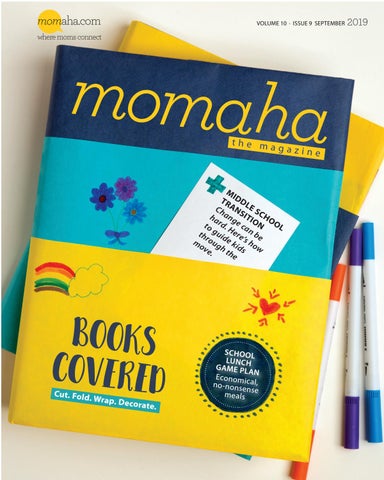
momaha.com
VOLUME 10 · ISSUE 9 SEPTEMBER
M TR IDDL Ch ANS E S ha ang ITIO CHO t o r d. H e ca N O L th guid ere n b e mo roug e ki ’s ho ve h t d s w he .
BOOKS COVERED Cut. Fold
. Wrap. D
e c o r a t e.
SCHOOL LUNC GAME PLH AN Economic no -nonse al, ns meals e
2019
When sneezes and runny noses aren’t simply colds, Boys Town Allergy & Asthma is here to help.
Sometimes kids need
extra special care.
Find a Boys Town Allergy & Asthma specialist at any of the following locations:
72nd Street Clinic 7205 W Center Rd, Ste 103 • Omaha, NE 68124 • (531) 355-7676
Lakeside Clinic 16929 Frances St, Ste 101 • Omaha, NE 68130 • (531) 355-5125 R
boystownhospital.org
Pacific Street Clinic 14080 Boys Town Hospital Rd • Boys Town, NE 68010 • (531) 355-6930
0000048424-01
When children are your everything, Anything can be. At Children’s Hospital & Medical Center, science and heart lead us to even greater pediatric breakthroughs. We provide the very best in pediatric specialty care, advance pediatric research, educate tomorrow’s experts and advocate for children, families and entire communities – to improve the future of medicine, and the life of every child. To find a physician for your child, call 1.800.833.3100 or visit ChildrensOmaha.org.
Education
•
Research
•
Advocacy
•
Care
1
THE WASHINGTON POST
CONTENTS
2
REAL MOMS + ADVICE
SEASONAL
SPONSORED FEATURES
4 Editor’s Column 5 On Our Radar 7 Be Well 11Get Organized 12 Momaha Bookshelf
8 School Lunches 16 Book Covers 18 Middle School Transitions 20 Popcorn Recipes 22 Pop Quiz 26 Bullying 30 Importance of Writing 32 High School Transitions 36 Second-Born Kids
6 Huntington Learning Center 10 Nebraska Educational Savings Trust 14 Learning Community of Douglas and Sarpy Counties 24 Fontenelle Forest 28 The Rose Theater 34 YMCA of Greater Omaha 38 Premier Dental
September 2019
0000062563-01
momaha where moms connect
VOLUME 10 . ISSUE 9 . SEPTEMBER 2019 editor in chief CHRIS CHRISTEN chris.christen@owh.com 402-444-1094
creative director + designer KILEY CRUSE cruse@owh.com 402-444-1375
assistant editor MARJIE DUCEY marjie.ducey@owh.com 402-444-1034
copy editor SHELLEY LARSEN shelley.larsen@owh.com 402-444-1143
momaha.com editor ASHLEE COFFEY ashlee.coffey@owh.com 402-444-1075
content contributors AMY TOKOS
cover photo KILEY CRUSE
account manager L AURE N KRUGE R lauren.kruger@owh.com 402-444-1261
account executive DEBORAH FERNSELL deborah.fernsell@owh.com 402-444-1209
SPEND A DAY AT MARIAN See what it’s like to be a Marian girl - we’ll match you with a current student. Shadow visits begin Sept. 16. For more information or to schedule a visit, contact Director of Admissions Molly Adams Woodman at 402.571.2618 ext. 1161 or mwoodman@omahamarian.org.
account executive E M I LY M A R T I N emily.martin@owh.com 402-444-1411
account executive M A R I LY N M A R T I N marilyn.martin@owh.com 402-444-1405
Momaha Magazine is a monthly publication of the Omaha World-Herald, 1314 Douglas St., Suite 700, Omaha, NE 68102. Momaha is a registered trademark, and all content is copyright 2019 by the Omaha World-Herald. All rights reserved. The opinions and perspectives published herein are those of the authors and should not be construed as those of Momaha Magazine.
7400 MILITARY AVENUE • OMAHA, NE 68134 MARIANHIGHSCHOOL.NET
3
MOMAHA.COM EDITOR ASHLEE COFFEY Wife to Kevin Coffey, music critic for the Omaha World-Herald. Mom to Sam and Elliott. Follow her on Twitter: @AshleeCoffeyOWH
And suddenly, kindergarten is here
E
very year, as summer vacation comes to a close, kids everywhere give a collective sigh about having to return to school. Since my school days ended years ago, this hasn’t been a concern of mine. Until now. My son Sam started kindergarten this year, and I couldn’t have dreaded it more. In fact, I’ve been dreading it since kindergarten roundup last spring. But back then I told myself, “I’ve got all spring and summer with him. It’ll go slow.” Boy, was I wrong. Of course it didn’t go slow. I wasn’t really worried about Sam going to an all-day school at a completely new place. He’s the type of kid who easily adapts to anything. He loves to do new things and meet new people. I knew Sam would be fine. I wasn’t fine. I was consumed with how fast everything suddenly seemed to be going. Wasn’t Sam just 2 and his brother, Elliott, a newborn? But then one day, before school, we went
shopping for uniforms. Sam was so excited about everything, but I walked into the store rather glumly, wishing we were doing anything but this. We grabbed a couple of kid-sized white polo shirts and steered him to the dressing rooms. I stood outside with Elliott while my husband went into the dressing room with Sam. Suddenly my phone buzzed. I opened the text message to see a photo of Sam, standing proudly in his new school clothes. I felt a huge lump in my throat and tears threatened to spill over, but I was also proud — excited even. He looked so cute and grown up. I realized then that dwelling on the fact that my kids are getting older doesn’t do me any good. It takes me out of the moment and prevents me from enjoying my children’s happiness at their own milestones. Of course, none of this stopped me from crying on the first day of school. But, hey — baby steps.
GET SOCIAL FACEBOOK /momahacom
4
September 2019
TWITTER @momaha_owh PINTEREST /momahaowh INSTAGRAM /momaha_owh
ON OUR RADAR MARJIE DUCEY
THINGS TO TRY THIS MONTH OFF TO BED Squeeze this NightBuddies turtle to make its eyes glow for three minutes at bedtime. With its bright fun colors and soft body, our 2-year-old reviewer was happy to snuggle with it. The lights are bright but small so they don’t keep children awake. Emmett, 2, had a little trouble activating the night light but not his big brother. Graham loved it because he could see in the dark. $14.99, cortextoys.com
FINGER FOODS, ANYONE? Bbluv stackable containers are ideal for individualized servings of formula or finger foods for toddlers. If you buy groceries in bulk, this route is more economical than toting individually packaged snacks. While the containers have screw-top lids, they are not leak proof, so only powdered or solid foods are appropriate. Microwave and dishwasher safe. $9.99. bbluvgroup.com
DESKMATE At 18 by 6 inches, the Glass Dry-Erase Desktop Computer Pad from Quartet is an organizational tool designed to sit between your keyboard and monitor. Using a dry-erase marker, you can jot notes, to-dos and reminders — even doodle on the desktop. Between notations, the pen rests in a tidy aluminum cradle. A small pullout drawer under the angled writing surface is perfect for holding small office accessories. The pad has a sleek design and a 15-year warranty. $26.95, quartet.com
A BIT OF ENERGY Journalists love food so there was no arm-twisting for a taste test of five flavors of soft and chewy Energy Bites from Unwrapp’d. The runaway favorite: Cinnamon Roll. Finishing strong: Peanut Butter Chocolate and Mint Chocolate. Peanut Butter scored respectably — “Close to a spoonful of peanut butter :)” Chocolate Chip Cookie Dough, however, fell short on the flavor meter. The Energy Bites are gluten, grain, soy and dairy free and come in recyclable, reusable jars. 10-ounce version, $9.95; 3-ounce variety pack, $11.99. eatunwrapped.com
ON THE GO This bblüv food container is great for keeping foods or liquids hot or cold on the go. The foldable spoon is not the sturdiest for a toddler, but an older child will have no trouble using it. The lid doubles as a bowl, but the 10-ounce container does not lend itself to easy pouring. Overall, a container that serves its purpose well. Not dishwasher safe. $17.99, bbluvgroup.com
5
SPONSORED FEATURE HUNTINGTON LEARNING CENTER
A plan for success Huntington offers tips to help teens with ADHD start the school year off right STORY Mary Rooney, Ph.D. ADOBESTOCK.COM
A
s the new school year begins, remember that teens with ADHD need extra programs and support to succeed academically. The following tips will help ensure that your teen has everything needed to succeed from the start. Involve your teen in the planning, so you’ll both feel confident.
ORGANIZATION
To be effective in school, kids need to be organized. Where do books go? Where do you take notes? Where do you write down assignments that need to be completed? Where do you keep handouts and worksheets? And what should you do with notices from school? Teens with ADHD have weak “executive functioning skills,” which makes it hard for them to stay organized. Help them create systems: Color-coded notebooks by subject, simple folder systems for storing worksheets and assignments, assigned places for everything from school supplies to school notices, and visual calendars.
GOAL SETTING
One of my favorite tools that a high school English teacher used with his students was the Grade Contract. At the beginning of the semester, he asked
students what grade they wanted to achieve in the class, and then shared the work they would need to do for that grade. The Grade Contract helped the students set specific goals and promoted a keen understanding of the milestones they would need to meet. In a less formal sense, parents can have discussions with their kids about course goals. Help your teen break down each goal into the necessary milestones and provide support to achieve the goals. Having a road map makes the end goal less daunting and helps your child stay focused. Since kids with ADHD struggle to sustain motivation for long-term goals, attach rewards and motivators to each milestone and check in regularly.
TIME MANAGEMENT
Staying on task and completing an assignment means understanding how to manage time. It’s helpful to coach your child through the steps of the first few assignments of the school year. Ask your child to articulate the assignment, then write out the plan of attack together. “First this, then that, next this, and after that …” Have your child check off each of the steps as he/she goes. After your teen announces he/she has completed the assignment, review the checklist. Praise
hard work and effort! If he/she has missed a step, have him/her make corrections before turning in the assignment. Eventually, pull back on your support and have your teen create his/her own plan of attack. If it goes well, you can supervise from a distance. If your teen is still struggling, then stay involved or get him/her extra time management support and skills training.
NAVIGATING UPS & DOWNS
One day, your child and his or her best friend may be inseparable and the next they may avoid each other completely. It’s difficult for parents to always understand their child’s evolving (and changing) friendships, but the best way you can be there for your child is by listening. Offer support and advice, but avoid getting overly involved. Navigating such ups and downs is an important part of your child’s development and growth. If your child needs more support than what you can provide, Huntington Learning Center offers an Advanced Study Skills Program to help kids improve their organization and executive functioning skills and give them practical tools for improving their goal setting, time management, memorization and recall, and study guide use.
ABOUT THE AUTHOR Mary Rooney, Ph.D., is a licensed clinical psychologist in the Department of Psychiatry at the University of California San Francisco. She serves as a consultant and ADHD expert to Huntington Learning Center. ABOUT HUNTINGTON Huntington is the tutoring and test prep leader. Its certified tutors provide individualized instruction in reading, phonics, writing, study skills, elementary and middle school math, algebra through calculus, chemistry and other sciences. Huntington offers prep for the SAT and ACT, as well as state and standardized exams. Huntington programs develop the skills, confidence and motivation to help students succeed and meet the needs of Common Core State Standards. Learn how Huntington can help at www.huntingtonhelps.com. For franchise opportunities please visit www. huntingtonfranchise.com. 0000062564-01
6
September 2019
BE WELL MARJIE DUCEY
REWARD OR HINDRANCE? Paying your children for good grades might not be worth the money
ADOBESTOCK.COM
I
t’s a tough question, Mark Weichel says. Should children be paid for getting good grades? Weichel is assistant superintendent for teaching and learning at Westside Community Schools. He’s also the father of four children. They are not rewarded financially for their academic performance. “I want them to know I value improvement and effort,’’ he says. “I want them to learn what they are doing in Mark Weichel class. I want them to have study skills.’’ Anna Sully Sparwasser, a counselor at Beveridge Magnet School, takes a different approach. She rewards her three children for good grades — just not with money. Anna Sully If a parent-teacher Sparwasser conference goes well, the family might celebrate with a popcorn and movie night. Or maybe a surprise trip for ice cream, which is a big treat for her kids. She’ll tell them that they stopped
because they did great in school, and she’s proud of them. “That’s my own parenting,’’ she says. Weichel and Sully Sparwasser do agree on one thing: Doing well in school is their children’s job, just like their parents have a job. The expectation is that they will work hard at that job and do their best, Weichel says. His two older daughters might even freak out, he says, if he offered them money to get an A on a test. It would add a lot of pressure. Instead, he wants them to focus on the fact that they’ve done the proper preparation and just need to demonstrate what they’ve learned. But Weichel says he wouldn’t chastise parents for paying their child if they believed it was motivating. Every child is different, and maybe sparking that motivation to study will make it become a habit. But Sully Sparwasser says sometimes rewards can backfire. One parent promised her child a cell phone for good grades. Once the phone arrived, the student’s grades plummeted. “It becomes this battle,’’ she says. “That’s hard.’’ She worries that payments for good grades may not be a good way of
preparing a child for the real world, where a good effort is expected at all times if you want to keep your job. “Every kid is going to have strengths and weaknesses,’’ she says. “They may not always get A’s, but as long as it’s their best.’’ But what do you do if your children aren’t doing their best? Instead of punishing a child for low grades, try setting clearer expectations about studying and grades, Sully Sparwasser suggests. “My husband and I ask our girls to be prepared, turn in your work on time and always do your best,” she says. There are consequences for poor grades, though. If a grade does not reflect a child’s ability or isn’t his best work, then parents need to address it. A negative consequence at home is only one option. “I think it’s more important to figure out what is going on for the low grade,’’ she says. “If the grade is not a student’s best work, then more has to be done, and that may involve staying for extra help after school, increasing homework time at home or cutting back on other activities in order to spend more time on studying.’’
7
NO-NONSENSE LUNCHES Sending your child to school with a tasty meal doesn’t have to turn your routine upside down
STORY Angela Davis/The Washington Post
ADOBESTOCK.COM
8
September 2019
D
o you hear that? It is the sound of parents everywhere chicken is a no-brainer, and a cold meatloaf sandwich is a delicacy your children deserve to experience in their lifetime. collectively exhaling as kids return to school. My days Many pastas will work for next-day meals, too. Noodles working from home have become eerily quiet, and tossed in marinara or an olive-oil based sauce are less likely the pantry and fridge are finally safe from daily raids by a to dry out. bored teenager and a toddler with an appetite rivaling “The » If you often have a smorgasbord of options in the fridge, Hungry Caterpillar.” This brief celebratory moment is often consider grain or pasta bowls for your more adventurous followed by dread, once I realize it is time to figure out a child. Here’s how to build them: game plan for school lunches. 1. Start by filling the base of a small food storage container I am a full-time recipe developer, so I am no stranger to with cooked rice, quinoa or other grains. Other things the kitchen. Every year, I try to convince myself that I am that work are cooked noodles and small pasta shapes like going to morph into the mom who creates smiley-faced sandwich cutouts, fruit skewers and homemade pizza dippers couscous or orzo. 2. Pile on some roasted veggies or raw salad ingredients like a Pinterest pro. But in the wise words of viral meme star such as sliced mini cucumbers, whole cherry tomatoes or Kimberly “Sweet Brown” Wilkins, “Ain’t nobody got time for diced peppers. that.” 3. Add your protein, such as As a single mom to two children shredded chicken, tuna, diced pork with busy schedules, I find a noor rinsed canned beans. If you have nonsense approach ends up working “My 4-year-old them on hand, capers, pickled veggies best. When I am grocery shopping, daughter is happy and olives can add acidity or brininess I look for lunch options that are to wake everything up. For kids who affordable and reasonably nutritious munching on an appreciate heat, add something spicy and do not require a ton of prep. such as banana peppers or a dollop of Bonus points if it is something that assortment of harissa paste. works for adult lunches too. Here are chopped grilled 4. Finally, some sort of dressing some of the ways you can follow my will help tie everything together. If lead and keep everybody fed and chicken or sliced you have a favorite store-bought happy, without complicating your routine. salami, cheese cubes, vinaigrette, use it! If not, it takes only a couple of minutes to shake up your » For kids who prefer to graze, raisins, apple slices own vinaigrette in a Mason jar to use lose the concept of a structured throughout the week. You can pack meal. My 4-year-old daughter is and crackers. It is this dressing in a smaller container happy munching on an assortment of chopped grilled chicken or sliced kind of like making a for your child to drizzle over the grain bowl when it is time to dig in. salami, cheese cubes, raisins, apple charcuterie board for » Sandwiches are traditional for slices and crackers. It is kind of like good reason. There is no shame making a charcuterie board for a a kid, with a juice box in packing a “regular” sandwich kid, with a juice box instead of wine. alongside chips, a piece of fresh fruit Compartmentalized plastic storage instead of wine.” and a drink. (Before you reach for the containers or bento boxes are perfect peanut butter and jelly, just make sure for lunches like this. your child’s school has not implemented a nut-free policy.) Older kids might appreciate extra protein in the form of To fend off boredom, let children choose their favorite sliced protein bars, hard-boiled eggs or hummus accompanied meats and cheeses from the deli counter — and by favorites by something hearty to dip, such as pita chips and sliced I mean whatever is on sale that week. Swapping sliced bread veggie sticks. You can buy individual packs of hummus, for pita pockets or tortilla wraps can break up the monotony. but it is cheapest to buy a family-size container (or quickly Use leftovers here, too: Most Sunday roasts will make make it from canned chickpeas) and portion it out yourself. great sandwich meats, chilled and sliced thin or diced. Think Guacamole is another great choice for dipping, but for the pork loin or ham, lean roast beef and just about any form of sake of keeping things fresh, single-serve cups can be worth poultry. For an easy veggie wrap, spread a large tortilla with the extra dollars. hummus or flavored cream cheese, top with an assortment of » Last night’s leftovers can find a second home in school sliced raw or (leftover) roasted veggies and roll it up. You can lunches. I am often thinking about how I will repurpose a bulk it up with greens or cooked grains. meal for lunch before I choose to cook it for dinner, and in » Keep food safety in mind. Young children are especially many cases I will cook more of it for just that reason. My vulnerable to food-borne illnesses, so take precautions to daughter attends a home day care where she can have her keep foods properly chilled (or warm) in insulated lunch bags lunch heated up, so dinner leftovers are the easiest thing to or thermoses until lunchtime. For cold lunches, include a send. Some schools offer a microwave for student use. reusable ice pack. Frozen juice boxes and squeezable yogurt Soups and stews can be reheated in the morning and tubes can double as ice packs, which will thaw and be ready poured into an insulated thermos to safely stay warm until to enjoy by lunchtime. lunchtime. Plenty of dishes also taste perfectly fine served Visit foodsafety.gov for tips on keeping school lunches safe. cold or at room temperature. Pizza and fried (or grilled)
9
SPONSORED FEATURE NEBRASKA EDUCATIONAL SAVINGS TRUST
SAVING FOR COLLEGE NEST 529 account is designed to grow alongside the kids, and this mom is ‘all in’ STORY Kristine Rohwer
C
ollege savings. Those two words used to throw my husband and me into giggle-fits when our children were babies. We were broke and had nothing we could possibly save, so the idea of having anything extra at all was laughable. I’ve learned a lot since my early 20s, back when I played the “I hope my card is approved for this tiny transaction” game. Now with multiple children — one a newly minted teenager — I’ve had to mature in the world of all things financial. And if I’m honest, I’m still just a novice. So if I’m excited about a plan that I fully understand, and it includes financial security for my children’s future, I’m all in. I’m talking about the NEST 529 College Savings Plan. You don’t have to be Ramsey or Orman to understand it. It’s a savings plan set aside for my children’s plans of higher education. And my kids have big dreams. Big expensive ones. I want them to have the opportunity to achieve those dreams, regardless of cost. A debt sentence doesn’t have to be a life sentence. My husband and I have managed to hold onto our student loan debt sentence for years, like most people our age. And that’s just the debt we racked up then, imagine the debt my children could acquire when they are ready to step into higher education. That’s why I had to start NEST 529 now, regardless of how little or grand our contributions. My contributions and those of loved ones are helping relieve future debt stress for my children’s future in higher education. Financial naiveté aside, we know we cannot cover all college expenses this way, but it will help. Our children range in age from preschool to high school. NEST 529 allows for Age-Based Investments, much like a 401(k), regarding each account. So what we put aside for our oldest, and considering we started his “college savings” late in the game, is different from our youngest who is still rocking
10
September 2019
ADOBESTOCK.COM
nighttime pull-ups. Our oldest is on the Aggressive Plan, while our baby is on the Growth Plan. This can change if our circumstances do, to whatever we want. The great thing is NEST 529 provides all sorts of investment options based on your child’s age and your level of risk. One size does not have to fit all, but we think these options work best for us.
Regardless of your current income or your financial knowledge (or in my case, general lack of ), you can start saving at any time. And you aren’t locked in; you can change beneficiaries at any time, and unused funds can be reallocated to other members of your family as long as they’re used for higher education expenses.
GET STARTED
“The NEST 529 College Savings Plan is full of incentives to help parents begin saving for their children’s education,” says Deborah Goodkin, managing director of savings plan at First National Bank of Omaha. ”It’s easy to contribute automatically from a bank account or through your employer. You can win contests and scholarships through the plan, as well.” NEST 529 College Savings Plan is a headache-free way of saving for a lifetime investment, and data agrees that children who know their parents are putting aside savings for college are six times higher to attend college and graduate, Goodkin says. 0000060332-01 Get details at NEST529.com
You can do this at home, in your pajamas, drinking coffee while pouring stale cereal for breakfast. Literally, five minutes and it’s done. Go online to set up a NEST 529 College Savings account or add a new beneficiary to your existing account. Contribute whenever you can or choose automatic payments from your bank account or payroll deduction program. “Set it and forget it,” if you will. Gone are the days of personal checks in birthday, baptism and graduation cards. Grandparents, godparents, aunts, uncles and family friends can contribute to the account electronically. It’s that easy and it’s paper free, meaning it’s environmentally friendly, too.
LEARN MORE
GET ORGANIZED AMY TOKOS Amy Tokos is a Certified Professional Organizer and the owner of Freshly Organized. You can find more organizing tips at freshlyorganized.com.
3 habits of highly organized families S
ome families have it, and some families long for it. It’s that sense of having it together. Here are three highly effective ways to bring organization to your household.
Knowing you have items and where to find them is fundamental to being organized. Think in broad categories: food, cleaning supplies, toiletries, school supplies. You get the idea. If you have to look several possible places for an item, then you might give it a home in the first place that came to mind. This will save you money. When like items are together, you know exactly what you have — and need. Consider your paper products: If you have plates in one space, plastic cups in another and utensils in another, it’s a bit chaotic pulling them together on demand. Having a space for all disposable/paper products can remedy this. If space allows, group paper towels, napkins and other paper products together.
PURGE CLUTTER
The less you have, the less you have to maintain. This is not a one-anddone clean-out. This is an everyday approach to stuff. Organized people are very intentional about what enters their spaces, and they are quick to get rid of things they no longer need. Having easily accessible donate bins and recycle bins can help create this habit in your family. The whole family participates in the maintaining of stuff in the home. They all share with the clean-out and contribute to the shopping lists. There is no one keeper
ADOBESTOCK.COM
HAVE A PLACE FOR EVERYTHING
of the stuff in the home. Along with this, there are good boundaries. Kids and parents know where their stuff belongs. An example could be kids’ toys. Let’s say you have them in a designated play space. That is their boundary. Toys can’t take over the whole house. If the play space is too full, then it’s time to do a clean-out.
COMMUNICATE
The two primary elements of good communication are a shared calendar and a weekly family “meeting.” The calendar can be paper or digital. The biggest key is that the whole family can see it and add items, if needed. Parents cannot be the keepers of the calendar.
As soon as kids can read, they need access. The family meeting doesn’t have to be anything formal. Just a weekly conversation over dinner about what’s happening. Topics can include tests, projects, activities, carpools, meal planning and shopping. This isn’t only the kids sharing; parents also need to share their schedules for the week. A work trip or big project due date are good things for the family to know. Also, share things you want to celebrate and are thankful for with the group. This process sets up the whole family to be looking ahead and understanding of what everyone has going on. It creates a truly collaborative environment.
11
MOMAHA BOOKSHELF MARJIE DUCEY
Hot off the presses Books to ease your way back into school The start of the school year is always an adventure. Kendall Munch, youth collection development librarian for the Omaha Public Library, suggests these titles to help ease the way.
PRESCHOOL-GRADE 2
GRADES 3-6 ”All Are Welcome” by Alexandra Penfold
”Back to School: A Global Journey” by Maya Ajmera and John D. Ivanko Whether they take a school bus, a boat or a rickshaw to get there, kids around the globe are going to school. Beautiful, joyfilled photographs of children studying, learning, exploring and having fun from nation to nation. ”The King of Kindergarten” by Derrick Barnes Starting kindergarten is a big milestone − and the hero of this story is ready to go. Barnes’ tale gives kindergartners a reassuring confidence boost. Vanessa Brantley-Newton’s illustrations exude joy.
12
September 2019
Follow a group of children through a day in their school, where everyone is welcomed. A school where students grow and learn from each other’s traditions and the whole community gathers to celebrate the Lunar New Year. ”School’s First Day of School” by Adam Rex It’s the first day of school at Frederick Douglass Elementary, and everyone is a little nervous. The school itself gets off to a rough start. But as the day goes on, the school recovers when it sees that it’s not the only one going through first-day jitters.
”The Friendship War” by Andrew Clements
Grace and Ellie have been best friends for years. Ellie is always right in the center of everything − and Grace is usually happy to be Ellie’s sidekick. But what happens when everything changes? This time it’s Grace who has everyone’s attention when she accidentally starts a new fad at school. ”Mr. Bambuckle: Rule the School” by Tim Harris There has never been a teacher like Mr. Bambuckle. Who else rides a unicycle while flipping bacon in a pan and wearing a dazzling blue suit? He gets to know each and every one of his new students, and makes learning exciting and fun. But Principal Sternblast is not impressed.
Enrich your child’s life! Art Music Dancing Instruments Acting Small Classes • Relaxed Environment
GRADES 4-7 ”Solving for M” by Jennifer Swender
Fall Classes start August 26 and run to December 7. For Information & Registration Contact Us Today! 402-556-7821 www.ArtsForAllOmaha.org
0000058783-01
Separated from old friends and starting new classes, Mika is far from her comfort zone. Math class is the most confusing of all, especially when her teacher assigns math journals. Maybe, with some help from friends, family and one unique teacher, a math journal can help her work out her problems.
7 city locations • $10/per Class
”The Unteachables” by Gordon Korman
The Unteachables are a notorious class of misfits. But they never thought they’d find a teacher who had a worse attitude than they did. During the year, Room 117 will experience mayhem, destruction — and maybe even a shot at redemption.
13
SPONSORED FEATURE LEARNING COMMUNITY OF DOUGLAS AND SARPY COUNTIES
novel ways to read Program shows how child literacy can bloom when words, pictures come to life STORY Dan McCann PHOTOGRAPHY Chris Christen
S
urrounded by attentive families, an open book in her hands, Debra Paris is in her element and, this particular evening, she’s wearing a regal purpleand-gold crown. “I like to get into costume for a character that I’m reading about,” she says. “I just like to bring the story to life.” The story, in this case, is “King Bidgood’s in the Bathtub.” Paris is holding court at one of the Learning Community Center of North Omaha‘s Prime Time Family Reading Nights, using her animated style of storytelling to emphasize to the kids, parents and caregivers that reading can be high-energy, highly interactive and fun. “When I’m telling a story, I like to involve everyone who is listening,” Paris says. “I like to use my voice and tone to make the story interesting. If we have to moo like cow in that story, then I want us all to moo like a cow.” She also makes a point to engage kids in a craft or other activity that relates to the story at hand. For the King Bidgood tale, she arranged for a bubble machine and coloring sheets. Reading, for Paris, is a lifelong passion. The veteran educator hopes to inspire a similar excitement in parents and caregivers so they can pass it on. Learning Community of Douglas and Sarpy Counties programs are anchored in the belief that parents are a child’s first and best teachers. When the lesson involves reading to them, the potential benefits are voluminous – from building vocabulary and letter recognition to boosting school readiness and grade-level reading skills. “When the child is ready for school, they’ll have a head start, and they’ll continue to develop a love of reading as they grow older,” says Paris, an Omaha Public Library partner-in-residence at the Learning Community Center of North Omaha. The Learning Community partnership with the library is part of a research-based approach to support family engagement in education. “When families establish a reading routine, the whole family
looks forward to it. Reading strengthens the bond between parent and child,” says Jamalia Parker, Family Engagement Services director for the Learning Community of Douglas and Sarpy Counties. Whether Paris is sporting a crown to share the story of a tub-loving king or donning her headto-toe llama costume for an active reading of “Llama Llama HoppityHop,” she is all in when it comes to promoting literacy and the upside to academic achievement. But she says, “You don’t have to dress up like I do.” With or without a costume, there are easy and effective ways for parents and caregivers to make reading come alive as a family routine. Back-to-school time is a perfect time to start! Set aside designated (and fully unplugged) family reading time, even if it’s only 15-20 minutes a day. Get into it! When reading, use voice and tone and bring in different sounds. Read everywhere. If you’re in the car, point out words on road signs and billboards. If you’re going to a restaurant, read the menu together. Pair reading with interests and activities. Whether your child is interested in arts and crafts, cooking or soccer, find books that tie into those subjects. If a trip to the zoo is on the horizon, read about the animals you’ll be seeing before you go. (Through the Omaha Public Library’s Partnership Pass Program, library cardholders can get free passes to Omaha’s Henry Doorly Zoo and Aquarium, Omaha Children’s Museum, Fontenelle Forest and Lauritzen Gardens.) Where are the “Wild Things”? As you read to your child, ask questions and talk about what’s happening in the story. This is a great way to build talking, listening, comprehension and problem-solving skills. Not sure which books to choose? Once school is back in session, ask your child’s teacher for reading suggestions.
FAMILY READING NIGHTS Family Reading Nights are part of the Learning Community of Douglas and Sarpy County’s Prime Time Reading program, a six-week class designed to show parents how to make reading active and fun. Supported by Nebraska Humanities, Prime Time Reading is offered several times a year at both the north and south Omaha Learning Community Centers. Learn more at learningcommunityds.org 0000062570-01
14
September 2019
0000064603-01
WELCOME BACK Does your family make time for reading everyday? This school year inspire your child to love learning. Reading together helps children of all ages succeed in school. Visit your Omaha Public Library and get started today.
LearningCommunityDS.org 0000062570-02
15
No-fail book covers
16
September 2019
Pocket design doubles the usefulness PHOTOGRAPHY + STYLING Kiley Cruse
T
extbooks will be begging to be cracked after an hour or two of making personalized covers at the start of the school year. This two-pocket design is perfect for holding assignments and notes home from teachers. Once the kids dress up their covers with doodles, stickers and stamps, there’s no chance of picking up someone else’s book by mistake.
What you need • Textbook to cover • 3 colors of wrapping paper • Washi tape • Scissors
Back to Swim Lessons register noW for once-A-Week sWiM lessons
• Ruler or yardstick
What you do
1. Unroll a length of wrapping paper and lay your closed textbook on top. Position the book 2 inches above the end of the paper and using a yardstick score a horizontal line. Then measure 2 inches above the book, draw a horizontal line and cut the paper. Crease the paper along the top of the book and then use the yardstick again to score a horizontal line. Set this piece of paper aside. 2. Unroll a second length of a different color wrapping paper and lay your closed textbook on top. Position the book 2 inches above the end of the paper and using a yardstick score a horizontal line. Then measure a few inches shorter than the top of the book, draw a line and cut. Set aside this second piece of paper. 3. Unroll the third length of a third color wrapping paper and lay your closed textbook on top. Position the book 2 inches above the end of the paper and using a yardstick score a horizontal line. Then measure a few inches shorter than the height of the second piece of paper you just finished cutting, draw a line and cut. 4. Fold up the bottom edge of each piece of paper along the score lines. Fold down the top of the first (largest) piece of paper along the score line. 5. Stack the bottom folds of all three pieces together, with the largest piece on the inside and the smallest on the outside. 6. Lay the spine of the book in the center of the paper and then wrap the paper over the cover, creasing along the vertical edge of the front and back covers. Pull the paper back from the book and fold along the crease lines. 7. Slip the front cover of the book into the front folded channel. Repeat, slipping the back cover into the back folded channel. 8. Secure the cover with decorative tape.
Ages 6 Mos. & older. Morning, Afternoon, evening & sAt. Morning
402-932-2030 LittleWavesFamilySwimSchool.com
Source: robert-mahar.com
17
QUANTUM LEAP Making the transition to middle school as easy as possible STORY Marjie Ducey
T
he transition to middle school can be scary but exciting. There are new classmates, teachers and classrooms and the dreaded locker combination. But middle school administrators, teachers and counselors across the Omaha metro area try to make the transition as stress-free as possible. Beveridge Magnet School in the Omaha Public Schools system schedules a week in June for students to get familiar with their new building and new routine. Then there’s a special day when school starts just for the newcomers. Westside Community Schools hold Warrior Walkabout, a halfday in May set aside for students to check out their middle school. Students can return before school starts for a more personalized visit. “They can come 20 times if they want, just to kind of go up to their locker and make sure they can open it. Or walk around and see where their classes are,’’ says Mark Weichel, Westside assistant superintendent for teaching and learning. Transition years are a big focus in the Ralston School District, too. A two-week bridge to middle school was held in July, with activities that explored the changes in academics ahead as well as social and emotional growth. “There were labs in a variety of different content areas that keep kids learning and prevent brain drain, while still making it fun for kids who are showing up,’’ says
18
September 2019
Jeremy Maskel, director of external relations and engagement for the district. Seventh-graders start the year with the middle school all to themselves, just as the district does for kindergartners and freshmen in high school. “The next day the older kids come back,’’ Maskel says. The transition to middle school can be just as tough on parents. Johnny or Susie may decide they are old enough to navigate things on their own and shun support from their parents. It’s actually the opposite of what they need, says Anna Sully Sparwasser, a sixth-grade counselor at Beveridge. “Talk to them about homework, ask questions about their friends, be involved and know where your kids are,’’ she says. “Parents need to be involved at this stage even though kids are acting like they don’t want it. Their frontal lobes aren’t developed.’’ Here are some of the bigger challenges facing both kids and parents at this new stage: Social media: The Internet and social media can be dangerous places for middle schoolers, so Sully Sparwasser says read those texts. Look over social media accounts. Be vigilant. “Kids can’t learn how to navigate the world in which we live without parents helping them,’’ she says. Organization: Your child shouldn’t be headed to school
without a planner, notebooks and pencils. Sully Sparwasser says her school calls it being “Beveridge ready.’’ Teachers will try to help them be organized but need reinforcement from parents. “It can be overwhelming.’’ Friendships: It’s a whole new world, and middle school students are learning how to navigate through a lot of new relationships. The more you know your child’s friends, the easier it can be if issues arise. Grades: Don’t let your child become overwhelmed and fall behind. Most schools give parents access to all of their child’s academic endeavors. You can see what assignments are missing or how they did on a test. Worried? Call or email a teacher if you have concerns. Extra activities: Sully Sparwasser says studies show that kids involved in activities do better in school. Tell your child to take part in at least one, whether it be sports, drama or band. It builds community, too. It’s also good to increase responsibilities at home. It will take a few weeks, but soon your child will be walking the halls of middle school like a pro. Just be patient, Sully Sparwasser says. “The kids are changing, their brains are changing, their bodies are changing,’’ she says. “It’s that balance of holding them accountable but also supporting them.’’
0000062569-01
19
POPPIN’ GOOD Movie night just got more a-maize-ing TEXT + PHOTOGRAPHY The Popcorn Board
Cookies ’n Cream Popcorn
20
September 2019
A
sk a popcorn lover how popcorn is best eaten and you’ll get a range of answers from “lightly salted,” “sprinkled with Parmesan cheese,” “tossed with herbs and spices,” to “drizzled with chocolate and almonds.” The best answer, perhaps, is “quickly.” Here are four flavorful variations on an American classic.
Down Home Apple Pie Popcorn Makes 10 cups
Blueberry and Pomegranate Power Bars
• 3 tablespoons melted butter • 1 teaspoon vanilla extract
Makes 12 bars
• 2 tablespoons brown sugar
• 8 cups popped popcorn
• 1 teaspoon ground cinnamon
• 1 1/2 cups old-fashioned rolled oats
• 1/8 teaspoon ground allspice • 1/8 teaspoon ground nutmeg • 8 cups popped popcorn • 1 cup dried apple chips, broken into large pieces • 1/4 cup toffee bits
1. Heat oven to 300 F. Whisk melted butter with vanilla. Toss brown sugar with cinnamon, allspice and nutmeg. 2. Toss popcorn with butter mixture. Sprinkle evenly with brown sugar mixture. Stir. Transfer to baking sheet lined with parchment paper. 3. Sprinkle apple chips and toffee bits over top. Bake for 15 minutes or until toffee bits start to melt. Cool before serving. Tip: Add chopped pecans for extra crunch.
Cookies ‘n Cream Popcorn Makes 12 cups
• 12 cups popped corn • 11-ounce package white chocolate chips • 2 teaspoons coconut oil • 15 chocolate sandwich cookies, coarsely chopped
1. Place popcorn in large bowl; set aside. 2. In medium saucepan on low heat, melt chocolate chips and coconut oil; stir until blended. 3. Pour melted chocolate over popcorn, stirring until well-coated. Stir in chopped cookies. 4. Spread mixture on baking sheet and chill until chocolate has set. Break into pieces to serve.
Maple Bacon Popcorn
• 1 cup dried blueberries
• 8 cups popped popcorn
• 1/2 cup whole natural almonds, toasted
Makes 2 quarts
• 6 slices thick-cut bacon • 1/4 cup pure maple syrup • 8 cups popped popcorn • 2/3 cup pecan halves, coarsely chopped • 2/3 cup dried cranberries • 2 tablespoons butter or margarine • 1/4 teaspoon coarse ground black pepper • 1/4 teaspoon maple extract
1. Heat oven to 400 F. Line jellyroll pan with foil. Place wire rack in pan. Arrange bacon in single layer on rack. Bake 15 minutes until ends of bacon start to curl. 2. Remove and reserve 2 tablespoons of the bacon drippings. Brush bacon with 2 tablespoons of maple syrup; bake 15 minutes until browned. Cool then coarsely chop bacon. 3. Combine popcorn, pecans and cranberries in large bowl. 4. Combine butter, black pepper, maple extract, remaining 2 tablespoons maple syrup and reserved bacon drippings. Cook over low heat until butter is melted. Drizzle over popcorn mixture and mix thoroughly. 5. Spread popcorn mixture in jellyroll or roasting pan. 6. Bake 5 minutes. Toss in bacon pieces. Serve warm.
• 1/2 cup pomegranate seeds and coarsely chopped • 2/3 cup honey • 2/3 cup light brown sugar • 2 tablespoons butter or margarine • 6 ounces bittersweet chocolate, melted
1. Line 13-by-9-inch pan with foil; spray with cooking spray. 2. Combine popcorn, oats, blueberries, pomegranate seeds and almonds in large bowl. 3. Combine honey, brown sugar and butter in small saucepan; cook over low heat to boiling; boil 2 minutes. Pour over popcorn mixture and mix thoroughly. 4. Using damp hands, press mixture firmly into prepared pan. Refrigerate until firm, about 2 hours. Cut into 12 bars. 5. Dip bottoms of bars into melted chocolate. Place on wax paper-lined pan; refrigerate until ready to serve. Store in air-tight container in refrigerator. Recipes + photographs from popcorn.org
21
POP QUIZ How many kernels of truth can you identify? TEXT + PHOTOGRAPHY The Popcorn Board
22
September 2019
Test your knowledge of one of America’s oldest snacks. Fear not; we’re not keeping score. This is pure and simple entertainment.
1.
6.
The average American eats how much popcorn each year?
How big are popcorn kernels after they pop?
a. 51 cups b. 51 pints c. 51 quarts d. 51 gallons
a. 2–3 times the original size b. 10 times the original size c. 20 times the original size d. 35–40 times the original size
2.
7.
“Zea Mays Everta” is what?
a. The motto (in Latin) of Popcorn University, meaning “Long Live Popcorn.” b. Popcorn’s scientific name c. The name of the woman who discovered popcorn d. A Native American reference for popcorn
3.
The world’s first mobile popcorn machine weighed 400 to 500 pounds and was often pulled by a… a. Young boy b. Large dog c. Tractor d. Circus elephant
4.
Popcorn explodes when …
a. The water inside is superheated and turns the starch to a gelatinized goop b. The gelatinized goop reaches about 347 degrees c. The pressure inside the kernel reaches about 135 pounds per square inch d. All of the above
5.
Popcorn grows on a stalk, which has several of these growing on it. a. Eyes b. Ears c. Heads d. Arms
Long before the advent of the cornflake, Ella Kellogg ate popcorn ground with milk or cream for breakfast. a. True b. False
8.
There are six types of corn:
a. Popcorn, sweet, dent, flint, pod, field b. Popcorn, sweet, ground, field, Indian, dent c. Popcorn, sweet, dent, flint, flour, pod d. Popcorn, sweet, field, ground, flint, pod
9.
Popcorn kernels need how much moisture to pop? a. 10–12% water b. 13.5–14% water c. 18.5–20% water d. 20% water
10.
If you dry kernels of sweet corn, they will pop just like popcorn when heated. a. True b. False
11.
12.
In 1945, an engineer named Percy Spencer used popcorn in his efforts to develop this: a. Television b. Popcorn popper c. Microwave oven d. Air freshener
13.
Air-popped popcorn has how many calories per cup? a. 31 calories b. 41 calories c. 51 calories d. 61 calories
14.
One of the earliest methods of popping popcorn involved: a. Wrapping kernels in layers of animal fat and placing in a clay pot over an open flame b. Placing kernels in a covered pot in the hot sun to warm for several hours c. Wrapping heated stones and kernels together in an animal skin d. Mixing unpopped kernels with extremely hot sand
15.
When a popcorn kernel is heated, the hard outer surface acts like what kitchen appliance? a. Pressure cooker b. Blender c. Microwave d. Food processor
Popcorn is a…
a. Carbohydrate b. Fiber source c. Whole grain d. All of the above
Find the answers on page 40
23
SPONSORED FEATURE FONTENELLE FOREST
Connecting with nature Nature Deficit Disorder. It’s a thing, and here’s the cure STORY Michaela Galeski
I
n today’s tech-rich world, children spend more time indoors than outdoors, and recent studies go as far as to give this reality a label: nature deficit disorder. According to the Child Mind Institute, the typical American child spends four to seven minutes a day in unstructured play outdoors and about seven hours a day in front of a screen. Here are ways to break the cycle and connect with nature.
LEND A HAND
Spend quality time outdoors while leading by example. Through volunteering, children are able to “get up close and personal with nature. They get to learn the value of hard work. They see the results of what they’ve done, and they get that sense of accomplishment from it,” says Michelle Foss, manager of stewardship and research at Fontenelle Forest. Foss oversees Fontenelle Forest’s volunteer work days, when community members gather to get their hands dirty. The work days typically are the third Saturday of every month, either at Fontenelle’s Nature Center or at Neale Woods, beginning at 8:30 or 9 a.m. Monthly work days are family-friendly, and can be tailored by age and skill set. Volunteers must pre-register, and children must be accompanied by a parent. “We have such a wide variety of people who come to our work days. ... It gives kids and adults a chance to learn from each other out in the fresh air,” Foss says.
JOIN NATURE EXPLORERS
A new club at Fontenelle Forest makes sure kids spend more time in nature. “Our kids are overscheduled a lot of the time, and the opportunity just to play and be wild and free doesn’t happen all the time,” says Catherine Harrington, club founder.
COURTESY OF FONTENELLE FOREST
“So that’s what we want to facilitate. “An appreciation for nature and our planet is so important for children. They’re obviously the future, and they’re the stewards of the earth going forward.” The Nature Explorers Club is open to children up to age 18, but the primary focus is on children in lower elementary grades. Kids learn to work collaboratively while parents and children cultivate memories together. Coming events include nature walks, making your own trail mix and bird feeder, and a lesson on recycling. Follow the Fontenelle Forest Nature Explorers on Facebook and Instagram for more information or go to fontenelleforest.org.
PLAY CITIZEN SCIENTIST
Why not simply go exploring? There are options everywhere to help gather scientific data with your children. The iNaturalist app provides a productive outlet for natural curiosity and allows anyone to become a scientist in their own right. Explore 19 miles of trails at Fontenelle Forest and join people from all over the world taking photos of flora and fauna
and identifying them instantly. No matter how small, every observation you make can contribute to biodiversity science, from the rarest butterfly to the most common backyard weed. iNaturalist shares your findings to help scientists discover and utilize your data. All you have to do is go out and observe.
BE A TEEN NATURALIST
Are you looking for opportunities for your teen to build a resume and engage in the community? The Teen Naturalist Trainee (TNT) Volunteer Program provides students ages 13 to 19 with experience in community service, networking and skills for their future careers. Next spring, our TNT program will ramp up as we train a new team of high school students to lead education stations along the forest boardwalk and in the Nature Center. As visitors hike the trails, they could encounter stations where your teen engages them through educational activities. Email us at info@ fontenelleforest.org for more information. See more programs and events at fontenelleforest.org. 0000062579-01
24
September 2019
0000062579-02
25
WHAT KIDS CAN DO IN THE FACE OF BULLYING STORY + PHOTOGRAPHY Metro Creative Connection
M
any adults may recall being bullied or witnessing bullying when they were in school. Despite that, it’s important that adults, including parents and educators, not see bullying as an inevitable part of growing up. The effects of bullying can be severe, affecting those involved — including the bullied, the bullies and those who merely witness bullying — long after their school days have ended. According to the U.S. Department of Health and Human Services, bullying has been linked to various negative outcomes, mental health issues, substance abuse and suicide. When taking steps to combat bullying, parents and educators should not overlook the benefits of enlisting children in their efforts. Kids can be great allies in the fight against bullying. Here’s how children and adults can work together and keep lines of communication open.
WHAT ADULTS CAN DO
StopBullying.gov, a DHHS website devoted to stopping bullying, notes the importance of teaching kids to treat everyone, including other children, with respect. Parents can teach kids to pause before saying or doing something that can be harmful to someone else. Bullying inflicts physical and emotional pain on its victims, so teaching kids to recognize that words can be just as harmful as fists may encourage them to think twice before saying something mean to a classmate. The DHHS also recommends advising children to do something else if they feel an urge to say or do something mean. Teach kids to
26
September 2019
walk away from a situation to watch television, play a video game or engage in another activity rather than saying or doing something hurtful.
WHAT KIDS CAN DO
Kids being bullied can employ certain strategies to overcome bullying. The DHHS recommends teaching children to look at bullies and tell them to stop in a calm, clear voice. Laughing it off also might work for kids who find joking comes naturally to them. The DHHS advises against fighting back, instead suggesting kids walk away and stay away before finding an adult who can stop the bullying on the spot. Encouraging students to confide in adults they trust also can help them overcome bullying and the feelings of loneliness that bullying
can elicit. Trusted adults can help children devise a plan to stop the bullying. The DHHS notes that most bullying happens when adults are not around, so staying near adults and other children can help kids avoid situations where they might be vulnerable to bullies.
WHAT WITNESSES CAN DO
Bullying can have a negative impact on children who witness bullying, even if they aren’t the victims. Adults can encourage children to speak to trusted adults and to report instances of bullying. In addition, kids should be encouraged to be kind to other children who are being bullied, inviting them to sit with them on the bus or in the lunchroom and engaging them in conversations about topics that interest them.
0000062559-01
Grow with us! You’re invited to schedule a free meeting to get to know our pediatricians and staff.
A NEW EXHIBIT
Boys Town Pediatrics offers: • 24-hour nurse helpline • 24-hour appointment scheduling • Extended evening and Saturday hours • Same Day Pediatrics for sick appointments * Five convenient Omaha locations
SEPTEMBER 28 – JANUARY 5 SEE MORE INF O AT
S AC M U S E U M . O R G 28210 West Park Hwy, Ashland, NE 68003 402.944.3100
boystownpediatrics.org
0000062548-01
For the Kids
INTO
September 11 - 15, 2019
AT O U R C O N S I G N M E N T S A L E S
For Juniors & Adults
kidzshoppeomaha.com
October 23 - 27, 2019 hizandherzomaha.com
Both Sales Held at the
Omaha Sports Complex 14706 Giles Rd
Wed-Fri 9:30 am - 7:00 pm Sat 9:30 am - 6:00 pm Sun 9:30 am - 3:00 pm*
*50% off select items as marked 0000062554-01
27
SPONSORED FEATURE THE ROSE THEATER
Grow at The Rose New slate of fall classes perfect for novices and seasoned performers
H
appy New Year! What? You don’t consider August the start of the new year? Look at the stores, the commercials, the newspaper inserts. The start of a new school year is upon us. And with the new school year comes an exciting time at The Rose Theater: the beginning of a new year of classes! In 2020, The Rose is looking forward to a new, larger education facility and expanded opportunities for students to grow their talent, skills and performance techniques. Registration is now open for The Rose’s new slate of classes for ages 2 to 18, whether beginner or seasoned pro. While it might not be Jan. 1, this is the perfect time to make a few resolutions.
GIVE IT A TRY
Our introduction to dance and movement classes are designed for our youngest artists. Older students can take triple-threat classes in ballet, tap, jazz and more. Saturday morning creative drama classes themed around popular movies and books give students the ideal entrance to acting over eight weeks.
ENROLL IN SOMETHING NEW
It might be a dance class in a genre you haven’t explored or one of many DRAMA at The Rose acting classes, but it is always exciting to stretch your imagination and your skills with something new. Classes are offered after school and Saturdays at several locations. The Rose’s drama and dance programs feature a progression of classes that allow students a solid introduction to the arts along with a pathway to improve their skills while working with professional teaching artists.
AUDITION
Whether you want to try out for The Dance Lab competition team, show off
THE ROSE THEATER/ALEX MYHRE
your triple-threat skills in Rose Brigade, participate in a work devised by you and your friends in a Teens ‘N’Theater production or step into the spotlight in a mainstage production, we encourage you to go for it! You never know what might happen. Rose classes will help you prepare for auditions at school, in the community, at college — and maybe even Broadway itself.
GO ONE STEP BEYOND
Have you always taken The Rose’s after-school drama classes, but stopped short of doing a production class that culminates in a full performance on stage? Have you participated in a group voice class, but haven’t ventured into a private lesson? Have you ever wondered what an intensive acting technique class might offer? The Rose offers classes in a safe, friendly environment led by working professionals who can share the ins and outs of performing in the “real world.”
BE IN A SHOW
Many classes culminate in a production. Taking your first few steps on the stage? Try “Sherlock Holmes & the First Baker Street Irregular” (written by The Rose’s playwright-in-residence Brian Guehring) or “Shrek the Musical Jr.” production classes, which will put a full-fledged student show on our smaller Hitchcock Stage. Have you always dreamed of performing on the mainstage? Check out our dance or musical theater classes, all of which end with a full performance, complete with lights, costumes and more. Want to strut your stuff in front of industry professionals? Audition for The Rose Brigade! Discover all the things The Rose has to offer this fall by visiting rosetheater. org. Use the Class Filter Tool to help you find the perfect class, based on your age and interests. Get ready, get set — GROW! 0000062574-01
28
September 2019
2136132-01 0000062574-02
@
2019-20 CLASSES ENROLLING NOW! «Ages 3-18 «Classes taught by professional artists «Year-long & short-term classes «Many performance opportunities «3 Convenient locations throughout Omaha
REGISTER TODAY!
(402) 345-4849 ★ www.rosetheater.org
ACTING ★ DANCE ★ VOICE ★ MUSICAL THEATER ★ DRAMA Omaha’s premiere theater arts education program
29
Is teaching writing as important as teaching reading? Literacy depends on it, experts say. Writing empowers students to find their voice and place in the world STORY Molly Sprayregen/The Associated Press PHOTOGRAPHY Syed Ali Haider
W
hen we think of literacy, we tend to think of reading. Schools, literary nonprofits and philanthropists often focus on encouraging students to be strong readers with solid comprehension skills. While those skills are crucial, many experts say critical and creative writing skills are equally important, and are too often overlooked. Compared to reading, writing is more active, encouraging students to be independent thinkers, take ownership of their own stories and ideas, and communicate them clearly to others, says Elyse Eidman-Aadahl, executive director of the National Writing Project, which offers resources for teachers who want to encourage students to write. “Unless we want an education system just focused on making people consumers and not focused on helping them be producers, this emphasis on reading only, which does happen in so many places, is very short-sighted,” she says. Even when students are given writing assignments, she explains, the work tends to focus on assessing a text, rather than on presenting a new idea. Writing, she says, should be “the central thing you’re learning. Not writing on a test, not writing to demonstrate you’re learning what someone has taught you, but also really writing as an author writes.”
30
September 2019
Reading, of course, contributes immensely to personal growth. But teaching it together with writing nurtures both, says Rebecca Wallace-Segall, executive director of a New York City writing center, Writopia Lab. “Writing impacts your ability to read,” she says. “Over 90% of our kids who come in as reluctant writers ... become more engaged readers as they’ve fallen in love with the writing process.” From a practical standpoint, writing is more important than ever; we depend on it for personal and professional communication. “We see this from employers all the time. They’re looking for folks who can write,” says Eidman-Aadahl. “Certainly with digital tools right now, think of what we’re all doing all day. We’re probably interacting with the Internet through writing.” Kids are already writing all the time, in texts, emails and social media posts. “Whether they’re actually being provided with the opportunity to learn to write, whether schools are addressing it or not, they’re already writing and publishing,” Eidman-Aadahl says. “Every young person is an author today if he or she is connected to the Internet. So we have to help them do it in the best, most responsible, critical, pro-social way.” Advocates of teaching writing say it is
Ten-year-old Genevieve Thiel shows off her work during Austin Bat Cave’s Magical Realism summer camp in Austin, Texas. Educators say teaching critical and creative writing is just as important as strong reading and is too often overlooked.
empowering. “When students own their voices and tell their stories, they become not only stronger and more confident writers, but also stronger and more confident individuals,” says Ali Haider, executive director of the Austin, Texasbased creative writing center, the Austin Bat Cave. Wallace-Segall says writing also helps students work through difficulties. “Creative writing, it’s a lifeline for us,” she says. “We’re watching kids work through their greatest challenges, subconsciously. They’re not writing a story about a difficult father or directly about a bully in class, but they are creating a fictional scenario that might feel distant enough for them to go deep into it.” And teaching students to write can have an impact on the larger world, notes Dare Dukes, executive director of Deep Center, an organization in Savannah, Georgia, that works with young writers to share their stories with policymakers, judges, politicians, police officers and the like. “So those adults can see that the stories they’re telling themselves about those young people are often wrong and doing a lot of harm in the world,” says Dukes.
31
THE ASSOCIATED PRESS
A student uses an iPad and Apple Pencil. Many high school students will either need or want to have some kind of laptop or tablet.
New high schoolers benefit from having the right gear As students become more independent, the right supplies can help them be organized STORY Katherine Roth/The Associated Press
T
hrough eighth grade, preparing for school is largely a question of checking off items from a recommended list of supplies. Preparing for high school? That’s something different that takes a little more thought and a lot more involvement by your teenager. “High school is about setting kids up to be more independent, and schools often don’t tell you specifically what supplies you need at this point,” says Amy Tokos, a professional organizer who runs the Omaha-based Freshly Organized. “It’s a time when kids get to explore what they want to do, a time of trial and error, and more unstructured time. And it’s important for families to remember the goal: It’s for you to have a college student in four years who knows how to organize
32
September 2019
themselves and how to be successful at school,” she says. The right supplies matter. And beyond that, talk as a family this summer about strategies for doing well and feeling good in high school, the experts say. Time management and self-care, like getting enough sleep seem to be among the big issues that come up early in high school.
GEAR
Backpack: High schools are big, and often kids don’t use their lockers, so investing in a good backpack is important. It should be sturdy, with padded shoulders and places for pens and pencils, a calculator, and a padded section for a laptop or tablet. Avoid backpacks with wheels because that might encourage kids to carry too much, Tokos says.
Electronics: Most high school kids will need some kind of laptop or tablet. Each school is different, so check with a counselor about policies and recommendations, says Ellen Delap, a professional organizer based in Texas, who runs Professional-Organizer.com. And invest in a sturdy case for protection. “These things do break,” she says. Planner: Even though many schools post assignments online, a paper planner helps kids visualize their days and weeks, Delap says. Leslie Josel, another organization pro, who runs the New York-based Order Out of Chaos, adds: “It’s not just about long- and short-term assignments, it’s also about managing when that work can be done amid sports and clubs and all the other activities that come up.” She has devised a planner
Planners can help students complete assignments on time.
that includes places to list after-school activities as well as assignments and tests. Filing system: It sounds big and overwhelming, but having a system in place can be super valuable once volunteer forms, subject study guides and college information all start rolling in, Tokos says. Get a file box that holds about 12 hanging files and is open on top, so your student can keep it in their bedroom or study area, she says. Papers, binders and plastic sheet protectors: Every kid is different, and by high school lots of kids know what works for them in terms of notebooks and binders. But it may take some trial and error figuring out what works best in ninth grade, OCIATED PRESS Tokos says. Josel recommends a binder with an accordion folder section, and plastic protector sheets for crucial t. papers like that Spanish verb list or the periodic table. Delap recommends binders with slash pockets, where papers can be filed quickly. She and Josel both recommend color coding binders or folders by subject. Extras: Josel urges families to consider getting headphones for their kids, because she says they often help kids study better. Sometimes ambient sounds or music (though not new music, she says) helps them focus. Kids can get busy now putting together a playlist for every subject, timed for around a half hour to 45 minutes, so they focus for that long on a subject, and then take a short break before starting in on the next one. She also suggests a portable, three-sided privacy shield that kids can use while working at the kitchen or dining room table to avoid distractions and prying eyes. ids ablet. HELPFUL CONVERSATIONS Parents should focus on asking, not telling, the experts say, d and make sure kids are involved in selecting their gear and p, a figuring out the ground rules and systems they’ll need. xas, Study plan: Josel recommends helping kids think about om. how they study best, before the deluge of high school tection. assignments. Her “personal homework profile” sheet, available free at orderoochaos.com, asks kids where and when they hools study well, for instance, and whether they do better working planner under the pressure of a tight deadline or incrementally over time. other Screens: Get everyone involved in coming up with ground w rules the whole family can live with regarding screen time. ds: Tokos recommends designated “power hours” with no -term electronic distractions for 45 minutes at a time so kids can ging focus on homework, allowing a 15-minute break at the end so sports kids can check their phone if they’d like, before focusing once es that again on their work. And begin a no-screens-in-the-bedroom er policy well before school starts, Delap says.
Full and Part Time Child Care Three ConvenienT LoCaTions 192nd and Pacific • 402-991-0696 178th and Pacific • 402-452-3057 180th & Dodge • 402-932-2922 ConTaCT Us For enrollment & additional information enrollment@smallMiracleChildcare.com
www.smallmiraclechildcare.com
0000062562-01
33
SPONSORED FEATURE YMCA OF GREATER OMAHA
Exercise and socialize Mom of three loves the YMCA for the healthy living it promotes STORY + PHOTOGRAPHY Mike Watkins
B
efore she and her family – husband Grant, daughter Isla and son Maddox – relocated to Valley three years ago, Abbi Gowen wasn’t a member of the YMCA of Greater Omaha. Living in Omaha, she joined a gym and found her classes and workouts there. The kids, now 6 (Isla) and 5 (Maddox), were too little at the time to be involved with activities outside their home or daycare. But now that they are members of the Valley community, Abbi, a pediatric nurse who is taking a break from working to be full-time mom to Isla and Maddox as well as 2-year-old Halle, says the family has found a home at the Twin Rivers YMCA in Valley. And they love it. “We come here, on average, five times a week – six when the kids have sports or other activities – because we all love it,” says Abbi, who hails from Hastings, Nebraska, and grew up in athletics, swimming as well as playing tennis and volleyball. “The kids love coming here for Child Watch, and I love coming here. “Class is time for me to work out, exercise and socialize with other moms who also love coming to the Y. And the kids love playtime. And then we have time together to play before we head home.” Abbi says she always wanted to be a mom, which was reflected in every job she had leading up to becoming a nurse. She was a baby sitter and lifeguard in high school and college and also gave swimming lessons. During her Y time, she enjoys kickboxing, spin, H.I.I.T. classes and ultimate strength and cardio classes. Although she has yet to teach a class, she says it’s on her radar despite not being a big fan of having all eyes on her
Abbi Gowen and her three kids – from left, Halle, Maddox and Isla – play with hoops and sliders at the Twin Rivers YMCA in Valley.
in a class setting. Still, she says the social aspect of coming to the Y – combined with the health benefits of exercise – are big draws for her. Having been new to the community and not knowing anyone in town, Abbi says she has created many strong friendships through her Y connections. She loves that the Twin Rivers YMCA is small enough that staff know her and the kids by name when they walk through the doors. “It’s really a family here; everyone makes us feel so welcome,” she says. “It’s motivating to come to class and know people. The kids have a lot of buddies
here. We love it.” In addition to their playtime at Child Watch, both Isla and Maddox have played basketball and taken swimming lessons. This summer, they participated in fishing camp. Abbi says the value for her family is definitely the healthy living that the Y promotes. “I like that the kids see me active and healthy.” She’s inviting neighbors to check out the Y, as well. “I’ve made it a point to tell them about the value and benefits of a Y membership, and now many of them come, too. It’s been a great experience that continues to get better and better.” 0000062575-01
34
September 2019
BUILD MORE THAN MUSCLE
YMCA OF GREATER OMAHA • metroymca.org 0000062575-02
35
Second-born kids are more likely to be troublemakers, science says STORY Ashlee Coffey PHOTO Erin Dunaway Photography
W
hen I was pregnant with my second child, I couldn’t count the number of people who told me to “hang on — second kids are tough.” I sort of scoffed at the idea at the time. My oldest son, Sam, was such an easy baby that I couldn’t imagine this new baby being anything but the same. But then Elliott was born. He made me throw out the window everything I thought I knew about being a parent. It’s like he knew, even as an infant, that his brother did something one way so he was going to do it the opposite — and most difficult — way. Well, there’s now scientific evidence that backs up the theory that second-born children are indeed the troublemakers of the family. That goes double for boys who are born second. The study, performed by MIT economist Joseph Doyle, examined data from families in Denmark and Florida. “Despite large differences in environments across the two areas,” he wrote, the results were consistent. I should have known. Even my pregnancy with Elliott was a roller coaster of events — doctors thought I was having a molar pregnancy early on, I developed gestational diabetes and my epidural failed during labor. I thought maybe things would turn around after that. And they kind of did. For a little while. Elliott was the easiest baby during his first two weeks of life. I think he was just trying to get us comfortable before hilariously crushing our dreams of having a kid who slept through the night early. After those first two weeks, he refused to sleep alone for 11 months. Even today at 2 years old, he prefers to have us around 24/7. And while his 5-year-old brother isn’t one to test boundaries, Elliott has no
36
September 2019
Sam and Elliott Coffey.
fear. He jumps, runs and climbs through our house as though he’s invincible (which, by now, he should know he most definitely is not). He’ll give me a side-eye look while doing something he knows he shouldn’t, and more often than not will act like he doesn’t hear me when I tell him to stop. He doesn’t mind snatching toys from Sam. I once witnessed him smack his big brother right across the head over a toy. He willingly went to timeout on that one. We utter the phrase “go to timeout” more than we ever have in Sam’s five years. Elliott accidentally tripped a fellow toddler at day care and, instead of apologizing, stood there laughing hysterically. (He did eventually say he was sorry.) Recently, he bailed buckets of water out of the bathtub when my husband walked out of the room to grab towels. What an unpleasant surprise to walk
into a puddle of water flowing out into the hallway. If you leave a toy unattended, Elliott will find it. Leave treats out? Elliott will open them. Leave a crayon out? Elliott will use it on the walls. Or the floor. Or the couch. He’s not afraid to speak up when you’re doing something that makes him mad. Perhaps this is more normal toddler behavior, and it’s new to us because Sam was pretty much the easiest kid ever. Despite Elliott’s propensity for trouble or his complete disregard for rules, he has the biggest heart. When he loves you, he really loves you. He might laugh when you fall, but if you’re hurt, he’s the first to offer kisses on your boo-boo. Yes, my second-born might be a bit more ornery than his brother, but he’s the sweetest kid — and worth all that trouble.
0000062567-01
37
SPONSORED FEATURE PREMIER DENTAL
FINDING THE RIGHT FIT Preventive care from a young age is key to oral health STORY Maggie O’Brien PHOTOGRAPH Courtesy Premier Dental
C
hoosing the right dental practice is key to good oral health. Dr. Daniel Beninato of Omaha’s Premier Dental says a dentist who takes a preventive rather than a wait-and-see approach can save your child’s teeth. The American Academy of Pediatric Dentistry recommends that oral hygiene habits begin by age 1 and include biannual exams. “Establishing dental care for your child at an early age helps us identify any early developmental issues and teaches children that going to the dentist isn’t a scary, unpleasant experience,” Beninato says. “What’s more, kids who understand the importance of dental hygiene are more likely to take better care of their teeth and gums into adulthood.” Dental disease causes school-age kids to miss more than 51 million hours of school every year, the American Dental Association reports. An unhealthy mouth can lead to bigger, more serious health problems, including heart disease and diabetes. “Choosing a dentist is one of the most important decisions you can make for your family,” Beninato says. “A lifetime of oral health is key to a lifetime of overall health.” During twice-a-year cleanings and exams, a dentist should check for gum disease and cavities, he says. A dentist using the latest technology can catch cavities in their earliest stages with a laser cavity detection device, which helps maintain and keep the tooth structure. Other considerations in selecting the right family dentist:
38
September 2019
1 2 3 4 5
What services are offered? Does the office have the expertise and experience to handle all areas of dentistry under one roof? Does the office offer simultaneous appointments for multiple family members? Is the office environment inviting to children? Premier Dental, for example, has a special family area with a kid-friendly vibe. Is the team experienced in providing dental care for all ages, from infancy to adulthood? Does the office use state-ofthe-art dental equipment and technology? Look for 3D digital impressions, same-day crowns and 3D X-rays.
6
Does the team participate in continuing education? What knowledge and expertise does the staff have in new technologies and treatments?
7
Does the office offer cosmetic dental services, with beforeand-after photos of actual patients?
8
Do the dentists believe in a preventive approach to oral health?
The right dentist can be there for your family members as they grow. “There is nothing I enjoy more than watching my patients go through the stages of life, from toddlers to teenagers to adults with children of their own,” Beninato says. For more information on Premier Dental, visit www.premiersmile.com.
WHEN YOU WANT THE BEST FOR YOUR FAMILY... CHOOSE PREMIER DE NTAL
CALL TODAY! 402.718.8741
$150
OFF ANY TREATMENT! Dental Practice
WHEN YOU SCHEDULE NEW PATIENT EXAMS FOR 1 ADULT & 1 CHILD OFFER EXPIRES 9/20/19. NOT VALID WITH ANY OTHER OFFER.
PREMIERSMILE.COM PREMIERSMILE COM 17110 LAKESIDE HILLS PLAZA OMAHA, NE 68130
0000062552-02
39
POP QUIZ ANSWERS Continued from page 23
1. c. Americans eat 16 billion quarts per year, which comes out to roughly 51 quarts per man, woman and child. 2. b 3. a 4. d 5. b 6. d. On average, popped popcorn takes up 37 times more room than unpopped popcorn. If you covered Oregon with a layer of kernels and then popped them, they would cover the entire United States.) 7. a. Ella and her husband, John Harvey Kellogg, both thought popcorn was an “excellent” food and “easily digestible and to the highest degree wholesome, presenting the grain in its entirety, and hence superior to many denatured
breakfast foods which are found in the market.” 8. c. The three most common are dent/field, sweet and popcorn. Flint, also known as Indian corn, and pod are commonly used as decoration. 9. b. Without this amount, popcorn will not pop. 10. b. The hull of sweet corn is too soft and would not withstand the pressure of being heated long enough to allow the corn to pop. 11. d 12. c. After WWII, Spencer was looking for ways to use microwave technology. He supposedly had a chocolate candy bar in his pocket that melted during his experiments with microwaves. On a hunch, he took popcorn kernels, placed them in the microwaves and watched them pop. The rest is history.
13. a. Popcorn is low in fat and calories, and it contains no artificial colors, preservatives or added sugar. Even oil-popped popcorn contains only 55 calories per cup. 14. d. This method is still used in India. Surprisingly, the sand doesn’t stick to the popcorn. A little shaking and it’s ready to eat. 15. a. The popcorn kernel is tough enough to withstand the exact amount of pressure needed for the water inside each kernel to heat, expand and gelatinize the starch. At just the right moment, the hull finally bursts open, the gelatinized starch spills out and immediately cools into the familiar shape. Sources: Ella E. Kellogg, “Science in the Kitchen” (Battle Creek, Michigan: Health Publishing Company, 1892), 104, 330; John Harvey Kellogg, “The New Dietetics: A Guide to Scientific Feeding in Health and Disease,” revised edition (Battle Creek: Modern Medicine Publishing Co., 1927).
Flexible Hours! WA N T E D :
Adult Newspaper Carriers Earn from $400-$1,000 a month! Be your own boss! Get more details by: Calling 402-444-3124 or apply online at Omaha.com/carriers
0000063482-01
40
September 2019
XNSP37236
0000062546-01