Title Emergent Orbital Motion in a Bidirectional Flux Field
Author: Olvine Dsouza, Contact: olvind@ymail.com |
Date: 23/02/2026
Abstract:
I present a field-based dynamical model in which stable circular orbits emerge naturally from bidirectional directional-energy lines that form a flux field, without invoking a central attractive force or prescribed orbital equations. Using a computational simulator as a physical analog, I demonstrate that mass body entering such a field spontaneously acquire orbital motion at multiple radii, with conserved speed and longterm stability. The results suggest that orbital behavior can arise from directional field geometry rather than force-based attraction, offering an alternative conceptual framework aligned with flow-based interpretations of gravitation.
Introduction:
Orbital motion is traditionally explained through Newtonian gravity, where a central force pulls masses inward, or General Relativity, where spacetime curvature guides geodesic motion. Both frameworks rely on a central source imposing motion. In contrast, this work explores whether orbital dynamics can emerge purely from the directional structure of space itself, modelled as a bidirectional energy flux field. If space is structured rather than empty, can motion be guided rather than pulled?
Interactive Simulator:
One can try the simulator from below link and by doing adjustments of streams count & arrows spacing as shown below. Watch the video on how to do adjustment to produce the orbital effect at every point of flux field.
STREAM COUNT: 250
ARROW SPACING: 23
STREAM SPACING: 120
Explore the live gravity simulator and its new gravity theory here: https://pancono.gamer.gd/ol.gravity.theory.index.html
Watch the videos on how to do adjustment to produce the orbital effect at every point of flux field at simulator.
https://youtu.be/AJy1IJrqYTw?si=4xtFPO9hAcc4pH9e https://youtu.be/PZU7Mh622HE?si=aUJL1dfGjc7C-SrC
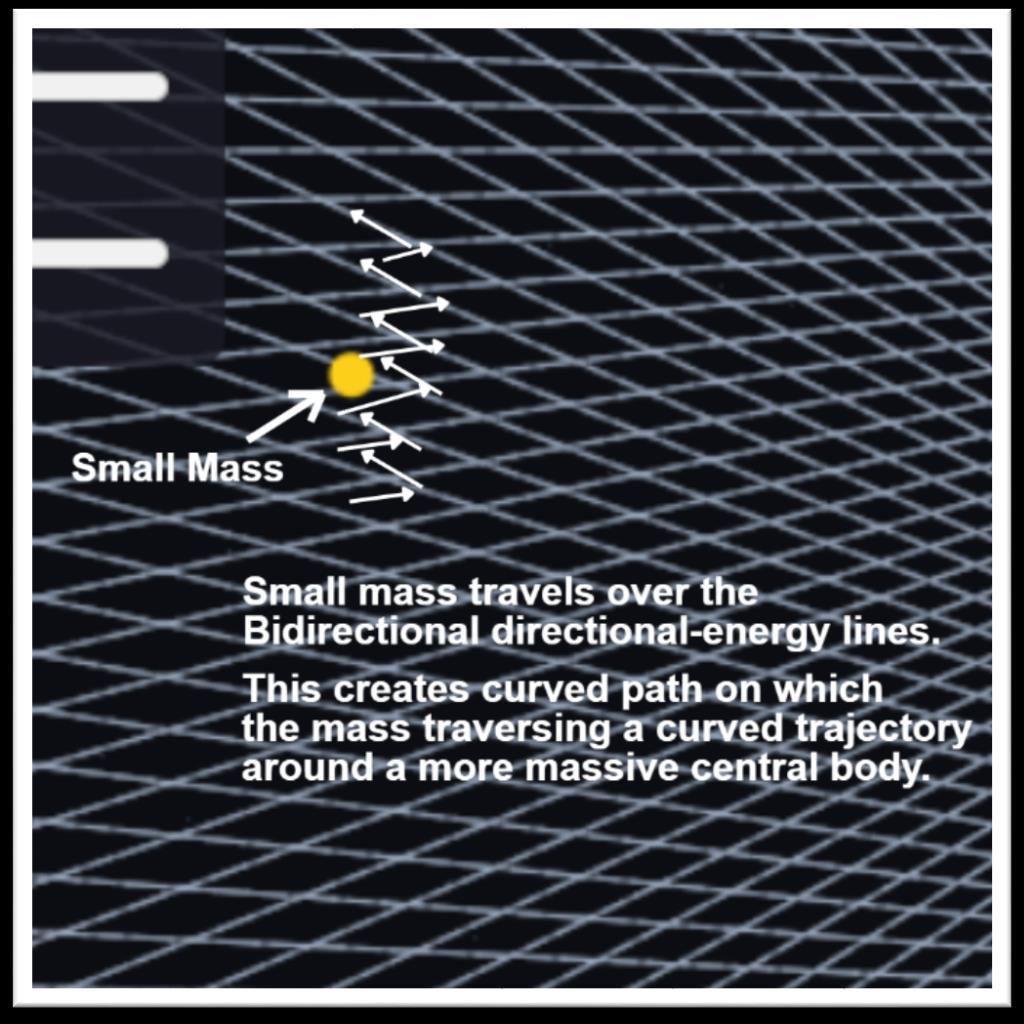
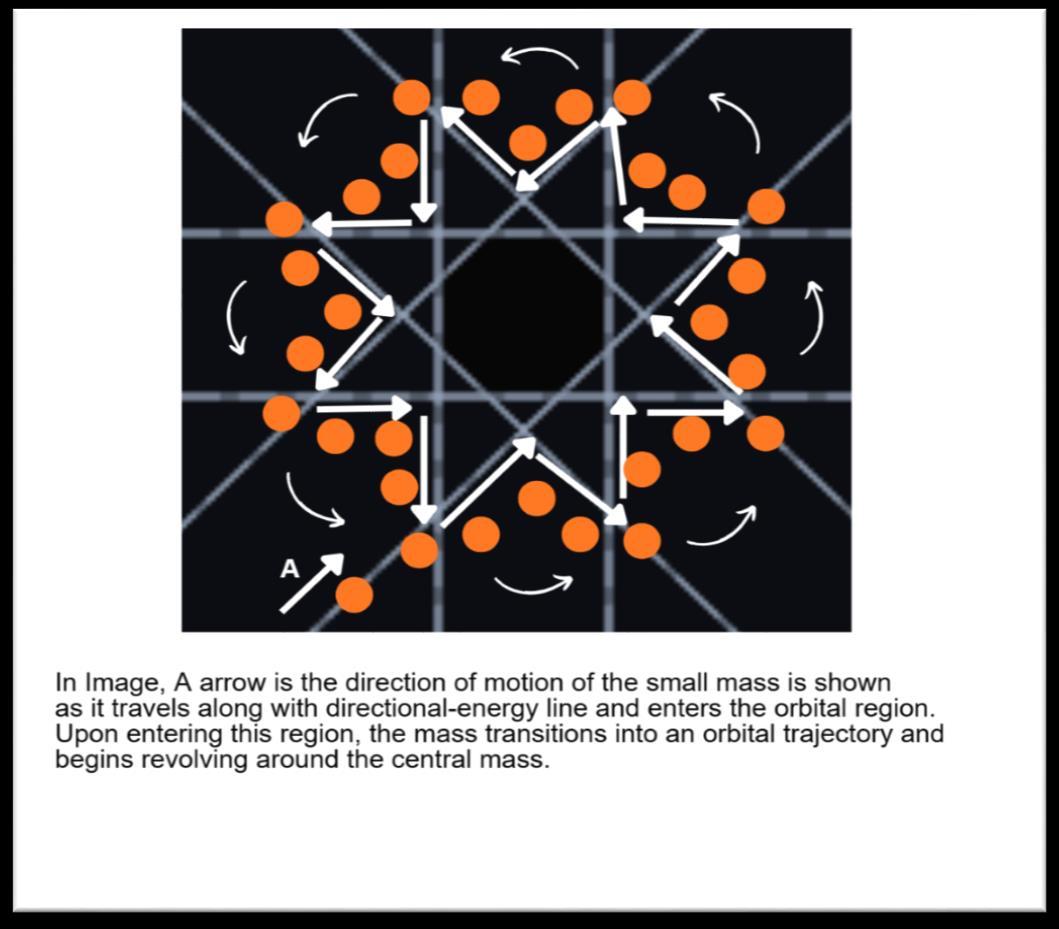
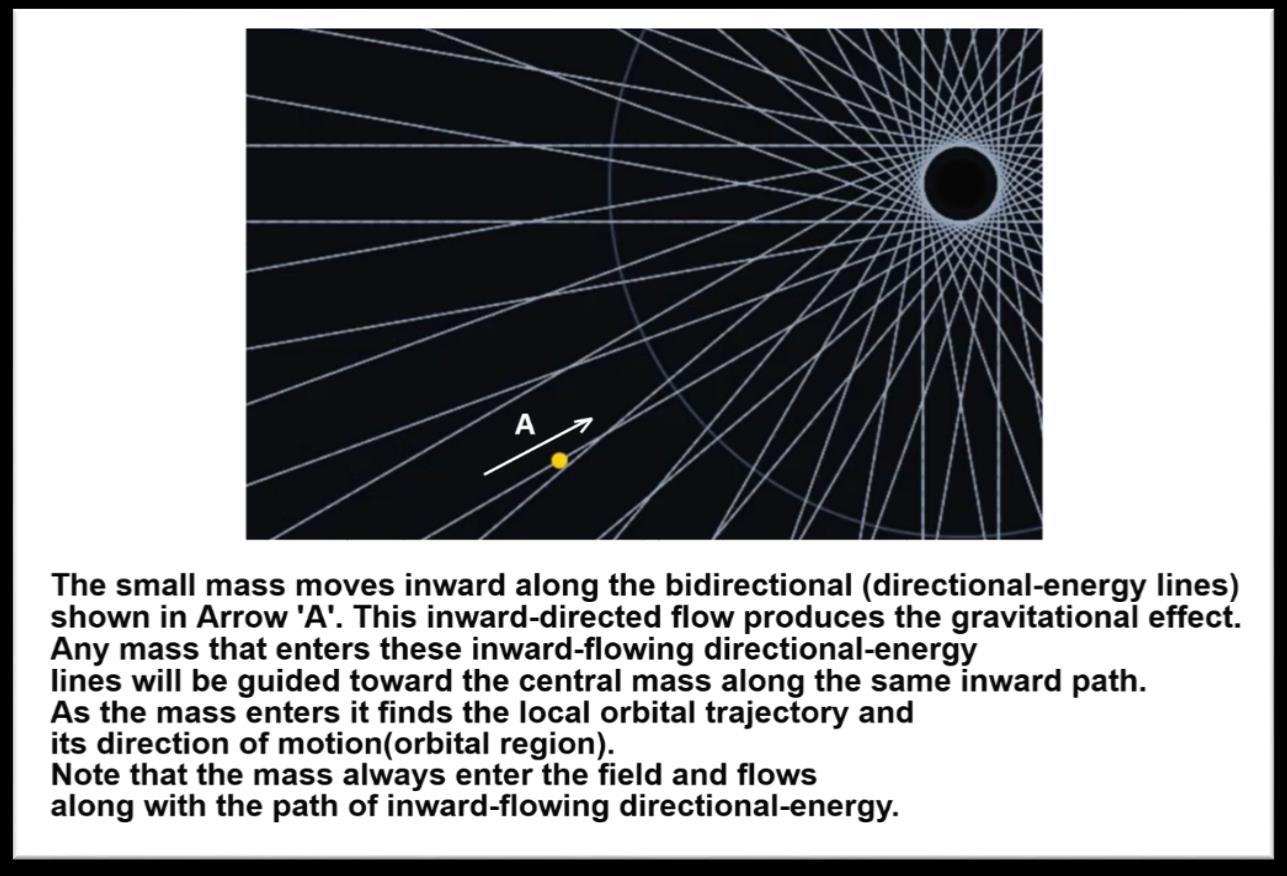
Below images explains how the simulator works and produces gravity and orbital motions.
2. Conceptual Model:
2.1 Bidirectional Flux Field:
The field consists of co-located paired bidirectional streams in space. These streams, represented in the diagram images as directional energy lines, form a continuous flow flux structure. Because this structure extends indefinitely, the resulting gravitational influence appears to possess infinite range.
Directional Streams as shown at below diagram:
One stream oriented along direction d
A complementary stream oriented along -d
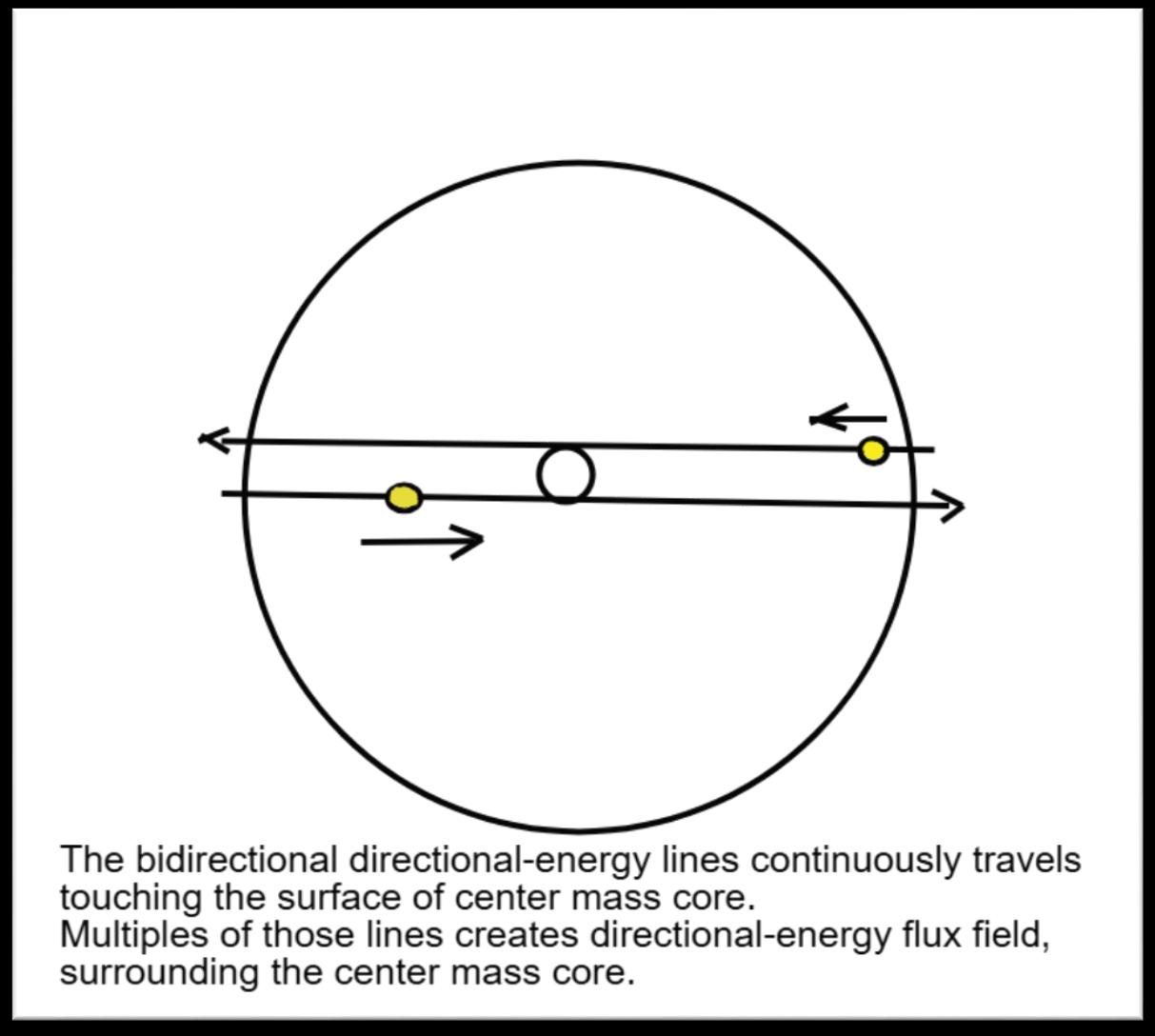
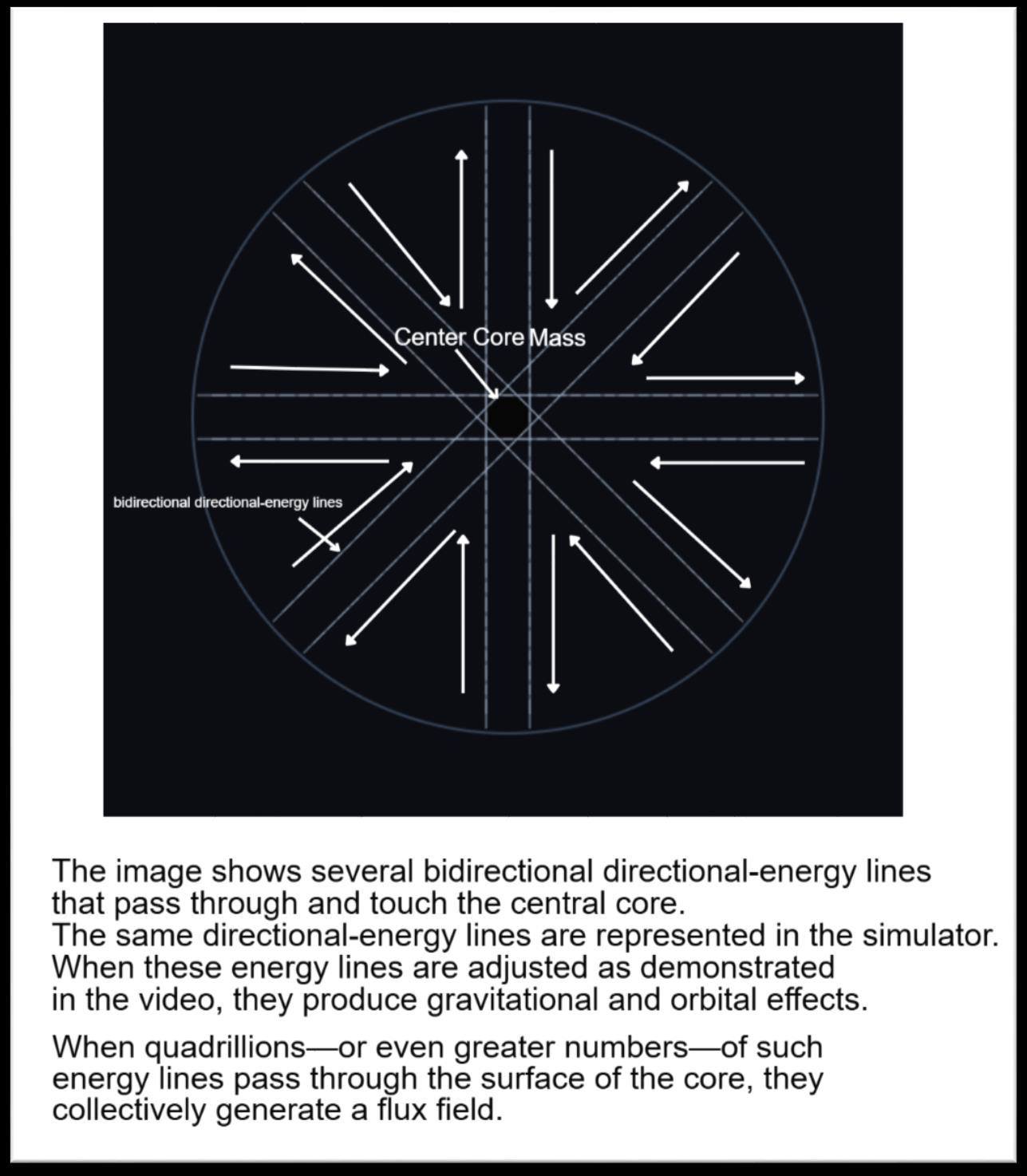
Each arrow represents a steady directional flow. Bidirectionality arises from co-located opposing streams. The field is locally symmetric but globally structured. This whole structure with energy lines can be seen at the simulator when the stream count is kept at 36 ( lowest flux of field).
2.2 Core and Field Geometry:
A central core
A surrounding field boundary (circular or elliptical)
The core (centre larger mass body) acts as a geometric distortion source, not a force emitter.
3. Particle (or Small Mass) Dynamics:
3.1 Particle (or Small Mass) State Variables:
x(t) = (x(t), y(t))
v(t) = (vx(t), vy(t))
m = particle mass
|v(t)| = v₀ = constant
Speed is constrained to ensure no energy loss.
3.2 Field Interaction Law:
Fi = α (di / ri)
di = stream direction
ri = particle-to-stream distance
α = field strength
Fnet = Σ Fi
3.3 Velocity Update Rule:
v' = v + (Fnet / m)
v(t+Δt) = v₀ (v' / |v'|)
x(t+Δt) = x(t) + v(t+Δt)Δt
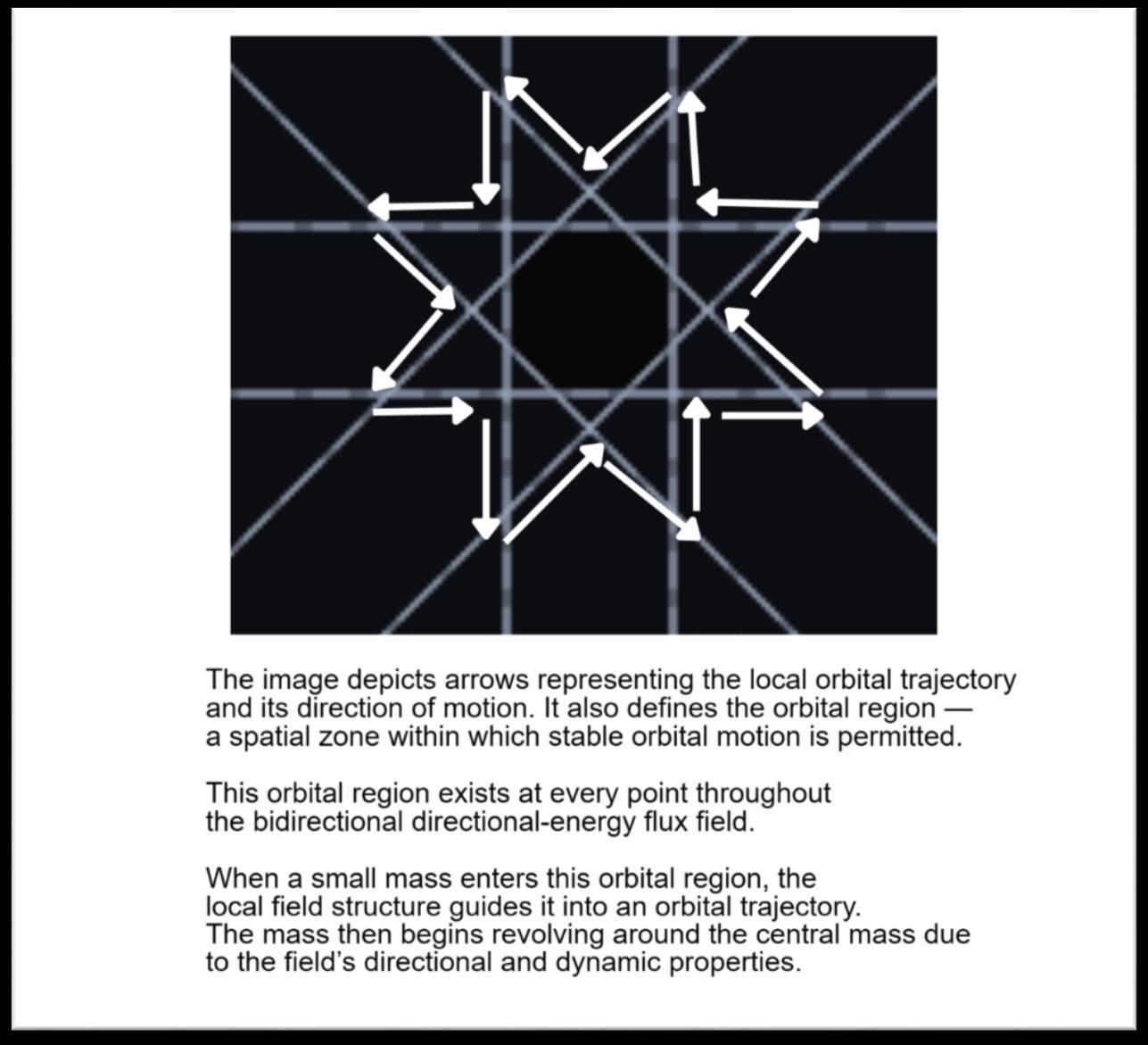
4. Emergence of Orbits:
4.1 No Central Force:
No centripetal force or orbital equation is imposed.
Directional bias bends trajectories and continuous curvature replace attraction.
4.2 Orbital Condition:
Field-induced curvature = inertial straight-line tendency This balance occurs naturally at multiple radii, producing:
Inner fast orbits
Outer slow orbits
4.3 Stability:
Speed is conserved
No inward spiral occurs
Motion remains bounded indefinitely
5. Interpretation:
5.1 Comparison with Existing Theories:
Framework
Newtonian
General Relativity
This Work
Cause of Orbit
Central force
Spacetime curvature
Directional energy flow
5.2 Physical Meaning:
Space guides motion
Matter follows flow geometry
Gravity is reframed as an emergent directional effect rather than a pull.
6. Conclusion:
Bidirectional directional-energy fields can produce stable orbits
The directional-energy lines that move inward toward the central mass carry smaller objects along their flow. This inward guidance causes the objects to fall freely toward the larger central mass, producing what we perceive as gravity.
Orbital motion emerges without central attraction.
The phenomenon is geometric and local Orbital dynamics may arise from the structure of space itself, suggesting alternative gravitational interpretations.
Acknowledgements:
The author acknowledges the use of computational simulation as a physical reasoning tool and presents this work as a conceptual and exploratory contribution.