Fall 2025, No. 70. This journal is funded by The Olivetree Review's CoEditor-in-Chief, Elda Nesimi.
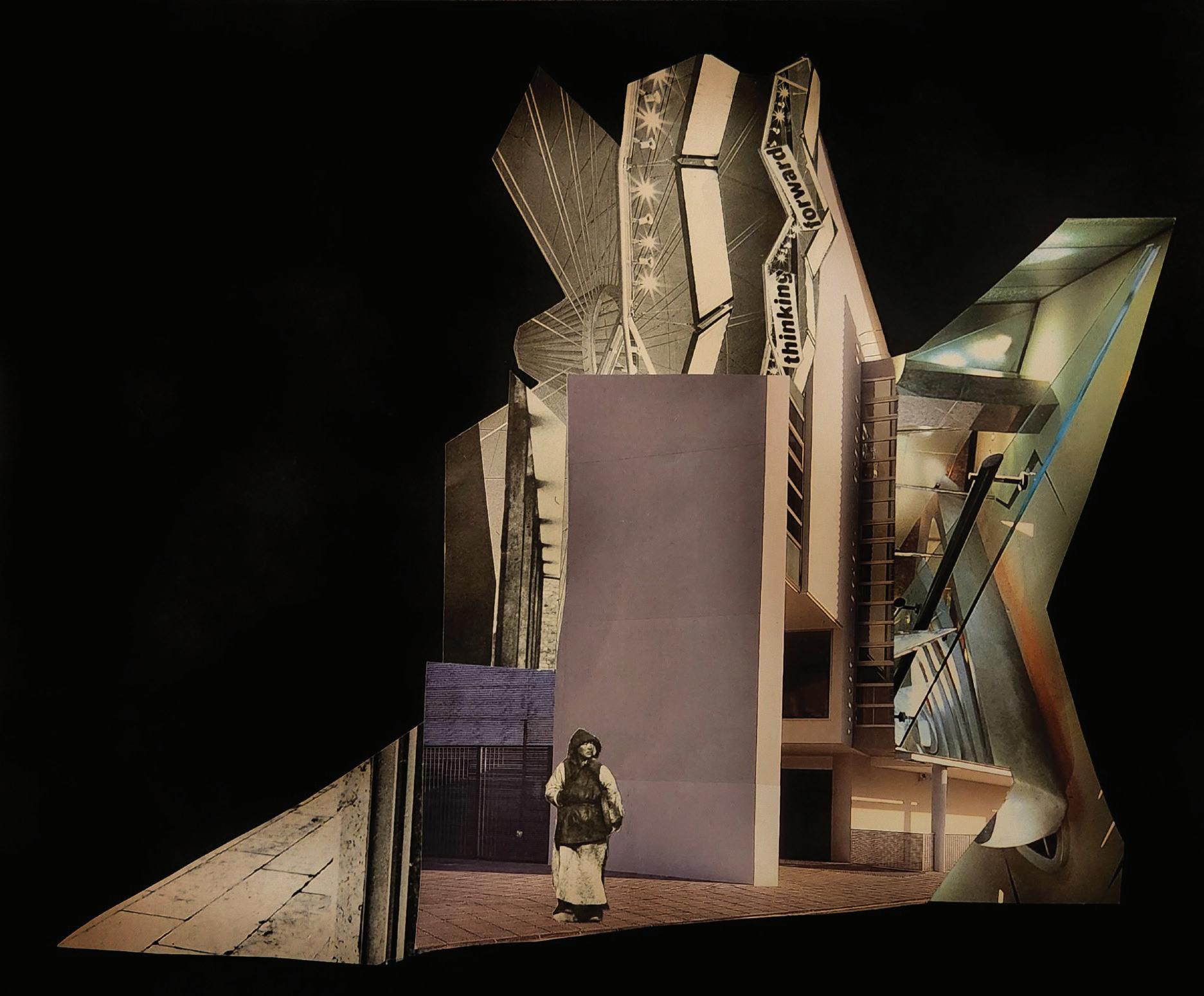
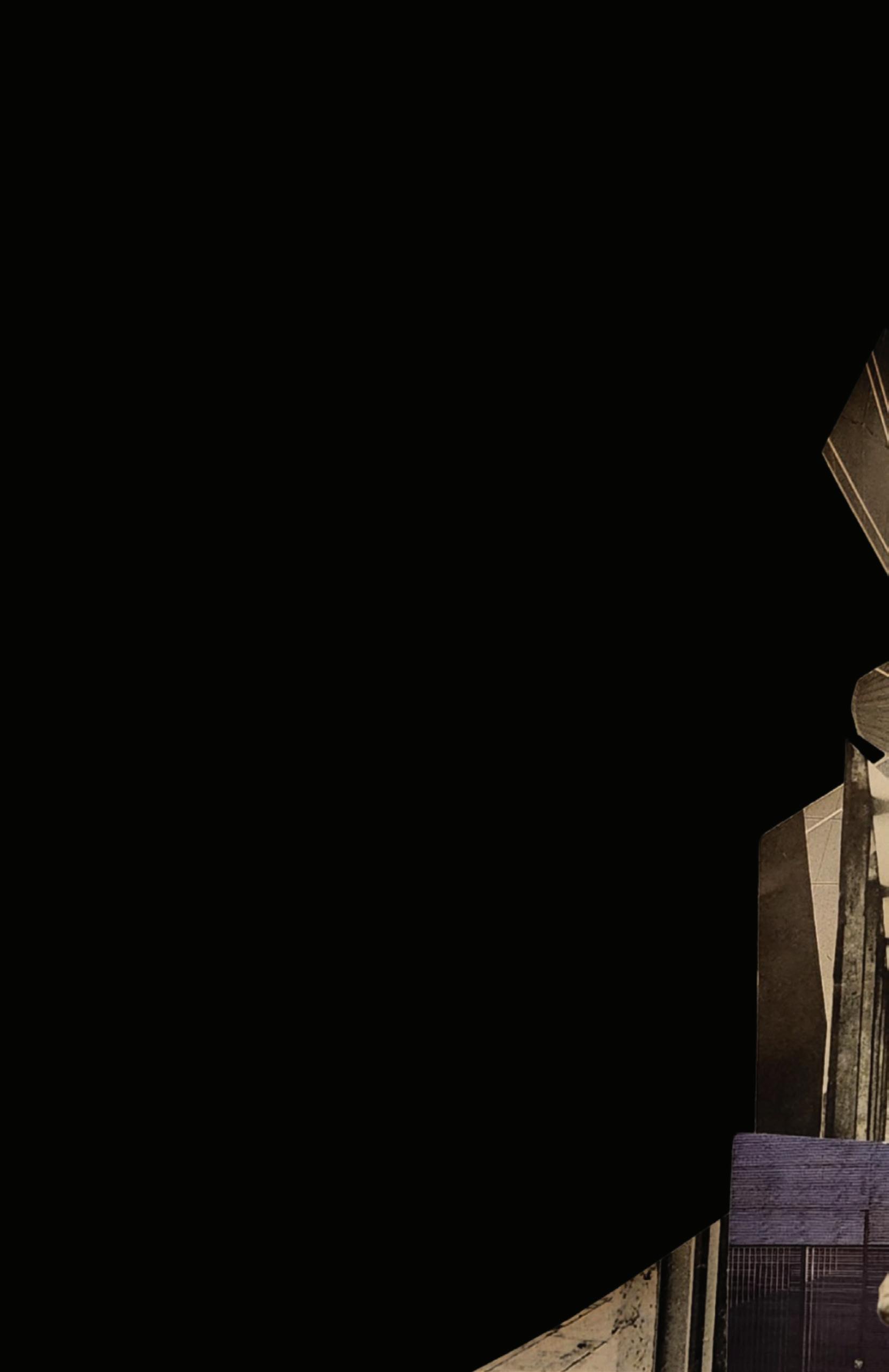
The artwork featured on the cover is Thinking Forward by Kenneth Ricci. The fonts used throughout are Helvetica Neue and Baskerville. Layout design by Elda Nesimi, Shakibul Alam, Ana Hendrich Acosta, Jannatul Begum.
Submissions are reviewed beginning in September through November, and again from January through March. We consider submissions of visual art, prose, poetry, and drama. The Olivetree Review is completely staffed by full- and part-time undergraduate students of Hunter College. All submissions are reviewed anonymously by Hunter College students.
Permission to publish the content in this issue was granted to The Olivetree Review by the artists and authors. These contributors retain all original copyright ownership of works appearing in The Olivetree Review before and after its publication. Copying, reprinting, or reproducing any material in this journal is strictly prohibited.
Appreciation and thanks to all those who made this issue possible, from our printers in Park Slope Copy Center, to the Hunter College institutions and offices, the student and public submitters, our shadow staff, and last but certainly not least, The Olivetree Review staff.
Printed by Park Slope Copy Center
Administrative & Editorial
Edit o rs-In-Chief
Anastasiia Poleva
Elda Nesimi
Managing Editors
Alexandra Shatan
Keila Cruz
Vice President
Alexander Rice
Secretary Billye Albro
Treasurer
Sophia Guelke
Art Editors
Hanuel Lee
Leah Chan
Suha Tasfia
Drama Editors
Alexander Rice
Billye Albro
Eldin (Eli) Mehovic
Poetry Editors
Keila Cruz
Sage Fairchild
Shawn Mon
Sophia Guelke
Prose Editors
Alexandra Shatan
Carl-Eric Granfelt
Sage Fairchild
Print Designers
Ana Henrich Acosta
Elda Nesimi
Jannatul Begum
Jax Texeira– PD Shadow
Shakibul Alam
Engagement Manager
Alexander Rice
Outreach Coordinator
Rithika Chowdhury
Publicity Manager
Ariyya Mohsin
Associate Publicists
Christine Stavropoulos
Leah Chan
May Lin
Taina Martinez
Editorial Shadows
Alsu Ibrahimli
Christine Stavropoulos
Lyra Calub
Francisca
Drama
Alexander
Poetry
Three
Fatima (Finn) Cruz
Poetry Standout Award
Jaspreet Johal
From
Fariha
From
Letters from the Editors
Dear Olivetree Review staff and readers, the release of this issue has been an enormous undertaking neither of us were prepared for. The 40th Anniversary edition was originally set for Spring 2024—over a year ago. Its delay stemmed from health complications, interpersonal tensions, and a lack of community support within previous leadership—issues familiar to anyone who has read past Letters From the Editors. We were no exception.
In our rush to revive the publication in Spring 2025, we built a foundation that wasn’t sustainable for its re-launch this Fall. We repeatedly chose the well-being and longevity of The Olivetree Review over our own, resulting in sacrifices, sleepless nights, doctor’s visits, and financial strain. Anyone else might have stepped back, but we held tightly to the vision of furthering the arts in this political climate. To us, giving up would mean yielding to forces that seek to erase art and free expression rooted in the human experience.
We have done our best to honor this
sentiment and to foster a flourishing creative community. The arts have always been a refuge for marginalized groups, and we are proud to be one of those corners at Hunter College.
The rebirth of OTR is reflected in the careful curation of this 40th Anniversary Edition. As you read, you’ll notice natural thematic clusters— an organic pattern from our editors’ selection process that we chose to preserve. The chronology mirrors a “birth of the self,” moving through complexity, brutality, despair, and finally toward its guiding light: love. Abstract Ripples signals emergence; "The Country in My Mouth" brings harsh realization; Smoke Break and Theodicy descend into the lowest depths. Tangled sparks connection, sharpened by "When Love Is a Weapon." The edition closes with "Game Night" and Good Company, gentle reminders of innocence and fantasy. This edition is special to us, and we hope it becomes just as special to you.
With warm regards, Anastasiia Poleva and Elda Nesimi
History of The Olivetree Review
Since the Fall semester of the year 1983, The Olivetree Review has been a Hunter institution, allowing a place for student writers to submit their work and see it published. Under the auspices of their faculty advisor, Professor David Winn, a small group of Hunter students successfully petitioned Hunter for the funds to start a publication. This allowed Olivetree's original staff members, Pamela Barbell, Michael Hariton, Mimi Ross DeMars, and Adam Vinueza, to create their issue of student work and dedicate it to the memory of the late Hunter College professor and poet James Wright.
The Olivetree Review has come a long way since that original first issue. Digital printing allows for both the inclusion of full color images and extra design elements to be available for all projects. We began including photography submissions in Issue #7, and advancements in scanning and digital photography have allowed for us to accept nearly any form of art that can be captured in one or more frames. We've also begun accepting drama writing submissions as of Issue #52, meaning we're finally accepting and printing all forms of creative writing and art that it's currently possible to.
Three Minute Daydream
Fatima (Finn) Cruz Poetry
Transport me
to a world of delectable flowers where the roses bloom in winter, proud and undaunted beings their red petals painting the ground as Lover and I spin, glide, waltz through their flower beds Wild asters spawn amongst the weeds hiding the stubborn daffodils that remain refusing to wilt and die like they should Lover and I, lost to a familiar melody and rhythm that plays for us and only us What does my love look like today?
A tall, tan fellow with long curly hair or a short Miss with the stars in her eyes Who knows, but time is limited The end draws near, the melody slowly dies and my world does too one wilting petal at a time Lover slowly fades, hand still in mine As I wake up to messy singing
There is no lover, just a phone that has started blasting sin into my ear The subway cart shakes violently And I realize, sadly, that I have returned to a world where I love no one and no one could love me
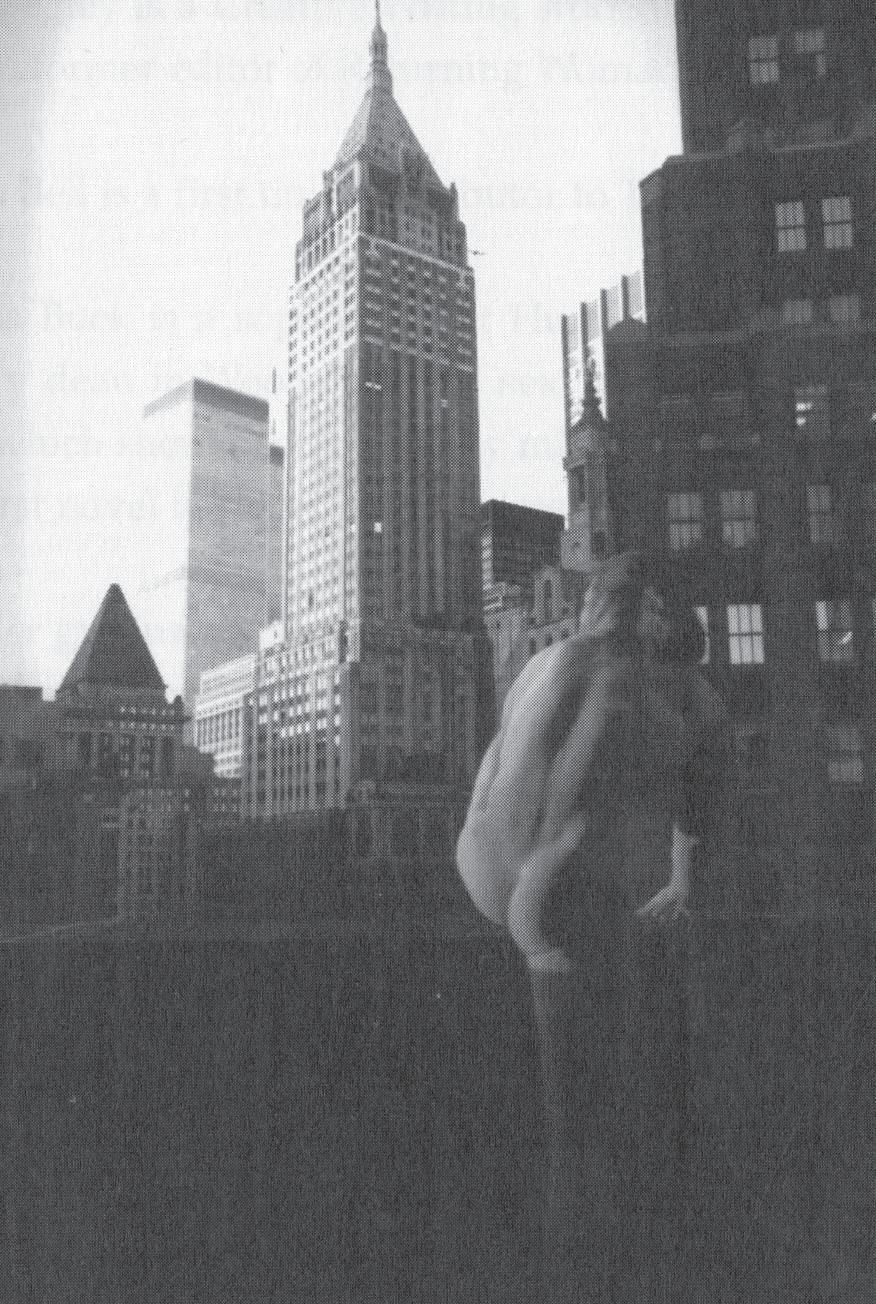
Photography OTR Art Standout Award Francisca Maria
Lopez Hernandez
Nico Valenzuela Prose
Tucked away deep in the jungles of Veracruz was the Village of Izote where ten-year-old Juan-Pablo Ríos lived with his mother, Dolores. The two shared a one-room shack with dirt floors on the edge of town. It was littered with empty liquor bottles left behind by farmers, ranchers, and even clergy members who sought a brief respite from ennui under the cover of darkness. Due to the nature of his mother’s work, Juan-Pablo wasn’t allowed in the home most nights.
That suited him just fine. He preferred to sleep in an abandoned toolshed turned stable, curled up on a bed of hay beside his beloved horse, Blanca, who’d been gifted to him last year by his uncle Pablo.
Though Pablo stopped speaking to Dolores several years prior, he still looked after his nephew. He’d pay the boy a few pesos to help him around his ranchito before school—milking cows, feeding chickens, and collecting firewood—but Juan-Pablo’s favorite task was caring for Blanca. He brushed her soft white coat with small speckled black dots, fixed her shoes, and would return every-
day after school to ride her on the nearby jungle trail that led to the river. Juan-Pablo was never happier than when he’d sit alone on the banks of the river and listen to the rhythmic sounds of Blanca lapping at the water’s surface—just a boy and his horse.
Then, in the summer of 1950, Pablo passed away after a brief bout with cancer. Pablo’s wife, Maria, was forced to move in with her parents in Xalapa as she and Pablo were only leasing the land. Before she left, Maria sold all the animals, except Blanca. Honoring Pablo’s wishes, she transferred ownership of the horse to Juan-Pablo.
Now solely responsible for Blanca’s well-being, Juan-Pablo decided to quit school (it only went up to eighth grade anyway). He lied about his age and began working in the sugarcane fields to pay for his horse’s upkeep.
It was brutal work, especially for such a young boy. His machete hand developed an unhealing sore as a result of the accumulated friction between his skin and the wooden handle. He’d clench his teeth and swing the blade through the searing pain to
meet his daily quota.
Once, his sweaty hand slid down the stock just as he swung the machete. It sliced straight through the cane and into his palm. As blood spilled over onto the soil like an unwatched pot, he rushed to the overseer’s tent to ask for help. Ramón and Raúl, the plantation owner’s cruel nephews were in the middle of eating a plate of Spanish rice and black refried beans.
“What are you doing here?” said Ramón. “It’s not quitting time ‘til I say so.”
“I cut my hand. It’s bleeding,” said Juan-Pablo, doing his best to hold back his tears.
“Please, can you get me a bandage?”
way to make sure it doesn’t get infected.”
The two brothers exchanged looks and laughed as Raúl emptied the saltshaker directly into the open wound. They chortled while Juan-Pablo writhed and screamed in agony.
“There. Now you have a real reason to cry,” said Ramón, tossing the boy a dirty rag.
“Next time, cut the whole hand off if you want to quit early. Now get back to work!”
Izote’s one and only veterinarian, Señor Martín — a hard faced middle-aged man that reeked of cigarillos.
“I don’t have any money for you, so run along,” Señor Martín grunted, as Pablo entered his office.
“I don’t ask for money, señor,” Juan-Pablo said. “My horse is sick.”
Martín looked him over.
had a red poncho; the other two wore denim western shirts.
Juan-Pablo approached timidly. “Excuse me, señores. Does that horse belong to one of you?”
“It’s mine,” said the man in red.
“I have a horse too,” said Juan-Pablo, “but she’s very sick. She won’t eat and she’s having digestive issues. I was wondering if you could give me some advice.”
Ramón grabbed the boy’s wrist and inspected the wound. “Oh boy, that’s a bad cut. Hey, Raúl, hand me the salt.” Raúl—somehow chewing and smiling at the same time—got up and grabbed the saltshaker. He removed its top and passed it to his brother.
But Juan-Pablo endured it all—the long hours, the humiliation, the stigmata in his hands— because without the work, he couldn’t afford to keep Blanca— and then he would truly have nothing.
Months passed. Then, one day, Blanca stopped eating. Her droppings became runny and frequent, and her lively, expressive eyes grew dim. After a few days
"Once he realized it was too late, he took her large heart in his arms and violently sobbed until his throat gave out."
“Hey, stop! What are you doing?” said Juan-Pablo as he tried to break free of Ramón’s grip.
“Relax, kid. This is the best
of the symptoms not improving, desperate and scared, Juan-Pablo walked ten miles to the village square in search of a veterinarian.
After some asking around, Juan-Pablo found the office of
“You can’t even afford clothes without holes or decent shoes, yet you have a horse?” he scoffed.
“And even if you do, how will you pay?”
“I’ve saved forty pesos.”
“Not nearly enough, get out.”
“I can work for you, señor, to pay off the debt. However long it takes.”
“No, you’re a stupid peasant boy. You have nothing to offer me. Now go!” He stood and raised his hand to strike, but Juan-Pablo turned and ran out.
Back on the street, Juan-Pablo wandered the village trying to think of anything else he could do for Blanca. He stumbled upon a general store, where he saw a horse tied to a hitching post. Nearby, three caballeros shared a bottle of tequila and made loud conversation in the otherwise quiet street. They were dark, rugged men all wearing sombreros. One
“Hey,” said the second man, squinting. “You look familiar. What’s your name?”
“Juan-Pablo Rios.”
“Rios? Pablo, the rancher, was your father?”
“No, he was my uncle.”
“This is Pablo’s sister’s kid,” said the third man.
The men exchanged smirks and chuckled. “So technically his father could be anyone in town,” added the second man. They all howled with laughter.
“Oh, yes,” said the man in red, catching his breath. “We’re friends of your mother’s.”
“Not me!” said the second man. “The bitch stole from my wallet the last time we were up there.”
“Oh yea, that wasn’t very nice,” said the man in red. “Hey kid, tell your mom she owes us a freebie, maybe you can pay her debt. Got any money on you?”
“No,” Juan-Pablo said.
“Of course not,” said the second man. Look at you, your mom steals from hardworking men and doesn’t even buy her son shoes. Despicable.”
“I don’t know anything about that,” Juan-Pablo whispered. “I just want to help my horse.”
“I know what to do,” said the man in red, suddenly serious.
“You do?” Juan-Pablo’s eyes lit up.
“Tomatoes,” he said. “Mash up canned tomatoes, like salsa, and then feed them to your horse. They’re a magic cure for sick horses.”
“They are?”
The other men watched, amused but silent.
“Absolutely, she may not eat it at first,” the man added. “But don’t give her anything else. She’ll eat it eventually when she gets hungry enough.”
“Thank you, señores,” said Juan-Pablo.
It took him only two hours to run back home, arriving just before dusk. Dolores was out, so he raided the pantry and filled a bucket with crushed canned tomatoes and brought it to the stable. When he arrived, Blanca’s eyes were dull and a powerful, sickening stench hung in the air. She’d usually produce an exuberant whiney and
snort when Juan-Pablo arrived after being away, but she had no reaction when he entered the stable that evening.
“It’s okay, girl,” he whispered, stroking her nose. “Everything’s going to be okay.”
He removed the hay and placed the bucket inside the stable. Blanca sniffed it, gave a half-hearted lick, then backed away. Disappointed, Juan-Pablo reminded himself the man had warned this would happen. She’d eat it eventually.
It was now well into the night and Juan-Pablo started to get sleepy. He took out his blanket and made himself a bed for the night next to his beloved horse. “Goodnight, Blanca,” he whispered. Everything will be better tomorrow, I promise.”
The following morning Juan-Pablo arose to find the bucket empty, and Blanca sprawled out on her side. He screamed in horror at what lay before him. He shook her and shook her, trying to wake her up. But she was gone. Once he realized it was too late, he took her large head in his arms and violently sobbed until his throat gave out.
A steady rain began to fall outside, as Juan-Pablo dug a grave in the damp earth behind the shed, each scoop of mud mixing with his tears. After he finished, there laid a simple mound,
marking the spot with two sugarcane stalks in the shape of a cross.
Later, soaked, shivering and covered in mud, he walked back into town. His heart ached, his steps heavy with grief and rage. The rain subsided, but the grey clouds remained overheard. He found the three caballeros right where he’d seen them last. The man in the red poncho raised a flask and took a swig as he saw him approach.
“Hey, look who it is! The horse doctor.”
“I did just what you said and now my horse is dead,” Juan-Pablo said. “You lied.”
“Lied?” the man laughed. “You actually believed that? It was a joke. Everyone knows tomatoes are the one food you never let a horse eat.”
The second man shook his head in disbelief. “Dios mío. We thought you knew! It was just a joke— we didn’t think you'd actually do it!”
“She was all I had,” Juan-Pablo said, his voice crackling.
“Well, you live and you learn, chamaco. Maybe next time, don’t go taking vet advice from drunks. That horse was going to die one day anyway.”
Juan-Pablo stared at them for a moment longer, the betrayal sinking deeper than their laugh-
ter. He wanted to kill these men, or at least tell them off in the exact words he had rehearsed in his head on the walk into town, but he couldn’t recall a single word. He stood there in awkward silence trying to remember, but suddenly felt tears welling up. He quickly turned and walked away, refusing to let these men see him cry and didn’t look back.
Juan-Pablo wandered aimlessly through the village all afternoon until he came upon a small church near the river with cracked whitewashed walls and a crooked cross on top. A weather-worn plaque on the side of the building read: Iglesia de San Nicolás. He peeked inside and saw that the church was empty and took a seat in the back pew. The inside was dark, the only light coming from a descending sun filtered through stained glass of burgundy and emerald green. The scent of wood and melted wax hung in the air. He bowed his head quietly and whispered, “I’m sorry, Blanca.” Suddenly, he heard footsteps approaching. A young priest in a black cassock approached. He had a kind face, worn but warm, and gentle brown eyes behind round wired spectacles.
“What’s your name, mijo?”
“Juan-Pablo Ríos.”
“Nice to meet you Juan-Pablo, Ríos, was it? The boy
nodded. “I’m Father Tomás,” said the priest as he sat down next to Juan-Pablo. “So Juan-Pablo, what brings you here?”
“Well, señor—”
“Please, call me Padre.”
“Yes, Padre. I’m here to pray for forgiveness.”
“For what?”
“I accidentally killed my horse.”
“I’m sorry. What was her name?”
“Blanca.”
Father Tomás nodded in sympathy. “She must’ve meant a lot to you.”
“She was all I had... Padre, are there horses in Heaven?”
The priest smiled. “I don’t know, but I believe that God loves all his creation, including horses. In fact, The Bible tells us that Jesus himself sits atop a white horse in Heaven, so yes, it’s quite possible there are horses in Heaven.”
A small smile swept across Juan-Pablo’s face.
“But we do know for certain that every human soul who's been baptized and led a good life will go to heaven. You’ve been baptized, haven’t you?”
Juan-Pablo shook his head. Father Tomás was taken back aghast.
“Really? Are you sure?!”
“I asked my mother if I was baptized once, and she said no.”
Father Tomás sat there in total shock, his eyes wide and his mouth slightly agape.
“Well, you must be baptized, immediately. Juan-Pablo you want to be baptized, don’t you? You want to be forgiven of sin and accepted into God’s flock, right?”
“I don’t know, Padre, am I allowed?”
“Yes, of course. I can baptize you right now.”
“Right now?”
“Yes, please, come. Let’s go down to the river at once and cleanse your soul. We have plenty of donated clothes here for you to change into afterwards. You can take as many as you’d like.”
Father Tomás led the boy to the tranquil river that ran behind the church. The sky was still heavy with clouds and the wind began to shift. Father Tomás rolled up his sleeves and stepped in, gesturing for Juan-Pablo to follow.
Juan-Pablo eased slowly into the cool water, shivering as it touched his skin. As he waded in further the initial cold subsided and he began to relax. Father Tomás placed a hand on the boy’s shoulder and said, “Juan-Pablo Ríos, I baptize you in the name of the Father, the Son, and the Holy Spirit” and gently lowered him into the river. Just then, the clouds above slowly parted, letting shafts
of golden sunlight beam down over the water. The breeze picked up, rustling the treetops.
Suddenly, a toucan — with dark feathers, a cream-colored face, a crimson tail, and a stunning beak containing all the colors of the jungle — flew overhead and alighted silently on a nearby branch, watching the scene below with curious eyes. It tilted its head, its immense beak gleaming
in the light.
It was the first sight Juan-Pablo saw after resurfacing. He stared intently at the magnificent bird, captivated by its beauty and brilliant colors.
Father Tomás followed his gaze and smiled. “It’s a sign, mijo. Dios te bendiga.”
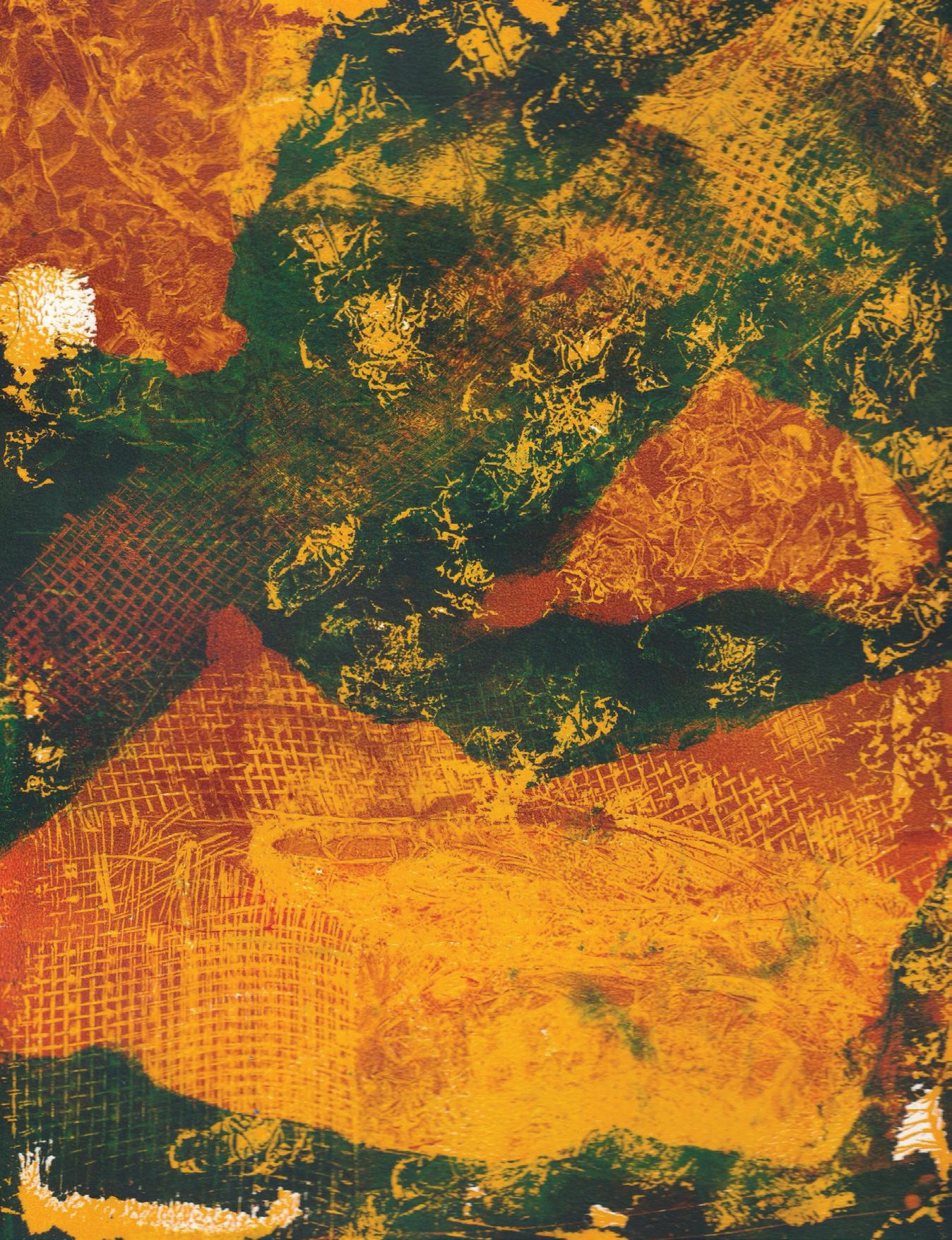
Melanie Doulton
Art
Ruptured Gel Print
Joe Cordaro
And They Were Roomates
Oil on Canvas
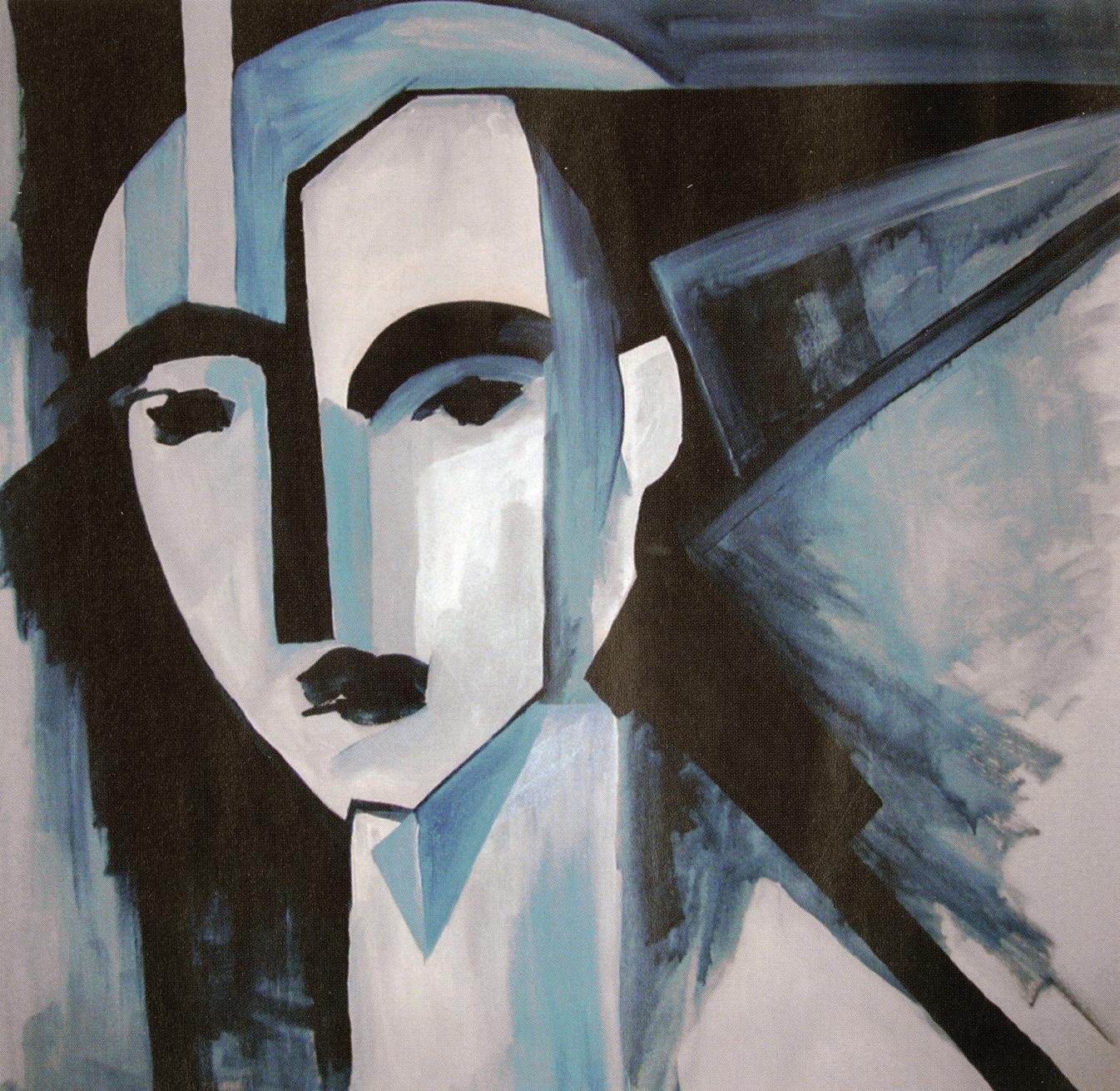
Del Porter
Art
Blue
Acrylic on Canvas
From the Archive
Kseniya Linov Art
Missing in Action
Jack Jewell Drama
EXT. WILDERNESS - NIGHT
A PLATOON OF SOLDIERS waits by the side of a train track in an open field. It is silent. They’re haggard and dirty–a long assignment.
In the distance, a light approaches. The train. There’s no whistle or horn, just the steady rumble of steel on steel.
CUT TO:
The train is stopped. Several soldiers stand atop it, throwing down sacks of supplies: bushels of pre-packaged food, tankers of water, and boxes of medicine.
A GROUP OF SOLDIERS are standing near the rear of the train, where a smaller freight car is attached. The side of the car reads: POSTAGE
A PAIR OF SOLDIERS jump up onto the rail and pull the doors apart. One of them is RAY (24). They hop inside and start distributing the packages to the others.
Ray picks up an envelope with
a very obvious red lipstick mark on it. A collective “OOH” from the other soldiers. The soldier to whom its written, AUSTIN (21), tries to snatch it away but Ray holds it just out of reach. He opens it and starts to read it aloud.
EXT. WILDERNESS - LATER
The SOLDIERS are gathered in the field, encircling a large bonfire. Several tents are set up: the canteen, medical bay, and showers. An area filled with sleeping bags and mats has been sectioned off for sleeping. The CLINKING of cutlery on metal plates as the soldiers eat their dinner. Many are chatting and laughing amongst themselves, indulging in all the luxuries they’ve been sent:
A group of SMOKERS stands by the center smoking cigarettes and flipping through magazines and newspapers. Every so often one of them waves a page in the air for the others to see.
Another group of DRINKERS all sit on the ground in a circle passing
around a cup of dark liquor. They each have a flask in hand and are taking swigs of the concoction before adding a splash of their own spirit for the next man.
Austin is sitting alone on a wooden crate. He’s holding the letter open and reading it over and over again.
CUT TO:
Over by the train, PAUL (19), is examining the postage cart again. He clambers inside. It’s dark, but the boy can make out the shape of a very tall, slender box in the corner.
He walks over to it and runs his hand along the wood. He tries to read the label in the dark, but it’s smudged. He tilts the box onto its side and picks it up, bracing it against his shoulder. It’s surprisingly light for its size.
Paul carefully carries it to the door of the car and onto the grass.
CUT TO:
Back at camp.
A fight has broken out. Austin is arguing with Ray near the edge of the fire. His letter is gone, and he gestures wildly at Ray, who holds his hands up in defense and denial.
The Smokers are at the Drinkers’ throats, neither possessing their preferred vices. One of them is holding a ripped-out page from a magazine, though the rest of the article is nowhere to be found.
The mug that the Drinkers were using has apparently vanished as well, causing them to point the blame back at the Smokers.
The rest of the camp is in a fuss, too. It seems everyone has lost a trinket of some sort. A toothbrush here, a compass there. Pens, pencils, notebooks, shoelaces, underwear, mugs, matches, snuffboxes, buttons, glasses, cards.
One MAN is running around with only one boot on. Another in the midst of shaving seems to have lost his blade.
The COOK scolds one of his assistants for misplacing his favorite knife.
Towels have gone missing and shower heads have mysteriously disappeared, leaving a few unlucky soldiers to be washed out of the shower tent with the full force of the latent water pressure.
CUT TO:
Paul continues to carry the box along the strip of grass next to the railroad tracks. He’s struggling now, almost being crushed by the weight of the box. He sets it down, propping it against the train. He takes a seat next to it.
He looks off into the distance at the camp a few hundred feet away.
CUT TO:
The Drinkers and Smokers have armed themselves now, each setting up meager barricades on opposite sides of the sleeping quarters. They’ve positioned mats to act as bunkers and are using pillows to reinforce them.
As they take aim and fire at each other’s defenses, the sleeping soldiers between them jolt awake and jump into action, taking cover behind their own bedsheets.
One of the Drinkers grabs an empty glass bottle from earlier and chucks it over his head into the enemy camp. It SHATTERS on impact, glass flying everywhere. From somewhere else in the camp, a siren BLARES
CUT TO:
Paul hears the siren and leaps to his feet. He looks out at the base
again and sees his comrades up in arms. He takes a few steps towards them, almost running, before looking back at the box. He trudges over to it and hoists it onto his back again.
CUT TO:
The camp is in an uproar now... half-drunken, half-asleep, and half-washed soldiers are manning the lines on either end of the sleeping quarters. Some run back and forth, delivering supplies to each side--ammo, gunpowder, buckets of water-- without realizing that the two sides are at war with each other. Most take up positions alongside their fellows, shouting orders and war-cries at imagined enemies.
Somehow Ray has taken command of the Smokers and is leading them in a covert flank through the latrines. Austin, fearless leader of the Drinkers, claims the forward territories uncontested, running the conquered linens, pillows and sleeping rolls back to his own camp to bolster their defenses.
Paul approaches the camp and sees the mayhem that the two sides have stirred up. He tries to run towards the bonfire, but is intercepted by a scout who gestures for him to run the box
to the Drinkers’ base. Paul tries to maneuver around him but the man won’t budge.
He gives in and makes a beeline for their pillow-fort, but just as he’s about to jump behind their lines and into safety, a brigade of firefighters carrying pails of water cuts him off. Together they run into the center of the fray, dousing fires and splashing water on any unlucky enough to not have been woken by the previous commotion.
COMMANDOS crawl under beds like they’re barbed wire, worming their way into the opposing base.
MEDICAL TEAMS hoist FALLEN SOLDIERS onto stretchers and administer first aid to those who can’t get up. Groups of MUSKETEERS set up rally points, zigzagging across the field as if they’re under heavy fire.
Paul dashes into the center of the sleeping quarters, weaving
between the beds. Pillows explode in bursts of feathers around him, mimicking mortar fire. Lanterns combust like Molotov cocktails, setting any loose bedding ablaze. The box is as heavy as a boulder now and Paul rocks back and forth, barely able to keep it upright on his back.
A HORN sounds as Paul turns. Ray's band of Smokers has found their way around the Drinkers’ defenses and they’re on the attack. Ray leads the charge into enemy territory, overrunning Austin's forces.
Austin turns from the front lines and grabs the soldiers around him, quickly leading a counter assault on the enemy’s forces. Paul gets swept up in the retreat.
Soldiers on both sides are clambering over one another, wrestling in the mud, and getting into fistfights.
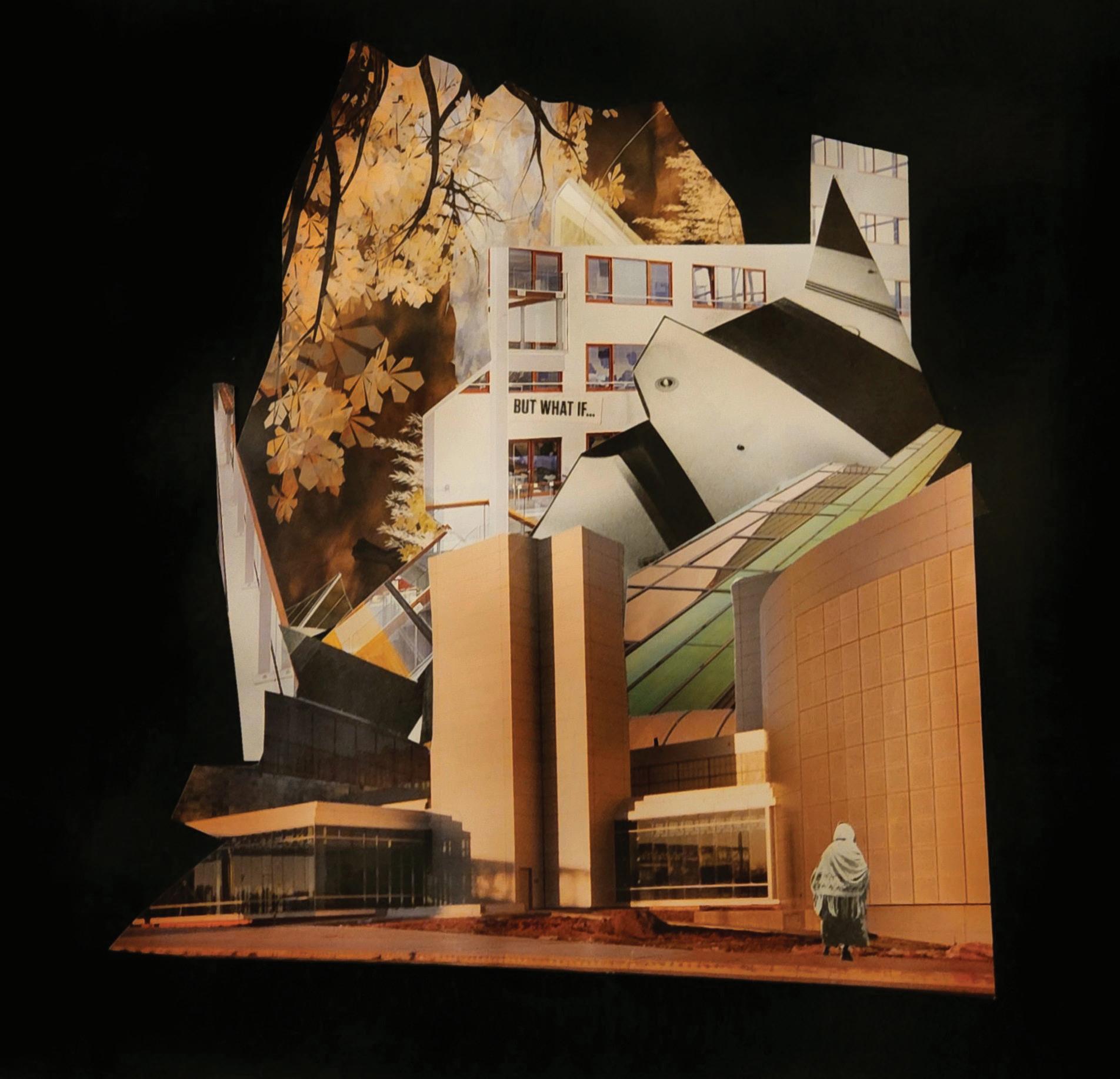
But What if
Kenneth Ricci
Art
I don’t remember feeling
This way
I remember the birds smudging the thick clouds becoming embers of the burning eye above shimmering against the rivers of the sky
The sky washed with warm songs of yellow and blue
The rise of the earthworms’ genuflection
The way they sipped from those languid leaves
Slow honey flow light from the heavenly dripper
How the sun placed a proud hand on the back of each tree
And each shrugged its bough high
Feeling the sky like a child in its mother’s hand
The sky reached back and answered the quivering call
The sun kissed the sky wrapping the world in orange
The neon buzz of life
Each body in unison
A thrumming thread woven into the tapestry outside
I don’t remember the hum of life can’t grab the warm quilt of life
can only watch from the cold
White walls within
I don’t remember being made for this.
Collage
Broken Birth
Photography– Color Negative Scan
Isadora Rooney Art
Billye Albro Drama
Dead Dogs and Coffee
Two women sit across from each other at a small coffee shop outside. They sit at a small circular table with an open umbrella. There are a few other tables around them, some with patrons and other tables empty. One of them has a gift bag by their seat. We enter into their conversation.
JEZEBEL:
[Recounting a scene she caught a glimpse of from her window.]
Dead puppies pour out of the garage door as it slowly winds itself open, getting caught on a small corpse here and there occasionally stuttering every few seconds.
[Momentarily pauses, shudders.]
I mean it was disgusting, Maisie. Utterly diabolical. Inhumane. What kind of person—what kind of creature could commit such a gross atrocity? Like—
[pauses]
Where do you even get that many dogs?
MAISIE:
Maybe he had a secret breeding business? It’s not like he was stealing every dog he saw off the street. That’s nearly impossible.
JEZEBEL:
Yeah, maybe he just kidnapped a dog often enough that it went without notice and so that families would assume their beloved pets just ran away. Force them to propagate puppies in the basement—
MAISIE:
And then once they were a couple of weeks old, almost weaned off of their mother’s tits, he’d go into the garage, snap their necks and probably jerk off a bit.
A nearby table of patrons stare at
them uncomfortably. One of them coughs lightly as an attempt to hint to the women that maybe they should take their conversation somewhere a little more private.
JEZEBEL: [laughs both at what Maisie said, but also at the patrons.]
Oh, and we can’t forget that some of them were skinned. Just dead little dogs, muscles and all, no skin attached.
MAISIE:
Maybe he was making a puppyhide suit for himself. Silence of the Puppies.
JEZEBEL: [momentarily chuckles]
I just think that if I were in his shoes, I would’ve just gotten a couple of bigger dogs from somewhere because it would be so much easier to make a skin suit out of them. You would only need a couple of large dogs to complete the human figure.
MAISIE:
Yeah, but I’d imagine it would be difficult to steal a lot of dogs and easier to just create loads of small ones. An absolute bitch to sew, but I’d imagine more…realistic.
JEZEBEL:
True. True. And I suppose I’m not taking into account all of the nonskinned puppy corpses that were also in the garage.
MAISIE:
Mhm. There was definitely something incredibly weird going on with your neighbor.
JEZEBEL: Morose.
MAISIE: [Nodding her head.]
JEZEBEL: Morose, not weird. Morose beyond limitation. Absolutely vile.
MAISIE:
[A bit confused, but with the smallest hint of annoyance.] Yeah, morose.
JEZEBEL:
Sorry, I just think it’s weird to just plainly call it weird. Like that’s the only adjective you can come up with.
MAISIE: I’m sorry that I don’t possess the same lexicon as you.
JEZEBEL:
Surprised you didn’t say “vocabulary.”
MAISIE: You always do this. You always find something at fault with something I said. We were having a good time and a great conversation. You, you–you can never–
JEZEBEL:
I can never what?
MAISIE:
You know what? No, nevermind. I don’t really feel like talking about this anymore. It’s not worth getting into. It’ll just ruin the rest of the day.
JEZEBEL:
You’re right, today's your birthday, let’s just focus on that. [Reaching her hand towards the gift bag below her seat] I did get you a gift… [Hands it to her.]
MAISIE:
[Opens the bag only to find a thesaurus.]
JEZEBEL:
Well, I noticed you didn’t have one on your bookshelf, so… [a long pause]
Silence of the Puppies, that was a really good joke earlier…
9/12/23
By Justin Prince Poetry
another day of biting your tongue, holding hope hostage in the corner. why bother claims another bond. why must we be the way we are; why did those who came before walk down those roads they paved. the soil is receding so suppose that means I can just run from it all. what good is living anyway when paradise is dying before you and God is just another man playing with his toys. what good is there to do but run.
unless life is the phoenix that works to rise renewed, the sun breaking through the scars of change beaming proudly upon lands where God is less man, more pliable power. a world where living is less good and more is.
Thinking Forward
Far From the Tree
Kacey Merkelson Prose
Choked Up
It was not a good ritual circle, in Henry’s amateur estimation. For one thing, it had ended up as more of a ritual oval drawn in thick-tipped Crayola marker. He’d messed up the spacing for the symbols, so the last few were squashed together. Just to add insult to injury, the red marker had run dry halfway through and he’d replaced it with the first one at hand, so now the whole thing looked Christmas-themed. He’d considered throwing it out and starting over, but he couldn’t bear to wait any longer. It probably didn’t have to be pretty, right? It just had to work. It had to work.
Under any other circumstances, he might have dismissed this whole plan as a pipe dream. That wasn’t necessarily because it was supernatural—after all, he’d reasoned, the Internet would have seemed impossible once upon a time, and yet his job was to understand and program that digital
magic. He was more concerned about how his directions came from a janky website featuring dancing skeleton GIFs and six different fonts of text full of rambling pseudo-religious nonsense. It wasn’t exactly the most reputable source to pin his hopes on.
Still, he’d copied the symbols onto flip chart paper Anna brought home from her classroom and lit the candles left over from their anniversary dinner. He’d placed the— the subject into the center of the circle and pricked his finger with a safety pin to bleed on it. He’d chanted the spell three times, wincing as he no doubt butchered the Latin and praying that it would work anyway. And then he closed his eyes, because if it didn’t work, then—then—
There was a great rush, like a storm blew through the room. Then Henry heard paper crinkle. He crumpled to the floor, still not daring to look up through the
Crayon on Stretched Canvas
Del Porter
tears in his eyes. A warm, smooth tongue licked his cheek, and he sobbed in relief.
By the time Anna got home from work, the paper was discarded, the candles were extinguished, and Roger was napping next to him on the couch. There was no sign that the dog had died.
“Does Roger seem sick to you?”
Henry slid another fork into the drying rack and turned around. Anna had been playing keep-away with Roger while he did the dinner dishes. It was his favorite game to play with her, because she usually
This was a much different scene. Roger usually left Anna breathless, but now she was putting effort into not catching up with his plodding walk. Henry watched in shock as Roger’s mouth fell open and he dropped his stuffed bear. Drool dripped from his limp jaw as he panted. Anna picked up and pet the dog, who nosed into her hand.
“Poor baby, you’re not doing well, are you? You feel kind of cold, too…” She pulled out a biscuit. “Alright, just this once—next time you have to earn it!”
Normally, Roger would wiggle and yip happily, snapping up the
"How were you supposed to make conversation with someone who'd been withering away in a bed for months?"
fell for his puppy-dog eyes and gave him treats for winning. It was also her favorite game to play with him, because it burned off some of the energy that otherwise meant a big Belgian Shepherd zooming around the house.
treat in a blink. Tonight, though, he just whined and turned away. Henry’s stomach churned. As he resoaped the sponge, Anna asked, “You were with him all day—what did you see?”
The sponge fell into the sink.
Cursing under his breath, Henry grabbed it and started scrubbing the first plate in reach. “He didn’t seem sick to me earlier.” It was technically true—the dog hadn’t been sick, per se. And Roger was fine now. He was fine. There was nothing to worry about—
Soap dripped down his wrist, and he realized he’d been scrubbing the same part of the plate over and over. He shoved it in the rack after a quick rinse and wiped his hands on a towel.
“Can we at least wait to see if he’s better tomorrow? We don’t want to deal with Dr. Cross unless we have to. Remember when he recommended those supplements that made Roger nauseous? And more importantly, how the fuck was he supposed to explain necromancy to a veterinarian?”
Anna crossed her arms. “I’m still pissed about that, but if there is a problem, I’d rather deal with it sooner than later. Which reminds me…” She walked into the kitchen, Roger belatedly lurching behind her. While she typed in her Notes app, Roger slumped into a corner,
resting his head on his paws. “We still need to get together with your sister.”
Henry stared blankly for a second before he remembered. His head started to pound. Shit, that was the last thing he needed to think about right now.
“I told you that it’s not necessary.”
“And I told you that you can’t put this off forever.”
“We’ll deal with the apartment when the time comes.”
“The time’s already come, hasn’t it? Your dad isn’t living there anymore.” He rubbed his forehead.
“Why does Stacey want to discuss selling it so soon, anyway? Is she in debt to the mob or something?”
Anna raised an eyebrow. Usually, her insightfulness was something he appreciated about her. Over the past year, though, sometimes he’d wished that he hadn’t married someone who could see right through him.
“You’re right. We don’t need to discuss this right now.” A weight lifted off his back. “Thank you—”
“After all, we can schedule a meeting with her when we see her tomorrow.”
Goddammit. He had to give this one to Anna—he couldn’t think of anything to say to that. He must have hesitated too long, because she leaned into his shoulder and sighed.
“Yeah, this really sucks. I don’t know, maybe we can do something nice after we hash things out with Stacey—go out for dinner or something.”
“I bet she’d appreciate that after all the shitty hospital cafeteria food,” Henry chuckled. Anna’s face fell. “But I don’t think you’re all worked up about this just because of the apartment. I think it’s because you don’t want to visit your dad tomorrow.” He didn’t not want to. That would be insane. It wasn’t like Henry had some sort of grudge against him. He loved him so, so much. Dad had always taken care of Henry whenever he was sick, rubbing his back while he fought queasiness and making him soup. The situation wasn’t the same, but Henry wanted to show Dad the
same kind of care. So of course Henry wanted to visit him—to hold Dad’s hand and talk to him and sit there while he lay in that hospital bed shriveled and pale and wheezing, wheezing, wheezing—
“Honey? Did you hear me?”
He shook his head. Anna was gently shaking his shoulder, brow furrowed. Roger was looking up at him, his eyes dark and wide like he was begging Henry for something. The dog wheezed.
“I think Roger needs to do his business!” He quickly grabbed the leash and clipped it to Roger’s collar. He thought he caught a whiff of garlic from the dog’s glossy black fur, but he must have imagined it, because they hadn’t fed him anything that would produce that smell. Come to think of it, Roger hadn’t eaten very much at all tonight.
Anna looked like she wanted to object, but the need to keep the floor clean won out.
“Alright, take him out.”
Henry sighed in relief.
“Come on, Roger. Time for walkies!”
The dog tried to growl with excitement, but it came out stuttering and weak. He was slow to stumble to his feet, and even slower to respond to Henry’s coaxing. Henry had to resort to a forceful tug of the leash, and he could tell that Anna noticed it too.
He really should have looked at that website more closely. In his defense, he was still panicking when he remembered its name from last year’s Halloween party. Ashton had started a game where they made fun of spooky stuff online, and Henry picked the site for “The Order of Magistos” on his turn. It was there they’d watched a video of someone using “The Rite of Conquering Death” to resurrect a mangled, dead cat. Even though Henry had laughed at his friends’ jokes about how fake it must be, he’d lain awake that night turning it over in his head, equal parts disturbed and enthralled. When everything had gone to hell earlier today, he’d been about to call Anna; but when he was grabbing his phone, he saw a photo from that party stuck on his whiteboard, and the
memory of that video gave him desperate hope. He was sure taking another look at the instructions would reveal where he’d gone wrong. Maybe the problem was the improperly drawn circle? Did he need to give more blood? For all he knew, he should have used different candles. Whatever it was, he’d readily do it.
He was pulling on his jacket when Anna’s voice snapped him out of his thoughts.
“We’re still going to see your dad tomorrow.”
“Yeah—yeah, sure. Fine.”
“If you don’t go, I’m not going to stop Stacey from coming after you for your stupidity.”
“I wouldn’t expect anything less.” He started opening the door.
“Oh! And before we leave, can you make sure to take out the garbage in the kitchen? I don’t want Roger getting into it while he’s alone—he made such a mess last time.” The floor fell out from under him.
He couldn’t turn around. He couldn’t move forward. He couldn’t say that Roger had al-
ready gotten into the trash earlier, and Henry hadn’t heard him at first because he was upstairs, and as he was rushing into the kitchen the dog had gone silent—
He didn’t come back to himself until he was on the street corner, choking on the cool autumn air and listening to Roger vomit up his dinner. ***
He was glad Anna was driving. It let his mind drift.
There was one evening in the summer of—was it ‘86? No, ‘85. He was in his father’s office. The sun was setting, casting amber rays across shelves of thick law books and a Persian rug. He gingerly held a miniature Sopwith Camel. Dad only showed off his plane models to Henry, and Henry treasured it as a special time just for father and son. Dad said assembling the miniatures was hard, but the process relieved a lot of his stress from work.
“Well, that and my good friend, Mr. Marlboro.”
Dad tapped the model’s nose.
“You can tell this is well made,
because it got the front-heaviness right. That’s what made the Camel so unforgiving; lots of rookies crashed it.”
“Then why did people fly it?”
“That same front-heaviness also made it very maneuverable. The Camel downed more German aircraft than any other Allied plane. Isn’t that impressive?”
At seven years old, Henry hadn’t quite grasped the difference between World War I and II; but he knew from Dad’s plane stories that Germans were bad guys, so he agreed that the Camel was indeed quite cool. He ran around the room, “flying” the model in his hand while Dad puffed his cigarette. Henry was the brave British pilot, brapbrap-brapping with his biplane’s gun to shoot the evil German planes and…he froze. A nasty idea started to take shape in his mind, and he shook it away. No, they had parachutes back then. The pilots would have been fine. That was a stupid thought. He turned back to Dad, eager for more stories— Dad doubled over, hacking and coughing. Henry rushed to his side, so he
saw how even as he struggled for air, he held onto the cigarette.
Now, Henry remembered this with a twinge of resentment, and an even bigger one of regret. Those damn cigarettes were what made his gums swollen and his teeth loose. They were what lined his temples with gray hairs and wrinkled his skin. They were what made him cough all the time, wheezy and crackling from the phlegm. He and Stacey had gotten so used to the cough that they didn’t even notice it anymore, like the stink of smoke that pervaded their childhood home. Henry found ignoring it a lot harder these days.
Speaking of things that were hard to ignore, Roger had been even worse in the morning. His usual alarm of enthusiastic barking had been replaced by sitting next to their bed, panting and drooling.
When Henry went to check on the dog, he’d gotten a powerful noseful of earthy, musty funk. He’d spat out some excuse to Anna about Roger digging in the yard and dunked him in a bath, but the smell still lingered. Hours later, it burned
in his nostrils. Between the strange rigidness of Roger’s legs, the untouched kibble, and the noisy, labored breathing, it was a miracle he’d managed to distract Anna from calling Dr. Cross. He really should have gone back to the website before they got in the car, but Anna wasn’t the only one who’d put something off all morning. He’d shave his dark brown stubble, and Anna deserved some fresh pancakes for being so patient with this whole Roger situation. But now that he had a whole car ride to ruminate on it, he realized that he hadn’t been that busy. He just hadn’t wanted to deal with yet another problem that morning. He’d wanted to push it back until he’d dealt with all those other problems and things were a little calmer. What an idiot he’d been. It was only going to get worse from here.
This hospital room was the same as the last one the doctors stuck Dad in—sterile and white and suffocating. At least they hadn’t put another patient in here
to double the awkwardness. Still, Stacey had no right to judge him for wanting to leave sooner rather than later. She never said she was angry, but she scowled as she looked up at him leaning by the door.
She was sitting at Dad’s bedside, as she so often did these days. She was the one who’d handled most of Dad’s care ever since he went into the hospital. They’d told Mom what was going on, but trying to convince her to actually help had devolved into another screaming match about whose fault the divorce was. As for Henry, he’d been so busy, and all those tests and treatments were overwhelming, and it was just…easier not to make the drive to the hospital. He already had enough stress without having to see Dad like this. But then again, it must have been torture for Stacey to be here, right? Just thinking about this place made him queasy. Okay, maybe she was right to be pissed off. But what was he supposed to do about it now?
He swept her into a hug as she got up, and she briskly patted his back. Her eye bags were dark and
her hair was just in a simple ponytail. “He can’t really swallow anymore, and he can’t talk at all. But he’s fairly lucid, so…he’d probably like to hear from you.” Sitting in the chair she pulled out for him, he got a good look at Dad.
He had gotten so thin ever since his appetite disappeared. Spit spotted his thick beard and wrinkles covered his sallow face. Dad’s eyes lit up when Henry sat down, and he extended a trembling hand. Henry started to reach out—and then his eyes locked onto the red, bumpy lesions on Dad’s knuckles.
Henry pulled back. The hand fell.
“Hi, Dad! It’s been a while.”
Why had he drawn attention to that? Stacey’s glare was already burning holes in the back of his head.
“Uh—how have you been?”
Henry knew damn well how he’d been! He was in palliative care, for fuck’s sake! He desperately racked his brains for something to say. Everything he could think of sounded more awkward
and insensitive. How were you supposed to make conversation with someone who’d been withering away in a bed for months?
Anna swore under her breath and sat next to him.
“Hello, Andrew. It’s good to see you. Henry’s very happy to see you too, right?” He nodded like a bobblehead.
“You want to hear about what we’ve been up to lately?”
She told Dad about the vegetable garden and their friendly competition over whose half would grow better. Then she went into what was going on with her students this year —apparently Nicky had brought in pictures of his pet snake for Show and Tell last week and creeped out his classmates. Stacey was appalled, but Dad laughed a little. It was nice seeing him this happy.
“After that, one of them asked about my pet, so I showed them pictures of Roger playing with one of his new toys. Here, look—I know you’ve missed him.” She pulled up a photo of Roger chewing on a smooth, white nylon bone.
“This is his favorite from the pack, ‘cause it’s chicken flavored. Look at him go, isn’t he cute?”
Stacey cooed in delight. Dad smiled brightly. Henry tried not to puke.
“Henry, is there anything you’d like to add?” He jerked away before he realized it was Stacey who put a hand on his shoulder.
“Henry? Are you okay?”
“Yes! Yes, I’m fine. I’m fine and Roger’s fine.”
“What do you mean, Roger’s fine? Why would he not be?”
Anna shook her head, but Stacey was still about to continue when Dad’s breath hitched. When the coughing started, Stacey was already by his side—so Henry clearly wasn’t needed. Who could blame him for stepping into the hall?
Eventually, he heard the fit stop. Stacey slammed the door open and bore down on him, Anna hot on her heels.
“Dammit, Henry!” She paused, looking toward the door.
“Never mind. Not here.”
“I think it’s time we leave,”
Anna interjected. His sister scoffed.
“What do you want me to do, Stacey? He’s like this every time I’ve dragged him here.”
“How do you do it?” he whispered.
“How can you stand being with him right now?”
“Henry, how can you stand not being with him?” His sister’s voice broke.
“Every second I’m not here, I feel like I’m the most selfish person in the world. Don’t you want to let him know how much you love him while you can—to at least give him some company? Or is it too much of a fucking hassle for you to spend time with your suffering, dying father?”
No, of course not. Because dying implied he was too far gone and there was nothing they could do, and he wasn’t! The doctors hadn’t given them a deadline yet. It was fine if he put off visitations a bit. There had to be more time. There had to be.
But looking at Stacey’s exhausted face, Henry couldn’t bring himself to say that. He went
back inside.
He stood by the bed. His expression must have been sour, because Dad gave him a thumbs up and thumbs down—areyouokay ?
“Yeah, I’m fine. Really, it’s alright. I just wanted to say…”
Henry couldn’t focus on his words when he was wincing inside at Dad’s pale, sunken face. He cast his gaze around for something else to look at, tracing a thin plastic tube back to a silver tank. Suddenly, all he could hear was oxygen hissing through the cannula, trying to compensate for failing lungs. He swallowed hard. What was it like for Dad to not be able to swallow anymore? It must be like gagging on your saliva while the dentist worked on you. Did he feel like he was choking? Stacey told him that one of the endless surgeries was to implant a stent for that, but how could he be sure it was actually helping? If Dad had any complaints, he couldn’t really tell them anymore. Fuck, when was the last time Henry heard Dad’s voice? It was earlier this month, he thought. Yes, he’d called to ask
Henry to bring him puzzle books from the apartment, and he’d said Dad would have to wait for Stacey to be available because he had to get dog food, and then Anna asked him why he’d bought an extra bag of kibble because the current one wasn’t that empty, and how long would it be before he forgot what Dad sounded like?
“I love you.” He kissed Dad on the forehead and ran out the door.
Anna dropped him and the car off at home. She told him that she needed to take a walk. Before he could go inside, she grabbed his shoulder. “One more thing. Call Dr. Cross.”
“What? Are you sure?”
“Henry. Roger’s sick as shit. You know it as well as I do. Do you think I’m not also scared that something’s really wrong with him?” Her shoulders slumped.
“I wish this wasn’t happening— not at all, but especially not now. It is exhausting having to decipher your feelings because you won’t be honest with me. I know you always want to stay positive, Henry, but
these days it’s just too much. So you are going to make an appointment with Dr. Cross. If anything happens to Roger while I’m gone, then you’ll take him to the emergency vet. And you should probably figure out how you’re going to apologize to your sister.” “I—fine. I’ll make sure Roger’s okay.”
He really meant it, even if it wasn’t the same way Anna thought he did. He was just going to have to take matters into his own hands.
“Good. I hope it’s not anything serious. Roger’s still young, so I wouldn’t think—”
“Anna. Go clear your head. I’ve got this.” He kissed her and headed inside. If he’d been a little more distracted, he would have stepped into the foul puddle that Roger was vomiting up in the living room.
“Shit, shit, shit!” Henry grabbed paper towels, but looking at the reddish-brown discharge made him gag. He leaned against the counter, retching. He could hear wet coughing behind him. A putrid odor—fish, feces, meat gone bad—flooded the kitchen.
He couldn’t look at the source. He couldn’t be anywhere near it.
He ran down the hall and locked himself in his bedroom. It took two tries to enter his laptop password with how fast he was typing, and he willed his hands to stop shaking. At last, he opened the tab sitting innocently in the corner of the screen. There must be something there, he told himself as he scrolled down the page, that said how to fix Roger. Then they wouldn’t have to worry about him anymore, because he’d be happy and healthy, able to move and eat and breathe again, and everything would be back to normal. It had to be okay. It had to be—
There was nothing. He read every step three times, and he couldn’t find any solution. He’d even carefully read the introduction—a rambling paragraph of nonsense about how the “Great Spirits of the Etheric Realm” wanted humanity to “transcend the shackles of the Demiurge.” The only hint it offered was that “powerful emotions can influence the mana channels during the ritual.” What the
fuck were mana channels? And— even if he had somehow caused this by feeling too strongly about his goddamn dog, where was an explanation of how to undo it? Wait. The video!
It took him a second to remember the link was back on the home page, but soon he had it up in full screen. He watched a figure in dark robes chanted over a (much neater) circle with a bloodstained cat in the center, its legs frozen in a curled up position. The symbols lit up with an eerie red glow as the candles flickered. There was the sound of strong winds and everything went pitch black. Someone— probably the cameraman—turned on the lights, revealing the cat lurching to its feet.
All of a sudden, the cat fell down, one of its front legs buckling. Now that Henry was looking, he could tell that leg wasn’t bending the way it was supposed to. It looked like something inside was pressing against the skin—like a fractured bone inside was trying to break free. Eventually the cat got up again and limped toward
the camera, its limbs struggling to straighten out. Its hissing and growling was not quite drowned out by the person’s professions of triumph. Just before the video cut out, the cat turned around, revealing tire tracks on its side.
When Henry and his friends talked about the video so long ago, Ashton insisted that the animal was just a really good puppet. Henry thought that was ridiculous, but Ashton said it made more sense than using a real cat. It’d be hard enough, he’d argued, to get it to sit still long enough to do all that makeup, especially the tire marks. How on earth could you coach a cat to act like a zombie that got run over?
***
The rotten smell wafted through the door. Henry let Roger in.
It was hard to concentrate on observing him objectively through the stench, but Henry took his time. Roger was much cooler to the touch than usual, and his skin felt improperly fitted. His torso and limbs were bloated, and his muscles were stiff. Dark fluid dripped
from his nostrils. But unlike a corpse, he still breathed. Even if it was labored and raspy, even if it sounded like there was a blockage in his throat…
Henry reached out. He pulled away. He put his hand on the lower chest, where the body wall met the front leg’s elbow, and looked for a pulse. After what felt like an eternity, Roger barked and snapped at his face, and he moved back. He watched in numb horror as Roger’s pained whines dissolved into coughs and pants. He hadn’t felt anything. There was no heartbeat
The site said powerful emotions could affect the ritual. Vomiting, lethargy, coughing, abdominal pain—weren’t those symptoms familiar? He’d read a similar list when Dad got the diagnosis and he was trying to make sense of what to expect. A quick search a few minutes ago had confirmed that dogs exhibited the same signs when they had this disease. If he X-rayed Roger now, would he find that he’d put tumors in the poor dog’s lungs? This was his fault, he’d thought at that point. He’d let his
in
fears break free at the worst moment, and now Roger was suffering for it. But maybe if he tried it again with a clearer head…
No, he’d realized, that wouldn’t really help. The video was supposed to demonstrate what wonders were possible with that magic, and yet the cat’s leg was still broken. It moved and sounded like it was hurting—how much of that was the injuries from the car, and how much was fighting the rigor mortis? Even if he’d done the ritual perfectly, Roger still would have ended up like this: a soul stapled to a decaying body, eternally choking to death.
Finally, he pulled Roger’s head into his lap. Roger looked up at him with pleading eyes, and Henry finally understood what he was asking for. He gave the dog a scratch under the chin and sighed.
“It wasn’t because I felt guilty,” he said. “I mean, you could argue
that I caused it. I was the one who ate that leftover rotisserie. Maybe I should have guessed that you’d go for the scraps. Maybe if I’d heard you sooner, I could have saved you. But I wasn’t thinking about it being my fault when I did this to you, and I wasn’t worried that Anna would blame me.
I wasn’t doing it for you, though. I mean, I’ve seen what happened to you—and even before that, I saw the video. I must have known, on some level, that this was wrong—that I couldn’t really bring you back. But I wanted to pretend that I had the power to change things. I’ve wanted that for a while now. I’m so sorry. I just couldn’t lose anyone else I loved.”
Roger’s throat convulsed. He coughed, and coughed, and coughed—and then went silent. In the palm of Henry’s hand sat a broken chicken bone, free at last.
From the Archive Lieberman
The Country in My Mouth
i.
Sometimes, I’ll forget to say a certain word in my mother’s tongue and foreign words will move in as though they’ve been searching for a place and my mouth was the perfect place to be in I lick away the cities and villages there, building skyscrapers of a new vocabulary.
ii.
[ I dream about My teeth
Coming loose
All the time. ] iii.
Sometimes my mouth is awash in a blood trail of familiar words. I swallow them hungrily–tasting an unknown graveyard.
iv.
Sometimes, my home crawls back in my mouth like criminals–I feel like a deserter. How many times can you dice a language a country a tongue before it becomes lost in debris?
From the Archive
Fariha Chowdhury Poetry
Untitled Digital Photography
From the Archive
Death in Autumn
From the Archive
John Champagne Poetry
Magic, this spectacle death of leaves.
They swallow the sun fire summer months, autumn turn transparent spill out their burning blood before our eyes a red death show sienna brown to grey the ashes, ashes covering the ground.
Not like us.
Not like the lovers we lost, stolen away in the night while the gaping moon looked on, the fish-eyed moon, holding her hollow womb, screaming her silent white song. Matthew, whose lungs collapsed in a poisonous sleep, Joseph, who slipped and disappeared, and James, who cut himself open to kill his disease of bruises.
All of them gone, leaving no letters etched in those desperate hours when names of God rattle the empty air as if He might appear, gone, not in flames, but softly, no feast of bleeding no scream of colors, but taken from us like the many dreams we can’t recall upon waking.
What thief God would make so small a thing of a young man’s death, and who will we lose when we next look away, forgetting that final goodbye, that meeting of arms, sweet performance of mouths, words we hoard for winter, love we waste, love we hide in our hands?
The Wall Street Journal
writes one morning that this age is “The Age of the Executive.” The accompanying picture is of a handsome, graying, well-dressed corporate executive with a briefcase. The image is of success.
Christensen rises from the breakfast table, journal in hand, and goes to his hall mirror. He buttons his jacket and stands in semiprofile. He makes a face of success.
*
Q: Is Christensen a social climber?
A: Christensen is a social water-treader.
*
Christensen walks to work every day. Today he passes a vagrant: a scruffy, middle-aged man (he thinks, as though automatically), who wears a cardboard sign around his reddening neck: PLEASE HELP ME. I AM HUNGRY.
Christensen would, on another day, have passed him with only a second or third thought, but today the street is sparsely trod upon; Christensen is afraid to pass the man without giving him something. He remembers reading
Christensen
that Rockefellers were well-known for handing out money, especially to small children.
Christensen tries to pass nonchalantly as he pulls out a coin and drops it into the man’s paper cup. The coin is a subway token.
*
Christensen’s office building has a doorman, who holdWWs open the elevator door for Christensen every day except Saturday and Sunday. The man gives him a pleasant smile each working day and says, “Good morning, sir.” This matters very much to Christensen.
*
Christensen is walking home from his office, when he passes a boy fumbling with a coat hanger stuck into the side door of a silver Mazda. Christensen stops, turns to look again, but stops at the nose of the car, unsure of what to do. Christensen finds it amazing that someone stands out in the open and attempts to steal a car without noticing a witness standing only a yard and a half away.
Christensen finally, hesitantly taps his fist against the hood of the car, and when the youth
From the Archive Adam Vinueza Prose
*
still doesn’t respond repeats the motion, more forcefully. “Hey boy,” he says, “what d’you think you’re doing?”
The boy stops suddenly, and jerks his hands away from the coat hanger as though it were charged with electricity. The youth and Christensen stand for a moment and look each other over, the boy paralyzed by shock and indecisiveness, Christensen by the same.
Christensen likes to be followed around, and scuffles with Buster all the time. He leaves the dog hairs on his coat so people in his office will know that Christensen has a dog that rolls around with him.
* Christensen is relaxing in his home. A scotch is in his hand, and he has taken off his jacket, tie and shoes. He looks out the window
"'Excuse me,' the man says, 'I thought you were a human being like the rest of us.'"
The boy comes to the realization that Christensen is not a policeman. He reaches into the back pocket of his jeans and pulls out a— Christensen does not bother looking to see what the youth is pulling out of his pocket.
* Watch him run.
One can see that Christensen is not athletic: he waddles like a duck.
* Christensen has a dog named Buster, who is completely black. Buster follows him around the house, perpetually wheezing and wagging his tail.
and, six floors below, he sees a group of young people dancing in a playground to disco music. Christensen wonders what it would be like to be young (which he used to be) and physically attractive (which he never used to be).
He finishes his scotch, then pretends that the glass is the hand of one of the dancing girls. He imitates the motions of the young men. The lights in his apartment are on, and if anyone happened to be casually window-gazing from the building across the street, he would see a gray-haired, dumpy, middle-aged man in a wrinkled suit waddling with a glass, stepping around his apartment like a ballroom dancer with an invisible partner.
Christensen learned two years after his divorce that his wife was earning more money than he. He pretends that it doesn’t bother him, but two days later he begins to frequent off-track betting.
*
Christensen’s favorite food: Rice pudding.
*
Christensen is doing his laundry in the basement of his apartment building. There is a young Puerto Rican woman also doing her laundry. She is wearing blue jeans and a tee shirt, and her curvaceous figure is noticeable to him.
Christensen cannot help looking at her body and desiring it. He must force himself to concentrate on his laundry. Whenever she speaks to him he trembles, and his replies are in a quavering monotone.
“Did you get hot water yesterday?” the woman asks him, as she folds family underwear.
“Y-yes,” he replies. Whenever the woman looks as though she is concentrating on folding her laundry, Christensen steals a glance at her breasts. They are round as apples.
* Christensen has trouble relating to women. Ever since he reached puberty, he’s been staring at women’s bodies, even if these bodies were standing in front of him
and the owners were talking to him. He disconcerts the secretaries in his office, who think of him as a big drooling dog, harmless but irritating.
*
Christensen has a daughter, who goes to college on Long Island. She does volunteer work for the New York Public Interest Research Group, and because of her, NYPIRG keeps mailing him pamphlets about their various projects. Most of these pamphlets urge him in one way or another to write letters to his Congressman.
Christensen has never heard of his Congressman. He doesn’t remember voting for him. He feels guilty and ignorant. He would throw the pamphlets away if he didn’t know that his daughter is the reason he gets them.
*
Christensen’s superiors cheat on their income tax returns. He does not. He equates his honesty with a lack of machismo.
*
Christensen’s three vague terrors:
1) Totalitarianism
2) The Internal Revenue Service
3) Victoria Principal
* Christensen is in Times Square, watching a pornographic film. While the film is in progress a
tall skinny man with horn-rimmed glasses sits down two seats from him. As a particularly erotic scene is flashing across the screen, Christensen feels a brushing on the side of his thigh. He looks down and sees that the man is caressing him with his middle finger while watching the scene.
For a moment, Christensen doesn’t know how to react. After several seconds, he slaps the man’s hand away. “Excuse me,” the man says, “I thought you were a human being like the rest of us. The man gets up and retreats to another row.
Christensen can no longer concentrate on the film. He gets up and leaves.
* Christensen rarely watches television shows. More often, he sits and stares at the television set. The images appear and disappear, the figures flashing, moving, changing color; Christensen doesn’t try to figure out what is actually happening in the television dream he is witnessing. It all seems the same to him when he watches like this.
* Christensen does, however, watch the Evangelists every Saturday morning. They make him feel superior.
* Christensen stands at magazine racks and scans the
covers of porno-graphic magazines. He is afraid to touch them, or even be seen perusing them for more than a few moments.
He has a subscription to Penthouse.vvc.
Christensen cannot look people in the eye.
*
Christensen’s underlings in the office do not respect him. For a prank, a young male clerk sends him a Valentine’s Day card, signed “With love and lust from the secretarial pool, who all desire your hunkiness.” Christensen sulks into his office on February 15th but doesn’t mention the card. He places it on his desk as though it is a sincere card, and spends the week glaring at his coworkers, convinced that the culprit will make himself known with a snicker.
No one snickers. He throws the card away.
*
His daughter doesn’t write him for money, though she does send him letters on occasion.
It disturbs him to see her so independent. When he sends her money, she sends it back.“Don’t try to buy my love, Daddy,” she wrote once in a letter. Christensen tears the letter into pieces.
*
Christensen is reading on the couch. He reads:
“As Gregor Samsa awoke one morning from uneasy dreams he found himself transformed in his bed into a gigantic insect.”
Christensen lays the book on his chest, then brings his hands and feet up into the air. He shuts his eyes, then wiggles his limbs the way he has seen bugs do when trying to struggle off their backs.
*
Q: Is Christensen a comic figure?
A: Christensen is not a comic figure.
*
Christensen’s greatest fear: That he is pitiably common and the oddest of all odd people at the same time.
*
Christensen is again invited to his high school reunion. For the occasion, he showers, shaves closely, and dresses his best. He wants to look well-adjusted.
At the reunion he talks to his former classmates with, he thinks,
an air of stateliness. He avoids the bar.
But throughout the party he is trembling. He is trembling because he has nothing to fondle in his hands, neither a glass nor a breast nor a camera nor an old yearbook nor a...
* When he gets back to his building, he meets the Puerto Rican woman from the laundry again, this time in the elevator. It turns out they live on the same floor. Apples, he thinks.
They live three doors from one another. Christensen passes her as she reaches into her coat pocket, then stops at his own door. He fishes through his pockets quickly, then makes a sad face and turns back to her. They smile at each other, and he takes a few steps forward. It seems that he’s forgotten his keys.... ad infinitum
OTR Poetry Standout Award Prometheus Brer
I lost that no good job of mine
Yup, I lost that no good job of mine.
Old Boss Blues
I guess I’ll join the struggle and work for my people full time
They had me teachin for Mr. Charlie and learnin from Ms. Ann
Teachin for Mr. Charlie learnin from Ms. Ann
But what they know about my life? They ain’t know that I’m a man.
Boss said clean out your desk and don't come back here
Said clean out your desk, and don't come back. You hear?
So I took to the streets and joined the movement there!
Boss blocked me from the office, told me I was banned
Yes, he blocked me from the office and said I was banned
But now I beat the drum, and play the people's band
Boss did me wrong, but can't say that I’m surprised
He always did me wrong, so no I’m not surprised
But now I’m gonna get right, cause I got organized.
He said I ain’t follow rules, and I ain't got no class
Said I don't follow rules and I ain't got class
But now I wave a banner-- says down with the ruling class!
I never joined no picket line, never protest long.
I ain’t never joined no picket line and never protest long I never even made a speech, until my boss went and did me wrong.
Smoke Break
Outside a dimly lit alley, a woman in her mid 30’s leans against a brick wall covered in worn-away corporate posters and signage, and most notably a “no smoking” sign. The woman is nearing the end of her cigarette, chugging the thing down while so desperately trying to make it last. The door besides her opens and for a brief moment we see the blinding white of a perfect office hallway. A rundown man in his mid-to-late 30’s enters the space, already opening a pack of cigarettes. Immediately the two brighten up when they see one another- the man, Mark Turner, less so.
ANNE:
Fancy seeing you here.
TURNER:
Hey, sorry, hope I’m not interrupting.
ANNE:
Not at all. I’m just finishing up, anyways.
Turner rustles through his pockets before coming up empty handed.
TURNER:
Ah… Do you-
ANNE:
Yeah. C’mere.
Anne lights his cigarette. They both enjoy the smoke for a moment.
TURNER:
So, did you end up-
He’s cut off by the gentle beeping of a little machine attached to Anne’s hip. She picks it up before stomping out her cigarette.
ANNE:
Sorry about that. Duty calls.
TURNER:
Right.
Anne clips on a tag with a long string of numbers - 4030139723before exiting down the long white hall. Turner fidgets with his own tag. The door swings open quickly after it closes. Chance, a younger man in his late 20’s struts out, calling behind him
CHANCE:
Well, I’m sorry to have missed ya!
Chance whirls around to Turner, clapping a hand on his shoulder.
CHANCE:
What’s up, man? You were out here with Anne? All alone?
TURNER:
I don’t wanna do this right now, Chance.
CHANCE:
Aw, come on, Turner. I’m just teasing ya. I can’t help myself, you know that.
TURNER:
Oh, do I.
CHANCE:
I’m just saying, if Anne looked at me the way she looks at you- well, lemme tell ya, there wouldn’t be much work getting done.
TURNER: Right.
CHANCE:
And you know why that is? Cause I’m a getter.
TURNER: A what?
CHANCE:
A getter. I get things. Whatever I want. I can get it. But don’t worry, I’m not going after your lady.
TURNER:
She’s not my lady, Chance.
CHANCE:
But she could be, ‘s all I’m saying. Hey, you got a light?
TURNER: Nope.
CHANCE:
Come on, man. How’d you light your’s then, huh?
TURNER Anne lit it.
Chance runs his hands through his pockets. He produces a lighter.
CHANCE:
Ah! Well I guess I don’t need you, asshole. Keep your lighter.
Turner ignores him while Chance lights up.
CHANCE: I just got out of my weekly eval. God, they’re really trying to fuck me in the ass. Imma fuck em right back. They don’t like my numbers? Watch me double that shit and not even break a goddamn sweat.
TURNER:
Yeah, that’ll show them.
CHANCE:
I mean I’m trying to be a good guy, yanno? I figured the slower I do my job the less… you know. But damn, these vultures are breathing down my goddamn neck, man. How many people do you think I’ve saved by being shit at my job?
TURNER:
How many people do you think you’ve killed?
Chance falters. He brushes off Turner’s question.
CHANCE:
I mean those suits don’t know about the shit we do down here. You know Barry just found out he’s got arthritis in both his hands from all the typing and shit? Yeah. And the kicker? Our fuckass insurance doesn’t even cover PT. They’re gonna kill us all, man.
TURNER: (suddenly serious) Then quit.
CHANCE: What?
TURNER:
I’m serious, Chance. Quit. Leave this place.
CHANCE: (a little scared) Aw, man, come on… You know I can’t do that.
TURNER: Why not?
CHANCE:
I’ve got a wife, Turn. I need this job. Same as you.
Turner thinks about his answer for a moment and calms down.
TURNER: Yeah. I know.
CHANCE:
It’s a good deal, right? And it’s only fair we get to complain about it sometimes. Hell, you certainly do. What’s up with you tonight? Anne say something?
TURNER: No, no. Anne didn’t… I don’t know, man. It’s just the job.
CHANCE: (raising his cigarette in a toast) I’ll cheers to that.
Turner finishes his first cigarette and immediately pulls out another.
TURNER:
Can I get a light?
CHANCE:
Oh shit, you really didn’t have one earlier? Sorry, man. Yeah, here you go.
TURNER: Thanks.
Chance tosses Turner the light. Turner tries to light his cigarette but struggles as his hand shakes.
CHANCE: …You good, man?
TURNER: (around the cig) Yeah, yeah, m’fine- just- shit- Shit.
Turner drops the cigarette entirely. Both men stare at the offending item. Slowly Chance looks back up to Turner.
CHANCE: Okay. So I’m gonna ask again.
TURNER: Mhm.
CHANCE: You good?
Turner is about to lie, about to
say “Yes. Absolutely fine. Praise the great day. Sorry for acting so weird. What’s up with you?” when something within him stops him.
TURNER: Are you?
CHANCE: What?
TURNER:
Are you okay? With this job, what we do? With any of it?
CHANCE: No, of course not- I mean. (pause) It’s okay.
TURNER: You think what we do is okay?
CHANCE: No- No. I…
Chance looks around for a moment, surveying his surroundings.
CHANCE:
What do you want me to say here, Turner? It’s a job, right? And in this economy, I mean… We should be grateful for that alone. Not to mention the protections. Right? You’re not grateful for what they’re doing for you? For Cosette?
Turner pauses. His intensity is
redirected from Chance to the thought of his daughter.
CHANCE:
Yeah. Just think about her, man. That’s the way to get through this shit, I think. You know? Just likeyou’re doing this for her. God’s gonna have to forgive you for that.
Turner runs his hands over his face and sinks into a squat. Chance hovers over him awkwardly.
CHANCE:
I… Shit… Uh. Sorry… Dude.
TURNER:
It’s fine.
They stand in silence. Turner picks up the dropped cigarette and brings it to his lips, lighting it. Chance weakly attempts to intervene.
CHANCE: Oh, dude, gross, don’t… Turner, man.
TURNER:
Stop, it’s fine, it's good. Five second rule.
CHANCE: (already given up)
That… Five seconds was not… Turner exhales smoke from the
ground-cigarette. Chance fiddles with his pack, debating taking another, before pocketing the case. He’s about to leave.
TURNER: What day is it?
CHANCE:
The 76th. Two more days 'till end of Quarter.
TURNER: Right.
CHANCE:
I’m guessing you already met quota, huh? Probably finished last week and you’ve been clocking overtime just to make the rest of us look bad.
Turner goes deathly still.
CHANCE: No? Are you… behind…? I mean, it can’t be worse than me. Don’t worry man, if they’re looking to fire someone it ain’t gonna be you.
TURNER: No. (to himself) I can’t… I can’t.
Turner drops to his knees and presses his forehead against the grimy concrete.
TURNER: Cosette. Cosette. For Cosette.
Turner looks up to the sky. He searches through the dark clouds of smog, searching in the gaps of sunlight for something. He doesn’t find anything. He begins to tear up. He begins to laugh. His body shakes from laughter, from tears, from exhaustion. Turner falls backwards, sitting on the ground with his back pressed against the brick wall. The laughter seems to have sucked all of the energy that was left right out of him. The laughter ends in a stutter and a gasp. Turner takes another drag from his cigarette.
TURNER:
You know, with everything we do, you know what I feel the most guilty about?
Chance sinks down to Turner’s level. He’s never seen the older, more stoic man like this. He’s fascinated by Turner’s unraveling.
TURNER:
Bringing her into this world. It’s not like I didn’t know this shit was happening. I don’t know, I guess I didn’t care.
CHANCE:
The credits didn’t help?
TURNER: (suddenly aggressive) I didn’t have my daughter for the
fucking credits, Chance.
CHANCE: No, of course not, I know-
TURNER: You don’t know shit.
Chance stands up, his fascination ends where being berated begins.
CHANCE: Alright, asshole. Enjoy your smoke.
Turner jumps up and stands in front of the door. Chance is more confused than threatened.
TURNER:
What’s your score at, huh? Mister Model Citizen? I bet you’re looking pretty good.
CHANCE: It’s fine.
TURNER:
Could be better, of course. Always room for improvement, right? Could knock up your wife, pump out a few dozen kids. That’d boost your credit real good. Only reason anyone does it, apparently.
CHANCE: What the fuck is your problem?
TURNER:
Oh! But you probably don’t even need any help maintaining a good score, do you? Your cushy job keeps that number nice and high, right?
CHANCE:
Our cushy job, asshat. And yeah, it’s great. The perks are pretty-fuckinggreat. Isn’t that why you took the job?
TURNER: No! I took it because I had no other fucking choice!
CHANCE:
Don’t bullshit me, Turner. You know how many people would kill to have our jobs? Literally, actually, kill?
TURNER: What? Like us?
CHANCE:
I haven’t killed anyone.
TURNER:
You’re an idiot, Chance. You think their blood isn’t on your hands? You’re drowning in it.
CHANCE: I’m not. It’s not my fault their credit’s shit.
TURNER:
No. ‘Course not. You just choose who dies.
CHANCE:
We don’t choose shit. You know The Company’s formula- hell, you know it better than I do. It’s not my problem if people don’t work hard enough to avoid the lottery. They picked their jobs, they chose not to contribute more to society, they know what they’re getting into.
TURNER:
And that gives us the right to kill them?
CHANCE:
Fuck, Turner, I’m not saying it’s right! You think this shit doesn’t haunt me, too? I dream in goddamn numbers! You think I don’t submit every case with a shaking hand? Not even knowing if I’m sentencing myself to death? But what are we supposed to do about it? This is the hand we’ve been dealt, right? So no, I don’t blame myself. There’s no blood on my hands. What? You wanna go start a revolution? Take down The Company? Good fucking luck with that but I’m not joinging your suicide mission. Go get yourself killed. Make your daughter an orphan. Or, just do your job.
Turner is riled up, heaving in breaths. He stares down Chance, waiting for him to buckle. Turner calms slightly as Chance gives him nothing to fight back with. Turner looks at the cigarette he still has clenched between his figures. It’s burned to the butt. Turner drops the cigarette as he releases the tension in his body. Without the anger propping him up, he’s barely able to stand.
TURNER: (exhausted) Fuck off.
Chance watches Turner for a moment. He looks to the door, then back at Turner. He sighs.
TURNER: Just spit it out.
CHANCE:
You gonna get in my face again if I do?
TURNER: Depends on what you say.
Chance rubs at his eyes with the heel of his palms. He tries his best to compose himself before speaking. He wants this to land. He wants to make sure Turner actually, really hears him.
CHANCE:
Look, you can quit at anytime-
Turner scoffs, interrupting.
CHANCE: (cont)
No, listen. We both know that we can leave whenever. And we both know that neither of us are going anywhere, right? I’m not telling you to quit. I think you gotta be brain dead or suicidal to leave this place. (pause) But since neither of us are gonna leave, what’s the point of getting worked up about it?
Turner’s fight reignites. Chance stops him before he can burst.
CHANCE: (cont)
No, no. I know. I know there is… Plenty to get worked up about. I just mean… This can’t be healthy, Turner. You, stressing yourself like this, it’s not worth it. We just gotta, I don’t know. We just gotta do what we gotta do. Whatever we can to get through the day.
TURNER: It’s not right.
CHANCE: I know. But someone’s gotta do it. You leave and they just replace you with someone with weaker morals. The Company is gonna
keep running with or without us. So it might as well be with us.
Turner nods gently. He didn’t need Chance to tell him any of this, he’s said the exact same things to himself for the past three years.
CHANCE: (cont)
Really, dude, just be grateful we’re in Numerical Analysis. I can’t imagine having Anne’s job- or any of the Selection Committee. I think seeing the names, not just their numbers… It’d make it a lot harder, yanno? Not blaming her, of course. She’s in the same sinkin’ ship we are. But I don’t know, man. Something about a name just humanizes them. God, not to mention the field workers. Yeah. You ever feeling guilty about our work, just imagine how they feel. Poor motherfuckers. Bet the pay’s great, though.
Chance looks at his watch.
CHANCE:
I should probably get headed-
TURNER: They promoted me.
CHANCE: What?
TURNER:
Thirty minutes ago. They promoted me.
CHANCE: Oh. Congrats. Or… Sorry? I’m sorry, I don’t know how to read you right now.
TURNER: I don’t know either.
CHANCE
Oh fuck- I didn’t mean what I said about the Selection Committee. I mean, Anne seems to be happy with it. I’m sure it’s not all that much worse-
TURNER: No.
CHANCE: No?
TURNER: No.
CHANCE: Oh. Fuck.
TURNER: Oh fuck.
CHANCE: It’s…?
TURNER:
Field Work.
Chance gasps, even though he knew the answer before Turner said it.
CHANCE:
Maybe it’s not as bad as it seems. I’m sure they’ve got some processes in place to make it… easier.
TURNER: Easier?
CHANCE:
I don’t know. I mean Ivan doesn’t seem to mind it.
TURNER:
Ivan’s a fucking sociopath. He probably likes it. (pause) Fuck. Fuck! I don’t wanna be like fucking Ivan, Chance.
CHANCE: You’re nothing like him, dude.
TURNER:
But I will be! God, you’re gonna see me a year from now and I’m gonna have those shifty fucking eyes and that- that cruelness. I don’t wanna be like that. It’s been thirty goddamn minutes and I already feel like fucking Ivan.
CHANCE: You already accepted the position?
Turner turns away, embarrassed.
CHANCE: (cont)
Hey, man, I can’t blame you. I’m sure I would’ve too.
TURNER:
I didn’t even let them finish. I didn’t even let them finish the offer before I accepted. I just saw the benefits, and…
CHANCE: What…?
TURNER:
Cosette. She… She’s removed from the lottery entirely. Forever. Even once I’m gone. So long as I work for The Company for the rest of my career, Cosette lives.
CHANCE: Holy shit.
TURNER: Yeah.
Chance pulls out his pack of cigarettes and lights two, handing one to Turner. He takes it like its muscle memory.
CHANCE: Well, I’m gonna miss you in
the office.
Turner laughs weakly.
TURNER: I have to do it, don’t I?
CHANCE: Turn…
The men smoke, not knowing what else to do.
CHANCE: When do you… start…?
TURNER:
They gave me the first person- the first selection. I should get used to calling them that. Like they’re winners, having been selected for some great prize.
Turner pulls an envelope out of his coat pocket. It’s still sealed shut.
CHANCE:
Shit. That’s it? That’s the selection?
Turner nods. Chance’s eyes flick back and forth between Turner’s face and the envelope. Turner’s expression is completely blank. Chance looks like a kid on Christmas morning. Turner’s hands begin to shake as he stares down the envelope as if it has offended him in some way.
TURNER:
I can’t do this. I can’t. Oh my God. I can’t. I wanted to be a firefighter when I was a kid. I wanted to help people. Save them. Now… Fuck.
Turner begins to cry, an overwhelming sadness. It’s not guilt, or frustration, or anger. Just sadness. He begins to bawl.
TURNER: (cont)
What is she gonna think? How am I s‘posed to look her in her eyes after killing an innocent man? My daughter’s gonna grow up with a murderer for a father.
CHANCE:
No, Turner. She won’t. She loves you, man. That kid loves you so much and she’s so smart. She’ll understand.
TURNER:
No, no, no she’s gonna hate me. My baby girl. Oh, baby girl I’m so sorry. I’m sorry. I’m sorry. I should’ve been better.
CHANCE:
You’re doing this for her, Turner. Any good father would. This is for Cosette. Turner sobs over the envelope,
clutching it to his chest.
CHANCE: (cont)
You have to. A complete removal from the lottery? That’s… That’s unheard of, Turner. I thought we had it good only having a few tickets in the mix - but none? I’m sorry, but I don’t think you’re doing anything wrong, wanting to protect your daughter. You’d be stupid not to do this.
TURNER:
I know! Fuck, I know.
Turner flattens out the envelope in his hands. Tears still fall freely down his cheeks but his breathing has steadied.
TURNER: I’m so scared, Chance.
CHANCE: The Company’s not gonna let anything happen to you-
TURNER: No. No. I’m scared of myself. I’m revolted. I know I should feel somesome hesitation and guilt.
CHANCE: (interrupting) I think you’re feeling plenty.
TURNER: (cont)
But then I think of her and… It all seems too fucking easy. One life can’t be comparable to-Fuck, I don’t know. Hundreds? Thousands? God. But her life? My Cosette? She’s worth a million. I would kill millions to save her. Easily. And I’m so fucking scared they knew thatThat The Company saw how easily I would buckle for her and that’s why they… They’re making me do this. They only promoted me ‘cause they know I’d do anything they’d say, they just have to dangle my fucking daughter’s life in front of me.
CHANCE:
I’m sure that’s not true. You’ve always been the top of the department. You earned this promotion.
TURNER:
To kill people with my own hands instead of killing them from behind a screen? Fuck. You’re right. I’ve been doing their dirty work for the last three years without even thinking twice. What’s the difference nowBesides saving Cosette?
CHANCE: I think this is the right thing.
Turner fiddles with the envelope. He traces the edge of the seal with the
same fingers holding his cigarette.
CHANCE:
Are you gonna open it?
TURNER:
Guess I might as well.
Turner takes a last hit before stomping out his cigarette. He holds the envelope, his entire body deathly still. Chance is barely breathing. In one swift movement, Turner rips open the envelope, letting the shreds fall to the ground, laying across the cigarette butts.
Turner pulls out a stapled sheet of papers, filled with information on the selected. He unfolds the paper and immediately freezes.
TURNER: 4030139723.
CHANCE: What’s that?
TURNER: It’s 4030139723. It’s Anne.
CHANCE:
That- That’s can’t be right- How-
Chance rips the papers from Turner’s hands. He lets it go easily, frozen in place. Chance flips through the papers, looking for any proof that
Turner could have read it wrong.
TURNER:
I’ve sat across from her for three years. I’ve spent sixty hours a week for the past three years staring at her, studying everything about her- I know her goddamn number. I- Fuck.
Turner takes the papers back. He flips through, hoping just the same that there’s some typo, some mistake that’s been made.
CHANCE:
You gotta tell them there’s something wrong. There’s a mistake. We’ll go together.
Turner stills. He’s staring down something on the page.
TURNER: Chance.
CHANCE: What?
TURNER:
You submitted this file. It was you. Look.
Chance looks over the paper. Upon seeing his name and number, he crumbles.
CHANCE:
I didn’t- I didn’t know it was Anne. How could- I don’t have everyone’s
fucking number memorized- How- I didn’t- Oh my God. I didn’t do this.
Turner pockets the envelope.
CHANCE: You can’t do it.
Turner looks up at Chance, his body language confused but his face a total blank wall.
TURNER: I have to.
CHANCE: It’s Anne, Turn. You can’t.
TURNER:
What happened to “this is the right thing?”
CHANCE: That was before it was Anne!
TURNER:
And that makes a difference?
CHANCE:
Are you serious? Yes! This is Anne we’re talking about, Turner. Our friend! I can’t believe you’re actually considering this.
TURNER: I’m not. I know what I need to do.
Chance looks at Turner with wild eyes, searching for something in the lack of emotion from his friend. Turner gives him nothing, not anger or grief, just a stern determination. Chance is scared. He begins to panic.
CHANCE:
What the fuck is wrong with you?! Turner! What the FUCK?! Turner Turner- This is Anne-Annabelle Endman. Our friend. The same woman who goes to your kid’s fucking softball games.
TURNER:
You think I don’t fucking know that?! I know! I know it’s Anne! I’m not a fucking idiot!
CHANCE:
Really? Cause you’re acting like oneTurner pushes Chance up against the wall, using his size and intensity to keep him pinned there. Despite the lack of weapons, Chance fears his life may be at risk should he dare to move.
TURNER:
Don’t. (pause) I could’ve loved her, I think. I think I was on my way to. But she’s dead now.
CHANCE:
She’s not! She’s alive and well right behind those doors! Turner, come on!
Turner pulls out the papers and slams them against Chance’s chest, knocking the wind out of his lungs and toppling him to the ground.
TURNER:
She’s dead and you signed the fucking warrant.
CHANCE:
I didn’t know!
TURNER:
Why does it matter? Why does it only matter now who we kill? You think all the others had friendless, loveless lives before we took them away? We’ve killed hundreds of Annes.
CHANCE:
But we don’t have to kill this one.
Turner pauses. For a moment, it seems he may concede. Something cruel comes over him. He turns around to Chance, who immediately deflates.
TURNER:
It’s her or my daughter.
CHANCE:
You don’t have to. Please.
TURNER:
If I don’t, someone else will, right? Might as well be a friendly face.
CHANCE: Turner…
TURNER:
Don’t try and stop me. I’d choose Cosette over you, too.
Turner opens the door to the long white hallway. He pauses before entering. The door swings shut and Chance watches helplessly. Chance shakes as he looks at his hands. A red light engulfs him. Soon, it’s the only light left onstage. He begins to hyperventilate, as if he’s not getting any air. Struggling to breathe, Chance manages to climb back up to a stand. He rips his numerical pin off his chest, tearing his shirt. He throws it to the floor and stomps it out like a cigarette. He looks at his arms and hands under the red light, wiping them on his shirt and pants, trying to scrub it away. He’s still scrubbing and scratching as the light fades into dark.
Gelatin Silver Print Photograph
Elda Nesimi
Von Oil on Canvas
Steven Chen Art
Hiroshima
From the Archive Willy Clay Poetry
We did so well in ignorance—
Seeking in the graceful prisons of Stonehenge Or bars where lovers chat of Scorpios The stars.
How our dreams leaped out with angel hands Our clod of earth, to cruise and court Those itching seeds.
One flash, one flower growing earthward In a flame, and lonesome eyes
From Hiroshima’s every street Were trampled with a Milky Way. What ardor must our hands possess to wipe Skin like suntan cream onto the earth.
The poets fish for fair bright stars And soldiers bow until the end to rising suns. What long has been a generous enemy Rising on the brink of earth and dreams Reaches us and is a ghastly friend.
Heroic Feat
Acrylic of Canvas
Valeriia Chendyrova Art
Home is Where We Are
OTR Prose Standout Award
Raven Campbell Prose
Mr. Maxwell was a man who could instill fear in anyone aged six to sixty. His skin was dark and thick, and unlike most people back then who looked like him, he was living in one of the richest neighborhoods in New York City. Half of his white neighbors ignored him, and the other half wanted him dead either out of jealousy or hatred. But none would ever say it to his face. No, even his white neighbors were afraid of him.
I don’t know if I was afraid too, or just stupid, but when Mr. Maxwell showed up on my doorstep with a pistol tucked into his belt, I faced him with my head up and my chest out. I’d rejected his daughter the day before in front of our entire class, so I thought Mr. Maxwell would have the mind to humiliate me in return. He was known to do a lot worse, though no one could prove it.
“Ain’t you supposed to be smart?” he’d asked me after plucking out the toothpick between his lips. His teeth were chipped yet pearly white. Summer had told me about the white dentist they had in Brooklyn who didn’t mind the color of their skin. “A boy as educated as you should know not to make me your enemy.”
Nala ran up behind me, despite Mama yelling from inside for her to fi nish her dinner. Her small hand grasped the back of my shirt as she peered up at Mr. Maxwell and greeted him. He ignored her.
“Say something, boy,”
“That was never my intent, sir,” I told him. I wasn’t an idiot—I knew saying no to Summer would warrant a reaction. But I had plans, bigger than settling down at age eighteen. In just two weeks we’d be in Pennsylvania, free from Mr. Maxwell’s wrath. Or
so I’d thought.
Mr. Maxwell stared at me as if trying to decipher whether I was being sarcastic or not. His eyes were black like an abyss that held countless memories. I would’ve liked to know them— the real memories. Not the ones that neighborhood folk gossiped about. A rich black man in 1857 New York had to have a story. But I would never know his.
“Smart ass,” he said, placing his hand a bit too close to the pistol.
I didn’t fl inch or back away, but a bead of sweat dripped down my brow. Nala’s fi ngers tightened on my shirt.
Even after I told her to go inside, she stayed in place, staring up at Mr. Maxwell.
“Summer already knows why I can’t marry her,” I explained to the man. “She’s a beautiful girl, but I—”
“There ain’t a reason good enough to say no to my daughter,” Mr. Maxwell said.
“You think you’re too good for her?” He took a step back to take in our house in full. It was small,
consisting of two fl oors with very thin walls. I could barely sleep at night if even a cricket chirped too loud outside a closed window. “You, in this shabby hut, are nothing,” he said.
Everyone was nothing to Mr. Maxwell if they weren’t as successful as him. He’d once been in a position well worse than ours, yet he chastised us for not being able to afford luxuries. I had never really known why he was okay with his daughter wanting to be with someone way below her economic status—I could only assume it was because whatever Summer wanted, she got.
“Marriage isn’t an option for me currently, sir,” I said, shoving my hands into the pockets of my slacks. “My family can’t afford a wedding, as you can see.”
Mr. Maxwell sucked at his teeth. “Nonsense. Don’t worry about money now. Summer is certain that with her wealth and your brains, you’ll be a good investment.”
Before I could answer, a group of young boys exited a
neighboring house carrying cloth bags. They rested each bag on the curb and then began a game of tag, running in circles and laughing. They were too happy, too young to truly understand why they had to move out. Their mother came out with a bag of her own, and yelled at them to quit playing around and hurry down the street with their bags.
“I knew Seneca would get the boot eventually,” Mr. Maxwell said after clearing his throat. “And there’s not much space for poor blacks in the rest of the city.” Yet his daughter wanted to marry one of those ‘poor blacks.’
Why don’t you get a job here to support your family fi rst? I know a few folks who could use a strong boy like yourself. Plenty folk only go to college once they’re stable.”
I tried to think of a polite way to decline his offer, but my mind drew blank, so I just stared.
“Summer told you we bought another townhouse, right?” he asked. “I bet your family’ll fi nd it comfortable. Hell, I bet y’all never felt comfortable before.”
“I’m not—”
“Think about it.” Mr. Maxwell put his toothpick back between his teeth. “There are
"We wouldn't be able to etch Nala's height into the walls of our new house because it wouldn't truly be our house."
“Where’s your family heading?”
“My uncle’s old colleague in Pennsylvania has space for us. And I have a full scholarship for Ashmun.”
Mr. Maxwell narrowed his eyes. “You know, boy, there’s no need to rush to college just yet.
tens of fi ne young men lined up to marry my daughter, but she wants you. I’ll give you three days to say yes.”
There were only two options: Marry Summer and my family would live in a nice house without having to pay rent, but
sacrifi ce my scholarship. Or, we would move to Pennsylvania without having to pay rent, and I still got to attend Ashmun. The right choice was clear as day, but it wasn’t what Summer or her father wanted.
Before I could tell him what I thought was my fi nal answer, a voice spoke up from behind me.
“Is there a problem, sir?” Imani stood beside me now, eying Mr. Maxwell. I hadn’t seen her in a few hours, as she’d been locked in her bedroom all day taking her braid extensions out.
Her dark hair was freshly washed, curled up just a few inches away from her scalp. “Khari is needed back inside,” she said.
“Khari and I are having a conversation, man to man,” Mr. Maxwell answered as his eyes raked my older sister. “But with that hairstyle, someone might mistake you for a man.”
He chuckled, but no one joined in. It was tiring, hearing men both black and white refer to my sisters as “male” for having short hair.
Imani pushed me back into the house and faced Mr. Maxwell again. “Don’t you have something better to do than harass poor folk?” Then she closed the door right in his face.
“Imani,” I groaned. “I could’ve handled him myself.”
She rolled her eyes.
Nala ran back into the kitchen with me and Imani following behind.
“Mama! Mama!” Nala called. Mama and Dad were sitting at the dining table before empty bowls when Nala approached them with wide, curious eyes. “Mama he had a gun.”
“Lord,” Mama said, hoisting the four-year-old onto her lap. “Didn’t I tell you to fi nish your food?”
Nala had a habit of staying silent when asked a question she didn’t want to answer. Mama simply sighed and turned her eyes to her eldest children.
“Maxwell?” she asked. I nodded.
“He threatened Khari,” Imani added. We both sat at the
table—her bowl full and mine half-eaten—and started to dig in.
Mama looked at Dad.
“Didn’t I tell you they wouldn’t leave him alone?” she said, shaking her head in disappointment. “Khari listened to your advice, and now he gotta deal with them.”
Dad reclined in his seat. “Hell, Edna. It’s too late to be bothering me.”
Mama slapped the top of his graying head with a white handkerchief, earning an “ow!” in response. Imani and I buried our giggles under spoonfuls of cornmeal porridge while Nala laughed freely, leaning her head against Mama’s neck.
“If Khari wanted to marry that girl, he would have,” Dad said, rubbing his head.
“He don’t know what he wants!” said Mama. “He’s just a boy. He don’t wanna be tied down, but marrying into that family will set his future straight. You know, we—”
“Mommy,” Nala called, but Mama had just started her daily rant. The rest of us knew better than to stop her fl ow, so we
mostly pretended to listen, even if we didn’t agree.
“They could really help us. When was the last time any of us bought new shoes? You marry that girl, and we’ll all be set for life.”
She wasn’t wrong. We did need the money, but why should I have to sacrifi ce my scholarship?
We were already fortunate to have Uncle Terry letting us live on the bottom fl oor of his house, and taking us away with him— for free. Mama knew how to cook and sew up holes in our clothes, and Imani was learning. Our lives were okay; there were a lot of people who were worse off than us. Me going to college for a few years wouldn’t make our situation worse. And as soon as I graduated from Ashmun, I’d have no problem making money a priority.
“Mommy!” Nala called again, and this time Mama looked at her. “If Khari don’t marry Summer, is Mr. Maxwell gonna shoot him?”
“I hope so.”
My spoon clattered
against the bowl. “Mama!”
“Oh hush, you know I’m just playin’,” she responded, rubbing a hand against Nala’s back. “You do need a good slap upside the head, though. Maybe that’ll set you straight.”
“Leave the boy alone, Edna,” Dad spoke. “When he’s ready, he’ll fi nd a fi ner girl in Pennsylvania.”
Imani clattered her spoon against her bowl before she scooted her chair back, prepared to stand up.
“I’m full,” she announced, though she had barely made a dent in her porridge. Her hands were at her sides, clenched into fi sts. Whenever someone spoke about Seneca being evicted, or about us moving, she would grow upset. Dad, Mama, and Imani moved to Seneca when Imani was two, and Nala and I were born there. Seneca was home to all of us, but moving seemed to affect Imani the most.
“Imani, fi nish your food fi rst. You barely ate all day,” Dad said, but Imani shook her head.
“I’m good,” she said,
standing. “Keep talkin’ ‘bout Pennsylvania.”
None of us tried to stop her when she left for her room. Mama sucked her teeth at Dad.
“She got your attitude,” Mama told him. “Silent but deadly. Never wanna talk about nothin’.”
“Mine!” he said. “She’ll get over it.”
“You know she won’t,” said Mama with a sigh. “When we leave Seneca, we all gotta—“
“Enough.” Dad stood up from the table and grabbed the chipped wooden cane resting against his chair. “We’re not leavin’ yet. We don’t gotta do nothin’ yet.” His cane repeatedly tapped against the wooden fl oor as he limped his way to the sofa in the living room. The couch groaned when he sank into it.
Everyone left in Seneca needed to be out in two weeks, before January 1st. Despite residents protesting and fi ling lawsuits to stop our land from being taken, the white folk had already started clearing our village the year before. Creating a
fi fty-one-block-long city park was more important than preserving a black village.
The New York City government gave each landowner seven hundred dollars, and since Uncle Terry was the one who owned our house, he got all the money.
Dad used to be a blacksmith but couldn’t fi nd a job that accommodated his injury after an apprentice dropped a scalding hammer on his right foot. Mama was barely making fi ve dollars a week being an athome tailor. Mama and Dad had saved up fi ve hundred dollars over two years, and most of it was spent the previous year on Imani’s dowry, to a man who left her home alone half the year while traveling with his father. She had enough of sleeping in an empty one-bedroom in Bed-Stuy and returned to live with us while her husband was gone.
Without Uncle Terry’s help, the rest of us would be on the streets.
I fi nished my dinner
listening to Mama talk about neighborhood drama while Dad faked being asleep on the couch. Apparently, Ms. Yvette next door was taking her three boys to live in Jersey with her sister, but the house was too small to fi t them and Ms. Yvette, so she’d have to stay at a black shelter in the city. She didn’t get any money from the government because the land her house was on belonged to Mr. Wallace, who had lived across the street. Mr. Wallace moved out a few days before and took his wife and newborn daughter to Greenwich Village despite the segregation. All the black neighborhoods were becoming overcrowded, and as much as he wanted his family to be around people who looked like them, he didn’t have a choice.
Mr. Wallace was the man of his household—it was up to him and only him to protect his family against the whites who wanted them out. I imagined I’d have to assume that position when we moved. In Chester, Pennsylvania, for every black person, there were
twelve white people. And while I was sure Uncle Terry’s friend lived in a black neighborhood, that wouldn’t stop us from facing racism. Even in New York City, we faced racism from whites and blacks. I tried not to worry too much. As long as my family and I were together, we could face anything. We could face white people calling us “squatters” for not owning our own property, and the Maxwells calling us “needy blacks” because we didn’t have as much money as they did.
In Pennsylvania, we’d have a roof above our heads— that was all that mattered. I’d go to college in the morning, and in the afternoon I’d pick Nala up from school, then we’d go home, and I’d help Mama wash dishes after dinner. Dad would help Nala with her homework. Imani would fi nd a job babysitting local kids to help us out while her husband was still away. Things would be okay. We’d be okay.
Mama set Nala down on the fl oor and rose out of her seat to grab the empty bowls from the
table. I stood.
“I’ll wash the dishes for you, Mama,” I said, only for her to shake her head.
“Don’t worry ‘bout it, baby. You go get Nala ready for bed.”
I reached for my sister, but Nala practically ran away from me, clinging to Mama’s leg.
“But Mama, I’m hungry!” The girl said. Mama rolled her eyes and picked Nala up, sitting her in front of her cold, halfempty bowl.
With nothing else to do, I headed to Imani’s room. I walked the short hallway, glancing at the drawings hanging from nails on the wall. The most recent was one Nala made at school—fi ve uneven stick fi gures, each joined at their hands with big smiles on their faces. Above that was a drawing from when I was thirteen—two tall stick fi gures, one with a swollen belly, standing beside two smaller ones. Only the fi gure meant to be Dad is smiling, and on Mama’s face is only one eye. I had been in the middle of drawing
her face when Mama’s water broke in the kitchen and all four of us had to go to the nearest black infi rmary—which wasn’t near at all. One of Imani’s drawings was beside that one, and instead of it being a family portrait, it was an intricate drawing of a wooden house. The house’s windows were broken, leaving serrated edges. The roof had a hole in it. It was abandoned. Like our house in Seneca would be when we left.
I tore my eyes from the drawings and instead focused on the opposite wall, where there were several lines etched into the wood. Dad and Mama had tracked mine and Imani’s height this way every year from age three until we each turned sixteen. Nala’s column only had three lines.
We wouldn’t be able to etch Nala’s height into the walls of our new house in Pennsylvania because it wouldn’t truly be our house.
But that was fi ne. We could track Nala’s milestones some other way.
Imani’s door was usually open, allowing us to enter whenever we pleased, but this day it was closed. Maybe she went to sleep early, I thought, but knocked anyway.
“I told you I don’t want to eat no more, Mama,” she said through the door, her voice quieter than usual.
“It’s me. What are you doing?”
Imani took a few seconds to respond. “Sketching.”
“Can I come in?”
There was silence on the other side, then shuffl ing, then more silence.
“Did Mama tell you to check on me?” she asked.
“No. Your door was closed so I—”
The door opened. Imani stood there with watery eyes and wet cheeks. All I could do was stare, which made her wipe at her face.
Before this day, the last time I saw Imani cry was when I was nine and she was twelve. Mama was at a friend’s house
and told us to be inside by 5 pm, but Dad let us stay out until 7.
We were playing jacks, and I was so sure she was cheating, so I shoved her and she scraped her arm against the concrete. Fed up, she did the same to me, and a few minutes later we were back inside and I was crying to Dad about the tiniest cut on my cheek. I got off scot-free while Dad gave Imani a spanking so hard she cried and locked herself in her room for the rest of that night and most of the following day.
And now, eight years later, she was crying again. Seeing her that way brought a strange feeling to my stomach, and my throat tightened like I was going to be sick. I didn’t know what to do other than try to lighten the mood.
“You’re gonna miss the city that bad?” I asked, forcing a chuckle. “At least you’ll still have an apartment here.”
“Shut up,” she said, and I brought my lips between my teeth. She took my arm and dragged me into her bedroom
before locking the door behind us.
Her room was tiny, but she worked with it. The twinsized bed took up most of the space and was pressed against a corner with a light brown dresser parallel to it. There was no closet, but there was a window allowing cold winter air inside. On the walls hung more of her drawings, and the occasional paintings she made when her husband brought back some materials from wherever he’d traveled to.
On her bed, there was a piece of paper atop a hardcover book she used in the absence of a desk. I sat on the edge of the mattress and took hold of the paper. On the bottom half was grass, and under that was dirt. Within the dirt were logs of wood and crosses, books and skulls. And on the top half was a thriving park where mothers walked strollers and kids ran around, unaware of what they were standing on.
I laid the paper back on the book. “Please, draw
something happy for once.”
“I will, as soon as something happy happens,” Imani said. She grabbed the paper and the book, and bent down to tuck them inside a shoebox under the bed. Then she stood with her arms crossed over her chest, looking out of the square window. A year ago, there was more activity. More families on their porches laughing and talking before they retired for the night. More couples giggling to each other when they thought no one would hear.
Now, there was only silence. Almost everyone was gone. “I don’t want our home to be destroyed.”
“I don’t either,” I sighed. “But we don’t have a choice. All we can do is go somewhere else.”
Imani looked at me. “You’re gonna miss it here, Khari.”
“Oh, yeah,” I said, leaning back on my arms. “I’ll defi nitely miss Mr. Maxwell threatening me, his daughter obsessing over me, and his son assaulting me at school.”
I smiled, but Imani didn’t.
“I’m not playin’,” she said. “When you’re in Pennsylvania, you’ll miss it.”
“When we’re in Pennsylvania, nothing else will matter. There won’t be anything to miss since you’ll all be right next to me.”
Imani sighed, uncrossed her arms, and sat beside me. When she turned to me, her dark brown eyes were wet with more tears, refl ecting off the oil lamp on the dresser. My throat tightened again, and I swallowed just in case I was going to throw up.
“Khari,” Imani started, her voice in a whisper. “We’re not going to Pennsylvania.”
I narrowed my eyes. I couldn’t have heard her right. “What did you say?”
Imani didn’t answer. Her tears broke free, droplets spilling down her cheeks.
“Imani, what—”
“We’re not going.”
My mind started to fl ood. What about Uncle Terry’s friend?
What about the house?
What about my scholarship?
“I mean,” she started again, attempting to wipe her tears, but they didn’t stop coming. “You’re still going, Khari. We’re not.”
I didn’t know what to say. Imani put her hand on my shoulder, but I shrugged her off and stood up.
“No. You’re all coming. We’re all moving.”
“Uncle Terry’s friend’s house can’t fi t us all,” she said. “He did get you a scholarship to Ashmun, but you’ll be living with Uncle Terry and Aunt Sasha. We have to stay. We can’t afford to go with you.”
“Where? Stay where?”
Mama, Dad, and Nala wouldn’t all fi t in Imani’s one-bedroom.
My sister looked down at her feet. “There’s a poorhouse not too far from—”
“No,” I snapped. Poorhouses were like prisons. They weren’t safe, or clean, or comfortable. They’d force Dad to work on his messed up foot,
and force Mama and Nala to eat scraps. Mama wouldn’t be able to fi nd a job if anyone knew she lived in a poorhouse. Nala would get bullied at school. “No. They’re not staying there. I’ll stay. I’ll get a job and we can—I’ll fi gure something out when—we... we won’t...” I was running out of breath trying to relay everything my brain wanted to say at once.
Imani didn’t say anything. She only watched as I took a deep breath, and waited for me to say something coherent. I couldn’t let my family live that way while I was in another state attending college as if nothing happened. I couldn’t go to college knowing something was wrong. There was only one solution—one thing that would make sure Dad, Mama, and Nala didn’t have to suffer.
“I’ll marry Summer,” I declared. “Mr. Maxwell will get me a job, and he’ll let us stay in his new house.”
Imani stood up. “Don’t be an idiot,” she said. “This is why Dad told us to keep the truth
from you. He didn’t want you doin’ somethin’ stupid.”
I tried to ignore the pain in my chest from knowing they all lied to me. They wanted me to think everything was fi ne. When were they going to tell me the truth?
“If this stupid thing is going to keep you all safe then I have to,” I said. Imani grabbed my arm and held tight even when I tried to push her away. “You can’t change my mind.”
I opened the bedroom door and stormed back into the main room with Imani clinging to me. Mama and Dad were sitting on the couch, and Nala was on Dad’s lap with her head on his shoulder and her eyes closed. Nala opened her eyes at the sound of my stomping and Imani’s pleas for me to listen to her. Mama and Dad looked at each other, and then at us. I stood in front of them.
“I’m not moving out of the city if you’re not,” I told them. “Not at all. Not ever.”
“Imani,” Dad groaned.
“What did I tell you?”
“He had to know, Dad,” Imani answered, letting go of me.
“It wasn’t right, keepin’ it from him in the fi rst place.”
Mama stood and put a gentle hand on my shoulder.
“Khari, baby. If you wanna go to school, then that’s what you’ll do. No use in worrying ‘bout us now.”
“I don’t want to go to school,” I lied. “I want to take care of you. I want to make sure Nala grows up with happy memories like me and Imani.” I wanted desperately to have all of those things and school, but there were no colleges in New York that would have me. “I’ll get married to Summer, and her family will make sure we’re alright.”
“Boy, listen to yourself,” Dad said. “That family don’t care about people like us. All we’ll get is their scraps.”
“You won’t. I’ll make sure of it,” I told him. “I promise.”
The next day, I was on the Maxwells’ porch at 9 in the morning. They lived on a street
lined with colorful townhouses. I assumed the new house they purchased was the one just to the left of theirs, because the fence separating their lawns was knocked over, and tools like hammers and pliers sat in between.
Mrs. Maxwell opened the door, a small woman with light brown eyes and matching hair that was almost entirely covered by a white bonnet. Pearls hung from her earlobes and neck. Her eyes lit up when she saw me, a grin pulling at her thin pink lips. Mrs. Maxwell was black, but so light that she could pass for white.
“Khari!” she said, “what a surprise.” Despite sounding like my visit was a shock, I bet she and her family had been waiting for me to show and declare my “love” for Summer. “Please, come in.” She ushered me inside and closed the door.
She guided me through the foyer and into the living room, which took up nearly the entire ground fl oor. There were two fl oral
sofas, one matching armchair, and a rocking chair all facing a lit fi replace. Against the far wall was a mahogany staircase leading upstairs, and just next to it was a door that I assumed led to the kitchen.
“Do you want some tea, darling?” Mrs. Maxwell asked, leading me to one of the sofas. “It’s so early! Did you eat breakfast yet?”
The couch was soft and made no noise as I sat. “No, I’m okay, thank you. I came to talk with Summer. Is she home?”
Mrs. Maxwell’s smile seemed to brighten. “Of course. She’s in her room getting dressed,” she said. “She’ll be so happy to see you! You sit tight. I’ll go get her.” Mrs. Maxwell walked off and to the staircase, her long, stiff dress dragging across each step.
When she was out of sight, I sunk into the couch. At least my future mother-in-law was not completely terrible. I had met her a few times before when she’d pick Theo and Summer up
from school or when Summer forced me to walk her home. How could someone as sweet as Mrs. Maxwell marry someone as vile as Mr. Maxwell? Probably for the same reason I was going to marry Summer—to get something out of it.
I had to do this for my family.
I wasn’t alone in the Maxwells’ parlor for long. The front door swung open and Theo Maxwell walked through carrying a shoebox. He kicked the door closed and stopped in his tracks when our eyes met.
“Would you look at this,” Theo said, a smirk coming to his lips. “The stray cat has fi nally come home?”
I sat up straight but didn’t stand. Theo didn’t deserve that much respect. Sure he was older than me, and bigger, and stronger. But he was just a copy of his father; a vicious man who’d do whatever it took to get his way.
“I’m not a stray,” I said, my voice coming out quieter than I intended. I cleared my throat.
“I just want to talk about some things with Summer.”
A smirk spread across Theo’s lips. “You’ll be a stray soon. A little birdie told me your family is gonna be homeless in a few weeks.”
Now I stood. “Who told you that?”
Theo laughed. “I bumped into your sisters on the way here. Imani told me everything. She said you were stupid to choose money over education, but I don’t see the problem. Men have to make tough choices, don’t we?”
If the Maxwells cared about anything other than what they wanted, Theo might have been offended by what Imani said. Now he knew I was only going to marry his sister for material gain.
“Look at this,” Theo spoke again, holding the shoebox higher. I didn’t move any closer, nor did he. Theo took the top off the brown shoebox and dropped it onto the waxed fl oor. He reached inside and pulled out a silver revolver with a light
wooden handle.
“Ain’t it nice?” he asked. Theo dropped the rest of the box and inspected his gun. Then he squinted and pointed it right at me.
I put my hands up. “Put that down.”
“Don’t be a woman, Khari. It isn’t loaded,” he said, but the smirk stayed on his face. I couldn’t tell if he was lying. “You know something?” he started. “Seeing your sister again reminded me how much I liked her in high school. But even then I knew I couldn’t ever marry her. She talks too much—talks about her opinions too much. That must be why her husband never spends any time with her.”
I wanted to tell him that Imani would laugh at the thought of marrying him, but I still didn’t know if his gun was empty or not.
“Theo, what are you doing?” Mrs. Maxwell said, padding down the steps by herself. A white purse was clutched in her hand. “Leave Khari alone. Your father should
teach you better manners, you know.”
“We’re just playin’ around, Mama,” Theo said. “That’s what men do.” He tucked the pistol into his belt.
Footsteps sounded on the stairs, and I looked to see Summer coming down. She was wearing a pink gown with a white trim that cinched around her waist and sleeves that draped over her hands. Her dark brown hair was pulled back, and another piece of pink fabric sat as a headband on her head.
“Khari!” the girl exclaimed with a blinding smile. She ran down the steps, and I didn’t understand how she managed to not trip over her dress. Summer embraced me, her arms around my neck and her head on my shoulder. I wrapped my arms loosely around her waist. “I knew you’d come.”
She pulled away, keeping her arms around my neck and staring into my eyes.
Her lips were plump and glossy. Her eyes were big and
round yet held a strong gaze. Summer was beautiful, there was no lying about that. If she and her family were not as selfi sh as they were, and I didn’t have to sacrifi ce a scholarship for her, the thought of marrying her wouldn’t have been so dreadful.
“Okay, lovebirds,” Mrs. Maxwell said. “I’m going out to buy more fabric. Khari, your mother is a tailor, right? Should I pick up anything for her?”
No one else in this household would have offered such a thing.
“Maybe another day, ma’am,” I said. “Thank you.”
The woman smiled before looking at Theo. “Be polite. I’ll be back.”
“Yes, Mama,” he said.
Mrs. Maxwell said goodbye and opened the front door. “Oh!” she exclaimed.
“More guests.”
At the door stood Imani, holding Nala’s hand. They both greeted the woman, and Mrs. Maxwell allowed them in before leaving and shutting the door.
Imani said hello to both Theo and Summer, and I didn’t miss the way Summer rolled her eyes at my older sister.
“You said you were going to the playground,” I said to Imani. She and Nala had left home at the same time I did, but only because Nala insisted on going to a park.
“We did go,” Nala answered. “But it’s too cold. Mani said we could be warm here.”
“Isn’t your house closer?” Summer snapped.
“I wanted to keep an eye on my brother,” Imani admitted. “Is that a problem?”
“Not at all,” Summer said in a tone that meant the exact opposite. She looked Imani up and down. “But next time you come here, wear something proper.”
Under her burgundy coat, Imani also had on a long-sleeved dress, but hers was a dull beige and would never be found at the same kind of shop as Summer’s. Just as my black button-down and loose slacks would never be
in the same shop as Theo’s.
“And be dressed as a white doll like you?” Imani responded.
It always irked her how much Summer liked to cosplay as a white girl. “It’s more meaningful to be black and rich than white and rich,” Imani would say.
Summer scoffed and looked at me for help I could not give her.
“Summer,” I started, removing my hands from her waist and placing them on her shoulders so I could keep some distance between us. “If we get married, can you ensure my family’s accommodations?”
Summer glanced at Imani, then and Nala, and fi nally at me. “That’s what you want?” she said. “But don’t you think they’d do better on the streets?”
“No,” I answered immediately.
“Come on, Khari. When you’re rich, do you think they’ll still care about your well-being? They’ll only care about your money. If we’re keeping them from
homelessness now, what will it be like in our future? When Imani’s husband is away on vacation and she’s demanding you buy her a new dress? Or when your father needs money because he can’t get a job? What then?”
I dropped my hands at my sides, but Summer kept hers around my neck. Her eyes seemed bigger, pleading for me not to care about my family.
“If that happens, then I will give them whatever they need,” I told her. “Even if she doesn’t ask me for it. If I have the money and Imani wants it, I’ll buy it for her. She’s my sister.”
Summer’s dark eyebrows curved downward. “And what about me?”
I took a few seconds to answer, ensuring my response was from my brain and not my heart. “You’ll be my wife, and I’ll buy you nice things too,” I said. “But only if my family is taken care of. Your father said we could all move into the new house. That’s all I want in return.”
Summer moved closer to
me, closing the gap I created.
“Khari, I don’t think that’s a good idea. Wouldn’t you rather we had a house to ourselves?” she asked. I could feel her breath on my lips. “We’ll need the space for when we have children. Your family will be just fi ne. They can care for themselves.”
“Are you going to allow my family accommodation, or not?” I asked.
Summer sighed and shook her head.
I looked into Summer’s gorgeous eyes. How can someone be so selfi sh? There were already enough people against us—it made no sense fi ghting amongst ourselves; hating ourselves.
I unlatched Summer’s hands from my neck. Her eyes widened as I started toward my family.
“Khari, wait,” she said, but I ignored her. “You’re not going to marry me?”
Theo’s eyebrows were raised, but I did not acknowledge him, choosing to stand beside Imani instead. My sister didn’t
say anything, only giving me a stiff nod.
“I can’t believe you’d choose them over a successful life,” Summer called after me. “I’m not giving you any more chances,” she warned. “This is your last one. If you say no today then...”
I stared, waiting for her to fi nish. She didn’t.
“Don’t be a fool, Khari,” Summer said. “You need me.”
As I was debating whether to respond to Summer or not, Nala released Imani’s hand and stood beside me, taking my hand tightly instead.
“Let’s go home,” I said to Nala, giving her a small smile. I tried to assure myself that we’d be okay. I’d fi gure things out somehow. I would go out later that day and search for jobs, hoping to make enough money in the next two weeks to at least rent a place for us. I tried to forget about my scholarship. My family needed to be safe before anything else.
Imani, Nala, and I turned
to face the door. That was when I heard a click. I knew what it was right away.
“You will marry her.”
The three of us spun back around. Theo was still a few feet away, and Summer even farther, but now Theo’s weapon was equipped and ready to fi re. And I still didn’t know if the gun was loaded.
Imani shoved Nala behind us, shielding her.
“Don’t,” Imani said to Theo. “If you hit Nala, even by accident, I’ll kill you.”
“You can’t tell me what to do,” he said. He reminded me of a child. “I’m the one holdin’ the gun.”
My sister sneered at him.
“You never knew your place, Imani,” Theo said. “Not back in high school, and not now. If you would just shut up and mind your business sometimes, maybe people would like you more. Maybe your husband would like you more.”
We shouldn’t be fi ghting each other, I told myself. But I couldn’t let him disrespect Imani anymore.
“Don’t talk to her like that,” I spoke up. “I don’t see anyone lining up to marry you. Who would want to? If it weren’t for your family’s money, you would be nothing.”
Theo glared at me, his fi nger hovering over the trigger. I looked at Summer, who was staring at the situation in front of her. She was going to let Theo shoot me. That was the moment I knew I would never marry her.
“We’re leaving,” I said.
“You’re not,” said Theo.
Despite his words, I turned back around with Nala in front of me and approached the door. It swung open before I could grab the handle.
Mr. Maxwell stood there holding two cans of paint. I tightened my grip on Nala’s hand and slowly backed away from the man, nearly bumping into Imani. His eyes traveled from me to his son. “The hell are you doing?” Mr. Maxwell asked. He stomped into the house and
kicked the door shut, then he set the cans on the fl oor and walked over to Theo.
“We’re just playin’,” Theo said with widened eyes. His hand began to tremble “It—it ain’t even loaded.” He lowered the gun and was about to tuck it back into his belt when his father snatched it from him. Mr. Maxwell checked the gun’s cartridge and then handed it back.
“You’re lucky,” he said to his son. “If you’d loaded my gun, I swear I’d—”
“I’m sorry, Pa. I shouldn’t have even taken it out of the box.” Theo crouched to the fl oor and picked up the discarded shoebox before putting the gun back inside and standing up.
Mr. Maxwell turned to me. “And you?” he asked. “What did you do?”
“He won’t marry me, Papa!” Summer whined, trudging over to her father. Mr. Maxwell gave me a cold stare. “‘Cause I don’t want his family in our new house!”
“Sir, you said my family
would be able to stay there if we married,” I spoke up. “If they can’t, then I won’t.”
“Why should they?” Summer asked as she grabbed her father’s arm. “At least Khari will go somewhere in life. They shouldn’t be squattin’ off him.” She looked at me. “I’m tryin’ to help you, can’t you see?”
I opened my mouth to tell her that she was only helping herself, but Mr. Maxwell spoke before I could.
“We all have to make sacrifi ces, Summer,” he said. “You wanna marry him don’t you?”
Summer pouted like a child and placed her hands on her hips. “Yes...but I don’t want no poor people in my house!”
“Then you can’t marry me,” I told her, receiving only a huff in response.
Mr. Maxwell shrugged Summer’s hand off of him to take a few daring steps in my direction. “Get out, then.”
Gladly, I wanted to say, but Mr. Maxwell was letting me go
without any threats or violence—I didn’t want to push my luck any farther. With Nala’s hand still in mine, I grabbed Imani’s arm and rushed through the door. We were down the steps and almost out of the front gate when I heard the front door open again.
“Boy,” Mr. Maxwell called out. I pushed Nala and Imani through the gate before turning around. “Come here,” he said, but I kept my distance. He stood at the top of the stairs and looked down at me.
“Sir,” I said. “You can’t change my mind.”
“I know you ain’t an idiot,” Mr. Maxwell said, descending the steps slowly. I stood still and watched him warily. There was no gun tucked into his belt, but I needed to be prepared in case he tried to grab me. “But if Summer don’t want your family here, I can’t change that.”
“I understand.”
He didn’t say anything for a few long seconds, and my feet were stuck to the ground, not wanting to turn my back on him. When he did speak, I couldn’t believe what he said.
“Come back here tomorrow. Paint the new house for me and I’ll give you fi ve dollars. That’s enough?”
“E-Excuse me? Five?”
“Fine. Ten dollars, but that’s it.”
“What?”
“You deaf, boy?”
“No, sir.”
“Alright,” he said, looking at my sisters, then at me again. “You need money and I need someone to paint my house.”
“Okay, sir. I’ll be here.”
“Good.” Then he walked back up to his house and slammed the door.
By Sage Fairchild Poetry
When love is a weapon
Use it–
Wield it with abandon, say I am here
And I feel joy
And there is nothing you can do about it.
When love is a weapon, Happiness is a threat to the state.
So be a danger: Talk with your hands
And when you smile, Show your teeth.
When love is a weapon
Keep it
Like a baseball bat
By the front door
Brandish it
Like a pistol on your waistband, When love is a weapon–Do the unthinkable:
Show it
Show it
Show it.
When Love is a Weapon
By Giuliana Tepedino Poetry
True Love
Mid-morning I wake, alone in my bed, alone in my room. The sun just whispers through the bay window, my hair is a mess, books and journals are scattered across the hand knit blanket, Renoir and Hopper keep album art and old postcards company on the wall, everything is warm: my skin to the touch, my pillow, my quiet mind. My heart is in the kitchen making coffee, it’s two blocks down walking the dog, it’s in Florence, in Vienna, in Rome. It's here, naked in my sheets. I’ve dreamt of hands down my sides, hands I trust, hands that know where to go, and this morning those hands are mine, I smile. Nobody is in love with me and everything is still bright. My love is still sweet, still tender. Still lemon balm tea and spring air. Still super 8, used books, a stranger’s smile. Still temporary despair washed away by afternoon espresso. Still swaying hips, still sure and steady. Still lungfuls of breath. I pick up a book and read two sentences— I am learning to see. I don't know why it is, but everything enters me more deeply and doesn't stop where it once used to. I put it down, I arch my back, I close my eyes.
By Mckeilla Malabunga Poetry
I am trying to believe in God again!
so I am guzzling down Mike’s Black Cherry while my friends giggle around the big screen. They glow under the fl aring neons, the saturated pixels and I profess that tonight, I’ll fi nd the grand meaning! I’ll fi nd a good reason to exist.
A synapse fl ashes, an idle organ beats laughter bellows through our blessed bodies and I place my faith, not in the Great Powers, but with my companions on the crimson couch.
I bring this confession to their black cat:
Astrology might be meaningless, but these strangers – these lucky few – found each other in the muck of existence.
Find me a needle! I’ll sew us together with a silver thread, so close we can smell
Game Night
the liquor seeping into our lungs, the ambrosia coating our lips. My epiphany is far from profound. I’m no Nietzche, no wealthy philosopher or drunken writer, I’m not sure if there’s a God –but their banter steals the air from my lungs. It feels almost baptismal. We feel nearly divine. This Miracle will leave laugh lines on our cheeks and when we decay, we will remember the names of our platonic paramour. These strangers are strong enough to dredge out the sewage in my skull. They make me less of a nihilist, a nightmare – I have found the Great Meaning!
I’ve unraveled the great scheme and sewn it through our throats. Give my agape, my affection to these Few – these Gorgeous Few.
Digital Photography
Keka Marzagao Art
Company
Screen printing, Linocut, & Risograph
Valeriia Chendyrova Art
Contributors
Francisca Maria Lopez Hernandez is a multidisciplinary Hispanic artist from the South Bronx with a focused passion for photography. Professionally trained in analog photography through the International Center of Photography, they have been building their craft since age 17 and even served as a youth panelist for ICP in 2015. Now graduated from Hunter College with a BA in Studio Arts, they aim to pursue a Master’s in Education and become an arts educator, using photography as the foundation of their work.
Fatima (Finn) Cruz is a Hunter alumna, a New Yorker, and a writer. What does she write? Everything and anything. With a pen and her imagination, nothing is impossible for her.
Nico Valenzuela is a versatile writer, crafting fiction, nonfiction essays, journalistic writing, as well as TV & film scripts. He aspires to a career in the media industry while simultaneously pursuing freelance writing opportunities and personal creative projects.
Melanie Doulton is a senior Studio Art major specializing in printmaking. Their artistic practice investigates the fractured and contradictory, both within the self and in the surrounding world. Melanie is interested in fostering dialogue about the role of art in belonging and well-being.
Billye Albro is a senior at Hunter College studying English Literature and Women and Gender Studies.
Kenneth Ricci has been exhibited in 27 galleries including solo shows and many more online galleries. His collages have been published in poetry and literary magazines nationally and internationally online and in print.
Raven Campbell, an author from Brooklyn and a proud Hunter alum, is building a career in writing and publishing. She is currently crafting her debut novel.
Sage Fairchild is a poet and fiction writer based in Brooklyn, New York. He is a multidisciplinary editor with The Olivetree Review, and a Sunnyside featured storyteller. Sage uses writing to explore themes of social activism, community, and love. His poem, "When Love is a Weapon," is taken from his Spring 2025 collection, Field Research of a Transgender Poet. Sage will be graduating from the Hunter College creative writing program this December.
Giuliana Tepedino thinks she’ll probably grow into her writing one day, with decades of life and wisdom under her belt. For now she cooks for a living and just carries a notebook everywhere she goes. Find more of her work on Substack and in collaboration with the Empty Space Art Collective.
Alexander Rice is a writer and director for the performing arts. He believes in the power of storytelling as a means of changing the world around him. To find more of his work, go sit by a large body of water for a few hours.
Prometheus Brer is a blues poet from the Bronx studying the lessons of revolution. To him, the blues is a consciousraising Black school of thought. As a member of Artist Against Apartheid, Prometheus finds harmony between Palestinian and Pan-African liberation.
Valeriia Chendyrova is a contemporary multidisciplinary artist based in New York. Her work is largely inspired by personal mythologies, social justice, and the immigrant experience. She addresses the ongoing global events
through the lens of her cultural upbringing. Her practice is informed by studies in International Relations and ties to her background, making her work an outlet for political activism.
Jaspreet Johal is a recent Hunter graduate, and a budding poet who loves to marry the existential with the whimsy of nature in his work.
Justin Prince (they/she) is an English major currently in their junior year at Hunter College.
Steven Chen explores the human instinct to avoid discomfort by pairing beauty with the morbid truths it often masks. Their work moves along a spectrum from vitality and bliss to death and decay, using this duality to expose the animosity that shapes the human condition. Through these contrasts, they craft analogous messages that reveal the issues hidden beneath what we choose to admire.
Jack Jewell is an accomplished filmmaker and writer. His other work includes off-Broadway shows as well as feature films, documentaries, and television. His most recent short film, Dodgers, was just released and is available to view on YouTube.
Kacey Merkelson is a senior at Hunter College studying Creative Writing. Her hobbies include writing short stories, Pokémon, and Dungeons & Dragons. She is very grateful to the friends and family who helped her along the way!
Egor Litke is an American-Russian creative director and photographer based in NYC. Litke is drawn to capturing surreal spaces and their relationship between humanity and nature.
Isadora Rooney believes that pictures can be taken by anyone. But it's the motive behind the shot that creates the distinct beauty of your work. Isadora tries to capture the intense feelings they get when looking at certain scenes from nature. She translates those feelings to others that may feel the same when viewing their work.
Elda Nesimi is a photographer and nonfiction prose writer aspiring to become a documentarist. As Co-Editor-in-Chief of The Olivetree Review, she has grown profoundly as a writer, leader, and artist, and hopes to carry that creative momentum into life after graduation. You can spot Elda by the Coney Island creek journaling and bird-watching—or laughing her head off in Hunter’s Publication Room.
Del Porter is a performance-based and visual artist whose work spans painting, dance, and sculpture. Informed by theatrical and baroque aesthetics, Del probes the boundaries between experience and production, challenging distinctions between the body and the environment that surrounds it.
ABOUT THIS ISSUE
This 40th Anniversary Edition issue features archival creative entries from previous issues, and mixed-pool submissions from the Fall ‘23, Spring ‘24, and Spring ‘25 semesters. This edition curates a dynamic conversation between past and present, bridging the change and continuities of Hunter creatives from 1983 until the present day.
GET INVOLVED
All students are encouraged to become editors, graphic designers, publicity associates, production assistants, or senior staff members. We are always looking for new members and staff. Attend our events, such as writing and art workshops, publication release parties, and open mics. Alternatively, you can email us to get involved and find us on Instagram.
SUBMIT
Passionate about writing or art? Submit your visual art, photography, prose, poetry, or drama every semester. See our Submittable below for details on how to submit work.