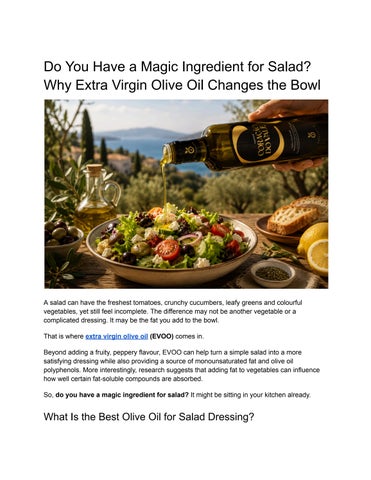
Do You Have a Magic Ingredient for Salad? Why Extra Virgin Olive Oil Changes the Bowl
A salad can have the freshest tomatoes, crunchy cucumbers, leafy greens and colourful vegetables, yet still feel incomplete. The difference may not be another vegetable or a complicated dressing. It may be the fat you add to the bowl. That is where extra virgin olive oil (EVOO) comes in. Beyond adding a fruity, peppery flavour, EVOO can help turn a simple salad into a more satisfying dressing while also providing a source of monounsaturated fat and olive oil polyphenols. More interestingly, research suggests that adding fat to vegetables can influence how well certain fat-soluble compounds are absorbed. So, do you have a magic ingredient for salad? It might be sitting in your kitchen already.
What Is the Best Olive Oil for Salad Dressing?
Extra virgin olive oil is generally the best choice for salad dressing because it is minimally processed and retains the characteristic flavour and naturally occurring compounds of olives. Its fruity, bitter or peppery notes can complement vegetables, while its monounsaturated fat makes it well suited to a simple oil-and-acid dressing. Not sure which extra virgin olive oil to choose? Your bottle matters more than you might think. Freshness, origin, harvest date, packaging and storage can all affect the oil you eventually taste in your salad. Read our guide to choosing the right extra virgin olive oil before you buy. This matters because salad dressing is a raw application. You are not hiding the oil behind spices, frying or long cooking. The oil is one of the main flavours in the bowl. And that means quality becomes much easier to notice.
Could Olive Oil Actually Make Your Salad More Than Just a Side Dish? Yes, there is a nutritional reason to pair vegetables with a source of fat. Several vegetables contain carotenoids and other compounds whose absorption can be influenced by dietary fat. Research on salads has found greater carotenoid absorption when vegetables are eaten with fat-containing dressing compared with fat-free dressing. This is one of the most interesting reasons to rethink the way we dress salads. Vegetables provide compounds such as: ● ● ● ● ●
Beta-carotene Alpha-carotene Lycopene Lutein Zeaxanthin
Some of these compounds are fat-soluble, meaning dietary fat can influence their absorption. A human study published in The American Journal of Clinical Nutrition compared salads served with fat-free, reduced-fat and full-fat dressings. The researchers found substantially greater absorption of several carotenoids when the salad was consumed with fat-containing dressing.[1] That does not mean adding unlimited oil makes a salad healthier. It means that the idea of a completely fat-free salad is not necessarily the nutritional upgrade people sometimes assume it is.
What Happens When EVOO Meets Tomatoes, Carrots and Leafy Greens?
When extra virgin olive oil is added to vegetables, its fat can provide a suitable food matrix for fat-soluble compounds such as carotenoids. Research suggests that the type and structure of dietary fat can influence carotenoid bioaccessibility and absorption from a mixed salad. A more recent randomized crossover trial looked specifically at salads eaten with different fats. Sixteen participants consumed the same salad alongside either olive oil or coconut oil, in both emulsified and non-emulsified forms. The researchers found greater carotenoid bioaccessibility
with olive oil than coconut oil, while emulsification also increased carotenoid absorption compared with non-emulsified fat. The important takeaway is not that olive oil magically "unlocks" every nutrient. The dressing can influence what happens to certain compounds from the vegetables after you eat them. That makes the oil more than just a flavouring.
Is Your Salad Dressing Too Complicated? It does not need to be. A classic homemade salad dressing can start with extra virgin olive oil, an acidic ingredient such as lemon juice or vinegar, salt and pepper. A little Dijon mustard can help create a more cohesive dressing and add flavour without requiring a long ingredient list. A practical starting ratio is: 3 parts EVOO + 1 part acid For example: ● ● ● ● ●
6 tablespoons extra virgin olive oil 2 tablespoons lemon juice or vinegar 1 teaspoon Dijon mustard Salt, to taste Black pepper, to taste
Put everything into a clean jar, close the lid and shake vigorously for about 15 to 20 seconds. That's it. You have a dressing. You can also adjust the ratio according to your taste. If you prefer a sharper dressing, increase the lemon juice or vinegar. If you want something smoother and richer, use a little more EVOO. The "magic" is often in getting the balance right, not adding ten ingredients.
Which Olive Oil Is Actually Good for Salad? For a salad, choose an extra virgin olive oil that tastes fresh and has a flavour profile you enjoy. And don't think of it as a salad-only ingredient. The same EVOO can be drizzled over bread, tomatoes and cooked dishes, used for marinades, or added as a finishing touch. Mild, fruity oils suit delicate foods, while more robust, peppery oils can hold their own with roasted vegetables, beans, herbs and stronger cheeses.
This is where olive oil becomes surprisingly personal.
If your salad is delicate Try a mild, fruity EVOO with: ● ● ● ● ●
Lettuce Cucumber Avocado Fresh herbs Light greens
If your salad is bold A more robust, peppery EVOO can work beautifully with: ● ● ● ● ● ● ●
Tomatoes Roasted vegetables Chickpeas Feta Olives Grilled vegetables Beans
You don't necessarily need the most expensive oil. You need an oil that is fresh, authentic and flavourful enough to complement the ingredients.
Could the Dressing Be Helping Your Vegetables Work Harder? Adding oil to a vegetable-based meal may improve the bioaccessibility of some plant compounds, particularly carotenoids. This does not mean EVOO increases every nutrient or guarantees a health benefit, but it shows why dietary context matters when considering how vegetables are consumed. This distinction is important. "Better absorption" does not automatically mean "more health benefits." Bioaccessibility and bioavailability describe processes that occur between eating a food and the body being able to access or absorb its compounds. They are not the same as proving a specific disease-prevention effect. Still, the science provides an interesting explanation for something Mediterranean cuisines have done for generations: vegetables are often eaten with olive oil. Research has also investigated how olive oil can act as a food matrix for compounds from other plant foods. A 2022 study examining salad-dressing formulations found that the presence of oils and lemon juice could alter the bioaccessibility of certain polyphenols during simulated digestion.[2] So the salad bowl is not simply about adding calories or flavour. The combination of foods matters too.
What Should You Put in a Mediterranean-Style Salad? A simple Mediterranean-style salad can combine fresh vegetables, herbs, legumes or cheese with extra virgin olive oil and an acidic ingredient. The goal is not to follow one rigid recipe, but to create balance between freshness, acidity, salt, texture and the flavour of the olive oil. Try building your salad around this formula: Salad component
Easy choices
Greens
Lettuce, rocket, spinach
Colour
Tomato, carrot, bell pepper
Crunch
Cucumber, radish, seeds
Protein/fibre
Chickpeas, beans, lentils
Freshness
Parsley, coriander, basil
Acid
Lemon, red wine vinegar
Fat
Extra virgin olive oil
Flavour
Salt, pepper, mustard
This gives you plenty of flexibility. And it means you don't have to make the same boring salad every day.
Why Does EVOO Taste So Different on a Salad? Because you are tasting it directly. In a raw dressing, the aroma, fruitiness, bitterness and pepperiness of extra virgin olive oil are much more noticeable than they would be in a heavily seasoned cooked dish. That makes freshness and oil quality particularly important. A good EVOO does not have to taste neutral. In fact, bitterness and pepperiness can be positive sensory characteristics of extra virgin olive oil. Depending on the olives, harvest time and style of oil, you may notice: ● ● ● ● ● ● ●
Fresh grass Green fruit Herbs Artichoke Almond Tomato leaf Peppery sensations
A salad is therefore one of the easiest ways to understand what your EVOO actually tastes like.
Does More Olive Oil Mean a Healthier Salad? No. Extra virgin olive oil is energy-dense, so portion size still matters. The goal is to use enough to dress the vegetables properly and provide flavour, rather than treating more oil as automatically better. A balanced diet depends on overall food choices, not one ingredient. EVOO can be a valuable part of a healthy eating pattern, but it is not a magic cure or a replacement for vegetables, protein, fibre or an overall balanced diet. Think of it as a supporting ingredient.
The vegetables are still the stars. The EVOO simply helps bring the whole dish together.
So, What Is the "Magic Ingredient" for Salad? If one ingredient deserves the title, extra virgin olive oil is a strong candidate. It adds flavour, supplies predominantly monounsaturated fat and can help create a food environment in which certain fat-soluble compounds from vegetables are more bioaccessible. But the real magic is the combination of quality ingredients. A good salad does not need a complicated recipe. Start with fresh vegetables. Add herbs or legumes. Squeeze over some lemon. Season it. Then finish with a fresh extra virgin olive oil you genuinely enjoy. Shake it together. Taste it. Adjust it. That simple dressing can completely change the way a bowl of vegetables feels. And perhaps that is the real secret. The best salad ingredient isn't the one that makes vegetables disappear. It's the one that makes you want to eat them again. Carotenoid absorption from salads: a randomized crossover human study found greater carotenoid absorption with olive oil than coconut oil and greater absorption with emulsified than non-emulsified fat.[3]
FAQs What type of olive oil is best for salad dressing? Extra virgin olive oil is generally the best choice for a salad dressing because it retains the natural flavour and compounds of olives and works well in uncooked applications. How do you make a salad dressing with extra virgin olive oil? Start with a 3:1 ratio of EVOO to lemon juice or vinegar. Add salt, pepper and optional Dijon mustard, then shake vigorously in a jar until combined.
Which olive oil is used for dressing? Extra virgin olive oil is commonly used for salad dressing because its flavour and aroma are preserved without cooking, allowing the characteristics of the oil to be experienced directly. Which olive oil is good for salad? Choose a fresh, authentic extra virgin olive oil with a flavour intensity that suits the salad. Mild oils work well with delicate greens, while robust oils pair well with tomatoes and stronger ingredients. Is olive oil good with raw vegetables? Yes. Olive oil pairs naturally with raw vegetables, and research indicates that consuming vegetables with dietary fat can increase the absorption of certain carotenoids compared with fat-free dressing.