3/26/2026 Full Edition

Page 1


Old Gold&Black

New pedestrian pathway will link Reynolda campus to The Grounds

Redesigned intersections, crosswalks and trails will enhance safety and campus connectivity

Wake Forest recently began construction on a new pedestrian pathway connecting its Reynolda campus to The Grounds development. The university aims to improve safety, accessibility and connectivity for students, faculty and the surrounding community with the project.

Jane Duncan, the director of marketing at Front Street will foster strong connections between the Reynolda campus, The Grounds and the broader Winston-Salem community.

“The pathway will truly help to extend the feeling of the campus community beyond the gates,” Duncan said. “We didn’t want this to feel like just another strip shop center or mall, but instead provide a walkable space with pedestrian activity. We really aim to create a sense of place without being a stand-alone area, connecting to the Wake Forest campus and the neighborhoods surrounding The Grounds.”

The Grounds is a 100-acre residential and commercial development currently under construction along Deacon Boulevard, adjacent to the University’s baseball, football and basketball stadiums. Set to open in Fall 2027, the project will hold dining options and re -

Wake Forest students who want to live off campus during their junior year.

“We found this project to be such a transformational step and provides residential, dining, entertainment and retail options for Wake Forest students, faculty and staff, as well as the city of Winston-Salem,” Front Street Capital Director of Marketing Jane Duncan said.

One of the ways this vision will take shape is through the new pedestrian pathway, designed to improve how people move between campus and The Grounds.

Currently, N. Cherry Street splits from University Parkway in a one-way northbound lane just before the

pat terns for northbound vehicles. The construction engineering team leading the initiative in association with the North Carolina Department of Transportation, Kimley-Horn, seeks to align the northbound and southbound lanes of Cherry Street side by side.

The intersection will be positioned over a newly marked pedestrian crosswalk, creating a single, fully signaled intersection with a dedicated pedestrian signaltions for safe crossing. Removing the Cherry Street safety and expand the surrounding greenway area and multi-use trail.

Furthermore, with the new multi-use path, a new

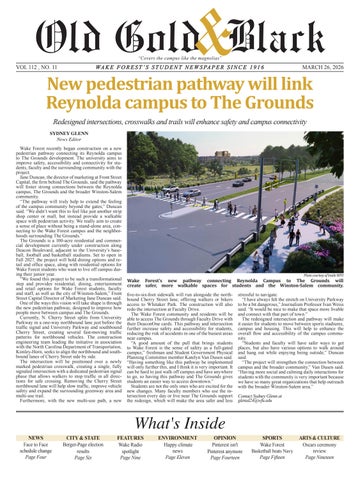
Wake Forest’s new pathway connecting Reynolda Campus to The Grounds will create safer, more walkable spaces for students and the Winston-Salem community.

bound Cherry Street lane, offering walkers or bikers access to Whitaker Park. The construction will also redo the intersection at Faculty Drive.

The Wake Forest community and residents will be able to access The Grounds through Faculty Drive with their DeaconOne cards. This pathway and intersection further increase safety and accessibility for students, reducing the risk of accidents in one of the busiest areas near campus.

“A good amount of the pull that brings students to Wake Forest is the sense of safety as a full-gated campus,” freshman and Student Government Physical Planning Committee member Katelyn Van Dusen said. “Having something like this pathway be implemented will only further this, and I think it is very important. It can be hard to just walk off campus and have anywhere to go, so having this pathway and The Grounds gives students an easier way to access downtown.”

Students are not the only ones who are excited for the new changes. Many faculty members who use the intersection every day or live near The Grounds support the redesign, which will make the area safer and less

stressful to navigate.

“I have always felt the stretch on University Parkway to be a bit dangerous,” Journalism Professor Ivan Weiss said. “It would be nice to make that space more livable and connect with that part of town.”

The redesigned intersection and pathway will make it easier for students to move between sports stadiums, campus and housing. This will help to enhance thenity.

“Students and faculty will have safer ways to get places, but also have various options to walk around and hang out while enjoying being outside,” Duncan said.

“The project will strengthen the connection between campus and the broader community,” Van Dusen said. “Having more social and calming daily interactions for students with the community is very important because we have so many great organizations that help outreach with the broader Winston-Salem area.”

Contact Sydney Glenn at glensd24@wfu.edu

Photo courtesy of Inside WFU

Old Gold & Black

is column represents the views of the editor-in-chief of the Old Gold & Black, Mattie Stillerman

Letter from the editor: Take a few extra minutes

e life of a college student is very “go go go”—especially for those of us who fall victim to the academic course load of “Work Forest.” ere are mountains of assignments, back-toback tests, hours of studying and meetings that probably could have been an email. e days y by and we struggle to nd a few free minutes.

With a never-ending list of responsibilities and activities, we nd ourselves desperate to save any ounce of time. In this bustling environment, one of the rst things to be compromised is how we get our news and information. Mobile technology promises instant answers to every possible question. e quick evidence for debates with your stubborn father and the name of that actor from that one movie you

and your friends can’t quite remember both show up in the Google AI Overview in seconds. If the answer isn’t on the rst page of Google, forget about it. We don’t have the extra ve minutes to dig through an article. However, there is so much value in taking a few extra minutes to read about campus news, brush up on local politics, discover local art events and stay in touch with the opinions of

As young adults, we have aged into a decisionmaking role in society.

peers.

It’s no surprise that as editor-inchief, I believe it is important for students to stay up to date on current events by reading the campus newspaper. is letter is not an advertisement for the Old Gold & Black, but an urging for our generation to stay connected and informed beyond AI summaries and the clickbait on TikTok’s For You Page.

Old Gold&Black “

Information is power and when we have reliable evidence, we can change our communities for the better. ere is strength in critical analysis that empowers us to not simply be bystanders in civic life, but make thoughtful decisions about communal issues. Whether in regard to housing changes or elections, answers are not

always black and white. Nor can they be summarized in a single sentence. Reading newspaper articles broadens our exposure to diverse perspectives, cultivating a well-rounded worldview. As young adults, we have aged into a decision-making role in society. We owe it not only to ourselves, but also to those in our community to be educated on relevant issues. An informed perspective is not developed by accepting the rst answer generated by the search engine. So I lied–this is a little bit of an advertisement for the Old Gold & Black. A test, if you will, to see if you read the article all the way through. But seriously, I implore you, take a few extra minutes and read full newspaper articles.

MARIA SILVEIRA MANAGING EDITOR silvmt23@wfu.edu

>> NEWS

Sydney Glenn, glensd24@wfu.edu

Jill Yoder, yodejs24@wfu.edu

>> CITY & STATE

Nick Costantino, costnp24@wfu.edu

>> FEATURES

Taylor Riley, riletc24@wfu.edu

Bianca Reznic, reznba24@wfu.edu

>> ENVIRONMENT

Evy McEwan-Debney, mcewes25@wfu.edu

Reese Lile, lilerl24@wfu.edu

>> OPINION

Caroline Gottsman, gottca23@wfu.edu

Sara Catherine Bradshaw, bradsr26@wfu.edu

>> SPORTS

Scottie Kimmelman, kimmsd22@wfu.edu

James Lombardo, lombjp23@wfu.edu

THE STUDENT NEWSPAPER OF WAKE FOREST UNIVERSITY SINCE 1916

MATTIE STILLERMAN EDITOR-IN-CHIEF stilmk23@wfu.edu

MIRIAM FABRYCKY DEPUTY EDITOR fabrml24@wfu.edu

>> ARTS & CULTURE

Lydia Derris, derrlf23@wfu.edu

Grace Schuringa, schugh24@wfu.edu

>> PHOTO

Catherine Neely, neelc24@wfu.edu

>> VIDEO

Ben Pappas, pappbw24@wfu.edu

>> SOCIAL MEDIA

Sophie Chan, chansr23@wfu.edu

>> COPY CHIEF

Elle Yormac, yormeh24@wfu.edu

>> DESIGN CHIEF

Cate Goldman, goldcr24@wfu.edu

>> DESIGN TEAM

Chloe Han, hanc24@wfu.edu

Kathryn Bakewell, bakekr24@wfu.edu

Elizabeth Hodges, hodgeg24@wfu.edu omas Tilton, tilttd25@wfu.edu

>> ADVISER

Ivan Weiss, weissij@wfu.edu

PIPER SAUNDERS MULTIMEDIA DIRECTOR saunpg23@wfu.edu

>> POLICIES

ANNE SHANNON BUSINESS MANAGER shanae24@wfu.edu

Our job as a newspaper is to be a platform for all voices, not just the ones we agree with. However, we reserve the right to reject advertisements that are vulgar, inaccurate, obscene or violate Wake Forest’s policies on nondiscrimination, diversity, equity, and inclusion as they pertain to student organizations. We will also reject any advertisements that promote illegal activities according to the state of North Carolina.

Not only do we hold our newspaper and its contents to a high standard, but we also expect that those who choose to use us as an outlet for their ideas, opinions and skill hold themselves and their content to a high ethical standard.

e Old Gold & Black is published ursdays during the school year, except during examinations, summer and holiday periods, by Triangle Web Printing of Durham. e views expressed in all opinion pieces and advertisements contained within this publication do not necessarily re ect the opinions of the Old Gold & Black. As part of our commitment to reporting news fairly and accurately, we will not remove any previously published content online unless it is retracted. If an error in either our online or print content is brought to our attention, we will revise the originally published article with an appended correction. In order to facilitate thoughtful and appropriate debate, profane, vulgar, or in ammatory comments on our website are not allowed and will be deleted. Comments which incite violence, target individuals in a form of cyber bullying, or which promote ideas which vilify marginalized communities will be deleted, and proper authorities may be noti ed and involved.

>> SUBMISSIONS

e OGB welcomes submissions in the form of story tips, columns and letters to the editor. Letters to the editor should be fewer than 500 words, and columns should be around 500 words. Send yours via e-mail to stilmk23@wfu.edu the Monday before publication. We reserve the right to edit all letters for length and clarity. No anonymous letters will be printed.

>> ONLINE MEDIA

Website: wfuogb.com

Facebook: facebook.com/ogb1916 X (Twitter): @wfuogb

Instagram: @wfuogb

TikTok: @wfuogb

Sports X (Twitter): @wfuogbsports

TEDxWakeForestU speakers step into the Fire

Speakers with a variety of perspectives and disciplines speak on how approaching risk can ignite change change

Finding a common ground in a divided world

Contact Aric Loiacono at

POLICE BEAT

• O ender consumed alcohol underage in Hopkins Residence Hall and refused transport. e report was led at 9:44 p.m. on March 19.

• O ender left a shower running which caused ooding in the lower rooms of Deacon Place Building 2. Subject had consumed alcohol and refused transport. e report was led at 3:09 a.m. on March 20.

• O ender was in possession of a fake ID which was lost and turned in to the Wake Forest University Police Department. e report was led at 12:32 p.m. on March 20.

• O enders consumed alcohol underage. One individual was incapacitated and transported to the Wake Forest University Baptist Medical Center from Parking Lot P. e report was led at 11:45 p.m. on March 20.

• O ender consumed alcohol underage and was seen pulling the re alarm in Bostwick Residence Hall. e report was led at 3:35 p.m. on March 21.

• O ender consumed alcohol underage, was seen pulling the re alarm and was in possession of a fake ID in Taylor Residence Hall. e report was led at 11:24 p.m. on March 21.

Lillian Fendelman/Old Gold & Black

Program for Leadership and Character and Palmer Foundation form a golf leadership initiative

The program will teach resilience, integrity and leadership through golf

The Program for Leadership and Character at Wake Forest University is partnering with the Arnold & Winnie Palmer Foundation to develop leadership skills in young golfers through character-focused programs.

Currently in its early stages, the initiative will connect educational resources with the Palmer Foundation’s global youth golf network to promote growth on and off the course. It will focus primarily on youth golfers, but Wake Forest golfers may also participate and provide input as the program is developed.

Michael Lamb, the executive director of the Program for Leadership and Character, said the career and legacy of Arnold Palmer, a star golfer who attended Wake Forest College about 75versity’s goals for character formation today.

“Arnold Palmer is a Wake Forest legend,” Lamb said. “He really embodies not only championship golf, but championship character.”

Golfers must exhibit honesty and self-discipline. For this reason, Lamb believes that golf is particularly suited for a character development program.

“In golf, you actually set your own penalties,” Lamb said. “You have to keep your own score. It relies on integrity in a way that many sports don’t…it

gives us a real chance to practice character in every round in ways that can help us grow.”

Lamb said the Palmer Foundation’s focus on character development aligns strongly with the purpose of the Program.

“One of the key areas of focus…is character development,” Lamb said. “And so when they learned about our Program for Leadership and Character and being at Wake Forest, they were excited about that connection. We began having conversations about how to really align our efforts…to really help young golfers around the world learn character.”

Corey Crossan is leading the initiative through the Program for Leadership and Character. She said the partnership creates opportunities for golfers even beyond the course.

“It was really exciting for us to be able to work with youth golfers to help them develop character, to not only help them perform better on the golf course, but to also perform better in life,” Crossan said. “Building things like resilience, temperance, courage…we can do that through golf, but it will also help Crossan said student-athletes at Wake program as it develops.

“I would love to get their advice and support of, you know, what do you wish you had when you were youth golfers?”

Crossan said. “How can we create tools with the Wake Forest golfers that would be that much more impactful for youth golfers?”

Wendell Dunn, the assistant director of the Program for Leadership and Character in Athletics, noted that the initiative contributes to existing character development work being done in athletics on campus. Dunn regularly works with Wake Forest teams to encourage personal growth.

“My connection and my work with them is usually mentorship,” Dunn said. “It could be a workshop, it could be a retreat… just build community amongst each other.”

Dunn said the golf initiative will bencollegiate level.

“We’re building programming for young golfers, so that by the time they reach the collegiate level or the professional level, they understand what character looks like in their space,” Dunn said. “They understand what leadership looks like in their space, and they’re able to not only be good people, but utilize that to perform better.”

Crossan noted that the initiative will grow as the partnership between Wake Forest and the Palmer Foundation develops. The organizers plan to work with a number of organizations connected to the Palmer Foundation.

“We’ve got three years committed with the Foundation,” Crossan said. “We’re working with a lot of differ-

ent partners…really hoping to embed different programs, tools, resources so that it goes much longer than those three years.”

Lamb said their long-term goal is to help athletes understand that character can improve both performance and everyday life.

“You need humility, you need resilience, you need courage, you need persistence, you need respect, you need integrity,” Lamb said. “Character can be a way for us not only to be excellent on the course, but also excellent in our lives.”

Contact Aric Loiacono at loiaat25@wfu.edu

Magic Johnson will replace Cynthia Erivo

as

Legendary former basketball player and entrepreneur Earvin “Magic” Johnson will replace “Wicked” star Cynthia

“Wicked” actress will speak in September instead

the 2025-2026 Face to Face Speaker Forum season, Wake Forest announced on March 2.

“Given the caliber of the speakers we bring to Face to Face, we know these types of changes are always a possibility,” Executive Director of Face to Face Sue Henderson said.

Johnson, who shattered records throughout his long career with the Los Angeles Lakers, remains a prominent the Washington Commanders and coowner of the Los Angeles Dodgers, Los Angeles Sparks, Los Angeles Football Club and esports franchise Team Liquid. He will speak on Tuesday, April 14 at LJVM Coliseum. ESPN college basketball analyst and author Jay Bilas will moderate the conversation.

Johnson was originally scheduled to speak at Wake Forest in September 2025, but postponed his visit due to unforeseen circumstances. The Demon Deacons’ own “Hometown Hero” Chris Paul stepped in instead.

“We are really excited that we still

have the opportunity to hear Magic Johnson this season after he was unable to attend in September,” Henderson said. “I’m really looking forward to hearing about his career in business as well as his years on the basketball court.”

woman “Dracula” show currently playing in London’s West End, Erivo is no longer available to visit campus on Wednesday, April 15, as previously scheduled. Instead, she will speak on Wednesday, September 16 at LJVM Coliseum. Ticket sales to her keynote event will begin on August 3.

A Tony, Grammy and Daytime Emmy winner known for her powerful vocals and acting, Erivo is currently most famous for starring as Elphaba in the

now, which is, of course, why she had to reschedule,” Henderson said. “I look forward to hearing how she is balancing her amazing career and what drives her passion to perform. I know we will be in for a real treat when she takes the stage

in September.”

Some students, especially graduating seniors, expressed disappointment at the news.

“Hopefully I will still get to go to the event in September, but I know a lot of seniors who are really sad about the change,” senior Hannah Reynolds, a Presidential Scholar for Theatre, said.

After seeing Kristen Chenoweth as the original Glinda actress from the Broadway production of Wicked, Reynolds was excited to see both Elphaba and Glinda during her time at Wake Forest.

“My freshman year, Kristen Chenoweth spoke at Face to Face, so it would have been full circle to see Elphaba at the end of my senior year,” Reynolds said.

Despite the date changes, both Johnson and Erivo will remain a part of the Face to Face speaker series in 2026.

“A magical end to this season and a wicked start to the next,” the email from Face to Face said.

Contact Caroline Khalaf at khalca23@wfu.edu

The initiative will focus on the development of youth golfers.
Ken Zhou/ Old Gold & Black
Annabelle Tan/ Old Gold & Black

CITY & STATE

PAGE 5 THURSDAY, MARCH 26, 2026

Reactions from N.C. politicians on the Iran war show deep partisan divide

Republicans support the war, whereas Democrats oppose its measures

As the war between the United States and Iran stretches into its fourth week and the death toll stands at 13 American soldiers and 1,500 Iranians, mostly civilians, an overwhelming majority of Republican politicians in North Carolina remain supportive of the war, whereas state Democratic o cials are criticizing President Trump’s military actions. eir reactions mirror partisan responses to the war at a national level.

Rep. Pat Harrigan (R-N.C.), who represents Winston-Salem, said in a Feb. 28 press release that he unequivocally supports strikes against Iran. He refused to characterize the con ict as a war.

“ is ain’t your father’s regime change,” Harrigan said. “It’s not the Global War on Terror. It’s not even war. It’s avoiding war through the limited, extremely violent and decisive use of force that achieves decisive overmatch and ends the ability for con ict altogether. It is reshaping the globe and the balance of power in favor of the United States of America again. We are rolling the tables.”

In a social media post on March 1, Democratic Gov. Josh Stein lamented the deaths of American service members and said he and his wife were praying for their families.

“I join all of North Carolina in mourning the three American service members who died in the Iran attacks,” Stein wrote, referring to the deaths of Sgt. 1st Class Noah Tietjens, Sgt. 1st Class Nicole M. Amor and Sgt. Declan J. Coady in an Iranian airstrike in Kuwait. “May the memories of these heroes be a blessing.”

At a March 2 press conference, Stein said he was “confused” and upset by the war.

“Why are we doing this?” he said. “ ere’s not many clearly articulated rationale. What is the purpose? It changes on an hourly basis, the stated reason. How long are we going to be there? How much are we spending to do this?”

At least three military bases in North Carolina are taking extra safety precautions against potential Iranian aggression following violent attacks in Michigan, Virginia and New York City.

In a March 1 social media post, Democratic U.S. Sen. candidate and former Gov. Roy Cooper expressed dismay over the deaths of the U.S. service members in the Middle East and thanked them for their service, while also emphasizing Americans’ fears about the war.

“Devastating news that American service members were killed and wounded and I pray for them and their loved ones,” Cooper said. “I’m grateful for our troops who eliminated leaders and damaged weapons of this evil and oppressive regime.”

Like Stein, Cooper also questioned whether the war is necessary.

“Americans fear another costly, drawn out war that puts our troops in harm’s way and removes focus and resources from needs here at home,” Cooper said. “Americans deserve to know all the long term objectives of this war, its risks and the exit strategy.”

Michael Whatley (R), who is running against

“What is the purpose? It changes on an hourly basis, the stated reason. How long are we going to be there? How much are we spending to do this?

Cooper in November’s Senate election, said he mourned the losses of American service members in the war.

“[Suzanne Whatley] and I are praying for the heroes we lost this weekend, as well as their families,” Whatley said in a March 1 social media post accompanied by an image of an American ag. “ eir sacri ce will not be forgotten and they have made the world a safer place.”

In a Feb. 28 post, Sen. Ted Budd (R-N.C.) acknowledged that most Americans oppose entering another con ict in the Middle East, but emphasized his support for President Trump’s actions.

“For decades, Iran and its terror proxies have repeatedly targeted American service members and stoked violence and unrest in the region,” Budd said. “President Trump knows well that the American people do not favor prolonged con ict, but there is also little doubt that Iran’s reckless ambition to obtain nuclear weapons and long-range missiles represents a grave threat to our safety and security. A nuclear Iran has always been an unacceptable outcome.”

Sen. om Tillis (R-N.C.) similarly expressed support for U.S. strikes against Iran and praised Trump’s decisions, but did recognize that Congressional authorization may be required.

“President Trump has rightfully determined that this theocratic dictatorship cannot be allowed to acquire nuclear weapons and continue to slaughter its own citizens who simply want freedom,” Tillis said. “I expect all members of Congress will soon be briefed about Operation Epic Fury and determine whether a broader scope and further military action requires an authorization by Congress.”

As the war presses on and the potential for more loss of life remains, politicians in North Carolina will have to answer questions from their constituents as support slips for the war and President Trump alike.

COSTANTINO
OLD GOLD & BLACK
Photo courtesy of Reuters
Nick Costantino, costnp24@wfu.edu

Sam Page defeats Phil Berger in GOP primary by 23 votes

The longtime N.C. Senate President Pro Tempore’s power is over

After a race decided by just 23 votes, one of the most powerful gures in North Carolina politics is no more.

Phil Berger, the longest-serving active State Senate Leader in the country, conceded the District 26 Republican primary to opponent Sam Page, the longtime sheri of Rockingham County, on Tuesday, March 24, after a recount con rmed Berger’s loss. In his announcement, Berger re ected on his many years leading Republicans in the state government.

“While this was a close race, the voters have spoken, and I congratulate Sheri Page on his victory,” he said. “Over the past 15 years, Republicans in the General Assembly have fundamentally rede ned our state’s outlook and reputation. It has been an honor to play a role in that transformation.”

Berger served as North Carolina’s Senate President Pro Tempore since 2011. Over the past decade, he became arguably the most in uential political gure in the state legislature, shaping policy across education, taxation and social issues. Even under Democratic governors, Berger maintained signi cant control over the legislative agenda.

Sam Page, by contrast, is a political

outsider at the state level. He built his campaign around local credibility and opposition to certain policy decisions associated with Berger, most notably Berger’s past support for casino expansion, which became a point of contention in the race.

On Tuesday, March 17, the initial ballot count found that Page beat Berger by only two votes. Berger immediately requested a machine recount, which yielded him a slightly larger margin of loss, by 23 votes.

Berger continued his battle

After the rst recount, Berger requested a hand-to-eye recount. Under state election procedures, o cials may conduct a partial hand recount by randomly sampling 3% of precincts and early voting sites. If that review reveals meaningful discrepancies—which the News & Observer notes is historically unlikely—the state has the authority to expand the process to a full recount.

Berger wrote in his request to the State Board of Elections on Friday that he wanted a recount of all the ballots because he believes there are signi cant discrepancies in the election.

“Although I believe a hand-to-eye recount of all the ballots is warranted here, I ask that, at the very least, the State Board

order a hand-to-eye recount of ballots that were read by the tabulators as having overvotes and undervotes,” Berger wrote. “ ose uncounted ballots…are nearly ten times the margin in this contest.”

In a statement following Berger’s initial recount request, Page expressed condence in the original election results.

“We won this election because the voters of Guilford and Rockingham coun-

“In

a local primary race that unexpectedly gained outsized outside attention, every vote mattered.

ties made their decision clear,” Page said. “[Berger] has the right to request a recount, and I’m con dent it will con rm the outcome. We won.”

e N.C. State Board of Elections is scheduled to meet this Wednesday, March 25, to certify the election results.

Politics professor weighs in

Wake Forest professor John Dinan, whose research focuses on state constitu-

tionalism, federalism and American political development, said in a statement that the signi cance of Page’s win lies not in Page’s ideological di erences from Berger, but in Page’s unexpected upset of the Raleigh hierarchy.

“Berger has wielded more in uence in North Carolina politics over the last decade and a half than any other public ofcial and has been an architect of nearly all notable policies enacted during this time,” Dinan wrote. “If Berger is defeated in his own party’s primary, as the current vote totals show, it will change the power dynamics in North Carolina’s state government.”

He continued: “A new Republican president of the state senate would emerge, but would not hold anywhere near the level of power that Berger has held, given Berger’s extensive experience in this position. Very few policies have been enacted in North Carolina over the last decade and a half without Berger’s approval. And so it would be very signicant if he were to be defeated and no longer be in a position to hold this level of in uence over North Carolina politics.” In a local primary race that unexpectedly gained outsized outside attention, every vote mattered.

Contact Eve Darke at darkev23@wfu.edu

UNC System approves tuition increase

On Feb. 26, the University of North Carolina System Board of Governors approved a tuition increase for new students at most of the state’s public universities.

e decision follows a Board of Governors’ announcement in September 2025 authorizing universities to propose in-state tuition increases of up to 3% to address rising operating costs and in ationary pressures. For nine years, UNC System tuition had remained frozen for in-state undergraduates, re ecting the System’s commitment to affordability despite rising costs.

e increase amounts to about $125 for in-state students and $983 for out-of-state undergraduates, on average. Tuition for current in-state students as well as for new students at N.C. Promise Schools will remain unchanged.

e Board also approved an increase in mandatory student fees. For the 2026-27 school year, fees are expected to rise by an average of 1%. e two increases will bring the combined average cost of tuition and fees to approximately $7,644 across most of the 17 UNC System universities, which serve over 256,000 students.

Commitment to a ordability

UNC leaders state that the decision represents a broader e ort to sustain university operations. While acknowledging the impact of surging costs, UNC System Presi-

dent Peter Hans emphasized that a ordability remains a priority for the System.

“Low tuition is at the heart of our compact with the people of North Carolina,” Hans said in a press release. “We’re focused on reducing administrative costs, keeping student debt down and making sure every UNC degree delivers value for our graduates.”

Operational costs on the rise

Rising costs tied to faculty retention, student services and other in ation-related expenses contributed to the tuition increase, as o cials weighed the consequences of increased student costs with the fundamental needs of the university system.

UNC System Chief Financial O cer Jennifer Haygood told NC Newsline that campuses will funnel the resources freed up by the tuition increase toward student support.

“You can see campuses wanting to invest in student services, particularly advising, both academic advising and career counseling,” Haygood said. “Lastly, in ation is always in the background as a continued challenge that our students, our campuses have been dealing with for many years and have been absorbing.”

Concerns about tuition increase

Despite support from UNC System ofcials, the decision to raise tuition sparked debate among members of the Board of Governors. Some critics contended that universities should continue cutting costs rather

than placing a nancial burden on students, noting that income growth in North Carolina has not kept pace with rising tuition.

One of these critics, Art Pope, a former N.C. House member and state budget director under Republican Gov. Pat McCrory, stressed the importance of lowering unnecessary spending.

“We can still do so much better, reducing the nickels and dimes that become millions, prioritizing the core academic mission of teaching and research in other areas and making it as free as practicable tuition for our in-state residents,” Pope said. “Other states are doing it.”

Students and families react

e news elicited varied responses from students and families. Some prospective students expressed disappointment but said the relatively minor increase in tuition is unlikely to alter their college plans. However, others noted that even a small increase in nancial burden can a ect certain families.

“Money is always going to be a factor in deciding of what students want to go and how they go, and if they’re able to a ord it. You know, $125 for one family versus another could be a big deal,” Damon Whalen, a school counselor, told Spectrum 1 News.

Hannah Rabinowitz, a student from North Carolina who goes to UNC Chapel Hill, said she was disappointed in the decision to increase tuition, especially for instate students.

“I was really shocked by the UNC [system] decision to increase tuition,” she said. “We’ve always prided ourselves in North Carolina on having really low, a ordable tuition. Even in light of raising tuition for out-of-state students, they were so willing to raise tuition for in-state students despite the mission of the schools.”

E ects for Wake Forest

As a private university, Wake Forest’s tuition will not be a ected by the UNC System decision. However, the university is making its own nancial changes for instate students.

Wake Forest announced in September 2025 that new North Carolina students whose families earn less than $200,000 per year will not pay tuition. e new scholarship program, called Gateway to Wake Forest, emphasizes a ordability as costs rise across the state.

“ e North Carolina Gateway to Wake Forest University demonstrates our deep commitment to students from our home state,” President Susan Wente said. “It says clearly to students and families who may not have considered Wake Forest because of cost: ‘Wake Forest is within your reach.’”

As the school expands its nancial aid programs, it intends to remain competitive with schools in the UNC system.

Contact Virginia Young at younvb23@wfu.edu

City Council retreat sparks plans for the future of Winston-Salem

Public transportation, housing affordability, crime and economic development will be at the center of these plans

The Winston-Salem City Council met at the Graylyn Estate on January 14 and 15 to discuss longterm plans for the city and ways to collaborate with other departments of the city government, such as the Police Department and the Transit Authority.

The council meets at this special retreat once a year to take a deeper look at issues that they cannot fully address during regular council meetings. The gathering also allows for team building among the council members and their staff.

that Council members get to know one another better, which helps strengthen working relationships,” Beth Hundley, assistant to the city manager, said. “Stronger working relationships mean more gets done for the citizens of Winston-Salem.”

Affordable housing and transportation are key goals, says Mayor Joines

In an interview with the Old Gold & Black, Mayor Allen Joines spoke to the importance of the retreat for taking a step back from day-to-day governance to look at overarching projects that can improve the lives of Winston-Salem residents.

One such topic of discussion was constructing more affordable housing units.

“One of the key things on our radar right now, and I think most cities across the country, is affordable housing,” Joines said. “We had a housing needs study done, about about 16,000 new affordable units here in the city over the next 10 years. And so we’ve put together a pretty aggressive plan to begin working on that.”

“I think we’ve done probably close to 5,000 units already, but we’ve got a long way to go, and we’re getting tight on money, so we had to talk about ways to accomplish our goal with the limited resources that we have within the city,” Joines continued. “And one of those things that we’ve decided to put together was our own local housing trust fund, made up of private sector contributions. We feel like that would be a good way for us to begin addressing the affordable housing issue.”

Joines also spoke on Winston-Salem’s public transportation system. He explained that the as it requires passengers to go all the way to the Clark Campbell Multimodal Transportation Center downtown to switch lines.

“I’ve been advocating for more across-town routes, so that if you’re going from, let’s say, Buena Vista… to Hanes Mall, you could go straight over there without having to come downtown,” Joines said. “I believe it will help our ridership, make it

vidual has to spend on the bus to get from point A to point B. It’ll cost us some money because we’ll have to add additional buses. But City Council endorsed it in general and [I’m] looking forward to getting more details on that.”

Finally, Joines touched on homelessness in Winston-Salem.

“Homelessness is an issue that’s on a lot of people’s minds,” Joines said, adding that the city continues to feel the repercussions of the pandemic. “We’ve made good progress in addressing our homeless situation. I created a ten-year plan to end chronic homelessness, probably about 15 years ago, and we were able to reduce chronic homelessness, which means that a person had been homeless

for over a year, by 92%.”

Joines said his team looks for creative solutions to address residents’ housing needs.

“We talked about ways to address the immediate homeless situation in terms of providing housing opportunities for the homeless,” he said. “We’re trying to look at some ways to do immediate housing, and then more long-term programs to help individuals get more self-sustaining.”

Council member Scott Andree-Brown echoed these sentiments.

moving our unhoused neighbors to permanent housing,” Andree-Brown said. “While we continue our work on affordable housing, we are exploring a community program to support the unhoused. This initiative will be a housing and services hub that will focus on the whole person. This will be an opportunity for our local governments and private organizations to partner together to lift up our neighbors.”

Planning for the future

Once the retreat is over, the city government staff develop a detailed action plan for each topic discussed. For example, the city will implement two cross-town bus routes with the Transit Authority within the next few months.

That work isn’t always easy. Council Memberernment that often relies on older facilities and systems.

Looking to the future of Winston-Salem, Joines said he is concerned by state initiatives that may restrict the city’s ability to assess property taxes, which are the municipal government’s main source of revenue.

“The state of North Carolina has put together a task force that’s been looking at property taxes,” he said. “I’m very fearful that they may do something that would limit our ability to create our own property tax rate. And that’s the basic source of revenue for cities in North Carolina. That’s the only thing we can do anything about.”

Joines added that he is looking forward to meeting the next president of Wake Forest and continuing partnerships between the city and the university.

“President Wente is retiring a little later on this year, and so we’re going to be anxious to see who the new president is and re-establish a strong relationship with that person,” he said. “But I think we’re very fortunate to have a positive working relationship on both sides of the equation.”

“[There were] lots of discussions on keeping thenology advances, providing workspaces within too many aging facilities [and] maintaining quality employees within highly competitive municipal careers, while having one major source of income – taxes,” Scippio said. “It’s like running a race with shackles.”

Contact Nick Costantino at costnp24@wfu.edu

Ken Chen/Old Gold & Black

FEATURES

OLD GOLD & BLACK

Taylor Riley, riletc24@wfu.edu

THURSDAY, MARCH 26, 2026

Bianca Reznic, reznba24@wfu.edu PAGE 8

5Ks for a cause

How Kappa Delta & Pi Kappa Alpha philanthropy embodies “Pro Humanitate”

Every spring at Wake Forest, students gather for philanthropy events that raise money and cultivate community. is year, two major fundraising events–Kappa Delta’s (KD) annual Shamrock 5K and Pi Kappa Alpha’s (Pike) One Love 5K–have become de ning examples of how Greek life philanthropy extends far beyond mandatory attendance and embodies “Pro Humanitate.”

e annual KD Shamrock 5K raises money for Positive Childhood Alliance North Carolina (PCANC), an organization focused on supporting children and families and promoting positive childhood experiences. e race also goes beyond the sorority and brings together people from across campus.

KD’s philanthropy co-chair, sophomore Reagan Barrett, oversees logistics, fundraising and outreach for the race. She notes KD invites everyone in the Wake Forest community to attend, including students, faculty, sta , campus organizations and local residents. KD members fundraise by reaching out to friends, family and even local businesses, many of which sponsor prices or donate food and drinks for the race.

“We’ve traditionally been one of [PCANC’s] top donors every year, if not the top donor…which we’re very proud of because in comparison to some of the other chapters, we are on the smaller side,” Barrett said. “[Everyone] cares about our philanthropy and the event. It brings everyone together.”

is unity, Barrett says, is impactful. Last year, Barrett worked on the logistics team and had the opportunity to watch as hundreds of Wake Forest community members gathered at the starting line.

“I remember everyone lining up at the start line and just seeing all these faces that I knew and faces I didn’t know lining up together, just getting their watches ready to start running,” Barrett said. “It was just really special for me to see everyone coming together.”

For sophomore Eva Tucker, a member of KD, philanthropy became a signi cant aspect of her Greek life experience.

“I feel like we do a really good job of making it easy to be involved in philanthropy in a fun way,” Tucker said. “Everbody loves doing it… e main point is the philanthropy but then [there’s the] added bonus of getting to hang out with everybody and having a good time.”

is year’s event will run concurrently with Kappa Delta’s Parents’ Weekend on March 21. Tucker said she is excited that many families will be on campus during the event.

“A lot of people’s parents are coming and I feel like that’s a great way to get more people involved and raise more money,” Tucker said.

Tucker added that the intersecting events o er an opportunity to bridge the gap between campus life and home life.

“In college, you don’t necessarily meet your friend’s parents and your friend’s parents don’t meet your parents,” Tucker said. “So I’m excited for that this year too.”

Part of what makes the event so meaningful is that the event’s earnings go towards a good cause. PCANC has had a longtime relationship with KD who frequently invites representatives from the organization to attend the 5K to speak about their mission and share their appreciation for KD’s support. According to Barrett, knowing about the policies the fundraising goes towards and the impact on the families they are helping makes the event more rewarding.

“ is year speci cally with the families, we have received so much positivity, so many donations from everyone’s families,” Barrett said. “Just the joy that it brings… Yes, it’s a lot of work, but we really

A large group of students from across campus gathered on a sunny day to take part in Pi Kappa Alpha’s One Love 5K.

do enjoy putting on the event because of where it’s going.”

is year’s Shamrock 5K is projected to achieve similar success as prior years. As of March 20, the day before the 5K, the race had 459 participants and had raised $37,162.01, with donations continuing to rise leading into race day.

Perhaps most importantly, Barrett stressed that KD’s philanthropy is not meant to be internal.

“We don’t just do our philanthropy for us and for our organization,” she said. “We want that mission and that culture we hold in our chapter to be spread to everybody else on campus as well. So I think that’s kind of what sets Shamrock 5K apart from some of the other philanthropy events that you’ll see.”

Kappa Delta isn’t the only organization building community via philanthropy. Earlier this semester, the brothers of Pi Kappa Alpha organized their rst campus-wide 5K in support of the One Love Foundation, a nonpro t focused on relationship abuse prevention and healthy relationship education. eir event, like KD’s, was the result of months of planning, outreach and collaboration between students.

Sophomore John Tolve, one of Pike’s philanthropy chairs, explained that the fraternity has hoped to work with the One Love Foundation for a long time.

“We’ve been in talks with the One Love Foundation for a while now,” Tolve said. “We wanted to be a part of their mission because a lot of people here on campus felt like they’re a great organization.”

Fellow philanthropy chair Matt Kutchma, who worked with One Love before coming to Wake Forest, helped forge a partnership between the two organizations. e fraternity also structured the race with support from the One Love club on campus. However, their original plans to hold the event o campus fell through, and securing a date on campus proved just as complicated.

“We ran into a bunch of roadblocks that we didn’t want to,” sophomore Alex Prevost, also a philanthropy chair at Pike, said. He added that UPD capacity issues, followed by two weeks of unforeseen

snow, forced the race to be postponed multiple times.

Despite the setbacks, and an early weekend start time of 9:30 a.m., turnout on Feb. 14 was strong.

“I think all that support, along with the long planning that we had for this event, turned out great,” Prevost said. “We got most of our chapter to sign up, most of the One Love chapters to sign up and even people outside of our organization to sign up.”

Kutchma also shared his appreciation for participation across campus.

“It’s always fun to see people getting together up and about in the morning, especially after a Friday night,” Kutchma said. “People don’t always want to get up and it kind of shows dedication for the cause and [that] everyone wanted to be there.”

e fraternity’s primary goal in partnering with One Love was to spread awareness of the group’s mission.

“ e main goal of One Love is to raise awareness [of] abusive relationships,” Tolve said. “So that was kind of our main message when advertising the event.”

Looking ahead, all three philanthropy chairs hope to grow the race into a larger annual tradition.

“We’re always looking to expand the event,” Kutchma said. We want to expand this to other fraternities as well, and other sororities…Even beyond just Greek life.”

Together, KD’s Shamrock 5K and Pike’s One Love 5K create the opportunity for students to be part of something bigger and form the moments that bring Wake Forest’s motto, “Pro Humanitate,” to life. Whether one is on the logistics side, sending numerous planning emails and overcoming coordination obstacles, or participating in the events, with early morning wakeups and a race towards the nish line, philanthropy is embedded in the culture of Wake Forest and Greek life on campus.

“We really do care a lot about our philanthropy,” Barrett said. “And we want everyone to come and be a part of it.”

Photo Courtesy of Matt Kutchma

Wake Radio shares a love of music with students

Scheduled radio and live shows expose students to new artists and genres

Since 1984, Wake Radio has provided students and the broader Piedmont Triad region with free, curated music. The student-run club broadcasts hour-long shows from 9 a.m to 1 a.m. every day of the week while the station itself runs 24 hours a day, seven days a week.

Wake Radio president, senior Jackson Shaver, explained the club’s mission of providing a creative and social outlet for its members and listeners.

“It’s just about bringing people who love music together and getting them all in the same space,” Shaver said. “A big thing that I think about is no matter someone’s race, gender, ethnicity, no matter any barrier anyone might have, two people can still like the same music.”

A casual, collaborative club

Shaver said that Wake Radio is inclusive and easy to join.

“The main function of the club is very low commitment,” Shaver said. “You just have to go to the studio for one hour a week. You can play whatever music you want to. Anyone in the whole world can listen, including your friends and family at home and friends here. It’s just taking an hour of your week to sit back and listen to music on really good speakers in a really cool space.”

Shaver said the club aims to have an app available by the end of the semester for both members and listeners. This app will allow hosts to easily schedule their shows and give listeners more information about each host, along with the type of music they can expect to hear.

“[The app will be] making it better for both the people in the club and the people that want to listen to have more inclusive experiences,” Shaver said.

Sophomore Emmanuel Ramirez enjoys co-hosting a Wake Radio show with his friend.

“Whenever there’s a radio show that he hosts, I’ll go and hang out with him,” Ramirez said. “There’s multiple mics in the studio, so you can talk as well. You can have a conversation and talk about the music.”

Ramirez also appreciates the Wake Radio studio

“It’s a cool place to hang out,” Ramirez said. “They have a ton of CDs and other physical music. Even if you don’t want to listen to the songs that are going on the radio, you can just grab a CD and play it.”

To gain access to the lounge, potential members must complete three “intern hours.” During these

hours, interns assist hosts with their shows and learn how the station operates. Then, they must pass a test administered by the staff manager, sophomore Abby Hoyt. Hoyt said that in addition to conducting exams, she keeps track of current members and attendance. -

men will meet coming into Wake Radio,” Hoyt said. “That’s been a really great opportunity. I have met so many people through it now, and seeing the freshmen get involved on campus and with Wake Radio has been super fun.”

Engaging the community with cool music

Hoyt’s show runs Tuesday nights at 10 p.m. She said that she likes to have a theme for each of her shows.

“I love rock music,” Hoyt said. “That’s mostly what I end up playing. I also like indie-pop stuff as well. I’ve done a lot of genres like new wave, country, funk and stuff like that.”

One of her favorite themes this semester was a Fleetwood Mac-centered show.

“I went through how the members of the band would speak to each other through their songs and lyrics,” Hoyt said. “It requires a bit more research if I’m actually gonna give backstories behind the songs.

give the audience a bit more context of why I chose those songs.”

She added that themed shows give listeners a chance to learn something new about the music or discover songs they might not know.

“I gave more context about the artist and their life,” Hoyt said. “My friends and family at home and here listen, so even if it’s not necessarily their genre of choice, it can be more fun to listen to when you get to hear fun facts about the music. And I think getting context behind the songs, too, is awesome because you get to hear where that sound came from and understand the emotions behind it a bit more.”

Wake Radio also hosts musical groups at concerts in the spring and fall.

“It’s a really good opportunity for students on campus and even bands locally to play,” Hoyt said. “It Hoyt said that anyone can perform, not just Wake Radio members, and that all music is welcome.

“It can be DJs, it can be a cappella groups,” she said. “It can be actual rock bands, whatever you want to showcase. The events are usually held at the Gas Hill area of the Ramkat.”

Wake Radio’s upcoming spring concert will be on April 18 at 8 p.m. at Gas Hill.

“We’re gonna have a variety of bands playing,” Hoyt said. “My band, ‘No Invite,’ is playing.”

Radio concerts with his band, K.O.N.K.

said. “At a lot of their events, it’ll be an open-mic scenario. I’ll bring my saxophone, I’ll bring my band and we’ll perform.”

shows.

“When I go to somebody else’s show, they’ve pretty said. “It’s really a fun time. You’re just chatting and listening to good music.”

“Sometimes I’ll tune in just to see what people are on in the background really helps when I’m in the library studying because I always know it’s going to be good music.”

To listen to Wake Radio, tune in to 88.5 WFDD or scan this QR code:

Photo Courtesy of Noah Brown Contact Rishi Vanka
Noah Brown and Eli Owen play at the Wake Radio Fall concert.
Photo Couretsy of Noah Brown
The K.ON.K band play their hearts out at a Wake Radio sponsored event where several different musicians on campus performed.

New look, same heart at the Writing Center

Peer tutoring program center undergoes renovations

Pedagogical preparation

Updated design refreshes an established campus initiative

Looking to the future

Building skills and community connections

Piper Saunders /Old Gold & Black

ENVIRONMENT

THURSDAY, MARCH 26, 2026

The sunny up-sides of getting outside

Why we should all go outside and “photosynthesize”

Spring has arrived in full force at Wake Forest, with tulips popping up through the dirt outside Benson and cherry blossom trees blooming in Tribble Courtyard.

The season also brings new academic stresses, ingraduation. The sunshine offers an escape from these worries, but most of us forget it’s there; opting to sit in the library and cross one thing after another off our “to-do” lists instead.

But it may be more important than ever to go outside and “photosynthesize,” so to speak. Research showsmans don’t capture energy from the sun in the same way plants do, we actually do perform a type of photosynthesis. Sun exposure triggers reactions in our skin that synthesize vitamin D, an essential vitamin for skeletal development in children and good bone health in adults.

can affect bone and muscle health as well as the functioning of the nervous system and immune system.

Beyond providing the body with necessary vitamins, sunshine can boost your mood, regulate sleep patterns, reduce seasonal depression following winter and contribute to overall mental and physical wellness. -

side. Research shows that being in nature offers im-sociated with increased levels of positive emotions, better social interactions and decreased levels of mental health problems such as stress and anxiety. Furthermore, access to green spaces can offer a reduced risk of cardiovascular and autoimmune diseases.

Nature can even help students improve their aca-

demic performance. Research suggests that time outside improves memory and attention control, as well as creativity. So not only does going outside make us feel better, but it also measurably improves our health and our cognitive abilities.

And there are so many places to go outside and enand tables dot the campus, under broad magnolia

to the sophomore parking lot offers an opportunity to garden while you unwind from classes, and the

Mateo Aguirre, a second-year student double-

own experiences communing with nature. He said students.

“Spending time outdoors has always helped me focus and ground myself after a long day of classes,” Aguirre said. “Volunteering and working at the as particularly given me a sense of purpose and inspiration I take into my classes and daily life. Students should take advantage of our garden and outdoor spaces for their well-being and to Spring has sprung, and there is no better time than table to eat outside. Take a small study break and walk under the magnolias on the lower quad. Or choose to study outside, where you can soak up the sun while you try to learn what the phospholipid bilayer is. Truly, we should all go outside and “photosynthesize,” and Wake Forest’s beautiful campus offers countless places to do so.

Contact Reese Lile at lilerl24@wfu.edu

this spring

Happy Climate News

We hear a lot about what’s going wrong on the planet – let’s see what’s going right

caps melting, pollution choking cities and countless microplastics in everything we own and eat. While it is important to stay informed about environmental problems,py news in the world of the environment.

Swimming solar saves space

Traditional solar technology is installed horizontally on land. While effective, this approach requires a lot ofthe lake. Furthermore, the panels coexist with the surrounding marine life, supporting the local ecosystem as its submerged base.

Slow and steady wins the racetula varia) is being released back into their natural habitheir “glow-in-the-dark” appearance and keep the forests on their home islands healthy by eating decomposing vegetation. After invasive species left the snails of London developed a breeding program that helpedsible to reverse species decline.

The great white sharks are back (they never left) Fishermen off the coast of Spain captured a youngtinues to exist in the Mediterranean. Their catch was surprising but important because great whites are listed as “vulnerable” on the International Union for Conservation of Nature’s Red List. The existence of support breeding for these endangered sharks, and thesearch into this so-called “ghost species.”

Contact Reese Lile at lilerl24@wfu.edu

OLD GOLD & BLACK
Ken Chen/Old Gold & Black

OLD GOLD & BLACK

Sara Catherine Bradshaw, bradsc24@wfu.edu

Caroline Gottsman, gottca23@wfu.edu

e views expressed in all opinion columns represent those of the article’s author, not the opinions of the Old Gold & Black Editorial Board

Don’t expect AI companies to be Angels

Anthropic/Pentagon showdown demonstrates need for ethical regulation of AI

At 5:01 p.m. on Friday, Feb. 27, just hours before the U.S. and Israel launched the airstrikes that killed Ayatollah Ali Khamenei and ignited a devastating reAnthropic risked the Pentagon’s wrath by holding demand for “full, unrestricted access to Anthropic’stions against “mass domestic surveillance” and “fully autonomous weapons.”

Anthropic has faced painful consequences as a result. For one, the federal government severed its contracts with the corporation and formed a new and intelligence agreements include ethical boundar-ment branded Anthropic a “supply chain risk,” the security designation to a U.S. company.

sighted leadership should be an inspiration to others charting ethical precedents for AI. But the fact that a single person at the helm of one company was responsible for exhibiting such moral restraint is indicative of broader institutional and societal failures.

Amodei’s footsteps, and Amodei himself cannot live

up to the ideal of a righteous philosopher king. Rather than expecting AI corporations to regulate themselves, we should be developing durable, responsive ethical frameworks that keep dangerous technologies in check.

AI is still a morally fraught tool I can’t believe I’m commending an AI company.cized Wake Forest’s adoption of generative content, grown.

I don’t completely avoid AI, but I strive to distance account and stopped using AI to study for quizzes

browser that donates to environmental efforts, as my default, and I turned off automatic “AI overviews” on

My friends groan whenever I start my grousing, but I’m glad I’m gaining a reputation for being blunt about my anti-AI beliefs. I hope my words plant seeds. Meaningful resistance to AI will come not from any one person perfectly shunning chatbots, but from best create meaningful boundaries on technological not inevitable” returns hundreds of excellent, humanwritten essays arguing exactly that: the AI debate will not be over until we decide that it is over.

I want to praise Wake Forest for its participation for academic and administrative use of AI may be broader and more supportive of generative technolo-

coming to a consensus. I was also heartened by the detailed AI policies that two of my professors included in their sy lack thoughtful top-down AI laws for a long time, but we can start laying the intellectual foundations for future policies right now in our nation’s classrooms.

and they will continue needing it for the foreseeable future. While Anthropic’s ethical constitution is robust and genuine, the company does not belong on a pedestal. No matter how many jazzy, serif-font,cials the corporation produces, the fact remains that Amodei and his company were more than willing products as long as the surveillance systems gathered intelligence only on foreign countries and the lethal robots remained just “partially autonomous.”age as the “good” AI organization braving the raging philosophical battles of Silicon Valley and Washington, but it, too, should be held to the highest moral Papers” in 2026 rather than 1788, perhaps he would have argued that “if AI models and their developers were angels, no government would be necessary.” But no AI company can be an angel, not even Anthropic—and we shouldn’t expect them to be.

Contact Miriam Fabrycky at fabrml24@wfu.edu

Benson Boone is overhated

O n social media, opinions can seem black and white. When platforms amplify extreme reactions, whether praise or criticism, those who fall between these two poles sometimes question their own opinions. This phenomenon exposes many up-and-coming music artists to extremely negative feedback.

Benson Boone is a key example of an artist who has faced significant criticism from people on social media. The extreme hate he receives online for his music and lyrics is disproportionate to his talent and success. While his songwriting and production are still developing, both Boone’s vocal ran ge and popularity disprove critics' harsh judgments.

Both Boone's vocal range and popularity disprove critics' harsh judgements.

B enson Boone made his singing debut as a contestant on the 19th season of “American Idol,” but withdrew halfway through the competition to pursue a music career independently. After his withdrawal, he started posting singing videos on TikTok, which gained significant attention and subjected him to accusations of being an “industry plant” – someone

whose rise to fame came from artificial hype or nepotism.

Regardless of how he rose to fame, one of the main reasons for Boone’s continued success is his vocal talent. He exhibits a powerful three-octave range, greater than most male singers. His most successful song, “Beautiful Things,” exemplifies his power and range, more so than his other highly streamed songs like “In the Stars” or “Ghost Town.” With over two billion streams of “Beautiful Things” alone, this song shows that Boone’s popularity stems from real talent rather than internet hype.

Boone’s music leans more mainstream since he typically releases pop ballads. Critics and the general population often label this style as unoriginal or formulaic, but it’s one of the most popular and successful styles in music. Many artists like Shawn Mendes, Dean Lewis and Lewis Capaldi faced similar responses early on in their music careers.

However, there’s one thing that all these artists have in common: their music continues to top the charts.

Despite the claims that Benson Boone’s music is calculated and cookie-cutter, his success so early on in his career proves that his music resonates with listeners. Furthermore, he has repeatedly sold out concerts and has a growing audience, indicating that listeners think of his work in a more positive light than what people on the internet might say.

More recently, Boone has faced harsh criticism for his album “American Heart,” which is understandable given its weak lyrics and messy production. This is a result of the album being completed in 17 days.

Though Boone once again exhibits his vocals, it is overshadowed by the basic lyrics and disconnected production. He often relies on the styles of other successful artists, such as Freddie Mercury, rather than creating a distinct sound. Though he might be an entertain ing performer and a strong vocalist, Boone needs to take the time to produce an album with deeper lyrics in order to stay relevant and prove that he’s not just an industry plant with shallow lyrics and mediocre production.

His growing fan base does not align with comments stating that he is objectively disliked or talentless.

Though social media often amplifies negativity, especially when it pertains to artists and their music, Ben son Boone’s commercial success, vocal ability and knack for entertaining exemplify his talent and discredit those who c laim he is undeserving of his success. His growing fan base does not align with comments stating that he is objectively disliked or talentless. It’s reasonable to be critical of artists, but the extreme hatred that internet users project onto Benson Boone is exaggerated and an invalid assessment of his true talent and succes s.

Contact Patrick Regan at regapr25@wfu.edu

Annabelle Tan/Old Gold & Black

Pinterest isn’t Pinterest anymore

Advertising now overwhelms aesthetics on the app

Years ago, Pinterest was my favorite social media app. It encapsulated all the thrill of doomscrolling without the stress of feeling a need to compete with others. I saw it as an app for inspiration more than anything else, and for this reason, it had a therapeutic quality that other social media lacked. Whenever I didn’t know what to wear or what design to get for my next set of nails, I loved scrolling through Pinterest for ideas.

Last week, I needed a cute pastel or floral spring dress for an event. I had no idea what to look for since I had never encountered that theme, so I checked Pinterest. I made a new board and searched, “spring fling dress,” but noticed almost immediately that nearly every single dress I clicked on opened a link to a website. Nearly every picture was captioned, “promoted by” or “shop now.”

This seems like a small issue, but it was irritating. I wasn’t even sure I wanted to buy a new dress—I was just looking for ideas to see if something was already in my closet. Moreover, trying to save ideas to my board and being redirected to a website I didn’t click on completely changes the purpose of the app from inspiration to sales. Is Pinterest even Pinterest if it’s virtually impossible to actually “pin” anything without being redirected?

Even worse, a lot of the website links seemed extremely sketchy. I saw several that were shameless knockoffs of well-known dress sellers, like “Peppamayo” instead of “Peppermayo” and “Luck in the Skys” instead of “Lucy in the Sky.” One link took me to a small website that was selling a dress

from Princess Polly, but tried to pass off the design as their own.

I hadn’t used Pinterest much recently, so I wondered when this change started, and, more importantly, why. When I went to Google “why is Pinterest all ads now?” the sentence autofilled almost immediately, so it seems like I’m not the only one wondering. What I found is exactly what I expected: it boils down to corporate greed.

It would be unfair to say Pinterest shouldn’t advertise at all, since they do need to make enough money to keep the company running. However, there is no need to replace real user content with so many ads, especially when users see the same products being advertised repeatedly.

I admit that if my intention had been to buy a new dress, it would be nice to search for a niche party theme and instantly get a lot of decent results. However, I would get the exact same results on Google, so it still feels unnecessary and against the original model of Pinterest for the app to be so ad-driven. It might be nice to see real products when looking for clothes or home decor, but not in other instances. For example, when I was searching for some vintage photos of the Jersey Shore to use for wall prints, I was still bombarded with Skims ads. At the very least, the influx of advertising on Pinterest completely changes the purpose of the app from fun aesthetic inspiration to regular online shopping, and it seems as though this will only get worse as greed takes over.

Contact Annika Watson at watsa26@wfu.edu

2 Much: Sequels are industry

Enough with the unnecessary remakes – bring back new ideas

Whatever happened to “If it ain’t broke, don’t fix it?” Between recent and upcoming releases like “Zootopia 2” and “The Devil Wears Prada 2,” one question has echoed in my mind: Are moviemakers simply out of ideas?

It seems as though redundant sequels and unnecessary adaptations have replaced creativity. As an avid movie-goer and, admittedly, an avid preview-watcher, I often find myself sighing when the silver screen warns of yet another reworked, re-purposed story.

“I think that sequels can sometimes move away from the original focus of a movie,” firstyear Penelope Tarr said. “It just seems like sequels can diverge from the original story and create a different direction that viewers begin to enjoy less and less.”

The main sequel haunting my mind has to be “The Devil Wears Prada 2.” As a self-proclaimed superfan of the original 2006 dramedy, I simply do not understand the need for a second movie. To me, one of the best parts of “The Devil Wears Prada” is its early 2000s charm, a quality that cannot and should not be recreated.

“Do they really need to be making a second one 20 years later?” first-year Phoebe Diamond asked. “In my opinion, sequels are never better than the original, and ‘The Devil Wears Prada 2’ just seems like overkill.”

To be fair, some sequels actually serve a purpose. For example, the “Dune” and “The Hunger Games” franchises contain complex storylines and intricate details that require multiple movies to do them justice. But the last thing that simpler franchises need is another 90-plus minutes that create a brand-new plot. With “Minions 3” and “Toy Story 5” set to hit the box office later this year, it looks like most movie empires have no concept of beating a dead horse.

Ultimately, my issue is with redundancy and lack of imagination. With sequels overtaking the theater, how can movies remain an expression of artistry? Without creative risk-taking, moviemakers forget what makes viewers fall in love with movies in the first place. Until Hollywood rediscovers the originality that is movie magic, viewers like me will continue to sigh at the silver screen, waiting for something new.

Contact Hannah Ordan at ordahg25@wfu.edu

Annabelle Tan/Old Gold & Black

SPORTS

Scottie Kimmelman, kimmsd22@wfu.edu

James Lombardo, lombjp23@wfu.edu

Men’s Basketball took down the Navy Midshipmen at the Joel Coliseum the National Invitational Tournament on Wednesday, March 18. The Demon Deacons received a bid to the NIT as one of the four No. 1 seeds, giving them the chance to host up to three games at two matchups.

Neither team started off well offensively as the Deacs struggled from the 3-point range early. However, with the help of strong offensive rebounding and good free-throw shooting, they extended their early lead to 9 points midway

size on their roster with the exception of 6-foot-11-inch big man Aiden Kehoe, and the Deacs were able to capitalize on

the boards for plenty of second chances. Nonetheless, shooting 2-for-16 from

Navy to cut into the Wake Forest lead, tying the teams at 26-26 with about six minutes remaining in the half.

Navy’s well-coached offense used strong spacing and ample ball screen action to create open shots and overcome their size disadvantage.

“Their pace on offense was way faster than our pace on defense,” head coach Steve Forbes said postgame. “We weren’t making them miss. We were hoping they missed.”

Fortunately for the Deacs, they continued to draw fouls as they hit eight more free throws the rest of the half to help build a 38-34 cushion at halftime.

The second half was a much better look for Wake Forest’s offense. The Deacs shot better from beyond the arc, but the real difference came in a heightened focus on working their offense

Tre’Von Spillers and Omaha Biliew had a very strong half, with 8 and 11 points respectively.

Per usual, sophomore guard Juke Harris was a superstar. He, too, found a lot of success attacking the lane and getting to the rim en route to a 26-point performance.

“I don’t know what else to say about [Harris],” Forbes said. “He’s a hell of a player.”

With the help of this improved interior play, the Deacs further extended their lead around midway through the second half, as their advantage got well into the teens for the majority of the remaining ten minutes. Navy got a few points back cleared their bench, but this game ended with Wake Forest moving on to the second round of the NIT with an 82-72 victory.

The Deacs will now host the No. 4

Illinois State Redbirds, who handily round matchup on Wednesday night.

Men’s Basketball’s season ends with NIT loss to Illinois State

Wake Forest Men’s Basketball’s season came to a close on Sunday night as the Demon Deacons struggled mightily to defend down the stretch, falling at home to the Illinois State Redbirds.

The Deacons got out to an early advantage on the back of strong interior play from forward Tre’Von Spillers. After a Redbird 3-pointer to open the game, they went on a 10-0 run to make it 10-3, including 5 points from star guard Juke Harris. Illinois State

fought back a bit, but another short run from Spillers and guard Myles Colvin meant the Deacs held an 18-9

mitted his second foul of the game at the 9:35 mark, and he was forced to limit his minutes the rest of the half so as not to get a third foul before the break.

From there, things got iffy. With Spillers out, the Deacs had to go to forwards Cooper Schweiger and Omaha Biliew to play the interior. It wasn’t a good day for Schwieger, who had season-long struggles with physicality and rebounding. The big man scored just 2 points in this game with one rebound and one assist while committing three fouls and turning the ball over three times. Biliew contributed well, but the loss of Spillers was crucial in the Redbirds’ response.

From that point to the end of the half, Wake Forest was outscored 23-14, and Illinois State tied the game at halftime, 32-32.

Once again, Wake Forest came out with a strong start to the second half, as they took a 9-point lead midway through the period and led 59-50 with 9:21 to go. Over the next four minutes, the Redbirds would hit three 3-pointers and go on a 13-2 run to take a 3-point

Guard Ty Pence was fantastic for Illinois State, scoring 17 of his 23 points in the second half, and guard Johnny Kinziger hit 5-of-7 3-pointers en route to a 17-point second-half performance of his own.

The teams battled, and with just over a minute to go, the score drew even at 73-73. ISU’s Chase Walker scored in the paint, and Tre’Von Spillers added two

more to his 24-point effort, meaning the Redbirds had the ball with no shot clock and 28 seconds to go.

The Deacons actually didn’t have too bad a defensive possession, but Kinziger hit yet another 3-pointer with 1.9 seconds on the clock, and Wake Forest’s lastditch attempt to tie it failed as their season ended with a 78-75 loss.

“[Illinois State] decided to step up the physicality of the game defensively, and I don’t think we reacted very well to it,” said Head Coach Steve Forbes postgame. When asked about how his team wasn’t able to handle said physicality, Forbes said, “I think they listen, I think they try, I think it comes down to who you are as a player … some guys just can’t do it. They can’t make that adjustment or improvement to be able to handle that kind of stuff.”

Describing the season, Forbes called it “frustrating”, citing consistency issues. “When we played consistent, what happened? We were pretty good. When we didn’t, we weren’t.”

On what his staff will be looking for in the upcoming transfer portal, Forbes said, “you look for some skill, some toughness. You look for guys that can play through physicality on offense, can guard physically, can rebound the ball.”

With one of the lowest budgets in the power conferences, the Deacons have an uphill battle ahead of them to build a squad that can make the NCAA Tournament next season.

OLD GOLD & BLACK
GRIFFIN LAMPHIER
GRIFFIN LAMPHIER
Tre’Von Spillers finishes at the rim against Navy on Wednesday night.
Juke Harris (2) goes up for a contested 2-point shot against the Illinois State Redbirds.
Piper Saunders/Old Gold & Black
Christopher Wallace/Old Gold & Black

Men’s Tennis takes down No.1 Virginia

Friday

The Demon Deacons continued to roll as they picked up a victory against Virginia Tech handily on Friday evening, 4-0. After earning the doubles point for the 20th time this season, the Deacs opened the match with a 1-0 lead to get their momentum going.drew Delgado got the early break to take care of their opponents, 6-3, and set the tone.

sophomore Charlie Robertson was locked in a battle at 5-5 before getting the break and clinching their match, 7-5, and snagging the doubles point for the Deacs.

The singles session went quickly, as three Deacs a score of 6-0, 6-1.

Kacper Szymkowiak, No. 20-ranked Luca Pow, and Joaquin Guilleme cruised to dominant wins for Wake Forest and secured the 4-0 victory.

the start tonight,” Head Coach Tony Bresky said. “Doubles was competitive across the board. From there, our guys carried that energy into singles and did

Sunday

Wake Forest captured its biggest win yet this season, with a compelling victory of top-ranked Virginia, 4-2, control of the ACC regular season as they become the last remaining undefeated team at 8-0 in conference play.

Christopher Wallace/Old Gold & Black Wake Forest celebrates as they clinch the match against Virginia on Sunday.

Wake Forest grabbed the doubles point in dominating fashion. Robertson and Pow handled Virginia’s No. 31 Kim/Dahlberg, 6-1, while Szymkowiak and Rottgering bageled Rice/Santamarta Roig, 6-0, to earn the point.

The singles session started in favor of the Deacs, as Guilleme and Robertson got an early break on their

from a break down to take his opening set on Court 3.

Pow came in clutch as he got the break in the second set to clinch his match, 7-5, 6-3.

Guilleme toughed out a tightly contested set as he defeated his opponent, 7-6 (2). He was down 5-6, 1540 in the second set before winning three consecutive points and dominating the tiebreak.

Virginia responded and handed Wake Forest two losses. #21 DK Suresh Ekambaram was defeated on Court 1 by No.2 Dylan Dietrich, 6-3, 6-4, and Robertson on Court 4 by #42 Santamarta Roig, 7-6(5), 6-1.

composure through a back-and-forth match to eventually grab the win, 7-5, 7-5, clinching the match 4-2 for the home team. The fans erupted as Virginia’s ball sailed out of bounds, giving Wake its 15th win in a row and a monumental win over the top-ranked team. in the country,” Bresky said. “Virginia has an excel-

was a packed house.”

Later that day, Wake Forest secured its 16th consecutive win against Longwood, 4-0.

Szymkowiak and Cornelius Shalmi took downdo and Aryan Shah clinched the doubles point against Borisov/Mrdak, 6-2.

Delgado took care of his match, 6-3, 6-1, while Pow 6-0, 6-1, completing the weekend sweep for the Demon Deacons. Delgado now has a perfect 18-0 record across singles and doubles this season.

The Demon Deacons are on a tear through the ACC, and will look to continue that as they face North Carolina and Duke next weekend.

Contact Ella Maynard at maynir24@wfu.edu

Baseball falls to Virginia in ACC matchup

Coming off a bounce-back, mercyrule win over Liberty on Tuesday night, Wake Forest took the road trip up to Charlottesville to play a red-hot No. 9 UVA team. The weekend slate tested the Deacs with their second consecutive weekend series against ranked ACC opponents. They looked to continue their momentum from Tuesday’s victory and get back on track in conference play after a disappointing showing against Florida State last weekend.

Park Friday evening with hopes of entering the series with the same effort on the mound that they brought to the Couch on Tuesday. Despite the momentous ambition, the Cavaliers came out

5 runs on the board against Deacon ace Blake Morningstar. Morningstar pitched only three innings, giving up 5 hits and 5 earned runs.

The early ‘hoos offensive effort served as a strong tempo setter, as the Deacs couldn’t climb back for the rest of the game. Wake scored three runs in the last two innings and brought the tying runner to the plate in the ninth, but couldn’t convert.

While able to rally 11 hits throughout the game, led by Dalton Wentz’s

3-for-4 performance, they left runners in scoring position in key moments and failed to keep up with the Virginia offense. With a 10-6 now looming large for the Demon Deacons, a win in Game 2 would be crucial.

Saturday afternoon’s game told a different story from the start, as the Deacs came out fast and grabbed the lead early. Starter Chris Levonas limited the Virginia offense to 2 runs through his

5 strikeouts and increasing his record to 5-1 on the year.

Backboned by an 8-run third inning, the Deacs beat the ‘hoos with their own game, building an insurmountable lead early and managing to maintain a 5-run margin throughout the game. Notable Deacon performances included Junior Boston Torres, who went 3-for-4 in his

the cycle.

Coming off the series-tying win, the a chance to clinch the series in a decida slightly unique theme that we hadn’t

forth battle, unlike the previous outings, neither team grabbed control of the game early. Both a 3-run inning and a 1-run fourth by Wake Forest were quickly answered by UVA punching

back with 2 and 5 runs of their own. Virginia took advantage of a latestruggling Deacs offense and scored 6 runs in the sixth and seventh innings, before icing the game with one more to win by a mercy-rule of 14-4 after eight. our bullpen in that game,” said Coach Tom Walter after the loss. “We knew we wouldn’t get a ton of length out of Troy [Dressler].”

Following the series-deciding loss, the Deacs return home for a non-conference game against Elon on Tuesday night, followed by a weekend series vs Cal. Wake will surely be looking to get back in the win column and get a few ACC wins on their side this weekend at the Couch.

Contact Ben Blake at blackbv25@wfu.edu

Photo Courtesy of Wake Forest Athletics

Cameron Young wins The Players Championship

While Wake Forest fans mourn the Deacons' not making the NCAA basketball tournament, they have found a reason to rejoice. Last weekend, former Demon Deacon Cameron Young won The Players Championship at TPC Sawgrass. He secured his second PGA Tour win in thrilling fashion, edging out British golfer Matt Fitzpatrick by one shot. With his win at TPC Sawgrass, Young Golf Ranking. He also pocketed $4.5 million worth of winnings.

Entering the last day of the tournament, Young was 4 shots under the leader through 54 holes, Ludvig Aberg. sour note, shooting a double bogey on 18. However, it was clear the following day that the 2019 Wake Forest graduate wasn’t ready to roll over and give up. After a bogey on the sixth hole, Young played bogeyless golf for the rest of the round.

Despite Young’s stellar play, his playing partner Fitzpatrick held a one-stroke lead entering the 17th hole. With immense pressure breathing down his neck, Young hit an amazing shot onto the island green, setting himself up for a 10-foot birdie putt. He made the putt, tying Fitzpatrick for the lead with one hole left.

Young followed up his birdie with a monster drive on 18, hitting the ball 375 yards—the longest ever recorded drive on the 18th hole of TPC Sawgrass. He secured a par on 18, just edging out Fitzpatrick, who missed an 8-foot putt for par.

“The stadium atmosphere out there is unbelievable…” Young said. “The way everything is raised, you just know kind of all eyes are right there on you. So, there’s nowhere to hide, and I feel like I stepped up really well and hit a bunch of good shots those last couple holes.”

ishing second at the 2022 Open Champi-

onship. In addition, Young was selected to the U.S. Ryder Cup team at Bethpage Black in 2025, delivering strong performances and earning the U.S. 3 points in four matches.

Young said it was special to have his family present to celebrate his big win. His wife, Kelsey Dalition, and their three children, Henry, John and Viviwin in August 2025, making this victory especially memorable.

While in Winston-Salem, Young was a formidable talent on the Wake Forest

mon Deacons, including three during his senior season. He won the 2017 New York State Open while still an amateur, course record at Bethpage Black. He led Wake Forest to being the No. 3 nationally ranked team in 2019. Young’s win at TPC Sawgrass adds another amazing accolade to his resume. Having become one of the PGA Tour’s

premier players, he makes his alma mater proud. The No. 4 player in the world will seek to continue his success as he will go to Augusta, Ga., at the beginning of April to battle for the green jacket. He hopes Masters since Arnold Palmer in 1964.

Contact Alex Gendron at gendac24@wfu.edu

Wake Forest Women’s Basketball season comes to

an end

First-round exit in NIT caps off disappointing campaign

While Wake Forest fans mourn the Deacons' not making the NCAA basketball tournament, they have found a reason to rejoice. Last weekend, former Demon Deacon Cameron Young won The Players Championship at TPC Sawgrass. He secured his second PGA Tour win in thrilling fashion, edging out British golfer Matt Fitzpatrick by one shot.

With his win at TPC Sawgrass, Young moves up

pocketed $4.5 million worth of winnings.

Entering the last day of the tournament, Young was 4 shots under the leader through 54 holes, Ludvig Ab-

shooting a double bogey on 18. However, it was clear the following day that the 2019 Wake Forest graduate wasn’t ready to roll over and give up. After a bogey on the sixth hole, Young played bogeyless golf for the rest of the round.

Despite Young’s stellar play, his playing partner Fitzpatrick held a one-stroke lead entering the 17th hole. With immense pressure breathing down his neck, Young hit an amazing shot onto the island green, setting himself up for a 10-foot birdie putt. He made the putt, tying Fitzpatrick for the lead with one hole left.

Young followed up his birdie with a monster drive on 18, hitting the ball 375 yards—the longest ever recorded drive on the 18th hole of TPC Sawgrass. He secured a par on 18, just edging out Fitzpatrick, who missed an 8-foot putt for par.

“The stadium atmosphere out there is unbelievable…” Young said. “The way everything is raised, you just know kind of all eyes are right there on you. So, there’s nowhere to hide, and I feel like I stepped up really well and hit a bunch of good shots those last couple holes.”

Wyndham Championship. In addition, Young was selected to the U.S. Ryder Cup team at Bethpage Black in 2025, delivering strong performances and earning the U.S. 3 points in four matches.

Young said it was special to have his family present to celebrate his big win. His wife, Kelsey Dalition, and their three children, Henry, John and Vivienne, wereing this victory especially memorable.

While in Winston-Salem, Young was a formidable for the Demon Deacons, including three during his senior season. He won the 2017 New York State Open to tie the course record at Bethpage Black. He led Wake Forest to being the No. 3 nationally ranked team in 2019.

Young’s win at TPC Sawgrass adds another amazing accolade to his resume. Having become one of the PGA Tour’s premier players, he makes his alma mater proud.

The No. 4 player in the world will seek to continue his success as he will go to Augusta, Ga., at the beginning of April to battle for the green jacket. He hopes Arnold Palmer in 1964.

Contact Scottie Kimmelman at kimmsd22@wfu.edu

Photo courtesy of PGA Tour
Wake Forest alumni Cam Young hoists the prestigious Players' trophy after winning the annual tournament.
Mary Carter (14) beats her defender to the basket against Maryland Eastern Piper Saunders/Old Gold & Black

ARTS & CULTURE

Lydia Derris, derr 23@wfu.edu

Grace Schuringa, schugh24@wfu.edu

Stuart Weitzman describes his path to success

Luxury footwear businessman speaks to Wake Forest entrepreneurial students

GRACE SCHURINGA Arts & Culture Editor

When Stuart Weitzman asks you what shoe size you wear, I now know the correct answer is “what size do you need me to be?”

Unfortunately, that was not the answer I gave on the evening of March 17, when luxury footwear designer Stuart Weitzman spoke at Wake Forest University’s School of Business. As a result, another lucky girl got to slip her size-nine feet into Weitzman’s infamous million-dollar-diamond-encrusted sandals, first worn by actress Laura Harring at the 2002 Oscars.

Weitzman’s talk was equal parts inspiring and humorous. He incorporated engaging anecdotes to tell the story of his path to success.

Weitzman’s father introduced him to shoemaking at a young age, putting him to work at the family shoe company, Mr. Seymour, in Haverhill, Mass. As a young adult, he pursued business at the Wharton School at the University of Pennsylvania, where he also drew and painted as a pastime.

“My creativity was a hobby,” Weitzman remembers. “I didn’t plan for it to be a business… that just serendipitously happened.”

One of Weitzman’s peers admired his sketches and asked him to draw shoes. He drew 20 shoes, the most iconic of which was a pump with alternating snake and leather print. Over Easter break, as Weitzman was walking down Fifth Avenue, he spotted one of his designs on display in the window of an I. Miller shoe store, America’s premier shoe company at the time.

He ran inside to inquire about the shoe. The salesman told him that the store had sold out and was on back order. Because his name wasn’t attached to the design, Weitzman described the moment as akin to what he imagined Taylor Swift felt when she first heard one of her songs on the radio before she was famous.

“It had to drive her nuts,” he said. “She was so

upset. That’s how I felt.”

After college, Weitzman continued to work at his father’s company, then recruited three peers to help him establish his own brand. Unusually, Weitzman maintained both the roles of CEO and creative director of the company.

Weitzman’s shoes have since become a staple of luxury footwear, often seen on the feet of Jennifer Aniston, Jill Biden, Gigi Hadid, Kate Middleton and Taylor Swift. Taylor Swift was so taken by his thigh-high boots—which were inspired by popular media like the 1990s film, Pretty Woman—that they became her constant companion during her 1989 World Tour.

“I need to be inspired,” Weitzman said. “I have yet to hear about a designer who can sit in a little room, make his collection and go home. If there is one, I’m positive that his shoes don’t sell.”

Weitzman’s background in business manifested in his savvy manipulation of the market and granted him a world-renowned reputation in the shoe business.

For example, he launched an ad campaign called “A Little Obsessed with Shoes” in 2002, which featured a Dalmatian with black shoes in place of black spots. The image was so popular that he received numerous requests to produce a larger version for house decor. Weitzman decided to eat the production price of manufacturing the posters in hopes that it would pay itself forward. 10 years later, Weitzman said, his company made strides in the bridal market, which he attributes to women seeing the ad when they were young girls.

In 2013, Stuart Weitzman made the expert decision to task photographer Mario Testino to create an ad for his new line of boots. Weitzman cleverly utilized Testino’s preexisting relationship with famed model Kate Moss to recruit her to be the face of the campaign. The result was a short film titled “Made For Walking” and produced as a favor by James Franco. What could have been a 10 million dollar production only cost Testino’s ex -

pertise and partnership. “You want the best. It will end up costing less.” Weitzman explains simply how a series of smart business decisions resulted in, as he described it, “an ad you can’t buy.”

Weitzman said his legacy manifests itself in love letters and compliments. His favorite fan mail was written by a young woman whose yacht sank after a hurricane in the New Orleans Harbor. It reads: “Yesterday it was raised, and there was not much salvageable, except my twelve pairs of Stuart Weitzman shoes, which were preserved by your meticulous plastic wrapping.”

Another moment Weitzman remembers feeling satisfied with his career was when a woman approached him at a party and said, “I can't wear your new shoes. I don't know what you've done. They don't fit me. I just don't like them. I don't even like the designs. I like what you used to do.”

He responded by saying, “Don’t blame me, I don’t own it anymore.”

In 2015, Weitzman sold his company to Coach. It exchanged hands last year for $120.2 million and is currently under the purview of Caleres. Weitzman has shifted his focus to philanthropic and educational work in his retirement and plans to continue his speaking tour at other universities across the nation.

“Do you secretly judge people on their shoes?” I asked Weitzman towards the end of our conversation.

Weitzman responded: “Like Forest Gump said, in the scene where he was waiting for the bus and trains his eyes on the shoes of a man passing, ‘my mama told me, you can tell a lot by a person’s shoes, where they’ve been and where they’re going.’ I think there’s a lot of truth in that.”

Contact Grace Schuringa at schugh24@wfu.edu

"Stuart Weitzman’s shoes have [been] seen on the feet of Jennifer Anniston, Jill Biden, Kate Middleton, Taylor Swift and Gigi Hadid."
Cate Goldman/Old Gold & Black
Luxury footwear businessman Stuart Weitzman describes his path to success.
Catherine Neely/Old Gold & Black

Style lessons from Carolyn Bessette Kennedy

Being yourself will always be in style

The Kennedy family has been nothing short of the hottest topic this month, thanks to the new Ryan Murphy Hulu show, “Love Story,” which follows the lives of John F.

The show gives viewers a look into the zeitgeist of 1990s New York and offers a dramatized interpretation of the couple’s relationship. It has blown up on TikTok, especially as a source of fashion inspiration, draw90s minimalism and JFK Jr.’s preppy—casual street style.

While their fashion sense was iconic in its own right, there’s more to take from the couple’s stories—sette Kennedy’s.

Kennedy’s style is inspiring, but not just because of the pieces she Kennedy’s look truly enduring is that she dressed for herself, not for trends. Timeless, basic and classy pieces — Birkin bags, Prada coats, stunning Yamamoto designs — were all well-tailored yet versatile, effortlessly fitting into her wardrobe. She returned again and again to staple

pieces that feel attainable for everyone, like white button-ups, statement coats, black tanks and Levi’s. From last years, Kennedy stuck to what looked best on her and felt comfort -

able rather than chasing whatever the season promoted.

In truth, we don’t know much about Kennedy, due to conflicting media narratives and her tendency towards reservation in the pub-

lic eye. From readings and videos, however, she appears to have been kind, savvy, charismatic and authentic. Her distinct style, while wildly admired, was arguably the least interesting thing about her.

Today, our culture is different. Microtrends come and go, and fast fashion clings to each viral theme of the season. I open TikTok to see posts like “Guys, can we collectively bring this [fashion trend] back?” While I find such posts amusing, they raise a question for me: Why can’t you wear those low-rise, embellished capris or skinny jeans reminiscent of 2016?

ion icon decades after her death because she was unapologetically herself. It also helped that she seemed to be a genuine and friendly person. She carried herself with poise and charisma, which exuded through her clothing. Her fashion didn’t need to be flashy to be influential. She wore the clothes; they didn’t wear her. So, the next time you’re hung up on an outfit, consider taking a page book.

Contact Grace Williams at willge24@wfu.edu

Oscars ceremony offers few surprises

“One Battle After Another” wins the top prizes at an uneventful, long ceremony.

The Academy Awards, otherwise known as the Oscars, are presented each year by Hollywood’s premier organization, the Academy of Motion Picture Arts and Sciences. They recimmortalize the top performances and technical work from every area of the industry. The 2026 edition of the ceremony, which my friends jokingly refer to as my personal “Super Bowl,” occurred on Sunday, March 15.

Needless to say, the Academy always gets some things wrong. I’m also disappointed that the whole process is becoming more and more political. For a complete list of winners, see here, as I’ll only be discussing a few awards in this article and my overall impressions of the ceremony.

After almost thirty years of nominations, Paul Thomas Anderson won Best Director, Best Adapted Screenplay and Best Picture. This wasn’t surprising as received almost universal acclaim and won virtually every preceding award.this new award.

made me enjoy his win more. My true gripe with the ceremony came with its love for “One Battle.” unremarkable and in some ways subpar — “Sinners,” on the other hand, was a wondrously original, creative tour de force with a brilliant ensemble, engrossing visuals and electrifying seto come, and its lack of recognition at “One Battle’s” expense drove me nuts. Also, the ceremony itself continues to display the best and worst of Hollywood. Pretty much all of the speeches were either passable or excellent; seeing performers like Jordan and Buckley visibly overwhelmed and excited reminds us why we root for good actors.

The only two real surprises of the evening came in Supporting Actress and Lead Actor. Amy Madigan won for

lain. This was a shock, but the bigger surprise came in Lead Actor: Michael B. Jordan.

The rest of the awards proceeded as expected. “Frankenstein” won in nearly every technical category. “Sinners” won for Score, Original Screenplay for “Sinners.” Sean Penn won in a com-ing with the Academy’s love for “One Battle.” Jessie Buckley won Lead Actress for “Hamnet.”

Personally, I disagreed with a number of the Academy’s choices, these chief among them. Ethan Hawke and Timotwo most deserving in the Lead Actor category, and Wunmi Mosaku deserved Best Supporting Actress (though, I confess, I haven’t actually seen “Weapons” because I didn’t think it would win). However, I’m very happy that Michael B. Jordan won; I’ve always liked him as an actor, and he gave a great His acceptance speech was also so likable that I couldn’t help but be won over. His visit to In-N-Out with fans afterwards only

amet’s bare ass is not why we watch the Oscars. The cutting off of the “KPop Demon Hunters” songwriters was disgraceful, as well. But if Hollywood didn’t embarrass itself a bit, would they really be Hollywood?

It couldn’t compete with 2024, when Ryan Gosling’s “I’m Just Ken” brought blockbuster “Oppenheimer” won Best Picture, but overall, the 2026 Academy Awards offered few surprises and a few embarrassments while rewarding some

Contact Henry Yates at yatehs24@wfu.edu

Michael B. Jordan accepts the Academy Award for Best Actor for his dual role in “Sinners.”
Courtesy of ABC News
Courtesy of the Associated Press

Q&A: Professor Caryn Greco will perform in upcoming “Carmen” production

Assistant professor of voice spent a year preparing for the role

On March 27 and 29, the Piedmont Opera will perform George Bizet’s classical production of “Carmen” at High Point Theatre. Wake Forest Assistant Voice Professor Caryn Greco has spent a year preparing for her role of Frasquita. Arts & Culture Editor Grace Schuringa sat down with Greco to discuss her hopes for this performance, her career and her advice for aspiring artists. This interview has been edited for clarity and brevity.

Grace Schuringa: What originally drew you to opera and what keeps you engaged in the art?

Caryn Greco: I started out as a huge music theater nerd and actually never wanted to do opera. Then I went to college for music education, and in my sophomore year, I was cast as an understudy for a role i n the opera we were doing, and that kind of did it for me. I was like, “Oh, my God, I love this, this art form that is extreme, heightened emotion.” It was so far beyond anything that I knew.

So I asked my voice teacher, the opera director and the other voice teachers on faculty: “Do you feel like this is something I could do? Do I have a future in this? Please be honest, because if not, I will stick with my music education degree.” And they were like, “Yeah, we do. It’s a lot of work and a lot of stress, so if you’re OK with that, we think you absolutely have a future in this.” So I thought, “OK, I trust you,” and re-auditioned for a degree in voice performance.

Schuringa: How do you juggle your various academic and artistic pursuits? What are the most challenging and enriching aspects of your dual career paths?

Greco: It’s a lot of balance, and I try

Crossword

to let my students in on that process. The challenging part is just making sure that I’m taking care of myself and practicing what I preach. I tell students all the time to take care of themselves, and I need to do the same.

The enriching part is just seeing the students start to understand what a performing career looks like when that’s not the only thing you do — letting them see that saying no is okay, that not being 100% is okay, and urging them to let go of the expectation of perfection. We’re all just on this planet, doing the best we can.

Schuringa: How did your experiences performing across North America and Scandinavia enrich your career as a performer?

Greco: I’ve gotten to work with a bunch of amazing people, not only directors and conductors, but also other singers. I have this really cool network of creatives around the world that I love, and we can rely on each other to kind of help us through things. Sometimes you can go to a place and not know anybody there and have an audience of strangers, which is sometimes really great, but it’s also nice to know people in the audience. The more performing you get to do outside your bubble, the more you start to have a little family wherever you perform.

Schuringa: What can the audience expect while attending “Carmen”? In what ways will this performance support opera newcomers who may be intimidated by the art?

Greco: I’m singing the role of Frasquita, who is one of Carmen’s friends. Every one of those characters is living life very passionately, and their emotions are felt very deeply and in the extremes. It’s insane to me that Carmen was written, in the 1800s, as such a strong woman who knows what she wants and wields

of Frasquita

her power very resolutely. This is one of those few operas where the women are very much in control.

I think it’s also a cool thing to see that all of these characters are flawed. And the big question is: why would anyone like Carmen? She is in the opera of bad decisions, but you find yourself cheering for her. I think that just translates to life. It’s a great first opera to see. It’s accessible. Our Carmen, Zoe Reams, is phenomenal. Her voice is like butter. I think it’s really cool for students to see this very dramatic, very larger-than-life art form.

Schuringa: Why is it important to stay engaged with the local arts community? How is opera evolving to stay relevant today?

Greco: Art is everyone’s entire lives, whether we realize it or not. It’s everything we see every day, and everything we consume and listen to.

We need to engage locally. It’s the same as supporting local businesses. I think that it’s really important to keep those companies in the community and support them, not only financially, but in any way possible, to allow art to be accessible to many people.

Opera has its reputation of being this elite, old, crusty thing, and that’s rooted in its history of being a very exclusive, elitist art form. But for a very long time, it has been cheaper to see an opera anywhere than it is to go to a sporting event. We’re in this reckoning right now of trying to figure out what makes sense in terms of creating new operas while still honoring the traditions that have kept it alive.

Schuringa: What advice would you give to students who want to pursue music professionally?

Greco: I tell students to practice but also to go out and experience life. We are human beings, portraying human beings

with emotions who are living lives. If you are in a practice room and don’t do anything else, then you have nothing to draw on at all. So go to the rock show. Go hiking. Go see the world’s largest chair. Have messy relationships and fights with people. See things from other people’s perspectives. That’s the only way you can bring a full human being to your art. In the art song, like the classical music realm, you’re singing poetry. There’s words and emotions and thoughts and feelings and experiences behind them, and the more you live your life—and the more you experience the good, the bad, the messy, the chaotic—the more you’re going to be able to make strong choices in how you want to use your voice.

Contact Grace Schuringa at schugh24@wfu.edu

Piper Saunders/Old Gold & Black “Caryn Greco has spent a year preparing for her role of Frasquita.”

Turn static files into dynamic content formats.

Create a flipbook