Old Gold&Black
“Covers the campus like
magnolia s ”
![]()
“Covers the campus like
magnolia s ”
Offce of Leadership Engagement raises awareness of the importance of perseverance
KATE HAMPTON HAYNIE Contributing Writer
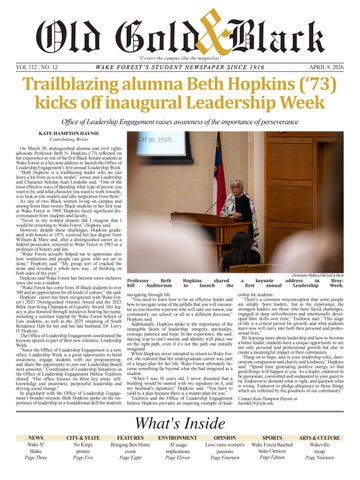
On March 30, distinguished alumna and civil rights advocate Professor Beth N. Hopkins (‘73) refected on her experience as one of the frst Black female students at Wake Forest in a keynote address to launch the Offce of Leadership Engagement’s frst annual Leadership Week.
“Beth Hopkins is a trailblazing leader who we can learn a lot from as a role model,” senior and Leadership and Character Scholar Juan Londoño said. “One of the most effective ways of deciding what type of person you want to be, and what character you want to work towards, is to look at role models and take inspiration from them.”
As one of two Black women living on campus and among fewer than twenty Black students in her frst year at Wake Forest in 1969, Hopkins faced signifcant discrimination from students and faculty.
“Never in my wildest dreams did I imagine that I would be returning to Wake Forest,” Hopkins said.
However, despite these challenges, Hopkins graduated with honors in 1973, received her law degree from William & Mary and, after a distinguished career as a federal prosecutor, returned to Wake Forest in 1983 as a professor of history and law.
“Wake Forest actually helped me to appreciate also how institutions and people can grow who are set in stone,” Hopkins said. “My group sort of cracked the stone and revealed a whole new way…of thinking on both sides of the coin.”
Hopkins said Wake Forest has become more inclusive since she was a student.
“Wake Forest has come from 18 Black students to over 300 and an appreciation for all kinds of culture,” she said. Hopkins’ career has been recognized with Wake Forest’s 2023 Distinguished Alumni Award and the 2023 Billie Jean King Champion of Equality Award. Her legacy is also honored through initiatives bearing her name, including a summer stipend for Wake Forest School of Law students, as well as the 2025 renaming of South Residence Hall for her and her late husband, Dr. Larry D. Hopkins.
The Offce of Leadership Engagement coordinated the keynote speech as part of their new initiative, Leadership Week.
“Since the Offce of Leadership Engagement is a new offce, Leadership Week is a great opportunity to build awareness, engage students with our programming, and share the opportunity to join our Leadership Board next semester,” Coordinator of Leadership Initiatives in the Offce of Leadership Engagement Melina Traiforos shared. “Our offce focuses on three key areas: selfknowledge and awareness, purposeful leadership and driving social change.”
In alignment with the Offce of Leadership Engagement’s broader mission, Beth Hopkins spoke on the importance of leadership as a foundational skill for students

Professor Beth Hopkins shared a keynote address in Broyhill Auditorium to launch the first annual Leadership Week.
navigating through life.
“You need to learn how to be an effective leader and how to navigate some of the pitfalls that you will encounter as you become a person who will take our nation, our community, our school, or all in a different direction,” Hopkins said.
Additionally, Hopkins spoke to the importance of the intangible facets of leadership: integrity, spirituality, courage, patience and hope. In her experience, she said, staying true to one’s morals and identity will place one on the right path, even if it’s not the path one initially imagined.
While Hopkins never intended to return to Wake Forest, she realized that her undergraduate career was part of a larger plan for her life. Wake Forest ultimately became something far beyond what she had imagined as a student.
“When I was 18 years old, I never dreamed that a building would be named with my signature on it, and my husband’s signature,” Hopkins said. “You have to yield to a plan because there is a master plan for you.”
Traiforos and the Offce of Leadership Engagement believe Hopkins provides an inspiring example of lead-
ership for students.
“There’s a common misconception that some people are simply ‘born leaders,’ but in my experience, the strongest leaders are those who have faced challenges, engaged in deep self-refection and intentionally developed their skills over time,” Traiforos said. “This stage of life is a critical period for growth, and what students learn now will carry into both their personal and professional lives.”
By learning more about leadership and how to become a better leader, students have a unique opportunity to see not only personal and professional growth but also to create a meaningful impact in their community.
“Hang on to hope, and in your leadership roles, demonstrate compassion and charity and kindness,” Hopkins said. “Spend time generating positive energy so that good things will happen to you. As a leader, endeavor to be passionate, committed and undaunted in your quest to be. Endeavor to demand what is right, and question what is wrong. Endeavor to pledge allegiance to those things which are refected by the goodness of our community.”
Contact Kate Hampton Haynie at haynkh24@wfu.edu
is column represents the views of the deputy editor of the Old Gold & Black, Miriam Fabrycky
To the future president of Wake Forest University:
I’ll be honest in saying that I don’t envy you. It’s an extraordinarily di cult time to hold any position in higher education, and most of all to act as the public face of an academic institution.
When Wake Forest reveals your name in May, I’m sure that some members of our community will react with skepticism and grumbling, no matter who you are. You’ll hit the ground running this July and face competing demands from students, faculty, sta , alumni, parents, peer institutions, donors, Winston-Salem residents and even the federal government.
It won’t be easy. Each of your decisions will satisfy some and upset others. But I am con dent that you will rise to the challenge of leading this school—especially if you adhere to a few key practices.
e presidential search committee has already prepared you well for this critical task. Hold their encouragement close to your heart and “get to know Wake Forest and get to love Wake Forest.”
Walk around campus and strike up conversations. Make an e ort to remember names, whether you’re speaking with the student body president, a sta member
Remain
true to the
heart of Wake Forest, but propose bold ideas.
from our custodial services, a bright-eyed freshman, an adjunct professor or a star athlete.
Listen a lot. It’ll help you understand who and what makes this campus come alive. And on that note…
Preserve what the Wake Forest community loves
Your rst few months in o ce will hopefully form your understanding of this university’s values and priorities. Trust the community when they tell you what they love about this school: the close-knit atmosphere that fosters strong academic and social connections, the breathtaking natural beauty that adorns campus year-round and our fundamental commitment to the motto “Pro Humanitate.” Your decisions will stick the landing when you properly
THE STUDENT NEWSPAPER OF WAKE FOREST UNIVERSITY SINCE 1916
MATTIE STILLERMAN EDITOR-IN-CHIEF stilmk23@wfu.edu
MARIA SILVEIRA MANAGING EDITOR silvmt23@wfu.edu
>> NEWS
Sydney Glenn, glensd24@wfu.edu
Jill Yoder, yodejs24@wfu.edu
>> CITY & STATE
Nick Costantino, costnp24@wfu.edu
>> FEATURES
Taylor Riley, riletc24@wfu.edu
Bianca Reznic, reznba24@wfu.edu
>> ENVIRONMENT
Evy McEwan-Debney, mcewes25@wfu.edu
Reese Lile, lilerl24@wfu.edu
>> OPINION
Caroline Gottsman, gottca23@wfu.edu
Sara Catherine Bradshaw, bradsr26@wfu.edu
>> SPORTS
Scottie Kimmelman, kimmsd22@wfu.edu
James Lombardo, lombjp23@wfu.edu
MIRIAM FABRYCKY DEPUTY EDITOR fabrml24@wfu.edu
>> ARTS & CULTURE
Lydia Derris, derrlf23@wfu.edu
Grace Schuringa, schugh24@wfu.edu
>> PHOTO
Catherine Neely, neelc24@wfu.edu
>> VIDEO
Ben Pappas, pappbw24@wfu.edu
>> SOCIAL MEDIA
Sophie Chan, chansr23@wfu.edu
>> COPY CHIEF
Elle Yormak, yormeh24@wfu.edu
>> DESIGN CHIEF
Cate Goldman, goldcr24@wfu.edu
>> DESIGN TEAM
Chloe Han, hanc24@wfu.edu
Kathryn Bakewell, bakekr24@wfu.edu
Elizabeth Hodges, hodgeg24@wfu.edu omas Tilton, tilttd25@wfu.edu
>> ADVISER Ivan Weiss, weissij@wfu.edu
value these core tenets of the Wake Forest identity.
Push us to imagine
Remain true to the heart of Wake Forest, but propose bold ideas. Carefully determine which long-standing campus dynamics are rightfully beloved and which are stagnant. Without losing sight of what the university already is, think expansively about what Wake Forest could be.
Articulate speci c goals for the community, and be prepared to explain how your decisions will move us closer to that vision. When you inevitably encounter roadblocks, speak with transparency and honesty.
Most importantly, get excited to join such an energetic, innovative and storied community. We can’t wait to meet you.
PIPER SAUNDERS MULTIMEDIA DIRECTOR saunpg23@wfu.edu
POLICIES
ANNE SHANNON BUSINESS MANAGER shanae24@wfu.edu
Our job as a newspaper is to be a platform for all voices, not just the ones we agree with. However, we reserve the right to reject advertisements that are vulgar, inaccurate, obscene or violate Wake Forest’s policies on nondiscrimination, diversity, equity, and inclusion as they pertain to student organizations. We will also reject any advertisements that promote illegal activities according to the state of North Carolina.
Not only do we hold our newspaper and its contents to a high standard, but we also expect that those who choose to use us as an outlet for their ideas, opinions and skill hold themselves and their content to a high ethical standard.
e Old Gold & Black is published ursdays during the school year, except during examinations, summer and holiday periods, by Triangle Web Printing of Durham. e views expressed in all opinion pieces and advertisements contained within this publication do not necessarily re ect the opinions of the Old Gold & Black. As part of our commitment to reporting news fairly and accurately, we will not remove any previously published content online unless it is retracted. If an error in either our online or print content is brought to our attention, we will revise the originally published article with an appended correction. In order to facilitate thoughtful and appropriate debate, profane, vulgar, or in ammatory comments on our website are not allowed and will be deleted. Comments which incite violence, target individuals in a form of cyber bullying, or which promote ideas which vilify marginalized communities will be deleted, and proper authorities may be noti ed and involved.
>> SUBMISSIONS
e OGB welcomes submissions in the form of story tips, columns and letters to the editor. Letters to the editor should be fewer than 500 words, and columns should be around 500 words. Send yours via e-mail to stilmk23@wfu.edu the Monday before publication. We reserve the right to edit all letters for length and clarity. No anonymous letters will be printed.
>> ONLINE MEDIA
Website: wfuogb.com
Facebook: facebook.com/ogb1916 X (Twitter): @wfuogb
Instagram: @wfuogb
TikTok: @wfuogb
Sports X (Twitter): @wfuogbsports
Students turned Sutton Gym into a celebration of resilience and community in the fght against cancer
SYDNEY GLENN News Editor
Music pulsed through the room as hundreds of Wake Forest students danced, sang and cheered for 12 straight hours. The marathon of energy was a fght for a mission bigger than themselves.
On Saturday, March 28, the Sutton Gymnasium flled with students for the 21st annual Wake ‘N Shake event. A 12-hour dance marathon, the student-run philanthropic event raises money for the Brian Piccolo Cancer Research Fund and the Comprehensive Cancer Center at Atrium Health Wake Forest Baptist.
The event creates a space for community, storytelling and support for those affected by cancer. Three student directors led this year’s event: sophomore Layne Cofell and seniors Matthew Postman and Mike Owens.
“When we were younger, my dad was diagnosed with stage four leukemia,” Cofell said. “It was a terrifying time, but he is now in remission. That experience shaped how deeply I care about cancer research and supporting families going through similar situations.”
“Once I got to campus, I saw frsthand how powerful the event was,” Cofell continued. “Watching the entire community come together for one day around a shared purpose is something really special.”
The Sutton Center was flled with decorations on the theme “All Eyes on the Cure,” and featured carnival-style activities and high-energy performances that kept participants engaged throughout the day.
“It’s such an amazing thing to be a part of something so big with such a large impact on our commu-
nity,” Executive Member of Decorations Committee Ellie Clark said. “Seeing everyone come together after all of our work has been an incredible feeling.”
From noon until midnight, students participated in dance routines, tug of war, pieing and a thrift shop. They listened to a speech by football head coach Jake Dickert and his team and performances by student-bands including Winston Station and Chicken Scratch.

Students founded Wake N’ Shake in 2005 in honor of Brian Piccolo, a Wake Forest alum and football player for the Chicago Bears who lost his life to embryonal cell carcinoma on June 16, 1970. The campus gathered to remember his legacy and all individuals and families affected by cancer.
“Wake ‘N Shake shows what a community is capable of when everyone is united behind a single goal,” Cofell said. “It’s incredible to see a group of students raise over $350,000 in just a few months, and over $100,000 in a single day.”
“Beyond the numbers, though, it creates a sense of connection that can be hard to fnd in everyday campus life,” Cofell continued. “It gives students

and faculty the chance to be part of something bigger than themselves and to come together in support of a meaningful cause.”
One of the 2026 student directors, senior Matthew Postman, has a personal connection to cancer which inspired his involvement and leadership in the philanthropy event. His mother, Colleen Postman, is a breast cancer survivor. She shared her story as a “champion” with participants at the event, focusing her talk around her favorite quote: “We don’t look to the past, we look to the future.”
“Having my mom there was everything,” Postman said. “It was such a full circle moment for me, as freshman year I was a dancer, sophomore year I was a committee member and junior year I was on exec. Getting to serve as director this year and hearing her story, she did an incredible job and I know she worked really hard to speak from her heart.”
Students had the opportunity to listen to six champions, all of whom have been affected in some way by cancer. This included Junius Nottingham, the father of Jeremy Nottingham, a Wake Forest alum who passed away from stage four colon and liver cancer; Molly Matthews, a stage four Hodgkin’s lymphoma survivor; Carlton Forrester, whose mother passed away from leukemia; Anna Cianci, a Wake Forest accounting professor and breast cancer survivor; and Bennett Cavallo, whose brother passed in 2015 from Ewing’s sarcoma.
Cofell said some of the most meaningful parts of the day were the champion stories as well as the groups of students that supported and represented each champion.
“I cannot even begin to describe how special it was to see these champions’ willingness to share their vulnerable story on stage, uniting the community to support a common goal,” Cofell said. “This tie to real-life stories would not be possible without the willingness of people affected by cancer to share their stories and without the presence of the Wake Forest student body supporting them.”
Many students worked behind the scenes on the Executive Board or committees, contributing to the excitement around the event. Executive teams included Dancer Relations, Morale, Hospitality, Decorations, Corporate Sponsors, Champion Relations, Local Outreach and Fundraising, Marketing and Entertainment.
To prepare, committee and executive board members organized dances, booked speakers, invited champions and set up the events and entertainment to keep students engaged throughout the day.
“We started back in April of last year with ideas of how to make the event better,” Postman said. “We were on phone calls all summer and in the fall we were setting up fundraisers while also trying to plan the perfect event for the spring, so it takes a lot of planning.”
Their hard work paid off not only in the event’s energy and excitement, but also in the fnal amount raised to support cancer research.
As the clock turned to midnight and “rave hour” concluded, the crowd erupted into applause as the fnal amount of money raised for the event was revealed — totaling at $353,147. This surpassed their goal of over $300,000, helping fund research and keep “All Eyes on the Cure.”
Contact Sydney Glenn at glensd24@wfu.edu
The committee anticipates the new Wake Forest President will take offce July 1
SKYLER VILLAMAR-JONES Senior Writer
On April 2, Curt Farmer and Jeanne Whitman Bobbitt, co-chairs of the Presidential Search Committee, sent an email broadcast to the Wake Forest community to share an update on the university’s ongoing presidential search.
The update shared that the committee is now looking at semi-fnalists and anticipates the 15th president of Wake Forest will take offce on July 1. They also said that they expect to announce the new president shortly following commencement, which will take place on May 18.
“Throughout the past few months, the search committee has spent signifcant time with the candidates,” the announcement read. “Our committee understands the weight of the assignment and has brought thoughtful and compelling questions to bear. It has been heartening to see the level of en-
gagement, intentionality and care with which the committee has approached the search. Committee members have been a joy to work with every step of the way.”
After a fve-year presidency, Wake Forest President Susan R. Wente will step down from her position on June 30. She announced her impending resignation on Oct. 1, which led the university to create a committee tasked with fnding and interviewing prospective presidential candidates.
“Following a sabbatical, I plan to return to my roots as a faculty member, focused on mentoring and advancing science in service to society,” Wente wrote in her resignation broadcast.
Farmer and Whitman Bobbitt wrote that they used community nominations to build a pool of candidates. They also said that candidates have all recognized the importance of hearing every voice in the Wake Forest community.
“We have repeatedly emphasized that our top priority is for the candidates

to ‘get to know Wake Forest and get to love Wake Forest’ – which you all know is important to leading this community if selected for the role,” they wrote.
Editor’s Note: This is a developing story.
Contact Skyler Villamar-Jones at villsc22@wfu.edu
The “better than most” designation remains the same since the 2025 report card
JILL YODER News Editor
In March, Wake Forest University earned a “B” grade in the Anti-Defamation League’s 2026 Campus Antisemitism Report Card, designating the University as “better than most.”
The ADL launched the Report Card in 2024 as part of its “Not On My Campus” campaign. They said they created this campaign in “direct re-
sponse to the signifcant rise of antisemitic incidents” since the Oct. 7, 2023, Hamas attack on Israel and the ensuing Israel-Hamas war.
The Report Card evaluates 150 colleges and universities nationwide, providing insight into current levels of antisemitism as well as support for Jewish students. The assessment is based on 32 criteria, grouped into three categories: “Publicly Disclosed Administrative Actions,” “Jewish Life

on Campus,” and “Campus Conduct and Climate Concerns.”
The 2026 Report Card found that 58% of schools received “A” or “B” grades, which is an increase from 41% in 2025 and 23.5% in 2024.
Wake Forest University is one of 16 schools surveyed by the ADL D.C. Region team.
“What we are seeing in the D.C. region is broadly consistent with national trends,” the team said in an emailed statement. “Many schools are making improvements through stronger policies, more responsive leadership and greater awareness of the need to address antisemitism seriously and consistently. That progress matters deeply, and we are proud to celebrate them.”
Wake Forest’s overall B grade remained the same since the 2025 Report Card, which was the frst year the University was included in the survey.
“I think the designation feels somewhat accurate, but also a bit reductive,” President of Chabad at Wake Forest Lila Goldstein said. “While Wake Forest may be doing better than many institutions in terms of structure, that doesn’t always capture the nuance of individual students’ experiences or the fuctuations in campus climate over time.”
In the category of administrative action, Wake Forest was designated as “Meeting Expectations.” However, within this category, Wake Forest earned a “Below Expectations’ rating in “Mandatory antisemitism education for students, faculty and staff” and “Conducts research to assess Jewish campus community experiences.”
“I would like to see more consistent dialogue and spaces where students can engage in diffcult conversations respectfully, especially around topics like Israel and Zionism,” Goldstein said. “A lot of tension comes from misunderstanding, and creating structured opportunities for discussion could help reduce polarization.”
For Jewish campus life, the university received a designation of “Excellent.” The only criterion that did not earn an “Excellent” rating was “Kosher dining,” which received a “Satisfactory.”
“The Jewish community at Wake Forest feels close-knit and supportive, and there’s a strong effort to create inclusive spaces for people with different levels of observance and perspectives,” Goldstein said. “There’s a genuine sense of belonging that makes a big difference in the overall college experience.”
In the category of campus conduct and climate concerns, the university received a “Low to none” designation overall, but was rated a “Medium” in the specifc criterion of “Level of hostile anti-Zionist student groups.”
“When tensions rise abroad, we have seen that Jewish students, staff and faculty can become targets here at home,” the ADL D.C. team said. “Political anger can spill over into antisemitic rhetoric, exclusionary behavior and hostility toward Jewish community members.”
Contact Jill Yoder at yodejs24@wfu.edu
Nick
Costantino, costnp24@wfu.edu
THURSDAY, APRIL 9, 2026
MIRIAM FABRYCKY Deputy Editor
As the third wave of “No Kings” protests attracted millions to over 3,000 demonstrations across the United States, more than 1,500 people gathered near the campus of Winston-Salem State University midday Saturday to protest Donald Trump’s second presidency.
Starting around 11:30 a.m., groups of attendees waving fags and signs clustered on street corners around S. Martin Luther King Jr. Dr. and over the U.S. 421 overpass. Organizers with bullhorns led the crowds in chants, including “this is what democracy looks like,” “we will fght back” and “no Trump, no KKK, no fascist USA.” The protestors cheered as hundreds of drivers passing by honked to show their support.
Nikki Cross of Winston-Salem danced to the chants. She said she has attended each of the three “No Kings” protests to date.
“I feel energy,” Cross said when asked if she noticed anything different about Saturday’s demonstration. “I feel that people want to save our country.”
“No Kings” predicts record turnout across the country and world
The broad coalition of progressive activist groups behind “No Kings” said they predicted Saturday to be the “biggest protest in U.S. history.” They reported eight million in attendance, a greater turnout
than previous demonstrations in June and October 2025 that respectively drew fve and seven million. Minneapolis hosted Saturday’s “fagship” protest. The city that captured public attention earlier this year during the immigration crackdown that left two U.S. citizens dead welcomed singer Joan Baez, Sen. Bernie Sanders (I-Vt.), singer Bruce Springsteen and actress Jane Fonda to address at least 100,000.
While other large cities also saw sizable crowds, protestors in suburban and rural areas comprised about two-thirds of RSVPs, organizers said. Americans living overseas also gathered at dozens of protests across Latin America, Europe and Australia.
Protestors express varying motivations
“No Kings” lists no specifc policy demands, which organizers say is an intentional choice to attract the largest possible swath of American society by harnessing widespread dissatisfaction with President Trump.
Protestors in Winston-Salem expressed a variety of reasons for their presence at the Saturday demonstration. Mel Fehrenbacher, a retired Navy lieutenant junior grade from Evansville, Ind., said he is upset by the growing federal debt, which he attributed to fscal irresponsibility and corruption in the Trump administration.
“It’ll get fxed in November,” Fehrenbacher said. “We’ll defnitely take back the House and hopefully the Senate, and then [Trump] will be the ultimate lame duck. But hopefully, he’ll be in jail by then.”

Ken Grant of Clemmons, N.C. said he was protesting to “preserve democracy.” He said his late wife, Brenda, would have been by his side.
“I’d say it’s time you open your eyes,” Grant said when he asked what he’d say to those who didn’t attend the protest. “Stop believing in those lies.”
“
We believe in something simple but powerful: that in this country, in this state and in WinstonSalem, there are no kings.
Speakers celebrate turnout and refect on scripture
Many attendees gathered around a stage erected in the Winston-Salem Union Station parking lot to listen to speakers and musicians.
Jenny Easter, president of the Forsyth County Association of Educators, said she was “so excited” to see greater turnout in Winston-Salem compared to the October 2025 “No Kings.”
“It shows that we are moving and growing each time, bringing new people into this,” Easter said. “We’re here today because we believe in something simple but powerful: that in this country, in this state and in Winston-Salem, there are no kings.”
“Nobody gets to rule over us without accountability,” Easter continued. “Not any politician, not our legislature, not anybody.”
Many speakers incorporated a Christian message into their remarks. The Rev. Daryl Napper, who recently ran in the Democratic primary for District 1 of the Winston-Salem/Forsyth County School’s Board of Education, refected on the Bible verse Micah 6:8, which calls for people to “act justly, love mercy and walk humbly with God.” A choir performed the gospel song “This Little Light of Mine.”
One man carrying a Bible and speaking into a headset microphone shouted that the protestors weren’t “true Christians.” Organizers wearing yellow fuorescent vests escorted the man out of the crowd at least two times.
The protesters’ mood remained positive. Suzanne Schramm of Winston-Salem said Saturday was her frst time attending a “No Kings” demonstration, and that the event gave her hope.
“I woke up today feeling good, you know?” Schramm said. “There was something I felt I could do.”
A crew driving a dump truck towards U.S. 421 honked and waved at the crowds, who cheered.
“Dump Trump,” the protestors chanted.
Contact Miriam Fabrycky at fabrml24@wfu.edu
The Trump administration is pressuring the Senate to pass federal voting bill
EVE DARKE Staff Writer
The Safeguard American Voter Eligibility (SAVE) Act, a proposed federal voting bill currently moving through Congress, could signifcantly alter voting for North Carolina residents.
Having passed the House and now awaiting a Senate vote, the act would impose stricter nationwide requirements for verifying voters’ identity and citizenship status. If enacted, the bill would supersede aspects of North Carolina law that currently maintain a more fexible approach to voter ID requirements and voter registration.
Voters in North Carolina are currently required to present a valid form of photo ID to vote in person, but the state accepts a wide range of IDs, including driver’s licenses, passports, military IDs, IDs expired for up to one year and some student IDs issued by North Carolina colleges and universities.
Furthermore, if you do not have a valid photo ID, you can vote without one if you sign an ID exception form. Registered voters in North Carolina can also request to vote by mail without providing a reason. To submit an absentee ballot, voters must provide certain identifcation information and a photocopy of a valid photo ID or sign the ID exception form. The absentee ballot must also be notarized.
Notably, while IDs are required to vote in North Carolina, proof of citizenship is not. Voters are held accountable by penalty of perjury, as well as by the “SAVE Agreement” passed by the North Carolina State Board of Elections last November, which permits the state to cross-reference state registration records with a federal citizenship database.
The SAVE Act would introduce sweeping changes to this system by creating a uniform federal standard for voter eligibility verifcation. The bill requires individuals to prove their U.S. citizenship with documents such as a passport or birth certifcate when registering to vote. It imposes penalties for individuals and voter registration offcials for failing to comply.
While the act may seem straightforward, many North Carolinians could face signifcant barriers to voting and voter registration if the SAVE Act is passed.
N.C. Voices explains that roughly 56% of N.C. residents do not have a passport, meaning they would have to provide photo ID and a birth certifcate to vote.
While this may not be an issue for some, the requirement could be troublesome for residents who cannot easily access their birth certifcates. Additionally, millions of American women and men have birth certifcates that do not match their current legal name because of marriage or other life changes. So while the act may seem simple, its repercussions could manifest in additional layers of bureaucratic trouble for many.
President Trump has repeatedly voiced support for the SAVE Act, saying elections in America are “rigged” and that he will not sign anything into law until the Senate passes the bill.
“America’s Elections are Rigged, Stolen and a Laughingstock all over the World,” Trump said in a March 2 Truth Social post. “We are either go-

ing to fx them, or we won’t have a Country any longer. I am asking all Republicans to fght for the following: SAVE AMERICA ACT!”
Last month, Trump also signed an executive order to create a national voter registration list, a move that Democratic election offcials are already challenging.
Democratic Gov. Josh Stein posted on X against the executive order the day after the president signed it.
“Voting is the fundamental right that underpins every other right we hold as Americans,” Stein said. “Know that I will do everything in my power to protect your right to choose your government. President Trump’s executive order is an unconstitutional, blatant attempt to restrict access to the ballot box and to take away your right to vote by mail. No one, including the president, can pick their voters.”
Peter Siavelis, a Wake Forest professor with expertise in political institutions, election systems and candidate selection, said the SAVE Act would
“create new administrative hurdles for voters and election offcials” in North Carolina.
“In practice, measures of this sort tend to fall most heavily on groups that already face barriers to participation, including elderly voters, students and lower-income citizens,” Siavelis said in a statement.
Siavelis added that North Carolina may be disproportionately affected as a swing state.
“Because NC is a purple state, elections are often determined by a small percentage of voters,” Siavelis said. “This legislation is a direct affront to the small number of voters that can determine electoral outcomes and represents an effort (among many others) to tip the scales in favor of the current administration’s allies.”
For North Carolina voters, the result could be a shift from a comparatively fexible system to one defned by stricter documentation requirements and more centralized federal oversight, reshaping how residents across the state participate in elections.
Contact Eve Darke at darkev23@wfu.edu

express opposition to proposed data center at heated town hall
MIRIAM FABRYCKY Deputy Editor
A Forsyth County town just 10 miles north of Wake Forest may soon host a data center, but many locals are resistant. On April 1, approximately 120 residents packed the Rural Hall Town Hall to its maximum capacity to speak against a proposed 129-acre rezoning.
If approved by the county, “Project Iron Spur” would allow the Charlotte-based development company Drox Group to construct four 78-foot-tall buildings immediately across the street from the Town Hall in collaboration with project management offce Montrose and engineering frm Thomas & Hutton.
“I hope and trust that whomever is here trying to mess things up, leave it alone, because Rural Hall has everything that anybody needs.” 96-year-old Bert Watkins said. She’s lived in the town of 3,500 since 1992. “Get out of Rural Hall because you don't need nobody else coming in here messing up everything.”
Residents who arrived too late to get a seat or stand inside gathered outside Town Hall. Attendees’ cars overfowed from the building’s parking lot to a nearby funeral home. Meanwhile, those inside questioned and rebuked Mayor Terry Bennett and Montrose representative Michael Fess for over two hours.
They delivered passionate speeches, recited poems and mimicked the droning sound of a data center. At least twenty wore red shirts as a symbol of their unifed opposition. One child held a cardboard sign that showed a crying face accompanied by the words “Please protect Rural Hall.”
Most speakers expressed concern that a data center would increase their power bills, overtap water resources and otherwise become a nuisance to a small town that prides itself on its peaceful natural surroundings.
Andrew Kraber, a pastor at Rural Hall Moravian Church, referred to an informal town slogan to introduce his remarks.
“As Rural Hall, we have agreed that we are the ‘Garden Spot of the World,’” Kraber said. “I also know that the only humming I want to hear in my garden… is the bees and maybe an occasional hummingbird… I don’t want the children who go to school and the playground right behind my house to hear anything else.”
“The things you’re offering–they are changes to our environment,” Kraber continued. “Changes we didn’t ask for.”
Montrose representative seeks to persuade the community
Fess, a Montrose representative from Huntersville, N.C., assured attendees that he and his company want to hear feedback from locals. The frst slide of his presentation was titled: “A Conversation with Our Neighbors.”
“Listening to your concerns and seeing how we can revise the plan and the application and how we can address those concerns… that's what we're up here to do tonight,” Fess said.
Fess noted that Drox picked the site on Glade Street and Bethania-Rural Hall Road because of other nearby industrial sites, railroads and a Duke Energy substation. He explained how data centers support the internet and said that newer facilities are less disruptive to their environments than the frst generation of data centers. He further highlighted the center’s potential to bring millions in tax revenue to the area.
While acknowledging that he couldn’t provide specifc answers to many residents’ questions as the company continues to tweak its site plans, Fess said that Drox is working to mitigate the data center’s effects on surrounding residential areas. For example, the data center would attract less traffc than other industrial developments, according to Fess.
“We’ll probably see about 20 cars per shift, if that,” Fess said. “Whereas if it was industrial manufacturing, such as a concrete plant, where the concrete trucks are running in and out all day.”
Fess invited attendees to apply for a steering committee of 6-8 locals.
“This isn’t a one-and-done meeting. We’re going to be continuing to meet with residents,” he said. “Again, this is not set in stone. We can revise the plans, we can put conditions on the rezoning to address your major concerns.”
Carol Newsome, a local activist, pushed back.
“We don’t want you picking the steering committee,” Newsome said to Fess, sparking applause from the audience. “This community needs to pick who’s in that steering committee.”
Newsome also questioned Fess’s tax revenue estimate and argued that the data center would not create as many jobs as other potential uses for the land.
Resident Jane Bodenheimer also advocated for Rural Hall to invest their land and resources elsewhere. She said she was concerned that the data center would harm nearby gathering places, including a volleyball court, a community garden and a fshing pond.
“I'm thinking that property would be really good for a community center, not a data center,” Bodenheimer said. “Maybe a community pool. Wouldn't that be awesome?”
“We do not need that monster,” Bodenheimer continued, referring to the proposed data center. “We do not want it.”
The Town Hall was tense at times. While the town organized a list of speakers, residents interjected their own thoughts throughout the meeting.
Others used their allotted time to express anger at the companies spearheading the data center.
“Why don’t you put it in Charlotte?” local Renee Bowles asked, pointing at Fess. “Put it in Huntersville. Put it next to your house.”
Rural Hall Mayor Terry Bennett discouraged at-
tendees from delivering infammatory speeches.
“Being loud, telling people they don't know what they're talking about… I don't think that's gonna work,” Bennett said. His words drew rumblings from the crowd.
But even Bennett let his opinion slip.
“Do I want the data center here?” he asked. “No, I don't, as a resident. But I've also got to listen to all the ones that's in this community.”
Mark Allen of Rural Hall said he didn’t support the data center but encouraged his neighbors to keep calm and prioritize lasting resistance rather than oneoff protests.
“We have to keep our passion,” Allen said. “If they delay this six months for the power study, don’t get numb to this.”
Forsyth County had planned to review Drox’s fnal site proposal on May 14, but the date may be pushed back as the company continues to alter its plans.
Jax Velazquez, an organizer and tattoo artist from Rural Hall, said they and other residents are seeking clarity from the town government on the timeline of the proposal process.
“If they are not in opposition, they have more questions than anything,” Velazquez said of their neighbors.
Jose Saucedo, an organizer from Winston-Salem, added he hopes Rural Hall residents stay engaged in future meetings, even as the company’s and county’s schedules remain opaque.
“How can we encourage more people to come out [and] speak out?” Saucedo asked. “We know power is within the people, and power is in numbers.”
Contact Miriam Fabrycky at fabrml24@wfu.edu

Taylor Riley, riletc24@wfu.edu
Bianca Reznic, reznba24@wfu.edu
“They’ll
MIRIAM FABRYCKY Deputy Editor
Ben Spencer spent over 30 years in a maximum-security prison for a crime he didn’t commit. After the Dallas, Texas native’s arrest in 1987 following the murder of white businessman Je rey Young, Spencer, then a 22-year-old newlywed and expectant father, watched his life dissolve from behind bars.
“I’m thinking that I’m going to be released, because they’ll realize I’m telling the truth,” Spencer said. “I always assumed that the judicial system worked.”
But it didn’t. Again and again, the state of Texas shot down Spencer’s appeals. Facing a life sentence, he prayed daily for his neighbors whose false accusations led to his wrongful conviction, then prayed for his own strength. Hope seemed lost.
en journalist Barbara Bradley Hagerty stumbled across Spencer’s story. Convinced of Spencer’s innocence, Hagerty spent years reporting tirelessly for NPR and the Atlantic on the injustice of his incarceration.
“If a judge says that you’re innocent, and you can’t get out of prison, what’s the point?” Hagerty asked, referring to a Texas judge’s ignored 2008 recommendation that Spencer be retried.
Her work led to Spencer’s release from prison in 2021 and his exoneration in 2024. Also in 2024, Hagerty published a book chronicling her e orts, titled “Bringing Ben Home.”
At an April 2 event in the Worrell Professional Center, Spencer and Hagerty discussed “Bringing Ben Home” with Wake Forest professors Mark Rabil, director of the Innocence and Justice Clinic, and Bryan Ellrod, director of pre-law programming. e O ce of the Dean of the College, the Program for Leadership and Character, the Department of Interdisciplinary Humanities and individual donors Roy Henwood and Nancy Kuhn sponsored the event.
Spencer and Hagerty spent the majority of their talk discussing the details of Spencer’s case as well as Hagerty’s reporting process.
Hagerty said she $rst learned of Spencer’s situation when speaking with Jim McCloskey, founder of the innocence clinic Centurion Ministries.
“I called up Jim, and I said, Jim, what’s the case that haunts you?” Hagerty said. “What’s the case that keeps you up at night?”
e case McCloskey had in mind was horri$c, and not only because it locked away the innocent Spencer. e victim, Young, was attacked and robbed while exiting his o ce. e assailant hit him over the head, cracking Young’s skull in $ve places, and put him in the trunk of his own car. Young likely managed to hoist himself from the trunk, but ultimately died in Spencer’s neighborhood.
Spencer had an alibi, and no security camera footage or physical evidence like DNA indicated he could be guilty. But three of his neighbors lied in court, incentivized by a $25,000 reward.
“People will say I’m being gracious or whatnot,” Spencer said. “But in my heart of hearts, I do not believe that my neighbors set out to get me convicted when they made these accusations.”
After Hagerty learned of Spencer’s ordeal, she immediately knew she wanted to help him. Furthermore, she realized his experience illustrated a broader crisis in the legal system’s unjust treatment of Black men.
“3,800 people have been wrongly convicted since 1979,” Hagerty said. “I had to show that this was not a one-o is happens all the time.”
At times, the truth wasn’t easy to $nd. Hagerty recounted going door-to-door in West Dallas with an armed private investigator named Daryl Parker to track down people with information about the 30-year-old case.
“It’s pouring rain… and as [Parker] is about to knock, he looks over at me, and he sees that I’m standing right in front of the door,” Hagerty said. “And he moves me over like this, and he goes… ‘sometimes they shoot through the door.’”
“I’m a Washington reporter,” Hagerty exclaimed to gasps and laughter from the audience. “No one has ever tried to shoot at me through the door—at least not members of Congress, at that point.”
Formed by faith and relationships

ough Texas formally exonerated Spencer of his prior convictions, there are some injustices that they could not remediate. He will never get back the time he could have spent with his family during the prime of his life.
Spencer remembered begging his wife, Debra, to divorce him after the courts rejected his $rst appeal around $ve years into his sentence,
“My hope for her was that she would $nd happiness and be okay in life, and her and my son would be alright, and I would try to do what I could to try to help myself while I was in prison,” Spencer said.
ough Debra did divorce Ben, the two stayed in touch and reconnected after his release. ey remarried on Jan. 10, 2022, exactly 35 years after their $rst wedding.
Spencer credited his survival in the most wretched of circumstances to his faith.
“I would just say it’s God,” Spencer said. “I continued to hope and pray that one day the truth would prevail, and it was a long time coming, but it eventually did.”
Hagerty is also a devout Christian. She said her faith motivated her quest to bring justice to Spencer.
“Clothe the naked, feed the hungry and visit the prisoner,” Hagerty explained, referring to Jesus’s lessons to his followers in Matthew 25. “It’s pretty basic stu .”
Re ections on release
“If you want to feel like a morally de$cient person, all you have to do is spend time with Ben Spencer,” Hagerty quipped. “I asked you what you wanted now that you were out… and I thought you were gonna say ‘I want a really great car,’ or ‘I want a di erent type of job.’ But what you said is… ‘what I want is for the Young family to believe that I’m innocent.’”
She played a video of Spencer speaking at his exoneration in August 2024. Unbeknownst to Spencer, the murder victim’s son, Jay Young, was present in the courtroom that day. Spencer spent his $rst minutes of freedom remembering Jay’s father and the rest of the Young family.
“I’d ask that we don’t forget that myself and my family were not the only victims in this, but the Young family were victims as well, because they lost their loved one, and the person who was actually responsible for what happened to Je rey Young was not brought to justice,” Spencer said that day. “So I’d ask that you pray for the Young family and be mindful of them.”
Spencer has worked to build a relationship with Jay Young since.
Students in attendance said they found Hagerty and Spencer’s remarks shocking and inspiring.
Sophomore Julia Hammerman heard about Hagerty and Spencer’s campus visit through the student organization Advocating Reform for Correctional Clients.
“I’ve always been interested in wrongful convictions,” Hammerman said.
Sophomore Peter Raymond is a pre-law student and learned of the event through posters on campus as well as conversations with Pre-Law Program Director Ellrod.
“I was very interested to see an individual who wasn’t treated properly by the law [and] still chooses to pursue justice,” Raymond said.
Contact Miriam Fabrycky at fabrml24@wfu.edu
PHILIP MORRISON Staff Writer
Wake Forest hosts six student-run a cappella groups, with styles ranging from Christian hymns to contemporary pop songs. These groups engage in a variety of endeavors, including “Pitch Perfect”-esque tournaments, on-campus concerts and studio-recorded passion projects.
An inviting, exciting community
Demon Divas member freshman Sophie Petronzio said her experience in the all-female group has been warm and welcoming since her audition.
“When I walked in, it just felt like they really wanted me there, and everybody walked out with a big smile on their face,” Petronzio said. “I remember going in and I just felt very loved, and that regardless of what happens, I felt like I had already made new friends.”

As a freshman, Petronzio values the friendships she’s formed with upperclassmen women in the Demon Divas.
“I think that there’s something really special about being with a lot of girls who are older than you, who have different experiences from you, or have been here longer than you,” Petronzio said.
The Demon Divas participate in singing competitions and recently arranged a performance for an International Championship of Collegiate A Cappella tournament in Durham, N.C. When asked what her favorite moment with the group was, Petronzio said it was her time competing at the ICCA.
“We got to bond outside of a school environ -

ment, and it felt like a commemoration of all the hard work we’ve been putting in,” Petronzio said. “Even though we ended up not placing, it was such a fun experience. Everybody really tried to make it fun, regardless of the outcome, from the start.”
The Demon Divas are looking forward to performing at Entrepalooza on April 9.
Business manager for Minor Variation, junior Caroline Kuebert, shared how her experience recording the group’s biennial studio album was a deeply rewarding challenge.
“I had never done anything like that before… if you told senior-year-of-high-school Caroline that in a year I would be in a recording studio, I would have laughed at you in the face,” Caroline joked. “Then we heard it [for the first time], knowing all the work that went into it… It was unbelievable.”
Kuebert added that it’s not just the experience of singing, but who she’s singing with that keeps her coming back.
“At the end of the day, it’s about fellowship and making music with people you care about,” Kuebert said.
Minor Variation will host their spring concert in Brendle Recital Hall on April 22 at 8:00 p.m..
Many Wake Forest singers say that a cappella groups allow their members to appreciate the music they love on a deeper level. Rollin’ Deacs Co-President, sophomore Matthew Jones, said his time in an a cappella group has changed his relationship with music.
“Even if you’re not as into music—or if you are into music—it’s just a whole other side of things,” Jones said. “You’re learning to create a back -
ing track and beats without playing any instruments… it connects you with the music more.”
Jones noted that the collaborative nature of a cappella also affects the way he listens to the songs.
“When you’re all singing it together, everybody has the same feeling, and everybody understands what the music is feeling to be able to sing it well,” Jones said. “I feel like people that aren’t as interested in a cappella should give it a try because it really makes you think of music in a different way.”
“At the end of the day, it’s about fellowship and making music with people you care about.
Jones said that because of a cappella, he saw many of his peers find a voice they never knew they had. He recounted how rapidly he saw sophomore Hunter Heiden, a member of the Rollin’ Deacs who had minimal singing experience, improve after joining.
“Just going through the months of being around good singers and taking the time to learn the music, he became a great singer,” Jones said. “He’s amazing.”
Whether you’re pitch perfect or can’t carry a tune, it’s likely there’s an a cappella group on campus waiting to hear your voice or see you in the crowd.
Contact Philip Morrison at morrpd24@wfu.edu
A
spotlight
HARPER RANSBURG Staff Writer
Sophomore Jessica Elkin described a grisly murder to me over the phone. The motive, method of death and setting all sent chills down my spine. But one question remained in my head: who killed Rob on the set of a new reality TV show? The answer was not so simple, but Wake Forest Mock Trial is going to set things right.
If you didn’t realize already, this is not a real case. However, members of Wake Forest’s Mock Trial club spend the entire semester as if it were. For example, Elkin was assigned to prosecute Rob’s alleged murderer, Charlie. As the prosecution, it was her job to put herself in the shoes of the defense.
“The defense can say Charlie didn't intend to kill Rob because intent is part of the charge of murder,” Elkin said. “Or that someone made Charlie do it.”
The Mock Trial team spends each semester focused on a different case. Some work for the prosecution, others are a part of the defense and some train to be key witnesses. After they’ve spent all semester practicing their roles and perfecting their courtroom skills, they compete against other schools.
As Elkin puts it, it doesn’t get much better than being in a courtroom embodying your role.
“ Being able to articulate your arguments on a dime has really helped me with the speed of my arguments.
“Have you seen ‘My Cousin Vinny?’” Elkin asked, referring to the 1992 legal comedy film. “Some teams will be close to that level of theatricality.”
Freshman witness William Grantham agreed.
“I also just really love the thrill of thinking on your feet in a courtroom setting,” he said.
Finding your way into the courtroom
Before she found herself trying to convince a jury of other Mock Trial members that a man was guilty of murder, Elkin found her interest in law after participating in her high school mock trial team. So did Grantham.
“We didn’t do very well, but it was a lot of fun,” Grantham said.
However, not all Mock Trial members started in high school. Grantham said many of his teammates began Mock Trial for the first time at Wake Forest.
“A good majority are just starting in college… so our coaches don’t prioritize former trial experience as much as they do on-the-spot quick thinking,” Grantham explained.
So you don’t need any prior experience. If you fell in love with a movie like “A Few Good Men,” or the countless “Lincoln Lawyer” adaptations, it is never too late to experience Mock Trial for yourself.
Acting coaches and working attorneys pitch in for the team as well, making the experience all the more real. And as Grantham explained, you don’t
even need to be pursuing a career in law or law school to audition for the team.
“One of the people on our executive board is not even considering law,” Grantham said. “He’s going to medical school and just does it as a fun hobby, and for the community of it.”
Mock Trial also develops skills unrelated to the field of law, according to sophomore Sally Wray.
“Being able to articulate your arguments on a dime has really helped me with the speed of my arguments,” Wray said. “I feel I'm able to articulate what I want to say better, more concisely, but also quicker.”
If you are a Wake Forest student looking for a good time and a great community, no matter your career desires, you can seek out a spot in Mock Trial.
Elkin said her favorite part of the club is the people.
“Everyone on Mock Trial is friends with each other, and we all have a good time together,” she said.
Wray agreed.
“They're just so perfect and they just make every competition and practice worth it,” she said of her teammates.
Members say it’s helpful to have a friendly group, since the club spends plenty of time training and competing at university tournaments across the country.
These events, held at institutions including the University of Georgia, University of Pennsylvania, Duke University and UNC-Chapel Hill, put members’ public speaking, reasoning and critical
analysis skills to the test.
While this may sound like a lot of traveling, paired with the weekly meetings and additional friendly competitions, Elkin assured me that the schedule is very manageable.
“It can feel like a lot, but it really isn't,” Elkin said.
If you like competing, meeting new people and thinking on the spot, then Mock Trial is the club for you. They are always excited for new students to try out for their close-knit team.
“I just have so much fun at an actual competition weekend because you're staying in a hotel with all your teammates, you're all going to dinner together and we're all doing the same thing,” Elkin said.
Junior Jason Chen agreed that the group shares camaraderie.
“Some of my closest friends were made from the mock team, including my roommates,” Chen said. “Being able to laugh and goof off with the rest of them has been the thing that keeps me coming back to mock [trial], despite all the complaints when it’s tournament season.”
While the general population at Wake Forest may be unable to handle the truth, Mock Trial can. All the while, they are forming lasting relationships with their fellow teammates.
Next fall, consider testing out your own prosecution, defense, witness or acting skills for the Wake Forest mock trial team. If you want to stay updated or find out more information about the team, follow them on Instagram @wfumocktrial.
Contact Harper Ransburg at ransha24@wfu.edu

Reese Lile, lilerl24@wfu.edu
PAGE 11
THURSDAY, APRIL 9, 2026
ELLA
JENNINGS Staff Writer
ChatGPT has been a lifesaver for me in college. It helps me understand complex topics and condenses my readings. But as my life as a college student gets easier, low-income families’ electricity bills are skyrocketing, the world is running out of drinking water and climate change is rapidly accelerating.
Picture this: Meta’s 2-million-square-foot data center is built 400 yards away from your home, your kitchen tap is run dry and you are forced to buy gallons of water from the grocery store for drinking and showering. Thanks to the sediment in your pipes, you will have to replace all your appliances, including your plumbing system, dishwasher, toilets and washing machine. Bright lights and loud humming noises from the data center prevent you from sleeping at night. This is not just a hypothetical. This is the reality of the Morris family in Mansfeld, Ga.
There are currently over 4,000 data centers in the United States, harming countless families like the Morrises. They are popping up all over North Carolina, including one proposed just 15 miles north of Wake Forest’s campus in Rural Hall, Forsyth County.
As artifcial intelligence becomes more and more common, so do massive data centers—large facilities with thousands of computers and servers. They power our internet searches, emails and websites, as well as receive our AI inputs. Data centers have been around for a long time, but the rise of AI means that they are growing exponentially.
Currently, data centers account for 4.4% of the United States’ total energy usage, and that proportion could rise to 12% by 2028. This colossal energy usage is rapidly accelerating climate change. For me, the tremendous amount of natural resources used to run these facilities is unimaginable.
For instance, there are 92 data centers in North
Carolina, which consume millions of gallons of clean water a day. To answer all of our seemingly harmless queries to ChatGPT, a large data center uses 5 million gallons of water a day, equivalent to the water footprint of a city of 50,000 people.
These impacts do not even touch on the millions of acres of deforestation and loss of ecosystems resulting from the construction of these 4,000 data centers around the United States, which accelerates climate change and creates an even larger surplus of carbon dioxide in the atmosphere.
It’s not just affecting the planet. Communities close to data centers are also seeing increases in their monthly electric bills–up to 25% in areas like Northern Virginia, where my uncle’s hometown of Sterling is currently home to over 100 data centers.
I’m not saying we should completely disown AI; rather, we should be conscientious when we use AI. You can type “-ai” following a Google search to avoid an AI overview. Maybe we don’t need to tell AI “thank you,” or maybe we avoid using ChatGPT as a friend or a therapist. Maybe we don’t use AI to generate videos of planets being used as jams and spread on toast. AI use should be reserved for responsible practices, such as study assistance, getting feedback on writing projects, or idea generation.
We may not feel the impact of data centers at Wake Forest, but as a university, we are creating an impact felt by the communities surrounding us. As a start, Wake Forest’s AI guidelines could mention being conscientious about environmental impact when using AI tools. By using AI sparingly and raising awareness of the detrimental environmental effects it creates, we can channel our “Pro Humanitate” energy and set an example that other universities can follow.
Contact Ella Jennings at jennem25@wfu.edu

small-scale change

We hear a lot about what’s going wrong on the planet – let’s see what’s going right
REESE LILE Environment Editor
News headlines are flled with stories of polar ice caps melting, pollution choking cities and countless microplastics in everything we own and eat. While it is important to stay informed about environmental problems, it is just as important to acknowledge what is going well.
To fip the script, let’s look at some happy news in the world of the environment.
Biodiversity on big bills
Native wildlife species will replace historical fgures on U.K. banknotes. Over 26,000 U.K. residents voted for the change, which organizers hope will promote wildlife conservation and prevent counterfeiting through such unique banknotes. Other countries, including Costa Rica, Norway, Switzerland and Scotland, already feature plant and animal species on their currencies. This seemingly small representation of nature in our everyday lives is a good reminder of the importance of nature conservation and will help native species gain recognition.
Oui oui baguette, non non PFAS
As of Jan. 1, France has banned manufacturers and importers from selling products that contain certain amounts of perfuoroalkyl and polyfuoroalkyl substances (PFAS), also known as forever chemicals. French manufacturers are now required to conduct reviews of their production systems to identify and eliminate PFAS sources. This ban is pushing companies whose products, including textiles, cosmetics, waxes and waterproof products, have historically contained PFAS to adopt safer alternatives, such as plant-based water repellents, silicone coatings and more. So far, this ban has been strictly enforced, and it represents a greater prioritization of public health.
N.C. shoutout! Waterway restoration underway
The N. C. Department of Environmental Quality awarded over $1.5 million in grants to help local governments restore streams. The projects will focus on improved stormwater management systems, re-shaping stream channels to decrease food risk in foodplains and increasing green infrastructure in cities. They aim to increase the public’s enjoyment of recreational areas and mitigate climate change—the effects of which have been increasingly felt by communities around the state, including from the lasting impacts of Hurricane Helene.
Contact Reese Lile at lilerl24@wfu.edu
PAGE 12
THURSDAY, APRIL 9, 2026
Sara Catherine Bradshaw, bradsc24@wfu.edu
Caroline Gottsman, gottca23@wfu.edu
e views expressed in all opinion columns represent those of the article’s author, not the opinions of the Old Gold & Black Editorial Board
Sirens, shelters and resilience during the 12-day war
MAVERICK CORTES Contributing Writer
The last two weeks of the U.S. and Israel’s operation against the Iranian regime have brought up many emotions for me. Israel is my second home. I have spent the last four summers there, officially more time than I have spent in my hometown, New York City, since graduating high school. And yes, that means I was living in Israel last June during the 12-day war.
After my sophomore spring at Wake Forest, I flew to Israel, planning to volunteer as a first responder on an ambulance, play ice hockey and spend free time with friends on the beaches of Tel Aviv. I landed at Ben Gurion Airport on June 2 with a suitcase and my hockey gear, excited for the summer ahead.
I was set to play in the Israel Elite Hockey League for the third year in a row and train with Magen David Adom, Israel’s national emergency service, as an assistant Emergency Medical Technician. The first week was exactly what I had imagined. I was with my summer family once again. We spent our days by the sea, evenings at the rink and nights out with friends who represent the diversity of Israeli society.
Then, in an instant, everything changed.
One night, while we were out at a party, every phone in the club (hundreds of them) went off at once with the same alert.
“Due to the significant threat, follow Home Front Command instructions,” the alert read. “Get close to a sheltered area.”
People ran, calmly but quickly. I did not panic. It was not my first siren. My friends and I made it back to our apartment, which had a “mamad,” a reinforced safe room. We stayed up all night waiting for updates.
Israel had launched a preemptive strike against the Iranian regime. We did not sleep until morning.
The next day was quiet but tense. Everyone was waiting. We stocked up on food and supplies, unsure how long we might be confined to the shelter. That night, though, during Shabbat dinner, another alert came through telling us to stay close to a protected space until further notice. It was on.
Minutes later, the sirens began. We ran to a nearby “m iklat,” an underground bomb shelter, joining over 100 people packed into a tight space two floors below ground. Then came the first wave of missiles. The sound is hard to describe. It was like fireworks, but heavier and closer.
And yet, even there, something remarkable happened. It was Shabbat, the Jewish day of rest, and people refused to let it be taken from them. In the shelter, surrounded by strangers, we sang and finished prayers together.
For hours, we moved in and out of shelters, trying to safely return to our apartment. Above us, explosions echoed as interceptions lit up the sky. Around us, people held each other close, waiting for the next boom.
What no one tells you about war is that there is no sleep. Day and night, you run back and forth to shelter. By the time you lie down, another alert sends you running again. The exhaustion builds
quickly, both physical and mental.
Everyone copes differently. Some people tried to sleep on the floor of the safe room. Others stayed on their phones, tracking missile alerts. Some called home. I knew my family would be seeing the alerts, so I texted them to say I was OK. Then I tried to conserve my energy.
Rinse and repeat. Every day. Every night.
By the fourth day, I was too tired to feel much until one moment changed that. During our third siren of the night, we were back in the shelter waiting. After a few familiar interceptions, there was a deafening crash. The building shook violently. Every vibration ran through us. Everyone thought we were hit.
We waited for what felt like hours before getting t he “all clear.” When we stepped outside, our apartment was still standing, with only paint chips scattered across the floor. But around the corner, a missile had struck and decimated a building. And then something unexpected happened.
Instead of chaos, there was action. Once emergency services accounted for everyone, the neighborhood came together. People filled the streets, clearing rubble and helping one another. It was all hands on deck–a moment of unity in the middle of destruction.
A few days later, I experienced something shocking. I was on a bus heading south when the sirens sounded again. The driver pulled over immediately. Everyone got out and lay face down on the side of the road with their arms over their heads. There
was no shelter.
From the ground, we could see interceptions lighting up the sky and hear explosions in the distance. We were completely exposed, lying on the asphalt under the unrelenting desert sun.
For 12 days and nights, this was life. Missiles were launched into civilian areas, targeting people indiscriminately–Jews, Arabs, Druze, Bedouins, Muslims and Christians alike. Everyone was a target.
For many people at Wake Forest, war exists in lectures, books and debates. For me, it was the sound of explosions overhead, the scramble to shelters at all hours and the quiet relief when a notification finally said it was safe to leave. It was fear, exhaustion and uncertainty, but also resilience.
Living through war changes you. I can no longer hear fireworks the same way. Not long after I returned home, an unexpected fireworks display sent me instinctively to the ground with my hands over my head. Maybe that feeling will fade. Maybe it will not.
But war teaches you something else, too. It shows you how fragile normal life really is and how extraordinary people can be when everything around them is uncertain. What I remember most is not the sirens or the explosions, but the resilience, the spirit and the heart of the people who kept singing in shelters and rebuilding in the dark. That is the Israel I keep going back to.
Contact Maverick Cortes at cortma23@wfu.edu

It’s time to make time for ourselves
CAROLINE GOTTSMAN Opinion Editor
While attending Wake Forest, I’ve heard the phrase “work hard, play hard” more times than I can count. This motto markets an impressive but sustainable lifestyle, one where someone’s schedule might include Pilates in the morning, a breezy exam in the afternoon, three extracurricular meetings and a social event to end the night. I’ve been doing my best to reach this standard by scheduling out time for the gym, meals, friends, classes, work and clubs.
However, recently, I’ve been doing a lot less of a perfect balancing act and a lot more of rushing around, getting five hours of sleep a night and closing out ZSR.
I’m not the only one, though. The library has progressively gotten more crowded, and almost everyone answers “How are you?” with something along the lines of “tired.” Maybe Wake Forest does promote a “work hard, play hard” lifestyle, but I wonder if, recently, we’ve been doing a better job at the work part than the play part.
Now, it’s true that exam season is upon us, and that these next few weeks are usually referred to as the “end-of-year craze,” where students run on energy drinks and a dream. But after waking up from another night’s sleep still not well-rested, I can’t help but think there must be a better way to deal with the stress.
While ruminating on this dilemma, one of my friends proposed that we go to the movies as “self-care” after a long week. Initially, I rolled my
eyes at this assessment and weighed my workload against this idea, almost bowing out to spend another night in Scholar’s Commons. But I decided to treat myself and walked out of that theater feeling better than I had in weeks. The assignments and exams that had been plaguing my mind had been pushed aside for a wonderful two and a half hours, and once I did get back to work the next day, I found myself significantly more energetic and productive.
The days following, I experimented with tiny forms of self-care: taking an extra-long shower, going to bed 30 minutes earlier, watching a few minutes of my favorite TV show during study breaks and generally trying to balance out that “work hard, play hard” mindset Wake Forest loves to tout. After a few days, I decided that self-care is not something to scoff at. In fact, it’s something we all can and should do a lot more of.
Self-care is a term we throw around a lot in everyday language, and it usually brings to mind spa days and other practices we deem expensive, indulgent or somehow selfish. But self-care is actually much simpler than that. In my opinion, it’s all about the little things that you can do to keep yourself happy and healthy. Self-care could be going on a quick walk to Reynolda Village in the sunny weather or devoting time to your favorite hobby.
Self-care doesn’t just feel good, but it can actually be good for you. Studies have shown that taking the time to “indulge yourself” and tend to your physical and mental health results in several surprising benefits. It can improve self-esteem,
physical health and overall mood, as well as lower stress. It can even make you more productive, as you’ll be less prone to burnout and exhaustion.
One of my favorite forms of self-care is reading a chapter in a fun book I’ve picked up. This type falls under what researchers call “mental selfcare” because it promotes intellectual stimulation. For other people, this activity might just sound like more work. Luckily, there’s no “right” way to do self-care. In fact, self-care is highly personalizable, though it usually falls into one of seven categories: emotional, mental, physical, social, spiritual, professional and financial. It’s important to find the one that works best for you. While your friend might find journaling to be a useful and relaxing form of emotional self-care, you might instead enjoy hitting the gym and participating in a more physical form of self-care.
The beauty is that it’s all up to you.
In a highly rigorous environment like Wake Forest, it can be hard to remember that there is so much more to life than academics. A grade doesn’t define you, and a day off won’t ruin everything. It’s important to give ourselves a little grace and make room for all the other stuff that makes us happy. So next time you’re deciding between yet another night in the library or a fun activity that presents itself, I ask you to maybe listen to that little voice in your head saying to “treat yourself.” Self-care isn’t a term to scoff at, but rather how we sustain a joyful, balanced life.
Contact Caroline Gottsman at gottca23@wfu.edu

MIMI HORTON Contributing Writer
Of course, falling in love is not the problem. The problem lies in the way society pushes women to treat relationships as the ultimate goal. From their teen years, girls soak up the propaganda of partnership as a measure of worth. Yes, academic accomplishments, talents and ambitions are impressive for a woman, but they are rarely viewed as groundbreaking as marriage.
When romantic love is the ultimate goal, passions become optional.
The media refects and perpetuates this propaganda. We see it in movies like “The Devil Wears Prada.” The job-obsessed woman, Andrea, quits her cool fashion job because her boyfriend and friends are upset that she is working too much and spending less time with them. Andrea’s boss, Miranda, is left by her husband because she dedicates too much of her time and attention to her job as editor-in-chief at a fashion magazine. This movie teaches us that the ambitious girlfriend has to learn to compromise, or she will be abandoned.
Meanwhile, the media shows men in the opposite light. When men are ambitious and obsessed with their jobs, they’re seen as attractive and motivating. It is barely a character faw and is instead perceived as the norm. However, driven women are viewed as mean and unlikable.
In addition to compromising between work and personal life, women often carry emotional labor in their relationships, especially in heterosexual ones. They manage events, they remember birthdays, they adjust schedules and they are more likely to relocate for their partner. They’re the ones expected to take a step back from their own career ambitions, personal goals and sometimes even their social lives. Women are usually the ones shrinking their
careers for loving relationships and motherhood as opposed to their male partners.
Why are women always the ones having to put their passions on the line to prove their love?
Growing up, girls are often taught to be more fexible, caring and considerate. Since society tends to encourage these qualities in girls more than boys, many girls grow up already familiar with adjusting to others’ needs and maintaining peace in social relationships. This socialization carries into relationships where being in love can escalate that tendency, making women more likely to compromise. A woman’s late night in the offce is seen as insensitive, and having to push back a date an hour is seen as draining. Equal aspirations become threatening to a man’s masculinity.
Having drive and passion requires putting yourself frst. You have to be obsessed with your goals, willing to take a risk for them, and have the time to pursue them. So what does the woman have to do? Simply, they just adjust their passions, and society labels it as maturity.
Now, I’m not saying all love is like this. Love is supposed to be healthy and stable. Partnership is supporting others' passions and goals and adding fuel to them, not the opposite. The right person will never ask you to choose between what you love and who you love.
Still, in today’s world, women are expected to put their relationships frst and leave their achievements at the door. Unfortunately, this systemic view of women won’t just change overnight.
But this article was never about getting girls to discard fnding love. It’s about whether they will be allowed to love without having to shut everything else out.
Contact Mimi Horton at hortsm24@wfu.edu


Limited series are the only shows worth our time
My attention span can no longer be bothered by TV shows with 6+ seasons.
HANNAH ORDAN Staff Writer
Either I have an exceptionally short attention span, or TV shows with upwards of seven seasons are just not worth anyone’s time anymore.
After recently rewatching the 2017 hit show “Big Little Lies,” I had an epiphany: limited series are the best kind of show. Somehow, these series capture the stylistic features of a blockbuster without an excessive number of episodes.
As a college student with multiple things on my mind, I don’t always have the time or energy to keep up with a dragged-out plot that spans hours and hours of television. However, I still fnd myself searching for an outlet to relax, and limited series seem to always provide the perfect solution.
Apart from “Big Little Lies” (my personal favorite), other miniseries like Netfix’s “The Perfect Couple” and HBO Max’s “The White Lotus” provide high-quality, captivating narratives in a few seasons, often including six to eight episodes per season. If these shows have mastered concise yet entertaining storytelling, why should viewers push through an agonizingly long show?
Freshman Meghan Colello agreed.
“I wholeheartedly believe that limited TV series are a much better use of time,” Colello stated. “Especially regarding one-season shows like ‘Normal People’ and ‘Love Story,’ they use much more powerful storytelling to condense the show instead of dragging out the plot to the point where no one has the time to keep up with it.”
“We’re busy. We have chores to do,” freshman Emma Perdigon, another fan of miniseries, added. “We don’t have the time or mental capacity to keep up with endless hours of the same show. I’m currently watching ‘Scandal,’ which has seven seasons, and there is simply no need for this many episodes.”
Of course, some long-running shows hold a special place in my heart and cannot be replaced by their more effcient counterparts. In fact, one of my favorite elements of “The Offce” is Pam and Jim’s slow-burning love story, which defnitely would not have held the same gravity in a six-episode show. That said, series like “Grey’s Anatomy,” “Criminal Minds” and “Scandal” would still be just as great with fewer seasons.
“It just loses the plot,” freshman Georgia Gimbel said regarding the longevity of “Grey’s Anatomy.” “The show gets boring and repetitive with the same storyline happening over and over again, just with different sets of characters.”
As someone who has never made it to the fnal seasons of these seemingly eternal shows, I often fnd myself turning to limited series as an escape from the endless TV sagas. With the busy schedule and attention span of a full-time student, miniseries are the perfect mode of entertainment. Until longrunning shows decide that it’s fnally quitting time, I will continue browsing for my next fun-sized show.
Contact Hannah Ordan at ordahg25@wfu.edu
Scottie Kimmelman, kimmsd22@wfu.edu
James Lombardo, lombjp23@wfu.edu PAGE 15
APRIL 9, 2026
SCOTTIE KIMMELMAN Sports Editor
Immediately following one of the more disappointing losses of their season on Tuesday, the Wake Forest baseball team turned things around yesterday with a statement win over the Clemson Tigers.
With the game taking place at the gorgeous Truist Park in downtown Charlotte, the Demon Deacons took advantage of playing in the nearby neutral site. While fan showings for both sides seemed even, the Wake Forest faithful made their presence felt almost instantly.
After a scoreless frst frame from starter Rhys Bowie, the offense wasted no time in getting on the board. Powered by RBI singles from Luke Costello and Boston Torres, the Deacs found themselves with an early 3-0 cushion.
Bowie, who has spent most of the year in the bullpen, was tasked to make the start against the Tigers on Wednesday. Despite the Sophomore southpaw getting only two innings of work in, he showed some serious fashes in his short stint.
Bowie consistently sat 96 with his sinker and made quick work of most of the Clemson hitters he came across. Up until the third inning, in which he ran
into some trouble, Bowie looked very solid.
It was in this third inning, though, that freshman Marcello Harsch came on to put out the fre. After allowing a runscoring groundout, Harsch struck out Clemson slugger Jacob Jarrel to leave two runners stranded.
Soon after, the Wake offense struck again. With contributions from up and down the lineup, the Demon Deacons were able to take a 7-1 lead heading into the fourth. From then on out, it was no contest.
“What a great team win,” coach Tom Walter said. “That's the best complete baseball game we've played all year.”
Even with Clemson attempting to keep things close, a sixth-inning outburst put things away for good. While the majority of the frame was dominated by walks and singles, it was a Ja var Williams grand slam that served as the dagger for the evening.
Not only did this Williams home run give the Demon Deacons an 11-run lead, but it gave this entire fanbase something to remain hopeful for. After a hot start that has given Williams a .367 average on the season, he, along with the rest of the top of the lineup, showed out against the Tigers.
“Offensively, we had a great day all day,” Walter said. You can't point out

any one person, because up and down the lineup, we had great at-bats all day.”
The ACC matchup was closed out by another freshman, Grant Nicolson, a Charlotte native. Nicholson, who pitched in just his third outing of the season, looked exceptionally sharp. Despite it being a rather low-pressure situation, Nicholson emulated the performances of most Wake youngsters this season.
“I'm really proud of Grant Nicholson there at the end, coming out in front of his hometown, and getting those last two outs for us. I was pumped for him. I was just pumped with the way he threw
the baseball.”
This 15-4 victory against an ACC rival was massive for the Demon Deacons. With several big-time opponents coming up in the schedule, this win will surely deliver a massive boost of confdence in the clubhouse.
Next up for Wake Forest will be another ACC weekend series, this time against Pitt. With the Panthers rolling offensively, the Demon Deacons will surely be in for a major test in Pennsylvania.
Contact Scottie Kimmelman at kimmsd22@wfu.edu
Wake Forest picked up a ranked win against California, but lost a nail biter to Stanford
ELLA
MAYNARD Staff Writer
Wake Forest men’s tennis dropped its frst match in conference play in two years as they fell to the No. 25 ranked Stanford Cardinal in a heartbreaking 4-3 match.
With what looked to be a promising start, senior DK Suresh Ekambaram and redshirt freshman Andrew Delgado, the No. 4-ranked doubles pair in the country, picked up yet another win this season with a 7-5 victory over No. 21 Chang/Razeghi on court one. The fnal score indicated this wasn’t going to be an easy win for the Demon Deacons.
On Court 2, sophomore Kacper Szymkowiak and freshman Mees Rottgering were locked in a back-and-forth battle with Stanford’s Godsick/Rivera. A tiebreak decided the match at 6-6. Ultimately, Szymkowiak and Rottgering picked up their eighth win as a pair this season, defeating Stanford, 7-6(3), clinching the doubles point for the Deacs.
Singles play began in similar fashion, with all six courts in tightly contested battles. Luca Pow went back and forth with his opponent in his opening set, eventually grabbing the frst set 7-5, before taking the sec ond set, 6-0.
Senior DK Suresh picked up another singles win on the season, securing his match 6-4, 7-5, to put the Deacs up 3-0 – in reach of the victory.
Stanford started to gain momentum, however, when Alex Razeghi defeated Rottering in a nailbit ing 7-6(5), 7-6(5) match.
From there, Stanford completed its comeback, se curing three-set victories on Courts 5, 4 and 6, ending the Deacs ACC run.
“Really tough match on the road in the ACC,” Head Coach Tony Bresky said
postmatch. “We've had a great run, and you have to give a lot of credit to Stanford. It's a great learning experience for our group.”

Wake Forest looked to bounce back on Sunday afternoon as they faced No. 54 California in Berkeley.
The Demon Deacons got back in the win column as they took down Cal, 4-2, grabbing their 11th win in conference play.
Delgado and Suresh got the doubles session going as they burst ahead 4-1 on court one, setting the tone while the other doubles courts remained close. Pow and Shah struck frst with a quick 6-3 victory. Moments later, Delgado and Suresh ended their opponents 6-3 to secure the doubles point.
The early edge gave
Wake Forest momentum as singles play opened.
Joaquin Guilleme raced to a 4-0 lead and eventually snagged his opening set, 6-2. Mosejczuk grabbed his frst set not long after at 6-3. Pow and Rottgering both picked up their frst set tiebreaks in dramatic fashion, while Aryan Shah narrowly dropped his breaker, 7-6(5).
Guilleme and Mosejczuk both rolled to straight-set wins, and, despite losses from Suresh and Shah, Rottgering was unphased as he secured the match for the Deacs with a confdent fnal set.
“Really proud of the way our guys responded today,” Bresky said. “This group has shown a lot of resilience all season, and it was great to see that again today.”
Wake Forest will return home next weekend, as they gear up for their regular season fnale and senior night against N.C. State.
Contact Ella Maynard at maynir24@wfu.edu
SCOTTIE KIMMELMAN Sports Editor
Just two days after crushing the Clemson Tigers in Charlotte, Wake Forest Baseball commenced their weekend series against the Pittsburgh Panthers in yet another ACC battle. With the offense really starting to pick things up and sophomore Chris Levonas getting promoted as the Friday starter, a seriesopening victory was destined for the Deacs.
Despite falling behind early, Wake Forest fexed their muscles in the fourth inning when homers from both Jimmy Keenan and Javar Williams gave the Deacs a 5-2 lead. Keenan, who has struggled for the better part of the year, came through in tremendous fashion with a towering 3-run shot over the
massive wall in left feld.
From there on out, it was a slugfest for the scorching hot Demon Deacons. After Dalton Wentz launched his 8th long ball of the year in the seventh, sophomore Luke Costello clobbered a 468foot dagger to put the Deacs up 6 runs in the eighth.
“Offensively, we did just enough,” Coach Tom Walter said following Friday’s game. “We got the long ball today and had some good at-bats when we needed them.”
On the pitching side, Levonas did his job to the best of his ability. Even without having his A+ stuff throughout the entirety of his outing, he limited the Panthers to just two runs while striking out seven. Freshman Evan Jones would later slam the door with two plus innings of no-hit ball.
“That’s a really good win,” Walter said. “It’s hard to win on Friday night

in this league, and really hard to win Friday night on the road against a really good team.”
If Friday’s win was any indicator of what is yet to come for the Deacs, then Saturday’s beatdown showcased a new world of potential. While Blake Morningstar’s return to the mound was the initial storyline of game two, the Wake Forest offense stole the show yet again.
After taking an early lead courtesy of another Luke Costello bomb, a scoring parade took place in Pittsburgh. Aside from a scoreless second inning, the Deacs torched Pitt starting pitcher Vincent Spizzoucco, tallying 8 runs against the right-hander.
Led by the trio of Costello, Dalton Wentz, and Javar Williams, Wake Forest absolutely dominated the Panthers. Scoring a season-high 22 runs, the Demon Deacons run-ruled their ACC foe with ease.
The pitching too fared well against the Panthers’ offense. While the eight earned runs allowed may look deceiving, both Morningstar and freshman Troy Dressler showcased plus stuff. Perhaps it wasn’t the most controlled effort, but certainly encouraging to say the least.
“It’s just a great team win,” Walter said. “It was good to see Blake Morningstar out there. I was happy with the way we played today.”
An unfortunately common trend that has hurt the Demon Deacons all season
has been their inability to win on Sunday. Losing all three of their Sunday ACC matchups this year, a list that includes Florida State, Virginia, and Cal, Wake Forest sought to bring the sweep home against Pitt in their fourth attempt.
Unlike the frst two games of the series, the Pitt pitching staff held the Wake Forest bats under control. Drew Lafferty of the Panthers held his own for six and two-thirds innings, racking up four strikeouts while allowing just two earned runs against the red hot Deacs.
On the other end, Cam Bagwell for Wake Forest shined on Sunday. The sophomore transfer logged six innings and allowed just one run, lowering his season ERA to a minuscule 2.89. With left-hander Matthew Dallas now out for the season, Bagwell has excelled in taking over his duties as the Sunday starter.
For the majority of this game, the Deacs remained in control. Holding onto a 3-2 lead heading into the ninth, a much-needed series sweep looked to be quite possible. However, several mental mistakes from closer Marcelo Harsh, and some well-executed small ball from the Panthers, handed Pitt a 4-3 victory. It was undoubtedly a tough way to end the weekend for Wake Forest, but there are still some positive takeaways as they advance deeper into conference play. Next week will serve as one of the more challenging stretches for the Deacs, as a Tuesday matchup against No. 11 Coastal Carolina, followed by a weekend series against Miami in Coral Gables, could dictate this team’s destiny.
Contact Scottie Kimmelman at kimmsd22@wfu.edu
JAMES LOMBARDO Sports Editor
The Juke Harris era at Wake Forest may be coming to an end. On April 3, the star guard announced via Instagram that he would declare for the NBA draft and enter the transfer portal. Harris averaged 21.4 points, 6.5 rebounds and 1.9 assists per game in his sophomore year for the Demon Deacons.
“This was not an easy decision, but this option gives me the best opportunity to evaluate my professional future,” Harris wrote in his post.
Current draft projections have Harris as an early second or late frst-round pick. Harris has until May 28 to decide if he will continue with the NBA draft process or withdraw his name to keep college eligibility. The last Demon Deacon to get drafted was Jake LaRavia, the 19th overall pick in 2022.
Per NCAA rules, a player may withdraw his name from the transfer portal at any time. So if Harris decides to
withdraw his name from the NBA draft before the May 28 deadline, he may return to Wake Forest for his junior year. However, he is currently the third ranked player in the transfer portal per 247sports and is expected to draw signifcant interest from top-tier programs.
Head Coach Steve Forbes will have his hands full this offseason trying to replace a player of Harris’s caliber. The sophomore was the 16th leading scorer in the nation, the ACC’s Most Improved Player, and a member of the All-ACC Second-Team. Harris scored 750 points this season, which marked the second highest scoring season in Wake Forest history.
Harris is not the only player leaving the Demon Deacons following the conclusion of this season. Myles Colvin, Marqus Marion, Sebastian Akins, Cooper Schwieger, Jaylen Cross and Omaha Biliew also entered the transfer portal within the last week. Like Harris, they can always withdraw their names from the transfer portal and return to Win-
ston-Salem.
After factoring in the graduates, only four highly touted players remain on Forbes’s team: guard Isaac Carr, guard Myles Colvin and twin four star forward recruits Gavin and Gallagher Placide. All four are expected to play heavy minutes next season.
A thousand players have already entered the transfer portal for Forbes to go after this offseason to rebuild his team, but projections indicate that Wake Forest has minimal NIL money to spend on their roster compared to other ACC programs.
If Forbes fails to build a tournamentworthy roster this year, his time as the head coach of this program may be up. However, the obvious question would still arise: Who would John Currie hire to replace him?
No matter what happens on the coaching front, next year’s roster will look very different from this year’s 18-17 squad that fnished 13th in the ACC. With Harris’s departure, a new leader
for this team will undoubtedly emerge. We will continue to cover men’s basketball on wfuogb.com as more offseason news becomes available.
Contact James Lombardo at lombjp23@wfu.edu

ALEX GENDRON Staff Writer
March and April are terrifc months for sports. People get excited for huge events like March Madness, NBA and NHL playoffs and MLB opening day. However, just days away is one of the most historic and important sporting events of the year: The Masters.
This is the time of year where the best golfers in the world fock to Augusta National Golf Club to battle for the green jacket. A tradition unlike any other, the classic nature and tremendous atmosphere of The
ing ranked in the top 50 on the Offcial World Golf Ranking. As a result, many top golfers do not get the opportunity to compete every year, with elite golfers such as Rickie Fowler, Tony Finau, Tom Kim and Sahith Theegala all missing this year's tournament.
There are plenty of amazing storylines entering this year’s Masters. The most prominent is certainly No. 1 golfer Scottie Scheffer’s recent struggles. Although Scheffer has not had the start to the golf season he would have liked, he is still formidable in every tournament and is currently the betting favorite to win. Plenty of eyes will be on him this weekend as
social media platforms like YouTube. DeChambeau plays an exciting brand of golf with his powerful driving, and has had success leading up to the tournament, winning back-to-back events on LIV. He has also fnished inside the top 10 leaderboard at the end of each round in the past two Masters, meaning he will be hungry to fnally top the leaderboard this year.
Another exciting player to watch is former Demon Deacon Cameron Young. After winning the Players and picking up the biggest win of his career, Young is coming into the tournament with confdence. He currently sits at No. 3 in the Offcial World Golf Ranking, and has fnished top ten in two previous Masters tournaments. Young would be the frst Wake Forest alumni to win the Masters since Arnold Palmer in 1964.

teur tournaments, or by be
creased presence on
Other top players including Xander Schauffele, Tommy Fleetwood, Ludvig Aber and Jon Rahm are amongst the top players in terms of betting odds to win the Masters, with Rahm being the only player who has already won a Masters. They are all entering the week playing great golf, and hope they show they are among the world’s best players for a reason.
Despite the great talent at the top, there are plenty of other golfers who could come alive and deliver on the biggest stage. Proven players like Brooks Koepka, Jordan Spieth, Justin Rose and Hideki Matsuyama have shown they can perform on the highest level when needed. Younger athletes like Akshay Bhatia, Matt Fitzpatrick and Collin Morikawa will seek to prove themself and make an even bigger name for themselves. In general, the storylines for this year’s Masters are truly endless.-
There will be plenty of things to look forward to about this year’s Masters. Like every year, the anticipation leading up to the tournament creates excitement and intrigue. Millions of fans will be tuning in to experience the magic that Augusta National produces year after year.
Contact Alex Gendron at gendac24@wfu.edu

18 THURSDAY, APRIL 9, 2026
Lydia Derris, derr 23@wfu.edu
Grace Schuringa, schugh24@wfu.edu
NOLA ADEPOJU Staff Writer
On March 21, Wakeville transformed Scales Fine Arts Center into a student-run, multidisciplinary arts festival. Music flled the breezeway while students drifted between a gallery and karaoke. Down the hall, others painted, stitched and pieced together new creations. At Wakeville, standing still wasn’t really an option.
Now in its fourth year, the festival has grown into a large-scale celebration of the arts featuring the talents of more than 100 students that brings together music, visual art, theater, dance and more under one roof. The festival was originally conceived by undergraduate student Roscoe Bell (‘23), who now attends Wake Forest School of Medicine, and has remained entirely student-run since its inception.
Planning this year’s festival began in May of last year, with the bulk of preparations taking place in September. Since Wakeville was held in mid-March instead of its usual mid-April slot, the weeks leading up to the event were especially tight. Despite the compressed timeline, the team’s hard work paid off, and the festival came together successfully.
While most performers are students, Wakeville has increasingly drawn faculty and community collaborators: this year featured a faculty band (OSEA), an African drum circle led by percussion professor Dr. John Beck and Gamelan performances including members of the Winston-Salem community.
For student director Janani Krishnakumar, that growth is intentional.
“We’re in the festival’s growing period,” Krishnakumar said. “With each iteration, we fgure out what works and what doesn’t, and adjust for the next year.”
That growth was visible throughout the day. New additions like an art and snack room and an open mic session joined an already packed lineup of performances and activities. Across Scales, audiences could move between live bands, DJs and large ensembles, flm screenings, dance and theater performances, and a gallery featuring student artwork and creative writing.
For performers, Wakeville provided both a stage and a uniquely collaborative environment. Senior Maggie Payne, who showcased her senior honors project in theatrical costume design and performed with her acapella group Minor Variation on the Scales Breezeway, described the experience as energizing and collaborative.
“Wakeville is different from performing at other events because everyone there is so excited to see all the different art and performances, and all the artists are cheering and supporting each other,” Payne said.
That sense of mutual enthusiasm carried into other performances. Sophomore Winston Miller, who performed with the acapella group Innuendo, said the festival’s intimate atmosphere keeps performers coming back.
“The crowd participation and energy with smaller crowds is what makes Wakeville such a

fun experience,” Miller said. “You feel so supported each time, and there’s always something new to see.”
Miller, whose group performed songs by Bruno Mars and Elton John to a crowd of about 50 to 60 people, summed up the festival in one word: “jawdropping.”
“It’s only one day,” he said, “but there are so many people and so many artists.”
Beyond music, Wakeville created space for a wide range of artistic expression. In Brendle Recital Hall, sophomore Elizabeth Cohen performed a self-choreographed solo dance piece that blended classical ballet technique with freer movement, dancing en pointe to an instrumental track. For Cohen, dancing at Wakeville is essential to representing the full scope of the arts on campus.
“Dance is an integral part of the arts here at Wake Forest,” Cohen said. “It’s a beautiful way for artists to express themselves through movement, and it’s important for us to show off all our hard work and inspire those around us.”
Attendee Lydia Anderson, a senior, described the festival’s energy as “bubbly” and “innovative,” pointing to unexpected moments like a community clothing swap in the lobby.
“Wakeville is very dynamic,” Anderson said. “You get to see so many different types of art all part of one festival, and it really shows how expansive the arts are.”
Even within performances, that collaboration was evident. Anderson noted that students across disciplines came together in ways that might not have happened otherwise.
“You saw people who had really only been in the music department performing with the theater group,” she said. “It shows how collaborative art
spaces are.”
Beyond performances, Wakeville offered spaces for participation. A hands-on art room invited attendees to contribute to a community canvas or experiment with materials like yarn, paint and Legos. Student organizations and campus partners hosted tables, while food trucks and community collaborators extended the festival’s reach to the broader city of Winston-Salem.
“If there’s something you’ve been wanting to see or try, it’s here,” Krishnakumar said. “You can catch them all at Wakeville.”
This year’s theme was “Self Love.” Krishnakumar explained that art can serve not only as expression but also as a form of personal growth.
“Art is healing,” Krishnakumar said. “Engaging in the arts as a musician has built so much confdence and happiness in me. It’s a really powerful way to spread those values to others.”
Looking ahead, Krishnakumar said she hopes Wakeville continues to grow in scale, drawing in more participants, more audiences and more opportunities for students to engage with the arts year-round. With much of this year’s leadership graduating, the future of Wakeville will once again rest in the hands of the students who choose to carry it forward.
“Wakeville shows everyone on campus that there are more paths they can take through curiosity and artistic views, and to welcome the Wake Forest community into the world of the arts and all that we do,” Cohen said. “Wakeville was one of my highlights this semester — it brings so many smiles and memories to all who attend.”
HENRY YATES Staff Writer
Phil Lord and Christopher Miller were top directors in the 2010s, delivering the run of “Cloudy with a Chance of Meatballs,” “21 Jump Street,” “The LEGO Movie,” and “22 Jump Street” in less than six years. Their careers were thrown off course after they were fred from “Solo: A Star Wars Story,” and they’ve since been stuck as producers, primarily working on the (excellent) “Spider-Verse” flms. Now, Lord and Miller return to directing with a live-action adaptation of Andy Weir’s acclaimed novel “Project Hail Mary.” Have they returned to form?
Yes. “Project Hail Mary” is a confdently directed, well-acted, fun and emotional flm. It’s not the best movie ever, but it’s very diffcult to point to a single weak spot. Even its long runtime — over two and a half hours — feels earned. “Project Hail Mary” looks gorgeous, too: cinematographer Greig Fraser, famous for “Dune” and “The Batman,” brings out the beauty and color of space in a manner I’ve never seen done before, foregoing the typical muted palette for bright oranges, greens and blues.
Ryan Gosling stars as Dr. Ryland Grace, a molecular-biologist-turned-junior-highteacher who wakes up on a spaceship, unsure of how or why he’s there. Slowly, the flm reveals his backstory, both to Grace himself as well as the audience, as he recalls his mission of gathering vital infor-

mation to help mankind prevent the sun from dimming.
While Gosling is charming enough on his own, the flm pairs him with an alien — dubbed “Rocky” — who is working to help his own planet, which is suffering from the same problem. Their relationship defnes the flm. Rocky is the highlight of the flm not only because of his inventive creature design, but because he is endearing and hilarious. At multiple points the character had me holding my breath as I feared for his safety or cackled at his antics. Beyond the usual bounds of the trope
of “human-and-alien friendship,” the flm uses their relationship to explore redemption, second chances and what it means to be brave.
The only other character of note is played by Sandra Hüller, who viewers may know from 2023’s “Anatomy of a Fall.”
Unsurprisingly for such an accomplished actress, she’s very good in “Project Hail Mary.” As the head scientist working to prevent the global ice age, Hüller’s character brings a gravitas to the situation. In a rare tender moment, she delivers what I found to be the most poignant line in the
flm, then sings Harry Styles’ “Sign of the Times” a few minutes later. The script, written by “Daredevil” creator Drew Goddard, is good, but struggles with structure in its fashbacks. Despite being fairly straightforward, these scenes feel both rushed and confused at times, as we’re unsure how much Gosling knows relative to the audience. The script also withholds the centerpiece of Gosling’s character arc — his need for bravery and redemption —- until very late in the flm. “Project Hail Mary” pulls off this eventual reveal, but the emotional moments both before and after could have benefted from an earlier introduction to this information.
No flm can truly do a book justice, nor vice versa. They are different mediums with different strengths and weaknesses. I have not read Weir’s book, but from my little knowledge, the flm truncates a good bit of the novel’s science yet captures its spirit well. To me, that’s the measure of whether or not an adaptation does its job, so if you liked the book, I’d recommend the flm.
If you like movies, I’d recommend “Project Hail Mary” to you, too. While not as high-energy as Lord and Miller’s earlier flms, the joy is still there. It’s wonderfully shot, funny, poignant and hopeful. What more could you want from a flm?
Contact Henry Yates at yatehs24@wfu.edu
JULIA MONTEIRO Contributing Writer
“You can be anything you want, but you have to be ladylike,” Professor of Communication Mary Dalton’s mother used to say to her.
Dalton wears vibrant, self-knit ponchos and shawls. Her mind is expansive and her words are powerful—more reminiscent of streams of consciousness than of complete thoughts. She is a professor who appears sure of her identity, but when I sat in my COM 320 class listening to her, it became evident how the notion of the “ladylike” had shaped her during her formative years.
On her birthday, Dalton walked into my class with two cookies for each student.
“I bake cookies for students,” Dalton said. “This is part of who I am.”
She views herself as “maternal” towards students and “traditionally feminine,” but says she’s unsure if these specifc traits have to do with her upbringing in the South.
Although she deems herself to be outwardly feminine, Dalton has always considered one of her greatest attributes to be her fercely competitive nature – a trait often associated with masculinity – particularly in her professional career.
“It’s intrinsic, it’s not related to being a certain type of woman,” Dalton said she realized as she aged. “It’s related to trying to be as authentic as a human being as I can be. And not… [to] put myself in, or feel like anybody else puts me in any of

Professor of Communication Mary Dalton details her perspective on femininity and the institutional struc-
those boxes. But the frst step is you have to see that they are boxes.”
During her time as a student at Wake Forest in the late 1970s and early 1980s, Dalton’s ambition led her to fnd ways to inhabit and deconstruct these boxes in Strings, a “non-conformist,” “anti-establishment” social society. Strings prided themselves on breaking the mold and being independent, while still ensuring their members were in the rooms where decisions were made.
Despite Strings being a forward-thinking group, Dalton felt herself conform to
the expectations of her male counterparts in Greek life. During a Sigma Chi fundraiser known as Derby Days, which still occurs annually, she was asked to perform menial tasks on behalf of the fraternity, such as household chores.
It wasn’t until she served as a Greek life advisor on a Panhellenic Caucus that a lightbulb went off in Dalton’s head: these tasks were degrading.
Women have assumed a subservient role in Greek life for decades, seeking men’s approval. And they still are.
“And I’ve heard that now it’s, what,
‘Beach Weekend’?” Dalton asked me. It baffed me that Dalton knew about the “Beach Weekend” tradition in which the brothers of a fraternity invite a date of their choosing to go to Myrtle Beach, S.C. for the weekend.
After accepting an invitation, dates are expected to paint a cooler for their frst Beach Weekend. Young women rationalize the implied requirement by reminding themselves that the fraternity brother is paying for the trip.
But, for most, these dates are lastminute setups or casual relationships. Either way, each man ends up with a date, whether it’s one girl or another. This begs the question: Does shelling out money warrant women spending countless hours painting? And to Dalton’s point, “What kind of equal partnership is that?”
Dalton is an advocate for equality, whether in the flms we study in class, be on screen like we study, or in the relationships she’s experienced frsthand.
What is truly special about Dalton is that she can bridge this gap between what she’s studied and her real-life experience, meshing the two in and outside of the classroom. Out of the seven questions I asked her, this article is the result of two. A conversation that was supposed to last 15-20 minutes lasted an hour. To sum up Professor Dalton in her own words from class: “My subconscious is way more intelligent than my conscious.”
Contact Julia Monteiro at montjr24@wfu.edu
ELLA KLEIN Senior Writer
After a 10-year hiatus, the Winston-Salem Independent Musical Festival “Phuzz Phest” will return to the city.
From April 9-11, over 40 local and national acts will play across venues in Winston-Salem, including at the Ramkat and Gas Hill Drinking Room, Fair Witness Fancy Drinks and Krankies Coffee.
Phuzz Phest originally centered its sound around indie, garage and punk rock, but has expanded into jazz, neo-soul, experimental guitar and more for the 2026 festival.
Dianna LaTerra, a Wake Forest graduate and local musician, never got to attend the original Phuzz Phest, but had heard its legend. Now, she’s working with other musicians

and creators to make the festival happen.
“It feels like a celebration of all that makes the city lively and lovably weird,” LaTerra said. “Not only does it highlight our local music scene, but the spaces, local businesses, and organizations that sustain our community. The route of Phuzz makes it such that you get your lay of the land for the city while discovering local artists.”
The festival originated in 2011, when a core group of local music professionals and musicians gathered to create Phuzz Phest, including Founder and Director Philip Pledger. The festival ran annually until 2016.
Dr. R. Saylor Breckenridge, an associate professor of sociology at Wake Forest, has worked for Phuzz Phest since its beginning. He feels that Phuzz Phest can act as a nec-

43 Ocean farers
45 Indoor light sources
essary moment of connection for young people in Winston-Salem.
“Now, six years on from the height of the pandemic and its push for physical isolation, this is a particularly ripe moment for Winston to lean into building the infrastructure and culture that brings people together in ways that can turn strangers into friends–and I think it’s crucial to do this for young people,” Breckenridge said.
He continued: “Youth and arts culture is where I’m eager to see lots of attention to growth. I want the city to be a place young people discover and feel really tied to and, maybe, want to stay around and help build.”
For tickets and the full lineup, visit this link.
Contact Ella Klein at kleiek22@wfu.edu
47 Brain disease linked to repeated head injury, for short
48 Where children of divorce might spend Father’s Day
51 Counterpart to aah
53 Car-stealing Rockstar Games game init.
56 Prickly plants
57 Charmed
59 Lou Gehrig’s disease, for short 61 “What’s your take?” in text
62 Football play in which defenders rush the quarterback
Inuit dwelling 66 Alley-___ (high-fying basketball move) 67 Dulce de ___ (Sweet milk jam)
68 Sloth bear featured in The Jungle Book
69 Acronym meaning currently unavailable, as in retail
70 Egg centers 71 Mole
1 The Karate Kid star Macchio 2 Spectators 3 Reddish-brown hue 4 “Waving through __” (Dear Evan Hansen hit song)
5 Lil ___ X (11-time grammy nominee)
6 Evidence
(Terminator 2 catchphrase)
7 Polite response to “Have a nice day!”
8 Commonly, a butterfy, rose, or snake
9 Ticker symbol for cryptocurrency based on a Shiba Inu meme
10 Hawaiian guitars, for short
11 Common email sign-off
12 Dorm supervisors, in brief
13 “Affrmative”
15 2023 JellyRoll song from his Whitsitt Chapel album
20 Like some passages
22 Uses TikTok’s For You Page, say
25 Shish ___ (meat and veggies on a stick)
27 Prefx meaning “fre”
28 Male benefciary
29 Fire residue
30 Feather scarf
32 Bout enders, in brief
34 What 43-ACROSS might signal when in danger
36 Status following “on deck”
38 Electronic data storer that might be cleared
39 Word following tool or med
42 Aloud
44 Race division
46 Comfort
48 Sneeze sound
49 Card game involving forbidden words
50 Certain bra sizes
52 Slowly fows
54 Add up
55 ___ gobi (Indian potato dish)
57 Candle stick?
58 It might be called to make a reservation?
60 Ex-Hamilton star Phillipa
63 Someone with a summer birthday, perhaps
65 Hole