02/05/2026 Full Edition

Page 1


Old Gold&Black

magnolia s ”

As the university invests in the Grounds, students question whether housing needs are being met

On Jan. 22, Wake Forest announced an “a liate housing program” that will allow students to complete the university’s six-semester residency requirement by living at approved o -campus properties during their junior year, beginning with the current freshman class. e announcement comes as the University struggles to accommodate juniors returning from study abroad programs and continues investing in o -campus projects, including e Grounds, a 100-acre mixed-use development near the football stadium.

“As the University pursues a modest, phased increase in undergraduate enrollment, demand for housing will increase,” Wake Forest Residence Life & Housing said in a statement. “As we continue our work of bringing the University’s residential commons model, e Forest, to life, we will focus on the rst- and second-year student experience.”

In a broadcast email to the student body, Residence Life & Housing highlighted Creekside, an apartment complex at e Grounds scheduled to open in the fall of 2027. Creekside is currently the only approved a liate location, but Residence Life and Housing said they “expect additional properties to be added” in the future.

Creekside, which is not owned or operated by Wake Forest, will house up to 521 students across 229 fullyfurnished units o ering private bathrooms, kitchens, a tness center, a clubhouse with study rooms, an outdoor pool and an entertainment area. e complex will be situated between the Allegacy Federal Credit Union Stadium and Lawrence Joel Veterans Memorial Coliseum and surrounded by a retail village, nature trails and pedestrian pathways to the university.

“By creating a dynamic place that blends residential, commercial, athletic stadiums and welcoming public gathering spaces, we are reimagining the University’s role as a community partner,” Wake Forest President Susan R. Wente said in a statement. “ is development will enhance the student experience, attract new talent and contribute to the city’s overall vitality. We believe e Grounds will create a common ground for all.”

e Creekside development team, led by Carter and Front Street Capital real estate rms, says they hope their complex will provide comfortable accommodation and a communal, student-centered atmosphere away from campus.

" is is the rst of several transformative projects that will de ne the future of e Grounds," Adam Parker, Senior Vice President at Carter, said in an announcement. "With Creekside, we're delivering an unprecedented residential experience in Winston-Salem, designed to meet student needs while anchoring this sports and entertainment mixed-use community."

Residence Life and Housing’s announcement marketing Creekside as a high-end opportunity generated mixed feelings among the student body. Some students were happy to learn of the new housing option.

“I am so excited to get the chance to live in such a modern, student-focused space that really feels like its own community,” rst-year Isa Aguirre said.

Others questioned whether the development meaningfully addresses the housing di culties many students –especially juniors returning from abroad – currently face on campus. While juniors in future classes have the opportunity to live at Creekside, limited campus capacity due to sustained increases in enrollment means many rising juniors will live in the newly renovated Babcock Residence Hall, historically a freshman dormitory, on South

Campus next year.

Some students see Wake Forest’s investments in the sports and entertainment district as emphasizing athletic engagement rather than immediate student housing needs.

“It’s frustrating that the university is prioritizing ashy projects over giving students more housing on campus,” sophomore Julia Perricelli said. “ ey are making a lot of changes in the next few years that are helpful for some, but seem to be hurting others and their ability to get fair housing.”

As enrollment grows and the University seeks creative solutions to avoid overcrowding, students experience uneven access to new housing opportunities. Many students who receive nancial aid from the university, for example, are required to live on campus all four years, and so will not be permitted to live at Creekside or future a liate properties.

Residence Life and Housing said in a statement to the Old Gold & Black that they are working to address capacity pressures for incoming classes, including by renovating and reconstructing existing residence halls.

“Looking ahead, the University’s ongoing space planning work will continue to shape the residential experience,” the o ce said. “A key priority is recentering the rstyear residential experience on South Campus. Planning is currently underway for the demolition and reconstruction of Collins Hall, with the goal of right-sizing South Campus to thoughtfully accommodate future incoming classes within an intentional rst-year neighborhood. As this work continues, the University remains focused on balancing enrollment growth with a residential model that supports connection, wellbeing and community for students.”

Contact Sydney Glenn at glensd24@wfu.edu

campus closes due to snow

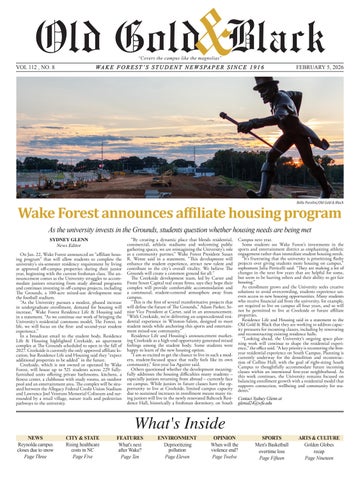
Bella Parolini/Old Gold & Black

Old Gold & Black

is column represents the views of the deputy editor of the Old Gold & Black, Miriam Fabrycky

Editorial: The truth can still set us free

Like millions of Americans, I saw footage of border agents killing Alex Jeffrey Pretti just hours after his death on Jan. 24. When experts published frameby-frame analysis of the numerous, widely-circulated videos of Pretti’s last moments, their ndings only con rmed what many of us had already concluded for ourselves when we saw masked federal o cers ring their weapons into a citizen’s motionless body as he lay on a frozen Minneapolis street.

Pretti’s killing was – horrifyingly –normal. He wasn’t the rst person killed by ICE. He certainly wasn’t the rst person killed by law enforcement. And as usual, the Trump administration, supported by conservative media, moved immediately to smear Pretti’s reputation, describing him as a “domestic terrorist”

and “would-be assassin.”

ere was something unusual, however, in the sustained public outrage that followed Pretti’s death. e American people, including some typical MAGA allies, successfully resisted the lie that Pretti deserved to die. eir overwhelming backlash forced the administration to soften its rhetoric and prompted Senate Democrats to deny funding to the De-

Don't look away. Cling to the truth, because it still has the power to set us free.

partment of Homeland Security.

How?

For one, it makes sense that Pretti’s particular death would be one to catalyze massive repercussions. As New York Times correspondent Kurt Street noted, Pretti seems to have been an “ideal victim”: a white citizen, a V.A. nurse, a legal gun owner and a deeply compassionate man who, in his nal breaths, helped another protestor to her feet.

Old Gold&Black “

But there’s an additional reason Pretti’s death shocked so many: it was impossible to deny the truth. Trump backed down because Americans insisted, unrelentingly, that we understood what we saw clearly in bystander videos.

Even if he doesn’t attempt an unconstitutional third term, there are nearly three years remaining in Trump’s second

administration. In the wake of his persistent assaults against basic civility, the path to a more perfect union is perhaps more arduous than ever. But the astounding fortitude and integrity of civilians in Minneapolis and across the country ood me with hope that that path is still possible.

Please, stay awake to the state of our nation. e word “woke” may have been appropriated into a partisan pejorative, but its guiding principle remains relevant: attention holds real power. Document wrongdoing and talk about it with your neighbors. Read good reporting – and create your own, if you feel so inclined. Don’t look away. Cling to the truth, because it still has the power to set us free.

MARIA SILVEIRA MANAGING EDITOR silvmt23@wfu.edu

>> NEWS

Sydney Glenn, glensd24@wfu.edu

Jill Yoder, yodejs24@wfu.edu

>> CITY & STATE

Nick Costantino, costnp24@wfu.edu

>> FEATURES

Taylor Riley, riletc24@wfu.edu

Bianca Reznic, reznba24@wfu.edu

>> ENVIRONMENT

Evy McEwan-Debney, mcewes25@wfu.edu

Reese Lile, lilerl24@wfu.edu

>> OPINION

Caroline Gottsman, gottca23@wfu.edu

Sara Catherine Bradshaw, bradsr26@wfu.edu

>> SPORTS

Scottie Kimmelman, kimmsd22@wfu.edu

James Lombardo, lombjp23@wfu.edu

THE STUDENT NEWSPAPER OF WAKE FOREST UNIVERSITY SINCE 1916

MATTIE STILLERMAN EDITOR-IN-CHIEF stilmk23@wfu.edu

MIRIAM FABRYCKY DEPUTY EDITOR fabrml24@wfu.edu

>> ARTS & CULTURE

Lydia Derris, derrlf23@wfu.edu

Grace Schuringa, schugh24@wfu.edu

>> PHOTO

Catherine Neely, neelc24@wfu.edu

>> VIDEO

Ben Pappas, pappbw24@wfu.edu

>> SOCIAL MEDIA

Sophie Chan, chansr23@wfu.edu

>> COPY CHIEF

Elle Yormac, yormeh24@wfu.edu

>> DESIGN CHIEF

Cate Goldman, goldcr24@wfu.edu

>> DESIGN TEAM

Chloe Han, hanc24@wfu.edu

Kathryn Bakewell, bakekr24@wfu.edu

>> ADVISER Ivan Weiss, weissij@wfu.edu

PIPER SAUNDERS MULTIMEDIA DIRECTOR saunpg23@wfu.edu

POLICIES

ANNE SHANNON BUSINESS MANAGER shanae24@wfu.edu

Our job as a newspaper is to be a platform for all voices, not just the ones we agree with. However, we reserve the right to reject advertisements that are vulgar, inaccurate, obscene or violate Wake Forest’s policies on nondiscrimination, diversity, equity, and inclusion as they pertain to student organizations. We will also reject any advertisements that promote illegal activities according to the state of North Carolina.

Not only do we hold our newspaper and its contents to a high standard, but we also expect that those who choose to use us as an outlet for their ideas, opinions and skill hold themselves and their content to a high ethical standard.

e Old Gold & Black is published ursdays during the school year, except during examinations, summer and holiday periods, by Triangle Web Printing of Durham. e views expressed in all opinion pieces and advertisements contained within this publication do not necessarily re ect the opinions of the Old Gold & Black. As part of our commitment to reporting news fairly and accurately, we will not remove any previously published content online unless it is retracted. If an error in either our online or print content is brought to our attention, we will revise the originally published article with an appended correction. In order to facilitate thoughtful and appropriate debate, profane, vulgar, or in ammatory comments on our website are not allowed and will be deleted. Comments which incite violence, target individuals in a form of cyber bullying, or which promote ideas which vilify marginalized communities will be deleted, and proper authorities may be noti ed and involved.

>> SUBMISSIONS

e OGB welcomes submissions in the form of story tips, columns and letters to the editor. Letters to the editor should be fewer than 500 words, and columns should be around 500 words. Send yours via e-mail to silmk23@wfu.edu the Monday before publication. We reserve the right to edit all letters for length and clarity. No anonymous letters will be printed.

>> ONLINE MEDIA

Website: wfuogb.com

Facebook: facebook.com/ogb1916

X (Twitter): @wfuogb

Instagram: @wfuogb

TikTok: @wfuogb

Sports X (Twitter): @wfuogbsports

Classes met on Zoom while facilities operated at adjusted hours

For the third week of classes in the spring semester, Wake Forest’s Reynolda and Downtown campuses closed due to snow and icy conditions.

Wake Forest informed students of the initial campus closure at 4:48 p.m. on Friday, Jan. 23 via Wake Alert. For the following week, students waited in anticipation each day for the Wake Alert system to update them on the status of campus closures, which were typically announced in the late afternoon.

The snow began on Saturday evening and continued throughout the weekend. Many students took advantage of the campus’s wintry transformation by sledding, playing football and taking pictures in the snow.

“I spent most of the day out sledding with my Hollingsworth said. “We used an air mattress, a trash can lid, a baking sheet and anything else we saw lying around. It was a lot of fun to see all the students out there together enjoying the snow, which, for me at

Campus remained closed through Thursday, Jan. 29, but teachers were encouraged to hold virtual classes beginning on Tuesday. Reynolda and Wake Downtown reopened fully on Friday, Jan. 30, for onsite learning and work.

Joseph Soares, a professor in the sociology department, commutes to campus from his home in Maryland each week and was unenthusiastic about the choice to hold Zoom classes.

“I was reluctant to teach online because it’s not as

said in an emailed statement. “I appreciate that the administration did what it had to do to keep us all safe,

Jenny Pyke, a professor in the English department, shared that she did not require Zoom meetings during the remote learning days, opting instead for asynchronous methods of student engagement.

“I’m a believer that there’s a lot of room for creative she said. “I don’t go to Zoom immediately. I think students are a little burned out on it, and if everyone

Junior Cahner Smith said that online classes add a layer of stress to her learning.

and then we got closed for snow. So now, I feel like I’m getting behind, and I’d prefer to be in class so I

During the campus closure, the majority of oncampus facilities were closed to student use. The Pit served as the only dining option for several days before restaurants reopened in Benson University Center. Several campus facilities operated under adjusted schedules, including the Wellbeing Center and ZSR Library.

Sophomore Lainey Lowenstein works at the Wellbeing Center and experienced the gym at maximum capacity for the majority of the week. She shared that students lined up at the door each morning to wait for treadmills to open up in the cardio room.

“I worked four days last week from 12-3 p.m. every

do any sort of workout without waiting. Usually that sort of thing might happen in the afternoons but not at

As snow settled over campus, some students traveled home over the weekend in anticipation of the snow and icy roads.

“I decided to go home because all of the snow exWhelan, a freshman from Birmingham, Ala., said. “I was worried about the power going out and didn’t

After the return to in-person learning on Friday, campus closed once again for the weekend as Winston-Salem received about 10 inches of snow on Saturday, Jan. 31. The following day, the University informed the Wake Forest community that Monday would be a remote learning day.

“I do not expect to be able to teach in person on Monday, but hope North Carolina can marshal the resources to clear the streets and highways in time

to believe that it isn’t more cost-effective for the government to invest in snow ploughs instead of leaving

Students expressed mixed opinions on the potential second week of snow and campus closures.

“I’m not nearly as stressed about this storm since

campus being closed at the start of the week. But if

After the second snowstorm on Saturday, students, faculty and staff await further updates on the coming week.

Contact Jill Yoder at yodejs24@wfu.edu

POLICE BEAT

• Unknown subject(s) busted victim’s car window and damaged the ignition of a car in Lot Z2. e report was led at 1:33 p.m. on Jan. 28.

• Unknown subject(s) took victim’s electric bike from a bike rack outside of Deacon Place Building 3. e report was led at 9:07 p.m. on Jan. 28.

• Student received medical assistance from an emergency response team and Forsyth County EMS in Angelou Residence Hall after consuming alcohol underage, but refused transportation. e report was led at 5:00 p.m. on Jan. 29.

• Unknown subject(s) removed victims scooter from bike rack outside of Angelou Residence Hall. e report was led at 10:38 p.m. on Jan. 29.

• Student reported that an unauthorized subject was making food in the kitchen of Deacon Place Building 7. Student said the subject appeared to be an intoxicated student. e report was led at 2:05 a.m. on Jan. 30.

Piper Saunders/Old Gold & Black

Convicted sex o ender and nancier

Je rey Epstein paid the tuition of a student attending Wake Forest University in the fall semester of 2009. Mistakenly spelled as “Wake Forrest,” the university is mentioned 10 times in the les released by the U.S. Department of Justice (DOJ).

Documents show that Epstein paid

$19,551 of tuition for the daughter of Jeanne Brennan Wiebracht, formerly employed as a campaign accountant for the seventh governor of the U.S. Virgin Islands, John de Jongh Jr. e student is mentioned throughout the emails as “Michele.” In the 2009 check made out to Wake Forest University by Epstein, the student is named as Michele T. Wiebracht.

Wiebracht did not respond to the Old Gold & Black’s request for comment.

Epstein died in a New York prison on

Aug. 10, 2019, while awaiting trial for federal sex-tra cking charges, about a month after his arrest. He had previously received a sentence of 18 months in a minimum-security facility for soliciting prostitution from a minor in 2008. e les have been a subject of intense examination as they contain evidence, such as records and testimonials, of connections to many high-pro le individuals.

liand, deferred comment to the University’s News and Communications team. He was the vice president for nance in 2009.

taken place near Manchester Plaza. The University Police Department

“ is is not the rst incident of stolen scooters this school year.

(UPD) is currently investigating the incidents, which they believe are the work of a single perpetrator. The university distributed an image of the suspect, captured using a campus surveillance camera, to all Wake Forest students and faculty.

“UPD officers are actively working with the Winston-Salem and Kernersville Police Departments to identify the suspect,” Major Jamie Herring of the Wake Forest University Police Department said.

“Two community safety advisory messages have been sent via Wake Alert this year regarding scooter thefts

ring to the Jan. 28 message and a Jan. 13 notice of seven scooter thefts that occurred over winter break.

No suspects were identified in connection with the thefts over break. All seven involved scooters that were stored on campus near residence halls.

“Nearly all the scooters reported stolen on campus were not secured with locks,” Major Herring said.

e over 3 million les related to Epstein published on the DOJ website include victim names, some 180,000 photographs and email correspondences between Epstein and Cecile de Jongh, the wife of John de Jongh and former rst lady of the U.S. Virgin Islands. She worked as a manager for Epstein’s Virgin Islands-based companies from 2007 to 2015. Epstein’s private island, Little Saint James, is located about a quarter mile from St. omas.

e les contain photocopies of checks made out to Wake Forest as well as to Skidmore College, American University and Elon University. e other three institutions also received tuition payments from Epstein on behalf of Wiebracht and De Jongh’s children. e payment is characterized as a gift from Epstein in response to invoices provided by Cecile.

“It’s like a treat,” Epstein wrote in one email to De Jongh, “It’s as if I had my own kids in college.”

e current senior vice president ofnance and administration, Brandon Gil-

“Wake Forest does not investigate or track the personal sources of funds beyond applicable legal and regulatory requirements,” Cheryl Walker, the executive director of strategic communications for Wake Forest University, said in an email to the Old Gold & Black. “We take matters of ethical conduct seriously and strongly condemn any form of exploitation or abuse. Consistent with federal privacy laws, the University cannot comment on the records or circumstances of an individual student.”

In a letter sent to two New York judges, lawyers representing Epstein’s victims requested that some les be taken down due to multiple “redaction errors.”

According to the Elon News Network, the DOJ removed one of the previously available les from their website on Feb. 2. e les contained a 2023 deposition of John De Johgh as part of a lawsuit from the Government of the Virgin Islands against JPMorgan Chase Bank, accusing the bank of facilitating Epstein’s crimes by providing him banking services.

In the les, John con rmed he believed the references of omas and Michele were those of Wiebracht’s children.

University Police emphasized the importance of locking parked scooters and bicycles at all times. They also recommend that students leave their scooters and bicycles parked in well-lit areas and register their property with UPD.

“ ese thefts were reported to have taken place near Manchester Plaza.

“Students should always keep a copy of their scooter’s serial number,” Major Herring said. “If it is later stolen and reported to police, the scooter can be placed into the National Crime Information Center as stolen. If it is later located by police, the possessor can be charged with possession of stolen property, and the scooter can be returned to its owner.”

Wake Forest community members with any information regarding reports of stolen scooters are encouraged to contact University Police at 336-758-559 or email police@wfu. edu. Additionally, if an emergency arises on or off campus, students and staff should contact 336-758-5911.

WENDY WARNER
Courtesy of Department of Justice
Piper Saunders/Old Gold & Black

CITY & STATE

OLD GOLD & BLACK

Nick Costantino, costnp24@wfu.edu PAGE 5

THURSDAY, FEBRUARY 5, 2025

School voucher enrollment skyrockets amid controversies

Over 100,000 students receive tuition assistance at private schools

Two years after the North Carolina legislature eliminated the income cap for the N.C. Opportunity Scholarship, enrollment in the state-funded school voucher program has skyrocketed. Over 100,000 K-12 students, including 4,229 in Forsyth County, now receive tuition assistance at private schools around the state as of Jan. 2026 – a dramatic increase from fewer than 33,000 students during the 2023-2024 school year.

It's just a known fact that our education system in North Carolina is not where it should be.

Supporters of the program say the $3,000 to $7,500 most participat-

ing families receive expands access to private schools and allows parents greater exibility in selecting supportive educational environments for their children, especially those with unique learning needs such as disabilities. Opponents argue that the vouchers funnel hundreds of millions of dollars away from struggling public schools to subsidize costs for high-income families.

Statewide statistics

During 2024-2025, the rst school year following the abolition of the income ceiling, 42% of Opportunity Scholar students came from families earning above $115,440. Several private schools also increased tuition in light of the new policy, drawing criticism from public school advocates. As private schools are held to fewer standards than public schools and do not publish standardized test scores, it’s challenging to evaluate participant outcomes. One statistic that is documented: race. White students bene t disproportionately from the Opportu-

nity Scholarship program.

ough intended to improve access to private education, many argue that voucher programs perpetuate socioeconomic segregation, especially given the racist history of private schools across the South. In 2024, ProPublica identi ed 20 North Carolina schools that originated as segregation academies and still primarily enroll white students. Unlike public schools, private schools may reject applicants –and some of these academies might do so, surreptitiously, on the basis of race.

WFU student weighs in

Sophomore Hannah Laxton grew up in Yadkin County, N.C. and attended Calvary Day School, a private, Christian pre-K-12 institution. While she didn’t use a school voucher and wasn’t aware of any classmates who did, Laxton said she is generally supportive of the program.

Citing uneven academic o erings across Winston-Salem’s high schools along with the school district’s disastrous budget crisis, Laxton said she be-

lieves parents are justi ed in sending their children to private schools.

“It’s just a known fact that our education system in North Carolina is not where it should be,” Laxton said. “ ere are some schools that are super good and there are other schools that are just not very good.”

Laxton said she believes she would have been “really behind on class” and unprepared for the rigor of Wake Forest if she had attended her assigned public school, Forbush High School in Yadkin County. She added that if she had children, she would enroll them in local private schools rather than WS/FCS unless they were zoned to the a uent, highly-ranked Reagan High School.

“ e schools here are so vastly different in quality,” Laxton said. “ ere are a lot of good elementary schools around here, but if it came to high school, if I weren’t in Reagan [High School’s zone], I’d send [my children] to a private school immediately.”

Contact Miriam Fabrycky at fabrml24@wfu.edu

Healthcare costs increase as budget impasse continues

DANIEL ADAMS

North Carolina remains the only state in the country without a comprehensive budget for the 2025-2027 biennium. Without a fully updated budget, public programs, such as Medicaid, lack the necessary funding to succeed, and residents are bearing the brunt of the state legislature’s impasse with increasing healthcare costs.

“North Carolinians who rely on Medicaid are su ering because the General Assembly has failed to fully fund the program,” Stein stated in a press release. “ e General Assembly must act to fully fund Medicaid and protect health care for more than three million North Carolinians.”

Why are healthcare costs rising in North Carolina?

N.C. healthcare costs are typically similar to the national average, but prices are

rising quickly. According to the Consumer Price Index for Medical Care, healthcare costs in the average U.S. city have increased by 587% since the 1980s, a rate that far outpaces general in ation.

is is due in part to the fact that the healthcare market lacks competition. Unlike other markets, consumers have only four choices for health insurance: Medicare, Medicaid, the ACA marketplace or employer-based insurance. is means that providers have little incentive to lower costs to attract customers.

“People often say market-based healthcare isn’t working in the US, but I don't see much of a market at all,” Tina Marsh Dalton, a Wake Forest professor specializing in health economics, said in a statement. “Prices are not transparent, and people are not choosing care based on costs.”

Costs have also increased following the expiration of post-COVID premium subsidies at the end of 2025.

“[H]ealthcare prices are continually rising all across the economy,” Dalton said. “ ey used to be heavily subsidized,

and it just got taken away.”

Emergency doctor: Patients su er long wait times

When patients do not have health insurance at the time of an accident or illness, they often go into medical debt to pay for care. However, if the hospital caring for them does not get paid for their services or doesn’t get funding, these hospitals may be forced to reduce sta ng or shut down, creating a ripple e ect.

James “Tripp” Winslow, a professor of emergency medicine at Atrium Wake Forest Baptist, said he sees rsthand the e ects of uneven access to healthcare.

“Right now in the emergency department, patients wait for 4 to 12 hours in the waiting room just to be seen,” Winslow said. “It’s even more concerning that many people who leave before being seen are often quite sick and just go home and su er without proper care.”

ese problems are exacerbated in rural areas of North Carolina, according to Winslow.

“A lot of the rural counties don’t really have doctors anymore,” Winslow said. “ ere are many Medicaid patients out there, and if they can't make enough money to keep the doors open, they’ll probably close.”

What’s North Carolina doing about the impasse?

N.C. Gov. Josh Stein has continued to press the legislature to pass a budget. Stein also signed “mini-budget” bills during a Jan. 29 visit to RHA Health Services’ Alamance County Behavioral Health Center in Burlington.

Experts believe that a full, comprehensive budget won't be formed until at least April. Until then, healthcare costs will continue to rise at an accelerated rate, impeding access to care and causing burnout among healthcare professionals across the state.

Contact Daniel Adams at adamdj25@wfu.edu

Young voters push back as North Carolina closes campus polling sites

College Democrats of North Carolina and four college students are suing the North Carolina State Board of Elections and the Guilford and Jackson county elections boards over their closure of three early voting sites on college campuses.

The case unfolds against a shifting political backdrop in North Carolina’s election administration. In 2024, Republicans gained control of the State Board of Elections, which oversees statewide election rules and appoints the county boards that select early voting sites. The appointed board members in Guilford and Jackson counties subsequently voted to close early voting sites at North Carolina A&T State University, the University of North Carolina at Greensboro and Western Carolina University ahead of the 2026 primary.

College Democrats argue in their lawsuit that these decisions “intentionally target the rights of young voters” and violate both the U.S. Constitution and the Voting Rights Act. The plaintiffs are seeking to restore early voting to all three campuses by Feb. 12.

Many see the closures as marking the loss of longstanding student access points to the ballot. UNC Greensboro has hosted an on-campus early voting site since at least 2012; Western Carolina University has hosted one since 2016 and students at North Carolina A&T previously fought to secure their site ahead of the 2020 election.

“This case is about targeted efforts to place additional, unnecessary, burdensome and ultimately un-

Carolina universities — including the nation’s largest historically Black university — and this fundamental constitutional right,” the lawsuit says, referring to North Carolina A&T.

County board members cited concerns about low turnout and resource allocation when rejecting campus sites. However, North Carolina will still have 10 early-voting sites on college campuses this year, up from nine in 2022, and 319 early voting sites in total, compared to 301 in 2022.

Student leaders weigh in

Student leaders across the state say the closures raise broader questions about democratic participation. Senior Caleb Pembele, president of the Wake Forest Democrats, praised the College Democrats forCarolina.

“I fully support the lawsuit that the College Demostatement. “Voting is a fundamental part of participating in a democracy and a constitutional right. The removal of early voting sites on college campuses by Republican members of the North Carolina Board of Elections is a clear attempt to subvert the will of young voters.”

Pembele said that on-campus voting sites went on to underscore the importance of these sites, especially on college campuses, for their effectiveness in boosting voter turnout.

“These sites serve two important functions,” he said. “First, having sites within walking distance reduces barriers to voting, as many college students don’t have cars, and they boost voter turnout, which is essential for a healthy democracy.”

Wake Forest does not have an on-campus voting site. More information on voting in the midterm primaries can be found on page 6.

Western Carolina students speak out

Zach Powell, one of the plaintiffs named in the lawsuit, is president of the Western Carolina University College Democrats. He said in a statement that he wasn’t blindsided by the county board’s decision to close the WCU campus polling site.

“My initial reaction was one of disappointment, but not surprise,” Powell said. “We had been anticipating this move ever since Republicans took control of the State Board of Elections last year. The WCU polling site serves the youngest and most diverse voter population in Jackson County.”

Powell said he believes Republicans reorganized congressional districts to favor their party amid dropping support in the state.

“I think that Republicans are starting to realize that their political stock is dropping, and now they feel the need to suppress the vote wherever possible,” he said. “Another great example of these voter suppression tactics is the Republican effort to redraw congressional districts across the country in their favor.”

Powell said that WCU worked extensively with the Jackson County Board of Elections to address concerns, offering an alternative on-campus facility and opening 60 additional parking spaces for voters. Despite those efforts, the board ultimately voted to close the site, citing cost and accessibility issues.

Student groups and universities are mobilizing in response. At Western Carolina University, College Democrats are working with community partners and student organizations to organize a “march to the

Additionally, the WCU Center for Community Engagement and Service Learning will provide shuttles to polling locations during early voting and on Election Day, while student organizations plan to offer additional transportation on Saturdays and select evenings.

Powell maintained that student awareness and mutual support are critical.

“One way that students can be helpful in this moment is to help spread the word about the polling place closure and make sure their peers know where they need to go to vote,” he said. “They can also spread the word about the resources and transportation that will be made available. And if they have a car and are willing, it would be super helpful for students to offer rides to the polls to their peers.”

voter access in North Carolina is far from settled. Supporters of restoring campus voting sites see the lawsuit as a battle in the war over fair access voters.

“I think we ain’t seen nothing yet,” Chris Cooper, professor of political science at Western Carolina University, commented to the Raleigh News & Observer. “I think we ain’t seen nothing yet.

Contact Eve Darke at darkev23@wfu.edu

Photo Courtesy of College Democrats of North Carolina
The College Democrats of North Carolina are suing the North Carolina State Board of Elections over their closure of three early voting sites on college campuses.

How to vote in Winston-Salem primary elections

Key deadlines, early voting options and changes affecting Forsyth County voters

North Carolina’s primary Election Day will take place on March 3, 2026. Voter turnout for midterm elections is usually much lower than for presidential elections, but they are just as important as the results often decide how effective the president will be. Here is everything you need to know about registering and voting in Winston-Salem.

The voter registration deadline is Feb. 6 at 5 p.m. In-person early voting runs from Feb. 12 to Feb. 28 at 3 p.m. If you have yet to register, do so soon so that you will be able to vote as soon as next week. If you want to vote early, the Forsyth County Board of Elections lists all Winston-Salem locations and their hours. The closest location to the Reynolda Campus is the Polo Park Recreation Center at 1850 Polo Road.

If you are eligible to vote in North Carolina, you can register online, by mail or in-person at the DMV. And if you require an absentee ballot, the deadline to request one is Feb. 17 at 5 p.m. Here are all the locations in Forsyth County where you can vote on Election Day, March 3. All voters in North Carolina must provide a photo ID or sign an ID exemption form at the polls. For Wake Forest students, DeaconOne cards meet this requirement.

If you choose to vote early, you can do so at any polling location in Forsyth County. However, if you vote on Election Day, you must vote at your assigned polling location. As classes will be held on Primary Election Day, early voting is a good option for Wake Forest students. Importantly, Wake Forest is split into two voting precincts, so if you moved from one side of campus to the other, you must re-register to vote. If you need to update your registration, i.e., because your on-campus address has changed, you must also bring proof of residency. Follow these instructions from the university to request and print this proof using WorkDay.

Students who live in Angelou Hall, Babcock Hall, Bostwick Hall, Col-kins Hall, Huffman Hall, Johnson Hall, Kitchin Hall, Luter Hall, Poteat Hall and Taylor Hall live in Precinct 903. On Election Day, they vote at Salem Chapel at 610 Coliseum Drive on Election Day. Students who live in Deacon Place apartments, Dogwood Hall, Magnolia Hall, Martin Hall, North Campus Apartments, Polo Hall, Polo Road houses and Student Apartments live in Precinct 905. On Election Day, they vote at Bethabara Moravian Church at 2100 Bethabara Road.

You can use this Voter Search tool to see whether you are registered to vote

Midterm primary elections, like all, are an important way to express your opinions and shape local, state and national governance.

and to view an example ballot. Republicans in the General Assembly redrew Congressional districts in North Carolina in 2025 to gain an electoral advantage and eliminate the district of a House Democrat. Therefore, some people are living in a new district in 2026 and will vote for a new member of Congress.

with any political party may only vote for the candidates in their party. For example, a registered Republican can only

vote the Republican primary ballot. An any political party’s ballot, but cannot vote on multiple.

You may not see as much news about the primary election or even the midterm elections, as compared to presidential elections. However, these elections, like all, are an important way to express your opinions and shape local, state and national governance.

Contact Nick Costantino at costnp24@wfu.edu

UNC System Board of Governors committee advances policy on academic freedom

A UNC System Board of Governors committee voted unanimously last week freedom. Many, including the state’s American Association of University Professors (AAUP), expressed concern that the policy may lead to political harassment of academics.

The full board of governors will consider the updated guidelines, an expansive addition to the current two-paragraph “Academic Freedom and Responsibility of Faculty” policy for the UNC System, in March.

The Faculty Assembly approved a version of the policy in October, but the UNCnition before presenting it to the committee, including a section on academic freedom for students and a key line stating “academic freedom is not absolute.”

freedom in the UNC System will not include “teaching content clearly unrelated to the course description or unrelated to the discipline or subject matter; using university resources for political or ideological advocacy in violation of university policy; [or] refusing to comply with

Faculty and students express concern over restrictions

institutional policies or accreditation standards to which the university is subject.”

dom echoes recent attempts from other public universities to curb politically polarizing material as the Trump administra-

sure on universities across the country.

For example, in the summer of 2025, the Trump administration sought to restrict Harvard’s access to federal research funding in response to allegations that the school did not adequately prevent antisemitism on campus. Furthermore, it pressured Columbia University to regulate campus protests more stringently by threatening its accreditation.

More recently, Texas A&M University ended its women’s and gender studies program last week due to a new university system policy that limits how professors can speak on topics of race and gender during class. In December 2025, the University of Oklahoma also made headlines for terminating an instructor who was accused of religious discrimination after giving a student a failing grade on an essay.

Attorneys Mike Tadych and Ashley Fox sent a letter on behalf of the faculty group represented by the AAUP to three UNC System administrators, saying the restric-

and historical scope of academic freedom,” according to the Assembly.

“Irrespective of rationale, the impulse to fence in academic freedom should be disregarded and eschewed,” Tadych and an academic freedom ‘box’ is antithetical to case law, our constitutions, and historical approaches.”

According to Inside Higher Ed, a UNC System spokesperson defended the revised language, saying that both the draft shared with the Faculty Assembly and the System’s later edits drew from feedback from staff, administrators and students. those stakeholders and speaks to the fact that academic freedom is a shared responsibility,” the spokesperson said.

Abbey Hatcher, who resigned from her associate professor position at UNC Chapel Hill on Dec. 31 but who remains an AAUP member, described her disagreement with the policy for Inside Higher Ed.

“All the parameters are basically threats to what faculty should or should not do,” Hatcher said. “They’re trying to be as imprecise as they can about what might be disfavored one day because it gives them leeway to retaliate in different ways.”

Chair of the faculty assembly Wade Maki said the drafted policy from October was a collaboration between the faculty

and administration.

“It’s a good balance of what the responsibilities that we have are and what the opportunities we have are, because academic freedom is critical to us using our expertise to do the teaching and research that faculty are supposed to do,” Maki said in the committee meeting. “We this.”

Belle Boggs, president of the NC Conference of AAUP, said she endorsed the but no longer supports the policy, following its expansion.

“Many new lines of text were somehow, between October and the end of academic freedom,” Boggs said in an inout about this now in a very rushed timeline. And this is a big deal because academic freedom is the number one work condition that we require to do our jobs.”

Disputes between faculty and university administrators will likely persist as both public and private universities come under pressure from state governments and the Trump administration.

Contact Nick Costantino at costnp24@wfu.edu

Annnabelle Tan/Old Gold & Black

PAGE 8

FEATURES

THURSDAY, FEBRUARY 5, 2026

Taylor Riley, riletc24@wfu.edu

Bianca Reznic, reznba24@wfu.edu

“Say yes to every opportunity”

Students unpack study abroad academics, travel opportunities and lifelong memories

It was the breathtaking view of the Grand Canal from Wake Forest’s Casa Artom House in Venice, Italy, that convinced me to partake in that program. For a semester, I was lucky enough to wake up to the view every morning before heading out to explore the city’s rich culture. Between film festivals, great food and unforgettable travel, I will always look back on my semester in Venice as one of the most influential times of my life.

“Over 85% of students earned creit overseas during the 20232024 school year, placing Wake Forest fourth nationally for study abroad participation.

My experience isn’t unique at Wake Forest, where study abroad is a significant part of student culture. Over 85% of students earned credit

Boats pass by on The Grand Canal at sunset in Venice, Italy , as historic buildings line the waterway, photographed in front

overseas during the 2023-2024 school year, placing Wake Forest fourth nationally for study abroad participation. The university prides itself on its study abroad programs and emphasizes its vast opportunities to attract prospective students. Students who choose to study abroad face a daunting decision when selecting a program.

“I’d traveled like 60-70% of the weekends ... I think my favorite

Junior Eliza Kalina participated in an affiliate program focusing on business in Barcelona, Spain, this fall. Beyond advancing her academic career, Kalina looked for special perks such as a flexible schedule that would allow convenient travel around Europe.

“We didn’t have classes on Fridays… so I went to Florence and Rome,” Kalina said, adding that she spent her weekdays in Barcelona at the beach or at landmarks like La Sagrada Familia.

Three-day weekends are a common and popular feature of Wake Forest study abroad programs.

Junior Katrin Cronlund, who spent this fall at the Casa Artom house in Venice, took advantage of her long weekends with frequent trips.

“I’d traveled like 60-70% of the weekends… I think my favorite place was definitely Morocco,”

Cronlund stated. While she wished she had even more time for travel, Cronlund said she appreciated the community and tranquility of Venice.

“I liked talking with people and laughing… I liked walking around Venice. The food was great if you’re willing to put some money down,” Cronlund expressed. She enjoyed living in a smaller city, with a slower pace of life relative to the hustle and bustle of other cities she had previously visited.

While some students, like Cronlund, hope to feel like a local after spending an entire semester abroad, other students seek out shorter immersions through summer sessions that last only a few weeks.

Sophomore Isabela Jaramillo falls into the latter category. She spent three weeks in London last summer with the London School of Economics (LSE), an experience she said created lasting memories and friendships.

“We went to Wimbledon at 4 a.m., and then we got let in at 10 a.m.,” Jaramillo said. “We brought stuff for a picnic, and it was lovely.”

Jaramillo stated she appreciated the opportunity to dip her toes into international travel but longed to spend even more time abroad.

“I should have taken the time to actually go and explore London more,” Jaramillo asserted.

When asked, all interviewees shared that they don’t regret their experience and would definitely study abroad again.

“Say yes to every opportunity!” Jaramillo said.

I couldn’t agree more.

Contact Harper Ransburg at ransha24@wfu.edu

OLD GOLD & BLACK
Harper Ransburg /Old Gold & Black
Wake students explore the shops of Camden Market in London, England.
Bianca Reznic/Old Gold & Black
of Casa Artom.

Q&A with a Habitat for Humanity volunteer

Community service is central to senior Mary Hauser’s life at Wake Forest. In addition to several other volunteer commitments, Hauser spends about one day each month building a ordable housing with Habitat for Humanity of Forsyth County. Deputy Editor Miriam Fabrycky sat down with Hauser to discuss how she rst discovered her passion for Habitat for Humanity’s work, the purpose she nds through volunteering and advice for students who want to get more involved in o -campus service.

is interview has been edited for clarity and brevity.

Miriam Fabrycky: When and why did you begin volunteering with Habitat for Humanity?

Mary Hauser: It was my sophomore year, and I wanted to learn some practical skills. I didn’t know how to x a car or do stu around the house. I was looking for opportunities to learn stu like that in a way that also t with the rest of my life – I couldn’t go become a construction worker, you know.

Fabrycky: Tell me about your rst time volunteering.

“ Whatever your interests are, you can nd a way to make them align with a good cause.

Hauser: It was December, and it was very cold. I just showed up… I was completely by myself. ere were maybe three or four older gentlemen there who all knew each other. We were putting up drywall. It was really dusty, but it was so much fun. [ en] I signed up for a ton of projects in the spring of my sophomore year.

Fabrycky: Sounds like it was a good t.

Hauser: De nitely. I love Habitat for Humanity, I really love it. e days I volunteer are my happiest days. I’ve always loved working with my hands and doing physical stu . I like feeling capable.

Fabrycky: So, did you pick up any of those practical skills you were interested in?

Hauser: I don’t think I ever hammered nails in my life before Habitat for Humanity, but now I’ve used those skills. We put some lights in my basement over the summer, and I could hammer in the wire clips.

Fabrycky: Are there any particular aspects of a building project that you nd challenging?

Hauser: I don’t think so. [ e work] is always within what you’re comfortable doing with your own body. ey always have options for if you want to use a power tool or not, if you want to be on a ladder or if you don’t. It’s always within your comfort zone.

Fabrycky: How do you feel about power tools?

Hauser: I am still terri ed! But using them with someone there showing you how, it’s not stressful. It’s not like I have to cut so many pieces of wood or I need to move faster. It can really be at my own pace. By the end of my most recent day, I actually

felt pretty comfortable using a nail gun.

Fabrycky: Do you have any favorite building tasks?

Hauser: I always love it when we get to go up on the roof. I enjoy it more when we’re working outside, and painting walls is fun.

Fabrycky: What’s been your most rewarding experience with Habitat for Humanity?

Hauser: I worked on one house for a number of days throughout the building process, including close to the end. We did some landscaping, and I planted some of the plants that you can still see outside.

It’s so di erent from anything in my classes, where you’re expected to know a lot and it can be stressful.

Fabrycky: And now a family lives there – amazing. Sounds like it can be a new adventure every day.

Hauser: Yes, I show up and have no idea what we’re going to be doing or what stage the house will be at. You don’t even know the address until the day before. I almost certainly have no idea of how to do the tasks, but they teach me.

Fabrycky: How does it feel to jump in sightunseen almost every time?

Hauser: It’s so di erent from anything in my classes, where you’re expected to know a lot and it can be stressful. Volunteering can be physically intense, but there’s something very refreshing about

it. Every time I’ve shown up, it’s been a good day – it’s been the best day.

Fabrycky: Do you participate in community service beyond Habitat for Humanity?

Hauser: Every organization I’m involved in oncampus is o -campus, facing volunteering. I like being out in Winston-Salem. I love Wake Forest, but it’s really important for me to leave the bubble.

Fabrycky: Tell me about those other organizations.

Hauser: ere’s Elemental Explorers – we do chemistry experiments in elementary schools, and once a semester the students come to campus and tour around. I also volunteer with the Student Association for the Advancement of Refugees. I go to a Syrian family’s house, and I tutor the kids and help the parents if they need help reading forms.

Fabrycky: Sounds like they’re all very meaningful experiences for you.

Hauser: Community service gives me joy. It gives me purpose. I’ve learned so much from working with students and having a relationship with the Syrian family, and I’ve learned so much from Habitat for Humanity.

Fabrycky: What advice would you give to students who want to get more involved in community service?

Hauser: Whatever your interests are, you can nd a way to make them align with a good cause. If you don’t have any ideas, ask your professors and friends, or go to the O ce of Civic and Community Engagement. en just try something. If it doesn’t make you happy, go nd something else, because there’s something for everyone.

Mary Hauser (holding hammer) helps construct a roof at a Habitat for Humanity building project in Winston-Salem.
Miriam Fabrycky/Old Gold & Black

What’s next after Wake?

Recent graduates offer advice to current seniors

Although it’s currently di cult to imagine our campus as anything but covered in snow, spring will be here before we know it, and graduation season will arrive alongside the green leaves, colorful owers and pleasant weather. In four short months, seniors will cross Hearn Plaza to receive their hard-earned diplomas, hoping the last few years have given them the skills they’ll need in the “real world.”

“College really is a once-in-a-lifetime experience,” Caroline Collins, who graduated in May 2025, said. “ ere will never be a period in your life where you’re going to be living with all your friends in the same campus bubble again.”

Wake Forest tends to set its students up for success. According to 2023 data from the Wake Forest Fact Book, 65% of recent graduates are employed, 32% are attending graduate and professional schools and only 2% are seeking employment. Even so, leaving the Wake Forest bubble can be intimidating. Whether graduates are continuing with studies, entering the job market or taking a gap year, it is undoubtedly a step into the unknown.

When thinking about post-grad, be open to new opportunities, new places and new people.

For 2025 graduate Lillian MacKinney, leaving Wake Forest felt like venturing into uncharted territory. After earning her bachelor’s degree in Psychology and Art, MacKinney moved to Milwaukee to work for Teach For America and pursue an online master’s degree in elementary education from Western Governors University.

“[Milwaukee] is a very random place that I feel like people don’t go to after college,” MacKinney said.

MacKinney received her job o er in October of her senior year, so she felt at peace about postgraduate employment. But she said moving to a new city without knowing anybody was frightening.

“I think about my social life all the time,” MacKinney said. “When I graduated, the social transition was di cult. I moved to a place where nobody is… I really miss my friends from Wake Forest, but I also feel like it is such a cool experience of being in the world and trying to make new friends.”

2025 graduate Luke Anders also embraced life in a new city. After majoring in Spanish and communication with a concentration in integrated communication strategies, he moved to Dallas to work at PepsiCo Foods as an associate marketing analyst. Like MacKinney, Anders had to adjust to an entirely di erent social scene.

“People often take for granted what they have when they’re in college,” Anders said. “You’re in a community that's super outgoing and welcoming, and it’s easy to make friends because everybody’s there.”

However, Anders said he is nding his footing in his new hometown.

“Moving to Dallas was di erent, but... [it’s] a super vibrant city where there's lots of personalities,” Anders said. “ e transition at rst was a little bit harder than expected. As the months go on, you de nitely nd your people and get closer to them.”

e transition at rst was harder than expected. As the months go on, you de nitely nd your people.

While exploring new cities can be exciting, there can also be value in returning to the familiar. Collins chose to stay in Winston-Salem to earn her master’s degree in English at her alma mater.

“I wanted to continue furthering my education, and I decided that I wanted to get my master’s degree at Wake Forest,” she said. “I’m so excited. I'm getting to [spend] an extra two bonus years at the school I love that has given me so much.”

Harrison Shephard also returned to a familiar city, moving back home to Mooresville, North Carolina after graduating in 2025. A major in environmental and sustainability studies and double minor in communication and politics and international a airs, Shephard elected to spend time preparing for postgraduate education.

“I’ve been working at a restaurant and [I’m taking] a gap year for law school,” Shephard said.

For seniors preparing for their undergraduate

studies to come to an end, Shephard suggests networking and staying in touch with peers and professors.

“If you’re planning on graduate school, get contact information for professors that you’re close with,” Shephard said. “Take the time to meet people in the eld and have some backup contacts.”

Anders encourages graduates to go beyond their comfort zones and take advantage of new possibilities.

“When thinking about post-grad, be open to new opportunities, new places and new people that you might not think t perfectly into your life,” Anders said. “I took a chance on moving to Dallas… it was an adventure to move away from home, to meet new people, and to enter a totally di erent industry from lots of my friends, but it gives you exposure to di erent parts of the world and di erent perspectives. It really opens your eyes to what there is outside of what you experience in college.”

Collins urges current seniors to be present during their last semester and make the most of every Wake Forest opportunity.

“Live in those nal moments with your friends and just soak it all up and enjoy,” Collins said. “Every moment could be the last time, so make the most of every chance you get.”

Despite their diverging paths, these graduates all said that Wake Forest has given them the skills and connections to “make it in the real world.”

“Everything happens for a reason,” Collins said. “If you don’t have everything about post-grad gured out, you will gure it out.”

Contact Taylor Riley at riletc24@wfu.edu

Photo Courtesy of Wake Forest University
In four short months, seniors will cross Hearn Plaza to receive their hard-earned diplomas, hoping the last few years have given them the skills they’ll need in the “real world.”

ENVIRONMENT

Deprioritizing pollution

The Environmental Protection Agency (EPA) announced on Jan. 9 that it will no longer calculate thetion’s effects on human health.

For over 40 years, the EPA has calculated the moneven into the bloodstream. Inhalation of these articles over time is linked to heart disease, lung cancer, birth defects and other serious health conditions.

far less valuable than they actually are, which risks control.”

Under the Biden administration, the EPA calculated

Many government agencies, in addition to EPA, value of regulations. The EPA’s analyses of PM2.5 health effects have informed environmental legisla-lution.

longer make these evaluations, saying they leave too

and ozone than in reality.”

of the EPA and the Executive Director of the Andrew Sabin Family Center for Environment and Sustain-

ysis would reduce over-regulation,” Meiburg said.

whom the costs fell don’t like this.” Meiburg also said that the federal government may be more willing to slash environmental regulations rules. your back.”

air standards.

Mary Rice, director of the Center for Climate Health and the Global Environment at Harvard University, “I’m worried about what this could mean for health,”the brain.”

industry. The chief of the EPA, Lee Zeldin, recently said the government agency’s mission is “to lower the cost of buying a car, heating a home, and running a business.”

lic health and the environment. It has not been [to…] “There are lots of agencies who have missions related should be mindless of cost. You have to do that, of

Contact Reese Lile at lilerl24@wfu.edu

Photo courtesey of Reuters
Annabelle Tan/Old Gold & Black

OPINION

OLD GOLD & BLACK

PAGE 12

THURSDAY, FEBRUARY 5, 2026

Sara Catherine Bradshaw, bradsc24@wfu.edu

Caroline Gottsman, gottca23@wfu.edu e views expressed in all opinion columns represent those of the article’s author, not the opinions of the Old Gold & Black Editorial Board

When will the violence end?

The death of Alex Pretti at the hands of federal agents paints a dark picture of our democracy

Those who knew Alex Pretti praised him for his kindness, generosity and dedication to his community. Pretti was a 37-year-old U.S. citizen who worked as an ICU nurse at a Veterans Affairs Hospital and lived in Minneapolis. Many said his smile always lit up the room.

On Jan. 24, federal agents shot and killed Pretti.tion and Customs Enforcement (ICE) and other agencies have been present in Minnesota for weeks as part of the Trump administration’s “Operation Metro Surge.” Pretti is the second Minneapolis citizen these agents killed Renee Nicole Good, also 37, on Jan. 7. in Los Angeles, then moving to Chicago. The Trump adto remove illegal immigrants. They’ve also accused “violent mobs” of interfering with deportation and claimed to have a “zero tolerance policy for criminal behavior.”

Yet in this pursuit, ICE agents have violated basic rights by unlawfully arresting citizens, using detention centers improperly and acting with excessive force.

Think about how much damage the Trump administration has caused during this crackdown. At least 40 people have died since the start of these raids, either at the hands of federal agents or in custody at detention centers. According to the New York Times, the administration said “it would prioritize deporting the ‘worst of the worst criminal illegal aliens,’” yet the majority of those arrested have no criminal record. Agents are breaking down doors, making aggressive arrests and killing innocent civilians.

The Trump administration continues to advertise these acts as promoting public safety, but it’s unclear who they’re trying to protect.

Philosopher Thomas Aquinas wrote that the “laws (legalia) we call ‘just’ are those that affect and conserve happiness and its elements within the political community.” Based on this statement, we can conclude that the law should be ordered toward the common good.

But this system, this environment, this institution that the administration has created by deploying ICE, isn’t advancing the common good.

I don’t believe that working toward the common good involves eight agents tackling and shooting an unarmed man 10 times. It doesn’t involve arresting 5-year-olds. I don’t believe that working toward the common good leads public schools to cancel classes out of fear for children’s safety. I don’t believe that it causes civilians to miss doctors’ appointments because they are too afraid of being pulled over by a federal agent.

I don’t believe that the community of Minneapolistesting in the streets every day.

Pretti’s death isn’t an isolated incident. It speaks to Trump’s understanding of his job as president of the United States. It speaks to his understanding of the legal system he directs with disregard for public safety.

I don’t want a president who thinks it is appropriate to post vile and disgusting comments on social media about a man who was just killed. A man who had a sister and parents. A man who committed his life to taking care of others.

But actions speak louder than words. Last spring, Shane Harris, a Wake Forest alum who now writes for The Atlantic, spoke to my News Literacy class. He told us that the magazine no longer reports on what Trump

says, but rather what he does.

What we need now is for Trump and border czar Tom Homan to act. To follow through on what they say about reducing the number of federal immigration enforce-

administration to put its agenda aside and put the public

I texted my dad the other day and told him I just didn’t know what to do anymore. All of the violence and hate is too overwhelming, too paralyzing. But what I have to do, and what we all have to do, is not succumb to those feelings.

We have to act as well. We have to keep talking about what is going on, whether that be by writing articles for our school newspapers, reaching out to our senators or standing up in the streets for our neighbors and our democracy. Minnesota residents are already taking action by delivering groceries to immigrants and offering other sources of aid — all simple forms of activism that make big differences.

The law is not on the side of the common good anymore. We have to work for ourselves and our communities. When we become silent, we become complicit in our own demise.

I reiterate what Judge Fred Biery wrote in his order to release 5-year-old Liam Conejo Ramos from a detention facility:

In the early days of the nation, Elizabeth Willing Powell, one prominent Patriot socialite, asked Benjamin Franklin, “Well, Doctor, have we got a republic or a monarchy?”.

Franklin responded, “A republic, if you can keep it.”

Contact Towne Moores at moortv22@wfu.edu

A sign demanding justice for Alex Pretti, who was fatally shot by Customs and Border Protection agents, hangs from bike handlebars before a memorial unity bike ride for Pretti in Minneapolis, Minnesota, January 31, 2026.
Photo Courtesy of Reuters

Sylly week no longer feels silly

“Work” Forest earns its name as even Sylly week hits the ground running

week of classes?

Before I stepped onto Wake Forest's campus for mytroductory days are often referred to as Syllabus Week

into the spring semester became a week full of stress

Many of my fellow freshmen agree that Sylly Week

labus Week is supposed to be a week of introducing

Freshman Anna Bolden was also surprised by the "Based on what I had previously heard about Wake give you a chance to get to know the people in yournot even sure if these classes are for me yet!"

An additional element of stress comes from the fact that many courses require students to read the syllabus

"I feel like knowing the syllabus has become a re-

where students grew more familiar with each other and their new courses has become just another week

Contact Hannah Ordan at ordahg25@wfu.edu

However, despite the

Where did all the backpacks go?

Female students now prefer totes

BECKIE SUSSMAN

Contributing

knew I had to be so fashionable to attend class?

because tote bags radiate something that backpacks -

female students prefer totes for good reason; they are

pack feels like departing a stage of life I am not ready Maybe one day I will trade my backpack for a chic and books in a backpack is way easier!

Contact Beckie Sussman at sussrr25@wfu.edu

Piper Saunders/Old Gold & Black
week's carefree allure, for many stu-
Sara Catherine Bradshaw/Old Gold & Black

Are rom-coms back?

Escapism, nostalgia and streaming services bring attention to a classic genre

I’ve always been a movie person. ere’s nothing I love more than settling down with a blanket and some popcorn, dimming the lights and hitting play as a cinematic score envelops me. I’m a fan of most genres, especially action, thriller and drama. However, the one type of movie that will always hold a special place in my heart is the romantic comedy, or “rom-com.”

Between the fashion, the music choices and the sizzling chemistry, what’s not to love with movies like “How to Lose a Guy in 10 Days,” “27 Dresses” and “You’ve Got Mail”? However, rom-coms sometimes feel like a thing of the past. You might notice that all the titles I mentioned were released from the late 1990s to the early 2000s. After this era, rom-coms fell out of style and dropped o the Hollywood docket. is drop-o was the result of many factors, chief among them the collapse of mid-budget movies in the industry. As streaming services came to dominate the market, people increasingly avoided movie theatres due to high ticket prices and the convenience of platforms like Net ix and Hulu. eater attendance slowly became an event reserved for monumental blockbusters, such as new entries in the Marvel or Star Wars franchises. Meanwhile, rom-coms, a low-stakes, mid-budget genre, began to lose money, with many lms failing to break even.

In response, producers and directors shifted away from modestly pro table lms to large-scale franchises and series.

By the 2010s, focus shifted to action movies starring superheroes and animated lms marketed toward children, leaving rom-coms essentially absent from the box

o ce. Without appreciation in the theater, studios invested less time, money, and talent into the genre, generating fewer quality productions.

While scouring for good, fresh rom-coms, I’ve watched some decidedly rotten movies. But as the years have passed, it’s become easier to nd rom-coms worth my while. In 2023, I was surprised by the adoring public reaction to “Anyone But You,” starring Glen Powell and Sydney Sweeney. While critics argued that the movie fell short compared to the golden lms of the ‘90s and ‘00s, the people seemed to love it. “Anyone But You” earned a whopping 87% audience approval rating.

In 2025, the Net ix rom-com “ e Life List” starring So a Carson and Kyle Allen garnered a similar reaction, ooding TikTok pages with fan-made videos about the movie. Like with “Anyone But You,” critics and audiences were bewilderingly split on their opinions of “ e Life List,” with the movie receiving a 46% on the Tomatometer and a 70% on the audience rating. e high audience scores demonstrate that rom-coms still appeal to public demand.

e most notable recent addition to the rom-com discourse is the 2026 Net ix “People We Meet on Vacation,” an adaptation of the Emily Henry book that stars Tom Blyth and Emily Bader. When “People We Meet on Vacation” came out, almost everyone I knew asked me if I had seen it yet. I had no less than three movie nights with di erent friend groups dedicated to watching Tom Blyth do the worm on my screen. When I opened my phone, I was greeted with TikToks of “Forever Your Girl,” a song featured in the lm, and petitions for further Emily Henry lm adaptations. Viewership statistics re ected enthusiastic reactions worldwide, with the movie debuting to 17.2 million viewers in its rst weekend and reigning as the number

one English-language movie on Net ix for Jan. 5-11. e combination of rom-coms slipping back into the mainstream over the past few years and the incredible reaction to this most recent addition to the genre led me to wonder: are rom-coms back?

If so, why now?

Now, love stories have been central to storytelling since the dawn of time, but the rom-com occupies a special subset with its promise of a “happily ever after.” While many drama romances and historical romances incorporate heavy topics like grief or war, rom-coms tend to be more surface-level, giving the audience a chance to turn o their minds and participate in a lowstakes, feel-good experience. With economic, political and environmental struggles dominating the news, rom-coms may be ourishing again because they can o er an escape from the chaos.

Another reason for the resurgence: ‘90s and ‘00s trends are back and stronger than ever. e craze for low-rise jeans and little purses may also drive a burgeoning interest in contemporary media, including golden age rom-coms.

Finally, Hollywood may be nally adjusting to the new streaming landscape with Net ix releases that may not ood the box o ce with revenue but hold widespread, heartwarming appeal to a growing percentage of the public.

All-in-all, the rom-com seems to be on the up. Whether that be because it o ers comfort in the chaos, style in the trends or ease of streaming, I, for one, am happy to see one of my favorite genres back on the screen. Because again, what’s not to love about a good old-fashioned rom-com?

Contact Caroline Gottsman at gottca23@wfu.edu

The combination of rom-coms slipping back into the mainstream over the past few years and the incredible reaction to this most recent addition to the genre leads to the question: Are rom-coms back?

Mattie Stillerman/Old Gold & Black

Scottie Kimmelman, kimmsd22@wfu.edu

James Lombardo, lombjp23@wfu.edu

Men’s Basketball drops third straight in overtime loss to Pitt

Foul trouble and sloppy play lead to crushing defeat

Coming off a demoralizing blowout loss against the Duke Blue Devils lastball team looked to turn a corner against their hopes of returning to the win column were futile as the Panthers defeated

Things started as usual for the Deacs.

to the metal.

Wake Forest took their largest lead of the

to control the boards gave the Panthers a chance to establish their game.

While Wake Forest maintained a lead for

kept their nose to the grindstone and battled all the way to the end. With just over

Forest holding a serviceable 4-pointated enough chaos to force overtime.

“I thought [Pitt] played a lot more

Steve Forbes said following the game. “They had a better pace on offense. They got on us on the glass. They turned us over. Those were big plays for them.”

While the Deacons held their own costly mistakes on defense and questionable shot decisions led to their downfall.

Wake Forest is all too familiar with their other major issue in the matchup:

those extra boards is far more challenging for this small squad – a problem evident on Tuesday. The Demon Dea-

Wake Forest’s total of nine.

fensive rebounding was going to be an

pointing to go on the road and have almost half their points come from second chances and on turnovers.”

con losses of this season have included some bright spots to write home about. But not from this game. The offense was the competition fans saw in years past was missing.

Wake Forest’s current track is concerning. If things don’t resolve in the could be on the horizon.

Contact Scottie Kimmelman at kimmsd22@wfu.edu

Men’s Basketball annihilated by NC State

Juke Harris is the only bright spot for the Demon Deacons as he notches a new career high of 31 points

JAMES LOMBARDO Sports Editor

Wake Forest Men’s Basketball lost yet again in embarrassing fashion on Saturday by 18 points to in-state rivals NC State. This was a game that many considered a “must-win” if the Demon Deacons wanted to make the postseason.

the Deacs won’t be dancing this March. Their fourth straight loss puts Wake

this team has been playing leaves many

to wonder if they’ll even qualify for the Their fourth straight loss came at the-

Wake Forest’s 3-point defense was nowhere to be found.

The Wolfpack jumped out to an early 11-2 lead and never looked back. The rim looked as big as the ocean as NC State alone. Wake Forest could hardly keep up with their high powered offense.

The majority of possessions felt stale as the only competent ball handler for the Deacs.

cold as the snowstorm in Winston-Salem this weekend. The Demon Deacons were down by an insurmountable 18 points at the break.

Wake Forest looked more inspired and began clawing back into the game. Little by minute mark when the Demon Deacons only trailed by six.

That’s when Wake Forest forgot how to play basketball again. around the perimeter on nearly every posthe basket with seven seconds left on thesion chucks bricked off the rim. game shot selection when the Demon

of 31 points. Wake Forest even saw solid production from Freshman guard Isaac Carr and Junior Forward Omaha Biliew.

“I talked to the team before the game

Steve Forbes after the game. “You have struggle to do that.”

Contact James Lombardo at lombjp23@wfu.edu

Tre’von Spillers (25) goes up for a highly contested layup in Tuesday’s matchup against the Pitt Panthers.
Photo courtesy of Wake Forest Athletics
Juke Harris (2) scored 31 points, but the rest of the team was as cold as the snowstorm in Winston-Salem this weekend.
Photo courtesy of Wake Forest Athletics

Women’s Tennis sweeps home doubleheader

Evie Oxford and Krystal Blanch won both their singles and doubles matches to help the Deacs come out on top in both contests

ELLA

Wake Forest women’s tennis continued their home winning streak this past weekend in a doubleheader. Coming off a 0-4 road loss to Furman, the team was searching to get back on track. The Demon Deacons redeemed themselves on Friday as they earned a nailbiter 4-3 against the Marshall Fighting Herd, then had a convincing 7-0 sweep of the Spartans of UNC Greensboro later in

the day.

In their opening match, the Deacs dropped both doubles matches and sur-

Marshall’s Polina Gumeniuk and Alina Mokrynska defeated Wake Forest’s Nevena Carton and Kady Tannenbaum, 6-1, and Marshall’s Johanna Strom and Nour El Ouzzani defeated Wake Forest’s Sankavi Gownder and

their rhythm at third singles this sea-

son, as this was Gownder and Nisbet’s Deacs will look to solidify the duo as the year progresses.

This forced the singles players to step up — and they did. Evie Oxford, Kady Tannenbaum and Sankavi Gownder all defeated their respective opponents in straight sets. Krystal Blanch defeated Marshall’s Johanna Strom in a three-

tory over the Herd.

Marshall picked up a pair of hardfought thrillers over Wake Forest’s Nevena Carton (7-6 (11-9), 4-6, 1-0

6-4) to bring the score to 4-3, but their efforts were too late.

Using the momentum of the earlier win, the Demon Deacons breezed past UNC Greensboro, sweeping the doubles and winning all six singles matches. They dropped no more than four games in a set across all matches. Gownder highlighted the singles matches with a 6-0, 6-0 blanking of Greensboro’s Kayley Bushnell. A leading force this season for the Deacs, Gownder will look for yet another triumph next weekend.

“Proud of the way the group responded after losing the doubles point to a good Marshall team,” Coach Wyshner said of the weekend. “Doubleheaders are always tough mentally and physically, and the players handled the second match with great maturity.”

The Deacs improved to 3-0 at home and now prepare to head to Old Dominion on Saturday, Feb. 7, in search

Deacs in recent seasons, and they hope to end that trend in the coming weeks.

Contact Scottie Kimmelman at kimmsd22@wfu.edu

Women’s Basketball loses in triple overtime thriller against Virginia

SCOTTIE

Last Thursday, the Wake Forest women’s basketball team had a chance to snap their six-game losing skid against ACC rival Virginia at the Lawrence Joel Memorial Coliseum. Unfortunately, the Demon Deacons were unable to secure the victory, falling 109-103 in a triple overtime affair.

Considering the Deacons’ recent record as well as the Cavaliers’ level of play, a loss of this magnitude isn’t completely detrimental to the team’s future success. In fact, there were several bright spots that fans may be content with.

Demon Deacons struggling to keep up with the Cavaliers, a strong start to the third gave Wake Forest some much-needed life. Thanks to a couple of 3-pointers from Mary Carter and Grace Oliver, the Deacons cut down in the quarter.

Virginia, however, maintained their strong offensive output and extended their lead to 10 by the end of the half. With little to no room for error in the

fourth, the Demon Deacons stormed back onto the court with a chip on their shoulder. Not only did they put up competitive numbers against the they arguably played their best brand of basketball.

went back and forth, a pivotal and one from sophomore Aurora Sørbye gave Wake Forest unparalleled energy. For the remainder of regulation, the Demon Deacons played with their hair on

Between clutch 3-pointers and strong interior play, this squad’s offensivesolutely super – so much so that they clawed all the way back to make it a

the game, star freshman Milan Brown nailed a 3-pointer at the buzzer to send the game to overtime. Milan, who has

with her career high in points with 30. There was no doubt that, heading into extra time, the odds favored the Demon Deacons. However, the Cavaliers still presented a real challenge. Sure enough, these teams played like

as their eight points apiece sent the game to double overtime.

two teams found themselves in yet another stalemate. With Wake Forest and Virginia both notching 11 points, an ultra-rare third overtime was in store.

While the Demon Deacons gave missed opportunities on free throws and costly turnovers gave Virginia far too many chances to capitalize.

Contact Scottie Kimmelman at kimmsd22@wfu.edu

Photo courtesy of Wake Forest Athletics
Senior Jingyi Li lunges for the backhand slice in her match against UNC Greensboro. In her singles match Li won 6-2, 6-0 and in her doubles match she won 6-2.
Photo courtesy of Wake Forest Athletics Freshman guard Caitlyn Jones storms in towards the paint for the

Seahawks and Patriots to match up in Super Bowl to cap off wild NFL season

After a series of nail-biting games in this year’sattle Seahawks and New England Patriots will trav-

Meet the teams

their team last offseason, including trading away veteran quarterback Geno Smith and longtime Manager John Schneider’s decisions, but they have

In free agency, Schneider turned the keys to Seattle’s future over to 27-year-old quarterback Samnold carried his success to Seattle with a career game in the NFC Championship, making the $100al signings like veteran wide receiver Cooper Kupp and edge rusher Demarcus Lawrence helped the Se-

On the other side, the Patriots are coming off a

ly transformed the Patriots’ defense and led them to

without mentioning second-year quarterback Drake

back Rating and among the frontrunners for the the number of excellent signings made by New England in the offseason, set the Patriots up for

I don't take that for granted," said Maye in a press

The stakes and the history

Brady and Russell Wilson, faced off in an extremely Butler’s infamous interception on the one-yard line

with 20 seconds left is a moment that Patriots fans in 2023 – only separated by 3 picks – and have trans-

In addition, the two head coaches have defenseser himself, has led the New England defense to be excelled at generating pressure while blitzing at a to, considering how the rest of the playoffs have

Contact Scottie Kimmelman at kimmsd@wfu.edu

Photo Courtesy of the Associated Press
Fan favorite second-year quarterback Drake Maye, who is in the running for NFL MVP following his fantastic regular season performance, celebrated winning the AFC Championship game after beating the Denver Broncos 10-7 in the snowy matchup.

ARTS & CULTURE

Campus bands rock out at the Ramkat

Settle Down and Winston Station expand into the

practice room. Since then, Winston Station has produced numerous singles. They performed one, titled “Human Summers,” at The Ramkat.

Academic excellence is inextricably linked with musical ability here at Wake Forest University. Joining the ranks of Chicken Scratch and Scratch & Co., newer student bands Winston Station and Settle Down ventured beyond campus to perform at The Ramkat on Thursday, Jan. 29.

The two bands took to the Ramkat stage, performing 90-minute sets for students and locals alike.

Winston Station

Winston Station, which has an established relationship with Andy Tenille, Wake Forest alum and co-owner of The Ramkat, invited the newer Settle Down to perform alongside them.

“They like the same music, it seems, and were buddies with some of those guys,” DeNatele commented about what motivated this decision. “Why not give them the same chance? We're lucky enough to have set this up and we want to share the wealth.”

“I felt like that was the most obvious thing to do,” Ashley added.

Winston Station is composed of DeNatale on lead vocals and guitar, Wesley Ashley on rhythm guitar and backup vocals, lead guitarist sophomore Sutton Collins, sophomore Luke Laczynski on bass guitar, sophomore Phil Susi on keyboard and Luke Hegner, a senior at the University of North Carolina School of the Arts, on drums. The latter two are recent additions to the band.

When sophomore Grey DeNatele, the lead guitarist and singer of Winston Station, was asked when the band first began playing, he was able to recall the exact date, October 4th, 2024.

“How do you remember that?”

“I just bought in,” DeNatele said.

The friends kick-started their career in the basement of Scales Fine Arts Center, where they converted a vacant marching band closet into a

Settle Down

While Winston Station has found a solid footing within the Wake Forest social scene since their debut last fall, Settle Down has only recently emerged from the depths of the Delta Kappa Epsilon fraternity basement with a similar objective: to perform good music.

e ve bandmates of Settle Down began playing together in the fall of 2025, when lead guitarist, senior Tristan Stump, and bassist sophomore Simon Vulliez, recruited sophomore Asher Lewis to play the keyboard, sophomore Tyler Mashewari for lead vocals and junior Meade Evans for drums.

ey were inspired to take the name “Settle Down” after repeated noise complaints from older members of Delta Kappa Epsilon when the band practiced in the basement of the fraternity house.

‘Settle Down’ is not a term that people use a lot or associate with music, for that matter,” Evans said. “It’s kind of a testament to the band.”

As the only band member who is not in Delta Kappa Epsilon (DKE), Evans’ introduction to Settle Down was a mere coincidence.

“I was in Accounting with [Stump] and asked if he wanted to study,” Evans said. “He told me he had band practice and said they were actually looking for a drummer. So I came down and played, and obviously I did OK.”

While preparing for Stump’s absence after his graduation, Vulliez is hopeful that the band will persevere.

“[Stump] has pretty tough shoes to ll, but our drummer is a junior and the rest are sophomores, so hopefully we’ll be able to continue next year,” Vulliez said. “I really want to play for other schools and fraternities because I think it's cool to play for more unique crowds.”

While Settle Down mainly performs indie rock covers, the band is working to release a few original

singles within the next year.

e Bond of a band

While both bands have invested copious personal time and funds into advancing their music, they view the rewards as far outweighing the cost.

“It can be a little stressful, having to work together with a lot of di erent people with a lot of di erent ideas,” Stump said. “But it helps you learn how to work better in a team and take in other people's input.”

DeNatele shared a similar sentiment.

“My favorite part of being in this band is having a completely separate group of friends that are personal to me,” he said. “I don't think there's a better bond than sharing music with each other. ere are some challenges, but it’s all glori ed in the end because we get through them.”

e bands have both evolved since their respective debuts, learning to lean on one another in times of uncertainty.

“It’s de nitely nerve racking to think I'll be playing for a lot of people I've never played [for] before,” Vulliez said. “But it's comforting to know there's ve other guys out there feeling those same emotions.”

Looking to the Future

To varying degrees, both Settle Down and Winston Station see their careers advancing beyond the bounds of frat parties. ey hope to continue to appear across Winston-Salem and say they will bring Wake Forest with them as they make their mark on professional music.

Members of Winston Station perform at The Ramkat in downtown WinstonSalem on Jan. 26., expanding past the Reynolda Grounds into the local music scene.
Grace Schuringa/Old Gold & Black
Tyler Mashewari, Asher Lewis and drummer Meade Evans in Settle Down band
Grace Schuringa/Old Gold & Black

The 2026 Golden Globe served looks

The silver screen meets Paris fashion week at this year’s Golden Globes.

The Golden Globes came and went, and I’m left ruminating on Miles Caton’s snub for Best Original Song for “I Lied to You” in “Sinners,” the fact that “Best Podcast” is now an awards category and how I desperately need to watch “Hamnet.”

However, the most captivating part of the Jan. 11 ceremony was, invariably, the ensembles. Many drew from old Hollywood influences to create classic, timeless outfits.

Though their intended “shockfactor” effect has lessened since Beyonce’s 2015 Met Gala dress, sheer dresses continue to appear in celebrity ensembles, to my disappointment. J-Lo and J-Law were both seen wearing see-through looks that didn’t succeed in pushing any boundaries. A rare success was Jennifer Lawrence’s Givenchy dress, which was beautifully crafted with strategically placed flowers and a puffed wrap that fell around her wrists.

Connor Storrie, co-star of hit television series “Heated Rivalry,” wore a polished grunge look with Saint Laurent aviator sunglasses and a hairstyle influenced by Kurt Cobain’s mugshot, the Beatles circa ‘67 and Patrick Swayze in “Point Break.”

After the craze over Hudson Williams’s dainty diamond and emerald choker for Vanity Fair, his stylist once again delivered with a Bvlgari serpent choker. I predict this accessory will become part of Williams’ brand – like MC Hammer pants, but far more chic.

Rose Byrne wore a stunning green dress and looked like she could lead James McAvoy into a home library, duping Keira Knightley’s iconic look in “Atonement.” The 210 hours of labor poured into her Chanel

dress paid off with the elegance of her Hollywood glam effect, complete with a 1940s-inspired red lip.

Aimee Lou Wood and Ariana Grande looked like goth Victorian fraternal twins in their dark off- theshoulder Vivienne Westwood couture dresses.

My personal favorite was Emma Stone’s Louis Vuitton belly shirt and yellow tasseled skirt. 2026 is the year of sets, and I am almost as obGracie Abrams’s burgundy Chanel look from her performance at Vogue

World 2025.

A very close second was Elle Fanning’s shimmering custom look. Her dress also nodded to old Hollywood glam with a deep V-neckline, match-

dery that mimicked a sparkle with silver and cool pastels. Seriously, she looked like she should’ve lost a shoe when the clock turned midnight.

Parker Posey falls in third place with her custom gold silk taffetaing down her chest and skirt. The yellow-gold and sheer brown Atelier Biser gloves perfectly complemented her dark features, and her funky poses matched the extravagance of the dress.

Fourth place goes to Sabrina Elba, who channeled Y2K in a 2002 archival Guy Laroche and beautifully accompanied the look with her chic pixie cut.

Halim dress. Higgins’ statement shawl appeared slightly like gold aluwhen paired with styled hair, clean makeup and simple jewelry.

The awards season fashion has only just begun, and it’s already leaving me wanting more.

Contact Margrethe Jensen at jensmm22@wfu.edu

Naomi Osaka’s Australian Open ensemble

More than fashion, Osaka’s Australian Open look tells a story of identity and self-expression

WILLIAMS

Inspired by the stories of the “underwater world” that she reads to her 2-year-old daughter, Japanese tennis player Naomi Osaka entered her first round Australian Open Match in an ensemble that sparked debate.

Osaka’s outfit, a sheer chiffon veil and aqua tennis dress with green tendrils, drew comparisons to a jellyfish. Her white Brummelesque hat evoked elements of 19thcentury dandyism and her plissé pants matched this upper ensemble. She made her way to face Croatian geometric white parasol.

Osaka collaborated with Nike, hairstylist Marty Harper and designer Robert Wun in her appearance. Wun said he was inspired by the iconic moment during the 2021 Australian Open when a butterfly landed on Osaka’s nose. He featured a butterfly as an accent on Osaka’s hat.

Her attire elicited a range of opinions.

“I think what she’s doing for the sport and the fashion is cool and bringing new eyes to the sport,” two-time Grand Slam champion Coco Gauff said for Sky Sports.

TNT Sports and Eurosport Tennis commentators praised Osaka’s outfit as “brilliant” and the “ultimate walk-on.”

However, others claimed the look detracted from the tradition and prestige of the sport. Doubles champion Jamie Murray, the brother of renowned tennis player Andy Murray, was unimpressed, saying Osaka’s getup resembled Mary Poppins.

“For me, I was just like, what? Like, what are you doing?” Murray said on BBC 5 Live Sport.

Osaka defended her outfit choice after the criticism.

“I don’t do this for them,” Osaka said for Sky Sports. “They will never get it, and I don’t want them to. I do this for the people that are like me.”

How warranted is the critique of Osaka’s outfit as “classless” when similar disruptions of tradition are accepted where white players are concerned? From catsuits at Wimbledon and the French Open to tutus at the US Open, players express their individuality on the world stage through a variety of stylistic choices.

Osaka’s performance has the potential to attract new audiences to tennis. Her outfit did not erode tennis tradition but rather exposed

Contact Grace Williams at willge24@wfu.edu

whose expressions have historically dictated the norms.
GRACE
Connor Storrie and Hudson Williams bring high fashion and elegance to the 2026 Golden Globes
Courtesy of the Associated Press
Naomi Osaka enters Rod Laver Arena in a head-turning, ele-
Courtesy of the Associated Press

My Dinner with Bernhard and the Virginia Woolf of Vienna

The

Austrian novelist Thomas Bernhard is often lauded for his Beckettian absurdity and dense prose. His first-person narrators are disillusioned and bitter, and I find them particularly useful lenses through which to glare at post-modern hypocrisy.

I’ve read just a few of the prolific Bernhard’s works. I began with the philosophically compact “Woodcutters,” which follows the musing and denigrations of the narrator at a single dinner party. I then read “The Loser,” which follows a failed pianist obsessed with Glenn Gould. Most recently, I read “Yes,” about a mentally distressed scientist who finds salvation in the company of a Persian woman and her Swiss husband.

What I find most striking about Bernhard’s wielding of language is the utter containment of his grand and interrogative theorizations on the human condition in page counts that typically number no more than 200. He is a voice of the century that is defined by limits.

Often, critics write Bernhard off as death-obsessed and drearier than Kafka, but his writing isn’t wasted on

those who aren’t too critical to bear him.

Bernhard’s works are polemical and placed in the socio-cultural climate of Austria, but can be extrapolated by all contemporary artistic in-

stitutions and pursuits. Submerged in the hysteria of his narrators, they reflect the lesioned mind of modernity.

Bernhard is a moralist in the tradition of Karl Kraus. What raises this denunciation of his critique of cul -

tural parochialism, far surpassing the level of mere satire, however, is Bernhard’s ironic tone of voice and musical sensibility. His narrators’ own credibility is constantly undermined by the anxious excessiveness of his attacks, which the reader gradually comes to see as being aimed as much at himself and his own fear of death. His language loops ceaselessly, exhausting itself through repetition. Cutting critique eventually settles into self-implication. In “Woodcutters,” the narrator’s declaration “[i] ndeed, I hated all of them, because they were in every way the exact opposite of myself,” captures Bernhard’s central rhythm into annihilation. The dinner party, the failed pianist and the obsessed scientist all discover the same impasse where sharp critique turns inwards.

Bernhard’s tact lies in this enclosure. His novels end not with resolution but with saturation, as if the mind can only survive by saying the thing one final time. What remains is not despair but exposure, which stages modern consciousness trapped in its own intelligence.

Don’t let the title discourage you into thinking that “The Housemaid” is two hours of monotonous depictions of domestic labor. The film, starring Sydney Sweeney and Amanda Seyfried, portrays an au pair situation that’s anything but usual.

For one, Sydney Sweeney steps out of her controversial American Eagle ad and into a brilliant performance as Millie Calloway, a manslaughter convict on parole who lives in her car. When a wealthy household offers her a position as a live-in housekeeper, it seems Millie has finally caught a break. But her life doesn’t look up for long before it plummets into hell.

Questions arise at this point. How does her new employer, Nina Winchester (Seyfried), fail to see through her fabricated resume? Why does Nina’s husband, Andrew Calloway (Brandon Sklenar), seem surprised by news of Millie’s arrival?

Things are going great for Millie. She lives in the dream attic room of a dollhouse estate. Her responsibilities, cleaning for a pristine family and watching after the charming daughter (Indiana Elle), are simple. What could possibly go wrong?

The dream shatters when Nina destroys the kitchen in search of her PTA notes and pins the blame on Millie. Nina continues to demonstrate concerning behavior, but her antics

only seem to draw Andrew closer.

The couple’s turmoil continues to test Millie’s sanity, along with that of the viewer, as suspicions rise with each life-or-death obstacle thrown Millie’s way. Forced to meet her probation requirements, Millie will do just about anything to keep her job

— even if it means losing her life.

As the movie progresses, Millie’s role evolves from housemaid to mistress to housewife. In the final scene, she takes up an entirely different position: a hitman.

Without spoiling the fun, I ask that you consider this bold question

with the conclusion of the film: Is Mil lie working out of necessity, or does Sydney Sweeney’s consequent character embody the ultimate modern woman?

Courtesy of the Associated Press
Thomas Bernhard, Austrian novelist and playwright, is known for his densely obsessive prose.
The Housemaid, starring Sydney Sweeney and Amanda Seyfried, portrays an au pair situation that’s anything but ordinary. The erotic thriller delves into the bizarre Calloway household.

Turn static files into dynamic content formats.

Create a flipbook