
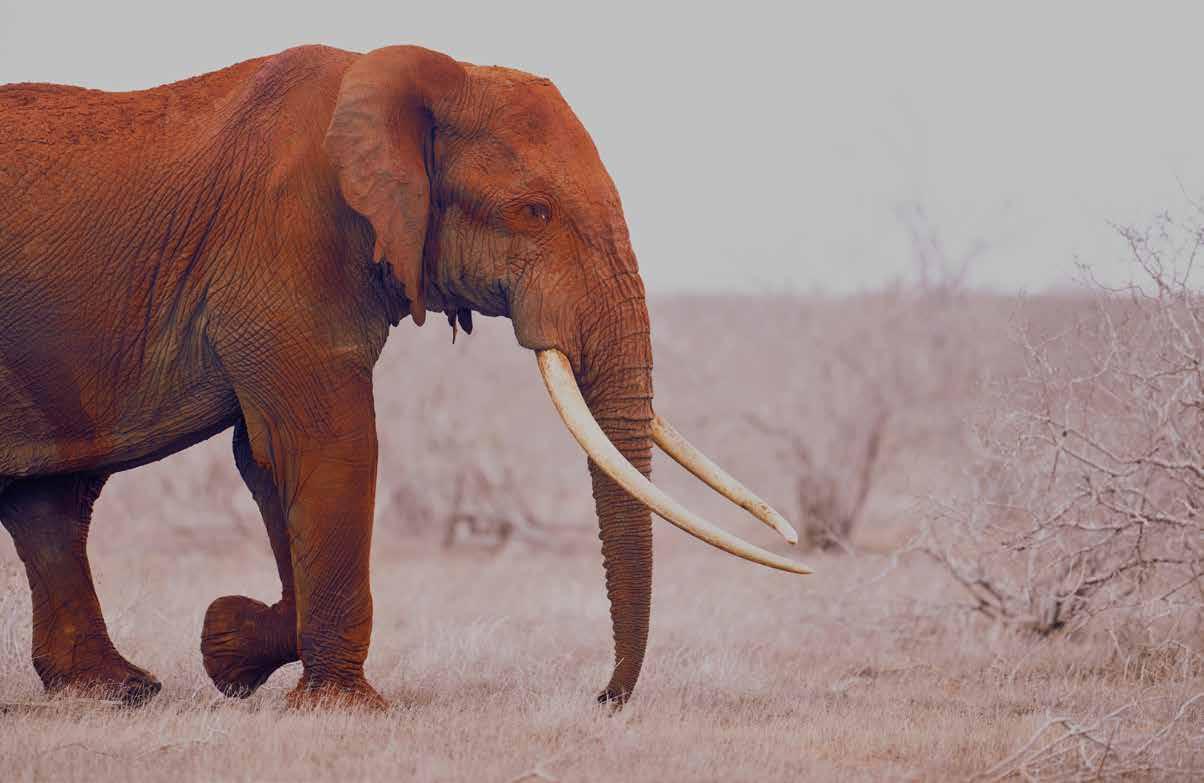
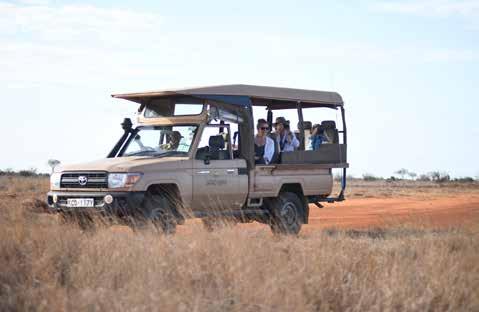



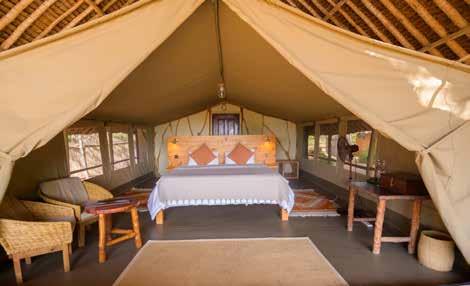
Rediscover safari’s romance at Satao Campcanvas comfor ts, star-f illed nights, and daily elephant parades at our waterhole.

I’ve just returned to Kenya after two months getting follow-up treatment in London for my thyroid cancer. I received radioactive iodine treatment which left me ‘hot’ for a few days and in an isolation ward in Sutton. But the good news is that the cancer seems to be in retreat. We will visit the oncologist again in late March for a few more scans to be sure. As I’ve said since the day I heard I had cancer, God is faithful. Keisiligayu Enkai (Maasai). Mungu ni mwaminifu (Swahili).
The second procedure in London was to insert a plastic voice valve in my altered trachea to allow me to have a voice again. We had a few ups and downs getting the right size valve fitted. That has been mostly successful, but I’m still working on getting consistent voice. I often get a few good hours in the morning before the outer base plate loosens up. The base plate, which is a plastic piece that I replace every day, covers the hole in my neck and by pressing an HME button I can now trap air and speak. Sometimes! Every time I eat or drink it blocks the voice valve and I have to wait for the food to make its way down. I’m sure my voice will improve as I keep working at it and trying different ways to seal the base plate. But for now my best way to communicate is by writing!
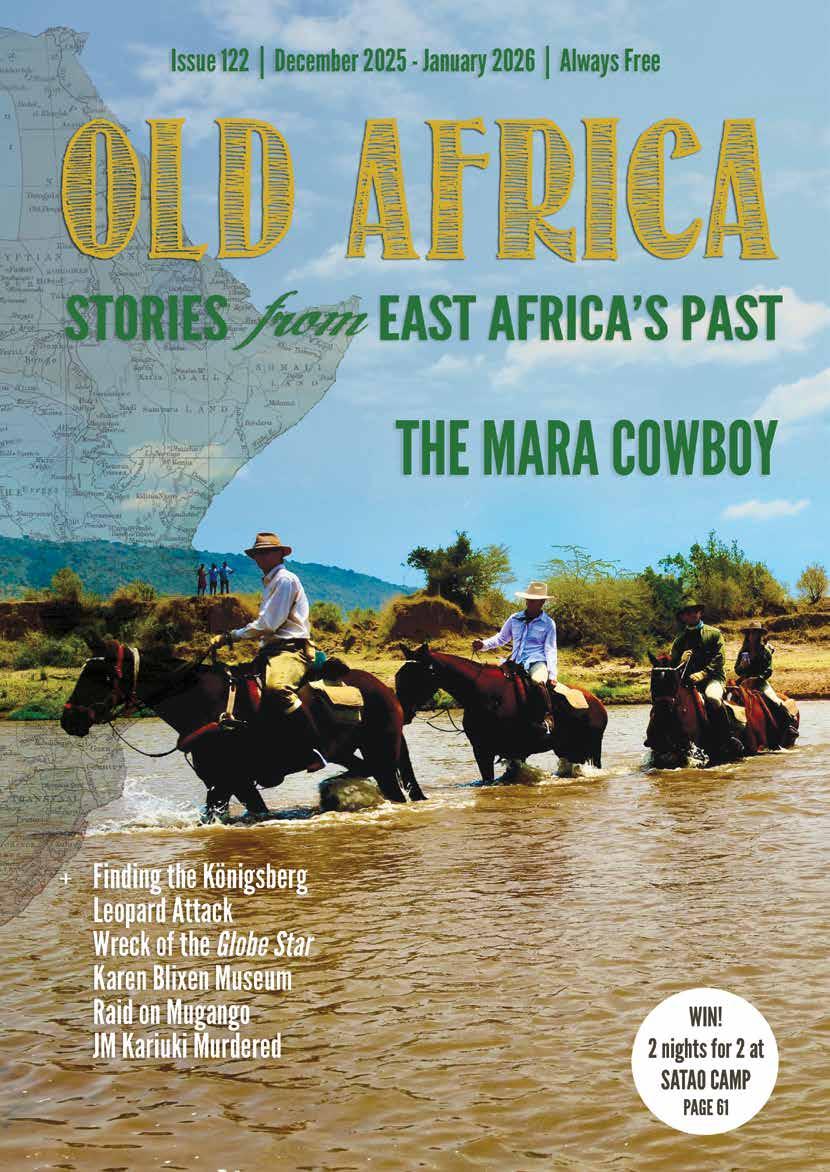
So here is issue 122, from my editing fingers through my computer to our layout artists, Mike and Blake, and on to you. We have been pleased with how many people have signed up for the digital edition. We have more readers signed up than we did for the printed version. So if you found this issue online on our website ( www. oldafricamagazine.com ) and haven’t signed up to be a regular reader with a reminder email, sign up now. Old Africa is free! And encourage a friend to sign up as well.
We do understand that many of you miss the feel of a paper copy in your hand. For those who really want a hard copy, we have introduced the collector’s edition. It is available for purchase directly from any Amazon website. They’ll print one copy just for you and send it to your address. Issue 121 is available now, either from our website (www.oldafricamagazine.com) or directly from Amazon. This issue 122 will be available as a collector’s edition soon. Keep on reading!
-Shel Arensen, Editor
P.O. Box 2338 Naivasha, Kenya 20117 www.oldafricamagazine.com
Editor: Shel Arensen 0736-896294 or 0717-636659
Design and Layout: Mike Adkins, Blake Arensen
Proofreader: Janet Adkins
Printers: English Press, Enterprise Road, Nairobi, Kenya
Old Africa magazine is published bimonthly. It publishes stories and photos from East Africa’s past.
Subscriptions: Subscriptions are available. In Kenya the cost is Ksh. 3000/- for a one-year subscription (six issues) mailed to your postal address. You can pay by cheque or postal money order made out in favour of: Kifaru Educational and Editorial. Send your subscription order and payment to: Old Africa, Box 2338 Naivasha 20117 Kenya. For outside of Kenya subscriptions see our advert in this magazine. Advertising: To advertise in Old Africa, contact the editor at editorial@oldafricamagazine.com for a rate sheet or visit the website: www.oldafricamagazine.com
Contributions: Old Africa magazine welcomes articles on East Africa’s past. See our writer’s guidelines on the web at: www.oldafricamagazine.com or write to: Old Africa magazine, Box 2338, Naivasha 20117 Email
Address: editorial@oldafricamagazine.com. After reading our guidelines and editing your work, send it to us for review either by post or email. (To ensure return of your manuscript, send it with a self-addressed envelope and stamps to cover return postage)
Copyright © 2025 by Kifaru Educational and Editorial All rights reserved. No part of this publication may be reproduced or distributed in any form or by any means, or stored in a database or retrieval system, without prior written permission of the publisher.



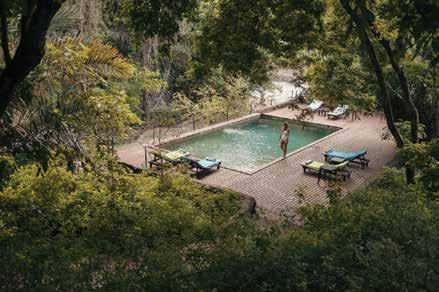

Experience an Authentic Safari this Holiday Season at Porini Camps, set
Rhino River Camp (Forest Tent)
Rhino River Camp (River Tent)
Rhino River Camp (Forest Tent)
Rhino River Camp (River Tent)
Porini Ol Kinyei Safari Cottages

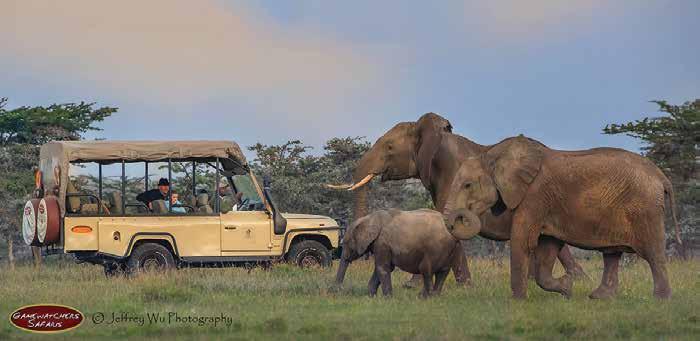
Full board accommodation I Free drinks such as mineral water, soft drinks, house wines, beer, and Gin and Tonic I
Guests will enjoy sundowners from scenic viewpoints and guided nature walks I The package also features shared day and night game drives in open 4×4 vehicles with an experienced driver-guide and spotter I At Porini Rhino Camp, guests will have the opportunity to visit the chimpanzee sanctuary in the Ol Pejeta Conservancy I Those at Porini Amboseli Camp can experience a Maasai village visit I For guests flying in, local airstrip transfers to the camps are included.
Please note, the above rates are excluding park and conservancy fees.




Dear Editor,
I have been so sorry to hear of your health problems in recent issues and pray for a complete recovery for you.
We are presently at Knox School of Theology at Mbale, and I am enjoying several duplicate copies of Old Africa that I brought with me and intend to leave in the guest lecturer apartment.
I particularly enjoyed a recent article about the opening of Embakasi airport on about 9 March 1958. I arrived as a raw 12-year-old at Embakasi on 12 March 1958, and only a year or so ago came to realise that the airport had only opened four days before I arrived.
I also enjoyed the article about Nairobi dam in the same issue. I was in the 96th Nairobi sea scouts, based at St Andrew’s Presbyterian church hall, between 1958 and 1960.
Now, a couple of issues later, the first online issue, there is a letter by George Vrontamitis from Njoro. He won’t have a clue who I am, but I was in 1a or 2a with him at Delamere High School in Upper Hill Road in Nairobi in 1959 or 1960. We’re hoping to make a farewell trip to Kenya sometime in the first half of 2026, after visits to Burundi and another month at Mbale. I definitely plan to knock on his door and make contact.
Thanks again. I’ve only ever had one other favourite magazine. I used to ride to Adams Arcade on Ngong
Road every month from Kilimani to pick up my copy of Boy’s Own paper. But nothing came close, not even that, to Old Africa magazine. I have every issue in presentation boxes I bought at Bookstop in the Yaya centre and I’m not parting with them.
Thanks again for all the joy you bring to those who still love Kenya decades later.
Dear Editor,
Ian McIver,
Australia
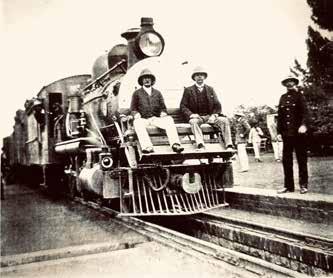
I appreciate the new digital issue - thank you. Your hunch was correct on the left-most rider on the front of the train. That is in fact the legendary White Hunter, Bill Judd. He was one of the progenitors of early safaris, along with Alan Black and others. He was killed by an elephant in 1927 at the age of 57. The man in the middle looks familiar to me, and I will try to recall his name and send it when I do.
Dear Editor,

October-November magazine on the way? I normally buy my number from Karen Provision Stores, but I haven’t seen it. I wish you a good day and thanks for a great magazine
B Hansen, Karen
Editor’s Note: Mr Hansen had missed the memo that Old Africa was going digital only. We wrote to him and told him how to read the magazine online and how to sign up for regular reminders and a link to the PDF version. Here is Mr Hansen’s response: “Thanks for the info. We are in modern times - I understand - but hurting a bit. I have all numbers minus no 4. I love to have a magazine in my hand. Looking forward to read the digital one. Wish you all the best.” Mr Hansen later received a PDF from us so he could print out his own copy.
Dear Editor,
Baxter Byrd
First, I hope the latest round of treatment in London has been successful and that you now have your voice back. Secondly, thank you for Issue No. 121 - as always a great read, albeit in a different format from usual. The new digital format downloaded without problems and is easy to read; I look forward to No. 122.
Lorraine Cruickshank, Scotland
Dear Editor, Hello Old Africa. Is the
Very many thanks for the baksheesh digital edition of Old Africa. I have enjoyed reading it and adding the odd article to your magazine over the years.
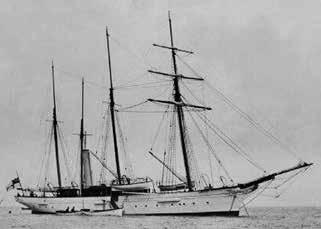
Having an interest in all things maritime in East Africa, I was intrigued by the mention of the yacht Fedora in the article Lions and Rail. I found this picture of Fedora It was an impressive steam yacht. It was scrapped in the 1930s.
However, there are a few corrections and additions to the picture captions in this new edition.
Page 19 - The railway in Kenya / British East Africa was not a railroad, that is an American term, never used here.
Fedora was the steam yacht belonging to William Charles Wynn, 4th Baron of Newborough, which he traveled in on his visit to Mombasa in 1899.
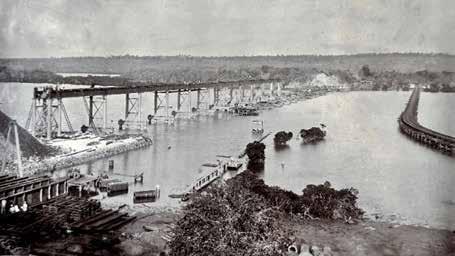
Kevin Patience has corrected the information about this photograph, which appeared on page 20 of Old Africa issue 121. “The trestle bridge on the right was not a pontoon bridge. It was built from timber poles from India driven into the seabed and used to run construction trains on to the mainland while Salisbury Bridge was built from iron piles screwed into the seabed.”
Page 20 top - The trestle bridge on the right was not a pontoon bridge. It was built from timber poles from India driven into the seabed and used to run construction trains on to the mainland while Salisbury Bridge was built from iron piles screwed into the seabed.
Page 20 bottom - The trolley line only ran from the Old Harbour to Kilindini, not round the island.
Page 28 - A British India steamer lies at anchor in the Old Harbour with a Royal Navy cruiser in the background.
Page 29 - These were push trolleys not trams.
Page 62 No 2 - One of 27 wooden trestle bridges built
on the line to Kisumu replaced by the American built steel ones in 1901.
Page 62 No 3 - This is the bridge over the River Nile.
Page 63 No 4 - Taken in 1950, this was the train carrying the Duke of Gloucester when Nairobi was given city status.
Page 63 No 7 – This photo shows Garratt locomotives outside the Nairobi engine sheds.
If you need help with photo captions, let me know. I may be able to assist.
Kevin Patience
Editor’s Note: We thanked Kevin Patience for his corrections and asked him to have a look at our photos in this issue to be sure we got it right. Kevin also sent in a story about the wreck of the
Globe Star, which appears in this magazine.
Dear Editor,
In your last edition, in digital form, Greta Drummond’s family trip from Nairobi to Alexandria on the Mediterranean Sea in 1946 sent in by her daughter Mborag Candy was a most remarkable story. Can one possibly imagine that a travel agent arranged this almost flawless trip all the way to Europe from Nairobi.
By the way, Churchill described the SS Coryndon when it was based at Butiaba on Lake Albert as the “best library afloat.” Hemingway wrote that she was “Magnificence on water.”
The SS Robert Coryndon’s route on the Albertine lakes was from Lake Edward to Lake George via the Kasinga channel and so on down the 140 kilometre Semliki River to Pakwatch in West Nile. But she was mainly based in Butiaba.
I am still trying to read the wonderful stories in your new digital magazine. However, give me the visits to the post office every two months to collect my copy of Old Africa and arriving back home and being able to read from a magazine that I can hold in my hands anytime.
Tor Allan, Usa River, Tanzania
Dear Editor,
The new digital version works for me! But I also wanted to say that I hope you are continuing to improve. And I send you all good wishes.
Patricia King, New York City
Dear Editor,
I did read the digital version



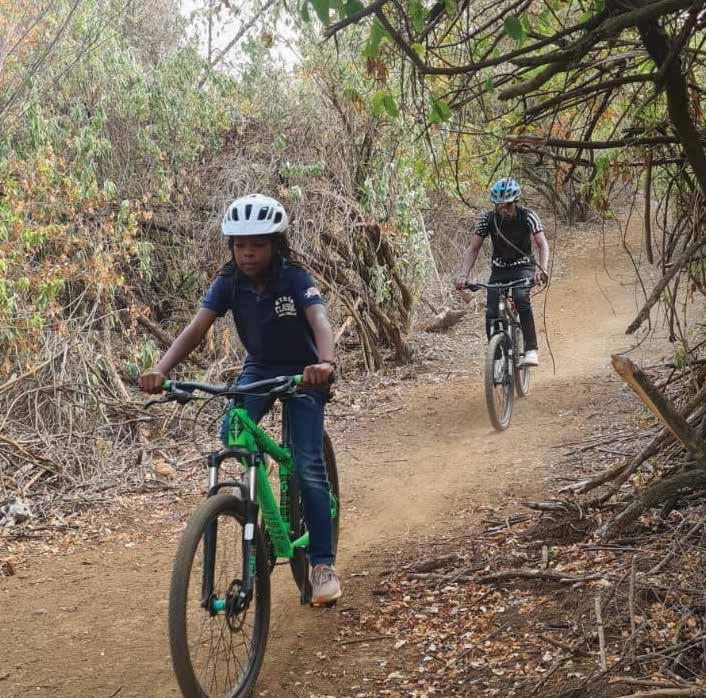
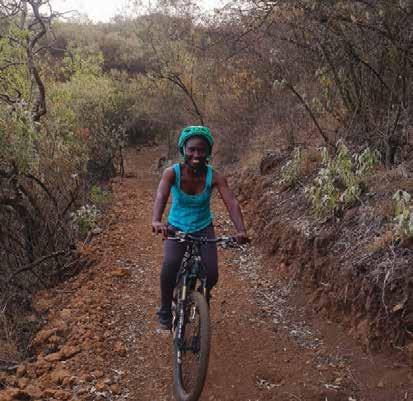
Elevate your riding experience on our exhilarating mountain bike trail, where breathtaking descents and challenging ascents intertwine with picturesque panorama. Immerse yourself in an enriching experience, fostering memories of collective excitement and camaraderie amidst the unspoiled splendor of nature.
of your October-November issue 121 on a wider screen.
In that issue I learnt of the publication of Thus Until: A History of Egerton University written by Emilia Ilieva and Reuben Matheka, both distinguished academics at the university. I earnestly congratulate them for the outstanding work, which has tackled the historical profile of the institution so exhaustively. It is certainly a trailblazing undertaking for institutions of higher learning. I am also proud to have had a hand in the actualisation of the book in a modest way, having done the index. Once again, congratulations to the authors and to Old Africa for such an informative review.
Jeremy Ng’ang’a, Nairobi
Dear Editor,
Hopefully your recovery is going well. I managed to view the digital Old Africa magazine issue 121 and found out that the PDF works better than the digital magazine on your website. However, I must say that I would prefer to receive a hard copy issue as I also collect them, and also use them as reference for many projects that I’m involved in. I think I’m right in saying I’m from the old school.
George Vrontamitis, Njoro
Dear Editor,
I hope your recovery continues well. Is there any chance of returning Old Africa to its original paper magazine format? I do miss it. Perhaps fewer editions and an increase in its sale price might make your publication more worthwhile financially.
Dear Editor,
Hope all is going to plan with your medical treatment. Much as I like the new digital version, I am still an old traditionalist and miss the old magazine format, but nothing stays the same forever and if one does not adapt, you are left behind.
I did struggle more with finding the answers to your history quiz, flicking backwards and forward on my desktop but eventually perseverance won. Here are my answers to the history quiz.
Andrew Mules, Naivasha
Dear Editor,
Thank you so much for Issue 121. Best wishes.
Mhorag Candy
Dear Editor,
From the many letters I’ve read in the latest issue of Old Africa, I know just how much it is your readers appreciate what you have done through the pages of your very popular magazine even now in your present state of health.
To see you produce yet another amazing editorial - all this despite your ongoing health issues - speaks volumes of your courage and sheer determination to carry
on regardless. Your attitude is infectious and a source of great encouragement to those of us whose medical conditions pale into insignificance when compared with yours and above all, with the sheer courage and determination you exude.
I have still not got over the fact that, despite receiving treatment at our nearby Royal Marsden hospital here in Sutton, you and your dear wife Kym, still found time to visit me at my manyatta and really make my day. The memory of that visit will stay with me forever and what also struck me was your unfailing faith which no doubt sustains you.
That you are still able to keep the magazine going despite your present condition, is something remarkable and an example to us all, and I pray that you may continue to make good progress and wish you every blessing. May your courage and determination continue to inspire us all.
Mervyn
Maciel Manyatta, Sutton, Surrey
Tony Church, Naivasha
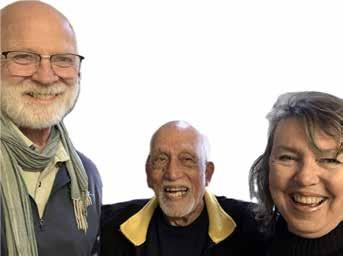
Old Africa editor Shel Arensen and his wife Kym visit loyal Old Africa reader Mervyn Maciel in his Manyatta in Sutton.
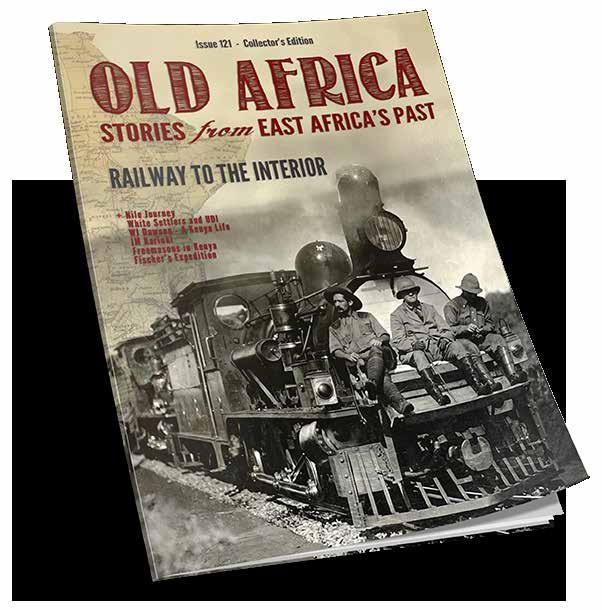
We are now releasing Collector’s Editions of each new issue of Old Africa that you can purchase directly from Amazon. Just click on the cover of the magazine to take you to Amazon to purchase your copy of issue #121. This issue (#122) will be available shortly, just check on our website in mid-December.

from the
by Tor Allan
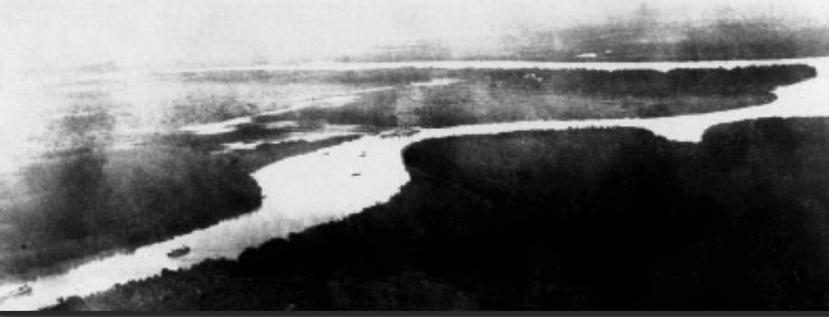
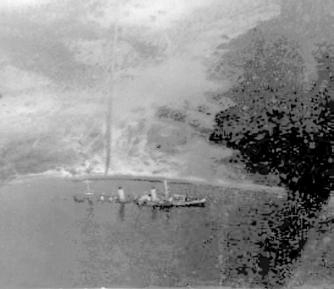
In his book Battle for the Bundu about World War I in East Africa from 1914 to1918, Charles Miller tells the true account of the sinking of the prized German battleship the Königsberg on 6 June 1915 by the Royal Navy. Miller aptly calls the battle the Duel in the Sewer, as the Königsberg had hidden itself in the murky Rufiji Delta of southern Tanzania or German East Africa, as it was known at the time. Miller’s book has a map showing the geography of the Rufiji Delta.
This remarkable piece of World War I history has fascinated me for decades – remarkable because of the remoteness of its location, and the physical and logistical problems of access, deep in the mangrove swamps of the Rufiji River Delta.
If you want to read about the battle, you can read Miller’s book or check out these websites.
https://en.wikipedia.org/wiki/Battle_of_ Rufiji_Delta , or https://stevebrakerbooks.com/ the-battle-of-the-rufiji-delta/
My story is about finding the Königsberg’s final resting place. To help me in my quest, I needed to understand the Rufiji River and its sources.
The Kipengere mountain range in southern Tanzania is where the Great Ruaha River begins its journey to the north. First it flows through the Usangu Flats where much rice is grown. The lifeline of adjacent Ruaha National Park, it then flows northeast to the Mtera Reservoir and hydroelectric project, about halfway between Iringa and Dodoma, then east and southeast between the southern Rubeho Mountains and the northern Udzungwa Mountains and then through another power plant and dam at Kidatu. The Great Ruaha then continues to its confluence with the Rufiji coming from the south.
Further south, the Kilombero River rises in the Kilombero Valley. This is a massive watershed where the Kilombero River forms and goes southeast and over the Shugulu Falls,
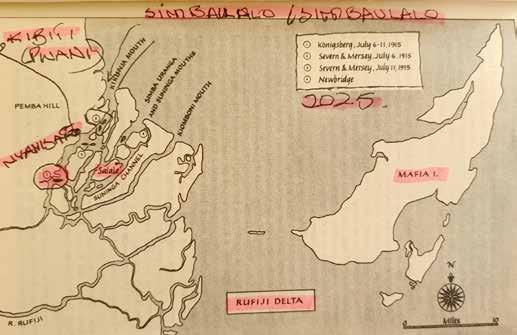
soon after it joins the Luwegu River coming from the south. Here the Kilombero flows northeast like the Rufiji where it then meets the Great Ruaha River coming in from the west and then into the Stiegler’s Gorge (now the Julius Nyerere) Hydro Power project and thence on through the Selous Game Reserve and the Rufiji Delta before discharging into the Indian Ocean opposite Mafia Island.
Having studied the river system and the history, I left my home in Usa River by road on 24 August 2025 with an outline itinerary of my journey south: Usa River, Dodoma and Iringa. Udzungwa Mountains and Kilombero River to Mikumi. I had a couple of accommodation bookings, but knew I’d mainly be staying in small roadside hotelis with street food, cold beers and rooms with running water and rubber malapas to wear in the shower –and hopefully without sticky tape repairs to mosquito net holes. I did take a mozzy dome to erect on my bed in the event that any of the hotelis were too grim for me, but I didn’t need it. One booking was at Stanley’s Kopje in Mikumi National Park where I had the most awesome views from my tent eastward to the Uluguru Mountains and the Rubeho Mountains to the west. Animals were spread out below on the plain, drinking and feeding, including a few Lichtenstein’s hartebeest.
As I gazed into the middle distance across the Mkata Flood Plain, I conjured up visions of the explorer Henry Stanley crossing it in 1872 on his return from ‘finding’ Livingstone. He passed a little to the north of the present park boundary, since the Mkata River was in full flood.
Burton and Speke would also have travelled this much-used slave route from Bagamoyo, in
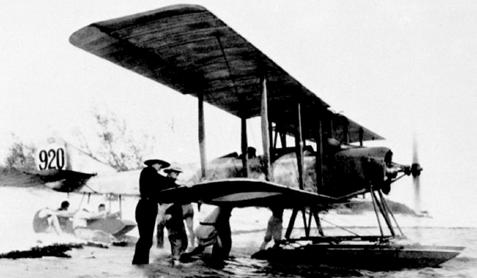
A Sopwith 920 getting ready to fly over the Rufiji River in search of the elusive German battleship in 1915.
(Photo from Old Africa issue 17)
search of the source of the White Nile. Speke travelled along this same route to Lake Victoria with the explorer Grant. The slave route winds on to Dodoma, Manyoni to Singida, Tabora to Ujiji on Lake Tanganyika and to Stanley Falls on the Congo River. Stanley brought a very reluctant Emin Pasha this way to Bagamoyo from his preferred home in Southern Equatoria, to repatriate him to Europe. However, Emin returned as soon as he could to Central Africa where he was murdered by an Arab slave trader who dumped his body into the Congo river at Kindu. When Livingstone died in Zambia, his two faithful servants Susi and Chuma had his body embalmed and wrapped in bark and sailcloth and carried to Zanzibar across the Mkata Plain. I imagined all these journeys as I looked down on the Mkata Plain from my tent.
I drove on to Morogoro and to Kisaki – part of this road was the old German road - and then through Selous Game Reserve, (now renamed Nyerere National Park) to Rufiji River Lodge where I’d hoped that I’d find some information about the Königsberg , but I drew a blank. I desperately needed to know how best to approach the Delta and from where – and then I had a marvellous stroke of luck. I found out my driver’s daughter, Grace, lived at Kibiti, right there on the Delta. I asked if she could make enquiries and next day we set off from Rufiji River Camp to Kibiti. This 130-kilometre track took four hours to
negotiate with potholes the size of empty swimming pools. We’d never have made it during the rains.
I arrived in Kibiti full of hope - for news, fuel and lunch. I found them all. Grace had done some great networking. After lunch she would show us the way to Nyamisati on the Delta to meet a man with a boat, who knew where the Königsberg lay submerged in mud.
We arrived in Nyamisati in the afternoon and met with the boat owner. A fee was agreed - not cheap by the way. It was a ‘Fibre’ as he called it, a modern fibreglass boat with an engine, rather than a traditional dugout
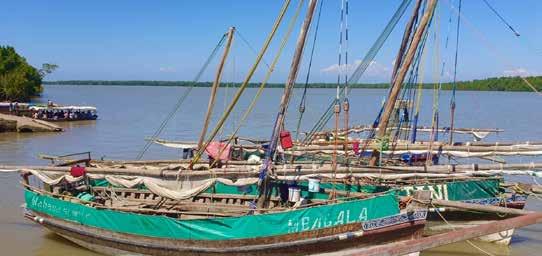
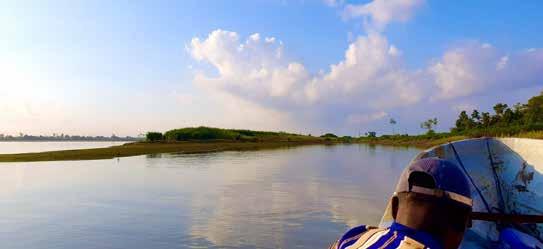
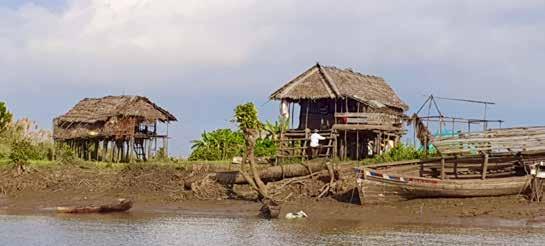
mtumbwi . I found a small hoteli for the night. Next morning we left at 7 am with the sun behind us. The very low spring tide would not allow any later departure. I had timed the tides as much as possible with the full moon on 7 September, which was still a few days away.
We set off into the Delta along the fairly easily navigable Kikunja Channel, the Indian Ocean only ten kilometres away; the channel was around 200-300 metres wide. After almost two hours, passing a couple of tiny villages and a few fishing boats, we entered the Simbaulalo channel and the captain
spoke. “Mzee,” he said to me, “Mzee, see that sandy spit rising from the channel – that is the Königsberg . It lies in silt and under mangrove.”
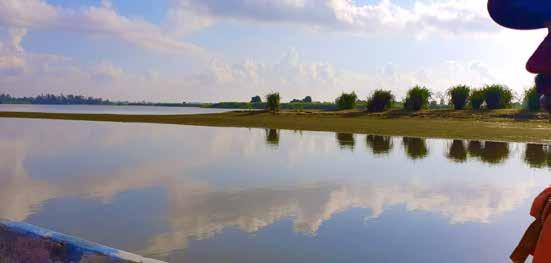
The island he pointed out was shipshaped but larger. It was simply a mound of mud and mangrove covering the hulk of the Königsberg . This was what I’d come so far to find. I took a moment to try and imagine what a hellish experience the whole attack must have been for the crew of the Königsberg . I also marvelled that I’d actually accomplished my long-dreamed of mission of locating the Königsberg ’s final resting place in the Rufiji River

Further on we came to the Somali - the Königsberg’s collier (coal supply ship) - also covered in silt and mangrove. We passed an occasional village, with houses built on stilts to keep them above flood tides.
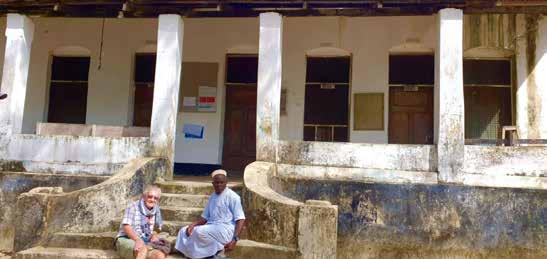
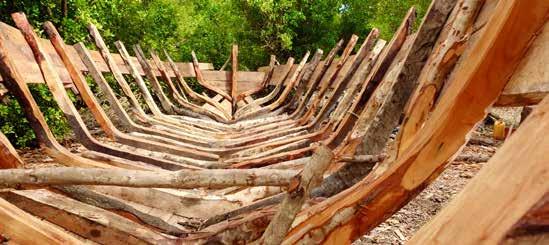
Our captain advised that we pay a courtesy call to the local mwenye kiti (village headman) on Salale island, where there is an old colonial house built by a German called Dunkan in 1898. At one time it had served as a government dispensary, but now it does not provide even an aspirin and its doors are closed and locked. Traditional boat building
still takes place on Salale, with mangrove ribs and keels and mango plank sides. We motored on into the Suninga channel.
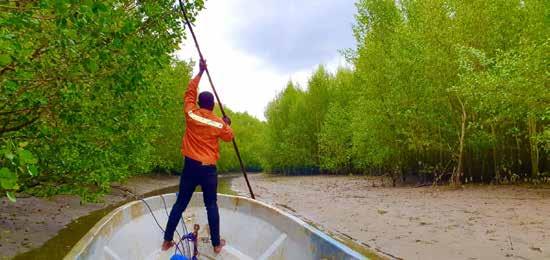
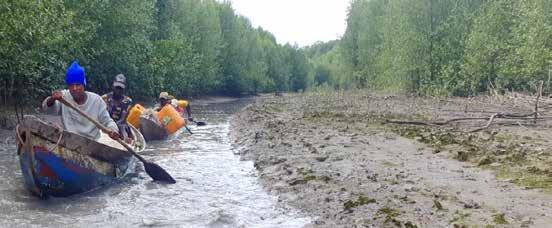
Suddenly after eight very hot hours in the Delta, we had a huge downpour of rain. Then the sun came out and all was well. Now we pushed on, literally, for a while, into the Simba Uranga channel, trying to find the best way back to Nyamisati. We were mired for an hour in a small channel in mangrove forest, awaiting the incoming tide. We moved a bit, the boatmen strenuously poling their way forward a foot at a time when they could. We
were so close to the Indian Ocean then that we could actually see it. We finally made it back to the small landing at Nyamisati at 2 pm.
I returned to Kibiti for the night and the following day drove south to spend three days at Kilwa Masoko with a full day visit to Songo Mnara Island to visit the superb 15th century Kilwa ruins World Heritage Site. Don’t miss it if you’re ever this far south of Dar es Salaam.
We drove on, still going south, through Lindi to Masasi where I spent the night and then to Tunduru and on to Songea. Here I visited the 1905 Maji Maji Rebellion Memorial Museum. This was very interesting and well worth a visit if you have read the history of this horrible incident. A rebellion against hut tax and colonial repression had been fulminating for some time in the southern part of Tanzania and almost threatened to drive every white oppressor into the sea. There is a good account online at: https://en.wikipedia. org/wiki/Maji_Maji_Rebellion
As I was about to leave, the guide said quietly, “There is something else you should see.” Behind the museum great mango
trees cast shade on the mass grave of 66 local villagers who had resisted the German presence in Songea. The 66 were arrested and forced to dig a deep trench. They were then hung and thrown into the mass grave. A monument with a memorial plaque bearing the victims’ names marks the spot.
Enough of this awfulness and sad history. I drove on southwards and passed many small tributaries of the upper reaches of the mighty Ruvuma River and then into the Great Rift Valley at Mbamba Bay on Lake Nyasa (Malawi) for the night - the night of the lunar eclipse. A quiet candlelit dinner on the beach marked an extraordinary few days. From there, I pushed on to Njombe, then Makambako to Iringa, Dodoma and finally back to Usa River – a round trip of three weeks and 4500 kilometres.
My mission was accomplished and my curiosity settled once and for all. I’d seen the remains of the Königsberg , one of the main players in Charles Miller’s ‘Duel in the Sewer.’
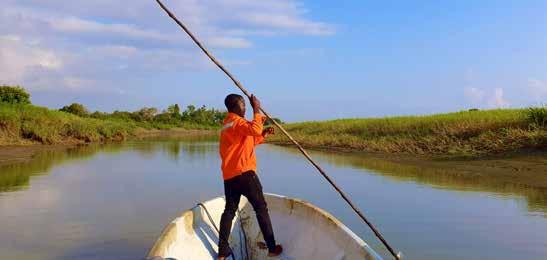
Poling alongside the edge of what I called Königsberg Island.
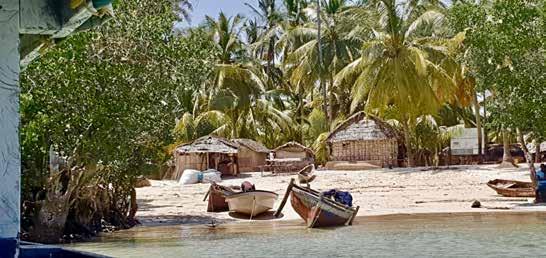





by Conrad Thorpe OBE
1961– Gatundu, Kenya Colony
“We lived in a police house as my husband, Tom Thorpe, was the Inspector in charge at the Gatundu (Kikuyu reserve) police station,” remembers Susie Thorpe, nèe Yarinakis. “I very much liked that I could walk down the road with the little shenzi (mongrel or stray) dog, with our two children who had been born already, Kim and Kieran, in the pushchair.”
She went on, “The local Kikuyu were very friendly and their little children chased us and ran around us, as I pushed the pram down the road. The police quarters were newly built in grey-Kikuyu stone. We lived in one of the quarters; it wasn’t big but it was comfortable. There was a little fireplace in the sitting room. In the kitchen we had a paraffin-powered fridge, which we had to turn upside down from time to time, to get it to work. We knew we had to do this as the older folk told us so. We had a kuni-fired (firewood) stove situated on a concrete floor. On the walls were paintings of the Kinangop and Mt Kenya. We kept chickens, so that we got fresh eggs and meat. This included a cockerel. Muriuki Kamwenji, our ex-Mau Mau fighter and now a cook, came later from his home in Karatina, in 1963, after he was released from prison. It wasn’t a big home, but it was a happy home.”
In 1961 in the nearby villages not far from Gatundu town, the waGikuyu people complained that a rogue leopard was regularly taking their livestock. One Sunday a report came in that a leopard was hiding in a thicket, which was surrounded by the local waGikuyu. Tom was always on duty as the station commander and the Station Sergeant came to the door with a verbal report regarding the leopard. Tom Thorpe reacted immediately. He assessed that this was very likely the ‘problem cat’ and now he might be able to eliminate it. Susie told Tom, “You’d better get on with it,” as he tied up his boots and put on his thick camouflage smock and left in the company of his Sergeant.
Susie continues her story. “My husband Tom left with the police Land Rover and the police driver called PC Ngumbia.” (PC is an acronym for Police Constable. Ngumbia was an Mkamba from Makueni, some 100 miles south of Nairobi). Tom made sure there was one other police constable with him - PC Ndung’u. Susie recalls, “Constable Ndung’u was a Kikuyu man and a reliable individual.” They went via the Police armoury to collect their firearms, but being a Sunday the armoury was locked and secured. Unfortunately, the custodian of the key was not immediately available. So, Tom couldn’t draw his weapon of choice, a Greener-gun made by the UK rifle manufacturer - W.W. Greener. They only had the Lee-Enfield, bolt-action .303 calibre rifles that the duty constables were armed with. The Short-Magazine Lee-Enfield (SMLE) .303 calibre rifle entered service in 1895 before the Boer War and remained in service until
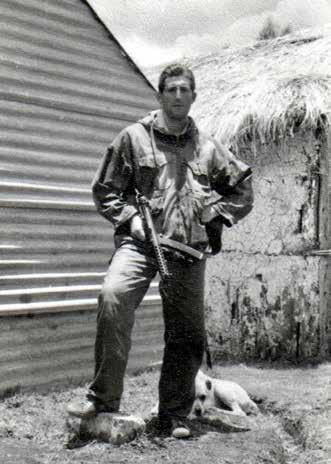
1957 in the British forces and is still in use in East Africa today. With no alternative firearms available, they elected to use them.
The trio drove to the site in the station’s Series 1 Land Rover. On arrival they found dozens of waGikuyu villagers in a great state of agitation, surrounding a large thicket and making a huge noise. They quickly explained to the police officers that the leopard, which was killing their livestock, had hidden itself in the bush and they needed the help of the police to eliminate it. Tom was already fluent in Kiswahili, having arrived in Kenya in 1953, and easily communicated with the local people. They were shouting, “Ngare, ngare!” meaning “Leopard, leopard,” in Gikuyu.
Inspector Tom Thorpe and his assistant, Constable Ndung’u and driver Ngumbi, alighted the vehicle carrying their BoerWar vintage Lee Enfield calibre .303 rifles. Tom ordered that they “made ready’’ and they cocked their weapons and chambered a round. Then, proceeding through the noisy and agitated crowd bearing pangas and spears, they drew close to the thicket.
The baying and noise of the local waGikuyu villagers and the scores of rocks and stones hurled into the bush, caused the leopard to flee from its hiding place. It flashed across from one thicket to the next, just 200 yards away. The villagers again surrounded the thicket and threw rocks into the bush. Susie picks up the narrative: “My husband approached the thicket with Constable Ndung’u by his side.” The crowd’s baying and stone-throwing intensified and the leopard charged out, biting the ankle of a villager as it raced past him, tearing away at high speed. It partially removed the scalp of another man and then turned and directed its fury at Tom Thorpe. In that instant of yellowblurring, dappled-speed he fired his rifle and missed. The cat attacked him, biting his neck. Its claws went into his forehead, missing his eyes by an inch. The cat’s rear legs were pumping and gouging at his abdomen. Had Tom not been wearing his heavy parachute smock or military camouflage jacket, he would have suffered serious damage to his lower abdomen. The jacket provided brief, but significant protection and probably saved his life.
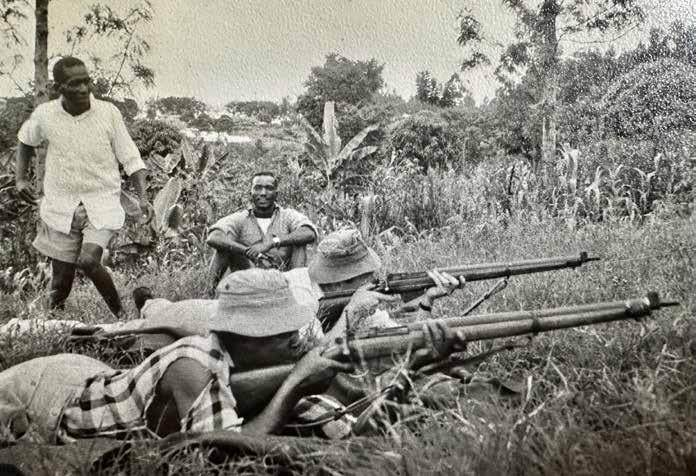
The leopard and Tom Thorpe now rolled on the ground in an embrace of spots and camouflage-uniform. With the leopard atop of Tom, his police constable aimed his rifle and shot the leopard in the body. It was a decisive and dangerous moment, but fortune was on Tom’s side as Constable Ndung’u’s bullet wounded the cat, which rolled off him even as a dozen sharp-bladed pangas, wielded by the agricultural waGikuyu villagers, rained down on the leopard.
Tom, covered in blood, was agitated that either the leopard or the high velocity bullet, could have killed him. But by a small miracle, he was alive. By now the legion of waGikuyu people had surged onto the spotted cat and hacked it into pieces.
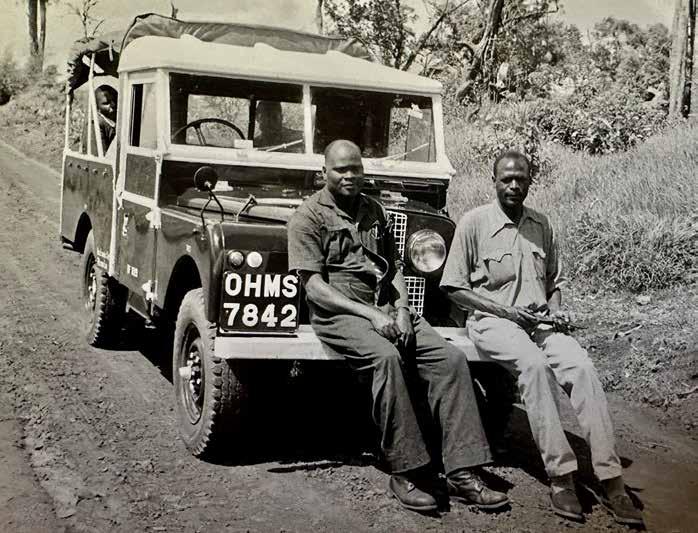
All the injured men, bleeding profusely, were rushed off to Kiambu hospital in the Station Land Rover registration OHMS 7842. The hospital is about 30 miles south, on muddy
and slippery, red-soil tracks, through the lower Kinangop’s forested roads. On arrival at Kiambu town, Tom was given two aspirin and, due to the severity of his injuries, dispatched to the city hospital in Nairobi. They injected him with penicillin, stitched up his wounds and hospitalised him for three days. Then Tom headed home to his wife Susie and very small children Kim and Kieran.
As my mother Susie concluded her story, she said to me, “I was working then at the Kiambu hospital. Dr Beecher may have treated him. There was also Dr Varma, but he did not live close to the site, so it was most likely Beecher.”
She added, “I had two very young children and they were my priority. Tom Thorpe had to help himself.”
Afternote. Constable Ndung’u undoubtedly saved my father’s life with his single shot into the leopard at point blank range. It is also true
that he could have killed his senior officer at that moment, but thankfully he didn’t. His immediate action saved my father from more serious injuries or even death. My father’s respect for leopards rubbed off on us all, as we grew up in the farms and bush north and east of Nairobi. Had Ndung’u not shot the leopard, it is doubtful that I would be penning this story. I was born in the Princess Elizabeth Hospital, Nairobi, 18 months after my father survived his encounter with an enraged leopard. The scar from the leopard’s wound to his neck was visible all his life. As a boy I could see it as my Dad drove our Land Rover and we sat in the back of the car. I drafted this story whilst consulting my mother Mrs Susie Thorpe (nèe Yarinakis) in Nairobi on 1 September 2024, and revised it on 15 September 2025 when fresh images and notes were found. Any factual inaccuracies are unintended, as I have attempted to record this story around the recollections of my mother. She has reached back in her memory to events that took place in the Kikuyu highlands, some 64 years ago.
Our Tom and Tomcat
Last week while hunting in the jungle
He got into an awful bundle
While he was tracking down a leopard
The leopard jumped and had him peppered
The leopard pawed and scratched his face
Which kind of put him out of place
In hospital now Thomas lies
I hope he drives away the flies
When better he will surely get hell
And go and get his little pet
This time surely, he must succeed
But still, he’s pale and like a weed
Janet Biltcliffe, Susie Thorpe’s youngest sister, wrote this poem as a 13-year-old after the leopard incident.

by Jim Dawson
W J Dawson, my grandfather, was a younger son of a Scottish farming family in Memsie, Aberdeenshire. In 1907 he had been dispatched to Australia to join his brother on a sheep station. When his ship called at Mombasa, which would no doubt have presented a wonderful contrast to the windswept hills of Fraserburgh, he decided to stay and the ship sailed on to Australia without him. A thumbnail family history has him acquiring land near the coast at first, and later serving in a government post, and then in the Great War before acquiring land up-country, where he was taken under Lord Delamere’s broad wing. He was a pioneer in agriculture, with a claim to having introduced pyrethrum to Kenya, and had a history of experimentation with flax, sisal, geraniums, maize and wheat, as chronicled by Elspeth Huxley among others. At various stages he owned farms in Njoro, Solai and elsewhere. He fought in the East African campaign of
World War I, served as Chieftain of the local branch of the Caledonian Society, and on the Legislative Council. W J married and settled at Njoro on a farm he called Memzie. He owned the Nakuru Hotel in the 1930s which, with the Great Depression, more or less bankrupted him, and not for the first time. He also owned land at Embakasi, much of which became Nairobi airport. With his son, Fergus, he leased farms in places which remain well known, Kipipiri, being one, the (in)famous Clouds another, and he continued experimenting with crops and livestock, all his life. They were early planters of sugar at Muhoroni. W J died in 1963, bringing to a close a distinguished and productive life which encompassed the entire colonial period of Kenya’s history.
In Part 1 of this series of articles, we left the young W J as a novice landowner on the coast. There is nothing in his papers to indicate why this didn’t work out, but from Playne and Gale’s East Africa , we know that “…the seasons of 1906 and1907 were not very favourable, and
this circumstance, combined with a low range of the world’s market in cotton, has militated against a very rapid increase in the area under cotton cultivation on the British East African coast.” His obituary in the Kenya Weekly News suggests he may have tried rubber, and according to a short biographical note in his papers, he may also have tried to plant wheat, evidently without success. And so, probably, the young man was drawn inland, to the new capital, Nairobi, most likely by a work opportunity at the newly established Government Farm at Kabete. We know from his papers he was there by 1908.
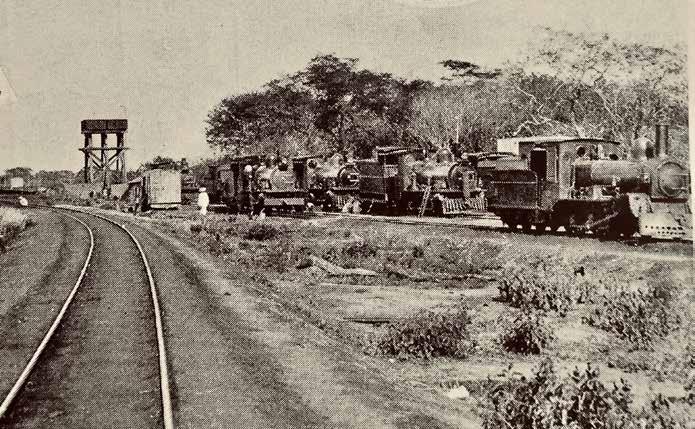
To get there he would have travelled inland on the storied Uganda Railway about six years after its completion. I think the achievement of this railway deserves to occupy most of this article on account of its importance to Kenya’s, and by extension, W J Dawson’s future.
Prior to writing this, I knew the outline of the history of this railway, as anyone born in East Africa would, but not the detail. I had travelled on it a few times too, without consciously recognising its critical role in East African history. It has been absorbing reading, from the original geopolitical conception as a line from the coast to the slopes of Kilimanjaro at the beginning of the scramble for Africa under the auspices of Sir William McKinnon’s short-lived IBEAC, through the nitty-gritty of Paterson’s and Preston’s accounts of the actual construction, to the detailed accounts in Hill’s Permanent Way and Charles Miller’s inspirationally-titled Lunatic Express Conceived in a welter of conflicting interests, and executed under unimaginable difficulties, it could nevertheless be claimed for it: “It is
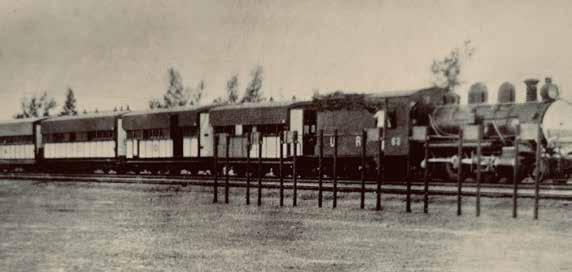
A ‘B’ class locomotive No.62 at Kapiti Plains station in about 1902. (Photo from A Cuckoo in Kenya by W Robert Foran)
not an uncommon thing for a line to open up a country but this line has literally created a country” (Sir Charles Eliot - The East African Protectorate ).
Steam, of course, had revolutionised transport in Europe and India in the previous decades and was instrumental in the westwards advance of the United States, but it was usually a follower rather than a precursor of development. But the Uganda Railway was itself the pioneer, the iron flanks of its engines indifferent to the dreaded tsetse fly as it steamed into the interior. Like much of the eastern coastlands of Africa, the immediate interior of East Africa was hostile to both man and domesticated beast on account of various insect-vectored diseases: African horse sickness, malaria, nagana and sleeping sickness were all present. From the Great Lakes to the Tugela River historic patterns of settlement and subsistence had literally been shaped by tiny flying parasites. Swathes of Africa were inhabited only seasonally or not at all. Wagon trails and transport riders, like those depicted in Jock of the Bushveld , had never existed near the equatorial coastlands. The ox-wagon, which opened central South Africa to Afrikaner settlement in the Great Trek 70 years earlier, was of little use in these areas. By the early 20th century underpopulation had been exacerbated by famine, rinderpest, slave-raiding and internecine strife, and so, until it reached well inland, the progress of the railway faced little in the way of resistance. Apart from terrain and climate, the fiercest obstacles were the lions of Tsavo. Nevertheless, it was in every respect as crazy an undertaking as described by Miller. Even Eliot,
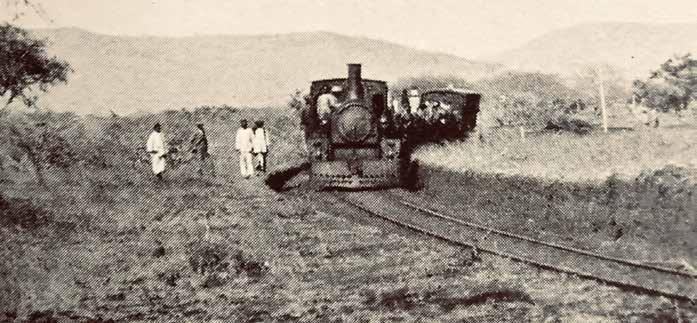
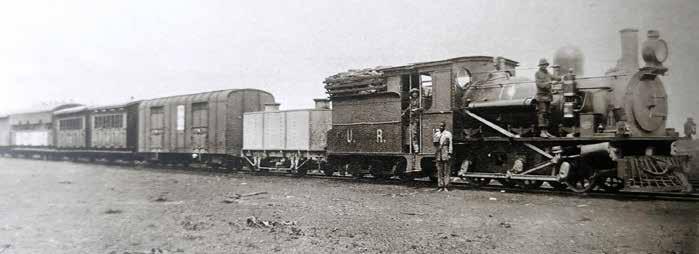
although Commissioner of the newly-formed East African Protectorate, had to confess: “I do not know why the Uganda Railroad was built…It is a little hard to believe that the only motive was purely philanthropic-namely, the suppression of the slave trade-nor are the strategic advantages of the line very obvious.” But built it was, and the achievement of driving a line through to Uganda in the years from 1896 to 1901 was immense, not only in its ambition but in its effect, the most obvious of which was the founding and speedy growth of the capital-to-be, Nairobi. But its effect in the final suppression of the east Africa slave trade cannot be underestimated; as Foran puts it: “Slave raiding in the territory now tapped by this steel road ceased as if by the wave of a magician’s wand.”
But it should not be supposed that East
African rail travel was as luxurious or even as comfortable an experience as rail travel in Europe. A contemporary advertisement on the back cover of the East African Quarterly offered First and Second Class fares to Nairobi for 61 and 30 rupees respectively, with Third class costing a mere 10 rupees. The trip to Nairobi would usually take a full 24-hours, with refreshment stops at Dak bungalows at the bigger stations, and frequent stops at smaller halting sites. Early travellers report the good (climbing onto the carriage roofs for the view) with the bad (choking red dust, in the dry seasons, especially on the sections between Voi and Makindu). One hesitates to imagine what conditions in 3rd class would have been like. Adherence to a strict timetable was not always to be expected; Foran reports that the first driver employed on the Uganda line,
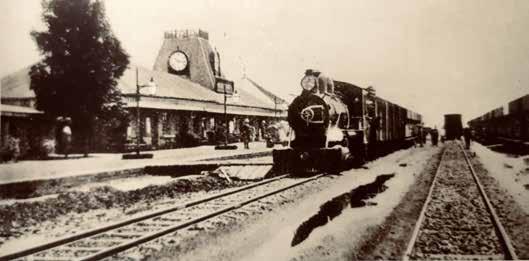
one Sam Pike, in return for a little something from a traveller’s supply of drinks, would quite happily stop the train for a hunter to bag a trophy. Advertised timetables were not always complied with, or even to be expected (as an aside, 70 years later, the same could still be said. I recall my brother and I being dropped at Nakuru station by my uncle, Bill Harte, for the 11-o’clock Nairobi train, having booked a few days earlier. Shortly after the train had drawn to a halt, we began looking for our carriage. Seeing us, the conductor approached, asking to see our tickets. “No,” he said, “these were no good.” Confused, we asked him why not. “Sir,” he explained, “these tickets are for today’s train.” Gesturing towards the carriages, he continued, “This is yesterday’s train. Today’s train will be here about the same time tomorrow.”)
It was by this somewhat eccentric service, then, that the young W J would have found his way to Nairobi.
At this point in time Nairobi was little different from any other new colonial settlement in Africa, and a number of writers expressed surprise at the choice of location for a campsite and railway halt which was to become capital of a nation, venturing the opinion that there were places within easy reach with better climate, vegetation and soil. But the convenience of the railway hub, which had been set up on the site of an old halt on the slave caravan route during the construction period, overruled every other consideration, and a new town started from scratch. Unlike the history-laden towns of the Eastern coast such as Mombasa and Dar es Salaam, there was little or nothing to start with. So, like Johannesburg, Salisbury (Harare),
Durban and the other great cities of Eastern and Southern Africa, it started as an untidy sprawl of shanties, shacks, tents and mabati. Foran, arriving as a hunter before becoming a police officer, chose to stay in a tent with his wife rather than risk what he describes as the sole hotel, the Masonic. In this he was wrong - Meinertzhagen, describing an arrival two years earlier, mentions a Woods Hotel, but it was probably little better. But only two years later, when W J arrived, the respectable and now venerable Norfolk Hotel had opened for business, which helps illustrate the pace of change in the nascent capital. It was near Nairobi that W J found employment at the government farm.
In my next article, I’ll cover life at Kabete and in pre-war Nairobi with the help of Foran, other chroniclers of the time and W J’s own papers.

My sons and their new friend from America went to a duka to buy drinks. “Fanta moja,” each of my sons ordered, offering up the required coins and receiving from the shopkeeper a bottle of orange Fanta. Their friend listened and watched the process. He decided he wanted two bottles of Fanta. So when it came time for his order he stepped up and said, “Two Fanta mojas, please!”
Africa
Major Robert Foran joined the fledgling British East African Police in Nairobi in 1904 soon after his arrival in East Africa. In those days Nairobi was a town of tents and mabati shacks. Church services were held in one of the local bars. In the newly founded cemetery six of the stones bore the simple inscription: “Killed by a lion.” The muddy streets were impassable after a rain. One person decided to beautify the new settlement by planting banana trees on the main street. They flourished until a passing ox cart knocked them over. Crime was so rampant that women stood guard with their rifles to make sure no one stole their washing off the line. A mere two hours after
signing on as a police officer with a Sikh inspector named Besant Singh as his Number Two, Foran received word that two drunken South Africans were shooting up one of the bars. An askari had asked them to stop and the men had fired at him. Foran felt he should deal with the drunkards alone.
Unwisely, he walked into the bar without drawing his gun first. He found the bar a wreck and he stared down the barrels of two revolvers.
“Now see here,” said one of the men, a big unshaven brute, who handled his .45 with the ease of long practice. “You hop it if you’re smart. We had to leave the South for one killing, and we don’t mind leaving here for another. And don’t try any tricks with us. We’ve been around. We learned to shoot in Texas. Look there.” And he fired casually without seeming to take aim, shooting the cork out of a bottle behind the bar.
“That’s the best shooting I ever saw with a handgun,” exclaimed Foran, genuinely interested.
“That’s nothing,” said the gratified gunman. “I’ll show you some real shooting.” He stuck some matches up at the end of the bar and lit them with five quick shots.
“Let me show you what I can do,” said his friend jealously. He also gave an impressive exhibition of trick shooting. Then they turned to Foran.
“Amazing!” said the young
police officer. “What about some more?”
“We’ll show you plenty after we’ve reloaded,” promised one of the men.
“Ah, so your guns are empty, are they?” remarked Foran, drawing his own revolver. “In that case, put up your hands and come with me.”
Foran locked the furious gunmen up in Nairobi’s onecell jail.
Taken from African Bush Adventures by J A Hunter and Dan Mannix Christmas Feast in the Bush. Not!
After helping to organize the police force in Nairobi, Major Robert Foran was assigned to Kisumu. In addition to policing the town, he was expected to help the King’s African Rifles who were patrolling nearby in case of any uprisings. In December Foran took his assistant Sergeant Ayenda, a topnotch soldier and drill sergeant, along with 50 askaris, to join the KAR regiment near Nandi Hills because of unrest among the Nandi. The regiment was under the command of Captain Maples.
Foran and Maples decided to celebrate Christmas Eve together. Both men had received hampers from home containing such delicacies as plum pudding, turkeys, champagne, liqueurs, brandy and everything else needed for a feast. They invited some nearby settlers and their
families for the party and prepared for a jolly Christmas Eve.
At sunset a runner arrived with a letter from a certain commissioner saying his fort was surrounded by a force of Nandi spearmen. The commissioner demanded immediate help.
Foran and Maples talked the matter over and flipped a coin to see who should go. Foran lost and, cursing his luck, he left with Sergeant Ayenda and his askaris. Maples grinned and ordered his two cooks, a Goan and a Swahili, to prepare supper and put the champagne in a cool place for the arrival of the guests. “I’ll save you a drumstick and a glass of wine!” Maple called out as Foran left.
Foran and his men marched through a rainy night with one skirmish on the way with some Nandi warriors. They moved on and by dawn they reached the fort. It turned out the war party supposedly besieging the commissioner’s fort were a group of Lumbwa on a nearby hill. Foran had a few choice words for the commissioner before heading back to his camp, looking forward to the remains of the Christmas dinner. When Foran and his men arrived, soaking wet and exhausted, he met Maples lounging under a tree patting his belly in a satisfied way.
“Gad, Foran, you should have been here,” he announced. “Best meal I’ve ever had. Turkeys were done to a turn, the champagne was splendid. I’ve never tasted such brandy and pudding. Too bad you missed it. I’m afraid we were all carried away and forgot to leave you anything.”
“After all, one of those hampers was mine!”
While he ranted and raved, Maples suddenly began howling with mirth. Then he told Foran the real story of what happened to the Christmas meal. While cooking the meal the cooks had opened the bottles and drunk everything –champagne, dinner wines, brandies and liqueurs. Then in their drunken state they’d gotten into a fight over how to prepare the meal. One of them knocked the other over the head with a saucepan of hot soup. The other then took a kettle of boiling water and threw it at his rival. Then they set on each other, using the turkeys as clubs. When the guests arrived, there was nothing left of the meal and they had to spend the evening doctoring up the two injured cooks who were suffering from second-degree burns, cuts, bruises and internal injuries.
Nobody enjoyed a Christmas meal that year!
Taken from African Bush
Adventures
by J A Hunter and Dan Mannix
to sting me. He had survived almost a full year with no food or water!
Jon Arensen, Naivasha, Kenya
“You mean you didn’t even save me a glass of wine or a slice of turkey?” roared Foran.
I took a group of students to Ngorongoro Crater in northern Tanzania on an ecology field trip in the early 1970s. On one hill we found a number of scorpions. I caught one and put it into a matchbox and brought it back to Kenya. But with everything else going on, I forgot all about the scorpion in the matchbox. About a year later, as I was rummaging through some things on my desk, I saw this matchbox and opened it up. There to my surprise was the scorpion –still alive and well and ready
Two missionaries, Doc Propst and Claudon Stauffacher, were doing a survey of the Pokot area many years ago. As they drove along the rugged road, they heard a clatter of rocks. They couldn’t see any obvious cause, so they stopped their vehicle to investigate. As they got closer to the sound, they saw a troop of baboons flipping over rocks and dropping them on other rocks. That was the source of the noise. They also noticed the baboons reaching down to collect something. The two men approached to see what the baboons were doing. As they got closer they could see that the baboons were turning over rocks and then grabbing the scorpions that had been sheltering there. They ripped off the stinger tails of the scorpions before scarfing them down. The baboons scampered away as the men came even closer. When they got to the rocks, they found a collection of scorpion tails scattered around, the remains of the baboons’ feast.
John Propst, Maingi, Kenya
Do you have a short, funny or quirky story about something that happened in Africa? Send your contributions marked Only in Africa to editorial@ oldafricamagazine.com, or by post to Old Africa, Box 2338, and Naivasha - 20117 Kenya. Please limit stories for Only in Africa to 350 words or less. Include your name and address in case your story is published. We pay KSH 1000/- for each published story. Sorry, we cannot return submissions to our Only in Africa column.
This article originally appeared in German as “Bericht über die im Auftrage der Ge- ographischen Gesellschaft in Hamburg unternommene Reise in das Massai-Land,” published in the geographical journal Mittheilungen der Geographischen Gesellschaft in Hamburg, 1882-83, and which formed the basis of Fischer’s 1885 book Das Masai-Land . The translated sections here comprise section I. General Report (pp. 36-99) and section III. D. Dr. G.A. Fischer’s ethnographic collection from East Africa (pp. 275-279).
This article was translated by Eckhart and Almut Spalding (the latter is a retired professor of Germanic Languages and Literature, Illinois College). For the sake of authenticity, Old Africa has chosen not to edit Fischer’s use of words like Negro and Washenzi, which are now objected to as pejorative, but in his day were descriptive.
Report of the Journey into Massai-Land, taken under commission for the Geographical Society in Hamburg by Gustav Adolf Fischer
The warriors order themselves into 4 classes: mr´ısho, kishang´op, ngareb´ut, liteyo. The first [consists of] the oldest and most experienced, who
also serve as leaders to the others. Among the Elm´orua who no longer go off to war, one distinguishes 3 classes: wolkid´ot, ondo´at, and niang´us. Each of these classes has a so-called leigwen´an, meaning a spokesman who represents the class at assemblies and speaks for it, who negotiates with foreigners, and has a very significant influence at times. These spokesmen, particularly those of the younger warrior classes, are of great use to the caravans, for they protect [the caravans] and speak to its advantage, of course to receive a remuneration afterwards.
In the Kinang´op districts of Nakuro and Ndoro north of Lake Naivasha, there are three well-known and influential spokespersons: Terere, Leiwoss and Lesingo. Other than these Leigwen´an, the so-called Laib´on have some degree of power. Anyone can become Laib´on who has the wherewithal to perform magic. Foreigners often take on this role. Through his magic, [the Laib´on] must bring good fortune in war, protect the land from misfortune and evil spirits, and produce rain.
There is an arch-Laib´on for the whole Massai realm. His name is Mbati´an, who mostly lives in the Kisongo district and from whom the Wakwavi also seek counsel. His task is primarily to determine the right moment
for conducting raids, and to bestow upon the warriors victory and good fortune with his secret powers. Before each raiding expedition, a number of warriors will travel to Mbati´an, who receives a certain number of cattle for his efforts.
Mbati´an is the most affluent man of Massailand. He is said to have over 5,000 cattle.
In return, he must accommodate the warriors who come to him for counsel and sojourn with him. The caravans that come into his territory also receive free accommodation. But the gifts he receives likely add up to more than the cattle he provides. Other than this arch-magician, every district has one or more ordinary magicians who occupy themselves with smaller matters, heal sickness, identify thieves, etc. They are usually followed [around] by a number of warriors and elderly people, one of whom carries a leather pouch with the magic substances. The magic powders are in a number of gourds. All magicians are distinctively corpulent, as a sign that they can afford to rest and enjoy copious nourishment from milk.
Some are so fat that they can hardly move.
The most commonly used powder is a very fine one colored light yellow-brown, and has a very pleasant aroma. In addition, every
Laib´on carries a horn of Gazella Granti on a strap on his side, which contains a whitish, clayish mass, with which [he] makes a mark on others’ foreheads. Even when the power which the Laib´on exert on the younger people is not of great consequence, and in many cases [the Laib´on] are even feared, [the Laib´on] know how to exploit superstition to their own advantage. I very much doubt that the sorcerers themselves actually believe their hocus-pocus. The sorcerers who do not have the favor and the trust of the young warriors cannot hold their own. There are cases where people are killed if they fall under suspicion of exerting dangerous magic on their compatriots. Every male individual enjoys the same rights [and] receives his allocation of the tribute which foreigners must pay. Every class receives its own tribute, which is redistributed
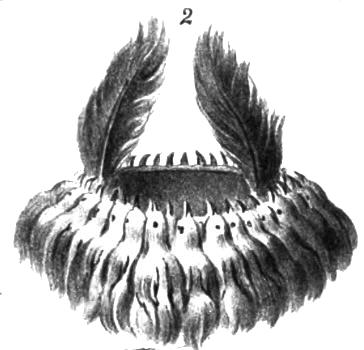
Wreath from the bodies of birds, from the Kwavi of great Arusha. This is made from smaller birds which are stuffed and strung together through the beaks. Black ostrich feathers are inserted on the sides. The wreath is worn by the small boys of the Massai and Kwavi after circumcision until the wound is fully healed. (From Plate 5 of Fischer’s magazine article showing some of the ethnographic objects he collected.)
amongst its members. It is quite clear that tribute [which is paid out] in this land is enormous, for one encounters new hordes of people almost every day. The spokespersons and sorcerers usually also receive extra presents in order to moderate the shameless requests of the young warriors.
With the entry into manhood in the 12th year, the cutting (incision, not circumcision) of the young [men] takes place and then they are taken up by the Elmur´an, among whom they must distinguish themselves in battle. Until the wound is healed, the young [men] carry a peculiar decoration made from the stuffed bodies of small birds. These are strung up on a thread through their beaks, and like a wreath are placed on the head. The girls also undergo cutting. Their faces are then painted white with flour, and they place jewelry made of small
chains of iron and cowrie shells on their forehead— the one ethnological artifact which I could not obtain. The camps of the warriors and non-warriors are situated separately, though some of the respected older members of the latter live among the warriors. After the young men tire of the life of banditry, and after they have captured a number of cattle in line with their expectations, they take one wife or many, and are admitted to the Elmo´orua. Since there is no servant class nor slaves, polygamy is necessary. Thus we find among the wealthier people, who have livestock consisting of several hundred cattle, ten wives or more. Together with the children, [they] take care of the livestock and perform the household tasks. Incidentally, among the Massai there is a more obvious difference between wealthy and poor people, more so than among other
uncivilized peoples. Thus poorer people, i.e. those who for whatever reason have not obtained any notable property, attach themselves to the wealthy and perform services for them. There is no selling of women. The son indicates to his father the girl he wishes to marry. [The father] goes to the father of the latter and requests the daughter. Thereupon the groom sends the bride several cattle and donkeys.
[The daughter] packs her belongings onto the latter, and moves to her husband, while it is up to her to leave the cattle behind with her father. Each woman has a hut for herself and each has a certain number of cattle and small livestock to maintain.
Owners of several 100 heads of livestock set up their own kraal, while others join together into a single encampment. Such encampments have the form of a circle, on the periphery of which are the huts, and the cattle rest at night in the middle. The whole is surrounded by a wall of thornbrush. The huts are 6 feet long, 5 feet wide and 3 1/2 to 4 feet tall, the ceiling has a soft arch, and the entrance is small. They are constructed from branches stuck into the ground, bowed together at the top, and cattle dung is thrown on top. Before the latter is done, the hut is covered with skins and is surrounded by dense wattle. These huts covered in dung withstand the weather for the short term while the encampment remains at the same spot. If one intends to move out of the encampment and find another place,
some of the women and the livestock are sent out. After the new encampment is partially constructed and the necessary cattle dung has been built up, the lords-husband come later with the rest of the household belongings. The urge to migrate is so great that encampments are always changing, even in the absence of a shortage of grass or water. The Massai knows not only his district, but his whole land down to the smallest detail, and the young [men] wander it in every direction, and they enjoy hospitality in the encampments of warriors.
From time to time entire districts have died out, while others are overpopulated.
A moving encampment [caravan] leaves a profound impression, and one is reminded of the migration of Abraham. The caravan marches in a long row. In front are several armed [warriors], then the cattle follow, then goats and sheep, behind them the donkeys and pack-oxen, and the rear is made up of women and children. The women are loaded [with packs] just like the pack animals. [In areas] where the framework of the huts consists of bamboo, such as [is the case] among the Massai who live near Kikuyu, these are carried along on the backs of the oxen or donkeys. [The animals] also have to carry an enormous amount of skins which are stacked up high and held together in frameworks arranged in wing-like fashion on their sides. The women are loaded with small children, milk
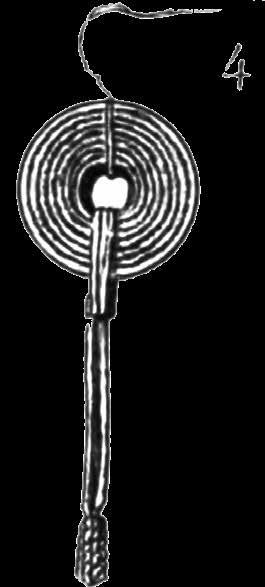
Earrings for married women, made from brass wire wound into two slabs of spirals. This is affixed with a small leather strap in the enormously expanded earlobe, and also by a second running over the head. They are used by the Massai and Kwavi. The husbands own similar ones. (From Plate 5 of Fischer’s magazine article showing some of the ethnographic objects he collected.)
vessels and other household tools, which they all carry on their backs. Understandably, they require little of household tools: several larger and smaller vessels made from gourds, a cleaver, little knives, [and] several cooking pots which they trade with the Wandorobo or the neighboring negro tribes.
That is all that they need. In the hut they rest on a cattle skin, which lies on branches (made from Elelesho-trees, if possible). Clothing is also made exclusively from skins or furs, even though caravans have traveled through their land for decades. The warriors are all naked. Only a small goatskin is draped on the left shoulder or on the breast. Married people have an even larger one which often stretches below the hips. The sorcerers and some wealthy people often wrap themselves in a cape of cowhide that stretches down to the knees, or use smaller furs which are knitted together from monkeys (Cercopithecus pygerythrus), rock hyrax (Hyrax) or the African wildcat, which they obtain from the Wandorobo. On rare occasion one might see a leopard skin. The women and girls are wrapped in a wide cape of soft-tanned cowhide with red earth and butter rubbed in. This reaches almost down to the feet and usually leaves one breast exposed. It is held together with a belt around the waist.
Jewelry has great importance among the Massai. The warriors are quite the dandies, as one can already tell from their fancy hairdos. They wear the most varied earrings made of lead, brass, beads, and almost always with iron links, often dangling down to the shoulders.
Sometimes [the earrings] are also made of twisted raffia, up to a length of 20 cm, slathered with red paint and butter. The upper arms are adorned with
armbands made of beads or two pieces of ivory or horn [keratin]. The fingers are decorated with rings made of thin brass or iron wire, sometimes with extensions covering the long finger like a shield. Bead bracelets are worn over the wrist, and the hip is surrounded with a bead-studded leather belt from which hang small iron chains. In addition, the warriors wear goatskins attached at the hips, and which hang in the back in the shape of a heart. These serve as cushioning for sitting, and as head covering during rainy weather. During wanderings they wear sandals, especially in thorny terrain.
Beyond that, the warrior possesses special war makeup and places great importance on appearing truly frightening and wild in battle. A generally desired decoration consists of a halo of black ostrich feathers sewn between two strips of leather, placed around the face and additionally decorated at
the top with several white feathers. The area below the knee is covered with protruding pieces of the long-haired, black-andwhite fur of the central African colobus monkey (Colobus gerza). These warriors also love the rattling [sound] of spurs, which they deceptively generate with tiny bells which they attach around their ankle.
Larger bells are bound around the upper thigh. The weaponry consists of mighty spears with long, wide blades, a short doubleedged sword, a knobkerry club which is often chiseled out of rhinoceros horn, and a shield made of buffalo or cowhide, painted in the colors black- white-red. The spear is only jabbed, not thrown. Weapons for throwing do not exist. The Elm´orua carry a bow and arrow in addition to a small spear. Finally, the capes mentioned further above serve as decorations for the warriors in battle. They are fixed around the neck, or
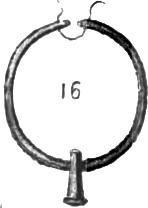
Neck ring from buffalo skin, from a Massai girl. (From Plate 5 of Fischer’s magazine article showing some of the ethnographic objects he collected.)
sometimes are simply placed over the head with a slit and undulate down the back.
Among the women, the main decoration consists of thick iron wire, which is wound in a spiral around the upper and lower arm and the lower thigh, and which spreads apart like plates at the joints. Of course this causes the body no small hindrance, and the belles can only move forward by turning [their entire body] and waddling in a peculiar way. In addition, the neck is surrounded with hoops of iron wires that extend all the way to the shoulders, especially among the southern Massai. All this jewelry remains on the body without ever being taken off, until death.
The earlobes are incised, as is the case with all male individuals, and are ultimately stretched out enormously, so that they often reach the shoulders. The married women carry many [pieces] of iron jewelry and beadwork, the latter of which is worn around the neck and hangs down over the breast. They also wear heavy earrings of thick, spiral-wound brass wire, 6 mm in diameter, which must be held in place with a leather strap across the head, and tied to the earlobes with another. They are so heavy that the scalp sustains a deep cut. It is incomprehensible how these women, so handicapped and weighted down with jewelry, can still go about their work, as they especially have to do given constant migrations and the setting-up of new encampments.
Among the beadwork, white, red, and dark blue are the most common color combinations. Less common are green, light blue or [European-]flesh-colored beads. [The Massai’s] perception of color is no less developed than that of the Swahili, as is shown by the numerous designations of the various colors of their cattle. However, the women always referred to the dark blue beads as er´ok (black).
The diet of the Massai and Wakwavi consists entirely of meat and milk. They do not spurn honey, however, and it is often enjoyed together with meat. The warriors only partake of the muscle and cowmilk. The entrails, brain, [and] goat meat and goat milk are rejected as being for older people or for women. The latter also buy bananas and negro corn in Chagga and Kikuyu if there is a dearth of meat or milk. It is considered a crime to consume meat and milk together. They live 10 or 15 days only on milk, and after that only on meat.
They even take a vomiting cure before transitioning their sustenance from meat to milk, or vice versa, by drinking fresh blood and milk mixed together, after which vomiting and diarrhea is supposed to happen.
Meat is also never brought into contact with a vessel containing milk. I saw a woman angrily refuse to sell a porter milk, because the pot he brought still contained bits of meat.
Furthermore, it is not permitted to boil milk. My cook always had to do this secretly, so as to avoid
causing a provocation. If insufficient milk is available, the young [men] take a strong heifer from the herd and, after a skilled man has bled the heifer at the neck, they place their mouth on it and drink the blood directly from it. As soon as the heifer becomes weak, they seal the wound and let [the cow] go. The milk is enjoyed three times a day, either fresh or fermented. The foreigner is almost always only given goat milk, usually in a sour state and so spicy that it was often unfit for consumption. The women are usually not allowed to sell cow milk. The meat is either superficially roasted on wooden sticks, or, less commonly, is cooked and is enjoyed with the saltless broth. The broth is often used to cook the wood of a tree called mrukut´an, especially before proceeding into battle. It possesses stimulants so strong that the young [men] often collapse with considerable tremors.
To be continued…
by John Cosgrove and Andrew Barrett
1969After the death of both my parents, I decided to sell the family home and leave Kenya. I had misgivings about this decision, but since I had no family ties left and I was just starting my career as an accountant, it seemed like the best thing to do. I was born in Nairobi and grew up in Kenya, where my parents had moved in the 1930s. My late father Owen was an electrical engineer and my mother Kathleen had been a secretary/ journalist.
Before he passed away, my father, through his connections with a senior partner at Coopers and Lybrand (C&L), asked C&L to recruit me as an articled clerk to receive accounting training in Nairobi. I met my good and longtime friend Andrew Barrett at C&L when he arrived in Nairobi from Coopers in Bristol on a six-month contract. Andy and I bonded on our common passion for cars and rallying. That began a 50-year friendship which still stands to this day. Since I was selling our Nairobi home and moving to the UK, Andy and I, like most young people, wanted to see the world.
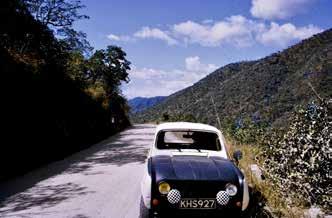
We started planning our road trip to the UK for June and July 1969, which was no mean adventure. We decided to drive from Nairobi to Cape Town in my Renault 4 and then put the car on a Union Castle ship to Southampton, England. We called the car Roho (Swahili for heart) and it’s the same vehicle that I used to
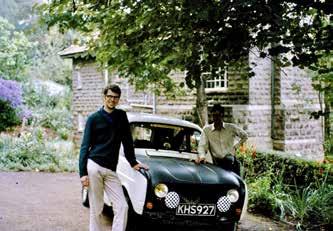
enter small rallies. Its small engine (850cc) was neither the fastest nor most powerful, but it was well-equipped for long trips with extra fuel, rally tyres and a sump guard. It had good ground clearance, which is a huge advantage on rough African roads. It was also very easy to access the engine and other parts, allowing for quick repairs using a few tools - an additional benefit in Africa.
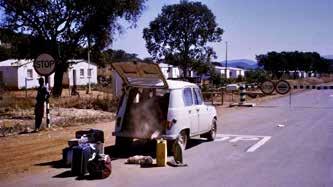
We got our Carnet de Passage en Duane (CPD) from the Automobile Association (AA) in Nairobi, and we were ready to go. The CPD allows you drive through countries without paying duty and taxes, though you must pay a deposit to the AA at the start of your journey. At each border, the customs stamp the CPD. When the trip ends, the AA checks it and if all is well, they refund your deposit. The final destinations for us were London and Bristol.
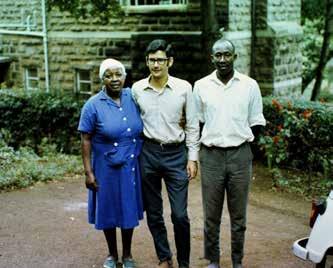
Before we left, I sold our family house on Davidson Road, near St Mary’s School. As I did so, I also arranged for Asha and Simeon, the only two remaining employees, to stay on until the new owners moved in. I also arranged for Asha to receive a pension from our Nairobibased solicitors, Kaplan and Stratton. She had taken care of us most of our lives and was like a second mother to my older brother David and me. Sadly, Asha only visited their offices in Queensway House, Nairobi a few times and
then never came again. We feared the worst but with very few households owning telephones or fax machines at that time, we were never able to find out what had happened.
On Wednesday, 11 June 1969, the day of our departure, Asha woke us up at 5:45 am. We had a hearty breakfast then we said our goodbyes. By 8:00 am we were off, headed for the Nairobi-Mombasa road, and took the turn at Athi River that leads to Namanga in Tanzania. The mileage on the clock was 52,214 miles (84,030 km).
on the Tanzanian side. We planned to take about five weeks for the whole trip.
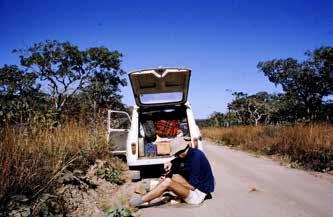
The next morning we made our way to the Mikumi National Park, but unfortunately a passing lorry threw up a stone and shattered our windscreen. This was our first challenge. Driving on dusty roads without the protection of the windscreen was very unpleasant, especially with dust from overtaking lorries and insects. But we had no option but to soldier on until we reached Iringa for repairs. Fortunately, the Roho’s windscreen was flat, so a replacement was easy to find and fit. We drove on and then, very tired, we spent the night at Mbeya Guest House.
On Friday 13 June we easily drove through Tanzania and across the Zambian border on murram roads. This was in contrast to the harsh treatment we endured at the Malawian border a few days later, where a few young pioneers decided to go through all of the car’s luggage. We spent the night in a rest house in Rumphi, in Malawi’s northern region. The countryside in Malawi was refreshing.
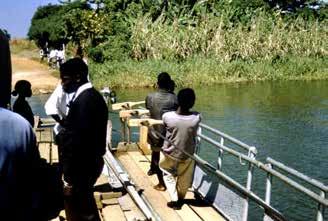
The next morning, we traveled to the Vipya Plateau (near Mzuzu), which was even more spectacular. The viewpoint known as Kamuzu’s View was named after of Dr Kamuzu Banda, Malawi’s first president. The weather was cool at an altitude of about 7,000 feet (2,134 metres) above sea level. After a long day, we rested for the night in Kasungu, central Malawi. On Sunday 15th June we left Kasungu and headed down to Lake Malawi. We joined the road at Nkhotakota and took route M5 which follows the lake down to the west side then crossed it via a man-powered ferry at Chia Lagoon. Off the ferry, we motored on to Salima and treated ourselves at the Grand Beach Hotel, a collection of bandas around the lake. Such a bargain, it only cost us £2 per person per night, full board!
On the first day, we had reached Morogoro by early afternoon after a good 520-mile (837 kms) journey on good roads, most especially
Here in Salima, we had to swap the car tyres around and get the suspension arm on one side welded back into place. The rough roads had truly taken their toll on the car. Unfortunately, the garage in Salima was not well equipped so we had to limp along to Lilongwe, the capital of Malawi, till we finally had the car fixed. Fortunately, most of the roads to Lilongwe were tarmac and crossing the Zambian border near Chipata was relatively easy.
On Tuesday 17 June we soldiered on over the fairly bad, rutted roads towards the river
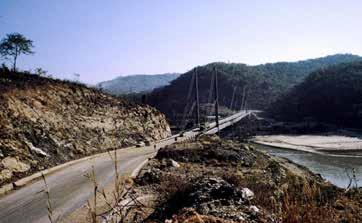
Luangwa. As we proceeded, we were surprised to come across a very new and modern suspension bridge. It was quite an unusual site in Africa back then. Little did we know that taking pictures of this bridge would cause a bit of conflict with the military. They threatened to take our camera and film. We managed to persuade the guard that we were simply amazed at this beautiful bridge, and he begrudgingly allowed us to keep our cameras. We later found out the reason for the military’s sensitivity was that the famous Luangwa bridge had once been blown up by the Mozambican rebels.
After much negotiation, they allowed us to proceed intact towards Lusaka, the capital of Zambia. We spent the next day in Lusaka town doing various administrative and financial errands to ensure that all was in order for our next leg of our journey into Rhodesia, now known as Zimbabwe. Lusaka is a strange city as we could not find any newspaper to buy on the streets. There were also no open restaurants, so we left Lusaka hungry and drove straight to Livingstone, which surprised us by being a fairly large town.
As we drove past Livingstone, we began to
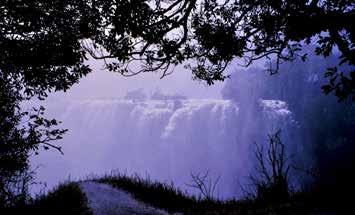
suspect that the car had an engine problem. We turned the engine off only to hear the noise continue. Baffled, we found out it was the sound of millions of cubic metres of water rushing at 1,088 cubic metres per second, crashing down the gorge, from a height of over 100 metres. Behold, we were right beside the magnificent Victoria Falls!
We marvelled at the scene till nightfall when the falls were floodlit and the blanket of mist around the falls created a dreamy spectacle that we will remember all our lives. Surprisingly, the Zambian Tourism Board had run out of all postcards featuring the falls. On Thursday 16 June, we crossed the border into Rhodesia and found the falls to be even more of a wonder from that side!
Five days into our journey, our mileage was now at 54,633 (87,924 kms) having done 2,419 miles (3,893 kms). We pressed on from the falls to Wankie National Park, now called Hwange National Park. Perhaps we had been spoilt by living in Kenya, for we felt disappointed by the game in this park. Tired, we decided to settle for a lovely evening next to a log fire with good food and drinks.

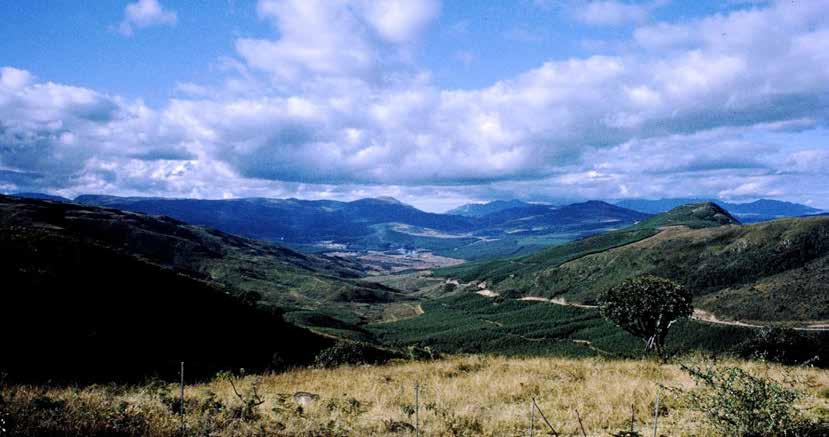
During our stay, elections were taking place in Zambia and Rhodesia. Zambia was holding a referendum while Rhodesia was deciding whether to amend its constitution or become a republic. Both events proceeded peacefully without much ado. When we arrived in Bulawayo, we stayed for the night at the Selbourne Hotel. Most of our time in Bulawayo was taken up by changing money into Rhodesian currency.
We took a short detour to visit the Rhodes Matopos National Park, now named Matobo National Park. This was also bit disappointing, except for a few gems like interesting cave paintings and the view from Cecil Rhodes’ grave called ‘World’s View,’ a wonderful vista of the surrounding countryside that was so peaceful and breathtaking. One can truly imagine spending hours there thinking away, lost in wonderment.
When we arrived in the capital city, Salisbury, now called Harare, we met up with my cousin Peter and his family where we stayed for a couple of days. He showed us around town and gave us useful tips on our travel routes. We were surprised to find that the local shops were well stocked despite the country experiencing three years of sanctions. My family gave us several tours around Salisbury, showing us the life and culture in Rhodeisa. It was evidently a growing city with a lot of buildings for both residential and commercial purposes.
On Tuesday 24 June we left the garage and headed towards the Eastern Highlands. The highlands are marked by beautiful views and a twisty road through mountain passes that confirmed that our Michelin map gave good recommendations for sightseeing. We steadily drove over the Birchenough Bridge in Rhodesia and crossed the border at Beitbridge
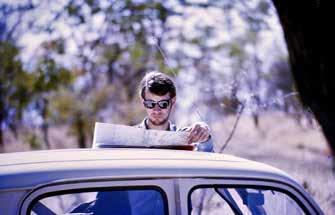
into South Africa. We decided to get to South Africa as fast as possible due to our shortage of Rhodesian pounds. It turned out not to be a readily convertible currency! In our hurry, we had mistakenly thought the border would be open until 10 pm, only to find it closed at 8 pm. This meant we had to spend an uncomfortable night in the car!
The next morning we successfully crossed the border into South Africa and were surprised to be greeted by our first ‘Whites only’ immigration building. It was an odd experience as I hold no experience or understanding that people of different races should be separated. We briefly stopped in Missina to send a telegram to our friend John Lowndes who was to join us in Johannesburg. The road onwards to Pretoria was mundane and poor signposting did not help.
When we arrived in Johannesburg, we stopped to visit my Uncle and Aunt, George and Eileen. They were very kind and showed us around Johannesburg. Our friend John finally arrived at Jan Smuts Airport, now renamed OR Tambo International Airport. We picked him up and spent a lot of time together in Pretoria. We visited the Voortrekker monument, built in honour of the Dutch-speaking settlers (Afrikaners) who travelled northward from the Cape into the highlands of South Africa, a journey known as the Great Trek. Inside the building, one of my forefathers, Dr Phillips, is represented giving a Bible to the Afrikaners as a peace offering. I learnt that the Boers, another term for Afrikaners, were very tough and determined people.
In Johannesburg we also enjoyed the view from the top of the Hertzog Tower, now renamed Sentech Tower. From there we had panoramic views of the mighty Johannesburg including the Rissik Street Post Office Tower and Union Hall.
Our journey continued through the lovely countryside towards Swaziland, one of the smallest countries in Africa. It gets dark very early in the southern hemisphere and we were not able to cross the border into Swaziland in time, so we spent the night nearby in Piet Retief, now known as eMkhondo.
Our ongoing journey was filled with magnificent views, especially going down into the Tugela valley and the climb up, out from the valley, followed by a sweet ride through thickly wooded areas of Paul Pietersburg and Vryheid, over hills with fine views. Sadly, this
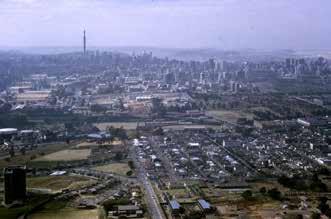
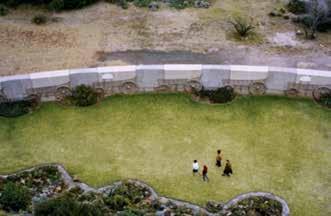
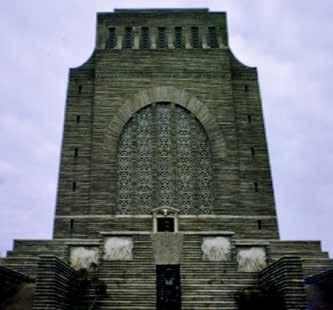
Voortrekker monument.
was soon spoilt by a nasty noise from the car which we suspected was the main crankshaft bearings. When this was confirmed, we had to drive very gingerly until we reached Greytown and arranged for the Roho to be towed to Pietermaritzburg the next day. To console ourselves, we went to see a Norman Wisdom film that evening.
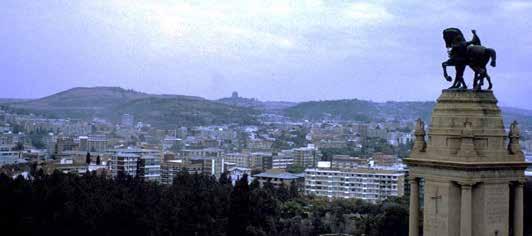
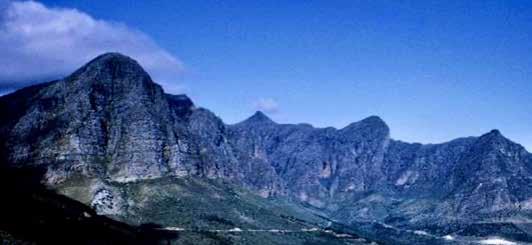
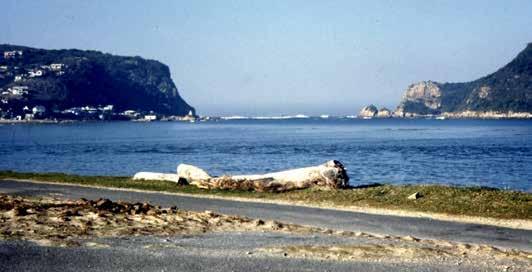
As the repairs were going to take a few days, we decided to hire a car and drive to Durban. Unfortunately, the weather was not good, so our trip to and from Durban was mundane. We would have appreciated our trip back to Pietermaritzburg via the valley of 1,000 hills a lot more, had the weather been sunnier.
Once the car was finally repaired, we resumed our journey towards our final destination, Cape Town. We chose the road along the coast of the Cape Province’s Garden Route. It runs across fields of wildflowers complemented by views of the ocean and
Outeniqua Mountains on the other side. This route is special amongst travelers for this very reason.
In Knysna, our penultimate destination before Cape Town, we stayed with my uncle and aunt, Mary and Huddy. They had a beautiful house with a direct view off the Knysna Heads, cliffs overlooking the Indian Ocean. This is truly one of the most magical parts of South Africa. We spent a few days in this wonderland.
After our time together in Knysna we bade our goodbyes and carried on along the coastal route to Cape Town. Another spectacle awaited
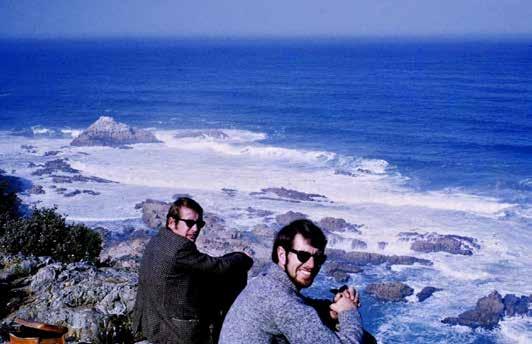
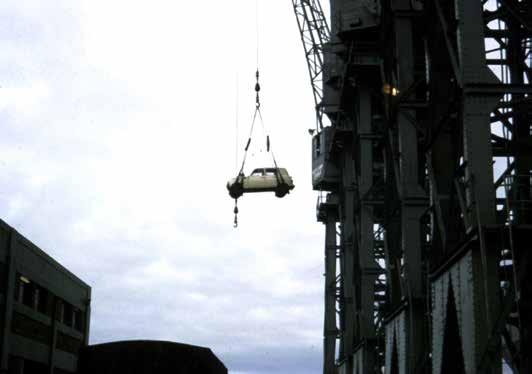
us here. A view of the port city seemingly being watched over by the imposing Table Mountain. The mountain appeared to be shrouded in a forever changing and moving tablecloth of white clouds. My Great Aunt lived in Cape Town, so we got good insider advice about what to do and see, like the exciting and famous ride in a cableway train to the top of Table Mountain.
Sadly, our trip finally came to an end and John had to fly back to Nairobi. The Roho was loaded onto the Union Castle ship, Edinburgh Castle and we boarded the ship too, destined for Southampton, England.
The Roho had one final trick for us while being loaded onto the ship. The drive shaft
sprocket sheared, and we had to glue it together with Araldite, a strong epoxy adhesive. As I watched the crane lift the Roho onto the ship, I felt my heart skip a beat at the thought of it being dropped into abyss of the ocean below.
When we arrived England, we finally got off and carefully drove up to London, where my brother lived in Wimbledon. My heart felt content with a trove of memories to treasure from our farewell tour. Andy’s family met him and they drove to Bristol.
Our wonderful adventure through East and Southern Africa came to an end, cementing a love of Africa in both of us. Ultimately, I returned to live in Kenya, my real home, where I have spent the majority of my life.
byTiras Waiyaki
This serialised story gives the life of JM Kariuki and how he became a prominent politician in Kenya in the 1960s. But by the 1970s he found himself in a struggle against President Kenyatta’s supporters. By 1974 he was receiving active death threats and in early 1975 a bus in which he was supposed to travel was bombed. The story continues:
JM Kariuki Murdered in Ngong Forest 1975
After the OTC bus was destroyed by a bomb blast, JM attended an engagement party in Karen, where he told a permanent secretary that he was the blast’s main target. On his way back from the party in Karen, JM visited the scene of that night’s explosion.
The following day JM, accompanied by his wife Terry, went to see his doctor about a pain in his knee. After the appointment, they each went their own separate ways.
That morning the 28-storey Kenyatta International Conference Centre had to be cordoned off after a hoax caller claimed that a bomb had been planted at the United Nations Environment offices.
Then JM’s trusted friend General Service Unit (GSU) Commandant Ben Gethi called him and explained that it would be nice if JM met the security chiefs and explained his innocence following a plan to implicate him in the city bombings. JM saw no need for that because no one had openly accused him of these attacks.
Within two hours Gethi called again. He reportedly asked JM to meet the security chiefs informally “in a friendly atmosphere” and Gethi promised to be there to ensure the MP’s security. JM finally agreed after the two men met at the International Casino on Saturday, March 1. The meeting was scheduled for the next day, Sunday, March 2. Early on Sunday morning Gethi visited JM’s home. Later the Parliamentary Select Committee probing JM’s disappearance and assassination noted this as unusual. Gethi insisted, “It was just a normal call to a friend’s house.”
However, investigations apparently showed that Gethi had taken a pistol to JM that he had promised him, to protect himself at the
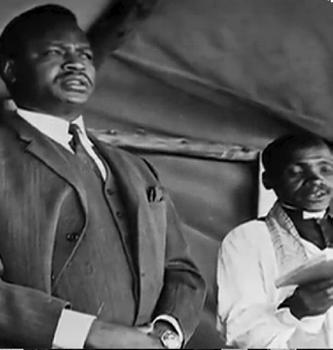
meeting. Witnesses testified that the visit was so secretive that Gethi entered JM’s bedroom instead of waiting for him to be woken up. “What was surprising is Ben Gethi’s going to JM’s house at six in the morning to find out if he had reached home. Which means Ben had some information! He was the Commandant of the GSU then, he must have had some information,” Mark Mwithaga, Vice Chairman of the Parliamentary Select Committee investigating the JM case, said to KTN News in their program about JM many years later. Mwithaga added, “He must have had some information. He must have known something.”
When JM informed his first wife of Gethi’s visit she asked him what he was doing with government officers when his relationship with the regime had hit rock bottom. He explained that Gethi was checking on him, quite concerned about his health as they had been together the previous night.
At noon JM went to the Ngong Racecourse, where he and Gethi had a brief chat. Mark Twist was spotted at the Racecourse in his dark glasses and very well dressed as usual, trailing JM, according to Mwithaga. Twist was said to be using telephone booths to communicate with CID chief, Ignatius Nderi. Later, JM went
to the Hilton Hotel in Nairobi even though Gethi denied before the Parliamentary Probe Committee that the two of them met. Witnesses later said they had seen Gethi in the company of Senior Superintendent Patrick Shaw. Witnesses reportedly told the Nation that at around 5 pm, Patrick Shaw and a Mr Young, a police reservist, chased away all street boys around the Hilton Hotel who usually caught JM’s attention. Apparently, some taxi drivers were also asked to leave. Criminal Investigations Department (CID) Director Ignatius Nderi and the Deputy Director of the National Youth Service (NYS) Waruhiu Itote were also seen briefly around the Hilton. Also spotted in the area were Pius Kibathi, a trained policeman, who according to the Nation never joined the force, and Councillor John Mutung’u of Olkejuado County Council. Another report said there was also a European lady police officer near the Hilton.
When Terry returned home, she did not find JM, but he had left a message to their household staff that he was going to meet up with Ben Gethi. At about 6:45 pm JM arrived at the Hilton’s Coffee House. Just when JM was about to sit down with his friend Macharia, a tour operator, Gethi appeared. On noticing the discomfort on Gethi’s face, because apparently the GSU boss was not expecting to meet JM with anyone else, the MP eased the dilemma by casually saying to his friend Macharia, “By the way, Gethi and I were to meet, let me have some minutes with him.”
Mwithaga noted in the KTN News programme that JM left the Hilton with Ben Gethi and Ignatius Nderi. Before JM left he approached the cashier and issued him with a cheque. Oddly, he wrote the names of Ben Gethi and Ignatius Nderi on the back of the cheque. These two men were JM’s friends of many years. Had they been sent as two people JM would not suspect or fear to lure him into a trap? And had he written down their names because he had become suspicious of them?
According to the Nation a security man at the hotel, Mr Fred Sing’ombe, reportedly saw JM and Gethi enter a Peugeot station wagon behind the hotel. However, in the KTN News programme, Mwithaga narrated that JM got into a GSU Mercedes and when they got to the roundabout near the Intercontinental Hotel, he was removed and taken into another vehicle almost by force as witnessed by a European.
His movements after being seen near the Intercontinental Hotel remained a mystery even to the Parliamentary Probe Committee into his death. But 15 years later the Nation newspaper established that JM was taken to the Special Branch Headquarters, Kingsway House, now Nyati House on Muindi Mbingu Street. Gethi and JM entered the building through a back entrance, heading straight to a senior Special Branch officer’s office.
In the room, JM found the senior officer, President Kenyatta’s bodyguard Arthur Wanyoike wa Thungu, the NYS’s Itote, CID boss Nderi and reservist Patrick Shaw. Given JM’s uneasy relationship with Thungu since his days as Kenyatta’s private secretary, he must have sensed outright danger. He was also aware of Thungu’s role in the Nakuru meetings against him.
According to a senior retired policeman, wrote the Nation, JM answered all the issues raised about the bombings by Nderi and Shaw to their satisfaction. Thungu started by asking JM why he kept “going round the country insulting Kenyatta.” JM denied this stating that all he had talked about was social justice for every Kenyan, which was in line with Mzee’s beliefs. Thungu then asked for accounting of scholarship money he had received while working as a private secretary to Mzee. He also raised the issue of money, issued as compensation to Mau Mau fighters who had lost their land during the independence struggle, apparently handled by JM when he was Assistant Minister for Agriculture with

Special Duties. Itote, who had worked closely with him at NYS, mentioned money from the Chinese government which JM had allegedly received on behalf of the service.
The situation between JM and Thungu got out of hand and Thungu lost his temper and reportedly punched JM in the mouth, knocking out three lower teeth. Exasperated, JM reached for the pistol in his pocket, the gun Gethi gave to him that morning. Gethi, probably the only person who knew JM had a gun, allegedly whipped out his service revolver and shot JM in his upper arm to protect Kenyatta’s bodyguard. The populist politician collapsed in a pool of blood as Thungu placed a call to a senior politician to update him on events.
James Lando Khwatenge, introduced on KTN News as a former Special Branch officer and whose Force Number was 123274, had more to add about this incident. He had been based in the unit responsible for inflicting torture and eliminating individuals perceived to be anti-government before being dismissed from the service at the rank of police inspector.
Khwatenge narrated to KTN, “Ben Gethi shot JM for the first time and disabled the hand.” Khwatenge made it very clear that all GSU are sharp shooters. He explained that Gethi had to shoot JM because if JM had shot Thungu, the president’s bodyguard, Kenyatta would have asked what happened to his bodyguard and where had JM gotten a GSU pistol to shoot Thungu.
Khwatenge says that JM was not killed by
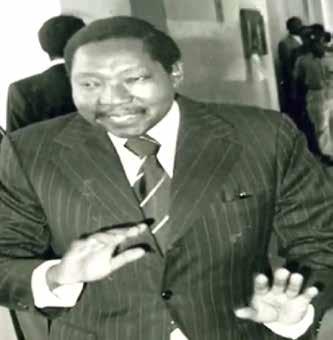
Gethi’s bullet, but if they let him live, he would go out “with a plaster, some missing teeth and being vocal, he would say what happened to him.” That was when they decided they had to kill him, but they had no plan on how to cover up the murder. Khwatenge says that a meat van with a red stripe on the side was found around Jevanjee Gardens and it was used to take JM to Ngong Forest where he was murdered.
Evidence received by the Parliamentary Probe Committee investigating JM’s disappearance and death, and later corroborated by Gethi in a confession to JM’s sister years later, stated that Thungu called in three men who had been waiting in another room. The three were ordered to take JM to a waiting car downstairs, after handcuffing him.
Apparently, they had been brought by Nderi to give evidence against JM regarding the city bombings. Bleeding profusely and wailing in pain JM was bundled into this vehicle, which according to the Nation belonged to a councillor from Kajiado District, the area where his body was found. During their investigation, the Parliamentary Probe Committee summoned the councillor and asked him to bring his car, a green Peugeot station wagon with a red inscription: “Meat Park.” It is believed that this vehicle ferried JM to the scene of his murder.
Before Gethi died on 12 September 1994, he reportedly confessed to JM’s sister, Rahab Mwaniki, that he had taken JM to Nderi and Shaw for questioning on the bombs. He said he had left JM with the two police officers and returned much later to find a Mr Pius Kibathi and two other men dragging a bleeding and groaning JM to a vehicle behind Kingsway House. A confidential witness testified before the Probe Committee that Gethi remained alone at Kingsway House until past midnight, chain smoking and talking on a police radio.
Deceased politician Michael Blundell wrote in his memoirs that, “J.M. Kariuki was shot and a bullet recovered from his body was traced to the gun of a member of the Presidential Guard.” He did not name this Presidential Guard. The Probe Committee established that two different pistols were used to kill JM. The Nation newspaper investigation established that JM was shot at different places, first at Kingsway House and then at the Ngong Hills murder scene.
The guns used were either a .38 Walther or a .38 Mann, both of which were pistols used by
members of the GSU Recce Company. Officers of the Recce Company provide special duties, the main ones being providing security to the president and visiting heads of state. Probe Committee members were utterly convinced that JM’s murder was a foregone conclusion and would have taken place even if Thungu had not provoked JM.
When JM had not returned home by Monday, Terry informed family members and they sent out search parties. Branch writes that JM’s family did not worry too much about his whereabouts as his Mercedes had been spotted outside the Hilton Hotel. The assumption was that he was staying there with a lady known to the family whom he was having an affair with.
But now JM had disappeared and not even those closest to him knew where he was. His Mercedes Benz, KPE 143, remained parked outside the Hilton Hotel where he was last seen alive by the general public. His first wife’s brother drove to Gilgil, arriving between nine or ten Monday night, and informed her that JM had disappeared and his car was parked at the Hilton. Meanwhile, some worried employees at the Hilton were also sending similar messages to Members of Parliament.
Word that JM was missing moved from rumour to fact. As Home Affairs Minister the immigration docket fell under Vice President Daniel arap Moi. When it became obvious that JM had disappeared, Moi told the House that JM was in Zambia. But questions piled up. It was not JM’s style to wake up and leave unannounced without telling his family. And his passport was still at home. The Nation newspaper carried a story that JM was in the Intercontinental Hotel, Lusaka, Zambia on personal business. “JM in Zambia. Alas!”
The newspaper said JM was visiting his friend Vernon Mwanga, Zambia’s Foreign Minister at the time. When Zambia’s High Commissioner in Nairobi quickly informed Mwanga’s office of the Kenyan newspaper headlines, Mwanga was actually in New Zealand before heading for Philippines. Mwanga knew JM was not visiting him in Zambia and he realised that something sinister must have happened to JM. After thorough enquiries with the Chief Immigration Officer in Zambia and the Minister of Home Affairs in Zambia, there was no record of JM having entered Zambia in the three or four months preceding his death. Mwanga’s office immediately set the record straight. The
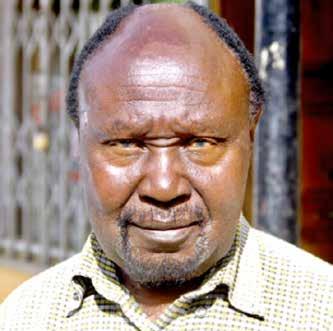
Mark Mwithaga was the Vice Chairman of the Parliamentary Select Committee probing the disappearance of murder of JM Kariuki.
Standard then refuted the Daily Nation story, saying its Lusaka correspondent had reported that, “The Zambian authorities categorically deny any knowledge of the whereabouts of the missing Kenyan MP, Mr JM Kariuki.”
“JM was not in Zambia! I can swear by the Bible,” Mwanga recalls.
A frantic search for JM by family and friends ensued all over the city. They checked the City Mortuary but did not find him. JM’s first wife wrote a report at Kilimani Police Station and then went to the GSU Headquarters at Ruaraka to see Ben Gethi, a family friend, because she knew he and JM had been meeting regularly before he went missing and he was the last person seen with the MP. Gethi reportedly said he was not available to meet her, but she remained adamant until she met him.
“Where did you take JM?” she asked him. “JM told me you came over to our house, what did you want?” She said he replied that he was going to Dagoretti to buy meat then decided to pop by. She asked him where JM was and he said he didn’t know.
On 7 March 1975 Rubia reported JM’s disappearance to parliament. On the same day, assistant minister Justus ole Tipis admitted in parliament that the MP was missing and asked anyone with information to cooperate with the police.
To be continued…
by Kevin Patience
1973Mombasa
The Globe Star became one of Kenya’s most notorious wrecks when she ran aground off Mombasa on the morning of 27 April 1973 and later on five salvage personnel died in the vessel.
The ship had approached the port for fuel and water and requested a pilot but was asked to turn round and wait. Unfortunately, the ship turned to starboard instead of port and grounded on Leven Reef at 5.30 am. Salvage efforts by the port tugs to refloat the ship later that day failed as the tide fell. The ship was on a voyage from Iskenderun in Turkey to Karachi, Pakistan, with 10,000 tons of malt wheat. Since the Suez Canal was closed, they had voyaged round South Africa. With the ship now firmly on the reef a salvage contract was awarded to two local Mombasa companies - Murri Freres together with Southern Engineering and the Port Authority. Murri had a number of suitable vessels including a powerful tug Barbara and two ex-military landing craft, Citadel and Rampart.
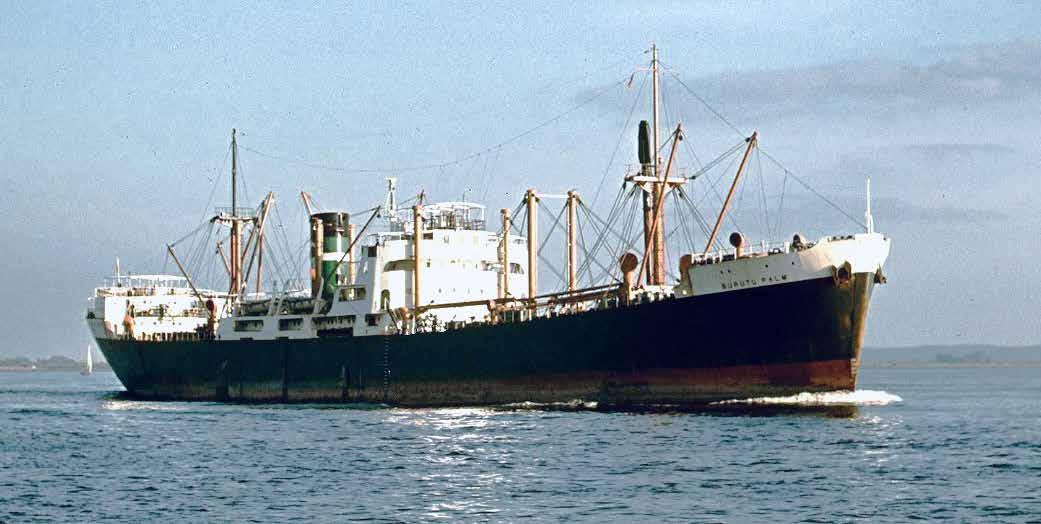
Salvage contracts are usually awarded on a No Cure - No Pay, so unless you are successful, you can lose your shirt! They set up suction pumps to discharge the wheat into the landing craft alongside. This continued until a bulkhead cracked and the engine room flooded, stopping operations. Repairs were completed and the generators were dried out and operations continued until June when the hull fractured in front of the bridge in No. 3 hold after heavy weather pounded the ship. They abandoned the salvage operation with massive costs to all involved and declared the ship a constructive total loss.
The Globe Star was one of two 11,000-ton cargo ships built for the Palm Line by Short Brothers, Sunderland in 1952. It was originally named Burutu Palm after a region in Nigeria. She sailed from West Africa to the UK carrying palm products including palm oil in deep tanks until 1967 when she was sold and renamed Tyhi. The ship was based in
the Far East and in 1973 she was sold to Globe Navigation of Singapore and renamed Globe Star. They chartered her to carry the wheat to Pakistan via Mombasa where the story ended. She was 451 feet long with a breadth of 52 feet powered by a Doxford four-cylinder vertically opposed diesel engine of 3,000 horsepower giving a speed of 12 knots.
In November 1973 a local engineering company, John Grossert, decided to cut the vessel in two in an attempt to refloat the aft end, which was still intact and full of rotting wheat. What followed has never really been fully explained but Ian Grossert, the son, and four of his team of divers died in No. 3 hold through the apparent inhalation of gas given off by the rotting wheat. The vessel was then placed off limits to all by the port authority with notices to that effect around the deck.
I first went out to the wreck in 1974 having been asked by Murri Freres to carry out a hull and gas inspection of the
ship with a view to carrying on where Grossert’s team had left off. The underwater hull inspection showed the whole ship firmly on the reef with the aft end from the bridge to the stern intact, but from the bridge forward the hull was wide open in No. 3 hold where the hull plating had been smashed open by the sea and intact in No. 2 to the bow. Climbing on deck, I was taken aback by the thousands of black spiders that were everywhere with webs stretching all over the ship. Fortunately, we had a bamboo pole in the boat and used it to great effect clearing a path through this mass of webs. The two of us had breathing apparatus and began the inspection using Drager glass gas samplers similar to a biro; you broke the ends off and, using a small hand-held pump, sucked the contaminated air in through the tube. The tube
lining turned different colours depending on the gas present. The results were disturbing with a varied selection of toxic gases including hydrogen sulphide, carbon monoxide and a highly inflammable petroleum gas venting on deck given off by the diesel oil fuel in the bottom tanks being boiled by the rotting wheat in No. 4 hold. My report was read and any further interest in the wreck ceased and it was left to break up.
In 1978 Divecon Ltd, a local diving and salvage company, was contracted to demolish the ship below datum and commenced cutting the ship. Eventually all that was visible were the four cylinders of the Doxford main engine, known locally as the ‘Four Apostles.’ Five years later in 1983 I was MD of Divecon Ltd and asked to look for suitable recoverable steel on any of the wrecks around Mombasa, as steel
was difficult to obtain with exchange control in force. I took the divers out to the wreck and began a systematic search of the remains below the surface. Running back from the main engine to the propeller was the shaft tunnel through No. 4 and 5 holds, which contained the propeller shaft still in situ. However, swimming down the tunnel to the end brought me to the stern gland that seals the shaft where it exits the hull to the propeller. Right next to me was a spare high quality steel tail shaft sitting in its crutches about fifteen feet long and weighing about five tons. This we could recover.
The following day armed with underwater cutting cable and thermic cutting rods we cut out a section of the tunnel roof and using three two-ton lift bags brought the shaft back to the workshop where it was cut up for a variety of jobs. That wasn’t quite the
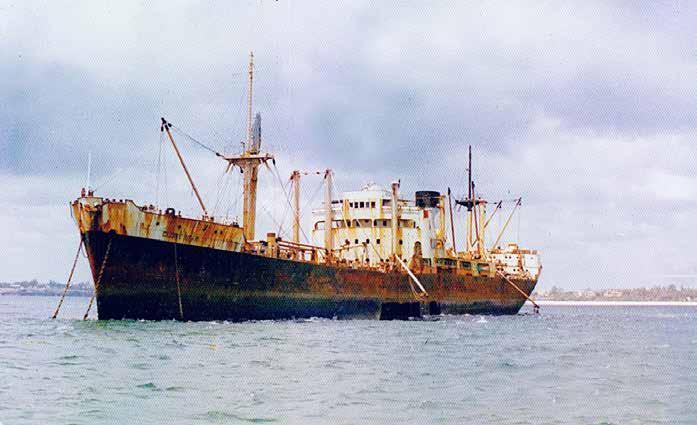
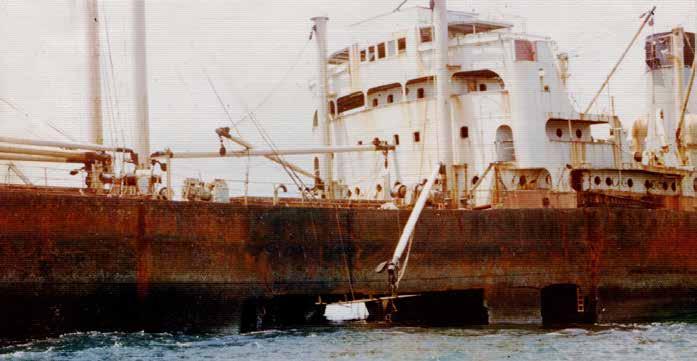
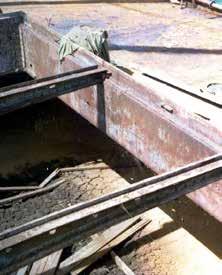
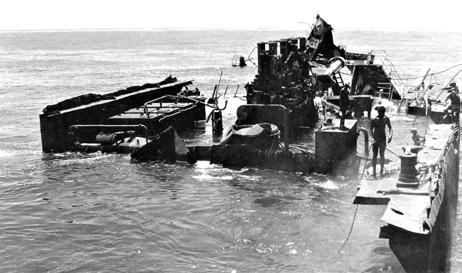
end of the diving as I took my wife out at weekends and we foraged around in the remains of the engine room recovering brass valves and fittings. Not very exciting, but nonferrous metal bought us a great deal of beer and wine once sold to the scrap merchants in Mombasa. After many years the engine block collapsed and disappeared below the surface leaving no trace of the wreck’s whereabouts other than a symbol on the Mombasa hydrographic chart.
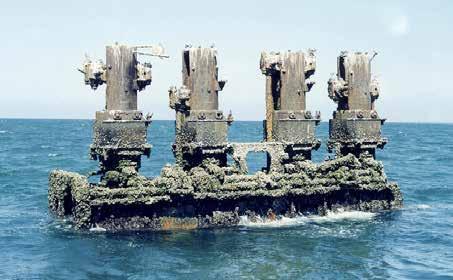
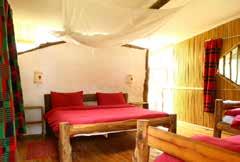
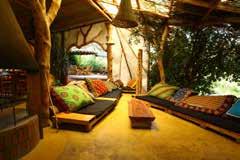

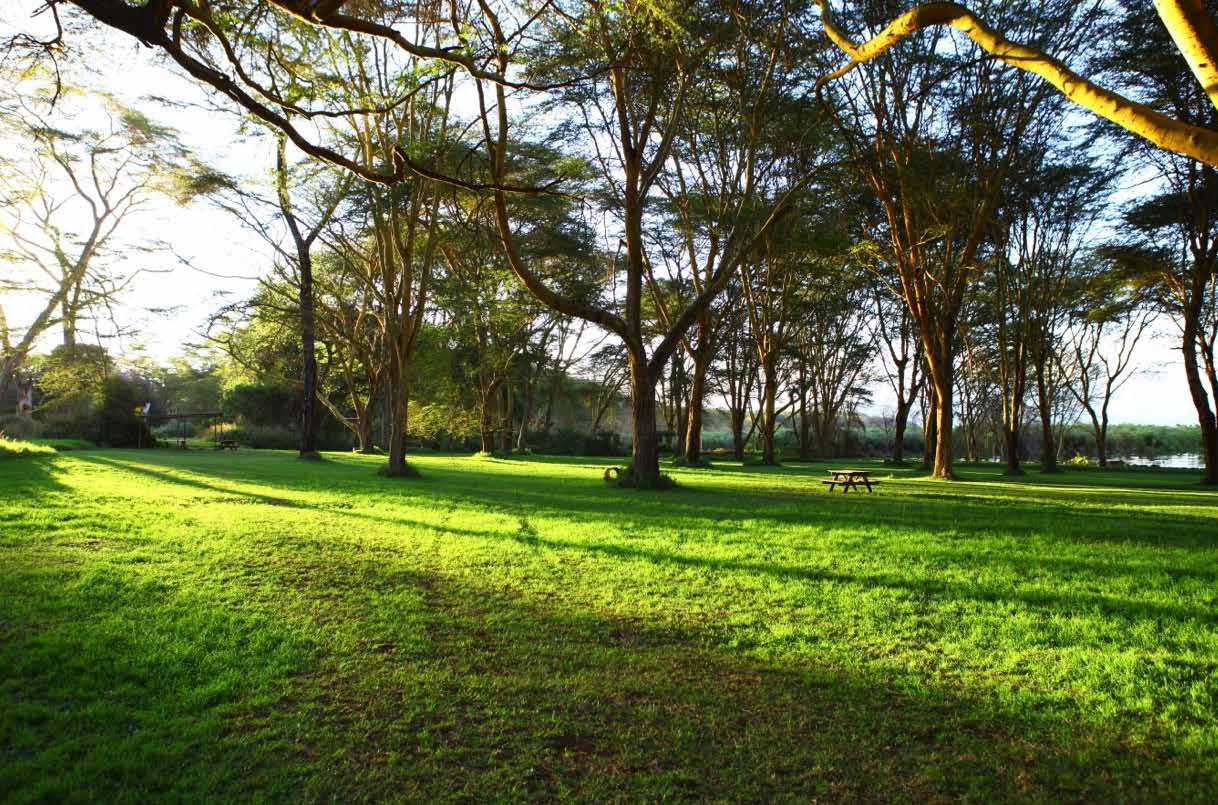


byTitus Murithi
I was surprised to see a tractor dating back to 1922 at the Karen Blixen Museum. In the early 1920s modern farming in Kenya was the reserved for the settler colonial farmers led by Hugh Cholmondeley, 3 rd Baron Delamere.
When tractors for tilling the settler farms were introduced, the most famous model was the Fordson Tractor Model F. One unique feature of those early tractors was their steel wheels with metal cleats at the rear. One of these tractors sits in the compound of Karen Blixen Museum in Nairobi, which was the home of Karen Blixen from 1917-1931. Karen Blixen, one of Kenya’s pioneer settler farmers, ultimately failed to establish her farm, but she immortalized the early settler experience with her book, Out of Africa , which begins: “I had a farm in Africa, at the foot of the Ngong Hills.” It’s appropriate that her old home was chosen as the location for the Karen Blixen Museum, which features early white settler history.
The tractor has survived for the last 103 years and Karen Blixen used it to till part of her 6,000 acre farm. Karen tried unsuccessfully to grow coffee, on advice from Lord Delamere, who was experimenting with wheat and dairy farming in Naivasha and Njoro.
The museum features other farm implements which are more than 100 years old, including different steel ploughs and ox wagons made of long thick wooden
timber fastened together with metal bars and had four steel wheels. Some ploughs could be pulled by the tractor and others could be pulled by the bullocks. The tractor used to pull steel harrow ploughs while the bullocks used to pull fallow steel ploughs.
The museum also displays a 1917 Gordon’s Guardiola coffee washing machine, which consists of a pulping machine, perforated drying chamber and a steam boiler. After coffee was harvested in the farm, mostly by women in those days, it could be soaked in water to remove impurities and then fed into the pulping machine to remove the husks.
Then they fed the coffee into the perforated drying chamber and dried it with hot air from the steam chamber. From there it was sun dried for about two weeks and then packed in sacks to be transported by ox wagons to the Nairobi railway station ready for export. The ten-kilometre trip to the station took a whole day.
Inside the old house and particularly in the study room, the floor is made of cedar wood timber which looks as pristine as it was in 1912 when the building was constructed by a Swedish engineer Ake Sjogren, the original owner of the building, before he sold it to Karen and her husband in 1917.
According to Denis Mwikhali, a tour guide in the museum, Ake Sjogren was an engineer and used his engineering skills to build his house to perfection. Most of the furniture in that study room are items used
A sturdy ox wagon which would have been used to transport coffee.
by Karen after she’d bought the house from Sjogren.
The walls of the same study room are made of pure mahogany. There are many books in the room and documents plus a typewriter which Karen used to type letters. One of those documents is a letter written to Karen after she left Kenya in Kiswahili by Kenya’s first president Mzee Jomo Kenyatta and it’s dated 3 August 1937. The letter says: “ Nakutumia salamu nyingi, yote ufanyayo kumbuka inchi unayoipenda na wanainchi waliyomo .” Mwandishi Jomo Kenyatta. (I send you many greetings. In all you do, remember the country which you love and the people who are in it. The Writer, Jomo Kenyatta)
Another room on display in the museum is the dining room, which has a dining table with a complete set of colonial era porcelain cups, kettles and cutlery. Other early colonial era artefacts in the museum are kitchenware tools, which include knives, dishes, cookware, jugs, kettles, spoons, cups, plates and many other utensils. Karen Blixen would have used them in her kitchen when she resided in that house.
During her stay in Kenya, Karen employed many workhands on her farm, including her immediate neighbours, the Kikuyu and Maasai, as well as from other parts of Kenya. One of them was a Somali youth named Abdillaih, who worked as an accountant on the farm. Karen painted a portrait of the youthful accountant, which now hangs by the front wall of the museum. Karen recognized his intelligence and sponsored Abdillaih to study law in Mombasa and he
became a lawyer in Kenya before relocatig to Somalia and becoming a judge.
Karen also painted a portrait of Njeri, a young Kikuyu lady whose parents worked at the farm. Njeri was a very beautiful lady. Karen chose her to work in the house and helping her to welcome and serve the guests who visited the farm. Because of her beauty, Njeri’s parents demanded that any man who wished to marry her pay a bride price of 250 goats. There weren’t any Kikuyu men in the area with that many goats. But the neighboring Maasai community from Ngong area owned plenty of sheep and goats and Njeri ended up being married by a wealthy Maasai from Ngong.
Another local employee of the farm was Kamande Gatura, whose first job was to bottle feed a bushbuck, which had been rescued by Karen from the surrounding Ngong forest. Karen had nicknamed the bushbuck as Lulu . Kamande went on to work in Karen’s kitchen and became an excellent cook.
Some parts of Karen Blixen Museum compound are covered by thick natural bushes, a section of the Ngong forest. There are also trees, both indigenous and exotic, which had been planted during the
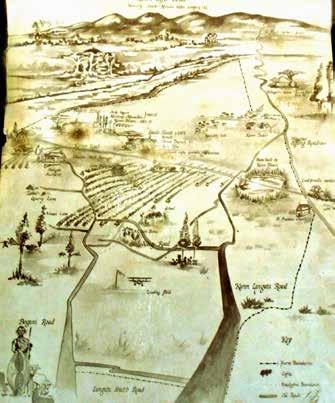
early colonial era. Some of those trees are almost a century old or older, including one Italian cypress ( cupressus sempervirens ) tree planted in 1931at the backyard of the main house.
The museum also displays an old map showing the boundaries of Karen Blixen’s farm and the surrounding area.
The Karen Blixen Museum is worth visiting and helps us understand why that area of Nairobi is still known as Karen –even though Karen Blixen left Kenya 94 years ago!



by Pritpal Sandhu
© Pritpal Singh Sandhu. All rights reserved
This is the story of a rare event that took place in 1959 during British colonial times in Tanganyika. A gang of bandits held up a whole town using pangas and guns. It traumatized the whole population of the town and bankrupted some of the traders who had to leave and resettle in the town of Musoma, where they had to take employment to make ends meet. This raid took place in Mugango, a small town close to the shores of Lake Victoria off the main dirt road running from Musoma to Majita. Mugango was a one street town, lined with about 14 dukas (Trader’s store-cum-residence), half on one side of the street and half on the other. This main street of Mugango took off at a right angle to the Musoma-Majita road, 26 kilometres south of Musoma. After a mile it ran parallel to the south shore of Suguti Bay on Lake Victoria, but offset from it by a few hundred yards. This right-angle street forming a T-junction with the Musoma-Majita road continued beyond the town to Mugango Ginnery and a jetty on Suguti Bay.
1959On a dark and drizzly night, with the rain drops pitter-pattering on the tin roofs of the dukas, the town of Mugango was fast asleep. Even the night-watchman sitting on one of the duka’s verandas in the dark shadows of the canopy-overhang dozed while wrapped in a blanket to keep out the night chill.
Around midnight a lorry full of armed bandits arrived at the T-Junction and turned into the main street of Mugango town. This awakened the dozing night-watchman. The lorry stopped by the first two dukas (1 and 2 on the map) belonging to two Premji families, who were away on a trip, and a large group of armed raiders disgorged from the truck. Leaving the driver with the truck, they sneaked along the main street most of them armed with pangas. Their leader carried a shotgun and a couple of sticks of dynamite. They punctured the tires of every trader’s vehicle parked in front of the dukas as they progressed down the street. They quietly spread themselves along the street in front of the dukas. The alerted nightwatchman

A sketch map of Mugango.
realized that if he raised the alarm he would be killed, so he quietly melted into the night through an alley between two dukas and went off swiftly to warn Mr Kurji, his employer.
Reaching duka 11 with its gas pumps, the leader and two of his men quickly dug a shallow hole and planted the two dynamite sticks in the ground before lighting the fuses and backing away. Within a few seconds the silence of the sleeping town was shattered by a thunderous explosion.
The town of Mugango had developed out of the bush, sprouting up where the road running along the south side of Suguti Bay on Lake Victoria joined the main Musoma-Majita road. Some pioneering Indian traders set up dukas along a short stretch just west of the MusomaMajita road. A new town called Mugango grew up around the traders’ stores. The area around the town had scattered shambas and homesteads of the Waruri and Wajita people. While the ginnery was run by Patels, almost all the shop owners in Mugango were from the Ismaili community and followers of the Aga Khan, although there were two or three small shops on the periphery run by the Waruris and Wajitas. There were about 70 members of the Ismaili community, including children, a large enough congregation to sustain a Jamat Khana—community and prayer hall— located midway along the street on the north side.
Most of the traders’ dukas had a fairly simple floor plan. The streetside of the building was the shop fronted by a shaded veranda. The large shop doors were a twin-pair, two-leafed arrangement that accordioned to the side, leaving a large opening which allowed the
interior of the shop to be seen by the people on the street. Other than these doors there were no windows at the front of the dukas. At the back wall of the shop, a door gave access to the living quarters which occupied the rear half of the structure. Another door from the living quarters opened on to a backyard fenced with corrugated sheets or papyrus stalks. Beyond the backyard was open thorn-tree dotted savannah country with shambas scattered about. Most of the structures were made of corrugated metal sheeting supported by a wood frame, while a few were made from cement blocks. All the dukas had corrugated tin roofs without ceiling boards.
In 1959 the town was too small to have any public amenities; there was no piped water, which had to be fetched from the lake. Electricity and phones had not even been dreamt of. At night the inside of the houses was illuminated with lanterns or petromaxes. As it got dark by 6.30 pm through the year, most of the traders and their families would be asleep by 9 pm. Most of the stores were general stores, and one could buy all the necessities and essentials for rural living. The largest duka (#11), belonging to NK Kurji, had dealerships for beer, cigarettes and three fuel pumps for petrol, diesel and kerosene.
Roughly half the traders did not own vehicles, while the rest owned one vehicle each, which they used to transport goods to and from Musoma as well as produce from the countryside. The Peugeot 403 boxbody, small Opel, Dodge, and Chevy trucks were the more
popular vehicles amongst the traders, as these were ideal for transporting goods over rough roads, and also for transporting the family.
They ran a cash economy; all transactions between the traders and their customers were carried out in cash. There was no police presence in Mugango; any crime would need to be reported to the police at Musoma, 26 kilometers away. To prevent crime and break-ins at night the traders employed night-watchmen armed with a rungu (a ballheaded club) and equipped with a flash light and a kabuti (a trenchcoat) for keeping warm. The watchmen would patrol the streets after dark, or sit and keep watch from the storefront verandas. Most of the traders kept their money in safes on their premises. They used this money to buy goods for trade when they went to Musoma, the nearest large town, and any surplus was deposited in the Barclays Bank.
The watchman who had observed the armed bandits dashed westwards and reached house #11 and knocked on the back door. He urged Mr Kurji to hide in the fields while he went to warn Mr Madat at house #12.
When the bandits arrived at dukas #1 and #2, eight men peeled off from the group and four each went and broke the locks to the two stores and gained entry. The bandits had information that the Premjis, owners of these two stores, were away on a trip to Kenya because the watchmen employed by the absentee owners had told the bandits. They quickly looted the two stores after killing Tiger, the owner’s guard

dog. They loaded all the light and high value goods into the back of their truck.
The dynamite explosion shook the whole town, causing the earth and buildings to shake. People awakened in their beds in a panic, their hearts racing, their bodies trembling with fear. Some jumped out of their beds and put on their clothes. Little kids started crying and some rushed to their mothers. After the first moments of panic, the traders in their homes realized their town was under attack, and they had better stay put, or they could be hurt or killed. No one dared to open their door to look into the street, as that would expose them to attack.
Shop #3 was owned by Mr Kurji, but it was managed by Andrea, a local Mujita man. When they came to loot duka #3, Andrea resisted and got into an altercation with the four men. Like Andrea, the bandits too were Wajitas. Maybe they feared he recognized them, so they murdered him by cutting him down with pangas. He died in the store defending his livelihood. The bandits then proceeded to loot the store and empty it of all valuable stock.
While Andrea’s murder took place at duka #3, the other four bandits broke into duka #4, cornering Sadhru Nazerali and his family in the house. As Sadhru tried to comply he was shoved around roughly by the bandits who demanded that he open all the locks. In his panic Sadhru fumbled around to find the keys. Without warning, one of the bandits struck a huge blow to the front of his face. The blow floored Sadhru, who staggered up from the floor bleeding from his mouth and nose and opened
the safe. His family cowered in the back room. The bandits worked very fast, loading the truck which had been moved to the front of the store. They were soon done and moved to shops #5 and #6. When they couldn’t gain access from the front, they broke in from the back. They progressed through the shops intimidating and dispossessing the duka owners.
On this pitch-black night with a light rain pattering on the tin roofs of the shops, the NK Kurji family in shop #11 had been fast asleep at the back of their shop. They were all shocked awake by the huge explosion, which caused their corrugated sheet house to shake.The smaller children rushed crying to their mother. They knew their town was being attacked, but they did not know the nature of the danger. Just as the reverberation of the explosion died out, they heard someone knocking on their back door and calling out to Mr Kurji urgently. It was the voice of the nightwatchman. He immediately went to the back door. The guard whispered urgently that a large gang of heavily armed robbers with pangas and guns had just entered town in a truck off the Musoma-Majita road and at the very moment were in the process of breaking into dukas 1 and 2.
The nightwatchman urged Mr Kurji to run into the shambas at the back of the house and hide, while he dashed to duka #12 and warned Mr Madat to do the same. Mr Kurji quickly put on his clothes and told his wife and children to stay in the house while he escaped into the bush and tall maize shambas at the back of his house. The watchman then sneaked around to
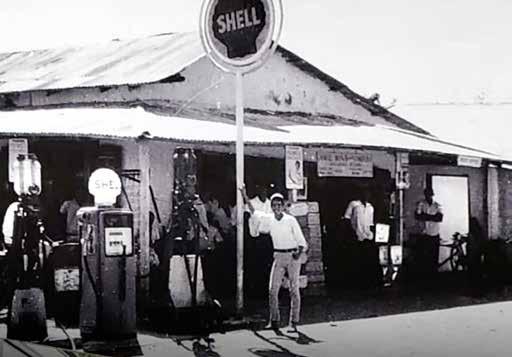
the back yard of duka #12 and communicated the same message to Mr Madat, who took his advice. The two traders escaped into the tall standing crop of maize.
Mrs Kurji gathered all her terrified children in one room about her, and tried to calm them down. The oldest of the children with her was her 10-year-old son Kasu. Soon they heard people breaking down their back door. In rushed four men, one with a gun and three with pangas. They threatened to kill Mrs Kurji and her children if all the locks were not opened including the safe. They asked her where her husband was, to which she replied that he had gone to Musoma.
As Mrs Kurji looked after the small children, her son Kasu opened the safe and the locks after Mrs Kurji handed him the keys. The bandit leader, an intimidating and violent man, grabbed Kasu and shoved him towards the safe. When Kasu opened the safe, they found a pile of cash in coins, with one 20-shilling bank note, which he handed to the bandit. Kasu was relieved that there was little money in the safe, as the day before his father had gone to Musoma town and deposited his money in the bank. The disappointed and furious bandit then kicked Kasu very hard in the thigh making him gasp and cry out in pain. He staggered and fell to the floor.
The young boy picked himself up and limped into the shop, shoved ahead by the bandit. The bandits opened one of the front doors and started looting all the goods they desired and carrying them away to their truck. They first went for the stock of cigarettes and the beer crates, before taking all the bolts of cloth and other items of from the store. When they had finished robbing all they desired, they told the boy to lock all doors and stay in their room. If he tried to look out or call for help, they would return and kill them with their pangas.
Having looted all the stores of cash and goods by about 2 am, the bandits drove off into the night. None of the traders had dared to go out to the street during the robbery. As the sound of the truck faded away, the people who had escaped into the fields made their way back cautiously to their dwellings. A very anxious Mr Kurji entered his house from the back, shivering from exposure, his wet clothes clinging to his body from sitting out in the maize field. He reunited with his distressed family. He changed into dry clothes and after
reassuring his family, he proceeded to assess the damages. He was very relieved to discover that the bandits had not found his side-by-side shotgun which had been hidden in one of the cupboards in their living area. During British colonial times gun licenses were very strictly controlled, and it would have created a major headache if it had been stolen. By the time the shock of the incident wore off, it was almost dawn, so he went outside to check on his Peugeot 403 using his flashlight, as the town would have to get the news of the holdup to the police at Musoma. He discovered that the tires had been punctured and the headlights smashed. He realized it would be a while before they could get the news to Musoma.
At dawn the town came alive as people checked with their neighbours and took stock of their losses. They also learnt about Andrea’s death from bravely resisting the bandits and injuries suffered by Sadru Nazerali. They also realized the security guard’s warning had likely saved the lives of Mr Kurji and Mr Madat. Had they stayed at their dukas when the bandits had broken in, they would very possibly been injured or killed. The thinking was that the bandits would be less likely to do violence to a woman and her small children. This was proven by the outcome as a man who resisted had been killed, another had suffered injury to his face while 10-year-old Kasu had suffered a violent kick to his thigh. They also spotted the depression that the dynamite made near the petrol pumps. It was incredibly fortunate that the petrol pump did not ignite or it could have been a bigger disaster.
The most urgent thing was to report to the police and get help. Mr Kurji set about mending the punctures and by 9.30 am Mr Kurji and Mr Madat drove off for Musoma.
Arriving in Musoma around 10.30 am they drove to the police station, after stopping on the way by my dad’s office for a few minutes— he was their lawyer— to get his advice before proceeding to file a report. That morning I was standing on the veranda at Jaffer Vira’s store next to my father’s office, and spotted Mr Kurji accompanied by Mr Madat looking haggard driving his Peugeot 403 boxbody with its smashed headlights, as he took the Wakili Sandhu keep-left (roundabout) opposite my dad’s office. Soon after the police from the CID—the Criminal Investigation Department— mobilized and set off for Mugango. They
investigated the scene of crime, took statements from the townspeople, and brought back Mr Andrea’s body for the postmortem to be done by the coroner at the Musoma Hospital.
One of the biggest clues that the police had was the very unusual use of dynamite to terrorize the inhabitants of Mugango. In those days, dynamite was a very controlled substance with rigorous documentation and accessible to very select users. The main users in Mara Region were the gold mines. The CID planted officers at the nearest active goldmine, which was the Tangold mine at Kiabakari. They shadowed the miners who had access to the dynamite while keeping a lookout for stolen goods being disposed off. Kiabakari was the ideal place for selling cigarettes and beer to the miners who had ready money. Before long they arrested two men, one of whom had working access to the dynamite. When they searched the miner’s dwelling, they discovered goods and boxes which had Mr Kurji’s name stenciled on them. One of the two men was wearing spectacles, a novel item for the average country person at that time. This aroused the CID officer’s suspicions, for he had observed that the spectacles had thick prescription lenses. On further investigation they turned out to be Mr Kurji’s prescription glasses that had been looted by the raiders. In those days the illiteracy rate was greater than 90 percent. As a result, there was a belief amongst some of the people that wearing eye-glasses conferred a higher status and the airs of a literate person. Consequently, many people including a few politicians wore spectacles with plain glass lenses just to enhance their status amongst country people.
The two men were tried at the Musoma High Court. The 10-year-old Kasu had to appear in court, to positively identify the men. In court he had to make eye contact with the criminals who had traumatized him, his family, and murdered Andrea, a family-man who ran his father’s second shop. It took a lot of courage for a young boy to do this while faced with the glaring countenance of the man who had ruthlessly kicked him and robbed his family’s livelihood. In spite of his fear, he identified them as the same men who broke into their house and forced him to open the safe. He also stated that he had seen one of the men in their shop earlier during the day before the robbery, presumably scouting out the town
and the shops. He showed the large blue-black bruise on his thigh to the Judge, where the man had kicked him. Other townsmen like Sadhru also identified the men as being the same who broke into their dukas. The prosecution was able to prove its case and both men were given long jail sentences. The sentenced men never divulged the names of the rest of the gang, so the majority of the robbers were not found and tried. Most of the stolen property was never recovered.
At the time of this story Mugango was an isolated frontier settlement. The after effects of this robbery and murder lasted a long time. The injuries healed soon enough, but the psychological trauma to the children and adults took a very long time to heal, especially Andrea’s family, who had lost a husband and father. Both the Premji families had to move to Musoma and start from scratch. Pyarali Premji was left broke with a family to support. He gave up being an independent duka owner and took up employment in Musoma at Nanakchand’s as an accountant. Sadhru’s facial injury healed leaving a scar, which he grew a mustache to conceal.
The appalling armed robbery and murder reminded me of some cowboy movies I had seen as a child, where gangs held up the isolated single-street clapboard towns in the Wild West. At the time of this event Tanganyika was still a frontier country and small towns in the bush, far from the long arm of the law, were vulnerable. The situation has changed dramatically in the last 65 years, particularly with the arrival of cell phones and boda bodas (motorcycle taxis). Mugango is no longer a remote town. Mugango has grown from a few dukas along a remote stretch of road, to a town with a population of 10,500 people - and a police station!
Acknowledgement: I would like to thank Kasu Kurji for answering my questions about his firsthand experience when the bandits broke into their duka and the late Mr B S Sandhu for providing me information on what happened after the incident. I would also like to thank Ravindra Patel, Mansur Premji, Diamond Jiwani, and Riyaz Jiwani for answering my questions.
by Ken de P Beaton
The Nairobi National Park began in 1946. Ken de P Beaton, the first warden, published a weekly diary in the East African Standard newspaper in 1949, later published as two books. Ken’s son Ron recently shared those books with Old Africa. His diary entries give a flavour of what the park was like in its early days.
12 March 1949 On February 24, the first wildebeest calves of the season were born in the park. Since then they have been arriving in numbers. They are earlier this year than last, when the first calves were not recorded till late in March. This must be a result of the good rains last year, which made the 1947 “spring” earlier than usual.
In contrast to the rather ungainly appearance of the adults, the newly born calves, with their reddish-brown, furry coats and black heads, are attractive sturdy little animals. A few hours after birth they are able to gallop at speed, and can easily keep pace with their mothers. This is a sound provision of nature, as everywhere
prowl jackal and hyaena only too ready to take their toll of newly born game.
I have said the adults are unattractive, but I saw recently a cinefilm, taken in slow motion, of wildebeest on the run. Nothing could have been more fluid or graceful than their action. They were as pleasing to watch as thoroughbred race horses.
The Maasai and other pastoral tribes will not graze their herds of cattle over areas where wildebeest are calving. They say the grass is poisoned and that the fine hair licked from the calves by their mothers gets into the stomachs of the cattle and forms hair-balls.
As far as my records go, wildebeest seem to be the only species of the order Artiodactyla that give birth at a certain season. All the other species appear to drop young all the year round, although the greatest number of youngsters are in evidence during the two rainy seasons. At the moment there are many young of eland, hartebeest, impala and waterbuck.
The waterbuck in the park have increased
greatly during the past year. They are numerous all along the Athi River. There are herds in the forest and near Kingfisher gorge. This part of Kenya is the only place where the two species of waterbuck - defassa and ellipsiprymnus - are found in the same locality. They intermingle, and I am sure they interbreed as variations of the two species are often seen The chief distinguishing feature between the species is that the first have a white patch on their behinds, while the second have an eliptical white stripe on the rump.
In the Lorian swamp area of the NFD there occur a number of albino waterbuck. They are so common in this restricted area that they almost constitute a distinct species although they are by no means all white. The albinos are only common among herds of normally coloured individuals. I do not know whether the eyes are pink or not.
The waterbuck is, in my opinion, one of the grandest of our antelopes. Seen on the alert, with their proud and handsome carriage against a background of forest, they make a picture that is not easily forgotten. They are seldom found far from water and are strong swimmers. I have watched them coming down to drink at the Athi and they always choose a spot where the water runs shallow. They avoid
the deep pools knowing well the danger of the ever-lurking crocodile.
I have been unpleasantly occupied during the past week, prosecuting offenders in the Resident Magistrate’s court. Two of these were dismissed with a light fine, as they pleaded that they had only been in the country a short time and had not seen all the publicity which has been given to the regulations. The Resident Magistrate warned the court, however, that he would deal severely with any offenders he considered ought to know better. He has also taken the trouble to visit the park to see for himself the number of warning notices which cannot escape the eyes of visitors.
I was following a car one evening which was overflowing with a large Asian family. Suddenly one of the back doors flew open and a little girl of about six years of age fell out into the dust. As the car was travelling fairly fast, I jumped out of my truck to help her, thinking she must be hurt. The father soon arrived on the scene. The child was unhurt, and the gentleman was profuse in his apologies for having broken a regulation in allowing his daughter to alight from a vehicle when not at a stopping place.
by Shel Arensen
In Old Africa wisdom from the elders was often passed on to the next generation through stories told around the fire in the evenings. There is a wealth of oral tradition and this column will collect the best of these stories. If you have a favourite folk tale that you would like to see published in Old Africa, send your contribution to: editorial@oldafricamagazine.com
Long long ago, a squirrel and a lion became the best of friends. The lion invited the squirrel to share the protection of his den and gave the little squirrel left-over scraps of meat after he went hunting. In exchange, the squirrel tidied the den and kept everything nice for the lion.
But after a while the squirrel began to feel sorry for himself. The lion went out on exciting hunting expeditions while the squirrel stayed home sweeping and dusting. The lion ate the biggest share of the meat – ‘the lion’s share’ -- while the squirrel only got the scraps. The squirrel forgot about having a safe, snug cave to live in. He forgot about the years before he’d met the lion when he’d often experienced gnawing, gut-tightening hunger. The squirrel forgot all the good things he had and dreamed about what he didn’t have. He thought about eating big juicy steaks instead of ears and tails. The squirrel became ungrateful, bitter and crabby.
He complained to the lion about the hard work in cleaning up the den. “You’re always leaving hair clumps from your mane all over the place,” the squirrel whined one day. “You snore when you sleep, you stink the place up with your rotten-meat belches, and I never get enough to eat.”
The lion eyed his little friend. “You don’t get enough to eat?” he queried.
“No, I don’t!” the little squirrel pouted. “I’m sure the reason I’m so small is because you never give me enough to eat. Why, I’ll bet I could eat a whole impala if I ever got the chance.”
The lion snarled in anger. “You ungrateful little squirrel! Tomorrow I’ll kill an impala and
Text © Copyright Shel Arensen
bring you the whole animal. If you finish the meat, I’ll apologize and give you a larger share of the meat in the future. But,” the lion paused for emphasis, “if you can’t eat the whole impala, then I will kill you because of your whining, complaining attitude.”
The squirrel gulped. But he stared back at the lion and taunted, “Bring on the meat!”
“Tomorrow morning,” the lion roared, “I’ll kill an impala by the water hole and then sit and watch you eat until you pop. You’re so scrawny, you’ll never eat a whole impala.”
“I’m only tiny because you never feed me enough!” the squirrel shot back. “Just watch how much I can eat tomorrow.”
That evening as the lion slept, the squirrel sneaked out of the den and called all the other squirrels in the area. “I need your help,” he said. “Everyone gather under the fallen acacia tree by the water hole tomorrow morning and I’ll tell you what to do.” All the other squirrels agreed to help.
The lion woke up and stretched in the dark hours before dawn the next day. Then he prowled through the curtain of blackness and crouched by the water hole. When a young impala buck skittered up to drink, the lion pounced. He dragged the dead impala away from the water hole and called the squirrel. Leading the squirrel back to the impala, the lion settled down and told him, “Go ahead and eat. And remember, if you don’t eat the whole thing, that will be the end of you.”
The squirrel nodded and started nibbling at the meat. He soon became full. The lion licked his velvety black lips, revealing sharp meatstained fangs. “Are you full already?” he asked.
The squirrel burped politely, which is the custom in Africa, and said, “All this meat is making me thirsty. I need to go to the water hole for a drink. Then I’ll come back and eat some more meat.”
The lion agreed. The squirrel scurried down to the fallen acacia tree by the water hole and found all the squirrels waiting for him. “The lion expects me to eat the whole impala,” the squirrel explained in a whisper. “But I’m
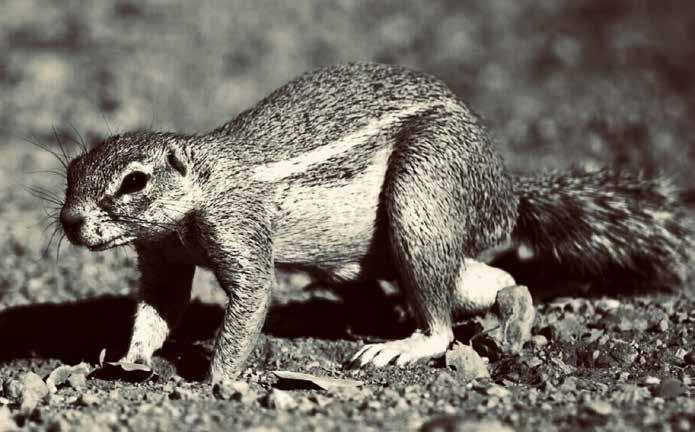
already full and I’ve barely started. So now it’s someone else’s turn. Go on up to where the lion is guarding the dead impala. Eat as much meat as you can. Then tell him you’re thirsty. Come down here and we’ll send up the next squirrel.”
The next squirrel went up and ate. When he was full, he asked permission to get a drink and when he reached the fallen acacia tree, he sent up the next squirrel. Then the next. And the next. The squirrel’s plan worked. The lion couldn’t tell the difference between the squirrels and was amazed at the amount of meat being eaten. The lion began to wonder if he hadn’t really starved his little housekeeper and began preparing an apology. Only one small scrap of meat remained when the squirrel who was eating said he needed a drink and waddled down to the water hole. They sent up the very last squirrel to finish off the meat. However, the last squirrel had bad eyesight and a poor memory. The others had to tell him about ten times what to do. “Finish off the meat, finish off the meat,” the last squirrel repeated to himself. He squinted to see the path and set off to look for the final piece of meat. But he couldn’t find it.
The lion saw this squirrel with furrowed eyebrows as he wandered back and forth muttering under his breath, “Finish off the meat, finish off the meat.” The lion worried that
maybe all the meat had affected the squirrel’s mind and he got up to help. The squirrel sensed the movement and swerved towards the lion and bumped into the lion’s leg. Looking up into the lion’s broad, whiskered face, the squirrel asked, “Oh! It’s a lion. Please, mister lion, can you tell me where the impala meat is that the rest of the squirrels have been eating? I’m supposed to finish off the meat.”
The lion roared in anger when he realized he had been tricked. He bounded down to the water hole. The squirrels stopped chuckling at their wonderful trick and feared for their lives. But they’d all eaten too much, their bellies dragged, and they couldn’t run for the trees. So they dug holes in the sandy soil and hid themselves from the angry lion. Which is why African ground squirrels live in holes instead of in trees.
This fun tale also points out the importance of giving thanks. When we forget to be thankful, we become ungrateful, complaining people. When we forget what God has done in our lives, we complain and worry and live miserable, selfish lives. And the consequence might leave us like the ungrateful squirrel –living in the dirt!
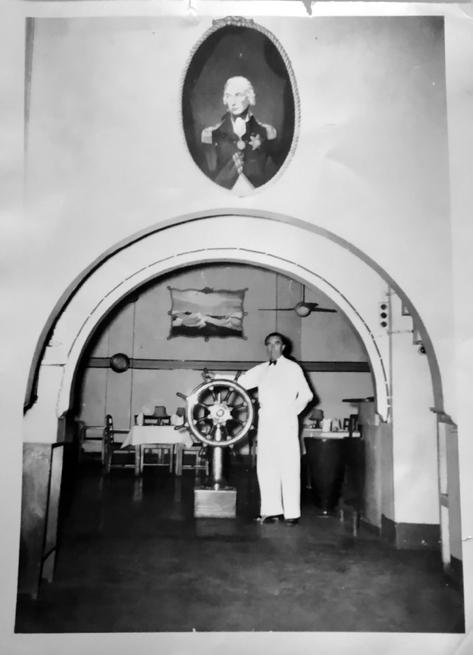
Per Akesson of Mombasa is the winner of our Historic Photo Contest for this issue. He sent in this photo of Nelson Restaurant on Kilindini Road in Mombasa, with its ship’s wheel as part of the decor. The restaurant was managed by T Colombo. The photo dates back to the 1950s. Younger residents of Mombasa might have no memory of this restaurant, but one of Per’s friends, in his 80s, took one look at the photo and named the restaurant and its location.
Per wins a free book prize from Old Africa
Old family albums hold many treasures. Enter one of your photos in our Historic Photo Contest and win a free book from Old Africa! And have the pleasure of sharing your photo with Old Africa readers around the world.
If your photo is chosen as a winner in our Historic Photo Contest, you will win a free book from Old Africa.
The best way to send a photo to Old Africa is to have it scanned as a jpeg file of 300 dpi resolution and email it to us at: editorial@oldafricamagazine.com Note on your email that you want this photo entered in our Historic Photo Contest.
If you don’t have access to a scanner or to email, you can mail your photo or photos to us at: Old Africa, PO Box 2338, Naivasha, Kenya 20117.
Old Africa reader Jeremy Ng’ang’a from Nairobi is the winner of our History Quiz 85, which appeared in Old Africa issue 121 (October-November 2025). By the contest deadline we received 12 entries. All 12 names were put into the Old Africa pith helmet and swirled around. Jeremy’s name was chosen out of the hat and he wins two nights for two at Satao Camp. If you didn’t win this time, have a go at Quiz 86, which follows below. This month’s History Quiz Contest is sponsored once again by Satao Camp and Old Africa is thankful for their support and willingness to sponsor this page.
History Quiz Competition #86!
Win two nights for two at Satao Camp!
How closely did you read this issue of Old Africa? Answer the ten questions in our history quiz below and you have a chance to win a vacation at Satao Camp. All the answers are found in this issue of Old Africa. Send your entry along with your name and address and phone number to: History Quiz, Old Africa, PO Box 2338, Naivasha, Kenya 20117. Or you can email your list of answers to editorial@oldafricamagazine. com The winner will be randomly chosen from all the correct entries received by the contest deadline, which is 10th January 2026.
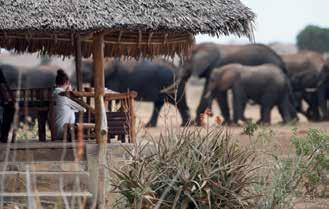
1. Who was the lion’s roommate?
2. Where did Tony Church first farm when he came back to Kenya in 1964?
3. In what National Park did a stone kicked up by a passing lorry break the windscreen of John Cosgrove’s Roho?
4. The headdress that Maasai boys wear between circumcision and warriorhood is made out of what material?
5. What kind of tractor is parked in front of the Karen Blixen Museum?
6. In what river was the Königsberg hiding when the British sank it in World War I?
7. What is the Kikuyu word for leopard?
8. On what island did Arthur Loveridge die?
9. Can a scorpion survive for a year in a matchbox without food and water?
10. What cargo was the Globe Star carrying when it ran aground on the Leven Reef?

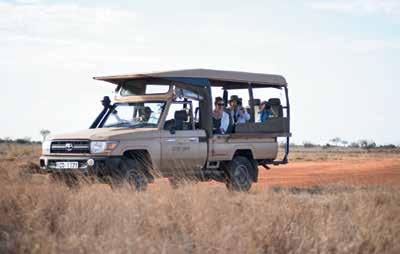
Wake up to the sight of elephants at our waterhole, unwind in spacious tents, and immerse yourself in the beauty of Tsavo East National Park. Located in one of Kenya’s largest and most iconic parks, Satao Camp offers:
Unbeatable Wildlife Viewing: Spot elephants, impala, lions, and more right from your veranda or observe from the camp watchtower.
Authentic Tented Comfort: Relax in beautifully designed en-suite tents that blend comfort with the charm of the wild.
Stunning Landscapes: Explore vast savannahs with iconic amber sands and the untouched beauty of Tsavo East.
Book your adventure today


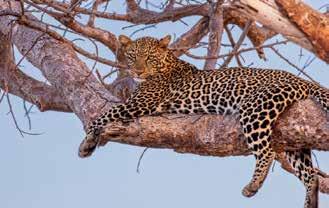
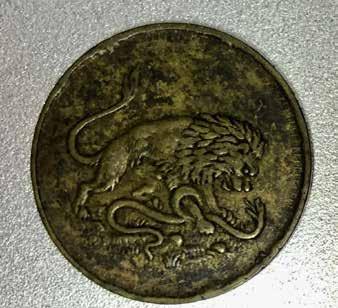

This token or coin is a mystery. On one side it reads: Societa Coloniale Italiana with the name Entebbe in the centre. The other side shows a lion grasping a snake. But there is no date on the coin. You can win a Ksh 3000/- gift certificate from Text Book Centre by identifying the date and the purpose of this token, which seems to commemorate some event. If you know when this coin was issued, or have any information about the inscription, or if you have any personal connection to this mystery token, send in your answer to Old Africa for a chance to win our History Mystery Contest.
Contest Deadline: For this prize we have to receive your entry by 10 January 2026.
Send your answer to this History Mystery Contest along with any information, history, memories or stories about this coin to: History Mystery Contest, Old Africa Magazine, PO Box 2338, Naivasha, Kenya 20117. Or email your answer to: editorial@oldafricamagazine.com. Editors will choose the winning entry. The answer to our mystery contest will be announced in our next issue along with the name of the winner and his or her story about our mystery location. Family members of Old Africa staff members are ineligible to enter this contest.
Our History Mystery Contest is sponsored by Text Book Centre.
…much more than a Bookshop!
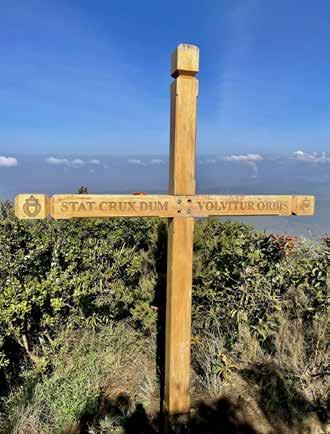
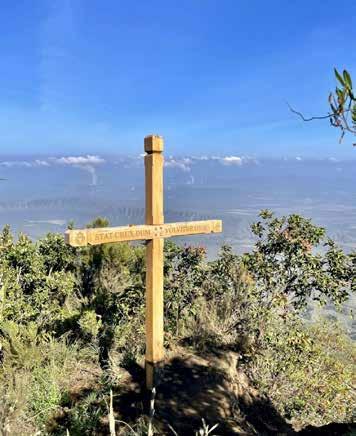
We did not receive any correct answers to our History Mystery Contest by the deadline of 4 November 2025. The photos show a wooden cross erected near the top of Mount Longonot. Thanks to Dr Peter Beard of Kijabe and Australia who shared the photos. He spearheaded a group of well-wishers who have restored the foundation of the cross, which was in danger of falling over. We are not certain who first erected the cross.
The Latin phrase carved on the cross states: “Stat crux dum volvitur orbis.” That translates to: “The cross stands while the world turns,” and it is the motto of the Carthusian Order, a contemplative order of the Catholic Church. In an interesting parallel, the same phrase is carved in the cement lintel on the front of the small memorial Catholic Chapel at the base of the escarpment road in the Kedong Valley, which was built by Italian Prisoners of War after completing the construction of the road in the 1940s.
Even though we did not get a winner to this History Mystery Contest, if any reader does know the answer to who put this cross up and when, please contact us so we can share that with the rest of the Old Africa family.
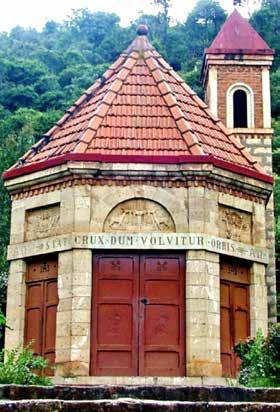
1. Guy Repton proudly displays the Household Brigade Cup, a horse racing trophy that he won.
2. Guy Repton and his Russian wife ‘Doushka’ bought the Cape Dutch house at Kitimuru coffee farm in Thika from Jos and Nellie Grant.
3. Jockeys pose for a prerace photo at the 1928 race weekend in Nairobi attended by the royals on safari. Left to right: Guy Repton, Marc Lawrence, Bluey Wells, Captain Vernon, Harry Walters, Tommy Forsyth, Sonny Bumpus, HRH Edward Prince of Wales, Henry Tarlton, Ted Hamlin, HRH Henry Duke of Gloucester, Ted Banham, Sawers, Joe Mulholland, Dick Ussher and Geoffrey Baynes.
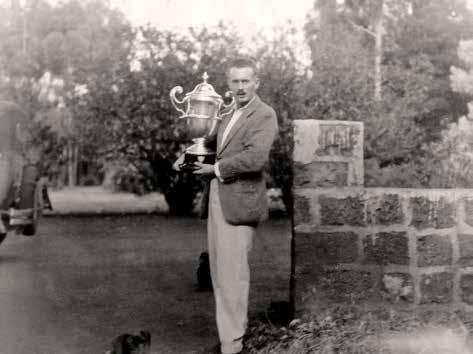
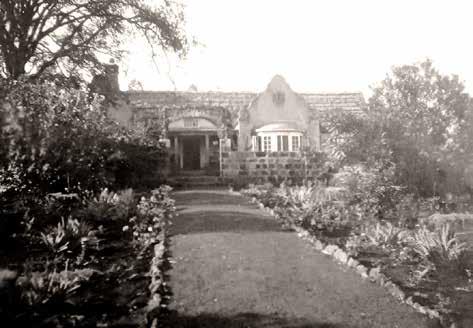
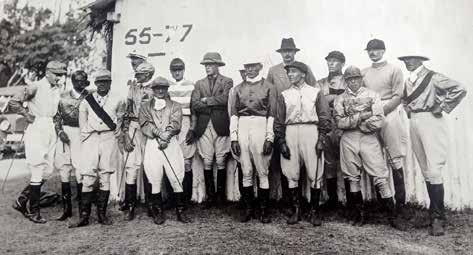
Matt McIlvenna from Nairobi shared the photos featured in our Old Africa Photo Album this issue. He writes: “Those photos are from Guy Repton’s own photo album which I came across in a sale in Norfolk! The Reptons bought Kitimuru from Elspeth Huxley’s parents (Jos and Nellie Grant) in Thika.” Guy Repton owned horses and was a ‘gentleman rider,’ often riding his own horses at the old Nairobi racecourse. His wife ‘Doushka’ was a Russian refugee and former wife of Jack Soames. When the Prince of Wales and his younger brother the Duke of Gloucester visited Kenya in 1928, the royals participated in the Nairobi races. These photos date from that event
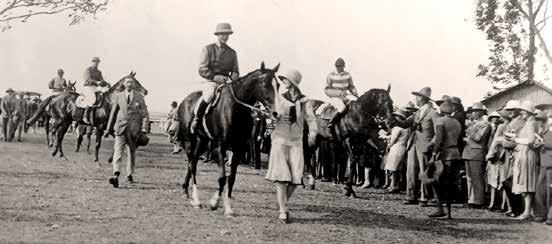
4. Beryl Markham leading HRH Edward the Prince of Wales on Cambrian, a horse Beryl owned with her husband Mansfield Markham.
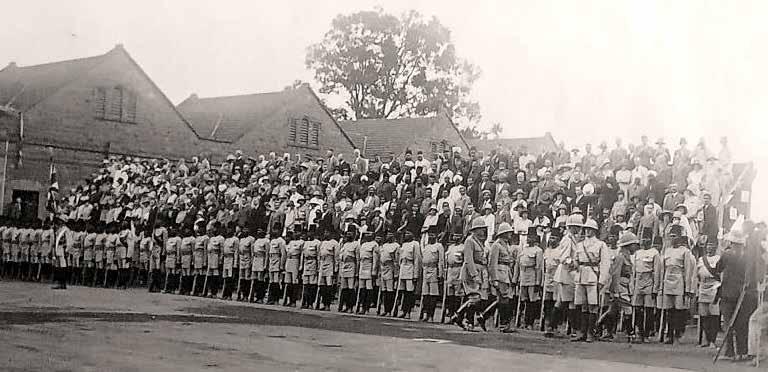
4 5 6
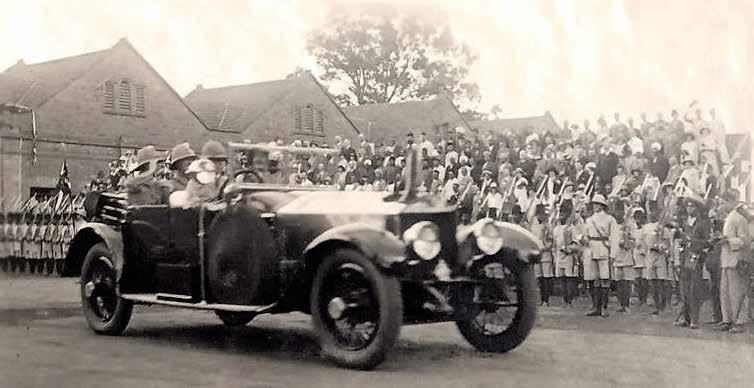
5. Troops from the King’s African Rifles keep order in front of the Nairobi Railway Station while a grandstand filled with spectators greets the royal visitors in 1928 – HRH Edward the Prince of Wales and his younger brother HRH Henry Duke of Gloucester.
6. The royal brothers greet the crowd as they drive away from the Nairobi Railway Station.
Life and Times of the Mara Cowboy
By Tony Church
Reviewed by Old Africa
Tony Church has written a cracking memoir. He starts with his childhood on the slopes of Mt Kenya, goes on to describe his experience in boarding schools and then tells about his time training to be a policeman in Rhodesia. When the opportunity arises, he returns to Kenya to farm before stepping out to start a safari guiding business. He quickly adds horse riding to his itineraries, gaining the nickname of ‘the Mara Cowboy.’
The book begins with Tony’s father coming to Kenya as a CMS missionary in 1932 and includes this scene from his parents’ wedding day in 1935 as they headed out to the Rift Valley for their honeymoon. “On reaching the bottom they found the Kedong River in flood… Would they have to spend their first night of their honeymoon bedded down in the back of their box body car? However, the next car to arrive was none other than Jack Hopcraft followed by other wedding guests returning to their farms…He tied a long rope to the bumper bar and waded across the swollen river, attaching it to a tree on the other side. He then waded back, took the wheel of my parents’ car, put it into first gear and roared into the muddy waters of the Kedong. The rope kept the car from being swept down-stream.”
Tony was born in England in 1938 while his parents were on a furlough. His mother barely got him back to Kenya as a twomonth-old before World War II broke out. Tony’s parents moved to Kigare CMS mission station, about five miles from Embu. Tony writes: “This was our home for the next seven years and the place of my earliest memories.”
One of those early memories was learning to fish for trout from his father. Tony has many stories about sports, pranks and dorm life in various boarding schools (he attended Turi, Kenton and then Prince of Wales). Tony’s parents instilled in him a love for Kenya. “Dad and Mother loved going on safari. They introduced the four of us - Colin, Jeremy,
Angie and myself - to many wild places in beautiful Kenya.”
As a teen Tony and his brother Colin rode their horses among herds of game animals on the Athi Plains. Just as Tony was finishing his education at Prince of Wales, his parents had to return to Britain in 1956. Tony finished the term and then was recruited into the Kenya Regiment, as the Emergency was still in force. But after his training, Tony got a place in university in England, but he didn’t complete the course. After a sojourn teaching at a school in Canada, Tony ended up in the Rhodesian police force. But he was homesick for Kenya and he returned to Kenya in 1964 to run a farm in Nandi Hills.
Tony’s love of Kenya led him to start his own safari company to share his insider knowledge with others. The book is filled with danger and adventure. After saving a client from a crocodile’s mouth in Samburu, Tony finds himself having to defend himself for the incident in court in Maralal. Lions leap over the fence around Nairobi National
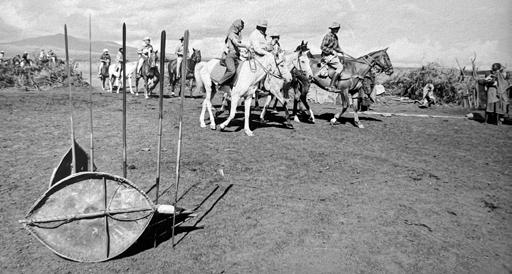
Top: Tony Church leads a horseback safari through a Maasai boma near Longonot.
Bottom: One of Tony Church’s riding safaris has a close encounter with a male lion.
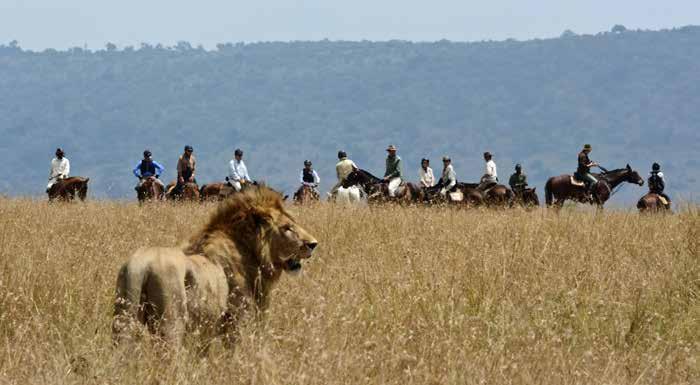
Park and attack his horses. He and his clients encounter elephants on horseback. The book also shows the ups and downs of operating a business in East Africa. When the East African Community breaks up in 1977 Tony finds most of his small fleet of vehicles in danger of being impounded in Tanzania. Tony makes trips to the United States to recruit clients, developing special friendships. From his first horse riding route from the Ngong Hills to Naivasha, Tony learns how to negotiate with local Maasai for passageway for his horses. Tony also tells of his struggle to set up and enforce good conservation practices around the Mara.
Stepping Out is a great read and told by someone who wouldn’t live anywhere else. The 396-page book also has a good selection
of photos. Available in Kenya directly from the author (for details contact tony@samawati. co.ke ) Also available on amazon.co.uk for £21 or on amazon.com for $30.
Arthur Loveridge, the first Curator of the Nairobi museum, died on 16 February1980, at the age of almost 89. After Nairobi Loveridge went on to be the Curator of Reptiles and Amphibians at the Museum of Comparative Zoology at Harvard. On his retirement he moved to the island of St Helena in the South Atlantic where he died after a short illness.
Born in Penarth, Glamorgan, Wales on 28 May 1891, Loveridge was 33 when he came to the Harvard Museum. He had already been Curator in Nairobi and served in museums in Wales and England. As he reports in his memoir Many Happy Days I’ve Squandered, he said he decided to become a Museum Curator at the age of ten. In 1914 he applied for the newly created post of Curator at the Nairobi Museum. He had taken a year’s course in Zoology and Botany in the University College of South Wales on the way to appointments at the Manchester University Museum and then in the Temporary Museum in Cardiff.
While in Cardiff making a card index of the whole British Fauna (about 23,000 cards), he heard of an open position in Africa. Although he already had a private collection of “nearly 250 jars of preserved reptiles and over 300 glass topped drawers containing birds’ eggs, insects and other specimens,” he was always avid for more. When he heard about a civil
engineer from British East Africa home on leave who “had in his youth shown a fondness for snakes,” he tried to persuade the man into collecting for him promising to give the man some postage stamps if he would pickle lizards and snakes. When Loveridge wrote to the man six months later to hear if he had collected any specimens, the engineer replied with the news that the East Africa and Uganda Natural History Society needed a curator for a new museum that would have government support. “Why don’t you apply for the post and then you can collect your own bally snakes!” Loveridge applied at once, was accepted, and arrived in Nairobi in mid-1914.

World War I very soon cast its shadow over Africa, but it did not interrupt Loveridge’s career as a naturalist. He joined the local forces shortly after his arrival and was soon on active duty. Even though he faced the occasional moment of danger, the memorable events for him were the capture of a rare animal. He tells about catching his first Boulengerula boulengeri, an amphibian endemic to the Usambara Mountains: “This rare Caeclian was obtained under rather unusual circumstances during the East African campaign. We were busily engaged in ‘digging in’ under an unpleasant shellfire, when it was unearthed by one of my fellow troopers in the Mounted Rifles. He humourously called out that one of my snakes had escaped and that, if I did not
This cartoon of Arthur Loveridge appeared in a newspaper in East Africa. Note the snake in his pocket!
come over and take charge of it at once, he would run his bayonet through it. Needless to say, when I saw what it was, I very gladly took charge of it.”
His passion for collecting when travelling through German East Africa from north to south was aided when: “All necessary preservatives and pickling jars were ‘found’ in captured German towns.”
Loveridge had a few years after the war ended to set up Nairobi’s fledgling museum. Then in 1924 he went to the United Sates where he was appointed by the Faculty of the Museum of Comparative Zoology in Harvard University to the position of Associate in Zoology in the Harvard University Museum. He spent the next 33 years there until 1957. He began by reorganizing the Museum’s herpetological collection and then, when Barbour was appointed Director of the Museum, continuing to supervise with surpassing care and later expanding it to become of one of the world’s great collections of reptiles and amphibians.
Despite being in the United States, Loveridge’s heart remained in the continent of Africa where he had spent almost ten years. There he had met his wife, and there he had indulged to the full his passion for collecting and for general natural history that had consumed him since childhood.
Before being hired at Harvard, Loveridge gifted some of his specimens to their museum. And when he came in 1924 he brought his entire collection and was the Curator as well. The
other side of Loveridge’s passion for collecting was his insistence on order and tidiness. All the specimens had to be perfectly classified, ticketed, and properly stored. He was in charge of a major but crowded, ill-labelled, ill-organized gathering of collections. He transformed it into a model of collections. He took frogs, snakes and lizards out of tanks and put them in fine glass-stoppered bottles with labels written in hard pencil in his own neat hand and carefully arranging them within trays, each with neatly typed labels. His collection, when he finished, was a thing of beauty. And he fiercely kept it that way.
The element of fanaticism in Loveridge’s neatness evoked legends. There is a tale in the Department of a drawer labelled “string too short to use.” His neatness and routine were at times extreme. Books had to be put back. Loveridge told his assistants that gaps on the bookshelves were to him like teeth that had been knocked out. Even the chairs had to be in correct positions under the counter. I was reprimanded one Monday, when, working over a weekend, I left all three chairs improperly aligned!
During his first years at the Museum he travelled back to Africa to indulge his favourite past time – collecting. His trips enriched the Harvard collections and provided for himself the study material he needed. Clearly this had been part of the understanding that went with the Harvard appointment. He did general collecting, not only herpetological collecting.
Loveridge was something
of a public figure, giving lectures, writing articles for “Fauna,” “Frontiers,” and “Natural History” and in 1928 he gave a series of 20 lectures for the Boston Society of Natural History on Boston’s WBET radio entitled: “Tales from Tanganyika.” He made the “Who’s Who” list in 1938. By 1942, the number of species and subspecies in the collection surpassed 6,000. The Department had to be enlarged, and a new room was taken over for snakes. But when the United States entered World War II in 1941, the Museum’s activities were curtailed. In 1942-1943 only 400 specimens were catalogued. Loveridge’s own collecting suffered and he only made one more African trip.
Decreased curating and collecting gave Loveridge time to write a number of books. Many Happy Days I’ve Squandered (1944) was the first. Tomorrow’s a Holiday succeeded it in 1947, then I Drank the Zambesi (1953), and Forest Safari (1956). His books all included highly entertaining accounts of his African experiences.
Loveridge made the last African expedition of his Harvard career to Nyasaland and Tete in 1948-1949. After this he devoted himself to a summary of East African herpetology, culminating with the East African Check List published in the year of his retirement, 1957.
I collaborated with him on one paper on “The Cryptodira of Africa,” published in 1957, the year I succeeded him.
Loveridge left Cambridge in 1957, immediately after his retirement, for the island of St
Helena in the South Atlantic. Although he did visit England, and I once saw him in the British Museum, he never returned to the United States. It is not known why—perhaps because the collection was no longer his in the special sense that it had been for 33 years.
In St Helena he kept up an intense interest in both African herpetology and the Museum and in collecting. His letters of 1958 are full of impatience to get the tubes to collect St Helena spiders. His correspondence began as he sailed on the ship to the island, and he soon started numbering his letters. He’d written 2,472 by early 1965, and he had written almost 7,000 at the time of his death. He was a punctilious writer, always answering a letter, but always insisting also that his letters be answered before he
would write again. He travelled also and at least once collected again in Africa—a small collection— Chamaeleo, Mabuya, and frogs from Mau Narok at 9,000 feet in Kenya, which he donated to the Museum. His most interesting paper from his ‘exile’ on St Helena may be unique in herpetology: his own report, published at his own expense, on “The status of new vertebrates described or collected by Loveridge.”
His wife died suddenly on St Helena in 1972. His son Brian joined him on the island four years later. In another four years Loveridge himself was dead.
Loveridge’s fanatic passion for his collection astonished is colleagues. But attention to detail is a good thing in a curator, and certainly the Museum was well served by Loveridge’s devotion.
The organization of the herpetology collection was his and his alone. When I took over the collection, all was in perfect shape. The collections he so diligently curated are his enduring monument.
Though Loveridge served in a University Museum, he was in no sense an academic. He belonged to another generation and another lifestyle—he was pre-eminently a collectornaturalist. He wrote: “Probably only a zoologist can look at an uncaught cobra and feel the joy a child feels on Christmas morning.”
Excerpted from an obituary by Ernest E Williams that appeared in the journal Breviora from the Museum of Comparative Zoology at Harvard University, 30 June 1982 Number 471.
Has someone “borrowed” some of your back issues? Or do you know someone who would enjoy reading back issues of Old Africa?
Years 1 & 2 (Issues 1-12) are now sold out!
To Kenyan address Overseas address
All Other Years (6 issues) Ksh. 1000/- Ksh. 1800/-
Please make cheques or money orders out to Kifaru Educational & Editorial and mail to PO BOX 2338 NAIVASHA, KENYA 20117.
Mpesa payments can also be made to: MPESA BUY GOODS #89867
Please make sure to follow up with a text or email stating what the payment is for and shipping address if applicable
If you are overseas you can pay with a credit card at https://oldafricamagazine.com/donate




We hope you enjoyed this edition of Old Africa. Please consider a donation to help us keep the stories coming.
www.oldafricamagazine.com/donate