
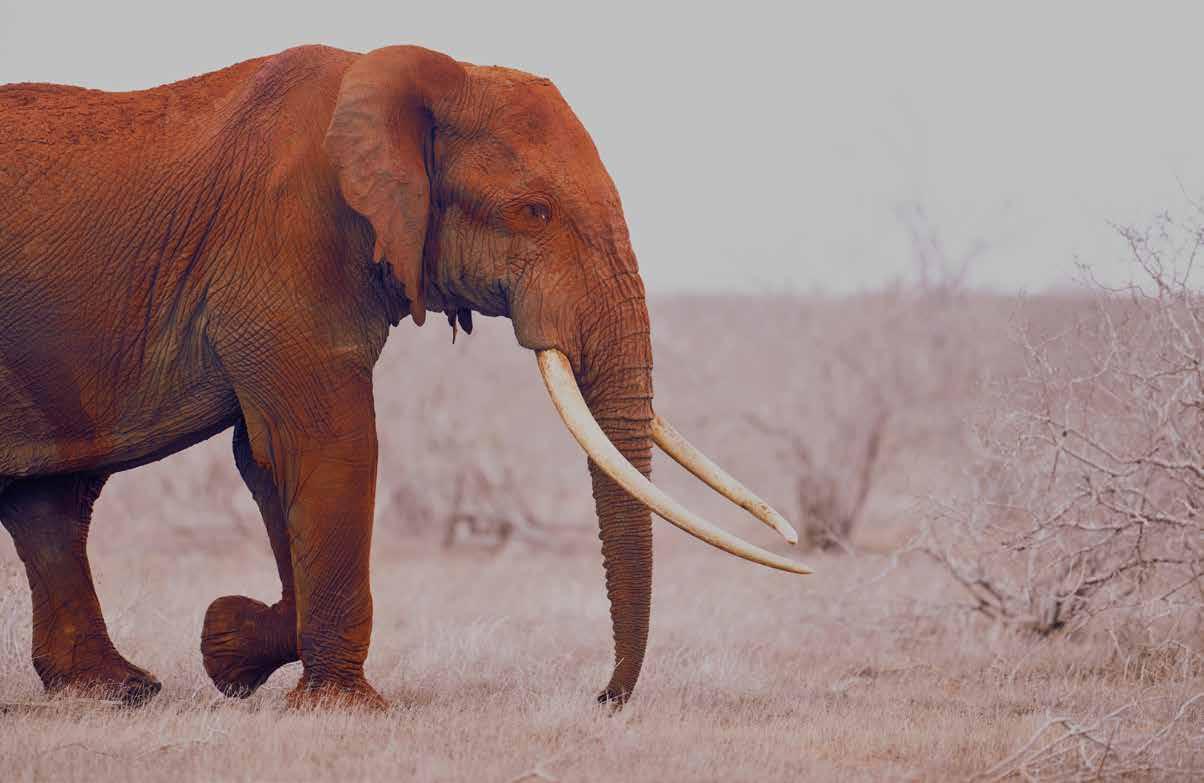
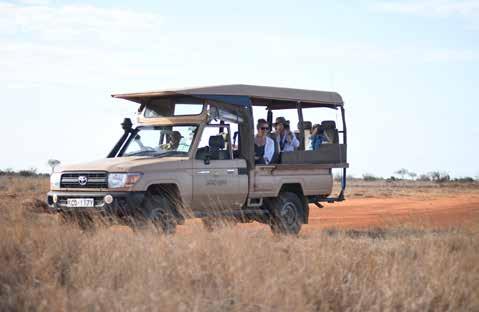



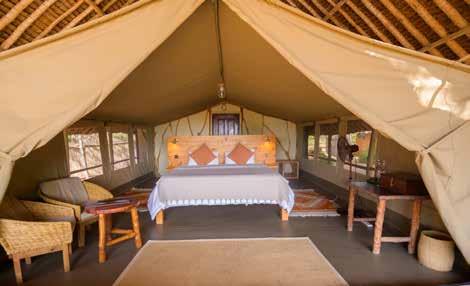
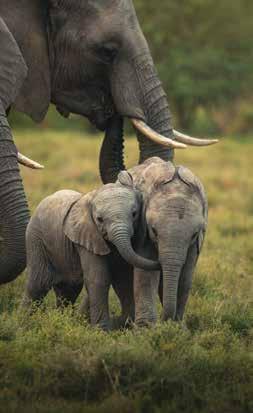
Rediscover safari’s romance at Satao Campcanvas comfor ts, star-f illed nights, and daily elephant parades at our waterhole.
A missionary joins an army truck convoy for a seven-day trek from Nanyuki to Moyale.
Few people remember that an area in a bamboo forest above Kijabe was once a key trading site between the Kikuyu and caravans coming through
After World War I, WJ Dawson starts out as an independent farmer in Kenya and is one of the founding members of a group that grew to become the influential Kenya Farmers’ Association (KFA).
After JM Kariuki’s burial, the Parliamentary Committee that seeks to find out the truth behind his murder finds their report quashed and many of them are sacked as Kenya faces a tense period.
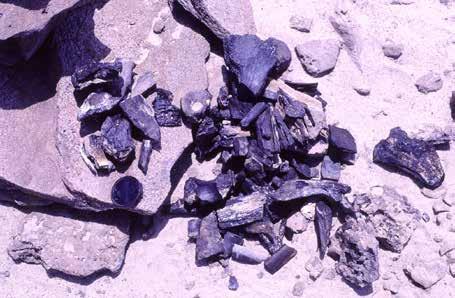
A Swiss scientist with an interest in volcanology comes to Kenya with his family and drives from Lake Magadi to Mt Elgon, Lake Turkana and Mt Kenya, finding intriguing fossils in the Chalbi Desert.
A short history of Musoma and the importance of the granite hill that towers over the town below.
A young Highlander comes to Portuguese East Africa to help set up a river trading route in the battle to stamp out slavery in East and Central

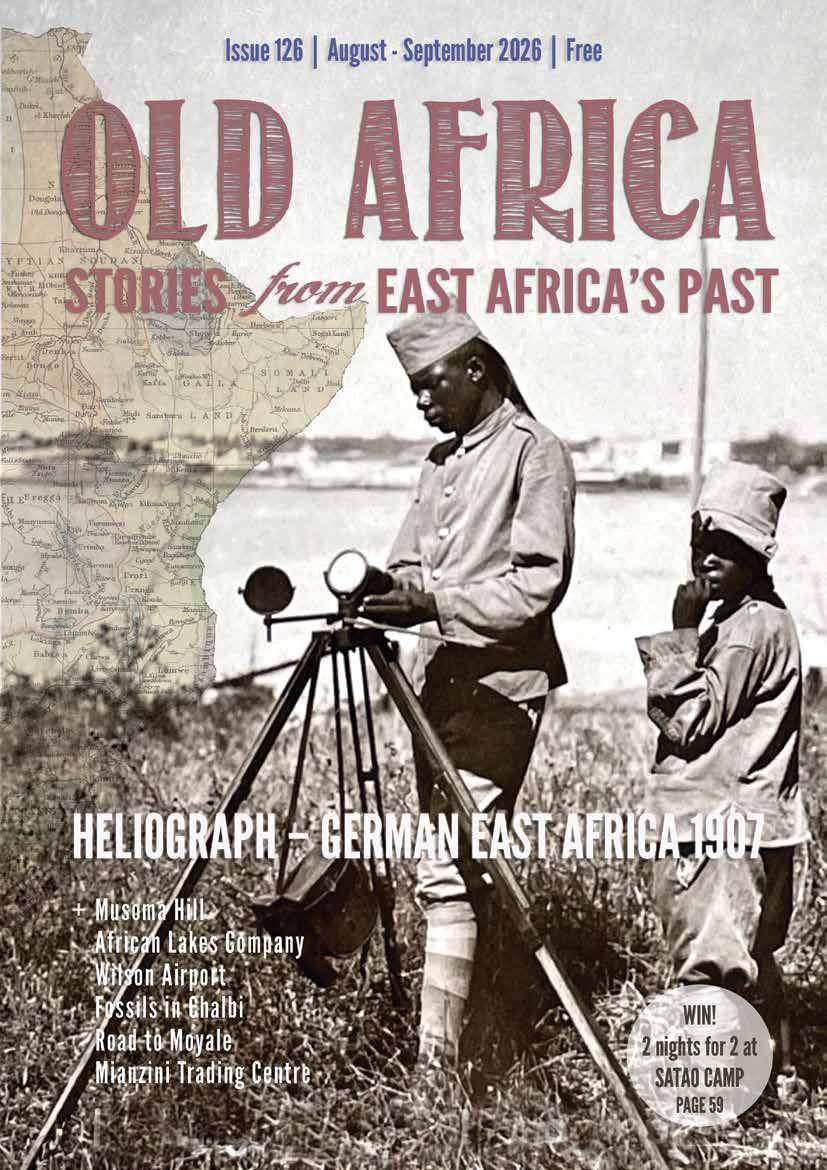
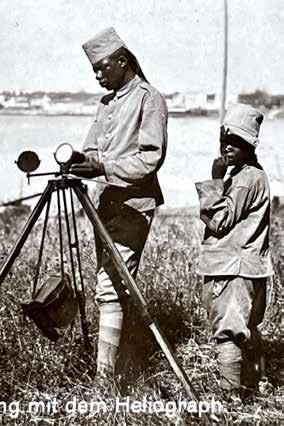
Cover photo: Askaris sending a message on a heliograph near Dar es Salaam harbour in German East Africa in about 1907. Our article on Musoma also speaks of how the hill behind the town was used by the Germans for sending heliograph messages.
(Photo courtesy Sue Deverell)
I’ve had to prepare this edition of Old Africa quickly, after a rushed visit to London to correct some problems with my voice prosthesis. Thankfully, all has been sorted out by good medical care at the Royal Marsden Hospital, backed up by the prayers of many faithful friends. So here is Old Africa issue 126, one year after I went through risky surgery to remove the cancerous tumour on my thyroid. God has been faithful.
I’ve often said that one of the big influences that brought Britain into East and Central Africa was the moral will to stop the suffering of slavery. The missionary explorer Dr David Livingstone had seen the misery firsthand and had spoken in Scotland about bringing “Christianity, Commerce and Civilization” to East and Central Africa to replace the system of using slaves to transport ivory to the coast and then selling the survivors to the middle east.
In recent years, this slogan has been reviled and seen as arrogant cultural superiority and Great Britain’s motivation for moving into Africa has normally been pictured as greedy exploitation.
However, in this issue we present an article on the life of Duncan Beaton, who worked with the African Lakes Company in Portuguese East Africa and Nyasaland from 1889 until 1904 helping develop a benign system of trade where ivory and other commodities could be shipped by steamships on rivers and lakes, rather than on the shoulders of slaves. This culminated in a war with Arab slavers in what amounted to a trade war. In the end, Livingstone’s idea of bringing commerce really worked and crippled the economics of slaves and ivory. Nyasaland and Portuguese East Africa are a little bit south of our normal story coverage area, but the African Lakes Company had ships all the way up through Lake Tanganyika. And after his time with the African Lakes Company, Duncan Beaton and his wife and children moved to Nairobi. Take the time to ponder as you read about how the Moir brothers, strong Presbyterian Christians, established the African Lakes Company in answer to Livingstone’s call. And see how Beaton joined in and then met his wife, a missionary nurse who had come out to Nyasaland to help establish Christianity.
P.O. Box 2338 Naivasha, Kenya 20117 www.oldafricamagazine.com
Editor: Shel Arensen 0736-896294 or 0717-636659
Design and Layout: Mike Adkins, Blake Arensen
Proofreader: Janet Adkins
Printers: English Press, Enterprise Road, Nairobi, Kenya
Old Africa magazine is published bimonthly. It publishes stories and photos from East Africa’s past. Subscriptions: Subscriptions are available. In Kenya the cost is Ksh. 3000/- for a one-year subscription (six issues) mailed to your postal address. You can pay by cheque or postal money order made out in favour of: Kifaru Educational and Editorial. Send your subscription order and payment to: Old Africa, Box 2338 Naivasha 20117 Kenya. For outside of Kenya subscriptions see our advert in this magazine. Advertising: To advertise in Old Africa, contact the editor at editorial@oldafricamagazine.com for a rate sheet or visit the website: www.oldafricamagazine.com
Contributions: Old Africa magazine welcomes articles on East Africa’s past. See our writer’s guidelines on the web at: www.oldafricamagazine.com or write to: Old Africa magazine, Box 2338, Naivasha 20117 Email
Address: editorial@oldafricamagazine.com. After reading our guidelines and editing your work, send it to us for review either by post or email. (To ensure return of your manuscript, send it with a self-addressed envelope and stamps to cover return postage)
Copyright © 2026 by Kifaru Educational and Editorial All rights reserved. No part of this publication may be reproduced or distributed in any form or by any means, or stored in a database or retrieval system, without prior written permission of the publisher.

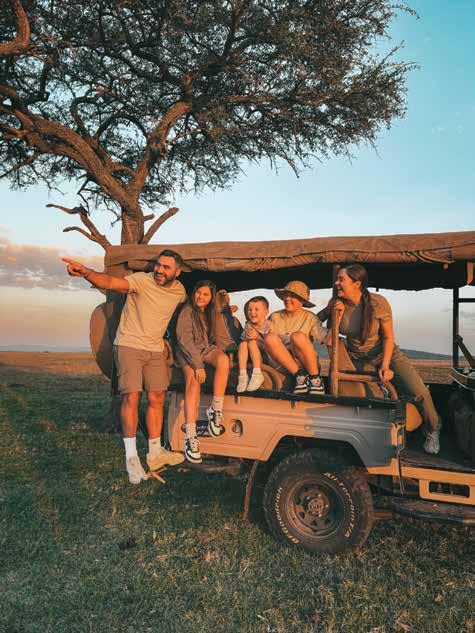



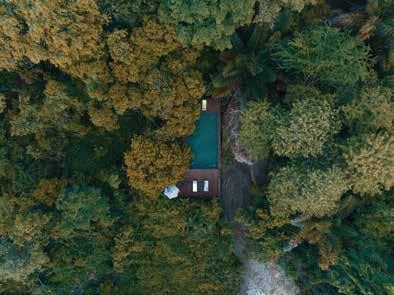
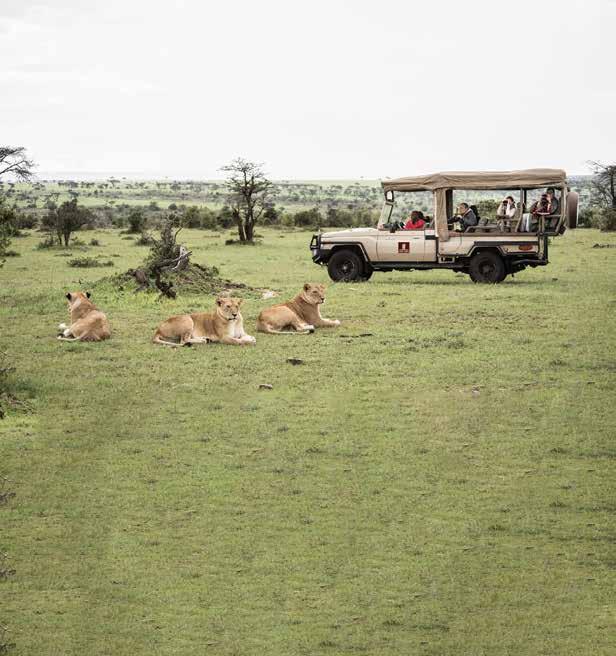
Experience an Authentic Safari this Holiday Season at Porini Camps, set in exclusive wildlife locations. Non-residents traveling with residents can enjoy special resident rates for an unforgettable safari adventure.
Porini Giraffe Camp
Porini Amboseli, Porini Mara, Porini Cheetah & Porini Lion Camp
Porini Rhino Camp
Rhino River Camp (Forest Tent)
Rhino River Camp (River Tent)
Rhino River Camp (Forest Tent)
Rhino River Camp (River Tent)
Porini Ol Kinyei Safari Cottages
Full board accommodation I Free drinks such as mineral water, soft drinks, house wines, beer, and Gin and Tonic I
Guests will enjoy sundowners from scenic viewpoints and guided nature walks I The package also features shared day and night game drives in open 4×4 vehicles with an experienced driver-guide and spotter I At Porini Rhino Camp, guests will have the opportunity to visit the chimpanzee sanctuary in the Ol Pejeta Conservancy I Those at Porini Amboseli Camp can experience a Maasai village visit I For guests flying in, local airstrip transfers to the camps are included.
*Please note, the above rates are excluding park and conservancy fees.


Dear Editor,
I’ve loved reading Old Africa for the longest time, but I’ve never known that I can read your issues online! I happened to log in to Facebook after quite a while and luckily saw a post that the new issue was live! I’ve sent in my answers for the History Quiz and I’m hoping for some beginner’s luck!
Tanisha Mehta, Kenya
Dear Editor,
Issue #125 was such an interesting read. Amazingly enough, the article about Jimmy Hearle brought back memories of our family life in Thika, and I knew quite a few people mentioned in the article. The article mentioned that Jo, Jimmy’s daughter, married Tony Glass. I was in the same class at Nyeri Primary School with Jo’s son Digby, and am sure their older son Chris was either in my sister’s or brother’s class. My Dad played competitive tennis, and we used to see those folk at Makuyu Club during tennis tournaments, and us kids mucked in and around the Club house, and slept in the cars in the car park in the evenings, when there was a “do” on!
I felt so sorry for Douli the chimp/gorilla in the article written by Margaret Collyer in Only in Africa. He had a rather sad life, and a terrible but inevitable ending. Altogether it was a great issue, with so much in it.

Thank you for choosing my answer to #124’s History Mystery Contest. Please may
I request Bluff about the Fisheries Officer in Malindi in the 1950s and 1960s for my prize.
We wonder what a suitable donation would be to help ensure you can keep going with your wonderful magazine? And is it possible to pay monthly?
Fran More, France
Dear Editor,
We finally got to go and stay at Satao Camp in Tsavo East NP having won the Old Africa magazine history quiz a few months back. I had also won the quiz about 15 years ago but never took the option to go due to various reasons. Boy, did I make a mistake in not organizing my life better! All I can say is, it was worth the trip. We saw just about everything there was to see. In the end I am ashamed to say, we didn’t even stop to admire the elephants, there were just so many around every corner and pan.
Besides the horrendous 11-hour drive down from Naivasha due to more commonly occuring jams along the highway, I can highly recommend staying at this camp, regardless if you win the quiz or not.
Thank you, Old Africa, for this opportunity of experiencing the local African bush.
Andrew Mules, Naivasha
Dear Editor,
It was wonderful to read that your six-month check-up went well. Thanks be to God. I was very happy to receive

issue numbers 121, 122, 123 and 124 from Amazon! Thank you for keeping Old Africa magazine going in these difficult times.
The cover story of Old Africa issue No. 125, June - July 2026, “Matthew Wellington: Last Link To Livingstone” by Judy Aldrick was good.
Jacob Wainwright (Yamuza) was about the same age as Matthew Wellington (Chengwimbe). However, Jacob was much younger when he was enslaved. After he was freed at about the age of 11, Jacob was taken to the CMS settlement in Nasik in 1860. Matthew arrived in Nasik in 1871 when he was about 24 years old. Jacob grew up in Nasik and was educated there.
Rev William Salter Price was in charge at Nasik when he was asked by his leaders at the CMS in London to select six volunteers to go and assist David Livingstone. “The offers were so numerous that it was a difficult matter to make a selection, but six were finally chosen, their leader being Jacob Wainwright, whom Mr. Price described as a welleducated, thoroughly reliable, earnest, good young man. The party started early in 1872, arrived at Zanzibar just after the Dawson Expedition had been arranged, and reached Livingstone in August, 1872.” [The Livingstone East Coast Aid Expedition: News of the Death of Dr. Livingstone, V. Lovett Cameron, W. F. Prideaux, Proceedings of the Royal Geographical Society
of London, Vol. 18, No. 2 (1873 - 1874), pp. 176-183 (page 8)]
When news of Livingstone’s death and that his body had arrived in Zanzibar was received in England in early 1874, Price recognized Jacob’s name and CMS made arrangements so that “Jacob Wainwright escorted the remains home, till they found their restingplace among the illustrious dead in Westminster Abbey.” [In Memoriam - David Livingstone, The Church Missionary Intelligencer Vol X 1874 (page 160)] In London Jacob met with the Committee of the CMS and gave testimony.
There was quite a stir about Jacob in England. To the extent that Queen Victoria expressed a wish to see him. Jacob was taken by a Secretary of the Church Missionary Society (CMS) to Windsor Castle. “During the interview Her Majesty graciously presented him with an autograph copy of ‘Our Life in the Highlands,’ written by herself.” [The Church Missionary Gleaner Volume XIV 1887 (page 6768)]
Jacob was at Price’s home in Kessingland, Suffolk in July 1874. In October 1874 he sailed for East Africa with Price, his wife Elizabeth Maria (nee Baly) and five other CMS missionaries to establish the CMS freed slave settlement near Mombasa. They arrived in Mombasa on November 15, 1874 after a stop at Zanzibar.
On December 6, 1874 Price wrote that he had a talk with Jacob Wainwright about his future occupation. He proposed as soon as it was
possible they would open a school, first for the children of Native Christians and then for the ‘Wanika,’ “if he could induce them to come. Jacob expressed his willingness, and seemed pleased at the prospect of having something definite to do. Poor fellow! He has hard times of it since coming to Mombasa - a great change from the life he had in England - a greater, perhaps, even than ours, but he has borne it admirably.” [The East Africa Mission - Extracts From Rev. WS Price’s Journal - The Church Missionary Intelligencer Vol XI 1875 (page 149)]
Alex Kuria
Dear Editor,
I’m helping to edit a book on the life of Jean B Sassoon based on her letters. She mentions many people in her letters from the 1960s and early 1970s. We’d like to have some identification info about the following people. All we need is enough for a one-line identifying note. If any Old Africa readers has any information about the following names, could they contact me through Old Africa – editorial@ oldafricamagazine.com
1.Priscilla Allen. Possibly something to do with the British High Commission. 2. Ronnie Smith (an elderly woman, who died in the 70s). She had a big old house and farm at Mweiga and handed it over to Africans after independence. May have been Australian, her family lived there. 3. Patrick Dowson. Seems to have lived at or near Naivasha. There is a man of this name who appears in court records
online, but he may not be the same person.4. Peter Burstyn. A Canadian volunteer teaching physiology, Jean does not say where. 5. The Michies, Mary and Norman. Very likely American. She was a photographer. They are mentioned online recollections of Kenyan artefacts donated to US museums. 6. Kusum Jerath. 7. Steve Barnett. 8. Norman and Marianne Mitton. He was killed in a car crash in Kenya in 1966. 9. Mike Gwynne. 10. Yvonne Malcolm Coe. Joined Jean on expeditions. 11. Christian and Ann-Marie, French family. Wife, baby & ayah were killed in an accident on the Mombasa Road, 1968. Tenants of Jean Hayes in Nairobi. 12. John Seago. There’s a reference to his being told that he can ‘no longer catch animals.’ 13. Bill Halstead, farmer at Timau. 14. Ann and Christopher Brown. 15. Sybilla and Charles Little. He was doing trypanosomiasis research. 16. Mary Nye (lived opposite Jean in Nairobi). 17. Val Braun. 18. Martin and Kay Brunt. 19. Don Detray. Who shot a lion (near the vet labs?) 20. Merrick Posnansky. 21. Someone simply called Nan. 22. Mari Hook. 23. Rob and Dorothy Udall. She designed textiles based on African patterns. 24. The Lampkins. He committed suicide. 25. Leslie and Elsa Martin. 26. The Kean-Hammersons. He was called Dennis. 27. Rosemarie Brown and husband Frank Cawson. 28. Irilie Murray. Settler and farmer. 29. Elizabeth Mayerhoff. Frequently travelled and stayed with Jean. 30. Murray Robert or Roberts. Lotte Hughes, UK



















Compiled by Old Africa
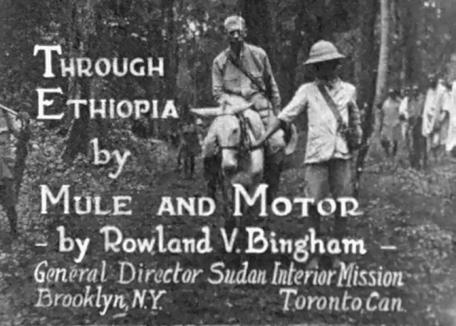
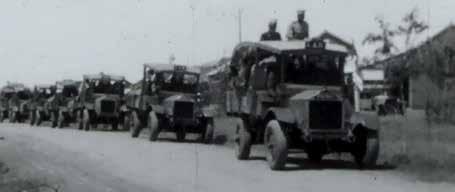
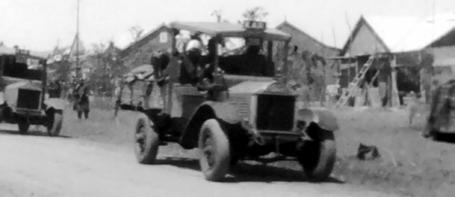
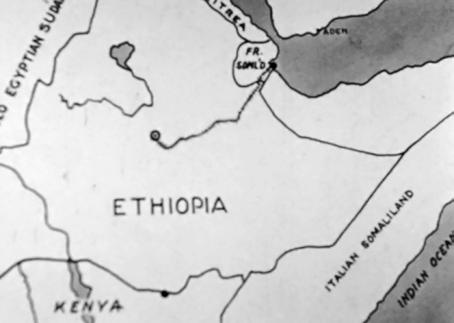
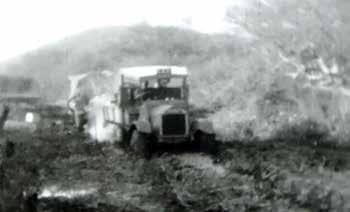
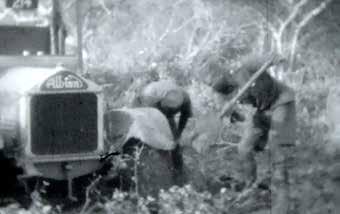
1929Rowland Bingham, the General Director or the Sudan Interior Mission (SIM), wanted to find a route into the southern part of Ethiopia. He hoped it might give them easier access for their work of preaching the Gospel and starting churches in the Ethiopia. So in 1929 he went to Kenya to check out the land. He had a cine camera, which was used to film parts of the journey. They later used to footage to make a silent film with captions to be shown to the churches in the USA and Canada who supported their mission work. The images and text for this article all come from that film. Erik Ness was working with SIM a year ago to move their archives to Wheaton, Illinois, in the USA and they donated this film and other photos and film reels to Old Africa. We used a slide scanner to scan stills from the brittle old cine film. The text is taken directly from the film.
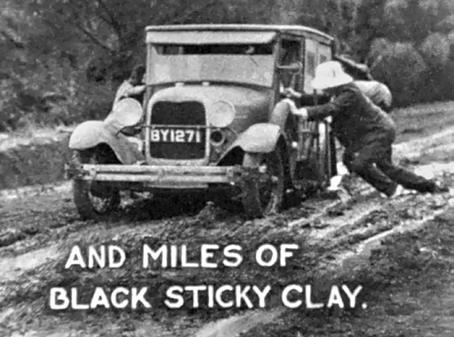
Attempting to enter Ethiopia in 1929, we struck trouble between Nairobi, capital of Kenya, and Moyale the border city. The torrential rains had already set in but were restrained in answer to prayer. When we set out as guest passengers of the King’s African Rifles with eight fourton trucks, our problems were: A river without a bridge… and miles of sticky black clay. A verse of Scripture faced him. “Elijah was a man of like passions with us, and he prayed fervently that it might
not rain – and it rained not.” Could this be today when everybody said that the rainy season had set in? He was impelled to pray while the rain poured: and assurance was given that prayer was answered. The rain ceased at once.
The next day, with a cloudless sky, the Government
said if he would take a chance and go to the railhead they would have him met with a convoy of the King’s African Rifles. If the rains held back, they wanted to send supplies to their outpost at Moyale on the Ethiopian border and he could go with them. We linked up with the convoy of eight four-ton trucks at
the foot of the snow-capped Mount Kenya and set out on our seven days journey to the border, through country teeming with wildlife.
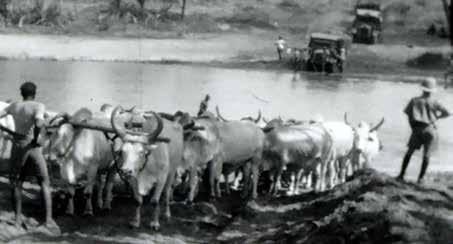
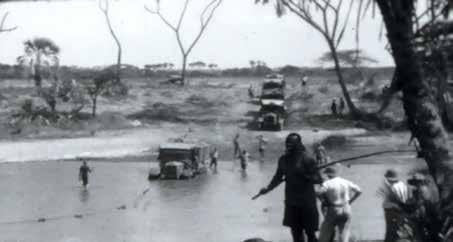
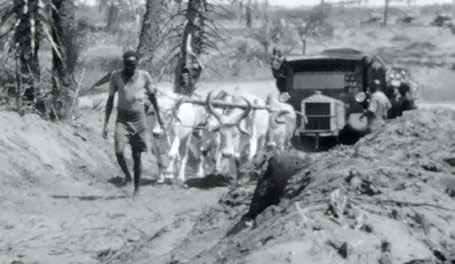
The film then showed photos of oxen pulling trucks across a river – probably the Uaso Nyiro. The text on the film continued: The cable snapped repeatedly but our patient oxen returned again and again. It took four hours to pull the last car across and then the officer declared we had gotten through easily.
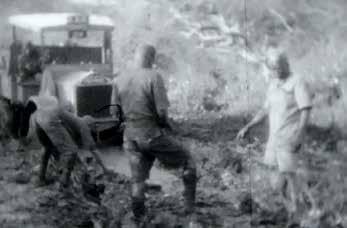
No other serious problems confronted us until the last day before reaching Ethiopia when it poured in torrent until the road became a river. Again prayer changed things. The rain stopped: the road cleared. Shortly after, however, we ran into cotton soil country – that black gumbo clay as sticky as glue. All afternoon we backed up, spaded off and filled in the tracks. We did not make a hundred yards before we had to pitch our tents for the night on the mud.
We [would have] been forced to camp there a whole month. But we were given a song in the night, sunshine in the morning, and by noon every obstacle was overcome and we reached the Ethiopian border.
The film does not go into detail about Bingham’s entry into Ethiopia from Moyale, but the film title is: Through Ethiopia by Mule and Motor and the first image on the film shows Bingham riding a mule. So it is assumed that he continued at least part of his journey by mule.
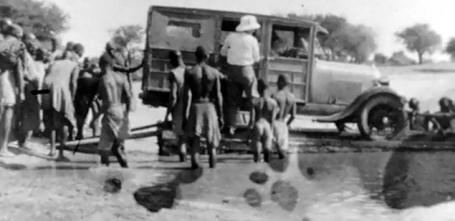
A team of oxen crossed the river to prepare to pull the army lorries through by ropes.
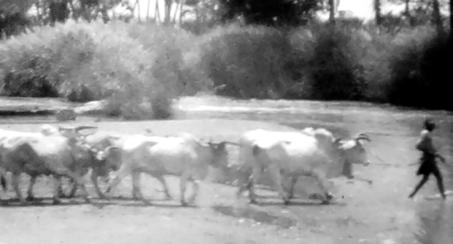
The team of oxen reach the other side of the river with the rope stretched behind them.
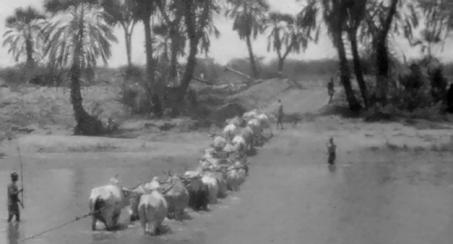
The oxen pull the first lorry across the river.
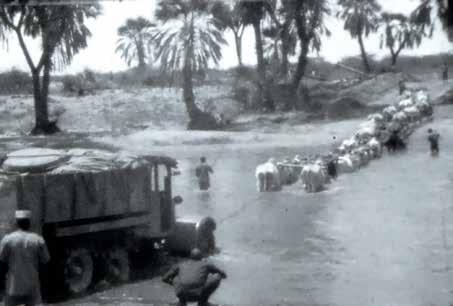
The oxen reach the other side, but the rope is no longer in sight, so it has apparently broken, something that happened repeatedly.
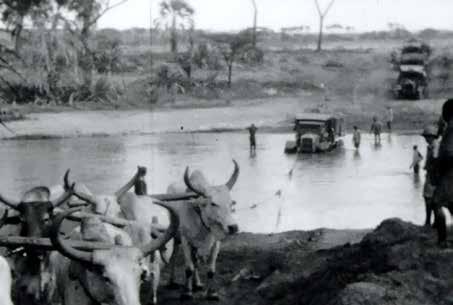
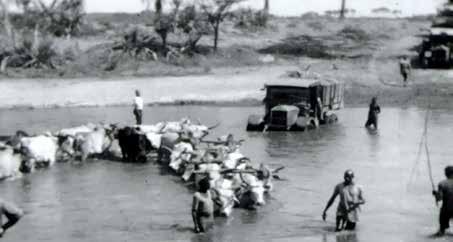
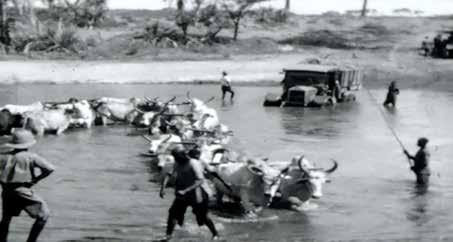
A lorry in the middle of the river with the rope attached.
The oxen strain and the rope is pulled taut.
The oxen circle around again after the rope has snapped.
The oxen getting ready to pull again.
The rope is taut as the oxen begin dragging the lorry again.
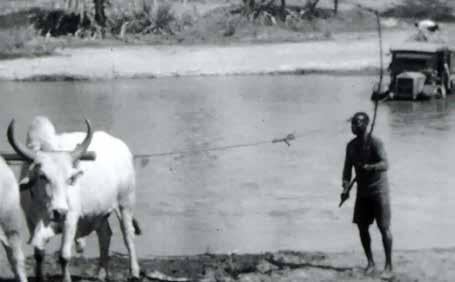
After four hours the last lorry is pulled across the river.
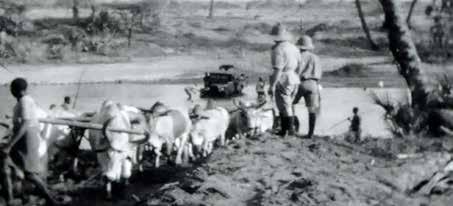
The last lorry is pulled up the bank on the far side of the river.
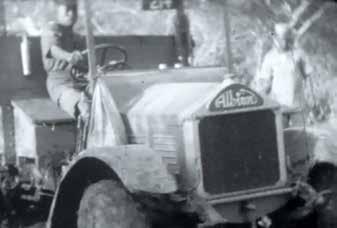
Bottom left: One of the KAR lorries mired in black cotton soil near Moyale. Bottom right: A lorry climbing out of the river. Note the chains on the rear tyres to improve traction.
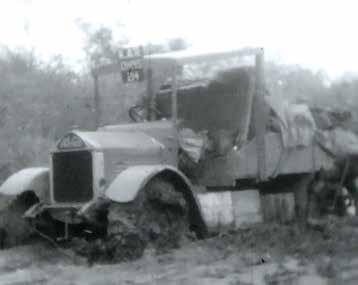
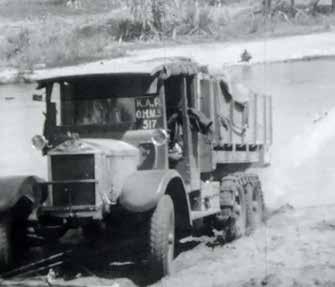


by Alex Kuria
Mianzini, or Mianzeni, is a place name found on the maps and accounts between 1840 and 1900. Like the names of many places in present day Kenya, that name is no longer in use. But there is still enduring history in that place.
Mianzi-ni in Kiswahili means the place of bamboo. It was a significant way point on the caravan route from the Kenyan coast, when men walked hundreds of kilometres inland in search of ivory and slaves. At Ngong and Mianzini they exchanged calico cloth, beads and brass wire for food with the Agikuyu.
Joseph Thomson and his companions saw Mianzini in September 1883 when they were travelling northwest, from Ngong to Naivasha. They saw Mianzini from the the floor of the Rift Valley. They “passed between Donyo Kejabè (Cold mountain) and Donyo Longonot.” [Through Masai Land by Joseph Thomson (1887) (page 193)].
On their way back to Mombasa in March 1884, they visited Mianzini. By this time Thomson was ill and injured by a buffalo attack, so he had to be carried on a hammock from Lake Naivasha up the escarpment to Mianzini. He described its majestic surroundings as follows. “... a magnificent view burst upon us. We were looking across a great plain, slightly undulating and perfectly treeless, bounded on the east by the imposing mass of the Aberdare Range, with Donyo Kinangop rising in picturesque distinction. Through a slight gap the snowy peak of Kenia glittered in crystal purity. To the south-east lay the wooded highlands of Kikuyu, with forests of bamboo in the foreground. To the south-west we saw the yawning pit of Donyo Longonot, and the romantic expanse of Naivasha. To the south the desolate plain of Dogilani, and to the east the massive escarpment of Mau. I got myself held up to view this grand landscape - probably
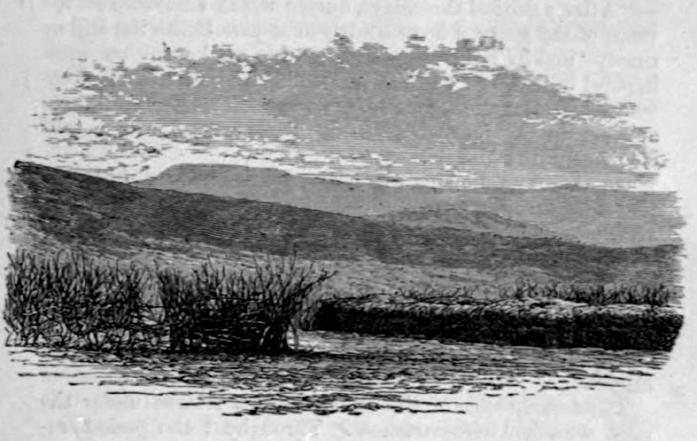
unsurpassed anywhere - and, weak and weary as I was, I surveyed the glorious panorama with infinite delight, though also with a spice of awe. Shortly after, we entered the bamboo forest …” [Through Masai Land by Joseph Thomson (1887) (page 335)].
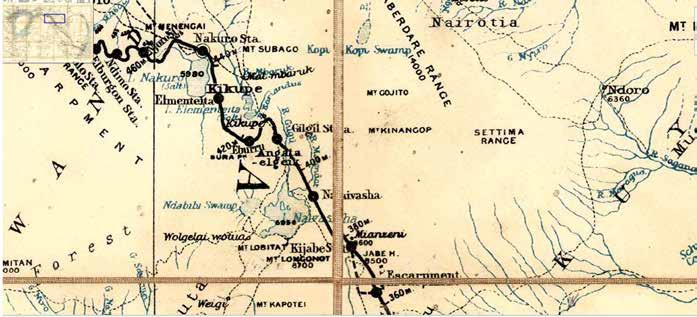
The establishment of Fort Smith near Kabete in 1891 by the Imperial British East Africa Company (IBEAC), shifted the location where the barter trade for food with the Agikuyu was done. The caravans now coming with the permission of the IBEAC camped at Fort Smith rather than Ngong or Mianzini. The completion of the construction of the Uganda Railway from Mombasa to Port Florence (Kisumu) in 1901, brought to an end the arduous walking and use of caravans of porters. A 1903 map of the railway and stations includes Mianzeni, located slightly past the Kijabe Station to the north.
The early Africa Inland Mission (AIM) missionaries wrote about the same Bamboo Forest located above Kijabe Mission. In 1905 John Stauffacher wrote, “We also discovered dense bamboo forests. You can hardly imagine how pretty a bamboo forest is. The trees stand so thick that it is perfectly clean under. The ground is usually covered with dense green moss, but you will see all this when you get here. [John W. Stauffacher letter to his fiancée Florence P. Minch, dated March 22, 1905].
In November 1906 Florence, now married to John, wrote about camping in the bamboo
forest as they made their way from Kijabe to Rumuruti via Nyeri. “We camped in the Bamboo, a regular camping place of the Kikuyu. We couldn’t stop any place we pleased for the forest was so dense we couldn’t leave the path and we couldn’t pitch our tent in the path. It was terribly cold tho. There was a heavy frost during the night. The porters didn’t sleep at all. They said they were kept busy keeping up a fire. We made a long march the next day down the mountain and to Nyeri.” [Florence Stauffacher Letter Rumuruti, Laikipia, B.E.A. Nov. 20 1906.]
[Editor’s Note: It’s likely Florence’s description is of a different belt of bamboo on the slopes of the Aberdares as it would have been a very long day’s hike from Mianzini to Nyeri!]
Mianzini remained until recently as a fine stand of bamboo on the road between Uplands and the Kinangop. Gradually the area just became known as the ‘Bamboo Forest.’
A 1975 map of the Kijabe area shows a Bamboo Road at about the same place as the current main road from Nairobi to Naivasha. So it seems the historic trading area of Mianzini would have been in that area near present day Kinale. Sadly, most of the bamboo has been cleared and with the new dual-carriageway carving up more land by Kinale, there won’t be any indication that the area was once called Mianzini and one of Kenya’s first export processing zones (EPZ).
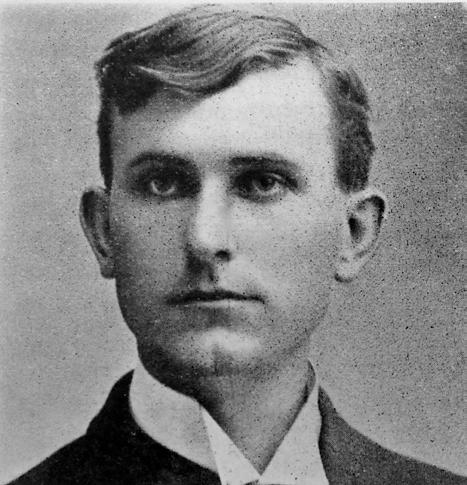
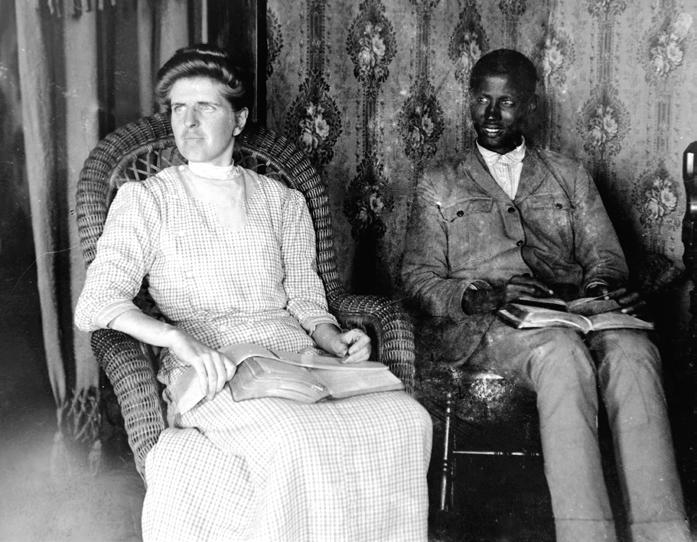
Top: John Stauffacher, an early AIM missionary, wrote about the bamboo forest above Kijabe. (Photo from Hearing and Doing, 1903)
Bottom: Florence Stauffacher and Mulungit, one of the early Maasai Christians. Florence also wrote about camping in the bamboo. (Photo from Old Africa archive)
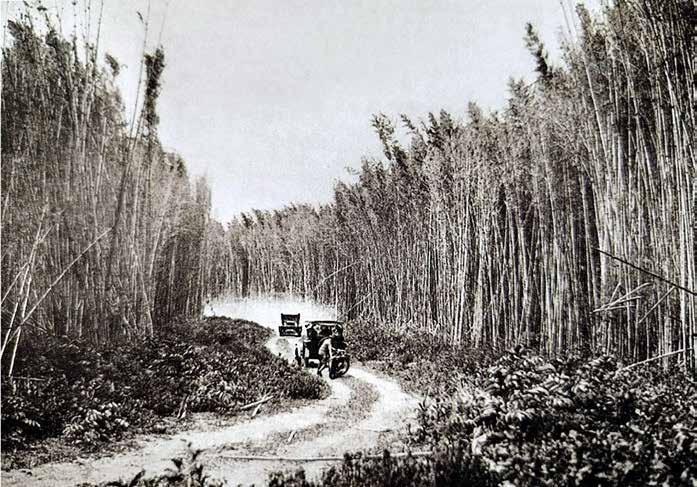
Top: The first road for vehicles from Kinangop to Uplands cut through the bamboo at Mianzini. This photo of the bamboo and cars was probably taken in the late 1920s or early 1930s. (Photo from Kenya: A Country in the Making, 1880-1940, by Nigel Pavitt, page 204)
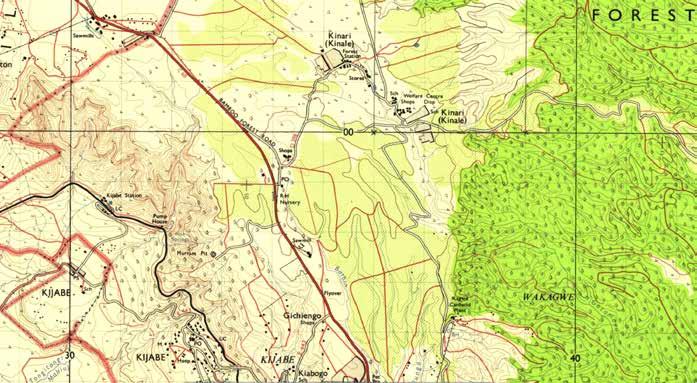
This 1975 map shows a Bamboo Road parallel to the main road above Kijabe. It indicates that historic Mianzini was near present day Kinale. (Map from https://esdac.jrc.ec.europa.eu)

by Jim Dawson
As late as 1914, as experienced an African hand as Rider Haggard was to observe (in his Diary of an African Journey) that, contrary to what Lord Delamere thought, Kenya was “no white man’s country,” attributing all sorts of ills to a combination of altitude and equatorial climate. He noted that he had “…never heard the health conditions of a place so universally condemned by its inhabitants, unless, perchance, they had land to sell.”
He wrote too that no European should stay there for more than 15 years, especially women “who go to pieces very rapidly here,” which would have come as a surprise to the many women in my family, especially my formidable grandmother. He was unimpressed by Nairobi, which he described as being in a “hobbledehoy stage with some fine buildings and many poor ones.” He was particularly scathing about the “dirt and inconvenience” of the central bazaar. He did however confirm an earlier theme, the tension between settlers and officials, of whom he said: “the power of the permanent officials, an everincreasing class, is becoming something of a menace to the public which pays them.” Some things never change.
Four years later, by the end of the war, Nairobi and Kenya were much altered, socially, politically and in physical
appearance. The city itself had been altered considerably by the necessity to house and feed large numbers of military personnel of all ranks. The Muthaiga Club had been founded just before the war and was a magnet for visitors, military and civilian.
More fundamental were the political changes. Kenya was still a “protectorate,” a term used by the Colonial Office, usually where it wished to protect indigenous political systems in place in regions, which it regarded as being in its “sphere of influence.” In this way, Swaziland (Eswatini), Bechuanaland (Botswana) and Basutholand (Lesotho) had been protected from Boer or Zulu encroachment, and retained under British influence without the political and financial cost of annexation or colonization.
In East Africa the term had first been used in 1890 in connection with Britain’s
relationship with the Sultan of Zanzibar, intended to curb the slave trade, and then Uganda in 1894, where the intention was a little more imperialistic. The British East Africa Protectorate was established in 1895. Increasingly, though, it was clear that it was not appropriate as a form of administration for the area which would come to be known as Kenya. Unlike the earlier Southern- and East African Protectorates, there was no single kingdom or polity in Kenya. Almost the first act of government after declaration of the Protectorate had been the construction of a railroad which spanned the entire territory, allowing access to a land which was home to many disparate groups.
By the time war came, much of the territory had been demarcated as farms or Crown land, in a pattern very different from the other
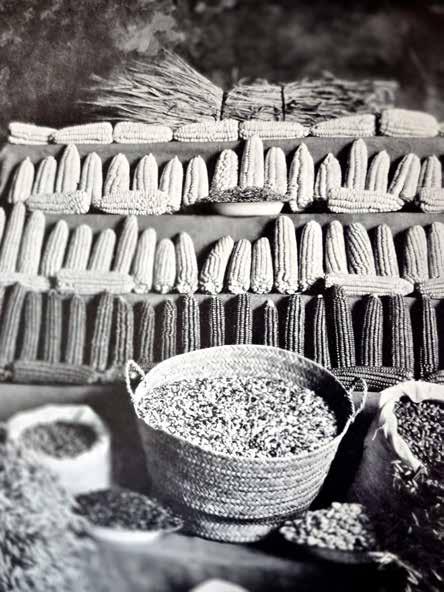
Africa protectorates. A settler community of over 10,000 had established itself, and a relatively passive form of topdown government designed to preserve existing indigenous power structures was inadequate. Psychologically, the settlers felt that if they were being called upon to protect the territory, they were entitled to a say in how it was run. The constant settler vs government antipathy began to bubble up again. In 1915 a mass meeting was held in Nairobi. In Lord Delamere’s absence (he was ill), Ewart Grogan (of Cape to Cairo fame) encouraged the settlers to join the war effort in return for which the Governor appointed a War Council which would include three settlers. It was agreed that these could be elected, and the first election in Kenya’s history was held.
But while the war saw development in Nairobi, and in the field of politics, its effect on farming and the agricultural economy were
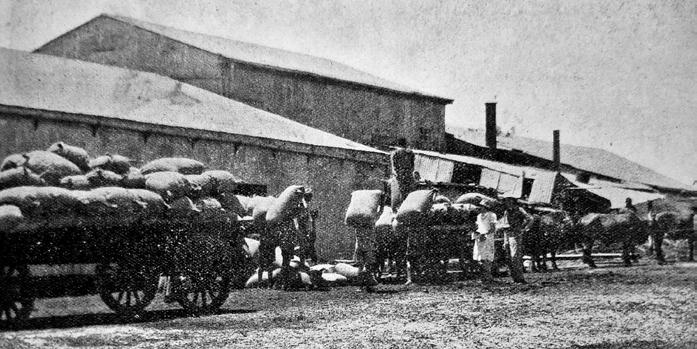
devastating. Not only were many farms more or less reduced to dereliction by the requirements for manpower, but exporting produce from this far-distant territory became almost impossible. In her biography of Lord Delamere, Elspeth Huxley noted that an acute shortage of shipping meant being cutoff from markets, and by the end of the war products which were not considered essential were excluded entirely from export to the UK, coffee being one of them.
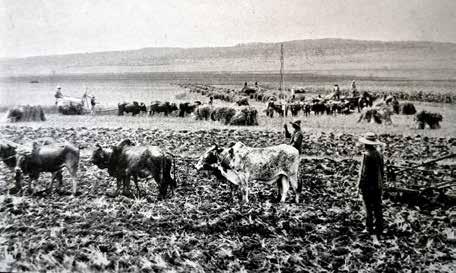
It was in this discouraging environment that WJ Dawson began his career as an independent farmer. As we saw in an earlier article, he had been transferred to the East African Veterinary Corps and promoted to Lieutenant, fairly early in the war. He had served in Bowker’s Horse and the East African Mounted Rifles, and certainly remained with the troops in a serving capacity until about 1915, to judge by the photographs. We don’t have an exact timeline of his activities around that time, but it seems likely that he was demobilised early, which may have happened to a few of the other East-Africa-based
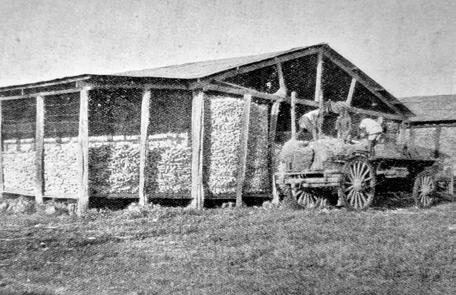
soldiers in order to bolster the Protectorate’s production of foodstuffs. It had become clear to the authorities and especially the Governor, that wholesale recruitment from East Africa’s nascent farming industry had resulted in a “decline in production” with a resultant “shrinkage in the Protectorate’s economic life” according to Elspeth Huxley (No Easy Way). Unga Flour Mills, the brainchild of Lord Delamere, had come into existence and into production in 1908-1909, and we have already spoken in an earlier article of the variety of crops and the varieties of wheat that
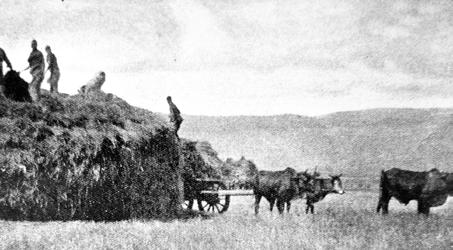
were already being worked with at the Government Farms at Kabete and Naivasha. Breeding against wheat rust had been further expanded to Njoro under George Evans, and later WJ Dowson (not to be confused with our WJ Dawson) and Gerald Burton. A Wheat Growers’ Association followed in 1913. But all of this progress had been stalled by the war. As Huxley put it “Manpower, black and white, vanished into the maw of the campaign.”
It seems, though, that the government, with the necessity of feeding thousands of troops and transport animals, and possibly with an eye to post-war recovery, approved the return of some soldiers to their farms, some on extended leave and some permanently, and that this became easier after the arrival of large numbers of troops from India and South Africa.
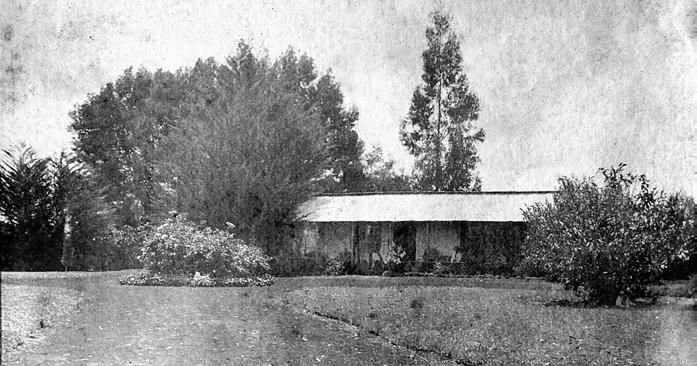
From an earlier photograph, we can deduce that even before the war WJ had left government service, or was at least contemplating it. His album has a picture of a “Happy Home” at Hope
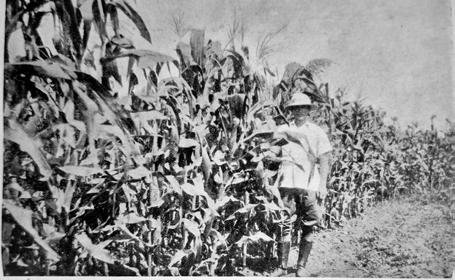
Farm, Limuru, followed by others of a trip “home” to Scotland, both in 1913. I am guessing the trip had something to do with raising the finance from the family for his next step in Kenya. I am indebted once again to the Europeans in East Africa resource for joining some dots. It shows that Hope Farm was owned by a South African by the name of Impey. Many years later, as a boy in the Eastern Cape, I recall Mrs Impey being most helpful to my family on our arrival in South Africa, to where she must have returned after her husband died.
The next trace I have on WJ’s progress comes from his own papers, in which he lists himself as one of the founding members of the Solai Maize Growers’ Association in 1915, which ultimately grew into the Kenya Farmers’ Association. I can only assume that, if he had maize to sell before the end of that year he must have succeeded in acquiring land in the area, before dashing off to war, and had returned sufficiently early in 1915 to have a crop ready. There is some controversy
about the founding date for the association, which would probably be of more historical interest if the KFA was still as influential in Kenya agriculture as it once was. When gathering information for No Easy Way , her history of Unga and the KFA, Elspeth Huxley drew heavily on WJ’s memory and papers, visiting him from England in 1957 and thanking him repeatedly in a series of letters on those old blue single-page glueedged “Aerogramme” letters people of my generation will remember. Clearly, though, she was under pressure of a deadline and she published without running the final draft past him. Probably, the management wanted the book ready before the grand opening of the new headquarters of the KFA in a building still-prominent in Nakuru. She wrote that the founding date of the KFA was a “matter of conjecture.”
Based on information from James McKay and the by-then deceased ex-chairman, John Toogood (neither of whom had been founder members), she gave a possible founding date in 1913, admitting,
though, that this was guesswork.
WJ was incensed; he was adamant that it had been in 1915, and that not only had he been present at the founding of the Solai Maize Growers’ Association, but he had been secretary to the founding meeting. From the Solai Association onward, there was a documented trail by way of the B.E.A. Maize Growers’ Association (1916) to the B.E.A. Farmers’ Association (1919) to the Kenya Farmers’ Association (1923). The Solai association had been formed with the intention of co-operative marketing of their maize in the face of over-production and a lack of markets.
I’m inclined to accept WJ’s dates. I think Toogood’s reported recollection and McKay’s notes to Huxley were in respect of the Kenya Wheat Growers’ Association, started in 1913, which lapsed during the War, and was only revived in 1925 (confirmed by Huxley). Of course, as President of the KFA and Unga, Mackay was paying for the book so it’s not surprising that Huxley went with his version. WJ was bitterly disappointed with Huxley’s book, and not only on this point. Writing to another veteran farmer, he said that he “had decided to publish a correct history of the K.F.A. from the start. Her book is simply full of errors of commission and omission and I think it is a pity to let the book go down as history.” His own copy of Huxley’s book is heavily annotated on the relevant pages and there are some loose pages with references to over 100 points of contention.
There was a hint in one of her letters that Huxley thought that age may have dimmed the memories of some of her sources; this too would not have sat well with WJ, who had been the youngest of the founders, and was only in his mid-sixties when the book came out, and in full possession of his faculties, as I well remember. He left detailed notes for a book or article tentatively entitled When and Where the River Began. Regarding sources, he noted on the first page that “the devil had only three of the founding members still to collect!”
His draft opens thus: “The author gave me the credit of a well-stocked memory. Had she trusted this memory and the literature I gave her, there need have been no doubt about the origin of …the KFA.”
I think, too, that he felt that appropriate credit had not been given to the man most deserving of it. That was Frank
Baillie, first Chairman, and indisputably a major pioneer of Kenyan agriculture. Also in WJ’s papers is a 1962 letter following up on Frank Baillie’s obituary, in which he paid him appropriate tribute.
Not long afterwards WJ himself became ill, and it seems that his full history was never published. I have toyed with the idea of completing the work for him, but most of the significance is lost now, with the KFA seemingly a shadow of its former self and Unga under corporate ownership. But he did at least get in the last word on the subject when the East African Standard of 30 January 1959 published a summary of WJ’s version (headlined K.F.A. History Starts Dispute on Origins), clearly timed for the grand opening of the KFA building which took place the following week.
In summary, then, WJ’s version was that at the suggestion of a Nakuru accountant and land agent,
Harold Thackrah, a meeting of farmers was called with a view to co-operative selling their surplus maize, there having been an oversupply in 1914. At the meeting the Solai Maize Growers’ Association was formed. An agreement was drafted in WJ’s own hand - he had been elected secretary to the meeting (as always happens to the youngest, newest attendant), although Thackrah was to be appointed the first Secretary of the Association. The first Chairman was Frank Baillie. The day following the meeting, in true pioneer fashion, the meeting secretary’s duties extended to bicycling to the farms of all the attendees to obtain their signatures, which must have been some trip, given the roads of the time. And so was born the KFA, probably the most influential agricultural institution in Kenya’s colonial period and for some time after.
To be continued…
byTiras Waiyaki
This serialised story gives the life of JM Kariuki and how he became a prominent politician in Kenya in the 1960s. But by the 1970s he found himself in a struggle against President Kenyatta’s supporters. In 1974 he received active death threats and in 1975 he wa called in for questioning and killed. The killers tried to dispose of his body and created a cover story. Once his body was discovered and identified, there was public outcry. After JM’s burial a Parliamentary committee was set up to investigate the popular MP’s death. The day the report was to be presented in Parliament, the committee was summoned to State House. The story continues:
1975
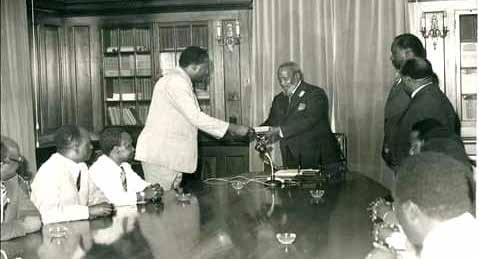
Mark Mwithaga, the deputy chairman for the Parliamentary Select Committee looking into the death of JM Kariuki, cooled Mzee Kenyatta down by stating that it would have been a witch hunt to have his name there. Yet no one had implicated him at any point, nor was there any accompanying proof of the President’s involvement.
As for everyone else mentioned in the report, Mwithaga added there was a lot of documentary evidence sent to the committee by people as proof. Others had appeared before the committee in person and stated what they knew about those being implicated. According to Mwithaga, Kenyatta took a green pen and deleted both the minister’s and his own bodyguard’s names before asking a subdued Mwangale to sign against each deleted name.
Burudi Nabwera, another committee member, remembers Mwangale himself crossing out the two names and signing against them, though they still remained readable.
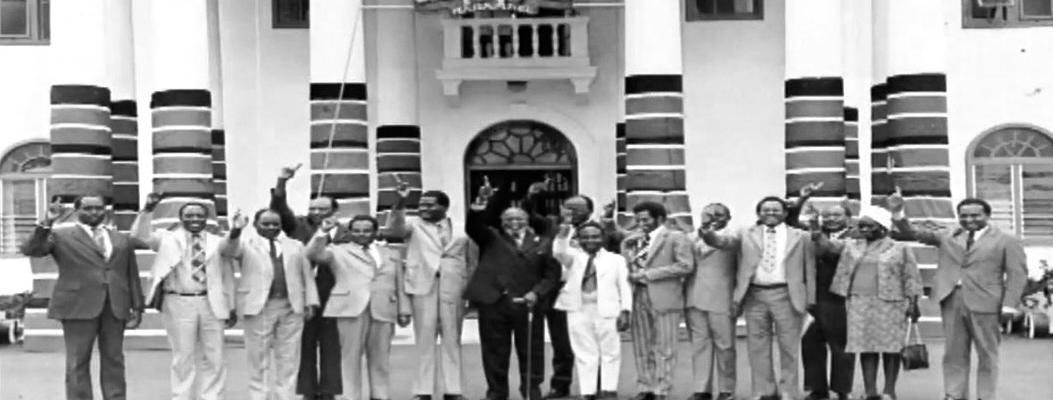
Mzee then ushered them out for a group photograph. Mwithaga feared that such a move would be used to drive some propaganda campaign, so he moved away from the group, but Kenyatta, according to the former Nakuru Town MP, asked, “Where is Mwithaga? He is one of the mothers of this issue!” The MPs were then asked to flash the single finger KANU salute. “This was high politics!” Mwithaga concluded.
In the course of the committee’s work some witnesses were reportedly tortured, threatened and intimidated by police. The police were also vulnerable as some of those who gave evidence
to the committee were reportedly fired. The committee reached findings that have been corroborated by investigative journalists and the contemporary archival record.
Once back in parliament, Mwangale tried tabling the report, but Speaker Fred Mbiti Mati allegedly said there was no hurry. Later, when Deputy Speaker Seroney took to the seat, Mwangale, with permission of the House, tabled the report. Kisumu Town MP Grace Onyango pointed out that the report had been doctored at State House, Nairobi. Some MPs maliciously rushed Mwangale to move the motion, but Mwithaga, not wanting to be pushed by anyone, seconded it only after two-and-a-half days. Burudi Nabwera took a day before seconding it. This guaranteed a lot of press coverage for the report and the system became furiously uncomfortable. In supporting the motion, John Keen stated that for refusing to eat JM’s body, the hyenas of Ngong’ Forest, an area he represented in parliament, should be awarded with “EGH State Medals and what have you.” He was sacked almost immediately from his post of Assistant Minister for Public Works.
Around the time debate on the report was going on in the House, Moi, Njonjo, G.G. Kariuki and Arthur Kinyanjui Magugu went to State House to see Mzee Kenyatta and informed him of the gravity of the matter under consideration in parliament and suggested some amendment to the motion, thus allowing the government to investigate the murder professionally under the attorney general. As Moi began to speak, Kenyatta called him a coward but Moi responded painfully yet respectfully that he was no coward.
“Who knows, JM Kariuki might have been
killed by communists,” G.G. remembered Kenyatta saying. The president praised Cabinet Minister James Osogo’s moving of an amendment to the ongoing motion requiring parliament to simply note the report.
Osogo said that he came across two different reports on JM’s disappearance and death prepared by the same committee. One had a cabinet minister’s name and that of the president’s senior bodyguard with chairman Mwangale’s signature of approval and the other one did not have their names, but it also had chairman Mwangale’s signature of approval. He stated that he did not understand which report was being approved by parliament. He pleaded that parliament note the report and then investigative arms of government would take it from there by investigating and prosecuting those involved. Whereas the government wanted the House to “note” the report, majority MPs voted for the report to be “adopted.”
In its original final report the Parliamentary Probe Committee into JM’s death recommended that a minister, who declined to respond to the committee’s summons, his bodyguard and that of the president and a councillor be investigated alongside a mayor in the Rift Valley, a District Commissioner, an NYS Deputy Director, who threatened to shoot anyone who summoned him to testify, a well-known member of the Kenya Police Reserve and one of JM’s rivals in the 1974 election.
The probe committee established that the president’s bodyguard had driven to Nairobi from Nakuru by a discreet route on the afternoon of March 2. Questioned by the committee, the bodyguard insisted that he spent March 2 with the president at Gatundu.
Obviously, the president could not be summoned to verify this.
Some individuals were accused of indirect involvement while others were accused of direct involvement. The GSU Commandant, either, “took an active part in the murder Himself” or was “an accomplice of the actual murderer or murderers,” concluded the committee. It recommended that he be suspended from duty pending fresh investigations. The committee also recommended that the Commissioner of Police, two Assistant Commissioners of Police and a Senior Superintendent of Police be replaced so that satisfactory investigations could be carried out by the police force.
The senior police officers based at Ngong’ Police Station were accused of gross negligence in the dispensation of their duties after JM’s body was discovered, to a degree which would have destroyed the possibility of the body’s identification. They were to be subjected to disciplinary action.
A senior editor with a leading newspaper was accused of publishing false statements indicating that Kariuki was in Zambia. This misled Parliament and the nation and delayed early investigations by publishing on 8 March1975 that JM was in Zambia. According to Daniel Branch, the committee suspected the actual murderer was a man said to be a police informer and trained policeman from Gatundu, who had been released from prison for bank robbery just before JM’s murder and was apparently interrogated by the CID, before JM’s body was identified at the mortuary, for making hoax bomb calls. But this suspect was bailed and vanished.
The committee reportedly made it clear that this
man had not acted alone but had carried out the murder on the orders of senior officials within the security forces and government. According to the committee, the suspect acted alongside two others and were all regarded as suspects in the murder, a matter which required thorough investigation.
Branch also indicates that this police informer’s sister and JM’s sister were workmates. According to the suspect’s sister, Branch indicates, the police informer was summoned to collect JM just an hour after the MP had been taken from the Hilton. The informer, according to this version of events, subsequently supported by journalistic investigations, took Kariuki to Ngong’ and shot him dead. Branch states further that a few months earlier, the informer had allegedly made an attempt on Charles Rubia’s life during the 1974 election campaign by firing a bullet that missed the MP by a whisker.
Moi, Njonjo, minister James Osogo (Busia South) and others continued to push for the report to be noted. By noting the report, Parliament would simply be acknowledging receipt of the document and thanking the committee for the work done but would have been under no obligation –and did not intend - to push government to implement the findings.
In the year 2000 Gachago told this writer that Njonjo held the report in parliament and said it amounts to zero. Wafula Wabuge (Kitale West) said that JM’s murder was a grave issue that MPs could not look at and just say, “Noted.”
Nabwera told Moi that the police, who were under him, had misled him that JM was in Zambia when he had actually been murdered and he should thank the committee for showing him the truth.
House Speaker Fred Mati called for a vote between noting the report and adopting it. Three cabinet ministers Mwai Kibaki, Gikonyo Kiano and Isaac Omolo Okero skipped the vote and almost lost their positions. James Nyamweya, the only cabinet minister to sit on the committee investigating JM’s disappearance and murder, was out of the country when the vote took place. Cabinet Minister Masinde Muliro, assistant ministers John Keen and Peter Kibisu’s votes provided for a swing vote of 62-59 for the report to be adopted and they were sacked that very evening. Asked why he voted against government’s wishes, Keen retorted that, “There is no collective responsibility in murder!”
George Anyona, who was a member of the House, said later in an interview, “I recall 1975 when JM was killed, and we were supposed to be sitting in parliament when it was suggested that we all go to State House and stage a demonstration
from there to town to show our loyalty to Kenyatta.” He added, “Muliro said, ‘Look Anyona, we cannot do this. People cannot go and kill somebody then take us there to go and demonstrate loyalty.’” Muliro did not join the demonstration.
On the evening of the vote as four Luhya MPs walked out of parliament, wrote Nabwera, an MP from Central Kenya approached them. “Why are Luyias becoming so kimbembele (nuisance) in this JM issue? This man (JM) was one of us but we felt he was too much. We chose to discipline him. What has that to do with Western Province? We did not kill one of you!”
The JM report was supposed to become a property of the House meaning that relevant government departments or ministries were to be invited to examine it and find out whether it could be implemented through a Bill of Parliament or any other mechanism like a government motion. This one was ignored. Those named as suspects were supposed to be investigated further but that was not to be as there was no goodwill from those in power. Journalist Jeff Koinange asked Charles Njonjo, who was attorney general when JM was assassinated, on K24’s Capital Talk about Mboya and JM’s murder but Njonjo explained to him that, “No, no, no, no, no, no, no. Well, we tried to know and then you are stopped and then no. No, it’s difficult, it’s difficult.”
Charles Rubia pointed out that there was no doubt in his mind that Kenyatta had wind of a plan to eliminate JM but, “I cannot say he is the one who gave the order for JM’s elimination,” the former MP for Starehe told Inooro TV.
“Kenyatta would never kill me. Other people, yes, but not Kenyatta,” JM often said to his wife Dorcas, according to JM’s daughter on KTN news.
Branch writes that the committee indicated that, “It was satisfied that there was a connection between the murder of JM and the bomb blasts.” The committee allegedly felt that the CID “was trying to concoct evidence linking Kariuki with the bomb blast which killed 27 wananchi citizens.”
JM’s cousin, Kanyi, told KTN News in 2016, “What we do not know is the particular person who pulled the trigger, but we know the government did it. The whole world knows that.” Mwithaga told KTN, “You cannot actually know who actually pulled the trigger, there were too many triggers, too many bullets, too many people and most of them are dead.” He also told the same station, “Anyone saying that government had nothing to do with the death of JM is playing with the intelligence of Kenyans, because it was government. Any
successive government will continue to bear responsibility, because it was government.”
Mwangale had foreseen a situation where nothing would be done to bring anyone to book. He concluded his contribution in parliament on JM’s report,“Once upon a time, a hyena came across a stone. The hyena stopped by and hailed the stone but the stone did not respond. As it passed the stone, the hyena turned around and said, ‘Even if you have not responded, you have heard’ and with those few remarks I beg to move.”
As all the drama ensued, Kenyan print media was awash with goings on, on their front and inside pages with accompanying images. The country was fully gripped in the controversy surrounding JM’s disappearance and subsequent assassination.
“J.M. IS MISSING,” “Moi gives statement on Kariuki,” “J.M. IS IN ZAMBIA,” “J.M. FOUND IN MORTUARY,” “J.M. IS DEAD,” “Church, party criticise ‘brutal killing,’” “HE WAS A MAN OF THE PEOPLE,” “J.M.’s final journey,” “P.C. is shouted down at Kariuki funeral,” “MPs DEMAND FULL PROBE INTO JM’s MURDER: ‘WE WANT THE TRUTH,’” “Mzee warns Ministers and M.P.s: ‘TOE KANU LINE OR GET OUT NOW,’” “J.M. Report: ‘2 More Days,’” “J.M. death mystery, probe team reports,” “MPs discuss report on killing of J.M.,” “LEGAL OPINION ON JM’S REPORT.”
The New York Times carried a story on the assassination under the title, “Critic of Kenya Regime is Found Shot to Death.” The British Sunday Times was not left behind either and, according to one historian, Kenya, through its High Commissioner in London, issued a formal protest to the British government after the paper published an investigative report claiming Kenyatta approved of JM’s murder.
Even after JM went missing and his body had been identified, bomb scares and further small bomb explosions continued across the country. A train derailed at Voi three days after the vocal MP went missing.
On 13 March, Kenyatta summoned his cabinet to his Gatundu home. He told cabinet that security forces believed JM was behind the bombings with a group of young chaps, “trained in Zambia” and after a fall out with them he was killed. Ministers refused to ‘buy’ this explanation. Led by Kibaki, they demanded to meet senior police officers and put them under the spotlight. A shocked Kenyatta
refused this. Spurred on by his cabinet colleagues, at the next cabinet meeting, Moi asked Kenyatta to appreciate the widespread discontent in the country and take measures to address these but the president stopped him by stating that only he knew how ordinary Kenyans felt about their government.
As the country was gripped by JM’s heartstopping saga, Mzee Kenyatta addressed a group of dancers in the Rift Valley making remarks which appeared to have a coded message. He spoke about Lucifer, the fallen angel. He described Lucifer as the King’s favourite arch angel. The angel became a devil after he started demanding for too much and stepped on everybody’s toes. Lucifer was hurled from heaven for his wickedness and revolt against God. Mzee Kenyatta stated that his government would have no mercy on anyone out to disrupt peace and harmony.
On 21 March 1975 Kenyatta staged a military parade at high noon from the Kenya Cinema in Nairobi’s Central Business District, dressed in full military gear, accompanied by military chiefs and Moi. Kenya Air Force jets flew low as, “The soldiers marched from Tusker, on what is now Ronald Ngala Street, on to Kenya Cinema and into Government Road what is now known as Moi Avenue. This is the first thing the British did on the day the Emergency was declared. That same morning, the Lancashire Fusiliers marched down Delamere Avenue. Tyranny is very unoriginal,” Nowrojee recalled as he spoke on KTN News years later. “He held the parade to show, ‘That I am still in charge. Don’t try anything!’”
Nyachae defended this action, when he spoke about that period years later on NTV. “I think he did this on the advice of the national security, simply to demonstrate that the government was still in charge. That was all.”
Thousands of onlookers watched the parade silently, most of them declining to acknowledge the ageing president’s greetings. With Kenyatta’s bosom friend, Ethiopia’s Emperor Haile Selassie, having fallen from power just six months earlier, it felt as though Kenya’s grand old man’s rule was also coming to an abrupt end.
Instead of visiting with JM’s family, Kenyatta left for Easter in Mombasa. This behaviour was seen by many as grossly indifferent, considering Kenyatta had just lost a former comrade in the independence struggle, his ex-private secretary, one-time assistant minister, and formerly a great friend and trusted confidant.
G.G. Kariuki wrote, “It was almost certain that this was the act of some powerful people in
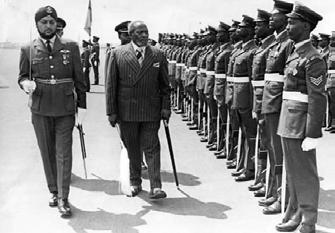
President Jomo Kenyatta inspected a guard of honour such as this one in Nairobi’s Central Business District during the aftermath of JM Kariuki’s assassination to show that he was in charge.
Kenyatta’s administration.” He went on, “In the social places the talk was that Kenyatta’s closest clique had murdered Kariuki.”
According to Bart Joseph Kibati, a former senior intelligence officer, a bomb went off near State House, Mombasa on 10 April 1975 at 7 pm while Mzee was enjoying entertainment from traditional dancers. Its shrapnel killed local merchant Bihari Gudka. No one was arrested in connection with this blast. On his way back to Nairobi from Mombasa, wrote Koigi, Mzee stopped to address a group of Kenyans and posed the question to his audience through the radio to the whole nation, “If a leopard is stealing and eating your animals, what do you do to him?” Innocently the crowd roared back, “Kill him.” Koigi viewed this as desperate justification for JM’s murder.
The uproar that followed JM’s death attracted state repression. For refusing to vote with the government side, Public Works minister Muliro was sacked and never returned to cabinet. Nabwera remembers that on the day after the vote Mzee called for a cabinet meeting at State House. Muliro was blocked from entering and the ministerial flag was removed from his car. It was then announced on state radio in the 1 o’clock bulletin that he had been fired. Nathan Munoko (Bungoma Central) replaced him. Munoko did not vote on the JM report.
For his part, Kibisu lost his Vihiga parliamentary seat in 1976 after an old case in which he had been accused of assault was revived and he ended up in jail. This coincidentally opened the way for Moses Mudavadi, Musalia’s father, who had stood against Kibisu in 1974 but lost. He won the ensuing by-election following Kibisu’s unceremonious exit and thus began the Mudavadi family partial dominance of Western Kenya politics.
A 1974 election petition filed against Mwithaga by Kabiru Kimemia was rushed and three judges ridiculously found that though the seating MP had not committed any crime, the 700 vote gap between him and Kimemia necessitated for there to be a by-election. To diminish Mwithaga’s chances of retaining his seat, a domestic scuffle with his wife Njeri over a year before had been reported to the police at the time by his wife. Although the case had since been shelved, now it was revived. The matter was taken to court in a very dubious manner to taint Mwithaga’s image.
On the evening of August 8 1975 Mirugi Kariuki, Kuria Murimi and Koigi were talking in Nakuru when Danson Mahugu crossed the street and warned them that plans were afoot to detain Koigi and jail Mark Mwithaga.
The following day Mwithaga was arrested and taken to AFTC Military Barracks. He was later taken to Kamiti Maximum Prison where he spent two years doing hard labour.
Mwithaga was jailed on the day before the by-election. His imprisonment invoked sympathy and on the election day Mwithaga beat Kimemia by a landslide. However, he could not sign the acceptance papers after prison officials on instructions from above denied his wife permission to hand them to him. Since Mwithaga was in prison, another election had to be staged. Mwithaga sent word to his followers to vote for Willy Komen. Komen won the election and the system’s man Kimemia, lost again.
Mwithaga returned to parliament in 1979 after Kenyatta’s death and was appointed Assistant Minister for Labour by President Moi, to deputise Elijah Mwangale.
Koigi, a young journalist at the time and budding politician was also arrested, on the same day as Mwithaga and detained without trial for criticising the government. He had dropped out of Cornell University in the USA and returned home to speak for the poor, unemployed and the landless. His powerful enemies argued, itihingagia mbugi, the entire herd cannot all have bells. He was released by President Moi in 1978 after Kenyatta’s death, “Kenyatta’s death was our way out of prison into freedom,” Koigi told NTV. Seroney and Shikuku were arrested in parliament in full breach of parliamentary immunity and detained without trial on 15 October 1975 where they spent three years on the pretext of abusing parliamentary privileges. After JM’s assassination pro government MPs had gone round the country on a massive KANU recruitment drive and one of them kept on
referring to the JM Probe Committee members as a “bunch of rogues” prompting Shikuku to state on 9 October 1975 in the House, that some MPs were trying to kill parliament the way KANU had been killed and when Kihika Kimani asked Seroney, who was on the chair, to order Shikuku to substantiate, Seroney responded that that there was no need to substantiate the obvious. The two were detained the next week.
Speaker Mati declared their seats vacant in a Gazette Notice dated November 28 of 1975. Shikuku was replaced in Butere by Richard Litunya and Seroney in Tinderet by Gerald Nathaniel Kalya. 1,155 days later, they left prison when Moi ascended to power after Kenyatta’s death and pardoned them. Barely able to walk, Shikuku was on crutches and his face unrecognisable due to unkempt facial hair. He returned to parliament and was appointed assistant minister by President Moi.
Another committee member Jesse Mwangi Gachago was jailed in 1978 for stealing coffee. “I have never stolen even a matchbox!” he tearfully told this writer in the year 2000. Gachago was released two years later from Kamiti Maximum Security Prison and delivered to Njonjo’s Muthaiga living room. Gachago believes he did it to show how powerful he was and to gain approval before contesting the parliamentary seat for Kikuyu
Constituency in 1980. Gachago had been jailed with his business partner, the then Embakasi MP Muhuri Muchiri. The two men owned Gaylord and Roma Hotels. Before being jailed, Gachago remembered being visited by Nderi and Gethi at Roma Hotel where they unsuccessfully asked him to disown the JM Parliamentary Committee’s report. Gachago’s political career, businesses and personal life were ruined following his arrest.
John Keen described that era around JM’s assassination to Moi’s biographer Andrew Morton, “It seemed that Governor Renison’s words that Kenyatta would be leader unto darkness and death were coming true. It was an ugly atmosphere. We never knew when we were going to be picked up and thrown behind bars. It was a period of suppression.”
Rubia told JM’s daughter, “The whole country was weeping, and everybody was really looking over their shoulder, who is next to you might kill you. It was a very bad time, still fresh in mind.”
Seroney never returned to parliament. He died under a dark cloud in a Nairobi hospital after a visit by some of his sworn opponents. No post-mortem was done. Heavily in debt, the farm on which he was buried was sold owing to an un-serviced bank loan. His former house is now a school and his grave is humiliatingly part of the playground.
To be continued…

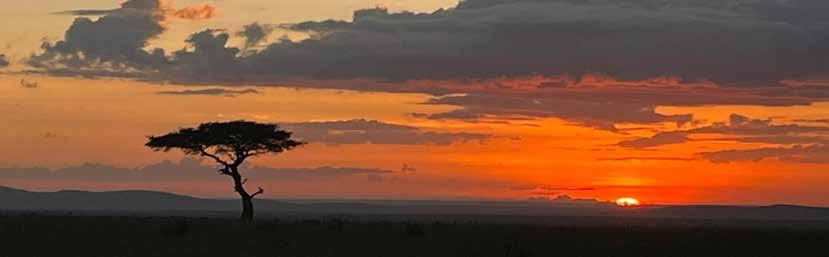
I spent a lot of my life in Africa and did a bit of big game hunting. This was mainly for the Game Department who needed things like elephants culled because they did a lot of damage to the crops of local, small-scale farmers. An elephant eats a lot and is said to relieve itself every three quarters of an hour. This makes it easy to follow because if the dung is found every hundred yards or so it would mean that the elephant is walking very slowly, but if found far apart the elephant is obviously moving quite fast.
I now live in Dorset and a friend and I were taking our dog for a walk down a country lane when we suddenly came across the most enormous poo! My friend gasped with horror, pointed at it and exclaimed, “What on earth did THAT!”
I took one look at it and said quite calmly, “An elephant!”
“Don’t be so stupid!” my friend said. “We don’t get elephants in this country!” I tended to agree with him but was intrigued to find out what animal had deposited this enormous poo. We walked on and it was not long before we found another even
bigger poo. I was amazed as I was absolutely certain that it had been done by an elephant. We walked on and rounding a corner we bumped into a circus, which, as circuses do, was moving on to a new location and being led quietly in the rear was – an elephant!
Mark Milbank, Dorset, UK
I used to own a farm in Rhodesia (now Zimbabwe) and raised beef cattle. One day one of my cattle herders came to see me carrying a small, furry, brown, baby animal about twice the size of a rat with its eyes still completely closed. My wife and I had no idea what it was but took good care of it and fed it on milk out of a bottle, followed by more solid food. It was a very greedy feeder and grew very quickly. It also
started to change its colour from brown all over to white all over its back and head then black over the rest of its body. Suddenly we realised what it was - we were feeding the most vicious animal for its size in all Africa. It was a honey badger!
It turned out to be the most wonderful pet, ragged with the dogs and came for walks with us. After about three months we thought that it would wander off back into the wild as we never put it into any sort of cage. My children loved the little animal and my youngest son even took it to bed with him! This scared me a bit as he could roll over in his sleep and annoy the animal and honey badgers have a reputation for attacking a very vulnerable part of an adversary’s body!
Eventually he did wander
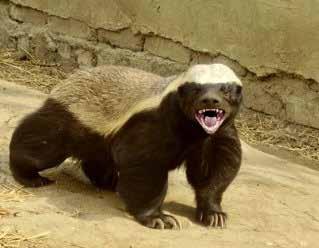
The honey badger was a wonderful pet!
off and we thought that we had seen the last of him, until after about ten days, he suddenly reappeared and brought a wife with him! I have never had such a wonderful pet.
Mark Milbank, Dorset, UK
We had a large cattle ranch on the Athi Plains in Kenya and, as well as our cattle, there was a lovely herd of giraffe that lived there permanently as well. We used to round up our cattle on horseback and one day my sister found a very young, baby giraffe entangled in a wire fence. There was no sign of the main herd so my sister got off and set the little giraffe free. She thought that it would gallop off looking for its mother in the main herd, but as she remounted her pony and set off for home the little giraffe followed her and she could not get rid of it. When she reached our homestead, we put it in a stable and gave it some milk before setting it free, thinking that it would soon gallop off in search of the main herd.
Not a bit of it! As soon as it saw one of us, it came galloping towards us. We never shut it up again and it remained it with us for about nine months. It was actually becoming quite dangerous. It was all of 14 feet tall by now and as soon as it saw us, it came galloping towards as with those huge legs flying in all direction. We really HAD to get rid of it somehow and, to our eternal shame, we sold it to a collector of African animals and they took it by ship to England. Years later we visited our
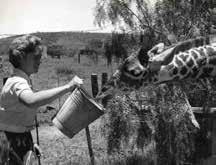
My sister Sue feeding the giraffe that imprinted on her after she rescued it from a barbed wire fence.
giraffe in Chester Zoo. It nearly made us cry seeing this magnificent wild animal in a cage.
Mark Milbank, Dorset, UK
and in a minute that tree looked like the perch of vultures over a kill, as my men filled the boughs. The rhino trotted quietly past the tree, neither winding nor seeing its occupants.
From A Game Rangers Note Book by Blayney Percival
An Ostrich Camera Hide
We had great excitement over my first rhino photograph. We were marching along the safari road across the Athi Plains when the beast was seen, quite alone in the open, so, taking the camera and the .450, I approached within 100 yards, and gave the two Maasai men their instructions. They were to come with me, one carrying the rifle. If the rhino ‘came,’ the man was to give me the rifle and run in one direction, while his fellow ran the opposite way, leaving me to stop the beast. When they understood what they were to do, we set to work to crawl nearer, and got close enough to snap a couple of pictures. That done, we frightened the beast away and succeeded in doing exactly what I intended to prevent. The rhino made straight for the safari, and I had a lovely view of the porters dropping their loads to run for the one and only tree within reach. The porters are expert climbers when there is a rhino behind
A big camera is a most awkward thing to carry when crawling up to game; it provokes language that might blister the veldt. I once tried the ostrich dodge, as described by Sir FJ Jackson in the Big Game volumes of the Badminton Library. My stalking ostrich was constructed from the remains of an old porter’s tent over a skeleton of thin sticks. It was a beautiful ostrich, and would have served admirably had I wanted to shoot. For a camera, however, it proved impossibly awkward to handle, and I discarded it. I can recommend a canvas ostrich as a Turkish bath; it was a success in that capacity.
From A Game Rangers Note Book by Blayney Percival
Do you have a short, funny or quirky story about something that happened in Africa? Send your contributions marked Only in Africa to editorial@ oldafricamagazine.com, or by post to Old Africa, Box 2338, and Naivasha - 20117 Kenya. Please limit stories for Only in Africa to 350 words or less. Include your name and address in case your story is published. We pay KSH 1000/- for each published story. Sorry, we cannot return submissions to our Only in Africa column.
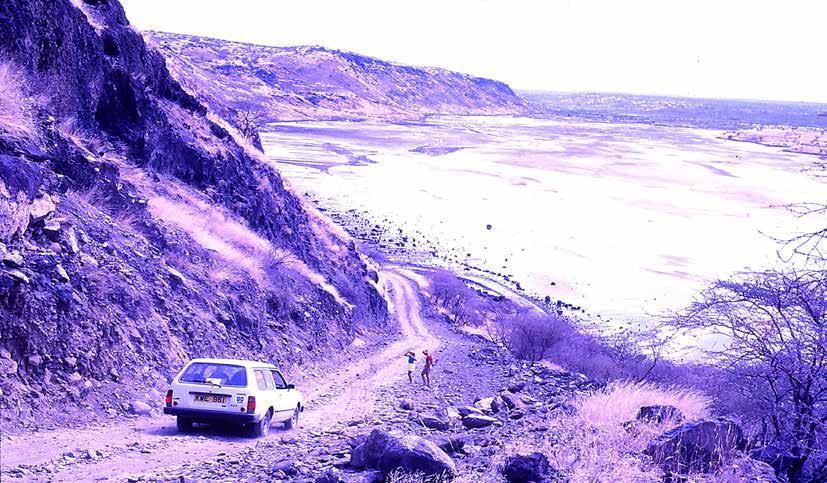
Setting off for Magadi in our rented Mazda. (All photos in this article courtesy the author, Jean Sesiano)
by Jean Sesiano
with the help of his daughter Florence
1988 My wife and I and two of our daughters, aged 11 and 13, set off from Geneva, Switzerland on a trip to Kenya in July 1988. I hold a PhD in geophysics and a Master’s degree in geology; at that time, I was teaching Earth Sciences at the secondary level, as well as General Meteorology in the Earth Sciences department at the University of Geneva.
I chose for our family to visit Kenya because, at that period of my life, I was passionate about volcanology and had visited numerous volcano sites around the globe to collect samples, take photos, and shoot 16mm film. I had studied volcanic phenomena in Italy, France, Spain (the Canary Islands), and Germany, as well as travelling to Mexico, the United States, Ecuador, Japan, Turkey, and Algeria, with its Saharan Hoggar mountains and dormant volcanoes. However, the famous African Rift Valley, dotted
with volcanoes and their accompanying phenomena, was missing from this picture. Furthermore, right next to Kenya, in Tanzania, lies the Ol Doinyo Lengai volcano, which is exceptional due to the composition of its lava: carbonatites. Before leaving for this trip, I had contacted Professor Celia Nyamweru from Kenyatta University in Nairobi, and we planned to meet as soon as we arrived in Kenya.
One of my daughters kept the logbook of our trip, conscientiously writing down day after day the various facets of this journey. I will summarize her observations, sometimes quoting the highlights of her account in full.
The big day has arrived, and we leave Geneva on July 24th. After a layover in
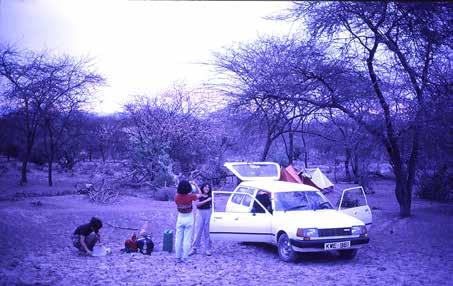
Our campsite at Magadi.
Athens, we reach Nairobi at 3:00 am local time. We need to find a hotel quickly, then get a few hours of sleep before going into town to find a rental vehicle. Celia is going to help us with this. After introductions over our first Kenyan meal, we visit a few agencies and find what we need for the first few days. This day is already ending, and we must think about tomorrow. The children are very eager to see animals, and we decide to visit the Nairobi National Park. Accompanied by a driver and two other tourists, we first head to the orphanage, where young abandoned or injured animals
are cared for before returning to their natural environment. We encounter a rhinoceros, lions and lionesses, a hyena, crocodiles, and hippopotamuses. Our children love it. Next we go on a game drive around the park, which is 120 square kilometres. A lioness on the road, then gazelles, impalas, and other swift animals appear before the children’s amazed eyes.
The next day, Wednesday, July 27th, we set off for the south of the country with our rental car, a Mazda. Once past the Ngong hills, the sun shines and the temperature rises. Maasai herders tend
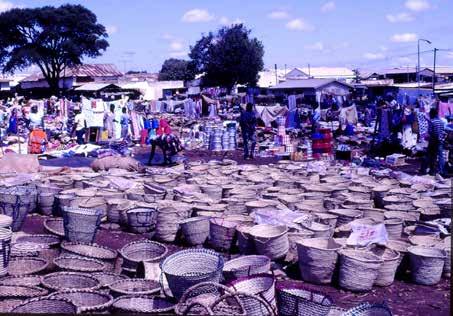
their sheep, standing on one leg, leaning on a spear, with a cloth wrapped around their bodies. We reach a village on the shores of Lake Magadi, located at the bottom of the Rift Valley. After refueling the vehicle and stocking up for ourselves, we pick up a soldier, at his request, who wants to get to the other side of the lake. This body of water is endorheic, meaning it has no outflow, as evaporation compensates for the inflow from hot mineral springs. Sodium carbonate deposits are mined and exported. Soon, we drop off our passenger, then settle down on a geological terrace of the rift overlooking the lake.
Monkeys and baboons, keep us company. Since the place is pleasant, we spend the night there under a tent. The next day, on the road back to Nairobi, we stop at the Lower Paleolithic prehistoric site of Olorgesailie for the night. It is famous for its very numerous handaxes knapped by Homo erectus about 1 million years ago. The site is well-designed and highly educational. On July 29th, we return to the capital.
The following day, we wake up to a light rain, which does not stop us from going to the agency to exchange our car for a Suzuki Sierra that will accompany us for the rest of the trip. It is an almost new vehicle with 2,000 km on the odometer—a sign of reliability. We stock up on provisions, then leave for Nakuru. We climb so high that it starts to get cold. Along the road, farmers are offering oranges and various vegetables; we let ourselves be tempted. Once past the
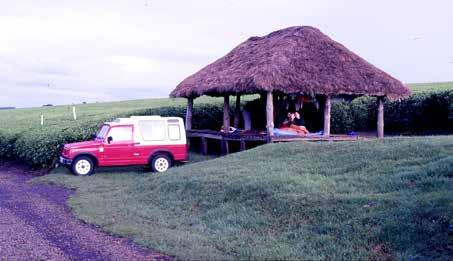
mountains, the temperature becomes more bearable. Shortly after the town, we stop to let President Moi’s convoy pass as it returns to Nairobi. We then cross vast tea plantations. As the day is already well advanced and the sky is becoming threatening, we sleep on the floor of a ‘banda’ where freshly cut tea leaves are stored. Around 11:30 pm, we leave it in a hurry because the roof is leaking. The downpours are violent. We find another ‘banda’ 400 meters further on and sleep there for the rest of the night, better protected this time. And to think we are in the dry season!
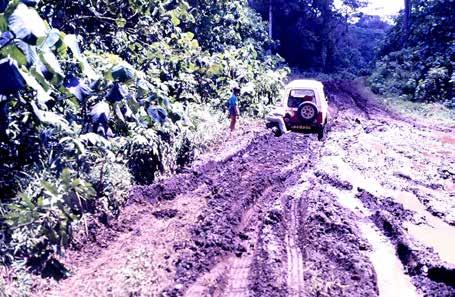
On the morning of this last day of July, it is cool and the sky is clear. We chat quietly with the plantation guards before leaving, then pass Kericho. We have left the bottom of the Rift Valley to climb onto the horst where Lake Victoria is located and head toward Kendu Bay, on the shores of the lake. There are many fishermen because it abounds in fish. We follow a track for 100 kilometres that brings us to Kisumu, the thirdlargest city in the country. Tonight, the YWCA welcomes us. After a noisy night, we buy bananas and sugar cane in town before heading toward the small village of Endebess. We intend to get as close as possible to Mount Elgon, which is currently invisible under the clouds. We ask for directions to Endebess, the National Park, and its lodges. A good track at first, which turns bad before we learn that we have gone entirely the wrong way! We turn around and commit to a track that quickly becomes muddy and
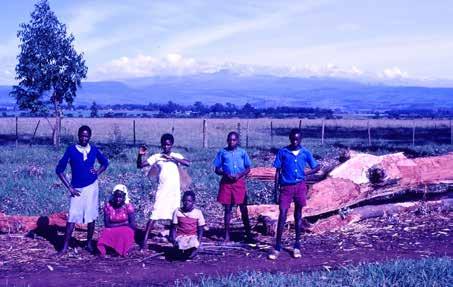
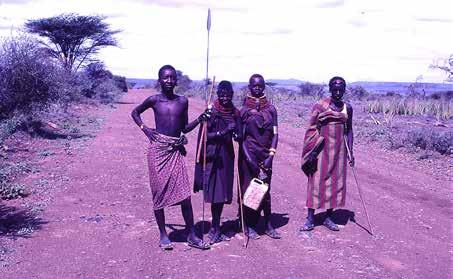
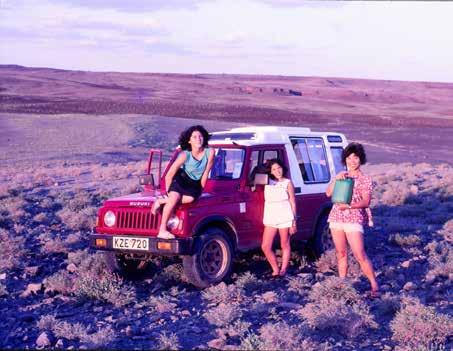
very slippery due to recent rains. The car, though a 4x4, skids; at any moment, we risk sliding off the road. Once again, we retrace our steps to finally reach Endebess. We are now on the right road, but a storm breaks out. The clay
track turns into an ice rink. The vehicle slides into the ditch, which is fortunately shallow. Braced against the embankment, aided by the rest of the family, we get the car back on the road and turn around. I drive very
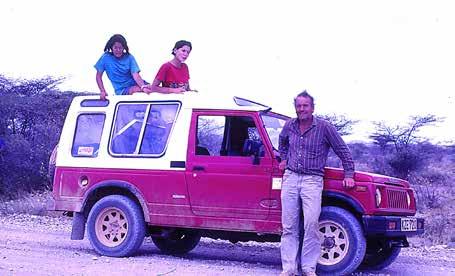
slowly, while my wife and our two daughters walk in the mud and the rain. We stop at a farm owned by an Englishman and ask him for hospitality, which he gladly grants us. We spend an excellent night next to five large presses intended for crushing sunflowers and corn.
With a “God bless the safari,” we leave the farm foreman under a radiant sun, an impressive Mount Elgon reigning in a blue sky, satisfied with the bad trick it played on us the previous day! But we know it will not be long before it hides under convective clouds. We head toward Eldoret, where we buy food and make a stop at a small restaurant, eating delicious chapati. Shortly before Kabarnet, we stop to learn more about the termite mounds standing near the road. By digging at the base, we discover a chamber topped by a chimney over two meters high. Two people arrive and, quick as a flash, overturn the structure and explain to us who its inhabitants are; large ants armed with pincers that sting very hard, flying ants, a huge and quite plump queen, and termites that are good to eat because they are rich in protein. The journey continues. We pick up a 12-year-old girl who needs to go to the village to do some shopping, then we
Top: The author and his daughters on the road in Kenya in 1988.
Middle: Some of the fossilized bones that were found on in the Chalbi Desert.
Bottom: The muddy road to the trail head near Chogoria.
set up camp on the sand by a river. The children make sandcastles and proudly bring us about 20 porcupine quills found nearby.
After an excellent night, we leave for Lake Baringo, which we pass by, as it is Lake Bogoria and its geysers, located in a reserve, that interest us. I film erupting geysers, as well as fumaroles and mud volcanoes. Antelopes and pink flamingos enhance this scenery. A little further on, deserted hot springs welcome us, and we take the opportunity to wash our bodies and clothes. As we travel northward along the bottom of the Rift Valley, these paravolcanic phenomena are normal. We pass near Lake Baringo again, but its crocodiles, hippopotamuses, and snakes discourage us from lingering. Under the ongoing storm and its downpours, the lake takes on a striking orange hue. Later, as the rain comes to an end, we pitch our tents near the track and spend a fairly good night. It is already August 4th, and we have 154 kilometres of track ahead of us. We pass many typical nomads with colorful necklaces, earrings, and ochre decorations on their faces, bodies, and hair—all of these Pokot herders carry spears. A stop by the side of the track allows us to find, under a burning sun, flints and pieces of obsidian, a volcanic glass, some of which have been worked. We spot our first zebras shortly before
reaching Maralal. There, we fill up on water and gas and buy a few souvenirs offered by children. The track crossing the Reserve is muddy, and the forest surrounding us burned a few months ago.
About ten kilometres after Morijo, we set up camp and, for the first time on the trip, are swarmed by mosquitoes! Fortunately, the mosquito nets are effective.
The next morning finds us
driving on a track through a desert landscape, waiting to catch sight of Lake Turkana; but just like in the song our children hum, there is always a mountain behind the mountain we have just
crossed! Finally, a body of water stretching endlessly toward the north appears, with a large island bathing in the foreground. On the shores of the lake rise numerous volcanoes, which were still
active a few thousand years ago. We pass through a village where we pick up a young boy who will lead us to the nearby Loyangalani Mission, run by an Italian priest and his Colombian assistant. We return to the village to eat and refuel. Back at the mission, the priest offers to let us set up our tents in the garden with a swimming pool fed by hot springs available in the shade of the acacia trees. The next day, after Mass said in Swahili, it is back to the pool before leaving for an excursion by the lakeside, where the water is slightly salty. We look for stones and fossils there. Limestone concretions have formed around shells or pieces of lava. The sun is high in the sky, but a light thermal breeze cools the air. Returning to the mission, we take our leave and head toward El Molo Bay before looking a little further on for a spot for the night. Sunday, August 7th, will be a complicated day. During the night, the wind picked up and knocked down a tent. Its occupants thrashing around under the canvas look like ghosts... In the panic, the bottle of syrup spills over the sleeping bags and clothes while a light rain falls outside. Furthermore, the water jerrycan is cracked and leaking. And finally, in the morning, we see that a tire is flat, pierced by a large acacia thorn. Two solutions: either return to the mission 30 kilometres away to repair it, with no guarantee, or
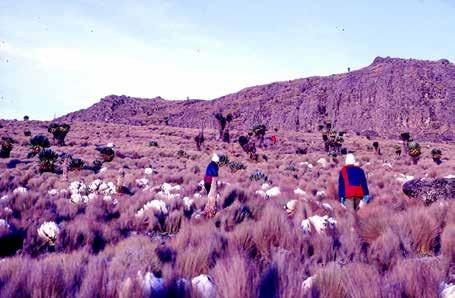
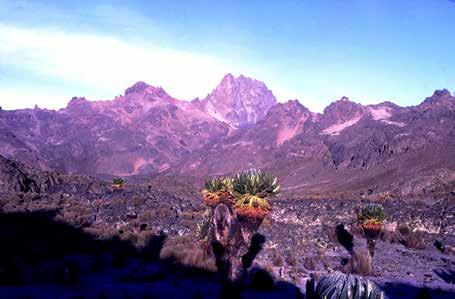
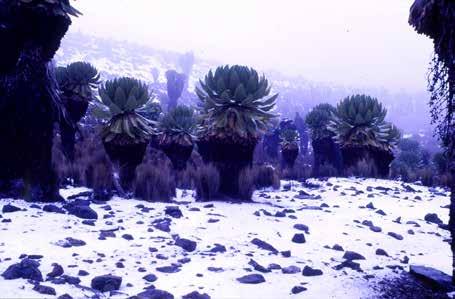
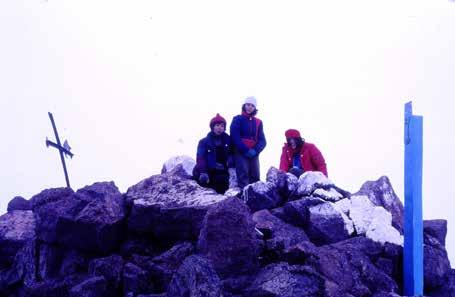
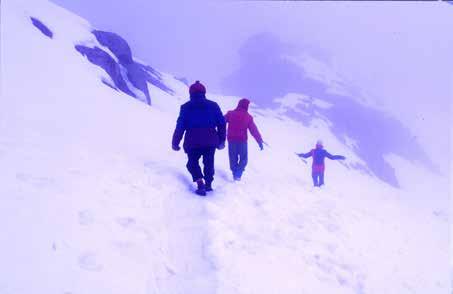
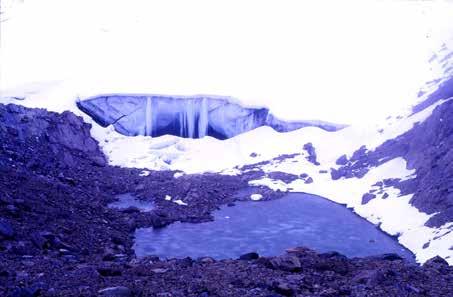
Top: The author’s family at Pt Lenana – minus Jean, who took the photo! Middle: Hiking down Lewis Glacier.
Bottom: The ice cave at the foot of Lewis Glacier.
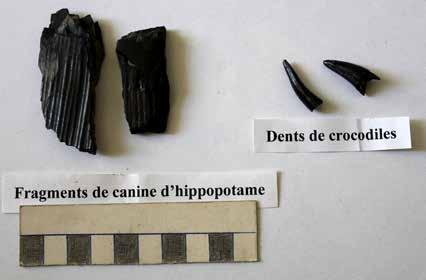
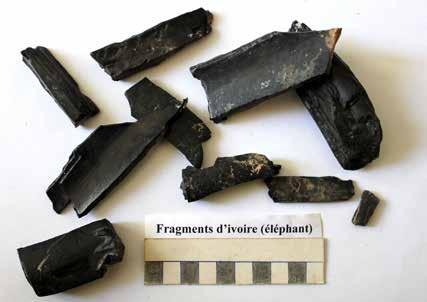
The fossil bones that we found on the shores of an ancient lake in the Chalbi Basin were analyzed by Professor Louis Chaix, a paleontologist at the Natural History Museum of Geneva, shortly after our return. The fossils included fragments of elephant ivory, crocodile teeth, hippo teeth and fish bones from Nile Perch. These remains, linked to the Early Quaternary—about 2 million years ago—attest to a fauna typical of today’s African savanna, which has currently deserted this region due to the lack of water. However, the most interesting discovery, which poses a paleogeographical problem, is the presence of a fish: the Nile Perch. This implies that some great African river was connected to the bodies of water in this region. It is possible to imagine that the Chalbi Basin was occupied by a shallow lake in communication with Lake Turkana, prior to the onset of volcanic activity—perfectly compatible with the presence of the rift—during which volcanoes would have separated these two bodies of water. Furthermore, one must imagine the absence of a northern sill separating Lake Turkana from a tributary of the Nile. The areas of lowest altitude are located to the west, or even, initially, on the border separating South Sudan from Ethiopia. In the context of active tectonics in this rift region, this is not surprising. The altitude difference separating the lake from the Nile barely exceeds 150 metres. It is also possible to envision a Lake Turkana whose water level was much higher than today and which overflowed toward the northwest toward the White Nile. This is the solution favoured by Celia Nyamweru, whose paper about the connection between Lake Turkana and the Nile River was published in Geographical Journal, Vol. 155, pp. 179-188, 1989. There would, however, be another option. This would be a communication with another tributary of the Nile, but further east, between Kenya and Ethiopia. It would take place north of the locality of North Horr. However, that theory is not favoured since the high altitudes are not compatible with a transfer via this route.
Celia Nyamweru’s paper about the connection between lake Turkana and Nile was published in Geographical Journal, Vol. 155, pp. 179-188, 1989.
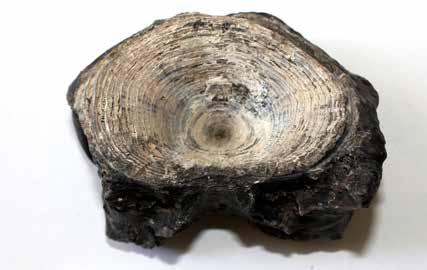
continue to North Horr, 80 kilometres away, with the risk of a second flat tire—this time without a spare. We decide to continue. The track, faintly marked, is poor; clouds hide
the sun a bit, and it is less hot. But mirages surround us, with mountains looking like islands in the middle of the water. Fortunately, we reach North Horr safely and go
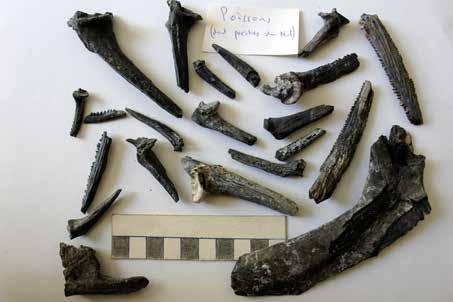
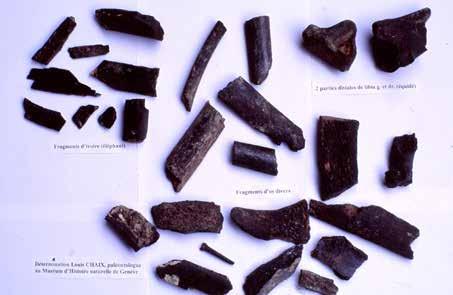
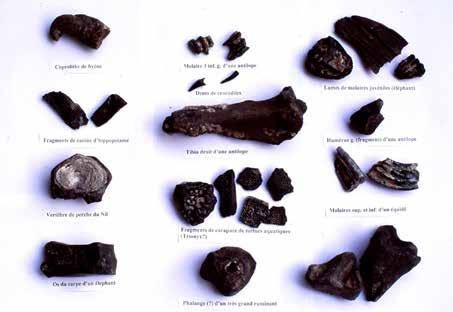
to the mission, where the priest, a German, receives us very kindly. The mission mechanic puts the vehicle back in order, then we depart for the beautiful, lush green oasis of Kalacha, where we make a few purchases. We set up camp a few kilometres away. After a peaceful night, we leave for Maikona. A Land Rover we cross indicates a new track that bypasses this town. We are now crossing the Chalbi Basin. During a mid-morning stop, while we are savouring some fruit and Jean is inspecting the surroundings, he runs back very excited because he has found fossilized bones. Black, patinated, and highly varied, they belong to all kinds of animals. This find is quite normal on the shores of an ancient, dried-up lake. After a harvest that mobilizes the whole family, we hit the road again to reach the oasis of Mayidahad. Several tracks lead out of it, and following the instructions of a herder to whom we give an orange and some carrots, we arrive in Marsabit in the late afternoon. In town, the police inform us that we will have to travel in a convoy
Left page;
Top: Fossilized crocodile and hippo teeth from the Chalbi Desert. Middle: Fossilized ivory fragments from elephant tusks.
Bottom: Nile perch vertebra.
Right page;
Top: Assorted fish bones, including those of Nile perch.
Middle: Some of the Chalbi fossils analyzed and classified by Professor Louis Chaix, a paleontologist at the Natural History Museum of Geneva. Bottom: Some more of the classified Chalbi fossils.
the next day because there are bandits armed with rifles on the road. Moving away from the town, we sleep in a wild spot with giraffes and elephant dung for neighbors—without their creators, unfortunately!
On Tuesday, August 9th, we are up early for a long day. Meeting a white farmer in his jeep, we ask him about these convoys. He laughs and says that it has been a long time since there were any raiders, and that the convoys continue simply out of habit. So, we set off for Isiolo and its 275 kilometres of track, with a lot of washboard road. We reach this locality in the late afternoon, do some shopping there, and then find a spot to sleep a little further on, surrounded by zebras and gazelles.
Upon waking, we can make out the peaks of Mount Kenya in a clear sky. It does not look very high, which is an illusion! We cross the equator, then head toward Meru and then Chogoria, where things get serious. A muddy 16 kilometre track, where we sometimes get bogged down, leads us to Chogoria Lodge, where we pay our park entry fee, about 400 shillings, and then another 6 kilometres to the parking lot at 3,200 metres above sea level. Here, the hiking trail begins. The weather is misty, but the landscape is magnificent. First bushes, then large tussocks of grass and lobelias start at about 3,900 metres. The slopes are gentle because the lava emitted by the volcano was very fluid. To the left, there is a deep gorge. Around 7:30 pm, we pitch
the tent at 4,000 metres; it is about -2°C. We are tired and can hardly eat.
On Thursday, August 11th, we wake up at 6:30 am and leave without eating. Tents and luggage are left behind. Forty minutes later, we reach the Hall Tarns refuge by a lake. An Englishman shows us the way. We eat two fruits and a few biscuits, then set off. Rock hyraxes, similar to our Alpine marmot, scurry away around us. We decide to take the shortest cut through the rocks, cross a dried-up lake covered in lobelias, and then reach a ridge. The children have headaches and feel like vomiting. The stops become more and more frequent; we are also discouraged by numerous false summits. Patches of snow appear, the fog rises, and sleet and snow begin to fall. At noon, the exhausted caravan reaches Point Lenana, at an altitude of 4,985 metres. Invisible in the fog, the summit of Mount Kenya towers over us by some 200 metres. We are alone. Jean cries tears of joy and hugs everyone. We must descend as quickly as possible, as the weather is worsening, and it is via the Lewis Glacier that we reach the Arthur Firmin hut at 4,790 metres; the entire landscape is white. At 3:30 pm, we are at the refuge where two New Zealanders, preparing to climb the volcano, offer us some soup, and then we dash down toward the tents where we pack up our belongings. Finally, an endless descent brings us to the parking lot where we pitch the tent.
The next day, we return to Nairobi via Embu and Thika. We check into a hotel,
then book our bus tickets to Mombasa. We devour some pizzas with great pleasure before getting into real beds! On Saturday, August 13th, we return our Suzuki, which has served us faithfully, and then set off for the coast, feeling anxious about the bus driver’s driving style. We take a hotel by the sea, and then it is a day of rest. A new rental car will allow us to drive along the coast, first to the south and the Shimba Hills National Park, then to the north, with Malindi and its Marine National Park. A night under the stars, by the sea, lulled by the sound of the waves, followed by a harvest of seashells on the shore. A fisherman offers us two magnificent ones. August 19th will be our last day in Kenya. We meet Celia one last time, and show her our fossil bones and recount the adventures of our magnificent journey, before taking the plane in the evening to return to Europe, delighted with our trip.
by Pritpal Sandhu ©Pritpal Singh Sandhu. all rights reserved
At night, before electricity came to Musoma, the hill spoke. Its voice drifted down through the darkness in eerie waves—deep, hollow wooooup-wooooup calls followed by shrill bursts of mad laughter that froze the blood of children lying awake in their beds. The hyenas had begun their nightly descent. They came padding down the dirt track behind our government quarter, slipping out of the granite wilderness above us and into the sleeping streets of town. Even now, decades later, I can still hear them. To a child, those sounds seemed impossibly close, as though the creatures stood just beyond the thin wooden bedroom door, breathing in the dark.
That hill—Musoma Hill—was not merely a landmark overlooking Lake Victoria. It was alive. It watched over the town, fed it with stories, sheltered its wildlife, shaped its history, and educated generations of children more profoundly than any classroom ever could. It was wilderness and memory fused together in stone. And today, that priceless inheritance stands in danger of being lost.
Musoma, my childhood hometown, was blessed beyond measure to grow around one of the most remarkable granite hills in East Africa. Rising above the shores of Mara Bay, the hill was a fortress of colossal boulders, caves, hidden ledges, and tangled forest. It possessed a richness of fauna and flora that
seemed almost unbelievable for a hill standing at the center of a growing town.
Until the early 1960s, the hill sheltered an entire clan of hyenas, troops of vervet monkeys, colonies of rock hyraxes, civet cats, porcupines, mongoose, skinks, and snakes of every description—including enormous rock pythons that preyed upon the hyraxes among the boulders. At times, an elusive leopard also haunted the slopes and surrounding open country. It fed on monkeys, hyraxes, stray dogs, dik-diks, springhares, and the Thomson’s gazelles that grazed near the airport plains.
Above all of them soared the fish eagles. In the hot stillness of afternoon, when the town lay drowsing through the post-lunch siesta hour, their haunting cries would drift over the rooftops from high above the lake. Those ringing calls—part triumph, part loneliness— became part of the soul of Musoma itself.
The town had begun developing around the hill during the German colonial era, around 1912, shortly before the First World War. Before then, the main settlement in the area had been Nyabangi, a trading village hidden in the shallow reaches of Mara Bay and accessible only to dhows. But the Germans sought a better harbour—one capable of receiving steamships on the vast inland sea of Lake Victoria. They found it on a triangular sand spit known in the Kabwa language
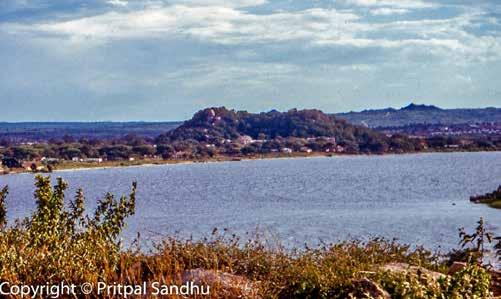
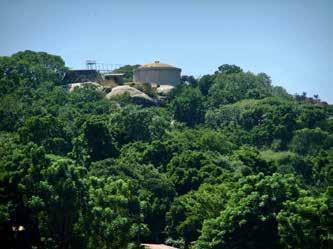
as Omusoma. The location was strategically perfect. Granite inselbergs anchored the peninsula, deeper water lay nearby, and the hill itself provided commanding views in every direction. The arrival of the Uganda Railway at Port Florence—modern Kisumu—in 1901 had transformed the lake forever. Steamships, hauled inland from Mombasa in crates and reassembled on the lakeshore, now connected the territories around Lake Victoria with the wider world. The railway had come at a terrible human cost. Indian railway workers, brought in to carve the line through disease-ridden wilderness and lion country, paid in blood, horror and exhaustion to make that imperial dream possible. Yet their labour changed East Africa forever, and Musoma became one of the beneficiaries of that transformation.
The Germans quickly recognized the military value of the hill. Using heliograph signalling stations, they established communication lines stretching from Nyabangi through Ikizu and Ikoma toward Shirati in the north and Mwanza in the south. At the foot of the hill, they built their formidable Boma—a stone administrative headquarters crowned with a Teutonic defensive tower pierced by rifle slits.
Even as the town slowly spread outward, the hill itself remained untamed. A narrow footpath climbed toward the summit for heliograph signalling, but otherwise the slopes remained wild country. During German rule, and later under the British after 1918, the hill persisted as an island of wilderness rising from the growing town below.
preparations for her coronation ignited a wave of imperial civic projects across the British Empire. The Musoma administration joined in the frenzy. During the sixteen months before the coronation of Queen Elizabeth II in June 1953, a dirt road was carved up the hill following the old heliograph trail. A steep flagstone staircase rose from behind Musoma Club. Near the summit, a circular dance floor was constructed where townspeople could gather beneath the stars and a coronation garden was built at the foot of the hill. By then my family was already living in a bungalow on the lower slope of the hill. The backyard of our house bordered the dirt track climbing into the wilderness above. From my earliest childhood, life and hill became inseparable.
At that time Musoma still lived by lantern light. At night, the town glowed softly with petromaxes and kerosene lamps, while beyond their pools of yellow light lay immense darkness. And from that darkness the hill descended upon us in the form of the resident hyena pack by the dirt track behind our house, announcing their presence by loud calls and laughter before dispersing into the streets and hinterland around the hill. These loud penetrating wooooup-wooooup calls and the high-pitched, maniacal, madman giggles always woke me up. The calls were so loud that it always seemed to me that they were just on the other side of my reverberating bedroom door even though they were actually about 50 feet away. I would lay in bed, in the dark, listening to them until they gradually faded away before falling back to sleep. In the predawn hours, they would once again wake me up when returning up the hill. In fact, they were part of the daily rhythm of my life, so much so, that on the occasional night when they took a different route down the hill, I would still come awake in anticipation. Those hyenas were not merely predators. They were Musoma’s night cleaners, consuming offal around the market and abattoir, quietly performing a sanitation service older than the town itself.
Then history intervened. On 6 February 1952, King George VI died. His daughter, Princess Elizabeth, ascended the throne, and
Other visitors from the hill came too. Twice a year the Jamun tree in our yard burst with purple fruit, and vervet monkeys would arrive in organized raiding parties led by dominant males with startling blue scrotums. They moved through the manyara hedge like seasoned thieves. “Monkeys!” someone would shout. Dogs exploded into barking chaos as the
monkeys bounded into the tree above them. The clever creatures taunted the dogs from the branches while stuffing fruit into their mouths with nimble hands.
Yet the most dangerous encounter came one night when our dogs erupted into savage barking in front of the house. A leopard had come for our pet goat, but it was thwarted by our Alsatian dogs and by my father, who hurled a Maasai spear at it in torch light thinking that it was a large caracal (African Lynx). Fortunately, the spear struck a glancing blow, and the surprised leopard disappeared into the dark night after cuffing our dogs about their faces, leaving one of them bleeding. My father told me later that he regretted hurling the spear to save the goat, for it would have been a very dangerous situation if the spear had wounded the leopard, as he was unarmed after having thrown it, thus very vulnerable to an attack from a wounded animal.
Our poultry sometimes attracted a gang of cheeky bandits from the hill – dwarf mongoose - who would occasionally get away with a fowl. But usually we children playing in the yard would detect the mongoose and chase them away.
On two occasions, our yard attracted large rock pythons out of the gigantic boulders. On the first occasion, our attention was called to the chicken run by the loud squawking of the chickens, and the barking of the dogs
outside the chicken run. I recall rushing out in the wake of my Dad and peering through the chicken wire into the run. My Dad spotted a python in the process of strangling a chicken in its coils, so he rushed back into the house, soon emerging with his shotgun. Telling me to stay where I was outside the chicken run, he entered and shot the python. Alas, he was unable to save the chicken for the muscular coils of the snake had already done their work.
On the second occasion, we were surprised when Dad opened the incubator room door and we spotted a python coiled on top of the incubator trying to reach the hatching chicks. This huge snake he guided out of the room with his hockey stick and dispatched with his shotgun. Besides the pythons, our yard also attracted egg and rodent eating snakes. These too were dispatched by my Dad with his hockey stick or by our home-helper Ogola using a rungu (knobkerrie) on the assumption that most of the local snakes were a danger to the small children playing in the yard.
Birds from the hill were also attracted to our yard, including wakes of black kites that were forever dive-bombing the chicks. On detecting the kite, the chicks would desperately dash to their urgently clucking mother and dive under her, disappearing from sight into her plumage. But any slow or surprised chick would be scooped up in the kite’s talons before the mother could arrive in defence.
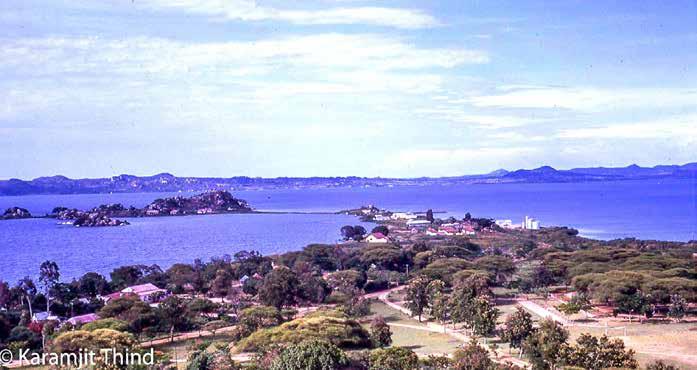
As children, we treated Musoma Hill as our kingdom. We climbed endlessly among the granite boulders, explored hidden ledges, discovered caves, and followed faint animal trails through the grass. Around nearly every bend rock hyraxes sunned themselves on warm stones until one gave a piercing alarm whistle and the colony vanished into cracks in the rocks.
We learned quickly which plants to avoid. The worst were the giant tree nettles which have a reputation for being the most painful nettles in the world. I have personal experience with that pain, as I once accidentally brushed my forearm against one of the large leaves of the plant which is covered in stinging hair. My yell of agony scared all the rock hyraxes in the vicinity, who instantly scampered back into their dark crevices. I was in terrible agony with intense itching and stabbing pain, while my companions searched for the leaves of a succulent vine whose thick sap soothed the pain. Fortunately, they found the vine soon enough.
We harvested silky spider membranes to make diaphragms for our papaya stem flutes and filled the hill with our dissonant notes.
The hill rewarded curiosity. On evening walks around the hill, I would encounter Nyanza swifts twittering while hawking for insects, particularly in front of the boma and living up to their names with their swift flight and wondrous aerobatics. It was a feast day for these birds - when clouds of lake flies (Chironomids) rose spiralling off the lake
surface and were blown towards the hill by the lake breezes. Many insectivorous bats lived in the caves on the hill and would emerge as it got dark to replace diurnal swifts and use their echolocation to feed on the insects through the night. These creatures made a huge dent in the population of biting insects to the benefit of Musomians. Both the bats and the swifts suffered predation from their nemesis the bat hawk with its huge gape, which became active at dusk and would swoop like a Peregrine falcon and grab a swift or bat and kill it in flight and then incredibly swallow it whole while on the wing. I witnessed that astonishing spectacle twice. Some memories remain permanently etched into the mind because they feel almost unreal. Others because they reveal the hidden heart of a place.
One day, while exploring deeper among the rocks, we discovered a narrow trench-like cave littered with bones. White droppings lay everywhere. Then we saw it. A human skull.
We had found the den of the Musoma hill hyenas. For several long moments we simply stared in silence. “Let’s go,” one of my friends whispered at last. Not long afterward we surprised two sub-adult hyenas near another cave. They watched us calmly with innocent faces before melting backward into darkness between the boulders. The clan survived until 1963, when the town council poisoned them on the orders from the area commissioner. With their disappearance, an ancient rhythm vanished from Musoma nights forever.
Yet for us children the hill remained
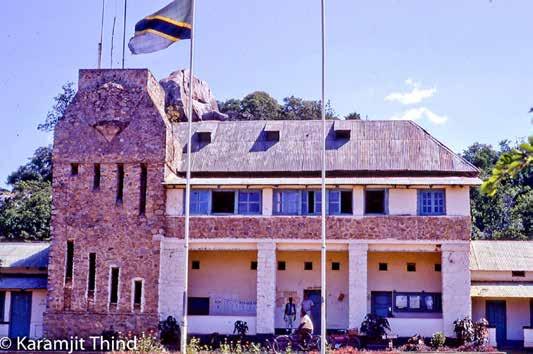
irresistible. Through the eight years of primary school, I frequently played truant during the mid-morning recess from school and, accompanied by a classmate friend or two, would go and explore the hill. In this way I became intimately familiar with the hill and its fascinating wildlife. From one of the lookout points I often went to watch a pair of fish eagles toing and froing between the lake and their crude stick nest, occasionally returning with a catfish in their talons to feed the eaglets.
The only side of the hill we did not visit was the steep forested side directly behind the Boma and the courthouse, for even as children we thought it was a no-go area, where discovery could have unpleasant consequences.
When I was in standard five a small group of us would play truant after the morning recess to go and swim in the exclusive swimming pool close to the District Commissioner’s (DC) house. This was an enclosure in the lake made by driving steel pilings into the lake floor. The pilings enclosure provided protection from crocodiles and hippo pods that occasionally came ashore at night to graze along the shoreline. Sometimes a pod would stay just offshore a couple of hundred yards waiting for their nighttime grazing opportunity.
unique window, when most of the adults would be at work. This was the time when we would slip away from the school grounds, sneak up the uninhabited hill, descend the side towards the west beach, using the staircase beyond the dance floor, and emerge behind Musoma Club. From there, being carefully elusive, we reached the swimming enclosure without being spotted by any adult. If we were ever spotted by the DC or other administration officials, it was not long before askaris (policemen) would be sent to arrest us. If this happened, we would scatter like chaff before the whistle blowing askaris pounding in our wake and flee back up the hill, which we knew intimately while the police did not, so they mostly failed to catch us.
The hill and its rich ecosystem was an adventure playground for the children of Musoma throughout my childhood. It was a default, “go to place” to enjoy the fresh air, the rock scrambling and the fascinating world of animals and plants. The hill revealed some of its secrets to me slowly over many years enriching my life
Looking back now, I realize the hill educated us in ways impossible to measure. It taught observation. Courage. Curiosity. Selfreliance. Respect for wild creatures. Awareness of plants, birds, tracks, sounds, and danger. It awakened imagination and sharpened the senses. The hill became our natural classroom long before the modern world invented the phrase “environmental education.”
And always there were the views. From the summit one could gaze across Mara Bay, over the shimmering immensity of Lake Victoria, and inland toward the distant Kirumi Hills. Wind moved through the grass. Fish eagles circled below the clouds. The town spread outward beneath the granite heights like a child sleeping under the protection of an ancient guardian.
The time between 10 am and 12 noon was a
But time has not been kind to Musoma Hill. Urban sprawl has crept toward its slopes. Water tanks crown the granite. Transmission towers and cell-phone masts stab upward like giant steel porcupine quills. Roads and settlements have severed the ecological connection between the hill and the surrounding hinterland. A living ecosystem has been fragmented. A heritage landscape has been scarred. And yet all is not lost. Musoma Hill can still be rescued. Its restoration would not merely preserve a scenic landmark. It would protect a living historical monument, an ecological refuge,
an outdoor classroom, and a priceless cultural inheritance for future generations of East Africans. Modern infrastructure can easily be relocated elsewhere. The hill itself cannot be replaced.
What Musoma possesses is extraordinarily rare—a naturally self-sustaining ecosystem rising from the centre of a historic lakeside town. Few places in Africa still hold such a fusion of history, geology, wildlife, memory, and identity within a single landscape. Musoma Hill is not simply a hill. It is the granite heart of a town.
It is the place where fish eagles have cried through the heat haze over Mara Bay from time immemorial; where children have learned the
mysteries of nature among ancient boulders; where hyenas have descended nightly into lantern-lit streets; where leopards have prowled beneath moonlight; and where generations stood upon the summit and felt themselves connected to something older and greater than themselves. If Musoma loses that hill due to environmental degradation and industrial uses, it loses part of its soul. But if it protects it— if the people of Musoma summon the vision, pride, and determination to preserve this extraordinary place—then the hill will continue to stand above the lake as it always has: wild, watchful, enduring, and magnificently alive.
from Ron Beaton
Duncan Beaton came to Africa in 1889 to work with the African Lakes Company based in Portuguese East Africa (Mozambique). In 1908 he moved to Kenya, living in Nairobi until his death in 1943. Here is an account of his early days, based on information provided by Duncan’s grandson Ron Beaton. Most of the details have been gleaned from his grandmother’s diaries. In addition, Ron provided copies of a two-part article Duncan Beaton wrote for the East African Review, which appeared in January and May 1933. Entitled “Spirit and Adventure in Central Africa,” the articles relate what the African Lakes Company did and Beaton’s role in that endeavor to stop the trafficking of slaves by providing a steamship service to enhance trade.
Duncan Beaton was born in the Isle of Skye in 1866, one of a family of six brothers and sisters. Only two, Duncan and one brother, survived to adulthood. Duncan joined the African Lakes Company in Glasgow 1886 at the age of 20. The Company had a charter to trade in East and Central Africa. The African Lakes Company had been started by the Moir brothers, both heavily involved with the Church of Scotland and its mission, to shut down the slave trade in Central Africa.
Duncan writes about the start of the African Lakes
Company in his article which appeared in the East African Review, January 1933.
Doctor David Livingstone was the first white man to explore the interior of this part of Central Africa, and make known to the world its geography and its possibilities, together with the conditions of life obtaining in this dark land.
The horrors of the slave trade were everywhere visible, and it was this, more than anything else, that made the greatest impression on his mind, so that when he returned to his native land (Scotland) he appealed to businessmen to lend a hand in the abolition of the slave trade, and in the opening up of a very dark continent to civilization. Fired by this appeal two Scottish brothers,
Fred and John Moir, both under thirty years of age, set out in 1877 to penetrate his unknown land. Their aim was to open up a trade route between the East Coast and the great lakes of Nyasa and Tanganyika.
After a long voyage via the Cape they landed in Zanzibar and were advised by Sir John Kirk, the British Resident, to cross over to Dar es Salaam and cut a road through from there to Lake Nyasa following the old slave route. They immediately set to work and made a good road for a distance of 25 miles through the jungle. The rainy season, mosquitoes and other insect parasites together with the fierce rays of the sun proved too much for them. They were laid up with fever and obliged to return home to recuperate…
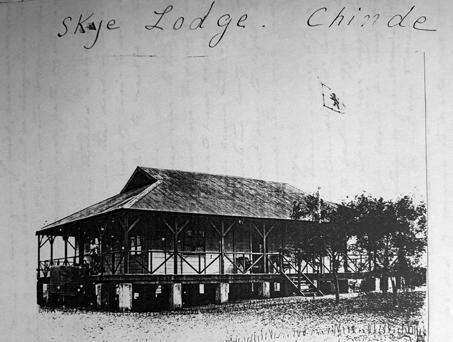
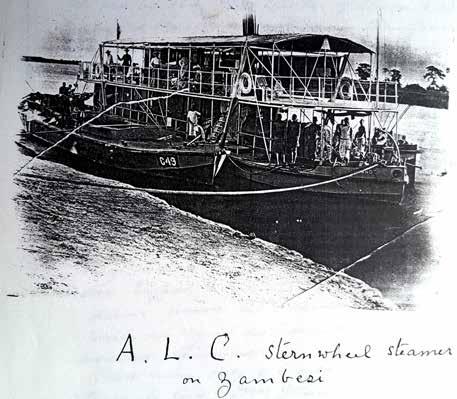
On returning in the following year to Africa they decided to adapt for their purpose the natural waterways of the country. They hoped by the establishment of an adequate and equitable system of water transport to render the system of the chained slave gang inoperative and unprofitable.
They landed in Portuguese territory by way of the Zambesi, and with monumental courage, patience and faith made their way up the uncharted rivers to what is now known as the highlands of Nyasaland.
The British Government had no official knowledge of their existence; the Foreign Office made it clear that they disclaimed all responsibility for the venture. They were, however, backed by a few wealthy philanthropists, notably Sir William Mackinnon and Sir Thomas Fowell Buxton, so that they
proceeded on their way to the Lake confident in the support of these friends.
They discovered a beautiful country, well-watered, and fertile, inhabited by a kindly race of people who were in constant fear of the Arab slave traders.
Ivory was plentiful, but carriers could be obtained only by raiding the villages who, on arrival with their loads at the coast, were sold together with the ivory. The terrors of the long overland journey with little food and no clothing, tied with slave sticks and chains, can better be imagined than described. To put an end to this horrific traffic was now the work before these two young men, and right nobly they did the job.
A company was formed in Glasgow, the African Lakes Company, and the two brothers were appointed joint managers. Trade routes
were established and trading stations were set up extending from the Coast to the south end of Lake Tanganyika. These operations brought them at once into conflict with the Arabs.
The agents of the Company bought the ivory direct from the natives, paying for it in trade goods, and had it transported in easy stages from one depot to another, and finally by boats to the coast. This method of peaceful trading and transport gradually did away with the Arab slave trading, but not before involving the company in a war which lasted for close on three years. The story of this war is an epic in itself. It is fully described in a book—“ After Livingstone,” by Fred Moir, which is well worth reading.
No military support was received from the British Government; the company’s employees with the aid of a few volunteers, which included Captain Lugard, now Lord Lugard, and Sir Alfred Sharpe, who afterwards became a Governor of Nyasaland, and the native levies fought the Arabs until they sued for peace. The Moirs, Captain Lugard and several others were badly wounded which necessitated their leaving for home to have their injuries attended to.
After three years in the company office in Glasgow, Duncan Beaton came out with the African Lakes Company in 1889 to Quelimane in Portuguese East Africa (Mozambique) to set up a reception port. This operation was moved a few years later to Chinde on the mouth of the Zambezi River. Duncan’s
article about those early days, where he refers to himself as the writer, continues:
It was in the year 1889 that the writer joined the service of the company, the country still being no man’s land. It was only after the Portuguese began to give trouble that the British Government stepped in and proclaimed a protectorate, with Sir Harry Johnston, who at the time was consul in Mozambique, as High Commissioner.
The Portuguese were in occupation of the coastline for centuries, but never dared penetrate far inland owing to the hostility of the natives. They certainly never set foot in Nyasaland. But noticing the developments that were taking place, in what they claimed to be their hinterland, they decided to despatch a military expedition to take possession, and on arrival at Chiromo, the port to Nyasaland, pulled down, with due honours, the British flag.
The natives wanted to fight them, but were restrained from doing so as the matter had now become a national question. Either Great Britain would have to intervene or we would have had to fight the battle ourselves. The writer, in the absence of the British Vice Consul at Quelimane, was deputed to lodge a protest and demand the withdrawal of the troops. The Governor declined to accept the protest as it was not written in the diplomatic
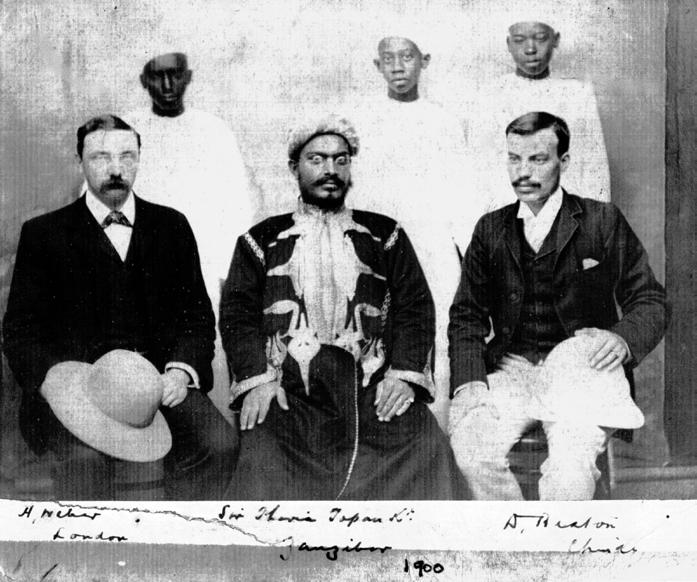
Beaton (front row right) in Zanzibar in 1900 as representative of the African Lakes Company together with H Weber (front row left), a representative of the Church of Scotland. The important Zanzibar representative in the middle is listed in the handwritten caption as Sir Tharia Topan. However, records show that Topan died in 1891 and other photos of Topan don’t look like the man in this photo. The man in the middle must have represented the Sultan in some way as Beaton came to lodge complaints about the behaviour of M’Lozi, the Mswahili son of Tippu Tip, the slaver who was entrenched in Tanganyika on the northern shore of Lake Nyasa. M’lozi was harassing missionaries and in open rebellion against the African Lakes Company. M’lozi, despite agreements in Zanzibar with the Sultan to discontinue slavery, was shipping slaves via Pemba in Portuguese territory, to bypass Bagamoyo in Tanganyika. He was later captured by Colonel Lugard, supported by the African Lakes Company, and hung.
language (French). However, an Italian friend came to the rescue and wrote it out in French after which it was, on presentation, accepted… Pressure was brought on our Home Government
Duncan Beaton met Alice de Planta after she came to Nyasaland as a missionary in 1896. They married in 1898.
by influential friends to intervene, with the result that Lord Salisbury demanded the withdrawal of the Portuguese troops. The Lisbon Government, fearing public opinion, procrastinated,
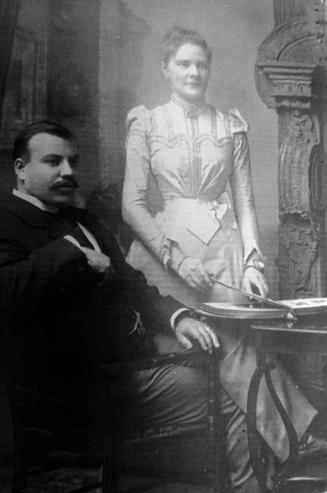
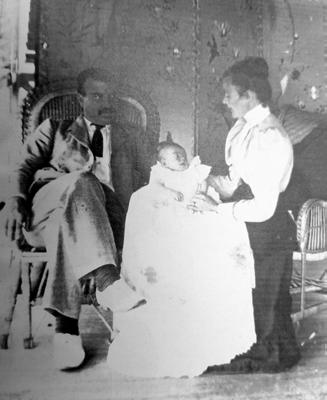
and not until an ultimatum was despatched was the order for the withdrawal cabled to Africa. It was rather an anxious time for the Consul and myself, until Admiral Freemantle, then in command of the British men in the Indian Ocean, anchored off Mozambique, sent the Sparrow, a light cruiser, to take us on board in the event of the ultimatum not being complied with. After these happenings the Portuguese were very furious, and evicted us from the house we occupied, and no Portuguese dared rent us another. It was here that our Italian proved himself again a friend in need—he placed his own house at our disposal. This ended our conflict with the Portuguese and shortly afterwards we were again good friends. Nyasaland was in our possession and the Zambesi was declared an international river.
A few months later a large force of natives threatened to attack the town of Quelimane, and the Governor invited the Consul and myself to a military conference, and to my surprise, considering the number of military officers present, I was invited to give my views as to how best to defend the town. Fortunately, a British steamer had arrived in the harbour, and I suggested that should the attack he pressed, the women and children should be placed on board the steamer, and instead of the troops remaining to guard the town, they should march out and attack the enemy. This was agreed to, and the Consul and myself marched out with them. This display of force, and a few
well directed shells, broke up the enemy concentration and they dispersed to their homes, much to the relief of the authorities.
My connection with Quelimane ended shortly after this as we shifted our headquarters to Chinde on the Zambesi [in 1891] where we obtained from the Portuguese a duty-free concession of land for the reception of goods to and from Nyasaland.
Unfortunately, we had not finished with the Arabs. After a truce of five years M’lozi, the Arab Chief, whose stronghold was at the north end of Lake Nyasa, revolted. The Arabs, at this period, firmly maintained that the Africans have no souls, and could therefore only be regarded as beasts and treated accordingly. This, needless to say, was not the government view. M’lozi defied the government, but this time he was against the forces of the Crown. A military expedition, under British officers and drilled native troops attacked what was considered by the Arabs to be an impregnable stockade. After heavy fighting the stockade was captured, and M’lozi was found hidden in an underground dugout. He was duly tried and hanged.
This was unfortunate, but inevitable, since the existence, in these days, of robber chiefs and their strongholds are incompatible with order and good government. At any rate it had the effect of putting an end to the slavers’ power for all time in Central Africa. My connection with the country lasted for a period of fifteen years. The company, of which I was latterly joint manager, is still flourishing; plantations of
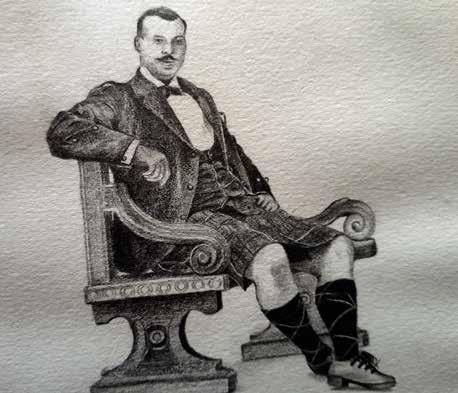
coffee, tea, cotton, tobacco and rubber were opened up, and the country generally developed on the lines laid down by the Moirs.
I have not said anything of the beneficent work of the missionary societies in Nyasaland. It is a story too long for the pages of this magazine.
was carried by mosquitos. Cinchona bark chewed or ground into powder [quinine] became the cure.”
After his time at Chinde, Beaton moved up to Mandala/ Blantyre in Nyasaland in about 1892-1893.Though Duncan Beaton said the main reason the Portuguese had not penetrated the interior was the hostility of the people who lived there, Ron Beaton added: “The Portuguese had tried on a number of occasions to settle this Zambezi basin but were stymied by malaria. Incidentally, I have discovered from my Grandmother’s journals that in 1898 they were visited by two Scottish physicians who had come up with the theory that malaria
Duncan certainly used this cure, because he wrote in the introduction to his article: “On the Zambesi I suffered frequently from malaria, due to mosquito bites, but knowing the remedy invariably cured myself. Since coming to Nairobi close on a quarter of a century ago I have not once suffered from fever.”
However, in the early days, malaria was a scourge. Europeans posted to Lake Nyasa at that time, mainly as missionaries, on average died within the first year from malaria.
In 1898 Duncan Beaton married Alice de Planta, a French Swiss nurse working for the Church of Scotland in Nyasaland. The couple lost two children to malaria and very nearly lost two more. Alice de Planta had come to Nyasaland as a missionary
in 1896. She traveled from Liverpool on the Duniden together with General Buller and his senior officers and a young journalist from the Daily Mail named Winston Churchill. In her journal she described him as very arrogant. General Buller was coming out to South Africa to take over the command of the army to fight the Boers.
Churchill, despite being a journalist, was captured by the Boers and later escaped through Mozambique. In Cape Town, Alice boarded the Induna to sail up the east coast of Africa to Chinde.
Alice wrote about the trip in her diary. “About 15 passengers for Chinde and I was the only lady. I was given the captain’s cabin. No one
could get a bath as the bath was required to hold all the vegetables. – but as these would probably only last a week the captain held out a hope that everyone might –with luck - get a bath before landing at Chinde.
“Some of the passengers were newcomers like myself – others were old planters returning to their tobacco and
Dr David Livingstone’s heart, lungs and liver were buried under this tree at Chitambo in northern Zambia after he died in 1873. The rest of his body was carried to the coast and in buried in Westminster Cathedral in London.
(See Old Africa issue 125, “Matthew Wellington: Last Link to Livingstone). This photo of the tree, with the carved inscription written by Livingstone’s men, visible on the trunk, was taken in 1928 by Captain Poulett Weatherley. (Photo from Old Africa issue 2)
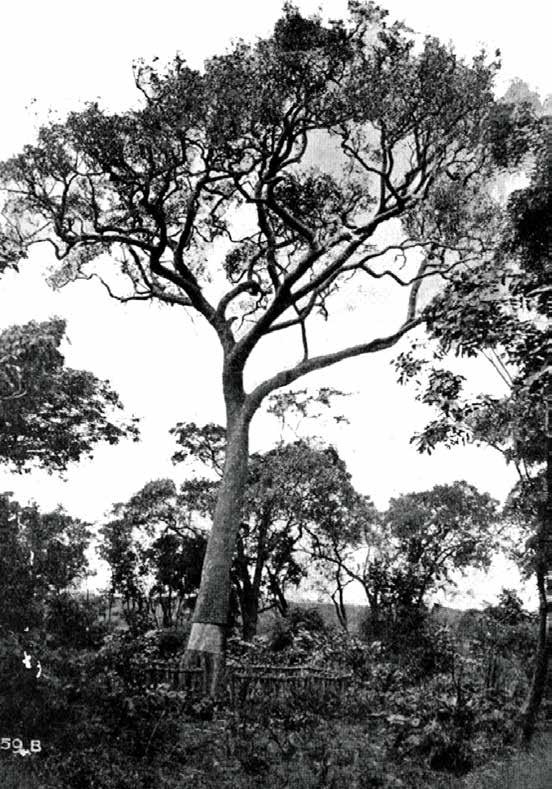
coffee plantations. And they delighted in telling us the most weird and outlandish stories! We spent a day at Beira! Beira in 1896!...What a godforsaken place – sand flies everywhere – ramshackle houses and a bar at practically every house. Men in the last stages of chronic malaria lounging about and who gave you the impression that they were just waiting to die. Dying being the only thing one could do in Beira.
“It struck me that if this was East Africa the church would do better to send missionaries to the white people instead of the natives.”
Having lost two children to malaria and concerned for the health of the others, in 1904 Duncan and Alice decided to move back to Edinburgh. Duncan had worked with the African Lakes Company for 15 years.
Duncan visited East Africa during the period of 1904 -1908 and the family moved to Nairobi permanently in 1908, joining Duncan’s cousins in Nairobi at Mackinnon Brothers opposite what is now the New Stanley Hotel. In 1909 Duncan was a member of the committee of the Colonial society along with Tarlton, Delamere and others.
In 1914 Duncan was commissioned into the army at the age of 51 as a captain and was responsible for mobilisation and supplies for the army fighting along the border with German East Africa. He was demobbed in 1919 and continued in business as well farming in Sotik on two pieces of land, a buffer area between the warring Maasai, Kipsigis and Kisii tribes.
Duncan Beaton died in 1943 in Nairobi, followed by his wife Alice in 1945. They had five children, two who died of malaria in Nyasaland, while William Beaton, Mary Beaton and Ken Beaton survived. Ken Beaton, Ron Beaton’s father, attended the Edinburgh Institute and then managed
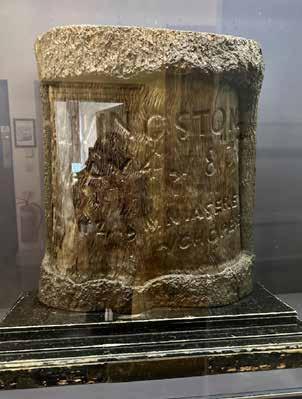
one of the farms in Sotik until he was commissioned into the army during World War II as a captain initially, then promoted to Major of a Ugandan KAR battalion. After the war Ken Beaton became the first Game Warden for Nairobi National Park. Sometime after 1928, Livingstone’s tree fell down. Because of his close connection to Nyasaland, Duncan Beaton took action and had it cut into crosses, one of which is still in the Anglican church in Zanzibar, which was built on the old slave market. Another is displayed in the Church of Scotland in Glasgow. The section of the tree trunk that had the carved inscription, was preserved and sent to London, where it now can be seen at the Royal Geographical Society. In about 1927 Duncan Beaton placed an appeal in the Times newspaper in London and over the next seven years money was raised to build a memorial to David Livingstone at Livingstone by the Victoria Falls.
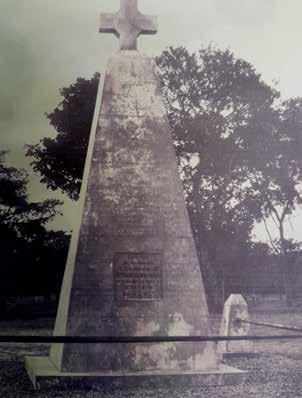
by Ken de P Beaton
The Nairobi National Park began in 1946. Ken de P Beaton, the first warden, published a weekly diary in the East African Standard newspaper in 1949, later published as two books. Ken’s son Ron recently shared those books with Old Africa. His diary entries give a flavour of what the park was like in its early days.
April 16 Owing to the lateness of the long rains the park is again dry and dusty. The waterholes have dried up and much of the game has migrated to the south into the Lunadipis country of the Masai reserve.
The rain is near however; all the signs are good. Many of the lion, including the Lone Tree pride with the ten little cubs, have followed the game. There are only fourteen lion, at the time of writing, in the park. Twelve of these are in the Athi basin and the other two, a lion and lioness, are great travellers being reported from points widely separated.
We are planning to build several dams and are cleaning out and deepening the present waterholes. The large numbers of Somali cattle in the park are being sold off and saltlicks have been made. All this will help to make the game
more resident, providing more grazing and water with the added attraction of salt.
Close to the north-western boundary of the park a school is being built in which students will be taught the mysteries of postal-telegraphy. I met the engineer in charge of construction yesterday. He has been having some exciting adventures.
A few days ago he sent a gang to work on a bungalow he is building. A few minutes later they came rushing back in alarm. They had found a lion in the passage and another sniffing round the back premises.
A night or two later he heard a great commotion under the shack he lives in, which is built on piles. He called his boy and flashing his torch below the building they saw a large python struggling with what he thinks was a serval cat. The combatants took alarm when the light appeared and slithered off into the night. It must have been a lucky interruption for the cat.
On another morning his boys told him there was a big animal in a pit he was digging as a latrine. On investigating he found an ant bear trapped in the hole. Being a kind-hearted chap he constructed a ramp; the ant bear climbed out and hurried off home.
There are many ant bear in the park, but they
are seldom seen as they are entirely nocturnal. They, like the elephant, are often referred to by Africans as the beast with a tail at each end. They are not far wrong, as the long, pointed snout is very similar to the thick tapering tail.
The front end can always be determined at a glance as it is surmounted by the large ears which are almost as big as a donkey’s. This abnormal development of ears, snout and long flexible tongue are all aids to the detection and procuring of its food which consists entirely of termites and termite comb fungus, a growth cultivated by these insects as a food supply.
The ant bear is not an aggressive animal, but he is well able to look after himself. His three-toed fore feet are armed with formidable claws, but I have never known him to use them in self defence.
I have, on several occasions, tried to capture one, hunting them in the moonlight with dogs. The ant bear has always come off best. His skin is very tough and thick, a dog’s teeth making no impression.
When seized, even by several dogs, he will put his head between his legs and turn a violent somersault which invariably frees him of his assailants. The only aggressive act I have

known one to make is to lash sideways with his heavy tail.
On one occasion, exasperated by the failure of my dogs to hold one of these beasts, I grappled with the animal myself. I received a rude surprise, being thrown several feet. I landed flat on my back staring up at the stars, and I let him be. When annoyed in this manner an ant bear will snort rather like a horse.
It makes another, rather ghostly, noise also. A friend of mine had a young one as a pet, feeding it on ants, posho and milk. At night when wandering round its enclosure undisturbed, it would make this soft moaning sound which was rather uncanny. If seen by lamp light, the small, piggy eyes shine red. He is the mightiest of all animal diggers. They are harmless beasts however, and except when they dig holes in roadways, endangering the springs of fast motorists, for whom I hold no brief in any case, do more good than harm.
Ant bears are of great benefit to their fellows of the wilds. Their industry provides countless other beasts with a home and sanctuary. Hyaenas, pig, jackal and many other wild animals use old ant-bear holes as nurseries for their young.

by R.H. Carcasson
Reviewed by Isabel Nanton
One of the favourite books on my African bookshelf provides solace during long, wet, grey Canadian winters. When the rain pours down outside, I pull out and bury myself in the pictures and lore of African butterflies compiled by ‘Bob’ Carcasson, owing the book’s presence in my library to the author’s son Francis who lives on Vancouver Island and who accompanied his Papa on many a collecting safari in East Africa.
As Francis says of his father, “He was very much a complete naturalist. In addition to insects, he had an encyclopedic knowledge of all forms of flora and fauna from around the world. I doubt he could be stumped on the name for any bird, insect, animal or plant.” Educated by Jesuit priests, Carcasson could read Greek, spoke English, Italian and French fluently and could read and write Latin. A giant in the entomological world, he was a major authority on African hawkmoths, important nocturnal pollinators, especially for night-scented longspurred flowers such as many African orchids. Hawkmoths’ long proboscises and hovering flight make them well suited to their work. Carcasson wrote his PhD on the Hawkmoths and became the director of the then Coryndon Museum, later the National Museum in Kenya in 1961.
includes many species named after him including pseudacraea congoensis (1956) and burgessi found on Mt Elgon in 1951.
An outstanding field naturalist, Carcasson wrote his butterfly handguide in the early 1980s while convalescing from lung cancer. The 100 gorgeous plates are replicas of his paintings.
“A man of considerable charm,” we are told, “he nonetheless hated cant and found fools difficult to bear” and was very disturbed by the destruction of nature. His legacy can be examined today by the health of African butterflies.
A modest volume of color-saturated butterfly illustrations, this book is a wonderfully simple introduction to the variety, beauty and great interest of African butterflies, of which there are 3,000 of the world’s 12,000 known species. And apart from their beauty, what’s not to love about some of the wild names for butterflies: Buffs, Skippers, Blues, Wanderers, Mother of Pearl, Gliders, Scribbled Harvesters and Painted Ladies to name a few.
When thumbing through the guide, I relish intel like “the oddities of butterfly behaviour” – learning that Swallowtails feed on aromatic plants of the citrus family, Swordtails on members of the Custard Apple family and Monarchs on poisonous milkweeds, while females of the large, brilliant Charaxes of my youth like to feast on rotting fruit and fermenting sap oozing from trees. Carcasson also examines butterfly mimicry of distasteful species to put off their predators and explains mass butterfly migrations.
Then, in 1969, much to the surprise of many of his friends, he resigned directorship of the National Museum to become chief curator of the new Centennial Museum in Vancouver. Carcasson had become increasingly dispirited, so his obituary tells, “by social and political changes” and in particular, (by) the unsolved murder of his close friend, the lepidopterist, T.H.E. ‘Pinkie’ Jackson. Famous in both the butterfly and birding world, Jackson’s legacy
Common in Nairobi forests, I recall the Noble Swallowtail, pale yellow Frail Vagrant and Crimson Tips. Another butterfly I recall is Hutchison’s Highflier - blue, red with white spots whose young larvae burrow into the twigs of Acacia and are associated with ants. Other gorgeous creatures include sapphire and common blue Mistletoe Hairstreaks, a group of over 100 species whose larvae are slug-like and feed on Mistletoes. Every so often, Carcasson drops in one of his larvae paintings onto a page
of his butterfly paintings – a reminder of how such beautiful creatures emerge from unlikely beginnings.
“He was a wonderful conversationalist and had a deep knowledge of many other things, including politics, world history, geography, literature, astronomy and geology,” says his
A spread from inside the book showing the vivid colours of some of Africa’s butterflies.
son Francis. While this is a scientific guide, Carcasson’s humanity imbues the text.
Collins Handguide to the Butterflies of Africa, published in 1981. It’s now out-of-print, but it is available from online used booksellers for circa US$ 40.
Has someone “borrowed” some of your back issues? Or do you know someone who would enjoy reading back issues of Old Africa?
Years 1 & 2 (Issues 1-12) are now sold out!
Other Years (6 issues)
Please make cheques or money orders out to Kifaru Educational & Editorial and mail to PO BOX 2338 NAIVASHA, KENYA 20117.
Mpesa payments can also be made to: MPESA BUY GOODS #89867.
Please make sure to follow up with a text or email stating what the payment is for and shipping address if applicable If you are overseas you can pay with a credit card at https://oldafricamagazine.com/donate
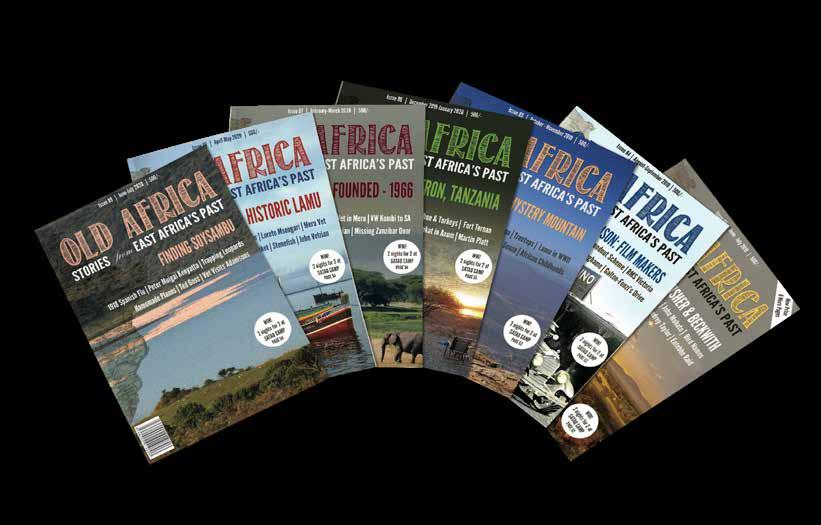
by Old Africa
One day a Dorobo hunter headed into the forest on a collecting foray. He had his bushbuck-hide honey bag, his fire making sticks and a ball of moss for making smoke. He also carried a long-knife in his leather scabbard and on his back he had his quiver of arrows and a bow. As he set out, an olkupelia (Augur Buzzard) flew out of a nearby acacia tree, flashing its white breast feathers. The Dorobo man smiled. Seeing the white chest of an olkupelia meant he would have a successful day of hunting and collecting honey.
He followed the flight of some bees and found a cleft in a tree that was oozing with honey. Climbing up, he smoked out the bees and scooped handfuls of thick golden honey into his honey bag. He shinnied down the tree and when he reached the bottom, he looked up and found two Maasai moran smiling at him wickedly.
“We have caught you alone,” one of the warriors said. “Now we will kill you!” The two warriors had their long spears ready to hurl at the lonely Dorobo hunter.
Realizing he could not fight back, the Dorobo man thought and then spoke out: “I have had a successful day harvesting some of the best honey in the world. Go ahead and kill me. But before you do, you need to taste this honey!”
The two warriors each reached out one hand to receive some honey, while
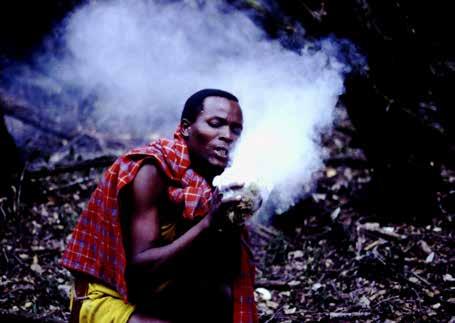
they each continued to clutch their spears in readiness.
“One hand?” the Dorobo mocked. “This kind of honey is so sweet you have to take two handfuls! I won’t give you any until you open both of your hands.”
The warriors hesitated but then each of them thrust the thin sharp end of their spears deep into the ground. The bladed spearheads quivered from the force. The Dorobo man smiled.
“Now, open both hands to receive the sweetest honey you’ll ever taste!”
The warriors each cupped their two hands together and the Dorobo man poured liquid golden honey until it flowed over the edges of their palms and fingers.
As the warriors bent down to lick the sweet honey from their hands, the Dorobo man, honey bag still firmly held on
his side, suddenly bolted. As he sprinted away, the warriors gripped the wooden hafts of their spears and tried to uproot them. But the honey was so slick and so slippery that they could not grasp the spear handles. They desperately pulled up on their imbedded spears, the handles now slimy and sticky. But the spears remained stuck in the ground.
Looking over his shoulder, the Dorobo hunter laughed and waved and disappeared like a vapor into the shrouded forest. The Maasai warriors were left to lick the honey off their hands and vow that they’d catch the Dorobo on another day.
After a Dorobo hunter related this story to a laughing crowd around an outdoor bonfire in the Mau Forest that they called an oleng’oti, he concluded, “Being clever is better than being strong!”
Old Africa reader Mike Nicholson from the UK is the winner of our History Quiz 89, which appeared in Old Africa issue 125 (June-July 2026). By the contest deadline we received 14 entries. All 14 names were put into the Old Africa pith helmet and swirled around. Mike’s name was chosen out of the hat and he wins two nights for two at Satao Camp. If you didn’t win this time, have a go at Quiz 90, which follows below. This month’s History Quiz Contest is sponsored once again by Satao Camp and Old Africa is thankful for their support and willingness to sponsor this page.
History Quiz Competition #90!
Win two nights for two at Satao Camp!
How closely did you read this issue of Old Africa? Answer the ten questions in our history quiz below and you have a chance to win a vacation at Satao Camp. All the answers are found in this issue of Old Africa. You don’t have to cut up your magazine. Just write the correct answers on a separate sheet of paper and send your entry along with your name and address and phone number to: History Quiz, Old Africa, PO Box 2338, Naivasha, Kenya 20117. Or you can email your list of answers to editorial@oldafricamagazine.com The winner will be randomly chosen from all the correct entries received by the contest deadline, which is 10th September 2026.
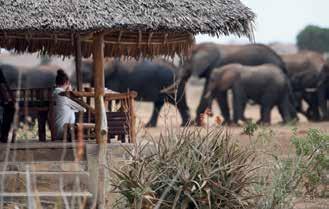
1. In what port on the coast of Portuguese East Africa did Duncan Beaton build the Skye Lodge?
2. What substance made the Maasai warriors’ spear handles too slippery for them to pull them out of the ground?
3. What was the full name of the maize growers’ group that eventually grew into the Kenya Farmers’ Association?
4. Who was buried on the slopes of the Ngong Hills after being killed in an airplane crash in 1931?
5. Who rescued a giraffe from a barbed wire fence, only to find the young giraffe following her everywhere?
6. Who was the first Managing Director and Chief Pilot of Wilson Airways?
7. The KAR lorries used to drive from Nanyuki to Moyale were manufactured by what company? (Hint: Look at the photos for the answer)
8. What does Sadani Baumwollfeld refer to?
9. Who was carried up to Mianzini on a stretcher?
10. A path ran up to the top of Musoma for signalling using what device?

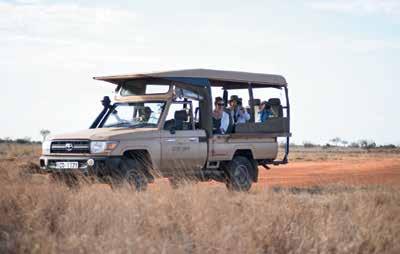
Unbeatable Wildlife Viewing: Spot elephants, impala, lions, and more right from your veranda or observe from the camp watchtower.
Authentic Tented Comfort: Relax in beautifully designed en-suite tents that blend comfort with the charm of the wild.
Stunning Landscapes: Explore vast savannahs with iconic amber sands and the untouched beauty of Tsavo East.
Book your adventure today
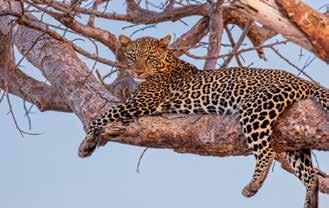
Wake up to the sight of elephants at our waterhole, unwind in spacious tents, and immerse yourself in the beauty of Tsavo East National Park. Located in one of Kenya’s largest and most iconic parks, Satao Camp offers:


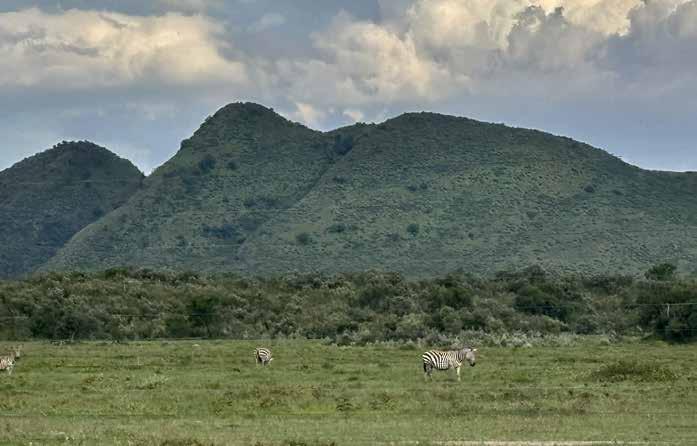
Win a Ksh 3000/- gift certificate from Text Book Centre by identifying the location of this small volcano in the Rift Valley. It has several names, one of which is derived from the facial feature of a well-known pioneer settler. Win a Ksh 3000/gift certificate from Text Book Centre by telling us where this little volcanic hill is located. If you know where this volcano is or if you have any personal stories from visiting or hiking to the top of this mystery location, send in your answer to Old Africa for a chance to win our History Mystery Contest.
Contest Deadline: For this prize we have to receive your entry by 10 September 2026. Send your answer to this History Mystery Contest along with any information, history, memories or stories about this volcano to: History Mystery Contest, Old Africa Magazine, PO Box 2338, Naivasha, Kenya 20117. Or email your answer to: editorial@oldafricamagazine.com. Editors will choose the winning entry. The answer to our mystery contest will be announced in our next issue along with the name of the winner and his or her story about our mystery location. Family members of Old Africa staff members are ineligible to enter this contest.
Our History Mystery Contest is sponsored by Text Book Centre.
…much more than a Bookshop!
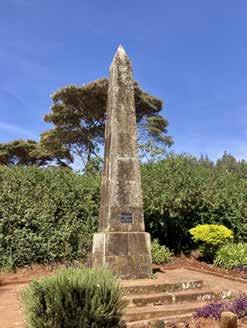
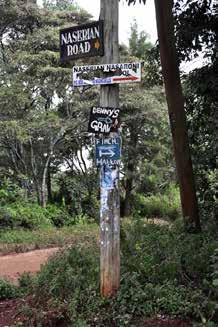
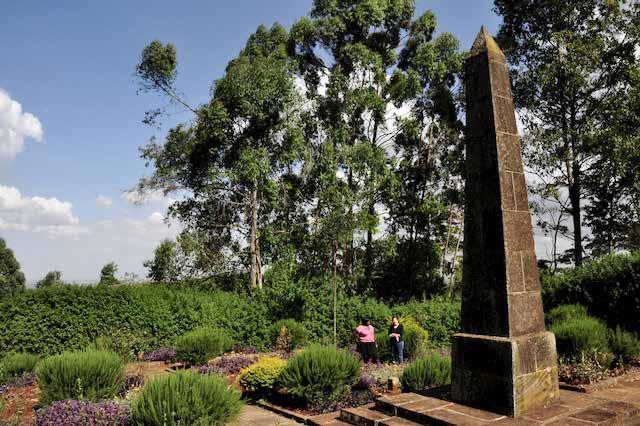
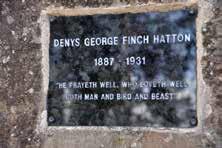
Top centre: A sign board pointing the way to Finch Hatton’s grave.
(This photo and the following two photos from Jon Steury)
Top right: A plaque in memory of Denys Finch Hatton.
Lower left: The memorial obelisk towers over the well-kept garden.
Jon Steury from Karen is the winner of our History Mystery Contest from issue 125 (June-July 2026). Jon wins a 3,000/- gift certificate from Text Book Centre. Here is Jon’s answer: When I saw the History Mystery Contest photos, I quickly recognized it as the grave of Denys Finch Hatton, renowned big game hunter and lover of Baroness Karen von Blixen. He died when a plane he was piloting crashed at Voi.
A few years back, my wife and I drove up onto the side of the Ngong Hills to visit the gravesite. It actually shows up on Google Maps and gives accurate directions. You must walk the last bit and then you find a locked gate in the hedge surrounding the beautiful little garden with a phone number on the gate to call to have the attendant come and unlock it for you (and receive your payment – I think it was 1,000/-). The garden is nicely kept and it’s a peaceful little grave site.
Jon also shared a few photos of their visit to Denys Finch Hatton’s grave on the side of the Ngong Hills.
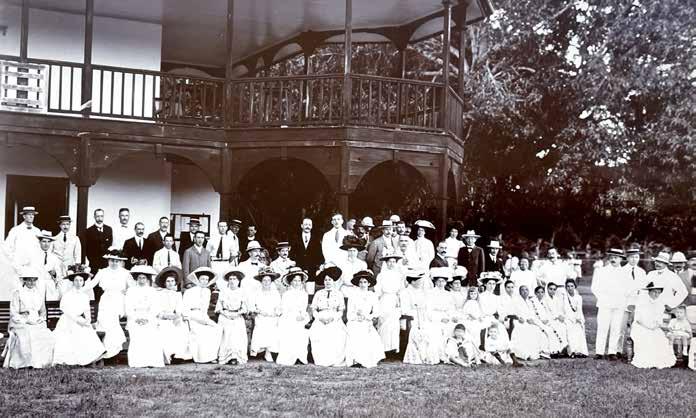
Sue Deverell of Tigoni, Kenya, is the winner of this issue’s Historic Photo Contest with this photo of the Mombasa Club members in front of the Club in 1912. Sue wins a book prize from Old Africa
Enter our Historic Photo Contest
Old family albums hold many treasures. Enter one of your photos in our Historic Photo Contest and win a free book from Old Africa! And have the pleasure of sharing your photo with Old Africa readers around the world.
If your photo is chosen as a winner in our Historic Photo Contest, you will win a free book from Old Africa
The best way to send photos to Old Africa is to have them scanned as a jpeg file of 300 dpi resolution and email it to us at: editorial@oldafricamagazine.com Note on your email that you want this photo entered in our Historic Photo Contest.
If you don’t have access to a scanner or to email, you can mail your photo or photos to us at: Old Africa, PO Box 2338, Naivasha, Kenya 20117.
Enter our Historic Photo Contest
Old family albums hold many treasures. Enter one of your photos in our Historic Photo Contest and win a free book from Old Africa! And have the pleasure of sharing your photo with Old Africa readers around the world.
If your photo is chosen as a winner in our Historic Photo Contest, you will win a free book from Old Africa
The best way to send a photo to Old Africa is to have it scanned as a jpeg file of 300 dpi resolution and email it to us at: editorial@oldafricamagazine.com Note on your email that you want this photo entered in our Historic Photo Contest.
If you don’t have access to a scanner or to email, you can mail your photo or photos to us at: Old Africa, PO Box 2338, Naivasha, Kenya 20117.
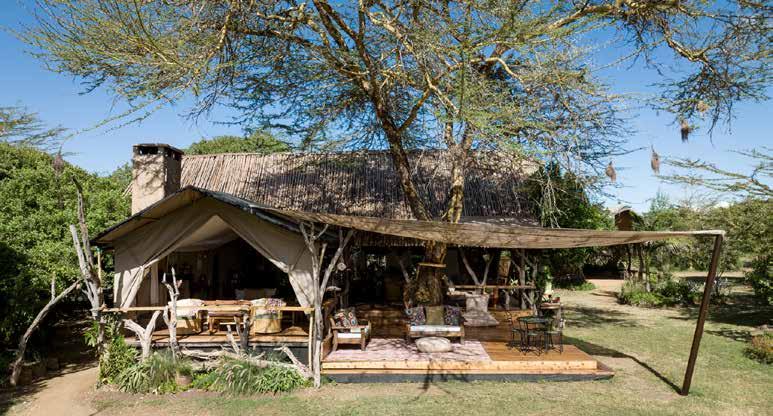

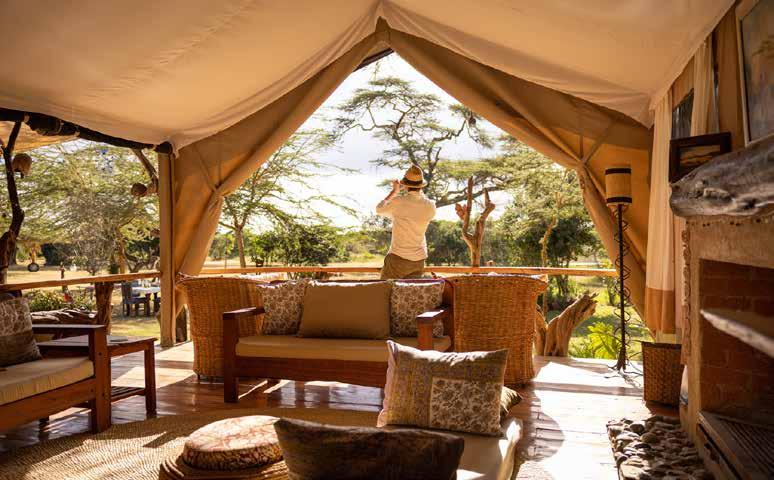
Once again we are delving into our files of vintage photos, which Sue Deverell of Tigoni shared with Old Africa. They come from archives from her grandfather, Alfred Gerald Wright Anderson and his business partner Rudolf Meyer who bought the Standard newspaper from AM Jeevanjee in August 1905 and changed the name to the East African Standard. The first seven photos seem to have been printed by the East African Standard as photo postcards for the Consolata Mission, founded in Turin in 1901 by Blessed Joseph Allamano. The photos shown here all have the words “Missioni Torinesi della Consolata in Africa (Italian Missions British East Africa)” printed on the top, along with a caption at the bottom. The Consolata Missionaries began their work in central Kenya in 1902 and these photos date from that era, showing traditional Kikuyu dress and culture before the changes that came when they began accepting Christianity. The last two photos are from a series of postcards showing scenes from German East Africa.
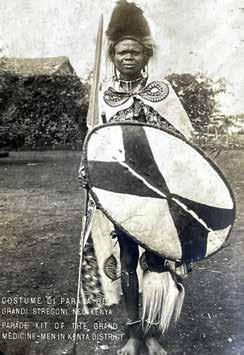
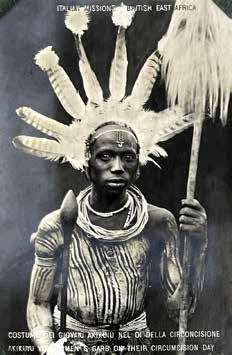
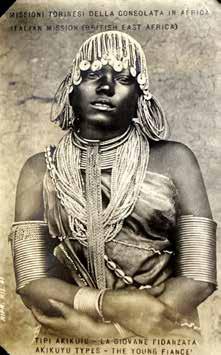
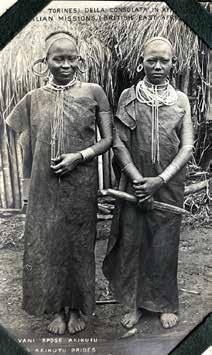
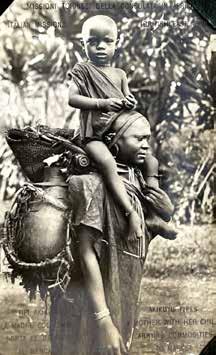
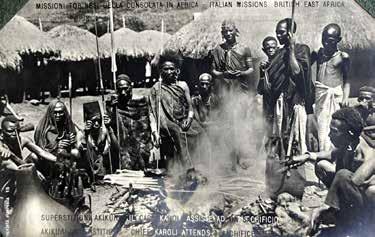
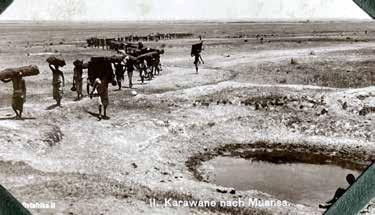
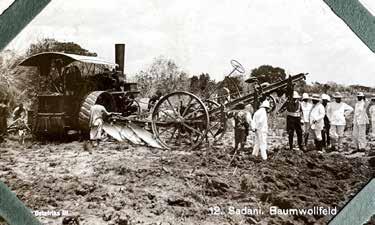
7. Chief Karoli and other elders at a traditional Kikuyu sacrifice.
8. A caravan of porters near Mwanza in German East Africa about 1907.
9. German planters ploughing a field for growing cotton at Saadani. The words on the photo - Sadani Baumwollfeld - referred to the Saadani Cotton fields, a large cotton plantation started in 1907 by the Leipzig Spinnery. Saadani was located on the Tanganyika coast about 27 miles north of Bagamoyo. The area is now part of the Saadani National Park.
by Jan Hemsing
In July 1929 Wilson Airways Ltd., was formed and soon after inaugurated a commercial air service at Nairobi and Mombasa with intentions of eventually operating all over East Africa. Their fares were Shs. 1/70 per mile. They soon achieved their goal to run a regular coast service to Zanzibar and intermediate points, with a possible extension to Beira and linking up with Imperial Airways for proposed services to Cape Town.
The ‘mother’ of Wilson Airways was Mrs Florence Kerr Wilson, a Timau farmer’s widow, who was 50 years old at the time.
‘Florrie’ Wilson, as she was always affectionately known, came to Kenya with her husband Major WH Wilson, DSO, after the First World War to start farming at Timau, near Nanyuki. Before the War she had made several flights as a passenger under conditions which would not be attractive to travellers of today. She came from a family of shipowners, and had been interested in flying ever since she was a child, when from the family home at Blundell Sands in Lancashire she used to strap herself to an umbrella and leap from a wall in the face of a high wind.
A flight which was the decisive factor in the forming of the new company took place when, following her husband’s death in 1928, Florrie Wilson had to return to England on business. She flew with Tom Campbell Black in John Carberry’s 3-engine Fokker Universal ‘Miss Africa’ with motor mechanic Archie Watkins as flight engineer. The flight took four days, and the inescapable conclusion can be drawn that at the end of it, three minds had but a single thought. When personal business matters were concluded in England, the trio visited aircraft Manufacturers to select suitable aircraft for Wilson Airways.
Tom Campbell Black had served with No. 216 squadron RAF in France as a pilot of one of the Handley Page aeroplanes of that Squadron which successfully flew from France to Egypt. He was stationed at Kantara in Egypt for over a year prior to leaving the RAF with the rank of Flight Lieutenant. After arriving in Kenya he farmed in the Rongai area. His dream had always been an air-transport service over Africa.
1879-1966
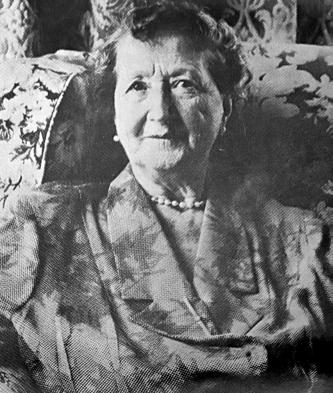
Archie Watkins, chief mechanic of the Motor Mart and Exchange (Nairobi Branch) took the opportunity of obtaining his Air Ministry Ground Engineer’s licences whilst in England.
Thus immediately following their epic flight, Florrie Wilson had the two people essential to the new enterprise. She also had the capital. She held the controlling interest in the new company, and became one of its Directors. Tom Campbell Black became Managing Director and Chief Pilot, and Archie Watkins Chief Engineer. Flight Lieutenant FA Swoffer, MBE was engaged as pilot, who for many years had been Pilot Instructor at the Hampshire Light Aeroplane Club. A Dunstan Adams, acting Clerk to the Committee of the Aero Club, became Wilson Airways’ first Company Secretary, and their registered offices were in Whiteaways Building which stood, before it was demolished, roughly where Phoenix House now stands on Kenyatta Avenue. The headquarters was at Mombasa.
In her own words, Florrie Wilson later described her Kenya-to-England flight with Tom Campbell Black:
“After my husband’s death in 1928 it was
necessary that I should return to England, and as I did not wish to travel by boat, Mr Carberry offered to fly me as a passenger in his aeroplane. This was arranged for February 1929. However, on the death of his engineer two days before the flight (German-born Mr Haeufl died as the result of a motor accident on 20 January1929 at Nyeri), Mr Carberry cancelled the arrangement, and I made enquiries as to the possibility of motoring myself via the Nile route.
“Later I met Mr Carberry with his father-inlaw Mr Meyer in Nairobi, and Mr Carberry said if I still wished to fly, he now had a man who would be willing to pilot me. I said I was making enquiries about motoring. The same day, Mr Meyer met me in his bank and introduced three men to me, Messrs. Hughes, Skinner and Black, one of whom said he would be willing to fly me in Mr Carberry’s plane, but I refused, as I did not know them.
“Later they called to see me at the Norfolk Hotel where I was staying at the time, and again tried to persuade me to fly, but I said I did not wish to do so.
“On my return to my farm, Messrs Hughes, Skinner and Black again called me with the same request, and as I preferred the idea of flying to motoring, I said I would think the matter over and then decided that provided a mechanic could be found and all arrangements made with Mr Carberry, I would charter the aeroplane from Mr Carberry and I asked which of the three was the pilot and was told it was Mr Black. The aeroplane when I flew home in it belonged, I understand, to Mr Carberry and Mr Black told me that he had been the pilot and a shareholder in a ‘plane with Skinner and Hughes.”
The first Wilson aircraft was a Moth, and carried a single passenger in an open cockpit. Florrie Wilson called it ‘Knight of the Mist’ and all Wilson aircraft were knights after that – ‘Knight Crusader,’ ‘Knight of the Garter’ and ‘Knight Belvedere.’
Nairobi’s first airfield was a strip of grassland at Dagoretti Corner, grazed by sheep. It was there that Maia Carberry, the first Kenya-born lady to fly her own plane, crashed in 1928. Wilson Airways used the Dagoretti airfield for a year, and then moved to what then became known as ‘Nairobi West’ - but which is now called Wilson Airport.
Chicago Field Museum had to be in London within a week. Tom Campbell Black strapped his 17.5 stone passenger into the other cockpit of his Gipsy Moth, tucked an extra 15-gallon tank of petrol in beside him and took off. The little machine concluded its astonishing trip over bushland, desert, forest and mountain ranges, in those days and in such a craft no small achievement.
There followed for Wilson Airways the carrying of hundreds of passengers from every walk of life including Royalty. The Prince of Wales flew by Wilson during his Big Game Safari in Kenya.
By 1931, Wilson Airways could boast two Avro Fives, two DH Puss Moths and three Gipsy Moths, and by 1938 they had a fleet of fifteen aircraft and a staff of 12 pilots and 14 engineers. In that year they flew more than a million miles and carried 4,794 passengers and 76 tonnes of mail—and all of this in times when lion, leopard and plains-game were no unusual hazard on up-country landing strips.
Writing about Florrie Wilson in 1939, after Wilson Airways had been operating for ten years, the East African Standard reported: “Mrs. Wilson is not most people’s idea of an airwoman. She is pleasantly feminine, of a quiet, unruffled
An early dramatic flight for Wilson Airways was when American Captain HA White of
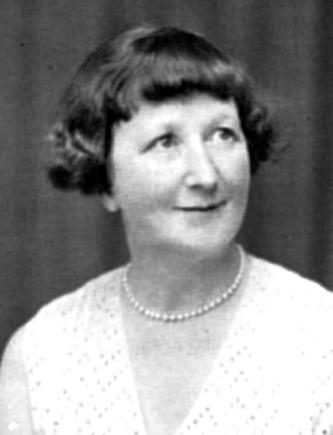
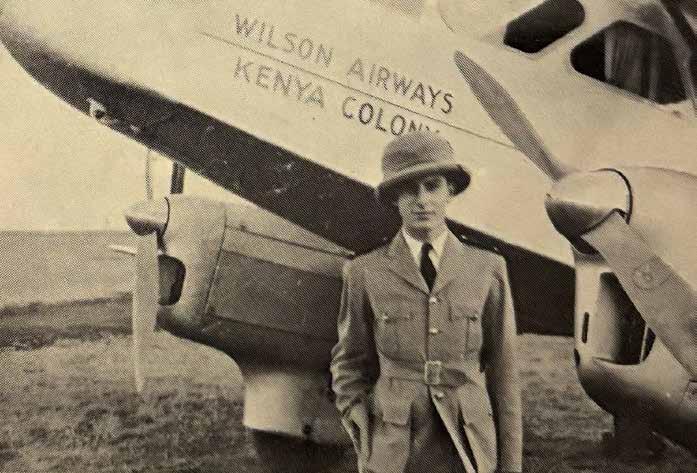
composure, and is a very shrewd business woman. She has a charming stone house which she built recently. For many years she lived at Nanyuki with her husband, but it was only after his death up-country that she realised the need for air transport in the outlying districts, especially the need for ambulance planes. One of her most interesting experiences was when she, with Mr MCP Mostert as her pilot, made the first flight crossing of Africa from east to west, and on to England in April 1931. They completed 8,531 miles between Zanzibar and Croydon in 80 hours 40 minutes flying time.” The route taken had been from Zanzibar across Central Africa to the Gambia, and then on to England.
Civil flying and Wilson Airways ceased operations with the outbreak of war in 1939, and the Wilson aircraft did valuable communications work during the attack northwards, leading to the defeat of the Italians in Abyssinia.
Florrie Wilson was awarded the OBE in 1935, and she was made a Life Governor of the Royal Agricultural Society of Kenya in 1958.
Her home in Karen was built round a full-sized billiard table, and according to Kenya historian Edward Rodwell, she was a formidable billiard and snooker player.
In 1962 the name of Nairobi West airport was changed to Wilson. Unveiling a plaque, the country’s Minister for Power and Communications said: “We have come to do honour to a very great and dear lady” - a fitting salute to the pioneer of what is now an enormous complex of hangars and administration buildings. Wilson Airport is reputedly one of the busiest small airports in the world and is the home for various light and charter aircraft, the Police Air Wing, the Flying Doctor Service, Search and Rescue Operations and much more, including the Aero Club of East Africa.
Florrie Wilson retired to Jersey late in life, but during a visit back to her Kenya home in Karen, she died on 29 September 1966. The mother of Wilson Airport was 88 years old.

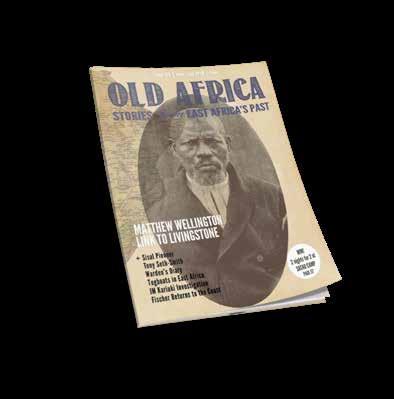
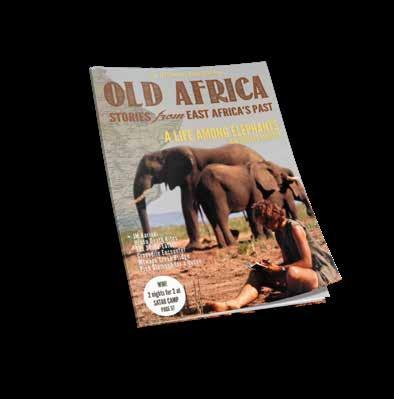
We hope you enjoyed this edition of Old Africa. Please consider a donation to help us keep the stories coming.
www.oldafricamagazine.com/donate