
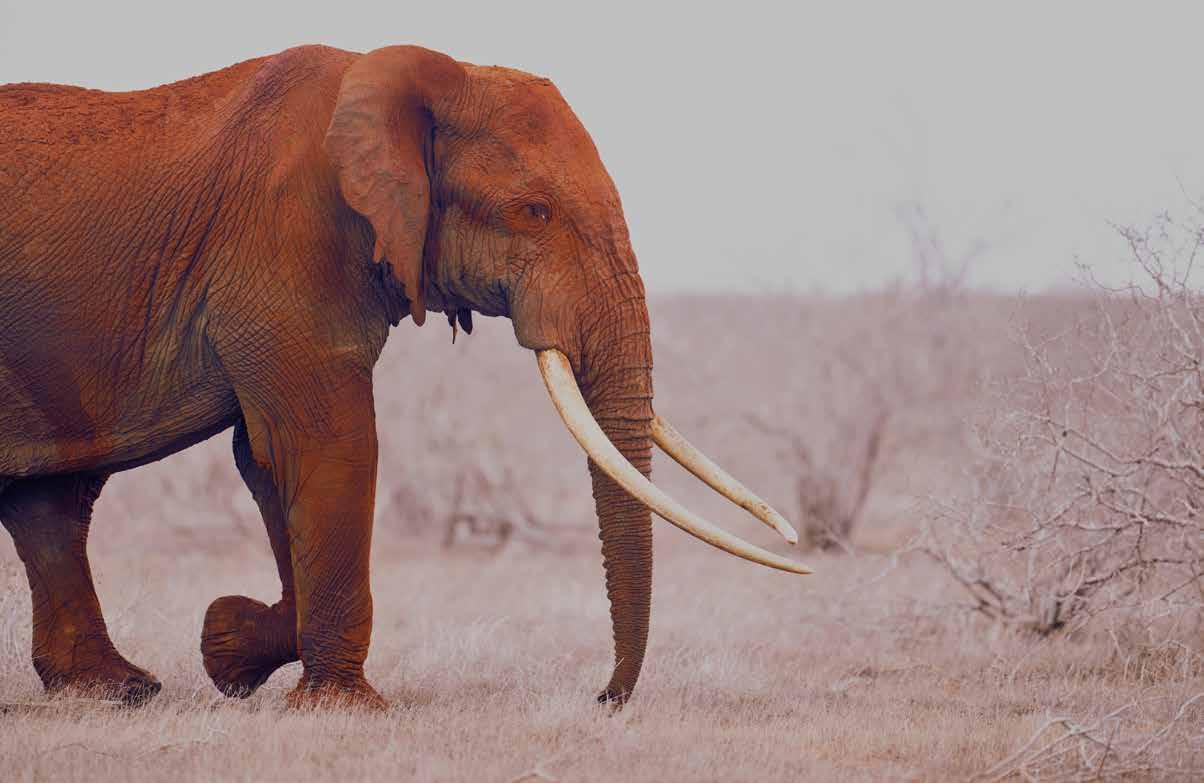
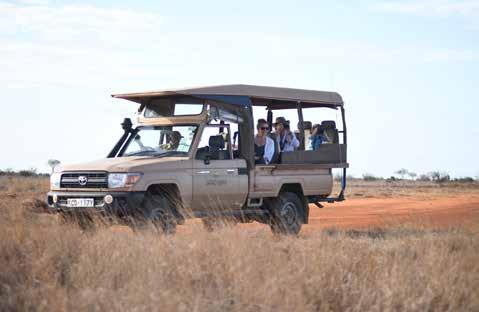



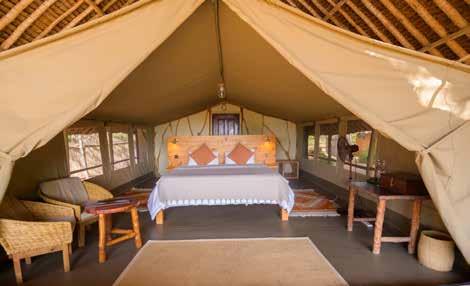
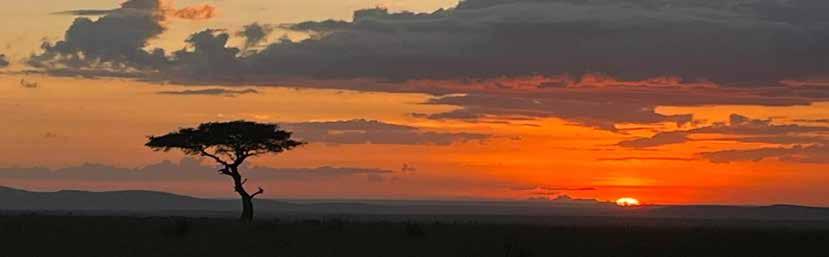
Rediscover safari’s romance at Satao Campcanvas comfor ts, star-f illed nights, and daily elephant parades at our waterhole.
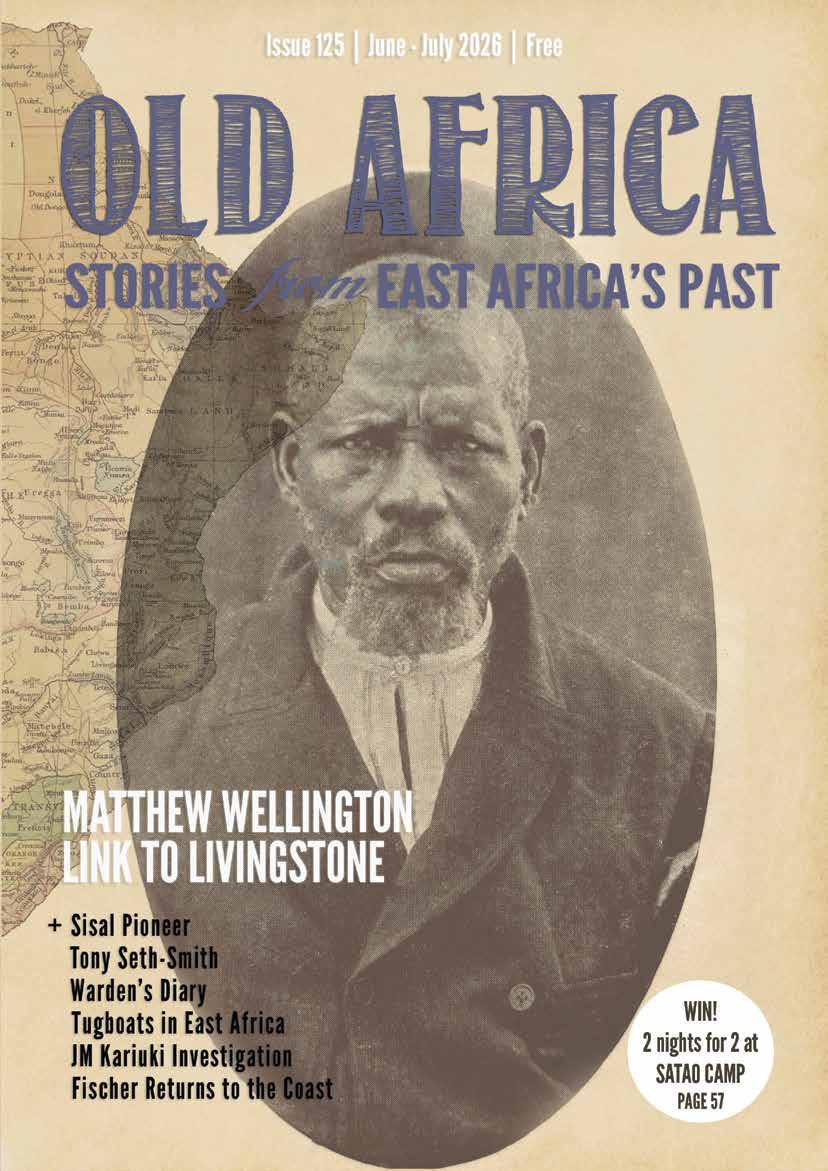
The life story of Matthew Wellington, a former slave who carried David Livingstone’s body to the coast.
Peter
joins other students in one of the first inter-racial groups to climb Mt Kilimanjaro.
WJ Dawson finishes out his World War I service with the Veterinary

A review of the tugboats that have worked the waters of East Africa, including one that played a role in a Hollywood film!
A Parliamentary Select Committee launches its investigation into the disappearance and murder of JM Kariuki in
Williamson Diamond Mines and the rare pink diamond feature on various
Jimmy Hearle delivers machinery to a sisal plantation in Nyali in 1913 and spends the rest of his life in the sisal industry in Kenya.
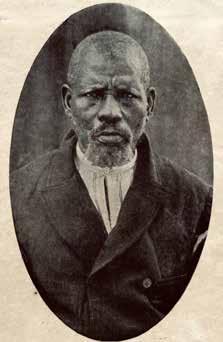
Cover photo: This photo of Matthew Wellington appeared on the cover of Rev Rampley’s short biography of Matthew Wellington’s life.
“Are you a Livingstone or a Stanley?” That was the first question anyone asked after they entered my school, Rift Valley Academy (RVA). The school had two Houses for intraschool sports and academic competitions. And our Principal, Herb Downing –Pa D to us kids – had chosen two iconic figures from East Africa’s history as the names for the Houses. Livingstone House for Dr David Livingstone, the missionary explorer who had a dream of ending the slave trade that was decimating southeast Africa. And Stanley House for the Welsh-born American journalist who famously ‘found’ Livingstone at Ujiji.
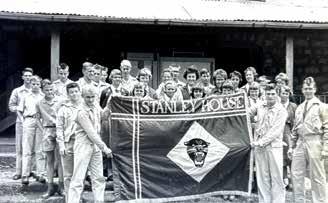
I was a Livingstone, appointed to that house when I started school at Kijabe, Kenya in September 1962 as a titchie in first grade. For some reason, we Livingstones weren’t very good at sports because for six straight years, Stanley House won every titchie field day. It wasn’t until eighth grade that I led the Livingstones to victory in a basketball game, collecting enough points to win the day.
This issue of Old Africa has a comprehensive article on Matthew Wellington, known as the last living link to Livingstone. Born near Lake Nyasa, he was enslaved as a boy, later sold in Kilwa and then rescued off a slave dhow near Aden by a Royal Navy ship on anti-slavery patrol. After going to a Christian settlement in India where he embraced Christianity and took the name of Matthew Wellington at his baptism, he returned to Africa. He ended up on Livingstone’s team and when the missionary died in what is now northern Zambia, he was one of the men who carried Livingstone’s body to Bagamoyo. Wellington lived out his final years in Mombasa and we appreciate Judy Aldrick’s efforts to write an accurate story of his life. We hope your enjoy the story.
On a personal note, I had a six-month checkup with my oncologist in London in March of this year and there are no signs of cancer returning. We are so thankful and say again, God is faithful. I have good days and bad days as I try to speak with an artificial voice valve. When my words are incomprehensible, my wife says, “Write it down,” so she can understand what I’m trying to say. I continue to write things down for Old Africa, too. I’m thankful I can still communicate through writing!
-Shel Arensen, Editor
P.O. Box 2338 Naivasha, Kenya 20117 www.oldafricamagazine.com
Editor: Shel Arensen 0736-896294 or 0717-636659
Design and Layout: Mike Adkins, Blake Arensen
Proofreader: Janet Adkins
Printers: English Press, Enterprise Road, Nairobi, Kenya
Old Africa magazine is published bimonthly. It publishes stories and photos from East Africa’s past.
Subscriptions: Subscriptions are available. In Kenya the cost is Ksh. 3000/- for a one-year subscription (six issues) mailed to your postal address. You can pay by cheque or postal money order made out in favour of: Kifaru Educational and Editorial. Send your subscription order and payment to: Old Africa, Box 2338 Naivasha 20117 Kenya. For outside of Kenya subscriptions see our advert in this magazine. Advertising: To advertise in Old Africa, contact the editor at editorial@oldafricamagazine.com for a rate sheet or visit the website: www.oldafricamagazine.com
Contributions: Old Africa magazine welcomes articles on East Africa’s past. See our writer’s guidelines on the web at: www.oldafricamagazine.com or write to: Old Africa magazine, Box 2338, Naivasha 20117 Email
Address: editorial@oldafricamagazine.com. After reading our guidelines and editing your work, send it to us for review either by post or email. (To ensure return of your manuscript, send it with a self-addressed envelope and stamps to cover return postage)
Copyright © 2026 by Kifaru Educational and Editorial All rights reserved. No part of this publication may be reproduced or distributed in any form or by any means, or stored in a database or retrieval system, without prior written permission of the publisher.







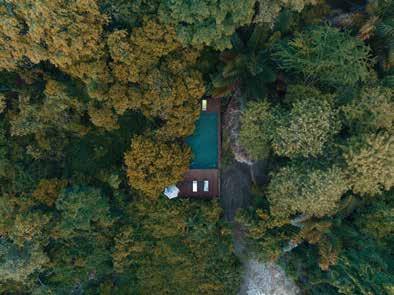
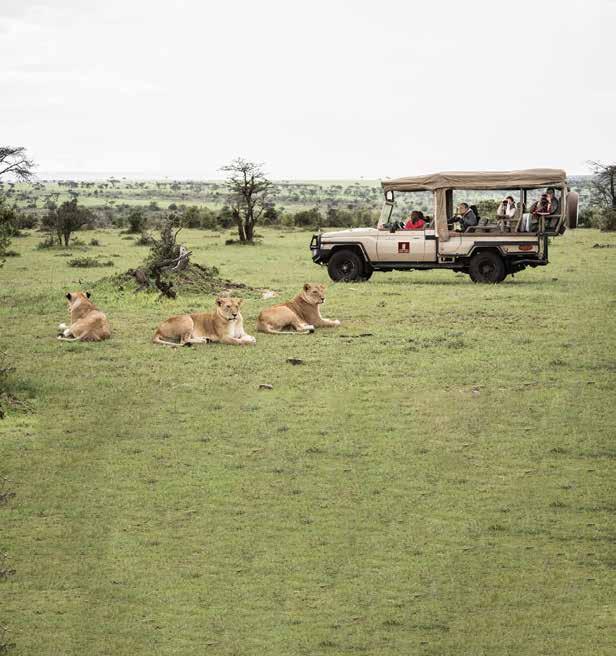
Experience an Authentic Safari this Holiday Season at Porini Camps, set in exclusive wildlife locations. Non-residents traveling with residents can enjoy special resident rates for an unforgettable safari adventure.
Porini Giraffe Camp
Porini Amboseli, Porini Mara, Porini Cheetah & Porini Lion Camp
Porini Rhino Camp
Rhino River Camp (Forest Tent)
Rhino River Camp (River Tent)
Rhino River Camp (Forest Tent)
Rhino River Camp (River Tent)
Porini Ol Kinyei Safari Cottages

Full board accommodation I Free drinks such as mineral water, soft drinks, house wines, beer, and Gin and Tonic I
Guests will enjoy sundowners from scenic viewpoints and guided nature walks I The package also features shared day and night game drives in open 4×4 vehicles with an experienced driver-guide and spotter I At Porini Rhino Camp, guests will have the opportunity to visit the chimpanzee sanctuary in the Ol Pejeta Conservancy I Those at Porini Amboseli Camp can experience a Maasai village visit I For guests flying in, local airstrip transfers to the camps are included.
*Please note, the above rates are excluding park and conservancy fees.



Sauti Zenu ~ Your Voices
Dear Editor,
I note the reference to the Eastern Telegraph Company in you latest issue of Old Africa magazine. You’ll be happy to know that the first recorded rugby match in East Africa that I have found was in April 1905 between the Eastern Telegraph Company and the HMS Terpsichore in Zanzibar. Eastern Telegraph Company rugby Captain for that match was Davis. Two other players known were Regent and Moffat.
That’s 121 years of rugby in East Africa. This year also marks 120 years of rugby in Kenya.
By the way, while in boarding school in Connecticut, I, too, wandered the railway line, looking to collect telegraph pole insulators.
Bill Cherry, Nairobi
Dear Editor,
All very good stories in Old Africa issue 124. I like the mix of African, Asian and European contributions. Excellent photos.
Rex Bousted founded the Mombasa Club and Rex’s great nephew is a friend of ours; he is married to Heather (formerly Lawrence). They are at Vipingo Ridge this weekend.

The Mombasa Club is in quite good condition and has a nice snooker room next to the bar on the veranda. The rooms are alright too. The Club has mostly Asian and African members now.
I sympathise with your tale
of woe about your collection of ceramic insulators. What a shame they were thrown away. Interesting about why the railway was moved to the edge of the escarpment.
Richard Frost, Vipingo
Dear Editor,
Regarding the article “The Eastern Telegraph Company in Mombasa”, my maternal uncle Dara Vatcha worked for a telegraph company in Zanzibar in 1930s. Am not sure if it was the same Company. Perhaps some exZanzibar readers may be able to tell us more.
Kersi Rustomji. ex-Kenya, Australia
Dear Editor,
As I have said on many occasions, I can’t adequately express the degree of satisfaction I feel each time a new issue of Old Africa appears. I can honestly say that your magazine has, and continues to bring endless joy to those of us who were privileged to live and work in East Africa (Kenya in my case) and still find it difficult to shake off the African dust from our feet!
Your latest editorial, as also your earlier ones, are ample proof of the sterner stuff you are made of. Lesser mortals like me could never cope with such courage and serenity as displayed by you especially when - despite initial difficulty, you managed to see through your late brother’s farewell service which, as a Pastor, you conducted so well. What an inspiration

you continue to be to the rest of us, and once again, I send my best wishes and prayers for your continued wellbeing – and thanks for being the powerful inspiration you really are.
Mervyn Maciel, ‘Manyatta,’ Sutton, Surrey, UK
Dear Editor,
As ever, we are really enjoying reading the magazine. Sadly, we no longer live in Kenya and reading the magazine makes us feel very homesick However, it also makes us appreciate even more what an absolute privilege it was to live there for 11 years.
We are now happily retired and have been able to visit regularly. Hopefully soon we can be there for slightly extended periods.
Tracey Kyffin
Dear Editor (and Old Africa readers),
Attendees at the 2007 Rift Valley Academy (RVA) reunion received the first issue of Old Africa (October-November 2005). It had several photos of RVA students. The last issue (#124) includes a history of RVA preceded by an article featuring Tom Mboya, whom RVA teacher (later MD) Roy Shaffer admired. Issues 117 and 118 celebrated Roy’s 100th birthday.
RVA is closely related to the Uganda Railway. Steel girders from the old railway bridges below the Kijabe mission station were used for building RVA’s Jubilee Hall. It was interesting to read about
the telegraph insulators and Willie Manson of the Eastern Telegraph Company.
Not recognizing any RVA alumni names or seeing USA addresses of letter writers in the last two issues, I appreciate giving a shoutout to the magazine and the school.
Wilfred Danielson (Willy, RVA 1955), Arlington, Virginia, USA
Dear Editor,
Thank you for all you are doing at Old Africa.
Jane de Voest, Watamu
Dear Editor,
My name is Olive and I had been in touch with you in 2023. Thank you for having shared Tom Lawrence’s article on Carissa House. I’m currently doing my Masters at the University of Liverpool, School of Architecture, focussing on Heritage Management. I’m trying to gather more information on Carissa House, Naromoru, which Tom has written about in this article.
May I kindly ask if you have more information/ literature on this house? Or if you could point me to a source of information. I look forward to hearing from you.
Olive Muthoni, Liverpool
Dear Editor,
Thank you for the PDF copy of Old Africa issue 124. It was the only good thing at the end of a dull day here in France. Days are warm but evenings are still chilly.
Neera Kapur, France
Dear Editor,
I just read my article about the Eastern Telegraph Company in Old Africa issue
124 April-May 2026. It looks great! Many thanks for your efforts and for the inclusion of one of the photos on the cover!
Matt McIlvenna, Nairobi
Dear Editor,
I’m writing a book on East Africa history. Currently, I’m trying to learn more about Percival Petley. I’m looking for any rare books with references about him. Any assistance would be greatly appreciated.
Scott McMillan
Dear Editor,
I noted in Old Africa issue 123 the photo of zebra mares outside the gates of Government Farm in Naivasha in 1904, part of an unsuccessful scheme to breed
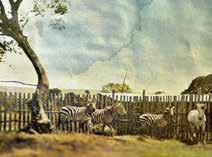
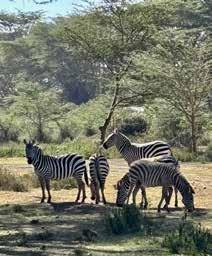
them with a Connemara pony stallion. As I drove by the gates of the same Government Farm (now known as KALRO) earlier in 2026, I saw another group of zebra grazing in almost the same location. Descendants of those same zebra 122 years later? The clear-cutting of yellow fever trees along that stretch of the highway to make way for a new dual carriageway has put that small herd of zebra at risk. Thankfully, they seem able to scrounge a living off the grass on the edges of the road reserve.
The Editor, Old Africa (Yes, an editor can write a letter to the editor!)
Dear Editor,
I can’t pretend it’s easy reading the magazine online so this is the first history quiz I have attempted to do. It really was much more pleasant when I could flick through the pages whilst sitting on my veranda! But maybe this is the only way to go, sadly. The story about the man’s chest and the baboon’s bald bum was great!
Janet Manuel, Nakuru
Dear Editor,
You are amazing, coming back and learning to speak again, and having the energy to produce Old Africa with so much good content.
Lars Asker, Sweden
Dear Editor,
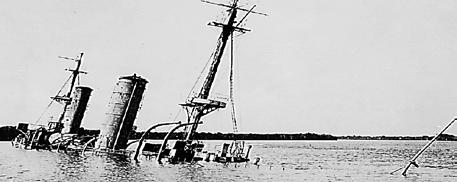
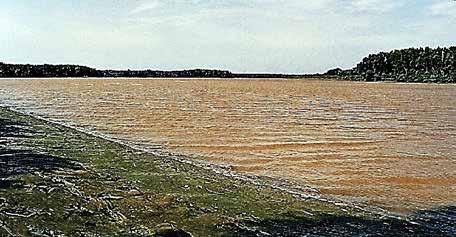
Many thanks for the latest edition of Old Africa (issue 123) and the Konigsberg corrections. Attached are two pictures which should settle the argument about its location. They show the wreck in 1917 as seen by the



















Royal Navy team sent to see if they could salvage the wreck, which was too far gone at that time, and my contemporary photo taken in 2001 as a comparison when I took the captain’s grandson to the site.
The article on Mtwapa Bridge brought back memories of the old chain ferry pulled back and forth across the creek until the
new bridge opened in 1958. There is an interesting family connection to this bridge in that on the first occasion we as a family crossed the bridge, Dad stopped the car to inspect the Bailey panels used to construct it. During World War II Dad had been with the Royal Engineers in Italy constructing Bailey Bridges across rivers in Italy
to replace those destroyed by enemy action. He was curious to see what panels had been used and how they had been pinned together.
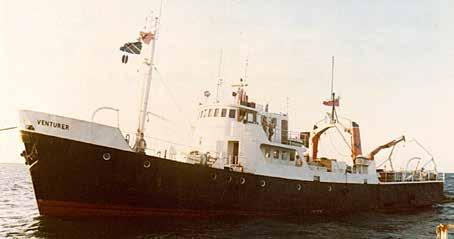
In 1982 I was MD of Divecon in Mombasa and we received a call to undertake a subsea survey on the north side of the creek using one of our diving support vessels Venturer. I was on board at the time while soundings were taken of the seabed along the stretch of embankment where the new bridge now stands.
Kevin Patience, UK
Dear Editor,
The latest issue of Old Africa (issue 124) was so anticipated, and gratefully received via Amazon. I am getting into a new rhythm of remembering to order hard copy of the collector’s edition every two months, and I so look forward to it arriving.
I am hoping to write a story for the magazine about a very special trip I made in the 1980s from Bor in Southern Sudan, over to Pibor Post, on the Ethiopian border, to see the White Eared Kob migration, and then on down to the Boma plateau and back thru the Imatong mountains. I think we were certainly the last people to do the trip, as the civil war broke out again, and we all had to leave Southern Sudan.
You all do such a great job at Old Africa, telling all the various stories you hear about, and there is so much still to learn about East Africa, that we will never know it all, but can be proud to have been part of the story of such a special place.
Fran More, Deux Sevres, France
by Judy Aldrick
Mombasa has hosted a number of famous residents in years gone by. One who received much public interest in the early years of the twentieth century, but is now largely forgotten, was Matthew Wellington, a freed slave who lived to a great age and died in Mombasa in 1935. He was the last living link to the famous missionary explorer David Livingstone and had worked for him and helped carry Livingstone’s body on its last journey down to the coast. In his old age Wellington became a celebrity.
With no mention of him in the main biographies of Livingstone and few in subsequent records, his story has to be unpicked from the available information and oral reminiscence.
His African name was Chengwimbe. He was born in about 1847 and came from the Yao tribe, a Bantu people living in northern Mozambique and present-day Malawi. He was given the name Matthew Wellington later in life by the missionaries when he was baptized as a Christian.
When he was about ten years old raiders attacked his village and burnt it down. They killed his father and took him and his mother prisoners. However, they were soon separated and after that he never saw his mother again. His captor sold him to a man of the Nyasa tribe, who lived on the shores of Lake Nyasa. He worked for this man as a cattle herder for about five years. Then in exchange, probably for cattle, he was sold to a man of the Kemanga tribe who lived on the other side of Lake Nyasa. According to Wellington’s testimony, he worked for this master for another five years, herding cattle.
Then came the Maasai who raided the Kemanga and killed many people. But he escaped with his master, who was badly wounded, and re-crossed the lake to Nyasaland where he was again sold, this time to one of his own tribe and taken back into Yao country.
But this was no happy ending as his new Yao master did not re-unite him with his family. Instead, he took the trusting youth by secret ways to Kilwa and sold him in the slave market to an Arab slave dealer for a roll of cloth.
To begin with the young Chengwimbe did
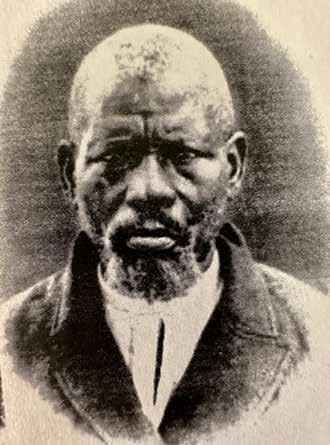
This photograph of Matthew Wellington was placed in the Emmanuel Church of Freretown as a permanent reminder of his contribution to the anti-slavery movement and link with Livingstone. (From a photograph of Matthew Wellington belonging to Emmanuel Church, Freretown, Mombasa)
not understand what was happening to him and how his fellow Africans were selling him into slavery. He had enough to eat and was not badly treated and adapted to his new life. He liked, as he later explained, being a warrior guarding cattle and his story is not unusual for the time.
The Yao were traders and deeply involved in the slave trade. They traded ivory and slaves to Kilwa and it was big business. In the 18th century slaves had been taken from neighbouring tribes but by the 19th century demand had become so great, the Yao increasingly sold their own people. If there was an argument or an accusation of witchcraft, the presumed guilty party and his whole family might be sold into slavery. (See Alpers,
EA: “The East African Slave Trade” Historical Association of Tanzania, Paper No 3, 1967, p 18,19). Demand for slaves peaked in the mid 19th century and was depopulating the region. Land was abandoned and famines became more frequent as the young and able bodied were taken for slaves.
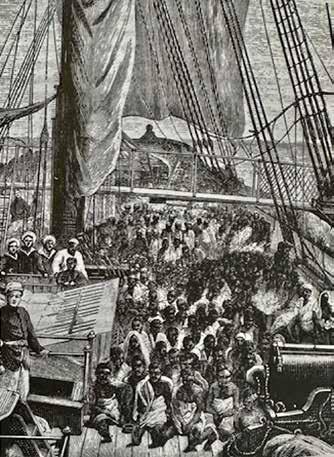
From Kilwa Chengwimbe was sent by dhow to Zanzibar where he remained for a few months before being sold on to another Arab dealer. They packed him like merchandise on board a large dhow along with many other enslaved Africans. He was lucky to have a place on the upper deck as below deck conditions were much worse. He quickly made friends with two other Yao men. To avoid suspicion from antislavery patrols, coconuts were laid over part of the upper deck. They sailed north towards Mogadishu calling at several African ports along the way.
Many slaves died during the voyage and the slavers threw their bodies overboard. As they were leaving Mogadishu and nearing Aden, a British man-of war came sailing into view and tailed them. Before long they were captured and taken on board with all the Arab crew. The British sailors set fire to the dhow. After spending three days aboard the British naval ship, the surviving slaves reached Aden where the British Government housed and fed them for one week. The slaves were freed and sent to various masters who wished to employ them as labourers.
Chengwimbe was engaged by a Parsee merchant who employed him as a house servant. The merchant treated him kindly and provided him with food and clothes. After a few months he was taken to Bombay, by order of the British Government, where, with other freed slaves, he was handed over to the CMS school at Nasik under the direction of the Rev W Salter Price.
There are two main accounts of Wellington’s early life. One was transcribed by the Reverend Dr Thomas William Walter Crawford, CMS, dated 1 November, 1911, and appears in The Zambia (Northern Rhodesia) Journal Vol VI, 1965, pp 99-102; “David Livingstone: Two Accounts of the Death and transportation of his body to the Coast. By Carras Farar in Bombay and Matthew Wellington.” The other comes from Rev WJ Rampley’s short biography of Matthew Wellington, published in 1930Matthew Wellington sole surviving link with Dr Livingstone. The details of the accounts vary considerably and the timeline is confusing. The Crawford account is earlier and more succinct than the Rampley version, which has more detail but was done when Wellington was in his
eighties and his memory was starting to fade. It seems Wellington was asked to tell his story so many times, it gradually grew more and more embellished as he tried to please his audience and tell them what they wanted to hear.
It is unclear which British naval ship intercepted the Arab slaving dhow, but the most likely is HMS Thetis. In 1871 HMS Thetis intercepted an Arab slaver off Mogadishu with 200 slaves onboard who were freed and taken to Aden. Both Rampley and McGregor Ross, who briefly interviewed Wellington in 1909, cite this ship. It is variously written that Wellington stayed at Nasik for seven years, but this cannot be correct. Possibly the transcriber made a mistake or misheard.
The Nasik Mission, also known as Sharanpur, was a Church Missionary Society settlement northeast of Bombay. Originally intended as an agricultural and industrial community for Indian Christians, it began taking in freed African slaves after 1854. The Reverend William Salter Price started the Africa section of Nasik and ran educational and training courses with the intention of sending freed slaves back to Africa to help set up mission stations and find employment. Those trained at Nasik were often referred to as ‘Bombay Africans.’
According to Matthew Wellington he was taught rough carpentry at Nasik and learnt Indian languages. He also converted to Christianity and was given the name Matthew Wellington at his baptism. In 1872 he volunteered to join an expedition in search of the missionary explorer Dr David Livingstone and returned to Africa.
Sir Bartle Frere, when Governor of Bombay and later President of the Royal Geographical Society (RGS) in London, recommended that British explorers should recruit staff for Africa expeditions from the Nasik Mission. Many did and as a result several ‘Bombay Africans’ returned to Africa in this way. How many managed to return to their homes is not recorded, though desertions were frequent.
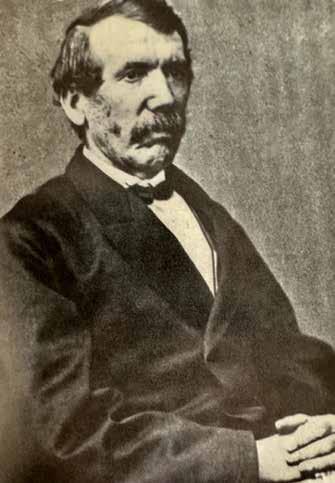
Earlier in 1866 Dr Livingstone had prepared for his final expedition to solve the riddle of the Central African Lakes and strike a blow against the slave trade. He visited his friend Bartle Frere in Bombay and selected eight freed slaves from Nasik to accompany him. He also found and re-employed four men who had been with him on previous expeditions. These were James Chuma and Wikitani from the Free Church of Scotland Mission and Abdullah Susi and Hamoydah Amoda, who he found in the docks at Bombay. Susi and Chuma became his most famous and faithful assistants.
Livingstone’s plan was to cross Lake Nyasa,
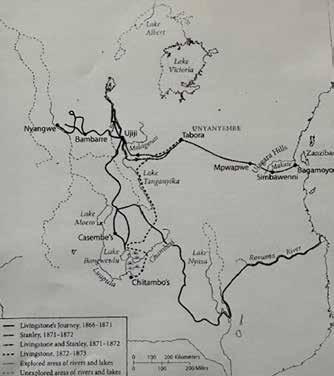
then aim northwest for Lake Bangweulu, which he believed would prove to be the source of the Nile. If he could trace a river running out of it into Lake Tanganyika and then from Lake Tanganyika into Lake Albert, the mystery would be solved. It was a tall order, even if everything went smoothly. Right from the start things began to go wrong.
Livingstone wanted to take 60 men with him, but he had difficulty recruiting suitable porters in Zanzibar. In the end, putting his trust in God, he set off from Rovuma Bay for Lake Nyasa, through dense jungle, with only 35 men. This was dangerously few men to transport the provisions and trade goods needed for the expedition. By contrast, Stanley, when he set off in 1871 to find Livingstone, had a caravan of 192 men.
Almost all of Livingstone’s porters and staff deserted within the first year. He ran out of food, lost his medical supplies and damaged his chronometer (this made subsequent readings inaccurate and caused serious problems in the future). At one point he was down to three men - Susi, Chuma and Gardner, the last remaining recruit from Nasik. Livingstone was in dire straits. Ironically, he only managed to survive and continue his journey by teaming up and relying on the generosity of Arab slave traders, the very ones he condemned as he documented the evils of the slave trade. Livingstone wrote
remains being
everything down in his journals and struggled on, refusing to give up.
Some deserters from his expedition went back to Zanzibar and reported that Livingstone had died. No one was sure what had happened to him. The British Consul, Dr Kirk, received a letter from Livingstone via an Arab slaver asking for supplies to be sent to Ujiji - so perhaps the missionary explorer was still alive.
There is some confusion in Matthew Wellington’s story as to which rescue expedition he joined. Henry Morton Stanley, the young journalist sent by the New York Herald, left Zanzibar for the interior in early 1871 on his expedition to find out what had happened to Livingstone, but he did not recruit men from Nasik. After delays, Stanley finally reached Ujiji in November 1871 where he had his famous meeting with Livingstone.
The following year in 1872, since Stanley had not yet returned with news of his meeting with Livingstone, another expedition was arranged to search for him. This expedition was organised and funded by the Royal Geographical Society and Oswell, one of Livingstone’s sons, was amongst the leaders. They chose six men from the Nasik mission to go on this expedition, which included Matthew Wellington and Jacob Wainwright. The others were listed as Carus
Farrar, Benjamin Rutton, William Rutton and Legett. However, they had hardly started when the Stanley expedition returned with the news that Livingstone had been found alive and well and he had refused to leave until he completed his quest. Oswell’s expedition was disbanded and instead Stanley organised another caravan to send men and supplies to meet Livingstone at Unyanyembe (Tabora). We know that 56 men arrived there on 9 August,1872, including the six from Nasik, who had joined after the aborted relief expedition. Others had been reemployed from Stanley’s caravan or taken on at Bagamoyo. A complete list of these men survives, which includes the name of Matthew Wellington.
There is confusion because much was written about Matthew Wellington by those who met and spoke to him in later years, and not all of it was factually correct. Maybe his memory dimmed as he aged, or his words were misconstrued by those who interviewed him. After his death, his relatives also enjoyed reminiscing about their famous ancestor and further inaccuracies crept in. But Matthew Wellington joined Livingstone with the resupply caravan in August 1872, not earlier as some have suggested.
In late August 1872 Livingstone set out for
Lualaba and Lake Bangweulu, with fresh hope and optimism, at the head of the best equipped team he had ever had. No expense had been spared. The porters were all free men and had been handpicked by Stanley and sent with ample stores and trade goods.
Livingstone had convinced himself that Lake Bangweulu in present day Zambia was the source of the River Nile and was determined to prove it. It turns out he was wrong as it is in fact part of a chain of lakes that feed into the River Congo, which flows west, not north. Livingstone reached Lake Bangweulu in October 1872, but the faulty readings from his damaged chronometer misled him as to his exact position. He decided to walk round the lake to map it and find a river flowing out towards Lake Tanganyika, which would confirm his theory. This was no easy task. Now completely lost, he was determined to carry on. His health took a turn for the worse. Soon he became so ill that he had to be carried in a litter as his men struggled over streams and through the swamps that surrounded the lake for many miles. His mind began to wander and play tricks, but still he refused to turn back, and his faithful attendants, including Matthew Wellington, stayed with him. Then the seasonal rains came, making the travellers and their equipment wet through, adding to their misery.
Livingstone’s health did not improve and by April 1873 it was clear he was dying. At the end of April they reached the village of Chitambo, on the edge of the swamps of Lake Bangweulu, near the River Luapula at a place called Illala. Here they stopped, set up camp and
Livingstone died during the following night. According to Jacob Wainwright’s testimony they found Livingstone on his knees at prayer, but Carrus Farar said he was found “fallen on the ground already expired.” (Zambia p 97) The men anxiously consulted what to do. They worried that if they buried him and reported his death their statements might not be believed. They also spoke about the extreme difficulty of carrying a dead body 1,500 miles to the coast, through tribes that thought a corpse brought illluck. But they were determined to try.
As Tim Jeal writes: for the “Africans who had followed Livingstone’s instructions without question since leaving Unyanyembe, the previous August, the sudden loss of their leader so far from their homes could have proved catastrophic. Certainly, had the party broken up and the trade goods been thoughtlessly sold off and plundered it is doubtful whether any could have reached the coast.” (Jeal, Tim: Livingstone 1985 Pimlico edition p 367.) But this did not happen. Chuma and Susi acted with calm decisiveness and took charge.
As Wellington explained in one of the talks he gave much later in life, they had been employed to stay with Livingstone and bring him back once his exploration was complete, and, dead or alive, this is what they did. (Otherwise, they would not have been paid.) Livingstone treated Africans kindly with trust and respect and they viewed him as a holy man or kind of mad saint. They also knew he was famous in his own country and realised the best way for a safe return was to keep together as a group.
Most explorers during this period kept their
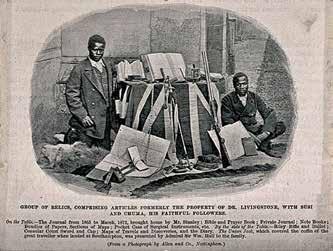
An engraved print showing Chuma and Susi and Livingstone’s personal effects they preserved and brought back from central Africa. (Photo from Last Journals of David Livingstone in Central Africa from 1865 until his Death, published and edited by Horace Waller in 1874)
expeditions together by rigid discipline, but this was not Livingstone’s way. He believed that his men were freemen and should be allowed to leave when they wished. Chuma and Susi were his righthand men, who organised the practical aspects of the expedition. European explorers often owed the success of their Africa adventures to their African headmen, and the Livingstone story more than most now depended on the ingenuity and resolve of the men left behind in a remote corner of central Africa.
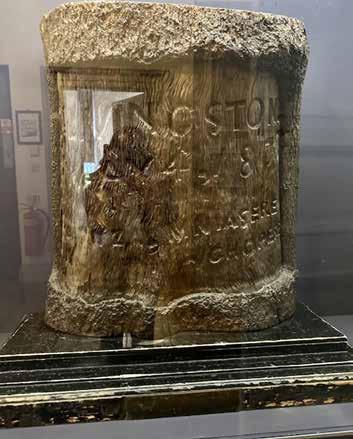
First, they preserved the body. The intestines and internal organs were removed and put in a tin box and buried by a large tree. Carus Farrar who had some medical training, helped by one of the Swahili porters, prepared the body, filling it with salt and brandy and drying it in the sun for about a month. Jacob Wainwright, the senior Nasik man, and the only one who could read and write in English, performed the burial service and later made an inventory of Livingstone’s journals and possessions, so nothing went missing. He carved Livingstone’s name and date of his death onto the trunk of the tree so fellow travellers could see where the great man had died. When the tree was cut down in 1898, the section bearing the inscription was taken to the Royal Geographic Society where it can still be seen.
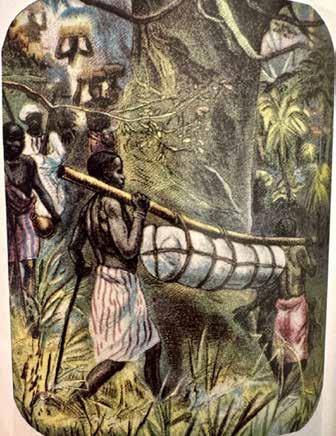
Once Livingstone’s body had thoroughly dried, Matthew Wellington described how they wrapped the corpse in cotton and then packed it into a hollowed out wooden cylinder made by Wellington and Benjamin Rutton from a tree trunk. This was painted with tar and sewn into a large piece of sail cloth to make it watertight. “We then slung the package on
to a pole which two of us carried for four days at a time.” Susi and Chuma’s leadership ability was confirmed as they reached Tabora within a record five months. The porters took turns to carry the precious bundle and here Matthew Wellington, fit and strong and used to heavy loads, played his part.
At Tabora they met a group of Englishmen on yet another Livingstone relief expedition. The leader was Lieutenant V Lovett Cameron. He advised Susi to bury Livingstone at Tabora but Susi and his team politely turned down this advice.
According to Carus Farrar’s testimony, taken in Bombay in 1874: two of the Europeans Dr Dillon and Mr Moffatt decided to return to the Coast leaving Cameron to go on alone to retrieve any of Livingstone’s papers left behind. Dr Dillon became ill and blew his brains out with a gun and instantly expired. When they came to Ugogo country they had to disguise their load as the superstitions of the people would not allow a dead body to pass through their country. They made it into a single package like a large tent, carried by a single porter and got through safely.
The men reached Bagamoyo in February 1874 after carrying Livingstone’s body 1,500 miles for nearly nine months. Mr Moffat took the body to the Catholic Mission where a coffin was made for it.
Chuma went to Zanzibar to find Dr Kirk the British Consul, but he was away on leave and Captain W F Prideaux his deputy was standing in for him. Astonished by the news, Captain Prideaux despatched a ship, HMS Vulture, to collect Livingstone’s body and bring it to Zanzibar. The body was placed in a wood
coffin in a room on the ground floor of the British Consulate and lay there before being shipped on to London. A plaque marking the spot, on the wall of the old Consulate building, can still be seen in Zanzibar.
The return of Livingstone was the talk of the town, and everyone was amazed at how his body and personal belongings had been carried safely from central Africa back to the coast. Ten men had died on the way including one of the Nasik men. It had been a difficult and dangerous journey. Captain Prideaux now found himself in an awkward situation. Expectations were high, but he was at a loss what to do. Without guidance from the Foreign Office, he hesitated to spend Foreign Office funds or take any action, for which he later would be blamed.
He played it safe and decided to ship Livingstone’s body to England with the minimum of fuss. Captain Prideaux thanked Livingstone’s men for their service, paid them their wages, with £1,000 from his own pocket, (as Livingstone’s money had all been spent) and sent them away. It was an anti-climax and must have been disappointing for those men, who with enormous effort had brought the body back to the British representative in Zanzibar.
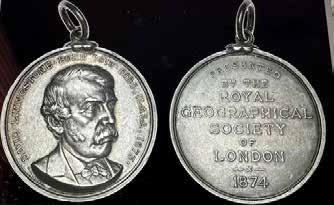
The close-knit team who had been with Livingstone on his last journey now dispersed. The following year the Royal Geographical
Society struck 60 medals for the men who had travelled with Livingstone on his last expedition, but not all of them received their medal; some were already dead, others working elsewhere or returned to their homeland. It was a poor sort of reward, especially as back in England Livingstone was treated as a hero and had been given a state funeral.
One African did manage to attend Livingstone’s funeral in Westminster Abbey on 18 April 1874. This was Jacob Wainwright from the Church Missionary Society Nasik Mission. The CMS paid for his passage to England. Chuma and Susi, his closest and most devoted attendants, who had been with Livingstone over eight years, missed the funeral.
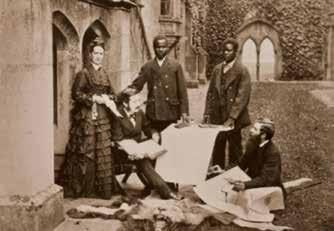
However, Chuma and Susi did eventually gain by their association with Livingstone. A wealthy sponsor James ‘Paraffin’ Young paid for them to come to England and help edit the explorer’s last journals and verbally fill in any gaps in the narrative. A photograph from the time shows Chuma and Susi with Livingstone’s daughter and son in Newstead Abbey Nottingham, looking at the maps and journals they had preserved so carefully. Horace Waller, a close associate of Livingstone and fellow anti-slavery activist is sitting on the ground.
Another engraved print shows Chuma and Susi in the book Horace Waller published in 1874 from Livingstone’s journals Last Journals
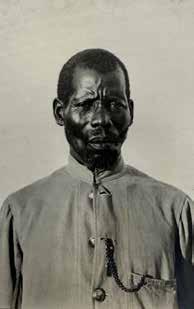
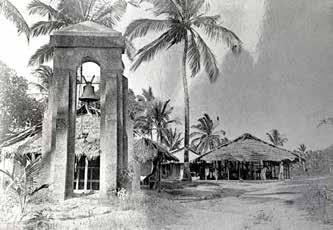
Left: This old photograph shows the Freretown Bell, which was rung on occasions to raise the alarm of imminent attack by slavers.
(Photo from author’s personal archive)
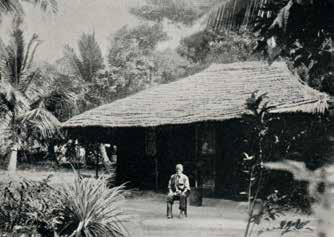
Right: This photograph of Matthew Wellington taken by McGregor Ross in 1909 is held in the Royal Geographical Society files and is the earliest picture we have of him, already aged over 60. The file contains the basic facts of his life.
Bottom left: Matthew
This photo shows Matthew Wellington sitting in his chair in Kisauni, dressed smartly in a white suit, perhaps about to tell his story to an interested Christian audience. (Photo from Rampley papers held at Birmingham University)
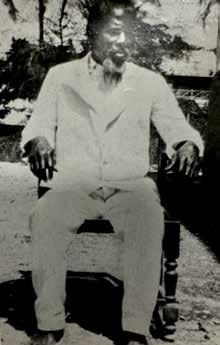
of David Livingstone in Central Africa from 1865 until his death. The photo shows the two men with the items they preserved and brought back from central Africa.
After their return to Zanzibar, Chuma and Susi became successful caravan leaders, and they were much in demand. Abdulla Susi was employed by Stanley on his Congo expedition 1879-82. Susi was a Muslim who converted to Christianity in 1886 and took the name David. He died in Zanzibar in 1891. James Chuma worked for the Universities Mission to Central Africa (UMCA) from 1875-78 and was headman for Joseph Thomson’s first expedition. Chuma died in 1882.
What happened to Matthew Wellington after his return to the coast? Records are scarce, but according to Carus Farrar’s narrative printed in the Zambia (Northern Rhodesia) Journal, 1965, the surviving Nasik men, which included Wellington, were sent to Mombasa to the mission at Rabai. Carus Farrar did not like it in Mombasa and returned to India from there. The others remained in Mombasa on the payroll of the Church Missionary Society, but what happened to Benjamin and Richard Rutton is unclear.
The Church Missionary society decided to establish a new settlement for freed slaves at Mombasa to be named Freretown, after Sir Bartle Frere, and sent The Reverend William Salter Price as project manager. He was horrified by what he found on his arrival in November 1874. The East Africa mission station at Rabai was in a poor state and barely functioning. Rebmann, the senior missionary, was blind and incapable and Sparshott, the other missionary, was hopelessly incompetent. The
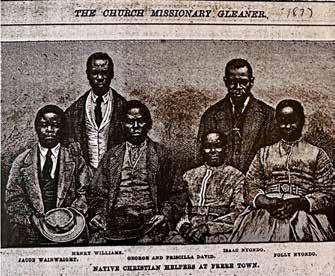
mission house in Mombasa was uninhabitable. Price came with his wife and four Europeans - two missionaries, a builder and carpenter and a vast quantity of material and supplies. But as the Rev KE Stovold in his book on the history of the Church Missionary Society in Kenya describes, the work of establishing the settlement was largely achieved with the help of three Bombay Africans and Isaac Nyondo, Rebmann’s assistant at Rabai. The Bombay Africans were Jacob Wainwright, Henry Williams and George David together with their wives. Price knew from them from his time in Nasik and relied upon them to move the project forward. Did Matthew Wellington help as well? His file in the Royal Geographical Society describes him as a pioneer of Freretown, so we assume he was there at this time. Salter Price was disappointed by the Europeans he brought with him, the carpenter was no good and the two missionaries fell sick and stayed at Rabai. The first mention I can find of Wellington is in a letter from William Salter Price dated 2February 1875. At this point Wellington is employed by Thomas Sparshott who is hard at work refurbishing the Mission House (now Leven House) to make it habitable. Price and Sparshott did not see eye to eye and had many arguments. In his letters Price complained that Sparshott was unsupportive of the Freretown project, he treated the Bombay Africans badly and the only one he liked was Matthew Wellington who he had taken on as his cook. Wellington had received some training in carpentry at Nasik, so this may have been the reason why Sparshott favoured him. Thomas H Sparshott, CMS missionary, had been working with Rebmann in Rabai since 1873 and was in Mombasa when Price arrived. Price disliked him intensely. He accused him of extravagance and misuse of mission funds and of holding evangelical views. Sparshott was stranded in Mombasa during the civil unrest and bombardment of the Fort, no doubt a frightening experience. He was there with his wife and child and had escaped the fighting by hiding in a small hut. The child had died. But Price had no sympathy for him and eventually after many furious exchanges by letter, Sparshott was persuaded to resign and return to UK.
Land for Freretown was bought and eventually legally signed off by the Liwali of Mombasa, Nasser Ali, by May 1875. Price and his team built roads and cottages with equipment sent from India. To begin with the missionary party was based in Rabai as Mombasa was unsafe. But once they secured
land and peace returned to Mombasa, attention transferred to Freretown. In January 1875 British gun boats had gone to Mombasa to bombard the Fort, restore Zanzibar rule and ensure the safety of the foreign missionaries and Indian merchants. Whether the unrest in Mombasa was caused by dislike of the Freretown project positioned so close to the Muslim town, or by the actions of Al Akida, an overmighty and unpopular leader who was holed up in the Fort and refusing to go quietly, is unclear. As usual Mombasa was full of conflicting political motives. Also, the Mazrui leader Sheikh Mbaruk of Gazi was waiting for an opportunity to retake the town and return his family to power. This was a pivotal and dangerous moment for Mombasa, but British naval guns saved the town for the Sultan in Zanzibar and ensured the missionary settlement went ahead as planned.
By June 1875 the first 300 freed slaves landed, mostly only speaking ‘Nyasa tongue’ (ie coming from present day Malawi the same region as Matthew Wellington). In 1873 the slave markets in East Africa closed. Livingstone after death had succeeded in his campaign against slavery, but now there was a new concern - what to do with the freed slaves, who needed housing and training for a fresh start in life. Missionary activity went into overdrive. Salter Price put out an urgent call for assistance. He asked for experienced Bombay Africans to come and help set up Freretown as a Christian settlement along similar lines to the Nasik mission. Offer of a free passage was given to any from Nasik who agreed to come to Mombasa and help in missionary undertakings. More than 100 took up the opportunity and most went to Freretown or Rabai. Some become lay preachers and teachers at the mission schools, while others provided more practical skills. The population of Freretown eventually reached 900.
By 1876 Freretown was up and running as a freed slave settlement with places to live and facilities available, and Rabai had been rejuvenated. Price, exhausted by his labours, handed over the East Africa Mission to new management - The Rev J A Lamb and Capt Russell. Price and his wife returned to the UK. The handover memoranda, which can still be seen in Birmingham University, lists the assets and all employees of the Mission. Matthew Wellington appears last on the list as Jemadar, Rabai. (Jemadar meant an armed guard). Having worked with Sparshott, he was not one of Prices favourites! Price had set up Freretown and got it running in under two
years, a remarkable achievement. His written memoranda demonstrate his clear-headed drive and attention to detail.
In a piece from the Church Missionary Gleaner of 1877 written by Price, under the heading “Morning Muster at Freretown” he described how when the slaves first arrived “they are often in an exhausted state and require a few weeks of rest and good feeding. But as soon as they are fit, employment is found for them in connection with the industrial operations of the colony and they receive pay according to their labour. They then become independent, live in their own cottages and manage their own affairs.” (The Church Missionary Gleaner magazine was the
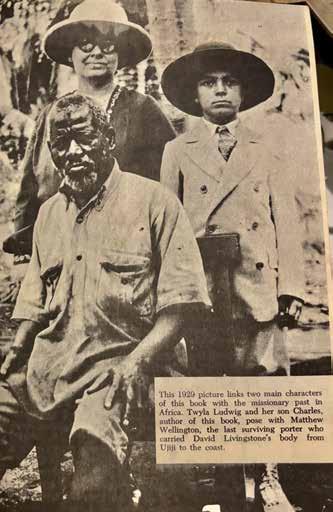
Missionary Twyla Ludwig and her son Charles pose for a photo after their visit with Matthew Wellington in 1929. Many missionaries would visit the old man because of his link to David Livingstone, whose story had inspired many to become missionaries themselves. The caption on this photo, which appeared in a biography called Mama was a Missionary by Charles Ludwig, notes that Wellington was the last surviving porter who carried Livingstone’s body from Ujiji to the coast. This shows how easily facts of the story could be mixed up and perpetrated. Livingstone and Stanley did meet in Ujiji, but Livingstone died later in Chitambo in present-day Zambia. His body was transported from there to Bagamoyo, not from Ujiji. (Photo from Mama was a Missionary by Charles Ludwig)
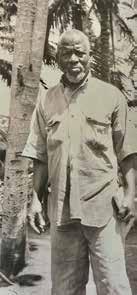
one of the first structures to be built next to the main office at the entrance to the settlement. Nearby were houses where the freed slaves lived, often with wives and children, and a shamba attached. The settlement had a cricket ground, a shop as well as a school, a church and workshops for for training in various crafts. They grew crops to feed the community and teach new agricultural methods. The bell tower, an important symbol of the Freretown settlement, still survives today.
The freed slaves received training which helped them to lead successful lives. Once able to earn a living and be independent they left Freretown. Descendants still reside in Mombasa and elsewhere in Kenya.
mouthpiece for the Church Missionary Society and contains articles and letters sent in by the missionaries attached to the various overseas stations.) Later on in the same piece, Salter Price described how a small police force made up of Bombay Africans was needed to prevent the new arrivals from running away and keep them safe, as he described it, “from the evil designs of outsiders who are on the lookout for opportunities of leading them astray and recapturing them as slaves.”
In 1881 a description of Freretown speaks of avenues of flamboyant, oleander and hibiscus and shambas busily being tilled, with vegetables and crops planted under the guidance of ‘elders’ from Nasik.
Jacob Wainwright worked closely with Price at Freretown after his return from England. He was literate, (unlike Matthew Wellington), but seems to have had trouble fitting in and working with European missionaries. In 1881 there was an uprising of Bombay Africans, who complained of racial tensions at Freretown. There is a photograph of Wainwright in an 1877 issue of the CMS journal smartly dressed in suit and tie and holding a hat. No photograph or mention survives of Matthew Wellington until much later. Jacob Wainwright left Freretown in 1881.
One feature of the new settlement was the Freretown Bell, which was rung on occasion to raise the alarm of imminent attack by slavers. More often a watchman struck it on the hour every hour as a call to worship or work and to provide a timetable for the day. A bell tower was
Wellington married twice and had several children and was allocated his own plot and house at Freretown. His first wife was called Ruth and one of his daughters Florence taught at a CMS school. Another daughter married a railway engineer from Barbados called Joseph Christopher Douglas who also had slave heritage, but from another part of the world.
In 1893/4 Matthew Wellington is described as overseer for Kilindini. The IBEACo had bought land there and established a temporary settlement to house freed slaves, overspilling from Freretown, as a halfway house to finding employment and leading independent lives. They rented out houses at low rates until the land was needed for other purposes. Now all that land has been taken up by the Port of Mombasa. Wellington and his wife helped to arrange Christian services in Swahili and received much praise from missionaries resident in Mombasa, as can be seen in letters from W S Taylor and Dr C S Edwards in The Missionary Gleaner.
Later in 1906 Wellington is described as working as an overseer in the Government Public Works Department. In a letter written to the Times July 18,1929 McGregor Ross writes that Matthew Wellington was in Government service working first for the IBEACo and then for the PWD. He was foreman for road building in Mombasa in1905-07. He remained throughout a leading member of the CMS Congregation and was elected Mombasa delegate for the Africa Church Council of 1909 and in 1912.
When Wellington was aged over 60 in 1911, the Governor of British East Africa petitioned the British Government on behalf of Wellington that he be awarded a special government pension in recognition of his connection with Livingstone. This was turned down, and in 1929 Governor Edward Grigg sent a further petition, which was similarly turned down. Life
was hard for Wellington who was now retired without regular earnings and with a large family to cater for. However, he received a small pension from the CMS and regular funds from a church group called Friends of Matthew Wellington based in London, who supported him in old age. He used to go to Treasury Square every month to collect his money, often accompanied by his granddaughter.
In 1907 slavery was abolished in East Africa and Freretown began to wind down, its operation complete. In 1918 Matthew Wellington bought a plot of land at Kisauni, in Maweni and moved out of Freretown. Here he lived on to a great age enjoying his status as a national treasure and living link with history. Many visitors came to see him, listen to his story and hear his memories of Livingstone and the dangers and adventures he had experienced first as a slave and then working with the famous missionary explorer.
On Christmas Day 1927 he was guest speaker at a lunch hosted by the residents of the island, attended by the Commissioner of Mombasa T Ainsworth Dickson, when a sum raised by the town committee was handed over to assist his living costs. In 1928 Edward Rodwell, editor of the Mombasa Times, visited him and interviewed him. The following year in 1929 Wellington took his place with the guests of honour during the brief visit of the Prince of Wales to Mombasa.
Despite his fame, Wellington’s last years were impoverished and difficult. With a large family to support, money was always short. And his fading memory meant that he could no longer tell a good story to the visitors who came to see him. Picture postcards were made of him and sold to help make ends meet. As Rampley writes: “What would the great missionary explorer think if he knew of the struggle of his old and faithful servant living on the proceeds of picture postcards?”
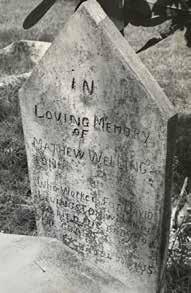
Matthew Wellington died in 1935 and was buried in the cemetery at Kisauni. His headstone reads: “In Loving Memory of Matthew Wellington who worked for David Livingstone, with others carried his body to the coast. Died 24 June,1935 made by his daughters.” There were many obituaries published in the international newspapers remembering the epic journeys he took with Livingstone.
His photograph was placed in the Emmanuel Church of Freretown as a permanent reminder of his contribution to the anti-slavery movement and his link with Livingstone.
I was inspired to write about Matthew Wellington after a friend showed me an article from the internet, which claimed that Matthew Wellington was in fact Abdulla Susi, Livingstone’s faithful companion and headman, and that they were one and the same person. I knew this could not be true, but I needed to look at the facts to disprove it. This is the result of my investigations, which I hope you enjoy.
In my archives, I then came across a Kenyan newspaper article from the Standard written in 1991, which was an interview with Wellington’s granddaughter, Maria Taylor. This newspaper article also claimed that Matthew Wellington was Susi and his African name was Susi Chengwimbe. I began to see how misinformation can arise and gather momentum and how important it is that fact checking is put in place.
References:
Alpers, EA (1967): “The East African Slave Trade”, Historical Association of Tanzania paper No 3, Nairobi
Church Missionary Society archives held at the University of Birmingham. They hold a full set of the ‘The Gleaner’ magazine as well as the letters of the Rev W Salter Price and Freretown records.
Jeal, Tim (1985): Livingstone, Pimlico edition
Rampley, WJ (1930): Matthew Wellington Sole Surviving Link with Dr Livingstone
Ross, McGregor: Photographic collection, 1909
Stovold, KE (1946): The CMS in Kenya: The Coast 1844-1944, Nairobi
Sulivan, Capt GL (1873): Dhow Chasing in Zanzibar Waters
The Royal Geographical Society London holds the list of Livingstone Bearer Silver medal recipients, 1875.
The Zambia (Northern Rhodesia) Journal Vol VI (1965): “David Livingstone Two Accounts of the Death and Transportation, by Carras Farrar and Matthew Wellington”
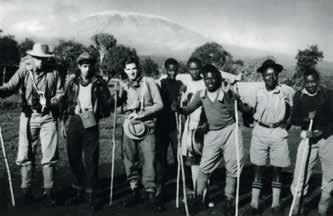
1954PeterGoodwin joined seven other students from across Kenya to make one of the first inter-racial climbs up Mt Kilimanjaro from the Outward Bound base in Loitokitok. Goodwin recalls, “It was very successful. We all reached the summit.”
After the climb, three of the climbers were invited to a ceremony at Government House. A newspaper article from the time described the event under the headline:
“Silver Spear Gift by Sir Frederick, Kilimanjaro climb recalled.” Here’s the rest of the article.
Three young men, a European, an Asian and an African, went to Government House, Nairobi, to receive from the Acting Governor, Sir Frederick Crawford, a silver-plated Masai spear on which their names were inscribed. The presentation recorded the trio’s outstanding contribution to the climb of Kilimanjaro in April of an inter-racial party organized by the Kenya Combined Schools for Outward Bound training.
The spear will go first to Siriba Training Centre in the hands of the African member of the trio, Samuel Musumba, aged 22, whose home is in Nyanza and who is taking a teacher’s training course at Siriba.
After that it will be passed on to Bashir
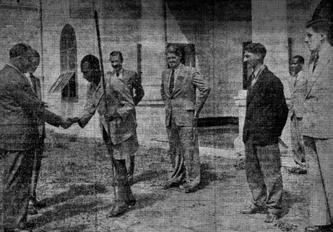
acting Governor of Kenya, Sir Frederick Crawford (left), shakes hands with Samuel Musumba, who holds the silver spear. Derek Erskine can be seen over Musumba’s shoulder. In the centre is RA Lake, Provincial Education Officer for Nairobi and the Southern Province, and on the right are Bashir Ahmed Meer and Peter Goodwin. Samuel Musumba was studying to be a teacher in Kisumu. Bashir Ahmed Meer’s parents had a photographic business in Nairobi. Peter Goodwin’s, parents were in coffee research in Kiambu. (Newspaper photo from Peter Goodwin)
Ahmed Meer, who is 17. He wants to be an aeronautical engineer and is studying at the Technical High School Nairobi.
Finally, the spear will be taken to the Duke of York School by 17-year-old Peter Goodwin, who hopes to be an agricultural officer.
Sir Frederick said that he had presented the spear because he felt the Outward Bound training was something “which we in Kenya should do all we can to encourage.” The courses brought together young men of all races in a spirit of comradeship and adventure and taught them not only to develop their powers of leadership but to understand each other’s problems.
“In a multi-racial society such as ours,” Sir Frederick added, “mutual trust and understanding is essential to the well-being of the State, and it is particularly important that our young men, who will be the leaders of tomorrow, should be taught to appreciate this.”
Handing the spear to Mr Derek Erskine, chairman of the Kenya Combined Schools Association, the Acting Governor said that he could think of no better principles on which to build the foundation of coming generations than the motto of the Outward Bound Trust: “To serve, to strive and not to yield.”
He commended the Combined Schools Association to people of all races in the Colony for their support.
Mr Erskine in reply said: “The spear is a symbol of the thing we all believe in – a united Kenya.”

by Jim Dawson
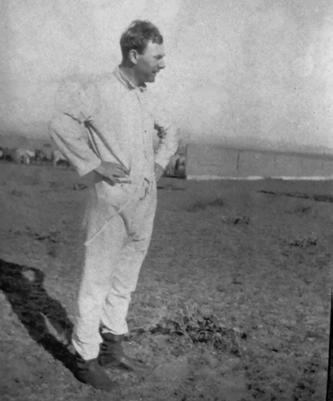
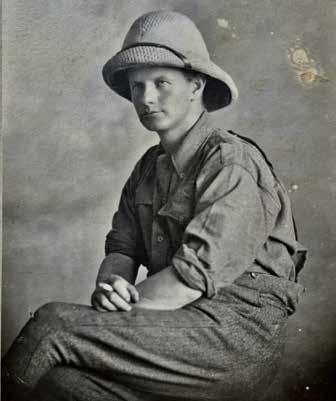
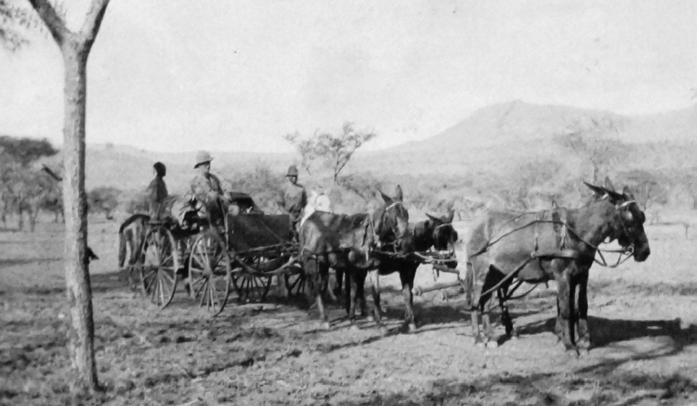
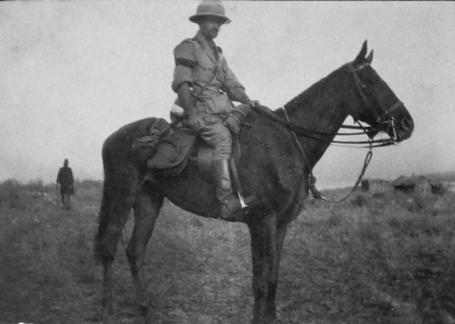
The East African Mounted Rifles, recruited from settlers and incorporating an assorted group of irregular mounted scouts, played a significant role in the early period in World War I in East Africa. But as recorded In CJ Wilson’s Story of the East African Mounted Rifles, from the beginning the regiment was plundered for manpower by other units who needed their skills and local knowledge. WJ Dawson is recorded in the regimental Nominal Roll as having been one of the earlier departures. He went to the Veterinary Corps, almost certainly on account of his background at the Government Farm at Kabete. From his photographs though, it is clear that he
remained with the Regiment for a while at least. After the first year or so of the war and following the unfortunate setbacks at Tanga and Longido, it became obvious that the campaign would be far longer than anticipated, and that the nascent colony could not meet the demands for manpower.
But the killing fields of France were likewise making demands on every part of the Empire, and this reflected in the quality of both troops and generalship sent to Africa to deal with von Lettow Vorbeck’s Germans. During 1915 the Regiment did sterling work scouting and in various engagements, but following early failures of the steadily increasing numbers of
Imperial troops it was decided to appoint a general with proven leadership qualities and at least some knowledge of African conditions, and the choice fell on Jan Smuts. This made sense, in that most of the new troops being recruited for service in East Africa would be South African. That country, under the leadership of Smuts’ one-time comrade in arms, Louis Botha, had joined the war in 1914 despite spirited opposition by Afrikaner diehards, and the two of them had swiftly disposed of German forces in South-West Africa (modern Namibia). Many South Africans had joined up and gone to war, firstly to South-West, and then to France (where their epic stand at Delville Wood on the
Somme is etched in history), but when the call came from Smuts to enlist for East Africa, many more, in their thousands, answered. With minimal training they were shipped to East Africa and thrust into battle in a very different part of the continent to what most of them were accustomed.
Of course, they had been preceded in this by a variety of units and officers, mostly from India and Britain. After the disaster at Tanga, which was more a failure of planning and leadership than the fault of the troops, more Indian troops arrived and many of them performed admirably in the prolonged campaign. However, the introduction to East African society of the British officer class, particularly those from the Indian Army, was not entirely welcomed by government or settler. From the outset the governor had made it clear that the war was an inconvenience. MF Hill in
Permanent Way wrote that “the relations between the Government and the Military Command were deplorable… Nairobi was crowded with Indian troops and senior officers of the Indian Army.”
JR Gregory put it a little more strongly: “Generals, Colonels, Majors and Captains ostentatiously decorated with tabs of various hues, and full of their own importance were pouring into Nairobi. They filled the Clubs where they groused at the absence of pukka sahibs, pukka golf, pukka polo, pukka bearers, pukka clubs and all the other pukkas they had left behind in India.”
Had their leadership qualities matched their selfopinion, they could have been forgiven. The abolition of purchased commissions had gone some way towards improving the quality of officers in the British Army but a commission, especially in India, was still largely the
preserve of the privileged and connected. Officers had automatic entry to the clubs in Nairobi and Mombasa and, naturally, they had passable mess facilities, in which they deplored the lack of social observances by the rough colonials, to the extent that some South African officers preferred to mess with their men rather than endure the snobbery. Some were referred to as “bed and bath warriors,” so called because they arranged for these battlefield essentials to accompany them on campaign, carried by bearers, of course. Thomas Wilson, a young Scottish officer in the KAR, who was killed by a German sniper late in the war, put it thus in a letter home: “The service dress is shorts, puttees and tunic but the regular officers have been originals in the Indian Army & transferred here. They are a very swank crowd.” (Sally Wilson: The Mules are Splendid Company)
Despite their immaculate uniforms and impeccable mess etiquette, having seen them in action, South African and Rhodesian staff and troops had little regard for their military abilities. Generals Aitken, Tighe, Stewart and Malleson were swiftly moved on once Smuts had had an opportunity to assess their capabilities. And this wasn’t just tribalism. That irascible British officer, Richard Meinertzhagen, too, held the British military leadership of that period, especially General Malleson, in utter contempt.
The British officer classes, on their side, considered the South Africans unmannered Boers, defeated in the AngloBoer War. This was to ignore the many harsh lessons in African warfare they had been taught in that conflict, and the very considerable effort and sacrifice Botha, Smuts and others had made
to bring South Africa into the war on Britain’s side. Smuts and many of his officers were cultured men, better educated than their Indian Army counterparts who looked down on them; Smuts had a double first in law from Cambridge and went on to Field Marshall rank. Van der Bijl held a Master’s degree
and was a Cambridge rowing blue, moving on to the RAF, a Military Cross and ultimately a cabinet post. Reitz founded a prominent law firm. The superior attitude of the “pukka” officers was unearned, unmerited and resented. Brown quotes an encounter which illustrates the difference between
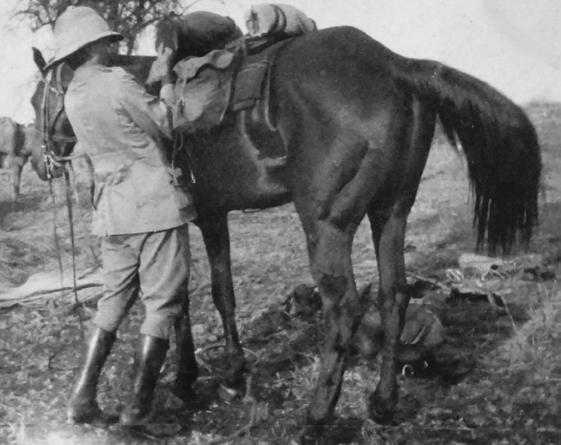
Another scout saddling up.
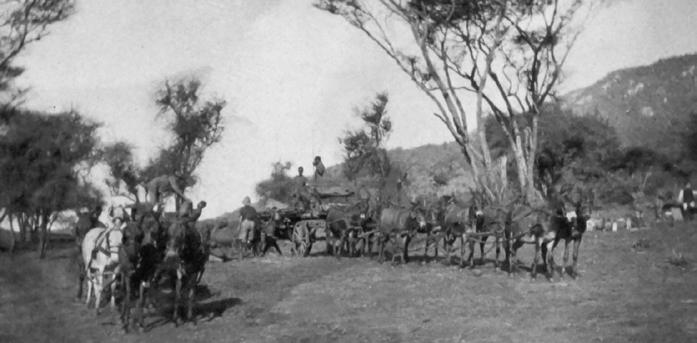
the two classes of soldier: “Somewhere behind the advance guard - indeed, very far back, according to Captain Piet van der Bijl on Smuts’s staff, came a British Officer of the Indian empire breed. He was travelling in great style with a gang of bearers carrying boxes from Fortnum and Mason, Picadilly…”
This, on a campaign where notoriously difficult logistics meant the severest of privations to the point of starvation on the part of the rank and file. Smuts pursued the war with considerably more success than his predecessors and Van Deventer, who succeeded Smuts in command after the latter’s promotion and summons to London, finally forced the Germans across the Rufiji, out of their own territory and into Mozambique. This came at a great cost in hardship and casualties, which aroused considerable criticism. Smuts is reported to have driven his forces so hard, often ahead of the necessary supplies and logistical support, that many
refused to shake his hand on his departure. And although forced far south, von Lettow was never decisively beaten in battle, surrendering only when the armistice was signed in November 1918.
Another aspect of life in wartime Nairobi worth considering is the effect on the ordinary people. While businesses which catered to the increased numbers of the armed forces and the refined tastes of their officers flourished, farming, government and some industries suffered severely from the absence of men on active duty. Development slowed as farmers, labourers and businessmen all served.
It would be remiss in a record of this period not to acknowledge the role of the thousands of porters who served. Especially in those areas where mules and horses died in their thousands, they were the essential arteries of the fighting forces. Early in the war they were organized into the official Carrier Corps, officered mostly by ex-EAMR
personnel, bearing essential supplies to the combat troops. Some were killed in the fighting. Many others died of disease and the privations of tropical warfare.
Dr Burkitt, still the only private medical practitioner in Nairobi, was put in charge of a hospital for sick and wounded Carrier Corps members in the course of which duty he tended to over 5,000 patients, an indication of the dangers and hardship suffered by this army of unsung heroes. He had only a single assistant, and despised time-wasting visitors from the senior ranks on ‘box-ticking’ inspections. To discourage them he would insist on them observing his surgical operations before dealing with any of the red-tape administrative issues with which they wanted to concern themselves. At the outset, he was given the military rank of lieutenant, from which he was never promoted despite his herculean labours, which JR Gregory attributes to “his contempt for those who
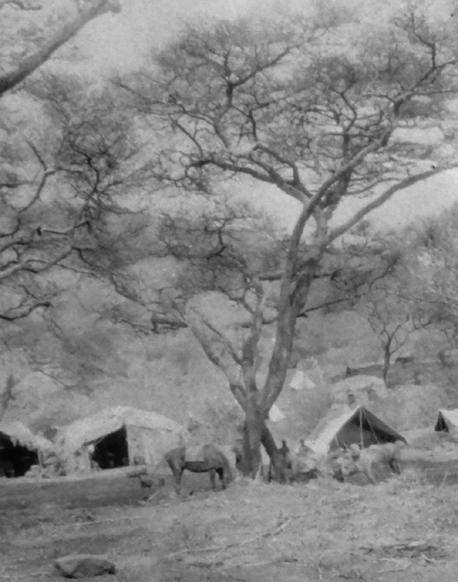
inefficiently bore exalted rank.” Deservedly, the Carrier Corps is commemorated in monuments in Nairobi and elsewhere.
There is not much we actually know about WJ Dawson’s service beyond his time with the EAMR. He had been transferred fairly early from the Regiment to the East African Veterinary Corps and given a commission. From his photographs it is clear that in this role he remained with the troops wherever they were posted, at least for a while. The importance, scale and difficulties of this work are perhaps best illustrated by the number of horses and
mules reported to have died in the course of the war in East Africa. Deneys Reitz, the famous South African soldier, lawyer and writer put the figure at 30,000, but there is evidence that it was at least three times this figure, and it’s clear that the role of veterinary officers in campaigns of this period was massive. The Armed Forces of South Africa 1659 - 1954 by Major G Tylden reads in this respect: “For the campaign in GEA 47 officers and 1,079 other ranks were enlisted and three veterinary hospitals were sent up with four mobile sections and personnel for the 10 mounted regiments.
Veterinary officers worked in the Union at remount depots and on purchasing boards as well as on transports from Durban to East African ports. The wastage in remounts during this campaign was tremendous; out of 98,000 animals, horses, mules and donkeys there survived 2,762 at the end of the war.”
So, the number of men in the veterinary service alone at the end of the war was more than twice the number of troops in the East African Mounted Rifles when they had set out so optimistically for Kajiado and Longido four years earlier. The equine casualty figure probably does not include the mounts acquired locally by the East African forces, which would push the figure to over 100,000, and that is just on the British side. In Port Elizabeth, South Africa, there is a memorial to the 300,000 horses estimated to have died in the 2nd AngloBoer war. Maybe a similar equine memorial would be appropriate in Kenya?

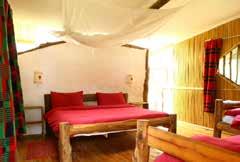


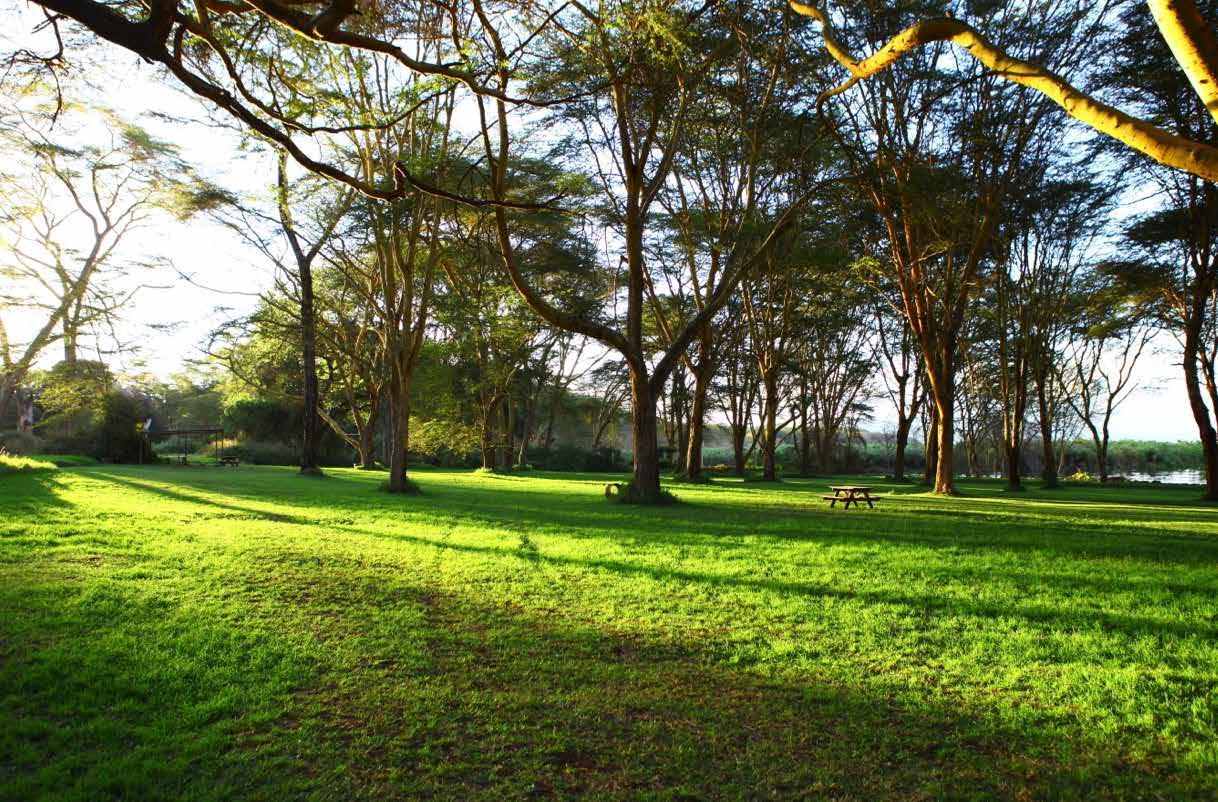
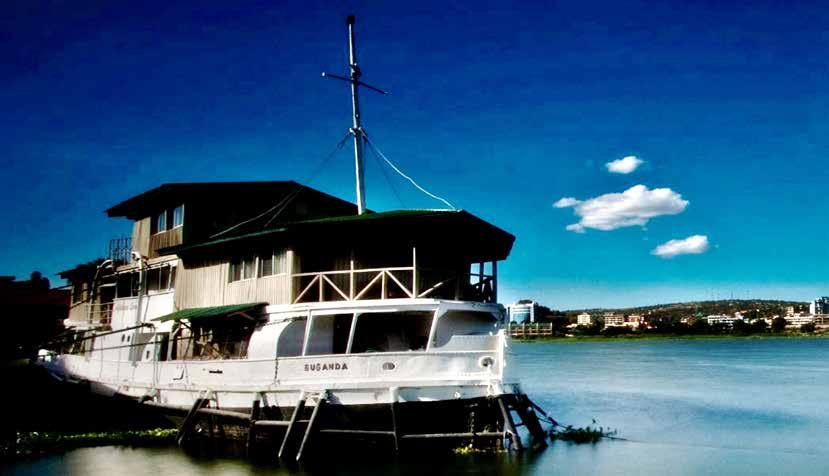
The Buganda, now in the port of Mwanza, offers sleeping space for the Hotel Tilapia and has been renamed the African Queen after the movie where it played a role as the German lake steamer Luisa.
by Kevin Patience
The building of the Uganda Railway from Mombasa in what was then British East Africa to Lake Victoria was a massive Victorian engineering project beginning in 1895. Indian labour, locomotives, rolling stock, rails and wooden sleepers were initially imported from India in ships of the British India Line. As there was no jetty to lie alongside in the old harbour all the ships anchored in mid-stream in Kilindini harbour and cargo was offloaded into barges to be pushed ashore by a steam tug and discharged on to the beach. The first tug to arrive was the Percy Anderson named after the chairman of the Uganda Railway Committee. The tug was built by Watson of Gainsborough in 1896, being 68 feet long, displacing 90 tons and powered by a 90 hp triple expansion engine. It proved a valuable workhorse even assisting the odd vessel that grounded in the entrance to the harbour. In 1903 following the completion of
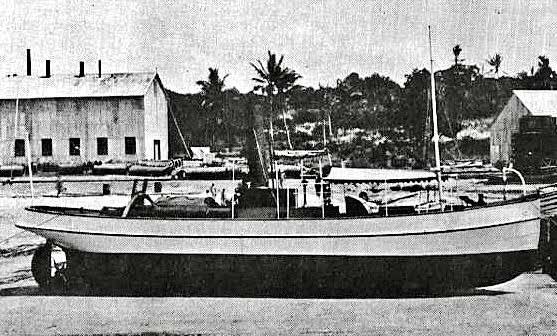
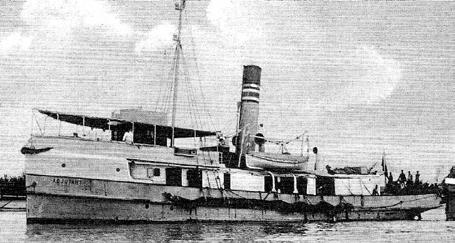
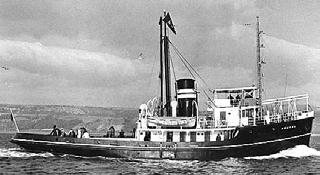
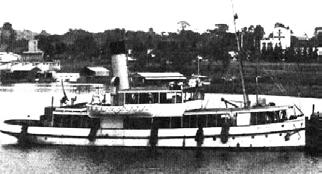
until 1967. Bottom: The Germans brought the Adjutant to Dar es Salaam harbour in 1905. The Royal Navy captured her in 1914 at the beginning of World War I.
the railway to the lake, the tug was dismantled and sent by rail to Kisumu where it served until 1967 having been converted to oil firing in the 1950s. A remarkable 72 years in service. Another early tug at Mombasa at the turn of the century was the Nyati (Buffalo) built by Cox & Co. Falmouth in 1899 for the African Wharfage company, that helped with the discharge of cargo for the Uganda Railway.
In the adjacent colony of German East Africa, now Tanzania, the Germans had five steam tugs: the Kadett built by Janssen and Schmilinsky of Hamburg in 1902; the Adjutant by the same builders in 1905 powered by a triple expansion engine; the Dar es Salaam built
by Stulcken of Hamburg in 1906 with a compound engine; the Helmut of 1910 and the Leutnant built in 1912. Of these the Adjutant had an interesting career having arrived in Dar es Salaam as the main tug to assist vessels of the Deutsche Ost Afrika Line. With the outbreak of the First World War in 1914 she was captured by the Royal Navy during the hunt for the German cruiser Königsberg, then hiding in the Rufiji River on the coast. Renamed H.M.S. Adjutant she was used to investigate German defences in the Rufiji River and recaptured after grounding in the river. Returned to Dar es Salaam, the tug was dismantled and railed to the port of Kigoma on Lake Tanganyika and while being
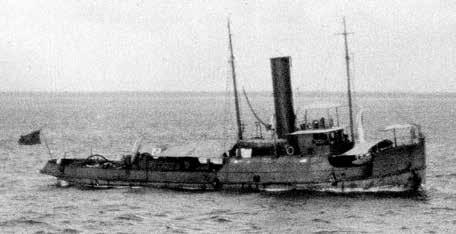
reassembled was destroyed by fire and scrapped. In 1931 the steam tug Imara arrived for Tanganyika Railways, but its career was short-lived and it was sold the following year. Five years later the Kionga arrived and on the outbreak of the Second World War the tug and crew made a break for the Italian port of Kismayu. With the allied invasion of Somaliland the tug was sunk to avoid capture and after salvage post war, sold to an Italian company and eventually scrapped in the 1980s.
During the First World War four steam tugs - Blackcock, Revenger, Sarah Jolliffe and the T.A. Jolliffe - arrived from Malta towing two shallow draft monitor gunboats to destroy the cruiser Königsberg in the Rufiji River. These tugs remained on the coast for some time until returned to civilian service after the war.
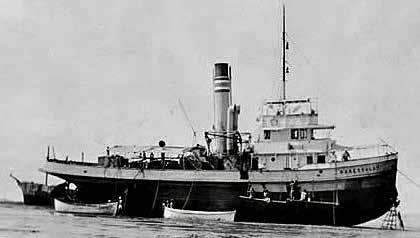
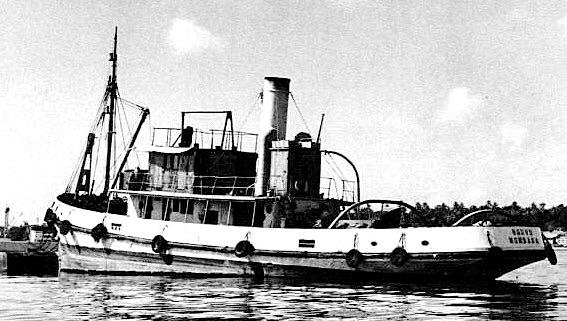
After the First World War new berths in Mombasa were constructed and a new steam tug Nguvu (Strength) was delivered built by Fleming and Ferguson in Scotland in 1925. After service in Mombasa, the tug became a navigation buoy service vessel and in 1954 the paraffin powered fridge in the galley caught fire and burnt out the wooden superstructure. The vessel returned to Mombasa with the coxswain standing in the open on a large pile of ash steering the tug with the remains of the ship’s wheel. The tug was repaired and served another four years before withdrawal. In 1927 the Kifaru (Rhino) arrived for service with the African Wharfage Company in Mombasa.
1929 saw the arrival of the most famous of the
Mombasa tugs, the Marie Felling, built by Earle & Co. of Hull, and named after the daughter of the railway’s general manager Christian Felling. A photograph of the lady was fixed to the saloon wall. Powered by twin 500 hp triple expansion engines, she was initially coal-fired then converted to oil-firing and became the mainstay of
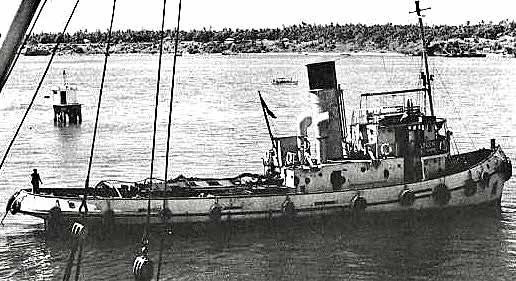
tug power in the port until the arrival in 1944 of the 800 hp tug Empire Linden on loan from the Ministry of War Transport. This was subsequently bought in 1948 by East African Railways and Harbours renamed Linden and remained in service until scrapped in 1983. The Marie Felling continued in operation until the 1970s when
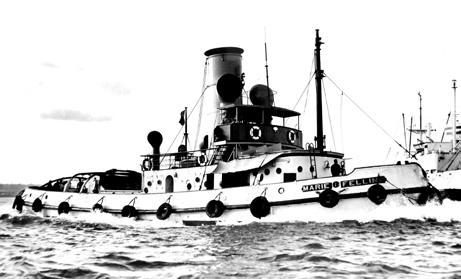
boiler repairs hastened its scrapping at African Marine in Mombasa.
Post war the Mombasa port authority purchased three TID tugs numbers 137, 138 and 140 and renamed them Toroka (Run away), Taveta (after a small Kenyan town) and Tiddler. All were coal-fired 200 hp compound engined vessels built by Dunston of Thorne but subsequently modified to oil-firing. Over one hundred of these pre-fabricated tugs were built during the Second World War and served all over the world. These three tugs crewed by four men were often used to tow the wooden dhows out of the old harbour to catch the offshore wind for India and Arabia. All three were dieselised and probably scrapped in the late 1960s. A fourth TID tug Bandari was also based at Mombasa. The British India Line purchased the steam tug Empire Minnow in 1948. It was renamed Thika and served on the coast until sold in 1951.
Two new steam tugs Nyati (Buffalo) and Simba (Lion) were delivered from the builders A.J. Inglis in June 1951 powered by twin engines of 1,530 hp and served in Mombasa and Dar es Salaam until the 1990s. They were used on a number of salvage operations including one when Simba was used to refloat a Korean
Top: In 1925 a new steam tug Nguvu (Strength) arrived in Mombasa from Scotland. Middle: The Marie Felling arrived in 1929 and is one of the most famous of the Mombasa tugs. She was named after the daughter of the railway’s general manager Christian Felling. Bottom: The powerful tug Empire Linden arrived in 1944 on loan from the Ministry of War Transport. East African Railways and Harbours bought the tug in 1948 and renamed it simply Linden.
fishing boat on the reef north of Mombasa. Boiler repairs hastened their withdrawal having been replaced by later diesel-powered tugs. Simba was scrapped at Mombasa and Nyati sank alongside the jetty in Dar es Salaam before being cut up.
Around the same time the British India Line ordered the 880 hp single-engined tug Arusha from Henry Robb for barge towing along the East African coast, a project that was short-lived. Arusha was sold to Falmouth Towage, renamed St Mawes and scrapped in 1984.
Meanwhile, on Lake Victoria, the early passenger/ cargo steam ships had been supplemented by the first large 200-ton steam tug Kavirondo,
named after a local district. Built by Fleming and Ferguson in 1914 it was dismantled and shipped to Mombasa in hundreds of crates and railed to Kisumu to be reassembled. Fitted with a single 400 hp triple expansion engine, the tug was used to tow barges to the smaller lake ports the larger steamers could not reach. After the First World War two more steam tugs Buganda and Buvuma were ordered from Bow McLachlan in 1924 for the same tasks as the Kavirondo. Named after local districts, they continued in service until the late 1970s when they were withdrawn and the Buvuma scrapped. The Buganda exists today as an annex to the Hotel Tilapia at Mwanza, a port on the lake
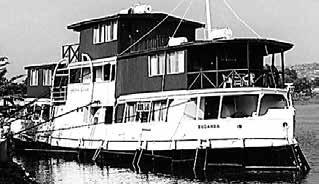
in Tanzania. The Buganda was added to the hotel because it gained a fair amount of fame when it was hired to Romulus Films to star as the German lake steamer Luisa in the 1951 film The African Queen, starring Humphrey Bogart and Katharine Hepburn. The vessel has been renamed African Queen and three additional cabins have been built on the tug - the Humphrey Bogart Penthouse, the Katharine Hepburn forward suite and the Captain’s after suite. These are available as accommodation in lieu of the hotel rooms, subject to availability.
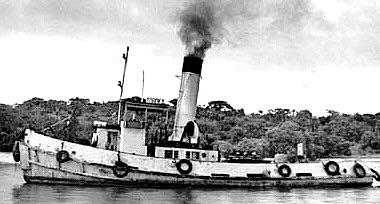
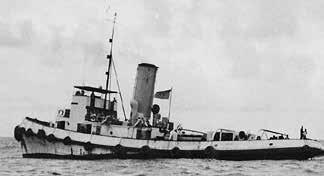
Top left: Arusha arrived in the 1950s for barge towing along the East African coast. Top right: Taveta came to Mombasa after World War II. She often towed dhows out of the old harbour. Middle left: After being built in 1914, the steam tug Kavirondo was dismantled and shipped to Mombasa in hundreds of crates and railed to Kisumu to be reassembled. The tug towed barges to the smaller lake ports. Middle right: Simba arrived with a companion tugboat named Nyati in 1951 and the two tugboats served in both Mombasa and Dar es Salaam. Bottom left: The Buganda arrived on Lake Victoria in 1924 with a sister tug named the Buvuma to assist the Kavirondo in towing barges to lake ports that were too small for the bigger lake steamers.
Kiboko Excuse
“Can I have a few days off work? ” Lempapa asked me.
“What for?” I inquired, thinking he had to take care of school fees or something mundane.
“I need to build a hippoproof fence around my shamba at Moidapi,” he said.
I asked for more details. It seems hippos from Oloidien Lake on the western end of Lake Naivasha, had been hungry. At night they wandered up to five kilometres from the water and had been invading Lempapa’s crops, and those of his neighbours. They had called KWS for help, but nothing much had been done. So Lempapa had to build a strong fence.
I gave him permission to take a few days off from his job. On his return he assured me that the multi-strand barbed wire fence he’d installed would keep the hippo out. I hope so.
I thought to myself that even though this event occurred this year in 2026, it’s only in Africa that someone would ask for time off work to build a hippo fence.
Editor!
Chimpanzee or Gorilla in Naivasha?
Gorillas live in forested areas in countries like Rwanda
and Congo. But in the 1920s, Margaret Collyer believes she met one on the shores of Lake Naivasha. Here’s her story:
While I was on a short break with friends who lived on the far side of Lake Naivasha, I came across an ape, ‘Douli,’ whose life was both interesting and heart-rending.
The East African trains could be most obliging with a little coaxing and the one I was travelling on stopped at a farm-track between Naivasha and Gilgil, allowing me to get out. Here I found myself in the middle of an empty part of the great Rift Valley in the late evening, with no one to meet me. I had to wait a very long time before a pony and milkfloat made its appearance.
While I was at this farm I rode over to Mr Paul Rainey’s place, which was then being run by Mr C Harvey and his sister, to meet Douli. (An American by birth, Paul Rainey was a professional hunter, and he had a farm at Naivasha. He bred ridgeback lion dogs and had a gift for training chimpanzees.)
Douli had been caught when very young in the Congo forests and had been given to Mr Rainey as a chimpanzee. When I first saw Douli he was still supposed to be of this species. At that time he was about three feet six inches in height, possibly a little more,
for he could walk with his arm around my waist. He had a stone house of his own in the compound and a servant to wait on him. Miss Harvey took me to call and Douli met us at the door of his house with his empty breakfast things in his hands. He had already rolled his mattress up and put it neatly into a corner.
The stories of this extraordinary ape are innumerable. He went everywhere about the farm with Mr Harvey and could open and shut gates. He sat at table and behaved like a perfect gentleman, drinking his tea out of a cup. Afraid of missing any of the sugar at the bottom, he sluished round the last drop of tea to make sure he got it all. He was exceedingly gentle and affectionate and was loved and looked after like a child for many years. He was given a bath every week, in which he would wash himself with soap and wash Miss Harvey too if given the chance. He disliked tame monkeys and one day a lady came to see him, carrying one in her arms. She was warned about Douli’s dislike, so during lunch, she chained her monkey to a tree. Douli spotted it and, picking up a large stone, hurled it at the animal and killed it on the spot.
One of the best stories told of Douli is when he was
thought to be ill. Miss Harvey, being very anxious about him, took him into the house and put him in an empty bedroom with his mattress and blankets on the floor. So long as she was near he played up to being a very sick monkey, lying on his bed covered up with blankets, too feeble to move. Thinking he would sleep, she left him; presently, peeping in at the window to see how he was, she saw him throwing his mattress in front of him and turning heels over head all round the room.
He was an awful drinker and if he got hold of the whisky bottle, drank until he was blind. He made a mistake one day and took a bottle of limejuice instead of the whisky and drank the lot which made him very ill.
There are some wonderful photographs of him lying in a deck-chair reading a newspaper and smoking a cigarette. He had a cat he was very fond of, whom he stroked in the most human way and gave it food out of his dish. The chickens he also fed, but in a different manner; he threw the food about, stood by with his back to them, and when they were busy feeding he reached round with his long arm, grabbed a bird, pulled its head off and threw the remains away.
He could open padlocks with keys and when no one was about would loosen the pole in the ground to which he was sometimes chained. He would then put all the soil back, patting it down so that no-one would know what he had done. The next time he was chained up he just lifted the pole out of the ground and slipped the chain off it!
I could write a small book on Douli’s doings, but enough. There was a tragic end to this semi-human creature. I never forgot him and was most anxious to see him again. Many years after that first visit, I did but I saw such a different Douli from the merry affectionate ape I remembered. He was no longer a chimpanzee but had grown into an enormous gorilla. Twice he had done his best to kill his friend Mr Harvey, who had had to go to hospital with the awful wounds inflicted by Douli’s teeth. On another occasion he had grabbed and stopped Mr Harvey’s motor-cycle in the yard, causing a nasty smash.
Douli was now extremely dangerous and had to be kept chained. All stones had to be put out of his reach, for he threw them at anybody and everything. When no more stones were to be found on the ground he took to loosening the wall stones of his hut and throwing them. His best friend was the person he most hated and would have killed if he could have got at him. He still tolerated Miss Harvey and it was she who took me to see him on my last visit which made me sad. Douli was quiet and shook hands with me, and I ventured to put a measuring tape round his forearm which measured, when limp, sixteen and a half inches.
But, in the end, there was nothing for it but to have the animal shot. However, nobody could do it; it was far too like murder. By this time the history of Douli had reached New York. A naturalist from the New York Natural History Museum came all the way to Kenya to see the ape
alive, then afterwards to shoot him and to take the skin and skeleton hack to America and have it set up by a taxidermist.
Poor unhappy Douli, who wanted a mate. He was given a peach and while he was eating it, was shot with a revolver through the back of the head.
It is strange that for so long a time no one seemed to realize that he was other than a chimpanzee. Not until nearly the end of his life did the Harveys conclude that he must be a gorilla; yet when I last saw him he must have stood all of five foot six inches. Of course he had not learnt gorilla ways, never having seen one of his own kind. He just looked sullen and unutterably miserable. Having had his liberty for so many years, being heavily chained was a dreadful punishment. Margaret Collyer in A Vivid Canvas
(Editor’s note: It’s possible that the ape in this story got his name Douli because he came from the area that is now Conkouati-Douli National Park in the Republic of Congo, which has both chimpanzees and western lowland gorillas. It’s impossible to know for sure without photos whether the ape was a large chimpanzee or in fact a lowland gorilla.)
Do you have a short, funny or quirky story about something that happened in Africa? Send your contributions marked Only in Africa to editorial@ oldafricamagazine.com, or by post to Old Africa, Box 2338, and Naivasha - 20117 Kenya. Please limit stories for Only in Africa to 350 words or less. Include your name and address in case your story is published. We pay KSH 1000/- for each published story. Sorry, we cannot return submissions to our Only in Africa column.
This article originally appeared in German as “Bericht über die im Auftrage der Geographischen Gesellschaft in Hamburg unternommene Reise in das Massai-Land,” published in the geographical journal Mittheilungen der Geographischen Gesellschaft in Hamburg, 1882-83, and which formed the basis of Fischer’s 1885 book Das Masai-Land The translated sections here comprise section I. General Report (pp. 36-99) and section III. D. Dr. G.A. Fischer’s ethnographic collection from East Africa (pp. 275-279).
This article was translated by Eckhart and Almut Spalding (the latter is a retired professor of Germanic Languages and Literature, Illinois College). For the sake of authenticity, Old Africa has chosen not to edit Fischer’s use of words like Negro and Washenzi, which are now objected to as pejorative, but in his day were descriptive.
Report of the Journey into Massai-Land, taken under commission for the Geographical Society in Hamburg by Gustav Adolf Fischer
We once again followed the old path back to Ngurum´an. After several days of rest here, where the negro corn had been almost completely harvested, we continued to follow the mountain range in a southerly direction. At first there was a light acacia forest in the vicinity of the mountain range, in which large flocks of guinea fowl (Num[ida] coronata) offered us welcome game. Soon it faded into a sparse grass inhabited only by a desert lark, and soon became devoid of vegetation entirely.
A flat, nauseating smell filled the air, and the dry ground was covered with a thin salt crust. After three hours of marching we approached the salty swamp into which the little river Waso Nyiro empties on the eastern side. The [river’s] water is still recognizable for some distance beyond, since numerous herds of gnu drink from it. The water is about 50 English miles long and in several places is 10 English miles wide. It is very shallow and has a reddish-yellow color. In the west the water reaches close to
the foot of the mountain range, with a few exceptions where somewhat higher land cuts into the swamp. [That higher land] is lightly forested and carries more or less fresh water. Springs of varying temperature discharge from the rubble of rock at the foot of the mountain range and provide the swamp’s source. Some spots were so hot that the porters’ feet hurt, and the temperature registered 50º[C]. At several locations, the rocks were carpeted with slimy masses of algae and moss, and there were clumps of rush grasses. In some spots the [swamp’s] banks were streaked with salt crusts that glistened white, like ice. For a short stretch, the foot of the mountain range was covered with volcanic rocks.
Even though there was almost no vegetation, the landscape still offered a beautiful, appealing impression. The blue, unblemished sky was mirrored in the mirror-flat water, which was bounded in the east by the soaring, black Gel´ei and Kitumbin mountains. In the south rose the precipitous slope of the volcano D’onyo Ngai, and to the north the landscape of Ngurum´an with the Mbolio mountains was still visible. Large flocks of flamingos (Phoenicopterus minor) and pelicans (P[elecanus] rufescens) enhanced the scenery, resting together in a thick host under a midday sun, forming pinkishred and white spots on the blue water.
The swampy terrain had begun at an elevation of 620 metres, and fell to the s[outh] w[est], close to the volcano, to a height of 500 metres above sea level. Nearing the mountain, the land rose again to 730 metres, above which the land rises further to circ. 1000 metres. This [mountain] called D’onyo Ngai (Mountain of God) is shaped like a pyramid, with flat, precipitous sides. The very visible crater is at the northerly side. As seen from the north, the sides exhibit two distinctive, small pointy triangles, which the coastal natives call pembe horns. Grey-white stripes of varying width extend outward from the crater, and in the sun they stand out, even from a distance, from the otherwise dark-brown-black color of the mountain. Other than the foot of the mountain, which is covered with many mimosa shrubs, the mountain appears to have little vegetation.
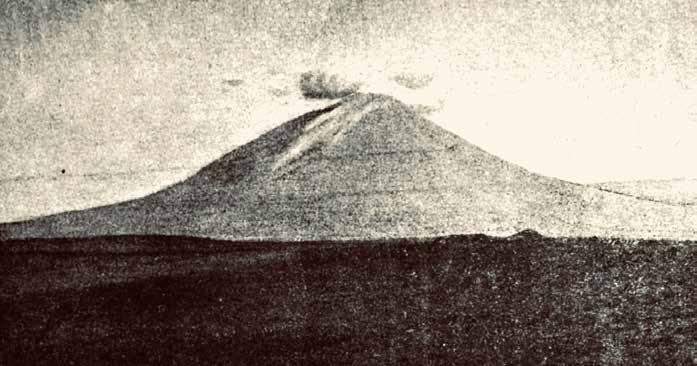
Only the southern and southwestern areas of the peak appear to have a covering of moss, or at least one perceives a greenish shimmer there.
The volcano soars precipitously from the flatland, and is as if glued to the mountain range on whose eastern edge it lies. Near the volcano, the hillside is noticeably flatter and the crest of the range is ragged. Boulders of varying sizes were scattered on the flats. Some of them stood in the salty swamp and looked like rocks of coral sticking out of the water. It looked as if they had come loose in an earthquake and had been hurled over there. Further on, the mountain range resumes its prior elevation. The swamp salt called magadi is dug out, mostly near the volcano, and is offered as an article of trade both in Massailand and on the coast. The natives, like the Mohammedans, chew small pieces of it together with tobacco, and the latter pack their donkeys with this salt on the return journey. In Pangani it can be sold for 3-5 doll[ars] per frassila (35 £), among other uses.
The land surrounding the volcano is barren and dry, the grass was completely desiccated. In various places there was a little bit of mimosa scrub. Some of the ground was denuded of anything. The volcano discharges small rivulets due to rainfall, wherein the grey masses of lava became visible. In several places there was also a frosting of magadi, and in the blackish earth one frequently saw small glittering bits.
In addition, the ground was covered in a thick layer of a fine, grey-yellow dust, which the strong southwestern wind carried aloft. This wind blew against the advancing caravan, and [the dust] pervaded everything. Several hartebeest (Alcelaphus bubalis), elands (oreas) and ostriches were visible in the distance. Several times we also disturbed rabbits and warthogs (Phaccochoerus africanus). The most common examples of birds in this desolate place were several lapwings (Chettusia coronata), coursers (Cursorius) and sandgrouses (Pterocles).
Only one time did I notice some smoke rising out of the crater, but Massai and Mohammedans consistently said that sometimes the tongues of fire were visible at night, and that from time to time roars emerged from the mountain. The latter could be compared to cannon fire, the former with the bellowing of cows. According to the testimony of one of my men, the last great eruptions took place in December 1880, and coincided with a substantial earthquake. This claim is consistent with earthquakes felt in Zanzibar at the time. My informant says that at the time he was in a caravan about four days’ travel southwest of the volcano, in the same mountain range. Around 10 o’clock in the morning there was a sound like thunder, thick clouds of smoke rose from the D’onyo-Ngai, and the Earth shook so violently that people fell to the ground. The Massai fled from the area, and a fissure opened
up in the mountains at Muti´eki.
After a lengthy search, we finally found a water source on July 3 in a 200-foot deep gorge which had been carved out by rainwater. This was in the region called “Sunya,” where the Massai had dug extensive holes in the sand, producing a cloudy water which tasted strongly of cattle. Here we again encountered several Massai encampments. The land rose to 850 metres and then fell suddenly to 100 metres to the level of Ngaruka, a very dry stretch of land surrounded by mountains and hills. Only a small stream flowed through, originating in the mountains at Mutieki, which is said to [either] fade into the sand or end in a small pond. Beautiful acacia trees grew thickly on the banks, and the wonderful, delicious water (the first since Ngurum´an) would have been truly refreshing for us— if only the Massai, [on seeing] our approach, had not deliberately driven their cattle into it above the encampment.
The plain of Ngaruka is bordered to the west by the oft-mentioned mountain range; to the north by the region of D’onyo Ngai; to the east by the mountain of Kitumb´ın and an adjacent hill country that stretches towards Kisongo; to the south and southeast by the mountains Simang´or, Loborg´o and Ethi, which rise markedly higher than the mountain range connected to them, to a height of 1450 metres. The plain [of Ngaruka] is a very hot stretch of land, for the reason that it is surrounded [by mountains]. Especially at the end of the dry season, when the air is often still, strong dust storms blow through, which come from the colder nearby regions of Kilima-Njaro and penetrate this area of strongly-heated air. At times they can be dangerous for caravans. During the march through the flatland I also noticed dust devils moving around in the vicinity of the mountains. Scraggly mimosas grew here, on ground that exhibited greyyellow clay. Strange masses of rock suddenly appeared at one spot, sometimes appearing like decayed tree trunks, sometimes like a collapsed wall of an old fortress, rising up to 10 feet in height.
There were several Massai encampments in the deeper parts of the plain. Wandorobo were also residing here with the Massai and found good spoils of ivory in this region. We crossed the mountain range of Mond´ul between the mountains Simang´or and Loborg´o, up to an
elevation of 1400 metres. Several Wandorobo who came into the encampment carried fresh Elelesho branches which they had brought from the heights where a few trees of this type grow. The lightly-hilly highland of Nanya, which borders this mountain range and descends toward the Massai distict of Balanga, grows grass and blooming herbs, and many giraffes are to be found there. It has ill repute among the inhabitants of the coast, because of its sopping cold. Whereas there were few clouds above the Ngaruka plain, there were thick clouds of fog, and even at sunrise the thermometer registered 14ºC. There was a cold southwesterly wind, and a fine rain drizzled until about 10 o’clock. The porters were terribly cold. We reached Kisongo, the last area where Massai can be encountered at any time of the year. Usually the chief sorcerer Mbati´an resides here. But at the moment he was at Leitokot´ok on the western slope of Kilima-Njaro. Kisongo is also referred to as a small, pointy hill which sits in the middle of the plain. Here, too, the grass was still green, and even in the dry season the Massai still find food and water for their herds here. Years ago the Mbati´an had the Wakwavi dig a stream from Mount Meru, into which they directed water from one of those other mountains so that the stream always flowed. For this work, the Wakwavi were fed every day with the cattle of the Mbati´an.
The warriors of this district were preparing a raid against Umb´ugwe (near Ugogo). They had recently suffered a defeat there, had returned without plunder, and they were rather inclined to make me responsible for the failure. We interacted in an uncomfortably irritable atmosphere. Even though we had planned to pay tribute, we did not do so, and for the following reason: they avoided the encampment entirely, because they believed that one of us, who was being carried due to a heavy bullet wound to the hand and had several burns on the head, had the pox. They called this ngaea, which had been introduced many times by caravans. They told us that we should leave as quickly as possible, which we did early the following day.
We proceeded through a blooming hill country, which stayed at an elevation of 1300 metres and at 8 o’clock in the morning had a temperature of 15ºC. After two short marches we reached the regions of Mount Meru, which has numerous streams. On the 10th of July we
reached the Wakwavi colony. In recent days the sky was always overcast, and it usually drizzled after 5 o’clock [in the afternoon] until morning. Here in great Arusha, the porters could feast and recuperate once again. The fertile land produces bananas, beans, peas, rice, negro corn, sweet potatoes, and manioc at all times of the year. However, the cold dampness spoils the enjoyment of the porters, who are used to the warm climate of the coast. They say that this area is more uncomfortable than anywhere else, and fails to fill the stomach to one’s content. It is said that hungry porters have suddenly died shortly after their arrival, after falling upon the vegetative delights and having eaten to their fill. Supposedly this is because of the unhealthy climate, but probably actually due to the over-apportioned food and overfilling of a deprived stomach.
It is astounding what portions of beans one such porter’s stomach can hold. One should consider that these people usually only eat once a day on the march, always around evening. In the morning they strike camp with an empty stomach, and [then] carry under the burning sun for the entire day with a load of 80 to 90 pounds of iron wire or beads, in addition to a gun of 8-9 pounds, a bag of ammunition, a powder horn, water bottle, sleeping mat, cooking pot, and often rations for several days and finally also several pounds of personal
possessions to trade for some ivory. They march, cheerfully and joking, 100 to 110 steps per minute. He only demands one thing, and one cannot blame him for it: upon arrival at the place to camp, he wants to eat his fill. But even this is not always granted him, especially on a journey through Massailand, and it is not rare that he must go hungry.
It must be said that at this time of year the climate on Mount Meru left much to be desired. I, too, froze in the morning and at night at a temperature of 15ºC. Mount Meru was persistently wreathed in grey, and at night there usually fell a fine rain on southeastern winds. Only at midday did the sun briefly break through, but not so as to make Mount Meru visible. Only one time towards evening during my 10-day stay was the mountain fully visible. The thin stripes of snow that were there yesterday, when the summit was briefly visible, had vanished once more. The area to the southwest at the foot of Mount Meru is thickly forested, mostly with acacia trees with yellow bark. There are also tamarinds and sycamores, and the water courses are edged with shrubs and creepers. Large numbers of open areas of grass are scattered in the forest. The fauna was richer here than any other areas [we] visited.
In the thickest part of the forest, near the mountain, lived small families of the whitemaned central African colobus monkey
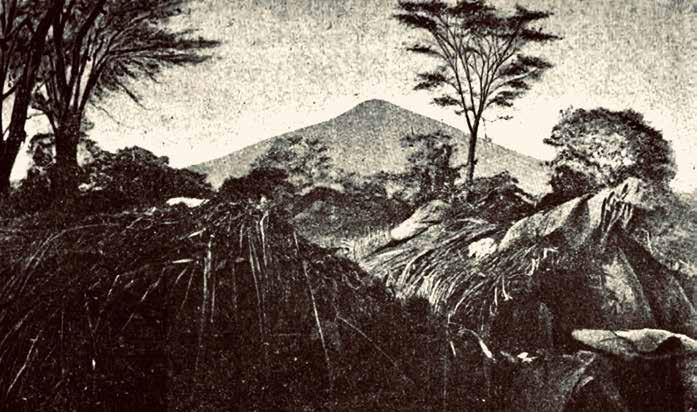
(Colobus gereza), which the natives would not permit to be shot. Two types of guenon monkeys (Cercopithecus rufocinereus and pygerythrus) especially sought out the crops. At night [we heard] the bush babies make their almost relentless screeches. Several kinds of squirrels sought their sustenance in the sycamores and tamarinds. Also the suni (Nesotragus moschatus), the only true antelope on the island of Zanzibar, was to be found here. The menagerie of birds was very rich, and provided most of the new species in my collection. For example, in these areas I caught a magnificent Hartlaub’s Turaco (Corythaix Hartlaubi) and a tit species (Parus fringilloides), among others.
In days of old the Wakwavi of great Arusha— among the Massai the stretch of land is called “Gigooine;” the Wakwavi themselves say Arusha—through force of circumstances began to engage in agriculture. At one time they were no less dependent on the Massai than [the Wakwavi] of Ngurum´an, or even little Arusha. In recent years, however, they have made themselves completely independent [of the Massai], and have become equal adversaries of the same, so that the Massai not only do not allow themselves to be seen in their area, but also cannot even allow their livestock to graze in peace in the vicinity of the mountain. A grim hatred exists between these fraternal tribes, and even when a so-called peace is made, bloody strife quickly follows. Incidentally, it occasionally happens that young Wakwavi warriors join the Massai. The Wakwavi living on Mount Meru derive their power primarily from the fact that they have taken up firearms, which they obtained through a small trade in slaves with the Mohammedans. Precisely because of the growth of their power and population — a portion of the Wakwavi from little Arusha has also migrated here — they have partly fallen back into their old raiding life. Only the older ones, viz. the married ones, cultivate the land, for which they also utilize slaves. The younger ones constitute a warriorhood like among the Massai, also despising vegetative sustenance, and whose clothing and customs align almost completely with theirs. This band of warriors untertakes raids against the Chaggaland (Komboko), to Pare and even to Ukamba, and steals animals and humans.
had seized cattle, goats, and around 15 slave specimens, the latter of which were sold immediately to the Mohammedans. For a good slave, one usually pays 1 gun, a powderhorn, an ammunition pouch, and some powder and lead. The Mohammedans make excellent business, for the worth of these items amounts to 6 doll[ars], but of a slave on the coast at least 40. The most dreadful scenes took place here, as they are sufficiently known from descriptions by earlier travelers. The Wakwavi of little Arusha are often prompted by their cousins of Mount Meru to join their raiding parties, but are peaceful people who have a different character from that of their forefathers. Little inclined [to raid], they usually weasel out and quickly return home with the excuse that they have lost their compatriots. This was also the case on this occasion.
Their clothing consists mostly of skins, but the older people also wear cotton. The ornaments are the same as those of the Massai. Foreigners, however, can move around here freely without being murdered, even though there were several occasions when blustering young Wakwavi struck porters with knobkerry clubs. In contrast to the Massai, the young people engage in the hunt, and they enjoy buffalo and antelope meat. They are evidently knowledgeable with snares, and almost daily small antelopes were brought to me alive. The children brought many francolins and guinea fowl which they caught in snares in the millet fields. They are expert at felling birds with rocks or arrows. For this reason, this is an oasis for the collector in the harsh desert of Massailand.
The married people arrange their quarters like the Wakwavi of little Arusha and Ngurum´an by one, twos, or threes in the forest near their fields. The inhabitants of the coast distinguish the Wakwavi living on the slopes of the mountains from those living at the base, and call the former WaMeru— they are those who especially hunt elephants.
I was just in little Arusha (on the outward journey in March), when Wakwavi warriors returned from a raid against the Wapare and
During my time among the Wakwavi we developed very friendly relations, which was visibly uncomfortable for the Mohammedans, who through all kinds of lies attempted to disrupt the amity. The elders visited me every day without any shyness, including a man who could make himself understood through the Swahili language, which was very important for me. The younger people, meanwhile, scurried away in fright at the sight of me. Those
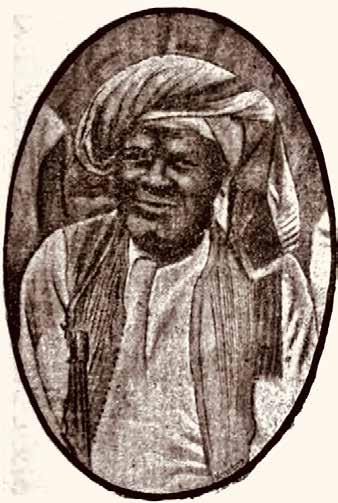
who lived in the area who saw me daily soon developed trust and undertook several hunts with me. In the course of these they showed great interest for the breechloaders and the manufactured cartridges, while the Massai were completely indifferent to such things.
When we arrived, there was a great excitement among the natives. A great number of them surrounded the tent. The most ridiculous rumors had spread, including: the white man sleeps at night in flowing water. This is why we found the creek flowing past the encampment to be fenced off. Only after a deputation of older people assembled in my tent and saw for themselves that I had brought an item along with me for the purpose of sleeping, was the creek made accessible again. At this time the deputation also asked if I consume sustenance, and they were visibly pleased to hear that I did not reject the things that they themselves enjoyed.
The fear of sorcery was as great here as it was among the Massai, and when purchasing ethnological items, especially of a certain type such as, for example, hand tools and tools for the home, it was necessary to maintain
the greatest caution. Little earrings made of glass, which looked like little icicles, were rejected here as evil magic, just like they were among the Massai. Some also regarded play coins the same way, though in general they were favored. Mirrors could not be brought out into the open. The Massai in particular were fearful of them, and when they peered into them, it was delightful to see with what peculiar expressions they displayed of shyness, fear, and astonishment. They did not accept these magical things, because they feared that possession of them would invite suspicion of being an evil sorcerer.
They make their weapons themselves, like the Massai, though they also highly regard spears and shields made in Machame (Chaggaland). They rarely produce iron themselves; usually they smith iron wire. Smiths, who are called in the Massai language likonono (sing. kononi), are an especially despised class among the Massai. But I could not establish that they are members of a distinct tribe, as others have reported. Among the Wakwavi, the father has greater authority over the son than among the Massai. The son cannot, like he can among the latter, sell cattle without the approval of the father. The proceeds of the son belong to the father. Several times, sales of slaves were reversed because the son had conducted the sale without the knowledge of his father.
As among all East African agrarian tribes, there are established drinking days among the Massai and Wakwavi. It is only natural, when one considers that alcoholic drinks are not immediately available, but must be prepared first. One day the usual visit of elders [to me] in great Arusha did not happen. On the following day they gave the excuse that it had been a day of drinking, and since I had told them that I do not want to see drunk people, they did not visit me. The intoxicating drink is always hydromel. Honey and water is stirred together, and is placed next to a fire for two days. They also add the root of an agave to speed up the fermentation. As previously mentioned, only people who are not warriors partake in drinking. The women refrain from it.
The inhabitants of great Arusha also seek counsel from the Mbati´an of the Massai, since they themselves appear not to have a great sorcerer. I did not encounter any Laib´on among them at all. The most influential man was the spokesperson for the elders and
his elderly father, named Lebanga, who had some 100 children. A ruler above the chieftains also does not exist here. Real power lies with the warriors, which can be seen from the fact that the day before our arrival, they killed the spokesperson of the youngest warrior class, a son of the old Lebanga, because in little Arusha he had acquired “evil arts” among the Mohammedans. Among the Wakwavi at Mount Meru, who had already heard of Europeans through the more fluid and free commerce with the inhabitants of the coast, I was often called the Swahili name Mzungu. Otherwise, and always among the Massai, I was referred to as Laib´on eb´or (the white sorcerer). The Massai had no idea that I was from a tribe of white people, but they rather considered me to be an especially distinctive Laib´on from among the multicolored inhabitants of the coast. The Mohammedans did not care to enlighten them on this point, and given [the Massais’] restless and suspicious character, it would not have been of benefit. They were so suspicious that, in spite of our gifts, they only answered our questions pertaining to their land, mores, and customs with reluctance and evasive glances. Their eyes always moved around skittishly, and they sought to evade any questions with some sort of an excuse. Due to their pride and boundless thirst for freedom, they are not useful as slaves. For this reason, to the best of my knowledge one never finds a Massai slave on the coast, whereas the closely-related Galla tribe delivers good and sought-after slaves. Wakwavi girls from the districts L´umbua and Mau, where the Wakwavi became very impoverished after their defeat, have at times attached themselves to caravans and live as wives of Mohammedans in Pangani. When we finally left great Arusha, the Wakwavi made the request that Europeans, who bring many arms and gunpowder, should soon return to settle among them so as to wipe out the Massai.
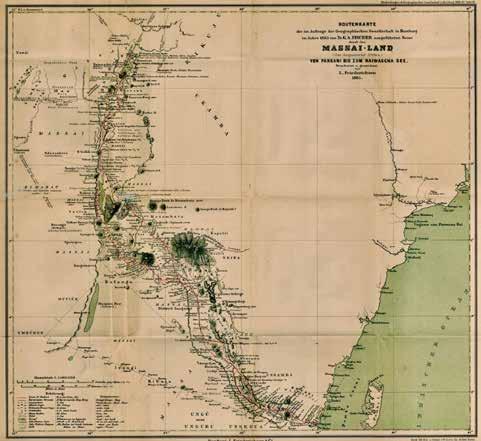
Mount Meru sends its waters mostly to the Pangani River. Only several unimportant streams flow to a small lake (or pond?) in the Balanga district. On the way to little Arusha we passed 3 little rivers, which merge into one not far from the Litema mountain range, and which soon joins with the little Weruweru river (as it is called below Ronga) which comes from Kilima-Njaro. On 24 July we arrived again at little Arusha, where we set up camp closer to the Ronga and outside of the forest, and which granted an open view over the landscape. The area was full of game and every day it delivered meat-based sustenance in plenty, which was desired all the more because the natives’ fields had been damaged in flooding, and almost only sugarcane was brought to market. The little reedbuck (Eleotragus reduncus) in particular graced [our] kitchen with good-tasting meat, which, because of its curiosity towards the hunter, fell prey to the hunter more easily than the cautious gazelles and pala (Aepyceros melampus).
Honey was now available in large quantities, and several times Massai came from the Sog´oni district to exchange livestock for it. Even though they enjoy honey and need it to prepare hydromel, they are still too proud to manufacture bee cages (hollowed-out pieces
of tree trunks) and hang them up. Hence one can only find honey among the Wakwavi and Wandorobo.
Many Massai warriors from the S´ıgir´ari district also passed through Arusha, and were about to start a raiding expedition against the Waruvu. On our return march to the Pare mountains we also encountered several troops of Massai who were driving away livestock which they had stolen from the Wapare. Hence, upon the caravan’s gunshots [to signal that we] needed grain, the Wapare only descended with reluctance from the heights. They also had blocked off access to water because of the Massai. We crossed the little Mkomazi river originating from the Pare mountains higher upriver than on the outward journey, so as to reach the level of Masinde and to acquaint ourselves with the land of the Wasamb´a. This is a peaceful people which engages in farming and raises livestock, and is closely related to the Wasegua in terms of language and customs. They live exclusively on this land crossed with mountain ranges of granite, which enclose valleys of varying width. In those valleys live several colonies of Wasegua who are subject to the chief of the Wasamb´a. This man, called Samboya, resides in a settlement at an elevation of 460 metres on the Ngua mountain, located on the slopes that fall off to the plain of Masinde. His son Kimeri lives in the mountain redoubt of Vuga, closer to the coast. Father and son are very jealous of each other, and because a sorcerer had predicted that one of them must die the day they lay eyes on each other, they fearfully avoid any encounter with each other.
Samboya has some Arab blood, as do any chieftain families of the Wasamb´a and WaChagga. He has yellow-brown skin and dresses very much in the style of the Arabs. And although he is so stuck in his nonbelief, to the point that pork is his favorite food, he loves to say expressions which are so common among the Mohammedans—“as God wills,” “praise be to God”—which they resent from such an impure mouth as his, but which they must tolerate as he is the lord of the land. Samboya speaks Swahili as his mother language. He also understands the Massai language, for, as a crusty merchant, he also has relations with them and buys ivory and livestock from them. Recently he came to an agreement with the Massai: during the dry months he permits them to graze their livestock
on the green fields of this land, in exchange for which the Massai leave his subjects in peace. In complete contrast to the Usegua peasant chieftain Sodenga, Samboya is a urbane man, who is also aware of the relations on the coast and on Zanzibar, and as the governor of the Sultan he flies a red flag on the Arabic Sundays (Friday). The Wasamb´a use cotton exclusively for clothing, and firearms are in such general use, that one rarely sees anyone with bow and arrow anymore, such that it was difficult for me to obtain a shield. They carry out an active trade in livestock and grains with the inhabitants of Pangani.
On the partially thickly-forested mountains there also grows a tree similar to sandalwood. In the plains there are stretches of impressively tall forest. The rocky streams flow from the mountains and merge in the level of Masinde and make up a swamp thickly grown with reed grass and Cyperus grass. The Washambaa live in the most bitter enmity next to the neighboring Washenzi, the inhabitants of the landscape of Bondei, where there is an English mission station. Samboya has until now attempted to bring them under his rule, to no avail.
Every day the chieftain sent hospitable gifts of a cow and two sacks of rice, in addition to butter and honey. But he also had very many wishes of his own, and was not shy in his requests. Now, however, as the trip was nearing its end, I could grant him everything. I could not satisfy only his desire for “spicy European wine” (spirits). Samboya was an expert at producing honey, banana wine and sorghum beer, but preferred the Hamburg brands to his native brews.
After three days’ stay, we proceeded along the mountain range to Maurui, leaving the little Mkomazi river to our right at a distance of 5 sea miles. Not far from foot of the Manga and Mafi mountains, that river flows into the Pangani. [We went] along the mountain range to Maurui, where the negro corn had just been harvested, and the natives approached us in great numbers. Thereupon, on 14 August we arrived in Pangani again, after about eight months’ absence.
The End
byTiras Waiyaki
This serialised story gives the life of JM Kariuki and how he became a prominent politician in Kenya in the 1960s. But by the 1970s he found himself in a struggle against President Kenyatta’s supporters. In 1974 he received active death threats and in 1975 he is called in for questioning and is killed. The killers try to dispose of his body and create a cover story. Once his body is discovered and identified, there is public outcry. After JM’s burial, a Parliamentary committee is set up to investigate the popular MP’s death. The story continues:
Parliamentary Select Committee
Charles Rubia approached House Speaker Mbiti Mati and told him that Kenya was in a dire state upon news of JM’s murder. They needed a committee to investigate the circumstances around his disappearance and death. Nabwera remembers that even vocal Gikuyu MPs were reluctant to head the committee or even sit on it. Rubia’s view was different, “We looked for someone who was not Gikuyu to chair the committee because we did not want to look tribal. After all, JM was not tribalist,” Charles Rubia told Inooro TV years later.
The committee was chaired by Elijah Mwangale who was deputised by Mark Mwithaga and comprised of a number of fiery MPs. “He (JM) had the support of people from all over Kenya and this was reflected in the committee and who was on it!” Nowrojee told KTN News.
A probe committee was formed, “The Select Committee on the Disappearance and Murder of the late Member for Nyandarua North, the Hon. JM Kariuki, M.P.” Members of this probe committee comprised of its chairman Elijah Mwangale (Bungoma East), his deputy Mark Mwithaga (Nakuru Town), Grace Onyango (Kisumu Town), Jesse Mwangi Gachago (Makuyu), Charles Wanyoike Rubia (Starehe), R Salim Mwavumo (Mombasa South), J Kasanga Mulwa (Makueni), Burudi Nabwera (Lurambi North), Justus Kitonga (Kitui North) D Mohammed Amin (Wajir East), Henry Wariithi (Tetu South), Jean Marie Seroney (Tinderet), Dr James Muriuki (Bahati), Martin Shikuku (Butere)
and James Nyamweya (Nyaribari), the only cabinet minister who sat on the committee.
The 15-member committee met 46 times and conducted 123 interviews with witnesses over the next two-and-a-half months. The Weekly Review wrote, “All eyes in Kenya and many hopes are now turned to the 15-member select committee to investigate the murder of JM Kariuki and there is no doubt that the committee is chaired by one of the best minds in Kenya’s national assembly.” Parliament broke out in thunderous applause when Mwangale pledged to do a thorough job with his committee.
However, it proved almost impossible for the committee to summon the Minister of State who reportedly declined to appear before the said probe. A certain DC appeared before the committee armed with a pistol. According to KTN News Casefiles, the Deputy Director of the National Youth Service (NYS) threatened to shoot anyone who dared to summon him to appear before the committee. Casefiles indicated that the NYS Deputy Director, who smoked Sportsman brand of cigarettes, was placed at the scene of JM’s murder. A packet of the cigarette brand found at the scene of JM’s murder added to the suspicion.
“When we went to where JM was shot dead behind Ngong Hills, I got a cigarette packet.
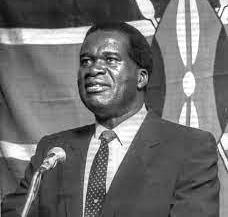
One of those who murdered JM used to smoke Sportsman cigarettes. I found a packet of Sportsman and it had one cigarette left in there. I opened it up and gave to the police but I was stupid or naïve because I gave this to a policeman hoping they would take fingerprints as only mine, his and JM’s killers fingerprints would be on it,” Shikuku said on K24’s Capital Talk.
The committee did manage to interview Mark Twist, who used to follow JM in Nairobi and Nakuru, and though he proved tricky and elusive, they got what they needed out of him.
Very interestingly, Shikuku was to tell the Kenya Television Network that Kung’u Karumba, one of the Kapenguria Six, had also been killed behind Ngong’ Hills. “Kung’u Karumba whom you told us was killed by Amin which is not true, we later found out when we were investigating the killers of JM, he was killed behind Ngong’ Hills. The Maasai told us!”
According to John Kamau, ole Tunta told the Nation that the place where JM’s body was found had been the scene of four other violent murders. And he said, “Only one body was recovered (while) the others were eaten by hyenas.”
Johnson Muchai Karumba, Kungu’s son, however told Citizen TV that Kung’u disappeared without a trace in Uganda in June 1974. Word was that he was killed by a business rival. Others said he was killed by Idi Amin’s soldiers. However, there was also speculation that he was killed by powerful forces in the Kenyan government. To date, the whereabouts of his body and how he may have died remain a mystery.
“Had ole Tunta not found Kariuki’s body –and reported it to the police- the abrasive Nyandarua North legislator would have disappeared without a trace, the same way freedom fighter Kung’u Karumba was said to have disappeared in Jinja, Uganda, in June 1974,” wrote Kamau in the Nation
When intelligence boss James Kanyotu testified, in camera, he told the committee that a cabinet minister had sent his bodyguard to Special Branch headquarters to report how JM had recruited some men, including the bodyguard’s own son, to go for military training in Zambia so as to topple the Kenya government. Pressed to adduce evidence, the bodyguard requested proof from the Special Branch itself. Kanyotu stated that Thungu also
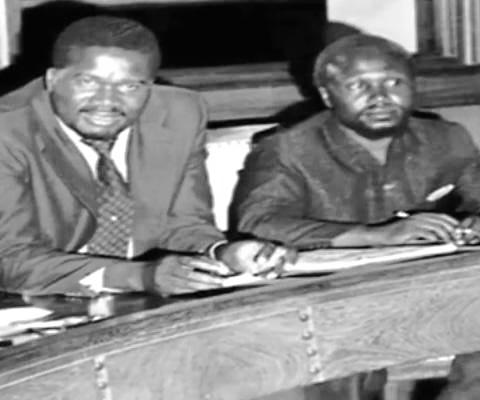
Chairman Elijah Mwangale (left) and his Vice Chairman Mark Mwithaga conduct a hearing for the Parliamentary Committee investigating JM Kariuki’s disappearance and murder.
reported about JM’s alleged recruitment of a militia to undergo military training. The Special Branch did not have any such information and these allegations were dismissed. Kanyotu warned the minister’s bodyguard never to take such reports to him again.
In the course of the hearing it emerged that CID boss Ignatius Nderi had claimed at OTC that a red Peugeot car driven by JM or Waruru Kanja had been seen speeding from the scene and was shot at. Nderi told the committee that he could not allow them to peruse the police investigation file into JM’s death as he had no permission from his boss Bernard Hinga. When Hinga appeared before the committee he reportedly promised to let them have a look at the file but that did not happen. Attempts by this writer to speak to Hinga (now deceased) years ago were met by a stiff, “No! N.O. in caps,” was Hinga’s firm response on phone.
KTN News reported that JM was shot five times in Ngong Forest. Mwithaga pointed out that JM was shot at the back of his neck to break up his spinal cord and completely finish him off. He further stated that the committee spoke to CID officers and everyone involved in the ballistics who confirmed this.
The committee identified those who were involved in the assassination, including senior officials and assigned each the role they played.
Some key figures in JM’s assassination did not show up before the committee.
Unknown to the ruling political class, the Special Branch had furnished some committee members with precise information on how JM’s assassination was executed. They had reportedly warned the administration against carrying out the murder but this went unheeded. The Deputy Director of Intelligence at the time, Stephen Mureithi, said that the issues surrounding JM’s demise were a time bomb. The government was at great pains denying any involvement in this murder.
JM’s wristwatch was found at the Makongeni Police Lines hidden in a packet of Sportsman cigarettes. Placed on a toilet’s rooftop, it was discovered by the child of a police sergeant, who wanted to play with the packet. The watch bore the inscription, ‘J.M. Kariuki’ on it. According to Casefiles on KTN News, Ignatius Nderi called the police officer and cautioned him not to speak about the matter. Casefiles further noted that other police officers and witnesses were also questioned by their superiors about what they knew concerning the assassination. Some were beaten and others locked up.
Shikuku had his version on the matter. He was approached by a man who overheard some women talking about the watch. He knew one of the women who was talking about this. The father to the child who found the wristwatch was a corporal. “Somebody, after killing JM took JM’s watch and found that it had its (sic) initials, so he hid the watch,” Shikuku said on K24, making it clear that this “somebody” could not have been a thief as thieves keep away from police stations. The corporal, his wife and child were summoned by the committee and they appeared before them.
According to Shikuku, the boy who found the wristwatch was looking for a wire to seal a hole on their jiko, so he saw a wire sticking on top of the toilet cubicle. He climbed a nearby tree, got the wire and saw a cigarette packet next to it. Inquisitive, he took the packet and found that it was heavy. The watch was inside and he took this to his father who in turn informed Superintendent Joginder Singh Sokhi. Sokhi drove all the way from the CID Headquarters to Makongeni Police Lines for the watch.
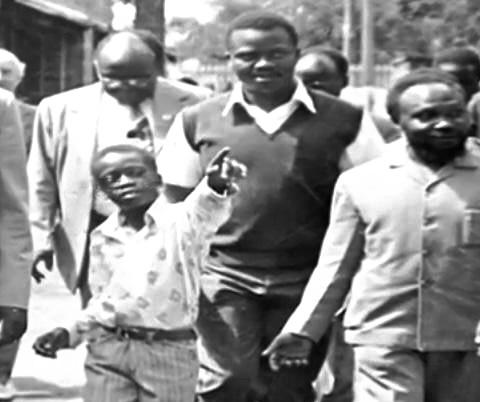
denied any knowledge on the matter and asked them to follow up with Superintendent Sokhi who said the watch was being retained for investigations but not much had been done in that regard. The boy and his father were both spoken to by the committee which even visited the Makongeni Police Lines. Years later this wristwatch was eventually parcelled to the family and kept in the custody of Doris Nyambura, JM’s first wife.
The committee invited key government officers’ right from the Vice President, Attorney General, Commissioner of Police, Director of CID, GSU Commandant, Special Branch Director and his deputy to find out if JM had committed any crime against the state or elsewhere but there was no proof of any. The committee also recommended that certain people who appeared to be implicated one way or the other in JM’s death be further investigated.
When the committee raised the issue of JM’s wristwatch, the head of CID Ignatius Nderi
On 3 June1975 the Parliamentary Select Committee investigating circumstances surrounding JM’s death was scheduled to table its report in parliament. Mwangale was in conference with his members in Room 7 on the first floor of Parliament Buildings going over the details of the report when the Clerk’s office informed them that they were wanted at State House, Nairobi.
Three copies of the report had been made. Mwangale carried one copy with him. The other two copies were left with two members of the committee who did not go to State House but were locked up in Room 7 with the windows shut and the keys to the door taken away from the sergeant-at-arms and kept by these two MPs. The two were under constant surveillance from a group of MPs. Apparently other copies were also given to some journalists and certain diplomats.
The committee left for State House, Nairobi where they found Mzee Kenyatta whose face was fuming. “He looked unwell,” recalls Nabwera who also remembers Mwangale taking the old man through the report. Mzee listened keenly, nodded occasionally and would say, “That’s very good.” All was well until Mwangale read out the names of a cabinet minister and Mzee’s senior bodyguard as some of JM’s suspected killers who the report recommended be investigated further. Mzee looked at everyone in the room, remembers Nabwera, “with a mixture of surprise and annoyance.” Nabwera writes that Mzee said to Mwangale, “Remove those names,” referring to his minister and senior bodyguard.
According to Mwithaga, Mzee’s complexion was almost chocolate as he demanded to know why one of his ministers, who was also present in the room, together with that of his bodyguard, a Senior Superintendent of Police, who at times was ranked as Inspector of Police though he had no police training in spite of occasionally wearing the uniform, were on the list of those to be further investigated.
He appeared to have a lot of thoughts as to what to do with the committee members remembered Mwithaga. “It appears that if it were not for being polite, you would even have put my name!” Mark Mwithaga quoted Kenyatta’s words to the committee.
“When you fight the son, you fight the father,” Kenyatta said in reference to his bodyguard.
At this point, “We feared he could have detained us,” wrote Nabwera. To be continued…
Has someone “borrowed” some of your back issues? Or do you know someone who would enjoy reading back issues of Old Africa?
Years 1 & 2 (Issues 1-12) are now sold out! To Kenyan address Overseas address All Other Years (6 issues) Ksh. 1000/- Ksh. 1800/-
Please make cheques or money orders out to Kifaru Educational & Editorial and mail to PO BOX 2338 NAIVASHA, KENYA 20117.
Mpesa payments can also be made to: MPESA BUY GOODS #89867.
Please make sure to follow up with a text or email stating what the payment is for and shipping address if applicable
If you are overseas you can pay with a credit card at https://oldafricamagazine.com/donate

by Jarat Chopra
Several postage stamps serve as footnotes to the “Pink Diamond from Tanganyika” story appearing in Old Africa number 123 (February-March 2026) and may be of interest to the avid philatelist.
Initially German and then British colonial authorities minted postage stamps for the territory of Tanganyika, included as part of the postal union with Kenya and Uganda. On the occasion of Independence Day on 9th December 1961, a new set of 12 stamps marked with “Uhuru” were placed on sale at all post offices as the first ever stamps of the new nation.
The designer of the ‘definitive’ series of stamps—meant for everyday use—was Victor Whiteley (1922-2002), who had previously been creating food packaging and record labels at his studio in London. He soon established himself as one of the premier Commonwealth stamp designers, credited with some 500 stamp designs conveying a broad diversity of subject matter.
The printer of the stamps was the old firm of Harrison & Sons Ltd. at High Wycombe founded in 1750 (and since acquired by De La Rue), using the photogravure process on unwatermarked paper. The set was printed in two sizes: the stamps of lower values were less than half the size of the higher denominations.
The themes of the stamps intended to reflect
various aspects of Tanganyika’s programme for social and economic development. Scenes included a teacher instructing villagers, nursing and maternity care, modern tractor cultivation, coffee picking and maize harvesting, the Dar es Salaam harbour and Serengeti lions, and symbolically the national flag and a burning torch above the peak of Mount Kilimanjaro.
Amongst these images, to represent the contribution of industry to economic development — according to the original pamphlet that accompanied the first-day cover envelopes postmarked with the day of issue of the stamps — was “one of Tanganyika’s great diamond mines.” The stamp with the ten-shilling value depicted in the background in black against a blue sky the iconic sorting house and plant of Williamson Diamonds Ltd. at Mwadui, which had covered the tax base of the country for more than a decade, introduced enlightened labour policies, and undertaken philanthropic works locally and regionally. Dominating the upper right foreground was the storied pink diamond. The pamphlet pointed out: “It is these mines that produced the unique rose pink diamond presented to Her Majesty the Queen on her marriage which is also shown” on the stamp.
The pink diamond later made a cut-andpaste cameo appearance in 1983 on a five-
shilling stamp entitled “mineral collections” for the 25th Anniversary of the Economic Commission for Africa, abstractly out of any context. And the Williamson mine appeared
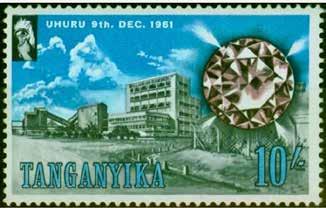
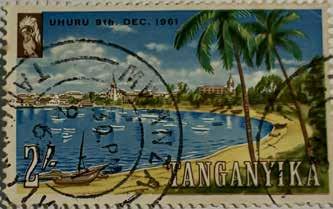
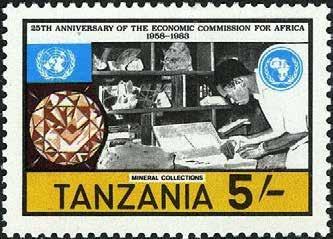
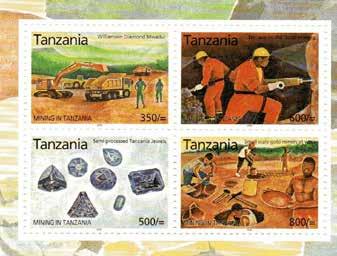
once again in 2004 on a 350-shilling stamp, appearing to be located in an imaginary verdant valley.
The ten-shilling stamp from Tanzania’s first definitive issue of stamps in 1961, showing the Williamson Diamond Mine at Mwadui and the pink diamond.
The Dar es Salaam harbour featured on the two-shilling stamp from Tanzania’s first definitive issue in 1961.
The pink diamond made a cut-and-paste cameo appearance in 1983 on a five-shilling stamp entitled “mineral collections” for the 25th Anniversary of the Economic Commission for Africa.
The Williamson mine appeared once again in 2004 on a 350-shilling stamp, appearing to be located in an imaginary verdant valley.
A sisal plantation in Kenya with agave plants growing in neat lines.
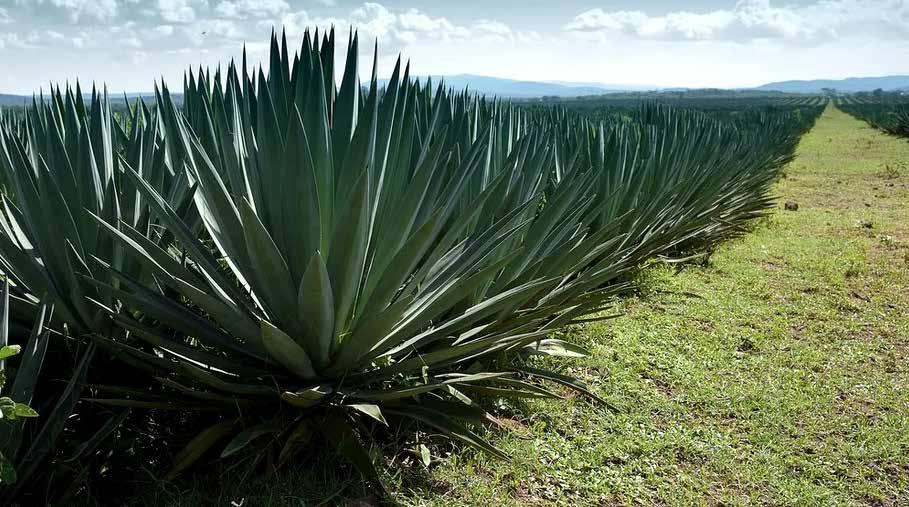
Carolyn Weller
J
immy Hearle had a pet mongoose when he started working on Nyali Estates north of Mombasa in 1913. The mongoose used to sit upright on the dining table in the evenings in the hope of receiving the small titbits from his plate. One evening the mongoose became very agitated and started to squeal. Jimmy turned to see a leopard crouching, poised to spring on the veranda, not 10 yards from where he sat. He quickly grabbed the closest object, which happened to be a paraffin lamp, and threw it at the leopard. There was a sudden hush, followed by total darkness.
Jimmy Hearle, a boy born in Penryn, probably wouldn’t have thought that he would one day have to fend off a leopard with a paraffin lamp while sitting on his veranda with a pet mongoose later in life. Hearle had a long and successful career in sisal after landing in East Africa. He witnessed global powers shifting through both World Wars and the historical decolonisation across the British Empire, including his adopted home in Kenya.
James Parminter Hearle
(Jimmy) was born in 1888 on September 27th as the third child of James and Elizabeth Hearle in Penryn in the county of Cornwall, England. He grew up on a farm nearby called ‘Gwarder.’
The Hearles ran a large farm machinery business. In 1901, after leaving school at the age of 13, Jimmy became an engineer apprentice at Ruston Hornsby in Grantham, Leicestershire. At this time his father became bankrupt and the younger children had to enter the workforce and fend for themselves.
Hearle always enjoyed his sport and played rugby for Falmouth. He had a cheery, friendly nature and became very popular. He was an honest man and many people throughout his life related that he could always be relied upon. This extract about his character is taken from his obituary:
“His friendship was greatly valued by many - a friendship unselfish and sincere, always ready to help, patient with all Conscientious in everything he undertook.”
In 1913 Hearle, aged 25, was asked by his Hornsby’s supervisors to take two oil engines out to Nyali Sisal
Company in Kenya, East Africa. When the manager sent for him Hearle immediately thought, “Oh hell, what have I done this time?” because he had had many disagreements with the trade unionists and thought he was being summoned concerning the union business. Instead, the manager informed him that he intended to send two engines to a place called Mombasa in Africa and he offered Hearle the job.
Hearle replied, “Well, I would like to think it over. Could I let you know in the morning.”
The manager said, “No. You will let me know now.”
Hearle made an immediate decision. “What the hell, anywhere would be better than this place,” and said,
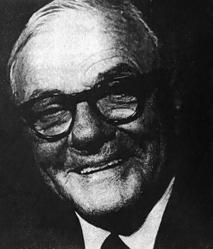
“Yes.” He went back to his digs to borrow an atlas and searched the west coast of Africa, where the manager thought Mombasa was. He eventually found it on the east coast.
Jimmy sailed through the Suez Canal, down the east coast of Africa, past Fort Jesus, built by the Portuguese in the 15th Century, and arrived at Mombasa. There was no quay at Mombasa, so passengers and cargo had to be taken ashore in ‘lighters’ or small wooden dugouts.
The mode of transport in Mombasa was a rail-trolley pushed by the local men along rail lines through the town, as they repeatedly chanted, “Mzungu na sema bloody fool” (the white man says bloody fool).
After Hearle delivered the engines, Rodseth, the manager at Nyali Sisal Estate, just north of Mombasa Island, offered Hearle the job of engineer at the Estate. Hearle agreed to take the job and lived in a house constructed of coral and sand with a corrugated iron roof.
It was on the veranda of this house that he scared off
the lurking leopard with a paraffin lamp. On another occasion, Hearle wounded a male bush buck that suddenly turned around and charged him. In a moment of panic, he grabbed the shotgun by the barrel and hit the animal over the head with the butt. The wooden stock broke and he ended up with both barrels pointing at the pit of his stomach. One barrel still had a live round.
In 1914, at the commencement of World War 1, Hearle enlisted in the defense force and his first duty was to guard the original railway bridge that linked Mombasa Island with the mainland. He filled the pylons with concrete in order to prevent sabotage by German spies who would only have had to drop explosives down the open tops to destroy the bridge. However, he could not approach one pylon because of a swarm of bees. The Brigadier arrived to inspect the work and on being told about the bees said, “Absolute bloody nonsense, show me!” The bees attacked the Brigadier, who
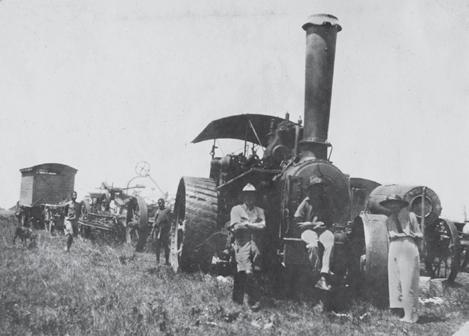
had to jump into the water. Consequently, he agreed that the bees were just as effective as the concrete.
Hearle subsequently returned to England to join the Royal Engineers, but was soon dispatched back to Kenya as he was able to speak Swahili and was familiar with the terrain. Upon his return, he was seconded to the 4th King’s African Rifles (KAR). He participated in the ‘Tanganyika Campaign’ from Moshi to Tanga and Dar es Salaam. During this campaign there was no motor transport to move troops or supplies so they had to march 30 to 40 miles each day in dry, rugged terrain and bivouac at night. Their diet consisted of canned bully beef and army biscuits or whatever they could shoot. A number of askaris (soldiers) were killed by lion at night without the man sleeping next to them being aware.
Hearle recounted the story of meeting up with another company of the KAR. In the evening the officers suggested that they went on a bird shoot as they had no meat for dinner. They had no shotgun, so they resorted
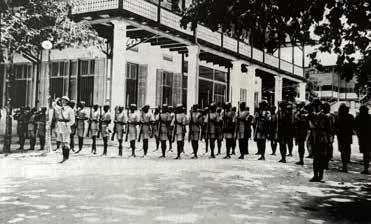
to taking a .303 rifle. After a short while, they came upon a flock of guinea fowl in the distance and Hearle said, “You have to aim to shoot the head off the bird, because the .303 bullet would shatter the bird.” With a grin on his face, he proceeded to demonstrate and managed to shoot the entire head off one of the birds. Now Jimmy was not a good shot, and this was a complete fluke. However, word soon spread through the messes of the campaign that “Hearle was a great shot!” Hearle often recounted this rumour with great hilarity.
Hearle fought in a number of skirmishes in Tanganyika with the German soldiers and was mentioned in dispatches and recommended for the Military Cross by Colonel Lily. Unfortunately, he never actually received the medal, due to poor communications at the time.
Hearle had a good rapport with the askaris and Colonel Lily asked him on many occasions to address them at the ‘barazas.’ Any disciplinary actions and fatigue duties were issued at these meetings. Jimmy was often asked to discuss any problems or issues that arose amongst the askaris.
At one stage during the campaign, Hearle became very ill with malaria which developed into blackwater fever. His company had to advance and left him behind with his batman, who alerted a Red Cross Caravan in the area and stretcher bearers were dispatched to Hearle’s aid. He was taken to the hospital in Dar es Salaam where he remained for the following three to four months.
Hearle returned to England at the end of the war. However, after a few months he decided to return to Africa, arriving back in Kenya in 1919. He was offered a position as engineer at ‘Kinani,’ a sisal estate approximately 25 miles south-east of Nairobi. The estate was owned by Hyram Craven and Ewart Grogan and managed by Eric Burrows. Jimmy stayed there for about two years.
Hyram Craven bought ‘Kakuzi,’ a coffee farm situated in the Ithanga Hills, 50 miles north east of Nairobi. He purchased the farm from Clayton and Jordan and asked Hearle to manage the farm. They asked Hearle to take two steam engines, named ‘Sylvia’ and ‘Edith,’ over
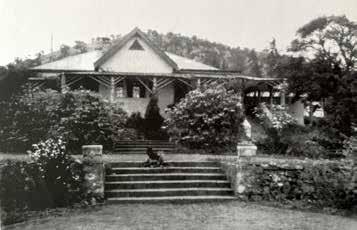
the rough terrain to Kakuzi. These steam engines cleared and ploughed the land to be used for planting sisal. He was accompanied by Tom Berrett, known as ‘TB’ and an adolescent African named Okello, who stayed with Hearle throughout. The three of them cut wood along the way to fuel the steam engines. They travelled approximately 100 miles to travel 50 miles, circumnavigating three hill ranges and crossing two large rivers, the Athi River and the Thika River. The bridges over these rivers were not strong enough to take the traction engines, so they laid steel railway lines over the bridges.
In 1920 Jimmy returned to England for a holiday and renewed his friendship with Ethel Mabel Arnold, known as Mabel. The two were married on the 3 January 1921. Mabel was the daughter of an English General Practitioner and had been educated in England and was accustomed to a comfortable gentry lifestyle. They returned to Kenya by ship via South Africa. The newlyweds docked at Mombasa and travelled by train up to Nairobi. They hired a taxi to take them the 50 miles to Kakuzi. However, upon reaching Thika,
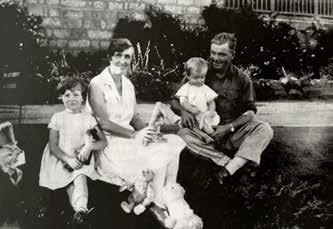
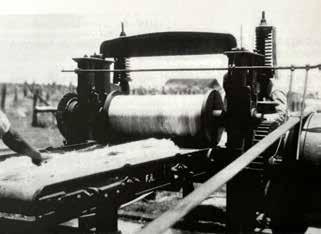
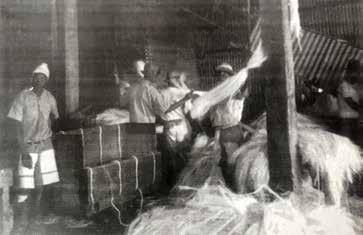
approximately halfway, Jimmy had to get out of the taxi to look for the tracks that would take them home.
Jimmy and Mabel lived in a mud and sisal pole house, without electricity or running water. They had no means of communication with the outside world. Lions often walked into the compound and sat roaring throughout the night outside the house. They often saw rhino from their porch. Whenever Hearle needed to go into Nairobi on business, he would walk 25 miles to Thika with a man carrying his gear and then catch a tram into town. These trips usually took three to four days.
In 1923 Mabel was pregnant with her first child. On the way to give birth in Nairobi she had to cross the Thika River. Men in the district came to help. They formed a human chain and carried the expectant mother across. Mabel gave birth to a daughter, Helen Josephine, and they called her Jo.
The first stone house built on Kakuzi was completed in 1922. It had two large bedrooms, a bathroom, dining room and a living room overlooking a sizeable garden of approximately five
acres. The kitchen block was situated separately at the back of the house. It comprised two rooms, one with a wooden stove and table for meal preparation and the other for washing and ironing.
The cook, nicknamed ‘Mpishi’ and the house servant, named Nanga, lived in huts at the back of the compound. Mabel, with the assistance of gardeners, developed a beautiful garden.
Kakuzi started to expand and Hearle bought a farm called ‘Kituamba’ from Eric and Alec Lindsey. This farm already had an established sisal plantation and factory. In 1926 Hearle built a water turbine powerhouse on the Thika River. He dug a channel about one mile long which diverted the water from the river towards large pipes which fed the water into the turbines.
Hearle planted sisal at Kakuzi and another property called ‘Kitito’ was purchased, cleared and planted with sisal. Eric Burrows came over from Athi River to manage this farm.
In December 1926 Hearle and Mabel had a son, called James William Arnold, known as Bill, and in 1927
Jimmy built a sisal factory at Kakuzi, which was powered by the newly constructed powerhouse.
In 1928 Mabel went with her two children to England by boat, via the Suez Canal. At this time Hearle was sent to Java by ship, via India to research the Dutch methods of sisal production.
In the 1930s another property named Lower Kakuzi was purchased. They grew maize and sunflower on this property to supplement the supplies of food for the workers on the farm. These crops proved difficult to cultivate as monkeys and baboons often ransacked them. Soon sisal replaced these food crops. Another farm called ‘Kinyangi’ was purchased from TB and George Sawyer. Kinyangi was an established sisal and coffee plantation. In addition, land was bought at Kitito from Harry Lloyd and more coffee was planted.
Kakuzi had by this stage reached a size of approximately 23,000 acres with about 500 acres under coffee and 10,000 acres under sisal. Camps were established for the staff on each of the estates. Many were squatters who lived with families and
livestock on the estates in the hope of finding employment. The squatters were mainly of the Kamba and Kikuyu tribes. However, recruited workers often came from Kisumu and Luo districts. The work force numbered approximately 5,000.
The Hearle children were sent to boarding schools in Nairobi. Jo went to Limuru Girls School for one year. At eight years old she attended Loreto Convent, Msongari, in Nairobi. Bill went to Kenton College in Nairobi for his primary schooling and was about to be sent to a public school in England, called Haileybury. However, World War II was declared, and he went to the Prince of Wales High School in Nairobi for his secondary education.
In 1939 at the start of World War II, Hearle was made District Commandant with headquarters at Thika Club and was responsible for guarding all the bridges and power stations in the district from Fort Hall to Ruiru. He was elected to the post of Officer Commanding Details in Nairobi for approximately one year. Then he went to Gilgil as 2nd In Charge of the
Prisoner of War Camp. From there he was promoted to Lieutenant Colonel and took charge of the POW Camp in Thika.
During the war, Hearle privately purchased his own dairy and mixed farm at Mweiga, near Nyeri, northeast of Nairobi. It was about 600 acres bordering the Aberdare Forest. A house was constructed from cut stone by the Italian prisoners of war. The farm was named ‘Bondeni’ meaning In the Valley in the Swahili.
In 1946 Hearle returned to Kakuzi to rebuild the estate as all the European managers had joined the army during the war years. In the same year, Hearle joined Brigadier Briggs’ political party and became increasingly interested in politics. He was often disillusioned with the views of some of the politicians in the colony. He always hoped that one day things would be worked out for the good of all, but he never came to terms with the attitudes of many of the expatriates who thought that Kenya would always be a white man’s haven.
In February 1948 his
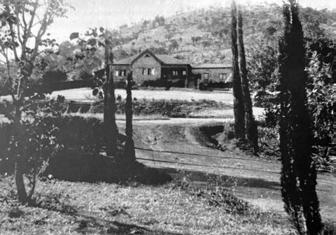
daughter Jo married Tony Glass, who managed the coffee on the estate. In 1951 Bill, after attending Reading University in England, returned to Kenya. He purchased a farm at Timau, near Nanyuki on the slopes of Mount Kenya. He worked extremely hard with cattle, a dairy herd, pigs, sheep and grew crops of wheat, barley and pyrethrum.
In 1952 Bill married Jean McKendrick. She had spent her childhood in Kenya and South Africa. They lived on the farm at Timau in a house consisting of three separate buildings; one timber with a corrugated iron roof and two log cabins with thatched roofs.
In 1950 Kakuzi Fibrelands became a public company and was listed on the London Stock Exchange. Hearle became Chairman Director of the company. Later, on behalf of Kakuzi Fibrelands, Hearle bought a large acreage of land bordering Kakuzi for a cattle ranch. This area, from lower Kakuzi, stretched southwards to the Thika River and east to Ngoliba Estate. The newly acquired land was approximately 7,500 acres and was stocked with scrub cattle, serviced by Boran Bulls. The cattle were sold as beef.
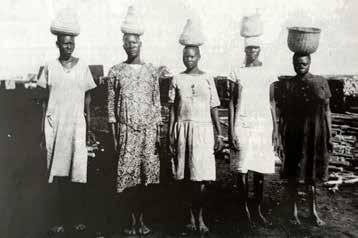
Two large dams were constructed on this farm to provide water for the cattle. The larger of the dams covered approximately three acres and the smaller was approximately one acre. The dams were stocked with two types of fish - tilapia and black bass. The main leisure activity of the family soon became fishing, boating and picnicking on these dams.
In the early 1950s Kakuzi Fibrelands was amalgamated with Kianzabi, another large coffee plantation owned and managed by James Walker. During the 1950s, Hearle employed a number of young European men as managers of the various crops. Martin Claudet, Barry Ratcliffe and Peter Wood were the managers of sisal. Tony Glass was in charge of coffee. Mr Good and Mr Maxwell were in charge of machinery. Eric Burrows was still General Manager. This was the beginning of a boom period for both coffee and sisal.
Hearle was a pioneer in Kenya’s sisal industry and held every major office within the Kenya Sisal Growers’ Association and the Kenya Sisal Board from his early involvement in the industry in the 1920s through the late 1950s. His knowledge and ability in the field of sisal is reflected in the number of companies in which he was involved, including Directorships of Kampi ya Moto and The Kenya Farmers Association. He was a Visiting Agent to many plantations, including Kibwezi, Voi Sisal, Taveta, the Anglo French Board, Sisal Limited and Kakuzi Fibrelands, the famous Outspan Hotel with
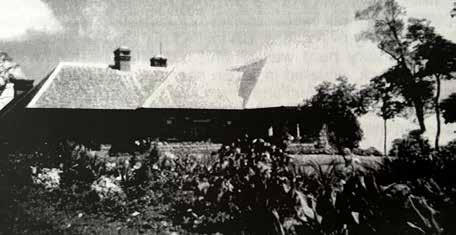
Treetops, Dwen and Jessop Engineers and City Brewers. He was elected President of Nairobi Club and was asked by the British Government to report on the management of the Ground Nut Scheme in Tanganyika. His knowledge of sisal and service on the Board of Agriculture was recognised with an award of Officer of the British Empire (OBE).
His obituary from the Kenya Sisal Board Bulletin states: “his devotion to the sisal industry in Kenya...is one which is never likely to be equaled or surpassed. The last of the pioneers in this industry, his name will for long be associated with the sure foundation laid and the great progress to which he contributed so much.”
In 1952 in Kenya a State of Emergency was declared due to the Mau Mau uprising, pushing for independence for Kenya from British colonial rule.
Though the area that Hearle farmed was not directly targeted by the Mau Mau, gangs came through to the Wakamba areas to collect arms and supplies. There were often skirmishes in the district, and for their own safety, Hearle and his family evacuated to Bondeni farm.
The Mau Mau uprising was effectively quashed in 1956, but the seeds were sown for Kenyan Independence, which was finally achieved in 1963.
In that year Hearle retired as Managing Director of Kakuzi Fibrelands and went to live on his farm, Bondeni, and retained a number of directorships.
As Kenya was preparing for political independence in 1963, Hearle was forced to sell Bondeni to the British Government for a minimal amount of money. The farm was divided into small plots, called shambas, and handed over to the Africans.
Hearle returned to live at Kakuzi until March 1964. He then decided to move down to South Africa and purchased a house at Umtumtweeni, near Port Shepston in the state of Natal. He returned to Kenya at the end of the year to spend Christmas with his daughter and her family. However, he died suddenly from a burst peptic ulcer on 18 December 1964. After 50 years in Kenya, mostly developing the sisal industry, Jimmy Hearle was buried at Langata Cemetery which overlooks the Athi Plains which he loved so much.
By Nicholas Rankin
Reviewed by Shel Arensen
I have rarely read a history book that has captivated me as much as Trapped in History by Nicholas Rankin. Perhaps his Kenyan childhood during the 1950s resonated with me, though I only came to Kenya in 1960. But the way he intersperses some of his poignant memories of his home in Tigoni and as a student at Pembroke House in Gilgil made the history come alive.
However, this book much more than a history of a white boy in Africa. That’s barely a shadow of the main story, which is a detailed, fair and well-reasoned portrayal of how Kenya came to be colonized by a group of white settlers along with a passionate group of missionaries who evangelized and started schools, creating inadvertently a nationalist movement. I particularly appreciated the early chapters on Harry Thuku and Johnstone Kamau (later known as Jomo Kenyatta) and their missionary mentors. Rankin writes: “The Christian gospel that first came into Kenya under the protection of the imperial state would in time be turned against imperialism. As African people were liberated by education, they would inevitably begin to want more freedoms: personal freedom, freedom of expression, political freedom.”
Rankin has another excellent chapter on the female circumcision controversy in the Kikuyu heartland which culminated in the murder of Hulda Stumpf, an AIM missionary lady, in 1928. Rankin’s research gives more details than I’d ever seen on this case, even though I grew up at Kijabe and often viewed Miss Stumpf’s gravestone in the pioneer missionary cemetery there. The event spawned the creation of independent churches and schools among the Kikuyu, another stepping stone on the path to demanding political independence.
Rankin’s father Tennant brought his pregnant wife Peg and three toddlers (Nicholas among them) to Tigoni in 1954, when the Mau
Mau Emergency period was at its height. In fact, Tennant’s job came about because his predecessor had accidentally shot himself in the leg with a pistol that he wore for safety and the company needed a replacement. Rankin has done a good job of explaining how the Mau Mau insurgency grew and the fear it induced among the white settler population, but he also paints the characters on both sides of the divide with accuracy allowing us to see them as real people. We get a glimpse into the lives of the loyalist chiefs, the political agitators, the Mau Mau committed to armed struggle and the Home Guards fighting with the British against their own people. We also begin to understand some of the British colonial administrators like Governor Mitchell and Governor Baring.
Rankin does not shy away from pointing out the horror of some of the attacks on white settler farms, giving a detailed account of the Ruck family murders in North Kinangop. But he’s also careful to point out the excesses and torture practiced by some of the British security forces in quelling the Mau Mau movement.
He also takes a hard look at the detention camps and the well-meaning efforts of Christians to rehabilitate what they called the ‘hardcore’ Mau Mau through confession and Christianity.
Even as Rankin relates the history of Kenya in a very readable style, he also ponders his own childhood as a British boy and his place in Kenya as the British Empire was winding down its rule across Africa.
Having read Histories of the Hanged by David Anderson and Britain’s Gulag by Caroline Elkins, I would rank this book as even better because it gives a wider scope of Kenya’s history and shows the various perspectives. And perhaps I like it best because of the author’s asides into his own childhood when he was trapped in history in Kenya during the Mau Mau Emergency.
Trapped in History: Kenya, Mau Mau and Me, Faber & Faber, 2023, 560 pages. Available at Bookstop, Yaya Centre for 4,500/-. Also available on amazon.com as a paperback for US $20, on kindle for $28.99 and on amazon. co.uk, as a paperback for £4.99 and hardback for £10.10.
by Ken de P Beaton
The Nairobi National Park began in 1946. Ken de P Beaton, the first warden, published a weekly diary in the East African Standard newspaper in 1949, later published as two books. Ken’s son Ron recently shared those books with Old Africa. His diary entries give a flavour of what the park was like in its early days.
1949 9 April. Portions of the park adjoining Nairobi township have been invaded this week by great hordes of army worms. These small black caterpillars are travelling in a north-westerly direction and eat an enormous amount of grass as they move steadily forward. A heavy toll of this pest is taken by a variety of birds from tiny flycatchers to ostrich.
Visitors to the park must have noticed close to the main entrance gate, great numbers of birds moving about on either side of the road. Many marabou storks, pacing slowly about deep in thought, and feeding in a leisurely manner. European and black storks, crested cranes, secretary-birds and pied crows. Hovering in the air and dropping down to feed are rollers, fly-catchers, bee-eaters, falcons, kestrels and kites. Many other birds, too numerous to mention, are all helping to control the invasion. In the evening I have seen a number of jackal there also and, although I am not certain, I think that they too are licking up and eating the caterpillars.
These insects, after passing through the chrysalis stage, finally appear as a white moth. They are then quite attractive and I have seen enormous swarms of these moths travelling fast in one direction, sometimes taking several days to pass.
It is a curious thing that when they have changed into the flying form they no longer appear to attract the birds. Perhaps with the change, they become unattractive to the bird palate.
When the park was first established, it was found that hyaena were out of all proportion to the usual balance of game. They had been attracted to the area by the
number of army camps and butcheries of the war years and were moving about in packs. No doubt, during that period, they served a purpose as the amount of scavenging to be done must have been enormous. They too in their ghoulish way must have ‘done their bit’. When the camps moved away however they turned their attention to the game and the toll was too heavy, so it was decided to reduce their numbers and some two hundred were shot. The increase in the numbers of young, of all species of game, was marked during the ensuing calving seasons.
Hyaenas seem to be increasing again and control measures may have to be adopted if the numbers exceed normal proportions. It is our policy to try not to interfere in any way and allow the balance to be kept by nature but we must ensure that the scales are even at the start.
There are three species of hyaena recorded in Kenya, the spotted, the striped and the brown, but only the two former have been seen by me in the park. The brown hyaena has been killed and identified as near as Kabete, so it is quite possible that this species may visit the park too.
The striped hyaena is very uncommon in this area, though plentiful further to the west and in the Rift.
The hyaena usually seen by the visitor is the spotted. They are big heavy beasts and some individuals are huge. Many pups are to be seen at present and often these youngsters are
quite black in colour. Two to four seem to be the average litter. They are born below ground in a prepared ant-bear hole and remain in or near these earths till they are quite big before they venture forth.
There is no distinct species known as the laughing hyaena; they all laugh, if it can be called laughing. To me, the eerie variety of sounds they emit, quite distinct from the usual howl, when they are mating or indulging in some nocturnal rite, has something uncanny and unearthly about it. If it could be properly recorded, it would make excellent background music to Dante’s ‘Inferno’ if that were ever produced as a film.
Everything about the beast is revolting. Its method of following up and killing mother and child, while in the act of childbirth, is revolting, and its cowardly nature despicable. Yet it has its place in nature.
It is largely due to the hyaena that epidemics
of disease among game are uncommon and quickly checked, for sick individuals are seldom allowed to live long enough to infect others. Deformed and sickly youngsters are not permitted to grow to maturity. The old and infirm are put out of misery. They also do an enormous amount of cleaning up.
Any evening, just after dusk, a number of hyaenas can be seen leaving the park by the main gate and shambling off towards Nairobi. We have called them ‘the dust-bin patrol,’ and we let them be, for it is certain that in the highways and the byways of Nairobi town they must do a power of good.
1. What tribe was Matthew Wellington born into?
2. Who was the first student to be given the Silver Spear for climbing Mt Kilimanjaro?
Old Africa reader Trish Combes from Kenya is the winner of our History Quiz 88, which appeared in Old Africa issue 124 (April-May 2026). By the contest deadline we received 13 entries. All 13 names were put into the Old Africa pith helmet and swirled around. Trish’s name was chosen out of the hat and she wins two nights for two at Satao Camp. If you didn’t win this time, have a go at Quiz 89, which follows below. This month’s History Quiz Contest is sponsored once again by Satao Camp and Old Africa is thankful for their support and willingness to sponsor this page.
History Quiz Competition #89!
Win two nights for two at Satao Camp!
How closely did you read this issue of Old Africa? Answer the ten questions in our history quiz below and you have a chance to win a vacation at Satao Camp. All the answers are found in this issue of Old Africa. You don’t have to cut up your magazine. Just write the correct answers on a separate sheet of paper and send your entry along with your name and address and phone number to: History Quiz, Old Africa, PO Box 2338, Naivasha, Kenya 20117. Or you can email your list of answers to editorial@oldafricamagazine. com The winner will be randomly chosen from all the correct entries received by the contest deadline, which is 10th July 2026
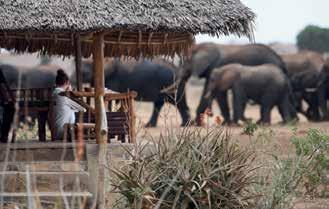
3. Who was the doctor in Nairobi assigned to care for the sick and wounded from the Carrier Corps in World War I?
4. What’s the name of the first tugboat to arrive in East Africa?
5. Who cared for an ape in Lake Naivasha, which might have been a gorilla?
6. Who was chief of the Wasamb’a when Fischer passed through his territory?
7. Who chaired the Parliamentary Select Committee investigating JM Kariuki’s death?
8. What’s the name of Jimmy Hearle’s daughter?
9. What Italian mission group worked with the Kikuyu in Kenya starting in 1902?
10. What was the title of Tony Seth-Smith’s autobiography?

Unbeatable Wildlife Viewing: Spot elephants, impala, lions, and more right from your veranda or observe from the camp watchtower.
Authentic Tented Comfort: Relax in beautifully designed en-suite tents that blend comfort with the charm of the wild.
Stunning Landscapes: Explore vast savannahs with iconic amber sands and the untouched beauty of Tsavo East.
Book your adventure today
Wake up to the sight of elephants at our waterhole, unwind in spacious tents, and immerse yourself in the beauty of Tsavo East National Park. Located in one of Kenya’s largest and most iconic parks, Satao Camp offers:


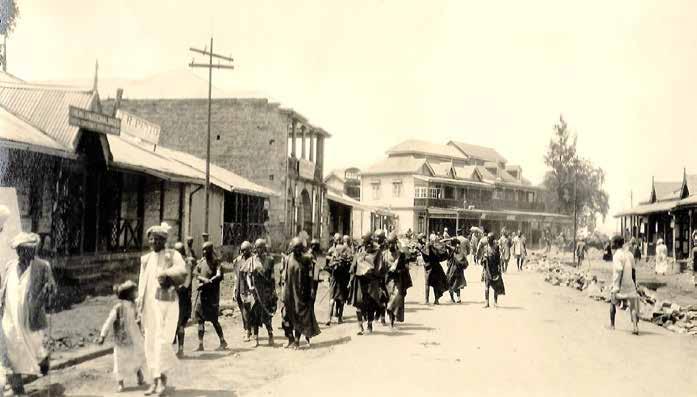
Celia Owles of Naivasha, Kenya, is the winner of this issue’s Historic Photo Contest with this photo of shoppers on the dirt road in the Pumwani District in the late 1920s. The photo came from a small photo album in Celia’s collections labelled: “Photos by Sandy Tennent 1927 & loose family portraits.” Sandy Tennent would have been Dr JH Tennent who came to Kenya in 1928 and lived in Nakuru. Old Africa scanned the photo as part of a project to publish Joan Booth’s memoir (Among Whistling Thorns), but this photo was not used in the book. Celia wins a book prize from Old Africa.
Enter our Historic Photo Contest
Old family albums hold many treasures. Enter one of your photos in our Historic Photo Contest and win a free book from Old Africa! And have the pleasure of sharing your photo with Old Africa readers around the world.
If your photo is chosen as a winner in our Historic Photo Contest, you will win a free book from Old Africa
The best way to send a photo to Old Africa is to have it scanned as a jpeg file of 300 dpi resolution and email it to us at: editorial@oldafricamagazine.com Note on your email that you want this photo entered in our Historic Photo Contest.
If you don’t have access to a scanner or to email, you can mail your photo or photos to us at: Old Africa, PO Box 2338, Naivasha, Kenya 20117.
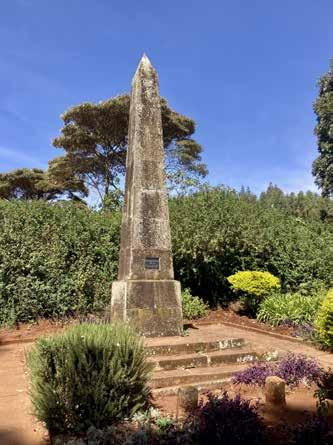
Win a Ksh 3000/- gift certificate from Text Book Centre by identifying the location of this memorial and grave site. A well-known character from Kenya’s colonial history was buried here after dying in a plane crash. Win a Ksh 3000/- gift certificate from Text Book Centre by telling us where this memorial is located. If you know where this grave site is located or if you have any personal stories from visiting this mystery location, send in your answer to Old Africa for a chance to win our History Mystery Contest.
Contest Deadline: For this prize we have to receive your entry by 4 July 2026.
Send your answer to this History Mystery Contest along with any information, history, memories or stories about this cross to: History Mystery Contest, Old Africa Magazine, PO Box 2338, Naivasha, Kenya 20117. Or email your answer to: editorial@oldafricamagazine.com. Editors will choose the winning entry. The answer to our mystery contest will be announced in our next issue along with the name of the winner and his or her story about our mystery location. Family members of Old Africa staff members are ineligible to enter this contest.
Our History Mystery Contest is sponsored by Text Book Centre.
…much more than a Bookshop!
can see the recent cement work. The original lintel is
Judy Aldrick)
>>Sheikh Mbaruk flanked by his sons Sebe and Ayub, with his chief commanders behind him. They are in front of Mbaruk’s Mwele Fort in the Shimba Hills where they made a last stand against the incoming British in the Mazrui uprising of 1895-1896. (Photo from Kenya’s Swahili Coast)
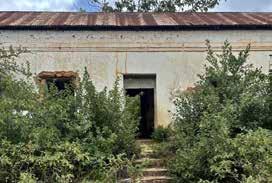
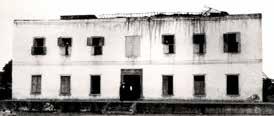
Sheikh Mbaruk’s Gazi Palace in 1895, soon after the British put down the Mazrui uprising. Note it had two storeys. In 1984 the upper storey collapsed. The carved door was removed and taken to Fort Jesus for safekeeping. Repairs were made and a roof placed over the remaining one-storey building. (Photo from Kenya’s Swahili Coast)
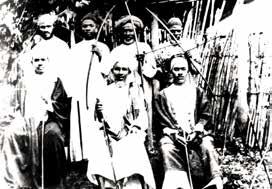
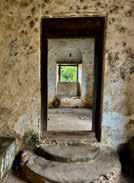
This was the courtroom in the palace where cases were heard and judgements carried out. It is rumoured that several columns in the building have entombed skeletons of people sentenced to death by the court.
Fran More from France is the winner of the History Mystery Contest for Old Africa issue 124 (April-May 2026). Here’s Fran’s answer: “The house is situated in Gazi, Kwale, South coast. The house goes back to Kenya’s slaving days. Slavery was abolished in Kenya in 1910, but was continued covertly, and sometimes voluntarily, as late as the 1950s. The house was known as The Slave House of Gazi Mbaruk. Kenya folklore has it that the house was built using the bodies of slaves, and as the folklore goes, the floor was supposedly made up using slaves’ teeth, mixed with shells and limestone.
“The house was the Palace of Sheikh Mbaruk of the Mazrui Dynasty, who had originally come from Zanzibar. He was later overthrown by a Sheikh from Oman. No wonder the house is said to be haunted, with such a grisly, sad history!”
Here’s a bit more about the old building, gathered by Old Africa on a recent visit to Gazi. The photos are of Sheikh Mbaruk’s Palace in Gazi, a little north of Mambrui town on Kenya’s south coast. Mbaruk was a Mazrui leader who resisted both the rule of the Sultan of Zanzibar and later the incoming British rule. Locals now call the building the Slave House and you can visit with the help of a guide from the local Gazi Women’s Group, who have also constructed a boardwalk through the nearby mangroves for some excellent birdwatching. Certain rooms in the palace and pits nearby were used to house slaves before they were sent by dhows to the Middle East. Stories continue to be told of torture being practiced on the captives, including removal of teeth and having hot chilis put into open wounds to increase suffering.
by Shel Arensen
Ahyena found a village with many goats and decided it would be easier to sneak through the fence at night at eat goats than to hunt wild animals, or – worse – wait for the lions to let him feed on the scraps off a kill.
Every night, the villagers found they had lost a goat. They examined their protective thorn fence and found the hole the hyena had torn open with his yellow fangs and strong jaws.
They put extra thorns in the fence, but the hyena broke through in another place and another goat was killed and eaten. The elders appointed young warriors to protect the goats. But the hyena stole another goat and escaped. All the warriors blamed the others for sleeping. But the village knew they were facing disaster if the hyena continued to kill their goats.
Finally, they went to the wisest man in the district and asked for his advice. The old man closed his eyes, scratched his gray whiskers and thought. The elders thought he had fallen asleep. Then the old man opened his eyes and said, “Bring me a goat!”
They brought a goat.
“Now kill it!” the old man said.
“We’re trying to save our goats from the hyena,” the villagers said. “Why should we kill another goat?”
The wise man bowed his head before speaking again. “Do you want to get rid of the hyena or not? This is the best way. Your thorn fence has failed. Your warriors have failed. Will you trust my wisdom?”
Grudgingly, the villagers killed the goat. “Now cut it in half, right down the middle.”
Puzzled, the villagers took their sharpened knives and carved the dead goat into two halves, each with a front leg and a back leg.
“Now, go to the place that leads away from the village where the path splits into two.” The villagers nodded. They knew the place. The wise man went on, “Take one half and place it exactly ten paces down one fork of the path. And then take the other half and place it exactly ten paces down the other fork of the path. Then go home and tell me what you find in the morning.”
The villagers wondered if the wise elder might be losing his senses. But they followed his instructions.
That night as the village slept, the hyena came stealthily along the path. Then his nose smelled the fresh blood of the split goat. “What’s this I smell?” the hyena asked himself. “Has my meal already been prepared for me?” He followed his nose until he reached the place where the path split. He started going down the left path when his right nostril told him, “No, don’t go this way. There is meat on this path going to the right.” So the hyena started going on the path on the right-hand side. Then he left nostril said, “No! I’m sure there’s meat on his other path.”
The hyena’s two nostrils pulled him in two different directions. Then his left legs decided to follow the left nostril. At the same time, his right legs decided to follow the right nostril. This battle went on until the hyena split down the middle and he died with his feet splayed out on the two different paths.
The next morning the villagers discovered their enemy, the deadly hyena, had expired, split into two parts at the fork in the path.
They went to thank the wise elder. He nodded and said, “It’s not possible to walk down two different paths at the same time.”
Sue Deverell of Tigoni shared the photos featured in this issue’s Photo Album page. They come from archives from her grandfather, Alfred Gerald Wright Anderson and his business partner Rudolf Meyer who bought the Standard newspaper from AM Jeevanjee in August 1905 and changed the name to the East African Standard. These photos seem to have been printed by the East African Standard as photo postcards for the Consolata Mission, founded in Turin in 1901 by Blessed Joseph Allamano. The photos shown here all have the words “Missioni Torinesi della Consolata in Africa (Italian Missions British East Africa)” printed on the top, along with a caption at the bottom. Records show that the Consolata Missionaries began their work in central Kenya in 1902 and these photos date from that era. They capture traditional Kikuyu dress and culture before the changes that came when they began accepting Christianity
1. An Italian missionary shows a group of Kikuyu the first church bell brought into the area for one of their mission churches. The postcard inscription says the Kikuyu are bringing their hands to their mouths to signify their amazement.
2. A missionary nun gives Bible instruction to interested Kikuyu women.
3. A traditional Kikuyu log bridge spans the Sagana River near Vambogo
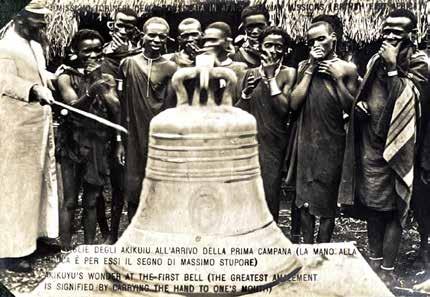
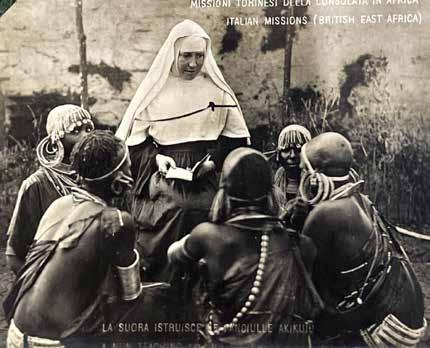
by Sara Seth-Smith, Lentolia, January 2026
Tony Seth-Smith was born on February 5th 1937, dying just short of 90 on November 22nd 2025 after declining health following the death of his son Martin in 2022 and his beloved terrier, Fupi, a year later, taken by a python at the back door.
Tony’s schooling started at Kenton College in Nairobi followed by Charterhouse in England and Oxford University, Oriel College.
He was first married to Renate Thiel. They had two children, Annette and Martin. Subsequently, he married Sarah Fielden in 1971 with whom he had a daughter Tana.
After coming down from Oxford, Tony did his National Service, training with the Kenya Regiment (T.F.) during the Emergency (1952-1960), and then seconded to Embu as a temporary DOKG (Kikuyu Guard). After this, he joined the Kenya Game Department in 1961 becoming a licensed professional hunter in 1963, when he joined Hunters’ Africa. Over the years he hunted in the Sudan, Uganda, Tanzania, Zambia and Botswana.
During this time, he had the responsibility of running the Njoro farm, Rotharini, on which he’d spent most of his childhood. Farming was not his natural bent; his passion lay in the bush. He engaged a Danish Manager to run the farm whilst he pursued his hunting career and his love of trout fishing.
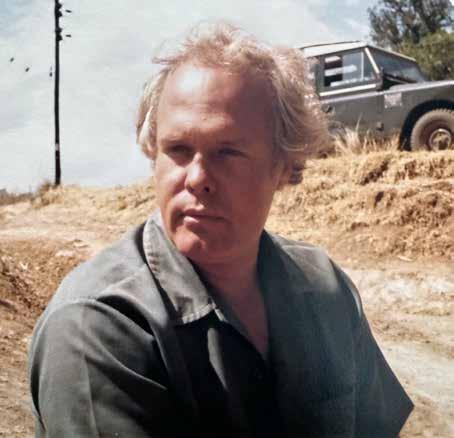
Tony was a born naturalist and upon retirement became a dedicated conservationist on moving in 2004 to the northern shores of Lake Naivasha to Lentolia (a name derived from the Maasai “Naitoli” meaning land of the Crested Crane) that forms part of a wider conservancy.
Recognised as a trusted authority on wildlife, conservation and Kenya history, he was featured in many articles, the last one with the late renowned photographer Martin Parr, and documentaries: Jeremy Paxman’s “Empire” and “History of Safari” with Richard E. Grant. An independent documentary film maker, Sara Nason, made
a Vimeo production “Eden at the Crossroads” depicting his conservation efforts on Lentolia and his thoughts on the past and the present.
Tony also wrote an autobiography For the Honour of a Hunter…, the title taken from a poem of that name, and co-authored a book about his father’s experiences in World War I called Donald’s War with Julia, his daughter-in-law.
Tony was a first class shot dubbed “one shot Tony” through his work as KWS’s longest-serving Honorary Warden. He was a full time Game Warden on the Galana Game Management Scheme in 1961 and 1962 with Ian Parker.
His Galana experience led to his involvement in managing elephants in Uganda’s Murchison Falls National Park encapsulated in the text book: Elephants and Their Habitats: the Ecology of Elephants in North Bunyaro, Uganda published by Oxford University Press 1975. The scheme and the accompanying scientific research provided material for more than 50 seminal papers on elephant biology.
Tony had many important and well-known celebrity clients, one of whom, Bing Crosby, wrote and recorded two songs especially about his family’s safari. Many became lifelong friends which has continued throughout the generations.
Tony’s affinity for the wild was shaped in his childhood, learning bushcraft from the N’dorobo forest dwellers above Lake Nakuru,
particularly Mtarakwa, his mentor. These dignified people survived by hunting with bow and arrow and collecting honey. They dressed in the skins from the animals killed and built their dwellings using such materials at hand. Each family was responsible for a stretch of forest from the Mau to the lake. Sadly, their ways and traditions have since been swallowed up by modernisation and deforestation.
Following Kenya’s 1977 hunting ban, Tony transitioned to leading photographic safaris with Ker & Downey. By this time Rotharini had gone the way of many European-owned farms that were compulsory purchased, moving the family to Karen in 1974.
Whilst he could be cynical, Tony was known for his sharp wit and generosity in quietly supporting friends in need,
whether for medical care or travel.
When the hunting ban was introduced and his camp staff and gun-bearers found themselves without a job, he turned the farm pick-up into a matatu taxi to give them an income. They were to pay Tony for petrol out of the proceeds. In no time, the pick-up’s tail-gate was bent from the many passengers getting in and out. The staff refrain at the close of day: “Sorry Bwana, but we’ve had a bad day with few passenger takings.”
An entrepreneur, he pursued various ventures adding cars to Arnie Mitchell’s fleet of hire cars and an aeroplane to Andrew Enniskillen’s Sunbird Charter Company. With Mike Prettejohn and others, he had an interest in Rukinga and Taita Ranches near Voi. He and Anthony Duckworth
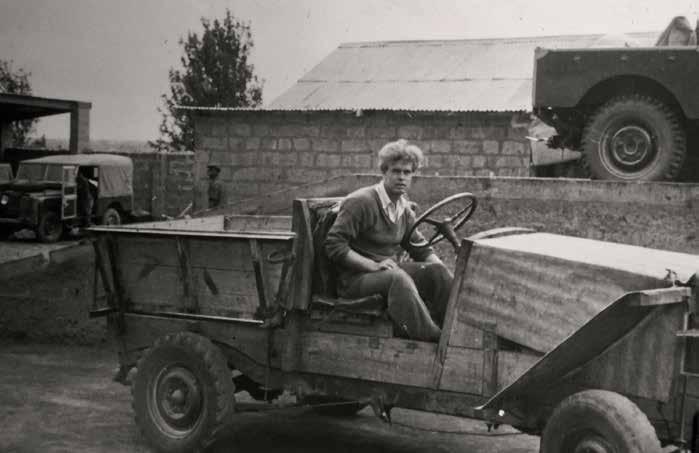
turned the English wildlife artist and cartoonist Roger Mcphail’s original paintings of Kenya’s game animals, birds and its peoples into posters for sale to tourists. Again, with Mike Prettejohn and Campbell Bridges, the latter a geologist and gemologist, he invested in a gold venture on the Turkwell in the 1980s until this particular enterprise became too dangerous as the price of gold rose sharply.
Tony’s connection to Muthaiga Club was rooted in history. His father, Donald, tasked with overseeing the building of the Club, cycled in from his Kakuzi farm near Thika with a man servant and a donkey, his dinner jacket packed. The by-now rather mangy glassed-in stuffed lion was one contributed by Donald that he’d shot on the Kapiti Plains.
Tony will be sorely missed, but as a way of hearing his voice one more time, here’s a piece he wrote in January 1999 called “Never a Dull Moment” as he noted events and memories of Taita and Rukinga, a piece of bush he and others were trying to preserve. His writing reflects his concern for the future of Kenya’s wildlife as well as giving a record of what life was like. Tony’s words speak for himself.
The Kenya of today is not the utopia of my childhood: a country sparsely populated, full of game and adventure where one’s life was one of continual excitement and action, a far cry from the ordered humdrum existence to be found in the developed world of 1999.
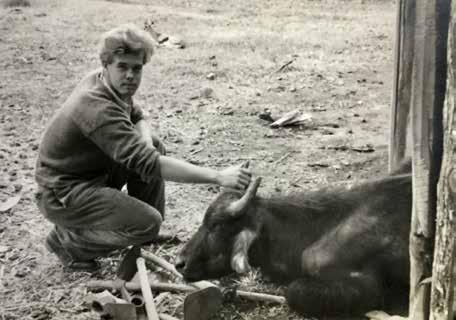
few corners where Africa in the raw still holds sway, a shadow of those ‘old days’ that still exists, and where the regimentation of the modern world does not extend its dreary reach.
Lions were killing more stock on Taita Ranch than was acceptable, and so once more I took a few days off to see if we could find the worst culprits and at the same time take a ‘Breath from the Veldt.’
Together with Billy Winter, my tracker Gobo, and Sarah we drove the 250 miles South East to Maungu. Arriving late in the afternoon Terence Hopking, the Ranch Manager, filled us in with the latest ranch news, pointing out that it seemed to be a lioness causing most of the cattle losses.
And yet…there are a
A cow had died the day before, possibly from rabies, and its carcass still lay untouched a couple of miles away in the bush. We investigated that evening and found the lioness to have been less choosy than the ranch hands about her next meal, as she had fed on much
of the cow’s hindquarters. In preparation for early the following morning we cleared some of the cover around the carcass and cleared an approach track that could be accessed quietly.
It was still dark the next morning as we crept silently towards the half-eaten carcass. Warning cries from a pair of crested francolin and discreet sounds of crunching set our hearts racing. Something was definitely feeding. We crouched down waiting for it to become lighter before closing in the last twenty yards to our vantage point behind a large commifera tree. The sounds of heavy feeding had stopped. To our disappointment we saw two silver-backed jackals slink away. Our lion had fed earlier and left the rest to lesser mortals.
We unloaded the rifles and walked half a mile back to the Toyota. The sun was now well up and the thick bush bathed in the beautiful gold of an African dawn. Signs of everything that had crossed the sandy track showed up in
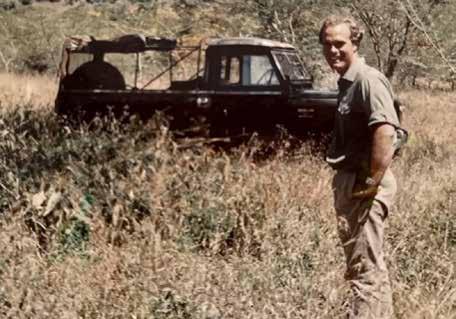
clear relief – jackal, a group of lesser kudu spoor imprinted over the tracks of an old bull elephant headed towards Kisima waterhole a mile ahead, porcupine, a caracal, hyena; the visitors’ book had been truly signed.
As the Toyota sped east along the ranch boundary, all eyes were glued on the sandy track in front interpreting the signs of the past night. Standing in the back, looking out through the hatch, Gobo called me urgently to stop. The tracks of two men pushing a bicycle signalled poachers. Here the technique for poaching meat is to use a blinding torch with which to dazzle the game, then to blow an electric horn that beeps continuously. This has the unexpected effect on many small animals of making them lie down, whereupon the poacher is able to approach the animal, still behind the strong beam of light and blowing the horn, close enough to administer a fatal blow to the head with a panga or rungu.
Although it might seem a most unlikely technique, sadly the proof of the pudding is literally in the eating, and two men can kill eight dikdik, a couple of impala or gerenuk in a night. The animals are butchered and the bicycles used to transport the meat out.
This was clearly what was happening. We inspected the tracks carefully gauging how early in the night the two men had passed into the ranch. Guessing that they would return to their settlement by much the same route we called in our anti-poaching team and had them ambush the track the following night.
A mile further on down the road we came across a spectacular male cheetah, not the pale straw-coloured cheetah of the open plains, beautifully marked in black and gold. Shortly thereafter we arrived at the Kisima waterhole where chuckling sandgrouse dropped in to drink and doves gathered in clusters in the surrounding tree tops. Everyone was
clearly preparing for a hot and thirsty day.
Sarah, Billy and I walked around the waterhole one way and Gobo covered the far side checking the soft sand for tracks. The rocks and surrounding bushes still dripped with the muddy water sprayed with enthusiasm by a large group of some twenty elephant that had just left ahead of us. Further along we witnessed the most unusual sight of five large leopard tortoises following each other around at a most un tortoise-like speed, and highly motivated – Spring was clearly in the air.
Whilst the ranch has a large number of natural waterholes, these unfortunately only last six to eight months of the year, after which cattle and game alike depend on large man-made, round cement storage tanks fed by water from the Mombasa pipeline whose source is the Mzima Springs in Tsavo Park.
Metered water is expensive and whilst we would have liked to provide water all over the ranch, nevertheless for economy’s sake not all the tanks were kept full all the time. Stopping by one such tank, we peered down its empty ten-foot drop to the bottom where our eyes alighted on the macabre sight of the remains of eight to ten baboon. In their desperate search for water at the height of the drought they must have jumped in for the small remnant of liquid that lay at the bottom, and in their weakened state had been unable to climb back out. Their bleached skeletons littered the bottom like a scene from the Killing Fields
of Cambodia. The country was not called the ‘Taru Desert’ for nothing.
We finished up that morning’s trip at a large natural waterhole at the base of Kivuku Rock where two crocodile, originally introduced as youngsters to keep baboon away from the camp water, were basking contentedly along the edge. They would no doubt soon make their mark for they had grown considerably and were very mobile.
Terence was already in the dining tent looking amused by something. It turned out that his watchman and a casual worker had had a serious fight inspired by ‘chang’aa,’ an illicit brew banned from the ranch, but nevertheless smuggled in by a Turkana woman apparently. Retribution, however, was just around the corner as it so happened in the form of four or five semi-tame buffalo that
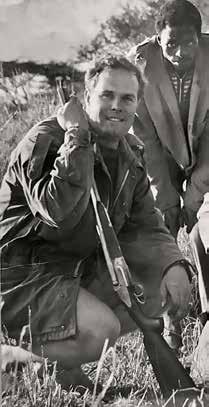
were normally fairly docile herded like cattle out to graze each day. It would seem that the smell of ‘chang’aa’ on her plastic jerry cans also fired up the buffalo that set on her giving her an uncomfortable pounding. That would be the last time I expect she would bring booze onto the ranch.
In the evening we drove out to one of the water tanks to watch the elephant and buffalo come in to drink. The surfaces of the tanks are heavily crenelated by elephant resting their tusks on the top whilst reaching down into the water with their trunks.
On the way back to camp in the dark we saw a beautiful male caracal, Africa’s equivalent of a lynx, lit up by the Toyota’s headlights. Unconcerned, he slunk along fifty yards ahead of us before jumping into the bush. A little further along a spotted eagle owl rose from the sandy track ahead and settled in a dead terminalia to our left.
It had been a full and eventful day and we fell into bed with high hopes that the anti-poaching team would remain awake and successfully catch their quarry.
we found it lying in much the same place. The ambush team had had an uneventful night. Billy, Gobo and I decided to cut across country on foot whilst Sarah drove the Toyota the few miles around to Pika Pika Hill where we were to meet up.
The patch of country we walked though was the general area in which our problem lion seemed to spend a lot of her time. The week before one of the ranch security men had gone down with a bad go of malaria. In spite of treatment, he became delirious and would wander off into the bush only to be brought back each time by the other staff members. One day he finally disappeared for good and when the men did find him there was little left of his naked corpse that had partially been eaten by lion.
Passing a dried-up waterhole, still walking, we came upon the victim’s clothes, his identity card still in his shorts pocket. In stark contrast to the unfortunate demise of the man whose clothes we found nearby, an erythrina tree was in full flower with sunbirds feeding amongst the blooms.
During the night we were awoken by Terence’s chickens, clearly startled by something trying to get at them. Perhaps it was a snake, a mongoose, a genet cat, who knows? We could see nothing in the beams of our torches. First thing next morning we headed back to see how the ambush for poachers had gone. A small two-and-half foot puff adder lay sunning itself in the middle of the road, and for the next two mornings
Each day has its downside. On this occasion we found Sarah but the car had a flat tyre, a common occurrence at Taita where every bush and tree seems to have been designed to grow tyredestroying thorns.
On one evening driving around the base of Pika Pika rocks, we came across an enormous puff adder. It was grossly thick and must have been pushing five feet. I’d never seen one bigger. Taita really is a ‘snakey’ bit
of country, especially round the rocky kopjes. Sarah, Tana and I saw a staggeringly large black Mamba on another evening. As it was travelling at great speed through the grass before disappearing down an anthill, it was difficult at the time to estimate its length.
In March 2015, having lost ownership of Taita and Rukinga, Tony took up his pen to write a few more memories about the area.
I am now writing again some sixteen years after I set down the preceding words. One now realizes what an extraordinary time we lived during the period in which we part-owned Taita and Rukinga Ranches. Over these past years so much of the Kenya we took for granted has gone: the country, the wildlife, forests and rivers have been raped and will never be whole again. I write therefore just to keep a record of how it was, and of daily events to which at the time we were seldom unduly amazed, but one now remembers with happiness and the realisation that ‘how it was’ should be recorded. So, I continue recalling some years on.
I remember one particular, extremely bad-tempered cow elephant, no doubt a recipient and survivor of a poisoned arrow. A young African carrying out research on dwarf mongoose had the misfortune to bump into her whilst on foot. The elephant chased him persistently for half a mile or so when in desperation he climbed a large commifera tree but couldn’t escape the elephant’s reach. She pulled him out of the tree and trampled him to death.
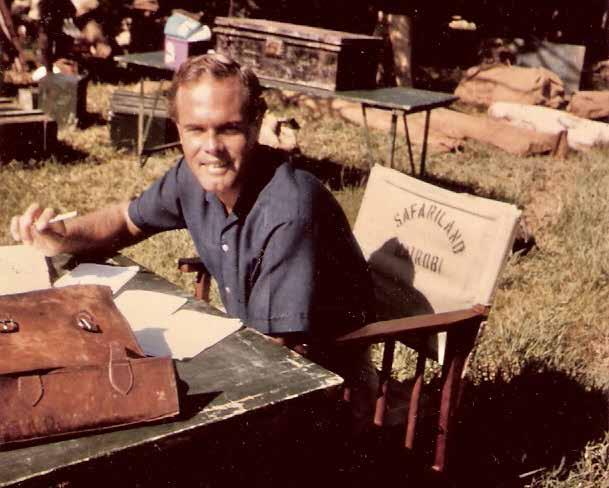
A few days after this incident the same elephant chased the Kazinga Butchery pick-up carrying three or four people in the back. The driver got such a fright when the elephant came screaming out of the bush that he accelerated away with such enthusiasm that one of his passengers fell out and became her second victim.
One morning the security team found a poachers’ camp tucked away deep in the bush. Dried meat hung from the branches so the poachers were clearly going to return. KWS ambushed the site unsuccessfully, although the following morning they did catch one man who they inexplicably released. No doubt money changed hands.
We were seeing a lot of cheetah. Two were regularly seen near camp and four were observed lying on the side of Pika Pika dam one evening.
One day Ted Goss and Ray Hubbard of the Eden Trust helicoptered in. The
Eden Trust had been most supportive in our endeavour to protect and water the wildlife. No one else was of the slightest help and all expenses were borne straight out of our own pockets: diesel, security, radios, and the mega water bills from the Mombasa pipelines.
On one occasion, when the water bill amounted to 600,000 shillings, we sought the help of Daphne Sheldrick, who for one reason or another was unable to help, but the Eden Trust, a smaller charity initiated by the actress Virginia McKenna, came through at the last minute providing the much-needed funding.
Sarah arrived back, having returned the anti-poaching team, to say that they were now following another two poachers’ tracks along the southern boundary. The ranch covered a hundred thousand acres of bush that was impossible to completely patrol and control poaching. One lunchtime we received
a radio call reporting that ten armed Shifta (Somali bandit/poachers) had raided Benjamin Woodley on Taita Sisal Estate.
There was consistent action of one sort or another all the time. Following a late afternoon radio report of a lion that had killed a calf at Sagana Dam I went down, tracked it up and found a single lioness that I felt probably had cubs nearby and so I left her in peace.
Sitting later that same evening on Sagana Dam, we watched 19 elephant, 12 giraffe and some impala come down to drink. It was most peaceful but one wondered for how much longer, for without our presence on the ranch none of the wildlife would survive. A research team doing a game count at the time came up with an inaccurate total figure of 315 elephant and 51giraffe. We had much more plus some 600 buffalo, zebra, impala, lesser kudu, etc.
I have jotted down these brief notes as a reminder of what was. The ranch is no longer in our hands, and, as I feared, the wildlife has been poached out of existence and charcoal burners have completed the destruction.
Old Africa World War I history tour being led by James Willson to Pika Pika Hill. When men like Tony SethSmith compare Kenya’s bush today with the country they grew up in, it does seem like the wildlife is gone. But the Old Africa tour in 2021 made its base on Rukinga ranch. In addition to visiting old war sites like Pika Pika Hill, where there had been an army camp, we did see
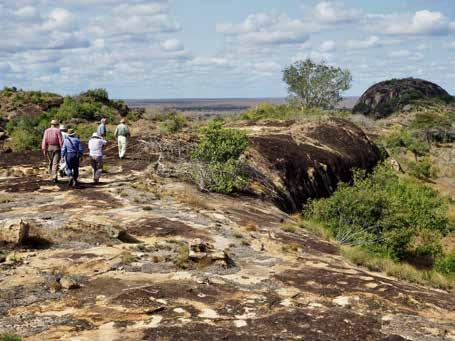
and
and the bush was regenerating, thanks to efforts by Wildlife Works.
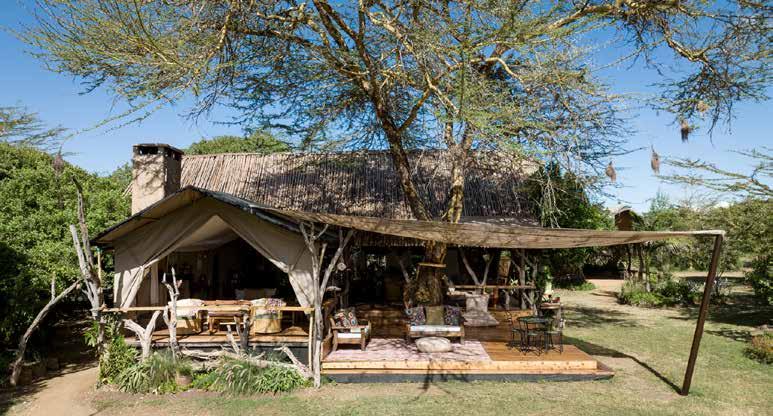

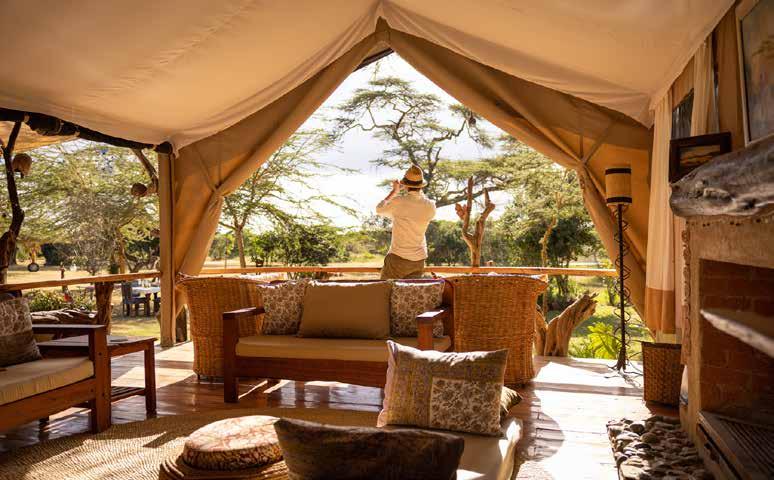
We hope you enjoyed this edition of Old Africa. Please consider a donation to help us keep the stories coming.
www.oldafricamagazine.com/donate