

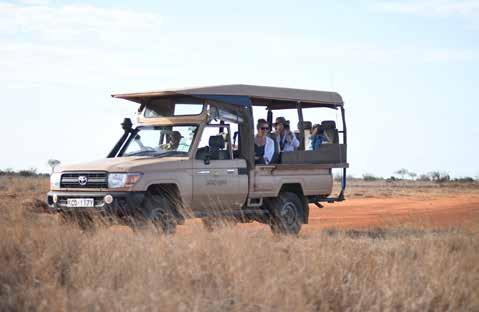




Rediscover safari’s romance at Satao Campcanvas comfor ts, star-f illed nights, and daily elephant parades at our waterhole.

A rare gem from Tanganyika is presented to Queen Elizabeth II as a

An engineer’s frustration at the ferry crossing at Mtwapa Creek leads to a
young Scot finds work at the Government Farm at Kabete.
Gustav Fischer makes more comments on Maasai culture during his 1883
frightening encounter with a crocodile on Sukari Ranch.
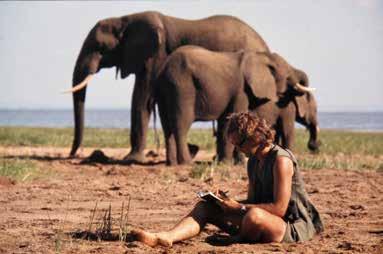
After I came back to Kenya following my extensive treatment for my thyroid cancer, I had to learn to use my new plastic voice prosthesis. It has not been easy. Food clogs it up. If I drink something and try to talk, it sounds like I’m gargling. Then the base plate comes loose and I when I try to speak, I hiss like a puff adder. So there has been a lot of frustration.
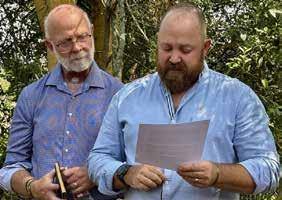
In addition to being an editor, I’m also an ordained pastor, so I get called on to do weddings, funerals and baby christenings. Or I should say I used to get called on to do those things. With a halting voice and very low volume, it’s hard to lead these kind of services. But in late November, I challenged myself to do my first public speaking since I received my voice prosthesis. My older brother Cam had passed away in 2024 in the US and his wife Esther Ruth came out to visit us in Naivasha and she brought Cam’s ashes, wanting to have his remains buried in the continent of his birth. So I agreed to lead a small family service. I prepared a short talk, remembering Cam’s life. After a few paragraphs, my voice failed and I had to call on my son Reid to finish reading the rest of my script. My last words before I handed over to Reid were: “And we’ve come to plant a tree in Cam’s memory – a symbol not only of the life of one who lived like a tree planted by a river, but also a symbol of eternal life with his Savior. As we bury Cam’s ashes today, we are saying kwa heri.”
We buried the box of ashes and then planted an acacia tortilis on top and put soil into the hole, first by handfuls as we said good-bye, and then with sweat and a shovel. A final prayer by my brother Jon concluded our little service by the Malewa River. When we finished, Esther Ruth, though tearful, said, “Now I feel like I’ve finally said good-bye.”
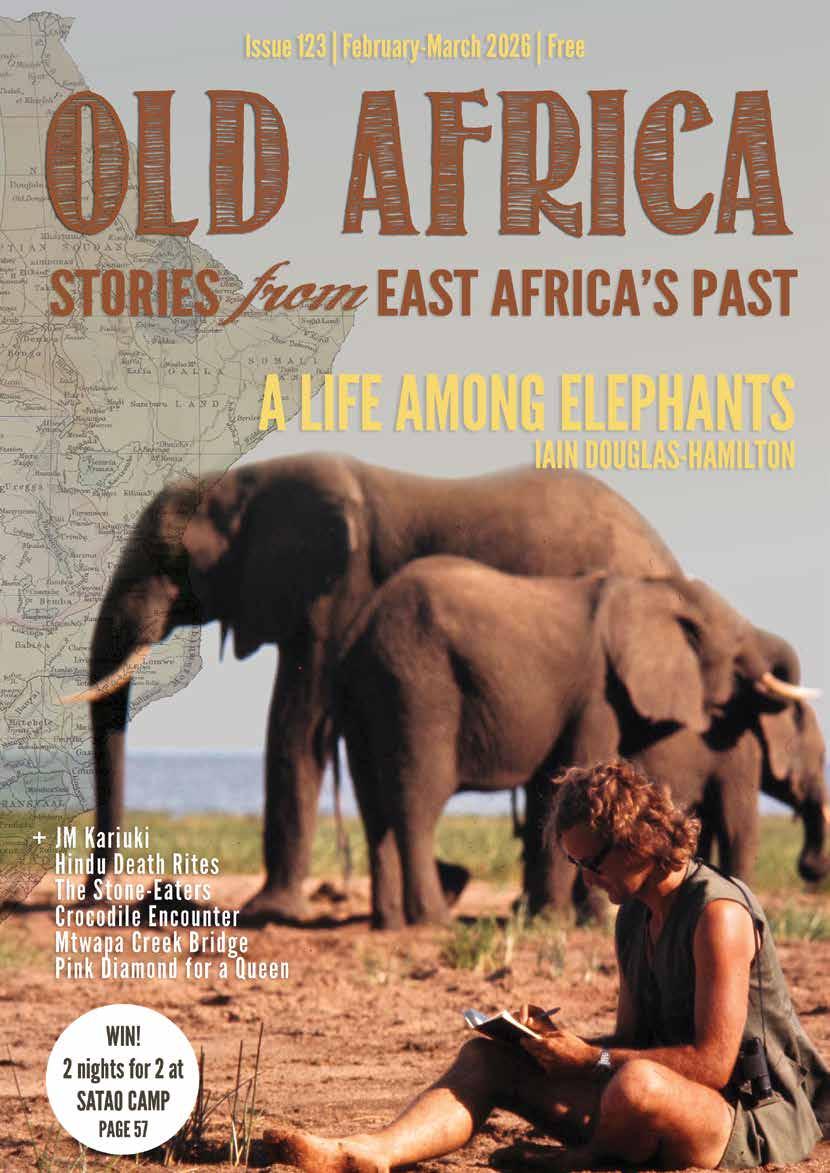
This illustrates the need we humans have for ritual and prayer to the Almighty when saying our final kwa heri to those we love after they pass through the portal of death. In this magazine, Neera Kapur-Dromsom takes us through her personal journey of grief when facing the deaths of members of her extended family, and shows some of the rituals practiced within the Hindu community to make sense of death. And in our Mwishowe column, we say kwa heri to Iain Douglas-Hamilton and look at the legacy of his life spent among elephants.
P.O. Box 2338 Naivasha, Kenya 20117
www.oldafricamagazine.com
Editor: Shel Arensen 0736-896294 or 0717-636659
Design and Layout: Mike Adkins, Blake Arensen
Proofreader: Janet Adkins
Printers: English Press, Enterprise Road, Nairobi, Kenya
Old Africa magazine is published bimonthly. It publishes stories and photos from East Africa’s past. Subscriptions: Subscriptions are available. In Kenya the cost is Ksh. 3000/- for a one-year subscription (six issues) mailed to your postal address. You can pay by cheque or postal money order made out in favour of: Kifaru Educational and Editorial. Send your subscription order and payment to: Old Africa, Box 2338 Naivasha 20117 Kenya. For outside of Kenya subscriptions see our advert in this magazine. Advertising: To advertise in Old Africa, contact the editor at editorial@oldafricamagazine.com for a rate sheet or visit the website: www.oldafricamagazine.com
Contributions: Old Africa magazine welcomes articles on East Africa’s past. See our writer’s guidelines on the web at: www.oldafricamagazine.com or write to: Old Africa magazine, Box 2338, Naivasha 20117 Email
Address: editorial@oldafricamagazine.com. After reading our guidelines and editing your work, send it to us for review either by post or email. (To ensure return of your manuscript, send it with a self-addressed envelope and stamps to cover return postage)
Copyright © 2026 by Kifaru Educational and Editorial All rights reserved. No part of this publication may be reproduced or distributed in any form or by any means, or stored in a database or retrieval system, without prior written permission of the publisher.








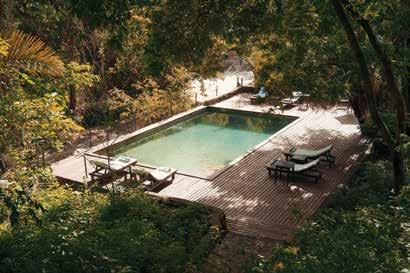
Experience an Authentic Safari this Holiday Season at Porini Camps, set in exclusive wildlife locations. Non-residents traveling with residents can enjoy special resident rates for an unforgettable safari adventure.
CAMP
Porini Giraffe Camp
Porini Amboseli, Porini Mara, Porini Cheetah & Porini Lion Camp
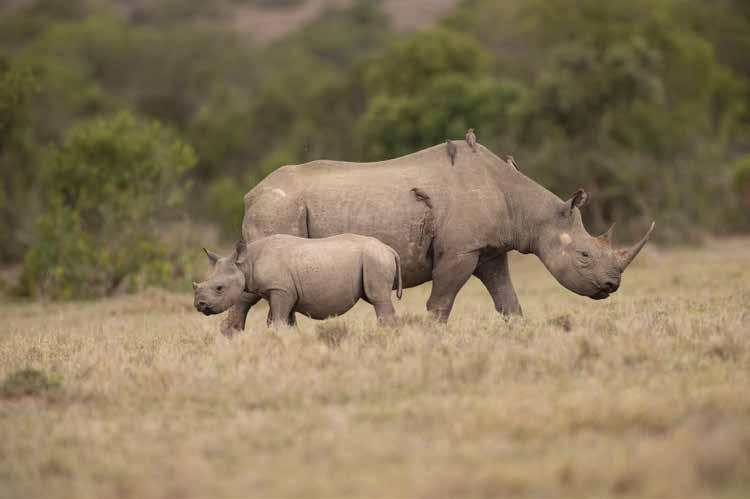
Porini Rhino Camp
Rhino River Camp (Forest Tent)
Rhino River Camp (River Tent)
Rhino River Camp (Forest Tent)
Rhino River Camp (River Tent)
Porini Ol Kinyei
Cottages

Full board accommodation I Free drinks such as mineral water, soft drinks, house wines, beer, and Gin and Tonic I
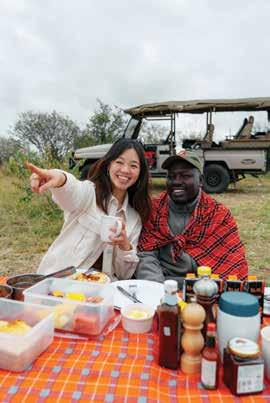
Guests will enjoy sundowners from scenic viewpoints and guided nature walks I The package also features shared day and night game drives in open 4×4 vehicles with an experienced driver-guide and spotter I At Porini Rhino Camp, guests will have the opportunity to visit the chimpanzee sanctuary in the Ol Pejeta Conservancy I Those at Porini Amboseli Camp can experience a Maasai village visit I For guests flying in, local airstrip transfers to the camps are included.
*Please note, the above rates are excluding park and conservancy fees.



Dear Editor,
We are grateful to hear of that you are getting better and that your speech is coming back.
Thank you also for making such a huge effort to get us the Old Africa magazine in digital form. The network for reading the magazine online is not that bad. I am not far off from Mugie Ranch. God bless.
Pastor Nicholas Lekorere, aMowuarak, Laikipia
Dear Editor,
What a pleasure and relief to see the latest issue 122 especially during these cold, wet and near-winter days! And thanks again for a positive and very uplifting editorial as always.
I join all your readers in wishing you well as you so courageously navigate this new chapter in your life.
Thanks for putting me in touch with Bizzie Frost after I read her story in Old Africa issues 119 and 120 about her trip though the Huri Hills. I want to share this message from Bizzie. Her message, coming when we in England are still in the midst of winter was a much-needed relief and felt more like an early Christmas present! I loved the photos she sent as they brought back so many memories of my own days in Northern Kenya. My days in the NFD shall always remain close to my heart and be a constant mood lifter especially in these dreary wintry days. Here is Bizzie’s message:

“I was very touched by your email. I am so pleased that my articles triggered happy glimpses back into your own life among the Gabbra and in the NFD. Your revelation that you are heading fast for 97 years old was also a big surprise! So, to be in touch with you is a great honour for me, and Old Africa is a very special link. It is a great shame that Old Africa can't keep it going as a printed magazine and that it is now only on-line.
“I thought I’d send you some more photos that I took on our memorable trip in the Huri Hills, ones that weren’t included in the Old Africa articles because there were so many of them. All the photos were taken on old-fashioned film and then I had them all professionally scanned in the UK. I hope they bring back happy memories for you of those years you spent in northern Kenya.” Bizzie Frost Mervyn Maciel, Manyatta, Sutton, Surrey
Dear Editor,
I have recently borrowed several editions of Old Africa from Chris Durrant and was saddened to read in your August-September 2025 edition, that you recently have had major surgery. I do hope that you are making good progress to a full recovery.
I have been in contact before as to whether you would like some articles of my times as a schoolboy at Manor House, Kitale in the mid- to late-1960s. I recall most vividly my time there and

have quite a few interesting stories of the school and personalities who lived in the area, such as the famous butterfly collector, Mr ‘Pinkie’ Jackson, House master, Mr Patrick Peacey, Headmaster Clive Richardson, wellknown rugby coach John Vorster and many others.
I attended the school from about age seven and was head boy for four terms, before going onto high school in Grahamstown, South Africa. I have photographs of the whole school and teachers, which were taken each year, as well as photos of rugby, soccer and cricket school teams. We had many games against schools like Pembroke in Gilgil, Kaptagat, Turi, Kitale and Hill School.
Thank you again for such an interesting magazine. What is it about Kenya which makes it so pleasantly unforgettable? Maybe a rich mixture of the people, so many fabulous varied concentrated landscapes, wild game, insects, snakes, shells and fish!…wild discos in the Driftwood, Ocean Sports and so on.
My wife, Yvette nee Searle, also an ex-Kenyan, and I, revisited Kenya in 2024. What an absolute joy it was catching up with friends all over the country and what bliss it was to stay at Ocean Sports. It was as if we went back in time to such a joyful part of our youth.
Kevin Weaver, Australia
Dear Editor,
I just received the December 2025 issue of your quality magazine, courtesy of Mo Verjee in Nairobi. My sister Ash and I send you our prayers for your complete recovery from cancer.
You are providing a great service to the Africawallahs across the globe. Consider Mamdani Mayor of NYC, and Rishi Zunak, who was recently PM of UK of Tanzanian heritage, as well as Barack Obama, the most famous Kenyan in the world.
Your piece on our family tragedy on the Likoni ferry of 1950 is well read and still making the rounds.
I will send you the promotional material of Dr Vali Jamal’s Magnum Opus of the Asian contribution to Uganda. He died some five years ago. His son Arafat who is a senior official with the UNHCR, has brought out his father’s work. At some point, you may wish to give it a write up. The Uganda Archives at Carleton University in Ottawa have ordered a copy.
Farouk Verjee, Vancouver, Canada
Dear Editor,
I enjoyed the latest issue of Old Africa online and was glad to see Matt McIlvenna’s photos included.
Judy Aldrick, Kent
Newsweek magazine. I often wondered what happened to the expedition as there appeared to be a press embargo. Fascinating story! I am writing from Sydney, Australia!
Barbara Barnes Vyden, Sydney
Dear Editor,
I trust you are slowly getting better and will soon be able to speak. Well done for publishing the excellent issue 122, full of good stories and photos. Such fun reading this issue, with lots to learn, and yearn for the past as we lived a very good life in dear old Africa.
Richard Frost, Vipingo
Dear Editor,
My name is Gibson Wachira, an avid reader of the Old Africa magazines. I would like to find out more about John Destro and more importantly about his Villa Franca dairy farm along the then Embakasi road. If photos of the farm and the Embakasi road back in the yesteryears are available, they would be helpful. God bless you for the work you put in towards the publication of the Old Africa magazine.
Gibson Wachira
I’ll see him, I might reconnect. I remember Arthur Wheeler with whom I kept in contact until a few years ago. I do remember Roger Wittaker, who was our biology teacher for a while. He used to bring his guitar and sing for us. Wow, that was nearly 68 years ago.
I also bought the book Stepping Out by Tony Church, which I enjoyed very much. Back then I was one of the founders of Mini Cabs and Tours Ltd (MICATO SAFARIS). I sold the company to Felix Pinto in 1972.
George Vrontamitis, Njoro, Kenya
Dear Editor,
I absolutely loved Tor Allan’s article about his travels to find the Königsberg. JM Kariuki’s story was also so interesting. I was working and living in Nairobi at the time of his disappearance, so it is interesting to hear what the ‘players’ had to say.
I hope you are making a good recovery. You are definitely an inspiration. I will look out for the next magazine. I am so enjoying being able to buy a copy here in France thru Amazon. I do so enjoy reading all the articles you print.
Dear Editor,
I am interested in contacting Irvine White who wrote the story about the Saga of the Hodi Hodi, which was published in your magazine in 2012. I was living in Kenya and was at the launch of the dhow and dined with Tony and Luke just prior to their departure. We were with
Editor’s note: If any readers have photos of John Destro’s Villa Franca dairy, please share them with Old Africa and we’ll pass them on to Gibson Wachira.
Dear Editor,
I really enjoyed Issue 122. I also was surprised to read that Ian McIver remembered me from Delamere Boys School on Upper Hill road. I was in 1a /2a classrooms. Unfortunately, I can not remember him. Maybe when
Fran More, Deux Sevres, France
Dear Editor,
Thank you for the current excellent Old Africa issue 122. I’m delighted your treatment went well and that you are now back home. Christine Nicholls, Oxford
Dear Editor,
Thanks for choosing my photo of the Nelson Restaurant as your Historic Photo Contest. I would be

very delighted to get any more short stories or comments from any Old Africa readers about the restaurant or the manager. I do find it very interesting to read about what happened some years back, before I arrived in Kenya.
Per Akesson, Mombasa
Dear Editor,
Tor Allan’s article on his safari in southern Tanzania in Issue 122 of Old Africa was of great interest to me. As editor of the magazine Habari of the Swedish Tanzanian Association, we have had several articles on Rufiji, Kilwa and World War I locations by my friend Åke Abrahamsson. He worked as a secondary school teacher in Lindi in the 1980s and has returned several times in recent days. He has just returned home to Gothenburg from his latest safari. Twice he has done almost the same safari in the Rufiji delta as Tor
did. Åke has an impressive collection of books on Word War I in southern Tanzania.
The Boer Philip Jacobus Pretorius had a farm in the delta, which was taken from him by the Germans when the war started. He was enlisted as a spy for the British and was the one who found Königsberg. This has been played down in the British literature, where the efforts of the British military and the innovation of reconnaissance by aircraft are highlighted. Pretorius’s autobiography from 1947 is called Jungle Man. Kevin Patience has written the book Shipwrecks and Salvage on the East African Coast and states the last visible remains of Königsberg were seen in 1966 and there are photos of Somali mid-1960s (aerial view), the stern in the 1990s and remains of the bridge superstructure in 2001.
Lars Asker, Sweden, ex-Bw Maji in Dodoma, Arusha and Bukoba
Dear Editor,
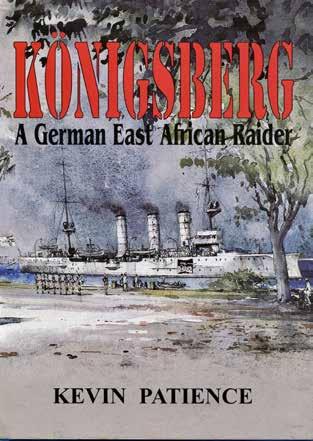
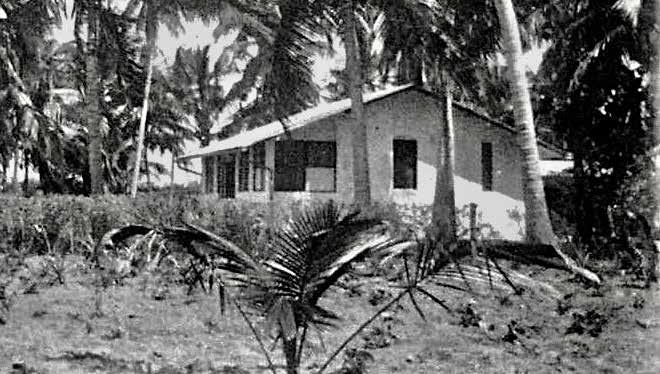
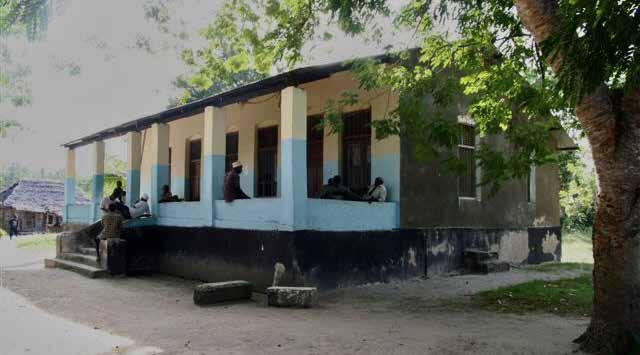
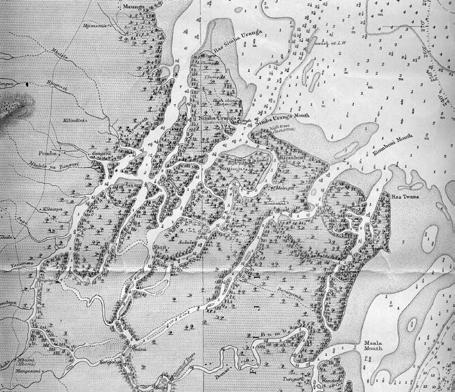
I just received the electronic copy of Old Africa issue 122. Thank you for the acknowledgements for my input on some of the photo captions. However, I found a bigger error this time. Tor Allan’s Königsberg article and his position of the wreck is not correct. The Königsberg is not buried under a pile of mud. It disappeared into the riverbed in 1966. I visited the site a number of times and took Captain Looff's grandson up there in 2001. I have a plate of the Torpedo Tube makers dated 1905 and recovered from the wreck in 1965 just before the remains sank after the 1966 floods. I also have a photo of the wreck in 1965 before it sank. I’ve also sent an extract of a hydrographic chart showing Königsberg in the upper reaches of the Rufiji Delta.
If Tor had read my book about the Königsberg, it

Top right: The last known photo of the remains of the Königsberg, taken in the Rufiji delta in 1965.
Right: A plate from the torpedo tube makers showing the date 1905.
(Photos courtesy Kevin Patience)

would have saved him a lot of hassle. I also wrote an article about the Königsberg, which appeared in the magazine Britain at War in December 2011. It gives the true story from records, diaries, etc. Tor also mentions seeing an old German house on Salale Island. The man who built that house was Claus Dankers, (not Duncan) the local German rep in the delta in 1914. It is reported that when Königsberg arrived outside the house, he went out with his shotgun thinking it was a Royal Navy warship. He was somewhat embarrassed when Captain Looff hailed him in German!
Kevin Patience, UK
Editor’s Note: We shared Kevin’s letter with Tor Allan, who wrote our story about his trip to find the wreck of the Königsberg. Here is Tor’s response: “Many thanks for sharing Kevin Patience’s email. I bought his excellent Königsberg book in 2005 and we've both enjoyed revisiting it this morning. I did not have it to hand during my trip planning and chose instead to go the fun route, relying on local information. I realize now the local information might not have been accurate. It was nevertheless a splendid quest. Yes, the area is a mass of channels - deltas by their very nature are dynamic and ever-changing. I rather enjoyed my guide's theory that the old wreck had filled with silt and that mangroves were now thriving on top of it. Sorry that you/I have published a story that turned out to be inaccurate. I am, meanwhile, undaunted. Ever since my return, I’ve felt even more curious and just might go back again with younger friends.”

In Old Africa issue 21 (February-March 2009) Jarat Chopra shared a photo of his grandfather, The Hon Iqbal Chand Chopra, presenting a rare pink diamond from Tanganyika to Princess Elizabeth in 1948. It appeared as our Historic Photo Contest winner. We also ran a short story by Jarat, detailing the story of the diamond, quoting The Royal Collection as saying this Tanganyika gem was the “finest pink diamond in existence.” The London Times meawhile reported: “A pink stone such as this, and of this quality, is a rare freak of nature.”
The extraordinary diamond was later set in a brooch, one of Queen Elizabeth’s favourites. The diamond brooch was recently on display in central London at the Victoria and Albert Museum (V&A) prominently in last year’s Cartier exhibition, renewing interest in the gem and its history. The Telegraph ran a full-length story, trying to set the record straight about the rather mysterious story of the pink diamond and its journey from Tanganyika to Queen Elizabeth II. The Telegraph used some pictures from Jarat Chopra for their feature.
Here is a shortened version of The Telegraph story, along with some of Jarat’s photographs, which he kindly shared with Old Africa. The story is by Victoria Ward, Deputy Royal Editor at The Telegraph.
1948The rare pink diamond presented to Princess Elizabeth in 1948 was fashioned into a
striking diamond brooch by the jewellery house Cartier –and at the 2025 V&A exhibit, the brooch proved to be one of the biggest draws among an impressive collection of jewels, watches and clocks.
But some have questioned whether the current narrative accurately tells the story of how this priceless stone found its way from the parched scrubland of one of East Africa’s poorest regions to the monarch’s own private collection.
Despite its provenance, there are claims that misinformation – some of it gleaned from 1950s gossip and coffee-table books published in the 1980s – has been so often repeated that it is now treated as established fact.
Many details about the story of this extraordinary
diamond are said to have been glossed over or misreported. What is certain is that its history stretches well beyond Cartier, whose involvement is considered by some to form the mere epilogue.
At the centre of this story are the Canadian geologist Dr John Williamson, founder of one of the world’s largest diamond mines, and his close friend and business partner, Iqbal Chopra, an Indian barrister.
“It is rather like going to see a play and reviewing the curtains while ignoring the drama and the actors on the stage,” says Jarat Chopra, the grandson of Chopra. “It is a sensational story but the few books out there are mostly the accumulation of gossip.”
Here then, as far as is possible from contemporaneous accounts
and scribbled documents long ago lodged in the National Archives, The Telegraph tells the full story of the late Queen’s pink diamond.
Founded during the last decades of British colonial rule in Tanganyika (which would later be merged with Zanzibar to form Tanzania), Dr John Williamson’s mine was the first of its kind outside South Africa. Its discovery was the result of a relentless, threeyear search by Williamson – a “lone wolf” who, despite his riches, rarely socialised.
The handsome geologist, who always wore the same uniform of khaki trousers and an open-necked shirt, was often mistaken for the actor Clark Gable and is said to have received dozens of letters a day from women offering themselves in marriage. By the age of 40, he had been dubbed The Diamond King and was reputedly the wealthiest man in the world.
Born in Quebec, the young Williamson swapped law studies for geology after a summer field expedition to the distant reaches of northeastern Canada captured his imagination. He went on to accompany his former professor to Johannesburg to inspect some land for the
De Beers diamond company and was invited to become a field geologist, searching for copper in north-eastern Rhodesia.
But Williamson’s later attempt to secure a licence from De Beers to search for diamonds in the British territory then known as Tanganyika was refused, prompting his resignation. Instead, he took a job with a different mining company but when that folded two years later, he decided to go it alone.
Williamson was so convinced there was an undiscovered diamond pipe in the Shinyanga region of Tanganyika that the search consumed his every waking minute. He decided to join forces with Chopra, the flamboyant Asian lawyer he had met in 1936 when searching for someone to oversee his legal affairs and finances.
The duo proved a formidable team. While Williamson followed the diamond trail in the barren wilds, Chopra financed the expeditions and kept mine inspectors and competitors at bay.
For years, Williamson surveyed land all over
Tanganyika’s Lake and Western provinces without much luck. But his eventual decision to take a sublease on the Mabuki diamond mine, the oldest in the territory, would prove pivotal.
A specific type of mineral found in the soil, combined with the discovery of the odd diamond nearby, was enough to convince him he was on the right track. He persevered out in the bush, surveying and arranging secretive licences, stubbornly refusing to give up his search despite often falling ill with malaria.
Then, on 6 March 1940, two local boys, James and Issa – recruited to help Williamson search for diamonds – found the first diamond in the dirt under a baobab tree that would change his fortune. They took it to show Williamson at his home. The geologist wasted no time in setting out with the boys to the exact spot where it was found.
“Iko hapa, Bwana, Iko hapa! [It is here boss, it is here!]” James is said to have exclaimed.
Williamson immediately set up a field camp near the tree and began panning gravel. That very day, he excavated more diamonds.
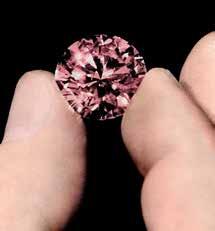
The diamond as it was finally cut weighing 23.6 carats. The cutting of the diamond was completed on 14 April 1948. © Jarat Chopra
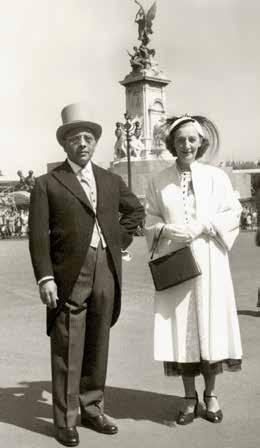
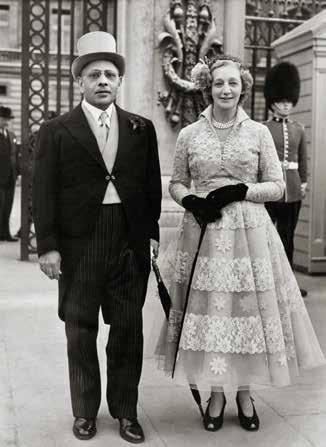
Left: Meeting at the palace. The text on this framed photo reads: 28th May 1953 The Hon. I.C. Chopra, O.B.E, Q.C., M.L.C., and Mrs. Chopra on their way to Buckingham Palace when they were presented to Her Majesty Queen Elizabeth II by The Rt. H’nble Oliver Lyttleton, Secretary of State for Colonies. © Jarat Chopra Right: The Hon. I.C. Chopra, with Mrs. T.F. Chopra, on the occasion of presenting the finally cut and set pink diamond in the Cartier brooch to Her Majesty Queen Elizaabeth II at Buckingham Palace, 22 June 1953. © Jarat Chopra
He had found his volcanic “pipe” at last: it would be the source of more than 19 million carats of diamonds.
The last thing Williamson wanted, however, was to alert anyone else to his discovery. He spent months quietly digging trenches and then backfilling them on a covert survey mission. Chopra is said to have been the only person he confided in as he went about staking his claim. The size of the mine – eight times larger than the world’s largest at the time, the Premier mine in South Africa – was kept a secret.
Meanwhile, Williamson excavated more and more diamonds with the help of a local task force, selling them as he went in order to buy equipment. The onset of World War II enabled the mine to grow slowly and
away from prying eyes, with Williamson, his brother and Chopra maintaining full control. By 1946, several thousand workers and their families were living at Mwadui and a 250-strong security force was on hand to protect his budding empire, which stretched across an area of five square miles. It was at the end of that year that the colonial government announced the size of the mine, and only then that its population began to understand what this meant. Post-war, everyone wanted a positive story.
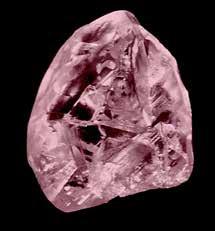
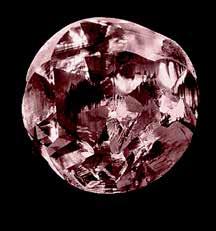
Then in October 1947 came a defining moment. Just as the country was getting to grips with the size of the mine, two unique stones were found: a large blue-white and the nowlegendary pink diamond,
huge at 54.5-carats, virtually flawless and incredibly rare. The events would be forever intertwined.
Incredibly, the pink was found in the dust on the surface. But according to Chopra, its story has long since been muddled with the discovery of the first diamond under the baobab tree by two African boys. The two discoveries are wrongly conflated in multiple magazine articles and books, including The Cartiers, Francesca Cartier Brickell’s 2019 biography of the family behind the fabled Cartier jewellery brand.
Both surface diamond discoveries, though, involved an extraordinary moment of chance. That such a huge diamond would be found on the surface, rather than buried, was a concept many
there at the time would grapple with for the rest of their lives. Among them was Jimmy Sudra, then a 10-yearold boy whose father, Virji, was a carpenter at the mine and who would later recall: “It looked just like a piece of glass to me.” Sudra said decades later: “God must have placed it there, or why would it be found? So it was fit for only a monarch to wear.”
Just a few months earlier, Princess Elizabeth’s engagement had been announced by Buckingham Palace and Williamson, an ardent royalist, decided he wanted to send her one of the two newly discovered stones as a wedding present. The geologist visited the Chopras at their home on the shores of Lake Victoria in Mwanza for advice about which one to give.
Jarat Chopra says: “It was my grandmother who had the grand flair for fashion who said it had to be the pink one. Williamson left it to my grandfather to make it happen. That was the division of labour that made the whole enterprise a romantic success story.”
Indeed, Williamson was paralytically shy, with no tolerance for protocol or officialdom, despite his admiration for the British monarchy. Williamson’s motivation for the gift may have been part philanthropic and part loyalty to the Commonwealth, as has been widely reported, but there was another reason. At the time, the post-war Labour government was threatening to nationalise the mine amid fears that the maverick Williamson would flood the market, destroying efforts to control world prices. “This was part of the grand competition with De Beers,
which was trying to get the mine out of private hands in order to maintain the carefully constructed price of diamonds through the cartel in London,” Chopra claims. “My grandfather had gone to the House of Lords in 1945 to prevent this from happening, and such a gift as the pink diamond to Princess Elizabeth was in aid of preventing nationalisation. So there was a strategic purpose.”
After seeking counsel from the Chopras, Williamson took the pink diamond to Barclays Bank in Mwanza, from which it then travelled on a BOAC flight from Nairobi to London, possibly by air mail, which was considered less risky than if someone had carried it.
For the huge pink, as with any diamond, the final outcome rested almost solely with the cutting. Williamson and Chopra already had a relationship with Briefel and Lemer, one of the best cutting firms in the world at that time, so there was no debate
about who would be given responsibility for this most delicate of tasks.
A cutter can take years studying a stone’s angles to decide how best to bring out its light. But when Sydney Briefel saw the diamond in early 1948, he knew right away that the brilliant cut was the right one. The only snag was a cavity in a part of the stone that took two months to solve. So rare was this stone that he is said to have polished it rather than risk damage by sawing or cleaving.
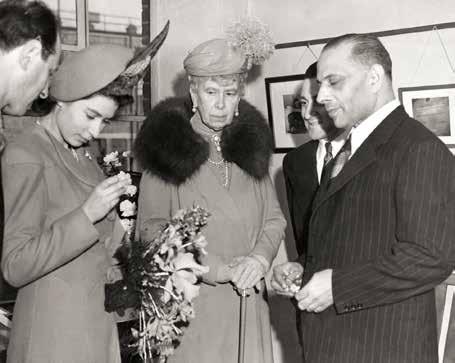
Given that the diamond was meant as a wedding present and the wedding had taken place in November 1947, it was decided to make the formal presentation at the “cross-work” stage, before the cutting had been completed.
On 10 March 1948, Chopra stepped into a carefully pressed Savile Row suit and headed to Briefel and Lemer’s base in Clerkenwell Green. There, huge crowds gathered to witness the
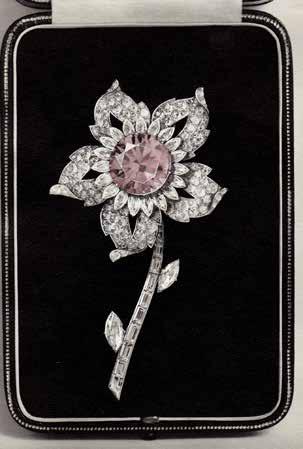
The pink diamond brooch as it appeared on the day I.C. Chopra presented it to Her Majesty Queen Elizabeth II on 22 June 1953. The text under this framed photo reads: Photograph shows pink diamond mounted as a centre of clip brooch given as a wedding gift to Her Majesty Queen Elizabeth II by Williamson Diamonds. Presented to Her Majesty the Queen at Buckingham Palace by The Hon. I.C. Chopra, C.B.E, Q.C., Partner. 22nd June 1953. © Jarat Chopra
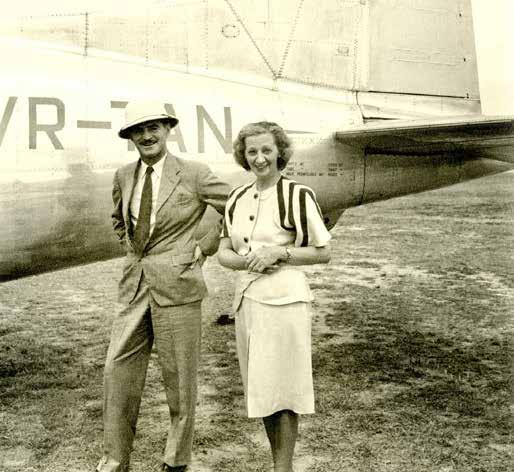
newly-married Princess arrive with her grandmother, Queen Mary. The Princess was photographed studying the stone as Queen Mary and Chopra looked on.
However, Queen Mary was not happy. “She was visibly upset because she was not the one being given the diamond,” according to Chopra. “She turned to my grandfather and asked: ‘Where’s mine?’”
It would be five years before the – now 23.6-carat – cut diamond was seen in public again. The delay in setting the huge stone has often been attributed to a desire by Williamson to source more pink diamonds. This is the explanation put forward by the V&A and outlined in its Cartier exhibition catalogue, but again, Chopra insists this was not the case.
“This diamond was unrivalled because of the colour,” he says. “Williamson knew it would have been
highly unlikely to find many more diamonds of a similar colour for a brooch.”
The geologist did, however, keep a secret stash of many other unique finds. “He kept three Craven A cigarette tins containing the best and most unusual diamonds found at the mine,” Chopra explains. “So he had access to several should he have wished to hand them over, but even so, they would not have provided the volume needed.”
There was also the thorny issue of tax as the diamond had been given to an individual rather than to the Crown and the Princess, of course, was not then covered by the immunity extended to the sovereign.
“It would have been prohibitive to pay taxes on the ‘priceless’ gift, so a special dispensation had to be arranged politically,” Chopra goes on. He claims that his grandfather engaged with parliament on the issue
before a legal exemption was issued.
Indeed, buried in the National Archives are pages upon pages of documents, scribbled notes and official government memos, charting how the Treasury came to extend relief from customs duty and purchase tax to wedding gifts sent from overseas.
The files indicate that the setting of the diamond in Britain and the tax issue were almost certainly connected, which in turn goes some way to explaining the cause of the delay. Rather surprisingly, however, there appears to be no direct reference to the pink diamond in the archives, despite plenty of wrangling over the tax implications for other, less valuable, items. The decision to waive taxes was meant for “things like furniture, plate and clothing,” according to one memo. However, nuance was required.
For example, by accepting unmounted pearls from the Sheikh of Bahrain on the basis that the Princess wanted to have them set in Britain, she would have been liable for 125 per cent tax on the value of both the gems themselves and their setting. If the Sheikh had instead had the stones set abroad, or paid for them to be set in the UK, the documents make clear that the ensuing tax could be refunded. But that would have added significantly to the total sum of exemptions about which the Treasury was clearly concerned.
The answer regarding the pink diamond lay in a novel idea that neatly avoided all potential pitfalls. If Williamson gave the setting as a coronation gift to the then monarch, the setting could be considered as belonging to the state, and the diamond to the Queen.
It is thought the idea may have been suggested to Chopra at a London drinks event or a palace garden party. In his memoirs, Oliver Lyttleton, then secretary of state for the colonies, describes himself as “the intermediary” on the matter. He writes that Chopra and Williamson approached him to ask if it might be appropriate to have the diamond cut and mounted as a coronation gift, set with any number of white diamonds the then Queen cared to select.
“The Queen accepted this fabulous gift,” he confirms. “She would certainly have deeply offended Dr Williamson if she had not.”
Chopra duly engaged Cartier to complete the creation of the brooch, while Williamson provided the additional diamonds and covered the costs.
“Lyttleton is writing very
diplomatically about my grandfather and Williamson volunteering to pay for the Cartier setting as a coronation gift,” Chopra says. “There was more to and fro than that. Nevertheless, there was agreement to do so. Since they were paying the bill for the setting, they were really the ones commissioning Cartier. But it was in step with the palace.”
The account contradicts the oft-repeated version of this story that the Queen herself commissioned Cartier only shortly before her coronation.
Crucially, Chopra had a long-standing, personal relationship with the French luxury goods company.
“All his personal and legal stationery, gold cigarette cases, silver cigar boxes, the armorial bookplates, cards and letterheads were done through Cartier in London,” his grandson explains.
“Cartier in London was the go-to for most commissions personally by my grandfather and for ephemera being used at the mine. Williamson was not interested in any of this. He had a different agenda and different passions.”
It was Frederick Mew, a senior designer who worked
for Cartier from the late 1920s until his retirement in 1971, who received the brooch commission. Multiple pencil sketches comprising different varieties of flowers were narrowed down to a shortlist of three or four which was presented to the Queen. Williamson went on to provide 170 small brilliant diamonds, 12 baguettes and 21 marquises for the chosen jonquil flower design.
With Williamson unwilling to propel himself into the public eye, it again fell to Chopra to present the finished gift. On May 28 1953, several days before the coronation, the barrister and his wife, Thelma, along with Lyttleton, went to Buckingham Palace to discuss the full arrangements with the Queen. Then, on June 22, almost three weeks after the coronation, the group returned to make the final presentation. Chopra reveals: “My grandmother recalled: ‘When the young Queen saw the diamond in its setting, she “oohed” like a little child.’” In return, the Chopras were given an autographed picture of the monarch.
The young Queen Elizabeth quickly began wearing the new commission,
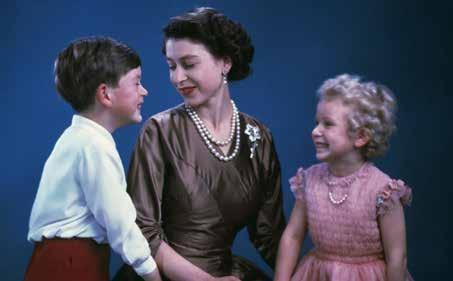
which was first seen in a set of 1954 portraits of the monarch posing with a young Prince Charles and Princess Anne at Buckingham Palace.
Throughout the 1950s and early 1960s it was a favoured piece that was regularly on show – most often on state visits. And in 1977, the Queen wore the brooch during her Silver Jubilee celebrations, which included a procession in the gold state coach, a lunch at the Guildhall and a Buckingham Palace balcony appearance.
The Queen chose to wear the brooch to one of the biggest events of the 20th century, the marriage of her son and heir, the Prince of Wales to Lady Diana Spencer in 1981, and again wore the pink diamond to the wedding of Viscount Linley in 1993 and to the wedding of her youngest son, Prince Edward, to Sophie Rhys Jones in 1999.
She wore it twice for her annual Christmas broadcast, once in 1968 and again in 1998. In her latter years, the Queen wore the brooch to a G20 summit reception in 2009, when she met US president Barack Obama and his wife, Michelle. Fittingly, she chose to wear it on her last visit to Canada in 2010, as well as to Royal Ascot and the Festival of Remembrance in 2013.
Its final outing on her lapel is thought to have been during her 2014 state visit to Paris.
A long-lasting legacy
Williamson died in 1958 as he had lived, quietly and out of the public eye. He left his mark on present-day Tanzania, having ploughed his profits into local hospitals, housing and schools. His diamond mine was immediately sold by his three siblings to De Beers and the Tanganyika
government for more than £4m amid warnings that it would be nationalised by an independent government. Some claim that the flow of diamonds then swiftly halted, perhaps in a bid to control the global market.
In 1996, Jimmy Sudra, who by then had relocated to Kent where he worked as a sub-postmaster, was invited to Buckingham Palace to be awarded an MBE in recognition of his impressive charity fundraising efforts.
On receiving his invitation, he wrote to the Queen’s private secretary, Sir Robert Fellowes, asking whether she might wear the pink diamond he remembered from his childhood.
When Sudra was ushered into his investiture, he was approached by an aide who whispered: “She is wearing your jewels.”
He later recalled: “She put her right hand on the stone and came very close to me. Then she asked me: ‘Is this the diamond you handled?’ It was a wonderful experience.”
Many contemporary accounts, including an essay about the Cartier exhibition on the V&A’s website, have wrongly declared that the Williamson brooch belongs to the Royal Collection. In fact, the brooch remained throughout the Queen’s life in her own private collection and was inherited on her death by the King. (The essay has been corrected after The Telegraph brought its research to the Royal Collection Trust’s attention.)
surely reappear again, worn by future generations of the Royal family.
As for IC Chopra, he relocated to Geneva but remained involved as a director of the Williamson mine for the next decade. He declined a knighthood on the grounds that Williamson could not be knighted as a Canadian. His grandson acknowledges that whenever the pink diamond appears in popular culture, as it has in this latest exhibition, it triggers the whole story of the mine itself and its effect on family life.
“Ultimately, it is a story of a partnership,” he says, “without which there would have been neither a mine nor a gift of a pink diamond.
“Both Williamson and my grandfather were professional individuals, educated to the highest standards and both played their respective professional roles. While they were different as individuals, one an extrovert and one an introvert, they were complementary in their skills. Both, though, were consummate strategists.”
To see the pink diamond – and for Chopra it is very much the diamond rather than the brooch – is to see the light of that much broader story refracted in it.
This extraordinary piece, however, has not been confined to a dusty vault. To the delight of jewellery aficionados, Queen Camilla wore the brooch to a Buckingham Palace garden party in May 2024 and it will
“It is shortsighted to see just the pretty diamond,” he says. “What reverberates most with me are the words inscribed on Williamson’s coat of arms (designed by Cartier) – ‘Perseverantia Palma,’ perseverance wins the prize – and I have tried to live my own life by this maxim.”
Has someone “borrowed” some of your back issues? Or do you know someone who would enjoy reading back issues of Old Africa?
Years 1 & 2 (Issues 1-12) are now sold out! To Kenyan address Overseas address
All Other Years (6 issues) Ksh. 1000/- Ksh. 1800/-
Please make cheques or money orders out to Kifaru Educational & Editorial and mail to PO BOX 2338 NAIVASHA, KENYA 20117.
Mpesa payments can also be made to:
Please make sure to follow up with a text or email stating what the payment is for and shipping address if applicable
If you are overseas you can pay with a credit card at https://oldafricamagazine.com/donate

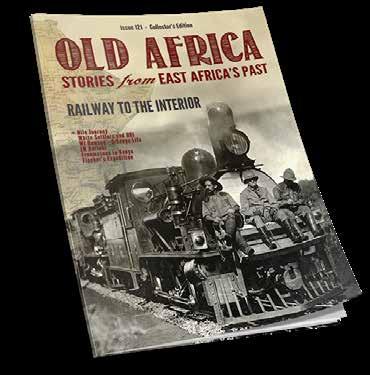
We are now releasing Collector’s Editions of each new issue of Old Africa that you can purchase directly from Amazon. Search ‘Old Africa Collector’s edition’ on Amazon to see issues #121 and #122. This issue (#123) will be available in Mid February.
PUBLIC NOTICE
URGENT: Regarding the whereabouts of Ms Katherine Meadows
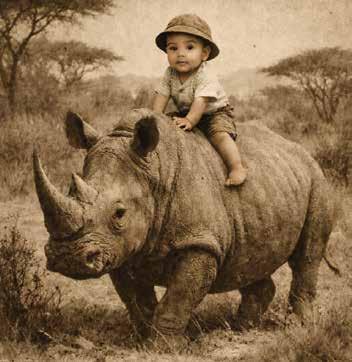
One occasionally encounters a sight that defies the rigid categories of colonial record. Such was the case this past Tuesday, when a wandering black rhinoceros was observed trotting with unusual purpose beneath the towering walls of Mt Ololokwe. Perched precariously upon the beast’s leathery shoulders sat an infant child, no more than eight months old.
According to local trackers, the pair is not merely wandering. The small rider is reportedly on a singular mission to locate his prospective godmother, the intrepid Katherine Meadows, well-known in these pages for her penchant for cheap liquor and her refusal to wear a corset in the humidity of the bush.
Miss Meadows, is hereby requested to claim her ward. The child is in good health, remarkably sun-browned, and, after insisting upon a westward course, has agreed to take shelter at the Lord Verrol in Runda until the elusive spinster has been located.
by Old Africa
1958Not
many people know that the first Mtwapa Bridge was built by Ron Buxton as a private enterprise. Ron Buxton had established a Nairobi branch of H Young, a construction company specializing in steel structures, in 1949. Though based in England, Ron often visited his far-flung business ventures and while in Kenya he often stayed with his favourite relative, Clarence Buxton, a cousin to Ron’s father Murray Buxton.
Clarence, a retired colonial official (he had been the Assistant Resident Commissioner in Naivasha in 1922 and was the first secretary of the Naivasha Sports Club) had a property in Vipingo on Kenya’s north coast, but access was often difficult because of the ferry crossing at Mtwapa Creek north of Mombasa. The chainpull ferry over Mtwapa Creek could only carry two vehicles at a time, leading to some long queues.
One Sunday afternoon in 1956, after a weekend visiting Clarence and his second wife May, Ron was driving back to Mombasa. At Mtwapa found himself behind a queue of 40 cars. Knowing it would be at least a threehour wait to cross on the ferry, Ron decided to
inspect the area to see if it would be possible to build a bridge. The ferry site was quite far inland from the ocean and at a spot that was very wide, probably because this caused the current on the tidal creek to move more slowly so it was easier to pull the ferry back and forth. Ron finally got his turn on the ferry and drove on to the Mombasa airport to fly back to Nairobi in his Tri-Pacer aircraft. After taking off he flew over Mtwapa Creek to have a look from above, snapping photos as he explored the area. He noted that on the ocean side of the ferry crossing there was a place where the creek narrowed which might be suitable for a bridge. When he met Clarence the next time, he had a serious proposal to build a bridge over Mtwapa Creek.
The idea immediately faced some difficulties. After doing a closer survey of his chosen bridge site by boat, Ron realized the gap of 313 feet was almost too long for a single-span bridge. And the depth of the creek, up to 100 feet in places, made it too difficult to sink intermediate piers in the water. The speed of the tides made a floating bridge, like the one at Nyali, impractical. It looked like the
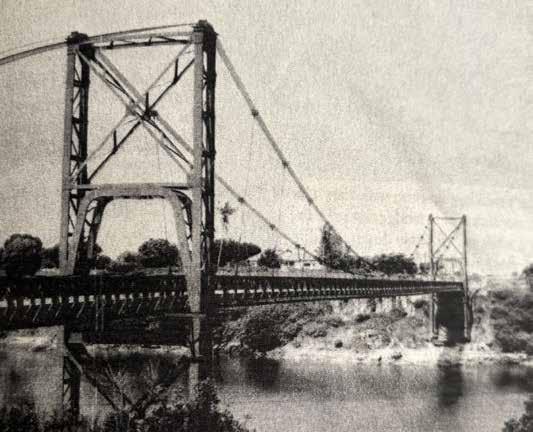
only kind of bridge that would work would be a suspension bridge. Though Ron was an engineer and his company specialized in steel structures, he didn’t have the experience to design and build a suspension bridge. But he knew how to network and get the necessary expertise for bridge building from others. So Ron and Clarence set up The Mtwapa Bridge Company to build and manage the proposed bridge. Ron raised the needed capital of 50,000 Kenya pounds from the local Barclays Bank to build the bridge. They later had to borrow more for a total of 70,000 Kenya pounds to finish the bridge.
In addition to the structural difficulties, the political roadblocks were even more formidable. The floating bridge at Nyali had been built with private funds and the Ministry of Works in the Kenya colonial government did not like it because private individuals had control of the bridge. Clarence did not think they would support another privately built bridge. But Clarence, who had served in the colonial administration, knew the ropes. First, he approached the Governor of Kenya, who said he was in favour of the project. However, as predicted the Ministry of Works fiercely opposed the project, feeling like outsiders were trespassing on their turf. Clarence, though, knew Major-General C C ‘Fluffy’ Fowkes, chairman of the Road Authority, a quasi-governmental group advising on road development. This authority was run by the British Colonial Office. Fowkes also supported the bridge. A meeting was convened to consider the proposal. The Ministry of Works laid out
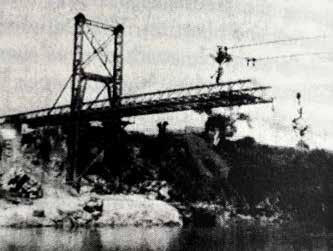
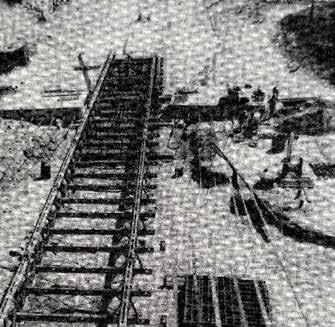
Left: The bridge was built on rollers on either bank of the creek. Right: When the bridge was ready, it was pushed out over the creek from either bank, supported by trolleys suspended from the bridge’s main cables.
its arguments against The Mtwapa Bridge Company building and operating the bridge. Fowkes listened and then asked, “If they don’t build the bridge, are you going to?”
“Unfortunately, we don’t at present have the money,” replied the Director of Works.
“Well, if you’re not going to build it, I don’t see why they shouldn’t,” said Fowkes.
The Mtwapa Bridge project was approved. The site was chosen, next to the Shimo la Tewa Prison. Ron got advice in England from Sir Donald Bailey, the inventor of the Bailey bridge in 1939. These bridges had been instrumental in helping the Allied war effort in North Africa and Italy during World War II. Bailey set his engineer the task of designing a bridge for the Mtwapa Creek crossing.
One thing that was needed was Bailey bridge panels and lots of cable. Ron had two lucky breaks. A lot of the panels and cable had been shipped to East Africa for the failed Groundnut Scheme in Tanganyika a few years earlier, and there was a large cache of Bailey panels and cable, which Ron acquired at a fraction of their real value. In the meantime, Anthony Gurney, a friend in England, began combing scrapyards for redundant Bailey panels left over from the war. He found a treasure trove in the King’s Scrapyard, Great Yarmouth, and bought up the precision-engineered panels for little more than their scrap value. Ron’s wife Phyllida later said, “That bridge was built from bits that fell off the back of a lorry.”
By August 1957 they were ready to go ahead with construction. Mowlem Construction was given the contract to build the foundations
Over the opening weekend over 1,000 tickets were sold.
and they sank the piles for the towers. Then they erected the towers, each 90 feet high and weighing over 20 tonnes. They were guyed into position and by the end of 1957 the first of 16 main cables was drawn across the creek and fastened to concrete anchor blocks. Heavy rains in December 1957 and early January 1958 caused one of the north bank anchor blocks for one of the cable stays to become unstable. They had to add extra vertical piling below the anchors and added some secondary anchorages 75 feet further inland to take the full load.
In the meantime, the span was being built up from either side of the creek on rollers. When both sides were complete, they were rolled out at the same time over the water. The dangling front ends were supported by trolleys suspended from the main cables. When the two spans met in the middle, they were bolted together. It had been nine months since construction had begun.
After this the bridge was soon completed. The deck was supported by steel cables and the decking was installed; heavy sleepers of a durable ironwood called azobe, imported from the Cameroons in French West Africa.
The Ministry of Works paved the road approaching the new bridge and Ron christened the new bitumen road by landing on it in his Tri-Pacer on one of his regular inspection visits to the bridge. The finish the job, the bridge was
painted with a special grey paint to protect it from the salty sea air.
Once the bridge was completed, it had to pass two weight tests from the Ministry of Works. For the first test, called a distributed overload test, ten seven-ton tipper vehicles were evenly spaced on the bridge, but all on one side to create an off-centre load equivalent to a central load of 90 tonnes. They left the tipper trucks in place for 12 hours on one side of the bridge. Then they repeated it on the other side of the bridge. The bridge held firm.
The second test, called a concentrated load test, required a 40-tonne load made up of a 15-tonne Foden dump truck towing a lowloader carrying a 20-tonne Caterpillar D7 bulldozer. As these heavy loads were towed onto the bridge the decking timbers rattled, the cables tightened and the deck visibly sagged. But the bridge passed this test as well.
The final task was to set the toll prices.
Pedestrians had to pay 10 cents; bicycles - 20 cents; motorcycles - 50 cents; cars - 2 shillings; pick-ups, vans and station wagons - 2 shillings and 50 cents; lorries up to 8 tonnes - 3 shillings and 50 cents; buses and taxis carrying more than five passengers - 5 shillings; heavy lorries - 7 shillings; and special vehicles or heavy equipment like tankers or tractors – 10 shillings.
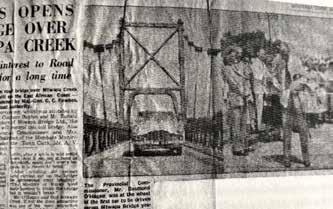
The opening ceremony was held on Friday 20 June 1958. More than 100 people attended including Ron and Clarence as well
as the Provincial Commissioner, the District Commissioner, the head of the Mombasa Municipal Board and the Town Clerk. ‘Fluffy’ Fowkes made the first speech, declaring the Road Authority’s confidence in Ron Buxton, “the engineer responsible for the planning of the bridge.”
Ron then spoke about the heavy ironwood planks of the bridge’s decking: “Don’t worry about the rattle; after a while it will settle down. And if you see the bridge bend in the middle, again, don’t worry – it’s meant to bend. The Ministry of Works tried their hardest to break the bridge, but it wouldn’t break.”
Fluffy tucked his walking stick under his arm and cut the ribbon of tape across the south approach and the new Mtwapa Bridge was declared open. Fluffy and his wife and the Provincial Commissioner Desmond O’Hagan and his wife Pamela got into a car and were the first to drive across the newly-opened bridge.
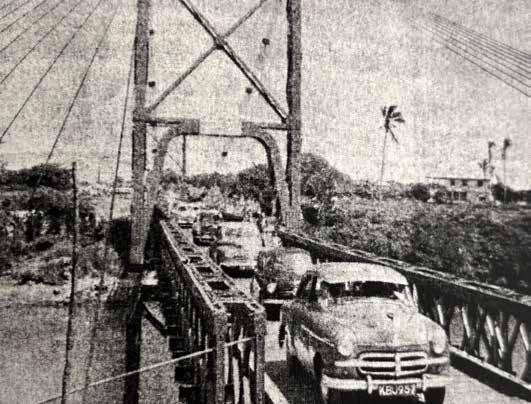
The next day the Mombasa Times declared it: “The finest bridge on the East African coast.”
The bridge was an instant success. Over 1,000 tickets were issued within 60 hours of the opening, half of them for vehicles. The bridge

from
to declare the
Bridge
greatly improved transportation on the Kenya coast heading north. Within five years the tolls had paid off their investment of 70,000 Kenya pounds and the Mtwapa Bridge Company operated the bridge for a little over 20 years until a new bridge was built in 1980 to replace Ron Buxton’s single-track toll bridge that was built with bits that fell off the back of a lorry!
This article was taken from the book The Book of Ron, the biography of Ronald Buxton written by Antony Woodward.

by Jim Dawson
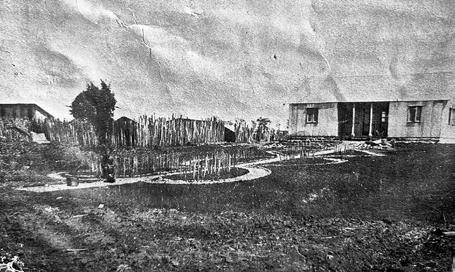
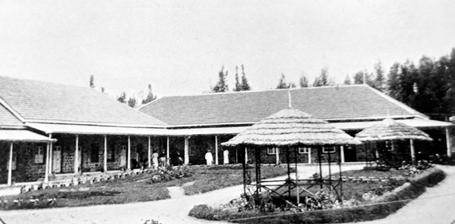
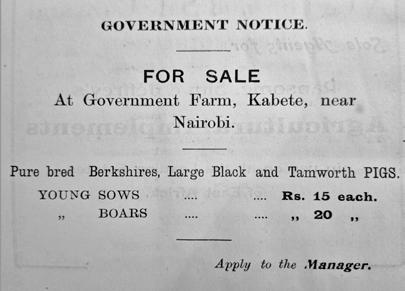
1908As in my earlier articles, there are two strands to this one; firstly, what we know of the personal history of my grandfather, WJ Dawson, as a young settler, and secondly the society in which he found himself. From his own papers we can gather that the young Scot’s first employment in Nairobi was at the government experimental farm at Kabete. Here he would have worked under Andrew Linton, the first Director of Agriculture for the protectorate.
In his papers, in sadly poor condition, is a copy of the Reports from the Director of Agriculture on the Government Farms at Nairobi and Naivasha for 1904 prepared for Parliament in the UK. With it are a sheaf of notes in WJ’s hand which appear to be a draft for a later edition of the same report for 1908. They are interesting for a number of reasons. Most striking is the breadth of experimentation which had developed in a very short time since Linton’s appointment. The list of crops and animals already imported for assessment in those early years is a testament to the energy and vision of those officials, and their lives must have been a constant swing between triumph and failure with new crops and breeds either thriving or failing. There was a seeding and breeding function too, as the government farms were
intended to provide seeds, plants and the services of selected bulls and rams to settlers as well as advice and support. The report notes that the 1904 season at Naivasha was marred by drought, and Linton’s introduction has a defensive tone. Although the rinderpest of the previous century had burnt itself
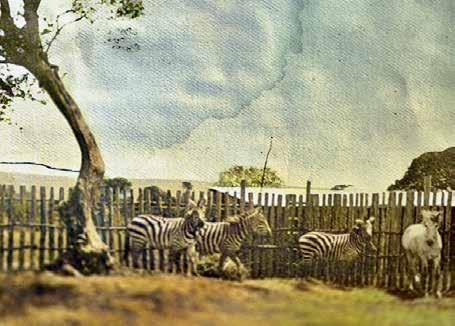
out, disease remained a problem, the “bane of the farm” according to Linton, especially with sheep. An attempt to farm wild zebra, alternatively to cross them with domestic equines, in the hope that the offspring could be domesticated was not proceeding as envisaged.
Scanning the 1904 report


one can identify at least five breeds of cattle, three of sheep, three of goats, two of horses, one breed of donkey and various breeds of fowls, geese and ducks. Ostriches featured too, although the ostrich feather boom centred in Oudtshoorn in the Cape was already in its dying phases. To the livestock were added various crops- all kinds of vegetable, fruit (deciduous and citrus) and other crops. Of particular interest, given WJ’s significant role in future developments in Kenya agriculture, were ten varieties
of wheat, and several varieties of barley, maize, millet and buckwheat. No fewer than 70 sowings of crops, cereal, vegetables, pulses, forage and more are recorded with notes as to outcomes. Non-edibles, such as sisal, hemp, cotton, linseed (flax), wattle and tobacco are also reported. Listed too are imports of many more exotics from India and the West Indies. Probably the most important of the imports were the wheat varieties, and it is clear that even then the holy grail was to find or breed a variety resistant to
wheat rust, and the number of annotations in the Report and WJ’s notes bear witness to what was to be a lifelong quest. I have memories of WJ and my father in earnest conversation on the edge of the Kipipiri wheatfields in the early 1960s, brows furrowed, anxiously examining wheat stalks for the russet-coloured signs of infestation.
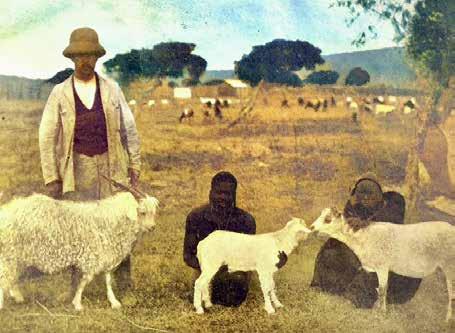
The manager at Kabete was Mr James Johnson and the vet was James Burton who had been hired to accompany one of the original shipments of animals from the UK. On this voyage the Angora ram became probably the first recorded “goat overboard,” according to his son in Europeans in East Africa That would have set back the Angora project by a year or two! Burton left in 1906 but returned in 1912 and would certainly have been one of WJ’s mentors where animal husbandry was concerned. It should be noted that the years 1904-1908 were particularly difficult in view of recurring drought, making the achievements of Linton and his staff all the more remarkable.
A broader Colonial Report, 1912-13, also addressed to Parliament, would certainly have had input from WJ. This contains a short section on agriculture in the country generally, and not just focusing on the Government Farms. It shows some phenomenal developments. An interesting note on coffee records that production had risen tenfold. Improved results for cattle were reported, attributed to the introduction of dipping techniques from South Africa, reducing parasite-borne
diseases like East Coast Fever, although sheep, as is their wont, had apparently found a new disease from which to die. 270 acres had been planted to various crops at Kabete, irrigation canals dug, and processing equipment installed for flax-retting and tobacco curing. The farm was now in a position to distribute animal medicine which included over 100,000 doses of rinderpest vaccine.
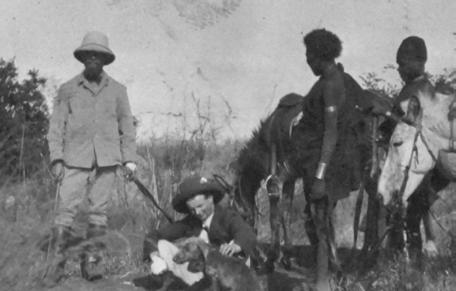
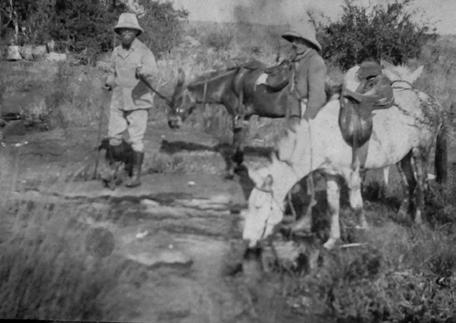
In addition to the notes, some photographs in WJ’s personal album give a few clues about life at Kabete. Identified in the photos are JD Ritchie, GK Klapprott, Reynolds (almost certainly Geoffrey), and Milne, who could have been Alec Milne, or Stuart Milne, both Scots and whose entries in Europeans In East Africa website make it certain he would have known them. It was probably Alec, as he was pictured in the same 1909 football team as WJ. In an odd coincidence, Klapprott came from the same small village in Natal that Catherine, WJ’s wife, eventually retired to.
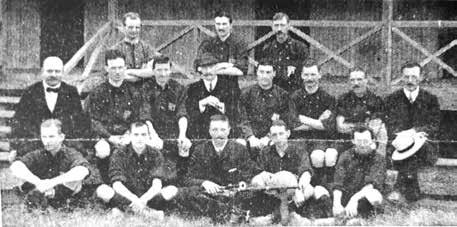
From his history, family accounts, and my personal memories of my grandfather, there was something of the stereotypical dour Scot in him, but he was certainly not without a sense of fun and humour, and I guess that he would have enjoyed the social life of Nairobi when not involved in the work of the farm. He was a member of the Caledonians football club by 1909 and I’m certain that this would have been in association with the Caledonian Society, founded in 1904, of which he became a lifelong member.
It was an interesting, vibrant and constantly changing environment.
From a sociological point of view, the development of a class structure in early Kenya is fascinating. Partly this was inherited directly from Britain, and partly from the acutely class-conscious Indian military and civil services. At the top, in their own estimation at least, were British aristocracy and squirearchy who varied from genuine pioneers, hard-working and visionary, epitomised by Lord Delamare, to caddish remittance men.
Gradations of rank in the military and government service were of studied significance, and experience in India tended to give one airs. To the mix you could add South Africans, who rather muddied the waters of class distinction, as they varied from old settler families of British extraction like the Bowkers, to Afrikaans/Dutch farmers recruited to the protectorate as settlers and the rough-andready trekboeren, itinerant stock farmers for whom the Great Trek had finally ended in East Africa. And then there were the ordinary settlers,
farmers, blacksmiths, miners and tradesmen, all looking for a new future although, as Robert W Foran notes, it is clear that some were more interested in fleeing a past. To all this would be added the immigrants from the subcontinent, with their own religious and class differences and of course the various
indigenous people of the Protectorate with their own diversity and differences. The upshot was a melting pot. Regarding the white settlers, Foran is simultaneously amusing and scathing. He noted the basic distinction between “Hill” dwellers and those who lived on the “Plain” but it went much
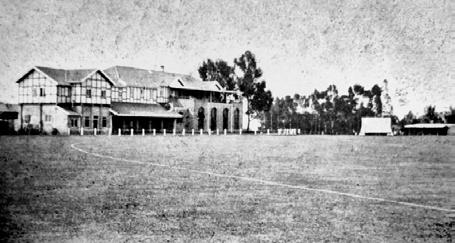
deeper: “The besetting sin of British East Africa,” he wrote, “was snobbery and official exclusiveness - a disease imported from India.” I noted earlier the British propensity for starting clubs wherever they settled, but as these developed some became instruments of exclusion rather than social cohesion. Foran had personal reasons for his contempt for the artificial hierarchies founded on position rather than merit. On arrival, as a military officer and sportsman, he’d been welcomed with open arms into the Nairobi Club, but he made the fatal social error of accepting a post as an officer in the nascent British East Africa Police. This made him a mere policeman in “polite society’s” eyes, and an instant outcast. Foran noted too that while a few farmer-settlers were admitted, most had no interest in club society, occupied as they were with the hard work of developing their land. As far as I know, WJ never joined any of the Nairobi clubs, and later in life he held them in low esteem. At that time he was a member of the Caledonians football club, and this together with his status as a low-grade government employee would have been sufficient to render him ineligible. Later, he may have become a member of smaller local clubs, like the Njoro Club, which were more
Top: Angora ram, native ewe and crossbred kid. (Photo from Reports from the Director of Agriculture 1904) Middle: Nairobi Club. (Photo from Reports from the Director of Agriculture 1904) Bottom: Caledonians AFC 1909 in Nairobi. WJ Dawson is in the back row, left. (From the Sunday Post, undated clipping)
community-orientated than exclusionary.
Nairobi at this time was also something of a magnet for distinguished visitors. One of them, Theodore Roosevelt, had just finished his term as president of the USA and another, Winston Churchill, would go on to highest office. Churchill’s visit was the earlier and more low-key of the two. He made use of the Uganda Railway and took part in hunts for big game, but he was much more reflective, regretful even, about hunting than his American counterpart whose party was reputed to have shot over 11,000 creatures. It is also worth noting that although his language often reflects contemporary values, Churchill was prescient regarding the Protectorate’s future, sympathetically identifying in Nairobi the same issues as Foran: class, race and origin, and expanding on them.
Churchill wrote in My African Journey: “One would scarcely believe it possible, that a centre so new should be able to develop so many divergent and conflicting interests, or that a community so small should be able to give to each such vigorous and even vehement expression. There are already in miniature all the elements of keen political and racial discord, all the materials for hot and acrimonious debate. The white man versus the black; the Indian versus both; the settler as against the planter; the town contrasted with the country; the official class against the unofficial; the coast and the highlands; the railway administration and the Protectorate generally; the
King’s African Rifles and the East Africa Protectorate Police; all these different points of view, naturally arising, honestly adopted, tenaciously held, and not yet reconciled into any harmonious general conception…”
On the other hand, I don’t think that Roosevelt, although a Nobel Peace Prize winner, gave much thought to the geopolitics of Africa. The ostensible purpose of his expedition was scientific, and most of the specimens shot were sent back to the Smithsonian in the USA for preservation and study. His was a long visit, and interesting too in that it was filmed by Cherry Kearton, (some of whose footage is
available online). After the war Kearton returned with his camera, later publishing In The Land of the Lion, in which he vigourously advocated for the camera rather than the rifle. This can be seen as part of a slow change in attitude to wildlife which may have influenced the future King Edward VIII, who became as adept at capturing animals on film as he was alleged to be at luring a different prey to his bed. Another notable arrival in 1910 was Denys Finch Hatton who later accompanied the future king in Kenya, and who is also credited with influencing changing attitudes to game management. Not long afterwards, Karen Blixen arrived.

Watching the train for new arrivals was apparently something of a pastime. In JL Gregory’s biography of Dr RW Burkitt, probably Nairobi’s first independent GP (Under the Sun), he writes: “As they poured out of their compartments… they must have presented a strange and puzzling picture to those who flocked to watch the arrival of each new consignment. Male and female, young and old, rich and poor, great and small, fair and dark, English and South African, British and Dutch, Jews and Gentiles, Europeans and Asians, aristocrats and plebeians, genuine settlers and adventurers.” Fashions were probably as varied. Robes, saris, suits, well-worn khaki, fashionable dresses, recommended tropical gear; all were on display. People travelling to the tropics, especially near the equator, were frequently warned of the dangers posed by the sun’s “actinic rays,” usually by outfitters’ need for sales.
When Dr Burkitt arrived, he had the full kit: spine pad, red-lined cork topi and a red-lined umbrella, red apparently being a good colour for warding off the deadly rays. An alternative to the topi was the terai or double terai, which were more popular with women. Evening dress and finery were great for visits to the clubs, Government House, or the newly opened Garvie’s Bioscope, where the “Latest, Greatest and Brightest of Pictures” would be showing, but with experience, men and women, especially those heading out into the hinterland, drifted quickly to comfort and practicality, ignoring the outfitters’ earnest recommendations. Churchill described the garb of officer and settler thus:
“His clothes are few and far between: a sun hat, a brown flannel shirt with sleeves cut above the elbow and open to the chest, a pair of thin khaki knicker- bockers cut short five inches — at least — above

the knee, boots, and a pair of putties comprise the whole attire.”
In the years leading up to World War I it is obvious that demographically, geographically and architecturally, Nairobi was undergoing significant changes. From swampy railhead, then pioneer town, it was beginning to show the attributes of a colonial capital. The Railway Station, the Post Office, Government House, the clubs, a racecourse, a cinema and new hotels had all sprung up in little more than a decade, and Nairobi, recognised as capital in 1907, looked set for a period of prosperity and expansion. For young men like WJ the future must have appeared promising and endlessly exciting. But back in Europe the clouds of war were gathering like cumulus over the escarpment, and even this far-flung outpost of empire was soon to be sucked into the maelstrom.
To be continued…
records of
When Desmond O’Hagan was a young district officer in northern Kenya, he adopted a baby elephant which insisted on sleeping in his bedroom. Tembo, which means elephant in Swahili, was brought into O’Hagan’s tent in the bush at the age of two months after his mother had been shot, and from then on declined to leave O’Hagan’s side. At first only the size of a large Labrador, Tembo spurned the spare bedroom in the mud hut with a thatched roof to lie down every night beside O’Hagan’s bed. During the day he went to the office, where he quietly watched O’Hagan conducting business and holding court. If there was a dinner in the evening, he insisted on coming too, screeching loudly until allowed into the dining room. Feeding the baby elephant was not easy. O’Hagan had no elephant’s milk and Tembo spurned the offer of grass. O’Hagan’s friends helped him find undiluted cows’ milk. Then, when O’Hagan went on safari, leaving Tembo in the care of a nurse who was fond of him, the elephant pined for his missing friend and died at the age of nine months.
From website https://www. europeansineastafrica.co.uk
While working in the pathology department at
Kenyatta Hospital in the late 1970s, I was conducting research around Mombasa so would travel down by the night train once a month. At first I would have a lie in and take breakfast during the second sitting but on every trip the toast was not freshly made and was rather rubbery. I assumed it had been prepared before the first sitting and had become stale, so I determined to take the first sitting for breakfast in the hope of fresh toast. However, the toast for the first sitting was just as bad as for the second sitting. I mentioned the toast to the waiter and asked when it had been prepared. He informed me that they always toast the bread the night before to save time in the morning.
Lesley Cartwright-Taylor, Epsom Downs, UK
I was posted to Kiboko to run the Tsetse Survey and Control field station in the early 1970s, while working as a scientist for the Kenya government. Just before Christmas one year, I had set up an experiment on trypanosomiasis in goats. We had infected five animals with the disease and had five uninfected animals as controls. Trypanosomiasis, or nagana, is a chronic disease that takes time as the animals slowly lose condition, so I didn’t expect any deaths while I went away over Christmas. However, when I returned
after new year I was perturbed to be told three of the control animals had died. I wondered if something had gone wrong with my experiment, but on quizzing the staff more closely I learned that they had eaten the animals for the staff’s totally unauthorised Christmas party!
Lesley Cartwright-Taylor, Epsom Downs, UK
In January 2025 I bought a cup of black coffee at the cafe by Gate 3 at Nairobi’s Jomo Kenyatta International Airport. It cost me Ksh 340/- or nearly US$3. I felt it was a shocking price for a 250 ml cup of coffee, when compared to the pittance coffee pickers used to earn in the 1970s for a debe filled with coffee beans. The old debe was a four-gallon square tin box used to measure how much coffee a picker had collected so he could be paid. A debe held over 18 liters of coffee beans!
One day in 1976 I picked a record number of debes with my Gikuyu buddy James Ngeretha. James and I picked coffee all day on a farm halfway between the hamlet of Kamiti and the small town of Ruiru in Kiambu county. We lived on the coffee estate in a rented bungalow with our parents, with little cash and one member of staff - Agnes Muthoki.
We laid magunia (sacking) under the coffee trees or
bushes and picked and grabbed the red and yellowred berries. They fell onto the sacking and then we gathered them up and filled the sack with the fresh coffee berries. Tree after tree, side-by-side, James and I picked coffee. All day, without respite, stopping only to sip the water we carried in the one bottle we shared. His mouth, my mouth, and then his. Not a care. We wanted a few bob and we had a purpose. We picked the red cherry-like beans with fervour.
The sun arced over our heads and the picking went on until about 3 o’clock in the afternoon. We knew time was closing. But our fingers flashed and grabbed, brains selected and directed, digits and thumbs worked pulling and picking the beans from branches onto the carpet of sacking. Picked by little fingers far away in the highlands of Kenya. Grown on the rich volcanic-laterite soils, at 6,000 feet where the red soil, the fresh montane rains, the equatorial sun and the highland air, all combine to create that quixotic mix that gives us that very best of coffees.
An Arabica bean formed of two halves like man and woman. Joined in a cocoon of cherry-red maganda or skin. It is this caffeine-packed, coffeechocolatey-zip, black and swirling, hot or cold, addictive and alluring, yet always drinkable coffee that we quaff every day by the gallon or the debe.
Debes that I picked with James Ngeretha on the lower slopes of the southern Kinangop massif. It’s the best coffee in the world. I think so. I know so. But as you sit there sipping it, know that it was picked by young boys and women so that
they could make a few bob for the day. They pick enough in a day to feed their family - for that day only!
And so, you might ask, what did James and Conrad do with their monies. Well, Ngeretha and Thorpe ran most of the way back from where our coffee was measured by the debe and we were then paid. We ran clutching our shillings, all 40 of them, silver coins. We ran along the red tracks and across the grassy vleis, down the valleys, across the rivers where we caught snakes and terrapins, fish and ducks, where we knew each crocodile had a place. We knew where we were going, we knew what we wanted and it made us run and run, all the miles to a place simply called ‘Hotel’ or in Swahili hoteli. It isn’t a hotel – it didn’t have a room to rent or a beer and a bar, not a Spa or an airportcar. It was simply a place where the farmhands made chai ‘special’ and mandazi Ngeretha and I split the money, right down the middle, 20 bob each! 20 bob that we didn’t have yesterday. We gorged on deep fried mandazis and ordered chai ‘special’. Chai special is tea with extra milk and dollops of brown-cane sugar. A cup then cost 50 cents (ordinary tea was 40 cents) and a mandazi cost another 50 cents. We drank tea not coffee. Tea was the drink of the people then, never coffee. Coffee went to the UK, America, Europe and parts of Asia. It was many years later that I came to love Kenyan coffee. But back then all I wanted was chai special and mandazi
We were always hungry, always starving and perpetually skinny. Just boys with space and freedom. I don’t know
where Ngeretha is now. We lost touch. We were two boys who picked coffee, drank chai and ate mandazi together and I still remember the special camaraderie. The memory remains - if only I could be 12-years-old again, picking coffee and running across the Serengeti (ol selenket in the Maasai language) or ‘the endless plains,’ running to get some tea and cake.
Today Tatu City stands where Ngeretha and I once picked coffee. Where our dogs chased down reedbuck and Thomson’s gazelles which, if we found the kills, we brought home like cavemen. And they then went in our sandwiches to school. Where we caught rock pythons and night adders, where crocs stalked us and we swam under water to catch ducks in the dams, where we ran miles across the plains to the Nichol club and back.
The coffee has largely gone, the plains have gone, there are no gazelles, no pythons, the ‘hotel’ has gone, no chai special or mandazis - but the memory remains. And as I think how my long day of picking debes of coffee beans earned me a silver coin treasure of 20/, I find it shocking that a single cup of the beverage today costs me 340/-!
Conrad Thorpe, Jomo Kenyatta Airport, Nairobi,
Do you have a short, funny or quirky story about something that happened in Africa? Send your contributions marked Only in Africa to editorial@ oldafricamagazine.com, or by post to Old Africa, Box 2338, and Naivasha - 20117 Kenya. Please limit stories for Only in Africa to 350 words or less. Include your name and address in case your story is published. We pay KSH 1000/- for each published story. Sorry, we cannot return submissions to our Only in Africa column.
This article originally appeared in German as “Bericht über die im Auftrage der Ge- ographischen Gesellschaft in Hamburg unternommene Reise in das MassaiLand,” published in the geographical journal Mittheilungen der Geographischen Gesellschaft in Hamburg, 1882-83, and which formed the basis of Fischer’s 1885 book Das Masai-Land. The translated sections here comprise section I. General Report (pp. 36-99) and section III. D. Dr. G.A. Fischer’s ethnographic collection from East Africa (pp. 275-279).
This article was translated by Eckhart and Almut Spalding (the latter is a retired professor of Germanic Languages and Literature, Illinois College). For the sake of authenticity, Old Africa has chosen not to edit Fischer’s use of words like Negro and Washenzi, which are now objected to as pejorative, but in his day were descriptive.
Report of the Journey into Massai-Land, taken under commission for the Geographical Society in Hamburg by Gustav Adolf Fischer
Before the warriors embark on a war campaign, they retreat for a short time to the woods, live only on meat, arrange their war decorations, and prepare themselves for the fight. This is said to be the only time when these heroes are not dangerous, for during this time of consecration they may not steal nor kill. We encountered many smaller such bands of warriors. The cows which provide sustenance are not slaughtered; rather, they are killed by throwing them down on the ground and strangling them. If this takes too long, the beast is given a blow from a knobkerry club to the neck. Sick or lean ones are treated contemptuously by the Elmur´an and are left to the Wandorobo. The young [men] are almost always on campaign. They meet up either by district, or from across several when it involves a raid on a more powerful people. The younger and less experienced warriors campaign
against the weakling negro tribes, especially against the Wadigo living between the Pangani and Tanga.
The Waruvu, Wasegua and Wanika also cannot hold out against the Massai. Greater resistance is encountered in raids against Umb´ugwe, and especially against the Kavirondo, a large, warlike tribe on Victoria Nyanza (at 1º S. lat[itude]). [The Massai] are often driven back by them with losses, as they are by the Wakamba. The Massai from the northern districts undertake raids against the Suku on Lake Mbaringo, to Kikuyu, against the Somal[is], and as far as Lake Samburu. The Massai living in Ndoro District, on the southwestern edge of Kenia, possess camels which they have stolen from the Somal[is]. On war campaigns, cattle are brought along for sustenance. The encampment is set up a day’s travel away from the area that will be fought over, and after orienting themselves with scouts to ascertain where the enemy’s cattle are, they hide themselves overnight in the surrounding bush. As soon as the livestock go out to pasture the next morning, [the warriors] burst out headlong, with loud cries. Some [of the men] fall upon the livestock herders, [and] the others attempt to separate as many cattle as possible from the herd and drive them away.
Sometimes the Massai also attack the settlements of the Negroes themselves, who for the most part flee. They usually lose quite a few of their number [when fighting] the Waruvu, who use firearms, which they know more or less how to use, from their secure islands.
Every year the Massai appear on the coast. In the Wanikaland they reach all the way to the English missions near Mombasa, and several years ago they slaughtered many people on plantations along the Pangani. Especially in the months of August, September, [and] October, when they move with their herds to the more abundant grazing near the coast and where there are numerous Massai encampments between the Pangani River and the Pare Mountains, they make the coast so insecure that trade between Pangani and Mombasa is barred. Several older people accompany
the warriors on such raids, to exhort them to caution, and to take charge of the distribution of the cattle upon their return. It is said to happen that impetuous, capable and famous warriors are compelled by their comrades to stay away from the fight. Often they have with them captive Negroes from coastal tribes, who must show them the way and indicate the areas where there are livestock.
Every warrior has his special comrade, who remains at his side in combat. If one of them falls, it is the duty of the surviving one to bring an item of his fallen friend’s weapons back to his relatives who have remained behind in the homeland. If he does not manage to do this, he will never again have a friend. In the fight over cattle, it is a joy for the Massai to be willing to die. In such a fight he does not fear
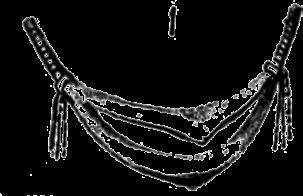
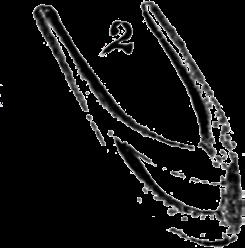
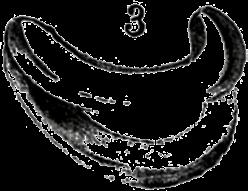
death. When a man [back in] the homeland feels death is near, he has himself be brought to his cattle, so that he may die among them. It is touching, with what love and care they maintain and wait on their herds, how familiar they are with individual animals, and how the animals listen to the calls and whistles of their masters. The women—who on migrations walk behind the baggage-laden oxen—practically speak with them, coax them, and encourage them to hasten forward with speed, which always elicited great merriment among the Mohammedans. It is not rare to hang a bell-like ornament of ivory around the [cows’] neck, as well as small handmade bells which have the same ring as those of cows in the Alps.


Castration is also practiced, especially on the donkeys. The cows of the various owners receive certain branded symbols. There is an enormously rich nomenclature for the various ages, colors, and genders of the beasts. Since the cattle are stolen from the most diverse regions, there is no particular type. Many merchants can immediately recognize the country it comes from. It is interesting to see how the cattle behave themselves when a caravan approaches. As soon as they see the long advancing row of alien figures, or catch an unfamiliar or disagreeable scent, they come bellowing—they are often in a group of a thousand— stand immediately in front of the caravan with raised ears, and bellow without end. Others pace back and forth in great agitation and the Massai have difficulty holding them together.
The Massai themselves, especially the women, exude a strong smell of cattle. The smell of people from the coast is also unpleasant for [the Massai], and
Object 1: Split armband of the Massai made from rhino horn, with small iron chains. The tips are wrapped in brass and are worn by the men on the upper arm.
Object 2: A similar armband to figure 1, but made from wood.
Object 3: Another split armband, this one made of ivory.
Object 4: A block of wood used by the Massai to stretch out the earlobes.
Object 5: Massai ear ornamentation made from ivory. The ear lobe runs through the opposite notches.
it is not rare for them to hold sweet-smelling herbs in front of their nose while they stare at a passing caravan. The smell given off by vegetable-based food is most disgusting to them. One time I witnessed a young Massai tell a hungry porter the words, “Your food smells bad,” and plunge a spear through the cooking pot. The oxen which are sold to the caravans are often not worth much, and are often so wild that one must hire Massai for several bead necklaces to tame them, or if one wants to take them along, to drive them along in the rear. It is quite a sight to behold, to see a young naked warrior charge a raging ox, how they grab them by the horns and throw them to the ground.
As far as religious customs are concerned, they do not appear in any form among the Massai. Even my translator, who, as already mentioned, was born a Mkwavi, explained to me that nothing of the kind exists. They do not have idols. A Mohammedan shared with me that sometimes before battle they ask “Ngai” to grant them good fortune. Perhaps the preparations for battle are also bound up with religious views. I have heard the word Ngai quite often. When it thundered, they called “Ngai.” They call the volcano D¨onyo Ngai.
When I launched rockets, they screamed ngai, ngai, and many said, when they saw me for the first time: ngai, especially whenever I lit matches. If one is so inclined, one can translate this word as ”God.” In any case the word is an expression for things which are inexplicable to them and appear to be of supernatural power.
As among all uncultivated peoples, they concern themselves only with the principle of evil and try to use magical methods of all kinds to banish that which causes misfortune. All of that superstition of the Middle Ages, some of which is still found at home [in Europe], of witches, the evil eye, auspicious and ominous days, still exists here in full force. It is not rare that people who are suspected of exerting evil magic (called utshavi by the Swahili) are killed. People try to protect themselves from evil magic by smearing cow manure on the forehead and cheeks. Many would only enter [our] encampment after performing this protective act. Young girls carry split wooden pieces around the neck to protect against the evil eye. It is interesting to note that even today the Italians often carry similar things to confront the evil eye.
removing their ornaments they lay them under a tree to be eaten by the birds and hyenas. Among the former is especially the Marabou stork, which boldly approaches first, like the vulture, and commences to peck out the eyes of the cadaver. These otherwise very shy birds are very friendly towards the Massai, are always to be found in their encampments, and even follow raiding parties. At times the Massai do not allow them to be killed. Other travelers have reported that there is some sort of hyena-cult, but I saw no evidence of this. We frequently killed these animals ourselves with gunshots, without the natives raising an objection or doing anything to stop it. They perceive burial of a body as a desecration of the Earth. When one of my porters—the only one of the 230 who did not return to the coast— was killed by a buffalo, his burial had to take place in secret at night. The fact that the blood of the unfortunate [man] had stained a corn field required paying an atonement (at the time we were among the Wakwavi of Ngurum´an).
Spitting on the hand plays a peculiar role among the Massai, and is reinforced by a belief in sorcery. When visiting the Mbati´an or any man who is believed to possess magical powers, one holds out the hand so that he can spit on it. It was also expected of me, and as I was not good at it at first, the response was always: “more!” When we arrived after a six hour march in the heat without water in the aforementioned area of Kibalb´al, where there were many encampments, the young warriors came in out in such numbers expecting me to spit on their hand, that my spittle ran out. This is also the practice when buying and giving gifts. After bargaining and reaching an agreement, the seller spits on the object being sold, as the giver of a gift does on the gift, as a sign that they will never request it to be returned.
The Massai do not bury their dead. After
The greatest sign of swearing the truth is to bite on a strand of grass. Bargaining with the Massai is a very extended [process]. One never receives a definitive answer when asking the price of something, and one is never certain that the sale will not be rescinded. One day, after long negotiations, we bought a cow and, after the purchase price was paid out and the cow was slaughtered, the former owner requested an additional payment because of the “unexpectedly large amount of fat” which the animal had. At first [we] refused this to him, but then he called together the men of
his age-set and demanded a discussion of the case. There was no end to the speech-making, [and] we were glad to be rid of him by giving an additional 15 bead necklaces.
Generally, their own assemblies and negotiations with foreigners are very orderly. Everyone must crouch down, [and] only the person whose turn it is to speak has the right to stand. That [person] has a stick or a knobkerry club in the hand with which he makes gestures. Anyone has the right to speak, though the Liegwen´an of the respective ageset has priority. The Massai love to talk, and are untiring in negotiations. For this reason it is of great importance for a caravan to have a good translator, who is familiar with all the customs and needs of the natives, who understands the nuances of the language, and knows how to impress [them]. There are only very few such people on the coast.
Holding out a hand for greeting is also generally common among the Massai. Like well-raised boys, the wildest warriors came to me with their arm outstretched, speaking the word ´assak. Among men the greeting is s´ovai, equivalent to “good day.” The answer is: heva. The warrior is addressed by outsiders with Mur´an. The Massai call a Mohammedan L´ashomba, i.e., “free one,” as opposed to Singa, slave. Words for counting among the Massai only go up to fifty. Anything more is expressed with the word ip-hi. For all numbers there is a curious finger-language which is employed either without accompaniment, or while saying the numbers out loud.
Even though caravans have been visiting Massailand for many years, there still has never been a friendly relationship with the natives, excepting the Wakwavi who live among the Massai. The fault for this lies primarily with the young warriors, as their diet of tiger [sic] means that they consequently possess a tigerlike disposition. Even the elders cannot refrain from stealing, but at least they try to prevent physical conflicts as much as possible. It was not rare that they returned goods which had been stolen. An unpleasant strain in the character of the Massai is their great stinginess. Even the poorest negro tribe in East Africa offers a counter-present after having received tribute, even if it is only rice and bananas.
special gifts, never gave so much as one goat, from the hundreds they possessed—albeit with the exception of one man, the only Massai I encountered with goodwill, and whom we will get to know later when the topic turns to Lake Naivasha.
The women, by contrast, are very obliging and are a great help to outsiders. They are untiring, despite their burdensome ornaments, as we have discussed. As soon as a caravan has arrived, they [come] carrying wood, leafage and grass, for which they receive several beads. They often carry water for the tired porters, then go to their encampment and bring back milk and skins to sell. (With the latter, the porter builds a hut for himself in Massailand.) They often stay the whole day in the encampment, joking and laughing with the porters. And it often happened that night befell them, and they stayed the night.
The Massai, who contrive to reap tribute on an almost daily basis, never gave anything. Even the Laib´on, who often also expected
The women even apprise the foreigners of the young people’s hostile intentions, and are prepared to resolve quarrels by any means. They also have, if one may put it this way, an international standing when it comes to migration. They can proceed unharassed to Kikuyu, to Chagga, to great Arusha, while the youth live in constant conflict with the inhabitants of these areas. One day while we were encamped at Lake Naivasha, women from Kikuyu came into the camp bringing flour to sell. They could enter the Massai area without hindrance. Incidentally, these [women] were indistinguishable from Massai women— for a foreigner at least—whose language they partially understood. This language is generally the lingua franca up to Mbaringo and Lake Samburu, and it is more or less understood by the tribes living in adjacent lands. In Ny´emsi the caravans obtain Wakwavi translators for the tribes living further afield. The Massai woman is a tough negotiator in the bargaining process, and it is not rare that a sale does not proceed because the woman has some special request which the foreigner cannot fulfill. Apparently, the husband tries to make up for the hard work [she performs] with as much jewelry as possible.
To be continued…
by Tiras Waiyaki
This serialised story gives the life of JM Kariuki and how he became a prominent politician in Kenya in the 1960s. But by the 1970s he found himself in a struggle against President Kenyatta’s supporters. In 1974 he received active death threats and in 1975 he is called in for questioning and is killed. The killers try to dispose of his body and create a cover story. The story continues:
An article on JM’s disappearance and death that appeared in March 2000 in the Nation newspaper shocked Kenyans with a startling investigative piece in a three-part series covering JM’s last moments on earth. It claimed that JM was interrogated at Kingsway House (Nyati House), which headquartered the dreaded Special Branch after being framed for a series of bombings that rocked the country. He was also questioned about Mau Mau fighters, secret bank accounts he had opened and the supposed disappearance of funds donated to the National Youth Service, which he once headed.
Two police inspectors later told the committee investigating JM’s death and disappearance that they had received a report at 2 pm on 3 March 1975 from a Maasai herdsman, Musaite ole Tunta and his neighbour
Meja ole Nchoki, both residents of Oloisho Oibor, about six kilometres from the main road. They had stumbled upon the body of a man found shot dead on a “Hyena pathway” nicknamed by locals “human being butchery.” At 4 pm police dispatched a vehicle to fetch the body. One account has it that ole Tunta had heard gunshots the previous night but mistook this for military exercises, which were common in the area.
Another account has it that some youngsters heard gunshots on the evening of 2 March as they were heading to play games in a nearby manyatta. They avoided the direction of these gunshots and took another route to the manyatta. The police reports did not indicate whether there was any blood found at the crime scene.
Ole Tunta is reported to have woken up the following morning to graze his goats. His manyatta was on the left hand side of the northern road to Magadi. He had not gone far when he saw the body of a man propped up near a shrub. The man appeared to be dead and blood was oozing from his mouth, the Nation reported him to have indicated.
Ole Tunta also reportedly observed that the pockets had been rifled and turned inside out, and his feet had no shoes on. Ole Tunta then called his neighbour Meja ole Nchoki and they
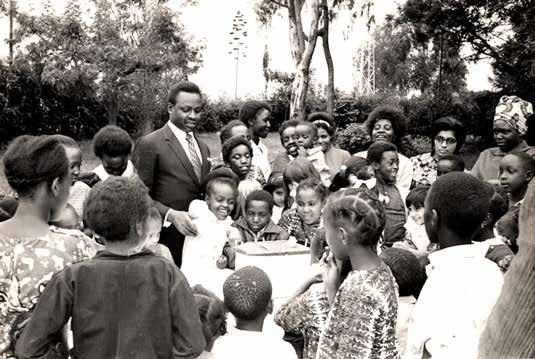
went to the site before heading to the police station. The cops seemed reluctant to head to the site. “We went back to the police station at 2 pm and left for Olosho Oibor in the company of the Ngong District Officer, Sibondo-Oduol, the local Chief Mr Ernest Mbayeyi, a new officer at the station and a corporal, Mr arap Towett,” Kamau quoted ole Tunta in the Nation. The Nation indicated that the inspector searched the body and only found a handkerchief. There were two spent cartridges at the scene. After cops left with the body, ole Tunta was picked up by CID officers on the morning of 4 March and asked to make a statement.
This happened after JM had been reported missing by the family and the public was in uproar. Following the tension, Vice Pesident Moi, under whom the internal security docket fell, ordered that ole Tunta be taken to him. Later Kirinyaga East MP Nahashon Njuno raised the issue of ole Tunta’s safety in parliament when he asked Moi to confirm that, “the person who first saw the body of the late JM Kariuki in the Ngong Hills has also disappeared…It may be regarded as a rumour, but rumours in Kenya sometimes turn out to be true. It all started as a rumour that JM was missing.”
JM’s body was recorded as having been booked at the City Mortuary at 5:20 pm on the same day, after having been left in the Land Rover in Ngong for about two hours. For about ten days, police never told the family that JM’s body had been found and was in the mortuary despite constant queries from his widows. The cops also allegedly lied that they had taken fingerprints of JM for identification. Actually, it was not until his widows identified his body that his fingerprints were taken. At some point there was a scheme to pass on ole Tunta as JM’s killer, he was even moved from one police station to the other.
JM‘s family had reported him as missing after he failed to return home. Swiftly, journalist Victor Riitho, a good friend of the MP who had a nose for news, drove with a colleague to Ngong Police Station. He told KTN News that they saw a report with the words, “A smartly dressed African male body found in Ngong Forest and taken to City Mortuary.” This had been quite considerably cancelled with a marker.
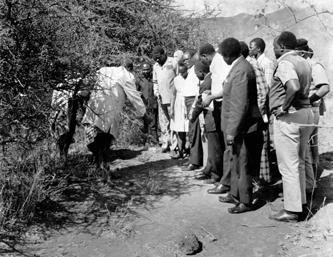
Musaite ole Tunta points to where he found JM Kariuki’s body for the parliamentary committee investigating JM’s disappearance and death.
bombing victims who were in search of their loved one. After searching body after body they did not see JM. Frustrated, Riitho sought his own ways of looking for JM at the mortuary. He whispered to one of the attendants in Gikuyu that he was looking for the body of the man who was brought in from Ngong Forest. The attendant told him that the body in question was in a secluded section of the mortuary.
A journalist then told JM’s wife Terry that he had heard reports that JM had been assassinated. There was also a police constable who went to the Kariuki house off Ngong Road and asked them to check the mortuary again. This constable, who chose to remain anonymous, later told the Parliamentary Select Committee into JM’s death that he had very deep information from Ngong Police Station. Since this constable knew JM, whom he started admiring in Murang’a during public rallies, he decided to ask JM’s wives to check what was going on at the City Mortuary.
The two drove to the mortuary and masqueraded as relatives of one of the OTC Bus
Dorcas had come to Nairobi from Gilgil and phoned up Terry worried about news that JM was missing. These two cowives rushed to the mortuary and begged a manager to allow them in. They found JM’s fully clothed body lying on a table. “My God, they have killed my husband!” Terry cried out. She had apparently gained access to the morgue under the name Mrs Kamau. “I recognised his olive-green jacket and a scarf that I knew. He hadn’t been put in a cold room, in one of those boxes. Something was going on,” Terry told the BBC. To be sure it was JM, she pulled his torn trousers and spotted a familiar birthmark on his right thigh. JM’s first wife, Dorcas, told KTN News, “It was him. He
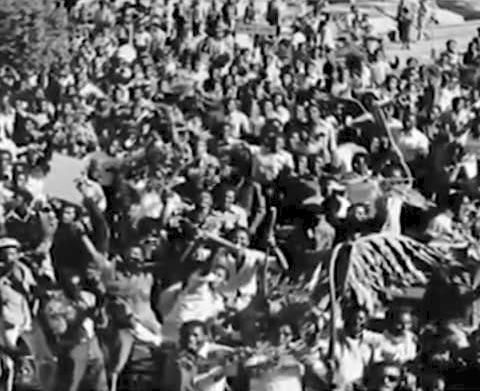
had been hit on the mouth and his scarf was out of place yet still on the neck but it was JM. He was dead!” They did not know who to trust so they hid their emotions and pretended the body was not that of JM.
Another account has it that JM’s second wife, Esther Mwikali, accompanied her two cowives to the mortuary. The wives rushed to parliament where Terry found a minister having coffee and admittedly poured it on his head out of emotion. They then sat in the Speaker’s Gallery from where they heard Moi narrate how JM landed in Tanzania and flew westwards. They let out loud screams and discounted this narrative. “JM is dead! JM is dead! You have killed JM! He is in the mortuary!”
Moi tried to calm MPs, but his voice was drowned with shouts of, “Shut up liar! You’re a government of murderers.”
Moi broke into tears, pulled out a white handkerchief to wipe his eyes and said, “If that is true and I have been misled to tell Kenyans lies, I am very sorry about it. This country is in danger!” Mwithaga remembered Moi making this assertion.
Parliamentary business came to a premature end and a good number of backbenchers accompanied JM’s wives to the City Mortuary to identify their colleague’s body. With all the confusion and fear gripping the House, most ministers drove away from parliament without flags on their cars. At the mortuary the gate was locked and MPs were denied entry and heavily armed police officers now surrounded the place. Kisumu Town MP Grace Onyango identified and confronted the Chief Security Officer of parliament, a Mr Okoth who was
attached to the Special Branch, but was now masquerading as a mortuary attendant. Mr Kibera, a senior superintendent of police in charge of the Nairobi Criminal Investigations Department, CID, now known as DCI, appeared on the scene and upon enquiring from MPs what was going on asked that the gates be opened. The gates remained closed until Kibera finally flashed his card.
Terry recalls seeing workers trying to push JM’s body through a window. “It was like a horror movie. Another 10 minutes and the body would have been gone. People would have told me I was crazy,” the BBC quoted her.
Butere MP Martin Shikuku had a different version of events after they got in the mortuary and surrounded its buildings. After a frantic search they almost gave up but he suggested that they look at this one body that was about to be picked up by a group of what appeared as Luo ‘mourners.’ The body was lying on a stretcher, without shoes on the feet but still wearing socks. “This is JM!” said Shikuku, but some of his colleagues refused to believe that it was him. Terry, JM’s third wife, agreed that it was JM.
“I introduced JM to Hilton Health Centre,” Shikuku later said on K24 TV’s Capital Talk show. “We used to go to the sauna and sit together naked…So I said to them, ‘Open up his trouser and look on his thigh, look for a scar and they found it.’” The scar is one he had obtained from the near-death beating he received from the former army officer called Rochester, at Athi River Rehabilitation Centre.
“He was pitch black. It was as though acid had been poured on his body,” Rubia told Inooro TV. “His face looked very dark as though they had poured something on it,” Terry told the BBC. Later she realized that this may have been acid poured on him so that he would not be identified. One of his legs had a tag labelled, “Unclaimed body of a Luo gangster,” Mwithaga later told KTN News.
“Here’s your husband lying on the table. And somebody says he is unknown. That’s what really tore my heart out,” Terry was quoted by the BBC. Three of his lower incisors were missing. Koigi wa Wamwere wrote that to disguise JM’s features, his body was doused in “sulphuric acid.” His eyes had been gouged out and the body was bullet riddled. His limbs were broken and many believed that his fingers had been chopped off.
Shikuku clarified on K24, “JM was
decomposing. The area around his fingers was swelling. So when the police took his fingerprints, his fingers did not bounce back to their original position. Usually when one is alive, the fingers go back to their usual position.”
However, the fingerprints confirmed that this was JM. Koigi also writes that JM’s penis had been severed and put in the pocket of his coat, stating further that he was almost unrecognisable.
The MPs also noticed a Peugeot 404 station wagon with some women mourning and weeping. It appeared as though they had come for the “Unclaimed body of a Luo gangster.” This mysterious group disappeared immediately.
Meanwhile cabinet minister Dr Kiano and his wife, Jane, went with JM’s widow Dorcas, to the site where his remains were found. They then went to the mortuary and saw JM. He was unrecognizable and appeared to have been tortured before death, remembered Jane. They went to see CID boss Nderi who told them he would investigate the matter and inform them accordingly. Mrs Kiano later recalled that on that day Dr Kiano uncharacteristically used strong language when talking about JM’s murder.
JM’s son Anthony Kariuki, who was six years old at the time, remembered years later, “On his funeral day, I did not recognize him. He had physically changed, being out in the weather condition.” Daughter Rosemary felt the same, “I recognized his hands but not the face, I was so shocked because it did not look like him,” she told KTN News.
JM was identified and officially booked in. The following morning MPs moved, in parliament, to appoint a committee to investigate the disappearance and murder of JM and on 14 March a motion was officially passed to appoint the committee. They invoked the National Assembly Power and Privileges Act so as to give themselves quasi-judicial
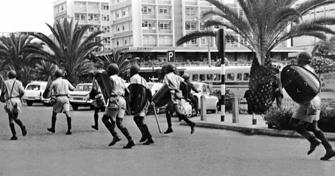
powers as they intended to do a thorough job. Earlier, thoroughly disturbed that his ministers had left parliament in a huff with no flags on their cars, President Kenyattabedridden from gout in Gatundu - called for a cabinet meeting slated for the next morning at State House, Nairobi. He wanted to know whether he still had a cabinet. He addressed each of them, one by one, asking if they were still in the cabinet starting with his Vice President, Moi. Moi affirmed that he was still in but before he could explain any further, Mzee moved on to the next minister and the next until he was done. “I just wanted to know if I still have a cabinet,” he said before leaving. The event lasted five minutes and has gone down as the shortest cabinet meeting in Kenya’s history.
When JM’s death was confirmed, Mzee described his murder as the most cruel.
While appealing for calm he called for anyone with information about the assassination to step forward. This fell on deaf ears as the capital almost went up in flames. Riot police and the GSU engaged University of Nairobi students in running battles as they chanted, “Ooooo why, oh why you shot him down?” and, “A people, united, will never be defeated. A people, united, will never be defeated,” as teargas chocked the air. Kenyatta College (later university) demonstrations on March 15 were characterised by students attempting to deface the university’s sign, so as to remove the president’s name. Three hundred students at Egerton College in Njoro marched the next day against the assassination and were dispersed by riot police. Consequently, these institutions had to be closed indefinitely.
For five years, violent riots accompanied by the relevant commemorative songs became an annual event and on every March 2, students took to the streets to protest JM Kariuki’s brutal killing in what came to be known as “JM Kariuki Day.” According to Branch, an arson attack was attempted at President Kenyatta’s daughter Margaret’s compound in Nairobi and Ben Gethi’s Nyeri home faced a similar attack. Ironically, police were deployed in JM’s Nairobi home as though there to guard the family.
Teresia Wanjiru who served JM and other guests food at the Kanyagia Village harambee a few days before JM’s death said that losing her beloved Member of Parliament was as painful as the loss of a child.
To be continued…
by Neera Kapur-Dromsom
“My father died when I was 26, single and still living at home with my parents and grandmother,” wrote Rasna Warah, a Nairobiborn journalist and activist, “His death occurred on a bright Wednesday morning in a style that was so characteristic of him. He woke up, asked my mother how she was feeling and then just slipped into eternity without a cry or a whimper. He left life the way he handled all events of his life - gently and without complaining! Even though I was well into adulthood, I couldn’t help feeling like an orphan. I could never be as kind and as gentle or forgiving as him! Most of all I was angry at him for dying before having seen me through life’s passages as he had, to some degree for my sisters. He left without even seeing my husband, Gray. The irony is that it was only after he died that I came close to achieving the things that would have made him proud. I fell in love with a man who is (almost) as kind and as gentle as my father.” Gray and Rasna had married secretly in London, at a time when a Kenyan Indian woman freely marrying an African was virtually unheard of.
Rasna’s father Kulwant Singh was a well-
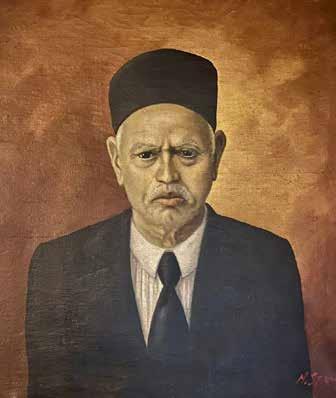
known and respected photographer in Kenya. He owned Studio One located beneath the Kenya Cinema, taking portraits of everyday people as well as elites and politicians, including President Moi. He trained his wife Manjeet Kaur and the couple ran the popular studio together.
After Kulwant died, Rasna was one of the first Indian woman in Nairobi to send her beloved father to the other world. I watched her torch her father, tears rolling down her face. Normally, when a Hindu or Punjabi died, Indian women rarely went to the crematorium. It was thought that they were too fragile emotionally, but Rasna did not blink an eyelid and lit the wood that lay on top of his body. I held Rasna’s hand as she let her father go.
My great grandfather Lala Kirparam Ramchand Wason aged suddenly. The Bangalore topi still clung to his head but the spirit lost its essence. News soon spread that he was bed-ridden. The family took turns to visit, quietly accepting the end that was to come. Dr D’Souza diagnosed it as a stroke and insisted on hospitalization. Lalaji vehemently refused. He went to live in Nyeri with his youngest son Kundanlal. ‘I want to die near you, close to you,” he told him. For many days he lay there convalescing. But bit by bit, his condition deteriorated. He lost weight and grew weaker by the day. At first his limbs became dysfunctional. Then his speech slurred. Finally, he could just move his eyelids. After all the dangers he had overcome in coming to live in Kenya, how could his life have drained away slowly in six months in bed?
His children gathered around him. Kirparam knew that his time had come. A film of tears on his much-wrinkled face, he struggled to say something, but no words came. Only his eyes blinked - just once. The end was at hand. Lala Kirparam Ramchand Wason died that night. It was 15 August 1944. An ocean lost a breath. Finished with happiness, unhappiness and the duality of these. Perhaps, here in the heart of Africa, he had found his arcadia. Independent in matters of mind and spirit, Kirparam had been a pioneer in his own right.
In the Hindu system, when a man draws his last few breaths, he is usually laid on the floor in the lap of Mother Earth. He touches the diya bati, a clay oil lamp immersed in water used to light up his own path of darkness. However, that night no such ceremony illumined Kirparam’s way. The last rights of the anteyeshti samskar were simple. That is perhaps how he may have wanted it. No sacrifices were offered to any Brahmin. He called himself a nastic (agnostic). He believed that work was life. But in the Hindu system, one is a Hindu regardless of one’s belief. It is acceptable. Anteyeshti or antim samskar is one of the most significant sacraments in Hindu beliefs marking the rite of passage of death; death is not viewed as the end of existence but as a transition from the physical body to the spiritual realm. The soul (atman) is believed to be immortal, moving through a cycle of birth, death and rebirth (samsara) until it attains liberation (moksha), its final destination.
Aaliyan such as may have been sung in his native town in India were not conferred upon the mourners in Kenya. He had rejected Hinduism, yet in the end he was cremated according to Hindu rites. Throughout the simple ceremony, his wife Bebe Hardei remained dryeyed. Kirparam’s ashes were immersed in the Tana River that flowed to the Indian Ocean. The Jhelum River in India that had baptized his birth ran into the same ocean. The road that lay behind the Jamia Mosque and the McMillan Library, opposite the Jeevanjee Market, came to be called Kirparam Road. Amongst the two lines of mabati dukas on this road, Kirparam, too, had his operated his business in an ironsheet structure with a wooden floor. After independence, the street would no longer bear his name. No edifice or memorial would be created to tell the story of those 3,000 Indian labourers who died during the construction of the Uganda railway or to remember those like my great grandfather Kirparam who survived and helped build Kenya. There is not even a small plaque to commemorate them.
Rann gai siappe duko rowe aapo apne (When women go for mourning each weeps for her own troubles)
After paying her condolences to the Wason family, soon after Lala Kirparam’s death, my maternal great grandmother Bebe Gurdei washed her face and feet before entering her own house. The assumption that a dead body
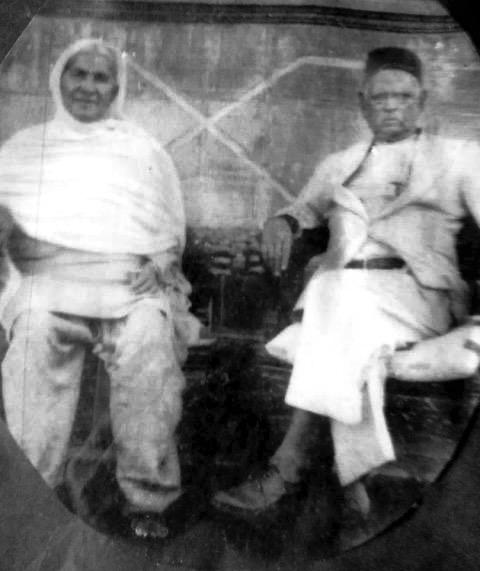
was polluted was part of the culture that Bebe Gurdei grew up with. While alive, the body is your temple, but as soon as the soul flees, a certain taboo is associated with the corpse. Sprinkling of water, a ritual bath of drinking water for purification overcomes this temporary pollution.
Never did she say, “Lalaji has died.” The word death was also taboo. Once she said, “Lalaji has become beloved to God.” Dreaded diseases too were nameless. Neither disclosed nor whispered - cancer, tuberculosis, heart attack, stroke. Such fatal afflictions were best left anonymous. One would have thought that just uttering the name was enough to make it infectious. If her grandsons dared to voice the name of the disease to Bebe Gurdei, she put her hands on both ears to stop the words entering her inner being. She would burst out, pleading with them in panic, “Baas! Stop!” and the debate would end - cut short before it had begun. Death would not be discussed in the house.
A hand lifted Bebe Hardei’s thumb, applied printer’s ink to it and pressed it on paper. The will left behind by Lala Kirparam Ramchand Wason was formalized. Kirparam’s estate and property would be divided amongst his sons and his eldest grandson. As for his wife Bebe Hardei, she got enough maintenance for life; she chose to live independently in
her house in Ngara with five tenants. Hardei was a very determined and proud woman, a businesswoman. She preferred to walk several kilometres under the sun to collect her money, rather than take the bus. She ordered cloth from as far away as Japan and China. Most of her clients were Muslim women. In those days very few women worked to make money.
Lajpat Rai the son of Bebe Gurdei, my other great grandmother, died of cirrhosis of the liver when I was about seven years old. The family started disintegrating. His body, including the bed he was sleeping on, took on the yellow hues of jaundice. The atmosphere at home became bitter. Bebe Gurdei only learnt about the death of her son when they were taking him for the last rites. With her arm around the shoulder of her faithful Kikuyu servant Moilo, she shuffled weakly down the path towards where the body of her son lay covered in a white sheet. Slowly, the women helped her descend the two steps. She would not believe it for a long while. “You are lying,” she kept on insisting. When she finally broke down, a big part of herself died with her son. Soon after Bebe Gurdei became bed-ridden with a bad leg. In her usual stubborn attitude to things new, Bebe Gurdei refused to be admitted to hospital. The leg got worse until finally it became utterly useless. Gangrene had spread inside. Her eyes had clouded, she could not see very well, but her hearing was still good. Faithful Moilo looked after Bebe Gurdei’s needs until the end. Surrounded by her children and greatgrandchildren, Bebe Gurdei died a very lonely woman a year after her son had died.
When my grandfather Hiralal’s first grandson was born to my father Krishanlal and my mother, Hiralal was happy beyond words. The boy had been born at his maternal grandparents’ house in Pangani. Hiralal insisted that Mum return to his home even though the 40-day period of ritual impurity had not ended. Such was the power of having a son. The firstborn son would do the last rites of the anteyeshti samskar and carry the family’s lineage forward. As soon as Papa brought Mum and my brother home, Hiralal bade them wait at the door. The puja thali - with coconut, clay lamp and flowers - was waved around the head of mother and child. A tilak (a red mark on the forehead indicating the third eye) was applied on their foreheads and also on all those present. Oil was poured at
the door before they entered and sweets were offered. At this time, Hiralal insisted that their priest Pandit Laxminarayan Shastri conduct the naming ceremony. Again, oil was poured on the floor and also on all those who were present and sweets were offered.
But Hiralal was not to have the good fortune to share the growing-up years of his grandson. Hiralal died less than two months later in the coastal town of Mombasa in 1954. Hiralal was struck down by a car and closed his eyes to the world, perhaps to be reborn in the endless cycle of karma. The suddenness of Hiralal’s passing stunned everyone. It came without warning or lingering illness. The whole household plunged into sorrow. As soon as his body was brought to Nairobi, they washed it with yoghurt, dressed it in new clothes and placed it on a narrow plank, which was hoisted on the shoulders of the men of the family. Old and young - men and women – covered their heads, wept and beat their chests. “Hai Hai our beloved bauji has left us.” The lamentation lasted for thirteen days.
At the crematorium his body was placed in a rectangular pit for the sacrificial fire and more wood placed over it. Mourners went around
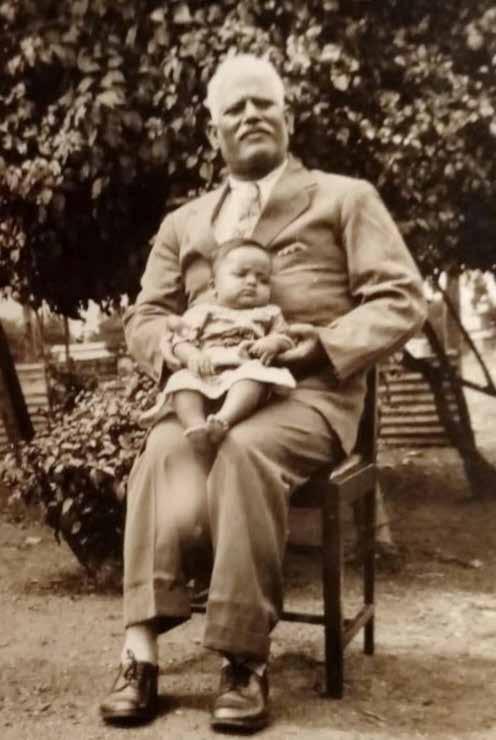
it paying their last respects. As the eldest son, my father Krishanlal lit up his father’s body. The flames rose higher as recitation of the Vedic mantras continued. But Krishanlal could not utter a word; his face was drenched with tears as he bid adieu to his father. As the eldest son, Krishanlal lit up his father’s body and was inconsolable. Ghee mixed with camphor, saffron and other aromatics were mixed and cast into the fire. The body was completely consumed. On the fourth day, his bones were picked out of the ashes and submerged into the Indian Ocean. As in birth, so in death.
The family was considered impure for thirteen days. On the fourteenth day, they donned fresh clothes. In an attempt to establish communion with the dead, Brahmin priests were invited on the fortieth day to conduct the necessary prayers and to partake of lunch. “O ancestor, Pitri deva, please proceed to Vaikunth (heaven) now. Take leave of your family and go. Your family bids you peace.” The priests invoked ancestors long gone, perhaps to be reborn in the endless cycle of karma.
When my Papa Krishanlal was just a very young boy, perhaps seven years old, his grandfather Chunilal passed away. The family gathered at the cremation grounds and took young Krishanlal with them. Seeing his beloved grandfather being torched, he started trembling and was traumatized and fell down. His doctors diagnosed it as epilepsy, a condition that he lived with for the rest of his life.
The Sanskrit word for death, “dehanta” means “the end of body” but not the end of life. The word for cremation in Sanskrit is dehasamskar One of the central tenets of Hindu philosophy is the distinction between a body and a soul. Hindus believe that the body is a temporary vessel for an immortal soul in the mortal realm. When we die, our physical body perishes but our soul lives on.
It’s believed the soul continues its journey of birth, death and rebirth, in perpetuity until a final liberation. This is at the heart of the philosophy of detachment and learning to let go of desires. Cultivating detachment is very important in the Hindu way of life. An ultimate test of detachment is the acceptance of death.
Hindus believe that the soul of the deceased stays attached to its body even after its demise, and by cremating the body, it can be set free. As a final act, a close family member forcefully strikes the burning corpse’s skull with a stick
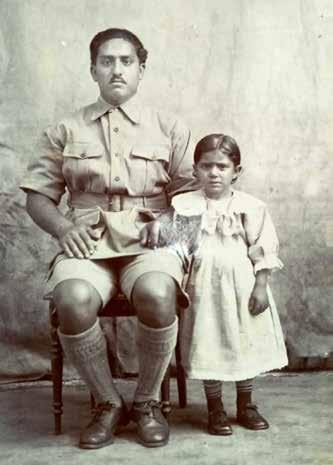
as if to crack it open and release the soul. To fully liberate the soul of its mortal attachments, the ashes and remaining bone fragments of the deceased are then dispersed in a river or ocean, usually at a historically holy place, like the banks of the River Ganges.
Requirements for cremation include ghee, sesame seeds, incense sticks and a white or red piece of cloth for covering the dead body. Ghee quickens the burning and the sesame seeds break the body into pieces. The cremation takes about two-and-a-half hours. The bones are placed in a grinder and crushed into ash and then handed to the family of the deceased in an urn.
During the tumultuous 1980s, Papa’s health started deteriorating. On 27 February 1988, at the age of 57, he passed away in a cold hospital bed in Nairobi. Even though he had a wife and six children, he passed away all alone. It was not a natural death. He had received a blood transfusion tainted with malaria. The direct cause of his death was not his epilepsy, nor the operation conducted upon his broken femur two weeks earlier. On the death certificate, the doctor had written cardio-respiratory arrest, severe malaria.
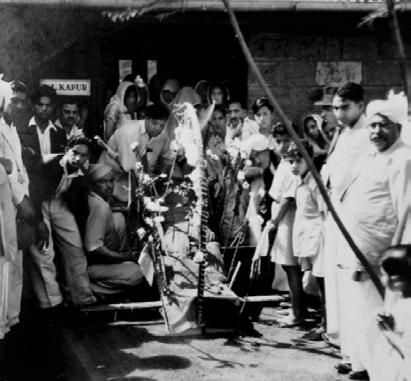
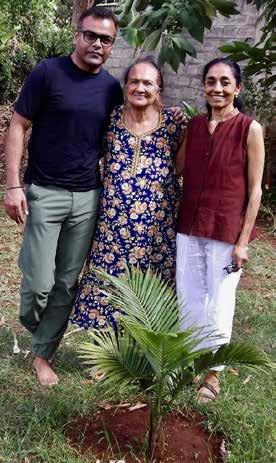
Papa had been telling mum to call me as he was afraid that he might die but Mum insisted that since I was in India learning dance, it was not fair to call me. She was wrong; Papa had seen a golden chariot calling him several days before and kept on telling Mum that his time had come - and it happened.
Papa passed away when I was about 36 years old. I was still single and living with my parents in Nairobi. But at the time that he died, I was in India learning dance. Papa’s brother, who also happened to be in Bombay at the time, came to see me. I was devastated when he broke the news to me. When I arrived at home in Kenya, Mum came out in a white saree; she was composed and kissed the blue lips of her husband Krishan for the last time. Seeing him lying there on the floor in his final shroud - grey and frail - feebly Mum held on to him. She felt the ground open under her feet. She cried her heart out. He lay lifeless. With piteous sobs, Mum clung on to him.
Papa passed away in 1988 and was cremated according to Hindu rites at the crematorium in Kariakor, which was a considerable distance from the residential area and out of view. Papa’s body was placed on a funeral pyre with lots of logs. He had been draped in a white cloth and nothing else - unlike these days where the
corpse is finely dressed. Being the eldest son, my brother, even though he was three years younger than me, lit the torch and the family bade him goodbye. The torch released a flood of memories and his hands started shaking. The images of a loving father and a caring man stood clearly before him. A young handsome man obsessed about theatre and cars and poetry recitals and bhajans and of visiting the radio station each Sunday morning. Here, papa would encourage them to participate in a childrens’ radio programme called “Bhaiya Moorti.” Now, he was gone.
I did not go to the cremation site as I did not want to leave Mum alone. I was well into adulthood but couldn’t help feeling like an orphan. I felt pain. He left without ever meeting my future husband.
At last, mum took hold of herself and folded her hands in front of her chest in a last namaskar, a gesture of respect to the man she had spent 36 years with. My sister and I were near collapse, but we put an iron control over our feelings to embrace and control our mother. We were trembling all over as we struggled with our emotions.
After my father’s cremation, the elders of the community got together to install the heir. A white turban was placed on the head of the
eldest son. Mum got up silently, went to the bathroom and bathed. She emerged in a white saree, bereft of makeup and jewellery. The usual red dot on her forehead was gone; she would apply it no more. Her hair remained unadorned. A sense of poise and calm evoked the moving dignity of the moment and reduced the onlookers to tears.
In death, as in life, papa left an indelible mark. Papa was also a poet of Urdu mushaira, Urdu poetry. When an artist dies, we don’t mourn just the death of an individual but the demise of an entire art form. There are so few truly talented and innovative artists left in the country, the departure of just one leaves a huge void in the artistic sphere. Papa was a creator in so many senses like his father Hiralal. He spoke fluent Urdu and recited verses in Farsi and in Urdu, he acted in theatre and recited plays and poetry on the Vernacular Service of the Voice of Kenya. Papa may be gone, but memories of him continue to inspire and at the same time haunt me.
My brother-in-law Raji Singh Gabriah passed away at the age of 74 on Friday 4 March 2024. He was cremated on 8 March 2024. As per the custom, after the cremation, for four days there was a reading of the Guru Granth Sahib at the Gurudwara. Sikhism does not subscribe to any mourning periods or mourning rituals after the death of a loved one. Starting on the day of death, the bereaved family will carry out a devotional reading of the entire Sri Guru Granth Sahib, the Sikh holy scripture. The sons washed the father’s body thoroughly and dressed him up well. He wore a gold turban and a black costume with a red tie.
After three hours of prayers at the Gurudwara, the body was finally put in an incinerator and the eldest son, as per the custom, pressed the button and let his father go. It was a very emotional moment and the onlookers could barely control their tears, yet there was no wailing. The sounds were held under the breath. It was a calm atmosphere. My sister looked on, shattered. To say farewell, those present placed flower petals on the body before being taken away. The prayers continued for the next four days. Finally, the ashes were immersed in Thika Falls and Raji became a part of the soil from which he had emerged. From dust to dust.
This is not a story about my ancestors and relatives dying, but about how the dying teach us to live. It is about redemption, forgiveness, love, compassion, all rolled into one.
Death is the ultimate equaliser. When your body and your bodily functions are controlled by others - doctors, nurses and machinesthere is no room for false pride or arrogance. When you can no longer do the simplest things - pick up a glass of water, comb your hair, dress yourself, walk or talk, you realize the fact that life is so temporary.
When a loved one dies, traditions and rites and ceremonies are important to help us process the event and the grief we feel. Various cultures and religions all have their explanations for death and man’s innate desire for immortality. Many traditional Africa stories speak of death as unnatural because man was created to live forever. But something has gone wrong. Death rites and rituals have developed in various ways around the world to help us understand what happens when we die. I’ve tried to show how the Indian community in Kenya used their traditions to make sense of death. Watching someone die can teach us the meaning of life and reveal to us the intense resilience of the human spirit.
My brother also recently passed on. Although he was agnostic, he was cremated according to Vedic rites.

byPritpal Sandhu
©Pritpal Singh Sandhu. All rights reserved
1954My
first encounters with speckled mousebirds or kuzumburus (in Swahili) took place very early in my childhood, before I was of school age. At the time, we lived in a government quarter at the base of Musoma Hill in Tanganyika. The quarter was set in a large yard bounded by a five-foot high thick manyara (euphorbia tirucali) hedge. Musoma then was a very small town surrounded by wilderness, resulting in a very rich diversity of birds visiting our yard. Our birds included weaverbirds, sparrows, fire finches, cordon-bleus, crows, go-away birds, starlings, kites, wagtails and many others. I especially remember a gang of gregarious birds which arrived around 9 am most mornings and disported themselves in the manyara hedge. These birds immediately attracted my attention, and I recall spending hours watching them chattering and socializing amongst the interlacing branches of the hedge or eating fruit on the mulberry and jamun trees. What held me spellbound was their unusual appearance and behaviour. They were unlike the other birds; their way of moving in the shrubbery resembled a mouse more than a bird. In fact, the bird had mousy, hair-like brown feathers covering its torso, a crest on the head, a bicolour decurved bill, and a graduated tail made up of stiff feathers that was twice as long as the body of the bird. The most unusual thing about the bird was the way it perched on the upright branches, holding its body vertical and parallel to the branch as opposed to perching horizontally at a right angle to the branch like other birds. Its wide-apart legs splayed out at
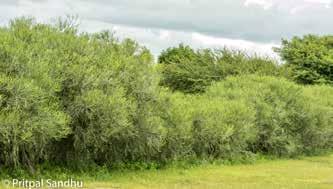
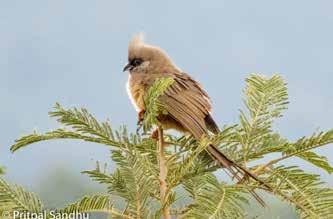
A speckled mousebird, also called a Stone-Eater.
odd angles, allowing it to maintain its vertical posture. The birds were also very dexterous being able to run up and down amongst the branches of the hedge with ease.
The mousebirds were always in a family group ranging anywhere from six to twenty birds making their twittering, almost laughterlike calls. They allowed me as a child to approach to within seven or eight yards, before one would take flight to the next bush, and would soon be followed by others flapping and gliding, while vocalizing their tisk-tisk alarms. There flights were always short-range flights without gaining height from bush to bush, as they were poor flyers and wary of the dozens of black kites that roosted on the hill behind our house, as well as other raptors, which could snatch them out of the air quite suddenly. The birds had a different alarm call for arial-predators - an explosive “Pit” repeated rapidly, while they would give a series of loud, “Shriek” calls when they spotted a terrestrial predator. I once spotted a neighbour’s Siamese cat stalking one of the birds in the manyara hedge; fortunately, the bird detected it just in time, gave a shriek of alarm, and took off followed by the rest of the group.
As we lived in a small town and my parents did not trust the hygiene at the town butcheries, we did not eat meat sold at the sokoni (local market). Besides the chickens that we raised and ate, most of the meat on our dining table was sport-hunted under license by my father, mostly antelope and game birds such as ducks,
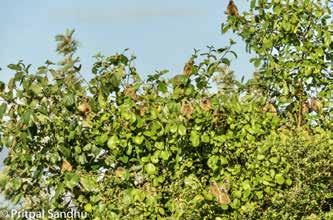
guineafowl, and spurfowl. As I got older, I started accompanying my father on his hunting outings exploring the bush on foot. As a result, my wildlife observation and hunting skills developed quite rapidly.
One day my dad’s clerk presented me with a locally-made catapult, which launched me on a short career as a catapult hunter before graduating to firearms. At that stage as an eight-year-old, my ambition was to succeed at shooting and roasting a mousebird. Along with one of my school friends, we spent many memorable hours seeking out, stalking, and potting at mousebirds all over the town’s hedges and bushes. Even though the birds allowed a close enough approach, there were always many eyes watching; they seemed always in awkward spots in the hedge, so most of our missiles were harmlessly deflected by branches and scared away the birds.
Our skills with the catapult developed gradually until eventually we succeeded in downing a mousebird. I still remember that day, when we gutted and cleaned the bird, lit a small twig fire under an umbrella acacia and roasted the bird, spitting it on a green branch. The two of us shared the small slivers of meat from the bird’s breast. As we got better with the catapult, our ambitions moved away from mousebirds to larger prey such as doves and speckled pigeons. Even though over time, I shot fewer than five mousebirds, they were part of my formative experiences as an aware outdoorsman and fascinated nature observer.
As soon as I became more proficient, I stopped hunting them and spent more and more time observing them with my fascination growing all the time. One of the behaviours that even struck me as a child, was the fact that on most mornings the birds would sit in the
hedge in a vertical pose facing the morning sun, their feathers fluffed, their bellies exposed and projecting towards the sun, with their wings held loosely out of the way; for all the world reminding me of pot-bellied gentlemen with watch chain vests taking in the morning sun. To achieve these postures, the birds have dexterous feet clinging to more than one branchlet at a time.
This behaviour I later learnt was related to an unusual fact. Even though the birds have a varied diet of plant matter such as fruits, berries, buds, leaves, seeds and flower nectar, they are predominantly fruit eaters. Having a low calorie dominantly fruit diet, the birds are always trying to conserve energy. At night a group of them will huddle together to stay warm, and on cold nights can go into a torpor reducing their metabolic rate by as much as 90% like humming birds and nightjars. In the mornings, the sunning behaviour helps bring their body temperature back up to normal. This huddling behaviour also makes them appear as a greater, more intimidating mass, deterring potential predators like arboreal snakes such as the green mamba and terrestrial predators such as the genet and mongoose.
I was captivated by the ability of the birds to
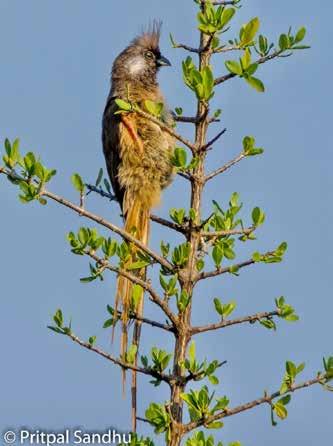

Speckled mousebirds feeding on the bananas at my bird table. Note they go down on their ‘heel.’
scurry along thin branches in the thickets, walk up or down a vertical branch, hang upside down, amongst other manoeuvres. These abilities I found out over time were due to their having unique feet. Unlike most common perching birds, which have three toes facing forward and one backwards, the mousebirds have the ability to move the first and fourth toes both forward or backwards at will, which along with the strong claws and judicious use of their strong decurved beak gives them a secure hold on vertical branches. I have even observed them reaching and pecking at the jamun fruit and wild figs while hanging upside down. Landing and holding on to the bark of vertical tree trunks was child’s play for these birds.
Most recently, I had a chance to observe the birds visiting a bird table that I had put up on the trunk of an acacia tree at a farm in the Ngorongoro Crater highlands of Tanzania. The first few days after I put up the table, no birds visited to peck up the corn. After a few days, I added some fruit, which brought out an immediate response from the birds. The first to arrive were rufous sparrows, to be followed shortly by the Baglafletch weavers, after which the mousebirds, who had been eyeing the fruit from their positions in the farmhouse hedge, overcame their shyness and three of them flew over. One landed on the edge of the bird table, while two of them landed on the vertical trunk of the yellowbark acacia, which housed the bird table. The mousebird on the bird table then approached the banana from one end and went down on its ‘heel’ before starting to peck at the banana. As soon as the Baglafletch weaver left, the two other mousebirds, too, landed on the bird table and started to feed on the bananas, resting on their heels while holding on to the fruit with one or the other of their legs. With
their strong dexterous feet, the birds are able to grab food with their toes and bring it up to their beaks. It appeared to me that even though the birds have very strong feet, their legs are not too strong, and they were quite averse to standing up on their feet. They seem to prefer hanging from their feet.
One day after the sun was well up, I was walking towards the wild fig trees on the farm, when I spotted a pair of mousebirds on the vertical sides of a stack of cement blocks. I put up my binoculars and was given a firsthand look at why the birds are also called stoneeaters. As soon as I had them in my field-ofview, I observed that it was a mother and her fledgling. I noticed the older bird was actually pecking gravel out of the bricks.
As I continued to watch, the reason for the adult bird pecking up gravel was revealed. The adult bird then transferred the gravel into its fledgling’s bill, the huge gape of which was enabled by a supplementary joint in the lower jaw at the base of the skull. While I watched, this procedure was repeated many times. All mousebirds have a gizzard, a muscular organ with a tough protective carbohydrate-proteincomplex kaolin-type lining. The gizzard grinds harder foods with the help of the stones the bird

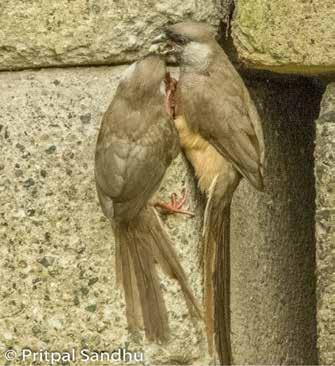
swallows. The bird has the ability to transfer food back and forth between the gizzard and the true stomach until digestion is complete. As mentioned before, mousebirds do not fly high; they prefer vegetational continuity, so that they can take short hop flights from tree to bush-to-bush. This also reduces their exposure to arial-predators like falcons, sparrow hawks and other raptors. Around 10 am one morning at the farm, I was walking towards two wild fig trees laden with fruit and fruit-eating birds, mostly speckled mousebirds and Fischer’s lovebirds. The left fig tree had a high thicket of bushes growing at its base. Some of the mousebirds were flying from one fruit laden tree to the other. As I got closer, I witnessed an unexpected and spectacular sight. Suddenly
ten or more mousebirds fell like noisy hail from the fig tree on my left crashing into the bushes below and scampering away into the dense foliage. They were followed a few moments later by a second hail of birds again falling down to the bush, only this time they were all Fischer’s lovebirds. While all this was happening, a peregrine falcon appeared in a stoop out of the heavens and smashed one of the mousebirds flying between the fig trees in mid-air, grabbing it in its talons before it could fall to the ground and coming out of its steep dive like a fighter jet. It flew to a nearby dead snag, where I observed it dining on the mousebird.
Under those fig trees was a leaky farm faucet, forming a small puddle of water, where I was lucky to observe birds coming to drink. One mid-day I spotted a rufous sparrow drinking from the puddle, which was soon joined by a number of mousebirds who quickly sucked up water and flew off. In contrast to the sparrow, which had to throw back its head to swallow each beak-full, thus taking longer to have its fill, the mousebirds had managed to drink without having to throw their heads back, saving time. This ability allows them to minimize time at a water source where they are very vulnerable to predators.
My recent six-week stay at Lengai Farm in the Ngorongoro Crater highlands refreshed my long acquaintance with the speckled mousebirds and allowed me many opportunities to observe these very social, closely-bonded birds going about their daily lives. I was well entertained in observing them, as there was hardly a dull moment.
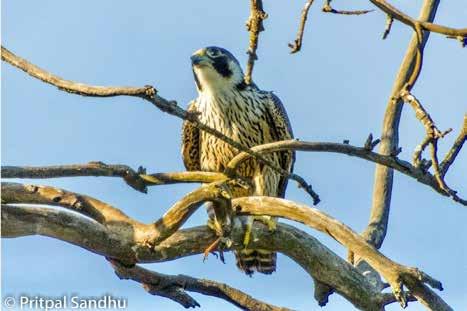
A peregrine falcon with the speckled mousebird it had just killed.

In 1979 I lived with my brother Seamus and Father (Baba) Tom, on a huge cattle ranch called Sukari. Sukari is a Kiswahili word meaning sugar. In the past the farm had grown sugarcane. But by 1979 it was a dairy and beef ranch. Despite being only 25 kilometres from Nairobi, Kenya’s capital, Sukari was still remote in the year 1979. There were still leopards, Maasai giraffe, Maasai ostrich, Burchell’s zebra, hippopotamus, wildebeest, Nile crocodile and even lion. There were rumours of black rhinoceros but I never saw them. I did see leopard, alive, and I did see lion on the farm, though the latter had just been shot dead. Three lions were shot dead one afternoon for killing 21 head of cattle. The ranch belonged to the first President of Kenya
– Mzee Jomo Kenyatta. I was 15 years old.
In 1979 there was still space, serenity and sanctuary on Sukari. Back then I was a lanky, bronzed teenager with straight blonde hair. We lived on Sukari because we couldn’t afford to live closer to the city. My Father was a General Manager in Nairobi, having just been ‘Africanised’ as a Kenya Policeman, and my Mother was still a theatre nurse. Their combined wages weren’t great and were even worse when they lived apart from each other. However, we children wanted to be in the bush, away from the city and the noise, cars and buildings. Away from its ordered gardens and population density. Sukari suited me. I was still too young for the girls, mentally and physically immature. But
by Conrad Thorpe OBE
and comfortable.
Fortunately, we were brought up in a household of sport. Our Father pushed us incessantly to compete and we did. I was already a competitive swimmer and a gifted cross-country runner. Altitude, environment and repetition had played its part. I played rugby and we had boxed as youths too. We wore shorts at home and shorts at school. A decade of childhood swimming and competing, cross-country and rugby, had given us boys form and with it came immense physical freedom and courage
From a young age I had started to catch snakes, initially the non-venomous varieties like Battersby’s green snakes and Cape wolf snakes. Later came the rhombic night adders,
African puff adders, horned vipers, African pythons and cobras. Eventually, I needed to master the maestro of the serpent world; The blacknecked spitting cobra, a fabulous snake that bites and spits venom and is intelligent, fast and aggressive.
On weekends and during school holidays we would roam across the 27,000-acre ranch at Sukari. It was better than any television or cinema - we didn’t have a TV in any case. It was wild, remote, without neighbours. There were no other Europeans on the farm, just us. But there were African labourers who worked there six days a week but were housed locally in the labour-lines all year round. I would cycle to the dairy to pick up the milk with a little rucksack on my back. I loved milk and I still do. And always I would walk, roam and explore the river lines, the planted-eucalyptus forests, the natural savanna, the riverine bush and treelines to the south and east of the farm. It was beautiful and I loved the land, the space and the freedom. I spent long days alone, exploring, venturing, covering many, many miles on foot, carrying my sticks. On my leather belt I wore my older brother Kieran’s bowie knife and always for company our beloved dogs were with us. Kieran had just left home to join the Metropolitan Police.
One day we were walking along the river line, firstly down the Kamiti, a tributary of the Nairobi River. From our home the land sloped gently southeast towards Kilimambogo (Buffalo Mountain) also know by the
Maasai as Oldonyo Sabuk (the big mountain). On my walk I had five, lithe, fit, long-pinktongued dogs with me. Along the river there were many aquatic birds - ibis, herons, kingfishers and waterfowl. There were Cape clawless otters, many species of riverine snakes, Nile monitor lizards and further down there were hippopotamuses. Always, one needed to be careful of Nile crocodiles. Whilst I hadn’t seen them this far upstream, I knew that they existed in the Nairobi River just a few miles to the south of us.
My walk took me down to the Nairobi River many miles from home. I carried neither compass nor map. I had the treeline of the river off to my right to act as a handle for navigation; to my left there were huge electricity pylons. I cut a course for the Nairobi River. Tall and eyecatching giraffe stopped and stared at our little human and canine patrol. The dogs had long since learnt not to chase giraffe. Too big, too fast and too dangerous.
Everything else was fair game. Wildebeest, kongoni, gazelles, duiker, reedbuck and African hares were all irresistible to the dogs. They chased and chased and chased. Their uncoordinated, random and poor targeting often led to failure. But sometimes they succeeded and we had lunched at school on Bohor reedbuck or Thomson’s gazelle caught by our dogs Sooty and Dax and the rest of the team.
As I neared the river line, the grass grew taller and reached above my head, dangerous for snakes. The ground was pitted with holes from the hooves of countless animals and the sun beat down on my head and shoulders. We sought shade and sanctuary by the river. When we came upon the river itself, the bush thickened and a triangular-shaped, redbushbuck darted for cover, vervet monkeys chipped and clucked. We represented the enemy, but we carried nothing but what we needed for self-protection. We were not a real threat, but I was
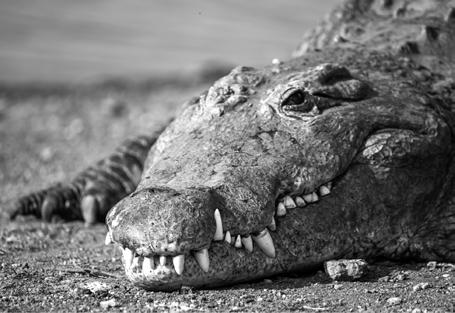
headed to a threat. I knew that along this river there lived a Nile crocodile of huge size, blackened by thousands of sunny days. I had seen him and I knew his form. My years of growing up in Kenya had given me a seriously healthy respect for crocodiles. So many people had been taken, Africans by the score and Europeans too. Almost all for underestimating this primeval and supreme killing machine. I was very alert and especially fearful of these huge African crocodiles.
Along this stretch of the river, the tempo and character of the flow slowed and the trees and their branches reached out over the water, creating a natural archway and tunnel of vegetation above the river itself. The course was straight and the water was quiet and deep, swollen and silent. And the river housed a huge reptile; a beast of an animal who by some strange twist of fate had lost about one third of his tail. His scales and the linear ridges on his back were burnt black by the equatorial sun, showing his age. These
large, old crocodiles become more dragon-like, with time. Their white, dirk-like canines and speckled jaws are not immediately indicative of the animal with the most powerful bite on earth.
On that day in 1979, I was looking for the crocodile on the only stretch of river where I had ever seen it. As a family, we had witnessed the animal lying on the sandy banks of the river, basking in the hot equatorial sun. His shortened tail and size were his signature. But on this day, he wasn’t to be seen. I walked down the north bank of the river; the dogs followed me. The trees and the bush shielded us from the sun now. I was alert to other big game too, but by then there weren’t any Cape buffalo or black rhino in the area.
There was a spot where the river ran very straight and true, its dark waters swirled and the birds and wildlife seemed not to sing or play. It was an ominous stretch of water. My senses were heightened. The dogs followed me and a few ranged ahead. I dipped my
head under bushes and lifted the acacia-thorned branches aside, carefully. There, near a shady spot on the north bank was a large yellow fever tree which had fallen perfectly across the river from one bank to the other. It was the ideal spot from which I could survey the river. The river here was about 20 yards across. Perhaps I would see the huge crocodile. I instructed the dogs to ‘stay’ and to ‘lie down’ and they did. Leaving my sticks with the dogs, I walked out along the yellow bole of the tree, until I got to the middle of the river. There I stopped and, holding a bough for support, I looked upstream and downstream. I searched the banks; my eyes scoured the water. I looked for the slightest betrayal of the mighty reptile’s form, a change of colour, a shape or shadow. I looked for movement in the water or unnatural eddies. But there was nothing. It was eerily silent, ominous. The water gave off almost no sound. It was almost impossible to see more than a few inches into the water as
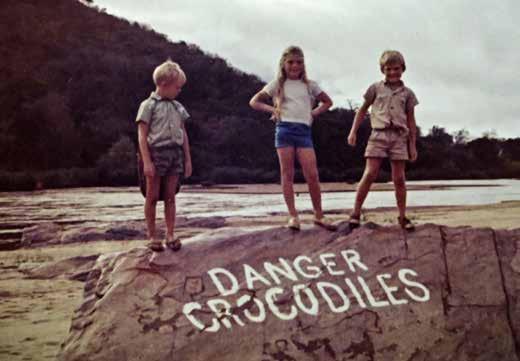
it was so laden with silt and mud. You could hide a car in here or a crocodile and you wouldn’t know.
I cast my eyes back to the bank where the dogs were lying on the ground, their pink tongues lolling out of their mouths. They waited and I waited. Eventually, for comfort, I decided to sit down and bestride the tree. I was facing east; my back to the dogs. My bare, skinny legs and my ng’inyirasandaled feet hanging down, just a few inches above the river. (Ng’inyira are Kikuyu rubber-tyre shoes.) The water moved surprisingly fast at this point. However, I felt as if I was being hunted or stalked. I could feel something. I looked downstream and I looked upstream. Nothing. But I couldn’t shake off this frisson, a sense, an electric tingle, my gut feeling, my exposure? I could feel it and then I saw it. This huge dark shape was coming up right by my feet, getting darker and more threatening in form and latent fury. I was immediately seized with fear. I used my hands to push myself up. Just as my sandalled feet were on the bole of the yellow tree, the enormous, pre-historic, man-eating reptile surfaced immediately next to me, just three or four feet away. Right where my legs had been hanging. Its eyelids moved across its lime-green eyeball in a most unusual manner, which I had never seen before, because I had never been this close to a crocodile. The crocodile held its position against the flow of the river, all the while looking directly at me. I felt primeval fear. My sixth sense had saved
my life. I realised how close I had come to being ‘taken’ by this huge crocodile, many miles from home and with only my dogs as witnesses. Fear hit me in a rush, like a wave it engulfed me. I needed to get away from the animal. I had come so dangerously close to being taken. Had I been taken, then what? The dogs may have drifted back home over the miles; maybe some would have stayed loyal and waited, but I would not have survived the attack, not against that prehistoric beast, not against this consummate killer. No way, never.
Sitting down on the bole of the tree over the river nearly cost me my life. My curiosity to see the beast in the river nearly killed me. My sixth sense unquestionably saved me that day. I lived on that day, but I felt my near-miss might have been revenge for our taunting and testing of some other crocodiles in another situation and in a large, natural rock-pool, not far from this part of the river. It was something I did with Seamus, my younger brother, just a year earlier.
We had played ‘chicken’ with crocodiles on the ranch, creeping up as they sunbathed on rocks out of the water. We carefully removed our shorts, our t-shirts and local car-tyre-sandals. Silently, we sneaked up to the edge of the crocodile pools and then racing, we ran and launched, naked from the house-sized rocks and covered the watergap like crazed-fools. This was before these primordial reptiles established whether we were friend or foe. We were quick and they were
startled. We weren’t stupid, though we were foolhardy. What I learned firsthand after my close call with death this day, was the clinical excellence that Nile crocodiles apply to their hunting. They are aquatic experts and conditioned to hunt, to stalk and to kill in a medium which they have come to dominate – the rivers, swamps, dams and lakes of Africa. Never, ever, take anything for granted near water. These huge reptiles are incredible killing machines of scales, teeth, eyelids, power, motion-sensors and muscle, capable of breathholding, submerging, diving, swimming and stalking; and they have the most powerful bite of any animal on earth. On that day I was filled with primeval fear and I have never forgotten the dangerous capability of these animals. I later learned a little bit more about their morphology. A crocodile has three eyelids. One of the eyelids operates from the lower orbit and another from the upper. Finally, crocodiles have one more eyelid that acts as protection and inbuilt goggles, once they go underwater. It was this eyelid that I recall so vividly, when the beast surfaced next to me, and its eyelids parted. Had I not seen the reptile’s eyelids up close that day, then I would never have been so curious as to look them up.
It is worth noting that an estimated 1,000 people are killed every year by crocodiles across the world. The vast majority are in Africa. I’m thankful I didn’t become a statistic!
by Ken de P Beaton
The Nairobi National Park began in 1946. Ken de P Beaton, the first warden, published a weekly diary in the East African Standard newspaper in 1949, later published as two books. Ken’s son Ron recently shared those books with Old Africa. His diary entries give a flavour of what the park was like in its early days.
1949 March 26, As car meets car, when cruising through the park, one hears the same question asked, “Have you seen anything?” If lion have not been on view on that particular afternoon, the reply is invariably, “Not a thing.”
The occupants of each car have certainly seen a host of various wild game and birds. But lion seem to be the only interest to the majority of visitors. I think I should stuff a lion, or cage one and put it near the entrance. It would save people a lot of time and also decrease the wear and tear of speeding cars to the earth tracks of the park.
During the past week the lion fans must have been well satisfied, for lion have been on view daily either at Lone Tree, the Kisembi Valley or Kingfisher gorge. The pride of lioness with the ten little cubs are certainly worth watching.
These little fellows, now fourteen weeks old, look just like woolly teddy bears. They are becoming very inquisitive. Much has to be learnt and practised. Stalking, attack, and use of cover, all are tried out on each other, and then, when work becomes boring, a gambol, or a good rough and tumble is thoroughly enjoyed.
Meanwhile mama looks on indulgently. Great affection for each other is shown by lion and even the aunts take as much interest in the cubs as the mothers. These cubs, consisting of three different families, are all of the same age within a day or so, and I doubt if the respective mothers now know which cubs are their own.
The youngsters accompany the adults on the night’s hunting now. At dawn the mothers can be seen carrying back to cover the remains of the nocturnal feast to satisfy the family appetite, which has begun to exceed the milk supply.
The rains appear to have set in and the whole park is fresh and green. It has given new life to everything after the long and hot dry spell. The birds are selecting nesting sites and the guinea-fowl are beginning to pair off. Antelope and gazelle can be seen racing and jumping. Spring is in the air.
In the forest many of the trees are in bloom
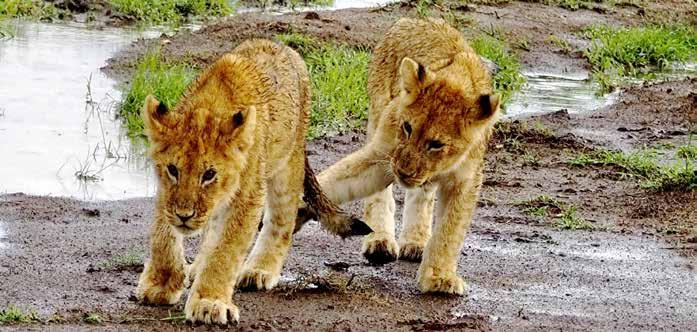
and a variety of wild flowers are beginning to blossom. I am no botanist and merely delight in looking at them. The crotons are in full bloom with their long, pale-yellow pendants of flowers. They, and the pink Cape-chestnuts, break the dark green of the forest with splashes of colour.
The wild bees are gathering the harvest of honey and the hum of these busy workers is loud round the flowering trees. There is a lovely red flower growing in bunches, on the ground, in the forest glades. Seen in the distance they look like fire-balls, but on closer inspection consist of clusters of delicately shaped trumpets.
The roads in the park are only dry weather tracks. Visitors would be well advised to exercise the greatest caution in leaving the one main road after rain. When the tracks are bad I erect notices closing them. It is often impossible to get these notices out to all the tracks in time. And even after a notice is erected it is ignored, and cars drive through. In such cases not only is much damage done to the tracks, but there is a grave risk of getting bogged and spending the night in the
park. There is nothing pleasant in spending a long night cramped in a motor car, with the possibility of a lion prowling round, making the stretching of one’s legs a risky procedure. People have found themselves in this predicament in the past. I have found them at dawn, and they looked a sorry sight.
Lions at Athi river killed a cow belonging to a settler this week. There is no excuse for this as they have plenty of food. Fortunately, these lapses are few and far between. We are unable to procure fencing wire with which to erect barriers between the park and private land, at these vulnerable points. We are lucky in having many adjoining landholders who tolerate these occasional losses to assist in the cause of game preservation.
By Margaret Collyer
Reviewed by Old Africa
Margaret Collyer, a gifted painter who studied at the London Royal Academy of Art in London, left England in 1915 to join her sister Olive in Kenya. Margaret wrote her story of settling in Kenya and it was published in 1935 without illustrations. Many years later Margaret’s grand nieces, Veronica Bellers and Susan Duke, revised the book and added illustrations –examples of Margaret’s artwork in beautiful colour, as well as many photos. Old Africa received a copy while recovering in hospital in London. It had been sent from Sarah Carnelley, who purchased the book directly from Veronica Bellers. Reading the book in hospital was a breath of fresh air and it felt like opening a door to the past.
her hospital work. But after arriving in Kenya, Margaret stayed on, helping her sister with her farm and a horse-breeding establishment.
She wrote about a trip in a horse-drawn Cape cart to get supplies at Kikuyu, “the nearest place where you could buy anything. Kikuyu is about six miles from Kabete and there was no particular road, only a very rough wagon track…With only one or two narrow squeaks we reached our destination in safety and loaded up the cart at the Indian duka…Just out of Kikuyu the track used to run alongside the railway line and about a mile towards home there was a large pit-like place where they had dug out all the earth for the railway embankment. The road lay close to this precipitous little crater and there was an extra steep downhill pitch for some distance before we came to it and for some way beyond.
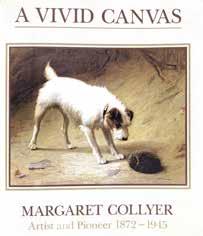
The book starts with Margaret’s childhood in the English countryside surrounded by the animals she loved – especially horses and dogs. She studied art in London and went on to live there for almost 20 years. Even in London, she loved animals, relating a story of a fox that she adopted and partially tamed. When the fox escaped Margaret had a wild adventure chasing the fox down Fulham Road and getting him back before someone hurt the bewildered creature.
During World War I Margaret worked as a nurse at the Allied Hospital in France. But in 1915 her youngest sister Olive, who had started a farm in Kabete in Kenya, sent Margaret a letter inviting her to come join her in Kenya. She managed to get a berth on a cargo ship and bought a return ticket, planning to return to
“The horses, now having their heads towards home and feeling the cart swinging easily after them down the declivity were getting out of hand as we neared the dangerous spot. In my haste to steady them I forgot about the Cape cart pranks and stepped on the footbrake as hard as I could.
“The wheels were now practically locked, so up went that horrible pole as high as the blinkers. This so alarmed the young horse that he began pulling to the right, edging towards the precipice…
“The offside wheel was already just over the edge when I realized what would happen if they bolted down that awful place sideways… Letting go of the brake I jammed both my feet hard against the footboard and, getting the strongest pull I could on the offside rein, I swung both horses round, head on to the pit… Over they went with leaps and bounds straight to the bottom where they landed in thick bush which checked all further progress.
“At the first wild leap over the edge out
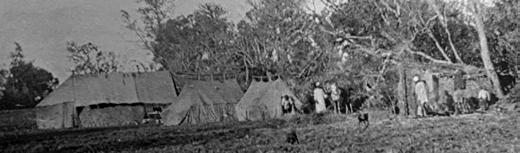

went the syce. Then the stores and cushions flew in all directions. I had my feet well forward and managed to remain until the final mighty bump as we hit the bottom when I was catapulted clean over the splashboard and landed between the horses and the pole. The only thing that remained on board was the old fat spaniel.”
In January 1918 Margaret and Olive went to see some property Olive had purchased near Gilgil. The plan was for Margaret to develop this new farm while Olive carried on at Kabete. They bought 30 cows at a sale at Naivasha and bought some young unbroken oxen to pull their wagon. Sending some of their workers with the wagon and instructions to pick up the cows in Naivasha, Margaret and Olive took the train to Gilgil.
They struggled to get the oxen to pull the wagon, but eventually they arrived at the farm in Ol’Kalao below Kipipiri. Margaret’s first view was not encouraging. She wrote: “In every direction the place was black and smoking. The beautiful tall herbage that had so enraptured my sister had now been reduced to ashes from unchecked veldt fires, desecrating the whole country in their windswept flight. We were appalled. Many hundreds of square miles of black, black blackness. Ridge upon ridge of great rolling downland with scarcely a bite of grass to be seen. Twenty miles due east loomed the Aberdare mountain range where the dense cedar forests flickered fire and belched smoke
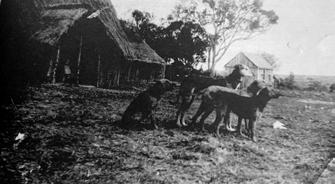
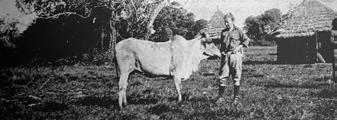
that veiled the summits and intermingled with pearly clouds of distant sky.
“Thus my future home deigned to greet me and the gods of wilderness and wild bid me welcome, admitting a demon desolation to the soul and wringing all remaining courage from my sinking heart.”
Olive prepared to return to Kabete. Margaret wrote: “I had terrible qualms and weakly asked what I was supposed to do next. Her reply was a stimulating tonic. Utter scorn both rang in her voice and looked out of her eyes.
“‘Do next? Why, you build a house, of course. There are plenty of trees about. You’ve got a saw, wedges and a hammer; what more do you want?’
“It was on the tip of my tongue to say, ‘But I’ve never built a house. I don’t know how to fell a tree.’ But sheer pride forbade the utterance of such words to so indomitable a being. Instead I wished her a cheery goodbye and a safe journey back.”
Margaret went on to build her house, learning to fell trees and carving out cedar pegs as she had no nails. Her first house had a packed mud floor. She named her farm Chatu Farm (chatu being Swahili for python) after rescuing her dog Prickles from the mouth of large python in a tug of war that Margaret described as “a terrific fight.”
Margaret’s first house burnt down in 1927, but she built a second house which she described as “airy, comfortable and pretty.”
Margaret farmed and painted in Ol’Kalao and her book describes the struggle as well as painting word pictures of the landscape with almost as much beauty as her paintings. This book captures the pioneering spirit of many of Kenya’s early white settlers. Margaret Collyer’s grand nieces have done an excellent job in preserving Margaret’s story from 1935, while at the same time illustrating her life with many of Margaret’s paintings and photographs.
Published by Librario Publishing Ltd, 2008, paperback, 367 pages. If you would like to buy a copy please contact: veronicabellers@ gmail.com Paper Copies: £17.50 plus postage. Audio: They are about to be able to offer an audio version on a memory stick. This is likely to cost £12.00 plus postage.
History Quiz Competition #87!
Win two nights for two at Satao Camp!
How closely did you read this issue of Old Africa? Answer the ten questions in our history quiz below and you have a chance to win a vacation at Satao Camp. All the answers are found in this issue of Old Africa. You don’t have to cut up your magazine. Just write the correct answers on a separate sheet of paper and send your entry along with your name and address and phone number to: History Quiz, Old Africa, PO Box 2338, Naivasha, Kenya 20117. Or you can email your list of answers to editorial@oldafricamagazine. com The winner will be randomly chosen from all the correct entries received by the contest deadline, which is 10th March 2026
1. Who was behind the building of the first bridge over Mtwapa Creek?
2. In what year was the book Among the Elephants first published?
3. Name the District Commissioner who adopted an orphan elephant in the NFD.
Old Africa reader Andrew Mules from Naivasha is the winner of our History Quiz 86, which appeared in Old Africa issue 122 (December 2025 – January 2026). By the contest deadline we received 11 entries. All 11 names were put into the Old Africa pith helmet and swirled around. Andrew’s name was chosen out of the hat and he wins two nights for two at Satao Camp. If you didn’t win this time, have a go at Quiz 87, which follows below. This month’s History Quiz Contest is sponsored once again by Satao Camp and Old Africa is thankful for their support and willingness to sponsor this page.
4. Who asked, “Where’s mine?” after IQ Chopra presented Princess Elizabeth with a pink diamond?
5. What kind of birds are sometimes called stone-eaters?
6. Who reported to the police that he had found a dead body, which later turned out to be the missing JM Kariuki?
7. Who opened his surgery on Kilindini Road in Mombasa in the late 1940s?
8. What year did Gustav Fischer make his expedition across Tanganyika and into what would later be called Kenya?
9. What did Margaret Collyer call her farm in Ol’Kalou?
10. Why do men have hairy chests?

Wake up to the sight of elephants at our waterhole, unwind in spacious tents, and immerse yourself in the beauty of Tsavo East National Park. Located in one of Kenya’s largest and most iconic parks, Satao Camp offers:
Unbeatable Wildlife Viewing: Spot elephants, impala, lions, and more right from your veranda or observe from the camp watchtower.
Authentic Tented Comfort: Relax in beautifully designed en-suite tents that blend comfort with the charm of the wild.

Stunning Landscapes: Explore vast savannahs with iconic amber sands and the untouched beauty of Tsavo East.
Book your adventure today

In Old Africa wisdom from the elders was often passed on to the next generation through stories told around the fire in the evenings. There is a wealth of oral tradition and this column will collect the best of these stories. If you have a favourite folk tale that you would like to see published in Old Africa, send your contribution to: editorial@oldafricamagazine. com
After making the other creatures that walked and crawled and flew and swam on the earth, the Creator decided to make a man. Taking wet clay from beside a river, the Creator formed the man with two legs, two arms and shoulders and a large head. He smoothed his creation and left the man on the riverbank to dry before coming back to breathe life into his nostrils.
Soon a baboon came down to the river to drink. Fearful of the crocodiles that swam in the river with their wicked toothy jaws, the baboon sat down to scout out the river. Without realizing it, the baboon sat down upon the chest of the drying man.
The baboon soon saw some bubbles in the river. Suddenly, a hippo surfaced from below the bubbles and gave a loud wheeze-honk.
The baboon laughed, but he still didn’t trust the water. It was murky and muddy and there could be a crocodile just waiting to eat him.
So the baboon continued to wait as the hot African sun burned down. The clay man beneath the baboon dried in the sun and the wet clay began to contract and become firm and hard.
Two African black ducks swam past and the baboon watched, wondering if the crocodiles would lash out at the plump birds. But the ducks passed by in safety.
An impala came down to the river and, after a quick look around, it buried its shiny black nose into the water and drank. The baboon cringed, expecting the impala to be snatched by a lurking croc. But the impala drank its fill before scampering away from the danger zone.
Finally, after several hours of waiting, the baboon decided there were no crocodiles in this bend of the river. He started to stand up so he could walk down to the river and get a drink. But as he tried to stand up, he found that the clay man he’d been sitting on had dried and the hair on the baboon’s bottom had become firmly imbedded in the clay man. The baboon made a second attempt to stand up, but he found he was completely stuck.
Now very thirsty and desperate for a drink, the baboon made one last effort, using all its strength. As the baboon launched himself to his feet, he felt great pain in his rear end and he heard a loud ripping, tearing sound. He reached back and felt his bottom and found he had no hair left. He looked at the clay man and saw his hair stuck into the man’s chest. And that explains why baboons have no hair on their bottoms. And ever since that day men have had hair on their chests!
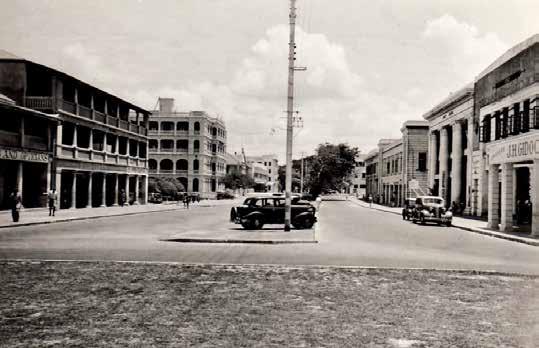
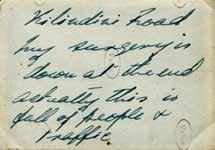
Jarat Chopra is the winner of our Historic Photo Contest for issue 123 of Old Africa with this photo of Kilindini Road in Mombasa taken by Jarat’s father, Dr Arjan Chopra. Jarat wins a book prize from Old Africa. Here is what Jarat has to say regarding this photo:
I write with reference to the Historic Photo Contest of Old Africa issue No. 122, depicting the interior of the Nelson establishment on Kilindini Road in Mombasa. It may be of interest for readers to take a step outside to see what Kilindini Road looked like at the end of the 1940s in the picture I have provided.
My father, Arjan Chopra, after spending the war years in England completing his medical studies at Queens’ College, Cambridge, and St Bartholemew’s Hospital, London, finally qualified as a doctor in 1947. Although his parents had been in Mwanza, Tanganyika, since 1928, Arjan had been born and schooled in India, and he fully intended to return to the family’s ancestral home in Gujranwala, Punjab. But the Partition of India in that same year prevented this. His grandmother, Malan Chopra, was abruptly relocated from Gujranwala to Mombasa, where her daughter (and Arjan’s aunt), Vidya Vati Sondhi, was living with her family. Being close to both individuals, Arjan also relocated to Mombasa, and there began his medical career.
He opened a surgery on Kilindini Road. On the back of the photograph, written in the same hand and ink of his student notebooks, is the caption: “Kilindini Road / My surgery is down at the end / Actually this is full of people and traffic.” He would maintain this surgery until the end of the 1950s, before moving on to Mwanza and later Arusha.
Old family albums hold many treasures. Enter one of your photos in our Historic Photo Contest and win a free book from Old Africa! And have the pleasure of sharing your photo with Old Africa readers around the world.
If your photo is chosen as a winner in our Historic Photo Contest, you will win a free book from Old Africa
The best way to send a photo to Old Africa is to have it scanned as a jpeg file of 300 dpi resolution and email it to us at: editorial@oldafricamagazine.com Note on your email that you want this photo entered in our Historic Photo Contest.
If you don’t have access to a scanner or to email, you can mail your photo or photos to us at: Old Africa, PO Box 2338, Naivasha, Kenya 20117.
Win a Ksh 3000/- gift certificate from Text Book Centre by identifying the location of this old road signpost pointing towards Thomson’s Falls, only 26 miles (not kilometres!) away. Win a Ksh 3000/- gift certificate from Text Book Centre by telling us where this signpost is located. It’s still standing. The photo was taken by an Old Africa reader in October 2025. If you know where this signpost is located or if you have any personal stories from visiting this mystery location, send in your answer to Old Africa for a chance to win our History Mystery Contest.
Contest Deadline: For this prize we have to receive your entry by 4 March 2026.
Send your answer to this History Mystery Contest along with any information, history, memories or stories about this cross to: History Mystery Contest, Old Africa Magazine, PO Box 2338, Naivasha, Kenya 20117. Or email your answer to: editorial@ oldafricamagazine.com. Editors will choose the winning entry. The answer to our mystery contest will be announced in our next issue along with the name of the winner and his or her story about our mystery location. Family members of Old Africa staff members are ineligible to enter this contest.
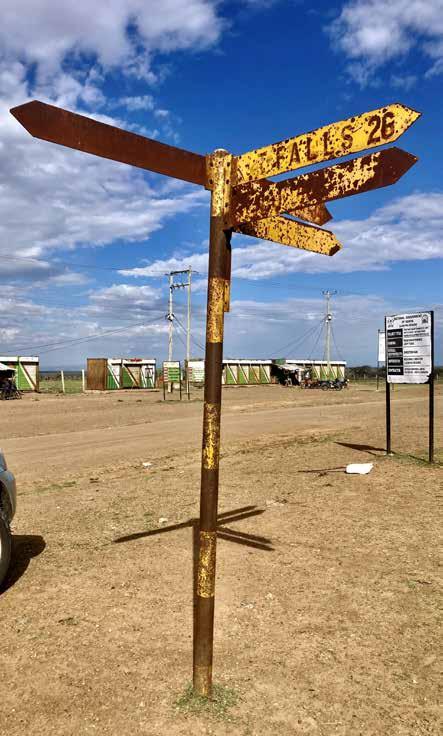
Our History Mystery Contest is sponsored by Text Book Centre.
…much more than a Bookshop!
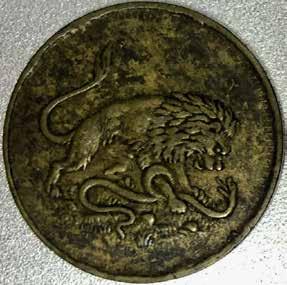

Brass trading tokens issued by the Società Coloniale Italiana in Entebbe in about 1905.
We did not receive any correct answers to our History Mystery Contest by the time of the contest deadline. We asked John Saul, who had sent us the photos of the token, to give us details. Here’s what he shared.
The Società Coloniale Italiana Entebbe brass token (or medal) was issued by the Italian Colonial Society around 1905 in Entebbe, Uganda, which was an important trading hub in the expanding British Empire. It featured a lion attacking a snake on one side of the token, symbolizing Italian colonial presence and commerce in East Africa. The tokens were used by the society to facilitate trade and support young Italians abroad.
The Società Coloniale Italiana (Italian Colonial Society) was an organization formed in the late 19th century to help Italian graduates find opportunities in foreign markets. They also supported Italian commercial expansion and they provided tokens, like the Entebbe token pictured in our mystery contest, for use in Italian trading posts and colonies. This represented a tangible aspect of early Italian colonial ventures in Africa.
The Società Coloniale Italiana continued to operate in East Africa, owning property in Kilindini, Mombasa, which was confiscated at the start of World War II under the “Trading with the Enemy Ordinance” of 1939.
These brass tokens are highly sought after by collectors due to their rarity and historical significance as artefacts of Italian colonialism in East Africa.
John Saul also noted that he would be willing to sell his Entebbe token to any Old Africa reader who might be a collector in search of this rare coin. Contact Old Africa at editorial@ oldafricamagazine.com if you are interested in this token and we can put you in touch with John Saul.
Ten years ago Old Africa reader Muhaimin Khamisa purchased some old photographic prints at an estate sale in Mombasa. At least some of the photos were the work of a long-ago Mombasa photo studio from the early 1900s. We have chosen ten of those photos for our Photo Album this issue. It’s interesting to note how most people posed very seriously for their portrait-taking session with the photographer. It’s also clear that headwear was the key to a good photo! And it was mostly men who had their photos taken! Only one photo shows a child, who is out of focus, showing how hard it was to keep children still long enough for the old camera to shoot one exposure. As you look at these photos, imagine the streets of old Mombasa 120 years ago when the people featured in this gallery primped and prepared for their portrait to be taken. Thanks to Muhaimin Khamisa for sharing these images with Old Africa
1: This man is sporting a moustache and displaying his watch for all to see.
2: Two young men, each wearing a fez, pose in front of a backdrop showing palm trees. The child on the chair obviously fidgeted while the photo was being exposed.
3: This man, wearing a simple white turban, also has a heavy khaki shirt, possibly showing his occupation as a porter.
4: A young man looks at the camera with a serious, passport-style frown, while sporting a well-worn fez.
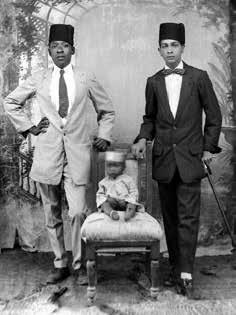
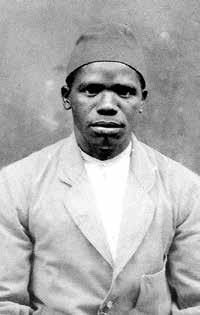

1
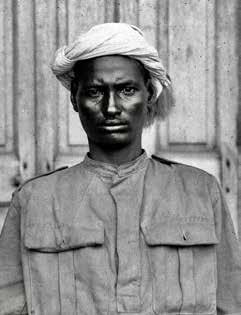
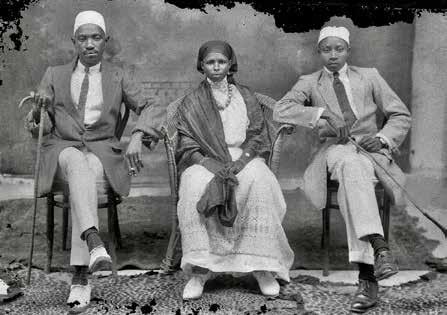
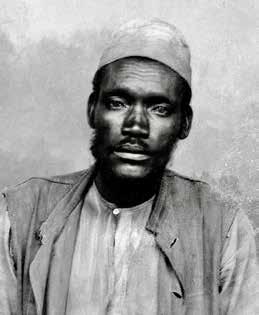
5: Two dapper men with canes and neckties along with the traditional Swahili kofia or prayer cap, have their portrait taken alongside a young woman displaying her jewellery.
6: This man has a pensive look on his face as he sits in front of the camera. He wears his kofia and his vest looks a bit tattered.
7: This man is wearing a kikoi cloth as his turban, and he also clearly displays his prayer beads in his front pocket, used for praying his dua or supplication prayers.
8: Placing his hands in front of him, this beturbaned man also carries his prayer beads in his front jacket pocket.
9: This man poses in front of a wooden door. In his front pocket are both prayer beads and a small book, possibly a Koran.
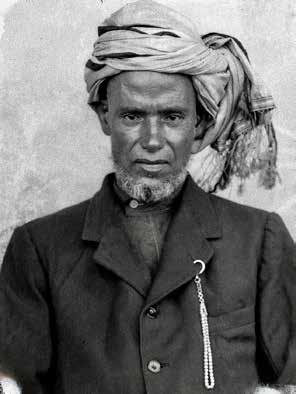
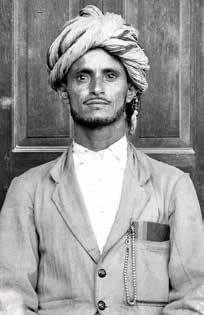
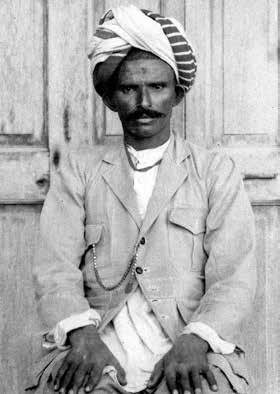
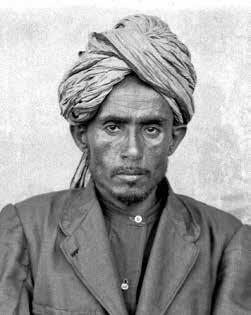
1942-2025
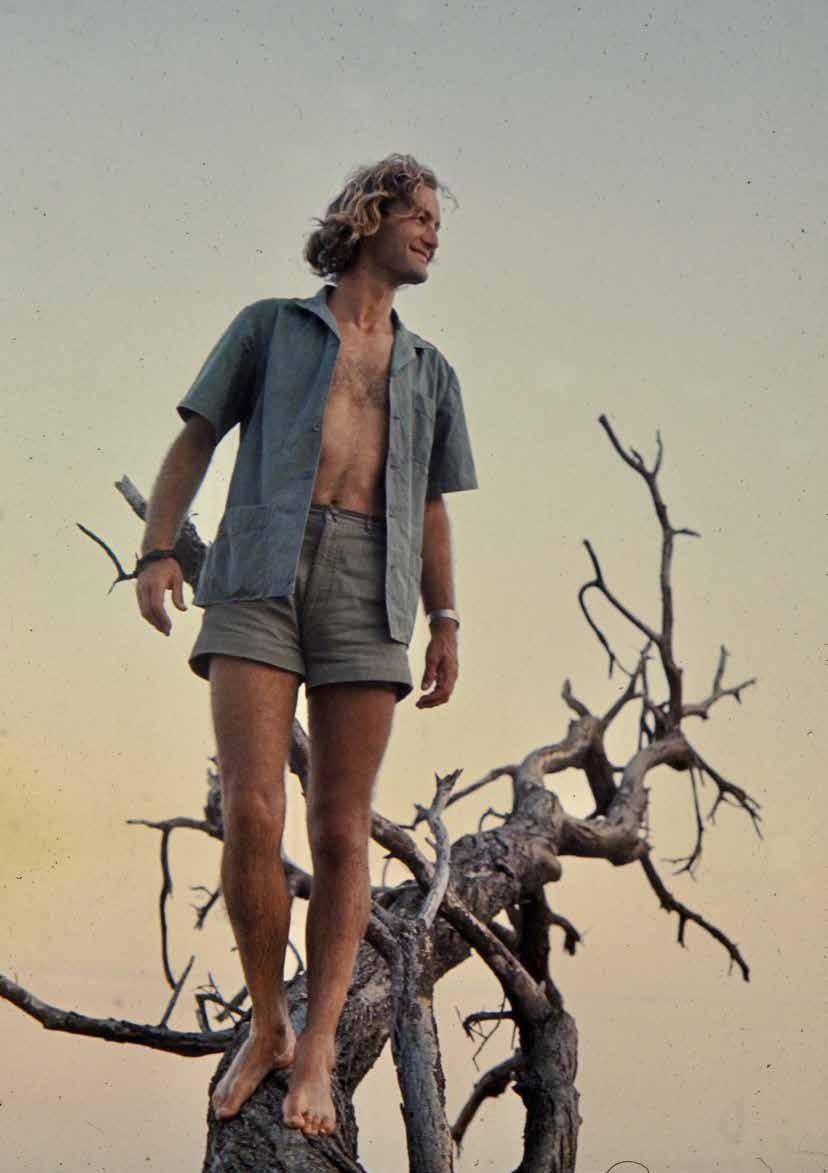
DrIain Douglas-Hamilton, renowned
Scottish zoologist and founder and president of Save the Elephants, passed away on 9 December 2025 in Nairobi at age 83.
A pioneering force in elephant conservation, Iain revolutionised our understanding of African elephants through his groundbreaking research. Iain started the first in-depth scientific study of elephant social behaviour in Tanzania’s Lake Manyara National Park in the 1960s. His work paved the way for much of today’s understanding of elephants and current conservation practices. When the herds he knew so well started getting killed for their ivory, he turned elephant protector.
Iain was instrumental in exposing the ivory poaching crisis, documenting the destruction of over half of Africa’s elephants in a single decade leading up to a crucial intergovernmental decision to ban the international trade in ivory in 1989.
In 1993 Iain established Save the Elephants to secure a future for wild African elephants by deepening our appreciation of their intelligence, safeguarding their habitats, and nurturing harmony between elephants and the people who share their landscapes. His innovative use of GPS tracking technology and aerial survey techniques transformed elephant monitoring and protection strategies, becoming standard practices in wildlife conservation.
Iain was born on 16 August 1942 in Dorset, the younger son of Lord David DouglasHamilton and Ann Prunella Stack. His father, a Royal Air Force officer and Spitfire pilot, was killed in the war in 1944.
Iain attended Gordonstoun School in Scotland between 1955 and 1960. From the time he was ten years old, Iain dreamed that he would fly around Africa and save animals. He
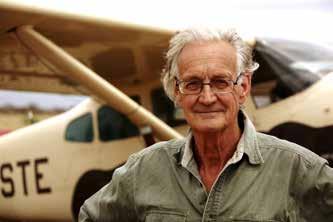
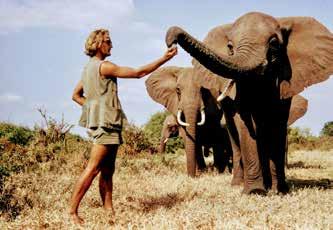
went on to study zoology at Oxford University, earning a bachelor’s degree in 1965 and then a D.Phil. in 1972.
At the age of 23 Iain moved to Tanzania to live in the wild in Lake Manyara National Park, where he carried out the first scientific study of the social interactions of the African elephant. His work is described in the book Among the Elephants written together with his wife Oria, who he met in Nairobi.
In an interview years later, Iain said about his time in Manyara: “Nobody had lived with wildlife in Africa and looked at them as individuals yet. I was incredibly lucky to have had the chance to be the first person to do that with elephants.”
From 1980 to 1982 Iain lived in Uganda, where he was made Honorary Chief Park Warden amid the chaos after Idi Amin’s fall. By 1980, most of Uganda’s elephants had been killed and were down from a probable 20,000 to an estimated 1,600 elephants and declining rapidly. He was in charge of anti-poaching activities under a project to rehabilitate Uganda’s three game parks. His plane was hit several times by gunfire from Sudanese troops who had been poaching animals in Kidepo National Park in northern Uganda. After his stint in Uganda, Iain moved to Kenya with his family where he continued his conservation work.
A skilled pilot, Iain developed techniques to monitor widespread elephant movements from the air. In the early 1970s, he designed study methods that would allow for comprehensive and replicable surveys of elephant families from low-flying aircraft, which would at the same time allow large population counts to be undertaken for the first time. Between 1976 and 1979, Iain worked on a joint IUCN /WWF
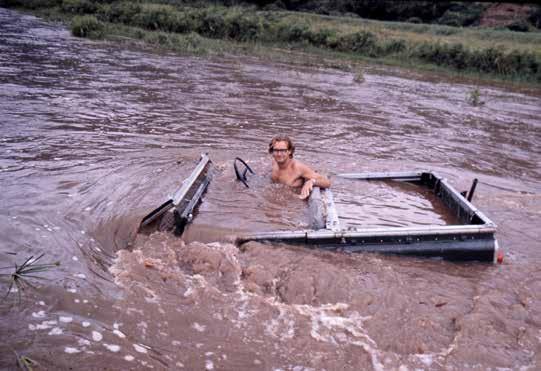
Elephant Survey and Conservation Programme, which surveyed African elephant populations in 34 countries to produce scientific data to help shape policy recommendations for the species’ protection. Around the same time, working for IUCN, Iain undertook research to map out the scale of the world ivory trade, its value, and its regulations.
Iain’s aerial surveys, coupled with research coming from other studies, began to show the scale of the poaching crisis sweeping Africa during the 1970s and 1980s, as demand for ivory from Asia grew. This research suggested that the population of African elephants across the continent of at least 1.3 million individuals in 1979 had been reduced to less than half, or around 600,000, by 1989.
These statistics illustrated to the world the scale of the problem and became known as the ‘elephant holocaust.’ Attempts were made to regulate the trade of ivory through the Convention on the International Trade in Endangered Species (CITES), but they were not effective. Iain led the way in arguing that a total ban on the ivory trade was needed to stem the loss of illegally killed elephants. The ban was globally accepted in 1989.
In 1993 Iain founded the charity Save The Elephants, “to secure a future for elephants.” The main research station for Save the Elephants is in Samburu National Reserve in northern Kenya. The organization has
conducted research on elephants across Africa and has increased public awareness of the many dangers that threaten elephants and the habitats in which they live. Iain pioneered GPS tracking of elephants in Africa, which has become a standard and widely emulated survey technique; it also guides the deployment of rangers to protect vulnerable and key elephant populations.
Save the Elephants has been studying herds resident or migratory to Samburu National Reserve, a cohort of roughly 1,000 individuals. Hundreds of elephants have been darted and fitted with collars carrying chips that communicate via satellites or mobile telephone networks with the charity’s computer databases. The elephants of Samburu are now one of the best-studied elephant populations in the world, with detailed histories of almost 1,000 individuals and their interactions from more than 25 years of research.
Alongside its focus on data collection, Iain directed Save the Elephants to increase its work on reducing the conflict between growing human populations and elephant herds. At a second research station in the Sagalla community in Tsavo, southeastern Kenya, the Human-Elephant Coexistence team is investigating ways for people to live in harmony with elephants in an increasingly crowded landscape. The Human-Elephant Coexistence programme is run by Dr Lucy King, who completed her doctorate demonstrating elephants’ instinctive fear of honeybees under
Iain’s guidance and mentorship. The project utilizes beehive fences, with beehives occupied by African bees, to reduce the problem of elephants destroying crops on small farms in Africa and Asia.
Reflecting on his work to save his beloved elephants, Iain said, “My hope is to secure a future for elephants in perpetuity, and I think it’s a challenge because we haven’t calmed down as a species, our numbers are increasing, and our demands on the environment are increasing. We want more of everything — more roads, more space, we want to carve up more forests, so there’s a big threat and a big challenge. My dream would be for human beings to come into balance with their environment, to stop destroying nature.”
Iain received many awards for his research and his work to protect Africa’s elephants.
In 2015 he was appointed a Commander of the British Empire and was presented with the Lifetime Achievement Award by San Diego
Zoological Society. In 2025 Iain and Dr Jake Wall were awarded the Esmond B. Martin Royal Geographical Society Prize, which recognises outstanding individual achievement in the pursuit and application of geographical research, with a particular emphasis on wildlife conservation and environmental research studies.
Iain published many academic research papers and several books, including Among the Elephants in 1975, which he wrote with his wife Oria. It has become a classic and has inspired many budding conservationists, including Vivek Menon, Founder of the Wildlife Trust of India. Vivek writes about meeting Iain for the first time at a CITES meeting in 1997 in Harare, Zimbabwe: “I was a callow youth finding my feet in a world into which I had ventured after reading Among the Elephants, his landmark book on his early work in Tanzania…Iain and Jane (Goodall) were role models for me, scientists who had left a world
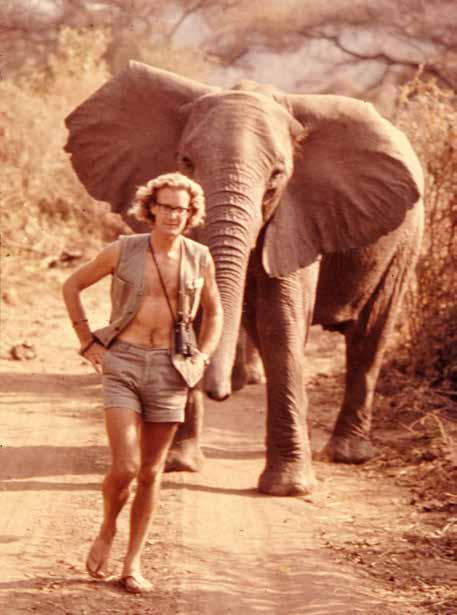
of western comforts to live in the forests of Africa and study our non-human compatriots. And then, on the plane from Nairobi to Harare, overhearing my conversation with Perez Olindo, the Kenya Wildlife Service Director who had a seat next to mine, a handsome middle-aged man turns to me from the seats in front and in a soft, understated voice that I came to know well over the years whispered, as if not to disturb the fellow passengers, “Ah! You work with elephants do you? How interesting! So do I. My name is Iain DouglasHamilton and this is my daughter Saba.” I was tongue-tied to say the least. Here was my hero, the man who flew his plane into a rose bed to woo his girlfriend and had survived a terrifying crash (he was to survive two more after), one who roamed bare-chested and bare-footed amongst herds of elephants named after Greek gods and mythological figures which he sort of resembled himself…The CITES meeting which was to follow for the next two weeks was a fiery one which centred around the killing of elephants and a possible opening of the ivory trade. Political rhetoric was at its most vitriolic, emotions ran like a gurgling mountain stream, untamed and unabashed and conversations varied from hushed corridor negotiations to loudly expressed opinions in a dozen languages. In the midst of this chaos lounged Iain, quietly espousing good science and fighting for the creatures he loved in the most dignified and sensible manner.
“That momentous meet was to lead to a friendship that was forged in Harare and cemented in the six months I spent in Kenya with the KWS in the late 1990s. The most remarkable part of that assignment of mine was to census elephants in Lake Turkana and Samburu with Iain. He was the leader and the pilot of his famed plane. I sat in the co-pilot’s seat not ever having sat behind even the steering wheel of a car. And Patrick Omondi and others were in the back spotting and counting out loud. My calibre as a flying companion got a thumbsup from his daughter Saba who commented that I was one of the few young men who had gone up with her dad and not needed to use a paper bag before landing. Indeed, he would spot an elephant while tail edging a cloud and then, to identify it, would zoom in on it with an angular approach fast and furious enough to turn your innards into your mouth and mix your kidneys up if he decided to have a second

go. I learnt more from him than anyone else in those early elephant days, whether up in the air or poring over elephant molars at his tent in Samburu. He was by my side when I launched my book on the Asian elephant, gave me sane advice when I started chairing the IUCN SSC Asian Elephant Specialist Group and hosted my family at his Naivasha home when the kids were small.”
The last few paragraphs of a press release announcing Iain’s passing from Jane Wynard at Save the Elephants gives a fitting summary to his life:
Never was Iain happier than when sitting with a young scientist studying maps of elephant tracks, speculating together about what might be going on in the pachyderm’s mind. He catalysed countless careers in research and conservation, both from Africa and all over the world.
“Iain changed the future not just for elephants, but for huge numbers of people across the globe. His courage, determination and rigour inspired everyone he met. Whether sitting quietly among elephants, poring over maps of their movements or circling above a herd in his beloved aircraft, that glint in his eye was there. He never lost his lifelong curiosity with what was happening inside the minds of one of our planet’s most intriguing creatures,” said Frank Pope, CEO of Save the Elephants and Iain’s son-in-law.
Iain, together with his wife Oria, inspired his daughters Saba and Dudu to devote their own lives to working for nature. He leaves behind six grandchildren, each of whom dreams of following his example in one way or another…
May Iain’s pioneering spirit and unwavering dedication to conserving Africa’s most iconic species continue to inspire us all.
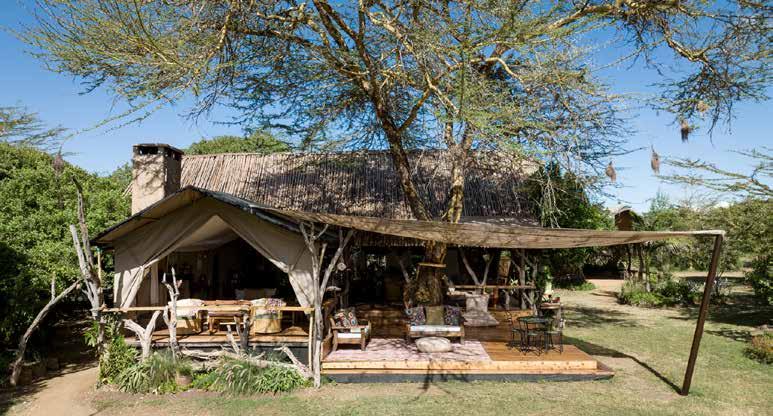

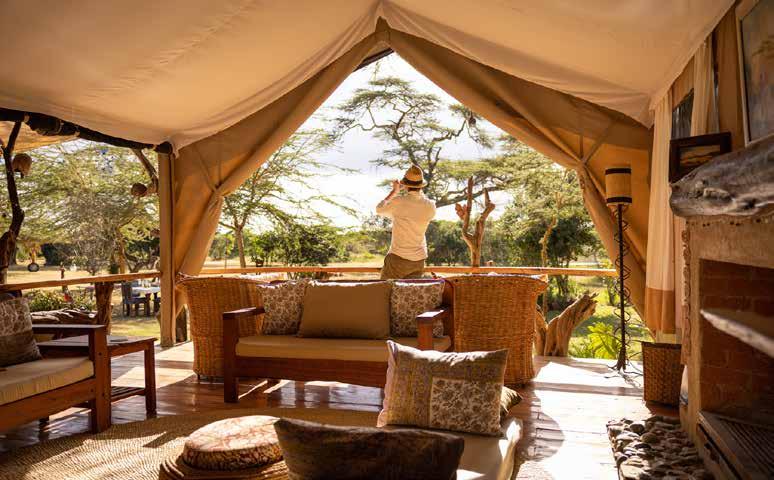
We hope you enjoyed this edition of Old Africa. Please consider a donation to help us keep the stories coming.
www.oldafricamagazine.com/donate