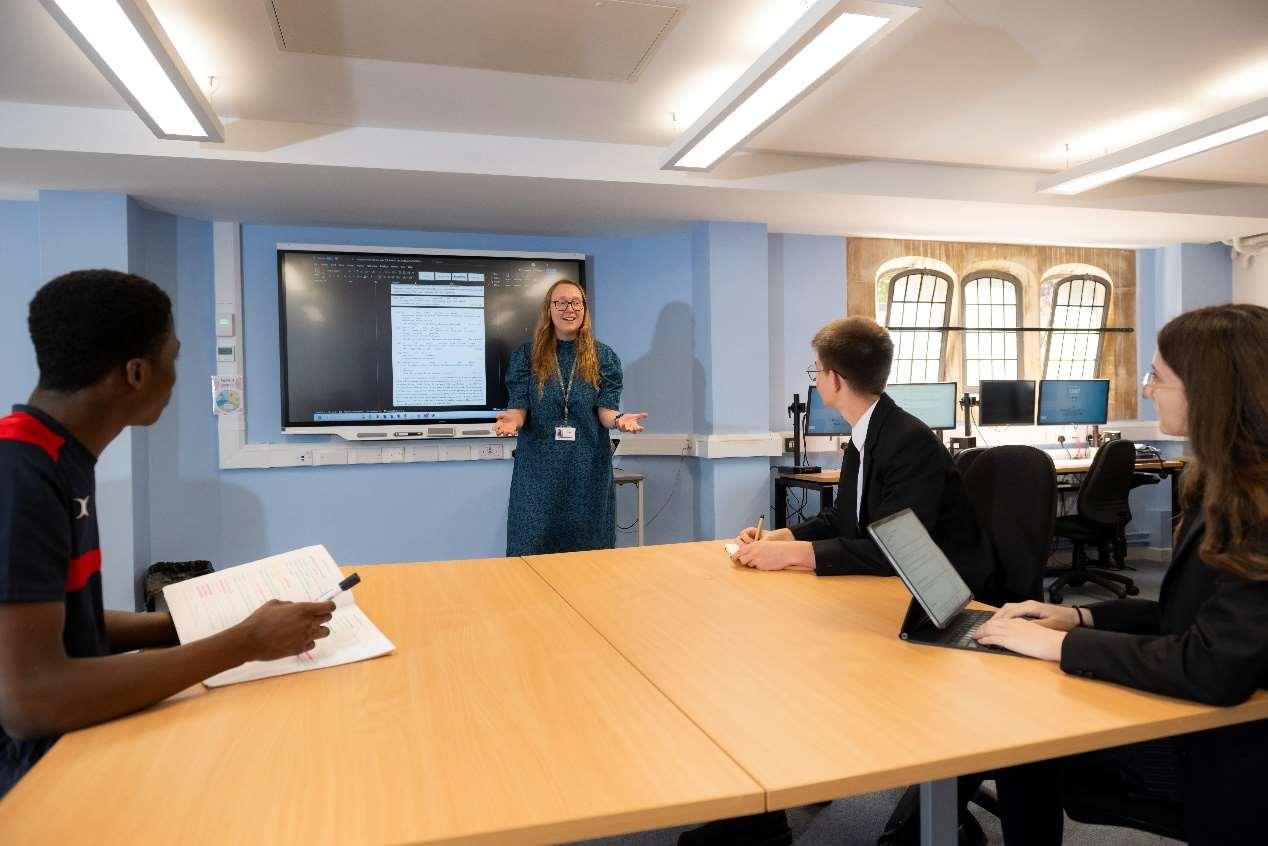
Pupils at King’s have broad horizons, and so they should. We are delighted to support applications to a wide range of higher education institutions, both in the UK and around the world. From Cambridge to Caltech, via the Swiss hospitality sector and conservatoire musicianship, every pupil at King’s has their own unique ambitions for the future.
With such a vast world to explore, making decisions can be the most di icult part. A large part of this booklet is dedicated to supporting the process of making decisions about the future. Crucially, the very process by which we can make informed choices – the process of reading widely and exploring the options available – is also good preparation for making a strong application during the 6a year.
We know that the process of applying to higher education can be a stressful one for young people, so we want to make it as calm and structured as possible. Pupils at King’s are clearly guided through their applications with plenty of checkpoints along the way and a team of tutor, house sta and Pupil Futures sta on hand for support. This booklet highlights the structure and timescales for UK (UCAS and UCAS Conservatoire) as well as US applications, which are our most common future pathways from King’s.
Above all, my introductory message is that this period in a young person’s life should be an exciting one, not an overwhelming one. Pupils at King’s consistently feed back that they are glad when they take on a challenging application, because they find it exciting and fulfilling, and they know that they have a strong support network around them regardless of the outcome. We as a sta team love what we do, and the pupils tell us that it shows; we are rooting for every single one of them to find an exciting future plan which is a good fit for them.
Parents and pupils are always welcome to get in touch with us to ask any further questions or for an indepth conversation about individual plans. Contact details can be found in the FAQs section.
Hannah Warwicker Director of Pupil Futures pupilfutures@kings-school.co.uk
Making Future Choices
We know pupils often find making decisions about HE and careers daunting. Our advice below is based on our experience of supporting pupils with both the pastoral and academic aspects of this process.
Read and reflect
Read widely around your classroom subjects, and reflect on what you find interesting about your learning and reading. It is important to make future choices with a view to what you find intrinsically interesting and motivating: are you drawn to the subject choice itself, the pay prospects, or the enjoyable lessons at school level? Students are most successful at HE and beyond when they have researched their chosen subject thoroughly before applying.
This research time should be spent on looking at course content and reading beyond the Sixth Form curriculum, more than on researching university o er rates or grade requirements! The balance in your Futures research should be firmly towards subject matter. For example, if you’re interested in Economics at LSE, spend more time researching the course content and then reading follow-up books in these areas than on researching the success rate for applicants.
Remember to log all your reading and reflection. The Academic Journal provided to 6bs can be a great place to do this and mean that when it comes to writing your personal statement you already have material to work with.
We often refer to engagement with a subject beyond the school curriculum as super-curricular activity. There are reading lists and suggestions for these activities on the 6b Team. Also feel free to ask your tutor, subject mentor, or one of the Futures Team for pointers on this. Embrace the support available but remember to follow your own interests and plough your own super-curicular furrow.
Use trusted tools e.g. Unifrog
This makes the process of researching application logistics quicker and easier and leaves you more time free for super-curricular development.
Unifrog has tools for shortlisting courses, comparing Oxbridge colleges, and researching HE opportunities/careers which are a good fit for your Sixth Form subject choices.
Similarly, there are some good tools on the UCAS website; we particularly recommend this as a route for researching degree apprenticeships. A list of other recommended tools and links can be found at the end of this booklet.
Be cautious of asking generative AI complex questions about the HE landscape, as it will often generate misleading answers. Similarly, be cautious of advice from unregulated online student forums and other anecdotal content.
Above all, we advise against using external advisors for HE applications other than those explicitly recommended by King’s for specialist areas e.g. US college applications. We at King’s have the data most relevant to King’s pupils and years of experience supporting the applications of pupils just like you.
Popular Sectors: Medicine, Law, Finance, Engineering
Many pupils are interested in well-known careers such as these. Before embarking on an HE application to one of these courses, ensure that you have considered all the possible pathways for arriving at your chosen destination. For example: a person can work in the financial sector without a Finance degree, there are degree apprenticeships available in prestigious careers like Law and Medicine, and many of these careers have graduate entry routes. For further details, speak to the Pupil Futures team or keep an eye out for our upcoming handbooks on these popular career aspirations.
Above all, consider your skills and interests, and why you are motivated to pursue a particular career. For example, if you intend to pursue Medicine because you are motivated by helping others, that’s a great aspiration! But there are a vast number of other altruistically motivated careers in the world too, and you might want to consider those as well. Similarly, pupils are often drawn to the Financial sector but worried about a relative weakness in Maths which will hinder them studying Economics or Finance. Consider that most graduate Finance jobs are not degree subject-specific, and research other routes you could take to your destination instead.
Popular Destinations
Pupils and parents often ask where the“typical”King’s pupil goes after school, and of course that is an impossible question, because each pupil has their unique strengths and interests. That said, in an average year, our most popular HE pathway is study at a UK university, with common destinations being Durham, Edinburgh, Exeter, KCL and UCL. We have a popular“Oxbridge Plus”programme and send healthy numbers to highly selective institutions including Oxford, Cambridge and Imperial. We have rapidly rising numbers of pupils opting for US colleges, and our next-biggest destination numerically is typically UK Conservatoires.
UCAS unpacked
UCAS (the University and Colleges Admissions Service) is the platform by which pupils apply for places at UK universities; on average, 90% of our cohort will make a UCAS application, and about 85% will ultimately opt to take up a UK university place.
Under the UCAS system, pupils make initial applications to five courses. Of these, no more than one may be Oxbridge, and no more than four may be Medicine/Dentistry/Veterinary. The same application is sent to all courses the pupil chooses, so they must be similar enough that the same application is plausible for all. This application consists of a Personal Statement written by the pupil, short questions about their personal details, and a Reference (including Predicted Grades) provided by the school.
Pupils initially receive“o ers”based on this form, which are provisional o ers of a place if the pupil meets certain grade conditions. Once the universities have responded, pupils then narrow their choices down to two: a“firm”place, where they most want to study, and an“insurance”place, with lower grades in case they miss out on the“firm”conditions. Pupils reply to o ers in a centrally coordinated fashion in the Lent Term so that the Futures Team can sense-check these o ers against the pupil’s academic progress. Sometimes an institution will accept a pupil who has missed their grades, but it is important that we don’t rely on this.
If pupils miss both their firm and insurance o ers, they can still take up a place at university by entering the marketplace for remaining places known as“Clearing”. The Futures Team will be on hand via Teams call on results day to o er individual support to pupils in this situation. In recent years there have been a generous number of good places available in Clearing and the vast majority of King’s pupils who have looked for a place in Clearing have found something satisfactory.
The application process is thoroughly sca olded within the structure of the school. In the Summer Term of 6b, pupils have sessions on how to write a Personal Statement, and supervised time drafting their Personal Statement and completing their personal details on the UCAS form. Pupils then show their drafted Personal Statement to their tutor, then subject mentor, then the Futures Team in that order. We advise against sharing the PersonalStatement with anyone outside of this school structure, so as not to muddy the waters. On average, King’s pupils apply for relatively selective universities, so it is important that their Personal Statements are not“average”; pupils should follow the King’s house style rather than being distracted by more general advice found e.g. online.
There are crucial ways in which parents can support this process. We invite you to reinforce with your child the key messages about keeping to deadlines and following the King’s process, and above all about following the instructions for Personal Statement preparation. We will also invite parents in the Summer Term to complete a form detailing any mitigating circumstances which have a ected your child’s education. We highly recommend completing this form honestly; such information can never weaken your child’s application and can in some cases result in a contextual o er or more sympathetic treatment if grades are missed on results day.
King’s has a very popular“Oxbridge Plus”programme which supports applicants to highly selective courses. Alongside Oxford and Cambridge, this includes many courses at Imperial, UCL, LSE, Durham and St Andrews, as well as selected STEM courses at Manchester and Warwick.
The goal of this programme is twofold: to prepare pupils for the specific hurdles to their chosen courses, such as admissions tests and interviews, and to provide them with a good overall level of super-curricular development, which will enable them to write a strong Personal Statement and have well-developed thinking skills at interview. The Oxbridge Plus cohort is invited to large group sessions weekly from the January of 6b. Alongside these, they are supported by subject mentors in departments; in most cases, departments will run weekly application support and extension sessions. We are currently reviewing our provision to standardise it across departments within the next two cycles.
A cornerstone of our Oxbridge Plus programme is the focus on interview skills. All pupils are invited to attend debating skills workshops in the Summer Term of 6b, and interview skills form a substantial part of the provision within departments. During the Autumn Term of 6a, all pupils who are to have university admissions interviews have at least one mock interview with a subject specialist and are invited to have additional practice interviews with the Futures Team and senior teachers.
Beyond this school support, applicants for the most selective courses are expected to be proactive and work towards their goals independently. Applicants for Arts and Humanities subjects will have to develop their critical reading skills, and STEM/Economics applicants will have to develop their problemsolving and mathematical skills. There will be advice given about how to do this through the weekly Oxbridge Plus sessions. Further, many pupils choose to enter external academic competitions and essay prizes as part of this super-curricular journey. Please note the guidance from Cambridge themselves that pupils should expect to spend an average of half an hour a day for the duration of Sixth Form to make a viable application to a highly selective university: this should include preparation for entrance tests etc but also wider super-curricular development.
Numbers of US applications and successes at King’s have boomed in recent years. In general, US admissions processes take account of the applicant’s wider experiences and overall“fit”for the institution more than purely academic data; this is a key di erence between the US and UK Higher Education scene. For this reason, King’s pupils often find that the breadth and co-curricular excellence nurtured at King’s makes them a good fit for a US application. The academic structure of a US college education also di ers substantially from the typical UK model. Students are likely to study a broader curriculum, and it is likely to be compulsory to study topics outside their intended specialism. Pupils should research the curriculum structure of their chosen institutions carefully and should demonstrate in their application that they are a good fit for every aspect of their chosen college, not just for their intended specialism.
The importance of this personal suitability for the institution makes the US college scene a complicated one to navigate for our young people. For this reason, we take advice from the experienced professionals at The University Guys, alongside our own in-house team; we have external speakers visiting annually to give expert guidance on themes such as choosing the correct college, and families are welcome to follow up with these experts in further detail if they choose to do so.
The developments with the use of standardised testing in US college admissions have made the headlines often in recent years. Standardised admissions testing largely became optional during the pandemic years, and is now being reintroduced in many colleges. We recommend that all applicants to US colleges should be prepared to sit the SATs and give a good performance in them. We have partnered with UES, who o er a King’s-specific programme of SAT preparation if parents wish to purchase it. We also have a range of SAT practice resources available in the Futures library for pupils who prefer to self-study.
Applications to US colleges are largely made via Common App, but admissions to some institutions are by direct application only. Further, there are di erent rounds of deadlines, and pupils can choose to make a binding decision agreement with their favourite institution. This system is legendary for its potential to cause stress and chaos for pupils attempting to navigate it. To avoid this, we have a careful structure in place to help the pupils organise their applications.
Pupils and parents should be aware of three key principles in the King’s approach to US Universities:
1. Common App is filled in and the first draft Common App essay is produced during school time. We run structured sessions for these just as we do for UCAS sign-ups.
2. Pupils should apply through a maximum of two systems in any given cycle. In most cases, this will be UCAS or Common App and one other. We will support a sensible number of US direct applications alongside Common App where appropriate; pupils should discuss with the Pupil Futures team directly. Exceptions will occasionally be made in the case of very competitive applications e.g. Medicine. Further, we do not recommend taking on an Oxbridge application and a US Early Decision application in the same cycle; only a couple of students a year will manage this feat. These guidelines exist primarily to protect the wellbeing and A level success of the pupils, and to encourage them to research courses and prioritise sensibly.
3. The school’s internal deadline for declaring an intention to make an international application which has an October or November external deadline is Week 1 of the Autumn Term. The internal deadline for declaring other international applications is the first day back from Autumn half term. These internal deadlines are strictly upheld so that we can deconflict reference writers and produce good quality applications.
Many King’s pupils opt to apply through“UCAS Conservatoire”for courses in Music or Drama. This platform is very much like UCAS and pupils will be supported with it accordingly. A small number also choose to make direct applications to institutions outside of this platform; such pupils are supported on a 1-1 basis, typically by the Drama department.
Apprenticeships
Degree apprenticeships have risen in prominence in recent years; there are a number of high-quality and very competitive apprenticeships available with big-name brands, especially in popular sectors such as Finance and Engineering. UCAS has a growing central database of apprenticeship opportunities, and we recommend that pupils use this to search, rather than the Unifrog equivalent.
Apprenticeship applications can be time-consuming as each is separate; there is no common platform like UCAS for universities. We invite pupils working on such applications to bring them to the Futures Department during drop-in so that we can be on hand to help. In recent years, Finance apprenticeships have been particularly popular with our pupils; please do get in touch individually if you would like to ask more.
Gap Years
Many King’s pupils opt to take a gap year before progressing to Higher Education. In particular, our pupils consistently choose interesting and structured activities which will be of real benefit to their overall personal and career development; the days of backpacking without destination are largely gone! Pupils should keep an eye on the gap year opportunities advertised in their year group Team and are welcome to pop into the department for further discussion of what might suit them on a year out.
Recent King’s gap year undertakings include:
Professional sport contracts
Internships at STEM research institutions
Volunteering placements for charities
Employment at prep schools, both in the UK and further afield
Pupils who have firmly decided to take a gap year typically apply during the 6a year for a“deferred” place, although this may not always be the best option. Pupils are encouraged to seek advice on a caseby-case basis.
Some pupils also choose to take a gap year post-o ers or post-results in order to reapply to Higher Education. We are always keen to support pupils, regardless of their reasons for reapplying. Above all, we recommend that pupils taking an “unplanned”post-o ers or post-results gap year spend that year on something genuinely rewarding and exciting, so that they are content with their decision to take that year out regardless of the success of their second application.
Other international
Besides the UK and US, we see ever-increasing numbers of applications being sent around the world. The most common of these are in Europe, Australia and Hong Kong. Pupils should seek advice with these applications on an individual basis, and in the case of applications around Europe we sometimes refer pupils to trusted external partners for the benefit of their expertise.
Regarding all international applications, pupils and parents should be aware of these three key principles:
1. Pupils must be independent and proactive in completing application paperwork for these international applications; we do not o er formal supervised sign-up sessions for destinations beyond the US and UK as numbers are so small and the range of application types so wide. We are very happy to mentor pupils with these applications on an individual basis, and we recommend that they come to work on them in the department during drop-in if they prefer close supervision.
2. Pupils should apply through a maximum of two systems in any given cycle. In most cases, this will be UCAS or Common App and one other. Exceptions will occasionally be made in the case of very competitive applications e.g. Medicine. These guidelines exist primarily to protect the wellbeing and A level success of the pupils, and to encourage them to research courses and prioritise sensibly.
3. The school’s internal deadline for declaring an intention to make an international application which has an October or November external deadline is Week 1 of the Autumn Term. The internal deadline for declaring other international applications is the first day back from Autumn half term. These internal deadlines are strictly upheld so that we can deconflict reference writers and produce good quality applications.
Top tips for success
These tips are based on the experiences and feedback of previous generations of pupils. There are also Q&A opportunities with 6as and OKS for both pupils and parents at webinars and school events.
1. Start early
Start early in the correct way; reading beyond your school subjects throughout middle school and Sixth Form is valuable, but feeling rushed to choose your future university course in Remove is not.
When Oxbridge+ and US support sessions start in January, attend them and follow the guidance. When teachers encourage you to start entering essay competitions or solving super-curricular problems, start now.
2. Take good notes
When you are enjoying your super-curricular reading, take notes which will make sense to you when you come to write your personal statement or prepare for your interview. Remember to read actively rather than passively, analysing texts and attempting to place them in their academic contexts wherever possible. The academic journal can be a good place for this, and has hints and tips on how to read critically. Similarly, if you make a shortlist on Unifrog, save it. Keep good notes and records of your whole application journey, and file them sensibly so you can access them easily when needed.
3. Keep to deadlines
Our series of internal deadlines exists to keep you calmly on course towards the external deadlines and to ensure we can work on your applications as e ectively as possible. Understand that these deadlines have been carefully placed to ensure that e.g. you have time to redraft your PS or we have time to collate a high-quality reference for you. Adopt the mindset that internal deadlines do matter.
4. Follow instructions
The slides from all pupil briefings are in the Team so that instructions can easily be re-read and digested.
5. Use our resources
Use resources recommended to you by the Pupil Futures team, such as Unifrog, or links placed in the Team. Do not use third party resources found online. Consider that a typical King’s pupil is applying to HE institutions which are at the selective end of the scale; we do not want to rely on resources which are targeted at producing an“average”personal statement. The King’s house style for all aspects of applications is informed by dialogue with the institutions which are most desirable to our pupils.
FAQs
Contact Us
How can I meet with a member of the Pupil Futures team for some advice or help?
We run a drop-in session every Wednesday afternoon, for the whole afternoon. Please bring your brief questions and conversations to this. Check the FAQs first in case it is covered here.
If you need a longer conversation (i.e. more than fifteen minutes), please email pupilfutures@kings-school.co.uk and the most suitable person will get back to you.
How can I request a reference?
Please use the hereferences@kings-school.co.uk email address to request academic references for e.g. Conservatoire applications, Hong Kong applications.
How should parents contact the department?
Please use the pupilfutures@kings-school.co.uk address and one of the team will get back to you.
Application
timeline
When is the deadline for my application?
The external deadline for Oxbridge, Medicine and related courses is mid-October, so pupils should expect to finalise their application in September.
The external“equal consideration”deadline for all other courses is in January. Current King’s pupils are expected to apply by this deadline, finalising their application in the Autumn Term, but some OKS choose to apply after it to some courses which are still open.
The“equal consideration”deadline means exactly that; institutions must treat equally all applications received by the correct deadline. There is no advantage to applying in September vs. December for a course with a January deadline. Pupils should follow the internal instructions and deadlines to ensure they complete a punctual and high-quality application, but there is no need to rush ahead of these.
What should I do at each time of year?
See the timeline for a full overview.
Be aware that applicants for the early UK and US deadlines take priority in the Pupil Futures Team diary for the first half of the autumn term, then January deadline pupils take priority in the second half.
Academic
documents
Do I need a transcript for my university applications?
UK universities will request a transcript if they need one. It will usually only be needed by students without GCSEs or equivalent qualifications.
Everyone needs a transcript for a US application. We will automatically provide one for US applicants. It is also common to need one for other applications outside of the UK.
How can I get a transcript?
Write to Mrs Mairi Lee via the Pupil Futures email address.
How can I get my exam certificates?
If you took GCSEs at King’s, the academic o ice will be able to send scans of your certificates.
If you took your GCSEs elsewhere, you/your parents/your old school will have them and the King’s academic o ice will not be able to help you.
A level certificates are available from the November after you complete your A levels. They will automatically be sent to you at that stage.
How do universities get my A level results?
If you are holding a conditional o er at a UK university, UCAS will automatically share your results with them ahead of results day.
If you are holding a conditional o er for an institution abroad (including the US) you must email the academic o ice well in advance (i.e. during May!) to ask them to pass your results across as soon as possible.
English language requirements
Do I need to take IELTS?
Most international students will need to take an English language proficiency test to study at an English language university.
There are some exemptions for citizens of certain countries studying the UK. See here: Student visa : Knowledge of English - GOV.UK (www.gov.uk)
Read the conditions of your o er carefully to clarify whether you need to do an English language test to meet a certain o er. Come and check directly with the Pupil Futures team if you are struggling to make sense of the small print.
Is IELTS the only university English language test?
IELTS is the most commonly chosen option by students at King’s but it is not the only one.
Look at TOEFL or other equivalents. Some can be cheaper or more practical e.g. taken online.
Students who did GCSE English at King’s do not have the correct combination of GCSE papers to use their GCSE as their English proficiency test in most cases.
Look at each university’s requirements online to be certain which tests they accept. Some even accept Duolingo!
When should I take IELTS?
You do not need to take your IELTS or equivalent before applying.
Most students choose to take it during the spring of 6a.
You must have completed and been certified for your English proficiency test by the deadline your university have given you to meet the terms of your o er. In most cases, this is the end of August.
Gap years
Can I apply through UCAS from King’s after I have left the school?
Yes, we routinely support OKS applicants. Please notify us by September 15th for an early application or December 1st for a January application.
We will gladly provide a reference, full support over a Teams call, PS feedback and thorough checking of the application form for OKS who have left the school the previous year.
We are also keen to support OKS who have been out of school longer than this where practical. Please do get in touch and we will discuss your options.
Student Finance
Who can apply for student finance?
You can apply if your normal home address is in the UK. Full rules and instructions here: Apply online for student finance - GOV.UK
For Parents
My child is applying for a very competitive course. How can I support thisapplication?
Encourage them to take super-curricular development seriously. Note the recommendation from Cambridge that building a strong application takes about 30 minutes a day for the duration of 6b.
There is no need to spend vast amounts of money on summer schools or tutoring; reading, problem-solving and academic discussion are the best ways to practise.
Prioritise admissions tests where relevant.
Be realistic about the standard of the competition and be prepared to support your child compassionately if their application is unsuccessful.
My child doesn’t know what they want to apply for. How can I help them to make informed decisions?
Unifrog has some good tools for this. Students can search courses and careers which match their A level choices, or browse the subject library more widely.
Encourage them to spend plenty of time exploring beyond what they are currently learning and reflecting on which aspects of their current studies interest them the most.
Help them to find work experience in relevant sectors if possible.
Try to avoid preoccupation with average earnings or employment statistics; all good university degrees are employable!
Most importantly, encourage them to engage with school support if they are floundering. They should discuss with their tutor, perhaps working through some Unifrog tools together, and should make good use of the Futures Department drop-in times.
Useful links
Occupational Maps: Institute for Apprenticeships & Technical Education
Home / Institute for Apprenticeships and Technical Education
Informed Choices | Informed Choices
www.ucas.com
www.unifrog.org
Lots of further links and guidance can also be found on the 6b Futures Teams channel.