The Oklahoma Historical Society
The Oklahoma Historical Society (OHS) is a private membership organization and state agency. The mission of the OHS is to collect, preserve, and share the history and culture of the state of Oklahoma and its people. Organized in 1893 by a group of territorial journalists, it has developed into one of the nation’s largest and most innovative historical agencies. Today the OHS operates museums and historic sites; publishes a historical journal, newsletter, electronic publications, books, and brochures; encourages and assists with historic preservation; and maintains several renowned research libraries. The Chronicles of Oklahoma, published quarterly by the OHS, is distributed to subscribers and all OHS members. Each issue contains historical articles, photographs and illustrations, book reviews, notes and documents relative to the preservation of our history, and OHS Board of Directors meeting minutes.
Membership
Membership in the OHS is open to anyone who wants to share the excitement and wonder of state and local history. Annual dues are Basic $40, Family $75, Friend $100, Associate $250, Fellow $500, Director’s Circle $1,000, Partner $2,500, and Benefactor $5,000. Membership includes a subscription to The Chronicles; Mistletoe Leaves, the OHS bimonthly newsletter; and EXTRA!, the OHS email newsletter; as well as other benefits. Membership applications and subscriptions should be mailed to: Membership Coordinator, Oklahoma Historical Society, 800 Nazih Zuhdi Drive, Oklahoma City, OK 73105-7917. Memberships also can be purchased online at okhistory.org/join. Single copies of The Chronicles cost $7 each plus shipping (and tax for Oklahoma residents). Single copies may be ordered by calling 405-522-5214 or emailing museumstore@history. ok.gov.
Reprints
Requests to reprint copyrighted material from The Chronicles of Oklahoma must be submitted in writing to the editor. In some cases, permission also must be obtained from the author of the article for which the reprint is requested.
This publication, printed by Southwestern Stationery and Bank Supply, Inc., is issued by the Oklahoma Historical Society as authorized by Section 19, Title 53, O.S. A total of 2,700 copies have been printed at a cost of $8,645. Copies have been deposited with the Publications Clearinghouse of the Oklahoma Department of Libraries. The Chronicles of Oklahoma (ISSN 0009-6024) is published quarterly by the Oklahoma Historical Society, 800 Nazih Zuhdi Drive, Oklahoma City, OK 73105-7917. Periodicals postage paid at Oklahoma City, OK. POSTMASTER: Send address changes to The Chronicles of Oklahoma, 800 Nazih Zuhdi Drive, Oklahoma City, OK 73105-7917.
Responsibility for statements of facts or opinions made by contributors in The Chronicles of Oklahoma is not assumed by the Oklahoma Historical Society. Copyright 2026, Oklahoma Historical Society
The
Chronicles Oklahoma of
Editor: Anna L. Davis
Volume CIV
Number 2
Summer 2026
Contents Father Robert McDole: Activist for Racial Justice BY PAUL T. MURRAY During the 1960s, the charge for civil rights was gaining momentum around the country. Father Robert McDole, a Catholic priest in Oklahoma City, would make waves as the first priest to be arrested at a demonstration. Under the tutelage of Clara Luper, McDole became an active figure in various sit-ins and events throughout the United States, bringing attention to Catholic participation in the Civil Rights Movement. Murray explores the life and legacy of McDole and his impact on the fight for equality in the United States. 126 The Klan and Civic Authority in the Aftermath of the 1921 Tulsa Race Massacre BY AARON SCHOENFELDT In the aftermath of the Tulsa Race Massacre, Tulsa World editor T. A. Latta used his position to question the Ku Klux Klan’s meteoric rise in Tulsa and their links to the violence that happened in June 1921. The analysis centers on two Tulsa World editorials published in 1924 and 1925. Each, emerging amid heated local political campaigns, cast the Klan, or a specific Klansman and city commissioner, as bearing responsibility for Greenwood’s destruction. Schoenfeldt brings to light Latta’s pursuit of the truth in the aftermath of the worst act of racial hatred the United States has seen. 149 Crossing the Big Water: Kiowas in World War I BY RONNIE A. BECK When the United States entered World War I, many Native Americans answered the call to serve. A small group of Kiowa men joined the US Army even though the government had routinely broken compacts and treaties with the Kiowa Nation. These men showcased a unique patriotism that harkened back to traditions that many Southern Plains tribes held dear. Beck writes about the men who served in the war, the tribal response to the war effort, and the personal stories of the families that supported these men overseas. 169
Volume CIV
Summer 2026
Notes and Documents Nothing More Chautauqua than William Jennings Bryan: A Week Riding the Circuit, July 1911 195 BY MATTHEW SMITH Historians Hall of Fame: Donald L. Fixico, David W. Levy, Linda D. Wilson, and Timothy A. Zwink BY MATTHEW PEARCE
210
Book Reviews
218
Ajtzip, Juan, He Listened to Us: A Maya Witness to Blessed Stanley “Apla’s” Rother, reviewed by Sarah Foss Fixico, Donald L., State of Sequoyah: Indigenous Sovereignty and the Quest for an Indian State, reviewed by Taryn M. Dixon
For the Record
224
Minutes of the OHS Quarterly Board Meeting, January 28, 2026
History in Focus
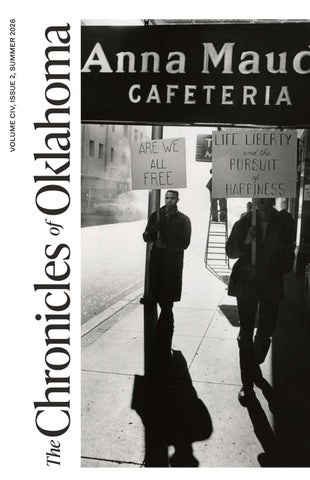
ON THE COVER Protestors hold signs outside the Anna Maude Cafeteria in Oklahoma City, 1961 (2012.201.OVZ001.9131, Oklahoma Publishing Company Photography Collection, OHS).
243
THE CHRONICLES OF OKLAHOMA
Father Robert McDole: Activist for Racial Justice1
By Paul T. Murray* In the early 1960s, when the movement for Black civil rights was gaining national momentum, Catholic participation in public demonstrations was scattered and rare. Few Catholic lay people, clergy, or religious joined civil rights protests. In Oklahoma City, however, progressive Catholics in the Young Christian Workers (YCW) and the Catholic Interracial Council joined organized efforts to assert Black civil rights. Bishop Victor Joseph Reed of the Oklahoma City-Tulsa Diocese spoke in favor of racial equality and allowed diocesan priests to participate in civil rights demonstrations, something few Catholic prelates did at the time. On January 14, 1961, Oklahoma City police arrested Father Robert McDole, assistant pastor of Corpus Christi parish, while he protested 126
FATHER ROBERT MCDOLE outside a cafeteria that refused to serve Blacks. McDole was the first Catholic priest in the United States jailed for participating in a civil rights demonstration. Two months later, he was arrested a second time. News of his arrests were reported in the local and national press. Since that time, however, Father McDole’s role in the civil rights movement has mostly been forgotten. Two very different individuals, civil rights activist Clara Luper and Vincent Joseph Reed, bishop of the Oklahoma City-Tulsa Diocese, influenced Father McDole’s participation in the demonstrations that led to his arrest. Luper’s aggressive leadership of the Oklahoma City sit-in movement provided a dramatic example of effective nonviolent action for racial justice. Bishop Reed’s support for Catholic social justice organizations, such as the Young Christian Workers, created an environment that encouraged activism by the laity and the clergy. Father McDole, a talented but inexperienced young priest assigned to an interracial parish, created a national news story that embarrassed his bishop. His reassignment far from Oklahoma City may well have aggravated an underlying mental ailment that ultimately led to his death. Robert Gene McDole was born in Stillwater, Oklahoma, in 1930. His father was a tenured mathematics professor at Oklahoma A & M University. Neither of his parents was Catholic. Monsignor Victor Joseph Reed, then a pastor in Stillwater, was instrumental in Robert’s conversion. He baptized sixteen-year-old McDole in May 1946. An accomplished pianist and organist, McDole studied music at Oklahoma A & M from 1948–1951. He then entered Assumption Seminary in San Antonio, Texas, to prepare for the priesthood. Thomas Litsch, a former priest of the Oklahoma City Diocese and a fellow seminary student, described McDole as “very pleasant and exemplary as a seminarian and a very, very excellent organist.”2 Victor Reed, newly installed as bishop of the Oklahoma City-Tulsa Diocese, ordained Father McDole on May 4, 1958. His first assignment was as assistant pastor at Sacred Heart parish in Oklahoma City.3 When Father McDole arrived in Oklahoma City, the state’s civil rights movement was well underway. Black civil rights activists pursued desegregation along two different paths. The first was litigation— challenging laws that required segregation of schools, buses, public accommodations, as well as literacy tests and poll taxes that hindered Blacks from becoming registered voters. The second method was 127
THE CHRONICLES OF OKLAHOMA nonviolent demonstrations at lunch counters, restaurants, amusement parks, hotels, and other venues that refused to serve Blacks on an integrated basis. Both methods required dedicated and courageous practitioners. The ingredients for successful civil rights lawsuits were clear—one or more skilled attorneys and plaintiffs willing to risk public exposure to change a law. Oklahoma’s pioneer plaintiff was Ada Lois Sipuel Fisher, a college graduate who planned to become a lawyer. In 1946, her application to the University of Oklahoma Law School was rejected because of her race. With Thurgood Marshall as her lawyer, she sued the school to be admitted. Her case reached the United States Supreme Court, which ruled in 1948 that she was entitled to pursue a legal education.4 The state hastily responded by creating a law school for Blacks at Langston University. Marshall prepared to appeal again, but the state’s attorney general conceded that the two schools were not comparable. Fisher entered the University of Oklahoma law school
Father Robert McDole, c. 1960s (2010.011.B079.0026, Oklahoma Journal Photography Collection, OHS).
128
FATHER ROBERT MCDOLE in June of 1949 and graduated with a Bachelor of Law degree in August 1952.5 In a separate, but related case, Charles W. McLaurin had been admitted to the University of Oklahoma’s graduate school of education but was segregated on campus. He was forced to eat at a separate table in the cafeteria, screened from other students in the library, required to use a separate restroom, and had to listen to lectures while sitting in a chair outside the classroom or inside a closet.5 These restrictions were struck down by the Supreme Court in the case McLaurin v. Oklahoma State Regents (1950).6 Organizing successful nonviolent protests is more complex. A skilled organizer is the first requirement. Next comes the recruitment of demonstrators committed to nonviolent tactics and willing to go to jail. Legal assistance is needed to free protesters from jail and defend them in court. Oklahoma’s leading organizer was Clara Shepard Luper. A native of Okfuskee County, she graduated from Langston University and, in 1951, she became the first Black student admitted to the University of Oklahoma’s graduate program in history. After earning her master’s degree, she taught at Dunjee High School in Spencer, Oklahoma, ten miles from Oklahoma City.7 Luper was more than a dedicated teacher. She inspired her students to make history. As children, Luper and three friends peeked through the windows of a white elementary school and were amazed by all the books they
Clara Luper, n.d. (2012.201. B1439.0740, Oklahoma Publishing Company Collection, OHS).
129
THE CHRONICLES OF OKLAHOMA saw. “I wanted to read the books. I wanted to explore new ideas, but the walls separated us and we were caught behind the walls,” she later recalled.8 Luper became a keen student of American history. While attending the University of Oklahoma, she encountered a professor who thought she was incapable of graduate study. Luper worked hard in his class, and at the end of the semester, he admitted that she had proved him wrong.9 Experiences like this made her a determined activist. While teaching at Dunjee High School, Luper became the advisor to the Oklahoma City NAACP Youth Council. She taught her young charges about Mahatma Gandhi and Martin Luther King Jr. From her, they learned methods of nonviolent protest. She inspired Youth Council members to take action to remove the barriers of segregation. Each year, Luper wrote a play performed by her students. In 1957, the play was Brother President, a dramatic portrayal of Martin Luther King’s leadership of the Montgomery bus boycott. Her students presented the play at venues around the state. Later that year, she and twenty-six Youth Council members traveled to New York City, where they performed at the NAACP’s “Salute to Young Freedom Fighters.”10 The bus carrying Ms. Luper and her young charges took a northern route to New York. Along the way, they dined beside white customers at integrated lunch counters. On their return, they traveled southern highways where Blacks were denied service at “whites only” restaurants. Several times they had to eat “paper-sack lunches.” Back in Oklahoma City, the young people discussed their trip, determined to fight against segregation in their hometown.11 The laws of Oklahoma and Oklahoma City did not mandate segregation in public eating places; nevertheless, segregation was the norm. If local lunch counters and restaurants were going to be desegregated, Youth Council members had to convince owners and managers to integrate voluntarily. Their initial efforts at persuasion failed. Local proprietors insisted they would lose white clientele if they served Black patrons. The young people then decided to use civil disobedience to force reluctant business owners to desegregate their establishments. Between August 19 and September 1, 1958, Youth Council members targeted five stores in downtown Oklahoma City. The Katz Drug Store was their first objective. This company was more than a drug store; it was a place where white and Black customers shopped for a wide variety of merchandise. If a white customer wanted to pause for
130
FATHER ROBERT MCDOLE refreshments, the store offered a popular lunch counter. Blacks could order food to go but were not allowed to sit and eat their meals.12 On August 19, thirteen disciplined Youth Council members, ranging in age from seven to fifteen, entered Katz Drug Store and sat down at the lunch counter. Each attempted to order a hamburger and a Coke, but none were served. They remained seated at the counter until the store closed. This scenario was repeated on the second day with the same result. On the third day, however, the food they ordered was delivered.13 On subsequent days, they successfully desegregated lunch counters at Veasy’s Drug Store, Green’s Variety Store, and the S. H. Kress store, although at Kress’s they had to eat standing up because all seats had been removed. When Youth Council members arrived at John A. Brown’s Department Store, they were frustrated to find all the lunch counter seats were occupied by white youths. Despite repeated attempts, the store’s management remained adamant; they would not integrate.14 The sitins paused at the end of August when the students returned to school.
Sit-in participants at Katz Drug, 1958 (20246.38.395.T, John Melton Collection, OHS).
131
THE CHRONICLES OF OKLAHOMA Historian Carl R. Graves remarked on “the relatively tranquil atmosphere” during these early sit-ins. Despite verbal abuse from some white customers, the young protestors remained polite and well-spoken. Police officers present at each demonstration acted in an impartial manner, restraining abusive white customers when necessary. They arrested only one person, a white youth who “struck a black youngster.”15 By the end of the year, ten establishments had been successfully desegregated. For the next seven years, Youth Council members and their adult supporters continued protesting at lunch counters, restaurants, department stores, hotels, and an amusement park. The last holdouts finally desegregated following the passage of the 1964 Civil Rights Act. Father McDole returned to Oklahoma City in July 1960 as assistant pastor at Corpus Christi parish. The parish was in a “changing neighborhood.” Black Catholics were 20% of the congregation, and their number was growing. White homeowners, fearing declining home values, were moving out.16 McDole’s awareness of the racism Black Corpus Christi parishioners faced probably motivated his joining the local sit-in movement. Soon after arriving in Oklahoma City, McDole became chaplain for the local Young Christian Workers cell. YCW was a Catholic social justice movement of young adults popular in the United States during the 1950s and 1960s.17 Black activists were picketing downtown businesses that remained segregated after the initial 1958 wave of sit-in demonstrations. On most Saturdays, protesters marched in front of stores and restaurants that refused to wait on Black customers or served them on a segregated basis. This strategy met with success. By the end of the year, the number of venues open to Black customers on a nonsegregated basis had more than doubled.18 YCW members regularly participated in these demonstrations. Father McDole joined with other adults supporting the protests. He marched and picketed every Saturday “except when prevented by other parochial duties.” The Oklahoma Courier later reported that he “had participated in these demonstrations since July [1960].”19 Had Father McDole served in another diocese, the bishop probably would have forbidden his participation, but Bishop Victor Joseph Reed was an exceptional leader. Born in Indiana in 1905, Reed moved with his family to Oklahoma at an early age. Seven-year-old Reed attended elementary school on the campus of St. Joseph’s College in Muskogee, 132
FATHER ROBERT MCDOLE
Victor Joseph Reed, bishop of the Oklahoma City and Tulsa Archdiocese, n.d. (photograph courtesy of the Diocese of Oklahoma City-Tulsa).
where his education closely paralleled his future seminary studies. He entered St. John’s Seminary in Little Rock in 1924. Four years later, he journeyed to the North American College in Rome, where he continued his preparation for the priesthood. He was ordained in December of 1929 and returned to Oklahoma the following summer.20 Reed traveled to Europe a second time in the 1930s to study at the American College in Louvain, Belgium. There, he was exposed to the YCW movement founded by Father (later Cardinal) Joseph Cardijn. In the words of one observer, the YCW was an “organization of young apostles thoroughly imbued with an ardent desire to go out into the world and bring the world back to Christ.”21 When he became bishop of the Oklahoma City-Tulsa diocese in 1958, he encouraged the formation of YCW cells that would apply Catholic principles to politics, economics, and working life.”22 Reed also endorsed the work of two
133
THE CHRONICLES OF OKLAHOMA related organizations, the Young Christian Students and the Christian Family Movement. After three years of protests, several Oklahoma City restaurants still refused to serve Black customers. Anna Maude’s cafeteria, located on the lower level of the downtown Cravens Building, was one. This eatery boasted it was “the cafeteria of cafeterias” where “every person is fed like a king.”23 But Anna Maude’s did not serve Blacks. On Saturday, January 14, 1961, Youth Council members and their adult supporters gathered at Calvary Baptist Church prior to demonstrating at Anna Maude’s. The young people warmed up by chanting “We want freedom. Everybody wants Freedom.” They recited the Twenty-Third Psalm and saluted the American flag. A youthful quartet sang the classic hymn “Go Down Moses.” As this was happening, Clara Luper scrutinized arriving adults. “I couldn’t believe my eyes when I saw a redheaded priest and a few whites enter,” she later wrote. She was pleased to see whites joining the demonstration. Luper watched Father McDole wipe his face and neck with a handkerchief. “He looked as though he was scared stiff,” she noted.24 Cecil Williams, a Youth Council volunteer, checked for weapons, and confiscated those he discovered. Luper reviewed rules for nonviolent demonstrations: “If anyone should hit you on one cheek, turn the other one. If anyone should spit on you, wipe it off.”25 The signage committee distributed signs saying, “Freedom Now” and “Segregation Must Go.” Finally, the marchers exited the church, two hundred in all, and walked in silence, two-by-two, toward the distant cafeteria.26 When they arrived at the entrance, they encountered guards posted at the top of the stairs leading down to the cafeteria. R. D. Cravens, owner of the building, started yelling, “Mrs. Luper, this is not your building. Take these children out of here immediately.”27 The pair argued, but neither would give an inch. After the protestors refused to move from the entrance, Oklahoma City police arrested nine adults, including Father McDole and Luper, and drove them to the police station.28 They were released after being charged with disorderly conduct and posting bond. Two days later, Father McDole and the others appeared in court before Municipal Judge Hillis Sanford. The judge convicted eight defendants, but dismissed the charge against McDole saying, “There will be no testimony in the case on the assumption that
134
FATHER ROBERT MCDOLE
Father McDole with students during a sit-in, 1961 (2012.201.B0390.0348, Oklahoma Publishing Company Photography Collection, OHS).
Father McDole (far right) exits the Oklahoma City Police headquarters with other protestors, 1961 (20246.38.282.1, John Melton Collection, OHS).
135
THE CHRONICLES OF OKLAHOMA the defendant was on a frolic of his own and his superiors have far more jurisdiction than I.”29 Bishop Reed surprised many people by issuing a statement defending his activist priest. He acknowledged that it is “the duty of the clergy, to preach, to teach, and to form the consciences of the laity.” He also stated that lay people have the responsibility “to see that these teachings are translated into our civil and social relations.” However, Reed qualified these observations by pointing out that in “isolated and exceptional circumstances—and in the absence of sufficient lay activity—the clergy may take direct action in these matters.”30 He explained that the cause of the Anna Maude’s demonstration was “the fact that in our community we have not yet been able to remove all vestiges of racial discrimination.” He went on to endorse the sit-in movement, writing, “The young people present [at the protest] said the nation’s number one moral problem is racial discrimination. In my mind, these young people were correct. Those who seek equality of races in the use of public services are simply seeking justice.” He appealed to Catholics “to translate into our civic and social life a true Christian respect for the human rights of all our fellow citizens.”31 Bishop Reed’s report left little doubt that he backed Father McDole’s actions despite his embarrassment at seeing one of his priests arrested.32 An editorial in the Oklahoma Courier saluted “Father McDole and all others who have been trying to ‘disturb the peace’ for racial justice.” The same editorial applauded Bishop Reed for his “forthright statement” supporting Father McDole.33 Many Catholics considered Father McDole’s participation in civil rights demonstrations and his arrests inappropriate for a man ordained to the priesthood. Ecclesiastical superiors expected priests to denounce sinfulness from the pulpit, but to refrain from engaging in public protests. However, others praised his militant actions. An editorial writer for the Indianapolis archdiocesan newspaper raised his voice to defend the young priest. He wrote, “The picture wasn’t pretty. A Catholic Priest, in black suit with Roman collar still in place, carried like a common criminal into a paddy wagon by two policemen.” Nevertheless, the writer pointedly reminded readers of “another Priest was condemned for imprudently driving the money changers and dove vendors out of a temple.”34 The archives of the Oklahoma City Diocese contain sixteen letters and telegrams to Bishop Reed from individuals, apparently all Catholics, 136
FATHER ROBERT MCDOLE expressing their opinions about Father McDole’s arrest. A few writers criticized Father McDole’s actions. James Connolley sympathized with the cafeteria’s management. He wrote, “I rather think that an honest man who builds his business through his own labor—and many sacrifices—has more moral right to run that business as he sees fit than has the young priest.”35 A second writer voiced a similar complaint. He questioned the morality of Father McDole’s actions. “Is it morally right, after a man has worked all his life to build a business, for the Catholic Church to cause him to go bankrupt?”36 Thirteen writers praised Father McDole’s stand in favor of civil rights. A. W. Kavanaugh, secretary-treasurer of the newly formed Oklahoma City Catholic Interracial Council, wrote, “One of the most pressing needs in interracial relations in this diocese is the awakening of social consciousness and responsibility in our fellow Catholics. This need has been served in great measure by the good publicity resulting from the incident at the Cravens building.”37 Ann K. Mathis identified herself as “part of a growing number of Catholics who “are proud of the stand of the Church . . . in regard to the Negro people.” She urged Bishop Reed to “stand behind Father McDole in his most courageous endeavors.”38 Mary and Rose Connor wrote from Norman, Oklahoma. “[W]e commend the stand taken by Father McDole on behalf of the restaurant desegregation movement. If Catholics give positive Christian example, openly, much good can be done.”39 Robert R. Buck, an attorney who represented the priest in court, sent a telegram stating, “I was present when the arrest was made and have made a thorough investigation of the facts leading up to and the action taken in the demonstration. . . . It is my opinion that Father McDole did not violate the law, but that his part in the demonstration was right and wholesome.”40 Donald F. Sullivan also sent a telegram of support, stating, “I believe the moral issue at stake is of profound significance since it goes to the heart of social doctrine of church.”41 Six other telegrams expressed similar sentiments, which suggests that the Catholic Interracial Council may have organized this show of support. Father McDole continued working to eliminate segregation from all of Oklahoma City’s eating places. He had been inspired by Luper. Several weeks later, he participated with a group of about thirty demonstrators who entered the coffee shop of a local hotel hosting a leadership institute for the Catholic Daughters of America. The Black and 137
THE CHRONICLES OF OKLAHOMA white protestors quietly took seats in the coffee shop. This time, there were no arrests. Hotel management made no attempt to remove them but apparently did not serve them.42 On March 11, 1961, Father McDole was part of a large group of adults and young people who returned to Anna Maude’s. There had been no progress toward desegregation in the ten-week interim since the first protest. Clara Luper wrote in her memoir, “The mood of the city had changed. Apprehension, anger, frustration, soul-searching, and shame were the order of the day.” She was frustrated because “[o]nly a few churches had deplored the behavior of the restaurant and hotel owners.”43 Prior to the demonstration, a large crowd of activists assembled in Tabernacle Baptist Church. Together they sang “Amazing Grace.” Luper announced, “This is the day we are going to offer our bodies in sacrifice for the cause of freedom.” She then revealed the novel method they would use: “[T]he planning committee has recommended that today we’re going to have a ‘squat-in.’”44 She continued with a series of instructions. “[Y]ou will have to be completely committed to nonviolence. Go [into the building] as far as you can and sit down on the floor. Don’t move. Whatever happens, you are to remain completely silent.”45 When the marchers arrived at the cafeteria, they found guards posted at the front door barring entry. As instructed, some demonstrators squatted on the floor. Luper did not move. White onlookers cursed them, but the well-trained followers continued squatting, blocking the doors. Police officers threatened them with arrest if they did not leave immediately. The determined protestors still would not budge.46 Luper was the first person to be arrested. She was dragged to a waiting patrol wagon. “Two officers grabbed me and dragged me out of the building onto the sidewalk and threw me in the paddy wagon,” she later recalled. Twelve others followed her into police custody— four Blacks and eight whites, including Father McDole, who refused to rise from the building’s floor. Because they obstructed the cafeteria entrance, they were charged with disorderly conduct and held at the police headquarters until released on bond later that day.48 In a statement issued by his attorney, Father McDole explained the reason for his involvement in the demonstration: “We do this in protest—not against our police force, not only against the restaurant owners—but against all the forces of evil in this community which 138
FATHER ROBERT MCDOLE
Father McDole (far left) watches the Anna Maude protests, 1961 (20246.38.282.4, John Melton Collection, OHS).
Father McDole is arrested during the Anna Maude protests, 1961 (2012.201.OVZ001.9151, Oklahoma Publishing Company Photography Collection, OHS).
139
THE CHRONICLES OF OKLAHOMA actively support the sin of racial discrimination.”49 He defended his decision to join those blocking the doors. “I believe we are morally justified in civil disobedience in trying to gain the higher aim of civil rights.” Referring to the mayor and city council members, he said, “They talk of property rights as though they were human rights. We say human rights are far more important than property rights or civil law.”50 Eight days later, while speaking at the inaugural meeting of the Oklahoma City Catholic Interracial Council, Bishop Reed elaborated on his defense of those who engaged in civil disobedience to bring about racial justice. He pointed out that whenever a principle, such as the essential dignity of all humans, contradicts a custom such as segregation, “principle is right, and custom is wrong.” Reed allowed that the problem of segregation was something “to be faced some day.” He then added, “It would seem today is the day.” Speaking directly to the issue of property rights raised by segregation’s defenders, Reed declared, “There are all kinds of people who seem to think that property rights are more important than human rights.”51 The bishop confirmed that he agreed with those who believe that human rights are superior. On August 31, at a mass offered for delegates to the convention of the National Catholic Conference for Interracial Justice, Bishop Reed preached a forceful sermon in favor of racial equality. He began by confessing, “There were no Negroes in the schools I attended, nor was I ever associated with them at social affairs or in local travel.” Despite that background, he stated that “the only view I feel a Christian can hold with reference to racial injustice [is] one of condemnation.”52 Discussing Father McDole’s arrests, Bishop Reed acknowledged “some uneasy feelings” because “it was not a very dignified sight.” He then stated, “It is the man who appreciates the importance of personal dignity who properly reacts to the deplorable indignities suffered by so many of the Negro race in their own communities. If a priest must occasionally suffer indignity to call reluctant public attention to the indignity of racial discrimination, then I feel the breach of decorum is justified.”53 Days after Father McDole’s second arrest, Bishop Reed announced he was transferring the activist priest to St. Mary’s parish in Ponca City, one hundred miles from Oklahoma City. Although his reassignment appeared to be a punishment for his participation in the “squatin” at Anna Maude’s cafeteria, Father McDole denied this was the case. 140
FATHER ROBERT MCDOLE “The bishop stood behind me as far as possible in this thing,” he told a reporter. “The time came, however, when he thought any further participation would be detrimental to the cause of the Church and the dignity of the priesthood. He asked me not to participate in any more demonstrations.” Explaining the transfer order from his bishop and mentor, McDole claimed he asked to be reassigned. “But I leave my heart with the sit-in movement,” he added. “I am bound to obey my bishop and will gladly follow his wishes.”54 Clara Luper was saddened to learn that her loyal ally, Father McDole, would soon be leaving Oklahoma City. When he arrived at the Youth Council meeting on June 7, “his eyes were filled with tears.” The young people started chanting “We Love Father McDole.” He stepped to the front of Calvary Baptist Church and addressed them: I’m leaving you now, but I want you to know that I’m leaving a piece of my heart with each of you. And, though we’ll be separated, I’ll always be with you. Not even time itself can separate us from the experiences that we’ve had together. You will always have my heart.55 Luper later wrote that, “Father Robert McDole had given us faith when we needed it. He strengthened our faith when it was flagging and we had made use of his musical talent and his training.”56 After McDole left Oklahoma City, other priests of the diocese continued attending the weekly civil rights protests, along with Protestant clergymen and Youth Council members. The participating priests were Father John Skeehan, assistant pastor at Sacred Heart parish, and Father Edward Jeep, assistant pastor at St. Patrick’s parish.57 Although he no longer worked with Clara Luper and the NAACP Youth Council, Father McDole continued his commitment to advancing civil rights. When Father Maurice Ouellet, pastor of St. Elizabeth’s mission in Selma, Alabama, spoke out in favor of Black voting rights, McDole sent him a letter of support. He wrote, “While I am glad and thankful to God for your truly Christian and priestly witness on behalf of the ‘little ones,’ I know from experience how difficult it can be to face an accumulation of hatred and malice.”58 In the summer of 1964, he was one of several priests from the Oklahoma City-Tulsa Diocese who traveled to Mississippi to participate in 141
THE CHRONICLES OF OKLAHOMA the voter registration campaign known as “Freedom Summer.” They did not remain long in the Magnolia State, however. When Bishop Richard O. Gerow, prelate of the Jackson-Natchez Diocese, complained to Bishop Reed about the visiting priests, Reed recalled them to Oklahoma.59 In March 1965, Father McDole journeyed to Selma, Alabama, together with ten other Oklahoma priests, to support the voting rights campaign led by Reverend Martin Luther King Jr. While there, he joined a demonstration and was injured when a member of the sheriff’s posse “rapped [him] on the shins with a billy club.”60 A photo taken during his Selma sojourn shows Father McDole marching with Martin Luther King Jr., Coretta Scott King, Reverend Ralph Abernathy, and three Abernathy children. The men and children have their mouths wide open, no doubt singing a Freedom Song. Thomas Litsch reported that during Father McDole’s final year in Oklahoma City, another priest was asked to check on him at the Corpus Christi parish rectory. When he arrived, he encountered McDole in a state of extreme emotional distress. His colleague
The Selma to Montgomery March. The priest marching with Martin Luther King Jr. and the Abernathy family is unidentified. He is believed to be Father Robert McDole, 1965 (Wikimedia Commons).
142
FATHER ROBERT MCDOLE escorted Father McDole to a local hospital for treatment.61 On three other occasions, he was hospitalized for treatment of his problems. Following McDole’s transfer to Ponca City, he was involved in a series of incidents having nothing to do with civil rights. Newspaper reports described his angry outbursts and increasingly aggressive behavior. On July 19, 1962, a woman in Newkirk, Oklahoma, not far from Ponca City, charged him with disturbing the peace after he made insulting and derogatory remarks in the presence of her family during a home visit and refused to leave her home.62 She was not the only person harassed by McDole. According to the diocesan archivist, his hostility “toward the pastor and assistants at the parish became so unbearable that the pastor insisted he be moved.”63 In the fall of 1962, Father McDole was transferred to a parish in Altus, Oklahoma, staying there only a few months. The same problems were reported, including, “his uncontrollable temper, his intolerance of human weakness in others, and his general disdain for authority continued to plague him.”64 Beginning in October 1963, Father McDole began psychiatric treatment for his emotional problems. By 1964, he had developed a reputation among clergy of the diocese for “voluble and erratic” behavior and an increasingly bad temper.65 There followed three other brief parish assignments. In June 1967, McDole left the Chandler, Oklahoma, parish to which he had been assigned, and announced his intention to resume the study of music at the University of Oklahoma. At about the same time, he filed a request to be relieved of his priestly obligations.66 Robert McDole was in the news again in June 1968. A story in The Daily Oklahoman revealed that he had married Kathleen Zimmerman in Norman, Oklahoma.67 A few days later, the paper reported that police had arrested him on charges of destruction of private property and assaulting a police officer. The arresting officer stated that McDole was breaking out the windows of a telephone booth with a hammer.68 On June 6, the Oklahoma City chancery office received word that McDole had assaulted his wife, breaking her nose, earlier that week.69 She later petitioned to have him admitted to the state psychiatric hospital. During the 1960s, priests in crisis were reluctant to seek assistance. Professional resources for dealing with emotional and psychological problems of the clergy were limited. Cut off from the support of the diocese and his fellow priests, McDole’s mental condition worsened rapidly. According to George Rigazzi, former archivist of the Oklahoma 143
THE CHRONICLES OF OKLAHOMA City Diocese, after McDole left the priesthood, he also left the state, “ending up eventually in Chicago.”70 The Daily Oklahoman newspaper reported McDole’s death in Chicago in August 1983.”71 This was a tragic end for the crusading priest. In the years following McDole’s Oklahoma City arrests, civil rights activism by Catholic priests and nuns became more common. In July 1963, seven Catholic nuns, all members of the School Sisters of St. Francis, joined priests and college students picketing the Illinois Club for Catholic Women, claiming the club “refused to admit Negro women.”72 Several Catholic sisters participated in the Selma voting rights demonstrations; Sister Leoline Sommer marched the full fifty-four miles from Selma to Montgomery.73 Father James Groppi, a priest of the Milwaukee Diocese, also went to Selma and later was arrested on several occasions while leading open housing demonstrations in Milwaukee.74 Father McDole is gone but not entirely forgotten. Joseph Chinnicci’s history of the post-World War II American Catholic Church contains a brief mention of his arrest at Anna Maude’s,75 while Jimmie Lewis Franklin mentions McDole’s involvement in the Oklahoma City desegregation movement in his history of Blacks in Oklahoma.76
Left: Father Robert McDole, 1961 (2012.201.B0390.0351, Oklahoma Publishing Company Photography Collection, OHS). Right: Unitarian Minister Rev. James Reeb, 1965 (photograph courtesy of The Andover-Harvard Theological Library Archive, Harvard Divinity School, Cambridge, Massachusetts).
144
FATHER ROBERT MCDOLE
Mural commemorating the Selma to Montgomery March in downtown Montgomery, Alabama (photograph provided by the author).
A much more prominent reminder is his depiction in a large downtown Montgomery, Alabama, mural commemorating the Selma to Montgomery march. McDole stands between Ralph Abernathy and Martin Luther King Jr. Unfortunately, Father McDole is misidentified as the martyred Unitarian minister Reverend James Reeb. The 1960s were a time of turbulence and change. Demonstrations by civil rights activists rocked many societal institutions, including the Catholic Church. The 1961 papal encyclical Mater et Magistra triggered a wave of changes, such as replacing Latin with English in the celebration of the Mass, allowing religious sisters to abandon their medieval habits, and encouraging greater participation by clergy and lay people in movements to advance social justice. Acceptance of these changes was uneven. Both Archbishop James McIntyre in Los Angeles and Archbishop Thomas Toolen in Alabama built churches and schools for Black Catholics, but opposed civil rights activism by clergy and laity as well as initiatives to reduce segregation. The Oklahoma-Tulsa Diocese was one of the most progressive dioceses in the nation in supporting social justice activism. But, as the case of Father Robert McDole illustrates, even an open-minded bishop like Vincent Joseph Reed was compelled to draw the line by adverse publicity stemming from newspaper photos showing one of his priests being carried to a paddy wagon by two police officers. 145
THE CHRONICLES OF OKLAHOMA
Endnotes
* Paul T. Murray, PhD, is Professor Emeritus of Sociology at Siena University in Loudonville, New York. As a college student, he was active in the Civil Rights Movement, and was a summer volunteer in rural Mississippi. He regularly taught a course on the Civil Rights Movement and organized tours for high school and college students to Mississippi and Alabama where they met with veterans of the movement. He has published eleven prior articles on Catholic involvement in the Civil Rights Movement. His book, Seeing Jesus in the Eyes of the Oppressed: A History of Franciscans Working for Peace and Justice, was published by the Academy of American Franciscan History in 2022. The photograph on page 126 shows Father Robert McDole (second right) and Clara Luper (center) at Oklahoma City Police Headquarters, 1961 (20246.38.282.3, John Melton Collection, OHS). 1 The author is indebted to George Rigazzi, former archivist of the Oklahoma City Diocese, and Thomas Litsch for their assistance in researching the career of Father McDole. 2 Thomas Litsch, email to the author, December 14, 2025. 3 “Curriculum Vitae for Reverend Robert Gene McDole,” Diocese of Oklahoma CityTulsa Archives. 4 Sipuel v. Board of Regents, 332 U.S. 631 (1948), https://supreme.justia.com/cases/ federal/us/332/631/ 5 Melvin C. Hall, “Fisher, Ada Lois Sipuel,” The Encyclopedia of Oklahoma History and Culture, https://www.okhistory.org/publications/enc/entry?entry=FI009. 6 Alfred L. Brophy, “McLaurin v. Oklahoma State Regents (1950),” The Encyclopedia of Oklahoma History and Culture, https://www.okhistory.org/publications/enc/ entry?entry=MC034. 7 McLaurin v. Oklahoma State Regents, 339 U.S. 637 (1950), https://supreme.justia. com/cases/federal/us/339/637/. 8 Stefanie Lee Decker, “Luper, Clara Shepard, (1923-2011),” The Encyclopedia of Oklahoma History and Culture, https://www.okhistory.org/publications/enc/ entry?entry=LU005. 9 “Clara’s Story, Discovering the Walls of Segregation,” https://www.claraluperlegacy. com/clara-s-story. 10 “Clara’s Story, The Clara Luper Legacy,” https://www.claraluperlegacy.com/ clara-s-story. 11 Clara Luper, Behold the Walls: Commemorative Edition (University of Oklahoma Press, 2023), 18. 12 Luper, Behold the Walls, 18–24. 13 Luper, Behold the Walls, 24. 14 The Katz chain operated thirty-eight drug stores in five Midwestern states. Lunch counters in all of their stores were integrated as a result of the Oklahoma City sit-in. Mark Buetler, “Katz Drug and Clara Luper,” 405 Magazine, February 2, 2017, https:// www.405magazine.com/katz-drug-and-clara-luper/. 16 This account is based largely on Carl R. Graves, “The Right to Be Served: Oklahoma City’s Lunch Counter Sit-ins, 1958-1964,” The Chronicles of Oklahoma 59 (Summer, 1981): 152–66. 17 Graves, “The Right to be Served,” 155.
146
FATHER ROBERT MCDOLE 18 Jeremy Bonner, The Road to Renewal: Victor Joseph Reed and Oklahoma Catholicism (Catholic University of America Press, 2008). 19 Graves, “The Right to Be Served,” 157. 20 Clara Luper, “Catholic Priest Tells Why I Joined Sit-ins,” Behold the Walls (Jim Wire, 1979), 179. 21 Bernard Schumacher, “The Laborers Are Many,” quoted in Bonner, The Road to Renewal, 51. 22 Bonner, The Road to Renewal, 357. 23 Luper, Behold the Walls, 64. 24 Luper, Behold the Walls, 60. 25 Luper, Behold the Walls, 60. 26 Luper, Behold the Walls, 61. 27 Luper, Behold the Walls, 62 28 Luper, Behold the Walls, 62–63. 29 “Bishop Outlines Integration Duty,” Oklahoma Courier, January 20, 1961, 1. The other eight defendants were found guilty. 30 “Bishop Outlines Integration Duty,” 1. 31 “Bishop Outlines Integration Duty,” 2. 32 Bishop Reed’s support extended to Catholic social justice organizations sponsored by the Oklahoma City diocese. These included the Christian Family Movement, Young Christian Workers, Young Christian Students, and Lay Extension Volunteers. 33 “Bishop Outlines,” 2. 34 “A Man of Principle,” The Criterion, March 17, 1961. 35 Connely to Reed, n.d., Diocese of Oklahoma City Archives. 36 Letter to Reed, January 17, 1961, Diocese of Oklahoma City Archives. 37 Kavanaugh to Reed, January 16, 1961, Diocese of Oklahoma City Archives. 38 Mathis to Reed, January 16, 1961, Diocese of Oklahoma City Archives. 39 Connor and Connor to Reed, January 16. 1961, Diocese of Oklahoma City Archives. 40 Buck to Reed, January 17, 1961, Diocese of Oklahoma City Archives. 41 Sullivan to Reed, n.d., Diocese of Oklahoma City Archives. 42 “Oklahoma priest again joins sit-in demonstration,” The Criterion (Indianapolis), March 3, 1961. 43 Luper, Behold the Walls, 64. 44 Luper, Behold the Walls, 66. 45 Luper, Behold the Walls, 66. 46 Luper, Behold the Walls, 67. 47 Luper, Behold the Walls, 67. 48 “Priest removed bodily in race demonstration,” The Criterion (Indianapolis), March 17, 1961, 3. 49 “Priest removed bodily in race demonstration,” The Criterion (Indianapolis), March 17, 1961, 3. 50 “Arrested Priest Says Sit-Ins Justified,” Catholic Courier-Journal (Rochester, NY), March 24, 1961, 7. 51 “Bishop Reed Extols the Principle of ‘Human Rights,’” Oklahoma Courier, March 21, 1961.
147
THE CHRONICLES OF OKLAHOMA 52 “Deplores Gradualism in Race Relations,” The Catholic Advocate (Newark NJ), August 31, 1961, 3. 53 “Deplores Gradualism in Race Relations,” 3. 54 “Arrested Priest Says Sit-Ins Justified.” 55 Clara Luper, Behold the Walls, (Jim Wire, 1979), 104. 56 Luper, Behold the Walls, 104. 57 Bonner, The Road to Renewal, 242. 58 McDole to Ouellet, November 1, 1963, Father Maurice Ouellet Papers, Amistad Research Center, Box 1, Folder 1. 59 Bonner, The Road to Renewal, 243–44. 60 George Rigazzi, “From the Archives,” Oklahoma Courier, July 30, 2020.
148
KLAN AND CIVIC AUTHORITY
The Klan and Civic Authority in the Aftermath of the 1921 Tulsa Race Massacre
By Aaron Schoenfeldt* “Tulsa had a riot. Yes it did!” declared Tulsa World editorialist T. A. Latta on March 28, 1924—almost three years after the 1921 Tulsa Race Massacre.1 The line appears midway through the second column of an editorial titled “Business Administration,” a sprawling critique of incumbent Democrat, and Klan-affiliated, Mayor Herman Newblock. In the 1924 civic election, the Ku Klux Klan’s influence was hardly a secret: Newblock, along with most members of the city commission, the jury board, and the county sheriff’s office, were widely understood to be aligned with the Invisible Empire. As Latta wrote in an 149
THE CHRONICLES OF OKLAHOMA election-day editorial three days later, the campaign, as he saw it, amounted to a single question: “whether the invisible empire should continue to dominate the governing agencies of the community.”2 Latta’s editorial matters because of how he assigns responsibility for the Massacre, not necessarily because it is factual. Latta’s discussion of “the riot” cuts sharply against the city’s official narrative of a “negro uprising.”3 “Not until three months had passed did the facts finally leak out,” he wrote.4 The “far-famed Tulsa riot,” he argued, “was the result of the close-in organization of this same Ku-Klux Klan organization.”5 From there, Latta offers an interpretation of the 1921 Tulsa Race Massacre: an initial clash near the courthouse between Black and White6 rioters on the night of May 31, followed by a pogrom-like invasion of Greenwood by a White mob at dawn on June 1. “The contretemps attendant on the lamentable foray of the negroes to prevent the lynching of their distressed brother . . . had been healed and sealed long before midnight,” Latta insisted.7 “Probably not a negro remained south of the Frisco. Order had been restored . . . Whence came the assault at daylight next morning? It was an organization of a fanatical and foolish and befuddled element . . . The riot—its fire and murder and wanton destruction—was the direct consequence of the klan—as yet an almost unknown quantity in Tulsa!”8 Latta’s editorial is a point of departure for understanding the ambiguous connection between the Klan and the 1921 Tulsa Race Massacre. The Klan’s possible involvement in the Massacre has divided historians, captured the minds of many Tulsans, and fueled considerable folklore. Eddie Faye Gates, historian and member of the Oklahoma Commission to Study the 1921 Tulsa Race Riot, recalled that no other issue, save reparations, divided the state-appointed truth commission as sharply as the question of Klan involvement.9 The final report of the Oklahoma Commission, written by historian Danney Goble, captures this tension: “Everyone agrees that Tulsa’s atmosphere reeked with a Klan-like stench. . . . Does this mean that the Klan helped plan the riot . . . helped execute it . . . as an organization, had any role at all? . . . Maybe both? Maybe neither? Maybe nothing at all?”10 11 Rather than asking whether the Klan caused the 1921 Tulsa Race Massacre, this article examines how contemporaries linked the rise of the secret society with the “fire and murder and wanton destruction” of the White mob. This article, importantly, does not argue that 150
KLAN AND CIVIC AUTHORITY
A white crowd forces Black Tulsans into a building during the Tulsa Race Massacre, 1921 (16946, Oklahoma Historical Society Photograph Collection, OHS).
Family searches the rubble of their home after the Tulsa Race Massacre, 1921 (20280.8, Oklahoma Historical Society Photograph Collection, OHS).
151
THE CHRONICLES OF OKLAHOMA the Klan, as a formal organization, planned or directed the “fire and murder and wanton destruction” of May 31–June 1, 1921. Instead, it examines how contemporaries like Latta linked the Klan’s rapid rise, marked by vigilantism, secrecy, and White supremacy, to the actions of the White mob. The analysis centers on two Tulsa World editorials published in 1924 and 1925. Each, emerging amid heated local political campaigns, cast the Klan, or a specific Klansman and city commissioner, as bearing responsibility for Greenwood’s destruction. These editorials are not smoking guns, but opinion pieces written in moments of civic crisis. What they do reveal is that some Tulsans in the years following 1921 understood the Klan’s rise as connected to the Massacre— even when definitive proof of perpetration was lacking. Seen this way, the relationship between the Klan and the Massacre is not reducible to conspiracy or coincidence but reflects the broader social continuity of White terror in the 1920s. In the civic imagination of post-1921 Tulsa, the Klan and the White mob, one a “secret” society, the other an eruptive crowd, overlapped, coexisted, and became mutually legible. This article advances scholarship on the 1921 Tulsa Race Massacre by reframing the contentious question of Ku-Klux Klan perpetration. Rather than seeking a hidden plot, it examines how contemporaries themselves conjoined the Klan and the White mob, often through implication, passive voice, and political insinuation. Part of the difficulty of definitively adjudicating the Klan’s responsibility for the Massacre is the powerful meanings that “the Klan” carried for contemporaries, which often exceeded the actions of the organization itself. This distinction echoes Elaine Frantz Parsons’s argument that two Klans operated in the Reconstruction era: the actual organization and the abstract circulation of it in public discourse.12 Building on Parsons, I argue that in a post-Massacre Tulsa, “the Klan” functioned in Tulsa both as a real organization and as a widely used label for secrecy, intimidation, and White civic violence. By fore grounding these ambiguities, the article argues that the significance of the 1920s Tulsa Klan lies less in a secret conspiracy of perpetrating the Massacre than in the continuity between White supremacist organizations, vigilante violence, and civic authority. In what follows, I trace the interplay between these two aspects of the Klan in post-1921 Tulsa—how the organization rose to power and the wider meaning of “the Klan.” Before turning to Latta’s editorials themselves, it is necessary to outline the political and cultural impact of the Ku Klux Klan on 152
KLAN AND CIVIC AUTHORITY
T. A. Latta (seated second from right) is pictured with his family, 1924 (Tulsa World, August 3, 1924).
Tulsa by 1924. The historical record reinforces that the Tulsa Klan, as a dues-paying fraternal order, was not incorporated into the national organization until after the Massacre. According to local newspapers, the Ku Klux Klan officially came to Tulsa in August 1921, when Klan chaplain Caleb Ridley preached to a packed house at Tulsa’s Convention Hall.14 Speaking on behalf of the Klan, Ridley took no credit for the Massacre but told the crowd that it “was the best thing that ever happened to Tulsa and that, judging from the way strange Negroes were coming to Tulsa, we might have to do it all over again.”15 Ridley mentioned that an incorporated Klan, “just 41 days old,” had been established in a nearby town, most likely Muskogee,16 that had already “assembled 1,300 members at a meeting.” Ridley’s remarks reveal a growing local interest, and possibly an emergent grassroots organization, in creating an official Klan presence in Tulsa.17 Shortly after Ridley’s departure in August 1921, the Tulsa Klan transformed from an almost unknown entity into the most powerful organization in the city, operating under the premise of “cleaning up” Tulsa. The Klan made its first public announcement less than a month later 153
THE CHRONICLES OF OKLAHOMA
Beno Hall (The Tulsa Tribune, March 16, 1930).
by flogging a White criminal, declaring through the newspapers its intent to cleanse the city of its criminal element.18 In December 1921, after an off-duty Tulsa police officer was murdered in a hijacking gone wrong, the Klan issued a public warning to Tulsa County Sheriff Willard “Bill” McCullough, stating, “TULSA SHALL BE CLEAN.”19 For many in Tulsa, such as Tribune editor Richard Lloyd Jones, the Klan’s message of civic purification was welcome. Jones and the Tribune had for months lamented that Tulsa was overrun with crime.20 In the wake of the Massacre, the Tulsa Ministerial Alliance, sharing similar concerns about the moral character of the city, launched its own “clean-up” campaign.21 By December 1921, the Klan claimed over 3,200 members.22 In January 1922, Beno Hall, the Klan’s meeting place, was built on the northeast corner of North Main and East Easton.23 From Beno Hall, Klan officers such as Minor Meriwether,24 William Shelley Rogers, Wash Hudson, D. C. Rose, and E. H. Consalvo planned political maneuvers, floggings, rallies, boycotts, and donations to local Protestant churches. Klan meetings, often advertised in the Tribune, were typically held on Tuesdays and Fridays.25 In the fall of 1923, Oklahoma Governor Jack Walton put Tulsa County under martial law for more than a month due to the outbreak of whippings led by the Klan. The Klan never relented to the Oklahoma 154
KLAN AND CIVIC AUTHORITY
Governor John Walton, 1923 (13054, Oklahoma Historical Society Photograph Collection, OHS).
National Guard, Governor Walton, or the Tulsa Chamber of Commerce, which desperately tried to broker a peace deal.26 On the first week of martial law, onlookers described seeing as many as seven Klan crosses defiantly burning in the Tulsa skyline.27 The military tribunal investigated the hundreds of floggings around Tulsa, but never broke the Klan’s vows of secrecy. Ultimately, the heavy-handedness of this martial law period, combined with the Klan’s authority, led to Walton being impeached in November 1923 by a legislature that he claimed was “Klan-dominated.”28 Public floggings, by the time of Latta’s editorial, were a stage upon which the Klan performed a new civic order of militant White Protestant values. The Klan’s main avenue of communication with the broader public, which they referred to as the “alien world,” was through their ritual floggings, covered by the Tribune and World. These remote whippings—rife with symbolic meaning—were transformed by the press into public spectacles. Gruesome details of flayed skin appeared beneath bold, threatening headlines. Between September 155
THE CHRONICLES OF OKLAHOMA 1921 and August 1923, local newspapers recorded at least thirty-five whippings or kidnappings in Tulsa County on the front page. The vast majority of victims were White men accused of crimes or corruption— bootleggers, car thieves, and “straw” bondsmen.29 On July 14, 1922, S. K. Lesky, a bondsman, was tarred and feathered by a group of masked men before being dumped on the corner of Third and Main, just outside the busy Robinson Hotel, with a sign around his neck “For all the crooks I am a sure bondsman.”30 The Klan used floggings to communicate to the broader Tulsa public that criminal activity, such as bootlegging and offering fraudulent bonds, would be met with vigilante violence. One of the most puzzling aspects of the Klan’s rise in Tulsa—given what we know of the organization—is how little anti-Blackness appeared as an explicit logic in its public mission. Of the thirty-five floggings in Tulsa County that hit the front-page news, only two targeted Black men. The most notorious act of racial violence occurred in March 1922, when a group of masked men abducted, flogged, and maimed John M. Smitherman.31 The Klan, however, publicly denied their role in Smitherman’s flogging, offering a $250 reward for “sufficient evidence leading to the apprehension and conviction of said criminals.”32 That same week, the Klan offered a substantial publicized gift to two Black churches.33 34 This silence raises unresolved questions about the Klan’s public mission in Tulsa. Was the Klan focused primarily on “cleaning up” White Tulsa? Or did anti-Black violence occur beyond the view of newspapers, in remote parts of Owasso, Sapulpa, or the Osage Hills? This possibility cannot be proven from the archival record. By 1924, the Klan dominated nearly every aspect of Tulsa city government. Four of the five voting members on the City Commission were affiliated with the Klan—Mayor Herman Newblock, Harry Kiskaddon, J. M. Crutchfield, and J. C. Whiteside.35 The Klan allegedly controlled the Jury Commission as well, granting it power to rig jury trials.36 At the state level, many Tulsa-area representatives, such as House leader Wash Hudson,37 John Miller,38 and G. S. Long (brother of Louisiana Governor Huey Long) were outspoken Klansmen.39 From law enforcement to city hall, from courts to the statehouse, Klan influence pervaded every tier of governance. Prominent Tulsans—especially those who had called the city home before statehood—were divided on the Klan issue. By 1924, Tate Brady, the man most associated with the Klan in modern Tulsa, had been 156
KLAN AND CIVIC AUTHORITY
W. Tate Brady, 1925 (The Tulsa Tribune, August 29, 1925).
An excerpt of the Brady-Merriwether [sic] Letters published in the Tulsa World, 1924 (Tulsa World, April 1, 1924).
157
THE CHRONICLES OF OKLAHOMA excommunicated from the secret society40 and was actively campaigning against it. Brady and his fellow former Klansman S. R. “Buck” Lewis formed a group called the Goodwill Democrats, opposing Mayor Newblock and his Klan-dominated ticket in the 1924 election.41 During the 1924 election, Brady released to the Tulsa World a copy of the letters he had written to local Klan leader Minor Meriwether after his dismissal.42 He accused the Klan’s leadership of attempting to “intimidate voters,” calling it “un-American,” “criminal,” and a “defamation of the character of every man who, like my people, belonged to the original Klan.”43 Brady lamented that the organization “was beginning to divide the best bunch of boosters on earth.” His alienation reveals the Klan’s challenge to preexisting power structures and its fracturing of an elite White pioneer class in post-massacre Tulsa.44 By 1924, the Ku Klux Klan had become both a dominant institutional force in Tulsa’s civic life and a widely recognized shorthand for secrecy, vigilantism, and extralegal authority. It was during this that Latta wrote his 1924 and 1925 editorials. At first glance, the opening editorial appears to offer a clear answer to questions that had plagued historians and Tulsans alike. A closer reading, however, reveals far more ambiguity than certainty. Still, the editorial reveals how one contemporary understood the Klan’s role in fomenting social division in post-Massacre Tulsa. Against the backdrop of the Klan’s rapid rise to civic power, Latta’s editorials intervened in an ongoing struggle over municipal authority. Newblock and his Democrat, Klan-affiliated ticket were first elected two years earlier, in April of 1922, three days after the Klan paraded 1,751 strong through downtown.45 In March 1924, Newblock and his administration were up for reelection again, running against Republican John Hadley, who was publicly anti-Klan.46 Only months removed from Oklahoma Governor Jack Walton’s unsuccessful “war on Klan,”47 the secret societies’ influence on civic affairs weighed heavily on the minds of many Tulsans. Newblock’s campaign strategy tried to sidestep the Klan issue altogether, neither rebuking nor applauding the secret society, choosing instead to argue that his administration was the best for civic business interests.48 But for opponents of the Klan, like the Republican World, the 1924 mayoral election boiled down to whether the “invisible dictator of Beno Hill,” Grand Dragon, Shelly Rogers, would continue to be the shadow mayor of Tulsa.49 158
KLAN AND CIVIC AUTHORITY Latta’s editorials mattered not because they offer neutral accounts, but because they circulated within, and helped shape, an ongoing public debate about the boundaries between civic authority, vigilantism, and secrecy in post-Massacre Tulsa. Latta attacks Newblock’s campaign by pointing to the periods of social and economic upheaval connected to the Newblock administration and the Klan’s reign in Tulsa.50 Latta literally blames the mostly Democrat-affiliated Klan for the “fire and murder and wanton destruction” of the Massacre.51 The uniqueness of this passage, written almost three years after the Massacre, begs further questions: Is Latta’s editorial revealing a public secret about the Klan being perpetrators of the Massacre that many hold to be self-evident but will not say? Is Latta telling a buried truth about the Klan, or is he stretching the truth for political gain? Part of the difficulty in interpreting this editorial is the way the organizational and symbolic Klan fuse together in the narrative. When Latta says the “fire and murder and wanton destruction” is the direct consequence of the Klan, is he saying that the Tulsa Klan were the perpetrators of the Massacre, or that the rise of the 1920s Klan across the US, which would soon have a chapter in Tulsa, was the indirect cause of the Massacre? When Latta states that “the far-famed Tulsa riot was the result of the close-in organization of this same Ku-Klux Klan,” is that because the Klan had not formed yet and thus would not make their first public announcement until September of 1921? Or is that because the burning of Greenwood was the Klan’s opening salvo in their reign of terror? Latta’s editorial blurs the line between the Klan as an organized fraternal order and the Klan as a symbol of secrecy and White violence. The editorial makes clear that, for Latta, the 1924 Klan, by then a powerful force in city government, was responsible for the spirit, if not the literal mechanics, of the Massacre. Even if Latta does not specifically differentiate between direct action and a more roundabout causation, he does emphasize an association between the 1924 version of the Klan and the fire, murder, and wanton destruction of the White mob. More important than anything, by 1924, there seemed to be little difference to Latta in spirit between the Klan who had taken over city hall and the White mob who burned Greenwood. The editorial’s passive voice and temporal ambiguity echo the ways in which the Klan often appeared to operate for many as both an actual organization and a symbol of public violence and secret authority. 159
THE CHRONICLES OF OKLAHOMA Latta’s editorial proved unsuccessful at swaying the minds of Tulsa voters, as Newblock and his Democratic ticket were reelected on April 1, 1924.52 On the midnight hour of election night, once it became clear that Newblock would be reelected, Klansmen organized a “serenade” party to mock their vanquished electoral foes: the Tulsa World headquarters and the Brady Hotel, the home of the Goodwill Democrats.53 What began as an act of charivari (a three-piece band played a minstrel outside the Tulsa World headquarters as a mini-wooden casket for the World hung out the trunk of an automobile) devolved into violence, as numerous Klansmen stormed the World offices. Once there, a small group of Klansmen assaulted a fifteen-year-old office boy, pulled a gun on a pressman, and issued an ominous warning to the newspapers that had harangued them for months, “you’d better be careful or you won’t be able to get out a paper in the morning.”54 This episode of violence and open intimidation illustrated Latta’s fears about what an electoral victory for Newblock and the Klan meant for Tulsa. Even if the Klan may not have been directly responsible for the Massacre, to anti-Klan Tulsans like Latta, the secret society’s ascent into the most visible parts of civic authority was akin to the wanton destruction and impunity of the White mob. Despite the uncertainty around whether the Klan, as an organization, were agents of wanton destruction on June 1, 1921, the 1924 version appeared to contemporaries as an extension of that White mob. If the 1924 editorial locates responsibility in the cultural zeitgeist, the 1925 editorial relocates it at the level of municipal authority. The ambiguity that marked Latta’s 1924 commentary did not remain confined to general denunciations of the Klan. In a 1925 editorial, Latta returned to the events of 1921, this time directing responsibility toward a named civic official: former Police and Fire Commissioner J. M. Adkison.55 This editorial appears amid Adkison’s rumored nomination for US Marshal of Oklahoma and focuses on his role as an actor in the Massacre, not the Klan as an organization or cultural force. Latta noted Adkison’s Klan connection, writing that he “has been one of the most ardent and offensive klansmen in the district.”56 This Klan connection, however, was only “a part of the causes for opposing the Adkison appointment.”57 Rather than Klan ties being the biggest stain on
160
KLAN AND CIVIC AUTHORITY
The Brady Hotel, n.d. (18827.192, Albertype Collection, OHS).
161
THE CHRONICLES OF OKLAHOMA his candidacy, Latta argues, what invalidates Adkison for the role of US Marshal was his role as a “peace officer during the tragic race riot:”58 It is revealing no secret to say that thousands of people hold him directly responsible for the lamentable loss of life and property which began at daylight the morning following the riot and continued until state troops arrived and took command of the situation, virtually setting aside the local authorities…an efficient, capable commander would have found it easy to establish sentries about that segregated section for the protection of both the white and negro sections of the city. Instead, daylight saw the ‘war’ deliberately opened anew and carried into the helpless negro district by armed bands holding some sort of a commission from the police commissioner and presumably acting on his orders.59 Notably, Latta did not argue that Adkison acted as a Klansman on June 1, 1921. Adkison’s Klan membership does not explain why he deputized—and possibly ordered—thousands of White men who would invade Greenwood on the morning of June 1. Here, responsibility for the Massacre’s most destructive phase does not lie with a secret society acting independently, but with the deputization and direction of an armed White mob by municipal authority. Latta’s focus on Adkison reframed the question of responsibility for the Massacre: rather than locating agency in a clandestine organization, he situated it in the exercise of civic power that authorized violence in the name of order. Read together, Latta’s two editorials are not contradictory so much as complementary. The earlier piece framed the Klan as the spiritual successor to the White mob that destroyed Greenwood, but the later editorial identified a specific official whose exercise of civic power helped translate that spirit into action. If Adkison bears legal responsibility for the violence of June 1, 1921, it is not because he acted under Klan orders, but because he deputized—and may have directed—armed White men in their invasion of Greenwood. The White mob did not need white robes to defend White supremacy; deputy stars sufficed. By the mid-1920s, many of the men who invaded Greenwood had become Klansmen themselves. As the Klan came to dominate city 162
KLAN AND CIVIC AUTHORITY government, it became increasingly plausible for Latta and other contemporaries to speak of the Klan as having “caused” the Massacre in a moral and political sense, even as questions of formal organization and premeditation remained unresolved. From his editorial role at the Tulsa World, T. A. Latta saw the Klan as both an organization that had infiltrated the halls of civic power in the early 1920s and a cultural zeitgeist behind the 1921 Tulsa Race Massacre. Latta’s editorials were more politically responsive than theoretically coherent, but they do illustrate how the White Mob and the Klan were linked in the years following the Massacre. By 1924, the Invisible Empire had established a visible presence in Tulsa’s civic life, as Klanaffiliated officials occupied positions in city government, law enforcement, and the courts. The Klan openly flogged alleged bootleggers, straw bondsmen, and immigrants accused of violating racial norms,60 often with impunity. Even if the Klan was not the architect of the 1921 Tulsa Race Massacre, contemporaries like Latta understood the 1920s Klan as the spiritual successor of the deputized mob who perpetrated “the fire and murder and wanton destruction” upon Black Tulsans. The question of Klan premeditation, as Latta’s editorials make clear, remains unresolved and, in many ways, beside the point. Rather than offering definitive proof of the Klan’s responsibility, Latta’s writing shows how difficult contemporaries found it to separate formal institutions from the broader patterns of violence and civic authority that governed Tulsa after the Massacre. Debates over whether the Klan directed the destruction of Greenwood hinged less on evidence than on how Tulsans perceived continuity between the deputized White mob of 1921 and the rise of the secret society shortly after. Latta’s editorials make visible a problem that continues to shape how the 1921 Tulsa Race Massacre is remembered today: the difficulty of naming perpetrators without dissolving them into an anonymous White mob. The Massacre is often remembered as something that happened to Black Tulsans, carried out by unnamed White individuals who invaded Greenwood on the morning of June 1, 1921, and protected by crowd anonymity, well-armed and carrying deputy stars. The perpetrators could have been anyone, and yet they are no one. No modern White Tulsan’s ancestor is guilty and they are blanketed by family lore about ancestors sheltering Black maids from the mob. In the face of a very real silence, the symbol of the Klan can offer an answer cloaked 163
THE CHRONICLES OF OKLAHOMA in white robes, accumulating the weight of secrecy surrounding the 1921 Tulsa Race Massacre. As an explanatory device, however, the Klan conceals as much as it reveals. Positioning the Klan as secret perpetrators risks oversimplifying this complex process of forgetting—one involving generations of Tulsans, learned cultural rules of not-knowing and secrecy, the destruction of records, and the withholding of family histories—into the work of a single secret society. By returning to Latta’s editorials, the question of the Klan’s responsibility for the 1921 Tulsa Race Massacre, even for contemporaries, was already unsettled and politically charged in the years immediately following the violence. Latta’s editorials do not resolve the problem of Klan perpetration so much as point to the deep entanglement of deputized mobs, secret fraternal orders, and civic authority in the aftermath of the Massacre.
164
KLAN AND CIVIC AUTHORITY
Endnotes
* Aaron Schoenfeldt is the Duane H. King Postdoctoral Fellow in the University of Tulsa’s Helmerich Center for American Research. Schoenfeldt holds a PhD in cultural anthropology from Northwestern University as well as a Master of Arts degree in Social Sciences from the University of Chicago. His dissertation, Victims Without Perpetrators: The Making of White Innocence in the Wake of the 1921 Tulsa Race Massacre, explores the contemporary silences around the 1921 Tulsa Race Massacre and the politics of remembering racial violence. His research and teaching interests are in US race relations, monuments/memorials, material culture, sports, and gift-exchange. The photograph on page 149 shows a Klan meeting, c. 1920s (2015.238.3140, Cherokee Strip Regional Heritage Center Collection, OHS). 1 “Business Administration,” Tulsa World, March 28, 1924, editorial page. 2 “The Election Today,” Tulsa World, April 1, 1924, editorial page. ³ Chris M. Messer and Patricia A. Bell. “Mass Media and Governmental Framing of Riots: The Case of Tulsa, 1921.” Journal of Black Studies 40, no. 5 (2010): 851–870. 4 “Business Administration,” Tulsa World, March 28, 1924. 5 “Business Administration.” Latta even questioned the term riot itself: “There was about as much ‘riot’ about that affair as there is religion about the miserable machinations of the klan in general.” 6 I capitalize White and Whiteness throughout this article to emphasize racial identity, much like Black and Blackness. Both APA and Chicago Manual of Style style guides recommend that all racial or ethnic groups be capitalized. 7 “Business Administration.” 8 “Business Administration.” 9 Eddie Faye Gates, Riot on Greenwood: The Total Destruction of Black Wall Street (Eakin Press, 2003). 10 Danney Goble, Tulsa Race Riot: A Report by the Oklahoma Commission to Study the Tulsa Race Riot of 1921 (2001), 11. 11 The Department of Justice’s 2025 report echoes this picture: while emphasizing the Klan’s overwhelming influence in 1920s Tulsa, it concludes that “None of this is conclusive evidence of Klan responsibility for the massacre.” Department of Justice Civil Rights Division, “Review and Evaluation Tulsa Race Massacre,” by Barbara Kay Bosserman, https://www.justice.gov/crt/media/1383756/dl, January 10, 2025, 46. 12 Elaine Frantz Parsons, Ku Klux: The Birth of the Klan during Reconstruction, 1st ed. (The University of North Carolina Press, 2016). 13 This distinction is central to understanding why debates over the Klan’s responsibility became, and continue to be, so fraught. The Klan is both a symbol of all White supremacist violence and an actual fraternal order. 14 “Ku-Klux Keeps Laws While Cowards Hide Crime Under Name of Klan Says Ridley,” Tulsa World, August 21, 1921, 1. 15 “Ku-Klux Keeps Laws,” 1. See also James Hirsch, Riot and Remembrance: The Tulsa Race War and its Legacy (Houghton Mifflin, 2002), 164. 16 “Muskogeean Flayed by Masked Mob,” Tulsa World, July 7, 1921, 1. Muskogee’s Klan seems to have formed before Tulsa’s, as their Klan performed their first public flogging on July 7, 1921. A group of masked men kidnapped Billy Ware, an alleged kidnapper, from
165
THE CHRONICLES OF OKLAHOMA his place of work, whisked him out of town, and flogged him repeatedly until he confessed. Ware’s race is not listed; thus, one would assume he is White. 17 Given the receptive audience and language, it is entirely possible that Ridley’s lecture was part of the process of incorporating an official Tulsa Klan. 18 “Tulsa Vigilantes Flay Captive,” Tulsa World, September 3, 1921, 1. This Klan involved hundreds of masked men whipping a White alleged car thief and bootlegger, J. E. Frazier, and ordering him “to leave town immediately and to write his associates warning them that the same fate awaited if they did not cease their criminal activities.” 19 “Ku Klux Klan Warns Sheriff,” The Tulsa Tribune, December 22, 1921, 1. 20 “Let’s Have a Pistol School,” The Tulsa Tribune, January 3, 1921, 12; “Who Seeks to Protect the People?” The Tulsa Tribune, January 23, 1921, 1; “To Make Every Day Safe,” The Tulsa Tribune, May 1, 1921, editorial. 21 The Tulsa Ministerial Alliance had a role in banning Sunday movies, preventing “prize fight” boxing matches in Tulsa, and hosting evangelist Billy Sunday. “Demand Higher City Moral Life,” Tulsa World, June 7, 1921, 9; “Crum Lands on Prize Fight as Degenerating,” The Tulsa Tribune, July 4, 1921, 2; “Prepare for Revival,” Tulsa World, September 15, 1921, 3. 22 “Ku Klux Klan Warns Sheriff,” 1. 23 Steve Gerkin, Hidden History of Tulsa (The History Press, 2014). 24 Minor Meriwether, an oilman from Louisiana was the leader of Tulsa’s Klan until the summer of 1922, when he was embroiled in an internal politics around the releasing of a “Klan-slate” of candidates for the 1922 Democratic Gubernatorial primary which Klansmen were expected to follow or face banishment. On August 26, 1922, the World reports that Meriwether and his family have fled to California (“Enemies Within Klan Seek Scalp of Meriwether?” Tulsa World, August 26, 1922, 1). Less than a month later, his Maple Ridge house near East 21st and South Detroit Avenue, was purchased by the president of a local bank (“Meriwether Home is Sold,” Tulsa World, September 13, 1922, 1). William Shelley Rogers, a lawyer and devout Mason from Alabama, takes over in his place. 25 “K.K.K. Tonight Step On It,” The Tulsa Tribune, March 27, 1923, 1; “Thousands Will See Klan Affair Tonight,” The Tulsa Tribune, June 13, 1924, 1; “K.K.K. Meeting Tonight Important,” The Tulsa Tribune, February 13, 1925, 1; “Klans to Meet Here to Take in 300,” The Tulsa Tribune, May 14, 1925, 2. 26 “Walton Gives Peace Terms to City,” The Tulsa Tribune, September 12, 1923, 1; Walton’s peace deal, brokered by H. O. McClure on behalf of the Tulsa Chamber of Commerce, sought the resignation of Police and Fire Commissioner Harry Kiskaddon and Tulsa County Sheriff R. D. Sanford, as well as a new jury board. The Klan refused to negotiate. An exacerbated McClure called the Klan “the worst blight ever known in American history.” “M’Clure Brands Klan as Blight on U.S. History,” Tulsa World, September 16, 1923, 1. 27 “Giant Crosses Burn On Hills About City,” The Tulsa Tribune, August 19, 1923, 1. 28 “Walton Impeached on First Ballot,” Tulsa World, November 20, 1923, 1. 29 Sometimes victims were seized after being released from police custody, raising questions about law enforcement’s involvement with these attacks. At best, Tulsa police and the county sheriff’s department chose not to prosecute floggings that had become public knowledge through the newspapers. At worst, authorities were direct participants. One unsubstantiated rumor, published on the front page of The Tulsa Tribune,
166
KLAN AND CIVIC AUTHORITY pointed to Police Commissioner Harry Kiskaddon as the lead flogger of numerous whipping parties. “Blake Hears Kiskaddon is Whipper,” The Tulsa Tribune, July 2, 1923, 1. 30 “Tar Party Victim Dumped Downtown,” Tulsa World, July 14, 1922, 1. 31 “Unmasked Band Abducts Negro and White Man,” The Tulsa Tribune, March 11, 1922, 1. 32 “Klan Denies It Maimed Black; Offers Reward,” Tulsa World, March 21, 1922, 1. 33 “Fund Given to Negro Pastors by Klan No. 2,” Tulsa World, March 20, 1922, 4. 34 To complicate matters further, a short-lived Black vigilante group called the Black Vigilantes of the Night formed in December 1921. “Negroes Whip Black Said To Be Lawbreaker,” Tulsa World, December 12, 1921, 1. This group flogged an alleged Black criminal. Black ministers quickly intervened, pressuring the group to disband. After December 19, no further whippings by this vigilante organization were recorded. “Negro Ministers Say They Will Expel Members of Secret Organization,” The Tulsa Tribune, December 21, 1921, 8. 35 See University of Tulsa Special Collections. “Membership Roster—Tulsa Chapter: READING COPY, 1928-1931,” The University of Tulsa McFarlin Library Special Collections. Identifier 1993.001. Also, “Newblock Ticket Wins by 10 to 6,” Tulsa World, April 2, 1924, 1. 36 “Walton Gives Peace Terms to City,” The Tulsa Tribune, September 12, 1923, 1. The Klan’s domination of the Tulsa County jury commission was an allegation made by Governor Walton. His peace deal involved a complete reshuffling of the Tulsa County jury commission. 37 Hudson was an openly devout Klansmen. See “Hudson Calls on Evans to ‘Reform’,” Tulsa World, September 25, 1924, 1. 38 “Miller in Race on Klan Ticket,” Tulsa World, February 6, 1924, 1. Although Miller did not end up running, this article makes it clear that Miller was not shy about this Klan ties. 39 “Two Democrats Hop Into Race To Defeat Newblock,” Tulsa World, February 28, 1924, 1. G. S. Long, then a dentist and former Tulsa County representative, lost to Newblock in the democratic primary for mayor. See also, “No White Heads in the City Hall,” Tulsa World, January 22, 1924, 1. 40 “Brady Letters Show How Klan Instructs Members,” Tulsa World, April 1, 1924, 20. Though Brady and Lewis were themselves former Klansmen and ardent advocates of the Lost Cause, they were expelled from the organization in August 1922 for defying orders of how to vote in the Democratic gubernatorial primary. 41 “Mayor Questioned on Klan ‘Control’ by Goodwill Club,” Tulsa World, March 25, 1924, 1. 42 “Brady Letters Show How Klan Instructs Members,” 20. 43 “Brady Letters Show How Klan Instructs Members,” 20. 44 “Old Guard Sees Power Slipping,” Tulsa World, October 10, 1922, 1. 45 “Klan Parades Despite Evans, Without Riot,” The Tulsa Tribune, April 2, 1922, 1. 46 “Hadley Into Action With 3 Speeches,” Tulsa World, March 22, 1924, 1. 47 Walton initially declared martial law in Tulsa on August 14, 1923, under the premise of stopping rampant floggings, without directly mentioning the Klan (“Martial Law Laid on City At Noon,” The Tulsa Tribune, August 14, 1923, 1). Within weeks though, it became
167
THE CHRONICLES OF OKLAHOMA clear that the Klan and their control of local politics were in his crosshairs. See “’War on Klan’ Orders Sent Markham,” The Tulsa Tribune, September 16, 1923, 1. 48 “A Constructive Campaign,” The Tulsa Tribune, March 29, 1924, editorial. 49 “And Now For the Campaign,” Tulsa World, March 20, 1924, editorial. 50 There are real questions about how “dominated” Newblock was by the Klan. In the months leading up to the 1924 election, the Tulsa World reports that the Exalted Cyclops, William Shelley Rogers, will run candidates in the democratic primary to oppose Mayor Newblock and two other commissioners (“Klan to Oppose Mayor, Two Commissioner in Primary,” Tulsa World, January 12, 1924, 1). A little over a month later, this plan for to launch a specific Klan slate is abandoned. By early March, it is reported that Newblock will get the support of the Klan (“Newblock to Get Support of Klan,” Tulsa World, March 2, 1924, 1). Almost two weeks later though, Rogers reportedly demanded that if candidates seek to be counted as Klan candidates, that they publicly appear at Beno Hall and declare themselves so, claiming, “Stand up and be counted if you are one of us,” (“Showdown New Demand of Klan in City Primary,” Tulsa World, March 13, 1924, 1). Newblock does not appear, but Harry Kiskaddon does. The following day, it is reported that the Klan will center all of its “weight against Hadley,” the anti-Klan Republican opponent of Newblock (“Klan Centering All Its Weight Against Hadley,” Tulsa World, March 16, 1924, 1). In short, Newblock was definitely a member of the Klan but as a mayor was not simply a pawn for the Exalted Cyclops. 51 Throughout the four-and-a-half years of newspaper archives that I read (1921–25), the Democratic Tribune was considerably more amicable than the Republican World. The Klan would often pay for advertising on the front page of the Tribune. This may be because most, but not all, Klansmen were Democrats. The Tribune was considerably less critical of the Klan and vocally supported Democratic candidates who were Klan backed. Meanwhile, the World, especially after the 1923 Martial Law period, became vocally antiKlan, campaigning against Klan-candidates and the Klan’s control of politics more generally. Whereas both newspapers sported on almost all the floggings from 1921–23, the World covered the Klan in more detail starting in 1924, using unnamed sources to shed light on the political maneuvers at the Klan headquarters. 52 Newblock and his administration would also be reelected in 1926. 53 “Boy is Attacked, Pistol Drawn in World ‘Serenade’,” Tulsa World, April 2, 1924, 1. 54 “Boy is Attacked,” 1. 55 “A State of Party Troubles,” Tulsa World, March 3, 1925, editorial. 56 “A State of Party Troubles,” editorial. 57 “A State of Party Troubles,” editorial. 58 “A State of Party Troubles,” editorial. 59 “A State of Party Troubles,” editorial. 60 “Greek Kidnaped—Severely Beaten,” Tulsa World, August 11, 1922, 1.
168
KIOWAS IN WORLD WAR I
Crossing the Big Water: Kiowas in World War I
By Ronnie A. Beck* According to Bureau of Indian Affairs (BIA) records, fourteen Kiowa men served in the military during World War I: seven enlisted and seven were drafted. This figure provides the most authoritative count, despite known shortcomings in agency documentation.1 Tribal historian Dr. Joe Fish DuPoint has argued that five Kiowas volunteered and ten more were drafted.2 LaRue Guoladdle of the Kiowa Tribal Veterans Office maintains that sixteen served.3 These discrepancies reflect the broader difficulties of reconstructing Native participation in war. BIA rolls were often riddled with clerical errors, including duplicate 169
THE CHRONICLES OF OKLAHOMA entries for the same soldier under different names, and oral traditions or family records sometimes preserved names that the agency overlooked.4 These inconsistencies underscore not only the challenge of pinning down exact numbers, but also the unsettled meaning of citizenship, sovereignty, and military obligation for Native Americans in the early twentieth century. This article illustrates how Kiowa warriors who fought in World War I continued to uphold their martial traditions despite living under the burden of federal assimilation policies. Military service allowed these men to maintain cultural identity while navigating an unfamiliar political world, offering Kiowa men the chance to affirm their toughness and warrior ethos even as they confronted racism, bureaucratic red tape, and the realities of modern warfare. The Kiowa wartime experience was neither a complete return to tradition nor a full assimilation into mainstream society. The Kiowa’s confinement to the reservation limited warriors’ opportunities to attain security and status. After detention on the reservation, according to historian Francis Paul Prucha, “large numbers of the formerly energetic and aggressive warriors became enervated and dispirited recipients of the dole.”5 Thus, military service offered young Kiowa men the chance to gain recognition within their community and a reprieve from the social and economic constraints of reservation life. Kiowa enlistment and conscription in World War I was an extension of deeply rooted warrior tradition. As anthropologist William C. Meadows has shown, Kiowa military societies historically provided structured paths for young men to earn social status, prestige, and spiritual fulfillment through acts of bravery, protection, and sacrifice.6 Although the reservation era curtailed formal warfare and weakened the influence of Kiowa Military Societies such as the Black Leggings (Ton Kon Gau) and the Oh-Ho-Mah societies, cultural expectations that men protect and serve their people endured.7 Service in France and Germany became the modern stage where this ethos was carried forward. To many, joining the military was a continuation of the Kiowa warrior tradition. Emblematic of the mindset of some Kiowa who served in the military during World War I, Kiowa-Comanche veteran Lanny Asepermy stated, “We lost our land once; we were not going to lose it again!”8 For others, enlistment was
170
KIOWAS IN WORLD WAR I a way of declaring that “you cannot take away the fact that I am Indian and you cannot take away the fact that I am American.”9 Even draftees embodied the warrior’s duty; being forced into service did not erase its meaning. This recognition mattered on the home front, where Kiowa families and societies still sang veterans’ songs and honored returnees, much as they had earlier honored warriors. World War I service both restorative, preserving the warrior role, and transformative, placing Kiowa identity in dialogue with US citizenship and sovereignty. For Kiowa men in 1917, military service was not born of enthusiasm but of obligation; decades of broken promises and confinement had eroded faith in the federal government. Even among draftees, serving became a means to reclaim respectability and warrior identity. Their participation must therefore be read not simply as patriotic compliance but as a pragmatic and symbolic assertion of survival under coercive policy. During World War I, Kiowa individuals and families demonstrated their support for the war and patriotism in a very public manner, even though long memories of broken promises and recent coercive policies made trust in the federal government anything but uncomplicated. On April 24, 1918, The Carnegie Herald printed a Kiowa soldier’s letter from Fort McKinley, Maine: “[Glen] Whitefox, writes, a good letter which fairly teems with patriotism. He does not forget that the Indians are ‘full-blooded Americans’ and asks that other Indian boys be encouraged to enter the service.”10 The same front page shows local mobilization for the war (draft movements, Red Cross committees, and a flag-themed benefit play), which helps show the immediate community context in which Kiowa families were living.11 Earlier that winter, the Kiowa County News reported town drives where “citizens, again demonstrated their patriotism in the Red Cross Drive, practically everybody, gave themselves to this work,” a snapshot of the civic pressure and enthusiasm around them.12 At the federal level, Commissioner of Indian Affairs Cato Sells praised Native participation in Liberty Loans as, “Hardly less important than the man with a gun is the man with a bond,” reflecting how Washington read Indigenous communities’ wartime stance.13 In contrast, the Kiowa had good reason to be skeptical. Only a decade earlier, the Supreme Court’s Lone Wolf v. Hitchcock (1903) upheld 171
THE CHRONICLES OF OKLAHOMA Congress’s unilateral authority to violate Kiowa treaty guarantees, a betrayal that made federal calls to duty deeply conflicted on the Southern Plains.14 In 1917, the Kiowa mindset was not inflexible. Kiowa men registered, served, and wrote about service in patriotic terms, while communities around them organized drives and celebrated enlistments; at the same time, the tribe’s experience with allotment, coercive schooling, and loss of treaty guarantees ensured a sober, sometimes wary view of the federal government which persisted underneath that public wartime participation. While a few Kiowa men volunteered out of a sense of duty or a warrior identity, the recruitment process was heavily shaped by federal policy and oversight from the BIA. The Kiowa Agency, operating under the BIA, actively implemented federal draft mandates and encouraged enlistment. Kiowa Agency records contain routine correspondence between Indian agents and the War Department, documenting efforts to ensure draft compliance among eligible Native men on the reservation.15 These documents reflect both cooperation and subtle coercion. In some letters, agents expressed concern about the limited number of eligible unmarried Kiowa men. They reported on meetings with community leaders to discuss enlistment quotas. While these events projected a tone of voluntary service, they were also part of a larger federal apparatus designed to track, pressure, and process Native men into military service. Notices posted at the Kiowa Agency advertised enlistment opportunities. They provided instructions on how to comply with Selective Service registration.16 These dynamics come into focus through the documented experiences of individual Kiowa servicemen. Though preserved only in fragmentary records, their service reveals the realities behind public narratives of Native patriotism. The following cases examine how Kiowa men navigated these conditions.17 Glen “To-Kope” Whitefox (1893–1973) enlisted in the US Army and served in Battery C, 35th Brigade, 72nd Coast Artillery Corps. Although the Kiowa Tribe commemorated Whitefox as a tribal member who served during the war, Whitefox later acknowledged in his postwar questionnaire that he “never was to the front” because his artillery unit did not reach the battlefield before the war ended. Despite spending seven months overseas, he had no direct combat experience, stating, “I 172
KIOWAS IN WORLD WAR I can not write anything about war experience because I did not fight.”18 Nevertheless, his service represented his tribe honorably, and his cultural ties to Kiowa warrior traditions remained noteworthy. A July 5, 1918, Evening Express (Portland, Maine) article titled “Three Indian Chiefs in Battery C” portrayed Privates Herbert DuPont and Glen Whitefox as “full-blooded Indian chiefs, descended from a long line of Indian warriors,” proud to serve “Uncle Sam.” The piece celebrated their heritage while romanticizing Native identity, emphasizing bow-and-arrow imagery and “tales of the Western plains.”19 Such language reflected how early-twentieth-century Americans framed Native American soldiers as exotic symbols of patriotism rather than as citizens asserting sovereignty and service. For Whitefox and his comrades, this national visibility affirmed Kiowa valor even as it revealed how mainstream society continued to stereotype Native warriors through nostalgic frontier tropes. While such portrayals elevated their image in the public eye, Whitefox’s own postwar reflections reveal a quieter reality, one shaped less by mythic heroism and more by bureaucratic challenges and perseverance upon returning to Carnegie. Upon returning to Carnegie, Oklahoma, he reported that his land and property had remained intact, noting, “Everything seems to be at
Glen Whitefox’s World War I registration card, 1917 (image courtesy of Ancestry.com).
173
THE CHRONICLES OF OKLAHOMA present as when I was here. Also, the rentals of leasing land seem to be running just right.” However, like many Native veterans, Whitefox faced bureaucratic challenges; he had still not received the trust patent for his allotted land, writing, “never have yet, but wishing to have it.”20 His experience highlighted the mixed realities for Native American servicemen. While his home life was relatively stable after the war, he encountered systemic obstacles in claiming land rights. Herbert Dupoint (1894–1971), born in Kiowa, Oklahoma, was the son of To-poie Dupoint and Au-kaum-by (“Standing Outside”). He had at least one son with his wife, Hainta. Dupoint resided in various locations throughout his life, including Kiowa Township, Kansas, in 1905 ,and Mountain View, Oklahoma, in 1930. He registered for military service in 1917 and would go on to serve in the American Expeditionary Force (AEF) as part of a field artillery unit in the 72nd Coastal Artillery Regiment alongside Glen Whitefox.21 DuPoint’s BIA service card records his training locations in Missouri and Maine. These entries closely align with the 72nd Regiment’s known organization and movements.22 Battery C was raised in the Portland Harbor defenses, specifically, at Fort McKinley, while the regimental headquarters and other batteries were formed at Fort Williams. After completing organization, the 72nd moved to Montreal, sailed for England on August 14, 1918, landed at Le Havre on August 29, and returned to New York City on March 29, 1919, where it was demobilized at Camp Grant, Illinois, the following month.23 Following his return from Europe, Dupoint’s name appeared in several community papers, which documented both his recognition and his everyday life. The Tribune-Progress (Mountain View) described a large Kiowa celebration held on April 2, 1919, welcoming “two of their warriors, Herbert Dupoint and Glen White Fox,” the first of the tribe to return from overseas duty.24 This event, attended by about two hundred Kiowas, featured a feast organized by Wind Goomda and reflected how traditional hospitality and ceremony were used to reintegrate veterans into tribal society. Later reports show Dupoint’s continued participation in community leadership. In November 1958, he was listed as sergeant-at-arms for the newly formed All-Kiowa Veterans Group in Carnegie, known as the Blackleggings Society, working alongside fellow veterans David Pinezaddleby and Leonard Cozad.25 Even decades later, the Anadarko 174
KIOWAS IN WORLD WAR I
A 12-inch breech-loading gun like the ones used at Fort McKinley, c. 1917 (image courtesy of the Coast Defense Study Group).
Daily News named him as part of the planning committee for the annual Carnegie Indian Veterans Day celebration, linking his World War I generation to the preservation of Kiowa veteran traditions.26 Dupoint returned to Oklahoma, where he lived in Carnegie, Caddo County, until his death on October 11, 1971, at the age of seventy-seven. He was buried in Cedar Creek Cemetery, Carnegie, Oklahoma. While specific details of his military service are limited, Dupoint’s role as a combat veteran underscores his significant contribution to his tribe during a pivotal period in history.27 Joseph Gilbert Kaulay (1895-1987) was at Fort Sill in Comanche County, to Calvin Kaulay, a member of Troop L Indian Scouts, and Maud “Tahote” Kaulay. He married Anna “Annie” Walker in Lawton, Oklahoma, on September 3, 1914, and the couple had six children. Kaulay enlisted in the US Army in 1918 and served as a Private First Class with the 27th Division’s 13th Provisional Company. 175
THE CHRONICLES OF OKLAHOMA As an example of the action witnessed by Kaulay, in late August 1918, the 27th Division, operating under the British Expeditionary Force, engaged in its inaugural major combat operation during World War I. From August 31 to September 2, the Division participated in the Battle of Vierstraat Ridge, a segment of the broader Ypres-Lys Offensive near Ypres, Belgium.28 German defenders held their ground with determination; machine-gun crews often fought to the last man, refusing to surrender even when surrounded. Though new to combat, the 27th Division pressed forward and secured its objectives by September 2. This battle served as a crucial learning experience, highlighting the harsh realities of warfare and setting the stage for the Division’s subsequent operations on the Western Front.29 After his discharge in 1919, he returned to Lawton, where he was honored by the Kiowa community, which, like many Native communities, recognized veterans with traditional dances and ceremonies. While details of his occupation are limited, Kaulay likely worked in farming or the local economy, which was common among middleaged Native men in Comanche County during the interwar years. He
Joseph Gilbert Kaulay, c. 1920 (image courtesy of the Kaulay family).
176
KIOWAS IN WORLD WAR I remained active in the Kiowa community and was respected as an elder statesman. He died on October 21, 1987, in Pawnee, Oklahoma, at the age of ninety-one, and was buried in Mt. Scott Cemetery, Meers, Comanche County.30 Kaulay’s life exemplifies the perseverance of Kiowa veterans, who, after serving their country, returned to rebuild their communities and witnessed their tribe and nation undergo significant changes throughout the twentieth century. John Bosin was born on the Kiowa-Comanche-Apache Agency (KCA) in the late nineteenth century.31 He was the son of Frank Bosin, a Kiowa Methodist minister, indicating a family background that combined Kiowa tradition with Christian influence.32 Bosin grew up near Anadarko/Carnegie, Oklahoma, in the heart of Kiowa country. He married Edna Hokeah and started a family; one of their daughters, Fern Lena Bosin, was born in 1920 in Carnegie, reflecting that Bosin had settled in the Carnegie area after the war.33 When the United States entered World War I, John Bosin enlisted in the Army at Fort Leavenworth, Kansas.34 He was transferred to Camp Wadsworth, South Carolina, Company C. 326th Signal Battalion, and later to Spartanburg, South Dakota.35 Bosin served overseas in the AEF as a private. Company C, 326th Field Signal Battalion, was a corps-level communications unit of VII Corps.36 As a member of the 326th, Bosin would have served in the Vosges and Meuse sectors and, after the Armistice, marched via Luxembourg into Germany, billeted at Wittlich, and remained there with the Army of Occupation until beginning its return in 1919.37 Contemporary accounts place General John J. Pershing’s inspection and review of the 326th at Wittlich in late April 1919.38 In subsequent decades, Bosin emerged as a cultural ambassador for his tribe. By the 1960s and 1970s, he had moved to or frequently traveled to Michigan, where he worked with inter-tribal organizations. He served as a powwow master of ceremonies and speaker, educating others about Kiowa traditions. For instance, in 1970, John Bosin (residing in Grand Rapids, Michigan) was described as “a Kiowa, born on the KCA reservation,” with many years of experience preserving Indian culture.39 He often appeared in full Kiowa regalia to share his heritage; one report from 1963 highlights him addressing a church gathering in traditional dress.40 This blend of roles, veteran, community leader, and cultural educator, was the hallmark of Bosin’s post-war contributions. 177
THE CHRONICLES OF OKLAHOMA Norman “Lon” Ahpeahtone (also recorded as Norman Kaubin, with Ahpeahtone as a traditional name or nickname) was born on July 2, 1895, in Oklahoma Territory. He was born in the Carnegie area of Caddo County, on Kiowa lands. Significantly, Norman was the son of Chief Ahpeahtone (1856-1931), who was regarded as the last traditional chief of the Kiowa tribe.41 Norman Kaubin’s service provides an especially vivid example of Kiowa participation in the war overseas. Kaubin enlisted on August 18, 1918, and was first processed at Jefferson Barracks in St. Louis, Missouri, before being assigned to the 8th Company, Coast Artillery Corps, at Fort Banks, Winthrop, Massachusetts. He landed in France on October 6, 1918, and was attached to the 146th Field Artillery at Blacourt. Following the Armistice, Kaubin’s unit advanced into Germany on January 1, 1919, as part of the Army of Occupation, remaining until May 31 before returning to France and sailing back to the United States. He landed at Hoboken, New Jersey, on June 30, 1919, and was honorably discharged thereafter, having escaped injury and death despite having served in an artillery regiment at the front.42 Kaubin’s record demonstrates that Kiowa soldiers were not only drafted or trained stateside but, in some cases, carried the burdens of combat deployment in Europe and even the symbolic work of postwar occupation, showing that the warrior ethos extended into global arenas far beyond the Southern Plains. Kaubin’s military trajectory exemplifies the passage of a Kiowa soldier into modern global conflict. His unit, the 146th Field Artillery Regiment, 41st Division, participated in some of the AEF’s most intense campaigns, including Champagne-Marne, St. Mihiel, and the MeuseArgonne.43 He arrived in France in October and would have encountered the war already in its crescendo, with the occupation force pushing forward into Germany by New Year’s Day. His experience not only affirms direct Kiowa involvement in pivotal WWI operations but also illustrates how even late-arriving soldiers engaged deeply with both the destructive and symbolic machinery of modern warfare, a vivid extension of the Kiowa warrior tradition into the European theater. After his return from Europe, Norman Kaubin reestablished his life in Oklahoma. His BIA service card documents his path from enlistment in 1918 to his service in France and Germany through 1919, noting that he was never wounded or gassed.44 This record suggests that, upon 178
KIOWAS IN WORLD WAR I discharge, he was able to resume civilian responsibilities and his obligations to the Kiowa community during the 1920s and 1930s. Kaubin married Eunice Whitebuffalo, and together they raised a large family in Caddo and Kiowa country.45 After the war, he returned to the center of Kiowa life, even as his children looked outward for education and work. He stayed rooted in Carnegie and Anadarko, where his involvement in church, school, and powwow life reflected the way many Kiowa veterans helped restore and sustain their community’s traditions after the upheaval of war. Charles Apekaum enlisted in the US Navy during World War I. Beginning on September 17, 1917, he served aboard the USS Dolphin (PG-24), then the flagship of the American Patrol Detachment based at Key West, operating throughout the Gulf of Mexico and Caribbean to protect merchant shipping.46 He later transferred to the USS Pocahontas (ID-3044), formerly the North German Lloyd liner Prinzess Irene, which had been seized in 1917 and converted into a high-tempo troop transport under the Cruiser-Transport Force. On May 2, 1918, the Pocahontas fought a running gunnery duel with a surfaced U-boat and
USS Dolphin, 1891 (512895, National Archives and Records Administration, Washington DC).
179
THE CHRONICLES OF OKLAHOMA ultimately completed the war having carried more than 24,000 troops to Europe and over 23,000 home.47 On January 18, 1919, Apekaum was transferred to Naval Station New Orleans and discharged on February 9, 1919.48 During World War I, this naval station served as an industrial navy yard and receiving station responsible for personnel processing and ship repairs within the Eighth Naval District.49 Apekaum’s autobiography offers a vivid first-person view of naval service and the pace of life at sea. “I enlisted in the U.S. Navy on April 9, 1917,” he recalled. “Rather than be conscripted, I enlisted; that was my main purpose.”50 After training at Great Lakes and the Naval Training School in New Orleans, he was assigned yeoman duties aboard the USS Dolphin. Life on the Dolphin was rigorous: sailors holystoned the decks before dawn. “They have a saying on the ship, cleanliness is next to godliness.”51 At the Navy’s rifle range in Guantánamo Bay, Cuba, he qualified as an expert rifleman, ranking among the ten highest scorers, “included in the list of marines and enlisted men on the ship.”52 Promoted to “yeoman second class, taking charge of all the records of the enlisted men,” he “wanted to take part in the actual war and requested that I be transferred to the USS Pocahontas.”53 On repeated crossings between New York and Brest, he served as a yeoman. When
USS Pocahontas in camouflage, 1918 (NH 82958, US Naval History and Heritage Command, Washington DC).
180
KIOWAS IN WORLD WAR I the Armistice was announced “mid-ocean.” He wrote, “Everybody was happy on the ship; we danced and celebrated and beat on tin cans. The next night was the first time that I saw our ship traveling with all the lights on.”54 Upon returning to New York, he recalled, “Every band in town was playing national airs; people were waving flags and throwing confetti.”55 Apekaum described how, in the years after the war, he helped move Kiowa civic life into state and national channels. “It was after the World War that Coolidge declared all the Indians citizens,” he recalled. Apekaum personally “took them to the precinct where they belonged and had their names put on the books as Democrats.”56 He framed veterans’ affiliations as an entry point to public life. “The American Legion is one way to take part in the state and national government,” and linked that new participation to shifting local power from older chiefs to elected committees.57 Apekaum’s postwar path demonstrates how a Kiowa veteran leveraged his military service to achieve political incorporation and statelevel authority, personally escorting newly recognized Indian citizens to register and utilizing the American Legion as a vehicle for service. His tenure as a state game warden placed a Native official at the center of conservation and public-order enforcement across various communities. These episodes document a veteran acting as a civic broker, bridging Kiowa community priorities with state institutions, while providing concrete evidence of the pressures of modernization and Native agency in the 1920s and 1930s. Taken together, these servicemen show how World War I became both a restorative and transformative force for the Kiowa. Military duty translated the older warrior ethic into modern terms, and upon returning home, the men carried that authority into community life, through veterans’ songs and naming ceremonies, American Legion posts, and visible leadership as interpreters, churchmen, and advocates. Their pay, skills, and discipline flowed back into households; their uniforms and public welcomes made Kiowa service visible in Oklahoma towns and helped press claims to full civic standing. At the same time, veterans acted as brokers with schools, courts, and agencies, registering voters, defending Native American religious practices, serving in state roles such as game wardens, and mentoring younger men. In this way, wartime experience reaffirmed Kiowa 181
THE CHRONICLES OF OKLAHOMA identity and obligations while also opening durable channels into state institutions; the result was not assimilation so much as negotiated incorporation, in which service at the nation’s call strengthened the tribe’s ability to speak, organize, and be seen. While Kiowa men served overseas, the home front became an important arena for demonstrating patriotism and support. Community members participated in Red Cross drives, war relief programs, and Liberty Loan campaigns. A 1917 article in The Kiowa County News urged Kiowa County residents to “show their loyalty” by purchasing Liberty Bonds, framing the act as both a civic responsibility and a moral duty to support soldiers in France.58 Although the piece addressed the county at large, its message resonated with Kiowa tribal families, many of whom were directly connected to the men serving in the US military. Their participation in such financial drives reflected not only their integration into national wartime programs but also a rearticulation of Kiowa warrior traditions, supporting fighters on distant battlefields through the means available at home. This blending of civic engagement and cultural identity underscored the multifaceted ways the Kiowa contributed to the war effort. This unity on the home front was also a way of teaching. As Kiowa elder Deborah Toyebo explained, wartime gatherings showed the young how to behave, listen, and remember. “The way they arranged the space, who stood first, who answered the songs, who approached the returning men, taught children how to read kinship, authority, and
Caddo-Anadarko Red Cross drive, c. 1918 (23421.18.9, American Red Cross of Central Oklahoma Collection, OHS).
182
KIOWAS IN WORLD WAR I memory.” In this sense, every farewell and welcome doubled as a classroom in Kiowa values, where respect, order, and gratitude were themselves acts of courage.59 Toyebo emphasized that what looked like tidy housekeeping on the home front was moral defense work. She recalled older women insisting that every table setting and utensil be in its exact place, “not about cleanliness, it was about order.”60 Order, in this view, guarded the household’s spirit and steadied children under wartime strain, the domestic counterpart to a warrior’s composure. Ceremonial life persisted during the war, especially in the form of Gourd Dances and warrior songs, even though the BIA outlawed them. These rituals, long associated with honoring returning warriors and preparing for conflict, were adapted to the wartime context. Meadows notes that military societies such as the Black Leggings and the OhHo-Mah Lodge continued to function in symbolic forms, often performing songs dedicated to those serving abroad.61 These ceremonies reinforced tribal unity and reaffirmed the warrior ethos in the absence of those serving, linking those serving in France with those holding the spiritual space at home. Newspapers such as The Carnegie Herald reported on tribal support for patriotic war efforts, including public ceremonies, farewells, and statements from tribal leadership expressing loyalty to the US cause and pride in Kiowa servicemen.62 These local acts of solidarity served dual purposes: aligning the tribe with national expectations while asserting that Kiowa participation was rooted in traditional values of protection and duty. As noted by Major Warren Queton, women “kept the circle intact,” organizing Gourd Dances in soldiers’ honor even when BIA agents attempted to restrict gatherings. These acts were more than just cultural preservation; they were acts of resistance.63 Oral histories support this interpretation. As Queton shared, the community “saw [soldiers] as warriors even before they left,” and tribal leaders emphasized that their service would be remembered not just by the US government but by their people.64 Kiowa elder Randy Palmer similarly recalled that “women held things together” during the war years, hosting dances and ensuring that returning soldiers were welcomed in culturally appropriate ways.65 These recollections unveiled a home front defined not by passivity, but by a tribal society where cultural survival and support for soldiers went hand in hand. 183
THE CHRONICLES OF OKLAHOMA
Kiowa Victory War Mothers, n.d. (20941.73.3.4.1.354, Oklahoma Historical Society Photograph Collection, OHS).
Armistice Day celebration, 1929 (19632, Oklahoma Historical Society Photograph Collection, OHS).
184
KIOWAS IN WORLD WAR I The Kiowas’ experience during World War I cannot be understood solely through enlistment records or battlefield reports. On the reservation, women upheld traditions, preserved land and family structures, and sustained the social foundations to which soldiers would return. Their efforts contributed to a postwar environment that honored veterans as US soldiers and as modern-day keepers of Kiowa warrior identity. Despite their willingness to serve, Native American soldiers, including those of the Kiowa, often faced systemic discrimination both during their military service and upon returning home. Unlike Black troops, Native Americans were not segregated into separate units by race. As championed by then Commissioner of Indian Affairs Cato Sells, in a letter to Henry M. Tidwell, superintendent of the Pine Ridge Reservation, he stated: Indians may enlist and do enlist in various regular organizations of the Army, where they have performed very good service and some attain commissioned grades. The plan of using Indian organizations in the Army is not a new one and was given thorough, practical trial in 1891, when the recruitment of one Company in each of the nineteen regiments of Infantry and one troop in each of eight regiments of cavalry from various Indian tribes, recruited in the immediate vicinity of their organization was ordered. After a conscientious test covering several years the plan was discontinued, and I think it would be much better now for the interests of all concerned for such Indians who have military aspirations to enlist in regiments of the regular establishment.66 However, with this integration, the prejudice they endured was often obscured. As author Thomas A. Britten notes, Native soldiers were “tolerated but seldom embraced” by white peers and commanding officers.67 Their ambiguous racial status, seen as neither entirely white nor fully Black, meant that they were subject to inconsistency in how they were treated.68 Author Russel Barsh documents cases in which Native soldiers were referred to with racial slurs, denied leadership roles, or discouraged from speaking their Native languages.69 Some were issued uniforms late, given inferior equipment, or deliberately excluded from group drills and social activities.70 Many were required 185
THE CHRONICLES OF OKLAHOMA to prove their service through agency records, which were often incomplete or poorly maintained.71 Even during the draft and recruitment process, in a striking example of the racialized mechanics of selective service during World War I, the Anadarko Tribune published Call No. 847, directing local authorities to “select and entrain, 90 white men physically qualified for general military” to Camp Greenleaf, Fort Oglethorpe, Georgia.72 This explicit instruction highlights how Kiowa and other Native men in Caddo County may have been excluded, or at least believed they were excluded, from white-only draft call-ups. It raises important questions about how they were actually mobilized, whether through voluntary enlistment, separate quotas, or other mechanisms, underscoring the racial inconsistencies that shaped military recruitment in Kiowa-centered areas. Kiowa oral testimony likewise reveals that racialized treatment extended beyond the military into civilian life. Apekaum recalled that Native American Church members were frequently misinterpreted by white authorities, sometimes arrested or labeled as intoxicated simply for participating in ceremonial practices, underscoring how Kiowa people continued to face suspicion and unequal treatment despite their service.73 For the Kiowa, Gilbert Kaulay’s service illustrates both the continuation of a warrior ethos and the personal toll of wartime separation. Letters from his wife, Annie, in 1918 describe the crowded and unstable living conditions in Meers, Oklahoma, and the tension between her and Gilbert’s mother over pay and loyalty.74 A year later, his mother, Maud “Tahote” Kaulay Rowell, wrote from Lawton, urging him to write more often to Annie and their young son, emphasizing the isolation and domestic strain his absence had created.75 These letters reveal how Kiowa families experienced the war as a time of profound uncertainty, economic hardship, and contested family authority, even as they drew pride from fulfilling traditional warrior values through modern military service.76 Such correspondence also reveals the enduring appeal of Kiowa kinship organization amidst the duress of wartime. How families argued about pay and communication was symptomatic of an even more subtle transformation taking place in tribal society: the slow transfer of power away from the extended family to those federal and military bureaucracies that now controlled pay, rations, and allotment rights. 186
KIOWAS IN WORLD WAR I For women like Annie Kaulay, their husbands’ absence required both emotional fortitude and bureaucracy as they wrote letters to Indian Agents, promptly attended to what became household land allotments, and, in the hot summer months, kept food stores up only with the help of relatives. BIA records indicate, “Several wives of enlisted Indians have applied for relief. Many are dependent upon the annuities of their husbands, now in the Army. Temporary rations have been issued pending instructions from the War Department regarding payment of Indian soldiers.”77 Such letters document how Kiowa women, abandoned during wartime mobilization, turned to kin networks and the BIA, which endorsed them to support their families. These transactions provide striking testimony to the emotional and economic penetration of war into reservation life, where the missing men had disrupted labor routines and ceremonial responsibilities alike. The Kaulay letters provide a window into the personal experience of World War I as it was lived in Kiowa homes. If military service brought Kiowa men into direct contact with American institutions, their postwar lives reflected the complexities of Native identity in the early twentieth century. Service in World War I solidified connections to the American nation and deepened Kiowa’s political awareness. Native political groups grew after the war, while many former servicemen pressed for tribal sovereignty and citizenship rights. The symbolic bond between Native American service members and the American flag has become a permanent fixture of intertribal gatherings, including powwows, which traditionally honor veterans as warriors in a blend of Native and American military styles. This integrationist model, reinforced by wartime service, would continue to influence national Native politics into the twentieth century. The war contributed significantly to the political incorporation of Native American communities into mainstream American society. In its aftermath, the number of national Native organizations and self-identified progressive leaders increased, alongside growing demands for citizenship and the resolution of longstanding claims. Additionally, the symbolic connection between Native veterans and the American flag solidified an integrationist framework that continues to shape twenty-first-century Native politics.78
187
THE CHRONICLES OF OKLAHOMA
Jasper Saunkeah (Kiowa) stands in front of the service flag at an Armistice Day celebration, 1942 (2012.201.B1148.0311, Oklahoma Publishing Company Photography Collection, OHS).
188
KIOWAS IN WORLD WAR I For Kiowa soldiers during World War I, lived experiences demonstrate a rearticulation of core warrior values and a strategic response to the constraints and pressures of reservation life. With economic distress and cultural repression, the Kiowa who went to war viewed the military as a means to regain stature in Kiowa society, earn a living, and demonstrate loyalty to their tribe and the United States. Others, such as Pvt. Glenn Whitefox was frustrated by not having seen action, but their role in the AEF represents an important and underappreciated chapter in the history of World War I, and, most notably, in what it means to be a Kiowa. World War I did not drastically remake Kiowa society, but it offered a potent new setting in which to revitalize warrior identity amidst the contemporary federal government’s control. It offered young men a way to assert a warrior identity in an America increasingly defined by federal assimilation policies. Upon returning from the war, many Kiowa veterans were reintegrated into tribal life not as passive recipients of American gratitude but as modern warriors whose service reaffirmed their standing within Kiowa society. Ceremonies such as Gourd Dances and Naming Rites honored returning veterans, drawing explicitly on pre-reservation traditions. In some cases, veterans were formally inducted into military societies, reviving old customs while adapting them to new realities. Their wartime experience became a visible continuation of ancestral responsibilities to protect and guide the people. Rather than seeing enlistment as a form of assimilation, some Kiowa families viewed it as a legitimate path to honor, particularly when traditional avenues for status were systematically dismantled by federal policy. The passage of the Indian Citizenship Act of 1924 has generated ongoing debate about the relationship between Native American military service and US political recognition. Scholars such as Vine Deloria Jr. and Alison Bernstein have argued that the Act served, in part, as a symbolic reward for Native American participation in World War I, suggesting that military service influenced shifting federal attitudes toward Native American inclusion. However, political scientist Gary Stein offers a contrasting interpretation, viewing the Act not as recognition but as a tool used by progressive members of Congress to assert control over Indian affairs, particularly from executive agencies such as the BIA and the Department of the Interior.79 However, for the Kiowa, this legislation had a limited direct impact. Most Kiowa tribal 189
THE CHRONICLES OF OKLAHOMA members had already been granted US citizenship by 1901 as part of the allotment process tied to the 1892 Jerome Agreement. Their service in World War I, therefore, did not precipitate legal enfranchisement but instead reflected broader cultural and political dynamics within the tribe. The conclusion of World War I marked a significant moment for the Kiowa community when its young men began returning from overseas duty. On April 2, 1919, The Carnegie Herald reported that Glen Whitefox and Hubert DuPont had just returned home from France, noting they were the only Kiowa soldiers yet to arrive back from service. Their return highlighted both the pride and the sacrifices borne by the tribe, as community members welcomed home their warriors who had participated in the global conflict. This brief but poignant notice underscored the visibility of Native service at the local level and the importance placed upon the safe return of Kiowa men from the battlefields of Europe.80 Although the scale of Kiowa participation in World War I may appear modest compared to that of other tribes, its significance lay in the continuity and adaptation it demonstrated. For the Kiowa, military service overseas represented not just patriotic duty but also a reassertion of their suppressed warrior identity in a new, sanctioned form. Each enlistment and drafted young man carried heavy weight in a small community, and returning veterans bridged the world of traditional warrior societies with the realities of modern industrial warfare. Their presence reinforced cultural pride, inspired ceremonies and songs that honored service, and provided a foundation for negotiating identity in the face of federal assimilationist policies. Most importantly, the war experience positioned these men as respected mediators of tradition and change whose authority shaped Kiowa communal life in the 1920s and 1930s. In this way, their service, though numerically limited, laid the groundwork for the revival of veterans’ societies and the more expansive mobilization of Kiowa men and women in World War II.
190
KIOWAS IN WORLD WAR I
Endnotes
* Ronnie A. Beck is a Major with the Oklahoma City Police Department and a Colonel in the Oklahoma Army National Guard, where he serves as Garrison Commander at Camp Gruber Training Center in Braggs, Oklahoma. He holds a PhD in History from Liberty University, along with master’s degrees in Military History and Strategic Studies. His research focuses on Native American military service, particularly the Kiowa Tribe’s participation in the World Wars. The painting on page 169 by Virginia Stroud honors the Kiowa Black Legging Society (image courtesy of the Oklahoma Supreme Court Judicial Center Collection). 1 “List of Indians in the World War,” Kiowa-World War I, Binder 1–4, Kiowa Agency Records, Record Group 75: Records of the Bureau of Indian Affairs, National Archives (NARA), Fort Worth, Texas. 2 Jo Fish DuPoint, interview with author. 3 LaRue Gouladdle, interview with author. 4 “List of Indians in the World War,” Kiowa Agency Records, RG 75, NARA, Fort Worth, Texas. 5 Francis Paul Prucha, The Great Father: The United States Government and the American Indians, vol. 2 (University of Nebraska Press, 1984), 656. 6 William C. Meadows, Kiowa Military Societies: Ethnohistory and Ritual (University of Oklahoma Press, 2022), 55–57, 229. 7 Meadows, Kiowa Military Societies, 55–57, 229. 8 Lanny Asepermy, interview in The Warrior Tradition, directed by Lawrence Hott (PBS, 2019). 9 “Native American Recruits,” US Department of Veterans Affairs, accessed February 7, 2025, https://department.va.gov/history/100-objects/object-52-native-american-recruits. 10 Carnegie Herald, April 24, 1918. 11 Carnegie Herald, April 24, 1918. 12 Kiowa County News, December 27, 1917, 1. 13 United States Office of Indian Affairs, Report of the Commissioner of Indian Affairs to the Secretary of the Interior for the Fiscal Year Ended June 30, 1918 (Government Printing Office, 1918), 10. 14 Lone Wolf v. Hitchcock, 187 U.S. 553 (1903). 15 Record Group 75: Kiowa Agency Central Files, roll 7RA205.2, Correspondence on Draft Registration, 1917-1918, NARA, Fort Worth, Texas, 16 Correspondence on Draft Registration, 1917-1918. 17 The Kiowa who served were Glen Whitefox, Herbert Dupoint, Joseph Gilbert Kauley, John Bosin, Charlie Apekaum, Norman Kaubin, Joseph Topie, Homer Buffalo, Moses Poolaw, David Frizzlehead, David Poolaw, Frank Doyeto, Fred Quotone, and Thomas Oyebi. 18 Glen Whitefox, questionnaire, n.d., Wanamaker Documentation, William Hammond Mathers Museum, Indiana University, Bloomington, Indiana. 19 “Three Indian Chiefs in Battery C,” Evening Express (Portland, ME), July 5, 1918, 8. 20 Susan Applegate Krouse, North American Indians in the Great War (University of Nebraska Press, 2007), 92, 152, 163.
191
THE CHRONICLES OF OKLAHOMA 21 US Bureau of Indian Affairs, “Card Files Relating to American Indians in World War I,” RG 75, NARA. 22 “Card Files Relating to American Indians in World War I.” 23 William C. Gaines, “Coast Artillery Organizational History, 1917-1950, Part I: Coast Artillery Regiments 1-196,” Coast Defense Journal 23, no. 2 (May 2009): 44. 24 “Kiowas Celebrate,” Tribune-Progress (Mountain View, OK), April 4, 1919, 5. 25 “All-Kiowa Vets Group Organized at Meeting Here,” Carnegie Herald, November 26, 1958, 1. 26 “Indian Vets Ready Plans for November,” Anadarko Daily News, September 16, 1962, 1. 27 “Herbert Dupoint (1894–1971),” FamilySearch, accessed March 9, 2025, https://ancestors.familysearch.org/en/K6H9-HFX/herbert-dupoint-1894-1971. 28 Eric Durr, “New York’s 27th Division Fought First Battle in August 1918,” National Guard News, August 28, 2018, https://www.nationalguard.mil/News/Article/1614576/ new-yorks-27th-division-fought-first-battle-in-august-1918/. 29 Mitchell Yockelson, “Borrowed Soldiers: The American 27th and 30th Divisions and the British Army on the Ypres Front, August-September 1918,” Army Historical Foundation, accessed March 9, 2025, https://armyhistory.org/borrowed-soldiers-the-american-27th-and-30th-divisions-and-the-british-army-on-the-ypres-front-august-september-1918/. 30 “Joseph Gilbert Kaulay and His Mother,” Smithsonian Institution, accessed March 9, 2025, https://americanindian.si.edu/collections-search/edan-record/ ead_component%3Asova-nmai-ac-097-ref519. 31 “Many Attend Bay De Noc Pow-Wow,” Nishnawbe News (Marquette, MI), Spring 1979. 32 “Snow Community,” Lowell Ledger, February 28, 1963, 7. 33 “Fern Sluder Obituary,” Dignity Memorial, accessed March 9, 2025, https://www. dignitymemorial.com/en-ca/obituaries/bethany-ok/fern-sluder-4593368. 34 “List of Indians in the World War,” Kiowa Agency Records, RG 75, NARA. 35 “List of Indians in the World War.” 36 “Non-Divisional Troops Chart,” South Carolina History Net—Camp Wadsworth, accessed August 25, 2025, https://www.schistory.net/campwadsworth/unitsnon.html. 37 “Non-Divisional Troops Chart.” 38 “General Pershing Decorating the Colors of the 326th Field Signal Battalion Attached to the 7th Corps, Wittlich, Germany,” photograph, National Archives Identifier 313164808, NARA, accessed August 25, 2025, https://catalog.archives.gov/id/313164808. 39 “General Pershing Decorating the Colors of the 326th Field Signal Battalion.” 40 “Snow Community.” 41 J. J. Methvin, “Ahpeahtone, Kiowa—A Bit of History,” The Chronicles of Oklahoma 9, no. 3 (September 1931): 334–37. 42 “Card File Relating to American Indians in World War I: Norman Kaubin,” August 18, 1918-June 30, 1919, Record Group 75: Records of the Bureau of Indian Affairs, NARA, Fort Worth, Texas 43 “Lineage and Honors: 146th Field Artillery Regiment,” US Army Center of Military History, Washington, DC, April 25, 2025, 3-4. 44 “Card File Relating to American Indians in World War I: Norman Kaubin,” RG 75, NARA, Fort Worth, Texas
192
KIOWAS IN WORLD WAR I 45 “Norman ‘Lon Ahpeatone’ Kaubin (1895–1980),” Find a Grave, accessed August 26, 2025, https://www.findagrave.com/memorial/26604005/norman-kaubin. 46 Card Files Relating to American Indians in World War I, RG 75, NAID 2124203, NARA; “Dolphin IV (PG-24).” Dictionary of American Naval Fighting Ships (DANFS), modified July 7, 2015, accessed August 25, 2025, https://www.history.navy.mil/research/histories/ ship-histories/danfs/d/dolphin-iv.html. 47 “USN Ships-USS Pocahontas (ID # 3044), 1917-1919,” ShipScribe, Accessed August 25, 2025. https://www.shipscribe.com/usnaux/ww1/ships/id3044.htm. 48 “Card Files Relating to American Indians in World War I.” 49 “History of US Naval Repair Base, New Orleans, Louisiana,” HyperWar, accessed August 25, 2025, https://www.ibiblio.org/hyperwar/USN/Admin-Hist/115-8thND/1158ND-A.html. 50 Charles E. Apekaum, Autobiography of a Kiowa Indian, ed. Benjamin R. Kracht and Weston La Barre (University of Nebraska Press, 2025), 68-70. 51 Apekaum, Autobiography of a Kiowa Indian, 68–70. 52 Apekaum, Autobiography of a Kiowa Indian, 68–70. 53 Apekaum, Autobiography of a Kiowa Indian, 70–76. 54 Apekaum, Autobiography of a Kiowa Indian, 70–76. 55 Apekaum, Autobiography of a Kiowa Indian, 70–76. 56 Apekaum, Autobiography of a Kiowa Indian, 89. 57 Apekaum, Autobiography of a Kiowa Indian, 89. 58 Kiowa County News, June 21, 1917. 59 Deborah Toyebo, interview. 60 Toyebo, interview. 61 Meadows, Kiowa Military Societies, 224–31. 62 Carnegie Herald, April 24, 1918.
Major Warren Queton, interview. Queton, interview. 65 Randy Palmer, interview by author, December 4, 2024. 66 “Letter from Sells to Tidwell,” Kiowa-World War I, Binder 1-4, Kiowa Agency Records, Record Group 75: Records of the Bureau of Indian Affairs, NARA, Fort Worth, Texas. 67 Britten, American Indians in World War I, 95-97. 68 Britten, American Indians in World War I, 112–14. 69 Barsh, “American Indians in the Great War,” 286-90 70 Barsh, “American Indians in the Great War,” 288. 71 Britten, American Indians in World War I, 141–44. 72 “Call No. 847: Select and entrain . . . 90 white men physically qualified for general military,” Anadarko Tribune, June 27, 1918, 2. 73 Apekaum, Autobiography of a Kiowa Indian, 131-45. 74 Annie Kauley letter to Gilbert Kaulay, March 12, 1918. 75 Rowell, Maud “Tahote” Kaulay Rowell letter to Gilbert Kaulay, March 31, 1919, in My Dear Son Gilbert: Letters from Home, contributed by dkaulay. 76 “Stories about Joseph Gilbert Kaulay,” Forces War Records, accessed March 9, 2025, https://uk.forceswarrecords.com/memorial/653603042/joseph-gilbert-kaulay/. 63 64
193
THE CHRONICLES OF OKLAHOMA 77 RG 75, Kiowa Agency Central Files: “Military Matters,” letter, Nov. 12, 1918, roll 2, frame 143, NARA. 78 Barsh, “American Indians in the Great War,” 277 79 Vine Deloria Jr., Custer Died for Your Sins: An Indian Manifesto (Macmillan, 1969), 2224; Alison R. Bernstein, American Indians and World War II: Toward a New Era in Indian Affairs (University of Oklahoma Press, 1991), 5-7; Gary Stein, “The Indian Citizenship Act of 1924: An Imposed Right,” American Indian Culture and Research Journal 5, no. 2 (1981): 10-12. 80 Carnegie Herald, April 2, 1919, 5.
194
Notes and Documents
Notes and Documents
Nothing More Chautauqua than William Jennings Bryan: A Week Riding the Circuit, July 1911 By Matthew Smith* As the train came to a screeching halt, the throngs of people inched forward, straining their necks upward in an attempt to glimpse the hero they had come to see, or more accurately, to hear. As he disembarked onto the platform, shaking the hands of the event’s promoters, city leaders and other acquaintances, the hundreds who had come to greet him began to cheer. Sporadic chants of his name were heard from different corners of the gathering. “Welcome to town, Commoner,” was a common refrain exclaimed by people who felt as though they knew this celebrity, whom people had come from across the country, the countryside more so, to be in his presence. As the crowd settled, the man of the hour gave a few short remarks expressing his gratitude for the reception and his excitement for the day’s schedule. Bryan Day had begun. William Jennings Bryan had come to town for Chautauqua. How is it that a politician who failed to win the presidency in three separate campaigns, who would resign the highest political office he would attain as secretary of state to President Woodrow Wilson, and end his career in a legal case championing fundamentalist Christian doctrine over the teaching of Darwinian evolution in public schools, could remain politically and culturally relevant over the span of two plus decades? The political career of William Jennings Bryan and the timeline of the Chautauqua Movement overlap with interconnectivity; it is difficult to see the existence of one without the other. 195
THE CHRONICLES OF OKLAHOMA
William Jennings Bryan, c. 1907 (141, Oklahoma Historical Society Photograph Collection, OHS).
196
Notes and Documents The greater Chautauqua Movement of the twentieth century developed from a small community’s desire to improve the education for their local church’s Sunday School programs. The first assembly for this purpose was held on the shore of Lake Chautauqua in western New York in 1874. This first “Chautauqua” not only included religious instruction but also physical recreation around the lake’s grounds and other lectures designed to stimulate greater thought and discussion amongst the participants.1 As this first camp meeting turned into an annual institute with a clear ethos and purpose, the leadership of Chautauqua developed a community built around personal improvement through opportunities to learn from leaders in academic, professional, religious, and political circles of life. As the legend of Chautauqua grew through annual press coverage and grassroots word of mouth, the demand to attend grew; however, as its location did not allow for easy access beyond a regional population base or significant financial commitment, satellite locations were developed. Regional, travel circuits were eventually created to allow the “center of culture” to be experienced by as many as possible.2 Bryan’s renown and his political, moral, and religious connection throughout the rural United States led to him being a sought-after speaker for decades. The Chautauqua Movement allowed the “dissemination of knowledge” to better everyone who attended, in turn improving their family, community, state, and the nation through a more educated populace.3 The backbone of Chautauqua was the lectures, whether religious, political, ethical, or centered on ideals and reforms. No matter the topic, “the lecturer always prevailed;” the Chautauqua crowd gave of their time and came with willing ears and open minds to the arguments of the day’s speaker.4 Reformers Carrie Nation and Jane Addams, writers Mark Twain and Lincoln Steffens, preachers, politicians, and even presidents fit into one of three categories: “the challenge lecture, the informative lecture, and the inspirational lecture”. Informative lectures enlightened listeners about a newly created invention or remote locale that rural America had likely not visited. Challenge lectures were designed to challenge existing thoughts or perspectives on matters relating to religion, politics, and education. The inspirational lecture was the most significant element of Chautauqua. The right lecturer could draw large attendance, bringing hundreds or thousands of people unacquainted with a quaint little town to its city for the first time; 197
THE CHRONICLES OF OKLAHOMA but most importantly, the inspirational lecture spoke to the values of the institution of Chautauqua as they reminded the masses “of what they commonly accepted but did not commonly practice.”5 The most popular figure to grace the platform under the Chautauqua tent was William Jennings Bryan, “the premier Chautauquan, the star of them all.”6 By 1911, Bryan’s speaking ability and feats were legendary, near mythical. He had already spent over a decade touring the country in support of his multiple political campaigns for the presidency, but also speaking before the masses at scheduled engagements along the circuit.7 Bryan’s team and the circuit promoters stacked an unconscionable number of speaking engagements and lectures throughout the summer weeks and months, to the benefit of everyone’s finances; Bryan regularly earned upwards of $2,000 per week speaking at Chautauqua events, totaling a salary through speaking alone that would equate to over $800,000 in today’s monetary value.8 The public would certainly be familiar with the rise of William Jennings Bryan from Nebraska congressman proclaiming the concerns of rural,
William Jennings Bryan at a Chautauqua event in Indiana, 1901 (96512553, Library of Congress Prints and Photographs Division, Washington, DC).
198
Notes and Documents agricultural America to the champion of Democratic populism railing against the unjust powers of urbanization, industrialization, and monopolistic capitalism.9 Gay MacLaren, a veteran performer and impersonator on the Chautauqua circuits for nearly two decades, reflected on her experiences and the cultural impact Chautauqua had on society in her memoir, The Golden Age of Chautauqua, published both independently and in the May 1928 issue of The Atlantic. In reviewing the big-name speakers who drew thousands to small, rural towns, MacLaren reminds the reader of the influence the circuit had on America’ s leaders, not just its patrons.10 More intimately, MacLaren captures the personal moments found along the circuit: a conversation between mother and child as they head into the Chautauqua tent for a lecture, or reflecting on the day’s work with a fellow performer inside the train car enroute to the next day’s site.11 MacLaran’s piece provided a masterful glimpse into the history and legacy of the Chautauqua Movement.12 MacLaren provides a picture of Bryan’s overall popularity and speaking prowess in a schedule of events the week of July 9–16, 1911, initially printed in Lyceum Magazine: On July 9 he left Lincoln, Nebraska . . . and reaching Arkansas City at 7.45 the morning of the tenth. He arrived at Pawhuska, Oklahoma, at 12.40 P.M., and lectured at the Chautauqua, then made an address at the reception downtown, shook hands with the entire population, jumped in an auto with Manager Horner, and headed for Pawnee, sixty miles away . . . Bryan [arrived] at Pawnee at nearly ten o’clock that night, having stopped on the way while he addressed the towns that massed as he went through. Four addresses and four thousand handshakes the first day. He closed his lecture at Pawnee about midnight. The next day, July 11, he went from Pawnee to Stillwater, shaking hands at every station with a cheering crowd, was met and paraded at Stillwater at one o’clock, spoke, took an hour’s sleep, and at three o’clock lectured to 2000 people for two hours. Then he jumped into an auto and sped twenty-five miles to Perry, catching a train and arriving at Guthrie, Oklahoma, at 8.10 P.M. Here he
199
THE CHRONICLES OF OKLAHOMA lectured to a jam at the Chautauqua pavilion, rushed back to catch the 10.50 P.M. train, and arrived in Oklahoma City after midnight. A few hours’ sleep and out at 6.05 A.M. the morning of the twelfth to Weatherford, where he lectured in the afternoon; then back to Geary, where he spent the night. Left Geary the thirteenth at 8.20 A.M. and arrived at Alva at 12.38, where he lectured at 2 P.M., leaving at 4 P.M. and arriving at Kingman, Kansas, at 7.20 P.M., where he lectured again. From Kingman to Stafford on the fourteenth, speaking in the afternoon, leaving at 4.04 P.M. for Turon, and thence driving twenty miles to Pratt, where he lectured that night; then on to Larned at 1.35 P.M., where he gave an afternoon lecture, then drove twenty miles to Great Bend, where he spoke in the evening, rushing from the platform to take the 8.50 train to Kansas City. He arrived at Omaha at 6.30 the next evening in time to address the missionary conference.13 This week of events shapes the historical record and analysis to follow. It is through the small, local newspapers of Oklahoma and Kansas that the love and high regard for Bryan and the attributes of the Chautauqua Movement can be fully understood. The population’s continued support and presence, politically and commercially, throughout his career, never wavered and was thus rewarded by Bryan with continued engagements to speak before them along the Chautauqua circuit. The Chautauqua coverage in Pawhuska’s Osage Journal on July 13, 1911, was indicative of the essential topics and themes that would be read in the local newspapers of Oklahoma and Kansas over the following week, no matter the size of the town or newspaper. The people were kept up to date on logistics, planning, and organization of the event with the local committee working in concert with organizers and promoters from the Redpath Bureau, with the hopes that a successful event would secure its return the following year; after guaranteeing six-hundred pre-sale season tickets for next year’s event, the Pawhuska Chautauqua became an annual experience. Chautauqua’s benefits were espoused prior to the program’s kickoff to increase interest and attendance, then given effusive praise after its completion. 200
Notes and Documents William Jennings Bryan’s arrival and itinerary were chronicled, including the guests he dined with, whose house he visited, what church dinner he consumed, and possibly the owner of the car that drove him around town. Bryan was here to speak. With great aplomb, skill, thought, and verve the Journal described his speech as “abounding with great thought and wholesome facts”.14 Throughout the duration of Chautauqua’s existence and influence, those involved seemed to truly “believe in the moral and educational nature of Chautauqua.”15 As society continued to fund and support the creation of public schools, Chautauqua provided the opportunity for further development and learning of the greater community. While some may have viewed further education as a luxury, communities that hosted stops on the circuit acknowledged benefits they introduced, describing it as a “necessity”.16 The Pawnee Courier compared the community’s learning opportunities from the lectures and cultural entertainments to the benefits of education in general. The community’s investment did not necessarily yield a direct economic profit, but it improved the human experience and “the standards of the community”.17 Chautauqua was a celebration of the educator’s mantra: learning for the sake of learning. After attending himself, Walter S. Mills, editor of the Weatherford Democrat, proclaimed that guests “went home feeling that they had been lifted above the daily grind . . . with renewed courage” to endure day-to-day expectations and hardships.18 The opportunity to expand one’s intellectual pursuits was obvious; beyond expanding one’s mind, Chautauqua fed the soul of a community as well. Bryan exclaimed that the United States as a whole benefitted from the draw of its greatest moral, religious, legal, and political thinkers to enter the tent, and in doing so, the “progress that is now being made along the line of moral and political reforms is traceable to the influence of the Chautauqua.”19 Chautauqua was special because it was designed for everyone to find something that would appeal to them personally. While many of the lecturers and speakers were elite members of society, Chautauqua was not exclusionary. “It is for the enjoyment of every citizen. It is meant for YOU,” pronounced the Pratt Union.20 The golden age of Chautauqua’s elevation of the pursuit of education and learning for the sake of learning is an example of America’s cultural heritage, in which a return to would benefit society. The grand idea of liberal education, born out of Lake Chautauqua, needed a national system to spread. The Chautauqua circuit at its peak 201
THE CHRONICLES OF OKLAHOMA was a combination of over a dozen circuits, with 150 towns hosting the weeklong affairs. In the early 1900s, Keith Vawter turned the Redpath Lyceum Bureau into the first Chautauqua circuit. The cities Bryan visited in the summer of 1911 were a part of the greater Western Redpath Chautauqua circuit, which included sites in Missouri, Arkansas, Texas, Oklahoma, Kansas, Nebraska, Wyoming, Colorado, and South Dakota.21 Each distinct circuit worked to secure talent for each week’s docket and provided the necessary equipment, such as the tents, platforms, and supports. The town was to provide logistical planning and manpower to ensure success. In reporting on the events of the week, the local papers were quick to acknowledge the role Redpath played in providing speakers and acts that drew sizable crowds each day, “which it would be next to impossible to secure here if it were not for the Chautauqua.”22 Eleven of the twelve towns in this circuit had populations below five thousand, with eight of them below three thousand. Hosting such a large-scale event was an enormous undertaking, but also an important opportunity. None would have a tourism department within their municipal government, but the town leaders understood the opportunity before them; the Weatherford Democrat provided an accurate image: “A big hill was before us to climb, but we reached the top, the limit and never stopped.”23 Each town was relatively new to the circuit, being their first or second time hosting such a production. Their goal was to be invited back to the party next year. The towns of Pawnee, Weatherford, and Stafford secured a return visit in 1912, which was described as “the desire of the people to make this annual event” by the Stafford County Republican.24 Having successfully pulled off the event, exhaling with a sense of pride and accomplishment must have been the reaction when townspeople read that Weatherford “was better than many other larger towns” and the town was a “wonder.”25 Many of these towns today are of similar size to what they were a century ago, but while they likely never desired to be a big, urban metropolis they certainly were “big time” for a week when Chautauqua came through. To witness the greeting Bryan received amongst the small towns of Oklahoma and Kansas during this week was the reaction of a people who appreciated a man who championed their cultural, moral, and political concerns for over a decade, not just a singular moment or for a particular election. Bryan was the Pied Piper of the rural Heartland. 202
Notes and Documents When he spoke, the people flocked to hear him and followed his voice wherever it led. While the week of Chautauqua was an opportunity for each of these towns to showcase itself, “Bryan Day” was different. Bryan regularly arrived hours before his actual speaking engagement to crowds of admirers at the railroad junction. Many towns provided Bryan with the best hospitality rural towns could offer: a meal. The Great Commoner shared a meal with forty others in Pawnee, a fourcourse meal at the Diggs residence in Stillwater, and with many fellow Nebraskans at the palatial home of the Cornell family in Weatherford.26 As someone who has enjoyed many a family meal in the rural hills of the Missouri Rhineland, I can attest to the caloric smorgasbord these dietary sit downs must have involved. The common folk of Oklahoma and Kansas had their hero at their table, exchanging the fruits of their labor and fields for the thoughts and words of his mind. Speech after speech, week after week, year after year, Bryan remained the spirit of Chautauqua personified. The headliner had no equal, “no living man has a greater influence on the minds and hearts of the American people,” claimed The Tiller and Toiler.27 Modesty and ego would be hard to maintain when constantly described as “the greatest of them all,” “the best-known lecturer on the American platform,” and “peerless . . . with matchless oratory.”28 Even after fifteen years of
Entrance to a Redpath chautauqua, 1915 (36518, Iowa Digital Library, Iowa City, Iowa).
203
THE CHRONICLES OF OKLAHOMA speaking before crowds in political arenas and open-air tents, the local papers noted that “he still holds his power of speech and eloquence, speaking with elegant style and perfect diction.”29 But it’s important to remember that Bryan’s draw throughout the country went beyond his voice and oratorical skills; it was attached to his ideas, theology, and principles, as well as his ability to portray them in a digestible way. The Pratt Union claimed no one ever left his addresses disappointed because “he appeals strongly to the thinking people.” The only ones who leave unsatisfied are those who came unprepared “to digest the food he dishes out so bounteously,” a fitting metaphor when one reflects on the hospitality many of these towns shared with Bryan during his appearances.30 The Guthrie Daily Leader noted that Bryan was a “master of hard work and hard travel” despite the toll it must have taken on his physical and mental strength.31 Estimates for those in attendance to hear Bryan speak approached four thousand spectators in Weatherford, and upwards of five thousand in Stillwater; both greatly surpassed the residential population within each town at the time, proving the regional and cultural attraction Bryan exuded. Bryan’s ability and endurance as a speaker were well-established. His mental capacity to hold the ideas, rhetorical devices, and performative elements of his speeches stands out in the documented stories of the week’s travels through Oklahoma and Kansas. Not only did Bryan speak every day during this week of travel, but he also gave multiple speeches a day. Additionally, Bryan did not give the same speech during these Chautauqua meetings. The papers covering the Western Chautauqua name three separate speeches presented to the people. In “Sign of the Times,” Bryan endorsed reforms across the world that raised humanity’s moral standards and, in turn, empowered people within their own governments. In “The Price of a Soul,” Bryan compared the moral strength of men whose thoughtful industry was worth more than any compensation they earned from the industrialists of the modern age, whose monetary worth surpassed the value they had provided society through their monopolistic business practices. Lastly, second only to the renown of his “Cross of Gold” speech, the third title Bryan recited on this tour was “The Prince of Peace,” commenting on the moral and social applications of Christ’s teachings. Many iterations of Bryan’s speeches would be reprinted in newspapers and magazines across the country and in publications Bryan produced, either as individual book manuscripts or in compilations. 204
Notes and Documents In the first two days of the tour, Bryan gave the speech, “Sign of the Times” at least three times in Pawhuska, Stillwater, and Guthrie, the purpose of which was to “encourage reforms and to arouse the indifferent to activity.”32 Bryan believed that the reforms needed could be achieved through bipartisan support, arguing the dangers of politics do not come from a divide between Republicans and Democrats but “of the aristocratic party which creeps into them both,” threatening the voice of the people established through popular government.33 The lecture sat well with the people of Oklahoma, the Osage Journal stating it was full of “deep thought and wholesome facts.”34 Bryan proclaimed that reforms established at the local, state, and national levels across the United States, paired with international initiatives, allowed for progress to be made in education, morality, and governance, declaring it was a “privilege to be a citizen in a land that is the torch bearer among the nations, and the pathfinder for the world”.35 Antiimperialist since the election of 1900, despite his own military service in the war against Spain at the turn of the century, Bryan would continue his vocal support against imperialism and militarism in the Wilson administration. Bryan first gave “The Price of a Soul” speech at Northwestern University’s law school, later making the rounds at Chautauqua. Its inspiration came from a question posed by Jesus in the gospels of Matthew and Mark in which Jesus asks what the benefits of worldly possessions are to humankind if a person loses their soul in the process.36 Bryan presented this speech on July 13 at the Alva Chautauqua in Oklahoma. In following his analysis, the Weekly Record recalls Bryan’s statement that “a man might honestly earn millions of dollars but that in many cases he did not collect what he had honestly earned,” arguing that American statesmen Thomas Jefferson and Abraham Lincoln’s services to the country could be valued immensely more than they ever have been compensated for monetarily; while in comparison, the leaders of today’s monopolies and trusts earn millions yet have not added significantly to society.37 Bryan then discusses the many different professions in society and how they add a positive good to society in certain ways, but how an individual can risk their soul when seeking the benefits of worldly compensation, no matter the noble causes they may be employed in. As individuals live in ways that properly weigh the importance of character and integrity, the nation benefits, domestically 205
THE CHRONICLES OF OKLAHOMA and internationally, from the cumulative effect as it is “measured by its purpose, its ideals and its service” and is providing the greatest service to the world via its “ideals in education, in social life, in government and in religion.”38 Beginning in 1904, one of, if not the best-known, lectures Bryan routinely gave was “The Prince of Peace,” a religious lecture professing “truths and moral lessons based largely on the life of Christ.” The Tiller and Toiler believed the people of Larned, Kansas, hoped this lecture would be the chosen topic of its Chautauqua if they were to have their wish.39 By 1911, Bryan had campaigned three separate times for the presidency. He was a well-established political entity, but also known to supporters and critics for his devout faith, which was a constant force in his life. “I feel sure of my ground when I make a political speech, but I feel even more certain of my ground when I make a religious speech.”40 Many of the reforms Bryan sought throughout his career centered around policy arguments, but others would come from the Social Gospel movement of the Progressive Era, which sought to enact societal reforms based on Christian faith, as it was “the foundation of morality in the individual and in the group of individuals.”41 Foreshadowing his later involvement in The State of Tennessee v. John Thomas Scopes, better known as the Scopes Monkey Trials, he acknowledged science’s role in expanding humanity’s understanding of the natural world while accepting that the mystery of how God works through life and creation is not a weakness, but a blessing of faith.42 Other attributes of the Christian faith that Bryan expounds on are sacrifice, forgiveness, love, and peace. As the lecture title intimates, Christ was dubbed the Prince of Peace, Bryan’s hope for himself, the Chautauqua crowds he spoke to, and society at large was that Christ’s example would strengthen each for the task at hand.43 For many, he paired the political and economic change they sought for their world with a sense of morality they felt inherent in their soul. Chautauqua may have started in the rural foothills of New York, but its golden era came from its expansion to the American heartland. The study of media coverage encapsulated in the research that led to this paper highlights Bryan’s relevance and popularity among the Chautauqua crowds in the summer of 1911. A public adoration that followed him through his political campaigns of the past and would continue for another decade into the 1920s. Theodore Roosevelt, Bryan’s 206
Notes and Documents contemporary and political rival in the early twentieth century, may have argued for Chautauqua’s place in representing the best of American culture and values as being equal to apple pie but you could certainly make the argument that Chautauqua’s esteemed place in society at the time and history today, would not have been possible without the celebrity, ability and legacy of William Jennings Bryan and the thousands who heard him under its tent, captured so clearly through that week in July 1911 along the Western Redpath circuit in Oklahoma and Kansas.44
207
THE CHRONICLES OF OKLAHOMA
Endnotes
* Matthew Smith is a product of Indiana University, earning his Secondary EducationSocial Studies bachelors in 2005 and a masters in History in 2025. Over a twenty year career in public education teaching in Indianapolis, Indiana, Smith has taught US History and Government, recently taking on dual credit courses like AP African American Studies and Advanced College Project US History through Indiana University. 1 Robert A. McCown, Iowa University Libraries, “Records of the Redpath Chautauqua”, December 31, 2025, https://www.lib.uiowa.edu/scua/bai/redpath.htm. 2 McCown, “Records of the Redpath Chautauqua”. 3 Gay MacLaren, “The Golden Age of Chautauqua: Morally We Roll Along,” The Atlantic, May 1938, 664. 4 McCown, “Records of the Redpath Chautauqua;” MacLaren, “The Golden Age of Chautauqua,” 664. 5 MacLaren, “The Golden Age of Chautauqua,” 665. 6 MacLaren, “The Golden Age of Chautauqua,” 668. 7 Michael Kazin, A Godly Hero: The Life of William Jennings Bryan (Knopf Doubleday Publishing Group, 2007), 122. 8 Kazin, A Godly Hero, 132. 9 Paolo Coletta work on the life of Bryan has long been considered a gold standard for historians, capturing his life and career in three separate volumes. While any writer taking on Bryan focuses a great deal on his political ideology, career, and influence, this was the specific focus of Bryan Koenig who wrote Bryan: A Political Biography of William Jennings Bryan. A more recent historian to work with the extensive legacy of William Jennings Bryan is Michael Kazin. Over the past thirty years, Kazin has written a full biography, A Godly Hero: The Life of William Jennings Bryan, in addition to other scholarly works interpreting the overall legacy of the Populist movement as a whole and, subsequently, Bryan within it. Brenda Wineapple recently published Keeping the Faith: God, Democracy and the Trial that Riveted a Nation, which chronicled the life and careers of two contemporaries, Bryan and renowned trial lawyer Clarence Darrow, as they would become adversaries across the bench in one of the twentieth century’s most famous cases, the Scopes Monkey Trial, a harbinger of the debate over traditional Christian values versus the rise of modernism in society. Historians and scholars also benefit from the extensive collections of correspondence, speeches and other documents maintained originally by Bryan and his wife, Mary, during their life and now held at the Library of Congress, the National Archives and multiple university libraries today. 10 MacLaren, “The Golden Age of Chautauqua,” 664–65. 11 MacLaren, “The Golden Age of Chautauqua,” 663, 666. 12 Charlotte Dan, “Rolling Along Morally on Chautauqua”, The New York Times, May 15, 1938, 90. 13 MacLaren, “The Golden Age of Chautauqua,” 669. 14 “Secures Chautauqua For Next Year”, The Osage Journal, July 13, 1911, 1; “The Idol of the People”, The Osage Journal, July 13, 1911, 1. 15 McCown, “Records of the Redpath Chautauqua”. 16 “Secures Chautauqua For Next Year,” 1. 17 “Permanent Chautauqua,” Pawnee Courier-Dispatch, July 13, 1911, 4.
208
NOTES AND DOCUMENTS Walter S. Mills, “The Weatherford Chautauqua”, Weatherford Democrat, July 20, 1911, 1. William Jennings Bryan, “Bryan Says Chautauqua is Factor in Moral Reform”, Weatherford Democrat, July 6, 1911, 1. 20 “Chautauqua is For YOU,” Pratt Union, July 13, 1911, 3. 21 McCown, “Records of the Redpath Chautauqua”. 22 “Secures Chautauqua For Next Year,” 1; Pawnee Courier-Dispatch, “Permanent Chautauqua”; “Wm. J. Bryan Saturday at 2:45”, The Tiller and The Toiler, July 14, 1911, 1. 23 “A Grand Success,” Weatherford Democrat, July 13, 1911, 1. 24 “Secures Chautauqua For Next Year,” 1; “The First Chautauqua,” Weatherford Democrat, July 20, 1911, 1; “The Chautauqua Closes,” Stafford County Republican, July 11, 1911, 1. 25 “The First Chautauqua.” 26 “The Idol of the People,” 1; “Bryan at Stillwater,” Stillwater News Press, July 13, 1911, 1; “Bryan’s Reception,” Weatherford Democrat, July 20, 1911, 1. 27 “Wm. J. Bryan Saturday at 2:45.” 28 “The Chautauqua,” Pratt Union, July 20, 1911, 4; “The Chautauqua is Over,” Alva Weekly Record, July 21, 1911, 1; “Retains His Capacity to Enthrall,” Guthrie Daily Leader, July 12, 1911, 1. 29 “Chautauqua Doings,” Weatherford Democrat, July 13, 1911, 1; “Retains His Capacity to Enthrall,” 1. 30 “The Chautauqua,” 4. 31 “W.J. Bryan Tonight at Chautauqua,” Guthrie Daily Leader, July 11, 1911, 3. 32 William Jennings Bryan, “”Signs of the Times,” By Secretary of State W.J. Bryan”, The New York Times, August 31, 1913, 6. 33 “Bryan at Stillwater,” Stillwater News Press, July 13, 1911, 1. 34 “The Idol of the People,” 1. 35 Bryan, “Signs of the Times”, 36 William Jennings Bryan, “The Price of a Soul”, in The Speeches of William Jennings Bryan, 338. 37 “The Chautauqua is Over,” 1. 38 Bryan, “The Price of a Soul,” 367. 39 “Wm. J. Bryan Saturday at 2:45.” 40 William Jennings Bryan, “The Prince of Peace,” in The Speeches of William Jennings Bryan, 261. 41 Bryan, “The Prince of Peace,” 264. 42 Bryan, “The Prince of Peace,” 268–71. 43 Bryan, “The Prince of Peace,” 290. 44 George Cooper, “The Daily Record: Roosevelt Lauds Chautauqua as “typical of America at its best’, The Chautauquan Daily, July 25, 2015. 18
19
209
THE CHRONICLES OF OKLAHOMA
Historians Hall of Fame: Donald L. Fixico, David W. Levy, Linda D. Wilson, and Timothy A. Zwink By Matthew Pearce* The Oklahoma Historical Society (OHS) has honored inductees to the Oklahoma Historians Hall of Fame since 1993. This award is the highest honor given by the OHS and recognizes important contributions to the preservation, collection, interpretation, and dissemination of Oklahoma history. Criteria for the Oklahoma Historians Hall of Fame are available on the OHS website. All complete nominations are considered by the OHS Awards Committee. The inaugural class of inductees featured Berlin B. Chapman, Grant Foreman, Joseph B. Thoburn, and Muriel H. Wright (Choctaw). Honorees reflect the diversity of Oklahoma’s historical profession. Notable inductees include Chickasaw Governor Bill Anoatubby, educator Mildred Imach Cleghorn (Apache), journalist John Erling, historian John Hope Franklin, author John Joseph Mathews (Osage), and artist Charles Banks Wilson. Rachel Caroline Eaton (Cherokee), Carolyn Hanneman, and Sarah Eppler Janda were inducted in 2025. On March 19, 2026, Donald L. Fixico, David W. Levy, Linda D. Wilson, and Timothy A. Zwink were inducted into the Oklahoma Historians Hall of Fame during the annual Oklahoma Historical Society Awards Banquet in Oklahoma City.
210
NOTES AND DOCUMENTS
Donald L. Fixico
Donald L. Fixico (Shawnee, Sac and Fox, Muscogee (Creek), and Seminole) was born in Shawnee, Oklahoma, and graduated from Muskogee Central High School. Since earning a PhD in history from the University of Oklahoma in 1980, Fixico has written and edited twenty books on American Indians and the American West. Recent titles include Chitto Harjo: Native Patriotism and the Medicine Way (Yale University Press, 2025) and The State of Sequoyah: Indigenous Sovereignty and the Quest for an Indian State (University of Oklahoma Press, 2025). He is currently Regents and Distinguished Professor of History, Distinguished Scholar of Sustainability, and Affiliate Faculty of American Indian Studies at Arizona State University. Fixico is among the leading historians of Native peoples in North America and has shared his expertise through numerous outlets. He is past president of the Western History Association, which gives the Donald L. Fixico Award each year to an outstanding book in the field of American Indian and Canadian First Nations history. In 2007, he received the American Indian Lifetime Achievement Award from the Western History Association. He is an internationally renowned speaker and has held visiting positions at the Free University of Berlin and the University of Nottingham. In 1992, President Bill Clinton appointed him to the National Advisory Committee for the National Endowment for the Humanities. In 2022, Interior Secretary Debra Haaland appointed him to serve on the Advisory Committee on Reconciliation in Place Names.
211
THE CHRONICLES OF OKLAHOMA Fixico has also had a profound impact as a teacher and mentor. “He is a scholar who has spent his life building bridges (not barriers) between peoples of all races and creeds,” one nominator wrote. Another stated, “His dedication to recruiting and empowering underrepresented students and scholars has transformed countless lives . . . and strengthened the presence of Native voices in Oklahoma and American history.” Many of his students are historians and educators. The Oklahoma Historical Society names Donald L. Fixico to the Oklahoma Historians Hall of Fame for his accomplishments in the fields of Native American, Oklahoma, and western history.
David W. Levy
David W. Levy was born in Chicago, Illinois, on May 6, 1937. He grew up working several jobs while developing a love for history thanks to his father. He graduated Phi Beta Kappa from the University of Illinois at Urbana-Champaign in 1959 and earned a master’s degree from the University of Chicago in 1961. He arrived at the University of Oklahoma (OU) after receiving his PhD from the University of Wisconsin in 1967. He remained at OU for the next four decades, retiring in 2006 as the Irene and Julian Rothbaum Professor of Modern American History. Students, friends, and colleagues knew Levy for his wit, humor, and dedication. He received several teaching awards and served the university as chair of the Faculty Senate. He was also involved in the Honors College and in establishing the Judaic and Israel Studies Program. 212
NOTES AND DOCUMENTS Each year the History Department gives the David Levy Prize to honor outstanding student work in the US History Survey course. In 2016 the lobby of Dale Hall Tower was named the David Levy Lounge in recognition of his many contributions to OU. Known nationally for his work on American intellectual and political history, Levy was beloved locally as the official historian of the University of Oklahoma. He published two volumes of The University of Oklahoma: A History (University of Oklahoma Press, 2008 and 2015). He lectured and wrote widely on all aspects of the university’s past, including the experiences of students during World War I. George McLaurin, the first Black person to enroll at the university, is the subject of Levy’s award-winning book Breaking Down Barriers: George McLaurin and the Struggle to End Segregated Education (University of Oklahoma Press, 2020). Levy passed away in Norman, Oklahoma, on August 9, 2025. He made arrangements to complete the third volume of his history of the University of Oklahoma before his death. For his accomplishments as a scholar and teacher, the Oklahoma Historical Society names David W. Levy to the Oklahoma Historians Hall of Fame.
Linda D. Wilson
Linda D. Wilson (née Kildahl) was born in Minnesota in 1948 to parents of Scandinavian heritage. She grew up on a dairy farm before moving to Arkansas and ultimately to Oklahoma City. She graduated valedictorian of her class at Crooked Oak High School in 1966. 213
THE CHRONICLES OF OKLAHOMA Wilson worked full time in Oklahoma City while taking college classes in the evening. She began her career at Tinker Air Force Base and later transferred to the Veterans Administration Hospital and the Mike Monroney Aeronautical Center. She earned a bachelor’s degree in accounting, with minors in business and history, from Central State University (now University of Central Oklahoma) in 1986. She completed a master’s in history at the University of Central Oklahoma in 2000. Wilson began working for the Oklahoma Historical Society while working on her master’s degree. She started as an intern for The Chronicles of Oklahoma and later became an associate editor for The Encyclopedia of Oklahoma History and Culture. Wilson wrote over 250 entries for the encyclopedia and helped edit hundreds more that were submitted by other scholars. She retired from the OHS in 2010. Specializing in Oklahoma women’s history, Wilson continues to work as a freelance historian. In 2021, she received the Muriel H. Wright Award for “‘An Appeal to Reason’: Women’s Suffrage in Oklahoma and Indian Territories, 1890–1907,” published in The Chronicles of Oklahoma. She has also prepared almost seventy biographies of women suffragists from Oklahoma and other states for the Online Biographical Dictionary of the Woman Suffrage Movement in the United States. As noted in Wilson’s nomination, “Her focused investigations offer us a much deeper knowledge of Oklahoma’s women’s history in the nineteenth and twentieth centuries and help the Oklahoma Historical Society to educate a statewide and national audience of students, adult learners, and scholarly readers.” The Oklahoma Historical Society names Linda D. Wilson to the Oklahoma Historians Hall of Fame for her accomplishments in the field of Oklahoma women’s history.
214
NOTES AND DOCUMENTS
Timothy A. Zwink
Timothy A. Zwink was born in Council Grove, Kansas, and grew up with six siblings. He attended Fort Hays State University, where he earned bachelor’s and master’s degrees in history. He earned a PhD in history at Oklahoma State University under the mentorship of Odie B. Faulk and LeRoy H. Fischer. Zwink’s career in academia spans several Oklahoma institutions, including Oklahoma State University, Northwestern Oklahoma State University (NWOSU), Rose State College, and the University of Oklahoma. He taught numerous undergraduate courses in US, Oklahoma, and American Indian history. At NWOSU, he received several teaching awards for his work in the classroom and for coordinating the district National History Day competition. In addition to his teaching and administrative responsibilities, which included serving as Vice President for Academic Affairs, Zwink kept an active research agenda that included presenting at academic conferences and publishing such works as The Flying Farmer Organization: First in Oklahoma (Western Heritage Books, 1983) and County Courthouses of Oklahoma (Oklahoma Historical Society, 1985). He also consulted on and developed public history projects related to the Santa Fe Trail and German POW camps in Oklahoma. Zwink joined the Oklahoma Historical Society as Associate Director of Development in 2002. He arrived while the agency was raising funds to furnish the Oklahoma History Center, which was then under construction. “His expertise as a grant writer directly contributed to 215
THE CHRONICLES OF OKLAHOMA
2026 Historians Hall of Fame Inductees: (left to right) Timothy A. Zwink, Linda D. Wilson, Lynne Levy, and Donald L. Fixico (photography courtesy of OHS).
the $12 million secured to furnish the History Center,” Zwink’s nomination states. “This accomplishment directly reflects [his] commitment to the History Center and leadership in the preservation of Oklahoma history.” Zwink also served for two years as editor of The Chronicles of Oklahoma. He retired from the OHS in 2016 as Deputy Executive Director. He continues to work as a freelance historian and editor. For his accomplishments as an educator, scholar, and administrator, the Oklahoma Historical Society names Timothy A. Zwink to the Oklahoma Historians Hall of Fame.
216
NOTES AND DOCUMENTS
Endnotes
* Matthew Pearce is State Historian for the Oklahoma Historical Society. Information for each inductee is on file with the OHS and includes biographical material, nomination forms, and photographs.
217
THE CHRONICLES OF OKLAHOMA
Book Reviews
HE LISTENED TO US: A MAYA WITNESS TO BLESSED STANLEY “APLA’S” ROTHER. By Juan Ajtzip. Translated by Gerald W. Schlabach (Resource Publications, 2025, Pp. 140, $28.00 cloth, $17.00 paper, ebook). Oklahomans—and most US Americans—who have heard of Blessed Stanley Rother largely only know about his death at the hands of the Guatemalan military, his beatification in 2017, and his legacy among Catholics today. Existing publications on Rother similarly build up to the moment of his death and focus on his notable martyrdom. Enriching this literature is Juan Ajtzip’s book, He Listened to Us: A Maya Witness. Ajtzip is a Tz’utujil Maya educator, radio operator, community organizer, dedicated Catholic, and a friend of Rother. In this book, Ajtzip contextualizes Rother’s story within his own life testimony and in so doing, presents an account of that includes details of Santiago Atitlán, the community to which Rother dedicated his life, the work of the Catholic Mission of Oklahoma (Micatokla), and Rother’s own ministry. This book joins a rich testimonio (testimonial) tradition in Latin America, providing firsthand accounts of state violence and survival. Three main themes, or arguments, emerge in Ajtzip’s compelling work. First, he introduces the reader to the concept of convivencia, a concept that does not easily translate to English but refers to a collective style of living that embodies mutual respect, listening, and empathy. According to Ajtzip, Rother embraced this concept, as evidenced in his willingness to dialogue with Maya religious leaders from the local cofradias, his dedication to learning the Tz’utujil Maya language, and his emphasis on improving the lives of his parishioners, on their terms. Ajtzip discusses specific examples of healthcare programs, education initiatives, and the development of La Voz de Atitlán radio station, explaining how Rother’s intentional collaboration with 218
Book Reviews community members and empowerment of them enacted meaningful changes in Santiago Atitlán, even within a climate of political oppression. The second theme is integral evangelization and continued organizing, and Ajtzip credits Rother with fostering this spirit of cooperation and resilience in Santiago Atitlán. Socioeconomic development programs like those Micatokla supported—literacy classes, agricultural cooperatives, and infrastructure construction—proved a vital part of integral evangelization, which stressed the importance of meeting physical and spiritual needs. However, the military state viewed these with suspicion. In the 1970s and 1980s in Guatemala, the military regime labeled many development initiatives as “communist” because these programs threatened to alter the status quo. To prevent this, the military launched brutal scorched-earth counterinsurgency campaigns across the country and strategically “disappeared” and assassinated community leaders. Ultimately, this is what happened to several leaders in Santiago Atitlán and to Rother. Ajtzip miraculously survived, and he details how Santiago Atitlán residents eventually confronted and expelled the military garrison from their community in 1990, a major turning point in garnering international pressure against the military regime. Though Rother did not live to see this moment, Ajtzip expresses how his spirit guided the community in bravely taking this action, gesturing to the ongoing legacy of collective organizing that Rother left behind. Ajtzip’s book does not move in a strictly linear temporal fashion, and this is one of its strengths. Ajtzip provides flashbacks, historical context, episodes from his childhood, and memories of his work with Rother as he recounts his life story. In doing so, the reader understands how Ajtzip’s story is both unique and illustrative of Guatemala’s history. His childhood experiences as a migrant seasonal worker teach the reader about Guatemala’s highly inequitable land tenure issues, the exploitation of Indigenous communities, and the dependence on export agriculture. His discussion of the challenges he endured in achieving an education portray the reasons behind Guatemala’s high illiteracy rates, the government’s inattention to the wellbeing of the countryside, and the failure to invest in the working class. Describing local religious practices in Santiago Atitlán helps the reader understand the fusion of Maya religious practices and Catholicism, 219
THE CHRONICLES OF OKLAHOMA and his discussion of Tz’utujil language and culture brings awareness to Guatemala’s rich linguistic and cultural diversity. Understanding Guatemala’s past and contemporary moments through Ajtzip’s memories allows the reader to better understand the world in which Father Rother lived and worked and the community that he refused to leave and where his heart still rests. Though this is a book set in Guatemala, readers interested in Blessed Stanley Rother and in Oklahoma’s international Catholic mission will be interested in reading this history. It beautifully intertwines the stories of two places, Oklahoma and Guatemala, through the life stories of two men, Ajtzip and Rother, showing the continued interconnectedness now visibly present in the Blessed Stanley Rother Shrine in Oklahoma City. Sarah Foss Oklahoma State University Stillwater, Oklahoma
STATE OF SEQUOYAH: INDIGENOUS SOVEREIGNTY AND THE QUEST FOR AN INDIAN STATE. By Donald L. Fixico (University of Oklahoma Press, 2024. Pp. 206. $34.95 cloth, ebook). When one considers Oklahoma statehood, it is no happenstance to imagine something akin to Rogers and Hammerstein’s brightly colored, vast prairie land, waiting to be settled. Academic analyses of the same phenomenon are more sensitive to the complex racial landscape present at the turn of the twentieth century. And, in his newest publication, Donald Fixico shines light on a forgotten piece of Oklahoma statehood history: the almost-state that preceded it. The State of Sequoyah asks when the idea of an Indian-led state arose in Indian Territory, who led its creation, and those at hand for its downfall. Fixico begins his study with the establishment of Indian Territory as a place to relocate Native populations in exchange for their tribal lands in the East. Tribes received reservations, retaining control over individual claims throughout the nineteenth century. The Five Tribes (Choctaw, Chickasaw, Cherokee, Muskogee (Creek), and 220
Book Reviews Seminole) began to desire a government of shared jurisdiction following the Civil War, when Confederate envoys won tribal support by promising statehood under the Confederacy. When the Confederacy died out, the desire for Indigenous unity did not. The Civil War brought another change to Indian Territory via Abraham Lincoln’s Homestead Act of 1862. Fixico speculates that this Act inspired hopeful property owners to view Indian Territory as free and open. Men like David Lewis Payne used poorly enforced intruder laws and sheer will to gain land and power in what came to be referred to as Oklahoma, a term coined by Choctaw Chief Allen Wright and haphazardly employed by non-Native parties in support of statehood. By the last decade of the nineteenth century, Oklahoma had already witnessed its first land run and eagerly prepared for a constitutional convention and the inevitable induction into statehood. Before this cohort of settlers succeeded, however, another group of aspiring legislators hoped to retain their share of jurisdiction in the eastern half of Indian Territory. This convention, named after Sequoyah (the Cherokee man who created an alphabet and written language for his tribe), convened in 1905. It was comprised of leading politicians from each of the Five Tribes, and together they drafted a statute of laws to create an Indian state. Unfortunately for them, their provision would fail to meet the standards of the federal government, and the desired Native state would eventually fall under the shadow of the statehood of Oklahoma. Fixico encourages us to see features of Indian sovereignty in Oklahoma today, especially following the 2020 McGirt v. State of Oklahoma Supreme Court ruling. This monograph eloquently relates how tribal citizens and politicians, Indian freedmen and African Americans, and intermarried whites and illegal white persons informed the political landscape of early Oklahoma. For its complexity, there are certain lines of inquiry regarding the history of Indian statehood that Fixico leaves unexplored. I would first draw attention to the possibility that early pan-Indigenous movements, such as Tecumseh and Tenskwatawa’s Indian confederacy, may have informed late-nineteenth century ideas of Indian statehood. Furthermore, I would have liked to see Fixico address a major, obvious question: why would tribal governments, which certainly saw themselves as sovereign bodies, desire statehood? A historian of the early twentieth century may retrospectively cite the impending Indian Ter221
THE CHRONICLES OF OKLAHOMA mination Policy as a rationale for statehood, but did supersession by a state appear as the most favorable protection for tribal governments in 1905? What motivated their acquiescence to US federal oversight? These questions of legality and control are answered individually, in the politics of men such as Pleasant Porter, but by and large are absent in Fixico’s assessment of the politics at the Sequoyah Convention. Perhaps future historians of Indian Territory may take this monograph as an opportunity to further expand on the intratribal political discourse regarding statehood. Fixico’s monograph provides a succinct history of Indian Territory from a legal perspective, featuring significant focus on the Indian government’s transitional phases through the nineteenth century. It is an addition to ongoing conversations of racial politics and Native dispossession and should inspire further work on the complexity of Oklahoma history. Taryn M. Dixon Northwestern University Evanston, Illinois
222
For the Record
For the Record
Oklahoma Historical Society Board of Directors Quarterly Meeting Wednesday, January 28, 2026, 1:30 p.m. Call to Order Compliance with Open Meeting Act. The regular quarterly meeting of the Board of Directors of the Oklahoma Historical Society was called to order by President Duke R. Ligon at 1:30 p.m., on Wednesday, January 28, 2026, at the Oklahoma History Center, Oklahoma City, Oklahoma. Pledge of Allegiance Roll Call Board members present: T. S. Akers, Jack Baker, Michael Birdsong, Deena Fisher (2:03 p.m.) Billie Fogarty, Karen Keith, Duke R. Ligon, Patti Loughlin, Shirley Nero, Lindsey Robertson, Donna Sharpe, David Sigmon, Kenny Sivard, Barbara Thompson, Jim Waldo, Weldon Watson, and Harold Wright Board members excused: Randy Beutler, Cheryl Evans, Ken Fergeson, Ann Hargis, Carlisle Mabrey, Jonita Mullins, Greg Stidham, and Kathy Taylor Declaration of quorum. Trait Thompson declared a quorum had been met. Possible Discussion, Revision, and Vote to Approve the Minutes of the October 22, 2025, Quarterly Board Meeting Donna Sharpe moved to approve the minutes of the October 22, 2025, quarterly Board of Directors meeting. Seconded by Weldon Watson, the motion carried unanimously. 223
THE CHRONICLES OF OKLAHOMA Presentation of Service Pin, Frank Rinehart (20 years) Trait Thompson, executive director, presented Frank Rinehart, accounting technician, with his 20-year service pin. Mr. Thompson said Mr. Rinehart handles the organization’s travel claims, deposits, invoicing, and more that we do not even realize. Mr. Rinehart is our steady guy, the one who is always there, and he brings donuts after a good night at the casino. Mr. Thompson said thank you for all the work Mr. Rinehart has done for the Oklahoma Historical Society (OHS) and the state of Oklahoma. Treasurer’s Report Donna Sharpe stated that the OHS has $1,620,276.50 in cash at the State Treasurer’s Office. The OHS has invested $200,299.12 in a Morgan Stanley account. This was originally a $150,000 investment. The OHS has invested $90,257.20 at Federated from an original investment of $150,000. The OHS has invested $17,288,063.94 in the Oklahoma City Community Foundation Endowment Fund. The total cash and invested funds of the OHS amount to $19,198,896.76. Executive Director’s Report Review of budget projections and expenditures from the 2nd quarter (October 1, 2025, to December 31, 2025). Trait Thompson provided a review of the budget and expenditures for two quarters and stated that most financial levels are around fifty percent. He said personnel expenditures are a little below that due to employees leaving, but other categories are above the fifty percent level. Mr. Thompson said overall, funds are on track for the middle of the fiscal year. Legislative update. Mr. Thompson provided a legislative update, stating that the FY 2027 budget request will include SB38, an increase in funding from the sales and use tax apportionment cover the costs associated with maintaining properties and equipment. The increase will total $654,876. The request also includes $20,000 to cover a parttime employee for National History Day activities due to the loss in federal grants. $583,287 is requested to install new exhibits at the Pioneer Women Museum in Ponca City. Lastly, the request also includes a one-time appropriation of $449,550 to cover the cost of high-density storage at the Oklahoma History Center (OHC). Mr. Thompson said the budget hearing for the House was held on December 16, and the hearing for the Senate was held on January 7. Both went well. He recently 224
For the Record had a meeting with Senator Micheal Bergstrom regarding SB1263. The bill proposes to change the State Register of Historic Places process by going through legislative approval. Mr. Thompson said there are some bills he will monitor throughout session: SB1962—removes the purchasing exemption from White Hair and restoration of historic buildings; SB1307—removes the prohibition on grants to religious institutions; SB1252—requires public comments be allowed at open meetings; SB1269—allows Oklahoma Heritage Preservation Grant funds to be used for capital improvements and repairs; and SB1289—five percent pay raise for state employees. Mr. Thompson said the first day of session is February 2. He stated that on the federal level, Congress has passed an FY 2026 budget bill for the Department of the Interior to fund SHPOs across the country and was signed by the president on January 23. Legacy Capital Financing projects update. Mr. Thompson provided a Legacy Capital Financing (LCF) update. He stated that the Sod House Museum has a new asphalt parking lot and fence installed after partnering with the Oklahoma Department of Transportation (ODOT). Mr. Thompson gave thanks to ODOT for charging solely for materials and saving the OHS some funds in the LCF budget. The Fort Gibson Barracks work has begun. The construction drawings are complete, and the fire marshal has approved them. Construction is ready to begin. Lynda Ozan is working with the National Park Service to finalize Section 106 approval. The Fort Gibson Adjutant Building has had its fire marshal permit completed, construction drawings will be completed in March, the bid advertisement will go out in April, bids will open at the end of April, the contract amendment process will start the first week of May, and construction is anticipated to begin midMay. The Henry and Anna Overholser Mansion will have its construction drawings completed February 10, the bid advertisement will go out February 11, bids will open March 10, contract amendments will be completed by April 30, construction should begin April 30 and finish January process, all artifacts must be removed during this process and the property will be closed to the public during construction. The Pawnee Bill Ranch and Museum will have its construction drawings completed by March 12, bid advertisements will go out March 13, bids will be open and evaluated by April 20, contract amendments should be completed by April 29, construction started April 30 and completed 225
THE CHRONICLES OF OKLAHOMA by January 2027, and all artifacts must be removed from the mansion and museum prior to construction. The Oklahoma Territorial Museum has completed its construction drawings for the bathrooms and museum roof. The drawing for the remaining Carnegie Library will be finished by April 17, the bid process and contract amendments will be completed by June 17, and construction begins June 18 and completed December 30. The Pioneer Woman Museum has a completed schematic design of the plaza, and the construction drawings will start at the end of March. The remaining building will receive new windows and a new roof, which will be completed through the state Roofing Asset Management Program. The construction will begin July 31 and will be completed mid-February 2027. The Will Rogers Memorial Museum construction drawings are expected to be completed by March 1. The project will go out to bid by April 30, and construction is scheduled to begin August 1. Fort Supply Historic Site has completed the sealant on the roads, purchased materials for the armor coating to be completed in the Spring when temperatures rise, construction drawings will start at the end of May, construction is scheduled to start on September 10, and be completed at the end of March 2027. Hunter’s Home construction drawings are scheduled to start at the end of May, and construction is scheduled for September 22, with completion in April 2027. Route 66 update. Mr. Thompson spoke about the 100th anniversary of Route 66. The OHS is the host agency for the Route 66 Centennial Commission, which has scheduled a year of main events: May 30 is the Oklahoma City birthday bash at Scissortail Park and the world’s largest car parade in Tulsa, July is the Route 66 Mural Fest, and November 11 is the Tulsa birthday bash. Mr. Thompson spoke briefly about the Mother Road Summit being held at the OHC, April 23–24. The Route 66 exhibit will open at the OHC on May 23. The documentary directed by Bryan Beasley should be completed in May. A Very OK Podcast will center around Route 66 for the year 2026 and the Oklahoma Route 66 Hall of Fame induction in Clinton are in July. Deena Fisher arrived at 2:03 p.m. Above and Beyond/Excellence Award recipients from November and January. November Above and Beyond: Brandon Smith, OHC; Michael Mayes, SHPO. November Excellence: Mike Fetter, Housekeeping; 226
For the Record Erin Brown, Territorial Museum; Jason Bondy, Oklahoma History Center Museum. January Above and Beyond: Carol Dire, OHC; LaChelle Westfahl, Human Resources; Michelle Jones, Human Resources; Bryan Beard, SHPO. Excellence: Collin Davis, Maintenance; Patrick Bomboy, Maintenance. Introduction of New Chief Financial Officer Mr. Thompson introduced Amanda Storck, the new chief financial officer. Ms. Storck has a lot of experience from previous state agencies. Discussion and Possible Action of the Final Selection of Grant Awardees for the Oklahoma Heritage Preservation Grant Program Angela Spindle, director of strategic initiatives, presented the final selection of grant awardees for the Oklahoma Heritage Preservation Grant Program. She also thanked the staff and board committee for their work. Ms. Spindle said there are thirty applications listed for approval in this grant cycle. Many of the projects are collections, from nonprofit organizations, and from rural areas, included institutions the OHS has not worked with before. Ms. Spindle said the total amount awarded was $509,438, while the total amount requested was $1,047,714. David Sigmon moved to accept the final selection of grant awardees for the Oklahoma Heritage Preservation Grant Program. Seconded by Patti Loughlin, the motion carried unanimously. Discussion and Possible Action on Updating the OHS Employee Information and Access Policy LaChelle Westfahl spoke about the policy updates and discussed the changes made. She said the updates made were mainly clean up language to help clarify these topics: volunteers and certain employees are not given access to certain areas; after-hours access approval has been updated; only the executive director, deputy executive director, maintenance staff, and security staff are given all/always access to the History Center; vendors will have clearly labeled badges; OHS Board of Directors are given proximity badges; employees can provide a badge photo as long as follows certain stipulations; badge replacement cost is initiated after five days; employees must use their badge and not the code at the History Center gate; and Human Resources will verify
227
THE CHRONICLES OF OKLAHOMA when building keys have been returned after an employee is no longer in their position. Donna Sharpe moved to accept the update to the OHS Employee Information and Access Policy. Seconded by Patti Loughlin, the motion carried unanimously. Discussion and Possible Action on Increasing the Fees Relating to the Centennial Farm and Ranch Program Lynda Ozan, deputy state historic preservation officer, spoke about the need to increase the fees for the Centennial Farm and Ranch program. Ms. Ozan said that the production costs for signs has increased and an increase in fees will cover this. The cost of a sign will increase from $75 to $100; the application will increase from $25 to $50; and shipping will increase from $0 to $50, unless the sign is picked up. Harold Wright moved to accept the free increase for the Centennial Farm and Ranch program. Seconded by Billie Fogarty, the motion carried unanimously. OKPOP Update Jake Krumwiede, director of OKPOP, provided an update on the status of OKPOP. He said he can officially state in a full Board of Director’s meeting that $18,513,767.81 were raised and the state matching funds have been received. He said the next steps are getting the employees needed to help build the great museum everyone has been working towards. Mr. Krumwiede said the solicitation for a Request For Proposal for architects and engineering, construction management, design, and the like will begin soon. He said 2026 is scheduled for the design stage, 2027 for fabrication and installation of the exhibit, and an opening in spring of 2028. Discussion and Possible Action on Using Funds from the Bob Blackburn Collections Endowment Fund to Purchase “Eldon Shamblin’s 1954 Stratocaster” Guitar for OKPOP’s Collection Mr. Krumwiede provided background on Eldon Shamblin’s 1954 Stratocaster guitar and the significance of inclusion in OKPOP’s collection. Mr. Krumwiede stated that the guitar was the inspiration for the design of OKPOP’s building and is the first custom Fender Stratocaster. He said the guitar is an object of adoration even without the provenance of Eldon Shamblin. The OHS Collections Committee has 228
For the Record made a recommendation for the one-time expenditure of $500,000 from the OHS Bob Blackburn Collections Endowment Fund to acquire Eldon Shamblin’s 1954 Fender Stratocaster from Ronny Proler. After much discussion, Deena Fisher made the motion to approve the use of funds from the Bob Blackburn Collections Endowment Fund to purchase “Eldon Shamblin’s 1954 Stratocaster” guitar for OKPOP’s collection. Seconded by Jim Waldo, and following a roll call vote of 11 yeas, 5 nays, and 1 abstention, the motion carried. Discussion and Possible Action to Enter into Executive Session under 25 O.S. § (B)(1) for the Purpose of Discussing the Employment, Hiring, Appointment, Promotion, Discipling or Resignations of Any Individual Salaried Public Officers or Employees Due the language of agenda item 14, and at the behest of Sandra LaVenue, representative of the Attorney General’s office, President Duke R. Ligon tabled agenda item 14. a. Vote to enter Executive Session b. EXECUTIVE SESSION pursuant to 25 O.S. § 301 (B)(1) c. Vote to return to Open Session d. Discussion and possible action on matters regarding item(s) discussed in Executive Session Discussion and Possible Action to Enter into Executive Session under 25 O.S. § 307 (B)(1) for the Purpose of Discussing the Annual Performance Review for Employment, Hiring, Appointment, Promotion, Demotion, Disciplining or Resignation of the Executive Director of the Oklahoma Historical Society a. Vote to enter Executive Session. Shirley Nero moves to enter Executive Session. Seconded by T. S. Akers, the motion carried unanimously. b. EXECUTIVE SESSION pursuant to 25 O.S. § 301 (B)(1) c. Vote to return to Open Session d. Discussion and possible action on matters regarding item(s) discussed in Executive Session. Karen Keith moves to table any actions regarding items discussed in Executive Session. Seconded by T. S. Akers, the motion carried unanimously. New Business There was no new business
229
THE CHRONICLES OF OKLAHOMA Announcements Oklahoma Historical Society Awards Banquet—Thursday, March 19, 2026. The OHS Awards Banquet starts at 6 p.m. on Thursday, March 19. Please mail in reservations as soon as possible. Adjournment There being no further business, President Duke R. Ligon adjourned the regularly scheduled quarterly board meeting at 4:27 p.m.
Trait Thompson, Executive Director
230
Duke R. Ligon, President
For the Record
Longtime OHS Members Listed below are the people and organizations that have supported the Oklahoma Historical Society through their membership for twenty or more years. Their long-term loyalty is most sincerely appreciated.
80+ Years
Robert A. Hefner Frank W. Lewis
70-79 Years
Robert P. Bogenschutz George Campbell John D. Edwards W. John Hefner Jr. Linda and Duke R. Ligon Thomas D. Martin William Justice Moll
60-69 Years
Oliver B. Adams C. B. Allen Walter W. Hunzicker Jr. Roy V. Bynum Billy R. Clark Steven Cole Paul W. Eichling Robert A. Hefner IV Dr. Lyda L. Long Dr. Wendell Long Jocelyn J. Love Robert T. Motter Jr. Vernon and Linda Pierce
50-59 Years
Robert H. Anthony Gerald and Dawn Baehler Jack D. Baker
Van Barber Dr. Kenny L. Brown Linda L. and Drew Edmondson Russell H. Harbaugh Jr. Sid T. Huckabay Linda Huggard Paul and Judy Lambert Timothy Larason Ward and Edna McCurtain Jane McConnell Devon L. Moore Joe Nimmo John R. Potts John L. Schmitz Michael and Sherrel Sheriff Michael C. Thomas Ralph and Barbara Thompson Dr. Alvin O. Turner Philip H. Viles Jr. William Waller Ada Public Library Colorado College-Tutt Library Dartmouth College Edmond Library Eufaula Memorial Library Huntington Library Kansas State University Langston University Los Angeles Public Library Midwest City Library Muskogee Public Library University of Central Oklahoma 231
THE CHRONICLES OF OKLAHOMA University of Chicago University of Maryland University of Tennessee-Knoxville University of Texas-Arlington University of Wyoming Libraries Western Carolina University Western Oklahoma State College
40-49 Years
Dr. Brad Agnew Sharron J. Ashton Rev. Eugene W. Baade Rogers I. Barton Vereal A. Barton Winston Barton Sheryl S. Benbrook John and Mary Bishop William Bleakley Frank Boyd Chester L. Bynum Lyndal R. Caddell Mark Cantrell Marybelle Chase Carl Cochrane Kenneth D. Corder Jeffrey Don Craighead Lewis Culver Robert L. Dorman Eugene Earsom Richard W. Finney Steven D. Fiser Byron Gambulos Nancy Gee Aulena Gibson John and Marsha Greiner Jay and Valerie Hannah Carolyn Hanneman 232
Fred and Kellie Harlan Allen and Linda Hicks Jeff and Carol Hirzel Nancy Barr Impastato Caroline Kilgo Jerry Koelsch Laquitta H. Ladner K. Kay Lewis Eugene I. Majerowicz Richard T. Malouf Tim Mauldin Judy McCormack Harold G. Moore Dr. Anne Morgan Sondra Morrison Tom Muchmore Russell Newville Stephen H. Parker David K. Petty Dale and Phyllis Regie Phil and Gayle Roberts Ric Russell and Dr. Francie Russell Charles and Cheryl Saxon Anne L. Schneider Dr. Blaine Shaffer John E. B. Sheriff Elizabeth Amber Sloan David Smith Polly Jane Statham Kenneth and Lois Stern June C. Stone Robert A. Streets Roberta D. Stuckey J. Byron Sudbury Michael Tower Joyce Varner Dr. Margaret S. Verble
For the Record James R. Waldo Darrel G. Walker William D. Welge Harvey D. Yost II Kalvin F. Zitterkob ACPL Genealogy Center Alva Public Library Ardmore Public Library Arizona State UniversityPolytechnic Campus Atoka County Historical Society California State University-Chico Dallas Public Library Denver Public Library Eastern Oklahoma State College Northeastern State University Oklahoma Baptist University Oklahoma Christian University Library Oklahoma City Community College Old Greer County Museum Purdue University Library Pushmataha County Historical Society and Museum Rose State College Serials Department-E JV Library Serials Department Green Library Southwestern Oklahoma State University Tahlequah Public Library University of California-Davis University of Central Florida University of Texas Library Serials Vere Harmsworth Library
30-39 Years
Mitchell Adwon Teresa Adwan Robert D. Allen Bill and Karen Anderson Nancy Antle K. M. Armstrong George and Yvonne Atkins Judy L. Barker Ronald D. Bebee Rita L. Benischek Kim Bishop Teresa M. Black-Bradway Beth Boydston LeRoy and Marlene Boyer Paul Bradley Dr. Robert Allan Breedlove Treca J. Brewer Lee and Marva Briix Billy F. Burke Bob and Chimene Burke Steven and Donna Byas Samonia C. Byford Martha Ann Clark John R. Colbert Terry N. Copeland D. Ryan Cordell Rick Corley Jerry and Nancy Cotton Janet M. Cottrell Joe H. Crosby James L. Crowder Jr. Mark W. Curnutte Gene Cusick Everett and Judy Cutter Jim L. Davenport Steve C. Davis Eddie and Maxine Decocq 233
THE CHRONICLES OF OKLAHOMA Rosella I. Detert Terry Duke William and Barbara Durrett John E. Elliott David and Sarah Evans Sally M. Ferrell Lonnie Fink Mary A. Finley Deone K. Fisher Carol Floyd Mary Lou and Delbert Foltz Mary Eaves Fraley Jimmy A. Frazier Herman E. Fullgraf Thomas R. Galbraith Gary W. Gallagher Dr. Alan W. Garrett Don Garrison Geraldine C. Gesell Jerry L. and Donna Goodman Jean W. Gordon Bobbie Baker Gosnell Edward and Brenda Granger Joy I. Grant Judith H. Groves Richard Hamill Barbara Van Hanken Dr. Roger D. Hardaway Harold Barry Hardwick Burns and Ann Hargis Robert and Mary Haught Sherry Heim Kathryn A. Hewitt Michael R. Higgins Lidia Hook-Gray Maj. Patrick D. Howard Thomas and Robin Howell Van and Liz Hughes 234
Randal and Kimberlhy Ice Dale and Ellen Ingram Chloe Janning Brent and Deborah Johnson Betty Johnston James T. Jones Judy K. Jones Dr. Davis D. Joyce Brian Kernke Jack D. Key Robert W. Kindt Barbara J. Klein Dr. Daniel W. Lawrence Neal Leader Max Lehew Michael Lekson The Honorable Tim and Nancy Leonard Jerry W. Lewis Daniel F. Littlefield Jr. Alan N. Livingston Chad Long Dr. Patti Loughlin Dr. Michael W. Lovegrove Robert and Susan Markman Claire Fuller Martin Dallas Mayer Jim Mayer Mark Mellow William Menzie David Moore Philip L. Moseley Carol C. Mullins Leah L. Nellis Hollye Nelson L. David Norris Julia Drummond Novitch Charles J. O’Leary
For the Record Susan Oliver Rondi Ott Sharon Peck Dennis Peterson Lloyd Dwayne Phelps Jean S. Phillips Dannie and Ginger Pierce Billy Pope Jeffrey and Stephanie Pounds Nancy de Quevedo Robert B. Ringo Phyllis Sandmann Bob G. Schulz Logan and Donna Sharpe James L. Showalter Dr. Constance A. Smiley R. G. and Kaye Smith Towana Spivey Pat Starbuck Dennis and Carol Steichen Mike and Glenna Stidham Gary and Sherry Strebel Marilyn Sulivant Bruce V. Swearingen Mike and Darla Terry J. Peter and Susie Thurmond Joe L. Todd Dale and Carolyn Tompkins Daryl Townley Rowanne Uselton George Verstraete Dena and Steven Wagner Gwen Walker Tom Walker Luann Sewell Waters Earl D. Wells Joyce Wells Gerald W. West
Pete and Lynne White Mark Whitman Laurie Williams Emmet and Linda Wilson Larry Wingo Carol Woitchek Allen and Jacque Wright Mary C. Young C. M. and Linda Zeeck American Antiquarian Society Baylor Library Bethany Library Checotah Landmark Preservation Society Cimarron Heritage Center Clayton Library Friends, Inc. Donald W. Reynolds Community Center and Library Dunagan Library-University of Texas Permian Basin GH2 Architects, LLC Heard Museum Library Hunter’s Home INCOG John F. Henderson Public Library McCurtain County Historical Society Missouri State University Northeastern Oklahoma A&M College Library Oklahoma School of Science and Math Oklahoma State Library Pioneer Woman Museum Plains Indians and Pioneers Museum San Antonio Public Library Sapulpa Historical Society 235
THE CHRONICLES OF OKLAHOMA Sequoyah County Historical Society Southern Methodist University Southern Prairie Library System Spencer Historical Society Spiro Mounds Archaeological Center T. B. Ferguson Home Site Texas Tech University Library Texas Tech University Southwest Collection Texas Tech University Library Tulsa City County Library
20-29 Years
Charles and Doris Ablard Mike Adams Lt. Col. John and Leslie Adkins Dr. Harold C. Aldridge Jr. Stanley J. Alluisi John and Nancy Alsup Rev. Larry Angus Walter D. Archibald Steve and Patty Armbruster Joyce Arnold Carol Asin Brian and Julia Bakeman Linden Baker Dr. T. Lindsay Baker Charles and Duchess Bartmess Clayton I. Bennett Lynette Bennett Russell Bennett Loyd and Judy Benson Randy L. Beutler Chris P. Bills Linda Bills Dr. Jeff Birdsong and Seonae Ha-Birdsong 236
Robert and Sharon Bish Dr. Kathleen Black Bobby C. Blair Francine and Michael Bray Darlene Gibson Breen Barbara Brinkman D. Paul Brown Jana Brown Art T. Burton Brian A. Buswell John R. Calhoun Nancy Ann Calhoun Glenda Carlile Harriet Carson Joseph and Michelle Carter John and Roberta Cary Carl R. Chaves Stephen L. Chilton Dewey W. Clapp Richard Henry Coiner Jr. Tom and Ellen Cole Frank E. Coleman Debby Cook Iris H. Cook Karen T. Cox Betty Crow Brent Cummings Elizabeth A. Dailey Mary Emma Dailey-Coates Dr. Don Davis Shirley De Vore Lise Deshea Robert Delozier Alan E. Dillingham Ned and Sharon Dismukes Ford and Vanessa Drummond Kenneth E. Dungan Anna Eddings
For the Record Linda A. Epperley Betty C. Estes Theo T. Evans Dr. Dianna Everett and Dr. Bobby Weaver Steven Everett Patricia Fields Dr. Deena Fisher and Tom Fisher John and Sue Francis Doug Frantz Ronald and Mary Frantz Robert A. Fugate Bob Gaddis Mark Gajewski William Gallaspy Mike and Debbie Gately Steve Gerkin Dr. Rose C. Gideon Martha H. Gillingham Jack Grimmett Jr. Phyllis Hammer David Hampton R. H. Hancock Doug Hayworth Brian Hearn Lawrence and Gay Hellman Charles Henderson Governor Brad and Kim Henry Trent and Nancy Hight Bill Hill Frank and Bette Jo Hill Tonya Holmes-Shook John A. Hooser Martha Hordinsky Dr. Carol Sue Humphrey Dr. Robert E. Hurst James T. Hunter Lorna A. James
Charles and Sharon Johnson Clinton Johnson Warren Johnson James A. Jones Sheila Jones Venetia Jorgensen Christopher Kimball Robert and Ruth Klabzuba Phil Kliewer Hattie Knox Gerald and Jean Krows Norma Jean Lannon Del Lemon Kay Little John L. Logan Leonard and Dorene Logan Keith and La Nita Lough Thomas Luccock Mac Maguire Micky Marsee Ann W. Markham John K. Martin Marge Mattocks Charles H. Mayfield Dr. Bob McCloy Carolyn McCoy Barbara McCrary James McCurtain Joseph and Carol McGraw Margaret McKinney Robert H. Meinders Mary Frances Michaelis Hon. Vicki Miles-LaGrange Dr. Earl and Marie Miller Richard Mize Dr. Dennis P. Morehart, DDS Jonita Mullins Jerry E. Murphy 237
THE CHRONICLES OF OKLAHOMA R. Clark and Kay Musser Nancy Myers Tom Nelson Larry W. Nemecek Leon and Marcene Nelson Donnie and Shirley Nero Martin L. J. Newman Gary Nichols Minnette Page William G. Paul Dale Payton Norman H. Pence Marty Pennington Veronique Pepin Bruce Pitts Lois Powell Payton and Carla Pratt Amanda Pritchett Elizabeth Rasmussen Stephen and Alice Reagan George Records Cathryn and Michael Render Penny Stark Replogle Barbara A. Reuter Becky Rickard Denise Rhodes Paul Rich Carolyn Riffel Lindsay and Lynn Robertson Roger Robison Dr. W. Edward Rolison Melanie and Walter Roth Linda Ryan Meg Salyer Dr. Gilbert O. Sanders Dr. Paula and Herman Sanders A. W. and Pamela Schmidt Fred and Patricia Schonwald 238
Paul I. Schulte George D. Scott Lee Sherrard Sharon Shive Dennis M. Shockley Michael and Lanell Shores Elizabeth J. Shumway David L. Sigmon Anna M. Smith Carol Frances Smith Kip and Betty Smith Joani Smith Christopher J. Sohl Angela Spindle Joyce Steel Lacey Stevenson Charles Stogner Raymond J. Stone Dr. Donald R. Stout Walter and Judy Stoyanoski Merle Swineford Mary L. Symes and Sandy Semler Michael and Sharon Taylor George and Nona Thompson Richard and Marilyn Thompson David Vassar Paul Vassar Dan Vinyard J. Blake Wade Linda Wagner Angela Walton-Raji Jean Warner Carol A. Watson Daniel G. Webber Ann Whitchurch Jimmie White Gary and Irene Wickham
For the Record William M. Wiles Susan Worstell Carol Wright Salena Wright Nancy P. Yoch Stan A. Young Greg Yoxsimer Rev. Richard V. Ziglar Antlers Public Library Fayetteville Public Library Har-Ber Village Museum Harrah Historical Society Haskell County Historical Society Henryetta Public Library Honey Springs Battlefield Inception Tech Indiana University Libraries Midwest Genealogy Center Museum of the Great Plains Nowata County Historical Society Oklahoma Department of Libraries The Oklahoma Publishing Company Pawhuska Public Library Ponca City Library Prague Historical Society Pryor Public Library Robert S. Kerr Museum The Small Group Architects University of California-Berkeley University of Oregon University of Rochester Library Will Rogers Memorial Museum Wilson Historical Society and Museum
239
Join the Oklahoma Historical Society or renew your membership, and help preserve Oklahoma’s heritage for future generations.
Oklahoma Historical Society memberships start at $40, and include unlimited admission to all OHS museums and historic sites. You will also receive a oneyear subscription to The Chronicles of Oklahoma, Mistletoe Leaves, and EXTRA! Visit okhistory.org/membership to view a full list of benefits and levels. You can easily join online or call our membership office at 405-522-5242. Take advantage of all that we have to offer and know that your membership provides vital support for the Oklahoma Historical Society!
Doaksville Candlelight Tours October 9 and 10, 2026 The annual Doaksville Candlelight Tours will be held on Friday, October 9, and Saturday, October 10, at the Doaksville Archaeological Site in Fort Towson. Tours will leave from the Fort Towson cemetery every thirty minutes from 7 p.m.-9:30 p.m. Guests will cross the WPA wall to enter the historic town and begin their guided walking tour. Each tour will last approximately one hour. This event is first-come, first-served, with advanced ticket holders seated first. Guests should be aware that the terrain is rugged. For more information, call 580-873-2634 or email fttowson@history.ok.gov. Doaksville Archaeological Site Red Road Fort Towson, OK 74735 580-873-2637
THE CHRONICLES OF OKLAHOMA
History in Focus
Shannon Miller, Steve Nunno, and Gina Jackson, 1989 (2012.201.B0940.0644, Oklahoma Publishing Company Photography Collection, OHS) In 1989, Oklahoma City, and surrounding cities, hosted the US Olympic Festival. The festival was a chance for Olympic hopefuls to demonstrate their skills, and for a younger generation of athletes to get a taste of competition on an international stage. The opening ceremonies were held at the University of Oklahoma’s Owen Field (now Gaylord Family Oklahoma Memorial Stadium) where President Ronald Reagan addressed the crowd of 75,000 and Oklahoma State University wrestler and Olympic gold medalist John Smith lit the caldron. At the festival was a twelve-year-old gymnast named Shannon Miller from Edmond. As a student at Steven Nunno’s gym, Miller would place third at the Olympic Festival. By 1996, Miller was the most decorated US gymnast in Olympics history, only surpassed by Simone Biles in 2024. By the time of her retirement, she won a combined sixteen world titles and Olympic medals. Gina Jackson competed competitively at tournaments around the US representing Dynamo Gymnastics from Oklahoma City. 242
243
THE CHRONICLES OF OKLAHOMA
Full text of Volumes 1–100 of The Chronicles of Oklahoma are available free of charge online on The Gateway to Oklahoma History at gateway. okhistory.org. The tables of contents for Volumes 70–104 can be found online at okhistory.org/publications. 244
Oklahoma Historical Society Officers
Karen Keith, President David Sigmon, Treasurer
Weldon Watson, Vice President Gov. Kevin Stitt, Ex-Officio Trait Thompson, Executive Director
Board of Directors T. S. Akers, Oklahoma City*al Jack D. Baker, Oklahoma City*5 Randy Beutler, Weatherford*al Michael Birdsong, Choctaw**al Ken Fergeson, Altus**4 Deena Fisher, Woodward*6 Billie Fogarty, Oklahoma City*al Karen Keith, Tulsa*al Duke R. Ligon, Oklahoma City**5 Patricia Loughlin, Stillwater*al W. Carlisle Mabrey, Tulsa**1 Jonita Mullins, Muskogee*2 Shirley Ann Ballard Nero, Clearview**al
Lindsay Robertson, Norman*4 Donna Sharpe, Checotah*3 David Sigmon, Bartlesville**2 Kenneth Sivard, Idabel*al Gregory R. Stidham, Checotah**3 Barbara Thompson, Oklahoma City*al Jeffrey Tanenhaus, Tulsa*6 James R. Waldo, Oklahoma City**al Weldon Watson, Broken Arrow**al Kaitlyn Weldon, Jones**al G. Harold Wright, Weatherford**6 vacant
*denotes that a director is elected by the OHS membership **denotes that a director is appointed by the governor Number 1234 denotes membership district al
denotes appointed or elected at-large
The Oklahoma Historical Society is governed by a twenty-five-member board of directors; thirteen are elected by OHS members and twelve are appointed by the governor. To ensure statewide representation, two members are elected or appointed from each membership district, and thirteen are elected or appointed at-large.
The Chronicles of Oklahoma Editorial Committee Dr. Heather Clemmer, Southern Nazarene University Dr. Joshua Clough, University of Oklahoma Dr. Brian Hosmer, Oklahoma State University Dr. Sarah Janda, Cameron University Dr. Sunu Kodumthara, Southwestern Oklahoma State University Dr. Michelle Martin, National Parks Service Dr. Natalie Panther, University of Central Oklahoma Dr. Matthew Pearce, Oklahoma Historical Society Dr. John Truden, Tarleton State University