
The Oklahoma Historical Society
The Oklahoma Historical Society (OHS) is a private membership organization and state agency. The mission of the OHS is to collect, preserve, and share the history and culture of the state of Oklahoma and its people. Organized in 1893 by a group of territorial journalists, it has developed into one of the nation’s largest and most innovative historical agencies. Today the OHS operates museums and historic sites; publishes a historical journal, newsletter, electronic publications, books, and brochures; encourages and assists with historic preservation; and maintains several renowned research libraries.
The Chronicles of Oklahoma, published quarterly by the OHS, is distributed to subscribers and all OHS members. Each issue contains historical articles, photographs and illustrations, book reviews, notes and documents relative to the preservation of our history, and OHS Board of Directors meeting minutes.
Membership
Membership in the OHS is open to anyone who wants to share the excitement and wonder of state and local history. Annual dues are Basic $40, Family $75, Friend $100, Associate $250, Fellow $500, Director’s Circle $1,000, Partner $2,500, and Benefactor $5,000. Membership includes a subscription to The Chronicles; Mistletoe Leaves, the OHS bimonthly newsletter; and EXTRA!, the OHS email newsletter; as well as other benefits.
Membership applications and subscriptions should be mailed to: Membership Coordinator, Oklahoma Historical Society, 800 Nazih Zuhdi Drive, Oklahoma City, OK 73105-7917. Memberships also can be purchased online at okhistory.org/join.
Single copies of The Chronicles cost $7 each plus shipping (and tax for Oklahoma residents). Single copies may be ordered by calling 405-522-5214 or emailing museumstore@history. ok.gov.
Reprints
Requests to reprint copyrighted material from The Chronicles of Oklahoma must be submitted in writing to the editor. In some cases, permission also must be obtained from the author of the article for which the reprint is requested.
This publication, printed by Southwestern Stationery and Bank Supply, Inc., is issued by the Oklahoma Historical Society as authorized by Section 19, Title 53, O.S. A total of 2,800 copies have been printed at a cost of $8,645. Copies have been deposited with the Publications Clearinghouse of the Oklahoma Department of Libraries.
The Chronicles of Oklahoma (ISSN 0009-6024) is published quarterly by the Oklahoma Historical Society, 800 Nazih Zuhdi Drive, Oklahoma City, OK 73105-7917. Periodicals postage paid at Oklahoma City, OK.
POSTMASTER: Send address changes to TheChroniclesofOklahoma, 800 Nazih Zuhdi Drive, Oklahoma City, OK 73105-7917.
Responsibility for statements of facts or opinions made by contributors in The Chronicles of Oklahoma is not assumed by the Oklahoma Historical Society.
Copyright 2026, Oklahoma Historical Society
Chronicles Oklahoma

Editor: Anna L. Davis
Volume CIII Number 4 Winter 2025-26
Contents
Appealing to Reason: How Publishers and Editors Drove Oklahoma’s Third-Party Movement into the Twentieth Century
BY EMMA LONG
Farmers in Oklahoma during the early years of statehood often found themselves in a difficult position. Economic depression, few agrarian opportunities, and lack of resources forced many families into tenancies. Capitalizing on the hardship created by the tenancy system, newspaper publishers and editors pushed a third-party movement in Oklahoma to encourage tenant farmers to seize the means of production and create a new economy. Emma Long analyses the rise of the Populist Party in Oklahoma among newspapers as an alternative to traditional political parties.
370
The Critique of Empire from Indian Country: Will Rogers and the US Empire, 1922–1935
BY DANIEL J. BURGE
Will Rogers, humorist and political commentator, is well-known for his pithy take on politics through letters and his syndicated newspaper columns. As the United States took an interest in expanding territorial holdings in the early part of the twentieth century, Rogers used his down-to-earth persona to appeal to public reason against a perceived American empire. Daniel J. Burge delves into Rogers’ works and presents a new interpretation of his thoughts on the US empire.
390
H. H. Champlin: Entrepreneur, Oilman, and President of the First National Bank of Enid
BY MICHAEL J. HIGHTOWER
As the city of Enid grew after the 1893 Cherokee Outlet opening, Herbert Hiram Champlin emerged as one of the city’s most prolific entrepreneurs. Oilman, lumber baron, and bank president, Champlin helped create the First National Bank of Enid. Little did he know that bank would be one of the few to weather coming economic disaster and political turmoil during the Great Depression. Michael J. Hightower explores the life and legacy of Champlin from his humble beginnings to his ultimate success as a businessman.
419
Governor J. B. A. Robertson and the USS Oklahoma Silver Service BY
MATTHEW PEARCE AND HEATHER FRANKS
Bogar, Thomas, Theatre on the American Frontier, reviewed by Jacob Boyd
Gordon, Linda, Seven Social Movements that Changed America, reviewed by James Kennedy
Hill, Pamela Smith, Too Good to be Altogether Lost: Rediscovering Laura Ingalls Wilder’s Little House Books, reviewed by Michael J. Hightower
Kehoe, Alice Beck, Trust and Power in American Archaeology, reviewed by Kathleen Wilson
Minutes of the OHS Quarterly Board Meeting, July 23, 2025
ON THE COVER
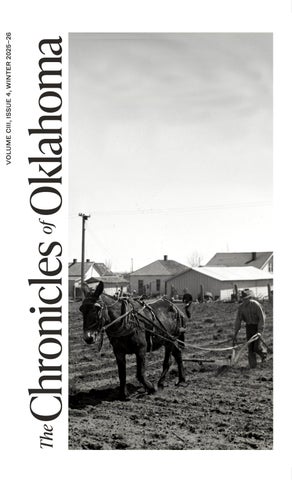
A mule-drawn plow in Britton, Oklahoma, 1937 (20218.251, Clayton E. Soule Collection, OHS).
Appealing to Reason: How Publishers and Editors Drove Oklahoma’s Third-Party Movement into the Twentieth Century

By Emma Long*
Reflecting on his arrival in rural Oklahoma in 1907, Oscar Ameringer lamented that the “Oklahoma farmers’ living standard was so far below that of the sweatshop workers of the New York east side,” that “comparison could not be thought of.”¹ Farmers, many resigned to a life of privation, faced a grim outlook as their Jeffersonian ideals became increasingly unattainable and they struggled to provide for their families and retain their farms. And, although the agricultural industry dominated the Twin Territories and subsequent fledgling state of Oklahoma during the late nineteenth and early twentieth centuries, the interests of farmers and tenants were largely overlooked. Consequently, rural Oklahomans, lacking political representation
APPEALING TO REASON
and desperate for relief, declared their affiliation with a succession of third-party agrarian organizations that pledged to ameliorate rural poverty. Whilst rural support for third-party organizations in Oklahoma during the late nineteenth and early twentieth centuries is welldocumented, the highly persuasive propagandists who drove rural Oklahomans to embrace those movements through publications are equally noteworthy. Publishers and editors representing the Populist Party, Farmers’ Union, and Socialist Party fundamentally promoted ideology, fostered solidarity, and recruited the rural supporters they pledged to represent, effectively driving Oklahoma’s third-party message into the twentieth century.
From the outset, the inhabitants of the territory that became Oklahoma faced a unique series of challenges. Initially considered largely uninhabitable, the territory was reserved for Native American tribes forced to relocate in the early nineteenth century under the administration policies of Andrew Jackson. However, westward expansion proved inevitable as the nation’s population rapidly expanded with industrialization and resulted in an increase of settlers encroaching on Indian Territory. Although originally prohibited from owning land in the territory, settlers were presented with a path to land ownership in the late nineteenth century after the federal government approved a series of acts that separated tribal lands, allocated specific tracts to all Native Americans, and opened almost two million acres of unallotted land for settlement.²
As a result, Indian Territory and the newly established Oklahoma Territory were inundated with settlers who scrambled for a parcel of land to call their own, speculators who vied to secure a profit, and prospectors who sought resources to exploit. From 1900 to 1910, Oklahoma’s population increased from 790,391 to 1,657,155.³ While Native Americans undoubtedly experienced the most severe repercussions of the land grab, settlers hoping to realize their agrarian ambitions did not emerge unscathed. Speculators, proficient in securing large acreages at minimum cost, contracted tenants under increasingly exploitive conditions.
Despite the resiliency, resolve, and resourcefulness that tenants gleaned from their agrarian livelihoods, tenancy in early Oklahoma often equated to a life of hardship. Coinciding with the population boom in the Twin Territories, the 1890s depression severely impacted the
THE CHRONICLES OF OKLAHOMA
price of commodities. Farmers, having little choice but to sell cash crops for far less than the cost of production, were driven deep into debt, and many were subsequently forced to transition into tenancy.4 Between 1900 and 1910, Oklahoma’s tenancy rate more than doubled, rising from 47,250 to 104,137.5 Adding to their plight, tenants found themselves bound to exploitative crop-lien systems and paid significantly higher interest rates than landowners. Furthermore, tenants’ high-interest, short-term credit was often directed toward the highly inflated cost of living, depriving them of opportunities to not only improve their quality of life, but also invest in more sustainable production methods.6
Because landlords often replaced tenants after the year’s agreement expired, or because tenants moved on voluntarily in search of better opportunities, tenancy proved a highly mobile profession. And considering that one-third of Oklahoma’s tenants moved every year, both financial and social instability took a toll on tenant families.7 Moreover, structural improvements to tenant farms were rare as tenants

Mr. Sedwick, a tenant farmer, speaks with Mr. Rowsey, the cotton farm owner, 1936 (2019.061.B1.01267, Oklahoma Conservation Historical Society Collection, OHS).
APPEALING TO REASON
simply could not afford to invest capital that they did not have into homes that they did not own. Consequently, many relocating tenants and their families were left with no choice other than to occupy the previous tenant’s dilapidated dwelling.
Not only did tenant poverty affect rural families economically, it also deeply affected them on a social level. In 1912, a southern farmer expressed his frustrations with the exploitative tenant system in the weekly socialist publication, the Appeal to Reason:
My family and I subsist principally on cowpeas, cornbread, and water. Have had twenty dollars’ worth of clothes in two years. Haven’t had a piece of underwear in eighteen months; that includes the severest winter known here. Last summer was a severe drought. I made $1,250 worth of cotton and was allowed $170 therefore. Nineteen out of twenty farmers here are “tied up” soul and body to the banks and credit houses. Haven’t been able to take my little children to church or Sunday school in two years on account of lack of suitable clothing.8
Habitually disparaged and considered “crude, immoral, and unsuitable church members,” tenants were shunned from local churches and often prevented from attending town dances.9 And, whilst it is evident that tenants felt some shame as a result of their privation and consciously avoided interactions with wealthier townsfolk, the wholesale discrimination and exploitation of tenants did not have the intended diminishing effect. Rather, it resulted in the formation of an innate affiliation of tenants as a social class, paving the way for their embrace of the Populist Party as a means of reviving their agrarian vision more equitably.
Founded in 1892, and built upon the Southern Farmers’ Alliance in Kansas and Oklahoma Territory, the agrarian Populist Party was one of the first organizations that attempted to ameliorate nineteenth-century rural poverty through agricultural reform. The movement, spearheaded by individuals sympathetic to the plight of the farmer, “provided a vehicle for mobilizing both third-party veterans and old-party farmers who were losing faith in the panaceas of the Gilded Age’s cosmopolitan spokesman.”10 Considering that both the 1892 and 1896 Populist Party platforms were of agrarian origin and
THE CHRONICLES OF OKLAHOMA

articulated demands such as “free and unrestricted coinage of silver,” and the granting of “free homes as provided in the national homestead law,” the Populist Party’s appeal to rural voters seemed only natural.11
Recognizing that “meaningful and lasting change . . . could be achieved only at the ballot box,” leading figures in the Territories’ Populist Party set out to propagate populist ideology in an effort to secure voters as an avenue to achieve agrarian reform.12 In 1894, Herman Taubeneck, national chairman of the Populist Committee, was featured on the front page of the Oklahoma Representative insisting that “no populist can afford to cast his vote for any of the old parties or remain home on election day.”13 The urgency of Taubeneck’s assertation was reiterated by the editor: “An opportunity is in the grasp of the Populists to send a Delegate to Washington who will not only labor for Oklahoma but for the financial betterment of the whole people.”14 Conscious of the importance of regular publications in promoting Populist ideology, agrarian reform editors embraced the challenge and spearheaded the Populist movement.15 In 1890 there was just one Populist publication in Oklahoma Territory, yet by 1895, the Territory boasted twenty-one.16
Tenant shack, n.d. (2012.030.86.5, Kenny Sivard Collection, OHS).
Standing out amongst Populist newspapers is the Oklahoma Representative, whose publisher and editor, Leo Vincent, rapidly rose to the rank of the Populist Party’s territorial chairman in 1894.17 Vincent, a resolute reformer and astute propagandist, was instrumental in the success of the Territory’s Populist Party. Not confined to simply promoting Populist ideals, Vincent exposed inconsistencies within the Republican and Democratic parties’ ideologies and their actions and played a vital role in persuading voters, particularly Democrats, to abandon their traditional party loyalties. Vincent, offended by the Democrats’ attempt to unite with the Populists in 1894, accused the Democrats of acting with a “purely selfish motive” to defeat the Republican Party.18 “Once and for all we wish the REPRESENTATIVE to be understood as opposing fusion . . . Fusion means confusion and disintegration,” Vincent declared.19
In an editorial specifically directed at Democrats titled “Democrat, Read and Think: You are Sick and Need a Doctor Badly,” Vincent exposed the apparent failures of the Democrat Party in the Territory at the expense of its citizens.20 Through satire, Vincent compared the Democratic and Republican silver platforms by likening them to “two links of bologna,” claiming they were “so near alike in smell and complexion” that they “must be from the same dog.”21 By drawing attention to the similarities between the two rival political parties, particularly their habitual pandering to the elite, Vincent set the Populist Party apart from the opposition, elevating it as the logical choice for residents of the Territories. In doing so, he fostered solidarity amongst rural residents, especially farmers and tenants, both justifying and heightening their resolve to effect agricultural reform through the ballot box.
In a further attempt to deride rival political parties, Vincent’s publications featured testimonials from political defectors. Freeman Kelly, a prominent Indiana Democrat who severed his political ties and joined the Populist Party in 1894, brazenly publicized the flaws he witnessed within the Democratic Party. Proclaiming that the Democrats lied and failed to keep promises, Kelly asserted that “the people can not expect relief from either of the old parties,” in that “neither can get away from the power of Wall Street.”22 By publicizing the transition of prominent Democrats to the Populist Party as not only the rejection of traditional party values but also the endorsement of progressive Populist
THE CHRONICLES OF OKLAHOMA

ideology, Vincent validated political realignment as an effective avenue to achieving a more equitable agrarian society. Vincent revealed the plight of the farmer and the social polarization occurring in the Territories, reporting that “the United States is the largest tenant farmer nation in the world,” that “of the 7,500,000 . . . engaged in agriculture about one third are so heavily mortgaged that the interest they pay to avoid foreclosure is about equal to . . . rent.”23 Emphasizing that prior to 1873 farm debt was almost nonexistent, Vincent called for an end to “laws contracting currency and demonetizing silver,” and claimed that without “more money in circulation, we are doomed, like Ireland, to be a nation of landlords and tenants, masters and slaves.”24 Moreover, Vincent drew attention to the insurmountable obstacles that farmers and tenants faced, reporting that in 1893 the cost of raising wheat was $11.48 an acre, yet “the value of an average acre of wheat in the United States was $6.16.”25 To the thousands of destitute tenants and farmers struggling to stay afloat in the
An editorial cartoon that appeared in The Oklahoma Representative, 1896 (The Oklahoma Representative, Oklahoma Digital Newspaper Program, OHS).
Territories, Vincent’s claims were rapidly becoming a reality, increasing the earnestness of the movement.
Adept at highlighting the unjust policies of traditional parties and propagating Populist ideology, Populist publications provided the party with an invaluable method of cost-effective mass communication. Owing to the influx of educational, persuasive, and exposé journalism, Populist publications such as Vincent’s Oklahoma Representative compelled tens of thousands of farmers, tenants, and progressives to transcend sectionalism, abandon their traditional party loyalties, and embrace the promise of a more equitable society. Consequently, by the mid-1890s, the Populist Party had emerged as the Republican Party’s primary rival, effectively disrupting the Territories’ political paradigm.
Notwithstanding the Populist Party’s unexpected and promising emergence, the presidential election of 1896 marked the end of the Populist movement. Lacking a clear candidate of their own, Populists swiftly pledged support to the Democratic candidate, and the subsequent election loss ultimately precipitated the nationwide collapse of the Populist Party. The loss, coinciding with a precipitous drop in crop prices that resulted in thousands of defaulted agricultural loans and repossessions across the country, signaled that once again, farmers and tenants in the territories were without political representation.26 Yet, despite the Populist Party’s ultimate demise, Populist editors like Vincent had succeeded in politically invigorating residents of the Territories, inadvertently providing them with the knowledge and resources required to organize and mobilize at the grassroots level effectively. And, just as the Populist Party had formed in response to the desperate conditions of rural residents, the Farmers’ Union was similarly founded on the conviction that collective action would effect change and ensure political representation for farmers at the national level.
Newt Gresham, a former Populist, editor, and sharecropper who had experienced the hardships that farmers and tenants faced firsthand, set out to normalize the concept of a union specifically established for farmers through his publications.27 By August 1902, Gresham had recruited ten men, six of them fellow farmers, and established the Farmers Educational and Cooperative Union of America in Texas. The newly founded Farmers’ Union’s objectives included “discouraging . . . the present mortgage and credit system,” assisting members
THE CHRONICLES OF OKLAHOMA
“in buying and selling,” and educating farmers on sustainable farming practices.28 Taking into consideration the demise of the Populist Party after its alignment with the Democrats, Gresham discerningly declared the Farmers’ Union a nonpartisan organization, which would “forever abstain from even the discussion of partyism.”29
Given that the Farmers’ Union’s objectives directly benefited farmers and tenants, the progression from Populism to the Farmers’ Union was a natural development for many rural residents. By 1903, the Farmers’ Union had diffused into Oklahoma and Indian Territories, and farmers and tenants, energized by their participation in the Populist movement, eagerly embraced the new agrarian organization.30 As a result of the combined recruitment efforts of R. D. King and Sam Hampton, the Farmers’ Union “was so successful in the territories that the Texas Farmers’ Union granted territorial members organizational autonomy at its annual convention in February of 1905.”31 Initially established as two separate Farmers’ Unions to accommodate for both Oklahoma and Indian Territory residents, the Unions soon combined to form the Indiahoma Union.
As Farmers’ Union membership flourished organically within the Territories, editors focused their energy on promoting Union ideology and fostering solidarity amongst members. The Independent Farmer, a weekly Farmers’ Union newspaper published and edited by J. K. Armstrong, was established in Durant in 1905 to advocate for the Farmers’ Union and organize rural Oklahomans to support Union policies such as crop curtailment and withholding. In an op-ed featured in The Independent Farmer’s inaugural issue, Sam Hampton acknowledged the significance of publications in representing, educating, and organizing farmers. Hampton compelled fellow farmers to “form a great battery through The Independent Farmer,” as “through it we can grasp each other’s hands and form a grand circle around one common and definite plan.”32 Citing farmers lack of direction, representation, and clear “organized efforts” as contributing to their situation, Hampton implored farmers to assist in alleviating rural poverty by cooperating so as to “regulate supply” and form a universal “scale of equitable prices” for their products.33
Considering that the Farmers’ Union primarily hoped to achieve reform through sustained, collective action, Armstrong used The Independent Farmer as an instrument to promulgate the benefits of clearing houses and direct dealing systematically, and to inform readers of
378
the strategies employed to do so. In an article titled “Direct Selling and Direct Buying,” Armstrong relayed the benefits of withholding cotton in warehouses until a price favorable to the producer was secured. By dispensing “the army of buyers operating between the farm and the factory,” and selling directly to the factory at all seasons of the year, Armstrong ensured that farmers would no longer “be at the mercy of the speculator and of the stock gambler.”34 Armstrong published plans to hold cotton, “whereby members may get 15 cents per pound,” and provided a guide on shipping cotton by rail to a Galveston port.35 This strategy guaranteed higher cotton prices, offered an “advance of twothirds of the value of cotton,” cheap storage rates, and a deduction of freight costs from the profits, meaning that farmers could participate in crop withholding at no expense.36 Moreover, acknowledging that collective action was a purely voluntary strategy, Armstrong regularly reinforced its effectiveness by featuring spirited reports of successful crop withholding plans from Union locals throughout the Territories.
Mirroring prior Populist publications, Armstrong promoted solidarity amongst farmers and tenants by highlighting the rife exploitation they experienced at the hands of commercial agriculture. Armstrong compelled members to critically analyze the agricultural system by including features that exposed exploitation at the hands of the commercial class. One such article calculated the cost of handkerchiefs made from a five-hundred-pound bale of cotton in comparison with the artificially low price of cotton. The article demonstrated that once all manufacturing and transport costs were deducted, including the meager $75 given to the farmer for producing the cotton, the revenue for the product was equal to over $3000.37 The imperative questions posed to Union members were, “Who received the $3000 revenue, and why did the farmer see less than 2.5 percent of a product in which he produced the most vital component?”
Although wealth production on farms across the nation more than doubled between 1897 and 1909, increasing from $4,250,000,000 to $8,760,000,000, farmers and tenants saw few, if any, economic benefits.38 Between 1899 and 1909, the value of crops in Oklahoma alone increased by 205 percent, yet in the same period tenancy rates in Oklahoma more than doubled.39 Despite the amount of wealth farmers and tenants created, Union members were increasingly recognizing that the commercialized agricultural system was designed to benefit the commercial class.
THE CHRONICLES OF OKLAHOMA
In a further attempt to foster solidarity amongst the farming and tenant community, Armstrong featured an article by Andrew J. Carothers, the General Superintendent of the Colored Farmers’ Union of Texas. “The very first man we must help by co-operation is the poorest among us,” Carothers proclaimed, adding “the strength of our co-operative chain is measured by the ability of our weakest member.”40 Carothers entreated members to assist their neighbors, especially tenants forced to pledge their crop before harvest, by advancing them money to pay off loans which would allow them to withhold their harvest until a fair price could be secured. Remarkably, Armstrong featured the article a full sixteen years before the Farmers’ Union officially, albeit controversially, allowed African Americans to organize into local Farmers’ Unions within the state of Oklahoma.41
Seeking to elevate the farming profession, Armstrong promoted farming as both an indispensable and honorable occupation. Asserting that “farmers feed and clothe the world; they supply that without which the republic could not exist . . . they furnish the volume of exports which make us a leading nation,” Armstrong validated the contributions of farmers and tenants.42 Moreover, by heralding to the ideals of Thomas Jefferson, Armstrong motivated farmers and tenants to unite, strengthening their resolve to achieve their Jeffersonian visions. Remaining loyal to Gresham’s nonpartisan sentiments, Armstrong avoided political rhetoric in The Independent Farmer, emphasizing that his publication was “not published in the interest of any political party, but proposes to keep a strict watch upon the political field and warn the people of conditions that may threaten their interests.”43 Nevertheless, just as Gresham had feared, political interference by Democrats sympathetic with the larger landowning conservative faction of the Farmers’ Union intensified in 1906. After years of internal debate over the increasing leadership roles of large landowners within the organization and reduced representation of small farmers and tenants, conservative members of the Farmers’ Union effectively took control of the organization. By October 1906, J. W. Houchin, the last remaining and “sole representative of the working farmer on the executive committee” had resigned, ultimately rendering small farmers and tenants unrepresented in the organization specifically established to bring them relief.44 This sparked a gradual reformation that resulted in a drastic reduction in membership as small farmers and tenants, realizing that their interests would no longer be represented,
380
APPEALING TO REASON

The two charters from Indian Territory and Indiahoma, 1906 (The Independent Farmer, Oklahoma Digital Newspaper Program, OHS).
THE CHRONICLES OF OKLAHOMA
fled the Indiahoma Union in droves. The subsequent Oklahoma Farmers’ Union, formed in 1907, emerged with less than five percent of the 70,000 members that the Indiahoma Union boasted in 1906.45
Rather than recoiling in resignation from the consecutive loss of two agrarian organizations dedicated to representing their interests, farmers and tenants drew on the inherent resilience derived from their shared economic and social hardships. Becoming increasingly aware and malcontent with the effects of commercialized agriculture through their involvement in the Farmers’ Union, farmers and tenants concluded that “their poverty was rooted in the institutions of commercial agriculture, a system that enriched the commercial classes at the expense of the working farmer.”46 In consequence, thousands of aggrieved former Indiahoma Union members aligned themselves with the tenets of Socialism well before they ever considered joining the movement.
Predating statehood, the Socialist movement began to organize in Oklahoma Territory and by 1904, after successfully expanding the movement into Indian Territory, locals from both territories united to form one organization that boasted twenty-three Socialist locals.47 However, despite its initial momentum, membership soon stagnated; socialism had traditionally catered to industrial laborers, and Oklahoma was still in its industrial infancy. Undeterred, Socialists turned their attention towards the politically isolated, poverty-stricken farmers and tenants of Oklahoma. Yet, recruiting farmers and tenants posed unique challenges for the Socialist Party of Oklahoma. Oscar Ameringer, a leading figure in the Socialist Party, arrived in Oklahoma in 1907, deriding “the fallacy of a socialist movement almost exclusively composed of farmers . . . Farmers were not wage earners . . . they were capitalists, exploiting wage labor,” he declared.48 However, upon witnessing the extreme poverty affecting Oklahoma’s farmers and tenants, Ameringer admitted his error and launched a fervent recruitment campaign with renewed vigor; “up to then I had been a part-time world saver . . . Now I was a professional, on full time, and in every fiber of my being . . . This thing [poverty] was too terrible to be tolerated.”49
Aiding Ameringer in his efforts to promote Socialist ideology were numerous Socialist editors and publishers; however, there were few as prominent as Julius A. Wayland. Described as “the greatest propagandist of Socialism that has ever lived,” Wayland was instrumental in the
Socialist Party’s success in Oklahoma.50 Overcoming childhood poverty, Wayland rose to serve as editor of the Kansas-based Appeal to Reason, bringing with him strong convictions surrounding plutocracy and capitalism. Considered one of the most influential publications of the Socialist era, Appeal to Reason was distributed throughout Oklahoma between 1895 and 1922. Wayland, who had advocated for both the Populist Party and the Farmers’ Union, had long appealed to rural Oklahomans and was adept in increasing socialism’s palatability to Oklahoma’s more conservative farmers and tenants. He was aided in his efforts by the extraordinary ability of Socialist leaders to redefine the Oklahoma Socialist Party’s political agenda to better align with former Union members and their distinct democratic agenda. Successfully intertwining socialism with agricultural reform by giving farmers and tenants a place on the Socialist Platform in 1912, the Socialist Party of Oklahoma declared that their “central mission was to facilitate the passing of land from the possession of the landlords into the hands of the actual tillers of the soil.”51
Embracing the responsibility of educating readers on Oklahoma’s unique form of agrarian socialism, Wayland ensured farmers and tenants that although socialism was the “collective ownership and

Ameringer, n.d. (23187.2, Oklahoma Historical Society Photograph Collection, OHS).
Oscar
democratic administration of all the means of production and distribution . . . this does not mean the common ownership of all things but only things as are socially used.”52 In an effort to appeal to tenants, Wayland pledged, “Socialism will not take your farm away . . . it will make it so all who wish may have farms, and not have to pay the landlord for the privilege of using the earth.”53 Wayland insisted that readers understand socialist ideology before they promoted it, and directed them to not “talk socialism” without “knowing it, otherwise you may do the movement more harm than good.”54 By drawing attention to the ills of commercialized agriculture, Wayland elevated farmer and tenant psyche: “The farm renter is waking up to a knowledge of how he is being robbed, not alone by the landlords, but also by the railroads and the trusts that buy his products at their prices and sell back to him at their prices also.”55 Furthermore, Wayland painted the Democrats’ blatant disenfranchisement efforts against farmers and tenants as direct discrimination against their social class. “Restrictions on the ballot, which are restrictions on democracy” are “disqualifications that relate to poverty,” he noted, lamenting that “there is no place in America where there is less real democracy than in the states that are perpetually democratic [sic].”56
Distinguishing the Appeal to Reason from other third-party publications were the aggressive recruitment strategies employed by Wayland. The Socialist Party required a far more concerted recruitment effort, unlike the Populist Party and the Farmers’ Union, particularly in Oklahoma where farmers and tenants served as the primary laborers. Serving to intensify the Socialist Party’s recruitment efforts, both the Republican and Democratic state conventions made bids for farmers’ votes in 1912 after having recognized the growing threat that the thirdparty posed in Oklahoma. Wayland was swift to reaffirm the Appeal’s purpose and proclaimed, “there are 15,000,000 voters in this country who do not support the socialist ticket . . . to make converts of the majority of these voters is the mission of the Appeal, and it has no other!”57 Highlighting the Appeal’s reach, Wayland announced that between January 1 and November 12, 1912, the Appeal circulated 32,994,020 newspapers, claiming it was “the largest circulation of any political paper in the world . . . the largest run ever made on one press in the same time.”58
Much of Wayland’s recruiting success lay in his unconventional recruitment methods. He featured and gave regular prizes to members
who ordered the most copies of special edition newspapers, or gave the longest list of new subscribers, and regularly published state circulation statistics. Moreover, Wayland implored members to influence progressives with socialist ideology. On the front page of the special Farmer’s Edition, Wayland wrote, “do not overlook the importance of making a list of the progressive Republicans and Democrats in your voting precinct . . . we need these men and they need our literature.”59
Wayland went so far as to establish an “Appeal Army” tasked with recruiting socialists. Appeal Army members encouraged political realignment by providing local progressives with copies of the Appeal at no cost. On one occasion, the Appeal Army sent a free copy of the Appeal to every voter in a precinct, with the plan that if it increased voter support, they would send a free copy to every household in the country.60 In addition, the Appeal Army enlisted “Socialist Scouts,” children rewarded with badges and buttons for distributing the Appeal to Reason and The Coming Nation. Wayland posited that by issuing both socialist publications to households, “one or the other will strike . . . in the mental solar plexus,” and convert the reader to socialism.61
Mirroring previous third-party publications, Wayland was skilled in fostering solidarity amongst farmers and tenants. Through emotional appeals, Wayland humanized and elevated the morale of farmers and tenants who had experienced social and economic discrimination in Oklahoma for decades. The Appeal regularly featured testimonials from farmers and tenants; “We have to mortgage our teams, tools, and crop for supplies to make the crop,” bemoaned one tenant, “when flour is selling for $3 . . . we pay $4.50, when meat is twelve cents a pound . . . we pay eighteen.”62 By highlighting the plight of the farmer and the capitalist-driven social and economic polarization occurring in America, Wayland reinforced the logic of socialist ideology. “Rockefeller’s income from Standard Oil is $40,000,000 a year . . . You and your class produced every dollar of his wealth, why not keep it for yourself?” Wayland questioned.63 By contrasting the few who enjoyed exorbitant wealth with the multitudes of farmers and tenants living in poverty, Wayland pitted the capitalist class against the producing class, imploring readers to support the socialist cause.
Notwithstanding Wayland’s tenacity or the Socialist Party of Oklahoma’s conviction, the Socialist Party ultimately shared the same fate as both the Populist Party and the Indiahoma Union before it. From the
THE CHRONICLES OF OKLAHOMA
outset, socialism faced fierce opposition from the Democratic Party, which employed a range of strategies, including disenfranchisement and cooptation. When the United States entered World War I in 1917, Socialists opposed to the war effort were labelled treasonous, threatened with mob violence, and, in many cases, denied credit from local bankers and merchants, making farming increasingly difficult for tenants. Furthermore, some Socialist publications soon found their second-class mailing privileges denied.64 In 1917 and 1918, Congress passed the Espionage and Sedition Acts, and many supporters of socialism faced intensified scrutiny. Prominent Socialist orator William Hicks was arrested and held in Arnett, Oklahoma, for “making a speech in a restaurant advising resistance to the army draft.”65 Hicks was later given a twenty-year sentence for violating the Espionage Act.66 As a result of the increased hostility and discrimination directed towards Socialists, many tenants and farmers had little choice other than to sever their ties with the Socialist Party. In the years between 1916 and 1918, the Socialist Party of Oklahoma endured an 84 percent decrease in votes, and by 1922, only seventy-three paid members remained, leaving the Socialist Party of Oklahoma obsolete.67
Despite their transient nature and sporadic accomplishments, agrarian third-party organizations played a significant role in the social, political, and economic development of Oklahoma during the late

Socialist Party logo, 1915 (Tim Davenport Collection, Socialist Party of America).
APPEALING TO REASON
nineteenth and early twentieth centuries. Yet, the success of Oklahoma’s third-party movements can be largely attributed to the concerted efforts of Populist, Farmers’ Union, and Socialist editors and publishers, skilled in propagating ideology, fostering solidarity, and recruiting voters. Through widely circulated publications, editors and publishers successfully invigorated political engagement, instigated statewide collaborative efforts, introduced social and agricultural reform to the public, and exposed the extent of poverty affecting farmers and tenants in Oklahoma. Strong in their convictions against exploitation and determined in their motives to find relief, editors and publishers demonstrated a unique ability to connect with their readers. Indeed, many editors and publishers who had experienced hardships firsthand were among the first to embrace farmers and tenants in solidarity publicly. Through collaboration and the lessons learned from the rise and fall of the movements that preceded them, third-party editors and publishers evolved alongside the third-party organizations that they represented, effectively driving Oklahoma’s third-party movement into the twentieth century.
THE CHRONICLES OF OKLAHOMA
Endnotes
* Emma Long is a senior history education major at Southwestern Oklahoma State University, who is set to graduate summa cum laude in May 2026. She plans to pursue a master of science in Education. Ever sympathetic to the plight of the farmer, Emma was raised on a dairy farm in New South Wales, Australia, and currently resides on a ranch in western Oklahoma with her husband and four children.
The photograph on page 370 is of farmers at work, n.d. (2013.626.74, Hunter’s Home Collection, OHS).
1 Oscar Ameringer, If You Don’t Weaken: The Autobiography of Oscar Ameringer (Henry Holt and Company, 1940), 232.
2 Bruce E. Johansen, The Encyclopedia of Native American Legal Tradition (Greenwood, 1998), 15, 16. Federal Government Acts included the Dawes General Allotment Act of 1877 and an amendment to the Indian Appropriations Bill in 1889.
3 US Census Bureau, Agriculture: 1909 and 1910. Vol 7, Oklahoma. NASS, 1910, 437.
4 Jim Bissett, Agrarian Socialism in America: Marx, Jefferson, and Jesus in the Oklahoma Countryside, 1940–1920 (University of Oklahoma Press, 1999), 10.
5 John H. Southern. “Farm Tenancy in Oklahoma,” Agricultural Experiment Station Bulletin 239, no. 1 (December 1939): 37.
6 Southern, “Farm Tenancy,” 38.
7 Southern, “Farm Tenancy,” 37.
8 Appeal to Reason, August 3, 1912, 3.
9 John Thompson, Closing the Frontier: Radical Response in Oklahoma, 1889–1923 (University of Oklahoma Press, 1986), 45.
10 Worth Robert Miller, Oklahoma Populism: A History of the People’s Party in the Oklahoma Territory (University of Oklahoma Press, 1987), 27.
11 The Oklahoma Representative, July 30, 1896, 1.
12 Miller, Oklahoma Populism, 96.
13 The Oklahoma Representative, June 14, 1894, 1.
14 The Oklahoma Representative, June 14, 1894, 4.
15 Miller, Oklahoma Populism, 101.
16 Miller, Oklahoma Populism, 101.
17 Miller, Oklahoma Populism, 100.
18 The Oklahoma Representative, September 6, 1894, 1.
19 The Oklahoma Representative, June 14, 1894, 4.
20 The Oklahoma Representative, September 6, 1894, 4.
21 The Oklahoma Representative, September 6, 1894, 4.
22 The Oklahoma Representative, September 6, 1894, 5.
23 The Oklahoma Representative, July 19, 1894, 6.
24 The Oklahoma Representative, July 19, 1894, 6.
25 The Oklahoma Representative, October 22, 1896, 2.
26 James C. Milligan, Oklahoma Farmers’ Union: A History of the First 91 Years (Cottonwood Publications, 1997), 9.
27 Milligan, Oklahoma Farmers’ Union, 9.
28 Milligan, Oklahoma Farmers’ Union, 12.
29 Milligan, Oklahoma Farmers’ Union, 12.
30 Milligan, Oklahoma Farmers’ Union, 12.
31 Bissett, Agrarian Socialism, 22.
32 Independent Farmer, January 12, 1905, 2.
33 Independent Farmer, January 12, 1905, 2.
34 Independent Farmer, May 3, 1906, 3.
35 Independent Farmer, November 16, 1905, 1.
36 Independent Farmer, November 16, 1905, 1.
37 Independent Farmer, July 19, 1906, 1.
38 Statistical Abstract of the United States, 1909 (Washington Government Printing Office, 1910), 156.
39 US Census Bureau; 1914 Agriculture: 1909 and 1910, 353.
40 Independent Farmer, May 3, 1906, 11.
41 Milligan, Oklahoma Farmers’ Union, 38.
42 Milligan, Oklahoma Farmers’ Union, 6.
43 Milligan, Oklahoma Farmers’ Union, 8.
44 Bissett, Agrarian Socialism, 55.
45 Bissett, Agrarian Socialism, 10.
46 Bissett, Agrarian Socialism, 39.
47 Bissett, Agrarian Socialism, 63.
48 Ameringer, If You Don’t Weaken, 227.
49 Ameringer, If You Don’t Weaken, 232.
50 Howard H. Quint and Julius A. Wayland, “Pioneer Socialist Propagandist,” Mississippi Valley Historical Review 35, no. 4 (1949): 585.
51 Bissett, Agrarian Socialism, 68.
52 Appeal to Reason, August 31, 1912, 2.
53 Appeal to Reason, September 21, 1912, 1.
54 Appeal to Reason, August 3, 1912, 3.
55 Appeal to Reason, August 3, 1912, 3.
56 Appeal to Reason, August 3, 1912, 2.
57 Garin Burbank, When Farmers Voted Red, The Gospel of Socialism in the Oklahoma Countryside, 1910–1924 (Greenwood Press, 1976), 71.
58 Appeal to Reason, November 23, 1912, 1.
59 Appeal to Reason, July 6, 1912, 1.
60 Appeal to Reason, July 6, 1912, 3.
61 Appeal to Reason, September 24, 1910, 3.
62 Appeal to Reason, August 3, 1912, 4.
63 Appeal to Reason, June 27, 1914, 1.
64 Roger Mills Sentinel, August 23, 1917, 6.
65 Roger Mills Sentinel, August 9, 1917, 3.
66 Bissett, Agrarian Socialism, 165.
67 Bissett, Agrarian Socialism, 165, 167.
The Critique of Empire from Indian Country: Will Rogers and the US Empire, 1922–1935

By Daniel Burge*
On December 18, 1932, humorist Will Rogers utilized his nationally syndicated column to respond to Walter Lippmann. A few weeks before, Lippmann, in his own syndicated column, had criticized Rogers for alleging that both Herbert Hoover and Franklin Roosevelt had promised not to cancel European debts if they won the election.1 Rogers reminded his readers that he was well-travelled and understood what foreign policy ordinary Americans desired. Rogers noted that other readers had also written letters to his editors stating, “I read Will Rogers, but why does he have to dabble in politics. Let him stay on funny stuff where he belongs.”2 Rogers found it amusing that any reader would
take umbrage with him talking politics, given that his comedy revolved around the foibles and follies of politicians. He then observed, “Well if they would just stop to think I have written on nothing but politics for years, you never heard me on a mother in law joke. It was always about national or international affairs.”3
Rogers did not hesitate to defend his foreign policy views even when challenged by Lippmann. Yet scholars have sided with Lippmann and dismissed Rogers.4 For many, Rogers was a comic who entertained, nothing more, a figure who fit alongside of George Burns, Gracie Allen, and Amos and Andy in the vapid 1930s.5 In 1973, an author in The New York Times opined that “Will Rogers seems to belong to a simpler time—assuming the twenties and thirties were a simpler time, an isolationist, small-town America.”6 Those who have deemed Rogers more than an entertaining cowboy nevertheless have pigeonholed him.7 Ben Yagoda credited Rogers for the consistency with which he critiqued America’s overseas interventions, yet held that those views “qualified him as an isolationist.”8 Some have gone so far as to label his “isolationist” worldview short-sighted.9 “In hindsight,” one biographer noted, “much of what Rogers believed about America’s role in world affairs in 1934 might appear ill-considered.”10 Somewhat ironically, scholars of isolationism have mostly ignored Rogers, with one mentioning him in passing as the man who “fatally poisoned public opinion” against the United States joining the world court.11 Unlike Charles Lindbergh, Gerald P. Nye, and Charles Beard, Rogers has never been added to the pantheon of famous isolationists.12
Although Rogers might have been a comedian, much of his humor centered on his critique of US foreign policy. Fortunately for scholars of international relations, Rogers frequently cited examples of how the United States dealt with its neighbors and colonies. Rogers understood that his critique of US foreign policy had become a staple of his comic repertoire. A year before his death, he aptly observed, “Ever since I can remember telling jokes on the stage, and years before I started writing for any papers, I have used kidding stuff about us going into somebody’s country, and it’s always been tremendously popular stuff, for not a soul wanted us to be sending Marines out over the world. Like a big city would send policemen to places where they heard there was trouble.”13
Rogers should be viewed as a humorist who unhesitatingly critiqued the US empire and openly called for decolonization. Although
THE CHRONICLES OF OKLAHOMA
couched in the relaxed style of the “cowboy philosopher,” Rogers took direct aim at William McKinley, Theodore Roosevelt, Warren G. Harding, Calvin Coolidge, Herbert Hoover, and even Franklin D. Roosevelt. His evolving target became those politicians—regardless of party— eager to send American troops abroad to establish its hegemony. Far from being an isolationist, Rogers was a man who believed that the average American benefited little from the United States’ imperial adventures. Of equal importance, he advocated for the United States to abandon its colonial holdings in the Philippines, Hawaii, Puerto Rico, and China. Unlike other comics, who stuck to mother-in-law jokes and who penned humorous sketches about the follies of neurotic men in cities, Rogers used his voice to challenge the US empire, speaking out not merely on behalf of the small man, but for the small nations. Rogers’ critique of interventionism began almost as soon as he gained a newspaper column. On December 24, 1922, Rogers published his first syndicated column in The New York Times, an article entitled “Batting for Lloyd George.”14 “I want to apologize and set the readers of The Times straight,” Rogers began, “as to why I am blossoming out as a weekly infliction on you all.” The New York Times had planned on Lloyd George penning a regular column, but the editor called upon Rogers when George backed out. The decision to begin a column by jesting about a British prime minister was followed by a column the next week entitled “Settling the Affairs of the World.”15 In these opening columns, Rogers freely descanted on topics ranging from debts to international peace conferences.16 Within a month, Rogers was broaching the subject of American interventions. “Nations never seem to get much nourishment out of these Unofficial invasions,” he joked, “If memory don’t fail me, I think we made a pilgrimage into Mexico unofficially. All we got was Sand in our eyes. Either make it official and go in a-shooting, or stay out!”17
Over the next decade, Rogers made it abundantly clear that he favored staying out of the affairs of other nations. Mexico served as a prime testing case. Rogers saw no point in pursuing Francisco “Pancho” Villa during the Woodrow Wilson administration, nor did he think the United States needed to threaten Mexico with retaliation, as occurred during the presidencies of Harding and Coolidge. In the summer of 1925, Rogers penned a column simply entitled “Meddling in Mexico, A Summer Sport.”18 Rogers marveled at the audacity of Secretary of State
392

Political cartoon featuring Will Rogers, 1932 (The Film Daily, Wid’s Films and Film Folks, New York City).
THE CHRONICLES OF OKLAHOMA
Frank B. Kellogg, who had penned a caustic diplomatic note to Mexico. “Our papers,” Rogers groused, “are always harping on US developing Mexico. Suppose Mexico don’t want developing. May be they want it kept as it was years ago. How much do Americans spend in the Summer to get to some place where there is no development.”19 He then hit upon his main point. “Why don’t you let every Nation do and act as they please. What business is it of ours how Mexico acts or lives?”20
In his column, Rogers argued that interventionists were cloaking their interest in Mexico under the guise of altruism. Neither Republicans nor Democrats were interested in what was best for the people of Mexico. In May 1923, Rogers reviewed a speech by President Harding in which he “spoke on golf, accuracy in newspapers, international court, Mexico and more honesty to party pledges.”21 Harding optimistically concluded that the United States was “on good terms with all the nations of the Western Hemisphere but one, and that was Mexico.” Having briefly summarized the speech, Rogers let loose his punch line for the paragraph: “Mexico must have struck more oil.”22 A few years later, Rogers continued his frequent jibes about Secretary of State Kellogg’s penchant for writing letters. “If Mexico don’t hear from us every morning it’s because we have run out of stamps. I bet you that Mexico in years to come can show more letters from Coolidge and Kellogg than Mrs. Coolidge and Mrs. Kellogg can.” He then struck a more serious tone. “Will somebody please write and tell me and then I will shut up, why we are always picking on Mexico? We have got more Oil in this Country than we can sell.”23 On another occasion, Rogers repeated the claim that oil lay behind American interest in Mexico: “Outside of the oil interests and Americans who want to make money out of Mexico, the rest of the World’s Eyes don’t even know Mexico exists.”24 If American politicians were interested in Mexico because of its oil reserves, they only adopted a belligerent tone because of Mexico’s lack of military power. Many nations behaved in ways that irked US politicians, but the United States only responded with military force against smaller nations that seemed unlikely to fight back. “If Mexico had an Army and navy as big as ours,” Rogers reasoned, “we would be as courteous and gentlemanly to them as we are to France and England.”25 In his column, Rogers continually defended the right of smaller nations to practice sovereignty within their borders. “America and England, especially,” he concluded, “are regular old busybodies when it come[s]
to telling somebody else what to do. But you notice they, (England and America) never tell each other what to do. You bet your life they don’t! If Mexico or the Boers, or the Philipines [sic], or India was as strong as either one of them was you bet you Kellogg would consult somebody besides Mr. Coolidge and Borah, before he commented where the eyes of the world were located.”26 Rogers hoped that the United States could learn to behave like Switzerland, a nation that had “no wars, no notes” and that tended “to its own business.”27
Rogers also chided western powers for targeting China. “Every Nation in the World,” Rogers pointedly observed, “has always felt privileged to dictate some particular policy to China. They would hold a conference and decide that China should have an ‘open-door,’ while they went back home and even plugged up their own key holes.”28 Rogers singled out Great Britain and Portugal for interfering in China’s internal affairs to protect their own interests. “I even read where a Portuguese Gun Boat fired on a Chinese mob,” Rogers jested. “That was done for an advertisement to let the World know that Portugal had a Gun Boat.”29 He then facetiously asserted that European interference had led immigrants to bring their wars to the United States. “No wonder the Chinese all come to ‘Frisco and New York to carry out their Tong Wars. It’s the only place where they can shoot each other in a friendly way without having some Nation join in to protect their interests.”30
Not surprisingly, he also targeted the United States for its belligerence. “Even America is stealing their stuff,” he lamented at one point.31 What irked Rogers was that China was not bothering anyone. “Here they are,” he opined. “They have never bothered anyone in their whole lives. They have lived within their own boundaries, never invaded anyone else’s domains, worked hard, got little pay for it, had no pleasures in life, learned us about two thirds of the useful things we do, and now they want to have a Civil War.”32 Rogers proposed that the League of Nations create a substitute for Article 10, allowing individual nations to engage in as many civil wars as they desired. His fictional Article 10 stated, “Any Nation can have as many private Wars as they choose without outside interference, so long as all shooting is confined to the home grounds.”33
As he had with Mexico, Rogers questioned the motives of those Americans who wanted to uplift a foreign nation. This time, however, he set his sights not upon oil men but upon missionaries. In April
THE CHRONICLES OF OKLAHOMA
1933, Rogers devoted an entire article to the issue of missionaries in China.34 Rogers began by pointing out that missionaries should spend their time aiding their fellow Americans, as the Frontier Nursing Service had done in Kentucky. “I may be all wet and probably am,” Rogers deprecatingly posited, “but when an American starts telling a Chinese ‘How to live,’ why its like a new dude telling an old cowman how to run his ranch.”35 Weaving in joke after joke, Rogers cracked, “I would as soon be a heathern [sic] and die because the town didn’t [sic] have a sewer, as to be an Episcopalian and get bumped off by a fellow member’s Rolls-Royce.”36 Rogers understood that his view on the futility of missions work in China was bound to offend some of his readers. He reprinted a portion of a letter from a missionary who had asked him to reconsider his stance. Yet Rogers refused to budge. He ended his article with the blunt sentence: “My motto is ‘Save America First, then when you get em all saved, save the Portuguese, for the Chinese don’t need saving.’”37
Baked into his critique of missionaries was the premise that Western nations were in no position to teach morality to Asians. Rogers bluntly claimed that “the Chinese as a race have forgot more honesty, and gentlemanliness than we will ever know if we live another Century.”38 Rogers’ dislike of missionaries and their false morality appeared time and time again in his telegrams. One telegram stated: “Headline says ‘British Kill Fourteen Chinamen in Shanghai.’ If our missionaries had already saved these fourteen, why that ought to make it all right, but it certainly will be terrible if they died heathens. Hurrah for selfdetermination of nations.”39 Other jokes revolved around the tendency of nations to have a corrupting influence abroad. “Another hoax was that a Chinaman’s word was as good as his bond,” Rogers quipped. “Well, that goes with the chop suey. That might have been in the old days, but not since the missionaries and business men come in. Chinese are just as human as anybody now.”40
Since his first column, Rogers had denounced the United States for refusing to force Europe to pay its debts accrued during World War I. He could not help but notice the distinct differences in how the United States treated Asia. “China owes us four million and we take over their custom revenue,” he astutely concluded in 1927. “France owes us four billion and we are afraid to send them a bill for it. What a great difference in diplomatic relations an army and navy make!”41
396

Rogers compared China and Japan to make his point. “Japan used to have these other Nations tell them what to do, too. Then they went out and got them a Navy, and now England and France and America take off their coats and spread ‘em down for Japan to walk on. . . . We don’t send any more missionaries there now.”42 Rogers then distilled his joke into a single punchy sentence: “Any Nation is a heathen that aint strong enough to punch you in the jaw.”43
China was not the only nation in Asia that Rogers defended, as he wielded his pen to denounce the US military occupation of the Philippines. The United States had governed the Philippines since the early twentieth century. Yet Rogers routinely took it upon himself to decry the unwillingness of politicians to grant the Philippines its independence. His tongue-in-cheek telegram in 1926 was typical. “President Coolidge refuses to give the Philippines their complete independence. I am with Mr. Coolidge. Why should the Philippines have more than we do? Yours for 100 per cent. Freedom for everybody, including Ireland.”44
Alfred Eisenstaedt, Will Rogers speaking with US diplomats at a Swiss Disarmament Conference, 1932 (TimeLife_image_748967, Life Photo Collection, New York City).
THE CHRONICLES OF OKLAHOMA
Rogers saw it as the height of hypocrisy for a nation to pledge itself to the principles of sovereignty and self-determination and yet hold colonies. Rogers confessed himself flummoxed by those who refused to allow the Philippines to vote on its independence. “What was that slogan,” he pondered, “the whole country was shouting just exactly ten years ago today? Does this sound like it, ‘Self determination of small nations.” Rogers signed that telegram: “Yours for memory, Will.”45
In March 1924, Rogers ran an article spoofing the United States Senate for its investigation into the Teapot Dome Scandal.46 Written as a scene from a play, Rogers humorously has various senators bicker over who had informed The Washington Post about the scandal. At one point, Senator Thomas J. Walsh of Montana asks the committee to call General Leonard Wood to testify, only to be told that “Mr. Woods is in the Philippines.” “I thought he was home,” Walsh rejoins. “Haven’t they got their independence yet?” Walsh is surprised when a fellow senator informs him that the Philippines are not free. “What’s the matter?” Walsh queries. “Haven’t they struck oil, too?” As more inane conversation ensues, several senators ponder why the Philippines cannot be granted independence. Senator Thomas Heflin of Alabama then offers: “It’s funny to me that a country can’t get their liberty, when they have advanced far enough to have the champion bantamweight prize fighter of the world. I know countries that have their liberty when they can’t even produce a good golf player, and that’s the lowest form of civilization.”47 While meant as comic relief, the pointless debate over the Philippines suggested the ineptitude of the Senate and the unwillingness of its members to seriously consider granting independence to a colony that it seemed likely to hold in perpetuity.
Rogers mocked the Senate for its inane debates, holding his sharpest barbs for the presidents who refused to grant independence to the Philippines.48 In November 1931, Rogers provided a short history lesson of the seven presidents in a single paragraph, denouncing each for their unwillingness to resolve the issue. He first dealt with the Republican triumvirate of McKinley, Roosevelt, and Taft: “McKinley said, ‘We lost to Spain and had to take you.’ Roosevelt said, ‘Aguinaldo, we are here! And I think you should have freedom, but not under my Administration.’ Taft said, ‘Ha! ha! let’s all have a good laugh, and we will set you free, soon as the Democrats get in.” Despite his own partisan leanings, Rogers hardly let Wilson off the hook, as he has him proclaim, “We
398
promised ‘em their Independence, and I will see that the next President gives it to ‘em.” Having condemned Wilson, Rogers added similar jokes about the following three Republicans: Harding, Coolidge, and Hoover. What bothered Rogers was that the recent string of presidents seemed more than happy to pass the Philippines on to the next occupant of the White House.
Rogers peppered his telegrams with witticisms on the need for the Philippines to help civilize the United States. “I am in favor of giving the Philippines their freedom,” he crowed, “and then us go under their protectorate. That’s the only chance I see of us maybe getting an improvement in the government.”49 Another telegram simply stated, “Everything is different nowadays, even the way a country gets its freedom. We give the Philippines twelve years. In two years they are to have a Constitution that is suitable to us. I hope they make it. Ours after 150 years is not suitable to us.”50 Given his penchant for castigating the rampant corruption within Congress, it is not altogether surprising that Rogers faulted politicians for demanding that Filipinos reform their government. Rogers understood that by refusing independence until reform, politicians in the United States could delay setting the Philippines loose for decades.
Rogers commented on the Hawaiian Islands. In 1932, a sensational murder trial occurred in Honolulu when wealthy New Yorker Grace Fortescue was charged with the murder of Joseph Kahahawai. Clarence Darrow was brought in to defend Fortescue and her alleged accomplices.51 Fortescue’s daughter, Thalia Massie, had previously accused Kahahawai and several other men of rape in a case that resulted in a hung jury. Given the racial underpinnings of the trial, a large portion of the white press supported Fortescue.52 Rogers, by contrast, credited Darrow for his principles and promised his readers that Darrow was no “Shyster Lawyer.” Nonetheless, Rogers believed the case addressed the issue of military occupation. “Darn this thing of being somebody elses country and taking it over,” he complained, “No good ever comes of it.” He then continued: “We claim its for protection sake that we hold it. That’s a lot of hooey. Its two thousand miles away. If any Nation can come two thousand miles across an ocean and then lick us, well we are good enough sports to say, ‘More power to you.’”53
In May 1932, a telegram entitled “Will Rogers Offers A Word of Advice To His Uncle Sam” was penned.54 Noting that the trial in Honolulu was
THE CHRONICLES OF OKLAHOMA
dominating the papers, Rogers ventured his take on America’s Asiatic empire. “Course I guess I am all wet,” he said with his customary deprecatory style, “but I never have seen any reason why us, or any other nation, should hold under subjection of any kind any islands or country outside of our own.” If the United States continued to hold the Philippines and the Hawaiian Islands, it would have to adequately defend them, especially given the rise of Japan as a military power. Defending a territory two thousand miles away from the contiguous states made little sense to Rogers. As he often did, he defused the tense situation in Honolulu with a joke: “Let’s all come home and let every nation ride its own surfboard, play its own eukaleles [sic] and commit their devilment on their own race.” Rogers signed this telegram: “Yours for remaining on the home grounds.”55
Yet of all the nations that Rogers wrote about, none came close to matching Nicaragua. The United States had routinely intervened in Nicaragua throughout the early twentieth century. Late in 1926, President Coolidge sent the Marines after a disputed election.56 As he did so often, Rogers responded with pointed barbs shortly after the news broke. “A few slogans for our latest war,” Rogers quipped, before running down a list of humorous slogans. These included “Join the army and take the old Nick out of Nicaragua,” “Let’s make Nicaragua free for 100 percent Americans to live in,” and “We have lost our first combat there, but wait till our spring drive starts against Nicaragua.”57 Over the following years, Rogers routinely worked Nicaragua into his telegrams and weekly articles, often highlighting the fact that the United States refused to declare war officially. In January 1927, Rogers ended a telegram with a jocular postscript: “What did you do, father, in the great war of Nicaragua?”58 Sending in the Marines seemed to Rogers a clear sign that the United States was at war.
In 1927, Frank L. Smith of Illinois was appointed to the Senate to fill the vacancy left by the death of William Brown McKinley.59 Charges of corruption had hounded Smith, however, and the Senate refused to seat him.60 Rogers spun the situation into a humorous telegram. “You want to know why we are so funny to the rest of the world?” he asked his readers. “Here we are sending warships to tell Nicaragua who to seat after their election and we haven’t got a senator that was elected.”61 If the United States could not figure out who had secured the most votes in cities such as Chicago and Philadelphia, what chance did


Will and Betty
on a lecture tour, c. 1920 (2012.201.B1103.0438, Oklahoma Publishing Company Photography Collection, OHS).
Will Rogers (left) and Secretary of War Patrick Hurley (right), n.d. (2012.201.B1103.0412, Oklahoma Publishing Company Photography Collection, OHS).
Rogers
THE CHRONICLES OF OKLAHOMA
it have in ferreting out the ballot situation in Managua? Rogers dutifully suggested that the people of the United States would be better served if the Marines solved American problems.62
Rogers freely joked about Nicaragua, but in 1931, he took on a more serious tone. On March 31, 1931, a massive earthquake rattled Managua. Rogers used his column to advocate for economic aid and asked his readers to send donations to the Red Cross.63 “Whether you believe the marines should be here or not,” Rogers confessed, “they have been a Godsend during the last week. They have done some heroic work.” Despite the aid they were providing to stricken residents of the capital, Rogers did not think that the Marines needed to stay in Nicaragua. Striking the same argument that he had made in the past, Rogers opined: “I don’t think it’s worth leaving ‘em down here just for the sake of another earthquake. We may dig a canal here some day but we don’t have to guard the place we are going to dig it. Nobody is going to sneak in and dig it while we are away.”64 He concluded his column with a simple sentence: “Let’s help put ’em on their feet, call it a day, and go home ’tend to our own business.” It would be hard to encapsulate Rogers’ foreign policy ideas better than that.
From 1926 until his death, Rogers defended Nicaragua’s sovereignty, demanding that the US cease its interference. In February 1934, Rogers ran a telegram on the executed Augusto César Sandino. Although Sandino had not been popular with the US government, Rogers refused to denounce him. “There is one thing that he and I always agreed on,” Rogers noted, referring to Sandino, “and that was that American armed forces had no right down there. As to whether he was a George Washington or a Jesse James, that’s for his own people to judge.”65 A year earlier, Rogers still faulted policymakers for refusing to abandon the notion that they had the right to intervene. “We still think in terms of Nicaragua, of Haiti, of San Domingo, of Mexico, all these we have been in some sort of messes with. We meant well, but we just do love to nose about. We cant seem to bear to seeing anything going on without us at least offering advice.”66
Until he died in 1935, Rogers frequently criticized those who sought to control regions outside the continental United States. Rogers developed a cohesive view of foreign policy.67 After World War I, he questioned why Americans were left on the hook for loans that its allies refused to repay. Rogers summarized this view in the simple quip,
“There just ain’t any such animal as international ‘good-will.’ It just lasts till the loan runs out.”68 In his “Letters of a Self-Made Diplomat to His President,” Rogers bemoaned that Europe did not appreciate the American contribution to the war effort, and he scoffed at the thought that Great Britain and France were considering repaying their loans.69 Rogers did not think it possible for the United States to buy allies. Applying his logic to international relations, Rogers averred: “Just money never made friends with anybody. If a few millions of dollars is going to part our friendship, why, the friendship was never very deep.”70 Rogers felt it was beneath the United States to rely on propaganda to win countries to its cause. “Well,” he noted, “if we can’t act natural and have people like us for what we really are, why, all the propaganda in the world will do no good. Propaganda is the easiest thing in the world detected, and the nation or individual that are trying it on is the first to detect it.”71 Nations behaved similarly to people, and people understood when another person was trying to buy their friendship. Keeping up the metaphor of friendship, Rogers explained: “Let a Nation do like an individual—that is, I mean a real individual. Let ’em go through life and do and act like they want to, and if they can’t gain friends on their own accounts, don’t let’s go out and try to buy it. Any time you go out purposely to make friends with someone, the result is generally terrible.”72
Tied into Rogers’ idea that a nation could not purchase international goodwill was the belief that moral leadership was a myth. No nation, least of all the United States, could instruct another nation in morality. In 1931, he explained this point of view in a telegram. After complaining that the United States was “running true to form fixing some other country’s business,” he denounced moral leadership in withering terms. “When some nation wants us to help ’em out,” he observed, “they use the same old ‘gag’ that we should exert our ‘moral leadership’ and we, like a yap, believe it, when, as a matter of truth, no nation wants any other nation exerting a ‘moral leadership’ over ’em, even if they had one.”73 The United States had tried to lead Europe after World War I and had failed. It was time to abandon interventions. Rogers concluded his diatribe against moral leadership with an epitaph: “If we ever pass out as a great nation we ought to put on our tombstone; ‘America died from a delusion that she had moral leadership.’”74 Nations did not want others to exert their moral leadership or act in their own self-interest. Rogers frankly rejected the notion that Western
THE CHRONICLES OF OKLAHOMA

Will Rogers reading a newspaper, n.d. (2012.201.B1103.0451 Oklahoma Publishing Company Photography Collection, OHS).
404
powers, such as the United Kingdom and the United States, were intervening globally for altruistic reasons. Rogers continually joked about the commodities that the United States was trying to control through its moral leadership. Regarding Mexico, Rogers quipped: “The Country to the south of us we have lately recognized. (The receipt for any other Nation that wants us to recognize them, is to strike Oil, or some other commodity that our Capitalists want.)”75 Rogers peppered his Mexico material with references to oil, while he used sugar to talk about the Philippines and Cuba. “Take sugar out of Cuba,” he explained, “and the sugar out of the Philippines and our altruistic feelings would kinder cool off.”76 He tweaked the joke a bit in a different article: “We always had some sort of a bill where we was still to be the big brother, as long as the sugar lasted.”77 The United States was not interested in intervening unless a commodity could be exploited.
If there was one central component of Rogers’ foreign policy perspective, however, it was the maxim: stay at home and mind your own business. In one telegram, Rogers reiterated his argument that “a nation is just like an individual.”78 “If a man’s neighbors all hate him and he is continually in trouble, and all his fights and troubles are always over in the other fellow’s yard, he must be wrong. Men—and nations—who did not stay at home and mind their own business were often in need of a “good licking or a muzzle.”79 Rogers returned to the theme that each nation needed first to take care of its own citizens before it spent time worrying about the plight of others. As Rogers pithily put it in 1932, “when you get into trouble 5,000 miles away from home you’ve got to have been looking for it.”80
Rogers hoped that the United States would release the islands and stick to defending its own borders. “We are mighty good colonizers,” he observed. “We ought to sell (or give away to some enemy) our island holdings, and concentrate entirely on the old headquarters ranch here at home.”81 In 1933, Rogers compared the situation of France with the United States. France could not help bordering nations that were interested in invading it, and, as such, it had to consider its military defenses seriously. The United States, in contrast, did not have aggressive neighbors and was protected by oceans.82 “No nation ever had two better friends than we have,” Rogers concluded. “You know who they are. Well they are the Atlantic and the Pacific Ocean. There is a couple of boys that will stand by you. And you can always depend on em, three
THE CHRONICLES OF OKLAHOMA
thousand miles wide and a mile deep.”83 Unlike other nations, which bordered aggressive powers, the United States did not have to involve itself in unnecessary wars, unless its leaders unwisely chose to do so. Rogers frequently compared major powers to international bullies and reprimanded them for their mistreatment of smaller nations. “That’s why your League of Nations won’t hold water, because the big ones run it, and the little ones know that the big ones have only turned moral since they got all they can hold. I can come in with a full stomach and advise the rest of the gang not to rob the fruit stand. That it ain’t right.”84 Cuba, Nicaragua, and the Philippines were all nations that the United States was bullying. Rogers found it ludicrous that powerful nations were pretending to be looking after the interests of others. “There is no Nation laying awake at night worrying about a little Nation,” he gloomily theorized, “unless that little Nation is one where somebody can march across to get to them.”85 A nation should

Future Texas governor Dan Moody and Will Rogers, 1927 (PB16-230, Will Rogers Memorial Museum, Claremore, Oklahoma).
not need a powerful military to have international powers respect its sovereignty.
Rogers wanted the United States to overhaul its foreign policy, believing it would strengthen the nation. He suggested that if the United States bothered to treat its “sister republics” in a fair manner, there would be no need for international conferences.86 On a separate occasion, Rogers observed the approach of Pan-American Day. “The best thing to do with these countries,” Rogers wrote, “is to get out, let ’em alone and then sell things cheaper and better than any other nation. Then we don’t have to worry about relations and goodwill.”87 Rogers was hardly naïve. Yet he believed that the United States’ interest could best be served by forming natural friendships with allies and by respecting the rights of other powers. If the US did so, it would find itself with friends and not with forced allies who were dependent on the United States for loans and international aid.
Whether or not he was influenced by Rogers, President Franklin Roosevelt adopted a policy of non-intervention in the Americas.88 In

Franklin D. Roosevelt (far left) laughs while Will Rogers (far right) speaks, 1933 (PB16271, Will Rogers Memorial Museum, Claremore, Oklahoma).
THE CHRONICLES OF OKLAHOMA
December 1933, Roosevelt delivered a speech about the evils of interventionism.89 “The maintenance of law and the orderly processes of government in this hemisphere,” Roosevelt argued, “is the concern of each individual nation within its own borders first of all.”90 Roosevelt thundered that the time was right “to implement the declaration of President Wilson by the further declaration that the definite policy of the United States from now on is one opposed to armed intervention.”91 A few days later, Rogers unsurprisingly praised Roosevelt for his speech. “Just when you would think there is nothing of importance to be said that hadn’t been said,” Rogers grinned, “he comes on Thursday night and gains over 100,000,000 new friends outside of the US and perhaps that many here, by announcing that the US was not going to mess around in any South or Central American country with a gun.”92 Rogers then offered the president a rare compliment, declaring “it was his best speech of all.”
Yet Rogers did not give President Roosevelt unqualified praise for his non-intervention declaration. It was one thing to declare that the United States was not going to intervene in Central America, but what was to be done with the colonies that the United States held? Rogers wished that Roosevelt “had gone a little further.”93 A month later, Rogers again praised Roosevelt for the “new deal toward all our neighbors to the south,” which had gained the United States “many friends.”94 He then urged Roosevelt to take the final step: “Give the Philippines their freedom and take that godfather clause out of our Cuban treaty, and the first thing you know we would be called ‘brother’ and not ‘big brother.’”95
Throughout Roosevelt’s first term, Rogers feared that the United States was drawing perilously close to intervening in Cuba. In September 1933, he asked his readers about a revolution in Cuba, which he suspected the United States had an interest in. “It’s their country, it’s their sugar,” he reasoned. “Take the sugar out of Cuba and we would no more be interested in their troubles than we would a revolution among the Zulus.”96 That same month, he mourned that his “singlehanded crusade to keep us out of Cuba hasn’t been very successful.”97 He encouraged his fellow Americans to drink their coffee black instead of meddling in revolutions to secure cheap sugar. Rogers was unsurprisingly pleased in 1934 when Roosevelt helped revoke the Platt Amendment, which had enabled previous administrations to intervene
408
in Cuban affairs.98 “President Roosevelt is giving Cuba a new treaty,” he crowed, “the ‘god-father’ clause is taken out. All their revolutions are to be strictly ‘home talent.’”99
In the same telegram, he praised Roosevelt for not intervening, but also asked for decolonization to become the administration’s policy. “It won’t be long now ‘till our army will all be visiting America at one time,” Rogers optimistically penned. “That’s the dope, get ’em all home, add to their number, add to their training, then just sit tight with a great feeling of security, and just read about foreign wars.”100 In one of his weekly articles, Rogers credited Roosevelt with his shift in Latin American policy, but openly pondered why the United States was not returning other colonies. “Now if we will just give the Phillipines [sic] their full freedom,” he argued, “and get out of there. Course Japan might take it, but she would anyhow. A dog can protect only the bones that are right in front of him, he can’t have one away off to itself in front of another hungry dog and expect to be able to hold it.”101 Promising to be a good neighbor was a fine start, but the United States needed to figure out what to do with its colonial possessions. The people of Puerto Rico, Guam, Hawaii, and the Philippines deserved to have the same rights as Americans.
There is no way to know if Rogers would have maintained a stinging critique of Roosevelt’s policies. Rogers died in an airplane crash in 1935, at a time when it appeared that Roosevelt was going to change US foreign policy drastically. While Roosevelt boldly denounced interventionism, he refused to embrace decolonization, clinging to America’s burgeoning Asiatic empire with the tenacity of his predecessors. Roosevelt had no intention of losing the territories that the United States had seized in 1898. Would Rogers have challenged Roosevelt for his refusal to grant the Philippines its independence? Or would he have found it ironic that his prediction that Japan would launch an attack on America’s holdings came to pass in December of 1941?
If it is impossible to know what Rogers would have written if he had lived, it is also difficult to determine what led him to joke so frequently about US foreign policy. Certainly, part of his motivation lay in the fact that audiences found his material amusing.102 It is hard to imagine that Rogers would have continued writing jokes about Nicaragua, Cuba, China, and the Philippines if his audiences had not responded. It is also plausible to assume that Rogers’ identity as a Native American played
THE CHRONICLES OF OKLAHOMA

Will Rogers memorial plaque from the Cherokee Nation, 1946 (22209.1, Oklahoma Historical Society Photography Collection, OHS).
a role in focusing his comic ear on the tune of imperialism. Rogers’ jokes about striking oil, for example, could be applied to Oklahoma in the same way as it could to Mexico. “I hear the Navajos have struck Oil on their Reservation,” he joked in 1924. “That will give the White Man a chance to show his so called 100 per cent Americanism, by flocking in and taking it away from the Indians.”103 In a telegram penned in 1927 for Thanksgiving, he made the comparison even more explicit: “This is Thanksgiving. It was started by the Pilgrims who would give thanks everytime they killed an Indian and took more of his land. As years went by and they had all his land, they changed it into a day to give thanks for the bountiful harvest.”104 Rogers rounded out his joke by noting that all the nation had to be thankful for in 1927 was “a war in Nicaragua, and China, and a rehearsal in Mexico, two floods and a coal strike, and pictures of the Black Hills.”105
In his columns, Rogers confessed that his understanding of the United States and its history differed due to his identity as a Native American. Take his hatred of Christopher Columbus. During a trip to Italy, Rogers openly dismissed the man often credited for his “discovery” of America. “Somebody would have found America,” Rogers pointed out, “though even if he hadn’t, for you couldn’t hardly get around without running into it. Why they didn’t find it sooner is more than I will ever know.”106 Rogers then explained why he did not think much of Columbus. “Being an Indian, I don’t mind telling you personally, I am sorry he ever found it,” Rogers mused. “The discovery has been of no material benefit to us, outside of losing all the land. And I am proud to say that I have never yet seen a statue in Oklahoma to him. He wasn’t so much of a discoverer as he was just restless and couldn’t stay in one place.”107 In retrospect, Rogers could joke about Columbus’s discovery of the New World, but that did not mean that he had to view the explorer as a hero.
There was one man that Rogers despised far more than Columbus, and that was Andrew Jackson. In 1927, Rogers wrote a column centered on his attendance at a Jefferson-Jackson Day dinner. Rogers quipped that he had prepared a speech on Stonewall Jackson, only to discover that the Democratic gathering was in honor of Andrew Jackson. “To tell you the truth,” Rogers informed his readers, “I am not so sweet on old Andy. He is the one that run us Cherokees out of Georgia and North Carolina. I eat the dinner on him, but I didn’t enjoy it.”108 Rogers’
THE CHRONICLES OF OKLAHOMA
column belittled Jackson’s accomplishments, as he pointed out that he spent his career shooting at Native Americans and that his victory at New Orleans took place after a peace treaty had been signed. “He would have a row with the Government,” Rogers explained, “and they would take his command and his liquor away from him, and he would come back and sic himself onto us Cherokee again.”109 In contrast to most Democrats, who toasted Jackson for his defence of the common man, Rogers saw no reason to celebrate the killer. Rogers’ identity as a Cherokee did not permit him to honor the man who had targeted his people.
Rogers could not make a career out of denouncing Columbus and Jackson. Still, his strident critique of both men illustrated how his Cherokee identity shaped his writings and sense of humor. Rogers distrusted policymakers who claimed to be acting in the best interest of others and questioned the motives of presidents from Jackson to Coolidge. As a member of a displaced nation, Rogers did not want other nations to suffer the same fate. Not surprisingly, then, he emerged as fierce a critic of colonization. The United States, Rogers argued through his humor, did not have the right to impose its will upon the Philippines, Nicaragua, China, Haiti, and Cuba. Rogers never adopted the myopic view that the acquisition of an overseas empire in 1898 marked a departure from traditional US policy. Instead, he hoped that the United States could abandon its long tradition of telling small nations, which included the Cherokee, how to live.
The fact that Rogers was a comic who spun jokes should not detract from his deadly serious critique of the American empire. Scholars have done Rogers a disservice by claiming that he was an unthinking isolationist, a man swept up in the isolationist fervor of the 1920s and 1930s.110 Throughout his career, Rogers actively denounced the interventionist and colonization policies of Republicans and Democrats, calling for a drastic overhauling of US foreign policy. If the United States wanted to earn international goodwill, policymakers needed to abandon interventions, focus on domestic issues, and leave other nations to sort out their own problems. If policymakers made a concerted attempt to hide US empire from the general public in the late-nineteenth and early twentieth centuries, it hardly fooled Rogers.111 Indeed, Rogers’ undisputed positioning as the most popular comic of his generation raises questions as to whether or not the general public was truly unaware of
412
WILL ROGERS
the United States’ colonial empire. Although he lacked the credentials of Lippmann and the respect of the foreign policy experts who wrote for the Atlantic, Rogers understood both the origins and the aims of empire builders. More than any comic of his generation, Rogers found a way to entertain the public by unmasking empire.
THE CHRONICLES OF OKLAHOMA
Endnotes
*Daniel Burge is a historian of US empire and humor. His first book is A Failed Vision of Empire: The Collapse of Manifest Destiny, 1845-1872 (University of Nebraska Press, 2022). He has articles in the Pacific Historical Review, Western Historical Quarterly, and Studies in American Humor. He is currently working on a project that examines George Washington’s Farewell Address and foreign policy.
The photograph on page 390 is of Will Rogers typing in an automobile, 1934 (2012.201. B1103.0444, Oklahoma Publishing Company Photography Collection, OHS).
1 Walter Lippmann, “Today and Tomorrow: Note for Will Rogers,” Birmingham (Alabama) News, November 23, 1932.
2 Will Rogers, “Now About These Critics,” in Will Rogers’ Weekly Articles: Volume 5, The Hoover Years: 1931–1933 (Oklahoma State University Press, 1982), 212–14.
3 Rogers, “Now About These Critics,” 212.
4 Many excellent biographies of Rogers barely mention his views on foreign policy. See, for example, Ray Robinson, American Original: A Life of Will Rogers (Oxford University Press, 1996), 238.
5 David F. Burg, The Great Depression (Infobase Publishing, 2005), 125.
6 Richard R. Lingeman, “The Cowboy Philosopher,” The New York Times, November 11, 1973.
7 See, for example, I. E. Cadenhead, Jr., “Will Rogers: Good Neighbor,” The Chronicles of Oklahoma 38, no. 1 (Spring 1960), 2–7.
8 Ben Yagoda, Will Rogers: A Biography (Knopf, 1993), 286.
9 Gary Clayton Anderson, Will Rogers and “His” America (Prentice Hall, 2011), 89, 102, 203.
10 Anderson, Will Rogers and “His” America, 190.
11 Kenneth D. Rose, American Isolationism Between the World Wars: The Search for a Nation’s Identity (Routledge, 2021), 233.
12 See, for example, Wayne S. Cole, Senator Gerald P. Nye and American Foreign Relations (University of Minnesota Press, 1962); Wayne S. Cole, Charles A. Lindbergh and the Battle Against American Intervention in World War II (Harcourt Brace Jovanovich, 1974); Thomas C. Kennedy, Charles A. Beard and American Foreign Policy (University Press of Florida, 1975).
13 Will Rogers, “Listening to Roosevelt,” in Will Rogers’ Weekly Articles: Volume 6, The Roosevelt Years: 1933–1935 (Oklahoma State University Press, 1978), 87.
14 Will Rogers, “Batting for Lloyd George,” The New York Times, December 24, 1922.
15 “Settling the Affairs of the World as They Should Be,” Buffalo Times, December 31, 1922.
16 Rogers, “Settling Affairs.”
17 Rogers, “Settling Affairs.”
18 Will Rogers, “Meddling in Mexico, A Summer Sport,” Tacoma Sunday Ledger, June 28, 1925.
19 Rogers, “Meddling in Mexico.”
20 Rogers, “Meddling in Mexico.”
21 Will Rogers, “Noosing ’Em,” Baltimore Sun, May 6, 1923.
22 Rogers, “Noosing ’Em.”
23 Will Rogers, “Will Rogers Visits Chicago War Zone and Escapes with His Life to His Great Surprise,” Bartlesville Daily Enterprise, December 4, 1926.
24 Rogers, “Meddling in Mexico.”
25 Rogers, “Will Rogers Visits Chicago War Zone.”
26 Rogers, “Meddling in Mexico.”
27 Rogers, “Meddling in Mexico.”
28 Will Rogers, “Well, The Chinese Must Have Been Studying Irish History,” Greensboro Daily Record, July 5, 1925.
29 Rogers, “Well, The Chinese Must Have Been Studying Irish History.”
30 Rogers, “Well, The Chinese Must Have Been Studying Irish History.”
31 Rogers, “Well, The Chinese Must Have Been Studying Irish History.”
32 Will Rogers, “Two Bulls in a China Shop,” Danville (Virginia) Register, February 6, 1927.
33 Rogers, “Well, The Chinese Must Have Been Studying Irish History.”
34 Will Rogers, “For Missionaries; Save America First!” Springfield Sunday Union and Republican, April 16, 1933.
35 Rogers, “For Missionaries.”
36 Rogers, “For Missionaries.”
37 Rogers, “For Missionaries.”
38 Rogers, “Two Bulls in a China Shop.”
39 Will Rogers, “On Self-Determination As Rogers Sees It In China,” in Will Rogers’ Daily Telegrams: Volume 1, The Coolidge Years, 1926–1929 (Oklahoma State University Press, 1978), 70.
40 Will Rogers, “Will Rogers Could Not Find Any Chop Suey in China,” in Will Rogers’ Daily Telegrams: Volume 3, The Hoover Years, 1931–1933 (Oklahoma State University Press, 1979), 115.
41 Will Rogers, “Will Rogers Gives His View of the Chinese Situation,” in Will Rogers’ Daily Telegrams: Volume 1, The Coolidge Years: 1926–1929 Oklahoma State University Press, 1978), 67.
42 Rogers, “Two Bulls in a China Shop.”
43 Rogers, “Two Bulls in a China Shop.”
44 Will Rogers, “Will Rogers Backs Coolidge on the Philippines Issue,” in Will Rogers’ Daily Telegrams: Volume 1, The Coolidge Years: 1926–1929 (Oklahoma State University Press, 1978), 6.
45 Will Rogers, “Thoughts By Will Rogers on the Philippines Veto,” in Will Rogers’ Daily Telegrams: Volume 1, The Coolidge Years: 1926–1929 (Oklahoma State University Press, 1978), 75.
46 Will Rogers, “Rogers Continues to Investigate Everything,” Atlanta Journal, March 30, 1924.
47 Rogers, “Rogers Continues to Investigate Everything.” The reference is to boxer Pancho Villa (Francisco Villaruel Guilledo) who travelled to the United States and captured the World Flyweight Championship in 1923.
48 Will Rogers, “Pat Hurley and Will Converse: Feeds Baloney to the Little Brown Brothers,” Roanoke Times, November 1, 1931.
THE CHRONICLES OF OKLAHOMA
49 Will Rogers, “Mr. Rogers Offers A New Plan For Handling the Philippines,” in Will Rogers’ Daily Telegrams: Volume 3, The Hoover Years, 1931–1933 (Oklahoma State University Press, 1979), 116.
50 Will Rogers, “Mr. Rogers Sums Up the Task,” 264.
51 Will Rogers, “Will Rogers Says: Maybe Mellon Will Pay the British Debt,” Danville (Virginia) Register, May 22, 1932.
52 “Senate Orders Investigation of Hawaiian Situation: Admiral Pratt Proposes Change of Venue to Assure Four Americans of a Fair Trial,” Boston Globe, January 12, 1932.
53 Rogers, “Will Rogers Says: Maybe Mellon Will Pay.”
54 Will Rogers, “Will Rogers Offers A Word of Advice To His Uncle Sam,” in Will Rogers’ Daily Telegrams: Volume 3, The Hoover Years, 1931–1933 (Oklahoma State University Press, 1979), 159.
55 Rogers, “Will Rogers Offers A Word of Advice To His Uncle Sam,” 159.
56 “Force of U.S. Marines Landed in Nicaragua: Americans Asked Help,” Daily (Bloomington, Illinois) Pantagraph, December 27, 1926.
57 “Will Rogers Says Today,” Asheville Times, December 29, 1926.
58 “Now Rogers Knows Why We Seem Funny,” Flint Daily Journal, January 10, 1927.
59 “Illinois Man May Fight for Seat: Frank L. Smith Uncertain About Future Course,” Pasadena Star-News, January 21, 1927.
60 “Frank L. Smith Denied Right to Senate Seat,” Chattanooga Daily Times, January 20, 1928.
61 “Now Rogers Knows Why We Seem Funny.”
62 “Will Wants Marines for State Elections,” Flint Daily Journal, February 15, 1928.
63 “Will Rogers Looks Over Quake Damage; Asks U.S. To Help,” Paducah Sun, April 9, 1931.
64 “Will Rogers Looks Over Quake Damage.”
65 “Will Rogers Says,” Jonesboro Daily Tribune, February 23, 1934.
66 “Nothing to Get Excited About,” Richmond Palladium and Sun-Telegram, August 18, 1933.
67 Rogers tenaciously defended his right to comment upon foreign policy. See Yagoda, Will Rogers, 280.
68 Will Rogers, “Mr. Rogers’s Disillusionment Increases As He Gets About,” in Will Rogers’ Daily Telegrams: Volume 3, The Hoover Years, 1931–1933 (Oklahoma State University Press, 1979), 110.
69 Will Rogers, Letters of a Self-Made Diplomat to His President (Oklahoma State University Press, 1977), 113.
70 Rogers, Letters of a Self-Made Diplomat, 113.
71 Rogers, Letters of a Self-Made Diplomat, 113.
72 Rogers, Letters of a Self-Made Diplomat, 113.
73 “Will Thinks the United States is Greatly Deluded,” Paducah Sun, June 23, 1931.
74 “Will Thinks the United States is Greatly Deluded.”
75 Will Rogers, “Inside Stuff on the Total Eclipse,” Springfield (Massachusetts) Union, September 23, 1923.
76 “Freedom Never Was Given Cuba Rogers Asserts,” Jackson Citizen Patriot, August 11, 1933.
77 “Says Will Rogers,” Dawson Springs Progress, July 19, 1935.
78 Will Rogers, “Mr. Rogers Moralizes A Bit On International Relations,” in Will Rogers’ Daily Telegrams: Volume 1, The Coolidge Years, 1926–1929 (Oklahoma State University Press, 1978), 72.
79 Rogers, “Mr. Rogers Moralizes A Bit,” 72.
80 Will Rogers, “Will Rogers Says,” Hickory Daily Record, February 10, 1932.
81 “Would Give Islands To Our Worst Enemies,” Geneva Daily Times, March 30, 1931.
82 Will Rogers, “The World Needs More Whiskers,” Oregon Sunday Journal, April 16, 1933.
83 Rogers, “The World Needs More Whiskers.”
84 Will Rogers, “A Boom in Brotherly Love,” in Will Rogers’ Weekly Articles: Volume 6, The Roosevelt Years: 1933–1935 (Oklahoma State University Press, 1978), 238.
85 Rogers, “A Boom in Brotherly Love,” 239.
86 “Today’s Wire from Will Rogers,” Houston Chronicle, February 9, 1928.
87 Will Rogers, “Rogers Thinks Canal A Tunnel, As He Is Unable to Locate It,” in Will Rogers’ Daily Telegrams: Volume 3, The Hoover Years, 1931–1933 (Oklahoma State University Press, 1979), 18.
88 For Roosevelt’s foreign policy, see Irwin Gellman, Good Neighbor Diplomacy: United States Policies in Latin America, 1933–1945 (Johns Hopkins University Press, 2019).
89 For Roosevelt’s foreign policy, see Robert Dallek, Franklin D. Roosevelt and American Foreign Policy, 1932–1945 (Oxford University Press, 1979); Warren F. Kimball, The Juggler: Franklin Roosevelt as Wartime Statesman (Princeton University Press, 1991); David F. Schmitz, The Sailor: Franklin D. Roosevelt and the Transformation of American Foreign Policy (University Press of Kentucky, 2020).
90 “Text of Roosevelt’s Speech,” News and Observer (Raleigh, North Carolina), December 29, 1933.
91 For Roosevelt’s foreign policy, see Irwin Gellman, Good Neighbor Diplomacy: United States Policies in Latin America, 1933–1945 (Johns Hopkins University Press, 2019).
92 “Rogers Thinks Roosevelt Still Good Radio Man,” Fort Worth Star-Telegram, December 30, 1933.
93 “Rogers Thinks Roosevelt Still Good Radio Man.”
94 “Today’s Wire from Will Rogers,” Houston Chronicle, January 23, 1934.
95 “Today’s Wire from Will Rogers.”
96 “Revolutions Run in Packs Like Bananas, Will Rogers Says,” Muskegon Chronicle, September 13, 1933.
97 “Will Rogers Says,” Ann Arbor News, September 18, 1933.
98 “Will Rogers Says,” Jonesboro Daily Tribune, May 31, 1934.
99 “Will Rogers Says.”
100 “Will Rogers Says.”
101 Will Rogers, “A Dog Can Protect Only the Bones That are Right in Front of Him,” Helena Daily Independent, January 7, 1934.
102 Will Rogers, “Listening to Roosevelt,” in Will Rogers’ Weekly Articles: Volume 6, The Roosevelt Years: 1933–1935 (Oklahoma State University Press, 1978), 87.
103 Will Rogers, “Rogers Returns to Boobs and Bankrolls,” Atlanta Journal, June 1, 1924.
104 “Pilgrims’ Thanks for Indians’ Land,” Saginaw Daily News, November 24, 1927.
105 “Pilgrims’ Thanks for Indians’ Land.”
THE CHRONICLES OF OKLAHOMA
106 Will Rogers, “Will Joins the Church-Prowlers,” Richmond (Indiana) Palladium and Sun-Telegram, July 31, 1926.
107 Rogers, “Will Joins the Church-Prowlers.”
108 “Feeding the Democrats Raw Oratory—By Will Rogers,” Salt Lake Tribune, February 5, 1928.
109 “Will Rogers Says: Feeding the Democrats Raw Oratory,” Danville Register, February 5, 1928.
110 Selig Adler, “Isolationism Since 1914,” American Scholar 21, issue 3 (Summer 1952): 335–44.
111 Daniel Immerwahr, How to Hide an Empire: A History of the Greater United States (Farrar, Straus, and Giroux, 2019), 21.
H. H. Champlin: Entrepreneur, Oilman, and President of the First National Bank of Enid

By Michael J. Hightower*
At high noon on September 16, 1893, a familiar scene etched itself into America’s collective memory when thousands of prospective homesteaders and town builders thundered into the Cherokee Outlet straddling Kansas’s southern border to open Indian lands to non-Indian settlement. Known popularly as the Cherokee Strip Run of ’93, the mad scramble for homesteads and town lots obliterated what was left of the old Chisholm Trail and dropped the curtain on free-range cattle grazing that had defined the regional economy for nearly three decades.
THE CHRONICLES OF OKLAHOMA
In the southwestern quarter of the Cherokee Outlet’s eight-millionplus acres of prime grazing land and smack in the middle of the famed cattle trail was a tiny government land office. When dawn broke on September 16, the newly constructed building was the outpost’s only permanent structure. By sundown, the townsite was swarming with an estimated ten thousand people who flocked to the land office to legitimate their claims.
Three miles north of that tiny office was a depot operated by the Chicago, Rock Island, and Pacific Railway. According to local lore, a railroad official who was passing through the area to check on the depot’s construction in the summer of 1889 inquired about the station’s name. “Skeleton Station,” came the reply. Deciding on the spot that nobody would want to live in a place called Skeleton, he suggested “Enid” after a character in a novel he had been reading on his way to the construction site—Alfred Tennyson’s Idylls of the King. 1
The literary appellation stuck, but the whole enterprise nearly foundered when a dispute broke out over the location of the townsite and the designation of stops along the railway. No sooner did the dust settle from the run of ’93 than two upstart villages squared off in a battle for economic supremacy: Enid, already a city of 3,500 that was delivering $23,000 per month in freight business to the railroad, and North Enid that was succeeding in its bid to win the Rock Island’s favor. In a clear indication that Enid deserved a depot, city clerk W. S. Whittinghill claimed that thirty-five-thousand passengers had been conveyed from the station at North Enid to Enid since the opening. Invoking divine intervention, Whittinghill prayed for a judge to issue a writ compelling the Rock Island to build a depot at Enid.2
The clerk’s prayers went unheeded when simmering unrest exploded into violence. “Intense excitement exists here over the attempted demolition of Rock Island property,” ran a press report in the Guthrie Daily Leader filed at Round Pond, Oklahoma Territory, on June 7, 1894. Enraged when a train refused to stop at the government townsite of Pond Creek, a mob forced the train to screech to a halt and began tearing up the track.
“So far, legislation and congressional action have failed,” continued the breathless report. “The affair is very serious.”
On June 6, Rock Island attorney John I. Dille fired off a dispatch to Territorial Governor W. C. Renfrow:
A mob of men at Round Pond has placed obstructions on the track of the Chicago, Rock Island and Pacific railway, torn up part of the track and are preventing men from repairing same by force. The sheriff and all his deputies are out of the county after men who broke jail, and the local authorities are unable to protect life and property. You are requested to use the power of the territory and call upon the war department for assistance to protect this property and life of employees.3
By mid-June, rioters had reached the point of no return. A hundred yards of track were rendered useless in one nasty altercation, allowing the rail company to stop freight trains and employees to be arrested, allegedly for violating a town ordinance against speeding. Although no one was killed in the melee, Rock Island property lay in ruins. Hours after the confrontation, two mail and passenger trains found their passage blocked and were forced to sit idle for twenty-four hours before repairs made the route passable.4
From June to July 1894, telegrams flew between officialdom in the territorial capital at Guthrie, alarmed citizens in and around Enid, and representatives from Rock Island. Tensions peaked one night when rioters burned trestles and cut telegraph wires. Reports filtered in of suspicious boxes, perhaps containing explosives, in the vicinity of Round Pond. “The people are highly wrought up and it is feared a battle between rioters and federal troops cannot be avoided,” declared the Guthrie Daily Leader on July 19. Law-abiding citizens took heart when offered a $500 reward for the arrest of the bridge burners. Rioters paid it scant attention, and the section men who rallied to the Rock Island’s defense were told to get out of the way under penalty of death. Undeterred by soldiers and guards dispatched to quell the violence, rioters doubled down on their politics by other means. We will never know how many soldiers and Rock Island guards were severely injured, or worse, in skirmishes. When a mob drove a Round Pond county attorney out of town, a few “conservative citizens” came to his rescue and saved his life.
Word on the street had it that a secret organization, “composed of men who will stop at nothing,” had been paid $6,000 to wage guerrilla warfare and, if necessary, burn every bridge in the Cherokee Outlet, tear up track, and wreck trains until the railway company recognized
THE CHRONICLES OF OKLAHOMA
both Enid and its archrival, North Enid. A company of soldiers from Fort Leavenworth was expected to arrive on the scene to reinforce their comrades-in-arms and Rock Island’s exhausted defenders.
“A veritable reign of terror exists in the two counties, and no man knows what will happen next,” continued the Guthrie Daily Leader.
The troops and deputies are wholly unable to cope with the mob, who care nothing for them. One man yesterday openly threw a dynamite bomb under a train carrying soldiers. The railroad company and the better citizens are telegraphing for more troops, but it seems to be impossible to make the authorities at Washington understand the gravity of the situation.
“The war of the torch and the bomb” in the Cherokee Outlet continued. Masked and heavily armed men burned a ninety-foot bridge north of Waukomis Station after a southbound passenger train passed over it. Just before the bridge lit up like tinder, guards posted at both ends were taken hostage, bound, and forced to watch as flames rose high into the night sky.5
A first-hand account of what came to be known as the Enid railroad war survives in a WPA interview with Andrew Oiler Crist, a Cherokee Outlet settler who arrived in the area aboard a coal car, staked his claim at Pond Creek (the expected location of the county seat), and opened a grocery store with his brother, D. H., and William McKinley. Operating in a tent as Crist and McKinley, the trio moved into a more substantial dwelling a few months before the war began.
Throughout the insurrection, storekeepers imported goods from wholesalers in Kansas City. They accepted the barter of commodities, including eggs, chickens, hogs, cattle, and produce, from their customers in payment for their grocery bills. But even as they went about the laborious business of integrating themselves into a nascent economy, they watched with increasing alarm the goings-on at the railroad tracks. Crist recalled one incident that turned fatal for a shipment of livestock:
One day, a load of cattle from the north was to be shipped south, so the people got together and sent men ahead to warn the trainmen to stop the train, that men were working on the rail. They
422
tried to flag the train down, but they would not stop, so the train was derailed and the cars were turned over, killing some of the cattle. The Railroad Company sent men and guards to rebuild the tracks.6
Prairie rebels were vindicated when Rock Island officials caved in to rioters’ demands and promised to stop their train at Pond Creek twice a day. With railroad service resumed, the violence sputtered to a halt. The war ended once and for all—and, to the surprise of many, peacefully—on September 16, 1894, when Enid’s two thousand or so residents celebrated the first anniversary of the run of ‘93.7
Herbert Hiram Champlin had no inkling of the imbroglio that would soon embroil Cherokee Outlet settlers when he joined the land run and staked his claim. But, as with all the other challenges and conflicts that confronted his generation of business builders, there is no evidence to indicate that it influenced his decisions. Born on February 18, 1868, in Winnebago County, Illinois, Champlin was one of six brothers whose father, Charles A. Champlin, served in the Union Army and suffered a wound at the Battle of Shiloh that left him with a crippled arm. Charles and his family joined the postwar migration to the West and wound up in McPherson County, Kansas. When Charles died, his wife, Alice—described by one biographer as the “indomitable widow”—was left to raise six boys on the family farm.8
“My folks were quite poor but we always had plenty to eat,” recalled Champlin in a 1937 interview with the Works Progress Administration (WPA). “We lived in a frame house, small but comfortable. I had to work fifteen hours a day. However, I never felt discouraged. I worked because I wanted to. Now I take it easy. I only work from eight to ten hours a day.”9
After completing his education, Champlin obtained a position at the age of nineteen at a private bank in McPherson for a salary of $15 per week.10 Weaned on the values of industry and thrift, Champlin managed to save $500 from his salary. In later years, he was fond of referring to that modest nest egg as the foundation of his fortune.11
After completing his education, Champlin obtained a position at the age of nineteen at a private bank in McPherson for a salary of $15 per
THE CHRONICLES OF OKLAHOMA

H. H. Champlin, n.d. (20466.8, Oklahoma Historical Society Photograph Collection, OHS).
week. Weaned on the values of industry and thrift, Champlin managed to save $500 from his salary. In later years, he was fond of referring to that modest nest egg as the foundation of his fortune.11
Champlin’s first foray into the Oklahoma country was on April 23, 1889. “This was the day after the opening of Old Oklahoma,” he said about the first land run into the Unassigned Lands (present-day central Oklahoma), “so I may be said to have been in the original run.”
The almost eighty-niner made his way to Guthrie, Kingfisher, and Oklahoma City before returning to Kansas. As he recalled, “By going about the first time before settling, I had a chance to acquaint myself with the country which doubtless made me satisfied with my present location.”12
Champlin came to the Oklahoma Territory to stay in the run of ’93. A month after his arrival, he signaled his intention to stay by assembling $10,000 in capital to establish Enid State Guaranty Bank at the corner of Randolph and Grand.13 Other banks included the Bank of Enid, the Farmers and Merchants Bank, and Fleming’s Bank, otherwise known as the Enid Bank and Trust Company. “They nearly all went broke except Mr. Fleming’s,” recalled Champlin about his early-day competition. “He was my competitor as long as he lived. He had the greater business of us two.”14
Illness forced Champlin to relinquish his banking interests and return to Kansas to recuperate under his mother’s watchful eye. But before he left, he invested his $500 nest egg in property that became the northeast corner of Enid’s town square. When he sufficiently recovered from his illness, he returned to Enid and, in a pattern that typifies frontier commerce, engaged in another line of business, this one in lumber. Before long, Champlin was operating lumber yards in Enid, Pond Creek, Hennessey, Medford, Lawton, Duncan, and Anadarko.15
His extensive holdings, and the travel that they necessitated, brought him into contact with people throughout the territory, farmers and city dwellers alike, who would become customers and associates in his expanding network of commercial enterprises.16
As he was building his lumber business and expanding into hardware, Champlin returned to banking by selling part of his property and using the proceeds to reacquire his stake in the bank he had founded. In his absence, the Enid State Guaranty Bank had come under the control of two men from Iowa who had exchanged its territorial for a
THE CHRONICLES OF OKLAHOMA
national charter to become the First National Bank of Enid.17 In short order, Champlin’s illness was behind him. He was back in Enid—and back in banking—to stay.
A founder and one-time president of the First National Bank of Enid shared a story, impossible to verify but certainly indicative of pioneer banking, about his bank’s genesis. He and several other young men had made the run into the Cherokee Outlet in hopes of staking out lots in what was mercifully renamed from Skeleton to Enid. Equipped with weapons as well as a tent, groceries, cooking utensils, water, and bedrolls, they dashed across the line at the signal shots and found a promising spot to put up their tent. Just as they were adding the finishing touches to their modest establishment, a friend dropped by with a considerable sum of money and declared that he was afraid to go to sleep for fear of being robbed. He asked the newcomers if they would take care of his money until he could become more comfortably settled. The young men agreed to help their friend, and before long, the word was out that a group of well-armed young men could be trusted with other people’s money. Legal tender began to pile up at their tent in such quantities that one of the men asked his companions, “Why don’t we establish a bank?”
The group placed sums that had been left in their safekeeping in separate envelopes and found a nail keg to serve as a depository, all the while taking turns as round-the-clock security guards. As the dust settled in the upstart metropolis, the young men found some paint and created a banner to hang over their tent with the simple inscription, “Bank of Enid.” From these modest beginnings arose the First National Bank of Enid.18
On November 14, 1895, Champlin was back in McPherson to marry his childhood sweetheart, Airy Delight Noble. The newlyweds traveled to Kansas City, where the groom began to wonder if urban refinements might be more to his bride’s liking than Enid’s rough environs. When he applied for a job at the First National Bank of Kansas City, the bank’s president, E. F. Sweeny, told Champlin that he and his wife would be better off in Enid, where he could “grow up with the country.”19 Champlin took the sage banker’s advice and returned with Airy to Enid, where growing up with the country included business deals at home and elsewhere in the territory. A typical banking venture came in July 1901 when he and several associates organized the Bank of Lawton.20
Growing up with the country also meant bringing four children into the world: Marie (Mrs. Doyle W. Cotton); Joel N.; Helen (Mrs. David Jerauld Oven); and Herbert Hiram Jr.21
Oil came roaring into Garfield County in 1916 with the discovery of the Garber oil field. At the time of the discovery, Sinclair Refining Company owned the lease on George Beggs’s farm in the middle of the oil field, but for some inexplicable reason, it had been allowed to lapse. At the urging of his business-savvy wife, Champlin accepted Beggs’s offer to sell his mineral rights for $11,500.22 Airy’s advice paid off on Christmas Day 1916 when the Beggs No. 1 struck pay dirt and flowed at the rate of fifty barrels an hour in the first two hours before leveling off at an impressive rate of three hundred barrels a day. A year later, the Beggs lease had twelve producing wells worth $5 million, and Champlin could add “oilman” to his lengthening resume.23 In short order, a pipeline connected the Garber field to Enid. Champlin bought a refinery, or “skimming plant,” that became the foundation for the Champlin Refining Company.
“He believed in taking prudent risk, especially if you are using technology,” explained H. H.’s great grandson, Joel Champlin. “Champlin

Champlin Refinery, c. 1950 (2015.239.2397.001, Cherokee Strip Regional Heritage Center Collection, OHS).
THE CHRONICLES OF OKLAHOMA
Refining Company was all about the technology. He was a very early adopter. Rather than experiment with things, he would buy something that somebody else already had going. And he believed in the totally integrated thing.”24
True to his values, Champlin put his profits into the company until he had the largest family-owned, fully integrated oil operation in the world. It was no exaggeration to champion the name of Champlin as “A Great Name on the Great Plains.”
Early on, Champlin Refining Company’s offices were in the First National Bank building, which was then on the northwest corner of Broadway and Independence. In 1925, the office was relocated to the second floor of the Champlin Hardware Store on East Randolph, where Sears would later be located. Fire destroyed the building in 1927. Champlin rebuilt the store and returned his offices to the new building, where they remained until 1951, when new offices were built in the 300 block of West Cherokee.25
After the Depression reached Enid, the American National Bank of Enid became an early casualty, and the First National Bank took it over lock, stock, and barrel. When the Enid Bank and Trust Company’s position became precarious, Champlin exerted his leadership to compel Enid’s remaining banks to assume its obligations. After the Garfield

428
Champlin filling stations were once ubiquitous across the Great Plains. (2009.115.011, Cherokee Strip Regional Heritage Center Collection, OHS).
County Bank closed its doors, Champlin expressed his regret that his bank had lacked the resources to assume its liabilities and save its depositors from their losses.26
When he was not busy helping his fellow bankers, Champlin gained fame as an archenemy of the government’s alleged meddling in the economy. “President Hoover should go on the radio and tell us the truth,” railed Champlin at every opportunity. “We have been on a building, spending and speculative orgy. Now it is up to the entire country to tighten its belt and work out of it. The government should help all it can by enforcing anti-trust laws and reducing expenditures so as to ease the tax burden on the people.”27
Champlin’s friendship with Oklahoma Governor William H. “Alfalfa Bill” Murray, forged when the two men were serving at the State Constitutional Convention in Guthrie, turned sour as the Populist governor tried to ease the people’s suffering through state programs. That approach to public service was an anathema to Champlin, a die-hard Republican whose commitment to free market capitalism put him at odds with anyone, let alone a state governor, who thought government handouts were a good idea. Their relationship deteriorated when Murray, determined to reduce oil production to drive up the price, heeded rumors of illegal drilling and called the National Guard to police the

Champlin filling station no. 24 at 2318 North Grand Avenue in Enid and known locally as the Jenzen filling station, dates to 1940-46. (3.4.IM.2A-1, Cherokee Strip Regional Heritage Center Collection, OHS).
THE CHRONICLES OF OKLAHOMA

The First National Bank of Enid, c 1950 (2008.148.035.148, William Edson Photograph Collection, OHS).
H. H. CHAMPLIN
oil fields. Champlin, who wanted to produce as much oil as possible to keep his refinery running at full tilt, saw Murray’s gambit as intolerable government overreach. As Phillips University professor Stephen J. England put it with a flair for understatement, Murray and Champlin “had some difficulties.”28
England joined the Phillips University faculty in 1921, well-positioned to observe and, many years later, record the escalating tension between the two men. As he noted in an oral history interview in 1970, “Mr. Champlin was not only an oil man, and a good business man, and a banker, he was also a Republican, and he felt as strongly about his Republican politics as Governor Murray did about his Democratic party.”29
When a wave of bank closings that began in Michigan cascaded across the land, Murray decided that it was time for Oklahoma to fall in line. The stage was set for a historic showdown between H. H. Champlin and Alfalfa Bill Murray over a question that has come to dominate political discourse at all levels: to what extent should government manage the economy?
Professor England doubled as a National Guard captain and battery commander, and he was one of the first to know that something big was brewing in the governor’s mansion. “Banks were closing,” recalled England. “Oklahoma banks were closing. People were losing their life savings. Banks were going bankrupt. Governor Murray decided something drastic had to be done. He issued an executive order closing all the banks in Oklahoma until the financial situation could be stabilized.”30
Insisting that his bank’s national charter put it beyond the purview of the state government, Champlin scoffed when the order came from Oklahoma City to close his doors. For three days, Murray tried his best to force Champlin to comply. And for three days, Champlin refused. A flurry of telegrams between Oklahoma City and Enid tells the story of two principled men who had no intention of bowing to the other’s will. Champlin’s tone was unequivocal: “My dear governor: You have had some very poor advice—stop—the banks of this community are uniformly sound and deplore the bank holiday—stop—to close our banks now would be disastrous to our depositors and the business community—stop—please do not press your unlawful demands.”
Predictably, Governor Murray was apoplectic at the Enid banker’s gall: “Replying to your telegram. Don’t worry about my advice
THE CHRONICLES OF OKLAHOMA
—stop—every bank in the state has voluntarily closed but yours—stop— if you open tomorrow I will show you how legal this order is—stop—I demand telegram by 9 o’clock in the morning that you have voluntarily closed.”31
On March 3, 1933, Champlin opened his bank for business as usual. But it was not business as usual for National Guardsmen stationed in Enid. “Mr. Champlin let it be known that he paid no attention to a Democratic Governor telling a Republican banker to close, and he announced he was staying open,” recalled England. “This infuriated the Governor, whose boiling point was a little low. As I heard the story later, he called an advisor and asked him if any of those units in that nest of Republicanism would follow his orders. The advisor assured him the soldiers would obey orders. So, the order was issued.”
England’s first inkling of the governor’s intentions came when his commanding officer, Enid attorney W. A. Graves, ordered him to round up some men, proceed to the bank, and close it. “I dropped my duties at the campus,” said England.
I got 12 men together, and we came downtown to the First National Bank. There was no trouble finding a parking place in Enid

Professor Stephen J. England of Phillips University, doubling as a National Guard captain and battery commander, and his recruits arrive at the First National Bank of Enid to fulfill Governor William H. “Alfalfa Bill” Murray’s order to close the bank. (2015.239.3308.001, Cherokee Strip Regional Heritage Center Collection, OHS).
in those days. The Depression had removed a great many of the few automobiles there were from the streets. I took some men and put two men at the front door, and two men at the rear door with instructions they were to allow anyone to go out, and no one to go in.
At approximately 10:50 a.m., England muscled his way into the lobby and was quickly enveloped in a swarm of people who were desperate to withdraw their money from the only bank in town that was still open. “They were drawing money as fast, and as heavily, as they could.” England bulldozed his way to the cashier, A. F. Butts, who assured him that, despite all appearances, he was in charge. “I told him the governor of Oklahoma had ordered this bank to be closed,” continued England. Struggling to be heard over the din, Butts responded that the governor’s threat to close a nationally chartered bank was illegal, as the state had no jurisdiction over it. Besides, it was solvent, and Butts had every intention to keep its doors open.32
The cashier changed his tune when England informed him that he had stationed guards at all the doors. “Mr. Butts was quite agreeable,” said England. “All he wanted to do was speak for the record, of course. The people that were in the bank finished their business and went out. And so, Governor Murray had a solvent, nationally chartered bank in Enid, Oklahoma, under his control. We placed our guards at the front and rear and everything went ahead.”
But the standoff did not end there. Glancing toward the front door, England spotted “a small-statured, gray-haired man” who was brushing his way past the guards and announcing for all within earshot that he was the owner and president of the bank. “My men told him that as far as they were concerned, he might be the Emperor of China,” said England, “but the orders were that no one was to go in.” No one, that is, except H. H. Champlin.
Well, eventually we arranged for Mr. Champlin to go in and look at his own bank. We might have been there for quite a while if the turn of events nationally hadn’t come to our rescue. It was on the third day of March 1933 when we took over the First National Bank. On the 4th day of March, Franklin D. Roosevelt was inaugurated president of the United States and one of his first official
THE CHRONICLES OF OKLAHOMA

434 National Guardsmen block the doors of the First National Bank of Enid in response to the governor’s order to close the bank. (2015.239.3308.002, Cherokee Strip Regional Heritage Center Collection, OHS).
actions was to close all the banks in all the United States. So, the United States caught up with the state of Oklahoma and closed the banks.33
Champlin located a telegraph operator and ordered him to fire off a telegram to the comptroller of the currency in Washington, DC: “This bank was forcibly closed at 10:50 a.m. by the national guards under orders of Governor Murray. We are powerless and await your instructions.” The bank president’s recalcitrance later went viral when Time Magazine announced to the nation that brinksmanship in Oklahoma had produced the first closure of a bank at gunpoint in the history of American banking.34
Troops remained stationed at the bank until Monday morning, when President Roosevelt ordered a four-day nationwide bank holiday. When banks reopened on March 14, the First National Bank of Enid—the last one to close its doors in Oklahoma—became one of the first to reopen. Down but far from beaten, Champlin gained national fame as a banker who knew better than bureaucrats how best to serve his people.35
H. H. and Airy began building their stately home in 1939, and an anecdote survives to illustrate the extent of the couple’s success in business. Needing floor coverings to complement his home’s elegant design, Champlin wrote to a merchant in Montclair, New Jersey, to inquire about his company’s inventory. Having never heard of Champlin Refining Company (or probably Enid, Oklahoma, for that matter), the dealer asked his neighbor—a vice president of Standard Oil Company—to do a bit of research. The man complied and showed up at his neighbor’s home the next evening with all the evidence the rug dealer might need to do business with H. H. Champlin. “I wish you would look at this,” he said, brandishing a sheaf of papers.
No one in the Standard offices has ever seen anything to equal it. Here is a man who owns all the stock in his company. He has his own oil wells, crude pipelines, refinery, products lines, bulk plants and service stations; even his own bank and we cannot find
THE CHRONICLES OF OKLAHOMA

H. H. and Airy Champlin’s mansion, c. 1940 (2015.239.3308.002, Cherokee Strip Regional Heritage Center Collection, OHS).
where he owes a dollar to anyone. We feel he is a perfect prospect for the sale of some rugs.36
Throughout his life, Champlin’s ardent support for the Republican Party blended seamlessly into a concern for others, and particularly those who could not help themselves. The story was told of the pity he felt for a young girl with a club foot. He remarked to a friend that he wanted to help her and added, “I will find a way.” Sure enough, the girl’s deformity was corrected.37
H. H. CHAMPLIN
Combining old-fashioned values with a keen interest in technological advancements, Champlin founded KCRC, Enid’s first radio station. As a flying enthusiast, he agreed to underwrite the construction of an army flying field.38 Even though he shunned publicity, his friends were legion, and none doubted his extraordinary work ethic. As he remarked in 1937, “The Champlin family have made a success by working hard and minding our own business.”39 Perhaps best known for his honesty, Champlin’s legacy survives in a tribute from Tulsa banker James McGraw: “H. H. Champlin is the one man in Oklahoma to whom his bank would loan a million dollars on an unsecured personal note.”40
H. H. Champlin died in his home on April 30, 1944, at age seventysix from a heart ailment that had compromised his health for a year. The First National Bank of Enid closed at 1:30 p.m. on the day of his funeral.41 Heads surely nodded in agreement across northwest Oklahoma when his obituary suggested that Enid would “miss his kindly spirit of friendship, his example of quiet living, his thought-provoking suggestions for civic progress and his helpfulness in many ways but little known and sometimes too little appreciated.”42
In 1954, the Champlin family sold Champlin Refining Company to the Chicago Corporation for $55 million. Union Pacific bought it from the Chicago Corporation in 1969, and the main offices relocated to Fort Worth, Texas, in 1981. The announcement in the fall of 1983 that the refinery was shutting down altogether meant the end of the line for hundreds of employees and sent shock waves across Enid.43
Don Hess, a twenty-three-year veteran of the company, said, “It kind of limits the job situation in Enid with that many people out of work all at once.”44 Daniel Prescott, Champlin’s vice president of Public Affairs, minced no words when asked to comment on the historic closure: “The smaller, less modern, less efficient plants cannot be competitive in the market.” To operate profitably, Prescott estimated that the company would have to spend upwards of $50 million on renovations—a difficult proposition at any time, but one that was impossible in the gathering gloom of Oklahoma’s energy bust of the 1980s.45
As Champlin Refining Company faded into obsolescence, its founder’s legacy lived on at the First National Bank of Enid. In December 1972, H. H.’s grandson, H. H. “Bud” Champlin, succeeded longtime executive
THE CHRONICLES OF OKLAHOMA
A. F. Butts as chairman of the board.46 The thirty-five-year-old Bud also served as chairman of Champlin Exploration, Inc., and president of Champlin Realty. Bud and his wife, JoAnn, had four children: Hiram; Joel (who graciously agreed to an oral history interview with the author); Jane; and Alec.47
Much to the surprise of its officers, the First National Bank and Trust Company of Enid made history on October 31, 1983, when its parent company, First Enid, Inc., received permission from the Kansas City Fed to acquire Fairview State Bank in Fairview. Carl Lightner, senior vice president and corporate planning officer, explained that the acquisition made sense: “Our economies are similar, our credit requests are similar, and we’re both community-oriented banks.” What Lightner and his associates did not know was that the acquisition put their bank on the map as Oklahoma’s first multi-bank holding company under new banking laws that allowed their existence.
“We didn’t know anything about it until an attorney with the State Banking Department told us we were the first,” said Lightner.48
In hindsight, expanding into Fairview proved to be an unwise move, given its officers displayed a lack of transparency regarding assets. “And of course, you don’t have a lot of recourse when you buy a bank,” explained Joel Champlin. “You would have thought they would have done better due diligence. I think there was a lot more trust back then than there is now.”49
The bank made history of a different sort on November 6, 1986. Rumors that the First National Bank of Enid was in trouble had been circulating for days. Its closure, heralded by the arrival of three FDIC officials whose numbers quickly swelled to ninety, brought throngs into the street to stand vigil as an iconic institution sank under the weight of inadequate management and a tanking economy. With twenty-six percent of its loan portfolio in energy and agriculture, the bank was in no shape to weather the worst economic downturn since the 1930s.50
The closure was the thirty-fifth in Oklahoma since the failure of Penn Square Bank on July 5, 1982, and it prompted bank depositor Audri Calkins to ask the rhetorical question, “Isn’t it sad that the biggest entertainment in Enid is to stand around and watch the bank close?”
R. C. Scheffe of Lahoma, who had been a depositor since sixth grade and whose grandfather began banking at the First National Bank of Enid seven decades earlier, said the closing was yet another sign of
H. H. CHAMPLIN
Oklahoma’s economic woes. “The way things were going,” said the sage sixty-five-year-old, “we’re going to have to dig a hole pretty soon, cover it up and start over.”51
According to the comptroller of the currency, the First National Bank of Enid’s assets were $114 million, and its deposits were $112 million, on June 30, 1986. The failure was noteworthy for two additional history-making events: the Fairview State Bank, which failed on September 4, 1986, with $22 million in deposits, became the first bank in Oklahoma owned by a multi-bank holding company to fail; and the First National Bank of Enid’s sixteen thousand depositor accounts were the most of any bank in which the FDIC paid depositors immediately.52
Although the Bank of Oklahoma bought the right to manage the bank’s trust business, no buyers could be found to take over its assets, and H. H. Champlin’s heirs suffered the indignity of a public auction.53 EBCO Auctioneers of Oklahoma City had their hands full in preparing for the biggest bank liquidation in the nation since Penn Square Bank’s demise in July 1982. “There’s a few more (people) than we expected,” said EBCO President Gene Smart a few days before the auction. “The lines just haven’t stopped. They started lining up at 8 a.m. this morning when we opened up.”54 More than a thousand bargain hunters and 1,250 registered bidders from as far away as Massachusetts and Georgia showed up on December 12, 1986, for a shot at going home with ashtrays, artwork, cabinets, telephones, chairs, sofas, and tables—in short, anything to remind them of the bank’s glory days, and at a discount. Novelty items included a Champlin gasoline pump which sold for $1,500. Enid oilman Harold Hamm purchased a half-interest in the building for which the FDIC set a minimum price of $465,000.00.
“It’s a sad day,” said former bank president Bill Harris, Jr. Jim Burnett was bothered by how ruthless the FDIC officials were in unloading the property, right down to a portrait of a former bank president riding a bicycle. “To me it seems almost like an invasion of an institution,” he said. “It (the auction) is exciting but it’s still depressing to me.”55
Joel Champlin graduated from college in 1982, just in time to doubt the wisdom of choosing a career in banking. He chose real estate instead, only to discover that banks in the 1980s did not have the only ticket to the roller coaster.56 Joel bought his great-grandparents’ home from the estate of his grandmother, Momma Jane, in 1997. Following their purchase, Joel and his wife, Kelly, filled it up with four sons and
THE CHRONICLES OF OKLAHOMA
an energetic black lab named Layla. To tour the spacious house is to catch a glimpse of Enid’s glory days after rioters brought a recalcitrant railroad to heel, when the Champlin name was plastered on buildings and billboards and gas pumps across the Great Plains, and in a place where a farm boy from Kansas had the gumption to tell a state governor to mind his own business.
Endnotes
*Michael J. Hightower, a fifth-generation Oklahoman, earned his doctorate in Sociology and taught at the University of Virginia before returning to his native state as an independent historian and biographer. He is the author of numerous articles and three books on Oklahoma banking history: Banking in Oklahoma before Statehood (University of Oklahoma Press, 2013); Banking in Oklahoma, 1907-2000 (University of Oklahoma Press, 2014); and Loyal to Oklahoma: The BancFirst Story (2 Cities Press, 2015). His latest book, Justice for All: Dick T. Morgan, Frontier Lawyer and Common Man’s Congressman (2 Cities Press, 2025; distributed by University of Oklahoma Press) chronicles the career of Dick T. Morgan, an Oklahoma founding father and six-term congressman (1909–20) who fought for progressive causes at the territorial, state, and national levels. Hightower lives in Oklahoma City and Charlottesville.
The photograph on page 419 is of a Champlin gas station in Oklahoma City, 1957 (2012.201.OVZ001.8728, Oklahoma Publishing Company Photography Collection, OHS).
1 Gary L. Brown, “Enid,” The Encyclopedia of Oklahoma History and Culture, accessed April 11, 2025, http://www.okhistory.org/publications/enc/entry.php?entry=EN006.
2 “After the Rock Island,” Guthrie Daily Leader, May 8, 1894.
3 “Rioting at Round Pond,” Guthrie Daily Leader, June 7, 1894.
4 Berlin B. Chapman, “The Enid ‘Railroad War’: An Archival Study,” The Chronicles of Oklahoma 43, no. 2 (Summer 1965): 126–97.
5 “Deputies Dispatched to the Scene of War,” Guthrie Daily Leader, July 19, 1894.
6 Danney Goble, Progressive Oklahoma (University of Oklahoma Press, 1980), 36; Michael J. Hightower, Banking in Oklahoma before Statehood (University of Oklahoma Press, 2013), 111; Andrew Oiler Crist, interview by Elizabeth L. Duncan, July 14, 1937, vol. 21, 493, Indian-Pioneer Papers, Western History Collections, University of Oklahoma, Norman, accessed April 11, 2025, https://digital.libraries.ou.edu/whc/pioneer/. The Indian-Pioneer Papers are also available on microfilm in the Research Division, Oklahoma Historical Society, Oklahoma City.
7 Brown, “Enid.”
8 Henry B. Bass, “Herbert Hiram Champlin,” The Chronicles of Oklahoma 33, no. 1 (Spring 1955): 43.
9 H. H. Champlin, interview by Merrill A. Nelson, April 17, 1937, vol. 17, 133, IndianPioneer Papers.
10 “Refinery, Bank Leader Widely Known in State,” Enid Daily Eagle, May 1, 1944.
11 “Refinery, Bank Leader Widely Known in State.”; Bass, “Champlin,” 43–4.
12 H. H. Champlin interview, 131. For a comprehensive history of the original Oklahoma land run on April 22, 1889, see Michael J. Hightower, 1889: The Boomer Movement, the Land Run, and Early Oklahoma City (University of Oklahoma Press, 2018).
13 H. H. Champlin interview, 132; Bass, “Champlin,” 44.
14 H. H. Champlin interview, 133.
15 H. H. Champlin interview, 132.
16 “Refinery, Bank Leader Widely Known in State.”
17 Bass, “Champlin,” 44.
THE CHRONICLES OF OKLAHOMA
18 George Gorton, A ‘Big-Ass Boy’ in the Oil Fields: My Adventures 1918-28 (Napco Graphic Arts, 1975), 30–1. See also Hightower, Banking in Oklahoma before Statehood, 172.
19 Bass, “Champlin,” 45.
20 H. H. Champlin to William Grimes, July 10, July 13, November 11, 1901, folder 6, box 1, E. H. Kelley Collection, Research Division, Oklahoma Historical Society, Oklahoma City.
21 Bass, “Champlin,” 44.
22 Bass, “Champlin,” 45.
23 “Champlin’s Instincts Grew Steady Fortune,” Enid Morning News, July 17, 1988.
24 Joel Champlin, interview by author, April 27, 2011, Enid, Oklahoma, Michael J. Hightower Oral History Collection, Research Division, Oklahoma Historical Society, Oklahoma City.
25 “Champlin’s Instincts Grew Steady Fortune.”
26 Bass, “Champlin,” 47.
27 Bass, “Champlin,” 46.
28 Stephen J. England, interview by Penn Woods, May 20, 1970, Enid, Oklahoma, Cherokee Strip Regional Heritage Center Collection. This interview was conducted as part of the Oklahoma Living Legends series of oral history interviews. Founded by leaders in the Christian Church (Disciples of Christ), Phillips University has always been a leader in theological instruction. England joined the faculty in 1921 and, many years later, wrote a thorough history of the Christian Church in Oklahoma. See Stephen J. England, Oklahoma Christians: A History of Christian Churches and the Start of the Christian Church (Disciples of Christ) in Oklahoma (Bethany Press, 1975). Among the most ardent supporters of the Christian Church and Phillips University was Dick T. Morgan, a territorial leader and, following Oklahoma statehood in 1907, a six-term congressman (1909–20) representing northwest Oklahoma. See Michael J. Hightower, Justice for All: Dick T. Morgan, Frontier Lawyer and Common Man’s Congressman (2 Cities Press, 2025; distributed by the University of Oklahoma Press).
29 England interview.
30 England interview.
31 “The Bank Wouldn’t Close,” Enid Morning News, June 25, 1986.
32 A. F. Butts, whose banking career began when he was a teller-bookkeeper in Drummond in 1905, worked at the American State Bank and the Garfield Exchange Bank in Enid before going to work at First National Bank of Enid in 1910, where he worked his way from the teller window to the chairman’s office. See “A. F. Butts,” unsourced newspaper article, dated by hand May 11, 1958, Enid Public Library Vertical Files, Enid, Oklahoma.
33 England interview.
34 Bass, “Champlin,” 48.
35 “The Bank Wouldn’t Close.” See also Michael J. Hightower, Banking in Oklahoma, 1907–2000 (University of Oklahoma Press, 2014), 114–15.
36 Bass, “Champlin,” 46.
37 “Refinery, Bank Leader Widely Known in State.”
38 Bass, “Champlin,” 48.
39 H. H. Champlin interview, 134.
40 “Refinery, Bank Leader Widely Known in State.”
41 “Refinery, Bank Leader Widely Known in State.”
42 “H. H. Champlin,” Enid Daily Eagle, May 1, 1944.
43 “Champlin’s Instincts Grew Steady Fortune”, “Champlin’s Name to Vanish from 11 Mid-American States,” Enid News and Eagle, October 1, 1983, Enid Public Library Vertical Files.
44 “New Shocks Enid Workers,” Enid News and Eagle, October 1, 1983, Enid Public Library Vertical Files, Enid, Oklahoma.
45 “Champlin’s Name to Vanish from 11 Mid-American States.”
46 “Bud Champlin Named Chairman of Board,” Enid Daily Eagle, December 19, 1972.
47 “Bud Champlin Named Chairman of Board.”
48 “First Enid Becomes First Multi-Bank Holding Company,” Oklahoma Banker (December 1983), 8.
49 Joel Champlin interview.
50 “First National in Enid Closes; No Buyer Found,” Daily Oklahoman, November 7, 1986, folder 3, Banks and Banking Vertical Files, Research Division, Oklahoma Historical Society, Oklahoma City (hereafter cited as OHS Banks and Banking Vertical Files).
51 “Enid Busy with Bank Closing,” The Daily Oklahoman, dated by hand November 7, 1986, folder 3, OHS Banks and Banking Vertical Files. For the complete story of the rise and fall of Penn Square Bank, see Hightower, Banking in Oklahoma, 1907–2000, 191–253; Michael J. Hightower, “Penn Square: The Shopping Center Bank that Shook the World, Part 1—Boom,” The Chronicles of Oklahoma 90, no. 1 (Spring 2012): 68–99, and “Penn Square: The Shopping Center Bank that Shook the World, Part 2—Bust,” The Chronicles of Oklahoma 90, no. 2 (Summer 2012): 204–36.
52 “First National in Enid Closes; No Buyer Found”; “Failed Bank Sets National Record,” Daily Oklahoman, dated by hand November 14, 1986, folder 3, OHS Banks and Banking Vertical Files.
53 “Enid Bank’s Trust Business Purchased,” The Daily Oklahoman, dated by hand November 14, 1986, folder 3, OHS Banks and Banking Vertical Files.
54 “First National Bank Property Sale Saturday to Be Largest Liquidation since Penn Square,” Enid Morning News, dated by hand December 7, 1986, Enid Public Library Vertical Files.
55 “Public Gets Chance to Buy Property of Failed Enid Bank,” Saturday Oklahoman and Times, December 13, 1986, folder 3, OHS Banks and Banking Vertical Files.
56 Joel Champlin interview.
Notes and Documents
Governor J. B. A. Robertson and the USS Oklahoma Silver Service
By Matthew Pearce and Heather Franks*
On January 14, 1919, Governor James Brooks Ayers (J. B. A.) Robertson declared that Oklahoma had “borne her share” on behalf of the United States and the Allied Powers during World War I.¹ Robertson supported President Woodrow Wilson and US entry into the conflict during his 1918 gubernatorial campaign, in which he won a contested Democratic primary and overwhelmingly defeated challengers Horace G. McKeever (Republican) and Patrick Nagle (Socialist) in the general election. Often remembered for barely avoiding impeachment in 1921, one of Governor Robertson’s lesser-known achievements occurred on September 19, 1919, with the formal presentation of a silver service to the captain and crew of the USS Oklahoma. This event marked the culmination of a whirlwind tour for the governor that included witnessing a military parade and a leisurely river cruise. Although Robertson may have hoped that presenting the silver service would announce Oklahoma’s arrival on a national stage, news of the event was quickly eclipsed by the death of a prominent Oklahoma politician and personal rivalries that defined state politics for the following decade.
Construction of the USS Oklahoma began in 1912 and was completed in 1914 at a cost of nearly $7 million. Spanning almost six hundred feet in length, the Oklahoma was “one of the most powerful warships afloat,” according to Joseph A. Stout Jr., with a reinforced steelarmored hull and a primary battery comprised of ten fourteen-inch guns.² While the ship was under construction, the Oklahoma legislature appropriated $7,500 to procure a silver service for the ship and charged Governor Lee Cruce, as well as the secretary of state and the state treasurer, with the responsibility of presenting the service to the
captain and crew.³ On November 29, 1913, Cruce signed a contract for a sixty-seven-piece silver service with jeweler Walter Crowder Dean of Oklahoma City, and the Gorham Company of Providence, Rhode Island. Dean would design each piece, while the Gorham Company was responsible for manufacturing and delivering the service to the Oklahoma.⁴
Walter Dean was born in Philadelphia, Pennsylvania, on March 16, 1865, and worked as a civil engineer in Paris, Texas, before arriving in Indian Territory in 1905 to open a jewelry store in Ardmore. He relocated to Oklahoma City in 1908 to expand his jewelry business and was a beloved local figure, becoming mayor in 1927 even though he did not campaign for the position.5 The Gorham Company was promoted as “America’s leading silversmiths.”6 Founded in 1831, the company grew from a small shop on Steeple Street in Providence, Rhode Island, to the premier maker of fine silverware by the early twentieth century, opening a storefront on Fifth Avenue in New York City, New York, in 1905.7
According to Elizabeth A. Williams, curator at the Rhode Island School of Design, “The company’s approach was to design and create some of the most exceptional works ever made in silver, and then develop the

of
USS Oklahoma, March 23, 1914 (LC-B2-3015-1. Library of Congress Prints and Photographs Division, Washington, DC).
Launch
the
THE CHRONICLES OF OKLAHOMA
most effective and inventive technologies and techniques to produce them.”8 The company was highly influential during the late nineteenth and early twentieth centuries—the pinnacle of American silver—and produced a number of iconic pieces. Silver services were a known specialty. Between 1891 and 1961, the company produced services for at least sixty US battleships and cruisers.9
The silver service for the Oklahoma consists of a punch bowl, coffee and tea service sets, twenty-four cups, two goblets, serving bowls and dishes for meats, fish, and vegetables, one cigar humidor, two candelabras, two trays, one waste dish, compote trays, pitchers for cream and water, and a tiered centerpiece (or epergne). Nautical themes were combined with Oklahoma symbols and emblems. Each piece features the Great Seal of the State of Oklahoma and the Official Seal of the Department of the Navy. Several platters feature fish crafted into the handles and display stylized motifs of maize, wheat, mistletoe, or oil derricks. The punch bowl is the largest piece in the service, crafted from sixty-four pounds of silver. At one end is a bust of Sequoyah. At the other end is a bust of David L. Payne. Each of the twenty-four

USS Oklahoma silver punch bowl, 1991 (2012.201.B0927.0351, Oklahoma Publishing Company Photography Collection, OHS).
USS OKLAHOMA SILVER
cups accompanying the punch bowl features the state seal and has a stylized fish handle.10 The Daily Oklahoman estimated that fifteen thousand people viewed the service when it was delivered to Walter Dean’s jewelry store in downtown Oklahoma City in anticipation of its planned presentation to the Oklahoma. 11
Cruce intended to present the service but was rebuffed by Navy officials because a captain and crew had yet to be assigned to the ship, which was still under construction.12 Approximately sixty thousand people attended the Oklahoma’s christening on March 23, 1914, an event covered by local and national media.13 Conflicting reports of whether the ship received a silver service soon emerged amid the press coverage.14 Work on the USS Oklahoma continued into 1915, and the ship was finally commissioned on May 2, 1916, when it was assigned to the Atlantic Fleet. US entry into World War I further delayed delivery of the service. While the Gorham Company kept it in storage, the battleship operated as a convoy escort and was assigned to the squadrons that escorted President Wilson to and from France during the Treaty of Versailles negotiations.15
Formal presentation of the silver service by Governor Robertson marked the conclusion of an extravagant, multi-day tour of the eastern United States by the governor, First Lady Isabelle Robertson and daughter Olive, Secretary of State Joe S. Morris, State Treasurer A. N. Leecraft, and much of Oklahoma’s congressional delegation.16 On March 26, 1919, the Gorham Company informed Robertson that it was “ready to ship” the silver service given sufficient notice.17 On July 9, Secretary of the Navy Josephus Daniels informed Robertson that the Oklahoma would soon arrive at the Norfolk Naval Shipyard in Portsmouth, Virginia, and encouraged him to write the ship’s commanding officer, Captain Noble E. Irwin.18 Upon receiving Governor Robertson’s inquiry, Captain Irwin replied, “It will give me great pleasure to accept for the Navy Department, the Silver Service presented by the State of Oklahoma.”19
The governor’s tour began on September 17, 1919, in Washington, DC, where Robertson and his party were among four hundred thousand people attending a formal military parade along Pennsylvania Avenue in recognition of General John J. Pershing and US armed forces for their service in World War I.20 After the parade, the governor and his accompanying party attended a joint session of Congress in which
THE CHRONICLES OF OKLAHOMA
Approximately five hundred people witnessed the presentation of the silver service, which paled in comparison to the celebration surrounding Oklahoma’s christening five years earlier.24 The celebratory mood and press coverage was damped further by news received that morning of the death of Oklahoma Representative Joseph Bryan Thompson.25 The presentation conveyed all the hallmarks of naval formality, nonetheless. The entire ship “was arrayed in holiday attire in honor of her distinguished visitors.”26 Jennifer Flint writes that the service was set on “a long table” and “presented a magnificent sight” on the ship’s afterdeck, which was adorned with hundreds of pennants and flags.27 The Daily Oklahoman reported that the crew was “attired in their immaculate white uniforms,” while “the civilian guests of honor” were in formal dress.28 Olive Robertson formally presented the silver service to Captain Irwin. The presentation was accompanied by speeches from Governor Robertson and Oklahoma Senator Robert Lathan Owen Jr. A reception concluded the event.
News of the silver service was quickly diminished by Thompson’s death and political rivalries. The governor and much of Oklahoma’s congressional delegation accompanied Thompson’s body to Oklahoma, whose funeral and burial were covered in great detail. In contrast, many reports of the silver service were relegated to a single sentence that read, “Governor J. B. A. Roberston of Oklahoma, and a party of state officials, presented the battleship Oklahoma today with a silver service, the gift of the state.”29 Such news was shrouded further on October 6, 1919, when the Oklahoma City Times reported that state auditor Frank C. Carter refused to permit the reimbursement of Secretary
448 the legislative body praised General Pershing for his leadership.21 The next morning, the group traveled to Philadelphia, Pennsylvania, and boarded the SS Tulsa for an overnight voyage to Newport News, Virginia.22 The Daily Oklahoman referred to the excursion as “a regular story-book cruise” in which the governor and other men assembled to talk politics while “younger members of the contingent—and some of the older ones, too,” gathered around “a victrola with a complete assortment of ‘jazz’ records.” “Throughout the voyage,” the newspaper reported, “the dinner bell was the only effective silencer of the ‘canned music.’”23 The party reached Newport News late in the morning of September 19 and received a tour of the naval shipyard before arriving at the Oklahoma that afternoon.
of State Morris and State Treasurer Leecraft for expenses incurred while traveling to present the service to the Oklahoma. 30 Although a fellow Democrat, Carter was a political opponent of Robertson’s and became an ally to Republicans who sought to remove the governor from office in 1921.31 Carter relented after being made aware that the appropriation for the silver service permitted those officials to present it to the Oklahoma. 32 Nevertheless, the dispute foreshadowed personal and partisan conflicts that defined much of Governor Robertson’s administration.
The most notable recognition that Robertson received for presenting the silver service came from the US Navy. As disputes over travel reimbursements received attention from the press, Captain Irwin sent a framed photograph of the Oklahoma to the governor. In a letter, the captain expressed his hope that Robertson would accept the photograph “from the officers and crew as a slight token of their appreciation of your interest and that of your family in the personnel of this vessel.”33
THE CHRONICLES OF OKLAHOMA
Endnotes
*Matthew Pearce is the state historian for the Oklahoma Historical Society and Heather Franks is the assistant manager at the Moore-Lindsay Historical House Museum and the collections manager at the Oklahoma State Firefighters Museum.
1 Governor James Robertson, State of the State Address, January 14, 1919, Record Group 8-D, Governor’s Office Records, Oklahoma State Archives, Oklahoma Department of Libraries, Oklahoma City, Oklahoma [hereafter Governor’s Office Records]. For an overview of Robertson’s tenure as governor, see Jimmie L. White, Jr., “James Brooks Ayers Robertson: Governor of Oklahoma, 1919-1923,” in Oklahoma’s Governors, 1907-1929: Turbulent Politics, ed. LeRoy H. Fischer (Oklahoma Historical Society, 1981), 87–114; James R. Scales and Danney Goble, Oklahoma Politics: A History (University of Oklahoma Press, 91-6; and Larry O’Dell, “Robertson, James Brooks Ayers,” The Encyclopedia of Oklahoma History and Culture, accessed November 4, 2024, https://www.okhistory.org/publications/enc/entry?entry=RO006.
2 Joseph A. Stout Jr., “U.S.S. Oklahoma, ‘Minister of Peace,’” The Chronicles of Oklahoma 77, No. 3 (Fall 1974): 285–86 (quote on page 285). See also Jennifer J. Flint, “‘The Pride of the Ship’: The USS Oklahoma Silver Service,” The Chronicles of Oklahoma 77, No. 3 (1999): 345, and C. P. Neimeyer, “USS Oklahoma,” The Encyclopedia of Oklahoma History and Culture, accessed November 8, 2024, https://www.okhistory.org/publications/enc/ entry?entry=US003.
3 The authorizing legislation (House Bill No. 97) passed both houses by the end of April and was signed by Governor Cruce by May 3, 1913. The law went into effect on October 4, 1913. “Other Important Legislation,” Harlow’s Weekly, April 5, 1913, 6; “Bills Passing House,” Harlow’s Weekly, April 19, 1913, 12; Harlow’s Weekly, May 3, 1913, 16; “Non-Emergency Measures Become Laws,” Harlow’s Weekly, October 4, 1913, 4-5.
4 Walter C. Dean and E. J. Dingee (the Gorham Co.) to the U.S.S. Oklahoma Silver Service Committee, November 26, 1913, and Contract, November 29, 1913, Record Group 8-D, Box 29, Folder 2, Governor’s Office Records. The contract was filed with the Secretary of State on December 1, 1913.
5 “Business Investment Looks Good To Firm With Jewelry Stock,” The Daily Oklahoman, November 29, 1908. See also Albert McRill, And Satan Came Also: An Inside Story of a City’s Social and Political History, ed. Larry Johnson (Full Circle Press, 2013), 231, and “Walter C. Dean,” Oklahoma City Clerk, accessed December 22, 2024, https://www.okc. gov/government/archives-records/oklahoma-city-history/previous-mayors/walterc-dean.
6 For example, see the Sapulpa Herald, November 23, 1935, 3.
7 For an overview of the company, see Charles H. Carpenter Jr., Gorham Silver 1831–1981 (Dodd, Mead, and Company, 1981).
8 Quoted in Laura Beach, “Gorham: Designing Brilliance, 1850-1970,” Antiques and The Arts Weekly, April 30, 2019, https://www.antiquesandthearts.com/gorham-designingbrilliance-1850-1970/. The Gorham Company would become the world’s largest silver company, with a thirty-five-acre factory and three thousand employees. Carolyn Kelly, “Gorham Silver is Revisited in a Polished RISD Museum Exhibition,” Architectural Digest,
May 6, 2019, https://www.architecturaldigest.com/story/gorham-silver-is-revisitedin-a-polished-risd-museum-exhibition.
9 Carpenter Jr., Gorham Silver, 174–79. Notable silver pieces manufactured by the Gorham Company include a flatware and tea set purchased by First Lady Mary Todd Lincoln, a Century Vase purchased by First Lady Julia Grant to commemorate the US centennial, and the Borg-Warner Trophy, which is presented to the winner of the Indianapolis 500.
10 For a more detailed description of the service, see Flint “‘Pride of the Ship,’” 347-48. The Oklahoma Historical Society commissioned a reproduction of the punch bowl in 1995.
11 “Silver Service To Be Shipped Today,” The Daily Oklahoman, March 12, 1914.
12 Lee Cruce to Josephus Daniels, February 19, 1914, and Josephus Daniels to Lee Cruce, February 26, 1914, Box 1, Folder 5, Record Group 8-B, Governor’s Office Records.
13 “Giant U.S. Warship Takes the Water,” The New York Times, March 24, 1914. Also see “Thousands Cheer As The Oklahoma Slides Into River,” The Daily Oklahoman, March 24, 1914, and Stout, “U.S.S. Oklahoma,” 287.
14 The Daily Oklahoman did not mention the presentation of a silver service during the ship’s christening, but Harlow’s Weekly reported that the ship “was given a silver service.” See “Battleship Oklahoma is Now Afloat,” Harlow’s Weekly, March 28, 1914, 4. The Tulsa Democrat reported that presentation of the silver service would be delayed. “Must Wait A Year to Present Silver,” The Tulsa Democrat, March 20, 1914.
15 Stout Jr., “U.S.S. Oklahoma,” 288. Work on the USS Oklahoma included designing and installing a cabinet to store the silver service. See P. C. Werkeiser to Mr. Angeleart, July 2, 1915, Ancel Earp to J. A. Gardner, July 6, 1915, and J. A. Gardner to Ancel Earp, July 9, 1915, Box 10, Folder 5, Record Group 8-C, Governor’s Office Records. The Gorham Company agreed to store the silver service at no additional charge until it could be delivered. See Box 29, Folder 2, Record Group 8-D, Governor’s Office Records.
16 See “Trial Voyage of S. S. Tulsa Like Yachting Cruse,” The Daily Oklahoman, September 28, 1919.
17 E. J. Dingee to J. B. A. Robertson, March 26, 1919, Box 29, Folder 2, Record Group 8-D, Governor’s Office Records.
18 Josephus Daniels to J. B. A. Robertson, July 9, 1919, Box 9, Folder 8, Record Group 8-D, Governor’s Office Records.
19 N. E. Irwin to J. B. A. Robertson, August 22, 1919, Box 29, Folder 2, Record Group 8-D, Governor’s Office Records.
20 “Capital Pays Homage to Pershing and His Conquering Hosts,” The Washington Post, September 18, 1919. Governor Robertson had initially scheduled the presentation of the silver service for September 17, only to postpone it at the recommendation of Oklahoma’s congressional delegation. See Scott Ferris to J. B. A. Robertson, September 5, 1919, Joseph B. Thompson to J. B. A. Robertson, September 5, 1919, and Tom D. McKeown to J. B. A. Robertson, September 5, 1919. See also J. B. A. Robertson to N. E. Irwin, September 5, 1919, and September 6, 1919. Box 9, Folder 8, Record Group 8-D, Governor’s Office Records.
21 W. W. Hastings to H. R. Christopher, September 12, 1919, Box 9, Folder 8, Record Group 8-D, Governor’s Office Records. Also see “Congress In Cheers Thanking Pershing,” The Washington Post, September 19, 1919.
THE CHRONICLES OF OKLAHOMA
22 Not to be confused with the U.S.S. Tulsa, a patrol gunship in service from 1923 until 1945, the S.S. Tulsa was a cargo ship launched in July 1919. See “Trial Voyage of S. S. Tulsa Like Yachting Cruse” and Department of Naval History, “The U.S.S. Tulsa, 1919–1945,” The Chronicles of Oklahoma 55, No. 3 (Fall 1977): 259–65.
23 “Trial Voyage of S. S. Tulsa Like Yachting Cruse.”
24 This estimate is based on the reported number of civilians in attendance, which appears to have been less than seventy-five people, in addition to the contingent from the USS Oklahoma, which comprised approximately four hundred officers and crewmen.
25 Representative Thompson’s death while in office triggered Oklahoma’s first special election to fill an open congressional seat. Larry O’Dell, “Thompson, Joseph Bryan,” The Encyclopedia of Oklahoma History and Culture, accessed December 20, 2024, https:// www.okhistory.org/publications/enc/entry?entry=TH014.
26 “Trial Voyage of S. S. Tulsa Like Yachting Cruise.”
27 Flint, “‘The Pride of the Ship,’” 346.
28 “Trial Voyage of S. S. Tulsa Like Yachting Cruise.”
29 For example, see “Present Silver Service,” Muskogee Daily Phoenix, September 20, 1919. Representative Thompson’s body lay in state at the Capitol in Oklahoma City prior to his burial in Pauls Valley. “Gore Was Unable To Go To Funeral,” Muskogee Daily Phoenix, September 21, 1919.
30 “Officers Must Pay Expenses For Traveling,” Oklahoma City Times, October 6, 1919. The article noted that Governor Robertson’s expenses had already been approved for reimbursement.
31 White Jr., “James Brooks Ayers Robertson,” 88.
32 “Carter To Issue Expense Warrants,” Oklahoma City Times, October 11, 1919. See also “To Pay One Claim,” Ponca City News, October 14, 1919, and “State News,” Woodward Democrat, October 17, 1919.
33 N. E. Irwin to Governor J. B. A. Robertson, October 3, 1919, Box 29, Folder 2, Record Group 8-D, Governor’s Office Records.
Book Reviews
THEATRE ON THE AMERICAN FRONTIER. By Thomas A. Bogar. (Louisiana State University Press, 2023. Pp vii. 301. $45.00 cloth, ebook).
As a volunteer of nearly twenty years with my local community theatre, and a bit of a US history buff, I looked forward to reading Bogar’s new book about the expansion of theatre across the western frontier in the early nineteenth century with great interest. However, I could not anticipate the depth and richness of detail in this exhaustively researched, brilliantly recounted tale of generations of thespians bringing the art and commerce of theatre to cities and towns across the continent.
Bogar’s genius lies in his weaving of the stories of the frontier towns and their residents with the intimate details of several of the most prominent theatre companies to wend their way across the unforgiving landscape. Over land and water, the tireless players traveled hundreds, sometimes thousands of miles every season, presenting their bills to audiences small and large (but usually smaller than hoped for). Bogar’s incredible research yields the names of dozens of actors and actresses, the playbills for nearly every stop they made, performance dates, quotes from local reviews, their financial success (or much more often, failure), and even the backstage drama that accompanied them along the way.
Bogar’s insights into the most popular titles and theatrical styles of the time are fascinating. For example, it makes perfect sense that, only a few decades removed from its status as British territory, the United States would still be firmly grounded in English cultural traditions. Shakespeare’s tragedies and comedies were among the most oftenperformed plays across the frontier, in seemingly direct contradiction to the rowdy, rough-and-tumble nature of its audiences. However, the companies also maintained a large repertoire of popular tragedies,
THE CHRONICLES OF OKLAHOMA
comedies, farces, and melodramas, typically performing two plays each night from among a rotation of dozens.
Staging their productions in any available public building was the rule as audiences were cultivated in new towns. Later, the eternally optimistic managers erected purpose-built structures from the small and simple to the vast and elegant—and often reerected them multiple times due to fire losses—the scourge of frontier cities.
Gradually, over the course of decades, Bogar paints the picture of the interwoven fates of generations of performers and managers. Competition often turned to collaboration as companies failed, merged, split again, and drifted across the South and West. Multiple generations of acting families eventually produced some of the most prominent names of the twentieth-century American stage, and those stars in turn contributed to the success and growth of theatre across the frontier with their highly anticipated appearances.
From the first pages of Theatre on the American Frontier, I was enthralled. The more I read, the more I wanted to read. Bogar has created a brilliantly written, fascinating portrait of the men and women whose perseverance and dedication brought the most popular entertainment form of the day to audiences across the frontier. I recommend it without reservation to any reader whose interests include the history of this country and its culture.
Jacob Boyd Town and Gown Theatre Stillwater, Oklahoma
SEVEN SOCIAL MOVEMENTS THAT CHANGED AMERICA.
By Linda Gordon (Liveright, 2025. Pp. 512. $39.99 hardcover, ebook).
In Seven Social Movements that Changed America, historian Linda Gordon, a two-time recipient of the Bancroft Prize, identifies seven key social movements in the United States between the 1890s and the 1980s. She defines a social movement as large-scale, participatory activism, beyond electoral politics, aimed at social and political change. She tells the story of how these movements began, progressed, and
declined, what their commonalities and distinctions were, and argues that it is more important that we understand how these movements operated, rather than cheering or reviling them.
Gordon’s book is organized simply and neatly into seven chapters, each chapter dealing with one social movement respectively, in mostly chronological order. Her work is well researched, including well over one hundred to two hundred sources cited for each chapter, such as from biographies, journals, magazines, books, and firsthand accounts.
The first movement is the story of two settlement houses; one founded in the 1890s and the other in the 1920s. Both were part of a social movement that created residences as bases from which to work at improving the lives of the poor. The second movement examines the Ku Klux Klan (KKK) in the 1920s and successive fascist groups in the 1930s, which they influenced. The KKK directed their bigotry towards Jews and Catholics, and later their hatred and violence towards Jews and labor organizers.
The third and fourth movements were the Townsend movement and the unemployed movement of the 1930s. The Townsend movement transformed the elderly into an activist political force for the first time in history, their cause leading to the inclusion of old-age pensioners in the Social Security Act of 1935. The following unemployed movement helped millions survive by pressuring the government to provide emergency financial aid and longer-term relief and jobs program.
The fifth movement covers the Montgomery, Alabama, bus boycott of 1955–56, arguably the founding inspiration for the civil rights movement. Gordon focuses on the leadership and victory of Martin Luther King Jr., as well as the sacrifices, labor, and skills of the followers who made it possible. The sixth covers the United Farm Workers union of the 1960s and 1970s, concentrating on the leadership of its inspiring founder Cesar Chavez and the followers who built the union.
Finally, the seventh social movement covers the women’s liberation movement of the late 1960s and 1970s. Gordon examines two Bostonarea organizations: Bread and Roses and the Combahee River Collective. She shows how several hundred mainly white middle-class women belonging to Bread and Roses, and a dozen mainly African American middle-class and working-class lesbians belonging to the Combahee River Collective, tried to put into practice their campaigns
THE CHRONICLES OF OKLAHOMA
against sex, race, and class discrimination, with a long-term influence in advancing a feminism that merged with antiracist, antihomophobic, and working-class politics.
Gordon’s work examines the longevity and long-term impact of these seven movements, studying the relations between their leaders and followers. She discusses the importance of obtaining required resources for their activities, the factors of time and space, and how these may differ between movements. Gordon also shows the importance of members being educated concerning the core beliefs and values of each movement, and their role in its participation and responsibility.
I found Gordon’s work to be interesting, informative, and well-researched. Regardless of whether one agrees with the outcome of each particular social movement or not, this book makes clear how important it is to educate and influence people one by one and energize and mobilize them towards a particular larger social goal.
James Kennedy
University of Central Oklahoma Edmond, Oklahoma
TOO
GOOD TO
BE ALTOGETHER LOST: REDISCOVERING LAURA
INGALLS WILDER’S LITTLE HOUSE BOOKS. By Pamela Smith Hill (University of Nebraska Press, 2025. Pp. xi. 384. $36.95 cloth).
Along her journey to literary stardom, Laura Ingalls Wilder explained why she had launched her Little House series to attendees at the Detroit Book Fair. Quite simply, her childhood memories were “too good to be altogether lost.” And what was so special about those memories? “I realized that I had seen and lived it all,” continued Wilder to what was surely a rapt audience. “All the successive phases of the frontier, first the frontiersman then the pioneer, then the farmers and towns” (p. xi–xii).
That was in 1937. By then, her first four books in what blossomed into an eight-book series had captivated the popular imagination: Little House in the Big Woods (1932); Farmer Boy (1933); Little House on the
Prairie (1935); and On the Banks of Plum Creek (1937). Over the ensuing six years, four more books would take the literary world by storm: By the Shores of Silver Lake (1939); The Long Winter (1940); Little Town on the Prairie (1941); and These Happy Golden Years (1943). Wilder’s books broke the mould for young adult literature in framing the West as both a crucible for character development and a mythic landscape that doled out opportunity and disaster in equal measure. Hers was not the halcyon West of the imagination popularized by writers who did their pioneering from an armchair. Wilder relied on her growing-up years on the frontier—from Wisconsin to South Dakota, with temporary settling in between—to portray a fictional Ingalls family whose life experiences mirrored her own and reflected the pioneer stoicism that the West demanded.
When Wilder felt the first stirring of literary ambition, she was no longer living on the frontier. At the age of 27, she and her husband, Manly, purchased forty acres and a modest farmhouse in the heart of the Ozarks near Mansfield, Missouri. They called it Rocky Ridge Farm, and until Wilder died at the age of 90 in 1957, it was her refuge from a world that was traveling at warp speed from the life she had known as a child. Wilder’s daughter Rose alternately edited her mother’s prose and plagiarized her stories to advance her own literary career. Their fraught relationship is a main theme of Hill’s biography. Weaned on her parents’ pioneer adventures, Rose could never quite escape those stories; “nor, apparently, could she escape an ambition to become a storyteller, like her mother” (p. 19).
From literary flops early in her career to her crowning success with These Happy Golden Years, Wilder refined her thematic focus, casting the Ingalls family as devoted to one another. “Civilization is unimaginably far away,” writes Hill. “This is an archetypal family, at once taming the wild and living as part of it. They also represent essential American values. The Ingalls family is resourceful, independent, devoted to each other, and fearless in the face of danger and hardships” (p. 50). The Ingalls’s experiences stand in stark contrast to other families that disintegrated through drink, adultery, greed, abuse, and other dysfunctions caused by extreme isolation. Such is the force of Wilder’s historic realism—“a decision not to sugarcoat the past” (p. 101)—that many adults have balked at exposing young readers to her books. As a member of the American Library Association’s Newbery Medal com-
THE CHRONICLES OF OKLAHOMA
mittee remarked in 1995, “Let’s face it, no story about a pioneer boy in the West has a hope of winning a prize today, especially if he doesn’t have a 1990s consciousness about how his home was taken from the Indians” (p. 98).
Although pioneer days have faded from collective consciousness and, for younger generations, disappeared altogether, Wilder’s themes have lost none of their relevance. Sacrifice and survival, growth and maturity, illness and disability, feminism, sexuality and marriage—these trials common to all humanity pervade literature aimed at young adults, from Louisa May Alcott’s Little Women (1868) and Mark Twain’s The Adventures of Huckleberry Finn (1884) to L. M. Montgomery’s Anne of Green Gables (1907). In her contribution to the genre, Wilder certainly took her readers into unsettling territory and introduced them to the darker angels of human nature. But she gave the Ingles family a way through their challenges by imbuing them with enduring values and survival skills based not on the shibboleth of rugged individualism, but rather, on the far more essential ties that bind. In Wilder’s own words, she wrote her Little House series to show readers “what is behind the things they see—what it is that made America as they know it” (p. 208).
True confession: I have never read any of Wilder’s Little House books. In my defense, my wife, Judy, and I binge-watched all nine seasons (1974-1983) of Little House on the Prairie on Prime Video, streamed in 2024 to commemorate the fiftieth anniversary of its television debut. In a cinematic flourish that Wilder could never have imagined, characters who had come to feel like old friends demonstrated their solidarity by dynamiting their community, Walnut Grove, to rubble in an act of defiance against a rapacious land developer. Better to leave Walnut Grove in ruins than succumb to a tyrant.
When I came to the last line of Hill’s masterful literary biography, her title resonated. Sure enough, Wilder’s memories are too good to be altogether lost.
Michael J. Hightower
Independent Historian and Biographer
Oklahoma City, Oklahoma and Charlottesville, Virginia
TRUTH AND POWER IN AMERICAN ARCHAEOLOGY. By Alice Beck Kehoe (University of Nebraska Press, 2024. $90.00 paper, ebook).
Truth and Power in American Archaeology was published as a supplement to Alice Beck Kehoe’s autobiography Girl Archaeologist: Sisterhood in a Sexist Profession (2022). Kehoe is a prominent North American archaeologist who began her career in the 1960s – a period in archaeology marked with theoretical and methodological shifts. As a female archaeologist entering the field during this time, Kehoe faced numerous challenges. The biggest of which was being heard in a maledominated field.
Kehoe explains that the chapters in this book were papers and lectures written over the years that were either rejected by publishers or poorly received by the archaeological community. When reading this book, it is important to place the papers in the context of when they were written. At first, it is easy to question the point of republishing this content now as these articles present perspectives that are now widely accepted and certain topics have been discussed ad nauseam over the last thirty years. However, the purpose of this book is not to elicit new ideas. Rather, it is to highlight that these ideas that were overlooked during a period in archaeology that was dominated by white, upper-middle-class, male voices. Additionally, while the New Archaeology of the 1960s and ’70s was lauded for being a turn towards a more scientific archaeology, several of Kehoe’s papers actively call out the discipline for its continuing imperialistic interpretations and understanding of Native North American archaeology. Kehoe was unafraid to expose the biases of a discipline founded in Imperialism at a time that same discipline was attempting to reinvent itself.
Although many of the arguments in these papers are now largely embraced by academics, such as transoceanic travel and Cahokia’s connection to Mexico and Central America, they were novel ideas at the time they were written but were overlooked until either they were presented by a male archaeologist or reemerged after decades had passed. Kehoe’s voice was not the only one silenced during this period. These “muted groups”, as Kehoe calls them, include not only women but also Native communities and people of color (p. 242). If these voices had been heard and their ideas accepted and incorporated into the field, imagine where North American archaeology could be today.
THE CHRONICLES OF OKLAHOMA
Alice Beck Kehoe fought sexist and racist challenges and roadblocks in the discipline so that female archaeologists, such as myself, and other muted groups could stand on their own today. While the field of archaeology is changing towards a more inclusive, progressive discipline, Kehoe’s book is a reminder that there is still much work to do to overcome the persisting, ingrained prejudices. Particularly regarding whose voice is considered an authority and worthy of being heard.
Kathleen Wilson SUNY
University at Buffalo Buffalo, New York
For the Record
Oklahoma Historical Society Board of Directors Quarterly Meeting Wednesday, July 23, 2025, 1:30 p.m.
Call to Order
Compliance with Open Meeting Act. The regular quarterly meeting of the Board of Directors of the Oklahoma Historical Society was called to order by President Duke R. Ligon at 1:30 p.m. on Wednesday, July 23, 2025, at the Oklahoma History Center, 800 Nazih Zuhdi Drive, Oklahoma City, Oklahoma.
Pledge of Allegiance
Roll Call
Board members present: T. S. Akers, Jack Baker, Randy Beutler, Michael Birdsong, Cheryl Evans, Ken Fergeson, Billie Fogarty, Karen Keith, Duke R. Ligon, Jonita Mullins, Shirley Nero, Lindsay Robertson, Donna Sharpe, David Sigmon, Kenny Sivard, Greg Stidham, Barbara Thompson, Jim Waldo, and Weldon Watson
Board members excused: Deena Fisher, Ann Hargis, Patti Loughlin, Carlisle Mabrey, Kathy Taylor, Harold Wright, and Dan Lawrence (emeritus)
Declaration of quorum. Trait Thompson declared a quorum had been met.
Possible Discussion, Revision, and Vote to Approve the Minutes
of the May 2, 2025, Quarterly Meeting; the May 3, 2025, Meeting of the Membership; and the May 3, 2025, Organizational Meeting
Ken Fergeson moved to approve the minutes of the May 2, 2025, quarterly Board of Directors meeting, the May 3, 2025, Meeting of the
THE CHRONICLES OF OKLAHOMA
Membership, and the May 3, 2025, Organizational Meeting. Seconded by Karen Keith, the motion carried unanimously.
Presentation of Service Pin, Renee Trindle (30 years)
Trait Thompson, executive director, and Nathan Turner, western regional director of the Museums and Historic Sites Division, presented a thirty-year service pin to Megan, the daughter of Renee Trindle. Ms. Trindle is the director of the Sod House Museum, who started her career with the Oklahoma Historical Society (OHS) at the Chisholm Trail Museum. She would drive the 140-mile round trip each working day and, according to Megan, absolutely loved working for the OHS.
Treasurer’s Report
Donna Sharpe stated that the OHS has $1,676,259.85 in cash at the State Treasurer’s Office. The OHS has $200,359.02 invested in a Morgan Stanley account. This was originally a $150,000 investment. The OHS has $91,922.57 invested at Federated from an original investment of $150,000. The OHS has $15,853,891.84 invested in the Oklahoma City Community Foundation Endowment Fund. The total cash and invested funds of the OHS amount to $17,822,433.28.
Executive Director’s Report
Review of budget projections and expenditures from the 4th quarter (April 1, 2025, to June 30, 2025). Gabby Hosek, chief financial officer, provided a review of the fourth quarter budget projections and expenditures. She stated that the Friends contributed more than anticipated due to the Route 66 documentary. Other than that, everything is on track for the fourth quarter.
Legislative update. Trait Thompson stated that the legislature provided the OHS with a flat budget for FY 2026 and a one-time appropriation of $2.8 million allocated for the installation of a new HVAC system at the Oklahoma History Center (OHC). Mr. Thompson spoke about HB2673, the bill that will allow pledges to count toward the $18 million state match for OKPOP and move the date for pledges to start counting back to May 2021 from May 2023. It passed both the House and Senate and was allowed to become law without the governor’s signature. Mr. Thompson then stated that $250,000 was transferred from the Civil Rights Trail Grant revolving fund to the Standing Bear
Museum in Ponca City by the legislature. He assured the Board that the transfer of funds would not affect the recipients of the Civil Rights Trail Grant fund.
Update on the installation of solar panels at the Oklahoma History Center. Mr. Thompson then provided an update about the solar panel installation at the OHC. He stated that the OHS spent over $317,000 on the electric bill for the OHC in 2024. Mr. Thompson stated that utility costs are projected to rise approximately 7 percent per year in the future. Rates have risen as much as 20 percent in recent years, especially after the 2021 winter storm. He said the OHC is the largest building under the OHS umbrella. Mr. Thompson said the installation of solar panels will offset 16 percent of the utility costs over the next thirty years and save the agency $1.2 million. The OHS will make an initial investment of $275,000 in Legacy Capital Financing (LCF) funds to install 636 solar panels on the roof of the OHC. Brightwell, a solar investment company for nonprofits, will find investors to cover the remaining costs of the panels. From installation through the next seven years, the savings will pay off the Brightwell investment. Mr. Thompson also mentioned how the solar panels will not be affixed to the roof of the OHC; therefore, they will not affect the roof warranty. The Office of Management and Enterprise Services has approved the OHS moving forward with this project. Mr. Thompson added that the solar panels will produce 573,381 kWh annually, and the thirty-year CO2 offset will be 26.9 million pounds. He expects the contract to be signed with Brightwell this week.
Update on Legacy Capital Financing projects. Mr. Thompson provided an update on the LCF projects. He stated that a contract had been signed with Quad Construction yesterday. The OHS is currently working on a contract with Nabholz Construction for the Will Rogers Memorial Museum project. He said that due to the numerous road projects and repaving needed at sites across the state, the OHS is working with the Department of Transportation on parking lot and road repairs. Mass Architects is working on construction drawings that Quad Construction will use, and the final scopes of work for sites will be determined based on budget estimates. Mr. Thompson mentioned the constant flooding at Spiro Archaeological Site caused by rainwater and how it has created many issues with the 1990s addition of the building. Doug Hooten, director of construction and maintenance for
THE CHRONICLES OF OKLAHOMA
Museums and Historic Sites, has spoken with the county commissioner to discuss options with architects and a construction company about the flooding upriver of the site. Mr. Thompson said at the Will Rogers Memorial Museum, the principal design of the new building, interior changes, and new addition have been completed, and Quad Construction is estimating the cost. Tad Jones, director of Will Rogers Memorial Museum, is continuing to work to raise additional funds in addition to the $11 million already available.
Update on the Route 66 documentary film. Mr. Thompson spoke about the documentary film focused on Route 66 in Oklahoma. He said the film has received grant funding from the Inasmuch Foundation and the William Hurt Foundation. Production has commenced, and the working title is Crossroads of America: Oklahoma’s Route 66. The film is directed by Bryan Beasley and produced by Pantheon Productions. Mr. Thompson said the crew will be filming in Oklahoma over the next month or so. He added that the film was designated as an Oklahoma Route 66 Centennial Project at the last Oklahoma Route 66 Centennial Commission meeting.
Update on the Hunter’s Home friends group. Mr. Thompson spoke about the OHS separating from the Hunter’s Home friends group. He said with the help of Sandra LaVenue of the attorney general’s office, the separation has been finalized and approved by the OHS and the friends group board of directors. The friends group sent a check by mail to liquidate the group’s funds to the OHS this week.
Above and Beyond recipients from May and July. Mr. Thompson announced the Above and Beyond/Excellence Award recipients for May and July. May: Above and Beyond—Erin Turner, OKPOP; Carrie Fox, Oklahoma History Center Museum (OHCM); Jody Stamper, Hunter’s Home; Mike Fetter, OHC; Maurice Spruiel, OHC; and Erin Pinkston, OHCM. July: Above and Beyond—Shea Otley, State Historic Preservation Office (SHPO); Manny Sarracino, Will Rogers Memorial Museum. Excellence—Michelle Jones, HR; Lisa Escalon, Museums and Historic Sites.
Introduction of New Staff Member and Notice of Promotion
Trait Thompson introduced Jennifer Atwood, director of collections. Ms. Atwood is new to the OHS. She has earned degrees from Baylor and Oxford universities and is excited to dive into the OHS
collections. Mr. Thompson then mentioned the promotion of Angela Spindle from Membership Officer to Director of Strategic Initiatives. She has been with the OHS for seventeen years.
Discussion and Possible Action on Committee Assignments
President Duke R. Ligon announced the changes made to the OHS Board of Directors Committees. New board member Kathy Taylor has been assigned to the following committees: Museums and Sites, Fundraising, Oklahoma History Center Museum, and Nominating. New board member Harold Wright has been assigned to the following committees: Historic Preservation, Oklahoma History Center Museum, and Membership. President Duke R. Ligon has been added to the Evaluation Committee. The Nominating Committee has been updated and includes T. S. Akers, Billie Fogarty, Patricia Loughlin, Jonita Mullins, Lindsay Robertson, Donna Sharpe, Kathy Taylor, and Barbara Thompson. The Executive Committee/Burkhart Trust Committee will include President Duke R. Ligon, Vice President Karen Keith, Treasurer Donna Sharpe, Jack Baker, Randy Beutler, Shirley Nero, Kenny Sivard, Jim Waldo, and Weldon Watson.
T. S. Akers moved to approve the updated committee assignments. Seconded by Cheryl Evans, the motion carried unanimously.
Update on OKPOP
Jake Krumwiede, director of OKPOP, provided an update on the fundraising progress of OKPOP. Mr. Krumwiede spoke about the legislature passing HB2673 and how it brings OKPOP closer to the $18 million match goal line. Today, OKPOP is $2.6 million away from reaching its end goal and currently has $1.9 million out in proposals. While fundraising efforts continue, the team looks forward to the next steps in the process. Every month, the team hosts OKPOP-ins, where the building is open to the public and they can see the OKPOP vision. Mr. Krumwiede announced the next OKPOP is scheduled for August 1 at 7 p.m. Steve Ripley will be inducted into the Oklahoma Music Hall of Fame.
Update on Oklahoma History Center 20th Anniversary Activities
Nicole Harvey, director of the OHCM, introduced Jillian Helsley, administrative assistant for the OHCM. Ms. Helsley is leading the event
465
THE CHRONICLES OF OKLAHOMA
planning for the 20th Anniversary events. She shared that on November 15, the day event will be held from 10 a.m. to 2 p.m. The museum will be free to guests, with interactive activities including living history, hands-on history, volunteer and docent tours, showing visitors all about digitization and genealogy, and more. Ms. Helsley said it is all-hands on deck that day. She said the evening event will take place from 5 to 7 p.m., during which time it will be dedicated to recognizing those who were closely involved with the building such as the board members of the past and present. Ms. Harvey said the exhibit for the 20th anniversary will be called Collect. Preserve. Share, as it is based on the OHS’s main three mission components.
Discussion and Possible Action on the Approval of the Friends of the Oklahoma History Center Board and Officers Lists
Ms. Harvey provided a list of the Friends of the Oklahoma History Center board and officers. There was no discussion among the Board. Barbara Thompson moved to approve the Friends of the Oklahoma History Center board and officer list. Seconded by Donna Sharpe, the motion carried unanimously.
Update on the State Historic Preservation Office
Lynda Ozan, deputy state historic preservation officer, stated that on July 1, the State Historic Preservation Office (SHPO) received its notice of funding opportunity for FY 2025, but the SHPO is still not listed in the FY 2026 budget. Ms. Ozan said the Senate is set to release the budget this evening. She said that due to the FY 2025 funds arriving much later than anticipated, as of July 29, the SHPO staff will consist of four people, down from eleven.
Discussion and Possible Action on the Proposed Fee Schedule for Section 106 Online System
Ms. Ozan said statutorily, the SHPO cannot charge for services. However, fees can be charged for online services rendered. These services are considered a maintenance fee. After researching other organizations’ methods, Ms. Ozan proposes charging an annual fee for the Section 106 online portal: $1,000 for federal agencies and $250 for delegated authorities/tribes. The fees would take effect on January 1, 2026, allowing time for beta testing of the system through the end of 2025.
David Sigmon moved to approve the proposed fee schedule for Section 106 online system. Seconded by Weldon Watson, the motion carried unanimously.
Discussion and Possible Action on the 2027 Oklahoma Historical Society Legislative Agenda
Trait Thompson spoke about the continued pursuit of SB38 to increase deferred maintenance funding through sales and use taxes from $1.5 million to $2.2 million per year, adding $20,000 to the base budget to assist with the National History Day costs, one-time funding for new exhibits for the Pioneer Woman Museum, one-time funding for high density storage, and possible funding added to the base for SHPO operations.
Kenny Sivard moved to approve the 2027 OHS legislative agenda. Seconded by T. S. Akers, the motion carried unanimously
Discussion and Possible Approval of the FY 2026 Budget Allocations
Gabby Hosek spoke about the $2.8 million one-time funds for the HVAC system and the flat budget from the previous year. She stated that the personnel section is the same as last year except for the mandated increases.
Karen Keith moved to approve the FY 2026 budget allocations. Seconded by Jack Baker, the motion carried unanimously.
Discussion and Possible Action on the Deaccessioning of the Confederate Flag (CM0423) and Tipi (07309)
Karen Whitecotton presented a PowerPoint on the Confederate flag that is being discussed for deaccessioning. She provided history on the item, reasons for deaccessioning, and why it should be sent to the State Historical Society of Missouri. The Tipi will not be consideredfor deaccessioning at this time, per the recommendation of the Collection Committee.
Billie Fogarty stated that the Collection Committee moved to recommend the deaccession of the Confederate flag (CM0423). Seconded by Greg Stidham, the motion carried unanimously.
THE CHRONICLES OF OKLAHOMA
Discussion and Possible Action on Declaring Worcester Cemetery Surplus Property under 53 O.S. § 5.2 (A)
Trait Thompson stated that the Cherokee Nation once owned the Worcester Cemetery. It went to Cherokee County, then to the OHS, and now it is in the process of going back to the Cherokee Nation. Mr. Thompson said the property must first be declared surplus to move forward and then the Cherokee Nation will need to waive sovereign immunity, as was done with the Will Rogers Birthplace Ranch.
David Sigmon moved to approve the declaration of Worcester Cemetery surplus property. Seconded by Donna Sharpe, the motion carried unanimously.
Discussion
and Possible Action on Updating the OHS Deposit and Cash Handling Policy
Gabby Hosek spoke about the OHS receiving a new point of sale system and the ability to stack discounts. Due to this new process, the verbiage for discounts was added to the OHS Deposit and Cash Handling Policy. Changes to the policy state that the OHS will offer a discount for purchases made in cash, multiple discounts cannot be applied to a sale, the higher discount will apply to the purchase, and reports will be made to the chief financial officer by the third working day of the month.
Billie Fogarty moved to approve the update to the OHS Deposit and Cash Handling Policy. Seconded by Cheryl Evans, the motion carried unanimously.
Discussion and Possible Action on Updating the OHS Admission Policy
Chantry Banks spoke about raising admission rates to museums and historic sites, as well as making Will Rogers Memorial Museum match the admission levels. He stated that due to the increasing costs of utilities and such, the price of admission should be raised, as it had not been changed in over a decade.
Ken Fergeson encouraged this policy to be reviewed more often and moved to approve the updates to the OHS Admission Policy. Seconded by Weldon Watson, the motion carried unanimously.
Discussion and Possible Action on the Proposed Oklahoma History Center Museum Venue Event Fee Structure
Sarah Dumas said the proposed new OHCM venue event fee structure will define fees, sales, and merchandise. When vendors want to sell merchandise during events held in the Chesapeake Event Center and the Devon Great Hall, the funds they procure are not going to the OHS Museum Store. The charge of $75 per vendor for standard event rentals and $50 for OHS-sponsored events would assist in covering lost sales. Additional updates also include cleaning ($150 per hour), damage coverage (at cost), and security. Proposed security costs are $50 per hour per officer for additional personnel and $75 per hour for an Oklahoma Highway Patrol trooper. For security equipment rental, such as metal detectors and surveillance equipment, those will cost the current market rate, and other security services will be determined based on event needs.
Karen Keith moved to approve the proposed OHCM venue event fee structure. Seconded by Donna Sharpe, the motion carried unanimously.
Notification of Declarations of Emergency
5/27/2025—two HVAC units replaced at Fort Towson Historic Site 7/10/2025—mold, rotting wood, and water entering the building at Spiro Mounds Archaeological Center
Trait Thompson updated the Board of Directors on the above declaration of emergency.
New Business
There was no new business.
Announcements
October Board of Directors Quarterly Meeting—Museum of the Western Prairie, Altus. The meeting will take place October 22 in Altus. Dayna Robinson, executive assistant, will send information to the Board.
Adjournment
There being no further business, President Duke R. Ligon adjourned the regularly scheduled quarterly board meeting at 2:32 p.m.
Trait Thompson, Executive Director Duke R. Ligon, President
THE CHRONICLES OF OKLAHOMA
New Members 2025
Donations and membership make it possible for the Oklahoma Historical Society to chronicle the rich history of the state through its research archives, exhibits, educational programs, and publications. Thank you to all of the generous donors who have who have supported our mission to collect, preserve, and share the history and culture of the state of Oklahoma and its people!
Director’s Circle
John A. Fischer
Associate
Town of Grayson
Donald Petty
Friend
Bret Ables
Bob and Mary Lee Allen
Mikel and Janet Anderson
Andrea Anderson
Rita Aragon
Joe Bryan
Joshua Byrd
Edward and Matilda Clements
Linda Clinkenbeard
Ned and Sharon Dismukes
Lane Dolly
Chris Dykstra
Peggy Evans
Sandra Flores
Patricia Forsythe
Linda Gaspar
Diane Hammons
John and Kay Hargrave
Carolyn Gay Harris
Jennifer Harrison
Bill Hill
Dennis and Cheryl Jackson
Jeanie Jones
Dian Jordan
Kalen Kattestad
Emma Kennedy
Pamella King
Tory and Michael Loffland
Emma Long
Don Longfellow
Richard and Chris Macha
Emily McLennan
John and Anna McMillin
Ulrich and Karen Melcher
Donald Miller
Steve Payne
Wyatt Pearson and Debbie Castro
Lisa Pierce
David Posey
Ghazi Rayan
Libby Riggins
Brenda Rusco
Sherry Rybolt
Kenneth Schell
David and Kim Scherich
William Scott
Jeff Shott
Kelsey and Greg Sisti
Bruce and Susan Smith
Mark and Jeanette
Spencer
Mark Stansberry
Staci Tressler
Wayne Warren
Mary Waters
Tracy Wilson
Chance Wimberley
Amanda Winn and Elise
Graham
Brendon Worth
Hugh Wynn
Family
Western Oklahoma
Historical Society
Broken Arrow Family
Drug
Cooper Adamo
Laura and Odis
Adkisson
Angel Alba
Ed Alexander
Gene and Cheryl Allen
Brandon Allshouse
Adem and Esra
Altinalan
David and Kai Anderson
Martha Anderson
Rachel Austin
Peggy Barnes
Robert and Mary
Barnett
Paul and Jo Bata
Susan Beckett
Jana Belcher
Brandi Belicek
Jim Benham
Kayden Bezdek
Shelley Bierschank
Matthew Biggers
Kristin Biggs
Carla Billingsley
JoAnna Blackstock and Michael Booze
Janis Blanton
Beverly Bortell
Fred Bost
Rudy Bowman and Larry Bowman
Forest Braden
Aidan and Jordan Brady
Autumn Brinegar
Lauren Briscoe
Darlene Browers
Terry Brown and Mark Swickey
Brian Brown
Courtney Brown
Tye Brown
James Brueggen
Steven Bullard
Gary Campbell
R. W. Carney
Megan and Kelly
Carson
Janet Carter
Jennifer and Thomas Carter
Jessica Carter
Tara and Jeffrey Casillas
Kandi Chapman
Lisa Chastain
Michelle Cheney
William Chung
Bailey Churchill
Sandra Cleveland
Adamo Cooper
Whitney Cooper
Charles and Janet
Davidson
Arian Davis
Bobby and Silvana Davis
John Davis
Rachel Dean
Donna Deming
Susan Demoss
Becki DeVore
Angie Diaz
Craig Dickinson
Dylan and Connie Dodson
Teresa Donham-Kelly and Shane Donham
NEW MEMBERS 2025
Zach Downing
Robert Duff
Grace and Dawn Eliserio
Tanner Enger
Claudia Esparza
Kayla Evans
Bruce Fisher
Melody Foutty
Paul Francel
Derek Frazier
Mitchell Funk
Sarah Gardner
Sharon Gassen
Jeremy and Stephanie Geissler
Linda Gibbs
Kristin Gillman
Martin Glendinning
Ron Gober
Sandra Godsey
Clinton Graves
John and Nancy Greer
Denise Gregg
Michael Grogan
Robert Hagmaier
Dana Hammond
Terry Handley
Christine Hanna
Joan Harper
Brian Harpster
Jason and Majorie
Harris
Elsie Hatch
Taylor and Sydney Haught
Lawana Haynes-Butler
Julie Hensley
Emily Hess
THE CHRONICLES OF OKLAHOMA
Charles Hester
Corrie and Daniel Houk
Suzy and Anna Howle
Guiping Hu
Jessica Hudson
Rick and Leann Hufnagel
Chrissy Iles
Clare Isaacs
Theresa James
Barbara Johnson
Jeremy Don Johnson
Michelle Johnson
Carla Jones
Charles Jones
James Kennedy
John and Tanya Kesner
Malaika Khan
Leshoin Kimbrough
Walter and Meretha
Leslie
Ash Lewis
Margaret Vance Lindsay
Bob Link
Guy and Donna Loborec
Lyle and Verna Lucas
Janet Lynn
Tyler Mandarich
Crawford Mann
Tara Markus
Paul Martin
James Massey and Julie Carr
Ann Matheny
Amber Matthews
Cindy McCurdy
Jay and Kelly McCurry
Elaine Mcilroy-Hargrove
Michael and Leigh Miller
Sharon Milligan
Tristen and Joey Mosqueda
Isaac and Ashley Muckala
Lindsey Munson
Molly and Amanda Newsom
Ronald Norris
Donna O’Keefe
Gregory Oppel and Chase Johnston
Hugh Osborn
Dewey Owens
Sharon Parker
Leslie Parks
Laurie Paul
Cherity Pennington
Aaron and Colleen
Perry
Shawn Peters
Michael and Dianna Phillips
Jan Powell
Bill and Mary Price
Marian Pryor
Amy Puckett
April and Alan Quiroz
Mary Quisenberry
Tammy Rauss
Holly Redeye
Darlene and Steve
Richardson
Sally and David
Riesenberg
Charles Robinson
Adrian and Pedro Rojo
Mary Rose
James Sanders
Amie Savage
Jerry and Jill Scott
Dean Sergent
Laura Shepherd-Madsen
Katherine Shirk
Rena and Eric Sites
Kelly Skelton
Elizabeth Smith
Michael and Linda Softcheck
Mallory Stacks
Melissa Stephens
Beth Stephenson
Maryann Stewart
Keith Stout
Melissa Sutton and Leanne May
Edward Tanenhaus
Elizabeth Tarbutton
Becki Teague
Brandy Thompson
Danica Thompson
Carrie Throckmorton
Rae Thorpe
Valerie and Gary Tilkens
Karen Tinsley
Suzzanne Tomlin
Sarah Totten
Melody Trent
Crystal Turner
Stephanie Varela
Leslie Wack
Amanda and Curtis Waddell
Melissa and Jerry Ward
Linda Warren
Don Waymack
Ryan Weaver
Coy Welch
Christi Wetzel
James White
Mary White
James Wiggins
Marilyn Williams
Robert and Tamara Winters
Joel Worley
Rachel Wright
Heathe and Cynthia Yeakley
Three Valley Museum
Oklahoma Sports Museum Association
Washington Irving Elementary
John Vaughn Library at Northeastern State University
Joe Anderson
Cheryl Arnold
Jose Arredondo
Sharon Bagsby
Richard Baltierra
Samuel Battiest Jr.
Julia Black and Meredith Hamrick
Bill Blair
David Bohanon
Tami Boxley
Christopher Brancart
Ronald Bruce
Clay Buchanan
Reverend Brian Buettner
Daniel Calvert
Scott Carel
Hunter Carr
Christi Chambers
Randall Cloud
Karen Cooper
David Copeland
Robert Cork
Sheryl Craig
Connie Cronley
James Crow
Connie & Joe Davidson
Kathy Davis
Tony Day
Damon Devereaux
Mackey Ditmore
Larry and Loretta Dodd
Joe Dorman
LaVerne Dowding
Connie Dunavin
Tupper Dunbar
Jonathan Elmore
Virginia Ervin
Steven Everett
Elyssa Faison
Faye Foster Kiryakakis
Samantha Fox
Susan Garrett
Jimmy Gibson
Kristen Gill
Jim Gipson
Sandy Goff
Alexandria Gough
Scott Hajek
Marcia Hall
Darcy Hammond
Patricia Hardin-Borah
Tara Harris
Kalina Harvey
Lori Hendricks
Jack Herron
Olivia Hook
NEW MEMBERS 2025
Rachel Hopkin
Timothy and Janice
Howard
Alvin and Carol Ihrig
Heather Noelle Johnson
Brenda Johnston
Dale Joliff
William Kelch
Kelly Knapp
Kenya Kraft
Sherry Langston
Steve Lawrence
Jamie Leal
Charles and Lorraine Lear
Carol Lee
Brent Lewis
Horace Lindley
Sheryl Lovelady
Skylar Marlow-Fuson
Jeffrey and Patricia Marsel
Richard Mason
Ray and Sharon McAllister
John Millar
Jeff Mizell
Bernard Moore
Chris Moore
Hono Noda
George Parson
Amy Patrick
Alan Penner
Helen Perry
David and Vesta Pierce
Hugh Plagg
Sandra Plane
Tracy Price
Vicki Prough
THE CHRONICLES OF OKLAHOMA
Danielle Pullen
Janet Raines
James Rea
Dianna Reeder
Darrell Rice
Stephanie Richards
Scott Richardson
Shelley Ricker
Robbie Rickey
Jeffrey Riesenberg
John Riesenberg
Jonathan Robinson and Julie Hudson
Beverly Schultz
Brett and Gwenda Sharp
Jared Shellhorn
LaWana Sides
Alsinie Slimp
Latisha Smith
Marianne Snipes
Shara and Scott Snyder
Aaron J. Stanfill
Natalia Starostina
Cynthia Stevens
Casey Sullivan
Patricia Sutterfield
Cathy Suttle
Corbin Taggart
Gwen Takes Horse
Stacy Taylor
Glenna Thomas
Calvin Tiffie
Patricia Trent
Srinivas Uppalapati
John Vance
Dawn Weir
Bill Wheeler
Edward Wheeler
474
Ann Whitchurch
Doug Winter
Patrick Yost
Steve Zabel
OKCU Basic
Christopher Abel
Ingrid Acoltzin
Phillip Adamo
Gabrielle Adams
Tina Adams
Rosemary
Adams-Peyton
Carlos Adamson
Winfred Addy
Michelle Adkins
Zackary Aduddell
David Aguingaga Rosas
Taylor Aguirre
Candyce Akanno
Caren Albarian
Evany Alexander
Floyd Alexander
Amr Alhuraibi
Chloe Allen
Courtney Allen
Dustyn Allen
Kaden Allen
Chase Allor
Nancy Almaraz
Taylor Alvarado
Jose Alvarez
Stefanie Amaral
Marcela Amaya
Harvey Amin
Todd Amway
Melissa Anderson
Sheila Anderson
Joseph Andrews
Chaastin Antwine
Luis Anzola Fajardo
Chelsey Apple
Octavia Appleberry
Brandon Arms
Avery Armstead
Billie Armstrong
Andrew Ash
Tyler Ashpaugh
Kelsi Atchley
Michael Atkinson
Christopher Austin
Phillip Austin
Ivan Avelino Ocampo
Madox Ayers
Gina Azlin
Abby Babb
Landon Baer
Brittney Baez
Judy Bagley
Ashley Bailey
Brent Baker
Jalen Baker
Jessica Baker
Paul Baker
Pauline Baker
Jordan Bakkum
Jose Baladez
Brett Baldwin
Christopher Ballard
Nolan Banks
Summer Banks
Robert Barajas-Lulla
Angel Barboza Navarro
Jesse Barge
Zayne Barker
Angela Barnett
Terry Barnett
Lila Barnhart
Joshua Barr-Sonoda
Al-Jabbar Barrow
Billy Barry
Keristan Bartlett
Steven Bartley
David Barto
Kristen Barton
Montie Barton
Tyler Barton
Ryan Bassham
Vern Bates
James Battles
Luis Bautista
Justin Baxley
Codey Beals
Gregory Beam
Sierra Beamer
Pamela Bearden
Tressa Bebout
Desaree Beck
Avalyn Belcher
Christopher Bell
Jeffrey Bell
Terri Bell
Miguel Bello Labori
Aisia Belote
Vonnie Bergman
Jacqueline Berry
Breyanna Bess
Devan Bettencourt
Rodrickius Betts
Mathew Bieberdorf
Destinie Bighorse
Glenda Billingsley
Christopher Bingham
James Bird
Robert Bius
Chassidy Bivins
Cody Bizzarro
Dale Blalock
Mario Blanco
Stasia Blankinship
Roger Blanton
Carleen Blaylock
Abigail Blevins
Daniel Blount
Matthew Blundell
Kevin Boatman
Annie Boaz
Jessamyn Boethin
Anthony Bond
Brianna Bond
Marina Bonine
Siriphan Boonsit
Matthew Borba
Joshua Boren
Yolimar Borjas Rangel
Denys Borrego-Ruiz
James Bosch
Taylor Bottoms
Saliese Bouren
Daniel Boutwell
Michael Bowers
Linden Boyce
William Boyd
Jack Boyd
Morgan Boyd
Michael Boyer
Tanner Boykin
Louis Bracaglia
Demekedric Bradford
Michelle Bradford
Angela Bradford
Clair Bradford
Amanda Bradley
Cordele Brandon
Kendra Brantley
Shawn Brantley
NEW MEMBERS 2025
Justin Briley
Christopher Bristow
Jose Briz
Hunter Brotherton
Alissa Brown
Codie Brown
Earl Brown
Elizabeth Brown
Jason Brown
Kimberly Brown
Lisa Brown
Mahala Brown
Raymond Brown
Sarah Brown
Tamesha Brown
Tiffany Brown
Ronald Brownell
Jeffrey Broy
Shane Bruce
Gina Brunkhorst
Jerry Bryce
Jefferey Bryson
Michelle Bucia
Amy Burdick
Jonathan Burgess
Jeffery Burks
Nikita Burks Smith
Niall Burley
Linda Burnett
Gregory Burns
Zachary Burrell
Annabelle Burton
Krystal Buster
David Butcher
Holly Caddell
Trevor Caddick
Nathaniel Cairns
Kelly Calfy
Mickey Call
THE CHRONICLES OF OKLAHOMA
Stacy Calligan
Craig Cannon
Courtney Cannon
Kaylee Cannon
Cole Cantrell
Jeffrey Caputo
Lacey Carey
Braxton Carnes
Tonisha Carney
Andrew Carpenter
Tonya Carpenter
Amber Carter
Elmer Carter
Joshua Carter
Maricus Caruthers
Maliyah Casanova
John Cassity
Leslie Castillo
Zackary Castro
Leslie Castro
Madison Cauthan
Melinda Caywood
Jonathan Cely
Joseph Cervantez
Kimberly Chance
Brent Chandler
Christopher Chandler
Robert Chapa
Tyler Chapek
Clayton Chapman
Joy Chapman
Raymond Chatham
Daniel Chavez
Rahul Chawda
David Cheatwood
Nathan Cherry
Jeffrey Cheverie
Lillian Chew
Kyle Childers
Frank Christiano
Camilla Christopher
Alejandra Cifuentes
Robert Claibourn
Ashly Clark
Christopher Clark
John Clark
Sammy Clark
Tommy Clark
Jasmine Clarke
Kaitlin Clarke
Joycelyn Cline
Gregory Clinton
Tara Coburn
Jess Cockerham
Mackenzie Coffey
Gary Cole
Sarah Cole
Cale Coleman
Geramey Coleman
Richard Coley-Neal
Kamran Collins
Kimberly Collins
David Colyer
Angela Confer
Leesa Conley
Haley Conn
Coby Conner
Beth Cook
James Cook
Michelle Cooksey
Bryce Coons
Brad Copeland
Sarah Copeland
Tasha Corbin
Brayden Cordes
Jeremy Cormier
Katie Cornell
Julio Corral
Terry Cothran
Delbert Cotney
Carlos Cotton
Kayla Cottrell
Matthew Countz
Tina Cox
Kody Craddock
Angela Craig
Melisa Craig
Corey Crawford
Tyler Creed
Dakota Cribb
Alexis Cronemeyer
Melani Crosley
Charles Cross
Julie Cross
Michael Cross
Tevys Crutchfield
Carlos Cruz
Anna Cummings
Cheryl Curry
Cyara Cutliff
Blane Cutting
Preston Cyphers
Sage Danaho
Brice Darakhshan
Krystal Dart-Townsend
Thanh Dau
Demetria Daukei
Julia Daukei
Ruth Davenport
Amy Davis
Anthony Davis
Brandi Davis
Bradley Davis
Jennifer Davis
Justin Davis
Larry Davis
Madison Davis
Mark Davis
Nikki Davis
Nina Davis
Diana Dawson
Glen Deal
Toby Deal
Kellar Deason
Adam Deatherage
Sharlee Delk
Carola Demmel
Mariah Demory
Race Dendy
Blain Denham
Camden Dennard
Susan Dennis
Michael Deshaies
Vickie Detjen
Vernon Detweiler
Xavior Devereaux
Clint Dietz
Kimberlee Dinsmore
Keilan Dodson
William Dodson
Daisy Dominguez
Madero
Jarred Donaldson
Xiaoliang Dong
Cortni Donoho
Jerod Dotson
Kent Dotson
Caleb Dowdy
Dyllan Downes
Whitney Doyeto
Natalie Draper
Paris Dubiel
Thomas Dugger
Brenda Duncan
Brandy Dunkin
Jerrell Dunlap
Brenda Dunn
Kelly Dye
Joshua Dykstra
James Eads
Steven Earhart
Wesley Early
Larry Earnest
Allen Easter
Kristine Easter
Esmaeil Ebrahimi
Robin Edwards
Richard Eiler
Katherine Einfeldt
Easton Elder
David Eldridge
Joseph Elias
Todd Elkins
Leslie Ellason
Kellen Elledge
Layton Elledge
Larry Elliott
Sydney Elliott
William Ellis
Samuel English
Eli Epson
Terrel Erwin
Juan Escobar Guiterrez
Guillermo Esparza
Patience Esparza
Brandon Eubanks
Cassie Evans
Lanny Evans
Richard Evans
Scott Everhart
Brandon Ewy
Susanne Fabian
Chandelle Fagan
Breanna Fancher
Russell Fanning
NEW MEMBERS 2025
Clayton Farley
Christopher Farmer
Abraham Farrar
Bobby Farrington
Eddie Faulkner
James Felix
Wesley Fent
Samirie Feronti
Leslie Fields
Cameron Fierro
Earl Finch
Jason Fischer
Austin Fisher
James Fitzgerald
Tyler Fitzgerald
Crystal Flaherty
Karen Fleming
Misty Flick
Cheryl Flint
Paul Flores
Sonny Florez
Audri Flowers
Katharine Flowers
Dylan Floyd
Andrew Folsom
Cassie Fondren
Matthew Foote
Jessica Ford
Larry Ford
Troy Ford
Zachary Ford
Ryan Foster
William Foster
Aaron Fox
Allison Fox
Ash Fox
Brooke Fox
Alondra Fraire
Steven Franklin
THE CHRONICLES OF OKLAHOMA
David Franks
Alexander Frazier
Jeanne Frazier
Cody Freeman
George Freeman
Joseph Freeman
Brendan Fryrear
Elvis Fuller
Vanessa Funkhouser
Luz Galindo
Pamela Gallagher
Eric Gallucci
Samantha Gamble
Breanna Gandy
Adan Garcia
Edgar Garcia
Justin Garcia
Maria Garcia
Felipe Garcia Guerrero
Jose Garcia-Reyes
Christopher Gard
Eddie Garza
Kellar Gaskins
Jimmy Gaspard
Joshua Gately
Travis Gatlin
Heather Geary
Carla Gebhart
Christopher Gebman
Steven Gesiakowski
Kristen Gibbs
Brandt Gibson
Melanie Giddens
Megan Gifford
Kayla Gilberts
Hayden Gill
Tamara Gillespie
Brooke Gillin
Sari Gilmore
478
Jeffrey Glass
Sharon Glassman
Lisa Gloer
Dalton Glover
Sandra Goff
Daniel Goforth
Laci Goldner
Aaron Gonzalez
Angel Gonzalez
Christopher Goodholm
Misty Gordon
Travis Gossett
Darrel Grace
Zebulon Grace
Nancy Graham
Addie Gray
Anastasia Gray
Holly Gray
Jeffery Gray
Joanna Gray
Alisa Green
Jeffrey Green
Kamryn Green
Kevin Green
Rachel Green
Tyler Greenfeather
Gladys Greenleaf
Sheri Greenwood
Larry Griffin
Casandra Griffith
Colton Griffith
Betty Grigg
David Grigg
Shari Grimes
Justin Grimm
Garrett Grissom
Kery Grunewald
Tiffany Guarnieri
Ricardo Guerrero
Rafael
Elie Guiliot
James Gunn
Jacob Gurley
Ashlee Gutierrez
Ashton Gutierrez
Melissa Guyll
Sarah Gwatney
Stanley Habiger
Shanda Hacker
Madison Hadden
Tyler Haderer
Sandra Hale
Steven Hale
Carol Hall
James Hall
Lawrence Hall
Rachel Hall
Brandon Halley
Joshua Hambrick
Jared Hamby
Jessica Hamilton
Dustin Hand
Donna Hanes
Jada Hanneman
Carrie Hansen
Cheryl Haplin
Nancy Hardeman
Olivia Hariston
Johnny Harless
Heather Harper
Joshua Harper
Lynn Harper
Shirley Harper
Portia Harrelson
Phillip Harris
Sheila Harrison
Jordan Hartfelder
Trey Hartfield
Bryan Harvill
Jesse Hatcher
Micah Hatchett
Mackinze Hatton
Micah Hatton
Lonnie Hawk
Desiree Hawthorne
Jack Hayden
Casey Hayes
Ralph Haynes
Amy Haywood
Aaron Heiland
Corban Heilig
Mark Heimrich
Austin Helt
Christine Henderson
Haley Henderson
Jake Henderson
Jesse Henderson
Louis Henry
Luke Henry
Alex Hernandez
Christopher Hernandez
Diane Hernandez
Juan Hernandez
Lesley Hernandez
Steven Hernandez
Carmen Hernandez
Ware
Jeffery Herron
Clinton Hewitt
Scott Hickam
Lucille Hicks
Robert Higgins
Donald Hill
Joshua Hill
Mason Hill
Thomas Hirokawa
Kevin Hoag
Kellie Hobbs
Daniel Hofegartner
Joe Hogan
Shayla Holland
Delaney Hollis
Meredith Hollyfield
Ronald Holyan
Mariah Honse
Christopher Hoosier
Katie Hoover
Shelton Hoover
Joel Hopper
Katie Horisberger
Adriana Horlacher
Jennifer Horrell
Helen Horton
Melanie Horton
Timothy Horton
Jeremy Howard
Jonetta Howard
Orval Howard
Ra’Shawn Howard
Robert Howard
Elijah Howell
Doug Howeth
Christian Hubbard
Corey Hubert
Blake Huckabee
Steven Huddleston
Cheri Hudson
Jaylynn Huff
Colton Hughart
Alissa Hughes
Lisa Hughes
Kristopher Hulsey
Chandler Hunt
Jason Hunt
Timothy Hunt
NEW MEMBERS 2025
Ryan Hurst
Sheila Hutton
Minh Huynh
Dana Hyams
Dustin Hynes
Lorena Ibarra
Kelly Idleman
Cheyenne Ingraham
Rebecca Irish
William Isaacs
Michael Isom
Deserae Jackson
Mia Jackson
Bruce Jacobs
Megan Jalbert
Michael James
Te’A Janz
Syerra Jenkins
Heather Jennings
Shanequa Jennings
Marci Jensen
Melissa Jensen
Amber Jiles
Cameron Johnson
Garret Johnson
George Johnson
Justin Johnson
Keith Johnson
Kevin Johnson
Pamela Johnson
Rachael Johnson
Russell Johnson
Tasha Johnson
Terria Johnson
Trent Johnson
Ryan Jolicoeur-Nye
Elissa Jones
Janet Jones
Jeremiah Jones
THE CHRONICLES OF OKLAHOMA
Margaret Jones
Nicholas Jones
Pearl Jones
Robert Jones
Saundra Jones
Thomas Jones
Wayne Jones
Claudette Jonker
Brandy Jordan
Michael Jordan
Mikki Jordan
Felicia Joyce
Stephanie Jurina
Abigail Kaihlanen
Alice Kating
Amanda Kelley
Charles Kelley
Christopher Kelly
Patrick Kelly
Denise Kendall
Zane Kennedy
Robert Kennish
Lori Kentner
Joseph Kerby
Alma Kerr
Farooq Khan
Lee Khieu
Sean Kickham
Connor Kimbrough
Charles King
Christopher King
Melanie King
Tawnya King
Darcy Kirk
Melissa Kirk
Patrick Kirunda
David Klassen
Christopher Knipp
Michael Knobelsdorf
480
Alex Knoff
Gary Knoxs
Ayele Kongo
Denise Kovach
Steve Koyn
Brian Kramer
Gabriella Kruszewski
Adam Kuykendall
Hank Kyker
Roland Lachance
Amari Lafevers
Joshua Lagunas
Sarah Lambert
Savanna Lambros
Charles Lane
Kimberly Lane
Martha Langley
Phillip Lankister
Michael Lauderback
Ezeriah Laurenzana
Seth Lawrence
Chelsea Lawson
Larry Lawson
Marin Leafer
Gwyn Leak
Whitney Lebert
Brandon Ledbetter
Colby Lee
Jaime Lee
Kenyetta Lee
Pearl Lee-Gifford
Mallory Leflore
Michel Leger
Trenton
Legrand-Schanbacher
Cecil Lemley
Elijah Lena
Alan Lester
Dylan Lester
Zackary Lethermon
Elizabeth Lett
Elizabeth Lewallen
Austin Lewis
Miles Lewis
Eric Liggins
Jenna Lira
William Lisenbee
Ashlyn Livingston
Jenny Livingston
Anna Lobaugh
Jason Locke
Melissa Lockney
Carissa Loden
Candy Loeak
Stephen Loftis
Krystal Logan
David Logue
Oscar Londono
Lynnuelle Long
Hiram Longoria
Heather Looney
Joseph Lopez
Lucy Lopez
Rodolfo Lopez
Genoveva Lopez Garcia
Brayden Loving
Carman Lowe
Patrick Lowen
Yesenia Lozano
Daquan Lualhati
Shane Lucas
Vanessa Luna
Edward Luskey
Jaiden Lussier
Cathy Lynn
Jessica Lytle
Kristen Mack
Brock Maddux
Gary Madl
Bethany Magers
Fredrich Maggard
Karen Magoon
Rami Mahdawi
Yesy Maldonado
Tina Malone
Todd Malone
Ngin Man
Scott Mandarich
Tammy Mangel
Amy Manharth
Jacy Manning
Stephanie Mansell
James Manuele
Luis Marine
Eduardo Marquez Porras
Hayley Marrs
Brian Martin
Danny Martin
Jayden Martin
Journei Martin
Lawana Martin
William Martin
Fernando Martinez
Rebecca Martinez
Stephanie Martinez
Jose Martinez Murillo
James Martinez-Scoles
Chase Mason
Christina Mason
Torreka Matcalf
Kristina Matchie
Kyle Mather
Glen Mathew
Blane Mathill
Michelle Matlock
Ryan Matney
Ella Mattingly
James May
Amy Mayer-Miller
Gwen Mayfield
Imani Mays
Garrell Maze
Michael McBride
Brett McBroom
Ricky McCain
Clyde McCane
Katja McCarthy
Jayla McClain
Summer McClanahan
Cody McClellan
Shelby McClintick
Tanner McClure
Gary McCombs
Nicholas McConnell
Jennifer McCorkle
James McCray
Alyssa McCullar
Forrest McCurtain
Haydn McDade
Cynthia McDonald
Christina McDowell
Garrett McDown
Cade McFarland
Tasha McGill
Amber McGowen
Mark McGuffee
Joseph McKenna
Jesse McKibben
Randall McKiddie
Steve McKiddy
Cameron McKinney
Sara McKinnis
Joey McLaughlin
James McLemore
Jennifer McMillan
NEW MEMBERS 2025
Montrice McMillan
Miranda McMillen
Madison McNeil
Coy McPeek
Bryce Meeker
Jennifer Meinke
Michael Melton
Kagan Mendoza
Elizabeth Mengucci
Sarah Meyer
Michael Mihalek
Annette Miller
Heath Miller
Jamie Miller
Max Miller
Michelle Miller
Vanassia Miller
Lee Milligan
Levi Mills
Justin Milwee
Tyrel Mims
Velma Mims
Nasar Minallah
Joshua Miner
Lindsay Mirrione
Bruce Mitchell
Cory Mitchell
Patrick Mitchell
Raymond Mitchell
Kayla Mix
Bernice Moad
Madison Mobley
Kimberly Moffitt
Jose Molero Romero
Shelby Molina
Michael Monahan
David Monk
Persephone Montanelli
Mary Moon
THE CHRONICLES OF OKLAHOMA
Macey Moore
Michael Moore
Poppe Moore
Rockel Moore
Leonela Mora
Joseph Morales
Travis Morales
Jellene Morehead
Claudia Moreno
Areyona Morgal
Jonathan Morgan
Jeffrey Morphew
Brandon Morris
Rhonda Morris
Rodrick Morris
Charles Morrison
Jonathan Morrow
Glenda Moseley
Adriana Moulton
Dustin Mow
Michael Muirhead
Dee Mullens
Kristina Murphy
Dennis Murray
John Murray
Chilekwa Mweetwa
Crystal Mydland
Duane Myers
Kevin Nail
Bibiana Najera Perez
Lucia Ndungu
Kathy Neff
Caleb Nelson
Dakota Nelson
Richard Nelson
Karl Nelson
Sherry Nephew
Gregory Neve
Jacob Nevitt
482
Kristy Newby
Erin Newton
Robert Nichols
Angel Nickerson
Trinity Niedermeier
Robert Nielsen
Sherri Nix
Taylor Nollen
Jennifer Norman
Evan Norton
Brenda Nowlin
Kobe Null
Paulo Nunes
Jessica Nunez
Therina O’Banion
Desiree Oberdoester
Victoria Odom
Dax Ogden
Catherine Okoro
Uzunma Oladapo
Christopher Oleary
Michael Olney
Krystal Olsen
Guy Oney
Courtney Opel
Tracy Orick
Teel Oswald
Tammy Overholt
Kaitlyn Overling
Tiffany Overstad
Antwanette Overstreet
Jayson Ovrerley
Jenna Owens
Peyton Owens
Ronald Owens
Timothy Owens
Jacob Oxley
Amber Paddock
Carlos Padilla
Stacey Parke
Coulton Parker
James Parker
Michael Parker
Natalie Parker
Ricky Parks
Joni Pataki
Eddie Pate
Benjamin Patterson
Dannie Patton
Timothy Paul
Samuel Payne
Elijah Payne
Macen Pearce
Mitchell Pearson
Timothy Pehrson
Charles Pennington
Loretta Penny
Domingo Pequeno
David Perera
Stephanie Perez
Carlos Perry
Devyn Person
Dustin Peterson
Martin Peterson
Austin Pettingill
Brunkeith Pettit
Latonya Pettit
Clynton Phillips
Jeremy Phillips
Melissa Picchione
Paula Piccin
Kelsey Pichardo
Lacy Pickett
Duncan Pierce
Donald Piggee
Scott Pilnicki
Billy Pinion
Michael Pinto
Steven Pitner
Grace Pittenger
Whitney Pizana
Thadius Plemons
Zackarias Plett
Jerry Plumbtree
Shea Poage
Michaela Pojezny
Jason Polski
Harlie Ponce
Gloria Porter
Christopher Potter
Gregory Potter
Jerry Potter
Kirsten Powell
Elizabeth Powers
Gabriel Powers
Andrew Prater
Janis Prestage
Casey Prestidge
Lewis Priddy
Ashton Prince
Machelle Pritchett
Vanaryda Prom
Richard Pugh
Amanda Purcell
Lana Putman
Dino Quijano
Francisco Quintana
Avila
Angelica Quishenberry
Derek Raby
Mathew Rader
Mihai Radu
Christian Railoc
Justin Ralls
Angela Ramirez
Bonnie Ramirez
Bryce Ramirez
Bryson Ramirez
Marcus Ramirez
Geraldo Ramos
Cailey Randolph
Angela Raney
Erika Rasmussen
Timothy Rattay
Christopher Rear
Debra Reay
Alexis Reed
Rena Reed
Taylor Reed
Brian Reeves
Jackson Reeves
Michael Reeves
Nikolas Reggio
Megan Reihm
Antoni Reinolds
Gabriel Resendiz
Roman Reser-Rosado
Anthony Ressel
Diana Reyes Campillo
Ashley Rhea
Chandler Rhodes
Kurt Ricci and Leif
Moore
Gary Rice
Barbara Richardson
Richard Rickner
Breana Ridenhour
Richard Riemann
Cecil Riley
Joshua Rinehart
Jamie Rivera
Vanessa Rivera
Andrew Robbins
Zachary Roberts
Azelia Robinson
Sheryl Robinson
NEW MEMBERS 2025
Stetson Robinson
Trevor Robinson
Veronica Robison
Amanda Robnett
Michelle Roche
Toni Rock
Leonardo Rodarte
John Rodgers
Debra Rodriguez
Geneva Rodriguez
Kayla Rodriguez
Sindy Rodriguez
Tanya Roland
Michael Roper
John Rorke
Jordan Ross
Paula Rother
Tiffany Rousselle
Marie Rowland
Demi Rudrow
Dakota Russ
Charity Rutledge
Marilyn Ryan
Lana Rybaski
Sallie Saddler
Victor Safford
Shanice Salazar
Kristen Samaniego
Skylin Samuel-Strebeck
Nohemi Sanchez Deberry
Sandra Sanchez-Morales
Julie Sanders
Kylie Sanders
Caleb Sanderson
David
Sandoval-Hernandez
Alex Santos Burton
Corbin Sarten
Kenneth Satterfield
THE CHRONICLES OF OKLAHOMA
Matthew Saulsberry
Jennifer Savage
Kenneth Say
Billy Scarberry
Howard Scarborough
Angela Schaffer
Courtney Schiralli
Laura Schmidt
Michael Schmitt
Ryan Schrader
Marquita Schultz
Paola Schulz Gutierrez
Ambur Scott
Ricky Scott
Karri Sears
Claudia Seay
Gilbert Segovia
Cade Sellers
Emily Selling
William Semler
Amelia Seymour
Cynthia Shamrock
Jason Shandy
Julie Shankles
Daniel Shannon
Jack Shannon
Mallory Sharp
Kathy Shatwell
Verdena Shaw
Cortez Sheffield
Logan Shelton
Jesse Sheninger
Kenneth Shepard
Dillon Shepherd
Rodney Shepherd
Becky Sherwood
Vernon Shinn
Heaven Shipley
Logan Shipp
Richard Shobert
Heather Short
Kirsten Shortridge
James Shoultz
Matthew Shrum
Brandley Shuman
Ricardo Sigala
Yael Silva
Devin Simms
Larry Simpson
Harpreet Singh
Eddie Sinks
Lonette Sinks
Branden Sisco
Drew Skaggs
Payson Slater
John Sletten
Natalie Slocum
Landyn Slover
Anthony Smith
Anthony Smith
Arlene Smith
Caleb Smith
Courtney Smith
Dante Smith
Denise Smith
Donna Smith
Elizabeth Smith
Erin Smith
Jason Smith
Joe Smith
Jordan Smith
Kimberly Smith
Lindsey Smith
Mckenzie Smith
Megan Smith
Melanie Smith
Michael Smith
Michael Smith
Sean Smith
Senite Smith
Shianne Smith
Tabitha Smith
Taylor Smith
Vaughn Smith
Kaytlyn Smock
James Smogonovich
Samantha Smythe
Mark Snavely
Dillon Snelson
Bobby Snyder
Khristine Solansky-Kleimann
Richard Soles
Alan Sordahl
Amillio Sorrells
Paton Southerland
Ian Soward
Jason Sparger
Anthony Sparks
Jesse Sparks
Brandon Spears
Elizabeth Spencer
Amanda Rose Spivey
Stephanie Spring
Sarah Staggs
Amber Standerfer
Joshua Stark
Lori Start
Deborah Steele
Nicholas Steenburg
Charles Stephens
Taryn Stephens
Steven Sternlof
Hailey Stevens
Jillean Stevens
Diana Stewart
Lauren Stewart
Logan Stewart
Susan Stewart
Aidan Stiles
Leah Still Brooks
Patricia Stites
Branson Stockholm
Karrigan Stoeltje
Warren Stone
Davis Stork
Izabella Stout
Anita Strain
Talia Stricklen
Corey Strong
Raelyn Strong
Nicholas Strothers
Richard Subia
Jake Sullivan
Deondre Sutter
Ruth Sutton
Bradley Swan
Austin Swanson
Shy-Ann Swanson
Michael Sweat
Tory Swedlund
Joshua Swigart
Ryane Taber
Austin Taff
Abigail Tallbear
Xoi Tang
Kayla Tapia
Evelyn Tate
Brayden Taylor
Anna Terry
Bill Thompson
Deshayla Thompson
Debra Thompson
Stephan Thompson
Quiyana Thornhill
Willie Threatt
Emily Thurner
Matthew Tibbits
Birdie Tidwell
Sa Tiger
Billy Tigert
Sam Tignor
James Tilford
Carlo Tiller
David Tiller
Diana Tilley
Francis Timmins
Jennifer Tipton
Christopher Tobias
Maria Todd
Justin Tolzien
David Tompkins
Brian Torre
Margarito Tovar Jr.
Robert Tow
Natalie Tracy
Diego Trevino
Emalia Trevino
Robert Triplett
Nicholas Trout
Torren Trowbridge
Tanya Trueblood
Shirley Tucker
Benjamin Tuley
Brianna Tull
Sheri Tully
Dorothy Turner
Jesse Turner
Bret Tyler
Rodrigo Urby
Alejandro Valencia
Kaycee Valencia
Richard Valot
Francisco Valverde
Michael Van Winkle
NEW MEMBERS 2025
Bernard Vang
David Vanhooser
Gypsy Velasco
Jessica Vendetti
Aymara Vergara Cedona
Jessee Vernoy
Mckenzie Victory
Tobias Vigil
Ciro Villalobo Chavez
Alan Villanueva
Juan Villanueva
Kyle Volz
Chance Wakley
Michelle Walbey
Mellyn Walker
Kelly Walker
Tanner Wallis
Karen Walter
Terry Walters
Paige Ward
Shelby Ward
Laura Warden
John Warnecke
Carla Washington
Katrina Washington
Kevin Waters
Amy Watkins
Haley Watson
Ashley Weatherford
Randisa Weatherton
Michelle Weaver
Chad Weber
Melvin Weber
Lindsey Wedlake
Debra Welker
Ryan Wenzel
Dylan West
Justin West
Vickie West
THE CHRONICLES OF OKLAHOMA
Jonathan Westberg
Beulah Wester
Mackenzie Wester
Bradley Westfall
Cheyenne Wetselline
Thomas Whatley
Tyler Wheeler
Crystal White
Joseph White
Kelsey White
Kerry White
Rebecca White
Shannon White
J. J. Whitekiller
Minnia Whitener
David Whitfield
Brittney Whitmore
Johnathan Whitney
Madison Whittington
Christopher Wickman
Arthur Wilder
Robert Wilder
Karen Wiley
Garrett Willert
Adam Williams
Catherine Williams
Gary Williams
James Williams
Jerry Williams
Jessica Williams
Jordan Williams
Kara Williams
Keith Williams
Kaylee Williams
Larry Williams
Shontessia Williams
Tonya Williams
Tyler Williams
Terry Williamson
Anthony Wilson
Ava Wilson
Billy Wilson
Clint Wilson
Dan Wilson
Joseph Wilson
Sonya Wilson
Tiara Wilson
Travis Wilson
Jerald Winfrey
Jillian Witbrod
Jason Witt
Joseph Witt
Michael Witten
Joshua Wolden
Miheret Woldeyes
Guelden Wolfe
Thomas Wolff
Yvonne Womack
Zachery Wood
Christopher Woodard
Kolby Woodrow
April Woods
Devin Woolery
Michael Woolery
Alexis Woosley
Deshawn Wright
Jonathan Wright
Jeffry Wright
Conor Wyer
Eva Wyrick
Matthew Yackle
Madonna Yandell
Gary Yarbrough
Jonathan Yeahquo
Kyle York
Casey Yost
Frances Young
Jeana Young
Johnny Young
Kyle Young
Amber Zamora
Sarah Zvonek
Student
Taylor Reich
History in Focus

John F. Kennedy at Big Cedar (P2010.078.02, Myrtle Edmond Collection, OHS)
On October 29, 1961, approximately twenty-five thousand spectators gathered at Big Cedar, “a wide spot in the road” in rural LeFlore County, Oklahoma, to witness President John F. Kennedy dedicate State Highway 103 (now US 259), a nine-mile stretch of road running north-south through the Ouachita National Forest. Pictured, standing from left to right, US Representative Carl Albert, Senator Robert S. Kerr, President Kennedy, and Oklahoma Governor J. Howard Edmondson. Representing Oklahoma’s Third District, Albert was House Majority Whip and a future speaker of the US House of Representatives. Kerr, dubbed “The Uncrowned King of the Senate,” championed an era of infrastructure development within the state. Other Oklahoma dignitaries present but not pictured were Lieutenant Governor George Nigh, US Senator Mike Monroney, and US Representatives Tom Steed, John Jarmen, and Ed Edmondson.
At the conclusion of the thirty-minute ceremony, which included speeches and a ribbon cutting, Kennedy boarded a helicopter for an overnight stay at Kerr’s Karmac Ranch near Poteau. Dedicated in 1966, the John F. Kennedy Memorial, a monument commemorating his visit to Big Cedar, marks the dedication site.
THE CHRONICLES OF OKLAHOMA
Full text of Volumes 1–100 of The Chronicles of Oklahoma are available free of charge online on The Gateway to Oklahoma History at gateway. okhistory.org. The tables of contents for Volumes 70–103 can be found online at okhistory.org/publications.
Oklahoma Historical Society Officers
Duke R. Ligon, PresidentKaren Keith, Vice President
Donna Sharpe, TreasurerGov. Kevin Stitt, Ex-Officio
Trait Thompson, Executive Director
Board of Directors
T. S. Akers, Oklahoma City*al
Jack D. Baker, Oklahoma City*5
Randy Beutler, Weatherford*al
Michael Birdsong, Choctaw**al
Cheryl Evans, Burlington**6
Ken Fergeson, Altus**4
Deena Fisher, Woodward*6
Billie Fogarty, Oklahoma City*al
Ann Hargis, Stillwater**al
Karen Keith, Tulsa*al
Duke R. Ligon, Oklahoma City**5
Patricia Loughlin, Stillwater*al
W.Carlisle Mabrey, Tulsa**1
Jonita Mullins, Muskogee*2
Shirley Ann Ballard Nero, Clearview**al
Lindsay Robertson, Norman*4
Donna Sharpe, Checotah*3
David Sigmon, Bartlesville**2
Kenneth Sivard, Idabel*al
Gregory R. Stidham, Checotah**3
Kathy Taylor, Tulsa*1
Barbara Thompson, Oklahoma City*al
James R. Waldo, Oklahoma City**al
Weldon Watson, Broken Arrow**al
G.Harold Wright, Weatherford**6
*denotes that a director is elected by the OHS membership
**denotes that a director is appointed by the governor Number 1234 denotes membership district al denotes appointed or elected at-large
The Oklahoma Historical Society is governed by a twenty-five-member board of directors; thirteen are elected by OHS members and twelve are appointed by the governor. To ensure statewide representation, two members are elected or appointed from each membership district, and thirteen are elected or appointed at-large.
The Chronicles of Oklahoma Editorial Committee
Dr. Heather Clemmer, Southern Nazarene University
Dr. Joshua Clough, University of Oklahoma
Dr. Brian Hosmer, Oklahoma State University
Dr. Sarah Janda, Cameron University
Dr. Sunu Kodumthara, Southwestern Oklahoma State University
Dr. Michelle Martin, Independent Historian
Dr. Natalie Panther, University of Central Oklahoma
Dr. Matthew Pearce, Oklahoma Historical Society
Dr. John Truden, Sul Ross State University
