Vol. 57, No. 5
Mistletoe Leaves
Published bimonthly by the Oklahoma Historical Society, serving since 1893
September/October 2026
actors and props to capture visual effects within the studio. In Crossroads of America, these technologies produced vivid night skies, landscapes, and scenes that evoke the experience of traveling along the historic highway. Director Bryan Beasley maintains a longstanding collaboration with the Oklahoma Historical Society. His career began with the acclaimed documentary Unconquered: Allan Houser and the Legacy of One Apache Family, narrated by Val Kilmer, and the historical narrative The Battle of Honey Springs. Bryan Beasley and Trait Thompson further collaborated on the 2023 documentary The People’s House: The Story of the Oklahoma State Capitol. The documentary premiered on OETA on Saturday, August 29, at 4 p.m.
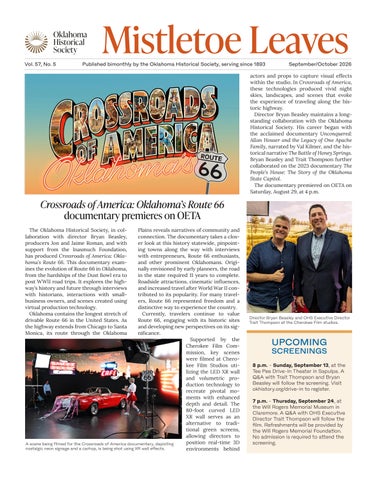
Crossroads of America: Oklahoma’s Route 66 documentary premieres on OETA The Oklahoma Historical Society, in collaboration with director Bryan Beasley, producers Jon and Jaime Roman, and with support from the Inasmuch Foundation, has produced Crossroads of America: Oklahoma’s Route 66. This documentary examines the evolution of Route 66 in Oklahoma, from the hardships of the Dust Bowl era to post WWII road trips. It explores the highway’s history and future through interviews with historians, interactions with smallbusiness owners, and scenes created using virtual production technology. Oklahoma contains the longest stretch of drivable Route 66 in the United States. As the highway extends from Chicago to Santa Monica, its route through the Oklahoma
Plains reveals narratives of community and connection. The documentary takes a closer look at this history statewide, pinpointing towns along the way with interviews with entrepreneurs, Route 66 enthusiasts, and other prominent Oklahomans. Originally envisioned by early planners, the road in the state required 11 years to complete. Roadside attractions, cinematic influences, and increased travel after World War II contributed to its popularity. For many travelers, Route 66 represented freedom and a distinctive way to experience the country. Currently, travelers continue to value Route 66, engaging with its historic sites and developing new perspectives on its significance. Supported by the Cherokee Film Commission, key scenes were filmed at Cherokee Film Studios utilizing the LED XR wall and volumetric production technology to recreate pivotal moments with enhanced depth and detail. The 80-foot curved LED XR wall serves as an alternative to traditional green screens, allowing directors to position real-time 3D A scene being filmed for the Crossroads of America documentary, depicting nostalgic neon signage and a carhop, is being shot using XR wall effects. environments behind
Director Bryan Beasley and OHS Executive Director Trait Thompson at the Cherokee Film studios.
UPCOMING SCREENINGS
8 p.m. - Sunday, September 13, at the Tee Pee Drive-In Theater in Sapulpa. A Q&A with Trait Thompson and Bryan Beasley will follow the screening. Visit okhistory.org/drive-in to register. 7 p.m. - Thursday, September 24, at the Will Rogers Memorial Museum in Claremore. A Q&A with OHS Executive Director Trait Thompson will follow the film. Refreshments will be provided by the Will Rogers Memorial Foundation. No admission is required to attend the screening.
FROM OUR EXECUTIVE DIRECTOR
By Trait Thompson
Oklahoma Historical Society Membership Office 405-522-5242 ohsmembers@history.ok.gov Mistletoe Leaves (USPS 018-315) is published bimonthly by the Oklahoma Historical Society, 800 Nazih Zuhdi Drive, Oklahoma City, OK 73105-7917. Periodicals postage paid at Oklahoma City, OK (ISSN 1932-0108) POSTMASTER: Send address changes to Mistletoe Leaves, 800 Nazih Zuhdi Drive, Oklahoma City, OK 73105-7917.
At the Oklahoma Historical Society, preserving written and photographic archives is our solemn responsibility. These photos, maps, letters, drawings, journals, newspapers, and books represent a glimpse into the lives of those who came before us. They are critical to understanding the people and events that shaped the way we live our lives. As important as these archives are, they do not serve us well if they are buried in a vault and inaccessible to the public. That’s why our online portal, The Gateway to Oklahoma History, is a vital part of our work. Created in 2012 in partnership with the University of North Texas, The Gateway is a repository of digitized archives. One major aspect that sets it apart is its keyword searchability. This fact alone makes it one of the researcher’s best friends. I have used The Gateway on many occasions, even before I started working at the OHS. It helped me amass research material about the Oklahoma State Capitol for the book I published in 2022. Thanks to The Gateway, I was able to find newspaper articles going back to statehood and rarely seen photographs of the building and its surroundings. To date, I have amassed over
By authorization of the Oklahoma Historical Society (OHS) Board of Directors, 2,900 copies are prepared at a cost of $2,014 bimonthly. The publication is financed in part with federal funds from the National Park Service, United States Department of the Interior.
Fair-thee-well
Contents and opinions do not necessarily reflect the views or policies of the Oklahoma Historical Society or the United States Department of the Interior. Mention of trade names does not constitute endorsement or recommendation by either organization. Mistletoe Leaves is published for the members and friends of the OHS in partial fulfillment of its mission to collect, preserve, and share the history and culture of the state of Oklahoma and its people. Students and teachers are invited to share studies and programs and to duplicate content as desired. Editors are welcome to reprint materials with credit. All Oklahoma Historical Society facilities are for the education and enjoyment of all. State and federal regulations prohibit unlawful discrimination in state and federallyassisted programs on the basis of race, color, national origin, and/or handicap. Anyone denied benefits should contact the grievance manager of the Oklahoma Historical Society, 800 Nazih Zuhdi Drive, Oklahoma City, OK 73105-7917, telephone 405-8377631 and/or the director, Office of Equal Opportunity, United States Department of the Interior, Washington, DC 20240.
300 pages of notes about the state capitol thanks to the abundance of available resources on the online portal. Whenever I undertake research for a podcast or speech topic, The Gateway is one of my first stops. Would you believe there are over eight million separate files on The Gateway? Approximately two million of those are photographs. In the 14-year existence of The Gateway, over 17 million users have logged on. These users range from serious researchers to people who want to find a unique photo to hang on their office wall. The collections on The Gateway aren’t limited to one geographic area of the state. We have 38 partners on the site, including the El Reno Carnegie Library, the Coleman Theatre Beautiful, the Oklahoma State Firefighters Museum, and the Keystone Crossroads Historical Society. The best thing about The Gateway to Oklahoma History is that all these digitized archives are available free to the public. Any photo, map, newspaper, or document can be downloaded by anyone, anywhere in the world. It’s important to us that these resources, which belong to the public through the diligent care of the OHS, are available to you. These important pieces of Oklahoma’s history need to be accessible, and every day, we are digitizing more documents and adding more to the repository. If you haven’t had a chance to explore The Gateway to Oklahoma History, I encourage you to do so by visiting gateway.okhistory. org. And, if you think this work is worthy, I urge you to consider a donation to the Oklahoma Historical Society to help us continue making our history available to all. Your gifts help accelerate our work, and we are so thankful for them.
Fraternal blue ribbon from the State Fair of Oklahoma 1907, with celluloid badge depicting livestock (1990.003.081, OHS Collections).
On October 5, 1907, the first Oklahoma State Fair commenced in Oklahoma City, one month before Statehood Day. At that first state fair, the biggest draw was horse racing, and the grandstand at the halfmile track accommodated 15,000 fans for the Oklahoma Derby. Agricultural crops and livestock were cornerstone traditions, bringing farmers and ranchers together at the fall harvest time. This year, you can visit the Oklahoma Historical Society booth at the 2026 Oklahoma State Fair from Thursday, September 17, to Sunday, September 27, at the OKC Fair Park in Oklahoma City. Our booth will also travel to the Tulsa State Fair from Thursday, October 1, to Sunday, October 11, at the Tulsa Fairgrounds. Read more about the history of fairs in Oklahoma in The Encyclopedia of Oklahoma History and Culture. 2
OKLAHOMA HISTORICAL SOCIETY NEWS
Thompson speaks at MMAC gathering On July 1, OHS executive director Trait Thompson spoke to staff at the Mike Monroney Aeronautical Center (MMAC) in Oklahoma City on the occasion of their 80th anniversary. The MMAC is the Federal Aviation Administration’s premier training facility for air traffic control personnel. In addition to housing the FAA Academy, it is home to the Logistics Center, Civil Aerospace Medical Institute, and the Civil Aviation Registry. The MMAC is one of Oklahoma City’s largest employers, and it has helped establish Oklahoma as a critical aviation hub in the United States. In his remarks, Thompson praised the people who work behind the scenes every day to ensure the safety of the flying public. He said, “Perhaps the greatest legacy of this Center cannot be measured in buildings, budgets, or even economic impact. It is the instructors who prepare tomorrow’s aviation professionals, the engineers who solve complex technical challenges, the researchers whose work that saves lives, the logisticians who keep vital systems operating around the clock. The MMAC’s greatest legacy is its people. Those whose names may never appear in headlines, but whose work protects millions of Americans every single day. That is public service at its very best.”
Shamblin’s Stratocaster joins collection Lilly Architects designed the Oklahoma Museum of Popular Culture (OKPOP) as a tribute to Oklahoma creatives who have impacted the worlds of music, movies, television, radio, comics, animation, literature, and more. The 52,500-square-foot building features colors inspired by Western Swing artist Eldon Shamblin’s 1954 Fender Stratocaster. Its gold exterior reflects the guitar’s finish, while black fields represent fret dots, white panels recall the pick guard, and maple accents suggest the guitar’s neck. Eldon Shamblin’s 1954 Stratocaster was the first custom-colored Stratocaster produced by Fender, making his gold model unique. Before the Stratocaster, guitarists were always seeking richer sound, smoother pitch shifts, and greater tonal variety. Other models, like the Telecaster, were less comfortable for extended performances. Leo Fender addressed these issues by designing the Stratocaster’s contoured body, angled forearm rest, and ribcage carve for improved comfort. The addition of a third pickup provided five distinct tones, and the new bridge design, with individual saddles for each string, enabled precise intonation. The Stratocaster also introduced a whammy bar to allow the player to “bend” notes for a vibrato effect, or to swoop down to other notes.
The metallic bronze powder in the gold paint of vintage guitars contains copper. Over time, exposure to oxygen, sweat, and moisture causes the copper to oxidize and turn green.
In 1954, Leo Fender presented Eldon Shamblin with the legendary gold Stratocaster at Cain’s Ballroom, where Shamblin performed with Bob Wills and His Texas Playboys. Shamblin joined the band in 1937 and played lead guitar and bass, developed guitar duets, and arranged songs by inventing the rhythmic musical trademark that Wills’ recordings were known for. In June, the renowned gold custom Fender Stratocaster, with its worn neck and aged gold finish reflecting years of use, was added to the Oklahoma Historical Society collections housed at OKPOP, returning to its home across the street from Cain’s, where it was played so often. This donation is a priceless addition to the future home of Oklahoma’s creative legacy. Shamblin’s Stratocaster has been at the heart of the OKPOP museum since day one, when golden, guitar-shaped shovels first broke ground in 2019. When Eldon Shamblin’s family recently visited OKPOP to see the guitar, his daughter Rita was especially moved, as it was her first time seeing the instrument since it left the family in the 1990s. Shamblin had a distinguished career performing with Merle Haggard, Leon McAuliffe, Willie Nelson, Joe Venuti, and Asleep at the Wheel. As the last surviving member of the Texas Playboys, he left a legacy that endures through audio recordings of his Western Swing classics. These will eventually be featured in interactive museum exhibits at OKPOP. His treasured Stratocaster is now part of a growing collection of over 40,000 artifacts, which highlight the global creative impact of Oklahomans. 3
Oklahoma Route 66 Museum milestone The Oklahoma Route 66 Museum in Clinton celebrated its most profitable single day in more than three decades this summer. This remarkable achievement was fueled by a surge of visitors and record gift shop sales as travelers from around the globe have flocked to join Route 66 Centennial festivities. On June 30, the museum generated more than seven times its average daily revenue, reflecting a substantial rise in visitors exploring Oklahoma’s section of Route 66. Museum director Cory Cart notes that this milestone reflects a broader positive trend. In the first half of 2026, attendance rose by 300% compared to the same period last year, positioning the museum for its most successful year. The Route 66 centennial has generated renewed interest in the historic highway, making the OHS site in Clinton a popular destination for travelers along Route 66. The museum’s reach extends beyond visitors. In recent months, the Oklahoma Route 66 Museum has hosted travel writers, journalists, and content creators from 13 states, resulting in coverage by national and international media outlets such as The Washington Post, CBS Chicago, the BBC, among other publications and broadcast organizations. To accommodate increased visitation, the museum has invested in improvements to the guest experience. Recent enhancements include hiring new staff, introducing a volunteer docent program, and doubling the size of the gift shop, which now offers a wider selection of Route 66-themed gifts and souvenirs. The Oklahoma Route 66 Museum presents the story of America’s Main Street through immersive exhibits, artifacts, and interactive experiences that highlight the people, places, and culture of the iconic highway. Join in the enthusiasm for the route’s centennial year and plan your visit today!
New grant program schedule for 2027
OHS Calendar of Events
September
October
2 - Drummond Heirlooms exhibit opens, Fred and Addie Drummond Home, Hominy
3 - History Alive! on the Cherokee Strip, Cherokee Strip Regional Heritage Center, Enid
2 - Rooted Infrastructure: “Caring for Trees that Anchor Our Historic Places” webinar, State Historic Preservation Office
6 - Oklahoma Route 66 Centennial Commission Meeting, Oklahoma History Center, Oklahoma City
2 - We Fought Back: The Black Legal Struggle for Education in Oklahoma Territory author talk and book signing with Dr. Sara Doolittle, Oklahoma Territorial Museum and Carnegie Library, Guthrie 5 - History Alive! on the Cherokee Strip, Cherokee Strip Regional Heritage Center, Enid 9 - Hungry Oklahoma: Confronting Poverty and Food Insecurity book presentation with author Robert Lee Maril, Oklahoma Territorial Museum and Carnegie Library, Guthrie 11 - Up Late with Will Rogers, Will Rogers Memorial Museum, Claremore 12 - Our Journeys: 50 Years After the Fall exhibit opens, Oklahoma History Center Museum, Oklahoma City 12 - Ice Cream Social, Fred and Addie Drummond Home, Hominy 13 - Screening of Crossroads of America: Oklahoma’s Route 66, Tee Pee Drive-in Theater, Sapulpa 16 - Oklahoma Historical Society Executive Committee Meeting, Oklahoma History Center 19 - History Alive! on the Cherokee Strip, Cherokee Strip Regional Heritage Center, Enid 20 - Route 66: The Main Street of America screening and panel discussion with filmmaker John Paget, Will Rogers Memorial Museum, Claremore 21 - Kilgen Theatre Organ performance “Welcome Traveler” with guest organist Ryoki Yamaguchi, Oklahoma History Center, Oklahoma City 24 - Black Moses guest lecture with author Caleb Gayle, Oklahoma History Center, Oklahoma City 24 - Screening of Crossroads of America: Oklahoma’s Route 66, Will Rogers Memorial Museum, Claremore 25 - New Wave film screening, Oklahoma History Center, Oklahoma City 25 - Movie Night featuring Possums (1998), Will Rogers Memorial Museum, Claremore 30 - Drummond Heirlooms exhibit closes, Fred and Addie Drummond Home, Hominy
8 - OETA’s Back in Time “Woody Guthrie” premiere, Oklahoma History Center, Oklahoma City 9 - Fall Activities begin, Oklahoma History Center, Oklahoma City 9–10 - Doaksville Candlelight Tours, Doaksville Archaeological Site, Red Road, Fort Towson 10 - Year of the Cat film screening, Oklahoma History Center, Oklahoma City 15 - Historic Preservation Review Committee meeting, Oklahoma History Center, Oklahoma City 16 - Overnight at the Museum, Will Rogers Memorial Museum, Claremore 17 - History Alive! on the Cherokee Strip, Cherokee Strip Regional Heritage Center, Enid 19 - Fall Activities conclude, Oklahoma History Center, Oklahoma City 21 - Oklahoma Historical Society Executive Committee Meeting, Oklahoma History Center, Oklahoma City 21–24 - Annual Research Center Book Sale, Oklahoma History Center, Oklahoma City 23 - Movie Night featuring Hocus Pocus (1993), Will Rogers Memorial Museum, Claremore 28 - Oklahoma Historical Society Quarterly Board of Directors Meeting, Clinton 29 - Open House: Haunt the Museum, Oklahoma History Center, Oklahoma City 30 - An Evening with Will, River Spirit Casino, Tulsa 31 - Will Rogers Days Parade, Downtown Claremore, Claremore 31 - The Indian Women’s Pocahontas Club wreath laying, Will Rogers Memorial Museum, Claremore 31 - Halloween at the Museum, Will Rogers Memorial Museum, Claremore
Join, renew, or give the gift of OHS membership this season. 4
The Oklahoma Heritage Preservation Grant Program has a new schedule. If you’re planning to apply for an Oklahoma Heritage Preservation Grant, be sure to mark your calendar. The 2027 grant cycle has moved forward several months. Optional draft applications will be accepted November 1–December 10, 2026, and grant applications will be open January 1–February 10, 2027, for projects taking place July 1, 2027–June 30, 2028. The Oklahoma Heritage Preservation Grant Program provides grants of $1,000 to $25,000 to eligible Oklahoma tribal and municipal governments and nonprofit historical organizations for projects that collect, preserve, and share Oklahoma history. Funding is available for collections, exhibits, educational programming, and organizational capacity-building projects. For more information contact, grants@history. ok.gov.
Call for proposals The 2027 Oklahoma History Symposium will be held on May 1, 2027, at the Oklahoma History Center in Oklahoma City. Presented by the Oklahoma Historical Society, the Symposium is a one-day event that encompasses a range of historical topics pertaining to Oklahoma. It provides a venue for scholars, students, educators, and community members from across the state and region to share their work and interests with others. This year’s theme is Invented Oklahoma: Myth, Memory, and the Making of the Sooner State. Oklahoma has long been concerned with its public image on a regional, national, and international stage. For example, the Golden Driller monument in Tulsa recalls a perceived golden age when the city served as the “Oil Capital of the World.” Meanwhile, with the 2028 Summer Olympics on the horizon, Oklahoma City promotes itself as the “Modern Frontier” and a regional destination. Oklahoma history is full of stories that have been raised to mythic proportions. But whereas myth tends to erase nuance and reinforce stereotypes, we welcome proposals that convey new findings or introduce innovative methodologies that challenge and complicate our understanding of Oklahoma and the region that we call home. We encourage proposals that engage key themes in history and related fields. The deadline for submissions is November 15, 2026. Proposals must be submitted online at okhistory.org/symposium.
UPCOMING EVENTS AND PROGRAMMING
Oklahoma Historical Society to Host Caleb Gayle, author of Black Moses The Oklahoma Historical Society will host Caleb Gayle for a guest lecture at the Oklahoma History Center in Oklahoma City on Thursday, September 24. The event will be held from 7 to 9 p.m. Doors open at 6:30 p.m. Caleb Gayle is an award-winning journalist and the author of Black Moses: A Saga of Ambition and the Fight for a Black State and We Refuse to Forget: A True Story of Black Creeks, American Identity, and Power. A professor at Northeastern University in Boston, he is a contributing writer at The New York Times Magazine. Black Moses charts the rise of Edward McCabe and his efforts to create a Black state in Oklahoma Territory during the late 19th and early 20th centuries. Longlisted for the National Book Award for Nonfiction, the book has received numerous accolades. They include the Stubbendieck Great Plains Distinguished Book Prize and the Oklahoma Book Award for Nonfiction. The Oklahoma Historical Society recognized Black Moses with the E. E. Dale Award for Outstanding Book on Oklahoma History. After the lecture, there will be a question-and-answer session, followed by a book signing and reception. Copies of Black Moses will be available to purchase during the event. The event is free and open to the public. Registration is requested at okhistory.org/signing.
Route 66: The Main Street of America screening with filmmaker John Paget Attend a special screening of Route 66: The Main Street of America, a new centennial documentary, at the Will Rogers Memorial Museum in Claremore on September 20 from 2 to 4 p.m. The documentary features compelling stories of everyday heroes and resilient towns along Route 66, offering an immersive portrait of this historic road. From unique attractions to revitalized main streets, the film highlights communities discovering renewed purpose, demonstrating that meaningful journeys often start on less-traveled paths. Whether you have traveled Route 66 or only imagined it, this film provides an engaging and heartfelt perspective on an American icon, filled with humor, warmth, and discovery. Stay for a live Q&A session with filmmaker John Paget and featured participants following the screening.
The Oklahoma History Center Museum, in partnership with the Vietnamese American Heritage Community of Oklahoma, is proud to announce Our Journeys: 50 Years After the Fall, a multimedia traveling exhibition on display September 12 through January 4, 2027. Created by New Jersey-based nonprofit Vietnamese Boat People, the exhibition centers the voices of Vietnamese Americans through oral histories, photographs, and interactive elements that explore migration, memory, and resilience across generations. The exhibit debuted in 2025, marking the 50th anniversary of the fall of Saigon and the displacement of millions of Vietnamese refugees whose stories continue to shape communities across the country, including here in Oklahoma. Oklahoma History Center Museum staff have developed an Oklahoma-specific component to the exhibition, threading a local narrative into this global story through interpretive panels and artifact cases drawn from Oklahoma City’s Vietnamese American community. Our Journeys is made possible with support from the Henry Luce Foundation, New Jersey Council for the Humanities, the Asian Women Giving Circle, and its Wall of Hope donors. Local support provided by the Asian District Cultural Association (utilizing Oklahoma County ARPA funds), Inasmuch Foundation, The Greater Oklahoma City Asian Chamber of Commerce, Quill Hawk Publishing Company, and the Agnes Nguyen family. The exhibition is included with regular museum admission. Visit okhistory.org/our-journeys to learn more and see related programming.
Annual Research Center Book Sale The Oklahoma Historical Society’s (OHS) John and Eleanor Kirkpatrick Research Center will host its annual book sale Wednesday, October 21, through Saturday, October 24, at the Oklahoma History Center in Oklahoma City. The sale will offer a variety of books, posters, maps, and collectibles. It will be open from 10 a.m. to 4:45 p.m. on Wednesday, Thursday, and Friday and from 10 a.m. to 1 p.m. on Saturday. This event is free and open to the public! The book sale is a fundraiser for the OHS Research Center. Proceeds will support the center’s efforts to collect items of historical significance, provide programming for researchers and school groups, and offer resources online.
Rooted Infrastructure: “Caring for Trees that Anchor Our Historic Places” On Wednesday, September 2, at noon, the State Historic Preservation Office will host a free webinar in its Rooted Infrastructure series, titled “Caring for Trees that Anchor Our Historic Places.” Join Riley Coy, urban forestry coordinator with the Oklahoma Forestry Services, and Deputy SHPO Lynda Ozan to learn how trees are the only living pieces of our historic sites that actually witnessed the past. Visit okhistory.org/rooted to register. 5
Oklahoma Historical Society Awards nominations open September 1 Herd of Angora goats with Pawnee Bill in the background, (courtesy Special Research Collections, University of Oklahoma Libraries, Gordon W. Lillie, 379 [detail]).
Goats return to Pawnee Bill Ranch The Pawnee Bill Ranch and Museum has launched a program to promote responsible land stewardship and enhance the visitor experience. In July, a herd of 16 Nubian goats was introduced to the property to clear underbrush and low-hanging branches. Chosen for their height, Nubian goats can reach higher vegetation than most breeds. The herd is well adapted to Oklahoma’s climate, having been bred and raised at Sweet Creek Goat Farm in Poteau. The goats will be rotated through various areas of the property to clear brush, allowing vegetation to recover and support responsible land stewardship. This sustainable approach manages the land without machinery or chemicals. As natural landscapers, the goats consume brush, support trail maintenance, and enhance the property’s appearance. Their presence honors the ranch’s livestock-raising tradition, which continues with bison, longhorn cattle, and draft horses. The goats will also offer educational opportunities for families, school groups, and other visitors. Following the conclusion of his traveling shows, Pawnee Bill managed the then 2,000-acre ranch at Blue Hawk Peak. He was an ardent conservationist, maintaining substantial herds of American Bison, Scottish Shorthorn cattle, Texas Longhorns, horses, and Angora goats in his day. The current project is funded by the Pawnee Bill Ranch Association.
WRMM groundbreaking for new building This past August, a groundbreaking was held for a new three-story building that will be located at the northeast corner of the Will Rogers Memorial Museum property. It will feature expanded storage for collections, additional office space for staff, and an event center on the top floor overlooking Claremore. “Over the years, the collection has expanded so much that we’ve outgrown our current space, and environmental controls from the 1930s no longer meet our needs today. We are looking forward to having a collection space that reflects the best standards of the profession,” said curator Jennifer Holt. “We’re also looking forward to having room for visitors to research on site in our new research library.” The project will also update the existing building. Plans include a new entryway with expanded welcome space, a larger gift shop, and upgrades to ensure compliance with the Americans with Disabilities Act. “This is a tremendous addition to the historic facility,” said museum director Tad Jones. “We could not have done it without
The Oklahoma Historical Society (OHS) will begin accepting nominations for its annual awards program on September 1, 2026. The recipients will be honored at the OHS Awards Banquet, which will be held on Friday, April 30, 2027, at the Oklahoma History Center in Oklahoma City. The OHS is seeking nominations for the following awards: Oklahoma Historians Hall of Fame: The highest honor awarded by the OHS, this award recognizes the work of individuals based on their contributions to the preservation, collection, interpretation, and dissemination of Oklahoma history. Bruce T. Fisher Award: This award recognizes the significant contribution of a project related to Oklahoma history, including (but not limited to) digital productions, exhibits, short-form publications, collections care, film, and public programs. The project must have been completed in 2026 with a budget of $20,000 or below. Linda Williams Reese Award: This award recognizes an outstanding dissertation or thesis on Oklahoma history completed in 2026.
A rendering of the proposed Will Rogers Memorial Museum entrance.
the support of the Oklahoma legislature and donors who have a passion for preserving the legacy of Will Rogers. This renovation will impact guests for generations to come and will help us better share Will’s inspirational life” The Will Rogers Memorial Museum was built in 1938 on land Will and Betty Rogers purchased in 1911. After Will’s tragic death, Betty donated the property to the state of Oklahoma to establish a memorial. In 1982, an office wing, library, and theater were added. The addition and renovation project is expected to be completed in the spring of 2028, and the Museum will remain open to the public during construction. 6
Joseph B. Thoburn Award: This award recognizes a junior or senior high school student who exhibits outstanding achievements in the presentation or interpretation of Oklahoma history. William D. Pennington Award: This award acknowledges an outstanding social studies teacher who makes a lasting impact on students and demonstrates effective teaching by any measure of excellence. To nominate an individual or organization, visit okhistory.org/awards and download the nomination form specific to the award. Instructions for submission are included on each form. You do not have to be an OHS member to nominate or receive an award. Current members of the OHS Board of Directors and current employees of the OHS and its museums, sites and affiliates are not eligible to receive an award. Completed nomination forms are due by November 15, 2026.
“She Would Not Be Silent” wins top award in National History Day contest Catherine Ann “Kate” Barnard, born in 1875, taught in several one-room schools before becoming an advocate of the less fortunate.
Each year, Maryland hosts the National History Day National Contest, attracting thousands of students from around the world. This year’s theme, “Revolution, Reaction, Reform in History,” inspired participants, some of whom took their projects to Washington, DC, from June 14 to 18. Oklahoma sent 61 students to the National History Day Contest, each qualifying through strong performances at regional and state levels. These students demonstrated outstanding research, creativity, and storytelling at the state contest in May, and have made a significant impact at the international event. National History Day encourages middle and high school students to explore history and present their findings creatively. This year, all of Oklahoma’s participants achieved notable success. Congratulations to Lexi Kruse, a junior high school student at Morrison Public Schools, who earned first place nationally for her individual performance, “She Would Not Be Silent: Kate Barnard and the Cost of Reform.”
Guided by her teacher, Patty Sanders, Kruse brought history to life and received top honors. Thanks to the dedication of this young historian, Kate Barnard’s story is reaching new audiences and keeping history relevant for a new generation of learners. Last year, Oklahoma commemorated the 150th anniversary of Kate Barnard’s birth by proclaiming May 23 as Kate Barnard Day. Barnard was the first woman elected to a statewide office, serving as Oklahoma’s Commissioner of Charities and Corrections. Known for her advocacy for children, Native Americans, and vulnerable Oklahomans, “Good Angel, Kate” was honored at her gravesite. It seems fitting that a century and a half have not diminished Barnard’s legacy of doing good deeds, while projects like National History Day help young historians continue to delve into the interesting people, places, and things that shape the state’s unique history. For a complete list of this year’s National History Day winners, visit okhistory.org/nhdwinners. Additional information about how to involve students in the Oklahoma National History Day and National History Day contests is available at okhistory.org/ historyday.
Fort Gibson Historic Site construction updates Progress is being made at Fort Gibson Historic Site, including restoration and preservation of historic structures and general improvements to the site. Rehabilitation of the Fort Gibson Dragoon Barracks is underway in accordance with the Secretary of the Interior’s Standards and Guidelines for Archeology and Historic Preservation. In late July, structurally compromised elements, including the wooden balcony, deck, framing, supports, stairs, and ramp, were identified and underwent demolition. Ceilings have been removed to assess interior joists. The slate roof has been removed and safely stored, and temporary roof supports are in place. Patio stones have been cataloged and removed, and windows and doors have been removed and restored and are cur-
rently being stored off-site until they are ready for installation. A period-appropriate masonry mortar has been approved to match the building’s exterior stonework when joints are repaired and repointed. Adjustments to the stone porch are approved, with reinstallation pending scheduling. Weather barriers have been installed so interior work can continue while the roof, windows, and doors are removed. The barracks will be completed with repairs and replacement of trim boards, painting and sealing of exterior carpentry, and installation of a new gutter and downspout system. Installation of a new electrical pole and underground wiring has been approved and is being coordinated by the contractor and OG&E. Archaeologists will be on-site to monitor the trenching work on the building. Repairs to HVAC and electrical systems are ongoing. Future projects are also being slated, which include plans for the Adjutant’s Office that have been finalized and include the reconstruction of the original porch. An upgraded kitchen and restroom will be added to that location to support expanded programming at the site. In 2026, the Commissary building will have its mortar work restored. All doors and windows of that structure will undergo restoration and repair, as well as improve7
The interior first floor of the structure, lower windows removed, and second floor rafters. Left: Supporting beams shore up the barracks building at Fort Gibson Historic Site.
ments to the collection storage areas. A new paved parking lot will be constructed next to the Visitor Center in 2027. In the interim, gravel has been installed until the paved lot can be constructed. During construction, visitors can safely explore the reconstructed early fort and stockade and visit the newly refurbished historic hospital, which features exhibits on the fort’s history. Restoration of the stone barracks is financed in part with funding from the National Park Service’s Save America’s Treasures Grant and matching funds from the Oklahoma Historical Society.
Oklahoma Historical Society 800 Nazih Zuhdi Drive Oklahoma City, OK 73105-7917
PERIODICALS
Mistletoe Leaves Vol. 57, No. 5
ADDRESS SERVICE REQUESTED
Make your mark on history! Each year, the Oklahoma Historical Society welcomes over 200,000 visitors and members across our 25 historic sites and museums, but we need your help! Since our founding in 1893, we have preserved nearly 200,000 artifacts and over 11 million photographs, thanks to generous donors and members like you! Our work is never done, and we need your help to ensure our history lives on for future Oklahomans.
EVERY DOLLAR MAKES A DIFFERENCE Your tax-deductible donation impacts the entire state through exhibits, educational programming, and so much more. By contributing to our Annual Giving Campaign, you provide critical operational support that allows us to continue our mission of collecting, preserving, and sharing Oklahoma’s rich history. As a thank you for your generosity, donations of $500 or more are recognized in the Oklahoma Historical Society’s scholarly journal The Chronicles of Oklahoma, and gifts of $1,000 or more are additionally recognized on the Oklahoma History Center donor board. Your contribution today supports the preservation of our past and promotes the education of our future Oklahomans. Give today! Visit okhistory.org/givenow to make your taxdeductible contribution or to learn more. For questions, please contact Development Officer Sydney Lahodny at sydney.lahodny@history.ok.gov or 405-659-4390.
September/October 2026
Doaksville Candlelight Tours return in October The annual Doaksville Candlelight Tours are scheduled for Friday, October 9, and Saturday, October 10, at the Doaksville Archaeological Site in Fort Towson. This annual event is a unique opportunity to experience the past through reenactor-led tours of the area’s history, which this year will delve into the history of Dr. Eli S. Penwell. This walking tour moves through lanternlit vignette scenes with several interpreters providing historical context along the way. During the American Civil War (1861– 1865), northern Texas, despite being part of a Confederate state, was marked by suspicion regarding allegiances to the Union or Confederacy. Dr. Eli S. Penwell, a resident of Bonham, Texas—originally from Indiana— was suspected by Confederate authorities of disloyalty. In 1864, Penwell and several associates attempted to escape to Union-controlled Fort Smith but were apprehended by Confederate troops and brought to the vicinity of Doaksville and Fort Towson. This year’s Doaksville Candlelight Tour will examine the motivations behind Penwell’s flight from Regional Director Nathan Turner, and OHS Texas, the historical figures involved, and Board Member T. S. Akers participate at a Doaksville Candlelight Tour station. the ultimate fate of Penwell. Tours will depart from the Fort Towson cemetery at 30-minute intervals. Participants will cross the WPA wall to enter the historic town and commence a guided walking tour lasting approximately one hour. The event operates on a first-come, first-served basis, with priority given to advanced ticket holders. Attendees are advised that the terrain is rugged. For hours, location information, admission prices, and directions to the Doaksville Archaeological Site, visit okhistory.org/sites/ visit-fort-towson. Tickets go on sale starting September 8. For additional information please call 580873-2634 or email fttowson@history.ok.gov. A living historian begins a candlelight tour at the Fort Towson cemetery as twilight falls.