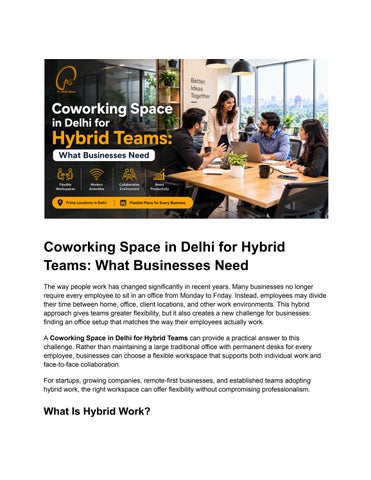
Coworking Space in Delhi for Hybrid Teams: What Businesses Need The way people work has changed significantly in recent years. Many businesses no longer require every employee to sit in an office from Monday to Friday. Instead, employees may divide their time between home, office, client locations, and other work environments. This hybrid approach gives teams greater flexibility, but it also creates a new challenge for businesses: finding an office setup that matches the way their employees actually work. A Coworking Space in Delhi for Hybrid Teams can provide a practical answer to this challenge. Rather than maintaining a large traditional office with permanent desks for every employee, businesses can choose a flexible workspace that supports both individual work and face-to-face collaboration. For startups, growing companies, remote-first businesses, and established teams adopting hybrid work, the right workspace can offer flexibility without compromising professionalism.
What Is Hybrid Work?
Hybrid work combines remote working with office-based work. Employees may spend certain days working from home and visit the office when they need to collaborate, attend meetings, meet clients, or work with colleagues in person. For example, a company might ask employees to work from the office two or three days a week while allowing them to work remotely on other days. Another business may allow employees to choose their office days according to projects and team requirements. This working model can be beneficial, but it changes how companies should approach office space. A traditional office designed around permanent seating may not always be the most efficient option.
Why Hybrid Teams Need Flexible Workspaces Hybrid teams have different workspace requirements compared with fully office-based teams. Not every employee needs a permanent desk, but employees still need access to a professional place where they can work and collaborate. A flexible workspace in Delhi allows businesses to create an office environment according to their actual requirements. Instead of paying for space that remains unused on remote-working days, companies can select an arrangement that better reflects their team's attendance patterns. Flexibility is particularly valuable for businesses experiencing growth. A company may have ten employees today and twenty in the future. Its workspace should ideally be able to accommodate these changes without creating unnecessary disruption.
What Should Businesses Look for in a Coworking Space? Choosing the right workspace involves more than checking the number of available seats. Businesses should consider how their teams work, what facilities they require, and whether the workspace can support future changes.
Flexible Seating Options Hybrid teams may not need fixed desks for every employee. A combination of shared workstations, dedicated desks, and private areas can provide greater flexibility. Employees who visit regularly can have suitable workstations, while those who come occasionally can use available shared seating. This makes it easier for companies to manage their workspace according to daily requirements.
Reliable Internet Connectivity
Internet connectivity is one of the most important requirements for a modern business. Hybrid employees may need to attend video meetings, access cloud-based software, share files, communicate with colleagues, and work with clients throughout the day. A professional coworking space in Delhi should therefore provide dependable high-speed internet so employees can work without unnecessary connectivity issues.
Power Backup Power interruptions can affect meetings, presentations, calls, and daily operations. For businesses that rely heavily on digital tools, dependable power backup is an important consideration when comparing workspace options.
Meeting and Conference Rooms Hybrid teams still need opportunities to meet in person. Team planning sessions, client presentations, interviews, reviews, and project discussions may all require a separate room. Access to meeting rooms in Delhi gives businesses a professional environment for these activities. Larger teams can also benefit from conference rooms in Delhi when they need additional seating or presentation space.
Private Work Areas Open workspaces are useful for collaboration, but certain tasks require privacy. Employees may need to discuss confidential projects, speak with clients, conduct interviews, or concentrate without distractions. Private cabins and enclosed areas can provide the additional privacy required for these situations.
How Coworking Spaces Support Hybrid Teams The biggest advantage of coworking for hybrid businesses is adaptability. Employees can come into a professional office when they need to collaborate without requiring the company to maintain a traditional office for every employee every day. A professional workspace in Delhi can also create a clear separation between work and home. Employees may find it easier to focus when they have access to a dedicated work environment. For managers, a shared professional environment can make occasional in-person collaboration easier. Teams can arrange specific office days for brainstorming, training, planning, or important meetings.
This creates a balance between remote flexibility and the benefits of working together physically.
Cost Advantages for Businesses Maintaining a traditional office involves more than monthly rent. Businesses may also have to consider furniture, utilities, internet connections, maintenance, cleaning, office equipment, and other operational expenses. With a flexible workspace arrangement, many of these requirements are managed within the workspace environment. This does not automatically mean coworking will be cheaper for every business. The actual cost depends on team size, location, facilities, membership terms, and usage. However, businesses that do not require a full-time office for every employee may find flexible arrangements easier to manage. A shared office space in Delhi can therefore be an option for companies looking to maintain a professional setup while keeping their office requirements adaptable.
Supporting Business Growth Hybrid workspaces can also support businesses as they grow. A company may initially need only a small number of workstations but require more space after hiring additional employees. A scalable office space gives businesses more flexibility when their requirements change. Instead of completely redesigning or relocating a traditional office, companies may be able to adjust their workspace arrangement. This can be especially useful for startups and small businesses that are still determining their long-term office requirements.
Who Can Benefit from a Hybrid Coworking Setup? Startups Startups often need flexibility because their team size and working methods can change quickly. A flexible office can provide a professional base without requiring a large traditional setup from the beginning.
Small and Medium-Sized Businesses SMEs may have employees working from different locations or departments with different office schedules. A flexible arrangement can help accommodate these differences.
Remote-First Companies Remote-first businesses may not need a permanent office every day. However, they still need a place for team meetings, employee gatherings, interviews, and important discussions.
Agencies and Consultants Agencies, consultants, and client-focused professionals often need a professional environment for presentations and meetings. A business workspace in Delhi can provide a more suitable setting than informal locations.
Coworking Space vs Traditional Office for Hybrid Teams A traditional office can provide complete control over the premises, but businesses generally have to manage more aspects of the setup themselves. This may include furnishing, utilities, maintenance, cleaning, and other operational responsibilities. A coworking arrangement provides a different approach. Businesses share certain facilities while receiving access to a professionally managed environment. For a hybrid team, this can make sense because the company may not need a large amount of permanently assigned space. However, the decision should depend on the company's size, budget, privacy requirements, expected growth, and working model. Businesses with highly specialised infrastructure needs may still prefer a traditional office.
How to Choose the Right Workspace in Delhi Before selecting a workspace, businesses should evaluate their actual working patterns. Start by estimating how many employees will typically visit the office on the same day. Then consider whether the team needs private cabins, shared seating, meeting rooms, or larger collaboration areas. Location is another important factor. A convenient location can make commuting easier for employees and provide better accessibility for clients. Businesses should also check the available facilities, internet reliability, power backup, cleanliness, privacy, and workspace policies. Most importantly, understand the pricing and terms before making a decision. Look for a workspace arrangement that provides enough flexibility without paying for facilities that the team does not actually use.
Why Choose Ojas Coworking? Ojas Coworking provides a professional environment for businesses looking for flexible workspace options in Delhi. For hybrid teams, having access to different types of work areas can make it easier to accommodate changing schedules and work requirements. Facilities such as meeting and conference rooms, private cabins, dedicated desks, high-speed Wi-Fi, and power backup can support both individual productivity and in-person collaboration. For a company considering a flexible office space, the focus should be on finding an environment that supports its current working model while allowing room for future changes.
Final Thoughts Hybrid work has changed the purpose of the modern office. Businesses no longer have to think only in terms of permanent desks and fixed working hours. Instead, they can consider how employees actually use office space and choose a setup that supports those requirements. A Coworking Space in Delhi for Hybrid Teams can provide a useful combination of flexibility, professional infrastructure, collaboration areas, and adaptable workspace options. The right choice depends on several factors, including team size, office attendance, budget, location, privacy, facilities, and future growth. Businesses that carefully evaluate these factors can create a workspace strategy that supports both employees and long-term business goals. For modern companies, the office does not have to be used every day by everyone to remain valuable. It simply needs to provide the right environment when people come together to work, collaborate, and grow.
Frequently Asked Questions Is coworking suitable for hybrid teams? Yes. Coworking can be suitable for hybrid teams because employees can use professional work areas when they need to work together while continuing to work remotely on other days.
What facilities do hybrid teams need? Hybrid teams commonly need flexible seating, reliable internet, power backup, private areas, meeting rooms, conference facilities, and comfortable collaborative spaces.
Can startups use coworking spaces for hybrid work?
Yes. Startups can benefit from flexible workspace arrangements because their team size and office requirements may change as the business develops.
Is a coworking space better than a traditional office for hybrid teams? It depends on the business. Companies that value flexibility and do not need permanent desks for every employee may find coworking more suitable, while businesses requiring complete control over their premises may prefer a traditional office.
Can hybrid teams book meeting rooms? Many coworking providers offer meeting and conference facilities. Businesses should check the availability, capacity, booking process, and applicable terms before choosing a workspace.
How do I choose a coworking space for my hybrid team? Consider your team's size, office attendance, location preferences, privacy requirements, available facilities, pricing, and future growth plans. The workspace should match how your team actually works.