We invite you to read and use this document to help set the course for historic preservation in Ohio in the coming years. The state plan will help direct priorities of the State Historic Preservation Office and can be used by others throughout Ohio who influence policies and decisions around activities that affect Ohio’s historic resources.
The world has changed a lot since our last plan, Finding Common Ground, and this new plan seeks to address the new opportunities as well as challenges that have arisen since the COVID-19 pandemic. Take inspiration from the goals, objectives and success stories in this plan to learn how you can be a part of the story: connect with your local historic preservation commission; participate in a local educational program about archaeology in your area; or visit a historic site. Preservationists across the state can join us as we explore Reconciliation, Recovery, and Resilience
Amanda Schraner Terrell Director, State Historic Preservation Office Deputy State Historic Preservation Officer, 2022
OUR VISION
Historic preservation will be a critical component of growth and revitalization in Ohio. Diverse partners will dialogue and collaborate on mutual goals and commit to the exploration, recognition, preservation and celebration of the full story of Ohio’s history.
IMPLEMENTATION STRATEGIES
Implementation of Reconciliation, Recovery, and Resilience will begin with an analysis of present programs and policies. The plan’s survey results show that the public lacks knowledge of historic preservation programs and activities, which indicates such programs are not being implemented to their potential effect. To address this, much of the plan outlines ways to increase outreach by the State Historic Preservation Office and by the many preservation partners operating around Ohio.
COLLABORATION
Armed with this information, the State Historic Preservation Offi ce and our preservation partners will increase efforts to find paths to collaboration on a variety of issues. Through public meetings, increased educational materials, collaborative programming and other means we will reach out to public and non-traditional partners, helping all to experience the value of preserving historic resources.
LOCAL INTERACTION
An important element of the plan will be the annual convening of a State Plan Assessment Group that will establish incremental goals for the year, including specific progress measures. These incremental goals will provide a clear structure for implementing the overall state plan goals and will define measurable successes.
SUCCESS
At the local level, successes will be measured by the integration of state plan goals and action items into local planning efforts and efforts of Certified Local Governments and Historic Preservation Commissions. These will range from explicit incorporation of State Plan-specifi c action items, to the establishment of local goals that adhere to the objectives set forth in the plan.
It is the goal of the plan to structure a regular reassessment of the public interest and participation in historic preservation activities in Ohio. Engagement of the public and non-traditional partners on a regular basis is critical to the success of Ohio’s historic preservation program.
County
Thad Lichtensteiger, Van Wert County Commissioner
This publication is made possible in part by a grant from the National Park Service, U.S. Department of the Interior, administered by the State Historic Preservation Office of the Ohio History Connection. This program receives federal financial assistance for identification and protection of historic properties. The U.S. Department of the Interior prohibits discrimination in departmental federally assisted programs on the basis of race, color, national origin, age or disability. Any person who believes he or she has been discriminated against in any program, activity, or facility operated by a recipient of federal assistance should write to: Office of Equal Opportunity, National Park Service, 1849 C Street, NW, Washington, D.C. 20240.
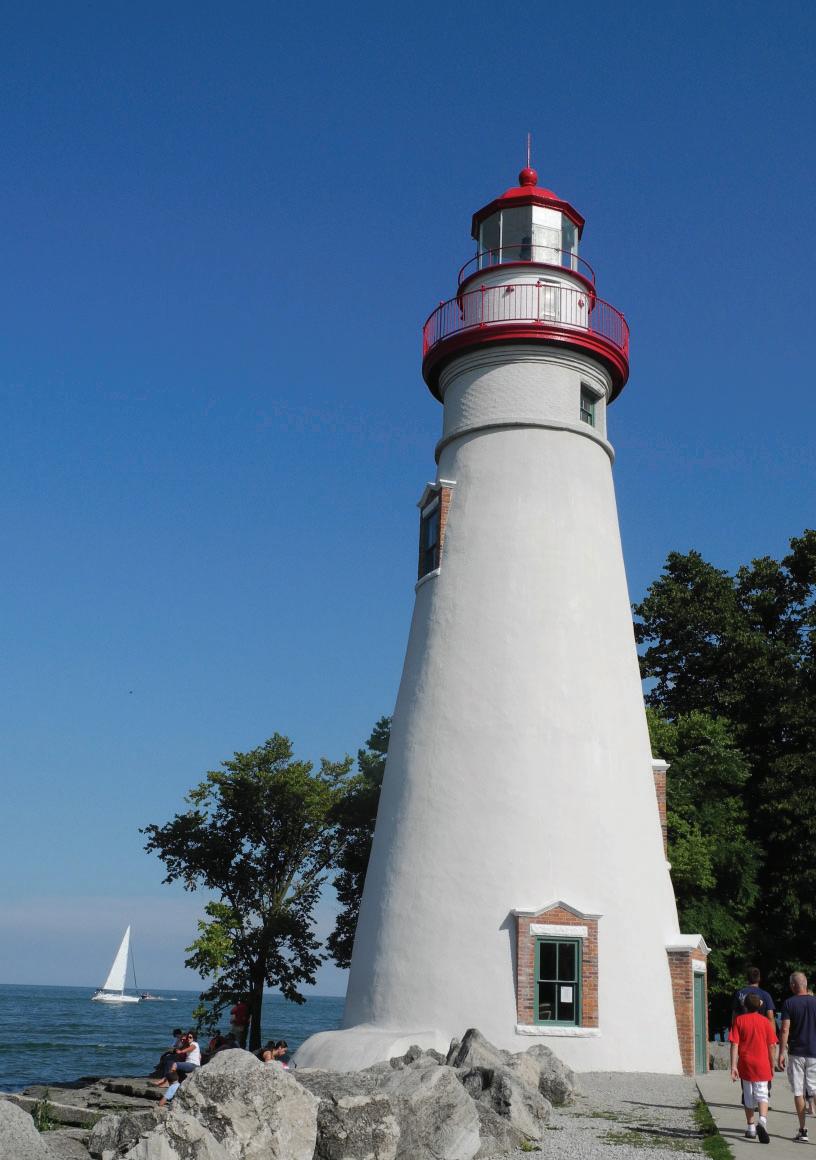
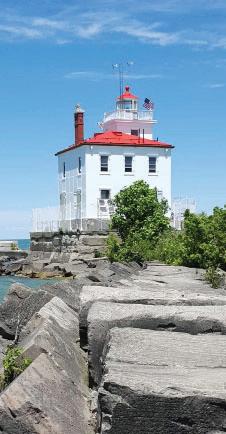
Marble Head Lighthouse, Ottawa
METHODOLOGY
A survey was conducted of our previous State Plan Advisory Board to gain some insight into how well we fared with implementing our previous plan, Finding Common Ground.
We evaluated our previous goals, identified challenges that still exist, and sought input for both how the next plan should be written and how to best utilize the Advisory Board.
Based on the additional survey results of the State Plan Advisory Board, preservation professionals and interested community members the three primary findings include: preservation funding should be increased; education and awareness remain barriers to increasing the impact of historic preservation programs; and there continues to be a significant need for more diversity, equity, access, and inclusion for both the plan and historic preservation in general.
State Plan Advisory Board
A new State Plan Advisory Board was assembled of members from a variety of disciplines and areas of expertise. Members represented historic preservation professionals, planners, archaeologists, economic development professionals, State Historic Preservation Office staff and a number of other participants who work in preservation-related fields including non-profit management, state agencies, survey and National Register professionals, architects, consultants, and engineers. This board helped shape the survey and provided the expertise and insight for the goals and action items that are the centerpiece of the state plan. Due to restrictions in place during the pandemic, all work was conducted remotely. Budget restrictions also meant that more extensive survey and outreach was not conducted.
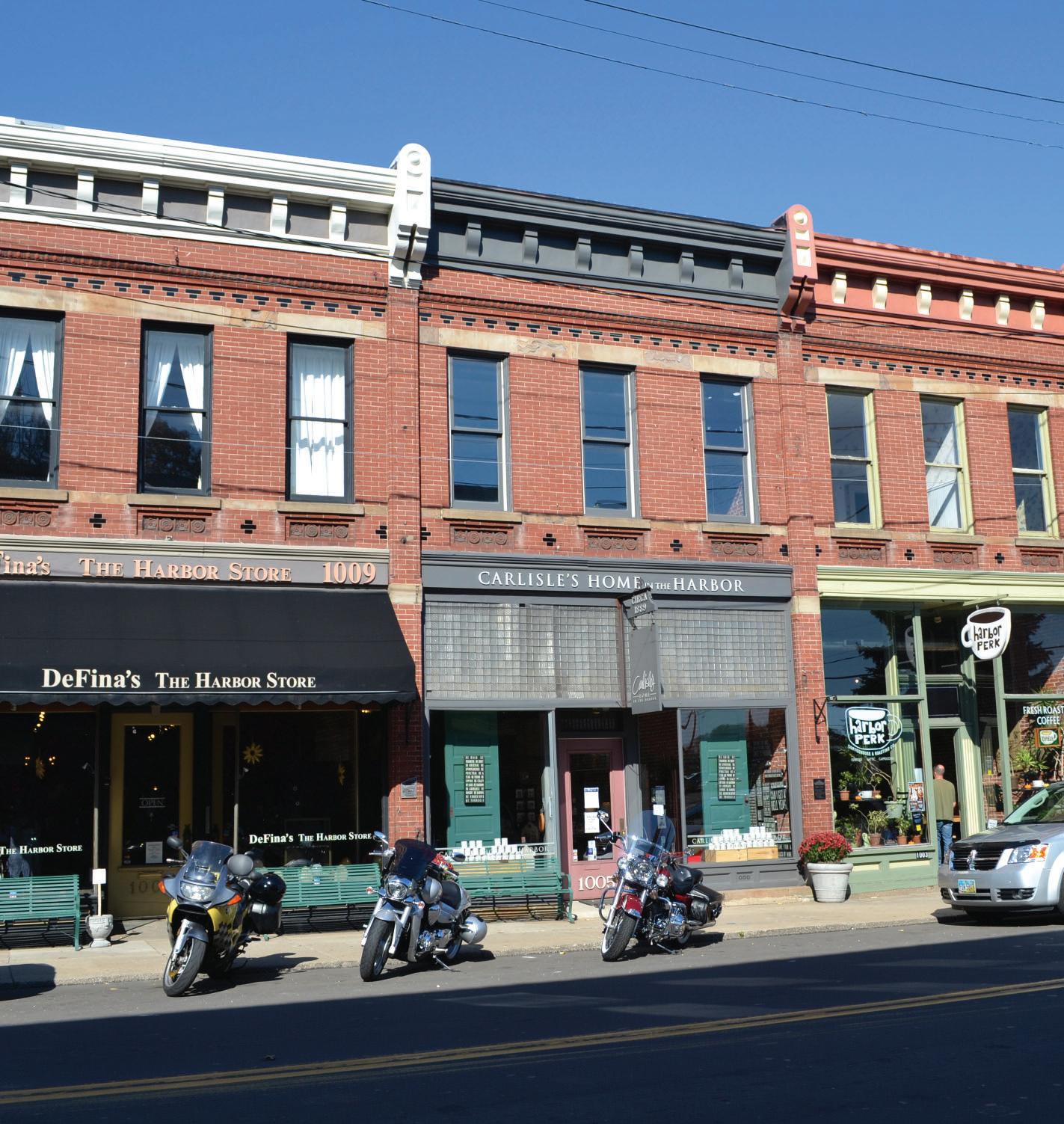
Ashtabula Harbor District, Ashtabula County
Public Survey
The survey (questions outlined below) was conducted over a month period and received responses from 274 individuals. Responses were divided across five regions in Ohio, with 36% coming from Central Ohio, 22% from the Northeast, 18% from the Southwest, 14% from the Northwest, 7% from the Southeast, and 4% from outside the state. 51% of respondents were part of an organization or municipality, while the remaining responses were split evenly between interested community members and consultants/contractors/companies.
The survey sought to identify areas where the last State Plan did not accomplish the stated goals, as well as providing information for the next state plan. The entire process was conducted during the COVID-19 pandemic, meaning that in-person meetings were not allowed and that the bulk of the responses were collected via email. Pandemic related budget constraints also meant that outreach was slightly more limited than the previous plan. The survey was primarily conducted using SHPO contacts and extra resources to reach the broadest population possible. This included Main Street Managers, Certified Local Governments, consultants, local historical societies, and others with a direct professional relationship with the historic preservation profession.
One of the most significant findings of our survey was the disparity between how historic preservation professionals and the general public viewed the achievement of our last plan’s goals. Namely, those involved with the State Historic Preservation Office and preservation non-profit programs saw many of our goals as accomplished. They felt that we had increased our partnerships with non-traditional groups, increased awareness of historic preservation programs, protecting historic and archaeological resources, and creating a positive image for historic preservation. In almost all of these goals, the interested community members felt like more work was needed. This has highlighted the need to increase public awareness of our work and historic preservation in general.
Goals
Subsequent targeted input was solicited from the Ohio Archaeological Council, archaeology staff at the Ohio History Connection and our tribal partners. In a departure from the last version of the plan, a draft slate of goals was prepared before conducting targeted input in order to help guide the discussion and, more importantly, identify where the architectural and cultural biases may lie.
The goals were developed from internal work plans, the results of the survey, the work of the Plan Advisory Board, and State Historic Preservation Office staff. Information from these contacts helped provide a robust examination of how historic preservation impacts communities and how our stewardship of these resources continues to guide our work. Contacts were provided draft goals and asked to both assess the current proposals as well as offer additional information. Gaps were identified in the protection of tribal related sites. Challenges include providing information and public support for those efforts while also avoiding exploitation or over-exposure.
Impact
The Current State Plan was devised to continue the broadening of connections with other groups while also integrating SHPO priorities with overall Ohio History Connection Strategic Plan goals of Sustainability, Equity, and Relationship Building. These elements worked together to create a State Historic Preservation Plan that supports organizational strategic needs while also helping to broaden the SHPO’s outside impact. It is vitally important for us to integrate the goals of equity and relationship building. These goals seek to strengthen our impact by making sure that we tell the stories of all Ohioans and that we make sure that telling those stories involves building relationships with the storytellers.
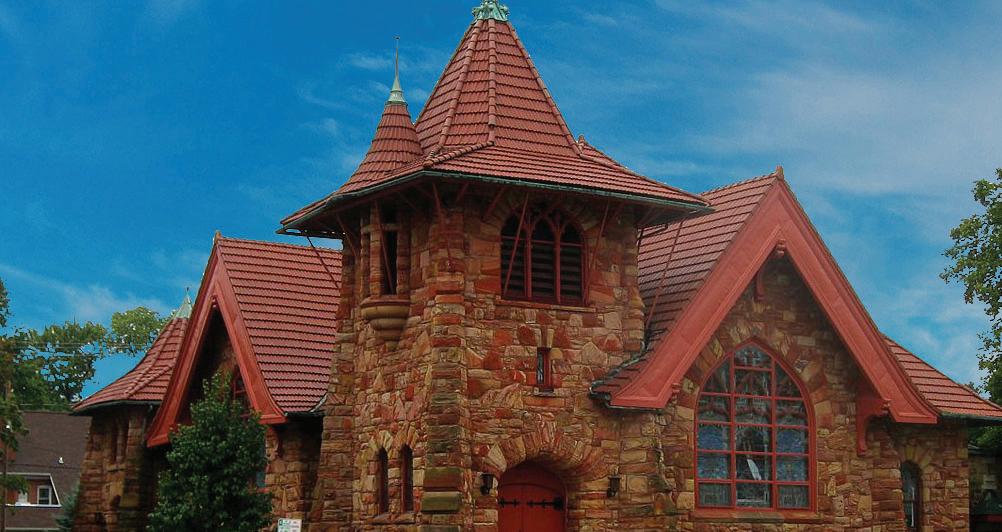
First Presbyterian Church, Napoleon
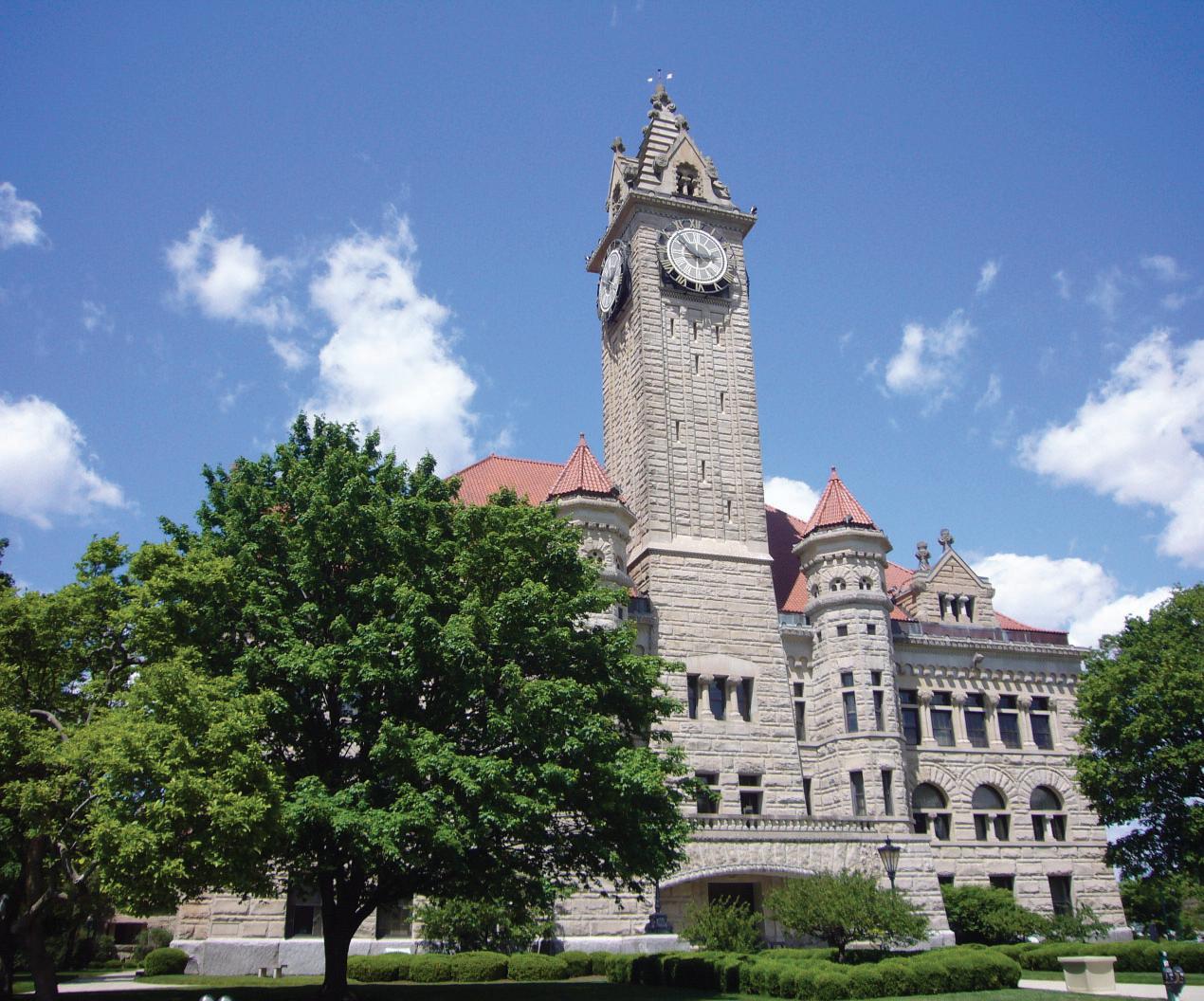
Wood County Courthouse
GOALS 2023-2030
Goal 1
All communities in Ohio become better places to live and work through historic preservation’s various programs and tools. We want historic preservation tools to be used, accessed and enjoyed by all to make communities better places to live. Whether rehabilitating a historic house, revitalizing a Main Street commercial district, preserving an archaeological site or landscape or just wanting to be able to appreciate and retain what makes places special, historic preservation tools should be within reach of more individuals and communities.
OBJECTIVE A: Historic Preservation’s financial programs and tools are known and accessible to all Ohio citizens, especially practitioners, government offi cials, developers, and property owners.
Action Items:
• Identify all financial incentive programs and tools, both public and private, and disseminate information about them in various formats and ways to reach the most audiences.
• Design a comprehensive training course on financial incentive programs and tools for property owners, business owners, and government officials.
• Encourage municipal cooperation to share successful applications of financial incentives and historic preservation work.
• Explore opportunities to assist homeowners in preserving their homes.
• Increase funds available for Ohio Historic Preservation Tax credit program.
OBJECTIVE B: Historic Preservation’s non-tax incentive programs and tools, such as energy efficiency rebates and local financial assistance options, are known and accessible to all Ohio citizens, especially practitioners, government offi cials, developers, and property owners.
Action Items:
• Identify all non-tax financial incentive programs and tools, both public and private, and disseminate information about them in various formats and ways to reach the most audiences.
• Design a comprehensive training course on non-tax financial incentive programs and tools for property owners, business owners, and government officials.
OBJECTIVE C: Non-financial historic preservation programs and tools, such as energy efficiency, trades networks, and marketing of historic buildings, are known and accessible to all Ohio citizens, especially practitioners, government offi cials, developers, and property owners.
Action Items:
• Develop homeowner resources like a clearinghouse of information for all levels of property owners, from those looking to research the history of their home to those looking for best practices for repairs.
• Better marketing of historic preservation for communities—how can protecting and reusing historic resources help a struggling community or a neighborhood that has seen disinvestment
• Connect property owners to trade networks and local craftspeople
• Increase connection to local trade centers at local/county level to increase knowledge of preservation trades for craftspeople
OBJECTIVE D: Ohio communities protect archaeological resources through local decision making and local designation and protection laws.
Action Items:
• Increase awareness of the value of archaeological sites to community identity and history
• Develop an archaeology-specifi c plan to guide efforts throughout Ohio
• Enact state legislation to protect unmarked human burial places and abandoned cemeteries
• Increase use of archaeological reports and studies to showcase, in a sensitive manner, the importance and variety of archaeological sites in Ohio
• Encourage additional National Register nominations for archaeological sites to offer documentation and protection to sites
• Provide guidance to the creation of an archaeology emergency fund
• Increase grant funding, including Certified Local Government grants, for archaeological site protection and stronger local anti-looting legislation
• Encourage the listing of Ohio’s ancient mounds to the World Heritage List to increase awareness of the state’s native population and to increase support for archaeological sites throughout the region.
Goal 2
The constituency promoting the value of historic preservation is expanded by increasing the understanding of historic preservation programs and benefits. We want historic preservation to provide greater value to communities, and the public is aware of its benefits. Everyone who impacts or effects, or has the ability to do so, historic resources in Ohio knows and promotes the benefits of historic preservation. Local officials are well-versed in historic preservation programs and aware of tools in order to increase general public interest in what historic preservation provides. A diverse cross section of community members, professionals and elected officials champion and share the benefits of historic preservation all over Ohio.
OBJECTIVE A: Reach the broadest audience possible through expanded media and marketing tools used by historic preservationists and their organizations.
Action Items:
• Develop an Economic Impact Study to highlight the importance of historic preservation to places across Ohio.
• Showcase impacts to communities, both financial and cultural, from preserving and reusing historic resources.
• Develop tourism-like slogan to use statewide for legacy businesses, rehabilitated buildings, etc.
• Assist in developing broader networks for historic preservation organizations and underserved communities. This ranges from modern-day American Indian tribes, Black and other racial groups, Appalachians, different socioeconomic groups, those with different abilities, Lesbian, Gay, Bisexual, Transgender and Queer groups, etc.
OBJECTIVE B: Expand working and cooperation with federal, state, regional, and local agencies, non-government organizations, preservation partner organizations, businesses, and private organizations on preservation projects and programs.
Action Items:
• Offer training to organizations and state agencies to better understand the benefits of historic preservation and the basics of building rehabilitation/ tax credits.
• Expand resources for state and local agencies and other entities to identify, designate, and protect archaeological sites.
• Work with organizations and federal, state, and local agencies to proactively identify and plan for protection of historic and archaeological sites.
OBJECTIVE C: Provide additional training to local government audiences that will explain how to utilize historic resources and incentivize rehabilitation.
Action Items:
• Regular online and in-person training opportunities about the process of historic preservation program and the benefits and incentives for historic preservation.
• Develop connections for local governments to receive specialized training from professionals in related fields, including archaeologists, real estate professionals, tax professionals, and contractors/construction experts.
• Encourage commissions to develop more outreach resources for communities and to eliminate jargon from operations.
OBJECTIVE D: Expand training for historic preservation professionals and tradespeople to understand the most common treatments and expectations in historic rehabilitation programs.
Action Items:
• Work towards developing connections with trade schools to create preservation-oriented classes.
• Develop means of connecting trades students and workers with property owners.
OBJECTIVE E: Expand public engagement with archaeological professionals and the public.
Action Items:
• Expand local government knowledge of need to protect archaeological sites
• Increase local government attention to archaeological sites to offer protection from vandalism.
• Encourage use CLG grants for archaeological studies and protection projects.
• Help communities to understand the non-monetary value of archaeological sites.
• Expand outreach to tribal partners in identifying and protecting archaeological and cultural sites of importance.
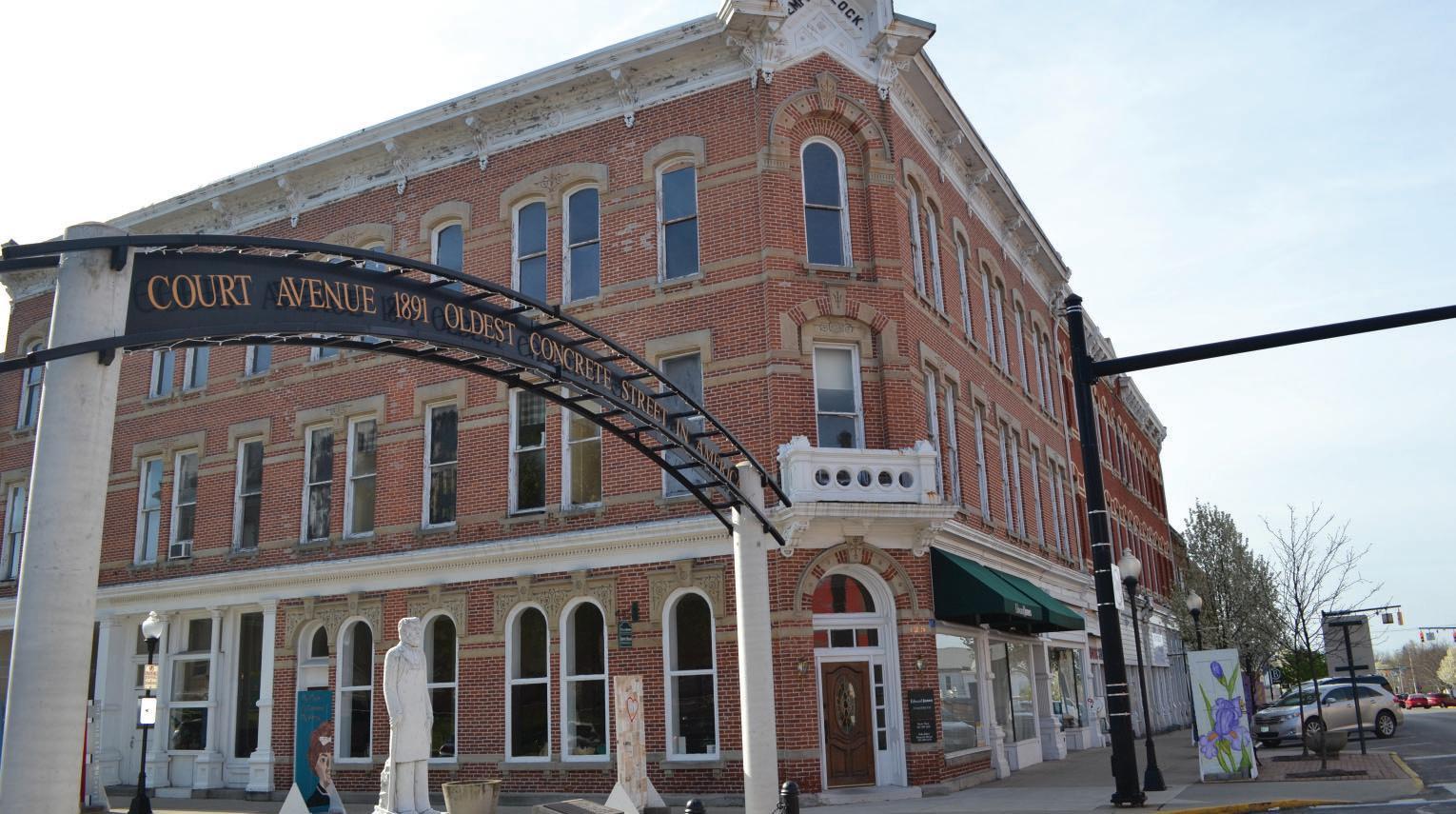
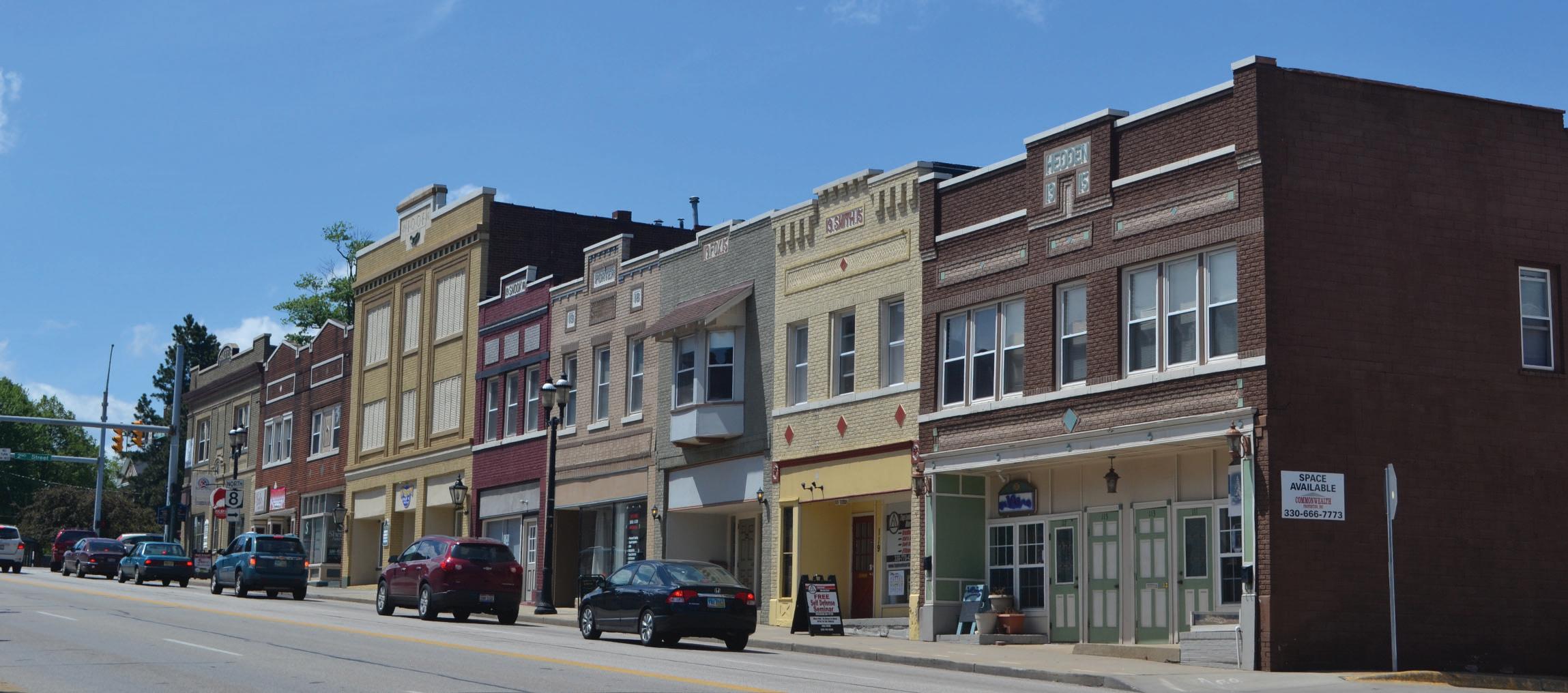
Downtown Bellefontaine Historic District
Goal 3
The economically and environmentally sustainable characteristics of historic preservation are leveraged by stakeholders to ensure that all Ohioans are more resilient.
Preservation is inherently sustainable. It reuses historic buildings, supports local economies, and fosters community. We will increase our resilience to natural and manmade disasters of all types and help communities prepare for any situation.
OBJECTIVE A: Promote environmental benefits of historic preservation to property owners, developers, and local governments.
Action Items:
• Develop marketing campaigns to showcase the long-lasting nature of historic buildings.
• Promote energy efficiency measurement tools to help property owners better understand how to take advantage of green building features.
• Provide case studies of historic rehabilitation projects that have embodied goals of energy efficiency and increased sustainability.
• Develop tools to help communities integrate energy efficient tools and designs into local historic districts.
OBJECTIVE B: Promote economic sustainability of historic preservation to property owners, local and regional development agencies.
Action Items:
• Emphasize the importance of strong local economies that reuse historic buildings.
• Expand availability of crisis team or emergency response assistance for historic districts and properties.
• Promote information on how historic districts embody walkability and economic diversity.
• Identify ways to promote historic preservation and development outside of the traditional tax credit framework.
• Expand knowledge of how legacy and local businesses impact local the economy and economic recovery.
OBJECTIVE C: Promote disaster preparedness for buildings to all levels of local, regional, and state government.
Action Items:
• Promote resiliency of historic buildings including their design and their materials.
• Encouraging Disaster Planning for sites and cities through case studies and disaster plan examples from other communities.
• Include additional organizations in disaster planning and hold wider training events towards crafting disaster plans.
• Work with communities to develop crisis plans and response teams to assist in reacting to natural and man-made disasters.
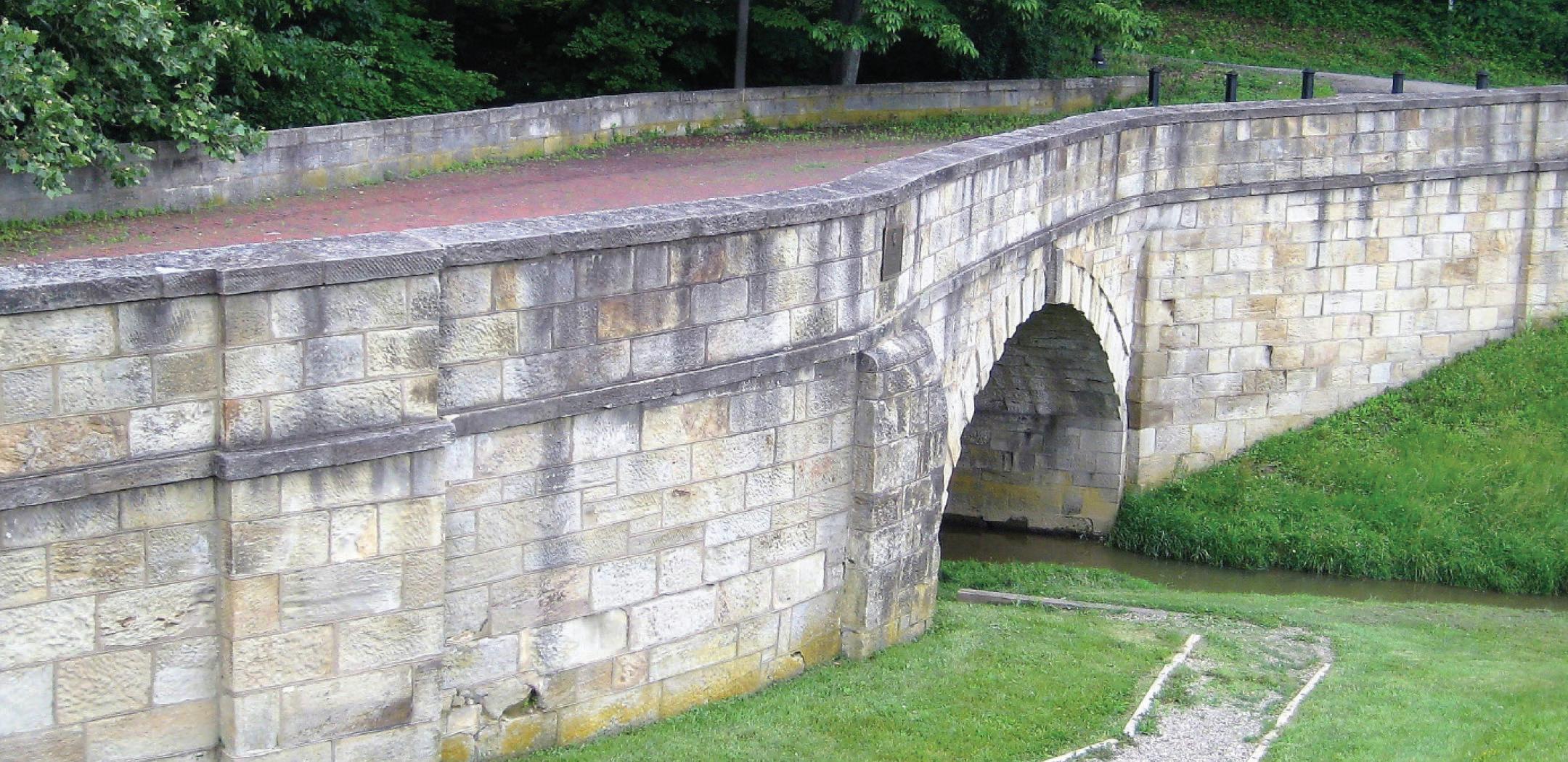
Peters Creek S-Bridge, National Road, Guernsey County
Goal 4
The diversity of voices represented in Ohio’s historic resources is expanded by increasing inclusion of underrepresented groups in both historic documentation and policy making.
We seek to have Ohio’s historic properties represent and tell the stories of all Ohioans. Whether an archaeological site, a building, a neighborhood or a cultural legacy, we seek to commemorate and support that memory. This includes increasing participation by underrepresented groups to identify, record and preserve places important to their history and striving to make preservation programs and policies more inclusive. No matter one’s race, background, socio-economic status, gender identity, sexual orientation, or ability status, the collective stories of all Ohioans, that are embodied in historic places, deserve to be told.
OBJECTIVE A: Ensure all historic preservation programs and practices do not exclude any Ohioans.
Action Items:
• Encourage and incentivize more National Register nominations and surveys to identify resources related to underrepresented communities, ensuring their stories are told.
• Increase access to historic preservation tools for communities that have not traditionally or frequently utilized them.
• Engage in outreach to associated nonprofits to promote historic preservation as a tool for social and economic change.
OBJECTIVE B: Expand the audience in making preservation decisions.
Action Items:
• Work towards connecting cultural affiliations to modern-day American Indian tribes when possible.
• Include specifi c underrepresented communities in the discourse about, and protection of, sites relevant to their history and culture.
• Work toward understanding barriers to participation for underrepresented communities and cooperating in removing those barriers.
OBJECTIVE C: Diversify age and backgrounds of preservationists.
Action Items:
• Develop tools for teachers to use historic architecture and archaeology in the classroom in a variety of disciplines.
• Develop opportunities for Youth Historic Preservation Commission members.
• Develop participation activities for camps, Scouts, etc. to increase awareness of historic preservation and archaeology.
• Increase social media presence of preservation to engage new constituents and preservationists.
Cuyahoga Falls Downtown Historic District
STATE HISTORIC PRESERVATION PLAN FOR OHIO: RECONCILIATION, RECOVERY & RESILIENCE
Rural & Appalachian Development
The world has dramatically changed in the five years since the last State Historic Preservation Plan, Finding Common Ground, was released.
The global COVID-19 pandemic has damaged the world economy and exposed deep racial and economic inequities in the United States. These changes have forced some very necessary yet difficult conversations. This plan is crafted to help Ohioans work towards addressing these issues through the lens of historic preservation. This plan seeks to address the structural problems inherent in historic preservation and forge new paths that assist various communities in protecting their history. Historic preservation can benefit everyone and it is important to make sure that these benefits are available to everyone. We believe in recovery, reconciliation, and resiliency.
(GOALS 1, 2)
In the previous plan, Finding Common Ground, we discussed the role of historic preservation in the recovery of Ohio’s legacy cities. From disinvestment, demolitions, and abandonment to the structural problems of a shrinking population, Ohio’s cities were especially hard hit by the Great Recession. While much work remains to be done, many large and mid-sized cities have seen significant growth in the past five years. From increased housing in downtowns to revitalized commercial districts, these cities have capitalized on the value of their historic resources.
But Ohio is much more than its large cities. It is full of smaller cities and villages that have faced the same distress and disinvestment. Issues facing smaller cities and villages range from protecting historic courthouses to stemming the loss of population. In the past five years we have also seen some significant progress in rural and small-town preservation.
Communities have passed Vacant Property/Upper Story Registry legislation to increase downtown populations. The use of federal Opportunity Zone funding from the State of Ohio, and increased use of the state and federal historic rehabilitation tax credits, have resulted in a number of projects rehabilitating key buildings and inspiring other rehabilitation projects. In an effort to expand the usage of these programs outside of larger cities, Heritage Ohio, the State Historic Preservation Office and the Ohio Department of Development have collaborated to host information sessions in small communities across Ohio to encourage use of the tax credits. In this plan we seek to increase the use of existing tools to promote revitalization while also exploring new tools and plans to assist in growing rehabilitation of historic and older buildings in rural areas.
The Ohio Revised Code provides counties and townships with limited options for protecting their historic and archaeological resources. These areas would benefit from tools that support proactive, rather than reactive, identification and protection of their cultural resources. It is important to find ways to work within current Ohio law to protect these historic places and to identify policies to increase recognition of these sites.
David Butcher, founder and curator of The People of Color Museum in the Tablertown, Athens County, speaks to the Ohio Annual Appalachia Heritage Luncheon in 2022
Solar Farms & Historic & Archaeological Resources
(GOALS 2,
3)
A new challenge for Ohio’s nonreplaceable historic resources is the statewide development of renewable energy sources, most notably solar farms. While Ohio has historically been tied to gas, oil and coal exploration, the vast amount of available farmland and access to transmission lines in rural areas has made Ohio a popular choice for the developers of solar farms in recent years. According to the Ohio Power Siting Board, the state agency that approves construction of solar farms, there are currently almost 67 utility scale solar projects under consideration, under construction or completed throughout Ohio: opsb.ohio.gov/wps/portal/gov/ opsb/about-us/resources/solar-farmmap-and-statistics. Three are completed and 10 are in construction.
A significant part of the demand for renewable energy is created by large corporations that do business in Ohio such as Facebook, Google and Amazon which have made pledges to switch to renewables for their power source in the coming years. This demand for renewable energy has also opened an opportunity for many Ohio farmers to lease their land for solar energy production rather than raising crops. Although the potential for environmental impacts from solar farms are less than those created by wind farms, solar projects can still encompass hundreds of acres of farmland and affect both archaeological sites and historic buildings. Many rural areas have never been surveyed for the existence of significant cultural resources. This could mean hundreds of acres will need to be surveyed for the presence of archaeological resources prior to the construction of a solar farm. When potentially significant archeological sites are found through survey, often the potential for adverse effects can be minimized with careful avoidance plans developed prior to construction. In addition, solar farms can have the potential of adverse visual effects to the built environment. Through the Section 106 coordination process the State Historic Preservation Office has
worked and continues to work with many solar companies on robust vegetative screening plans to minimize the visual impacts from solar farms to aboveground historic resources.
The State Historic Preservation Office, the Ohio Power Siting Board, renewable energy companies, and the public have worked together to successfully mitigate adverse effects from solar farms and found acceptable solutions agreed upon by all parties. While the continued popularity of solar farms depends on the availability of the technology and raw materials, this serves as an example of how contractors have worked to avoid archaeological sites and minimized impacts to historic resources.
Main & Maple Streets: Local Preservation
(GOALS 1, 2)
As has been said for many years, preservation is local. Cities and villages across the state have seen a number of new challenges over the past five years, as well as significant opportunities. Particularly important are our county courthouses. The specter of the demolition of the Seneca County Courthouse remains over the state, and preservation advocates encourage county seats to seek assistance to rehabilitate and maintain their historic courthouse complexes rather than demolish and construct all new. It is also important to consider other large-scale catalytic projects for smaller communities that are not county seats. The Piqua Hotel renovation, for example, served as an important spark in the revitalization of downtown Piqua.
The twin problems of vacancy and affordable housing have long plagued Ohio since the loss of much of the industrial jobs across the state. Policy decisions are needed that correct the missed opportunities of vacant properties with the housing needs of our most vulnerable citizens. This also extends to providing resources and incentives for property owners to rehabilitate houses and housing. There are currently no preservation-specific financial resources to assist property owners in rehabilitating single-family homes.
Current preservation-based tax incentives explicitly exclude owner-occupied homes from the credits. Further, according to the Ohio Housing Finance Agency, the state increased housing units just 1.8% between 2010 and 2020. A quarter of the state’s residential properties were constructed prior to 1940 and 30% of those properties are vacant. The low levels of overall vacancy of all housing stock (1.7% and 5.8% for homeowner and rental vacancy rates, respectively) indicate that the ready-to-rent market is fairly tight. However, the overall vacant properties numbers indicate that more can be done to rehabilitate properties and return them to housing.
It is important for local governments to receive training in preservation practices and incorporate historic resources into community planning. With issues like affordable housing and sustainability, it is important for municipalities to plan for both the protection and use of their historic resources.
Community groups must work proactively with their local governments to determine how best to protect and revitalize historic districts. This can include frequent training for local historic preservation commissions to update them on understanding emerging trends, new technologies, and evolving modernday materials that may be appropriate to use in historic districts.
TOOLS FOR FIGHTING VACANCIES
Ohio’s cities and villages have utilized a number of tools in their fight against vacancies, disinvestment. Land Banks have continued to serve as a means of acquiring vacant properties and cleaning titles, offering large-scale development opportunities. Vacant Property Registration Ordinances have similarly offered communities of all sizes an opportunity to work on regulating local vacant properties. These ordinances, which require paperwork and fees collected by the municipality, incentivize rehabilitation and reuse while also assisting in first-responder safety (by identifying vacant properties to firefighters and police) and providing municipalities with data on land use.
COVID-19 Pandemic & Historic Preservation
(GOALS 1, 2)
The COVID-19 Pandemic brought Ohio and the world to a halt. Stayat-home orders and uncertainty stopped development in its tracks and put countless projects on hold. The economy was hard hit, with layoffs and bankruptcies skyrocketing in a few months, particularly in the service sector. After the initial slowdown, development started again. The work of the State Historic Preservation Office continued unabated. Numbers of project reviews, tax credit applications, and National Register nominations maintained the same general pace as before the pandemic. The State Historic Preservation Office, like much of the rest of the world, had to learn how to work in digital format as much as possible.
Survey Needs
(GOAL 4)
While great strides have been made in collecting data through targeted AmeriCorps survey projects much still needs to be done to gain as accurate a portrait of Ohio’s historic architectural and archaeological resources as possible. A comprehensive system of survey is needed to provide not only accurate information about archaeological sites, but to offer a system of protection for those sites. There are several classifications of resources that also require additional research, survey and registration: Out of 112,335 surveyed properties and 4,223 National Register listings we have cultural landscapes, including rural sites and farmsteads (240 National Register listed sites and 7,172 surveyed sites); industrial sites (188 nominated, 1,373 surveyed); governmentrelated buildings, including township halls (245 listed and 558 surveyed); midcentury modern buildings constructed between 1945 and 1970 (40 listed); recent past resources less than 50 years old (0 listed); and resources associated with underrepresented communities, such as European-based immigrant groups (17 listed), African Americans (71 listed/529 surveyed) , American Indians (1 listed/96 surveyed), Latinos (1 listed/4 surveyed), Asian Americans (5 surveyed), women, lesbian/gay/bisexual/transgender persons, Appalachian/regional groups and socioeconomic groups (the last few categories do not have specific markers in the survey data). Many of these types of resources have not been identified as such on Ohio Historic Inventory, Ohio Archaeological Inventory forms, or some National Register nominations, since early listings focused primarily on architecture. The plan has several elements designed to address approaches to fill these gaps in knowledge, reevaluate and expand our current data and identify ways to engage broader participation in telling the full story of Ohio through survey and National Register documentation.
World Heritage Listing
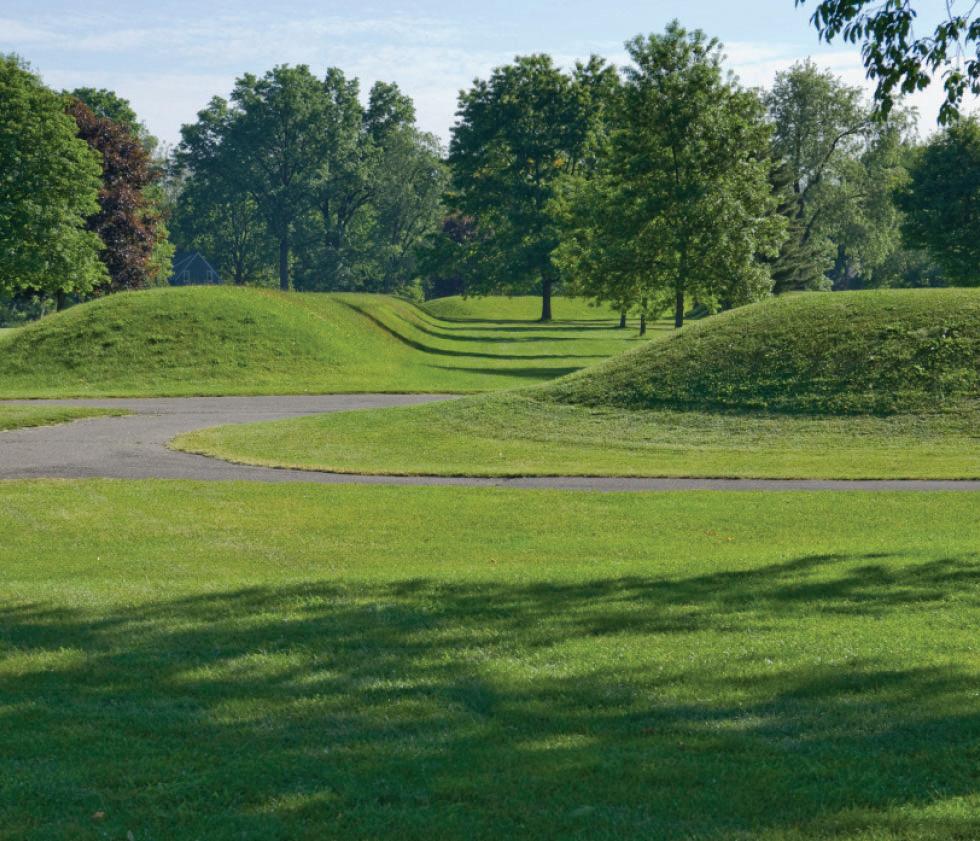
The Ohio History Connection and partners have been working towards inscribing the Hopewell Ceremonial Earthworks on the UNESCO World Heritage List. This nomination will be considered by the UNESCO World Heritage Committee in the summer of 2023. Designation will help highlight the rich culture of Ohio’s native population and provide additional assistance to those sites. The potential for tourism dollars flowing into Licking, Ross, and Warren counties will also help further protect and develop educational opportunities for these sites.
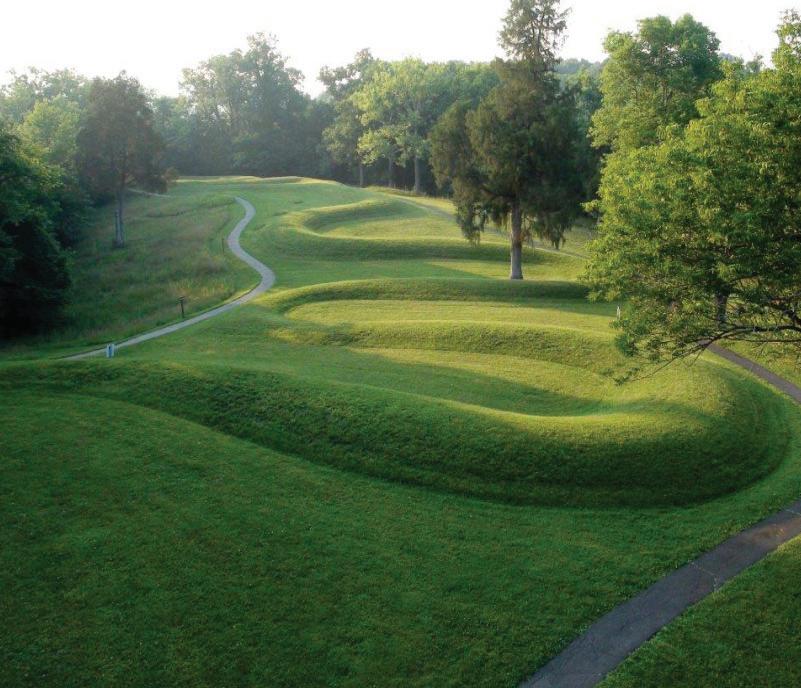
Serpent Mound, Adams County
Newark Earthworks, Licking County
STATE HISTORIC
PRESERVATION OFFICE
ACTIVITIES
The State Historic Preservation Plan is meant to serve many different purposes.
It is a guide to historic preservation policy for the entire state, creating metrics for evaluating how well the state’s government, non-profits, and organizations are meeting Ohio’s historic preservation needs. This plan is a public document, providing information to the public about grant funding priorities, upcoming programs, and generally how historic preservation resources in the state are, and could be, directed. And finally it serves as a work plan for the State Historic Preservation Office, directing our work and funding priorities for Certified Local Government Grants, survey priorities, and educational programs.
Section 106
(GOALS 1, 3)
The National Historic Preservation Act of 1966 made preserving historic, architectural and archaeological resources a national policy. Under Section 106 of the Act, federal agencies must consider the effects of projects that they fund, license or permit on properties that are listed on, or eligible for listing on, the National Register of Historic Places. To accomplish this task, agencies that receive federal funds must consult with local officials and the State Historic Preservation Office to determine whether their undertakings will affect historic properties and, if they will affect them, seek ways to avoid, minimize or mitigate those effects. It is through the Section 106 process that a number of resources are identified, whether through mitigation efforts or through the project planning process. In federal fiscal year 2020, Ohio’s State Historic Preservation Office reviewed over 4,800 federal and state assisted projects, among them HUD-funded housing projects, including rehabilitations, demolitions and new construction; bridge and road improvement projects funded by the Ohio Department of Transportation; wireless communications facilities licensed by the Federal Communications Commission; and various U.S. Army Corp of Engineers projects. In addition, the office reviews state-funded projects each fiscal year under Ohio Revised Code §149.53 that requires state agencies to cooperate with the State Historic Preservation Office when their projects may affect historic properties.
Certified Local Governments
(GOALS 1, 2, 3, 4)
The Certified Local Government program is a partnership between federal, state and local governments. It was in this spirit of partnership that the Certified Local Government program was created by the 1980 Amendments to the National Historic Preservation Act. Adopted in Ohio in 1985 and administered by the State Historic Preservation Office, the Certified Local Government program has since certified nearly 80 local governments of all sizes. Under federal requirements for the program, Certified Local
Governments must establish a qualified historic preservation commission; a process for survey and inventory of historic resources; a process for public participation for local designation, design review and the National Register nomination process; and follow all state and local preservation laws. Buildings designated as historic by a Certified Local Government are eligible to apply to the Ohio Historic Preservation Tax Credit program. A grant program administered by the State Historic Preservation Office assists Certified Local Governments in executing the requirements of the federal program and in developing effective local preservation plans, guidelines, and other program assistance.
Certified Local Governments in Ohio continue to adapt to new challenges and opportunities. As outlined in the Certified Local Government Grants section, communities across the state have taken the initiative to develop design guidelines and update their survey and National Register documents. As a result of the COVID-19 pandemic governments across the state had to shift from in-person meetings to online. While creating a host of new challenges, this change also opened a number of new opportunities for training and hybrid meetings for those that may be unable to attend meetings in person.
LEGACY CITIES
Ohio’s Legacy Cities are the formerly industrial cities that have seen a significant loss of population since the end of the manufacturing heyday after World War II. Of the ten largest Ohio cities in 1950, only Columbus has increased in population (due in part to a period of annexation). Youngstown has fallen out of the top ten cities, replaced with Parma, a suburb of Cleveland. These cities lost between 11% (Toledo) and 64% (Youngstown) of their population between 1950 and 2020. However, the buildings and infrastructure of these cities remain, offering both challenges and opportunities in historic preservation.
Federal Rehabilitation Tax Credit
(GOALS 1, 3)
Ohioans remain among the nation’s leading users of federal income tax credits designed to stimulate private investment in preservation of historic properties. The credit encourages owners to rehabilitate income-producing properties listed in the National Register of Historic Places. In following the Secretary of the Interior’s Standards for Rehabilitation, owners of investment properties may qualify for a federal tax credit equal to 20% of qualified rehabilitation expenses. The Ohio History Connection’s State Historic Preservation Office reviews projects and makes recommendations to the National Park Service, which makes final decisions about projects. The federal credit may be used in concert with the Ohio Historic Preservation Tax Credit, for a potential tax credit of up to 45% of qualified rehabilitation expenses. The credit has aided preservation and rehabilitation of more than 1,700 buildings in Ohio, representing a total investment of over $7 billion since the program’s inception. However, much of this development has been focused on the state’s largest cities, meaning that smaller communities have not felt the same benefit.
Survey, Inventory & Registration
(GOALS 2, 4)
In Ohio, the ongoing survey of buildings and archaeological sites is recorded on Ohio Historic Inventory and Ohio Archaeological Inventory forms. These databases maintain information about surveyed resources, whether from a Certified Local Government-sponsored survey or Section 106 consultation, a grant project, or the AmeriCorpssponsored survey program. More data collected means clearer and more precise information about Ohio’s historic resources.
Over 101,000 properties have been surveyed since the Ohio Historic Inventory program’s inception in 1973. Recent State Historic Preservation Office initiatives have resulted in significant growth in surveys covering areas that were previously underemphasized. The Ohio Modern project in 2009–2010 made great strides in our understanding of post-World War II development in the state. As a result of the project, hundreds of 1940s, ‘50s and ‘60s properties in Dayton were surveyed and a statewide historic context document for midcentury modern properties was written. Hundreds of properties have been systematically surveyed through the State Historic Preservation Office’s multi-year participation in the AmeriCorps program of the Ohio History Connection. One focus of these surveyors has been African American neighborhoods in Cleveland and other cities.
Despite these important additions to survey information, many previously surveyed properties have witnessed great change over the years. Whether a building has been recently rehabilitated using tax credits or demolished, the survey data is rarely updated at the state level. In many cases, forms were prepared in the 1970s and ‘80s, meaning that the information is over 30 years old. While local survey efforts may reflect these changes, these efforts may not be coordinated with the State Historic Preservation Offi ce. It is a high priority to encourage projects that revisit older survey records and integrate current survey data with the State Historic Preservation Offi ce records.
HISTORIC CONTEXTS IN OHIO
Agricultural Resources of the Cuyahoga Valley MPS
Apartment Buildings in Ohio Urban Centers, 1870-1970 MPS
Augspurger Amish/Mennonite Settlement TR
Cross-Tipped Churches of Ohio TR
Downtown Youngstown MRA
East Liverpool Central Business District MRA
Eastlake Houses of Ashley TR
European Ethnic Communities, Dayton MPS
Federal and State Correctional Institutions in Ohio MPS
Hannaford, Samuel, & Sons TR
Historic and Architectural Resources of the Underground Railroad in Ohio MPS
Historic Industrial Resources of Tipp City, Ohio 1840-1959
Historic Mill-Related Resources of Delaware and Liberty Townships MPS
Historic Resources of the Cincinnati Park and Parkway System 1817-1959
Hobart Welded Steel Houses TR
Light Stations of Ohio MPS
Lima MRA
Little Cities of Black Diamonds-Athens, Hocking, Perry Counties MPS
Morgan’s Raid in Kentucky, Indiana and Ohio MPS
Ohio and Erie Canal TR
Pennsylvania German Churches of Ohio MPS
Recreation and Conservation Resources of the Cuyahoga Valley MPS
Round Barns in the Black Swamp of Northwest Ohio TR
Tiffin Industrial Buildings TR
Twentieth-Century African American Civil Rights Movement in Ohio MPS
U.S. Coast Guard Lighthouses and Light Stations on the Great Lakes TR
Underground Railroad in Ohio
Upper Prospect MRA
Zanesville Historic Railroad Depots TR
TR (Thematic Resources) and MRA (Multiple Resource Area) were the terms used for multiple property submissions until 1991 when National Register Bulletin 16B was published. MPS (Multiple Property Submission) is the term used since the publication of the bulletin.
Hope Furnace, Vinton County
National Register of Historic Places
(GOALS 2, 4)
Ohio has one of the largest numbers of properties on the National Register of Historic Places. The wide range of historic places in Ohio that are listed in the National Register encompass all aspects of our state’s growth and prominence, from the farm buildings of the northwest to the small Appalachian towns of the southeast, the industrial hubs of the northeast, to the transportation centers of the southwest. The growth of the Ohio Historic Preservation Tax Credit program has increased pressure on the National Register nomination process. Coupled with the fact that many older nominations need to be updated to reflect new information and additional areas of significance, it is a priority to proactively list properties in the National Register and to reexamine older nominations. Specific property types of note include mid-century properties and properties less than 50 years old eligible for the National Register because of their exceptional significance. Erieview Tower in Cleveland represents part of the large-scale redevelopment efforts in Cleveland. Recent nominations for downtown Toledo and Dayton have taken into account the impacts of urban renewal policies, documenting the development of Ohio municipalities since the Second World War.
Online Geographic Information System
The State Historic Preservation Office Online Mapping System makes Ohio Archeological Inventory, Ohio Historic Inventory and National Register data available both internally and externally in an electronic mapbased format. The boundaries of individual archaeology sites, areas surveyed and National Register-listed historic districts have all been digitized and made available on this site. This unified research system was developed to facilitate the work of State Historic Preservation Office staff, preservation consultants, agencies and organizations that use the data. The data is integrated with relevant infrastructure and environmental information, aiding users in visualizing how environmental data, archaeological, historic and infrastructure resources relate to each other. The Geographic Information System is constantly evolving as new data and new technology become available.
Building Doctor
The Building Doctor program is one of the State Historic Preservation Office’s most longlived public outreach programs. Begun in 1979, the program sends State Historic Preservation Office staff to a sponsor community to offer a seminar on old-building care and maintenance followed by on-site consultations with old-building owners in the community. Nearly 300 clinics have been held over the years providing assistance to property owners by addressing common old-building maintenance, preservation and rehabilitation questions and demonstrating how common-sense regular maintenance and repairs can preserve historic properties.
Celina Main Street Commercial Historic District
FUNDING HISTORIC PRESERVATION IN OHIO
Ohio Historic Preservation Tax Credit
The Ohio Historic Preservation Tax Credit, administered by the Ohio Department of Development in partnership with the Ohio History Connection’s State Historic Preservation Office and the Ohio Department of Taxation, provides a refundable state tax credit equal to up to 25% of qualified rehabilitation expenses for the rehabilitation of historic buildings.
Established as a two-year pilot program in 2006, it was renewed without a sunset in 2013. A total of $60 million is set aside annually, with two rounds of $30 million each in credit awards. Subsequent alterations to the program include an 8% set-aside for smaller projects and a 25% set-aside for intermediate projects. One of the criteria to qualify for the state tax credit is that a building must be either listed in the National Register of Historic Places or locally designated as historic by a Certified Local Government. Additionally, the proposed work must meet the Secretary of the Interior’s Standards for Rehabilitation, and costbenefit requirements must be met.
Since 2008, over 785 buildings have been rehabilitated in 78 jurisdictions. An average of 26 projects are approved each year, leveraging over $13 million invested per project. Credits totaling $915 million have been granted, that will leverage over $8 billion in total investments. 555 projects have been funded and over 380 successfully completed to date. The program has also created over 10,000 construction jobs and 6,795 permanent jobs. It is clear that the credit has had a large impact on historic preservation in Ohio, bringing buildings of all types and sizes back in service for housing, offices, and a variety of new businesses.
In 2022 the State Legislature passed a new bill which temporarily expanded the Ohio Historic Preservation Tax Credit.
The new bill doubled the amount of funds available from $60 million annually to $120 million annually; raised the perproject cap to $10 million per project; and expanded the credit to 35% of all Qualified Rehab Expenditures in cities below 300,000 in population. While a temporary change, this nevertheless reaffirms the state’s commitment to helping communities rehabilitate and revitalize their historic buildings.
Pipeline Initiative
(GOAL 4)
In 2013, a new funding program was piloted by the Ohio Department of Development to funnel projects to the Ohio Historic Preservation Tax Credit program. Since a building must be either listed in the National Register of Historic Places or locally designated as historic by a Certified Local Government to qualify for the state tax credit, a new program was needed to get properties registered. The Pipeline Initiative, now permanent, was created to provide grant funds to facilitate listing a building or historic district in the National Register. Pipeline grant funds are also available to investigate whether a building’s original features may remain well-preserved behind a non-significant addition, such as a metal screen.
Federal Grant Programs
The State Historic Preservation Office and Heritage Ohio partnered on two successful applications to the Paul Bruhn Historic Revitalization Grant Program. The first award of $556,327 in 2020 will be regranted to four Ohio Main Street communities to assist with rehabilitation work on historic buildings that prioritize economic impact, use of commercial first floor space and upper floor residential space, and encourage reactivation of vacant spaces. A second award of $750,000 is earmarked for the same type of projects in Main Street communities in Ohio’s Appalachian region.
The SHPO has also received two Underrepresented Communities Grants. One is to fund a context of African American historical sites throughout the state and to create nominations based on that information. As second for $47,000 is for a partnership with the Cleveland Restoration Society to survey and inventory significant Black churches in Cleveland. One church will also be nominated to the National Register. Other funding opportunities are available, including the Save America’s Treasures grant and the National Semi Sesquicentennial grant.
Under the terms of the National Historic Preservation Act, 10% of each state’s annual federal apportionment from the U.S. Department of the Interior’s Historic Preservation Fund is set aside for Certifi ed Local Governments to carry out the purposes of their ordinances. The Certified Local Governments may pursue a wide range of preservation activities, including historic resource surveys, National Register nominations, community education projects and the rehabilitation of historic buildings. The program is competitive, with an average of $130,000 in Historic Preservation Fund monies annually available. Between 2017 and 2021, the State Historic Preservation Office awarded matching grants to 35 Certified Local Governments. Grant highlights include Green Lawn Abbey in Columbus and First Church in Oberlin. These grants, while for relatively small, targeted rehabilitation projects, help to off set the overall costs of larger rehabilitation projects that involve numerous other funding sources. In Cleveland, Lakewood and Lorain CLG grant funds were paired with Pipeline Grants to fund National Register district listings and encourage use of the state tax credits. These projects would not have occurred otherwise.
History Fund Grants
The Ohio History Fund is a competitive matching grant program administered by the Ohio History Connection. The program supports history projects falling into one of three broad categories: Bricks & Mortar, Organizational Development, and Programs & Collections. A variety of nonprofit organizations and public entities can apply, including preservation groups, local governments, community historical societies and museums, archaeological conservancies, and libraries. The Ohio History Fund is supported by voluntary contributions from Ohioans through their state income tax forms, sales of Ohio History license plates, and from private donations. Recent historic preservation-related projects include accessibility upgrades to the National Historic Landmark-designated Edmund Drummond Libbey House in Toledo and a period-appropriate roof on the Mabel Hartzell House in Alliance.
NONPROFIT HISTORIC PRESERVATION
Main Street
Developed by the National Trust for Historic Preservation in 1980, the Main Street program has since become an independent subsidiary of the Trust and is managed by the National Main Street Center. The Ohio Main Street Program, administered by Heritage Ohio, is designed to improve all aspects of the central business district, including focused economic management, strengthening public participation and making downtown a fun place to visit. It is also important to illustrate to community leaders how revitalizing historic buildings is a critical element in recruiting new businesses to downtown areas. Building on downtown’s inherent assets, rich architecture, personal service and most of all, sense of place, the Main Street Approach™ has rekindled entrepreneurship, cooperation and civic concern. The Main Street program has earned national recognition as a practical revitalization strategy scaled to a community’s local resources and conditions.
MAIN STREET™ FOUR-POINT APPROACH
The National Trust for Historic Preservation created the Main Street Program in 1980 to provide structured guidance to communities that combine principles of economic development and historic preservation. The widely recognized Four-Point Approach encapsulates the vision of the Main Street program:
ECONOMIC VITALITY focuses on capital, incentives, and other economic and financial tools to assist new and existing businesses, catalyze property development, and create a supportive environment for entrepreneurs and innovators that drive local economies.
DESIGN supports a community’s transformation by enhancing the physical and visual assets that set the commercial district apart.
PROMOTION positions the downtown or commercial district as the center of the community and hub of economic activity, while creating a positive image that showcases a community’s unique characteristics.
ORGANIZATION involves creating a strong foundation for a sustainable revitalization effort, including cultivating partnerships, community involvement, and resources for the district.
First Christian Church, East Main Street
Historic District, Alliance
Statewide Nonprofits
Ohio has two statewide nonprofit historic preservation organizations, Preservation Ohio and Heritage Ohio. Both serve as advocates for historic preservation and revitalization throughout the state. The Ohio Archaeological Council serves as the primary statewide nonprofit for professional archaeologists.
Preservation Ohio serves as an advocate for historic preservation and provides a number of workshops to local communities including “Tools & Strategies to Create Vibrant Historic Neighborhoods” and “Tools to Sleuth Old Houses and Antiques.” They have launched “Banking on the Past” as a resource for smaller tax credit projects between $60-500,000. As host of the Ohio’s Most Endangered Historic Sites list, Preservation Ohio highlights challenges to properties across the state. To assist with long-term conservation efforts, Preservation Ohio administers easements on several historic properties. Heritage Ohio is a statewide advocate for historic preservation and revitalization. The organization hosts the Ohio Main Street Program and the annual statewide Historic Preservation Conference. The conference brings revitalization professionals together to learn, socialize and celebrate annual awards. Heritage Ohio hosts webinars monthly on a wide variety of historic preservation downtown revitalization topics. Each quarter, training is offered on the Main Street Approach ™ and “sash mobs” on wood window repair are hosted every other year. A popular educational session has been the Tax Credit Coffees, a partnership between Heritage Ohio, the State Historic Preservation Office and Ohio’s Department of Development, through which staff teams have visited 65 of 88 counties sharing information on how to use the state and federal historic tax credits. In addition, Heritage Ohio in 2019 received a $500,000 appropriation from the State of Ohio to invest in Main Street building improvements. Heritage Ohio has partnerships with a variety of state organizations to enrich its programmatic content and financial support. The Appalachia Heritage Luncheon is an annual luncheon held since 2011 in partnership with the Ohio Hill Country Heritage Area. Heritage Ohio also supports Young Ohio
Preservationists, a movement of 18-40 year-olds exploring and enjoying historic preservation in our state.
For more than 45 years, the Ohio Archaeological Council has promoted the advancement of archaeology in Ohio. The organization works to cultivate a strong network of professional archaeologists in every field within the discipline. The Council’s advocacy work has included a cemetery task force that recommended policies to protect human burials, and supporting the protection of archaeological sites. Outreach programs including Archaeology Month, grant programs like the Patricia Essenpreis Memorial Grant, and providing a clearinghouse of information to those who may encounter archaeological sites in the process of construction and development.
Local Nonprofits
Ohio has over 75 local historic preservation organizations, ranging from neighborhood associations to citywide and regional nonprofits. These organizations carry out a wide variety of functions, from chain-of-title research and addressing technical preservation issues, to providing design review for historic buildings and rehabilitating historic structures. These organizations operate where local government cannot normally reach, serving as advocates and offering a preservation perspective on local revitalization and development.
The Columbus Landmarks Foundation, founded in 1977, is the city’s nonprofit for historic preservation. With programs and projects focused on both commercial and residential development, Columbus Landmarks serves to help all of those who live, work, and play in the State’s Capitol. Programs include the Columbus’s Most Endangered List and the Atlas of Columbus Landmarks. The Home Preservation Loan Fund, founded in 2010, has provided numerous loans to help rehabilitate houses across Columbus’s historic districts. The Home Preservation Program has offered assistance to homeowners across the city.
Cincinnati Preservation Association, founded in 1964, is active throughout the greater Cincinnati region, and in northern Kentucky. Cincinnati Preservation Association’s practical preservation workshop series covers a wide variety of topics, including LEED
(Leadership in Energy and Design) compliance, greening your rehab, buying and renovating vacant properties, windows and other topics. CPA also has lecture series, Preservation in the Park, that highlights stories of buildings and the people associated with them. Over the last several years CPA has also established an Endangered Buildings Revolving Fund to help with buildings that are faced with imminent threat of demolition and they have also started a Black Sites Program that is dedicated to identifying, documenting, celebrating and saving sites associated with Black History in the greater Cincinnati area.
Since 1972 the Cleveland Restoration Society has been committed to preserving, protecting, and celebrating historic buildings and places that foster vibrant and inclusive communities. Efforts to preserve the religious architecture of northeast Ohio has long been a focus. Since its inception in 1992, the Heritage Home Program has facilitated 1,967 home rehabilitation loans valued at over $79 million, and provided over 20,000 homeowners with technical assistance. The organization has developed a Historic Properties Program, a revolving fund to stabilize threatened historic structures. Most recently, the fund was used in conjunction with a Certified Local Government grant to preserve the legacy of the DallMays Houses, places of layered history that are associated with Cleveland’s immigrant past and African American cultural heritage. Cleveland Restoration Society published its first book in 2019, shining a light on the development of a mid-century African American neighborhood in Cleveland and launched a new initiative to establish a Civil Rights Trail, telling the stories of events that occurred in the recent past in the hopes that we may learn from them today.
CASE STUDY
Barker House
BY WES CLARKE
The scene has played out many times in the historic preservation arena.
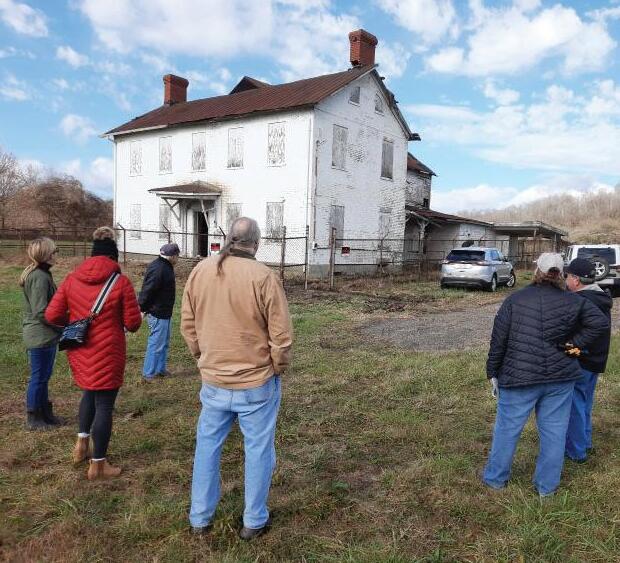
A large government agency is holding a sparsely attended public meeting to finalize procedures to remove a dilapidated historic structure from their property. They need to document that no reasonable alternative to the adverse effect of demolition remains available, and they have reasonable arguments: after decades of neglect, the house structure has become unstable and an eyesore; none of the multiple solicitations to move the structure to private property have been productive; and continuing to leave the structure “as is” presents a safety hazard. The solution seems obvious, unless someone at the public meeting that night in August, 2017, has a serious plan for moving the house. One citizen stands and asks to speak. It is out-of-order on the agenda, but the managers allow a brief statement. “The people who built and lived in that house were the start of our community. That house is the heart and soul of our neighborhood. It should be saved …”
Those of us in the historic preservation community have seen this movie before and we know how it often ends. When meeting attendee Jack Haessly approached the directors of the Washington County Historical Society a few weeks later to ask for their support in saving the house, the president and vice-president, both cultural resource management professionals, assumed the worst. But Mr. Haessly, a local businessman and community leader, was persistent, and the board pledged to support the preservation effort to whatever extent they could.
Follow-up research by the society officers transformed their level of enthusiasm for the project, if not their presumption that it would be an uphill effort likely to fail. The builder of the house, Joseph Barker Sr., was an early settler and housewright in the Northwest Territory, and Barker women and men were significant participants in the region’s development, meriting the inclusion of some family members in David McCullough’s best-selling book The Pioneers. But the real inspiration
for the preservation effort was the magnificent Federal style detail and fixtures that remained in the house, incredibly surviving almost 200 years of private and agency occupation. Still, the chances of saving the structure seemed small.
Fast-forward fi ve years to late 2022. Federal legislation has been passed transferring the house and 3.51 acres of land to the non-profit Friends of the Joseph Barker Jr. House (FJBJ). Environmental studies and technical preparations have been accomplished, the Ohio Department of Transportation has completed installation of an access road, and transfer of ownership of the Barker House to FJBJ has been finalized.
What happened in the intervening years to achieve this unlikely outcome? Perhaps most importantly, cooperation between local, state, and federal preservation groups and agencies brought together expertise regarding historic preservation laws and regulations, resulting in a systematic, fact-based approach to the house preservation effort. Other professional know-how in historical architecture, engineering, the law and accounting also joined the endeavor. Proposals and responses supporting preservation were therefore issue-focused and practical. Preliminary fund-raising pledges demonstrated community support and established a basis to meet contingencies as they developed. A formal support group (FJBJ) and basic accounting mechanisms were also legally established at both state and federal levels. The resulting combination of preservation expertise, a practical approach to problem-solving, fiscal wherewithal and formal organizational structure convinced the region’s federal and state legislators that this was a serious effort with the ability to follow through in the long term, gaining help with bureaucratic and funding hurdles. The presumed outcome at that public meeting several years before had been answered and altered, a testament to unexpected outcomes.
CASE STUDY
Preservation, Recognizing Black History & Affordable Housing: A Win-Win-Win with the Adaptive Reuse of the Manse Hotel Complex
BY BETH JOHNSON
The Walnut Hills Area Council has taken a lead within Cincinnati in recognizing the rich and deep history of the Black population within their neighborhood and in the city.
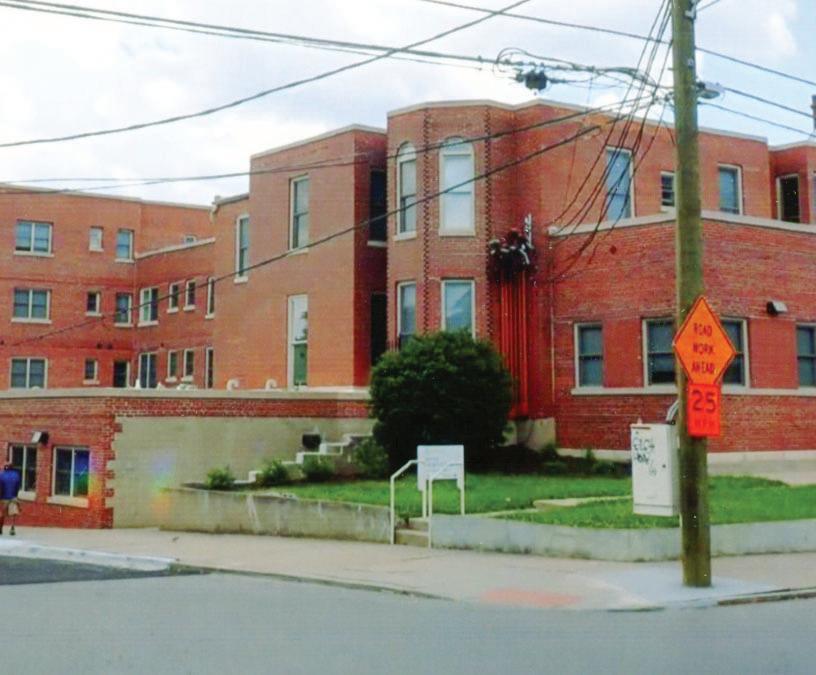
A vibrant black business district along Lincoln Avenue provided opportunity and services to a black population that often faced discrimination in whiteowned establishments. This included the Manse Hotel located at 1004 Chapel Street, which was one of the few hotels in Cincinnati that accommodated African-American travelers. Originally built as a second empire style single family home, Horace Sudduth, an
influential and prominent black businessman, purchased the building in the 1930s. After building an expansion, he converted the property into a hotel that quickly become a center of activity for the community. Over the years, legends like Duke Ellington, Thurgood Marshall, Count Basie, Frank Robinson and James Brown all visited the hotel. Once Cincinnati hotels became integrated, the Manse lost business to hotels that were closer to the Central Business District. The hotel lost its prominence and its clientele turned into a transient population until it was sold in the early 1970’s to be turned into apartments.
After falling into disrepair, the Model Group purchased the property as part of the revitalization and redevelopment efforts outlined in the 2016 Walnut Hills Reinvestment Plan that was created for the Walnut Hills Redevelopment Foundation with support from the City of Cincinnati. This plan highlighted areas for focused investment that included both rehabilitation and new construction. The original plan for the buildings by the Model Group contemplated tearing down the structures for new development, but through engagement with the Walnut Hills Redevelopment Foundation and local community members, they learned about the important history of the buildings and changed course. Instead, the Model Group sought local Historic Landmark Designation and National Register Individual Listing as part of the 20th Century African American Civil Rights Movement in Ohio Multiple Property listing.
With the historic designations, the project was able to create a capital stack that included both the Federal and the Ohio Historic Preservation Tax Credit. The rehabilitation of the Manse Hotel and Annex also used Low Income Housing Tax Credits, Home Funds, and FHLB Affordable Housing Program funds to provide a much-needed supply of 60 affordable housing units for seniors that even incorporates aging in place, visibility design standards and ADA accessible units for 1/3 of the units. The project was certified in 2021.
The preservation and adaptive reuse of the Manse Hotel and Annex exemplifies when neighbors, developers, and the City engage to understand the needs of a community, focus efforts, and understand the importance of the story buildings can tell. Not only did the redevelopment save and honor an important part of Black History within the City of Cincinnati and neighborhood of Walnut Hills, but it also provided much needed and desired quality, modern, and affordable housing for seniors.
Ashtabula County Underwater Archaeology Survey
BY MARY BETH HIRSCH
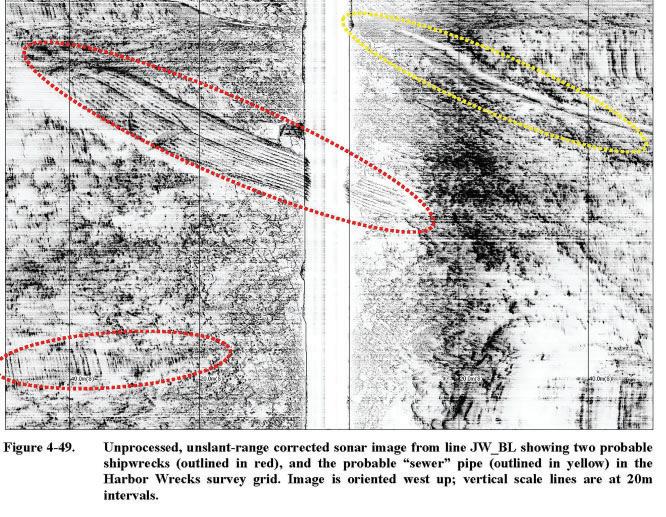
Ohio’s first systemic survey of submerged cultural resources within the Lake Erie waters of Ashtabula County was completed in 2020. Its purpose was to highlight the potential for submerged cultural resources and determine effective methods for their identification.
The study area was an estimated 30 square miles, calculated as the first mile off shore along the approximately 30 linear mile Ashtabula County shoreline. The scope of work included an assessment of known and reported archaeological sites in county waters, development of proposed search areas, execution of Phase I geophysical marine remote sensing survey, target investigation and dive operations, and a report of findings.
Of the 63 previously reported shipwrecks in the project area noted during background research, eight were selected for geophysical survey. Survey grids were designed over the last known positions of the wrecks in the survey areas that totaled approximately 840 acres of lake bottom. Four survey areas were selected of anticipated paleolandscape along the shoreline, submerged lands that were likely above grade during the time of precontact human occupation.
Specialized equipment was used to measure the depth of the water, profile the lake bottom and scan the bottom to record anomalies that could indicate of the presence of shipwrecks or precontact human occupation.
Outcomes of the survey included the updating of four existing Ohio Shipwreck Inventory forms and one new Ohio Shipwreck Inventory form was prepared for a previously unrecorded vessel. The report suggested this vessel and several others warranted additional study for their potential for National Register listing.
The four paleolandscape survey sites did not identify submerged pre-contact materials but nonetheless contributed to a better understanding of the nature of the data, geologic conditions within the survey area, and recommendations for future surveys.
The results of this project demonstrate that shipwrecks may be located and exhibit significant levels of preservation and integrity at any depth within county waters, despite a rocky substrate, minimal sediment overburden, and the action of ice cover in winter.
The report further recommended that the State Historic Preservation pursue the following:
• Request submerged cultural resources survey for Section 106 compliance in advance of proposed lake bottom and/or shoreline disturbance activities within Lake Erie.
• Inform the public about Lake Erie shipwrecks and raise awareness of shipwrecks as non-renewable resources and work to protect them from vandalism and unintended damage from anchoring.
• Pursue funding to carry out additional surveys to study, photograph and map the wrecks in more detail, and to locate additional wreck-related materials.
Information for this case study was obtained from Submerged Cultural Resources Survey, Geneva, Geneva-OnThe-Lake, Saybrook, Ashtabula, North Kingsville, and Conneaut Townships, Ashtabula County, Ohio, prepared by Coastal Environments, Inc. Funding for the survey project was provided by a Hurricane Sandy Relief Fund Grant awarded to the Ohio History Connection by the U.S. Department of the Interior, National Park Service.
CASE STUDY
The Cleveland Athletic Club
BY MARIANGELA PFISTER
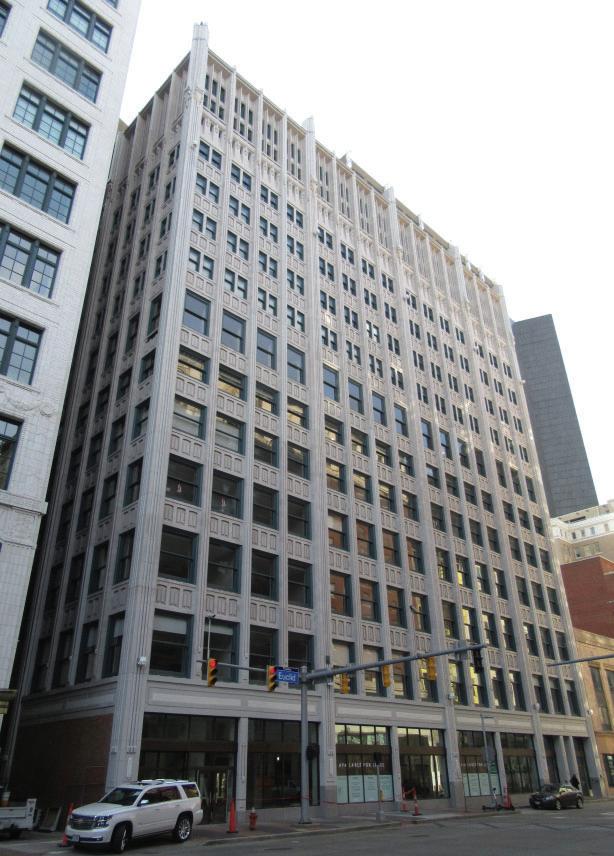
The Cleveland Athletic Club, located at 1118-1148 Euclid, Cleveland, was certified for both federal and state tax credits.
The Athletic Club building was designed by J. Milton Dyer, who also designed Cleveland City Hall. It housed offices, a hotel, and sporting venues. The Club closed its doors in 2007 and was recently rehabilitated as The Athlon apartments.
The project is notable for several reasons. On the exterior, there was significant damage to the terra cotta, which was carefully repaired, while retaining intact original materials as much as possible. In addition, emphasis was placed on the retention and repair of the historic windows on the primary elevation.
On the interior, historic marble, terrazzo, and wood floors remained expressed where they survived. In fact, the applicant revised their first floor plan to retain marble discovered during the project. The historic swimming pool was retained as a pool. The pool is significant in translating this building’s historic use as an athletic club as is the gym, which was sensitively transformed into housing, while still keeping the visual relationship of the historic gym.
Also connected to the historic use was retention of the lobby, club spaces and dining halls with their highly signifi cant decorative ceilings that had collapsed in many areas. The applicant had the decorative ceilings repaired in place by having molds cast and repairs made match. Other significant historic elements, such as the skylight, wood trim, fireplace area historic wainscotting, wood covered columns and window surrounds, were all retained.
The work accomplished at the ceilings, including the skylight and decorative wood details, is at a high level of preservation in a building that was severely deteriorated due to lack of maintenance. The interior water leaders had drained into the building causing severe mold and damage to wall and ceiling plaster and to the flooring.
Through this historic rehabilitation project, utilizing federal and state tax credits, The Cleveland Athletic Club has been returned to a compatible new use while going above and beyond to retain historic fabric and the features that make it significant.
CASE STUDY
African American Civil Rights Multiple Property Document
BY RORY KRUPP
Preparation of the 20th Century African American Civil Rights Movement in Ohio Multiple Property Document, 1900-1970, was funded by the FY 2016 African American Civil Rights Grant Program administered by the National Park Service.
The MPD focused on four themes in Ohio civil rights: employment, public accommodation, education, and police brutality and police relations. The MPD went beyond large landmark events in the civil rights movement to examine numerous series of small and often unsuccessful events that eventually culminated in civil rights legislation or systemic change. Every unsuccessful protest and court case set the stage for the next, as techniques and legal strategies were honed. Recording these building block sites and their stories throughout Ohio was a key task for the MPD.
The vitally important roles of women in
civil rights was explored. Women were crucial in starting civil rights organizations in small towns and large cities alike. For example, Constance Curtis Nichols was instrumental in founding and fostering Columbus’ Vanguard League in the 1940s. Women were also crucial in adopting new tactics such as picketing in the 1930s and nonviolent protest in the 1940s. Women often pushed more conservative male leadership to make progress.
The MPD also examined civil rights actions in smaller towns and cities. This research often began with an ephemeral item or mention. A single photograph led to the connection of the headquarters of the National Committee to Combat Fascism, a Black Panther—affiliated organization, in Lima, Ohio—a building that still stands and is now a Black-owned ice cream shop. This led to the connection to a march in Lima in 1970 led by the Farm Labor Organizing Committee, a pioneering farm labor unionizing group established by MacArthur Prize–winning activist Baldemar Velasquez.
revealed how civil rights actions came to rural Ohio. While homegrown activism was common, research revealed that often activism was sparked by a person moving back to their hometown or moving to a smaller town from another city to begin change. Activism in smaller communities usually lagged behind that in large cities by years, but techniques and organizations did gradually spread. Cleveland’s Future Outlook League, active in employment issues in the 1930s, had active chapters in Akron, Alliance, Canton, Mansfield, Painesville, Portsmouth, and Springfield by the end of the 1940s. The National Association for the Advancement of Colored People (NAACP) had branches in Ohio’s three largest cities by the 1920s. However, by 1948 NAACP branches had been started in New London, Crestline, Massillon, and Warren as well. New London’s branch was noted not only for its aggressive actions in desegregating restaurants and movie theaters, but also for being the only branch in Ohio led by a white person, Frieda Stahl, a Cleveland transplant to the area.
The MPD has been used as a cover sheet for several National Register nominations and historic tax credit projects. Tax credits gained for rehabilitation of the Manse Hotel and Annex in Cincinnati, for example, not only preserved a long-vacant structure once used as a luxury hotel but added important affordable housing and aided in neighborhood revitalization. Because sites significant to Ohio civil rights are often located in neighborhoods that were redlined, historic tax credits based on the civil rights MPD can begin to address long-term historical discrimination in housing and finance.
The MPD is also useful for public outreach and education. It is being used to plan civil rights trails in Cleveland, as well as a statewide civil rights trail being formulated by Heritage Ohio.
Exploring small-town activism also
The MPD serves as an important marker for civil rights progress. While civil rights legislation and activism have improved over the decades, issues related to other civil rights themes such as police brutality and police relations have only changed in the barest increments. It is hoped that the MPD will serve not only as a record of historical progress in Ohio civil rights, but also as an inspiration for future activism and change.
East Mount Zion Christian Church/Euclid Avenue Christian Church, Cleveland
CASE STUDY
BY JOYCE BARRETT
Van Wert Forward is a multi-phase development project led by Van Wert County Foundation (VWCF), with a goal of preserving and enhancing our core downtown assets.
With vibrant, revitalized downtowns, we can improve the quality of life for residents, attract and retain talent, and encourage tourism.Van Wert is an agricultural county-seat community on the western edge of Ohio. The population, which edges over 28,000, has remained relatively stable with a median annual income of $54,254.
The community entered the Ohio Main Street Program in 2004, though staff turnover has slowed economic growth that may have been expected. Persisting still, they have invested in CDBG grants which improved several buildings in the district and the community has seen modest new business growth.
The Van Wert County Foundation grappled with determining a
breakthrough strategy that would accelerate growth potential, and landed on downtown revitalization as the means to economic vibrancy. The Foundation therefore established Van Wert Forward.
The first step was establishing the historic downtown as a listing in the National Register of Historic Places. In 2021, utilizing a “Pipeline Initiative Grant” via Ohio’s Department of Development, the cost of consultants to prepare the National Register listing was subsidized. National Register listing created an avenue for the use of historic tax credits.
Van Wert Forward has acquired over 50 buildings in the historic downtown, representing about 80,000 square feet of real estate.
The Ohio Historic Preservation Tax Credit Program is extremely competitive. Van Wert was funded in their second attempt, taking 10% rather than the maximum 25% to make their applications more competitive for 11 buildings in phase 1 of an 8-year plan. When completed, these mixed-use buildings will provide 53 apartments and upgraded commercial space.
Van Wert Forward’s redevelopment project has attracted experienced outof-town developers who realize the scale demanded for economic success.
Successful redevelopment projects deploy all the tools in the financial toolbox. Van Wert Forward, in addition to using the federal and state historic tax credits, have secured new market tax credit allocations for the commercial space. Ohio recently passed another development tax credit program
“Transformative Multi-Use Development” (aka TMUD) which allows for a 10% credit for the insurance premium tax. $20 million annually is allocated for rural Ohio projects.
JobsOhio is the state’s privately funded Economic Development organization that boosts innovation, drives job creation, and new capital investments in Ohio. JobsOhio’s “Vibrant Communities Program” creates jobs through redevelopment in smaller Ohio communities paving the way for a possible $2 million investment in the historic downtown project. Van Wert Forward was selected in the first round, receiving $1.5 million from this program.
Heritage Ohio (the statewide historic preservation nonprofit) and the State Historic Preservation Office partnered to provide an NPS Paul Bruhn Grant to one historic building. Van Wert Forward was awarded $157,557 that will revitalize an elevator in a phase one project.
As a CLG community, we know the Design Review Board has the best interests at heart in maintaining the historic integrity of their downtown.
Van Wert is moving forward because they decided to invest in themselves first. The county foundation takes impact investment to the heart of their community. What will happen? We think this project will be transformative with historic preservation at the core. Projected to increase income taxes, property taxes and sales taxes, this initiative stands to create new places to live, work, and socialize. The community revitalization gives Van Wert an edge in business recruitment while attracting new residents. This revitalization is a big win, proving that history matters and preservation works.
Van Wert
McCurdy Block, Van Wert during rehabilitation
HISTORIC PRESERVATION PLAN SURVEY BY THE NUMBERS
Progress Toward Current State Preservation Goals
Part of an organizaiton or municipality Interested community member
The first portion of the plan was to determine how well the State Historic Preservation Office, state agencies, and historic preservation nonprofits met the goals lined out in the previous plan, Finding Common Ground
THE GOALS IN FINDING COMMON GROUND WERE AS FOLLOWS:
• Developing partnerships with agencies, organizations, local governments, property owners and other entities
• Increasing awareness about the benefits of historic preservation
• Protecting historic and archaeological resources
• Increasing representation and participation of underrepresented groups in the field
• Creating a positive image for historic preservation Respondents were given 5 rating options for rating: Inadequate, Developing, Acceptable, Accomplished, and Exemplary.
The survey was to assess progress toward achieving the goals outlined in the previous plan, Finding Common Ground, and to determine new goals for the new plan, Reconciliation, Recovery, and Resilience. The survey was conducted by Ly Foor, Manager of Audience Insights with the Ohio History Connection, between November and December 2020. Questions were developed in coordination with the Plan Advisory Board and SHPO staff A total of 274 responses were received from throughout the state.
WHAT ARE THE RESULTS?
Respondents were asked to give a ranking of five options: Inadequate, Developing, Acceptable, Accomplished, and Exemplary.
The results of the survey are below. There is a notable difference between how the public and the professionals who took the survey view the extent to which the goals were met. As a consequence, we have identified increased outreach to the general public as a part of our overall goals.
Developing partnerships with agencies, organizations, local governments, property owners and other entities
Respondents were also asked to select the most important new state-level legislation that the next plan should address to help protect archaeological and historic resources in Ohio.
#1
#2
#3
Create state historic tax credit for residential/home rehabilitation
Legislation to allow counties and townships to better protect historic and archaeological resources
Increase Ohio Historic Preservation Tax Credit funding available
#4
#5
Legislation that creates state-level review for projects receiving state funds that impact historic and archaeological resources (state-level Section 106)
Enact legislation to protect sites when human remains are present
Increasing
The second portion of the survey focused on the future.
The Plan Advisory Board identified statewide legislation goals and broader preservation priorities for Ohio. The survey provided a ranked choice system, and the results show the results as a ranked number of priorities. This ranking then impacted how the goals for Reconciliation, Recovery, and Resilience were drawn up and prioritized.
Survey respondents were also provided the opportunity to share additional goals and ideas that may not have been included on the survey. These results centered around two primary themes: increasing access to affordable housing and addressing issues of economic and social equity.
SOME
SPECIFIC IDEAS INCLUDE:
• A subsidized loan program to fix up land bank/abandoned properties for affordable housing.
• Access to funding for home rehabilitations.
• Access to funding for low-income and fixed-income properties, both residential and community based.
• Creation of community based retail.
IN TERMS OF SOCIAL AND ECONOMIC EQUITY:
• Address tensions between historic preservation, gentrification, and classism/racism.
• Increase focus on diversity.
• Increase focus on the history of all commununities.
• Combat the urban/rural divide.
Additional Ideas & Goals Shared by Respondents
AFFORDABLE HOUSING
• Provide a subsidized loan program to fix up older properties/land bank homes for affordable rental homes and/or rehabbed to be used as smaller shelters.
• Better access to funding for preservation of historic homes for privately owned properties. Ensure that communities that are lower or fixed income can also benefit from historic preservation.
• Provide funding to low-income areas to renovate, restore, or preserve both residential and community buildings—do something about the boarded up, unused and blighted areas so that families and communities have safe spaces.
• There are many neglected buildings, sites, and communities that often don’t get the attention that is needed to preserve their history.
• We should be laser focused on affordable housing and community retail end uses. Nothing is more critical than these areas in addressing social inequities.
ECONOMIC & SOCIAL EQUITY
• Address tensions between historic preservation, gentrification, and classism/racism.
• Form partnerships so that the past is an important part of our communities future and that the knowledge of the past isn’t lost.
• Help combat the growing rift between urban-rural spaces and the economic-political-social issues.
Glass Pavilion, Toledo Museum of Art, Toledo
STATE HISTORIC PRESERVATION PLAN BIBLIOGRAPHY
Abrams, Elliot and AnnCorinne Freter, The Emergence of the Moundbuilders: The Archaeology of Tribal Societies in Southeastern Ohio. Athens, Ohio University Press, 2005.
Alanen, Arnold R. and Robert Melnick, ed. Preserving Cultural Landscapes in America (Center Books on Contemporary Landscape Design). Baltimore, MD: Johns Hopkins University Press, April 2000.
Ball, Donald B., ed. “Celebrating Ohio’s Historical Archaeology.” Ohio Valley Historical Archaeology. Proceedings of 2004 Symposium on Ohio Valley Urban and Historic Archaeology. Vol. 18. 2004.
Burayidi, Michael A. Resilient Downtowns: A New Approach to Revitalizing Smalland Medium-City Downtowns. New York, NY: Routledge, 2013.
Comp, T. Allan, Regional Heritage Areas: Approaches to Sustainable Development. Washington, DC: National Trust for Historic Preservation, 1994.
Cox, Rachel S. Design Review in Historic Districts. 3rd ed. National Trust for Historic Preservation, Washington, DC, 2003.
Dancey, William S. The First Discovery of America: Archaeological Evidence of the Early Inhabitants of the Ohio Area. Columbus: Ohio Archaeological Council, 1994.
Dono, Andrea L. and Linda S. Glisson, eds. Revitalizing Main Street: A Practitioner’s Guide to Comprehensive Commercial District Revitalization. Washington, DC: National Main Street Center, 2009.
Eppig , Marianne and Lavea Brachman. Redeveloping Commercial Vacant Properties in Legacy Cities. Columbus, OH: Greater Ohio Policy Center, 2014. Esperdy, Gabrielle. Modernizing Main Street: Architecture and Consumer Culture in the New Deal. Chicago, IL: University of Chicago Press, 2010.
Fisher, Charles and Hugh Miller, ed. Caring for Your Historic House. New York: Harry N. Abrams, Inc., 1998.
Fedelchak, Marilyn and Byrd Wood. Protecting America’s Historic Countryside. Washington, DC: National Trust for Historic Preservation, October 1988.
Friedman, Donald. Historical Building Construction: Design, Materials, and Technology, 2nd Edition. New York, NY: W.W. Norton & Co., 2010
______________. The Investigation of Buildings: A Guide for Architects, Engineers, and Owners. New York, NY: W. W. Norton & Co. 2000.
Fuller, Wayne E. One Room Schools of the Middle West: An Illustrated History. Lawrence: University Press of Kansas, 1994.
Gagliardi, Neil and Stephen Morris. Local Historic Preservation Plans: A Selected Annotated Bibliography. Washington, DC: Historic Preservation Services, National Park Service, 1993.
Genheimer, Robert A., ed. Cultures Before. Contact: The Late Prehistory of Ohio and Surrounding Regions. Columbus: Ohio Archaeological Council, 2000.
Gordon, Stephen C. How To Complete the Ohio Historic Inventory. Columbus: Ohio Historical Society, 1992.
Gorski, Elanor Esser. Regulating New Construction in Historic Districts. Washington, DC: National Trust for Historic Preservation, 2009.
Harris Cyril M. American Architecture, An Illustrated Encyclopedia. New York: W.W. Norton & Company, 1998.
Helsel, Bill, David A. Simmons and Miriam Wood. Ohio Historic Bridge Guide. 7th ed. Ohio Historic Bridge Association, 1999/2000.
Heritage Preservation. Caring for Your Historic House. New York, NY: Harry N. Abrams, 1998
Howe, Barbara J., Dolores A. Fleming, Emory L. Kempand, Ruth Ann Overbeck. Houses and Homes: Exploring Their History. Maryland: Rowman & Littlefield, 1987.
Jacobs, Jane. The Death and Life of Great American Cities. New York, NY: Vintage, 1992.
Jakubovich, Paul J. and Les Vollmert. Good For Business: A Guide to Rehabilitating the Exteriors of Older Commercial Buildings. Milwaukee: Department of City Development, 2002. Jester, Thomas C., Ed. Twentieth Century Building Materials: History and Conservation. Los Angeles, CA: Getty Conservation Institute. 2014.
Kern, Kevin F. and Gregory S. Wilson. Ohio: A History of the Buckeye State. Chichester: Wiley-Blackwell, 2014.
Keister, Douglas. Stories in Stone: A Field Guide to Cemetery Symbolism and Iconography. Layton, UT: Gibbs Smith Publishers, 2004.
Kitchen, Judith L. Old Building Owner’s Manual. Columbus: Ohio Historical Society, 1983.
Caring for Your Old House: A Guide for Owners and Residents. Washington, DC: The Preservation Press, 1991.
______________. Characteristics of Effective Local Historic Preservation Legislation. Columbus: Ohio Historical Society, 1989.
Knepper, George W. Ohio and Its People, 3rd Ed. Kent: Kent State University Press, 2003.
Lambin, Jeanne. Preserving Resources from the Recent Past. Washington, DC: National Trust for Historic Preservation, 2007.
Lepper, Bradley T. Ohio Archaeology: An Illustrated Chronicle of Ohio’s Ancient American Indian Cultures. Wilmington: Orange Frazer Press, 2005.
Lerner, Shereen. Archaeology and Historic Preservation. Washington, DC: National Trust for Historic Preservation, 1995.
Lindberg, James. Heritage-Based Rural Development: Principles, Strategies, and Steps. Washington, DC: National Trust for Historic Preservation, 2011
Mallach, Alan and Lavea Brachman. Regenerating America’s Legacy Cities. Cambridge, MA: Lincoln Institute of Land Policy, 2013.
Mathis, Gregory R. and Saleh Van Erem. Preserving Wisconsin’s Civic Legacy: A Guide to Rehabilitating and Reusing Local Government Properties. Washington, DC: National Trust for Historic Preservation, 2010.
McAlester, Virginia Savage. Field Guide to American Homes, Revised: The Definitive Guide to Identifying and Understanding America’s Domestic Architecture. New York, NY: Knopf, 2015
Miller, Julia H. Laypersons Guide to Historic Preservation Law: Federal, State and Local Laws Governing Historic Resource Protection. 4th ed. Washington, DC: National Trust for Historic Preservation, 2008.
Morris, Marya. Innovative Tools for Historic Preservation. Washington, DC: American Planning Association, 1997. Morris, Stephen A. “Subdivision Regulations and Historic Preservation.” Cultural Resources Partnership Notes. Washington, DC: National Park Service, 1992, revised 1998.
Morris, Stephen A. “Zoning and Historic Preservation.” Cultural Resources Partnership Notes. Washington, DC: National Park Service, 1989, revised 1998.
Morrow, Baker H. A Dictionary of Landscape Architecture. Albuquerque: University of New Mexico Press, 1987.
Moss, Roger W., Ed. Paint In America: The Colors of Historic Buildings. New York, NY: Wiley, 1994.
Murphy, James L., An Archaeological History of the Hocking Valley, Revised Edition. Athens, Ohio University Press, 1989.
Murtagh, William J. Keeping Time: The History and Theory of Preservation in America. 3rd ed. New Jersey: John Wiley & Sons, August, 2006.
National Alliance of Preservation Commissions. Design Review with Limited Resources, 2012.
National Park Service. Respectful Rehabilitation: Answers to Your Questions About Old Buildings. Washington, DC: Preservation Press, 1982.
O’Brien , Kevin and James Robey Estimates of the Economic Impact of the Ohio Historic Preservation Tax Credit Program on the State of Ohio. Cleveland: The Great Lakes Environmental Finance Center, Maxine Goodman Levin College of Urban Affairs at Cleveland State University, 2011
Otto, Martha P. and Brian G. Redmond, ed. Transitions: Archaic and Early Woodland Research in the Ohio Country. Ohio University Press and the Ohio Archaeological Council, 2008.
Pacheco, Paul J., ed. A View From the Core: A Synthesis of Ohio Hopewell Archaeology. Columbus: Ohio Archaeological Council, 1996.
Pregliasco, Janice. Developing Downtown Design Guidelines. Sacramento: California Main Street Program, 1988.
Prufer, Olaf H., Sara E. Pedde, and Richard S. Meindl, Archaic Transitions in Ohio and Kentucky Prehistory, Kent, Ohio, Kent State University Press, 2001.
Rabun, J. Stanley. Structural Analysis of Historic Buildings: Restoration, Preservation, and Adaptive Reuse Applications for Architects and Engineers. New York, NY: Wiley, 2000.
Raines, Albert and Henderson, Laurence G. With Heritage So Rich: a Report of a Special Committee on Historic Preservation. New York, NY: Random House, 1966.
Rypkema Donovan. The Economics of Historic Preservation: A Community Leader’s Guide. 2nd ed. Washington DC: National Trust for Historic Preservation, 2005.
Schmickle, William. The Politics of Historic Districts: A Primer for Grassroots Preservation. Lanham, MD: AltaMira Press, 2006
_________________. The Historic District Action Guide: From Designation Campaigns to Keeping Districts Vital. Lanham, MD: 2018.
Smith, Kennedy. Revitalizing Downtown: 1976-1986. Washington, DC: National Main Street Center, 1994.
Stipe, Richard E. A Richer Heritage: Historic Preservation in the Twenty-First Century. Chapel Hill, NC: University of North Carolina Press, 2003
Stipe, Robert E. and Carole Zellie. “Issues Paper: Conservation Districts.” Cultural Resources Partnership Notes. Washington, DC: National Park Service, 1993, revised 1998.
Stoked, Samuel N. and Watson, A. Elizabeth. Saving America’s Countryside: A Guide to Rural Conservation. Baltimore, MD: The Johns Hopkins University Press, 1989.
Strangstad, Lynette. A Graveyard Preservation Primer. Lanham, MD: Roman, & Littlefield Publishers, 2013. The Main Street Approach. CD-ROM. Washington, DC: National Main Street Center, 1994.
Tyler, Norman; Tyler, Ilene, R. and Ligibel, Ted J.. Historic Preservation: An Introduction to Its History, Principles and Practice, 3rd Edition. New York: W.W. Norton & Company, 2000.
Weaver, Martin E. Conserving Buildings. New Jersey: John Wiley & Sons, 1993.
Young, Robert A. Historic Preservation Technology: A Primer. New York, NY: Wiley. 2008.
NATIONAL TRUST FOR HISTORIC PRESERVATION PUBLICATIONS
Guiding design on Main Street: The Professional’s Manual for Managing Design
Richard D Wagner (National Trust for Historic Preservation)
Maintaining Community Character:
How to Establish a Local Historic District
Pratt Cassity (National Trust)
Procedural Due Process in Plain English: A Guide for Preservation Commissions
Bradford J. White and Paul W. Edmondson
Regulating New Construction in Historic Districts
Elanor Esser Gorski, AIA
Using Professional Consultants in Preservation
Ellen Beasley
Innovative Tools for Historic Preservation
Marya Morris
Preserving Resources from the Recent Past
Jamie Lambin
How to Organize a Preservation Development Charette
Jennifer Goodman
A Layperson’s Guide to Historic Preservation Law
Julia H. Miller
Heritage-Based Rural Development
James Lindberg
Preserving Wisconsin’s Civic Legacy: A Guide to Rehabilitating and Reusing Local Government Properties
Gregory R. Mathis and Saleh Van Erem
WEBSITES
Federal Reserve Bank of Cleveland clevelandfed.org
Governor’s Council on People with Disabilities gcpd.ohio.gov
Governor’s Office of Appalachia development.ohio.gov/cs/cs_goa.htm
Ohio Historic Preservation Tax Credit Program development.ohio.gov/cs/cs_ohptc.htm
State Historic Preservation Office, Ohio History Connection
ohiohistory.org/shpo
CASE STUDIES
Barker House
Wes Clarke
Preservation, Recognizing Black History and Affordable Housing: A Win-Win-Win with the Adaptive Reuse of the Manse Hotel Complex
Beth Johnson
Ashtabula County Underwater Archaeology Survey
Mary Beth Hirsch
The Cleveland Athletic Club
Mariangela Pfister
AA Civil Rights MPD
Rory Krupp
Van Wert
Joyce Barrett
PHOTO CREDITS
Cover Photo, ASM Headquarters; Toledo and Ohio Station; Serpent Mount and Newark Earthworks; Manse Hotel; Ashtabula Underwater Survey; East Mount Zion Baptist Church; all courtesy of Ohio State Historic Preservation Office.
Fairport Harbor West Breakwater Light photo courtesy of Sheila Consaul.
Photo of David Butcher courtesy of Heritage Ohio.
Barker House Case Study photo courtesy of Wes Clark.
Cleveland Athletic Club photo courtesy of Sandvick Architects.
McCurdy Block photo courtesy of PLATTE Architecture + Design.
All other photos courtesy of Nathan Bevil.
STATE PLAN ADVISORY BOARD
Thanks to Community Planning & Preservation Manager Nathan Bevil who coordinated the completion of this plan, to all of the contributors of case studies, and to the following individuals who served on the State Plan Advisory Board and provided valuable insights and suggestions throughout the course of its development.
Joyce Barrett, Director, Heritage Ohio
Nathan Bevil, Community Planning and Preservation Manager, State Historic Preservation Office.