MAGAZINE
MARCH & APRIL 2019 HEAVYWEIGHT CHAMPION
CHANGING IT UP
SALAD DAYS
OHIO’S IMMIGRANT PRESS
Ohio Boxer Buster Douglas
James Ritty’s Incorruptible Cashier
Paul Newman’s Kenyon Debut
Bridge From Old to New
Page 26
Page 32
Page 36
Page 42 OHIOHIS TORY.ORG
1
MAGA ZINE
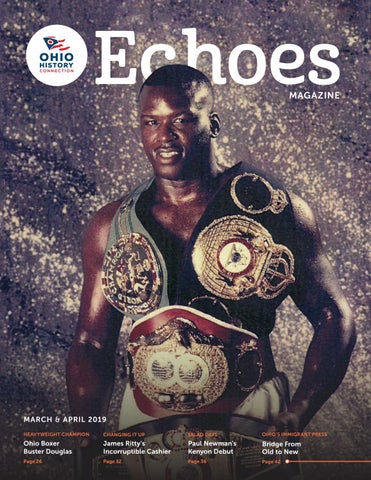
Cover: Columbus native James “Buster” Douglas became a boxing legend when he knocked out heavily favored Mike Tyson on Feb. 11, 1990, in Tokyo. See page 26. Photo courtesy of John Johnson.
Vol. 58, No. 2
Contents MARCH & APRIL 2019
26
Buster Douglas—Undisputed Heavyweight Champion of the World
32
Ritty’s Incorruptible Cashier—The Invention That Changed Business and Put Dayton on the Map
36
Paul Newman’s Acting Debut—How the Renowned Actor Found His Calling in the Kenyon College Theatre Department
42
Ohio’s Immigrant Press—Bridging the Gap Between Old Country and New
EDITORS
Bill Eichenberger Tom Wolf CONTRIBUTORS
Bob Hunter El sie Manolis Kiara P fister Jenni Salamon David A . Simmons Shannon Thomas
I N E AC H I S S U E
ADVISORY BOARD
Susannah Cleveland B owlin g G re e n St ate Unive r sit y
Donna DeBlasio Youn gstown St ate Unive r sit y
Nishani Frazier Miami Unive r sit y
Rober t G enheimer Cin cinn ati Muse um Ce nte r
Stephen G eorge O hio Histor y Conne c tion
Alex Hastie O hio v. the World
G eorge Ironstrack Miami Unive r sit y
Chester Pach O hio Unive r sit y
Roger Pickenpaugh Historian an d Auth or
Daniel Rivers T he O hio St ate Unive r sit y
Erin Wingfield
2 4 4 6 13 14 20 46 48 50
Contents Letter From Our Editors What’s Your Story? In the News Historic Sites & Museums At the Ohio History Center & Ohio Village Featured Events & Exhibits I Wish I’d Been There Young Eyes on the Past Reviews
O hio Histor y Conne c tion
Echoes Magazine (ISSN 0012-933X) is published bimonthly and distributed by the Ohio History Connection as a benefit of Ohio History Connection membership.
Moving? Contact us at membership@ohiohistory.org or 800.686.1545 to share your new address.
Editorial Offices: Ohio History Connection, Ohio History Center, 800 E. 17th Ave., Columbus, OH 43211-2474 Phone 844.836.0012 • Email echoes@ohiohistory.org Postmaster: Please send address changes to: Echoes Magazine, Ohio History Connection, Ohio History Center, 800 E. 17th Ave., Columbus, OH 43211-2474 Entire contents © 2019 by the Ohio History Connection. All rights reserved. Nothing may be reprinted or electronically reproduced in whole or in part without written permission from the publisher. The Ohio History Connection accepts no responsibility for facts and opinions expressed by the authors. 2 Echoes | MARCH & APRIL 2019
The Ohio History Connection is a
Like us on Facebook and follow us on Twitter @OhioHistory
Buster Douglas UNDISPUTED HEAVYWEIGHT CHAMPION OF THE WORLD
26 32
He was supposed to be a patsy that Mike Tyson would knock out quickly during a tune-up fight before a showdown with Evander Holyfield. But James “Buster” Douglas flipped the script, shocking the sports world with a 10th-round knockout of the previously unbeaten Tyson.
Ritty’s Incorruptible Cashier THE INVENTION THAT CHANGED BUSINESS AND PUT DAYTON ON THE MAP For nearly a century, Dayton was synonymous with National Cash Register Co. But before NCR, and before business leader John H. Patterson took over the company in 1884, a Dayton saloon owner and inventor named James Jacob Ritty applied for, and received, the first U.S. patent for a cash register.
Paul Newman’s Acting Debut HOW THE RENOWNED ACTOR FOUND HIS CALLING IN THE KENYON COLLEGE THEATRE DEPARTMENT
36
After serving in the Navy Air Corps during World War II, Paul Newman returned home to Shaker Heights, then enrolled at Kenyon College in Gambier, Ohio. Cut from the football team, he decided to give theatre a chance. He acted in nine plays during his time at Kenyon.
Ohio’s Immigrant Press
42
BRIDGING THE GAP BETWEEN OLD COUNTRY AND NEW The Ohio History Connection has an extensive collection of bound and microfilmed newspapers from across the state, dating from 1834 through 1959. More than 100 newspaper titles represent Ohio’s immigrant communities, in languages that include Czech, Finnish, German, Hungarian, Hungarian-German, Italian, Polish, Romanian, Serbian, Slovene and Slovak.
OHIOHIS TORY.ORG
3
LET TER FROM OUR EDITORS When we’re writing stories for Echoes Magazine, we understand we’re simply opening a door for members onto a bit of our state’s history. With each story we tell, we invite you to walk on through that door, to learn more about a given Ohioan, to visit a historic building, to read a book or to watch a video about a subject you may not have realized you were interested in. Aviator Jerri Mock. Olympic champion Jesse Owens. World War I marine Ouida Okey. Famed Ohio writer Sherwood Anderson. We make the introductions. You form the relationship. So it was with pleasure that we received the following letter from former colleague Bob Glotzhober, emeritus curator of Natural History for the Ohio History Connection. “I really enjoyed the article about (wildlife artist) Bob Hines in the most recent Echoes,” he wrote. “I have been aware of his work since about 1974.” We were pleased that Bob enjoyed the story and were happy to learn more about Bob Hines’s story. “Once, while working in northern Virginia, I had the opportunity to meet Hines and observe him in action. The nature center where I was working at the time hosted a weekend spring wildlife festival, and Bob was one of the people invited to present a program for the public. “He did an outdoor ‘Chalk Talk.’ He had a large pad of paper on an easel and huge blocks of colored chalk. He would ask people to name a bird or mammal, and he would draw them with chalk while talking about their natural history. Most of the birds were either raptors or game birds—he was of the ‘old school’ of naturalists, he said, and told the group that chickadees, etc. were ‘dickey birds’ and not his specialty. “The highlight of the event was a bird that he selected to draw for us, and we had to guess what it was as he drew it and talked about it. He started with a large block of black chalk, and drew lines that seemed to make no sense at all. Then with his last few strokes of the chalk, a white whooping crane popped magically out of the black background that he had been drawing!” Our stories are snapshots, moments in time. They serve as introductions. We’re always excited to learn more about a subject, so drop us a line.
4 Echoes | MARCH & APRIL 2019
What’s In every issue of Echoes Magazine, we feature the stories of Ohio History Connection members and other Ohioans to stoke memories and shed light on our shared past. For this issue, we asked,
“What Ohio music do you listen to and what makes it so enjoyable?” Here are some of your responses: BOOTSY COLLINS I can’t remember when I first heard Bootsy Collins. It must’ve been in the ‘80s before I moved to Ohio, because I had a cassette tape of The One Giveth, the Count Taketh Away. Here’s what I do remember: The bass—that pure, danceable, funk beat blew my mind. And then the amazing, funny, audacious lyrics. Danceable like Prince, but funkier, funnier and with more bass. Bootsy makes me smile and want to dance. His music isn’t complicated, but it’s brilliant and sexy and so much fun. Bootsy was born in Cincinnati, Ohio. His brother Phelps “Catfish” Collins was also a musician and both of them were once part of James Brown’s backing band, the Pacemakers. —Susan Halpern, Columbus
DEVO Devo blew my little 13-year-old mind in 1978. Their robotic movements and jarring mechanized rhythms both horrified and transfixed me. They sang about “devolution,” claiming that technology had caused humanity to reach its peak and we were devolving back into monkeys.
Devo was the self-described “important sound of things falling apart.” They talked about the ninnies and the twits, “making decisions based on stupidity … go around in designer jeans and puffy vests, and are monitoring reality for the rest of us.” Then I came to find out that these alien cyborgs were actually from Akron and were raised on the same Cleveland late-night horror movies that I was. Sci-fi imagery, Ghoulardi wisecracks and Dada absurdity in a rock band! —Loren Lazarony, Konstanz, Germany
NEW BOMB TURKS, GAUNT As a transplant to Columbus in the mid-’90s, my introduction to the central Ohio music scene came through an encounter at my son’s preschool. My wife came home and said she struck up a conversation with one of the other dads who seemed like a great guy. She said I should meet him and mentioned he was in a band. Great, I thought, having been dragged to my “co-worker’s husband’s bands” over the years, which too often meant a night of Bad Company covers. I can’t wait. But not this time. The dad in question turned out to be Sam Brown, drummer for the Columbus punk bands the New Bomb Turks and Gaunt. I had heard of the Turks when I was living in California and was a fan. It was great to meet Sam, and it was even better to become friends and to get to know other people in the local music scene. For me, the best part of the Columbus music scene is the support the bands and fans give one another. —Brian Kraft, Columbus
THE PRETENDERS The Pretenders may have broken onto the scene in London, England, but the musical fandom and rock-
OHIO MUSIC
and-roll attitude that drove bandleader Chrissie Hynde is all Ohio. Hynde was born and raised in Akron, growing up obsessed with the soulful, hard-hitting rock music that was spilling out of many a Midwestern garage. In London, the Pretenders created their self-titled album, one of the most fully formed debuts ever recorded. Filled with spikey, hooky classics like Precious, Mystery Achievement and Brass in Pocket, it made them stars. It was on the band’s third record where Hynde would most directly draw on her upbringing for inspiration with the song My City Was Gone. Released in 1984, lyrics about paved-over farmland and endless shopping malls resonated. —James A. Baumann, Columbus
CHRIS CASTLE, THE WOMACKS, & EMILY KEENER Norwalk had, for several years, an amazing Americana scene, and I imagine it still does. It really got started with Chris Castle, who has several amazing albums (especially Last Bird Home, which hit the Americana charts in 2012). But Chris helped a band that I wish was still together called the Womacks, who put out two albums before breaking up, and then Emily Keener, who was on The Voice in 2016 at the age of 16. When she was 15, Keener recorded an album with the Womacks, East of the Sun. They’re all from Norwalk in Huron County. —Matt Tullis, Sandy Hook, CT
KATHLEEN BAT TLE, EARL THOMAS CONLEY Being from the Portsmouth area, I would cite Kathleen Battle on the opera side. And once I was on a bowling team called the ETC Fan Club (country music fans will know that ETC is short for Earl Thomas Conley, a West Portsmouth boy). I had never heard of him before joining the team as a mid-season replacement!
P.S. ETC’s Mom was on the team, so I had to fib and tell her I liked him! —Dina Pierce, London, Ohio
MICHAEL STANLEY BAND, ERIC CARMEN AND THE RASPBERRIES . If you started listening to music in the 1970s, you’ll know both as northeast Ohio stalwarts. —Mark Brahney, Spring Lake, NJ
THE AKRON SCENE It’s hard to stop at two in Akron. It’s a vibrant music scene. Some of my favorite bands playing original music are Shivering Timbers, Hey Mavis, the Numbers Band, Ray Flanagan, and the Speedbumps. Favorites among bands who cover other people’s music are Highway 61 and Mo Mojo. —Chuck Auerbach, Akron Auerbach was too modest to include his son Dan’s band, the Black Keys, or his own Chuck Auerbach Band, which released Remember Me in 2018. —EM
WHAT’S YOUR STORY? We want to know your stories, so in every issue of Echoes Magazine we ask you a question, then run selected answers in the following issue. Here’s the question for May & June: Tell us about your best memories involving Ohio baseball. Are you a majors or minors fan? Reds or Indians? Clippers or Mud Hens or Chillicothe Paints? Do all of your family members cheer for the same team, or do you have a house divided? From Ohio History Connection Archival Collections
Your Story?
Email your story responses (50 to 150 words) by March 15 to echoes@ohiohistory.org or, if you follow us on Facebook, send us a Facebook message.
OHIOHIS TORY.ORG
5
In the News OHIO HISTORY CENTER
Ohio—Champion of Sports Hits the Field March 16 It’s impossible to tell the national story of sports without Ohio, say Ohio History Connection curators Eric Feingold and John Haas, who, with a team of colleagues, have been knee-deep in sports history preparing for the new exhibit, Ohio–Champion of Sports. The exhibit opens Sat., March 16, at the Ohio History Center museum in Columbus. One of the biggest investments in creating a temporary exhibit that the Ohio History Connection has ever made at the Ohio History Center, Ohio—Champion of Sports will fill 6,800 square feet in galleries on three floors of the building with the compelling story of our state’s role in shaping America’s sports history. Appropriately, it’s also one of the most interactive exhibits we’ve ever mounted. You can shoot hoops, try an obstacle course and, along the way, see one-of-a-kind videos created especially for this exhibit, in which Ohio athletes, coaches, owners and fans at the center of the action describe their experiences in their own words. 70 STORIES AND 26 SPORTS
The exhibit features 70 stories and 56 oral histories covering more than 26 sports. “You can learn about roller derby, skateboarding and e-gaming as well as baseball, football and basketball,” Feingold says. Vintage sports photos, programs and equipment from Ohio History
6 Echoes | MARCH & APRIL 2019
Connection collections and more than 20 outside lenders are intermingled with immersive experiences. You’ll learn about: F The 1920 founding of the National Football League at a Jordan and Hupmobile auto showroom in downtown Canton. F The storied history of Major League Baseball’s Cincinnati Reds. F Seven-time All Star Larry Doby, who broke the color barrier in baseball’s American League when he signed with the Cleveland Indians in 1947. F Logan, Ohio, native Katie Smith, Ohio State Buckeyes legend and Women’s National Basketball Association champion. F The Toledo Troopers, a women’s professional football team known as the “winningest” in pro football history, with seven consecutive championships from 1971 to 1977. SHOWCASES UNIVERSAL THEMES
“Even if you’re not a sports fan, you’ll relate to the stories of character, victory, adversity, tradition, identity and innovation showcased in this exhibit,” says Bill Mahon, a member of the sports exhibit project team. “Ohio—Champion of Sports is about universal themes that transcend the game.” Hear the story of Ohioan Jesse Owens and his four gold-medal wins at the 1936 Olympics in Hitler’s Germany. Learn about his victories and the adversity he faced as an African American man back in the United States.
Track and field star Stephanie Hightower THE OHIO STATE UNIVERSITY ARCHIVES
Learn about Ohio’s LGBTQ history through the lens of events like the Gay Games and Bat N’ Rouge, an annual drag softball game hosted in Columbus. Celebrate social connections Ohioans make through sports— tailgating with family and friends before a big game; shouting, “O-H!” in a crowded airport and hearing “I-O!” in return; or the community spirit that overtakes you when your
MEMBERS SEE IT FIRST
Join us for special members-only hours for Ohio—Champion of Sports! Ohio History Center I-71 & 17th Avenue, Columbus Fri., March 15 • 5:30–8:30 p.m. Sat., March 16 • 8:30–10 a.m. To let us know that you’re coming, email membership@ohiohistory. org or call 800.686.1545 with your member number, date of choice and the number of adults and children attending. Your RSVP helps us plan, though is not required. We can’t wait to share this exciting new exhibit with you! The Plaza Café will be open during the members-only hours. Members enjoy a 10% discount.
OHIO—CHAMPION OF SPORTS
TRIVIA
Can you answer these Ohio sports trivia questions?
QUESTION: What University of Mt. Union football coach holds the all-time records for most national titles (11) and highest winning percentage (.929)? ANSWER: LARRY KEHRES
QUESTION:
Bring your group to the Ohio History Center to explore our new exhibit, Ohio–Champion of Sports, on exhibit March 16, 2019– Sept. 6, 2020. F Explore the interactive exhibit F Hear 70+ stories of 25+ sports F See sports memorabilia F Add your photos to the exhibit
Call for pricing on guided tours and packages.
Questions? Call 800.686.6124 or visit ohiohistory.org/sports. See the story Buster Douglas— Undisputed Heavyweight Champion of the World on page 26.
To book your visit, contact our Scheduling Office:
Check the calendar on pages 14–25 for special Ohio—Champion of Sports programs.
grouptours@ohiohistory.org 800.686.1541 or 614.297.2266
Visit our Ohio—Champion of Sports blog at ohiohistory.org/cards
Which professional football team from Ohio won seven consecutive national championships from 1971 to 1977?
QUESTION: What Ohioan, the son of German immigrants, introduced so many innovations to the game of football that a college football trophy is named after him?
QUESTION: What is the name of the track in Akron, Ohio, where the All-American Soap Box Derby is held? ANSWER: DERBY DOWNS
SCHEDULE A GROUP TOUR
Opening Sat., March 16, at 10 a.m., the exhibit runs through Sun., Sept. 6, 2020, at the Ohio History Center, I-71 & 17th Avenue (Exit 111), Columbus. Ohio—Champion of Sports is included with museum admission: $12, $10/age 60+, $6/age 4–12, Free/ Ohio History Connection member or age 3 & under. Hours are Weds.–Sun. 10 a.m.–5 p.m.
QUESTION:
ANSWER: JOHN HEISMAN
“Ohio–Champion of Sports offers a look into the future of history
This sports league, founded in 2005, was originally called the Ohio Roller Girls.
ANSWER: THE TOLEDO TROOPERS OF THE NATIONAL WOMEN’S FOOTBALL LEAGUE
THE FUTURE OF HISTORY EXHIBITS
“We’ve worked with major league teams, minor league teams, colleges, universities and high schools to get materials. “We hope that everyone visiting this exhibit will find some local connection that brings back memories of home,” he adds.
QUESTION:
ANSWER: OHIO ROLLER DERBY
In the Great Moments Theatre, you’ll see sports-related photos crowdsourced for the exhibit. You’ll also have an opportunity to share your own sports stories. There’s even a place to record your own victory dance!
exhibits,” Mahon says. “Throughout the exhibit, history-makers are front and center, telling their own stories in their own words—we facilitate the storytelling and let first-person accounts of sports history shine,” Mahon says.
ANSWER: CHUCK HARRIS
high school team heads to the state championships.
What Knox County innovator was known nationally for making customized rearview bicycle mirrors?
OHIOHIS TORY.ORG
7
Abandoned Cemeteries and Unmarked Burials Merit More Respect A recent poll shows that 82 percent of Americans agree that there should be laws to protect archaeological sites or artifacts, according to the Ohio Archaeological Council, a statewide organization of professional archaeologists. In practice, though, state laws may not always provide adequate protection to the most important sites. “The current law, which considers desecration of cemeteries and gravesites a misdemeanor, is insufficient. There is no effective state law enforcing the protection of any unmarked gravesite on public or private land from looting or vandalism. That means none of my ancestors are protected,” says Chief Glenna Wallace of the Eastern Shawnee Tribe, featured speaker at the 2019 Statehood Day luncheon in Columbus on Feb. 27. Ohio has some of our nation’s weakest state laws governing unmarked burial places and abandoned cemeteries, says Al Tonetti, a trustee and chair of the Government Affairs Committee of the Ohio Archaeological Council. Other longtime observers Todd Kleismit, Burt Logan and Brad Lepper of the Ohio History Connection agree. “When it comes to protecting unmarked graves and abandoned cemeteries, experts have put Ohio near the bottom,” says Kleismit, Ohio History Connection director of community and government relations. NO PROCESS OR PROCEDURE
“There’s no process or procedure prescribed by law in place for anyone to follow in dealing with human remains in unmarked burials—whether ancient or later— leaving all such burials vulnerable to whoever or whatever comes along,” Kleismit says.
8 Echoes | MARCH & APRIL 2019
Tonetti, who’s studied such laws elsewhere, says most states have laws establishing a program that balances private property rights while protecting these burial places from unnecessary disturbance by activities such as commercial, industrial and residential land development; agriculture; mining; and looting. ALL DESERVE PROTECTION & RESPECT
The laxity of Ohio’s laws was brought to light in a 2010 report of the Legislative Commission on the Education and Preservation of State History. That led to creation of the Ohio General Assembly’s Cemetery Law Task Force, which issued its recommendations in 2014. Though most of its recommendations haven’t been adopted, the Cemetery Law Task Force concluded that all burial sites and human remains, regardless of their age, deserve the same level of protection and respect, and that more should be done to protect them. Ohio History Connection Executive Director and CEO Burt Logan says the Ohio History Connection and other partners would like to see Ohio move more closely in line with some other Midwestern states when it comes to legal protection for abandoned cemeteries and unmarked burials. According to Ohio History Connection Curator of Archaeology Brad Lepper, many offer some type of financial incentives and technical assistance to encourage and reward landowners who want to preserve abandoned cemeteries and unmarked burial places on their properties. Many also provide for a permitting process and a state board to review, consider and help resolve the potentially conflicting interests of the many parties who may be involved when human remains in abandoned or unmarked burials are disturbed.
Based on what other states are doing, Lepper says that a similar program in Ohio might include: • offering legal protection to abandoned or unmarked human burials. • cataloging known abandoned or unmarked burial places in Ohio and keeping a record of them. • requiring a state-issued permit before human remains in unmarked burials and abandoned cemeteries may be disturbed. • making it unlawful to trade or destroy human remains or other items taken from abandoned cemeteries and unmarked human burial places. • penalties for violating the law. • tax exemption for abandoned cemeteries and unmarked burial places. • a process for balancing protection and private property rights. “We and our partners continue working to try and effect a change to the way in which abandoned cemeteries and unmarked burials are treated in Ohio,” Lepper says. The issue is a priority for historyand-heritage advocates attending the Feb. 27 Statehood Day legislative advocacy event in Columbus, who will discuss the need for more effective laws with state legislators. “We’d like to see a process for dealing with unmarked burials and abandoned cemeteries that balances protection and private property rights. In the end, we want to see all burials treated respectfully, whether the remains are 200 years old or 2,000 years old,” Lepper says.
LOCAL HISTORY
SAT., MARCH 16
Regional Meetings Start March 9
Register by Friday, March 8
Active in local history? Register now for the Ohio Local History Alliance Regional Meeting in your vicinity. These annual gatherings of local historians and others active in local historical societies, museums and related organizations start Sat., March 9. This year’s theme is Local History is America’s History. Each meeting runs from 9 a.m. to 4 p.m. and includes a session related to the theme, plus additional skill-building sessions; reports from the Ohio Local History Alliance and the Ohio History Connection; an opportunity to share what your organization is doing; and a tour of a nearby museum or site. Cost is $35 ($30/Ohio Local History Alliance or Ohio History Connection member) and includes a continental breakfast and lunch. Save the date for your region’s meeting and register soon online at ohiolha.org. SAT., MARCH 9
Register by Friday, March 1 West Central Ohio (Region 7) • Hosted by Shelby County Historical Society at Amos Memorial Public Library, 230 E. North St. in Sidney, for organizations in Auglaize, Champaign, Clark, Darke, Greene, Logan, Mercer, Miami, Montgomery, Preble and Shelby counties. Southeast Ohio (Region 9) • Hosted by Meigs County Historical Society and Chester-Shade Historical Association at Meigs County Historical Society, 399 S. Third St., Middleport (morning) and Chester Shade Historical Association, 46454 St. Rt. 248, Chester (afternoon), for organizations in Athens, Gallia, Hocking, Jackson, Lawrence, Meigs, Pike, Ross, Scioto and Vinton counties.
Center, 67 E. Main St., Lexington, for organizations in Ashland, Crawford, Erie, Huron, Marion, Morrow, Ottawa, Richland, Sandusky, Seneca and Wyandot counties.
Central Ohio (Region 6) • Hosted by Worthington Historical Society at the Griswold Center, 777 High St., Worthington, for organizations in Delaware, Fairfield, Fayette, Franklin, Knox, Licking, Madison, Perry, Pickaway and Union counties.
Northeast Ohio (Region 4) • Hosted by Trumbull County Historical Society at the Kinsman House, 303 Mahoning Ave., Warren, for organizations in Ashtabula, Geauga, Mahoning, Portage and Trumbull counties.
Southwest Ohio (Region 8) • Hosted by Warren County Historical Society at the Harmon Museum, 105 S. Broadway, Lebanon, for organizations in Adams, Brown, Butler, Clermont, Clinton, Hamilton, Highland and Warren counties. SAT., MARCH 23
Register by Friday, March 15 Northeast Ohio (Region 3) • Hosted by Lakewood Historical Society at the Nicholson House, 13335 Detroit Ave., Lakewood, for organizations in Cuyahoga, Lake, Lorain, Medina and Summit counties. Southeast Ohio (Region 10) • Hosted by Muskingum County History at the Stone Academy, 115 Jefferson St., Zanesville, for organizations in Belmont, Coshocton, Guernsey, Monroe, Morgan, Muskingum, Noble and Washington counties. SAT., APRIL 6
Register by Friday, March 29 Northwest Ohio (Region 1) • Hosted by the Toledo Firefighters Museum at Jaeger Hall, St. Clement Parish, 3030 Tremainsville Rd., Toledo, for organizations in Allen, Defiance, Fulton, Hancock, Hardin, Henry, Lucas, Paulding, Putnam, Van Wert, Williams and Wood counties. East Ohio (Region 5) • Hosted by, and at, the Massillon Museum, 121 Lincoln Way E., Massillon, for organizations in Carroll, Columbiana, Harrison, Holmes, Jefferson, Stark, Tuscarawas and Wayne counties. SAT., APRIL 13
Register by Friday, April 5 North Central Ohio (Region 2) • Hosted by the Richland County Museum at Lexington Senior Civic
Octagon Earthworks Update
C
In the January & February 2019 issue of Echoes Magazine, we provided an update on our intent to acquire the lease at Octagon Earthworks in Newark with the goal of offering full public access there, appropriate to an ancient site of international significance. Subject of a proposed nomination to the World Heritage List in recognition of the remarkable American Indian culture that lived in Ohio 2,000 years ago, Ohio’s Hopewell Ceremonial Earthworks comprise: the Newark Earthworks including Octagon Earthworks; Fort Ancient near Oregonia and Lebanon; and Hopewell Culture National Historical Park near Chillicothe. The World Heritage List includes many places of universal importance, among them the Grand Canyon, Taj Mahal and Great Wall of China. On Nov. 28, 2018, the Ohio attorney general, on behalf of the Ohio History Connection, filed a petition with the Licking County Court of Common Pleas with the intention of acquiring the lease. The case was assigned to a Licking County judge. However, in January 2019, the judge recused himself and the hearing has been reassigned to a new judge. At the time this issue of Echoes Magazine went to print, a hearing date had not been selected. To get the latest news on the Octagon Earthworks, sign up for our weekly Ohio History Connection enewsletter at ohiohistory.org/enews or visit ohiohistory.org/octagonnews.
OHIOHIS TORY.ORG
9
HISTORIC PRESERVATION
New Concord’s John & Annie Glenn Museum Added to National Register of Historic Places The Ohio History Connection’s John & Annie Glenn Museum at 72 W. Main St. in New Concord has been added to the National Register of Historic Places. Associated with John Glenn (1921–2016), one of seven original astronauts chosen for America’s space program and the first American to orbit the Earth, Glenn’s boyhood home and New Concord remained touchstones for him throughout his life. Due to the nature of his career as an astronaut and later as a United States senator, Glenn moved many times, though consistently returned to New Concord to celebrate his achievements and announce his future plans. The Glenn family moved into this one-and-a-half story bungalow in 1923. His father moved the house once, then in 2001 it was moved again under consultation with John and Annie Glenn. The property most closely associated with Glenn during the period when he gained national significance, it is now open to visitors as the John & Annie Glenn Museum. Former governor John Kasich made it officially part of the Ohio History Connection’s site system by signing Senate Bill 86 near the end of his term. The Museum Association of East Muskingum manages the John & Annie Glenn Museum for the Ohio History Connection.
Ohio History Connection members enjoy free admission to the John & Annie Glenn Museum. Learn more at ohiohistory.org/places.
10 Echoes | MARCH & APRIL 2019
OTHER RECENT OHIO ADDITIONS TO THE NATIONAL REGISTER
Portage Trail developed as the local commercial center. Forty-eight buildings in the district reflect the history of local commercial growth from 1836, when Cuyahoga Falls was incorporated, to 1954. After that, Portage Trail was widened to accommodate traffic, local retailers began relocating to the State Road Shopping Center, opened in 1955, and commercial growth along Front Street and Portage Trail largely ended.
COLUMBUS • FRANKLIN COUNT Y HARTMAN HOTEL 275 S. Fourth St. & 150 E. Main St.
The six-story Hartman Hotel is associated with the history of hotel development in Columbus, and with Dr. Samuel B. Hartman (1830–1918), founder of Peruna Manufacturing Co. and inventor of its bestselling product, Peruna. At the turn of the 20th century, the medicinal tonic was one of the most popular and successful patent medicines in the U.S. The Hartman Hotel, completed in 1898 and operated as a hotel until 1921, is the last building associated with Dr. Hartman’s nationally distributed medicinal creation.
CUYAHOGA FALLS • SUMMIT COUNTY CUYAHOGA FALLS DOWNTOWN HISTORIC DISTRICT 2091–2250 Front St.; 111–245 Portage Trail; 138 Stow Ave.; 2035 Oldetown Loop; 2044-2220 Second St.; 2055-2253 Third St.
Pioneers drawn to the Cuyahoga River as a waterpower source founded Cuyahoga Falls along its banks, platting the Public Square on Portage Trail, uphill from, and west of, the river. An area along Front Street and extending along
CINCINNATI • HAMILTON COUNTY PROVIDENT SAVINGS BANK & TRUST CO. 630–632 Vine St.
An early skyscraper in downtown Cincinnati, the Provident Savings Bank & Trust Co. building is associated with the history of commerce in the Queen City. One of Cincinnati’s largest, longestrunning regional banks, Provident Bank operated under local ownership for 104 years, with this building as its headquarters until 1967. Designed by Cincinnati architect Harry Hake (1871–1955), it occupies most of a city block. Built of steel and reinforced concrete faced with brick and terra cotta, the Italian Renaissance-style building was finished in three stages: 1908, 1916 and 1923. FINDLAY • HANCOCK COUNTY BOSS MANUFACTURING CO. 317 W. Main Cross St.
Workers for Illinois-based Boss Manufacturing made gloves and mittens in this factory from 1903 to 1961. The company’s largest branch plant, and Findlay’s biggest factory at the time, it employed 450 people in 1910, many of them young
Pond for the 12 concrete turtles that occupy it. The complex is encircled by a golf course that opened in 1922. The Army Quartermaster General designed the housing in types labeled
women who worked long hours for low pay in the period before labor reforms, though their skills were essential to making the gloves. Consisting of sections built in 1887, 1905 and 1910, the L-shaped brick factory had a railroad spur linking it to the Lake Erie & Western Railroad a few blocks west. LAKEWOOD • CUYAHOGA COUNTY REIDY BROS. & FL ANIGAN BUILDING 11730 Detroit Ave.
Associated with the history of commercial development in early20th-century Lakewood, this three-
story red brick building, was once home of the Reidy Bros. & Flanigan furniture store. It was built in 1910 as a two-story building, and a third story was added in 1919. WRIGHT-PATTERSON AIR FORCE BASE GREENE COUNTY
“A” through “H,” sized according to the grade of officer intended to live there. Most are cottages of just under 1,300 square feet for company officers. Twenty-three duplexes range from about 2,100 to 3,200 square feet. Seven Type “A” houses for field officers are each about 2,400 square feet. Part of a national initiative to create permanent housing for military personnel, they were built by Penker Construction Co. of Cincinnati, using funds from the Public Works Administration (PWA), a Depressionera federal program created to help the building industry recover. The design adapts civilian planning principles and popular suburban architecture of the time to a military setting. CANTON • STARK COUNTY TIMKEN VOCATIONAL HIGH SCHOOL 521 Tuscarawas St., W.
In 1938, local industrialist Henry H. Timken donated $1.25 million to Canton City Schools to build a vocational high school that would
BRICK QUARTERS HISTORIC DISTRICT Chidlaw Road and Metzger Drive
This military housing and recreational complex built between 1934 and 1937 resembles a typical planned suburban community of the time. Ninety-one brick Tudor-style single and duplex houses are set back from tree-lined streets in a grid, with recreational facilities on a semi-elliptical street at one end. A boulevard cuts through the center of the plan, with park space and a reflecting pool known as Turtle
help train a skilled, reliable labor pool. After the school board voted to broaden the scope of the new school to include the arts and programs teaching students to become
productive citizens, initial plans for a factory-like building were dropped in favor of a modernistic Art Deco style that reflects the school’s industrial, artistic and cultural aspirations. Its sleek appearance shows the influence of industrial design and streamlining in the 1930s and the building features murals, relief sculpture and other artwork characteristic of the Art Deco style. In addition to serving as a high school, Timken was in use seven days a week in 1939 and 1940 to train 5,000 defense workers. After World War II, 2,500 veterans from three counties trained there for new jobs.
PLYMOUTH • HURON & RICHLAND COUNTIES PLYMOUTH HISTORIC DISTRICT Bounded by Dix, Trux, Mills and Railroad Streets
A commercial center platted in 1825 along existing roads, some of them literally chopped out of the woods during the War of 1812, the Plymouth Historic District is associated with the history of settlement and commerce in this village of 1,800+ and the surrounding region. Plymouth straddles the Richland/Huron county line and the base line of the Connecticut Western Reserve. Several roads cross at angles downtown, making the village “square” more of a trapezoid. The local Fate-Root-Heath Co. manufactured small industrial locomotives and Silver King farm tractors in Plymouth for many years in the 20th century. The district has four wooden commercial buildings dating to about 1850—the earliest built in 1848—with another 54 commercial buildings, houses and churches in architectural styles of the Civil War era through the 1960s on or near the square, including First Lutheran Church (1886) and Plymouth United Methodist Church (1866 and 1897).
OHIOHIS TORY.ORG
11
support of programs, exhibits and Ohio Village. “This year, we’ve chosen the Hopewell Ceremonial Earthworks as our focus, recognizing that their proposed designation as a World Heritage Site would draw visitors from around the world, generating recognition for Ohio and having a positive economic impact on our state,” says Conestoga’s Laura Ecklar.
Seip Mound between Chillicothe and Bainbridge, one of Ohio’s Hopewell Ceremonial Earthworks
YOU’RE INVITED
April 28 Fundraiser Benefits Hopewell Ceremonial Earthworks Conestoga, a volunteer fundraising support group for the Ohio History Connection, hosts its annual fundraising event to benefit the Ohio History Connection on Sun., April 28, from 4 to 8 p.m. at the Ohio History Center in Columbus. Proceeds will benefit the nomination of Ohio’s ancient Hopewell Ceremonial Earthworks to the World Heritage List as Ohio’s first World Heritage Site. Conestoga promises a memorable event, featuring a special behindthe-scenes tour of ancient Hopewell artifacts from Ohio History Connection collections in off-site storage, and an up-close look at the Ohio History Center archaeology exhibit Following in Ancient Footsteps. The event will also include Conestoga’s popular silent auction, heavy hors d’oeuvres and spirits, and an opportunity to see other Ohio History Center exhibits, including Ohio— Champion of Sports. (See page 6.) Founded in 1986, Conestoga has given more than $636,000 to the Ohio History Connection in
12 Echoes | MARCH & APRIL 2019
Comprising Hopewell Culture National Historical Park in Ross County, Fort Ancient in Warren County and the Newark Earthworks in Licking County, the Hopewell Ceremonial Earthworks constitute the largest, most elaborate and best-preserved examples of hundreds of earthworks in what is now Ohio, the apparent center of North America’s extraordinary Hopewell cultural tradition. Built about 2,000 years ago by American Indians of the Hopewell Culture, these sites are believed to have served as ceremonial centers for sacred rituals and gatherings that brought together peoples and societies scattered across half a continent. The April 28 benefit hosted by Conestoga is open to all. Tickets are $100/person. Part of the ticket cost is tax-deductible. Event donors include Lexie and Bill Bickell, Laura and Pat Ecklar, Marilyn Goodman, Dave and June Hinkle, Peg and Larry Neal, Heather and Gary Ness, Jeanne and Robert Nevel, Marilyn Paulsen, Ruth and George Paulson, Georgeanne and Michael Reuter, Joan and Jerry Riesling, Sally Rogers, Dave Timmons, Richard Wendt, and Betty and Howard Zimmer. When you arrive on April 28, you’ll be provided with timed tickets for transportation to the Ohio History Connection’s off-site archaeology collections facility, where curators will be on hand to meet you. All other activities are at the Ohio History Center. Free parking is available in the Ohio History Center lot at 800 E. 17th Ave. (I-71 & 17th Avenue, Exit 111). For tickets or to
learn more about donor options, call Truda Shinker at 614.297.2334 by Thurs., April 18. Learn more about Conestoga at ohiohistory.org/conestoga. ARCHIVES
See Ohio’s Constitutions at the Statehouse Now when you visit the Statehouse, you can see real pages from Ohio’s original 1802 and revised 1851 constitutions. Through a partnership of Capitol Square Review and Advisory Board, Capitol Square Foundation and the Ohio History Connection, both documents are on permanent display there. A new exhibit features them together with interactive displays on Rights, Responsibilities and Constitution Stories that help answer questions like “What is the Ohio constitution?” “What does it do?” and “What’s its impact on Ohioans in the 21st century?” “Having cared for and preserved the Ohio constitution documents since 1885, we understand the value of the stories they contain,” says Megan Wood, Ohio History Connection director of museum and library services. “The Statehouse is where Ohio civics and government come to life,” says Laura Battocletti, executive director of Capitol Square Review and Advisory Board. “The exhibit will teach students and other visitors about the importance of these founding documents and how they affect our lives. In addition, the entire Statehouse Museum has been updated with a new layout and expanded legislative gallery experience plus a new iCivics interactive for school groups.” “Bringing the constitutions to the Statehouse for permanent display realizes a dream we’ve worked toward for more than a decade,” says Charles R. Moses, chair of the Capitol Square Foundation. “The exhibit would not have been possible without the support of the Ohio History Connection.”
O HI O HIS TO RY CO NNEC T I O N
Historic Sites & Museums NORTHWEST OHIO 1. Armstrong Air & Space Museum 2. Cedar Bog Nature Preserve 3. Cooke-Dorn House 4. Fallen Timbers Battlefield Memorial Park 5. Fort Amanda Memorial Park 6. Fort Jefferson Memorial Park 7. Fort Meigs 8. Fort Recovery Museum & Monument 9. Glacial Grooves Geological Preserve 10. Hayes Presidential Library & Museums 11. Indian Mill 12. Inscription Rock Petroglyphs 13. Johnston Farm & Indian Agency 14. Lockington Locks
NORTHEAST OHIO 15. Custer Monument 16. Fort Laurens 17. McCook House 18. Museum of Ceramics 19. Quaker Yearly Meeting House 20. Schoenbrunn Village 21. Shaker Historical Museum 22. Tallmadge Church 23. Youngstown Historical Center of Industry & Labor 24. Zoar Village
SOUTHWEST OHIO 33. Adena Mansion & Gardens 34. Davis Memorial Nature Preserve 35. Fort Ancient Earthworks & Nature Preserve 36. Fort Hill Earthworks & Nature Preserve
CENTRAL OHIO
SOUTHEAST OHIO
37. Harriet Beecher Stowe House 38. John Rankin House 39. Miamisburg Mound
47. Big Bottom Memorial Park 48. Buckeye Furnace
26. Hanby House
40. National Afro-American Museum & Cultural Center
27. Logan Elm
41. Paul Laurence Dunbar House
50. Campus Martius Museum
28. Newark Earthworks
42. Serpent Mound
51. John & Annie Glenn Museum
29. Ohio History Center & Ohio Village
43. Story Mound
52. Leo Petroglyphs & Nature Preserve
30. Shrum Mound
44. U.S. Grant Birthplace
53. National Road & Zane Grey Museum
31. Wahkeena Nature Preserve
45. U.S. Grant Boyhood Home & Schoolhouse
54. Ohio River Museum
32. Warren G. Harding Home & Memorial
46. William Henry Harrison Tomb
55. Our House Tavern
25. Flint Ridge Ancient Quarries & Nature Preserve
49. Buffington Island Battlefield Memorial Park
Ohio History Connection members enjoy free regular admission to these museums and attractions. Find locations, hours and more at ohiohistory.org/places.
OHIOHIS TORY.ORG
13
P R O G R A M S & E X H I B I T S AT T H E
Ohio History Center
“
& Ohio Village
The Ohio History Center museum is closed Tues., Feb. 19, through Fri., March 8, while work is underway on the new exhibit Ohio—Champion of Sports. Ohio History Connection offices, including the State Historic Preservation Office, remain open Mon.–Fri. 9 a.m.–5 p.m., as does the Third Floor Archives & Library Research Room Weds.–Sat. 10 a.m.–5 p.m. The museum reopens on Sat., March 9, and the new exhibit Ohio—Champion of Sports opens Sat., March 16. Enjoy the following programs free with museum admission.* Questions? Call 800.686.6124.
Volunteer Open House WEDS., MARCH 6 & APRIL 3 PRESENTATION STARTS AT 5:30 P.M. Attend our monthly open house and learn about some of our Visitor Experience volunteer opportunities at the Ohio History Center & Ohio Village, great for ages 12 & up, adults, social and corporate groups and retirees. An RSVP is helpful, though not required. Free. 800.686.6124, 614.297.2635 or ohiohistory.org/volunteer
Museum Reopens SAT., MARCH 9 F 10 A.M. The Ohio History Center museum reopens after being closed Feb. 19– March 8 to install the new exhibit Ohio— Champion of Sports. The new exhibit opens Sat., March 16. See page 6. OHIO—CHAMPION OF SPORTS
Women of Ohio Sports
Z
SAT., MARCH 9 NOON–12:30 P.M. Explore Ohio women’s involvement in sports, from baseball pitcher Alta Weiss to racecar driver Sarah Fisher, in this staff-led program. F
14 Echoes | MARCH & APRIL 2019
OHIO—CHAMPION OF SPORTS
Plenty of Fish in Ohio SAT., MARCH 9 F 2–2:30 P.M. Join guest presenter Dennis Evans to learn about some of the best fishing practices and locations for Ohioans of various ages, abilities and interests.
The National Pastime on an International Stage SUN., MARCH 10 • 2–2:30 P.M. SUN., APRIL 28 • 1–1:30 P.M. When America went to war in 1917, many soldiers took their favorite pastime overseas. Learn about the impact of World War I on baseball at home and abroad. ECHOES IN TIME THEATRE
And the Water Sloshed Over Ohio—The Flood of 1959 SAT., MARCH 16 PERFORMANCES AT 1 & 3 P.M. January 1959 brought major flooding to many places in Ohio, killing 16 people, forcing 49,000 from their homes and causing extensive damage to homes, businesses, roads and bridges. Listen as one 1959 Ohioan, portrayed by Dave Hatfield, shares his story. Echoes in Time Theatre lasts about 30–45 minutes and includes a post-performance Q&A. OHIO—CHAMPION OF SPORTS
The Beautiful Game in the Buckeye State
one of the first 10 teams in Major League Soccer history. OHIO—CHAMPION OF SPORTS EXHIBIT TOUR
Sports Exhibit Highlights SUN., MARCH 17 & MAY 5 F 2–2:30 P.M. SUN., APRIL 7 F NOON–12:30 P.M. Join us for a tour of our new exhibit Ohio—Champion of Sports. A museum staffer will guide you through the stories on display, highlighting don’t-miss objects along the way.
Nancy Drew— Ohio’s Girl Detective Z SAT., MARCH 23 F NOON–12:30 P.M. SAT., APRIL 13 F NOON–12:30 P.M. From books, movies and TV shows to computer games and more, Nancy Drew is a timeless icon with over 200 titles to her name. But who’s Carolyn Keene, and how is Nancy’s mysterious author connected to Toledo? OHIO—CHAMPION OF SPORTS
Across the Field: Little-Known Fun Facts About OSU Sports SAT., MARCH 23 F 2–2:30 P.M. We all know about legendary football coach Woody Hayes, but there’s so much more to Ohio State sports. Did you know that baseball was the first sport to draw the crowds—even after football came on the scene? Join OSU archivists to see real objects from the OSU Archives and hear some surprising stories of people, events and locations involved in OSU athletics.
SUN., MARCH 17 F NOON–12:30 P.M. SUN., APRIL 28 F 2–2:30 P.M. Join a museum staffer to learn about professional soccer in Ohio, including several former professional teams and
*Museum admission is $12; $10/ages 60+; $6/ages 4–12; Free/Ohio History Connection member or ages 3 & under.
Ohio History Connection Archival Collections
Ohio History Connection Archival Collections
“““
“““
Plenty of Fish in Ohio
Women of Ohio Sports
MARCH 9
MARCH 9
OHIO—CHAMPION OF SPORTS STAFF PICK
TOUR
Larry Doby
World War I Display
SUN., MARCH 24 F NOON–12:30 P.M. Jackie Robinson may have broken the color barrier in professional baseball, but he didn’t do it alone. Learn about Larry Doby, first African American player in baseball’s American League.
SUN., MARCH 31 F NOON–12:30 P.M. On this staff-guided tour of our World War I display, see real uniforms, helmets, gas masks and personal effects collected from Ohio men and women who served.
STAFF PICK
Mae Takasugi’s Parasol Z SUN., MARCH 24 F 2–2:30 P.M. Mae and Kingo Takasugi of Alliance, Ohio, were among thousands of Japanese American citizens forced to leave their homes and relocate to government-run internment camps during World War II. Learn about the internment and see the parasol Mae owned before she left Ohio.
Female Artists From Ohio Z SAT., MARCH 30 F NOON–12:30 P.M. Join a museum staffer to explore works by Ohio’s female artists throughout the museum, including painter and illustrator Josephine Klippart (1848–1936) and OSU professor Carolyn Bradley (1898–1954).
Medical Marvels & Mishaps SAT., MARCH 30 & SUN., MARCH 31 F 2–2:30 P.M. Explore how medical practices and treatments have changed over three centuries and get a hands-on experience with some real 19th-century surgical tools.
OHIO—CHAMPION OF SPORTS FIRST FRIDAY FILM SERIES
Field of Dreams FRI., APRIL 5 F 5–9 P.M., WITH MOVIE AT 7 P.M. Join us for an evening of family fun at a nice price. Starting at 5 p.m., museum admission is just $8, $4 ages 4–12, Free/ Ohio History Connection member or ages 3 & under. Our movie seating capacity is 300. Pick up movie tickets at check-in, first come, first served. Snacks and beverages will be for sale.
wide path of destruction. The tornado damaged more than 1,400 buildings and hurt more than 1,300 people. Hear the story of devastation from a resident, portrayed by Marcia King. Echoes in Time Theatre lasts about 30–45 minutes and includes a post-performance Q&A. Echoes in Time Theatre has changed from every Saturday to the first and third Saturdays. Please note that there are no Echoes in Time performances on Sat., April 13 or 27.
OHIO—CHAMPION OF SPORTS
Brain Injuries & Sports SUN., APRIL 7 F 2–2:30 P.M. Hear a guest speaker from the Brain Injury Association of Ohio and learn more about this dangerous aspect of contact sports. HOMETOWN HISTORY
Alliance SAT., APRIL 13 & SUN., APRIL 14 2–2:30 P.M. A castle, a troll museum and the birthplace of the scarlet carnation? That’s right, we’re going to talk about Alliance! From the Feline Historical Museum to one of the winningest football teams ever, explore Ohio’s Carnation City through a presentation by someone who calls it home. TOUR
Predators of Ohio SUN., APRIL 14 F NOON–12:30 P.M. On this guided tour of our natural history exhibit, learn about some of the carnivorous predators that stalk fields, rivers and forests of the Buckeye State.
OHIO—CHAMPION OF SPORTS
SPECIAL DISPLAY
HOMETOWN HEROES
Easter Cards
Basketball
SAT., APRIL 20 • 11 A.M.–1 P.M. See a special tabletop display of vintage Easter cards from our collections.
SAT., APRIL 6 F 10 A.M.–5 P.M. Join us for a day of special activities about basketball! From local stars to national legends, explore connections between this beloved sport and Ohio history. ECHOES IN TIME THEATRE
Xenia Lives! The Tornado of 1974 SAT., APRIL 6 & 20 PERFORMANCES AT 1 & 3 P.M. On April 3, 1974, an F5 tornado ripped through Xenia, Ohio, leaving a half-mile-
March is Women’s History Month. Follow the Star Z to Women’s History Month programs in this issue of Echoes Magazine.
OHIO—CHAMPION OF SPORTS
A Lost Sport Found SAT., APRIL 27 F NOON–12:30 P.M. Last summer, workers restoring a stream bank near the Cleveland Museum of Art uncovered some unusual concrete curbs. Archaeologists determined that they were boundary walls of a court once used to play roque, an early-
OHIOHIS TORY.ORG
15
20th-century variant of croquet. Learn more about the game and hear how we collected a piece of the court. TOUR
Museum Highlights SUN., APRIL 28 F NOON–12:30 P.M. Get an introduction to our collections on this staff-led tour. Learn how Shakespeare’s words brought an invasive species to America; where George R.R. Martin might have gotten his inspiration for dragon glass in Game of Thrones; and more! The following four programs at the Ohio History Center are also part of the COSI Science Festival, taking place citywide May 1–4. Admission to these programs is free. Museum admission can be purchased separately. Learn more at cosiscifest.org. COSI SCIENCE FESTIVAL
Artifact, Fossil, & Bone Identification WEDS., MAY 1 F 2–4 P.M. OHIO HISTORY CENTER Archaeology and natural history curators and specialists will be on hand in the museum with examples of ancient American Indian artifacts, fossils and animal bones typical of central Ohio. They’ll answer your questions and help identify finds that you bring in.
“““
Pleasures of the Cup—Monocles and Brandy MARCH 23
COSI SCIENCE FESTIVAL
It’s Not a Copperhead— Debunking Snake Myths in Ohio THURS., MAY 2 F 3–4:30 P.M OHIO HISTORY CENTER Natural History Curator Erin Cashion will share facts about snakes and snakebites, offer snake-identification and safety tips, and explain how snakes help humans and ecosystems. After her talk, see live snakes up close and touch them if you want to. COSI SCIENCE FESTIVAL
Remote Sensing In Archaeology—How Modern Technology Has Become Key to Understanding the Past FRI., MAY 3 F 10 A.M.–NOON OHIO HISTORY CENTER Until recent years, shovels and trowels were mainstays of archaeology fieldwork. Modern technological advancements have rendered large-scale shovel testing obsolete. Learn how sophisticated remote-sensing instruments now allow archaeologists to see what might be hiding just below our feet. COSI SCIENCE FESTIVAL
GENEALOGY WORKSHOPS OHIO HISTORY CENTER Find our full 2019 schedule and register online at ohiohistory.org/genealogy
16 Echoes | MARCH & APRIL 2019
Origins of the Tremper Pipes FRI., MAY 3 F 1–3 P.M. OHIO HISTORY CENTER Ohio History Connection archaeologists excavated the Tremper pipes in 1915. Each one-of-a-kind, the more than 100 animal-shaped pipes were crafted 2,000 years ago by artisans of the ancient American Indian Hopewell culture.
They were made from Ohio pipestone quarried a mile from the earthworks—or so we thought! See these fascinating pipes and hear how archaeologists using new mineral-analysis technologies have traced the source of the raw materials to surprising origins. Meet Assistant Curator of Archaeology Juli Six in the exhibit Following in Ancient Footsteps for this hands-on presentation.
Star Wars Day SAT., MAY 4 MUSEUM OPEN 10 A.M.–5 P.M. Explore Ohio’s connections to Star Wars during this day of special programs! OHIO—CHAMPION OF SPORTS ECHOES IN TIME THEATRE
John D. Reese—The Nation’s Baseball Doctor SAT., MAY 4 & 18 PERFORMANCES AT 1 & 3 P.M. Youngstown’s John D. Reese (1855–1931) was a bonesetter—a practitioner who manipulated joints, bones and muscles to heal them. Among his clients were many athletes, especially baseball players. Listen as a reporter for the Youngstown Vindicator, played by Ron St. Pierre, shares the story of Reese’s life and names of those he treated. Echoes in Time Theatre lasts about 30–45 minutes and includes a post-performance Q&A.
*Museum admission is $12; $10/ages 60+; $6/ages 4–12; Free/Ohio History Connection member or ages 3 & under.
STAFF PICK
German Mauser SUN., MAY 5 NOON–12:30 Did you know that Han Solo’s famous blaster was based on a real World War I handgun? Stop by for a look at a real German Mauser c96, the gun that inspired Solo’s blaster. F
morning. Advance registration and payment required by March 15. To learn more, contact Susan Brouillette, 800.686.6124, 614.297.2616 or sbrouillette@ohiohistory.org. To register, call 800.686.1541 or email reservations@ohiohistory.org. OHIO—CHAMPION OF SPORTS HISTORY AFTER HOURS
MORE FEATURED EVENTS • • •
PLEASURES OF THE CUP
Monocles & Brandy SAT., MARCH 23 F 7–9:30 P.M. OHIO VILLAGE A delicious way to enjoy history with friends, our Pleasures of the Cup events are progressive cocktail parties that pair authentic adult beverages with stories, characters and the experience of days gone by. From a Smoking Bishop to bathtub gin, let us show you a new way to appreciate history. MARCH 23: Join the Monocles & Brandy Society for drinks and revelry as they recruit new members. Be on the lookout, though—there’s a criminal in their ranks. Can you solve this 1880s mystery before it’s too late? Must be 21+ to attend. Advance registration required. $40, $35/Ohio History Connection member. 800.686.1541 or reservations@ohiohistory.org Thirsty? Enjoy all five Pleasures of the Cup events in 2019 with series tickets, available through March 22. $175, $150/ Ohio History Connection member. See all five 2019 events at ohiohistory.org/cup. OHIO—CHAMPION OF SPORTS
Junior & Cadette Girl Scout Overnight—Sports! FRI., MARCH 29, 6:30 P.M.– SAT., MARCH 30, 10 A.M. Who knew history could be so much fun? Explore the new interactive exhibit Ohio—Champion of Sports. Learn about sports history and the role Ohioans have played in it, and take home a special Overnight at the Museum patch for attending! The $30/person fee includes snacks on Friday night and breakfast on Saturday
The Good, the Bad & the Ugly of Ohio Sports SAT., APRIL 13 F 7–10 P.M. From triumphs to scandals to everything in between, we’ll showcase fascinating Ohio sports stories from our archives during this evening at the Ohio History Center. Grab a cocktail and explore the museum after hours! Must be 21+ to attend. Advance registration required. $25, $20/Ohio History Connection member. 800.686.1541 or reservations@ohiohistory.org GENEALOGY WORKSHOP
Genealogical DNA Testing for Beginners SAT., APRIL 13 F 10:30 A.M.–12:30 P.M. Hear nationally known expert Kelli Bergheimer explain how DNA testing can help you break down barriers in your family-history research. Learn about different types of DNA tests, which test makes the most sense for you, and how to make sense of your matches and get the most out of your results. $20, $15/Ohio History Connection member. Advance registration required. 800.686.1541 or ohiohistory.org/ genealogy
PLEASURES OF THE CUP
Drinks of the Speakeasy SAT., MAY 11 F 7–9:30 P.M. OHIO VILLAGE Travel back in time to a world of bathtub gin, cool jazz and flappers. Explore the underground world of Ohio Village with an escort as you learn how Prohibition sent alcohol from bars and taverns to secret watering holes. Must be 21+ to attend. Advance registration required. $40, $35/Ohio History Connection member. 800.686.1541 or reservations@ ohiohistory.org
FEATURED EXHIBITS • • • OHIO—CHAMPION OF SPORTS NEW!
Ohio—Champion of Sports OPENS SAT., MARCH 16 10 A.M.–5 P.M. F ON EXHIBIT THROUGH SUN., SEPT. 6, 2020 See page 6. Follow our Ohio—Champion of Sports exhibit blog at ohiohistory.org/ sports. 800.686.6124 or 614.297.2300
1950s— Building the American Dream ONGOING Get a look at life in the 1950s. Peek in the closets and snoop in the drawers of a real, fully furnished Lustron steel house made right here in Ohio. From the contents of the cupboards to the news on TV and the toys in the yard, this hands-on exhibit is a fascinating journey back in time.
GENEALOGY WORKSHOP
Learning More About Your Family Photographs SAT., MAY 11 F 10:30 A.M.–12:30 P.M. Want to find out more about old photos you’ve collected? Information in them may tell you more than you realize. Learn how to sharpen your observation skills and assign accurate dates to 19th- and early-20th-century photos to aid in your family-history research, with instructor Lisa Wood, Ohio History Connection history services manager. $20, $15/Ohio History Connection member. Advance registration required. 800.686.1541 or ohiohistory.org/genealogy
March is Women’s History Month. Follow the Star Z to Women’s History Month programs in this issue of Echoes Magazine.
World War I Display ONGOING See equipment, weapons, uniforms and memorabilia commemorating the centennial of the U.S. entering World War I. RELATED PROGRAMS: World War I Display Tour, Sun., March 31, Noon– 12:30 p.m.; Staff Pick—German Mauser, Sun., May 5, Noon—12:30 p.m.
OHIOHIS TORY.ORG
17
Creative Ohio—Artists, Artwork & Their Inspiration Z ONGOING Through pieces from Ohio History Connection collections, explore the artwork, inspiration and creative processes of four Ohio artists in this intimate exhibit—Paul-Henri Bourguignon (1906–1988), Emerson Burkhart (1905–1969), William Hawkins (1895–1990) and Josephine Klippart (1848–1936)—and create your own artistic masterpiece. RELATED PROGRAM: Female Artists From Ohio, Sat., March 30, Noon–12:30 p.m.
Genealogical DNA Testing for Beginners APRIL 13
Historian in Training We believe it’s never too soon to start learning the tools of the history trade. That’s why we’ve created Historian in Training, a monthly series offering kids a chance to start building historicalthinking skills through hands-on engagement and fun activities.
WWI SAT., MARCH 23 F 10–11 A.M. Discover the art and technology of World War I in this hands-on, interactive program for ages 7–9. OHIO—CHAMPION OF SPORTS
PRE-K (AGES 3–6)
Sports
Bugs
SAT., APRIL 27 F 10–11 A.M. Using the interactive displays in our new exhibit Ohio—Champion of Sports, learn how Ohio’s athletes have made history, in this program for ages 7–9.
SAT., MARCH 9 F 10–11 A.M. Meet creepy-crawlies native to Ohio and learn all the ways these bugs are helpful to humans, in this program for ages 3–6 and their grown-ups.
Let’s Grow!
2019
ELEMENTARY (AGES 7–9)
SAT., APRIL 13 F 10–11 A.M. Spring is just around the corner! Learn about Ohio plants through stories and hands-on activities in this interactive program for ages 3–6 and their grown-ups. $5/child, Free/adult. Advance registration required. You must participate with your child. (Don’t worry—we’ll give you things to do!) 800.686.1541 or ohiohistory.org/ littlehistorians
$5/program. Advance registration required. Caregivers do not stay for the program, though must remain on site. 800.686.1541 or ohiohistory.org/ littlehistorians
SPRING BREAK HOURS
Ohio History Center Museum OPEN DAILY MARCH 9–31 & APRIL 22–28
Mon.–Sun., 10 a.m.–5 p.m. Closed Easter Sunday, April 21
March is Women’s History Month. Follow the Star Z to Women’s History Month programs in this issue of Echoes Magazine. 18 Echoes | MARCH & APRIL 2019
with an experienced educator to learn about forge safety and a number of techniques while creating a personalized flint striker and a set of tent spikes. This class is ideal for those with little to no blacksmithing experience. $85, $70/Ohio History Connection member. Advance registration required by Sat., April 16. 800.686.1541 or ohiohistory.org/classes
Blacksmithing
Ohio History Center COLUMBUS
Ohio History Classes & Workshops
Advance registration required by Sat., March 16. 800.686.1541 or ohiohistory.org/classes
Ohio Women of Scandal— Victoria Woodhull & Theda Bara Z
Memoir Writing
SAT., MARCH 23 F 1–2 P.M.— VICTORIA WOODHULL SAT., MARCH 30 F 1–3 P.M.— THEDA BARA Ohioans Victoria Woodhull and Theda Bara both cultivated controversy, though for very different reasons. On March 23, learn how Woodhull demanded a seat at the table in the male-dominated worlds of politics and finance in the 19th century. On March 30, learn how Bara’s onscreen silent film roles were as scandalous as she wasn’t. Purchase classes individually or as a series. Twoclass series: $25, $20/Ohio History Connection member. One class: $15, $10/Ohio History Connection member.
TUES., MARCH 26, APRIL 2, 9, 16, 23, 30 & MAY 7 & 14 F 2–4 P.M. In this eight-week course for ages 55+, explore the process of memoir writing. In partnership with Thurber House, a nonprofit literary center. Learn how to get your story down on paper and build your writing skills. Class size is limited. Free with required advance registration thanks to a Seeding Vitality Arts in Museums grant from Aroha Philanthropies. 800.686.1541 or ohiohistory.org/classes
Blacksmithing—Hiking Tools SAT., APRIL 13 F 10 A.M.–3 P.M. Strike while the iron’s hot in a blacksmithing workshop that teaches the basics of this storied craft. Work
TUES., MAY 7, 14, 21, 28 & JUNE 4, 11, 18 & 25 F 2–4 P.M. In this eight-week course for ages 55+, learn about forge safety techniques, tool control and metal shaping to create a series of projects, both artistic and practical. Class size is limited. Free with required advance registration thanks to a Seeding Vitality Arts in Museums grant from Aroha Philanthropies. 800.686.1541 or ohiohistory.org/classes
OVER 50 SITES INSIDE! Ohio Histo ry
Conn ectio
n | PASS
POR T
1
ROAD TRIP?
Bring Your Passport! Visit ohiohistory.org/passport or call 800.686.6124 today to receive your copy! $2 COVERS SHIPPING AND HANDLING
Ohio History Center Hours Museum The Ohio History Center museum is closed Tues., Feb. 19, through Fri., March 8, while we install the new exhibit Ohio— Champion of Sports. Offices, including the State Historic Preservation Office, remain open Mon.–Fri. 9 a.m.–5 p.m., and the Third Floor Archives & Library Research Room remains open Weds.– Sat. 10 a.m.–5 p.m. The museum reopens on Sat., March 9, and Ohio—Champion of Sports opens on Sat., March 16.
Museum Hours Resume Sat., March 9 WEDS.–SUN. 10 A.M.–5 P.M. CLOSED MON.–TUES. CLOSED EASTER SUNDAY, APRIL 21
School’s Out—Museum’s Open! MUSEUM OPEN SEVEN DAYS A WEEK
Third Floor Research Room The Third Floor Archives & Library Research Room remains open while the museum is closed through Fri., March 8. Hours are: WEDS.–SAT. 10 A.M.–5 P.M. CLOSED SUN.–TUES.
MARCH 9–31 & APRIL 22–28 The Plaza Café will be open daily 11 a.m.–2 p.m. Use your member discount to save 10%.
OHIOHIS TORY.ORG
19
F E AT U R E D O H I O H I S T O R Y C O N N E C T I O N
Events & Exhibits STATEWIDE
CENTRAL OHIO
Call for History Day Judges & Volunteers
Ohio Local History Alliance Regional Meetings
Fort Laurens Free Speaker Series
SATURDAYS IN MARCH & APRIL F 9 A.M.–5 P.M. F MARCH 2: Fremont & Piqua. MARCH 9: Delaware & Cincinnati. MARCH 16: Bowling Green, Canton, Cleveland & Zanesville. APRIL 6: Youngstown 4 Volunteer as a judge for fourth- through 12th-grade history projects at one of our 10 regional Ohio History Day competitions or the April 27 state contest in Delaware, Ohio. Learn more and register at ohiohistoryday. org—click on “Get Involved.” 800.686.6124, 614.297.2526 or ohiohistoryday.org.
SATURDAYS IN MARCH & APRIL See page 9 for central Ohio meetings.
SAT., MARCH 16 F 11 A.M.–NOON Fort Laurens, Bolivar 4 Free. 330.874.2059 or fortlaurens.org
OHIO LOCAL HISTORY ALLIANCE
Regional Meetings SATURDAYS IN MARCH & APRIL FROM MARCH 9 THROUGH APRIL 13 See page 9.
Regional History Day Contests SAT., MARCH 2, 9, 16 & APRIL 6 F 9 A.M.–5 P.M. See fourth- through 12th-graders present their history projects, competing for a chance to move on to our April 27 statewide History Day competition. MARCH 2: Fremont & Piqua. MARCH 9: Delaware & Cincinnati. MARCH 16: Bowling Green, Canton, Cleveland & Zanesville. APRIL 6: Youngstown. Get details at 800.686.6124, 614.297.2526 or ohiohistoryday.org
Region 6 History Day Contest SAT., MARCH 9 F 9 A.M.–5 P.M. Ohio Wesleyan University, Merrick Hall (Registration) & Gordon Field House, 65 & 105 S. Sandusky St., Delaware 4 Counties: Delaware, Fairfield, Fayette, Franklin, Knox, Licking, Madison, Perry, Pickaway, Union. 800.686.6124, 614.466.9335 or ohiohistoryday.org
Taking Tea With George Custer Z SAT., APRIL 13 F 10 A.M.–NOON Hanby House, Westerville 4 Dacia Custer Shoemaker saved the Hanby House from demolition in the 1930s. Come to tea in her small home behind the Hanby House. Enjoy a presentation about the history of tea, plus a tea buffet, then enter the Hanby House and meet Shoemaker’s cousin, George Armstrong Custer of New Rumley, Ohio, portrayed by Rick Williams. Hear the tale of Custer’s youth and life in Ohio. $20, $18/Ohio History Connection member. Advance registration required by April 6. 800.600.6843, hanbyhouse@ yahoo.com or hanbyhouse.org
NORTHEAST OHIO
Ohio History Day State Contest SAT., APRIL 27 F 9 A.M.–5 P.M. Ohio Wesleyan University, Gordon Field House, 105 S. Sandusky St., Delaware See regional Ohio History Day contest winners compete in the state finals for a chance to move on to National History Day at the University of Maryland, College Park, in June. 800.686.6124 or 614.297.2526 or ohiohistoryday.org Special thanks to Champion Sponsor CollegeAdvantage, Ohio’s 529 Savings Plan
20 Echoes | MARCH & APRIL 2019
Ohio Local History Alliance Regional Meetings SATURDAYS IN MARCH & APRIL See page 9 for northeast Ohio meetings.
Zoar Free Speaker Series SAT., MARCH 2 F 11 A.M.–NOON Schoolhouse, Zoar Village, Zoar 4 Free. 800.262.6195 or historiczoarvillage. com/events
Region 3 History Day Contest SAT., MARCH 16 • 9 A.M.–5 P.M. Check-In for Exhibits, Papers & Websites: Cleveland History Center, 10825 East Blvd., Cleveland 4 Check-In for Documentaries & Performances: Case Western Reserve University, School of Law, 11075 East Blvd., Cleveland 4 Awards Ceremony: Maltz Performing Arts Center, 1855 Ansel Rd., Cleveland 4 Counties: Cuyahoga, Lake, Lorain, Medina, Summit. 800.686.6124, 216.721.5722 ext. 1503, or ohiohistoryday.org
Region 5 History Day Contest SAT., MARCH 16 F 9 A.M.–5 P.M. McKinley Museum & Presidential Library, 800 McKinley Monument Dr., N.W., Canton 4 Counties: Carroll, Columbiana, Harrison, Holmes, Jefferson, Stark, Tuscarawas, Wayne. 800.686.6124, 330.455.7043 or ohiohistoryday.org
Region 4 History Day Contest SAT., APRIL 6 F 9 A.M.–5 P.M. Youngstown State University, DeBartolo Hall, One University Plaza, Youngstown Counties: Ashtabula, Geauga, Mahoning, Portage, Trumbull. 800.686.6124, 330.941.1601 or ohiohistoryday.org ZOAR FREE SPEAKER SERIES
William McKinley SAT., APRIL 6 F 11 A.M.–NOON Zoar Village, Zoar 4 See Christopher Kenney, living history interpreter and director of education for the McKinley Presidential Library and Museum, in a rousing first-person portrayal of 25th president William McKinley, who made frequent trips to the Zoar Hotel
““
Preble, Shelby. 800.686.6124, 937.773.2522 or ohiohistoryday.org
Tea & Historic Craft SUN., MARCH 10 F 2–4 P.M. Fort Meigs Museum & Visitor Center, Perrysburg 4 Enjoy a cup of tea! Join us for a special Sunday afternoon of fun and learn how to block print on fabric. Included with museum admission: $10, $8/senior, $5/student, Free/Ohio History Connection member or ages 5 & under. 800.283.8916, 419.874.4121 or fortmeigs.org/tea
““
PATRIOTISM & PROTEST
Panel Discussion
Ohio Local History Alliance Regional Meetings MARCH & APRIL
for dinner and overnight stays. Free. 800.262.6195 or historiczoarvillage. com/events
and son of frontier diplomat Andrew Montour. Free. 330.874.2059 or fortlaurens.org.
Zoar Season-Opening Day
Homeschool Day
SAT., APRIL 6 F 11 A.M.–4 P.M. Zoar Village, Zoar 4 Step back in time! Explore carefully preserved museum buildings that document the life and times of the 19th-century Germans who created Zoar, one of the nation’s longest-lasting communal settlements. $8, $4/ages 5–17, Free/Ohio History Connection member. 800.262.6195 or historiczoarvillage.com
FRI., APRIL 26 F 10 A.M–4 P.M. Zoar Village, Zoar 4 Demonstrations throughout the village will help students experience life in the 1850s. Try baking, butter churning, tinsmithing, gardening and more! For pricing and required advance registration, call 800.262.6195 or visit historiczoarvillage.com/events.
Zoar Pretzel Day FRI., APRIL 19 F NOON–4 P.M. Zoar Village, Zoar 4 Learn about the German tradition of pretzel baking and the pretzel’s significance to the Society of Separatists of Zoar. Zoar descendant and pretzel-baking expert Nancy Wyatt will offer a presentation on pretzel baking in Zoar, with delicious samples. A tour of Zoar’s historic buildings is included in your ticket. $8, $4/ages 5–17, Free/Ohio History Connection member. 800.262.6195 or historiczoarvillage. com/events FORT LAURENS FREE SPEAKER SERIES
John Montour SAT., APRIL 20 F 11 A.M.–NOON Fort Laurens, Bolivar 4 Join livinghistory interpreter William Hunt, who’ll portray John Montour (1744–1788), American Indian interpreter, negotiator
SAT., MARCH 9 F TIME TBA Hayes Presidential Library & Museums, Fremont 4 Hear a panel of experts discuss the meaning of patriotism and protest, and how is it used in our society. Free. 800.998.7737 or rbhayes.org Programs in the Patriotism & Protest series offered by Hayes Presidential Library & Museums in association with the exhibit A Family of Service are made possible in part by Ohio Humanities, a state affiliate of the National Endowment for the Humanities. Any views, findings, conclusions or recommendations expressed in these programs do not necessarily reflect those of the National Endowment for the Humanities.
NORTHWEST OHIO
Ohio Local History Alliance Regional Meetings SATURDAYS IN MARCH & APRIL See page 9 for northwest Ohio meetings.
Region 2 History Day Contest SAT., MARCH 2 F 9 A.M.–5 P.M. Terra State Community College (Building C), 2830 Napoleon Rd., Fremont 4 Counties: Ashland, Crawford, Erie, Huron, Marion, Morrow, Ottawa, Richland, Sandusky, Seneca, Wyandot. 800.686.6124, 419.332.2081 ext. 246, or ohiohistoryday.org
Region 7 History Day Contest SAT., MARCH 2 F 9 A.M.–5 P.M. Piqua Junior High School, 1 Tomahawk Trail, Piqua 4 Counties: Auglaize, Champaign, Clark, Darke, Greene, Logan, Mercer, Miami, Montgomery,
March is Women’s History Month. Follow the Star Z to Women’s History Month programs in this issue of Echoes Magazine.
Leave a Legacy Passionate about preserving history for future generations? Consider including the Ohio History Connection as a beneficiary in your estate plans. Our staff can help you choose options that best fit your needs.
Call 800.647.6921 to learn more.
OHIOHIS TORY.ORG
21
“““
Ohio History Day State Contest OHIO WESLEYAN UNIVERSITY DELAWARE, APRIL 27
TALK
Corkscrew Swamp Sanctuary, With Robert Glotzhober SAT., MARCH 9 F 10 A.M. Cedar Bog, near Springfield & Urbana $10, Free/Ohio History Connection member. 800.860.0147, 937.484.3744 or cedarbognp.org
Region 1 History Day Contest SAT., MARCH 16 F 9 A.M.–5 P.M. Bowling Green State University, BowenThompson Student Union, Bowling Green 4 Counties: Allen, Defiance, Fulton, Hancock, Hardin, Henry, Lucas, Paulding, Putnam, Van Wert, Williams, Wood. 800.686.6124, 419.372.7916 or ohiohistory.org/ohiohistoryday
Kids Days at Hayes SAT., MARCH 16 & MAY 11 11 A.M.–12:30 P.M. Hayes Presidential Library & Museums, Fremont 4 Formerly called Second Saturdays R 4 Kids, Kids Days at Hayes is an interactive, educational program for kids through age 12. MARCH 16: Enjoy a Victorian tea party in the museum auditorium. MAY 11: Try your skill at an obstacle course on the grounds of Spiegel Grove, estate of 19th president Rutherford B. Hayes. Call for cost. 800.998.7737 or rbhayes.org
22 Echoes | MARCH & APRIL 2019
Escape Room FRI., MARCH 22; SAT., MARCH 23; FRI., MARCH 29; OR SAT., MARCH 30 Hayes Presidential Library & Museums, Fremont 4 Can you solve a Civil Warera riddle to escape a room at Hayes Presidential Library & Museums? Bring your friends and find out! Call for time and cost. Advance registration required. 800.998.7737 or rbhayes.org
Presidential History Book Club WEDS., MARCH 27 & APRIL 24 NOON–1 P.M. Hayes Presidential Library & Museums, Fremont 4 Read biographies of U.S. presidents and enjoy lunch-hour discussions at this free book club. Bring your lunch if you choose to. MARCH 27 & APRIL 24: Coolidge by Amity Shlaes. 800.998.7737 or rbhayes.org TALK
Climate Change, Natural Phenomenon or Human-Made Disaster?, With Erin Cashion SAT., APRIL 13 F 2–3:30 P.M. Cedar Bog, near Springfield & Urbana $10, Free/Ohio History Connection member. 800.860.0147, 937.484.3744 or cedarbognp.org
“SAINTS PRESERVE US!”
The Irish in America THURS., APRIL 18 F 7:30 P.M. Fort Piqua Plaza Ballroom, 308 N. Main St., Piqua 4 Laugh and cry as the Ohio History Connection’s Mike Follin portrays Shawn O’Shaughnessy, an Irish immigrant who’s come to America to find his fortune—not unlike Scots-Irish John Johnston or Irish immigrants who helped bring the canal to Piqua and Ohio. Follin has drawn the story of O’Shaughnessy and his family from many Irish diaries. It’s an emotional roller coaster as they journey across the Atlantic only to find that, though there are jobs around every corner in New York City, so are signs that read “Irish Need Not Apply.” Eventually, in Ohio, the O’Shaughnessys find the Land of Golden Opportunity they imagined. Proceeds from this evening sponsored by Johnston Farm Friends Council benefit 2019 educational programming at Piqua’s historic Johnston Farm & Indian Agency. $30, $25/Ohio History Connection or Johnston Farm Friends Council member. Advance registration required by April 15. 937.773.2522
Hayes Easter Egg Roll SAT., APRIL 20 F 2–3:30 P.M. Hayes Presidential Library & Museums, Fremont 4 Kids ages 3–10 are invited to participate in a variety of egg games that replicate the famous White House Easter Egg Roll started by President Rutherford
Hayes Presidential Library & Museums
ages 13–18, $5 ages 6–12, Free/Ohio History Connection member or ages 5 & under. Hours vary seasonally—call 800.998.7737 or visit rbhayes.org
SOUTHEAST OHIO
Ohio Local History Alliance Regional Meetings SATURDAYS IN MARCH & APRIL See page 9 for southeast Ohio meetings. MYSTERY DINNER THEATRE
A Taste for Murder
Easter Egg Roll HAYES PRESIDENTIAL LIBRARY & MUSEUMS, FREMONT, APRIL 20
B. Hayes. Prizes are awarded in six age categories, and each child receives a balloon and treats. Admission is three hard-boiled colored eggs for use in the egg games. Children are also invited to participate in face painting, corn-hole games, craft activities and visits with the Easter Bunny. 800.998.7737 or rbhayes.org GENEALOGY & FAMILY HISTORY
RootsMagic Workshop SUN., MAY 5 F 1–4 P.M. Hayes Presidential Library & Museums, Fremont 4 Learn how to make the most of RootsMagic genealogy software with Bruce Buzbee, RootsMagic president and software creator. Free with advance registration. RSVP to John Ransom at 419.332.2081 or jransom@rbhayes. org, or Becky Hill at bhill@rbhayes.org. 800.998.7737 or rbhayes.org
FEATURED EXHIBITS • • •
A Family of Service—The Hayeses in World War I Z THROUGH MON., MAY 27 F MON.–SAT. 9 A.M.–5 P.M. & SUN. NOON–5 P.M. CLOSED MONDAYS THROUGH MARCH Hayes Presidential Library & Museums, Fremont 4 Rutherford B. Hayes, who served in the Union Army during the Civil War, passed his belief in the value of service on to his children
and grandchildren. When the United States entered World War I, eight Hayes family members answered the call. In this special exhibit, explore America’s involvement in the “Great War” through the eyes of the Hayes family. Included with Hayes Museum admission: $13, $10/ ages 13–18, $5/ages 6–12, Free/ Ohio History Connection member or ages 5 & under. 800.998.7737 or rbhayes.org. RELATED PROGRAMS: Patriotism & Protest Panel Discussion, Sat., March 9
SAT., MARCH 9 F 5:30–7:30 P.M. (DOORS OPEN AT 5 P.M. SHOW BEGINS AT 5:30 P.M.) Campus Martius Museum, Marietta Eight of the world’s finest chefs gather to compete for the title of Top Chef on the hit TV show, The Next Top Chef! Ego and pride are on the menu in this cutthroat competition, where one of the chefs discovers that poison is on the menu, too! Ticket includes dinner, dessert, drinks and show. $60/person. Advance registration required. 800.860.0145 or mariettamuseums.org/events
Region 10 History Day Contest SAT., MARCH 16 F 9 A.M.–5 P.M. Ohio University Zanesville, 1425 Newark Rd., Zanesville 4 Counties: Belmont, Coshocton, Guernsey, Monroe, Morgan, Muskingum, Noble, Washington. 800.686.6124, 740.453.0391 ext. 129, or ohiohistoryday.org
NEW!
BROWN BAGGIN’ THROUGH HISTORY
Temperance Z
The Damsels to the Rescue
FRI., MARCH 1–SUN., OCT. 6 MON.–SAT. 9 A.M.–5 P.M. & SUN. NOON–5 P.M. F CLOSED MONDAYS THROUGH MARCH Hayes Presidential Library & Museums, Fremont 4 Before Prohibition, there was temperance. In reaction to growing alcohol consumption, many mid-19thcentury people began voicing concerns about the social effects of drinking. The Temperance Movement gained popularity in the 1850s and became a significant moral and political force by 1900. Learn about the causes for temperance, the role of its proponents in American society, how the Hayeses helped shape the movement and how they were shaped by it. Included with Hayes Museum admission: $13, $10
FRI., APRIL 5 F NOON–1 P.M. Campus Martius Museum, Marietta Hear from storytellers Judi Tarowsky and Mary Tarowsky. Free thanks to the generous support of Washington County Public Library. 800.860.0145 or mariettamuseums.org
March is Women’s History Month. Follow the Star Z to Women’s History Month programs in this issue of Echoes Magazine.
Zane Grey Family Day SUN., APRIL 28 F 1–4 P.M. National Road & Zane Grey Museum, Norwich, between Zanesville & Cambridge 4 See the Ohio Village Muffins take on the Muskingum University Zane Greys in a game of base ball (yes, two words) played by 19th-century rules. Sample Dutch oven cooking and enjoy fishing demonstrations, children’s games, musical entertainment and more. Free. 800.752.2602 or johnglennhome.org
OHIOHIS TORY.ORG
23
SOUTHWEST OHIO
Ohio Local History Alliance Regional Meetings SATURDAYS IN MARCH & APRIL See page 9 for southwest Ohio meetings.
Fort Ancient Open Weekends THROUGH APRIL 1 F SAT. 10 A.M.–5 P.M. & SUN. NOON–5 P.M. Fort Ancient Earthworks & Nature Preserve, near Oregonia & Lebanon 4 Cabin fever? Weekends-only through April 1, explore North America’s largest ancient American Indian hilltop enclosure and three miles of hiking trails with scenic overlooks. Warm up in the on-site museum and explore the history of this National Historic Landmark, thought to have served as an ancient social and ceremonial gathering place. $7, $6/ages 60+ or 6–17, Free/Ohio History Connection member or ages 5 & under. Outdoor-only admission (no museum access) $8/carload. 800.283.8904 or fortancient.org
The History of Maple Syrup SAT., MARCH 2 F NOON–4 P.M. Fort Ancient Earthworks & Nature Preserve, near Oregonia & Lebanon This four-hour, hands-on outdoor class will offer plenty of instruction and a fun firsthand experience. Learn about Native, colonial, traditional and modern techniques of making maple syrup through four stations, one focusing on each of these approaches. Sample maple products, learn to tap a tree and compare modern and historic methods as we boil down sap in both a cast-iron kettle and a stainless-steel evaporator. Open to all, this program is best for older teens and adults due to its nature and length. Please dress for the weather. $7, $6/ages 60+ or 6–17. Advance registration required. 800.283.8904, 513.932.4421 or fortancient.org
Visiting Uncle Tom’s Cabin
Z
WEDS., MARCH 6 & APRIL 3 HOUSE OPENS FOR TOURS AT 6 P.M. DISCUSSION 7–8:30 P.M. Harriet Beecher Stowe House, Cincinnati MARCH 6: Harriet & Other Women Authors—Celebrate Women’s History Month by observing how Harriet and two of her literary friends, Fanny Fern and Sarah Orne Jewett, used short pieces to address the everyday lives of 19th-
24 Echoes | MARCH & APRIL 2019
century women. Though often treated as second-class authors by their male counterparts, the three were part of a strong network of women writing in the second half of the 19th century. APRIL 3: Harriet & the Continuing Struggle Against Slavery—See what Harriet Beecher Stowe was up against by sampling the Southern response to her book Uncle Tom’s Cabin. Find suggested readings for these programs at stowehousecincy.org, under “Join the Discussion–Visiting Uncle Tom’s Cabin.” Led by John Getz, Ph.D., Professor Emeritus, Xavier University, and John Douglass, Ph.D., Professor Emeritus, University of Cincinnati. Free. 800.847.6507 or stowehousecincy.org
Region 8 History Day Contest SAT., MARCH 9 F 9 A.M.–5 P.M. University of Cincinnati, Tangeman University Center, 2766 UC Main Street, Cincinnati 4 Counties: Adams, Brown, Butler, Clermont, Clinton, Hamilton, Highland, Warren. 800.686.6124, 513.763.2316 or ohiohistoryday.org
Family Storytime SAT., MARCH 9 & APRIL 13 10:30–11:30 A.M. Harriet Beecher Stowe House, Cincinnati 4 Recommended for ages 5–12. MARCH 9: Join us to read Ruth and the Green Book by Calvin Alexander Ramsey and Gwen Strauss, then work together on a hands-on activity imagining packing for a Green Book road trip. APRIL 13: Join us for a family read-aloud of Patricia Polacco’s classic Pink & Say, set during the Civil War. Afterward, work together on a related hands-on activity. Program included with museum admission: $4, $2/ages 6–18, Free/Ohio History Connection member or age 5 & under. 800.847.6507 or stowehousecincy.org
Eliza Archard Conner— Author, Traveler, Women’s Rights Activist Z SUN., MARCH 10, 2018 F 4–6 P.M. Harriet Beecher Stowe House, Cincinnati “Author, Traveler, Scholar.” These words on a New Richmond, Ohio, headstone describe Ohio-born journalist Eliza Archard Conner (1838–1912). Join in a public discussion with Cincinnati historian Cora B. Arney and discover the inspiring story of Conner, who followed in Harriet Beecher Stowe’s tradition of activism and social justice. 800.847.6507 or stowehousecincy.org
SHE BLINDED ME WITH SCIENCE LECTURE SERIES
In Vino Veritas— The Truth About Wine Drinking in Ancient Athens SAT., MARCH 23 F 10:30 A.M.–NOON Fort Ancient Earthworks & Nature Preserve, near Oregonia & Lebanon One meaning of symposium is “drinking together.” In this program by Dr. Kathleen Lynch of the University of Cincinnati, learn about archaeological evidence of symposiums in ancient Greece, where Athenians developed an elaborate system of preparing and serving wine that required special pottery, often with self-referential images. As the wine warmed the drinkers, they discussed contemporary events and mythological heroes, and even sang together, creating bonds among them. Advance registration recommended. $7, $6/ages 60+ or 6–17, Free/Ohio History Connection member or ages 5 & under. 800.283.8904 or fortancient.org TALK
Fort Ancient Wildflowers SAT., MARCH 30 F 10:30 A.M.–NOON Fort Ancient Earthworks & Nature Preserve, near Oregonia & Lebanon Learn about local wildflowers from Dave Woehr, Ohio Certified Volunteer Naturalist, who’ll present the full spectrum of wildflowers you can find at Fort Ancient from the end of winter until the first frost of autumn. Included with museum admission: $7, $6/ ages 60+ or 6–17, Free/Ohio History Connection member or ages 5 & under. 800.283.8904 or fortancient.org
Roots Music Revue—Songs & Stories of the Ohio River & the Underground Railroad SUN., MARCH 31 F 2 P.M. John Rankin House, Ripley 4 Through music and storytelling by Roots Music Review, hear the story of the Underground Railroad and the role the John Rankin House and Ohio River played in helping African Americans flee slavery. A National Historic Landmark, the Rankin House is one of Ohio’s best-documented and most active Underground Railroad “stations.” Featured performers include Southern Gothic alt-country blues singer/ songwriter Amythyst Kiah; and the Pedigos—father and son Ben and Harry Pedigo—whose musical style spans
““
Courtesy of National Archives
““
“““
Ohio Village Muffins Base Ball at Zane Grey Family Day
African Americans Fighting for a Double Victory
NATIONAL ROAD & ZANE GREY MUSEUM NORWICH, APRIL 28
NATIONAL AFRO-AMERICAN MUSEUM & CULTURAL CENTER, WILBERFORCE
folk, bluegrass, country and rhythm and blues. Narration and storytelling will be provided by Betty Campbell of John Rankin House; Dewey Scott of Ripley’s John P. Parker House; and Carl Westmoreland of Cincinnati’s National Underground Railroad Freedom Center. Free. 800.752.2705 or ohiohistory.org/rankin HIKE
Wildflower Discovery Tour SAT., APRIL 6 F 2–4 P.M. Fort Ancient Earthworks & Nature Preserve, near Oregonia & Lebanon Learn about early spring wildflowers and plants on this hike through the woods and prairie with Dave Woehr and other Ohio Certified Volunteer Naturalists. Advance registration recommended. $7, $6/ages 6–17 or 60+, Free/Ohio History Connection member or age 5 & under. 800.283.8904 or fortancient.org SEMI-COLON CLUB
We Were Eight Years in Power SAT., APRIL 27 F NOON Harriet Beecher Stowe House, Cincinnati Join us for a discussion of the book We Were Eight Years in Power by Ta-Nehisi Coates, on race, the presidency of Barack Obama and its aftermath. Free. 800.847.6507 or stowehousecincy.org
TALK & HIKE
Behind the Scenes at Fort Ancient SAT., MAY 4 F 2–4 P.M. Fort Ancient Earthworks & Nature Preserve, near Oregonia & Lebanon See the mounds, hike the trails and learn in-depth about the history of Fort Ancient Earthworks & Nature Preserve. Site manager Jack Blosser will teach you about the customs, beliefs and lifestyles of the ancient inhabitants of this American Indian ceremonial site— the Hopewell (200 B.C.–A.D. 400) and Fort Ancient (A.D. 1000–1650) people. Advance registration recommended. $7, $6/ages 6–17 or 60+, Free/Ohio History Connection member or age 5 & under. 800.283.8904 or fortancient.org
FEATURED EXHIBITS • • • NEW!
Yours for Race and Country— Reflections on the Life of Col. Charles Young SAT., MARCH 16–SAT., AUG. 17 WEDS.–SAT. 9 A.M.–4 P.M. EXHIBIT OPENING SAT., MARCH 16 11 A.M.–3:30 P.M. National Afro-American Museum & Cultural Center, Wilberforce 4 See 33 handcrafted quilts made by members of the Women of Color Quilters Network celebrating the life of Col. Charles Young (1864-1922). Third African American to graduate from West Point, Young was a soldier, diplomat and civil rights leader,
and his longtime home, still standing in Wilberforce, is a National Historic Landmark. Curated by quilt artist and educator Dr. Carolyn Mazloomi, the exhibit mixes art, interpretive storytelling and Young artifacts from National Afro-American Museum & Cultural Center collections. On Sat., March 16, from 11 a.m. to 3:30 p.m., enjoy an exhibit-opening program featuring Dr. Mazloomi, the quilt artists and a special Express Yourself Saturdays art workshop, all included with museum admission: $6, $5/senior, $3/ages 6–17, Free/Ohio History Connection member or ages 5 & under. 800.752.2603 or ohiohistory.org/naamcc
African Americans Fighting for a Double Victory ONGOING F WEDS.–SAT. 9 A.M.–4 P.M. National Afro-American Museum & Cultural Center, Wilberforce 4 Explore the many ways African Americans served our country during World War II, and get a look at the impact black veterans had on postwar advances in civil rights. Included with museum admission: $6, $5/senior, $3/ages 6–17, Free/Ohio History Connection member or ages 5 & under. 800.752.2603 or ohiohistory.org/naamcc
OHIOHIS TORY.ORG
25
James “Buster� Douglas fought undefeated heavyweight champion Mike Tyson in Tokyo because no venue in the U.S. wanted the fight, which was widely expected to last only a round or two and end with Douglas out cold on the canvas. Instead, Douglas knocked out Tyson in what many consider the greatest upset in boxing history.
26 Echoes | MARCH & APRIL 2019
DENNIS ROGERS, STARS AND STRIPES
Buster Douglas THE UNDISPUTED HEAVYWEIGHT CHAMPION OF THE WORLD
T
he odds against Columbus’s James “Buster” Douglas beating undefeated heavyweight boxing champion of the world Mike Tyson on Feb. 10, 1990, were set—by the only Las Vegas bookmaker, Jimmy Vaccaro, who would even give odds—at 42-1.
The day before the fight, sportswriter Matthew Engel put the match into perspective: “Think of the great upsets of heavyweight boxing history—James J. Braddock beating Max Baer, Muhammad Ali beating Sonny Liston, Leon Spinks beating Ali—put them together and double them, and you might get somewhere close to the consternation that would be caused if James Douglas should happen to beat Mike Tyson in Tokyo tomorrow.” Douglas’s friends and family were taken aback that he’d even consented to fight Tyson. “After I was scheduled to fight Tyson, I ran into a friend at a party and she said, ‘My God, Buster, you must be desperate for money if you’ve agreed to fight Mike Tyson,’” Douglas says, leaning back in the chair of his office, a boxing gym in his hometown’s Thompson Community Center. Douglas was the son of a ferocious boxer, William “Dynamite” Douglas, and grew up in the predominantly black Linden neighborhood of Windsor Terrace. He trained to box with William at his side, always, inevitably, a little in his father’s shadow.
You must be desperate for money if you’ve agreed to fight Tyson.
“When my mother, Lula Pearl, found out I was fighting Tyson, she asked my dad, ‘Is Tyson as mean as you were in the ring?’ And my dad told her, ‘Yes dear, yes he is.’” Lula Pearl then sat down with her son before giving her blessing for the fight. “My mom came over and asked me if I was afraid to fight Mike Tyson,” he says. “And when she saw that I was not afraid, she told me, ‘Well, OK then. Go whip him.’” All images are from the John Johnson Collection except where noted.
OHIOHIS TORY.ORG
27
THE FEARSOME MIKE TYSON If he had been afraid, who could blame him? Tyson had fought 37 professional fights and won them all, 33 by knockout. He didn’t merely win. He destroyed other fighters. Seventeen times he knocked his opponent out in the first round. Six lucky fighters made it to the second round before winding up on the canvas. Douglas remembers the telephone call he received in October 1989 from boxing promoter Don King. “King said, ‘Hey, big guy, you want to fight for the title?’ And I told him, ‘I ain’t doing anything else right now, so, sure.’” Because Douglas wasn’t supposed to make it out of the first or second round—the bout was designed by King as a tune-up for Tyson to fight title contender Evander Holyfield later that year—the fight was held in Tokyo. (No venue in the U.S.—not in Las Vegas, not in Atlantic City—would take the fight.) Douglas simply didn’t have the resume or boxing pedigree that Tyson did, having fought less-talented opponents throughout his professional career, which began in 1981. But his record of 29-4-1 was just good enough to draw him into the sights of Tyson’s camp. To even get a shot at Tyson, Douglas had to rebound from a devastating loss to Tony Tucker for the International Boxing Federation title in 1986. The boxing world accused Douglas, who was ahead on
points when he was knocked out, of the cardinal sin of quitting when he was ahead. After the fight, Douglas fired his father, Bill, and signed on exclusively with manager John Johnson and trainer J.D. McCauley, his uncle. After Douglas defeated heavyweight Oliver McCall in July 1989, King tentatively scheduled him to fight Tyson in October. But Tyson had to pull out of that fight because he was injured during training. Douglas kept on training, though, for a tune-up fight of his own with a boxer named Ken Lakusta.
BEST SHAPE OF HIS LIFE “Buster entered the ring in the best shape of his professional career,” says John Johnson. “Beginning in early August, he trained for a fight in October and when that didn’t materialize, he kept training for his February fight with Tyson, so six months in a row in the gym and doing roadwork.” When the time came for Douglas to fly to Tokyo, he did it with a heavy heart: His beloved mother, Lula Pearl, had passed away three weeks before, on Jan. 21. He was devastated but when asked if he wanted to forgo the match, he said no. “My mom would have wanted me to fight,” Douglas says. “I knew that. I fought for her … and for my father.”
Below: From left to right: trainer J.D. McCauley, Buster Douglas and manager Jim Johnson.
28 Echoes | MARCH & APRIL 2019
Associated Press
At a press conference the day before the fight, Tyson went in first to answer questions. The room was packed with reporters. By the time they called Douglas into the room for his interview, it was almost empty. “I think there were, like, two reporters there. All the chairs had been knocked over. It looked like a hurricane come through. I was definitely an afterthought,” he says.
TIME STANDS STILL For sports fans, the fight has become something akin to the assassination of John F. Kennedy, the moon landing or the fall of the Berlin Wall: Every one of them can tell you where they were (Author’s note: the Out-R-Inn on Frambes Avenue in Columbus) the night Douglas stunned the world by beating the invincible “Iron” Mike Tyson. And the fight wasn’t even close. Douglas dominated the bout from the first round. He threw and landed nearly twice the number of punches as Tyson, keeping the champ away with a savage jab and putting together one combination after another, just like McCauley and Johnson had drawn it up.
Douglas dominated the bout from the first round.
Announcers Jim Lampley and Larry Merchant both felt that Douglas had won six or seven of the first nine rounds before he floored Tyson in the 10th, becoming the first fighter in 38 bouts to knock Iron Mike to the canvas. (The official scorecards would have been wildly controversial, as one judge had Douglas ahead, one Tyson ahead and a third scored the fight a tie.) Douglas survived being knocked down in the eighth round (the only round that Tyson won decisively) when the bell rang at the end of the round. Two rounds later, Douglas accomplished one of the most astonishing feats in all of sports history. After Douglas’s win, Merchant told HBO viewers, “This makes Cinderella look like a sad story.” Douglas returned to Tokyo in 2018 for the filming of the ESPN 30 for 30 documentary, 42 to 1. “All the memories just came flooding back to me,” Douglas says. “It was a little unreal. I mean, I knew I could beat Mike Tyson. I believed I would beat Mike Tyson. But looking back on it … ” Douglas trails off. A pause. And then the trace of a smile crosses his face. Because the impossible did happen. And the kid from Windsor Terrace became the undisputed heavyweight champion of the world. –EM
Douglas stands over Tyson after knocking out the champ.
LEARN MORE
You can watch the entire Douglas/Tyson fight by visiting youtube.com and searching the key words “Tyson,” “Douglas” and “Full Fight.” ESPN aired the 30 for 30 documentary 42 to 1 in December 2018. It is still available on the network’s streaming service, ESPN+. Learn to box from Buster Douglas at Thompson Community Center, 1189 Dennison Ave., Columbus. Youths ages 8–18 are free, not including additional equipment costs, and adults pay $25 per session. The center is open noon–9 p.m. Tuesdays, Thursdays and Fridays, 3–9 p.m. Wednesdays and 9 a.m.–6 p.m. Saturdays. For more information, call 614.645.3082.
This makes Cinderella look like a sad story. Connecting to and reflecting everyone in our community is vital to the Ohio History Connection’s mission and work. As a part of our new exhibit at the Ohio History Center, Ohio—Champion of Sports, we’re excited to recognize Columbus Recreation and Parks Department as our Ohio—Champion of Sports Community Partner. This relationship will connect recreation and parks patrons to the exhibit and programming and promotes the Ohio History Center as an essential resource in our community.
OHIOHIS TORY.ORG
29
The pre-fight poster emphasized Mike Tyson’s return to the ring.
30 Echoes | MARCH & APRIL 2019 The Columbus Dispatch
ROUND BY ROUND ROUND
1 An uneventful round, both fighters
measuring their opponent. But ringside announcer Larry Merchant notices something unusual from the start: “That’s probably the best round I’ve seen Douglas fight.” Douglas: 31 punches thrown, 12 landed. Tyson: 13 punches thrown, five landed.
ROUND
2
ROUND
3
Douglas begins to assert himself. He lands a stinging right hand that stops Tyson in his tracks. Merchant ends the round by saying, “I don’t think I’ve ever seen Mike Tyson absorb that kind of four- or five-punch combination in his entire career.” After the round, Douglas had landed 52 punches to Tyson’s 16. A reset round, both fighters clinching and holding. Tyson throws his best left of the fight but Douglas shrugs it off. After the round, Tyson’s corner implores him, “You’re not closing the gap, Mike. You gotta get inside.”
ROUND
4
The possibility of an unthinkable upset begins to set in. Color commentator Sugar Ray Leonard says of Tyson, “Sometimes you step into the ring and you just don’t have it, things don’t click in. Maybe that’s what’s happening here.” Two minutes into the round, Douglas lands a big right hand to Tyson’s chin. He keeps Tyson at bay with his longer reach and sharp double jabs.
ROUND
5
Douglas takes the fight to Tyson, landing a hard right-left combination at 1:38 in the round, and following it with a second combination that clearly wobbles Tyson. “This is the most trouble Tyson’s been in at any stage of a title defense,” Merchant says. The announcers note that Tyson’s left eye is beginning to swell shut. (The lack of preparedness in Tyson’s corner becomes apparent between rounds when they improvise a surgical glove filled with cold water to reduce the swelling around Tyson’s left eye. They were so confident of an early knockout of Douglas that they failed to bring an “enswell,” a frozen metal device used to reduce swelling.)
ROUND
6
Tyson lands two quick right uppercuts, his most devastating weapon, but neither seems to make an impression on Douglas. Larry Merchant gives the round to Tyson after scoring Douglas the winner of the first five rounds.
7
ROUND Tyson lands two good shots to Douglas’s body, but his advance is slowed when Douglas fires a hard overhand right. At the end of the round, Lampley provides some perspective: “You have to go as far back as 1964, with Cassius Clay’s upset of Sonny Liston, for something this big.” By the end of the round, Douglas has landed 89 jabs to Tyson’s 21.
8
ROUND Douglas continues to thwart Tyson’s aggression with jabs. With 50 seconds to go in the round, Douglas unleashes a flurry of punches that backs Tyson up on the ropes. But with five seconds to go, he allows Tyson room inside and Tyson delivers his trademark right uppercut, which sends Douglas to the canvas. Douglas waits for the referee to count to nine before getting to his feet. He’s saved by the bell. ROUND
9
ROUND
10 Tyson enters the round with
Tyson immediately comes at Douglas, trying to see if his opponent is still shaken from the knockdown. But Douglas weathers the storm. Both fighters cling to each other, clearly exhausted. Of the Japanese crowd, Merchant says, “They came to see Godzilla, and the wrong guy appears to be Godzilla.”
his left eye swollen nearly shut. Douglas retakes control of the fight, dominating the round and then assailing Tyson with two hard left jabs before missing on a third. But a subsequent right uppercut hits Tyson square on the chin. Douglas finishes off Tyson with two lefts. Merchant quips, “This makes Cinderella look like a sad story,” and Lampley calls it “the greatest upset in boxing history.”
OHIOHIS TORY.ORG
31
The first National Cash Register used in a retail establishment— the Miners’ Supply Co. in Coalton, Ohio—featured a cash drawer (open in photo) and a paper roll to tabulate transactions. Ohio History Connection, Ohio Guide Photographs Collection
32 Echoes | MARCH & APRIL 2019
Ritty’s Incorruptible Cashier O
ne hundred forty years ago this year, a Dayton saloon owner set his mind to solving a problem that had dogged his business from its inception. His subsequent invention would change the way business was conducted across the globe.
James Jacob Ritty, owner of the Empire Saloon on Market Street, identified a persistent problem at his bar: Cash had a way of making itself scarce come closing time, a portion of the profits pocketed, he surmised, by his staff. “He was a man about town, a larger-than-life personality, and the Empire was always busy, always crowded,” says Alex Heckman, vice president of Dayton History. “But his revenue was not lining up with the volume of his business. An open cash drawer was, evidently, too much of an invitation.” While taking a trip across the Atlantic Ocean by boat, Ritty became intrigued with a device in the engine room designed to count each revolution of the ship’s propeller. Why couldn’t that concept be adapted for a machine that would count retail transactions, he wondered?
REALIZING THE VISION With his brother, John, a mechanic, Ritty went to work building his machine, which went through at least two iterations before the pair applied in 1879 for a patent. The “J. & J. Ritty Cash Register and Indicator” received the first patent for a cash register on record. “The second iteration was patented but never produced or sold,” Heckman says. “The brothers still needed to work through practical issues so that it could be sold to shop owners and the like.” The first two iterations featured a face like a clock and a row of keys for entering amounts from 5 cents to 95 cents (by fives) and from $1 to $9. A mechanism inside the machine recorded the sales. But the brothers weren’t done improving their cash register. The third version was designed in tablet form with indicators (small plates) bearing the same money values imprinted on the top of the keys and connected by vertical sliding rods. When a key was depressed, the indicator rod—
OHIOHIS TORY.ORG
33
Lisa Powell, Dayton Daily News
Before the Ritty brothers gave up their business, they sold three cash registers to John H. Patterson, who owned coal mines, sold coal across the region and owned a general store in Coalton, Ohio, about 120 miles southeast of Dayton. That purchase was a stroke of good fortune for Patterson. After buying the Incorruptible Cashier machines, Patterson watched as his business, which had slowly lost money despite robust sales, turn a profit. He had learned firsthand the value of the cash register. resting on the key—was elevated until the indicator showed through a glass-covered opening in the upper part of the machine. In his 1945 book, Wherever Men Trade: The Romance of the Cash Register, Isaac F. Marcosson described the tablet breakthrough as “an important advance because the exact amount of the sale was revealed to both clerk and customer.” The new machine “shed the light of publicity on every transaction.”
GOING TO MARKET The Ritty brothers dubbed their market-ready invention “Ritty’s Incorruptible Cashier” and in 1880 opened a shop above the Empire to produce cash registers. By October 1881, the business was staffed by 10 men under the supervision of John Ritty, who served as foreman.
He had learned firsthand the value of the cash register. But always the Empire called out to James and demanded his attention. The brothers had sold several registers to bar and café owners, but the burden of running two businesses became insurmountable. At the end of 1881, the brothers sold their business to an investor group led by Jacob H. Eckert for $1,000. (Eckert’s contribution to the cash register came about when he joined forces with machinist John Birch, who devised a locked cash drawer and the telltale bell that rang “cha-ching” after every purchase.)
34 Echoes | MARCH & APRIL 2019
When he got out of the coal business in the early 1880s, Patterson bought a controlling share of what would become the National Cash Register (NCR) Co. from Eckert and his group. It was announced at his first stakeholder meeting on Jan. 5, 1885, that Patterson owned 227 of the company’s 300 shares. With Patterson at the helm, one technological advance followed another. By 1888, NCR was a multi-national business, and by 1911, the company had sold more than 1 million cash registers. “Most Daytonians are at least familiar with the name John H. Patterson and are aware of the NCR story in a general sense,” Heckman says. “But I believe the story of James Ritty needs to be told. It is a testament to American ingenuity, to Ohio ingenuity.”
NO HARD FEELINGS By all accounts, Ritty never begrudged Patterson his success at National Cash Register. He often was an honored guest at NCR annual meetings and conferences. In any case, his restaurants kept him busy. In 1882, he opened another saloon, the Pony House, on South Jefferson Street. He retired in 1895 and died nearly two decades later in December 1913. “The irony of this story is that we appear to be on the cusp of the death of the cash register,” Heckman says. “Higher-end retail establishments are doing away with the cash register. If you want to check out of a store now, you don’t look for the register, you look for an employee with an iPad or a Square.”
Cash registers were practical tools for businesses the world over but in the early part of the 20th century, they could also be ornate works of art. You can see this roomful of registers at Dayton History’s Carillon Historical Park. Lisa Powell, Dayton Daily News
Future generations will likely have to depend on museums like Dayton History’s Carillon Historical Park to learn about inventions as revolutionary and ubiquitous as the cash register. The change is already happening.
The change is already happening. “When we give tours of our 1930s print shop, back when printers used Linotype and hot metal, we’ll get students who ask, not trying to be funny, ‘Where’s the screen?’” says Heckman. “That’s how quickly technology can change.” –EM
LEARN MORE
During the first half of the 20th century, cash registers were often not only useful but also ornate works of art. Dayton History has several hundred registers on display at Carillon Historical Park, 1000 Carillon Blvd., Dayton. Admission is $10/ages 18–59, $9/ages 60+, $7/ages 3–17 and Free/age 2 & under. For more information, call 937.293.2841 or visit daytonhistory.org. Two books about John H. Patterson—one of the pioneers of American business—were published in the first half of the 20th century. The first, Samuel Crowther’s John H. Patterson: Pioneer in Industrial Welfare, was published by Doubleday, Page & Co. in 1923. Isaac F. Marcosson’s Wherever Men Trade: The Romance of the Cash Register was published by Dodd, Mead & Co. in 1945.
OHIOHIS TORY.ORG
35
As a junior at Kenyon College, Paul Newman joined his fellow students for a formal social event in 1948.
36 Echoes | MARCH & APRIL 2019
Paul Newman’s Acting Debut HOW THE RENOWNED ACTOR FOUND HIS CALLING IN THE KENYON COLLEGE THEATRE DEPARTMENT BY PATRICK PARR
O
n Nov. 6, 1947, Paul Newman stood offstage at Kenyon College’s Hill Theater, awaiting his college acting debut.
He was portraying Hildy Johnson in the play The Front Page, an adaptation of the 1931 black-and-white classic said to be “the granddaddy of all journalism movies.” Newman had already come a long way in life to get to this moment. When remembering his childhood home, he told a Good Housekeeping writer in 1995, “I used to go up in the attic with a good book, a glass of iced tea and a bowl of popcorn.” He also rode his bike anywhere and everywhere. He attempted to play sports but failed miserably at them, even though his father owned a successful sporting goods store. All images: Kenyon College, Greenslade Special Collections and Archives
The beers Paul Newman (in T-shirt) consumed with his fraternity brothers remained an important memory of his freshman year in Gambier.
OHIOHIS TORY.ORG
37
the differing perspectives of those two high school classmates. “He loved his fun. During rehearsal breaks, he used to head for the piano and pound out boogie-woogie. A flock always gathered around.”
DRAWN INTO WAR
Several photos document Newman’s close relationship with female student Barbara Bohnet.
SHAKER HEIGHTS BOYHOOD Newman attended Shaker Heights High School in suburban Cleveland and floated through his years there in relative obscurity. His grades were mainly average. He told film critic Shawn Levy, “I was always one of those students of whom it was said: ‘He is very promising.’” Peggy Behrens, with whom he attended high school, remembered Newman with a shrug. “Nobody really noticed him at that time. You heard talk later about his blue eyes, but none of the girls ever talked about them back then. And he didn’t look like a football player with broad shoulders or anything.” But there was a different perspective of Newman, as well, related by another female classmate to biographer Charles Hamblatt: “You felt he was not really tamed, that just beneath the surface there was a streak of violence.” Newman’s mother encouraged him to try theatre in high school. It’s safe to say that she could see his desire for the spotlight. But Newman wasn’t exactly a standout actor in high school. In fact, he hardly acted at all. “I stage-managed … and I remember that one of my big disappointments was not getting the role of the First Gravedigger in Hamlet,” he related to photojournalist Lillian Ross. It was, perhaps, his Shaker Heights drama teacher, William Walton, who first noticed Newman’s potential. “Paul’s outstanding quality was the seriousness with which he worked … he was extremely intelligent and—unusual for a highschool boy—was interested in serious drama.” But as Walton explained to a reporter for Ohio University’s journalism school magazine, there was another side to Newman’s personality, much like
38 Echoes | MARCH & APRIL 2019
And then, as was the case with his generation, Newman was sucked into World War II right after graduation. He signed up for the Navy Air Corps, hoping to be a pilot. But color blindness kept him out of the cockpit. He ended up on the aircraft carrier Bunker Hill in the Pacific. One day he was supposed to run a drill with his pilot to practice landings, but the pilot had to cancel at the last minute, saying he had an earache. A short time later, two kamikaze planes killed just about everyone on deck. In other words, if his pilot hadn’t had an earache, we wouldn’t have had Paul Newman.
STAGE DEBUT Newman had been on an aircraft carrier 500 miles off the coast of Japan when the bomb dropped on Hiroshima Aug. 6, 1945. Yet, 27 months later, here he was, pacing backstage at a men’s college in Ohio, pretending to be someone he wasn’t. He must have thought for a moment how surreal it was to have been so close to death and yet still be standing. On that night at Kenyon’s Hill Theater, a nervous Paul Newman was running through lines in his head offstage. He had gobs of time to build up his nerves. For the first 10 minutes of The Front Page, others are building up the Hildy Johnson character, searching for his whereabouts. Johnson doesn’t appear, so Newman had plenty of time to peek out at the good-sized audience and gulp down the tension. Newman chose to be an economics major at Kenyon. After a failed attempt at being a football player, he headed over to Kenyon’s theatre department. His drama professor at the time, James Michael, saw something raw and untamed in him. “He showed all kinds of talent,” Michael explained to biographer Shawn Levy. “I told him if he learned discipline he would go far … he had great intelligence, physical stamina and the ability to work hard.” It was Michael who gave Newman his first chance at the spotlight, even though Newman “was a C student, but it wasn’t because he wasn’t bright.” Rather, Michael remembered Newman as “a good technician and a no-nonsense actor.”
MUCH TO LEARN Newman didn’t think much of himself as an actor at the time. He told Lillian Ross, “I was probably one of the worst college actors in history. I didn’t know anything about acting. I had no idea what I was doing. I learned my lines by rote and simply said them, without spontaneity, without any idea of dealing with the forces around me onstage, without knowing what it meant to act and to react.” That was before he attended the New School in New York City, before he met Marlon Brando, before he trained six hours a day in the gym for his role in Somebody Up There Likes Me, a role James Dean had locked down before his tragic car accident. And not even on the radar were future classic films such as Cat on a Hot Tin Roof, Butch Cassidy and the Sundance Kid, Cool Hand Luke and The Sting.
Kenyon, he decided to commit himself fully to being an actor. His family would support him for a year. If he didn’t make it, he’d be urged to head back to his pop’s sporting goods store in Cleveland. But a lot happened before he headed to New York, as he outlined during a Columbia University oral history project: “I wasn’t ‘searching for my identity’ … I was just running away from the family retail business and from merchandising. I just couldn’t find any romance in it. Acting was a happy alternative to a way of life that meant nothing to me … I was instinctively pursuing the only thing I’d ever done really well.” And after many bumps, Newman found his way. “My ambition had always been greater than my talent,” he insisted to writer Aaron Latham in a Rolling Stone interview.
FORMATIVE YEARS Newman came into his own at Kenyon and appeared in nine plays during his college years, all directed by James Michael. He grew more comfortable being up on stage, but there probably aren’t many people who saw him back then who would have said he’d become an acting legend, let alone a creative entrepreneur. At 22, Paul Newman was a college actor drinking beer with his buddies and playing boogie-woogie on the piano. After
THANKING KENYON After graduating from Kenyon in 1949, Newman made sure to remain closely connected to the school that awakened his love for theatre. When he’d reached fame with his films, Newman often went back to his alma mater to direct plays, especially after James Michael’s retirement. On June 4, 1961, just 12 short years after walking across the Kenyon stage, Newman was awarded
During his senior year in 1949, Newman (center foreground) was one of 19 cast members in R.U.R.: Rossum’s Universal Robots, a 1920 play by Czech playwright Karel Čapek, said to have introduced the term “robot.”
OHIOHIS TORY.ORG
39
In R.U.R.: Rossum’s Universal Robots, Newman (center) played the male robot named Primus, who falls in love with the female robot Helena.
an honorary Doctor of Humane Letters. The then36-year-old attended the ceremony with his wife, Joanne Woodward. Much later in his life, after creating the line of food products called Newman’s Own, the actor showed his support for Kenyon by donating $10 million to the college. “My days there were among the happiest and most formative of my life. I believe strongly that we should be doing whatever we can to make all higher-education opportunities available to deserving students.” Yet it all started with an impulsive trip over to the theatre department in November 1947, when he found himself lost and aimless, a former soldier who’d had hopes of playing football. Kenyon, and director James Michael, gave Paul Newman the confidence and character necessary to pursue a lifelong acting career.
Patrick Parr is the author of The Seminarian: Martin Luther King Jr. Comes of Age. He grew up a hundred miles northeast of Kenyon College in Cuyahoga Falls.
LEARN MORE
Kenyon’s first recorded theatrical performance was a play in 1848 called The Yankee in England. Find a fascinating history of Kenyon’s drama department at bit.ly/2COpivv. A succinct overview of Newman’s life and career is available at newmansownfoundation.org. Click on “About Us” and then on “Our Founder.” The Kenyon College Historic District is in the National Register of Historic Places and is one of Ohio’s most picturesque campuses. Buildings dating as early as the 1820s face Middle Path, which runs from Old Kenyon on the south through the village of Gambier to Bexley Hall on the north.
40 Echoes | MARCH & APRIL 2019
OHIOHIS TORY.ORG
41
Foreign-language newspapers helped newly settled immigrants acclimate to Ohio.
42 Echoes | MARCH & APRIL 2019
Ameryka Echo, Bowling Green State University Center for Archival Collections; Ranicka Borba, Library of Congress; all other images from Ohio History Collection Archival Collections
Ohio’s Immigrant Press BRIDGING THE GAP BETWEEN OLD COUNTRY AND NEW BY JENNI SALAMON
I
magine moving to a new country, a place where the language, laws and customs are unfamiliar.
You settle into a community where others from your homeland are already living and working, but how will you learn about your new home? Thousands of immigrants came to the United States during the 19th and early 20th centuries and asked themselves that same question. In addition to relying on their neighbors and family members, they had at least one other important resource available: a newspaper in their native language. Adopting the style, pattern and commercial methods of English-language newspapers, the immigrant press provided news, opinion, advertisements and other information of public interest. Readers might find information about an upcoming election, church events, local businesses or adapting to American life, all in their own language. It was this diverse range of content that allowed these publications to be multipurpose: helping immigrants stay connected to their native cultures, supporting their efforts to assimilate into life in the United States and documenting their everyday lives.
COMING TO OHIO Immigrants have a long history in Ohio. Initially most came from England, Ireland and Scotland, but by the mid-19th century, thousands arrived from continental Europe in search of better economic opportunities and freedom from political oppression. Germans were among the first immigrants from central Europe, and they established communities all across the state. Many settled in Cincinnati, but others found their way to the urban centers of Columbus and Toledo, as well as smaller cities such as Delphos and New Philadelphia. For many years, they were the most populous immigrant group in Ohio and by 1910, half of Cincinnati’s population was German. They established breweries, farms, factories, mutual aid societies and labor organizations. Quickly becoming active in local politics, most of Ohio’s Germans were wellestablished by the 1850s.
INDUSTRIAL EXPANSION BRINGS NEW WAVES The growth of industrialization in the late 19th century brought new waves of immigration from central, southern and eastern Europe. Cleveland, in northeastern Ohio, became home to communities of Czechs, Hungarians, Poles, Romanians and Slovaks. By 1900, about 75 percent of the city’s population was foreign-born or had at least one foreign-born parent. Their arrival led to the strengthening of the Roman Catholic, Eastern Orthodox and Jewish communities, along with their attendant social
OHIOHIS TORY.ORG
43
organizations of workers’ groups, gymnastics unions and welfare clubs. As in Cincinnati, politicians courted the support of these national groups. Typically, new immigrants settled in cities where both job opportunities and communities of their own nationalities already existed.
Jenni Salamon is unit manager, digitization, for the Ohio History Connection. Below: Foreign-language newspapers like the Cincinnatier Volksblatt not only helped immigrants assimilate, but also gave new citizens an opportunity to express their patriotism, as illustrated by this 1917 ad for Liberty Bonds during World War I.
Today, Ohio’s immigrants mainly arrive from Africa and Asia. Still, they follow paths similar to those of their European predecessors by creating communities, businesses and aid organizations.
OHIO’S IMMIGRANT NEWSPAPERS Foreign-language newspapers became a way to bridge the gap between immigrants’ old and new countries. They communicated local, state and national news and views, and their news from abroad was often more detailed than Englishlanguage newspapers. They also provided political opinion, practical advice for new immigrants and a variety of general-interest articles. The newspapers helped Americanize their immigrant readers while preserving their native cultures and languages.
Several of Ohio’s immigrant newspapers were influential well beyond city and state boundaries. The Cincinnatier Volksblatt (People’s Journal) was the first German daily to be published in the United States, and the German Columbus Westbote (Western Messenger) was often referred to as the “Democratic Bible.” By the 1920s, the Polish Toledo Ameryka Echo had over 120,000 subscribers living in dozens of urban centers and rural communities in and out of the United States, including Poland. Cleveland’s Czech newspapers also enjoyed an international sphere of influence and represented three major political viewpoints within the Czech community: Freethinker, Roman Catholic and Socialist. As the 20th century advanced and immigration from these areas of Europe waned, subsequent generations became more assimilated. Gradually, foreign-language newspapers lost their influence and patronage. Today, only a handful are still published. By recording immigrant history and daily life, these newspapers are incredibly rich sources for historical research. They capture a unique segment of American history, and tell the important stories of those who came to the United States seeking new opportunities and then established vibrant, influential and industrious communities.
44 Echoes | MARCH & APRIL 2019
Ohio History Connection Archival Collections
WIDESPREAD READERSHIP
LEARN MORE
To learn more about this project, including which titles are available and how to search them, visit ndnpohio.ohiohistory.org or ohiomemory.org.
Explore Our Foreign-Language Newspapers The National Digital Newspaper Project—a collaborative effort of the National Endowment for the Humanities, the Library of Congress and state partners like the Ohio History Connection— preserves America’s historic newspapers and seeks to expand access to them. In 2016, to support Ohio History Connection efforts to make access to this archive easier, the National Digital Newspaper Project funded digitization of 100,000 pages of our immigrant newspapers. See and read these and many other old Ohio newspapers (as well as scores of vintage newspapers from other states) on the website Chronicling America, chroniclingamerica.loc.gov, where they’re available to you free and full-text searchable from the comfort of home. While some newspapers won’t be there, many are, and it’s always worth checking. Among them are 20 Ohio foreign-language newspaper titles covering 1834–1959 and representing 10 immigrant groups: Croatian, Czech, German, Hungarian, Hungarian-German, Lithuanian, Polish, Romanian, Slovak and Slovenian, chosen with help from a statewide advisory board of subject experts. Adding this content to Chronicling America has greatly increased the resources available to you for researching these communities. These 20 newspapers join two immigrant newspapers already available to you online through our collaborative digital library, Ohio Memory, ohiomemory.org, including the State Library of Ohio-funded Cleveland Americké Dělnické Listy (American Workingman’s News) project. The Ohio History Connection has an extensive collection of bound and microfilmed newspapers dating from 1834 through 1959 from throughout the state. All are available for your use in the Third Floor Archives and Library Research Room at the Ohio History Center in Columbus. More than 100 newspaper titles represent news coverage of our state’s immigrant communities, in languages that include Czech, Finnish, German, Hungarian, Hungarian-German, Italian, Polish, Romanian, Serbian, Slovene and Slovak. The largest number are German, mostly published in urban centers like Cincinnati and Cleveland.
OHIOHIS TORY.ORG
45
I Wish I’d Been There T H E DAY T H E DA M B R O K E BY B O B H U N T E R
The question has nagged me for years: If I had been on a downtown Columbus street on March 26, 1913, would shouts of “The dam has broken!” and “Go east!” have sent me fleeing with other panicked souls who feared that a Scioto River already flooding the city’s west side was about to surge over its eastern banks? Thousands heard the cries (an early20th-century example of “fake news”) and started sprinting to the perceived safety of higher ground. Twenty years later, that bizarre mass exodus became the topic of James Thurber’s comic story, “The Day the Dam Broke.” Funny, because the already-inundated Griggs Dam didn’t break and authorities later admitted that it wouldn’t have done much damage if it had. Thurber’s story first appeared in The New Yorker magazine on July 29, 1933, and later that year in My Life and Hard Times, which is still in print today. Of the collection of humorous vignettes, Ogden Nash said it was “just about the best thing I ever read.” Later, longtime New York Times essayist Russell Baker said it was “possibly the shortest and most elegant autobiography ever.” “The Day the Dam Broke” is a classic piece of American humor, but the story wasn’t funny at the time. At 9 in the morning on March 26, the rain-swollen Scioto overtopped the
46 Echoes | MARCH & APRIL 2019
levee and the river raged out of its banks for five days, roaring through the helpless west side during the Great Flood of 1913. Houses were ripped from their foundations, four street bridges across the Scioto were destroyed and 93 lives were lost. Supposedly, a bootblack working at the Neil House hotel started the stampede on the day in question when he thought he saw the river rising, figured the dam must have broken and thought his shouts would save hundreds of lives.
THE WATER RISES TO THE EAST Some police officers heard the warning, saw people running and took up the cry, which intensified the effort. Stores emptied. Work stopped. Some sought safety on the roofs of the tallest downtown buildings. One woman climbed on top of the “These Are My Jewels” monument on the Statehouse lawn (a statue of a woman representing Ohio with her arms around seven prominent Ohioans, including Ulysses S. Grant, William Tecumseh Sherman and Rutherford B. Hayes). There was a flood, but it wasn’t composed of water. It was a deluge of people— young, old, rich and poor—flowing in a furious rush toward the east. “All the time, the sun shone quietly and, there was nowhere any sign of oncoming waters,” Thurber wrote. “A visitor in an airplane, looking down on the straggling, agitated mass
of people below would have been hard put to divine a reason for the phenomenon.”
NEWS OF THE PANIC DELAYED The local news accounts didn’t report anything about the frantic “run” when it happened. George Smallsreed, a Columbus Evening Dispatch reporter at the time who eventually became the managing editor, admitted the press didn’t report “the run” for a year after it occurred because of embarrassment to the city and to staffers who had panicked and joined the exodus. Smallsreed and young reporters Gus Kuehner and Bill McKinnon had been covering the flood on the west side of the city that day and noticed water lapping at the hubcaps of their tires when they crossed the Town Street bridge (which was carried away by the strong current shortly thereafter). After they parked their car on the east side of town, they heard the shouts, observed the fleeing multitude and commenced running, graciously stopping to free the horses from a livery stable on their way. The owners of the horses probably never expressed their gratitude for the reporters’ act of kindness. “There was a silent agreement among us on the paper that the panic run was best forgotten,” Smallsreed said. “It wouldn’t have done much for Columbus. It was a year before we broke that part of the story.” It might not have been quite so embarrassing if the river hadn’t flooded the low-lying west side so many times before. Since the area’s first recorded flood in 1798, the Scioto River had overflowed its west bank on 11 occasions, the last one in 1898.
Courtesy Rosemary Thurber
A REAL TRAGEDY But the horrific nature of the 1913 flood—it took out every house on Glenwood Avenue—had apparently primed local citizens for panic. Twenty years later, Thurber took a moment his hometown gladly would have forgotten and memorialized it, blending the facts with fiction as only he could. He even drew one of his classic cartoons, where a massive number of Thurber people and Thurber dogs are all running in the same direction, past buildings where a frantic Thurber man in the window is waving his arms in his distress over the flood—or not having found a way to join the great run. As a humorist, Thurber is often ranked only behind Mark Twain in American literary circles. In this tale, Thurber’s family had to use an ironing board to stun their grandfather, who believed the Confederate cavalry of Nathan Bedford Forrest threatened the city and insisted that his family stand its ground. He had his mother taking a dozen eggs and two loaves of bread, in what sounds like an early version of the rush to the grocery store for milk and eggs when the weatherman calls for light snow. He has some running as far as Reynoldsburg, 12 miles to the east, and some giving up “exhausted” and climbing trees in Franklin Park, four miles away. Thurber said no one seemed to have the “courage” to just stop running and start his or her car.
DOCTOR MALLORY TO THE RESCUE Thurber wrote, “When I reached Grant Avenue, I was so spent that Dr. H.R. Mallory … whom I had drawn away from at the corner of Fifth and Town, passed me. ‘It’s got us!’ he shouted, and I felt sure that whatever it was did have us, for you know what
conviction Dr. Mallory’s statements always carried. I didn’t know at the time what he meant, but I found out later. There was a boy behind him on roller skates, and Dr. Mallory mistook the swishing of the skates for the sound of rushing water. He eventually reached the Columbus School for Girls, at the corner of Parsons Avenue and Town Street, where he collapsed, expecting the cold frothing waters of the Scioto to sweep him into oblivion. The boy on the skates swirled past him, and Dr. Mallory realized for the first time what he had been running from. Looking back up the street, he could see no signs of water, but nevertheless, after resting a few minutes, he jogged on east again …” It’s difficult to know precisely how much of Thurber’s account is true and how much is fiction, but it’s a compelling scene and one that many of the embarrassed runners refused to talk about later. I wish I’d been there. I’m sure I would have run.
Bob Hunter is the author of nine books including Thurberville, a book about James Thurber and his hometown of Columbus that was published under the Trillium imprint of The Ohio State University Press in 2017. He was a sportswriter for The Columbus Dispatch for more than 40 years, including the last 23 as sports columnist.
In 2007, Washington Post book critic Jonathan Yardley wrote, “If you can only have one book by James Thurber, then it has to be My Life and Hard Times.” The nine stories, all gems according to Yardley, include “The Day the Dam Broke,” “The Night the Bed Fell,” “University Days” (about his time at Ohio State) and “The Night the Ghost Got In.” Visit Thurber House, one of the humorist’s boyhood homes, at 77 Jefferson Ave., Columbus, open 1–4 p.m. daily. Guided tours ($4, $2/seniors or students) are offered 1–4 p.m. Sundays. This year, Thurber House is commemorating the 125th anniversary of Thurber’s 1894 birth with several special events. For details, call 614.464.1032, ext. 11, or visit thurberhouse.org.
OHIOHIS TORY.ORG
47
Left to right: Kiara Pfister and Elsie Manolis wearing their National History Day medals for their award-winning documentary.
Women in Olympic Swimming YO U N G E Y E S O N T H E PA S T
BY E L S I E M A N O L I S A N D K I A R A P F I S T E R , O H I O H I S T O RY DAY S T U D E N T S
48 Echoes | MARCH & APRIL 2019
Manolis and Pfister wrote and directed a video documentary on women in Olympic swimming as part of Ohio History Day, a statewide competition for students in grades 4–12. They chose the topic because of their shared interests in swimming and the women’s-rights movement. Through the process of creating their documentary and competing in Ohio History Day, they report that they learned “how to dig deeper into research” and to “compile our ideas into a storytelling lens, improve our public speaking skills, work better as a team and properly cite sources in a working bibliography.” Their documentary qualified for the June 2018 National History Day competition at the University of Maryland, College Park. View Manolis and Pfister’s 10-minute documentary at ohiohistory.org/ swimmers.
HIGHLIGHTS FROM THE HISTORY OF WOMEN IN OLYMPIC SWIMMING DOCUMENTARY VIDEO In 776 B.C., the first Olympic games were held in ancient Greece, challenging athletes to compete for a title. However, women were restricted not only from competing but from attending events.
Getty/Popperfoto
When asked about the relevance of history, Elsie Manolis and Kiara Pfister, students at Walnut Hills High School in Cincinnati, say, “History explains to us why things are the way they are, as well as gives us an appreciation for our ancestors, who worked hard to change the inequalities of the past and to give us equal rights.”
The women’s-rights movement in America in the 19th century motivated women to fight for equality in sports. In 1900, women gained the right to participate in tennis and golf in the Olympics. Inspired by this movement, women began advocating for their right to compete in swimming. Women faced many struggles to be able to compete in the Olympics, particularly around what they wore. They fought for the right to wear practical swimsuits that would both allow them to swim competitively and be accepted by general society and the Olympic committee. Through many adamant figures, such as Charlotte Epstein (1884–1938), a compromise was reached in which women agreed to put on a robe after they got out of the water. Women’s competitive swimming gradually became accepted by swim clubs, the general population and, in 1912, the Olympic committee.
Frances Schroth (third from left), born in Toledo, was a one-time world record holder in the 100-meter freestyle and a pioneer of women’s Olympic swimming.
she lived through the night, but said she would never swim again. She beat the odds and continued to swim as a way to build the strength she’d lost. Munz fulfilled her dream in 2000 by swimming in the Sydney Olympics, where she won a gold medal for the 4×100 freestyle relay and a silver medal for the 400-meter freestyle. She then competed in Athens in 2004, winning a bronze medal for the women’s 800-meter freestyle. Munz, who persevered under difficult circumstances, is an inspiration to all women, Manolis and Pfister say.
TWO FAMOUS OHIO WOMEN SWIMMERS TO KNOW Frances Schroth (1893–1961), from Toledo, was an inspiration to many, as she was among the first American women to compete in Olympic swimming, participating in the 1920 Antwerp games. She won two bronze medals and one gold medal for a 4×100 freestyle relay. (Women from many countries began swimming at the 1912 Olympics. However, U.S. women were not permitted by the Amateur Athletic Union to compete until 1920.) Diana Munz, from Cleveland, was born in 1982. She started swimming at a very young age and excelled at the sport throughout her childhood. Before her senior year of high school, Munz was in a terrible auto accident in which she broke her back. The doctors proclaimed it a miracle that
Kiara Pfister of Cincinnati is in ninth grade. She recently moved to Munich, Germany, where she attends Munich International School. Kiara enjoys playing violin and volleyball as well as skiing. She loves learning languages and speaks Macedonian, Croatian and English and has studied Latin, Spanish and German. After this History Day project, she has espoused a greater love of history. Elsie Manolis of Cincinnati is a freshman at Walnut Hills High School. She loves competitive swimming, playing the cello and hiking. At Elsie’s school, she enjoys taking honors classes that challenge her to work harder and be her better self. While she loved history before, this project has expanded her interest in women’s history and the struggles women have faced.
OHIOHIS TORY.ORG
49
Reviews BOOK
Tigerland: 1968–1969
A City Divided, a Nation Torn Apart and a Magical Season of Healing by Wil Haygood
Tigerland lives at the intersection of sports, politics and culture. In it, journalist Wil Haygood recounts the exploits of Columbus’s East High Tigers basketball and baseball teams in 1968 and 1969. East became the first high school in Ohio to win state championships in both sports in the same school year. But Haygood also, by necessity, writes about the assassinations of civil rights leader Martin Luther King Jr. and presidential candidate Robert Kennedy. And he writes about U.S. Olympic athletes Tommie Smith and John Carlos, who ascended the podium after finishing first and third in the 200-meter dash and raised black-gloved fists into the air during the national anthem, a powerful statement that Smith later called not a Black Power salute but “a human rights salute.” These things happened out in the wider world, but Haygood suggests that Ohioans, especially black Ohioans,
were affected by these events as much as people living anywhere else in the country. The Tiger basketball championship was almost expected. After all, the squad had won the state title the previous year and had two star athletes returning. So popular were the basketball Tigers, they played their games at the Coliseum on the Ohio State Fairgrounds and still had to turn fans away. Their games were even broadcast on the radio, a rarity in those days. But the Tiger baseball team was another story altogether. They didn’t even have a dugout and were forced to carry folding chairs from the school to the ball field to have a place to sit between innings. Their uniforms were old, their gloves hand-medowns. But they had something more important: They had outstanding Little League coaches (some were former players from the Negro Leagues) who provided the boys with fundamentals
that would turn into victories when they showed up to play ball at East High. Of the times and of Columbus, Haygood writes, “Blacks held no political strength in the city, but they did now have athletic strength. The nation may have been on fire, and those embers still burning, but these championships were both undeniable and fortifying. They seemed, in their own unique way, to say to those who needed uplifting: Hold on.” This review by Bill Eichenberger was originally published in the Ohioana Quarterly, Winter 2019, Volume 62, No. 1. Find more information about Ohioana Library at ohioana.org.
BOOK
Mrs. Morhard and the Boys One Mother’s Vision. The First Boys’ Baseball League. A Nation Inspired, by Ruth Hanford Morhard The Little League World Series has, in recent decades, become something of a big deal. The tournament— which pits the best Little League teams from the U.S. and across the globe against one another in competition at two ball diamonds in Williamsport, PA—is now broadcast in its entirety on ESPN and its online streaming service, ESPN+. Last year, fans could watch 230 games leading up to, and including, the Series, featuring both boys and girls (ages 9–12). But Williamsport wasn’t always synonymous with Little League baseball. In her book, Mrs. Morhard and the Boys, Ruth Hanford Morhard tells the story of Josephine Morhard (her mother-in-law) 50 Echoes | MARCH & APRIL 2019
and the first Little League World Series, held in Cleveland in 1941 between the champions of Morhard’s Junior American and Junior National leagues. For Josephine Morhard, baseball wasn’t simply about the game or about skills, innate or acquired. It was an outlet for her son, Al, who was acting out and often in trouble until she formed the league that would teach him not only the game, but life lessons. According to the author, “Josephine recognized that the boys were young, but she wanted them to learn the game and learn from the game—to gain confidence in their abilities, to learn discipline and teamwork and gain values they could use throughout their lives, whatever they ended up doing.” Josephine served as a strict league commissioner. In a column for the
Cleveland Plain Dealer, legendary sportswriter and editor Hal Lebovitz recalled, “When there was a problem, she served as Judge Landis (the commissioner of the major leagues). If any boy got out of line, she’d blow that whistle she always carried, lay down the law and that was that.” The league folded in 1944 as America’s participation in World War II ramped up and shortages, especially of rubber, abounded. The first Little League World Series in Williamsport was held after the war, in 1947. But Morhard’s legacy was already secure: Players from her eight Little League teams gathered in 1968 to celebrate her. Her boys were now “lawyers, doctors, brokers…businessmen and builders. … The boys had ‘grown up right,’ just as she’d hoped.” –EM
Cleveland Indians pitching ace Bob Feller throws the first pitch at a 1960 Little League game between Seven Hills and Brooklyn Heights. Seven Hills won 5–2.
Cleveland Press Collection, Michael Schwartz Library, Cleveland State University
OHIOHIS TORY.ORG
51
OHIO HISTORY CONNECTION 800 E. 17th Ave. Columbus, OH 43211-2474 ohiohistor y.org
NON-PROFIT ORG. U.S. POSTAGE PAID COLUMBUS, OH PERMIT No. 1157
ADDRESS SERVICE REQUESTED
All hands on deck!
GIVE TO THE
Ohio History Fund ON YOUR
State Tax Return. An easy way to support your community! Your donation funds local history grants in Ohio.
ohiohistory.org/historyfund
Commodore Oliver Perry featured in Perry’s Victory, painted by William Powell of Cincinnati
52 Echoes | MARCH & APRIL 2019