























45 A Swift Thought Poem by Joi Floyd
46 Queen of the Flowers By Ross Howell Jr.
For this gardener from Kazakhstan, roses reign supreme
52 Almost Heaven on Buffalo Lake
By Cynthia Adams
Mike Fowle’s boats create a ripple effect on quiet waters
56 Concerts, Canoes and Community
By Danielle Rotella Guerrieri
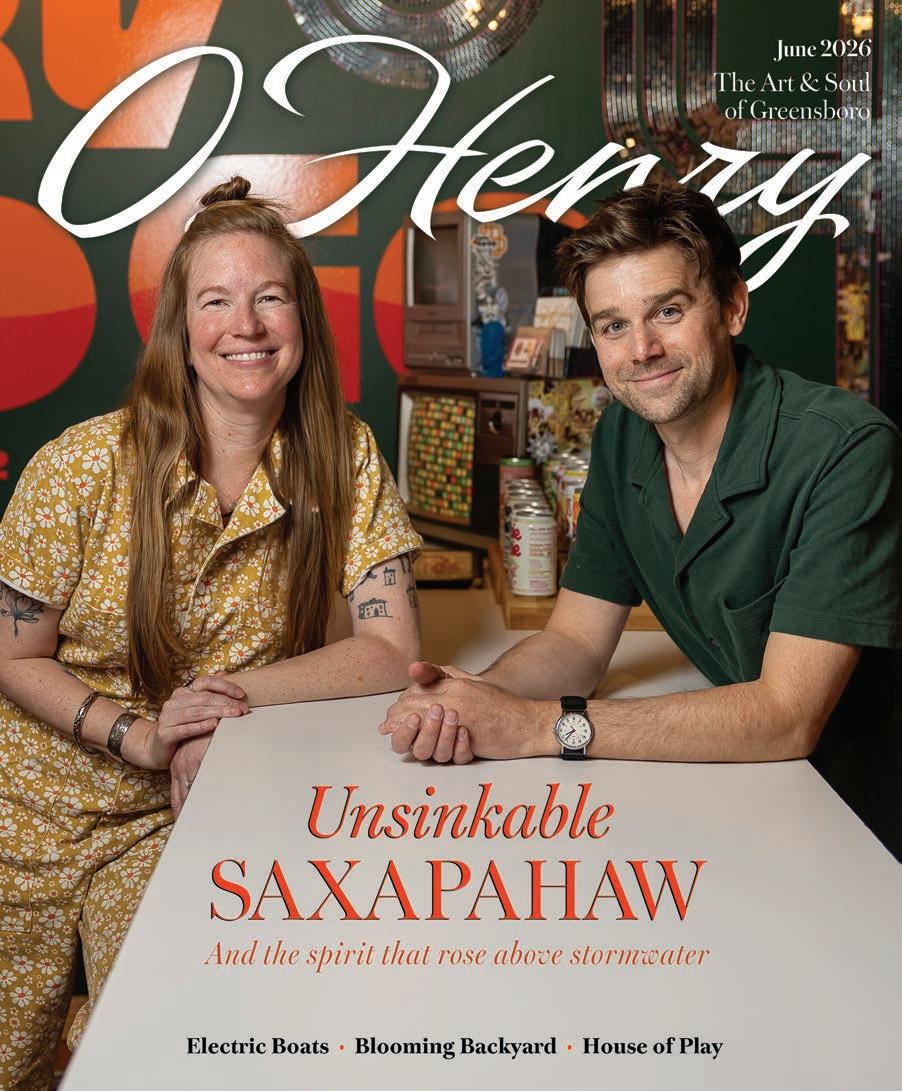
Passion and perseverance after Saxapahaw’s storm of the century
62 Adventure Awaits
By Cassie Bustamante
A globe-trotting couple creates a child-centric house of fun
72 June Almanac
By Ashley Walshe
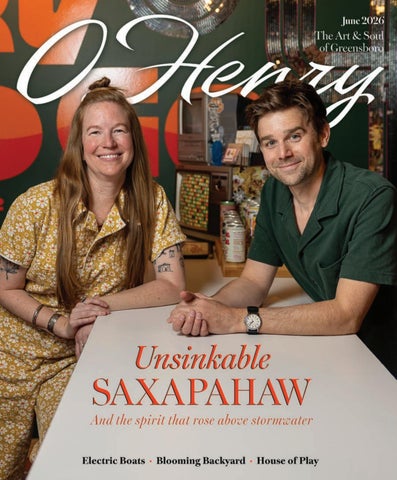
Cover photograph by Bert VanderVeen
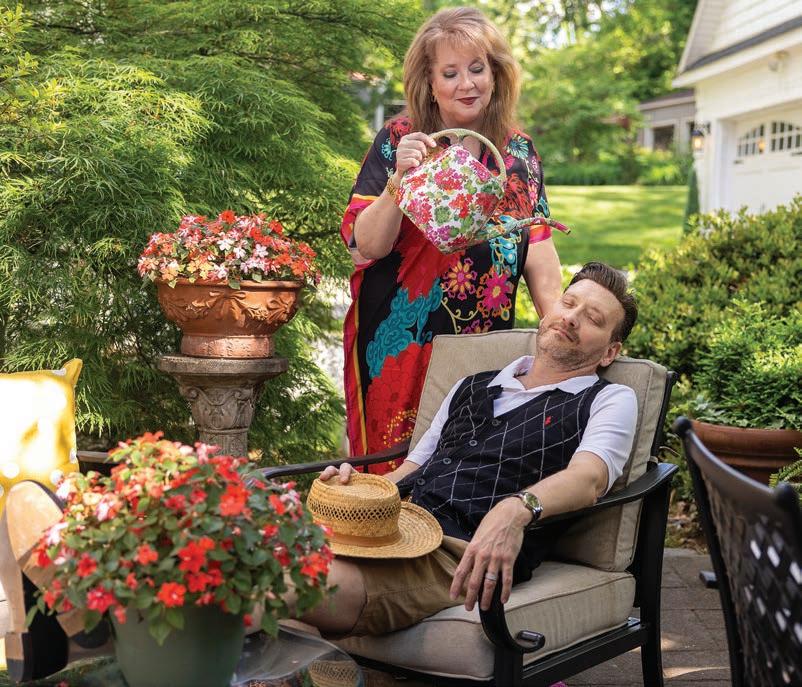
Photograph this page by Lynn Donovan
13 Chaos Theory By Cassie Bustamante
15 Simple Life By Jim Dodson
18 Sazerac
23 Tea Leaf Astrologer By Zora Stellanova
25 Life’s Funny By Maria Johnson
28 The Omnivorous Reader By Anne Blythe
31 State of Mind By Tommy Tomlinson
35 Home Grown By Cynthia Adams
39 Birdwatch By Susan Campbell
41 Wandering Billy By Billy Ingram
84 Outings
93 GreenScene
96 O.Henry Ending By Cynthia Adams



Volume 16, No. 6
“I have a fancy that every city has a voice.” www.ohenrymag.com
PUBLISHER
David Woronoff david@thepilot.com
Andie Rose, Creative Director andiesouthernpines@gmail.com
Cassie Bustamante, Editor cassie@ohenrymag.com
Joi Floyd, Assistant Editor joi@ohenrymag.com
Jim Dodson, Editor at Large jwdauthor@gmail.com
Keith Borshak, Senior Designer
Miranda Glyder, Senior Designer
CONTRIBUTING EDITORS
Cynthia Adams, David Claude Bailey, Maria Johnson
CONTRIBUTING PHOTOGRAPHERS


Betsy Blake, Lynn Donovan, Amy Freeman, John Gessner, Bert VanderVeen, Mark Wagoner
CONTRIBUTORS
Harry Blair, Anne Blythe, Susan Campbell,
Danielle Rotella Guerrieri, Ross Howell Jr., Billy Ingram, Gerry O’Neill, Gary Palmer, Stephen E. Smith, Zora Stellanova, Tommy Tomlinson, Ashley Walshe, Amberly Glitz Weber
ADVERTISING SALES
Lisa Allen
336.210.6921 • lisa@ohenrymag.com
Amy Grove 336.456.0827 • amy@ohenrymag.com
Brad Beard, Graphic Designer
Jennifer Bunting, Advertising Coordinator ohenrymag@ohenrymag.com
Henry Hogan, Finance Director 910.693.2497
Darlene Stark, Subscriptions &
OWNERS
Jack Andrews, Frank Daniels III, David Woronoff
In memoriam Frank Daniels Jr.


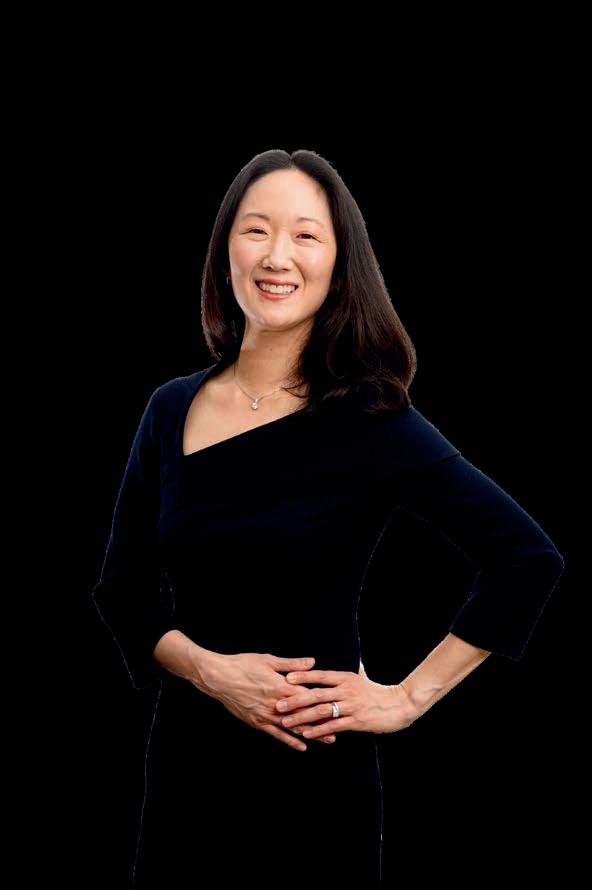

DR. EDWARD GRONET BOARD-CERTIFIED PLASTIC SURGEON
DR. CINDY WU DOUBLE BOARD-CERTIFIED PLASTIC SURGEON


Together, Dr. Edward Gronet, a board-certified plastic surgeon and Dr. Cindy Wu, a double board-certified plastic surgeon, offer advanced plastic surgery at H/K/B Cosmetic Surgery in Greensboro. Alongside them, experienced Med Spa providers deliver a range of advanced, nonsurgical treatments. Under one trusted name, the practice provides refined treatments that restore balance, enhance natural beauty, and prioritize subtle, polished outcomes.
















By Cassie Bustama Nte
From a very young age, I’ve been a very heavy sleeper. My mom has gleefully recounted tales of my sleepwalking as a small child through our little raised ranch, making it back to the safety of my bed, thanks to her guidance. In college once, a friend called me just before midnight and we had a long and soulful chat. At least, according to her. The next day when she recalled our conversation, I had no idea what she was talking about. Apparently, I’d just picked up the receiver in my sleep and gabbed coherently enough to pass for awake. (I’m not sure what that says about my real-life conversational skills.)
And so, many years later when my husband, Chris, and I had kids, they were quickly trained to go to Dad with their middleof-the-night wake-ups. Mom? Out cold, oblivious. But Dad? He’s sure to hear their pleas. Otherwise, our poor kiddos would be battling nightmares on their own.
In my deep state of sleep, I often have wild, vivid dreams, which I sometimes recount in detail to Chris in the morning. “But what do you think this one means?” I’ll ask.
His response? Typically, a shake of the head, an amused smirk, followed by ”I don’t pretend to know what goes on in that head of yours.” And, unlike me, he doesn’t give his dreams — or mine, for that matter — a second thought.
As a light sleeper, he doesn’t tend to have the intense dreams that I do. I’m no sleep scientist, so that could be a theory of my own making, but it works for me. At any rate, one morning, I found out that he, too, is actually capable of memorable dreams.
It’s 4 a.m. and I’m suddenly wide awake, a solid hour before my alarm is due to go off, something that happens
often in my middle agedness. I slip off the satin eye mask I wear to prevent wrinkles from worsening and stare into the darkness, considering all of my productive options — writing, brainstorming, meditating — and instead reach for my phone. Mindlessly scrolling, I squint at its tiny screen. So much for anything that satin mask may have done for my skin.
A few moments later, a giggle, followed by a contented sigh, escapes Chris’ lips. I know this laugh well and it’s one he delivers with love — for me. But, it’s the middle of the night and my anxious, exhausted brain races with “what if” scenarios. Is he dreaming about me? And, If not, then WHO? Mind you, Chris is totally trustworthy. There is no rational reason for me to doubt him. But who ever said I was rational, especially at 4 a.m.? As far as I’m concerned, he’s guilty until proven innocent.
After sulking for a while, I lace up and put my anxious energy to use outside on the pavement with my dog. The dark stillness of the morning always helps to quiet my thoughts.
Back inside and a little less on the verge of lashing out at Chris for what his dream self may have done, I pour myself a mug of steaming black coffee while contemplating my next move. I keep my back to him as he works on his laptop at our dining table, blissfully unaware that I’m stewing over something he probably didn’t even do in his waking life.
“You know, I woke up at 4 a.m. and could not fall back asleep,” I say as calmly as I can. “Meanwhile, you were over there giggling like a schoolgirl in your sleep.”
I turn to face him, a challenge in my eyes.
He looks up from his computer and smiles at me. “Ah, yes. I was dreaming we were on a dinner date at Machete.”

My tight-lipped expression breaks into a giddy grin and I let out a laugh as every trace of doubt vanishes into thin air. It’s me! I am the girl of his dreams!
“We were having a good time,” he says. “And I must have said something hilarious,” I retort.
He rolls his eyes because I’m well known around our house full of young adults — and a second-grader— for entertaining myself and no one else. After a beat, he lets out that laugh, quietly, almost to himself — a soft echo of the one I heard just hours ago. OH
Cassie Bustamante is editor of O.Henry magazine.



By Jim DoDsoN
As I write this, it’s an hour before sunrise on Good Friday of Holy Week.
With my morning meditation behind me for the day – I call it “Coffee with God,” a time when I have frank conversations with the Almighty beneath the morning stars – it seems like the ideal moment to take stock of my “Three G’s.”
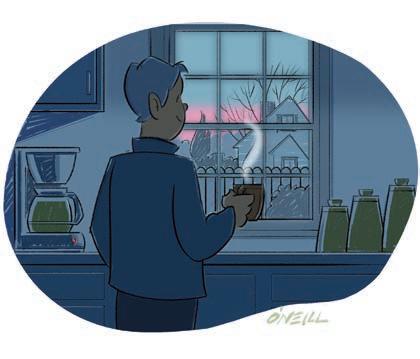
In addition to the enduring love I have for my wife, children and brand new grandchild – a baby girl named June; how’s that for timing? — the Three G’s is my simple shorthand for God, golf and gardening, the three defining elements of my life’s journey.
Allow me to consider them in reverse order of importance.
This month, on June 7, my home’s garden will be featured on the annual Greensboro Council of Garden Clubs tour. It’s an honor I never saw coming. That’s because building gardens (and working in them) has been a passion of mine since I was knee-high to a post-hole digger. I hail from rural people, you see, smalltime Carolina farmers who lived off the bounty of the land. So, the urge to grow things is in my bloodstream. Some of my fondest memories are of visiting my dad’s elderly second cousins, Josie and Ida, a pair of spinster ladies in their 80s who shared a handsome old farmhouse from the Civil War era and a giant garden in Orange County.
My dad called them the “Moon and Star Girls.” He called them this because their house had limited indoor plumbing but a pair of splendid outhouses with elegantly carved wooden doors. One featured a half-moon (Cousin Ida’s), the other a shining star (Cousin Josie’s). I was deeply fascinated by both women and their fancy outhouses. Almost every Easter and Christmas of my boyhood, our family would take them a salted country ham, Pond’s Cold Cream, and copies of Reader’s Digest, Life Magazine and the Saturday Evening Post.
Ida was the solemn and stern sister who ran the household. Josie was the sweet and talkative one who loved books and storytelling. Their dressing style was pure 19th century, floral
dresses with knitted sweaters Ida made by hand and lace-up boots. I like to think part of the verdure in my blood comes from them as well as my great-grandmother, who lived 5 miles closer to Dodsons Crossroads, and grew and collected native plants for making folk medicines. Aunt Emma, my dad’s grandmother, was the beloved “healer” along Buckhorn Road since a real doctor was 20 miles away. The vast garden of the “Moon and Star Girls” was well-known along Buckhorn Road between Hillsborough and Chapel Hill. The Dodson sisters shared their bounty with neighbors up and down the road. For several summers before a game called golf seized my waking attention, I got to stay with Ida and Josie and help in their garden. Josie would sing hymns and tell me stories about our Colonial ancestors while Ida kept a sharp eye on our progress, sometimes reminding us that the “Lord loves busy hands. Not idle chatter.” Once, Josie stuck her tongue out at Ida’s back and we both dissolved with laughter. Cousin Ida was not amused.
Both my parents were serious suburban gardeners, which is why I grew up to become one, too. I’ve built three ambitious gardens in my life, from a forested hilltop in Maine to a pinegirdled garden I brought back to life in Pinehurst. Number three is the most ambitious, built around the old house we purchased a decade ago on the street where I grew up in Greensboro. Likely, it’s my final garden.
Garden work is good for the soul, Cousin Josie liked to say.
•
Golf came into my life at age 11 after watching Arnold Palmer play in the 1964 Masters Tournament on TV. That’s the year the King of Golf won his final green jacket by six strokes and tossed his cap into the air. I promptly joined “Arnie’s Army.”
I began beating golf balls around our backyard with an old Bobby Jones wedge I still own (somewhere) and quickly progressed to a modest nine-hole golf course I nearly wore out every day after swim practice. I followed my dad into journalism and shared his passion for the cruelly addictive game invented 400
years ago by lonely Scottish shepherds.
In 1997, as a columnist for Golf Magazine, I published a memoir called Final Rounds that told the story of taking my wise old man back to play the courses on England’s Lancashire coast where he learned to play the game as an airman shortly before D-Day.
The book was a bestseller that changed my life. After reading it, Arnold Palmer invited me to write his memoir, A Golfer’s Life, and share the cover credit with him. We remained close friends until his passing in September 2016. During our last visit in Latrobe a month before he passed away, I asked him to autograph my copy of our book. He wrote: “Jim, Thank you for your wonderful words. I couldn’t have a better friend.”
I’ve been deeply blessed by my golf writing, a career that includes four books of the year about the game (two from United States Golf Association and two from International Network of Golf), scores of friends and a lifetime of memories.
Not long ago, just for fun, one of my golf buddies and I even started a podcast on Apple called Sports is Beyond Us that allows us to share the timeless joys, fellowship and low comedy of the game. •
God is the most important “G” in my life. I once heard someone say there are two paths to God — one is love, the other is sorrow.
I’ve taken both paths in my life and found that the divine force of the universe eventually welcomes everyone home regardless of where they’ve been. We all have a different picture of who or
what God is. My belief is that God grades life on a generous curve and small miracles are everywhere if you take time to notice.
Many years ago, I took my highly opinionated Scottish mother-in-law to the daily Evensong service at St John’s College Chapel in Cambridge, England. Kate was probably my best friend during several challenging years, a gifted gardener and educator who never missed watching the British Open Championship with me over gin and tonics. She was the only person on Earth who ever called me “James.”
Kate was also a professed atheist who had one of the kindest hearts of anyone I’ve ever known. Her own parents perished during the German bombing of the docks in her native Glasgow when she was very young.
That summer evening at St John’s, though, when the choir sang the familiar “Old Hundredth” hymn from the Genevan Psalter, I heard Kate softly singing along. As we exited into a beautiful evening, she took my arm and squeezed it. There were tears in her eyes.
“Thank you, James,” she said. “My mother and father loved that old hymn. I haven’t heard it in 50 years.”
Praise God, I thought, from whom all blessings flow. OH
Jim Dodson is founding editor of O.Henry magazine. Find him on Substack at One Man’s Simple Life and on Apple Podcasts at Sports is Beyond Us

with
At AudioNova | Doctors Hearing Care, better hearing is always our focus. Dr. Amy Kirkland, Au.D. is committed to provide each patient with an exceptional level of care and attention. She has been one of the triad’s leaders in hearing technology for over 28 years. Call today to schedule your free hearing screening.
Amy Kirkland Au.D.






"A spirited forum of Gate City food, drink, history, art, events, rumors and eccentrics worthy of our famous namesake"

Dear Diego: Elementary school plays a key role in a child’s development, but for shy and reserved Joi, who found it hard to make genuine friends, she spent most of it by herself. That was until I met Diego. “Joi, could you please stop that!” yells Mrs. Perkins, my fourth-grade teacher, during our class walk to the playground. I’m near the back of the line and have, unknowingly, slipped into a daydream, humming a tune the entire walk back — loud enough for her to hear me from the front of the line. A little embarrassed now that my classmates are staring at me, I walk the rest of the way back with my head down. “I thought it sounded good,” says a voice behind me. Diego. He has a Go, Diego, Go! backpack — fitting, isn’t it? — and light-up Skechers he wears everyday. From that moment on, Diego and I are two peas in a pod, never leaving the other’s side. He becomes my first best friend and later evolves into
a crush. I am fascinated by his ability to climb the monkey bars just as he is fascinated by my swift running skills — so much so that he brags to all his male friends that I could beat them in a one-on-one race if they dared to challenge me. Sadly, a year later, his father, who is in the military, is stationed overseas, which means Diego has to leave. Now as an adult, I appreciate the love Diego showed little Joi when she needed it the most. I hope he has grown up to impact other people as much as he impacted me. And who knows? Maybe we’ll meet again one day. Until then, I’ll keep an eye out for light-up Skechers.
– Joi Floyd
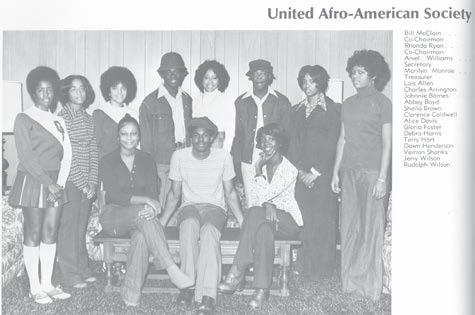
Captured here are the 1974 founding members of the United Afro-American Society for Greensboro College’s yearbook, The Echo. Bell-bottoms, bold patterns and enough polyester to make a disco ball nervous, this lineup is as rich in personality as it is in ’70s fashion. Membership may not have come with a written dress code, but a keen eye for the style was clearly part of the deal.

“Once I started doing film acting at the studio, I just fell in love with it,” exclaims Emi Curia — a Winston-Salem native and actress. A year after graduating from UNCG, Emi’s career continues to rise. At 22, she’s already a veteran of the hit TV series Echoes (Netflix) and Murdaugh: Death in the Family (Hulu). But before she was in front of the camera, she was on stage. “I did dance as a kid, and that evolved into community theater,” she says. After coming to Greensboro for college in 2021, she found in-STUDIO, a nontraditional, Greensboro-based actor training facility that quickly became central to her journey. “That studio is like my home,” she says.
Not only has she made friends who have become family at the studio, but Emi’s instructors have steered her in the right direction: “Having a good teacher who sees you is so important, and I admire teachers for being able to do what they do.” Her favorite teacher there, Lee Spencer, put her at ease, giving her the confidence to pursue her dream. “When it comes to acting, you’re working with someone who’s really bringing themselves and their vulnerability to you.” Isn’t that a little scary? Sure, she says, “It feels like you’re exposing yourself, but when teachers can foster a safe environment for you, it makes you feel like you can do anything.”
Beyond the screen, Emi is a multi-talented performer — skilled in tap dancing, ASL, kickboxing, piano, mezzo-soprano and fluent in Japanese, just to name a few. She has leveraged these abilities to secure leading roles in four plays and 15 films, with her most notable performance as Miley Altman in last fall’s Murdaugh: Death in the Family. Though an exciting milestone, she describes the audition process as tense. “It was really stressful, to be honest with you. I had that audition when I was on vacation.” Just before her senior year spring semester began, Emi recorded her audition from a hotel room. She didn’t think much about it afterward, so she was surprised to see she was pinned for the role. With exams, finals and now a role in a TV show all at once, she felt the pressure. Balancing frequent drives to Atlanta for filming with the demands of her final semester at UNCG meant occasionally missing class. “I had to bargain with my professors for excused absences,” she says. Still, by embracing the meaning of her name — “by the grace of God” — in
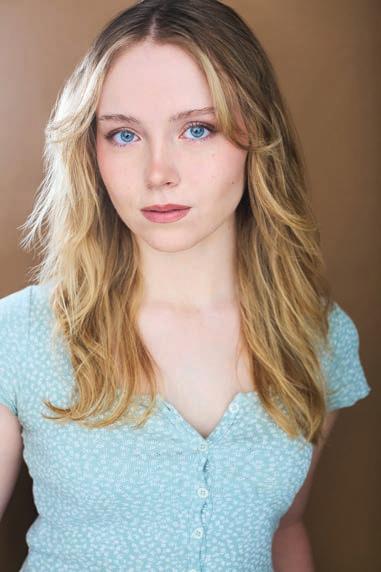
her daily life, she persevered through the demanding schedule and graduated with two degrees: psychology, and women’s, gender and sexuality studies. “I will always be grateful for that experience,” Emi says.
Ask Emi how post-grad life is and, like many recent college graduates, she might roll her eyes. “Sometimes I get that question, and it just makes me laugh because I really understand now how much it sucks.” As a psychology major, she put value in relationships with friends, coworkers and passing strangers. “I miss my friends. I miss my acquaintances. I miss all of it,” she says, though she quickly adds that she doesn’t miss the pile of assignments. Emi encourages her peers pursuing an artistic career to create a path for themselves and to stay persistent. Work hard and respond to the calling you feel. “You just have to see it through. The tunnel is long, and you’re not going to be able to see the light at the end of it, but you have to be the light to guide yourself.”
— Joi Floyd



Terms and Conditions: $300 off any order of $1198 or more,$200 off any order of $998-$1198 or $100 off any order of $698-$998, on any complete custom closet, garage,or home office unit. Not valid with any other offer. Freeinstallation with any complete unit order of $600 or more. With incoming order, at time of purchase only. For a limited time SPECIAL FINANCING for 18 months *with approved credit* Expires in 90 days. Offer not valid in all regions.



Father’s Day is right around the corner and we’re bracing ourselves for a day where we hold back the eye rolling as the corniest puns ever, aka dad jokes, exit the mouths of our fathers. They’re a comical and fun play on words, but, if your father is like most, he probably feels unashamed when blurting out the same joke over again and again — on repeat forever and ever. And, if you’re not careful — or if the apple doesn’t fall far from the tree — you may find yourself in a witty banter battle. This year, we’d like to defeat our funny fathers, so here are some dad jokes to keep in your arsenal, just in case you riff-off against the wizard of wordplay.

Sometimes, it’s better to start slow and simple. Pull out a classic and consider quacking this joke; What did the duck say to the waiter? Put it on my bill.
As descendants of fathers who somehow forget to flush every time, this one always gets us rolling: What did one toilet say to the other? You appear a bit flushed. And, maybe, just maybe, it will remind them to erase the evidence.
Finally, it’s time to pull out the big puns. Though, to be honest, we’re not sure if this joke is entirely accurate — especially since our dads can’t remember the names of


our best friends from elementary school. What’s the best way to save your dad jokes? In a dad-a-base.

- Fri / 9:30a - 5:00p Sat / 9:30a - 4:30p








(May 21 – June 20)
Truth: Nobody can rock a floral top with geometric print slacks quite like you can. This month, the new moon in Gemini (June 14) paired with your maximalist tendencies could elevate your dopamine dressing to Iris Apfel status. Try not to let your flashy curations keep you from focusing on your inner world. Beginning June 19, a profound healing can occur if you’ll allow it. Avoid hiding behind your rose-colored retro rounds and face the music.
Cancer (June 21 – July 22)
Don’t let a little rain stop you.
Leo (July 23 – August 22)
Two words: homemade focaccia.
Virgo (August 23 – September 22)
Reimagine the leftovers.
Libra (September 23 – October 22)
“No” does not require an explanation.
Scorpio (October 23 – November 21)
Somebody’s meddling.
Sagittarius (November 22 – December 21)
Read the room.
Capricorn (December 22 – January 19)
May the circle be unbroken.
Aquarius (January 20 – February 18)
Shake some dust, darling.
Pisces (February 19 – March 20)
Check the batteries.
Aries (March 21 – April 19)
Try sitting with the crickets.
Taurus (April 20 – May 20)
Three’s a crowd. OH
Zora Stellanova lives in the N.C. mountains with her wolfdogs, Venus and Lilith. Although she prefers divining with loose-leaf pu-erh, she recommends a mugwort and passionflower blend for those seeking wisdom and clarity from dreams.

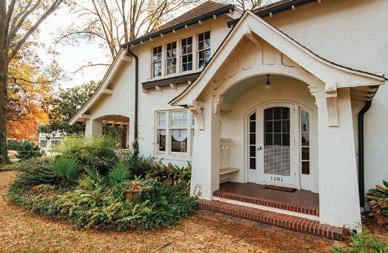
Nomad Vacation Rentals is a short-term rental company with 25+ locations in Greensboro, NC. From enjoying a staycation on Elm Street to needing more space to host family from out of town, Nomad has you covered.






To everything, turn, turn, turn
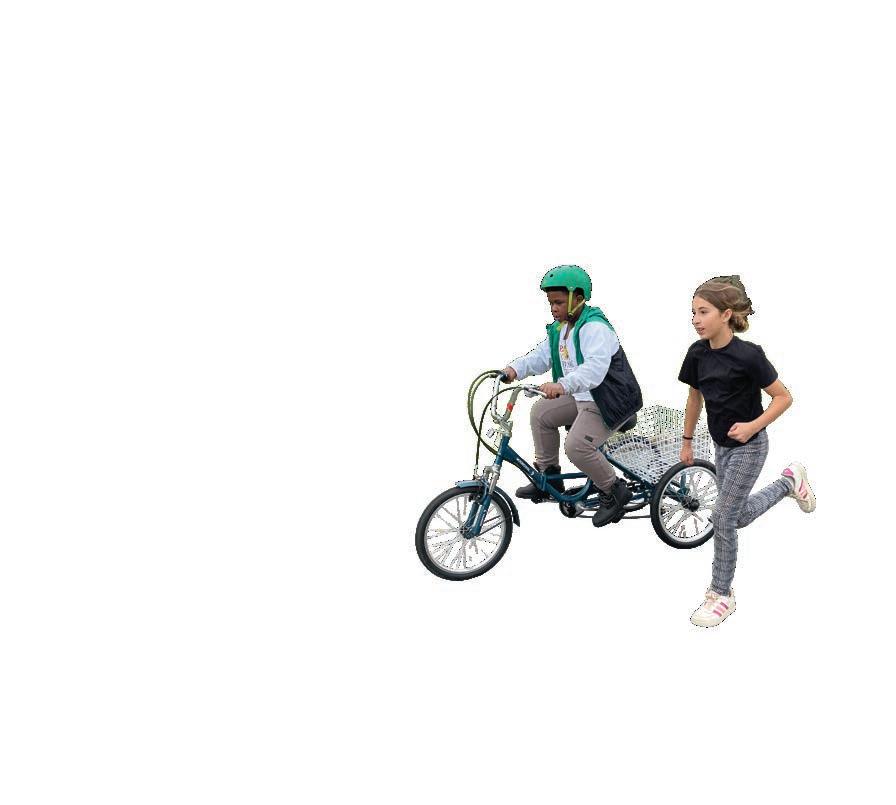
early spring day when the warm sunshine evens out the cool breeze.
Almost every Sunday afternoon, from 1–4 p.m. when the weather is nice, you’ll find A’laa and her family volunteering at the Greensboro Community Bike Shop in Barber Park.
Part walk-in repair garage, part picnic, part bicycle library — all free — the shop is run by volunteers with the Transit Alliance of the Piedmont, a nonprofit group that pushes the power of cycling to boost transportation, health and personal connection.
“People relate to you on a different level when you’re on a bike,” says Treva Whitmoyer, a retired nurse and alliance volunteer.
This month, the alliance plans to open a repair-only bike shop on West Market Street, alongside the Downtown Greenway. The Barber Park site will remain open through this month, longer if the city renews the lease for the bike library where A’laa gives free instruction to beginning cyclists. She works with people of all ages, but the young ones pick up skills the fastest, she says. They’re more open to instruction, less bogged down by ideas of what they can and can’t do, and less afraid of falling.
You wanna learn to ride? You gotta be ready to fall, according to A’laa (pronounced Ah-LAH).
Back when she was 3 and her family lived in Algeria in Northern Africa, she rode bikes with her mom, dad and older brother. She had a balance bike with no pedals. As long as her feet touched the ground, she was good to go.
Then her family entered an immigration lottery, a chance to come to the United States. Her mom, Fawzia Moussouni, who taught several languages and American civilization to high school and college students, applied on the last day possible.
“I said, ‘OK, I will take this chance,’” says Fawzia.
A few months later, her husband, Mohammed Boufenouche, called her. She was in class, testing students. He told her to leave class for a minute.
“We won!” he exulted.
A friend vouched for Greensboro as a good place to raise a family, so Mohammed, Fawzia and their kids settled here in 2019.
“I wanted a quiet place,” says Fawzia, who works as a teaching assistant in a middle school. “I love it here.”
A’laa got a new bicycle here, one with training wheels. Her brother, Omar, helped her to get the hang of it. Then Omar took off the training wheels, and they went to a sidewalk near their apartment. A’laa fell. A lot.


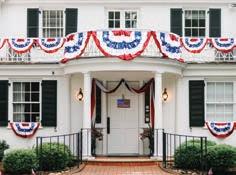

Saturday June 27 10:00am - 4:00pm
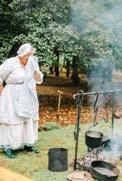
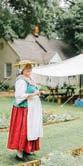
· Reenactor encampment · Family-friendly · · Live demonstrations · Hands-on activities · · N.C. Wyeth exhibit · Period Music · Step back in time as we celebrate the 250th anniversary of the American Revolution with a return of Drums of Liberty!


“I got mad because I couldn’t do it,” she says.
Her mom put Band-Aids on her scraped knees and elbows.
Her brother told her it would take time and practice.
“I went right back,” A’laa remembers. “If you don’t have patience, you’re probably going to be angry all the time.”
One day, A’laa found her balance. She was riding a bike. By herself.
“I was happy and excited and proud,” she says, beaming from her camp chair. “I felt really optimistic in that moment.”
She wants other people to know that feeling, so when 9-year-old Asher Warfield walks up with his grandmother, Mary Pettway, asking if someone can teach him how to ride a bike, she hops up, gets Asher a helmet and picks out a three-wheel bike for him.
They start on a stretch of asphalt beside the Simkins Indoor Sports Pavilion. The narrow lane leads to the bike shop, a small, brick building that used to house the controls of a sewage treatment plant before Barber Park took its place.
Asher stares at his feet as he pedals.
A’laa encourages him to look up and fix his eyes on where he wants to go.
He turns around, cruises past the shop.
“Grandma, look!” he says.
Other people trickle in. Cars weighed down with bike racks pull in to donate cycles, which the Transit Alliance reconditions and gives to people who need transportation.
Visitors dig into the chicken and rice dish that Fawzia has set on a table; she always brings food and snacks.
Two young women walk by.
“You wanna ride bikes?” says Sheldon “Shel” Herman, who calls himself the “chief bicyclist” of the Transit Alliance.
“Where?” one of the women asks.
“Here,” says Shel.
“How much?”
“Free.”
The women sign release forms, grab helmets and go.
A young man, an engineering student at N.C. A&T, brings his bike by for repair. One tire has a slow leak. Shel shows him
how to replace a tube.
Others watch and learn from Shel and the other volunteer bike mechanics. Ten-year-old Nuwaib Farooqui’s father, Shadab, brings him to the bike shop to learn new skills, interact with people and get away from electronic screens.
“Any excuse to take him outside, I’m game for,” says Shadab, who develops apps for mobile phones and admits to a lovehate relationship with technology.
“I want him to know what’s real and what’s not,” he says.
That’s fine with Nuwaib, who just wants to know how to fix his bicycle when it breaks down.
“It’s the closest thing I have to a car until I’m 16,” he says.
It doesn’t take long for Nuwaib and A’laa to connect. They take off on the park loop. As they pedal away, I’m watching more than bicycle wheels turn. I’m watching time turn.
I remember the moment I caught my balance and my dad, who was running beside me, turned loose of the seat of the little red bike that I learned to ride on.
I remember swooping down a hill at Country Park on a Peugeot bike at breakneck speed about 40 years ago and feeling a wave of happiness and freedom.
I remember my first date with the guy who’s now my husband, a bike ride through southeast Guilford County.
I rode, for fun, for almost 60 years.
I stopped a few years ago, after a wreck left me counting my lucky stars and reckoning with the hard truth that I don’t bounce like I used to.
Recently, my husband and I gave our mountain bikes to the Transit Alliance. That’s how I found out about the bike shop and met A’laa.
Now, as I watch her and Nuwaib pedal away, eyes fixed on where they want to go, I feel no regret.
Instead, as A’laa would say, I feel really optimistic in this moment. OH
Maria Johnson is a contributing editor of O.Henry. Email her at ohenrymaria@ gmail.com.



By A nne Blythe
If you’ve ever felt caught in one of life’s undertows, fighting overwhelming currents seemingly beyond your control, you might find a kindred spirit among the cast of characters in Jared Lemus’ debut short story collection, Guatemalan Rhapsody.

Lemus, a Kenan Visiting Writer at UNC-Chapel Hill, has compiled 12 vignettes portraying men and boys living in Guatemala or the United States. The protagonists are barely making ends meet, either caught in low-paying jobs or living on society’s edges through illicit means. Many of them are struggling to break free from generational poverty, Byzantine bureaucracy and emotional vulnerabilities.
The ache of unfulfilled possibility unites these principal characters — a healer, a van taxi driver, a long-haul trucker, a night busman, an aspiring tattoo artist, a laundryman, a builder, a once-celebrated soccer player turned middling middle school coach, teenage highway robbers and kids left to fend for themselves in this country after their parents were deported or returned home to Guatemala.
There is a machismo and toughness that permeates these protagonists that rarely masks their underlying vulnerability and tenderness. There are females in their orbit, but few are as
fleshed out as the central male figures. The women often provide the unvarnished truth with warmhearted mercy.
Lemus shows a flair for different writing styles throughout the collection. In the opening story, “Ofrendas,” he gives readers a taste of Guatemalan pacing and dialogue, using Spanish-style inverted opening and closing marks throughout the lyrical English. The story kicks off the collection with a nod toward indigenous Guatemala and the Mayan tradition of people bringing cigarettes, candies, flowers, alcohol and monetary offerings in search of relief or protection from San Simon, a saint known to be a trickster representing both light and dark. In this story of second chance seekers and human sacrifice, you can almost feel the fires crackling as the healers greet the petitioners at the pits they’ve built and hear the owls hooting their ominous calls in the highlands beyond the gated monastery.
In “Bus Stop Baby,” a story about a busboy/dishwasher who rides a bus all night for warmth because the damp mattress he rented was in an unheated garage attached to a house filled with cocaine addicts, Lemus gives readers a chance to choose their own adventure mapped out in two columns, Option A or Option B.
There’s traditional storytelling, too, always with vivid descriptions. In “Heart Sleeves,” a story of an aspiring tattoo
artist seemingly “opting for weed and heartbreak” over fulfilled potential, you can almost hear the bee-like buzz of the tattoo guns.
In “Saint Dismas,” a story of amateur highway robbers scheming for food and motel money, your fists might clench in pain as Lemus describes the rope-burned hands of the teens posing as construction workers whose plans went awry when a car sped through the thick cord they stretched across a Guatemalan road to force passersby to stop.
While it might sound like Guatemalan


The collection is a true rhapsody, made up of many different riffs on stories of people swimming against the tide, striving for validation, love and
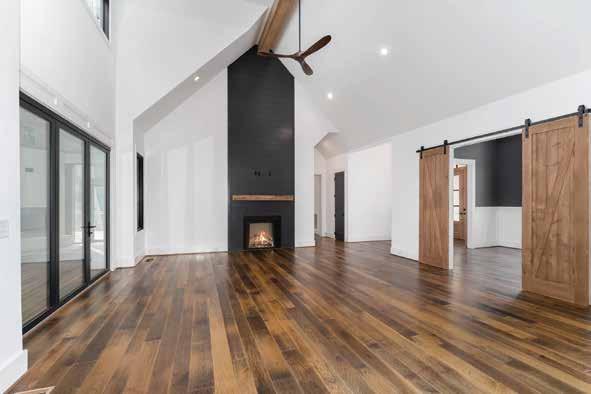
Transform your home or office with the elegance and durability of Weeks Hardwood Flooring, the Triad's most trusted name in flooring solutions. Whether you're seeking to enhance the warmth of your living room or upgrade your business space, our expert team is here to guide you every step of the way. Visit our website to explore our wide range of premium flooring options and start your next project with confidence today.


Rhapsody is all doom and gloom, there is wit and light humor amid the darkness. The collection is a true rhapsody, made up of many different riffs on stories of people swimming against the tide, striving for validation, love and survival.
The most pleasurable note among the variations is how Lemus treats his protagonists with dignity and compassion, traits that could go a long way in the world today. OH
Anne Blythe has been a reporter in North Carolina for more than three decades covering city halls, higher education, the courts, crime, hurricanes, ice storms, droughts, floods, college sports, health care and the many wonderful characters who make this state such an interesting place.












It’s our game, the American game
By tommy tomlinson
My wife and I had our first date at a Hickory Crawdads game.
Well, OK, I already need to backtrack. Alix says to this day that it was not a date. At the time I didn’t think it was a date, either. But somewhere between the first inning and the ninth, I started to feel that tug of attraction. A little more than a year after that night, we got married. Nearly 28 years of marriage later, we’re still together.
The point here is not to settle the question of whether it was or was not a date. The point is to make our way, eventually, to Brad Pitt’s question from Moneyball: “How can you not be romantic about baseball?”
North Carolina gives baseball romantics so many places to fall in love.
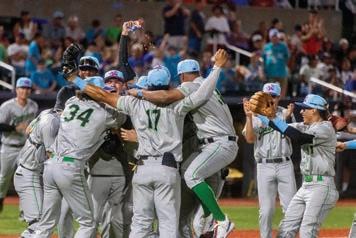
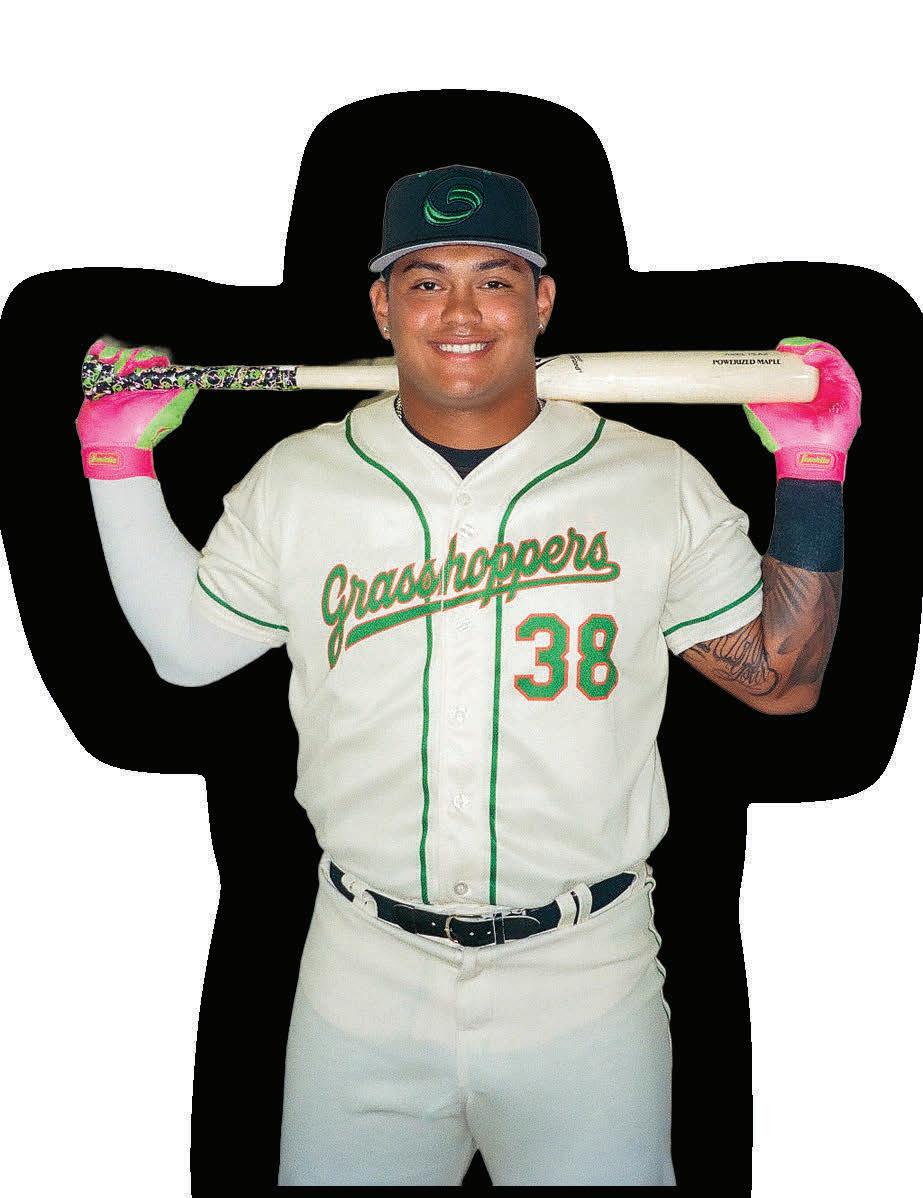
Best I can tell, there are 22 professional baseball teams playing in North Carolina this summer. Nine are farm clubs of Major League Baseball teams. Eleven teams play in summer leagues for college players — they use wooden bats instead of the aluminum bats in college games. Two more teams play in the independent Atlantic League. You could drive around the state and see a different game in a different park every night for three weeks straight, with a game left over.
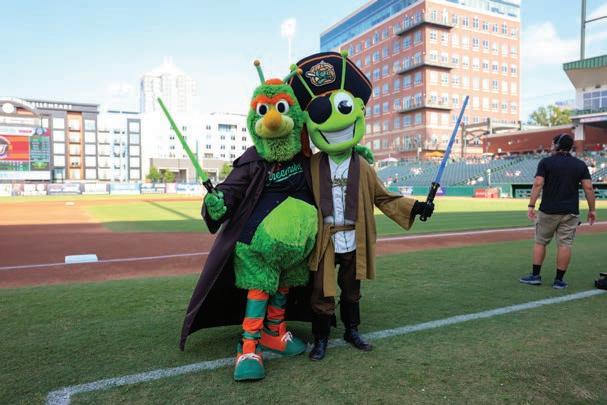
Minor league team names are sports poetry. Here in North Carolina we have the Gastonia Ghost Peppers and the Edenton Steamers, the Greensboro Grasshoppers and the Holly Springs Salamanders, the Forest City Owls and the Fayetteville Woodpeckers, the Boone Bigfoots and the Greenville Yard Gnomes. (Should it be the Boone Bigfeet? Sounds like a discussion for the ballpark, between innings.)
Some teams choose names with a local angle. The Kannapolis Cannon Ballers name-check the Cannon Mills textile company that basically built the town. (The Cannon Ballers’ logo also features a mustachioed figure who looks sus-

piciously like Kannapolis-born Dale Earnhardt.) Asheboro has the North Carolina Zoo, so their team is the Zookeepers. My favorite, along these lines, is the Winston-Salem Dash. I’ll let you figure that one out — although if you’re strict about grammar, you might not like the answer.
Alix and I have been to minor league games all over the state. Every park has its own quirks and charms. A few years ago, as part of a baseball vacation, we went to see an Asheville Tourists game. I hadn’t been feeling great that week. We had to park at the bottom of a hill, and the stadium was at the top. I was dreading that climb. But then a guy rolled up in an extralong golf cart. It turns out the Tourists will give fans a lift up to the stadium if they need one. That day, I needed one. I felt like a VIP as the cart zoomed us to the gate.
By the way, if you ever take a book to the ballpark — lots of people do! — my suggestion is Ryan McGee’s Welcome to the Circus of Baseball. It’s about the summer he spent as an intern with the Tourists, and it is jam-packed with stories. I will never forget his tale of the mountain man the team sent into the woods behind the outfield fence to retrieve batting practice homers. He always returned with a bagful of balls — and another bag full of squirrels and such for his supper.
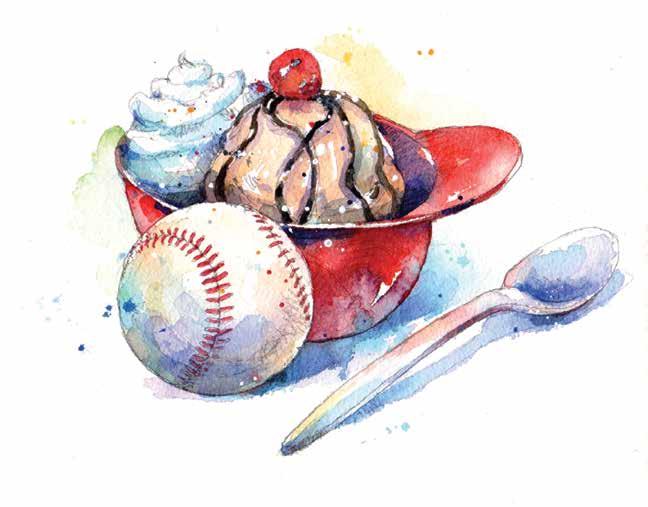
Speaking of supper, the range of what qualifies as ballpark food is so much wider than it used to be. The Durham Bulls, for example, offer pretzels with hummus, gourmet popcorn, Impossible Foods veggie dogs and a ton of local brews. Even the smallest parks often have fancy burgers and IPAs. They still have the classics, too. Nothing says the eighth inning at a minor league park like ice cream in a little batting helmet.
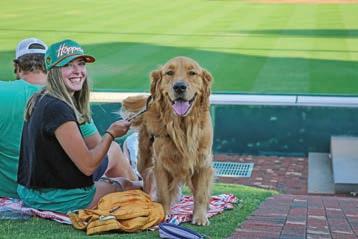
In Greensboro, we cheered for one of the team’s bat dogs who retrieve bats tossed aside when players get a hit. In High Point,






we spotted former World Series MVP Frank Viola serving as pitching coach for the Rockers. In Wilson, years ago, we happened to show up on Pint Glass Night and brought home a Wilson Tobs glass we use to this day.
The Tobs (a nod to Eastern North Carolina’s tobacco roots) have moved to Smithfield, where they’ll start playing in 2027. Wilson’s team is now the Warbirds — they’re a farm team for the Milwaukee Brewers. They replaced the Carolina Mudcats. The old Mudcats’ stadium in Zebulon is now home to the Zebulon Devil Dogz, which will feature Australian players. As they say in baseball, it’s hard to keep track without a scorecard.
The truth is, it doesn’t matter what the teams are called or who’s playing. I’ve been to dozens — hundreds? — of minor league games over the years. The only surefire star I remember watching is Jim Thome, who mashed baseballs for the Charlotte Knights and went on to hit 612 home runs in the majors. I’m sure there have been other all-stars somewhere in all those games, mixed in with the guys who made it to the bigs for a bit, and the ones who never made it at all. But I don’t remember the players. What I remember are the warm nights and the cold beer and the good company.
I still have my ticket stub from that Hickory Crawdads game back in 1997. I have no idea who won that game. I just remember the fireworks that almost set the woods on fire beyond the outfield fence, and the slow dawning, as I talked to my seatmate, thinking that this might not be just another night at the ballpark.
We still don’t count that night as our first date. But we’ve spent a lot of nights at baseball games since then. And you can bet every one of those counts.
Tommy Tomlinson is the author of two books, The Elephant in the Room Dogland. He was a longtime columnist for the Charlotte Observer and has written for Esquire, The Atlantic, ESPN the Magazine and many other publications. His online newsletter is called The Writing Shed. He lives in Charlotte with his wife, Alix Felsing.

















By C ynthi A A dA ms
There are a few dusty trucks parked outside Gum Springs Garage. Otherwise, there are no overt clues that this is a place of significance, one that has supported the livelihoods of this Pittsboro farming community since the 1950s.
Inside is a glimpse of a rare authenticity as endangered as the hand-written letter.
No money is wasted on appearances. Not even a doorknob on the sliding door to the garage, just a hasp and padlock. Even on a sweltering day, the door is open to the working man’s establishment on Silk Hope Gum Springs Road.
There is no sign stating, “We fix what you broke,” but that is what happens here. Auto repair is the primary focus. But rows of repaired and tagged chainsaws, leaf blowers, weed whackers and edgers await pickup. If, say, a tool or tractor is busted beyond repair and cannot be fixed, then proprietor Randy Kidd can order or help find a new one.
The garage itself, a former service station, is doggedly rustic, with a sphere of influence that blooms far beyond the oil-soaked floors. The place would make a fancy man’s garage — the kind manfluencers show off with vintage cars parked on gleaming surfaces clean enough to eat on — look foolish.
There is no angling for commercial appeal at Gum Springs Garage. Instead, energy and resources are devoted to the locals who work on their farms, land and gardens. Fluorescent lights
illuminate shelves of engine oil, Motomix and batteries. Fanbelts, chains, filters and parts hang on rusty nails.
A grimy-faced clock advertising LeakPro piston rings is frozen at 5:05. What paint remains on the shiplap siding is barely winning the struggle to stay put.
The floor is hard dirt, compacted by the boots of generations of farmers who have come there. The rest is concrete or wood, changing as you work your way through the shop’s interior. Everything that Kidd ever repaired seems cemented into the genetic code of the place.
My own father owned a trucking company and farmed. The trucking company kept him afloat.
Although he could manage basic maintenance on Peterbilt trucks himself, he knew what he didn’t know, which turned out to be an important lesson for his five children. When it came to pulling a motor or transmission or replacing a timing chain, he deferred to and relied upon men like Kidd.
“Standing in a church doesn’t make you a Christian,” my old man would mutter, “any more than standing in a garage doesn’t make you a mechanic.”
My father was the youngest son, determined to hang onto his father’s farmland. He wore short-sleeved work shirts and an old pith helmet to protect himself from the relentless sun, astride a rusty, red International Harvester, planting long rows of soybeans, wheat or corn. By lunchtime, his shirt and the khakicolored helmet were soaked with sweat.
We learned, too, that there were a thousand miseries inflicted upon farmers.
He endured every farming hardship: the cost of seeds, fer-










tilizer, equipment, labor, blight and drought. The cost of ill-timed or too much rain. Of surpluses and ruined crops. Miscalculations. The endless, backbreaking cycle of defeat.
We children knew about the Farm Bureau and debt before we knew how to count the coins in our piggy banks. Farmers operated on razor-thin margins. When a tractor broke down, farming halted. When a mower, harvester, baler or cultivator broke, it shredded profits. The Kidd family, farmers themselves, understood this.
Although Kidd is the third family member to run the garage, do not expect him to jabber away, thrilled to talk about himself, or to brag about his reviews. Online, effusive customers give his garage five stars — the top rating.
“I’m a redneck from nowhere,” he replies without a trace of irony, a ball cap over a full head of gray hair.
Untrue, it turns out. Customers praise that he is an authentic fix-it man, having worked in the garage since boyhood.
They file in, nodding in the younger Kidd’s direction, who, like his father, Roy, before him, fixes or makes work the tools of their trade. The things made whole here — a farmer’s lifeblood — are the reason many have endured.
A loyal customer posted online that he “supported even wannabe farmers” like himself.
Kidd has also served his community in other ways, as a firefighter and veteran.
He farms like Roy, who understood the urgency when a tractor stopped working. Asked if there is anything that his garage can’t fix, Roy paused a beat and replied, “Did a man make it?”
The garage is also a certified STIHL dealer. On a quiet Wednesday, Kidd figures up a bill for first-time customer Susan Harrell, there to pick up a new chainsaw.
“I’d like to buy an all-electric, but have to watch costs,” mentions Harrell, staring at one hungrily.
Kidd nods. He places the new saw on a worn counter in what is designated as the office, demarcated by an actual wooden floor, with a filing cabinet and
aging swivel chairs.
Harrell steps into the office and picks up the saw, assessing its heft. She tells Kidd she learned manual skills helping her brother with home renovations.
Clad in jeans with a knife-edge crease and a jean jacket, she nods appreciatively as they chat and he answers her questions. The proprietor wears a loose-fitting blue work shirt with an embroidered name tag along with Wranglers.
Wire-rimmed specs are pushed up on the bridge of his nose as he calculates the tax on the invoice.
There is no AC in the summer, but a fan hangs over the separate customer lounge, which occupies the second bay of the garage. Cast-off chairs, two school desks and a rump-sprung navy Naugahyde seat salvaged from an old car are angled around a wood stove.
A Pepsi machine near the office, boxed in by racks of supplies, may or may not work.
“I do have a place for cold drinks,” Kidd points out, without looking up.
Perhaps the drink machine does work.
When he was younger, a boy, really, he sometimes left his father’s garage at closing time and headed home to bale hay. It is back-breaking labor that keeps high school boys flush with gas money in the summertime.
No longer young, Kidd still bales hay.
“Round or square bales?” another customer asks.
“Both,” Kidd answers, riffling through the filing cabinet. Too busy to glance.
For now, he will keep fixing things, selling things and satisfying his customers tomorrow and the next day, until his fingers can no longer do the work. And if another Kidd does not want to step in, he might one day slide that garage door closed for good.
And then, continue farming, growing things. Like our daddy did, until heart problems stopped him.
Some things even a guy like Randy cannot fix. OH
Cynthia Adams is a contributing editor to O.Henry magazine.



BlueDenimRealEstate.com info@bluedenimre.com Locally



By susA n CA mpBell
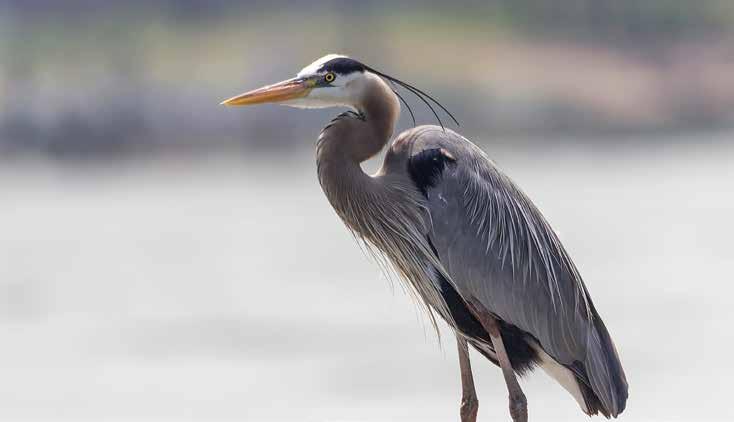
The great blue heron is a bird that will get anyone’s attention, bird lover or not. It is the largest of all the species found in the Piedmont and Sandhills, and is second in wingspan only to the bald eagle. Great blues are colonial nesters, gathering often very close together in trees in wet environments where terrestrial predators are not a threat.
Great blues can be found across North Carolina year-round foraging in a variety of wet areas. The way it ever so slowly stalks its prey in the open is unique. However, nesting habitat can be harder to find. Many wet areas are too shallow to preclude raccoons, opossums and other climbing animals. Sizable beaver ponds or islands in the middle of lakes with mature trees or large snags are attractive. If a pair or two are successful in raising a brood high above the water, it is likely that the number of nests will grow in subsequent years to form a “heronry.” The female will weave a cup nest from the branches, then add smaller, softer material (such as twigs, grasses, moss, etc.) that her mate delivers.
The bond between a pair of great blues is very strong during the breeding season. Male and female are both involved with rearing the nest generation. The large nest can accommodate up to five eggs, and both adults incubate and then brood the young. The male spends most of the daylight hours at the nest while
the female is there overnight. Herons are very good parents, able to defend their young with not only their heavy, sharp bills, but with very powerful wings.
It will take a year or more for the young to reach maturity. During the first several weeks they are fed mainly fish by their parents, but as they begin to forage for themselves, they will become opportunistic, eating everything from large, aquatic invertebrates (such as crayfish) to frogs and even the eggs of other bird species. Some individuals will not breed until their third summer. Sexually mature birds sport long plumes on their neck and back. They may be seen displaying to their mates by raising their crests and clapping bills together at or near the nest site.
The loud raspy croaking of herons is territorial and can be heard day or night at any time of the year. They will defend rich feeding areas as well as their nest from competitors. Great blues also call when in flight, perhaps to maintain contact with family members. In the air, they have a very characteristic profile with slow, deep wingbeats, their necks coiled, and legs trailing out behind them.
These huge birds are amazingly unafraid of humans. Although they seldom tolerate a close approach, they are frequently found feeding from bulkheads, farm ponds and even small backyard water features. Many great blue herons have learned that people may provide an easy meal — even if it is in the form of fish remains or table scraps. So, keep an eye out, one of these birds may be closer than you think. OH
Susan Campbell would love to receive your wildlife sightings and photos. She can be contacted by email at susan@ncaves.com.










- McKenzie E.


How a seminal local computer science publication and illustrator rocketed a career
By Billy ingrAm
“There is no reason anyone would want a computer in their home.” — Ken Olson, President of Digital Equipment Corporation in 1977
Just two years after mass-marketed personal computers were made possible by a game-changing microprocessor, Robert C. Lock founded Small System Services, the “Corner Computer Shop” on Spring Garden at Mendenhall, in 1979. That little shop of floppy discs served as Lock’s launching pad for arguably one of the most consequential and culturally influential magazines of the 20th century, Compute!, first catering to a decidedly minuscule demographic when it debuted in 1979 — devout computer geeks. The publication spawned a sprawling publishing empire before being sidelined a decade and a half later by the popularity of the very subject it was devoted to.
A UNCG chemistry and biochemistry professor at the time, Harvey Herman was writer and associate editor of Compute! starting with the very first issue. “The magazine was based really on the MOS Technology 6502 chip in a lot of the early computers, the single boards, ones that you could use right off the shelf,” he says. “There was a lot of useful stuff coming out of the magazine.” Every issue offered readers what the soon-to-be-popular publication called “type-ins,” custom-made programming codes to manually type into Ataris, apple ][, TRS-80 and Commodore PET models, cascading rows of seemingly random letters and numbers strung together that must be entered without error or the DIY software wouldn’t Do It, Yo.
Success was immediate and overwhelming. By issue No. 3 in March 1980, Compute!’s crew had grown from publisher-editor

Original Harry Blair illustration for issue No. 46, March 1984, of Compute!
Lock and five unpaid stringers to dozens of contributors, columnists and support staff. Leaving the Spring Garden electronics store behind, magazine production was established in a stunning, two-story, gray stone manse on Bessemer and Magnolia. With the addition of spinoff mags and manuals, they began overflowing out of a former heavy-machinery manufacturing plant on Fulton Place and High Point Road (today’s Gate City Boulevard) a year later.
That’s when Fred D’Ignazio, already an accomplished author specializing in robotic programming in 1982 and living in Chapel Hill, began writing for Compute! “It was so exciting,” he says. “I really had the feeling this was going to take off.” However, in mainstream minds, computers were strictly sci-fi fodder: “Maybe others looked at you as a geek, but, inside, you knew you were smarter than everybody around you.” D’Ignazio reflects on his former editor, Lock: “He was kind of a visionary statesman- or chairman-of-the-board type person. Very thoughtful, very nice to me and encouraging. I was on the fringe, thinking of computers in much more of a futuristic and metaphorical sense. Like how do you introduce computers to children?” Yes, that was a radical concept in the early ’80s.
Beginning with issue No. 1, Compute!’s cover artist almost every month was O.Henry’s own illustrious illustrator, Harry Blair. “He’s my favorite cartoonist of all time!” D’Ignazio, who currently resides in Tucson, Arizona, hadn’t heard that name in decades. “Harry drew cartoons of me going off on my different journeys overseas with robots and computers. He was very whimsical.” One of those

caricatures “was a bunch of robots chasing me across the globe, just very funny.”
Headquartered in a hangar-sized facility off of Wendover by 1983, Compute! cashed out to ABC Publishing for $18 million. A major redesign was undertaken five years later with cluttered (stock?) photo covers replacing Mr. Blair, whose coup de grace that January depicted a wintery mountain range awash in bluish hues, Big Tech logos crystalizing inside a starry sunset. A stark, frozen terrain devoid of humanity, a suffocating, frosty landscape offering no possibility of connectivity. Metaphorical?
In 1990, the enterprise was gobbled up by General Media, publisher of Penthouse and Omni, the latter consolidating editorial and production with Compute (now sans any “!”), here in Greensboro. Not long after, Compute was folded into, or buried beneath, internet behemoth AOL. Video killed the radio star.

The ’90s had arrived, bringing vastly more powerful processors and sophisticated, off-the-shelf software. Gone was that unprecedented level of kinship twixt a magazine and its subscribers by virtue of the communal coding experience, this pivotal technical and inspirational catalyst that had fed eager brainiacs for a decade. “Microsoft BASIC was just everywhere,” D’Ignazio points out about those intrepid early-’80s code tweakers. “There was no limit to the kind of programs you could create. That early, hands-on experience, combined with tapping into people’s imagination, especially young people, I think it really inspired a whole generation.”
I know that to be true.
I met with one such individual, Keir Davis, in his suite of offices tucked into Latham Park proper. Davis and a phalanx of prodigious programmers at the firm he founded in 2002, Xtern Software, alongside a team of behavioral psychologists from Northwestern University, developed the tools for enhancing interconnectivity between NASA Mission Control and the Artemis II manned voyage recently returned from the moon. Under the confines of Earth’s gravity, Xtern is involved in next-level
web and mobile-focused customized software for all manner of industry — furniture makers, an A-list jewelry designer, a manufacturer of military boots, even UNCG, where Davis as well as many of his local workforce have earned degrees, his in computer science. Very high-level, diamond-edge innovation taking place right across from the tennis courts.
As a 10-year-old Pittsburgh (adjacent) youth, Davis was an avid consumer of Compute! “This was prior to my even knowing what Greensboro was.” He once copied those elongated lines of code into a 1982 Texas Instruments computer and recalls “looking at those great Harry Blair covers.” There are those who insist there are no coincidences, but, in the summer following eighth grade, Davis and his mother moved to the Gate City, where he attended a cartooning class at Weaver High taught by . . . I’ll let you guess.
Forty years later, Davis and his wife were out to dinner when they spotted none other than Harry Blair. “I talked to him and he remembered the class, but he didn’t remember doing this,” Davis says, presenting a superbly sketched caricature of himself as a 14 year old that hangs in his home today. “I showed it to him on my phone and Harry lost it. He was like, ‘I can’t believe you would’ve saved that.’ It was a throwaway for him, right? He can do this in his sleep, but to me it was really cool.” I’d bring up the whole “circle of life” concept and all of that but I might owe Disney a royalty.
Over the last half century, personal computers emerged from bit players to major supporting (or starring) roles in our everyday lives. From operating systems scarcely capable of rendering spreadsheets or simplistic, pixelated diversions like Pong and Pac-Man to generating unimaginably complex computations crucial for blasting astronauts into outer space and then returning them safely to terra firma.
And Harry Blair had it covered all along. OH
Billy Ingram’s TVparty! was first to stream videos from television shows over the internet and first to create web pages with text, pictures and embedded media.




A car engine rattling.
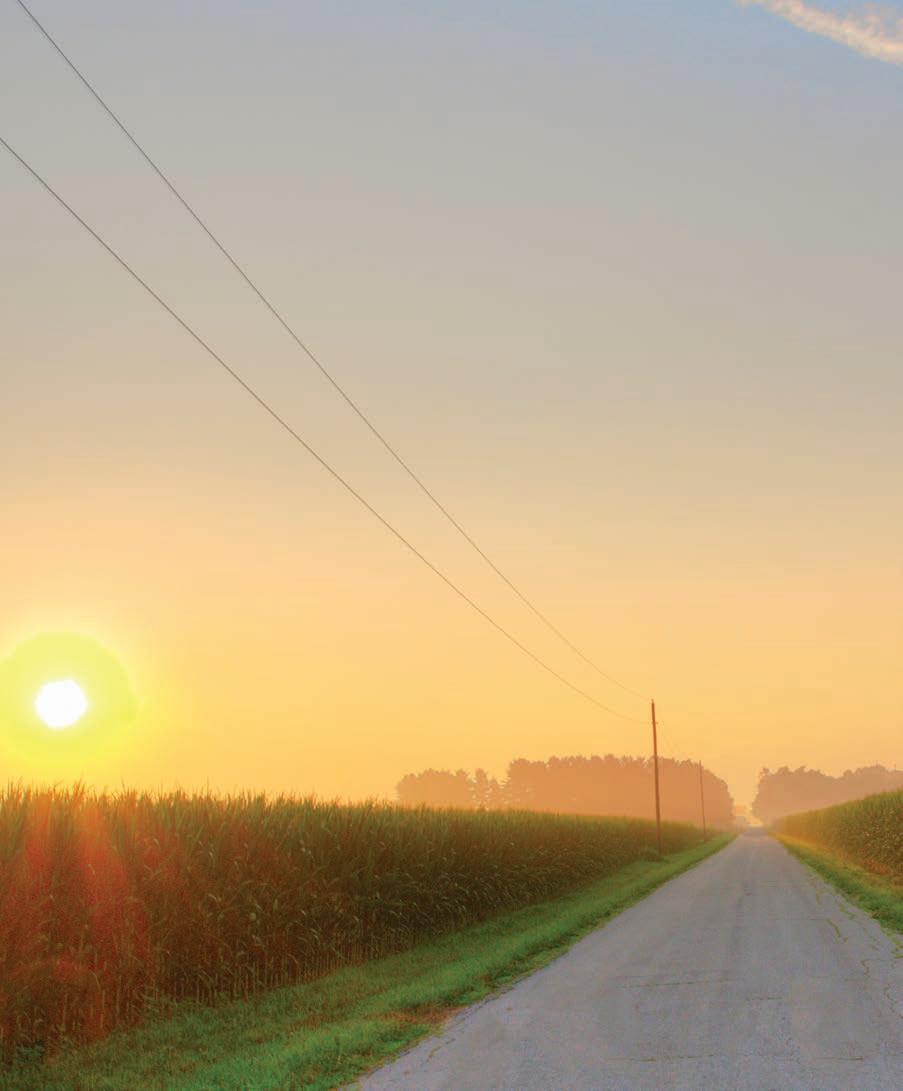
A busted radio preaching the end of the world. That soft, hazy sun racing behind the horizon, peaking only for the thought of crashing. The Earth’s breath, hot and fast, blowing the trickled sweat from my hairline to my forehead. A swished whiskey hits the adrenaline, causing a swerve left, then right. The radio speaks, “Blazing temperatures bring hysteria!” I turn it off without a care in the world and without a second to spare.
— Joi Floyd
Joi Floyd is the assistant editor of O.Henry magazine. Should you wish to contact her, just look for a woman writing under a tree — or email her at joi@ohenrymag.com.
By Ross Howell JR. • PHotogR a PHs By lynn Donovan
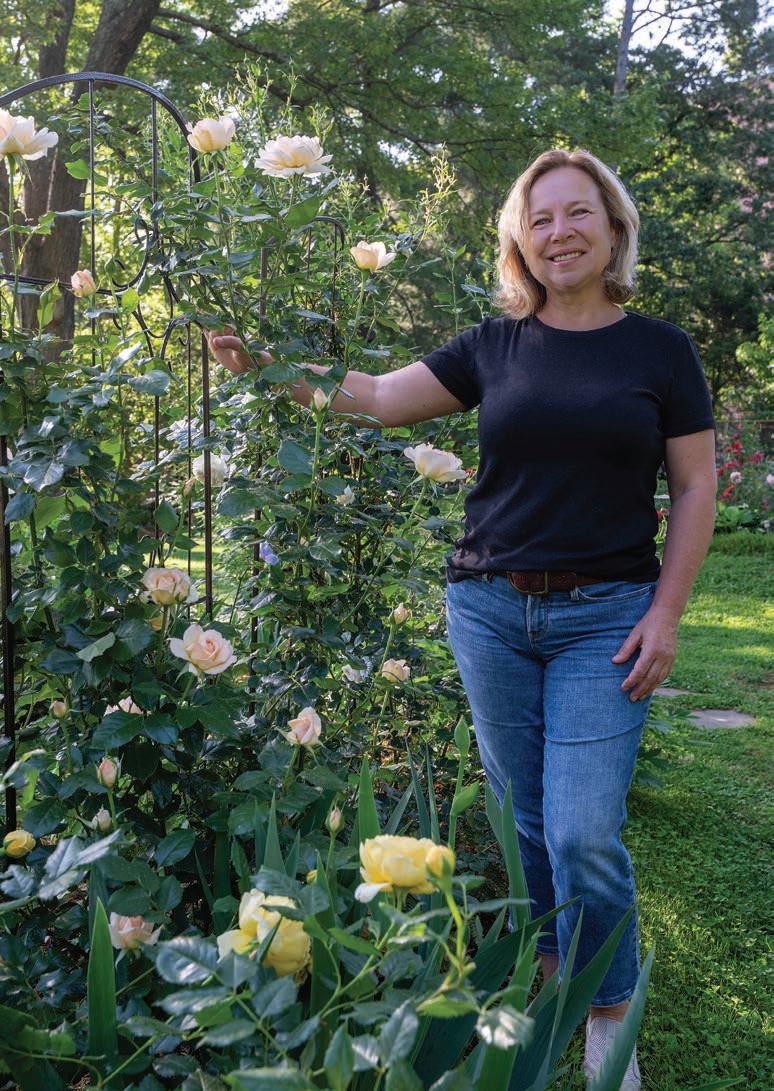
Before Yelena Belyayeva and her husband, Randall Bean, moved to Greensboro from Trinity, she tended lilies in her garden.
But roses were always on her mind.
“I grew a lot of lilies — they were so easy!” she says with a laugh. “At that time, I would think, ‘Oh, the rose, queen of the flowers, she is too much effort.’”
“But, in gardening, I want people not to be afraid,” she continues, “because roses are not as hard as people think.”
Yelena grew up in Temirtau, a city on the steppe of central Kazakhstan — still part of the Soviet Union until she was a young woman.
“My father was Russian and my mother was Ukrainian,”

Yelena says. Though they lived in an apartment, her mom “was very, very passionate about gardening.”
Outside the city, they had what is called a “summer house.”
Along with a vegetable garden and fruit trees, she remembers her mother growing irises, daisies, peonies, lilies, lilacs and snowbush. But the plains of Kazakhstan were harsh.
“My mom had a few roses, but we had to cover them,” Yelena says, noting that they didn’t fare well in the cold or snow.
“To tell you the truth, I didn’t like the garden work as a kid,” she confesses, smiling, “but I enjoyed the beauty, not just of the flowers, but of everything in nature.”
After high school, she attended Moscow State Forest University, where she dreamed of becoming a forest ranger.
“I wanted to be among the animals and woods,” Yelena says.
Since no forestry positions were available when she graduated, she returned to her hometown to take a job with the Temirtau Winter Garden, a public botanical garden conservatory of tropical and subtropical plants in a very cold place.
“Most of the work was indoors, but it appealed to my passion,” Yelena says.
Eventually, a close friend in Kazakhstan who had met and married an American, suggested that she knew someone who would be a perfect match for Yelena — her husband’s best friend, Randall.
But communication between the two was a challenge.
“I studied English when I was in school but I was not so good,” she explains. “My teacher said, ‘Yelena, you will never learn English.’” She smiles and shakes her head.
“But Randall bought one of these portable electronic translators and that is how we corresponded at first,” Yelena continues.
Following a two-year courtship, the couple married in Kazakhstan and moved stateside to Trinity in 2006 with Yelena’s 10-year-old son. (He went on to attend N.C. State and lives in Raleigh now.)
When Randall’s father, who had been living in the same Greensboro house since 1955, decided to move into assisted living, Yelena and Randall relocated to his old residence.
The house sits on a lot that’s nearly an acre in size. Randall’s father grew vegetables for years after his wife passed away, though he had neglected the vestiges of her flower garden.
“Mama Sarah had azaleas, camellias and big boxwoods,”
Yelena says.
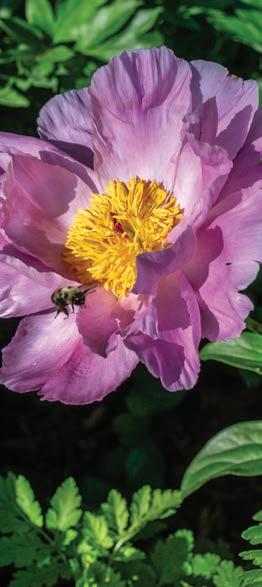
She also found remnants of candytuft and a row of peonies that she estimates are around 40 years old. And, while Randall remembers his mother growing roses, none of them were still living when Yelena began tending the garden.
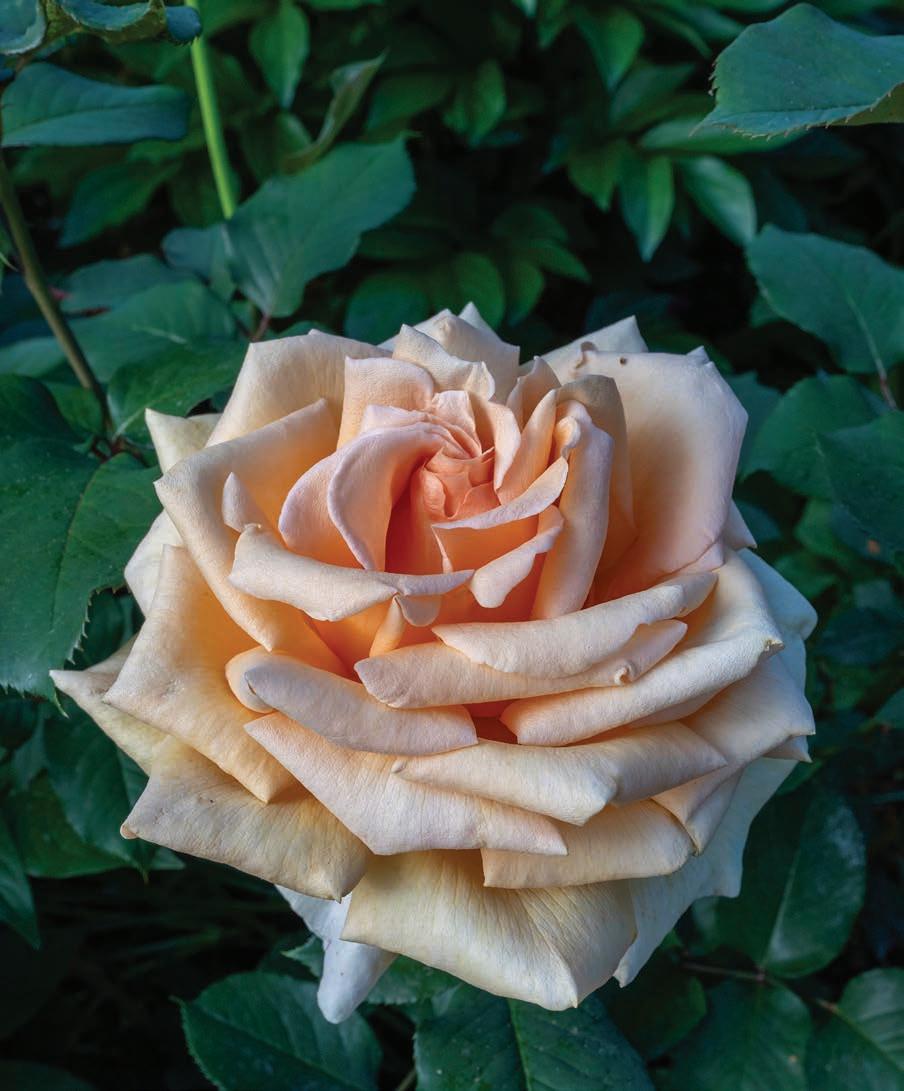
“So all 200 of the roses are mine!” she quips. “I have been collecting them for more than 10 years.”
Starting with the original flower beds, Yelena kept “extending, extending, extending” — and digging holes to plant her roses.
The work was difficult because of the heavy clay soil and the big roots of old trees.
“Randall even bought an augur, but that did not work so well,” she says.
And for several years, she was working full time.
Now that she is retired and the garden is established, Yelena finds that she still spends at least six hours a day in the garden for 11 months of the year.
“With our seasons, there is no break for gardeners,” Yelena explains. “We just finished raking leaves from these huge oak trees in January and in February. I’m already planting my first roses again.”
She smiles.
“But I love it,” she muses.
Yelena prefers planting roses with bare roots. And while she put in her newest roses this February, she believes the best time planting time for Greensboro is the first week of March.
“You can find all kinds of information about when and how to do it,” she says.
A source Yelena especially recommends is Witherspoon Rose Culture in Durham (www. witherspoonrose.com).
“I have several roses from them,” she says. “They give you everything you need.”
For the first year after planting, Yelena concentrates on keeping the new rose well watered. Depending upon the type of rose, she may use a systemic treatment to help prevent disease.
The greatest potential cause of disease in our area?
“It’s the humidity,” Yelena responds.
To promote blooming, she will fertilize her roses two or three times during the growing season, though she doesn’t like putting fertilizer in the ground. She prefers fertilizers she can spray onto the foliage.
“It’s easier for me and the plants absorb it faster,” Yelena explains.
To counter Japanese beetles, destructive pests that usually appear in June to feast on rosebuds and flowers, she has discovered a commonsense solution.
“This is what I learned from an Instagram friend in Japan,” Yelena says.

(The friend grows 1,500 varieties of roses in her garden!)
After the first wave of blossoms in May, Yelena pinches back the new buds as they appear for at least two weeks and closer to a full month.
“Every morning, I go out watering and I pinch the buds,” Yelena continues. “If you have five bushes, it’s not a big deal, but for me? Well, it’s a lot!”
So, when the Japanese beetles appear, their salad bar is closed, as it were. They move on for the most part, leaving Yelena with healthier roses. The downside is that a wave of blooms is lost, but she assures me she can still count on two or three more waves in a typical season.
I ask Yelena about which types — tea rose, grandiflora, floribunda, climbers, ramblers — seem to be best suited to her garden.
“You know, it’s more about, who is the father of the roses?” she replies. “Oh, what is the word?”
Yelena consults her phone to translate.
“The breeder!” she says, nodding happily. “Kordes in Germany is my favorite. They breed very healthy roses.”
As we walk about, Yelena shows me the abundance of plants in her garden.
“I have 80 peonies,” she says proudly.
I spot tulips, hydrangeas, creeping phlox, cone flowers, azaleas, hostas, zinnias, columbines and ferns. She shows me a robust vegetable garden along with cherry trees, crabapple trees and pawpaws.
“I don’t plant peaches anymore,” Yelena says. “We have so many squirrels, I just gave up.”
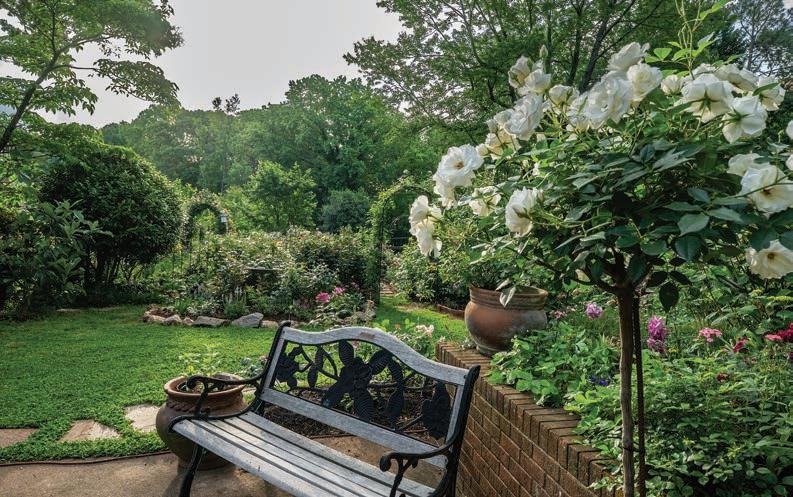
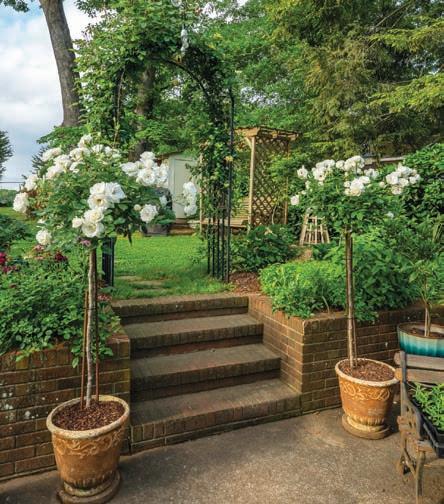
And, as you’d expect, there are roses everywhere, many cascading over trellises that Randall installed for her.
“This is a rambler called Peggy Martin,” Yelena says, pointing out an enormous rose bush. “She is absolutely gorgeous when she’s blooming.” The thornless rose variety is named after an avid gardener in Louisiana whose property stood under seawater for two weeks after Hurricane Katrina. The rambler was one of the few plants in her garden that lived.
“I guess because she is a survivor, she can grow crazy big!” Yelena says, laughing.
She points out two more roses that cascade from a trellis.
“This one is a climbing rose called White Lady Banks and you see next to her the yellow, also a climber.” I comment on the clusters of smaller flowers.
“Yes, the flowers are smaller than Peggy Martin,” she replies. “But the big difference between the ramblers and the climbers is that the climbers keep blooming all through the summer — the ramblers only bloom one time a season.”
But that one time? “It is spectacular!” Yelena adds.
She shows me how she prunes the ends of the roses to increase the cascading effect as they grow.
“There is a woman on Instagram from Italy,” Yelena continues. “She plants her climbers and ramblers close to her trees so they grow all the way over them!”
When I ask her if she has irrigation for the plants, she answers that it wouldn’t be economical to use city water, since she has so many roses and the beds are so spread out. Recently, she added three barrels to collect rainwater. She also carefully mulches her roses with pine bark nuggets to help them hold moisture. If the summer is very dry, she waters her roses by hand.
“But roses are hardy,” Yelena says. “You must choose the right variety from the right breeder, but once they are established, roses are very strong!"
“The beauty, the joy to see them and smell their flowers,” she muses. “Every year, I plant more and I think, ‘OK, it’s enough.’ But it’s never enough!”
Once again, Yelena smiles, surveying her garden. OH
Ross Howell Jr. is a contributing writer.
You can follow Yelena Belyayeva on Facebook and on Instagram @belyayevayelena.
By C yntHia a Dams • PHotogR a PHs By JoH n gessneR
The motor catches, a muted, whispery sound, as Mike Fowle casts his boat off from Dana Smith’s lakeside dock. “It uses the most cutting-edge battery technology on the market right now,” he says, watching our surprised faces. “Lithium phosphate.”
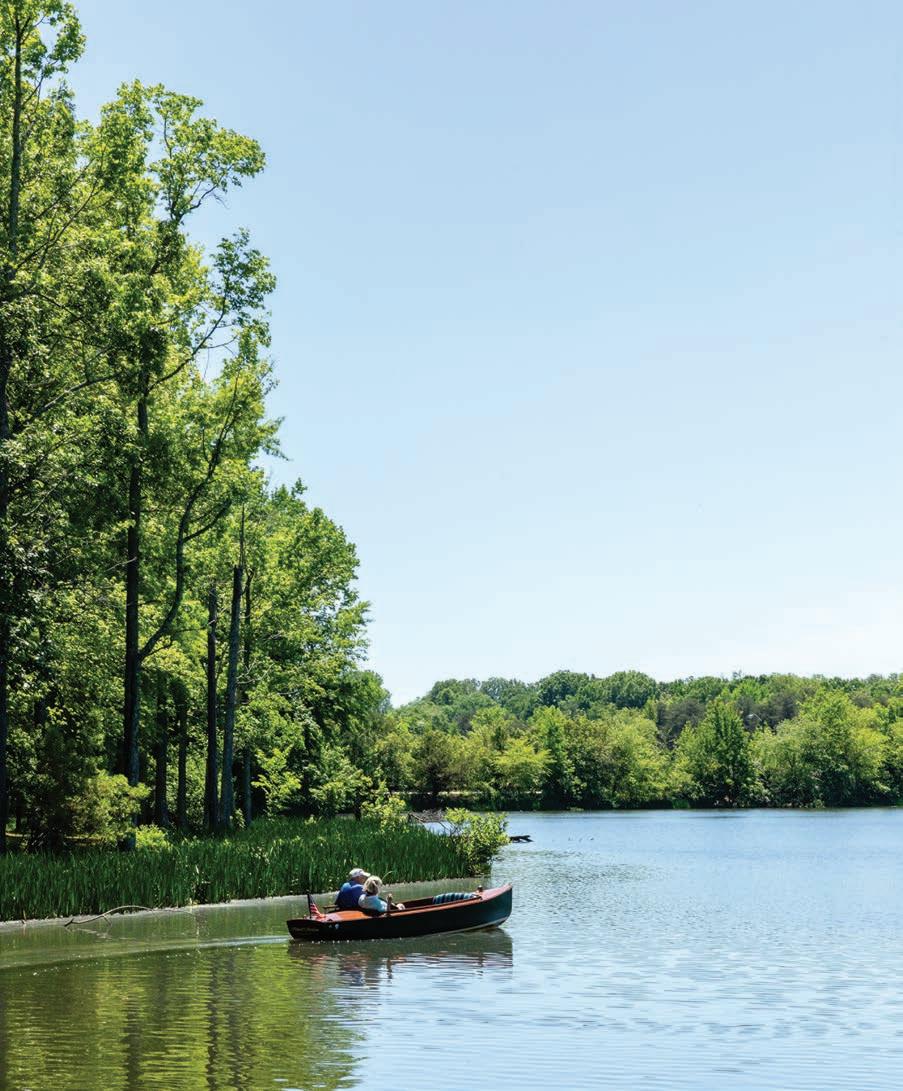
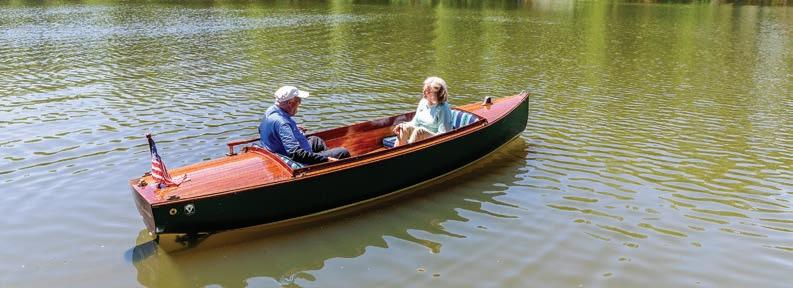
Three of us glide across Greensboro’s private Buffalo Lake in a modified version of the 1982 vintage Pelican skiff, aptly named Almost Heaven. Almost soundlessly.
Fowle grins. “That’s what you want.”
On a perfect spring day on the water, the most impressive aspect is what you do not hear. You do not hear the unmistakable roar of a standard-issue outboard motor. In fact, even with my hushed voice hoarse from allergies, conversation flows easily as Fowle describes retrofitting this small cedar-and-mahogany craft (outfitted with an electric motor) for owner Dana Smith.
If you think EVs on the roadways are remarkably silent, try an EV-powered watercraft. Practically noiseless — plus, it does not chew up gas, spew oil or foul the water. And the motor seems up to the task as three adults skirt around the lake’s edge, as pleased as children.
Fowle assures us the boat is sufficiently powered to carry four, smoothly cruising at the allowed 5 miles per hour.
An egret is unruffled when we slip past the shoreline, not even a wake betraying us.
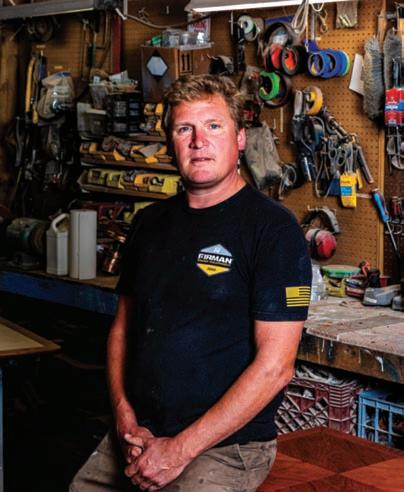
With the tousled blond hair and energetic brio of a younger man, Fowle is now 44. He is a man who loves water, but is more often wending Greensboro roadways for UPS, as he has for the last 25 years.
But his spare time is devoted to twin passions: cars and boats. His latest score is a 1958 red Corvette convertible.
While delivering packages on his route, he affably notices which customers are into cars. Occasionally, he will return
on his days off to take the lucky ones out for a spin in a vintage car.
Since his teenage years, Fowle has tinkered. He repairs, paints and undertakes car and boat restoration projects in his free time. Fowle learned much of what he knows from his father and the family’s wood-finishing business, which manufactured varnishes and finishes.
In 2020, he began Fowle Garage. The garage bursts with projects — a new boat he is working on awaits completion, and various car projects wait in the queue.
On a recent Saturday afternoon, he estimates having a day’s worth of tasks ahead.
“I have — let's see — there's one, two, three, four, five, six, seven projects here,” he counts as he walks through the garage and grounds.
Fowle and Smith became acquainted through previous boat restorations, he notes, “when I worked at a wooden boat shop.”
Smith contacted Fowle to help him find an electric Pelican. He already knew what he would do with it.
“He had bought this new house, sight unseen, with the idea that he was going to get one of these little boats and put a dock in.”
The house Smith had bought unseen? It was exactly where he wanted to be, Fowle explains. It was on a cul-de-sac at Ascot Point, with the advantage of having Buffalo Lake at its back door. “It gave him water access.”
By coincidence, Fowle knew about such a boat for sale — the exact model Smith was searching for — and it happened to need work. He connected the owner with Smith, who then worked out the sale.
The thoroughly modernized vintage boat was ready to glide in April 2025.
But homeowners on the lake did not own land on the lake perimeter.
Enter Jess Washburn, who did.
Washburn made headlines in 2017 when he became co-owner of two Greensboro private lakes, Buffalo Lake and Lake Jeanette. (His own party pontoon was featured just last month in O.Henry.) The former, smaller lake, only 69 acres, had disallowed lake access. But the much larger Lake Jeanette, at 270 acres, allowed restricted boating access via the homeowner’s private marina. Both lakes had buffer zones; neither had historically allowed docks.
One workday, Fowle took his lunch break at home when his meal was suddenly interrupted.
“I get a knock on my door. It's Dana and this other gentleman named Jess Washburn.”
Washburn, who also lives on Buffalo Lake, was working with various homeowner associations around the lake regarding access for residents.
Traditional motorboats and Ski-Doos were strictly disallowed. The Pelican, an electric boat, had Washburn’s attention. He had wanted to put electric boats into service on the lakes from the
start, given strict speed limitations and other homeowner association restrictions.
The two men told Fowle, “We want more of these boats to go on this lake because they're quiet.”
Electric-powered boats were a logical answer to the puzzle posed in 2017 by John Hammer, former editor of Rhino Times, concerning the fate of Buffalo Lake and Lake Jeanette after their sale by textile concern ITG.
“What do you do with a couple of lakes, particularly since the land around them has largely been developed?” he asked in his publication.
An adapted version of the Pelican proved to be Washburn’s solution.
Fowle says the new version far exceeds the original. “The idea came from Dana’s boat. I retrofitted his boat with a keel and steering system, and the electronics for the motor.”
He further modified Smith’s boat, adding a foot in length
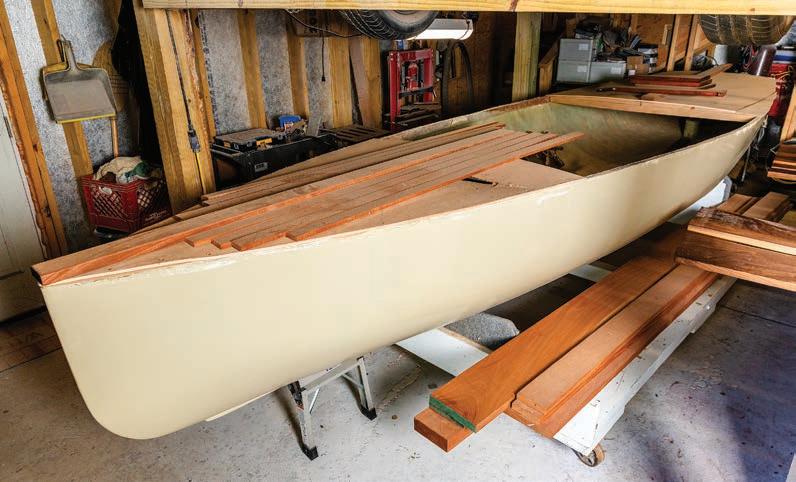
and 4 inches in width, changing the shape. Originally, he says with a laugh, it “looked a bit like a kayak.” He added stability by redesigning the keel, devising a pocket for the propeller drive unit and adding a tiller steering mechanism. “Everything was handmade to steer the rudder.”
In the eight months since Almost Heaven was altered and put into service, Fowle and his team have created a fiberglass mold for a next-generation hull. They now have the capacity to reproduce a boat adapted from the 1982 original in a matter of days.
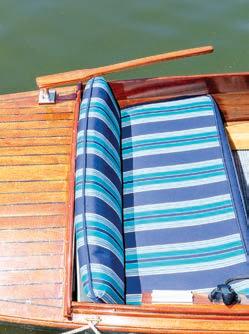
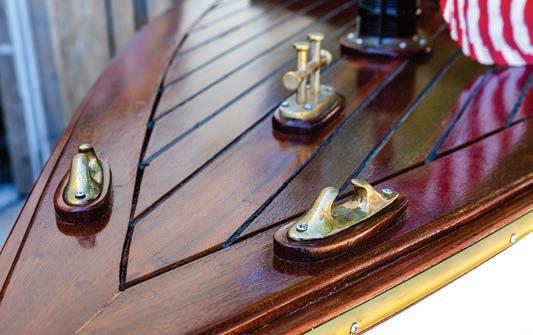
Once encased in wood and painted, the fiberglass boat appears to be a dead ringer for an original Pelican. It’s upscaled without sacrificing the good, traditional looks of a wooden boat now that Fowle has worked his magic. And fiberglass is not prone to leaks.
You would not know the difference visually, Fowle assures us. “This has all the appeal of a yacht in a super small package.”
Fowle’s passion doesn’t wane when it comes to refining restoration projects. At present, his grandfather’s 1931 Ford Model A pickup sits in his garage awaiting repairs. He says affectionately, “I basically got it running and learned to drive on it when I was 14 or 15.”
Just for fun, he borrows his father’s 1930 Ford Model A De luxe Tudor, driving around town, honking the goose-like horn for appreciative motorists. The 1930s car earned its “deluxe” designation, with handsome detailing, tweed upholstery and upscale finishes, such as a custom-made wooden trunk on the
rear. When he stops to dash into a grocery store for a Gatorade, admirers stroll over for a look and flash a thumbs up. Kept in mint condition and fully roadworthy, it recently made an appearance at a Gate City Rotary Club Great Gatsby-themed function.
Now, thanks to Fowle, Smith’s new-and-improved Pelican is proving relevant.
And it appears to be a win-win for all parties, plus water and nature enthusiasts who are equally environmentally interested.
Invariably, bottles and trash end up in the bodies of water he owns. Washburn adopted a stretch of Elm Street near his lake, where he cleans litter.
Smith and his wife, Zell, keen nature lovers, are often found trolling Buffalo Lake, fishing out ugly debris to ferry away.
“They are creating a positive impact on the environment, carting away as much trash as they can manage,” says Fowle.
Almost Heaven, agile and maneuverable, makes cleanup fun for the citizen environmentalists. It weathers the winter just fine, says Fowle, allowing the Smiths to keep it docked behind their home.
As residents and lake owners have worked through the approval process, more docks are reportedly pending on Buffalo Lake. Access remains carefully restricted to kayaking, paddleboats and quiet boats. Fowle anticipates a growing demand for more electric boats.
“Don’t you think that’s cool?” he asks, an enormous grin on his face.
It’s Almost Heaven. OH
By Danielle Rotella gueRR ieR i PHotogR a PHs By BeRt vanDeRveen
Last July, Tropical Storm Chantal wreaked havoc across central North Carolina, causing $500 million in storm damage.
Perched above the Haw River’s east bank in a quiet corner of Alamance County, Saxapahaw was ground zero for some of the worst flooding and property damage in the state, with nearly 12 inches of rain falling in 24 hours. Since its revitalization in the late 1990s, the former mill village has been a hip and vibrant destination, drawing visitors with its rich history, Southern cuisine, bespoke artwork, specialty craft ales and bohemian counterculture. On a recent cloudy Thursday morning, my dad, Pete Rotella, and I decided to see how Saxapahaw was faring after the flood.
We start our visit chatting with the Saxapahaw Museum director, Jane Cairnes, and the man behind the town’s revitalization, entrepreneur John M. Jordan Sr., son of the late U.S. Senator B. Everett Jordan. Jordan and his sons, Mac and Carter, purchased many mill houses and the abandoned spinning mill and dye house in 1995, and renovated them into 75 apartments. They also turned the upper dye house into commercial space and a home for The Hawbridge School, a public
charter school with an emphasis on community engagement, environmental stewardship and the arts. “We were competing with Chapel Hill, Durham and Raleigh real estate,” Jordan says. I had people living in 60 houses who needed a place to buy gas and bread, and I provided it.” Over the years, the sleepy little town evolved into a lively and progressive home for lovers of music, arts and the outdoors.
Just down the hill from the museum is the Saxapahaw General Store. After filling our bellies with a good ol’ Southern breakfast, we learn how owners Jeff Barney and Cameron Ratliff turned a modest gas station and country store into a community hub beginning in 2008. Look for gourmet grub with an emphasis on comfort food, a staggering selection of beer and wine, locally grown produce and area crafts. Thankfully, their establishment was not damaged by the storm. Just two days after Chantal passed, they announced on Instagram: “We have electricity, Wi-Fi, A/C, and our full menu available.”
Cup 22 is our next stop, an open, two-story space with black industrial railings and massive windows that welcomed neighbors and volunteers after the storm with bottomless coffees and
the adjacent Haw River Ballroom, one of North Carolina’s premier musical destinations. Known for hosting nationally and internationally renowned bands, the Ballroom has also held film screenings, workshops and private events since 2011, thanks to its large, 750 capacity that maintains an intimate vibe. Due to its location in the mill’s upper dye house, the Ballroom was left unscathed, making it an ideal hub for storm relief efforts.
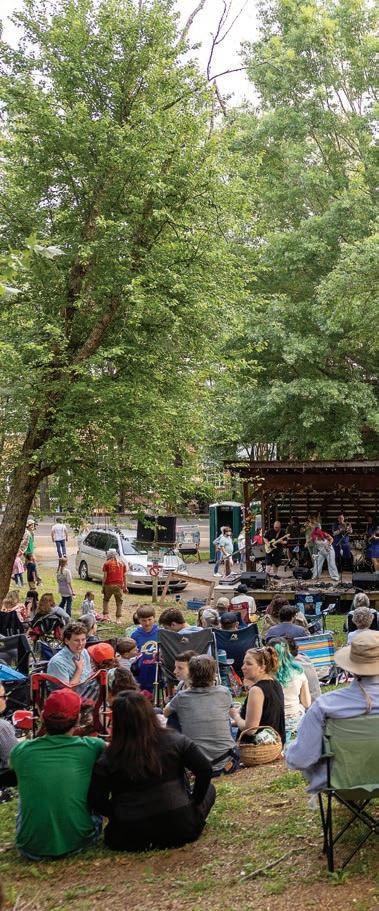
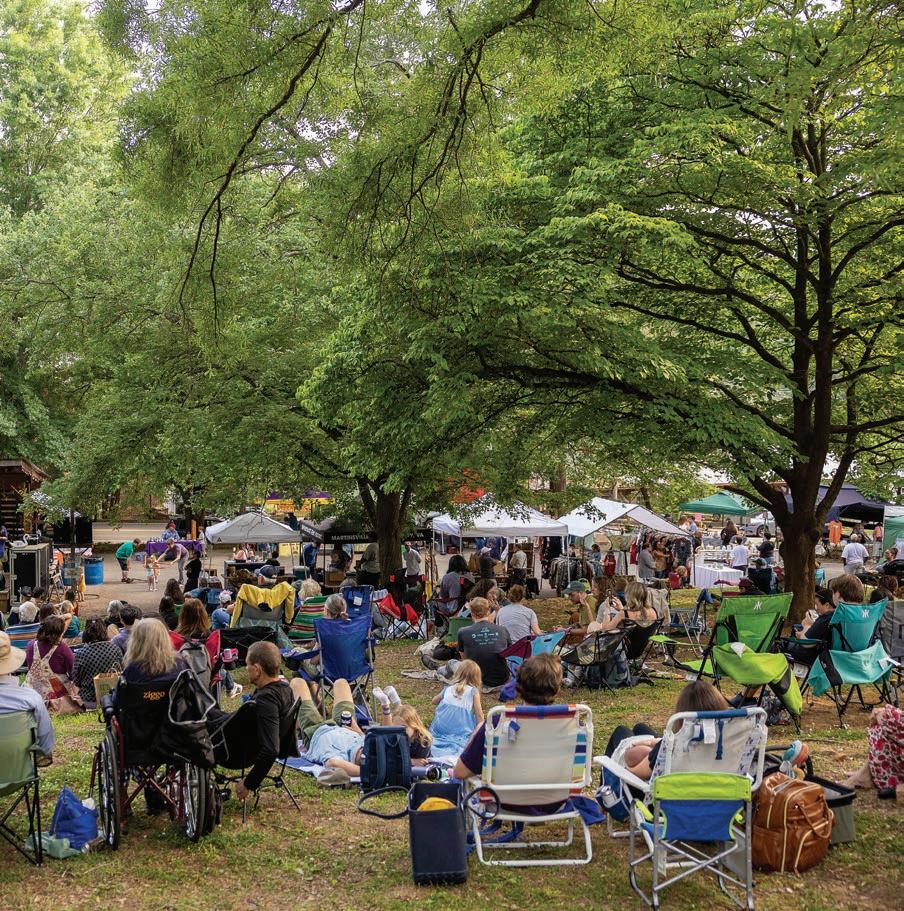
Saturday in Saxapahaw is another LaGarde creation, a familyfriendly outdoor concert and farmers market held weekly from the first Saturday of May through late August from 6-8 pm. Held in a grassy hillside near the Ballroom, “Swan Buckets” and a Swan Venmo account collect donations that pay operating costs. The LaGardes were also instrumental in organizing widespread relief efforts last July.
Next door to the Ballroom is Haw River Farmhouse Ales, a quaint, eclectic pub with cozy outdoor seating, owned by Ben Woodward and Dawnya Bohager, who use locally grown ginger, barley, rye and other ingredients in their small-batch customer favorites, such as Odds & Ends IPA and Saxtoberfest.
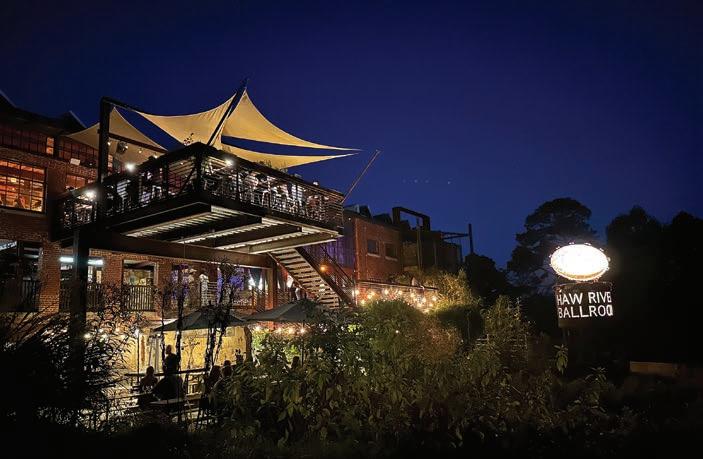
Excited to explore Saxapahaw’s art scene, we walk to Riverside Collective, where we’re greeted by contemporary oil painter Katie Pape, one of the five female artists who opened the shared studio space in 2004. When the bike shop next door moved, Katie and her husband, Ian, opened an adjacent store, Saxy A GoGo. Inside, Saxy, a vintage shop, a nonalcoholic bar, a lounge and a recording studio are all connected, creating a funky, urban vibe. Along with their wide variety of art, Riverside Collective offers classes in weaving, watercolor and leatherwork, and a Monday Open Studio Night where fellow creatives can connect. (While their shops didn’t sustain flood damage, the Papes’ daughter’s preschool, Saxapahaw Village Kids, inside Saxapahaw United Methodist Church, was completely submerged. “One of my favorite stories from the flood was how Holly, the preschool’s pet chinchilla, was gallantly rescued by volunteers after the storm,” Katie says.)
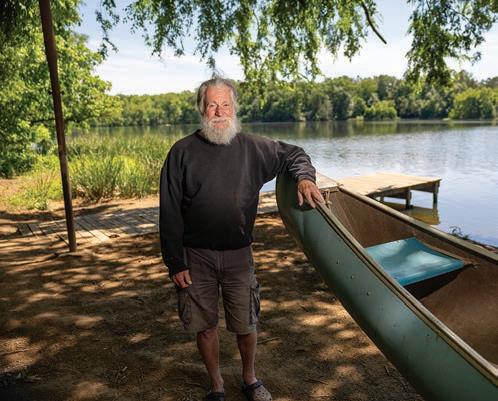
With our new art carefully packaged, we mosey past more upper mill spots that dodged storm damage — Deipnon Studio, a custom tattoo shop, and The Hawbridge Lower School — before entering Leftbank Butchery. Owner Ross Flynn opened the whole-animal butchery in 2014 to provide a local outlet for area farmers who want to process and sell their meat, such as beef cows from Alamance County farms and chicken from Little Way Farm in Siler City. Before leaving, we look into Flynn’s Seam Butchery Class, which teaches ways to cut and use every part of an animal, and the Basics of Cooking Meat Workshop, an excellent way to learn techniques for brais-
ing, roasting and pan-frying cuts of beef.
With a pound of tienda chorizo in hand, we climb up a steep staircase before opening a ginormously heavy oak door to enter The Eddy Pub, a European-style gastropub serving farm-to-table food and known as “Saxapahaw’s Living Room.” With old steam valves as beer taps, a rustic wood ceiling set against expansive windows overlooking a patio and the Haw, the pub partners with local farms for their meat and vegetables and serves North Carolina-brewed beers and wines from smaller, family-owned vineyards. On the second level of the mill complex, the pub
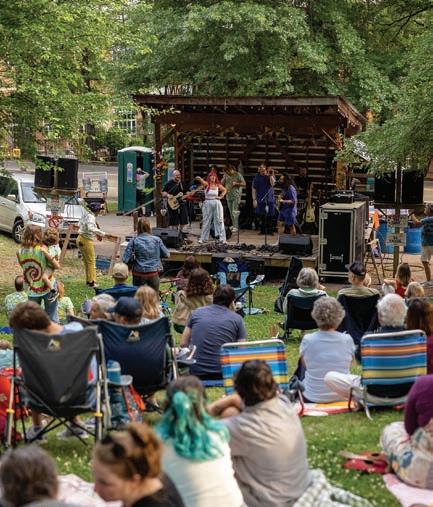
remained unscathed by the flooding. General manager and co-owner Paul Neubauer and his staff were some of the first to volunteer after the storm.
After bowls of hearty chicken chili with fresh sourdough bread, we walk up the road to StudioSax, a multicultural, creative café and vintage store opened last year by Deborah and Robert “Robo” Jones, the talented trombonist from the 90s jazzy, pop-rock band The Sex Police. Deborah proudly shares that it’s the only Black-owned storefront in Saxapahaw as she finishes setting up paints and brushes for the night’s dot-painting event. Jones then gives us a tour of the outside courtyard, which she explains was “completely filled up with water when it flooded.” Sand and dirt still line the cement courtyard, which adjoins a nearby hillside, where folks gather to hear live music and many come for sound baths, a meditative, immersive audio experience that induces relaxation.
As my dad and I leave Saxapahaw, we’re both struck by everyone’s love for the dynamic, free-spirited river community. There are still small, visible signs of Chantal’s passage, but those are nothing compared to the stories of generosity and the survival of a magical place that refuses to be washed away. OH
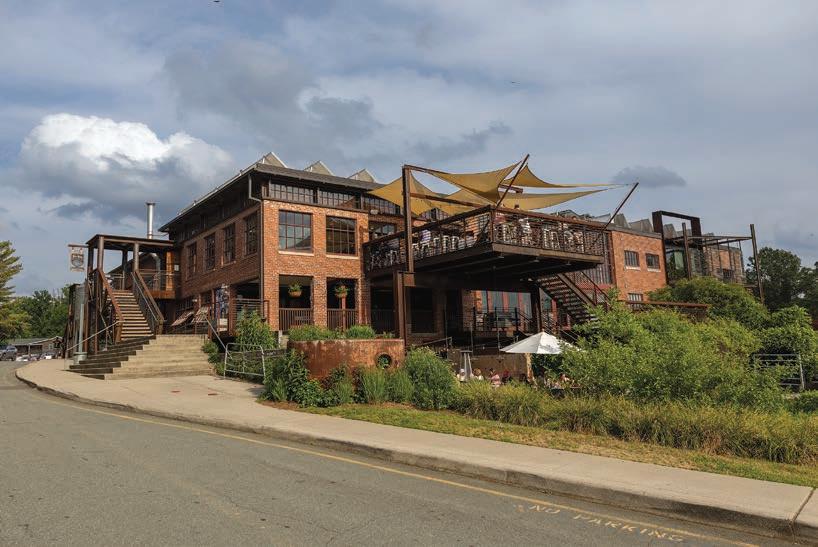
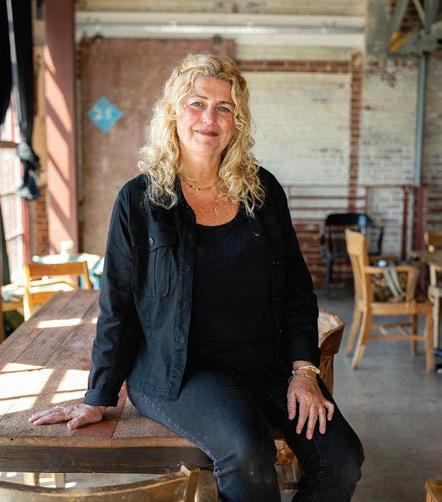
Heavy rain and winds fueled by Tropical Storm Chantal began on Sunday, July 6, and, by Monday morning, the Haw River had crested at 32.5 feet, within an inch of the 1996 flooding following Hurricane Fran. Both the Buddy Collins Memorial and Church Road bridges were submerged beneath turbid water pouring out of the Haw. Later in the day, Haw River Ballroom co-owner Heather LaGarde says, the stormwater had receded enough to gauge the damage. She quickly harnessed her international disaster-relief expertise (from 20 or so years working in the human rights nonprofit sector) and her expansive social media channels to bring the village together through an in-person and Zoom meeting in the Ballroom that afternoon.
“Everyone in here was shellshocked, gobsmacked,” Heather says. She put enormous sheets of paper on the stage, where volunteers wrote down needed supplies — buckets, hammers, crowbars, dish soap — and those who weren’t affected shared how they could help. A makeshift leadership team was quickly assembled to oversee incoming donations and direct volunteers, allowing the rebuilding to swiftly begin. For nearly three weeks, the Ballroom was closed, making it command central for supplies and donations. “It looked like a Home Depot in here!” exclaims Heather. She was overwhelmed by the outpouring of help. “The response was truly beautiful. We got such a hard hit but were able to rebound because of the sweetness of the community and the kindness of all the people.”
Most affected by the flooding were Saxapahaw Campground, The Haw River Canoe & Kayak Company and The Bridge Wellness Center, whose owners discovered that when it rains — even torrentially — the Saxapahaw community pours in support. We had an outpouring of people wanting to help,” says Lauren Miller, owner of The Bridge Wellness Center. “Volunteers came out with a swiftness to do the heavy lifting of getting everything out of the space.” Her studio, she says, was covered in mud and sentiment, cardio equipment floating in the water, and her storage area completely submerged, accessible only by canoe.
The Haw River Canoe & Kayak owner Joe Jacob was overwhelmed by the abundance of support. “Many were bummed by what took place, but it reminded me of so much positive in the world,” he says, “and I found it to be a very uplifting experience.” Water rose past the ceiling of Jacob’s building, taking a day to recede enough for him to assess the damage. Over 60 people came out to help that first day. Everyone was covered in mess and muck. No one ever handed me a bill, and one lady gave us a Ford Explorer because she knew our vans flooded.” What is it they say about a rising tide lifting all boats?
Mike Bordeau, owner of Saxapahaw Campground, says the people in Saxapahaw care about each other, and “the old, the young, everybody here gets along with everybody — that’s the big draw.” Sitting riverside, Bordeau’s Campground had 25 feet of water come through. “When I first saw the damage, I wasn’t sure we could recover. It was catastrophic for us, causing us to close for three months.” That was the first time he’d ever shut his doors in the campground’s six years of business.
Shortly after Chantal passed through, a GoFundMe campaign was created to financially support local businesses, and the nonprofit SaxForward coordinated financial donations and supplies. “Thanks to the donations, I was able to pay my staff and came close to breaking even for the year,” Jacob says.
Now, everyone is back up and open for business. “We still have some rebuilding, but nothing to keep us from opening,” Bordeau says. Jacob is constructing a small structure to house his kayaks and canoes by the lake, which, he says, “will be nicer than what we had before.” After months of remediation and restoration, plus a little redesigning, Miller’s wellness center is open again, offering day passes so visitors can drop in for a workout, sound bath, stretch or yoga session.
Two of Saxapahaw’s other creative spaces, Paperhand Puppet Project and Culture Mill, were forced to regroup after the flooding. Paperhand, a puppetry arts nonprofit, was in the process of relocating when the storm accelerated their move.
A performing arts laboratory, Culture Mill’s rented building had long suffered from dampness, with Chantal increasing the potential threat of hazardous mold. Directors Tommy Noonan and Murielle Elizéon decided last year that being nomadic was the best option for their arts ecosystem. The flood water rose so high in Paperhand Puppet’s storage building that they lost supplies for their upcoming show, The Gift, about the power of water — an irony not lost on director Donovan Zimmerman.
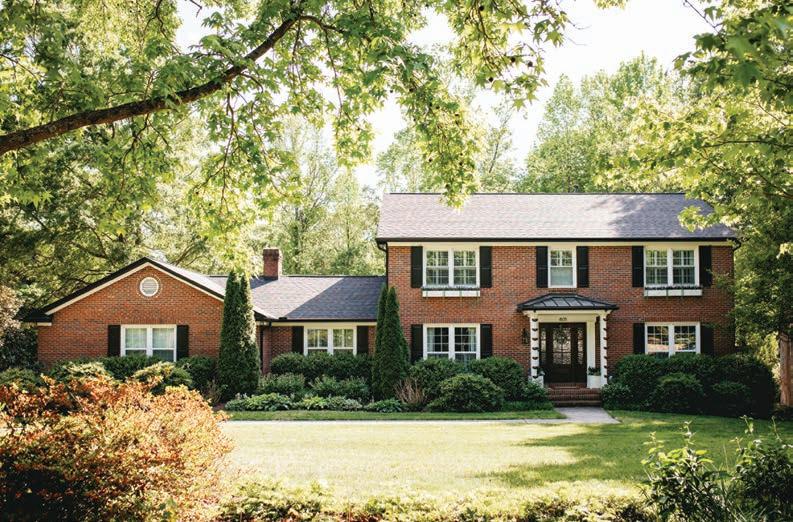
“Last week we got a phone call about a little girl,” says Ashlee Wagner, lounging on her plush living room sectional while her two daughters, 7-year-old Lowina and 4-year-old Lizzie, play nearby. Her husband, John, is busy helping Lowina find the Beyoncé song she’s looking for on her device.
Lizzie twirls in a Disney princess dress, lost in magical reverie, while Lowina’s ears perk up at her mother’s words. “Mom, are we getting a new sister?”
“Yes, baby,” answers Ashlee. Lowina cheers enthusiastically.
“You know how there are little girls who dream of getting married and getting pregnant?” Ashlee asks. “I was never that kid.” Her own father and his siblings were all adopted and she knew that, when it came time to start her own family, she wanted to adopt.
John, who owns his own State Farm Insurance Agency, jumps feet first and wholeheartedly into Ashlee’s plans. “I think I feed into her sometimes, and that's probably why we're so wild with everything going on in life,” he says. “But it's fun.”
When the Wagners bought their traditional, brick house in 2017, they imagined filling the New Irving Park home with kids. “That was always the plan,” says Ashlee, who owns her own travel company, Just Another Wagner Adventure. Just as they kicked off their adoption journey, they got to work renovating — first, the
first floor, followed by the pool and backyard, then the basement and, finally, upstairs. “We basically built this house to be our forever dream home,” muses Ashlee.
“I want to keep this house forever,” says Lowina, who officially became a Wagner just before she turned 3. With renovations underway in 2019, John and Ashlee initiated that first adoption, but what is already a lengthy process was stalled even more by the COVID pandemic. Finally, in January 2022, the couple headed to South Africa to bring home Lowina.
Of course, a few months before that trip, one that was to last about six months, life caught them by surprise. “I found out I was pregnant,” says Ashlee. When they finally returned to the States in the summer of 2022, they brought home both Lowina and her infant sister, Lizzie, who was also born in South Africa — a bond Ashlee is thrilled all three of her girls will share. And the place her soon-to-be-three girls will be lucky enough to grow up in together? Well, the Wagners are determined to turn it into an at-home adventure haven that would exceed any child’s wildest fantasies.
They started renovations with the living room and kitchen, which open to one another, adding white, shaker-style built-ins and revamping the fireplace with a simpler look that features a thick, rustic slab mantel. The small “U”-shaped kitchen was reconfigured to fit an island and banquette seating. “I always had that dream of, you know, you’re washing dishes and you look outside.” Over the banquette, a painting by artist Amira Rahim, aka “The Color Poet,” adds a vibrant splash to the otherwise neutral space.
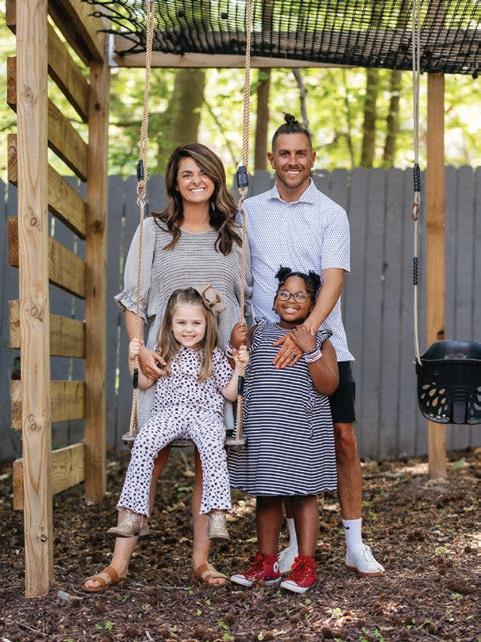
The walls on the main level are coated in various shades of gray and filled with accessories and art from their travels all over the world, a passion that slowly turned into an avocation. (More about that later.) In the dining room, a grid of eight square photos glows with the oranges and yellows of global sunsets from various destinations. One photo that Ashlee took using a tripod shows the silhouette of John and Ashlee caught in a kiss, the sun’s orb illuminated behind her while hot air balloons in the distance fleck the sky.
Nearby in the den, long, wooden shelves line an entire wall. Ashlee points to various tchotchkes and lists the countries
they’re from: “This is Egypt or Jordan. That is Tanzania. Lolo, where did we get this?” She asks her oldest. “Was this Mexico or Honduras?” Their souvenirs include a Day-of-the-Dead-inspired cat, a beer stein, artisan-made glass elephant bookends, a strand of beads featuring evil eyes. “We have evil eyes kind of hidden everywhere to keep the bad spirits out.”
When it’s time to go upstairs, the girls race ahead, shouting, “My room’s cooler!”
“My room first!” says Lowina. What color is it? “You’ll see when you get there.”
“Oh, Lowina,” Ashlee says with a laugh. “Silly girl!”
All of the bedrooms, including the primary, are painted in shades of blue or teal, with the girls each having pink accents. Lowina’s features a giant map of the world, a lace teepee, blush scalloped curtains, a muted-rose rug and a pair of twin beds adorned in — you guessed it — pink. Does Lizzie sometimes bunk

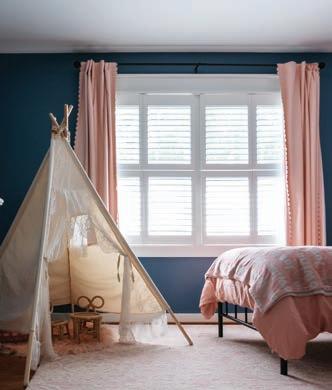


with big sis? Nope, says Lowina, the other bed is where the family’s two cats sleep.
Though she’s younger, Lizzie’s bed is a queen. Her room, says Ashlee, used to have a tent bed and a “true safari theme.” But, as the family prepares for a longer stint of summer travel as well as another period in South Africa, she’s planning to rent the home short-term and is leaning into practicality. A large stuffed giraffe still stands in the corner and a circular, golden-yellow lion pillow rests on a hanging chair.
Just down the hall from their bedrooms, the girls share a bathroom and — wait for it — an indoor jungle gym. Ashlee and John have created a bunk room, where the twin-on-top and full-on-bottom beds have been built in. And, on another wall in that space, sits a large, wooden playset, complete with rings. “Come look at my trick,” cries Lizzie as she hangs upside down.
Lowina, not to be outdone by her little sister, performs a Little Mermaid-style hair swoosh move while Mom walks into her own bedroom, adjacent to the bunk room, which was originally part of the primary bedroom. Ashlee and John reconfigured the two rooms on that side of the house,
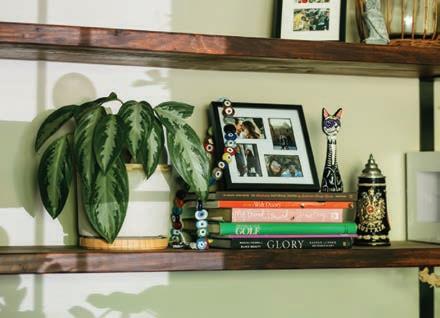


creating the bunk room and adding a large walk-in closet with French sliders. On either side of their bed, Ashlee hung funky lanterns they found in Turkey and, on the front-facing wall, they added built-ins and a window seat. A hands-on couple, they did much of the work upstairs themselves and hired J&K Builders to do what they could not.
On the basement level of the home, where they continued working with J&K, yet another play gym keeps the girls busy. “Mommy, I’m going to slide!”
Lizzie exclaims, landing in the middle of a ball pit as lightweight balls in aqua, red, lavender, pink and orange fly.
Nearby, a projector hangs from the ceiling, aimed at a blank, white wall standing in as a screen. “This is our movie area,” says Ashlee. Another comfy sofa provides the perfect space for a family snuggle sesh
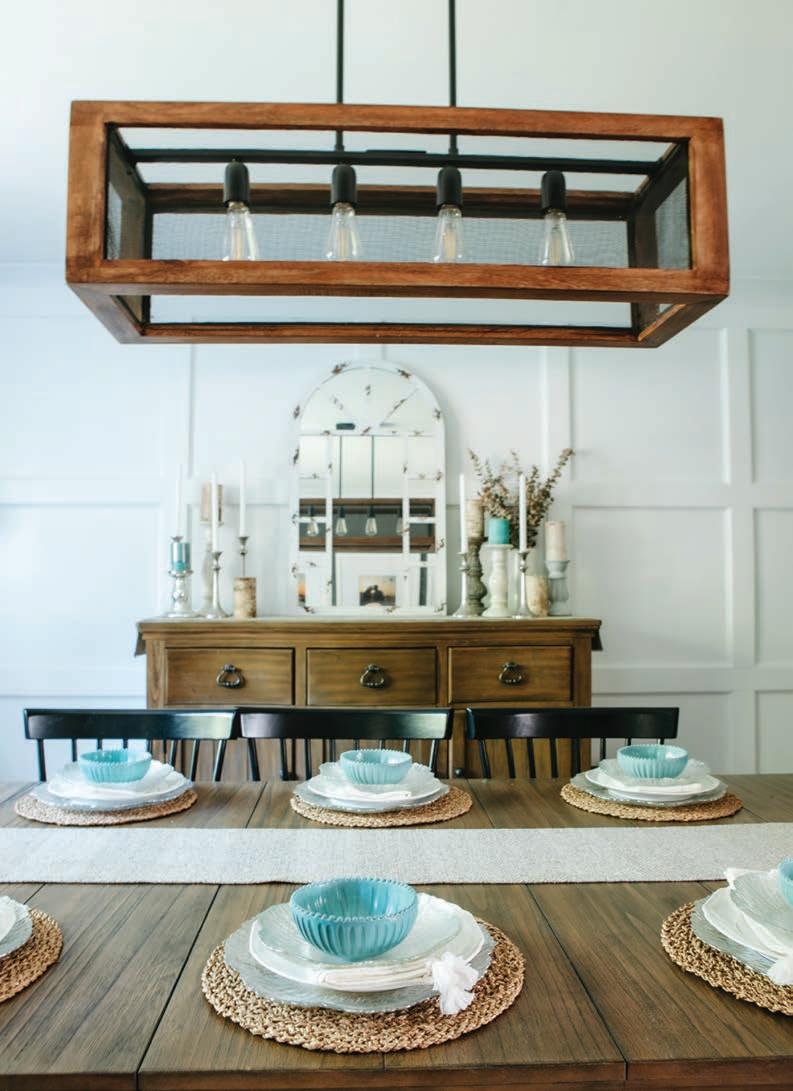
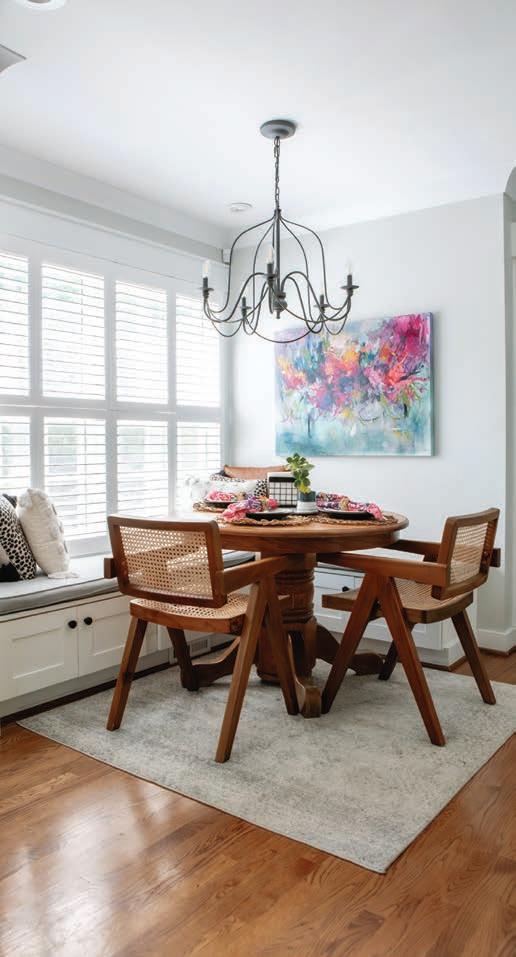
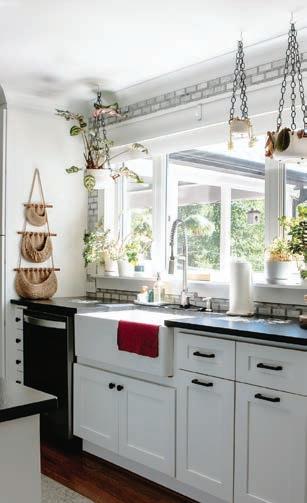
while they watch modern and classic Disney hits together. Lizzie opens a large trunk that serves as a coffee table. Inside, it’s filled to the brim with more princess dresses and costumes — time for an outfit change!
A kitchenette, bedroom and bathroom take up the rest of the basement space, plus a little bonus. “Yeah, I got a sauna,” says Ashlee. “I thought, why not?” Sometimes, Mom needs a quiet space to escape.
From the basement sliders, the girls are ready to run outside as dappled afternoon sunlight shadows the lawn. The backyard, just as she’d once dreamed, can be seen while Ashlee stands at her apron sink. There, she can watch the girls play in their treehouse, gaze at the peaceful surface of the pool or watch John and his sticks at work on the putting green.
Yes, a putting green. John’s a big golfer and, while he’s got his own bucket list of course destinations, he wanted to bring a bit of The Masters look to his own backyard. So, the couple dug in, adding an abundance of azaleas, mimicking the
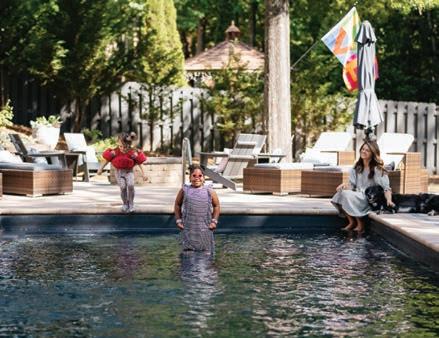

look of Augusta National Golf Course in Georgia. In fact, while they worked with Summit Landscaping Innovations alongside Guilford Pools on all hardscaping and the pool, John and Ashlee did all of the planting.
Tucked alongside the back fence, a modern-looking treehouse sits high, nestled among a few trees. Ashlee looked at some ideas on Pinterest and John ran with it, building his kiddos a dreamy,
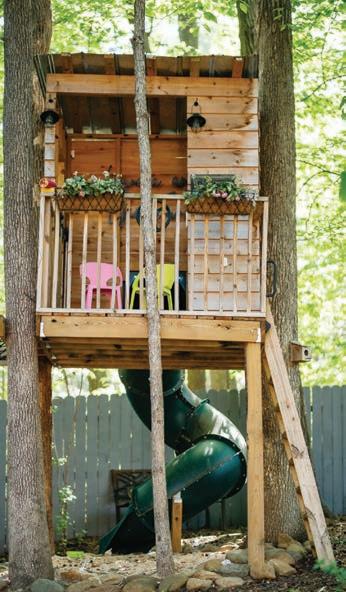
lofted playhouse. While a ladder will get you up, a tunneled slide is definitely the way down. A jungle gym extends to the treehouse’s left and, nearby, a disc swing gets plenty of use. “Mama, go fast!” shouts Lizzie as her mom pushes her.
“They like to go really high,” says Ashlee. After all, the sky is the limit. “I want to raise my kids to where they can go blow the world open if they want to.” OH
John and Ashlee Wagner met in the fall of 2008 as freshman at UNCG. “In Business 101 class, funny enough,” says Ashlee. John sat right behind her. Soon after meeting, the two began dating. But, midway through the first year, John decided to “retire from school” and returned home to Wilmington.
“John’s been a rebel his whole life,” quips Ashlee. “He likes to defy what the norm is.”
A year and a half later, Ashlee visited friends in Wilmington. “And somehow John pops back up and we’re dating the next week.”
In 2014, after Ashlee earned her bachelor’s degree in business administration, the Wagners tied the knot in Ocean Isle, honeymooned in Cancun and then, months later, took a bigger, second honeymoon in Ireland. That same year, Ashlee accepted a new role at an executive search company. Finally, John says, “Finances felt stable,” and the honeymooners found themselves bitten by the travel bug, booking two big trips a year.
“Each trip was three or four countries,” says John.
“And what’s crazy is,” says Ashlee, “I think we’ve only been to 40 countries.” OK, that’s a lot, she acknowledges with a laugh.
But, notes John, referencing a world map that graces their wall, a pin in each place they’ve visited, “There are still so many places we haven’t even touched.”
In 2022, once she was back at home with her daughters, Ashlee began contemplating what she wanted out of life. Now as a VP, she was working some 80 hours a week. Plus, she notes, being a woman in leadership in the South comes with its own set of challenges. She asked herself, “If my kids were in this environment, what advice would I give them?” The answer was clear: “My advice would be to quit and go do something you love.”
Friends and family had been telling her all along that she should think about pursuing a career in travel, but a voice in her head kept talking her out of it.
But now, with four —soon to be six — little female eyes on her, she says, “I decided I was just as worthy of that advice.”
Today, she runs her own company, works with John a bit and even manages some properties they have acquired over the years as well as some for local, woman-owned Nomad Vacation Rentals. With a flexible schedule, the family jet-sets all over the world and roadtrips all over the U.S. Plus, she’s got the freedom to now be the mom who goes on field trips or helps out in class. “I can do whatever I want,” she says, “and that has been very fulfilling.”
“That’s why I have my own business,” notes John, who says their Greensboro home is his eventual retirement plan — meaning, he’ll sell it in 20 years or so and travel the world, perhaps buy a new property, maybe in another country. Though Ashlee says they created it to be their forever home, her wheels are always turning, too. “My dream would be running a safari.”
“Tomorrow’s not promised,” he says. “You can always earn money tomorrow. Make the experiences right now.” Plus, he says, they were lucky enough as a young couple to purchase “all the toys I ever wanted,” silly things like drones that end up in a closet somewhere. “I’d much rather book the plane ticket.”
Last summer, the family of four, plus their two large dogs — their cats stayed behind — traveled much of the United States in a 20-foot camper. “Wild,” says Ashlee. Once again, this summer, they’re hitting the road for one more long-term adventure as a family of four. And soon, they’ll be headed back South Africa, returning to the States as a family of five.
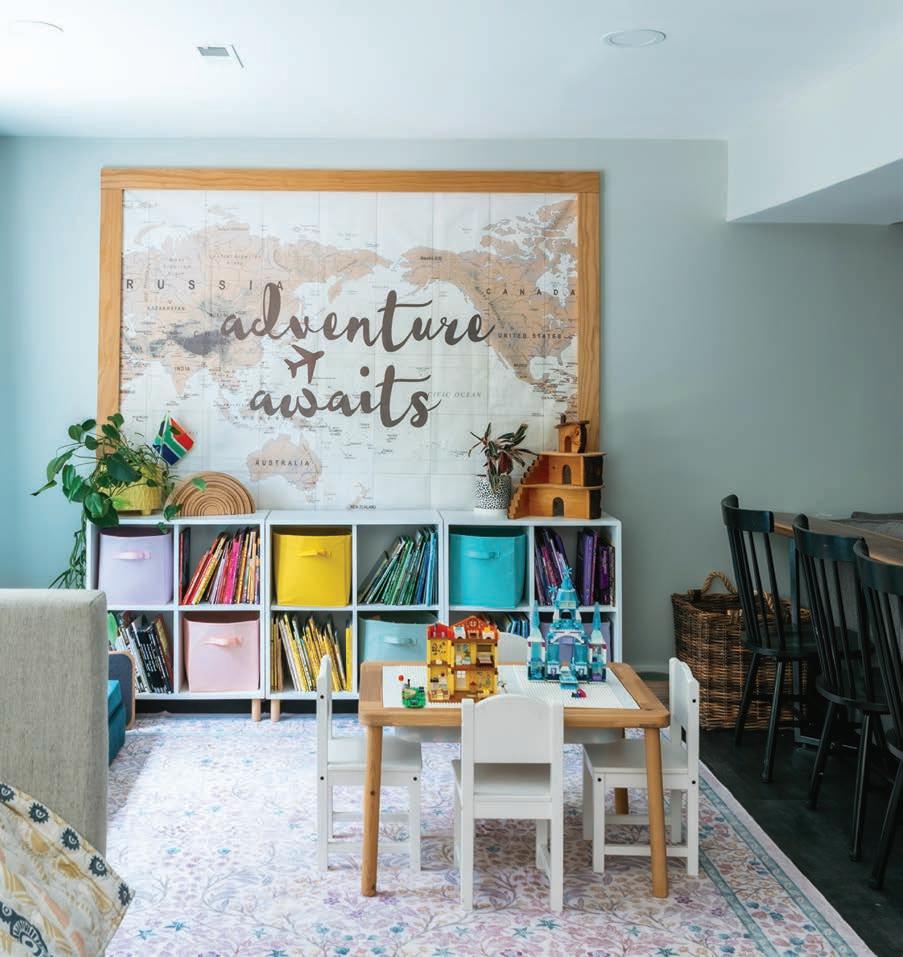
By asHley walsHe
June is a blueberry banquet, a living shrine, a procession of sun-loving pilgrims.
Here they come, with their sun hats and baskets. Wonderstruck and reverent; wide-eyed and ravenous.
There’s no wrong way to worship.
Aging fingers work methodically, rolling over ripe berries as if they were prayer beads on an endless mala. Mothers guide tiny hands from fruits of red to deepest blue. Kitchen mystics pluck to the mantra of blueberry ice cream, blueberry cobbler, blueberries all summer through.
Life buzzes in all directions.
Cat stalks field crickets. Puppy chases swallowtails. Children sneak plump berries from brimming buckets by the handful.
The seekers come and go, each with their simple offerings: bliss, open palms, purple-stained prayers.
At blueberry church, Mmmmmmm is a sacred hymn. A pop of sweetness spells amen.
As balmy morning melts into sun-drenched afternoon, the hum of bees could bring one to their dirt-smudged knees.
Thank you, a berry pilgrim sings, praising the miracle of all creation.
Between the spike of mosquitos and the early fireflies, the birds blurt Glory! Glory!, same as they did at sunrise.
And so it goes, summer day after summer day. Baskets runneth over. Bellies fill with sweetness. All who seek shall find magic at the blueberry jubilee.
What could be dreamier than a day in June? A midsummer night.
The field crickets crackle like warm vinyl. Moonflower and nightblooming jasmine perfume the balmy air. Drink it in. And don’t forget to look up.
According to NASA, the Venus and Jupiter conjunction on June 8 and 9 is one of the most notable astronomical events of the year. Look low in the western sky a half-hour after sunset to see these two luminous planets seemingly close enough to touch, no telescope required.

The strawberry moon — first full moon of summer — will rise on June 29, one week after the solstice (June 21). The Old Farmer’s Almanac notes that Native American Algonquian tribes, and the Ojibwe, Dakota and Lakota peoples, marked this month’s moon by the “ripening of June-bearing strawberries” across the fertile land. Other names for this month’s moon include the berries ripen moon (Haida), the hatching moon (Cree), the honey moon and the mead moon. One could also call it dreamy.
And what is so rare as a day in June? Then, if ever, come perfect days. — James Russell Lowell

It’s not too late to sow some garden magic. Cucumbers, squash, pumpkins and melons. Beets, carrots, chard and scallions. Beans, basil, marigolds and sunflowers. The soil is warm and ready. Plant the seeds. Woo the pollinators. Behold miracles. OH
A SPECIAL SECTION DEDICATED TO LOOKING AND FEELING YOUR BEST IN 2026
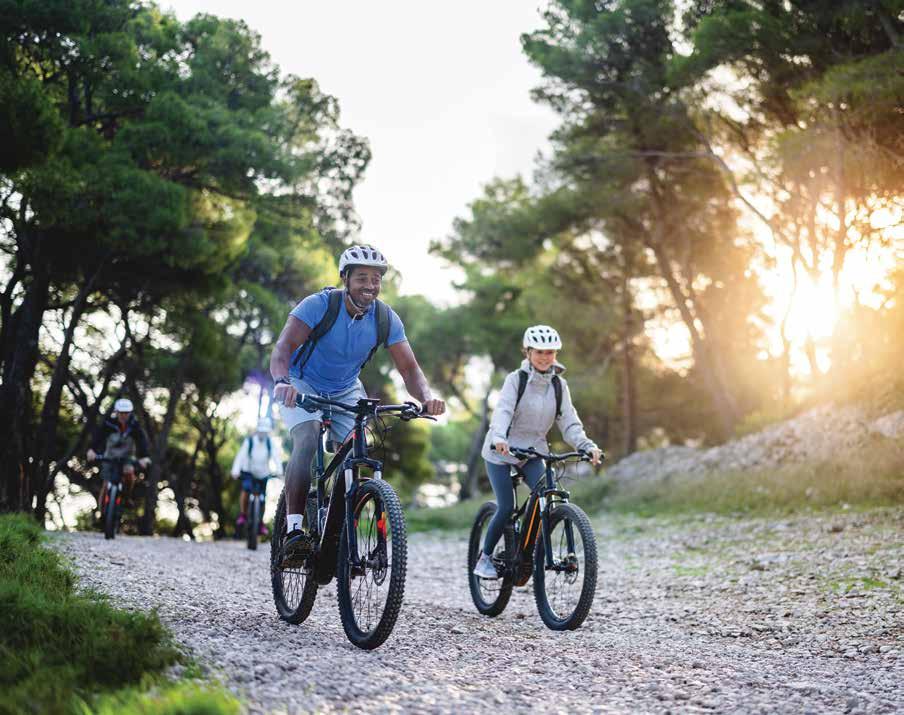
Wake Forest Outpatient Imaging
Merle Norman
The Curated Aesthetic
Cass Jewelers
Core X Studio
WhiteStone
Seabolt Upholstery
Greensboro Plastic Surgery
Focus Personal Training
BrightStar Care
Humane Society of the Piedmont
Fellowship Hall

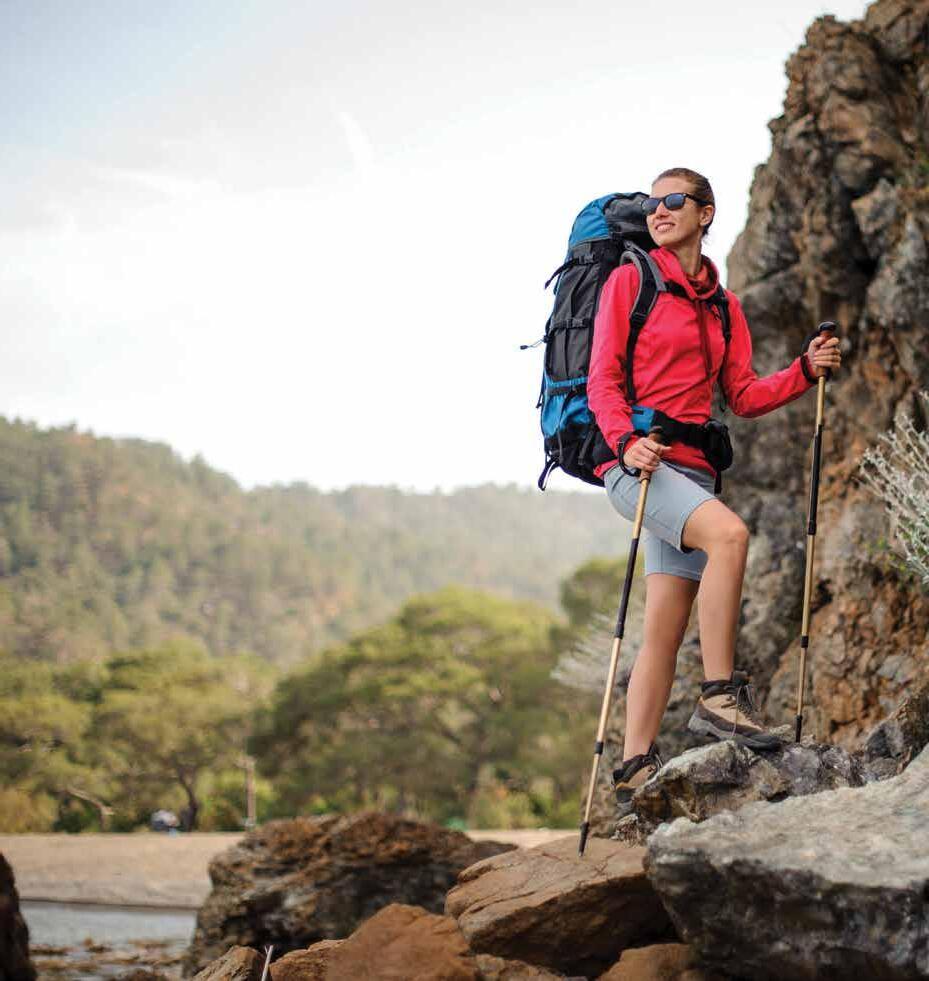




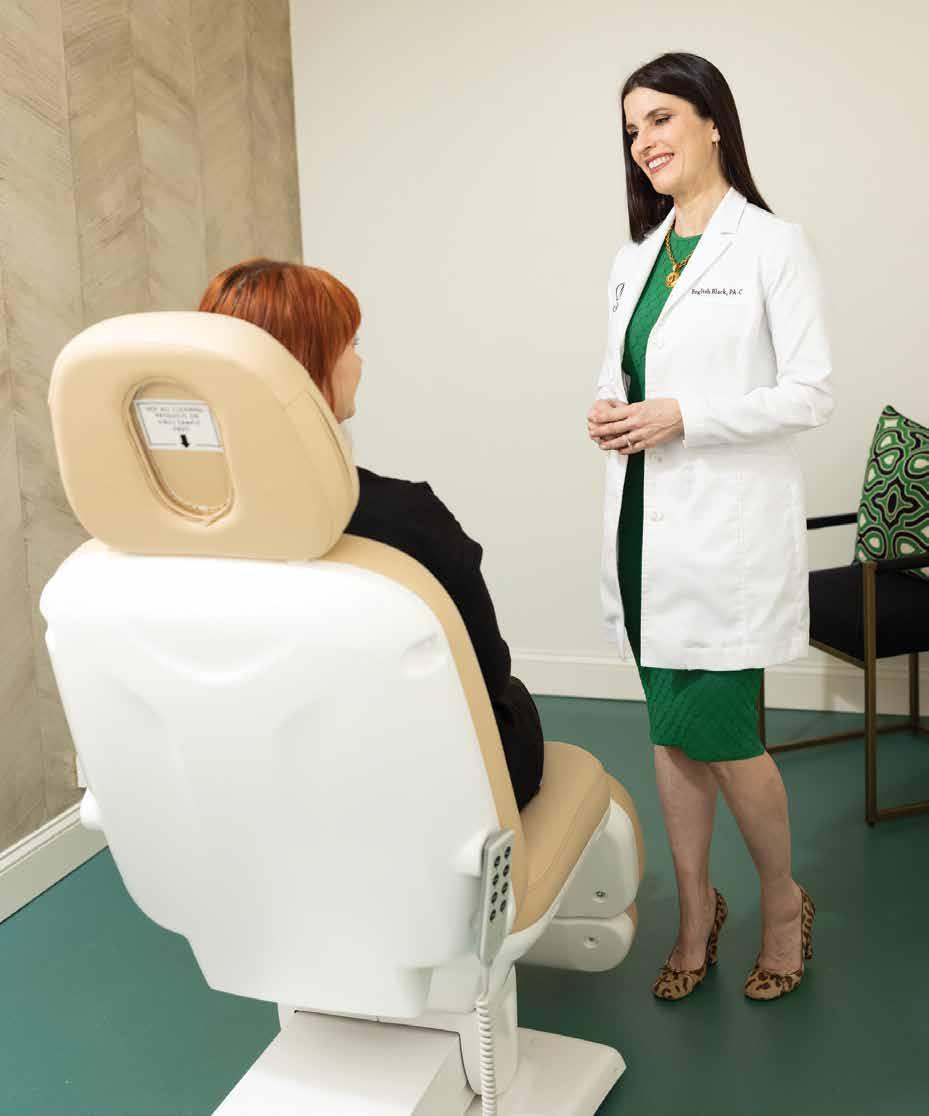







“At Greensboro Plastic Surgery, our mission is to raise the standard of care for Plastic Surgery in this community. We’re dedicated to exceeding expectations and delivering quality results with a seamless patient experience. We can’t wait to meet you!”
Collier S. Pace,
MD, FACS
Offering a broad range of aesthetic skin care and surgical services including:
• Abdominoplasty
• Aesthetic Services for Men
• Botox and Injectable Filler
• Cosmetic Breast Surgery
• Facial Cosmetic Surgery
• Liposuction and Body Contouring
• Mommy Makeover
• Skin Care Services

We work with a wide range of clients who have a wide range of goals - our training is 100% tailored to the needs and goals of each individual.
From senior adults looking to retain muscle and mobility to individuals with significant weight-loss goals to athletes training for their sport or a specific event, we have the tools and experience to help you meet your goals.
Maximize your recovery and improve your range of motion with our professional assisted stretching sessions. Our team combines exercise science with hands-on technique to help you move better and feel better.







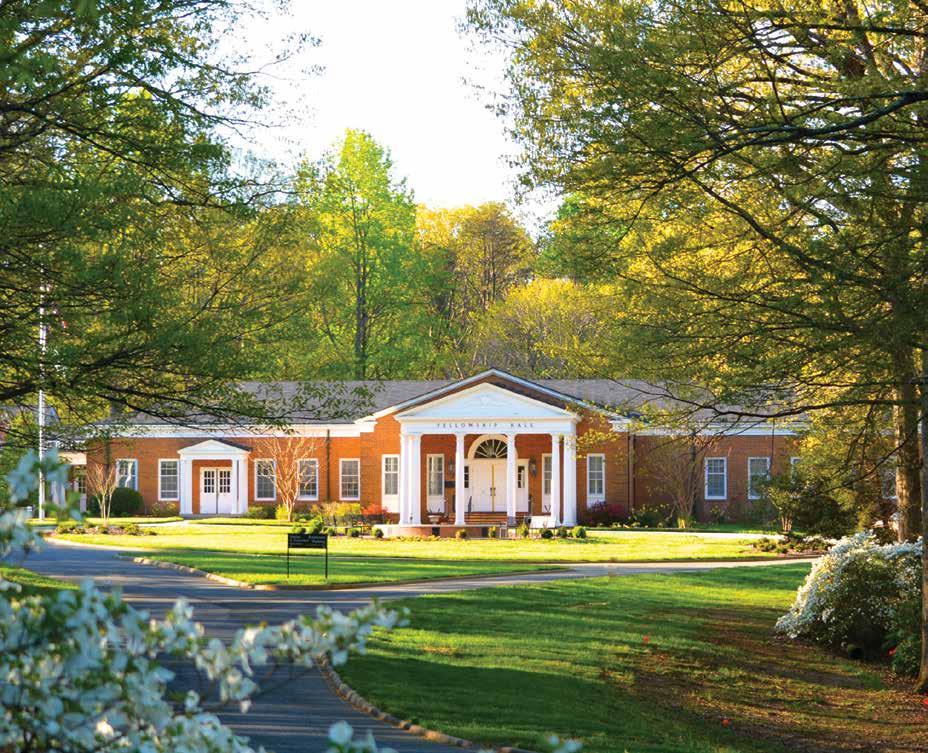


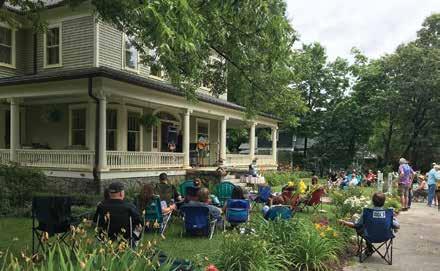
Porchfest
June 13
POCKET FULL OF POSIES. 10 a.m.–4 p.m.
Stop and smell the roses. Then move along to the next house, where you might stop and smell the gardenias, as you make your way through the Greensboro Council of Garden Clubs’ annual garden tour. You’ll even get to peep around the yard of our founding editor, Jim Dodson. Stroll amongst the freshest of blooming flowers, shade plants, greenery and garden decor while picking up ideas to bring home to your backyard. With six private gardens on their tour, you’re sure to find a patch of posies that suits your fancy. Tickets: $25.00. Info: facebook.com/gcgcinc.

shoes and get ready to burn up the dance floor — OK, it’s a lawn. Best of all, it’s free. LeBauer Park, 208 N. Davie St., Greensboro. Info: greensborodowntownparks.org.
JUNE 12
WE’LL TOAST TO THAT. 7:30 p.m.
COOL DRINKS, COOLER TUNES. 6–8 p.m.
Ease your way into the evening after work as you dance, unwind and have a good time at the Music in a Bottle concert series. Nothing screams “taking the edge off” more than a couple of cool beverages (a beer or iced coffee) and live music — local artists of course — to
Groove back a half century with tunes that’ll make you want to boogie the night away. Toast’s The Best of Bread tour is hitting Greensboro and wants to take you on a journey through the ’70s lite-rock band’s biggest hits. Think “Make It With You” and “Everything I Own.” Charting Billboard’s Hot 100 a total of 13 times, Bread paved the way for lite-rock music and Toast aims to commemorate them. Better carbo-load —
In need of a night out on the town? We’re highlighting some of our picks so you can immerse yourself in the growing and evolving Greensboro arts-and-culture scene. Before attending any event, it’s best to check times, costs, status and location. Although we conscientiously use the most accurate and up-to-date information, the world is subject to change and errors occur!
June 13
we recommend avocado toast — because you’re sure to find yourself on your feet, out of your seat and dancing to the beat. Tickets: $30+. Carolina Theatre, 310 S. Greene St., Greensboro. Info: carolinatheatre.com/events.
WAVE YOUR WANDS.
7 p.m. Saturday, 3 p.m. Sunday. A wand, pointed hat and flowing cloak are all you need to make your night magical — oh, and maybe a ticket to this concert-andmovie in one. Experience the adventures of Harry Potter and the Order of the Phoenix on screen while the Greensboro Symphony Orchestra provides the soundtrack. With a wicked playlist and a cinematic peek into Hogwarts, it’s a bewitchingly spellbinding show fit for all wizards or muggles. Tickets:
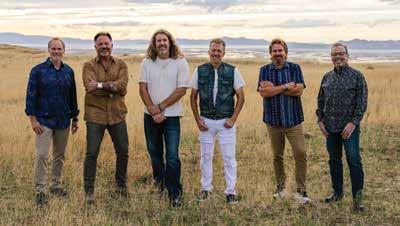
Toast’s The Best of Bread
June 13
$42.35+. Tanger Center, 300 N. Elm St., Greensboro. Info: tangercenter.com.
GATHER ROUND’ THE STOOP. 11 a.m –6 p.m.
It turns out a porch can be used for more than holding plants and a good ol’ rocking chair — it can be used to bring people together. Dunleath Historic District invites you to its annual Porchfest, where music spills from the front stoop out into the streets. Enjoy porch performances, grab a bite from food vendors and soak in the community spirit amongst friends and neighbors. After all, the porch is where the heart is — or however the saying goes. Free. Dunleath Historic District, Summit Avenue and Yanceyville Street, Greensboro. Info: dunleath.org/porchfest-attending.

BEST OF 48 HOURS. 7 p.m.
Lights, camera, action! Greensboro filmmakers take center stage at The Best of 48 Hours Film Project screenings. This Oscar-style event will showcase the short films these
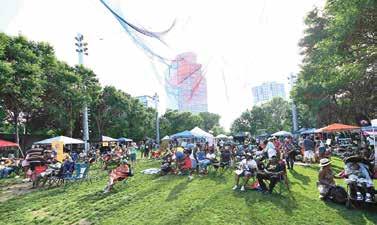
Juneteenth GSO Fest
June 18–21
fired-up filmmakers produced for the 48-hour film project competition. So, come dressed to the nines — or in your daily ’fit — and celebrate those who make small but mighty movies and do it all at lightning speed. Tickets: $15. Carolina Theatre, 310 S. Greene St., Greensboro. Info: carolinatheatre.com.
EARLY AMERICAN EARTHENWARE. 10 a.m.–4:30 p.m.
There’s nothing quite like a day spent with your hands in clay. Discover the art of pottery and explore how clay was used in early America at High Point Museum’s Historic Park. You can’t spell “earth” without “art,” but spinning it into art isn’t as simple as that. By the end, you’ll feel like a true pro among your peers. And the best part? You’ll get hands-on experience creating your very own piece of functional pottery to take home. Seize the clay! Free. Historical Park at High Point Museum, 1859 E. Lexington Ave., High Point. Info: highpointmuseum.org.
CHECKMATE.
9–11 a.m.
Spend your morning with kings, queens and knights. Hop your way downtown where you’ll learn how to play chess. This beginner-friendly class will teach the basic rules and strategies of chess for those who are up for the chess challenge. You’ll get a real, close-up experience, where every legend starts as a beginner. And who knows? You might just discover you’re a pawn with potential. Go ahead and make your move. Cairn’s Course, 501 Guilford Ave., Greensboro. Info: greensboro-nc.gov/ departments/creative-greensboro.
A CULTURAL CELEBRATION.
Grab your pals for a multiday celebration of Black culture at the fifth annual Juneteenth GSO Fest. This festival commemorates the
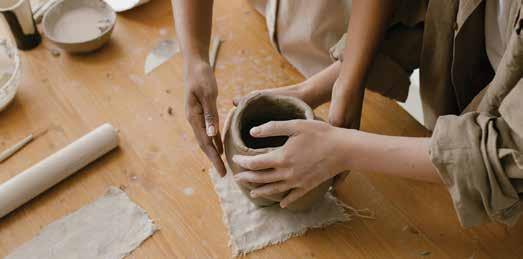
federal holiday of Juneteenth by immersing and educating audiences through poetry, performance, live music, vendors, food trucks and even a 5K.
On Thursday, June 18, put your best foot forward at the high-energy Kickoff Celebration, where dance and art battles set the tone for the weekend. Then, on Friday, June 19, the Juneteenth Soulebration takes center stage. Support local vendors and sway to live music in an “all are welcome” atmosphere. Next, stretch your legs before hitting the ground running at the Juneteenth Freedom Forward 5k and Family Fest on Saturday, June 20. Fuel up with some sweet and savory street eats and dance the night away while the bands play. Wrap up your weekend on Sunday, June 21, with a brunch and panel discussion offering a space to connect, reflect and converse with community leaders while munching on a mid-morning meal. Festival: Free; Brunch: $65+. Festival: Downtown Greensboro & Piedmont Triad Farmers Market; brunch: DreamSpace. Info: juneteenthgsofestival.com.

RHYTHM OF THE SOLSTICE. 2–10 p.m.
How are you taking advantage of the longest day of the year? Spend it outdoors as the Greensboro Summer Solstice Festival welcomes all whimsical fairies and festival-lovers to attend its annual celebration of diversity, community and feminine spirits. Intended to spark creativity and unite communities, this
festival is filled with delicious food, rhythmic drum circles and local artisans. And just when you thought it couldn’t get more fired up, cap the night off with a finale showcasing LED hoopers and awe-inspiring fire spinners. Entry fee: $10; children 12 and under, free. The Greensboro Arboretum & Lindley Park, 3299 Starmount Drive, Greensboro. Info: greensborosummersolstice.org.

































CHICAGO.
7 p.m.
Want to end your weekend on a high note? Chicago has a solution to that — and no, we’re not talking about the Windy City. Chicago, the first American rock band to chart 40 albums in six consecutive decades, rolls into Greensboro for a little “Saturday in the Park” on a Sunday. Watch these legends live in concert as they rock the mic, drums and guitar. Pro tip: Take Dad out for a Father’s Day he won’t forget. Tickets: $30+. Tanger Center, 300 N. Elm St., Greensboro. Info: tangercenter.com.
MUCH ADO ABOUT NOTHING. Times vary.
Piedmont Shakespeare Company, a nonprofit that performs free, original Shakespeare plays, invites you to enjoy its production of the Bard’s lively romantic comedy, Much Ado About Nothing. Set in the aftermath of war,
soldiers return home and re-enter a world of love and uncertainty — only to find themselves in a tale as merry as the day is long. This play explores themes of romance, loss

and connection while keeping you on your toes with its witty banter. Free, reservations recommended. Locations vary throughout the Triad. Info: piedmontshakes.org.
COMIN’ UP LAVENDER. 4:30–6:30 p.m.
There’s nothing that tickles your nose more than garden-fresh lavender and the Downtown Greenway has plenty to share. Learn about the history of this delicate herb and its sweet — yet, minty — flavor profile, and craft a beautiful keepsake to take home while supplies last. Whether you love the taste or like to indulge in the soothing smell, we think you’ll enjoy plucking a few sprigs for your next coffee or lemonade, which will be on hand for you to try. Free. Freedom Cornerstone, 750 Plott St., Greensboro. Info: greensboro-nc.gov/departments/creativegreensboro.. OH
To submit an item for consideration, please email ohenrymagcalendar@gmail.com by the first of the month prior to the month of the event.

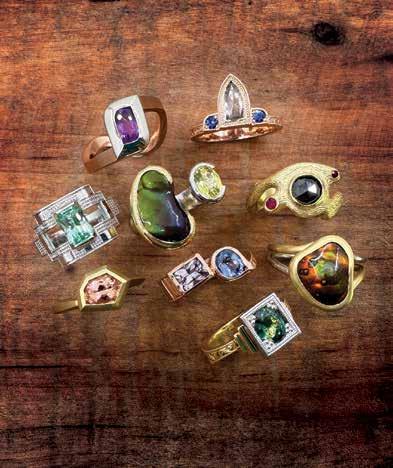

















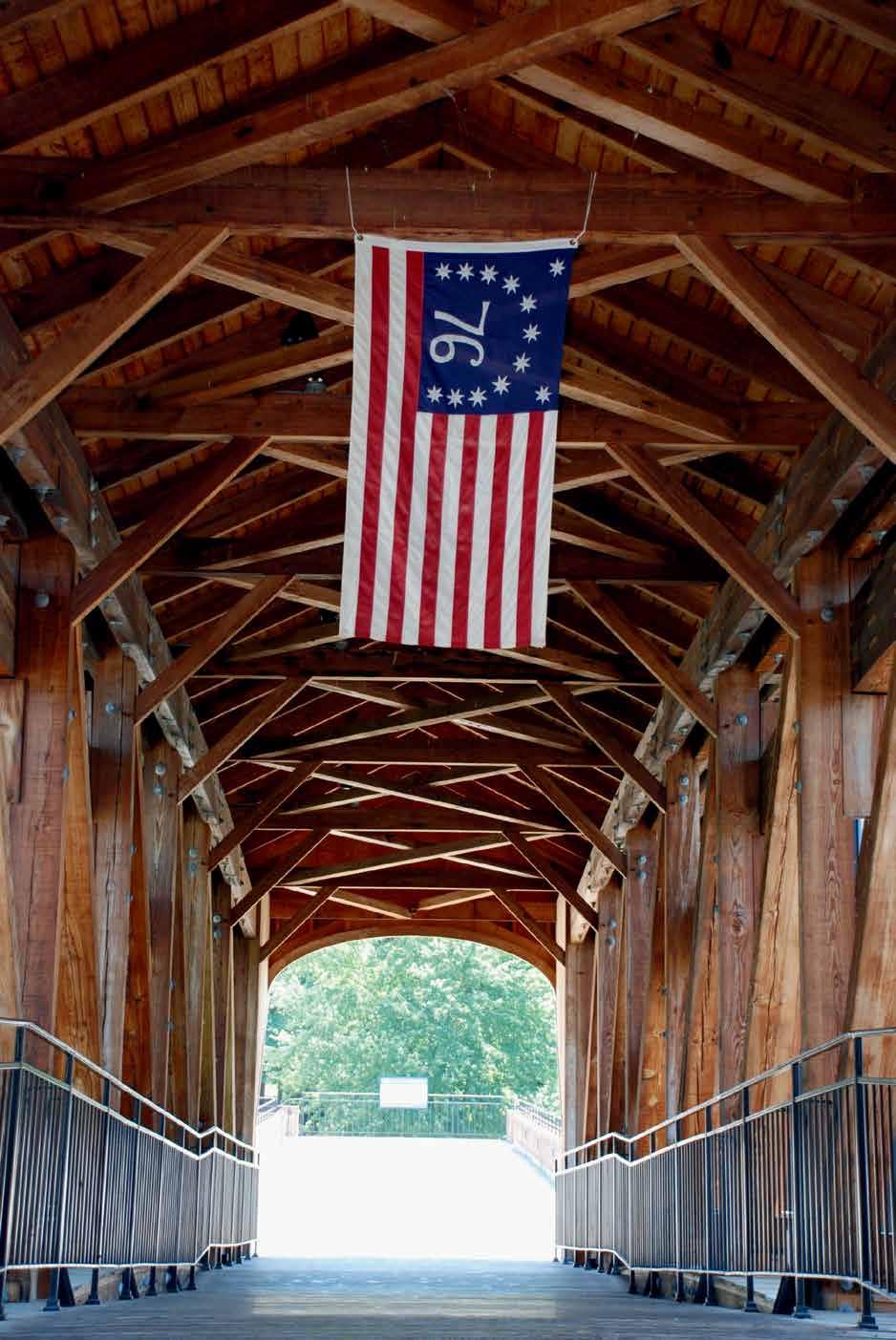





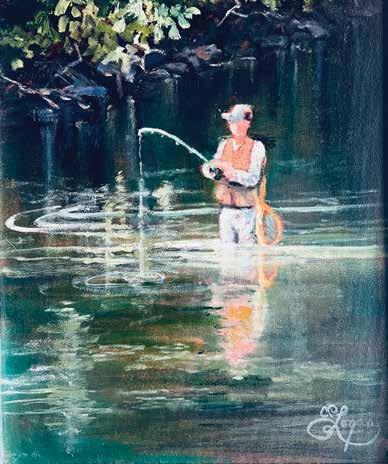
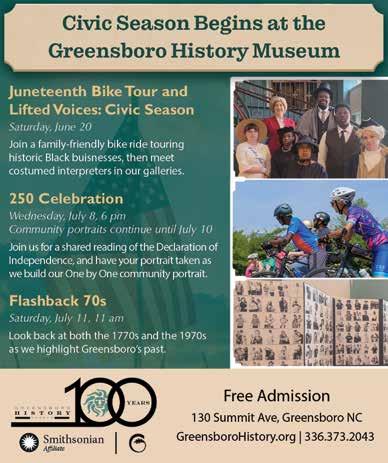







Photographs by Phyllis Citron






The Pyrle
Monday, February 23, 2026
Photographs by Lynn Donovan
In loving memory of Jordan Pearson


Triad’s Hope Runs Wild Gala
Honoring Gisela and Dan Hood
Koury Convention Center
Saturday, February 21, 2026
Photographs by Lynn Donovan



man who changed the way I saw the world
By C ynthia a dams
My dad bought a 75-acre farm near Reed Gold Mine in Cabarrus County, site of the first documented commercial gold found in 1799, way before the California 49ers struck gold out West. The story goes that Conrad Reed, son of a farmer, discovered a glittery, 17-pound rock in Little Meadow Creek that proved a useful doorstop. Three years later a jeweler in Fayetteville recognized the Reed doorstop was actually a hunk of solid gold.
Conrad’s father, John, eventually developed a bona fide mining operation, encouraged by the discovery of a 28-pound nugget a few years after the doorstop find. Other mines in neighboring counties opened and flourished, including one with a thriving town dubbed Gold Hill.
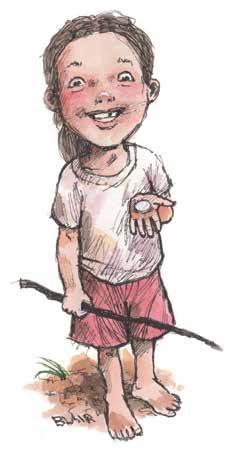
Gold Hill eventually produced sufficient gold to result in the establishment of the Charlotte Mint. Charlotte city fathers fretted, wishing the Queen City would thrive like Gold Hill seemed to be doing. It is more than a little ironic that Charlotte’s present-day fortunes were built upon cold, hard cash.
Mining in the state continued until the Civil War claimed able-bodied men, and underground mining ceased altogether at Reed Mine in 1912. Most North Carolina mines were shuttered, even after Cornish miners immigrated there seeking their fortunes once tin mining was exhausted in Cornwall.
Another doorstop never surfaced. But the hope never died. There were rumors, always, of small nuggets found in the Rocky River, which threaded through Cabarrus County past our family farm.
Frequently, my dad would muse that our horses and livestock were probably making their deposits on top of veins of gold. As kids, we would climb down the weedy banks into the swift river current, risking snapping turtles and water moccasins to
pretend we were panning for gold.
We even knew a prospector, Uncle Dan, who lived in a dirt-floored shack on a dirt road, which lacked electricity or running water well into the 1960s. He was a hermit, a raggedy-looking man, and a source of fascination to all the children in our small community.
Uncle Dan spent most of his days panning in the river, hoping to find a nugget. Unbeknownst to our parents, we would knock at his rickety door and visit. I was too young to attend school, and, in that time, we were allowed to play and roam freely with the understanding we were to be home for meals and bath time. If he was home, we would delightedly crowd into his dark shack, with the only light shining through the boards and the open door as the primary illumination. Uncle Dan, painfully shy and pitifully poor, was gentle and always kind to us. He was our friend. Sometimes he would show us minute bits of gold and we would gawk.
We children wished him luck and hoped he would have a windfall.
Once, as I played outside busily outlining a playhouse in the dirt with sticks, Uncle Dan passed by the chain link fence separating our farm from the neighbors. “Morning,” I called to him. He stopped.
“Morning, Miss Cindy,” he answered.
This exchange felt very grown-up, having an adult friend. I grinned a toothy grin — the Tooth Fairy had recently visited — showing the gap in my teeth.
His sun-battered face, wrinkled and dry, spread into a smile. Uncle Dan reached into his pocket and offered something. I stepped closer. He pushed a quarter to me through the fence.
I thanked him and pocketed the prize. Now I had two quarters — one from the Tooth Fairy and one from Uncle Dan!
Were there any coins left for him to feed himself? Even we kids noticed the cans in his shack of pork-and-beans and Vienna sausages.
Quarters still remind me of this moment. A man who had nothing to give freely offered something that was most likely needed and precious to him.
And that act opened something in me that has never closed. OH