

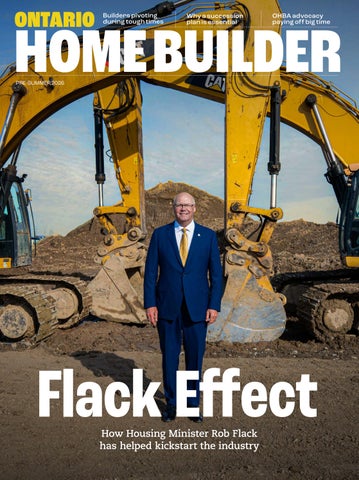
Flack Effect

How Housing Minister Rob Flack has helped kickstart the industry
Stainless Steel Tank and No Anodes
NEW NWP500 Heat Pump Water Heaters
The Navien NWP500 is built for efficiency, performance and durability with a stainlesssteel tank and aluminum refrigeration coils... no anodes needed. To learn more about all the advantages of the NEW NWP500, visit navieninc.com or scan the QR code.


Energy Star rating: up to 4.05 UEF.
Top and side connection options.
Built-in Wi-Fi powered by NaviLink® with over-the-air software updates.
Designed to meet NEEA AWHS Tier 4 requirements.
Quiet operation, less than 45dBA.
Ambient operating range of 41°F–113°F.
THE FEELING OF HOME
CRAFTED FOR CANADIAN LIVING.
Spring brings light, renewal, and the promise of fresh beginnings. With JELD-WEN’s Canadian-made windows and doors, your home opens up to the season, welcoming brighter days, crisp breezes, and the beauty of nature in full bloom. Designed for Canada’s ever-changing climate, our products offer lasting performance, energy efficiency, and timeless style that help your home feel vibrant and comfortable, inside and out.
Choose JELD-WEN for craftsmanship that lets every season shine, especially this one.


EXPLORE OUR FULL LINE OF CANADIAN MADE ENERGYEFFICIENT WINDOWS AND DOORS AT JELD-WEN.CA


P36 First Responder
Rob Flack has stepped up like few housing ministers before him
P27
Pivot Plays
From rental to commercial, tough times require


P17 Exit Strategy
Don't have a succession plan? What could possibly go wrong?
CONTENTS PRE-SUMMER 2026
9 Association News
Measuring the major impact of OHBA'S advocacy, Futures Faster is building skills and strengthening careers, big news at PKHBA and your can't-miss events calendar.
17 Inside Storey
MNP's Kerry Smith shares advice before you handover the keys to your business.
21 Frame of Mind
An ingenious rental development in Amsterdam showcases innovative interiors for compact units.
23 Trending
From rustic decorative stone to insurance incentives and modern window wells, here's what’s new in industry products and services.
45 Building Buzz Napoleon and Golden Windows mark major anniversaries, the BIFA26 Awards, NKBA show comes to Canada, and is this really the death of the bath tub?

54 Chapter Spotlight
Lanark-Leeds HBA reminds us of the importance of rural regions in housing growth.
ON THE COVER Ontario Housing Minister Rob Flack stands tall at Mattamy's The Nine in Mississauga.


EDITOR
Ted McIntyre
ted@laureloak.ca


ease of handling for flexible installation — including curved-wall applications.
Building with SilveRboard®
Lightweight,
Indoor Air Quality: SilveRboard does not contain CFCs or HCFCs, no off-gassing and does not promote growth of mold and mildew.
Environmentally Friendly: EPS foam can be recycled and uses only steam and water during manufacturing. Increases Comfort & Energy Savings: Acts as continuous insulation in the building envelope, reducing thermal bridging and energy consumption while improving home owner comfort.

Take a photo of our QR code and sign up for digital updates and news!
Ontario Home Builder is published six times per year (Winter, Spring, Pre-Summer, Summer, Fall, Awards).
Al l r ights reserved. No part of this magazine may be reproduced without the written consent of the publisher. © 2026
For address corrections please email info@laureloak.ca or phone: (905) 333-9432.
Si ngle copy price is $6.00
Subscription Rates: Canada $16.95 + HST per year,
Order online at https://www.laureloak.ca/subscribe.


SUSTAINABILITY MEETS SUPERIORITY.
Discover BP Canada’s wood fibre insul-sheathing panels.
• High performance
• Bio-based building materials
• Recycled wood fibre sourced from post industrial and post consumer origin
Perfect Combination


BP Canada’s R-1.5 exterior sheathing panel provides structural strength, noise reduction, superior water vapour permeance at 37 perms, and a remarkably low carbon footprint, at a value-based pricing. R-1.5 continuous superior water vapour permeance - a perfect combination for our Canadian climate.
Reduce Material and Labour Costs
BP Canada’s Excel exterior sheathing panel provides R-1.5 of continuous insulation while providing superior structural strength, weather resistive and air barrier properties, ensuring that your walls remain warm and dry, mitigating moisture entrapment in the wall cavity.
Performance and Strength
BP Canada’s R-5 XP exterior sheathing panel provides R-5 of continuous insulation using low GHG extruded polystyrene, laminated to a 1/2" high performance wood fibre panel. The overall panel assembly provides a water vapour permeance rating of 2 perms, ensuring an optimal performance of your overall building envelope.


Modern

Triple

Aluminum reinforced mullions for larger window configurations


From Policy to Progress
Measuring the impact of OHBA’s advocacy
OHBA has spent the past several months working behind the scenes to deliver impactful wins for our industry. March 2026 will be remembered as the month the federal and provincial levels of government got serious about unlocking housing supply to make it more affordable.
For far too long, OHBA has warned government that it takes too long and costs too much to build new homes and complete substantial renovations. We have consistently advocated for targeted and meaningful tax and process reforms to reduce costs for our members, including reducing development charges, improving approval timelines and addressing ongoing skilled labour shortages.
Following the passage of Bill C-4, which OHBA and our members spent months advocating for, the federal government confirmed the removal of the federal portion of the
GST for qualifying first-time home buyers. In March 2026, the Canada Revenue Agency (CRA) confirmed that applications for the new FirstTime Home Buyer (FTHB) GST/HST rebate are now open.
The rebate provides eligible first-time homebuyers with a full or partial rebate of the GST, or the federal portion of the HST, on newly constructed or substantially renovated homes. Eligible purchasers may receive a rebate of up to $50,000. The Province of Ontario also agreed to rebate the provincial portion of the HST (PST) for eligible first-time home buyers using the same criteria as the federal government for determining who qualifies as a first-time home buyer.
The rebate is available for qualifying purchasers who entered into an Agreement of Purchase and Sale with a builder on or after March 20, 2025.
The measure applies to new homes purchased from a builder, substantially renovated homes and certain owner-built homes. Applications for the rebate must generally be submitted within two years of taking ownership of the home or completing construction.
On March 25, 2026, Ontario Premier Doug Ford, Ontario Minister of Finance Peter Bethlenfalvy, Ontario Minister of Municipal Affairs and Housing Rob Flack, Associate Minister of Housing Graydon Smith, Mississauga Mayor Carolyn Parrish, and Associate Minister of Small Business and MPP for MississaugaStreetsville Nina Tangri were on hand to announce the removal of the provincial and federal components of the harmonized sales tax on new homes under $1 million, and a reduction of the HST for new homes between $1 million and $1.85 million, for all new-home buyers, which took effect on April 1, 2026, and will run until March 31, 2027.
A full 13% sales tax reduction will apply to new homes with a purchase price under $1 million for all buyers of new homes where the home is to be used as their primary place of residence or as a residential
OHBA CEO Scott Andison, Chair Christina Giannone, Ontario Premier Doug Ford, 1st Vice-Chair Tom McLaughlin, 2nd Vice-Chair Brandon Campbell, Past Chair Dave Depencier and V.P. of Policy, Advocacy and Relationships Kirstin Jensen.
rental property. The change will provide a flat $130,000 sales tax reduction for new homes between $1 million and $1.5 million, and for amounts between $1.5 million and $1.85 million, a declining tax reduction from $130,000 to the existing $24,000 provincial rebate amount. New homes in excess of $1.85 million will continue to receive the $24,000 provincial rebate.
As currently defined within the regulations, substantially renovated new homes are treated as new housing for tax purposes and are included in this new policy measure.
This announcement is the result of years of advocacy work led by OHBA and our local HBAs, and of OHBA and BILD presenting concrete evidence to both levels of government over the past year to show that the time to act and make this muchneeded change was now. This latest policy change is designed to reduce upfront homeownership costs, help restore momentum in Ontario’s housing market, and directly support the continued construction of new homes to meet the needs of Ontario’s growing population. OHBA and our members have used our One Voice through meetings with local MPPs and MPs, ensuring that key decision-makers understand the
ASSOCIATION NEWS
realities facing our industry.
The HST rebate was not the only important housing reform announced in March. Following its announcement, the provincial government introduced Bill 98, the Building Homes and Improving Transportation Infrastructure Act, legislation aimed at continuing to reduce red tape, improve planning and approvals processes, and support the timely delivery of new housing and infrastructure across the province. Included in this legislation are measures to further streamline planning and approval tools. The list includes: reforms to municipal official plans to improve consistency, usability and navigation; consultation on site plan control reform; bringing into force longawaited parkland dedication regulations; establishing an expert third-party advisory body as part of the section-by-section review of the Ontario Building Code; and enacting new frameworks to enable communal water and wastewater systems, among other measures.
Last but not least, on March 30, 2026, the federal and provincial governments announced the Canada-Ontario Partnership to Build. This agreement includes a plan to lower development charges
in Ontario by up to 50% and to fund infrastructure investment. This 10-year, $8.8 billion program represents a major step forward in lowering the cost of building and addressing project viability across the province, especially in high-DC areas. The program will include at least two key conditions: funding to municipalities and regions that apply, provided they lower their DCs for builders and developers; and municipalities must agree to update their DC background studies.
This announcement builds on OHBA’s years of work and will fasttrack the implementation of DC requirements under Bill 17 and 60. OHBA and BILD are continuing to work closely with the provincial government on the design and implementation of the HST reduction and the DC reduction programs.
On April 10, OHBA and BILD hosted a webinar on the changes to sales tax. This is the first in a series of webinars that OHBA will host to ensure members have access to accurate, up-to-date information on this important policy. As additional details emerge, including on the DC reduction program, OHBA will continue to provide timely updates through future webinars and ongoing website resources.
An Exciting New Chapter for PKHBA
After a months-long search, the Peterborough & Kawarthas HBA has announced Sol Zia as its new executive officer.
Sol brings more than 25 years of executive leadership experience across association management, government relations, fund development and stakeholder engagement. He offers a strong foundation in organizational leadership, board governance and strategic execution—key strengths that support PKHBA’s continued growth and evolution.
With both Westjet Rewards and the Calgary Hotel Association, Zia’s leadership delivered measurable impact, including membership growth, revenue expansion and high levels of member satisfaction. He also worked closely with municipal partners on local development initiatives—experience that will be valuable as PKHBA continues to
engage with stakeholders across the region.
In other regional news, the Peterborough Women in Trades Committee held its launch event in March, with OHBA Chair Christina Giannone in attendance to support this initiative. The Peterborough Women in Trades Committee is a collaboration between the PKHBA and the Peterborough & District Construction Association. The committee exists to empower, connect and support women in the construction and residential building industry through advocacy, mentorship and awareness initiatives that highlight the importance of skilled trades careers for women.
The event provided an opportunity to connect with women and allies across the construction and skilled trades sectors, and to celebrate the formation of the committee.


PKHBA Co-Chairs Elsa Batten and Katie Rowland flank OHBA Chair Christina Giannone.


OHBA Futures Faster:
Building Skills, Strengthening Careers
What happens when you bring together experienced industry professionals, emerging talent and targeted, real-world learning? You create momentum.
Futures Faster was designed to support Ontario’s residential construction workforce through mentorship, micro-credential training and meaningful industry connection. Over the course of the program, participants didn’t just build new skills, they gained clarity, confidence and a stronger sense of where they fit within the industry.
Participants described Futures Faster as: Valuable, informative, transformative, supportive and empowering. At its core, the program focused on connection. Mentors and mentees were matched based on shared values and professional outlook, creating space for honest conversations, practical guidance and knowledge sharing across roles and sectors. Builders,
consultants, designers and suppliers came together, often connecting with people they wouldn’t typically meet in their day-to-day work.
For many participants, that connection was the most impactful part.
“Supporting emerging professionals while continuing to grow my own leadership and perspective has been an incredibly rewarding experience,” says mentor Toby Smith.
“Mentorship truly is a two-way street, and this program proves how powerful shared learning can be for individuals and the industry.”
Alongside mentorship, participants engaged in targeted microcredential training designed to reflect real industry needs. Learning opportunities ranged from short, focused modules to more in-depth courses, allowing participants to build practical, jobready skills in areas such as project management, building science, leadership and business operations.
Specialized program streams provided additional depth, giving participants the opportunity to explore key areas shaping the future of housing in Ontario, including multiplex and gentledensity housing, high-performance building and resiliency, as well as Indigenous approaches to housing and land.
The result was learning that felt relevant and immediately applicable to participants within the residential construction industry.
“This program gave me the knowledge, network and confidence to move forward with a real multiplex opportunity, which was something I wouldn’t have done on my own,” says Marla Metson, a Multiplex Stream mentee.
That sense of forward momentum showed up consistently amongst participants. They reported stronger professional networks, greater confidence in their career direction, and a clearer understanding of their next steps within the industry.
Just as important, the program reinforced a sense of belonging. “Getting to meet someone I otherwise wouldn’t have crossed paths with, and learning from their experience was one of the most impactful parts of the program,” explains Brendan Charters, a Futures Faster mentor, BBBC-Pro Stream, and partner with Eurodale Design + Build
Futures Faster also demonstrated what’s possible when mentorship and training are intentionally combined. By pairing industry experience with targeted learning, the program created a model that supports both individual career growth and broader workforce development.
As Ontario works toward the goal of building 1.5 million homes by 2031, initiatives like Futures Faster play an important role in strengthening the people behind the work, supporting both today’s workforce and the next generation of industry leaders.


ASSOCIATION NEWS

Upcoming Events
OHBA is gearing up for an exciting spring events lineup! Stay tuned to ohba.ca/events for ongoing event updates.
Queen’s Park Day
Monday, May 25 | 9:00 am – 7:00 pm Toronto
We look forward to welcoming our Board of Directors, Chapter Chairs and Chapter Executive Officers for a day of critical advocacy, connecting OHBA members with decisionmakers to champion industry priorities, challenge policy barriers and drive meaningful change in housing.
OHBA Golf Classic
Wednesday, July 29 | 12:00 pm – 7:00 pm
Lionhead Golf Club, Brampton
Tee off alongside industry leaders at the OHBA Golf Classic, an elevated day of connection, competition and exclusive experiences you won’t find anywhere else.
OHBA Reception x AMO
Tuesday, August 18 | 6:00 pm – 11:00 pm Ottawa
Connect where it matters most. The OHBA Reception at the AMO Conference brings together municipal decisionmakers and industry leaders for an evening of meaningful dialogue, relationship-building and housing-focused conversations.
OHBA Conference & Awards
Sunday, Sept. 27 – Tuesday, Sept. 29
Blue Mountain Resort, Collingwood
The OHBA Conference is where ideas, leadership and opportunity converge. With impactful programming, influential speakers and unmatched networking, this event equips you with the knowledge and connections to stay ahead in a rapidly evolving industry.

OHBA Partnership Opportunities
Interested in supporting the association and showcasing your brand?
The OHBA Partner Program provides organizations with strategic opportunities to support the association’s work while engaging members through customized event partnerships.
Be sure to contact us about opportunities to showcase your company.


INSIDE STOREY
One-on-one with industry experts


Exit Strategy
No
succession plan yet? What could possibly go wrong?
By Ted McIntyre with Kerry Smith
HERE’S THE HARD REALITY of family businesses: Only 30% survive to the second generation—and just 16% make it to the third. The construction industry is particularly vulnerable, given that about 60% of homebuilders have fewer than five full-time employees. Now consider that roughly 30% of construction businesses expect to transition by 2030, but just 29% of them have formal plans, and you can start to see the problem.
Kerry Smith is all too familiar with this precarious ground. A partner within MNP’s Professional Services team and National Leader of its Family Office Services division, Smith cautions that procrastinating on succession planning jeopardizes the future of your company, family and employees.
OHB: Is succession planning like a will for many—too daunting to wade into?
KERRY SMITH: “Many instinctively think

KERRY SMITH MNP NATIONAL LEADER, FAMILY OFFICE SERVICES
of a succession plan as this monstrous 80-page document. So for businessowners already run off their feet, the thought of wading into it can be paralyzing. The easiest way to start is to think about the three ways you can exit your business: Does it go to family; management/employees; or to a third party? Write the options down, as well as what you perceive to be the pros and cons of each. What stresses you and what excites you? Now that you’ve built a framework, you’re positioned to have a good conversation with a professional.”
At what point should you consider getting a plan in place?
“What’s the best time to plant a tree? Yesterday! I suggest starting at least five years out, but, like your financial plan, revisit your succession plan regularly, as circumstances change.
Your five-year-old daughter is playing softball, not hammering concrete right now. But will she gain the interest, skills, leadership and supplier ties to take over one day? Keep your options open and check back yearly. I’ve had clients who planned to sell externally, then one day their kid turns 18 and says, ‘I’m in!’ And it works the other way too, where you just assume a family member will want to take over one day, then discover they have no interest.”
But sometimes that’s a good thing.
“While we can’t decide for them, being an objective sounding board can really help walk your clients through their options. I’ve had some owners say, ‘My kids are great! They’ll be perfect!’ And I’m like. ‘Your kids don’t even know what a balance sheet is!’ So we often need to have an honest conversation. But it can also be an opportunity to train them up and fill in the gaps of whatever an intended successor is missing.
“This is where a hybrid model can really work well. First, it shows your management group that you’re committed to them and see the value they bring to the table. It also keeps them invested in the company in the long term. So with a hybrid, the next


generation is collecting profitability from the business while not necessarily running it.”
Having
a plan—or not—affects
talent retention.
“The war on talent for builders and renovators is so important right now. As business owners start to age, if management and employees don’t see a plan in place, they may question their job security. Conversely, if there’s a clear plan in place, it can also help attract top talent.”
Dealing
Everything you need to get the job done 1
Adhesives for both Wood and Vinyl
High-performance wood adhesives— MSC Urethane, MSC Modified Silane, MSC Glue Assist, and MSC T&G Glue for strong, secure wood flooring applications, as well as MSC Resilient Premium Universal Adhesive for vinyl and resilient flooring.

3
Care & Maintenance
2 MEET METROPOLITAN SYSTEMS COMPLETE™

Underlays
MSC Premium Underlay for acoustic and glue-down applications, MSC Standard Underlay for moisture and sound protection, MSC Basic Underlay for everyday installations, and MSC AMB, a commercial-grade moisture barrier with up to 100% RH protection.
with family businesses, it must get awkward at times.
“I had a client whose son started working in the business with another company, but ultimately ended up coming over. My client felt his son had room to grow in terms of leadership and business knowledge, but figured that with time, training, and the right people around him, he could get there. But then the business started to stall, and some people began telling my client, ‘You know, your son might actually be the problem,’ which is always a tough thing for a father to hear. My client called me on a Friday afternoon and said, ‘Well, I did it.’ I said, ‘You did what?’ And he said, ‘I fired my son.’
The perfect solution for Kentwood and Evoke flooring – The Easy Clean Mop Kit and Easy Clean Powder are specially formulated to preserve your floor's finish and be better for the environment. Made from biodegradable ingredients and in compostable packaging.


“I had another client whose father owned the business and always insisted he had a succession plan. But when he passed away, it turned out he didn’t. Enter the father’s estranged wife, who inherited the company’s operating assets, including the building, while the son now ran the operations. Before the father’s death, they had been exploring a potential sale of the company, but after he passed, everything unravelled. The estranged wife told everybody to get out—she was selling the building. Every interested buyer backed off. It sent shockwaves through the company. The son, who had never held a formal leadership role, suddenly found himself running the business under incredible pressure. Fortunately, he managed to save it and began rebuilding the brand and its value—but it was a long process that took more than five years.
“Family dynamics can really derail a transition plan. You can’t help but take work home with you at the end of the day, and that’s when your boardroom table becomes the family dinner table.


Without a formalized plan, you’re really opening the door to family conflict.
“But it can be challenging with hybrid models too, because management opinion may conflict with family opinion, and management may assume that family opinion will override them. So you need to be mindful of that when you’re including them in discussions.”
It’s not just a succession plan, but an emergency plan that is sometimes needed.
“Absolutely. What if you’re temporarily incapacitated, or there’s a sudden death? Who is doing what, why and when?’ It’s really important for the family too, because this is where their money is coming from.”
It’s easy to forget how many people rely on a company’s success—even beyond family.
“There are your employees who depend on you for their livelihood, then you’ve got your partners and subtrades. And there’s your local community—especially for the residential construction community—that relies on your charity events and contributions. These are all individuals who will feel the ripple effect. The legacy of your business can be eroded. It’s all part of what’s at stake when you don’t plan.”
It has to be hard for many to cut the cord and hand over the keys.
“Especially with home builders and contractors, many of which are family businesses that are still being led by the founding generation. There can be a sort of transition to the transition. It’s very common to see that while they may not be involved in the day-to-day affairs of the company, they may be sitting in a board position or in an advisory capacity to the next generation.”

It’s also easy to forget that life isn’t over after you hand over the reins.


“The final phase of a succession plan should be the post-exit handover. We’ve had many clients who struggle with what comes next. The business has become such a big part of their identity. That next day, when you don’t drive to the office, it can be quite challenging. And so we also talk about transition planning—what’s going to keep you busy, and what do you have planned for the future?”


A NEW VIEW OF VINYL: THE GENTEK® WINDOW COLLECTION
MORE GLASS. CLEANER LINES. BUILT FOR THE CANADIAN CLIMATE.
The Gentek Window Collection brings together the 4000 Series and 3000 Series in a modern high-performance vinyl window system designed for today’s homes—and tomorrow’s expectations.
Delivering slimmer sightlines, stronger curb appeal, and energy-smart comfort year-round, it gives builders, contractors, and homeowners more of what matters on both sides of the glass.
• Refined, contemporary profiles that welcome more natural light indoors
• Two frame depths for residential replacement and new construction
• Energy-smart glass packages and premium finish options, including Armour Guard™ black exterior window coating
• Adaptable details for different wall conditions, siding types, and installation approaches
gentek.ca | Make us a part of your home.

MAKE ONE CLEAR CHOICE THAT COVERS MORE GROUND. Contact your Gentek Sales Rep, nearest retailer, or scan to learn more.


Micro Scope
Innovative interiors for compact units
MICRO UNITS have emerged as a viable solution for modern urban living. They offer the inherent advantage of lower utility bills, as their smaller size requires less heating, cooling and lighting. Further, their limited space encourages residents to adopt a minimalist approach to furnishing and decor. This not only aligns with a modern, streamlined aesthetic but also reduces expenditures. These combine to offer a budgetfriendly lifestyle without compromising the benefits of living in urban areas.
Designing micro-unit apartments hinges on several key strategies that balance maximizing space and functionality with creating a comfortable living environment. The use of multi-functional furniture is crucial. This includes fold-out beds, convertible tables and storage ottomans. Integrating storage spaces such as wall shelves, wardrobes and underbed compartments makes the most of every square inch.
Modular design elements also play a role. Incorporating flexible and reconfigurable components, such as movable partitions or modular kitchen units, allows residents to adapt the space to their changing needs.
The presence and design of communal spaces are paramount in micro-unit buildings. These shared areas, such as lounges, laundry rooms and outdoor spaces, provide a necessary extension to living spaces. Given the limited private space in micro units, they also offer residents additional room to relax, socialize and engage in activities their units cannot accommodate.
In Amsterdam, Shift Architecture Urbanism has designed the Dom¯us Houthaven residential complex, featuring 235 compact rental apartments tailored for high-density urban living. This innovative project combines functional design with playful interiors to optimize the use of space and foster community among residents.
Each apartment, ranging from 463 to 645 SF, is ingeniously designed around a “smart-living core.” This core includes a kitchen, a box bedroom, a bathroom and extensive storage, maximizing functionality within a compact footprint. The bedroom, uniquely designed as a cupboard with built-in shelves and under-bed drawers, features perforatedsteel folding doors that allow for flexible use of the living space: closed for a spacious living room by day, and opened
for an expansive bedroom by night.
The material palette is deliberately contrasting, with pale laminate floors, untreated concrete ceilings and white walls set against brightly coloured furnishings and modular units. The steel doors were chosen for their durability and ease of operation. Interior design includes pastel tones on doors and window frames, bamboo, wood veneer, corrugated steel plates, ceramic tiles and terrazzo, creating a rich, tactile environment that enhances the visual and functional appeal of the spaces.
Beyond the individual apartments, Dom¯us Houthaven offers extensive communal spaces designed to encourage resident interaction and combat loneliness. These areas include co-working spaces, a shared living area, a communal kitchen and garden spaces, all crafted to extend the feel of the apartments into shared public zones. Key features include a woodlined seating area that doubles as a bookcase, pastel-green ceramic-tiled kitchen units, and large, versatile furniture pieces that serve as room dividers, creating intimate yet open subspaces. With market pressure to build affordable housing increasing and dwellings becoming smaller, innovative interiors are likely to take greater hold in design and construction. OHB


Rustic Farmhouse Facelift
Rinox’s Kava decorative stone brings rustic, natural warmth to modern farmhouse-inspired elevations and feature walls. Suitable for both interior and exterior applications, the stone’s varied profiles and earth-toned Amaretto colour create depth and visual interest on siding and fireplace surrounds, among other uses. Easyto-install units come in 35 SF per 460lb crates, with matching corners simplifying transitions and detailing. Kava’s ToneXclusive Service lets customers customize the colour of their molded concrete stone products. RINOX.COM
TRENDING
Ideas for Builders & Renovators

RenoMark Insurance Perk
Starting this year, RenoMark-certified renovators and trade contractors are now eligible for a 10% premium discount on business insurance from Federated Insurance (new business customers only). A proudly Canadian insurer, Federated offers one of the most comprehensive insurance programs for renovators and is a recommended insurance provider for the OHBA. (Not offered in Quebec.) FEDERATED.CA/BUSINESS-INSURANCE/OHBA

Well Worth It
First impressions matter, which is why EHS Sales’ Modern Square Window Well is a gamechanger. While the clean, geometric lines blend seamlessly with modern architectural styles, these window wells are also designed for maximum strength, durability and protection for basement windows against water, dirt and debris. They also allow more natural light into your homes’ lower levels. EHSSALES.CA


Shafts Stack Up
Stubbe’s precast box shafts boost efficiency with major site time savings, replacing cast-in-place or block elevator and stair shafts. These complete units include stairs, landings, caulking, cast-in plates and connections for seamless integration with other systems, handling full structural loads as a one-to-one swap. Stacked typically up to six to eight floors before other trades arrive, they pair with steel pan, structural steel, wood joist or mass timber floors for superior accuracy, quality and risk reduction—slashing site time by two months on average. STUBBES.COM

Dual-Range Voltage Detection
Electricians can now spot a wider range of live circuits with Milwaukee Tool’s new Dual Range NonContact Voltage Detector and Dual Range
NonContact Voltage Detector w/ LED. Each automatically senses and differentiates low (12–49V) and high (50–1000V) voltages, signalling yellow or red alerts accordingly. The LED model adds a powerful work light for safe, precise use in dim or confined areas. MILWAUKEETOOL.CA


Reliable and resilient
Choosing Enbridge Gas

Affordable
Use
Energy choice
An established energy network that provides flexibility and dependable service as communities grow.

PLAYS
From rental to commercial, some builders are expanding their scopes in tough times
By Jonathan Oke


t’s said that Plato captured the idea behind the phrase “Necessity is the mother of invention.” Today that necessity is hitting home—literally. A near-dead housing market made it essential for many to step outside the familiar business models. Doing so can feel as daunting as deciphering Plato’s original Greek script, but it’s often the best way to stay viable. Despite a wave of good news for the industry at the end of March, the Urban Land Institute’s 2026 Emerging Trends in Canadian Real Estate report’s central message remains: reinvention is critical to driving future growth. That includes purpose-built rental platforms that pair CMHC-backed programs with new financing structures to scale rental supply beyond condo-heavy models. Some builders admittedly read the
tea leaves earlier than most. Alterra Developments began a subtle shift from condos to rentals three years ago. The company is leveraging prior experience highlighted by its recent CreateTO project, a partnership with Mahogany Management on a major mixed-use, transit-oriented project at 777 Victoria Park Avenue in Toronto. The long-awaited development will deliver 705 rental homes, including 256 affordable units, on a former TTC parking lot.
Alterra’s second rental project, a partnership with OGDC, is just breaking ground at 2810 Bayview Ave. As with 777 Victoria Park Avenue, the 45 storey, 475-suite building will feature geothermal heating and cooling.
But Alterra is adding extra flavour to its new rental recipe by bringing condo-level design to the project. Echoing a conversation he had with Toronto Under Construction, Alterra
President Stuart Wilson says they’re putting themselves in the position of tenants. “When I walk in, my first impression should be. ‘Do I love the lobby, its materials and the lighting, or does it feel like a Howard Johnson?’ Does it feel vibrant to me? The materials that I’m interacting with—are they pleasing? Does this feel like a home I can be proud of?
“It’s not just a spreadsheet and an investment for us,” Wilson assures. “We are building first-class homes for people. How do we maximize amenity usage and enjoyment at all times of the day? We’re thinking about the long-term maintenance, such as how the garbage is going to work and how we’re going to maintain a high cleaning standard.”
RENTAL CAN BE BEAUTIFUL
ARIA Build is another that has leapt into the rental market with upscale
Breaking ground last October,
Alterra’s transit-friendly
777 Victoria Park Avenue project w ill i nclude 705 rental units.


design in mind, drawing on its custom-home expertise. When managing partner Behzad Ayon purchased an East York property in 2021, he initially planned to build a single-family home. But the plan changed when 2023 legislation permitted up to four units, plus garden or laneway suites, without a variance. A bylaw last summer that allows up to six units in some GTA communities has accelerated further plans.
“It wasn’t originally feasible to build a custom home for resale. Then the new bylaw allowed multi-family, and given the housing shortage, it made economic sense to design accordingly,” Ayon explains. “Coming from the luxury sector, we wanted it to reflect that standard and fit the neighbourhood, not be one of those boxy buildings that residents dislike. We wanted to build something we’d want to live in ourselves.”


Completed in January, the five-plex includes four apartments and a garden suite—each around 1,000 square feet with two bedrooms, 1.5 baths, and private entrances. Aria designed the interior, while partnering with Veralinea Design Studio on the blueprints. It features a spacious patio and a raised basement infused with natural light, while every floor offers bright, self-contained twobedroom suites that feel refined yet practical.
“We rented all five units within two weeks at premium rates because it’s a premium product,” Ayon says. “It fills that missing-middle gap for families seeking community.”
While Aria is staying busy with its custom home division—“We’ve got eight on the go”—the team has launched Maison Developments to focus on the multiplex work, led by Ayon’s brother Jamil. “We spend
more time designing spaces that flow,” Ayon says. “Thoughtful design helps build a more luxurious product without necessarily spending more.” Challenges came with new codes and methods. “It’s a learning curve,” Ayon admits. “We’re using steel stud walls, dense sheathing instead of regular lumber, and fire-rated plumbing and electrical systems designed for multi-unit construction. Urban lots also make excavation and access difficult.”
Still, the model offers advantages. Predictable income and an indemand product have made it easier for Aria to work with lenders. The lack of client therapy required in the custom-build world is also appreciated. “The rental space is easier,” Ayon says. “In custom homes, you’re building someone’s dream, but with multi-family, you’re beholden to the blueprint, not the emotions.”
ARIA Build’s first venture into the rental world was an East York project (top and left), which includes four apartments and a garden suite—each showcasing high-end finishes. Above, the company’s new side-byside six-plex project in East York is in the permit stage.


BUILT TO BE NIMBLE
Campanale has never been a onetrack builder, but in today’s uncertain market, that flexibility has become a defining advantage.
Founded in 1979, the Ottawa-based family firm has grown from a modest real estate operation into a diversified company spanning residential development, property management and commercial construction. That breadth is now underpinning a deliberate pivot—one that has seen the mid-sized builder move aggressively beyond its traditional for-sale model and deeper into rental, mixed-use and alternative housing formats.
“We were originally a production builder, with a smaller percentage of our construction being rental. But in the past five to 10years, it has kind of flipped, really jumping into the deep end of the rental market,” says Cody
Campanale, director of land development and finance.
The shift is as much about necessity as it is opportunity. Prolonged approvals have made it increasingly difficult for builders to sustain a steady pipeline of for-sale housing without tying up significant capital in land, Campanale says. “If you’re doing 80 to 100 homes a year, you need to have a minimum of five years’ supply when it takes that long to get a project approved. That’s a huge capital investment for midsized firms to manage.”
Purpose-built rental offers a different equation. “If we’re going to hold the property as rental, it creates longer, better returns over the long haul,” he says, framing the move as a strategic hedge against both market volatility and planning delays.
The firm’s history gave it a head start. It has long retained portions of
Left: Now in its third of four phases, Campanale’’ Callahan Estates in Arnprior offers low-rise residential units tha t blend rentals and for-sale homes. The mix includes single-family homes, modern triplexes, townhomes and attached bungalows (pictured here).
its developments as rental, building institutional knowledge that is now paying off. That experience, combined with federal financing tools like CMHC’s MLI Select program, enabled it to scale up quickly. “When those incentives became available, we were in a position to really take advantage,”
Campanale notes, adding that the program’s longer amortizations and lower costs reduced risk and encouraged greater project volume.
Beyond tenure, the company is also rethinking its product. It has been an early adopter of mixed-use development in Ottawa’s suburbs, integrating retail and commercial space into residential communities well before it became common practice. “To build a commercial project attached to a multifamily in a suburban neighbourhood was considered a risk,” Cody says. “We’ve seen a lot of benefit.”
More recently, Campanale has
Above: Campanale’s Longfields Square II is a 27-residential-unit building with roughly 14,000 SF of retail space. Its Urban Terraces project (64 stacked, back-to-back townhomes near the Longfields Station transitway entrance) can be se en at the very top left.

“We were originally a production builder, with a smaller percentage of our construction being rental. But in the past five to 10 years, it has kind of flipped.”
pushed into underserved segments, while finding more affordable ways to do so.“When you’re doing multilevel construction with concrete buildings and interior common spaces, the cost per square foot is so high that it makes renting these family-style three-bedroom apartments difficult,” Cody explains. “However, when you’re dealing with low-rise wood-frame construction without any interior common spaces, which we’re doing in secondary markets like Arnprior, just outside of Ottawa, you can build really wellpriced three-bedroom units like townhouses of1,643SF. That’s where we have a very comfortable market with a lot of demand—people who can’t afford to buy or are not ready to buy, but who still want a low-rise product with a backyard and garage.”
Scaling up rentals has required operational changes, from expanding maintenance teams to refining tenant screening and management
systems. Geography also matters: clustering projects helps control costs and improve service delivery.
Even with a clear strategy, Cody Campanale remains pragmatic. With softening land prices and shifting financing conditions, his company is prepared to adjust course again if needed. “If the current market changes, we will be ready to pivot again,” he says. “A good business should be ready to transition.”
AVOIDING A SATURATED MARKET
Sue Wastell didn’t so much dip a toe into rentals as dive in headfirst. The president of London, Ont.-based Wastell Homes says her company has “pivoted pretty much completely into rentals,” driven largely by economics that made traditional for-sale housing increasingly unworkable.
“There was a real need in the market for rentals,” Wastell says, also noting the game-changing nature of CMHC programs,
particularly MLI Select. “It’s because of that, including the long amortization, that we were able to make the numbers work—or at least just to break even.”
But there’s a cruel irony when too many builders leap in at the same time. In London, a market that typically sees 4,000 annual starts, dominated by single-family homes, now sees 95% or more of those starts as rentals, Wastell notes. “We are at a point of oversaturation on the rental side,” she laments. “We’re all going to be reining it in, and maybe just building in very specific neighbourhoods where there isn’t a lot of competition.”
In response, Wastell Homes has reintroduced single-family construction phases with more “price-conscious floorplans,” aiming for a more even split between rental and low-rise construction.
With a core team of fewer than 10, the company is nimbler than most. “We can pivot quickly,” Wastell says. “For instance, our Willow site in the north end of London consisted of traditional three-storey stacked townhomes. We put them up for sale, but not one sold. So we went back to the city, revised all the floor plans, and turned each unit into two units, while changing all of the servicing that was being brought into the site. It took almost 10 months overall, but now we have a very successful rental site where we doubled our density. We’ve been really conscious of cost-cutting, and have made units available to people at a price point that’s achievable.”
The shift hasn’t come without strain. “There have been a lot of sleepless nights and stresses we’ve never experienced before, getting into something totally new where you’re learning along the way. But surrounding yourself with a great team helps. And we’ve leaned into other builderdeveloper friends with years of experience in this area for advice.”
Despite furnishing the market with in-demand housing types, lender purse strings remain tight, and administrative expenses are daunting, Wastell says. “On the rental side, the paperwork aspect is crazy. Few realize how much money you end up spending just to get
Campanale’s Creekside Flats is a three-unit dwelling currently renting in A rn prior.

“It wasn’t really an intentional part of the business plan. It grew organically out of community connection.”
reports, tracking—all of the necessary requirements that banks and everybody else are asking for.”
Even so, Wastell has avoided some of the worst outcomes facing peers, thanks in part to a land strategy and diversified portfolio that includes commercial assets. That flexibility continues to open doors—from adding residential to existing commercial sites to reconsidering condo projects as potential rentals.
“If there’s an opportunity,” she says, “we are always open to considering doing whatever.”
MOUNTAIN OF OPPORTUNITIES
A diversified business model has also served Mountainview Building Group, which strategically reassigned the majority of its residential site team to commercial projects, including a major Niagara-region resort renovation for a private client. The move allowed the company to continue operating efficiently while making meaningful
use of internal resources, explains company president Mark Basciano, whose longstanding personal and professional relationships have also played an important role. Deep roots within the community and industry have translated into a steady flow of work, from corporate to residential projects.
“It wasn’t really an intentional part of the business plan,” says Basciano. “It grew organically out of community connection. We have many strong partnerships and friendships in the industry, and when someone is planning an office renovation, new building or redevelopment, we’re often brought in early rather than them going out to the open marketplace.”
One such relationship led to a notable new venture: a partnership with FRAM + Slokker on the Summersides Retirement Residence in Fonthill. Now under development, the project will include a retirement home alongside two apartment buildings designed


specifically for seniors living, providing both assisted care and independent living.
“We had a piece of property and recognized there was a real need for seniors housing in the area,” notes Basciano. “This is our first seniors assisted-living residential project, and as such, we leaned heavily on the experience of our partner, as well as systems and people within our commercial division with respect to construction. Our commercial team has been instrumental in supporting that work, and it’s been a strong example of the two sides of the business working collaboratively.”
Not that it’s always seamless. “It has been challenging helping people to understand that, in some cases, they are stepping into new roles and how those roles will evolve,” says Basciano. “But compensation hasn’t changed, hours haven’t changed, and most important, people remain employed. That is something we are continually focused on, especially when so many of our colleagues across the industry have had to face difficult staffing decisions.”
Like many Ontario builders, Mountainview has experienced a major decline in residential activity. But they’ve used the downtime to focus on cost discipline.
A vacant property and a relationship with FRAM + Slokker led to Mountainview’s Summersides Senior Residence development, which has broken ground in Fonthill.


“Ongoing negotiations with our trade and supplier partners have become a priority,” Basciano says. “Ontario is currently softer than many other North American markets, so we’re having conversations about whether there’s an opportunity for short-term pricing flexibility that could help projects move forward and allow us to bring homes to market at more attainable price points.”
For Basciano, this approach reflects a longer-term mindset rather than a reactionary one.
“These efforts aren’t about meeting the needs in the short term alone,” he says. “They’re about maintaining stability, honouring commitments and finding practical ways to move projects across the finish line. When you’ve made commitments to lenders
and partners, your focus becomes very clear—you problem-solve, you adapt and you stay committed.”
WIDENING THE NET
Tribute Communities is among those adapting. Apart from citing purposebuilt apartments as “a great asset class—a big part of our future,” Tribute CFO Gus Stavropoulos told Toronto Under Construction in February that they have also veered into modular technology on low-rise projects. “It’s shaving six to eight weeks off a house, and time is money these days. So if you can finish the home sooner, get paid sooner, and pay off your servicing, land loan and construction loan two months sooner on a pro forma with 400 or 500 houses in the community,
it’s a big deal. So we’re starting to do more and more on the modular side and prefab.”
While many have been flexible— and brave—enough to explore alternative construction opportunities, Alterra’s Wilson believes the slower condo market has also afforded builders an opportunity to improve the way they approach design.
“Honestly, we’ve had the most wonderful period of focusing on how we can make these buildings better,” Wilson shares. “It’s been a really positive exercise. When the condo market returns, I am 100% confident that today’s condo/rental builders will be designing and developing better buildings.”
And if the level of design will be changing, so will the level of the buildings themselves, owing to a longer slowdown in the condo market than many have predicted. “I think we’re going to be delivering smaller buildings over the next five to seven years, especially in the condo space—maybe only 100,000–200,000 square feet of GFA,” Wilson continues. “I’m not sure we will see another 60-, 70-, 80-storey condo project for another decade.” OHB
Wastell Homes is trying to balance its portfolio. That incudes new homeownership opportunities at Kokomo B e a ch Club in Port Stanley, and its Willow rental community in London (below).


FIRST RESPONDER
Facing tough questions, Housing Minister Rob Flack has helped offer a lifeline to an industry in need


ROB FLACK is seated comfortably at the table in his Queen’s Park office—bluecheckered business shirt, a vest and no tie. He’s lost count of the appearances and interviews crammed into his daytimer since becoming Minister of Municipal Affairs and Housing a year ago, but the total is staggering. For perspective, his team tallied 146 ministry outings between the legislature’s June 2025 recess and October return—including a gruelling 10-hour, 900-km overnight drive from Sault Ste. Marie to Thunder Bay during a Northern Ontario tour.
Flack prefers meeting in the field rather than from behind his desk. “I could sit here and listen to briefings all day in the boardroom, but you learn it better and faster when you’re on the road,” he says.
If he is a road warrior, Ontario’s housing market has seemed like his bloodied coliseum, the stands traditionally filled with a disgruntled and jaded residential construction industry. Flack is the ninth minister to be thrown into this arena over the past 14 years, marking the highest turnover of any Ontario ministry during that span. But, from the outset, he has been different. On the eve of his inaugural meeting with OHBA CEO Scott Andison, Flack asked if Andison could bring along a typical builder pro forma so he could get a better idea of where the industry’s pain points lay. “In my 25+ years of doing this work, I’d never had a cabinet minister ask for something so practical going into an initial meeting,” Andison says.
Bearing a diploma in agriculture from the University of Guelph, Flack appreciates the business side of this challenge, having climbed from sales trainee to become the youngest-ever CEO of Masterfeeds, a leading Canadian manufacturer of animal feeds. After four decades with the London, Ontario-based company, he dove into the political pool, winning ElginMiddlesex-London in 2022 after an unsuccessful run as the CPC candidate in the riding of London West during the 2021 federal election. Flack quickly fell into Premier Doug Ford’s favour, being named Associate Housing Minister in 2023-24, before a seemingly well-suited Agriculture Minister post in 2024-25, and, since last March, the top housing job.


Ontario Housing Minister Rob Flack fields questions from reporters in the halls of Queen’s Park as the province’s h o using challenges intensify.

The industry has, for the most part, welcomed his arrival—particularly in light of dramatic legislative changes announced in late March that included a full year’s removal of HST on new homes valued up to $1.5 mi llion, and a partnership with the federal government on an $8.8 billion investment to cut municipal development charges in half for three years.
But Flack isn’t taking a victory lap just yet. He knows the glacial pace of building approvals needs further work. However, as we sit down for a chat about his past and the industry’s future, you get the feeling he’s passed the baton to the building community.
So, how’d you end up with the Minister of Housing portfolio?
“I was in the Premier’s office, and after he’d told me a couple times how great a job I’d done as Minister of Agriculture, I said to him, ‘Why do I get the sense I’m not going to be your Minister of Agriculture when I walk out
of this room?’ And he smiled and said, ‘Well, I have a serious mission for you to consider, should you choose to accept it?’ And I went, ‘What is this, Mission Impossible?’ And the Premier responded, jokingly, ‘Just about. I want you to be my Minister of Municipal Affairs and Housing.’ I didn’t expect it, but was honoured to serve in this role.”
Has it seemed more Mission Impossible than you anticipated?
“Well, I wouldn’t call it impossible. Challenging, absolutely. Impossible? No. We just have to make sure we keep playing our rightful role in trying to provide a kickstart. I always say: ‘Governments don’t build homes.’ Our role is to help create the conditions for the market to do what it does best.”
Tell me a little bit about your parents.
“My dad is 94. My mom is 90. They live together, with some help, in Streetsville. Both were educators.
My father ended up being a superintendent in the Peel Board of Education.”
You own and operate Flack Farms, raising Polled Hereford cattle. What sparked that interest?
“My grandfather on my mother’s side was a farmer in the Ottawa Valley— Pembroke. From my earliest days, I would go up there. I fell in love with all things farming.”
You h ad early political interests too. Your first political act was sort of a small-town rebellion?
“I was in Grade Nine. They were making Streetsville, Clarkson, Erindale, Port Credit and Cooksville all part of a new government under the City of Mississauga, and I wasn’t a fan of that. It was the one and only political protest of my life. Five or six of us got together and carried a bristol board sign with ‘SOS’—’Save Our Streetsville’—on it. We marched up and down Tannery Street, then
Behind the wheel of a vintage tractor at the Elgin County Plowing Match.
went to lunch. I don’t think anyone even noticed us.”
It must have felt like walking a tightrope to go from the agriculture ministry, where you’re quite protective of the land, to housing, where many builders would like the Greenbelt opened a bit.
“It’s a delicate balance. I’m a great believer that we need to protect our very best agricultural land whenever, however possible—because farmers feed cities. That said, not all land is created equal, and certain pieces should be considered for housing. I’m also a big proponent of infill—even in small towns and villages—using better land-use planning. One thing we added in the new provincial policy statement was agricultural impact assessments to measure, monitor and value land being considered for urban expansion.”
What is your plan to free up more land for low- and mid-rise housing?
“There are a number of properties that municipalities, the province and the federal government own that need to be repurposed for housing. That’s been a goal of mine since I first got elected. And you can get creative in how to do it, whether it’s working with Habitat for Humanity or the cooperative housing model, which I think should be kick-started again. So far, 109

properties have been approved for sale, each reviewed for potential social outcomes. As new surplus sites are identified, the Ministries of Municipal Affairs and Housing and Long-Term Care will assess their suitability. Since 2018, the sale of 151 properties has generated over $337 million in revenue and reduced annual maintenance costs by more than $5.4 million. And we’ve probably got 20 to 40 pieces, easily, that could be made available tomorrow. We just have to get rid of the red tape and get on with it. The redeployment of that land is critical to our success going forward—balanced, again, with the need to protect our very best farmland.

But we also have to make sure we build what the market needs, not necessarily what people think should be built.”
Is that approach being applied locally with the arrival of VW and Vianode to Elgin County?
“Yes. We’re going to look at repurposing the former St. Thomas hospital lands, working closely with the city, the municipality and Infrastructure Ontario. I think you’ll see a significant amount of all types of housing being built there. In fact, Central Elgin is going to market with an RFP for repurposing the lands as we speak.”
The Ontario government press release about your appointment as housing minister noted “a specific mandate on attainable housing and modular homes.” The federal government is also pushing modular. Is this the answer?
“As we look to advance housing affordability across Ontario, modular homebuilding is a promising avenue. When I first came to the Ministry of Municipal Affairs and Housing as Associate Minister, modular housing was a significant part of my portfolio. It was immensely encouraging to hear about the time and cost reductions some of these businesses are able to achieve, and in areas like the north, I think it
At home among the Polled Hereford herd during his Masterfeed days, Flack says protecting prime farmland must be balanced carefully with the need for more housing.
Doug Tarry of Doug Tarry Homes with the minister during a housing tour in St. Thomas last May.

will prove particularly effective in addressing housing needs.
That’s why, under the Protect Ontario by Building Faster and Smarter Act, we removed barriers for Canadian manufacturers who want to introduce innovative materials, systems and building designs to market. We have also committed $50 million over five years through Invest Ontario to grow the province’s industrial capacity in modular construction and other innovative options.
As to whether it’s the answer, I think it’s a little more complex than that, and standard construction still has its place in the continuum. But modular homebuilding will absolutely play a role in our collaborative efforts to address the housing crisis.”
Let’s talk about recent news. From the one-year HST cut to DC cuts, has this been the biggest set of legislation you’ve implemented in your career?
“Without a shadow of a doubt. Since I’ve been Minister of Municipal Affairs and Housing, we’ve passed
five bills and tabled another at the end of March: Bill 98, the Building Homes and Improving Transportation Infrastructure Ac t, which lowers the time and cost to build a home. The past year, the behind-the-scenes listening and learning tours I had with numerous stakeholders throughout the province, including OHBA and all their members, and within government with the Minister of Finance, the Treasurer and the Premier himself—it has been unrelenting, but obviously quite satisfying to see your initiative come to fruition. Not just my initiative—everyone collectively.”
It must have been encouraging to see the federal and provincial governments working together on the HST.
“You’ve got to give credit to the Prime Minister—he was a big part of this discussion—and to the Premier, because without both of them, this would not have happened. I knew (the Premier) was on side early on in my tenure in this
ministry—that we were singing from the same song sheet.”
OHBA believes a December 19 meeting with you, Finance Minister Bethlenfalvy and economist Peter Norman was pivotal in pushing all this legislation over the finish line.
“We’ve been talking about HST and DC reductions with the federal government for about a year. But as we got closer to the end of 2025, I’d say yes, that was an important moment, because it illustrated two key things to the Ministry of Finance: First, that it would protect 100,000 jobs; and second, OHBA, BILD, Rescon, everybody has demonstrated that they believe it’s going to move the needle. And they did a great job in selling their case.”
How quickly can we expect the development charge cuts to take effect?
“I expect the legislation to be passed by the time the legislature rises on June 4. We think this is going to be transformative and history in the making.”
Rob Flack is joined by fellow Ontario ministers Todd McCarthy (Environment, Conservation and Parks) and Kinga Surma (Infrastructure) during OHBA’s Annual Conference last fall.
Given the number of details still to be determined regarding the HST removal, would you consider extending the rebate’s end date?
“I do not see this being extended past next March 31st.”
OHBA calculates that from 2020 to 2024, the Ontario government averaged $3.5 billion annually in PST revenue on the sale of new homes, but just $1.1 billion last year due to lower home sales. If PST were permanently removed, what avenues does the government have to replace the revenue?
“You replace it with a strong economy. If it spurs more production and construction, you’ll generate revenue from people working. If you’re not building homes, how many people aren’t working? And if they left, what tax base are you losing from those people who were working?
“So, I’ll give you my math. When we got into office, all the taxes we brought in from personal, corporate, booze, on collections, fees, etc., were $150 billion to pay all the bills. This year, we had over $220 billion. And we didn’t raise a tax! We didn’t raise a fee! In fact, we lowered them. We
cut a whole bunch of the red tape. So why did provincial revenues go up? Because the economy was stronger, people had confidence and invested. I’ll make the argument on lowering DCs, I’ll make the argument on any fee—if it spurs more production and construction, you’re going to gain the revenue from people working.”
Dropping sales tax on purpose-built rentals seems to be having an effect.
“We talk about the dream of homeownership—and it needs to be kept alive—but we also have to keep rental affordability at the forefront as well. Purpose-built rentals are a bright spot in the housing market right now. We built, I think, 24,000 units in 2025—a record in Ontario. We took provincial HST off on purpose-built rentals, and we’ve seen an impact there.”
Of course, more people renting longterm erodes family wealth transfers for down payments—the proverbial Bank of Mom and Dad.
“I met with some people recently, looking at unique financing
structures, where it’s shared equity or where a fund could buy a home, and someone could basically make the payments and build equity. We’ve got to look at different ways toward homeownership, such as land leases.”
Another issue to address is the number of tradespeople retiring or leaving for greener pastures.
“The biggest threat to the housing industry right now is skilled trades. Retaining them is vital because when things do turn for the better—and they will—if we don’t have the skilled trades there to build the homes, we’re going to be in trouble. We’re investing in young people and skills development in this government. And I’m in constant contact with both Nolan Quinn (Minister of Colleges, Universities, Research Excellence and Security) and Education Minister Paul Calandra, and am ensuring, curriculum-wise, that skilled trades are front and centre. I would certainly be a proponent for shop class in school, having grown up with that myself.”

Minister Flack and Premier Ford announced HST cuts on new homes during a March 25 press conference.
Regarding some municipalities slowwalking approvals, is the current level of enforcement enough?
“No. The answer’s no. That’s why we continue to look at other pieces of legislation and regulations. Every municipality thinks they’re unique. But the building code should be king. Whether you’re in Wawa or Windsor, Toronto or Timmins, it should be the same. I’m trying to get comparisons across the province and in some American states on how long it takes to get shovels in the ground and how they do it. I think we’re going to see some pretty compelling evidence that we can do a lot better job.”
The federal government has been reducing immigration. Will that help with housing supply and demand?
“Frankly, maybe long-term it’s not the right solution, but short-term it gives us a chance to digest the population growth we’ve had to meet health care, education, infrastructure and housing needs.”
Anxiety, as much as anything, is keeping many buyers on the sidelines.
“The biggest threat to the housing sector, and the economy, frankly, is
uncertainty. And that’s what Donald Trump has created in the past 12 months. We’re going to look at every measure possible to bring that uncertainty off the table.”
Does any story stand out from all the people and associations you’ve met since becoming Housing Minister?
“A young lady at a restaurant in Toronto’s Distillery District was serving my wife and I. She was sharing an apartment with a friend. She teared up and said, ‘You know, I’ve lost the hope of ever owning a home.’ You still have to work— it doesn’t come for free. But the dream of home ownership should be attainable. To see someone completely lose hope, that’s what bothered me most. I think of that young woman often.”
OHBA has taken an education-first, rather than pressure-based, approach to advocacy. Is it working for you?
“Scott Andison and (V.P. of Policy, Advocacy & Relationships) Kirstin Jensen have been tremendous resources for us, for me. I learn a lot from them. They don’t come

in here saying, ‘I want this.’ They come in saying, ‘Here’s a concern— how do we solve it?’ And that’s my approach. We’re here to look for solutions, not for blame. I believe we bring good legislation forward because of this.”
OHBA and BILD have singled you out for your support of the industry. How do you think you might be different from past housing ministers?
“I had a 40-year career in business. I understand what it’s like to hire people, build and invest in businesses, and be accountable to shareholders and a board of directors. The key word is accountable. If people ask me to do things, they have to show me how the business is going to work. I’m a business guy, and that’s how I think. The Premier works the same way, and Minister Bethlenfalvy thinks the same way. That has helped us get things done. In agriculture, it was the same thing: Show me how to help you, and we’ll work together. People still say, ‘You’re a politician,’ but I say, ‘No, I’m a business guy.’”
Given all your recent measures, is there a sense that the ball’s in the builders’ court now?
Flack, with Mississauga-Lakeshore MPP Rudy Cuzzetto and Argo Development VP of Corporate Affairs Adine Carter, concedes “the wheel is not turning fast enough,” but is expecting results in the wake of groundbreaking legislation.
“One hundred percent. I’ll use the term I’ve used for decades: ‘Don’t expect things from people; inspect them.’ So while I expect this is going to work, I’m going to inspect by sitting down with OHBA, BILD— all my home builder friends—to make sure it’s working, that we get people’s thumbs off the pause button, and that we get this housing continuum moving again. Once you start building homes, it creates resales, it creates an environment where people can move into senior residences and new apartments, downsize, or buy their forever home. The wheel is not turning fast enough, and we need to speed it up. But the HST reduction, the DC reduction, and the legislation to lower the time and cost it takes in municipalities all help to get shovels in the ground. We’ve been a busy ministry, and I’m now expecting results.” OHB


BUILDING BUZZ
News and moves from the industry

Napoleon Turns 50
New Design Council, Anniversary Grills launch highlight Ontario company's golden anniversary
Celebrating five decades of craftsmanship and innovation in the hearth industry, Napoleon is looking to the future of design with the launch of the 2026 Napoleon Design Council. The first-of-its-kind initiative brings together leading interior designers, contractors and builders to redefine how fireplaces are integrated into modern living spaces.
The Design Council will unite respected industry voices to produce expert-driven content focused on real projects, practical insights and emerging interior design trends. Rather than spotlighting theoretical forecasts, the initiative is grounded in lived experience, offering homeowners and professionals credible, design-forward guidance.
The inaugural group will include custom home builder Alair Homes, professional contractors and TV personalities
Michael Holmes Jr. and Brian McCourt, and designers Alykhan Velji, Jessica Cinnamon and Michelle Berwick.
Napoleon is also introducing a limited production run of 1,976 Anniversary Grills to celebrate its 50th anniversary. Each includes a commemorative apron and premium tool set, making it both a functional centrepiece and a collector’s item for loyal enthusiasts.
“When a fireplace is thoughtfully placed, it anchors a room and influences everything from layout to material selection,” says Garry Scott, V.P. of Marketing at Napoleon. “This project gives us the opportunity to demonstrate how intentional design can transform a space— and how the right fireplace can elevate the entire home.”
Napoleon is North America’s largest privately owned manufacturer of quality fireplaces, grills, heating and cooling
products. Last year, Napoleon was named as one of Canada’s Best Managed Companies.
With nothing in his pocket, toolmaker Wolfgang Schroeter emigrated from Pforzheim, Germany to Canada in October 1969. In Barrie, he initially worked as a toolmaker, where he met his future bride, Ingrid, a fellow German national. Irregular orders made for unstable employment, so they took matters into their own hands in 1976, founding Wolf Steel Ltd. with just a few newly purchased tools in a garage.
Ingrid and Wolfgang initially produced railings and quickly became a regional leader. However, things really got going when Ingrid’s father wanted an oven in 1978. Wolfgang built it. Then one for the neighbour, which was followed by further inquiries. And that’s how the Schroeters came to be in the oven business.
The company grew after Wolfgang designed an innovative wood stove with ceramic glass in 1980–1981, evolving into a major North American manufacturer of gas, electrical and wood-burning products.


Golden Windows Marks 65 Years with Major Expansion
Golden Windows is celebrating its 65th anniversary with a significant milestone: the transition from its current 125,000 sq. ft. facility to a new, state-of-the-art 240,000 SF manufacturing facility in Kitchener, an $80 million investment.
The company began in 1961 as a small Kitchener millwork plant under the name Golden Triangle Windows, referencing the Kitchener-WaterlooCambridge industrial and economic region in which it operated.
Still family-owned and operated, the company—one of the few window and door manufacturers with ISO 9001 certification for its quality management
systems—is an integrated designer, manufacturer and distributor of highquality windows and doors, with a full line of vinyl, wood and aluminum-clad products. While Golden Windows primarily sells in Ontario, with retail locations in Kitchener, London and Kanata, it also serves additional markets across Canada and the United States.
The new facility will be among the most advanced manufacturing operations in the industry, incorporating an automated storage and retrieval system, as well as highly efficient, leading-edge production equipment to enhance capacity, precision and overall performance.
Financing, Funding and Design Top 2025 CMHC Web Traffic
Canada Mortgage and Housing Corporation’s (CMHC) latest web metrics show where industry professionals are turning first for guidance—and it’s clear that financing and funding programs remain top of mind.
In 2025, Financing pages drew 15.24% of all CMHC website traffic. The MLI Select program led the category, followed closely by CMHC Eco Plus: Apply for a 25% Partial Premium Refund, both of which are key resources for lenders and developers seeking smarter financing options.
The Funding section accounted for another 12.22% of views, with the mostvisited pages including Funding Programs for New Construction and Renovation Projects, the Affordable Housing Fund and the Apartment Construction Loan Program Beyond financial tools, design resources are also popular. The Housing Design Catalogue, hosted separately, generated strong independent interest. When combined with CMHC’s overall traffic, it represented 13.12% of total views—a sign that builders and planners are increasingly seeking inspiration as part of early project development.
CMHC 2025 Web Engagement by Category
Source: CMHC data via David Harris, SeniorOfficer, Media Relations.


BIFA26 Celebrates Industry Innovation
Resiliency was the operative word at the Building Innovation Forum & Awards 2026. The event, which took place at the Sheraton Parkway Toronto North in Richmond Hill, showcased strategies, systems and innovations that strengthen homes, while the awards recognized leadership and achievement across the sector.
The event concluded with an engrossing fireside chat between Enerquality CEO Joe Vaccaro and Hall of Fame inductee Andrew Guido, the innovative founder of ERTH360, and V.P. of Sustainability and Innovat ion at Willowdale Asset Management (the former corporate division of Empire Communities).
“Events like this are important because they give us the opportunity to step back from our dayto day work and
think about the bigger picture, where our industry is heading and how we continue to improve the homes we build,” said Vaccaro. “The decisions we make about performance, resiliency, innovation and collaboration have longter m impact, not just for builders, but for homeowners, communities and municipalities across Ontario.”
The Enerquality label is only growing in importance, Vaccaro stressed. “Labelling provides something incredibly valuable: credibility and confidence. For builders, it demonstrates a commitment to performance and quality. For homeowners, it provides reassurance that their home has been thirdpar ty verified to meet high standards for energy efficiency and building performance.”
HERE’S A LIST OF THIS YEAR’S WINNERS:
Innovation Gauntlet
LG Electronics Canada
Energy Star Builder of the Year
– Small/Custom
Wrighthaven Homes
Energy Star Builder of the Year – Mid-Volume
Doug Tarry Ltd.
Energy Star Builder of the Year – Large Volume
Mattamy Homes
Rising Star of the Year Maple City Homes
Rising Star of the Year Fusion Homes
Multi-Family New Construction Building of the Year
Mattamy Homes (Westbend)
Licensed Professional of the Year
Craig McIntyre, EQ Building
Energy Advisor of the Year Ecosynergy Inc.
Net Zero Builder of the Year – Small/Custom Sean.ca
Net Zero Builder of the Year
– Mid/Large Volume
Doug Tarry Ltd.
Green Renovation Project of the Year
Frontiers Design Build Inc.
Green Renovation Project of the Year
Greening Homes Ltd.
Green Marketing Campaign of the Year
BK Cornerstone Design Build Ltd.
Innovation in Building of the Year
Empire Homes
Young Industry Leader of the Year
Phil Santana
Champion of the Year
Tara Gill
Hall of Fame
Andrew Guido

Our national survey found succession planning ranks among the top concerns for construction leaders — but it’s also an opportunity.
Discover how a strong succession plan can do more than help you prepare for the future. What


MEMBER’S EDGE PROGRAM
As an OHBA Member, you have access to exclusive services, discounts and offers from trusted industry partners through the OHBA Member’s Edge Program. Whether you’re looking for innovative products, cost-saving solutions, or new ways to grow your business, the OHBA Members Edge program delivers direct value to all member companies across the province! It’s just one more way your OHBA membership works for you, year-round!
If you have any questions about the benefits available to you, please email membership@ohba.ca


Proudly Made in Canada

Automating the Future of Mass Timber


Intronic and International Timberframes (ITF) are betting that smarter manufacturing is the key to scaling low car bon construction across Canada. Having unveiled their next generation Dowel Laminated Timber (DLT) production line, the DLT602, at the International Mass Timber Conference in April in Portland, the partners say automation can turn what has been a craft process into reliable, highvolume output.
DLT—100% wood panels held together with hardwood dowels rather than adhesives or metal—is among the most environmentally advanced mass timber products, with clear appeal for ESGdriven and green cer tified projects.
Installed at ITF’s Donald, B.C. plant, Intronic’s first automated line has already delivered efficiency and consistency gains of more than 25%, informing a full redesign for the DLT602.
DESIGN TRENDS
Death of the Bathtub?
Our Contemporary Series clay brick taps into today’s trends with clean lines and less pronounced textures. Its smooth faces and clean edges pull inspiration from modern architecture, combining sleek looks with a full colour palette developed to coordinate with many of our stone veneer products.

The age of the bathtub may be over. According to new data from Homestars. com, 30% of Canadians with a tub in their home have not used it for at least a year. The result was consistent regardless of age range, gender or location of
NORDIC MATT
the people surveyed, suggesting this is a universal trend. The research also uncovered that nearly a third (32%) of Canadians were unhappy with their bathrooms and would like to remodel.
One reason Canadians may be ditching the tub is to save money, with data from Homestars.com also revealing that 58% are mindful of their water usage.
APPOINTMENTS
Daikin Promotes Ontario
Leader


Daikin Comfort Technologies North America has promoted Ashish Joshi to Division V.P. of Sales Planning for Canada. With over 13 years at Daikin, including seven years in Houston with roles that included Sales Planning Manager and Director of Change Management, Joshi brings global expertise from India, Japan and the U.S., while being fluent in Japanese, English and Hindi. Relocating to Ontario in June, he will lead the new Sales Planning team in the Canadian Division to boost strategic growth, aligning with recent organizational changes for FY26 success.
EVENTS
Kitchen + Bath Canada Debuts this November
Kitchen + Bath Canada (KBC Expo), powered by Emerald (producers of KBIS) and sponsored by NKBA, launches Nov. 11–12 at Toronto Congress Centre. This first national event targets Canadian interior designers, remodelers, manufacturers, builders and architects with exhibits, NKBAled s essions and networking tailored to local regulations and trends.
Emerald EVP Brian Pagel noted strong interest, calling it a “vibrant destination” for innovation amid market challenges.
A 29-storey, 267-unit apartment build completed in just 35 weeks using our Total Precast Building Solution.
Over 203,000 sq ft installed with speed, precision, and a design ready for future expansion.


The Better Way To Achieve Higher R-Values


NKBA CEO Bill Darcy highlighted kitchen/bath’s dominance in Canada’s $61 billion reno sector, stressing the need for a dedicated Canadian platform.

Registration opens in June at kbcexpo. com, with NKBA members getting free entry.
Doc Series Takes Canadians Behind the Scenes

The Canadian Construction Association (CCA) has announced the Construction for Canadians Tour, an 11 epi sode national docuseries set to begin filming in June. The cross cou ntry journey will offer Canadians an inside look at the people, technology, and teamwork behind the country’s housing and infrastructure projects.
“While construction is central to the homes, roads, hospitals and public infrastructure Canadians rely on every day, much of the work that goes into delivering these projects happens out of sight,” says CCA President Rodrigue Gilbert. “This series is about opening the door and showing Canadians the incredible effort, coordination and skilled talent required to build our country. Construction is often misunderstood. People see the final result but not the
MEDIA
planning, technology, skilled trades and teamwork required to get there.”
Through direct engagement onsite and candid conversations enroute, the tour will share industry insights and openly address common myths about construction, while highlighting the complexity, skilled expertise and significant investment required to deliver the infrastructure Canadians depend on every day.
The tour will visit 21 projects across 10 provinces—both active sites and recently completed landmarks—spotlighting collaboration between builders, local leaders and communities.
Fengate Launches New Brand

Fengate Asset Management has launched Fengate Communities, a new residential brand that will unify its properties under one platform focused on resident experience and communitybui lding, supporting stronger investor returns. The first property to lease under the new banner will be 500 Upper Wellington this spring.
The company says the move reflects the growth of its residential portfolio, which includes more than 25,000 units slated for delivery over the next 10 years. Fengate also says it broke ground on five communities last year, representing 1,915 homes, with additional groundbreakings planned for 2026.
“Through one unified brand, we’re delivering a consistent and connected living experience for our residents no matter which community they call home, from the first leasing and sales touchpoint to everyday living,” says Fengate Real Estate president Jaime McKenna. OHB


Tough Flashing Protection that Outsmarts Water
Une protection de solin résistante qui déjoue l‘eau


Window’s Best Friend


Chapter Spotlight


OHBA Chair
Christina Giannone visited Lanark Leeds in March. At right, Lanark County HBA’s first executive in 1991 (Standing) directors Ken Wright, Kevin James, Greg Hanna and Dick Stanton. Seated are secretary treasurer Tim Legate, 2nd V.P. Keith Kerfoot, President Sandy McAdoo, and 1st V.P. Robert Viets. Director Guy Saumure was absent.
Rural Ripples: Lanark Leeds HBA
FOUNDED: 1991 MEMBERS: 66
IF YOU’RE NOT quite sure where the Lanark Leeds HBA calls home, you’re not alone. Stretching west and south of Ottawa, it’s the kind of region where subdivisions give way to quaint rural towns and villages, and where a 20-minute drive can mean a world of difference in the price of a home. It’s also where this local chapter is carving out a distinct voice—one rooted in rural realities, but increasingly central to Ontario’s housing conversation..
It’s an evolving membership—one still requiring added representation from Leeds County. But the data bodes well.
“In our earlier years, we were a collection of small builders and tradespeople, a tight group of grassroots members of the community,” recalls Luke McLenaghan, a longtime LLHBA board member and past president. “The membership now includes some bigger organizations, and that’s a good thing. (Chair) Pierre Dufresne has done a great job of developing LLHBA, but it has been a challenge to attract the next generation of younger/smaller builders. Having grown up here, those companies hold an important part of the mix for me. I think (Chair) Pierre Dufresne sees their value as well.”
Dufresne is a more recent arrival, having joined in 2023 and immediately being drafted into leadership. “I had lunch with (then president) Andy Cockburn, and he said, ‘Maybe you can come on the board?’ I said, ‘Maybe.’
Then I got a newsletter that said, ‘Pierre Dufresne’s a new director.’”
There were 29 members at the time. Today, it’s 66, with a few more waiting in the wings. “We promoted our expansion primarily by forming a builderdeveloper council—sending out letters and meeting with municipal officials, saying, ‘We want to be part of the conversation!’” notes Dufresne, V.P. of Land Development at Cavanagh Communities. That conversation is increasingly important as Ottawa’s housing pressures ripple outward. “A single-family home is $200,000 cheaper than it is within the city, for the same model on the same lot,” Dufresne says. The result: builders are moving outward in search of land, and homebuyers are following in search of affordability.
LLHBA is growing alongside them. But this isn’t just a story of expansion— it’s one of perspective.
“What I didn’t appreciate when I first joined was the importance of the role of the rural municipalities in creating housing supply to meet provincial targets,” says Dufresne, a former OHBA chair. I had (former OHBA Chair) John Meinen’s voice in the back of my head saying, ‘Pay attention to the rural locals and their role in providing housing oportunities!’”
But with growth comes strain, with every municipality facing the same issue—water and wastewater treatment plant-required upgrades. DCs have surged accordingly—from $19,000 to
$43,000 in Carleton Place; from $22,000 to $39,000 in Mississippi Mills.
But there are success stories. “When I first met Mississippi Mills town council four years ago, I was impressed by their proactive approach to housing attainability,” Dufresne shares. “The council ensured adequate land supply for future growth and updated its infrastructure plan, addressing deficiencies with creative, phased solutions that extended servicing capacity from 350 to over 1,000 units—allowing development to continue without interruption. Mayor Christa Lowry also led an official plan amendment to permit new housing types like stacked and back-to-back townhomes, expanding attainable price points. Unlike most municipalities who wait for private proposals, the town initiated and justified the change itself, engaging residents honestly about rising prices and the need to retain younger generations. It’s a rare, pragmatic example of non-political, forward-looking housing policy.”
Dufresne cautions municipalities to similarly plan for surging growth. “Housing demand is going to be much greater than what you’re planning for, and being able to propertly plan for it will protect housing affordability opportunities in your region.”
It’s a warning rooted in experience— and in geography. Lanark Leeds may feel like the quiet edge of the map, but its role is growing louder. OHB


10 YEAR LIMITED WARRANTY

PARTS AND COMPRESSOR

COLD CLIMATE HEAT PUMPS BUILT FOR EVERY SEASON
Napoleon® Cold Climate Heat Pumps (ccASHP) deliver dependable heating in temperatures as low as -30°C (-22°F) and cooling up to 54°C (129°F), giving you confidence on every install.
Pair with a Napoleon Air Handler or Gas Furnace and the EQ®Hub Smart Thermostat to deliver a complete hybrid solution that maximizes performance and savings.
