4
SADDLEBAG DISPATCHES
SADDLEBAG DISPATCHES
5
SD
FEATURE STORIES
92
SADDLEBAG DISPATCHES
COVER STORY
MARC CAMERON: FROM BADGE TO BESTSELLER George “Clay” Mitchell
EST. 2014
Our mission at Saddlebag Dispatches is to keep the spirit of the frontier alive by fostering interest, discussion, and writing in the history and legacy of the American West.
24
SHERRY MONAHAN:A LEGACY WRITTEN IN STORIES Casey W. Cowan
OCTOBER 2026 • VOLUME 12, ISSUE #2 Copyright © 2026 by Saddlebag Dispatches, LLC. All Rights Reserved. No part of this magazine or its contents may be reproduced in any form without express written permission of the publisher. This magazine is the product of human creativity and effort, crafted without the use of generative artificial intelligence in its writing or storytelling. While AI is a valuable tool in many creative fields, we are committed to publishing works by humans about the human experience.
50
FORT SMITH: BEYOND THE LEGEND George “Clay” Mitchell
64
EDITORIAL
SAM SIXKILLER: COMES A LIGHTHORSEMAN
PUBLISHER: Dennis Doty MANAGING EDITOR: Don Money
Chris Enss
COPY EDITOR: Anthony Wood
120
FEATURES EDITOR: George “Clay” Mitchell
CHARLES LEFLORE: FORGOTTEN LAWMAN
ASSOCIATE EDITOR: Ben Henry Bailey EDITORIAL ADMINISTRATOR: Amy Cowan
Anthony Wood
POETRY EDITOR: John McPherson
136
ENTERTAINMENT EDITOR: Terry Alexander
CHARLES PORTIS: A LASTING LEGACY
CONTRIBUTING EDITORS: Reavis Wortham, Chris Enss, Paul Colt, W.
Ben Henry Bailey
Michael Farmer, J.B. Hogan, Regina McLemore RESEARCH DIRECTOR: Barbara Clouse
160
BOOK REVIEWERS:
TRAVELOGUE: MUST SEE FORT SMITH
Ben Henry Bailey, Chris Enss
Don Money
POET LAUREATE: Marleen Bussma ART DIRECTOR: Casey W. Cowan CONTRIBUTORS: James A. Tweedie, Bruce Hartman, Wiley Jackson, Jeffery K. Miller, Marc Cameron
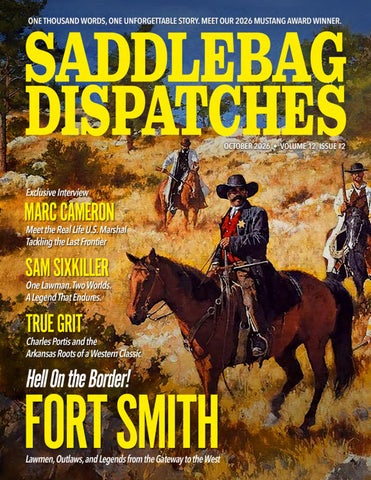
BUSINESS BUSINESS MANAGER: Amy Cowan For advertising rates and schedules or business-related questions, contact Business Manager Amy Cowan amy@saddlebagdispatches.com CONTACT INFORMATION Saddlebag Dispatches, LLC 2401 Beth Lane, Bentonville, AR 72712 479.657.3894 WEBSITE www.saddlebagdispatches.com Dedicated to the memory of our late co-founder, Dusty Richards, and our dear departed friends and partners, Velda Brotherton, Bob Giel, and Sherry Monahan. On our cover: Bass Reeves, Deputy U.S. Marshal, Hot on the Trail by C. Michael Dudash, 2026. (With Permission)
SHORT FICTION 37 39 43 63 81 113 129 143
OLD BLAZE—Sharon Frame Gay EVEN IN DEATH—Devon McKay NEVER LEAVE FORT SMITH ALIVE—Don Money THAT OTHERS MAY LIVE—Wiley Jackson MANHUNT—Dennis Doty THE LAW COMES WITH A PRICE—Ben Henry Bailey THE FORT SMITH HAUNTING—Bruce Hartman WHAT HAVE I DONE—James A. Tweedie
WESTERN POETRY 32 160
13 STEPS TO GLORY—Marleen Bussma GHOSTS OF FORT SMITH—JK Miller
PERSPECTIVES 8 14 16
BEHIND THE CHUTES 20 THE BOOK WAGON 162 TRIBAL PASSAGES THE VIEW FROM MY HILL 166 TALKING WESTERNS LIVELY LIBATIONS 172 COWGIRLS OF LEGEND
8
SADDLEBAG DISPATCHES
BEHIND THE CHUTES Dennis Doty PUBLISHER
Riding the Western Frontier New issue, stories, and award-winning Western authors.
H
owdy, partner! And welcome to the newest issue of Saddlebag Dispatches. We’re happy to have you spend part of your day with us. First out of the gate, we’re proud to announce the publication of a two-volume Western Crime Anthology—Rough Country and Hard Country. We’ve teamed up with Roan & Weatherford Publishing Associates, Metamorphosis Literary Agency, the Will Rogers Medallion Awards, and the U.S. Marshals Survivors Benefit Fund to bring you these two great
collections featuring the works of the most acclaimed voices in writing today. Edited by New York Times bestselling author Reavis Z. Wortham, these anthologies offer new stories from authors never before seen together. Such Western and Crime luminaries as Craig Johnson, C.J. Box, Marc Cameron, Jeffery Deaver, W. Micheal Gear, Kathleen O’Neal Gear, Joe Lansdale, Jonathan Maberry, Heather Graham, John Gilstrap, M. William Phelps, offer fresh stories for your reading enjoyment, while also introducing audiences
to some of the best up-and-coming voices in the genres. To celebrate the release, we helped host a special launch weekend at the U.S. Marshals Museum and the Fort Smith Public Library in Fort Smith, Arkansas, the first weekend in May. Many of the anthology’s authors joined us for the festivities, including several of the biggest names in Western and crime fiction. Signed prints of Western artist C. Michael Dudash’s Deputy U.S. Marshal Bass Reeves: Hot on the Trail—the painting featured on this issue’s cover—were also auctioned to benefit the U.S. Marshals Survivors Benefit Fund. It was an unforgettable weekend celebrating great stories, great authors, and the legacy of the men and women who have served as U.S. marshals. These anthologies are a special tribute to courage, honor, and the spirit of the West. All proceeds from these two great volumes go to the U.S. Marshals Survivors
A few of the terrific authors who joined us for our May Launch Weekend for the Rough Country and Hard Country Anthologies. From left, Marc Cameron, Harry Hunsicker, Barron Birtcher, Phil Mills, Jr., Anthony Wood, Jefferson Glass, John Gilstrap, Rik “Yonder” Goodell, Reavis Z. Wortham, and Betsy Randolph . Photo by George “Clay” Mitchell.
SADDLEBAG DISPATCHES
9
10
SADDLEBAG DISPATCHES
SADDLEBAG DISPATCHES
Benefit Fund. They’re available everywhere books are sold, so get your copies now. On a much sadder note, we’re heartbroken to announce that we’ve lost one of our own. Will Rogers Medallion Award-winning author Sherry Monahan, the talented food writer/historian who wrote our “Lively Libations” column, passed away June 28th after a brief battle with cancer. For more on Sherry, her life, her work, and her passing, please see Casey Cowan’s heartfelt obituary for his friend beginning on page 18 of this issue. To say Sherry will be sorely missed would be the understatment of the year. Moving on, the results are in for the 6th Annual Mustang Award for Western Flash Fiction. A special thanks to the volunteer judges for this year—Michael Knost, Michelle Ferrer, and Reavis Z. Wortham, who are all award-winners in their own right. The winner is announced in this issue as well as on the Saddlebag Dispatches Facebook and Instagram pages. Also in this issue, our columnists offer a selection of articles related to Fort Smith. The amazing Chris Enss offers a column on Zoe Tilghman, the wife of legendary lawman Bill Tilghman and her struggle to keep his memory alive. The always-funny Reavis Wortham gives us a humorous look at cowboy life in View From My Hill, while Regina McLemore’s Tribal Passages sheds light on the life and times of Captain Jack Ellis, a captain of the Cherokee Lighthorse and a Deputy U.S. Marshal. Sherry Mohahan’s final Lively Libations column takes a look at Moonshiners, Revenuers, Saloons and Blind
Tigers, and Terry Alexander’s Let’s Talk Westerns features the legendary Belle Starr and her depictions by Hollywood. Sticking with our historical Fort Smith theme, Anthony Wood offers us a feature on Charles Leflore, the greatest lawman you’ve probably never heard of. Ben Henry Bailey profiles the life and works of Charles Portis, the creator of Rooster Cogburn. In “Comes a Lighthorseman,” Chris Enss profiles Captain Sam Sixkiller of the Cherokee Lighthorse. George “Clay” Mitchell gives us an historical oversight into the law in Fort Smith, and Don Money gives a tour of historical sites in Fort Smith in his travelogue, “Where the Frontier Began.” Rounding out our nonfiction slate this issue, Features Editor George “Clay” Mitchell sits down with retired Deputy U.S. Marshal and legendary New York Times bestselling author Marc Cameron for an in-depth conversation about a career that has taken him from federal law enforcement to the bestseller lists. Cameron discusses his years with the U.S. Marshals Service, the experiences that shaped his writing, and the real-world influences behind his acclaimed Arliss Cutter novels. For readers interested in the men and women who enforce the law—and the stories that grow from their experiences—this is a fascinating look behind the badge and beyond the page. Cameron’s perspective also provides a fitting bridge to this issue’s exploration of the U.S. Marshals Service, offering a firsthand perspective on an agency whose history is deeply intertwined with Fort Smith and the American West.
In our short fiction selections, Ben Henry Bailey’s Deputy Marshal Luke Patten demonstrates that “The Law Comes with a Price.” Modern Western “That Others May Live” is author Wiley Jackson’s premiere published short story, and it’s a doozy, to say the least, as Deputy U.S. Marshal Creed McCrae tracks a violent killer to ground. In my own “Manhunt,” a Deputy Marshal’s life is full of the unexpected. Bruce Hartman offers “Fort Smith Haunting” where a group of former Jayhawkers learn that not all old wounds are healed, and it’s time to pay the piper. Our very own Don Money offers us “Never Leave Fort Smith Alive,” where a quick and easy bank robbery goes astray leaving a string of dead bodies in its wake. Finally, we offer longtime contributor James A. Tweedie’s “What Have I Done?” in which a false accusation leads to an angry response and a long tough trail to catch a killer. Our poetry selections include our Poet Laureate Marlene Bussma’s “Thirteen Steps to Glory” about the justice found in Judge Isaac Parker’s courts, and J.K. Miller brings us “Ghosts of Fort Smith,” an overview of the town’s historic places. As always, the talented staff at Saddlebag Dispatches and I remain fully committed to bringing you the very best original stories, poems, serials, columns, and features—works that reflect the openness, struggle, and unforgiving nature of the Old West. So, pull up a chair, pour yourself a cup from the camp pot, and ride with us into the West that was. Dennis Doty
11
12
SADDLEBAG DISPATCHES
SADDLEBAG DISPATCHES
13
14
SADDLEBAG DISPATCHES
THE VIEW FROM MY HILL Reavis Wortham CONTRIBUTING EDITOR
A Pain in the Backside Cow camp has its hazards, but nobody expected this particular one.
S
onny Bonner and his Pitchfork crew thought they had everything they needed in cow camp during last season’s roundup. They even had electricity when one of the boys tapped into a power pole without frying himself. With lights strung through the cottonwood trees, it looked like one of those old pictures of African hunting camps. Then, in a horrifying incident, Ace Lieberman signed on for the season and brought to their attention a distinct lack of one modern amenity. In his learned opinion, they were missing adequate bathroom facilities. One chilly spring night, an old-fashioned blue norther blew in and frosted everything it touched. Used to discomfort, the boys lit a house fire to toast their feet and pulled folding chairs up close. Extending their feet, they scooched close enough to be just shy of baking the soles of their boots. Sufficiently warmed, Ace stood up, stretched, and disappeared into the darkness for a little privacy. Ismay Hand poked the fire with a scuffed boot, adjusted his chew and watched the new hand walk away. “The way Ace walks reminds me of a story about a monkey and a three-legged dog–”
He was interrupted by an agonized screech from the dark. “I believe something’s eating Ace.” Sonny stretched and laced his fingers behind his head. Bart McDowell looked concerned. “You think maybe we ought to help him?” “Whatever’s eating Ace can do it by itself.” Rank poked the fire up some more. Ace stumbled into the light, limping, gasping, and clutching his nether regions as if a Mexican lion had just ripped off an important appendage. “I knew I’d do that some day!” Ismay couldn’t stand it. “What happened?” “I lost my balance and fell back into a prickly pear,” Ace moaned and gingerly pulled down his jeans.
“Somebody’s gonna have to pick all these stickers out of my rear. I knew I shouldn’t have left Jersey.” The whole Pitchfork crew recoiled in horror. “I’m not touching your backside.” Sonny shook his head. “In fact, I don’t even want to look at it. Keep that thing covered.” Ace tried twisting around to examine his bristling posterior. “I can’t get these stickers out by myself. Come on you guys, you know these things are almost invisible, anyway. They’ll fester up and the hospital will have to amputate!” “They don’t amputate butts.” Doc’s tone suggested indifference. Every cow camp west of the Mississippi has a hand named Doc. They’re always good at pulling calves and doctoring an occasional burn or broken leg. “We could sear the stickers off with a blowtorch,” Ismay suggested. “Just shave his butt.” Already tired of having his evening disturbed, Rank stared into the fire. “Then his jeans won’t brush the stickers and they won’t hurt.” “Fine then.” Doc looked like he’d bitten into a lemon. “I’ll take a look. You boys clear that table off. Somebody find me a pair of tweezers and get a light over here.” The boys removed dishes, pans, bottles, and condiments while he considered the situation. “Bart, bring me a pair of rubber gloves out of the box in my truck there. I’m not touching this boy’s backside with my bare hands.” Once it was cleared, Ace sprawled belly down over the table. The faces of the Pitchfork crew were those of men facing a firing squad. “Careful,” Ace ordered. “And
SADDLEBAG DISPATCHES
don’t nobody say nothin’ about my birthmark back there.” Sonny chuckled. “Looks like Texas, but the gulf’s a little too low.” The rest gathered around to watch the surgery as Doc snapped the rubber gloves on his hands. “This is going to be tough because I can’t hardly see. I’ll just have to pass my hand over the skin, and you tell me if I bump a sticker.” Sonny fired up a Coleman lantern and brought it close. Doc lightly rubbed Ace’s bare, white cheek with his palm, somewhere around El Paso, and didn’t look like he enjoyed it none. “Yaaahhh!!!” “There’s one.” Sonny held the light closer as Doc used the tweezers to pluck it out. Ace yipped. “I do believe that was a hair,” Sonny observed. Ismay brought another light and held it over the table at an angle that illuminated hundreds of little stickers covering Ace’s sitter. It looked like twin Chia pets. “Oh, no.” Sonny groaned. “We’re gonna be here all night.” Rank, still sitting and staring
into the fire, began singing “There’s a Bad Moon on The Rise.” Doc was well into his second hour of extractions when headlights came bouncing down the two-track road from the direction of the main gate. Sammy, the owner of the Pitchfork Ranch, and his wife, Miss Lina, arrived at their camp under the cottonwoods. “Uh-oh,,” Sonny said. “This is not gonna be good.” He tried to intercept the truck, but the headlights had already found Ace, face down on the table, pants around his knees, and the crowd of interested onlookers gathered around his backside. Miss Lina’s window was rolled down, despite the cold, because she’d been about to greet the boys. “My lands.” “Stay in the truck, Mama.” Sammy stepped out on the running board and Miss Lina obeyed, but that didn’t keep her from staring at the bizarre scene in their headlights. Sonny walked up to the truck to keep the startled couple from joining them and struggled to find an explanation. “He has a bone in his throat.”
“You’re working on the wrong end, then, boys.” Sammy chewed his cigar stub. Sonny did some fast talking, trying to convince Sammy that what they were doing wasn’t really illegal in most states. Rank sat alone at the fire, sharpening a stick. Sammy shifted his cigar to the opposite corner of his mouth and worked up a dim smile from the safety of the truck’s cab. “You look like the only person doing something normal in this camp, Rank.” Rank looked up. “Only if it’s normal to drive this through his heart when they’re finished.” “I’d take a look at driving it in the other end,” Sammy said, and offered the loan of his knife. Reavis Z. Wortham is the New York Times bestselling author of seventeen novels to date. A retired educator, he now writes full time, with The Rock Hole named a Top 12 Mystery of 2011 by Kirkus Reviews and Dark Places listed among True West Magazine’s Top 12 Modern Westerns. Wortham’s The Texas Job won the Will Rogers Medallion Award Gold Medal in the Western Modern Fiction category. Reavis lives with his wife in Texas.
15
16
SADDLEBAG DISPATCHES
LIVELY LIBATIONS Sherry Monahan CULINARY EDITOR
Whiskey, Law & Disorder Moonshine, Marshals, Blind Tigers... and Ground Hog Smith?
W
hile Fort Smith, Arkansas, had plenty of legitimate saloons, moonshine whiskey, also called mountain dew, was wildly popular and the bane of many. Planters Mountain Dew was a legitimate brand of whiskey made in the 1860s, but many states used this term for moonshine, which flourished in Arkansas, where locals earned money with their corn, skipping the taxes paid by honest saloonkeepers. There were also pre-prohibition “saloons” called Blind Tigers where moonshine was sold. Wayman Hogue lived in the Ozarks in the 1800s and recalled visiting a moonshine still. “First, they filled sacks with shelled corn and let them soak in the water for a day or two. Then, they spread the corn out on boards and let it remain until it sprouted. Next, they ground or beat the corn into ‘chops.’ One way to do this was to chisel out an excavation in a solid stump and pour the corn in it and beat it with a pestle. Another way was to place the sprouted corn on a flat rock and crush it by twisting another round rock over it. In making the mash, they put in about five bushels of the coarse ground meal into a heavy oak bar-
rel and added to this a bushel of beaten-up sprouted corn, letting it stand for several days. Then they filled the cooker with mash, and a good fire of solid wood, such as the oak or hickory, was kept burning under and around it. The steam coming from the cooking mash escaped through the tube at the top and on into the pipes, which were lying in the trough. Here, the cold water running over the pipes condensed the steam into a liquid, which emptied into a jug. This liquid was a kind of alcohol and was called ‘sanglin’s.’ When the cooking was over, the sanglin’s was poured back into the cooker and re-cooked and re-condensed. The liquid from this second cooking was whiskey.” While enforcement fell to the U.S. Revenue inspectors, U.S. Marshals were also heavily involved. Springfield, Missouri’s Advertiser reported in 1876, “Of all the duties in this country, that of the U.S. Marshal is the most dangerous and onerous. The people of the neighboring counties seem to have the idea that the chief use of any officer of the law is to afford a target for their rifles and pistols, and we too well know how many United States officers have fallen victims to duty.”
Deputy U.S. Marshal S.F. Stahl reported that between 1897 and 1900, 432 people were arrested for moonshining in Arkansas alone. He noted, “Nothing is so terrible in its evil results to a community as the manufacture and sale of moonshine whisky. As Judge Rogers so aptly stated in his charge to the grand jury, ‘making moonshine whisky is invariably the commencement of a career of crime,’ and it is to break up this nefarious business that the court and the marshals have made a most earnest and effective effort.” Some moonshiners had colorful or descriptive names, like Ground Hog Smith, who was indicted under that name. His fellow moonshiners gave him the moniker for his ability to crawl into a hole and pull himself into it and hide, which allowed him to evade the law many a time. Despite moonshiners and blind tigers, legitimate saloons served a variety of cocktails and beverages. The Capital Hotel Bar in Little Rock offered a list of summer cocktails in 1889 that included: Fish House punch, Steinway Punch, Arack Punch, Manhattan, Martinez cocktail, John Collins, Dripped Absinthe, Yard of Flannel, Gin Fizz, Whiskey Fizz, Silver Fizz, Celery Punch, Celery Fizz, and White Plush. Editor’s Note: With this issue, we share the final installment of Lively Libations by our dear friend and longtime contributor, Sherry Monahan, who passed away in June 2026. Sherry’s words have been a familiar and welcome presence in Saddlebag Dispatches, and we are grateful to have this final column to share with our readers. We will miss her greatly.
SADDLEBAG DISPATCHES
Whiskey Fizz 1/2 tablespoon sugar 2-3 dashes lemon juice Splash club soda 1 wine glass whiskey Fill a large bar glass with ice. Mix all the ingredients together and shake. Top off with sparkling water.
Source: Recipe adapted from Harry Johnson’s New and Improved Illustrated Bartenders’ Manual, 1888
17
18
SADDLEBAG DISPATCHES
SADDLEBAG DISPATCHES
19
20
SADDLEBAG DISPATCHES
THE BOOK WAGON Ben Henry Bailey & Chris Enss BOOK REVIEWER
Books for the Trail Some Western reads worth packing in your saddlebag Grit, Guns, and Justice Velda Brotherton’s Lawless Frontier: Crime, Justice, and the Deputy Marshals of Judge Isaac Parker’s Court (published by Otterford, 2026) is a gripping, atmospheric book that captures both the danger and beauty of the untamed frontier. From the first page, Brotherton immerses readers with a style that makes you care for each character. At the end of each chapter, Brotherton checks in with the reader and gives insight into the story she told us. What makes Lawless Frontier especially compelling is its vivid sense of place. Brotherton paints the landscape with such authenticity that you can almost feel the dust in your throat. The frontier isn’t just a backdrop, but instead, a living force that shapes every choice the characters make. The constant tension between civilization and chaos pulses beneath the story, giving it both urgency and depth. Brotherton brings remarkable depth and texture to the historical figures who shaped justice and defied it along the edge of Indian Territory. Rather than presenting them as distant legends, she renders them as complex, driven individuals navigating a brutal and morally tangled frontier. The likes of U.S. Marshal Jacob Yoes, Deputy
and reflective, keeping the readers engaged from beginning to end. Another highlight is the novel’s exploration of law and justice in a territory where both are fragile concepts. Brotherton avoids simplistic moral binaries. Instead, she presents a world where choices carry consequences and where right and wrong are sometimes separated by only a thin, wavering line. This moral complexity adds richness to the narrative and elevates it beyond a straightforward adventure tale. Ultimately, Lawless Frontier is a powerful tribute to the grit and determination required to carve out a life in unforgiving territory. It blends action, heart, and historical texture into a story that feels both entertaining and meaningful. For readers who appreciate Western fiction with strong characters and a vivid sense of authenticity, this novel delivers a deeply satisfying ride across a truly lawless land. —Ben Henry Bailey
Marshal Joseph Wilson, Canada H. Thompson, Judge Issac Parker, and Outlaw Ned Christie show up in her book. These real-life characters are another standout strength of Brotherton’s as she brings them back to life to show their impact on history. They feel grounded and real, each carrying their own burdens, dreams, and moral struggles. The pacing is brisk but thoughtful. Action sequences are handled with clarity and excitement, yet the novel never sacrifices character development for spectacle. Brotherton balances moments of danger with quieter scenes that allow relationships to grow and tensions to simmer. There’s a satisfying rhythm to the storytelling that is intense
Justice the Hard Way Rough Country: Volume I (published by Hat Creek, 2026) hits hard and never lets up. This is Western crime fiction stripped to the bone—violent, moral, and deeply human. Spanning the gunsmoked past of the frontier and the uneasy present of the modern West, this anthology asks timeless questions: Who stands their ground? Who breaks when the pressure is on? And what does justice look like when the law isn’t enough? Anchored by a powerhouse lineup of New York Times bestselling authors, the collection delivers standout stories that feel essential rather than ornamental. Craig Johnson’s brand-new Walt Long-
SADDLEBAG DISPATCHES
Grit Knows No Age
mire tale is a welcome return to familiar terrain, rich with character and quiet menace. Marc Cameron’s Arliss Cutter story cuts sharp and clean, while Reavis Z. Wortham’s Tom Bell entry brings a simmering tension. Joe R. Lansdale, John Gilstrap, and Kathleen Gear add muscle, grit, and emotional depth, each story carrying its own weight. What elevates Rough Country beyond a standard anthology is its cohesion. Despite the range of voices, from established heavyweights and emerging talents alike, every story feels cut from the same rough cloth. The landscapes are vivid, the pacing relentless, and the characters collide headfirst with loyalty, violence, and consequence. From backcountry deputies chasing old ghosts to modern lawmen facing threats that ignore borders the West here is unforgiving and alive. Adding real-world gravity, all proceeds benefit the U.S. Marshals Survivors Benefit Fund, honoring those who paid the ultimate price. Rough Country isn’t just a collection; it’s a statement. —Chris Enss
Few novels barrel into your heart with the steady, unflinching aim of True Grit (published by Simon and Schuster, 1968). Written by Charles Portis, this slim, sharpedged masterpiece is more than a simple Western as it positively throbs with the triumph of voice, character, and moral clarity that leaves a lasting echo long after the final page. At the center stands the indomitable Mattie Ross, one of the greatest narrators in American fiction. From her opening declaration, delivered in a tone as dry and precise as Arkansas dust, Mattie commands the story with unwavering conviction. She is fourteen years old, but her resolve could outmatch any outlaw in the territory. What makes the novel extraordinary is that Portis never softens her, never patronizes her youth. Instead, he lets her formidable intelligence, stubborn righteousness, and razor-sharp wit carry the narrative with an electrifying result. The plot itself is deceptively simple as Mattie seeks justice for her murdered father and hires the grizzled U.S. Marshal Rooster Cogburn to track down the killer in Indian Territory. But simplicity is the novel’s secret weapon. Portis strips away excess and delivers a lean, fast-moving adventure fueled by dialogue so crisp it practically snaps off the page. The exchanges between Mattie, Cogburn, and the vain Texas Ranger LaBoeuf are comic gold that are endlessly quotable. Yet beneath the humor and gunsmoke lies something deeper. True Grit is a meditation on justice, faith, aging, and the cost of determination. It celebrates
courage without romanticizing violence. The West here is not mythic grandeur but more so it is covered in mud, hardship, and stubborn survival. Portis captures it all with prose that feels both timeless and startlingly modern, being plainspoken but slyly sophisticated. What truly elevates the novel is its moral backbone. Mattie’s Presbyterian certainty anchors the story in a worldview that refuses compromise. Her grit is not swagger, but instead, it is conviction forged in tragedy. By the time the famous ride and shootout unfold, the emotional stakes feel earned rather than sensational. In barely 200 pages, Portis achieves what many epics cannot. He gives us a story that is thrilling, hilarious, poignant, and profound all at once. True Grit doesn’t just entertain but also brands itself into the reader’s mind. It’s a novel you admire on first read and revere on the second. Quite simply, it lives up to its title in every way imaginable. —Ben Henry Bailey
21
22
SADDLEBAG DISPATCHES
Taste the Mother Road The Route 66 Cookbook (published by Harvard Common Press, 2025) is equal parts travelogue, history lesson, and kitchen companion—a love letter to America’s most storied highway told through food. Author Linda Ly invites readers to cruise the Mother Road without leaving home, pairing location-specific recipes with the stories, cultures, and roadside legends that made Route 66 an enduring symbol of freedom and possibility. Organized by state from Chicago to Los Angeles, the book unfolds like a well-planned road trip, complete with memorable pit stops and unexpected delights. Ly’s recipes span humble diner classics and celebratory desserts to regional specialties that reflect the cultural crossroads of the route. The inclusion of German, Mexican, Indigenous, Asian, and fusion dishes underscores how Route 66 has always been more than pavement; it’s a moving tapestry of American immigration, innovation, and regional pride. What truly sets this cookbook apart is its sense of place. Each recipe feels anchored to its origin, whether it’s a slice of Elvis Ugly Crust Pie from Texas or New Mexican posole simmered with tradition and heart. Ly’s accessible approach makes the dishes inviting for home cooks of all skill levels, while the historical context adds depth without overwhelming the culinary focus. With 66 thoughtfully curated
recipes, The Route 66 Cookbook succeeds in capturing the romance of the open road and translating it
into something tangible and delicious. It’s perfect for armchair travelers, road trip nostalgists, and anyone who believes the best way to understand a place is to taste it one mile and one meal at a time. —Chris Enss
Gus & Call: the West’s Damon & Pythias There are stories that can surpass the genre they are set in and establish themselves as a literary masterpiece. Larry McMurtry’s Lonesome Dove (published by Pocket Books, 1985), is one of those pieces that sets itself apart, capturing the imaginations of those in cowboy hats while at the same time entertaining those who have never owned a pair of boots. A grand adventure traverses across the untamed American West with a sobering meditation on the brutality that shadows human ambition. Epic in scope
yet intimate in its character portrayals, the novel follows former Texas Rangers Augustus “Gus” McCrae and Woodrow F. Call as they embark on a monumental cattle drive from the dusty border town of Lonesome Dove, Texas, to the wilds of Montana. Their banter back and forth is rooted in a strong friendship that tests the very bounds of loyalty. What begins as a bold, almost whimsical undertaking, gradually unfolds into a journey marked by hardship, loss, and stark moral reckoning. At its heart, Lonesome Dove celebrates the mythic grandeur of the West. McMurtry’s landscapes are vast and luminous with rolling plains, swollen rivers, and open skies that seem to stretch on forever. The physical journey north becomes a testament of endurance and courage, filled with stampedes, river crossings, and encounters with unpredictable weather and wildlife. The reader feels just as much along for the ride as the characters do. The adventure is rich with camaraderie, humor, and the stubborn optimism that fuels dreams of being able to start life anew. Through Gus’s wit and Call’s stoic determination, McMurtry captures the restless spirit that drove both pioneers and settlers to chase opportunity beyond the known horizon. The novel resists romanticizing the frontier by showing that in between the beauty lies unflinching brutality. Death is sudden and often senseless, whether delivered
SADDLEBAG DISPATCHES
by disease, accident, or violence. McMurtry portrays a West where survival is precarious and justice uncertain. Native Americans, outlaws, and settlers alike are caught in cycles of vengeance and fear, revealing the darker impulses that accompany expansion and conquest. The cowboys themselves are not immune to cruelty or moral failure as they are flawed men shaped by loneliness, pride, and unspoken regret. What elevates Lonesome Dove beyond a traditional Western is its emotional depth. McMurtry lingers on unfulfilled love, friendships tested, and the quiet ache of aging in a world that demands relentless toughness. The brutality of the journey underscores the fragility of human connection, making moments of tenderness more poignant. In the end, Lonesome Dove stands as both tribute and critique. It honors the adventurous spirit that defined the American frontier while exposing the cost in blood and broken lives. McMurtry’s masterpiece reminds readers that the West’s beauty was real and breath-
taking but at the same time, so was the harshness of the human heart that sought to conquer it. At the time this review was being written, Robert Duvall, who played Augustus “Gus” McCrae in the miniseries of Lonesome Dove, passed away. Gus had such wit and charm that when Duvall took up the seemingly impossible task of playing the part, he did it with such enthusiasm and charisma that only solidified Gus even more so into being one of the greatest characters of all time. Robert Duvall is an American treasure, and his vast career will always be the standard of legend. —Ben Henry Bailey
Her West, Her Story Women Shaping the West: Stories from Wyoming (published by The Collective Book Studio, 2016) by author and photographer Lindsay Linton Buk is a photographic essay that feels both intimate and expansive—much like the state of Wyoming itself. A Wyoming resident who once dreamed of becoming a photog-
rapher for National Geographic, Linton Buk brings that sense of wonder, curiosity, and visual rigor to this accomplished debut. The result is a stunning, deeply human collection that celebrates the women who have helped shape the state’s cultural, legal, and historical landscape. Through powerful portraits and thoughtful storytelling, Linton Buk introduces readers to 25 influential women, including Wyoming’s first Native (Navajo) female lawyer, Affie Ellis; anthropologist and executive director of the Heart Mountain Wyoming Foundation, Aura Sunada Newlin; and legendary cowgirl Mary A. “Mickey” Thoman. Each woman shares reflections on her life and career, grounding personal narratives within the broader context of Wyoming’s rugged terrain and complex history. The photography is exceptional. Linton Buk captures her subjects with honesty and respect, allowing strength, vulnerability, and individuality to coexist within each frame. Just as striking are the landscapes: wide-open plains, weathered towns, and dramatic skies that do more than provide a backdrop. Wyoming itself emerges as a central character—shaping, challenging, and inspiring the women who call it home. Part educational travelogue, part visual storytelling, Women Shaping the West invites readers to explore Wyoming through extraordinary images and lived experience. It is a meaningful tribute to resilience, place, and the power of women’s stories that will linger long past the final page. —Chris Enss
23
24
SADDLEBAG DISPATCHES
SADDLEBAG DISPATCHES
A LEGACY WRITTEN IN STORIES Author Sherry Monahan didn’t simply preserve the history and stories of the American West. Through scholarship, storytelling, food, and friendship, she made the past come alive. STORY BY
CASEY W. COWAN
T
here are some historians who tell you what happened. Then there are historians like Sherry Monahan, who don’t simply recount history, but invite you inside it. A few years ago, a group of us from Saddlebag Dispatches found ourselves in Tombstone, Arizona, attending the Tombstone Festival of Western Books, an annual event that, combined with the Tucson Festival of Books the same weekend, draws together many familiar faces from the Western history and literature community. It had already been a full day of bookselling, gladhanding, and sight-seeing. If you’ve ever been there yourself, you know that it’s not your average tourist destination. Sherry was practically a Tombstone native. She’d written books and articles on the town and its history, and she and her husband, Larry, even owned property just outside of town Radiant, elegant, and smiling from ear to ear, Sherry Monahan celebrates another Will Rogers Medallion at the 2024 awards. It is a fitting photograph of a woman who found so much joy in the people, places, and stories of the West. Author’s Personal Collection.
where they spent weeks camping and communing with nature. To say she knew the town would be an understatement. Sherry had promised to be our guide, since we were all a bunch of first-time visitors. Earlier in the day, she’d handed us copies of a monograph she’d written about the town, a way for us to take a self-guided tour, to see the places most visitors overlook. We wandered well beyond Allen Street, stopping at old neighborhoods, forgotten corners, mining remnants, churches, and, of course, the old Tombstone Swimming Pool. The swimming pool was non-negotiable. “You’ve got to see it. It’s the oldest swimming pool in Arizona. Built in 1883. Can you imagine?” Only Sherry could make an old swimming pool sound like an essential stop on a historical tour. She understood that history wasn’t simply about famous gunfights or celebrated names. It was about ordinary places, overlooked details, and the people who lived everyday lives in extraordinary times. She found stories where most people saw old buildings.
25
26
SADDLEBAG DISPATCHES
By the time dinner ended, the sun had disappeared beyond the Huachuca Mountains. The tourists had thinned as the early spring evening turned crisp and chilly, storefront lights glowed against weathered brick, and Allen Street had settled into the peculiar quiet that only old Western towns seem to know after dark. Our little procession stepped out onto the boardwalk. There was Sherry leading the way, followed by George “Clay” Mitchell, Anthony Wood, my father-in-law Roger Hankins, and me. She immediately stopped us at the intersection of Allen and Fifth. “This,” she said, pointing toward the second story of what is now the Longhorn building, “is probably where Virgil Earp’s attackers were waiting for him.” The intersection suddenly changed. Instead of standing in modern-day Tombstone, we were transported back to December 1881. It had been two months since the infamous gunfight at the O.K. Corral. Wyatt Earp’s older brother, Deputy U.S. Marshal Virgil Earp, having just emerged from The Oriental Saloon, was crossing the street, Sherry shared a table with fellow author Anthony Wood at the Will Rogers Medallion heading home. Awards booth during the 2024 Tucson Festival of Books. It was the beginning of But hidden men waited for him in a terrific friendship. Author’s Personal Collection. the darkness above. Buckshot shattered the quiet, and we could all practically That evening, after we’d all had a merry time hear the sound of the shots. celebrating our friend, Chris Enss, and her book, That was what Sherry did. She never simply pointed According to Kate, at Big Nose Kate’s Saloon, she at a building. She dissolved time. In her hands, history gathered our little group together. stopped being something you learned and became “Okay, now we’re going to do Essential Tombsomething you experienced. stone,” she announced. Continuing along Allen Street’s creaky boardwalk, Naturally, it began with dinner. We made our every doorway became another chapter. Outside the way to the Longhorn Restaurant, where conversasite of Campbell & Hatch’s Billiard Parlor—today tion flowed as easily as it always seemed to around home to the Red Buffalo Trading Company—she Sherry. Food wasn’t simply something she enjoyed. It stopped again. was another doorway into history. Long before culiMorgan Earp died here. Not somewhere. Here. nary history found its current popularity, Sherry was Just a few feet from where we stood. demonstrating that what people cooked, served, preShe spoke of the silver mines that built Tombserved, and shared around their tables often revealed stone, the miners who risked everything underground, as much about a culture as the wars they fought or the the architecture that survived fire and neglect, the politicians they elected. She understood that history Cowboys, the Earps, Doc Holliday, Johnny Ringo, lived in kitchens every bit as much as battlefields.
SADDLEBAG DISPATCHES
the Birdcage Theater, the city morgue that’s now a coffee shop, the boom years, the tragedies, the rebuilding. Facts became stories. Stories became people. People became real. Without realizing it, we had stopped looking at Tombstone as tourists. We were walking through someone else’s stories and experiences. And that was Sherry’s extraordinary gift. She didn’t lecture. She invited you in. The best historians possess knowledge. The rare ones possess imagination disciplined by scholarship. They know enough not merely to explain the past, but to help others inhabit it. Sherry belonged in that rare company. It wasn’t surprising that she approached history that way. Before she ever became one of the country’s foremost culinary historians, she’d explored careers in modeling, finance, retail, and genealogy, always chasing curiosity wherever it led. She combined meticulous research with engaging storytelling, producing eighteen books that explored frontier life through the universal language of food. Recipes became windows into migration, Sherry and Chris Enss were longtime partners in crime. Here, they share a moment survival, celebration, hardship, and comat the 2019 Will Rogers Medallion Awards at Cattleman’s Steakhouse in Fort munity. Meals became history lessons. Worth, Texas. Both took home awards that night. Photo Courtesy of Chris Enss. Readers came for the recipes, but they stayed because Sherry made them longtime partner-in-crime, New York Times bestcare about the people who prepared them. selling author Chris Enss. “She was also a treasured While her work earned numerous honors—includfriend whose generosity, laughter, and unwavering ing multiple Will Rogers Medallion Awards—such support made every life she touched a little brighter. accolades never seemed to define Sherry. Friendships She leaves a place that cannot be filled and will be did. Anyone who spent more than a few minutes with deeply missed.” her quickly discovered her warmth, her infectious She and Larry were fixtures throughout the Westlaugh, her endless curiosity, and her wonderfully dry ern literature community, amongst which they had sense of humor. She could move effortlessly from many close friends. Whether attending conferences, discussing nineteenth-century chuckwagon cooking exploring historic sites, or sharing photographs and to recommending an unforgettable restaurant in stories from their travels aboard their boat, they whatever town happened to be hosting that year’s lived with the same spirit of curiosity that animated particular convention. Sherry’s writing. “Sherry dedicated her life to preserving the rich “Sherry was a best friend. She always called me history and traditions of the American West, leaving her blond brother,” said award-winning author and behind a body of work that will educate and inspire historian Bill Markley. “We first met in 2005 at Spofor years to come,” said Sherry’s good friend and kane, Washington Western Writers of America Con-
27
28
SADDLEBAG DISPATCHES
Sherry poses with one of her favorite treats during lunch at the Hard Rock Casino Diner in Tulsa, Oklahoma, during the 2025 Will Rogers Medallion Awards. We turned lunch into an impromptu photo shoot for a pie cookbook we were working on. Neither of us knew it would be the last meal we would share together. Author’s Personal Collection.
SADDLEBAG DISPATCHES
Bill and Liz Markley were among Sherry’s closest friends in the Western literary community. Here, they are pictured with Sherry and Larry during a visit to North Carolina. Photo Courtesy of Bill Markley
vention and went on to have lots of fun experiences together. One of the craziest was when my wife, Liz, and I were taking an East Coast victory tour after I retired from my 40-year environmental enforcement career. As we traveled through North Carolina, we planned to have lunch with the Monahans, then push on to the Outer Banks, but Hurricane Matthew blew up and we spent three days at their house. We had fun drinking Hurricanes, eating Sherry-cooked shrimp, and playing board games by candlelight. Sherry was a best friend.” History wasn’t something she studied, and adventure wasn’t something she postponed. She embraced both. That became especially clear as our little group continued wandering Tombstone that night. The later it grew, the quieter the town became. Our footsteps echoed softly across the boardwalks. The desert air cooled to the point we all buttoned our jackets. The stars twinkled clear and cold overhead. For long stretches, we simply listened as Sherry talked, and it wasn’t history we were seeing, but the atmosphere and story of this old Arizona boomtown too tough to die.
Eventually our walk came to an end. My car was parked one block over near the old Russ House Hotel, and we lingered beneath the awning, reluctant to let the evening end. We talked about history, legacy, preservation, books, forgotten places, and why stories matter. The street was almost perfectly still. There was scarcely a breath of wind. Then, without warning, the hanging sign above us lurched sideways. It swung hard against the building, shattering the silence. Smack. Again. Smack. We all looked up. One of us laughed. Another wondered aloud whether Tombstone’s ghosts had decided to join the conversation. It was one of those wonderfully inexplicable moments that never quite leaves you. Years later, none of us remembers exactly what was said afterward, but we all remember how it felt. That evening seems to capture everything that made Sherry so extraordinary. Sherry understood something many historians never do—that history isn’t made remarkable by
29
30
SADDLEBAG DISPATCHES
Sherry and I celebrate her Will Rogers Medallion Award Silver Medal for Victorian Recipes with a Side of Scandal at the 2025 Will Rogers Medallion Awards. It was a happy night, and a proud moment for us both. Author’s Personal Collection.
famous names, but by ordinary people whose lives became extraordinary through circumstance. That it isn’t merely a collection of dates and names, but memory. It’s standing exactly where someone else once stood and allowing yourself to imagine, however briefly, what they experienced. “For Sherry, it was never just about the food. It was about the people around the table, past and present. The laughter, the stories, and the moments shared over a good meal are what matter most,” said George “Clay” Mitchell, EVP & Chief Publishing Officer of Roan & Weatherford Publishing Associates—and one of the tourists that night in Tombstone. “There’s an empty seat at the table now, but the memories Sherry helped create remain. Our hearts and minds, and maybe our stomachs too, are fuller because of her smile, her laughter, and the joy she felt in bringing people together.”
Few people have the ability to give others that experience. Sherry did it naturally. And now she’s gone. On June 28, after a brief battle with brain cancer diagnosed only a few months earlier, Sherry Monahan passed away surrounded by those she loved. She was sixty-three. She leaves behind her devoted husband, Larry, her mother, Marilyn Teeter, her sister, Susan Cunningham, and family, countless friends, generations of readers, and an immeasurable contribution to preserving and interpreting the history of the American West. She also leaves something less tangible. Experiences. Conversations. Shared meals. Long walks through historic places. Stories that will forever be told beginning with the words, “Sherry once showed me…” “Sherry Monahan was a gentle breeze with the soul of a hurricane—a force of nature to be reckoned
SADDLEBAG DISPATCHES
From Left to Right: Amy Brewer of Metamorphosis Literary Agency, Sherry Monahan, Casey Cowan of Roan & Weatherford Publishing, and Bill Markley pictured during the 2025 Will Rogers Medallion Awards Banquet. Photo by Joe Ownbey, Ownbey Photography.
with,” said Will Rogers Medallion-winning historical author Anthony Wood. “Encouraging and supportive, Sherry was a friend I could always trust to be honest and direct, silly and serious, happy and empathetic. She will be greatly missed. Already is, in fact.” As her publisher, I, personally, had the privilege of helping bring some of her work into readers’ hands and share the stage with her when she won some of those awards. As her friend, I received something far more valuable, the reminder that history is not a distant country. It’s in and around all of us. It waits patiently in old streets and weathered buildings, in family recipes, fading photographs, forgotten journals, and quiet cemeteries. It waits for someone willing to slow down, look carefully, and tell its stories honestly. Whenever I think of her now, I don’t picture awards or book signings or conference halls. Instead, I see Allen Street after dark and hear footsteps on old wooden boardwalks. I remember a group of friends standing beneath the stars outside the Russ House Hotel as an old sign suddenly began to swing in the stillness. I remember Sherry, smiling as she trans-
formed another ordinary evening into something truly unforgettable. The finest historians preserve the past. The finest storytellers make us feel it. Sherry Monahan somehow managed to do both. She didn’t simply write about history. She invited the rest of us inside. I like to think that if she were leading one more tour through Tombstone, she’d eventually stop in front of that old swimming pool again. “You’ve just got to see it,” she’d say with that familiar smile. And we’d smile, too, because by then, we’d know it was never really about the swimming pool. It was about learning to see history the way Sherry did. Godspeed, my friend. Casey W. Cowan is the co-founder, President, and Creative Director of Roan & Weatherford Publishing Associates and Saddlebag Dispatches magazine. With over thirty years in journalism, publishing, and design, he continues to champion powerful storytelling that preserves and reimagines the American West, a mantle he took over from his late friends and mentors, Dusty Richards and Velda Brotherton.
31
32
SADDLEBAG DISPATCHES
13
SADDLEBAG DISPATCHES
STEPS TO GLORY POETRY BY
MARLEEN BUSSMA SADDLEBAG DISPATCHES POET LAUREATE
Ft. Smith acts like a funnel while it pours out those who seek their western destination that has fresh and raw mystique. Explorers, traders, settlers pass this gate of history, while outlaws, horse thieves, whiskey-runners know that they can flee to safety inside Indian Territory on the west. Untouched by white-man’s law, it has become a viper’s nest. The lawless west has ridden in on horses fresh with youth, while justice slowly limps along and staggers toward the truth. Judge Parker wears the robe of frontier justice on the bench. Two hundred deputies ride out to keep the peace and quench the stench of murderous mayhem that has settled on the land. Bold killers pay attention when Judge Parker takes the stand. His first year on the bench, he makes a bold, eye-popping move. Rough justice serves to teach a lesson, though some don’t approve. Six murderers are hanged together as a show of clout. Judge Parker is not ruthless. He shows what the law’s about. The gallows stand up white and wide complaining with a creak. Its thirteen steps to glory do not turn the other cheek. While scores of murderers are sent to hell’s gate with a lurch, not one was ever hung because he sang too loud in church.
33
34
SADDLEBAG DISPATCHES
SADDLEBAG DISPATCHES
35
36
SADDLEBAG DISPATCHES
SADDLEBAG DISPATCHES
SHARON FRAME GAY
OLD BLAZE A SHORT STORY
Winner of the 2026 Saddlebag Dispatches Mustang Award for Western Flash Fiction
T
he kid looked like a waif. He stood before me, thin as a scarecrow, with tears tricklin’ down a filthy face. Next to him was an ancient dog with a rope around its neck. “Please, mister, won’t you take him?” The boy wiped his nose on a tattered sleeve. “My pa says I gotta kill him if he can’t find a home.” He pulled a pistol from a burlap bag, and I took a step back. The kid was about ten or twelve years old. I’d never seen him before. “Why do you have to kill him, son?” I’d loaded the wagon with supplies and yearned to get home before sunset. But there was somethin’ about this boy and his dog that gave me pause. “Well, Blaze here is sick, and he’s old. Pa says we ain’t gonna feed an animal if it can’t pull its weight. So, if I don’t find someone to take him today, I’ll have to shoot him, and I sure don’t wanna do that.” Now the boy was sobbing, frail shoulders buckled in despair. He placed a hand on the old dog’s head, then looked at me with the saddest eyes I’d ever seen. “Let me take a look at this dog,” I said. Blaze was skin and bones. He wagged his tail real slow the way old dogs do, almost apologetic. One eye was weeping, and his left front paw reeked of infection. Bloody scabs circled his neck where the rope hung. A white streak of fur ran down his muzzle like a lightning strike, and one ear had a notch chewed out of it. He probably hadn’t eaten in days. It didn’t look like he’d live past a week.
“Was he hitched to the back of your wagon?” I asked. The kid nodded. “Yeah, Pa said he’d have to keep up if he wanted to live. And if he didn’t, we’d just drag him along, and I’d get a whippin’ too, because I should have left him back in Nebraska. Mister, I’m beggin’ you, please take him. He’s a good dog, and I love him.” He knelt and threw his arms around the old guy’s neck. Blaze licked the boy’s face, even though the dog must’ve hurt all over. “Sure, I’ll take him,” I lied. “Give him a good home. Lots of food and a warm place to sleep. He’ll be happy. I promise.” He brightened the way the sun comes out after a cloudburst. “Did you hear him, Blaze? This nice man’s gonna take you home, so you can live out your days here in Wyoming.” When the boy stood, I noticed the marks on his arms, the chain of bruises around his throat. Jaw clenched, I reached for the rope and brought Blaze to my side. “Go on now, son. I bet your pa’s waiting for you, and I have to leave.” The kid took one last, longing look at Blaze and walked away, his worn shoes flapping in the dust. I picked up the dog. He was as light as a feather. I placed him in the back of the wagon. He tried to hop out and follow the boy, so I tied him to a barrel, then we set off across the prairie.
37
38
SADDLEBAG DISPATCHES
I’d get far enough away from town, then shoot him. Spare the kid the grief. I had no use for the poor old thing. He was death walking. I figured I’d bury him off the side of the trail and stack rocks over his grave, so the wild things wouldn’t dig him up. About halfway home, I spotted a grove of trees on a tiny knoll. It would be as good a place as any. I stopped the wagon, lifted Blaze to the ground, and we started up the hill. He limped alongside me, his grizzled face peering up into mine. My stomach twisted as I tied him to a tree and drew my revolver. He just stood there and wagged his tail, lifting his bad foot. I aimed at his chest, and my hands shook. Tried again. Then shoved the gun back in its holster. “I can’t do this,” I muttered. “How in the hell can I kill this old feller?” I untied him and carried him back to the wagon. This time, Blaze rode up front with me. He stared at me for the longest time with his weeping eye, then leaned against my shoulder, the warmth of his old body leaching straight into my heart.
Blaze lived for two more years before he died in my arms one night under a blanket of stars. I buried him beneath an aspen tree surrounded by wildflowers, and I visit his grave every day. You could say I saved him, but truth be known, it was Blaze who saved me. I still have the ragged rope he wore around his neck, and keep it by the
bed. Sometimes I run my fingers over it and pretend he’s still here. He was just an old dog, but he left me with far more than a frayed rope and a lonesome heart.
Every morning, I pour a cup of coffee, make a batch of biscuits, then call the boy in for breakfast. It was easy to take the kid too. I rode hard the next morning after bringing Blaze home and found the boy with his father west of town. His pa had no use for him, either. I handed the miserable bastard fifty bucks and a few promises, and now I have a son who’ll never know the back of my hand or hear the sting of harsh words. He’ll inherit this spread when I join Blaze on the other side. My boy Andy and I sit on the porch in the evenings and watch the moon flickering through the trees. In our quiet moments, we talk about that old dog and how he brought us together forever. { Sharon Frame Gay,is an award-winning author whose work has appeared in many anthologies and magazines, including Chicken Soup for the Soul, Typehouse, Fiction on the Web, Literally Stories, Lowestoft Chronicle, Thrice Fiction, Saddlebag Dispatches, Crannóg, and others. She is a Pushcart Prize nominee, award winner in several genres of writing, a two-time recipient of the Will Rogers Medallion for excellence in Western writing. Collections of her short stories, Song of the Highway and The Nomad Diner, are available on Amazon, as is her debut novel, the Western mystery Where the Crows Fly.
SADDLEBAG DISPATCHES
39
DEVON MCKAY
EVEN IN DEATH A SHORT STORY
First Runner-Up in the 2026 Saddlebag Dispatches Mustang Award for Western Flash Fiction
G
rief had won. Dora Westbury sank deeper into the straw-laden mattress. The effort was less for the comfort the bed provided and more for the hope of sleep, praying for anything to ease the pain of her broken heart. Even that proved futile, offering only false security and brief episodes of unconsciousness. Time was fleeting. It’d been days since she’d left the room. Yet, at some point, she knew she must. There were chores to do—marked by the rooster’s announcement of a new day. His loud crow demanded his flock be fed, as well as the mule, and perhaps even herself. If Thomas were alive, he would have coaxed her out of bed, likely with a joke about the biscuits not burning themselves and an infectious grin, as was his way. But now, there was no laughter, no teasing about her cooking, nor anyone to eat the hardened tack of baked flour, water, and lard. Burnt or not. A bath was in order as well, a necessity to wash away the dirt staining her dress and hands from burying him. Despite not feeling the pangs of hunger nor the urge to change clothes, a clean gown and a meal would follow. Simple tasks, done without thought. She needed to be strong. Prepared. How many times had Thomas reminded her of this? It was the only time her husband was serious. They learned early on that the wolves would come. Men, hungry for their land. The West was lawless. Governed by those with the biggest guns.
The threat had been more dire than they could have known. However, the bullet that took her husband’s last breath had changed that perspective. It had changed everything. And now she was to continue their dream alone. A steep price to pay for land ownership and to farm with freedom. Strange to find herself a widow at only twenty and one years of age. Gone were the dreams of a family, a boy with his grin, and a girl with mirth dancing in her green eyes. Perhaps that was what hurt the most—knowing their story had ended so abruptly. Thomas had vowed to protect her… to share their lives and grow old together. He’d promised forever. Anger reared its ugly head again, spearing through the sorrow, as it had off and on. The brief respite reminded her she was still alive. And it was just as painful, if not more so, than the heartache. Though not rational, she blamed him for breaking the promise… for no longer being here, never to return. For leaving behind a wound that would never heal. She squeezed her eyes shut as fresh tears burned fiercely behind her eyelids. A remarkable feat, considering there were few left to shed. The grief consumed her, swallowing the anger, and crushing her lungs with its intensity. She forced herself to a sitting position, gasping for breath. Thomas wasn’t at fault, nor was this what he would have wanted. He’d want her to live a good life… to somehow find happiness again. And though
40
SADDLEBAG DISPATCHES
the thought wouldn’t heal her heart, it soothed Dora enough to regain control of her breathing. She focused on the wall, taking short, shallow breaths until she calmed down. The logs, hand-hewn and sealed with dirt, had become a home. And although Thomas was no longer there to share it, the house and land belonged to her. Certainly, that was worth fighting for? After a moment, she let her gaze drift from the wooden planks to the window. A slight breeze stirred the stagnant, warm air, ruffling the gingham curtains and awakening the scent of her husband left behind to haunt her. Rays of sunlight streamed in, lighting the space with the promise of a new day. An ugly reminder that life went on. Without Thomas. Unsettling, considering she’d grown used to the dark. Welcomed it, even. A glint of steel caught her eye. She shifted her gaze, focusing on the nightstand. Specifically, Thomas’s prized possession—a pearl-handled Colt passed down from his father. A gun she had buried with her husband. She was sure of this, despite her mind playing tricks and evidence suggesting otherwise. She leaned forward, grasping the six-shooter. The weapon was heavy, loaded with bullets. Something else worth noting. When she laid the gun on his chest, the chambers were empty, the ammunition removed by her own hands. She had done so deliberately, thinking it wise.
Now she was filled with doubts, questioning her actions. Perhaps she was mistaken. Placing the gun on her lap, she fumbled to reach into the pocket of her skirt. Her fingers closed in on a small collection of metal objects, mentally counting out six. She locked them in a fist and pulled her hand free, startled by the realization. How was this possible? Thoughts ran rampant, her mind reeling with excuses. Yet, none made sense. The gun she buried hadn’t been loaded. She had proof of this. Dora slowly opened her hand, then tossed the bullets aside before picking up the Colt again and rechecking the chamber. No. Her eyes did not deceive. However, her sanity was in question. A shadow crossed the window, alerting her to the darkness once again and ending the inquiry. The scrape of boots on the porch further terrified her, followed by the sound of splintered wood. They didn’t bother to knock. Her heart stopped in fear and shock, then started beating erratically. Predators had arrived. The wolves were at the door, just as her husband had warned, prompting her next move. He would want her to fight. She raised the Colt with careful aim, instinctively feeling the pearl handle pressing just right against her palm. Once, she’d been afraid of the firearm. Thomas had changed that. Her husband’s lessons flooded her memory—evenings spent practicing target shooting and self-defense. Now, holding the gun felt like second nature. And she knew exactly how to use it. Even in death, Thomas had prepared her. Devon McKay,is an award-winning author whose work has appeared in many anthologies and magazines, including Chicken Soup for the Soul, Typehouse, Fiction on the Web, Literally Stories, Lowestoft Chronicle, Thrice Fiction, Saddlebag Dispatches, Crannóg, and others. She is a Pushcart Prize nominee, award winner in several genres of writing, a two-time recipient of the Will Rogers Medallion for excellence in Western writing. Collections of her short stories, Song of the Highway and The Nomad Diner, are available on Amazon, as is her debut novel, the Western mystery Where the Crows Fly.
SADDLEBAG DISPATCHES
41
SADDLEBAG DISPATCHES
DON MONEY
NEVER LEAVE FORT SMITH ALIVE A SHORT STORY
Pert Anderson, Customer, National Bank of Western Arkansas
T
he long barrel of the Colt Walker pushes against my forehead as the shock of what is happening settles on me. I rode into Fort Smith this morning and came to the bank to inquire about making a seed loan, and now find myself in the middle of a bank hold-up. “Get your hands up, Pert,” the man with the kerchief covering his face says to me before turning his head to the teller, Jordan James. “And you—bank man—go ahead and load up that bag with all the money you got.” “How do you know my name?” I ask the man. Pushing my fear aside, I give the outlaw a good hard stare. Something familiar about the man settles on me. “Alton? Is... is that you, cousin? What’n hell you doing?” The man squints his eyes as if that would add to the disguise. “I do not know who you are talking about.” But in the move of a guilty conscience for having put a pistol in the face of one of his kin, he lowers the gun away from my face. “Hurry up with that money,” he says as the pistol’s barrel moves to the teller. Jordan slides the bag, now stuffed with greenbacks, across the counter. I decide to put this foolishness to an end reaching and pulling the kerchief down from the robber’s face. “It is you, Alton Anderson,” I say, grabbing hold of the pistol barrel. “Grandma Velda would be embarrassed at you being an outlaw and bringing shame on the family name.” Frustrated, Alton says to me, “Let go before you
ruin everything. Nobody in the family cares about me anyway.” He tries to pull away from me but I press in close, twisting the Colt away from him. “Naw, I ain’t going to let you sully the family—”
Jordan James, Bank Teller, National Bank of Western Arkansas At first, I was in shock at facing the first bank robbery to occur in Fort Smith in many years. Then the explosion of the pistol going off between the two men sends me stumbling back away from the bank counter. I watch in horror as Pert Anderson crumples over and falls dead to the floor of the bank, a blossom of blood spreading from his chest. “You shot him in the heart,” I say, looking at the guilty man. “I didn’t mean… he should not have….” The rest of the man’s words fail him. He swings the pistol back up and points it at me. Our eyes lock together, and the man pulls up the mask to cover his face again. I sense what is about to happen. I drop behind the counter as the pistol shot passes overhead. I watch as the bottom of the money bag disappears from the countertop, and I hear boots running across the wooden floor and then the bell of the door announcing the outlaw’s departure. I get to my feet and cross through the door out into the lobby. The amount of blood seeping onto the floor affirms my previous thought that Pert is dead. Multiple gunshots sound from the street as I suppose Alton Anderson is making good his escape.
43
44
SADDLEBAG DISPATCHES
Anger swells in my body. I am not going to let this murdering outlaw get away. I’ve got to let the marshal know who’s behind the bank robbery. The door opens, releasing me to the chaos of the robbery’s aftermath. People scream, running in panic from the path of Alton’s horse as he spins around atop his mount, firing off rounds. I yell as I run past the blacksmith’s stall into the middle of the street. “Alton Anderson held up the bank! Alton Anderson just shot Pert….” A loud commotion catches my attention, and just as I spin around, the horses bear down on me.
Glenn Klein, Blacksmith Big Klein Smithy The brutal sight of the horses trampling Mister James is shocking. I lay my hammer on the anvil and watch as several people run to check on the teller. Ross Macy, owner of the General Store, kneeling beside the fallen man, stands and shakes his head. My stomach churns, knowing I just witnessed the death of a man.
I don’t know if anyone else actually heard what James was yelling about Alton Anderson being the person who just robbed the bank. That information I have to get to Marshal Valentine Dell. With the main road in chaos, my best bet is to cut through the alleyway between the General Store and Opportunity Saloon to get to the marshal’s office. With a quick look over my shoulder, I dart down the alley. As I round the corner behind the saloon, I skid to a stop. A man is standing in my path. “I thought you may have heard what the bank man was yelling about who just robbed the bank. I’m afraid I can’t let you go running to the law letting them know who shot down Pert. Those horses running down the bank man worked out well in my favor, but you had to hear what he said and stick your nose in my business. Getting away clean is going to require that I put a stop to you.” A pistol in the man’s hand looms out toward me. “Now, hold on a minute.” I throw my hands up—
SADDLEBAG DISPATCHES
Whip Neely, Bartender Opportunity Saloon I ease the door back closed, with the echo of the gunshot bouncing off the wooden walls of the alley. That scoundrel Alton Anderson just shot Glenn Klein down in cold blood. I had just started out the back door of the saloon to head out to the privy when I saw the murder of the blacksmith. Not only that, Alton implicated himself as the man who just robbed the National Bank and killed Pert Anderson. That’s two killings, not to mention the cause of Mister James from the bank getting trampled to death–dangerous information to be carting around in Fort Smith. Information that a man just got killed for. Alton is in the saloon all the time for drinks and to watch the dancing gals, so I know he knows who I am. I don’t think he saw me in the alleyway, but I can’t be sure. If this information is going to get to Marshal Dell, I am going to need to send it by someone else who might be able to slip by if Alton is still out there somewhere. I call Josie back to the storeroom. “Josie, I need
you to run a message over to the courthouse. Find Marshal Dell and tell him that Alton Anderson was the man who robbed the bank and he killed Pert Anderson and Glenn Klein. He is also the reason poor old Jordan James was caught up in that run down on the street.” Josie gives me a strange look, like she is pondering something. “Whip,” she says, “who else knows about this?” Her question hits me as odd. She does not seem concerned about the murders and robbery, just who knows about it. “Just me. I heard Alton confess to killing Pert, and then I saw him with my own eyes shoot down Glenn. He may still be skulking around. We need to let the law know before he gets away.” Surprisingly, Josie laughs. “I thought back home in Batesville, on the White River, everybody knew everybody, but even a big ol’ town like Fort Smith is a small world too.” “Josie, I don’t know what nonsense you are talking about, but you need to get on over to Marshal Dell and...” The appearance of the derringer in her right hand stops me cold.
45
46
SADDLEBAG DISPATCHES
“Small world, as in Alton is my man. That money he took is going to get us out of Fort Smith and across the river to a place of our own out in the Territory. Can’t imagine my luck in being the one you called back here. Now, our secret can die on your lips.” Movement behind the crates to my right causes me to turn my head. There, rising up from where he catches his mid-morning nap, is the saloon’s piano player, William Blake. The look on his face tells me he overheard every word Josie just said. He knows his life is also in danger if she discovers him there. I look down, hoping he catches my drift to return to hiding. I may not make it out of this, but at least what happens to me will be told. Just as he slips back down out of sight, Josie, who never noticed William, tears at the collar of her dress, ripping it. “I’ll tell everyone you lured me back here and attacked me, and that is why I had to kill you.” A wicked look comes across her face as she steadies the gun pointing at me but pauses for a second. Maybe she won’t actually go through with—
William Blake, Piano Player Opportunity Saloon I squeeze my eyes shut at the pop and then feel the thud of Whip’s body bounce against the wood plank floor where I lay. Josie screams and goes running out of the storeroom crying. “Whip attacked me… I had to do it… I… I….” I hear the murderess spinning her story. From what I overheard, she and Alton Anderson are leaving a trail of blood through Fort Smith—Pert dead at the bank, Jordan James run down, that blood is still on Alton’s hands—even indirectly, Glenn and now Whip, both killed for trying to let the law know. I stand up and make my way to the door. Josie is the focus of all of the people in the saloon right now. This is my chance to slip out of the stockroom and out the backdoor. As I clear the doorframe, Josie glances over in the middle of her dramatic performance and sees me leaving the room. She realizes instantly that I must have been in the room when she killed Whip and overheard everything she said. “William was in the room and attacked me also.” She continues her sobbing. “He has a gun and said he’d kill anyone who tried to stop him.” Josie looks
up, like she has just seen me for the first time. She screams. “There he is, and he has a gun!” Lance Nichols, a young hothead who fancies himself to be a gunfighter, draws his pistol, and in a smooth motion, fires a shot hitting me right in the chest. White hot pain flares through my body as I crumple to the floor. From where I lie, I can hear a jumble of chaotic conversation. “Nichols, you fool, he wasn’t even heeled.” “Well, Josie said he was coming out to shoot the place up.” “Whip is dead in the storeroom.” “Josie?” I look to my right and see Marshal Dell coming through the backdoor, pistol drawn. “What’n Sam Hill is going on here? Glenn Klein is lying dead in the back alley, and people are running to me about gunshots in the Opportunity, a man trampled in the street, and a man dead at the bank. Fort Smith looks more like Dodge City today.” Someone I can’t see says, “You got one dead in the storeroom and William bleeding out over there on the floor from where Lance Nichols shot him, thinking he was about to kill us.” The marshal speaks again, “A couple of ya’ll get him up off the floor and on over to Doc Foley.” I feel my body lifted and then my eyes close… A sharp pain in my chest and I blink my eyes open. Doc Foley stands over me with forceps in his right hand, his apron covered in blood. My blood. “Marshal, he ain’t going to make it. He’s lost too much blood. I can’t get it to stop.” I’m feeling weak. I know my life is fading fast. That thin veil to the other side is flickering in my vision. Marshal Dell looms over me. “William, what happened?” I tell him everything. I get every single thing I know off my chest.
Alton Anderson bank robber and murderer I creep along back to my horse hidden behind the Lamont Hotel at the edge of town. Minutes before, I heard the worst possible thing while hiding outside the open window at Doc Foley’s office. William Blake took his last breath, but not before spilling the entire
SADDLEBAG DISPATCHES
litany of my sins of the day—the robbery, killing Pert, starting the stampede that killed the bank man, killing the blacksmith, Josie killing the bartender, leading to the piano player getting shot and dying. I make it back to my mount and light out for my house. I’ll grab a few possessions, and with the money from the bank holdup, I will cross the river, and head for the Territory. Josie is going to be on her own. Rounding a bend in the road, a bullet slams into my shoulder, throwing me from my horse. The sound of pounding hooves, and minutes later, Marshal Valentine Dell towers over me from the back of his horse, Winchester rifle aimed at my face. “Alton Anderson, you are under arrest for a list of crimes as long as my arm,” Marshal Dell says. “Judge Parker is going to have some words for you.” A week goes by and I now stand in Judge Parker’s courtroom at the end of a day of testimony. I know will end with a noose around my neck, my feet swinging free. The judge’s voice booms out from the bench. “Alton Anderson, your crime spree has forever shaken the roots of Fort Smith. The chain of death you drug across this town, resulted in the deaths of five men. Men whose lives have ended here in Fort Smith. For that, I sentence you to hang tomorrow. May God have mercy on your soul. Just as your victims’ fate, you will never leave Fort Smith alive.” Morning comes after a sleepless night, and the noose rests snug around my neck. Marshall Dell asks if I have any last words. I scan the crowd, and there in the back stands the smug looking Judge Isaac Parker. “Judge Parker,” I yell. “You told me I’d never leave Fort Smith alive, well, neither will you. You son of a—”
Isaac C. Parker, U.S. District Judge for the Western District of Arkansas This disease has ended me. I can’t catch my breath for all this coughing. I lay in bed with the uncanny knowledge that my time on Earth is up. Moments of my life flash through my mind. The last one was of a man from two years ago, him standing on the gallows, yelling at me. Funny. Turns out, he was not wrong. I am just another in a long line of those who will never leave Fort Smith alive. {
THE AUTHOR Don Money is a Western writer whose stories are crafted from his lifelong love of the history of the American frontier. His stories blend authentic historical detail with characters full of grit facing the hard choices of life in the backdrop of the vivid American West. Don has multiple western short stories published in Saddlebag Dispatches and Go West magazines and in two western story collections: Tales of the Western Trail and Yonder Goes the Tumbleweed. Don calls Arkansas home and is married to his muse, Sarah, and together they have five amazing children. He served for ten years in the United States Air Force and now is currently a middle school teacher. He is also a member of the White County Creative Writers and Western Fictioneers.
47
48
SADDLEBAG DISPATCHES
SADDLEBAG DISPATCHES
49
50
SADDLEBAG DISPATCHES
Established in 1817 along the Arkansas River, Fort Smith served as a frontier military post, a strategic Civil War stronghold, and a major crossroads during the forced removal of Native Americans along the Trail of Tears. Photo by the Author.
SADDLEBAG DISPATCHES
FORT SMITH: BEYOND THE LEGEND Fort Smith’s storied history goes far deeper than hanging judges and notorious outlaws, revealing a frontier shaped by competing laws and complicated lives. STORY BY
GEORGE “CLAY” MITCHELL
“
I
n the American frontier, there were Black Hats and White Hats, but most wore gray.” For Michael Wallis, the Western Heritage Award winning journalist and historian who’s written about Route 66, that idea is essential to understanding the Wild West, not as it has been remembered, but as it was lived. The West of popular imagination is cleanly divided: lawmen and outlaws, heroes and villains. The reality, he argues, was far more complicated. Few places reveal that complexity more clearly than Fort Smith. Here, on the edge of Indian Territory, the American West wasn’t just imagined—it was enforced, contested, and, ultimately, judged.
Before the Law Took Hold When the federal court for the Western District of Arkansas moved from Van Buren to Fort Smith in 1871, it brought with it the promise of order to a region where jurisdiction was often unclear and authority uneven.
Instead, it exposed how fragile that authority could be. Judge William Story, appointed at just twenty-seven, arrived in Fort Smith at a time when the city itself was still finding its footing. The district had recently expanded, the court’s reach stretched deep into Indian Territory, and oversight from Washington was distant at best. In that environment, the system quickly bent. A congressional investigation later uncovered a web of corruption tied to the court’s operations. Deputies were encouraged to “work up business,” arresting individuals in Indian Territory, sometimes without proper warrants, then backdating paperwork to justify the arrests. In other cases, they created fictitious posse members to inflate expenses, splitting the proceeds among themselves and their superiors. The scheme extended beyond the courthouse. Local business owners were drawn into the system through a practice known as “returning marshals,” which allowed them to claim fees for prisoner transport. A parallel economy emerged, fueled by what were
51
52
SADDLEBAG DISPATCHES
From 1871—1975, Judge William Story (left) and U.S. Marshal Logan Roots were at the heart of a pattern of corruption tied to the operations of the federal court for the Western District of Arkansas. Facing impeachment, both would resign, paving the way for the appointment of the famous Judge Isaac C. Parker.
essentially marshal-issued checks, a form of currency that circulated throughout Fort Smith, enriching some while destabilizing others. At the center of it all was U.S. Marshal Logan H. Roots and his deputy, Richard “Dick” Kerens. Playwright and historian Brandon Goldsmith, whose work, The Western District explores this period, argues that Story may not have been the architect of the corruption, but rather its most visible figure. In Goldsmith’s telling, Story was young, inexperienced, and often absent, leaving the day-to-day operation of the court in the hands of men who knew how to exploit it. Documents suggest that in some cases, Story signed paperwork that was later completed or altered without his oversight. By the time federal authorities began to investigate, the system had already begun to unravel. A Secret Service agent sent to Fort Smith to examine irregularities found himself unable to interview deputies, who had been sent out into the territory. His inquiries were quietly redirected. His mail, he later discovered, had been opened. At one point, he was warned of a possible assassination attempt and fled the city.
A second agent, operating undercover, eventually exposed the scope of the scheme. By then, however, time had worked in the conspirators’ favor. A congressional investigation documented months of abuse and financial misconduct, but by the time charges were pursued, the statute of limitations had expired. No one was held accountable. Story, facing impeachment, resigned before proceedings could be completed. Roots and Kerens left Fort Smith and went on to build fortunes elsewhere. Behind them, they left a court discredited and a system in need of repair.
The Man at the Center When Isaac C. Parker arrived in Fort Smith in 1875, he inherited more than a position. He inherited a problem. The court he took over had been compromised by scandal, its authority questioned both locally and in Washington. Its jurisdiction, covering all of Indian Territory, remained vast and difficult to enforce. And its reputation, shaped by its earliest years, had yet to recover.
SADDLEBAG DISPATCHES
A view of Judge Parker’s courthouse and jail as it stands today, from where the walls of the original fort stood. Photo by the Author.
53
54
SADDLEBAG DISPATCHES
Judge Isaac C. Parker, known as the “Hanging Judge,” gained a reputation as a man willing to impose order at any cost. During his tenure in Fort Smith, he sentenced 160 men to death for their crimes, of which 79 were ultimately executed.
Parker’s task was not simply to preside. It was to restore confidence in the law. Over the next twenty-one years, he would hear more than 13,000 criminal cases, making his courtroom the focal point of federal justice across the frontier. Nearly every major case originating in Indian Territory passed through Fort Smith, placing Parker at the center of a system that extended far beyond the city itself. It was here that his reputation took hold. Known as the “Hanging Judge,” Parker became a symbol of harsh frontier justice—a man willing to impose order at any cost. The image has endured for more than a century, reinforced by popular accounts and retellings. But the reality is more complicated. While Parker sentenced 160 men to death, 79 were ultimately executed, figures that align more closely with the practices of his time than with the legend that followed. Parker himself opposed the death penalty in principle, though he enforced it as required by law. What set him apart was not severity. It was scale. Parker served longer than most of his contemporaries and operated in one of the most volatile jurisdictions in the country. His courtroom became the place where the West’s most difficult questions were brought for resolution—questions of jurisdiction, sovereignty, and accountability. In Fort Smith, everything led back to Parker’s bench. And from that bench, the West was not just observed, it was defined.
Carrying the Law
Deputy U.S. Marshal Bass Reeves, one of several deputies who would become famous for their service under Parker, was an instrument of the judge’s quest for justice.
If Parker represented the law, men like Bass Reeves carried it into the territory. Reeves’ story begins in bondage and ends in distinction, a transformation that reflects both the possibilities and contradictions of the frontier. Born into slavery in 1838 near Van Buren, Reeves fled to Indian Territory during the Civil War, where he lived among Native American communities and learned the land that would later define his career. By the time he was commissioned as a deputy U.S. marshal in 1875, he knew the terrain, the people, and the realities of a region where law was often difficult to enforce. That region covered more than 75,000 square miles. Deputies rode for days or weeks at a time, traveling hundreds of miles to serve warrants and
SADDLEBAG DISPATCHES
Present day recreation of Judge Parker’s gallows, located at the Fort Smith National Historic Site. Photo by the Author.
return prisoners to Fort Smith. Roads were scarce. Settlements were scattered. Jurisdiction was often contested, with tribal, federal, and local authorities operating under different rules. To operate in that environment required more than authority. It required adaptability. Reeves became known for his use of disguises, posing as a preacher, a farmer, or even an outlaw to gain the trust of those he pursued. Over a career that spanned more than three decades, he arrested more than 3,000 people, transporting them back to Parker’s courtroom. Reeves did this without ever knowing how to read or write. The work was dangerous.
In the course of his service, Reeves killed fourteen men, each, he maintained, in self-defense. His reputation grew not from exaggeration, but from consistency, a lawman who could navigate a landscape where the line between order and disorder was often unclear. In a frontier defined by uncertainty, Reeves brought the law with him.
When the Lines Broke Down But not everyone who encountered that law remained outside it. Zeke Proctor’s life followed a path that defies simple categorization, from a deadly confrontation with U.S. marshals to eventual amnesty, and later service as a deputy marshal himself under Parker.
55
56
SADDLEBAG DISPATCHES
SADDLEBAG DISPATCHES
Two lives shaped by the law Belle Starr (left) became one of the West’s most enduring outlaw legends, while Zeke Proctor (right) went from a deadly confrontation with federal authorities to serving as a deputy U.S. marshal under Judge Isaac Parker. Their very different stories illustrate how complicated the line between outlaw, lawman, and legend could become in the Indian Territory.
In 1872, Proctor stood at the center of what became known as the Goingsnake Massacre, a violent clash rooted in competing jurisdictions between Cherokee courts and federal authority. The incident began as a legal dispute but quickly escalated into a deadly exchange of gunfire, leaving multiple people dead, including members of a federal posse. At its core was a question that defined much of life in Indian Territory: Who had the authority to enforce the law? The Cherokee Nation maintained its own courts and legal system. The federal government claimed jurisdiction in cases involving non-Native citizens. When those systems collided, the results could be explosive. In the aftermath of the shooting, both sides issued warrants. Federal authorities sought to arrest Cherokee participants. Cherokee officials sought to arrest federal deputies. For nearly a year, the situation remained at a standstill. It was eventually resolved through an agreement The three-story brick jailhouse was built in 1888 beside the federal courthouse in Fort Smith to replace the notoriously brutal and overcrowded basement jail known as “Hell on the Border.” Photo by the Author.
brokered at the highest levels of government. Both sides withdrew their warrants. No one was prosecuted. Proctor returned to his life. Years later, he would serve as a deputy U.S. marshal under Parker, a man once pursued by the law now working to enforce it. His story reflects a truth often lost in the mythology of the West: The line between lawman and outlaw was never fixed.
The Making of a Legend While some lives blurred, others were rewritten. Belle Starr became one of the most enduring figures of the frontier, her name synonymous with outlaw culture. But as Wallis notes in his book Belle Starr: The Truth Behind the Wild West Legend, much of that reputation was shaped less by fact than by fiction. “She was so wrapped up in lies and innuendo,” he said, “I wanted to unwind it and find the true story.” Starr never robbed a train or a bank. She was convicted only once, for horse theft. Yet dime novels and newspaper accounts transformed her into something larger, a symbol of rebellion and danger that bore only partial resemblance to her life.
57
58
SADDLEBAG DISPATCHES
Vintage hand-illustrated map of Fort Smith, Arkansas, circa 1887. Note the many buildings along Garrison Avenue, the city’s main thoroughfare, as well as the walls of the old Fort surrounding the Federal Courthouse and Jail at middle left.
SADDLEBAG DISPATCHES
59
60
SADDLEBAG DISPATCHES
WYATT EARP IN FORT SMITH BEFORE THE LEGEND A SURVIVING 1871 court record places a young Wyatt Earp in a Van Buren jail, years before he became one of the most recognizable figures of the American West. The document itself reflects a system in transition. “Van Buren” is crossed out and replaced with “Fort Smith” as the federal court relocated, and the presiding judge’s name is amended as leadership changed. Historians generally agree that the “W.S. Earp” listed is Wyatt Stapp Earp, though the circumstances of his arrest remain debated. Some accounts suggest the charges were exaggerated or unfounded, while others note that Earp and his brothers did not always fit the clean “white hat” image later attached to them. The episode is notable not because it reveals a hidden chapter of some alreadyformed legend, but because there was no legend yet. Earp was still a young man passing through the rough-and-tumble world of the Arkansas–Indian Territory border, where arrests, disputed charges, shifting jurisdictions, and imperfect records were part of everyday life. Fort Smith would later become famous for the lawmen who operated there, but in Earp’s case, the record captures him on the other side of the bars. Nothing in these document hints at the lawman Earp would eventually become, or at the gunfighter whose name would later become synonymous with Tombstone. That transformation came years later and, as with so many Western figures, was shaped not only by what Earp did but by what subsequent generations chose to remember. The young man in the 1871 record had no reason to know his name would one day carry the weight of a legend. That may be the most revealing thing about the document. Before Fort Smith became part of Wyatt Earp’s story, it was simply one stop in the life of a young man whose future had yet to be written. The court record preserves a moment before the mythology began — when Wyatt Earp was not yet a famous lawman, a gunfighter, or an icon of the American West. He was simply W. S. Earp, sitting in an Arkansas jail.
SADDLEBAG DISPATCHES
Colorized photo of the Judge Parker’s original courthouse. Originally constructed as a military barracks in the mid-19th century, the structure was converted into a federal courthouse and primitive basement jail in the 1870s. It still stands today.
“She wore a gray hat,” Wallis said. Like Parker, like Reeves, like Proctor, Starr became a figure shaped by narrative, her story refined, exaggerated, and retold until it took on a life of its own.
Where Myth Meets Reality Fort Smith’s role in the story of the American West is often overlooked, but its impact was significant. “A very important role, and one that has been somewhat hidden,” said Tom Wing. Positioned along the Arkansas River, the city served as a gateway for migration, for commerce, and for federal authority moving into Indian Territory. It was a place where the consequences of expansion were felt directly, where questions of law and sovereignty were not abstract, but immediate. More federal executions were carried out through the court at Fort Smith than anywhere else in the country. More deputy marshals connected to that court died in the line of duty than in any other jurisdiction. But statistics alone don’t explain its importance. Fort Smith mattered because of what happened there, not just in terms of outcomes, but in terms of process. It was a place where systems were tested. Where authority was challenged. Where stories began.
A Frontier Still Taking Shape Today, Fort Smith stands as a historic site, preserved, interpreted, and visited by those seeking to understand the past. But the story it tells is not as simple as legend would suggest. It is a story of a system that struggled before it stabilized. Of a judge who became a symbol, not because he was different, but because of the scale of what he faced. Of lawmen who enforced authority in a place where authority was uncertain. Of individuals who moved between roles—outlaw, citizen, officer—as circumstances changed. And of stories that, over time, became something else. In Fort Smith, the West didn’t just unfold. It was argued, enforced, and remembered. And like the people who passed through it, its story resists easy definition, not black and white, but, as Wallis suggests, in shades of gray. George “Clay” Mitchell is an award-winning reporter and photographer, a founding partner of Saddlebag Dispatches, and Executive Vice President and Publisher of its partner company, Roan & Weatherford Publishing Associates.He lives in Lavaca, Arkansas, with his wife and two daughters.
61
62
SADDLEBAG DISPATCHES
SADDLEBAG DISPATCHES
WILEY JACKSON
THAT OTHERS MAY LIVE A SHORT STORY
A
crimson dawn stretched over the Arkansas River, painting it the color of blood. Red sky morning, sailor take warning. He’d been Air Force, not Navy, but he’d pulled enough squids out of tight spots to know that was one warning they all took seriously. Mist hugged the water, a ghostly veil, the steel plant behind him washed in reddish light. Deputy Marshal Creed McRae frowned. Something in the river told him the day wasn’t done leaving its mark. Hearing footsteps through the wet grass, Creed turned. His partner, Deputy Javi Risueno, held out a steaming cup. Just in time. Crime scenes never felt official until the coffee arrived. “Thought you could use this, boss.” “Thanks, Rizz.” He took the cup and tried a sip. Just like he liked it—hot, black, asphalt in a mug. God, did he ever need it. They’d been in Oklahoma City chasing a lead when the call came through. After a two hour high speed drive, his eyes felt sandblasted. And still, they’d arrived too late. The younger marshal took a sip from his own cup. “Whadya think?” “I think the Troopers had no idea what they were walking into.” The coroner’s techs slid the body of a dead Arkansas State Trooper into a black body bag. Another murdered cop. Another brother lost. It started around 3 a.m. near Mountainburg. A trooper pulled over a silver minivan for speeding on southbound I-49. The driver shot him dead and fled west onto I-40 with ASP in pursuit, joined by Crawford County deputies, and Van Buren PD. The
fugitives bailed off the interstate to avoid a roadblock at the state line and tore through Van Buren’s streets until the chase ended here—a factory yard pinned against the river. Three more officers were killed in the ensuing firefight, and five others wounded. No mystery why. The locals hadn’t known they were dealing with something far more dangerous than your everyday, ordinary escapees. The fugitives were all former U.S. military special operators—highly trained, heavily armed, experienced killers. And Creed knew better than anyone what these kinds of men could do. A shout cut through the mist. “We got one!” The deputies pushed through the wet grass to the edge of the river. Firefighters waded chest-deep in the black-green water, struggling with a partially submerged vehicle. A hand broke the surface, then another, until a body was dragged free. Wiry frame, scraggly beard, a bone frog tattoo poking out from the v-neck collar of the sodden shirt. “It’s Travis.” He ran a hand through his hair and gritted his teeth. “Damn it.” If Travis was dead in the river, where were Bonner and Wakefield? “What was that?” A crowd had gathered on the bank—local patrol officers, a couple of state troopers, the bulk of the Crawford County Sheriff’s Office. The big man who’d spoken—tall, hard-shouldered, hatless—crossed his arms and leveled a stare at Creed. This was probably the local sheriff. His nametag read Davis. Creed nodded toward the body. “His name is Aaron
63
64
SADDLEBAG DISPATCHES
Travis. Navy SEAL court-martialed and convicted of selling arms to a militia group.” “How the hell would you know that?” Hooking two fingers into his peacoat, Creed pulled his badge on its chain out from under the wool. It shone red in the early morning light “McRae. Marshals Service.” He jerked his head toward Rizz. “This is my partner, Deputy Risueno. Travis escaped from a transport bus in Kansas last week with seven other military prisoners. We’re part of the task force rounding them up.” “Not doing a very good job of it, are you?” He grinned, resisting the urge to tell this puffedup, lard-ass county mountie where he could shove it. They needed all the cooperation they could get right now, and pissing off the locals wasn’t the way to get it. “We’ve run five of them to ground already, Sheriff. Alive, I might add.” A sarcastic chuckle came from the edge of the group. Creed turned toward the sound. A tall, muscle-bound man in full green battle rattle rolled his eyes and muttered something under his breath. Creed’s gaze narrowed. “Do I know you?” “No, but I sure as hell know you.” The arrogant smirk, along with the patch on the front of his tactical vest, identified him as ICE. Because of course, their services were needed here. “You’re that damn pacifist. The marshal who won’t pull your piece.” A low murmur ran through the group. Davis gave him the stank-eye. “That true, Marshal?” “My job is to apprehend, Sheriff, not kill. Last
time I checked, yours was too. That’s what separates us from them.” Head tilted, Creed made a show of stifling a yawn. This was not his first rodeo. “Dead men can’t stand trial.” “I don’t think you appreciate what’s going on here, son.” Davis got right in his face and poked him in the chest. “We lost three good men out here this morning, including two of my deputies. Five more were wounded, two of them critically. You may not care about that, but I sure as hell do. ‘Apprehension,’ as you put it, is off the table.” “I know how you feel. These guys killed four marshals as they escaped. Every one of them was a friend of mine. But that doesn’t give any of us a hunting license.” “Well, I disagree. They’re cop killers.” Creed took a step closer, putting himself squarely in Davis’s space. “You have every right to disagree, sir. But if any of the remaining fugitives are alive, they fall under Marshals Service jurisdiction. If anyone here decides to play cowboy, I will treat it as interference with a federal apprehension and have you prosecuted.” He locked eyes with the ICE goon. “Try me.” “Listen here—” A radio crackled, cutting through the tension. “CC-Alpha, Dispatch.” Without taking his eyes off Creed, Davis leaned his head toward the mic clipped to his epaulette. “Dispatch, go for Alpha.” “Trooper One reports a possible subject floating in the river, two miles downstream. Requests ground units respond.” Creed locked onto that. Two miles downstream. He checked his watch, thinking fast. Three hours since the firefight here… “Sheriff, send units over there now. Secure the scene and get photos. I need eyes on that subject immediately.” Davis stiffened. “We’ve already got three dead, and my people are stretched thin—” “Then get the troopers or city boys to do it.” His voice rose. “Make sure they go in with vests and backup, but get someone over there right now.” That landed. A few of the deputies hesitated, glancing at their boss. Davis’s jaw clenched, but after a beat, he barked for a pair of units to move. They hustled off. Creed turned toward the firefighters, still milling around the partially submerged minivan. “Hey! You got eyes on anything else in there? Any more bodies?”
SADDLEBAG DISPATCHES
“Not yet.” One of the men straightened, water rippling around his chest. “We’re checking the back now, but we’re hip deep in mud down here and visibility’s trash.” Nodding, hands on his hips, Creed’s instincts hummed like a tuning fork struck hard. “Any loose gear? Weapons, body armor, things like that?” “Yeah. A rifle and a ballistic vest. Not counting the vest on the stiff.” Rizz stepped up beside him. “Boss… you’re making that face again.” He didn’t answer right away. His eyes went to the river and the slow brown water, tracing the current, the drift time, the access points on both banks. The whole map unfolded in his head. “Because if that really is the body of one of our guys downstream, we’ve still got a fugitive unaccounted for.” He took a deep breath. “And I’ll bet I know who it is.” The younger marshal frowned. “Who?” “Greg Bonner.” “Because…?” “Call it a gut feeling.” The kid raised his eyebrows expectantly, but Creed wasn’t about to explain here in front of God and the world. He pointed to a large, wooded island out in the middle of the river. “Get your drone up and sweep that sandbar over there. Optical, thermal, everything you’ve got. I need to know if someone’s been there in the last three hours.” “On it.” Rizz jogged back to the truck for the gear. Surveying the banks again, Creed let out a long breath. A gravelly, whiskey-laced voice growled in his ear. When something feels wrong, bubba, assume it is. People die ignoring that. No, Greg Bonner wasn’t in the water, and he wasn’t dead, either. He could feel it.He was somewhere out there in that gray silence, waiting.
“Marshal?” Phone pressed to his ear, he lifted his eyes. Sheriff Davis was heading toward him, hands hooked on his belt. Creed raised one finger. “Hold on, Chief. Sheriff’s got something.” He muted the call. “What can I do for you, sir?” “My men’ve secured the other scene.” Creed took a breath, measuring his words. “What’d they find?” “Another body. Caucasian male, late thirties to
mid-forties. Washed up on the bank.” “Any pictures?” “Yeah, but I’m not sure they’re going to be any help.” Davis grimaced and held up his phone. The image showed a man with his face blown off, the damage unmistakably from a high-caliber round. “Scars? Ink?” “Would a missing pinkie count?” Davis swiped to a wider shot and zoomed in on the left hand. “Hell, yes. That’s Brandon Wakefield.” “Another SEAL?” “Marine Raider. Lost the finger to an IED in Iraq.” Creed nodded at the screen. “Mind zooming back out for me?” The Sheriff scowled but did as he was asked. Wakefield lay face-up in the shallows, snagged on a downed tree. An M4-style carbine and a black tactical vest were still strapped across his chest. “Guess that makes us two-for-two, huh? We may not need you today after all, Marshal.” Davis straightened, pride threading his voice. “Only a matter of time ’fore that last one washes up, I bet.” “You’re assuming a lot.” Creed scuffed his boot on the grass and bit his lip. “Humor me for a second. Where exactly did they find him?” “You can almost see it from here.” Davis stepped closer to the water and pointed downstream where the river curved south. “Tip of that island? Almost straight across on the north bank.” “Anything else back there? Businesses? Houses?” “Yep. There’s a park, and behind that, a residential area—”
65
66
SADDLEBAG DISPATCHES
“Was there any blood or brain matter found at the scene?” “No. Just the body. Looks like it floated—” “Floated?” He tried to keep the sarcasm out of his voice, but was only partially successful. “This soon after Time of Death? With a vest and a rifle dragging him down?” The penny dropped. Davis blinked. “You’re not suggesting….” “If I were you, sir, I’d get people canvassing that area ASAP. If our missing fugitive made it out of the water alive, that’s the first place he’d try for cover. Tight streets, plenty of places to hole up….” Davis nodded, already turning away to bark orders. Creed raised the phone and unmuted his boss. “Chief, we’ve found Wakefield….” Never leave a straight path, kid. Always keep ’em guessing. Yeah. Bonner was out there. And he was going to make Creed work for it.
Up ahead, Sheriff Davis’s black Tahoe peeled off toward the riverside residential area. Creed, gripping the wheel of his federal-issue Explorer—his “G-Ride”— kept the accelerator on the floor. Rizz, riding shotgun, squinted over at him. “Uh, boss… wasn’t that our turn?” “His. Not ours.” “But our fugitive—” “My gut tells me Bonner killed Wakefield and left the body there to be found.” His voice was flat, calm, but the weight behind it left no room for argument. “Classic misdirection. The chance of an escaped federal fugitive turning up in a residential area….” “Is going to drive the locals absolutely nuts.” A deep breath. “So he is alive.” “You doubted me?” “Teach me never to argue with that famous gut.” Rizz gave him a long side-eye. “Mind if I ask you something, though?” About time. Between the hesitations and sidelong glances, he’d been waiting for it for the last hour. “Go ahead.” “You, uh… seem to know an awful lot about this Bonner guy. More than you could get from his file. Should I be worried?” He kept his eyes on the road. “I told you I was in the Air Force, right?”
“Yes, sir. Combat Rescue Officer, right? Over in the Sandbox.” “I wasn’t going to say anything in front of the Sheriff and his bunch, but Bonner and I served together.” His knuckles tightened on the wheel. “I was fresh out of training, didn’t know my ass from a hole in the ground. Suddenly, I’m in Syria, leading nine guys into combat. You ever run into any PJs back when you were with the 82nd?” “Never had the chance.” “They’re Pararescuemen. Combat-trained medics who specialize in recovering personnel from behind enemy lines. And every one of these guys was older, sharper, harder than me. Bonner was my senior noncom. Taught me how to read a problem from two miles out. How to track in terrain that doesn’t want to be read. How to stay alive and bring my people home.” He shot Rizz a glance. “He doesn’t always play by the rules, but he damn sure gets results.” The kid met his gaze, the question written all over his face. “Don’t worry.” Creed chuckled under his breath. “Chief Otte knows all of this. I told him when I requested the assignment.” “Wait… you asked to bring Bonner in?” “Yep.” “Boss, these guys killed four of our people.” “I’m well aware.” The road blurred. All he could see were four faces he’d never see again. The Marshals Service was small—family-small—and losing people hit hard. “I’d served with every one of them too. Ben Graham was even my roommate at FLETC.” FLETC was the Federal Law Enforcement Training Center at Glynco near Brunswick, Georgia. All deputy marshals, along with cadets from across the federal system, passed through its gates, learning the skills and discipline that would shape them in the field. “So you want to save your friend? Even after what he’s done?” “Friendship has nothing to do with it.” He frowned, trying to name the tangled mix churning deep within. “In the PJs, we had a code. ‘These things we do, that others may live.’ That meant something to me. Still does. It’s why I joined the Air Force. Why I became a Marshal. Bonner was one of mine… and he broke the vow. So, yeah, it’s personal. But not because I want to save him.” “Then why?” “Because like I told the sheriff, we’re in the business
SADDLEBAG DISPATCHES
67
68
SADDLEBAG DISPATCHES
of catching criminals, not killing them. That applies to all of them, no matter what they’ve done. So I wasn’t going to sit on the sidelines while half the country plays judge, jury, and executioner.” “Pretty deep, boss. But I get it.” Rizz shifted in his seat. “So… what’s the play here? If the sheriff’s chasing ghosts on the north bank—” “Bonner planted Wakefield to drag every badge in the county the wrong way. While they’re tied up, we get free rein to hunt where it matters.” He tapped the wheel. “Something he drilled into me. Never leave a straight trail. Always make them chase the wrong thing.” They’d reached downtown. Creed hung a right toward the river and the Midland Bridge. Halfway across the span, he flipped on the flashers and eased onto the shoulder. “See something?” “Not yet.” Creed twisted in his seat and snagged a set of binoculars from the back. “But from here? I just might.” Climbing out, he moved around to the guardrail and lifted the glasses. Up here, the whole river spread
out like a diagram only he could read. He started with the initial contact point. Two and a half miles upstream, firefighters were still visible, wrestling the fugitives’ abandoned minivan out of the current. Point one. He slid the glasses downstream. A coroner’s crew clustered around Wakefield’s body on the north bank, right where Bonner wanted him to be found. A little under a mile from Creed’s current position. Point two. Bonner wouldn’t have lingered, though. He killed Wakefield fast, staged the body, then slipped right back into the water. He knew he had a tiny window before boats, drones, and helicopters swarmed the area like hawks. “Okay… now where’d you go then, you slippery son of a….” A string of small natural islands clustered near the north bank. Farther out, a long, narrow man-made spit shielded the shipping channel. No chance Bonner would box himself in that close to the planted body. Not his style. Which meant, he’d crossed.
SADDLEBAG DISPATCHES
With the current ripping like this, there was no swimming straight across. The river would’ve pushed him downstream before he reached the other side. Creed shifted the binoculars to the southern bank. Wide-open ground. A stretch of parkland, empty industrial lots with barely any tree cover. Nothing to give a half-frozen fugitive a place to disappear, warm up—the cruiser’s dash read forty degrees—and get ready for the next move. But at the very end of the bridge, below the level of the roadway, a structure jutted up against the dull morning light. What the hell? It was a sprawling, multi-level building the color of old rust, topped with what looked like a four-story lighthouse. Less than a thousand yards past it sat a large metal building marked as a flea market. Beyond, a smattering of small businesses, a cemetery, and a neighborhood. Everything Bonner would need— cover, warmth, and an elevated view to plan his next move. From there, he could either steal a car or disappear into the woods. Anything else nearby would be too exposed. Dropping the binoculars, he waited for a break in traffic before crossing to the center guardrail to get a better vantage downstream. Nothing. The river was clear, the banks empty. Nothing on the south side for miles, just open land and scrub. Rizz looked at him expectantly as he climbed back into the Explorer. “Well?” He pointed to the lighthouse. “Tell me what that is, would you?” His partner pulled out his phone and typed fast. “Old restaurant. Looks like it was really fancy back in the day, but it hasn’t been open in years. Condemned after flooding in 2019, but they haven’t gotten around to tearing it down yet.” “In other words… the perfect place to hole up.”
Creed crouched low behind a cluster of oaks, morning frost crunching under boots. “You got eyes on the approach?” Rizz dropped beside him, scanning the area with the scope on his M4. “Clear from here, boss.” “We ride the treeline for as long as we can.” The cold sliced through his vest as he scanned the warped outline of the Lighthouse Inn. “He shouldn’t be expecting us, but if he is, we’ll at least have some cover.”
69
70
SADDLEBAG DISPATCHES
SADDLEBAG DISPATCHES
Wind moaned through the broken eaves as they got closer, the river rumbling and gurgling beyond. The place felt hollow. Watchful. “Three entry points on Side One,” Creed whispered. “Closest is jammed with debris.” “Middle one’s our best. Primary’s a kill box.” He wasn’t wrong. The old customer entrance—a narrow covered walkway leading into a recessed door— was a perfect funnel. From there, Bonner would have all day to pick them off. “Middle it is.” Press-checking his Glock, Creed slid it back in its holster, and brought up the short-barrel WP870 12-gauge. Cold metal. Familiar weight. He flicked off the safety. “I lead. You cover.” “Boss—” “No argument. You’ve got distance, I’ve got the close-in work. You’re my eyes. You see anything worth shooting, you put it down. Got me?” The kid blew out a frustrated breath. “I got ya.” “Remember, Rizz. Stay patient, stay alive. You know Bonner’s background. You know what he can do.” PJ training. Some of the toughest in the world, right up there with DEVGRU and Delta. Bonner would weaponize every corner of this place and make them bleed for every inch. Their only real edge lay in the fact Creed was forged in the same furnace and could predict—just maybe—how Bonner thought. “Copy that.” Creed glanced up at the tower. Movement. Barely there. A head in profile behind a weather-faded pane. It lingered, then slid out of sight. Rizz stiffened. “What?” “He’s here.” He motioned toward the lighthouse wall. “No idea if he made us, but we can’t give him time to dig in. Stay tight. No noise.” The trees thinned. Cold air rolled off the river. Just yards now to the south wall. “Ready?” “Ready.” Creed eased up the concrete steps. The door hung slightly open. Bonner’s entry point. Standing to the side, he pushed it with two fingers. It swung wider with a long creak. He waited one breath then slipped inside. The storeroom smelled like mildew and dead summers. Dust coated everything. Rizz moved left. Creed flowed right. Light cut thin beams through broken windows, dust drifting through the shafts like smoke.
“Clear left.” “Clear right.” Raising the 870, low and steady, he crossed to the inner door and leaned just enough to see. Kitchen left. Bar right. Straight ahead, the dining room stretched toward the river with floor-to-ceiling glass. Nautical kitsch everywhere. A fake ship’s hull converted into a booth, complete with rigging and masts. A playground for ambushes. Footsteps above. Light. Deliberate. A declaration of intent, telling them he wasn’t hiding. His gut tightened. Bonner had seen them outside. Drawing a breath, he projected his voice toward the ceiling. “Federal Marshals. Don’t make this harder than it needs to be, Bonner. You’re cornered. Step out.” A long pause. Then a chuckle drifted down from the second floor. “By God , I’d know that Texas twang anywhere. McRae, is that you?” “Second floor,” he whispered to Rizz, pointing. “Cross to the windows. Stay low. Converge on the stairs.” Rizz bolted across the dining room in a crouch. Creed followed, hugging the wall, eyes scanning every shadow. “Yeah, Greg. It’s me.” “I heard you’d gone Fed. Didn’t want to believe it.” “You’re lucky I found you first.” He kept his eyes on the stairwell. “After Leavenworth, there’s a line waiting for you. Every badge in the country wants you in a body bag.” Crack. A blur. Dust erupted at his shoulder. He rolled, ducking behind a railing, coming up with the shotgun raised, scanning for movement. Nothing. Same old Bonner. “They can take a number and get in line.” Bonner’s voice echoed down the staircase. “You best cut your losses and back out of here, bubba. I don’t want to kill you—but I will if I have to.” Creed’s teeth clenched. “Not an option.” They converged on the stairwell. “Ready?” Rizz held up three fingers, counting down. “One… two….” “Three.” Bonner appeared at the landing, rifle raised. A bullet tore the plaster near Creed’s ear. Adrenaline flared. Heart hammering, Creed lunged, firing a warning into the ceiling. Dust rained. Bonner cursed and backpedaled. Rizz hit the landing, M4 raised, breathing hard. “Second floor, clear! Damn. Where’d he go?”
71
72
SADDLEBAG DISPATCHES
“Tower.” Creed’s voice was tight, his feet already moving. “Up!” They advanced up the spiral, boots silent on the steel. Another shot cracked from above. He jerked as the round grazed his shoulder. Rizz flinched. “Boss—” “I’m good. Watch your angles.” Bonner’s shadow cut across the top of the stairwell. Rizz fired a round into the wall beside him. Plaster burst. Bonner recoiled, cursed, and ducked around the corner. Creed climbed fast. Rizz stayed tight behind, weapon tracking every blind spot but unable to shoot without threading a needle through Creed’s spine. The stairwell narrowed, boxing them in. If Bonner fired again, he might hit either one. Not giving him the chance, Creed surged up the final steps and slammed into Bonner with full momentum. The hit drove both men across the landing. Creed lost the shotgun in the scramble. Bonner swung wild, knuckles cracking against ribs. Creed answered with an elbow to the jaw. They crashed hard into the wall, rotten wood and plaster giving way, dust raining down. “No shot!” Rizz shouted from three steps down, rifle trained, muscles coiled but trapped outside the fight. Recovering first, Bonner slammed a savage jab to Creed’s jaw. Teeth rattled. Head spun. He moved in with another punch, but Creed grabbed his wrist mid-swing and twisted, forcing him off balance. He pivoted, lashed out with a knee, catching Bonner in the side. The world narrowed to pain and motion. Creed’s vision blurred, but he forced his weight low, grounding himself. The two rolled across the landing, grappling, each trying to gain leverage. Bonner’s hands clawed at Creed’s body, reaching for his Glock. Creed countered with forearm strikes and short, crushing body blows. The fight was a grind—flesh and bone, sweat and blood, every move measured yet violent. Creed’s left arm throbbed where Bonner caught him with an elbow. His shoulder burned from the earlier bullet graze. Bonner tried to hook his leg, but Creed dropped his center, slamming him flat on the boards. The other man rolled, kicked, scrambling for space. Creed lunged again, forearm across the throat, pressing Bonner down. Bonner thrashed, spit a curse, eyes hard and unyielding, but Creed held him, leveraging his weight, bone against bone.
A sharp twist, a shove, and Bonner’s head hit the floor. Dazed but not defeated, he twisted, trying to break free. Creed adjusted, tightening his grip, forearm pressing down. “How’d you know we’d found you?” Bonner tried desperately to work his fingers under Creed’s grip. “Saw you on the bridge,” he grunted. “Knew it was you. When you looked this way, I knew the game was up.” “Like now?” “...never.” “You’re done, and you know it,” Creed growled, even as his own ribs screamed with every motion. “Don’t make it any worse for yourself.” “…screw… yourself….” Bonner’s energy ebbed, the fight tilting irrevocably. His eyes were hard, calculating, even in defeat. Sagging back onto the floor, Creed rolled his former comrade facedown, choking and gasping for breath. He pulled a pair of flex-cuffs off his belt and secured Bonner’s wrists. He inhaled, slowly, steady, willing the adrenaline high to ease. “Jeez, boss.” Rizz gave him a look of concern. “You okay?” “Mostly.” He pressed a hand to the graze on his shoulder, then to his ribs. He was going to be sore in the morning for sure. “Call it in.” Rizz keyed his radio and made the call. Creed hauled the fugitive upright. “Try anything stupid and you’ll regret it.” Bonner glared, still breathing too hard to answer.
SADDLEBAG DISPATCHES
“...Copy that.” Rizz dropped his handheld and wiped a sheen of sweat off his forehead with his sleeve. “Locals are on their way. Sheriff Davis is pissed. Wants to know what the hell we’re doing all the way over here.” “I’ll deal with Davis. He’s just mad he didn’t get to make it three-for-three as payback for his deputies.” Creed shook his head and nudged Bonner forward. As they moved down the stairs, Bonner leaned in, voice low enough for only Creed to hear. “You think any of this matters? You should’ve let those county mounties kill me. The people I work for broke me out once. They’ll have me back on the street in a week.” “Then I guess we’ll just catch you again.” Eyes glinting, Bonner let out a thin, humorless breath. “Not likely. Not after this. Truth is, bubba? We answer to the same guys. And they can get to you, too.” Bonner’s words hung in the stale air, a threat and a promise all in the same moment. Creed said nothing. He hauled the prisoner outside to wait for the cavalry. His ribs and shoulder ached, and he tasted the coppery tang of blood. Rizz shook his head and chuckled. “You sure it was worth it, boss?” “These things we do, that others may live.” Not for glory. Not for revenge. For life. Glancing over, he watched his old friend’s eyes follow the river. The sun had burned the mist off the river, the red sky of earlier now just a memory. Yet somewhere deep in his gut, Bonner’s words struck a chord. {
THE AUTHOR With a background in military history and years spent around soldiers and the culture that surrounds them, Wiley Jackson writes stories about ordinary people pushed into extraordinary situations. He loves battlefields, horses, museums, classic cars, vintage aircraft, and a well-stocked armory. He lives in the South with his wife and three dogs.
73
74
SADDLEBAG DISPATCHES
SADDLEBAG DISPATCHES
SAM SIXKILLER: COMES A LIGHTHORSEMAN “By peace our condition has been improved in the pursuit of civilized life.” —John Ross, Principal Chief of the Cherokee Nation 1866 STORY BY
CHRIS ENSS
L
awman Sam Sixkiller led his horse through a belt of sparse timber along the Illinois River in Southeast Oklahoma. He was a stocky, dark-skinned, heavy-shouldered man with a neatly trimmed, droopy mustache, and small dark eyes that were flatly calculating. They shifted purposely from the streams of sunlight off a growth of blackberry bushes to the rocky path dancing before him. Apart from the sound of his roan’s hooves slowly moving through the sweet-gum shrubs and short grass, there was a mingling of a trio of agitated voices wafting through the warm air. Sam urged his ride into a clearing where three half-blood Cherokee-Seminole Indians sat playing dice. In between rolls of the dice, the men drank from an amber colored bottle they eagerly shared with each Sam Sixkiller was more than a lawman. He was a legend of Indian Territory. High Sheriff of the Cherokee Nation, Captain of the United States Indian Police, and Deputy U.S. Marshal under Judge Isaac Parker, Sixkiller wore three very different badges in a career spent enforcing the law on the frontier.
other. Scattered beside the men were four empty bottles of liquor. The drunken Indians barely noticed Sam slowly inching his horse into their crude camp. The men, undisturbed by Sam’s presence, continued with their game. They argued over whose turn it was, nearly coming to blows over which player went next. Sam watched them toss the dice on a thick blanket. At first glance, the blanket appeared to be draped over a log. The closer he got to the action the more it became clear the make-shift table was actually the body of a fourth Indian. A stream of dried blood had trickled out from under the covering and pooled around a stand of butterfly weeds. Sam scrutinized the scene more carefully and spotted a massive knife within reach of the Indian closest to him. Sam casually pushed his jacket over the six-shooter strapped on his side, revealing not only the weapon, but the slightly tarnished badge showing he was a member of the Cherokee Nation police force. One by one the men turned and looked at the lawman. For a breathless instant, Sam watched the knife,
75
76
SADDLEBAG DISPATCHES
expecting one of the Indians to snap it up. Without saying a word, the three got to their feet, wavering a bit as they did. Sam pulled his gun out of his holster and leveled it at the men as he lifted his five foot, seven inch frame off his horse. He motioned for the men to back away from the body and they reluctantly complied. Disgusted, Sam walked over to one of the bottles and kicked it hard. It spun into a nearby rock and broke. What little booze was left inside it spilled out and quickly soaked into the dry land. Sam made his way to the motionless man on the ground, and using the toe of his boot, rolled him out from under the blanket. The man was dead—a deep cut across his throat and his limbs stiff. Possession of liquor on Indian land was a criminal offense. After being appointed Captain of the Indian Police at Union Agency in Muskogee, Creek Nation in February 1880, Sam had arrested numerous buyers and sellers of alcohol. The hold that liquor had on many of the men and women in his jurisdiction threatened to destroy the Cherokee way of life. Alcohol transformed several tribesmen from being proud and self-reliant to careless and irresponsible. Leaders of
the Five Civilized Tribes who lived on the reservation Sam patrolled recognized the effect alcoholism had on the people. A Native American elder, concerned about the issue, lamented, “The Great Spirit, who made all things, made everything for some use, and whatever use he designed anything for, that use it should be put to. Now, when he made rum, he said, “Let this be for the Indians to get drunk with. And it must be so.” Resigned to the consequences of their actions, Sam escorted the men to the Muskogee jail in Northern Oklahoma and hauled their dead companion back to his family. Muskogee, the capital of the Indian state, was a sprawling frontier town with a population of more than 500 people by the early 1800s. The Missouri-Kansas-Texas Railroad stretched across the area making it a prime stop over for cattlemen wanting to transfer their livestock to buyers of either the east or west coasts. Legitimate businesses, such as hotels, mercantile, and barber shops, thrived in the busy town, but criminal activities were abundant as well. Men like Captain Sixkiller were entrusted with containing the illegal enterprises. Many of the unlawful deeds
SADDLEBAG DISPATCHES
Law and order on the reservation often rode on horseback. Mounted police provided American Indian communities with a means of maintaining order without the intervention of outsiders. These officers in Valentine, Nebraska circa 1885, were likely members of the Sioux Nation.
included cattle rustling and bootlegging. The latter of which could be highly profitable and considered a violation of a Congressional act. Passed by Congress in the late 1790s, the Trade and Intercourse Acts outlawed the use of liquor in the Indian Fur Trade. It was later amended to restrict the sale of alcohol to Indians under any circumstances. Government officials such as New Jersey state senator, Theodore Frelinghuysen, and Christian missionary and activist for the rights of American Indians, Jeremiah Evarts, who were concerned about preserving the Native American culture, believed the Indian’s weakness for alcohol made them susceptible to being taken advantage of by white trappers and ambitious land speculators. Political and military leaders like President Andrew Jackson and General Phil Sheridan, who believed the United States ultimate goal should be to remove all Indian tribes from the frontier, spoke out against the act and held to the idea that alcohol use and abuse was one of the best ways to ostracize Indians. By the time gold was discovered on Creek and Cherokee Indian land in southern Georgia in 1828, legislation had already been passed that incorporated
77
78
SADDLEBAG DISPATCHES
the region into the territories of the state. Georgia Governor George Gilmer ordered the Creek and Cherokee people off their tribal land and had them forcibly relocated to the Oklahoma territory. Alcohol that was illegally sold and traded to the displaced tribes aided the United States government in its quest to seize the Indians’ property. The grueling 2,200 mile march across nine states known as the Trail of Tears, resulted in the deaths of more than 5,000 Indians. They died from disease, starvation, and exposure while en route. It left the Creek and Cherokee people broken and dispirited. The consumption of alcohol became even more prevalent among the tribes. Bootleggers were able to get their product into Indian hands in spite of the laws against it. On the rare occasion traders could not provide the forlorn Indians with alcohol, the Indians became resourceful. Some would become intoxicated using lemon or vanilla extract. Captain Sixkiller presided over a people who resented being driven off their ancestral lands and grappled with the destructive impact of alcohol brought in by outside traders. In addition to keeping the peace on a reservation filled with fellow Cherokee still struggling to adjust more than fifty years after being displaced, Sam had to contend with animosity between members of the other civilized tribes who lived in the same region. The Seminole Indians, which number less than any other tribe in the area, believed the domain they were given to occupy was less fertile than that of the other tribes. They argued that because their land was hilly, broken, and dense with timber, making a living farming–the only option for any of the tribes to sustain them–was not as likely. The constant threat that all the land given to each of the tribes would be reclaimed by the United States and returned to public land was a source of tension and considered by some as a justification for criminal behavior. Captain Sixkiller was part of a law enforcement system established by each of the Five Civilized Tribes after their move to Oklahoma. The duties of the Indian law enforcement agents were to pursue and arrest all perpetrators and fugitives from justice. Made up of twenty-six men total, including a captain, lieutenant, and twenty-four horsemen, the group was known as the Lighthorse Company. Indian outlaws arrested by the members of the tribal police were subject to trial and if found guilty punished for their deeds. Re-
percussions for wrong-doing ranged from execution or imprisonment to social and religious sanctions. Being ostracized from the tribe or not being allowed to participate in ceremonial rituals was considered by many Indians to be a worse fate than jail. Some of the offenses thought to be most serious by the Five Civilized Tribes included murder, rape, and adultery. Prior to the prison being built in Tahlequah, Oklahoma, in 1874, offenders were thrashed with a whip for their crimes. Lighthorsemen used hickory switches to strike the convicted with and the lashes numbered twenty-five for misdemeanors and seventy-five for felonies. The day to day business of preserving law and order on the reservation for Captain Sixkiller and his cohorts did not primarily involve the pursuit of desperados. It consisted of mundane activities like cleaning out irrigation ditches, killing beef cattle for rationing, removing illegal squatters and intruders on Indian land, building roads, transporting important messages from one area to another, taking the census, and keeping alcohol at bay. Alcohol provided tribal officials with serious problems. Not only did they have to combat the crimes committed as a result of the actions of intoxicated Indians, but they also had to fight against members of the nation who sold the product to their own people. There was a lot of money to be made selling liquor to the Indians and opportunistic Native Americans wanted in on the profits. Nefarious Cherokee, Choctaw, Creek, Chickasaw, and Seminole Indians stole cattle and horses and traded them for bootleg whiskey. According to a 2009 report of the Bureau of Ethnology, crime escalated substantially in Oklahoma from the late 1850s through the 1890s, because of the bootlegging trade and Muskogee became the most dangerous town in the territory. During the frontier era, more lawmen were killed near Muskogee than anywhere west of the Mississippi River. Not only was Sam Sixkiller responsible for keeping order on Indian land during this volatile time, but he was also employed as a Deputy United States Marshal and assisted Federal posses in pursuit of non-Indian citizens. Before Sam Sixkiller made his mark in the annals of Indian police history, his father Redbird ‘Tor-gu-wha Tah-Tso-Quah’ Sixkiller was interpreting the laws his son would one day uphold. As a Chief Justice of the Cherokee Supreme Court, Redbird established tribal
SADDLEBAG DISPATCHES
A photograph from 1893 still rides with the Choctaw Lighthorsemen today. Taken in Antlers, Oklahoma, this historic image captures the original Choctaw Lighthorsemen, whose tradition of tribal law enforcement continues more than a century later. In a fitting tribute to their predecessors, the Choctaw Tribal Police have even placed this photograph on their modern police cruisers.
policies and was responsible for the execution of the law. He was an exceptional student throughout his school years and before he graduated his high marks caught the attention of a Quaker family who felt he deserved to have his education furthered. The family provided Redbird with the funds to attend school in Newark, Delaware. Enrolled at Delaware College, he studied law and philosophy. By 1835, Redbird had returned to his ancestral home in North Carolina known as Cherokee Indian Nation East. Efforts to remove Redbird’s family, as well as the other Indians in the area, were already underway by the United States government. According to an official census taken in December 1835, more than sixteen thousand Cherokee were forced to abandon the territory. The names of Indians who would not go willingly were taken from them along with their possessions. Less than a year before the Indians were made to leave, Redbird married Pamelia Whaley. Born in March 1810, Pamelia was also Cherokee. The couple lost their first child, Dewey, on the Trail of Tears. The Sixkillers arrived in the Goingsnake District in the winter of 1837, and settled near the present day village of Westville, Oklahoma. Though reluctant to do so, 3,800 members of the Seminole tribe relocated to the area along with the Sixkillers and other Indians, resolving themselves to
make the best of their circumstances. They objected to the United State government flooding the land that had been promised to them in 1832, by President Andrew Jackson with other Indian tribes. Cherokee leaders such as Chief John Ross and later Redbird Sixkiller, acted as mediators to arrest the hostility between the Seminole Indians and the United States. Their efforts were recognized at the House of Representatives in the spring of 1838. Congressman Henry A. Wise from Virginia told politicians that “the Cherokee mediators went at the risk of their own lives and penetrated within the lines of the bitter Seminole forces. They discharged their mission with satisfaction and integrity. We owe them our thanks.” Redbird’s assistance helped bring some peace to the explosive region. Sam was charged with carrying on that duty. Chris Enss is a New York Times bestselling author who has written about women of the Old West for more than thirty years. She’s penned more than fifty books on the subject and been honored with eleven Will Rogers Medallion Awards, two Elmer Kelton Book Awards, an Oklahoma Center for the Book Award, three Foreword Review Magazine Book Awards, and two DOWNING Journalism Awards from Women Writing the West. Her book, Sam Sixkiller: Cherokee Frontier Lawman, written with co-author Howard Kazanjian, is available on Amazon.
79
SADDLEBAG DISPATCHES
DENNIS DOTY
MANHUNT A SHORT STORY
D
eputy United States Marshal Mortimer “Mort” Ainsley led his dun saddlehorse and a pack mule off the Arkansas River ferry, thanking the ferryman for a good crossing. He understood that word would be out within hours that another marshal was in the Territory. Turning south onto the Military Road, he kept his eyes open searching the surrounding woods for threats. At least two deputy marshals had been ambushed on this road in the past, and he had no intention of making it three. After riding less than a half mile, he turned west into the woods where he stopped and built a smoke while he watched his backtrail. When no suspicious travelers appeared before he finished his smoke, he judged it safe to move on. A source he’d cultivated in Fort Smith said his man was hiding out somewhere in the Choctaw Nation, possibly near the Black Fork and Little River area. Ainsley hadn’t been in that part of the country before, but he understood it was dense woodlands which might help in his approach. No point in worrying about that until he found the outlaw. Jasper Jenkins was wanted for bank robbery and murder. He’d shot the banker and the clerk when they refused to open the vault. When an elderly woman screamed, he shot her too. The clerk had survived and given a good description. Mortimer asked for this assignment because the wanted poster made him think he’d seen this fellow somewhere before, but studying the image simply refused to unlock the memory. He picketed his animals on good grass near a stream just before dark and set up his camp. There wasn’t much to it. He strung
a canvas between some trees in case it rained and spread his ground sheet and bedroll underneath, then set to work frying some bacon and making biscuits and coffee. After pouring himself a cup, he placed a good piece of bacon between two biscuit halves and was just about to take a bite when he heard a rustling in the brush. Drawing his Colt, he slipped into the shadows and waited. He didn’t have to wait long. “Hello, the camp. I smelled your bacon. May I come in?” A tremulous voice sounded from the woods. “Come in if you’re friendly.” Mortimer heard a stirring in the woods opposite his fire before an elderly Indian appeared leading a gaunt pony. He carried an ancient Hall flintlock and wore a hatchet on his beaded belt. He looked harmless, and seemed to be alone, so Mortimer stepped out of the shadows still holding his Colt. “I’ve got bacon and biscuits, if you’re hungry. There’s coffee, if you have a cup.” “Thank you. I was once Mingan—Gray Wolf, but now they call me Nixkamich. It means grandfather.” “I will call you Mingan. You still look like a gray wolf to me.” “You honor me. Thank you for welcoming me to your camp, Marshal.” Mortimer had started to holster his pistol but raised it again. “What makes you think I’m a marshal?” “White men don’t travel in Choctaw country without good reason. Some are running from the law, but you aren’t. You’re well-armed and ride a good horse. Your mule tells me you plan to travel for some time and don’t wish to find settlements for supplies.” Mortimer holstered the gun. “Your eyes are still
81
82
SADDLEBAG DISPATCHES
sharp, Mingan. Come, sit, and eat. What are you, Choctaw or something?” Mingan grunted as he eased himself into a sitting position laying the ancient rifle beside him but pointed away from the fire. “My body rusts like the unoiled hinges on a gate. No, I am Cree. I have been visiting my Choctaw relatives.” Mingan produced a tin cup and poured himself a cup of coffee. Mortimer dug into his saddlebag and produced a small poke. “Here’s some sugar. I don’t use it myself.” “Thank you. It has been a long time since I tasted sugar. As I recall, I’m very fond of it.” He dropped a generous pinch of it into his coffee, stirred it with a stick, then took a sip before handing the sugar back. “Ah, yes. I still like it.” He grinned. “Keep it.” Mortimer, handed him a biscuit, then offered the skillet of bacon with a fork to get it out. “Thank you, Marshal.” “The name is Mortimer. I have no idea what it means, but my friends call me Mort.” “I will call you Mort.” Mingan took a bite of biscuit and chewed slowly, rolling the bite around in his mouth. “This is very good. Not every man can make a good biscuit.” “I watched my momma make ’em—when we had the flour, that is.” They ate the rest of the biscuits and bacon, then poured more coffee. This time, Mingan took his coffee without sugar. “I will save the sugar for later and remember you when I use it.” Mort nodded and took out the makings for a smoke, offering them to Mingan who nodded his thanks. Mingan expertly rolled a quirly before handing the pouch back to Mort. As they finished their smokes, Mingan said, “You don’t need to tell me anything you don’t want to, but I move around much and may know something helpful. My memory is pretty good for an old man.” Mort thought it over quickly then pulled out the dodger on Jenkins and handed the poster with the sketch on it to him. Mingan studied it for what seemed like a long time. Finally, he said, “I remember. Two… no, three moons past, I rode by a poorly built cabin. This man was there with another. There may have been more inside, but those are the two I saw. I saw no horses, but there was a larger building nearby in the woods. I
SADDLEBAG DISPATCHES
asked to buy some grain for my horse. They said they had none to sell. They were not friendly, so I rode on. I remember a rope stretched from the soddy to a scrawny black oak. It had clothes draped over it, and some were women’s clothes.” “Where was this?” “From here, you would ride southwest and cross the Ouachita Mountains. They are called the Kiamichi Mountains there. It is rough country. South of the Kiamichi, you will strike the Little River. Stay on the north and west banks. It flows mostly west, but after a while it will turn south for maybe a mile before turning west again. The cabin was there where the river turns back to the west.” “Thanks, Mingan. This is a great help. Will you camp here tonight?” “Yes. I have enjoyed your campfire. I will get some more firewood.” He strode off into the woods and soon returned with a large armful of mixed branches and dry sticks. He fetched his bedroll and rolled it out near the fire. “There’s room under the canvas if you want.” “My bones crave the heat from the fire. This is fine.” “If it rains, it’ll be dry under there. Your choice.” “Thank you.” The old man placed his ancient rifle next to his bedroll, then put his hatchet beside it and lay down, pulling his blanket up over both him and his weapons with his back to the fire. “Good night, Mort.” “Peaceful sleep, my friend.”
Mort awoke in the predawn to find Mingan turning two large perch on a spit over the fire, fry bread in his skillet, and fresh coffee. “Good morning, Marshal. I borrowed some of your coffee. All I have is chicory.” “Good morning, my friend. I’m glad you did. What’s in the skillet?” “Fry bread. I think you’ll like it. I’m not as good with biscuits as you.” Mort poured himself a cup of coffee and sat down near the fire. “Give me your plate. These asâwesis are about done.” Taking Mort’s plate, he slid one of the perch onto it and added a warm fry bread on top. He then made his own plate and sat back to enjoy breakfast. “You must have gotten up early to have time to catch these fish and do the cooking.” “Not so early. After you went to sleep, I thought
of it.” He removed a hide-wrapped packet from his coat and opened it to reveal a small ball of twine with hooks. “So, I baited it with grubs and left it in the stream. When I woke up, I walked down there, kept the two biggest and released the others.” “I believe I’ll need to add some twine and hooks to my own gear.” The two men ate mostly in silence, then quickly and efficiently packed up the camp. When they were ready, Mort offered his hand. “Thanks for a fine breakfast.” “Thank you for sharing your camp. Ride safely, my friend.” “You as well, friend Mingan. I will remember you.” Mort mounted the dun and turned his head southwest. Mingan mounted his scrawny pony and urged him to the north, quickly disappearing into the forest. Mort rode through the mostly forested land covered in post oak, blackjack, vines, and sumac. He gave the sumac thickets a wide berth knowing that they were a favorite of bears. It was early for the berries that the bears sought, but he felt no need to tempt fate. The occasional open glens were carpeted in bluestem with clumps of Indian Blanket and Prairie Coneflower. In one open area, he found a large patch of brilliant Blue Star. His progress was relatively slow as he pushed through the brush and up and down the mostly rolling terrain. A few deeper ravines or canyons forced him to veer from his path and choose a safe place to cross. Between the terrain and the constant vigilance, he was ready for a rest when he reached the Little River. He had a little more than an hour of daylight left and probably could have reached the cabin Mingan had described before dark. It was mighty tempting, but it would be better to get a good night’s rest and look it over in the morning. That would give him plenty of time to come up with a plan and map out his approach. Much better to do that than stumble upon the cabin at dusk and get into an unplanned fight he might not win. So, he staked his horse on some good grass and made a dry camp. He was too close for a fire but too cold to not have one, so he spent a miserable night waking every hour and pacing around to restore some warmth to his body. That and a breakfast of jerky and water put him in a peckish mood. He broke camp at first light and followed the river west until it turned south. Figuring he was close,
83
84
SADDLEBAG DISPATCHES
he tied his horse and pack mule behind some scrub brush off the trail, took his rifle and canteen, and headed south staying in the cover of the trees. He soon spied the peak of the cabin roof. No smoke came from the chimney, but they might sleep late in there, so he approached cautiously under cover until he had a good view of the cabin and its surroundings. There was no movement. He sat behind a beautyberry bush with his back against a large rock and his rifle across his knees waiting. An hour passed with no change except the position of the sun and the activities of small woodland creatures. It was time to take action. Looking around, he found a fist-sized stone and hurled it at the door. It was a good throw and hit with a resounding thump. Nothing. No movement in the window, and the door remained closed. Crouching, he dashed across the clearing to the corner of the cabin. Mingan had been right about the construction. There was no chinking between the logs. He could nearly put a fist between some of them. Still, he couldn’t get a clear picture of the inside. There was nothing left to do, so he drew his pistol, ducked under the window, and crashed through the door. Silence. The place was empty. There were dirty dishes on the table and signs of a hasty departure. He crossed the room to the fireplace. Stirring the ashes with his hand, he found some which were still slightly warm. That meant no more than a day old. His quarry ate breakfast here yesterday. With that knowledge, he made a less than stealthy approach to the barn where he found evidence that three horses had been kept there recently. He studied the tracks, noting that one horse had a bar on its left rear shoe. That would help with tracking them. The tracks led back to the house, then west. Mort walked around the cabin looking for any unusual sign. Where they had mounted, the tracks were pretty stirred up and overprinted but he found one clear boot print with a hole in the sole. In front of the door about ten yards out, he found the tracks of a mule which came in from the north and departed the same way. The rider hadn’t dismounted and had stayed only a short time. They were warned. Nothing for it but to follow them. He returned to his livestock.
After following the trail for two days, Mort became convinced that the fugitives were headed to Do-
aksville, a small but important Choctaw settlement. He was also convinced that they knew he was on their trail—which frequently followed creeks and streams or doubled back to overlook the backtrail. He decided to abandon the trail and strike out for Doaksville. Doaksville consisted of a trading post, stable, blacksmith, a small tavern, and a church. Mort went to the stable first to care for his horses and see if there were any others there. Finding only one other horse, he chose not to announce his presence yet by asking questions about travelers. Instead, he asked where the best meals in town were served. “Well, you kin git a handful o’ crackers and a can o’ beans at the trading post, or you kin git a hot meal at the tavern.” The stableman was a grizzled old Choctaw with a couple of missing teeth. “Reckon I’ll try the tavern then. Thanks.” “Stick with the pork. The chicken ain’t fittin’, and the beef is stolen.” “Thanks again.” Mort walked down the dusty street to the tavern where he ordered soup beans with ham and cornbread and a mug of beer. The beans came seasoned with a few flakes of dried red chilies. Mort decided he liked them that way. A man came in beating the dust off his clothing with his hat and walked straight to the bar. “Whiskey, and leave the bottle.” Mort stiffened at the voice and looked up just as the man turned around. “Been a long time, Johnny. Or is it Jasper now?” The man’s eyes narrowed. “Fifteen years, Mort. You look well.” “As well as can be.” “What brings you to the Nations?” “I came to take you back, John.” Mort pulled the right side of his coat back, clearing his pistol and exposing the badge on his chest. “United States Deputy Marshal. My, oh my. You have done well for yourself, Mort. How’s the family?” “Gone. All of them are gone now.” “Sorry to hear that.” “You could have stayed in touch.” “I move around a lot. You understand.” Mort slowly stood up from the table. “I do. And you understand why I have to take you back.” Jasper’s hand suddenly dove for his gun. Mort responded in kind. Fast, but not fast enough. Jasper’s gun barked once as Mort’s came to bear
SADDLEBAG DISPATCHES
85
86
SADDLEBAG DISPATCHES
SADDLEBAG DISPATCHES
and fired. Jasper jerked and a spot of blood appeared on his vest. There was a crash to the right. Mort turned, ready to fire again, but the man was down and not moving, his rifle dropped at his side. Mort turned back as Jasper slowly slid down the bar struggling for a breath that never came. He crossed the room and knelt next to the dying man. “I’m sorry it had to end this way, John.” “So… am… I—” Mort eased John’s body onto the floor and gently closed his sightless eyes. Rising, he walked to the other man. He didn’t recognize him. Reloading his pistol, he eased the hammer down on an empty cylinder and holstered it as he walked out the door. A frightened and half-starved looking Indian woman sat on a pony at the hitching post where two other horses were tied. “You Jasper’s woman?” he asked. She nodded. “Which horse is his?” She indicated a strong looking chestnut. “I’ll be taking his horse to take him back to Fort Smith. That other horse is yours now. Sell it and get yourself something to eat.” He untied it and handed her the reins. The woman nodded, took the reins, and rode slowly away. Mort pulled the bedroll and rope off Jasper’s horse and went back inside. Spreading the blanket on the floor, he rolled Jasper in it and tied it up in a neat bundle. He placed three silver dollars on the bar. “See the other one gets buried and pay someone to clean your floor.” The barman nodded but said nothing.
Two afternoons later, Mort rode southeast down Garrison Avenue to Judge Parker’s courthouse where he dismounted and tied his horses and pack mule. Marshal Daniel Upham came out to meet him. “Who do you have there, Ainsley?” Mort handed him the dodger on Jasper Jenkins. “Where’d you catch up to him?” “Doaksville.” “Why’d you bring the body all the way back here? You know the judge won’t pay for the buryin’.” “I’ll bury him here.” “Again, why?” “You knew him as Jasper Jenkins. I knew him as John Jay Ainsley. He was my brother.” {
THE AUTHOR Dennis Doty is the Publisher of Saddlebag Dispatches Magazine and Vice-President at Roan & Weatherford Publishing. He writes whatever his overly active imagination leads him to but specializes in Westerns and Historical Fiction. During a wildly misspent youth, he served ten years in the Marine Corps and spent two years on the Rodeo Cowboys Association Southwest Circuit mostly falling off bareback broncs. His first published novel, The Cherokee Strip, co-written with the legendary Dusty Richards, was released in April 2021. Dennis’ short fiction has appeared in Saddlebag Dispatches, Cheapjack Pulp, Storyland Literary Review, Inner Circle Writers Magazine, and in anthologies such as At Death’s Door and The Untamed West. He spends his days writing, editing, and yelling at kids to get off his lawn. He can be found at www.dennisdotywebsite. com, on Facebook at www.facebook.com/dwdoty or at the home in southeastern Kentucky he shares with two dogs.
87
88
SADDLEBAG DISPATCHES
SADDLEBAG DISPATCHES
89
90
SADDLEBAG DISPATCHES
SADDLEBAG DISPATCHES
91
92
SADDLEBAG DISPATCHES
SADDLEBAG DISPATCHES
93
94
SADDLEBAG DISPATCHES
SADDLEBAG DISPATCHES
95
THE TYPEWRITER CAME FIRST. OR MAYBE IT WAS THE VEST. EITHER WAY, NEITHER WAS OPTIONAL.
In the mid-1970s, when Marc Cameron was making $6.57 an hour working in law enforcement in Texas, writing novels wasn’t a career, it was a long shot bordering on fantasy. Still, it was a dream he carried with him, one he had already shared with the woman he was about to marry. Then reality set in. “I called her a month before we got married,” Cameron recalled, “and told her I wanted to write books and also be a cop.” Most people would have picked one. Cameron didn’t. And neither, it turns out, did his wife. With money tight and a future uncertain, she made a choice that would shape the rest of his life: she scraped together enough to buy him two things—a bulletproof vest to keep him alive on the job, and a typewriter to chase the dream that might one day let him leave it. Marc during a research trip in an 1880’s Town South Dakota, while working on Bad River in 2023.
“It took me twenty years to get published” That sentence lands differently when you know what came before, and everything that happened in between. WRITE WHAT YOU KNOW Today, Cameron is a New York Times bestselling author, known for his Jericho Quinn thrillers and for continuing the iconic Jack Ryan series created by Tom Clancy. But his path into fiction wasn’t built in a writing program or a quiet study. It was forged in patrol cars, courtrooms, and remote stretches of wilderness, over nearly three decades in law enforcement, including as a Deputy U.S. Marshal. Part of it was community. At a writing convention in Montana, he made connections that would change his trajectory. “I met Elmer Kelton and Dusty Richards,” he said. “Did my elevator pitch. Got an offer.” And part of it was something less tangible, a belief that the work mattered, even if no one else saw it yet.
96
SADDLEBAG DISPATCHES
ALASKA: THE FINAL FRONTIER If Texas shaped Cameron’s early life, Alaska became the landscape that defined his imagination. He had wanted to go there since he was a child, after seeing a display at the Texas State Fair. “I got this big map of Alaska and the Yukon and put it up on my wall,” he said. Years later, he made it happen. Today, he and his wife, Victoria, live in Alaska, where the environment itself becomes a character in his books.
“It can be rough,” he said. “Moose and bear wandering through the neighborhood.” The extremes aren’t just scenic, they’re dangerous. “At forty below, it’s cold,” Cameron said. “At fifty-eight below, metal breaks. Gas turns to gel. You run in that, your lungs fill with blood.” That kind of environment doesn’t just shape stories—it raises the stakes. “It becomes part of the story.” In fact, one of the defining traits of Cameron’s novels is that the environment is more than setting—it’s almost a character.
Marc standing by his patrol cruiser as a new officer with the Weatherford (Texas) Police Department, circa 1985–86. This was his first job in law enforcement before joining the U.S. Marshals Service.
SADDLEBAG DISPATCHES
WESTERN AT HEART For all his exotic and global settings and modern action/espionage plots, Cameron sees his work through a different lens. “Every one of my books is really a Western buddy story.” It’s not about horses and six-shooters—though those archetypes still echo. It’s about something deeper: isolation, morality, and the lone figure navigating a dangerous world. “The Arizona Ranger mentality,” he said. “You’re out there on your own.”
That idea carries through his characters, particularly Arliss Cutter and Jericho Quinn—men who operate in spaces where the rules are unclear and backup isn’t guaranteed. Even the weapons they carry reflect that blend of old and new. “One of my characters, Arliss Cutter, carries a Colt Python,” Cameron said. “That makes him different from someone with a 17-shot semi-auto.” It’s a small detail, perhaps, but it speaks to a larger philosophy: tools matter, but identity matters far more.
Leading a horse with a young companion in Sherman, Texas, during his first posting with the U.S. Marshals Service. Marc has been around horses most of his life, and even worked as a farrier for several years.
97
98
SADDLEBAG DISPATCHES
SADDLEBAG DISPATCHES
Marc and two fellow deputies in Dutch Harbor Alaska in 1998, ‘arresting’ a Chinese vessel with National Marine Fisheries... which turned out to be great research for a certain Arliss Cutter novel.
99
100
SADDLEBAG DISPATCHES
Marc works on a Jericho Quinn novel along the South Fork of the Koyukuk River, north of the Arctic Circle, at 2 a.m. in 2014. The remote setting reflects the kind of firsthand experience and research Cameron draws upon in his novels.
TAKING ON TOM CLANCY When Cameron was asked to continue the Jack Ryan series, it was both an honor and a challenge. “I was a big Clancy fan. It was pretty terrifying.” He remembers telling editor Tom Colgan he wasn’t sure he could do it. Colgan’s advice was simple: “Write the best Marc Cameron in the spirit of Clancy.” That became his guiding principle. The Tom Clancy Ryanverse novels continued by Cameron include: Power and Empire (2017); Oath of Office (2018); Code of Honor (2019); Shadow of the Dragon (2020); Chain of Command (2021); Red Winter (2022); and Command and Control (2023). “The writing is the same. You have to do the research. You have to respect the characters.” Still, stepping into an established universe comes with its own pressures—especially from readers who know it inside and out. “Some people, it’s their main hobby to read Clancy novels,” he said. Cameron reads reviews, but carefully. “I could get 50 four-star reviews and one onestar,” he said. “That’s the one that sticks with you.”
SADDLEBAG DISPATCHES
101
102
SADDLEBAG DISPATCHES
Cameron at the helm of a sailboat in Resurrection Bay near Seward, Alaska. Far from the courtroom and the page, Cameron has long drawn inspiration from the rugged landscapes and outdoor life of the Last Frontier.
SADDLEBAG DISPATCHES
103
104
SADDLEBAG DISPATCHES
Marc on horseback on Hawaii’s Big Island in 2024. “The great thing about writing is that I can do it from anywhere.” Cameron’s travels have taken him throughout the Pacific, including Japan, Saipan, Hawaii, and the Cook Islands, one of his favorite places in the world.
SADDLEBAG DISPATCHES
THE LONG VIEW For Cameron, storytelling isn’t confined to a desk. It happens on assignments, on the water, in the air, anywhere life unfolds. He recalls boarding a 300-foot ship in rough Alaskan waters during a federal seizure. “Climbing up in Deadliest Catch weather,” he said. That moment later became a scene in one of his books. “I’m always thinking—this will go into a story someday.” That mindset turns experience into material, and material into narrative. Looking back, Cameron sees both his careers—law enforcement and writing—as part of the same journey. One gave him stories. The other gave him a way to tell them. And through it all, there’s a sense of resolution that real life doesn’t always offer. “It’s cathartic,” he said. “In books, the bad guys get what they deserve.” That’s not always how it works in reality. Cases go cold. Justice is delayed, or denied entirely. But in fiction, Cameron can reshape that outcome. “It may take two books,” he said. “But they’ll get their comeuppance.” That philosophy runs through the two original series that established Cameron as a bestselling author. Marc during his years with the U.S. Marshals Service in Alaska. (Right) Cameron rides a snowmobile north of Anchorage near Lake Louise in spring 2000; (middle) conducting man-tracking operations on Prince of Wales Island in 1999, shortly after a three-day hunt ended with the capture of a fugitive; and (bottom) participates in survival-suit training in the Chukchi Sea near Utqiaġvik (formerly Barrow).
105
106
SADDLEBAG DISPATCHES
Marc stands in the doorway of the Fred Blixt cabin north of Fairbanks in August 2024, coffee in hand while researching Dead Line. The setting may look peaceful, but the revolver at his side is a reminder that Cameron’s research often takes him well beyond the desk—and sometimes very close to the world inhabited by his novels.
SADDLEBAG DISPATCHES
107
108
SADDLEBAG DISPATCHES
Marc and his wife, Victoria, pose together in front of The Lighthorse Monument at the U.S. Marshals Museum in Fort Smith, Arkansas during the launch celebration for the Rough Country Anthology in May, 2026, benefiting the U.S. Marshals Survivors Benefit Fund.
SADDLEBAG DISPATCHES
109
Marc with the commemorative star honoring his Alaska-based protagonist, Deputy U.S. Marshal Arliss Cutter, at the Marshals Museum. The personalized brick is part of the #PaveAmericasStar program, an outdoor walkway that allows supporters to permanently honor real-life law enforcement heroes, loved ones, and iconic fictional deputies alike.
110
SADDLEBAG DISPATCHES
SADDLEBAG DISPATCHES
111
His Jericho Quinn series began with National Security in 2011 and continued with Act of Terror (2012), State of Emergency (2013), Time of Attack (2014), Day Zero (2015), Brute Force (2015), Field of Fire (2016), the shorter works Dead Drop (2017) and The Triple Frontier (2018), and Active Measures (2019). The popular series will return in 2027 with Fail Safe. His Arliss Cutter series, drawing heavily on Cameron’s experience as a Deputy U.S. Marshal and his years in Alaska, began with Open Carry in 2019. It was followed by Stone Cross (2020), Bone Rattle (2021), Cold Snap (2022), Breakneck (2023), Bad River (2024), Dead Line (2025), and Backtrack, released in July. Cameron also brought Arliss Cutter into Rough Country, the all-star Western crime anthology released this year by Hat Creek. The collection, edited by Reavis Z. Wortham, features “Mud and Hate,” a new Cutter story alongside work from New York Times bestselling authors Craig Johnson, John Gilstrap, Kathleen O’Neal Gear, Joe R. Lansdale, and others. The anthology also includes contributions from C. J. Box, Jeffery Deaver, Jonathan Maberry, Heather Graham, M. William Phelps, and W. Michael Gear in the companion Hard Country. These volumes bring Cameron’s work into the company of some of the biggest names in contemporary Western and crime fiction. THE VEST & THE TYPEWRITER In the end, it all comes back to that early moment, the one that still defines everything that followed. A young man with two ambitions. A woman who believed in both. And two purchases that made it possible to pursue them at the same time. One to survive. One to create. It took twenty years for the typewriter to pay off. But it did. And the vest? That made sure he was still around to see it happen.
Marc hard at work in 2018 on a visit to the Rarotonga/ Cook Islands working on a Jack Ryan novel for the Tom Clancy Estate.
George “Clay” Mitchell is an award-winning reporter and photographer, a founding partner of Saddlebag Dispatches, and Executive Vice President and Publisher of its partner company, Roan & Weatherford Publishing Associates.He lives in Lavaca, Arkansas, with his wife and two daughters.
112
SADDLEBAG DISPATCHES
SADDLEBAG DISPATCHES
113
BEN HENRY BAILEY
THE LAW COMES WITH A PRICE A SHORT STORY
T
he sight of a dead body always created curiosity, and one draped over a horse always aroused suspicion. The townsfolk of Fort Smith watched with intrigue, but Deputy U.S. Marshal Luke Patten couldn’t have cared less. If folks wanted to watch him ride in with a body draped over a horse, that was their business. If they let their children gawk, so be it. Maybe they would learn from the free lesson of how going against the law never ended well. Luke stepped down from the saddle, pulling the reins on the second horse to the hitching rail, and tied both securely. He stuck his hand out to Dutch, the courthouse caretaker. Dutch grabbed and shook Luke’s hand. “I see you got another one that is going to escape the noose.” “If anything, he gets to escape countless hours in the jail and a courtroom.” “Who was that one?” Dutch scratched the back of his neck with his weathered hand. “That is Rhodes.” “The same one that killed that merchant a few weeks back?” “One and the same.” Luke rolled a cigarette and struck a match on the bottom of his boot. Lighting the smoke, he took a deep drag into his lungs and blew out the smoke. He handed the cigarette over to Dutch, who gladly took it and began smoking. Luke looked Dutch up and down, and the man could not have weighed more than ninety pounds. “You been eating regular?” “Been trying to, but at my age, the appetite just isn’t what it once was.”
Luke handed a coin over to Dutch, who took it and stared at it. “Make sure to get you some of Missus Teal’s apple pie at the boarding house. She makes a hell of a pie.” Dutch looked up at Luke and smiled wryly, holding up the coin. “Thank you, Luke.” Luke waved him off and told him to go get some food. He made his way into the courthouse. The sooner he could get the body taken care of and check in with Judge Parker, the sooner he could get to his own supper.
Smoking a pipe, Judge Parker looked out from his office window not happy it had come to guns to bring in Rhodes. He liked the criminals to be brought before the law, tried fairly, and whatever sentence they deserved be handed out accordingly. With the Indian Nations, some men would come quietly, and others resorted to other methods to avoid being brought back to Fort Smith. “Travis is going to have another heyday with you.” The judge didn’t move from the window. His back was all Luke had to stare at. Gilbert Travis was a defense lawyer from New York who felt his talent could be used further out west. He defended the worst of the worst, sometimes getting cases thrown out due to his slick persuasion over witness testimonies. He hammered them for a good while, confusing the witness, until they almost just as much confessed to doing the crime themselves. Luke shrugged in his chair. “That weasel can
114
SADDLEBAG DISPATCHES
twist the story all he wants, but facts are facts. There was nobody else there, so he would just be talking to me.” “That is what I am afraid of.” The judge turned and looked at Luke. He had a way of making a man feel small. Parker was not cruel or unjust, but he carried himself as a man of power. Anyone else sitting there before him would have felt this, but Luke didn’t. He had lost all sense of emotion a long time ago. “You put quite a few men down in self-defense. I am not questioning that. However, I am not the only opinion that matters. “You’ll never be able to afford a wife and children if you keep killing your quarries.” The whiskey the judge had given Luke when he arrived became an annoyance in his hand. He threw back the brown liquid, felt the burn down his throat to his stomach, and set the glass down on the judge’s desk. “Anything else, Judge?” The anger was evident across Luke’s face, and he didn’t give a damn. The judge looked down at his pipe and sighed. “At the moment, no.” Luke took that opportunity to get to his feet and grab his hat from the floor where he had set it. “Be careful, Luke. I would hate for something to happen where you found yourself before my court.” Setting his hat on his head, Luke turned from the door, facing the judge. “You don’t have to worry about me.” With a slight smile, he pushed through the office door. Luke found that his appetite had flown but felt that he should still eat supper. Eating whenever a chance presented itself was an old rule for those that found themselves on the trail, never knowing when they might be able to eat next. Along the boardwalk he took in the dusk air and made another smoke, thinking about his conversation with Parker. The judge was starting to bend to the pressure of the lawyers coming from back east who would analyze the hell out of everything, trying to find a loophole that would set a criminal free. Gilbert Travis was one of those types who had made quite a living off the wicked being set free back into the world. Luke felt if he sent a couple of those outlaws to hell, before Travis muddied the law to get them free, then so be it. “Marshal, I am going to have some words with you.” A judgmental tone came from behind Luke. He didn’t need to turn around to know who it was. He cursed his thoughts for somehow summoning him.
“What the hell do you want, Gilbert?” Gilbert Travis was a tall, sickly man with a face resembling a rat. A small mustache covered his upper lip. It looked like a rat tail, completing the image. “I saw you brought another one of my clients in dead.” The words dripped with accusation. “Maybe you should tell your clients that when they are wanted by the law, they should refrain from attempting to kill the officer who is doing his job.” “Is that really what happened or did your itchy trigger finger get the better of you again?” Travis pulled out a small notebook and pencil and waited for an answer. Luke felt no inclination to answer the pencil pushing pip-squeak and instead, he took a deep drag on the cigarette and let out a cloud of smoke that made Travis choke. Travis fanned the smoke away from him. “You can ignore my questions now, but I will see you in court.” Luke maintained his stoic pose and nodded his amusement at Travis before walking past the man. “Sir, you have the class of a coyote in a chicken coop.”
The café was crowded, but Luke spotted a table in the back that was unoccupied. The loud conversations seemed to get quiet, and eyes drifted to the Deputy U.S. Marshal as he made his way to the table. The actions he took in his job had caused townsfolk to be wary around him, and Luke didn’t mind that in the slightest. The more people were walking on
SADDLEBAG DISPATCHES
eggshells around him, hopefully it meant the less he would have to talk to anyone. He ordered his food and automatically scanned the room for who he was sitting with. Being a Deputy U.S. Marshal had its perks, but with it came many enemies. He was likely to run into them in the Indian Territory. He was also just as likely to run into them in Fort Smith. His eyes drifted from face to face until it landed on a newcomer to the café. One that haunted him in his dreams and when he was awake. The face was beautiful, quaint, and was accompanied by the deepest blue eyes that Luke had ever seen. The face belonged to Delia Michaels, previously Delia Grant, and she was the one person on this earth who could send Luke running for the hills. Their eyes locked together, and Luke suddenly wished he was back in the Territory hunting outlaws. She closed the café door behind her but did not remove her eyes from him as she made her way through the crowded café to Luke’s table. He saw her, but his eyes were filled with memories, and his heart felt the deep pangs of emotion from a long time ago. “Hello, Luke.” Standing, he pulled back an additional chair at the table and she sat down. “Hi, Del.” The silence between them was broken by the waiter who asked Delia if she wanted anything. She ordered some coffee but no food. “You look good.” Delia smiled, and Luke noticed her comment had made her cheeks slightly flush.
115
“And you are as beautiful as ever, Del.” “I have been looking for you the last couple of days and wasn’t sure if I was going to see you before tomorrow.” “I have been in the Territory.” “That is what Dutch told me.” Another silence fell over the table. What Luke had said about her being as beautiful as ever was true, but her eyes showed a deep sadness. Luke figured circumstance would do that to a woman the night before her husband was set to swing. “I know that it probably would be best to not come to you, especially under the circumstances, but I am desperate, Luke. Not for me, but for my boy, Christopher.” Her eyes filled with tears, and she quickly wiped them and thanked the waiter who brought them both cups and a pot of coffee for the table. “I heard about Troy….” His words felt hollow, so he quickly added, “I am really sorry, Del.” “We cannot control other people, even if we are married to them, it seems.” Another silence fell between them. Luke was beginning to get agitated. “What do you want, Del?” “I came to see if there is anything you can do to stop Troy from being executed tomorrow.” “Come on, you know better than that.” Anger was creeping its way into his voice. “I know, but I wanted to try. If there is anything left, from what we had before, that could make a difference. After tomorrow, Christopher is going to be without a father.” “There is nothing that I could do, even if I wanted to, but you also wouldn’t be in this fix if you didn’t marry him.” He paused suddenly looking down at his coffee cup, “I could have been a good husband to you, Del.” His words were somber and laced with heavy regret. “We were both young, and you were gone most of the time tracking down outlaws. I was not your focus, and we just drifted apart.” “I was trying to save up for a proper place for you, so I took on as many cases as I could. Sure, it took me away, but I figured you would wait for me. All that did was give Troy a way to sneak in and steal your heart.” “I knew I should have just left this alone.” Delia rose to her feet, but Luke stood faster and caught her arm gently. “I am sorry. Please don’t go yet.” She slowly sat back down at the table. It confused him why he didn’t let her go then. This
116
SADDLEBAG DISPATCHES
woman, who had caused him so much heartache after she left him before, was the only person he wanted to be with on this earth. “Just old feelings coming up, but I shouldn’t have said that.” She wiped her eyes again. “Love is a peculiar thing that doesn’t know how to make sense of itself, and it takes no prisoners with one’s emotions.” She realized what she had said about no prisoners and quickly looked up at him. “Sorry, I didn’t mean anything by that.” “Despite what people say, I have taken prisoners alive, Troy being one of them.” To say that Luke wished Troy Michaels was dead, was an understatement. The hanging could not come soon enough, and when it did, the world would be a better place with him no longer in it. The sometime leader of a gang of robbers had ridden roughshod all over the countryside. From banks, stagecoaches, and stores, they didn’t seem to mind whom they collected their bounty from. For a long time, there wasn’t any proof as to who was in this gang, due to the hoods they wore, but after one of their own was wounded and caught in a bank robbery attempt, he spilled the beans on his compatriots to get a lighter sentence. Troy turned out to be the leader of the gang, and when it was confirmed, the marshals were sent out to find the remaining members. Luke ended up being the lucky one to find Troy hiding in a rundown cabin in Indian Territory. Most of the gang were apprehended, but two of them got away and still were unaccounted for. Delia hadn’t known her husband was a criminal. She thought he made his money honestly as a horse trader. It broke her heart at the news, but even when she learned of all the wickedness her husband had done, she still stayed by his side for the sake of their four-year-old son. “I always wondered why you didn’t kill him. Didn’t he attack you with a shovel?” “He did. I defended myself all the same. I guess he was just turned the right way that gave him a better chance of surviving a bullet.” “I appreciate you not killing him. Regardless of how it was, I have always believed you didn’t kill him because of me.” Luke looked into her eyes and smiled sadly, and Delia rose to her feet. “Please do not come to the hanging tomorrow. I think it would be too much on me watching Troy die and having you there.”
SADDLEBAG DISPATCHES
“I won’t be.” Luke got to his feet. Delia tried to pay, but he told her he would take care of her coffee. She started walking toward the door. “Del.” She stopped and turned back to him. “When this is all said and done though, if you need anything, please don’t hesitate to come find me.” “I will.” She smiled slightly. “You’re the only person who calls me that, you know?” Luke shrugged. “I prefer it that way.” With a slight nod, she turned and left the café. Luke sat back down, and his meal arrived. Looking down at it, he knew that any hope of eating was gone. The appetite for food was replaced with a hunger for a bottle of whiskey.
Low popping sounds brought Luke Patten back to consciousness. His head hurt awful, and he could not focus his eyes long enough to know where he was. When he left the café the night before, he found a saloon. If asked now which saloon that was, he could not have answered that, but he knew he had downed a lot of whiskey and felt it this morning. He also couldn’t answer how he made it back to his room in the boarding house. Fully clothed still, he sat up and the world spun, making him lie back down. Once it had slowed, he made his way to his feet but was tempted to get back in bed and call it a day. Then he remembered the sounds that woke him. He heard a couple more screams coming from a distance. Making his way to the window, he stared out. The sun hurt his eyes. He could see a crowd of people running from something. That is when it hit him. These were folks that had come to see the hanging today, and hearing more of the popping sounds, he realized those were gunshots. He knew Del would be there. Suddenly, drunkenness aside, he grabbed his hat and gun belt and ran out the door.
Walking out onto the street, there were still some folks running away, but the shots seemed to have stopped for the moment. Luke saw there were at least three wounded being attended to, and right out from the gallows there was a figure sprawled out on their back, a hood over their head. Marshals were posted all around the gallows for the executions and any attempt would be met with a
117
118
SADDLEBAG DISPATCHES
strong force of resistance. It might not be impossible if it was planned out well, Luke thought, and then his mind went to the remaining members of Troy’s gang. They had worn hoods over their heads to conceal their identities too. They must be here to bust Troy out. From the side of a building on Luke’s left he caught movement and had to jump out of the way of two running horses. He rolled to a knee and saw that one rider wore a hood, but the other rider did not, and there was no mistake that it was Troy Michaels. Luke fired a quick shot from his revolver, catching the hooded rider in the back. He slumped in the saddle but managed to hang on as both riders rode out of town, and all was quiet. Luke got back to his feet and made his way over to the gallows. A gurgling cough caught his attention coming from the fallen masked figure. Holstering his pistol, he kicked a gun that was lying on the ground within reach. He probably couldn’t have lifted the gun anyway with his extensive wounds. The heavy coat he wore was soaked in blood, and Luke gathered that he probably was shot at least twice. “This sure didn’t turn out well for you, did it?” Luke kneeled, pulling off the hood of the gang member, revealing the face. His eyes went wide, and shock closed his throat tight. “Del?” Blood trickled down the corner of Delia’s mouth, and her eyes were looking around slowly until they settled on Luke’s. He cradled her head. “Del, what were you doing?” His voice cracked and tears stung his eyes. Del raised her hand and touched his face. “Love
makes us do stupid things.” She was barely able to manage the words, and then her body went limp, and the light in her eyes went out. Luke pulled her body toward him and yelled at the top of his lungs, the sound echoing off the nearby buildings.
Three days after his escape, Troy was starting to feel good at his chances of getting away. When he was first on the run, before being captured, he had stayed in the Indian Nations, but this time he was going to keep heading west. He thought he might head to Denver or all the way to California. One thing he knew was that he was not going back to the gallows. Troy turned to George Harber, his companion who had helped spring him from the execution, who in turn had caught a bullet in the lower back on the way out of town. George was suffering from a fever and was suffering for the last couple of days, but Troy kept them going, not stopping to look for a doctor. By that morning, George had died, and Troy was thankful for that. He did not have time to waste on a dying man. Troy started saddling his horse. They had made cold camps each day away from any trail and had been traveling at night. The sun was just about to tip over the horizon, and it would be dark soon. In the dusk light, Troy noticed a figure standing in the shadows. He was so taken by surprise that he fell to the ground. “If I was half the coward you were, I would be jumping at shadows too,” the voice said. “Who the hell are you?” Troy said with a croak. The shadowy figure stepped closer to Troy, a revolver in his hand. It was then that Troy recognized the man with the badge pinned on his coat. “Luke Patten?” Troy slowly got to his feet. “You here to take me back again?” The humor in Troy’s words agitated Luke. “No, not this time. Not breathing anyway.” Luke walked closer to Troy who was cautiously walking backwards. His hand was not far from the gun in his waistband. “Delia never caught up with us. I take it she got caught?” “If you cared about your wife, you wouldn’t have left town without her, but I figure everyone in your life has their purpose, and once they play that part, they become dispensable to you.” Luke holstered his pistol. “Maybe I’ll go break her out like she did me.” Troy chuckled softly. “It gets mighty cold out here on the trail. You would know that better than anyone.”
SADDLEBAG DISPATCHES
“Del’s dead, you son of a bitch!” Luke’s voice was low and cruel. “And that will be the last time you speak of her.” Luke’s anger seemed to mold into a sadistic smile across his face that sent dread down Troy’s back. “Now, why don’t you pull your pistol and show the world how tough of an outlaw you really are.” His palms sweating, Troy eased his hand toward the gun but did not grab it. “Come on, Troy. Where’s that big bad outlaw that has a way to convince people to do bad things for him? Where’s that smooth talker that could spin his wife’s head into a tizzy until she was willing to break the law and lose her life to get your sorry ass out of the noose?” Anger was beginning to well up in Troy and Luke could only grin. “That’s it. Draw on me you cowardly skunk, or am I going to have to drag your sorry carcass back to Fort Smith to hang?” There was only a moment of hesitation before Troy drew his gun from his waistband in a blurred motion. His thumb brought back the hammer on the pistol, and he sighted it over Luke’s frame. Two shots cracked the evening air sending nearby birds flying for cover. The gunsmoke drifted on the breeze, and the echoes of death dissipated into silence.
The sight of a dead body always created curiosity and one draped over a horse always aroused suspicion. When there were two bodies draped over horses being brought into town, it always caused alarm. Deputy U.S. Marshal Luke Patten didn’t care though. If you broke the law, you should expect it to come for you, one way or another, and if these people got a free lesson in that every time he came to town, it was all for the better, he thought. After he took care of Troy and George’s bodies, he went to Del’s grave. He had missed the funeral when he took after Troy. “I am sorry for not being there when you needed me, Del. I should have been there for you more years ago, and I should have been there for you recently. I now know why you didn’t want me to go to the hanging.” Tears welled up in his eyes as he knelt to the ground, one hand holding his hat and the other the wooden cross. “I love you, darling, I always have, and I always will.” He left the cemetery and went to the courthouse to get his next assignment. It was high time he got out of Fort Smith. {
119
THE AUTHOR Winner of the 2025 Will Rogers Medallion Award for his short story “My Friend Tom,” Ben Henry Bailey is a Colorado native whose lifelong passion for the American West began early. By the age of three, he was already captivated by classic western films, and by seven, he was writing his own Western stories. What began as childhood fascination quickly evolved into a deep, enduring respect for the people and history that shaped the frontier. For Ben, storytelling is not just about cowboys and outlaws, it’s about the human experience. His work explores the lives of brave men and women from all walks of life who called the West their home. Through multiple points of view, he brings to light the triumphs and tragedies that defined an era, capturing the grit, grace, and complexity of the frontier spirit. Ben believes that the most powerful Westerns aren’t just about action or scenery, they are about people. His writing strives to honor the resilience, heart, and humanity that live at the core of every great western story.
120
SADDLEBAG DISPATCHES
SADDLEBAG DISPATCHES
121
CHARLES LEFLORE: FORGOTTEN LAWMAN Long before Hollywood made legends of the West’s famous lawmen, Captain Charles Leflore hunted outlaws across Indian Territory with courage, tenacity, and an unwavering code of justice. STORY BY
ANTHONY WOOD
I
magine a scene set in June of 1885. A wagon rolled lazily along a hot and dusty trail like any other road in the West. Infamous outlaw, Dick Glass, who fomented strife between the Creek and Cherokee Nations, probably patted the nearest whiskey barrel, admired his cargo and thought of the money he would soon be counting. He must’ve smiled at his trusty sidekick, Creek Freedman Jim Johnson, knowing they would make a killing from selling spirits to the more than willing purchasers in the Indian Territory. Easy to buy rotgut in Texas and easy to sell to Indians in the Territory, Glass and his gang looked to make a fat profit. Surely he was admiring his growing reputation as mentioned in the Muskogee Phoenix April 2, 1885, issue, “Dick Glass is getting for himself a name that soon will rival Jesse James.” Captain Sam Sixkiller of the U.S. Indian Police and his lesser known partner at the time, Charles Leflore, Captain Charles Leflore, renowned lawman and longtime captain of the Choctaw Lighthorse Police, devoted more than two decades to bringing outlaws to justice across Indian Territory.
stopped the outlaws’ wagon at the Colbert Landing on the Red River near Denison, Texas. Unwilling to surrender, Glass pulled his pistol but took a shotgun blast from the hand of Captain Sam Sixkiller. Johnson went down in the first gunfire exchange. When the shooting ended, the most famous outlaw in the Indian Territory in the 1880s, Dick Glass, lay dead from the blast of Captain Sam Sixkiller’s shotgun. As the smoke cleared, an unknown outlaw sped away on his horse. Taking out after him in full pursuit was an equally unknown lawman who was none other than Charles Leflore. After a harrowing six-mile ride, Leflore caught the ruffian, cuffed him, and brought him back to receive justice. Relentless as Pat Garrett pursuing Billy the Kid and persistent as Heck Thomas tracking down dangerous outlaws like the Doolin-Dalton gang, Leflore refused to be outdone by those who believed they were above the law. His love of true justice and fairness made him one of the greatest lawmen in Indian Territory history you’ve probably never heard of. But why?
122
SADDLEBAG DISPATCHES
Leflore served not only as a Deputy U.S. Marshal and Captain of the Choctaw Lighthorsemen, but as a railroad agent, as well.
Charles Leflore’s handwritten oath taking up the duties of a Deputy U.S. Marshal in 1883.
Who Was Charles Leflore?
the sale of Choctaw lands to the U.S. government and agreed to the removal of the tribe by the Treaty of Dancing Rabbit Creek in 1830. Charles first married Mary Angeline Guy, sister of Chickasaw Governor William Guy, about 1856 at Boggy Depot, Atoka County, Pushmataha District. Born December 13, 1836 at Boggy Depot, and though she died December 15, 1883, at Limestone Gap, she gave Charles seven children, six daughters and one son, of which only four lived long lives. In 1896, he married Louisa Frances “Lu” Patrick, born in Livingston, Colorado. “Lu,” being a former classmate of his twins and many years his junior, caused quite the gossipy stir in the community about the difference in their ages. Even the Christian County Republican made mention in 1904, “The white girl schoolmate, then a “sweet girl graduate” of twenty, married Leflore who was then a paunchy one-eyed old Indian man of 60.” Before we get to Charles Leflore the lawman, we must take a look at the energetic life of a man who sprung from the loins of a highly educated family, some of whom served as chiefs of the Choctaws. Leflore finished school at Armstrong Academy for boys located near present-day Bokchito, Oklahoma, but
Nestled in the quiet of the hills of the Choctaw Nation in what was once called the Indian Territory lived a relatively unknown man who became one of the most extraordinary lawmen in Oklahoma history. Though you may never have heard of him, outlaws wreaking havoc in the Indian Territory in the 1880s and 1890s certainly knew his name and commitment to justice. The exploits of Charles Leflore and his fellow Lighthorsemen are the stuff great westerns are made of—grit, revenge, redemption, justice, and raw courage. From surviving shootouts with ruffians who refused to surrender and lay dead in the dust to arresting outlaws rewarded by throwing their hands in surrender and receiving a home cooked meal at Leflore’s ranch, why haven’t we heard about this larger than life lawman? Charles Leflore (Laflore), grandson of Louis and Nancy Cravatt LeFleur who operated a trading post and inn at present day French Camp, Mississippi near the Natchez Trace among the Choctaws in the early nineteenth century, was born to Forbis and Rebecca Fisher Leflore in July of 1841 in Doaksville, Towson County, Apukshunubbe District of the Indian Territory. Forbis was the half-brother of the well-known Greenwood Leflore, the head chief who negotiated
SADDLEBAG DISPATCHES
123
chose to quit the school he was attending in Fort Smith when the Civil War broke out, in which he served as a captain. After marrying Mary Angeline, Charles contracted with the U.S. government to deliver meat allotments to destitute war victims. He operated the first toll bridge on the Fort Smith Road that crossed the Clear Boggy Creek, and the first grist mill in Atoka County. Leflore owned a cattle ranch at Limestone Gap, near the Texas Road, where he ran a store in town, served as postmaster, and bought and operated an existing toll bridge over Limestone Creek in 1876. Charles Leflore may be a name you’re not familiar with, but rest assured the outlaws and miscreants of his day knew his reputation for bringing ne’er-dowells to justice all too well.
The Choctaw Lighthorse Police Much like Captain Charles Leflore, the formidable and menacing Lighthorse Police force has neither received the recognition nor the notoriety they deserve. Established to maintain law and order, keep the peace, and pursue dangerous outlaws, the Choctaw Lighthorse Police was founded in 1820 following the Treaty of Doak’s Stand located on the Natchez Trace. Initially funded by the U.S. government, the first mounted corp of policemen became fully operational to serve as the main law enforcers of tribal regulations in 1824. After removal to the Indian Territory 183133, the Lighthorse’s responsibilities moved there. Referred to in Choctaw as Issuba Vmbinili Tvshka, “Perched Horse Warrior,” the policemen supplied their own mounts and weapons for their duties afield. Keeping up with these protecting angels of the law, one would’ve had to ride the strongest and swiftest of horses with the steadiest gun hand. So, let’s mount a fast mustang horse and try to keep up with justice-seeking Charles Leflore as he pursues wicked lawbreakers through Indian Territory history. Though time and space do not allow for all the stories of Charles Leflore’s exploits to be told here, a glimpse into this remarkable man’s life and work will have to suffice. In 1882, Charles Leflore joined the Choctaw Lighthorse police, taking the oath to uphold the law and seek out and apprehend lawbreakers in the Choctaw Nation. By the next year, he was commissioned as a Deputy U.S. Marshal by none other than “Hanging Judge” Isaac Parker in Fort Smith, Arkansas. Early in 1884, Leflore accompanied a force of
Peter Pitchlynn was made head of the Choctaw Lighthorsemen and tasked with removing whiskey from the Choctaw Nation in 1820. The Choctaw Lighthorsemen were the original Choctaw Tribal Police. Courtesy of the Choctaw Nation of Oklahoma
124
SADDLEBAG DISPATCHES
1885 Map of Indian Territory, delineated by individual tribal nations. Creator Unknown.
twenty-five Lighthorse to battle the Christie Gang. Christie and his outlaws had robbed a number of trains that passed through Choctaw territory and needed to be stopped. The gang prepared to rob the “Katy Train,” short for the Missouri-Kansas-Texas Railroad, at a water tower stop. They weren’t expecting the Lighthorse Police to show up. When the guns fell silent, ten gang members, dead or wounded, were loaded on the very train they intended to rob and hauled away. With only two Lighthorsemen wounded, the Christie Gang’s string of train robberies came to an end. Leflore was making a name for himself as a respectable and faithful lawman. It wasn’t long after this full-scale lawman and outlaw gun battle that Leflore and his Cherokee partner, Captain Sam Sixkiller, ended Dick Glass’s reign of mayhem. Known to be “a man of cool courage and determination that nothing will deter from his duty,” Charles Leflore’s reputation rapidly grew. The
notoriety he received for his part in taking down the Dick Glass Gang gave him the trajectory that would send him to a captaincy later. Soon after, Leflore and his posse caught and killed three wanted ruffians who were far from Fort Smith. If killed in the field, the bodies had to be taken back to be properly identified by the authorities in Fort Smith, Arkansas. With the intense heat, Leflore devised a plan to salt down the bodies to reduce bloating and decomposing, thus delivering relatively unspoiled corpses to the proper officials. Known for his stern code of justice, Leflore also had a compassionate side that offered fairness to those who would comply with their arrest and journey to Fort Smith for trial. When on his way to deliver outlaws to Fort Smith, Leflore would often stop at his ranch to allow his men to rest, eat well, and relax a bit. Chaining his prisoners to a tree in his front yard, he would offer them a home cooked picnic style meal,
SADDLEBAG DISPATCHES
125
The railroad pass through Limestone Gap in Atoka County was once the scene of frequent train robberies. Courtesy of the Oklahomian Files.
his hospitality extending to those whose days were certainly numbered. But there were many who didn’t comply with an arrest to enjoy the picnic. Drunk of moonshine, two ruffians—a Cherokee named Black Hoyt and his white partner, Jess Nicholson—were causing trouble in Muskogee in September of 1886. When Leflore and Sixkiller stepped up to arrest the disturbers of the peace, Black Hoyt got away clean as Nicholson wounded Sixkiller in the arm. In a desperate attempt to defend his partner and apprehend the two outlaws, Leflore put a bullet into Nicholson, who died of his wound later. A great blow came to the Lighthorsemen on Christmas Eve of that year when Leflore’s colleague and faithful friend, Captain Sam Sixkiller, was murdered in Muskogee. Sick and needing medicine, unarmed and off duty, Sixkiller made his way to a local drugstore. Two outlaws, Dick Vann and Alf Cunningham, holding a grudge against Sam for a previous run-in,
were disturbing the peace, fighting, and drinking. They disarmed the local sheriff with a stolen shotgun and laid an ambush for the Lighthorse Police captain. When Sixkiller emerged from the store, someone yelled his name followed by a taunt from Vann. As Vann pulled the scattergun’s trigger, Sixkiller pushed aside the weapon to make him miss. But before the lawman could arm himself, Vann shot him four times, dropping the lawman to his hands and knees, and then to the ground with one last shot from Vann’s pistol. The two outlaws sped away, thus ending Sixkiller’s six year tour of duty with the Lighthorse Police. A great loss to the police force, over two thousand people attended Sixkiller’s funeral. As lawmen pursued Sixkiller’s murderers and newspapers praised his faithful service, U.S. Marshal William Fields succeeded Sixkiller as Captain of the Lighthorse. In April 1887, near Eufaula in the Creek Nation, Fields was killed while trying to capture an
126
SADDLEBAG DISPATCHES
outlaw. It was then that Charles Leflore took his place as Captain of the Lighthorse Police.
Becoming Captain
Leflore in his later years, prior to his death in 1920 at the age of seventy-nine.
Chasing known outlaws often took Captain Leflore on long journeys, as in the case of the first major arrest as captain, outlaw Gus Bogles, who had murdered a coal miner in the Choctaw Nation. Leflore finally caught up with Bogles in Denison, Texas in June 1887. Gus Bogles, convicted of his crime in Judge Parker’s court, “took a long drop into eternity” on July 6, 1888, in Fort Smith, Arkansas. The life of lawman Captain Charles Leflore reads like one of the best of all dime novels ever written. Having been made a Deputy U.S. Marshal by Judge Isaac Parker’s hand in 1883 and proven himself beyond what the average lawman was required to do, by fate and murder of his two predecessors within a year and a half of Captain Sixkiller’s death, he became the Captain of the Lighthorse Police in 1887. Not only did he bring well-known, dangerous felons to justice, he also removed from society many more dangerous outlaws whose names have been lost only to the records that survive, or not, in the annals of history. And in his travels to capture outlaws, Captain Leflore crossed paths with one bunch known to every western enthusiast—the Dalton Gang. Known to be skilled train robbers who were reputed to once have been lawmen themselves, the Daltons were on a roll. In September 1891, Captain Leflore and his men began a hot pursuit of the wily outlaws after they relieved the M. K. & T. passenger train of its loot at a place called Leliaetta, near Wagoner, in the Creek Nation. Leflore’s brush with the Daltons came on July 12, 1892, when the notorious outlaws took over the train depot at Adair and waited for the northbound No. 2 train slated to arrive at 9:45 p.m. When the gang proceeded to rob the train, eight lawmen, including Captain Leflore burst from a railcar—guns blazing. To their disappointment after the smoke cleared, the Daltons had escaped unscathed with a small amount of loot while three lawmen, including Leflore himself received wounds. At some point, the Daltons sent Leflore a letter asking that he resign his post so they wouldn’t be forced to kill a man they much respected. His respect surely was made known after handing over the notorious Choctaw horse thief Tandy Folsom to the authorities. Interestingly enough, Folsom was
SADDLEBAG DISPATCHES
127
Chickie Leflore, one of Charles Leflore’s twin daughters. Photo Courtesy of the Oklahoma Historical Society.
Chickie Leflore’s twin sister, Chockie. Photo Courtesy of the Oklahoma Historical Society.
offered the opportunity to have his crimes commuted if he chose to become a U. S. Marshal. Surely Captain Leflore had a hand in influencing Folsom’s decision, if not Judge Parker’s as well. Captain Leflore’s service as a lawman under Judge Parker was rewarded when he was retained as a Deputy U.S. Marshal when the federal court moved from Fort Smith to Paris, Texas in 1890. In the late 1890s, Leflore pursued and captured one of the first two men slated for execution near Atoka in the Choctaw Nation. Henry Whitefield had murdered a man in Wagoner, Creek Nation, in December of 1897. Captain Leflore, relentless in his efforts to protect citizens and bring justice to lawbreaking miscreants led him to see through to the capturing of Whitefield, and witnessing the first execution of convicted criminals under the laws of the United States in the Indian Territory on July 1, 1898. Leflore continued working out of the Paris federal court until his retirement in 1905. Captain Leflore’s notable service did not come without cost. In the process of carrying out his many duties, he received multiple wounds to his person on a number of occasions. Though dodging many bullets, there were a few that found their mark, like the time he was shot in the jaw while making an arrest and lost his left eye as a result.
Once retired, Captain Leflore became quite the entrepreneur, breeding and selling fine racehorses to well-to-do horse enthusiasts in England. Besides serving as a Deputy U.S. Marshal and as Captain of the Choctaw Lighthorsemen for eight years, he also worked as a special agent for the Missouri, Kansas, and Texas Railroad. Despite his many wounds, and the societal complaint about marrying Louisa Patrick, Captain Charles Leflore enjoyed living a full life and the notoriety he so well-deserved. After a long tour of service as a lawman, business owner, husband, and father, Leflore died at his home in Limestone Gap at the age of seventy-nine, September 20, 1920. He’s buried in a small cemetery about a mile north of his house. Award-winning Arkansas Writers Hall of Fame author, Anthony Wood, received a Will Rogers Medallion Award in 2021 for his short story, “Not So Long in the Tooth.” Anthony serves as Copy Editor for Saddlebag Dispatches EVP & Development Editor for Hat Creek, an imprint of Roan & Weatherford Publishing, and is a member of White County Creative Writers, and Turner’s Battery living history group. In Land of the Blind, the first in his western series, The Atalanta Chronicles, was released in May. Anthony enjoys researching ancestors, roaming historical sites, camping and kayaking along the Mississippi River, and spending time with family. He and his wife, Lisa, live in Arkansas.
128
SADDLEBAG DISPATCHES
SADDLEBAG DISPATCHES
129
BRUCE HARTMAN
THE FORT SMITH HAUNTING A SHORT STORY
W
hen the war ended, men wandered everywhere—bitter men practiced in hatred and exhausted by it. Shootings, stabbings, and lynchings ruled the ragged borderlands of Missouri and Arkansas, where unslaked bloodlust kept the war alive. Men marked as Union sympathizers crowded into Fort Smith, hoping for protection by federal troops. One such man was Andrew Jackson Farr, who called himself Captain Farr but had no commission or even any enlistment papers, just a Yankee officer’s uniform he’d stolen off a corpse. For three years, he led a company of irregulars in guerrilla fighting and civilian depredations. The Hounds of Hell, they called themselves. Riding at night in black dusters and hoods, they sniffed out rebels and their kin, burned their farms, slaughtering their families if they resisted. Among those mountain folk, they were seen as henchmen of the devil, a band of murderous demons who rode like thunder on moonless nights to bring the populace under the spell of evil. The captain found endless amusement in his reputation as the devil’s minion. He believed in neither God nor the devil nor any other power except what came out of the barrel of a gun. Seven of the Hounds of Hell remained alive when the fighting ended. They went their separate ways— one to Illinois, two to Kansas City, the rest with Captain Farr to Fort Smith. It was a military town, rough and violent, full of renegades and whores. The captain went there hoping for a pension. The Army shunned him, even considered hanging him for doing their dirty work. They knew about the incident at Rose Tree Falls.
He passed his time in the Lone Raven Saloon, frequented by other ex-soldiers and irregulars. Three of them—Coburn, Nicholson, and Stubblefield—served under him in the Hounds of Hell. They drank whiskey, smoked cigars, played cards, and talked about the war. Coburn, the youngest in the group, was anxious to get home to St. Louis. He was a nervous, impulsive youth, with bad teeth and a haunted look in his eyes. The others were glad to see him go. “After what that sumbitch did we ought to shot him,” Nicholson said, but when Coburn actually was shot, riding to Little Rock on a rented mule, they felt a twinge of regret. Maybe they’d gone too hard on him after Rose Tree Falls. When Stubblefield said, “He got what was coming to him,” the captain scowled. Not out of sympathy for Coburn but at the notion there was some law of retribution men like them were subject to. For a few days, Coburn’s murder was the talk of Fort Smith. A teamster named Duggan, who’d driven the wagon that brought Coburn’s corpse to town, stopped for a drink at the Lone Raven. He treated its patrons to a detailed description of the killing. “One bullet was all it took,” he said. “Shot him in the back at close range and left his money pouch on him. And the damnedest thing—one of his fingers was missing, the right forefinger. Snipped off like a cigar behind the second knuckle.” “Did they find the finger?” somebody asked. “No, but they found a bloody cigar cutter in his coat pocket. Whoever shot him must have used that and stuck it in his pocket.” “But why?”
130
SADDLEBAG DISPATCHES
“That’s what I’d like to know,” Duggan said. “Killing a man’s one thing—we all done that during the war. But mutilating him and leaving the cutter in his pocket. That smacks of devilry.” Captain Farr and his men waited until they were alone in the street before anyone spoke. “I couldn’t help thinking of that cigar cutter you lost,” Nicholson said, his eyes darting away from the captain’s. “It wasn’t the only cigar cutter in the world,” the captain said. “I know, but I couldn’t help thinking about it.” “You think too much. What happened to Coburn had nothing to do with Rose Tree Falls.” Nicholson couldn’t stop. “But if those boys’ father, or maybe an uncle—” “The father’s dead, remember?” “Coburn was a fool to tell that woman his name,” Nicholson said. “Now he’s paid the price.” The captain reproached Nicholson with an icy stare. “He wasn’t paying any price. Getting himself killed had nothing to do with any of that.” Stubblefield tossed a pair of dice on the table and studied the result. “Fate is what it was.”
“You heard Duggan,” Nicholson said. “There was mutilation, just like with those boys.” Captain Farr laid a hand on his revolver, protruding from under his belt. “There won’t be any more talk about that.” After a few days, they forgot about Coburn and his missing finger. They needed to earn money to stay alive. They hired a wagon with a two-mule team and drove it west into the Choctaw Nation, where they traded jugs of whiskey for half-breed slave girls to bring back to Fort Smith for the brothels. After the Indians were drunk, they tied them up and stole their horses. Having backed the Confederacy, the Choctaw had no standing to complain. Briscoe, one of the two in their company who’d fled to Kansas City, passed through Fort Smith on his way to buy cattle in Texas. He brought unwelcome news about Riley, who’d gone with him to Kansas City. Riley was a good-looking man, something of a dandy in fact. He cared nothing about the war. It was the opportunity for plunder which drew him into service. While the other men were busy raping and pillaging, he’d rifle through jewelry boxes, desk
SADDLEBAG DISPATCHES
drawers, and wall safes, stealing anything of value he could lay his hands on. The others despised him, saw him as selfish and unethical. Now, he was dead, the result of a freak accident in the sawmill where he worked. “Poor Riley got sawn in half,” Briscoe said a little hesitantly. “Well, not exactly in half. More like in fiftieths. Poor sumbitch had too much to drink. Laid himself down on a birch plank they was slicing into veneer and ended up getting cut lengthwise in thin strips. I reckon nobody was paying attention.” “That was a freak accident all right,” Nicholson said. “Right up there with a two-headed baby.” “Riley always was one for show,” Briscoe said. “We knew he’d go out with a flair.” Captain Farr felt his stomach clenching, and his breath faltering as if he’d had a close brush with death. Lately, at odd moments, he’d felt a sudden loss of nerve, an objectless apprehension. A sense of being pursued by something at large in the world that didn’t belong there. A foul odor surrounded him as if leaking from his bowels. He felt his hand trembling when he read a newspaper, wrote a letter, or raised a
131
cup to his lips. He quelled it by drinking more whiskey. He couldn’t let the men see his weakness. Before the war, he’d been a horse trader, a barge captain, and a land speculator—a man with no other gifts than his sway over men. Now, he couldn’t rid himself of the image of Riley sawn in strips, dripping blood along the edges of fine furniture. How could something like that happen by chance? “Was there foul play?” he asked Briscoe. “No sign of it.” “Fate is what it was,” Stubblefield said, shaking his dice. Riley’s fate was strangely fitting, if you believed in that sort of thing. In addition to pilfering, he had a taste for mutilation. Killing men wasn’t enough—he liked to slice them up. At Rose Tree Falls it was Riley who’d tortured the boys with his spurs. That was another reason the other men detested him. And now, he’d been carved up like a Christmas turkey. Another unnerving coincidence soon came to light. One of their men, McBride, a superstitious and guilt-ridden Catholic, returned home to Cairo, Illinois. A clipping from the local newspaper, the Cairo
132
SADDLEBAG DISPATCHES
Independent, arrived in the Lone Raven’s mail, addressed to Captain Farr, with no return address. The clipping, headlined “Mysterious Disappearance,” reported that on a Friday afternoon, McBride—known in Cairo for his drunkenness and blasphemy, and guilty, by his own admission, of selling his soul to the devil—hired a horse at the livery stable, informing the attendant he would return in an hour. He rode out of town and was never seen again. A search party led by Sheriff Beaumont followed his tracks, which ended abruptly at the edge of a flooded forest of barkless timber known for its pockets of quicksand. The still-saddled horse lay dead in the swamp water. Its eyes pecked out by crows, and a foul odor drifting around it. Neighboring farmers reported a lurid light hovering over the swamp that evening, accompanied by a din, like the howling of wolves. The Sheriff, after consulting the Baptist minister, concluded that unearthly forces had been at work. It was unlikely McBride would ever be seen again in this world. The arrival of this clipping came as a heavy blow to the captain and his remaining men. After the incident at Rose Tree Falls, McBride trembled with guilt, beating his breast and claiming he’d sold his soul to the devil. He was a drunk. The men were not at all surprised he’d been taken in by the superstitions about the Hounds of Hell. Nor were they at all surprised that he’d made the same declarations in some saloon in Cairo, or that he’d wandered fatally into a swamp. What was surprising—and disturbing—was the newspaper clipping, mailed anonymously to the captain. “Fate is what it was,” Stubblefield said as they sat at their usual table in the back corner of the Lone Raven. Stubblefield cast his dice and swept them back up with no apparent interest in how they landed. “This is the work of men, not of fate,” the captain said after several minutes of silence. He turned his eyes away, his lips twitching. “What men?” Nicholson demanded, pounding his fist on the table “Who in Cairo knew McBride rode with us, or where to find you? And why send the clipping?” “Somebody’s trying to tell us something.” Stubblefield slammed his mug on the table. After another long silence, the captain twisted one corner of his mustache. “It goes back to Rose Tree
Falls. The Gannett woman had a husband, the boys, a father—” “He’s dead,” said Nicholson. “We checked on that.” “A brother then, or a son we didn’t know about. Whoever the man is, he’s stalking us, picking us off one at a time. And look at the order of these killings. First, Coburn, who told the woman his name. Then Riley, who did the cutting. And now, McBride.” “What did McBride do?” “Don’t you remember?” How could they have forgotten? Stubblefield asked himself, keeping a wary eye on the others. How could they forget the night when hell was in session? A clouded, windy night, heat lightning parsing the minutes in stop-time flashes. We rode in like demons, burned the town, turned the men out of their houses, whipping them through the streets. Josh Gannett, gone to fight for the rebels, wife and sons left to mind the farm. Seven boys, ages ten to seventeen. Our orders were to kill every male over fifteen, and younger if armed. The younger boys could have saved themselves if they’d stood down when we ordered them to. But they fought tooth and nail, even the smallest ones. The mother egged them on, screeching like a banshee while the captain stood watching, trimming his cigar. It was her started the killing, with her double-barrel shotgun. Wiley Moore and Clay Hopkins, choking out their lives in the dirt. After that, McBride tied her to a snag and made her watch what we done to her boys. Riley cut them in ribbons with his spurs and we washed our hands in the blood. Then we lined them up and shot them one after another. All seven of that mother’s sons. We took turns shooting, so nobody could claim innocence. Nicholson shot the oldest boy in the mouth, sending an arc of blood and broken teeth over his brothers. Briscoe bloodied the head of the next youngest boy with a bullet above the eyes. Mine was the youngest, barely ten-years-old. I couldn’t bear to see him staring at me, so I turned him around and shot him in the back. The captain took his turn mechanically, with no particular pleasure or pain. Throughout all this, the mother could have covered her eyes—instead, she stood watching her boys suffer and die. Fixed us in a gaze of fury none of us wanted ever to see again. Finally, Coburn, soft-hearted fool, turned her around to face the other way. In a whisper only he could hear—if he heard it at all—she asked him who he was and
SADDLEBAG DISPATCHES
133
134
SADDLEBAG DISPATCHES
he called out his name. Shouted out the other men’s names, too. As if he wanted our depravity inscribed in the annals of war. “It was McBride tied her up on that snag,” the captain said. “That’s why he had to die in a dead timber swamp.” “Somebody killed him?” Nicholson asked. The captain’s face took on a chalky pallor. “Of that there can be no doubt. And he’s going to kill us, too, unless we can stop him.” They rode north under a churning, moonlit sky, the world darkening as they approached Rose Tree Falls. Wraiths of dust whirled around them like fumes from hell, and brimstone salting the wind. In their high boots and spurs, black dusters and capes, whipping their horses through the seething wind, they shuddered with the terror they meant to instill. Once in town, they banged on doors, fired shots in the air, and torched barns and sheds. No one ran out to greet them or chase them away. There was nothing alive in that town. The only one left was the undertaker, quaking under his hearse. He told them all the Gannetts were dead. The man was killed in the war, and the sons shot and torn in pieces. “The woman?” “Her too,” the undertaker said with a nod. “Buried her myself.” Something followed them out of town and south toward Fort Smith. It wasn’t a man, it wasn’t even human. Captain Farr caught a whiff of it. It tightened his throat, soured his taste, making him retch. He heard a keening in the night sky. Then he knew—it was the woman. The mother who’d been made to watch her seven sons suffer and die. She waited for them in Fort Smith. Or so it seemed. For as they rode into town, a woman dressed in rags, stood before them, wild-eyed, spitting into the street. The captain pulled back on his reins and his horse reared as if it saw a snake. The woman muttered—whether curses or prayers, he couldn’t tell— and melted into the shadows. Again the keening rose in the sky. He called out to a deputy sheriff loitering nearby, “Arrest that woman!” The deputy laughed. “Old Annie? She’ll do you no harm.” “That’s the Gannett woman.” “She’s just a crazy woman lives around here. What do you want me to do with her?”
Back in the Lone Raven, they drank a quart of whiskey to dispel the gloom they’d brought back with them. Nicholson seemed in a trance, like a man studying his face in a mirror on the last day of his life. Stubblefield tossed his dice in an imaginary battle with fate. The captain, after a long silence, declared what they must do. The west was just opening up. He’d heard about the new railroad spanning the continent. They would join Briscoe in Kansas City and head to Nevada or California, as far as they needed to go to escape the haunting. “Briscoe’s already dead by now,” Stubblefield said. “How do you know that?” “Wait till tomorrow. You’ll see.” The next day brought a telegram from Briscoe’s woman in Kansas City. Briscoe was found murdered and scalped while on his way back from Texas. “It’s down to us three,” Nicholson said, writhing in an agony of fear. “Who’ll be next?” “You,” Stubblefield said, jiggling his dice. “Why?” “It’s meant to be. Want me to show you?” The dice chattered in his hands as he prepared to throw them. “Pick a number from two to twelve.” Unwilling to trust his fate to Stubblefield’s dice, Nicholson leaped up and ran out of the saloon. It was a futile gesture the others agreed. You can’t defend yourself against a ghost. “Is it a ghost?” Stubblefield wondered aloud. “Or our own damned selves?” Nicholson’s body was found floating in the Arkansas River the next morning. All his teeth, extracted. “She’ll come for us today,” the captain told Stubblefield quietly. “One of us has to live to tell the tale.” The captain ventured a bitter smile. “Is it a tale? Is that what it is?” “No, I reckon not.” Stubblefield allowed himself one more roll of the dice. “Two,” he said as the dice tumbled onto the table. Snake eyes, just as he expected. You could almost see the fangs opening between them. “Not your lucky day,” the captain said. Stubblefield pocketed his dice and fled to the street, bustling with horses, carts, and indistinguishable women in rags. At the corner, he met her. Implacable eyes, pale cheeks, and lips as slick as clay. She stepped closer, wrapping her arms around
SADDLEBAG DISPATCHES
him in a hideous embrace, the sting of death finding its mark. She continued on her way. The captain stiffened as he watched the door swing open. A black thing framed in blinding light, gliding toward him. An airy lightness in her step, and joy in her twisted smile. No one else in the saloon seemed to notice her. For almost a year, she’d haunted him and his men with demonic machination. Snipping off Coburn’s finger with the lost cigar cutter, slicing Riley into strips, luring McBride into the quicksand—those deaths required cunning, imagination, deceit. After panic set in, killing Nicholson and Stubblefield had been child’s play. And now, with only the captain remaining, she had no reason to disguise herself. So much better the captain see her coming, knowing who she was—the mother of seven murdered boys. She shuffled toward him, eyes glistening like obsidian knives. He drew back in terror pawing at the wall as she approached. She didn’t even have to touch him. He arched himself into the corner, gasping and choking on his own vomit. They found him as she left him—hunched almost in half, hands twisted into claws, eyes popping out. His face, stone cold and purple, lips, bitten through, tongue lolling as if he’d been strangled. The undertaker claimed it took an hour’s work with hammer and chisel to restore him to a semblance of humanity. {
135
THE AUTHOR Bruce Hartman’s current project is the “Lost West Trilogy.” The first volume, Legend of Lost Basin, was a 2025 Spur Award Finalist and won the Peacemaker Award for Best Western First Novel of 2024. His story, “Rattlers,” was a 2025 Finalist for the Peacemaker Award. Bruce traces his roots to the West and lived for many years in Colorado.
136
SADDLEBAG DISPATCHES
SADDLEBAG DISPATCHES
137
A BODY OF WORK WITH A LASTING LEGACY He wrote little, sought no fame, and explained nothing. Yet Charles Portis created some of the most enduring, distinctive, and quietly influential fiction in American literature. STORY BY
BEN HENRY BAILEY
C
harles Portis occupies a curious and enviable place in American literature. He is widely loved and deeply respected by writers, yet remains oddly under-discussed in mainstream literary conversations. He did not cultivate a celebrity status, did not chase trends, and he did not explain himself. Instead, Portis wrote a small number of novels, each precise, funny, and unmistakably his own, and then largely withdrew from public literary life. The result is a body of work that feels timeless, untouched by fashion, and startlingly alive. Born in 1933 in El Dorado, Arkansas, Portis grew up in a region that would later shape his fiction without ever limiting it. He served in the U.S. Marine Corps during the Korean War and later became a journalist, working for publications such as the Arkansas Gazette and the New York Herald Tribune. That journalistic background would play a huge role Charles Portis in his younger days, looking every inch the writer he would become—unhurried, unsentimental, and apparently in no particular need of anyone’s approval.
in his future writings. Portis learned how people talk, how they reveal themselves unintentionally, and how humor often emerges not from punchlines but from precision. Portis’s early nonfiction, including his reporting and essays, already displayed the traits that would define his fiction. Deadpan humor, exact language, and an instinct for the revealing detail. He was fascinated by people who believed passionately in something, often something misguided that they pursued with relentless energy. Rather than judging these people, Portis allowed them to indict or redeem themselves through their own words. This approach placed him slightly outside the dominant literary culture of his time. Neither a confessional writer nor a showy stylist, he did not write sprawling social novels or overt political allegories. His books were compact, controlled, and funny in ways that rewarded careful readers. Across all his works, Portis maintained an unwavering commitment to clarity. His sentences are economical but never thin.
138
SADDLEBAG DISPATCHES
Portis’s novel gave Hollywood one of its most enduring Western characters in Rooster Cogburn, but the real achievement was subtler. He created a world in which courage, stubbornness, justice, and foolishness could all occupy the same man.
His dialogue is exact without sounding artificial. He trusted silence, implication, and understatement. Portis’s prose is famously clean as he does not decorate or rush. His sentences tend to land exactly where they need to and then stop. This discipline is not cold or distant but rather affectionate. His characters are never mocked from above even when they are foolish, obsessive, or absurd. Instead, he grants them dignity. Portis’s comedy arises from human stubbornness, misplaced confidence, and the gap between how people see themselves and how the world sees them. That approach would define his novels, from Norwood to Dog of the South to Masters of Atlantis. Yet True Grit stands apart, not because it is louder or more dramatic than his other work, but because it is so perfectly balanced.
Portis is a writer with no weak books, no wasted sentences, and no interest in explaining himself. His reputation rests on a modest number of novels, essays, and journalistic pieces, yet his influence far outweighs his output. Portis did not aim to define a generation or capture a movement. Instead, he perfected a particular way of seeing the world, one marked by stubbornness, moral certainty, delusion, humor, and quiet grace, and rendered it with astonishing precision. To understand the importance of Portis and his work is to understand how literary greatness can come from restraint. He proved that comedy could carry moral weight, that genre can coexist with high art, and that voice, above all else, can make a story immortal. Every one of his works contributes to this achievement, forming a body of writing that is unusually consistent, deeply humane, and increasingly revered. Portis matters because he reminds us that greatness does not require volume or visibility. He wrote a
SADDLEBAG DISPATCHES
139
John Wayne made Rooster Cogburn an icon, but the character belonged first to Charles Portis. Beneath the eyepatch and bravado was a man as flawed, funny, stubborn, and unexpectedly human as the world he inhabited.
handful of novels, avoided publicity, and trusted his work to speak for itself. In an age of constant self-promotion, that restraint feels almost radical. He captures something essential about human persistence, the way people cling to ideas, obligations, and self-images long after they stop making sense. He did this without cruelty and without sentimentality. His humor is generous. His moral vision is clear-eyed. While True Grit is Portis’s most famous work, it is not an outlier. His other novels share the same virtues: deadpan humor, obsessive characters, and a fascination with people pursuing ideas just beyond their reach. Norwood explores loyalty and aimlessness. Dog of the South follows a man on a bizarre, self-destructive quest. Masters of Atlantis is a comic masterpiece about intellectual delusion and invented history. Across these works, Portis returns to a central theme—human persistence. His characters keep going, often for the wrong reasons, with inadequate
information and misplaced confidence. Portis treats this not as tragedy, but as comedy laced with a sense of compassion. True Grit is Portis’s most famous novel and a cornerstone of American literature. Its importance cannot be overstated, but it is crucial to understand why it matters beyond its popularity or film adaptations. Told through the unforgettable voice of Mattie Ross, a fiercely moral fourteen-year-old girl seeking justice for her father’s murder, True Grit is a masterclass in narrative control. Mattie’s voice— formal, biblical, relentlessly judgmental—is sustained with astonishing consistency. Portis created one of the most distinctive narrators in American fiction, and he never breaks character. True Grit also reshaped the Western. It stripped away romanticism and replaced it with bureaucracy, discomfort, and moral ambiguity. Most importantly, it placed a young woman as a fully realized intellectual character, at the center of
140
SADDLEBAG DISPATCHES
For Portis, the typewriter was enough. He had little interest in literary fashion, celebrity, or explaining himself. He trusted the work—and his characters—to do the talking.
the story and not as a symbol or accessory. Mattie Ross remains a radical creation, one who commands respect rather than sympathy. If True Grit is about moral certainty, Dog of the South is about moral confusion. The novel follows Ray Midge, a man who travels to Mexico to retrieve his stolen car and his estranged wife. A comic odyssey unfolds fueled by Ray’s inability to understand himself or anyone else. Ray is one of Portis’s great creations: self-pitying, oddly sincere, and perpetually misreading situations. The humor of the novel arises from Ray’s internal monologue, which constantly rationalizes failure and assigns blame elsewhere. Yet, Portis never turns Ray into a joke. Instead, he presents him as a deeply human figure, trapped by his own narratives. The importance of Dog of the South lies in its exploration of self-deception. Portis shows how people construct elaborate explanations to avoid facing uncomfortable truths. The novel is funny, bleak, and compassionate all at once—a rare combination that few writers can manage. Often cited by admirers as Portis’s funniest novel, Masters of Atlantis is a satire of intellectual obsession
and invented belief systems. It traces the rise and fall of a fictional philosophical movement, complete with arcane doctrines, bitter schisms, and self-appointed authorities. What makes Masters of Atlantis important is its insight into how ideas function socially. Portis understood that belief systems, whether religious, philosophical, or political, often matter less for their truth than for the identity and power they confer. His portrayal of scholars, cranks, and true believers is unsparing yet oddly tender. The novel feels increasingly relevant in a world saturated with fringe ideologies and self-anointed experts. Portis captures the human desire to belong to something larger than oneself, even if that something is fundamentally absurd. Gringos, Portis’s final novel, returns to Mexico but shifts focus to a community of American expatriates, drifters, and dreamers living on the margins. These characters have fled the United States for various reasons, some romantic, some pathetic, and now exist in a limbo of half-fulfilled fantasies. The novel examines the idea of escape itself. Portis shows that geographic distance rarely resolves internal conflict. His expatriates carry their obsessions, delusions, and
SADDLEBAG DISPATCHES
141
Charles Portis died in Little Rock, Arkansas, in February 2020, following a battle with Alzheimer’s disease. He left behind a remarkably small body of work, but one whose wit, precision, and humanity continue to loom far larger than its size.
habits with them. The humor is gentler here, tinged with melancholy, but no less precise. Gringos is important because it completes Portis’s thematic arc. Across his work, characters chase clarity, justice, love, or meaning, only to discover that these things resist tidy solutions. The final novel accepts this condition with calm wisdom. Portis said little about his own work, but perhaps that is fitting. His novels do not ask for explanation. They endure because they are built with care, intelligence, and uncommon respect for readers. True Grit for example is not just a great Western or a great adventure story. It is a great American novel, quietly confident, endlessly quotable, and as tough and funny as the country that produced it. His works are reread, rediscovered, and recommended not because they chase relevance, but because they are built to last. In a literary culture often drawn to noise and scale, Charles Portis reminds us that quiet precision can be a form of greatness, and that a small body of work,
perfectly executed, can leave an outsized mark on American literature. Each of his works stands on its own, yet together they form a remarkably coherent worldview. Few writers have managed such unity without repetition and fewer still have done so while remaining genuinely funny. Portis’s influence can be seen in writers who value voice, restraint, and moral comedy. Yet his greatest contribution may be his example as he demonstrated that a writer does not need a large body of work or constant visibility to matter deeply. Quality, consistency, and integrity are enough. Ben Henry Bailey, a 2025 recipient of the Will Rogers Medallion Award for his short story, “My Friend Tom,” is a Colorado native whose lifelong engagement with the American West began at an early age. By the age of three, he had developed a fascination with classic Western films, and by seven, he was writing his own Western stories. What started as a childhood interest grew into a lasting respect for the people, cultures, and history that shaped the frontier.
142
SADDLEBAG DISPATCHES
SADDLEBAG DISPATCHES
143
JAMES A. TWEEDIE
WHAT HAVE I DONE? A SHORT STORY
I
n numb disbelief, Lukas Polk stared at the still-smoking Colt .44 in his right hand. A moment earlier he had drawn it from its holster, pulled back the hammer with his thumb, and squeezed the trigger, something he had done a hundred times before. But until that moment, he had never pointed and fired it at a man. Why? He asked himself without remembering the answer. He had arrived in Fort Smith the previous evening after a long ride from Fayetteville on his way from Kansas City to Shreveport to visit his widowed sister. She was dying of consumption. Luke’s eyes moved from his gun to a fallen, empty chair on the far side of a table where he had been playing cards with three other men. Scattered cards, four whiskey glasses, and four neat piles of assorted coins sat untouched as the men who had been sitting to his left and right, now stood with guns drawn—warily moving their eyes back and forth between Luke and the man on the floor next to his chair. Cards! He remembered. And he called me a cheat! Anger rose and fell in his chest, the same anger that had driven him to answer the accusation by putting a bullet into the center of the man’s face. Luke was deafened by the noise of the gunshot, just as sure as the burst of anger had driven him into a momentary blind rage. What have I done? In a daze, Luke walked around the table to his right, holstering his pistol and brushing past a man
called Old Jeb before stopping and staring at the unmoving body of the man who had introduced himself as Morgan an hour earlier. The man’s nose and upper jaw were a mass of shattered bone and blasted, bloodied flesh. The remaining half of his once-trim mustache was now twisted vertically where it grotesquely pointed toward his closed right eye. Across from where the man’s nose had been, his still open left eye wandered about as if searching for something it could no longer see. As Luke watched, the left eye slowly closed to join its opposite companion in death. They had been playing for nickels, and Luke fought back a sudden urge to sweep the money on the table into his pockets. I’m going to hang. He walked out of the saloon into the late-night darkness, wondering why none of the men who witnessed him commit murder made any attempt to stop him from leaving. When he claimed his saddled horse from a nearby stable, he absentmindedly handed the groom a dollar even though he had already paid in advance. What should I do? Where should I go? In desperation, and in fear for his life, twentytwo-year-old Lucas Polk, son of a Confederate soldier who had become a preacher after the war, turned his horse to the west where, after a brief pause to listen for anyone who might be following, he crossed the state line into the Territory, hoping to make a safe escape through the Cherokee Nation and beyond. He knew that before the sun came up, one of the local marshals would probably be on his tail.
144
SADDLEBAG DISPATCHES
“For Christ’s sake!” Deputy Marshal Philip Bly as he closed his eyes to the light above his bed threatening to attack his throbbing head in the predawn darkness. “What the hell time is it?” It wasn’t completely dark, because Will Kemp still held a candle in his hand as he stepped back from the raging deputy and cleared his throat. “I’m sorry, Phil,” he replied. “I know you need to sleep it off.” Will was a reporter for the Fort Smith Elevator and was on his way to write up a story about the shooting. He knew Bly emptied more than one bottle earlier in the evening, but Marshal Potter hadn’t known it when he found Will walking down the street at 1:00 a.m. and sent him to wake up Bly so he could chase after the runaway murderer. When Bly quieted down a spell, Will took to telling him what he needed to know. After a pause, Bly bellowed again. “To hell with Potter, and to hell with you for waking me up! There’s nothing I can do till morning anyways. Can’t track a man in the dark, lessen you’re an Indian.” “No, sir,” replied an emboldened Will. “Maybe you can’t track him in the dark, but you can maybe find out something from the witnesses waiting down at the office. And if you don’t mind, I’ll follow along and put it in tomorrow’s paper.” “Thankee, Will. You’re right as usual, and I was wrong to scold you for wakin’ me up. Now, help pick up my clothes while I find my gear.” Fifteen minutes later, a slightly unsteady Bly sat down behind a desk and listened to six men tell what they knew about poor Morgan and how he came to a bad end two hours earlier in the Redman Saloon. Everybody knew Morgan as a man who broke wild horses and sold them for a living. “Good as gold,” said Jeb. “Honest as the day is—” “Don’t matter much to me whether he was sweet or sour,” Bly interrupted. “The only thing that matters is that he’s dead, because someone shot him in the face.” Bly looked at the men through eyes squinted against the dim light cast by the kerosene lantern hanging from a hook on the ceiling. “Jeb, you said the man what shot him went by the name of Luke?”
SADDLEBAG DISPATCHES
“That’s right, Marshal. He rode into town night before this from somewhere north and spent the night at Maggie’s Boarding House. Spent all of yesterday sleeping until he set up at the table pushing nickels against Sam and me, and Morgan when he joined in later.” Bly’s impatience grew. “Doesn’t matter much where he come from, but it might matter where he was going. Did he say anything about that?” “Louisiana, either New Orleans or Shreveport. One or t’other, or both. He wasn’t much for talkin’. Just shootin’. The stable boy says his horse was silky brown with a white blaze shaped like a pinecone.” “That’s a start. If any of you boys can think of anything else before I head off, you let me know, hear?” Old Jeb raises a finger in the air.. “The stable boy saw him ride west to the line.” Bly stood and spat a second time. “Good to know. So who’s gonna ride with me as posse? Will? How about you? You’ve been with me three or four times, and it’s all been good. We’re gone for a few days and you get paid for your trouble.” Will shook his head in a way no one could tell if he meant yes or no.. Bly didn’t give him a chance to explain. “I’ll take that as a ‘Yes.’ And, Will, you speak Choctaw like one of them chiefs. Better‘n me. So, let’s go get this here Luke and bring him back for Judge Parker to finish him off and make the world a better place for it.”
145
At seven in the morning, they started off with Luke having an eight-hour head start. “Where do you figure he’s headed?” Will asked as they tied their gear onto their horses. “I figure we’ll find him turning south toward the Texas-Louisiana border. Heading for friends or kin in Shreveport.” Bly settled into his saddle by shifting his weight from side to side. He smiled at Will. “If you’re a betting man, what say you wager a dollar that I’m wrong? I’ll pay you two-to-one.” “I see it the same as you.” Will climbed onto his horse and kicked him forward into an easy trot. “So, I don’t see the sense in betting against myself.” Bly, who was fully awake and clear headed for the first time that morning, broke into a deep-throated belly-laugh. As far as Bly was concerned, the hunt was getting off to a good start.
Luke turned north as soon as he crossed the state line while following the light of a rising quarter moon. After a hundred yards or so, he doubled back, following the dim line of a trail heading south and west. Then, at the first crossing, he broke into a fast gallop due west before looping his way north and then west again until he figured he’d left enough trail confusion to fool anyone trying to track him. With the first light of dawn, he turned south, following a well-worn trail leading one-hundred miles through Cherokee and Choctaw Territory until it crossed the east Texas border. Once there, it would be a two-day ride to his sister’s house in Shreveport. Luke’s detours took nearly four hours, so by the time he turned south,his head start had been trimmed by nearly half.
For his part, Bly had taken time to study the prints left by Luke’s horse at the stable, until he was sure he could recognize them. “The right heel of the left front shoe is straight and doesn’t follow the normal curve of the hoof. If we cross his trail, I’ll know it.” “Unless it rains,” Will said. “Shut up, man,” Bly replied. “You’ll bring bad luck.” When the two men crossed the state line, they turned south, pushing their horses at a pace that would get them to the Texas border in two days.
146
SADDLEBAG DISPATCHES
At each stop for water, they asked if anyone had seen a lone rider on a brown horse. And no one said they had until late on the second day. “Yes,” said the only Choctaw in the group who spoke English. “We met him on the trail heading south two hours ago. We traded food for one dollar. Big Shoulders said we should take it all, but I said we must be fair.” “Thank you,” Bly said. With a tip of their hats, the two men continued south knowing they were close to the end of their ride. One mile further on, Bly pulled his horse to a halt. “There.” He pointed to a line of hoof prints joining the trail from the west. “I bet that’s our man.” After dismounting and studying the prints for less than a minute, Bly smiled. “Same shoe. Must be the same horse.” Bly was even more certain they had guessed it right from the start.
Luke rode for nearly two full days without stopping, except when watering his horse and letting him feed on the lush grass that grew alongside the scattered springs and creek bottoms. He had missed all of breakfast, lunch, and dinner the day he left Fort Smith. He didn’t have anything to eat in his saddlebags, either. A friendly encounter with the Cherokee and Choctaw provided handfuls of dried corn and two small squares of pemmican to keep him from fainting away from hunger. Now, the afternoon sun shone. Luke’s horse was well-fed and watered. He figured, since he was less than ten miles from the Texas border, he might as well slow his pace a bit while he chewed on some of the pemmican. As he chewed, he tried to push away the memory of the man he had shot, but the memory kept pushing back. The game was going well with lots of laughter and good joshing until Morgan sat down across the table. The first thing he said to Old Jeb and Sam was to ask why they had sunk so low as to spend time with an ugly drifter who looked like he needed a ladder to climb onto a horse. He had laughed as if he thought he was funny, then flashed a knife in front of Old Jeb’s face until Jeb and Sam both started laughing along with him.
He laid the knife on the table next to his coins and swore if I took his money, I’d take his knife in my gullet. From then on, whenever I won a hand, he spit on his bet before pushing it less than half way across the table in my direction. “You’re not good enough to take my money,” he said after I had won three hands in a row. “At least not fair and square.” That’s when he stood with the knife in his hand, holding it like a threat. “Listen to me,” he said. “Everybody hear me out. This here grease-belly-shit-butt’s been cheating me out of my hard-earned money for over an hour, and if he don’t give back what he stole from me, then I might just have to stick him like a pig.” That’s when he reared back with the knife, and I shot him in the face. God, forgive me. I didn’t mean…. That’s when Luke heard the approaching hoofbeats and turned to see two men riding up behind him with pistols drawn. “Put your hands up and get hanged, or ride off into the sunset with a bullet in your back. Your choice. Don’t make much difference to us either way,” the larger of the two men said as they reined in their horses with Luke held tight in between. Luke’s mouth was full of pemmican. The uneaten remains went up in the air with his right hand along with his empty left.
SADDLEBAG DISPATCHES
147
148
SADDLEBAG DISPATCHES
Luke noted the U.S. Marshal’s badge pinned to the man’s wool-quilted vest. He swallowed the pemmican in his mouth with one gulp, wishing he could reach for his canteen and wash it down “Please.” He gagged. “I need some water or….” With hands still in the air, he coughed up the pemmican, spewing it onto his horse’s left shoulder. “Don’t look like you need the water anymore,” replied the shorter of the two men, who was also wearing a small badge on his worn leather jacket. “But here,” he said, handing Luke his own canteen with one hand as he slipped Luke’s pistol from his holster with the other. “I can’t open it with one hand,” Luke complained, as he showed his right hand full of pemmican. But Will wasn’t having any more of it. “You’re either thirsty or you ain’t. Throw that horseshit away and take a swig or I’ll take my canteen back, and yours with it.” “And it’ll be a long ride back to Fort Smith without you having anything to drink,” said Bly, without a hint of humor in his voice. With Luke’s hands tied behind his back and Will and Luke’s horses roped together, they rode back to Fort Smith and Judge Parker. The ride would take longer than the ride out to the Texas border. Luke considered begging for the chance to see his sister in Shreveport. But he knew a man damned to hell wasn’t in any position to ask for much of anything, so he kept his mouth shut and did what he was told. The second night they spent in a Cherokee village where they shared a dinner of roasted corn and strips of dried deer meat, along with an herbal tea that all three men thought disgusting and drank little of it. After two full days on the trail, Luke still hadn’t said a word. That evening around the fire, the silence led Bly to ask Luke a question. “Just curious ’bout what made you think you could shoot an innocent man dead in his own town saloon and get away with it?” Luke cleared his throat. He looked into the fire then up into Bly’s face. He recounted the dreadful events leading up to the man’s death. “I’m not proud of what I did, but even if you’d hang me twice, I swear I’d do the same thing again. Seeing I was so angry and afraid, and such. Whether it was wrong or right, don’t make much difference anyhow… least not now.”
SADDLEBAG DISPATCHES
Later that night, while Bly slept, Will nodded off during his watch. Luke noted it, sidling over on his knees, inching closer to Will. When he got close, he turned around using his tied-up hands to reach out and slid Will’s pistol out of its holster. Then while keeping a firm grip on its walnut handle, he sidled back to where he’d started. Not long after, Will woke up and found his pistol missing. To his relief, he saw Luke still lying on his side, asleep. But where was his pistol? Dang it, he swore to himself, thinking one of the Indians had stolen it and wondering what Bly would think when he found out about it. “Psst!” The whispered sound from Luke caught his attention, and as Will stood and walked over to his prisoner, he glanced about, hoping to see his pistol lying on the ground, caught in the dim light of the dying fire. “Did you lose something? Well, here it is.” Luke rolled over, onto his stomach. Will saw his pistol in Luke’s hands. “Take it. It doesn’t belong to me, anyways.” Shamed and embarrassed, Will took the pistol and slid it back into its holster. “Tomorrow you should better mind your watch.” Will still didn’t say anything, but he didn’t forget what Luke told him earlier in the evening, nor how he’d spared his life during the night. When they got back to Fort Smith, Will gathered his friends together, asking if what Luke said about Morgan and the poker game were true. After talking around in circles for a bit, they all said they couldn’t find anything wrong with Luke’s story Morgan was a bully. He’d threatened to slit everyone’s throat, including Luke’s. That’s why none of them tried to keep Luke from leaving the saloon. They figured they’d have done the same as he did. When the case went to trial, Judge Parker heard what the witnesses had to say. He brought his gavel down, throwing the case out before it went to a jury. “You’re free, son,” Parker said. “Now just git, don’t come back, and may the good Lord have mercy on poor Morgan’s soul.” Afterwards, Bly, Will, and Luke shook hands. Will paid for Luke’s dinner the night before he saw him headed off to Shreveport again. Luke got there in time to spend ten days with his sister before she passed. {
149
THE AUTHOR James A. Tweedie has lived in California, Utah, Scotland, Australia, Hawaii, and presently in Long Beach, Washington. He has published six novels, four collections of poetry, and one collection of short stories with Dunecrest Press. His award-winning stories and poetry have appeared in regional, national, and international print and online anthologies. He is a regular contributor to Frontier Tales and Saddlebag Dispatches.
TRAVELOGUE: FORT SMITH, ARKANSAS
150
SADDLEBAG DISPATCHES
A life-size bronze statue of Deputy U.S. Marshal Bass Reeves stands in Fort Smith, a faithful companion at his side as he rides out to enforce federal law across Indian Territory. The monument honors one of the most accomplished lawmen of the Old West and his enduring connection to Fort Smith.
SADDLEBAG DISPATCHES
151
TRAVELOGUE: FORT SMITH, ARKANSAS
WHERE THE FRONTIER BEGAN Fort Smith, Arkansas carved its place in history with conflict and courage, and the frontier town was shaped by lawmen and legends. The history of how Fort Smith forged its role in the West makes it a must-visit for Western history aficionados. Visitors can connect with that spirit of adventure that grew along the Arkansas River and spilled its way west through the gateway into the lawless Indian Territory. STORY BY DON MONEY PHOTOS BY DON MONEY & GEORGE “CLAY” MITCHELL
mean years in prison or a walk to the gallows. But Fort Smith’s history extends beyond the courthouse and the badge. Its streets were home to merchants, gamblers, entrepreneurs, soldiers, outlaws and families who built lives on the edge of a rapidly changing nation. That history remains remarkably accessible today. Rather than simply reading about the people and events that shaped the region, visitors can stand where they stood, walk through the buildings where they worked and lived, and see artifacts that survived their passing. Whether you’re drawn to the grit of the Old West, the machinery of frontier justice, or the everyday lives of the people who called Fort Smith home, these five destinations offer a chance to experience the city’s history firsthand, while discovering the people, places and stories that helped shape the American West.
TRAVELOGUE: FORT SMITH, ARKANSAS
F
IVE MUST-SEE destinations stand out to provide visitors to Fort Smith with a diverse experience that takes you through the history of the town. Visitors can walk through the courtroom of “Hanging Judge” Isaac C. Parker and see the gallows that delivered his ultimate sentence. They can learn in depth about the storied history of America’s oldest federal law enforcement agency, the United States Marshals Service. Those visiting can take a guided tour of a once famous bordello, walk through a restored Victorian mansion, and even step back into the past with artifacts and exhibits of the town’s frontier past. Together, these destinations reveal the many layers of Fort Smith’s past. This was a place where soldiers once guarded the frontier, federal marshals pursued fugitives across Indian Territory, and judges handed down sentences that could
152
SADDLEBAG DISPATCHES
TRAVELOGUE: FORT SMITH, ARKANSAS
#1: UNITED STATES MARSHALS MUSEUM
LOCATED ALONG THE scenic Arkansas River, the U.S. Marshals Museum, with its unique five-pointed star design, houses 53,000 square feet of museum space along with an atrium, gift shop, cafe, and meeting spaces. Visitors can explore the legacy of America’s oldest law enforcement agency through the interactive and immersive exhibits. The museum’s exhibits are divided into four educational sections: “A Changing Nation,” “Frontier Marshals,” “To Be A Marshal,” and “Modern Marshals.” These themes all have a central hub called “The Campfire” and features four marshals from different time periods recounting their stories. The “Frontier Marshals” section tells the story of some of the most iconic marshals, including Bass Reeves, who rode from Fort Smith out into the Indian Territory to bring outlaws to justice. The exhibits in this part of the museum connect its visitors to the tools of the trade and artifacts used by the frontier marshals. In the U.S. Marshals Museum, visitors can uncover the bravery, history, and impact of the U.S. Marshals Service.
#2: FORT SMITH MUSEUM OF HISTORY LOCATED DOWNTOWN, THE Fort Smith Museum of History is the oldest functioning museum in the state of Arkansas. It features exhibits that showcase Fort Smith’s heritage from frontier life to modern times. Visitors can step back in time through interactive exhibits, along with hundreds of artifacts and photographs. One exhibit of special interest to those who enjoy western history is one that focuses on Judge Isaac C. Parker, the famed judge who, from his Fort Smith courtroom, shaped the law in the Western District of Arkansas and the Indian Territory. Original furnishings from the courtroom of the judge who became known as the “Hanging Judge” are on display along with pictures, texts, and artifacts. The city’s importance in frontier history as a military stronghold, a center of law, an economic hub, and a cultural crossroads is on full display at the Fort Smith Museum of History.
SADDLEBAG DISPATCHES
153
#3: FORT SMITH NATIONAL HISTORIC SITE
TRAVELOGUE: FORT SMITH, ARKANSAS
THE HISTORY OF life on the edge of the frontier and the Indian Territory can be brought to life for visitors as they explore the Fort Smith National Historic Site. Run by the National Park Service, this engaging location immerses visitors in the history of the forts built there along the river, details the lives of outlaws and lawmen alike, as well as its role in Native American relocation along the Trail of Tears. A walk through the historic buildings on the site guides you through the federal courtroom of Judge Isaac C. Parker, the squalid living conditions of those jailed there, and the infamous gallows that ended the life of eighty-six convicted criminals. Outside, visitors can view the prominent 100-foot ship-mast-like flagpole on the parade grounds, a replica of the original built in 1846. Also of interest and located next to the historic site is an iconic statue, titled “Into the Territory,” commemorating U.S. Deputy Marshal Bass Reeves. To round out the trip, a trail along the Arkansas River provides a view across the waterway into where the lawless of the Indian Territory resided. A trip to the Fort Smith National Historic Site provides visitors with hours of immersion into history.
154
SADDLEBAG DISPATCHES
TRAVELOGUE: FORT SMITH, ARKANSAS
#4: MISS LAURA’S BROTHEL MUSEUM
A UNIQUE DESTINATION for Fort Smith visitors to explore is Miss Laura’s Brothel Museum. The museum is housed in a beautifully preserved once-premier Victorian-era brothel house. The guided tour showcases a remarkable collection of photographs, artifacts, and personal stories and is advertised to provide you with “a journey through woman’s [sic] history you didn’t know you needed.” Built in the late nineteenth century, the house offers a glimpse into a side of frontier life that is often overlooked in traditional accounts of the Old West. Miss Laura’s was part of a thriving district that catered to travelers, soldiers, lawmen, merchants, and other men passing through Fort Smith. Behind its ornate Victorian exterior was a business shaped by the women who worked there and by the social and economic realities of a rapidly growing frontier community. Today, Miss Laura’s stands as the last remaining house of its kind in Fort Smith and one of the city’s most distinctive historic landmarks. Visitors can step inside its restored rooms and learn about the women whose lives were often left out of the official histories of the frontier. The stories told within its walls add another dimension to Fort Smith’s past, revealing a community that was about far more than judges, marshals, outlaws, and the law. Due to the adult nature of the subject matter, the museum is recommended for ages sixteen and up. The vibrant history of Fort Smith and the crucial role women played in shaping the city are just a visit away at Miss Laura’s Brothel Museum.
SADDLEBAG DISPATCHES
155
#5: THE CLAYTON HOUSE LOCATED IN THE city’s beautiful Belle Grove Historic District stands an elegant Victorian-era home that harkens back to Fort Smith’s frontier beginnings on the edge of the Indian Territory. The Clayton House provides visitors with a portal to the past as they tour the 1882 home of William Henry Harrison Clayton, chief prosecutor in Judge Isaac Parker’s famous court. Clayton’s personal history was intertwined with many western history notables, including the infamous “Bandit Queen” Belle Starr and Deputy U.S. Marshal Bass Reeves. Today, visitors can tour the home’s historic 6,000 squarefoot restoration which includes a formal parlor, sitting room, study, formal dining room, common areas, four bedrooms, servants’ quarters, and three porches. The tour includes the grounds of the house including the Victorian herb garden, spacious lawn, and a Victorian gazebo. More than a beautifully preserved Victorian home, the museum offers a glimpse into the lives of the people who shaped Fort Smith during one of the most turbulent periods in its history. Its rooms provide a striking contrast to the courthouse, jail, and gallows associated with Parker’s court, revealing the domestic side of a community built around frontier justice. For visitors exploring Fort Smith’s history, the house helps complete the picture of a town where law, politics, family, and the frontier came together. The Clayton House provides a total immersion into the early frontier lifestyle of Fort Smith.
TRAVELOGUE: FORT SMITH, ARKANSAS
156
SADDLEBAG DISPATCHES
SADDLEBAG DISPATCHES
157
158
SADDLEBAG DISPATCHES
SADDLEBAG DISPATCHES
159
160
SADDLEBAG DISPATCHES
Bones of Choctaw and Cherokee, prostitutes, drunks and outlaws, refugees, slaves and orphans. Fort Smith is ropes lassoing necks and making fast, dangling side arms, pulling hard like dawn after a stampede, dust rising. Fort Smith is letting ‘er rip: Miss Laura’s Social Club, Hangin’ Judge Parker’s courtroom. Hell on the Border. Bones of Choctaw and Cherokee, prostitutes, drunks and outlaws, refugees, slaves and orphans. Fort Smith is the Tornado of ‘96 prying everything loose– roofs and cows and railroad cars and broken, blood-veined crystal wizard’s glass and red limestone rubble shards. Even the bends in the roads, they say, have flown. Fort Smith today is getting on: feed mills, machine works, bail bonds, dairy foods, graphic packaging, green lawns. Why, Habitat for Humanity even has a resale store. Bones of Choctaw and Cherokee, prostitutes, drunks and outlaws, refugees, slaves and orphans.
SADDLEBAG DISPATCHES
GHOSTS of
FORT SMITH poetry by
JK MILLER
161
162
SADDLEBAG DISPATCHES
TRIBAL PASSAGES Regina McLemore CONTRIBUTING EDITOR
The Cherokee Avenger Jackson Ellis, Deputy U.S. Marshal in Indian Territory
B
iographical information about Jackson Wilson Ellis states that he was born in Sweet Town, Cherokee Nation, in 1859. It is difficult to pinpoint where Sweet Town was because no historical reference can be found of it. However, a search of Ellis’s family tree shows that the family lived in Akins, which the Cherokee called Sweet Town, before statehood renamed it. Akins is a small community south of Sallisaw, Oklahoma, in Sequoyah District, approximately twenty-four miles from Fort Smith. In later years, Judge Parker’s Fort Smith would play a huge role in Ellis’s life. His father, Edward “Big” Longfoot Ellis died at Fort Gibson during the Civil War while he was corralling his company’s horses. Jackson “Jack” Ellis, who was his only child, was very young when his father died. He quit school at age sixteen and went to work on a farm. Farm work, however, didn’t hold his interest, and while still in his teens, he began spending time with Parker’s men. Perhaps finding Ellis to be an eager, skillful, young man, they allowed the teenager to ride with them as a posseman. He soon developed a strong interest and affinity for law enforcement,
Deputy U.S. Marshal Jackson Ellis served in a variety of law enforcement positions from a young age, most notably under the tutelage of the famed Captain Sam Sixiller.
and, by age twenty-one, was working as a deputy sheriff and assistant warden of the Cherokee National Penitentiary under Cherokee High Sheriff and Warden, Sam Sixkiller. Sixkiller and his young deputy must have made an odd pair. Sixkiller was heavy-set and short, around five foot eight inches. Ellis probably took after his big father. He was six and a half feet tall and of a slender build. However, both
men had the bushy mustaches that were the style of the day. No doubt the two men became friends, which would someday lead to a possible vendetta on Ellis’s part. In 1885, Ellis was appointed Deputy United States Marshal for the Western District of Arkansas under Judge Parker. During the same year, he began riding with the Indian Police of the Five Tribes, a tribal police force, stationed in Muskogee, Oklahoma, a city which had a reputation for lawlessness. He was working with his former boss, Captain Sam Sixkiller, who was captain of the Indian Police. Ellis rode with the Indian Police for over twenty-five years, at some point becoming Captain Jack. Over his long career in law enforcement, Sam Sixkiller had made many enemies among the outlaws. Two of these were Dick Vann and Alf Cunningham, hardened criminals who frequented the Muskogee area. Dick Vann reportedly had once threatened to make Sixkiller pay for kicking him at the Muskogee State Fair during a tense confrontation with the lawman. On Christmas Eve of 1886, Sixkiller, off duty and sick, was on his way to visit the drug store in Muskogee to buy medicine. Meanwhile, Vann and Cunningham were drinking heavily and brawling in the town. Cunningham slipped into a hotel and stole the shotgun of Ray Farmer, the hotel’s owner. He then pointed the shotgun in the face of the town marshal, Shelly Keys, while Vann took the pistol from his hip. As Sixkiller was stepping from the drug store onto the street, someone yelled, “Sam!”
SADDLEBAG DISPATCHES
163
Historic Cherokee National Prison building in Tahlequah, Oklahoma. When completed in 1875, it was the only penitentiary building in the entire Indian Territory until it closed in 1901. It later served as the Cherokee County Jail before eventually being restored and reopened as a the Cherokee National Prison Museum in 2012.
He turned to see who was calling him. As he was walking toward the men, Dick Vann shouted, “You’ll never do that to me again!” Cunningham fired the shotgun, but the quick-thinking Sixkiller sprang forward and knocked the gun from his hand. Before Sixkiller could defend himself, Vann shot him four times with the pistol at close range. Blood poured from his head and chest. Sixkiller dropped to his hands and knees, and Vann shot him once more. One witness said that one of the men leaned over the captain’s body as if watching him die. The two men rode out of town as the townspeople gathered around their fallen hero. A crowd of over two thousand people attended Sam Sixkiller’s funeral. Ellis was likely there, along with Sixkiller’s fellow deputy marshals, the forty men he commanded in the Indian Police,
and his many Native and White relatives and friends. Obituaries honoring Sixkiller’s life and service filled area and national newspapers. One such account in the Indian Journal quoted Indian Agent Robert L. Owen, who praised Captain Sixkiller by saying, “He died a martyr for the cause of law and order and had the respect and confidence of all the decent people in the country, particularly of men like Honorable Isaac C. Parker, Judge of this District…” An award of $1,500 was offered to anyone who could bring the outlaws in, but despite an intense manhunt by the marshals and Sixkiller’s relatives, the two murderers were not found. Jack Ellis was hit hard by the loss of his friend and mentor. No doubt he made it his business to bring the assassins to justice. Less than a year later, in September 1887, Ellis found Dick Vann and
attempted to arrest him. Vann resisted arrest, and Ellis killed him in a gunfight. Interest in Sam Sixkiller’s life and legacy continued for many years. On March 3, 1898, after recounting the story of Sixkiller’s life and death, The Weekly Chieftain reported “Jackson W. Ellis was the avenger. While acting deputy US Marshal, he shot Vann, who lingered a few days and died.” No mention can be found of Alf Cunningham. He seems to have vanished from the public eye and from history. Back during the time Ellis was serving as a deputy marshal in 1887, Cherokee senator Ned Christie was accused of killing Deputy United States Marshal Dan Maples in Tahlequah. The name of Captain Jackson Ellis is actually mentioned in an account of the murder in the May 12, 1887, edition of The Weekly Chieftain. The article states that
164
SADDLEBAG DISPATCHES
Ned Christie was a well-known Cherokee Senator accused and hunted down for the alleged killing of Deputy U.S. Marshal Don Maples.
Deputy Ellis was married three times and widowed twice. His third wife, Susie Ellis, was a trained nurse and midwife whom Jack married in 1909 in Muscogee. They would remain together for the rest of his life.
Marshal Maples had telephoned Ellis, who was working for the Indian Police in Muskogee, from Tahlequah, to make arrangements to meet him in Fort Gibson. Christie claimed he was innocent and refused to be tried by Judge Parker. He stayed at his fort-like home in Wauhillau for almost five years, sometimes engaging in gunplay with the marshals. Although it cannot be confirmed that Ellis was ever sent to Christie’s home to arrest him, he would have been aware of the failed attempts of Parker’s marshals to bring Christie in. He would have also heard that Bud Trainor, a well-known whiskey peddler, had at one time been a suspect in Maple’s murder before Christie was charged. Ellis would have known about Christie’s death at the hands of a posse, led by marshals Paden Tolbert, Captain G.S. White, and Heck Bruner in 1892. He would have seen the macabre pictures that the posse took with Christie’s corpse. As a fellow Cherokee, he could have questioned the actions of the posse and longed to obtain justice for Ned Christie. According to Ellis’s obituary of 1927, Ellis, in an act of self-defense, shot and killed Bud Trainor in a gunfight on the streets of Tahlequah. Author and historian Art Burton offers more insight into what happened. According to Burton, one day a drunken Trainor and his gang were terrorizing the citizens of Tahlequah by riding down the main street, shooting at anything that moved. Jackson Ellis, who had been squirrel hunting in the nearby countryside, came upon the scene when he rode into town. He ordered Trainor to stop, but Trainor told him to “get his gun.” They met in the middle of the street, and both
got off three shots before Trainor was struck through his teeth and into the back of his throat. Without bystander assistance, he would have drowned in his own blood. If Ellis’s gun had been loaded with real bullets instead of squirrel shot, he would have killed him. Burton claims that Trainor survived but was killed by black cowboys near Nowata in 1896. Eventually, Bud Trainor was identified as the killer of Marshal Dan Maples by an eye-witness some years after Trainor’s death. Some would say he deserved to pay the ultimate penalty for causing the deaths of two innocent men and spreading pain and devastation throughout Indian Territory with his illegal whiskey trade. His career took Ellis beyond the borders of what would become Sequoyah, Adair, Cherokee, and Muskogee counties in northeast Oklahoma as well as western Arkansas. At one time, he also rode with the Indian Police of Choctaw near Atoka. This clipping from The Sunday Morning Sayings newspaper from Wagoner, Oklahoma, May 1, 1898, illustrates the versatility of Ellis: “Captain Jackson Ellis, of the Indian Police…who is well-known in Tahlequah and throughout the Cherokee Nation, will organize a troop of cavalry in South McAlester this week.” The writer went on to express his confidence in Ellis by saying, “The company which Capt. Ellis offers to Uncle Sam will be without superior from Maine to California. He knows his business.” The Legends of America website relates an incident that happened when Ellis was traveling by train from Kansas City to Galveston. Four bandits attempted
SADDLEBAG DISPATCHES
165
A reunion of deputy marshals from Judge Parker’s Court posing in front of Immaculate Conception Church on Garrison Avenue in Fort Smith in 1908. Photo reproduced courtesy of the family of Deputy Marshal Tobe Pinson.
to rob the mail and express cars but were confronted by Ellis and train guard, Jack Frazier. Ellis and Frazier fought them off, and the crooks rode away with only a thousand dollars, a small fraction of the cash the train was carrying. In the 1880s, Ellis was given a special commission as a special officer for the Missouri Pacific Railroad. The early railroads through Indian Territory were often targeted by the outlaws who flourished in the area, and men such as Ellis were often hired to help protect the trains and their cargo. By 1890, Ellis was practicing law as well as working for the Indian Police. In the March 27, 1898, Fort Smith News Record, he stated, “There are thousands of cattle up in Sequoyah district in the Cherokee Nation on which a revenue of $1 per head should be collected, but the constables are powerless. There is not much hope that the cattlemen will be compelled to pay one cent.” During his lifetime, Ellis was
married three times. His first wife and their two children died. Ellis was recorded as living in Tahlequah with his second wife, Cordelia Smith, in 1886. They had five children. She passed away in 1901 in McAlester, where they were living at the time. He married Susie Yarberry Crawford on November 5, 1905, in Muskogee, Oklahoma. In July 1909, the couple and the five children were living in Marble City, Oklahoma, which isn’t far from where Ellis was born. By 1913, Jack and Susie Ellis were living in the small community of Bunch, Oklahoma, in Adair County, where they spent their remaining years. Jack and Susie Ellis became pillars of the Bunch community. “Miss Ellis,” by which she was known, was a trained nurse and midwife, who delivered hundreds of babies in Bunch and throughout rural Adair County. On May 31, 1929, the Adair County Democrat proclaimed, “Pioneer Indian Dies at Bunch.”
After relating that Captain Jackson W. Ellis, a prominent figure of Territorial Days, had died at his home near Bunch on May 25, the article briefly described his life, relating how he’d became affiliated with the Indian Police early in his life and gone on to ride with them for more than 25 years, many of them as Captain of the famed Light Horse Brigade. Another obituary stated, “All law-abiding citizens feel themselves indebted to this fearless officer for clearing the country of so many terrors to society.” If it were possible to speak to Sam Sixkiller, Ned Christie, and all the victims of merciless criminals, they would probably agree. Regina McLemore is a Will Rogers Medallion Award-winning author and retired educator of Cherokee heritage. Her great, great grandmother, Susie Christie Clay, survived the Trail of Tears in 1839. Regina’s Young Adult Trilogy, Cherokee Passages, is a fictional retelling of her family’s history from the Trail of Tears down through the modern day.
166
SADDLEBAG DISPATCHES
TALKING WESTERNS Terry Alexander
ENTERTAINMENT EDITOR
Beyond the Legend of Belle Starr The woman behind Hollywood’s notorious and misunderstood outlaw queen
B
elle Starr had a colorful history in Fort Smith, Arkansas and in the Indian Territory. She walked the dirt streets and rode the dusty trails, endured the hot summers and the cold winters. She was known as the Queen of the Outlaws, a moniker given to her after her murder. Several well-known, and some unknown, actors have portrayed her on the big screen. None of these movies have an overabundance of historical accuracy. The first was 1938’s Heart of Arizona, a Hopalong Cassidy western. Natalie Moorhead played Belle. After her release from prison, Belle Starr returned to her ranch. Unknown to her, her foreman had been rustling cattle. When she put a stop to his thievery, she encountered a hail of bullets and had to rely on Hoppy to save her. William Boyd played Hopalong Cassidy, and George “Gabby” Hayes played Hoppy’s sidekick. Sally Payne played Belle in the 1941 Roy Rogers western Robin Hood of the Pecos. The local magistrate ruled over a large area, forcing all the smaller ranchers out so he could take over. After he forced
Roy out of the sheriff’s office, Roy donned a mask, and with the help of a partner and some assistance from Belle, he stole from the rich and gave the money to the poor. Gabby Hayes also appeared in the film.
Belle Starr, also released in 1941, was a major Hollywood production starring Gene Tierney as the bandit queen, and Randolph Scott playing her husband, Sam Starr. After the Union Army burned down her family’s mansion in Mis-
souri at the end of the Civil War, Belle joined forces with a guerrilla leader to rob the frontier towns loyal to the northern cause. At the end of the movie, Belle was shot from ambush, and when her killer tried to claim his reward for killing her, her husband, Sam Starr, stated that the deceased woman wasn’t Belle. Belle’s granddaughter, Flossie Hutton, didn’t approve of the film and threatened litigation. Isabel Jewell played Belle in the 1946 movie Badman’s Territory. Randolph Scott played Sheriff Mark Rowley. He and his brother, John, ventured into Indian Territory and encountered several outlaws, Jesse James, the Daltons, and Belle Starr. Gabby Hayes portrayed the sidekick, and Ben Johnson had an early uncredited appearance. In 1948, Belle Starr’s Daughter was released. It starred George Montgomery, with Ruth Roman as Belle’s daughter. Isabel Jewell played Belle for the second time in this feature. When Bitter Creek Yount killed the local sheriff of Cherokee Flats, Belle Starr wanted to kick him out of the gang. He murdered Belle and took over the gang, leading them on a massive crime spree. Belle’s daughter, Cimarron Rose, returned to town to find her mother’s killer. The sizzling sex symbol, Jane Russell, played Belle in 1952’s Montana Belle. George Brent was the male lead. Bob Dalton saved Belle from a lynch mob and, after she joined the gang, fell madly in love with her. She donned a disguise, a blonde wig, and began singing in a saloon. Another gang member and the saloon owner also fell in love with her, which led to a botched robbery. Keith Larsen played The Kid
SADDLEBAG DISPATCHES
in the 1953 release, Son of Belle Starr. Belle doesn’t make an appearance in this film, not even in a flashback. Donna Drake provided the romantic attraction. Belle’s son wanted to live an honest life, but he found himself being drawn to his mother’s life. In 1965, The Three Stooges starred in the western, The Outlaws Is Coming. Sally Starr appeared in a cameo as Belle. After they destroy the pressroom of the Boston Wildlife Conservative Magazine, the stooges are sent to Casper, Wyoming, to stop the slaughter of the buffalo. Once they arrive, they encounter Wyatt Earp, Jesse James, and Belle Starr who are helping the buffalo hunters. Annie Oakley fell in love with the editor of the magazine and tried to help the boys. This features a pre-Batman Adam West and was the final completed Three Stooges film. The Belle Starr Story was a 1968 release that starred Elsa Martinelli as Belle and George Eastman as her love interest. After years of abuse by men, Belle surpassed the male species in everything—she could outride, outshoot, outdrink, and outgamble all of them, save one. They became rivals, and then partners in a failed robbery. He was captured, and she broke him out of prison, promising him another poker game. This was an oddity for spaghetti westerns. It was directed
by a woman, Lena Wertmuller. Belle smoked cigars in the movie, and they had plastic tips, which didn’t come along until the 1950’s. Elizabeth Montogomery starred in the 1980 TV movie, Belle Starr. Cliff Potts appeared as her love interest, Cole
Younger. Belle and her husband, Blue Duck, were living on a small farm in Greenview, Texas. Her daughter, Pearl, went to a local school in town and was learning to be a lady. She had no idea that her father was Cole Younger. In the film, Eddie, her son, was mentally challenged and stayed at home with his mother. Belle had a special friendship with Cole Younger, Jesse James, and the Dalton boys. When Blue Duck demanded she end the affairs, she refused, and he moved away from the farm. A local minister fell in love with Belle and proposed. She refused, and he and several of his
167
congregation burned her house down. She returned to Indian Territory and joined the outlaws in a grand robbery. They stole all the possessions of the lovesick preacher. Belle is not the central character in the following movies; she is more of a supporting character. One of the best films dealing with the aftermath of the Civil War was also made in 1980. The Long Riders told the story of the James/ Younger Gang and Cole Younger’s relationship with Belle Starr, played by Pamela Reed. For the most part, her part of the story transpired in Texas, and featured her husband, Sam Starr. Unique to this movie was that actual brothers played the historical brothers, The Keaches played the James brothers, the Carradiness played the Younger brothers, The Quaids played the Miller brothers, and the Guests played the Ford brothers. In 2010, James A. House starred in Bass Reeves. It was a drama on the life of the African-American Deputy Marshal. Sally Colombo appeared as Belle Starr. David Gyasi played Bass Reeves in 2019’s Hell on the Border, who tracked a dangerous outlaw through Indian Territory. The film also starred Ron Perlman and Zahn McClarnon, with Amber Sweet as Belle Starr. The feature was filmed at Tannehill State Park in McCalla, Alabama.
168
SADDLEBAG DISPATCHES
The Real Belle Starr Belle was born Myra Maybelle Shirley on February 5th, 1848, in Carthage, Missouri. Nicknamed May, her parents were John and Elizabeth Shirley. She received a classical education at the Carthage Female Academy and learned to play the piano. Her older brother, John “Bud” Shirley, taught her how to ride and shoot. She was an excellent marksman. Bud joined the Jasper County Bushwhackers and was killed in June of 1864. After his death, her father moved the family to Texas where she married James Reed in 1866. They had a daughter, Rosie Lee “Pearl,” who was born in 1868, and a son, James Edwin “Eddie,”
born in 1871. James Reed was killed in April of 1874 by a sheriff in Paris, Texas. In 1880, Belle married Sam Starr, and they settled in Indian Territory, on what she nicknamed “Younger’s Bend.” In 1882, they were arrested for horse theft and sentenced to prison. Belle served nine months at the Detroit House of Corrections. Sam served the entire year. He was involved in a shootout with Cherokee law officer Frank West in December of 1886. Frank tried to arrest Sam at a Christmas dance in Whitefield, and both were killed. Belle later married Jim July, who was fifteen years younger. He began calling himself Jim July Starr.
Belle Starr as a young woman. Born Myra Maybelle Shirley in 1848, Belle received a classical education, learned to ride and shoot from her older brother, and would eventually become one of Indian Territory’s most notorious figures.
On the morning of February 3, 1889, Belle was returning from a dance at Eufaula. She had stopped at the Choctaw town of Hoyt to visit some friends. She left the settlement later that afternoon and continued toward the Canadian River to ride the ferry across. She rode her favorite horse, a mare named Venus. Less than a mile from the river, at a fork in the road, Belle was shot in the back with a shotgun, as she passed some thick brush. She fell from her horse and lay on the trail. Her assailant approached and shot her in the face and neck. Her horse bolted from the murder, swam across the river, and returned home. Pearl, who was at Younger’s Bend, noticed the horse and went across the river to search for her mother. When she arrived at the murder site, Frog Hoyt was at the scene. He had heard a gun discharge when he got off the ferry and rode over to investigate. Tracks were found at the scene, they disappeared into the woods, but they were going toward property that Belle had rented to Edgar Watson. Five people were suspected of Belle’s murder, the first being Edgar Watson. He had fled from Florida to escape a murder charge and settled in the Indian Territory. Watson had rented a small farm from Belle but was afraid she would turn him in to the authorities. At the dance she attended in Eufaula, Edgar had asked for a dance, but she refused. The second was Frog Hoyt. He and Belle had been involved in a horse trade, and Belle had gotten the better of the deal. Several people made sport of Frog because of this, and he harbored a great deal
SADDLEBAG DISPATCHES
169
Belle Starr arrives in Fort Smith in 1886, a pearl-handled revolver riding at her hip and Deputy U.S. Marshal Benjamin Tyner Hughes beside her. Hughes and Deputy Charles Barnhill had arrested Starr at Younger’s Bend in May and brought her to Fort Smith to face federal charges. The photograph was made by the Roeder Brothers, Fort Smith photographers.
of resentment. He tried to talk to Belle at the Eufaula dance, but she refused. The third was Eddie Reed, her son. He had ridden Belle’s favorite horse, Venus, over some very rocky ground and Belle had whipped him with bridle reins. The beating she administered was so severe that Eddie was bedridden for three weeks. Some thought he may have ambushed Belle to get revenge. Pearl’s daughter, Flossie, stated in a 1930’s interview that her mother always thought Eddie had committed the murder. The fourth, Flossie, was born out of wedlock from an affair that Pearl had with a married man. Belle had sent her to stay with
family in Missouri. She later returned to her childhood home and left her child to be raised by her Missouri relatives. The final suspect was Jim July Starr. Allegedly, he was on his way to Fort Smith to turn himself in on a horse theft charge. However, Edgar Watson stated that he came to his farm and asked to borrow a shotgun to kill some varmints. Jim vehemently denied the charge, although it was said that he was having a liaison with a Cherokee woman. Belle was laid to rest on a hillside at Younger’s Bend. Although Edgar Watson later bragged, stating that he killed Belle Starr. Her murder was never solved.
Belle Starr has lived on in a long parade of movies, from Gene Tierney to Jane Russell and Elizabeth Montgomery, but Hollywood never quite found the woman beneath the legend. They made her a gunfighter, a seductress, an outlaw queen. The real Belle was something harder to capture—ambitious, calculating, complicated, and very much a product of the violent world she inhabited. Terry Alexander and his wife, Phyllis, live on a small farm near Porum, Oklahoma. They have three children, thirteen grandchildren, and four great grandchildren. If you see him at a conference, though, don’t let him convince you to take part in one of his trivia games—he’ll stump you every time.
170
SADDLEBAG DISPATCHES
SADDLEBAG DISPATCHES
171
172
SADDLEBAG DISPATCHES
COWGIRLS OF LEGEND Chris Enss
CONTRIBUTING EDITOR
The Marshal’s Widow How Zoe Tilghman Preserved Her Husband’s Legacy
D
eputy Marshal Bill Tilghman nudged his galloping horse in the side with his spurs to encourage the animal to run faster. The lawman was after a fugitive who had gotten a bit of a head start and whose ride was swift and agile. The horse’s ability to keep up with the outlaw’s mount had a great deal to do with the rider in the saddle. Tilghman was a solid, broad-shouldered man in his early forties, and the despera-
do he was pursuing was a petite, seventeen-year-old woman. Jennie Metcalf, known in the Oklahoma Territory as Little Breeches, led her horse across the prairie around the town of Pawnee with ease. The ride was so fluid she managed to remove her Colt six-shooter from the waistband of the oversized trousers she was wearing, turn around in her seat, and fire a volley of shots at Tilghman. The marshal grimaced as he
Long before he became one of Oklahoma Territory’s most celebrated lawmen, Bill Tilghman learned the trade of frontier justice in Kansas alongside his friend and fellow lawman Bat Masterson.
spurred his horse on and lifted his Winchester out of the saddle holster. It was August 18, 1895, and the sun was a ball of fire. The wind at his face was like the breath of a furnace. He was hot and tired and in no mood to take part in a gun battle with a teenager. Tilghman hadn’t anticipated the young woman would make a run for it when he set out to arrest her and her cohort, Annie McDoulet alias Cattle Annie, for stealing horses. The pair’s misdeeds extended far beyond horse thievery. For several months, the women had been working with the Doolin Gang. In 1895, William “Bill” Doolin organized the group composed of some of the most ruthless criminals in the region. They robbed banks, stagecoaches, and trains. Marshal Tilghman and two other deputy marshals, Heck Thomas and Chris Madsen, had been on their trail for years, but the gang was always one step ahead of them. It was clear someone was helping them to navigate around law enforcement’s efforts to apprehend the felons. After the Doolin Gang robbed the United States Army payroll near Woodward, Oklahoma, in March 1894, the three officers discussed what they knew about each crime and what dubious characters seemed to always be in the general vicinity. Little Breeches and Cattle Annie were the prime suspects. The three men believed the women had been scouting for the gang, acting as their lookouts, and keeping them in supplies. Tilghman was convinced the key to the Doolin Gang’s demise was to capture the misguided youth who were aiding and abetting them. Acting on a tip Tilghman re-
SADDLEBAG DISPATCHES
ceived in the summer of 1895, he and Deputy Steve Burke traveled to a farm outside of Pawnee where Cattle Annie and Little Breeches were rumored to be staying. The lawmen were less than three hundred yards from a crude cabin on the property when Little Breeches raced out of the structure, vaulted onto a nearby horse, and headed into the prairie. Tilghman gave chase after instructing his deputy to grab Cattle Annie who was watching the action from a busted window next to the front door. Little Breeches’ gun roared spitefully, but her aim was wild. It was difficult to hit a moving target on a horse at full gallop—a fact for which Tilghman was sincerely grateful. The marshal fired his shotgun over the young woman’s head in hopes her ride would spook and lose its footing. The animal reared and Little Breeches almost dropped her pistol. She swayed in her saddle like a drunken man, regained her composure, then spurred the horse back into a gallop. The distance between the marshal and the desperado widened. Tilghman’s patience was stretched to the limit. He lifted his shotgun, took careful aim, and shot Little Breeches’ horse out from under her. The animal jerked and toppled over. The rider was tossed hard from the saddle, and before hitting the ground, Little Breeches dropped her gun. When she caught sight of the weapon, she quickly crawled toward it. Tilghman reached the spot where the gun rested before the woman did and kicked it out of the way. Furious, Little Breeches grabbed a handful of dirt and threw it in the marshal’s face. While trying to rub the dust out of his eyes, the runaway scratched his
173
A respected writer and literary editor, Zoe Tilghman had already published articles and poetry before her husband’s death inspired her to begin recording the adventures of the legendary marshal.
face with her nails. Still struggling to see, Tilghman tried to take hold of her flaying arms and her fists that were contacting his chin and torso. In the process, he tripped and fell, and the cornered woman kicked him in his head and neck. The lawman batted her legs away from him while managing to get back on his feet. Little Breeches was relentless. She continued to hit and scratch Tilghman after he stood up. At last, the lawman pulled his revolver from his holster and leveled it at the woman. Startled,
she took a step back and carefully eyed the marshal. Tilghman’s nose and mouth were bleeding, and his face was riddled with claw marks. Little Breeches studied the battered man trying to determine if he would shoot her. The seasoned marshal sensed her dilemma and in answer to her unspoken question, pulled the hammer back on his gun. They stood staring at one another for a tense moment and then Little Breeches turned to run. Tilghman stiffened his jaw and fired his six-shooter. The pistol roared!
A typewriter key punctuated the description of the sound of Bill Tilghman’s gun and the pristine white paper on which it appeared was then quickly pulled from the roller. Zoe Tilghman, an attractive, dark-haired woman in her early forties, read over what she’d written about the marshal’s arrest of Little Breeches, comparing the telling with the lawman’s notes he had jotted down on a worn, Big Chief tablet. Satisfied she’d gotten the facts correct, Zoe sat back in her chair, stared out
the window at a cold February morning in 1925, and studied the gray sky blanketing the Oklahoma City landscape. A strong wind scattered the falling snow around the wintry trees standing like ballet dancers poised to show how graceful they were in the bitter gusts that eddied and swirled. The makeshift office in the modest three-bedroom home on Twelfth Street was cluttered with bulging file folders, notebooks, letters, cards of condolence, several past due bills, film canisters,
photographs, and various guns including a Winchester rifle. Everywhere Zoe looked, she saw reminders of her late husband. William Matthew Tilghman was born on July 4, 1854, at Fort Dodge, Iowa. He entered the field of law enforcement in 1874 and remained in the profession for more than fifty years. He rode with such well-known peace officers as Wyatt Earp and Bat Masterson and was referred to by his closest lawmen friends as the “greatest of all of us.” Tilghman was celebrated by
SADDLEBAG DISPATCHES
city officials and territorial politicians for his work. In 1905, he was honored by President Theodore Roosevelt for his dedication to law and order on the frontier. At a public tribute to the officer, the president remarked that Bill Tilghman was the kind of man who would “charge hell with a bucket.” In addition to being a legendary marshal, Tilghman was a father of seven children and a faithful companion to his second wife Zoe for more than two decades. His violent death in November 1924, devastated Zoe and the three boys they had together. Tilghman had encountered numerous criminals over the course of his career and had come through the gun battles relatively unscathed. When he took the job of bringing about stability in the untamed oil town of Cromwell, Zoe anticipated he’d take care of the work and return home to live out his days with her and their boys. She never imagined he would be gunned down in the line of duty. Now a widow at forty-three, Zoe was faced with how to continue without the man she cherished and admired. Not only would she be responsible to make sure nineteen-year-old Tench, seventeen-year-old Richard, and twelve-year-old Woodie were cared for on her own, but the debts the couple had accumulated fell solely to her to pay. Tilghman was buried on November 5, 1924, and on November 10, 1924, creditors came calling. Zoe was the literary editor of the newspaper Harlow’s Weekly. Her salary alone would not cover the family’s needs and outstanding bills. She had been pondering over the situation for weeks in between reading Tilghman’s detailed
memoirs of the various manhunts, posse rides, shootouts, and arrests in which he participated over the course of his life as a sheriff or marshal. She reviewed with considerable pride the newspaper clippings he had kept about the outlaws he apprehended. Although he’d stayed on the job longer than any of his colleagues and squared off against more renegades than lawmen such as James Butler Hickok, Seth Bullock, or Virgil Earp, Tilghman’s name wasn’t as recognizable as most of the others in the field. Among the correspondence Zoe had received from men and women expressing their sorrow over Tilghman’s death, were newspaper articles about Wyatt Earp’s work in motion pictures, his friendship with film star William S. Hart, and the biography in the works about the lawman and his gunfighter life. Zoe had never personally met Earp but knew of him from her husband. She believed Tilghman’s experiences were at least as daring and exciting as anything Wyatt Earp had done, and spanned a far greater number of years. The idea to write a book about Tilghman’s adventures wearing a badge began forming in Zoe’s mind a month after his passing and was rekindled after reading a possible volume on Wyatt. She was convinced readers would appreciate the tales of Marshal Tilghman’s efforts to tame the territory beyond the Mississippi. According to Zoe, “My husband was one of the West’s greatest peace officers. He hunted down famous outlaws and killed when he had to. But Tilghman was more than an expert gunman who fought on the side of the law. He
175
and other men who held dangerous jobs as sheriffs and marshals did the work of civilization along the whole frontier.” Inspired by the women who had penned books about their accomplished husbands such as Elizabeth Custer, who was married to General George Armstrong Custer, and Jessie Benton Fremont, who was married to explorer John Fremont, Zoe hoped a tome written about Tilghman would bring him the recognition she felt he deserved and provide necessary revenue. Zoe was a respected author who had written several published articles and poems for various magazines. Her first book entitled The Dugout, about the life of early Oklahoma pioneers, was scheduled to be printed by Harlow’s Publishing Company, a subsidiary of the newspaper where she was employed, in the fall after Tilghman was killed. She was hopeful she could persuade Victor Harlow, the founder of the publishing firm, to invest in a manuscript based on the life and services of the slain marshal. Bill Tilghman meticulously chronicled his time wearing a badge. Oklahoma and Indian Territories were the last of the frontier, and it was there that the bad men of the nation congregated before the country was opened to settlement. Tilghman got his early training in law enforcement in Kansas, beside his good friend Sheriff Bat Masterson. Zoe would begin the story of Marshal Tilghman at the place known as one of the “wickedest towns of the Wild West.” She was still grieving her loss when she sat down at her typewriter to pen Tilghman’s story. With her fingers poised over
176
SADDLEBAG DISPATCHES
the keys, she watched flurries of white cascading from the clouds above. She pulled the shawl she was wearing tight around her shoulders, and the frigid temperature on the other side of the glass crispened her resolve to do what needed to be done. As her fingers began the work, she no longer saw the frost laced country beyond her back yard, instead, she was with her husband at his office in Dodge City. In the early morning hours of July 6, 1884, Marshal Tilghman sat behind a distressed, oak desk reviewing the paperwork he had completed on the latest arrests, information on inmates in custody including their charges, and the final judgement of the court on the cases. The sparsely furnished room was dimly lit by a bracket lamp that revealed a gun rack filled with rifles. Stacked on a shelf underneath the wooden case were several boxes of ammunition. The clock on the wall quietly chimed 1:00 a.m. Tilghman was so focused on the reports he didn’t acknowledge the time. He didn’t look away from the task at hand until he heard the muffled sound of gunfire reverberating from somewhere in the near distance. He eased himself out of his chair, grabbed a loaded weapon from the rack, and left the office to investigate. The lawman walked briskly down the main thoroughfare of town toward where he had heard the shots fired. Another round exploded and a river of customers poured out of Webster’s Saloon and found their places in the street a safe distance from the entrance of the establishment. When Tilghman reached the scene, he was informed that the shooter inside
After more than fifty years in law enforcement, Tilghman had ridden with some of the West’s best-known peace officers and faced more outlaws than most men who ever wore a badge. His career ended violently in 1924 while serving in the oil town of Cromwell, Oklahoma.
the business was a gambler named Dave St. Clair. The marshal nodded his thanks for the warning, pushed open the batwing doors leading into the saloon, and slowly stepped inside. The tavern was in disarray— tables overturned, chairs tossed about, and chunks of broken glass and liquor bottles scattered around. The body of Bing Choate, a cattleman from Goliad, Texas, was lying crumpled on the floor in front of the bar. A wide-eyed, visibly shaken Dave St. Clair was standing over the dead man with his gun leveled at him. When he caught sight of Bill, he turned his gun from the direction of the cowboy and aimed it at the lawman. Sheriff’s Deputy
Bill Bowles was across the room near the piano trying to keep a half dozen men and women seeking refuge from any more bullets. “It was a fair fight,” Bowles announced to the marshal. Bill Tilghman and Dave St. Clair stared at each other across the room. Bowles sensed the tension between the men and chattered on hoping to diffuse any gunplay. “Choate said he was cheated in the card game,” Bowles explained quickly. “He started waving his gun around and claiming that he was the fastest son-of-a-bitch in town. Choate called St. Clair a cowardly son-of-a-bitch then punched him in his face and head with a cane and said, ‘I’ll teach you a lesson.
SADDLEBAG DISPATCHES
Widowed at forty-three and left with her husband’s debts and three young sons, Zoe turned to Bill’s meticulously kept notes and memories to preserve the story of the man she believed deserved a place among the West’s great lawmen.
I’ll kill you, you son-of-a-bitch.’ St. Clair tried to explain himself then Choate jumped up and headed to the door acting like he was going to leave with the three other cowboys who were with him.” St. Clair’s expression didn’t soften. He eyed Tilghman closely as the lawman contemplated his next move. Bowles continued talking. “Choate stopped when he was about eight feet from the door and faced toward the bar,” the deputy expounded. “St. Clair knew, we all knew, it wasn’t going to end at that point. He told Choate, ‘You’ve been punching my neck and stomach with that cane, and you’ve been shaking your gun around pretty freely.’ While he was talking, I moved toward
that bar. At that instant, St. Clair said, ‘I ought to take that pistol from you and shove it up your ass!’ Choate then pulled his gun and spun on St. Clair. I shouted at Dave to look out. That instant St. Clair drew his pistol and shot Choate. St. Clair had not drawn his pistol before that.” St. Clair kept his eyes fixed on Tilghman as the marshal inched his way toward him. “I want you to give me your gun, St. Clair,” the lawman told him. St. Clair didn’t respond, not even the blink of an eyelid. Tilghman continued slowly walking toward him. “I’m not going to hurt you, Dave, I just want your gun so nothing else happens.” With his chest inches from the
177
gun barrel, Tilghman stopped and extended his hand. “Give me your gun, Dave.” Slowly it was done. Tilghman stuck the gun in his waistband, then called over his shoulder at those hiding behind tables, “Anybody hurt?” There were murmurs of denial as the nervous patrons emerged from their safe positions. Tilghman nodded to them as they cautiously moved about. He then took St. Clair’s arm to lead him away. At the door, St. Clair turned toward the disconcerted saloon customers and staff and announced, “I’m not a cheat.” No one responded. Tilghman motioned for St. Clair to move along, and he did so. The crowd waiting outside opened to let the pair through. A few thanked the lawman for his help as he passed by them. Armed with such stories about the heroism of her husband during the desperate outlaw days of old, Zoe presented the book proposal to her publisher in March 1925. When signing the contract to write the book, she never imagined the years it would take to complete the job, nor the heartbreak she would endure in the process. Chris Enss is a New York Times bestselling author who has written about women of the Old West for more than thirty years. She’s penned more than fifty books on the subject and been honored with eleven Will Rogers Medallion Awards, two Elmer Kelton Book Awards, an Oklahoma Center for the Book Award, three Foreword Review Magazine Book Awards, and two DOWNING Journalism Awards from Women Writing the West. Here latest book, the critically-acclaimed Daughters of Daring: Hollywood Cowgirl Stunt Women ia available everywhere books are sold..