Our mission at Saddlebag Dispatches is to keep the spirit of the frontier alive by fostering interest, discussion, and writing in the history and legacy of the American West.
All Rights Reserved. No part of this magazine or its contents may be reproduced in any form without express written permission of the publisher. This magazine is the product of human creativity and effort, crafted without the use of generative artifcial intelligence in its writing or storytelling. While AI is a valuable tool in many creative felds, we are committed to publishing works by humans about the human experience.
PUBLISHER: Dennis Doty
MANAGING EDITOR: Anthony Wood
COPY EDITOR: Don Money
FEATURES EDITOR: George “Clay” Mitchell
ASSOCIATE EDITOR: Ben Henry Bailey
ASSOCIATE EDITOR: Betsy Randolph
POETRY EDITOR: John McPherson
ENTERTAINMENT EDITOR: Terry Alexander
CONTRIBUTING EDITORS:
Reavis Wortham, Chris Enss, John T. Biggs, Paul Colt, W. Michael Farmer, J.B. Hogan, Regina McLemore
RESEARCH DIRECTOR: Barbara Clouse
BOOK REVIEWER: Ben Henry Bailey
POET LAUREATE: Marleen Bussma
ART DIRECTOR: Casey W. Cowan
CONTRIBUTORS:
Robert Temple, Ben Henry Bailey, Don Money, Preston Lewis, Sharon Frame Gay, Sherry Monahan, Christie L. Wright, J.B. Hogan, Michael R. Ritt, David Morrell, Marc Cameron, Craig Johnson, George “Clay” Mitchell, Chelsea Hamilton, Casey Cowan, Chris Enss, and Reavis Z. Wortham
: Amy
contact
Manager Amy Cowan
Dispatches, LLC 2401 Beth Lane, Bentonville, AR 72712 479.657.3894
Dedicated to the memory of our late co-founder, Dusty Richards, and our dear departed friends and partners, Velda Brotherton and Bob Giel.
BEHIND THE CHUTES
Dennis Doty PUBLISHER
Riding the Western Frontier
New issues, stories, and award-winning Western authors.
Howdy, partner! Welcome to the newest issue of Saddlebag Dispatches, where the West still rides tall. This year we’re shifting our publishing schedule from December to January, May, and September, giving our contributors more time to polish their best work—and more chances to win the recognition they deserve. Three outstanding issues, same grit, same adventure, and a tip of the hat to the authors who helped us make this improvement.
Speaking of recognition, this issue celebrates the exceptional storytelling of Robert Temple, winner of our third annual Longhorn Prize for Western Short Fiction with his story, “Elk Creek.” Robert will soon be sporting his custom trophy buckle from Montana Silversmiths while pondering how best to spend his cash prize. The Longhorn Prize would not be possible without the dedication of our volunteer judges. Believe me when I say it’s no small task to read and rank a couple dozen top-tier Western short stories. Unlike most contests, we strip all identifying information from submissions before sending them to the judges, ensuring they approach each story without preconceptions. It’s our contribution to fair and
Our 2025 Saddlebag Dispatches Longhorn Prize for Western Short Fiction Winner, Robert Temple.
impartial judging—and they do the job consistently and exceptionally well. Our heartfelt thanks go to this year’s judges: Phil Mills Jr., Betsy Randolph, and last year’s winner, Bob Armstrong. Now, let’s see what you think of the story they selected.
Staying with contests, the annual Will Rogers Medallion Awards were held the fnal weekend of October in Claremore, Oklahoma. These awards honor excellence in Western literature, poetry, music, and flm. We were pleased as punch to see so many of our staf members and contributors recognized.
New York Times bestselling author Chris Enss—quite possibly the hardest-working Western author we know—took home Gold and Bronze Medallions for her features “Love and the Gold Miner” and “Sarah Royce’s Journey West,” both of which appeared in our April 2024 issue.
Saddlebag Dispatches Associate Editor Ben Henry Bailey earned a Bronze Medal for his short story, “My Friend Tom,” a fresh and thought-provoking look at the participants in the gunfght at the O.K. Corral.
The inimitable W. Michael Farmer won a Bronze Medal in Western Historical Fiction for Proud Outcast: Days of War, Days of Peace—Chato’s Chiricahua Apache Legacy Volume II from Hat Creek.
Our resident humor columnist, New York Times bestseller Reavis Z. Wortham, collected two Silver Medallions, one each in the Traditional Western and Modern Western categories for The Journey South and The Broken Truth, respectively. Be sure to his new paranormal Western, Comancheria, only from Roan & Weatherford’s Hat Creek imprint.
Our Western food columnist, Sherry Monahan, won Silver for her cookbook Victorian Recipes with a Side of Scandal from Otterford Gourmet (and don’t miss her newest cookbook, Culinary Treasures: Dude & Guest Ranches of America, either).
Rounding out the pack, Phil Mills, Jr. earned Bronze for The Story in the Western/Young Reader/Fiction/Illustrated category from Young Dragons.
While we’ve highlighted the winners we publish at Roan &
Weatherford and in Saddlebag Dispatches, many others also deserve recognition, including some of the best and brightest in the business: Craig Johnson, Baron Birtcher, Ron Schwab, John D. Nesbitt, Rik “Yonder” Goodell, Mark Warren, Jamie Lisa Forbes, John Chandler, Sally Thompson, Norman E. Matteoni, Rene’e M. Laegreid, Natalie Bright, WK Stratton, Michael F. Blake, John Farkis, Pamela Kleibrink Thompson, Darby Kachut, Carol Markstrom, Manuela Schneider, and many more. Congratulations to all!
Over at Women Writing the West, we were equally proud to see our contributors recognized. Chris Enss was a fnalist in the WILLA Awards for Scholarly Nonfction for her book The Doctor Was a Woman? Stories of the First Female Physicians on the Frontier from Two Dot. Our newest Sad-
dlebag Associate Editor, Betsy Randolph, took second place in the LAURA Awards for her short story “William’s Cup.” We’d also like to congratulate our old friend and contributor Michelle Ferrer, who won frst place in the LAURA for her story “The Homeplace.”
Once again, while we’ve highlighted the contributors we publish, many other talented authors were honored as well, including Laura Beth Dean, Marcela Fuentes, Kathleen Blackburn, Darby Karchut, Natalie Musgrave Dossett, Shana Hatfeld, Kate Hamberger, Candace Simar, and Lynn Downey, among others. Congratulations to all these outstanding women writers.
Turning to this issue, readers will fnd a veritable bounty of prize-worthy Western content— articles, short stories, poetry, interviews, and columns.
Among our excellent fction offerings include Ben Henry Bailey’s short story “Where the Buffalo Roam,” Sharon Frame Gay’s “Sundown,” Preston Lewis’s “No Pay Saloon,” Don Money’s Switcharoo,” and Sherry Monahan’s wonderful fiction debut, “Nellie’s Destiny.”
Turning to features, we open with a timely and thought-provoking special feature, “This Ain’t Your Grandaddy’s Western,” by Roan & Weatherford Publishing CEO Casey W. Cowan and New York Times bestselling author Reavis Z. Wortham. This article explores why the Western isn’t dying—but evolving—and how modern writers can honor the genre’s grit, themes, and legacy while still reaching readers hungry for relevance, complexity, and hard-earned truth. Featuring interviews and practical insights
(Most of) the Roan & Weatherford/Saddlebag Dispatches crew show off their combined hardware at the Will Rogers Medallion Awards in Claremore, Oklahoma. From left, Phil Mills, Jr., Sherry Monahan, Amy Brewer, Casey W. Cowan, Amy Cowan, W. Michael Farmer, Anthony Wood, Ben Henry Bailey, George “Clay” Mitchell, and Reavis Z. Wortham. Photo by Michelle Mitchell.
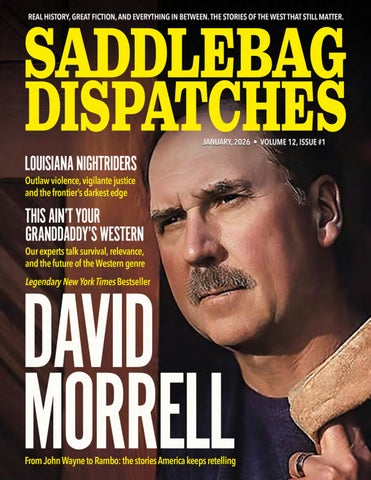
from bestselling authors David Morrell, Craig Johnson, and Marc Cameron, it’s essential reading for any Western writer, as well as anyone who cares about where the Western genre is headed in the years to come. That conversation continues with Features Editor George “Clay” Mitchell’s exclusive interview with legendary author David Morrell, best known as the creator of First Blood and the iconic character John Rambo. A pioneering voice in modern action and suspense, Morrell has spent decades redefning masculine fction, moral consequence, and the cost of violence. His insights on storytelling, genre evolution, and literary endurance are not to be missed.
the pride and craft of Old West mixologists. Chris Enss celebrates remarkable women in Cowgirls of Legend, highlighting actress, stuntwoman, daredevil, and ex-
Marc Cameron, John Gilstrap, C.J. Box, M. William Phelps, Jefery Deaver, Jonathan Maberry, Joe R. Lansdale, W. Michael Gear and Kathleen O’Neal Gear, Heather Graham, and many more. All proceeds beneft the U.S. Marshals Survivors Beneft Fund. The launch will be celebrated with a major event at the U.S. Marshals Museum in Fort Smith, Arkansas—a must-see for fans of Western fiction and history alike.
Chris Enss introduces Dr. Fannie Quain, one of the nation’s earliest female physicians. Christie Wright explores South Park, Colorado’s only legal execution. J.B. Hogan examines George Custer’s 1874 Black Hills Expedition, a pivotal event that led directly to the Black Hills Gold Rush and the disastrous Powder River Expedition. Finally, Regina McLemore brings us the remarkable story of Native American bronc rider Jackson Sundown. Rounding out our lineup this issue is Managing Editor Anthony Wood’s “Louisiana Nightriders,” the brutal conclusion of his detailed examination of the West-Kimbrel Gang in Reconstruction Era Louisiana. In our columns, Sherry Monahan serves up history and favor in Lively Libations, exploring
ceptional horsewoman Adele von Ohl. Terry Alexander continues his refection on iconic performers and Westerns on screen in Talking Westerns, ofering a heartfelt tribute to the passing of legendary actor Graham Greene.
Regrettably, our pages allow room for only two Cowboy Poets, but we’re proud to feature Michael Ritt’s “Cowboy’s Lament” and Marleen Bussma’s “A Million Dollar Rain.” Our thanks and respect go out to all the fne poets who submitted their work.
Looking ahead, we’re thrilled to preview our upcoming two-volume anthologies, Rough Country and Hard Country, hitting shelves this April. Edited by New York Times bestselling author Reavis Z. Wortham, these collections explore crime, justice, and survival in the American West from 1850 to today, featuring stories from some of the most acclaimed voices in contemporary Western and crime fction—including Craig Johnson,
This celebration also ties into our May issue, which will feature an exclusive interview with retired U.S. Marshal and bestselling author Marc Cameron, a behind-the-scenes tour of the Marshals Museum, and a full lineup of Fort Smith– and Marshal–centric fction, history, and nonfction. Between the anthologies, the museum celebration, and the May issue content, readers will have plenty of ways to dive into the grit, justice, and enduring legacy of the American West.
Are you detecting a theme here? The biggest authors, the most prestigious awards… all in one place—Saddlebag Dispatches. And that’s exactly why our talented staf and I remain fully committed to bringing you the very best original stories, poems, serials, columns, and features that refect the openness, struggle, and unforgiving nature of the Old West.
So pull up a chair, pour yourself a cup from the camp pot, and ride with us into the West that was.
Dennis Doty
THE VIEW FROM MY HILL
Reavis Wortham CONTRIBUTING EDITOR
Cream, Please.
Why some cowboys should never fetch their own cream
Doreen’s 24-Hr Eat Gas
Now Cafe was busy for a dark Saturday morning. The little diner was packed solid with cowboys and fshermen who couldn’t get out because of the weather. Everyone drank coffee and watched the Weather Channel on the wall. It was only fve in the morning, but the cafe was noisy with frustrated fishermen and sharpeyed cowboys when Sonny Bonner and Rank Pickles blew through the front door with the sudden gust of wind that was determined to tear down Doreen’s sign.
The familiar cafe scent of cofee, frying bacon, and hot toast flled the air.
They took the two remaining seats at the counter. Doreen set two cups of cofee in front of them without asking.
Rank pointed at the steaming cup. “I’d like some cream, please.”
She shook her head. “With all these boys in here, I’ve already run out. I have skim milk, though.”
He shuddered. “That’s just watered-down blue john. What kind of cafe is this?”
Doreen’s mustache bristled. It’s the consensus of the cafe’s regular customers that she has a better mustache than Waddie Mitchell.
“It’s the kind of cafe that would
be a lot quieter if you weren’t here,” she snapped. “Why don’t you go outside and complain to your horse? He’s the only one who cares if you’re happy or not.”
Sonny ignored the exchange and carefully poured coffee from his cup into the saucer on the counter. Holding it delicately between the thumb and middle fngers of both hands, he blew across the surface to cool it of. Doreen’s cafe is one of the few places left in this world where customers can still slurp their cofee like Granddad once did.
Sometimes it’s hard to hear the jukebox from all the slurping that goes on up and down the counter. An unsuspecting tourist once complained that the cafe sounded like a convention of sinus suferers.
Sonny fnished his saucer and looked at the dark parking lot through the huge windows to check his truck. The only illumination came from the Eat Gas Now sign. “Doreen, it wouldn’t hurt you to put some lights out on that parking lot so we could see. If I needed to get anything out of my truck, I’d have to wait until daylight.”
He was the only person who could talk to Doreen like that and still stay in the cafe. She just poured more coffee into his cup and increased the volume on the TV.
“Don’t you have some powdered cream somewhere?” Rank asked, still mifed.
“I thought you cowboys were tough.” Doreen popped her gum. “You drink it black when you’re not in here.”
“But in here, I want my cream.”
The wind caught Curly Baxter’s hat and blew it into the cafe just before he came through the door. He paused beside the counter to set his hat right and overheard the last exchange.
“Rank, I’ve got an old milk cow out in the trailer. I’m taking her to the sale barn, but if you’ve got a notion to go out there you can get a little milk from her for your cofee.”
“You may as well,” Sonny said.
“It still won’t be cream, and I don’t trust you, Curly.” He cut his eyes at the old cowboy. “Besides, my milking skills are a little rusty.”
On the other side of Rank, a young man barely out of his teens joined the conversation uninvited. “I never saw a cowboy who couldn’t milk.”
Curly turned his cold blue eyes toward the stranger dressed in the warped straw hat that had to have come from a truck stop rack. The young man wore a rock concert T-shirt and sneakers.
“I suppose you can?”
“Sure I do. You just grab one and squeeze.” The youngster tipped his hat back with a thumb, like he’d seen in the movies.
“Go ahead on.” Curly handed him an empty water glass from the counter. “There’s plenty of room inside the trailer. Just climb in and fll ’er up, but be sure to latch it back and throw the rod when you’re fnished.”
Sonny had already forgotten
Rank’s need for cream before the young man was out the door. He recounted to Curly about the time he’d accidentally performed a bodily function on an electric fence. He glanced out the large window on the front and saw Blackie Prescott in the parking lot.
“I walked like John Wayne for a month,” Sonny concluded to the chuckles of those around him. He didn’t hear the laughter. He was up and hurrying to open the door for Blackie, who was half carrying Youngster’s tattered remains into the cafe. The poor kid’s shirt was torn to shreds, his eye was already turning black, he’d lost his cheap hat, and he was covered in dirt from his long hair to his boot. The only thing covering the other foot was his sock.
Blackie dumped the youngster’s carcass on a hastily cleared table. “What happened?” Doreen
shouted. “You look like you’ve been swarmed by a roll of barbed wire. Do I need to call the law?”
“That thing almost killed me,” Youngster gasped. He still held the shards of the water glass in a trembling hand. “I thought you said she was a gentle old milk cow.”
Curly frowned and took the glass. “She is. She never acted that way with me.”
Sonny looked through the window at the parking lot. Cattle trailers were parked on each end of the dim lot.
“Who you hauling for today, Curly?” Sonny asked.
“The Double Shovel.”
“What color is the trailer?”
“It started out blue.”
“I went to the gray one.” Youngster shuddered and twitched.
A grizzled old rancher walked up to the register to pay his bill. He stuck a toothpick in the corner of
his mouth. “That was mine, son, and I ain’t hauling milk cows.”
Sonny glanced up from Youngster’s terror-stricken eyes. “What are you hauling?”
“A bad-tempered old rodeo bull called The Grim Reaper.”
“Just grab one and squeeze, huh?” Sonny smiled, thankful he preferred his cofee black. “I believe you grabbed the wrong one this time, kid.”
Reavis Z. Wortham is the New York Times bestselling author of seventeen novels to date. A retired educator, he now writes full time, with The Rock Hole named a Top 12 Mystery of 2011 by Kirkus Reviews and Dark Places listed among True West Magazine’s Top 12 Modern Westerns. Wortham’s The Texas Job won the Will Rogers Medallion Award Gold Medal in the Western Modern Fiction category. His latest work, the Western Horror novel Comancheria, hits shelves in October. Reavis lives with his wife in Texas.
LIVELY LIBATIONS
Sherry Monahan
CULINARY EDITOR
Masters of the Bar
Nineteenth-century mixologists shaped taste, illusion, and etiquette
Mixologists in the Old West took pride in knowing their customers and made sure they were completely satisfed with their saloon experience. In 1876, a Missouri newspaper ran an interview with a mixologist who claimed that most barkeepers could tell where a customer was from based on their drink order. He commented, “Well, you see, sir, barkeepers can generally fx the nationality of the visitor by his drinks. Most all Americans that drink at all go for a gin or whisky cocktail in the morning. A French drinker either takes claret and ice, or if he is anyway hard on it, some cognac or absinthe. . . . In this country, every State nearly has its own style of drinks. Of course, whisky is at the top of the heap; but then there are hundreds of brands and we try to suit all tastes. A New Yorker calls for rye, and a Pennsylvanian wants Monongahela; the North Carolina and Florida fellers stick up for corn whisky, and its nearly certain death to ofer a Kentucky drinker anything but bourbon. Missourians are great whisky-drinkers. They want their whisky straight and strong, and plenty of it.” When asked about not having what a customer wanted, the barkeep re-
sponded, “Suppose you don’t happen to have the particular brand of whisky a gentleman calls for? Well, that’s easily settled. There’s mighty few bars where they keep both rye and bourbon, and between me and you there’s not many drinkers who can tell the diference between ’em. Most bars keep two or more bottles of whisky– all drawn from the same barrel– and if a bar-keeper understands his business he can make a customer believe he is drinking rye when he is actually drinking bourbon, or vice versa. Bad rye whisky with a dash of common bitters can be made to pass as corn whisky.”
Three of the most famous mixologists operating in California during the nineteenth century were Jerry Thomas, William “Cocktail” Boothby, and Harry Johnson. Jerry Thomas is considered the “Father of the Cocktail.” He tended bar at the Occidental Hotel in San Francisco in the 1860s where one legend claims the martini’s history starts. In 1862, “Professor” Thomas published the Bartender’s Companion. He is also credited with creating the wildly popular Tom and Jerry cocktail while tending bar at the Occidental.
William T. “Cocktail” Boothby, whose career spanned the nine-
“Professor” Jerry Thomas (top), William “Cocktail” Boothby (center), and Harry Johnson (bottom) were the most famous— and infuential—mixologists operating in California during the nineteenth century.
teenth and early twentieth centuries, spent a large portion of his career at the elegant Palace Hotel in San Francisco. It was there he created his signature, “Boothby Cocktail.” His frst bartender book, The American Bartender, was published in 1891 and revised after the turn of the century.
While Boothby was the head bartender at the Palace, he also filled in at the Fairmont Hotel and another downtown saloon. During this time, a patron of these establishments decided to stop drinking. This unnamed imbiber wandered into the Fairmont one afternoon where Boothby served him a cocktail, and he went on his way. He later patronized the downtown location where Boothby had started serving drinks. The man said to Boothby, “I’ve seen you somewhere before.”
Boothby replied that he didn’t think so.
The patron replied, “You got a brother working at the Fairmont?” Boothby told him he did not.
The man muttered, “Most curious, more curious.”
About an hour later, Boothby had stepped behind the bar at the Palace and that same patron walked up to the mahogany board to order a beverage. William leaned over to take the man’s order but rather than hearing a cocktail order, the man asked, “Have you got a brother at the Fairmont?”
Boothby replied, “No sir, not I. What will you have?”
The pale-lipped patron moaned, “Not a thing! When I get as bad as this, it’s time to quit. I’m through forever!”
Harry Johnson also tended bar in San Francisco for a while and later wrote the 1882 Bartenders’ Manual, which went into great detail as to how one should act and look behind the bar. He described how a bartender should address his customers, how to attain a job at a saloon, how to set up a bar, and also included hints on making drinks just right. Harry stated that in order for a bartender to make
the best drink possible, he must take the customer’s order and then ask if he liked it medium, stif, or strong. He also needed to ascertain if the customer wanted a julep, a sour, or a toddy version of his drink. Harry concluded, “I can not avoid, very well, ofering more remarks regarding the conduct and appearance of the bartender…. Bartenders should not, as some have done, have a tooth-pick in their mouth, clean their fngernails while on duty, smoke, spit on the foor, or have other disgusting habits.”
Sherry Monahan is an award-winning culinary historian who enjoys researching the genealogy of food and spirits. While there’s still plenty to explore about frontier food, she’s expanding her culinary repertoire to include places and foods from all over America and beyond. She holds memberships in the James Beard Foundation, the Author’s Guild, and the Wild West History Association. She is also a professional genealogist, and an honorary Dodge City marshal. Her newest cookbook, Culinary Treasures: Dude & Guest Ranches of America, hit bookstores in November.
Jerry Thomas’ 1862 Bartender’s Companion (left), “Cocktail” Boothby’s American Bartender, frst published in 1891, and a Germanlanguage translation of Harry Johnson’s Bartender’s Manual from 1882.
Whiskey Sour
Juice of 1/2 lemon
1/2 teaspoon powdered sugar
2 ounces whiskey
Carbonated water
Berries
Dissolve the sugar with a little of the carbonated water. Combine all ingredients and shake with crushed ice. Strain into a 6-ounce glass. Fill with carbonated water and top with berries.
Source: Recipe adapted from Harry Johnson’s New and Improved Illustrated Bartenders’ Manual, 1888
Western Genre Alchemy
THE BOOK WAGON
Ben Henry Bailey & Chris
Enss
BOOK REVIEWER
Six-Guns &
Shadows
Classic characters ride again and new ones take aim.
Chasing The Dream
The Grand Ole Opry is one of America’s most iconic and enduring institutions of country music—a live radio show that grew into a cultural cornerstone. Its story stretches back nearly a century and mirrors the rise of country music itself. To celebrate the Opry’s 100th anniversary, children’s author Emily Frans penned a book to teach kids about the history of the show and how it shaped the music industry.
Frans invites young readers on an inspiring, behindthe-scenes adventure through one of the most famous stages in the world. Written with heart, rhythm, and reverence for the Opry’s magic, Howdy! Welcome to the Grand Ole Opry written by Emily Frans, illustrated by Susanna Chapman with a Foreword by Lainey Wilson (Abrams Books, 2025) captures the thrill of chasing a dream and stepping into the spotlight for the frst time.
a budding musician, the story puts readers directly in the artist’s boots. They arrive at the legendary setting and are ushered through the performers’ entrance–a threshold where so many real-life stars once took a deep breath before their debut. From there, the book beautifully guides readers to their own dressing room, where nervous excitement hums like a tuning guitar string, and f nally to the main stage itself.
Susanna Chapman’s illustrations glow with color and energy, blending the nostalgic charm of the Opry’s rich past with the contemporary sparkle of today’s performers. The story encouraged confdence, perseverance, and the belief that dreams are built through courage and preparation.
More than just a musical tale, Howdy! Welcome to the Grand Ole Opry is a celebration of every child who dares to dream big.
Horror takes the reins of the western genre in Reavis Z. Wortham’s Comancheria (Hat Creek, 2025). Wortham weaves the soul of the Western with the shadows of horror, threading eerie tropes through dusty trails and open skies, crafting a tale where frontier grit meets the uncanny. The result is a story that honors both genres while creating something fresh, immersive, and entirely its own.
Told from the perspective of
—Chris Enss
What I enjoyed most about this book is how Reavis took two seemingly contrasting genres with the rugged grit of the Western and the eerie, unsettling tones of horror, and interwove them with care and intention. This isn’t just a Western with a few horror elements thrown in for shock value as it is more a fully realized Western horror narrative, where every chilling detail and supernatural twist feels right at home in the dust and desolation of the frontier. He blends them so seamlessly that the eerie atmosphere feels like a natural extension of the Western world he’s built.
The protagonist, Texas Ranger Buck Dallas, is a compelling and complex figure whose journey charges the narrative with emotional depth and intrigue. The curse that was bestowed upon him is not merely a plot device but a source of profound emotional weight, enriching the story with stakes that resonate on both a personal and thematic level.
Riding alongside Buck is Texas Ranger Lane Newsome, a character whose presence adds both levity and emotional texture to the story. They share a bond forged through hardship and mutual understanding, yet it’s their sharp, quick-witted banter that truly brings their relationship to life. Their exchanges are laced with humor, sarcasm, and the kind of unspoken trust that can only develop between two people who have ridden through fre together. At one point, after a brief but spirited argument, they’re afectionately likened to “an old married couple.” This balance of tension and camaraderie not only provides comic relief but also deepens the emotional stakes of the story. Lane challenges Buck, supports him, and reminds us that even in a grim, cursed world, loyalty and humor still have their place.
The tone remains consistently dark, casting a somber and haunting atmosphere that lingers throughout the tale. While the cast of characters is expansive and at times a challenge to keep them all straight, they contribute to the richly textured world Reavis has created. Despite its density, the story never loses its grip and keeps the pages turning with a quiet intensity that lingers long after the fnal chapter.
—Ben Henry Bailey
Chuck
Wagon Delight
Sherry Monahan, known for her deep love of frontier cooking and Western food culture, takes readers on a journey into the heart of America’s dude and guest ranches in Culinary Treasures: Dude & Guest Ranches of America (Otterford Gourmet, 2025). This imaginative work extends Monahan’s signature blend of food history, travel lore, and handsin-the-kitchen recipes into the ranch-vacation world.
The featured recipes are from some of the most well-known and respected dude ranches in the West. Anchored in ranch kitchens, the culinary recipes included are those that ranch guests might be served or even help prepare–breakfasts that fuel a long ride, hearty soups, delicious entrees and main dishes, breads and cookies, and even a cocktail or two to enjoy at the end of the day.
As with Monahan’s other works, one would expect rich photography and a comprehensive history of the dude ranches that provided the many appetizing recipes to be tried. From the breakfast ride potatoes served at the White Stallion Ranch
in Tucson, Arizona, to the jalapeno cheddar polenta made at the Lone Mountain Ranch in Big Sky, Montana, Culinary Treasures: Dude & Guest Ranches of America is for everyone who wants to bring the favors of the ranch into their everyday kitchens.
—Chris Enss
Credit Where It’s Due
When we view history through only one lens, we blind ourselves to the richness of other voices and perspectives, trapping our understanding on a one-way track that leaves no room for growth.
James B. Mills’, In the Days of Billy the Kid: The Lives and Times of José Chávez y Chávez, Juan Patrón, Martín Chávez, and Yginio Salazar (UNT Press, 2025), takes what we know and expands heavily upon it through the eyes of people that were not given their proper place in history. Mills shifts the focus from the iconic outlaw to the often-overlooked Hispano f gures who shaped New Mexico’s turbulent history while offering a
compelling reexamination of the American frontier. This book is meticulously researched and is a richly illustrated masterpiece that redefnes our understanding of the Old West.
Mills, known for his award-winning Billy the Kid: El Bandido Simpático, expands the narrative beyond the Lincoln County War to explore a broader tapestry of resistance and resilience among New Mexico’s Hispano communities. The book centers on four central fgures: José Chávez y Chávez, a lawman turned outlaw; Juan Patrón, an intellectual prodigy; Martín Chávez, a conservative journeyman; and Yginio Salazar, a resilient vaquero. Through their stories, Mills delves into the complex dynamics of frontier life, highlighting the struggles against corruption, exploitation, and violent oppression that plagued the region following the Mexican-American War in 1848.
The narrative extends into the early twentieth century, examining events such as the Horrell War, the arrival of the railroads, the rise of the Herrera brothers and Los Gorras Blancas, and the people’s movement in San Miguel County. Mills also introduces readers to lesser-known fgures like Nicolás Aragón, Germán Maestas, and Porfrio Trujillo, providing a more nuanced and inclusive history of the era.
What sets this work apart is its commitment to presenting a fresh perspective on the American West. Mills utilizes a wealth of new information, including photographs to illuminate the lives of these Hispano individuals and their contributions to the region’s history. The book challenges the traditional narratives centered
around Anglo fgures and ofers a more inclusive and accurate portrayal of the Old West.
In the Days of Billy the Kid is an unprecedented study that belongs on the bookshelf of any American West afcionado. It not only enriches our understanding of a pivotal era but also honors the lives and legacies of those who have been marginalized in mainstream historical accounts. Mills’ work is a testament to the importance of revisiting and revising historical narratives to ensure there is a more comprehensive and equitable representation of the past.
—Ben Henry Bailey
A Love Letter to the Soul of the West
Award-winning photographer Jules Frazier’s passion for photographing the west is on full display in her spectacular collection, Faded Icons of the West: A Photographic Series of the American West and Rodeo. This stunning visual essay captures the
rugged beauty, quiet dignity, and enduring spirit of the Western landscape and the people who inhabit it. Through Frazier’s discerning lens, abandoned trading posts, weathered barns, lonesome railroad tracks, cowboys waiting in chutes, rodeo queens, and dust-covered arenas become more than mere relics—they are living symbols of a vanishing culture. Each photograph tells a story of resilience and nostalgia, inviting the viewer to pause and refect on what it means to preserve a heritage built on grit, grace, and open skies. Her mastery of light and composition transforms ordinary moments—cowboys tightening cinches, broncs mid-buck, sunsets over forgotten towns—into extraordinary works of art. What makes Faded Icons of the West especially compelling is its emotional resonance. Frazier balances the grandeur of the Western frontier with intimate glimpses of human connection and devotion to tradition. The images carry a sense of reverence and melancholy,
reminding us that progress often erases as much as it builds.
More than a cofee table book, this volume stands as both a visual documentary and a love letter to the soul of the West. For anyone who cherishes the authenticity of rodeo life, the poetry of open ranges, or the quiet endurance of those who call the frontier home, Faded Icons of the West is a masterpiece worth treasuring.
—Chris Enss
The Desert Never Forgets
With Deadly Vintage (Rogue River, 2025), the late Michael McLean—who passed away in 2022— and writer/editor Sabine Berlin, who is editing and polishing the fve fnished manuscripts for the Grayson-Hall Mystery Series, deliver a taut, atmospheric thriller that fuses the New Mexico desert with psychological tension mixed with scientifc realism. Kicking of the series, this debut blends the grit of a procedural with the dread of ecological horror, ofering readers a story where the desert conceals something darker.
Geologist Mark Grayson takes
what should be a straightforward assignment evaluating mineral deposits for a family-run vineyard called Cat’s Claw. The vineyard is tucked deep in the desert, and from the moment he arrives, nothing feels routine. The land is heavily guarded, the records sealed, and Grayson’s instincts warn him that the vineyard’s secrets run deep. When Deputy Medical Examiner Shannon Hall begins investigating a mutilated body found nearby, their paths cross in a collision of science and law that soon spirals into survival.
McLean excels at world-building, painting Cat’s Claw as both picturesque and menacing, a place where the soil hides more than roots. The writing vividly captures the desert’s dual nature as vast and barren on the surface yet teeming with the ghosts of what humans have buried there. When Grayson and Hall uncover a hidden cave system behind the vineyard, the novel shifts gears from crime drama to something far more chilling, hinting at scientifc experimentation, corruption, and biological horror that stretches beyond local greed.
What makes Deadly Vintage stand out is its balance of intellect and suspense. The geological and forensic details lend authenticity without slowing the pace, while the humanity of two professionals bound by duty and haunted by loss grounds the story emotionally. Both Grayson and Hall are layered, capable protagonists forced to question their moral limits as they confront not just killers, but the consequences of human ambition gone rogue.
In McLean’s world, the desert becomes a mirror of the novel’s themes—isolation, concealment,
and endurance. Like the land itself, Deadly Vintage reveals its secrets slowly, and when it does, they cut deep. The book exudes intelligence in how seamlessly the authors weave scientifc precision into the narrative. Geological details, forensic analysis, and subtle social commentary elevate the story beyond standard mystery fare. Grayson and Hall are realistic detectives, thoughtful professionals using reason and expertise to navigate a web of deceit and danger. Their realism grounds the story, making each discovery feel earned and every revelation chillingly plausible.
—Ben Henry Bailey
An Essential Guide for Equine Emergencies
What do you do when you’re faced with an emergency involving your horse, but professional veterinary health care isn’t readily available? Author and respected equine veterinarian Dr. Nancy Loving’s book on that topic provides specifc strategies you can employ to help your horse in an emergency situation.
Nancy S. Loving’s What To Do Until the Vet Arrives: Emergency Care for Horses (Trafalgar Square, 2025) is a comprehensive, well-organized guide written for horse owners, riders, barn managers, and anyone who fnds themselves in a situation where their horse needs help before a veterinarian arrives. The book walks readers through both preventive preparation and hands-on emergency responses, covering everything from what should be in a frst-aid kit, to safely restraining a hurting horse, to
dealing with serious conditions like colic, choking, eye injuries, open wounds, and fractures.
This book is authoritative yet accessible; drawing from her more than forty years of experience in equine medicine and surgery, Loving has laid the book out logically beginning with an assessment of equine vital signs the documents to have on hand in, case of an emergency, and includes many full-color photos and diagrams to illustrate key concepts. The spiral binding is a practical feature that allows the book to lie completely fat, making it easy to reference instructions and follow along hands-free while caring for a horse.
What to do Until the Vet Arrives is an excellent resource.
—Chris Enss
Lead Like a Lawman
Chris Enss’s Principles of Posse Management: Leadership from the Old West for Today’s Leaders (TwoDot, 2018), ofers a refreshing and entertaining take on leadership and teamwork, drawing lessons from the lawmen and posses of the American frontier. As a manager of a team, reading leadership books was not new to me, but fnding one that spoke to me on a work level and more importantly, to my passion for the old west, I was getting the best of both worlds.
Known for her engaging histories of the Old West, Enss brings that same storytelling f air to a book that blends history with practical insights for modern readers. Through vivid stories of fgures like Wyatt Earp, Bat Masterson, and other frontier legends,
Enss explores how these individuals led their posses in pursuit of justice. Each chapter connects an Old West episode to a timeless leadership principle, trust, loyalty, courage, clear communication, and moral authority. The premise is both creative and compelling, showing the challenges faced by nineteenth-century lawmen are not so diferent from those confronting twenty-frst-century leaders who must inspire teams, make tough decisions, and stay true to their values under pressure.
Enss has a deep knowledge of the Old West that adds authenticity to her narratives. This historical grounding not only makes the stories compelling but also gives the leadership lessons weight as they are tested in life-and-death situations, not just hypothetical
scenarios. Some of the best insights I took away were having a plan for setbacks, regrouping to reassess, and should you fnd success, approach it with humility and dignity.
Enss writes in a lively, narrative style that makes the lessons memorable rather than didactic. She includes period photographs and anecdotes that bring the frontier to life, grounding her leadership principles in history. The result is part history lesson, part management parable—an easy, engaging read that never feels like a textbook. When it comes to the leadership tips, Enss doesn’t just list them but instead, she tells compelling stories of frontier lawmen, their challenges, and how they commanded respect and loyalty. These stories are vivid and cinematic, often including photographs and anecdotes that make the history feel alive. Readers are entertained while simultaneously absorbing leadership insights.
—Ben Henry Bailey
The quiet air’s calm bated breath brings in another day.
Baked leaves, wise with experience, are already turning gray.
Weak withered grass, well scorched by sun, lies lifeless, limp, and parched.
The pasture has surrendered to the dust where cows have marched.
Spring rains are undecided if they’ll bless this dried up land.
A rancher’s livelihood hangs in the balance where he’ll stand like years before when trouble came unwanted to his door.
Well-seasoned by past tough times, he’ll stand up to what’s in store.
Low stock ponds shrank to mud holes and he’ll have to move the herd. He saddles up his favorite horse, then calls out leaving word he’s taking cattle to the creek where water can be found.
Dark clouds are building to the west. As yet, they have no sound.
The cattle, bunched and moving well, don’t notice darkened skies.
Bold thunderheads have elbowed for position. Lightning flies from one cloud to another, like a silk flag in the wind.
Far distant mountains disappear, as if the landscape thinned.
The thunder’s bluster bruises with its blows of heavy noise.
Thick clouds have walled off feeble sunlight, darkened land, and poise to give the starved land what it wants, relief from heat and dust. Sweet smells of wet sage fill the air. Right now, it’s rain or bust.
The rancher leaves his herd near water where they’ll rest and graze. He turns his horse and spurs him under skies that seem ablaze with lightning, loose and limber, dancing to the thunder’s rock. This is the kind of weather that puts fire on horns of stock.
The rancher leaves his herd near water where they’ll rest and graze. He turns his horse and spurs him under skies that seem ablaze with lightning, loose and limber, dancing to the thunder’s rock.
This is the kind of weather that puts fire on horns of stock.
The barn stands like a beacon on the distant, rain soaked ground. The dripping horse and rider are the tallest thing around.
Stark fear of being struck by lightning fades when they’re inside. This welcome rain has given them a million-dollar ride.
The barn stands like a beacon on the distant, rain soaked ground. The dripping horse and rider are the tallest thing around. Stark fear of being struck by lightning fades when they’re inside. This welcome rain has given them a million-dollar ride.
ROBERT TEMPLE
ELK CREEK
A SHORT STORY
Winner of the 2025 Saddlebag Dispatches Longhorn Prize for Western Short Fiction
Elk Creek, Indian Territory, 1874
Sergeant Major Emmanuel Custis of Company B, Tenth Cavalry loved only one thing in this world—horses. And in this muddy feld beside rain swollen Elk Creek, Custis had charge of two thousand duns, bays, sorrels, grays, and paints of every color. He took them in with a cavalryman’s eyes. Ponies, hardly a one over fourteen hands, stood in thick mud up to their cannons. Gaunt fanks stretched drum-tight over ribs. But their heads were up, watching him—Indian ponies.
Looking over his shoulder, Custis eyed the twenty-fve men in his detail as carefully as he had the Comanche ponies. Each trooper carried a cavalry saber, a coiled hemp rope and a Model 1865 Spencer carbine. Bandoleers of .56-.50 cartridges crisscrossed their chests. Custis nodded to Corporal Sikes, who then bawled an order to fve of the troopers to form a picket line in a semi-circle around the herd.
“Ya’ll keep a sharp eye on them Injun ponies,” Custis said to his pickets, “but stay clear of them. We don’t want to spook them before we get the corral up.” Then he ordered the rest of his men to stack their carbines and hang their bandoleers around the muzzles. Pointing toward a copse of post oaks bordering the feld, Custis set them to work chopping fence posts and rails.
They hacked fence posts from saplings no thicker than a woman’s wrist. Each time a trooper chopped
three posts, he cut of a short length of his rope, lashed the posts into a tripod and added it to the rough semicircle taking shape about twenty yards away from the herd. Each tripod stood chest-high and sat about eight to ten feet from its neighbors. The troopers connected the tripods with saplings cut into long poles and laid across the junction of each tripod. A feld corral was a familiar task for his bufalo soldiers. Sergeant Major Custis was free to admire the mudcaked Comanche horses.
Up close like this, Custis was always struck by how tiny Indian ponies were—like their riders. Slender gaskins and cannons. Stocky barrels with little more than a foot between withers and points of the hip. Small, china doll heads tapered to narrow muzzles with dainty nostrils. Pretty little things, that was a fact, even covered in mud. But don’t get too close, or teeth and hooves would get you, sure as looking at you. Yes, Indian ponies were never quite still, never quite beaten—until they dropped stone dead.
A sight tougher, Custis knew, than the cavalry’s big standard breeds. Not that there was anything wrong with old Charlie, his gelding. Sixteen and a half hands, Charlie was—and just as black as a Comanche’s scalp. Charlie would charge through hell for Custis, but these Indian ponies lived there. Tough wasn’t the word for them. Mean, plumb mean, all the way to the marrow. These Indian horses would have kept running from
the black troopers of the Tenth—if the Comanche had asked them. Nah, these horses wouldn’t quit on you. Might burst a lung and die, but they wouldn’t quit.
Custis let fy a long brown stream of tobacco at an ugly, sway-backed, brown piebald some twenty-fve yards away. He watched the horse track the spit with its eyes until the goober fell some twenty yards short. Then the piebald set its ears back, stretched its neck toward Custis and showed its teeth. Custis turned and looked into the Tenth’s encampment, for the beaten Comanche. Yeah, there they were, a hundred yards away, squatting on their haunches in the mud with half the regiment guarding them. Tabananica, White Wolf, Little Crow, and Big Red Meat, all the Yamparika Comanche big wigs and their sullen warriors—watching Custis and his men, watching these horses. Bet their horses were a sight better looking last May, muscles thickened by the sweet grass of spring, ready to ride to war against white bufalo hunters along the Red River. Custis shrugged. Hadn’t taken long for those white men to cut and run. No more than ffteen or sixteen dead, and sure enough they had screamed for protection from Custis and the rest of the Tenth Cavalry—men they wouldn’t let share a bar room in the rankest rotgut saloon in the Indian Territory. Almighty white men. Custis spat another stream of tobacco.
half the regiment guarding them. Tabananica, White Wolf, Little Crow, and Big Red Meat, all the Yamparika
Kansas right smack in the middle of the Union line and hemmed them in with his white troops so the coloreds wouldn’t run. Even set a company of white cavalry with drawn sabers behind the First Kansas with orders to cut down any black soldier who so much as looked over his shoulder. Run hell. Custis and the rest of the First Kansas had marched straight forward, taking volley after volley from the line of white men in gray, but pushing ahead of the white troops in blue to the left and right. Then at ffty yards, the First Kansas had leveled their rifes and blown the rebel troops away. The surviving white men had thrown down their guns and run like deer. Whatever power white men had in Custis’s eyes had disappeared that morning in a puf of smoke from the muzzle of his rife.
But marching—the plod, plod, plod of his blistered feet through the rest of the war had grown wearisome. When the Union eventually won, the Army straight away disbanded the First Kansas. White men still drank in saloons. Black men still had to tip the jug back in the woods. So, when the call went out for recruits for two colored cavalry regiments, Custis had signed on with the new Tenth Cavalry—the very frst man in the recruiting line.
He fgured that back in 1863 more than a few of those bufalo hunters had stood across the battlefeld from him. Yes, many of those white men were sure to have worn gray at Honey Springs. There Custis had seen his frst action, not more than fve miles farther up Elk Creek with the old First Kansas Volunteers. General Blunt hadn’t trusted his colored infantry. Put the First
Yes, Custis thought, any man would quit on you— even these Comanche. Until this morning, Custis had hated Comanche. Kiowa too. All these damn horse Indians. But especially Comanche. Hated them for their contempt for pain. Hated them for their war cries that sent cold shocks down his spine. Hated them for the hundred red ribbons they cut out of each screaming prisoner. Most of all he hated them for the power of the bond with their horses. No white man,
and no black man either, ever rode a horse like an Indian, especially a Comanche. Best thing you could say about a trooper was he rode like a Comanche. But that was always a lie. A Comanche didn’t ride a horse. He became one with the horse. Horse and rider were one magnifcent creature—so fast, so powerful. But just fve days out of Fort Sill were all it took for the Tenth Cavalry to run this rain-drenched, starving band of Yamparika Comanche to ground. First sight of Tenth Cavalry troopers and the Comanche had held up a white fag. Not a shot fred. Major Schofeld had looked damn near to tears wanting to kill something, but all he got were seventy warriors with no fght in them at all, along with a couple hundred squaws and children, and two thousand horses. Men, not horses, had quit. The bond between Comanche and their horses was broken, washed away by mud and hunger and croup. Custis found his hate for the Comanche was gone.
Yet here, the horses remained, their power unbroken. Custis saw it in their eyes. Even beneath this gray, sodden sky, their eyes were alive with bright, crackling power. If only Custis could somehow touch that power, feel it surge through his veins, fll his soul. Custis swore. That was what he had sought when he charged the rebels at Honey Springs. That was what he’d marched through the war chasing. That was why he had joined the Tenth Cavalry. That power. And he hadn’t even known it until now. He saw it crackle in the eyes of that ugly, sway-backed piebald, not twenty-fve yards away. He could take a rope from one of his troopers and lasso that horse, climb aboard it and ride until the Judgment, but he knew he would never touch that power.
“Sergeant Major.” A voice behind him. Whose was it? Sikes, yes, Corporal Sikes. Custis shot a glare over his shoulder. “Sergeant Major, corral’s up. What do we do now?”
“What we came here to do.” Custis was surprised at the sour eagerness in his voice—the dirty joy. He tried to fll that hollow he had only just realized inside himself. And he knew he never would but had to try, and go on trying. Or sit down and put a bullet through his skull. The hollow was just too deep. “Have the men take up their rifes. Send three men downstream about thirty yards in case some of these horses try to swim.”
“And then?”
“Shoot them! That’s our orders. Every blessed one of them.” {
THE AUTHOR
Born in Alaska in 1952, Robert Temple grew up a military brat across the United States. After a three-year hitch in the 82nd Airborne, he received a B.S. in journalism from the University of Florida and an M.A. in English from Florida State University and then taught creative writing, composition, and literature at several Florida colleges. While teaching, he and his wife also raised and bred Suri alpacas for eighteen years. Throughout his teaching career, Robert kept writing, publishing the frontier novel, The Strange Courtship of Kathleen O’Dwyer, and numerous short stories, and winning several awards for fction, among them the William Faulkner Literary Competition Award for Short Story in 2024.
John Wayne as Captain Nathan Brittles in John Ford’s classic, She Wore a Yellow Ribbon.
THIS AIN’T YOUR GRANDADDY’S WESTERN
Why the Western isn’t dying, but evolving... and how modern writers can honor the genre’s grit, themes, and legacy while reaching new readers hungry for relevance, complexity, and hard-earned truth today.
STORY BY
CASEY COWAN & REAVIS
WORTHAM
The American West has always been about survival, and right now, the genre is in a shootout with irrelevance.
We hear it all the time from writers: “Readers just don’t appreciate a good, old-fashioned Western anymore.” And sometimes that’s true, but just as often, the problem isn’t with the reader. It’s with how we’re telling the story.
There’s no denying that the American Western isn’t what it used to be, either on the shelves or on our screens. Sales aren’t where they once were. The publishers who’ve been in the trenches the longest— Kensington, Berkley, Five Star—have all pulled back, consolidated, or stepped away entirely. The old familiar medium of paperback Westerns and novels are in a shallow grave and will remain there for the foreseeable future, another stake in the heart of a tried and true friend who helped defne generations of readers.
Classic Western readers are a loyal bunch, but they’re dwindling by the year, and younger gener-
ations aren’t picking up Louis L’Amour novels the way their grandfathers once did. They’re looking for something diferent.
But contrary to popular opinion, the genre’s not dead. It’s simply going through a generational shift. In order to be successful, Western writers and publishers must adapt. Not because they don’t believe in the genre, but because they’re struggling to make it sustainable in a market that’s shifting beneath their boots.
The evolution of the Western isn’t just commercial. It’s philosophical. Legendary author David Morrell, creator of First Blood and one of the sharpest observers of modern storytelling, sees four primary ways writers are redefning the West.
“The frst,” he says, “depicts what happened when westward pioneers reached the Pacifc Coast and found nowhere left to go. I’m reminded of the frst great classic Western novel, James Fenimore Cooper’s The Last of the Mohicans, which was written in 1826 (the modern era for Cooper) about events on the New York frontier in 1757. Already, the tone is mournful—that
THE LEGEND
DAVID MORRELL
David is a Canadian-American author whose 1972 debut novel First Blood—later adapted into the 1982 flm—launched the iconic Rambo franchise starring Sylvester Stallone. He has published more than thirty novels, translated into approximately ffty languages worldwide. His fction includes Last Reveille, The Totem, and Blood Oath, as well as the novelizations of Rambo: First Blood Part II and Rambo III. He lives in Santa Fe, New Mexico.
THE LIBRARIAN
CHELSEA HAMILTON
Chelsea Hamilton is a Texas high school Library Media Specialist with 16 years in education and a lifelong habit of falling down literary rabbit holes. A reader to excess, she believes there’s no such thing as too many books–––only not enough shelves.
something has ended. Cormac McCarthy explores this theme, as well—how the modern West can’t compare to the hopes of the frontier.”
“The second dramatizes the reverse—those pockets of the modern West that still echo the frontier and the conficts associated with it.” He points to authors like Craig Johnson, C.J. Box, and Anne Hillerman for keeping those values alive in a contemporary setting.
“The third,” Morrell continues, “is about deep historical re-creation—scrupulously researched accounts of the Old West, providing in-depth historical depictions of its heritage and signifcance, helping us to better understand and appreciate the quest for frontier. Johnny D. Boggs’s palpably vivid cattle-drive novels are excellent examples of this.”
“And the fourth is the hybrid approach—to incorporate tropes from classic Westerns as a way of making contemporary stories feel archetypal.”
Together, those four modes form the backbone of today’s Western revival. Writers aren’t abandoning
the trail, they’re simply blazing new ones through diferent terrain.
We’ve seen this shift frsthand through the pages of Saddlebag Dispatches over the past decade. Every issue brings us new work from authors trying to balance respect for the classics with storytelling that connects with readers raised on streaming TV, fast-paced thrillers, and deeply fawed antiheroes. This experience gives us a unique perspective on writing Westerns for a modern audience, and it all boils down to this: don’t try to be the second coming of Zane Grey, Max Brand, Donald Hamilton, or Louis L’Amour. Emulating these fne authors is an exercise in futility. They were the undisputed masters of the genre in their time, and for good reason. But that was then, and this is now. They’ve already told their stories, and the key to success in any genre is fnding your own narrative voice. Audiences and their tastes change over time, and the author who fails to change with the times dooms him or herself to invisibility and irrelevance.
As David Morrell tells his writing students, “We need to be frst-rate versions of ourselves and not second-rate versions of other authors.”
It’s time to fnd a new format.
Understand Your Audience
Let’s face it, authors. We’re not just writing for cattlemen, cowboys, and ranch hands anymore. When Westerns frst caught fre, the people reading them were the very ones who’d lived that life. In 1937, E.C. “Teddy Blue” Abbott—one of the last of the trail cowboys—wrote We Pointed Them North, a memoir about driving cattle from Texas to the railheads in Kansas and Nebraska. Readers of his time didn’t need to imagine the world he described. Like him, they’d seen it, smelled it, lived it.
Back then, America was still eighty percent rural and twenty percent urban. After World War II, that ratio fipped, and so did our audience. We’re no longer writing for readers who’ve wrested a living from the land, roped calves, or branded steers. We’re writing for veterans of Iraq and Afghanistan, for nurses, welders, schoolteachers, gamers, single moms. People who may never saddle a horse but still understand what the Western stands for—independence, sacrifce, justice, integrity, and redemption.
But here’s the catch: they don’t want to read their grandfather’s Western. They want fully realized characters, immersive worlds, and compelling moral confict that cuts deep. They want grit, but they want it earned. And more than anything, they want stories that make them feel something.
Today’s readers—especially the younger ones— consume genre fction diferently. They’re drawn to dynamic characters, tighter pacing, internal confict, and themes that feel relevant to their own lives. They also tend to read across genres, so a Western might need to wear more than one hat: historical thriller, mystery, romance, even horror. A cattle drive can still pull them in, but only if the stakes are personal, the characters are layered, and the story feels urgent.
We had several extensive discussions with a high school librarian on this subject, and she educated us on new desires among young readers. In the “olden days,” readers wanted justice, wrapped in western lore. Today’s audience asks for genre frst, then feeling.
“They come into my library with specifc questions,” said high school librarian Chelsea Hamilton.
INFLUENCERS
The rise of streaming in the mid-2010s, has had a profound infuence on the preferences of the reading public, especially with regard to the Western genre. Pictured here are Anson Mount (upper left) from Hell on Wheels, Luke Grimes (upper right) in Yellowstone, Timothy Olyphant (middle left) from in Justified, Robert Taylor (middle right) from Longmire, Kurt Russell (lower left) in Bone Tomahawk, and Billy Bob Thornton (lower right) in Landman.
THE MARSHAL
MARC CAMERON
Marc is a New York Times bestselling author of action thrillers whose fction is shaped by nearly three decades in law enforcement and years living and working in Alaska. A retired Chief Deputy U.S. Marshal, Cameron began his career as a police offcer before joining the U.S. Marshals Service in 1991, where he specialized in dignitary protection and rose through the ranks. He ultimately retired in 2011 as chief of the District of Alaska to pursue writing full time.
“My students don’t want to look for a story set in the west, for example. They’re asking for dystopian romance, morally complex characters who have forced proximity to enemies where they learn about life, and maybe those enemies become good guys or friends.”
“They might ask me, I’d like to read horror, but set in the Old West.” And then she grinned. “They specifcally ask for angst and confict, but with a touch of humor and maybe some history that will spark a desire to read more in that genre.”
Yes, six-shooters, saloons, and frontier justice still hold appeal. But younger readers didn’t grow up on Bonanza, Gunsmoke, or Rio Bravo. They grew up on Justifed, Yellowstone, Hell On Wheels, Red Dead Redemption, and Longmire—stories where moral ambiguity reigns and the heroes are often broken, reluctant, or on the edge of becoming villains themselves.
sitting around a campfre with a reliable narrator—a favorite uncle, or our grandparent, who is recounting some adventure. Some uncles cuss a little more than others or add a little more bawdy spice, but the best ones speak to us on our level in our vernacular.”
The Old West wasn’t monolithic, and the modern Western shouldn’t be either. Readers are hungry for stories told from underrepresented perspectives—women, indigenous characters, Black cowboys, Latino vaqueros. These aren’t political statements or historical corrections; they’re factual, overlooked realities. Including them expands not only the authenticity of the story but also the range of people who see themselves refected in the genre.
If your Western clings too tightly to outdated tropes, it risks reading like a museum piece instead of a living, breathing narrative.
“I’m a frm believer that a good story is a good story, no matter the genre,” says New York Times bestselling author Marc Cameron. “That said, as a reader of Westerns, I like to see plots where Good triumphs over Evil. No reader, but especially a Western reader, wants to be talked down to. A good Western— all good stories, really—should feel as though we’re
“We’re fortunate enough in the modern era that a lot of the unheard voices that have been marginalized over the centuries are now being validated,” says Craig Johnson, New York Times bestselling creator of the Longmire phenomenon.
“It makes for a more varied and interesting storytelling technique. I don’t think it’s fair to re-write history, but you have to be sure and tell the entire story, and a good one. In western literature and history, it’s very easy to go down the gopher hole and forget important things like, is the reader already aware of this? Is there another and more interesting way to tell this story in a way that hasn’t been done before?”
The most exciting Westerns being written today
THE COWBOY
CRAIG JOHNSON
Craig is a New York Times bestselling American author best known for the Walt Longmire Mysteries, which began with The Cold Dish in 2004 and inspired the hit Netfix series Longmire. His novels are rooted in the high plains and mountains of Wyoming, where he lives, and are celebrated for their strong sense of place, wry humor, crackling dialogue, and deeply human characters. He lives in Ucross, Wyoming, population roughly twenty-fve.
are hybrid animals. In Johnson’s Longmire novels, mystery meets cowboy grit in the form of Sherif Walt Longmire. C.J. Box’s Joe Pickett books blend political thrillers with high-country suspense. Marc Cameron carries the same code north in his Arliss Cutter series, where a Deputy U.S. Marshal faces justice on the edge of the Alaskan frontier. Taylor Sheridan’s work folds in family drama, land disputes, and crime noir. The Western doesn’t have to stay in one lane. It thrives when it straddles several, keeping its boots dirty but its heart in the now.
“I frmly believe that genre is only a sales term the publishers use to pigeonhole books into marketable packages,” said Johnson in a recent interview with Saddlebag Dispatches. “There are only two genres: good books and bad books. The trick is reading the good ones and avoiding the bad. I like writing the books in layers, attempting to reach readers in every way possible.”
Speaking to Modern Readers
If your particular story is still focused on cattle rustlers and outlaw gangs, that’s fne, but make sure it’s saying something new. A strong emotional core, tight modern pacing, and deeper internal arcs can breathe life into even the most familiar setup.
The Western has always been a story about endings—about change, loss, survival, and the people stuck in the middle of it all. That part hasn’t changed. The trick now is to tell it like it matters again.
This is where so many otherwise talented Western authors fall short. They’re still relying on storytelling techniques that haven’t evolved in decades. What worked for classic, genre-defning writers like Wister, Grey, and L’Amour in the golden age of Westerns don’t appeal to most modern audiences. Even the things that worked for Dusty Richards, Elmer Kelton, or Cotton Smith twenty or thirty years ago are now dated. Young readers don’t know the West. When we said, “this ain’t your grandaddy’s western,” we meant those old black and white days of television horse operas. Good guys with a gun. Bad guys with black hats. But even then, young directors like Sam Peckinpah, who directed The Westerner way back in 1960, saw the need for better storytelling. His scripts and settings dealt with—wait for it—angst and troubled characters. It was groundbreaking TV for that time and, unfortunately, arrived on the scene far too soon. He hadn’t yet fgured out how to reach those who were looking for something diferent but didn’t know it.
If you want to reach younger readers—or even just hold the attention of modern adult readers—you need to bring your craft up to speed. While you can love and honor the classics, writers like Johnson, Morrell, Box, Cameron, Nevada Barr, Anne Hillerman, and—shameless plug—Reavis Z. Wortham, should be your lodestars for writing in today’s evolving Western market.
Your Modernized Toolkit
1
Deep POV is Your New Saddle
“As writers,” Marc Cameron says, “our job is to entertain and, to a lesser extent, teach (albeit slyly without letting anyone know they’re being taught.) Today’s readers have an endless supply of entertainment and information blasting them in the face like a frehose. I used to start at the ten thousand foot level and zoom in. Now, I generally start as if I’m looking the main character dead in the eye—whether they’re riding a horse, racing a motorcycle, or engaged in a running gunfght—and explore how their surroundings are afecting them. Then I allow myself to zoom out and give a little more description of where he or she is at that moment—through their lens.”
If you’re still writing in omniscient third-person, you’re probably losing readers. Modern audiences want connection. They want to be the character, to get inside their heads, and not just watch them. That means deep third-person POV—or even frst-person. Or better yet, learn from the master James Lee Burke and switch viewpoints when they are dictated by the story and characters. Get into your character’s skin. Let us feel their fear, anger, grit, or grief.
● Eliminate head-hopping. Stick with one POV per scene or chapter.
● Avoid italicized direct thoughts. Just write them in the narrative.
● Keep tense consistent—present-tense thoughts in a past-tense novel are jarring.
2
Show, Don’t Tell... Or Else
Exposition, info-dumps, and “telling” readers what to feel doesn’t work anymore. If your writing reads like a Wikipedia entry, fx it.
● Use action, dialogue, and internal refection to convey emotion.
● Let readers interpret what a character is feeling based on behavior and context.
● Cut the narrator’s voice unless it’s a frst-person POV character.
3 Dialogue Needs to Snap
Your characters shouldn’t all sound the same, and they shouldn’t all speak in full sentences. You’re not writing a courtroom transcript. Craig Johnson’s bestselling Longmire novels are a masterclass in the use of dialogue. Just as in real life, each
TRAILBLAZERS
The architects of the classic Western. Louis L’Amour (top left), Max Brand (top right), Owen Wister (bottom left), and Zane Grey (bottom right) established the genre’s foundation—one modern Western writers should now build upon, rather than imitate.
character is imbued with a unique way of speaking and expressing themselves.
“Charles Dickens once said that to be a writer you have to be a student of human nature,” Johnson said. “I’ll take that a step further and say that you also have to be a student of language. Writing a novel is something like conducting a choral group, and before you begin, you have to know what voices it is that you need for this particular piece. The voices are the characters, and they are the ones telling the story, their voices providing the tone and rhythm the story creates. The old saying is that character is fate, and I might add that story is character.”
This not only enriches the story, it lends an authen-
WORKHORSES
They built on the Trailblazers’ foundation, bringing the Western into the mid-20th century. Ralph Compton (top left), Elmer Kelton (top right), Robert W. Johnstone (bottom left), and Dusty Richards (bottom right) kept the genre alive and popular, even if their style now feels of its time.
ticity that becomes so familiar, a reader will come to know the voice of a certain character without having to be told they’re speaking.
● Give each character a distinct rhythm, vocabulary, and attitude.
● Keep dialogue tags to a minimum, or even eliminate them altogether. Let the reader know who’s speaking through action and tone. Give your characters something to do in order to identify the speaker.
● Don’t overuse names in dialogue, it sounds stilted and unnatural.
● Mimic natural patterns of speech. Listen to how people talk in conversation, how they use contractions, how they use shorthand or incomplete thoughts.
4Let the Setting Become a Character
Readers don’t just want to see the West—they want to feel it. Marc Cameron’s bestselling Arliss Cutter novels are set in Alaska, where climate and terrain play a starring role in every story. “I spent much of my career with the United States Marshals Service working in rural areas—Northeast Texas along the Oklahoma border, Northern Idaho along the Canadian border, and Alaska,” he explains. “Weather, terrain, and access routes played important roles in any operation. Very often, especially in Alaska, the weather is far more dangerous than the outlaw we happen to be hunting. [It] plays a much more important role when you experience more of it than merely walking between your house and a warm car.
“A foot chase or fght at forty below… or ten below, for that matter… is far diferent than any fracas on a spring day. A fugitive hunt that crosses glacial rivers requires far more detailed logistical planning than a hunt in the city. It’s not just Alaska, though. Michael Connelly is brilliant in his use of Los Angeles as a character in the Bosch and Lincoln Lawyer novels. Western readers are, in my experience, grounded to the land. Louis L’Amour often said if he wrote about a certain rock, a reader should be able to fnd that particular rock. I’ve been a tracker for much of my professional life and as such have had to be hyper-aware of the world around me. It’s fun for me to pass along the little things that, again, might slip by unnoticed had I not pointed them out—to show the reader what my characters are looking at and let them feel the same snow stinging their face.”
● Let the land shape your characters’ decisions and values.
● Make isolation, weather, and geography active forces in the story.
5
Tropes Aren’t Sacred
David Morrell sees the crossover method as a way of making contemporary stories feel timeless. “My novel, First Blood, is set in modern Kentucky but has the feel of a classic Western and the frequent theme of a gunfghter who isn’t allowed to hang up his guns,” he explains. “A stranger comes to town, looking for a place to settle. The local sherif has suspicions about him and arrests him. A jailbreak leads to a chase into the mountains. In this case, the
stranger (Rambo) escapes on a motorcycle, not a horse. In the end, the stranger returns to town and has a gunfght with the man who wouldn’t let him live peacefully.”
If your hero rides into town in a white hat and cleans up the place with a six-gun, you better be doing something interesting with it.
● Challenge the old archetypes—loners, damsels, stoic sherifs.
● Subvert expectations. Make the bad guy the town preacher. Let the outlaw be the voice of reason.
● Ask yourself: have I seen this exact plot before? If so, change it.
● There’s a new western feature flm out, with sweeping photography and big name actors. Unfortunately, it’s the same old same old. Character One comes into town to regain possession of his family’s land that is now owned by the local bad guy sherif. Come on!
6 A Flawed Character Always Beats a Perfect One
“I think all interesting characters have some faws,” says Cameron. “I’m not too big on anti-heroes. I want my heroes to be imperfect and real, but I want their mistakes to be of the head and not the heart. That said, I think modern audiences enjoy complex plots with complex motives. The ‘good’ guys and the ‘bad’ guys should both believe that they’re the ones on the right side of history.”
In other words, nobody wants to read about a walking cliché. Perfect men with perfect morals in perfect hats don’t sell.
Craig Johnson agrees. “I think that if you’re going to write perfect characters, then you really need to be writing comic books or religious tracts—we’re all broken, we’re all imperfect, and I think that it’s in the way that you embrace those faults that make characters not only interesting, but believable. As the old saying goes—”We like people for their virtues, but we love them for their faults.” The two are totally entwined, and I can’t help but think that you can’t have one without the other.”
● Give your characters weaknesses, blind spots, and regrets. Have them second guess themselves sometimes or fnd some quirk that appears over and over in the manuscript.
● Make their growth real and hard-earned. How does your character feel? But for cryin’ out loud, don’t tell us your character is sad. Explain it through story and actions. Let them make mistakes that matter.
LODESTARS
The modern standard-bearers. Reavis Z. Wortham (top left), C.J. Box (top right), Anne Hillerman (bottom left), and Nevada Barr (bottom right) anchor the genre today, blending crime, landscape, and character into stories that defne where the Western is now—and where it’s headed next.
7
Keep it Lean
Word count matters more than ever. With production costs climbing, most publishers are looking for books in the 40k–70k range.
“Understand the economy of words,” says George “Clay” Mitchell, Executive Publisher of Roan & Weatherford Publishing Associates, which has published multiple award-winning Westerns under its Hat Creek imprint. “Lean doesn’t mean thin. Lean means muscle. In a modern Western, every sentence, every line of dialogue should do work. They should move the reader, raise the stakes, deepen the scar. If a scene doesn’t change something in the character or the world, it’s just dust on the trail. Sweep it out. Leave only what kicks.”
“Tony Hillerman once told me, ‘Don’t forget to tell a good story, Craig,’” says Johnson. “‘You’ve stripped enough green beans in rocking chairs and trailed after the ass-end of enough cattle to know a good story when you hear one. You can slow a story down, but there better be a reason for it rather than just padding a page-count to get a book written.’”
Morrell thinks of it “as choosing words in a novel with the same care we choose words in a short story.”
● Cut fller scenes that don’t move the plot or develop character.
● Avoid long-winded descriptions. Choose one vivid detail instead of fve.
● If a scene isn’t pulling weight, kill it.
8
There Must be Blood
“The Northern Cheyenne have a saying,” says Johnson. “‘You judge a man’s strength by his enemies.’ I think the challenge is fnding antagonists strong enough to go up against Walt [Longmire] but also believable and relatable enough for readers to fnd them as compelling as he is. I love it when readers write to me and say that they may not have liked a character, but they understand why it is that they did what they did. I think the antagonist has to be properly motivated, and as my ol’ buddy Tony Hillerman used to say, ‘You have to sit in all the chairs.’”
Conflict and consequence are the lifeblood of modern storytelling. Don’t pull your punches.
● Raise the stakes early. What happens if your hero fails? Make them bleed.
● Let violence have meaning. Don’t make gunfghts cheap.
● Endanger characters readers care about.
9
Know Your Audience
Younger readers don’t want to read their granddad’s books. But they might read one that feels like a Western with a modern engine under the hood.
“Our Western and Historical line is still actively seeking Western novels,” Mitchell says. “But we’ve moved past the straight Gunsmoke kind of storytelling that used to defne the Classic Western. These days, the stories that stand out are crossovers—Western at heart, but with the muscle of other genres. A Western can ride through horror, science fction, crime, or romance and still stay true to its roots. The setting doesn’t matter nearly as much as what the author’s trying to say.”
● Embrace thematic relevance—concepts like justice, identity, land, legacy.
● Write with moral complexity. Don’t spoon-feed lessons or make everything black & white.
● Consider crossover potential. Readers today crave something more nuanced than a straightforward narrative they can guess the ending of after the frst page. Change things up, instead. Try something like Western noir, neo-Westerns, Western horror, Western Romance, Paranormal Westerns (try Reavis Z. Wortham’s new release, Comancheria), or even sci-f Westerns. Remember, a Western is more a state of mind and theme, than a rigid setting. For proof of this, consider David Morrell’s classic novel, First Blood, or James Mangold’s excellent superhero movie, Logan. Hugh Jackman’s Wolverine may have claws instead of a six-shooter, but have you seen a more world-weary old cowboy since Clint Eastwood’s star turn in Unforgiven?
THE PUBLISHER
GEORGE “CLAY” MITCHELL
George is an award-winning reporter, photographer, writer, and editor with over 30 years of experience in story conception and development. He is a founding partner and Features Editor of Saddlebag Dispatches Magazine, as well as Executive Vice President and Executive Publisher of its sister company, Roan & Weatherford Publishing Associates. He lives in Lavaca, Arkansas, with his wife and two daughters.
10Publishing Today
The publishing world isn’t easy right now, especially for Western authors. Most big houses aren’t biting, and the niche market’s crowded. But that doesn’t mean you’re out of luck.
“Your name has to mean something,” says Mitchell. “You can’t build a brand in the dark. Drive your own cattle—send the stories out, read in public, talk to folks, let them know who you are and what you stand for.”
● Focus on indie and hybrid publishing with dedicated Western audiences.
● Build your own brand via newsletters, events, and social media—especially YouTube and TikTok.
● Join anthologies and contests to boost discoverability, even if they don’t pay well.
● Think about serialization—most younger readers consume fction episodically. They ask authors and librarians specifcally for stories that are part of a series, where they can build a relationship with a character or characters over the course of multiple books.
Keep Riding. Just Train a New Horse
The Western isn’t dying. It’s adapting, and so should we. The values at its heart haven’t changed—rugged individualism, survival against the odds, justice in a lawless land, and the complicated morality of right and wrong. As Mitchell puts it, “...The Western is an enduring symbol of the untamed frontier where action, crime, and status collide and where themes of justice, morality, and survival play out in a uniquely American but universally human story.”
What’s changing is how we tell the story. The craft has to evolve. The tropes have to stretch. The characters have to breathe. Most of all, the stories have to resonate with the people who pick them up.
And to the writers tempted to throw up their hands and blame the reader, consider this. Maybe the issue isn’t that modern audiences “don’t appreciate Westerns.” Maybe it’s that the genre hasn’t always given them a reason to. The burden of relevance is on us, the writers and the publishers. Readers don’t owe us their time. We have to earn it.
At Saddlebag Dispatches, we’ve seen the future of the Western. It’s a chorus: traditional, contemporary, diverse, hybrid, strange, nostalgic, and gritty as hell. Westerns are making a comeback on the screen. Find where they’re heading and cut them of. If you’re writing Westerns today, don’t just ride the trail already blazed. Cut a new one. That’s how legends are made.
ON THE RISE
These writers are reshaping the genre for contemporary readers while honoring its roots. M. William Phelps (top left), James Wade (top right), Taylor Moore (bottom left), and Baron Birtcher (bottom right) represent the forward edge of modern Western storytelling.
Casey W. Cowan is co-founder of Roan & Weatherford Publishing Associates and Saddlebag Dispatches magazine, and serves as publisher of Hat Creek, Roan & Weatherford’s Western and Historical line. With over thirty years in journalism, publishing, and design, he continues to champion powerful storytelling that preserves and reimagines the American West, a mantle he took over from his late mentor, Dusty Richards.
New York Times bestselling author Reavis Z. Wortham has penned over twenty novels, most recently the paranormal Western Comancheria. His work has earned both critical and popular acclaim, as well as multiple Spur and Will Rogers Medallion Awards. A retired educator and sought-after speaker, Wortham now writes full time and lives in Texas with his wife.
SHERRY MONAHAN
NELLIE’S DESTINY
A SHORT STORY
“Maither, everyone is seated in the dining room, shall I take the biscuits?”
“Nellie Grace Kavanagh, I asked you to call me mom or mother. We may be from a wee town in Ireland, but you were born in America. I don’t want people to be tinkin’ we are lower class, if you please.”
She smiled and winked. “Yes, of course. I’m very sorry, Mother.”
“That’s better, and yes, please take them with the tea. Your sister and I will bring the rest.”
Nellie carried a porcelain plate piled high with freshly baked biscuits that left a rich buttery scent behind her. She set them down, along with the pot of steaming tea, and adjusted her lilac dress before she took her place at the table.
She was happy with how the table looked. She and her older sister, Emma, set it with their mother’s good dishes and fne Irish linen. It was summertime in Savannah, so they opened the windows for the occasional breeze to whisk away the still, humid air.
Her stomach growled as the aroma of her mother’s chicken fricassee flled the dining room. The steaming mashed potatoes and fresh buttered green beans enhanced her hunger.
Nellie’s father said, “Dear wife, Bridget, we may not be in Ireland, but if I close my eyes, I would swear we never left.”
“And that is the only kind of swearin’ I better be hearin’ around my dining room table, Brendan Kavanaugh!”
Everyone around the table, including Brendan’s good friend, Josiah Dieter, chuckled at their lovable and friendly banter. They bowed their heads and
began the Catholic blessing, “Bless us, oh Lord, and these thy gifts….”
Above the subtle sounds of knives and forks touching china, they listened to Josiah tell wondrous stories about the silver mining out West. He talked of the unclaimed wealth waiting to be discovered in the hills of southern Arizona Territory. “I tell you, there’s silver laying beneath those green hills, but I need capital, and men, to uncover, mill, and mine it.”
Nellie guessed Josiah had turned up again because her father was the vice president of the Merchants National Bank and wanted his fnancial support.
Bridget escorted Nellie and Emma to the kitchen so the men could talk, sip whiskey, and smoke cigars.
Nellie bristled. Even as a girl at fourteen, she understood what was being said. She cursed under her breath, “Damn if I wouldn’t even smoke one of their smelly old cigars if I could listen and talk with them, but that isn’t proper.”
As the girls and Bridget cleared the dishes, Nellie fussed about being escorted out. “Mother, why can’t I stay and listen? Why do women have to leave the business discussions to the men?”
Bridget thought for a moment, and in her Irish brogue she only used at home said, “Nellie, one day you’ll be understandin’.”
“I doubt it.”
So did Bridget.
Emma complained, “Why do we have to do servants’ work like cooking and cleaning when Father can aford to hire staf? We have a butler and a lady’s maid.”
“True, but Danielson and Annie are for household organizing. I’ve told ya before, your father and I want
to instill good values and make sure you appreciate things in life. You can only do this by experience. Besides, we hire staf for large parties.”
Emma pouted as they washed the dishes, while Bridget noted the diference between her two daughters. Emma, a year older than Nellie, had grown into a proper young lady perfectly content to sit in the parlor after supper and do needlepoint. Bridget recalled Nellie saying, “Emma likes neatly styled hair, fancy clothes, and has a desire to do nothing but be the matron of a rich household.” She chuckled knowing her youngest daughter was right.
Nellie was the opposite of her older sister and disliked tight-ftting, corseted dresses, and bows in her hair. She preferred to let her silky, long deep brunette hair fow freely and romp around in a loose-ftting dress at one of the nearby park squares. Bridget had worried about Nellie since she was a little girl. She wasn’t as refned as Emma and lacked certain social graces because she tended to speak her mind at will.
Bridget’s biggest challenge was Nellie’s gift or curse, depending on the judge. Nellie had an intuitive ability to know things, often before they happened. Some found it curious while others considered her “unusual.” Finding her a suitor was going to be difcult, even in a large city like Savannah.
As the stifing summer’s humidity waned to fall’s cooler air, Nellie’s father had more meetings. After dinner one evening, Nellie had to know what was going on, so she crept downstairs after her mother retired to her room.
As she stood outside the library door, her breathing quickened and her heart pounded in her ears. She whispered, “For pity’s sake, calm down. If your heart beats any louder, they’ll hear you!”
She closed her eyes and called on her inner grace to slow her breathing. She listened to the men, praying to the Lord above she wouldn’t be discovered. Josiah Dieter was back, along with Mr. Blackburn, a big merchant in town, Mr. Flynn, the local lumberman, and mayor Lippert.
She peeked through the keyhole and saw them passing around a rock. Josiah said, “It assayed one hundred dollars to the ton.”
Nellie didn’t know what that meant, but they all smiled. Josiah remarked, “There’s plenty where that comes from, but I need your fnancial support to get it.”
Brandon said, “It appears to be a good investment with ore like that. How much do you need, Josiah?”
“Five thousand from each of you should do nicely.”
Nellie gasped out loud, and her hand few to her mouth. She prayed she didn’t give away her spying position.
She knew they lived in a nice house on Liberty Street, but she never knew they had that much money. She was equally surprised to hear the other men match the ofer. He told his investors when he got to Tucson, Arizona Territory, he’d buy mining supplies, horses, and other necessities with the funds. Nellie’s father wanted to go with Josiah, but said it was best if he stayed put, at least until he got set up. Brendan agreed. She mouthed “I knew it! Our lives are about to change, but I feel both good and bad things.”
She slowly snuck upstairs and crawled into bed. Anxious tears rolled down her face as she lay thinking about what she just heard.
It wasn’t long after that night when Josiah Dieter discovered the Destiny Mine in October, 1880. Brendan got silver fever. With only a small camp growing around the mines, he thought it best he went alone. “There won’t be any proper housing and conditions will be very rugged. Most mining camps only have canvas tents for everything. Besides, I’ll be away at the mines most of the time and would worry about you being alone with all the grifters. Give me some time to evaluate the situation, and I’ll bring you out when I feel it’s safe.”
Nellie knew his words were fnal and nothing, not even Bridget’s mournful eyes, could change his mind.
The next morning the family solemnly dined on Brendan’s favorite breakfast of eggs, sausages, homemade peach jam, scones, and tea before he left. Everyone picked at their breakfast until it was time for him to go.
With his carriage loaded, they drove to Savannah’s train station. Bridget appeared strong and only shed a little tear as she hugged him good-bye. Nellie knew she was more upset than she showed. The girls tried not to cry, but they couldn’t hold back their tears. Even though Emma would miss her father, she hoped he hated Destiny. She didn’t want to leave her Savannah life.
Nellie, on the other hand, didn’t have too many friends and was curious about the West, especially
after listening to some of Josiah’s stories. It sounded like a wondrous place where free thinkers and spirited young women could ft in. She intuitively knew this was her future.
Bridget received weekly letters from Brendan after he arrived in Destiny. On February 5, 1881, he wrote, “Destiny is a booming town, and I’m sure we can make a good life here. A German immigrant named Otto Gustav just opened the Cosmopolitan Hotel and has the very frst beds in Destiny. I promptly secured accommodations for us. It’s time for you to join me. The hotel lobby even has a Steinway piano where beautiful music will greet you. It really is as its name indicates—cosmopolitan. Emma may struggle a bit, but Nellie will have plenty of things to sketch and explore. I have a young man working with me named Declan O’Connor. He’ll be Nellie’s guide as she explores the area. Lord knows that child will wander, because she loses herself in nature. He’s as strong-willed as she is, so God help them.”
Brendan wrote Josiah had set up an ofce in town,
and they fled several mining patents. He named the frst mine Bridget, the second Emma Savannah, and another the Nellie K.
Bridget beamed. Four long months of separation was fnally ending. She read part of Brendan’s letter to Nellie and Emma, “It’s with great excitement that I write this missive to you. Pack your bags. It’s time for you to join me in Destiny.”
Bridget told Nellie about Declan. She crossed her arms and said, “Great. Father thinks I can’t take care of myself and need a protector.”
“Well, dear child, it’s a wild place, and I’m more than glad your father has arranged it. Now, go start organizing your things. I’ll talk with Annie about the packing and Danielson can work on closing up the house.”
As far as Nellie was concerned, moving to Destiny couldn’t come soon enough. She noticed her mother had a sparkle in her eye again and bounced as she walked and prepared the transition. The house needed to be closed up, furniture packed, china to be wrapped, and so much more.
“How long before we can leave, Mother?”
“My best guess is about three weeks.”
Nellie grinned.
Her thoughts drifted as she walked upstairs, “What would this new town look like? Will I meet someone nice, maybe make some friends? Maybe a rich mining man, who didn’t mind an opinionated woman who just knew things….”
She said, “After all, I am fourteen, and it’s time I started getting some serious suitors. When Emma was fourteen, she had more boys calling than I could count. I know deep down that will happen in our new town, which just happens to have the name of Destiny. And so, it is mine.”
Nellie noticed after her father’s letter, a sadness fell over Emma with the realization she was leaving the only life she ever knew. She frequently screamed, “I don’t want to go! I’m staying in Savannah.”
Her mother tried to console her but to no avail. She cried and pouted, and Nellie complained she was just plain ornery to be around most days. Emma formed a plan around a birthday party she planned to attend on Saturday. It was across town, so she asked Bridget if she could stay for a few days. Bridget agreed as long as she was home by Tuesday, two days before their departure to Destiny.
Emma went to the party as planned, but when she didn’t show up on Tuesday, Bridget took a coach to the Whitfeld’s stately mansion. Always impressed by the large columns and grand gardens, it was one of Savannah’s most stunning homes.
After being shown to the parlor, Mrs. Whitfeld glided into the room in her fnery and greeted Bridget. She responded with basic courtesies and immediately told her Emma hadn’t arrived home.
“Gracious, Bridget! Emma left yesterday, and I just assumed the child went home.”
“She told me she was coming home today. She had this planned because of our move.”
Mrs. Whitfeld called for her carriage driver Jarvis. “Did you take Miss Emma home on Monday as instructed?”
“No, Missus W. I started of like you said, but she insisted I take her to the train depot. Assumin’ it was okay, I did as she asked. She was very intent on goin’ there.”
“I truly am sorry, Bridget. Is there anything I can do to help?”
“No, tank you, but I do need to be go—umm, I mean, I shall take my leave now.”
Bridget tried to tame her “Irishness,” as she called it, in proper society, but when she got upset or mad, it slipped out.
She didn’t know what to do, Emma was missing, the house was in the process of being closed up, and they were ready to leave for Arizona. When Bridget returned home, she found an excited Nellie with a letter in her hand. “Mother, I received a letter from Emma!”
“My dearest Mother and Nellie, I love you both, and I miss Father desperately, but I cannot go to Arizona Territory. Please do not search for me or delay your start. Do not worry as I have made other arrangements. I will be in touch when I can, and please tell Father I love him. I am sorry. Lovingly yours, Emma.”
Bridget burst into tears. Nellie tried to calm her as her mind raced. “What will we do? Surely, we can’t just leave without Emma, but how can we fnd her?”
Bridget composed herself and sent a wire to Brendan explaining Emma’s letter and she and Nellie would continue on. She left their new Destiny address with a cousin in town in case Emma came back.
What was supposed to be a happy day turned into a somber journey as Nellie and Bridget made their way to the train station. As they got closer, Nellie became agitated.
“If you wring your hands any tighter, you’re going to hurt yourself.”
“Mother, I hesitate to say this, but I don’t think we should get on the train. I feel something bad is going to happen.”
“Nonsense, I know you have a sense about certain things, but I’m tinkin’ your sister’s disappearance is clouding your intuition.”
Nellie was usually right to listen to her inner self, but maybe her mother was right. “Okay. I don’t feel right about it, but it could be that Emma’s missing, and we’re both worried.”
“I’m glad, so let’s just enjoy this trip as best we can, knowing your father is waiting for us in Destiny.” Nellie sighed and agreed.
It started to rain, as if their sadness had been sensed. They handed their tickets to the conductor, who showed them to their berth. As the train’s engine stoked, and its whistle blew, their emotional and physical journey began. It was Nellie’s frst time on a train, so she focused on their adventure. Her mother stared out the window as they pulled away, hoping that maybe Emma had changed her mind.
Nellie pulled out her prized silver pencil case and worked in her sketchbook for hours as she observed the landscape and made notes for future drawings. Her mother kept busy with needlepoint.
After several days, they crossed Texas, which seemed to last forever in Nellie’s opinion. As they enjoyed a meal of Texas beef and potatoes in the dining car, they heard a loud thud and the train’s brakes screeched. Dishes few of tables, water and wine tipped over, and passengers were jostled. Nellie and her mother were shaken up, but unhurt. “Well, I guess you were right about something bad happening. It seems we hit something”
“Maybe, but there is something else worrying me.”
Then gunshots roared outside. Bridget grabbed Nellie and hid under a table. Four men burst through the door brandishing shotguns and pistols.
“Don’t do anything stupid, or we’ll kill you,” said one of them in a growling voice.
“Give us your valuables—now!” said another yelling.
Nellie and Bridget sat quietly shaking under the table when a calloused hand grabbed Nellie by the arm. He yanked her out, and Bridget screamed, “You be takin’ your hands of my child!”
The leader, a bearded man named Hank, yelled, “Shut up, or I’ll kill ya both!”
Nellie wrestled with Hank until he pulled her close to his face. She saw he was desperate and scared. His breath smelled of tequila, and his teeth were tobacco stained.
She didn’t care about her watch chain, which was the only valuable jewelry she had, but she wasn’t about to part with her silver pencil case. She clutched it close to her body, hoping Hank or the others wouldn’t see it, but Hank reached for it.
She screamed. “No, please, no. It’s not valuable, and it’s from my father.”
“Oh really? It looks like silver to me, and I don’t see any man claiming to be your Pa. Hand it over.”
“No!” she shouted.
Hank grabbed her wrist so tight, Nellie winced in pain.
Bridget lurched at him and grabbed for his gun. “Leave her be!”
Hank and Bridget were struggling with his pistol when the gun went of. It wasn’t clear who received the bullet until Bridget gasped and fell back. Blood painted a red pattern on her pale green dress.
“You bastard!” cried Nellie.
Hank looked surprised, “I wasn’t going to kill anyone. I just wanted to scare you. Your mother should have let me be.”
Nellie collapsed beside her mother’s body as she cradled her head. “It’ll be all right my child. Go to your father. I love you all.”
Bridget closed her eyes for the fnal time. Nellie’s mind raced with hate and anger, and then she called down grace to bring peace and love to surround her as tears fowed.
When Hank demanded her pencil case again, Nellie begrudgingly complied, “You can take this for now, but I will hunt you down and get it back. The clock is ticking on your evil ways.” Hank stared at her while the other bandits laughed.
Just when Nellie thought she had sufered enough, a short, creepy-looking man named Jackson leered at her. He tried to kiss her. “Get away from me, you animal!”
He hissed, “You’ve got a mouth on you, little priss. I’m taking you as my prize, and ain’t nobody gonna stop me.”
Nellie looked toward the other passengers and no one moved, until an older man stepped in. Then another man, and the commotion around them created such chaos that Nellie escaped to the next car.
Her heart pounded and she had to think fast. She saw a family with a boy about her size sitting anxiously. “Please, help me. They just killed my mother, and I have no one else.”
“What’s your name?” the woman asked.
“Nellie. Please hurry, they’re coming for me and want to take me.”
“I’m Missus Stilton.” She reached for her son’s valise and yanked out some pants, a shirt, and a hat. “Quickly, strip of that dress and don’t be shy. Put these on and tuck up your hair. Sit there and be quiet.”
Nellie did as she was told, and just in time. Hank and the other men charged in. Hank said, “Do you see her Jackson?”
“No, but she can’t have got far.” Nellie sat, pretending to read a book as the bandits slowly walked the car, looking for her.
“To hell with it! We don’t have time for you to satisfy your urges, Jackson. We gotta get off this damn train.”
After they exited the train, Nellie nearly fainted from holding her breath. Mrs. Stilton assured her that she could change her clothes and would accompany
her as far as Tucson. Her mind went back to what Hank said, “Did he really say destiny? Could he have meant my Destiny or something else?”
Nellie thanked Mrs. Stilton for her kindness, but refused to change back into her dress for fear the robbers might return. As the train paused to check on the passengers, they arranged for her mother’s burial at nearby Fort Bliss.
The death of her mother set in as she continued on to Tucson. Tears rolled down her cheeks as she thought about what happened. While she hated Hank for what he did, she saw something in his eyes that made her think there was still a good soul inside. She mumbled, “What kind of childhood did you have? Were your parents loving and kind? I think not.” She said aloud, “I forgive you. However, I will never forget.”
“You’re forgiving that man?” asked Mrs. Stilton.
“Yes, but the forgiveness isn’t for him. It’s for me. If I spent my precious days hating him, it will have been a waste. He has to live with his choices, and I with mine.”
“It takes a strong person of faith and believing to do that. I’m sure your mother would be proud.” Nellie started sobbing again.
The train chugged into Tucson two days later. Nellie thanked the Stiltons for helping her as she stood on the platform trying to decide what to do. “I need to contact my father.”
She had the money and valise she and her mother brought, so she made her way to the telegraph ofce and messaged her father. “In Tucson. Please come. Dressed as a boy for safety. Will explain upon arrival. Hurry. Address to Nelson Kavanaugh. Await your reply.” She then set of to fnd suitable accommodations. Nellie received his reply the next morning. “Am coming today with Declan. Meet at Bank Exchange. 3 p.m.”
She was thrilled her nightmare, save for her mother and Emma, was almost over. She went to the exchange and saw her father with a tall, dark-haired man. He’s the most handsome man I’ve ever seen!
“Father!” She waved and shouted across Congress Street. He stared across the sunny street, shielding his eyes, and saw a young boy.
“Is that you, Nellie?”
“Yes!” As she raced to him, she bumped into a man in her excitement. Her hat fell to the ground, and
the dusty wind blew her hair freely. She bent down to pick it up, and when she turned around, Jackson, with his evil eyes, stared down at her. He pawed at her, and she screamed.
Her father and Declan rushed to her. Jackson was still holding Nellie, and he and Hank drew their guns. Jackson snarled, “Just hold right there. This little lady is mine.”
“The hell she is!” roared Brendan. “That’s my daughter, you scoundrel.”
Blood drained from Hank’s face, and he told Jackson, “Let her go.” He refused.
Declan drew his gun and bolted toward Jackson who pushed Nellie to the ground. Hank moved away, but Jackson refused. He took aim at Declan, but was too slow. Declan fred at Jackson’s chest, and he fell dead.
As Declan helped Nellie up, Hank approached and drew something from his coat. Declan said, “Not so fast. What do you think you’re doing?”
“I have something that belongs to her.”
“It’s okay,” she said.
Hank handed Nellie her silver pencil case. “I truly am sorry for everything,” he said as the sherif arrived to arrest him.
“Thank you for that.”
Nellie turned to Declan and hugged him.
Brendan wasn’t pleased, but understood Nellie must have been through a great deal. “Let’s get you home, and along the way you can tell me where your mother is, and you can tell me about Emma. You’re going to love Destiny.”
As she looked into Declan’s blue eyes, she said, “I already do.” {
THE AUTHOR
Sherry Monahan began her writing career when she combined her passion for food, travel, and history. She penned her frst book, Taste of Tombstone, in 1998. That same passion landed her a monthly magazine column in 2009 when she began writing her food column in True West Magazine entitled Frontier Fare.
Sherry is a culinary historian who enjoys researching the genealogy of food and spirits. While there’s still plenty to explore about frontier food, she’s expanding her culinary repertoire to include places and foods from all over America and beyond.
A DOCTOR TAKES THE FIGHT
As tuberculosis ravaged America, North Dakota’s frst woman physician led a statewide campaign of medicine, education, and political will that reshaped public health in the Upper Midwest.
STORY BY
CHRIS ENSS
When the North Dakota state legislature declared war on tuberculosis in 1906, Dr. Fannie Dunn Quain was on the front lines, leading the charge. Tuberculosis, also known as consumption, an infectious lung disease, was the leading cause of mortality in the United States. It was the largest health threat in major cities such as Chicago and New York where more than twenty thousand suferers were dying a year.
Although North Dakota’s population and size was considerably smaller than Illinois or New York, the disease couldn’t be dismissed in the upper Midwest section of the country. Since entering the medical profession, Dr. Quain had treated many patients struggling and slowly wasting away with consumption. There was no reliable treatment for tuberculosis, and she was dedicated to not only eradicating the illness but also educating the public about the disease. The
doctor was thirty years old when she joined the National Tuberculosis Association and was an infuential member of the organization for the bulk of her career.
Born Fannie Almara Dunn in Bismarck, North Dakota, on February 13, 1874, an opportunity to teach presented itself before the idea of becoming a doctor was realized. Fannie’s parents were John Platt Dunn and Christina Dunn. Her mother was a dressmaker, and her father was a pioneer druggist in the territory and mayor of the town. She was a middle child and the only girl. The Dunn family home was always flled with extended family and friends who played important roles in the history of the Dakotas. Among the men and women Fannie spent time with as a small child were the Seventh Cavalry of cers and their wives from Fort Lincoln, including some of whom died at the Battle of the Little Bighorn.
Fannie attended primary school in Bismarck and graduated from high school there in 1890. Desiring to continue her education, she enrolled at the St. Cloud Normal School in Minnesota and studied to
Graduation photograph of Dr. Fannie Almara Dunn from the University of Michigan Medical School ca. 1898.
become a teacher. Just prior to leaving the area, Fannie witnessed a massive prairie fre that threatened to consume her family home and the town in which she was raised. The fames were contained twelve miles outside the city. It left a scorched section of land several miles wide in its wake. Crops, grain, houses, barns, and livestock were destroyed in the blaze. According to Fannie’s recollection of the incident, “the country between Burnt Creek and the northern border was all black as a plowed feld.” The image of the way the land looked was seared in her mind when she left North Dakota for Minnesota.
Fannie’s teaching career began at a country school twenty-eight miles from Bismarck in Ecklund. She had not yet earned her teaching degree, but young women who wanted to help children learn to read and write were so scarce in the area that the school board agreed to forego the technicality. Ecklund was a long way from recovering from the fre that had swept through the area. Fannie later recalled the day her father drove her from their house to the location she was to report to work. “It was my frst venture on my own,” she noted in her memoirs, “and when clouds darkened the sky on that 3rd of April, they made the departure for the unknown more depressing. The frst twelve miles father knew the names of all the homes that we passed, and the ride was rather pleasant, then suddenly came the change to the black country.
“As far as the eye could see in any direction, the earth was soot black, and the sky was only a shade lighter. Eighteen miles through burned grass. Wagon wheels had worn the grass away, and the gray earth showed through in contrast to the black prairie, marking a trail winding, in the way of the least resistance as horse trails do, to the horizon.
“It was about two o’clock when we reached the top of the small elevation and looked down upon what was to be my home for the next six months. We were looking at the home of Ole Anderson, a cluster of sod buildings of all shapes and sizes grouped around a well. The well was conspicuous because it was the only thing in the collection that did not have a wall and roof of sod out of which were standing the stalks and seed heads of last year’s sunfowers. This place was known to the neighbors as ‘Sod Town.’ One could hardly distinguish the buildings from the surrounding gloom.”
The Andersons were enthusiastic about Fannie boarding at their home. They welcomed her with a
hug and praise for the job she had committed to do. Fannie was charmed by them but was a bit apprehensive of the sod house.
“The kitchen had an earth foor, but the best part of the house had a pine foor so white that I feared to step on it,” she later wrote about the accommodations. “The inside of the house was lined with building paper to keep the dirt from falling onto the foor. There was a great cottonwood log for a ridge pole and from this matched ceiling boards slanted either way to the eaves. This ceiling and big log had been whitewashed as had the window casings. These windows were the redeeming feature of the house. They were cut in the walls, which were three feet thick, and boxed in, with the window set in the outside edge. This made a wonderful place to curl up in on a rainy Sunday and read.”
The school where Fannie taught was a mile and a half from the Anderson’s house. It was unlike anything she imagined it would be. The building was a renovated storehouse for the threshed grain. There were two windows on either side of a blackboard that hung on the wall behind a crude, wooden table that would act as the teacher’s desk. The classroom was big enough for a dozen students. Each were furnished with desks made of two upright boards slanted at the top and a shelf below for books. “The room leaked all around, and the foor had come to life,” Fannie recalled years later. “Every two boards made a tent clear across the foor, and the water stood between, so we had to walk on the ridge to keep our feet dry. It was cold and damp, and the frst few days we had no stove where children could be dried when they came to school wet. This improved when a stove was set up in the dark corner.”
Fannie enjoyed teaching but was fascinated with the medical profession. As a young girl, she had spent time with her father at his pharmacy and became acquainted with a number of doctors who inspired her to become a doctor. In addition to working as a schoolteacher to save money to attend college, she was also employed as a bookkeeper. In September 1894, the U.S. Surveyor General for North Dakota provided Fannie with a letter of recommendation she would use to secure her position.
“She is a young lady of bright attainments and exemplary character, kind and obliging,” the government ofcial wrote. “She has been engaged for the past year as a typewriter in this ofce and has given the best of satisfaction. [She is] quick and accurate and pays
strict attention to all the details of his work. She is capable of flling any position that she may ask for.”
When Fannie was fnancially able, she enrolled at the University of Michigan Medical School. She attended class with a hundred ffty other students, seventeen of whom were women. Seventy-five of the hundred ffty completed school, and thirteen of those were women. “Therefore, we girls in the class have always pointed with pride to the fact that girls proved to be better students than our male counterparts,” Fannie later commented on her college years. One of the women Fannie attended school with was Katherine Crawford. Katherine became one of only one hundred fifty black, female physicians in the country in the early 1900s.
Fannie Dunn graduated from the University of Michigan in 1898. She interned at a hospital in Minneapolis and, for a while, entertained the idea of staying on with the facility as one of its resident physicians. Ultimately, she decided to return to Bismarck where doctors were in short supply. She became North Dakota’s frst female doctor.
News that Fannie had plans to move back to her hometown and open a practice made the July 11, 1899, edition of the Bismarck Tribune. “Miss Fannie
Dunn, who graduated in medicine at Ann Arbor and who has been taking a practical supplemental course in nurse’s work at the Northwestern Hospital in Minneapolis, returned to Bismarck today,” the article read. “It is understood her friends are urging her for an appointment as a woman physician at the insane hospital to fll the present vacancy.”Dunn opened her own practice within days of coming home to North Dakota. In no time, her business was thriving. It was doing so well she declined the ofer to serve as assistant physician at the asylum. Fannie wasn’t interested in pursuing additional medical jobs outside her practice, but she did agree to run for the ofce of superintendent of schools. If elected, she promised to help other young women with a desire to study medicine become a doctor. Fannie won the election by a considerable margin.
The enthusiastic doctor traveled all over Burleigh County to attend to patients. She delivered many babies, set broken bones, treated pneumonia, and even removed a bullet or two. In 1901, one of her patients had been to see her regarding abdominal pains which the doctor diagnosed as appendicitis. She explained to the gentleman he needed surgery, but he decided to put it of and travel more than ninety-eight miles
Whether by bicycle, horse, or train, Dr. Quain traveled all over Burleigh County North Dakota to attend to patients. She delivered many babies, set broken bones, treated pneumonia, and even removed a bullet or two.
away for a job. En route, the patient became ill and decided to consult a doctor where he was located. The doctor thought it best to send the man to see a specialist in Brainerd, Minnesota, for help. Fannie’s patient sent her a telegraph letting her know what had transpired and that he was taking the train to Minnesota. Dr. Dunn was certain his appendix was in danger of rupturing and believed he’d never make it to Brainerd, some fve hours away, without dying. The doctor was determined to reach the man and perform emergency surgery. After quickly weighing her options, she decided the only thing to do was try and catch the train using a railroad handcar.
Dr. Dunn hurried to the train depot and explained the situation to a group of railroad employees who helped her locate a handcar. A section boss on duty refused to allow her to use the vehicle unless he was on board. Fannie happily complied because she anticipated she’d need help pumping the lever. Unfortunately, the section boss, who had been drinking, was too drunk to lend a hand. Three high school boys watching the scene unfold ofered to be of assistance. The teenagers hopped onboard and quickly began working the lever. With Fannie’s help, the makeshift railcar crew quickly traveled the six-mile distance between Bismarck and Mandan where the train carrying her patient had momentarily stopped. She managed to reach her patient just as the train was pulling away from the station. Fannie then escorted the seriously ill man back to a hospital in Bismarck where she removed his appendix.
Dr. Dunn periodically returned to her alma mater to expand her medical expertise. In November 1900, she enrolled in a three-month course on diseases of the eye and ear. The following year, she took a course on infectious lung diseases. That particular area of study sparked an interest that would lead to the building of the frst sanitarium in the state.
While working at the St. Alexius Hospital in Bis-
marck in late 1902, Fannie met a surgeon named Dr. Eric Peer Quain. The pair conferred on a case and, soon after, fell in love. Fannie and Eric were married on March 25, 1903.
“At the home of Mr. and Mrs. John P. Dunn last night at 9 o’clock took place the wedding ceremony which united in marriage Dr. E. P. Quain and Miss Fannie Dunn of this city,” the March 26, 1903, edition of the Bismarck Tribune reported. “The wedding was a surprise to all but the most intimate friends of the bride and groom, so quietly had all the advance arrangements been conducted.
“…The bride was gowned in a handsome dress of white satin, and, after the ceremony, congratulations were extended by the guests present. A wedding supper was served after the ceremony, and the bride and groom left on the night train for Baltimore where they will remain for several months, after which they may make a European trip.
“…The bride has a wide circle of acquaintances and friends who admire her for her worth and sterling character. Dr. Quain is one of the best-known physicians in Bismarck and the western part of the state who has built up a large practice and is a skillful and able professional man. Dr. and Mrs. Quain will return to the city at the completion of their trip and make their residence in the city.”
Fannie continued working her successful practice and dividing her time between her patients, new husband, and researching tuberculosis. Four hundred ffty Americans were dying of consumption every day, most between the ages of ffteen and forty-four. The disease was so common and so terrible that it was often equated with death itself. Fannie was preoccupied with fnding the best way to treat tuberculosis suferers who visited her ofce. She became a member of the National Tuberculosis and Respiratory Disabled Association and set her sights on creating a statewide chapter. Tuberculosis was highly contagious, and she wanted
people throughout North Dakota to know how to prevent and treat the illness.
Shortly after Dr. Dunn Quain’s daughter was born in 1908, she met with Burleigh County school superintendents to encourage them to ensure that children were educated about tuberculosis. Fannie wanted teachers to make students aware of the disease and how they could make a diference by keeping their hands washed and covering their mouths when they coughed.
By early 1909, Fannie had helped establish the North Dakota Tuberculosis Association and helped craft a bill introduced and passed in the state senate for the construction of a sanitarium for those sufering with tuberculosis.
“The amended bill establishes the North Dakota Tuberculosis Sanitarium and provides for the organization of the board of management, which is named in the bill. The members of the board are the governor, Dr. Ruediger, state bacteriologist, Dr. Grassick, state health ofcer, Dr. Fannie Dunn Quain of Bismarck, and C. J. Lord of Cando,” the February 26, 1909, edition of the Bismarck Tribune reported.
“Within a reasonable time after the taking efect of this act the said board hereby created shall afect a permanent organization by the election of the usual ofcers of boards of similar character, which organization shall be accomplished at meetings to be held at the seat of government on call of the governor and by giving ten days’ notice thereof. Meetings thereafter shall be held at such points as in the opinion of a majority of said board shall be most convenient. Said board shall receive as compensation for its services the sum of $3 per day and their actual and necessary expenses while engaged in the work provided for herein, to be paid as other expenses for boards of trustees of state institutions; provided, that no member of said board receiving a salary from the state shall receive anything save his actual and necessary expenses.
“An appropriation of $10,000 is made for the purchase of the site and for the necessary expenses of the organization and conduct of the afairs of the board. The site is limited to 160 acres of land, and it is to be forested and improved.
“The character of the commission indicates that good work will be done. Dr. Fannie Dunn Quain, one of the members named, is a well-known resident of Bismarck, and she has been deeply interested in the campaign against tuberculosis. Her selection as
a member of the board is a nice compliment to her personal and professional standing in the state.”
Sun Haven State Hospital opened to patients in November 1912 in the Turtle Mountains near Dunseith, North Dakota. In 1913, the sanitorium accommodated twelve patients. In 1920, there were ninety patients and one hundred forty patients in 1922. The cost to receive treatment at the facility was $1.50 a day. Patients had to follow a strict regimen of diet, exercise, and rest. They were encouraged to spend as much time as possible outdoors.
A year after Fannie’s son Buell was born in May 1912, the dedicated physician was appointed as a delegate to the International Congress on Tuberculosis in London. When she returned from Europe, she decided to close her practice and concentrate on eradicating consumption.
Between 1913 and 1933, Dr. Quain served in every ofce of the state tuberculosis association and represented it on the state health advisory council as well as in the National Tuberculosis Association. Under Fannie’s direction, school nurses were introduced into North Dakota schools, health seals were sold to help fnancially support the work*, health habits were publicized, and clinics to treat infants sufering with the disease were created.
Throughout the 1930s and 40s, Dr. Quain worked to address issues facing women physicians trying to make inroads in a male dominated profession. She served as regional director of the Medical Woman’s National Association for the states of North and South Dakota, Minnesota, and Iowa.
Dr. Fannie Dunn Quain died of a heart attack on February 2, 1950. “Tributes to people like Fannie Dunn Quain can never be wholly adequate,” her obituary in the February 4, 1950, edition of the Bismarck Tribune read. “Let it now be said of her simply that the good she did will live long after her, both in the memories of people and the works she started.” Dr. Dunn Quain was seventy-fve when she passed away.
. Chris Enss is a New York Times bestselling author who has written about women of the Old West for more than thirty years. She’s penned more than ffty books on the subject and been honored with eleven Will Rogers Medallion Awards, two Elmer Kelton Book Awards, an Oklahoma Center for the Book Award, three Foreword Review Magazine Book Awards, and two DOWNING Journalism Awards from Women Writing the West. The Doctor Was a Woman is available wherever books are sold.
DON MONEY
SWITCHAROO
A SHORT STORY
“Doctor Harrin Quintus’s Medicinal Miracles.” Lark Jordan read the side of the medicine wagon. “Marshal, you have truly outdone yourself with this plan.”
Deputy U.S. Marshal Harrison Quinn walked from behind the box wagon to stand next to Lark. He showed of the burgundy frock coat, gold vest, cherry satin puf tie, and black derby hat he wore. “Special circumstances call for unconventional methods. You have been my posse men long enough to know what you are in for.”
Lark laughed. “Mighty dandy looking there, Marshal Quinn. I do know all about how crazy things can get with you. I was in that Union Army air balloon you appropriated to pull of that arrest in Yuma last year.”
“You also know I always bring in the warrants I’m given,” Quinn responded. “And it’s Doctor Harrin Quintus you mean. If you are going to drive the wagon for me, you have to get my new name memorized.”
The two lawmen climbed up onto the wagon’s seat and set out from the farmhouse of an old friend of Harrison’s where they had stayed the night to prepare for the arrest attempt in Silverton.
“You think all of this trickery is necessary?” Lark asked as he steered the wagon onto the road leading toward the town.
“Brody Garrett’s father has a lot of influence around Silverton because he owns three of the biggest silver mines in the area. Clyde Garrett isn’t going to just let us waltz in and arrest his son, even if it’s on a murder charge. Plenty of people are on his payroll there and would stop us on his word.” Harrison took and pinned his Deputy U.S. Marshal badge on
his vest under his coat, close enough to present it if things got rough.
“We’ll be like Daniel in the lion’s den.” Lark laughed, but inside, his nerves had him worried he’d end up on the wrong side of the grass on this trip. “How is this plan going to work, exactly?”
“It is going to take a little bit of showmanship and a whole lot of luck,” Harrison replied. “The best way to get out of Silverton in one piece is to not even let them know we arrested Brody in the frst place. I’ve got a couple of friends who are brothers, Jim and Jack Murphy, already in town who are going to help us pull this of.”
Lark’s eyes grew wide as the marshal explained the rest of the plan in detail to him. “When we snatched away Elmer Counts in that balloon for his arrest, I thought you had to be the most daring and genius lawman I’d ever met. But this plan… this plan has me adding crazy to the list of ways to describe you.”
Soon the streets of Silverton were in sight, and Marshal Harrison began calling out to the curious people watching their arrival. “Attention, good folks. Doctor Harrin Quintus’s Medicinal Miracles is in town for one night only. Come to the Gem Hotel tonight to see the miraculous and absolute rejuvenative power of Doctor Quintus’s tinctures and age reducing wraps. Not only will you feel younger, you will be younger. Don’t miss the show starting at seven.”
The marshal-in-disguise repeated the call all the way down Silver Street and up Main Street until they arrived at the Gem Hotel.
Word spread quickly through town about the arrival of the medicine show. As Harrison suspected,
the townspeople, miners, and cowboys were drawn into the possibility of a new sensation in town.
“Park the wagon around back by the stables, but close to the rear hotel door. Take care of the horses and see to it they are fed, watered, and ready to head out after dark. We will be making a quick escape after this one,” Marshal Harrison quietly told Lark before he headed into the hotel to make the arrangements for the show.
Harrison, in his role as Doctor Quintus, spent the next couple of hours visiting every saloon, restaurant, and hotel in town to further spread the word. His main objective was to lay his trap at the Lucky Strike Saloon, where Brody Garrett spent his days playing poker, mostly losing his father’s money. The seed for the idea to take his future prisoner came when the deputy marshal discovered that Brody had a proclivity for medicine shows.
Arriving back at the Gem Hotel, Harrison checked in with Lark out back before going inside to start up the show. He was happy to see that Jim Murphy had arrived in the back room. “Jim,” Harrison said to the younger of the two brothers, “everything all set with Jack?”
“Yep,” Jim replied. “We’ve been really careful to avoid being seen together since we arrived from Arkansas. Especially now that we’re dressed identically.”
“Good work,” Harrison said. “I’m going to ofer to Jack, who will be planted in the crowd, to take two years of his life. Once you two switch out, you will be wrapped that way for two hours.”
When Deputy Marshal Quinn frst contacted the brothers for assistance with his scheme, they laughed at the idea. It had always been a running joke to their family back in Fort Smith how much the two brothers looked alike, despite that they were separated by fve years in age. Jim looked like the spitting image of Jack at his age.
“No problem, Marshal. As long as I am still breathing to collect the ffty dollars at the end of this, I got no problem with that.”
Sure that the back half of the plan was in place, Harrison resumed his showmanship mantle inside the Gem Hotel. The crowd overfowed from the lobby, up the stairs, along the second-foor overlook, and even peered through the open windows along the wooden sidewalk.
“Esteemed ladies and gentlemen,” Doctor Quintus said in a bellowing voice, “I bring to you a miracle
all the way from the Far East of the world. The secret of youth, the remedy to old age, the medicinal magic that will roll back the hands of ticking time.”
Now that the promises of the traveling medicine show had been laid out, murmurs of disbelief began to swirl through the crowd. Harrison took note that Brody was in the crowd, standing along the back wall, and Jack Murphy positioned himself close to the man they were after.
“I hear your murmurs of skepticism, but I, unlike the other charlatans you have been faced with before, will back up my promises with a demonstration and a money back guarantee.”
The crowd grew interested in these two promises.
“You there.” The doctor pointed directly at Jack Murphy. “I can see the disbelief etched into your face, sir. I ofer you, free of charge, fve years of your life back. Through the ointments of my linen shrouds, I shall wrap you like the Pharaohs of Old Egypt, and in two hours’ time you shall be fve years younger.”
“Naw, snake doctor, I’d rather spend my two hours with some cards and ladies,” Jack replied and drew laughs from the assembled people.
“I see, I see,” Doctor Quintus said. “Your time of carousing is important, and I wouldn’t want to waste that. How about I ofer you twenty dollars for the privilege of your time?”
That got the attention of the crowd. Many now wished the doctor had called on them.
“All right, Doc.” Jack walked up to the front of the room where the demonstration table had been set up and laid down on it. “It’s your money.”
Harrison called out to Lark to assist him as they wrapped the man head to toe in the light linen fabric. “Now,” the doctor announced, “we will carry our guest back into this darkened back room for the process to fully take place. If you all will return in two hours, you will witness my medicine’s ability to cheat time.”
Harrison and Lark each took an end of the table and carried it into the back. The crowd milled around for a few minutes, and then most dispersed to other evening activities.
Out of sight in the back room, Jack was quickly unwrapped, and Jim, who came in through the back door, was wrapped up to take his place. Harrison sent Jack out back to hide by the wagon.
At the mark of two hours, Harrison, back in doctor persona, and Lark carried the table back out to the
front where the crowd had returned in even greater numbers to witness the reveal.
With a fourish and a proclamation of victory, Doctor Harrin Quintus carefully unwound the wrappings to unveil the newly youthful “Jack.” A shock at the sight washed over the crowd and was punctuated by Jim as the doctor handed him a mirror to behold the change for himself.
“My Lord!” Jim exclaimed. “It’s real. I look like I did fve years ago, and I feel better than I have in ages.” He walked through the crowd, looking at his hands in amazement. “I wished you had left me for a few more hours.”
“That will go to a paying customer this time.” Doctor Quintus made a big show of handing over the promised twenty dollars. The marshal was happy to see that Brody Garrett had taken an interest in the transformation from Jack to Jim. “I’m going to ofer my best deal and double the ointment dose to roll back the years twice as much. So, in two hours, you can look, and feel, almost ten years younger.”
Jim wandered out the front door and disappeared around back. Hands shot up around the room. Shouting and pushing erupting all around, but all the commotion came to a halt as Brody Garrett pushed his way through the crowd.
“Now, Doctor Quintus,” Brody said in a menacing tone, “you don’t have to ofer me the money back guarantee. I’m ofering you the bullet delivered guarantee if this doesn’t work.”
Several of Brody’s cronies laughed at the less than veiled threat.
“I assure you, Mister…?” Harrison inquired.
“Garrett,” Brody replied. “I’m a big deal around here. Nothing goes without my or my father’s say so around here. You better pray this works for me like it did the other feller.”
“You have nothing to worry about, Mister Garrett,” the doctor said. Lark had returned to the front and began to assist in wrapping Brody, who was laid out on the table. “In two hours, you will be amazed at what you see.”
The duo repeated the same process and were soon carrying the table with the wrapped Garrett into the back. Setting him in place, Harrison signaled for Lark to ready the cloth with the chloroform on it.
“One last thing,” Harrison said as he unwrapped the portion of the wrap covering the man’s face.
Brody looked up in confusion as the two men
hovered over him. The doctor had pulled back his coat, revealing a U.S. Deputy Marshals badge pinned to his vest.
The marshal smiled down at the bound man. “I’m United States Deputy Marshal Quinn, and you are being brought in on a murder warrant.”
Before Brody could protest, Lark pushed the cloth down over the man’s nose and mouth, knocking him unconscious.
Jack and Jim opened the back door of the hotel and helped load the newly acquired prisoner into the back of the wagon.
Harrison and Lark swapped out the signboards on the side of the wagon and climbed aboard the newly christened General Store Supplies wagon.
“Let’s head out before they get curious and go poking around,” Harrison said. “I want to be two hours away when Clyde Garrett fnds his son missing.” The marshal turned to the Murphy brothers and paid out their fee. “You boys be careful heading back to Arkansas.”
Lark shook his head. “Marshal Quinn, you have outdone yourself with this one. Got your outlaw with the switcheroo.”
The two lawmen headed out, quickly putting distance between themselves and Silverton. Quinn had arranged to catch the train into Durango and get Brody Garrett back to New Mexico and in a jail cell.
An hour into the trip, the sound of thundering hooves could be heard by Quinn and Lark approaching their wagon from the road behind them. Minutes later, Jack Murphy caught up with the wagon.
Taking in the man’s haggard appearance, Marshal Quinn called for Lark to stop the wagon. “I take it by your haste that something has gone wrong.”
Jack spoke out of breath from the hard ride. “Clyde Garrett heard about Brody participating in the medicine show and got suspicious and busted into the back room looking for his son.”
Lark looked panicked. “That’s not good, Marshal.”
“It gets worse,” Jack said. “They started searching around and came across me and Jim together behind the livery, making plans to ride home. One of Clyde’s smarter men who saw your show put two and two together and fgured out it was all a scam. Jim and I rode out in diferent directions to try and split them up. Last I saw, Clyde Garrett was putting
together a group of men to set out. Sorry about this, Marshal Quinn.”
“It’s all right, Jack,” Quinn answered. “You go and ride on ahead. I’m betting you want to rendezvous with your brother and get back to Arkansas while the getting’s good.” A head nod, and Jack was of again.
Lark got the wagon rolling again. “We sure might miss having his gun around when they catch up to us,” Lark said looking over at the marshal.
“Truth be told,” Quinn replied, “I was hoping for a two hour head start but prepared for one. About ten more minutes up the road we will be in good shape.”
Lark’s shoulders eased some of their tension. “Always got a plan for everything, huh?” Lark laughed. “Can’t wait to hear this.”
Marshal Quinn looked ahead at the broken-down wagon they were approaching and laid out his plan for their pursuers.
Lark looked at the wagon and the woman beside it as they approached. “Marshal, you’re a right diabolical man.”
The two men tipped their hats at the attractive woman in the blue dress as they rode by.
A half hour later, Clyde Garrett rode up to the broken-down wagon at the head of a group of ten rough-looking men and came to a stop in front of the young woman. “Ma’am, you happen to see a medicine wagon traveling this way, have you?”
“No, sir.” The woman fashed a demure smile, “But I surely could use your help. My name is Tilda. I was running away to elope with my new man when the axle on this here wagon broke, and he rode of and left me here all alone. Said ‘I can’t be sticking around here and burdened down like this with you.’ It broke my little heart after all the plans we’d made together.”
“Sounds like quite the scoundrel, but we’ve got to keep riding. I’ll send a man back to town to fetch the blacksmith to help you.”
Clyde turned his horse back to the road.
Tilda picked back up talking. “I said to him ‘Brody, if you go of and leave me here alone, I ain’t going to marry you and help you topple of your daddy’s business empire.’”
Clyde’s head snapped around. “What’s that you are saying?”
Feeling the hook now good and set, the woman yanked the line. “Well... my was-to-be-future husband’s father is some well-to-do from around these parts named Clyde Garrett. Don’t know if you know him or anything. But Brody made a plan with some man to sneak him out of town, and we was going to get married, and my own daddy was going to supply Brody with enough men to come take over Clyde’s mining operation for part of a cut of the business. But, if he is just going to—”
Stonewalled anger etched on Clyde Garrett’s face, and he turned his horse back toward town and yelled to his men. “Come on, men. That worthless Brody is a son of mine no more.”
“What about me?” Tilda called out to the retreating line of men.
“Have your damned daddy help you out for all I care,” came the gruf reply from Clyde, and the men rode out of sight.
Tilda watched them go, then leaned down under the wagon and pulled the fake broken axle out of the way and tossed it into the back. Climbing up onto the bench seat, she snapped the reins and put the team in motion for Durango to report to Marshal Quinn and collect her payout. {
THE AUTHOR
Don Money was born and raised in rural Arkansas. He spent the majority of his youth exploring the woods around their family farm or with his face buried in a Western novel. After graduating high school he joined the United States Air Force and traveled the globe as a Nuclear, Biological, Chemical Weapons Defense Specialist. After ten years in the service, Don returned to his roots in Arkansas and now teaches Language Arts to sixth graders. He holds Masters and Bachelors degrees in Education from Arkansas State University. Don is an active member of the White County Creative Writers group and enjoys writing fction across multiple genres. He has sixty short stories published in a variety of anthologies and magazines. Don resides in Beebe, Arkansas with his wife, Sarah, where they are the proud parents of fve children.
An undated image of a public hanging in the American West, showing a large crowd gathered around a tall gallows supporting a hooded condemned fgure.
SIMS’ SWING: SOUTH PARK’S ONLY LEGAL EXECUTION
STORY BY
CHRISTIE WRIGHT
“The sherif then requested the prisoner to step up on the platform. His feet were bound and his hands were tied behind his back. The black cap was drawn over his face, the rope adjusted, and while the priest knelt in prayer, the line was jerked and in one instant, the crime-stained soul of Cicero Sims was launched into eternity.”
And just like that, Park County, Colorado’s only legally executed murderer publicly met his maker on July 24, 1880, in the county seat of Fairplay, Colorado according to the Leadville Weekly Herald newspaper (Leadville, Colo.) of July 31, 1880.
Exploring this wayward soul will include this young man’s early history, his dastardly deeds, and his historic demise.
feet plus. A bucolic setting, this high grassland geological feature;
high “fourteeners,” mountain peaks towering at 14,000 feet plus. A bucolic setting, this high grassland plain is called South Park Basin—the real South Park. Although the term has been popularized by the adult animated series in recent years, it is actually a designated geological feature; the other two geological parks in Colorado are North and Middle Parks.
Cicero C. Sims
Smack-dab in the center of Colorado lies Park County, a vast mountain grassland ringed with sky-
The area measures over 2,100 square miles per the county’s statistics and encompasses nearly half of the entire size of the county itself. It was designated a National Heritage Area by Congress in 2009, one of sixty-two National Heritage Areas to date.
Many famous writers and travelers literally waxed eloquent upon witnessing the view from one of the four road passes that empty into the park. The Golden Globe Weekly newspaper (Golden City, Colo.) of August 16, 1873,
A panoramic view of South Park looking west as seen from Wilkerson Pass, the eastern entry into the Park via U.S. Highway 24. A seasonal visitor center with an elevation of 9,500’ sits at the top, providing a welcoming stopover before descending into South Park itself. Twenty-three mountain peaks are visible from the center’s west side. Photo courtesy of author.
carried the following traveler’s description: “This (the South Park) is considered the most beautiful and best known of the Parks... It ofers a remarkable combination of the beauties of the Plains and those of the mountains. They mingle and mix in charming association.”
Indigenous tribes called the region home for thousands of years as evidenced by archaeological dig fndings that have included stone enclosures, rudimentary tools, and charcoal remnants. French explorers entered the scene in the 1700s, and fur trappers came in the early nineteenth century, calling the area Bayou Salado or “salty marsh” for the local salt springs. An enterprising pioneer family homesteaded there and extracted the mineral as a commercial enterprise. Called the Salt Works Ranch, it remains in the same family today.
The 1859 Pikes Peak Gold Rush brought in thousands of people from around the world in search of silver and gold fortunes. With a population infux of over 3,500 souls from 1870 to 1880—many of European nationalities—the masses converged into the veritable melting pot of humanity.
Mountain towns sprang up as mining supply centers while homesteaders settled the great South
Park plains, providing beef, hay, and other essentials. Stagecoaches ran from Denver and surrounds to transport prospectors and others to the high country; the railroad reached the area in 1879, ofering even more commercialization.
Law and order was sorely needed in this far-fung territory, but it was a stretch for the sherif and his handful of deputies to monitor such an enormous area. As a result, frontier justice was sometimes imposed, resulting in at least seven known illegal executions or lynchings from 1863 to 1880, with the local newspapers using various tongue-in-cheek terms to describe the dastardly fate: throat trouble, necktie parties, and performing on the tightrope. There were sixty-four known illegal hangings in Colorado from 1882 to 1903 according to Stephen J. Leonard’s 2002 book, Lynching in Colorado 1859-1919. Park County saw at least seven of these.
Contributing to the perceived need for quick summary justice was the fact that Park County courts were on a circuit. District Judges rode in only twice a year and often had a lengthy docket plus a backlog to cover in just one week; hence, delayed legal justice was not uncommon.
In cases of capital crimes, each county assumed
the responsibility for executing the condemned man in the mid-nineteenth century, resulting in large, chaotic public spectacles. Leadville held a double execution in 1881, that of murderers Gilbert and Rosengrants, with up to 5,000 attendees. According to Leonard, an estimated 15,000 to 20,000 people were present for Andrew Green’s legal hanging execution in Denver on July 27, 1886.
The state of Colorado promptly did away with these “carnivals” in 1889 after Governor Job A. Cooper signed a law making executions a state, not county, matter. These were subsequently held at the Colorado State Penitentiary in Canon City, Colorado with only a limited number of witnesses allowed.
Into this Park County mix came nineteen year-old Cicero C. Sims. Born into a large, dirt-poor family in Ducktown, Tennessee in 1860. Sims’ father was a Baptist minister who died when Sims was a baby. His mother passed away only three years later. Sims was subsequently raised by his numerous siblings. He went to work in the nearby copper mines as a child and was illiterate.
After two of his brothers traveled to Colorado in the late 1870s, Sims soon followed, settling in the small town of Alma, Colorado eight miles west of Fairplay and just over the Mosquito Mountain Range from booming Leadville.
Rumor had it that Sims was involved in several assaults en route and reportedly pulled a gun on a Fairplay saloon owner once arriving in town. He later partnered up and moved in with Danish miner John Jansen who worked at a local smelter where Jansen earned the wages and Sims cooked for the two.
On the evening of January 25, 1880, after enjoying dinner together in an Alma saloon, Sims and Jansen stepped out onto the boardwalk and into the cold January air. As the pair began horsing around, it was great fun until Jansen knocked Sims’ hat of. Angry, the latter demanded his friend pick it up. When Jansen refused, Sims threatened to shoot him, swore at him, and “Suiting the action to the word, he pulled his revolver, took aim and fred. Jansen fell heavily to the ground. The ball had entered the brain just between the eyes, and its efect had killed him instantly,” according to the Rocky Mountain News of July 24, 1880.
Realizing what he had done, Sims slowly backed down the street, the proverbial smoking gun still in hand. While shocked onlookers gathered, twenty-some men took of after the culprit, chasing him
into the adjacent forest. Although Sims’ footprints were initially easy to follow in the snow, they soon mixed with his pursuers, and the trail was lost.
Three days later, a bedraggled Sims showed up at a downtown Denver boarding house after midnight. He was wearing diferent clothes and boots, and his feet had swollen from frostbite. He must have been nearly delirious from his ninety-mile journey as he signed the hotel register with his true name and place of residence—Alma.
Cicero was quickly apprehended after the hotel owner recognized him from the Park County Sherif’s telegram he had sent to neighboring jurisdictions; the murder weapon was still in the suspect’s belongings.
Sims languished in the Denver jail for three months where he had been housed for safe-keeping, a common practice then to ward of a potential lynching in Park County. In April of 1880, Park County Sherif John Ifnger and one guard arrived to take Sims and two other convicted murderers back to Fairplay to stand trial with the Honorable Thomas M. Bowen presiding.
Judge Thomas Mead Bowen, circa 1885, taken fve years after he fed his Fairplay, Colo. courtroom under threat of being lynched. Photo courtesy of Thomas M. Bowen, Del Norte, San Luis Valley, 1885. Unknown Photographer. Courtesy of the Luther Bean Museum, Adams State University, Robert & Joan Hanna Collection, 78.04.3o
Bowen was a bit of a character himself. Elected as a Colorado District Judge in 1876, his territory covered nine counties. Occasionally disregarding court decorum, he was known to put his feet up on a bench and smoke a cigar just before calling court to order. Bowen did have some other noteworthy accomplishments, including as a Justice of the Arkansas Supreme Court from 1868 to 1871, Governor of the Idaho Territory for a mere fve days in 1871, and serving as a U.S. Colorado Senator from 1883 to 1889.
Cicero Sims’ murder trial was a true spectacle according to Rocky Mountain News reporter Benjamin Zalinger who attended and wrote a vivid description of the courtroom scenario in his July 24, 1880 article entitled, “The Gallows.”
The trial of Sims was one of the most exciting ever witnessed in any court. It was exciting from more causes than are generally noticed among cases of this kind. There was continued fear, in the frst place, that the mob would get him before the judicial examination should have been concluded and this in itself was no trifing matter.
Everybody understood what mob law and a lynching meant at the hand of the outraged Park County people. Then the judge and jury and attorneys were notifed in the most solemn and awful way that if the prisoner were freed, it would go hard with those who assisted toward that end. It is even said that when Judge Bowen reached the court room on the second day of the trial, he found a piece of new rope very neatly coiled up on his judicial desk.
With Sims quietly standing before him, Judge Bowen sentenced him to be hanged at some “convenient place in Fairplay” on the eleventh day of June and to hang by the neck until he was dead. Another description claims the judge emphasized each syllable as his voice rose: “dead, dead, dead!”
Sims’ sentence was probably predetermined anyway, as the sentence before his, that of murderer John Hoover, was deemed much too lenient by the townsfolk. Hoover had also shot a young man in cold blood the year before but due to trouble locating his defense witnesses, the District Attorney approved a plea bargain of only eight years for manslaughter, not murder. Hoover even grinned as he left the courtroom, earning him an early-morning lynching out of the very courthouse window where he had been sentenced.
The ominous noose, plus a threatening vigilante poster tacked up on the local Post Ofce building,
The original Park County courthouse where Sims was tried and sentenced and where cellmate John Hoover was hung out of the second-story window. The courtroom is located on the top foor which was recently renovated. Today this building is referred to as the “old courthouse” after a new courthouse was constructed in 1986; however, the old building is still used for offce space. Photo courtesy of author.
was all Bowen needed to beat a hasty retreat out of town. He left his other docket cases “hanging” or unfnished, ultimately quitting the bench altogether one month later.
Sims was returned to the Denver jail for a few months until his execution date was extended to July to his attorney’s appeal attempts. July 24, 1880, was the specifed execution date. Sherif Ifnger arrived to take fnal custody of his charge but not before Sims agreed to a fnal portrait by well-known photographer William G. Chamberlain. Escorted out onto the jail’s front lawn and dressed in his gray cashmere burial
suit—with no necktie—Sims posed for the last time, knowing that his likeness would be printed in the newspapers and sold to the public.
Ifnger, Denver Sherif Michael Spangler, three newspaper reporters, and the condemned man took a carriage to the Denver train station where crowds gathered to gawk at the fettered convict. Barking out disbursement orders, the lawmen tried to shield Sims from the hordes. His manacled legs awkwardly clanged as he entered the coach car. Soon, they were of, whisking the young man up to his high-country fate and hopefully, his ultimate height of Heaven.
Reporter Zalinger was allowed to accompany Sims the entire day to write a detailed story about the man’s last day on earth and his actual execution. Once the train pulled into the Red Hill Station, fve miles north of Fairplay, the party transferred to a four-horse team wagon guarded by ten awaiting armed men. With the crack of the whip, the group was of and away to Fairplay.
Onlookers had amassed in town to view the execution. Miners came down from the mountains, businesses were shuttered, and large groups of people strolled over to look at the scafold constructed by the jail guard. Grafti marred the platform’s trap door with some crude sketches and crass remarks written underneath it.
At the appointed hour, Sims took a short wagon ride to the gallows. Throngs followed, walking up the little hill. He was hoisted up to the platform, and as the sherif read the death warrant, a sudden boom of thunder exploded in the dark sky, adding an ironic touch to Park County’s only legal execution.
“Do you have anything to say as to why the death sentence should not be executed?” queried the lawman according to the Rocky Mountain News edition of July 24, 1880.
“I don’t know as I have much to say. I have my life taken, and I do not think I have had a fair trial or a fair show, but I am willing to forgive all who had a hand in it if they will forgive me. I hope the Lord will forgive me my sins.”
And with that, the lever was yanked and Cicero C. Sims shot downward, dying at exactly 1:35 p.m. His body was lowered into the cofn paid for by the Fairplay citizens with the rope still around his neck. He was buried in the Fairplay cemetery that day although no known marker exists anymore.
Was Park County’s only legal execution a deter-
rent to further murders? Apparently not, as only two months later, ranch hand John Doolittle shot and killed a man in a nearby town and was subsequently sentenced to prison. Up until the year 1900, the county saw nineteen men killed although some cases resulted in acquittals or no charges. The county’s only other nineteenth century capital crime was that of Benjamin Ratclif in 1895, a rancher convicted of killing three school board members over a textbook dispute and a personal family matter.
And so goes the Wild West in the 1880s.
The excitement wasn’t quite yet fnished for Zalinger however. On a deadline and wanting to scoop all the other newspapers, he borrowed the sherif’s fne horse. Galloping the full eight miles back to Red Hill Station, the reporter breathlessly boarded the awaiting train that the engineer had kindly held for him for 45 minutes. He made it back to Denver in time to meet his publication deadline and his “Gallows” article appeared later that afternoon.
The Leadville Weekly Herald’s issue of July 31, 1880, penned a poetic tribute to Cicero Sims on their front page:
In the Town of Fairplay, ’Neath the Sun’s Golden Rays, Sims, for his Crime, the Dread Penalty Pays. Resigned to His Fate, Abandoning All Hope, The Red-Handed Murderer Dies by the Rope. Expressing Regret, Laying on Whisky the Blame, He Walks to his Fate and Bravely “Dies Game.”
Christie Wright, a ffty-year Colorado resident, has been writing about the state’s 1800s settlement years for the last decade. Drawing on her career knowledge as a former state probation offcer, she has transposed her frst-hand knowledge of criminals to the bad men of Colorado’s Wild West era. In doing so, she has dug up some incredible true tales of saloon gun battles, lynchings, and all around “dastardly deeds.” Christie specializes in the history of the South Park National Heritage Area that encompasses the ranches in a montane grasslands region in Colorado’s center. It also includes the region’s historic towns and mountain mining camps that were prominent during the Pikes Peak Gold Rush. Her book, South Park Perils: Short Ropes & True Tales , (Filter Press LLC, 2012) is a collection of Park County’s true murder stories, many untold, and a second edition was recently printed. Her articles have also been published in various local magazines and newspapers. She is a member of Women Writing the West and Western Writers of America.
LOUISIANA NIGHTRIDERS
Vigilantes turned the tables on the West-Kimbrel Gang, ending years of terror with decisive, bloody justice, as the outlaws’ ruthless cunning fnally met the wrath of the communities they haunted.
BY
ANTHONY WOOD
PART TWO OF THE TWO-PART SERIES
The West-Kimbrel Gang committed untold hundreds of atrocities against innocent travelers and settlers moving west through central Louisiana in the 1860s. Several notable barbarous acts describe their savage nature and ofer a context leading up to their destruction.
Uncle Dan and Aunt Polly Kimbrel set the stage for the depth of horror committed against victims of the gang’s activities. Their methods were well-planned and executed meticulously. They lured travelers into their home, treated them as honored guests, and after a meal, retired the guests to a room for the night. One morning, an older couple, having slept peacefully through the night, awoke to resume their travel. Without warning, Uncle Dan bashed the man’s head in with an ax as they hitched up the wagon. Aunt Polly lured the elderly lady to her garden where she slashed the woman’s throat as she bent over to pick a
1890s illustration of a murderous brawl not unlike the scrum that brought about the end to the West-Kimbrel Gang in 1870.
radish. Uncle Dan and Aunt Polly were so methodical, efcient, and so dedicated to their horrible craft, that neighbors arriving for an unannounced visit would not be the wiser to their murdering thievery. Next to John West, Aunt Polly Kimbrel was probably the worst of the worst in scheming to murder victims. Aunt Polly, appearing to be a likable person with a sweet and friendly disposition, was responsible for murdering the women and children. To minimize screaming and bawling that might bring neighbors to her door, she slashed her victim’s throats with a razor-sharp homemade blade nicknamed “Frogsticker” by her descendants. With blood gushing on her kitchen foors, Aunt Polly conceived a new method. In the case of an unfortunate schoolteacher traveling west, Aunt Polly grabbed her hair and forced her down on all fours. Her daughter, Dydie, held a dishpan under the victim’s neck to catch every drop of blood as Aunt Polly slit her throat. The body removed, the Kimbrel household returned to peace and tranquility as if nothing had occurred.
STORY
One gang member, Dan Dean, after witnessing several murders, decided he wanted out. When ordered to kill an old man for his money, Dean refused. Fortunately, West allowed him to ride away unharmed despite other gang members’ protests. Holding the gang’s exploits close to his chest, Dean hoped West would leave him alone. Not the forgiving or forgetting type, West insisted he and Dean hold a conference about Dean’s decision to break the Nightrider’s code by leaving the gang. Fearing for his life, Dean slipped away to East Texas. Regretting Dean’s escape, West sent every available man to track Dean to his hiding place amongst his kin. Unsuccessful in fnding Dean, West tried to entice Dean into returning to settle the matter. When that failed, West sent Dean a threatening letter written in blood decorated with a crude black cofn. It appeared that West wanted Dan Dean dead.
Realizing the Nightrider’s far-reaching influence, Dean returned to Winn Parish to expose the
West-Kimbrel Gang—John West’s greatest fear. Once home, West summoned Dean for a talk at the old Peck gin and mill where the Prison Well was located. Arriving at West’s property, Dean surveyed the grounds surrounding the gin to avoid being ambushed. He found John West and Laws Kimbrel standing over a woman, bound and gagged, with her infant lying beside her. Dean realized West intended not to murder him but rather coax him back into the gang.
West’s demeanor was calm and collected. “Dan, let’s settle our diferences.” When horror showed on Dean’s face for the woman, West immediately shot her dead. He turned to Dean. “I’ve fooled with you long enough. Take that baby by its dress, knock its brains out, and we’ll be even. And you’ll live!”
Dean, horrifed but full of contempt, yelled, “I’ll see you in hell frst. Kill your own babies! Then go teach your Sunday school class!”
The infant screamed as if it knew what was coming. West holstered his pistol, grabbed the child by
Winnfeld, Winn Parish, Louisiana. Photo courtesy of Winn Parish History Facebook page.
its dress, and dashed its head against a gin post. West dropped the lifeless body of the child, roared like a bear, and drew both pistols on Dean. In the spirit of a TV western gunfght, West and Dean shot it out. When the smoke cleared, West crouched, dazed from a bullet creasing his scalp. As West wiped blood from his face, Dean could have killed him, but didn’t.
Dean turned to Laws Kimbrel, who had been passively watching and asked if he wanted in the fght. Laws shrugged and turned to help West.
As wicked as West’s actions were, probably the worst quality these men and women possessed was their uncanny ability to quickly return to a state of emotional peace after committing such horrible crimes. These examples characterized the Nightriders as a whole, except one who stood up to John West that day—Dan Dean.
Demise of the West-Kimbrel Gang
The sun rose on a crisp, cool Easter Sunday that would see no rising of the dead on April 17, 1870. Local residents readied themselves for church services on a day they would witness the end of the West-Kimbrel Gang in Atlanta, Louisiana. Unbeknownst to John West, the plan for their demise was already set. Dean’s shootout with West became the last straw to set in motion the gang’s destruction.
Not long before the incident with the infant’s death, ex-soldier James A. Maybin and friends asked for outside assistance but found law enforcement in the area, controlled by the carpetbagger Reconstruction government, to be inefective and untrustworthy. Maybin traveled to New Orleans and met with Governor Henry Clay Warmoth. After hearing Maybin’s cry for help and naming John West and Laws Kimbrel as the leaders, he could ofer no help. Seeing Maybin’s disappointment and distress, Warmoth suggested Maybin go back to Winn Parish, gather a posse, and take care of business.
Though opposing vigilante methods at frst, Maybin fnally agreed it was the only course of action left to take. But one question had to be resolved. The carpetbagger controlled courts would charge the posse with murder after destroying the gang. Governor Warmoth’s only recourse was to sign twenty-fve blank pardons for every man who participated in the killing of the outlaws. Warmoth prepared them so Maybin could write in the names of the vigilantes at his discretion. The Governor concluded, “You can go as far as may
Louisiana State historical marker outlining the history of the murderous West-Kimbrel Gang in Winn Parrish. The operated primarily along the Harrisonburg Road, which the Natchez Trace and El Camino Real. Photos by author.
be necessary. You have complete executive clemency in your hand.”
After the shootout with West, Dean quickly gathered recruits to face the West-Kimbrel Gang. Men came armed—ready to end the storm of terror they had endured for years. In the meantime, West enacted his plan to kidnap members of Dean’s family and others to hold as hostages to force Dean’s surrender. As Justice of the Peace, West went so far as to prepare a warrant for Dean’s arrest, charging him with resisting a law ofcer and attempted murder. To the locals still unaware of West’s criminal activity, it appeared he was carrying out his lawful duties.
As services began on Easter Morning, several Nightriders entered the Methodist Church in Atlanta, took Dean’s parents and others, proclaiming, “They’re protecting a fugitive from justice.” West declared he would take his prisoners to Natchitoches for trial but had every intention of murdering them on the way.
West left several Nightriders, including Laws Kimbrel, to guard the prisoners in an upper room above a store in town while he sauntered over to the Methodist Church. Removing his hat and dusting himself of, he taught a lengthy Sunday school class lesson on the resurrection of Jesus as if nothing had occurred, and led congregational singing for the Easter service. When services ended, West returned to Collin’s Store, where his hostages were being held. Frustrated that Dean had not surrendered himself, West and another Nightrider, Arthur Collins, left Atlanta with intentions of robbing and murdering school district leader, Jack Ferguson, of funds he carried for the construction of the Atlanta Male and Female Institute.
While West and Collins waited for Ferguson to appear, a band of local schoolboys and their professor captured Laws Kimbrel and the Nightriders who guarded the prisoners. They held the Nightriders under guard in the same upper room where the hostages had been held. Soon an army of over one hundred vigilantes gathered. Having drawn in more Nightriders with the gang’s own secret bugles calls, it was time for the West-Kimbrel Gang to die.
The heavily armed vigilante force decided not to wait for West and Collins to reappear. Using West’s own familiar cowhorn bugle call, Nightriders appeared from all directions and were taken prisoner moments after arriving. The very same bugle call that rallied the Nightriders to attack unsuspecting victims became the nail in the cofn for the gang’s demise. With little to
Louisiana Governor Henry Clay Warmoth, who gave the angry citizens of Winn Parrish the go-ahead to take matters into their own hands to defeat the West-Kimbrel gang. Photo by W. Kurtz, ca. 1870
no discussion, the vigilantes took the Nightriders to a feld outside of town and summarily executed them with shotguns.
As two young men, left to protect the slain bodies from wandering hogs, tended to their tobacco, Laws Kimbrel and another Nightrider raced away unharmed by the execution, escaping into the nearby woods. Aided by his younger brother, Tom, Laws Kimbrel escaped to Texas. The two guards reported their misdeed, but Maybin and the vigilantes decided not to pursue the Kimbrels until West was captured and executed.
In the meantime, West’s plan to rob Ferguson never materialized, so they headed back to Atlanta to take their prisoners to Natchitoches. When they entered Atlanta, vigilantes immediately shoved shotgun and rife barrels into their faces and bellies, disarming them. West protested but quieted himself when a local, Matt McCain, threatened to shoot both men on the spot. McCain ordered the same fring squad to fnish the job to end the West-Kimbrel Gang. But it didn’t happen. West, realizing the full measure of his plight, fran-
tically searched for help in the crowd. He called on lodge members to rescue him. They refused. He even ofered McCain $30,000 in stolen gold if he would release him. In a cowardly attempt to save himself, West broke free to beg a group of women to pray that he would escape his fate. They did not pray. As a last resort, West broke free again and jumped up on a stump to plead, “Listen to me. Give me three days and I’ll open your eyes—”
At that moment, an unknown marksman armed with an old pre-War shotgun from a nearby window, ironically blasting West in the same spot he and the Nightriders customarily slit their victim’s throats. His body quivered with his head still attached only by a few ligaments, then collapsed. As Jack Peebles penned in his book, The Legend of the Nightriders, “Thus John West—Sunday school teacher, choir leader and church superintendent, lodge member and justice of the peace who claimed a leading role in community afairs—went to a potter’s grave without beneft of a song or a sermon.” Arthur Collins tried to escape through the crowd but was quickly gunned down.
A pair of outlaws fatally shoot a man riding a horse. Woodstock illustration published 1860.
Cleaning Up Atlanta
Jim Maybin never used the pardons given him by Governor Warmoth. Justice of the Peace of Winnfeld, J.M. Abel determined them unnecessary, reporting that the gang “died of gunshot wounds administered by a party or parties unknown—homicidal.” That being the last and only ofcial ruling given for the event, life went on as if nothing had occurred, and Winn Parish was the better for it.
Laws Kimbrel, and his brother Tom, who escaped the execution, escaped the vigilante search party that went after them. Laws Kimbrel was later hanged in Texas for robbery and murder. The remaining members of the Kimbrel family, including Aunt Polly, were banished from Winn Parish.
As the bodies of the outlaws were gathered, citizens would not allow the outlaws to be buried in the Atlanta cemetery alongside their departed loved ones. The outlaw dead were thrown into a mass grave deep in a gully outside the church graveyard without so much as a preacher’s prayer said over them. The West-Kimbrel Gang had fnally been destroyed, never to return.
Later, a grave marker was set for John West inside the cemetery, though over one hundred-ffty feet from the other graves at the time. The date of John West’s demise was incorrectly inscribed on the stone as 1872 rather than the correct date of 1870. Sometime later, a local citizen pulled up West’s gravestone and laid it by a fence at the edge of the graveyard, not wanting the criminal’s marker to stand near his deceased loved ones buried there.
During removal of the bodies, John West’s head detached and lay unnoticed for several months. Eventually found, his sun-bleached skull was prominently displayed atop a fence post in Atlanta where it remained for years, perhaps as a warning to other outlaws. Later, it was displayed in Collier’s Store in Atlanta until World War I when the building was torn down—a ftting end for one of the most notoriously gruesome and murderous thieves in the Old West.
Good Intentions Gone Bad
The Nightriders might have believed at frst their intentions were noble in desperate times. Some had volunteered to serve with the Confederate Home Guard as the Civil War raged on. They defended family and home from devilry inficted by roving outlaws and later lawless Union soldiers occupying Winn Parish during Reconstruction. Any hint of good intention disappeared when their murder and theft turned to self-seeking proftable gain. Not by coincidence, members of the same Home Guard participated in ending the West-Kimbrel Gang’s reign of outlawry.
The citizens of Atlanta and the vigilantes made a declaration of justifcation for their deeds in executing the West-Kimbrel Gang on that Easter Sunday. Published in the Natchitoches Times on April 24, 1870, they listed some of the gang’s criminal
Louisiana State historical marker commemorating the end of the West-Kimbrel gang at the hands of vigilantes on Easter Sunday, 1870. Photo by Author.
behavior—Lieutenant Simon Butts’s murder and robbery, a man murdered simply for having served as a Union soldier, the murder of an ex-slave who refused to stay with a former master—a Kimbrel family member, an assassination attempt made on a lawyer, and the fearless daytime murder of a sawmill owner and his hired hand. The Nightriders also fred the Winn Parish courthouse to destroy all legal documents against them and later burned their own storehouse for insurance money. The article concluded that “all attempts to have them tried and committed by law proved inefectual.”
The law never questioned the vigilantes or citizens of Atlanta about the capture and execution of the West-Kimbrel Gang. Patrick Horn’s novel, Pad Pennywell, written from the perspective of West’s former slave, describes John West as a psychotic murderer. Uncle Pad summed up the demise of the gang, saying, “the West-Kimbrel Clan fnally went too far and got what was coming to them.”
The West-Kimbrel Gang remains the most notorious, calculating, skillful, and horrifying band of criminals ever to bleed on the pages of Louisiana
history. The Ouachita Telegraph summarized them as band of cutthroats who had, “been operating as highwaymen with unvarying success ever since the close of the war, and perhaps before its close, and have sent unheralded and unprepared into eternity the soul of many an innocent victim, stimulated thereto solely by an ungodly greed for gain.” News of the Nightrider’s brutal exploits and execution made newspapers as far away as New Orleans and New York.
The story of the destruction of the West-Kimbrel Gang is truly a story of western justice at its very best.
Arkansas Writers Hall of Fame author, Anthony Wood has won a number of awards for his work which include a Will Rogers Medallion Award in 2021 for his short story, “Not So Long in the Tooth.” Anthony serves as Managing Editor or Saddlebag Dispatches, is a member of White County Creative Writers and of Turner’s Battery living history group. In River Storm, the eighth action-packed volume in his historical fction series, A Tale of Two Colors, Anthony tells the tale of the demise of the West-Kimbrel Gang. Anthony enjoys researching ancestors, roaming historical sites, camping and kayaking along the Mississippi River, and spending time with family. He and his wife, Lisa, live in Conway, Arkansas.
The Kimbrel house site and cemetery (at top) as they appear today. Photo courtesy Google Maps.
John West’s military gravestone removed from its place in the Atlanta Cemetery, by a local citizen. Photo by Author
DAVID MORRELL BENEATH IT ALL THE WESTERN
GEORGE “CLAY” MITCHELL
PHOTOS COURTESY OF DAVID MORRELL
David Morrell learned the Western before he learned he was learning it.
As a boy, he drifted through a childhood he describes as unhappy and lonely—his father killed in the Second World War, his mother remarried into a household that never quite ft, a kid left largely to himself. On certain days, he’d show up at bus stops and beg for fare, telling strangers he’d lost his money and couldn’t get home. People gave him coins. Instead of boarding the bus, he’d turn and head for the theater.
Inside those dark rooms, the Westerns waited.
He remembers them with the clarity of a frst language: John Wayne, Glenn Ford, Richard Widmark, faces and voices that, to a young mind, weren’t just entertainment. They were templates. They were a way to understand how a world works: what a man does when he has no place to belong, what a town does when it feels threatened, what the wilderness
David Morrell, legendary novelist and creator of Rambo, whose work reshaped the modern thriller while carrying the Western’s oldest questions forward.
does when the rules of civilization run out. When the lights came on in the theater, Morrell would fnd solace in the public library.
“That’s part of me,” Morrell said. “I don’t know why there was more, but those books would provide it, and I roamed the stacks.” In the house, he says, his parents didn’t read or encourage reading fction. The library became its own kind of frontier, rows of spines instead of mountains, but the same invitation: go farther, see what’s out there, fnd what you didn’t know you were looking for.
If you only know Morrell as the creator of Rambo (he didn’t get a frst name until the movie), you might assume the Western is something he visited later, the way modern writers sometimes “try” a genre. But Morrell’s point, made repeatedly, and with the relaxed confdence of a lifelong teacher, is that infuences don’t behave like choices. They act like the weather. They surround you, soak into you, and years later, you realize you’ve been living inside them all along.
He didn’t sit down to write First Blood and tell himself, I’m going to write a Western. He sat down to write a novel about a veteran, a young man coming home, carrying a war inside him, colliding with a country that can’t decide what it believes about itself. And only later, stepping back from the work, did he recognize the shape beneath it.
“A stranger comes to town,” Morrell said. “The sherif doesn’t like you. Now our guy is in jail, but he breaks out, and this sherif leads a posse after him. This is material that we have seen in other contexts.”
It’s one of those moments where an author says something simple, and you feel the foor shift slightly under your feet, because you recognize how much story is really pattern. The clothes change. Horses become patrol cars. Volley rifes become helicopters. The canyon becomes a mountain pass or a forested ridgeline, but the old machinery continues to operate. The Western, Morrell argues, is less a setting than an engine. It’s the narrative device America returns to when it wants to discuss belonging and exclusion, violence and law, and civilization’s promises and failures.
And if that sounds like an academic point, Morrell never lets it stay academic for long. He points out what a child knows before a critic ever names it: Westerns are exciting because the confict is clean on the surface and complicated underneath. A town claims to be civilized, but it can turn into a mob in a heartbeat. A sherif claims to be the law, but the law can become personal. The wilderness claims to be empty, but it has its own rules, rules older than any badge.
has passed, drifting into a place that wants his skills and resents him for having them. It can be the scout fgure that American literature has been reworking since Natty Bumppo: the man who does not fully belong to either world, the man who keeps moving because stopping would mean choosing. It can be a decorated veteran coming home to a country that can’t decide whether to thank him or fear him.
And it can be John Rambo, walking into a small town and triggering a moral chain reaction.
Morrell’s Rambo is often mistaken for the flms’ later myth. This near-superhuman fgure survives what would kill ten men, a symbol so widely copied he has become shorthand for a particular kind of American masculinity. But Morrell repeatedly returns to the idea that myth arises when a story is repeated without its human weight. What he wanted in First Blood wasn’t glamor. It was a collision. The novel was written in the late 1960s, at a time when the war wasn’t confned to Vietnam. Coming to America from Canada at the peak of the war. It was in the streets. It was within families and classrooms, politics, and television screens. Morrell wrote his story into that fracture: a Vietnam veteran facing a sherif, Teasle, who fought in Korea, two generations, two wars, two versions of what America thinks it is.
In the Western environment, it isn’t a background. It’s pressure. It’s a force that reveals character. Morrell hears that in Freud’s title Civilization and Its Discontents, a phrase that sounds like it belongs in a lecture hall until you lay it alongside the classic Western image of a settlement building a wall against what’s outside it.
“The contrast between the settlement and the wilderness,” he said, “is a very powerful narrative drive. When the stranger comes to town, it upsets all that.”
That “stranger” can be a gunfghter whose time
Korea, Morrell notes, did not divide the country in the same way Vietnam did. Teasle belongs to an older version of civic confdence, and he is old enough to be Rambo’s father. That matters. In the novel, Teasle’s wife has left him because he wanted a child, and time has run out. He fnds a “son” in Rambo that he never planned to have, only to discover that this son is the last person on earth he can control.
“There are lots of contrasts,” Morrell said. “It’s almost, from that point of view, an allegory.”
But even that allegory, the generational confict, the clash of viewpoints, arrives wrapped in the Western’s familiar skin. A man with the wrong skills for civilized society. A town that tightens into hostility. A sherif who can’t chase the stranger out of town fast enough. A pursuit into the wilderness where the landscape becomes judge, jury, and amplifer.
Morrell didn’t invent those ingredients. He inherited them. Sometimes he inherited them so deeply he didn’t recognize where they came from until later. He talked about revisiting old flms and realizing he had borrowed an image without meaning to, a posse in pursuit, a man running through the forest, and then recognizing he’d started First Blood in the wrong place because he’d opened on the chase before we knew who anyone was.
He went back. He restored the oldest rule of the Western: you begin with the stranger entering the town, because that’s where the moral disturbance starts.
If Morrell had stopped there, we’d still have a clean story about Western infuence on a modern thriller. But the longer you talk with him, the more you realize this isn’t only about genre. It’s about why stories do what they do to the people who write them.
At one point, Morrell described a practice that
THE CONTRAST
BETWEEN THE SETTLEMENT AND THE WILDERNESS IS A VERY POWERFUL NARRATIVE DRIVE.
has shaped his entire career: before he commits a year of his life to a novel, he writes a letter to himself. Not an outline. Not a proposal. A letter—loose, searching, a written conversation asking why the idea won’t let him go. He pushes for answers that aren’t convenient. He refuses the frst explanation. He goes deeper until he fnds the nerve that the story is really touching.
It’s the kind of method that makes sense coming from a man who spent his early years alone, trying to fnd coherence in things that weren’t coherent. The child who snuck into movie theaters didn’t only want a distraction. He wanted structure. He wanted meaning. He wanted a world, even a violent one, that followed some moral logic.
Westerns gave him that. Then they stayed.
And decades later, after espionage novels, horror novels, thrillers, and even comic-book icons like Wolverine, Morrell still returns to the Western’s essential questions as if they’re written into his blood: Who belongs? What do we do with men trained for violence when society no longer wants violence?
What happens when civilization’s wall cracks? What does the wilderness reveal about us when the town’s rules disappear?
If that sounds like the past speaking, Morrell doesn’t treat it that way. He treats it as something current, and, at moments, unsettlingly timely. We live, he suggested, in an era again split by “strongly diferent viewpoints about where the country should go.” The Western survives because it has always been America thinking out loud about itself: a young country using story as a mirror, returning to the frontier not because we miss horses and hats, but because the frontier is where our national myths either hold, or fail.
Morrell once said he didn’t write First Blood as a Western on purpose. But after ninety minutes with him, it becomes hard to believe purpose is the point. The Western, for Morrell, is not a genre you choose. It’s a way your imagination moves when it’s trying to tell the truth, about fear, about longing, about violence, about belonging, about what it costs to build a civilization and what it costs to defend it.
Morrell (left) with Sylvester Stallone (right) on the set of First Blood. Photo courtesy of David Morrell.
A Stranger Comes to Town
During the conversation, Morrell came up with a disarmingly simple defnition for a Western: it’s a story about someone who no longer belongs.
That fgure appears repeatedly in American storytelling, long before the genre acquired spurs and six-shooters. James Fenimore Cooper’s Natty Bumppo, the central fgure of The Last of the Mohicans, is already there at the beginning, caught between cultures, fuent in wilderness survival, uneasy in settlement, unable to sit still long enough to become “civilized” as the new nation demands. Natty keeps moving, not because he wants adventure, but because stopping would mean choosing a world that doesn’t quite want him.
Morrell observes that the same tension is echoed across decades of Western storytelling, and he recalls encountering it frst not on the page but on television. As a boy in the 1950s, he watched the Warner Brothers series Cheyenne, about a man raised among Native Americans who drifts through white society without ever fully belonging to it.
“In the language of the time,” Morrell said, “In-
dians raised Cheyenne, and then he entered white society, and he isn’t sure where he belongs. So he keeps moving, trying to fnd where he should be.”
That restlessness, physical, moral, psychological, is the engine. It’s also the source of tragedy.
“You see it over and over,” he said. “The gunfghter is at the end of his time, using his skills for the last time, with the hope that no one will ever have to use them again.”
That, Morrell argues, is not incidental. It’s the genre telling the truth about its own violence.
It’s a pattern that predates cinema and continues well beyond it. Frederick Jackson Turner’s frontier thesis, the idea that dissatisfed people moved west, settled, became dissatisfed again, and moved farther west, describes not just migration, but a psychological loop. Reinvention requires confict. Confict produces specialists. Once stability arrives, those specialists become problematic.
The Western lives in that uncomfortable middle ground, where the old skills are still required but already resented.
Morrell (left) and Stallone (right) together again during the flming of Rambo III. Photo courtesy of David Morrell.
Morrell recognized this long before he could name it, and long before he wrote First Blood. When he finally did write that novel, he found the pattern resurfacing almost against his will. Rambo is not merely a man trained for combat. He is a man trained too well. The traits that allowed him to survive war, hyper-vigilance, aggression, and adaptability are precisely what make him incompatible with civilian life.
“Back there, I could fly a gunship, I could drive a tank, I was in charge of million-dollar equipment, but back here, I can’t even hold a job parking cars!”
—John Rambo
For Morrell, that is quintessentially Western. You see it in Natty Bumppo. You see it in Cheyenne. You see it in the aging gunfghters who ride into town knowing this will be the last place they stop. And you see it in Rambo, walking into a small town not to cause trouble, but to pass through, only to discover that there is no neutral ground left for someone like him.
The Western understands something modern
culture often resists admitting: that progress does not erase the people who made it possible. It leaves them behind. Sometimes it honors them. Sometimes it fears them. Sometimes it tries to cage them.
And sometimes it hunts them.
That tension, between usefulness and obsolescence, between honor and disruption, is why Morrell bristles at simplistic readings of First Blood as either pro-violence or anti-authority. The novel’s moral confict isn’t about heroes and villains. It’s about incompatible roles. Rambo and Teasle are locked into identities forged by diferent wars, diferent eras, diferent assumptions about what the country owes its fghters, and what it fears in them.
The Western doesn’t resolve that confict cleanly, because it can’t. Instead, it stages it again and again, in new clothes and new landscapes, asking the same uncomfortable question: What do we do with people whose abilities were essential yesterday, and terrifying today?
Morrell’s answer, like the genre itself, is not a policy proposal. It’s a story. And in that story, the man who can’t hang it up keeps moving, not because he wants to, but because there is nowhere left that truly wants him to stay.
In First Blood, John Rambo (as played by Sylvester Stallone) is not a hero or a villain, but a man left behind by progress, caught between usefulness and obsolescence
The Landscape Is the Story
In a Western, the environment is never neutral. It presses. It exposes. It judges.
Morrell discusses landscape the way some writers discuss character, because, for him, the two are inseparable. Towns promise order, rules, and protection. Wilderness promises none of that, but it promises honesty. When the story crosses from settlement into open land, something fundamental changes. The social contracts thin. The masks come of.
“That’s exactly it,” Morrell said when it was suggested that the environment becomes as important as any individual in a Western. “It’s the contrast between the settlement and the wilderness.”
He reaches, almost instinctively, for ideas that bridge literature and psychology, like Civilization and Its Discontents. Freud argued that civilization is built by suppressing instinct, by constructing rules and walls that keep our more dangerous impulses outside the gate. The Western dramatizes what happens when that wall is tested.
“When the stranger comes to town,” Morrell said, “It upsets all that. It’s a very powerful narrative drive.”
The town represents what we say we are. The wilderness represents what we are in fact when stripped of supervision.
That opposition runs through classic Western imagery: the dusty main street set against open range, the jailhouse against the canyon, the church bell against the howl of the wind. Civilization is fragile, maintained by agreement and ritual. Nature is indiferent. It doesn’t care who wears a badge or who claims authority. It only responds to action.
Morrell absorbed this long before he could articulate it. As a child watching Westerns, he didn’t think in terms of symbolism. He felt the shift. When characters rode out of town, the story changed temperature. When they crossed into forests, mountains, or deserts, the stakes became more primal.
That instinct carried directly into First Blood. Once Rambo escapes custody, the story leaves the town behind and enters the mountains and forests, spaces where hierarchy dissolves. The sheriff’s authority
Rambo’s opponent, Sheriff Will Teasle (as played by the late Brian Dennehy) is an overzealous local lawman who sees the drifter as a threat to law and order in his small slice of America .
WHAT WE ADMIRE IN THE WESTERN IS THE ACTION HAVING MORAL AND SOCIAL SIGNIFICANCE.
means less with every mile. The posse’s numbers stop mattering. Training, endurance, and instinct take over.
In that terrain, Rambo doesn’t become more dangerous. He becomes more himself.
This is where Morrell’s Western inheritance asserts itself most strongly. The wilderness is not just a backdrop for violence. It’s a crucible. It reduces the characters to their essentials and compels them into roles they can no longer deny. Teasle cannot retreat into procedure or protocol. Rambo cannot pretend he is anything other than what the war made him.
Morrell has used that exact mechanism across genres, often without announcing it. In Testament, a modern thriller, a reporter and his family are driven into hiding, retreating into the mountains and ultimately into a ghost town, one of the most loaded spaces in Western iconography. In The Totem, a remote valley in Wyoming becomes the site of threat and revelation, a place where law enforcement and ranchers confront forces they can’t easily name or control.
Again and again, Morrell returns to elemental settings: forests, caves, mountains, rivers, snowfelds. He insists there’s a reason those places never lose their power.
“I don’t think it’s possible to write a bad story about a forest or a bridge or a cave or a mountain or a river,” he said. “These things are hardwired into us.”
They’re hardwired because, long before civilization felt permanent, those environments decided whether we lived or died. The Western understands that memory and keeps activating it. When a story moves into wild space, it isn’t escaping society. It’s testing whether society deserves to survive.
That’s why the environment in the Western often feels moral, even when it isn’t sentimental. The land doesn’t care who is right. It reveals who is prepared,
who is adaptable, and who has mistaken authority for competence.
In First Blood, the wilderness doesn’t choose sides, but it does remove excuses. Teasle’s men aren’t evil. They’re outmatched once they leave the structures that protect them. Rambo isn’t righteous. He’s just capable in a place that rewards the skills civilization taught him to suppress.
That tension, between the safety of rules and the truth of terrain, is where the Western lives. It’s why the genre keeps returning to moments where characters must cross a line: out of town, into the open, away from witnesses. Once they do, the story stops asking who they claim to be and starts asking who they are.
For Morrell, that question never loses urgency. Civilization, he suggests, is always provisional. The wilderness, whether physical, psychological, or moral, is always waiting. The Western is the genre that understands what happens when the two collide, not in theory, but in practice.
Out there, the land doesn’t enforce the law. It becomes it.
The Wild Bunch Moment
Every genre has a fault line—a moment when the ground shifts so violently that everything afterward must either respond to it or pretend it never happened.
For Morrell, that moment in the Western is The Wild Bunch.
“There’s no question,” he said. “The Wild Bunch reinvented the Western. Objectively speaking, it’s the watershed. After that, anybody who knew the traditions was either doing versions of The Wild Bunch or denying it ever happened and doing traditional Westerns.”
The timing matters. The Wild Bunch was released in 1969, the exact cultural moment Morrell was deep into writing First Blood. America was fractured. Vietnam was on television every night. The old assurances no longer held. Sam Peckinpah’s flm didn’t just revise the Western. It tore open its moral skin and forced audiences to confront what had always been there. Violence in The Wild Bunch isn’t heroic or clean. It’s prolonged. It’s chaotic. It’s ugly.
It has consequences.
That was the revelation Morrell had been searching for, though he didn’t know it until he saw it.
He had been struggling for years to fnd the right
voice for First Blood . He wrote draft after draft, working on the novel every day for three years, sensing something wasn’t quite right. He knew what he didn’t want: the dead language of action fction, the inherited clichés that had been repeated so often they no longer meant anything.
“How often do we read books with ‘a shot rang out’?” he said. “It drives me nuts. Shots don’t ring out, bells do. Why would anybody settle for that?”
Morrell had done his master’s thesis on Hemingway’s style, and while he’s quick to say he doesn’t especially like Hemingway, he absorbed two principles that stuck. First: make the work as concrete and real as possible. Second: fnd new ways to express things that have already been described.
The Wild Bunch showed him what that could look like in practice.
Peckinpah’s flm didn’t stylize violence to make it glamorous. It slowed it down to make it inescapable. The blood didn’t signify victory. It signifed cost. Watching it, Morrell realized the novel he was trying to write needed to be visceral in a way action fction rarely was, not to shock, but to force recognition.
“I knew immediately what I was looking for,” he said. “I was looking for an ultra kind of realism, where it was so visceral that we would feel it in our gut.”
That realization unlocked First Blood. Morrell
wasn’t interested in piling on action scenes for spectacle’s sake. He wanted every burst of violence to matter morally and psychologically. The physical pain had to register. The exhaustion had to accumulate. The damage had to linger.
In that sense, First Blood becomes not just a Western in structure, but a Western in conscience. It inherits Peckinpah’s insistence that violence can-
THERE’S NO QUESTION.
THEWILDBUNCH
REINVENTED
THE WESTERN. OBJECTIVELY SPEAKING, IT’S THE WATERSHED.
(From Left) Ben Johnson, Warren Oates, William Holden, and Ernest Borgnine in the classic 1969 Western, The Wild Bunch.
not be separated from meaning. If it doesn’t carry weight, if it doesn’t leave scars, it doesn’t belong on the page.
That philosophy extended beyond First Blood and into Morrell’s broader understanding of action storytelling. He’s sharply critical of what followed in the 1980s, when the lessons of The Wild Bunch were half-learned and over-applied. Films didn’t absorb their moral seriousness. They copied their surface energy.
The result was escalation without refection, more explosions, fewer consequences.
“What we admire in the classic Westerns is the action having a moral and social signifcance in terms of how the story is being told,” said Morrell.
It’s a standard he has returned to time and time again, even when writing far from the frontier setting. In his view, action only earns its place when it reveals character, sharpens confict, or exposes a social fault line. Otherwise, it’s noise, movement without meaning.
That’s why The Wild Bunch never stops mattering to him. It didn’t just change how Westerns looked. It changed what they were allowed to say. It acknowledged that the gunfghter’s last ride isn’t noble because it’s violent, but tragic because it’s necessary—and because it shouldn’t have been.
Years later, when Morrell watched the fourth Rambo flm with that history in mind, he recognized Peckinpah’s shadow again. A massive machine gun. A body slumped behind it. An image that echoes William Holden’s fnal moments in The Wild Bunch, a man spent, emptied, consumed by the very force that defned him.
For Morrell, that echo wasn’t accidental. It was the genre remembering itself.
The Western, after The Wild Bunch, could never go back to innocence. And neither could the stories Morrell wanted to tell.
Rambo: Myth vs. Man
At some point, John Rambo ceased to be a character and became a symbol.
That transition, subtle at frst, then overwhelming, is at the heart of Morrell’s most complicated relationship with his own creation. It’s also where First Blood begins to drift away from the novel that gave it life, carried forward by a culture eager for spectacle and certainty.
In Morrell’s book, Rambo is not a superhero.
He is not indestructible. He is not even particularly admirable in a conventional sense. He is frightened, volatile, skilled in ways that no longer translate to peace, and increasingly aware that the war did not end when he came home. The novel makes this unmistakably clear by doing something Sylvester Stallone ultimately refuses to do.
Rambo dies.
That choice was not a provocation. It was, for Morrell, inevitable. The novel’s logic demands it. Rambo and Teasle, hunter and hunted, are too similar, too locked into their identities, too incapable of understanding each other to survive the collision. They are the same man at diferent points in time, and the Western has always known what happens when that kind of mirror is forced into confrontation.
“They both had to die,” Morrell said. “Because they were too stupid to understand each other. Which is life, right?”
The flms, of course, make a diferent decision. And Morrell is careful, almost generous, in how he talks about that divergence. The frst movie, First
Blood, follows the novel’s plot closely, even as it softens its moral edge: one person (Deputy Galt) dies accidentally, and two more perish in a car crash while chasing Rambo outside of town. Rambo lives, but he remains recognizably human.
Then the shift begins.
By the second flm, Rambo is approaching mythic status. The action expands. The feats grow more implausible. Emotional vulnerability recedes in favor of endurance and triumph. By the third flm, Morrell argues, the connection is gone entirely.
“He escapes from things that he physically could not survive,” said Morrell. “He would have been dead way earlier in the story, but because he’s Rambo, he escapes.”
The distinction matters because myth operates by a totally diferent set of rules than character. Myth doesn’t need interior confict. It doesn’t need doubt. It doesn’t need a consequence.
Myth reassures. Character unsettles.
Morrell saw this contrast crystallized during a Rambo flm festival in Santa Fe, where the frst three
flms were screened over three days. Afterward, a viewer summed up the experience with unintended precision: in the frst flm, he believed in Rambo and cared about him. In the second, the action began to overwhelm the character. By the third, there was no emotional investment left at all—only motion.
That observation stayed with Morrell because it articulated something he had felt but hadn’t yet put into words. Action had replaced meaning. The Western moral gravity had been traded for kinetic release.
And yet the story doesn’t end there.
Years later, when a fourth Rambo flm was in development, Morrell found himself in occasional conversation with Stallone, who had begun to refect critically on the franchise’s evolution. Stallone expressed concern that the second and third flms had glamorized combat, and he wanted the fourth to take a diferent direction, in Morrell’s words, a “Sam Peckinpah Rambo movie.”
The infuence is visible if you know where to look: the brutality, the weight, the exhaustion. A climactic image of Rambo slumped behind an enormous
machine gun calls back unmistakably to William Holden’s fnal moments in The Wild Bunch. It’s a visual acknowledgment of cost, not conquest.
For Morrell, that moment represented something like reconciliation, not a return to the novel, but a recognition of what had been lost along the way.
The cultural afterlife of Rambo, however, remains double-edged. The name itself has become shorthand for exaggerated masculinity and unchecked violence, detached almost entirely from its original context. Morrell doesn’t deny that transformation, but he resists the idea that it invalidates the source.
“My Rambo is an antihero,” he said. “In both the novel and the frst movie.”
That distinction matters, especially now. Antiheroes are meant to trouble us, not reassure us. They expose contradictions. They force uncomfortable questions about power, trauma, and responsibility. When they harden into myth, those questions evaporate.
Morrell is pragmatic about this. Stories, once released, no longer belong solely to their creators. Culture reshapes them according to its needs. In the 1980s, there was an appetite for invincible fgures who could cut through complexity with force. Rambo obliged, even if the original Rambo would not have recognized himself.
But the man Morrell wrote, the one walking into a small town with nowhere to go, carrying skills that no longer fit the world he’s returned to, remains intact on the page. He is not a fantasy of power. He is a warning about it.
That, ultimately, is the diference between Rambo the myth and Rambo the man. One exists to reassure an audience that violence can solve disorder. The other insists that violence creates disorder and that once unleashed, it does not neatly return to its box.
The Western has always understood that distinction. It has always been known that legends are comforting, but men are costly.
Why Writers Need Westerns (Even When They Don’t Know It)
Morrell does not talk about writing in terms of formulas. In fact, he distrusts them.
When he describes his process, it sounds less like engineering and more like interrogation, of himself, of his obsessions, of the half-formed ideas that refuse to let go. Before he commits a year or more of his life to a novel, Morrell doesn’t outline it. He writes that letter to himself.
Not a pitch. Not a synopsis. A letter.
“I sit down and ask myself why this project is worth a year of my life,” he said. “And I don’t settle for easy answers.”
The letter is loose, exploratory, and sometimes argumentative. He pushes back against his own explanations. He demands depth. If the idea collapses under scrutiny, it wasn’t worth pursuing. But if it survives, if it keeps insisting, then the story has earned its time.
That practice, Morrell suggests, is not so diferent from what Westerns have always done for writers, whether they realize it or not. The genre strips stories down to elemental questions: Who are you when the rules fall away? What skills do you carry that the world no longer wants? What happens when you cross the line between safety and truth?
You don’t have to set a story in the 1800s to ask those questions. You have to put pressure on a character and see what’s left.
Morrell traces this instinct back to The Hero with a Thousand Faces, which he encountered in graduate school and absorbed so thoroughly that it became second nature. He’s careful to say he never “imitated” Campbell. Instead, he internalized the idea that stories across cultures share deep structures, and that the Western is America’s most enduring expression of that shared mythology.
AND
At its core, the Western is a journey story. Not always a physical one, but almost always a moral one. Characters move through space, across land, into wilderness, away from society, and learn something essential about themselves along the way. Sometimes what they know is disillusioning. Sometimes it’s fatal. Sometimes it forces them to keep moving because there’s no home left to return to.
That pattern recurs throughout Morrell’s work, even when the genre label changes. In Testament, a reporter and his family are driven into hiding, retreating into the mountains and a ghost town, a literal regression into Western space, where the protections of modern life fall away. In The Totem , a remote Wyoming valley becomes the stage for confrontation, fear, and revelation. The novel is classifed as horror, but its bones are unmistakably Western: lawmen, threatened communities, hostile land, and an enemy that tests the limits of human control.
Morrell doesn’t see this as genre-blending for novelty’s sake. He sees it as inevitable.
“There’s something so elemental about the Western ingredients,” he said. “They’re hypnotic for me. Again and again, I come back to them.”
Forests. Mountains. Caves. Rivers. As mentioned before, these are not neutral settings. They are psychological triggers. Morrell believes they’re hardwired into us, remnants of a time when understanding the land meant survival. That’s why stories set in those spaces rarely feel trivial. The stakes are built in.
The Western understands that duality. Civilization is a thin layer. Valuable, necessary, but fragile. The land beneath it is older and more honest. When a story forces characters into contact with that older reality, it exposes truths they can’t avoid.
That exposure is what Morrell is after when he in-
THERE’S SOMETHING SO ELEMENTAL ABOUT THE WESTERN INGREDIENTS. THEY’RE HYPNOTIC FOR ME.
terrogates his own ideas. He once described becoming obsessed with old photographs, only to realize, after days of writing, that what fascinated him was not nostalgia, but death. Photographs freeze time. They remind us that everything we see is already gone. That realization didn’t make the novel heavy-handed. It made it honest.
The same applies to his more recent fxation on old staircases, grand, decaying structures that lead upward but not necessarily toward improvement. He doesn’t yet know what that obsession means. But he knows it matters, because it won’t let him go.
Though best known for First Blood and the screen success of the Rambo series, David Morrell’s body of work spans multiple genres and media. His recurring fascination with men at the end of their usefulness runs through his Westerns, thrillers, horror novels, and even his comic-book work—evident in Last Reveille, The Totem, and Testament.
For Morrell, that nagging insistence is the signal. Civilians, he jokes, might notice something interesting and move on. Writers don’t get that luxury. When something strikes them, they ask why. And they keep asking until the answer becomes uncomfortable, or useful.
That’s where Westerns come in, whether writers acknowledge it or not. The genre permits asking foundational questions without ornamentation. It doesn’t require elaborate worldbuilding or complex social systems. It requires a person, a place, and an unavoidable confict.
A stranger comes to town.
The land refuses to cooperate.
The old rules no longer work.
From there, everything else follows.
Morrell believes that many writers resist the Western because they associate it with clichés or nostalgia. But what they’re really resisting is its honesty. Westerns don’t let characters hide behind abstraction. They force choices. They make consequences visible.
screenings weren’t casual entertainment. They were formative experiences.
“I saw Hondo in theaters,” Morrell said. “The Searchers… I saw all of his movies.”
For Morrell, Wayne wasn’t just a star. He was a through-line, a living map of how the Western evolved across decades. That realization eventually became explicit when Morrell wrote John Wayne: The Westerns, a project he initially undertook not for money or prestige, but out of fascination.
That’s why the genre persists, even when it disguises itself as a thriller, a horror novel, or a superhero story. Writers keep returning to it because it does what all enduring stories must do: it asks who we are when the structures we rely on fail.
It doesn’t allow us to answer easily.
Whether they know it or not, writers need Westerns because Westerns demand such reckoning. They strip stories to their essentials, remove the safety net, and insist that meaning be earned—not explained.
Morrell didn’t set out to become a Western writer.
But like the best Western characters, he kept moving toward the terrain that told him the truth.
John Wayne and the Shape of the Genre
If the Western formed Morrell’s storytelling instincts, then John Wayne gave those instincts a face.
Morrell doesn’t speak about Wayne with irony or distance. He speaks about him the way people talk about fgures who shaped them before they were old enough to know they were being shaped. Those
At the time, Morrell was writing for a magazine focused on home video technology, laser discs, improved transfers, the growing seriousness with which films were being preserved and re-examined. When editors asked what he wanted to write about, his answer surprised even his agent.
“I said I wanted to write about John Wayne’s Westerns,” Morrell recalled. “My agent thought I was crazy. There wasn’t much money in it. It was an article fee, and it was going to take a lot of research.”
Morrell spent months on it, anyway.What drew him wasn’t nostalgia, but structure. Wayne’s career, Morrell realized, traced the arc of the Western itself, from classical heroism through moral doubt to self-aware reckoning. Wayne was often dismissed as a persona, a symbol rather than an actor. Morrell disagreed.
“He was a true actor,” he said. “He knew how to do stuf in front of the camera and behind it.”
In flms like The Man Who Shot Liberty Valance, Wayne demonstrated a quiet precision that undercut the caricature. The performance isn’t about dominance. It’s about erosion, about a man realizing that the world he helped build no longer needs him in the same way. It’s one of the genre’s most explicit meditations on obsolescence, and Wayne plays it without bravado.
That awareness becomes even more striking when Morrell places Wayne’s work in a historical context. He points to 1969 as a kind of perfect storm for the Western, a year when the genre split three ways at once.
True Grit arrives as a backward glance, reafrming traditional values and earning Wayne his only Oscar. Butch Cassidy and the Sundance Kid ofers a hip,
THE WESTERN ISN’T JUST ABOUT FRONTIER VIOLENCE OR MORAL CLARITY. IT’S ABOUT TRANSITION. IT’S ABOUT WATCHING VALUES AGE THROUGH TIME. IT’S ABOUT UNDERSTANDING HOW TRAITS ONCE CELEBRATED MAY EVENTUALLY BECOME LIABILITIES.
ironic reinvention. And The Wild Bunch detonates the form entirely, stripping away illusion and forcing the violence into the open.
“What a hell of a year,” Morrell said. “You have the hip Western. You have the Western looking back to its traditions. And then you have The Wild Bunch destroying it all.”
Wayne stands at the center of that crossroads, not because he controlled it, but because his career had been long enough, varied enough, and self-aware enough to refect it. Morrell sees Wayne not as a relic resisting change, but as an artist who understood exactly where he stood in the genre’s evolution.
That understanding extended beyond performance. Morrell delights in telling stories that complicate Wayne’s public image: Wayne as a serious chess player, dispatching challengers at a tennis tournament while sipping tequila. Wayne as a law student whose injury redirected him into flm work, where he learned the business from the ground up.
For Morrell, Wayne’s importance lies not in politics or iconography, but in craft. Wayne embodied the Western’s central tension: strength paired with vulnerability, authority shadowed by doubt. Over time, his characters became increasingly aware that their kind was passing, that the world they had helped tame was no longer theirs to shape.
That awareness resonated deeply with Morrell’s own storytelling instincts. It’s the same tension that defnes Rambo and animates Morrell’s fascination with men at the end of their usefulness. The same tension that runs through his thrillers, horror novels, and even his comic-book work.
The Western, he suggests, isn’t just about frontier violence or moral clarity. It’s about transition. About watching values age. About understanding that the traits once celebrated may eventually become liabilities.
John Wayne’s Westerns dramatized that truth repeatedly, sometimes consciously, sometimes not. And for a boy sitting in a darkened theater, absorbing
Editions of First Blood span decades and borders, carrying a familiar Western grammar—stranger, lawman, line drawn, wilderness waiting—into the modern American imagination. Photo courtesy of David Morrell.
those flms without knowing why they mattered, that lesson took root early. Morrell didn’t grow up wanting to imitate John Wayne. He grew up learning, through Wayne, how a genre could examine itself, question itself, and still endure.
And that, more than any single role or performance, is why John Wayne remains integral to who Morrell became as a writer: not as a symbol of the Western’s past, but as a guide to how stories survive by understanding when their time is changing.
The Frontier That Never Closes
By the time our conversation wound down, what lingered wasn’t Rambo, or even the Western as a genre. It was a way of thinking about stories, and about America, that Morrell has been circling for most of his life.
He never set out to be a Western writer. He set out to understand why certain stories stayed with him, why specifc images, men on the move, towns on edge, wilderness pressing back against order, kept resurfacing regardless of the form his work took. Espionage. Horror. Thriller. Comics. Strip away the surface, and the same questions remained.
Who belongs?
What happens when the world no longer needs what you’re best at?
What do we do with people shaped by violence once we pretend violence is behind us?
Those are Western questions. Always have been.
Morrell’s childhood, lonely, impoverished, fueled by borrowed coins, darkened theaters, and book stacks, gave him early access to the genre’s emotional truth. Westerns weren’t myths to him. They were lessons. They showed him how stories could grapple with fear and displacement without finching, how landscapes could become moral arenas, how characters could be defned as much by what they couldn’t leave behind as by what they carried forward.
Over time, those lessons fused with craft. With discipline. With a refusal to accept easy answers. Morrell didn’t chase myth. He interrogated it. He didn’t romanticize violence. He weighed it. He didn’t trust heroes who survived without cost.
That’s why First Blood still endures, not because it launched a franchise, but because it asked a question America has never fnished answering. And it asked it in the language the country understands best: a stranger coming to town, a lawman drawing a line, a wilderness waiting just beyond the last streetlight.
The Western, in Morrell’s telling, isn’t about nostalgia. It’s about reckoning. It’s the genre we return to when our systems fail, when our confdence fractures, when our myths start to contradict our lived experience. We dress it up diferently each time, but the bones remain the same.
Civilization builds walls.
The frontier tests them.
Stories reveal whether they hold.
Morrell has spent a lifetime moving through that terrain, sometimes knowingly, sometimes by instinct, always with an ear tuned to the deeper resonance beneath the action. He understands something many writers only discover late, if at all: that genres don’t disappear when we outgrow them. They wait. They adapt. They resurface where the pressure is greatest.
The Western never really ended. It simply changed its clothes. And Morrell, who once slipped into movie theaters to escape a world that didn’t quite have room for him, has spent decades proving that the frontier isn’t a place on a map. It’s a condition. A moment of collision. A story waiting to be told whenever civilization meets its limits and has to decide, once again, who it is.
George “Clay” Mitchell is an award-winning reporter and photographer, a founding partner of Saddlebag Dispatches, and Executive Vice President and Publisher of its partner company, Roan & Weatherford Publishing Associates.He lives in Lavaca, Arkansas, with his wife and two daughters.
BEN HENRY BAILEY
WHERE THE BUFFALO ROAM
A SHORT STORY
The bouncing and jarring of the stagecoach were enough to make anyone inside pray for the journey’s end and anyone sitting on top pray for death instead. The trail was rough and each jar the coach took sounded like it could be its last. Samuel Hood braced himself for each jolt as he watched the station keeper from La Roca Rota Station raise a fst, still shouting profanities at the coach.
“All I asked was if I could fll my canteen. I wasn’t going to drink from the damn bucket.”
Samuel adjusted himself to face forward in the seat, making sure to keep the shotgun pointed to the side away from Murphy, the driver, and the horses. He had known a stagecoach guard who let himself get careless, and on a rough trek, when they hit a bump, the shotgun went of killing one of the horses.
“Don’t worry none, Samuel. That man Burton is a loud-mouthed son of a bitch that is still sore from losing to us Yanks.” Murphy spit tobacco juice to the side of the stage and cracked the reins. Being part of the Twenty-Fourth Infantry Regiment had its perks but being an all-colored regiment also had its hardships from people’s prejudices. Bringing the Indians and outlaws under control in the area did little to shake old feelings on race.
“Take a swig of mine.” Elm Worthington handed his canteen to Samuel.
Elm and Rev Handy sat on the top of the stage, holding onto the side rails the best they could amongst the passengers’ luggage.
“How did you get yours flled?” Samuel took a long pull on the canteen.
“Unlike you, Sam, I don’t ask damned fool ques-
tions that are likely to set white folk of.” Elm took the canteen back and wiped it of with his sleeve before he took a drink himself. Samuel and Elm had known each other for a long time, and some claimed they were brothers with how much they tried to outdo each other and all the fghting that went on between them.
All three soldiers always appreciated it when Murphy drove the coaches they guarded. He didn’t seem to care if you were white, brown, black, or green for that matter. If you did your job and made good conversation, Murphy liked you. That could not be said for all the stagecoach drivers.
Rev had his nose in his Bible, which was usually the case. He had gotten the nickname “Rev” for always fnding a way to quote the holy scriptures. “Don’t worry, Sam, regardless of the wicked tongues or actions of others, the Lord has us right where he wants us.”
Samuel turned back to the front, rolling his eyes. He brought up his right foot, inspecting the missing heel of his boot. Pressing a fnger into the gaping hole, there was still enough leather to not feel it pressing into his foot.
“What happened there?” Murphy glanced over before cracking the reins again.
“Had us a run in with some Kiowa a couple weeks back, and they damn near shot my foot of.”
Murphy glanced back at the boot, shook his head, and grunted. “Lucky.”
“Lucky if I get the other heel shot of. Then I might be up for a new pair.”
The town of Elmerton was a happy sight for all three soldiers, signaling an end to the rough ride. The
journey had only been twenty-fve miles from Fort Concho with a stop for fresh horses at La Roca Rota Station. The few passengers that were in the coach disembarked once Murphy pulled to a stop in front of the stage depot. A potbellied man stood on the boardwalk and welcomed the travelers.
“You run into any Indians or bandits?” The potbellied man adjusted his pants that were a size too big for him.
“Not a hide nor hair of either sort, Mister Jenkins.” Murphy tied the reins around the brake post and began to climb down.
Samuel was of a like mind to get of this huge contraption. After the jarring journey, he was almost excited to be marching again, even with only one boot heel.
“You boys get the luggage down.” Jenkins directed with an over eager fnger that pointed at the soldiers.
“I don’t believe that is our—” Murphy cut Samuel of by nudging him, but it was too late.
“Do I hear sass in your voice?” Jenkins seemed to not have much leeway between happy and angry as his mood changed quickly.
“Not to worry, Mister Jenkins, we will get the luggage taken care of.” Murphy went to work getting the luggage to the boardwalk. Samuel joined in reluctantly with Murphy as Elm and Rev caught what they threw down to them.
Jenkins stared at Samuel for a moment before barking orders at Rev and Elm to carry in the strong box. Once everything was unloaded, Elm made Samuel stay outside and sent Rev in to talk about transportation back to Fort Concho.
“I swear, Sam, you would argue with a coyote.” Elm chuckled to himself and pulled Samuel along to the general store for some tobacco and rolling papers.
“I got good news, and I got some bad news.” Rev looked from Samuel to Elm, a calm demeanor resting on his face.
“Might as well start with the bad and let the good ease our minds afterward.” Samuel did not look forward to the bad news.
“Mister Jenkins said we can’t have a ride back to the fort. He said we were brought on to guard the stage, not as passengers.”
Elm and Samuel looked at each other and then back at Rev. “We don’t have any horses here to ride back to the fort.”
“That’s right, Elm.”
“So, he wanted us to guard the stage but won’t give us a ride back on it?”
“That is the way I see it, Sam. Colonel Shafter is not going to be happy about us being set afoot.” Rev adjusted his glasses back to the top of his nose.
They all stared at each other for a moment, thinking of the long twenty-fve miles back to the fort on foot.
“Well, what the hell is the good news?” Samuel and Elm sounded of in unison.
“Oh, right, I almost forgot.” Rev brought his Bible up to his chest, never being very far from it. “Murphy said he will pick us up west of that last stage stop. He said Burton is a little squealer and would tell Jenkins if he saw us on the stage, but past that we are home free.”
“Well, we better get our gear and start walking.” Samuel was not happy, but the sooner they got back to Fort Concho the better.
“Don’t worry, Sam, regardless of our new situation we fnd ourselves in, the Lord has us right where he wants us.”
Samuel shook his head and ground his teeth, grabbing his rifle and gear from the boardwalk. “Somedays, Rev. Somedays.”
The hot Texas weather was not playing well with Samuel’s mood. Sweat had begun gathering in places that made the walk most uncomfortable and the constant limp he had with the heelless boot only made things worse. He tried to distract himself by looking over the landscape to see if he could spot any Indians sneaking up on them. He soon lost interest in doing that and dug for a locket he had tucked into his pants. Opening it up, he could not help but smile at the sweet face staring back at him, giving a boost of strength to continue walking and to get back to Fort Concho as soon as he could.
Elm rolled a smoke and looked for a match in his coat pockets. Back in town he had forgotten to buy matches. “Either of you have a match?”
“Yeah, I do. My ass and your face.” Samuel smiled at Elm.
Elm glared at Samuel, the unlit cigarette dangling from his mouth. When no match was ofered up, he threw it into the grass.
“Elm, did you by chance have anything to do with the naming of that town, Elmerton?” Rev’s question didn’t require his eyes to leave the Bible he read as he walked.
“You think I would be soldiering if I had a town named after me?”
“Maybe.” Rev’s eyes stayed trained on the words in the Bible.
“Hell no. I would be mayor or some damn thing. Wait, scratch that. I would be a businessman and own my own store, hotel, and saloon. Have me some dancing girls on the side as well.” Elm could not contain the smile that crossed his face.
“He who loves money will not be satisfed with money, nor he who loves wealth with his income, this also is vanity.” Rev’s pace didn’t slow as he turned to the next page. “Ecclesiastes fve, verse ten.”
Elm stopped and turned to look at Rev. “Were you reading that part just now?”
“No, I am currently in the Psalms.”
“I don’t know why you waste your time reading that Bible. There are no colored chaplains in the regiment.”
“There might be one someday, but I don’t care about that. I like to read my Bible for comfort and to feel the Lord around me.”
“Maybe you should try praying us up some horses or have Murphy hurry it along to come pick us up.” Samuel’s irritation was painted across his words.
“Once we pass La Roca Rota Station, Murph is going to pick us up. His run isn’t until later tomorrow.” Rev looked up from his reading for the frst time and closed the Bible. He held it up to his chest. “The Lord provides what we need and gets us to where we are going.”
Samuel and Elm couldn’t help but groan as they continued their journey through the Texas heat.
When they fnally stopped that night to camp, Samuel’s feet ached with a ferocity that made him start wishing for the bumpy stagecoach ride again. He found that kind of funny and decided that he needed to get some sleep.
Rev cooked a quick meal over a small fre, and after they ate, all three men lay on their blankets looking up at the stars. Samuel pulled the locket from his pocket and opened it, again fnding peace and comfort.
“What you looking at?”
Samuel looked over at Elm. “Nothing.”
“Doesn’t look like nothing to me. What is it?”
“Nothing, okay. Just a picture.”
“What is it a picture of?”
“None of your damn business is what.”
“Awful touchy for it being nothing.”
Samuel didn’t say anything more but looked at the picture for a few moments before he started to put it away. He had been taken so much with the picture that he didn’t see Elm sneak out of his blankets until he grabbed the locket from his hands.
“Give me that back!”
“Not until I know what is so important for you to keep looking at this every fve minutes.”
Samuel jumped up and tried to get the locket back, but Elm swatted his hands away, stepping a few feet from the fre and opened it.
“Hell, this is of a woman.”
“Of course it is of a woman.” Samuel was fnally able to retrieve the locket, relieved to have it back in his possession, as if losing it would be the end of the world.
“It’s a white woman.”
“So?”
“What you got a picture of a white woman for?”
“I just do, okay.”
“Do you know her?”
“I do.”
“You sweet on her?”
“Maybe.”
“Does she know that?”
“Yeah, we go on walks sometimes.”
“She blind?”
“No.”
“She knows you’re black right?”
Samuel looked down at the locket and turned it slowly in his hands. “It never seemed to matter.”
“Well, it should.”
“It doesn’t matter. She just happens to be sweet on me too.”
Elm could not contain the laughter that erupted from his mouth. He found himself bent over, slapping his knee. “She is defnitely blind,” was all he could muster in between coughing and laughing.
Rev rolled over and yawned. “Come on, guys, I already said my bedtime prayers, and I am trying to sleep.”
“Why is it so damn funny?” Samuel turned towards Elm, ignoring Rev, feeling the anger flash across his cheeks.
“I am trying to imagine this lady going on walks with you.” The laughter in Elm started to dissipate but not much.
“Why is that so hard to imagine?”
“Because you are about the ugliest dog I have ever seen. What possibly would she want with you?”
The laughter came in subtle wheezes now. “But if you want to rile every white fella this side of the Red River, courting one of their own, all the power to you brother.”
Elm turned away from the fire, standing up straight, and sucking in much needed air. “If that lady is okay with the likes of you, then maybe she wouldn’t mind going on a couple walks with ol’ Elm.”
That is when Samuel drove his shoulder hard into the middle of Elm’s back, tackling him to the dirt.
The sun rose early and caught Samuel’s one eye that was not swollen. Slowly opening it, he was jolted awake by a fgure sitting on a horse, practically in the middle of their camp.
“You sleep like a rock.” The fgure looked ominous, but Samuel knew the voice right of. “If an Indian wanted to slit your throats, all three of you would be dead already.”
“Where did you come from, Black Wolf?” Sam raised up, touching the cut on his cheek. That Elm could pack a punch.
Black Wolf stepped down from his horse, bringing Elm and Rev awake. Black Wolf’s father was a mixed blood Cherokee trader, and his mother was of African and Cherokee heritage. As a scout, it was said that he could read signs like a book with every small indentation on a trail being a story of its own. The fact that he had come into their camp with his horse, without waking any of them, was a little unsettling to Samuel.
“Been trailing some outlaws. Regiment is not far behind me.” Black Wolf looked around the camp.
“Where are your horses?”
“We get paid to guard the stagecoaches, not ride back on them.” Elm wiped the sleep from his eyes and spit the morning taste out of his mouth. He grimaced, touching the split lip he was sporting.
“You are far from the trail.”
Samuel stood and pulled his boots on. “We are trying to avoid La Roca Rota. That station keeper doesn’t take well to our kind.”
“I never liked him much myself.” Black Wolf looked of in the distance. “The outlaws I am trailing broke of towards the north. That is where La Roca Rota Station is at.”
“If your outlaws made it up there and robbed Burton, more power to them. That sidewinding yapper deserves it.”
“No one would deserve to be attacked by outlaws, Samuel. Especially not that man’s family.” Rev had sat up in his blankets and was wiping away the grime from his spectacles.
“Family? You’re telling me that man has a family over there?”
“Yeah, while you were getting cussed out, his wife gave us some fresh biscuits for the trip.” Rev looked over to Elm. “Elm ate them all though.”
Elm looked at the men who now stared at him. “What? They were delicious.”
Samuel was about to cuss Elm up and down but was interrupted by a couple loud cracks that cut
across the morning air. All the men froze and listened as the echoes died of, but they were soon followed by more loud cracks. Black Wolf saddled up as the other three grabbed their gear, no one needing to say anything.
The soldiers and the scout made it to the top of a hill that overlooked the station. They crouched down to take stock of the situation before them as several people were active in the main yard. Two men were sprawled out on the ground not moving. Two more men who were armed, holding their guns on a woman and three little kids who were sitting on the ground. Finally, three other men worked over another one on the ground, trading of between their fsts and boots on the man.
“This is a hell of a situation.”
Samuel looked over at Elm. “We need to do something.”
“I thought you were all for that station keeper getting what was coming to him?”
“I was wrong.”
“It is going to need to be soon. I don’t know how much of a beating that man down there can take.” Elm wiped his forehead.
Samuel looked down at the station again. He hated Burton. Hated him with a passion for all the things said the day before. If Samuel asked himself yesterday if Burton deserved this, he would not have hesitated one second and said yes. But the woman and children didn’t deserve to be treated like that, and he felt a growing fear for their safety. He started putting together a plan.
“Hey, Black Wolf. We’re going to have need of that Sharps you have on your saddle.”
Burton had seen his fellow soldiers cut down right in front of him in the war. Had heard their cries as they tried to crawl away from the carnage in excruciating pain. He had seen it all and, over time, had become numb to it. Even being back in camp, he would see the boot pile from all the amputees, and after a couple months of that, he started not to feel anything.
In the war, his family was not there for him to worry about. Today was dif erent, and his family was here facing death with him. He felt fear like he had never felt before, watching these animals point their guns at his wife and children. All he could think
about was what would happen to them once these men killed him. Any scenario that came to his mind made him want to throw up. He had tried to fght back but was quickly beaten to the ground. The two hands he had working for him were gunned down without a second thought and lay dead only a few feet away. This situation he found himself in was what he imagined being in hell felt like.
They tied Burton’s hands behind his back. “Alright now, mister fancy pants, I want to know when and where the next army payroll is going to be coming through. The longer it takes for you to tell me, the more I am going to hurt your nice little family over there.” The man who stood over Burton seemed to be the one in charge. He wore a dirty red bandanna that had seen better days.
Burton honestly didn’t know. He told them as much, and another fst slammed into his face. He heard his wife crying and calling out his name. “Then I guess we are going to have to start with your family over there until you do know.”
Burton yelled at the outlaws who hit him again. He and his family were going to die and the only thing he could do was pray, and pray is what he did.
“Well, howdy there, boys.” The voice came from the backside of the main building. The armed men all turned and started to raise their guns, but were stopped short as three soldiers in blue walked toward them, their revolvers drawn and pointed at directly at them. Burton, through swollen eyes, saw
the soldier he cussed out yesterday, walking toward the outlaws.
“I am only going to say this once. Lay down your guns and no one will be hurt. Resist, and you are getting a one-way ticket to the pearly gates.” Samuel sounded more confdent than he felt.
With Rev and Elm at Samuel’s side, they walked toward where the woman and children were being held. There were fve outlaws in total and Samuel hoped that the surprise appearance of the soldiers would be enough to subdue this robbery.
“What is this now? Have us some blue dogs here to lay down the law.” The outlaw with the red bandanna hooked his thumbs on his belt and started laughing. “There are fve of us, soldier boy. Not much chance of you getting us all.”
“Okay, your funeral.” Samuel raised his hand to his lips and let out an ear-piercing whistle.
The outlaws all looked at each other and were shocked when Red Bandanna’s chest ripped apart, throwing the outlaw to the ground, followed shortly by a loud thundering boom from a nearby hill.
In the chaos, two outlaws raised their guns. Samuel shot the frst one, but the second outlaw fred his gun, clipping Samuel’s coat. The outlaw was quickly shot down by Elm and Rev.
The woman grabbed her three kids and held them down, covering them with her body. Two more outlaws remained, and they were having a difcult time deciding if they wanted to raise their guns.
“Go ahead, boys.” Elm cocked his revolver. “You want to go play in the fre with your friends?”
A moment passed and Elm fred a shot, slicing the ear of one of the outlaws, and quickly pulled the hammer back again on the gun. “Next one goes into your damn fool head.” The fght went out of them, and the remaining outlaws slowly lowered their guns to the ground and put their hands in the air.
Elm sat next to Samuel and watched as Black Wolf secured the two remaining outlaws. Samuel inspected the bullet hole in his coat sleeve. The bullet had missed him within less than an inch.
“Not the other heel like you were hoping for.”
“Nope. Days not over yet though.” Samuel smiled. “How’s the jaw?”
“From our little scrap? Hell, I wasn’t sure if you were f ghting me or wanting to hug me.” A smile crossed over Elm’s face, rising to his feet he patted Samuel on the arm and walked away.
Burton felt a sense of relief that he never had felt before. Even though his body had been beaten severely, he felt like he could run and kick his heels in the air. His desperate prayer had been answered, and he was surprised at who the Lord had sent to save them from those evil men. Yesterday, when the soldier had asked about flling his canteen, Burton was flled with an old-time hatred. He couldn’t give a good answer why he had so much hatred for the colored regiment, but what he did know was that all he felt now was shame. He walked over to where Samuel was sitting, and Samuel quickly got to his feet, ready for whatever was about to come.
“There is not much I can say except that I am sorry and thank you for saving me and my family.” He stuck out his hand toward Samuel.
Samuel looked at Burton, seeing tears building in the corners of his eyes. Since yesterday, Samuel had thought of all the things he had wanted to tell this man and had even thought of beating him within an inch of his life. But the words did not come and instead, he reached out and shook Burton’s hand and nodded. In the distance, they heard a yell and saw Murphy coming in with the stagecoach.
“The Lord put us right where we need to be. Yes sir, he surely did.” Rev held his Bible to his chest and looked up into the blue sky, a big smile crossing his face. {
THE AUTHOR
Winner of the 2025 Will Rogers Medallion Award for his short story “My Friend Tom,” Ben Henry Bailey is a Colorado native whose lifelong passion for the American West began early. By the age of three, he was already captivated by classic western flms, and by seven, he was writing his own Western stories. What began as childhood fascination quickly evolved into a deep, enduring respect for the people and history that shaped the frontier.
For Ben, storytelling is not just about cowboys and outlaws, it’s about the human experience. His work explores the lives of brave men and women from all walks of life who called the West their home. Through multiple points of view, he brings to light the triumphs and tragedies that defned an era, capturing the grit, grace, and complexity of the frontier spirit.
Ben believes that the most powerful Westerns aren’t just about action or scenery, they are about people. His writing strives to honor the resilience, heart, and humanity that live at the core of every great western story.
SHARON FRAME GAY SUNDOWN
A SHORT STORY
The sun sets hard around here. It carries with it the deepest heat I could ever imagine. The night soaks it up and pours it on to the bed, with only a hint of a blazing breeze drifting through the window.
Arizona is brittle. Simple as that. Had I known how harsh it would be, I might have moved on. But instead, I settled deep into the cactus thorns and arroyos.
I hoped I’d adjust to it here and thought I had. But one unlucky day, I found myself hiding in an abandoned cabin, wondering if my neck would stretch over a crime I didn’t commit.
It was a woman who frst lit my imagination in this barren land. She’s a lot to look at, that woman. A goddess. Resilient as the desert itself. Her legs wind around me at night and make me believe I’m a better man than I thought. Claire is her name. It falls from my lips like a prayer.
Claire has hair the color of burnished copper that shines in the sun like a lighthouse on a sea of sand. Like a lost sailor, I followed her beam and clung to her shores, thirsty for love and half dead from yearning.
She’s why I’m stayin’, but not how I got here.
The Civil War’s what broke me frst. My soul wandered around in the empty shell of who I used to be. Once, I was a bright young lawyer in Atlanta. But the war made sure it secured a place for me in that special hell a person goes when he kills another man. When I die and fnally descend, every door I open in a long
corridor of sorrow will reveal the rattling bones from the soldiers who caught my bullets.
When the war ended, many of us tried their hand at a life out west. Maybe there’d be a chance in a new land to put our nightmares behind us. Some wanted to settle on a grassy plain, or pinned their hopes on the mountains. Others just wanted to hide away in the rocks and canyons like a snake and shed their sorrow.
All I wanted to do was point my horse west and see what was over the next hill. There were plenty of hills behind the frst one, and after a while, I grew weary of the trail. Riding at night to escape the heat, I wandered into Tucson one dusty dawn and tied my horse to a post near the local hotel.
Stepping into the shade of the hotel’s restaurant, it was startling to see my face in a mirror behind the desk. The refection was sullen, with a deep tan and weary blue eyes. I ran a hand over my stubbled chin, then had the decency to remove my hat and slap it a few times to knock of the dust.
An angel appeared. She made her way through the customers as though she were parting the Red Sea, hips swaying beneath a deep green dress. Her hair tumbled about her shoulders in russet waves, and her emerald eyes sought mine in the dim light. A sprinkle of freckles danced across her cheeks. Right then and there, I wanted to kiss them of of her and run my fngers through her tresses forever. I dared not look at the swell of her breasts, as the beast within me might have howled at the moon and slashed at her gown.
“Would you like a table?” She dimpled when she asked, and I almost swooned.
I nodded, mute in her presence as she sat me in a corner by a window.
“Will you be staying here in the hotel, sir?”
Finding my voice, I plastered a grin on my smitten face and said yes.
She dimpled again and walked away. I wanted to follow like a speckled pup, but my feet felt nailed to the foor. Once she disappeared in the crowd, I stared out the window at Tucson, thinkin’ I may have found God in the sweeping blue of a sky that went on forever.
I spent most of my coin on the hotel and food, dancing around Claire like a fool every day, bumbling through my bashful words and showing of like a schoolboy. I must have done something right, because she responded to my courtship. Dazzled, I continued to be drawn to her charms so deep I knew there’d be no gettin’ out of this town.
On our wedding day, my bride brought me to the house where she’d lived all her life. I proudly stepped over the threshold with Claire in my arms. The heat of the desert was no match for my passion that night.
Toward dawn, I sobered, thinking of our future. Jobs were scarce. I applied for work wherever I could, but someone always beat me to it. My law degree from the South was probably not worth the paper it was printed on. I’d do anything to earn a dollar.
I’ll always remember the dreary dusk when OneEyed Joe rode into town astride the most striking horse I’d ever seen. The sky was gray for a change, and so was the dappled stallion loping down the street. He looked as though he could leap clear of the ground and take to the sky like Pegasus.
One-Eyed Joe, on the other hand, was a crippled ghost of a man, pale as a trout’s underbelly. He had one watery brown eye that scanned the main street with a dismal look. The other eye was stitched shut. I fgured he caught a ball during the war, and the best the surgeon could do was yank it out and throw it onto a pile, along with the limbs and digits the battles extracted with no mercy from wounded soldiers.
He reined the stallion in front of The Aces saloon and dismounted with a groan. I was standing nearby and nodded. He didn’t see me, his sewn eye on the side of the face where I stood. He hobbled up two steps and limped into the bar. The diference between the horse and the man was so vast, I followed him inside to see who this stranger might be.
The Aces was in full swing that night. It looked as though the saloon had been polished like a brass spittoon. The whores looked pretty, and the piano was in fne tune. Laughter and smoke rose toward the ceiling and drifted along the beams.
The one-eyed man found a group of poker players in the corner and sat down with a grin on his weathered face. He took a fstful of coins out of his pocket and tossed them on the table. One of them spun like a ballerina, then landed squarely in front of Tex Chandler, the king of the poker games in this town.
“You in, Mister?” Chandler asked.
“Yep. Name’s Joseph Cofn, but I’m known as One-Eyed Joe. Guess y’all can fgure out why.”
The table erupted in laughter, and one cowboy slapped Joe on the shoulder in good humor. The others nodded and watched as Chandler dealt the cards.
It didn’t take long to fgure out Joe was winning, and winning big. I thought of the horse outside and wondered if he was a card sharp. But his crippled demeanor and his pitiful eye made him look more like a charity case, so none of the men seemed too angry about losing their money to him.
After a couple of hours, One-Eyed Joe got up from the table, tipped his hat and walked away. I wondered what he might do next, so I followed out of curiosity. Joe pushed through the saloon doors, then halted abruptly and spun around.
“You’ve been watchin’ me all night,” he said.
Startled, I didn’t know what to do but stare at my boots, feeling foolish.
“Hey, it’s okay. I just thought you might have something to say to me.” Joe jammed his hat on his head and peered into my eyes with his good one. “Something you wanna know, son?”
“Well, sir, now that you ask, I was interested in how you kept winning, is all.”
He stifened, wary. “So, why would you care?”
“Well, I’m short on money, and thought if I could fgure out what you were doing, maybe I could play some poker and win a dollar or two myself.”
His eye narrowed. “Are you calling me a cheat?”
His hand went for his pistol and drew it so fast I swear the leather sang. I backed up, hands in front of me as though I might ward of a shot.
“No! That ain’t what I meant. I was just curious, is all. Now, please, take that gun of me. I saw enough of that in the war. I didn’t live this long dodging bullets at Gettysburg to waltz with yours.”
He nodded and put away the gun. Then leaned in towards me and lowered his voice.
“So, you’re a Rebel boy, eh? I can tell from your drawl. Lucky for you, I’m one, too. Since you asked, I’m gonna tell you. I won the money honestly. Took years of practice and maybe some cunning. But it’s all aboveboard.”
He grinned, revealing a gold tooth that sparkled in the light fltering through the swinging doors.
One-Eyed Joe turned toward his horse and gathered the reins. At that moment, there was a ruckus inside The Aces. We both turned to gawk at what looked like the whole saloon emptying into the street and rushing toward Joe.
“Get him!” a voice rang out, followed by the baying of dozens of others. “That son of a bitch is a cheat!”
Joe took a deerskin pouch out of his pocket and tossed it. I caught it in one hand. All eyes in the crowd turned toward me as the stranger hauled himself into the saddle and spurred the stallion into a gallop. I swear Joe winked his good eye as he few by.
The street flled with shouts and threats as the men directed their rage my way. Stunned, I leaped of the steps and ran down an alley. The angry throng followed. I didn’t know what was inside the pouch, but it was probably something valuable. I sure couldn’t stop and take a look, and I couldn’t go home. It was dangerous. I had to protect Claire somehow. The cries from the crowd were getting closer as I dodged behind the livery and fung myself through an open window into a stall.
A big bay gelding rolled his eyes and fattened his ears.
“Whoa now, whoa,” I chanted as I tossed a bridle over his head and pushed the bit into his mouth. There was no time to saddle him. I opened the livery door, and we galloped out and onto Church Street. A bullet few past as I ducked low on the bay’s neck. Another grazed the horse’s haunch. He snorted in shock, then thundered away with me clinging to his back like a fea.
We ran deep into the night until the gelding stumbled and slowed in the moonlight, sides heaving. I dismounted and stared up at the stars. What was I supposed to do now? They knew me in Tucson. They knew Claire. Those men were probably pounding on the door of our house. She’d be terrifed. My heart ached. I couldn’t go home. Why the hell did I run in the frst place?
If those vigilantes caught up with me, I wouldn’t
get a fair trial. It’s doubtful they’d even let me explain. They’d hang me for sure, thinkin’ I was part of Joe’s scam. My life had changed, and not for the better.
Claire once talked about an old cabin in the Catalina foothills belonging to her late father. It hadn’t been used in decades. She’d said it perched beside a small trail through a gap in the mountain. I turned the horse toward the hills. By dawn, I’d found the path through the craggy notch. Then it was simple enough to fnd the broken-down structure.
I reckoned it would be worse inside than out, and I was right. The few cupboards nailed to the chinked walls were bare. A wobbly bed crouched in a corner, covered with a flthy blanket that had seen better days. I shook it, and three scorpions spilled out, their stingers up over their backs like they meant business. I stomped ’em with my boot and peered around the rest of the cabin. Nothing else seemed to move, so I went outside with the blanket and beat it with rocks until the dust few. A feeble brook meandered several paces to the south. I watered the horse and let him pull on a few dusty weeds, then put him in the small corral behind the cabin.
I tossed the blanket back on the bed and fopped down. Joe’s deerskin bag was tucked inside my britches. I pulled it out and shook it open. All the money Joe feeced from the players in Tucson spilled out. I shivered despite the heat. Who’d believe I wasn’t in on this? Trembling with fatigue, I fell asleep and didn’t wake for hours until a pack rat joined me on the bed and took a nibble out of my shirt.
I’d decided the only sensible solution was to wait a day or two until things calmed down, then sneak back into Tucson and see if Claire would talk to Sherif Dunbar and bring him to the house. I’d give the money back and tell him the truth, that I had nothing to do with it. The fact I ran of wasn’t a good sign, but returning all the money might exonerate me.
In the meantime, I’d hunker down in the cabin and keep the money hidden in case the vigilantes from The Aces caught up with me. Later that morning, I shot a rattler and skinned it. I built a small fre near the stream and hung the meat over the fames on a stick. There wasn’t much to eat on the snake, but I swallowed it anyway out of desperation.
On a hill above the cabin, I found a large rock near a tall saguaro. I dug a hole with the heel of my boot, tossed the bag inside, and covered it with the rock. Then I walked back to the shack and sprawled on the bed as the afternoon heat covered the room like a shroud.
They came at dusk when I stepped out the door to relieve myself. Five of them. Apache renegades, up to no good. They must have heard my gunshot
hours ago. They’d probably been waiting until sundown to pounce.
I thought fast. There were only fve bullets left in my gun, and I wasn’t much of a marksman. So, maybe I’d try to be hospitable frst.
“Hello,” I said. My voice sounded thin and rusty, like the hinge on the cabin door. “I’m Sam Taylor. Got no food or money to give you. Nothin’ like that. I’m just here to rest awhile, then I’ll clear out.”
An Apache with a ragged scar across his cheek cocked his head, narrowed his eyes, and scowled. He jerked his chin toward the cabin, and two Indians stalked past me and through the door. I heard them rustling around, looking through the cabinets and kicking at the bed. They walked out, shaking their heads. Then the renegades stood in a half circle in front of me like a fring squad. They talked among themselves, probably discussing how to kill me. Two of the renegades shoved at each other and broke into an angry argument. Another Indian hollered at ’em. A fock of doves roosting on the roof few up and away, frightened by all the noise. I envied those birds.
I had nowhere to run. The chances of pulling at my gun before they’d run an arrow through me were slim to none. I had to get back behind a wall. Every one of those men had hatred stamped across his face. I’d seen that look in the war. Even though I’d done nothing wrong to them, they’d made up their minds that I was already a ghost. Death licked at my neck, and sweat trickled clear down into my boots.
I took a slow step backwards toward the cabin, and all hell broke loose. An Indian raised his bow and aimed. Then I gaped in shock as he fell over, blood blooming out of his back like a cactus fower. The others crouched and swiveled their heads, lookin’ to see where the bullet came from. I took this moment to dart through the door and poke my pistol out a window. One Apache ran straight toward the cabin, screaming like a devil. I took a shot and missed. He kept coming. I pulled the trigger again, and the bullet caught him in the shoulder. Then he spun and hit the ground as my third shot took him down. Bullets from my unknown savior dispatched two more Indians.
The last Apache turned and ran. Hands shaking, I aimed. The slug hit him in the leg. He stumbled, then
limped over to his pony and dragged himself onto its back. My next shot went wide, kickin’ up dust as the Indian raced away.
The silence afterwards was deafening. My ears rang like a churchyard bell. Four dead Apache sprawled on the ground, the stench of gunsmoke everywhere. My knees shook and heart pounded.
“Come out of there with your hands up, or I’ll shoot you too.” A voice rang out.
“Who’s there?” I shouted through the wall.
“Your killer, if you don’t get your ass outta there. I’ve got the drop on you and you know it! I’ve got two loaded pistols and a rife. There weren’t many bullets fying out of your gun, so I guess it’s about empty. Give up and you might live to see another day.”
He was right. I stood there with a useless pistol in a one-room cabin with nowhere to run. Reluctantly, I dropped the gun and walked out with my hands up, expecting to get gut-shot at any moment.
One-Eyed Joe peered around a boulder, his Colt pointed at my head. His good eye squinted in the sun, a cunning smile revealing the gold tooth.
“So, we meet again, my friend,” he said, then mo-
tioned for me to move away from the cabin as he walked toward me.
“How… how did you fnd me?” I stammered.
“Aw, it took a while. I had a lot of hoofprints to track, but I thought you’d hightail it to these hills and I was right.” He chuckled. “Did you know your horse is missing a shoe? The tracks were easy to follow once I fgured it out. Led me right to ya.”
“Whaddya want, Joe?” I asked, though we both knew what it was.
“You know what I want.” He waved the gun again, then aimed it at my chest. “Tell me where it is, and I’ll let you go. It’s gettin’ dark and I’m not a patient man. The vigilantes from The Aces might fnd us soon.”
If I told him I’d left the bag back in Tucson, he’d likely kill me and then go after Claire. If I told him I’d lost it, he’d kill me too. Heck, he was gonna kill me no matter what happened, but for now I had the upper hand, because without me, there was no money.
My mind raced, thinking about how to stall him. Maybe I could confuse him with talk while I thought of an escape plan.
“Do you think I’m stupid, Joe?” I asked. “I know where the money is, and you don’t. Maybe we can cut a deal.”
“A deal? You’re lookin’ at the wrong end of a bullet and you want to negotiate with me?” He laughed, slapping his thigh.
“And you’re lookin’ at nothing but murder on your hands if I don’t tell you where the money is. Do you think I’d leave it in plain sight in the cabin? Shoot me and you’ll never fnd it.”
He studied my face with his good eye and pursed lips, chewing on his thoughts. In the distance, his horse snorted and nickered. Joe finched and glanced around, then turned and glared at me again.
“So, what kind of deal are we talkin’?”
“Well, I caught the bag you tossed my way as you ran out of town and left me running for my life. I can’t go back to Tucson now, even though I’m innocent. I was in the wrong place at the wrong time, and now I may never see my bride again because of you. My life is ruined. That should account for something. Say, ffty-ffty?”
Joe snorted and spit at a lizard on a rock nearby. We both took a moment to watch. His spittle missed by inches, and I guessed his aim was bad because of his vision. But I wasn’t about to test it.
“You’re just bein’ cagey with me, son, but I’ll tell you what,” he said. “You show me where the money is, and I’ll give you twenty percent and refrain from sending you to hell.”
“How can I trust you?”
I moved slightly to the left, away from his good eye. He turned his head like a viper, resting his gaze on me again and frowning.
“Well, it seems to me you ain’t got much of a choice now, do you?” he said. “Eventually, I’ll grow tired of holding this gun on you and pull the trigger. I can fnd money in the next town pretty easy. You might not be worth all this trouble, I’m thinking.” He shifted from one foot to another.
I believed him. The sun was going down, and I thought I might have an advantage then. But I couldn’t outrun a bullet. I looked around to see if there was anything nearby to defend myself. One of the dead Indians had a knife strapped around his waist. If I could get to it somehow, I might have a chance.
As though he read my mind, Joe took a shot above my head. I ducked as it splintered the wall behind me. A sliver nicked the back of my skull. Sweat peppered my forehead.
“Okay, okay, I’ll show you where I buried it!”
I thought I might be better of up on that hill than just standin’ in front of him like a target.
Joe nodded. “Keep your hands up and walk in front of me. I ain’t got much time for this, so don’t try nothin’ funny. The damned Apache that got away might come back with his friends soon, and I don’t want to lose my scalp.”
I started toward the cactus, walking as slow as I
could muster, even though the thought of the Indians returning was enough to make my blood curdle.
“Hurry it up!” he shouted, then shot into the air, which put some ginger in my step.
“Why did you toss me that bag, anyway, Joe? You might have made a clean getaway.”
“Nah. It was easy pickings that night. I wasn’t about to try my luck attempting to outrun the whole damn town and gettin’ my neck in a noose. No thankee. Reckoned it would be better to toss it to you, then maybe circle back and get it later. Easier to deal with one man than a bunch of ’em. But you must have bolted, because fresh hoofprints covered the trail out of town from a passel of riders. I guessed they were after you. It was tough to follow until one set of tracks stood out. Now, quit askin’ so many questions and give me that money before I decide it ain’t worth it.”
“Stop right there! Put your hands up, now!” A voice cut through the desert heat. Joe and I both wheeled around in surprise.
I almost rubbed my eyes in disbelief. The sherif was standing next to a palo verde tree. Right next to
him was Claire, her hair an ember in the light of the waning sun.
Quick as a rabbit, Joe dropped to his knee and aimed his pistol straight at Claire’s heart.
“I’ll kill her if you come a step closer!” he snarled.
That’s when I jumped him from behind and we rolled on the ground, the pistol between us. Joe pulled the trigger. The bullet hit one of my ribs, hot as blazes.
Then another shot rang out. But this time, it was the sherif’s bullet, and Joe stopped tussling with me and collapsed, his blood seeping into the sand.
I sat on the ground, head in my hands, shaking. Claire ran up and fell on her knees, holding me as I wept with relief.
“How did you know where to fnd me?” I asked.
“It was pretty easy,” she said, her sweet face inches from mine. “I remembered telling you about my father’s cabin. When the sherif came to the door, I said I’d lead him up here if he’d give you a chance to explain. I knew you were innocent, Sam.”
“We heard everything Joe said,” Sherif Dunbar said. “We’ll straighten it all out back in Tucson. In
the meantime, let’s get Joe’s corpse to the undertaker and you to a doctor.”
I showed him where the money was, and he dug it up. Claire helped me down to the cabin as I winced and limped along.
The ride home was painful. Claire wrapped my ribs with her petticoat to stop the bleeding, and Dunbar said he thought I was gonna live. We used the bay gelding for One-Eyed Joe’s body, and I mounted his dappled stallion. I fgured he was mine now, considering everything Joe put me through, and the sherif didn’t argue.
We took Joe to the undertaker, and the bay gelding back to the livery stable. Old Doc Winters said the bullet grazed my rib, but it missed anything vital. He said it was gonna hurt like hell every time I moved for a while, but I’d be fne.
It took days, and a lot of angry conversations, before the sherif convinced the men from The Aces of my innocence. They didn’t understand why I ran of, and neither did I. Fear and confusion, I suppose. They all got their money back, and that helped.
At first, the town treated me and Claire like strangers, but after a few weeks, things went back to normal. I even garnered a smile or two when I walked down the street.
A month later, Sherif Dunbar said that Clarence Olsen, one of the few lawyers in town, was looking for a young man to help with his practice. I hobbled over to his ofce, my rib still aching and hair slicked back, wearing a string tie and a nervous smile. I knocked on the door and Olsen answered. He led me to a comfortable chair. We talked for a long time and came to an agreement. It was a proud moment to see my name go up on the sign out in front of the law ofce, right below his.
This old Arizona heat still tries to get the best of me. But I fgure it’s worth it to see the smile on Claire’s face every morning when I give her a kiss and ride on down Church Street to my ofce. The dappled stallion foats along, his mane dancing in the breeze like a fag. I see it as my fag of surrender to this harsh land. I’ve made peace with it, though, because every night I come home to Claire, and hold her in my arms as her copper hair shimmers in the setting sun. {
THE AUTHOR
Sharon Frame Gay is an award-winning author whose work has appeared in many anthologies and magazines, including Chicken Soup for the Soul, Typehouse, Fiction on the Web, Literally Stories, Lowestoft Chronicle, Thrice Fiction, Saddlebag Dispatches, Crannóg, and others. She is a Pushcart Prize nominee, award winner in several genres of writing, and the recipient of the Will Rogers Medallion for excellence in Western writing. Collections of her short stories, Song of the Highway and The Nomad Diner, are available on Amazon, and her frst novel, the Western mystery Where the Crows Fly, hit the shelves in September.
George Armstrong Custer, wearing the stars of a Brevet Major General ca. 1865. Despite his meteoric rise, he would lose those stars at the close of the Civil War, reverting back to his permanent rank of Lieutenant Colonel.
A FATEFUL MARCH INTO THE BLACK HILLS
The 1874 Black Hills Expedition mapped sacred land, uncovered gold, and ignited tensions that would lead directly to war and George A. Custer’s destruction at the Little Bighorn.
STORY
BY
J.B. HOGAN
On Thursday, July 2, 1874, a large expedition left Fort Abraham Lincoln near the recently founded northern Dakota Territory town of Bismarck. This group was headed for the uncharted Black Hills, farther south in the territory and an area covering parts of present-day South Dakota and northeastern Wyoming. Little was known then about the Black Hills, except they were sacred to Native Americans—especially the Lakota Sioux.
This massive undertaking, consisting of some 1,000 soldiers from the Seventh U.S. Cavalry Regiment, was led by Lieutenant Colonel George Armstrong Custer. According to accounts, such as those in Ernest Grafe and Paul Horsted’s Exploring with Custer: The 1874 Black Hills Expedition, the mission also included 110 wagons with civilian teamsters, 70 Indian scouts, four reporters, four scientists, two gold miners, and a Black woman cook called Aunt Sally. There was a sixteen-man band that played “The Girl I Left Behind Me” and the unit’s standard “Garryowen” as they departed on their momentous undertaking. Also along
was photographer William H. Illingworth, whose remarkable pictures documented the two-month long journey. A herd of cattle trailed behind the expedition to provide meat should there be a scarcity of deer and elk along the way.
Ostensibly, the Black Hills Expedition of Summer 1874 was meant to fnd an area for locating another fort in the region to ensure the safety of settlers and prospectors. The presence of prospectors hinted at another reason—the search for gold, rumored to be in abundance in the area.
The departing contingent had so many wagons that Custer, still called “General” by most although his Civil War rank of Brevet Major General had been reduced to Lieutenant Colonel after the confict, had the wagons travel in columns of four on the prairie and whenever otherwise possible. In single fle, the wagons stretched some two to three miles. Several cavalry companies rode on either side of the wagons and two companies of infantry brought up the rear for even more protection should the expedition encounter hostile Indians. They
also took artillery along, consisting of three Gatling guns and a Rodman rifed cannon.
During the journey, Custer and the journalists sent reports back to the military and newspapers updating the expedition’s progress. A few soldiers kept diaries as well, and so the trip was well-documented for that time which enables us to put together a relatively detailed timeline. Starting on July 2, 1874, from Fort Lincoln and ending back there on August 30, 1874, the expedition took sixty days to complete its round trip.
Going to the Black Hills: July 2-18, 1874
• Thursday, July 2: To fanfare and musical accompaniment, the expedition mounted up and prepared to leave Fort Abraham Lincoln around 8:00 a.m. This frst day, they traveled some ffteen miles before making camp around 8:45 in the evening.
• Friday, July 3: The second day’s travel also began
around 8 a.m. They journeyed a little over fourteen miles before making camp.
• Saturday, July 4: On this day, the expedition began leaving very early in the morning and would maintain this schedule almost every day during the rest of the trip. They broke camp at 4:45 a.m. and traveled another fourteen miles before stopping for the day.
Over the next twelve days, before reaching the Black Hills, the expedition typically averaged ffteen to twenty miles per day before camping, but on two days they managed to go thirty miles before halting. Traveling over prairies and past dark hills, they found that the soil was dry and alkaline. The dust stung the sunburnt soldiers’ skin and got into small cuts causing discomfort for the troops.
• Thursday, July 16: The expedition crossed into Montana Territory and headed due south toward the Black Hills.
• Friday, July 17: The group crossed the border into Wyoming Territory.
In the Black Hills: July 18-August 16, 1874
• Saturday, July 18: After traveling some 290 miles, the expedition reached the Belle Fourche River, a tributary of the Cheyenne River. As they approached the Black Hills, Custer and his men saw a “rich and beautiful country” of dramatic hills and lush felds of fowers.
• Sunday, July 19: Heavy rains came in the night and continued into the morning. Troops struck tents twice but had to pitch them again when the rains came back. The soldiers were thoroughly soaked but still able to build a crossing over the Belle Fourche which they accomplished at four in the afternoon.
• Monday, July 20: Seeking a way into the Black Hills, they passed through a valley of wild berries and
The 1874 Black Hills Expedition on the trail. The column included over a thousand troopers from the 7th U.S. Cavalry Regiment, 70 indian scouts, four reporters, four scientists, two gold miners, and a photographer. Also along for the ride, 110 wagons, three Gatling Guns, a Rodman rifed cannon, and a herd of cattle.
cherries and then through a narrow pass after which they camped before a range of sandstone hills.
• Tuesday, July 21: Exploration and mapping of the Black Hills began. As he often did, Custer rode ahead with the Indian scouts to find the best path for the group to follow. A Private Hoerner accidentally shot himself in the g while mounting his horse. Private John Cunningham, sick for several days with dysentery, died in camp sometime after eleven p.m. The troops complained of the poor treatment Cunningham received from the expedition doctors, who were viewed by the men as incompetent drunks.
• Wednesday, July 22: Just after breakfast, a feud between soldiers William Roller and George Turner turned violent. Roller fatally shot Turner who died in the ambulance wagon after the group broke camp around two p.m.
• Thursday, July 23: Camping before the Inyan Kara mountain, Custer and a small party, including photographer Illingworth, climbed the mountain. Someone, perhaps Custer himself, carved “74 Custer” in the rocks there.
• Friday, July 24: This was a day of difcult travel, wagons had to be lowered by ropes into a deep ravine. They managed to go eleven miles that day, camping at Cold Springs Creek and the Floral Valley—so named by Custer because of the large felds of fowers there. With fresh deer and elk meat and abundant fresh berries, the area seemed to be a virtual paradise to the weary soldiers.
• Saturday, July 25: Breakfasting at three-thirty a.m., the group then traveled eleven and a half
miles from Cold Springs Creek to Cold Creek. Passing through a heavy, uniform-soaking mist, they saw the frst signs of an active Indian trail.
• Sunday, July 26: On the road by daybreak, they climbed out of the Floral Valley and made camp at Castle Creek, covering fourteen miles this day. During a pause, Illingworth climbed a hill to take an iconic photograph of the long train of single fle wagons stretching back almost as far as one could see. Mid-morning they came across a five-lodge Sioux village. Due to recent hostilities between the Sioux and the Arikara and Ree (who are most of Custer’s indigenous scouts—Bloody Knife, his main scout, was Arikara), there was a confrontation, and shots were fred, with one Sioux wounded. The Sioux managed to escape except for an older man, One Stab, who was taken hostage.
• Tuesday, July 28: Waking to frost, the party was led this day by One Stab, the hostage Sioux scout, and they traveled ten miles to Reynolds Prairie. A highlight of the day was fnding a huge stack of elk horns assumed to be a spiritual ofering by the local Sioux.
• Wednesday, July 29: Leaving camp at the usual 4:45 a.m., the party eventually reached Vanderlehr Creek where they camped. The fifteen mile trek was so difficult, despite plenty of fresh fish, deer, and berries, that many of the troops did not arrive until after midnight. The last of the wagon train didn’t reach camp until 4 a.m., just in time for reveille. As a result of the day’s difficulties, Col. Custer allowed the men two days of fatigue (light) duty to recuperate.
• Monday, July 27: A layover in camp day, giving the men a chance to do washing and cleaning. Miners Horatio N. Ross and William T. McKay and some of the soldiers spend the day looking for gold in a tributary of Castle Creek, renamed Gold Run, when some gold was found—the frst so far in the expedition.
• Thursday, July 30: Traveling 10.2 miles this day, the expedition arrived at what is now the city of Custer, South Dakota. Gold was found in nearby French Creek, and the news of this fnd would set of a tidal wave of gold-seekers and others into the Black Hills.
• Friday, July 31: A layover day to rest men and animals. Detachments were sent out to map the area. More gold was found. Custer and a group, including Captain William Ludlow, climbed Harney Peak, the
The Expedition’s Permanent Camp at French Creek.
highest peak of the Black Hills at some 9700 feet. Back at camp the men split into two teams and played a game of the new sport called baseball. The ofcers had a champagne supper at which whiskey was “not slighted” as well. Custer and his group didn’t return until 1 a.m. and were happily greeted by the concerned camp.
• Saturday, August 1: From August 1 through August 5, the expedition moved 3.5 miles down French Creek to Custer Park and remained there in a permanent camp. Prospectors continued looking for gold.
• Sunday, August 2: Gold was discovered near
camp. Reporters with the expedition sent back stories of the gold discovery, which spread in newspapers across the country.
• Monday, August 3: Gold fever hit the unit, including Aunt Sally, the cook. Scout Charley Reynolds left around midnight for Fort Laramie with newspaper dispatches and trip reports. Custer and a small unit of troops essentially provided cover for Reynolds by exploring along the same trail the scout took.
• Tuesday, August 4: More gold searching on this day. Custer’s group was still out.
On Friday, August 7, 1874, Custer took time away from his command duties to go hunting. Here he is pictured with a freshly-slain grizzly bear, taken down in company of Captain Ludlow, Private Noonan, and Native Scout Bloody Knife.
• Wednesday, August 5: Custer’s group returned to camp at 9:30 a.m. Around noon, he released One Stab but did so surreptitiously so as not to rile up the Arikara and Ree scouts. The Custer Park Mining Company is created with twenty-one claimholders including miner Horatio N. Ross and Aunt Sally, the cook.
• Thursday, August 6: The unit broke camp and traveled 23.5 miles to Gillette Prairie. They began to retrace their path leading back home to Fort Lincoln. The Arikara learned of One Stab’s release. This especially upset Bloody Knife.
• Friday, August 7: The unit traveled 16.2 miles from Gillette Prairie to the north fork of Rapid Creek. On this day, Custer and a small group, including Captain Ludlow, Private John Noonan, and Bloody Knife, killed a grizzly bear.
• Saturday, August 8: Traveling 14.7 miles, the expedition moved from Rapid Creek to Reausaw Lake. A heavy fog slowed movement and caused a two-hour delay. Reporter Aris Donaldson, of the St. Paul Pioneer, was lost most of the day but fortunately located one of the hunting parties and returned to safety. Camp was established around 10:30 p.m. but the full contingent did not arrive until sometime after 2 a.m.
• Sunday, August 9: The expedition set out at 4:45 a.m., giving the late arrivals from the day before no chance to sleep. On this day, they traveled 7.5 miles, camping by Little Elk Creek. The difcult terrain forced them south, away from their goal of reaching Bear Butte. Two troopers, William Davis and Theodore Ewert (who kept a log of the expedi-
Period photograph of Fort Abraham Lincoln, Dakota Territory. The post is now a state park located seven miles south of Mandan, North Dakota, and includes replicas of the house Custer and his wife occupied, along with seven other major buildings, including a barracks, the fort’s makeshift theater, a stable building, and several blockhouses.
tion), got lost hunting and didn’t fnd camp until just after dark.
• Monday, August 10: Leaving camp at 4:30 a.m., the explorers traveled from Little Elk Creek to Boxelder Creek, a distance of 7.5 miles. They passed through valleys with hills of limestone and sandstone on either side. That night the soldiers were entertained by the native scouts who celebrated the day’s hunting with their elk dance—Bloody Knife was a featured dancer.
• Tuesday, August 11: On this layover day, two companies of troops were sent out on Pioneer Duty to scout and prepare roads to lead the column out of the Black Hills. The soldiers took this opportunity to wash and clean clothes and to play a second game of baseball.
• Wednesday, August 12: The expedition traveled 5.7 miles before making camp. A report indicated there were signs of a large body of Indians nearby but no other proof was found and no contact was made. The men were said to be in “good spirits.”
• Thursday, August 13: 4.7 miles through Custer Gap were covered on this day. Photographer Illingworth took a camp photo of the ofcers and civilian scientists. Col. Custer was shown at the center of the photo, lying on the ground. Pvt. James King, suffering from advanced dysentery, weakened further during the day and died. Again, some of the men blame the incompetency of the expedition doctors for King’s death.
• Friday, August 14: Part of the group stayed in camp for Pvt. King’s burial. It was conducted with a three-shot volley and the playing of taps. Services were read by Capt. Benteen. Col. Custer did not attend King’s burial and had the rest of the expedition moving by 4 a.m. They traveled a hurried twenty-six miles on this day and camped at the base of Bear Butte.
• Saturday, August 15: A layover day of rest and for writing letters to send to Fort Lincoln.
• Sunday, August 16: The expedition crossed the Belle Fourche River in preparation for the trip back to Fort Lincoln and awaiting safety, family, and friends.
Heading Back to Fort Lincoln: August 17-30, 1874
• Monday, August 17: Turning north toward home, the expedition maintained a much faster pace than they did coming to the Black Hills. They seldom cov-
ered less than twenty miles in a day, one day going over thirty-fve miles in their rush to get home to Fort Lincoln.
• Tuesday, August 25: Sgt. Sempker died of dysentery on the trail home. His was the last death on the trip.
• Sunday, August 30: The expedition arrived back at Fort Lincoln to the sounds of “Garryowen.” The extraordinary expedition covered a total of 883 miles, with another 322 miles in exploration and reconnaissance.
While there were no real skirmishes with the Sioux or any other tribes, the expedition nonetheless created the atmosphere in which hostilities between the Plains Indians and the United States would spiral out of control.
Custer himself had a strong idea about what the expedition meant to the Sioux and how it might roil relations between the two peoples already at odds with one another. “We are goading the Indians to madness by invading their hallowed grounds,” he wrote to the New York Times, “and throwing open to them a terrible revenge whose cost would far outweigh any scientifc or political beneft possible to be extracted from such an expedition.”
Prophetically, and less than two years later, on June 25, 1876, hostilities between the Plains Indians and the United States exploded into a major confrontation. On that fateful day, Lieutenant Colonel Custer and 268 of his men would be killed by a combined force of Sioux, Cheyenne, and Arapaho warriors—this bloody debacle being a direct consequence of the 1874 expedition into the sacred land of the Black Hills.
J.B. Hogan is an award-winning author, poet, and local historian. A veteran of the U. S. Air Force Security Service and Tactical Air Command, he holds a Ph.D. in English Literature from Arizona State University (1979). For many years he worked as a technical writer in Arizona and Colorado. To date, he has published over 350 stories and poems, as well as a number of books including Angels in the Ozarks, Bar Harbor, Living Behind Time, Losing Cotton, Fallen, and Forgotten Fayetteville and Washington County. He has served as chair and a member of the Fayetteville (AR) Historic District Commission and as president and board member of the Washington County (AR) Historical Society (WCHS). In October 2019, he received the WCHS Distinguished Citizen Award. In 2024 he was awarded the Secretary of State’s Arkansas Diamond Award. He is the 2025 inductee into the Arkansas Writers Hall of Fame.
PRESTON LEWIS
CATFIGHT AT THE NO-PAY SALOON
A SHORT STORY
Clyde Denby slammed his fst on the table, rattling the jiggers of whiskey he was sharing with Solon Turner and drawing a sudden hush from the Saturday afternoon crowd in the No Pay Saloon. As the patrons braced for a brawl, Clyde leaned across the felt-topped table, jabbed his trigger fnger at Turner and scowled.
“We’ve been friends too long to get drawn into this feud, Solon.”
Turner banged his fist on the tabletop, then nodded as he tugged on the mustache that curled like hawk wings above his lip. “Agreed. I’m tired of riding into town every Saturday, braced for a Main Street showdown.”
Denby slapped the green felt again. “I’m fed up with making excuses just to share a drink with my best pal.” He yanked of his sweat-ringed hat, plopped it on the tabletop, and ran his fngers through his sunbleached hair. “How long have we been friends?”
Before Solon could answer, bartender Stubby Dawes sidled up to the table, polishing a beer mug with the grimy hem of his soiled bib apron. “I know you boys ain’t feuding, but the rest of my customers aren’t so sure.”
The two friends surveyed the nervous onlookers. “This feud’s none of your afair, gentlemen,” Clyde growled, then added with measured menace, “unless you keep gawking at us.”
“Mind your own business unless you want free drinks,” Solon added. “You know Stubby’s rules. Get killed in his saloon, and you don’t pay for your drinks.” He pointed to the hand-painted notice on the wall stating the policy. “Ain’t that right, Stubby?”
“Not a soul’s ever taken me up on that of er,” Stubby said deadpan. “Now the rest of you get back to your liquor and your smokes. Clyde and Solon are lifelong friends here in Menard County. They ain’t a threat to anybody.”
The others returned to their conversations, their cards, and their drinks, not caring to test the bartender’s no-pay policy.
Stubby leaned toward them and lowered his voice. “Nobody’s got anything to fear, right, boys? I’ve heard rumblings of a dispute building between your families. Any truth to that?”
Clyde nodded. “Silliest feud in the history of Texas.” Solon agreed. “It all started over a dang apron.”
“In church, no less,” Clyde added.
The bartender placed the now-sparkling mug on the table, dropped the hem of his apron, and plopped into a vacant chair between the two friends. Stubby tugged at the neck strap of his stained smock. “An apron like this dirty rag I’m wearing?”
Solon released an exasperated breath and grumbled, “No, it was a frilly waist apron Maude stitched on her sewing machine and trimmed in lace. She was so proud of her handiwork, she wore the apron to church just to show it of.”
Clyde winced, grabbed his hat and rolled the brim. “Then Beulah had to open her mouth and inform Maude it wasn’t appropriate to wear an apron to church. Maude’s response left her fuming.”
Reclaiming the narrative, Solon nodded. “Maude answered she brought it to cover her eyes if Beulah’s ugly face got to be too much to look at.”
“Beulah must’ve loved that.” Stubby smirked.
“She was ready to shoot the moon and cuss the stars,” Clyde said, “but settled on tongue-lashing Maude, telling her she looked like something the dog buried and the cat dug back up.”
Shrugging, Solon took up the story. “They started slinging insults at each other like they were in a contest to see who could be the least ladylike.”
Clyde released the grip on his hat brim. “Then the preacher stepped in and asked them to apologize. Said he knew they didn’t mean those harsh words.”
“My Maude refused. Answered, she was raised never to lie, especially in church. Besides that, she said Beulah had gotten even uglier since they started jawing. I grabbed her arm and escorted her outside before lightning struck us.”
“As the Turners left the church, Beulah yelled Maude looked like the south end of a northbound mule,” Clyde added. “Since that Sunday last month, all I’ve heard is Beulah calling my best friend’s wife a witch and other names that rhyme.”
Solon rolled his eyes. “Maude’s been claiming Beulah’s a jackass, minus the jack. She’s threatened me just for seeing Clyde, since he’s married to ‘that woman,’ as she calls Beulah. Tarnation, I’ve known Clyde longer than I’ve known Maude.”
Clyde pufed out his cheeks and exhaled a frustrated whistle. “Why’d we marry to begin with, Solon?”
His pal answered not with words, but with a sheepish smile.
“Besides that, Solon?”
Scratching his cheek, Solon pondered the other benefts of a wife. “Their cooking’s better than ours.” He turned to the bartender. “Any suggestions, Stubby?”
“Gents,” said Dawes, “you married ’em. I just serve the drinks you’ll need to survive ’em.”
“Then fetch us a bottle,” Clyde replied.
“Yeah, a big one” Solon added. “Whiskey bottles don’t talk back.”
Stubby shufed to the bar, served two cowhands awaiting refills, then returned with an unlabeled fask of tangle-foot. “It’s the cheapest liquor I carry,” Dawes announced. “Didn’t fgure your feuding wives were worth the expensive brands.”
“Beulah’s been too ornery to cuddle and too mean to cook since this started,” Clyde groused as he took and uncorked the bottle.
“We oughta give ’em pistols to settle matters,” Solon replied, lifting his jigger.
“Then who’d patch our pants and scrub our dish-
es?” Clyde shot back as he topped of his buddy’s jigger, then flled his own.
Dawes scratched his head. “You boys might be onto something.”
“How’s that, Stubby?” Solon asked.
“Let ’em fght it out.”
“With their strong venom and poor aim, they would kill half of Menard,” Clyde cautioned.
“Not guns—fsts! Remember awhile back when you two got into it over who was gonna pay for drinks? You both insisted on covering the other’s whiskey and got so mad, you slugged it out. That’s when I started my no-pay policy and changed the name of the saloon. Business has never been better.”
Clyde shook his head. “They may hate each other, but they’d never fght it out.”
Solon agreed. “They’d rather gossip behind each other’s back and make us miserable.”
“Besides,” Clyde added, “they won’t show up if they know the other one’s gonna be here.”
Stubby crossed his arms. “You boys are no more eager to settle this than they are. If you don’t arrange a showdown, it’ll drive a wedge between the two of you.”
“Maybe you’re right,” Clyde said.
“But how’ll we do it?” Solon asked.
“And where?” Clyde asked.
Stubby’s lips twisted into a grin. “Right here in the No Pay Saloon.”
The two husbands burst out laughing.
“They’d never set foot in a drinking establishment,” Clyde said.
“Too many sermons at home about us even darkening your doorway, much less taking a Saturday afternoon drink or two in your den of iniquity.”
Stubby slapped the thighs of his soiled apron. “Then let your preacher referee the bout at church.”
“Preacher Charlie would croak at the thought,” Clyde said.
“Unless he could take up a collection.”
The bartender clapped his hands. “You two are smarter than you look.” He spun toward the crowd. “Boys, who’d pay a dime apiece to see a catfght between two mean, feuding women?”
A chorus of cheers, whistles, and stomps rocked the saloon, providing a boisterous afrmation of their interest.
Stubby turned back to Turner and Denby. “A forty-forty-twenty split of the profts. I’ll take twenty percent and give you each forty—if you get your women here.”
Clyde lowered his head, grabbed his hat, and twisted the brim again. “Beulah’s stubborn as a mule. Doubt I could ever drag her here.”
“Maude wouldn’t show up if she smelled Beulah anywhere nearby,” Solon added.
“They’d balk and bow their backs if they knew of any drinking,” Clyde observed.
“I’ll shut the bar down thirty minutes before they arrive and not resume until the fght’s over.”
Both husbands hesitated.
Stubby leaned in, eyes twinkling. “Sounds like Beulah and Maude wear the britches around your places. Are you men or apron-string husbands?”
Clyde growled, “You’re the one wearing an apron.”
“We’ll still need a reason to get ’em down here,” Solon grumbled.
“Tell ’em I’m ofering a free steak to any woman that comes to the No Pay between six and seven o’clock Saturday evenings.”
“Maude’d sell her soul for a steak she didn’t have to cook,” Solon noted.
“Same with Beulah.”
Stubby poured them each another jigger. “Drink up and have ’em here by six o’clock.” He turned to his customers. “Boys, spread the word! There’ll be a catfght at the No Pay Saloon this evening at six o’clock. Admission is ten cents, but no drinking until after the fght. Bring all your pals. Maybe we can loosen the apron-strings around these fellows’ necks before they tighten into nooses.”
By the time Clyde and Solon downed their last sips of liquor and strode outside, the crowd buzzed with anticipation. After the others departed to deliver news of the impending catfght, Stubby Dawes ducked out for a few minutes to run to the butcher’s shop and purchase a thick slab of steak that he left raw on a platter in the middle of his bar beside two flthy aprons he retrieved from the back. After that, he moved tables and chairs to the walls, clearing a space for the upcoming brawl. Thirty minutes ahead of the scheduled showdown, patrons trickled back in, paying their dime and positioning themselves for the best view. Out of respect for the female fghters, Dawes prohibited smoking until after the bout was called. The noise grew with the excitement, and by six o’clock, a hundred and thirty-eight men had squeezed inside to watch the fun.
That amounted to thirteen dollars and eighty cents by Stubby’s calculation.
Five minutes past the hour, the crowd fell silent as Maude entered on the arm of Solon Turner. She looked confused as her eyes took in the packed room, then surprised when the men cheered her.
“What’s this about?” she asked her husband.
“You’ll see.”
“Where’s my steak?”
Solon steered her toward Stubby. “She wants to see her steak.”
Stubby jerked his thumb over his shoulder toward the counter. “On the bar.”
Maude stepped past the bartender, stared down at
the platter for a moment, then glared at her spouse. “It’s not even cooked.”
Solon shrugged. “I promised a steak. Never said it’d be cooked.”
His wife fumed, studied the slab of uncooked meat, then looked at the backbar mirror, just as the crowd hushed and Beulah Denby walked in beside her husband. Maude scowled as the men gave her adversary a rousing cheer.
As perplexed as a drunk at a temperance meeting, Beulah stood confused for a moment, then grinned at the men’s cheers. Her smile crashed into a frown as soon as her gaze caught sight of Maude by the bar. Beulah spun around to leave, but Clyde grabbed her arm. She yanked it from him and started for the door until the spectators closed their circle, blocking her exit.
“What is this about?” she snapped at her husband.
“It’s time you and Maude got past your diferences,” Clyde demanded. “You can kiss and make up like little kids or settle it like men.”
“Same goes for me,” Solon informed Maude. “The feud ends here between you two. Like Clyde said, either kiss and make up or settle it like men.”
Beulah stepped toward Maude, lifting her hand and jabbing her index fnger at her enemy’s nose. “I’d smooch the wrong end of a jackass frst.”
Maude charged for Beulah until Solon grabbed her arm.
“Then why don’t you go kiss that mirror behind the bar?” Maude spat.
The spectators laughed and whistled, then roared when Stubby Dawes stepped between them.
“Ladies,” he announced, “since you have refused to bury the hatchet except in each other’s back, we’ll settle this like men with raw fsticufs.”
The two women looked from the bartender to each other, their eyes brimming with a mixture of hatred and doubt.
“Either of you packing a knife? Gun? Anything else that can be used as a weapons?”
Both shrugged and shook their heads.
A voice hollered, “I’ll frisk them just to be sure!”
The women’s searing scowls drove the volunteer back into the crowd as other patrons laughed or volunteered to help with the inspection.
“At the No Pay Saloon,” Stubby continued, “neither of you’ll have to pay for any purchases or any property you may damage in settling this dispute should you die while resolving your disagreements.”
Both women glanced nervously at their husbands, who grabbed their arms to keep them from retreating.
“Furthermore, there’ll be no eye-gouging, hair-pulling, scratching, clawing, or crying. Though fsts are the
preferred weapon, you may slap each other if you so desire. You can kick as long as you are both standing, but you cannot kick a downed opponent.”
The fear in the women’s eyes was seeping out, replaced by worry.
Stubby stepped to the bar and picked up the flthy bib aprons. “Wear these so the blood don’t stain your dresses.” He tossed an apron to each husband. Clyde and Solon hung the strap over their wives’ necks and then tied the bib strings behind their back as the bartender continued his instructions. “You’ll fght as long as it takes to settle this issue, either by death, by severe injury, by surrender, or by hugs if you agree to call it a draw and become friends again. Do you women understand?”
Both nodded, their eyes glazed with uncertainty. Stubby pointed at two chairs on opposite sides of the room. “Take your corners and await your husband’s instructions while the boys place their bets.”
A wag in the crowd yelled, “I’m betting on the ugly one!”
Another spectator answered, “Which one’s that? They’re both ugly.”
Solon and Clyde offered advice to their now bewildered wives. Then Stubby shouted, “Let the festivities begin.”
The women stood warily in their corners until their husbands pushed them toward each other. They stumbled forward, then stopped within reach of one another, the men cheering, egging them on. The fghters just stood there, and the cheers turned to boos.
“Fight! Fight! Fight!” chanted the spectators.
Acting as referee, Dawes stepped between the two women. “The point of a fght is to hit your opponent. We don’t turn the other cheek in the No Pay Saloon.” He backed away.
Maude’s anger fnally cracked. She cocked her right arm and slapped Beulah hard, leaving a red welt. “That’s for mocking my apron at church.”
Shocked by the attack, Beulah rubbed her cheek, then swatted back. “That’s for calling me ugly.”
For a brief instance, the two women glared. Then their rage erupted, their hands failing at each other like windmill blades in a cyclone, mostly missing but occasionally thudding into fesh. The crowd whooped and hollered at the intensity, if not the accuracy, of their blows. Both women screamed and screeched as they fought. The spectators stomped the foor with so much enthusiasm that the wooden planks vibrated through the entire building. Maude and Beulah swung and missed, then swung and hit, their frustration at missing one another growing as their anger exhausted itself. In exasperation, both lunged for a hold, grabbing a handful of hair and trying to scalp one another until Stubby stepped in and separated them.
The two wives looked at their husbands.
“Settle it,” Clyde said.
“End it,” Solon said.
Clenching their jaws, both women pounced, throwing their fsts. Most swings resulted in glancing blows until Maude landed one solidly on Beulah’s nose, staggering her as her snout spewed blood on the bib apron. Beulah’s watering eyes doused the anger simmering in them. As the men cheered at her solid connection, Maude glanced briefy at her husband, proud of her damage, but when she turned her attention back to her opponent, Beulah planted a ferocious hit to her left eye. Maude screamed and shouted an epithet she had never used in church, drawing chuckles from the crowd. Stunned, she staggered backward until Solon caught her and shoved her toward Beulah.
Reinvigorated by their one-punch successes, the two attacked with growing fury, pummeling each other’s head and torso and head again. The men bayed with delight as the gals’ fsts attacked bruised fesh. Gradually, their successful strikes dwindled, and their listless misses increased as they gasped for breath and the energy to continue. Both bent over, resting their hands on their knees and panting like stationary locomotives at a depot, their anger replaced by fatigue.
Beulah straightened frst, lifting her hands but struggling to keep them steady and aloft. “You ready for more?”
“Whenever you are,” Maude said gasping as she lifted her shoulders and wobbly fsts. “I must say, Beulah, you’ve never looked better, your nose especially!”
Beulah fought a cackle. “I’m surprised you can even see with that pufy eye.”
“That’s why you look better.” Maude said. Then she chuckled.
Both women lowered their fsts, then laughed. At once, they stepped toward each other, raising their arms and grasping each other in a hug.
Stubby rushed in and grabbed an arm of each pugilist, lifting it in the air. “Boys, I’m declaring this bout a draw. Once the ladies leave, we’ll open the bar for drinks.”
The men exploded in cheers.
“What about our steak?” Beulah demanded.
“Yeah?” Maude echoed.
“Just a moment, ladies,” Stubby answered, stepping behind the bar and pulling a butcher knife from a drawer. He sliced the slab of beef in half and gave a piece to each. “Press this on your eye, Maude, and do the same on your nose and cheeks, Beulah. It’ll speed the healing.”
Both women obliged, chuckling at their battered visages as the patrons moved the tables and chairs back in place so drinking could resume once the gals left.
“We’ll be a sight to see tomorrow in church,” Beulah said wryly.
“I’ll wear my apron so no one will notice,” Maude said, dabbing the raw meat at her eye.
“Grand idea. I’ll wear one too.”
Stubby grinned. “Keep my aprons, ladies. They’re so flthy, I was gonna toss them, anyway. Y’all take them as mementos of the catfght at the No Pay Saloon.”
“Wasn’t that nice of Stubby?” asked Solon as he walked up, Clyde at his side.
“Now, are we all four friends?” Clyde inquired. The two women looked at each other, then nodded to their husbands.
“You fellows owe us a steak tonight,” Maude said.
“And we’re not talking about the ones we’re wearing on our faces,” Beulah said.
“Absolutely,” Clyde replied, putting his arm around Beulah’s shoulder.
“I’m with Clyde,” said Solon as he took Maude’s hand. “We’ll head for the eatery straightaway.”
As the couples started toward the exit, the other customers clapped for the women, who curtsied toward them.
“You ladies go on,” Stubby said. “I need to settle up with your husbands.”
The men abandoned their wives, who put their arms around each other’s waist and headed outside in the dwindling light of day, their free hands holding the slabs of steak against their wounds.
Solon and Clyde returned to the bar. “What do we owe you?”
“I’m the one that owes you. Remember our forty-forty-twenty split?”
Clyde nodded. “Now that you reminded me.”
“We had a hundred and thirty-eight men here for the boxing match. That comes to thirteen dollars and eighty cents. Less my twenty percent take of two dollars and seventy-six cents, I owe you each fve dollars and ffty-two cents.” Dawes counted the change out on the counter and pushed each man his share.
Solon whistled. “This is the biggest payday I’ve ever had in my life.”
Clyde agreed. “Mine too.”
The lifelong friends cocked their heads and looked at one another with sly grins.
“Are you thinking what I’m thinking?” Clyde asked.
Solon nodded. “If we can get them mad at each other tomorrow in church, we can make another killing next Saturday night!”
Clyde threw his arm around Solon as they marched out of the saloon. “For once, I can’t wait to get to church in the morning.”
“Same with me,” Solon replied, “but frst, let’s buy them the fnest steaks in Menard. They earned it.”
“And now,” Clyde laughed, “we can aford it.” {
THE AUTHOR
Preston Lewis is the author of some sixty novels and nonfction works on the American West and is the 2025 recipient of the Lifetime Achievement Award from the Will Rogers Medallion Awards. Lewis’s literary honors include three Spur Awards from Western Writers of America and eleven WRMA medallions, including six golds for western humor, short stories and traditional westerns. He is a past president of WWA and the West Texas Historical Association. In 2021, Lewis was inducted into the Texas Institute of Letters for his literary accomplishments. He holds a bachelor’s degree from Baylor University and a master’s degree from Ohio State University as well as a second master’s degree in history from Angelo State University. Lewis lives in San Angelo, Texas, with his wife Harriet Kocher Lewis, who is editor and publisher of their Bariso Press imprint.
WHEN INDIANS RODE AS COWBOYS
From Bufalo Bill’s Wild West to early rodeos, Native horsemen turned ancestral skills into survival, spectacle, and championship glory—none more legendary than Nez Perce rider, Jackson Sundown.
STORY BY
REGINA MCLEMORE
For generations, American children have played the game of Cowboys and Indians. But what of the real Indians? Did some of them play the game for both sides?
According to author David Roos in his article, “How Horses Transformed Life for Plains Indians,” on www. history.com, research has shown horses appeared in North America centuries before the Spanish explorers brought them here. Only traces remain of these frst horses that mysteriously disappeared, but the two dozen Andalusian horses Columbus brought on his second voyage to the New World in 1493 transformed the lifestyle of Native Americans forever. The Natives called these wonderful creatures such names as “elk dog,” “sky dog,” and “holy dog.”
Some of these horses and their ofspring became the property of the frst cowboys of North America, the Mexican vaquero, who originated many of the
skills and customs associated with cowboys. Others eventually wound up in Native hands. Beginning with the Pueblo Natives, who drove out their Spanish oppressors and captured their prized horses in 1680 and continuing over the trade routes to the neighboring tribes of the Navajo, Ute, and Apache, horse ownership quickly spread across the country. Soon the Comanche and Kiowa had horses, followed by the Shoshone, Nez Perce, Blackfoot, Lakota, Crow, and Cheyenne. By the French and Indian War of 1760, most tribes were represented by skilled mounted warriors.
After years of brutal warfare between the settlers and various tribes, nearly all of the conficts ended by 1900 in a decisive victory for the settlers. Natives, especially the plains tribes, were mostly confned to reservations and were encouraged to trade their roaming, hunting lifestyle for the quieter life of a farmer.
Some Natives searched for an alternative. Over the years, they had been quietly observing the ways of the vaquero and the American cowboys. The free-riding lifestyle of these men must have appeared familiar
Famed Nez Perce cowboy Jackson Sundown, pictured at the Pendleton Roundup in either 1915 or 1916.
and desirable to these former warriors. Besides, it was something many of them had a natural talent for, as early showman and entrepreneur Buffalo Bill (William Cody) capitalized on as early as the late 1870s. According to author Louis S. Warren in Bufalo Bill’s America, Indians were the primary attraction in Bufalo Bill’s Wild West Exhibition. The show was full of Indian horse races and fancy riding, as well as historical re-enactments, which featured them, like a reenactment of an Indian band pursuing a Deadwood stagecoach.
It is easy to see why performing in a show appealed to the Natives. By the late 1880s, the government had labeled many of them as “self-supporting” and slashed their rations. Employment opportunities for Indians were scarce and poor-paying. Working as an agency policeman, one of the best positions available, only paid eight dollars a month. Other jobs, such as digging ditches or road work, paid even less. In contrast, the standard wage for Indians in the Wild West Show was $25 a month, plus meals, lodging, and clothing.
If one was promoted to the role of a “chief,” he might get paid as much as $125 a month.
Over the years, native leaders such as Sitting Bull, They-Even-Fear-His-Horses, and Black Elk, joined the show. No doubt they saw it as a means to escape their reservations, see the world, and make good money.
In a dark time in Native American history, Cody ofered a way to preserve families and cultures. He encouraged his performers to bring their wives and children, ofering to pay women ten dollars a month, often with an additional fve or ten dollars for each child. Cody said that their presence added a sense of morality to the camp.
Even though Bufalo Bill and his show appeared to benefit his performers, reformers accused him of exploiting Indians. One performer, Black Heart, denounced the criticism by saying, “We were raised on horseback. That is the way we had to work.” Cody and his partner, Salsbury, “furnished us the same work we were raised to. That is the reason we want to work for these kind of men.”
Soldier, bison hunter, showman, and businessman, William “Buffalo Bill” Cody founded his Wild West show in 1883, taking it across the United States and around the world. For millions, the enduring image of the “Wild West” was shaped not by history books, but by what they saw in Cody’s arena.
Sitting Bull, pictured here with Cody, was one of the many Native American leaders who joined Buffalo Bill’s Wild West Show over the years. Others included Black Elk, Black Heart, and They-Even-Fear-His-Horses (better known as “Young Man Afraid of His Horses” due to a mistranslation).
Those skills were also valuable on the ranch, which led to some cattlemen hiring Natives as ranch hands or for cattle drives. One cattleman was said to have praised his Pawnee wranglers as “the best in the world.”
Another plus for displaying roping and riding skills was that it was acceptable behavior. Sun dances, pow wows, and other tribal ceremonies were forbidden, but working as a skilled cowboy or even participating in contests of skill was not. What’s more, many of these competitions were open to all comers, no matter the race, or even the gender. In most cases, if you could pay the entry fee, you could compete.
The frst rodeos evolved out of simple competitions among the cowboys. Who could rope a steer the fastest? Who could stay on a wild horse the longest? Spectators enjoyed watching the cowboys perform, and soon ranches were competing against each other to determine who had the best cowboys. It wasn’t long until money changed hands, and someone found a way to make a proft from the spectators’ desire for entertainment.
It is a matter of debate as to where and when the frst rodeo was held. According to the Texas Rodeo Hall of Fame located in Pecos, Texas, the frst such event was held there on July 4, 1883. This unique affair featured calves running down Main Street chased by cowboys and a rodeo-like competition with cash prizes. A historical marker in Pecos reads:
(Rodeo)…Started With Claims Of Cattle Outfts—NA, Lazy Y, And W Ranches—That Each Had Fastest Steer Ropers…Best Roper Was Morg Livingston Of The NA, Second Trav Windham Of Lazy L… Several other cowboys competed for cash prizes in other events.
Although the competitions weren’t called rodeos consistently until the 1920s. They soon became popular American events. One of the best-known and longest running competitions is the Pendleton Round-up, a four-day event, featuring a four-day rodeo and a Native American cultural celebration, held annually in Pendleton, Oregon, since 1910.
The organizers of the event invited working cowboys, ranch hands, and members of Native American tribes to demonstrate their skills to a receptive audience. Some Natives set up teepee villages next to the rodeo grounds and gave demonstrations of horsemanship and traditional dancing, beading, and other
skills. Other Native cowboys participated in saddle and bareback bronc riding, steer wrestling, calf and steer roping, horse racing, and bull riding events.
One of the best-known of these early Native cowboys was Jackson Sundown, of the Nez Perce, a nephew of Chief Joseph, who was born Waaya-Tonah-ToesitsKahnin (Blanket of the Sun) in 1863. The Nez Perce were renowned for their mastery of horses, and Sundown likely learned how to ride, breed, and raise horses at an early age. By the age of 14, he was active in the Nez Perce War of 1877, but unlike Joseph and many of his tribe, Sundown escaped being captured by the United States Cavalry and fed to Canada. According to legend, he lived with a group of Sioux, led by Sitting Bull, who were considered to be war criminals because of their participation in the Battle of the Little Big Horn.
In 1880, he returned to the United States and lived and worked in various places until he fnally settled on the Nez Perce reservation in 1910. While living there, he earned his livelihood by breeding, raising, breaking, and selling horses. To supplement his income, he entered rodeo competitions where he won many all-around cash pots; although he
One of the best known early Native American cowboys was Jackson Sundown, a member of the Nez Perce tribe and a nephew of the famed Chief Joseph.
At ffty-three, more than twice the age of most of his competitors, Jackson Sundown returned to the Pendleton Roundup in 1916 and won the all-around title. His victory cemented his fnal ride as one of rodeo’s most enduring legends.
specialized in bareback and saddle bronc riding. Sundown stood out from the other contestants, not only for his ability but for his appearance. He wore bright colored shirts and large, elegant woolen chaps and tied his long braids under his chin. Sundown continued participating in rodeos across the west and in Canada into his early 50s.
Sundown decided to retire from rodeo after taking third place in the Pendleton Round-up in 1915. He was over ffty, and rodeo had almost wrecked his body. In 1916, an artist friend, sculptor Phimister Proctor, ofered to pay his entry fee if he would compete at Pendleton one last time. The story is told that Sundown drew a very wild horse named Angel that bucked furiously. Sundown casually removed his hat and fanned the horse to cool it of demonstrating his control. Sundown won the all-around event, and gained cowboy immortality. He had won the $350 Trophy Saddle as one of the oldest champions in rodeo history.
Area newspapers, such as The Sunday Oregonian,
on September 24, 1916, added further details provided by reporter Gordon Stuart. According to Stuart, after the famous ride was over, Sundown received an ovation lasting over 15 minutes during which he rode around the arena, waving, smiling, and bowing to the spectators as they chanted, “Sundown! Sundown!”
Sundown was declared to be the frst Indian to win the title of World Champion. When asked what inscription he wanted on his beautiful prize saddle, he modestly replied, “You put wife’s name.”
Sundown and his fame didn’t disappear into obscurity. On August 30, 1918, a headline from the East Oregonian read: “Jackson Sundown Is Bringing Pupils for Championship Ride.” During the two years following his victory, Sundown had been training young riders and was bringing some of his pupils to compete at Pendleton. The article also related that he had been staying in California where he had “posed not only for a sculptor but for a moving picture camera.”
Jackson Sundown during his championship-winning ride aboard Angel at Pendelton in 1916. At the conclusion of the ride, he received a 15 minute standing ovation.
One of these sculptures, created by artist Phimister Proctor, features Sundown on a bufalo hunt. It remains on display at the Smithsonian today.
Sundown would also go on to take an active role in the leadership of his tribe. In 1919, newspapers named Sundown as “a chief adviser” to Nez Perce Chief Yellow Bull. Sundown, the Chief, and other Nez Perce leaders traveled to Washington, D.C. and other cities to protect the hunting and fshing rights of their tribe.
Even in his later years, Sundown continued to ride and perform in exhibitions throughout the region, which increased his fortune; although he once told reporters he mostly rode “for fun.” In September of 1922, he and other Nez Perce appeared at the Lewiston-Clarkston Tri-State Fair in Idaho, mounted and in colorful regalia. Sundown was described as “an Indian Apollo” at the fair.
Sundown contracted pneumonia and passed away in December of 1923. His obituary appeared in several newspapers. The December 28, 1923, edition of the
Cottonwood Chronicle in Idaho, began Sundown’s obituary with “The Nez Perce Indians have lost one of their most noted and picturesque members.”
The December 24, 1923, edition of the East Oregonian, described Sundown as “the greatest rider of his race.” The obituary concluded with, “The ride he made to win here (Pendleton) has gone down in the annals of the Pendleton Round-up…”
Jackson Sundown was one of those rare fgures who achieved international fame at the crossroads of two worlds—Indian and cowboy. That singular blend of culture, skill, and accomplishment is refected today in his presence on the ofcial logo of the National Cowboy & Western Heritage Museum.
Regina McLemore is a Will Rogers Medallion Award-winning author and retired educator of Cherokee heritage. Her great, great grandmother, Susie Christie Clay, survived the Trail of Tears in 1839. Regina’s Young Adult Trilogy, Cherokee Passages, is a fctional retelling of her family’s history from the Trail of Tears down through the modern day.
COWBOY LAMENT the
poetry by
MICHAEL R. RITT
Out on the prairie where the sagebrush grows, An old cowboy sits dreamin’ as the cold wind blows. His hat’s worn thin, and his boots are frayed, He dreams of the range and the life he has made. Back in his youth, with a horse and a rope, He’d ride through the canyons, his heart full of hope.
The cattle would bawl, and the dust would rise, Under wide-open stars in those big, endless skies.
He’d sing to the herd ‘neath the moon’s silver hue, No fences, no cities, just the life that he knew.
The clink of his spurs and the creak of his saddle, Were music enough when he herded those cattle.
But now the range is all split up and sold, The barbed wire’s strung, and the trails have grown cold. Ranch houses are condos, the prairie’s a mall, And the call of the cowpoke don’t echo at all.
His hands, gnarled and weathered, still itch for the rein, But the world’s movin’ fast, like a runaway train.
Truck stops and highways where the longhorns once grazed, Leave the old cowboy lonesome, befuddled, and dazed. He closes his eyes, hears the old cattle’s low, Feels the wind on his face from those days long ago.
In his heart, he’s still ridin’ where the wild grass sways, Just an old cowboy dreamin’ of his younger days. So here’s to the cowpoke, with his memories grand, Of a life on the range, with a rope in his hand.
Though the world’s changed around him, his spirit’s still free, Ridin’ trails in his dreams is where he’ll always be.
TALKING WESTERNS
Terry Alexander ENTERTAINMENT EDITOR
The End of Kicking Bird
Hollywood honors the legacy of beloved and versatile actor Graham Greene.
Graham Greene, one of the most versatile actors who didn’t frequent Hollywood, chose to live in his native Canada. He had an unmistakable screen presence and played a wide variety of characters with strength, humanity, and authenticity. He was best known for his role as Kicking Bird in the 1990 revisionist western Dances with Wolves.
Born on June 22, 1952, on the Six Nations Reserve in Ohaweken, Ontario, he was a member of the Oneida Tribe. His parents were John, who worked as a paramedic and maintenance man, and Lillian, a homemaker. Before he settled on a career in acting, he worked in the steel industry as a draftsman, welder, carpenter, and a civil technician. At one point, he oper-
ated a recording studio and was an audio technician for Canadian rock bands.
Graham began performing in theatre and received good reviews. In 1978, he made his TV debut in The Great Detective. He described his performance as awful, but stated that it gave him incentive to hone his craft and become an accomplished actor. His movie debut was in the 1983 flm, Running Brave.
The role of Kicking Bird secured him an Oscar Nomination for Best Supporting Actor. The flm provided a diferent slant on the western, challenged stereotypes, and honored the Native American culture. The movie won seven Academy awards including Best Picture and Best Director for Kevin Costner. The cast had to learn the Lakota language, but unfortunately, the
Perhaps best remembered as Lakota Medicine Man Kicking Bird in Kevin Costner’s 1990 epic Dances With Wolves, Graham Greene was an actor’s actor, bringing strength, charisma, and authenticity to every role he played.
Whether playing a likable NYPD detective alongside Bruce Willis in Die Hard With a Vengeance, a ruthless reservation police chief opposite Robert Taylor in Longmire, or a Death Row inmate resigned to his fate in The Green Mile (above), Graham could command any scene—sometimes without even saying a word.
instructor was a female and taught all the actors the feminine version of the language. However, the efort shown by the cast, the director, and producers refected their commitment to authenticity.
In 1994, Graham appeared in two Western projects. He frst played the quick-talking, scheming Joseph in the Western-comedy Maverick, opposite Mel Gibson, Jodie Foster, James Garner, and James Coburn. Later that year, he portrayed Red Hawk in an episode of Lonesome Dove: The Series.
In 1995, Greene took on the role of NYPD detective Joe Lambert alongside Bruce Willis and Jeremy Irons in Die Hard With a Vengeance. He went on to share the screen with Pierce Brosnan in Grey Owl (1999) and with Tom Hanks, David Morse, James Cromwell, and the late Michael Clarke Duncan in the flm adaptation of
Stephen King’s serial novel The Green Mile later that same year. Greene played Preacher Slick Nakai in three PBS adaptations of Tony Hillerman’s bestselling novels, beginning with Skinwalkers: The Navajo Mysteries (2002) and followed by A Thief of Time and Coyote Waits (2003). These productions predate—and should not be confused with—A&E’s current Leaphorn, Chee, and Manuelito series, Dark Winds .In 2005, he portrayed Conquering Bear in the mini-series Into the West. Graham had a recurring role of Malachi Strand in the modern-day western Longmire from 2014 to 2017. Taylor Sheridan directed Graham in the 2017 movie, Wind River. Graham played Ben, a tribal elder, and won a Best Actor Award at the American Indian Film Festival.
Graham’s fnal western flm was Trail of Vengeance, flmed in 2025
in northwest Arkansas. He played Hoko, an old Indian seer. Graham won twenty-two awards during his career. His talent and range was vast. In 2000, he won a Grammy for Listen to the Storyteller. In 2025, he received the Governor General’s Performing Arts Award.
He passed away at age seventy-three, from a long-term illness on September 1, 2025, in Stratford, Ontario. He will be remembered as a trailblazer for Native representation in flms and television. He left behind a legacy of grace, depth, and dignity.
Goodbye, Kicking Bird.
Terry Alexander and his wife, Phyllis, live on a small farm near Porum, Oklahoma. They have three children, thirteen grandchildren, and four great grandchildren. If you see him at a conference, though, don’t let him convince you to take part in one of his trivia games—he’ll stump you every time.
COWGIRLS OF LEGEND
Chris Enss CONTRIBUTING EDITOR
America’s Daring Lady Rider
Buffalo Bill’s Wild West star inspires generations of riders.
The mesmerized onlookers lining Denver’s streets in 1913 cheered as Bufalo Bill Cody proudly led his Wild West parade toward the performance grounds. Behind him came a spectacle of 181 horses, eighteen buffalo, elk, donkeys, cowboys, and Indian warriors—followed by the famed American Amazons, a fearless troupe of women riders. Among them was Adele Von Ohl Parker, one of the most daring equestriennes of her time.
Born December 13, 1885, in Plainfeld, New Jersey, Adele inherited a passion for horses. Her father had been a rider with the New York Dragoons, while her mother and grandmother operated a respected riding academy. From an early age, Adele and her siblings trained at the school, mastering horsemanship as others might learn arithmetic. Her frst brush with public attention came in 1903 when she was thrown from a bronc on Park Avenue but managed to regain control, impressing onlookers with her calm command.
Adele’s enthusiasm for riding was never confned to simple showmanship. She became known for performing tricks at high speed— jumping from the saddle and back again, standing upright while her horse cantered, and displaying her
skill at prestigious events such as Madison Square Garden’s horse shows. Newspapers called her “a most charming example of the athletic girl,” praising both her riding and her refned manner. She was also an expert shot, comfortable with a rife, shotgun, or revolver— traits that would later defne her as one of America’s earliest female stunt performers.
By 1905, Adele had outgrown the horse-show circuit and began
performing at New York’s Hippodrome, billed as “the fair maid from Texas” to lend her Eastern roots a Western fair. Her act featured wild broncos, dazzling rope work, and comic skits. During one flm sequence for the show, her skirt caught in the saddle, and she was dragged by a runaway horse until a mounted ofcer rescued her. The dramatic footage, later shown in Nickelodeon theaters nationwide, made her an accidental screen sensation—years before stars like Tom Mix or William S. Hart appeared on flm.
Eager to expand her talents, Adele studied acting and voice in New York, performing dramatic sketches at upscale venues while continuing to ride. Her blend of grace and grit caught Bufalo Bill Cody’s attention, and, in 1907, she joined his Wild West show. Touring the East Coast, she thrilled
Adele Von Ohl Parker pictured on horseback at home on her North Olmsted, Ohio ranch, ca. 1930. Photo by George Wasmer.
crowds with her horse Aristocrat, whose tricks—like leaping three feet from a standstill—earned ovations. Adele became a role model for young women, proving they could hold their own in what had long been a man’s arena.
While touring, Adele met bronc rider and former lawyer James Letcher Parker of Cheyenne, Wyoming. They married in 1909 and remained with Cody’s show before launching their own act with Arizona Joe and Company. The pair performed across the country
in productions like A Glimpse of Prairie Life and Cheyenne Days, where Adele was billed as the “Noted Wyoming Horse Woman.” Critics from Tacoma to Tulsa raved about her daring feats and fawless control in the saddle.
In 1913, Adele and her husband took their show abroad, performing before European audiences and meeting with solicitors in England to settle an inheritance from a distant relative. The trip proved both professionally and fnancially rewarding, and by year’s end, the Parkers
returned to the United States with new ambitions. Adele envisioned producing her own Wild West show, combining theater, comedy, and equestrian artistry.
Between 1914 and 1916, she starred in theaters from Boston to San Francisco, hailed as the “Champion Lady Bronco Buster of the World.” As America edged toward World War I, Adele proposed a new venture—training Red Cross nurses to serve on horseback. Her idea of a mounted female medical corps drew national attention. “Why shouldn’t women ride to the rescue as men do?” she asked reporters. Her enthusiasm inspired riding clubs and civic leaders to explore the concept across the country.
Through the 1920s, Adele continued dazzling audiences in Wild West exhibitions and early Western flms alongside Hoot Gibson and Buck Jones. Even as a mother of two, she remained a ferce competitor, winning multiple trophies at the 1923 California Stock Horse Classic. At forty-three, she joined Ringling Brothers and Barnum and Bailey, performing breathtaking stunts at Madison Square Garden, including the “pickup,” where she swept a kerchief from the ground at full gallop, and the “death drag,” hanging upside down from her speeding horse—tricks few women dared attempt.
When her mother died in 1928, Adele retired from touring and opened the Von Ohl Equestrian School in Cleveland, later known as Parker’s Ranch. The school offered not only riding instruction but also exhibitions where her students showcased their skills to the public. She even taught the unusual art of swimming horses. Adele found the Ohio countryside
Parker performing a jump over a high bar on her ranch ca. 1930. She was 44 years old. Photo Courtesy of Cleveland State University, Michael Schwartz Library, Special Collections
ideal, claiming the Rocky River Valley “provided the grandest riding range in the United States.”
In a 1965 interview with the Great Falls Tribune, Adele confessed that if she could live anywhere else it would be Montana where she and her husband once owned a ranch. Still, she remained devoted to her school and her students in Cleveland where the demand for skilled horsewomen never waned. For more than three decades, she shared her knowledge and stories from her days with
Bufalo Bill, inspiring generations of riders.
Adele Von Ohl Parker died on January 21, 1966, at the age of eighty. More than 300 former pupils attended her funeral in North Plainfield, New Jersey, a testament to the countless lives she infuenced. Once hailed as “America’s Most Daring Woman Rider,” she left behind a legacy of courage, independence, and unbridled spirit—a true American Amazon whose life bridged the frontier and the modern age.
Chris Enss is a New York Times bestselling author who has written about women of the Old West for more than thirty years. She’s penned more than fifty books on the subject and been honored with eleven Will Rogers Medallion Awards, two Elmer Kelton Book Awards, an Oklahoma Center for the Book Award, three Foreword Review Magazine Book Awards, and two DOWNING Journalism Awards from Women Writing the West. Here latest book, the critically-acclaimed Daughters of Daring: Hollywood Cowgirl Stunt Women will be available everywhere books are sold February 3, 2026..