ď Ľ
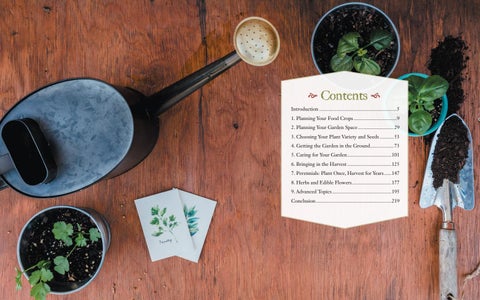
Contents ď Ś
Introduction.........................................................................5 1. Planning Your Food Crops.........................................9 2. Planning Your Garden Space.................................. 29 3. Choosing Your Plant Variety and Seeds.............. 53 4. Getting the Garden in the Ground...................... 73 5. Caring for Your Garden.......................................... 101 6. Bringing in the Harvest.......................................... 125 7. Perennials: Plant Once, Harvest for Years........ 147 8. Herbs and Edible Flowers...................................... 177 9. Advanced Topics........................................................ 195 Conclusion....................................................................... 219
Introduction
G
rowing a garden is as much food for the soul as it is for the body. There is little more satisfying, or delicious, than walking out your backdoor and picking a fresh, vine-ripened tomato or filling a colander full of carrots and beets with soil still lingering on the roots.
Watching the cycle of a garden, from the dormant earth, first seed sprouting, producing the harvest, and then gifting us with another seed to perform the cycle again, is like witnessing a small miracle each year. My heart is filled with a gratefulness for the way the good Lord created this earth and the food to nourish our bodies that I don’t find in the same depth when purchasing off the store shelf. After all, God is the Creator—this world and the very depth of nature we see before us is His canvas and design. Watching it up close, how the chill of winter is necessary for production of fruit and some seeds to sprout, to the rains of spring so those seeds can germinate, and the summer warmth to bring everything to fruition and harvest, is a testimony to His hand. Yet there are springs when the rains aren’t bountiful, the sun is scorching, and plants die; and it’s in these times perhaps I’m more appreciative of the harvest I get, knowing even when the earth doesn’t work with me the way I’d like, God will provide and teach me as I go. It used to be almost every household had at the very least a small kitchen garden where they grew some of their own food. In much of today’s mainstream society we’ve traded our connection to our food and land for the convenience of having someone else grow it for us. But you and I, my friend (because I consider all other gardeners friends), we know the importance and joy of
INTRODUCTION
5
raising nourishing and healthy food for ourselves and our family that goes well beyond the plate and pocketbook. I’ve found gardening to be one of the simplest and most complex things there is. It really is as simple as plopping a seed into the soil, providing some sunlight and water, and letting it grow. But on the other hand, the condition of the soil, growing zones, pest management, and any number of other things come into play in determining whether that plant will thrive and provide you with a bountiful harvest. I come from a long line of gardeners. Some of my earliest memories are of springs filled with planting the garden, snapping beans alongside my father, and filling up the jars for the pressure canner alongside my mother. I hail from people who made their living from the land; and if they didn’t raise or grow it themselves, they would have gone hungry. My husband and I, along with our two children, raise all our own meat and over half of our fruits and vegetables for the year on 14.96 acres here in the foothills of the North Cascade mountain range of Washington State. As we strive to increase what we grow and preserve each year, we’ve learned a lot—more from the failures than the successes, though thankfully we have more successes now than when we first started some 19 years ago. No matter how many times I’ve grown the same crop or raised a garden, I learn something new every year and season. A garden will teach you many lessons, and only some of them are about food. It is my aim with this book to walk you through what I’ve been blessed to learn, what other gardeners who have gone before me have shared, and to help you raise just a little bit more of your own food than you did the year before. I don’t believe it’s possible for one book to cover every area of gardening; exhausting every facet of composting, permaculture, and seed saving are all separate books. But I will cover what you need to know to have a solid foundation to raise your own fruits, vegetables, and herbs from planning and planting to harvesting; I’ll give you tips to implement and extra resources should you need to dive in deeper than we will in these pages. Deal? Good. Let the growing begin!
6
T H E FA M I LY G A R D E N P L A N
INTRODUCTION
7
SEED STARTING AND PLANTING CHART Germination Period
Basil
4–8 weeks, plant outside 2–3 weeks after last frost
5–10 days
2–4 weeks after last frost
You can start indoors on the last frost date, but beans don’t like their roots messed with, and I prefer to direct sow
6–18 days
3–4 weeks after last frost
Beets
3 weeks before last frost, plant outside on last frost date
5–21 days
2–4 weeks before last frost and sow up to 8 weeks before first frost in fall
Broccoli
7 weeks before last frost, plant outside 2 weeks before last frost
4–20 days
2 weeks before last frost, 10–12 weeks before first frost in fall
Brussels sprouts
2–3 weeks before last frost, plant outside 2 weeks after last frost
5–15 days
2 weeks after last frost, can direct sow 10 weeks before first frost in fall
Cabbage
6 weeks before last frost, plant outside 2 weeks before last frost
4–20 days
2 weeks before last frost, 6 to 8 weeks before first frost in fall
7–21 days
2–4 weeks before last frost, 8 to 12 weeks before first frost in fall
bush, pole, and shelled
Carrots
T H E FA M I LY G A R D E N P L A N
( spring and fall dates if applicable for fall crops)
Cauliflower
8–10 weeks before last frost, plant outside 4 weeks before last frost Fall crop start 12–14 weeks before first frost, plant outside 8 weeks before first fall frost
4–10 days
Chard
4 weeks before last frost, plant outside last frost date
5–21 days
Last frost date, 10–12 weeks before first frost date in fall
Cilantro/ Coriander
4–8 weeks before last frost, plant outside right at last frost
5–10 days
2 weeks before last frost, 6–8 weeks before first frost in fall
Corn
Best direct sown
3–10 days
2 weeks after last frost
My Sow Date
My last frost date______ My first frost date ______
P L A N
Start Indoors
Beans—
96
Direct Sow
Plant
2 weeks before last frost
GETTING THE GARDEN IN THE GROUND
G A R D E N
Seed starting can be a great advantage to your garden, allowing you a much longer harvest time. In some climates, it’s the only way you’ll successfully be able to grow a crop. It’s the only way I can grow enough tomatoes and peppers to take us through a whole year.
Below is the seed starting and planting chart I use. You won’t find all vegetables listed because some plants don’t do well started indoors or don’t warrant the work for only a few days earlier harvest.
F A M I L Y
Transplant out of the little greenhouses following the outside planting dates found on the seed packet or in your Seed Starting and Planting Chart on the next page.
97
Perennials: Plant Once, Harvest for Years 146
T H E FA M I LY G A R D E N P L A N
PLANNING YOUR FOOD CROPS
147
When it comes to pollination, one variety of apple tree works as a pollinator for almost all varieties: the crab apple. That’s why you’ll commonly find crab apples planted in apple orchards. Many sources recommend white-blossom crab apples as your best bet for pollination. One reason crab apples are a great pollinator is their bloom time. Their spur blooms open first, followed by the blooms on one-year-old wood, which means you have a longer bloom time window that will match more apple varieties. While crab apples aren’t known for their flavor, they are naturally high in pectin and disease resistant. They make wonderful apple jelly, and my grandmother always added one or two crab apples to her other fruit flavors of jam and jelly as a natural pectin source.
HOW TO CARE FOR PERENNIALS FOR YEARS OF FOOD Before perennials come out of dormancy for the year (usually late winter/early spring) you want to prune them. Almost all fruit-producing trees and bushes should be pruned. Fruit trees are usually pruned using one of three methods: a central leader, open center/vase, or modified central leader method. Central leader: The main trunk grows upright, and branches come out in a scaffold pattern from the center (think Christmas tree, and you’ve got it!). You’ll often see apples and pears done this way. Open center/vase: Remove the center leader (the center vertical top branch) from the top of tree and shape it to remain open in the center with the fruit-bearing branches coming up from the outside like a vase. Usually apricots, cherries, nectarines, peaches, pears, and plums are pruned to this shape. Modified central leader: In a combination of both central leader and open center/vase, you leave the central leader until the tree has produced a scaffold of about eight branches, then cut back the central leader and maintain those scaffolds and a more open center. We use modified central leader for the majority of our trees. If you’ve been pruning your apple tree to open center even though tradition recommends central leader or modified, don’t panic. If the tree is older and established, continue good pruning habits and keep it in the shape it’s been pruned too. We have neighbors with a beautiful orchard, and all the apples are pruned to open center/vase. In the same growing area but down the road the apples are pruned to a modified central leader. They both produce well. It’s best to prune your trees rather than be scared you’re doing it wrong and do nothing.
158
T H E FA M I LY G A R D E N P L A N
PERENNIALS: PLANT ONCE, HARVEST FOR YEARS
159
Many vegetables are heavy feeders, as you can tell from the chart above; but they’re not all heavy nitrogen feeders. All plants need a certain amount of basic nutrients in order to grow, but some need a bit more of specific types more than others. While all plants need some nitrogen, phosphorus, and potassium (this is what you see in many fertilizers, or NPK for short) among other core nutrients, others depend more heavily on some of the individual nutrients—hence the crop rotation I’ve laid out and which many a gardener follows. I follow some rules more strictly than others with my crop rotation. For example, if I happen to follow a leaf planting with a root instead of a fruit (I plant carrots after my broccoli), I don’t freak out or think much of it. As you gain more experience with your garden, you’ll learn what works best for you—which rules you should keep religiously and which ones you bend.
My Hard-and-Fast Crop-Rotation Rules Never plant anything in the Solanaceae family (eggplant, peppers, potato, and tomatoes) in the same soil for at least three years. For example, if you planted potatoes, don’t plant tomatoes or anything in that family for at least three more years. This has more to do with avoiding blight than nutrient deficiency. Both early blight (caused by fungus Alternaria solani) and late blight (caused by fungi-like mold Phytophthora infestans) infect plants in the Solanaceae family. In full disclosure, I have taken a gamble over the past four years and planted my tomatoes in the same soil as the previous year’s tomatoes, but that is because it’s inside our off-grid greenhouse (or high tunnel) that never receives overhead watering and has never shown any signs of disease or blight. I would never do this in a regular gardening setting, but because the soil is always covered and has never had any disease present, I break my own rule. Never plant brassicas in the same soil for at least three years unless you’ve planted legumes and tested your nitrogen levels. This was an invaluable tip I learned years ago from an organic farmer with decades of experience.
Plan Your Garden’s Crop Rotation Based on the charts and information above, plan out which crops will go where for this year. Many people like to draw grids or sketch their gardening areas to plan their crops. I’ve found it easy to snap a picture each year when the plants are well established (so I can tell at a glance what each crop is) for record keeping and planning the following year’s crop rotation. You may think you’ll remember the following year what you have planted where, but trust me—the years start to blend together. Save yourself the headache and document it. You’ll find space and worksheets available at the end of this chapter.
204
T H E FA M I LY G A R D E N P L A N
A DVA N C E D TO P I C S
205