Magazine of the Corps of Royal Electrical and Mechanical Engineers
In 2020, REME launched the Lifting the Decks initiative, with a focus on the mental wellbeing of serving REME personnel and veterans.
We are in the process of re昀ning Lifting the Decks, increasing accessibility with an added emphasis on reminding our REME Family to speak out about ‘what’s on their mind’ and that, whatever stage in their life, we will always be here to listen to and support them.
If there is something on your mind troubling you, big or small, whatever the cause, we are here to listen and to help. If you wish to get in touch regarding yourself or concern for someone else, please don’t hesitate to contact woym@remecharity.org
Editor: Mrs Sarah Eden + Corporate Communications Officer
RHQ REME, The Prince Philip Barracks, Lyneham, CHIPPENHAM, SN15 4XX
TEXT: should be submitted in MS Word and name saved as per the article. No formatting, columns, power point etc. Articles to be cleared by CO/OC/EME or appropriate REME CoC, or nominated substitute and should be submitted as soon as possible.
PHOTOGRAPHS: MUST be submitted separately, in jpeg format and be at least 500kb preferably 1mb or more. Only photos over 3mb can be considered for the front/back covers and please remember captions.
FILESHARE: websites, such as dropbox are ideal for submitting larger files.
EMAIL: The ONLY email address which should be used is: craftsmaneditor@reme-rhq.org.uk. Not MODnet. Please use the article title not ‘Craftsman Article’ as the email title.
TIMINGS: The latest submission date is the first day of the month prior to publication. This does not guarantee the article will be published in that specific edition.
Births, Engagements, Marriages and Deaths: These will be inserted free to all past and present members of the Corps.
Contents:
The contents of The Craftsman are strictly copyright and all rights are expressly reserved. The views expressed herein do not necessarily reflect the policy and views, official or otherwise, of the Editor, the Corps or the MOD, therefore no responsibility for these will be accepted. Whilst including an advertisement we are not necessarily endorsing the product and as a result, the publisher and its agents do not accept responsibility for any transaction between the reader and the advertiser. Whilst we take all precautions with regard to advertising, readers are advised to take professional advice before entering into any commitments. Letters concerning reproduction, contributions or any other matter should be addressed to the Editor.
General Handling: This publication contains official information and should be treated with discretion.
Corps ASM New Years message
Scribe: WO1 (ASM) Stuart Job
As we begin 2026, I can honestly say I have once again been humbled by the dedication, commitment, and work ethic I have witnessed during my frequent unit visits. It goes without saying that 2025 brought its challenges, whether through the strain of time spent away from family and friends, or the increasing demands placed upon our amazing Corps.
I must again acknowledge the outstanding work of the REME Charity and the Corps Secretariat; they remain the backbone of our support to the REME Family. I am truly grateful, and immensely proud, that our Corps benefits from such a fantastic network of individuals who consistently step forward during difficult times. Their mission is to look after, support, and, when required, intervene to help our people both financially and emotionally. As a Corps, this is one of our greatest strengths. Believe me when I say: a REME soldier, always a REME soldier
As a Corps, we continue to punch well above our weight in sport. There are far too many individual achievements from the past year to list, but I would like to recognise the unsung heroes among you – the Coaches, Referees, training staff, Physios, volunteers, and many others who put in the hard yards to allow our soldiers to thrive. Thank you.
Nineteen serving REME personnel were recognised in His Majesty The King’s New Year Honours List. This includes a knighthood for our Master General, four MBEs, one KVRM, seven MSMs, one 4* commendation, three 3* commendations, and two
CJO/JCC commendations. I extend my sincere congratulations to all who have received an award. Their success highlights the exceptional calibre of our people. I am proud that their work has been recognised in this way, but equally mindful that many more across the Corps are operating to similarly high standards. Thank you – and rest assured, we will continue to celebrate our successes whenever and wherever we can.
Lyneham continues to be our home, and rightly so. I am proud to see positive changes emerging in how we train as a Corps, and I encourage everyone to play their part in shaping REME to meet future
The REME Offer, and the career we provide our people, remains strong – in my opinion, the best across all cap badges. Over the past 12 months we have seen increased inflow to the Corps and a very encouraging number of transfers from across Defence. We are held in high esteem throughout the Army and wider Defence, and this is being recognised at all levels.
My final thoughts are to acknowledge just how busy we are as a Corps, and how much we continue to ask of our soldiers. That said, I have every confidence that we are more than ready for the challenge. As always, we will deliver to the highest standards –both now and in the future. Remember to look after yourselves, your teams, and your families.
Thank you once again for your unwavering dedication and your continued support to the Corps and the wider Army.
Arte et Marte
21 Engineer Regiment LAD Germany
Scribe: WO2 Shinn/SSgt Hough
21Engineer Regiment LAD operates in a uniquely challenging environment, split across two locations: Claro Barracks in Ripon, UK, and Talbot Barracks in Sennelager, Germany. The main command element is based in the UK, while the AQMS exercises detached command over the German-based LAD, providing dedicated Equipment Support (ES) to 23 Amphibious Engineer Squadron.
This structure enables seamless support to 23 Amphibious Engineer Squadron while fostering close cooperation with NATO allies. In 2021, a significant milestone in multinational interoperability was achieved when Lieutenant General Langenegger (Commander Operations, DEU) and Lieutenant General Jones (Commander Field Army, UK) signed the Revised Common Guidance (RCG) between the German 1st Panzer Division and the British 3rd Division. This agreement formalised the creation of DEU/GBR 130 Pionierbrückenbataillon (130 PiBrBtl) a joint British-German Pioneer Bridging Battalion.
Based in Minden, 130 PiBrBtl was partnered with 23 Amphibious Engineer Squadron to form a core component of NATO’s Wide Wet Gap Crossing capability (WWGC). This multinational formation is tasked with constructing bridges and ferry systems to enable the movement of troops and vehicles across major water obstacles.
21 Engineer Regiment LAD(G) plays a critical role in this capability. Its personnel are distributed between the B-
Fleet Fitter Section in Sennelager and the M3 Fitter Section at the Water Training Area (WTA), approximately 50 miles apart. While this dual-location setup presents logistical challenges, it offers valuable opportunities for interoperability with the Bundeswehr, who operate the same M3 Amphibious Rig platform from the same training area.
Minden Fitter Section and the M3 Amphibious Rig – Cpl Graham
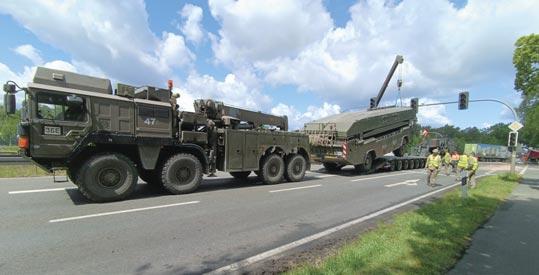
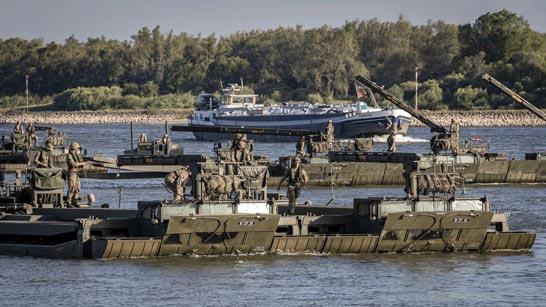
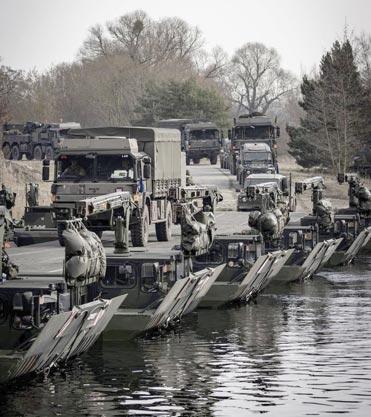
The M3 amphibious rig is a highly specialised and versatile vehicle, primarily designed for WWGC operations. It is capable of being configured in several configurations, such as connecting multiple M3 rigs together to form a static bridge or linking three or four vehicles in a ferry cycle to transport vehicles and personnel across water obstacles. This system is the only WWGC capability currently available to the British Army and remains a unique asset of 23 Amphibious Engineer Squadron.
The M3 amphibious vehicle itself is an all-terrain, selfpropelled platform built to operate in both land and water environments. When deployed, the M3 can travel on public roads like any other conventional HGV, allowing it to cover extensive distance, sometimes hundreds of kilometres, before reaching its designated crossing site. Once on-site, a well-drilled and experienced crew can rapidly assemble an 8-rig bridge, for a crossing approximately 100 meters in
length, in as little as 30 minutes. Alternatively, a 4-rig ferry, capable of transporting vehicles, personnel and cargo across a water gap, can be operational in just 10 to 15 minutes.
The M3’s design also ensures it can support a wide range of military vehicles, including up to and including the Challenger 2 Main Battle Tank; providing a crucial capability for overcoming natural and man-made obstacles during operations. This robust amphibious system allows the British Army to maintain critical mobility and operational flexibility in diverse terrain and environmental conditions.
Ex BLACK HORSE WALK – LCpl Thomas
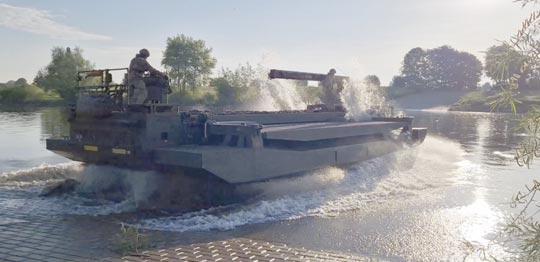
In May 2025, the Squadron deployed on EX BLACK HORSE WALK, a four-day validation exercise that tested and honed the skills of the Squadron and LAD leading up to EX GRAND CROSSINGS. The main effort was to practice and perfect the Handover Takeover of a crossing site from one Troop to another; a necessary capability which ensures longer crossing times can be sustained. Once validated, the Squadron would be ready for future deployments. As the LAD prepared to support this exercise, it meant firstly ensuring the M3 Rigs and the B fleet vehicles were fit for the task. This saw us rectifying any major faults, carrying
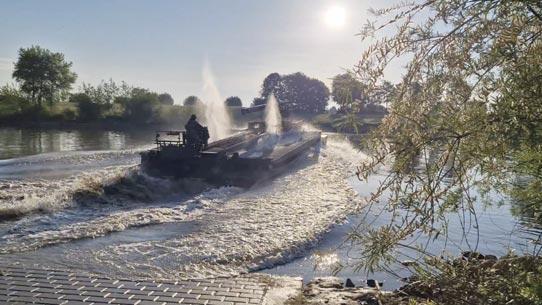
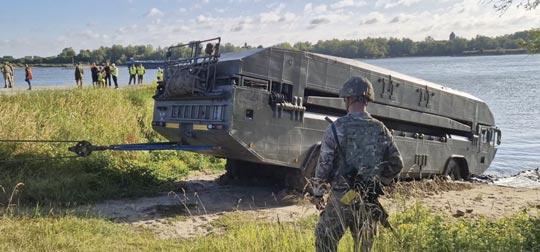
Ex BHW-M3 entering the water at the Waterside Training Area
Ex BHW-M3 entering the water at the Waterside Training Area
out any servicing then fitting our LAD vehicles with the necessary STTE, tools and spares needed to provide adequate support. The support vehicles had to be prepped with similar layouts before deploying; since we were supporting two individual Troops with the two Fitter Sections comprising of a SVR, fitter truck and Prod Sgt each.
The road move to our first location went well and, to add to our good fortune, the first two days of the exercise were fairly relaxed with routine maintenance being conducted. This is always welcomed, and we used the downtime to replace Ramp Cylinder seals (a vital component for the waterproofing of the M3 Rig) and repair other small jobs that arose as a result of the road move. This time was also spent familiarising the newer members on the of the LAD on the platform and teaching them how to repair the various faults encountered. The remaining two days of the exercise presented more major faults with one M3 Rig developing marine issues where the water function was intermittent, rendering the vehicle unfit to carry out its main function. After some in depth diagnostics, the problem was identified and repaired allowing the vehicle to get back in the rotation.
Post exercise, it was time to assess the damage, so the vehicles were channelled into the workshop where ISI inspections were conducted by the Vehicle Mechanics. This then turned into a JAMES exercise of inputting faults and demanding spares. Once this was done, it was time to call END
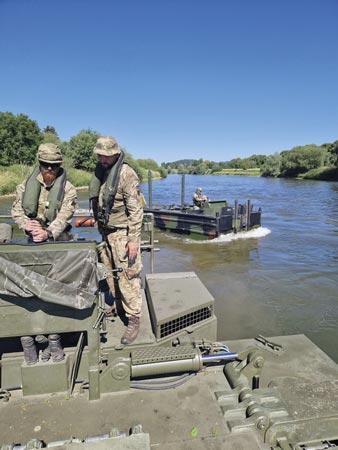
Ex GC - Cpl Graham (right) conducting on board failure diagnosis
Ex GC - M3 preparing to ferry cycle the river Rhine
EX and have that post exercise shower that everyone looks forward to.
Ex GRAND CROSSINGS – Cpl Whiteside
During June and July 2025, 23 Amphibious Squadron LAD deployed alongside a Squadron of 14 M3 rigs in a joint multinational exercise, delivering essential ES across multiple WWGCs. Operating as part of the integrated BritishGerman Battalion 130 DEU/GBR PiBrBtl, the team collaborated closely with Italian and Dutch forces to execute complex river crossing operations from the Rhine to the Weser, including key locations at Hameln and Minden.
The exercise demanded resilience and technical expertise from 23 Amph LAD. Tasked with maintaining the M3 Amphibious Rigs throughout extensive road movements and demanding river operations, the LAD faced a wide range of mechanical challenges from wheel malfunctions to intricate ECU and sensor faults. Despite the complexity and volume of repairs, the team consistently rose to the occasion. Intense environmental conditions added to the
ExGC - Cpl Spolton (Recovery Mechanic Class 1) overseeing the recovery of a beached M3
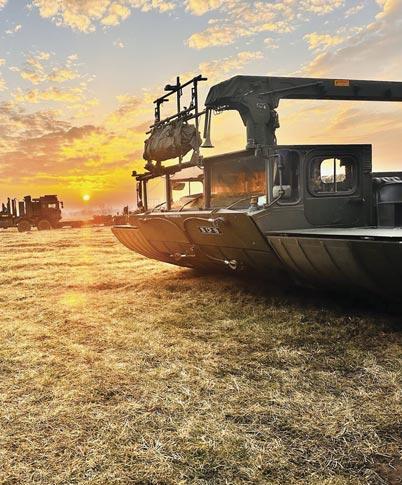
Introduction picture - M3 in Zulu Muster, Ex POLISH DRAGON
challenge, with temperatures soaring to 38°C and breakdowns occurring along busy Autobahns. These factors tested both the endurance and adaptability of the LAD, who worked tirelessly to ensure the Squadron adhered to a strict operational schedule.
Thanks to our dedication and skill, the M3 rigs remained fully missioncapable throughout the exercise. Their successful deployment enabled seamless ferry operations across the Rhine and the construction of a bridge over the Weser at Hameln. The final crossing, facilitated by an Italian bridge unit, marked the culmination of the exercise at the Minden Water Training Area.
This deployment showcased not only the technical proficiency of 23 Amph LAD but also the strength of multinational cooperation. Their efforts ensured mission success and demonstrated the critical role of ES in enabling complex amphibious operations.
RE Fitter within an LAD – Spr Irvine
I am one of two Royal Engineers currently serving in LAD(G), the other being a Welder and Fabricator. As a Fitter, my primary training has been focused on plant equipment, with additional experience gained working on Land Rovers. Since joining the LAD, I have had the opportunity to broaden my engineering skillset by working across a wider range of platforms than is typical for a Royal Engineer Fitter.
Initially, the transition presented a steep learning curve, but over time I’ve developed confidence and now feel like an integral part of the team. One of the highlights of my time in the LAD was supporting OP INTERBOW, where I spent time in Minden working on M3 rigs. This was both challenging and rewarding, offering hands-on experience with complex equipment.
I’ve also deployed on exercises such as EX GRAND CROSSING, where I supported the LAD in maintaining M3 rigs and ensuring the successful delivery of a WWGC by the Squadron. Prior to joining the LAD, I served as an amphibious crewman within the Squadron. While that role had its merits, I much prefer my current position in the LAD. It keeps me engaged, offers a greater sense of purpose, and provides a more structured work/life balance.
AT – Cpl Ahmed/Spr Irvine
Spr Irvine and I recently attended a Rock Climbing Single Pitch Foundation Course at the AT Lodge in the Harz Mountains, Northern Germany. As both of us were relatively new to climbing and had a slight fear of heights, this course proved to be a valuable and rewarding experience.
The training included a mix of indoor and outdoor rock climbing, bouldering, and abseiling. While all aspects were
beneficial, the outdoor sessions stood out due to the serene environment and breathtaking views of the Harz Mountains.
The course focused on key techniques such as single pitch climbing and lead climbing. We were already somewhat familiar with single pitch climbing from previous multi-activity AT packages, but lead climbing was a new challenge that pushed us beyond our comfort zones and helped build confidence.
In addition to the climbing course, Spr Irvine also completed the Mountain Biking Foundation Course at the same location. With no prior experience in mountain biking, this was a completely new and exciting challenge. The course covered a variety of riding styles including trail riding, road riding, and a visit to a bike park.
Trail riding was particularly enjoyable, offering both physical and mental challenges. The steep inclines and varied terrain made the ascent demanding, but the exhilarating descents more than made up for it. The course also covered essential skills and techniques, as well as equipment maintenance and repair, providing a wellrounded introduction to mountain biking.
Overall, both courses offered valuable skill development, personal growth, and memorable experiences in a stunning natural setting. They were excellent opportunities to step outside our comfort zones and embrace new challenges.
Minde Fitter Section - M3 in their bridging configuration
102 Bn REME –SUAS Ready in 2025: Integrating Drones into CSS Operations
Scribe: Major C Kipling
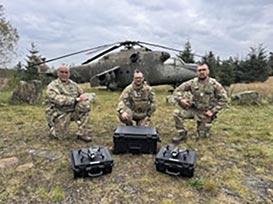
In early 2025, units within the 1st (UK) Division were challenged to achieve drone readiness at the earliest opportunity. This initiative was driven by the evolving character of conflict, particularly highlighted by the extensive use of Small Uncrewed Aerial Systems (SUAS) on the battlefield in Ukraine. The requirement was clear: our personnel needed to be trained and proficient in operating and flying drones.
To meet this requirement, the Land Warfare Centre introduced the SUAS Commanders’ Course. Our Training Warrant Officer successfully completed this course, enabling him to plan and deliver distributed SUAS Operator training. As a result, the unit gained four qualified operators. In parallel, the Commanding Officer, as the Responsible Officer, along with the OC 153 Coy and the Quartermaster as Delegated Officers, attended the mandated SUAS Briefing Course delivered by the Military Aviation Authority (MAA).
Simultaneously, the unit applied to the MAA for a Letter of Endorsed Category (LEC). Once granted, the LEC authorised the unit to operate specific SUAS within the Open A3 Category. While funding for military-grade SUAS proved challenging, the LEC permitted the use of equivalent civilian-grade systems under defined security constraints. This approach allowed operators to build competence using the same platforms and software. With authority, qualifications, and equipment in place, the next step was to integrate SUAS into our Standard Operating Procedures. The unit developed several concepts of
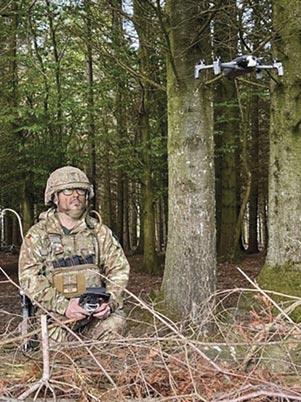
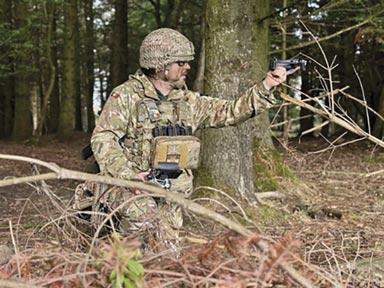
WO2 Milne (102 REME SUAS Commander) operating the SUAS
WO2 Milne hand launching the SUAS
employment to maximise capability. While the concept of ‘one-way attack’ is not currently a priority for CSS, it may become relevant in the future; for now, our focus remains on reconnaissance and defensive applications. These include supporting Recovery and Equipment Support (ES) Forward Repair Teams and securing ES locations at both Company and Battalion levels. Additionally, SUAS were employed to enhance counter-SUAS training by introducing realistic scenarios during exercises, testing sub-units’ ability to detect and respond to enemy drones.
Since achieving operational authority, the unit has conducted numerous bespoke SUAS exercises, enhancing both operator proficiency and tactical employment. We have also supported other units’ exercises, further broadening our and their experience.
Looking ahead, 102 Bn REME aims to expand its tactical use of SUAS and refine doctrine for their employment in deployed CSS environments. We are also fostering innovation and skill development through participation in First Person View (FPV) drone racing, now recognised as an official Army sport.
From the Commanding Officer 102 Bn REME – Lt Col Anthony Platt
Within 9 months, 102 Bn REME seized on this direction from higher formation and went from having zero capability to implementing a brand-new SUAS capability into the REME Reserve. The tenacity, ingenuity and enthusiasm shown by the whole team at 102 Bn REME to make this happen, has been nothing short of outstanding. Having 2 x SUAS platforms, 4 x SUAS Operators and 1 x SUAS Commander, with all the necessary policy, processes and licences in place to operate these SUAS in field conditions, is not only a Battle Winning capability for REME Reserve force elements, but absolutely enhances our Attract and Retain workstreams for recruiting and retention also.
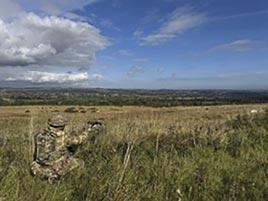
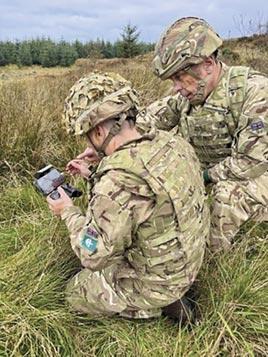
Members of the units SUAS detachment on Exercise SHADOW SPROCKET, tactical SUAS proof of concept exercise
102 REME Operator deploying the SUAS on the units SUAS Operators Course
One of the units Operators conducting a recovery task reconnaissance using the SUAS
Training & Development
REME Arms School Updates
Artificer Training Team
Scribe: Major Si Ratcliffe
Introduction
Artificer training represents the pinnacle of engineering education within the REME, with students earning either a Level 5 HND or a Level 6 Degree upon completion, depending on their Career Employment Group (CEG).
Changes
To address the span of command within 8 Trg Bn REME, Project REFORGE was initiated. The project proposed redistributing certain ITT trade groups to other departments and restructuring the 8 Bn organisation. As part of this initiative, all Land Artificers were scheduled to transfer entirely to the REME Arms School.
In August 2025, I was assigned to a newly established role within the REME Arms School, tasked with creating a training team structure capable of managing approximately 150 Artificer students. This included overseeing all aspects of their experience, from welfare support to course delivery. My responsibilities also extended to other key elements of the Artificer pipeline, such as the REME Potential Leadership Assessment (RPLA), formerly known as PAB, as well as Artificer Maths selection and Engineering Management.
RPLA Update
The terminology surrounding the assessment of REME soldiers has long been a topic of debate, with many recalling the transition from PAAB to PAB. This prompted a review of what is truly being assessed during the course. Leadership emerged as the defining quality for selecting Artificers, MTIs, or Potential Officers, leading to the creation of the REME Potential Leadership Assessment (RPLA). While the course remains largely unchanged, it continues to focus on key areas such as the ability to communicate effectively in group settings, physical capability, and mental agility. The team at the school is actively working to enhance the Command Task element, introducing new tasks, while retiring outdated ones to ensure the assessment remains relevant and challenging.
Artificer Maths
The Potential Artificer Electro-Mechanical (PAEM for VM and Armrs) and the Potential Artificer Technician Development Course (PADC for Tech) are currently operating at full capacity, with approximately 50 bids received for just 16 places each time. Recently, priority has been given to individuals who were removed from courses due to cancellations and those preparing for operational deployments. Please continue
submitting bids for your personnel and ensure the justification box is detailed and comprehensive. Rest assured; I review each submission thoroughly before making a decision.
Regarding exemptions, please note recent changes to the JPA competence, as outlined in Corps Instruction E5. In summary, the requirement to hold a ‘Trade Exempt’ competence has been removed. Eligibility is now determined by the completion of the Class 1 course. If an individual achieves a sufficiently high percentage, the competence REME|POT ART TECH ELECT MATHS EXEMPT|Army| will be displayed (e.g., for the Tech Elec CEG).
Engineering Management
Engineering Management offers tailored courses such as ESCAM and TAC, designed to qualify attendees in engineering assurance practices. These courses can be booked via TARGET. If your unit has a Tech Eval approaching, it is highly recommended to liaise with the Engineering Management WO. As part of the TAC course, attendees conduct a comprehensive audit of a unit, producing a Tech Eval-style report. This report has no formal impact, allowing the unit to focus its efforts on addressing any identified shortcomings ahead of the actual Tech Eval.
Additionally, the Engineering Management WO contributes to the delivery of key elements of the Artificer Command and Field Course (ACFC), ensuring that standards and best practices are upheld consistently across the Corps.
Artificer Command and Field Course
Module 1
ACFC 1: This three-week programme is designed to prepare students for the demanding course ahead. It equips them with essential knowledge and skills required to complete essays, engineering reports, and presentations effectively. All students, regardless of their CEG, will undertake this module at the start of their course under the guidance of the ACFC Training Team.
Module 2
ACFC 2: This module constitutes the largest portion of the course, with some CEG-specific elements lasting 12-14 months. At this stage, students are divided by their CEG: Armourers and VMs undertake the General Course, Technicians follow the Electronics Course, and AV/AC personnel complete the Aviation Course and are taught and assessed by Civilian Contractors throughout. The Art Trg ASM has complete oversight of this component of the course and
will be the ‘green’ liaison for all students. This module is where the majority of the academic qualifications are achieved.
The current qualifications available are as follows:
• Aviation: BEng (Hons) in Aviation Engineering Management
• Electronics: BSc in Electronic Systems Engineering
• General: DAO Level 5 Diploma in Mechanical Engineering ACFC 2 is academically challenging, with the maths components often proving particularly demanding for students. If you are successful in being selected for the course, my strongest advice is to refresh your knowledge of GCSE to AS-level maths before attending. Doing so will better prepare you for the course, set you up for success, and help minimise the stress associated with exam resits.
Module 3
ACFC 3 marks the final 10 weeks of the course, during which students return to the Artificer Training Team. This phase provides the greatest flexibility to teach and mentor students on what it truly means to be a Tiffy. Weeks 1-4 focus on engineering lessons and practices, report writing, and workshop setup assessments. This is followed by a five-week scenario-based package, which underwent significant updates in late 2025 to reflect the modern battlespace, incorporating revised documentation and presentations.
The final 10 weeks are pivotal, shaping students into
credible and knowledgeable Artificers with dynamic problemsolving skills and the confidence to excel in making critical engineering decisions. Feedback from recent courses has been overwhelmingly positive, with the highlight being the week 9 exercises. During these exercises, students face sixhour command rotations, where they are assessed on their ability to manage tactical situations, Equipment Support, and operational considerations.
The course concludes in week 10 with Promotion and Scrolling, a moment of well-earned relief and celebration. The promotion, dine-out, and scrolling ceremony mark the culmination of the course and the beginning of the students’ journey as Artificers.
Contact List
OC Art Training Team: Maj S Ratcliffe DSEME-REMEAS ArtTrg OC
2IC Art Training & RPLA Lead: Capt D Bates DSEME-REMEAS ArtTrg 2IC
ASM Art Training: WO1 (ASM) A Morris-Jones DSEMEREMEAS ArtTrg ASM
ASM RPLA: WO1 (ASM) B Owers DSEME-REMEAS PAB ASM
Eng Mgt: WO2 R McCready DSEME-REMEAS EngMgmt WO
SSI Art Training: SSgt S Wainwright DSEME-REMEAS ArtTrg
SSI
Ref: Corps Instruction E5
LAND TRAINING DEFICIENCY REPORTS (TDRS)
Drives change
TDRs play a critical role in redefining REME technical training to meet the evolving operational demands of the Field Army.
They establish a structured feedback loop between the Equipment Support Requirements Setting Team — acting on behalf of the Land Warfare Centre — and the Field Army. This ensures that training remains relevant, responsive, and aligned with current and future operational needs.
TDRs help to identify and spotlight:
Capability gaps – critical skills or knowledge that must be added.
Eliminate non-essential training – content that adds no value and should be removed.
If it’s not reported, it won’t be the crème de la cREME of training.
No evidence = No change
ACFC 3 programme
Adventurous Training
Exercise WYVERN SHOSONE
Scribe: Cpl Bester
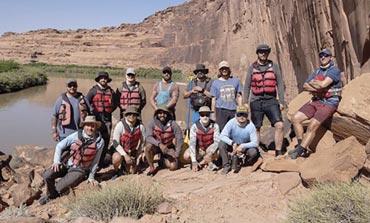
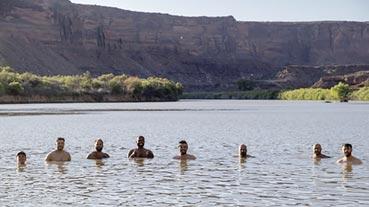
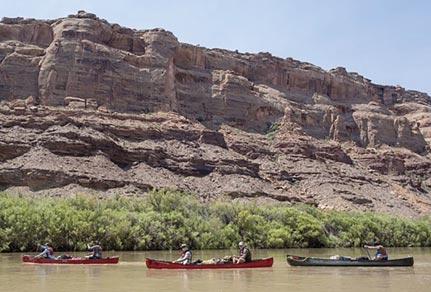
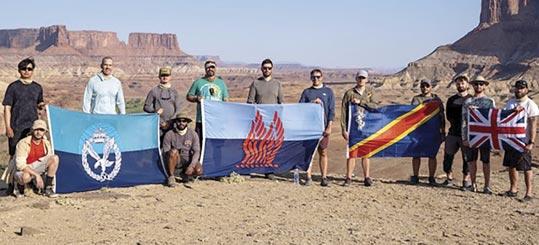
Enter the HQ FIND Briefing Room in 1 Aviation Brigade, the mid-June humidity doing its bit whilst we waited to receive the movements brief for what would be the Adventurous Training opportunity of the year. The group saw eleven participants and two Instructors preparing to embark on Exercise WYVERN SHOSHONE, aptly named after the Shoshone people, a Native American tribe who thrived in the Great Basin region of the United States. We would be taking in the beauty of this environment along with a taste of what life was like for the Indigenous people, Cowboys and Outlaws, as we journeyed down a 120 mile stretch of the Green River with our sights set on reaching Spanish Bottom - the confluence between the two largest rivers in Utah, the Green River and Colorado River.
Before long the 18th of June was upon us. With a lastminute stuff and tuck all the kit was loaded, and we were on the bus making our way to London Heathrow. The chatter and excitement grew as the realisation that we were past the point of no return set in. The impeccable planning and pre-
departure admin made for a smooth sailing across the Pond and into “Up the Creek” campsite; where we would have our last proper shower and cold drink before setting off on the water. On the morning of the 20th of June, we were greeted by the friendly staff from Tex Riverways who supplied everything from Canoes to the portable toilets. One couldn’t help but laugh as a six-foot four burley American explained that the toilets were a favourite hiding spot for the Yellow Belly Marmots in the area, and that we would be best advised to keep a lid on it.
We also split into our boat crews at this point with Team Alpha led by Sgt Jason Lucas (Instructor, Rifles) and Team Bravo led by Maj Scott Battishill (Instructor, REME). Ironically, our team’s ride just so happened to be a GMC van very similar to the Battle Wagon driven by Mr T in the famous American action series The A-Team. Of course, this set the tone for the friendly competition that was to come between Team Alpha and Team Bravo in the following days.
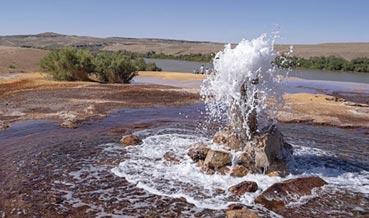
Our point of departure was 115 miles from our destination at a location known as Crystal Geyser, which was formed when a Sulphur rich deposit was struck during a drilling operation in the 1930’s. The eruptions occur spontaneously, and it added a special touch because it just so happened to be spurting the mineral rich water as we were taking a tenminute break from preparing our canoes.
With the emphasis on not working through the heat of the day, we made a quick start on paddling. Without much input from the instructors, we made our way down the river in an unsynchronised manner - this meant a couple of extra miles of zig zagging from the left bank to the right followed by the occasional uncontrolled U-turn. Later we were to find out that this so called ‘self-discovery’ was planned by the instructors all along.
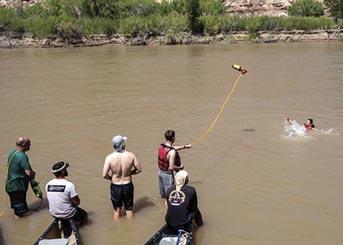
The effect of the wind and current became apparent as it made quick work of pushing one of the canoes, ‘Stingray’ into some debilitating shrubbery causing its occupants to tuck and roll, capsizing the canoe in the process. The instructors quickly jumped into action. Hastily deploying float lines, the paddlers and canoe were quickly recovered. After fighting the frustrations of bad paddling technique, windy conditions and hot weather we finally made it to mile 102, the first campsite. The landing points around some of these sights left something to be desired, but some members insisted that we double down and slog the kit up what felt like the fourth addition to the Three Peaks challenge. Determined, we got the kit
up the bank, now dubbed as Scott’s Bank and setup camp in Anvil Bottom for the night. Since our habitat for the next ten days was self-supported with limited space on the Canoes, we couldn’t rely on the comfort of induction hobs and pristine kitchens. Instead, we turned to the more traditional fire and cast- iron alternative. Thanks to WO2 Chris Devereux (AAC) the resident Survival, Evasion, Resistance, and Escape (SERE) expert, we received a masterclass in training on safe cutting and fire lighting; which was a skill we came to rely on a bit more than expected in the following days.
As the saying goes, every morning is a blank canvas and breakfast the first brushstroke. Well let me tell you this breakfast was no exception. A hearty sausage and potato skillet made for happy campers provided the necessary fuel as we made our way onto the river trying to beat the punishing midday sun. After making it through the first day the instructors were kind enough to delve into their box of tips and tricks, talking us through the techniques around forward paddling and Ruddering from the stern. This made a massive difference in keeping the canoe in a straight line. Paddling was smooth for the first mile or two before the wind picked up again. Needless to say, this wouldn’t be an Aviation Brigade article without mentioning Bernoulli’s Principle, which was naturally occurring as the wind dropped down the canyon sides and accelerated up the narrow river passage creating a choppy surf. This was the final obstacle to navigate before reaching the landing on the right bank of the river. Now I would agree that a bit of surf on a river does not sound intimidating, but with fully loaded canoes this can be a tricky scenario. Hitting the waves broadside could guarantee a flooded canoe or maybe even a capsized one. With the bods keen to get out of the choppy waters we settled at Three Canyons for the night. Setting up tents was an endeavour as one had to strike the balance between sleeping on uneven ground or tolerating a snoring symphony, which unsurprisingly turned out to be something that certain individuals in the group were very talented at.
Early sunrise was our signal for the start of our morning routine. Up at 0600hrs, admin, tents down, and for the boat crew on kitchen duties, breakfast readied. On the agenda for the second day were two strokes, one to draw the canoe sidesways while facing forward and the other to turn the canoe through 360 degrees. Obviously, synchronicity was a big part of making these strokes work as intended. We weren’t there yet, but it didn’t matter as we could still enjoy the serenity and beauty of the river and surrounding landscape even with the boat facing upstream. Speaking about serenity, with no other traffic or city noises even remotely close we got an early warning of a V8 jet boat engine as it roared up the river. What was the chance that this jet boat would belong to none other than the Canyonlands Park Rangers. The interaction was mostly friendly apart from when they tried to trick us into admitting to illegal fishing activities. Jason, however, didn’t crack under pressure and quickly answered with ‘but isn’t fishing illegal without a permit’ this caught them off guard as one replied with ‘Oh yeah’, signalling the end of the discussion. On we went. Ten Mile Bottom had a very narrow landing zone, so much so that Team Bravo, who landed first, had to unload their canoes and drag them up the bank. The exertion we expended getting into the campsite
was completely worthwhile as this was one of the most scenic and unique camps on the whole expedition. Just off the bank of the river we found ourselves on a small Plateau of only a couple of acres that formed a perfect pocket for a grassland patch. Some shady old trees stood against the backdrop of a deep alcove and the canyon side was characterised by hundreds of tiny ledges, pockets, and windows. The rock has eroded into the sandstone and can only be described as nature’s version of little doll houses. This makes the fascinating myth of the Nimerigar, tiny beings depicted by the Shoshone Folklore, slightly more believable. If mythical stories don’t tickle your fancy, then there was the breathtaking sunset to look forward to at the top of the canyon.
With the sunrise breaking through the trees, we are up again for another day on the water. We were moving from Ten-Mile Bottom to Bow Knot Bend.
Our first stop was the River Register a mile and a half upstream from The Hey Joe Uranium mine and couple more from Bow Knot Bend. The River Register has become quite a popular stop over the years as it contains inscriptions and petroglyphs from a time gone by.
Why Bow Knot you might ask?
Well, the word bowknot gives a good visual representation of what the bend in the river looks like. Yes, a bend that happens to be six miles long nearly turning back onto itself. The two parts of water are separated by a mere six hundred yards of earth in between them. For the smarty pants out there wondering why we didn’t just cut across – the almost vertical incline and rocky undulating terrain was why.
Other than the long distances we had to cover; the paddling conditions were moderate, and we learned about
reverse paddle strokes, handy for entering and exiting landing spots, stopping in the water and man overboard drills. These drills were tested when WO2 Devereux unbeknown to us decided to take a dip in the water. Not to worry, he was recovered unscathed.
The days and nights seemingly merged into one as we came up to the halfway point of the expedition. Our drills had been honed, and camp admin had become somewhat smooth and efficient. The target for day five saw us doing a steady ten miles down to Mineral Bottom. On the way however we just so happened to pass Horseshoe Canyon that has succumbed to the power of the river and turned into a gigantic Oxbow. Upon arrival at Mineral Bottom, we were very happy to see a proper boat ramp and some shaded pergolalike structures that made it seem like we made it to an oasis in the desert. The shallow water next to the boat ramp made for a good swimming spot which we all enjoyed.
Apart from the Park Rangers who crossed our path, it was the first time in five days that we came across other campers. The highlights of the day didn’t end there, with Cpl Bailey
(REME) and WO2 Gregory (REME) working hard behind the grill, we were spoilt with delicious steaks for our evening meal. Having steaks on a desert canoeing expedition might seem a bit far-fetched, and it would be, unless you have Pit Master WO2 Joseph Gregory (REME) whose menu planning made it possible to have top notch meals for the duration on the river. The evening was capped off nicely with a stroll to the nearby Geological Station and Airstrip.
On to Fort Bottom we go…
With everyone in fine spirits we made our way further down the river. A celebratory hiphip hooray was in order as Jason had his birthday on the river. It must have been the birthday vibes that turned the wind in our favour as we were making quick progress. We took a moment passing by Horsethief Canyon, a hideout for the infamous Butch Cassidy, envisioning the silhouettes of the ‘Wild Bunch’ as they disappear behind the canyon edge. We reached Fort Bottom after what seemed to be the shortest day of paddling. This worked out perfectly for an afternoon of learning some of the more advanced recovery techniques used in Canoeing. First was rescue by means of float lining. Quite simply a buoyant bag stuffed with twenty metres of rope is thrown across the midsection of the person being recovered; they then proceed to wrap the rope under their shoulder blades before being reeled in.
We were also assessed on two types of canoe recovery techniques, the X-rescue and Curl rescue. These attempts in recovery made some good theatre for the rest of the group who sat on the bank looking on as the circus unfolded. After dinner and a special birthday dessert we took a hike up to the Fort situated on top of the canyon outcrop. The fort itself was constructed from a certain type of stone that had to be carried up all the way from the basin, spectacularly impressive if you ask me. The Fort was used as an outlook with clear lines of view for 360 degrees overlooking what is known as the Island in the Sky District. It was the perfect spot for a couple of expedition snap shots.
We waved a goodbye to the Fort as we turned the bend at mile 36 keeping our eyes and ears peeled for the upcoming white water; aka, riffle; testing the skills we had learnt over the last couple of days. LCpl Samual Penn (AAC) and I were positioned down river with the float lines ready to come to aid if needed. Luckily the whole team made it through and reached Lower Anderson Bottom without any hiccups. Up until that point we had been very fortunate to see some amazing sights and topography. We were also pleasantly surprised by the abundance of wildlife. Some sightings included the
• North American Beaver or Castor Canadensis, too skittish to get a snapshot of
• Mule Deer, surprisingly they are good swimmers too
• Great Blue Heron or Ardea Herodias, stealthily lurking in the riverbank shadows and probably the rarest of the camp visitors, the Desert Striped Whip Snake, a non-venomous subspecies of the Colubridae family. The interaction however was short lived as it whipped off into the shrubbery, like the name suggests. It was time to get a move on again to the waiting confluence. We left Lower Anderson pushing ahead to Prehorse Canyon. By now we were confident in the canoes and spent time consolidating the techniques what we had learnt from the beginning of the expedition. The silent competition of proving to be the best rowing pair had been growing and reached boiling point. This meant a full-blown Need for Speed style race to establish the winners (Top tip-a paddle full of water splashed into the opposition’s face is a good way to get a head start). Besides races and water fights, we had a couple of interesting features on that stretch.
First, Turks Head raised high above the water standing proud on a pedestal in the form of its own base, with the name derived from its uncanny resemblance to a Turkish-Fez. Also, around Turks Head we witnessed several Puebloan structures or small rock shelters built into the overhanging ledges of the canyon sides. Some resources suggest that these rock shelters were used as grain silos by the tribes that use to roam the waters before. Due to unpredictable water levels and availability of camp landing sights we had to push on a bit further bringing us up to the 17-mile mark for the night.
As I mentioned earlier in the article, we came to rely on our fire lighting skills a bit more than expected. Due to high temperatures, our water consumption was higher than anticipated. We topped up our jerry cans with filtered water. But this was short lived as the fine silt in the river water quickly blocked the filter elements making all six of them inoperable... This literally boiled down to the last resort, as we ended up pre filtering water through a couple of layers of a cotton Shemag, before boiling the water over an open fire. The whole team chipped in, from collecting firewood to keeping the fire going and boiling the amount of water required.
With water running low, we had an important decision to make. Playing it safe, the team leads decided to head on to the pickup point one day early. We had become so efficient at packing up camp it was almost like we rolled out of our tents
and into the canoes in one swoop. I think this efficiency was enhanced by knowing that if we made it through the last 17 miles, we would have a bit more R&R time in Spanish Bottom and Moab to enjoy the last stint of the trip. The paddling conditions were good. It was incredible seeing the boat crews charging down the river taking turns to draw the pack downstream, as another crew took the lead, occasionally forgetting about the solo paddlers who were working very hard to keep up. There is so much to say about the incredible landscape, not just on our last day, but during the whole expedition.
However, I think the Confluence deserves a mention of its own. We knew we had arrived before even seeing it. With every stroke we could feel the change in the current and water flow, and a change in smell, as all the minerals in the water were being churned up at the point of contact between the Colorado and the Green Rivers. Watching these forces of nature collide and then harmonise brought a sense of accomplishment for our achievement over the last nine days. Witnessing such magnificence brought a sense of appreciation and a sense of responsibility to preserve nature for the future.
We reached our final campsite at Spanish Bottom filled with contentment. The beach made for a perfect paradise where we enjoyed the warm afternoon sun, swimming and sharing personal highlights of the trip. It would also be the last opportunity to have a go at Cowboy camping, sleeping under the stars. This endeavour was short lived when the UV light torches exposed all the scorpions emerging onto the bank. Let’s just say Cpl’s Kian and Sheikh (AAC) had their tent put together very quickly.
As the saying goes, all good things come to an end. I can confidently say that even though this expedition reached its end, inside all of us now lives a memory that will be cherished for a long time. With that I would like to conclude by mentioning those people who played a key role in making it happen.
• WO2 Chris Devereux (Expedition co-ordinator and SERE lead)
• MAJ Scott Battishill (Expedition Lead and Instructor)
• WO2 Joseph Gregory (Pit Master and food logistics)
• Sgt Jason Lucas (Instructor) Funding:
• AAC Paddle sports (top donor)
• AAC Fund
• REME Fund
• Berlin Infantry Brigade memorial fund
Greater Manchester Army Cadet Force: Exercise VENTURER GM ROCK 25
REME Charity helps Cadets to embark on an adventure of a lifetime in Gibraltar
Scribe: Captain Jamie Curley, Greater Manchester Army Cadet Force.
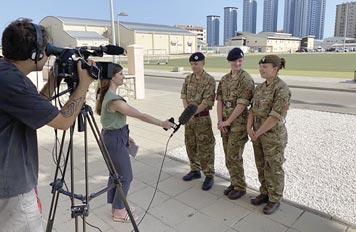
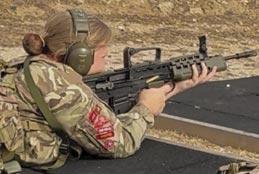
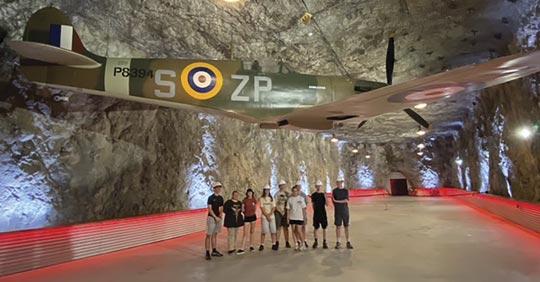
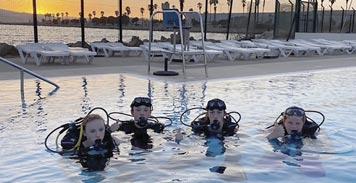
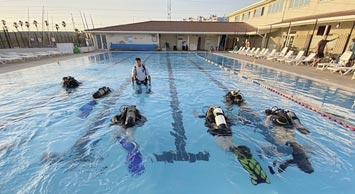
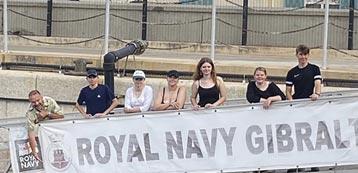
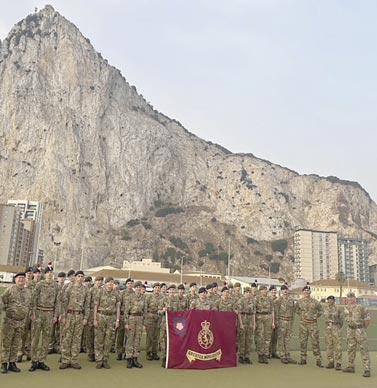
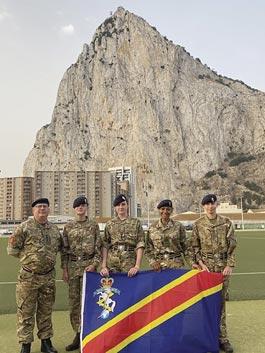
Since 2019 Greater Manchester Army Cadet Force (GMACF) has had a formal Alliance with the Royal Gibraltar Regiment Army Cadet Force and this year it was the turn of GMACF Cadets to visit Gibraltar. Support from the REME Charity helped the Cadets to experience a wide variety of training from Adventurous Training on water to Military training in the Buffadero Fighting In a Built-Up Area (FIBUA) Village and blank firing exercises in the Maida Vale Tunnels. Friendships and memories were made and the Alliance was strengthened with joint training and visits to the beach. When interviewed by local TV News station, GBC, about the experience, the support from the REME Charity was highlighted. It was a week of many firsts with some Cadets experiencing their first trip outside the UK, first time flying, scuba diving, paddleboarding, going on an RN Patrol boat, blank firing in simulated tunnel battles; all helped by the REME Charity supporting the Cadets and Cadet Force Adult Volunteer’s (CFAV’s) badged to REME from Detachments at Clifton and Coop Academy Swinton in 4 (Korea) Company GMACF.
The Cadets also raised money through a sponsored swim, where they collectively swam the distance from Gibraltar to Morocco (14km) and were supported by grants and other fundraising.
Pre-Departure
The Alliance was initiated by Col Martin Newman, a former GMACF officer who later became Colonel Cadets Gibraltar. In 2019 this was
Being interviewed by GBC for TV News Broadcast
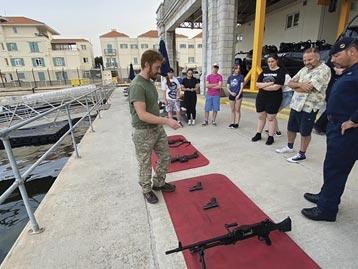
Cadets being instructed on weapon systems by Royal Marines
formalised with a signing of the Alliance document by officials including the Lord Lieutenant of Greater Manchester and representatives of the Royal Gibraltar Regiment Army Cadet Force (RGRACF).
This was the second visit of Greater Manchester Cadets to Gibraltar and the ambition was to strengthen our alliance and friendship and enable the Cadets to have an experience which would last a lifetime.
12 months in the planning GMACF enlisted the help of many colleagues in Gibraltar including all three services, National Museum of
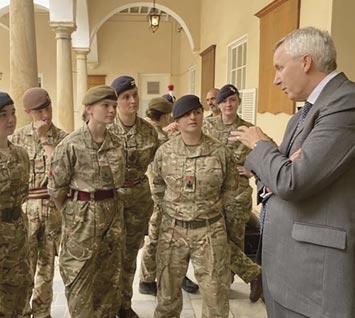
In The Convent, Governor’s Residence
In the Spitfire Hall WW2 Tunnels
On the Range at Buffadero TC
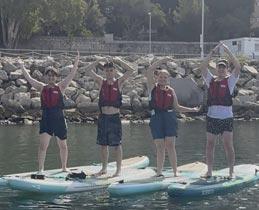
Cadets Paddleboarding
Gibraltar, HM Government of Gibraltar and in particular the RGRACF Cadets led by Officer Commanding Major Jurie Williamson.
The Cadets, supported by staff and parents, began by raising money for the exercise through their sponsored swim (collectively swimming the distance across the straits from Gibraltar to Morocco (14km)); raising nearly £2,000.
Training, Adventure, Culture
After a day of acclimatisation at Devil’s Tower Camp and a trip out into the Bay of Gibraltar to experience Dolphins up close in the clear Mediterranean waters it was straight into military training at Buffadero Training facility. The Cadets competed in teams on the 25m live firing range and were given instruction from the Royal Gibraltar Regiment Instructors on building clearance which they then practiced in teams.
After training it was a trip to The Convent (the official residence of the Governor of Gibraltar) for a private tour and a meeting with HE The Governor, Lt Gen Sir Ben Bathurst KCVO CBE
The following days saw the Cadets divide into three groups to take part in a round robin of activities which included visiting a RN Gibraltar Squadron, being shown the range of weapons used by the Squadron and then being taken out into the bay on board HMS Dagger, one of the two patrol boats in the Gibraltar Squadron. After this, the group went on the water in powerboats for a high speed trip around the bay with expert RN crews and then received instruction in the art of paddleboarding (or falling off the paddleboards as the adults showed they were expert at!). The day ended with a SCUBA try dive session with Royal Navy BSAC Instructors.
Other groups were given a guided tour of the Northern Defences from local guide and RGRACF Instructor CSgt Ian Bramble and after some free time exploring Gibraltar were given a personal tour of the Gibraltar Museum by Director Philip Smith.
The third group meanwhile scaled the heights of the rock itself visiting the natural wonder of St. Michael’s cave and testing their nerve on the skywalk and Windsor suspension bridge before visiting the Great Siege Tunnels and the WW2 Tunnels. While
SCUBA Diving
SCUBA lesson with Royal Navy
Cadets meet HE the Governor Lt Gen Sir Ben Bathurst
there they laid a wreath from GMACF at the monument to the fallen.
More SCUBA diving filled our evenings as well as visiting our friends at No.2 (Overseas) Squadron RAF Air Cadets and their Commander Flt Lt Ivan where they were able to fly around the rock on the new state of the art flight simulators at the Military Heritage Centre located at Princess Caroline’s Battery.
The week culminated in a subterranean exercise with Cadets practicing tunnel and cavern clearance skills in a blank firing exercise, again with the help of CSgt Barmble and the team from the RGRACF. The day was rounded off with a trip to the Gibraltar Fair.
Reflecting on the week the Cadets were asked their thoughts as they prepared to return to Manchester; Cadet RSM Ionescu said “brilliant week, never thought I could finish my time in the Cadets with an experience like this, my first trip to Gibraltar, training in FIBUA and tunnel fighting, Adventure Training, powerboating, The Rock, SCUBA diving and friends, what a week”.
Cadet Sgt Jones – who had been given a shout out on the flight out to Gibraltar from the Easyjet Captain for being on her first flight, commented “if I had been told I would have a week like this in Cadets when I started, I
wouldn’t have believed them. But it has happened, and I’ve done so many things with a great group of friends all because of the Cadets”.
A wonderful week of adventure and military training, cultural experiences and celebration of friendships old and new. The alliance between Greater Manchester and Royal Gibraltar Army Cadets is stronger than ever, thanks to the generous support of The REME Charity.
GBC News Manchester Cadets strengthen Gibraltar links
Visiting Gibraltar Sqn RN
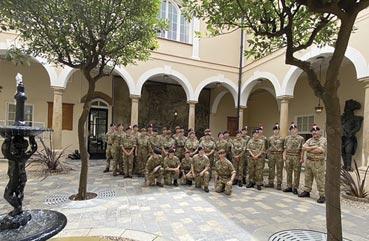
GMACF Cadets in Gibraltar
REME Cadets and Adults on the Rock
Are you good enough for Aviation?
Scribe: Major Jonathan Leng – Apache DT
In today’s fast-paced world of modern warfare, few roles pack the punch of cutting-edge tech, engineering responsibility, and job satisfaction like REME Aviation. If you’re a Young Officer mapping out your career, becoming an Aircraft Engineering Officer (AEO) should be at the forefront of your mind.
Engineering Excellence
Helicopters and Uncrewed Air Systems are engineering masterpieces: you’ll find boundary-pushing innovation and technologies in each, and every, one. We’re talking Precision Kill Weapon Systems, linked targeting radars, and ultra-light carbon fibre composites. And the future? Think air-launched UAVs, anti-drone tech, and directed energy weapons.
These incredible machines are built by the best Engineers in the world and then handed over to us, the REME, to keep the flying punch in the Army’s fist. It brings with it real engineering responsibility for all employed to support it: when it comes to winning battles, Army Aviation brings unmatched speed, reach and lethality – but one engineering mistake can result in significant consequence.
A Role of Real Impact
Great responsibility comes with such capable and missioncritical assets in our care. On deployment, the importance of our work becomes crystal clear. I recall from my Op HERRICK tour when patrols returning to Camp Bastion would seek out Apache personnel to say thanks for their part in supporting the platform. This was when the true value of our job was felt. It’s not just the high-profile platforms that make a difference. I once opened The Times newspaper to read about
and apprehended thanks to one of our Unit’s platforms. Knowing our work directly contributed to national security was humbling, and I will always remember how it felt knowing we had made a difference.
The Team That Makes It Happen
Aviation demands the highest levels of technical skill and professionalism, and REME Technicians deliver this. Working alongside them is a privilege. I’ve watched them achieve remarkable feats on Operations and exercise, every day in barracks, and during their transition to the civilian workforce when they finish their time in the Army. Their success reflects the strength of our REME community.
My own aviation journey spans over 16 years, from frontline Apache Ops to supporting counter-terrorism Ops and now in the Apache Delivery Team. The variety and challenge of aviation roles is top-notch for young REME officers; you will always be in the thick of technical issues, using your training, knowledge and skills to solve tough engineering challenges. REME HQ is actively working to create more opportunities for future AEOs – those who love aviation could spend their whole career working in aviation (I have), but there are plenty of opportunities to dip back into land systems if you miss getting muddy with the Recy Mechs!
The Reward
What makes it all worth it? The reward. Whether it’s cracking complex engineering problems (CEng evidence? Sorted), leading teams, travelling, playing sport, or growing yourself and your team, aviation offers it.
From the Joint Air Delivery Test & Evaluation Unit (think engineering innovation of air delivery) to the Defence Accident & Investigation Board, from Apache and Wildcat to Ultra Persistent Wide Area Surveillance capabilities and everything in between, job diversity is excellent. And here’s a bonus: REME RHQ is exploring extra pay incentives for AEOs. Watch this space!
So, if you’re a Young Officer with a passion for engineering, leadership, and making a real impact, then becoming an AEO is for you!
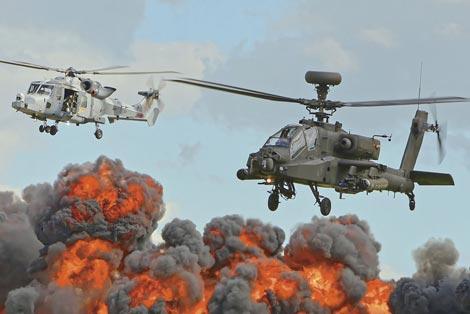
Apache and Wildcat helicopters train together
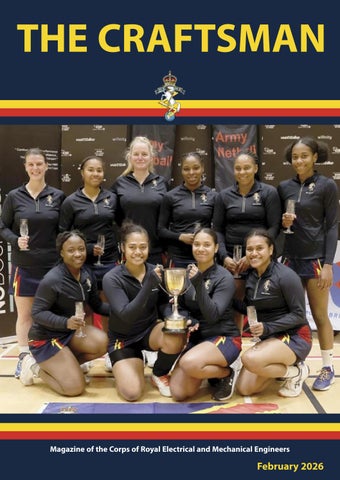
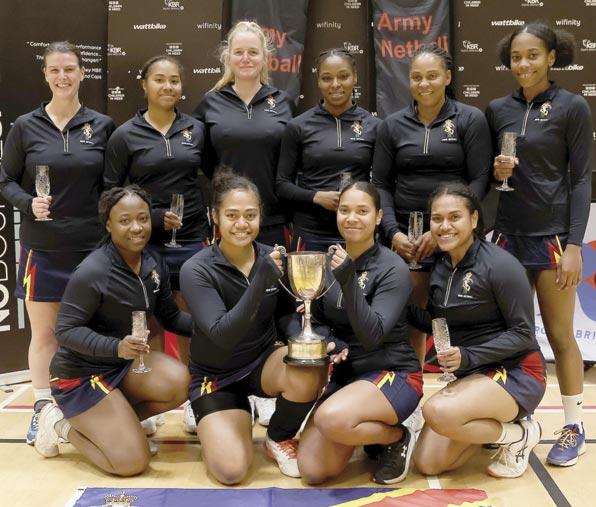
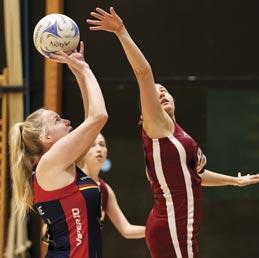
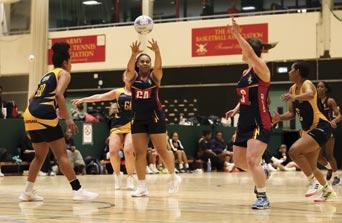
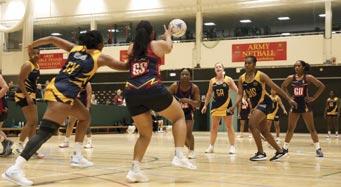
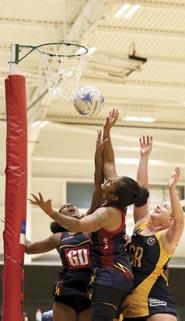
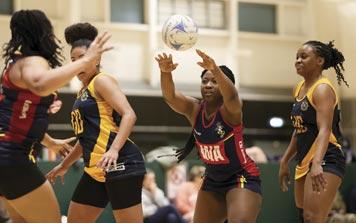
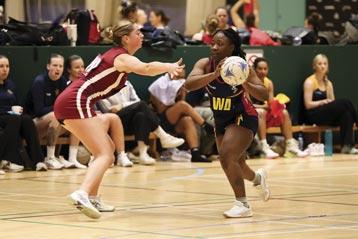
REME Women’s Netball Team Makes History at Army Inter Corps Championships
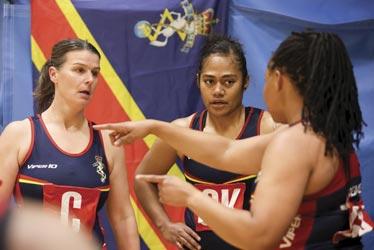
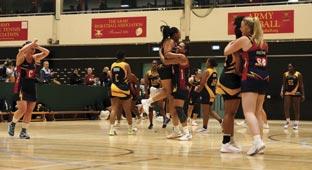
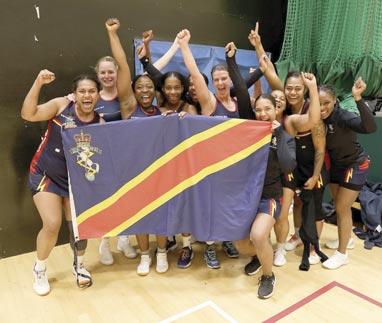
For the first time ever, the REME Women’s Netball Team has claimed the coveted Army Inter Corps Championship title, marking a historic milestone for the Corps. The competition, held at Aldershot Garrison Sports Centre on 18–19 November 2025, showcased the grit, determination, and teamwork that define REME.
The Road to Victory
Day one saw REME dominate the court, defeating RAMS (13–10) and RA (9–6), followed by a hard-fought draw against AGC (10–10). They closed the day with an emphatic win over the Intelligence Corps (28–8), remaining unbeaten.
On day two, the team continued their
REME on the attack
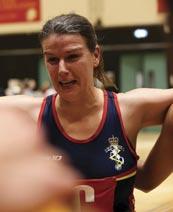
Shots up for Lt Col Ellis
LCpl Soso and Cfn Bacchus denying a RLC goal
Great feed into the circle from Cfn Jones
Scribe: Major Jenny Thomas
Rank Surname First Name Unit
Lt Col Ellis Laura Fd Army HQ
Maj Thomas Jenny Defence Digital
LCpl Quashie Shema 15 Sigs
LCpl Soso Torika 7 REME
Cfn Bacchus Kayjuana Acceptance and Testing Team BOXER
Cfn Jones Christelle 3 REME
Cfn Kidareva Venisita 8 REME
Cfn Ralagi Tina 19 RA
Cfn Tittle Nesreen 6 REME
Cfn Vesikula Elizabeth 21 Eng Regt
Cfn Vunitabua Adi 8 REME
strong form with a commanding 25–0 victory over UOTC. Despite a narrow loss to RLC (9–14), REME bounced back to beat Royal Signals (13–5). Finishing second in the table and tied on points with AGC, REME advanced to the final on goal difference – a testament to their attacking strength.
The Historic Final
The Inter Corps Netball Championship final delivered an electrifying rematch between the RLC and REME, echoing last year’s nail-biting contest where REME fell short by a single goal. This time, history was rewritten. At half-time, the RLC held a narrow 8–7 lead, but REME stormed back in the second half with determination and grit. In a thrilling finale, experienced Centre Maj Jenny Thomas inspired a united REME surge, rallying Defenders to join the attack and keep possession in the dying
Cfn Jones ‘sending it’
Another goal for LCpl Quashiegoal
Cfn Jones working hard
Another goal saved by LCpl Soso and Cfn Bacchus
Half time strategies
seconds. The atmosphere was electric as the team held firm under immense pressure, refusing to let history repeat itself.
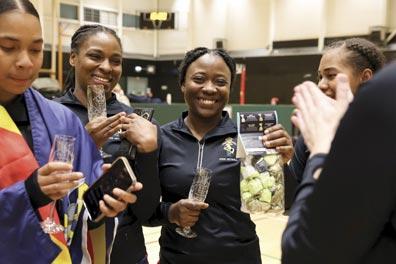
When the final whistle blew and the scoreboard confirmed a 15–14 victory, the court erupted in cheers. REME had finally broken the cycle of near misses and claimed their first Inter Corps Netball Championship title. It was a defining moment of pride, passion, and perseverance, reflecting the Corps’ exceptional unity and capability.
Squad Highlights
The squad featured standout performances across the court, Team
Cfn Tittle on the attack against the R Sigs
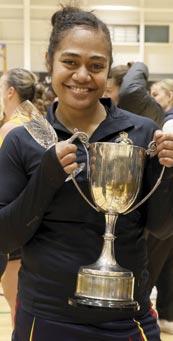
Team Captain LCpl Soso with the Winner’s Cup
An emotional tribute to the team by Maj Thomas
Cfn Jones - REME Most Improved Player of the Competition
Captain LCpl Torika Soso, 7 Bn REME earned the accolade of REME Player of the Tournament, while Cfn Christelle Jones, 3 Bn REME was named Most Improved Player.
Every player contributed to this landmark success, reflecting the Corps’ ethos of professionalism and teamwork.
A Huge Thank You
This achievement would not have been possible without the unwavering support of the Chain of Command.
Their commitment in releasing players for training and competition was instrumental in enabling the team to prepare and perform at their best. Without this backing, REME could not have taken the Inter Corps Championship title.
Looking Ahead
This victory sets a new benchmark for REME sport and inspires future generations to aim high. Congratulations to the entire squad for making history and proving that determination and unity can achieve extraordinary results.
Previous REME Inter Corps Accolades
2014 – Plate Winners
2023 – Finalist
2024 – Finalist
2025 – Winners
Interested in playing netball?
The Corps Squad is always looking for new players for the women’s, men’s or mixed team. For more information please contact Maj Jenny Thomas: Jennifer.thomas201@mod.gov.uk or Capt Sean Branch: sean.branch100@mod.gov.uk.
SHOP
www.remeshop.org.uk
The REME Shop carries a varied range of items from branded clothing, gifts, statuettes, accessories, military uniform items and bespoke personalized products on request. The Corps shop is located within the REME Museum and offers a collection service.
The REME Shop carries a varied range of items from branded clothing, gifts, statuettes, accessories, military uniform items and bespoke personalised products on request. The Corps shop is located within the REME Museum and offers a collection service. The REME Trading Company (of which the shop is a part of) is a ‘not for profit’ and runs in support of The REME Charity for The REME Family.
The REME Trading Company (of which the shop is a part of) is a ‘not for profit’ and runs in support of The REME Charity for The REME Family.
01249 894871
01249 894871
sales@remeshop.org.uk
sales@remeshop.org.uk
The final whistle
REME Winners!
Exercise NORTH SPANNER, REME Basketball Training Camp
Scribe: WO2 Clarke
In preparation for the 2025–26 British Army Basketball League (BABL) season, the REME Basketball team conducted an intensive training camp at Kinloss Barracks from 25th to 31st August 2025. The week-long programme included structured training sessions and competitive friendly matches against local teams; aimed at sharpening skills and building cohesion ahead of the upcoming season.
Recognised as one of the most successful Corps teams in Army sport, REME Basketball has a proud legacy of excellence in the BABL, having secured the overall title in last year’s men’s competition.
With the next round of BABL fixtures not scheduled until February 2026, this camp provided a valuable opportunity for the team to come together, bond both on and off the court, and enjoy everything the North of Scotland has to offer.
DAY ONE Arrival and First Session
With most of the team travelling up from England, six of the seven players scheduled for Day One flew into Inverness Airport on Sunday night. One player, however, had a slightly more adventurous journey - his MT department issued him an electric car that required recharging every 180 miles for a 500mile round trip. Despite the logistical challenge, everyone arrived on time and in good spirits.
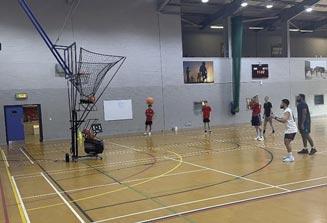
The team wasted no time getting started. After shaking off the travel fatigue with some transition and team offensive drills, the players were eager to get their hands on the Dr Dish shooting machine - a highlight of the camp and a valuable tool for refining shooting technique.
Following the daily sessions at Kinloss Barracks, the team travelled to Inverness to take part in a joint training session with the Inverness Lions Under-18s, a team competing in the Scottish National League. As one of the scheduled friendly opponents later in the week, this session offered a valuable opportunity for both sides to engage, observe the structure of a national league training environment, and assess the competitive level of their upcoming opposition.
DAY TWO Hunt for Nessy
With most of the team feeling the effects of the previous evening’s training session in Inverness, Tuesday was kept light to allow for some recovery. The morning was spent focusing on shooting drills and revisiting offensive strategies; keeping the intensity low but purposeful.
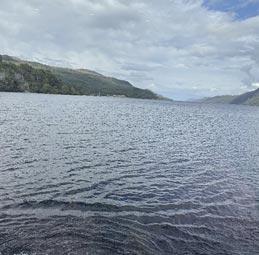
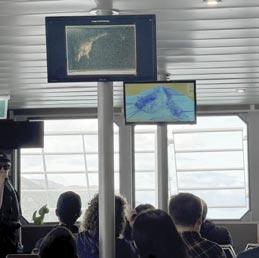
In the afternoon, the team headed out to Loch Ness for a scenic cruise - an opportunity to take in the breathtaking Highland landscape and, of course, to keep an eye out for the elusive Loch Ness Monster. It was a great chance for the players to unwind, bond, and experience a bit of local culture beyond the court.
DAY THREE Volleyball on the Beach and Team BBQ
With two friendly fixtures fast approaching, Wednesday morning’s training session saw a noticeable increase in intensity. The team focused on scrimmaging and competitive 4v4 play, pushing each other to sharpen match readiness and tactical execution.
View from the boat
The team getting hands on with the Dr Dish
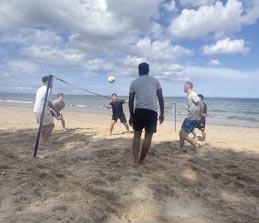
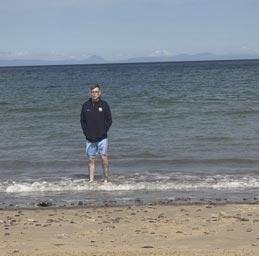
After the demanding session, the team earned a welldeserved break and headed to Kinloss Barracks’ private beach. Armed with pre-cooked BBQ burgers and hot dogs, we set up a Volleyball court and enjoyed some light-hearted competition in a different sport. LCpl Joice had confidently claimed REME Volleyball dominance - but it didn’t take long to discover that his talents might have been overstated. After losing a 1v1 match to LCpl Anish Tamang, Joice took a chilly dip in the North Sea as part of the forfeit, much to the amusement of the rest of the team.
Following a relaxed and fun afternoon, the squad travelled
back to Inverness for a second joint training session with the Inverness Lions Under-18s. The evening focused on zone offense drills and adapting to fast-paced, full-court pressurevaluable preparation for the competitive fixtures ahead.
DAY FOUR First Game vs Highland Bears
In preparation for our first friendly fixture against the Highland Bears, the team undertook two focused training sessions on Thursday - each lasting two hours. These sessions concentrated on ensuring every player clearly understood their roles on both offense and defence; with particular emphasis on team coordination and execution.
Having faced the Highland Bears previously, we knew this would be a tough and much-needed test. The opening two quarters were tightly contested, with both teams trading baskets and the lead changing hands multiple times. A tactical shift from man-to-man defence to a zone setup allowed REME to edge ahead, although Coach WO2 Clarke found himself spending more time on the court than he might have preferred.
The second half mirrored the intensity of the first, but thanks to solid team play and the effective implementation of offensive strategies practiced throughout the week, REME pulled away to secure a well-earned 66–45 victory. Every player contributed, making it a true team effort and a promising sign for the season ahead.
DAY FIVE Lions Fixture
Buoyed by their first friendly win, the REME team shifted focus to the final game of the week against the Inverness Lions Under-18s. After training alongside the Lions all week, a friendly rivalry had begun to form, with the young squad confident they could challenge the REME side.
In a twist, WO2 Clarke switched allegiances and coached the Lions for this fixture, giving the younger REME players the opportunity to manage themselves on the court. This not only provided valuable experience in leadership and in-game
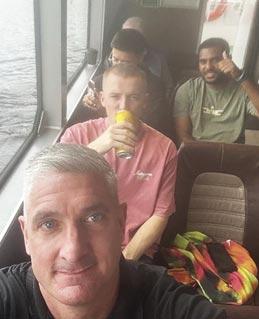
WO2 Cooper and the rest of the team enjoying the views and the local brews on the boat
WO2 Cooper and the rest of the team enjoying the views and the local brews on the boat
Proof the Loch Ness Monster is real
decision-making, but also added a bit of extra motivationbeating their own Coach.
The game was played at a ferocious pace, with the lead changing hands multiple times. It remained close throughout and came down to the final two possessions. With 18 seconds left on the clock and REME up 66–64, LCpl Anish Tamang was sent to the line for two free throws. Under pressure, he made the first but missed the second, giving the Lions a chance to tie the game with a three-pointer.
Despite advancing the ball well, the Lions were unable to get a shot off due to excellent team defence from REME, and the clock expired - securing a narrow but well-deserved second win for the REME team.
To celebrate the end of a successful and hard-fought week, Coach Clarke treated the team to a meal and ice cream in Forres and Findhorn Bay, rounding off an excellent week of Basketball, development, and team cohesion.
Summary
The REME Basketball Team’s training camp at Kinloss Barracks, held from 25th to 31st August 2025, was a resounding success. Designed to prepare the squad for the 2025–26 British Army Basketball League (BABL) season, the week delivered a perfect balance of high-quality training, competitive fixtures, and team-building experiences.
With the next BABL fixtures not due until February 2026, the camp provided a vital opportunity to develop match sharpness, reinforce tactical understanding, and strengthen team cohesion. From intense court sessions and scrimmages to friendly matches against the Highland Bears and Inverness Lions U18s, the team showed real progress - securing two well-earned victories and gaining valuable experience.
Off the court, the players bonded through activities like a Loch Ness cruise, beach Volleyball, and a team BBQ, all while enjoying the stunning scenery of the Scottish Highlands. The week concluded with a celebratory meal in Forres and Findhorn Bay, marking the end of a productive and memorable camp.
Overall, the training camp was a huge success - setting a strong foundation for the season ahead and reinforcing REME Basketball’s reputation as one of the Army’s top-performing Corps teams.
If you are interested in joining the REME Basketball family or attending any future training sessions and participating in an upcoming game, please don’t hesitate to reach out to the REME Basketball Corps Secretary: WO2 Martin Clarke - email: martin.clarke231@mod.gov.uk
WO2 Cooper and the rest of the team enjoying the views and the local brews on the boat
More sightings of the Loch Ness Monster
REME and Highland Bears
Pushing Limits and Making Memories: REME Arms School’s Adventurous Training in Sölden
Scribe: Sergeant Kemp
Adventurous Training is a vital part of military life. It gives us the opportunity to step outside our usual routines, challenge ourselves in unfamiliar environments and improve team cohesion. This summer, a group from the REME Arms School travelled to the alpine town of Sölden in Austria for a week packed with physical exertion, shared laughter, and unforgettable experiences.
Sölden, nestled deep in the Ötztal Valley, is surrounded by dramatic peaks and rugged terrain. Known for its extensive network of Hiking and biking trails, high-altitude climbing routes, and panoramic views, it provided the perfect setting for what would prove to be a physically and mentally challenging week.
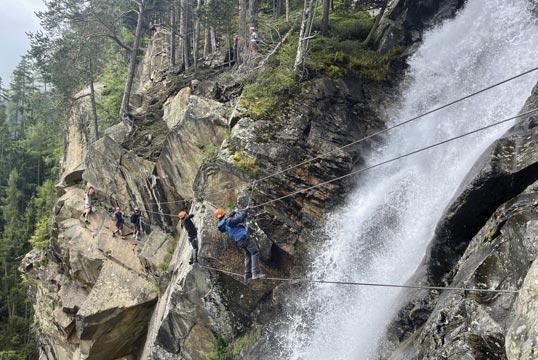
We began with the Klettersteig, a fixed climbing route that combines Mountaineering with elements of rock climbing. These routes are equipped with steel cables, iron rungs, ladders, and suspension bridges, allowing climbers to traverse exposed rock faces safely. The route we tackled involved vertical ascents, narrow ledges, and a few heart-pounding crossings over deep ravines. For those not comfortable with heights, it was a serious test of nerve. But the sense of achievement at the summit, with the valley stretching out
below us, was worth every shaky step.
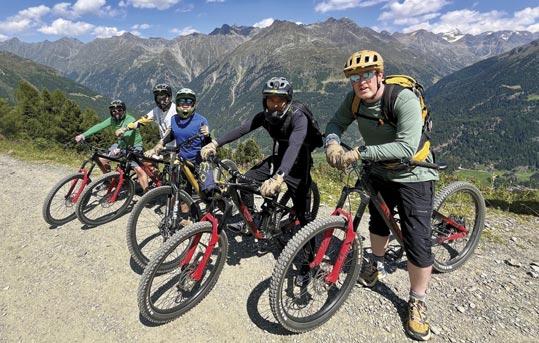
Next came mountain biking, which proved to be both exhilarating and demanding. Sölden’s bike park and surrounding trails offer a mix of technical singletrack, forest paths, and high-speed descents. After skills development sessions in the bike parks, it was time to hit the trails. We stuck to the blue routes, which matched the ability level of the group. These trails were fast, flowy, and packed with smooth turns that made for an exhilarating ride. The terrain kept us engaged without being overwhelming, and although there were a few spills along the way, the sheer fun of cruising through the alpine scenery made it one of the most enjoyable parts of the week.
We also took on high-altitude trekking, reaching elevations above 3,000 metres. These hikes were no gentle strolls. The ascents were steep, the terrain uneven, and the thinner air made every step more demanding. Unless of course you were born and raised at a higher altitude where 3,000 metre peaks are merely foothills…But the reward was immense, with epic views of snow-dusted peaks and dramatic alpine skylines, all captured with the obligatory team and individual photos. A particular highlight was the refreshment
stop at one of the multitude of mountain huts; far from the basic standard of a UK bothy, these huts are more like hotels perched amongst the peaks. The strudel was amazing, would recommend.
For many of us, this was our first time in Austria, and even the journey there was an adventure in itself. We drove through France, Belgium, the Netherlands, and Germany before finally arriving in Sölden. WO2 Tinku Rai summed it up perfectly; a mix of physical challenge, personal growth, and great camaraderie, especially while trying mountain biking and Klettersteig for the first time in such a stunning location.
Evenings were just as memorable. We organised a friendly cooking competition, with different teams preparing meals for the group. Everyone brought their best effort to the table, but Team Nepal, led by Sgt Diwash Rai, stole the show with a pork curry that had everyone going back for seconds. It was a great way to unwind, share stories from the day, and enjoy some well-earned food.
Of course, no trip is complete without a few stories. Maj Jason Whitehouse reminded us of the risks of selfie culture when a curious cow took an interest in him mid-photo. His rapid retreat had the rest of us in stitches. Then there was Cpl Yubraj, who decided to tackle a Klettersteig route while still wearing his fully loaded daysack. It was a bold move, nearly a disaster, and absolutely unforgettable. Thankfully, he had his PTI rig on underneath, complete with go-faster white socks, and somehow powered through like a true mountain Superman.
None of this would have been possible without the support of the REME Arms School leadership and the instructors who kept us safe and focused throughout the trip. A special mention goes to Sgt Nar Gurung, whose tireless work behind the scenes ensured everything ran smoothly from start to finish.
Looking back, the Adventurous Training trip to Sölden was a resounding success. It challenged us, brought us closer together, and gave us memories that will stay with us for years to come. If you’re planning your next AT adventure, Sölden should be high on your list. It is a place that tests your limits, inspires you with its beauty, and rewards you with experiences you won’t forget.
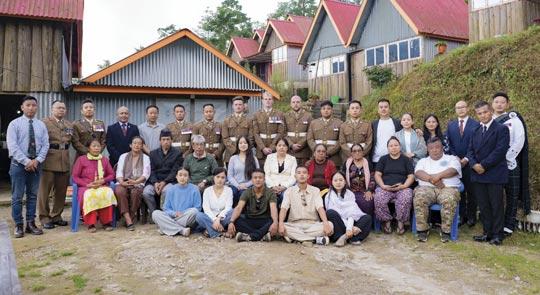
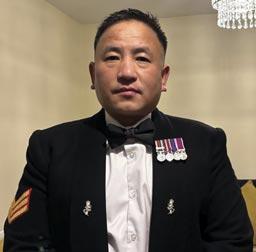
Honouring Sergeant Naresh Kumar Rai
A Final Farewell to a Respected
WColleague
Scribe: Cfn Dixon
hen word reached us that Sgt Rai of 13 Head Quarters Company, 6 Battalion REME had sadly passed away, a group of volunteers stepped forward to serve as his coffin bearers - a solemn and humbling duty that each of us were proud to undertake.
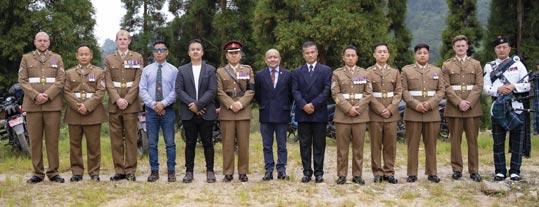
Our team comprised of SSgt Cox, Sgt Ghale, Sgt Subba, Cpl Reid, LCpl Sunuwar, Cfn Dixon, and Pte Sunwar, all from 6 REME. Together, we were entrusted with one mission – to carry Sgt Rai with honour to his final resting place in Nepal.
Preparing to
Honour Sgt Rai
In the weeks leading up to the funeral, rehearsals began. We practised every detail to ensure the ceremony would be conducted with the utmost precision and dignity. From learning to slow march in pairs, to handling the practice coffin and folding the flag with precision.
Sgt Ghale led the drills, his command sharp and steady, ensuring perfect coordination throughout. What began as routine practice evolved into a shared sense of purpose. After several sessions of drill practice, we were confident and ready to represent both Sgt Rai’s family and the REME with pride.
Journey to Nepal
A week later, our journey began from Tidworth, connecting through Dubai before finally landing in Kathmandu, Nepal. There we were warmly received by member of the British Gurkhas Nepal, who briefed us on local customs, funeral arrangements, and the traditions we would be part of.
After spending a day in the city, we began our long journey from Kathmandu to Dharan and continued on with a winding four-hour journey to Pachthar, Nepal – Sgt Rai’s home village. The road was challenging – the
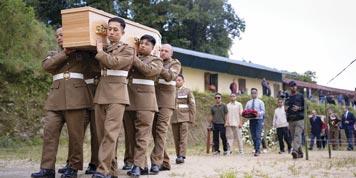
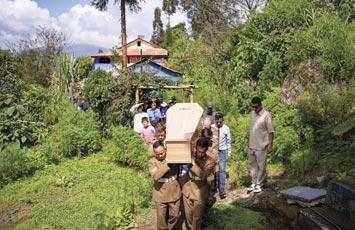
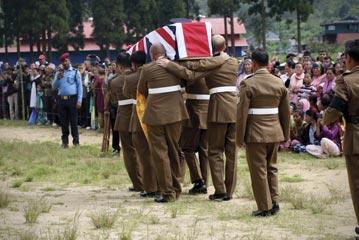
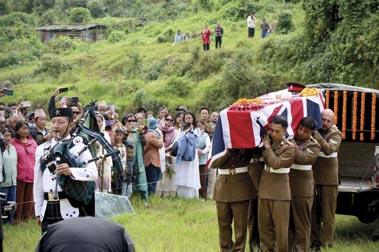
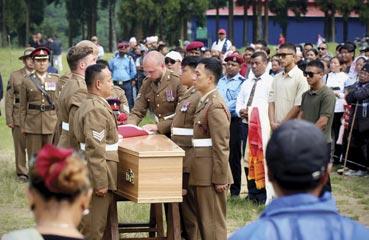
Moving Sgt Rai after the village ceremony on Kanyatar Show ground field, back to the Land Rovers where we then moved to his final place of rest
Following the family ritual at Sgt Rai’s family home we moved Sgt Rai from the family home to a Land Rover then onto Kanyatar Show ground field
Moving Sgt Rai into the designated location on Kanyatar Show ground field, for the commencement of the main ceremony for villagers to pay respects
twisting mountain paths were long and demanding. But as we passed through each small village, the people’s warmth and kindness reminded us of the community spirit Sgt Rai embodied.
Upon arrival we were welcomed with open arms by Sgt Rai’s family and friends. Their humility and warmth spoke volumes about the kind of person he was. That evening was spent socialising, sharing stories, and enjoying traditional Nepalese food before resting for the day ahead.
The Funeral
On the morning of the funeral, we adapted to several last-minute changes with flexibility and professionalism. Dressed in our No.2 dress, we assembled at the landing site where the helicopter carrying Sgt Rai’s body was due to arrive.
All our training came together as we carefully lifted the coffin, transferring it from the helicopter to the waiting Land Rover. The first stop was Sgt Rai’s family home – a narrow, steep decent down winding steps. There, amidst tears and prayers, we placed him alongside his loved ones and stepped back to allow the family to perform traditional rituals and prayers in peace.
Later, we carried him back to the funeral site, where hundreds of people had gathered, lining the path to pay their final respects. Bagpipes accompanied us as we marched with slow, steady steps. The ceremony blended British military tradition with Nepalese cultural rites, a symbol of the bond between two worlds that Sgt Rai represented so well.
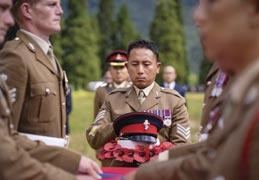
Our final duty was at the cemetery. Upon arriving at the cemetery, we lifted the coffin once more, down a steep embankment to the graveside where his family offered further rituals and prayers. As we gently lowered him to his final resting place, the moment was heavy with emotion and a shared silence — a reminder of the deep respect and affection held for Sgt Rai by everyone who knew him.
A Life Remembered
Sergeant Naresh Kumar Rai joined the Brigade of Gurkhas in 2002 and proudly served with the 2nd Battalion, Royal Gurkha Rifles (2RGR) before moving to the REME in 2022. During his long-dedicated service, he took part in several operations and exercise, including Op HERRICK (2008, 2011), INTERLINK (2023, twice) and CABRIT (2024) – earning great respect for his hard work and calm leadership. Known as a true “Warrior Poet”, he was not only a skilled soldier
Moving Sgt Rai into the designated location on Kanyatar Show ground field, for the commencement of the main ceremony for villagers to pay respects
Un-dressing of the coffin to present Sgt Rai’s family with the wreath, belt, medals, cap and folded flags of the United Kingdom and Nepal, this took place on Kanyatar Showground field during the main ceremony
Un-dressing of the coffin, folding the flags, this took place on Kanyatar Show ground field during the main ceremony
but also a talented poet, Musician and Songwriter whose words touched many hearts. Beyond his military life, he helped build a community centre in his home village and brought people together through kindness and understanding. Sgt Rai will always be remembered for his bravery, warmth and lasting difference he made in people’s lives.
A Legacy of Honour
Sgt Rai will be greatly missed by all who had the privilege to serve alongside him. His professionalism, warmth, and dedication left a lasting impression on his comrades. His memory will continue to live on through those he inspired, both in Nepal and within the REME family.
Rest in Peace, Sgt Rai.
Photo of all family members and military personnel at the end of the ceremony outside Cottage Kanyatar before we departed back to Kathmandu
Photo of Military personnel and Sgt Rai’s Brother In-Law at the end of the ceremony outside Cottage Kanyatar before we departed back to Kathmandu
The late Sgt Naresh Rai
Roles required:
New Drivers
Pit Crew
Strategist Mechanics
Team trials information:
Wednesday 4 March 2026 th Clay Pigeon Raceway
Driver Trials cose £45 (paid on the day via cash or bank transfer)
REME in Scandinavia: Norway 1945
Scribe: Rebecca Penfold, Assistant Curator
In April 1939, Germany offered a non-aggression pact with Norway and other Nordic countries, but the Norwegians decided not to sign this agreement. During the period from 9 April to 10 June 1940, Norway and Denmark were attacked by Germany and were occupied from June 1940 until the end of World War II.
With Germany occupying Norway in the 1940s, several Norwegian men fled to Iceland, where they were part of the
Allied occupation to prevent a German takeover. According to ‘Arctic War: Norway’s role on the Northern Front’, a booklet published in London in 1945, by His Majesty’s Stationery Office on behalf of the Royal Norwegian Government Information Office, there were 12 men who said, “We will form a Norwegian Army of our own” rather than become a part of the British Army. They became ski Instructors and performed odd jobs in Reykjavik. Forming on August 5 1940, they called themselves the Norwegian Company, Iceland. These soldiers helped the British Military understand the arctic elements they were now in. The military continues to utilise training exercises and equipment tests in arctic climates at Camp Viking in Øverbygd to this day.
The REME War Report from June 1944 to May 1945 explains that “On 8th May 1945 the German High Command surrendered all their remaining land, sea and air forces unconditionally to the Allies, thus giving up their conquered territories of Denmark, Norway and the Channel Islands without a battle.” With the end of the war in Europe, the 1st Airborne Division took part in Operation DOOMSDAY in Norway. REME were a part of the Allied forces that helped to liberate the Norwegian people. As part of this operation, they acted as a police and military force during the Allied occupation of Norway in May 1945. They were tasked with the disarmament and repatriation of the German occupation army as well as supervising the surrender of the German forces in Norway, preventing the sabotage of military and civilian facilities.
The museum recently received items donated from a REME soldier’s deployment to Norway after the occupation of Scandinavia. Among these were newspapers created by British troops, titled ‘Skål!’ (Cheers!), described as a weekly publication for British personnel stationed in Kristiansand. Regular features included ‘News from home’, ‘At the flicks’, ‘Summary of world news’, and ‘The sportsmen’s log’, among others.
The medals of John Bennett McRae, 2023.87.1
William Roy Turner, the newspaper’s original owner, was discharged from the Army in December 1945. The issue dated Friday, 20 July 1945, was produced just before he was sent home; in the margins, he noted, “I am a Judge, tomorrow!” next to an athletics race to be held on the Sunday.
War diaries from June to November 1945 in the archives explain what 1st Airborne Division Workshop REME were doing in Norway. In June 1945, it says that “the unit soccer team fulfilled several fixtures with Norwegian teams”.
Part of the record of service for John Bennett McRae, which we received during the donation of his medals, talks about him being a part of the 1st Airborne Division. McRae was re-mustered as a Vehicle Mechanic on 22 February 1945 and was then flown into Norway on 26 May 1945. The operational duties of the Division included welcoming back King Haakon, looking after Allied ex-prisoners of war, arresting war criminals and supervising the clearing of minefields.
Other jobs explained in the 1st Airborne Division Workshop REME war diaries explain that they were completing M.T. Repairs of both British and foreign makes, with many being “accident jobs” in August 1945. The museum also has records that while in Norway, Lieutenant Alexander Jamieson Romanes was killed serving in the 1st Airborne Division. He died on 13 August 1945, and his grave is in Oslo Western Civil Cemetery, Norway. It was noted in one of our donations that he was killed in a traffic accident, although this is not found in any official records that we hold. Romanes’ grave is pictured on our Death in Service Database in the Remembrance Gallery of the museum.
At least two REME Soldiers that we know of received ‘The Liberation of Norway’ certificate from The People of Norway; Captain Maurice Wilfred Munday and J R Roberts signed in Oslo in December 1945. Roberts was part of the 1st Airborne Division in Norway. This certificate of thanks was issued to British servicemen who participated in the liberation of Norway, 8th May 1945.
Although his service is not in our records, we do have the medals of Charles Joseph Douglas Calder, who was awarded the Arctic Emblem. The Defence Imagery website describes the first Arctic Emblems as being presented to Veterans on 10 October 2006 as a mark of hardship on the Arctic Convoys in World War Two, specifically between 3 September 1939 and 8 May 1945. The Emblem commemorates those who served in the Arctic in especially dangerous and extreme weather conditions against resistance from German forces. The Arctic Emblem was awarded for either serving in Russia or Norway.
To end this potted history of REME and the British Military in Norway a quote in our archive translated from Norwegian at the time from Fædrelandsvennen; a Norwegian regional newspaper based in Kristiansand, Norway, on the 27 August 1945 says “We are
afraid that we Norwegians ourselves do not half realise what we owe our British friends: We have been too occupied, too full of joy over the liberation. We do not put the right valuation on all that we have to thank the English for”.
Charles Joseph Douglas Calder’s medals including the Arctic Emblem. The Emblem is a small white star with a red dot and a blue ribbon with the words “The Arctic”, 2014.7078
The Liberation of Norway certificate awarded to Captain M.W. Munday, A:1984.2853
he REME Arborfield Rugby Reunion took place on Saturday, 18th October 2025, at the welcoming Netherfield Cricket Club in Kendal. The event was superbly organised by Andy Rapley, Bruce Leslie, and Chippy Wood, who ensured every aspect reflected the proud spirit, history, and enduring camaraderie of the Corps.
Attendees travelled from across the country to join several generations of REME Arborfield Rugby players, accompanied by their wives and partners, for an evening of celebration, friendship, and reflection. Proceedings commenced in style with bubbles served at 1815 hrs, setting the tone for an evening that balanced formality with laughter and good humour in equal measure.
A splendid buffet dinner followed, providing ample opportunity for old friends to reconnect and share tales from years on and off the pitch. One of the evening’s most memorable moments came when Taff Cullen presented Corps Rugby Colours to Tyrone Rees and Bruce Leslie, recognising their exceptional service, commitment, and contribution to REME Rugby. Citations were delivered by Tony Williams and Andy Rapley, offering thoughtful and heartfelt tributes that perfectly captured the character and achievements of both recipients. It was clear from their emotional responses just how deeply the awards resonated – a testament to the strong bonds and lifelong pride that REME Rugby continues to inspire.
With formalities complete, the atmosphere relaxed into an evening of music and celebration. The disco proved a tremendous success, with timeless favourites such as “Oops Upside Your Head” and the Conga ensuring that the ladies were soon leading the charge onto the dance floor – and even weaving their way around the tables. The room was filled with laughter, conversation, and the unmistakable energy of shared history and friendship.
As the evening drew towards carriages at 2359 hrs, there was time for a touch of good-natured humour, with many remarking that one particularly notable attendee was none other than Graham Morgan’s brother, John! – a light-hearted moment that encapsulated the warmth and wit that defined the event.
Special thanks were extended to Jobbie Power and Stevie Milner for their invaluable efforts in preserving
the rich history of REME Arborfield Rugby. Their meticulous collection of photographs, newsletters, and tour guides continues to provide an enduring record of the team’s heritage and spirit.
In keeping with the Corps’ ethos of service and support, the reunion committee were also proud to announce a donation of £200 to the REME Charity; ensuring that the evening’s success contributes towards supporting serving personnel, Veterans, and their families across the Corps community.
The evening was a resounding success – a celebration not only of Rugby, but of service, friendship, and shared pride in the Corps. It stood as a reminder that the REME Arborfield Rugby family remains as strong and connected as ever. Here’s to the next reunion – and to many more memories yet to come.
Potteries & District REME Association
Scribe: Maurice Hope, Photos John Edwards OBE & Social Media.
November is traditionally one of our busiest months of the year, in addition to our normal monthly activities we had Remembrance and a Civic Visit in the calendar.
Despite it being a wet and horrible morning in the Potteries on Saturday 1st, eight people braved the weather and came together at The Hungry Horse in Meir for our monthly North Staffs REME Breakfast club to enjoy a hearty meal and an hour’s banter; and even though short on numbers we still managed to raise £35 from our in-house raffle. This now takes us past our £500 target to be handed to the REME Corps Charity at the end of the year. With only the December breakfast to go this year on Saturday 6th, along with Christmas jumpers the order of the day.
Remembrance Sunday on the 9th saw our members spread out all across our catchment area of the “Six Towns” and Staffordshire Moorlands to do their own town and village services, in addition to having representation in London in the form of Adrian Walker, marching with the Arborfield Old Boys Association, with the branch also having two wreaths laid during the morning. John Yates was on hand in Cheadle to cover our members from the Moorlands area while our main branch wreath was laid by our branch President Maurice Hope at the main City Cenotaph in Stoke, where the Parade
and march past was led immaculately as ever by our branch Standard bearer Gil Mould.
One unusual thing on the day was that the Parade Commander stated that this year no Veterans were to parade (Where that gem of an order came from is anyone’s guess?!) and were asked to join the many spectators at the outdoor service. It must be the very first time that Veterans have been banned from a Remembrance March Past which was very disappointing.
Our next function was our monthly get together for lunch at a local pub/diner, this month it was on Armistice Day, Tuesday 11th, at The Ship Inn in the village of Teanford near Cheadle in the Staffordshire Moorlands. Always a very popular food stop for our members, with 13 in attendance with £42 raised for branch funds from our in house raffle.
Topping off a couple of busy days mid month saw our branch President Maurice Hope and Vice President Lt Col John Edwards OBE at The Lord Mayors Parlour at Stoke Town Hall giving the present holder as the cities first citizen role, Cllr Stephen Watkins, (An ex-Mercian Infantryman who also happens to hold the appointment of the Armed Forces Champion for the City), an in-depth insight into our branch and the role of our Corps within the Army set up.
Michael wins the chocolates
REME Leads the City Parade All set for wreath laying
John wins Biscuits for a change
REME Presentation Lord Mayors Parlour
John Yates Lays Wreath at Cheadle
Letter to the Editor
I had the pleasure of receiving the following email recently from Derek Taylor…
Iam a retired WO1 (Superintendent Storeman) having served a touch over 36 years. I have been laying a wreath on Remembrance Sunday on behalf of REME Association Scotland, in Edinburgh, with my Granddaughter, Amara, since she was 5 years old. She is now 18 and still wishes to carry on with this tradition. I am very proud of her.
Derek also sent through these photos back on 12 Nov 2017 at Glasgow’s George Square when Amara was just 10 years old. She marched on parade with the REME contingent and proudly laid the wreath. Drew a fair bit of attention from the press and her photo appeared in many Scottish papers the following day.
London Gazette
04 November REGULAR ARMY
Intermediate Regular Commissions (Late Entry)
Warrant Officer Class 1 Peter Steven MEAGER 25105091 to be Captain 2 September 2024 (Belated Entry)
Warrant Officer Class 1 John REED 25107351 to be Captain 2 September 2024 (Belated Entry)
Warrant Officer Class 1 Forbes ROBERTS 25181065 to be Captain 2 September 2024 (Belated Entry) Warrant Officer Class 2 Jamie Henry DEVINE 25202896 to be Captain 2 September 2024 (Belated Entry)
Warrant Officer Class 2 Mark Steven WELTON 24202318 to be Captain 2 September 2024 (Belated Entry)
Short Service Commissions
Steven Ian YOUNG 30291867 to be Captain 1 September 2024 (formerly Royal Navy) (Belated Entry)
The following have been awarded the Long Service and Good Conduct Medal (Military)
MAJ, M. W. BALL, REME, 30028274
WO2, J. S. BANKS-POPPLE, REME, 30125958
CPL, D. S. BINDING, REME, 30123630
MAJ, J. L. R. CAMPBELL, REME, 30097367
MAJ, S. F. D’INVERNO, REME, W1061776
WO1, M. W. FOSTER, REME, 25159497
SGT, M. FULLER, REME, 30123930
SSGT, P. R. GREGORY, REME, 25211471
SSGT, G. HAGUE, REME, 25175501
SGT, C. H. HEATH, REME, 30123951
MAJ, T. H. HUMPHERY, REME, 30122255
SGT, D. N. KALIES, REME, 25225695
CPL, B. E. KING, REME, 30123960
SSGT, M. W. LIDGETT, REME, 30123928
SGT, F. M. LOCKE, REME, 25209776
WO1, M. J. LOVERIDGE, REME, 25192817
CPL, L. M. QUINTON, REME, 30123929
MAJ, M. J. RIMMER, REME, 30028304
The following have been awarded the 1st Clasp to the Long Service and Good Conduct Medal (Military)
CAPT, C. BALE, REME, 25121280
MAJ, S. C. J. BRUMPTON-TAYLOR, REME, 25119909
WO1, S. M. CASS, REME, 25122046
WO2, R. A. DUNSIRE, REME, 25121621
LT COL, R. C. J. JAMES, REME, 552409
WO2, A. D. McIVOR, REME, 25121995
O2, A. D. McIVOR, REME, 25121995
LT COL, K. J. MILES, REME, 552443
WO1, D. M. MILLER, REME, W1043828
WO2, M. A. OHALLORAN, REME, 24872231
WO1, G. OWEN, REME, 25121996
SSGT, S. W. PYSARCZUK, REME, 25118597
SSGT, P. J. SHAW, REME, 25117042
CAPT, D. R. SLAVEN, REME, 25122680
SSGT, N. R. F. STIDDARD, REME, 25122057
CAPT, B. P. TURNER, REME, 25119028
LT COL, M. A. WILCOX, REME, 552515
11 November
REGULAR ARMY
Regular Commissions
Lieutenant Colonel D. E. HALL 539570 retires 14 December 2024 (Belated Entry)
Regular Commissions (Late Entry)
Major A. FURMIDGE-OWEN 24905202 retires 31 December 2024 (Belated Entry)
Intermediate Regular Commissions (Late Entry)
Captain K. GELDARD 25142463 retires 1 January 2025 (Belated Entry
18 November
No entries
25 November
REGULAR ARMY
Regular Commissions
Lieutenant Colonel M. A. LEARMONTH 537447 retires 18 January 2025 (Belated Entry)
Regular Commissions (Late Entry)
Major T. A. MCCLUSKEY 24678952 retires 3 January 2025 (Belated Entry)
Major P. G. REYNOLDS 25005970 retires 1 February 2025 (Belated Entry)
Intermediate Regular Commissions
Captain L. I. R. LANGLEY 30171620 retires 2 January 2025 (Belated Entry)
Captain J. R. D. WATTS 30089141 retires 12 January 2025 (Belated Entry)
Short Service Commissions
Captain M. RAND 30330388 retires 1 February 2025 (Belated Entry)
02 December
No entries
09 December
REGULAR ARMY
Regular Commissions
Lieutenant Colonel J. J. HACKNEY 555151 retires 25 March 2025 (Belated Entry)
Regular Commissions (Late Entry)
Major N. D. ALLCOCK MBE 24781907 retires 22 March 2025 (Belated Entry)
Intermediate Regular Commissions
Captain C. M. DAVIDSON 30283352 retires 13 March 2025 (Belated Entry)
Captain A. TOMLIN 30244068 retires 22 March 2025 (Belated Entry)
ARMY RESERVE
Group A Officer
Cadet Matthew Alistair Barnes DEMPSEY 30448071 to be Second Lieutenant (on probation) 4 July 2025
16 December
ARMY RESERVE
Group A Second Lieutenant (on probation) M. A. B. DEMPSEY 30448071 is confirmed as Second Lieutenant 20 July 2025
23 December
REGULAR ARMY
Regular Commissions
Lieutenant Colonel D. FINNER 563579 retires 3 April 2025 (Belated Entry)
Commissions (Late Entry)
Lieutenant Colonel M. D. R. KEANE 24781180 retires 5 April 2025 (Belated Entry)
Major J. J. BAYLEY 25024560 retires 2 April 2025 (Belated Entry)
Major G. A. HOWARD 25035615 retires 18 April 2025 (Belated Entry)
Intermediate Regular Commissions (Late Entry)
Captain G. MACKRELL 25077367 retires 30 April 2025 (Belated Entry)
Short Service Commissions
Captain W. C. H. WILSON 30282802 retires 1 May 2025 (Belated Entry)
30 December
To be an Ordinary Knight Commander of the Military
Division of the said Most Excellent Order:
Lieutenant General David James EASTMAN, M.B.E., 531461
To be Ordinary Members of the Military Division of the said Most Excellent Order:
Major Jack COLLICOTT, Corps of Royal Electrical and Mechanical Engineers, 30146779
Lieutenant Colonel Darren WARD, Corps of Royal Electrical and Mechanical Engineers, 24678638
Major Martin James BENTLEY, Corps of Royal Electrical and Mechanical Engineers, 25065625.
Warrant Officer Class 1 Adam Lee CULLIFORD, Corps of Royal Electrical and Mechanical Engineers, 25104287
King’s Volunteer Reserves Medal
Major John RICHARDS, V.R., Corps of Royal Electrical and Mechanical Engineers, Army Reserve, 565057
Obituary
David James Pilcher 1936 – 2025
Scribe: Scott Pilcher
David’s Father George, Mother Margaret and Brother Alan lived in Plumtree Farm, Old Romney, Kent. Romney Marsh was always his Spiritual Home. The family moved to Dingleden, Benenden and then it was on to Langton Green where he ended up at Skinners’ Grammar School, Tunbridge Wells.
He happened to mention to his Mother one evening that he enjoyed The Combined Cadet Force at school. A few months later he was sitting in a barrack room in Arborfield along with 30 other 15 year old boys. In all, he served for 25 years in the Army leaving as a Captain. He represented the Army at Rugby and played Football, Cricket and Hockey at unit level.
He always maintained that his most exotic posting was, wait for it, Ranby Camp with its Mighty Antars. It was there that he met Pam whom he married in 1971. They started off married life in quarters in Whetstone, London as David was serving at The Ministry of Defence. A move to Celle, Lower Saxony followed, where Scott was born in a British Military Hospital in Hannover in 1974. Soon after, this was followed by a 3 year tour in Hong Kong.
Sadly Pam, his best mate for 20 years, died in 1990, both Scott and the Baulch family were heartbroken as you would expect, but he was most grateful for the support that Scott and he received from family, friends, colleagues at work and The Elizabethan High School at that difficult time.
It was some 13 or so years after his beloved Pam died that David met Jean, whom he went on to share the most wonderful 22 years with.
David always respected his Father’s work ethic and his service in the Great War. He was proud of his Son and all that he has achieved. He always said that he was eternally grateful for the care, love and guidance that he received from three
remarkable women: his Mother Margaret, Wife Pam and partner Jean.
He always acknowledged that throughout his life he had the good fortune to enjoy his work and be supported by wonderful family, friends and colleagues which enabled him to have a fulfilling and rewarding life.
Death Notices
GREEN – Capt (Retd) Leslie Hamilton Green died on 20th November 2025 aged 77. Dates of service 1969-1996.
HALLETT – WO1 (Retd) Edward Maurice Hallett died on 18th November 2025 aged 93. Dates of service 1954-1976 plus 3 years National Service.
HOLLAND – Col (Ret’d) Nick Holland, passed away on 4th September 2025, aged 80. Dates of service 1966-1998
HOCKING – Robert Hocking passed away peacefully on Weds 26th November following a short battle with colon cancer. Dates of service 1958-1982.
MARSHALL – WO1 (Retd) Anthony Rae Marshall died on 3rd November aged 95. Dates of service 1945-1975.
NAVAN – James (Bob) Navan died on 7th November aged 93.
Death Notice Requirements
In order to publish a death notice we require the following information: Surname, first name, rank, full date of death, ages and dates of service. An obituary with additional career and life information is welcome. To inform us of the death, please contact Pamela Bailey-Yates, Corps Welfare Assistant, Email: welfare@remecharity.org
A Huge Thank You from
We’re incredibly grateful for the generous dona琀ons received lately, and we especially want to highlight the con琀nued support from our serving Ocers, Soldiers, and re琀red REME Ins琀tu琀on and Associa琀on members. Your commitment keeps us moving forward.
Since October we have collected £15265 including very generous dona琀ons from:
North Sta昀ordshire REME Breakfast Club £600
Graham Smithers £550
Mar琀n Robinson £500
SSgt Luke Lagrue £452.50 – Half Marathon
REME Scotland Gathering £320
Adrian Wood £200
Lt Col (Re琀red) John and Rosemary Edwards £150 - Merry Christmas!
Lt Col Rebecca Macklin £100
John Peters £100
Nathan Thompson £100
Laura Gaines £100
Other notable dona琀ons:
Andrew Harvey, Kubir Gurung, Stacey Bloxam, Amy Howard, Douglas Buckley, Steve Mar琀n, Jacqueline Harvey-Hall, Mark Stoke, Al昀e Todd, Brian Dearden, Jamie Atwill and Robin Kisbee.
For all fundraising queries please email Hugh McNulty via fundraising@remecharity.org
Need a hand? We’re here for you. Whether you’re currently serving or a veteran, The REME Charity is here to support you during tough 琀mes. Reach out directly at WOYM@remecharity.org for fully con昀den琀al advice and support. S琀ll serving? You can also speak to your Unit Welfare POC for guidance.
Leave a las琀ng legacy with The REME Charity. If you’d like to support our work through a gi昀 in your will, you can do so by adding a codicil. As a registered charity (No. 1165868), dona琀ons are exempt from inheritance tax— helping your legacy go even further for REME personnel and veterans.
Social Media. If you’d like to support our work, or adver琀se your REME Charity events through social media feel free to tag us in your posts and use the following hashtags #REMECharity #OnceREMEAlwaysREME. You can also email communica琀ons@remecharity.org for help spreading awareness of your fundraising across The REME Charity social media channels, or on REME Connect.
Corps Calendar 2026
More information regarding Corps Mess Functions can found by scanning the QR Code, or by accessing the ‘REME Connect’ website or alternatively email; REMERHQ-0Mailbox@mod.gov.uk for all general enquiries. All dates correct at time of printing, please check your monthly Craftsman magazine for amendments.