THE CRAFTSMAN
Magazine of the Corps of Royal Electrical and Mechanical Engineers
August/September 2026
for Scan ort Supp
In 2020, REME launched the Lifting the Decks initiative, with a focus on the mental wellbeing of serving REME personnel and veterans. We are in the process of re昀ning Lifting the Decks, increasing accessibility with an added emphasis on reminding our REME Family to speak out about ‘what’s on their mind’ and that, whatever stage in their life, we will always be here to listen to and support them. If there is something on your mind troubling you, big or small, whatever the cause, we are here to listen and to help. If you wish to get in touch regarding yourself or concern for someone else, please don’t hesitate to contact woym@remecharity.org
woym@remecharity.org
Corps Formation: 1 October 1942 Corps Motto: Arte et Marte Corps Patron Saint: St Eligius (Celebrated 1st Sunday in December)
AUGUST/SEPTEMBER 2026
Contents Volume 82 No. 7
FEATURES Army Apprenticeship Awards . . . . . . . . . . . . . . . . . . . . . . . . . . . . . . . . . . . . . . . . . . . . . . . . . . . .4
Editor: Mrs Sarah Eden + Corporate Communications Officer RHQ REME, The Prince Philip Barracks, Lyneham, CHIPPENHAM, SN15 4XX craftsmaneditor@reme-rhq.org.uk (preferred method) subscriptions@reme-rhq.org.uk (for changes of address) ( Mil: 95481 4529 Civ: 01249 894529
Excellence in Action . . . . . . . . . . . . . . . . . . . . . . . . . . . . . . . . . . . . . . . . . . . . . . . . . . . . . . . . . . . . .6 Colonel REME’s Biennial Review of Cadet Force . . . . . . . . . . . . . . . . . . . . . . . . . . . . . . . . . . .7 REME Experience at Churcher’s College CCF . . . . . . . . . . . . . . . . . . . . . . . . . . . . . . . . . . . . . .8 First Unit Receives New Vehicle Maintenance Kit (VMK) . . . . . . . . . . . . . . . . . . . . . . . . . .10 Exercise RHINO STORM . . . . . . . . . . . . . . . . . . . . . . . . . . . . . . . . . . . . . . . . . . . . . . . . . . . . . . . . .12 Exercise WYVERN WINTER WARRIOR . . . . . . . . . . . . . . . . . . . . . . . . . . . . . . . . . . . . . . . . . . . . .14 Exercise DRAGON RYDER . . . . . . . . . . . . . . . . . . . . . . . . . . . . . . . . . . . . . . . . . . . . . . . . . . . . . . .16 AM Village 2026, 5 Bn REME, Increasing AdM Excellence . . . . . . . . . . . . . . . . . . . . . . . . .18 Exercise PINION TITAN . . . . . . . . . . . . . . . . . . . . . . . . . . . . . . . . . . . . . . . . . . . . . . . . . . . . . . . . . .20 Exercise ANTIGUA BUCK 26 . . . . . . . . . . . . . . . . . . . . . . . . . . . . . . . . . . . . . . . . . . . . . . . . . . . . .23 Exercise PINION STORM . . . . . . . . . . . . . . . . . . . . . . . . . . . . . . . . . . . . . . . . . . . . . . . . . . . . . . . .27 Exercise HARAKA STORM . . . . . . . . . . . . . . . . . . . . . . . . . . . . . . . . . . . . . . . . . . . . . . . . . . . . . . .30 Innovative Drone Capabilities . . . . . . . . . . . . . . . . . . . . . . . . . . . . . . . . . . . . . . . . . . . . . . . . . . .32 Passing Out Parade – ATR Pirbright . . . . . . . . . . . . . . . . . . . . . . . . . . . . . . . . . . . . . . . . . . . . . .34 Endurance and Awareness: 72 Holes for Prostate Cancer UK . . . . . . . . . . . . . . . . . . . . .35 Exercise DRAGON YOMP . . . . . . . . . . . . . . . . . . . . . . . . . . . . . . . . . . . . . . . . . . . . . . . . . . . . . . .36 REME Brazilian Jiu-Jitsu . . . . . . . . . . . . . . . . . . . . . . . . . . . . . . . . . . . . . . . . . . . . . . . . . . . . . . . . .38
REGULARS From the Museum – Victory in the Desert: Montgomery and REME at El Alamein .40 Corps Notices . . . . . . . . . . . . . . . . . . . . . . . . . . . . . . . . . . . . . . . . . . . . . . . . . . . . . . . . . . . . . . . . . .43 Corps Calendar . . . . . . . . . . . . . . . . . . . . . . . . . . . . . . . . . . . . . . . . . . . . . . . . . . . . . . . . . . . . . . . . .47
SUBMITTING ARTICLES TEXT: should be submitted in MS Word and name saved as per the article. No formatting, columns, power point etc. Articles to be cleared by CO/OC/EME or appropriate REME CoC, or nominated substitute and should be submitted as soon as possible. PHOTOGRAPHS: MUST be submitted separately, in jpeg format and be at least 500kb preferably 1mb or more. Only photos over 3mb can be considered for the front/back covers and please remember captions. FILESHARE: websites, such as dropbox are ideal for submitting larger files. EMAIL: The ONLY email address which should be used is: craftsmaneditor@reme-rhq.org.uk. Not MODnet. Please use the article title not ‘Craftsman Article’ as the email title. TIMINGS: The latest submission date is the first day of the month prior to publication. This does not guarantee the article will be published in that specific edition. Births, Engagements, Marriages and Deaths: These will be inserted free to all past and present members of the Corps. Contents: The contents of The Craftsman are strictly copyright and all rights are expressly reserved. The views expressed herein do not necessarily reflect the policy and views, official or otherwise, of the Editor, the Corps or the MOD, therefore no responsibility for these will be accepted. Whilst including an advertisement we are not necessarily endorsing the product and as a result, the publisher and its agents do not accept responsibility for any transaction between the reader and the advertiser. Whilst we take all precautions with regard to advertising, readers are advised to take professional advice before entering into any commitments. Letters concerning reproduction, contributions or any other matter should be addressed to the Editor. © Published by RHQ REME. Funded by The REME Charity. www.remecharity.org. Advertising All communications regarding commercial advertising rates should be made direct to the Editor. Sustainably produced on paper sourced from responsible sources using vegetable based inks. Jamprint Design & Printing Ltd www.jamprint.co.uk info@jamprint.co.uk 01249 823 950 © Crown Copyright
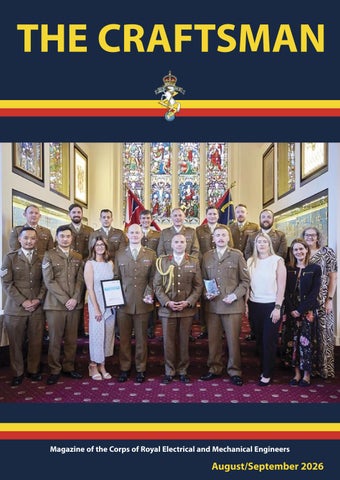
Front Cover – Army Apprenticeship Awards
General Handling: This publication contains official information and should be treated with discretion.
Before submitting an article you are requested to read the guidelines on the inside front cover 3
Corps News
REME’s continued success at the Army Apprenticeship Awards Scribe: Lt Col Jobes
R
LCpl Hill receiving the Overall Best Army Apprenticeship Award from Brigadier Jim Taylor (Hd Pers Policy, HQ Army)
EME continue to deliver the largest and most complex Apprenticeship programme in the Army, and our soldiers continue to perform at exceptional levels; both as Apprentices and as Mentors. The Army’s Apprenticeship Awards provides an appropriate stage from which to recognise our best and their stand-out performances. The awards were held on 9 Jun 26 and in the Indian Army Memorial Room at Royal Military Academy Sandhurst; proving to be, once again, a truly special occasion worthy of the reverent venue. Having won the ‘Best Level 3 Army Apprentice Award’ for the previous three years, expectations were high. Once again REME had some high calibre entries that made it to the shortlisting of finalists; a marked achievement in itself: Shortlisted to the L3 Best Army Apprenticeship Award was: Cpl Jaydeep Thapa of 9 Bn REME. LCpl Mathew Hill of 1 R Irish LAD. Shortlisted for the Best Army Apprenticeship Champion Aware was: WO2 (AQMS) Paul Titler of 2 Bn REME. SSgt Lucy Brook of 16 Regt RA. Who unfortunately, was unable to attend. The Corp Colonel, Colonel Iain Wallace, and the new Corps ASM, Jack Coats, along with families and Unit CoCs attended the awards. No one was quite expecting the fantastic results that were going to be announced. First congratulations go to, WO2 (AQMS) Paul Titler, who was announced as runner up for the best champion award, along with a highly commended award by Brigadier Jim Taylor, Hd Pers Policy, HQ
Back Row (L-R): WO2 (AQMS) Wayne Jaclin, SSgt Jonathan Marsh, WO1 (ASM) Jay Bent, Lt Col Reg Gentry, Lt Col Alan Jobes, Capt (CASM) Jack Coates, WO2 (AQMS) Ryan Ham, Maj Greg Barnes, Hayley Alison. Front Row (L-R): Sgt Ramesh Limbu, Cpl Jaydeep Thapa, Zoe Titler, WO2 (AQMS) Paul Titler, Colonel Iain Wallace, LCpl Mathew Hill, Katie Watkins, Capt Evie Lindsay, Laura Molyneux
4 craftsmaneditor@reme-rhq.org.uk
Army. WO2 (AQMS) Titler, transformed a disjointed apprenticeship programme for 2Bn REME Apprentices. His dedication, leadership, and selfless support, both on deployment and at home, re-engaged learners, improved progression, and established lasting processes to ensure continued success across multiple trade groups. The next bit of success came when both Cpl Jaydeep Thapa and LCpl Matthew Hill were shortlisted in the top five for the Best Level 3 Apprentice Award. LCpl Hill was announced as taking the top spot keeping this award with REME for the fourth-year running. This reward recognised his outstanding engineering feats during Operations and Deployment exercises. Then came the finale when LCpl Hill, on top of his L3 Award was announced as the overall Best Army Apprentice: the top Army Apprenticeship Award; that is the Number 1 Apprentice out of circa 13,500 Army Apprentices. Not a bad accolade to have. The Army Apprentice of the Year award honours exceptional dedication, skill, and growth. It recognises Apprentices who excel in trade, embody Army values, inspire others, and contribute to their unit. LCpl Hill has exemplified hard work, leadership, and professionalism, setting a high standard that inspires soldiers. The awe-inspiring setting of this Awards Ceremony will remain a fantastic memory for the REME soldiers and their families that attended. The speeches, the Band, the food, the company from all sectors once again showcased Army Apprenticeships and the extraordinary abilities, contributions and successes that our people deliver and achieve. The Corps would like to express a big thank you to Brigadier Taylor and the Army Apprenticeship team in HQ Army for their choice of venue and outstanding event organisation that made the day truly remarkable for all.
WO2 (AQMS) Paul Titler, Colonel REME Colonel Iain Wallace, LCpl Matthew Hill
The Corps Colonel congratulates WO2 (AQMS) Titler and LCpl Hill, and SSgt Brooks and Cpl Thapa for their notable performances and being recognised as finalists. These soldiers would not have had this success if it wasn’t for our COs, OCs, WOs and SNCOs support and their dedication in writing outstanding nominations. Finally, a huge thank you goes out to our finalists’ families, Wives and partners; your love and support remain the cornerstone of their performances. Thank you.
Before submitting an article you are requested to read the guidelines on the inside front cover 5
Unit Life
Excellence in Action: Staff Sergeant Adams receives a Master General’s Commendation Scribe: Major Donaldson
S
taff Sergeant Adams has demonstrated exceptional the BOXER for decades to come. dedication and expertise over the past three years as His commitment not only exemplifies the highest the ATT Artificer within the UK’s BOXER armoured standards of REME, but also ensures the UK Army remains vehicle programme. His leadership and technical skill have at the forefront of armoured vehicle capability. For his been pivotal in the successful delivery of the first 23 UK outstanding contribution to this complex and critical BOXER vehicles to the British Army as of February 2026 – a programme, Staff Sergeant Adams is richly deserving of landmark achievement in a £4 billion capability exceptional recognition and this Master General’s programme. Commendation. The journey to this milestone was far from straightforward. It required navigating a complex web of legislative, technical, and safety authorisations, alongside the establishment of a brand-new facility; complete with specialised workforce, equipment, and processes. Throughout, SSgt Adams exhibited exemplary work ethic and meticulous attention to detail, ensuring that every engineering standard was met to the highest level. His thorough understanding and application of the Army Equipment Support Publications (AESPs) have laid a solid foundation for the Corps to support the BOXER platform throughout its planned 30-year service life. This is no small feat given the vehicle’s advanced technology and complexity. Crucially, SSgt Adams oversaw the creation of a bespoke acceptance facility – a workshop built from the ground up – ensuring it was fully equipped and compliant with stringent engineering and safety standards. This facility has been vital in preparing the first receiving units with the necessary safety equipment and processes to operate the BOXER safely and effectively. His professionalism and relentless pursuit of excellence have been evident in his ongoing collaboration with Field Service Representatives, resolving issues swiftly and effectively. The impact Boxer Programme Direction, Colonel Andy Elliot presenting of his work will be felt by every Master Generals Commendation to Ssgt Adams British soldier and unit operating 6 craftsmaneditor@reme-rhq.org.uk
Cadets
Colonel REME’s Biennial Review of Cadet Force Scribe: Major Owen Larsen
O
n 24th April 2026, the Combined Cadet Force (CCF) of Royal Russell School in Croydon, South London, had the honour of welcoming Colonel REME Iain Wallace OBE ADC as the inspecting officer for their biennial review. Colonel REME was received by the Headteacher Dr Chris Hutchinson, and the CCF Contingent Commander of over 20 years, Wing Commander Colin Leggatt, with the visit commencing with an inspection of the guard of honour. This was followed by a series of briefings from the Cadets and adult Instructors, who highlighted the significant and transformative impact that participation in the Cadet Forces has had on their lifestyles, personal development and career aspirations, with many of the Cadets expressing ambitions to pursue careers in public service or the Armed Forces. After lunch it was out into the glorious sunshine for a historic contingent photo, before moving around the school grounds to see a number of Cadets fieldcraft stands; including one being run by Sgt James Bishop of 150 Pl, 103 Bn REME (their local REME Unit) and the Corps Engagement Team. The day concluded with a final parade where Colonel REME presented a number of promotions and awards to Cadets, who will undoubtedly treasure this memory, as it’s not every day that you receive an accolade from the professional Head of the cap-badge you wear. The event marked a significant day in the School and CCF’s calendar and sincere thanks go to Colonel REME for generously giving his time to attend the event and for bringing the excellent weather with him. REME Cadets are growing in strength and size, and with the close support of Colonel REME, the REME Cadet Liaison Committee are looking to continue this expansion ahead of the Government’s ambition to deliver a 30% increase in National Cadet numbers by 2030 ‘30 by 30’. If you want to volunteer to aid in this, then get in touch with the REME Cadet Liaison Committee on our REME Connect Page.
Promotions on Final Parade
Col REME Meeting the Cadets
CCF Biennial Photo
Before submitting an article you are requested to read the guidelines on the inside front cover 7
Cadets
REME Experience at Churcher’s College CCF Scribe: Lt Phil Coghlan, Churcher’s College CCF
I Budding Reccy Mechs operating the Scammel EKA
n June, Churcher’s College CCF was delighted to host a REME afternoon for its Army Section Cadets. Sixteen Army (and one RAF) Cadets rotated through three activities: a practical recovery task using a Tirfor hand powered winch and tackle to pull a LAND ROVER up a grass bank; the opportunity to start up and operate the recovery boom on a 17-tonne SCAMMELL CRUSADER EKA military recovery truck; and a “recovery mechanic maths” stand, where cadets calculated estimated pull using variables such as rolling resistance, gradient, ground resistance and damage to recovery casualty vehicles. It is unusual for Cadets to have the opportunity to see beyond the infantry style activities more commonly associated with the Cadet Forces, so all left having learned a great deal about the Corps and the wider Army, as well as having had a thoroughly enjoyable afternoon. Our thanks go to Lt Col Toby StrattonBrown and Maj (Retd) John Attlee for
Maj (Retd) Attlee changes a wheel on the Scammel EKA while everyone else supervises…
Lt Col Stratton-Brown demonstrates the Scammel EKA to Cadets
8 craftsmaneditor@reme-rhq.org.uk
Cdt CSgt Matthew Coghlan in the cab of the Scammel EKA
providing two fascinating and beautifully restored vehicles, and for sharing their expertise with us. Churcher’s College CCF includes Cadets from both Churcher’s College and The Petersfield School. Over five years, they undertake a Cadet syllabus which prepares young people for their role in the community and develops personal responsibility, leadership and self-discipline. For those leaving the Army, becoming an Instructor with the Cadet Forces is an opportunity worth considering. It is not soldiering, but Army service equips us with excellent skills for developing young people. Helping Cadets push themselves and achieve things they did not realise they could is hugely rewarding and a brilliant way to give back. The author was a REME officer from 1997 to 2006 and has been a Cadet Instructor for four years.
remeconnect.org/apple
Land Rover winching demonstation
Or download ‘REME Connect’ in app stores
remeconnect.org/android
remeconnect.org/app Before submitting an article you are requested to read the guidelines on the inside front cover 9
Unit Life
First Unit Receives New Vehicle Maintenance Kit (VMK) Scribe: WO1 (ASM) Stuart Cass (ASM Eqpt Ops, Army HQ)
10
June 2026 marked a significant milestone for Army Equipment Support as the first batch of new Vehicle Maintenance Kits were formally handed over to the King’s Royal Hussars Light Aid Detachment; with Craftsman Rogers receiving the first kit from Colonel Mat Davis, Commander ES 3XX.
New vs Old
LCpl Rai using the VMK
10 craftsmaneditor@reme-rhq.org.uk
Representatives from Army Headquarters Equipment Branch, the National Armaments Director Group, RHQ REME, and 3rd (UK) Division Equipment Support Branch gathered to witness the delivery of a replacement that has been discussed for more than two decades and actively developed since 2019. For generations of REME Vehicle Mechanics, the standard toolkit has remained largely unchanged. Originally issued in a metal toolbox before later transitioning into a plastic container, the kit was built around the requirements of legacy vehicle fleets such as the Series 3 Land Rover and early DAF platforms. While reliable in its day, the toolkit increasingly struggled to keep pace with the demands of modern military vehicles and evolving maintenance practices. The new Vehicle Maintenance Kit represents a major step forward. Developed through years of collaboration between equipment specialists, support organisations, and end users, the kit has been designed specifically for the needs of today’s Army and the platforms of tomorrow. More than simply a collection of tools, the modular system enables maintainers to diagnose and repair faults at the point of need. Every item has been carefully selected to support modern diagnostics, precision maintenance, and efficient repair practices; reducing reliance on outdated equipment and improvised solutions. The benefits are clear. Reduced repair times improve vehicle availability, increasing fleet reliability and strengthening operational capability. For front-line units such as the King’s Royal Hussars, this translates directly into greater readiness during training and operations. Speaking during the handover, project representatives
highlighted that this achievement is not merely the conclusion of a long-running requirement, but the start of a wider transformation in how Equipment Support is delivered across the Army. It demonstrates the value of sustained effort, user engagement, and close collaboration across multiple organisations. While it has taken more than 20 years for the requirement to become reality, the result is a robust and future-ready capability that will support Army maintainers for years to come. The rollout of Vehicle Maintenance Kits will continue in phases, ensuring all units benefit from this long-awaited investment. For those receiving the equipment, however, the impact is immediate. The new toolkit is more than just a set of tools; it is recognition of the critical role REME personnel play in sustaining the Army’s fighting power. After more than two decades of discussion, the message is simple: the right tools are finally in the hands of those who need them most.
Cpl Rundle checking out their new toolbox
Looking Ahead For other trade groups who are not yet within the programme’s scope, work is already underway to develop future capability requirements. Personnel are encouraged to engage with forthcoming surveys, working groups, and consultation activities. The next generation of equipment support capability will be shaped by those who use it every day and their voice will be central to its success.
LCpl Kalugata and LCpl Rai discussing the new tools
AIRBORNE REME ARE YOU READY TO PUSH YOUR LIMITS? DO YOU WANT TO BE PART OF THE ARMY’S GLOBAL RAPID REACTION FORCE?
WANT TO EARN AIRBORNE STATUS? We’re actively seeking motivated REME soldiers who want to take on the challenge of PCoy and earn the coveted maroon beret.
.
THEN 16 AIR ASSAULT BCT WANTS YOU! BE PART OF THE UK’S AIRBORNE TASK FORCE, READY TO DEPLOY AT SHORT NOTICE.
Course
PCP
Screening
AAPPS
AAPPS 26.02
23 Mar 26
05 May 26
10 May – 03 Jun 26
AAPPS 26.03
11 May 26
07 May 26
12 Jul – 05 Aug 26
• SUPPORT HIGH-TEMPO OPERATIONS.
AAPPS 26.04
06 Jul 26
08 Jul 26
13 Sep – 07 Oct 26
• GAIN EXPOSURE TO CHALLENGING ENVIRONMENTS AND REAL-WORLD MISSIONS.
AAPPS 26.05
21 Sep 26
17 Nov 26
22 Nov – 16 Dec 26
• DEVELOP YOUR LEADERSHIP, RESILIENCE, AND TECHNICAL SKILLS IN A UNIQUE SETTING.
AAPPS 26.06
24 Nov 26
02 Feb 27
07 Feb – 05 Mar 27
WHATEVER YOUR TRADE. THERE’S A PLACE FOR YOU IN THE AIRBORNE REME
Pre-Conditioning Programme (PCP): SP may be considered to complete the PCP remotely at their own unit, subject to HQ 16X approval. This provides flexibility while still maintaining the high physical standards expected of Airborne soldiers.
INTERESTED? SPEAK TO YOUR COC OR CONTACT 16X J4 ES TEAM FOR MORE INFO. 16X-HQ-ESBranch-Groupmailbox
Airborne REME SharePoint 8 PARACHUTE FD COMPANY REME
2025DIN07-131 - Arms Pre-Parachute Selection: Information on candidate eligibility and course loading process for AAPPS
Before submitting an article you are requested to read the guidelines on the inside front cover 11
Exercise
Exercise RHINO STORM – 1 R YORKS LAD Introduction
D
uring Exercise RHINO STORM, 1 R YORKS LAD deployed to Germany to validate the capability and test operational effectiveness of the 1 R YORKS BG in a Brigade level exercise. The exercise encompassed CALFEX, RASG (Rear Area Security Group) and FTX phases including blank and live firing; presenting numerous opportunities and challenges for the LAD. The exercise also tested the British Army’s approach to deployments as we used ferry, rail and air travel to deploy into mainland Europe proving successful.
ES The LAD experimented with new REME doctrine in the form of Equipment Triage Areas (ETA) and Equipment Repair Areas (ERA) replacing the former ECP and ECCPs, respectively. Considering the lessons learnt from Ukraine and the threat of sUAS, utilising ETAs allowed for greater dispersion across the battlespace and allowed Fitter Sections to be pushed further forward. Also, there was a much greater emphasis on peer-to-peer recovery, meaning platforms could be moved into secure locations, enabling REME assets to push forward and conduct ES effectively as well decrease the footprint of SVRs forward. As an LAD with this increased dispersion and use of caches/RxPs less casualties were taken than estimated if we were to have used more centralised C2 nodes.
Team cohesion and cultural activity As part of 1 R YORKS LAD’s deployment to Germany, personnel were afforded
12 craftsmaneditor@reme-rhq.org.uk
periods of downtime, which were used effectively to experience the host nation and improve team cohesion. Several personnel took part in Adventure Training (AT) in Bavaria, conducting activities such as hill walking and Kayaking, whilst taking in some of the most impressive landscapes Germany has to offer. Evenings were also used to strengthen morale and camaraderie, with the LAD coming together to watch England compete in their opening World Cup fixture against Croatia. These moments contributed significantly to maintaining a positive team environment throughout the deployment. In keeping with the football spirit, and in line with the World Cup, the LAD successfully defeated 1 Scots Guards LAD 6-2 in a football match utilising sport and competition to further improve relationships throughout 7 Brigade. Some members of the LAD also got out to Dortmund to explore the city’s culture and complete a stadium tour of Signal Iduna Park.
Summary Overall, Ex RHINO STORM provided valuable lessons learnt in deploying the LAD effectively; reinforcing the importance of in-mission effect, efficient recovery procedures, and workforce development. The deployment demonstrated that high equipment availability can be maintained in challenging conditions through effective planning, use of SMEs, and structured repair echelons. Furthermore, the LAD made full and effective use of downtime, balancing recovery with meaningful activities that enhanced morale, cohesion, and cultural awareness during the deployment.
Before submitting an article you are requested to read the guidelines on the inside front cover 13
Adventurous Training
Ex WYVERN WINTER WARRIOR 26 – DSEME Take on the French Alps Scribe: Sgt Nar Gurung, REME Arms School
DSEME team overlooking the Serre Chevallier ski area
I
bringing together personnel from across the REME Arms School, 8 Battalion REME, 4 School of Technical Training (4SoTT), and DSEME Headquarters, encompassing a range of seniority, experience, and personalities. Their destination, the renowned alpine resort of Serre Chevallier, which would go on to serve as the backdrop for a demanding programme of winter Adventurous Training. Following a lengthy journey from the United Kingdom, the team arrived at its accommodation for the exercise, Résidence Le Prorel; ideally located near the Ski lifts and key other local infrastructure. This simplified the admin throughout the expedition, which enabled maximum time and effort to be dedicated to delivering the respective ski courses. Each day began with safety briefings, followed by progressive skiing and Ski touring activities across the expansive Serre Chevallier resort. Utilising the 250 km of marked pistes and the Extensive off-piste terrain. The training itself was delivered concurrently to the Ski Foundation 1 (SF1) and Ski Foundation 3 (SF3) groups, with a healthy Instructor to student ratios of around 1.6, with the varied terrain enabling instruction to be tailored to the ability of each individual, while maintaining an appropriate level of challenge for all involved. Capt Mercer and Sgt Zillessen closing up on the Instructor
n the early hours of 13 March 2026 (while much of the United Kingdom remained still asleep) a team of permanent staff from DSEME embarked on a journey to the French Alps to commence Exercise WYVERN WINTER WARRIOR. The expedition assembled a diverse cohort,
14 craftsmaneditor@reme-rhq.org.uk
SF1 personnel focused on building core skills and drills, with the first day used to assess the starting ability of all students and address common administrative issues such as ill-fitting kit and insufficient snacks for an entire day on the mountain. The remaining days of the course concentrated on building confidence and carefully encouraging students to push into their own growth zones, culminating in an epic run down a black slope, a standout moment for the SF1 group, going from zero to hero in just a week! Meanwhile, the more experienced SF3 group undertook challenging Ski touring, covering critical safety lessons and the theory behind avalanche survival, drawing on Lt Col Logie’s extensive experience as an SL3 Instructor. Maj Daley and his SF1 team prepare to descend The course reached its peak with an overnight stay at Refuge Buffère, a demanding yet highly and administrative assistance; and the DSEME and DCTT rewarding highlight of the expedition. Business Support Teams for facilitating the expedition. The evenings were used for planning, reflection, and Particular thanks go to the EPAO Southwest Team, especially lessons learned, embedding the principles of Adventurous Mr David Wise and Arnica Gurung, along with the Unit Leadership and Resilience Training (ALeRT) throughout. Adventurous Training Officer, Capt Steven Cowley, for their The expedition’s success was driven by three highly skilled continued guidance and support. Instructors: Lt Col Paul Logie (SL3), Maj James Daley (SL1), and Maj Trevor Isaac (SL1), whose professionalism and clear coaching enabled skiers of all abilities to progress with confidence. All trainees thoroughly enjoyed the package, successfully receiving SF1 and SF3 qualifications, and with a bonus of zero injuries! Avoiding the recent curse on REME Ski Trips. The expedition also marked a fitting farewell to Maj Boswell, who is due to leave the Army after 30 years of outstanding service, exemplifying commitment and professionalism that will continue to inspire those who follow. Maj Isaac, one of the Instructors for the SF1 course had this to say about his experience delivering SF1 on WYVERN WINTER WARRIOR: “Having recently completed the Ski Leader 1 course, this was my first opportunity to operate as a Ski Leader. I found the experience extremely rewarding and learned a great deal throughout the expedition, now I am keen to build on this experience to support future Ski students within Defence.”
Sgt Gurung, SF1 – Expedition 2IC / Theatre Lead “Coming from a different background, skiing was new to me, but this expedition completely changed my mindset. With high-quality instruction and consistent support, I progressed from simply coping to genuinely enjoying skiing. The experience has motivated me to pursue SF2 and further progression, and being involved in both the planning and execution of the expedition has given me the confidence to help deliver future Adventurous Training expeditions.”
Acknowledgements Sincere thanks are extended to Capt James Whiteley, whose dedication and meticulous planning were central to the expedition’s success. Although he was unable to deploy, his support from the UK remained invaluable throughout. Appreciation is also expressed to the REME Corps ASM, AATG, and PRI Managers at MoD Lyneham for their financial support; the MT Department and Garrison Admin Team for transport
Maj Isaac guides his SF1 team safely down a black route
Before submitting an article you are requested to read the guidelines on the inside front cover 15
Sport
Exercise DRAGON RYDER 26, – 5 Bn REME Scribe: Lt H Thompson
T
welve personnel from 5 REME deployed to Florida, USA, for Exercise DRAGON RYDER 26, a week combining competitive Golf, team building, and well-earned Esprit de Corps in the Sunshine State.
Day 1 – Providence Golf Club: The tour opened at Providence Golf Club, setting the tone for the week ahead. In impressive early form, Maj Lawson claimed the first Green Jacket, posting a solid 36 points. At the other end of the leaderboard, Capt Jackson took on the Last Man Caddie Outfit after a challenging round, finishing with 8 points. The day concluded with the team’s first group meal at Ford’s Garage, where American cuisine was sampled in force; ribs, fries, and plenty of calories to replace those burned on the course.
Day 2 – Champions Gate: The Ryder Cup Clash Day two saw the main event: a Ryder Cup-style match against 2 Bn REME at Champions Gate Golf Club. Despite a determined effort, 5 REME were narrowly defeated, with 2 Bn REME securing the victory. Individual performances still shone through. Sgt Plant took the day’s Masters Jacket with 34 points, while Cpl Young endured a difficult round, finishing with 3 points and earning Last Man. The evening, however, was all about camaraderie, with both teams sharing drinks and stories at the clubhouse bar; competition briefly giving way to Corps unity.
Day 3 – MacDill AFB: The team travelled to Tampa’s MacDill Air Force Base to face US Air Force Veterans in a Texas Scramble format. Once again, the hosts proved strong competitors, securing victory. The day was marked by laughter, crossservice bonding, and a notable highlight: visits to the tax-free pro shop, where several members upgraded their kit. Notably, LCpl Crighton-Poli and Cfn House both invested in new Spider putters, undoubtedly hoping to improve their odds for the remaining rounds.
Day 4 – Orange Lake Legends: One photo, two Battalions, and a combined handicap that still couldn’t beat the course
A change of theme brought a relaxed and colourful atmosphere to Orange Lake
5 REME brought confidence. The Vets brought scorecards to prove us wrong 16 craftsmaneditor@reme-rhq.org.uk
Legends Course, with a Hawaiian-style day adding to the enjoyment. Despite the laid-back setting, Maj Lawson remained ruthlessly consistent, reclaiming the Green Jacket with an outstanding 38 points performance. Meanwhile, Cpl Young again finished Last Man with 18 points, showing determination but still searching for form.
Day 5 – Rest and Recreation A well-earned rest day saw the team step away from the fairways and into Florida’s unique landscape. The group journeyed to the Everglades, experiencing a hover-boat tour and spotting local wildlife. The day continued at Cocoa Beach, offering sun, sea, and recovery time before the final push. The evening wrapped up with a team meal at Florida Seafood & Grill, further strengthening bonds built throughout the week.
Final Day – Southern Dunes: Bunker City Finale The final round took place at Southern Dunes Golf Club, known affectionately (and accurately) as “Bunker City.” In a standout performance, SSgt Weaver delivered a record-breaking 40 points, taking the day’s honours. Cfn House finished the round as Last Man with 17 points, bringing the competition to a close.
Overall Results and Closing Celebrations At the end of six days of Golf, competition, and camaraderie, the overall Green Jacket Winner was Maj “Bandit” Lawson with an impressive 143 points across four scoring rounds. Last Man & Most Improved was Cpl Young, showing resilience throughout the week with 43 points overall. The tour concluded in fitting fashion with a final team meal at the Longhorn Steakhouse, where Maj Lawson, proudly wearing the Green Jacket, took his place at the head of the table.
06f- Maj “Bandit” Lawson takes the jacket. Cpl Young takes the experience
A formal thank you, delivered by a team still recovering from the result
From fairways to swamps… still no sign of anyone finding their ball
If style points counted, we’d have won by miles Before submitting an article you are requested to read the guidelines on the inside front cover 17
Unit Life
AM Village 2026, 5 Bn REME, Increasing AdM Excellence Scribe: 2Lt N Bestwick
5
5Bn finding Wally on the Benidorm strip
Battalion REME deployed to Spain and, after a brief cultural visit to the Benidorm strip, arrived for AM Village 2026 at Albacete Air Base, a 1-week event hosted by the European Defence Agency (EDA) to allow allied nations and civilian companies to demonstrate capability and interoperability as Additive Manufacturing continues to advance. A Forward Repair System NATO (FRSN) and a Makerspace deployed with the team to demonstrate employment in field conditions, conducting rapid design and manufacture using the skills taught on the 5 REME-ran AdM course. Interoperability was a focus of the event, with allied nations trading engineering drawings and 3D prints they required with one another, showcasing how we can work together and add a small amount of competition. The event was an opportunity for industry partners to show off new technologies that could pave the future of ES, from metal replacement plastics that can be used to make chassis parts, to new cold spray technology that could repair holes in metal via a backpack. A highlight of the week was the StrataSys stand where they showcased; AI designed drones, a new technology that can print 3D maps with accurate contours and a 3D printer that can print prosthetic fingers with fingerprints that trick biometric scanners. The week culminated in a drone building competition in
AM Village team with the British FRSN and makerspace
18 craftsmaneditor@reme-rhq.org.uk
LCpl Cordice looking at StrataSys’ new, jelly like 3D printing capability
which 5 Bn teamed up with the Portuguese Navy and Materialise (A global 3D printing company that develops software and provides on-demand manufacturing services) to build a drone capable of flying while carrying a payload, further improving our relationships with NATO partners and industry. By the end of the week, we not only showed how capable 5 Battalion REME is within AdM but also saw how new techniques and technologies can be utilised to further increase our effectiveness as an ES solution to problems the Army will face in the future. If you have an interest in AdM and wish to increase your engineering skill set, scan the QR code and fill in the form in this article.
Ian from Mark3D showing off their composite 3D printing capability
Adm Interest Registration
LCpl Matthews looking at a complex 3D printed cooling solution from Meltio that could not be made with Additive Manufacturing
Belgian Armed Forces battle damage repair capability
Before submitting an article you are requested to read the guidelines on the inside front cover 19
Exercise
Ex PINION TITAN Scribe: Capt McGuiness
Structure
BSG HQ
x PINION TITAN served as 7 Bn REME’s validation exercise, testing its ability to operate as a dispersed and selfsustaining force. The Bn was restructured into the Battalion Support Group (BSG) which was made up of five distinct elements: four Composite Sub-units (CSUs) and a central BSG HQ. Acting as the planning and C2 of the BSG, BSG HQ analysed Brigade orders, then outputting direction of activity across the formation. CSU Broadside and CSU Ghostship delivered both land and aviation support, each containing a Forward Repair Team (FRT), Aircraft Maintenance Teams (AMT) for both Wildcat and Apache. CSU Lighthouse provided the logistical backbone, establishing the Brigade Logistics RV and deploying Vehicle & General (V&G) support elements. CSU Mosaic controlled the Brigade Support Area (BSA), delivering battlespace management while enabling the BSG through integrated first-line logistics, medical support, and force protection.
BSG HQ provided the command and planning backbone for Ex PINION TITAN, orchestrating the deployment and sustainment of all BSG FEs from WFS to dispersed training areas. From the outset, the HQ established robust C2, ensuring consistent situational awareness through a rigorous CHoC on the initial deployment. Once deployed, BSG HQ conducted 6, 8, and 12-hour planning cycles, driven by Brigade orders and evolving mission requirements. Working from two planning vehicles and an ISO container on Ripon Training Area, the Battle Captain also synchronised activity across the battlespace, executed movements, and maintained continuous reporting to Brigade. The introduction of the SV safety notice significantly increased complexity, requiring planners to adapt, balancing the evolving tactical picture with real-world equipment constraints and restrictions on mobility. After two weeks in Ripon, BSG HQ deployed to Dishforth Airfield, co-locating with the CSUs to refine coordination and begin planning for redeployment and recovery operations. This phase relied heavily on the integration of white fleet assets, ranging from 9-seater vans to articulated lorries carrying 40ft ISO containers, enabling continued movement despite limitations on the green fleet. Through disciplined planning and consistent command output, the HQ successfully enabled the recovery and return of equipment and vehicles, maintaining coherence and tempo in a complex and constrained environment.
E
Shaping In the two weeks prior to deployment, all force elements assembled at Wattisham Flying Station (WFS) to conduct a comprehensive Reception, Staging, Onward Movement, and Integration (RSOMI) phase, setting the conditions for a successful deployment. This saw in excess of 1,000 personnel on WFS, a Brigade photo and a show of force called an Elephant walk. This period saw multiple atts and dets, including 7 Regt RLC, TSW, JHSS, and 53 Engr, arrive and integrate fully with the BSG structure, forming a coherent Brigade-level force.
20 craftsmaneditor@reme-rhq.org.uk
CSU Ghostship and Broadside CSU Ghostship and Broadside operated in parallel across Ex PINION TITAN, each delivering complementary effects under demanding conditions. CSU Ghostship initially deployed into Catterick Training Area, establishing a concealed headquarters before redeploying at short notice to Dishforth Airfield, overcoming mobility challenges caused by adverse weather. From Dishforth, the focus was on security and clearance patrols to enable uninterrupted aircraft maintenance, including defensive operations and CPERS serials, where it successfully detained and processed intruders. The CSU also supported Brigade QRF activity and, following the fleet-wide “STOP” directive, executed rapid Pantec moves between Dishforth and Wittering, later deploying to Abingdon by CH-47 to escort aircraft before recovering to Wattisham. In contrast, CSU Broadside deployed early to Dishforth, establishing and operating a Convoy Support Centre (CSC) that proved critical in sustaining the tempo of 3 and 4 AAC Battlegroups as they moved into theatre. Operating over 20 vehicles in austere winter conditions, Broadside maintained support despite high winds, sub-zero temperatures, and snowfall. Following the SV safety notice, the CSU’s Land ES elements were heavily committed to diagnosing faults, while its AMT adapted by deploying Apache and Wildcat support ‘at reach’ to locations including Newcastle and Oxford, ensuring continuity of aviation operations despite restricted ground mobility. In the latter stages, Broadside assumed responsibility for airfield security and worked closely with Divisional Headquarters to coordinate the recovery of over 200 platforms. Together, both CSUs demonstrated adaptability and resilience, maintaining operational output despite environmental challenges and equipment constraints, and contributing decisively to the overall success of the exercise.
CSU Lighthouse Throughout Ex PINION TITAN, CSU Lighthouse demonstrated the effectiveness and adaptability of a fully composite Combat Service Support sub-unit deployed in austere conditions. Formed around a 132 Sqn RLC HQ and strengthened through the integration of personnel from 73
Coy, the CSU established a cohesive and functional Command Post from the outset. This partnership enabled efficient command and control across a diverse suite of logistic effects, despite the challenges inherent in operating as a truly “composite” organisation, comprising a Sqn HQ, V&G Pl, and Supply FEs. Early in the deployment, the CSU successfully established the Brigade Logistic Rendezvous (BLRV), Materiel Area, and Ammunition Field Storage Area, working closely with 53 Engr Sqn to shape the ground, improve accessibility, and ensure the safe handling and distribution of materiel. These sites formed the backbone of Brigade-level sustainment throughout the exercise. The V&G Pl played a pivotal role in maintaining the Battalion fleet in theatre, conducting essential repair tasks and recovery operations. Their work included managing SV fleet recovery and undertaking inspections en-mass, ensuring vehicles remained available to support manoeuvre. Alongside them, the Supply FE maintained momentum across the Brigade by delivering CSUPS, simulated ammunition, ration resupply, and packed fuel. Operating for the duration of the exercise from Ripon, the CSU contended with exceptionally swampy and rarely frozen ground. Despite these constraints, the sub-unit consistently met logistic demand, demonstrating resilience, professionalism, and the value of integrated CSS capability in a dispersed and dynamic battlespace.
CSU Mosaic CSU Mosaic deployed to establish and control the Brigade Support Area (BSA), rapidly transforming an undeveloped site into a fully functioning sustainment hub under demanding conditions. Clear operating procedures and an effective layout enabled the efficient flow of personnel, vehicles, and materiel, while continuous Command and Control ensured the integration and sustainment of multiple Force Elements without loss of tempo. Key outputs included the operation of a centralised ammunition and stores node, issuing three days of supply while retaining depth stocks, and a vehicle parts demand node that allowed the FAACO to process requirements efficiently. Force protection was enhanced through the “Digital Sentry”
Before submitting an article you are requested to read the guidelines on the inside front cover 21
ground-based sensor system, identifying enemy movement before incursions reached the perimeter, enabling decisive responses that preserved continuity of operations. CSU Mosaic demonstrated resilience and adaptability throughout, with a notable morale boost delivered through a pop-up catering capability in Ripon, widely regarded as the best “Ripon chicken” on exercise.
Exercise outcome Ex PINION TITAN culminated in 7 Bn REME successfully achieving validation, demonstrating its ability to operate as a cohesive, dispersed formation. All elements delivered against demanding conditions, confirming the Brigade’s readiness and capability to deploy as a unified and operationally effective force.
Open Tuesday to Sunday 9.30am to 15.00pm
Not-for-profit cafe at the REME Museum. All proceeds support the REME Charity.
22 craftsmaneditor@reme-rhq.org.uk
Sport
Ex ANTIGUA BUCK 26 – 9 TS Bn REME Scribes – 2Lt Marquis De Assis and Cfn Edwards
F
rom 7th - 22nd March 2026, members of 9 Battalion REME set sail on Ex ANTIGUA BUCK 26, a two-week offshore sailing expedition as part of Ex CARIBBEAN EXPRESS. Starting in Antigua, the team island hopped down to St Vincent and the Grenadines; aiming to develop our sailing knowledge, confidence, teamwork and sea legs! On arrival in Antigua, we met the Skipper and were briefed on the expectations and achievements for the Adventurous Training (AT). The phrase “no one onboard is a passenger” stood out to the crew, as many wondered how 15 of us were meant to run the yacht at the same time. We were allocated Watches (teams) which were given tasks throughout the expedition. This rotated in a cycle where each team would
either be the ‘On’ Watch sailing the boat, the ‘Admin’ Watch who cooked and cleaned, or the ‘Off’ Watch who rested. Over the next couple days, we set the boat up for the trip, conducted a food shop and initial lessons such as man overboard drills. On Monday 9th, we set sail from Antigua and the wind was perfect! We were travelling at 10 knots towards our next stop about 40 miles away. The sea sent us waves which caused the novices to start questioning their decisions, however, seasickness at the start of the trip was inevitable and this soon wore off. We arrived at Anse Deshais, Guadeloupe, where we were able to explore what was a little city and test out the local shops to purchase the essential fridge magnet!
9 TS Bn REME in the Caribbean
Before submitting an article you are requested to read the guidelines on the inside front cover 23
Lt Shimell Spinning Sandhurst Dits
The Morning After a Night at Sea
Off Coast of Guadeloupe
24 craftsmaneditor@reme-rhq.org.uk
Even though the official language of Guadeloupe is French, the locals were friendly, so the crew had no trouble finding their way around. After the short souvenir stop, our sail proceeded to Terre-de-Haut, an island off the South coast. Here we anchored for the night before setting sail at 0400 the next morning. Most of the sailing was done either overnight or early in the morning. This was so we had the days to explore our destinations. When setting off, all the crew would wake up to raise the sails and get the boat safely off the mooring, before breaking down into Watches. Resting at sea was a novel experience for many of the crew, who have never had to sleep through the feeling of rocking or the boat leaning to one side! We arrived in Portsmouth, Dominica, where we conducted a cultural visit of the island. We visited waterfalls and tried local delicacies, such as fresh coconut water and sugar cane! The team also learnt about the island’s history during a visit to a peak overlooking the capital, called the Morne Bruce Garrison. It was named after Captain James Bruce, a British Royal Engineer who designed forts in the area as a defence against the French invasion in 1771. Sailing proceeded overnight for 40 miles to Rodney Bay, St Lucia. This marina was also used as a defence against the French and named after British Admiral George Brydges Rodney. Here, we replenished our food for the remainder of the journey and conducted routine maintenance. There were also restaurants offering various local cuisines to indulge in, so we had a crew meal out to celebrate the halfway point of the trip. The following day, we sailed to the South of the island and
It does rain in the Caribbean!
anchored off a beach beneath The Pitons: 2 volcanic plugs both standing over 2,500ft. This next sail was another night sail, Caribbean Sunset from St Lucia to Union Island, St Vincent and the Grenadines. Each watch had a chance to operate the boat that night in 3-hour shifts under the supervision of the Skipper and his Mates. We were at sea using only compasses and digital navigation systems for direction because of the poor visibility at night. The crew initially found this daunting, however by the end of the trip, we were confident in using these tools and the lights from other vessels to navigate safely. On Sunday 15th, we arrived in Union Island to a quiet harbour. After spending a portion of the day resting, we went to a tiny island within the harbour where we watched kite surfers flying all around the bay. The following day we had another 0400 start and sailed to Tobago Cays, the most southern destination of the expedition. Here we capitalized on the opportunity to eat more local cuisine, snorkel with Turtles and Sting Rays and spot Iguanas. In the late afternoon, we motored to Chatham Bay on the South of Union Island, where we anchored for the night. On our sail back North, we passed many of St Vincent’s 32 Grenadine Islands, before reaching Bequia, the closest to the mainland. This was our final destination before returning to 2Lt Assis Spinning Sandhurst Dits Antigua, so the crew spent the day once again searching for souvenirs in the local markets. We left the following morning for the longest sail of the trip, a 260 mile journey back to Antigua. This 30 hour stretch tested the mental resilience of most of the crew but nevertheless we got through it through lots of chatting and a decent playlist! Ex ANTIGUA BUCK 26 gave the crew a deeper appreciation for the region’s history and diverse communities, as well as the opportunity to conduct Adventurous Training and push themselves outside their comfort zones. All enjoyed the fantastic two weeks, with many stating it was a highlight of their Army career. This reflects our commitment to excellence and the growing community within REME Sailing which includes dinghy, windsurf and kite surfing. The Crew at Tobago Quays – Marine Conservation Area Before submitting an article you are requested to read the guidelines on the inside front cover 25
Fantastic Offshore Sailing in the Trade Winds
Rochester Celebrating Seeing Dry Land
If you would like to get involved in REME sailing, no previous experience is needed, only the ability to swim! We can be found online at remesailingclub.com or through the Army Sailing Association website. Several taster sessions are run throughout the year as well as unit and club organised AT events. Please go to REME Sailing Club to find out about the excellent training and adventure training offshore, dinghy, windsurfing and kitesurfing opportunities within the REME for serving, retired and family members of the Corps. Follow REME Offshore Sailing on Instagram.
Sailing into the Sunset
26 craftsmaneditor@reme-rhq.org.uk
WO2(CSM) Metters Instagram Pose (3rd Attempt)
Exercise
IN TO THE BOX – Exercise PINION STORM 26 – 7 Aviation Support Battalion REME Scribe: Captain Gideon Goldsmith Lister
The CSU, 4 Army Air Corps, and Task Force BRAWLER
I
Two members of the CSU double checking this was definitely an enemy
Sergeant Shackleton admiring the fruit of his labours
n April 2026, 7 Aviation Support Battalion REME deployed into the hallowed ground of Hohenfells Training Area, Germany to join 1st Aviation Brigade and a host of US Army units to execute Exercise COMBINED RESOLVE. Working in a frenetic and congested exercise area with almost 7,000 troops from various nations, operating ATTACK and FIND aviation, as well as a plethora of armoured vehicles of all flavours, the CSU certainly had its work cut out for it. 7 Aviation Support Battalion REME holds the unique role of providing a full Brigade Support Group function for 1st Aviation Brigade, which in turn provides ATTACK and FIND capability to the Allied Rapid Reaction Corps and both Divisions, as well specialist customers. In order to meet the demands placed on the unit, the concept of the Composite Sub-Unit has been designed. Composing of Aviation Technicians, Recovery Mechanics, Vehicle Mechanics, RLC Suppliers and Stores Specialists, as well as medical and a headquarters element, a CSU can provide fullspectrum Combat Service Support in an agile and flexible manoeuvre element. Exercise PINION TITAN provided the second opportunity the unit has had to test and experiment with the CSU construct. Delving in to “the box” as described by the Americans, the CSU was subject to all manner of enemy action while fighting to provide recovery, repair and supply in an environment contested by a live and free-roaming enemy. Pitted against Donovian Separatist Forces, the CSU had to dodge enemy attack drones flown by the Ukrainian Magyar Birds, deter special operation forces played by 3 RANGER, and combat disgruntled black forces played by the US FALCON team. The exercise provided a real opportunity for the CSU to demonstrate the Corps ethos, both repairing by
Before submitting an article you are requested to read the guidelines on the inside front cover 27
Enjoying the scenery while a persistent agent lingers
Taking a moment prior to conducting the CBRN sniff test An unwelcome surprise in the ECCP
The CSU delivering everything a Battle-Group could want to win the fight 28 craftsmaneditor@reme-rhq.org.uk
skill and surviving by fighting. Blessed with blazing sun, the Supply team moved a total of 24,590km during the three-week exercise, providing logistic support to 4 Army Air Corps Battle-Group and Task Force BRAWLER, the US attack aviation Battle-Group. The Vehicle Mechanics fought an endless horde of Land Rover faults spurred on by questionable clutch control from the more aviation minded side of the BattleGroup, and the Aviation Technicians immersed themselves in the frenetic flying demands required to decisively counter and delay the unprovoked and illegal invasion of Gorgas by Donovian forces. The exercise was defined by the sheer scale of the endeavour, it was richly resourced by a professional enemy and constantly observed by a team of US and UK mentors; providing valuable training insight to all the Force Elements involved. Throughout, the threat picture steadily increased. With initial drone observations building towards probing strikes both from dismounted forces and subsequently dedicated enemy aviation assets. This culminated in a firm dislodging of the Composite Sub Unit by artillery delivered chemical
Two Driver/Comm Specs enjoying a break from fighting a cam-net
661 Squadron embarking on a counter-attack at dusk
agents. Donning their GSRs and getting out of dodge, the CSU withdrew further to the rear to face their most fearsome enemy yet: roadworthiness. Tasked with rehabilitating the entire Battle-Group in three short days, the CSU set to the task with enthusiasm and grit. Fuelled by a sense of professionalism and new found access to the PX’s supply of white monster, they achieved the herculean task of turning round all but three of the 130 vehicles for the long move. The target of Finland for the next exercise in the Brigades’ exercise series meant a threeday move across Germany to the port, before redeploying a splinter to the Port of Pori to conduct manoeuvres alongside the second newest member of NATO. Throughout, the Aviation elements dutifully chased the contingent of Wildcat from 661 Sqn AAC across the continent, providing aviation engineering and support at the drop of a hat. The exercise was busy, challenging, and useful for both the CSU as a team, the individuals within the CSU, and the Brigade, who are learning how best to employ this novel manoeuvre element.
Photo taken at the request of the subjects
Nothing like a bit of SV(R) on SV(R)
Before submitting an article you are requested to read the guidelines on the inside front cover 29
Exercise
Ex HARAKA STORM 2026 (KENYA) – 23 Para Engr Regt Wksp REME Scribe: LCpl Nkhata Ex HARAKA STORM 26 is a major biannual British Army exercise conducted in the demanding savannah and arid terrain of Laikipia County, Kenya. The most recent deployment concluded in spring 2026, played a key role in certifying the UK’s Global Response Force for High-Readiness operations worldwide. The primary objective of the exercise was to validate 16 Air Assault Brigade Task Force for rapid deployment; confirming its ability to respond to international crises at 24 hours’ notice. Training throughout the exercise incorporated advanced technology, including the Tactical Engagement Simulation (TES) system. This involved the use of computerised vests that track soldiers’ movement and firing accuracy in real time. Operating under extreme heat and austere living conditions, personnel were pushed to their physical and tactical limits while adapting to an environment significantly different from that of the UK. Personnel from 23 Parachute Engineer Regiment Workshop REME, working closely alongside 8 Field Company, were responsible for providing essential Equipment Support to the Royal Engineers. This support ensured that engineer tasks could be completed effectively, enabling RGR to operate at full capability. A key responsibility of ours was to always maintain vehicle and plant equipment availability. One of the more challenging periods arose following a safety notice concerning prop shaft bolts on MAN SV vehicles. With exercise timelines already tightly planned, parts had to be sourced from the UK. This created significant pressure on the Workshop, requiring extended working hours, often late into the night, to ensure critical equipment remained available and that operational output was not affected. Throughout the exercise, a wide variety of equipment faults were encountered and rectified in field conditions. Repairs
30 craftsmaneditor@reme-rhq.org.uk
ranged from resolving air leaks on trailer airline systems, requiring heating of components to achieve a proper fit, to conducting alternator replacements on Land Rovers when battery charging systems failed. On one occasion, a Light Wheeled Tractor (LWT) suffered a breakdown due to contaminated fuel. With no ability to fully drain and flush the system in field conditions, the vehicle had to be recovered using specialist equipment and transported back for repair. Similarly, a generator that had been flooded during heavy overnight rainfall required extensive work. All oils and lubricants had to be drained and replaced, and the system thoroughly dried before it could safely return to service. Communication and engagement with Plant Operators was also a key part of the role. Clear explanations of faults, repair plans, and expected timelines ensured that equipment users understood the situation and could plan accordingly; particularly when dealing with mission-critical assets. The exercise also included a CBRN serial, during which personnel operated in full protective suits. Conducting maintenance tasks in these conditions proved especially demanding due to the already high ambient temperatures, highlighting the importance of resilience and adaptability in extreme environments. Despite the intense workload, there were moments of down time that provided opportunities to recharge. Personnel were able to experience Kenya’s incredible wildlife at close range, including sightings of Elephants, Lions, Giraffes, Zebras, Gazelles, and Hyenas. Engagement with local communities also offered valuable cultural experiences, from sampling Kenyan cuisine to learning basic Swahili — “Jambo” quickly becoming a familiar greeting. In addition, there were opportunities to take part in Adventurous Training activities such as cliff jumping, ziplining, abseiling, and rock climbing. These experiences not only boosted morale but also provided a unique and memorable highlight of the deployment. Ex HARAKA STORM 26 proved to be a demanding yet rewarding exercise, reinforcing both individual and collective capability. It demonstrated the critical importance of REME support in enabling combat effectiveness and highlighted the adaptability, professionalism, and resilience required to operate successfully in challenging environments.
Before submitting an article you are requested to read the guidelines on the inside front cover 31
Unit Life
47th Regiment RA, REME Workshop – Innovative Drone Capabilities: AR3 EVO Acquisition and Deployment Scribe: Cpl Weston
T
he Royal Artillery’s 47 Regiment has recently advanced its operational capabilities through the acquisition of the new AR3 EVO drone technology. Currently, the Regiment has integrated twelve AR3 EVO drones into its fleet, marking a significant step in modern reconnaissance and surveillance within the British Army. This development underscores the Regiment’s dedication to adopting innovative solutions to improve battlefield awareness and operational efficiency. Deployment and Testing Locations The testing phase involves a dual-location approach, utilising the varied terrains of Estonia and Salisbury Plain in the UK. This strategic choice allows for comprehensive evaluation of the AR3 EVO drones’ performance across different environmental conditions; including diverse weather patterns, terrain types, and operational scenarios. Such rigorous testing ensures the drones meet the demanding requirements of modern military operations.
Additionally, the testing aims to evaluate the AR3 EVO’s endurance, flight stability, and ease of control under various operational conditions. The data collected will inform future developments and operational strategies; ensuring the Regiment remains at the forefront of technological innovation.
Our Role and Contributions
Capabilities and Objectives
Our team has played a key role in the integration of the AR3 EVO drones, receiving them, preparing them for deployment, and coordinating their rapid deployment to Estonia. This involved a quick turnaround to ensure the drones and related equipment were ready for immediate operational testing. Concurrently, we have maintained ongoing support for drone operations within the UK, ensuring continuous flight capability and operational readiness. Our role has been vital in logistical preparation and technical maintenance, enabling the Regiment to maximise the effectiveness of the AR3 EVO systems during this critical testing phase.
The primary goal of deploying the AR3 EVO drones at the moment is to assess their capabilities in real-world scenarios. Equipped with high-resolution cameras, infrared sensors, and advanced data transmission systems, the AR3 EVO enables real-time intelligence gathering. This technology facilitates rapid assessment of battlefield conditions, target identification, and situational awareness, which are vital for find operations and overall mission success.
The successful integration of the AR3 EVO drones signifies a substantial enhancement in reconnaissance capabilities. It aligns with the broader strategic goal of incorporating unmanned systems into traditional military roles, thereby reducing personnel risk and increasing operational flexibility. As drone technology continues to evolve, the British Army is
32 craftsmaneditor@reme-rhq.org.uk
Implications for the British Army
positioned to adopt increasingly sophisticated systems, maintaining a competitive edge in modern warfare. In conclusion, the ongoing testing of the AR3 EVO by 47 Regiment RA exemplifies the British Army’s proactive approach to technological advancement. The insights gained from these trials will influence future deployments and operational doctrines, reinforcing the Army’s commitment to innovation and excellence in defence
capabilities. Our contributions have been essential in supporting the Regiment’s efforts to stay at the forefront of military technology.
Summary While we continue to operate a deployable Unit of Action using the WATCHKEEPER platform and anticipate the introduction of the future “CORVUS” capability, the AR3 EVO is delivering a distinctive capability to the Regiment. This ensures we remain proactive and sustain critical Intelligence, Surveillance, Target Acquisition, and Reconnaissance (ISTAR) support to the British Army; both domestically and internationally.
A fantastic opportunity for Cfn – Cpl* to be attached to Army Adventurous Training Air Wing (AATAW) Netheravon for 12 months from 26 Oct 2026 on a TEE basis. With no prior parachuting experience necessary, AATAW are fully committed to investing in their TEE staff who will complete an Accelerated Free Fall (AFF) Course in Cyprus (civilian cost approx £1800) and receive a civilian skydiving licence. Throughout 2027, TEE staff will be mentored through a 150-jump programme (civilian cost approx £5000) over a 12-month period, with the aim of passing the national governing body’s ‘Category Systems Basic Instructor’ cadre, the basic static line para instructors’ course, in the future. We need individuals who can work as part of a small team in a high risk to life environment. Individuals will also return from Cyprus with a military climbing qualification to assist us with our wet weather climbing wall programme. In return the Wing will ensure that individuals are well managed and will maintain close liaison with respective CoCs. During the summer, TEE staff’s CoC will be invited to Netheravon to see their SP at work and, weather permitting, to tandem jump with them. AATAW will also prioritise units that provide TEE for AT course places.
6 x REME JNCOs have worked at Netheravon throughout the 2026 season. They will be competing in the Armed Forces Parachute Championships and are now well on the pathway to becoming instructors. Important: TEE staff must be clean shaven throughout (Fire Rescue SOPs requirement). *Sgts will also be accepted on the understanding that they will be considered ‘junior staff’ working alongside JNCOs.
Enquiries (with CoC support) directly to:
AATAW Wing Sergeant Major, Hughes, Jase Sgt (AATG-AATC-AirWg-WSM) Richard.Hughes219@mod.gov.uk
REME Life
Passing Out Parade – ATR Pirbright Scribe: Sgt Thompson
O
n the morning of the 19th of June, under brilliant blue skies and with the summer sun beating down on the parade square, Lt Col Goose and Sgt Thompson were honoured to attend ATR Pirbright and witness the passing out parade of 26 newly trained REME Soldiers as they formally entered the Corps. It was a flawless occasion and a privilege to watch one of the larger contingents of new REME Soldiers complete their basic training. Accompanied by the stirring sounds of The Band of The Rifles, the parade marked a significant milestone in their journey; celebrating their transformation from recruits into professional Soldiers ready to begin their military careers. The atmosphere was electric throughout the ceremony. As the Soldiers marched proudly across the square, applause rang out from the assembled families and friends whose support had helped them reach this moment. The cheering, foot-stomping and celebrations from the spectators reflected the immense pride felt by all in attendance and added to the sense of occasion. Addressing the Soldiers, Lt Col Goose spoke with immense pride, highlighting the
34 craftsmaneditor@reme-rhq.org.uk
opportunities that lie ahead and demonstrating what can be achieved through dedication, commitment and perseverance. His words carried particular significance as he once stood on a similar parade square many years ago as a young Soldier himself; making his journey to senior leadership an inspiring example for the newest members of the Corps. With family and friends eagerly waiting to offer their congratulations and a well-earned period of leave ahead, there was just enough time to gather everyone for a quick photograph to extend a warm welcome and include the newest members of the REME family within the Craftsman Magazine.
Charity
Endurance and Awareness: 72 Holes for Prostate Cancer UK Scribe: Cpl Crocker
O
n 3 June, four members of 6 Battalion REME, WO2 Jones, SSgt Gledhill, Sgt Lynch and Cpl Crocker, organised and completed the Prostate Cancer UK 72-hole Golf challenge in support of charitable fundraising and awareness. Beginning with a first tee time at 03:50 and finishing the final hole at 20:30, the event took 16.5 hours to complete and covered 24.3 miles on foot. Conditions throughout were distinctly miserable, and morale reflected this at times; however, spirits were lifted by welcome news during the challenge. Sgt Lynch received confirmation of his selection for the Tiffy course, alongside recording his first ever par. Totals for the day included 72 holes completed, 24.3 miles walked, over £600 raised, and a copious quantity of Golf balls lost. The challenge was conducted across Upavon and Ogbourne Down Golf Courses, both of which provided exceptional support, including complimentary green fees. Their generosity and cooperation were instrumental in enabling the event and are gratefully acknowledged. The team’s efforts supported Prostate Cancer UK, where awareness and fundraising remain vital, as it continues to be one of the most common cancers affecting men in the UK. Before submitting an article you are requested to read the guidelines on the inside front cover 35
Unit Life
Exercise DRAGON YOMP 2026, 5REME Cateran Yomp – 54-Mile Endurance Challenge Scribe: 2Lt E Routier
T
First checkpoint boosted confidence (perhaps even overconfidence)
The beginning of the trail is proving difficult already, but legs and morale are still very fresh 36 craftsmaneditor@reme-rhq.org.uk
he Cateran Yomp is one of the UK’s toughest endurance events: 54 miles (87 Km) of steep climbs in the Scottish Highlands, rough ground, and unpredictable weather. Finishing it is an achievement, completing it as a team of four soldiers in under 20 hours demands discipline, resilience, and strong teamwork. From the start, the route constantly shifted. Firm trails gave way to bog, climbs turned into long descents, and every section brought a new challenge. The aim was simple: stay steady and stay together. Early on, the team felt strong, holding a pace of over 5 km/h. As the miles built, the physical effort became secondary to the mental fight. Fatigue crept in, focus dipped, and minor issues felt magnified. Checkpoints became more than refuel stops, they were essential morale boosts, breaking the route into manageable segments. Teamwork proved decisive. Constant communication, quiet encouragement, and keeping each other moving made the difference whenever the pace began to drop. Morale took a hit at Beanie Bog - a relentless one-hour stretch where each step sank deep and boots quickly filled with water. Conversation dried up, heads dropped, and all attention shifted to picking a path through that avoided the worst of it. The hardest stretch came late on, when exhaustion fully set in and the finish still felt distant. This was where the team would either break or prove itself. From the 60km mark onwards, light faded and silence settled in, until LCpl Khadka broke it with a loudspeaker
Morale is high before the start of the Yomp, and calories are being accumulated
blasting Nepalese music, lifting spirits and driving the team on toward the next checkpoint. By this stage, every step was heavy. The pace dropped to around 3 km/h, and both physical and mental fatigue had to be accepted and pushed through. The ‘Dragon Yompers’ kept moving. Step by step, they closed it out, crossing the finish line inside 20 hours and completing the 54-mile challenge. Alongside the physical effort, the team raised over £700 for the Army Benevolent Fund, and the REME charity; supporting soldiers, Veterans, and their families, adding real purpose to the challenge. In the end, it wasn’t just about distance or time. It was about grit under pressure, backing each other when it mattered, and getting the job done.
Checkpoint 2, the team is refuelling and administrating their feet
Heads are starting to drop and Yompers focus on putting one foot in front of the other
Rest is critical after nearly 20hrs of walking in the Scottish Highlands
Dragon Yompers cross the finish line and earn their gold distinction. Pride overcomes the pain accumulated over almost 90km, and smiles can be seen on certain faces
Before submitting an article you are requested to read the guidelines on the inside front cover 37
Sport
REME Brazilian Jiu-Jitsu: From Strength to Strength Scribe: Captain John Woodman he first third of 2026 has marked a significant step World-Class Exposure forward for Brazilian Jiu-Jitsu (BJJ) within the REME. What REME personnel have also had the opportunity to learn from started as small pockets of training across units is rapidly elite-level athletes, including seminars delivered by Roger evolving into a structured, competitive, and growing Gracie and Ffion Davies. community. These sessions provided invaluable technical insight and Through increased participation, organised training camps, inspiration, reinforcing the level that REME athletes are and exposure to world class instruction, REME BJJ is building striving toward. real momentum; not just in performance, but in culture. This Grassroots Effort progress, however, depends on continued involvement from across the Corps. The more people that step onto the mat, the A special mention must go to SSgt Jones, who has been stronger this community becomes. instrumental in developing Brazilian Jiu-Jitsu at unit level in Yeovil. Training & Development Running sessions in his own time, he has effectively built and sustained a club from the ground up. Creating REME Training Camp – Building the Team opportunities for others to get involved and develop. The first REME run training camp ahead of the Army This kind of commitment is what drives the growth of the Championships brought together personnel from across units sport within REME and Pan-Army. to train, share knowledge, and prepare as a team. Army Championships Results It marked a shift towards a more unified approach, moving beyond isolated training and towards a Corps level standard. The Army Championships showcased the progress being This camp was entirely orchestrated by SSgt Matt Stokes, who made across the Corps, with REME athletes delivering absolutely deserves recognition for this fantastic event. outstanding performances across multiple divisions. In activity delivery he was supported by exceptional civilian • Dan Konecke – Double Gold Instructors as well as Sgt Josh Gibbs RAPTC and LCpl Ricky • Noah Wright – Double Gold Bellingham RIFLES. • Tom Ellis – Double Gold
T
Sgt Pritchard and Capt Woodman Representing at the World Masters 38 craftsmaneditor@reme-rhq.org.uk
Army run Roger Gracie and Ffion Davies seminar – the biggest ever Army run seminar
• Muhammed Demba – Gold • John Woodman – Double Silver • Mike Bentley – Double Silver • Stuart Richardson – Silver • Josh McKay – Silver & Bronze • Milan Bajic – Silver & Bronze
Get Involved
What’s Next The calendar ahead continues to build momentum: • Front Line Services Championships (FLSC) – entry is on Smoothcomp • Over-Seas Visits (OSVs) at Army level…..a Corps one is on the cards • Planned Army wide seminars featuring top-tier athletes These events provide both competitive opportunities and a clear pathway for those looking to progress within the sport.
REME Brazilian Jiu-Jitsu is growing, but its continued success depends on participation. Whether you’re completely new or already experienced, there is a place on the mat. Training opportunities are expanding, standards are rising, and the team is building. Now is the time to get involved. As Brazilian Jiu-Jitsu in the Army grows, so does the opportunity to represent the REME and the Army at OSVs. Please don’t hesitate to get hold of myself or the REME Brazilian Jiu-Jitsu lead Sgt Jamie Pritchard. Army and UKAF BJJ discipline lead, Capt John Woodman john.woodman133@mod.gov.uk REME BJJ discipline lead, Sgt Jamie Pritchard Jamie.pritchard970@mod.gov.uk
www.remeshop.org.uk SHOP
The REME Shop carries a varied range of items from branded clothing, gifts, statuettes, accessories, military uniform items and bespoke personalized products on request. The Corps shop is located within the REME Museum and offers a collection service. The REME Trading Company (of which the shop is a part of ) is a ‘not for profit’ and runs in support of The REME Charity for The REME Family.
01249 894871 sales@remeshop.org.uk Before submitting an article you are requested to read the guidelines on the inside front cover 39
Museum
Victory in the Desert: Montgomery and REME at El Alamein Scribe: Abigail Sirrell, Assistant Curator
I
n the last instalment of this series, we examined the achievements of Field Marshal Bernard Montgomery and REME in the closing stages of the Second World War; culminating in the German surrender at Lüneburg Heath in May 1945. This second article turns back to October 1942 and REME’S first major test in active service as a newly formed Corps during the Second Battle of El Alamein, under the command of the then Lieutenant General Montgomery.
Libya. Germany intervened on behalf of their Italian allies, and General Erwin Rommel arrived in Libya in February to take command of these reinforcements, marked as the Deutsches Afrika Korps. During the North Africa campaign, Rommel would earn the nickname of ‘Desert Fox’ for his ability to outmanoeuvre his opponents. Rommel recaptured the initiative in the Axis favour with an attack through Cyrenaica. Bypassing Tobruk, the westernmost supply port for the allies, Rommel reached the Egyptian border on 14 April, where the The Road to El Alamein Allied and Axis forces remained stalemated until November The Western Desert campaign took place in the deserts of 1941. Throughout 1942, the North African theatre developed Egypt and Libya and was the main theatre in the North into a prolonged contest of attrition in which each side African campaign of the Second World War. The British repeatedly advanced, retreated, and recaptured key positions maintained a significant military presence in North Africa across the desert. The Western Desert Force had by this time through their large garrison in Egypt. Libya was an Italian been re-designated the Eighth Army, and consisted of British, colony, whilst Tunisia, Algeria and Morocco were French Australian, Indian, South African, New Zealander, and Free colonies. Italy’s dictator, Benito Mussolini, had declared war French soldiers. By the end of June, Tobruk had again fallen, on Britain and France in June 1940. Fighting began in North the Eighth Army was in full retreat, and Rommel was driving Africa on 13 September 1940 when the Italian 10th Army, the Afrika Korps, which had now been renamed the seeking to extend Mussolini’s Mediterranean empire into Panzerarmee Afrika, on towards Egypt and Alexandria. Egypt and seize the Suez Canal, launched an attack from its In July 1942, the Eighth Army halted the Axis forces at El bases in Libya on British forces in western Egypt. North Africa Alamein, a narrow corridor between the Mediterranean coast was a strategic priority for Allied forces due to the need to and the impassable Qattara Depression. Though the First protect the Suez Canal and the vital oil supplies in the Middle Battle of El Alamein allowed the Eighth Army time to regroup East, and this advance threatened Allied communications and and rebuild its strength, it failed to destroy the Panzerarmee supply routes. Lt General Richard O’Connor’s Western Desert Afrika. Winston Churchill sought a more decisive defeat, and Force of 36,000 men counterattacked the Italians, driving replaced the military commanders in the Middle East. He them out of Sidi Barrani in Egypt and pursuing them back to appointed Lt General Sir Harold Alexander as Commander-inChief, Middle East, and Lt General Montgomery as commander of the Eighth Army. Montgomery arrived on 13 August and was not satisfied with the Eighth Army’s training. He told them they did not understand how to use armour and that he was determined to put this right. He then cancelled a number of planned withdrawal operations, from blowing up the Nile bridges to a complete withdrawal from Egypt into Palestine. He demanded that there would be no further withdrawals, only advances. Resisting the calls of Winston Churchill for an early attack, Montgomery took to planning proper logistic support, improving training, and accumulated superiority in manpower, tanks, and artillery before launching the offensive. Morale amongst the troops rose noticeably as a result. The Lt General judged that the battle Lieutenant General Bernard Montgomery watches his tanks move up in North Africa, November 1942. Image courtesy of the National Archives would be completed within 12 Catalogue, The U.S. National Archives and Records Administration. days. 40 craftsmaneditor@reme-rhq.org.uk
The Course of Battle The Second Battle of El Alamein began with a coordinated ground and air bombardment against the Axis positions. German and Italian forces had heavily fortified the Alamein line by constructing strong defensive positions and planting deep minefields, which they termed the ‘devil’s gardens.’ To break through these defences, Montgomery launched Operation LIGHTFOOT. At 21:40 hours on 23 October 1942, the Eighth Army artillery opened on enemy Batteries and employed over a thousand field and medium guns. As intended, this caught the Panzerarmee Afrika off guard. Four divisions of 30 Corps began its attack in the northern sector whilst 13 Corps forced through from the South, with the intention of forcing a gap across the enemy’s defensive system through which 10 Corps would pass and attack the enemy armour. However, enemy artillery and anti-tank gun fire prohibited progress, and the Axis minefields were too deep to be penetrated in a one-night attack. Attempts to pass the armour into the open and to the West of the Axis defensive system had been unsuccessful. Montgomery shifted tactics, focusing on wearing down the enemy’s Infantry in the North with attacks by the 9th Australian Division and 51st Highland Division, whilst continuing heavy artillery bombardments, air attacks and Infantry attacks against the Axis defences positions. These attacks, termed
‘crumbling’ by Montgomery, were largely successful, and on 27 October 1st Armoured Division alone knocked out nearly 50 German tanks. The decisive breakthrough came during Operation SUPERCHARGE, launched on 2 November. After yet another intense artillery barrage, the Allies broke through the weakened Axis positions near Tell el Aqqaquir. Rommel’s armoured forces suffered severe losses and now lacked both the fuel and the reinforcements needed to continue fighting. By 4 November, the Axis line had collapsed and Rommel had ordered a full westward retreat. Montgomery ordered 2nd New Zealand Division to Fuka along the coast and 10 Corps to Matruh to cut off the retreating enemy, whilst 13 Corps pursued the Italian Infantry units in the South.
REME in Action Whilst the preparatory work for the battle was taking place, the Eighth Army components of the new Corps of REME had to be established. Within several weeks of REME’s formation on 1 October 1942, those serving in the North Africa campaign achieved the first honours for the newly formed Corps through their participation in the Second Battle of El Alamein. The total strength of the Corps across the whole of the Middle East in October 1942, including the 36,000 civilians employed in base and advanced base workshops, was 68,000. Brigadier Colin Bullard, the first Director of Mechanical Engineering to be appointed at GHQ Middle East Command,
Three maps illustrating the progression of the Second Battle of El Alamein, from the initial attack through the ‘Break-In’ phase to the ‘BreakThrough’ in the final days of fighting. REME Middle East War Report, The Battle of El Alamein 23rd October – November 1942. E:08.0121.01.
Before submitting an article you are requested to read the guidelines on the inside front cover 41
received Montgomery’s praise and congratulations for the Corps’ smooth and successful integration into the Field Army. Many of the units involved had not previously taken part in active operations, and the desert terrain was unfamiliar to a great number of the troops newly come into theatre. A period of training was essential before they could operate effectively in such harsh arid conditions. The rocky ground and hardened sand formations broke suspension springs and shook vehicles to pieces, and the dust seriously hampered engine performance. A significant problem for REME was the need to ensure maximum recovery and repair support for armoured units in congested battlefield conditions. 10 Corps would be coming through from well behind the front line and leaving their own Workshops far behind. There was around eight to nine miles distance between these Workshops and the minefields. To combat this, the repair elements of armoured Regiment Light Aid Detachments (LADs) were grouped into first line repair Workshops and positioned along Brigade routes, allowing early equipment casualties to be repaired with minimal demand on recovery resources. In addition, each Division was allocated one skeleton armoured Workshop, which could move up to the assembly areas vacated by the tanks and become operational well before any battle casualties were likely to be backloaded. In the first few days of fighting, the number of tank recoveries was outweighed by the Regiments’ decline in fighting strength. This was largely due to the organisation of reporting of casualties by Regiments to Brigade EMEs. Reports were received by Recovery Sections so late that their teams 42 craftsmaneditor@reme-rhq.org.uk
were often up to 80 miles ahead of where they were needed. It quickly became apparent that whilst recovery teams must stay forward with the battle at the outset, Brigade Recovery Sections should stay well behind their formations in a steady advance. In addition, great difficulty was experienced in removing tanks from minefields until the lanes had been cleared to reach them. Six lanes for the 10 Corps armour had been marked up to the minefields, but these lanes were constantly congested with traffic, and attempting to winch an immobilised tank from the middle of a minefield would often result in it being dragged on to another mine. Recovery Sections were given a tractor for standby duties at each minefield gap in an attempt to keep the gaps clear. It transpired, however, that REME was in a much stronger position than had initially seemed, as many of these early reported casualties and breakdowns had been dealt with by the Brigaded LADs. They had repaired and returned to action 66 of the first 113 tanks recovered. The importance of providing Brigade EMEs and recovery officers with suitable reconnaissance vehicles was also demonstrated on multiple occasions. Their use prevented casualties among the recovery teams and damage to the recovery vehicles. One such example is the experience of one CREME of an armoured Division who was directing a Diamond T tractor to a damaged tank in the dark and realised, just in time, that it was occupied by the enemy as a pillbox. Recovery crews came under heavy fire when moving in to retrieve damaged 10th Armoured Division tanks after the first few days of fighting. The Driver of one Scammell transporter narrowly avoided an 88-millimetre shell that passed through the middle of the radiator and knocked the engine back between the front seats. A key factor in the success of the advance was the effective use of third-line Workshops to support the LADs and Brigade Workshops, which were required to move continuously with their units and formations. The Workshops supporting the armoured troops were organised into groups that operated on a leapfrog system, ensuring that repair capability was maintained while other Workshops relocated. In 24 days, 10 Corps was able to advance approximately 470 miles. Third-line Workshops demonstrated at this time that they could not only undertake repairs but also serve as centres for sorting and distributing damaged equipment, while relieving the workload of second-line Workshops. REME’s significant contribution to the victory of the Allies at the Second Battle of El Alamein is further consolidated by the fact that, between 23 October and 22 November, REME Workshops recovered 1,244 tanks and repaired around 1,007. This was in addition to over 500 armoured cars and carriers, countless ‘B’ vehicles, guns, and instruments. In his dispatch on the clearance of the Axis forces from North Africa, General Viscount Alexander credited REME with enabling the Eighth Army to maintain its superiority in armoured warfare, stating that “in 10 Corps alone, of 530 tanks received into workshops, 337 were put into service again during the first 11 days of the battle.” Although the Second Battle of El Alamein did not go entirely as planned, it lasted around 12 days, as Montgomery had predicted. The Eighth Army had suffered 13,560 casualties and lost 500 tanks, but 300 of these were recoverable. In contrast, Rommel’s Panzerarmee Afrika had been smashed, and over 35,000 Axis prisoners had been captured. The Eighth Army’s victory forced the Axis into a devastating retreat across Egypt and Libya to the borders of Tunisia, marking a significant turning point in the Western Desert Campaign and effectively neutralising the Axis threat to Egypt and the Suez Canal.
Obituary Lt. Colonel A G T ‘Tiny’ Davies Scribe: Sally Davies
Tony Davies was born on 17th May 1930. His parents lived in Harrow and he was schooled in West London. Like the rest of his generation, he was ‘volunteered’ for National Service in October 1948. Too tall for standard issue Battle Dress at 6ft 7in, he was fitted with a larger Canadian BD, much nicer semibarathea material but green khaki coloured. The Guards Dept RSM hated this oddity in his parade and Tony was named ‘The Man in the Harlequin Uniform’. While at Eaton Hall O C S i n 1 9 4 9 To n y decided that, as he was enjoying Army life, he would transfer to Regular Army Service. He joined intake 6 at RMAS in August 1949. His first contact in Alamein Coy was Doug Charles (later Col D R Charles) and together with Christopher Parrish they decided to join REME. Tony was very proud to receive the REME Sword, which is thought to have been the first of its kind to be struck. After completing his degree Tony went on the De Havilland Aircraft and Engine Companies for works training. Work in stripping and assembling DH Gypsy engines was to prove to be very useful in his subsequent career. Tony also spent interesting stints at RAE Farnborough where the Comet fuselage was being fatigue tested in the water tank after the Comet
Disasters. After completing the RAF Graduate Tech Officers course Tony went to Cyprus in 1959 to become OC 653 Lt Ac Sqn WKSP. This was a fascinating post; the Workshop was manned by REME Artificers and Technicians but was soon joined by, a group of RN Air Techs and Artificers, many of whom insisted on wearing ‘Full Set’, i.e. beard and moustache, to the RA BSM’s disgust. Although aircraft was serviced mostly in the open air, more detailed tasks were carried out in canvas Alderston Shelters. The servicing bays were usually constructed from the boxes which had held the Auster aircraft for transport to Cyprus with aircraft fabric dropped to the inside to dust-proof the bays. Tony returned to the UK at the end of 1960 to take over 11 MAG; the MAG was responsible for taking engineering and maintenance of the Scout helicopter. Although some difficulties arose from the new airframe, the Nimbus engine was the major problem. Adding a 2stage axial compressor to the front of the centrifugal compressor on the well-tried Astoiste engine was not as easy as the designers intended; delaying its introduction into service. The eventual success of the Scout was largely due to the work of the staff at AAC, 11 MAG and REME staff of the Scout Intensive Flying Trials teams. In 1964 Tony then went to sunny climes as BEME of the 2 Ind Inf Bde in Kenya and later Aden. There he was reunited with Doug Charles who was serving with the Aden Defence Force. Returning to aircraft Tony became OC 71 Ac Wksp in Detmold followed by a tour as 2 i/c CRÈME 2 Div. In the early 70’s staff tours followed at MOD (Air) and Directorate of Armaments, separated by a return to aircraft to introduce the Gazelle helicopter into service. In 1976 Tony went to Liverpool to be CO 42 Comd Wskp, a most enjoyable tour of nearly four years preceded another enjoyable stint as OC Management Wing at the REME Officers School. Tony completed his uniformed career in 1984 at Maint. Br HQ 3 Div. To complete his working life Tony emulated several of his colleagues and joined the Families Housing and Welfare Service as Commandant at Bulford, retiring in 1987. At the party to open 5 Armed Wksp Officers Mess in Tidworth, Tony was introduced to the tall and elegant Rita Parker. The introduction was by her best friend Elva Ingram. Rita and Tony were married in 1954 and as an Army Wife Rita enjoyed tours to UK, Cyprus, Aden and Germany. Sadly, Rita died in 1993 after 2 major bouts of cancer. In September 1994, Tony married the also widowed Elva Ingram. Rita and Tony’s first child, Paul, was born appropriately in Wembley and their Daughter Sally Elva was born in BMH Nicosia. At school Tony excelled at sports, playing
Before submitting an article you are requested to read the guidelines on the inside front cover 43
Death Notices GARDNER – SSgt David Gardner, passed away on – 2nd July 2026 aged 93. Dave served with the REME between – June 1954 to June 1976 in the UK, Germany, Singapore, Hong Kong, Aden, Cyprus, Norway and Northern Ireland. He also took part in exercises in Turkey and Thessalonica. TUFFT – Former Cpl Michael Tufft passed away on 18th – May 2026 aged 68. Served (approximately) 1976-1979 WILLIAM – Former SSgt – Michael (Mick) David William sadly passed away on 23rd – June 2026 aged 79. Served with the Corps between 1966-1989. WYARTT – Former WO1 (ASM) Brian Henry Wyartt passed away on 10th – June 2026, aged 87. Served with the Corps between 9th – September 1954 and 16th – January 1979.
Death Notice Requirements In order to publish a death notice we require the following information: Surname, first name, rank, full date of death, ages and dates of service. An obituary with additional career and life information is welcome. To inform us of the death, please contact Pamela Bailey-Yates, Corps Welfare Assistant, Email: welfare@remecharity.org
London Gazette Cricket for his school XI for 4 years. At soccer he signed amateur forms for Tottenham, but in 1948 turned down professional terms. As an athlete (shot putting and discus throwing) he held Middlesex County records, representing the County. He represented England v France in 1948. At RMAS he was awarded colours for both athletics and soccer. A serious motor cycle injury in 1953, which put him in hospital for 9 months, inhibited the rest of his sporting career. In Cyprus in 1959 he took his coaching and refereeing qualifications and soon found himself administering East Cyprus soccer. Subsequently being a member of BAOR FA, and eventually a member of the Executive of the Army FA. He was honoured to be a member of the Executive of the Army FA and to be made an Honorary Vice President of the Army FA. I n 1 9 7 2 To n y w a s a p p o i n t e d t o b e A r m y Representative on the Wilts FA, where he served continuously until his death; becoming President in 2009. He served in many other soccer appointments, being on the Executive Committee of the SW Counties Championship, Chairman of FA Disciplinary Panels etc, but his most unusual was Chairman of the Merseyside Football League, at this time being one of largest leagues in the UK. In retirement Tony was Governor of several schools, at one time being Chairman of the one school and ViceChairman of two others. He was a Parish Councillor and Church Warden. In his spare time, he read voraciously and listened to music. He loved his family, including his two stepsons, who shared his love of the ‘Mighty Arsenal’ and enjoy his love of music. 44 craftsmaneditor@reme-rhq.org.uk
02 June REGULAR ARMY Regular Commissions (Late Entry) Captain M. J. BENTLEY 25065625 to be Major 31 July 2025 (Belated Entry) Captain (Acting Major) N. A. CLARKE 25021220 to be Major 31 July 2025 (Belated Entry) Captain (Acting Major) G. J. GANNON 25046293 to be Major 31 July 2025 (Belated Entry) Captain L. J. GRACE 25044770 to be Major 31 July 2025 (Belated Entry) Captain (Acting Major) S. C. HUNT 25056810 to be Major 31 July 2025 (Belated Entry) Captain (Acting Major) L. M. K. KING 25074692 to be Major 31 July 2025 (Belated Entry) Captain (Acting Major) D. J. RITCHIE 25045544 to be Major 31 July 2025 (Belated Entry) Intermediate Regular Commissions (Late Entry) Captain M. D. CHAPMAN 25072831 to be Major 31 July 2025 (Belated Entry) Captain (Acting Major) M. T. TENNICK 25050970 to be Major 31 July 2025 (Belated Entry) Captain (Acting Major) L. S. WHITE 25060792 to be Major 31 July 2025 (Belated Entry) Warrant Officer Class 1 Kevin David RADCLIFFE 25163413 to be Captain 13 April 2026
09 June No entries
16 June The following have been awarded the Long Service and Good Conduct Medal (Military) SGT, J. M. COUSER, REME, 30143678 SGT, G. J. DUTTON, REME, 30146218 SGT, J. A, GALPIN, REME, 30111375 CPL, J. M. GIBBON, REME, 30140425 WO2, K. H. R. HARKNESS, REME, 30146135
SGT, S. M. HASAN, REME, 30146172 SGT, S. A. OAKLEY, REME, 30140412 CPL, A. PROVIS, REME, 30143449 SSGT, J. R. L. SKILTON, REME, 30144015 SGT, E. D. SIMMONS-JONES, REME, 30147785 SSGT, S. T. SOZA, REME, 30147194 SGT, A. R. TAYLOR, REME, 30144236 SGT, J. C. TERRY, REME, 25168474 KING’S COMMENDATION FOR BRAVERY Lance Corporal Kieron Edward BUCHAN, Corps of Royal Electrical and Mechanical Engineers, 30351587. For bravely intervening in a violent knife attack and providing critical first aid to the victim whilst off-duty, in Coventry on 2nd September 2023. To be an Ordinary Knight Commander of the Military Division of the said Most Excellent Order: Lieutenant General Simon Peter HAMILTON, C.B.E., 543296. To be Ordinary Members of the Military Division of the Third Class, or Companions, of the said Most Honourable Order: Major General Elizabeth Jane FAITHFULL-DAVIES C.B.E. 548498 To be Ordinary Members of the Military Division of the said Most Excellent Order: Sergeant Perry Gordon COOK, Corps of Royal Electrical and Mechanical Engineers, 30190759. Major Mark James SAUNDERS, Corps of Royal Electrical and Mechanical Engineers, 24853515. The King’s Volunteer Reserves Medal: K.V.R.M. Army Colonel Lex AGATHANGELOU V.R. Army Reserve 551662
23 June No entries
30 June REGULAR ARMY Intermediate Regular Commissions (Late Entry) Warrant Officer Class 1 Thomas Daniel ASHTON 25139388 to be Captain 27 April 2026 Warrant Officer Class 1 Steven Michael BOYLE 25180543 to be Captain 27 April 2026 Warrant Officer Class 1 Jonathan Dion CARROLL 25189012 to be Captain 27 April 2026 Warrant Officer Class 1 Jack Peter COATES 30032879 to be Captain 27 April 2026 Warrant Officer Class 1 Dean GEORGE 25152578 to be Captain 27 April 2026 Warrant Officer Class 1 Allen John HILTON 25141721 to be Captain 27 April 2026 Warrant Officer Class 2 Kai Adam FELDSMANN 25159529 to be Captain 27 April 2026
The Craftsman is YOUR magazine, air YOUR views, share YOUR news
The Craftsman is YOUR magazine… Air your views and submit your news The Editor welcomes all stories – from REME Sport or raising money for the REME Charity to Exercises and Operations or personal stories from serving personnel and veterans
Please see the contents page for details on how to submit your story
The Corps Communications Team Are you emailing the right person? The Craftsman Magazine Editor CraftsmanEditor@reme-rhq.org.uk The Digital Media Manager remerhq-corpssocialmedia@mod.gov.uk Change of postal address Subscriptions@reme-rhq.org.uk Before submitting an article you are requested to read the guidelines on the inside front cover 45
A Huge Thank You from
A huge thank you from The REME Charity! We’re incredibly grateful for the generous dona琀ons received lately, and we especially want to highlight the con琀nued support from our serving O cers, Soldiers, and re琀red REME Ins琀tu琀on and Associa琀on members. Your commitment keeps us moving forward. In June we collected in excess of £3000 including very generous dona琀ons from: REME Lincs Breakfast Club £100 David Madgwick £50 Nigel King £50 Leisa Oliver £50 For all fundraising queries please email Hugh McNulty via fundraising@remecharity.org
For all fundraising queries please email Hugh McNulty via fundraising@remecharity.org Need a hand? We’re here for you. Whether you’re currently serving or a veteran, The REME Charity is here to support you during tough 琀mes. Reach out directly at WOYM@remecharity.org for fully con昀den琀al advice and support. S琀ll serving? You can also speak to your Unit Welfare POC for guidance. Leave a las琀ng legacy with The REME Charity. If you’d like to support our work through a gi昀 in your will, you can do so by adding a codicil. As a registered charity (No. 1165868), dona琀ons are exempt from inheritance tax— helping your legacy go even further for REME personnel and veterans. Social Media. If you’d like to support our work, or adver琀se your REME Charity events through social media feel free to tag us in your posts and use the following hashtags #REMECharity #OnceREMEAlwaysREME. You can also email communica琀ons@remecharity.org for help spreading awareness of your fundraising across The REME Charity social media channels, or on REME Connect.
46 craftsmaneditor@reme-rhq.org.uk
Corps Calendar 2026 More information regarding Corps Mess Functions can found by scanning the QR Code, or by accessing the ‘REME Connect’ website or alternatively email; REMERHQ-0Mailbox@mod.gov.uk for all general enquiries. All dates correct at time of printing, please check your monthly Craftsman magazine for amendments.
AUGUST 07
Sovereigns Pde
SEPTEMBER
22
HQ Officers’ Mess Corps Autumn Guest Dinner Night
22
MG/Senior Officer Conference
25
STEM Challenge (29th VIP Day) Northern RAJA Careers and Employment Support Event – Catterick
17
HQ Officers’ Mess Corps Dinner Night
28
22
REME Association Executive Committee 1000-1200hrs
N OV E M B E R
26
Airborne Officers’ Dinner Night
05
Field of Remembrance Opening Ceremony
26
Bow Shackle Ball
06
Institution Dinner Night
07
REME Field of Remembrance Families Day
08
Remembrance Sunday – Cenotaph Parade
11
Remembrance Day
12
Corps Council
14
REME Reserve Conference
20
Churchill Medals Awards (IET)
OCTOBER 01 01
Corps’ 84th Birthday REME Memorial Day at National Memorial Arboretum
02
REME QM Dinner Night
03
Broxhead Club – Tower of London Event
05
National Cadet Week
DECEMBER 06 08 14
15
Lt Col Symposium TBC
RHQ Christmas Grants RHC
5-11 Arborfield Old Boys Association (AOBA) Exec Meeting
REME Alpine Champs (Ex SG26) & Visitors Week
11
Sovereign’s Parade
Corps WOs’ & Sgts’ Mess Autumn Dinner Night
14-18
REME Nordic Champs (Ex NB26) & Visitors Week
Corps Boxing Event
Leaving the Regular REME? Why not join the REME Reserve?
Right for me? Your financial security It makes financial sense. Get an annual tax-free bounty, plus pay, plus pension contributions. Supplement your salary or take the family on holiday.
Your support network Changing careers is scary. Shared experience builds bonds and friendships like nothing else, it’s worth keeping hold of for when you need it most.
Your option to return (should you need) Miss your old life? It could take you 6-12mths to rejoin but as a Reservist, it’s a simple transfer form.
What’s in it for me? Security Clearance
Sport & AT
Rail card
Home to Duty Travel
Holding SC can give you access to higher paid roles with some companies. As a reservist you maintain this accreditation.
Whether you love sailing or skiing, as a reservist you get paid to participate in Regular Army sport and AT events.
Reservists get the Forces Railcard (1/3 off travel)
Get your mileage paid for by the Army to attend all training nights and weekends (up to 50miles@MMA rates)
Tax-free bounty
Holiday pay
Pay
Rank
On satisfactory completion of your annual training, you receive a tax-free bounty of over £2k!!!
Sounds strange, but Reservists get holiday pay too (1 RSD for every 10 trg days).
Either ¼ (2hrs) ½ (4hrs) ¾ (6hrs) or full (8hrs) Reserve Service Days (RSDs) pay @ rank and includes 5% X Factor
Pte-SSgt and 2Lt-Capts can normally transfer and keep their rank. WOs might be asked to revert (dependant on available PIDs).
rajaREME.org
Wellbeing
Career progression
Mobilised service
Get early access to jobs not advertised to civies through the RAJA jobs website, REME only!
Settled to a new area? Reconnect with old Army friends or meet some new. We all need good people in our lives.
As a Reservist, you also get annual appraisals, so career progression is still possible including SSE commissions.
Between jobs? That’s ok because you can volunteer to be mobilised for overseas deployments and operations on the same pay and allowances as a Regular.
Pension abatement
Keep learning
No pension abatement for Reservists on RSDs. You receive all your pension; your Reserve pay; and contributions to your Reserve pension.
Reservists get access to SLC credits and DLE. Keep growing and learn new skills to support your new career ambitions.
What am I committing to? Only 19 days each year To qualify for your tax-free bounty, your annual commitment is19 days for your first 3 years (only 27 days afterwards).
Reduced ITRs
How do I transfer?
To qualify for your tax-free bounty each year, you only complete an SCR, ITR Behaviour’s and no annual camp (first 3 years only).
FIND
your closest REME Reserve centre
FIX
a call and arrange a visit
FIRE
pull the trigger!
Scan the QR code to find the REME Reserve Centre closest to your final resettlement location.
Scan the QR code to contact your nearest REME Reserve centre. They can answer your questions and ensure you have all the information you need before applying!
Go for it. You can find vacancies and apply for your transfer via the Digital Transfer App on Defence Gateway.