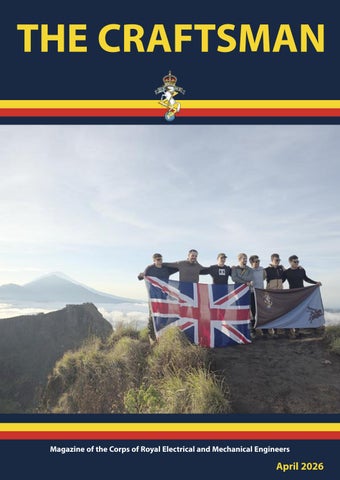
Magazine of the Corps of Royal Electrical and Mechanical Engineers
In 2020, REME launched the Lifting the Decks initiative, with a focus on the mental wellbeing of serving REME personnel and veterans.
We are in the process of re昀ning Lifting the Decks, increasing accessibility with an added emphasis on reminding our REME Family to speak out about ‘what’s on their mind’ and that, whatever stage in their life, we will always be here to listen to and support them.
If there is something on your mind troubling you, big or small, whatever the cause, we are here to listen and to help. If you wish to get in touch regarding yourself or concern for someone else, please don’t hesitate to contact woym@remecharity.org
Corps Formation: 1 October 1942
Corps Motto: Arte et Marte
Corps Patron Saint: St Eligius
(Celebrated 1st Sunday in December)
Editor: Mrs Sarah Eden + Corporate Communications Officer
RHQ REME, The Prince Philip Barracks, Lyneham, CHIPPENHAM, SN15 4XX
TEXT: should be submitted in MS Word and name saved as per the article. No formatting, columns, power point etc. Articles to be cleared by CO/OC/EME or appropriate REME CoC, or nominated substitute and should be submitted as soon as possible.
PHOTOGRAPHS: MUST be submitted separately, in jpeg format and be at least 500kb preferably 1mb or more. Only photos over 3mb can be considered for the front/back covers and please remember captions.
FILESHARE: websites, such as dropbox are ideal for submitting larger files.
EMAIL: The ONLY email address which should be used is: craftsmaneditor@reme-rhq.org.uk. Not MODnet. Please use the article title not ‘Craftsman Article’ as the email title.
TIMINGS: The latest submission date is the first day of the month prior to publication. This does not guarantee the article will be published in that specific edition.
Births, Engagements, Marriages and Deaths: These will be inserted free to all past and present members of the Corps.
Contents:
The contents of The Craftsman are strictly copyright and all rights are expressly reserved. The views expressed herein do not necessarily reflect the policy and views, official or otherwise, of the Editor, the Corps or the MOD, therefore no responsibility for these will be accepted. Whilst including an advertisement we are not necessarily endorsing the product and as a result, the publisher and its agents do not accept responsibility for any transaction between the reader and the advertiser. Whilst we take all precautions with regard to advertising, readers are advised to take professional advice before entering into any commitments. Letters concerning reproduction, contributions or any other matter should be addressed to the Editor.
Advertising All communications regarding commercial advertising rates should be made direct to the Editor.
Sustainably produced on paper sourced from responsible sources using vegetable based inks. Jamprint Design & Printing Ltd www.jamprint.co.uk info@jamprint.co.uk 01249 823 950
General Handling: This publication contains official information and should be treated with discretion.
Equipment Support in a High Readiness Division
Scribe: Colonel Jeavons
GOC’s Foreword: I am delighted to be able to add some context at the front of this guest editorial written by 1 (UK) Division’s Commander ES. The Division is an exciting and dynamic place to serve now. Having recently completed 12 months as the Allied Reaction Force’s Land Component Command, we continue to have clear purpose, a mandate to build a war-fighting Division, and we are feeling the benefits of the modernisation ambition. TES equipment has just started to arrive for 7X; RAPSTONE continues to deliver impressively for the FLF and both 16X and 8X are enjoying renaissances in their respective skillsets. We have identified an operational purpose for 19X (Rear Area Operations Group) and under the 40/60 plan, have contrived a means by which we may deploy our Reserves alongside the early movers of the Division. And that renewed sense of purpose and release of entrepreneurial spirit is palpable. REME is a key enabler in delivering a light and airborne Division that is First to the Fight. This is most apparent in the work to prepare and maintain the readiness of the fleet and we have recently taken steps to protect the ES workforce to better enable this. But critically the Corps is also deeply tied into the other key lines of effort through its support to conceptual development (how we will fight), enabling the rollout of new equipment at pace through RAPSTONE, and preparing for the fight we may need to have. As our brilliant sister Division also continues to modernise, 1 (UK) Division will hold the majority of the UK’s high readiness tasks for the foreseeable future. This includes the medallic earning opportunities of CABRIT and ELGIN. We are routinely exercising across Europe, in Canada, the USA and in Kenya. In short, the Division is going through an exciting and unprecedented period in its history and REME continues to keep the punch in our light and airborne fist.
Maj Gen RSJ Hedderwick, GOC 1st (UK) Division.
Pressure, Purpose and Professional Pride
The GOC rightly sets the context. 1 (UK) Division is operating at a level of tempo and readiness beyond that which we have experienced in our recent history, and for the foreseeable future will continue to do so. That reality places a disproportionate burden on our Equipment Support community. Maintaining large, diverse fleets at high readiness, while simultaneously modernising, deploying, exercising and regenerating, is demanding work. It is also essential work. The Division’s ability to be first to the fight rests, in no small part, on the skill, judgement and commitment of its Engineers and logisticians.
It is therefore important to be candid. The system is under pressure. Fleet holdings remain extensive, activity levels are high, and emerging requirements continue to arrive faster than traditional processes were designed to absorb. Our ES workforce is stretched, and surges, however well executed, are not a sustainable way of doing business indefinitely. These are not failings of people or units; they are the predictable consequences of a formation that is doing exactly what the nation asks of it.
Acknowledging this pressure is not a sign of weakness. It is the starting point for intelligent change.
From Coping to Controlling
What should give us confidence is that the Division is not simply enduring these challenges; it is actively addressing them. Over the last year we have taken deliberate steps to move from reactive effort to controlled delivery. This includes a clearer ES tasking process, greater prioritisation at formation level, and conscious protection of the workforce during critical readiness periods. These changes are not theoreticalthey are already reducing friction and improving predictability for units and LADs alike.
At the same time, we are making better use of the tools available to us. Specialist facilities such as Ashchurch will soon be employed more intelligently to reduce the burden on forward ES teams. Contracted support, including Babcock DSG, is increasingly being used in a way that preserves readiness, allowing equipment to be worked on while remaining operationally viable. This is not outsourcing responsibility; it is applying resources where they add the most value.
Crucially, we are improving our understanding of workload through better data. By analysing ES demand in the past, acting in the present, and predicting more accurately for the future, we are beginning to align effort with reality rather than assumption. This is how we move from heroic effort to sustainable excellence.
Engineering as a Main Effort
One of the most important shifts underway is cultural. In 1 (UK) Division, engineering is no
longer viewed as an enabling function operating quietly in the background. It is a main effort. REME tradesmen and RLC logisticians sit at the heart of delivering fighting power, readiness and endurance. Their work has immediate operational relevance, whether that is sustaining airborne forces at immediate notice to move, enabling FLF deployments, or supporting operations such as CABRIT and ELGIN.
This visibility matters. It reinforces professional pride and strengthens trade identity. It also drives standards. When we see clearly how our actions translate into operational effect, quality improves, innovation accelerates, and the Division becomes more lethal and more resilient as a result.
The Divisional ES Warfighting Development (WarDev) initiative exemplifies this approach. By empowering soldiers and officers to challenge assumptions, test new ideas and refine how ES is delivered in warfighting, we are harnessing the intellectual capital of the workforce. This is not change imposed from above; it is evolution driven from within.
Modernisation, Not Just Maintenance
Modernisation is often discussed in terms of platforms and programmes -TES, RAPSTONE, future mobility - but its real impact is felt in people. Working in 1 (UK) Division exposes ES personnel to cutting-edge technology, complex systems and demanding environments. That accelerates competence and builds confidence. It also creates opportunities for professional accreditation, industry engagement and broader engineering experience that are increasingly rare elsewhere. The excellent work by 2 Bn REME and 8 Fd Company to develop a drone repair policy and capability are testament to this innovative approach.
There is no denying that the pace is relentless. High readiness commitments across the UK, Europe, Kenya and beyond test individuals and families. Leadership must therefore remain alert to sustainability and burnout risk. Encouragingly, this is understood at formation level, and practical measures - protected ES periods, clearer
prioritisation, improved communication - are already in place. The aim is simple: to demand a lot, but not demand the impossible.
A Great Place to Serve
For all the challenge, the conclusion is clear. 1 (UK) Division is a great place to serve as a member of the Equipment Support community. It offers high operational purpose, meaningful responsibility, rapid professional development and the opportunity to shape how the Army fights and sustains itself in the future. The Division’s ethos is strong, its direction is clear, and its leadership is committed to protecting and investing in its people.
As the GOC notes, the renewed sense of purpose across the Division is palpable. For ES personnel, that purpose is felt every day - in every repair, recovery, inspection and innovation that keeps the punch in our light and airborne fist. The demands are high, but so too is the reward. This is where engineering matters, where professionalism is recognised, and where service genuinely makes a difference.
In short, the pressure is real—but we are not overwhelmed. We are adapting, improving and delivering. And for those who want to be challenged, developed and trusted at the heart of a modern, war-fighting Division, there is no better place to serve.
Lived Experience
Regular to Reserves
Scribe: Captain Louise Howitt AGC(SPS)
Ijoined 102 Bn REME in Feb 25. For me to transfer from the Regular Army, I had to liaise with SO2 SPS Reserves to understand how the process worked. It transpired that as an Officer, I needed to locate a unit with a space for an RAO, rather than a Det Comd role, as these roles are not available for AGC(SPS) Reservists within Army Reserve units. This meant searching on SERVE and speaking with the RAO at 102 Bn REME to see if they would accept me. Once this was complete, it was a very smooth process, and I was invited to the first Training Night after leaving the Regulars to attest and
complete my initial administration.
In the first few weeks of attending, there were some very useful briefs taking place such as explaining how the different training codes work and how they fit with the annual training commitment. For me, one of the biggest differences between the Reserves and Regular is that the dispersed SPS team holds such a mixed range of experience with regard to JPA and G1 expertise. Although we have personnel who have served many years in the Army Reserve, their experiences including mobilisations has not always focused on providing G1 support.
One element I enjoy about attending training is that it keeps the link with the military; up until the point I left in February, it was the only organisation I had worked for. On Tuesday evenings, I like to get to the Army Reserve Centre (ARC) early so I can do PT, and recently, organised sessions have been set up enabling me to meet more members of the Battalion as well in addition to the BHQ element I see weekly. So far this year, I have been a regular weekly attender and have also completed several weekend serials. We ran a successful AGC(SPS) weekend and as a team will look to build on this for the next two TITANIUM SPROCKET exercise serials.
have also just completed the first week of JOTAC(R) in Warminster, in which I particularly enjoyed the opportunity to meet other Reserve personnel, hear how different units work and how they fit it around their varied civilian commitments. Before the end of the training year, I hope to complete another week to begin consolidating and applying the learning from JOTAC.
This will be another opportunity to meet more new people as well.
Picture taken at JOTAC during the Combat Estimate teaching phase
Today we’re supporting more service people than ever. That’s not just because our membership is growing but because there is increasing recognition of the AFPS15 pension as a highly valuable asset. For many, it’s second only to the value of a home.
At today’s values, a £20k pa income requires a pension pot of c£400k. And when you consider the average civilian pension pot for over 50s in this country is less than £100k, you can see why we say that AFPS15 is among the very best of the public sector pension schemes.
By making the best pension choices throughout your career (and even when you’re in Resettlement), you can make a significant difference to your pension income.
Our Forces Pensions Consultants, the experts at the Forces Pension Society, are here to provide personal guidance. Access to our experts is included in your annual membership subscription and the earlier in your career you take an interest in your pension, the better.
Independent, not-for-profit
As an independent, not-for-profit organisation, our membership subscriptions help to fund our support for the Veterans’ Community, our Roadshows and Webinars, our attendance at CTP Employment Fairs, plus our vigilance in challenging governments whenever we spot unfairness or injustice in the system.
Visit: forcespensionsociety.org/join-now/ Annual membership for you and your spouse/partner is just £47. You will have exclusive access to our Forces Pensions Consultants, our informative Members’ Webinars and you’ll receive our bi-annual enewsletters and our magazine, Pennant.
You’ll also have access to our wide range of membership benefits from discounts on new cars to insurances, including our latest range of travel policies.
Ex OVERLORD SUPPORT 25: A Battlefield Study Across Normandy and Arnhem
Scribe: Craftsman Ahmed, 22nd Signal Regiment LAD
In July 2025, 40 members of 22 Signal Regiment took part in Exercise OVERLORD SUPPORT 25; a battlefield study spanning Normandy and Arnhem. The event, planned and executed by Sgt Pearson of the Light Aid Detachment (LAD), aimed to enhance teamwork, leadership, and professional development through the study of two of the most pivotal operations of the Second World War, namely, Operation OVERLORD and Operation MARKET GARDEN.
Purpose and Approach
The exercise sought to strengthen morale, cohesion, and mental wellbeing across the Regiment while providing a deeper understanding of historical leadership and strategy. Delivered in a relaxed but structured environment, it encouraged soldiers of all ranks to engage in reflective learning and teamwork.
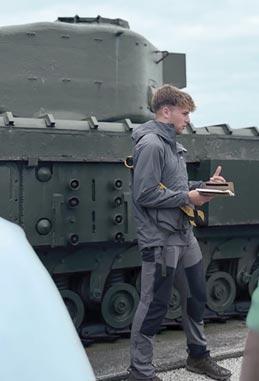
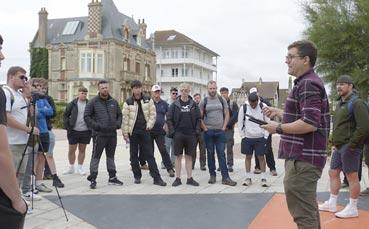
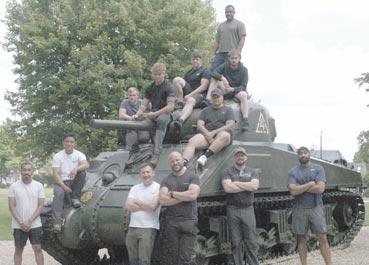
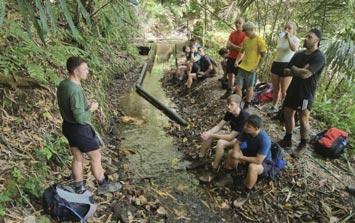
The study was conducted in syndicates, each assigned a specific battle to research and present, with input from a professional Historian. This syndicate-led format encouraged collaboration, improved presentation skills, and shared learning throughout the week. In this image, Cfn Partington (Spanner of the week) can be seen delivering a structured brief.
Normandy Phase – Operation OVERLORD
The first three days were spent in Normandy, exploring key sites linked to the D-Day landings.
After a day of travel, Syndicate 1 delivered the first presentation at Brécourt Manor and Utah Beach, covering the heroic actions of the 101st Airborne Division during the assault - made famous by Band of Brothers.
The following day included a visit to the Arromanches Museum, where attendees explored a fascinating collection of wartime uniforms, weapons, and vehicles. Later that afternoon, Syndicate 2 led the group at Omaha Beach, providing a detailed ground perspective on the challenges faced by Allied forces during one of the most demanding assaults of D-Day.
On day three, the focus turned to Pegasus Bridge and Merville Battery. Syndicate 3 presented on the 9th (Essex) Parachute Battalion, led by Lieutenant Colonel Terence Otway, and its successful assault on the fortified German coastal battery threatening the Sword
Beach landings. The historical context and courage displayed by these men left a lasting impression on all attendees.
Arnhem Phase –Operation MARKET GARDEN
After the Normandy phase, the group travelled to Arnhem, with an evening to unwind and enjoy the local hospitality - a chance for laughter and building new friendships that built lasting memories.
Day five began at the Hartenstein Museum and Nijmegen Bridge, where Syndicate 4 discussed the Allied efforts to capture key crossings. Despite the innovative tactics employed, the eventual German counterattacks led to the failure of Operation MARKET GARDEN; a sobering lesson in the realities of warfare.
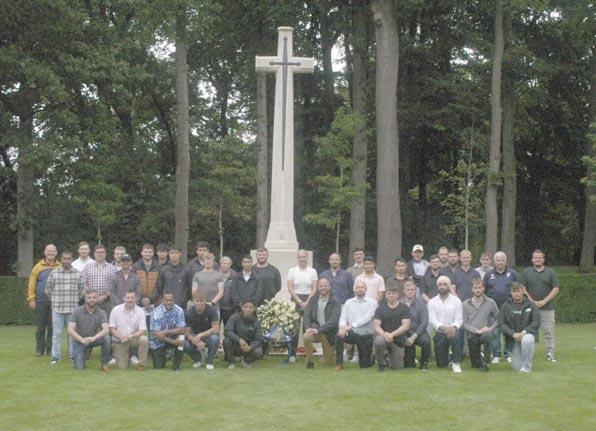
On the final day, Syndicate 5 led the visit to Arnhem Bridge and Arnhem Woods; highlighting the unexpected German resistance and the heavy losses sustained by Allied forces. The group reflected on the human cost of the operation during a moving visit to the Arnhem–Oosterbeek War Cemetery.
A Special Farewell
The closing ceremony at the cemetery was particularly poignant, marking the final visit to Arnhem by (Airborne) Padre Jerry Sutton, following a long and distinguished career in the Army. Padre Sutton is well known in Arnhem for his tradition of parachuting into the drop zone on Arnhem Day before delivering a sermon to thousands.
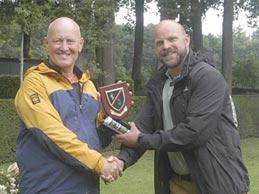
As a token of gratitude for his years of service and dedication, members of the exercise presented him with a farewell gift. Craftsman Ahmed laid a wreath in remembrance, followed by a two-minute silence observed by all - a fitting tribute to both the fallen and the Padre himself.
Members from 22nd Signal Regiment LAD at the Hartenstein Museum
Sgt Pearson presenting Padre Sutton’s gifts
Historian Major Strange explaining the “Multiverse of Madness”
Conclusion
Exercise OVERLORD SUPPORT 25 proved to be an outstanding success. Thanks to the meticulous planning and leadership of Sgt Pearson, all objectives were achieved, and participants gained an invaluable appreciation of teamwork, history, and the enduring spirit of the Corps. The shared experiences, from
studying history on hallowed ground to honouring those who served, left every participant with renewed pride in REME and a deeper understanding of the sacrifices that shape our profession today. A special thanks to the Historian Major John Strange (27 AEC) for his meticulous efforts and incredible instructional breadth of knowledge.
The REME Shop carries a varied range of items from branded clothing, gifts, statuettes, accessories, military uniform items and bespoke personalized products on request. The Corps shop is located within the REME Museum and offers a collection service.
The REME Trading Company (of which the shop is a part of) is a ‘not for profit’ and runs in support of The REME Charity for The REME Family.
sales@remeshop.org.uk
Members of 22nd Signal Regiment at Oosterbeek Cemetery on the final day
24 Commando Royal Engineers Regiment Workshop Vs 23 Parachute Engineer Regiment REME Workshop
IScribe: Cpl Hembury
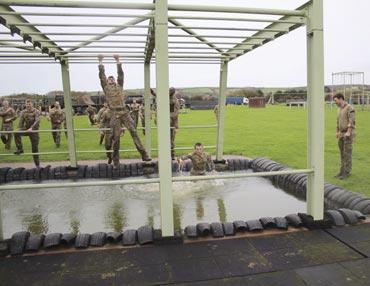
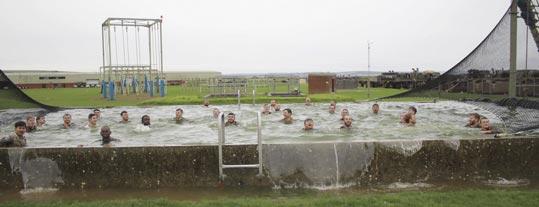
n November 2025 an engaging visit took place between 23 Parachute Engineer Regiment REME Workshop and their counterparts at 24 Commando Royal Engineers Regiment Workshop REME, hosted at RMB Chivenor. The purpose of the visit was to strengthen ties between the two high-readiness units, 16 Air Assault Brigade and the UK Commando Force, by fostering mutual understanding, sharing experiences, and exploring how each unit operates in their unique but similarly demanding environments. The event provided an excellent opportunity for soldiers from both Workshops to learn from one another, test their physical and mental resilience, and build camaraderie.
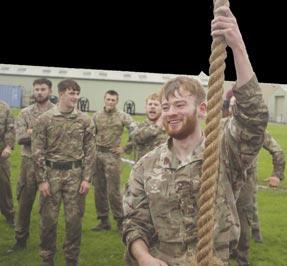
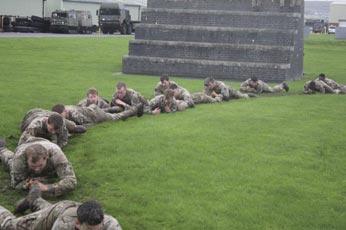
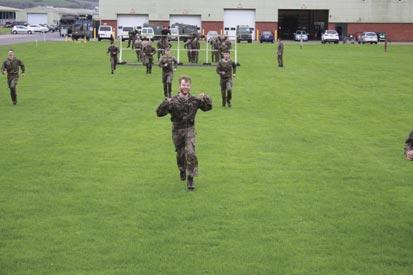
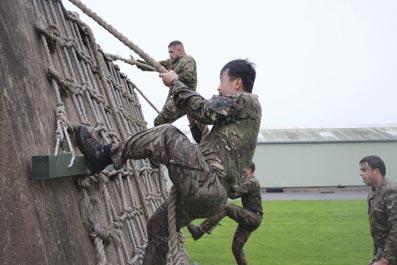
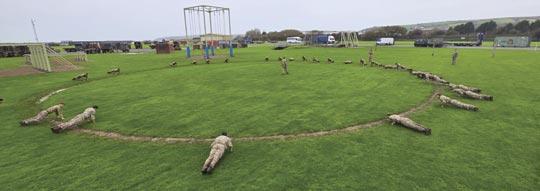
The day began with an introduction to the infamous Bottom Field, the Commando assault course that forms a key part of the All-Arms Commando Course. Members from both Workshops were given the opportunity to tackle the challenging obstacles, which included rope climbs, full regains, and other physically demanding tasks. These obstacles are not only a test of physical fitness but also of determination, teamwork, and mental fortitude, as they are pass/fail elements of the Commando Course. To add to the challenge, participants were required to fully submerge themselves in the tank, ensuring they were suitably cold and wet before continuing. This experience tested their ability to maintain focus and determination under adverse conditions; a hallmark of both Commando and Airborne soldiers.
The session culminated in a timed race across the obstacle course, pitting the two Workshops against each other in a spirited competition. This race was not just a test of physical ability but also a demonstration of the Commando spirit; cheerfulness in the face of adversity and the determination to push through challenges as a team. The
friendly rivalry added an extra layer of excitement and motivation, with both teams giving their all to claim victory.
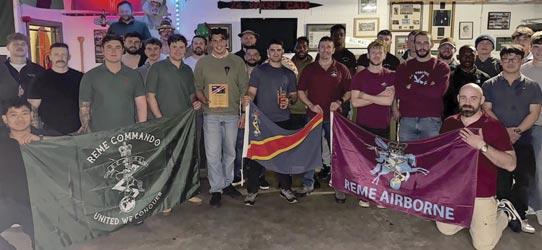
After the physically demanding morning, the teams had the chance to warm up and recover with some well-deserved refreshments, including a “hot wet”. The afternoon session shifted focus to knowledge-sharing and professional development. Both Workshops delivered detailed presentations on the structure and daily operations of their respective Brigades. These presentations provided insights into the unique roles, responsibilities, and challenges faced by each unit. They also highlighted the training, exercises, deployments, and arduous courses undertaken by Workshop members, such as the All-Arms Commando Course and P Company. This exchange of information not only deepened the understanding of each Brigade’s operational approach but also inspired individuals to consider pursuing these challenging courses and joining the ranks of either the REME Commandos or Airborne REME.
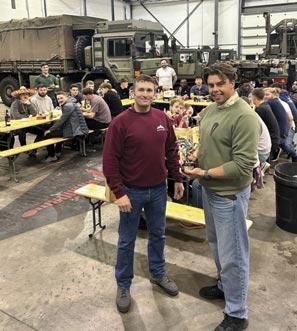
The day concluded with a more relaxed but equally competitive evening event. Over pizza, the two Workshops participated in a “Taskmaster”-style competition, designed to test creativity, problem-solving, and teamwork in a fun and engaging way. The event was hotly contested, with both teams eager to claim the inaugural 23 v 24 trophy. In the end, 24 Commando emerged victorious, becoming the first champions of what is sure to become a cherished tradition. The evening’s activities further strengthened the
bond between the two units, showcasing the shared values of teamwork, determination, and a healthy sense of competition.
This visit was a resounding success, providing an excellent opportunity for soldiers from both Brigades to learn from one another, build relationships, and test their physical and mental limits. It also set the stage for a reciprocal visit next year, when 24 Commando will travel to 16 Air Assault Brigade to experience life within the Airborne community. Events like this are invaluable in fostering mutual respect and understanding between units, as well as in promoting the unique and challenging opportunities available within both Brigades.
Both 16 Air Assault Brigade and the UK Commando Force continue to seek fit, motivated, and determined soldiers who are eager to serve in their unique and demanding environments. For those who thrive on challenge, adventure, and the opportunity to be part of a very high-readiness force, these Brigades offer unparalleled opportunities for personal and professional growth. This visit was a testament to the shared ethos and camaraderie that define these two exceptional units, and it serves as a reminder of the strength and unity within the British Armed Forces.
Details of course requirements and applications can be found at the following links;
AAPPS DIN - 2023DIN07-152 - AAPPS
AACC DIN - 2025DIN07-035 - AACC
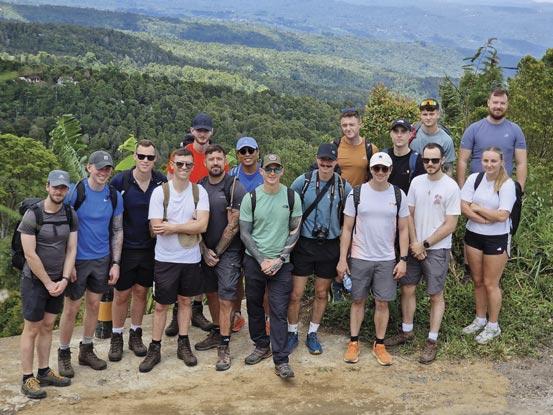
8 Parachute Field Company’s Journey Through Bali: Adventure Training Beyond Limits
IScribe: 2Lt Stimson and Cfn Middleton
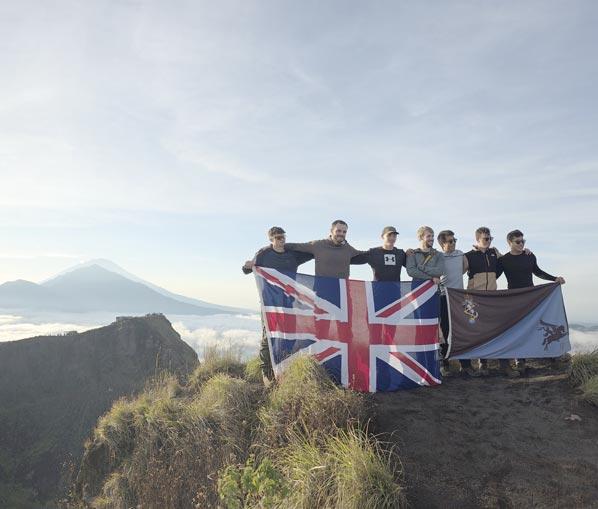
magine standing on the edge of a volcanic crater as the first rays of dawn break through a sea of clouds, the humid air thick with the scent of jungle and incense from distant temples. This isn’t a postcard; it’s the reality of 8 Parachute Field Company’s extraordinary Adventure Training (AT) in Bali.
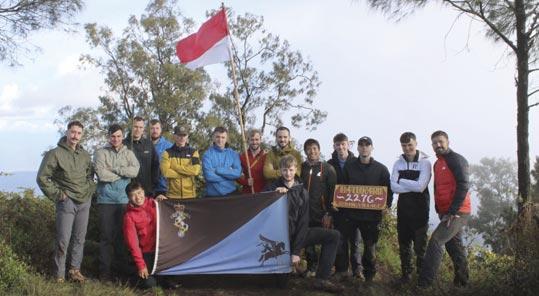
When most people think of Bali, they picture serene beaches and tranquil sunsets. For 8 Parachute Field Company, however, Bali became the backdrop for an unforgettable test of endurance, resilience, and cultural discovery during Ex BATUKARU RUSH, a two week expedition that blended demanding summer mountaineering with deep cultural immersion.
The moment we stepped off the plane, Bali greeted us with a wall of heat and humidity that instantly reminded us we were far from the cool, familiar landscapes of UK. That first day was about acclimatisation, exploring vibrant local towns, sampling authentic Indonesian cuisine, and learning the customs and values that define this island’s
Quick cultural visit
Fully immersed into the culture.
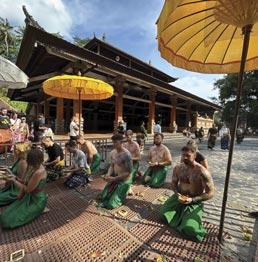
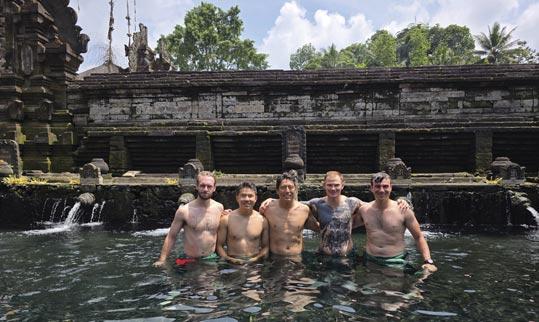
Praying at Tirtha Empul Temple
rich culture. Every interaction with locals reinforced the importance of respect and curiosity, setting the tone for the journey ahead.
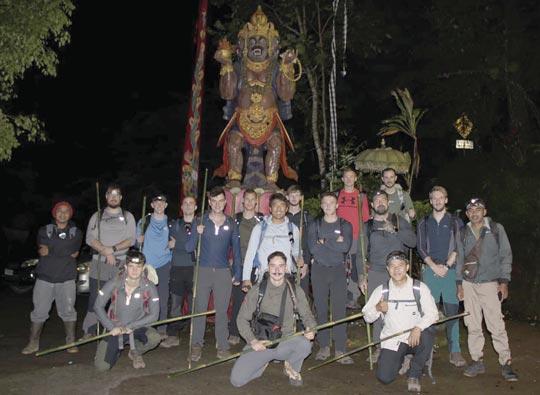
Our introduction to hiking started gently led by Capt Clegg and Capt Howe, easing us into the rugged terrain and tropical climate. But Bali doesn’t stay gentle for long. Each day brought steeper inclines, longer distances, and more challenging conditions. The structured progression from short, low-gradient walks to gruelling ascents was deliberate (I think!); designed to push our physical limits while sharpening mountaineering skills. The heat and humidity were relentless, forcing us to keep on top of hydration, pacing, and rest. Early starts became essential (although 0200 hrs set off was a bit unnecessary…), especially for summit attempts on Mt Batur and Mt Batukaru, where steep climbs and thin trails tested endurance and teamwork. Low light conditions added complexity, demanding focus and trust in one another. By the end of each day, fatigue was real, but so was the sense of achievement.
This wasn’t just about physical challenge; it was about embracing Bali’s soul. Between hikes, we explored sacred sites like Tanah Lot Temple, wandered through the mystical Sangeh Monkey Forest, and marvelled
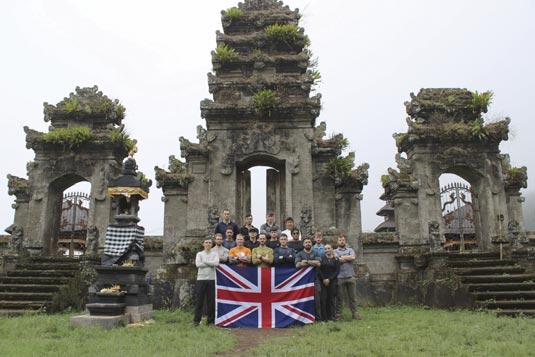
All smiles at the top of Mt Batukaru
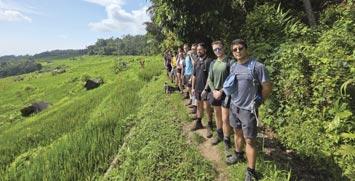
Rice field… Quick, pose for a picture!
A quick lesson on pacing
0200hrs start to beat the heat
Ritual bath at Tirtha Empul Temple
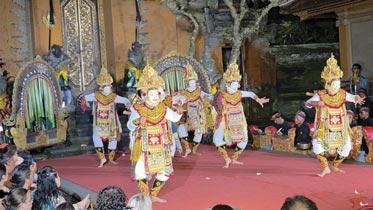
at the ancient nutmeg groves while being amazed by the serene paddy fields. At the ARMA Museum, we witnessed the mesmerising Kecak Dance, a powerful display of Balinese Hindu tradition told through rhythmic chanting and dramatic storytelling. One highlight was trekking through dense jungle to reach Laangan Waterfall, where the roar of cascading water marked the perfect reward for our efforts. Evenings in coastal towns like Canggu offered a
victories of the day.
Ex BATUKARU RUSH was far more than a physical challenge; it was a masterclass in adaptability and mental toughness. Wild animals, unpredictable terrain, and the sheer unfamiliarity of the environment demanded constant vigilance and teamwork. Every obstacle reinforced the importance of preparation, discipline, and the ability to stay calm under pressure. Yet, amid the sweat and strain, there was joy; joy in conquering fears, in learning new skills, and in sharing unforgettable experiences with your peers. This was adventure training at its purest: demanding, rewarding, and deeply enriching.
For anyone seeking once in a lifetime AT, Bali offers an extraordinary canvas for growth, bonding, and discovery. The peak sense of achievement when standing at the summit of a volcanic peak as the sun rises over a sea of clouds sharing laughter with friends is a feeling that is beyond words. 8 Parachute Field Company’s journey through Bali proves that when you step outside your comfort zone, you don’t just see the world differently; you
No one was ready for that downhill after this moment
Mesmerising Kecak Dance, a powerful display of Balinese Hindu tradition
Exercise MAYAN PHOENIX – 146 Company, 102 Close Support Battalion Deploys to Belize
AScribe: Captain Appleby
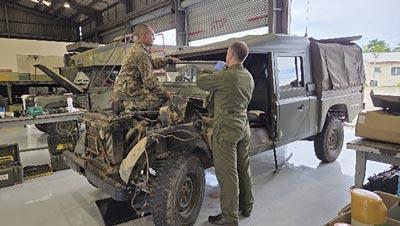
rmy Reserve personnel from 146 Company, 102 Battalion REME deployed to Belize for Ex MAYAN PHOENIX in September 2025. The core aim of the deployment was to support with the maintenance and repair of key training equipment used by exercising troops undergoing jungle training in harsh terrain. The team worked on multiple platforms during their deployment, including Land Rover, SV(R) and white fleet transport vehicles.
For most personnel, this was the first time deploying to Belize. The heat and humidity bring an elevated risk of heat illness, so the team completed the recommended acclimatisation PT programme in the early hours of each morning to avoid reducing output in the Workshop.
The team brought outstanding skills, professionalism and enthusiasm to the role. Impressing the local LECs with swift repairs whilst refusing to compromise on quality. The deployment was a fantastic opportunity to develop more recent recruits, utilising repairs as training aids to offer first-hand experience and in-themoment learning.
At Price Barracks in Belize, the British Army co-exists with the Belize Defence Force (BDF). This enables the sharing of best practice learnings both in the jungle and the Workshop. All members contribute towards a common goal and assist each other along the way.
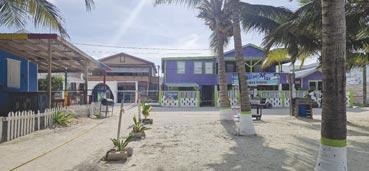
The team head to Caye Caulker
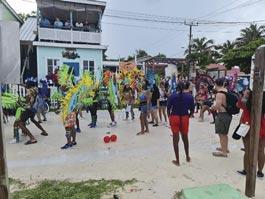
Locals celebrate Belize Independence Day
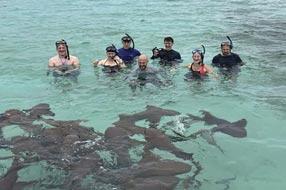
Members of 146 Coy snorkelling with Nurse Sharks
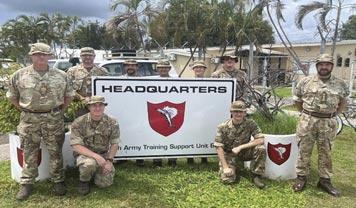
Members of 146 gather at HQ for a farewell photo
It wasn’t all rigid days in the Workshop. The team worked hard to deliver results, earning the downtime to explore the beautiful scenery and culture of Belize. They began with a visit to the Caribbean Island of Caye Caulker on their first weekend off. Taking part in snorkelling and enjoying the carnivals to celebrate the anniversary of Belizean independence alongside the locals.
Cfn Virgo
The snorkelling on Caye Caulker was such an amazing experience. We fed huge Tarpon fish by hand as they jumped out of the water to grab a Sardine, then headed out to the reefs to explore. We saw all kinds of amazing wildlife like Barracudas, Stingrays and Turtles. At one point, we were completely surrounded by Nurse Sharks. It was such a fantastic day.
Cfn Shane McFayden
I completed battle camp in November 2024, so I was surprised when I was invited to join the deployment to Belize for Ex MAYAN PHOENIX so early in my career. I’ve really enjoyed the opportunity to utilise the skills I have learned after recently completing my Level 3 HGV service and Maintenance Technician course with my full-time employer, MAN. This enabled me to align my role in the Army with the vocational skill I already have, so I could move to a Class 3 Vehicle Mechanic, which made me eligible to deploy to Belize. I’ll gain a lot of experience working with the Reserves, which will aid my development in my employment, and vice versa.
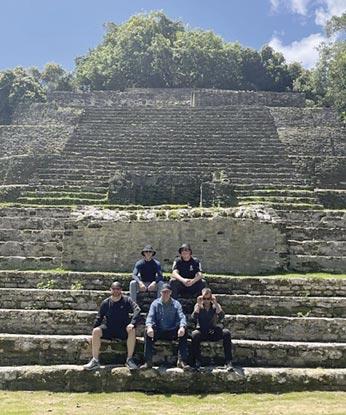
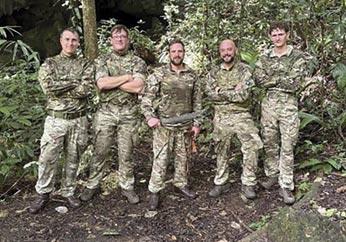
I didn’t expect so many opportunities to explore the country whilst I’m here. I loved the Adventure Training, where we spent the day exploring the Caves, and the Cultural Day roaming the local Mayan temples. It’s also been a brilliant opportunity to get to know the team better.
Left: Cfn Virgo removing a windscreen for the first time, supported by
Below: Members of 146 Coy on the Mayan Temples of Xunantunich
Bottom: 146 explore the Caves
Sgt Elliott
Exercise RHINO PULL 25: Building Battle Winning Capability – 20 Sep to 5 Oct 25
102 Battalion REME delivered its flagship annual training camp this autumn with Exercise RHINO PULL 25, a two-week Technical Training Exercise (TTX) held across Catterick Garrison and its Training Area. It marked the culmination of Project GLADIUS, a unit-driven initiative aimed at building battlewinning capability by focusing on the deployability, engineering competency, and mobility of its Forward Repair Teams (FRT).
Intent: The exercise was designed with a clear intent: to test, develop, and refine the battle-winning capability of forward repair teams through a structured programme within an immersive operational scenario.
Training in Action: Initially, the exercise focused on foundational technical training before introducing a progressively escalating threat scenario and increasing levels of repair complexity. From first light to last light, soldiers were immersed in realistic scenarios that tested their technical acumen, problem solving and tactical agility. Recovery under simulated contact, battlefield repairs in degraded conditions, and command challenges under pressure, all featured prominently.
Reflections from the Ground: SSgt Steen, one of the FRT Commanders, commented: “RHINO PULL 25 was about more than
just trade skills - it was about building confident, capable soldiers who can lead, adapt, and deliver under pressure. The energy and professionalism across the Battalion were outstanding.”
Exercise RHINO PULL 25 provided a comprehensive platform for the development of all trades, fostering technical proficiency, cross-functional collaboration, and adaptability in a dynamic operational environment. The exercise challenged personnel to apply their skills in realistic scenarios, encouraging innovation, teamwork, and a deeper understanding of each trade’s contribution to mission success.
Community Engagement: The visit from the Mayor of Great Aycliffe Town Council was a proud moment for the unit;
offering an opportunity to showcase our people, capabilities, and community engagement. The Mayor’s interest and support were warmly received, reinforcing the strong ties between the Armed Forces and the local community.
The Mayor responded after his visit:
“Thank you for the invite and to your colleagues for a wonderful afternoon. It was a great day and hopefully the Council can work closely with REME in the future”
Ready for the Fight: As 102 Bn REME looks ahead to future commitments, the lessons from RHINO PULL 25 will serve as a foundation for continued excellence. With sharpened skills, stronger teams, and renewed confidence, the Battalion stands ready to deliver battle-winning effect wherever it’s needed.
Forged in the Snow: Reflections from Exercise NORDIC BLUEBELL 25
Scribe: SSgt Wilson
Standing in below-freezing temperatures, in darkness, with a cutting wind driving snow relentlessly into your face is enough to make anyone briefly reconsider their life choices. Then comes the instruction, “skis on!” as you stare at a slope that resists all forward movement. At that moment, it becomes clear exactly what the Nordic Development Camp is about, and there is nothing left to do but to get on with it.
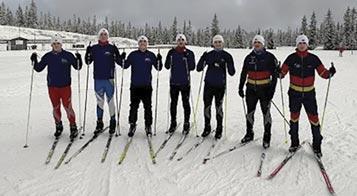
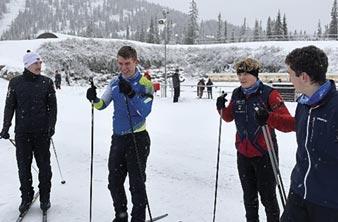
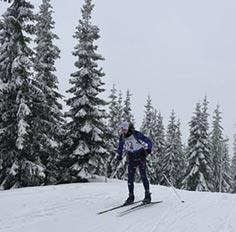
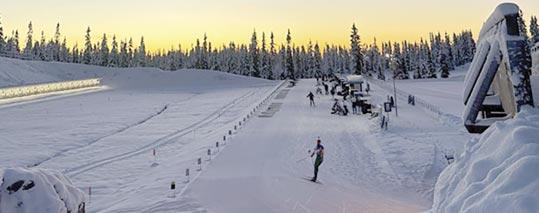
Exercise NORDIC BLUEBELL 25 was conducted in Sjusjøen, Norway, between 22 November and 20 December 2025; focussing on the development of teams across the Corps in Nordic Skiing and Biathlon, concluding with the REME Nordic Winter Sports Championship. 8 Training Battalion REME deployed a small team of seven soldiers, predominantly Initial Trade Training personnel from Normandy Company to develop the foundational skills required for Biathlon and
Nordic Skiing. Beyond the technical demands of the sport, the camp offered an early opportunity for these soldiers to experience a demanding winter training environment outside the confines of trade training. It marked the beginning of their exposure to Cross-Country Skiing as a military skill, providing a capability that will remain relevant throughout their careers. Training began at the Sjusjøen Arena, where complete novices were introduced to an unfamiliar environment and the humbling realities of gravity. Early efforts were focussed less on speed and more on the basic challenge of remaining upright, as the team attempted to coordinate arms, legs, and skis while negotiating the arena without incident. Although the snow initially offered a degree of comfort when falls inevitably occurred, it quickly became clear that repeated exposure to sub-zero temperatures was the greater adversary. As confidence gradually grew, so too did the complexity of the conditions. Changing snow underfoot whether frozen, freshly fallen, or beginning to melt, ensured that no two sessions were the same and progress was rarely linear. Skills were developed through repeated encounters with uphill climbs and unforgiving descents, with gravity providing consistent and impartial feedback.
It was through this process that determination took hold and the team realised that perseverance was almost as important as technique.
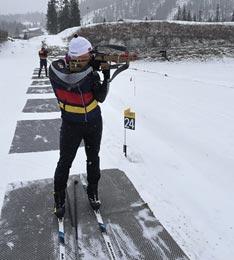
By the end of the first week, the team was moving with purpose, applying Skate 1, 2 and 3 techniques and beginning to identify individual strengths and preferences within the discipline. The introduction of the Anschutz .22 Biathlon
The 8 Trg Bn team stand ready for training in the Sjusjøen Arena
Standing unsupported introduced new challenges including figuring out the best way to keep the weapon still enough whilst hanging out!
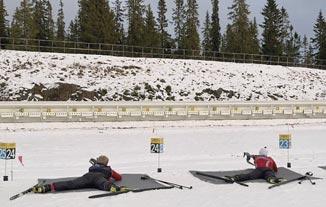
Cfn Coulson and Cfn Blake were amongst the quickest in the team to zero the weapon against the paper targets laid out by the range staff
Cfn O’Hara expressing his confidence in his skate technique during Biathlon training with a classic ‘Blue Steel’ pose rifle added a further layer of complexity, requiring the soldiers to ski effectively while managing the weapon on their back. As the exercise progressed, morale remained high and improvement became tangible, measured less by speed, and more by the simple but satisfying achievement of falling over less frequently than the day before. There was however, Cfn Blinston, who briefly concluded that descending hills was both quicker and easier when undertaken headfirst on his chest, temporarily substituting Nordic skiing for the Skeleton.
During the second week, the learning curve was deliberately reset as the team transitioned from skate skis to classic skis, marking the next phase of Nordic development. This introduced an entirely new set of challenges, requiring unfamiliar movement patterns and a renewed focus on technique. The team quickly became acquainted with the new local terrain, known as Meadows, where subtle changes in gradient and snow conditions demanded constant adaptation. The ever-changing snow underfoot reinforced the importance of equipment management, particularly the correct application of grip wax. One member of the team learned this lesson over the course of an 11 Km session, where excessive grip resulted in the skis that enthusiastically adhered to the snow but resisted forward momentum with equal determination.
He ran with skis on. With guidance from the training staff, and a growing appreciation for the balance between grip and glide, the team refined their approach and began to overcome the challenge more effectively. Classic Skiing also placed greater emphasis on physical output, particularly in the loipes [specially groomed trails or tracks designed for cross-country skiing] which offered brief respite from the finer points of technique. When conditions allowed, efficiency gave way to enthusiasm, and progress was often driven by sustained bouts of determined double-poling. While this approach was undeniably effective in covering ground, it also served as a timely reminder that Nordic Skiing rewards not only technical proficiency, but a willingness to apply effort in considerable and repeated quantities. Yet despite the change in technique, Cfn Blinston continued to develop his falling technique with admirable persistence.
After three demanding weeks of learning, adaptation, and
Despite the conditions, morale remained high throughout the development camp!
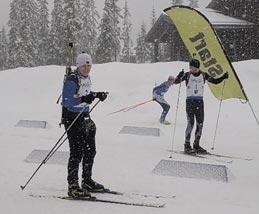
Coulson about to start his first Biathlon race
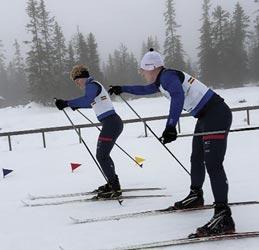
Cfn Blinston tagging Cfn Coulson in the relay event
no small degree of mental preparation, race week finally arrived. The programme provided a fitting culmination of the training, comprising a 4 x 5 km classic relay, a 5 km freestyle race at Meadows (where the majority opted for skate Skiing), a 7.5 km Biathlon race, and concluding with a 7.5 km mass-start freestyle event. Unsurprisingly, skate once again proved the favoured technique for the final test. The closing race was contested with the same collective spirit that had characterised the camp throughout. Team members waited for one another at the finish, offering encouragement and ensuring that everyone crossed the line.
As the final skier finished, there was a shared and immediate recognition that the development camp had reached its end and Skiing was finished – at least for now. Beyond the relief, the sense of achievement was unmistakable. The team had acquired a new skill directly transferable to military contexts, developed a level of fitness capable of meeting harsh environmental demands, and gained confidence from mastering something few of their peers at home could readily imagine.
Exercise NORDIC BLUEBELL 25 proved to be far more than an introduction to winter sport for members of 8 Training Battalion REME. Conducted in a demanding environment, it challenged soldiers physically and mentally, fostered adaptability, and reinforced the value of persistence when progress was measured in small, hard-earned gains. The camp demonstrated that development often occurs most effectively when individuals are removed from their comfort zones and required to perform under unfamiliar and unforgiving conditions. For the Corps, the camp introduced a group of motivated and capable soldiers to Nordic Skiing and reinforced 8 Training Battalion REME’s role as a valuable conduit for identifying and developing future talent within the sport. For the soldiers of 8 Training Battalion REME, the experience provided a foundation in Nordic Skiing and Biathlon that will endure well beyond the snow of Sjusjøen. It also instilled confidence, resilience, and an appreciation that forward momentum is not always elegant, but remains as progress nonetheless. While gravity continued to assert itself until the final day, the team departed with new skills, strengthened bonds, and a shared understanding that sometimes the quickest way forward is simply to get back up, adjust, and push on.
This development method saw team members skiing without poles to practice the fundamentals of the skate ski technique
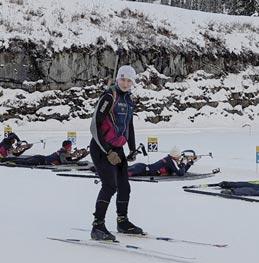
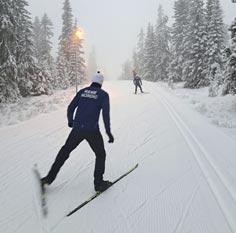
A scene from the Sjusjøen Arena
Cfn Bishop beginning a descent during the Biathlon race
Some local cuisine from ‘Det Lille Pannekakehuset’ in Lillehammer, ideal for recovery
Endurance and Adventure: SAAE Takes on the Leptos Challenge in Cyprus
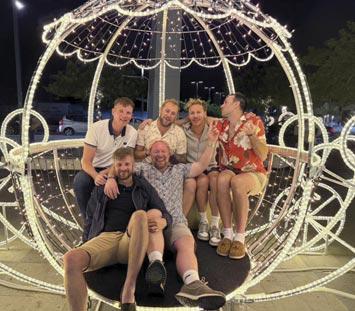
Pre-race Day 2
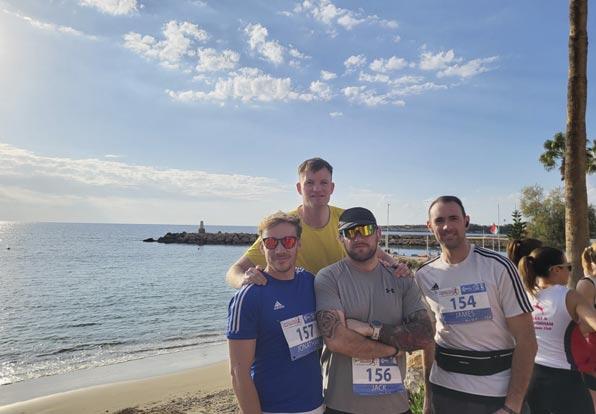
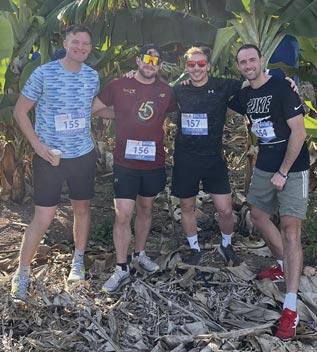
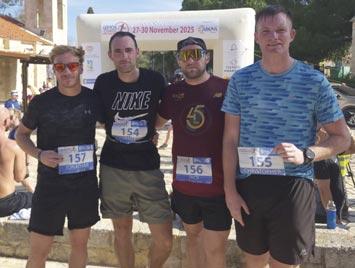
On 25th November 2025, six Instructors from the School of Army Aeronautical Engineering (SAAE) embarked on an unforgettable journey to Cyprus to compete in the prestigious Leptos Cyprus International 4-Day Challenge; a staged running event that pushes participants beyond the limits of a traditional marathon. This demanding competition combines road, trail, and cross-country running across four consecutive days, testing both physical endurance and mental resilience.
Funding and Support
The team would like to express sincere appreciation for the generous contributions that made this challenge possible. Special thanks go to:
• REME Charity
• Army Sports Lottery
• Lyneham Garrison PRI
• SAAE Fund
Their support ensured the team could represent with pride and tackle one of the most demanding endurance events of the year.
Training and Acclimatisation: Preparing for the Heat
Preparation began long before the team set foot in Cyprus. Training sessions at Lyneham airfield and surrounding areas focused on building endurance and speed, complemented by individual fitness programmes tailored to each member’s goals.
Upon arrival, acclimatisation became the priority. The
Pre-race Team Photo
Scribe: SSgt Davies
team conducted a full dry run of the medical plan to ensure all skills and drills were refined and fully understood ahead of the event. The team embraced a mix of active recovery and cultural immersion; aqua aerobics, coastal walks, and swimming in the Mediterranean helped adjust to the warmer climate, while sessions in the sauna ensured bodies were primed for the heat. Fueling for performance was equally important, and the team sampled authentic Cypriot cuisine, including Meze, Souvlaki, and Stifado, providing the energy needed for the arduous races ahead.
The Challenge: Four Days, Four Races
The event successfully combines four unique races:
• Day 1: A fast-paced 6km time trial
• Day 2: An 11km mountain trail run through rugged terrain
• Day 3: A multi-terrain half marathon distance
• Day 4: A 10km city run through the vibrant streets of Paphos
Post Race Day 2
Despite strong competition from seasoned running teams and other British Army units, the SAAE team delivered a commendable performance, securing 14th place out of 25 teams. For many participants, this proved to be one of the most demanding physical events they had ever faced, yet their determination and teamwork remained evident throughout. Wet Bulb Globe Temperature (WBGT) readings were monitored daily, and structured hydration measures were maintained to ensure all Athletes were properly prepared for each race.
Team Perspective:
SSgt Christian Birks
“This was my second time running the Cyprus Challenge, having previously competed in 2022. That experience didn’t prepare me for the brutal inclines of the 11km hill climb and the mountainous half marathon. The heat peaked during both events, turning each run into a battle for the finish rather than chasing personal bests. Thankfully, the final Paphos city 10km offered some respite—goodbye mountain climbs, hello flat streets!”
Team Perspective:
SSgt John Davies
“Running in Cyprus sounded like a dream—sunshine, coastal views, and adventure. What I didn’t factor in was the heat that felt like running through a hairdryer on full blast. The scenery was stunning: rugged cliffs, turquoise waters, and winding trails that made you stop (mostly to catch your breath, but also to admire the view). My ‘easy jog’ turned into a survival mission, complete with bargaining at every incline. Despite time set aside for acclimatisation, I spent most of the run wondering if I’d signed up for a
desert marathon. Still, between the sweat and the laughs, it was unforgettable—I’m already looking forward to next year.”
Team Perspective: SSgt Jack Taylor
“Being a late convert to ‘running for fun,’ I thought completing the London Marathon in 2025 was my toughest challenge, until Leptos. From the start, I realised this was a completely different test. Training in Wiltshire doesn’t prepare you for the heat and the ascents. Despite the difficulty, I thoroughly enjoyed Cyprus; the stunning views and a bit of healthy competition with SSgt Mahoney kept us both strong throughout.”
Cypriot Culture
SSgt Ferguson, Driving the Challenge:
Behind the Scenes of the Leptos Adventure
While the athletes pushed their limits across rugged terrain, my role was to keep the wheels turning, literally. Supporting the team in an administrative capacity, I was responsible for ensuring every member was at the right place at the right time for the start of each race. Once they set off, my own challenge began, navigating scenic routes from the sparkling Mediterranean coast to the towering Cypriot mountains and through the wild beauty of the Akamas National Forest.
The Leptos Challenge was more than just a sporting event it was a cultural experience. With strong local support and flawless organisation, the atmosphere buzzed with energy and camaraderie. As I waited at the finish line for the team to complete their gruelling stages, I discovered the simple pleasures of Cypriot life: sipping rich, aromatic Cypriot coffee and indulging in Loukoumades, golden honey-soaked pastries that melt in your mouth.
From the logistical hustle to the breathtaking landscapes and warm hospitality, the Leptos Challenge was a reminder
that every great adventure is powered not only by those who race but also by those who keep the journey moving behind the scenes.
Performance Highlights: Leptos
Challenge Results
Overall Team Standing
14th place out of 25 teams
Total Time: 13:14:14
Day 1 – 6km Time Trial
Team Position: 14th | Total Time: 1:14:22
• SSgt Davies – 20th – 21:35
• SSgt Birks – 49th – 24:01
• SSgt Taylor – 118th – 28:41
• SSgt Mahoney – 123rd – 28:55
Day 2 – 11km Mountain Trail
Team Position: 14th | Total Time: 3:39:02
• SSgt Davies – 30th – 1:03:18
• SSgt Birks – 74th – 1:14:03
• SSgt Mahoney – 107th – 1:21:01
• SSgt Taylor – 114th – 1:24:31
Day 3 – Multi-Terrain Half Marathon
Team Position: 15th | Total Time: 6:07:18
• SSgt Davies – 27th – 1:40:36
• SSgt Taylor – 94th – 2:11:09
• SSgt Birks – 110th – 2:14:26
• SSgt Mahoney – 114th – 2:17:19
Day 4 – 10km City Run
Team Position: 14th | Total Time: 2:13:31
• SSgt Davies – 22nd – 38:00
• SSgt Birks – 77th – 45:00
• SSgt Mahoney – 108th – 49:36
• SSgt Taylor – 110th – 49:42
• SSgt Greenwood – 204th – 1:11:35
Trend Insight
The team maintained a consistent ranking of 14th across most stages, with a slight dip to 15th on the demanding half marathon day. Individual performances were strong, led by SSgt Davies who consistently placed in the top 30.
Beyond the Race: Culture and Camaraderie
The Leptos Challenge was more than just a race it was a cultural experience. The team explored the historic heart of Paphos, including the Tombs of the Kings, and sampled traditional Cypriot delicacies in the old town. When not pounding the trails under unexpectedly hot conditions, they enjoyed well-earned rest at the hotel and even took part in water aerobics sessions for active recovery.
Looking Ahead
The Leptos Challenge proved to be a test of endurance, a cultural immersion, and a bonding experience for the team. With memories of scenic mountain trails, Mediterranean views, and warm Cypriot hospitality, the instructors returned home with a sense of achievement and a promise: We’ll be back next year.
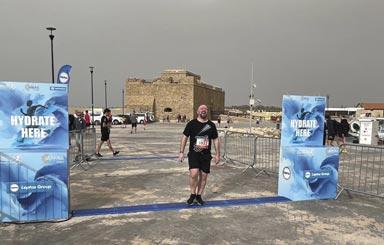
SSgt Greenwood 10K Finish
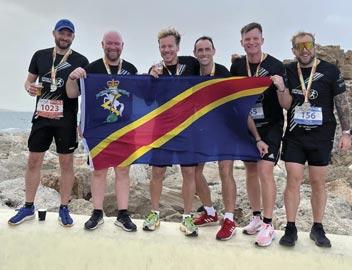
SAAE Leptos Challenge Team Photo
Adventurous Training
Ex SUBMERGED SPANNER
Scribes: LCpl Robertson and Cfn
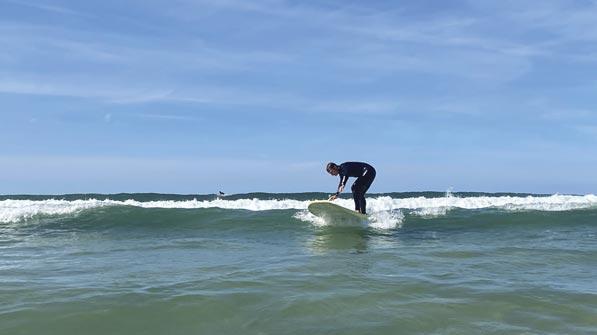
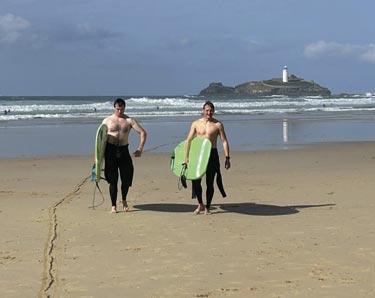
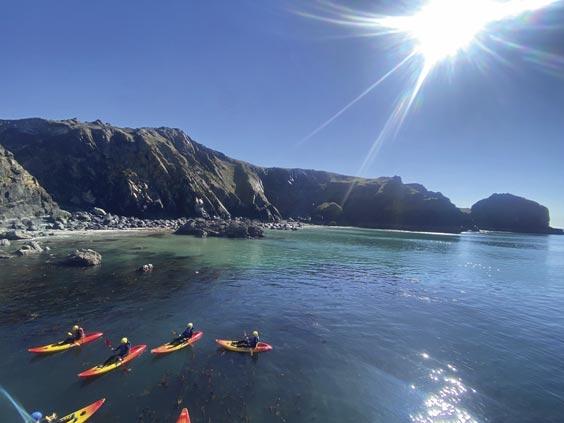
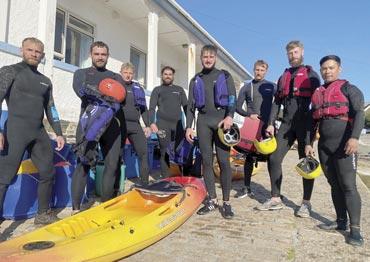
The OC directed the Workshop to plan a time in a busy Calendar to conduct some well-earned Adventure Training (AT). The AT package was financially supported by the Regiment and a generous contribution from the REME Charity, which helped to get the AT funding over the line. The AT consisted of three days of water-based sports in Cornwall. The three activities were Coasteering, Surfing, and Sea Kayaking. We managed to find accommodation at RNAS Culdrose at no charge, and the activities were led by a local company known as Global Boarders. We highly recommend
using this company as they offered a great MOD discount, and the instructors were extremely experienced in each activity.
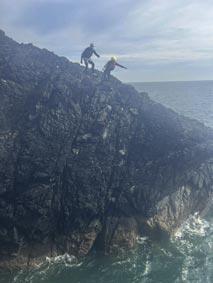
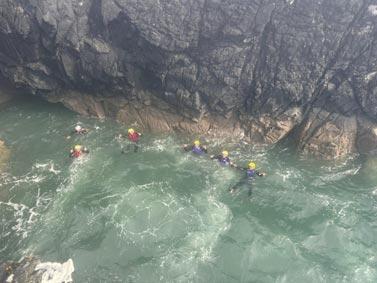
Coasteering: The moment we all questioned our Military Swim Test results
Coasteering is a daring activity which involves scrambling and climbing along the coastline on slippery rocks, jumping into water from height at every opportunity, a great way to explore the Cornish coast. To take part you require a wet suit,
Cpl Henry putting the ‘M’ in the YMCA
Coasteering and the leap of faith
Coasteering - Smiling but not for long
Coggins
buoyancy jacket, helmet and a short term memory so you forget how scary the last jump was. We worked our way up to some very challenging jumps; some exceeding 12 metres. This was a day where just because JPA says you can swim it doesn’t mean you can actually swim. When we first entered the white water crashing against the rocks, we were all regretting our life choices as we got accustomed to the feeling of drowning. I recall the WSM shouting ‘I’M DYING!!!’ Type 2 fun with many funny stories to talk over in the local public house afterwards. It was testing for everyone, required great teamwork and was extremely rewarding. Due to the nature of the activity, we could not get many photos of what we accomplished.
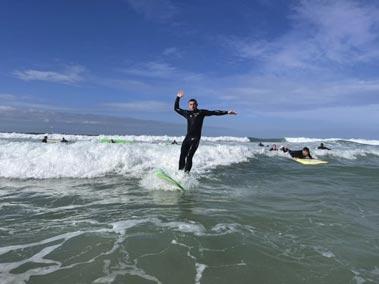
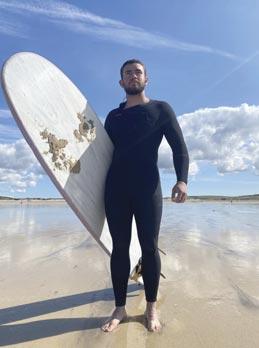
Surfing: Falling with enthusiasm
Surfing was next, and it was about as graceful as you’d expect from a
Baywatch it ain’t
Sea Kayaking and perfect weather conditions
group with no natural balance and a slight headache from the day before. We had a morning lesson from an instructor from Global Boarder. Most of us spent the session falling off the boards within seconds. A couple of people managed to stand up briefly, which was celebrated by the group as if it was an Olympic victory. We had the afternoon to put into practice what we had learnt from our blonde salty haired Instructor. It was great fun even if we swallowed plenty of sea water and were thrown around like we were in a washing machine. Day 2 completed no injuries, no deaths, its going well.
Sea Kayaking: The ‘relaxing’ activity
We rounded the last day off with some Sea Kayaking, but before that we had another morning of Coasteering for good measure, just to remind ourselves what sea water back in our
lungs feels like. We all imagined Sea Kayaking would be relaxing, how wrong were we. The instructor went through the basics of how to control our paddle powered bathtub and away we went. It was a mix of surfing the waves and swimming to safety once we had been tipped out. Another great method to explore the best parts of Cornwall. Eventually the group made it back to shore, wet and tired but still in good spirits.
Would we do it again?
In a heartbeat
We were fortunate to have fantastic weather. We found some of the best local restaurants and watering holes
that Cornwall had to offer. A working week where we managed to forget about the day to day stresses a fleet of old Pinzgauer provides you. The group worked together to build trust, improve communication, boost confidence and create shared memories. It was a great AT package and reminded us all how important it is for even the busiest of Workshops to make time for Adventure Training. None of which could have been achieved without the support of the REME Charity, thank you.
Cpl Kirby trying to do YMCA whilst surfing
LCpl Smith born to surf!
Sea Kayaking Team photo
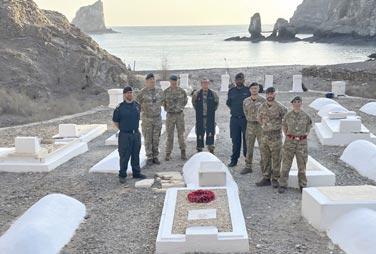
Dawn over Cemetery Bay: A Two-Day Tribute to Cpl Robert William Lloyd
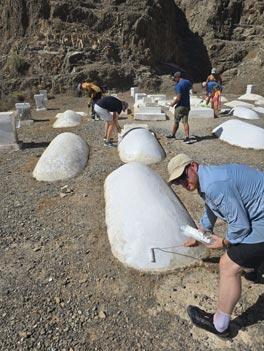
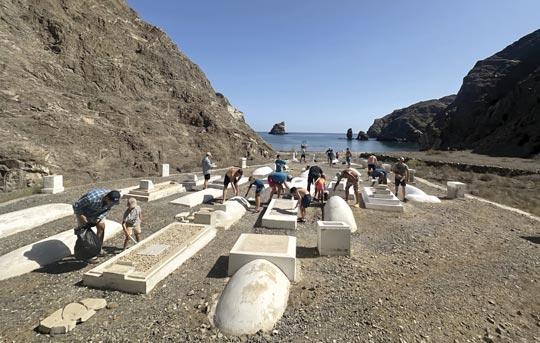
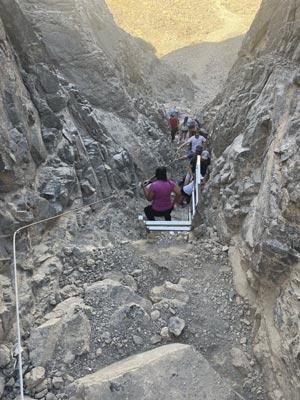
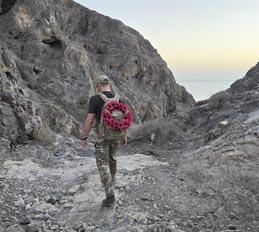
In the cool pre-dawn of Muscat, two distinct acts of remembrance unfolded across Cemetery Bay – Oman’s secluded coastal sanctuary, which is home to a number of graves of service personnel and diplomats who lost their lives in service to the crown in Oman during the Dhofar and Musandam wars. The site was gifted to the UK by the Sultan and remains one of the only designated burial sites for Christians in Oman. The site itself reachable only by boat or the rugged Sidab Trail. Over two days, British service personnel on Loan Service, Embassy staff, and their families honoured Corporal Robert William Lloyd REME (22821348, 1937–1958), who died of heatstroke aged 21 while supporting the 13/18th Royal Hussars during the Jebel Akhdar War.
Loan Service (Army) Painting the Graves
Scribe: WO2 Hunter
Family Clean-up
DAY ONE: A Family Effort.
Sunday 9 November 2025
At 0800hrs, members of the British Army on Loan Service and their families, including children clutching brooms and paintbrushes, gathered at the Sidab Trail car park. Some with younger children opted for the boat rendezvous at 0830hrs, boarding vessels for the 15minute crossing to the cemetery as the sun climbed above the Arabian Sea. The boat also carrying a new headstone for Cpl Lloyd.
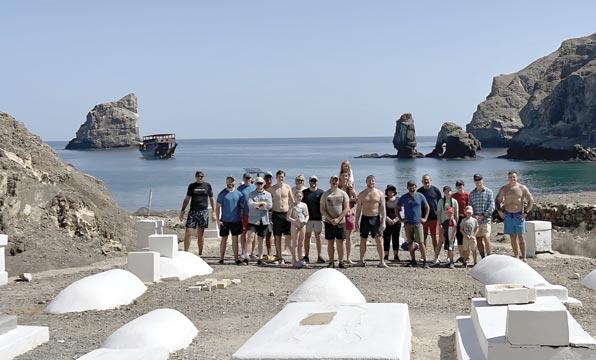
Once the team had completed their journeys to the cemetery and with the temperature steadily rising with the sun, the work began immediately. Families and children collected rubbish whilst adults raked weeds and scrubbed headstones. Painting the headstones a brilliant white became a team effort that led to some children becoming more paint than person, grinning through the mess as they worked hard to help. A few hours had passed before the site was transformed: tidy, dignified, and ready. The new headstone replaced the older damaged stone in preparation for the upcoming service. The group loaded several bags of rubbish onto the boat and departed, leaving Cemetery Bay, gleaming in the morning sun.
DAY TWO: A Swift and Sacred Rededication
Monday 10 November 2025
At 0545hrs, Sidab car park filled again. This time, a contingent of Army, Royal Air Force and Royal Navy personnel from the British Embassy staff joined the Loan Service Army team. Headtorches cut through the darkness as the group set off, reaching the cemetery just
Families utilising the fixed wires and ladder on the trail
Team Army stands by the freshly painted cemetery
as the sun rose over the sea, its golden light illuminating the freshly painted headstones.
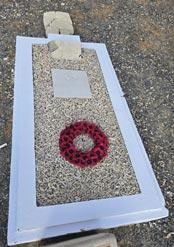
The new headstone, emplaced just days before laid in wait, its surface gleaming with Lloyd’s name, rank, REME badge, and the words “His life’s ambition started so hopefully, but ended so quickly” reminding the attendees of the reality of the loss.
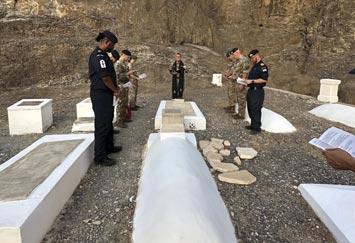
The Reverend Dr (Wing Commander) Philip Wilson, Staff Chaplain to the Chaplain-in-Chief of the Royal Air Force, began the rededication service.
A tight circle formed on the sand. Padre Wilson delivered a serene service, a fitting tribute to a young soldier who gave his life in Oman’s brutal heat.
WO2 Adam Hunter delivered Archibald MacLeish’s “The Young Dead Soldiers Do Not Speak”, the poem’s refrain, “We were young. We have died. Remember us.” met with profound silence. The Act of Dedication rededicated the grave as the exhortation rang out “They shall grow not old…”, followed by two minutes silence, accompanied only by the sound of waves gently lapping the rocky shore.
The Kohima Epitaph sealed the moment “For your tomorrow, we gave our today.” as a wreath was laid, followed by the REME Collect, Lord’s Prayer, and Padre Wilson’s blessing.
The team headed back with intent, aiming to get back before the heat of the sun made the hike even more of a challenge. Even in the winter months, the mercury often pushes well above 30 degrees. By 0800hrs, the group was back at the car park, mission complete.
With no known living relatives and full-service records pending at the National Archives, this two-day tribute, one of paint-splattered children and Army family labour, one of triservice prayer and freshly painted stone, ensured Cpl Lloyd’s sacrifice, and the sacrifice of all of those interred in the cemetery endures. In the words of the poem: “We leave you our deaths. Give them their meaning.” and so, under Oman’s rising sun, we did.
Transporting the wreath on the Sidab trail
British Military standing by Cpl Lloyd’s grave
British Military standing by Cpl Lloyd’s grave
Wreath laid before removing the damaged headstones
Rallying for Charity
Scribe: Chris Cockrell
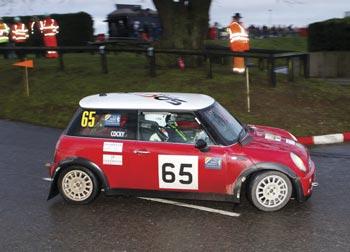
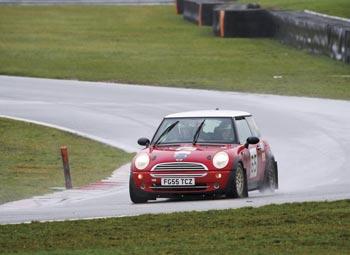
Former REME Cpl (VM) Chris “Cocky” Cockrell has decided to start up Rallying again after leaving his Military service over 30 years ago. He served in all theatres of operation and was part of the British Army Rally Team. Chris says: “As I approach 60 this year, I wanted to landmark it with fulfilling a lifetime ambition of competing in a British Rally Championship and I want to give something back by raising funds for The REME Charity. My time served in the REME has moulded me to the person I am today and as I run my own chauffeur business now their support has enabled me to compete. I am also raising funds for Children in need.”
Chris is competing in the 25/26 Circuit Rally Championship and has just recently got a finish at the Snetterton stages. Chris says: ”I started out well on Stage 1, until the coolant hose came off and we lost coolant whereupon the car filled up with smoke and for safety we had to pull out and miss the rest of the stage, but this meant I would get max time penalty which then scrubbed any chance of a good result. Allthough disappointed with this, I proceeded to use the rest of the day as a test day as this was the first time I had actually driven the car, and as the weather was bad, it gave me an opportunity to test the car limits as well as my own. Overall I was 53rd out of 90 and 9th in Class. Special thanks to Jamie @spark developements for keeping me going, my Navigator Steve and the rally community for their help and advise. My next 2 rounds in the Circuit Rally Championship is Donnington on 15th March and Cadwell park on the 26th April. Both these events are live streamed on You Tube should you wish to watch and see what rallying in a circuit championship is all about.”
If you would like to follow Chris and his venture, his Instagram account is titled RALLYING FOR CHARITY and if you can donate, please go to the Go Fund Me page also titled RALLYING FOR CHARITY. Any funds large or small will gratefully be received. If you can sponsor Chris as a business or privately then he can be contacted on 07949807330 or via email chriscockrell@tiscali.co.uk
“Any support I receive will be gratefully received. I thank you for reading my story and I hope to raise as much as I can for the Charities. Best wishes Chris.”
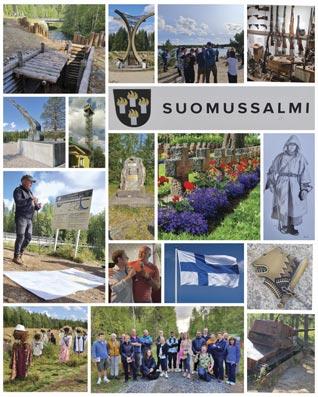
Boxer Programme Team Battlefield Study to Finland
Scribe: Major Guy Whittaker
Introduction – Colonel Andy Elliott – Programme Director
Battlefield studies remain an indispensable element of professional military education. They enable us to examine historical conflicts in depth, considering terrain, climate, and other factors that shaped human decision-making, and to reinforce these lessons for the British Army of tomorrow. For the Boxer Programme Team, such studies significantly enhance our thinking on capability development and acquisition.
As Boxer continues to enter service, its mobility, protection, and digital integration exemplify fleet modernisation. Yet, the enduring fundamentals of conflict remain unchanged. Europe’s forests, rivers, and urban spaces are as challenging today as they were in 1939, and the “fog and friction” of war continues to govern the uncertainty of battle.
Exercise BOXER’S IRON WINTER provided an exceptional opportunity to explore these timeless complexities, drawing
lessons as relevant to modern mechanised operations as they were to the soldiers who fought there over eighty years ago.
Main Body
Finland’s wartime experience displays the challenges of expeditionary, mechanised warfare and offers enduring lessons in operating under extreme conditions against a numerically superior adversary. These themes resonate strongly with contemporary challenges yet remain widely underexplored within UK professional military education. This made the Finnish Winter War the perfect choice for the Boxer Team’s 2025 Battlefield Study.
The Winter War (1939–1940) saw Finland resist a Soviet invasion against overwhelming odds. Exploiting terrain, their mobility, and the harsh winter conditions to their advantage, Finnish forces inflicted heavy losses on the Red Army. Though Finland ultimately ceded territory, its defence remains a powerful example of resilience and adaptability in extreme environments and provides many lessons that can be applied today.
Preparation for the Battlefield Study began before the team touched down in Helsinki, with two conceptual study periods laying the foundations. The first, a virtual scene-setter, introduced the character of the conflict; the second, in-person, deepened understanding through syndicate discussions. Led by Paul Davis (logistics support Manager), these sessions focused on the battles of Suomussalmi and Raate Road, where the Finnish forces used ingenuity and terrain to blunt Soviet armour.
Deployment
On the day of our deployment to Finland all was going smoothly, however as the old mantra goes, no plan survives contact with the enemy. The enemy in our case was an over-capacity Helsinki Airport due to the city hosting the U21 European Athletics Championship. Two missing bags were a minor inconvenience, but the team pressed on, travelling North into the centre of Finland.
The first study day centred on the Battle of Suomussalmi, an early Finnish victory. Though modern landscapes have softened the scars of war, syndicate discussions were sharp and insightful. This first day of study focussed on the tactical action of the Battle and how Boxer would be employed in similar scenarios including anti-armour ambushes, river crossings and logistic patrols. The group also benefitted from stops at a local tourist centre museum and, memorably, lunch at “The Silent People” art installation; an unexpected cultural interlude that sparked as much debate as the tactical stands.
Day two took the team to Raate Road, deep inside the Finnish countryside where the terrain made it easier to visualise the conflict. Here, Finnish forces
decimated Soviet columns along a narrow forest track. A sobering reminder of how mobility and protection can be compromised in complex terrain. Building on Day 1, the syndicates now considered the wider conflict and how the resistance in central Finland prevented the Soviets from cutting the country in half. Highlights of the day included the Outpost Museum at the Finnish Russian border, a complex network of well-preserved Finnish defensive positions, and the national Winter War Memorial.
The final day shifted focus to the Capital, Helsinki, exploring its role as Finland’s political and economic centre during the war. Syndicate presentations on logistics, national resilience and geopolitics were delivered against a backdrop of rain showers and city noise, a modern echo of the chaos the country faced in 1939.
Key Lessons
Standing on ground where history was forged, we were reminded that the challenges of the Finnish Winter War echo through lessons still relevant today. The diverse composition of our group, military and civil servants from across the Boxer family (LCpl to 2*), enabled exceptional divergent thought and highlighted numerous insights for the Programme.
First and foremost, the Finnish ability to operate in extreme cold conditions reinforced the need for vehicles and their support systems to be climate resilient and versatile; ensuring they can function effectively regardless of environment. We also underlined the value of innovation in equipment delivery. Whether through modular, upgradeable capability (of which Boxer is inherently capable) utilising evolving technology such as direct energy weapons, or through international collaboration from other Boxer user nations. Vehicle recovery and sustainment operations were unsurprisingly highlighted as critical enablers, reminding us that mobility and protection must extend beyond the fighting echelon. Finally, the study demonstrated that lessons from history remain relevant today. The Finnish success in the Winter War reinforces the need for a manoeuvrable, adaptable and an interconnected force.
Closing Thoughts
Exercise BOXER’S IRON WINTER was not only an enjoyable battlefield study but also an investment in the team’s conceptual knowledge of the environment in which Boxer may be expected to operate. For our Corps, the message is as clear as ever: maintenance and sustainment are fundamental enablers of operational success. Forward Repair Teams/Fitter Sections need the skills, flexibility and empowerment to improvise repairs when supply chains are inevitably disrupted. Rapid recovery, either peer-to-peer or with organic
recovery assets is a key manoeuvre enabler. And more broadly speaking, British Army equipment must fundamentally be designed for reliability and ease of repair in the extreme cold.
No Battlefield Study succeeds without the right team. The Boxer Team was blessed with the support of Finnish historian Lt Col (Retd) Lassi Piirainen. A truly invaluable member of the group, his local knowledge was vital, blending historical insight, cultural context and the contemporary setting (neighbour Russia and Finnish NATO membership). His maps and organisational charts sparked lively debate throughout but, most importantly he enjoyed the Boxer tradition of a karaoke bar!
As the Boxer Programme moves forward to IOC in 2026, the insights gained on this Battlefield Study are invaluable in helping us shape capability development, doctrine, and support. This will ensure the field force is delivered a truly world class capability.
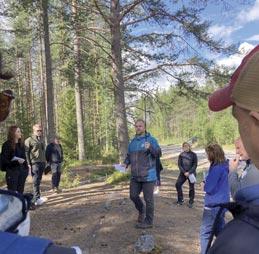
Lt Col Brad Hardwick delivering a brief on Finnish defensive positions
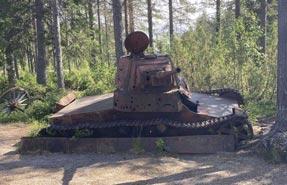
Destroyed Soviet tank on the Raate Road
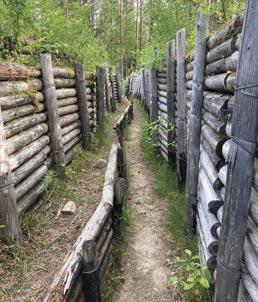
Finnish trench network
Training & Development
MSEC(L) Professional Development Day to Goodwood Motor Circuit
OScribe: 2Lt Bearman
n Monday 8th December, the Military Systems Engineering Course (Land), MSEC(L), organised a Professional Development Day at the Goodwood Motor Circuit, gaining rare access to the inner workings of motorsport and aviation engineering. The visit began with a warm welcome from Gabriel, Head of Motorsport Operations, who provided an overview of the history of Goodwood, it’s military origins and its role in preserving and advancing motorsport. The session set the tone for a day; focused on real-world engineering application and professional growth for junior officers.
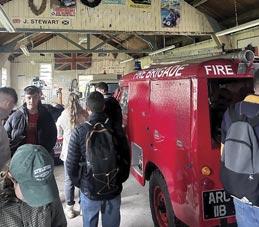
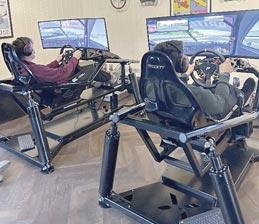
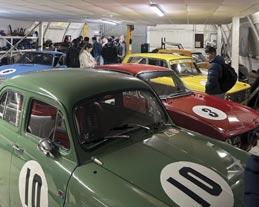
A major highlight was the hands-on experience within Goodwood’s Simulator Suite, where the junior officers explored the engineering principles behind simulation and driver-training technology. The group then toured the engineering workshops observing Land Rover restoration, vintage race car maintenance, and the craftsmanship required to keep heritage vehicles operational. These insights broadened their understanding of mechanical design and the challenges of sustaining ageing platforms - offering parallels with military equipment support. A standout moment was stepping into a large early-1970s shed, which was a Formula 1 workshop from the era of François Cevert and Jackie Stewart. Painstakingly moved from Kent, it was a small, hands-on workshops where F1 cars of that period were designed and built. The space gave the group a sense of how engineering was achieved long before today’s manufacturing tools.
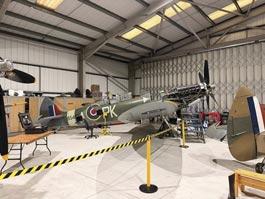
The visit concluded with a tour from the ‘warbird’ engineering team, whose expertise in airframe restoration and engine maintenance gave the cohort insight into the engineering precision required to bring a historic aircraft back to life and maintain airworthiness. There were a variety of World War Two aircraft which were fascinating to see undergoing deep maintenance.
MSEC(L) returned to Lyneham with a greater appreciation of the diverse engineering perspectives experienced at Goodwood, which will enhance their understanding of engineering in the future.
BPotteries and District REME Association
Scribe: Maurice Hope
efore we finally consign 2025 into the history books, the following deserves to be given a mention. During the year the North Staffs REME Breakfast Club, which meets on the first Saturday morning of each calendar month with an average of around a dozen attendees, managed to accrue the sum of £600 from its in-house raffles to be presented to the Corps Charity in December. Many thanks must go to organiser Adrian Walker and his merry band for such a sterling effort throughout the year.
The first Breakfast event of the year was held on Saturday 7th with fourteen members enjoying a couple of hours of banter.
The first social event of the year was a monthly lunch at one of our favourite venues, The Ship Inn in the village of Teanford in the Staffordshire Moorlands, on Tuesday 10th of February. With 18 persons in attendance, it raised a very healthy sum of £60 towards our branch Summer Banquet, hopefully on the last Saturday of July. This year will see a return to the bet365 Stadium (Home of Stoke City), and with luck it will not need cancelling if Stoke have a home preseason friendly game arranged for the day.
With our home venue of The Weathervane (Hungry Horse) Hotel in Meir getting a complete overhaul during February, the branch has not had a monthly branch meeting for the first time since the 1990s. All should be back to normal in time to host the North Staffs REME Breakfast Club event on Saturday the 7th of March.
A quick reminder to any Corps member in our catchment area of North Staffordshire (Including the Staffordshire Moorlands) and South Cheshire, we meet as a branch on the fourth Tuesday of the month at The Weathervane Hotel (Conference Room) in Meir, commencing at 7pm, all are welcome to join us.
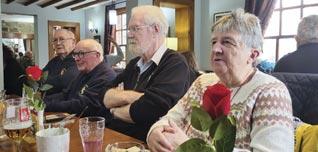
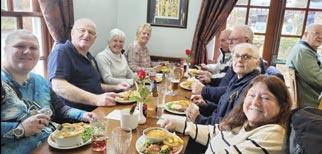
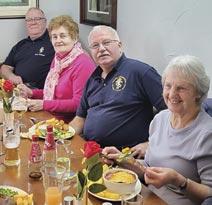
Big smiles, full stomachs
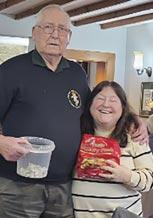
Mo Hope and Joan Martin
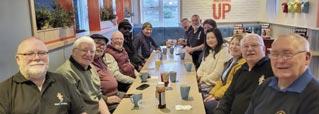
RCT Members table Patiently Waiting for service
REME Breakfast Club
Montgomery’s Moment: The German Surrender at Lüneburg Heath
Scribe: Abigail Sirrell - Museum Assistant
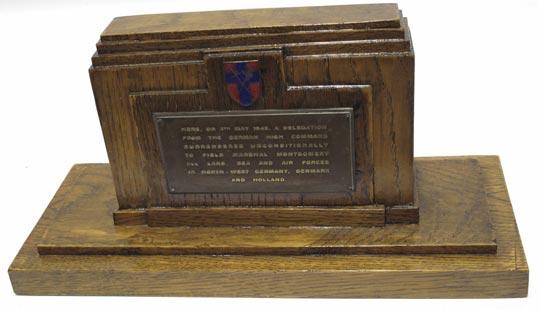
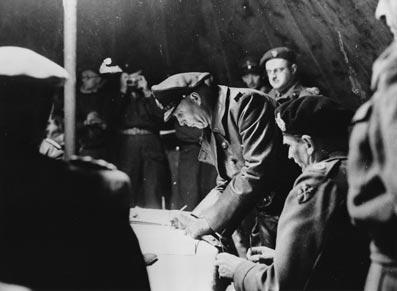
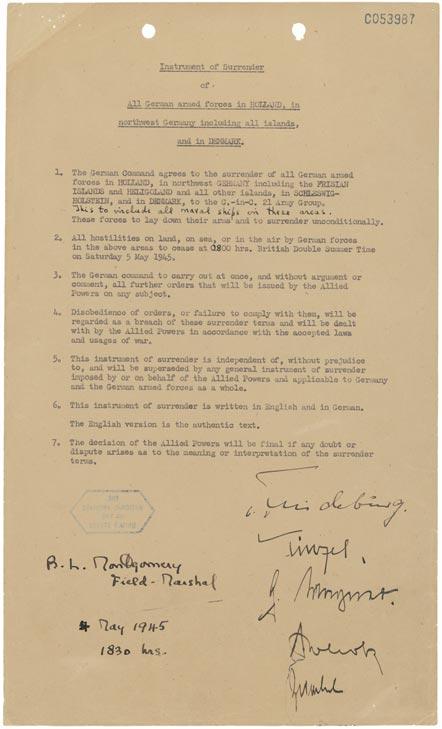
At the centre of this month’s article is an object from the REME Museum’s collection that marks what can be considered one of the most significant moments of the British Army’s history. It is a small wooden model of the stone plinth and plaque erected on Lüneburg Heath commemorating the surrender of German forces in NorthWest Europe in May 1945. The metal plate is inscribed ‘Here, on 4th May 1945, a delegation from the German High Command surrendered unconditionally to Field Marshal Montgomery all land, sea and air forces in North-West Germany, Denmark and Holland.’ Featured above the plaque is the shield of 21 Army Group, renamed the British Army of the Rhine (BAOR) in August 1945, which was the primary Britishled formation in North-West Europe in the closing stages of the Second World War.
Bernard Law Montgomery
Bernard Law Montgomery was one of the most prominent and successful British commanders of the Second World War, perhaps best known for leading the Allied forces to victory at the Second Battle of El Alamein in October 1942, and later commanding the invasions of Italy and Normandy. Promoted to the rank of Field Marshal in 1944, he was highly respected by his soldiers for his meticulous planning, morale-boosting leadership style, and his determination to minimise casualties. His thorough but cautious strategies, however, often caused
friction with American allies and fellow Commanders. A controversial and polarising figure, he famously lacked diplomacy and tact when dealing with others, and was described by Winston Churchill as “in defeat, unbeatable; in victory, unbearable.” After the war, Montgomery was created a Knight of the Garter and Viscount Montgomery of Alamein.
German Surrender at Lüneburg Heath
The Second World War drew to a close as the Allied forces crossed the River Rhine at the end of March 1945 and executed a rapid advance through North-West Germany. April saw the breakdown and encirclement of German defences as 21 Army Group and the American Ninth Army met at Lippstadt as part of Operation VERITABLE, forming a pincer around Germany’s Army Group B. By the end of April, British and American troops had linked up with their Soviet allies, the Red Army, on the River Elbe, severing German forces and trapping the last substantial German fighting force left on the western front in the Ruhr industrial heartland. The Allies captured the cities of Bremen and Hamburg, and reached the Baltic Sea at Lübeck and Wismar on 2 May. The rapidly shrinking pockets of German troops began to surrender by the thousands, and over 300,000 Germans became prisoners of war.
Lüneburg had been captured by the British forces on 18 April 1945, and Field Marshal Montgomery established his
The model of the stone memorial erected on Lüneburg Heath, in the Museum’s collection. (1968.886)
Tactical Headquarters (TAC HQ) on Timeloberg hill in the village of Häcklingen. A German delegation led by the new Commander-in-Chief of the German navy, Admiral HansGeorg von Friedeburg, crossed the British lines North of Hamburg and was escorted to the headquarters on 3 May. They had been sent by Grand Admiral Karl Dönitz, who had been nominated Head of State and Supreme Commander of the German armed forces following the death of Adolf Hitler on 30 April, to negotiate with the British Field Marshal. Dönitz hoped that a partial surrender of Army Group Vistula, which was being cut off to the East by the advancing Red Army, might buy time for German troops to evade Soviet capture and escape through the Baltic Sea ports. Montgomery snapped back that he had never heard of any of the officers in the delegation, and rejected their offer with characteristic bluntness. He instead demanded the unconditional surrender of all German forces on his northern and western flanks. This included the Netherlands, all of North-West Germany, Denmark, and all naval ships in these areas. Should they refuse, Montgomery threatened to press on with air and ground attacks against military and civilian German targets. The German delegation left to confer with Dönitz, and were given 24 hours to do so.
They returned to Montgomery’s TAC HQ tent the following day, May 4, at 17:00 hours. After keeping the party waiting outside in the rain, Montgomery stepped out of his command caravan in Battledress uniform, then grinned and declared to a reporter, “This is the moment!”
For the ceremony, which was filmed by the British Pathé News and recorded for broadcast on radio by the BBC, he sat at the head of a table and announced the terms of the surrender into two BBC microphones. At 18:20, the German delegates signed the Instrument of Surrender which would come into force at 08:00 hours on Saturday 5 May 1945. The Field Marshal signed on behalf of the Allied Supreme Commander in Chief, General Dwight D. Eisenhower. A further unconditional surrender of all forces on land, sea, and in the air under German control was signed by Colonel General Alfred Jodl on May 7 at General Eisenhower’s Allied Expeditionary Force Headquarters at Reims, which was ratified in Berlin the following day. Though the war stretched on in the Far East, 8 May 1945 marked the end of the Second World War in Europe.
The forested heath upon which the signing took place had long served as a significant German defence force training ground and was considered the birthplace for German armies. After the war, a stone memorial was erected on the site, quarried and constructed by 855 Quarrying Company and 5 Engineer Base Workshops, Royal Engineers. Five German soldiers were employed to guard the memorial at all hours, day and night, though by the end of 1955 the annual cost of security was over 100,000 Deutsche Marks, and the guard was withdrawn.
When the bronze text was stolen and the stonework defaced, it was dismantled and re-erected at the Royal Military Academy in Sandhurst in 1958. A limited series of commemorative inkwells of the memorial were produced and are believed to have been presented as gifts for Montgomery’s staff. The model in the REME Museum’s collection is one such piece, and it was donated to the Museum in 1968.
REME’s Movements
REME played a decisive role in sustaining the Allied advance through Germany in the final months of the war, proving beyond doubt the value of a dedicated Corps of Craftsmen and Engineers embedded within the British Field Army. Their push through the heart of the Reich tested men and machines alike. Road verges were heavily mined, leading to frequent tank casualties. During the last five weeks of fighting, the Guards Armoured Division suffered more than 220 tank casualties.
At this late stage of the war, transport was suffering from considerable wear, and mechanical breakdowns were increasing. Nevertheless, 21 Army Group made a steady advance following the crossing of the Rhine. The opposition remained fierce, but progress was in full flow and it was evident the end was in sight. 8 Corps, 12 Corps, and 30 Corps pursued the enemy for five weeks after the Rhine crossing, covering between three and four hundred miles.Every bridge or obstacle they faced was likely to become a bottleneck in the advance, but REME were prepared and well-equipped, ready to assist with recovery vehicles when needed. When crossing the Elbe River, for example, a beach recovery Section was made available for recovery at the bridges, and this proved indispensable once again at Artlenburg, where a large and steep hill rendered a bridge exit nearly impassable. Officers on motorcycles with tractors at call were organised along the advance routes, and Caterpillar D8 tractors and Armoured Recovery Vehicles were kept continuously busy clearing abandoned vehicles that blocked the roads. Recovery was generally limited to clearance during the day
General Admiral von Friedeburg signing the Instrument of Surrender. Field Marshal Montgomery sits beside him. Image courtesy of the National Archives Catalog, The U.S. National Archives and Records Administration
and backloading at night, facilitated by the formation of four moonlight battery Workshops from two independent Searchlight Battery Workshops for the purpose of illuminating forward areas at night. This enabled operations to continue at night unimpeded. In the North-West Europe campaign, the AntiAircraft component took a greater proportion of the total REME effort than in any other theatre.
The practice of leapfrogging Workshops had also become a principle of REME operation in the field. Third line Workshops supplemented Light Aid Detachments and Brigade Workshops, which had to keep pace with their units and formations. Each one leap-frogged over the others a considerable distance after remaining in a location long enough to do a significant amount of repair work. So vital was the contribution of REME that Montgomery himself famously described the Corps as “the punch in the Army’s fist.”
This final advance was the culmination of hardwon experience that had been forged in the deserts of North Africa, refined in Sicily and Italy, and further developed in the campaign of North-West Europe. This article is the first of a wider series examining the achievements of REME alongside Montgomery throughout the Second World War.
Information in this article is taken from E:07.0981.02 and A:1961.0644.
The Instrument with which all German armed forces in Holland, North-West Germany, Frisian Islands, Heligoland, Schleswig-Holstein, and Denmark surrendered, signed by Montgomery and the German delegation. Image courtesy of the National Archives Catalog, The U.S. National Archives and Records Administration
Alan Taylor 22773757 REME
Scribe: Graham A Matthews, Secretary Lincolnshire Branch REME Association
Alan was born 7th August 1933 in Wrangle Lincolnshire the fifth of 5 children of James and Peg Taylor. Alan went to Friskney Primary School and then won a scholarship to Skegness Grammer School. He followed his brothers Frank and Gordon into the REME in 1951 on a 5/7-year Regular engagement, completing basic training in 5 Platoon D Coy Blandford followed by trade training as a VM at 11 Battalion Ellesmere Salop.
Alan was posted to LAD RASC Training Battalion Farnborough before sailing on the Empire Pride to Japan. Alan was then shipped to Korea and stationed at Youg-Doug-Po; in Aug 1954 Alan sailed on the Empire Orwell to Port Said and was stationed at Fayid. Shortly after, Alan was posted to Cyprus serving in the Station Wksp REME Larnaca and then to the new REME base Wksp Dhekelia.
When his tour was over Alan returned to England and had just enough time to marry Margaret before he was recalled, as required for the Suez Crisis, sailing on the SS New Australia and was attached to 57 HM RA. He eventually returned to England on the Empire Clyde and demobbed in 1957. During his service Alan attained the rank of Corporal.
Alan had two brothers who served in the REME at the same time; a past article in the Craftsman from The Lincolnshire Branch (The Taylors Tale) details the three brothers’ time in the REME.
Alan moved to Leverton with Margaret; initially moving in with his ‘in laws’ before moving to Lacey’s Lane and then having their own house built in Leverton. They had 2 children, Jane in 1963 and Robert in 1966. Alan had several jobs including working alongside Vernon Forth, Margaret’s Cousin, and a fellow member of the REME Association, at Dickinsons Garage and AEL Motors until eventually he set up as a self-employed mobile mechanic, able to service and repair everything from motorcycles to HGVs and farm machinery.
Alan and brother Frank were both founder members of the Lincolnshire Branch, being staunch supporters of the
REME Association, attending meetings and functions. After a short illness Alan died on Tuesday 13 January 2026. Alan was a proud man, a family man, a good friend who will be missed by everyone who knew him.
A service of remembrance was held at the Boston Crematorium on Tuesday 10th February 2026 where the family and many friends said their fond farewells, the Lincolnshire Branch Standard with Escort was paraded and final respects paid.
Warrant Officer Class 1 Sam Spratt
Scribe: Shaw Spratt
It is with deep sadness that we announce the passing of Sam Spratt, a devoted Husband, Father, and Grandfather. Sam served with distinction for 22 years in the Royal Electrical and Mechanical Engineers (REME) as an Armourer, spending much of his service in Germany with the Guards, where his skill, dedication, and camaraderie earned him the respect of all who served alongside him.
Beyond his military career, Sam had a lifelong love of hockey and fishing; passions that brought him joy and moments of quiet reflection.
He will be dearly remembered for his unwavering commitment to his family and his service, leaving behind his loving Wife Lorna, three Sons, and seven cherished Grandchildren.
Sam’s memory will live on in the hearts of all who knew him, both in the military and at home.
Death Notices
CRAXFORD – Col (Retd) Samuel Charles Craxford passed away in 29th January aged 91. Service dates are 1954-1989.
GREGG – Former WO1 ASM Gordon Gregg passed away on 13th August 2025 aged 78. He served with the Corps between 1963-1987.
HEENAN – Lance Corporal (Retd) Duncan Charles Heenan-known as Pepsi. Passed away on 20th January 2026. Aged 66. Service dates 1979-1986 Served in West Germany attached to: 4 Armoured Division Tank Transport Regiment in Duisberg. 9th/12th Royal Lancers (Prince of Wales’s) in Hohne. 1st Battalion Welsh Guards in Hohne.
MAUND – WO2 (Retd) John Maund passed away 28th January 2026 aged 56. Served dates were 1986 to 2008.
TAYLOR – 22773756 Cpl Alan Taylor DoB 7th Sept 1933 passed away on Tuesday 13th Jan 2026 aged 93. Service Dates Sept 1951 to Jan 1957 Served in UK, Japan, Korea, Egypt, Cyprus and Suez.
Death Notice Requirements
In order to publish a death notice we require the following information: Surname, first name, rank, full date of death, ages and dates of service. An obituary with additional career and life information is welcome. To inform us of the death, please contact Pamela Bailey-Yates, Corps Welfare Assistant, Email: welfare@remecharity.org
London Gazette
27 January 26 REGULAR ARMY
Short Service Commissions
Officer Cadet Peter Stuart Willoughby BAKER 30354784 from The Royal Military Academy Sandhurst to be Second Lieutenant 13 December 2025
Officer Cadet Nathan James BESTWICK 30441772 from The Royal Military Academy Sandhurst to be Second Lieutenant 13 December 2025
Officer Cadet Peter Michael BOYLE 30306985 from The Royal Military Academy Sandhurst to be Second Lieutenant 13
December 2025
Officer Cadet Alistair James CARGILL 30371906 from The Royal Military Academy Sandhurst to be Second Lieutenant 13 December 2025
Officer Cadet Ben Joseph COOKSON 30432924 from The Royal Military Academy Sandhurst to be Second Lieutenant 13
December 2025
Officer Cadet Christopher James CORKILL 30371908 from The Royal Military Academy Sandhurst to be Second Lieutenant 13 December 2025
Officer Cadet Richard James DUNBAR 30328789 from The Royal Military Academy Sandhurst to be Second Lieutenant 13
December 2025
Officer Cadet Samuel Antony Merlin FELTHAM-WHITE
30345145 from The Royal Military Academy Sandhurst to be Second Lieutenant 13 December 2025
Officer Cadet Grace Frances GREEN 30318664 from The Royal Military Academy Sandhurst to be Second Lieutenant 13
December 2025
Officer Cadet James Hardie GREIG 30400048 from The Royal Military Academy Sandhurst to be Second Lieutenant 13
December 2025
Officer Cadet Luke Geoffrey Joseph SEARLE 30270892 from The Royal Military Academy Sandhurst to be Second Lieutenant 13 December 2025
Officer Cadet Toby Aiden SMITH 30434777 from The Royal Military Academy Sandhurst to be Second Lieutenant 13
December 2025
Officer Cadet Toby Oliver WADDINGTON 30378582 from The Royal Military Academy Sandhurst to be Second Lieutenant 13 December 2025
03 February No entries 10 February No entries 17 February No entries 24 February No entries
A Huge Thank You from
We’re incredibly grateful for the generous dona琀ons received lately, and we especially want to highlight the con琀nued support from our serving Ocers, Soldiers, and re琀red REME Ins琀tu琀on and Associa琀on members. Your commitment keeps us moving forward. Since 01 January 2026 we have received very generous dona琀ons from:
The Edinburgh Trust £2000
Mrs Zoe Bascombe in memory of Si ‘Bae’ Bascombe - private amount
5 REME £450
Mr Kevin O’Connor £375 in memory of SSgt Al昀e Hedley
D G Weaver £250
REME Scotland Gathering £230 - belated entry
Mrs Carol Parker £100
Other notable dona琀ons:
Caroline Leonard, Nathan Cane, Lisa Bailey, Amanda Bri琀on, Stuart Bass, Donna Conway
For all fundraising queries please email Hugh McNulty via fundraising@remecharity.org
Need a hand? We’re here for you. Whether you’re currently serving or a veteran, The REME Charity is here to support you during tough 琀mes. Reach out directly at WOYM@remecharity.org for fully con昀den琀al advice and support. S琀ll serving? You can also speak to your Unit Welfare POC for guidance.
Leave a las琀ng legacy with The REME Charity. If you’d like to support our work through a gi昀 in your will, you can do so by adding a codicil. As a registered charity (No. 1165868), dona琀ons are exempt from inheritance tax— helping your legacy go even further for REME personnel and veterans.
Social Media. If you’d like to support our work, or adver琀se your REME Charity events through social media feel free to tag us in your posts and use the following hashtags #REMECharity #OnceREMEAlwaysREME. You can also email communica琀ons@remecharity.org for help spreading awareness of your fundraising across The REME Charity social media channels, or on REME Connect.
Corps Calendar 2026
More information regarding Corps Mess Functions can found by scanning the QR Code, or by accessing the ‘REME Connect’ website or alternatively email; REMERHQ-0Mailbox@mod.gov.uk for all general enquiries. All dates correct at time of printing, please check your monthly Craftsman magazine for amendments.
Leaving the Regular REME?
Why not join the
Reserve?
Security Clearance
Holding SC can give you access to higher paid roles with some companies. As a reservist you maintain this accreditation.
Tax-free bounty
On satisfactory completion of your annual training, you receive a tax-free bounty of over £2k!!!
Your financial security
It makes financial sense. Get an annual tax-free bounty, plus pay, plus pension contributions. Supplement your salary or take the family on holiday.
Your support network
Changing careers is scary. Shared experience builds bonds and friendships like nothing else, it’s worth keeping hold of for when you need it most.
Your option to return (should you need)
Miss your old life?
It could take you 6-12mths to rejoin but as a Reservist, it’s a simple transfer form.
What’s in it for me?
Sport & AT
Whether you love sailing or skiing, as a reservist you get paid to participate in Regular Army sport and AT events.
Holiday pay
Sounds strange, but Reservists get holiday pay too (1 RSD for every 10 trg days).
Get early access to jobs not advertised to civies through the RAJA jobs website, REME only! Wellbeing
Settled
Pension abatement
No pension abatement for Reservists on RSDs. You receive all your pension; your Reserve pay; and contributions to your Reserve pension.
Keep learning
Reservists get access to SLC credits and DLE. Keep growing and learn new skills to support your new career ambitions.
Rail card
Reservists get the Forces Railcard (1/3 off travel)
Pay
Either ¼ (2hrs) ½ (4hrs) ¾ (6hrs) or full (8hrs) Reserve Service Days (RSDs) pay @ rank and includes 5% X Factor
Career progression
As a Reservist, you also get annual appraisals, so career progression is still possible including SSE commissions.
Home to Duty Travel
Get your mileage paid for by the Army to attend all training nights and weekends (up to 50miles@MMA rates)
Rank
Pte-SSgt and 2Lt-Capts can normally transfer and keep their rank. WOs might be asked to revert (dependant on available PIDs).
Mobilised service
Between jobs? That’s ok because you can volunteer to be mobilised for overseas deployments and operations on the same pay and allowances as a Regular.
Only 19 days each year
To qualify for your tax-free bounty, your annual commitment is19 days for your first 3 years (only 27 days afterwards).
Reduced ITRs
To qualify for your tax-free bounty each year, you only complete an SCR, ITR Behaviour’s and no annual camp (first 3 years only).