INTRODUCTION
The Real Cost of Keeping Legacy ERP Isolated
• Most organizations do not suddenly decide their ERP system has failed. The issues appear slowly—manual data handling, repetitive approvals, delayed reporting, and disconnected tools. Initially, these feel manageable. Over time, they silently reduce efficiency and slow decision-making.
• Traditional ERP systems were built to control transactions within a closed environment. While they are reliable for accounting and compliance, they struggle to function in today’s connected business landscape. Modern operations depend on CRMs, cloud accounting, HR platforms, analytics tools, and customer-facing systems.
• When ERP systems cannot interact smoothly with these tools, they become isolated data repositories rather than operational engines.
Why Legacy ERP Systems Fall Short in
API-Driven Environments
• Modern software ecosystems rely on APIs to exchange data and trigger workflows instantly. However, most legacy ERP platforms were never designed with API-first architecture.
• APIs were often added later as limited extensions, exposing only basic data while restricting access to workflows and transactions. Authentication methods are outdated, documentation is inconsistent, and real-time processing is rare.
• Instead of simplifying integration, APIs become fragile points of failure.
• This makes automation complex, monitoring difficult, and integration maintenance expensive.
The Automation Limit Inside Traditional ERP
Platforms
• Legacy ERP automation usually works only within individual modules. Finance automates accounting entries. Procurement automates approvals.
• But real-world business processes cross departments and systems.
• For example, closing a sales deal might require actions across CRM, finance, inventory, logistics, and compliance tools. Legacy ERP systems cannot coordinate these workflows efficiently.
• Employees end up manually transferring data, sending emails, and reconciling systems—becoming the automation layer themselves.
• This approach does not scale and introduces risk.
Why ERP Extension Is a Smarter Strategy Than Replacement and
Zoho Creator as a Flexible ERP Extension Platform
• Replacing a legacy ERP is expensive, risky, and disruptive. Extending it offers a safer alternative.
• ERP extension keeps the core system intact while adding a modern layer around it. The ERP continues to function as the system of record, while innovation happens externally.
• This approach enables APIs, automation, integrations, and custom workflows without modifying ERP code or affecting stability.
• Extension transforms legacy ERP from a limitation into a foundation.
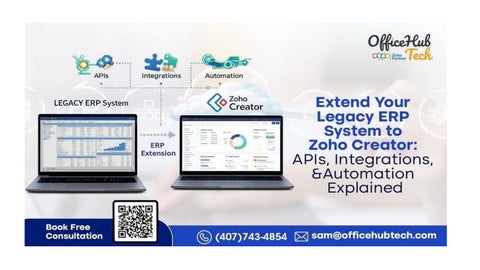
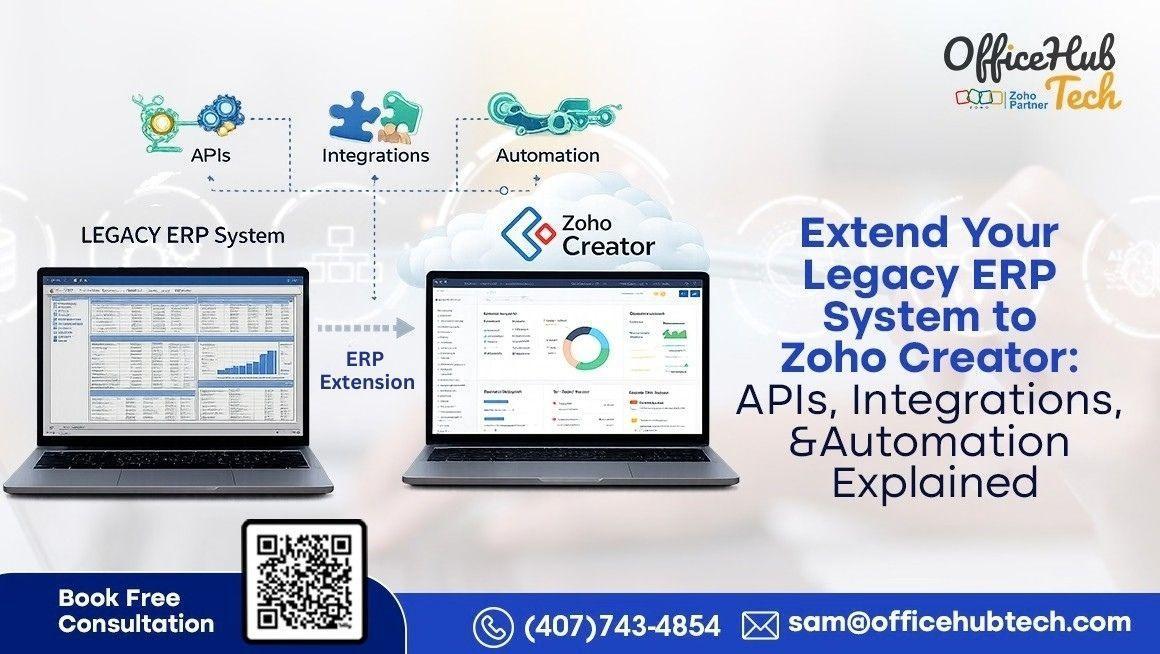
• Zoho Creator is not positioned as an ERP replacement. Instead, it acts as a low-code extension layer built for integration and automation.
• Organizations can design applications that reflect real operational workflows rather than forcing processes into rigid ERP structures.
• Zoho Creator interacts with ERP systems through APIs, manages logic externally, and syncs validated data back to the ERP securely.
• This allows businesses to modernize capabilities without disrupting trusted systems.
Closing the API Gap with Zoho Creator
• Zoho Creator supports modern integration standards such as REST APIs, OAuth authentication, webhooks, and JSON-based data exchange.
• It acts as a translation layer between legacy ERP systems and modern applications.
• When ERP APIs are limited or inconsistent, Zoho Creator normalizes data, manages error handling, retries failed processes, and exposes clean APIs to downstream systems—without exposing the ERP directly.
• As a result, even closed ERP platforms can participate in real-time digital workflows.
Using APIs to Expand ERP Capabilities and Security and
Control in ERP Extension Architecture
• Common API integrations include:
• • Twilio for SMS and WhatsApp notifications
• Slack for approval alerts and exceptions
• SendGrid or Mailgun for transactional emails
• Zoom for automated meeting scheduling
• Zoho Creator manages authentication, transformation, and orchestration without modifying ERP systems.
• Extending ERP systems does not weaken security. Zoho Creator enforces role-based access, encrypted data transfer, and detailed audit trails.
• ERP access is limited to APIs, reducing exposure and risk.
• This architecture aligns with enterprise governance requirements while supporting scalability.
Relevance
Conclusion: Extending ERP Is the Path to Long-Term
• Legacy ERP systems struggle not because they are outdated, but because they operate in isolation.
• By extending them with Zoho Creator, organizations unlock real-time integrations, automation, and cross-platform workflows that modern business demands.
• As the Top Zoho Creator Developer and Implementation Company, OfficeHub Tech delivers scalable, secure ERP extension solutions that evolve with business needs.
• As the Best Legacy ERP System Modernisation and Extension Services Provider in the US, India, and UAE, OfficeHub Tech helps enterprises modernize ERP capabilities without replacing core systems.
ABOUT US
OfficeHub Tech is a Premier Zoho consulting and business automation firm delivering end-to-end digital transformation solutions for growing and enterprise businesses.
With 17+ years of industry experience and 10+ years as an Authorized Zoho Partner, we help organizations streamline operations, improve visibility, and scale efficiently using Zoho, AI, and integrated third-party platforms.


Headquartered in Florida, USA
Serving clients globally
Trusted by Businesses Worldwide
• 17+ years industry experience
• 10+ years Authorized Zoho Partner
• 50+ certified professionals
• 900+ successful projects
• 250+ global clients
• 99% customer retention
• 24/7 support & SLA-driven delivery