Why Legacy ERP Systems Fall Short in API-Driven Environments
Modern software ecosystems rely on APIs to exchange data and trigger workflows instantly. However, most legacy ERP platforms were never designed with API-first architecture.
APIs were often added later as limited extensions, exposing only basic data while restricting access to workflows and transactions. Authentication methods are outdated, documentation is inconsistent, and real-time processing is rare. Instead of simplifying integration, APIs become fragile points of failure.
This makes automation complex, monitoring difficult, and integration maintenance expensive.
The Automation Limit Inside Traditional ERP Platforms
Legacy ERP automation usually works only within individual modules. Finance automates accounting entries. Procurement automates approvals. But real-world business processes cross departments and systems.
For example, closing a sales deal might require actions across CRM, finance, inventory, logistics, and compliance tools. Legacy ERP systems cannot coordinate these workflows efficiently. Employees end up manually transferring data, sending emails, and reconciling systems becoming the automation layer themselves. This approach does not scale and introduces risk.
Integration Risks Businesses Often Overlook
Legacy ERP integrations are commonly batch-based, syncing data at scheduled intervals rather than responding to real-time events. When integrations fail, errors are often silent data stops flowing, reports lose accuracy, and decisions are made on outdated information.
Fixing these issues usually requires specialized ERP consultants, system downtime, and lengthy troubleshooting cycles. The root cause lies in ERP systems designed to operate independently rather than as part of a distributed ecosystem.
Why ERP Extension Is a Smarter Strategy Than Replacement
Replacing a legacy ERP is expensive, risky, and disruptive. Extending it offers a safer alternative.
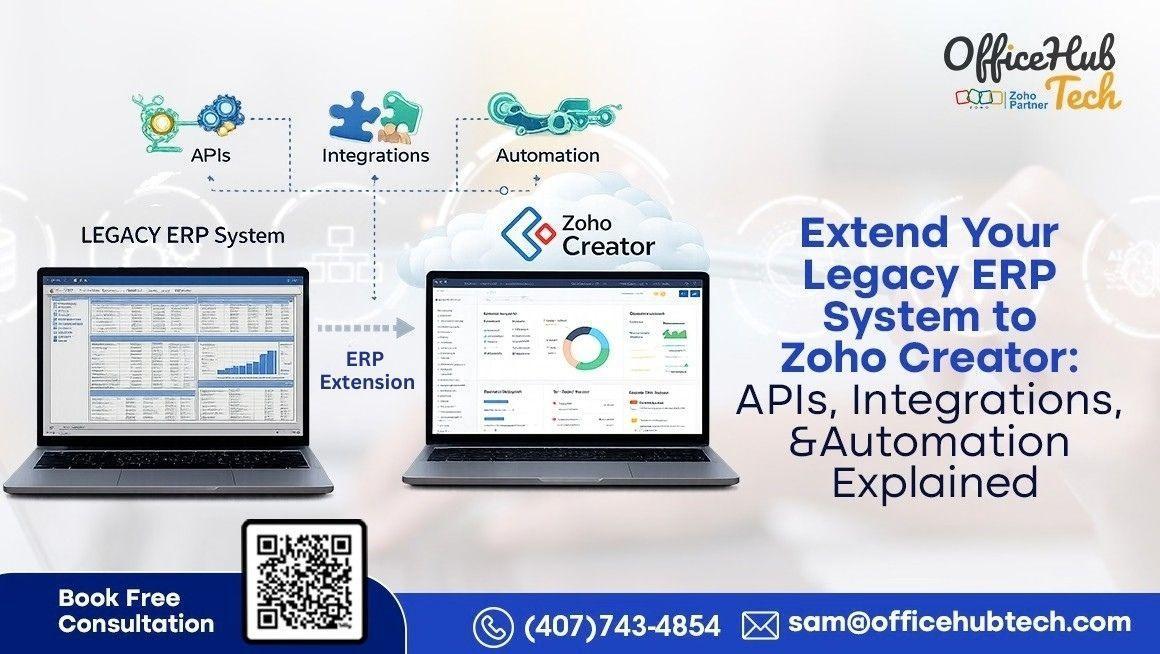
ERP extension keeps the core system intact while adding a modern layer around it. The ERP continues to function as the system of record, while innovation happens externally. This approach enables APIs, automation, integrations, and custom workflows without modifying ERP code or affecting stability.
Extension transforms legacy ERP from a limitation into a foundation.
Zoho Creator as a Flexible ERP Extension Platform
Zoho Creator is not positioned as an ERP replacement. Instead, it acts as a low-code extension layer built for integration and automation.
Organizations can design applications that reflect real operational workflows rather than forcing processes into rigid ERP structures. Zoho Creator interacts with ERP systems through APIs, manages logic externally, and syncs validated data back to the ERP securely.
This allows businesses to modernize capabilities without disrupting trusted systems.
Closing the API Gap with Zoho Creator
Zoho Creator supports modern integration standards such as REST APIs, OAuth authentication, webhooks, and JSON-based data exchange. It acts as a translation layer between legacy ERP systems and modern applications.
When ERP APIs are limited or inconsistent, Zoho Creator normalizes data, manages error handling, retries failed processes, and exposes clean APIs to downstream systems without exposing the ERP directly.
As a result, even closed ERP platforms can participate in real-time digital workflows.
Automation That Matches How Businesses Actually Operate
Zoho Creator enables event-driven, cross-system automation. Workflows can trigger based on ERP updates, CRM activities, inventory changes, or scheduled conditions. For example, a CRM deal closure can initiate credit checks, inventory validation, approvals, and accounting updates automatically—without manual ERP interaction. Exceptions are handled through conditional logic, and notifications are sent instantly. This orchestration level is rarely achievable inside legacy ERP systems alone.
Extending ERP Using the Zoho Ecosystem
Zoho Creator becomes more powerful when integrated with other Zoho applications. Instead of forcing ERP systems to handle every function, responsibilities are distributed across specialized tools.
Common integrations include:
• Zoho CRM for sales-driven workflows
• Zoho Books for accounting and compliance automation
• Zoho Inventory for real-time stock management
• Zoho People for HR-related approvals and asset tracking
• Zoho Projects for linking operations with financial data
• Zoho Analytics for cross-system reporting
• Zoho Mail for automated communication
• Zoho Flow for event-based integrations
Together, these tools allow Zoho Creator to act as a central orchestration layer while the ERP remains secure and stable.
Connecting Legacy ERP with Third-Party Applications
Modern businesses rely on external platforms such as accounting tools, payment gateways, logistics systems, and document management solutions. Zoho Creator supports seamless third-party integration.
For instance, QuickBooks integration enables financial synchronization without manual reconciliation. Zoho Creator manages data mapping, validation, and synchronization logic, ensuring consistency across platforms.
This connectivity is where ERP extension delivers immediate operational value.
Using APIs to Expand ERP Capabilities
Legacy ERP systems struggle to interact with modern communication, commerce, and analytics platforms. Zoho Creator bridges this gap by connecting ERP data with popular APIs, applying business logic externally, and triggering workflows securely.
Common API integrations include:
• Twilio for SMS and WhatsApp notifications
• Slack for approval alerts and exceptions
• SendGrid or Mailgun for transactional emails
• Zoom for automated meeting scheduling
• Microsoft Graph for calendars and documents
• Shopify for eCommerce synchronization
• DocuSign for digital contracts
• OpenAI for intelligent automation
• Google Maps and Analytics for operational insights
Zoho Creator manages authentication, transformation, and orchestration without modifying ERP systems.
Conclusion: Extending ERP Is the Path to Long-Term
Relevance
Legacy ERP systems struggle not because they are outdated, but because they operate in isolation. By extending them with Zoho Creator, organizations unlock real-time integrations, automation, and cross-platform workflows that modern business demands.
As the Best Legacy ERP System Modernisation and Extension Services Provider in the US, India, and UAE, OfficeHub Tech helps enterprises modernize ERP capabilities without replacing core systems.
As the Top Zoho Creator Developer and Implementation Company, OfficeHub Tech delivers scalable, secure ERP extension solutions that evolve with business needs.
FAQs
Q1: Can legacy ERP systems be extended without replacement?
Yes. Extension allows organizations to add new workflows and integrations externally while keeping the ERP core unchanged.
Q2: How does Zoho Creator integrate with ERP platforms?
Zoho Creator connects through APIs and webhooks to consume data, apply logic, and automate processes.
Q3: Why is automation difficult in legacy ERP systems?
Most legacy ERPs lack event-driven architecture and cross-system workflow support.
Q4: Does Zoho Creator support third-party integrations?
Yes. It integrates with Zoho apps and tools like QuickBooks, Slack, and Shopify.
Q5: Is ERP extension secure?
Yes. It improves security by limiting ERP access and enforcing governance controls.
Q6: How quickly can ERP extension be implemented?
Most projects deliver results within weeks since the ERP core remains untouched.
Source Originally published on: https://officehubtech.com
Contact Us
Address: 2480 Cherry Laurel Dr, STE #179, Sanford, FL 32771
Phone: +1 407 743 4854
Email: sam@officehubtech.com
Our Social Presence :
: https://www.linkedin.com/company/office-hub-tech-llc/
: https://www.facebook.com/people/Officehubtech/61557939612512/
: https://www.instagram.com/officehubtech/
: https://twitter.com/ZohoRPAExperts
: https://www.youtube.com/channel/UCbOmNa7PsQrVwWS_PulONWw