BELMONT g A True Original Story
[ President’s Report 2025 ]
Ohwhat a we’veyearhad....
[ President’s Report 2025 ]

[ President’s Report 2025 ]
Ohwhat a we’veyearhad....
[ President’s Report 2025 ]
We have been struck by how clearly the foundations of Belmont’s work came into view — foundations rooted in our Christ‑centered mission and our longstanding commitment to educating students of character, purpose and hope. What began years ago as faithful preparation has become visible in meaningful ways across our campus and beyond. This was a year when hard work bore fruit, when purpose became tangible and hope took shape through action.
This year, we stepped back to consider the story we are writing together across our community. It is one shaped by purpose, formation and deep commitment to serving the world.
Stories help us make sense of who we are and where we are headed. And like any good story, Belmont’s is shaped by more than achievements alone. It is shaped by people of character, by the settings around us, by creative and innovative work that drives the plot forward and by the hope that anchors everything we do.
Throughout 2025, we saw Belmont’s story unfold in powerful ways. In Nashville and beyond, partnerships deepened and new ones emerged, allowing Belmont to serve at the intersections of character, creativity and innovation. In classrooms, clinics, studios and neighborhoods, our community continued to ask a central question rooted in our Christ‑centered calling: How will we use our gifts to serve others?
Meaningful stories are rarely shaped without challenge. In a season largely marked by uncertainty, division and hesitation across higher education and beyond, Belmont chose a different posture. Where others pulled back, we continued to build — leaning into collaboration, conviction and care.
At the heart of our story is a hope grounded in God’s faithfulness, a hope that does not ignore challenge but is forged through it and lived out through service, hospitality and shared vocation. This hope calls us to imagine boldly and build wisely.
Rooted in our mission, we trust that God’s story for Belmont will continue to unfold as we seek to meaningfully impact the world. What follows is our story, told through the characters who shape it, the settings that form it and the work driving it forward. It’s a story of a community committed to excellence, guided by faith and prepared to step into the next chapter together.
We are grateful to share this story with you.
In Christ,
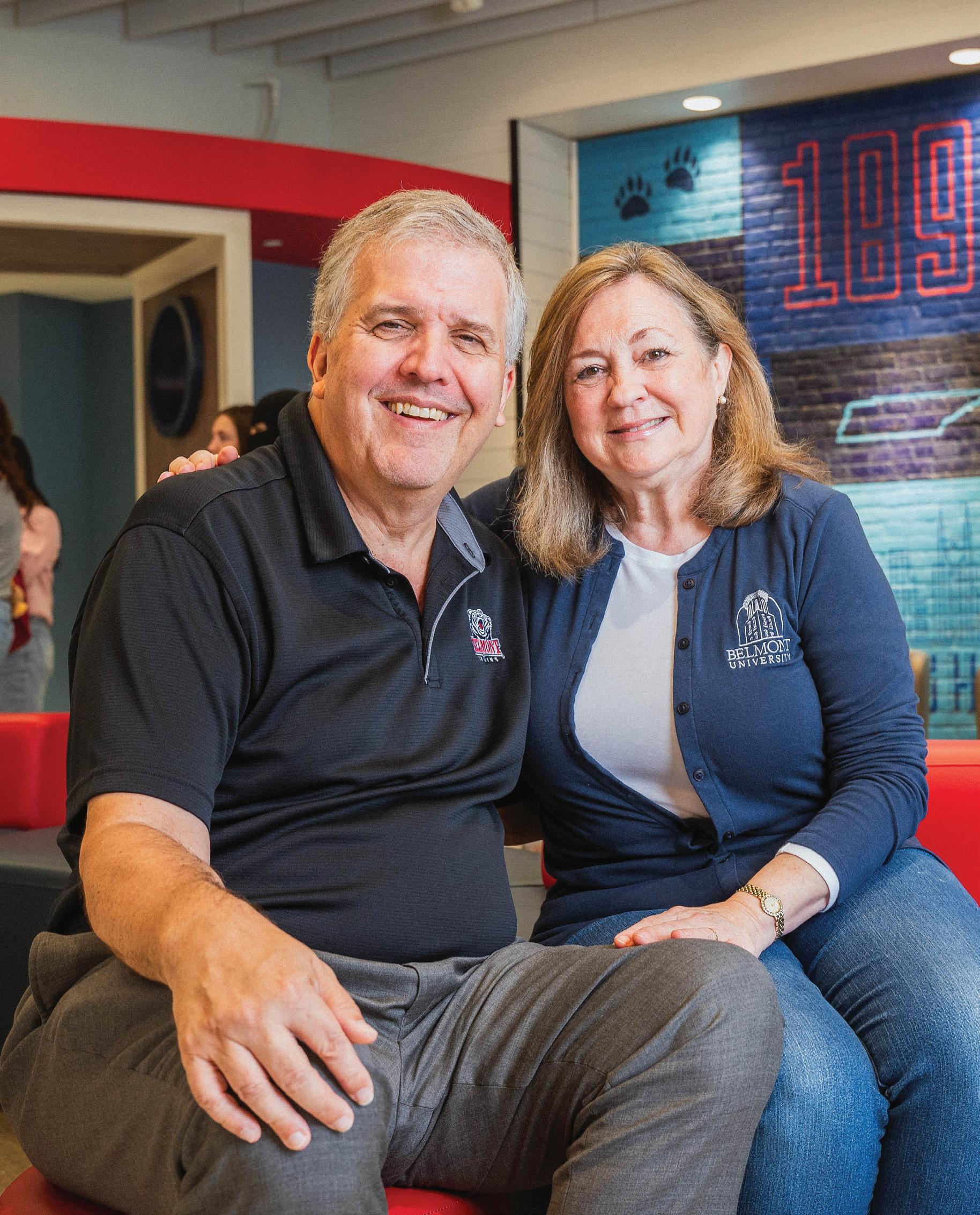
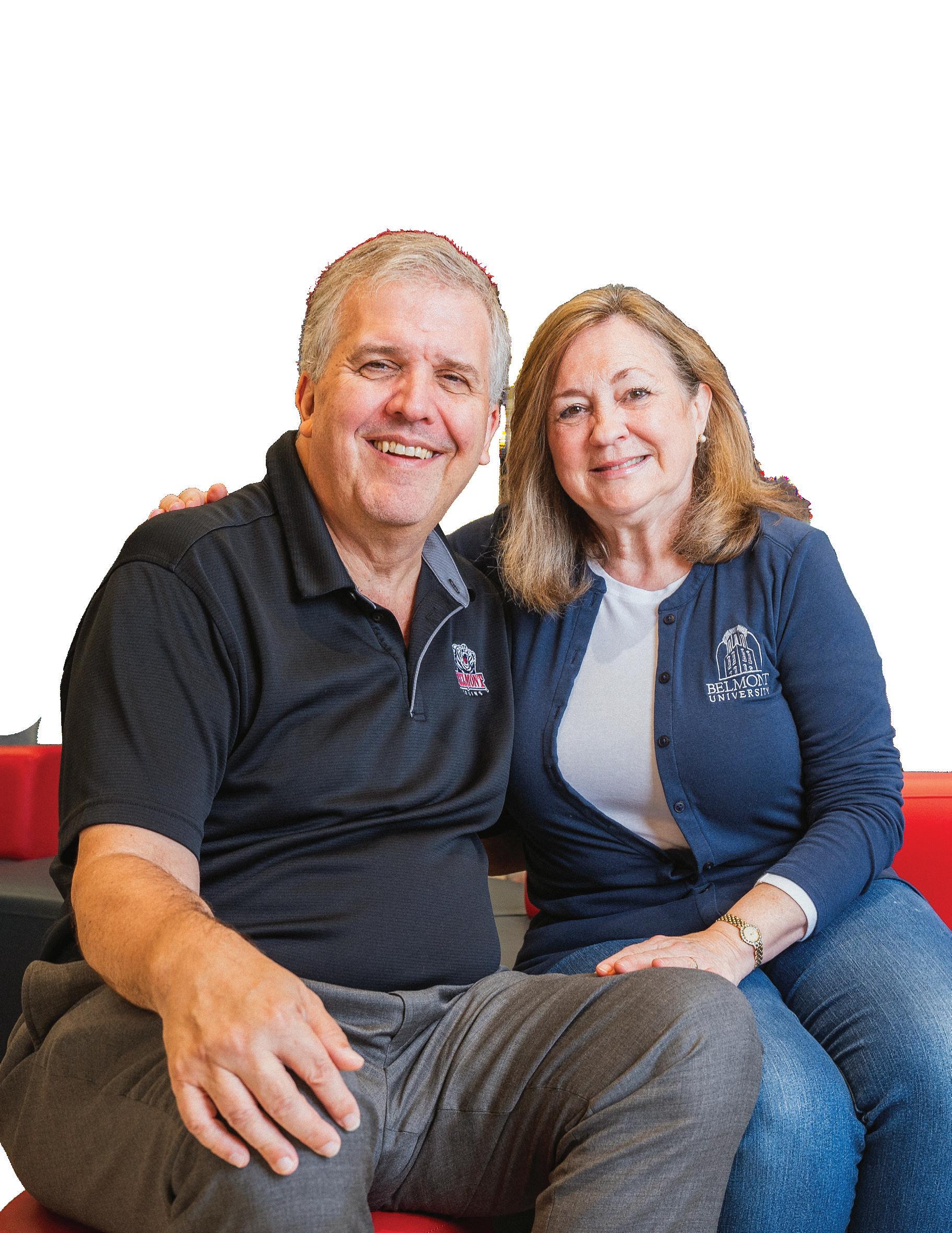
Greg & Susan

Our story is written by people of integrity and purpose.
At every step in our journey, it has been people of character who have made Belmont what it is. Rooted in our Christ-centered mission, these people — the characters in our story — are known for their creativity, generosity, excellence, hospitality and faith. This year, we welcomed new leaders to our cast of characters and celebrated the successes of those who have spent many years under the Tower. We also made concrete what has always been true about Belmont by elevating character as a guiding principle and launching the Belmont Formation Collaborative — a unified framework that houses key formation offices and initiatives while supporting strategic formation efforts across campus. The Collaborative ensures every person in the Belmont narrative is formed with integrity and purpose at the center.
Character? Yeah,we’re working on it!
Achieved a %
Career Outcomes Rate [class of 2024]
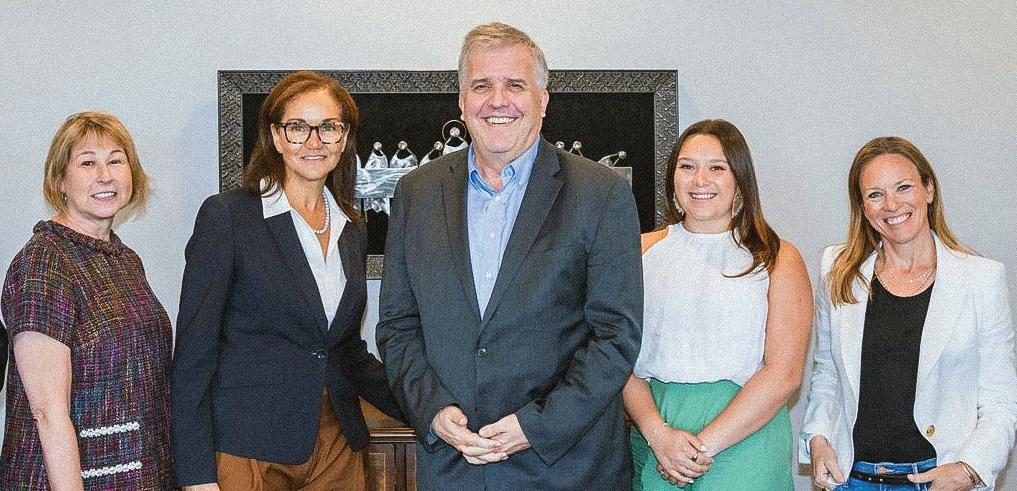
Supported by grants from The Kern Family Foundation and the Lilly Endowment’s Educating Character Initiative, the Belmont Formation Collaborative brought together offices including general education, wellness, spiritual formation and service-learning. To support this transformative work, Drs. John and Charlotte Witvliet arrived as senior scholars, each bringing nearly 30 years of higher education experience. Their complementary expertise in theology, worship and character development deepens Belmont’s Christcentered approach to whole-person formation rooted in faith. Their arrival coincided with other leaders whose careers embody the character the Collaborative seeks to cultivate. Dr. Randy V. Bradley joined as dean of the Jack C. Massey College of Business, bringing business and health care entrepreneurial leadership. Rick Archer, whose work has shaped everything from homeless recovery centers to an international restoration project, became dean of the O’More College of Architecture & Design. Six new members joined the Board of Trustees, bringing expertise across industries vital to Nashville and beyond.
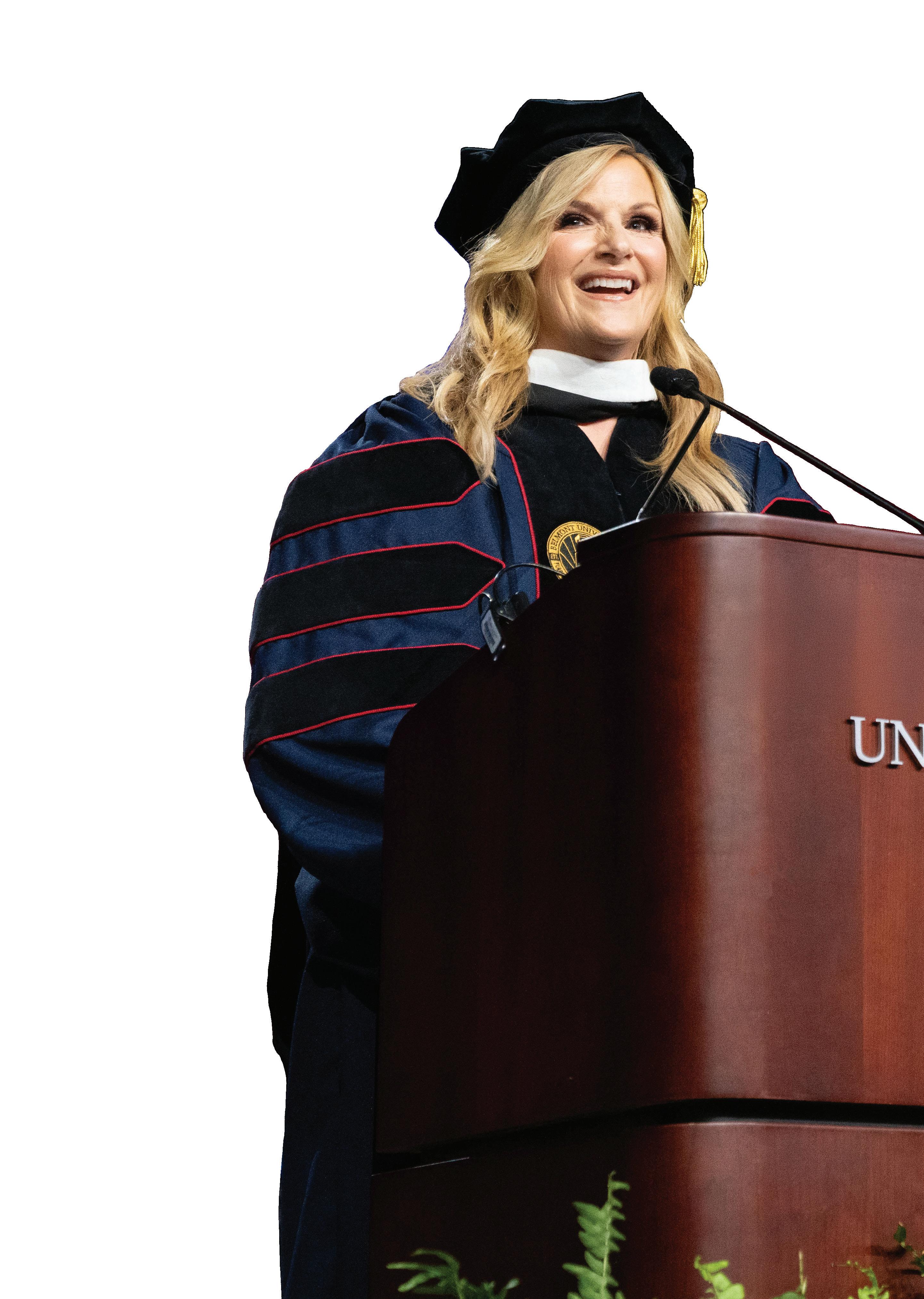
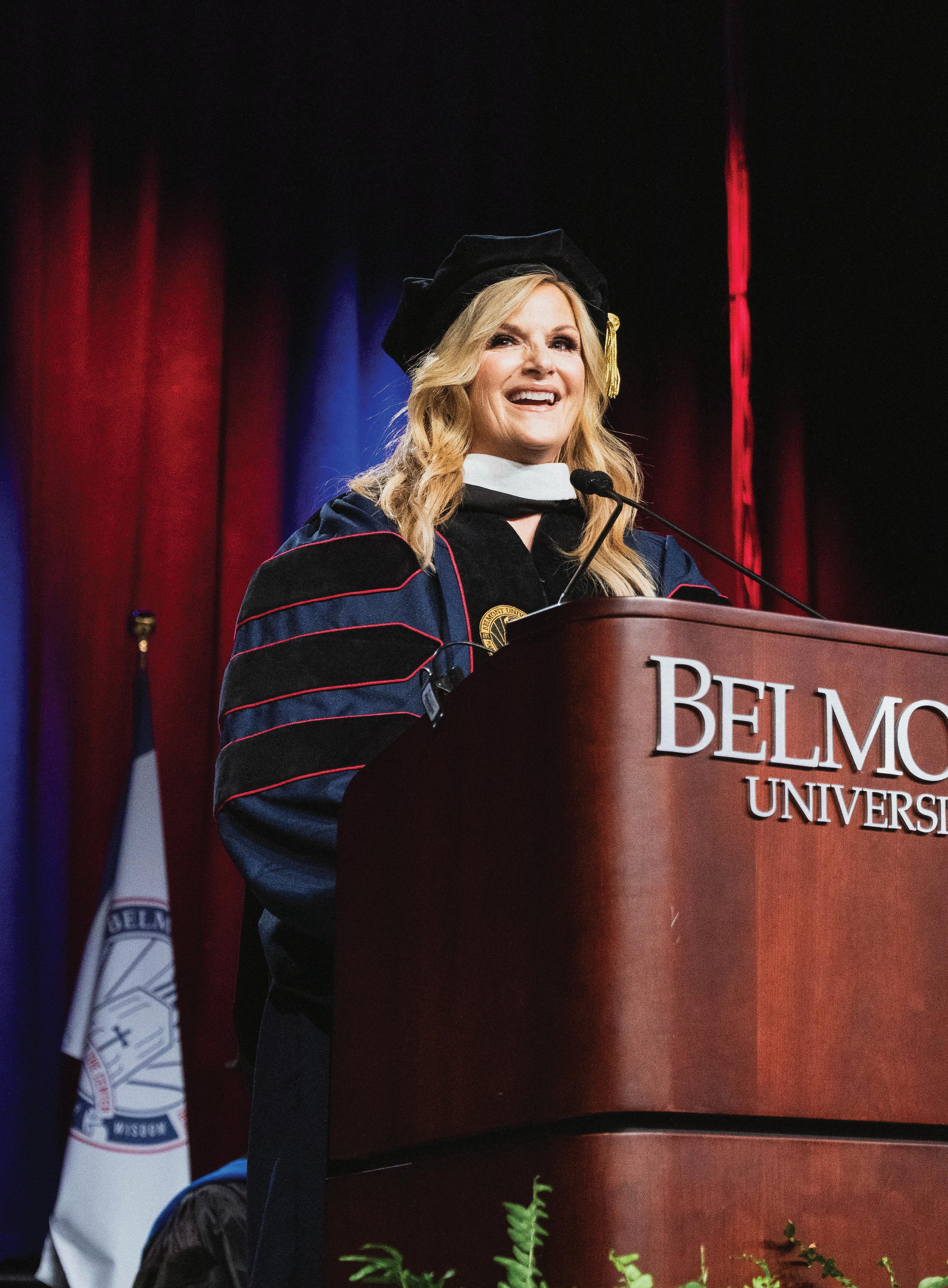
At spring commencement, the University proudly recognized four individuals with honorary doctorates: Grammy-winning Belmont alumnae Trisha Yearwood and Hillary Lindseyand social impact entrepreneurs Dr. Kim Tan and MichaelBontrager. Plus, the University’s commitment to formation now extends even further to our youngest community members through Little Bruins Preschool, a faith-based, early childhood initiative launched in early 2025, where children ages 3-5 from Belmont employee families and the surrounding neighborhood begin their journey of whole-person development.
Character reveals itself through both persistence and breakthrough moments. Seconds before Dr. Kristian Dambrino received her Doctor of Nursing Practice degree in May, she learned of her Fulbright Global Scholar Award acceptance for mental health research in India and Indonesia. “There’s nothing more gratifying than a cultural exchange and mutual learning,” Dambrino said. “I cannot wait to work alongside the psychiatrists and nurses in these two countries.”
Mathematics professor Dr. Andy Miller competed on “Jeopardy!” after nearly three decades of auditions, embodying the wisdom that persistence matters as much as outcome. Alumnus Ashley Gorley was inducted into the Songwriters Hall of Fame with more than 80 No. 1 radio singles, joining songwriting legends while continuing to mentor the next generation through his publishing company. And Belmont Public Relations students were recognized internationally as the only Public Relations Student Society of America Chapter to earn Star Chapter Award each year since the award was established.
Belmont alumna Cassie Donegan claimed the Miss America 2026 crown and Preliminary Talent Award, showcasing years of training and ongoing mentorship from instructors like Jo Lynn Burks, her professor who remained her vocal coach for nearly 10 years. Fellow alumna Sadie Schiermeyer finished as first runner-up, marking a historic sweep of the top two spots by Belmont women. Current student Madison Whitbeck also competed in the pageant.

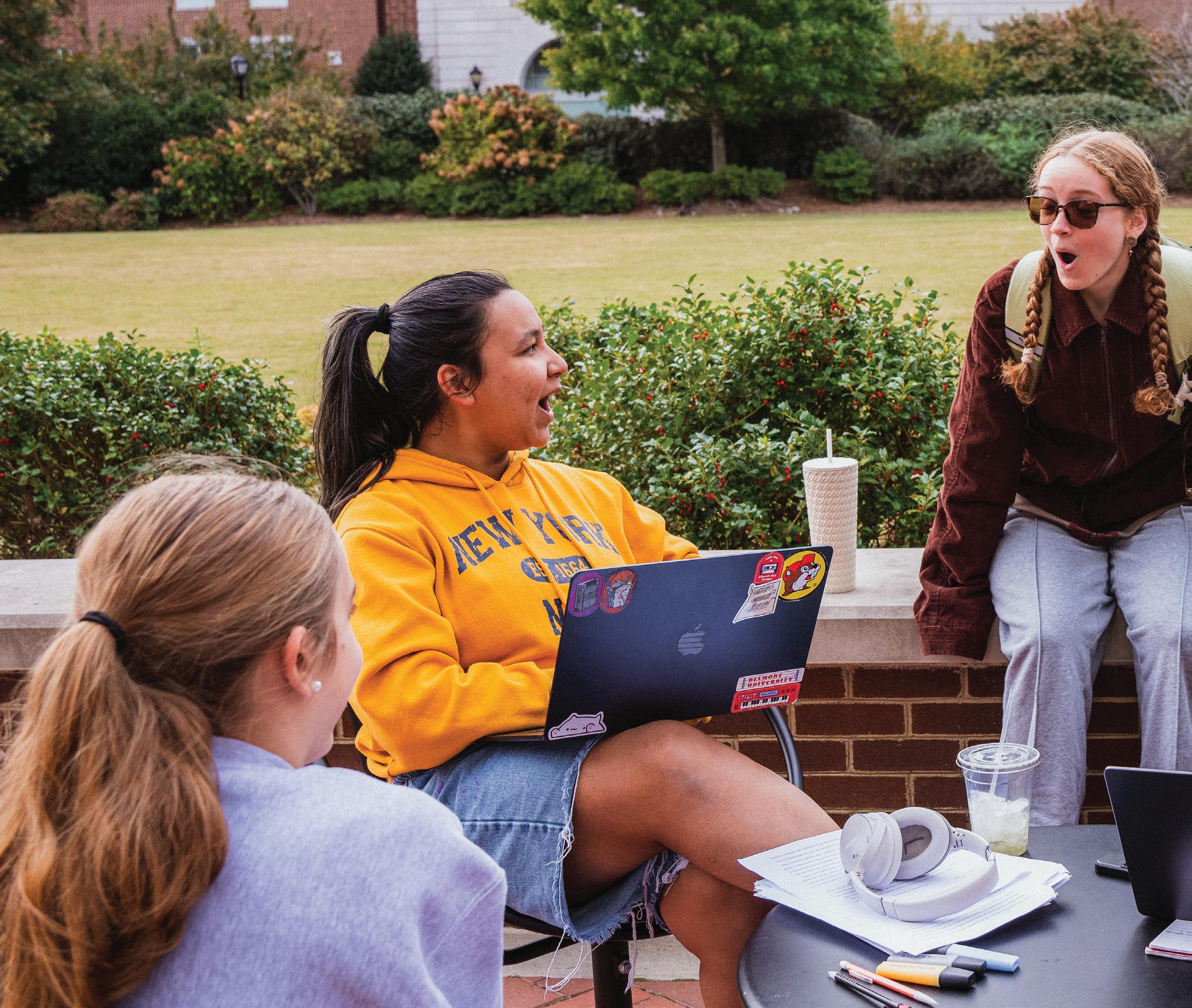
Formation efforts reached every corner of campus, from classrooms to competitions to community partnerships. Belmont student-athletes demonstrated how character and excellence complement each other this year. The University tied for 17th nationally in the NCAA Graduation Success Rate at 97% alongside Duke, Notre Dame and Stanford. Belmont Athletics earned the conference All-Academic Award for the 13th consecutive year, with 32 student-athletes carrying perfect 4.0 GPAs and nine programs achieving perfect 100 graduation success rate scores.
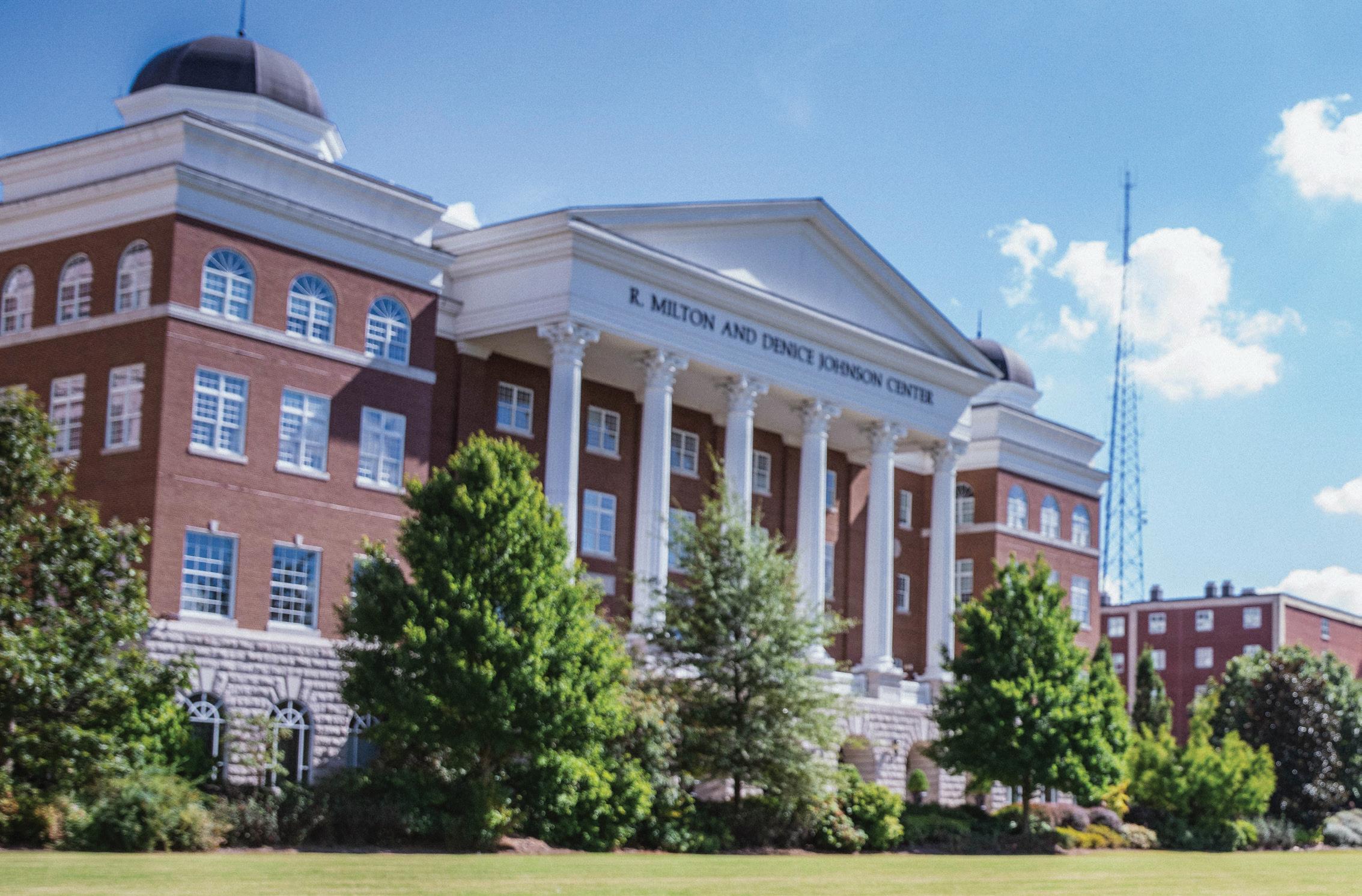
Meanwhile, Milton Johnson, Board of Trustees chair, received the 2025 Rick Byrd Character Award. As a first-generation college student who graduated from Belmont in 1979, Johnson rose to become HCA Healthcare Chairman and CEO. He and his wife Denice launched the Bell Tower Scholars program, which has enabled nearly 500 students from Metro Nashville Public Schools to attend Belmont with full scholarships.
Other examples of formation on campus included Belmont adding therapy dogs, Tunes and Doe, to campus staff, expanding mental health and wellness resources. When veterans’ advocate Gary Sinise visited campus to screen “Brothers After War,” he reinforced Belmont’s commitment to those who have served, reflected in the University’s Military Friendly Gold status and Military Spouse Friendly designation.
Donors raised nearly during
$1M
giving day
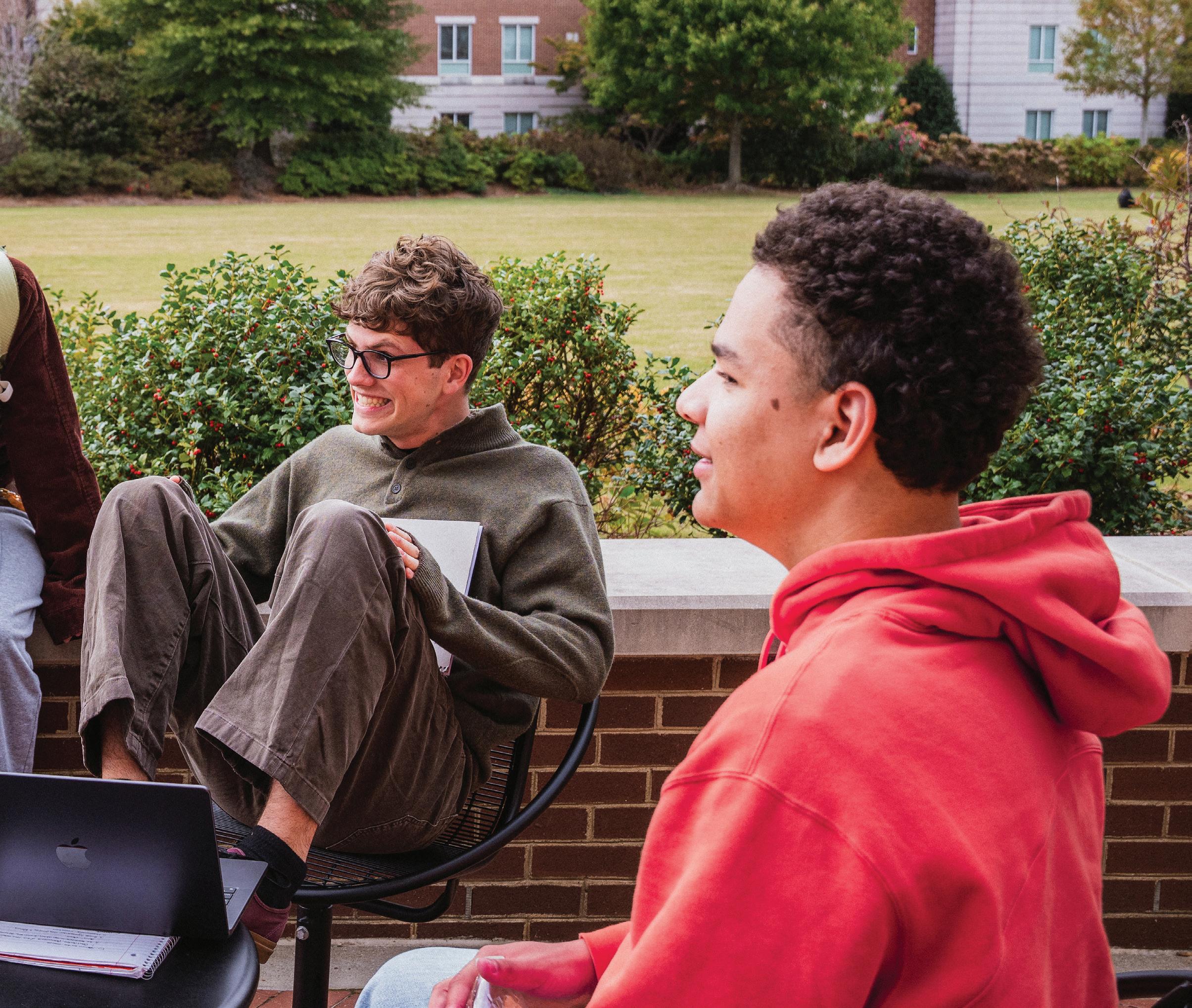
Character formation works on multiple levels simultaneously — through daily practice, decades of persistence and moments of breakthrough achievement. It creates a community committed to lifting others, ensuring that creativity, generosity, excellence, hospitality and faith transform not only individual lives but the world. These are the characters who make Belmont what it is, demonstrating what becomes possible when integrity and purpose guide every step of the journey.
That’s how it’s done!

The summer after her freshman year, Brenna Blume boarded a plane to Poland — only her third flight ever — to work with Ukrainian refugee children at a sports camp. She’d never been overseas. She barely knew what to expect. But the experience of service changed everything.
“If I can do this overseas, I can do this in Nashville,” she realized when she returned. “I can do this with people that I get to see every day and that I have a relationship with.”

That single trip transformed how the now-senior softball player approaches both athletics and life at Belmont.
It’s an understanding at the heart of what Dr. Charlotte Witvliet, senior scholar for character, mental health and flourishing, has spent nearly 30 years studying. She now continues this work as part of the Belmont Formation Collaborative. Her research shows how character virtues like gratitude, hope, patience, forgiveness and accountability in relationships play a key role in our own and others’ flourishing, especially under pressure.
“Dialing down difficulties is not enough to make us flourish,” Witvliet explains.
“We also need to grow as whole persons in relationship with God and others, living in harmony with the virtues we say we value.”
Blume has experienced this firsthand. Through volunteering at food banks, serving individuals with special needs and showing up even after grueling practices, she’s learned what whole-person formation looks like.
“I’ve met so many people in such vulnerable spots in their lives through service,” she reflects. “I’ve learned a lot about vulnerability, humbling myself, gratitude — everyone you volunteer with teaches you a little bit about yourself.”
The connection between athletic excellence and service isn’t coincidental.
As a Division I athlete competing for conference championships, Blume knows what high-stakes performance demands. But she’s also learned that true excellence extends beyond the field. It’s about who she’s becoming, not just what she’s achieving.
Witvliet’s work through the Belmont Formation Collaborative addresses this same vision.
“Our worth is secure — by God’s grace — apart from our performance,” she notes.
“We have a deeper purpose than our individualistic success, a higher hope than our own glory.”
It’s this vision that drives Belmont’s Formation Collaborative, equipping students like Blume to pursue excellence with humility, building the character that allows them to carry success without letting it carry them.
Winston Churchill once said, “We shape our buildings, and afterward, our buildings shape us.” This year, Belmont’s setting told its own story — how spaces form lives and communities far beyond Nashville. From residence halls and gathering places that foster belonging, to clinics and classrooms that bring hope to Tennessee communities, to global initiatives that connect students to a world in need, our spaces became expressions of our Christ-centered mission.
[ Our spaces tell a story of hope ]
Belmont’s campus evolved this year in ways that honored legacy while creating space for growth. Two existing facilities were renamed to honor alumni icons for their achievements in service and academics: Jack Benz, a dear alumnus whose dedication to the University spans seven decades, and Dr. Fannie Valree Hewlett, Belmont College’s first African American graduate.
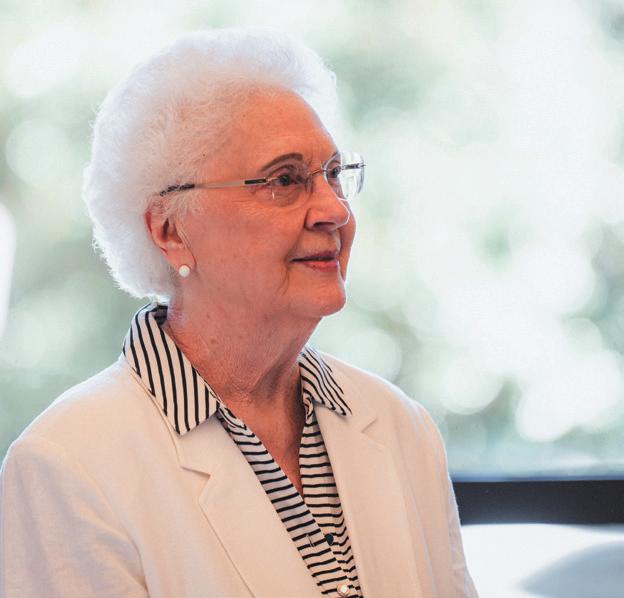
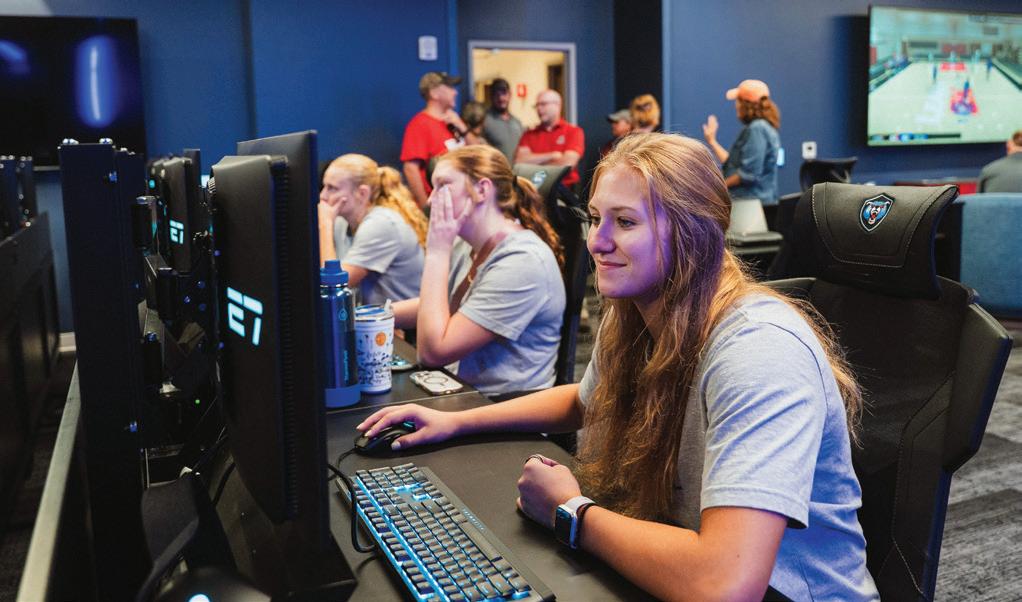
Belmont’s newest residence hall honors Betty Wiseman, a pioneering force in women’s collegiate athletics who founded Belmont’s Women’s Basketball program in 1968 and continues to be a key figure on Belmont’s campus. A new E-Sports Suite in Wiseman Hall offers a shared environment for gaming. The space addresses the need for connection among students and transforms an often-solitary pastime into a shared experience.
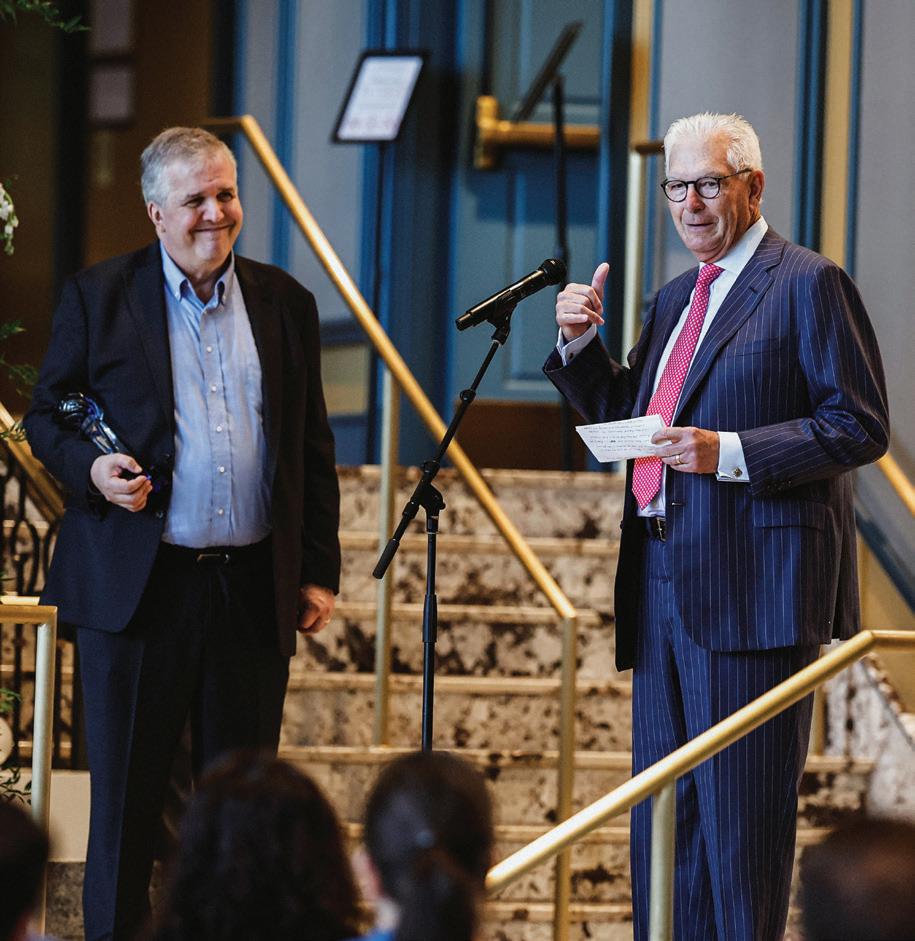
Benz, Hewlett and Wiseman “exemplify the transformative power of the Belmont experience,” said President Greg Jones. “Their commitment to Christ and their stories of purpose, dedication and service will continue to shape our community, inspiring future generations of students.”
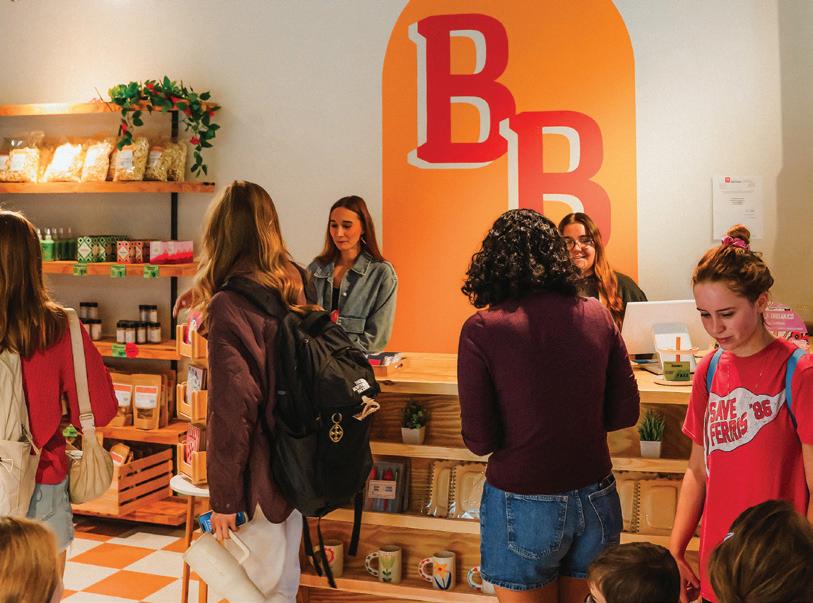
Belmont’s ongoing commitment to belonging and community extended across campus in unexpected ways. The Bruin Bodega opened in October, transforming a campus retail space into a celebration of entrepreneurship by showcasing products created by Belmont alumni, students and faculty. Meanwhile, Collar
Scholars, a new service-dog training club, welcomed a servicedog-in-training to campus, bringing joy to daily campus life while advancing life-changing work.
Belmont’s spaces also challenged the campus community to grow.
The “Some Were Neighbors” exhibit — a traveling exhibition from the United States Holocaust Memorial Museum — transformed campus into a place of reflection and moral courage, exploring the role of ordinary citizens during the Holocaust. As the first university in the U.S. to host this exhibit, Belmont welcomed thousands to reflect and consider the power of choosing humanity. This year’s Humanities Symposium, hosted by the College of Liberal Arts and Social Sciences, further examined the sense of what it means to be a neighbor asking campus attendees to consider how to care for those in their community.
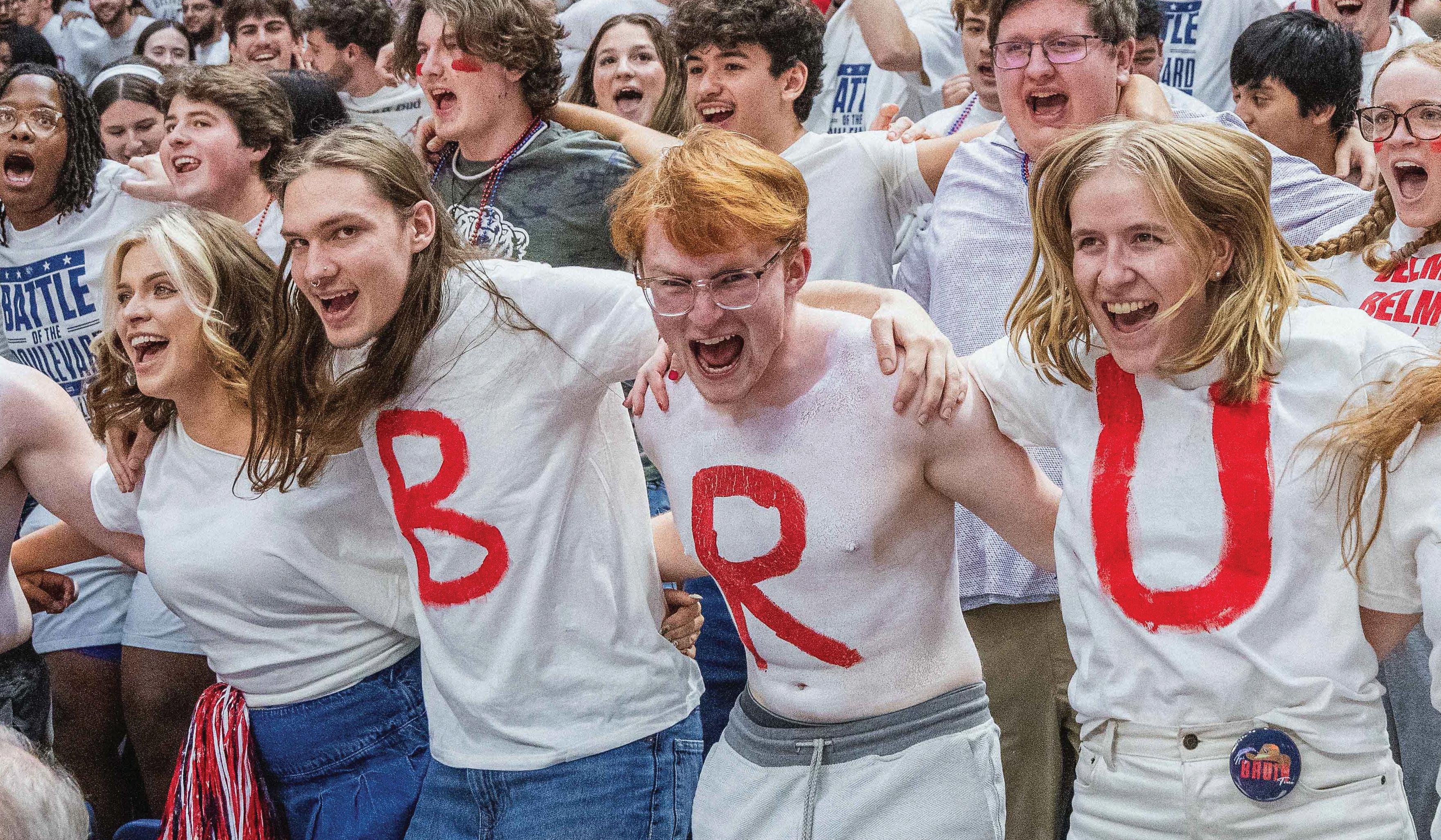
Space for celebration proved equally formative. When Belmont claimed victories in the annual Battles of the Boulevard basketball games, campus brimmed with the pride and unity that comes from shared experiences. Throughout the year, influential voices including country artist/alumnus Russell Dickerson, sportscaster Jim Nantz and Maestro Giancarlo Guerrero shared their industry insights and expertise with students, reinforcing campus as a launch pad for meaningful work and purposeful lives.
Nearly $90K RAised for charitable causes by Belmont’s Fraternity and Sorority
“FS Live” event. • Belmont alumni have founded over 900 businesses in 135 cities and 8 countries around the world. • 39 school and church groups saw the “Some Were Neighbors” exhibit & 4,000+ people visited. • 1,400 people attended “the House of David” premiere at the Fisher Center. • 718 new residential spaces added (Wiseman Hall). • 12 global engagement programs unified under Belmont Global.

campus volunteer hours
33,465 participated in 1000 Nearly students Study Abroad and Belmont USA study away programs representing value $1m+
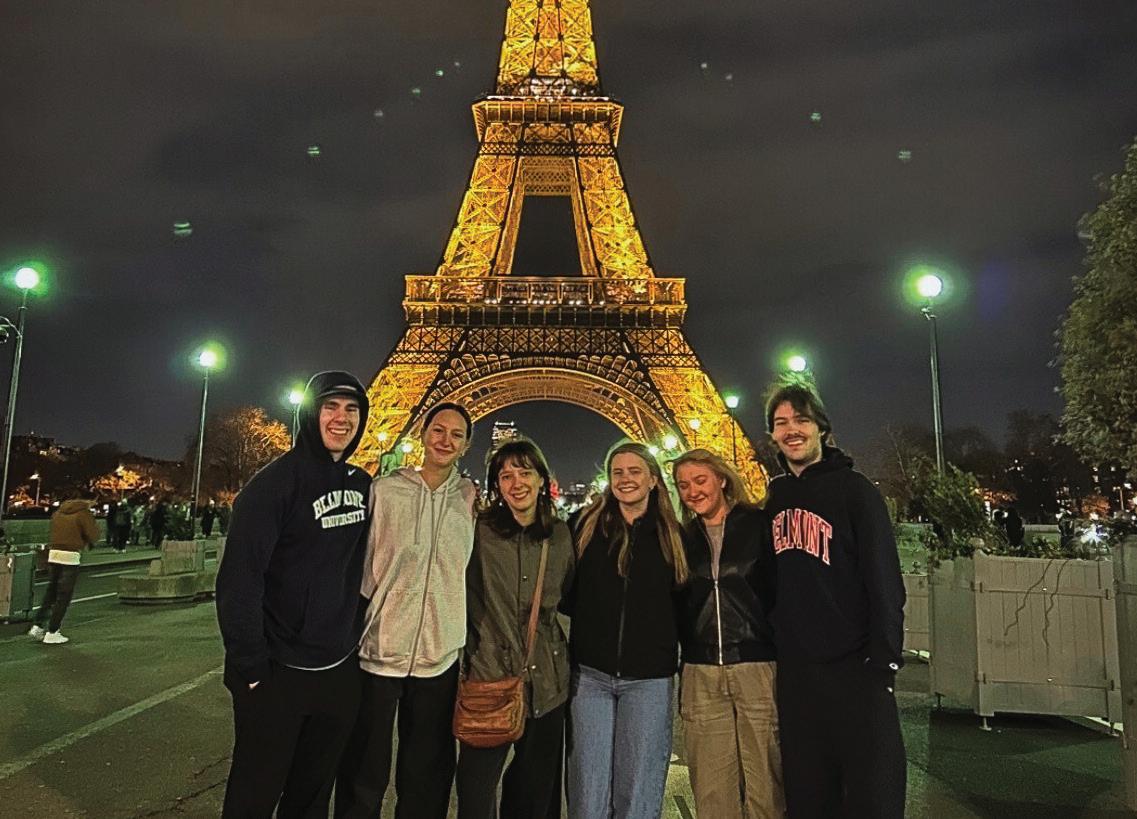
Global Honors students at the Eiffel Tower at night during a stopover on their way to Greece
The same commitment to formative spaces extended into Nashville and across Tennessee. Through the Flourish Mobile Clinic — launched by the University’s Center for Abundance, Resilience, Excellence and Spirituality (CARES) — Belmont extended compassionate health care to the front steps of underserved populations.
University Provost Dr. David Gregory highlighted the clinic’s role as a living classroom: “Our students will gain realworld experience, developing the clinical expertise and cultural humility needed to deliver trauma-informed, community-based care. This is how we prepare them for lives of meaning and service.”
The clinic embodies a belief that hope is lived out through consistent presence in neighborhoods and community spaces. That same belief drove Belmont’s work behind prison walls where education transformed lives at the Turney Center. Nine students graduated through Belmont’s Prison Education Program, embodying
Beyond campus and state lines, Belmont’s reach expanded across the globe. With the launch of Belmont Global, the University aligned global education, partnerships, health initiatives, international student services and innovation efforts under a shared vision, ensuring global engagement reflects a cohesive University mission.
The Global Honors Program, now housed within Belmont Global, expanded its study abroad offerings with new locations in Greece and Spain, creating additional pathways for STEM students while building on established global partnerships. Several students were awarded prestigious international scholarships, affirming both their academic excellence and their desire to serve beyond borders.
perseverance, second chances and the belief that education can transform lives regardless of circumstance.
Belmont also created spaces for meaningful conversation. The 2025 Peace Summit further reinforced Belmont’s role as a convener in Tennessee. In collaboration with Fisk University and Queen’s University Belfast, Belmont created space to explore peace, civility and love through lenses including religion, art, politics and storytelling.
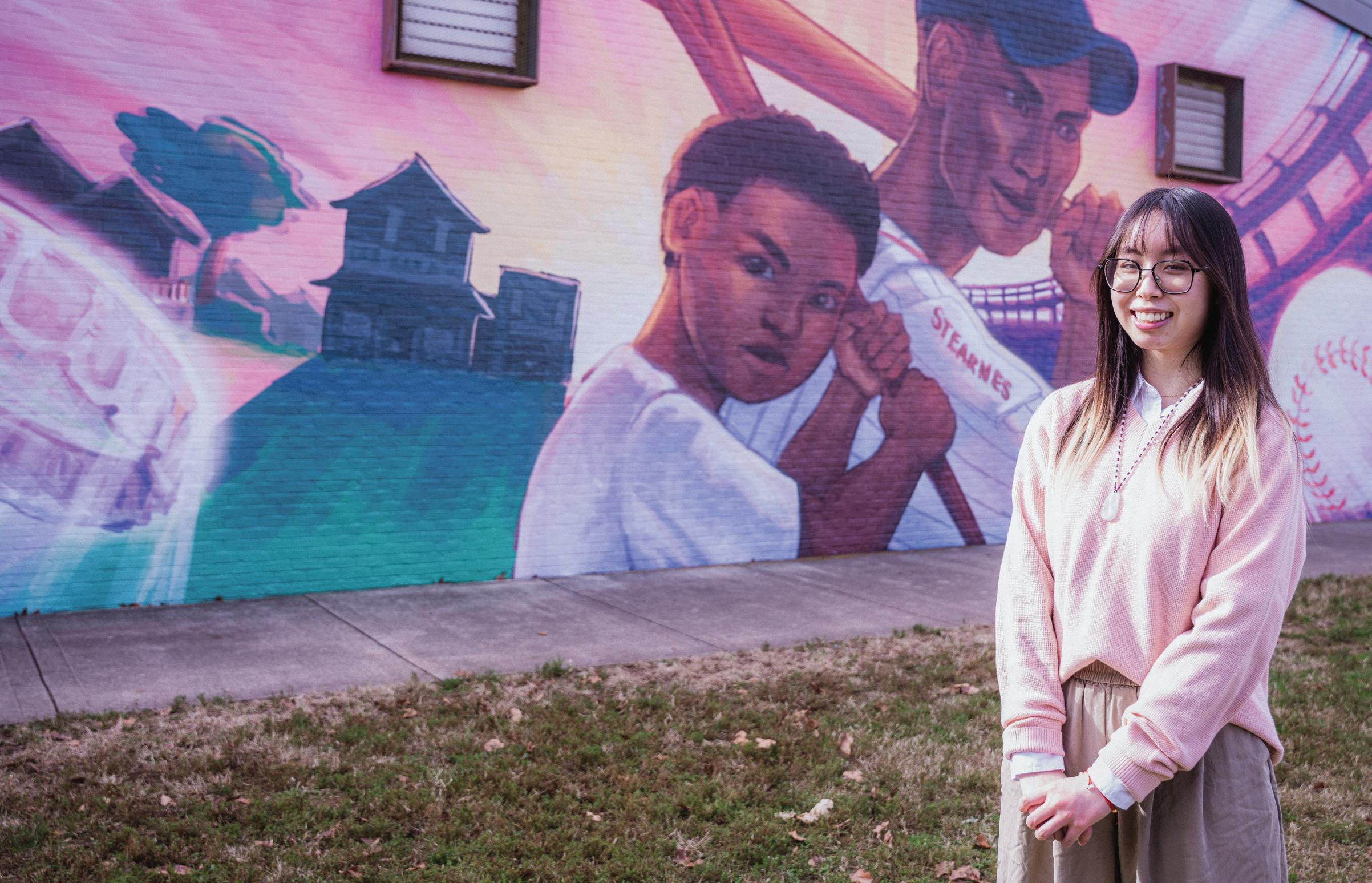
Community spaces were further transformed through art. In Nashville’s Edgehill community, the E.S. Rose Park mural transformed a neighborhood gathering place into a symbol of beauty, history and renewal. Designed by Belmont illustration major Joanna Wu, the mural honors the legacy of the Negro Leagues and immortalizes one of Nashville’s greatest baseball legends, Norman “Turkey” Stearnes, celebrating community through creativity and partnership.
Eleven undergraduate students from various fields learned from leading experts and worked alongside international partners in an immersive interdisciplinary global health initiative that reshaped their understanding of global health. Similarly, Belmont mobilized students and staff to live out their faith through service by partnering with local ministries in places including the Pacific Northwest, Guatemala and the Dominican Republic.
Our Christ-centered commitment to learning and service calls us to direct intentional effort and attention into places and spaces: on campus, in Tennessee and around the world. When we design spaces with intentionality, stories can take root and develop in ways that impact all who experience them.
[ Kristoff Hart] &


“Wonder creates content that creates community,” Hart explained, noting that Wonder’s premium, faithand values-driven content is paired with discussion guides and resources to encourage deeper engagement. “People believe in the hope we inspire.”
While Hart creates digital gathering spaces for millions, Belmont students designed a physical space closer to home. In Hickman County, interior design students transformed a vacant roller rink into The Duck Pond, a daycare serving local families. Working with the United Way, they didn’t simply rethink the space, they designed it for connection.
“Our designs were based on their needs and wants,” said interior design student McKinley Shannon. “Interior design is more than aesthetics. It’s about understanding people and creating spaces that support them.”
The redesign paired practical solutions, like ADA-compliant flooring and updated plumbing, with features that foster community including a garden for children and caregivers to grow food and gather together. Whether in the form of a TV show streaming to millions or a daycare redesigned for a neighborhood, these spaces prove that when gathering places are designed with intention, they can become catalysts for hope.
This year, Belmont’s reach expanded through spaces designed to bring people together — both digital and physical — demonstrating that place matters. Beyond campus, Belmont shared the magic of “Christmas at Belmont: Live from Nashville” with a global audience through Wonder Project on Amazon Prime. But Wonder’s partnership with Belmont extends far beyond a virtual stage.
Wonder Project’s breakout series “House of David” illustrates how digital platforms can spark conversations around resilience, courage and identity. Belmont alumnus Kristoff Hart is transforming storytelling as Wonder’s vice president of partner marketing, creating spaces where audiences don’t just watch, they gather. Wonder brings viewers together through events, partnerships and in-person gatherings, including the “House of David” season two premiere hosted at Belmont’s Fisher Center for the Performing Arts in September.
[ What drives the story forward
Stay with us — it’s getting good!
Creativity
Converge to Tell New Stories.
Stories reach a significant moment where everything comes together — a turning point that reveals what matters most. For Belmont, this year brought a season of creativity and innovation, where bold ideas met deep purpose. It was a time when music and mission intertwined, when innovation in health care stood alongside support for vulnerable children and when partnerships opened doors to new possibilities. These moments remind us that the heart of our story is transformation and dreams realized through hope.

At Belmont, c reativity is a form of stewardship — a way of cultivating gifts, honoring craft and serving others through excellence shaped by faith.
On Music Row, that convergence became tangible with the opening of Phase One of the Mike Curb College of Entertainment & Music Business expansion. The renovation of the historic Buddy Lee Attractions/ Capitol Records building added new songwriting rooms, listening spaces, live sound classrooms and collaborative student areas, all within one of America’s most iconic creative corridors. “The epicenter of America’s creative heartbeat, Music Row is the ideal location for Belmont’s growing footprint, as it creates a natural intersection of industry and education that fosters collaboration and drives innovation,” said Brittany Schaffer, dean of Curb College.
Belmont’s presence on Music Row affirms a simple truth: education belongs inside the industry it seeks to shape.
That belief also guided the launch of the Center for Mental Health in Entertainment, a first-of-its-kind initiative made possible
$58M
Mike Curb & the Mike Curb Foundation lead gift from
through a $3 million gift from the Country Music Association. The Center brings together the Curb College and the College of Pharmacy & Health Sciences to address long-standing gaps in research, education and care for those working in entertainment.
$3M
“This Center represents a powerful opportunity to build a culture of care, resilience and innovation for artists and professionals across music, film, television and beyond,” said Debbie Carroll, the Center’s inaugural CMA endowed chair and executive director.
With Caroll’s leadership, Belmont is leading a cultural shift, placing wellbeing at the center of creative work and preparing both artists and counselors to navigate the industry with resilience.
The Fisher Center for the Performing Arts continued to serve as a classroom on the largest scale. During the residency of “DOLLY: A True Original Musical,” which drew 49 consecutive sold-out audiences, students stepped directly into
the professional creative process through the Dolly U Fellowship program. From costumes and sound design to company management and music transcription, Fellows worked alongside Broadway-level professionals as the musical evolved in real time.
That commitment to mentorship and process echoed in moments beyond the stage. When Tony Award-winning director Bartlett Sher visited campus ahead of the musical’s premiere, students heard candid reflections on creative patience, collaboration and the value of sustained work over instant success.
And when American Idol selected the Fisher Center as a production site for auditions, it further affirmed Belmont’s role as a trusted partner in shaping the future of the arts.
“We’re proud to partner with Belmont, a school that shares our passion for discovering and celebrating musical talent,” said American Idol Executive Producer and showrunner Megan Michaels Wolflick. “With so many Belmont auditions through the years, this collaboration feels like a natural fit.” From world premieres to national broadcasts, the Fisher Center continues to blur the line between classroom and career, offering students front-row access to moments that shape both craft and calling.
$1M
While creativity took center stage, innovation shared the spotlight by turning insight into actions that drove the plot forward.
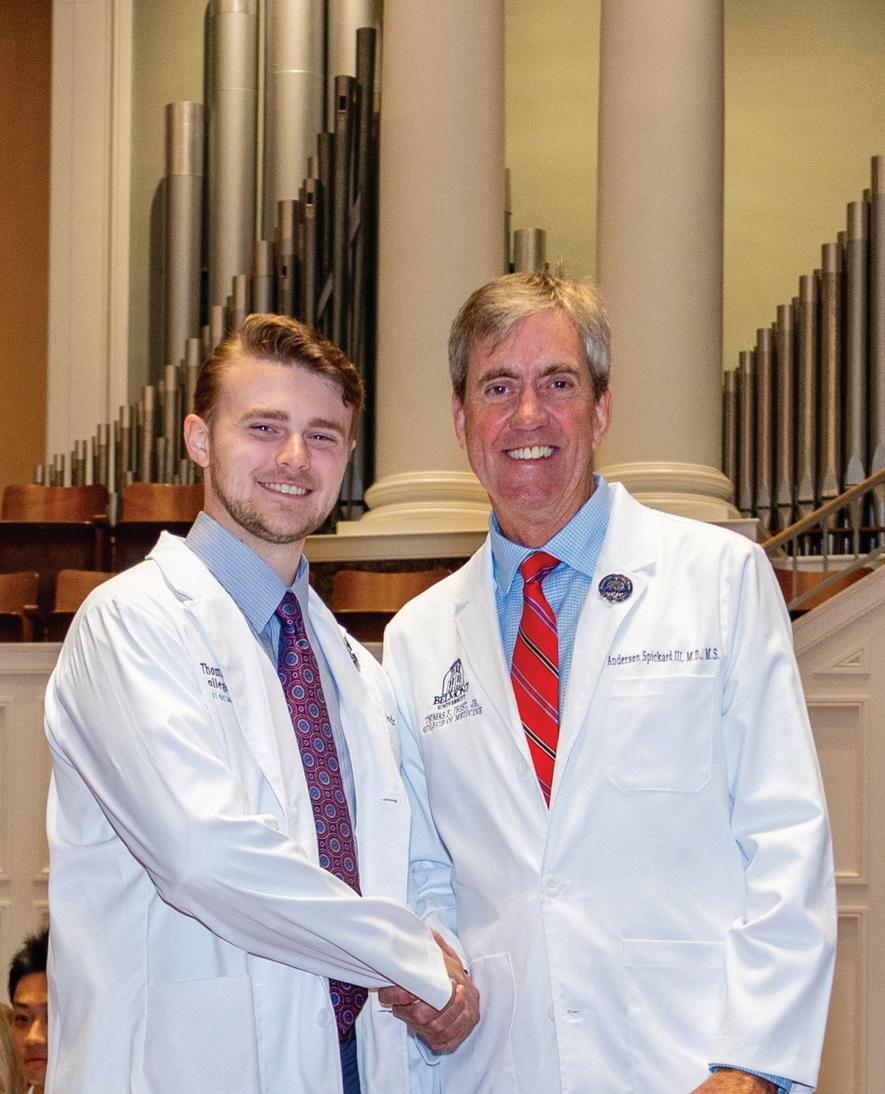
At the Thomas F. Frist, Jr. College of Medicine, Belmont’s inaugural medical students participated in Doctors’ Day on the Hill at the Tennessee State Capitol, engaging lawmakers and health care leaders to better understand the role of advocacy in patient care. For future physicians still in their first year of training, the experience underscored a defining principle of Belmont’s medical education: healing extends beyond the clinic into the systems that shape health. Rooted in faith that cares for the whole person, Belmont’s approach to innovation seeks better, more compassionate systems.
That formation has been strengthened by extraordinary partnerships. The Bill and Crissy Haslam Foundation added a $1 million endowed scholarship to reduce financial barriers for
future physicians, reflecting the conviction that the future of health care depends on collaboration, compassion and access.
“Education transforms lives and communities,” said Crissy Haslam. “We are hopeful this scholarship will remove barriers for students who desire to make an impact through both their talents and training.”
Innovation also took shape through Belmont Innovation Labs’ continued work to transform outcomes for vulnerable children across Tennessee. A new report, “Every Child Tennessee: 2025 Impact Case,” identified urgent gaps facing youth aging out of foster care and called for bold, coordinated investment. The findings were sobering, but the message was hopeful. With supportive adult relationships, stable housing and traumainformed mental health care, young people can thrive.
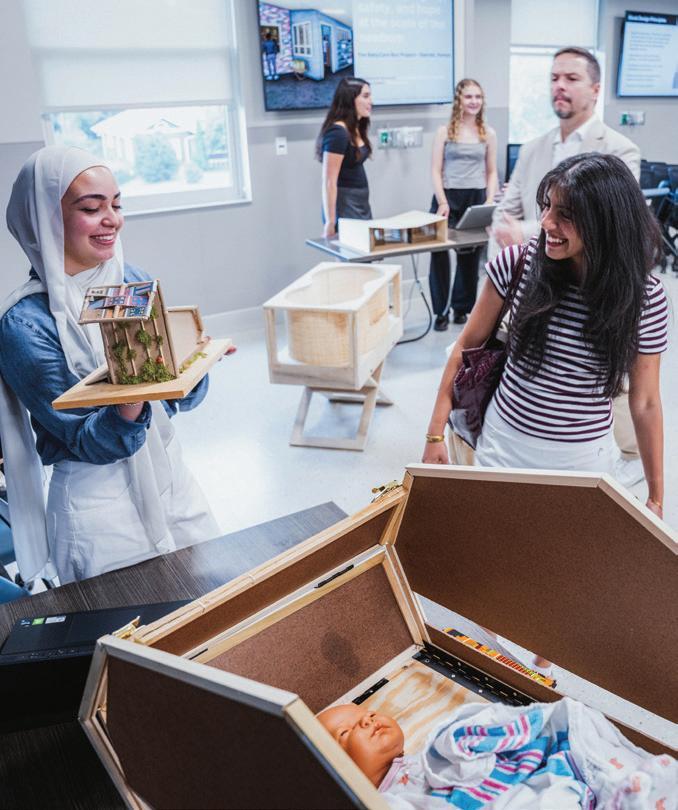
O’More students present their Baby Care Box designs
“At Belmont, our Christ-centered approach calls us to address our community’s most pressing issues with courageous leadership and creative partnerships. Our commitment to foster care solutions reflects this approach — that strong families build strong communities, and that universities have a unique opportunity to open doors of hope and promote flourishing,” said President Greg Jones.
That call to action is now being met through the Reconstruct Thriving Youth Challenge, a $1 million venture-philanthropy initiative designed to scale solutions statewide. By bringing together data, lived experience and cross-sector partnerships, Belmont is helping rewrite what is possible, shifting from fragmented efforts toward focused, collaborative change. The University’s commitment to vulnerable children was further recognized when Belmont received the 2025 Adoption Advocate designation from the Dave Thomas Foundation for Adoption,
honoring the University’s comprehensive support for employees pursuing adoption and foster care.
On a global scale, innovation was realized through the Baby Care Box Project, where architecture students partnered with Doctor of Nursing Practice students to design safe, affordable sleeping environments for newborns in underserved communities in Nairobi, Kenya. By pairing clinical expertise with practical design, students developed solutions that are culturally appropriate, locally sourced and scalable, addressing a critical need in neonatal care.
Woven together, these stories reveal that at Belmont, creativity and innovation are partners in the same pursuit: forming students who imagine wisely, build thoughtfully and serve with hope. This is what drives stories forward — through thoughtful creation that meets the world’s deepest needs.

This work is only the beginning. Bat-Ami hopes to continue advocating for vulnerable communities through the legal system, with plans to pursue a career as a public defender.
theory finally found a place together in the professional world,” Blake said.
“So many people in foster care end up interacting with the justice system,” she said. “I want to be someone who understands where they’re coming from and who knows how to fight for them.”
While Blake was stewarding a story on stage, Bat-Ami was carrying one into law. A freshman double majoring in history & public policy and Spanish and, as a former foster youth, Bat-Ami drafted Tennessee’s Foster Youth Bill of Rights, which became law in July 2025.
Their work may look different, but Blake and Bat-Ami share a defining trait: the courage to step forward when preparation meets opportunity. Whether shaping a score or shaping policy, both are living examples of what happens when students use their gifts to meet real needs.
Motivated by her own experience in the foster care system and shaped by conversations with other youth across the state, Bat-Ami set out to translate lived experience into lasting protections. “I had experiences that were rare for foster youth. I didn’t move schools, I was able to get a real education and I wasn’t afraid to speak up,” Bat-Ami said.
At Belmont, students don’t wait for permission to step into meaningful work — they take the lead in shaping the plot. They recognize a need, bring their full selves to the moment and help write what comes next. For Hudson Blake and Ella Bat-Ami, those moments unfolded in drastically different arenas — a Broadway-bound musical and the Tennessee State Capitol — yet both reveal how purpose and preparation converge when students are trusted with real responsibility. For Blake (‘25), that responsibility came unexpectedly.
Selected for the University’s immersive DOLLY U fellowship, Blake worked alongside Broadway professionals during the world premiere residency of “DOLLY: A True Original Musical,” contributing directly to the show’s score.

“When I aged out, it felt like my responsibility to make sure other kids could identify rights violations and speak up without fear.”
Initially joining during the production’s early workshop phase, Blake was later invited to stay on as a music assistant for the full run, supporting the creative team in real time as the show evolved. “My love of musical theatre and my love of music
Amid division, we choose peace; amid fear, we choose hope.
Like any good story, ours includes tension. In a season when many are retreating, we have chosen to keep building with an entrepreneurial spirit and a conviction that the future is worth shaping. Where isolation seemed inevitable, we leaned into collaboration. Where fear tempted withdrawal, we committed to investing. When division threatened, we worked to sow peace. These choices reflect the quiet strength of hope. This is hope shared, lived and woven into every dream we pursue together.
Belmont’s Executive Learning Network celebrates 7,000 members & 200 companies anniversary
impacting more than


This year marked significant growth in programs that prepare learners for meaningful work and service. The addition of two new Adult Degree Programs opened new doors for those beginning or returning to education. Plus, by significantly reducing tuition for adult learners, more students gained access to a Belmont education.
“At Belmont, we believe education should be within reach for everyone, regardless of where they are in life,” said Dr. Jim McIntyre, assistant provost for academic excellence and dean of the College of Education. “Our adult learners bring unique perspectives and experiences to the classroom, and we want to ensure they have every opportunity to succeed.”
Graduate education also expanded significantly and saw great success. The College of Law reached a defining milestone this year, achieving the highest bar passage rate in Tennessee on the July 2025 Bar Exam, with a 96.9% first‑time pass rate — up from 94.7% last year. New programs include the online Master of Art in Media and Entertainment
Industries (MAMEI) designed for working professionals ready to lead, innovate and grow within the global entertainment business and the Post Professional Occupational Therapy Doctorate Program which provides new pathways to healing professionals. And the online Master of Arts in Teaching provided greater access for teachers by reducing tuition for Tennessee educators.
Belmont’s commitment to building extends beyond academics to beauty and storytelling. A generous $3.5 million gift from Andrea Waitt Carlton and the AWC Family Foundation will fund hope inspired storytelling and film, investing in voices and productions that bring light to a world hungry for hope.
$3.5M
Andrea Waitt Carlton and the AWC Family Foundation Gift From
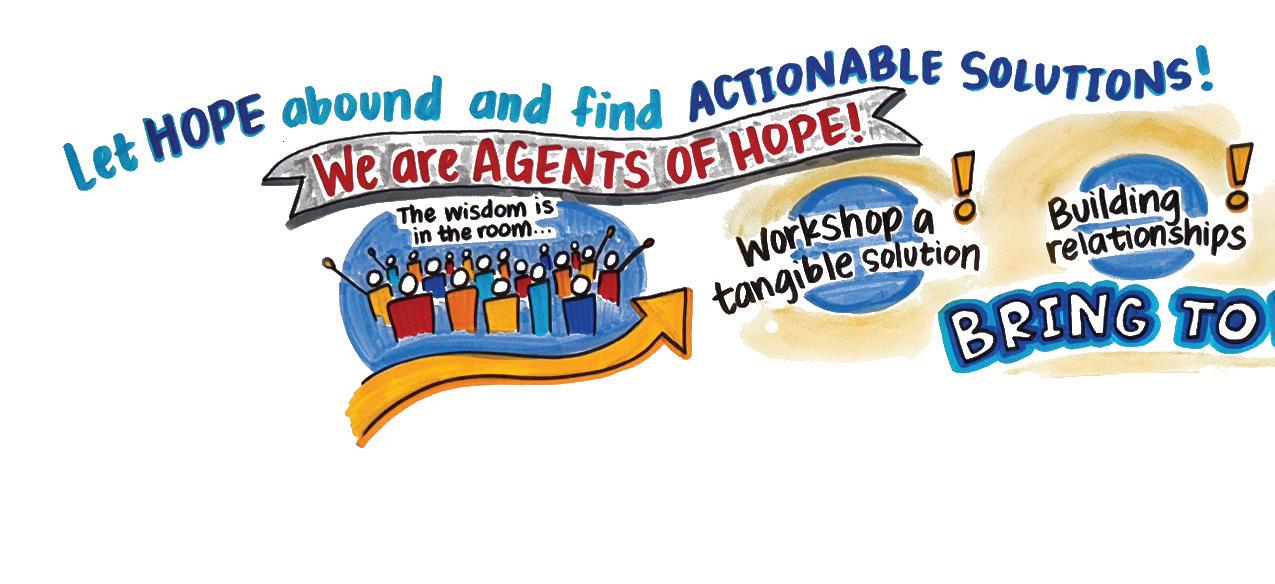
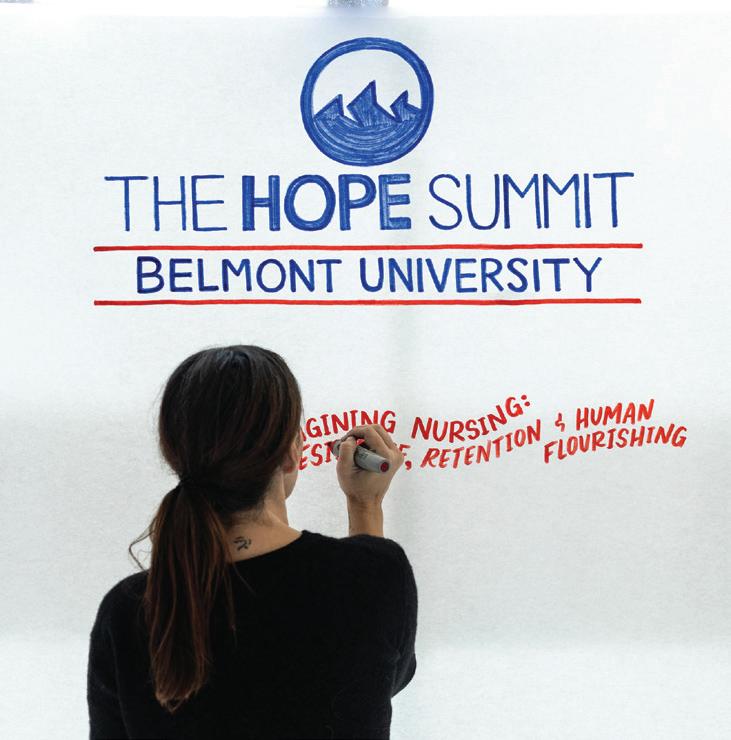
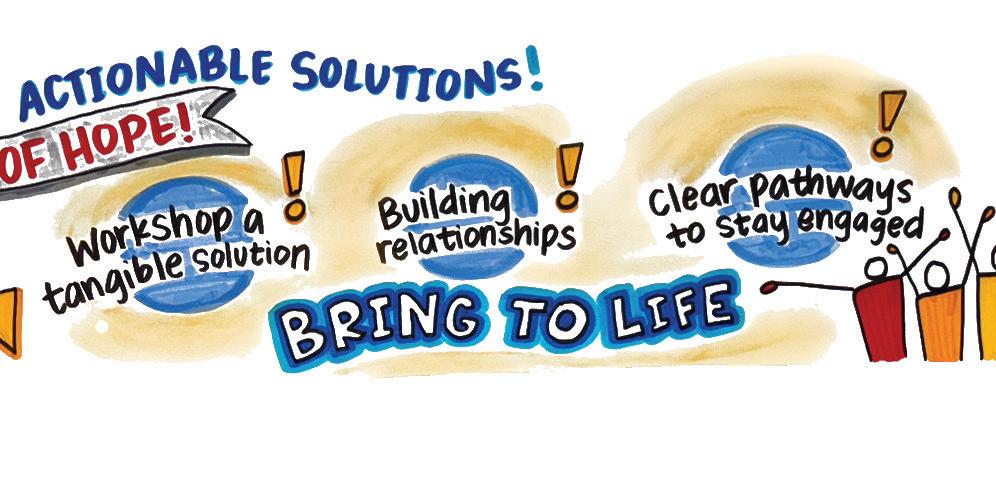
The Hope Summit Workshop Series gathered thought leaders and practitioners to explore what it means to address pressing problems with creativity, conviction and compassion. Participants designed solutions to nursing burnout, AI accountability and mental health in entertainment. Belmont continues to build on these solutions, publishing research and launching new initiatives on and off campus.
That same spirit of connection defined the Executive Learning Network’s 35th anniversary year. For more than three decades, ELN has touched more than 7,000 members across 200 companies — bringing leaders together for high caliber development and mutual growth. Under
director Jill Robinson’s steady guidance for more than 18 years, the program has maintained relevance while expanding its impact, bridging academia and Nashville’s business community.
Collaboration also took shape through the Belmont Collaborative for Health Systems Innovation, funded by a $5 million HCA Healthcare gift, which includes funding for an endowed chair, matched through the Johnson Academic Challenge. The Collaborative unites clinicians, entrepreneurs, payers and community voices to design health solutions that center people — not just patients — throughout their lifelong health journey.
Let’s put our headstogether!
96 . 9 % bar pass rate��irst-time
$5M HCA Healthcare Gift From
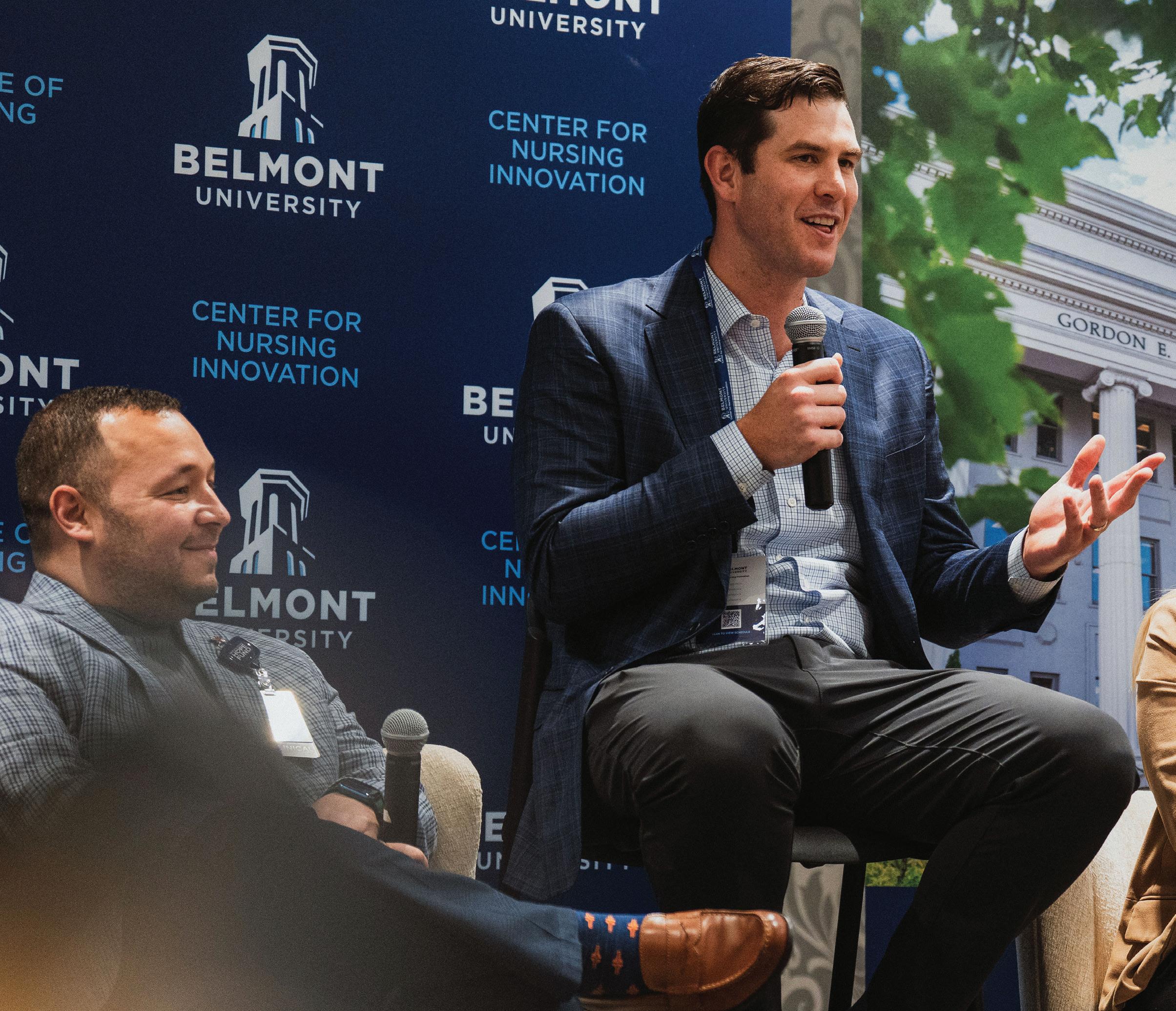
Nursing Innovation Summit participants collaborate in a “Shark Tank” style rapid design lab led by HCA Healthcare's Digital Transformation and Innovation team
This year, nursing faculty launched the SHIFT Model, an innovative approach to nursing education designed to combat burnout and strengthen the profession. Additionally, Belmont nursing received a transformative $2 million gift from the Bedford Falls Foundation, which will support nearly 200 nursing students at Belmont and address factors contributing to the nursing shortage nationwide.
The second annual Nursing Innovation Summit showcased and generated creative solutions and new collaborations while a new nursing master’s program, welcoming its first students this fall, will equip people called to mid career transitions into nursing with graduate level preparation.
Beyond nursing, Belmont celebrated entrepreneurial excellence through the 6th Annual Belmont Entrepreneur Awards, which recognized 100 of Belmont’s top alumni entrepreneurs, acknowledging industry, peer and community impact.
Meanwhile, the annual Buntin Pitch Competition welcomed business pitches from 10 students across a variety of majors. Winners were celebrated for businesses ranging from a web based platform that allows users to create, design and resize knitting patterns to a food and beverage photography business focused on serving Nashville. By integrating innovation into education and practice, Belmont continues to shape leaders who thrive in complexity.
At this year’s Opening Convocation, and at many events since, students, faculty and staff have recited the Peace Prayer, often attributed to St. Francis of Assisi. Loved for many generations, the Peace Prayer represents a Christ centered approach to the internal and external tensions of the human experience. This prayer acknowledges these conflicts and asks that in Christ, they would be turned upside down.
Lord, make me an instrument of your peace: where there is hatred, let me sow love; where there is injury, pardon; where there is doubt, faith; where there is despair, hope; where there is darkness, light; where there is sadness, joy.
$2M Bedford Falls Foundation gift
Grant that I may not so much seek to be consoled as to console, to be understood as to understand, to be loved as to love.
For it is in giving that we receive, it is in pardoning that we are pardoned, and it is in dying that we are born to eternal life. Amen.
Belmont’s Christ centered mission calls its people to peace in a world that can often feel its lack. Guided by the example of Christ — our Prince of Peace — Belmont is forming students, staff and faculty who respond to despair with hope and to darkness with light.
That conviction inspired the SHIFT Model, Belmont’s innovative framework for nursing education, which emphasizes scholarships, holistic support, innovative curriculum, a flourishing framework and a transition-to-practice academic residency. “We’re working to shape nurses who can flourish personally and thrive in complexity,” said Rasmussen.
For recent graduate Daria Sickler, Belmont’s commitment to formation and the future of nursing is personal. She chose Belmont for its deep ties to Nashville’s health care community and reputation for character and excellence. Today, she works in the emergency department at Monroe Carell Jr. Children’s Hospital at Vanderbilt.
With an increasingly overburdened health care system, this kind of formation is no longer a bonus, but a necessity.
Rasmussen’s approach to student care combines high expectations with intentional care. “Amy checked in regularly, cheered us on and made complex concepts understandable,” Sickler said. “She didn’t just ask about our lives — she shared honestly about hers.
The nursing profession faces unprecedented challenges with burnout rates exceeding 60% and nearly half of experienced nurses considering leaving within five years. In response, Belmont is making a bold investment in students like Sickler and in the very foundations of nursing education, ensuring that the next generation of nurses can lead and sustain health care for decades to come.
Right after I got my job offer at Vanderbilt, she was one of the first people I told.”

Belmont’s investment in nursing education is a declaration of hope, expressed through people like Rasmussen and Sickler. By equipping nurses with resilience, compassion and confidence, Belmont is shaping a future where health care professionals and the people they serve thrive.
Sickler recalls her senior preceptorship in Vanderbilt’s adult emergency department, where she regularly witnessed injuries and new diagnoses. Yet what stands out most are the stories she heard from patients. “I still remember some of their names,” Sickler said. Now, she practices with the conviction that nursing means investing in human connection while delivering clinical excellence.

From learning assertiveness in pediatrics to navigating high-pressure situations during her preceptorship, Sickler credits Belmont’s emphasis on resilience and mentorship for her success: “Support from mentors makes all the difference.” For her, that support came through Dr. Amy Rasmussen. Rasmussen brings more than 20 years of experience to her role as assistant professor of nursing and assistant dean of academic practice partnerships. She notes that though many of the factors contributing to nurses leaving the workforce begin early in a nurse’s journey, solutions tend to focus on the years after graduation. Rasmussen believes that nursing educators have an opportunity and responsibility to step in to “move solutions upstream into the college years.”
Hope is the thread that binds Belmont’s story — steady, shared and rooted in God’s renewing love for the world.
E[ Anchored in Hope ] Theme?
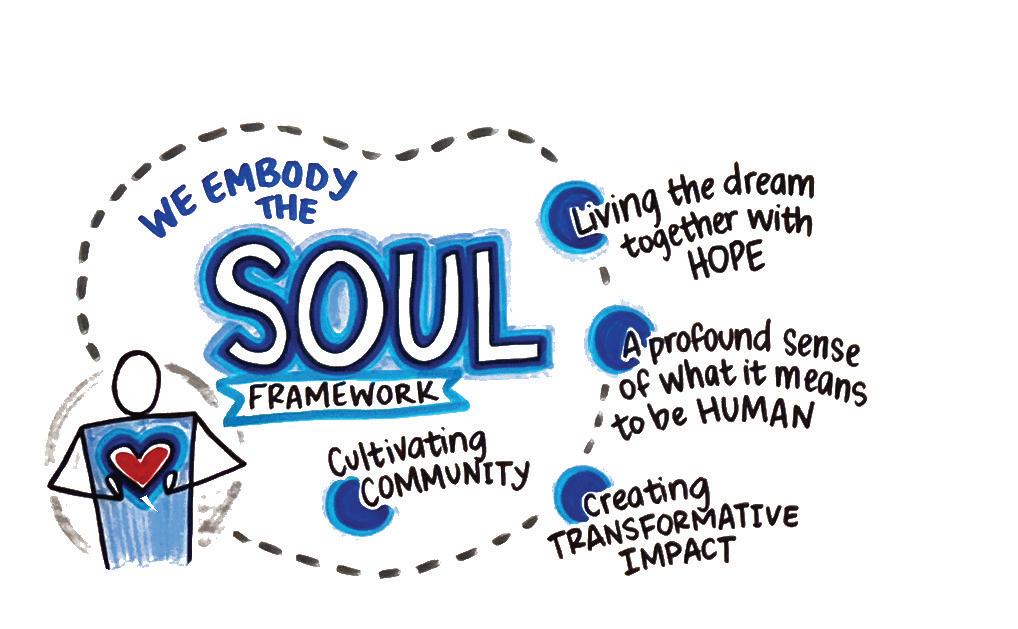
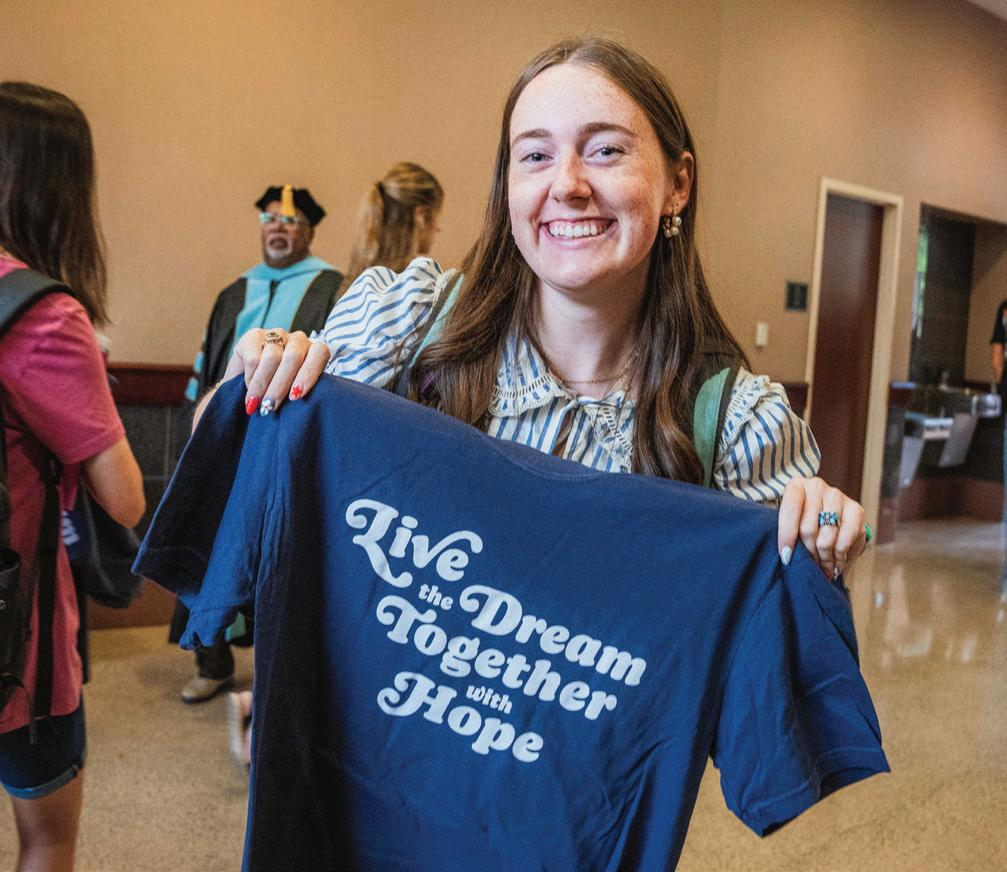
very great story is shaped by a theme, and ours is hope. A hope that we live out together as we dream boldly for what’s ahead. At Belmont, hope is the anchor of our souls and a steady presence that calls us to imagine more. It’s not a shallow optimism or a denial of hardship, but a living hope grounded in the trust that God is making all things new. This hope invites us to dream big and to do so in community because the best dreams are the ones we live together. The power of HOPE was on display all across campus as we oriented around this year’s annual theme, Living the Dream Together with Hope, from the University’s SOUL Framework.
What was this year all about?
selves to their work,” said President Greg Jones. Investments in flexible work, family‑supportive policies and intentional community‑building reinforced a simple truth: hope flourishes where people are valued and supported.
At Belmont, hope is both a future promise and a daily practice, expressed in the ways people work, lead and care for one another. In a year defined by momentum and growth, the University’s steady center remained its people and the community they create together.
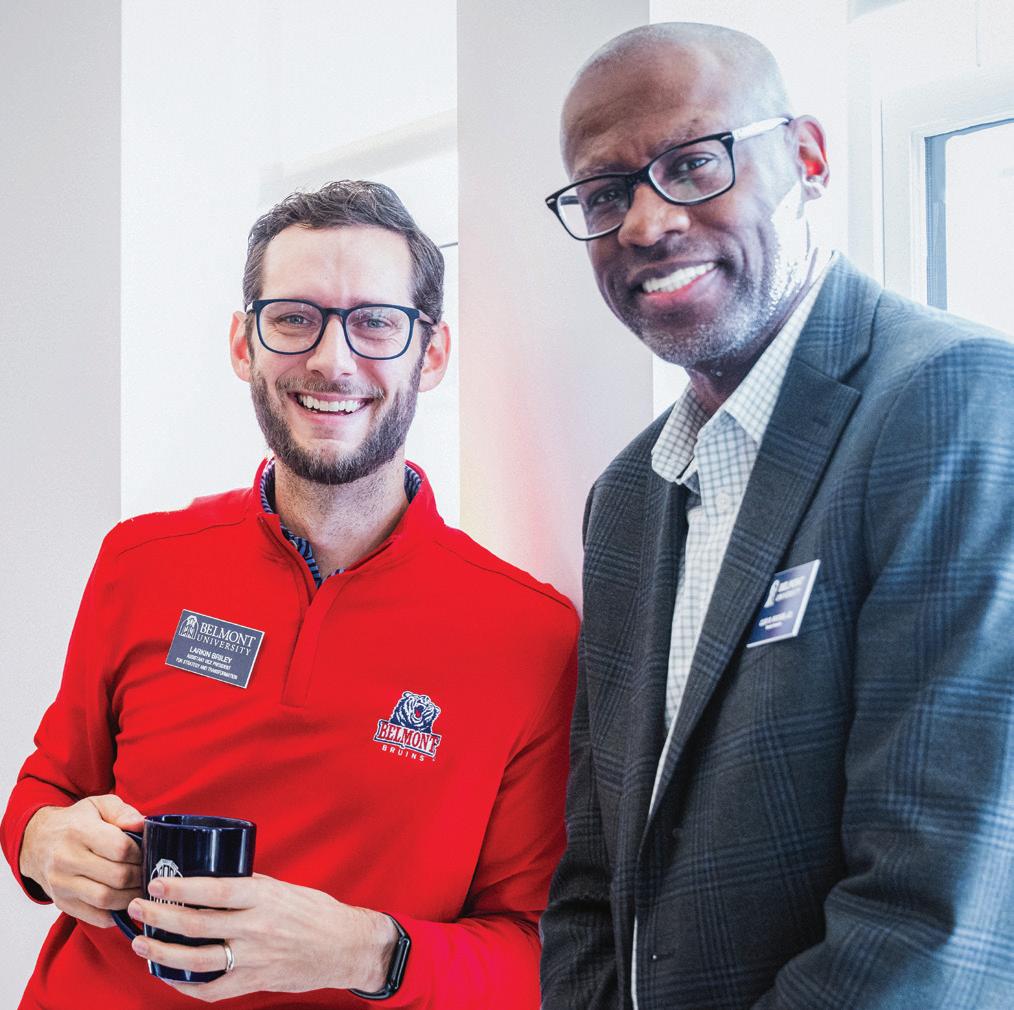
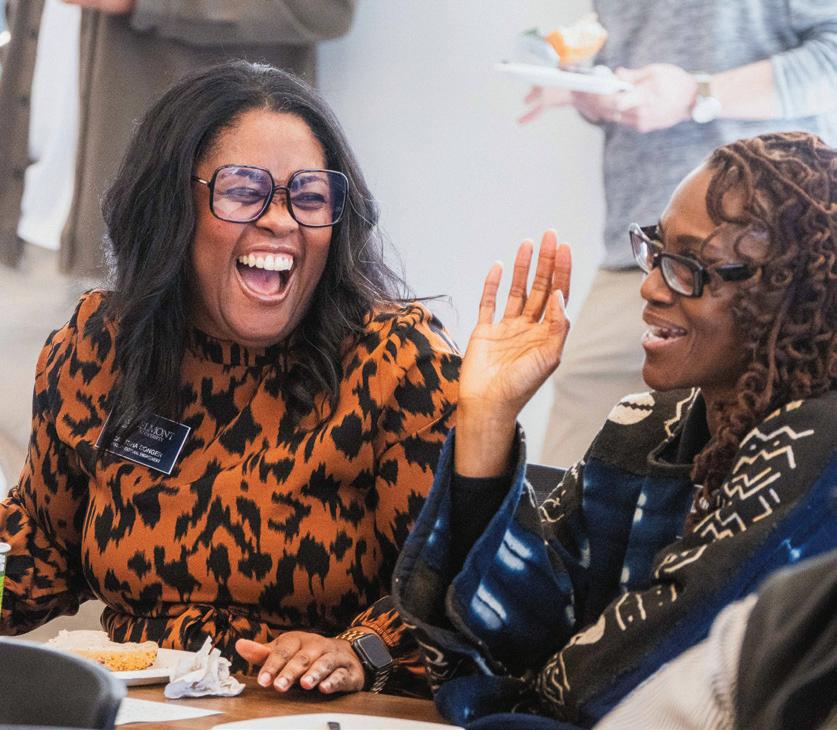
That culture was affirmed this year as Belmont earned its first national recognition as a “2025 Great College to Work For,” receiving Honor Roll status among an elite group of institutions across the country. The distinction reflected the lived experience of faculty and staff who point to mission, leadership, well‑being and workplace support as defining strengths. “Our Christ‑centered foundation fosters an environment of trust that encourages people to bring their full
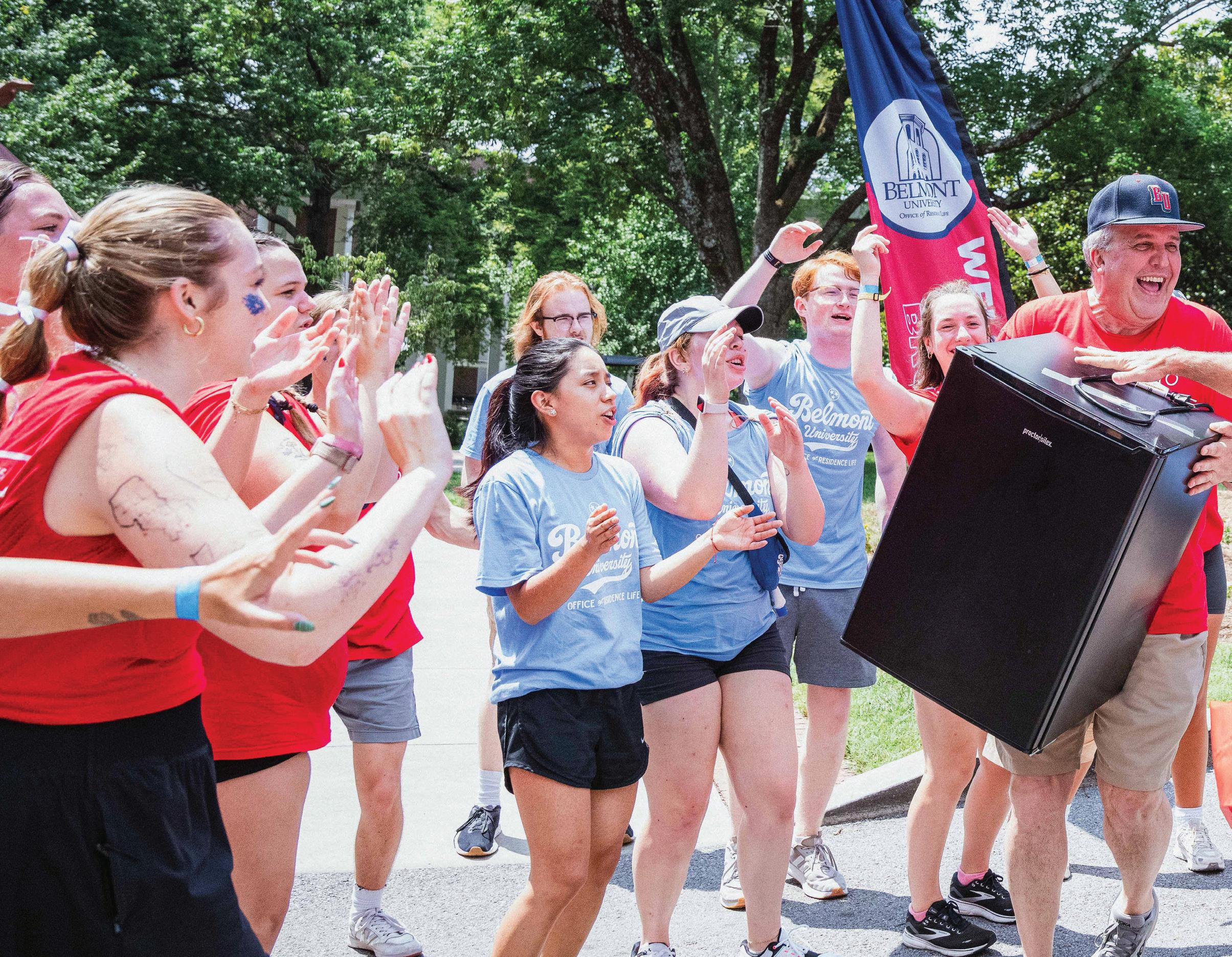
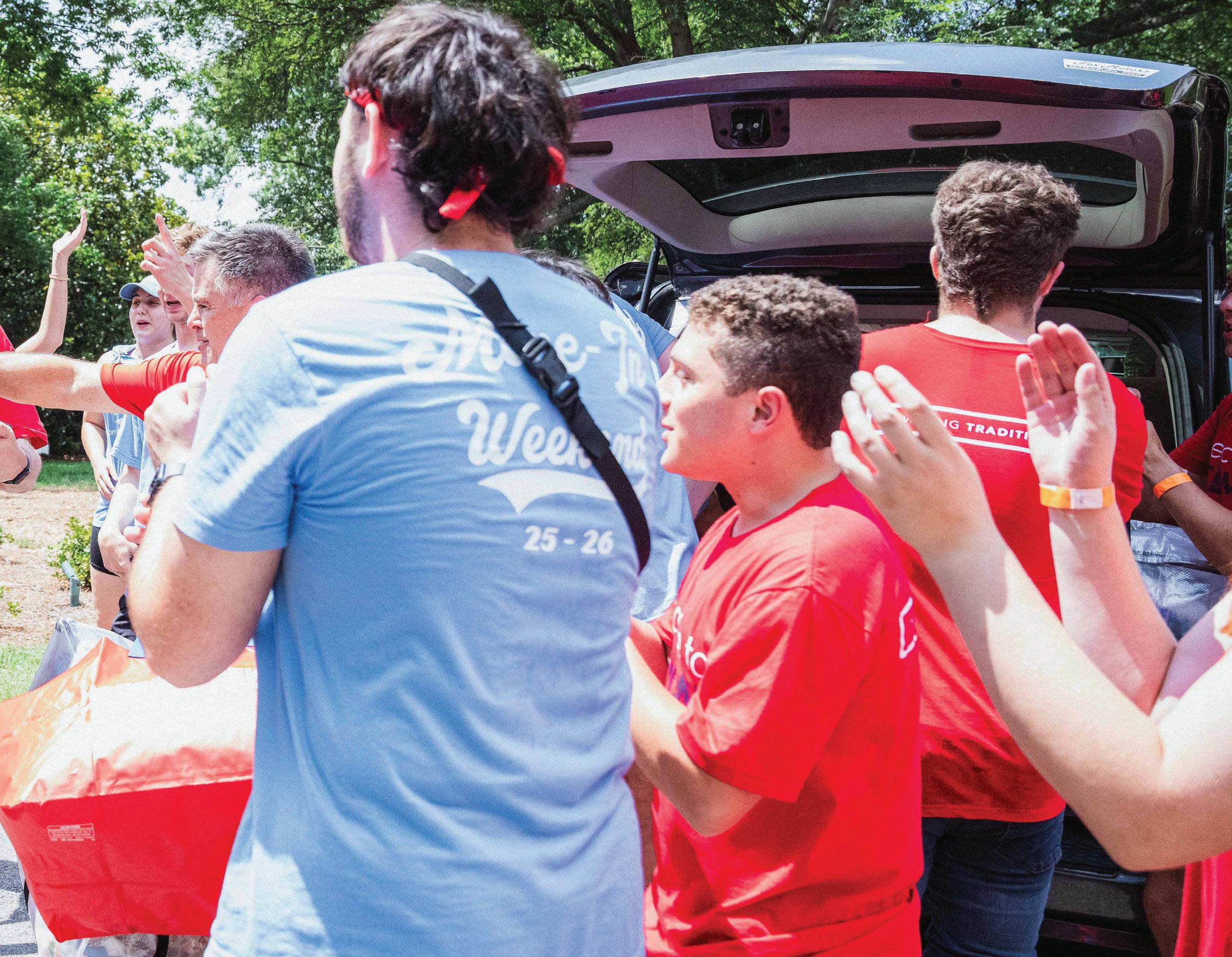
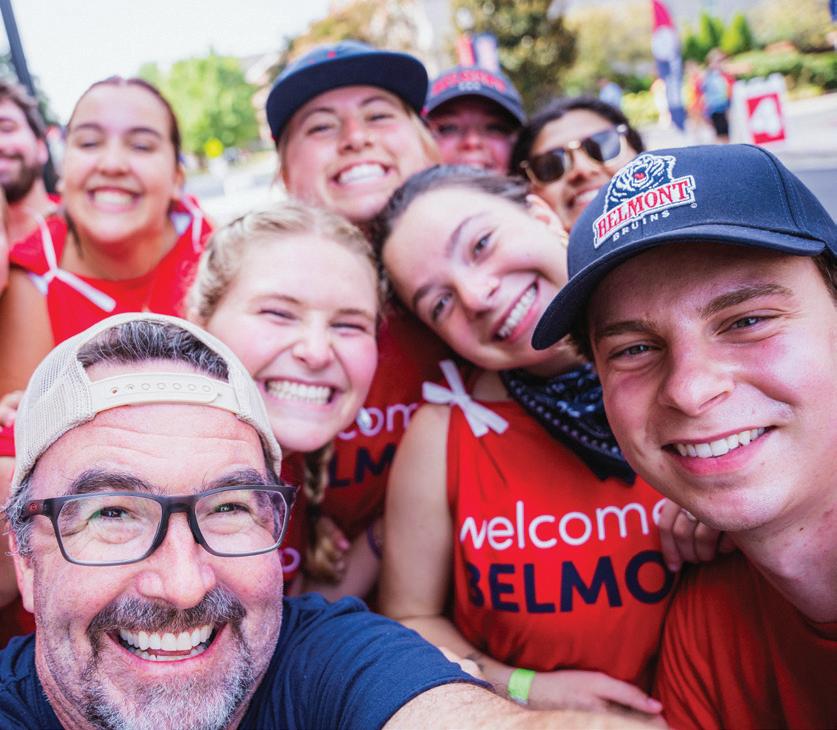
That same spirit was evident as Belmont welcomed 8,932 students to campus, the largest enrollment in University history. New and returning Bruins arrived from every state and 33 countries, drawn by academic excellence, vibrant campus culture and shared belief in Belmont’s mission to form leaders of character, creativity and purpose. “The growth reflected confidence in programs and trust in the relationships that define the Belmont experience,” said Dr. Chris Gage, vice president for enrollment services.
Hope also found voice beyond the classroom through season three of “The Hope People” podcast, hosted by President Greg Jones. Through conversations with artists, entrepreneurs, philanthropists and leaders across disciplines, the series explores hope as something lived, marked by courage, resilience and faith.
Belmont University Named 2025
Great College to Work For
Hope Transforms campaign goal towards a $700M Raised
$310M

Hope, by its nature, looks forward. It calls communities to imagine what could be and take faithful steps toward making it possible.
This year, Belmont gave that forward‑looking hope a name with the launch of Hope Transforms, the University’s most ambitious fundraising effort yet with a goal of $700 million.
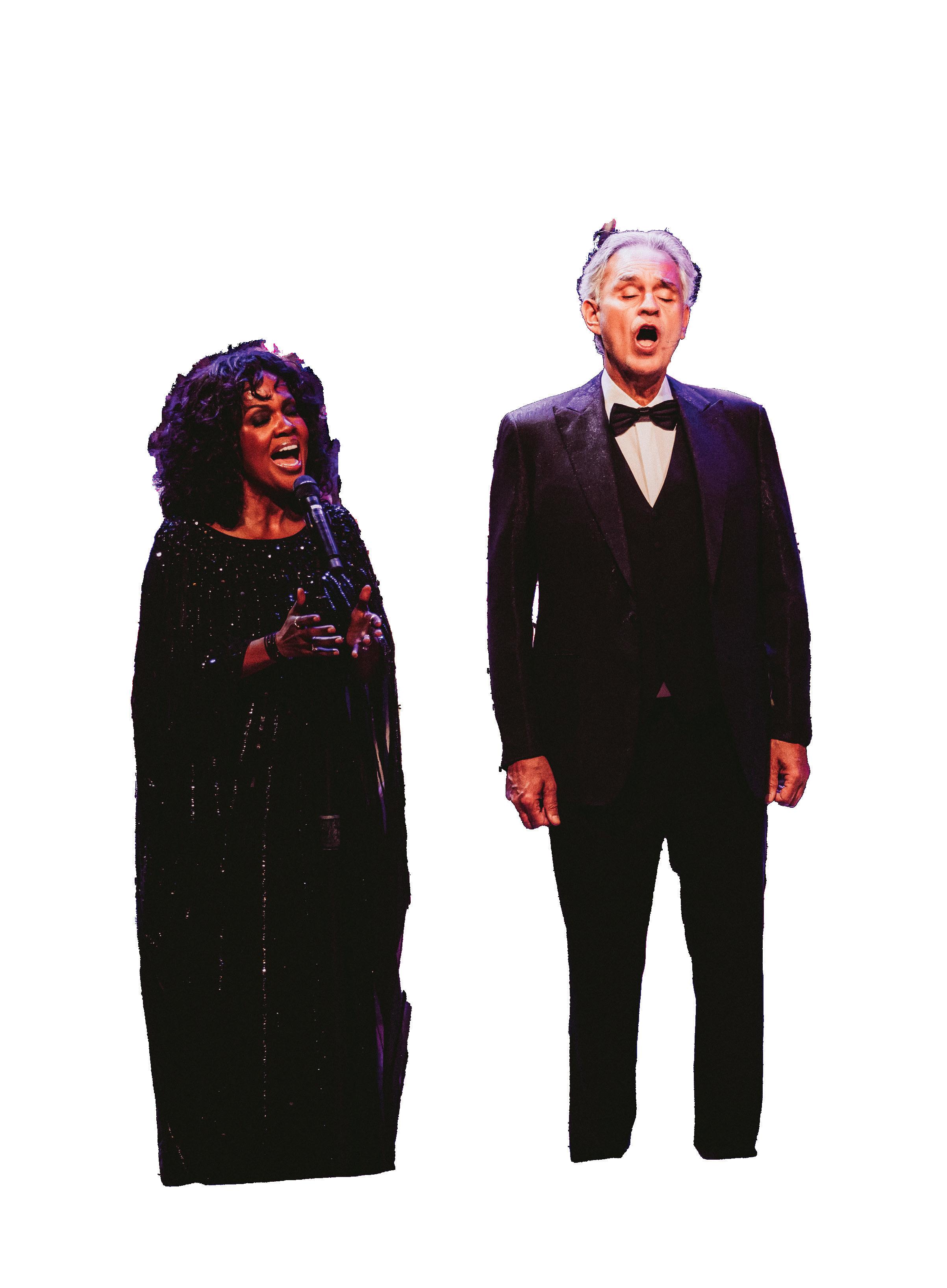
The campaign was introduced through “An Evening of Hope” at the Fisher Center for the Performing Arts, a sold‑out gala headlined by world‑renowned tenor Andrea Bocelli alongside guest artists and Belmont musicians. The evening captured something special about Belmont’s vision: excellence rooted in faith and purpose. The event proved so meaningful that the Bocelli team invited Belmont students to perform on two 2026 arena tour dates.
At its heart, Hope Transforms advances a vision centered on forming leaders of character, unleashing transformational creativity and inspiring innovation that serves the common good. Ending the year with $310 million raised, the campaign reflects a collective commitment to people and programs that shape lives beyond graduation.
That commitment took form through the Johnson Academic Challenge, a matching initiative established by Milton and Denice Johnson to strengthen faculty excellence across the University, with five endowed chairs already established. “By doubling the impact of donor generosity, we hope to attract and retain innovative leaders of character who bring forward‑thinking perspectives to our programs,” said Milton Johnson, chairman of Belmont’s Board of Trustees. “These endowed positions will be catalysts for transformation in how we prepare students for the future.”
President Greg Jones and Rev. Susan Pendleton Jones further embodied this vision through their investment in an endowed chair in formative education, focused on whole‑person formation and character development. “Forming students as people of character and purpose is sacred work,” said Rev. Susan Pendleton Jones. “Belmont faculty do this beautifully, helping students discover not just what they can do, but who they’re called to be.”
Moments like “An Evening of Hope” do not emerge overnight. They are made possible by years of faithful preparation — the quiet, rigorous work of learning and creating. At Belmont, hope takes shape through music and movement, research and performance, questions asked and truths explored.
Powerfully expressed through “Requiem for Colour: A Journey through Lament and Joy,” an original orchestral and choral masterwork composed and conducted by Dr. Jeffery L. Ames, hope is woven together through music, literature and visual art to explore resilience and a brighter future. Its three MidSouth Emmy Awards recognized excellence in composition, performance and technical achievement.
The production brought together nearly 200 singers from Belmont and Tennessee State Universities, an orchestra of students and professional musicians and an interdisciplinary team of faculty and student collaborators. From the live performance on Belmont’s
campus to its broadcast through PBS, “Requiem for Colour” reflected a shared commitment to creative rigor and excellence shaped in community.
This same spirit extends across disciplines through the SPARK Symposium, which transformed a spring day into a celebration of student scholarship, performance and creative work spanning every college. “SPARK demonstrated how much our community pours into each other,” said Dr. Beth Bowman, assistant dean of the College of Sciences and Mathematics. “It felt like an extension of Belmont’s combination of academic rigor and genuine community support.”
Together, these commitments, shaped through daily practice and carried forward by bold vision, affirm a shared conviction that hope is sustained through people: through teachers who mentor, students who grow and a community willing to invest deeply in the future it believes is possible.
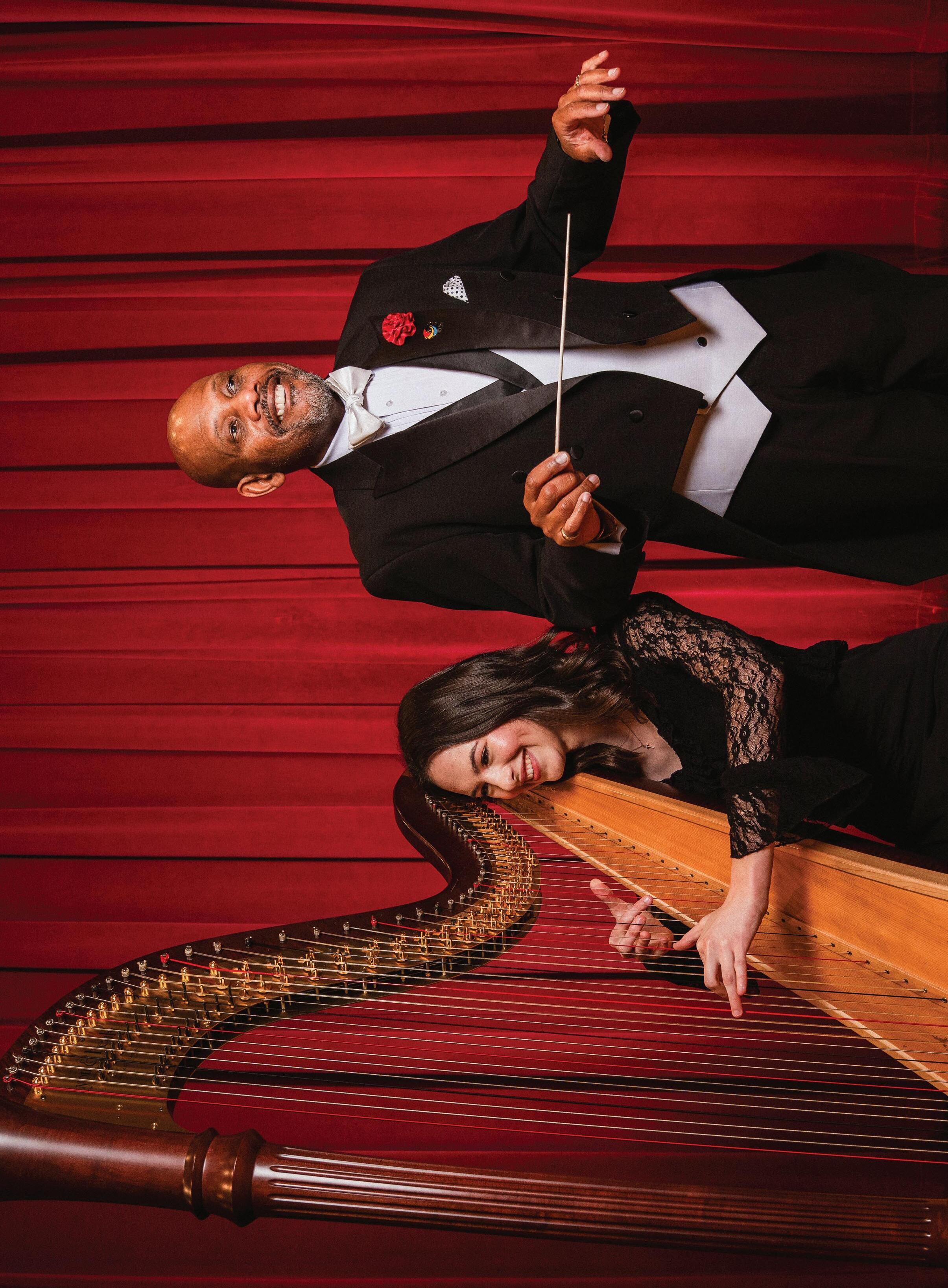

Still, Smith felt ready.
“I never could have imagined the incredible opportunities that I’ve been given at Belmont,” she said. “That experience left me feeling inspired to keep chasing even greater dreams.”
For Ames, that readiness is the point. Whether guiding students through a masterwork like “Requiem for Colour” or watching them take the stage beside world-class artists, he sees the same transformation at work. “It’s one thing to witness excellence,” Ames said. “It’s another to realize you belong there. And, I belong there. That’s what I want our students to feel.” Together, their stories reflect the heart of Belmont’s mission: forming people who create with purpose, perform with integrity and carry hope forward, from wherever their calling leads.
That same conviction shaped another defining moment this year, one experienced from a seat on the Fisher Center for the Performing Arts stage. As Belmont harpist Audrey Smith performed alongside Andrea Bocelli during “An Evening of Hope,” she found herself in a moment she once only imagined. “It was so exciting to prepare for a performance of this caliber with some of my closest mentors and friends,” Smith said. “Bocelli was singing in front of me, the choir was behind me and I was playing the harp’s glissandos. It was surreal — I wish I could go back and just stay in that moment and soak it all in again.”
Selected through a competitive audition process, Smith performed alongside another Belmont harpist and a faculty mentor, an intergenerational collaboration that reflected the University’s approach to learning. Preparation was intense, rehearsals were compressed and expectations were professional in every sense.
When Dr. Jeffery Ames lifted his hands to conduct his masterwork “Requiem for Colour,” the moment carried more than music. It held years of study, prayer and persistence, and the belief that creative work can tell the truth about pain while still pointing toward hope.
For Ames, director of choral activities and professor of music at Belmont, “Requiem for Colour” was more than a composition. Developed over more than a decade, the work traces a journey through lament and joy, retelling the Black American history of resilience by weaving together music, literature and visual art. Its recent recognition with three MidSouth Emmy wins affirmed not only artistic excellence, but a deeper conviction that creativity can help communities reckon honestly with the past and provide the hope to imagine something better.
AFter an exciting 2025, Belmont entered 2026 with confidence and purpose.
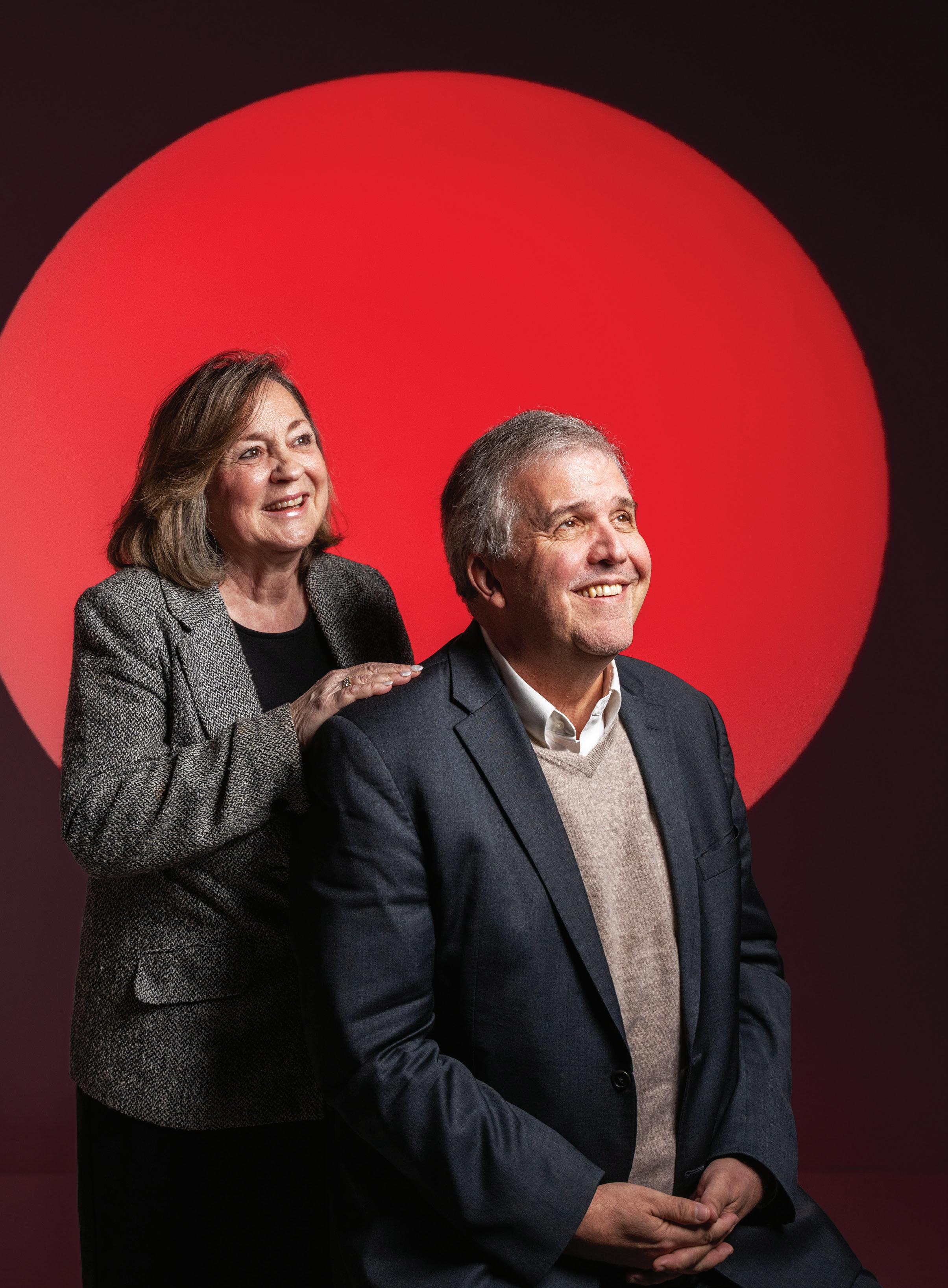
In December, the Board of Trustees extended President Greg Jones’ contract an additional five years through May 2036 — a clear affirmation of his and Susan’s leadership and the University’s vision to become the leading Christ-centered university in the world.
2025 was a glimpse of what happens when a community dreams big and works together. As Belmont looks forward, our call remains clear: to form graduates who bring hope and healing to a complex world. That vocation shapes everything from our story’s characters, to its plot points, to how we approach our world’s conflicts, to the themes we elevate.
With eyes fixed on Christ and a community ever committed to the work, Belmont moves into the future with confidence and wonder. After all, the best is yet to come, and it’s going to be great.

The ��uture is bright!