152
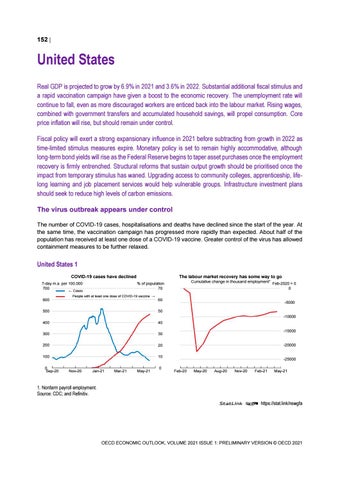
United States Real GDP is projected to grow by 6.9% in 2021 and 3.6% in 2022. Substantial additional fiscal stimulus and a rapid vaccination campaign have given a boost to the economic recovery. The unemployment rate will continue to fall, even as more discouraged workers are enticed back into the labour market. Rising wages, combined with government transfers and accumulated household savings, will propel consumption. Core price inflation will rise, but should remain under control. Fiscal policy will exert a strong expansionary influence in 2021 before subtracting from growth in 2022 as time-limited stimulus measures expire. Monetary policy is set to remain highly accommodative, although long-term bond yields will rise as the Federal Reserve begins to taper asset purchases once the employment recovery is firmly entrenched. Structural reforms that sustain output growth should be prioritised once the impact from temporary stimulus has waned. Upgrading access to community colleges, apprenticeship, lifelong learning and job placement services would help vulnerable groups. Infrastructure investment plans should seek to reduce high levels of carbon emissions. The virus outbreak appears under control The number of COVID-19 cases, hospitalisations and deaths have declined since the start of the year. At the same time, the vaccination campaign has progressed more rapidly than expected. About half of the population has received at least one dose of a COVID-19 vaccine. Greater control of the virus has allowed containment measures to be further relaxed.
United States 1 COVID-19 cases have declined 7-day m.a. per 100.000 700
The labour market recovery has some way to go Cumulative change in thousand employment¹ Feb-2020 = 0 0
% of population 70
← Cases
People with at least one dose of COVID-19 vaccine →
600
60
500
50
400
40
300
30
200
20
100
10
-5000
-10000
0 Sep-20
Nov-20
Jan-21
Mar-21
May-21
0
-15000
-20000
-25000 0 Feb-20
May-20
Aug-20
Nov-20
Feb-21
May-21
1. Nonfarm payroll employment. Source: CDC; and Refinitiv. StatLink 2 https://stat.link/nswgfa
OECD ECONOMIC OUTLOOK, VOLUME 2021 ISSUE 1: PRELIMINARY VERSION © OECD 2021
153
United States: Demand, output and prices
StatLink 2 https://stat.link/p7gh5u
United States 2 Fiscal policy is providing massive support % of GDP 0
Inflation will rise further
% of GDP 120
Y-o-y % changes 5 PCE Core² Michigan 1Y inflation expectations
-4
111
4
-8
102
3
93
2
84
1
-12
General government net debt¹ → ← Government net lending
-16
-20
2012
2014
2016
2018
2020
2022
75
0
2012
2014
2016
2018
2020
2022
0
1. General government shows the consolidated (i.e. with intra-government amounts netted out) accounts for all levels of government (central plus State/local) based on OECD national accounts. This measure differs from the federal debt held by the public, which was 100.1% of GDP for the 2020 fiscal year. 2. Personal Consumption Expenditures excluding food and energy price index. Source: OECD Economic Outlook 109 database. StatLink 2 https://stat.link/ydr6g8
OECD ECONOMIC OUTLOOK, VOLUME 2021 ISSUE 1: PRELIMINARY VERSION © OECD 2021
154
The recovery has picked up speed The economic recovery has picked up speed. Indicators of consumption activity have risen, with strong household income growth and a gradual relaxation of containment measures boosting spending. Household saving rates remain elevated compared to pre-pandemic levels. Labour market conditions continue to improve, with jobs growth recently strong in virus-sensitive sectors like leisure and hospitality. The unemployment rate was around 6% in April 2021, though only around two-thirds of the jobs lost at the onset of the pandemic have been added back so far (in net terms). Job losses have been especially severe for low-wage workers in the services sector and for African Americans and Hispanics. Core inflation has picked up, with strong growth in some tourism-related services prices. Manufacturing activity is now back around pre-pandemic levels and housing construction remains robust despite some increases in market interest rates.
Macroeconomic policy is heavily supporting activity Fiscal policy has strongly boosted activity. The American Rescue Plan passed Congress in mid-March, with spending measures worth about 8½ per cent of GDP that are largely concentrated in this year. The package was very broad in scope. Supplementary unemployment benefits have been extended until September 2021 and eligible families received a fresh round of stimulus payments from mid-March. Financial assistance is being provided to support subnational governments and schools as they endeavour to reopen. In addition, temporary provisions to expand health insurance coverage and provide support to low-income households, such as the Child Tax Credit and the Earned Income Tax Credit, were included. In 2022, fiscal policy will begin to exert a contractionary influence on economic growth as support measures expire. The administration has proposed additional spending that may temper this effect, with the “American Jobs Plan” and the “American Families Plan” focusing on a broad array of priority areas. These plans include fiscal support for decarbonisation, infrastructure, research and development, elderly and disabled care, job training, childcare, tax credits, paid leave and universal pre-school. If legislated as proposed, these packages would be worth an additional 19 per cent of GDP combined over the next ten years, partly funded through higher taxation. Monetary and financial market policy also continue to provide substantial support to the economy. The Federal Reserve expects to keep the federal funds rate in the 0-¼ per cent target range until the labour market has returned to maximum employment and inflation is above 2% and on track to moderately exceed it for some time. Concomitantly, the Federal Reserve has continued to expand its balance sheet. Ongoing monthly purchases of USD 80 billion in Treasury Securities and USD 40 billion in mortgage-backed securities will continue until clear further progress towards achieving the employment and price-stability goals has been made.
The strong output recovery will increase labour demand Real GDP growth is expected to pick up strongly in 2021, with fiscal support pushing household consumption growth sharply higher. At the same time, the reopening of the economy due to widespread vaccination of the population will enable activity in more sectors to return to normal. Export activity will also recover as the virus is better controlled in major trading partner economies. Stronger demand for labour will translate into a lower unemployment rate, even as more discouraged workers are enticed back into the labour market. Wage growth and price inflation are picking up as slack diminishes. Looking through a transitory spike, inflation is unlikely to substantially overshoot the Federal Reserve’s symmetrical price target of 2% in the medium term. Nevertheless, asset purchases should begin tapering in 2022 in response to a tight labour market that induces stronger inflation, pushing long-term interest rates higher.
OECD ECONOMIC OUTLOOK, VOLUME 2021 ISSUE 1: PRELIMINARY VERSION © OECD 2021
155 An upside risk to the projections is that fiscal policy turns out to have a more expansionary impact on economic growth in 2022 than currently assumed. The proposed new spending packages are not currently factored into the baseline projections. It could be that the spending measures are legislated in their current form and the increase in taxation is more modest than currently proposed by the administration. In addition, the very high household saving rate could decline more rapidly than expected, leading to stronger consumption growth. A downside risk to activity is that underlying inflation picks up more sharply, causing the Federal Reserve to raise the Federal Funds Rate within the forecast period. A rise in firm insolvencies, as supportive measures are wound back, is also a risk, given that non-financial corporate leverage in many virus-exposed sectors remains high.
Structural reforms should now be prioritised Policy settings that promote sustained output growth once the impact from temporary stimulus has waned should now be the priority. Spending on environmental, transportation and social infrastructure is needed, but could be partially funded by charges levied on those that use it most intensively. Infrastructure investment that reduces carbon emissions should be coupled with further progress in pricing carbon content. The effective pricing of energy-related carbon emissions in the United States is currently among the lowest in the OECD. Reducing and eventually removing fossil fuel subsidies and lowering the taxation of renewable energy are important priorities. As the economy further recovers, labour reallocation processes and the prospects of the most vulnerable will benefit from upgrading access to community colleges, apprenticeship, life-long learning and job placement services.
OECD ECONOMIC OUTLOOK, VOLUME 2021 ISSUE 1: PRELIMINARY VERSION © OECD 2021