261
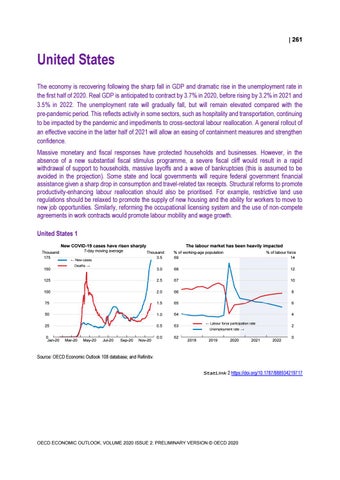
United States The economy is recovering following the sharp fall in GDP and dramatic rise in the unemployment rate in the first half of 2020. Real GDP is anticipated to contract by 3.7% in 2020, before rising by 3.2% in 2021 and 3.5% in 2022. The unemployment rate will gradually fall, but will remain elevated compared with the pre-pandemic period. This reflects activity in some sectors, such as hospitality and transportation, continuing to be impacted by the pandemic and impediments to cross-sectoral labour reallocation. A general rollout of an effective vaccine in the latter half of 2021 will allow an easing of containment measures and strengthen confidence. Massive monetary and fiscal responses have protected households and businesses. However, in the absence of a new substantial fiscal stimulus programme, a severe fiscal cliff would result in a rapid withdrawal of support to households, massive layoffs and a wave of bankruptcies (this is assumed to be avoided in the projection). Some state and local governments will require federal government financial assistance given a sharp drop in consumption and travel-related tax receipts. Structural reforms to promote productivity-enhancing labour reallocation should also be prioritised. For example, restrictive land use regulations should be relaxed to promote the supply of new housing and the ability for workers to move to new job opportunities. Similarly, reforming the occupational licensing system and the use of non-compete agreements in work contracts would promote labour mobility and wage growth. United States 1 New COVID-19 cases have risen sharply Thousand 175 150
7-day moving average ← New cases
The labour market has been heavily impacted Thousand 3.5
Deaths →
% of working-age population 69
% of labour force 14
3.0
68
12
125
2.5
67
10
100
2.0
66
8
75
1.5
65
6
50
1.0
64
4
25
0.5
63
0.0
62
0 Jan-20
Mar-20
May-20
Jul-20
Sep-20
Nov-20
← Labour force participation rate
2
Unemployment rate →
2018
2019
2020
2021
2022
0
Source: OECD Economic Outlook 108 database; and Refinitiv. StatLink 2 https://doi.org/10.1787/888934219717
OECD ECONOMIC OUTLOOK, VOLUME 2020 ISSUE 2: PRELIMINARY VERSION © OECD 2020
262
United States: Demand, output and prices 2017
2018
Current prices USD billion
United States GDP at market prices Private consumption Government consumption Gross fixed capital formation Final domestic demand Stockbuilding1
19 543.0 13 340.4 2 742.7 3 999.1 20 082.2 16.3 20 098.5 2 374.6 2 930.1 - 555.5
Total domestic demand Exports of goods and services Imports of goods and services Net exports1
2019
2020
2021
2022
Percentage changes, volume (2012 prices)
3.0 2.7 1.5 4.8 3.0 0.2 3.2 3.0 4.1 -0.3
2.2 2.4 1.8 2.3 2.3 0.0 2.3 -0.1 1.1 -0.2
-3.7 -4.0 0.6 -1.7 -2.9 -0.7 -3.6 -13.8 -10.7 -0.1
3.2 3.4 1.2 3.5 3.1 0.4 3.6 3.7 6.5 -0.5
3.5 3.6 2.8 4.0 3.6 0.0 3.6 4.4 5.1 -0.2
Memorandum items GDP deflator
_
2.4
1.8
1.1
1.1
1.5
Personal consumption expenditures deflator Core personal consumption expenditures deflator2
_
2.1
1.5
1.2
1.2
1.4
_
2.0
1.7
1.4
1.4
1.7
Unemployment rate (% of labour force) Household saving ratio, net (% of disposable income)
_
3.9
3.7
8.1
6.4
5.6
_
7.8
7.5
16.1
14.9
13.2
General government financial balance (% of GDP)
_
-6.3
-6.7
-15.4
-11.6
-8.3
General government gross debt (% of GDP) Current account balance (% of GDP)
_
106.6 108.4 128.0 134.2 136.3
_
-2.2
-2.2
-3.4
-4.0
-4.1
1. Contributions to changes in real GDP, actual amount in the first column. 2. Deflator for private consumption excluding food and energy. Source: OECD Economic Outlook 108 database.
StatLink 2 https://doi.org/10.1787/888934219736
United States 2 Fiscal policy is providing massive support % of GDP 0
Financial conditions are supporting investment
% of GDP 120
Annualised rate, thousands 1900
Adjusted National Financial Conditions Index² →
1700 -4
4
111
-8
102
-12
93
General government net debt¹ → ← Government net lending
-16
-20
Index 5
← Private housing permits
84
2012
2014
2016
2018
2020
2022
75
1500
3
1300
2
1100
1
900
0
700
-1
500
2007
2009
2011
2013
2015
2017
2019
-2
1. General government shows the consolidated (i.e. with intra-government amounts netted out) accounts for all levels of government (central plus State/local) based on OECD national accounts. This measure differs from the federal debt held by the public, which was 79.2% of GDP for the 2019 fiscal year. 2. The Adjusted National Financial Conditions Index (ANFCI) is published by the Federal Reserve Bank of Chicago and adjusts for the state of the business cycle and the level of inflation. Positive values are associated with tighter-than-average financial conditions and negative values are associated with looser-than-average financial conditions. Source: OECD Economic Outlook 108 database; Federal Reserve Bank of Chicago; and Refinitiv. StatLink 2 https://doi.org/10.1787/888934219755
OECD ECONOMIC OUTLOOK, VOLUME 2020 ISSUE 2: PRELIMINARY VERSION © OECD 2020
263
COVID-19 case numbers have remained elevated The number of COVID-19 cases has been persistently elevated since the start of the pandemic outbreak. Over 12 million US citizens have now tested positive to the virus, with more than 250 000 deaths attributed to it. Since mid-September, there has been a surge in cases. In response, new restrictions related to indoor gatherings and public spaces have been imposed in some areas. Schools in many jurisdictions have also moved back to remote learning and curfews and stay-at-home advice issued for specific locations. Nationwide testing capacity has gradually increased and the number of tests has ramped up since mid-September.
The economy is recovering, but services activity remains weak The economy experienced its sharpest contraction in post-war history in the second quarter of 2020, with non-farm employment declining by around 22 million through March and April 2020. A subsequent relaxation of containment measures was accompanied by a discernible economic rebound, with more than half of those lost jobs added back to employer payrolls by October 2020. Indicators of spending on goods consumption have recovered strongly. Similarly, housing investment has rebounded, with low mortgage interest rates and strong pent-up demand fuelling residential sales and construction. Even so, spending on most services remains weak. Google mobility trends suggest that activity in restaurants, cafés, shopping centres and movie theatres is about 20% lower than at the onset of the pandemic. Furthermore, a high share of low-wage workers in these industries means that the crisis risks sparking a long-lasting rise in earnings inequality.
Macroeconomic policy support has been substantial Fiscal policy reacted decisively earlier in the year once the scale of the economic impact became apparent. Comprehensive support was introduced, including supplementary unemployment insurance, one-off payments to families, financial assistance to state governments, forgivable loans with a Treasury backstop to small businesses that retain workers and increased health sector capacity. In response to the expiration of certain measures, the President issued executive orders in early August to partially extend fiscal support. However, this was funded by USD 44 billion (0.2% of GDP) from the Disaster Relief Fund and so was a temporary solution. As yet, no new broader fiscal support package has passed into legislation despite proposals from both major parties. Agreement on a new fiscal stimulus package, as assumed in these projections, is urgent to avoid a damaging fiscal cliff. Monetary and financial market policy is also providing substantial support to the economy. At the onset of the crisis, a suite of new credit facilities were introduced and prudential regulations were eased to limit the possibility of financial institutions restricting access to finance. The Federal Reserve cut interest rates to 0-0.25% and announced the resumption of unlimited large-scale asset purchases, significantly expanding the size of the balance sheet. In September, the Federal Open Market Committee issued forward guidance that reflected the adoption of the new flexible average inflation targeting strategy. Specifically, the Committee noted that the policy rate will not increase until inflation has risen to 2%, and is assessed to be on track to moderately exceed this rate for some time, and labour market conditions have reached levels consistent with the Committee’s assessment of maximum employment. Financial conditions have become highly accommodative as a result of the policies so far enacted.
OECD ECONOMIC OUTLOOK, VOLUME 2020 ISSUE 2: PRELIMINARY VERSION © OECD 2020
264
The recovery will be gradual and scars will remain GDP growth is expected to pick up through 2021, reflecting an assumed additional fiscal package that will particularly support household incomes and consumption. Improved conditions in major export markets and the fulfilment of agreed targets under the US-China Phase 1 trade deal will boost export activity at the same time. Nevertheless, until an effective vaccine has been deployed successfully in the latter part of 2021, assumed localised virus outbreaks and subsequent introduction of containment measures will temper business confidence and provide a headwind to new non-residential investment. Labour market conditions will show further steady improvement, although the unemployment rate will remain elevated compared with the pre-pandemic period. Similarly, the labour force participation rate will rise further but will not return to the levels seen in February 2020, partly reflecting early labour market exits of older workers, who have decided to retire rather than wait for the recovery, thus depriving the economy of valuable human capital. The existence of labour market slack will weigh on wage increases despite recent improvements in the pace of measured productivity growth. In turn, tepid growth in unit labour costs will keep price inflation well below the Federal Reserve’s 2% inflation target. An upside risk to the projections is that the scale of fiscal support turns out to be more expansionary than currently assumed. For example, a substantial new infrastructure package is not currently factored into the baseline projections. A downside risk is that a new fiscal package is relatively meagre in scale or takes many more months to be agreed. There is also a risk that large-scale firm insolvencies dent investment prospects. Non-financial corporate leverage has risen to historical highs, with many businesses in sectors exposed to COVID-19 confinement measures having accumulated substantial debt.
Structural reforms should accompany ongoing macroeconomic policy support A timely fiscal stimulus should be well targeted and effective in its support of workers and businesses affected by lockdown measures. Federal government financial assistance to state and local governments should be maintained, given they may otherwise need to wind back spending due to a drop in tax receipts and balanced budget requirements. There also needs to be continued support for individuals facing difficulty in quickly re-entering employment and at risk of dropping out of the labour force. In particular, job placement and retraining services should be improved and expanded. These services will also help to reorient workers from sectors that may permanently contract in the wake of the pandemic to new growth areas of industry. Over the medium term, labour reallocation and wage growth will also benefit from reducing the scale of occupational licensing and non-compete agreements in work contracts. Similarly, restrictive land use regulations should be relaxed to promote the supply of new housing and the ability for workers to move to new job opportunities. The approval of a vaccine for COVID-19 should be accompanied by thorough planning and governance around its production and eventual dissemination to the population. A rigorous vaccination process will reduce uncertainty, benefiting the economic recovery.
OECD ECONOMIC OUTLOOK, VOLUME 2020 ISSUE 2: PRELIMINARY VERSION © OECD 2020