225
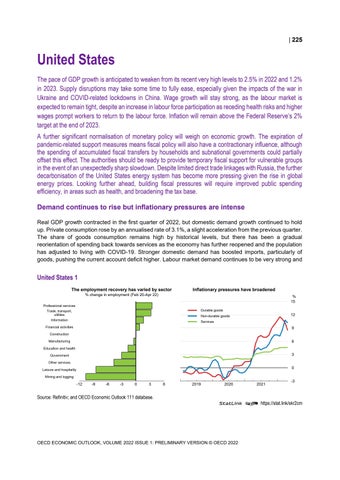
United States The pace of GDP growth is anticipated to weaken from its recent very high levels to 2.5% in 2022 and 1.2% in 2023. Supply disruptions may take some time to fully ease, especially given the impacts of the war in Ukraine and COVID-related lockdowns in China. Wage growth will stay strong, as the labour market is expected to remain tight, despite an increase in labour force participation as receding health risks and higher wages prompt workers to return to the labour force. Inflation will remain above the Federal Reserve’s 2% target at the end of 2023. A further significant normalisation of monetary policy will weigh on economic growth. The expiration of pandemic-related support measures means fiscal policy will also have a contractionary influence, although the spending of accumulated fiscal transfers by households and subnational governments could partially offset this effect. The authorities should be ready to provide temporary fiscal support for vulnerable groups in the event of an unexpectedly sharp slowdown. Despite limited direct trade linkages with Russia, the further decarbonisation of the United States energy system has become more pressing given the rise in global energy prices. Looking further ahead, building fiscal pressures will require improved public spending efficiency, in areas such as health, and broadening the tax base. Demand continues to rise but inflationary pressures are intense Real GDP growth contracted in the first quarter of 2022, but domestic demand growth continued to hold up. Private consumption rose by an annualised rate of 3.1%, a slight acceleration from the previous quarter. The share of goods consumption remains high by historical levels, but there has been a gradual reorientation of spending back towards services as the economy has further reopened and the population has adjusted to living with COVID-19. Stronger domestic demand has boosted imports, particularly of goods, pushing the current account deficit higher. Labour market demand continues to be very strong and
United States 1 The employment recovery has varied by sector
Inflationary pressures have broadened
% change in employment (Feb 20-Apr 22)
% 15
Professional services Durable goods
Trade, transport, utilities
12
Non-durable goods
Information
Services
Financial activities
9
Construction
6
Manufacturing Education and health
3
Government Other services
0
Leisure and hospitality Mining and logging
-12
-9
-6
-3
0
3
6
0
2019
2020
2021
-3
Source: Refinitiv; and OECD Economic Outlook 111 database. StatLink 2 https://stat.link/skr2cm
OECD ECONOMIC OUTLOOK, VOLUME 2022 ISSUE 1: PRELIMINARY VERSION © OECD 2022
226
United States: Demand, output and prices 2018
2019
GDP at market prices Private consumption Government consumption Gross fixed capital formation
2021
2022
2023
Percentage changes, volume (2012 prices)
Current prices USD billion
United States
2020
20 527.2 13 913.5 2 869.4 4 281.7
2.3 2.2 2.0 3.1
-3.4 -3.8 2.0 -1.5
5.7 7.9 1.0 6.1
2.5 3.1 -0.1 2.8
1.2 1.1 1.8 2.6
Final domestic demand Stockbuilding¹
21 064.6 58.7
2.4 0.1
-2.5 -0.5
6.5 0.3
2.6 1.0
1.5 0.0
Total domestic demand Exports of goods and services Imports of goods and services Net exports¹
21 123.3 2 533.5 3 129.7 - 596.2
2.4 -0.1 1.2 -0.2
-3.0 -13.6 -8.9 -0.3
6.9 4.5 14.0 -1.4
3.5 3.6 9.6 -1.0
1.5 3.9 3.2 -0.1
_ _ _ _ _ _ _ _
1.8 1.5 1.7 3.7
1.2 1.2 1.4 8.1
4.2 3.9 3.3 5.4
6.4 5.9 4.7 3.6
3.6 3.5 3.1 3.8
Memorandum items GDP deflator Personal consumption expenditures deflator Core personal consumption expenditures deflator² Unemployment rate (% of labour force) Household saving ratio, net (% of disposable income) General government financial balance (% of GDP) General government gross debt (% of GDP) Current account balance (% of GDP)
7.6 16.6 12.3 6.4 7.0 -6.4 -15.4 -11.8 -6.7 -5.3 108.6 134.1 127.6 126.1 126.8 -2.2 -2.9 -3.6 -4.2 -4.3
1. Contributions to changes in real GDP, actual amount in the first column. 2. Deflator for private consumption excluding food and energy. Source: OECD Economic Outlook 111 database.
StatLink 2 https://stat.link/fpz9rj
United States 2 The fiscal expansion was large % pts 0
Interest rates have risen sharply
Cumulative percentage point difference in underlying primary balance, 2019-2021
% 4.0 Treasury Constant Maturity, 1 Year
3.5
-1
Corporate Paper, AA Financial Discount Rate, 3 Month
3.0
-2
2.5
-3
2.0 -4
1.5
-5
1.0
-6 -7
0.5 USA
OECD
0
0.0
2008
2010
2012
2014
2016
2018
2020
0
Source: Refinitiv; and OECD Economic Outlook 111 database. StatLink 2 https://stat.link/9tp3hv
OECD ECONOMIC OUTLOOK, VOLUME 2022 ISSUE 1: PRELIMINARY VERSION © OECD 2022
227 a depressed participation rate that still remains over 1 percentage point below its pre-pandemic level has contributed to acute labour shortages in some sectors and rising nominal wages. As in other countries, energy and food prices have spiked, eroding the purchasing power of households. However, underlying inflationary pressures have also risen markedly as strong demand continues to run up against supply constraints, with price pressures having broadened from goods to services components. The direct trade implications on the United States of the war in Ukraine and sanctions on Russia are limited. Just 3% of crude oil imports and 1% of total crude oil processed by US refineries derive from Russia. Furthermore, the United States is a net exporter of natural gas and is the second largest exporter of wheat in the world. Even so, there is a greater reliance on Russia for some other energy commodities, such as uranium, and there have been material indirect effects through global markets. The rise in oil prices has prompted the administration to release an additional one million barrels per day on average from strategic reserves over the next six months. The recently announced embargo on Russian oil imports by the European Union is expected to push global oil prices even higher in 2023. The S&P500 has also fallen markedly so far this year. Furthermore, disruptions to key inputs for semiconductors and transport equipment produced in Ukraine and Russia (e.g. palladium, argon, neon) and lockdowns in China could also create supply disruptions that impact production in the United States.
Fiscal and monetary policy support is unwinding rapidly The major pandemic-related fiscal programmes have now expired. The fiscal deficit is anticipated to fall substantially in 2022, suggesting a strong contractionary influence on real GDP growth. Nonetheless, this may be partially offset by the lagged effects of previous government spending. Discretionary fiscal stimulus during the pandemic was among the largest across the OECD and some support measures, such as transfers to households and state and local governments, are yet to be fully spent. Monetary policy normalisation has now begun. The Federal Open Market Committee has now lifted the Federal Funds Rate from its pandemic low by 75 basis points to 0.75-1% and communicated that further increases are likely to be forthcoming. OECD projections assume that the policy rate will be raised through the projection period in pursuit of the Federal Reserve’s objectives of maintaining price stability and full employment, with the Federal Funds Rate reaching 3-3.25% by the end of 2023. A reduction in central bank holdings of Treasury securities, agency debt and agency mortgage-backed securities also began on 1 June 2022. Balance sheet reduction will primarily be achieved by only reinvesting principal payments from securities to the extent that they exceed monthly caps. For Treasury securities, the cap will be set at USD 30 billion per month for the first three months before increasing to USD 60 billion per month. For agency debt and mortgage-backed securities, the cap will initially be set at USD 17.5 billion per month and will rise to USD 35 billion per month after three months. The tightening of monetary policy is already having a notable impact on market interest rates: the rate on a 30 year fixed rate mortgage has risen by over 2% since the start of 2022.
Growth will slow and risks are to the downside Real GDP growth is projected to slow to 2.5% in 2022 and 1.2% in 2023. A rapid normalisation of monetary policy, fiscal consolidation, ongoing supply disruptions and a rise in oil prices will weigh on growth. However, the further reorientation of domestic demand back towards the services sector should help to attenuate some supply shortages. Wage growth is expected to stay strong, as the labour market is expected to remain tight despite an increase in participation as receding health risks and higher wages prompt workers to return to the labour force. Price pressures may recede with a moderation in energy prices in 2023, but inflation is projected to remain above the Federal Reserve’s 2% target.
OECD ECONOMIC OUTLOOK, VOLUME 2022 ISSUE 1: PRELIMINARY VERSION © OECD 2022
228 Risks to the growth and inflation projections are substantial. The war in Ukraine could have a more significant negative impact on real GDP growth and could also push inflation notably higher. At the same time, further tightening in labour markets could cause nominal wages to accelerate substantially. To the extent that this contributes to more persistent inflationary pressures and a de-anchoring of inflation expectations, it could lead to a faster tightening of monetary policy, weakening economic growth. With fiscal support now having been wound back, signs of distress may become more visible on balance sheets of corporates in sectors that continue to be impacted by the pandemic or by supply chain issues. Another variant of COVID-19 that significantly disrupts economic activity would also weaken growth, especially in those parts of the country with more limited vaccine coverage. On the upside, healthy household balance sheets could fuel a stronger rebound in consumption and there is the potential for a larger rebound in labour supply than currently projected.
Building fiscal pressures necessitate reforms A significant decline in monetary and fiscal policy support is appropriate given the rapid economic recovery and elevated inflation. There may be a need for new fiscal measures to cushion the impact of war in Ukraine or a broader economic slowdown. However, any such measures should be well targeted and temporary. This is especially the case given building fiscal pressures from an ageing population and much-needed spending initiatives to strengthen the social safety net and achieve the climate transition. Improved public spending efficiency in areas such as health should be a priority. Declining competition between healthcare providers has led to rising profit margins that could be combatted by giving consumers more control of their data, including by introducing clear national data portability policies. Very high pharmaceutical costs could also be addressed through expanding the number of pharmaceuticals subject to negotiation by Medicare. Facilitating the decarbonisation of the United States energy system has become more pressing given the rise in global energy prices and should continue to be a strong focus of the administration.
OECD ECONOMIC OUTLOOK, VOLUME 2022 ISSUE 1: PRELIMINARY VERSION © OECD 2022