145
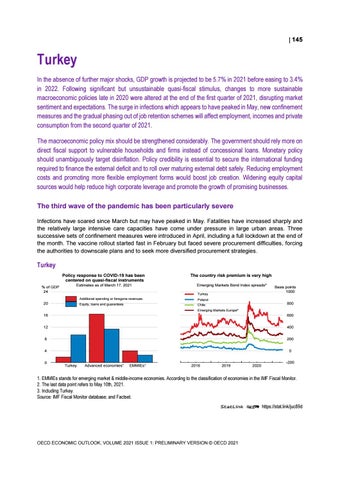
Turkey In the absence of further major shocks, GDP growth is projected to be 5.7% in 2021 before easing to 3.4% in 2022. Following significant but unsustainable quasi-fiscal stimulus, changes to more sustainable macroeconomic policies late in 2020 were altered at the end of the first quarter of 2021, disrupting market sentiment and expectations. The surge in infections which appears to have peaked in May, new confinement measures and the gradual phasing out of job retention schemes will affect employment, incomes and private consumption from the second quarter of 2021. The macroeconomic policy mix should be strengthened considerably. The government should rely more on direct fiscal support to vulnerable households and firms instead of concessional loans. Monetary policy should unambiguously target disinflation. Policy credibility is essential to secure the international funding required to finance the external deficit and to roll over maturing external debt safely. Reducing employment costs and promoting more flexible employment forms would boost job creation. Widening equity capital sources would help reduce high corporate leverage and promote the growth of promising businesses. The third wave of the pandemic has been particularly severe Infections have soared since March but may have peaked in May. Fatalities have increased sharply and the relatively large intensive care capacities have come under pressure in large urban areas. Three successive sets of confinement measures were introduced in April, including a full lockdown at the end of the month. The vaccine rollout started fast in February but faced severe procurement difficulties, forcing the authorities to downscale plans and to seek more diversified procurement strategies.
Turkey
% of GDP 24
Policy response to COVID-19 has been centered on quasi-fiscal instruments
The country risk premium is very high
Estimates as of March 17, 2021
Emerging Markets Bond Index spreads² Turkey
20
Additional spending or foregone revenues
Poland
Equity, loans and guarantees
Chile
Basis points 1000 800
Emerging Markets Europe³
16
600
12
400
8
200
4
0
0
Turkey
Advanced economies¹
EMMIEs¹
0
0
2018
2019
2020
-200
1. EMMIEs stands for emerging market & middle-income economies. According to the classification of economies in the IMF Fiscal Monitor. 2. The last data point refers to May 10th, 2021. 3. Including Turkey. Source: IMF Fiscal Monitor database; and Factset. StatLink 2 https://stat.link/juc89d
OECD ECONOMIC OUTLOOK, VOLUME 2021 ISSUE 1: PRELIMINARY VERSION © OECD 2021
146
Turkey: Demand, output and prices 2017
2018
GDP at market prices Private consumption Government consumption Gross fixed capital formation Final domestic demand Stockbuilding1 Total domestic demand Exports of goods and services Imports of goods and services Net exports1
3 133.7 1 836.6 450.6 935.6 3 222.9 26.2 3 249.1 816.0 931.4 - 115.4
Memorandum items GDP deflator Potential GDP, volume Consumer price index2 Core inflation index3 Unemployment rate (% of labour force) Current account balance (% of GDP)
_ _ _ _ _ _
2020
2021
2022
Percentage changes, volume (2009 prices)
Current prices TRY billion
Turkey
2019
3.0 0.7 6.5 -0.3 1.2 -2.6 -1.6 9.0 -6.4 4.2
0.9 1.6 4.3 -12.4 -2.1 0.0 -2.1 4.9 -5.3 3.2
1.8 2.9 2.2 6.5 3.7 5.5 9.4 -15.4 7.4 -7.3
5.7 6.7 0.5 5.6 5.4 -2.8 2.6 22.0 11.2 2.7
3.4 3.7 1.5 5.9 4.0 0.0 3.8 7.1 8.1 -0.5
16.5 5.1 16.3 16.5 10.9 -2.3
13.9 4.4 15.2 13.4 13.7 0.9
14.8 4.0 12.3 11.2 13.1 -5.2
18.1 3.9 16.0 16.3 14.0 -3.6
12.3 3.7 12.8 12.8 14.2 -3.4
1. Contributions to changes in real GDP, actual amount in the first column. 2. Based on yearly averages. 3. Consumer price index excluding food and energy. Source: OECD Economic Outlook 109 database.
StatLink 2 https://stat.link/jo6prt
The economic recovery faces strong headwinds Buoyant growth in the second half of 2020, driven by large quasi-fiscal support, increased inflation, widened the current account deficit and created concerns about fiscal sustainability. This was followed by credible monetary restraints and fiscal transparency commitments at the end of the year. Labour markets remained weak, with a persisting low employment rate, reduced labour force participation – notably by women – and the unemployment rate reaching 25% for youth. Ongoing improvements in business and consumer sentiment were hit by unexpected changes in monetary policy leadership at the end of the first quarter. Resulting disruptions in capital flows, risk premia, inflation expectations and long-term interest rates, combined with an exceptional surge of infections in April and new mobility restrictions, created headwinds that will likely last for some time.
The policy mix should be rebalanced Policy support to mitigate COVID-19 effects is still excessively centred on concessional loans. This is not sustainable for vulnerable firms and households, as income losses from the pandemic linger. While the government pursues official fiscal consolidation targets, these loans involve relatively opaque and potentially considerable contingent liabilities for the public finances. The continuation of the pandemic, low employment rates and household incomes, and increased debt burdens and re-financing costs for both firms and households call for direct support. The relatively low public-debt-to-GDP ratio allows room for such targeted and temporary transfers. The new management of the central bank has reiterated its commitment to the 5% inflation target - against both headline and core inflation above 17% in the first
OECD ECONOMIC OUTLOOK, VOLUME 2021 ISSUE 1: PRELIMINARY VERSION © OECD 2021
147 quarter of 2021 and persisting inflationary pressures. However, it no longer mentions further policy tightening in its forward guidance statements. The monetary policy outlook is blurred and credibility must be re-built in an environment of doubts about central bank independence.
The recovery will be gradual and large uncertainties persist A gradual recovery is projected after a contraction of activity in the second quarter of 2021. The phasing out of job retention schemes, combined with increased debt burdens and re-financing costs of firms and households, will weigh on domestic demand. Exports are projected to stay strong, except in tourism. The outlook for public and private banks’ problem loans at the expiration of forbearances granted during the pandemic remains uncertain. No major disruption is projected to the lending capacity of banks in the short term but credit growth is expected to stay lower than in 2020. Large downward and upward risks weigh on the projections, depending on developments in the pandemic, the domestic macroeconomic policy mix, and international funding conditions. External financing needs will exceed 30% of GDP in the next 12 months due to pending debt roll-overs. Capital outflows after the weakening of international investor confidence put additional pressure on the balance of payments. Further tensions in the availability and cost of external funding would hinder the recovery and may raise destabilisation risks.
Rebuilding confidence in macroeconomic policy and structural reforms are key A more balanced recovery requires a transparent and robust macroeconomic policy framework. Temporary fiscal supports need to be combined with a credible monetary policy that actually delivers lower inflation. Labour market reforms that reduce employment costs and promote more flexible employment forms would boost higher quality job creation and improve social cohesion. Improving financial transparency and strengthening equity and venture capital markets would help to re-balance excessively leveraged firm balance sheets and ease the survival and foster faster growth of promising businesses.
OECD ECONOMIC OUTLOOK, VOLUME 2021 ISSUE 1: PRELIMINARY VERSION © OECD 2021