254
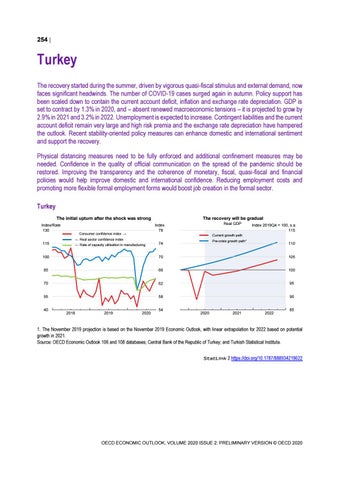
Turkey The recovery started during the summer, driven by vigorous quasi-fiscal stimulus and external demand, now faces significant headwinds. The number of COVID-19 cases surged again in autumn. Policy support has been scaled down to contain the current account deficit, inflation and exchange rate depreciation. GDP is set to contract by 1.3% in 2020, and – absent renewed macroeconomic tensions – it is projected to grow by 2.9% in 2021 and 3.2% in 2022. Unemployment is expected to increase. Contingent liabilities and the current account deficit remain very large and high risk premia and the exchange rate depreciation have hampered the outlook. Recent stability-oriented policy measures can enhance domestic and international sentiment and support the recovery. Physical distancing measures need to be fully enforced and additional confinement measures may be needed. Confidence in the quality of official communication on the spread of the pandemic should be restored. Improving the transparency and the coherence of monetary, fiscal, quasi-fiscal and financial policies would help improve domestic and international confidence. Reducing employment costs and promoting more flexible formal employment forms would boost job creation in the formal sector. Turkey The initial upturn after the shock was strong Index/Rate 130
Consumer confidence index →
Real GDP
Index 2019Q4 = 100, s.a. 115
Current growth path
← Real sector confidence index
115
The recovery will be gradual Index 78
← Rate of capacity utilisation in manufacturing
Pre-crisis growth path¹
74
110
100
70
105
85
66
100
70
62
95
55
58
90
40
2018
2019
2020
54
0
2020
2021
2022
85
1. The November 2019 projection is based on the November 2019 Economic Outlook, with linear extrapolation for 2022 based on potential growth in 2021. Source: OECD Economic Outlook 106 and 108 databases; Central Bank of the Republic of Turkey; and Turkish Statistical Institute. StatLink 2 https://doi.org/10.1787/888934219622
OECD ECONOMIC OUTLOOK, VOLUME 2020 ISSUE 2: PRELIMINARY VERSION © OECD 2020
255
Turkey: Demand, output and prices 2017
Turkey GDP at market prices Private consumption Government consumption Gross fixed capital formation Final domestic demand Stockbuilding1 Total domestic demand Exports of goods and services Imports of goods and services Net exports1 Memorandum items GDP deflator Potential GDP, volume Consumer price index2 Core inflation index3 Unemployment rate (% of labour force) Current account balance (% of GDP)
2018
_ _ _ _ _ _
2020
2021
2022
Percentage changes, volume (2009 prices)
Current prices TRY billion
3 133.7 1 836.6 450.6 935.6 3 222.9 26.2 3 249.1 816.0 931.4 - 115.4
2019
3.0 0.7 6.5 -0.3 1.2 -2.6 -1.6 9.0 -6.4 4.2
0.9 1.6 4.3 -12.4 -2.1 0.0 -2.1 4.9 -5.3 3.2
-1.3 -1.5 2.9 -4.5 -1.7 6.5 5.1 -19.8 -0.9 -6.2
2.9 3.2 2.2 2.6 2.8 1.2 3.9 5.0 8.8 -1.3
3.2 4.2 0.1 6.4 4.1 0.0 3.9 7.1 9.2 -0.9
16.5 4.7 16.3 16.5 11.0 -2.1
13.9 4.0 15.2 13.4 13.7 1.2
12.8 3.2 12.0 10.9 12.5 -2.9
12.4 2.8 11.9 11.9 14.8 -2.7
9.5 2.8 9.5 9.5 15.3 -3.1
1. Contributions to changes in real GDP, actual amount in the first column. 2. Based on yearly averages. 3. Consumer price index excluding food and energy. Source: OECD Economic Outlook 108 database.
StatLink 2 https://doi.org/10.1787/888934219641
The initially successful fight against the pandemic has lost its early momentum Infections, which were relatively contained in April and May, have grown again after the relaxation of confinement measures in June. The monitoring of the health situation was difficult as only symptomatic cases have been reported until the end of November. There was a sharp escalation of infections in autumn, together with a rising number of deaths. Despite increased pressures on the hospital infrastructure, the testing, tracing and tracking system and health professionals, the saturation of intensive care capacities was avoided as of the first half of November, but tensions have augmented. Some new confinement measures were introduced in October and November and additional restrictions may become necessary.
The economy recovered sharply in the third quarter of 2020 but faces headwinds The drastic fall in activity in the second quarter was followed by a sharp recovery. It was driven by ample quasi-fiscal and monetary stimulus and strong export demand on the back of a large exchange rate depreciation and exporters’ successful diversification towards new markets. The rebound in industrial production was particularly vigorous. Business investment remained weak, but job retention programmes in the formal sector reduced employment losses. However, the unemployment rate for new entrants to the labour market and, in particular, youth is soaring. Weakness in tourism activity, which accounts for 4% of GDP and 7% of employment, has had adverse spillovers in tourist regions, despite a partial rebound in August thanks to domestic demand and visitors from certain countries such as Russia. The resurgence of infections, the weakening of external demand, regional geopolitical uncertainties, and further exchange rate depreciation and volatility in the last quarter of 2020 will weigh on the outlook.
OECD ECONOMIC OUTLOOK, VOLUME 2020 ISSUE 2: PRELIMINARY VERSION © OECD 2020
256
Quasi-fiscal and monetary support is being scaled down Monetary and quasi-fiscal support has been massive. Concessional credits to households and businesses, provided mainly by public banks, but also private banks incentivised by government guarantees and new credit regulations (backed by negative real interest rates), gave an outstanding quasi-fiscal stimulus. Resulting pressures on the current account deficit and inflation have generated concerns about financial and exchange rate stability. Faced with a surge in risk premia and exchange rate depreciation, the authorities tightened the fiscal stance in autumn and public banks drastically reduced their credit expansion. The central bank has raised policy interest rates. The earlier divergence between the effective funding costs and the official interest rate of the central bank had created investor uncertainties, raising risk premia and denting exchange rates. Recent stability-oriented economic and monetary policy announcements and measures, including the sharp increase in the policy interest rate in November, have improved investor sentiment.
The recovery will be gradual and risks persist GDP is projected to contract in the last quarter of 2020 and recover only very gradually afterwards. The resurgence of the pandemic, the modest coverage of formal social safety nets and cash transfers, combined with firms’ and households’ already high debt levels, will weigh on private consumption. The subdued international trade environment will not permit exports to be buoyant. Investment will be affected by persisting uncertainties. There are both downward and upward risks. Uncertainties concerning regional geopolitical developments aside, domestic and international confidence may either weaken or improve according to developments in fiscal, financial and monetary policies. In this context, any increase in risk premia would bear on the cost of foreign financing of the high external funding requirements stemming from the large current account deficit and debt rollovers. If downward risks materialise, pressures on the exchange rate, inflation and financial stability would intensify and the economy may contract again.
Rebuilding confidence in the macroeconomic policy framework and structural reforms is crucial Room is available for above-the-line fiscal support until the recovery is firmly underway. Part of the support currently provided through public and concessional loans and loan guarantees can be converted into more transparent, targeted and temporary cash transfers. Such support should be accompanied by the implementation of a coherent and credible macroeconomic policy framework, encompassing monetary, fiscal, quasi-fiscal and financial policies, and all contingent liabilities, to improve transparency and confidence. Reducing employment costs and promoting more flexible employment forms in the formal sector would facilitate high-quality job creation.
OECD ECONOMIC OUTLOOK, VOLUME 2020 ISSUE 2: PRELIMINARY VERSION © OECD 2020