2
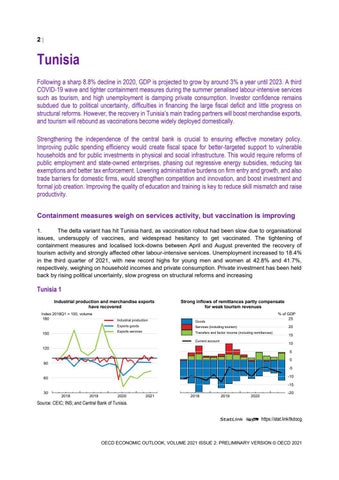
Tunisia Following a sharp 8.8% decline in 2020, GDP is projected to grow by around 3% a year until 2023. A third COVID-19 wave and tighter containment measures during the summer penalised labour-intensive services such as tourism, and high unemployment is damping private consumption. Investor confidence remains subdued due to political uncertainty, difficulties in financing the large fiscal deficit and little progress on structural reforms. However, the recovery in Tunisia’s main trading partners will boost merchandise exports, and tourism will rebound as vaccinations become widely deployed domestically. Strengthening the independence of the central bank is crucial to ensuring effective monetary policy. Improving public spending efficiency would create fiscal space for better-targeted support to vulnerable households and for public investments in physical and social infrastructure. This would require reforms of public employment and state-owned enterprises, phasing out regressive energy subsidies, reducing tax exemptions and better tax enforcement. Lowering administrative burdens on firm entry and growth, and also trade barriers for domestic firms, would strengthen competition and innovation, and boost investment and formal job creation. Improving the quality of education and training is key to reduce skill mismatch and raise productivity. Containment measures weigh on services activity, but vaccination is improving 1. The delta variant has hit Tunisia hard, as vaccination rollout had been slow due to organisational issues, undersupply of vaccines, and widespread hesitancy to get vaccinated. The tightening of containment measures and localised lock-downs between April and August prevented the recovery of tourism activity and strongly affected other labour-intensive services. Unemployment increased to 18.4% in the third quarter of 2021, with new record highs for young men and women at 42.8% and 41.7%, respectively, weighing on household incomes and private consumption. Private investment has been held back by rising political uncertainty, slow progress on structural reforms and increasing
Tunisia 1 Industrial production and merchandise exports have recovered Index 2018Q1 = 100, volume 180
150
Strong inflows of remittances partly compensate for weak tourism revenues % of GDP 25
Industrial production
Goods
Exports goods
Services (including tourism)
Exports services
Transfers and factor income (including remittances)
20
Current account
15 10
120
5 0
90
-5 -10
60
-15 30
2018
2019
2020
2021
0
0
2018
2019
2020
-20
Source: CEIC; INS; and Central Bank of Tunisia. StatLink 2 https://stat.link/tkdocg
OECD ECONOMIC OUTLOOK, VOLUME 2021 ISSUE 2: PRELIMINARY VERSION © OECD 2021
3
Tunisia: Demand, output and prices 2018
2019
2020
GDP at market prices Private consumption Government consumption Gross fixed capital formation Final domestic demand Exports of goods and services Imports of goods and services Net exports¹ Memorandum items GDP deflator Consumer price index Unemployment rate (% of labour force) Central government financial balance (% of GDP) Current account balance (% of GDP)
2022
2023
Percentage changes, volume (2010 prices)
Current prices TND billion
Tunisia
2021
106.3 76.3 21.0 19.5 116.8 51.1 64.7 - 13.6
0.9 2.1 2.6 0.3 1.9 -4.5 -7.8 2.6
-8.8 -5.3 -4.3 -33.7 -9.8 -17.2 -16.5 1.5
2.9 2.6 -0.9 -5.3 1.0 8.2 6.8 -0.1
3.2 2.4 0.4 5.0 2.3 7.3 5.5 0.3
3.0 3.3 -1.2 7.6 2.9 6.7 5.9 -0.1
_ _ _ _ _
7.2 6.7 15.1 -3.5 -8.4
5.3 5.6 16.7 -10.2 -6.8
5.8 5.8 17.7 -8.2 -6.0
6.2 6.3 17.0 -6.0 -6.4
5.9 5.8 16.4 -5.3 -6.3
1. Contributions to changes in real GDP, actual amount in the first column. Source: OECD Economic Outlook 110 database.
StatLink 2 https://stat.link/retg2v
difficulties in financing the large fiscal deficit. Due to strong export demand, especially for electrical and ICT equipment as well as pharmaceutical and medical products, and rising oil and gas production as well as mining activity, industrial production has recovered to its pre-crisis levels. However, supply-chain bottlenecks have started to weaken demand for some exported intermediate inputs. Inflation has picked up since July, mainly due to rising food and beverage prices. Recent improvements in vaccination coverage have allowed the resumption of foreign tourist arrivals. In spite of weak tourism revenues, the current account deficit has decreased due to a strong inflow of remittances and low import demand.
Tunisia 2 The fiscal deficit has increased and interest expenditures are rising % of GDP 2 0
Primary deficit
Financing the fiscal deficit is becoming increasingly difficult % of GDP 100
Interest expenditures
90
Headline deficit
-2 -4 -6 -8 -10 -12
2011 2012 2013 2014 2015 2016 2017 2018 2019 2020
0
Basis points 800 ← Public debt
750
Risk spread on government bonds¹ →
80
700
70
650
60
600
50
550
40
500
30
450
20
400
10
350
0
2015
2016
2017
2018
2019
2020
300
1. Spread is the difference in yields on government securities with outstanding maturities of 10 years between Tunisia and the United States. Source: CEIC; and Tunisia Ministry of Finance. StatLink 2 https://stat.link/eujw15
OECD ECONOMIC OUTLOOK, VOLUME 2021 ISSUE 2: PRELIMINARY VERSION © OECD 2021
4
Policies have mitigated the effects of the pandemic on households and firms 2. The fiscal package to support households and firms totalled 4.3% of GDP in 2020. This included deferring tax payments, accelerating VAT reimbursements, providing interest rate subsidies and loan guarantees to affected firms, expanding cash transfers to vulnerable households, offering temporary support to the unemployed and self-employed, and additional financing for the health sector. The central bank lowered the policy rate by 150 basis points in 2020, requested banks to temporarily defer loan payments, suspended fees for electronic payments and withdrawals, provided loan guarantees and liquidity, and eased macro-prudential regulations to support credit to the private sector. The monetary base has increased by more than 10% since early 2020, but the bulk of new loans has been channelled to stateowned enterprises and the public sector, leaving many private firms struggling with financial difficulties. 3. In 2021, the high fiscal deficit and public debt and an increasing public wage bill leave little space for fiscal stimulus. Emergency support is being phased out and replaced by more targeted support for vulnerable households. The authorities are improving and extending the system of targeted cash transfers by linking different data sources, verifying eligibility and introducing digital payment procedures. This will promote financial inclusion and facilitate the replacement of inefficient and regressive energy subsidies by targeted income support to the poor. A COVID-19 fund financed by multilateral credit institutions and private donations provides additional resources for targeted cash transfers to vulnerable households and firms, medical equipment and hiring health professionals. Many measures adopted by the central bank to support the economy as well as other firm support measures have been extended until end of 2021.
The recovery will be slow 4. Improvements in vaccination coverage and a gradual removal of containment measures will continue to support activity in labour-intensive services sectors. However, rising firm bankruptcies, as pandemic-related support measures are phased out, will keep unemployment high, weighing on household incomes and damping private consumption. Political uncertainty has been reduced after the nomination of a new government, but is still high and holding back private investment. Some progress on core structural reforms is expected thanks to the resumption of a dialogue with social partners, and investor confidence should improve gradually during 2022. An improving health situation in Tunisia’s main trading partners will boost merchandise exports, and the resumption of tourist arrivals will raise services exports. Due to subdued domestic demand and high unemployment, inflationary pressures will remain contained, but they will gradually rise in 2022 due to high commodity prices and decreasing energy subsidies. 5. Besides pandemic-related risks, political tensions and social unrest pose a significant risk to the recovery. With public financing needs estimated at around 8% of GDP in 2021, a credible medium-term plan to reduce the fiscal deficit, and progress on structural reforms, are fundamental to restore investor confidence and allow multilateral lenders to help re-finance the high public debt. A fasterthan-expected increase in interest rates in advanced countries could reduce capital inflows and lead to a currency depreciation, raising the risk of a sovereign debt default and a financial crisis. The foreign currency debt of both public and private sectors is high and the share of non-performing loans was already high before the pandemic. Feedback loops between the public sector and the banking sector are strong as a significant share of public debt, including from state-owned enterprises, is held by domestic banks. Rising world commodity prices pose an upward risk on inflation, the current account and the fiscal deficit, as Tunisia is a net importer of oil and related products and energy subsidies are still high. Moreover, further monetary financing of the fiscal deficit would put additional pressure on inflation and reduce the credibility of the central bank. Centralised wage bargaining covering 2020 and 2021 might reinforce inflationary pressures. Persistent supply-chain bottlenecks in major export markets would weaken demand for merchandise exports. On the upside, a quicker resumption of foreign tourist arrivals and a faster recovery of the Libyan economy would boost goods and services exports.
OECD ECONOMIC OUTLOOK, VOLUME 2021 ISSUE 2: PRELIMINARY VERSION © OECD 2021
5
Structural reforms are key for macroeconomic stability 6. To reduce macroeconomic imbalances and related risks, it is crucial that the national dialogue delivers on structural reforms. Improvements in public spending efficiency should include a reform of public employment and state-owned enterprises and reallocation of resources to long-delayed public investments in education, health and infrastructure. Regressive and inefficient energy subsidies should be replaced by targeted income support for vulnerable households, using digital tools, once the economy is well underway. Reducing tax exemptions, improving tax enforcement and introducing property taxes could raise more and fairer tax revenue. Lowering administrative burdens for firm entry and growth, strengthening competition enforcement, reducing trade barriers and improving port infrastructure would boost investment and formal job creation. Improving the quality of education and professional training, including through better cooperation with the private sector, is key to reduce skill mismatch and raise productivity and exports.
OECD ECONOMIC OUTLOOK, VOLUME 2021 ISSUE 2: PRELIMINARY VERSION © OECD 2021