215
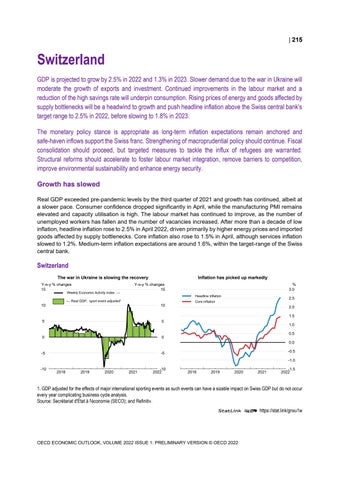
Switzerland GDP is projected to grow by 2.5% in 2022 and 1.3% in 2023. Slower demand due to the war in Ukraine will moderate the growth of exports and investment. Continued improvements in the labour market and a reduction of the high savings rate will underpin consumption. Rising prices of energy and goods affected by supply bottlenecks will be a headwind to growth and push headline inflation above the Swiss central bank’s target range to 2.5% in 2022, before slowing to 1.8% in 2023. The monetary policy stance is appropriate as long-term inflation expectations remain anchored and safe-haven inflows support the Swiss franc. Strengthening of macroprudential policy should continue. Fiscal consolidation should proceed, but targeted measures to tackle the influx of refugees are warranted. Structural reforms should accelerate to foster labour market integration, remove barriers to competition, improve environmental sustainability and enhance energy security. Growth has slowed Real GDP exceeded pre-pandemic levels by the third quarter of 2021 and growth has continued, albeit at a slower pace. Consumer confidence dropped significantly in April, while the manufacturing PMI remains elevated and capacity utilisation is high. The labour market has continued to improve, as the number of unemployed workers has fallen and the number of vacancies increased. After more than a decade of low inflation, headline inflation rose to 2.5% in April 2022, driven primarily by higher energy prices and imported goods affected by supply bottlenecks. Core inflation also rose to 1.5% in April, although services inflation slowed to 1.2%. Medium-term inflation expectations are around 1.6%, within the target-range of the Swiss central bank.
Switzerland The war in Ukraine is slowing the recovery Y-o-y % changes 15
Weekly Economic Activity index →
Inflation has picked up markedly
Y-o-y % changes 15
% 3.0 Headline inflation
← Real GDP, sport event adjusted¹
10
10
5
5
0
0
2.5
Core inflation
2.0 1.5 1.0 0.5 0.0 -0.5
-5
-5
-1.0 -10
2018
2019
2020
2021
-10 2022
0
2018
2019
2020
2021
-1.5 2022
1. GDP adjusted for the effects of major international sporting events as such events can have a sizable impact on Swiss GDP but do not occur every year complicating business cycle analysis. Source: Secrétariat d'État à l'économie (SECO); and Refinitiv. StatLink 2 https://stat.link/gnxu1w
OECD ECONOMIC OUTLOOK, VOLUME 2022 ISSUE 1: PRELIMINARY VERSION © OECD 2022
216
Switzerland: Demand, output and prices 2018
2019
GDP at market prices Private consumption Government consumption Gross fixed capital formation
2021
2022
2023
Percentage changes, volume (2015 prices)
Current prices CHF billion
Switzerland
2020
719.7 372.2 79.9 184.0
1.2 1.4 0.7 0.6
-2.5 -3.7 3.5 -1.7
3.7 2.6 4.0 3.4
2.5 3.1 2.7 0.2
1.3 0.8 0.8 1.1
Final domestic demand Stockbuilding¹
636.1 - 6.0
1.0 0.7
-2.3 1.3
3.0 -3.8
2.2 0.7
0.9 0.0
Total domestic demand Exports of goods and services Imports of goods and services Net exports¹
630.1 476.6 387.0 89.6
1.9 -0.8 -0.2 -0.4
-0.8 -6.4 -4.4 -1.8
-1.2 12.8 5.8 4.9
3.0 6.0 7.7 -0.1
0.9 2.0 1.6 0.6
-0.1 0.4 0.4 4.4
-0.5 -0.7 -0.3 4.8
1.4 0.6 0.3 5.1
2.4 2.5 1.7 4.7
1.4 1.8 1.2 4.6
17.4 1.3 39.5 5.4
23.1 -2.8 43.1 2.8
21.5 -0.8 40.7 9.3
18.7 0.4 41.2 7.1
17.9 1.2 40.6 7.2
Memorandum items GDP deflator Consumer price index Core inflation index² Unemployment rate (% of labour force) Household saving ratio, net (% of disposable income) General government financial balance (% of GDP) General government gross debt (% of GDP) Current account balance (% of GDP)
_ _ _ _ _ _ _ _
1. Contributions to changes in real GDP, actual amount in the first column. 2. Consumer price index excluding food and energy. Source: OECD Economic Outlook 111 database.
StatLink 2 https://stat.link/yp7lqo
Switzerland has limited direct economic ties with Russia and Ukraine, but the economy is affected by lower global growth and uncertainty, which have triggered an appreciation of the Swiss franc. Natural gas imports make up 15% of Switzerland’s final energy consumption. To safeguard supplies for the next year, the Federal Council has created conditions for the Swiss gas industry to quickly procure additional natural gas, liquefied natural gas (LNG) and storage capabilities. Roughly 51 000 Ukrainian refugees (0.6% of the population) have arrived in Switzerland since the onset of the war. The Swiss government has invoked a special residential status for refugees, which includes access to accommodation, social benefits and medical care.
Monetary policy remains accommodative, but fiscal policy is tightening The Swiss central bank kept interest rates unchanged at -0.75% at its meeting in March 2022 and remains willing to intervene in the foreign exchange market to stave off unwanted currency appreciation. As core inflation is within the target-band and the Swiss franc faces appreciation pressures, policy interest rates are projected to remain unchanged. However, the Swiss central bank should closely monitor inflation prospects and begin normalising interest rates if warranted. Due to strong momentum in the real estate market, the Federal Council has reactivated the sectoral countercyclical capital buffer, at 2.5% of risk-weighted exposures secured by residential property in Switzerland, effective from September 2022. The government has continued to scale back COVID-19-related fiscal support as the pandemic and economic situation has improved. A fiscal surplus is expected for 2022 with further consolidation in 2023 of 1.2% of GDP.
OECD ECONOMIC OUTLOOK, VOLUME 2022 ISSUE 1: PRELIMINARY VERSION © OECD 2022
217
Growth prospects are damped by the war Real GDP growth is projected to moderate to 2.5% in 2022 and 1.3% in 2023, reflecting slowing domestic demand and the negative impact on global growth from the war in Ukraine. While lower, manufacturing export growth is projected to remain positive over the projection horizon and should, together with a low cost of capital, raise investment. A progressive reduction of the high household savings rate is projected to support private consumption over the next two years. Higher prices on energy and supply bottlenecks will be a headwind to growth, and are projected to push headline inflation to 2.5% in 2022 and 1.8% in 2023, within the central bank’s target range. However, prolonged disruptions in global supply chains could increase inflation more markedly and lower activity.
Fiscal policy should continue to support inclusive growth and the green transition Ample fiscal capacity allows for continued government support to people and firms hardest-hit by the COVID-19 crisis. Due to the significant uncertainties relating to the war in Ukraine, the government should be ready to scale up expenses related to the influx of refugees while the planned consolidation progresses. Fostering labour market integration of under-represented groups would help sustain the recovery and improve inclusiveness. Close monitoring of financial risks related to real estate is warranted. Improving the environmental sustainability of consumption and production would accelerate the transition towards a netzero economy. Further investment into renewable energy and mobility would decrease reliance on the gas and oil markets and enhance energy security.
OECD ECONOMIC OUTLOOK, VOLUME 2022 ISSUE 1: PRELIMINARY VERSION © OECD 2022