142
Switzerland Real GDP is projected to increase by 3.2% in 2021 and 2.9% in 2022, supported by the easing of containment measures and stronger sentiment amid the subsiding pandemic. Improving labour market prospects and the progressive reduction of currently high saving will underpin consumption growth. Investment should rebound on the back of reduced uncertainty. With the recovery progressing, deflation pressures will fade, but inflation should remain well within the target range. The government moved swiftly to support employment and incomes during the downturn. The fiscal stance is expected to remain adequately supportive in 2021. Fiscal measures should become better targeted to support viable jobs and companies. Structural reforms should be accelerated, including ones to strengthen the business environment and remove internal barriers to competition. With low inflation expectations and still high uncertainty, monetary policy should remain accommodative. The economy is gradually reopening as the vaccination campaign progresses Faced with a large rise in infections in autumn 2020, the authorities gradually raised distancing requirements in the fourth quarter of the year and imposed a partial lockdown in January 2021 that significantly lowered the number of daily infections. The easing of restrictions started in March with the reopening of non-essential shops, museums and sports facilities. The increasing circulation of new COVID-19 variants poses risks that the authorities plan to mitigate by accelerating vaccinations, strengthening testing capacities and providing free self-tests to households. While supply bottlenecks delayed the vaccination campaign, the Confederation maintains its objective of inoculating 70% of the population by end-June.
Switzerland Policy support cushioned the impact of the pandemic on workers Index, 100 = max 140
The impact of the crisis differed greatly between sectors Thousands 1400
← The KOF Stringency Index¹ Short-time workers →
120
Diffusion index, s.a. 75
Index 2019 = 100 150 ← PMI, manufacturing sector
1200
70
100
1000
65
130
80
800
60
120
60
600
55
110
40
400
50
100
20
200
45
90
0 Feb-20
May-20
Aug-20
Nov-20
Feb-21
May-21
0
40 Jan-20
140
Retail trade sales, volume →
Apr-20
Jul-20
Oct-20
Jan-21
Apr-21
80
1. The KOF Stringency Index record the stringency of COVID-19 policy measures in Switzerland. The values range from 0 (no measures) to 100 (full lockdown). Source: Refinitiv; KOF Swiss Economic Institute; and SECO. StatLink 2 https://stat.link/085piy
OECD ECONOMIC OUTLOOK, VOLUME 2021 ISSUE 1: PRELIMINARY VERSION © OECD 2021
143
Switzerland: Demand, output and prices 2017
Switzerland
2018
Total domestic demand Exports of goods and services Imports of goods and services Net exports1 Memorandum items GDP deflator Consumer price index Core inflation index2 Unemployment rate (% of labour force) Household saving ratio, net (% of disposable income) General government financial balance (% of GDP) General government gross debt (% of GDP) Current account balance (% of GDP)
694.0 365.3 78.6 180.2 624.1 - 6.9 617.3 452.5 375.7 76.7 _ _ _ _ _ _ _ _
2020
2021
2022
Percentage changes, volume (2015 prices)
Current prices CHF billion
GDP at market prices Private consumption Government consumption Gross fixed capital formation Final domestic demand Stockbuilding1
2019
3.0 0.8 0.9 0.8 0.8 0.3 1.1 3.4 0.4 2.0
1.1 1.4 0.9 1.2 1.3 0.1 1.4 -0.1 0.0 -0.1
-3.0 -4.5 2.9 -1.7 -2.7 0.6 -2.1 -6.8 -6.3 -1.1
3.2 3.6 4.0 2.3 3.3 -0.8 2.4 4.9 3.7 1.2
2.9 3.0 -0.8 2.9 2.5 0.0 2.5 5.8 5.8 0.7
0.7 0.9 0.5 4.7 16.0 1.3 39.8 6.7
-0.1 0.4 0.4 4.4 16.2 1.4 41.0 6.7
-0.6 -0.7 -0.3 4.8 20.9 -2.6 43.0 3.8
-0.5 0.2 0.4 5.4 18.9 -3.5 46.8 5.2
0.7 0.4 0.5 5.3 17.4 -0.6 47.8 5.4
1. Contributions to changes in real GDP, actual amount in the first column. 2. Consumer price index excluding food and energy. Source: OECD Economic Outlook 109 database.
StatLink 2 https://stat.link/1upgx0
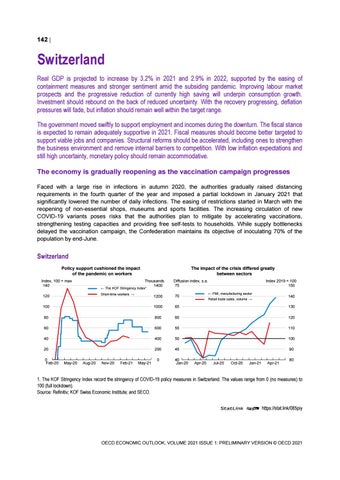
The second wave of infections halted the recovery With the reintroduction of containment measures, growth significantly slowed in the fourth quarter of 2020. Up to February 2021, the service sectors continued to be severely restricted and retail trade fell sharply. For the manufacturing sector, on the other hand, survey data indicated a continued and strong recovery. According to the KOF indicator, the improvement of the business situation was more broad-based across sectors in March and April and retail trade rebounded significantly. The rise in the unemployment rate stalled in the first quarter, but the number of workers on short-time working hours increased from about 250 thousand in October 2020 to 450 thousand in January 2021. Headline inflation has edged up due to rising commodity prices and currency depreciation, turning slightly positive in April.
A strong policy response helped cushion employment and incomes In 2020, the authorities provided generous support to workers and firms through job retention schemes, income compensation for the self-employed and credit guarantees for enterprises. This was complemented by measures targeted to the sport and culture, tourism and airlines industries. Most of these programmes were extended to 2021 and the credit guarantee programme was followed by a broader “hardship clause” programme providing guarantees, loans or grants to companies significantly affected by the pandemic restrictions. Monetary policy remains very accommodative, with a negative policy interest rate and actions taken to counter safe-haven pressures on the Swiss franc and sustain dollar liquidity and bank credit.
OECD ECONOMIC OUTLOOK, VOLUME 2021 ISSUE 1: PRELIMINARY VERSION © OECD 2021
144
The easing of restrictions will foster a rebound in economic activity The gradual lifting of restrictions along with the rollout of vaccines will trigger a rebound in activity from the second quarter of 2021 onwards. Lower uncertainty and the low cost of capital will foster a recovery in investment. Improvements in labour market conditions and a reduction of households’ currently high saving will support consumption. In addition, buoyant external demand should encourage exports. However, the decline in unemployment is projected to be gradual, reflecting the eventual removal of policy support and an expected rise in bankruptcies. Inflation should turn positive but will remain low. Uncertainty is high. A failure to conclude an institutional agreement with the European Union regarding market access would negatively impact trade. Moreover, the continued rise in transaction prices and growing vacancy rates in residential housing raise vulnerabilities related to the real estate market. On the upside, rapid progress in vaccination could further unleash private consumption.
Fostering productivity and an inclusive recovery should be a priority With large uncertainties and projected low inflation, monetary policy should remain accommodative. Financial risks, including those related to the real estate market, should be closely monitored. Large fiscal support has appropriately buttressed the economy during the downturn and should be maintained until the recovery is well established. Over time, fiscal measures should become more targeted, to support viable jobs and companies, and should aim to facilitate job transitions. Strengthening the business environment, lowering barriers to competition, ensuring greater equity in education and boosting adults’ digital skills would foster productivity and help sustain the recovery.
OECD ECONOMIC OUTLOOK, VOLUME 2021 ISSUE 1: PRELIMINARY VERSION © OECD 2021