251
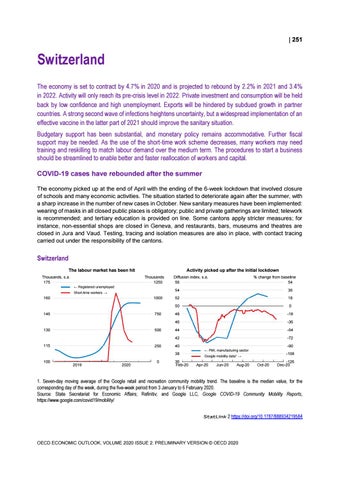
Switzerland The economy is set to contract by 4.7% in 2020 and is projected to rebound by 2.2% in 2021 and 3.4% in 2022. Activity will only reach its pre-crisis level in 2022. Private investment and consumption will be held back by low confidence and high unemployment. Exports will be hindered by subdued growth in partner countries. A strong second wave of infections heightens uncertainty, but a widespread implementation of an effective vaccine in the latter part of 2021 should improve the sanitary situation. Budgetary support has been substantial, and monetary policy remains accommodative. Further fiscal support may be needed. As the use of the short-time work scheme decreases, many workers may need training and reskilling to match labour demand over the medium term. The procedures to start a business should be streamlined to enable better and faster reallocation of workers and capital. COVID-19 cases have rebounded after the summer The economy picked up at the end of April with the ending of the 6-week lockdown that involved closure of schools and many economic activities. The situation started to deteriorate again after the summer, with a sharp increase in the number of new cases in October. New sanitary measures have been implemented: wearing of masks in all closed public places is obligatory; public and private gatherings are limited; telework is recommended; and tertiary education is provided on line. Some cantons apply stricter measures; for instance, non-essential shops are closed in Geneva, and restaurants, bars, museums and theatres are closed in Jura and Vaud. Testing, tracing and isolation measures are also in place, with contact tracing carried out under the responsibility of the cantons.
Switzerland The labour market has been hit Thousands, s.a. 175
Activity picked up after the initial lockdown Thousands 1250
← Registered unemployed Short-time workers →
160
1000
145
750
130
500
115
250
Diffusion index, s.a. 56 54
36
52
18
50
0
48
-18
46
-36
44
-54
42
-72
40 38
100
2019
2020
0
% change from baseline 54
36 Feb-20
-90 ← PMI, manufacturing sector
-108
Google mobility data¹ →
Apr-20
Jun-20
Aug-20
Oct-20
-126 Dec-20
1. Seven-day moving average of the Google retail and recreation community mobility trend. The baseline is the median value, for the corresponding day of the week, during the five-week period from 3 January to 6 February 2020. Source: State Secretariat for Economic Affairs; Refinitiv; and Google LLC, Google COVID-19 Community Mobility Reports, https://www.google.com/covid19/mobility/ StatLink 2 https://doi.org/10.1787/888934219584
OECD ECONOMIC OUTLOOK, VOLUME 2020 ISSUE 2: PRELIMINARY VERSION © OECD 2020
252
Switzerland: Demand, output and prices 2017
2018
GDP at market prices Private consumption Government consumption Gross fixed capital formation Final domestic demand Stockbuilding1 Total domestic demand Exports of goods and services Imports of goods and services Net exports1
694.0 365.3 78.6 180.1 624.1 - 6.8 617.3 452.5 375.8 76.7
Memorandum items GDP deflator Consumer price index Core inflation index2 Unemployment rate (% of labour force) Household saving ratio, net (% of disposable income) General government financial balance (% of GDP) General government gross debt (% of GDP) Current account balance (% of GDP)
_ _ _ _ _ _ _ _
2020
2021
2022
Percentage changes, volume (2015 prices)
Current prices CHF billion
Switzerland
2019
3.0 0.8 0.9 0.8 0.8 0.3 1.1 3.4 0.4 2.0
1.1 1.4 0.9 1.2 1.3 0.1 1.4 -0.1 0.0 -0.1
-4.7 -6.8 2.2 -5.2 -5.2 -0.9 -6.4 -4.4 -6.8 0.8
2.2 1.4 2.0 1.9 1.6 -0.9 0.6 2.2 0.8 1.0
3.4 1.9 1.6 4.4 2.6 0.0 2.6 3.3 3.0 0.6
0.7 0.9 0.5 4.7 17.3 1.3 39.4 8.6
-0.1 0.4 0.4 4.4 17.9 1.4 38.1 10.9
-0.2 -0.7 -0.3 4.9 22.1 -4.4 42.0 6.4
0.3 0.2 0.3 5.2 20.8 -3.8 45.9 5.8
0.6 0.4 0.4 4.8 20.1 -2.5 48.5 6.5
1. Contributions to changes in real GDP, actual amount in the first column. 2. Consumer price index excluding food and energy. Source: OECD Economic Outlook 108 database.
StatLink 2 https://doi.org/10.1787/888934219603
The economy has been severely impacted The lockdown triggered a large decline in GDP in the second quarter of 2020, albeit to a lesser extent than in many other European countries. In addition to the relatively early easing of containment restrictions, the structure of the economy helped to limit the impact. Manufacturing benefited from the positive performance of the chemical and pharmaceutical industry. Meanwhile, several sectors such as accommodation, transport and construction were hit hard. Consumer confidence is rebounding, but remains below its pre-crisis level. Short-time work has concerned more than a quarter of employees since the start of the crisis, although the number of short-time workers is now decreasing. Only about half of the sharp drop in employment translated into higher unemployment as part of the working population withdrew from the labour market. Unemployment seems to have stabilised but could rebound when the use of short-time work ends or if restrictions are prolonged.
An extensive support package is being implemented A large set of measures (amounting to around 6% of GDP, of which government guarantees account for about one-half) has been implemented to support incomes and firms. The Corona Income-Compensation Scheme has been set to compensate the loss of income for employees and the self-employed. It has been extended until mid-2021. The existing short-time work scheme coverage has been expanded to limit the impact of the crisis on employment. To avoid an increase in employees’ contributions, the Federal Council provided funding to the unemployment insurance fund (around 1.7% of GDP). Government guarantees for loans and delays in the payment of some taxes were also put in place for companies in distress. Monetary policy remains accommodative with negative interest rates. Moreover, with the COVID-19 refinancing OECD ECONOMIC OUTLOOK, VOLUME 2020 ISSUE 2: PRELIMINARY VERSION © OECD 2020
253 facility, the Swiss National Bank provides liquidity to banks to finance loans granted under the government’s COVID-19 scheme.
The economy is slowly recovering but risks are high The contraction in GDP should amount to 4.7% in 2020. Growth is projected to recover to 2.2% in 2021 and 3.4% in 2022. Some sectors such as transport and tourism should be affected by the impact of the crisis for longer. By contrast, the chemical and pharmaceutical industry should continue to support the recovery. Private consumption will be held back by high unemployment and low confidence levels. Exports will recover only slowly due to sluggish demand in trading partners and a strong currency. Risks are on the downside. New local lockdowns would reduce growth until large-scale immunisation is attained. Financial stability may be compromised by the continued increase in mortgage loans and residential property prices. By contrast, stronger growth in Europe would be positive for exports.
Further temporary fiscal support and streamlined regulation will help the recovery When the use of the short-time work scheme is scaled down, a risk exists that firms disappear and many workers become unemployed. To allow better and faster reallocation, more support for training and reskilling, especially in new technologies, will be needed. Streamlining processes to start a business will be key. To help banks supply loans to firms with liquidity problems, the Swiss National Bank should be ready to extend the COVID-19 refinancing facility.
OECD ECONOMIC OUTLOOK, VOLUME 2020 ISSUE 2: PRELIMINARY VERSION © OECD 2020