209
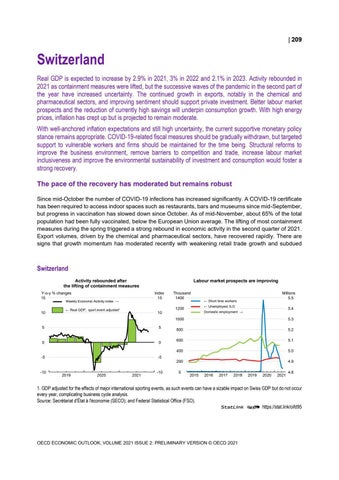
Switzerland Real GDP is expected to increase by 2.9% in 2021, 3% in 2022 and 2.1% in 2023. Activity rebounded in 2021 as containment measures were lifted, but the successive waves of the pandemic in the second part of the year have increased uncertainty. The continued growth in exports, notably in the chemical and pharmaceutical sectors, and improving sentiment should support private investment. Better labour market prospects and the reduction of currently high savings will underpin consumption growth. With high energy prices, inflation has crept up but is projected to remain moderate. With well-anchored inflation expectations and still high uncertainty, the current supportive monetary policy stance remains appropriate. COVID-19-related fiscal measures should be gradually withdrawn, but targeted support to vulnerable workers and firms should be maintained for the time being. Structural reforms to improve the business environment, remove barriers to competition and trade, increase labour market inclusiveness and improve the environmental sustainability of investment and consumption would foster a strong recovery. The pace of the recovery has moderated but remains robust Since mid-October the number of COVID-19 infections has increased significantly. A COVID-19 certificate has been required to access indoor spaces such as restaurants, bars and museums since mid-September, but progress in vaccination has slowed down since October. As of mid-November, about 65% of the total population had been fully vaccinated, below the European Union average. The lifting of most containment measures during the spring triggered a strong rebound in economic activity in the second quarter of 2021. Export volumes, driven by the chemical and pharmaceutical sectors, have recovered rapidly. There are signs that growth momentum has moderated recently with weakening retail trade growth and subdued
Switzerland Activity rebounded after the lifting of containment measures Y-o-y % changes 15
Index 15
Weekly Economic Activity index →
10
Labour market prospects are improving
← Real GDP, sport event adjusted¹
10
5
5
0
0
-5
-5
-10
2019
2020
2021
-10
Thousand 1400
Millions 5.5
← Short time workers ← Unemployed, ILO
1200
5.4
Domestic employment →
1000
5.3
800
5.2
600
5.1
400
5.0
200
4.9
0
2015
2016
2017
2018
2019
2020
2021
4.8
1. GDP adjusted for the effects of major international sporting events, as such events can have a sizable impact on Swiss GDP but do not occur every year, complicating business cycle analysis. Source: Secrétariat d'État à l'économie (SECO); and Federal Statistical Office (FSO). StatLink 2 https://stat.link/oifd95
OECD ECONOMIC OUTLOOK, VOLUME 2021 ISSUE 2: PRELIMINARY VERSION © OECD 2021
210
Switzerland: Demand, output and prices 2018
2019
GDP at market prices Private consumption Government consumption Gross fixed capital formation Final domestic demand Stockbuilding¹ Total domestic demand Exports of goods and services Imports of goods and services Net exports¹ Memorandum items GDP deflator Consumer price index Core inflation index² Unemployment rate (% of labour force) Household saving ratio, net (% of disposable income) General government financial balance (% of GDP) General government gross debt (% of GDP) Current account balance (% of GDP)
719.8 372.2 79.9 184.0 636.1 - 5.9 630.2 476.6 387.0 89.6 _ _ _ _ _ _ _ _
2021
2022
2023
Percentage changes, volume (2015 prices)
Current prices CHF billion
Switzerland
2020
1.2 1.4 0.7 0.6 1.1 0.7 1.9 -0.7 -0.2 -0.4
-2.5 -3.7 3.5 -1.7 -2.3 1.3 -0.9 -6.3 -4.4 -1.8
2.9 1.7 6.4 4.8 3.2 -3.0 -0.1 7.6 3.1 3.1
3.0 3.8 -2.5 3.6 2.9 -0.5 2.4 5.4 4.7 1.0
2.1 1.9 -0.4 1.1 1.4 0.0 1.4 4.4 3.8 0.9
-0.1 0.4 0.4 4.4 17.4 1.3 41.0 4.9
-0.5 -0.7 -0.3 4.8 23.1 -2.8 43.9 1.2
1.2 0.6 0.3 5.1 23.0 -2.3 46.8 6.2
1.4 1.0 0.7 4.6 20.1 0.2 47.2 6.5
1.0 0.8 0.8 4.4 18.7 0.8 46.9 6.4
1. Contributions to changes in real GDP, actual amount in the first column. 2. Consumer price index excluding food and energy. Source: OECD Economic Outlook 110 database.
StatLink 2 https://stat.link/e0omlq
new car registrations. However, overall growth should remain robust, as business sentiment is still strong. GDP is set to catch-up with the pre-pandemic levels before the end of the year. While the unemployment rate remains above its pre-pandemic level, the number of furloughed and unemployed workers has declined significantly since the beginning of the year and the number of vacancies increased. After being negative for roughly a year, consumer price inflation has risen on the back of higher energy prices, but remains well below the upper bound of the central bank’s target range.
Policy support remains substantial A strong fiscal position with low public debt has enabled the government to provide generous support to workers and firms during the crisis. To help the recovery, the government has developed a transition strategy that aims at gradually withdrawing exceptional COVID-19-related measures while helping workers and firms adapt to structural changes and boosting growth through investments and structural reforms. A gradual scaling back of the crisis-related extensions to the job retention scheme started in July 2021, but a complete normalisation of the scheme is not planned before 2022. The hardship clause program that offers grants, loans and credit guarantees to the hardest hit companies is maintained until end-2021, and more flexibility has been given to the cantons to tailor eligibility requirements to specific local needs. Due to negative interest rates and a relatively small domestic bond market, the Swiss National Bank has remained committed to foreign exchange interventions as an instrument to stave off safe-haven pressures (and related deflationary pressures). Monetary policy is expected to remain accommodative, maintaining a negative policy rate.
OECD ECONOMIC OUTLOOK, VOLUME 2021 ISSUE 2: PRELIMINARY VERSION © OECD 2021
211
The economic recovery will continue With the rebound in activity, GDP growth is projected to reach 2.9% in 2021. Fading pandemic-related uncertainties and a low cost of capital should further support investment in 2022. Labour-market normalisation and a reduction in the high saving rate of households will boost consumption over the next two years. Buoyant external demand should foster exports. With significantly lower COVID-19-related expenses in 2022, the general government budget deficit should turn into a surplus and further consolidation is projected in 2023. Employment will gradually strengthen, pushing wages up by a little over 1½ per cent per annum in 2022 and 2023, but consumer price inflation is projected to remain moderate. However, uncertainty remains high. Risks in the financial sector have increased with rising corporate indebtedness and growing imbalances in the domestic real estate market. Trade disruptions, due to renewed pandemic waves or new trade barriers, including with the EU, could hamper the recovery. On the upside, a faster rundown of accumulated savings would result in higher consumption and activity.
Targeted policy support would enable an inclusive recovery With moderate inflation pressures and well-anchored long-term inflation expectations, the accommodative monetary policy stance remains appropriate. Continued close supervision of financial risks is warranted. The removal of fiscal policy support should be gradual to avoid hampering the recovery. In this regard, temporary adjustments to the application of federal fiscal rules as currently envisaged by the government are welcome as they could provide more leeway over the pace of consolidation. Support should increasingly focus on hardest-hit firms and on people, rather than jobs, by facilitating reallocation through job search and upskilling. Strengthening the business environment, lowering barriers to competition and trade, and fostering the labour market integration of under-represented groups such as foreign nationals, women and older workers, would spur productivity and help sustain the recovery. Policies to improve the environmental sustainability of consumption and investment would help accelerate progress in transitioning to a low-carbon economy.
OECD ECONOMIC OUTLOOK, VOLUME 2021 ISSUE 2: PRELIMINARY VERSION © OECD 2021