139
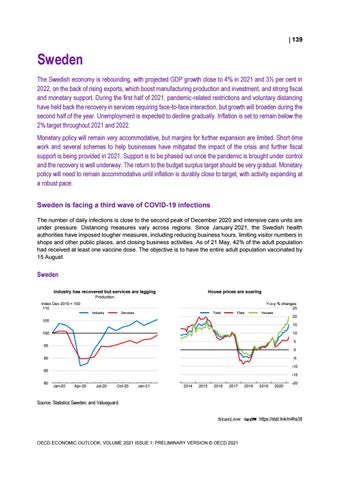
Sweden The Swedish economy is rebounding, with projected GDP growth close to 4% in 2021 and 3½ per cent in 2022, on the back of rising exports, which boost manufacturing production and investment, and strong fiscal and monetary support. During the first half of 2021, pandemic-related restrictions and voluntary distancing have held back the recovery in services requiring face-to-face interaction, but growth will broaden during the second half of the year. Unemployment is expected to decline gradually. Inflation is set to remain below the 2% target throughout 2021 and 2022. Monetary policy will remain very accommodative, but margins for further expansion are limited. Short-time work and several schemes to help businesses have mitigated the impact of the crisis and further fiscal support is being provided in 2021. Support is to be phased out once the pandemic is brought under control and the recovery is well underway. The return to the budget surplus target should be very gradual. Monetary policy will need to remain accommodative until inflation is durably close to target, with activity expanding at a robust pace. Sweden is facing a third wave of COVID-19 infections The number of daily infections is close to the second peak of December 2020 and intensive care units are under pressure. Distancing measures vary across regions. Since January 2021, the Swedish health authorities have imposed tougher measures, including reducing business hours, limiting visitor numbers in shops and other public places, and closing business activities. As of 21 May, 42% of the adult population had received at least one vaccine dose. The objective is to have the entire adult population vaccinated by 15 August.
Sweden Industry has recovered but services are lagging
House prices are soaring
Production Index Dec 2019 = 100 110
Y-o-y % changes 25 Industry
Services
Total
Flats
Houses
20 105 15 100
10 5
95 0 90
-5 -10
85 -15 80
Jan-20
Apr-20
Jul-20
Oct-20
Jan-21
0
0
2014
2015
2016
2017
2018
2019
2020
-20
Source: Statistics Sweden; and Valueguard. StatLink 2 https://stat.link/m4hs38
OECD ECONOMIC OUTLOOK, VOLUME 2021 ISSUE 1: PRELIMINARY VERSION © OECD 2021
140
Sweden: Demand, output and prices 2017
2018
Current prices SEK billion
Sweden GDP at market prices Private consumption Government consumption Gross fixed capital formation Final domestic demand Stockbuilding1 Total domestic demand Exports of goods and services Imports of goods and services Net exports1 Memorandum items GDP deflator Consumer price index2 Core inflation index3 Unemployment rate4 (% of labour force) Household saving ratio, net (% of disposable income) General government financial balance (% of GDP) General government debt, Maastricht definition (% of GDP) Current account balance (% of GDP)
4 624.2 2 114.2 1 203.4 1 163.2 4 480.8 27.3 4 508.1 2 021.9 1 905.8 116.1 _ _ _ _ _ _ _ _
2019
2020
2021
2022
Percentage changes, volume (2019 prices)
2.1 1.9 1.1 1.4 1.5 0.3 1.8 4.5 4.0 0.3
1.4 1.2 0.3 -3.0 -0.1 -0.1 -0.3 4.9 1.4 1.7
-3.0 -4.7 -0.9 0.3 -2.4 -0.8 -3.1 -5.6 -6.2 0.0
3.9 3.2 2.1 4.8 3.3 -0.3 3.0 10.7 9.3 1.0
3.4 4.6 0.8 4.3 3.5 0.0 3.5 4.6 5.0 0.1
2.4 2.0 2.1 6.3 13.4 0.8 38.9 2.6
2.7 1.8 1.7 6.8 16.1 0.6 35.0 5.1
1.5 0.5 0.5 8.3 17.9 -3.1 39.9 5.2
1.5 1.6 1.7 8.4 15.1 -3.3 39.9 6.4
1.0 1.4 1.4 7.5 13.3 -1.6 39.4 6.2
1. 2. 3. 4.
Contributions to changes in real GDP, actual amount in the first column. The consumer price index includes mortgage interest costs. Consumer price index with fixed interest rates. Historical data and projections are based on the definition of unemployment which covers 15 to 74 year olds and classifies job-seeking full-time students as unemployed. The break in the time series resulting from the adaptation of the Swedish Labour Force Surveys (LFS) to the new EU framework regulation from 2021 onwards has not been taken into account in the projections. Source: OECD Economic Outlook 109 database.
StatLink 2 https://stat.link/p2fmlx
Manufacturing is bouncing back, but the pandemic still holds back services Strong exports are raising industrial production, which has already surpassed its pre-crisis level. Manufacturing confidence is well above its historical average. Meanwhile, pandemic-related restrictions and voluntary distancing are holding back activity in services requiring face-to-face interaction. Google retail and recreation mobility trends remain nearly 20% below normal. Service confidence remains weak, especially for hotels and restaurants.
Fiscal and monetary policy strongly support the economy Budgeted discretionary measures related to the pandemic amount to SEK 259 billion (5% of GDP) in 2021, up from SEK 161 billion (3.3% of GDP) in 2020. Higher subsidies within the short-time work scheme will be extended until mid-2021 and employers are now eligible for financial support covering 60% of the cost of training for employees on reduced working hours. The government supports businesses having lost a large share of their turnover during the pandemic, notably through compensation for up to 100% of fixed costs, up to a monthly maximum of SEK 75 million (EUR 7.4 million) per business. Healthcare spending has increased markedly, including for testing, vaccination, prevention and elderly care. The number of places in education and training is increasing, along with targeted education and training for vulnerable groups and further measures to improve labour market matching. OECD ECONOMIC OUTLOOK, VOLUME 2021 ISSUE 1: PRELIMINARY VERSION © OECD 2021
141 Monetary policy remains very expansionary with the policy rate expected to remain at zero until at least end-2023. As of 30 April 2021, the Riksbank had spent the equivalent of about 3.3% of GDP on corporate lending via banks and 9.9% of GDP on extended purchases of securities, including mortgage and corporate bonds.
The recovery is set to gather pace after distancing measures ease Strong exports will continue to boost growth and will lift business investment. Government consumption and investment will also support the recovery. As distancing measures are eased, private consumption will pick up, reflecting pent-up demand and elevated asset prices. Soaring housing prices are also expected to push up residential investment. Unemployment is projected to decline gradually as economic activity recovers and labour market and training measures facilitate job matching. Inflation is likely to remain below the 2% target, reflecting moderate wage bargaining agreements and persistent slack in parts of the economy. An appreciation of the krona would pull down inflation further. Rising housing prices and household debt, from already high levels, increase financial and macroeconomic risks. The reinstatement of the mortgage amortisation requirement, which was lifted during the pandemic, from September 2021 is welcome. If housing prices continue to soar, other measures to cool the housing market should be considered, such as tightening limits on mortgage loan-to-value or debt-to-income ratios, raising property taxes or phasing out mortgage interest deductibility, along with measures to streamline land-use planning procedures.
Policy support should remain until the recovery is well established The government should continue to support households and businesses until distancing restrictions are eased and to buttress demand until the recovery strengthens. Investments in education, training and labour market measures will provide skills for expanding activities, notably digital and green developments, and will help bring down unemployment. Further investments to accelerate the environmental transition could boost growth. If the recovery proves weaker than projected, there is scope for further fiscal expansion to support demand, as margins for monetary policy are limited and government debt remains low.
OECD ECONOMIC OUTLOOK, VOLUME 2021 ISSUE 1: PRELIMINARY VERSION © OECD 2021