206
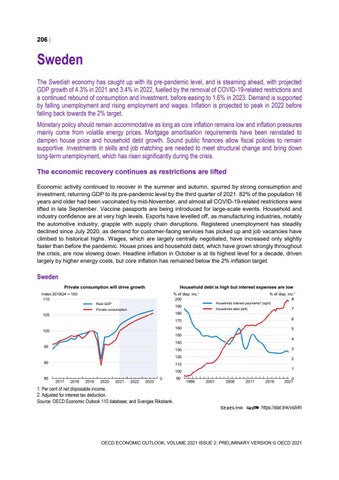
Sweden The Swedish economy has caught up with its pre-pandemic level, and is steaming ahead, with projected GDP growth of 4.3% in 2021 and 3.4% in 2022, fuelled by the removal of COVID-19-related restrictions and a continued rebound of consumption and investment, before easing to 1.6% in 2023. Demand is supported by falling unemployment and rising employment and wages. Inflation is projected to peak in 2022 before falling back towards the 2% target. Monetary policy should remain accommodative as long as core inflation remains low and inflation pressures mainly come from volatile energy prices. Mortgage amortisation requirements have been reinstated to dampen house price and household debt growth. Sound public finances allow fiscal policies to remain supportive. Investments in skills and job matching are needed to meet structural change and bring down long-term unemployment, which has risen significantly during the crisis. The economic recovery continues as restrictions are lifted Economic activity continued to recover in the summer and autumn, spurred by strong consumption and investment, returning GDP to its pre-pandemic level by the third quarter of 2021. 82% of the population 16 years and older had been vaccinated by mid-November, and almost all COVID-19-related restrictions were lifted in late September. Vaccine passports are being introduced for large-scale events. Household and industry confidence are at very high levels. Exports have levelled off, as manufacturing industries, notably the automotive industry, grapple with supply chain disruptions. Registered unemployment has steadily declined since July 2020, as demand for customer-facing services has picked up and job vacancies have climbed to historical highs. Wages, which are largely centrally negotiated, have increased only slightly faster than before the pandemic. House prices and household debt, which have grown strongly throughout the crisis, are now slowing down. Headline inflation in October is at its highest level for a decade, driven largely by higher energy costs, but core inflation has remained below the 2% inflation target.
Sweden Private consumption will drive growth
Household debt is high but interest expenses are low
Index 2019Q4 = 100 110
% of disp. inc.¹ 200 Real GDP
% of disp. inc.¹ 8 Household interest payments² (right)
190
Private consumption
7
Household debt (left)
180
105
100
170
6
160
5
150
4
140
95
90
130
3
120
2
110 1
100 85
2017
2018
2019
2020
2021
2022
2023
0
90
1996
2001
2006
2011
2016
0 2021
1. Per cent of net disposable income. 2. Adjusted for interest tax deduction. Source: OECD Economic Outlook 110 database; and Sveriges Riksbank. StatLink 2 https://stat.link/vis54h
OECD ECONOMIC OUTLOOK, VOLUME 2021 ISSUE 2: PRELIMINARY VERSION © OECD 2021
207
Sweden: Demand, output and prices 2018
Sweden GDP at market prices Private consumption Government consumption Gross fixed capital formation Final domestic demand Stockbuilding¹ Total domestic demand Exports of goods and services Imports of goods and services Net exports¹ Memorandum items GDP deflator Consumer price index² Core inflation index³ Unemployment rate⁴ (% of labour force) Household saving ratio, net (% of disposable income) General government financial balance (% of GDP) General government debt, Maastricht definition⁵ (% of GDP) Current account balance (% of GDP)
2019
2020
2021
2022
2023
Percentage changes, volume (2020 prices)
Current prices SEK billion
4 830.2 2 206.5 1 258.2 1 216.9
2.0 0.8 0.3 -0.3
-2.9 -4.7 -1.0 -0.6
4.3 4.5 2.8 6.2
3.4 4.2 1.4 5.6
1.6 2.1 0.6 2.0
4 681.6 41.2
0.4 -0.1
-2.7 -0.7
4.5 0.1
3.8 0.0
1.7 0.0
4 722.7 2 208.2 2 100.7 107.5
0.2 6.1 2.2 1.8
-3.3 -5.0 -6.0 0.3
4.6 7.1 7.9 0.0
3.8 4.6 5.6 -0.2
1.7 3.5 3.8 0.0
2.5 1.8 1.7 6.8
1.6 0.5 0.5 8.3
3.1 2.0 2.3 8.8
2.5 2.6 2.8 7.6
2.0 2.1 2.1 6.8
15.6 0.6 34.9 5.5
17.1 -2.8 39.7 5.7
14.9 -1.3 36.8 6.2
13.8 -0.2 34.1 6.2
13.4 0.6 31.7 6.1
_ _ _ _ _ _ _ _
1. Contributions to changes in real GDP, actual amount in the first column. 2. The consumer price index includes mortgage interest costs. 3. Consumer price index with fixed interest rates. 4. Historical data and projections are based on the definition of unemployment which covers 15 to 74 year olds and classifies jobseeking full-time students as unemployed. Following the adaptation of the Swedish Labour Force Surveys (LFS) to the new EU framework regulation, there is a break in 2021 in the unemployment series. 5. The Maastricht definition of general government debt includes only loans, debt securities, and currency and deposits, with debt at face value rather than market value. Source: OECD Economic Outlook 110 database.
StatLink 2 https://stat.link/w138f2
Macroeconomic policy settings remain supportive Monetary and fiscal policies remain supportive. In September, the government phased out many COVID-19-related measures, such as short-time work allowances and compensation for sick leave. The proposed 2022 budget boosts spending by SEK 74 billion (1.5% of GDP), and includes tax cuts for low-income earners as well as increased grants to municipalities to help cover COVID-19-related expenses. The budget also contains fiscal measures to incentivise the transition towards a greener economy, such as support to local climate investments. The Riksbank has signalled that the repo rate will remain at 0% for some time to come, but has terminated crisis liquidity support and is projected to start tapering asset purchases in 2022.
Services consumption will drive growth going forward GDP growth is projected to be 3.4% next year, before easing to 1.6% as the post-pandemic catch-up dissipates. Private consumption will be a main growth driver, fuelled by a high rate of vaccinations and unwound containment measures, rising employment and wages. Fiscal policy is set to turn from expansion to some tightening over the projection period, despite grants from the EU Recovery and Resilience Facility amounting to 0.2% of GDP in 2022 and 2023. The fiscal balance is projected to become positive in 2023 and Maastricht debt will be back at the pre-pandemic level next year. Consumer price inflation is projected
OECD ECONOMIC OUTLOOK, VOLUME 2021 ISSUE 2: PRELIMINARY VERSION © OECD 2021
208 to peak at around 3%, but could remain elevated if wage growth accelerates and supply chain disruptions drag on. If high energy prices persist, this could dampen household consumption as well as production in energy-intensive industries. A tight labour market and higher inflation could lead to earlier than foreseen monetary policy tightening. Household debt has risen to almost 200% of disposable income, making households vulnerable to interest rate increases. There is a risk that long-term unemployment will stay durably higher than before the crisis, as happened after the 2008-09 financial crisis. Energy prices, which are sensitive to weather and the balance of supply and demand in neighbouring countries, could boost demand if they decline. Swifter than expected resolution of supply-chain bottlenecks is another upside risk.
Policies should address unemployment and the green transition The government should continue to improve incentives to work and invest in skills and tailored job matching to upskill migrants and address potential scarring effects from the pandemic. Investments in infrastructure and power distribution are needed to meet the increasing demand for electricity from the transition to a green economy. Monetary policy should remain accommodative as long as core inflation remains low and inflation expectations are anchored.
OECD ECONOMIC OUTLOOK, VOLUME 2021 ISSUE 2: PRELIMINARY VERSION © OECD 2021