136
Spain As vaccination advances and restrictions are progressively lifted, economic activity will pick up strongly. GDP is projected to grow by 5.9% in 2021 and 6.3% in 2022, supported by pent-up demand, the national recovery plan and a gradual pick-up of tourism. Reduced uncertainty will lead to a sharp decline in precautionary saving and support private consumption. Investment is expected to pick up significantly from the second half of 2021 as expectations improve and the Next Generation EU funds provide additional support. Fiscal policy is set to remain expansionary in 2021, supporting firms and workers in the most affected sectors and regions. The announced direct aid to viable firms should be executed swiftly. Improving the efficiency of active labour market policies and ensuring training opportunities for workers on job retention schemes are important to support workers disproportionately hit by the pandemic. Promoting out-of-court proceedings, especially for SMEs, should be prioritised to prevent court congestion when the insolvency moratorium expires. The containment measures have been lifted partially The reduction in infections has led to the partial lifting of containment measures since March, and the state of emergency and the national night-time curfew ended on 9 May. The remaining restrictions, such as capacity constraints and limited opening hours for restaurants, vary across regions. The speed of vaccination picked up recently.
Spain The recovery in services is lagging
The labour market is gradually improving
Balance, s.a.Business confidence, 3-month moving average 40 Manufacturing
Retail trade
Social security affiliations Index Dec 2019 = 100 110
Total employment
Services
30
Employment under temporary contract
105
Employment of workers under 25
20
100 10 0
95
-10
90
-20
85
-30 80 -40 75
-50 -60
2009
2011
2013
2015
2017
2019
0
0 Dec-19
Jun-20
Dec-20
70
Source: OECD Monthly Economic Indicators; and Ministry of Inclusion, Social Security and Migration. StatLink 2 https://stat.link/b3q10t
OECD ECONOMIC OUTLOOK, VOLUME 2021 ISSUE 1: PRELIMINARY VERSION © OECD 2021
137
Spain: Demand, output and prices 2017
Spain GDP at market prices Private consumption Government consumption Gross fixed capital formation Final domestic demand Stockbuilding1 Total domestic demand Exports of goods and services Imports of goods and services Net exports1 Memorandum items GDP deflator Harmonised index of consumer prices Harmonised index of core inflation2 Unemployment rate (% of labour force) Household saving ratio, net (% of disposable income) General government financial balance (% of GDP) General government gross debt (% of GDP) General government debt, Maastricht definition (% of GDP) Current account balance (% of GDP)
2018
Current prices EUR billion
1 161.9 678.1 216.3 216.9 1 111.4 8.6 1 120.0 408.4 366.5 41.9 _ _ _ _ _ _ _ _ _
2019
2020
2021
2022
Percentage changes, volume (2015 prices)
2.4 1.8 2.6 6.1 2.8 0.3 3.1 2.3 4.2 -0.5
2.0 0.9 2.3 2.7 1.5 -0.1 1.4 2.3 0.7 0.6
-10.8 -12.1 3.8 -11.4 -8.8 -0.3 -9.1 -20.2 -15.8 -2.0
5.9 6.4 2.6 8.4 5.9 -0.2 5.7 9.8 9.6 0.2
6.3 5.6 1.7 12.3 6.1 0.0 6.1 9.5 9.3 0.2
1.2 1.4 1.1 0.8 1.3 1.7 0.8 -0.3 1.6 1.1 1.0 1.1 0.5 0.4 0.9 15.3 14.1 15.5 15.4 14.7 1.4 2.0 10.5 7.3 4.4 -2.5 -2.9 -11.0 -8.6 -5.4 114.5 117.3 146.8 146.5 144.3 97.4 95.5 120.0 119.7 117.4 1.9 2.1 0.7 0.6 1.0
1. Contributions to changes in real GDP, actual amount in the first column. 2. Harmonised index of consumer prices excluding food, energy, alcohol and tobacco. Source: OECD Economic Outlook 109 database.
StatLink 2 https://stat.link/ctaf1q
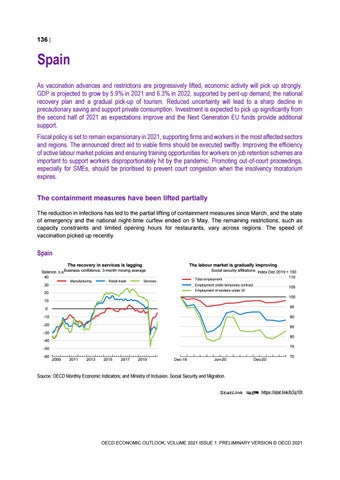
The uneven effects of the pandemic persist Following the weak start in 2021 due to the third wave, with GDP declining slightly in the first quarter, there are some indications that the economy is rebounding, in line with the improvement of health indicators and the relaxation of containment measures. In April, the number of workers on job retention schemes decreased by 14% to around 600 thousand. Credit card spending increased by 9% in the first week of May, compared to a year ago. The recovery in manufacturing has been faster than in services sectors, but there was a significant pick-up in activity and confidence indicators for services in April. The labour market is improving, although less so for vulnerable workers who tend to be employed in retail and tourism-related sectors with temporary contracts.
Fiscal policy remains supportive The government has introduced direct fiscal support (6.4% of GDP) and liquidity measures (14.3% of GDP) since March 2020. The extension of the job retention schemes and the aid to the self-employed are under discussion. The moratorium on home evictions and deferral of rent payments for vulnerable groups were extended until August. Direct aid measures to firms (0.9% of GDP), including non-reimbursable grants to viable firms in the most impacted sectors and two funds for recapitalisation and loan restructuring, were recently introduced. The insolvency moratorium remains in effect until the end of the year. The national recovery plan, incorporating the use of EUR 70 billion (5.8% of GDP in 2019) of the Next Generation EU funds over the coming three years, will provide further support.
OECD ECONOMIC OUTLOOK, VOLUME 2021 ISSUE 1: PRELIMINARY VERSION © OECD 2021
138
Growth will be supported by the national recovery plan GDP is projected to rebound strongly, as the gradual deployment of vaccines enables the release of pentup demand and a gradual recovery of tourism. Policies will continue to limit job losses and cushion the damage to productive capacity in 2021. Greater dynamism from the second half of 2021 will lead to a strong carryover effect in 2022, in addition to the support provided by the recovery plan. Lower restrictions and uncertainty will lead to a decline in precautionary saving and support private consumption, but accumulated savings in 2020-22 in excess of pre-pandemic levels are assumed to augment net wealth as they are concentrated in higher-income households. Investment will grow robustly, supported by declining uncertainty and EU funds. Inflation will remain subdued as slack remains. A downside risk is an increase in insolvencies once policy support is phased out. A faster-than-projected vaccination rollout and a swifter use of the EU funds than projected would raise growth.
Flexibility in implementing aid and quality training are key to effective reallocation The swift implementation of the direct aid measures, which could be delayed as some regions might not be equipped with resources to identify viable firms, is crucial. If the crisis persists longer than projected, there might be a need to increase the amount of funding for this type of direct aid. The transposition of the EU Insolvency Directive should be brought forward to ensure the smooth exit of non-viable firms. Maintaining a flexible labour market that allows firms to adapt to potential post-pandemic structural adjustments, including by prioritising firm level agreements, can support the recovery. Increasing the allocation of active labour market spending towards training, raising the quality of training, and developing public job training programmes targeted to low-skilled workers can enable effective re-training and upskilling of workers and facilitate their reallocation to sectors with better prospects.
OECD ECONOMIC OUTLOOK, VOLUME 2021 ISSUE 1: PRELIMINARY VERSION © OECD 2021