245
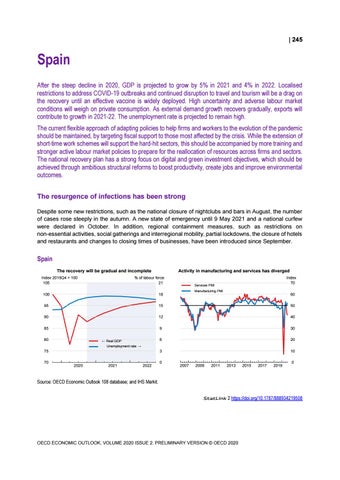
Spain After the steep decline in 2020, GDP is projected to grow by 5% in 2021 and 4% in 2022. Localised restrictions to address COVID-19 outbreaks and continued disruption to travel and tourism will be a drag on the recovery until an effective vaccine is widely deployed. High uncertainty and adverse labour market conditions will weigh on private consumption. As external demand growth recovers gradually, exports will contribute to growth in 2021-22. The unemployment rate is projected to remain high. The current flexible approach of adapting policies to help firms and workers to the evolution of the pandemic should be maintained, by targeting fiscal support to those most affected by the crisis. While the extension of short-time work schemes will support the hard-hit sectors, this should be accompanied by more training and stronger active labour market policies to prepare for the reallocation of resources across firms and sectors. The national recovery plan has a strong focus on digital and green investment objectives, which should be achieved through ambitious structural reforms to boost productivity, create jobs and improve environmental outcomes. The resurgence of infections has been strong Despite some new restrictions, such as the national closure of nightclubs and bars in August, the number of cases rose steeply in the autumn. A new state of emergency until 9 May 2021 and a national curfew were declared in October. In addition, regional containment measures, such as restrictions on non-essential activities, social gatherings and interregional mobility, partial lockdowns, the closure of hotels and restaurants and changes to closing times of businesses, have been introduced since September.
Spain The recovery will be gradual and incomplete Index 2019Q4 = 100 105
Activity in manufacturing and services has diverged
% of labour force 21
Index 70
Services PMI Manufacturing PMI
100
18
95
15
50
90
12
40
85
9
30
6
20
3
10
80
← Real GDP
60
Unemployment rate →
75 70
2020
2021
2022
0
0
2007
2009
2011
2013
2015
2017
2019
0
Source: OECD Economic Outlook 108 database; and IHS Markit. StatLink 2 https://doi.org/10.1787/888934219508
OECD ECONOMIC OUTLOOK, VOLUME 2020 ISSUE 2: PRELIMINARY VERSION © OECD 2020
246 ď ź
Spain: Demand, output and prices 2017
2018
Current prices EUR billion
Spain GDP at market prices Private consumption Government consumption Gross fixed capital formation Final domestic demand Stockbuilding1 Total domestic demand Exports of goods and services Imports of goods and services Net exports1 Memorandum items GDP deflator Harmonised index of consumer prices Harmonised index of core inflation2 Unemployment rate (% of labour force) Household saving ratio, net (% of disposable income) General government financial balance (% of GDP) General government gross debt (% of GDP) General government debt, Maastricht definition (% of GDP) Current account balance (% of GDP)
1 161.9 678.1 216.3 216.9 1 111.4 8.6 1 120.0 408.4 366.5 41.9 _ _ _ _ _ _ _ _ _
2019
2020
2021
2022
Percentage changes, volume (2015 prices)
2.4 1.8 2.6 6.1 2.8 0.3 3.1 2.3 4.2 -0.5
2.0 0.9 2.3 2.7 1.5 -0.1 1.4 2.3 0.7 0.6
-11.6 -14.2 5.9 -15.2 -10.4 -0.2 -10.6 -19.9 -17.4 -1.4
5.0 5.8 2.3 4.1 4.6 -0.1 4.5 7.1 5.5 0.6
4.0 4.6 0.1 4.6 3.6 0.0 3.5 5.7 4.4 0.5
1.2 1.4 0.9 0.8 0.5 1.7 0.8 -0.3 0.4 0.6 1.0 1.1 0.5 0.1 0.6 15.3 14.1 15.8 17.4 16.9 1.4 2.0 14.2 9.8 6.3 -2.5 -2.9 -11.7 -9.0 -6.6 114.5 117.3 139.1 142.3 144.3 97.4 95.5 117.3 120.5 122.4 1.9 2.1 1.4 1.9 1.9
1. Contributions to changes in real GDP, actual amount in the first column. 2. Harmonised index of consumer prices excluding food, energy, alcohol and tobacco. Source: OECD Economic Outlook 108 database.
StatLink 2 https://doi.org/10.1787/888934219527
The recovery has been uneven across sectors and regions Despite a strong rebound in the third quarter of 2020, the level of GDP was 9.1% below that in the final quarter of 2019. The rise in infections since late summer and the introduction of travel quarantines by other countries limited the recovery in tourism-related sectors. The number of tourists in September was 87.1% smaller than a year ago and foreign credit card transactions declined by 65% in October. Manufacturing activity indicators continue to recover, but those for services registered a steeper decline, due to new containment measures. The number of workers on short-time work schemes in October was 18% of the peak in April. However, the pace of exit from job retention schemes has slowed down, with the remaining workers concentrated in sectors and regions most affected by the crisis.
Policy measures remain extensive and targeted The short-time work schemes and the extraordinary benefit to the self-employed were extended until 31 January 2021, while the measures to help vulnerable tenants will last until the end of 2021. The new short-time work scheme is targeted to sectors directly affected by restrictions and introduces incentives to combine it with other work. In July, an additional loan guarantee facility of EUR 40 billion (3.2% of 2019 GDP) to finance new investment by firms and the self-employed and a EUR 10 billion (0.8% of GDP) fund to promote the solvency of strategic companies were created. A number of packages targeted at specific sectors (automobile, tourism, transport) were introduced during the summer. A EUR 16 billion (1.3% of GDP) COVID-19 fund was created to transfer resources to regions to help with healthcare and education expenditures. In November, to support firm solvency, the maturity period to pay the whole loan, the grace
OECD ECONOMIC OUTLOOK, VOLUME 2020 ISSUE 2: PRELIMINARY VERSION Š OECD 2020
247 periods for the payment of the principal of the loan and the deadline to apply for loans under the public guarantees were increased, and the suspension of insolvency proceedings was extended until March 2021. In addition, the European Central Bank’s accommodative monetary policy, including expanded asset purchases, will continue to support aggregate demand. The national recovery plan presented in October outlines the main areas, where the EUR 72 billion (5.8% of GDP) that Spain is expected to receive from Next Generation EU funds will be utilised. EUR 26.6 billion (2.1% of GDP) of these funds are already included in the Draft Budget 2021.
The recovery is set to be gradual and incomplete The strong rebound in the third quarter of 2020 is set to be followed by a contraction in the fourth quarter. The adverse impact of the new containment measures on activity, especially in the hospitality sector, is assumed to ease slowly. Consequently, the recovery will be gradual and the level of GDP will remain below pre-crisis levels by the end of 2022. The increase in private consumption will be limited by the incomplete recovery of the labour market and high precautionary saving. While business investment will pick up, supported by low interest rates and declining uncertainty, still low capacity utilisation combined with weakened financial positions of firms will limit the extent of the recovery. As a consequence, the increase in economic activity will only partially reverse the rise in the unemployment rate. Downside risks include more persistent effects on household and firm solvency, restricting the recovery in domestic demand more than projected. On the upside, a faster-than-assumed recovery in tourism and trading partners’ growth and a swift use of European recovery funds boosting public investment could lead to a stronger rebound.
Policies should support reallocation and productivity In the short run, policy support to those directly impacted by new containment measures should be continued. At the same time, training should be promoted for those on short-time work schemes to improve their prospect of finding a new job in expanding sectors and firms. Public employment services should strengthen individualised support, via the aid of profiling tools, to facilitate upskilling of workers and improve labour market matching. A prolongation of the crisis can push viable firms into insolvency. Remaining gaps in insolvency regimes should be addressed to speed up out-of-court restructuring processes. There is also a need to lower long-standing barriers to productivity growth. The effective implementation of prior structural reforms addressing internal market fragmentation of product markets is key. The co-ordination and evaluation of regional and national innovation policies should be increased to raise the quality of innovation. This can also contribute to improving the structure of economic activity by facilitating adoption of digital technologies and removing barriers to firms’ growth. Frontloading investment in renewable energy, energy efficiency and sustainable transport during the recovery, in line with the National Energy and Climate Plan and the national recovery plan objectives, would help the green transition as well as job creation.
OECD ECONOMIC OUTLOOK, VOLUME 2020 ISSUE 2: PRELIMINARY VERSION © OECD 2020