203
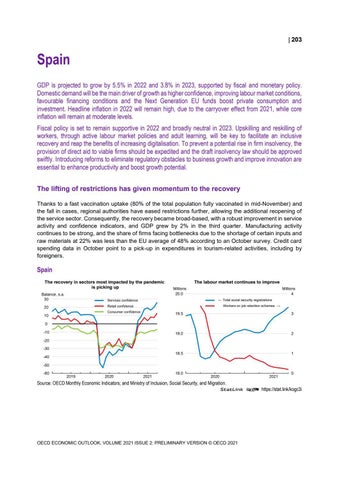
Spain GDP is projected to grow by 5.5% in 2022 and 3.8% in 2023, supported by fiscal and monetary policy. Domestic demand will be the main driver of growth as higher confidence, improving labour market conditions, favourable financing conditions and the Next Generation EU funds boost private consumption and investment. Headline inflation in 2022 will remain high, due to the carryover effect from 2021, while core inflation will remain at moderate levels. Fiscal policy is set to remain supportive in 2022 and broadly neutral in 2023. Upskilling and reskilling of workers, through active labour market policies and adult learning, will be key to facilitate an inclusive recovery and reap the benefits of increasing digitalisation. To prevent a potential rise in firm insolvency, the provision of direct aid to viable firms should be expedited and the draft insolvency law should be approved swiftly. Introducing reforms to eliminate regulatory obstacles to business growth and improve innovation are essential to enhance productivity and boost growth potential. The lifting of restrictions has given momentum to the recovery Thanks to a fast vaccination uptake (80% of the total population fully vaccinated in mid-November) and the fall in cases, regional authorities have eased restrictions further, allowing the additional reopening of the service sector. Consequently, the recovery became broad-based, with a robust improvement in service activity and confidence indicators, and GDP grew by 2% in the third quarter. Manufacturing activity continues to be strong, and the share of firms facing bottlenecks due to the shortage of certain inputs and raw materials at 22% was less than the EU average of 48% according to an October survey. Credit card spending data in October point to a pick-up in expenditures in tourism-related activities, including by foreigners.
Spain The recovery in sectors most impacted by the pandemic is picking up Balance, s.a. 30
The labour market continues to improve Millions 20.0
Millions 4 ← Total social security registrations
Services confidence
Workers on job retention schemes →
Retail confidence
20
Consumer confidence
10
19.5
3
19.0
2
18.5
1
0 -10 -20 -30 -40 -50 -60
2019
2020
2021
0
18.0
2020
2021
0
Source: OECD Monthly Economic Indicators; and Ministry of Inclusion, Social Security, and Migration. StatLink 2 https://stat.link/kogc3i
OECD ECONOMIC OUTLOOK, VOLUME 2021 ISSUE 2: PRELIMINARY VERSION © OECD 2021
204
Spain: Demand, output and prices 2018
2019
GDP at market prices Private consumption Government consumption Gross fixed capital formation Final domestic demand Stockbuilding¹ Total domestic demand Exports of goods and services Imports of goods and services Net exports¹ Memorandum items GDP deflator Harmonised index of consumer prices Harmonised index of core inflation² Unemployment rate (% of labour force) Household saving ratio, net (% of disposable income) General government financial balance (% of GDP) General government gross debt (% of GDP) General government debt, Maastricht definition³ (% of GDP) Current account balance (% of GDP)
1 203.3 699.5 224.7 234.0 1 158.2 12.4 1 170.6 423.1 390.4 32.7 _ _ _ _ _ _ _ _ _
2021
2022
2023
Percentage changes, volume (2015 prices)
Current prices EUR billion
Spain
2020
2.1 1.0 2.0 4.5 1.9 -0.2 1.6 2.5 1.2 0.5
-10.8 -12.0 3.3 -9.5 -8.5 -0.5 -8.9 -20.1 -15.2 -2.2
4.5 4.4 3.2 3.8 4.0 0.3 4.3 11.7 11.4 0.3
5.5 4.5 2.5 8.1 4.8 0.0 4.8 10.7 8.5 0.8
3.8 3.1 1.7 7.0 3.6 0.0 3.6 6.1 5.4 0.3
1.3 1.1 1.6 2.6 1.5 0.8 -0.3 2.9 3.2 1.5 1.1 0.5 0.4 1.2 1.5 14.1 15.5 15.0 14.2 13.6 4.2 10.8 6.9 4.8 4.5 -2.9 -11.0 -8.1 -5.4 -4.2 117.7 147.6 147.8 144.8 143.6 95.5 120.0 120.1 117.1 115.9 2.1 0.8 0.6 1.0 1.2
1. Contributions to changes in real GDP, actual amount in the first column. 2. Harmonised index of consumer prices excluding food, energy, alcohol and tobacco. 3. The Maastricht definition of general government debt includes only loans, debt securities, and currency and deposits, with debt at face value rather than market value. Source: OECD Economic Outlook 110 database.
StatLink 2 https://stat.link/q2sw0k
Labour markets have been resilient compared to previous crises as job retention schemes have played a key role in limiting job losses and are enabling a faster recovery. The increase in social security affiliations, and the decline in the number of workers on job retention scheme to 190 718 (around 6% of the peak in April 2020) have brought effective employment rates almost back to pre-pandemic levels. Despite declining, the unemployment rate remains high at 14.7% in the third quarter, and high rates of youth (30%) and long-term unemployment (32%) persist. The wage rate has increased by 2.6% in the third quarter of 2021 compared to the second quarter. The annual growth rate of headline inflation increased to 5.4% in October, mainly driven by electricity prices, which will carry over to early 2022. Overall inflation expectations remain around target, even if survey evidence suggests that price expectations in October differed across sectors, with a larger increase in manufacturing.
Policy support to firms and households remains substantial Spain is set to get EUR 70 billion (5.8% of GDP) of the Next Generation EU funds. Around 85% is assumed to be absorbed in the projection period, in line with authorities’ plans. The Budget 2022 includes EUR 27 billion of the funds, of which around 40% is allocated to energy, infrastructure and environment investment. The short-term work schemes and the extraordinary support to the self-employed have been extended until the end of February 2022, made more targeted and linked to training. Firms’ access to direct aid schemes was eased in September. A number of temporary tax cuts, and price caps to protect vulnerable consumers and SMEs were introduced to address the impact of the increase in energy prices. The slight increase in the minimum wage and the introduction of the mechanism to offset the loss of pension
OECD ECONOMIC OUTLOOK, VOLUME 2021 ISSUE 2: PRELIMINARY VERSION © OECD 2021
205 purchasing power will also support household incomes. The public debt-to-GDP ratio has increased from 95.5% in 2019 to 120% (according to the Maastricht definition).
Domestic demand will be the main driver of growth GDP is projected to reach pre-pandemic levels by the first quarter of 2023. The strong recovery of private consumption, fuelled by pent-up demand and the reopening of services sectors, is set to be the main driver of growth in 2022. The Next Generation EU funds, together with a recovery in final demand and lower uncertainty, will support private investment. The unemployment rate is projected to fall to 13.6% in 2023. The carryover effect from 2021 will impact headline inflation in 2022, even as the contribution of the energy component and base effects from 2020 ease and slack in labour markets remains. The downside risks include a resurgence of the pandemic, greater persistence of inflation with a pass-through to final prices and wages, larger-than-expected scarring effects from higher unemployment and insolvencies, and a lower than projected absorption speed of the EU funds. A quicker-than-projected convergence of tourism to prepandemic levels and a higher-than-assumed impact of EU funds on economic activity could boost growth further.
The effective use of EU funds and structural reforms can raise long-term growth Assuming the selection of good investment projects and the implementation of reforms, the EU funds can raise growth potential. The effective implementation of prior structural reforms addressing internal market fragmentation of product markets, which can be a barrier to the entry and growth of innovative firms, can raise the impact of the funds on economic activity. Reducing labour market duality, and improving skills and job prospects of those disproportionately affected by the pandemic, especially the youth, through more efficient active labour market policies, should be prioritised for an inclusive recovery. As the moratorium on insolvency proceedings will expire in June 2022, expediting the approval of the draft insolvency reform bill and ensuring that direct aid goes to the viable firms in need will be key to limit potential scarring effects from the pandemic. Increasing the energy efficiency of buildings and promoting a higher share of renewables, as planned in the recovery plan, and facilitating more competition in the electricity market can help address energy poverty and support the green transition. The high public debt calls for renewed fiscal prudence once the recovery is firmly underway. Pension reforms, which are increasing the purchasing power of pensioners, should be balanced with those to ensure long-term fiscal sustainability.
OECD ECONOMIC OUTLOOK, VOLUME 2021 ISSUE 2: PRELIMINARY VERSION © OECD 2021