209
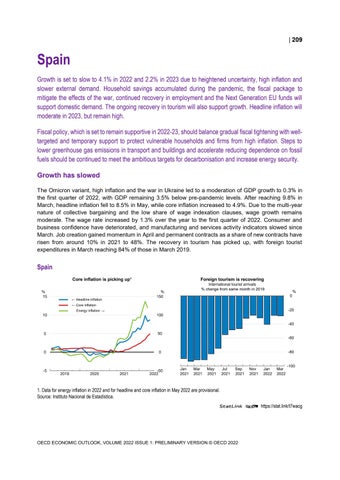
Spain Growth is set to slow to 4.1% in 2022 and 2.2% in 2023 due to heightened uncertainty, high inflation and slower external demand. Household savings accumulated during the pandemic, the fiscal package to mitigate the effects of the war, continued recovery in employment and the Next Generation EU funds will support domestic demand. The ongoing recovery in tourism will also support growth. Headline inflation will moderate in 2023, but remain high. Fiscal policy, which is set to remain supportive in 2022-23, should balance gradual fiscal tightening with welltargeted and temporary support to protect vulnerable households and firms from high inflation. Steps to lower greenhouse gas emissions in transport and buildings and accelerate reducing dependence on fossil fuels should be continued to meet the ambitious targets for decarbonisation and increase energy security. Growth has slowed The Omicron variant, high inflation and the war in Ukraine led to a moderation of GDP growth to 0.3% in the first quarter of 2022, with GDP remaining 3.5% below pre-pandemic levels. After reaching 9.8% in March, headline inflation fell to 8.5% in May, while core inflation increased to 4.9%. Due to the multi-year nature of collective bargaining and the low share of wage indexation clauses, wage growth remains moderate. The wage rate increased by 1.3% over the year to the first quarter of 2022. Consumer and business confidence have deteriorated, and manufacturing and services activity indicators slowed since March. Job creation gained momentum in April and permanent contracts as a share of new contracts have risen from around 10% in 2021 to 48%. The recovery in tourism has picked up, with foreign tourist expenditures in March reaching 84% of those in March 2019.
Spain Core inflation is picking up¹ % 15
Foreign tourism is recovering International tourist arrivals % change from same month in 2019
% 150
← Headline inflation
0
%
← Core inflation
-20
Energy inflation →
10
100 -40
5
50
0
0
-60 -80 0
-5
2019
2020
2021
-50 2022
Jan 2021
Mar 2021
May 2021
Jul 2021
Sep 2021
Nov 2021
Jan 2022
Mar 2022
-100
1. Data for energy inflation in 2022 and for headline and core inflation in May 2022 are provisional. Source: Instituto Nacional de Estadística. StatLink 2 https://stat.link/t7wacg
OECD ECONOMIC OUTLOOK, VOLUME 2022 ISSUE 1: PRELIMINARY VERSION © OECD 2022
210
Spain: Demand, output and prices 2018
2019
GDP at market prices Private consumption Government consumption Gross fixed capital formation
2021
2022
2023
Percentage changes, volume (2015 prices)
Current prices EUR billion
Spain
2020
1 203.3 699.5 224.7 234.0
2.1 1.0 2.0 4.5
-10.8 -12.0 3.3 -9.5
5.1 4.6 3.1 4.3
4.1 0.1 1.2 7.4
2.2 3.2 1.3 4.7
Final domestic demand Stockbuilding¹
1 158.2 12.4
1.9 -0.2
-8.5 -0.5
4.2 0.5
1.9 0.0
3.1 0.0
Total domestic demand Exports of goods and services Imports of goods and services Net exports¹
1 170.6 423.1 390.4 32.7
1.6 2.5 1.2 0.5
-8.9 -20.1 -15.2 -2.2
4.8 14.7 13.9 0.5
1.9 13.7 7.5 2.3
3.1 2.5 4.8 -0.9
_ _ _ _ _ _ _ _ _
1.3 0.8 1.1 14.1
1.1 -0.3 0.5 15.5
2.2 3.0 0.6 14.8
3.9 8.1 4.5 13.6
4.6 4.8 4.5 13.9
4.2 -3.1
10.8 -10.3
7.0 -6.9
6.4 -5.0
5.5 -4.2
Memorandum items GDP deflator Harmonised index of consumer prices Harmonised index of core inflation² Unemployment rate (% of labour force) Household saving ratio, net (% of disposable income) General government financial balance (% of GDP) General government gross debt (% of GDP) General government debt, Maastricht definition³ (% of GDP) Current account balance (% of GDP)
117.7 147.6 146.3 143.3 140.8 98.3 120.0 118.6 115.6 113.1 2.1
0.8
0.9
1.0
0.1
1. Contributions to changes in real GDP, actual amount in the first column. 2. Harmonised index of consumer prices excluding food, energy, alcohol and tobacco. 3. The Maastricht definition of general government debt includes only loans, debt securities, and currency and deposits, with debt at face value rather than market value. Source: OECD Economic Outlook 111 database.
StatLink 2 https://stat.link/i0689p
The war in Ukraine is affecting the Spanish economy via increased energy prices, disruptions in production chains and higher uncertainty, as direct trade and financial exposures to Russia and Ukraine are limited. Lower confidence and real disposable incomes led to a decline in private consumption in the first quarter of 2022. The agreement with Brussels to limit the price of gas entering the electricity market in the Iberian peninsula, expected to come into effect in June, can help contain headline inflation. At the end of May, 59 000 Ukrainian refugees had been processed by the authorities.
Fiscal policy remains supportive Fiscal policy is set to remain accommodative in 2022-23. Due to strong revenue growth and the phasing-out of COVID-19-related spending, the budget deficit narrowed to 6.9% of GDP in 2021 and is projected to be 4.2% of GDP by 2023. To counter the negative impact of the war, the government approved a plan in March that included a subsidy on fuel retail sales, the extension of existing energy tax rebates, direct aid to the transport sector and electricity-intensive industries, a refugee reception programme, and a new credit line for vulnerable firms (EUR 10 billion, 0.6% of GDP). The direct support measures to soften the impact of higher energy costs (EUR 6 billion, 0.4% of GDP), due to expire in June, are expected to be extended until September. The introduction of the mechanism to offset the loss of pension purchasing power will support household incomes, but also increase public spending in the projection period. The execution of Next Generation EU funds has picked up in the first quarter of 2022, and is expected to be frontloaded in 2022-2023. OECD ECONOMIC OUTLOOK, VOLUME 2022 ISSUE 1: PRELIMINARY VERSION © OECD 2022
211
The pace of growth will moderate GDP is projected to expand by 4.1% in 2022 and 2.2% in 2023. High inflation and uncertainty will lower household spending. Supply bottlenecks in semiconductors will also constrain private investment and merchandise exports. The adverse effects of the war will partly be mitigated by the boost provided by the March fiscal package, the rollout of the Next Generation EU investment projects, lower uncertainty surrounding the pandemic and the recovery of tourism. Inflation is projected to moderate in 2023, helped by continued slack in labour markets, and assuming moderate pass-through of inflation to wages, but will remain high due to the impact of the EU oil embargo on Russia. There is a risk that higher inflation could become entrenched if there are further energy market disruptions or greater pass-through to final prices and wages. Escalation of the war in Ukraine or further COVID-19 outbreaks create downside risks to growth, while a higher-than-assumed use of EU funds and their impact on economic activity could boost growth further.
Reforms and investments to promote the green transition are crucial Fiscal support to address the near-term effects of the energy shock on vulnerable households and firms should be well targeted and temporary. A medium-term consolidation strategy based on spending reviews is needed to start lowering the fiscal deficit and public debt-to-GDP ratio gradually. The share of wage agreements with indexation clauses remains moderate, but is rising, highlighting the importance of an agreement of social partners to burden share and prevent a wage-price spiral. Increasing certainty for investment, cooperating closely with European partners to increase interconnectivity with the rest of Europe, and improving energy efficiency are key to ensure energy security and promote the green transition. The ambitious climate targets will require a predictable, long-term regulatory framework, sufficient incentives to mobilise private investment, and improved storage, demand-side management and digitalisation to use renewable energies effectively. Ensuring timely and effective implementation of the recovery plan can support the digital and green transition and boost productivity growth.
OECD ECONOMIC OUTLOOK, VOLUME 2022 ISSUE 1: PRELIMINARY VERSION © OECD 2022