200
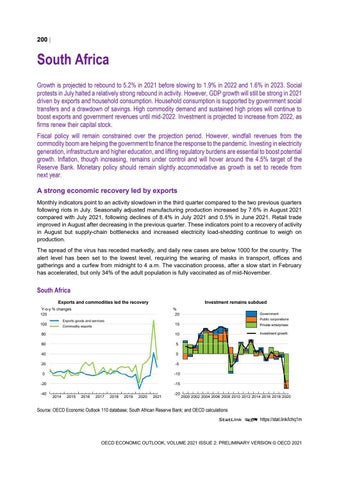
South Africa Growth is projected to rebound to 5.2% in 2021 before slowing to 1.9% in 2022 and 1.6% in 2023. Social protests in July halted a relatively strong rebound in activity. However, GDP growth will still be strong in 2021 driven by exports and household consumption. Household consumption is supported by government social transfers and a drawdown of savings. High commodity demand and sustained high prices will continue to boost exports and government revenues until mid-2022. Investment is projected to increase from 2022, as firms renew their capital stock. Fiscal policy will remain constrained over the projection period. However, windfall revenues from the commodity boom are helping the government to finance the response to the pandemic. Investing in electricity generation, infrastructure and higher education, and lifting regulatory burdens are essential to boost potential growth. Inflation, though increasing, remains under control and will hover around the 4.5% target of the Reserve Bank. Monetary policy should remain slightly accommodative as growth is set to recede from next year. A strong economic recovery led by exports Monthly indicators point to an activity slowdown in the third quarter compared to the two previous quarters following riots in July. Seasonally adjusted manufacturing production increased by 7.6% in August 2021 compared with July 2021, following declines of 8.4% in July 2021 and 0.5% in June 2021. Retail trade improved in August after decreasing in the previous quarter. These indicators point to a recovery of activity in August but supply-chain bottlenecks and increased electricity load-shedding continue to weigh on production. The spread of the virus has receded markedly, and daily new cases are below 1000 for the country. The alert level has been set to the lowest level, requiring the wearing of masks in transport, offices and gatherings and a curfew from midnight to 4 a.m. The vaccination process, after a slow start in February has accelerated, but only 34% of the adult population is fully vaccinated as of mid-November.
South Africa Exports and commodities led the recovery
Investment remains subdued
Y-o-y % changes 120
% 20
100
Government Public corporations
Exports goods and services
15
Private enterprises
80
10
Investment growth
60
5
40
0
20
-5
0
-10
-20
-15
-40
Commodity exports
2014
2015
2016
2017
2018
2019
2020
0 2021
-20
2000 2002 2004 2006 2008 2010 2012 2014 2016 2018 2020
0
Source: OECD Economic Outlook 110 database; South African Reserve Bank; and OECD calculations StatLink 2 https://stat.link/lchq1m
OECD ECONOMIC OUTLOOK, VOLUME 2021 ISSUE 2: PRELIMINARY VERSION © OECD 2021
201
South Africa: Demand, output and prices 2018
South Africa
2019
Current account balance (% of GDP)
5 357.6 3 408.4 1 037.9 849.2 5 295.5 37.0 5 332.5 1 472.7 1 447.6 25.2 _ _ _ _ _
2021
2022
2023
Percentage changes, volume (2015 prices)
Current prices ZAR billion
GDP at market prices Private consumption Government consumption Gross fixed capital formation Final domestic demand Stockbuilding¹ Total domestic demand Exports of goods and services Imports of goods and services Net exports¹ Memorandum items GDP deflator Consumer price index Core inflation index² General government financial balance (% of GDP)
2020
0.1 1.1 2.7 -2.4 0.8 0.4 1.2 -3.4 0.5 -1.1
-6.4 -6.5 1.3 -14.9 -6.2 -1.7 -8.0 -12.0 -17.4 1.8
5.2 6.1 0.0 -0.6 3.9 0.7 4.6 12.5 10.2 0.6
1.9 2.0 0.9 3.1 1.9 -0.1 1.9 5.7 6.0 0.0
1.6 2.1 1.3 6.7 2.6 0.0 2.6 2.9 6.7 -1.0
4.5 4.1 4.1 -5.7 -2.6
5.3 3.3 3.4 -11.6 2.0
5.1 4.4 2.9 -7.8 4.9
3.2 4.8 4.0 -6.1 1.2
3.7 4.5 4.5 -5.6 -1.1
1. Contributions to changes in real GDP, actual amount in the first column. 2. Consumer price index excluding food and energy. Source: OECD Economic Outlook 110 database.
StatLink 2 https://stat.link/an4o26
Fiscal support is being reduced Monetary policy remains accommodative as the Reserve Bank has maintained the repurchasing rate at 3.5% since March 2020. However, after inflation jumped to 5% in September, above the 4.5% target, the reserve bank increased the repurchasing rate by 25 basis points to 3.75% in November and signalled its readiness for progressive normalisation of monetary policy. An accommodative monetary policy stance remains appropriate as inflation is projected to return towards the target, expectations remain anchored and fiscal policy is constrained. The policy interest rate is projected to start rising again moderately in the second half of 2022. The currency has remained strong, even appreciating during some periods, which has helped to cushion the transmission of external pressures to domestic prices. Jobs lost due to the pandemic have not been recovered yet. Wage pressures should remain low despite the headline increase from the temporarily higher share of skilled workers in job creation. Despite limited fiscal space, the government has reinstated the COVID-19 Social Relief of Distress Grant of ZAR 350 per month covering unemployed working-age individuals not receiving any social grants from August 2021 to March 2022. Most of the other relief measures have been prolonged for a few months in 2021 but are planned to be discontinued before the end of the year.
A progressive return to the long-run growth trend is projected Assuming the pandemic is contained and there are no further stringent restrictions, GDP growth is projected to reach 5.2% in 2021, mainly on the back of a very strong first half of the year, before receding to 1.9% and 1.6% in 2022 and 2023 respectively. The main engine of growth will transition from exports (global commodity demand and prices are projected to slow over 2022) to internal demand, driven by household consumption and investment. Household consumption should remain strong, boosted by an improving labour market, sustained credit levels and government social transfers. Private investment
OECD ECONOMIC OUTLOOK, VOLUME 2021 ISSUE 2: PRELIMINARY VERSION © OECD 2021
202 should progressively pick up on the back of needed capital replacement and expected improvements in the implementation of policy reforms and electricity generation. The recent government initiatives to address the electricity crisis, such as permitting some municipalities to buy electricity from suppliers other than Eskom and allowing private companies to self-generate up to 100 MW, should help to ease electricity shortages over the medium term. Fiscal policy, though remaining prudent, should gain some fiscal space over the projection period and contribute to growth through public investment. Domestic near-term risks to growth include increased load-shedding (rolling blackouts) by the power utility and higher-than-expected electricity prices, which could derail growth. However, continued higher demand and prices for commodity exports would boost growth.
Restoring confidence is key for investment and growth A decisive policy action on electricity generation is needed to lift growth potential. With the recovery and improved growth prospects, electricity shortages will start to bite on production. Further increasing the purchase of renewable energy could quickly bring additional electricity in the grid and stimulate confidence, which in turn is needed for business investment. Fixing failing state-owned enterprises, including through better governance and privatisation, would reduce government transfers to these entities and therefore contribute to restoring public finances and confidence. Finally, prolonging the COVID-19 Social Relief of Distress Grant until jobs lost during the pandemic are recovered would support household consumption and growth. Improving the implementation of public infrastructure investment projects, in particular in the transport sector, will reduce trade bottlenecks, reduce the cost of doing business and increase growth potential.
OECD ECONOMIC OUTLOOK, VOLUME 2021 ISSUE 2: PRELIMINARY VERSION © OECD 2021