206
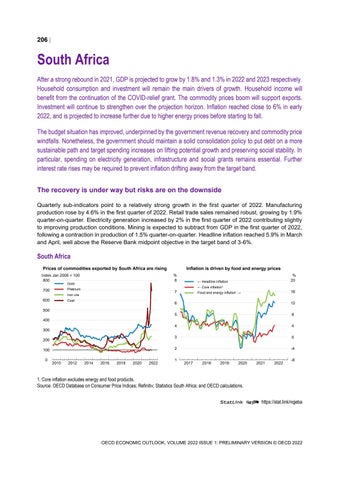
South Africa After a strong rebound in 2021, GDP is projected to grow by 1.8% and 1.3% in 2022 and 2023 respectively. Household consumption and investment will remain the main drivers of growth. Household income will benefit from the continuation of the COVID-relief grant. The commodity prices boom will support exports. Investment will continue to strengthen over the projection horizon. Inflation reached close to 6% in early 2022, and is projected to increase further due to higher energy prices before starting to fall. The budget situation has improved, underpinned by the government revenue recovery and commodity price windfalls. Nonetheless, the government should maintain a solid consolidation policy to put debt on a more sustainable path and target spending increases on lifting potential growth and preserving social stability. In particular, spending on electricity generation, infrastructure and social grants remains essential. Further interest rate rises may be required to prevent inflation drifting away from the target band. The recovery is under way but risks are on the downside Quarterly sub-indicators point to a relatively strong growth in the first quarter of 2022. Manufacturing production rose by 4.6% in the first quarter of 2022. Retail trade sales remained robust, growing by 1.9% quarter-on-quarter. Electricity generation increased by 2% in the first quarter of 2022 contributing slightly to improving production conditions. Mining is expected to subtract from GDP in the first quarter of 2022, following a contraction in production of 1.5% quarter-on-quarter. Headline inflation reached 5.9% in March and April, well above the Reserve Bank midpoint objective in the target band of 3-6%.
South Africa Prices of commodities exported by South Africa are rising Index Jan 2006 = 100 800 Gold
7
Iron ore
600
% 20
← Headline inflation ← Core inflation¹
Platinum
700
Inflation is driven by food and energy prices % 8
Coal
500
16
Food and energy inflation →
6
12
5
8
4
4
3
0
2
-4
400 300 200 100 0
2010
2012
2014
2016
2018
2020
2022
0
1
2017
2018
2019
2020
2021
2022
-8
1. Core inflation excludes energy and food products. Source: OECD Database on Consumer Price Indices; Refinitiv; Statistics South Africa; and OECD calculations. StatLink 2 https://stat.link/nqjeba
OECD ECONOMIC OUTLOOK, VOLUME 2022 ISSUE 1: PRELIMINARY VERSION © OECD 2022
207
South Africa: Demand, output and prices 2018
South Africa
2019
2021
2022
2023
Percentage changes, volume (2015 prices)
Current prices ZAR billion
GDP at market prices Private consumption Government consumption Gross fixed capital formation
2020
5 357.6 3 408.4 1 037.9 849.2
0.1 1.1 2.7 -2.4
-6.4 -6.5 1.3 -14.9
4.9 5.7 0.0 2.0
1.8 2.8 0.5 5.0
1.3 1.9 1.1 6.0
Final domestic demand Stockbuilding¹
5 295.5 37.0
0.8 0.4
-6.2 -1.7
4.0 0.7
2.6 -0.2
2.3 0.0
Total domestic demand Exports of goods and services Imports of goods and services Net exports¹
5 332.5 1 472.7 1 447.6 25.2
1.2 -3.4 0.5 -1.1
-8.0 -12.0 -17.4 1.8
4.8 9.9 9.4 0.1
2.4 6.3 8.6 -0.6
2.3 3.1 6.6 -1.0
4.5 4.1 4.1 -5.7
5.3 3.3 3.4 -11.6
7.1 4.6 3.1 -6.4
4.8 6.0 4.2 -5.2
4.0 5.8 5.6 -4.3
-2.6
2.0
3.7
2.8
1.7
Memorandum items GDP deflator Consumer price index Core inflation index² General government financial balance (% of GDP) Current account balance (% of GDP)
_ _ _ _ _
1. Contributions to changes in real GDP, actual amount in the first column. 2. Consumer price index excluding food and energy. Source: OECD Economic Outlook 111 database.
StatLink 2 https://stat.link/fg5ah3
South Africa has a low direct exposure to Russia and Ukraine, trading less than 1% of its total exports and imports with these countries. Nonetheless, food prices are rising at 6.6% in March and 6.3% in April, outstripping headline inflation. In addition to the war and logistical bottlenecks, the recent flooding in KwaZulu-Natal may lead to further increases in food prices. Exports will benefit from rising prices for commodities exported by South Africa.
The fiscal and monetary policy mix remains accommodative Inflation is at the upper limit of the target band, but the relatively strong currency is helping cushion the transmission of external pressures to domestic prices. In this context, the central bank should be ready to raise interest rates again to prevent inflation from drifting away from the target band. The key policy rate is expected to rise to 5.75% by the end of the year and to 6% by mid-2023 before declining gradually thereafter. The fiscal stance is still accommodative, as windfall commodity revenues have allowed the government to maintain a high level of spending while reducing the deficit. In particular, the COVID-relief grant covering 10 million beneficiaries is now prolonged until March 2023. Fiscal policy should become more targeted, with support focused on vulnerable households particularly exposed to food price increases and firms in sectors affected by lingering effects of the pandemic and the war. To cushion the impact of higher energy prices on households and companies, the government introduced a reduction in the general fuel levy for two months, starting in April. The reduction is being renewed for another two months but it will be halved for the last month.
OECD ECONOMIC OUTLOOK, VOLUME 2022 ISSUE 1: PRELIMINARY VERSION © OECD 2022
208
Growth prospects have improved GDP growth is projected to reach 1.8% and 1.3% in 2022 and 2023 respectively. Growth will remain supported by household consumption, investment and commodity exports. Household incomes and consumption will be boosted by government social transfers and higher wages. Private investment will continue to rise as electricity generation improves, given the need for capital replacement. The war in Ukraine has pushed up commodity prices, prolonging the commodity boom cycle for longer than expected. Consequently, inflation, driven by energy and food prices, is projected above the upper limit of the target band in 2022 and only start to start declining by the end of 2023. Core inflation will rise in 2022 and 2023, as second-round effects from higher headline inflation spread in the economy. Domestic near-term risks to growth include increased rolling blackouts by the power utility and renewed mobility and gathering restrictions due to a new wave of COVID-19, as only around 50% of the adult population is vaccinated. Also, if global prices do not decline as assumed in 2023, inflation would remain around the upper limit of the target band, delaying the reduction of policy rates and lowering GDP growth. On the upside, if the recovery in the tourism sector continues, it will provide additional support to household consumption.
Boosting infrastructure investment is key for productivity growth In the short term, boosting electricity generation remains key to improving production conditions for firms. To help cushion the impact of rising energy prices, administrative bottlenecks delaying the implementation of the decision to allow private companies to self-generate up to 100 MW should be lifted rapidly, and the purchase of renewable energy from independent power producers accelerated. Reviving productivity growth is essential to lift living standards. Key measures include improving transport infrastructure, fostering the quality and affordability of telecommunication networks, broadening access to higher education and reducing competition barriers. More fiscal space is needed to finance these spending needs. Increasing government tax revenues and improving public spending efficiency through better procurement and contracting would increase fiscal space.
OECD ECONOMIC OUTLOOK, VOLUME 2022 ISSUE 1: PRELIMINARY VERSION © OECD 2022