130
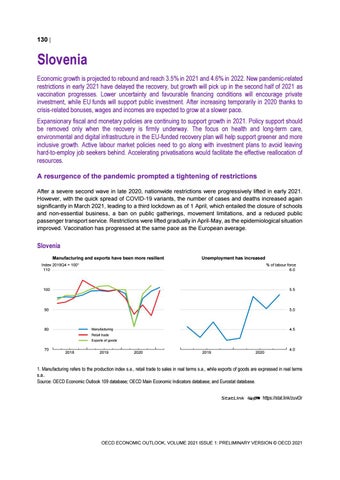
Slovenia Economic growth is projected to rebound and reach 3.5% in 2021 and 4.6% in 2022. New pandemic-related restrictions in early 2021 have delayed the recovery, but growth will pick up in the second half of 2021 as vaccination progresses. Lower uncertainty and favourable financing conditions will encourage private investment, while EU funds will support public investment. After increasing temporarily in 2020 thanks to crisis-related bonuses, wages and incomes are expected to grow at a slower pace. Expansionary fiscal and monetary policies are continuing to support growth in 2021. Policy support should be removed only when the recovery is firmly underway. The focus on health and long-term care, environmental and digital infrastructure in the EU-funded recovery plan will help support greener and more inclusive growth. Active labour market policies need to go along with investment plans to avoid leaving hard-to-employ job seekers behind. Accelerating privatisations would facilitate the effective reallocation of resources. A resurgence of the pandemic prompted a tightening of restrictions After a severe second wave in late 2020, nationwide restrictions were progressively lifted in early 2021. However, with the quick spread of COVID-19 variants, the number of cases and deaths increased again significantly in March 2021, leading to a third lockdown as of 1 April, which entailed the closure of schools and non-essential business, a ban on public gatherings, movement limitations, and a reduced public passenger transport service. Restrictions were lifted gradually in April-May, as the epidemiological situation improved. Vaccination has progressed at the same pace as the European average.
Slovenia Manufacturing and exports have been more resilient
Unemployment has increased
Index 2019Q4 = 100¹ 110
% of labour force 6.0
100
5.5
90
5.0
Manufacturing
80
4.5
Retail trade Exports of goods
70
2018
2019
2020
0
2019
2020
4.0
1. Manufacturing refers to the production index s.a., retail trade to sales in real terms s.a., while exports of goods are expressed in real terms s.a.. Source: OECD Economic Outlook 109 database; OECD Main Economic Indicators database; and Eurostat database. StatLink 2 https://stat.link/zuvt3r
OECD ECONOMIC OUTLOOK, VOLUME 2021 ISSUE 1: PRELIMINARY VERSION © OECD 2021
131
Slovenia: Demand, output and prices 2017
Slovenia GDP at market prices Private consumption Government consumption Gross fixed capital formation Final domestic demand Stockbuilding1 Total domestic demand Exports of goods and services Imports of goods and services Net exports1 Memorandum items GDP deflator Harmonised index of consumer prices Harmonised index of core inflation2 Unemployment rate (% of labour force) Household saving ratio, net (% of disposable income) General government financial balance (% of GDP) General government gross debt (% of GDP) General government debt, Maastricht definition (% of GDP) Current account balance (% of GDP)
2018
2019
2020
2021
2022
Percentage changes, volume (2010 prices)
Current prices EUR billion
43.0 22.6 7.9 7.9 38.4 0.7 39.1 35.8 31.9 3.9
4.4 3.6 3.0 9.6 4.7 0.3 5.0 6.3 7.2 -0.1
3.2 4.8 1.7 5.8 4.4 -0.8 3.4 4.1 4.4 0.1
-5.5 -9.7 1.8 -4.1 -6.2 -0.4 -6.5 -8.7 -10.2 0.4
3.5 2.5 3.6 6.9 3.7 0.0 5.8 7.9 8.7 0.2
4.6 8.7 1.2 7.6 6.7 0.0 6.6 5.7 8.3 -1.4
_ _ _ _ _ _ _ _ _
2.2 1.9 1.0 5.1 6.1 0.7 84.0 70.3 5.8
2.3 1.3 1.7 1.9 1.7 -0.3 0.8 1.1 1.9 0.8 0.5 1.4 4.4 5.0 5.2 4.5 6.0 18.9 18.8 13.5 0.4 -8.4 -8.5 -5.3 86.2 101.0 102.4 105.1 65.6 80.4 81.8 84.5 5.6 7.3 5.9 4.1
1. Contributions to changes in real GDP, actual amount in the first column. 2. Harmonised index of consumer prices excluding food, energy, alcohol and tobacco. Source: OECD Economic Outlook 109 database.
StatLink 2 https://stat.link/xr6fji
New restrictions have delayed the economic recovery The impact of sanitary measures was mostly concentrated on services requiring close proximity and interaction. The trade sector was also affected, although less than in spring 2020, as businesses and consumers adapted and increasingly used online shopping and home delivery. Consumer confidence dropped only modestly in April 2021 despite the renewed restrictions and much less than a year ago. Manufacturing, transportation and construction were significantly less affected. Manufacturing output and exports of goods to EU countries have already reached pre-pandemic levels and continue to increase. In March 2021, exports increased 18% year-on-year.
Policy support has prevented further employment and income losses Fiscal and monetary policies have been appropriate and helped to prevent further job and income losses, bankruptcies and a more significant economic downturn in 2020. Another fiscal policy package was approved in February 2021, amounting to around EUR 320 million (0.7% of GDP in 2019). Many of the support measures, such as the furlough scheme and the short-time work scheme, were extended until at least mid-2021. Additional allowances have been paid to students, the unemployed, pensioners and healthcare workers. The government also decided to support firms employing minimum-wage workers and cover part of the cost associated with the almost 9% minimum wage increase in 2021.
OECD ECONOMIC OUTLOOK, VOLUME 2021 ISSUE 1: PRELIMINARY VERSION © OECD 2021
132
Economic growth is projected to pick up as vaccination progresses Increased vaccination and containment of the epidemic has allowed restrictions to be progressively lifted over the spring of 2021. As business and consumer confidence increase and uncertainty diminishes, the economic recovery is expected to strengthen at the end of the year and to accelerate throughout 2022, mostly driven by domestic demand. The crisis has exposed the need for greater digitalisation and, together with favourable financing conditions, this should help boost investment in new machinery and equipment. Housing investment is also expected to benefit from accumulated household saving, which increased significantly during the crisis. The government is planning major infrastructure projects in 2021-2022. As the short-time work and furlough schemes are gradually withdrawn, firms will first re-employ workers that were temporarily dismissed and increase hours worked. Unemployment will fall and almost return to pre-pandemic levels at the end of 2022. Real wages and disposable income will grow at a slower pace as government support is withdrawn and crisis bonuses are no longer paid. Inflation will therefore remain moderate as the economy recovers. The main downside risk comes from new virus variants or a slower-than-expected vaccination rollout leading to prolonged restrictions on economic activity and travelling. On the upside, the recovery would be stronger if households’ confidence and consumption were to rebound faster than projected.
Policy measures are needed to promote a green and inclusive recovery Policy support should continue to mitigate the impact of the crisis on the labour market and only be withdrawn gradually. Drawing on the funding available under the Next Generation EU programme and additional national funds, the government has planned substantial infrastructure investments in the health and long-term care sectors, and for a green and digital transformation. As some jobs will be permanently lost and new ones require different skills, active labour market policies, such as adequate job search support, upskilling and reskilling, are needed to prevent low-skilled workers, older workers and hard-toemploy job seekers being excluded from the economic recovery. The high share of state-owned enterprises could be an obstacle to the reallocation of resources towards viable sectors and firms during the recovery. Accelerating privatisations could facilitate the effective reallocation of capital and workers.
OECD ECONOMIC OUTLOOK, VOLUME 2021 ISSUE 1: PRELIMINARY VERSION © OECD 2021