197
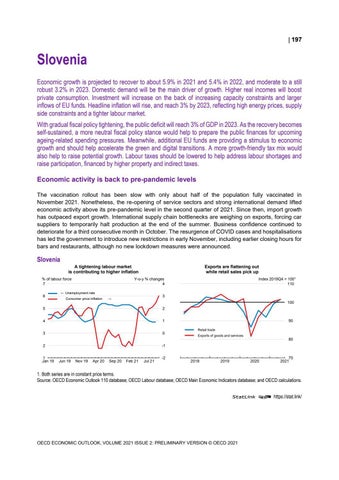
Slovenia Economic growth is projected to recover to about 5.9% in 2021 and 5.4% in 2022, and moderate to a still robust 3.2% in 2023. Domestic demand will be the main driver of growth. Higher real incomes will boost private consumption. Investment will increase on the back of increasing capacity constraints and larger inflows of EU funds. Headline inflation will rise, and reach 3% by 2023, reflecting high energy prices, supply side constraints and a tighter labour market. With gradual fiscal policy tightening, the public deficit will reach 3% of GDP in 2023. As the recovery becomes self-sustained, a more neutral fiscal policy stance would help to prepare the public finances for upcoming ageing-related spending pressures. Meanwhile, additional EU funds are providing a stimulus to economic growth and should help accelerate the green and digital transitions. A more growth-friendly tax mix would also help to raise potential growth. Labour taxes should be lowered to help address labour shortages and raise participation, financed by higher property and indirect taxes. Economic activity is back to pre-pandemic levels The vaccination rollout has been slow with only about half of the population fully vaccinated in November 2021. Nonetheless, the re-opening of service sectors and strong international demand lifted economic activity above its pre-pandemic level in the second quarter of 2021. Since then, import growth has outpaced export growth. International supply chain bottlenecks are weighing on exports, forcing car suppliers to temporarily halt production at the end of the summer. Business confidence continued to deteriorate for a third consecutive month in October. The resurgence of COVID cases and hospitalisations has led the government to introduce new restrictions in early November, including earlier closing hours for bars and restaurants, although no new lockdown measures were announced.
Slovenia A tightening labour market is contributing to higher inflation % of labour force 7 6
Exports are flattening out while retail sales pick up
Y-o-y % changes 4
← Unemployment rate Consumer price inflation
3
→
100
5
2
4
1
3
0
2
-1
1 Jan 19
Jun 19
Nov 19
Apr 20
Sep 20
Index 2019Q4 = 100¹ 110
Feb 21
Jul 21
-2
90 Retail trade Exports of goods and services
0
2018
2019
80
2020
70 2021
1. Both series are in constant price terms. Source: OECD Economic Outlook 110 database; OECD Labour database; OECD Main Economic Indicators database; and OECD calculations. StatLink 2 https://stat.link/
OECD ECONOMIC OUTLOOK, VOLUME 2021 ISSUE 2: PRELIMINARY VERSION © OECD 2021
198
Slovenia: Demand, output and prices 2018
2019
GDP at market prices Private consumption Government consumption Gross fixed capital formation Final domestic demand Stockbuilding¹ Total domestic demand Exports of goods and services Imports of goods and services Net exports¹ Memorandum items GDP deflator Harmonised index of consumer prices Harmonised index of core inflation² Unemployment rate (% of labour force) Household saving ratio, net (% of disposable income) General government financial balance (% of GDP) General government gross debt (% of GDP) General government debt, Maastricht definition³ (% of GDP) Current account balance (% of GDP)
45.9 23.9 8.4 8.8 41.1 0.9 42.0 38.9 35.0 3.9 _ _ _ _ _ _ _ _ _
2021
2022
2023
Percentage changes, volume (2010 prices)
Current prices EUR billion
Slovenia
2020
3.3 4.8 2.0 5.5 4.4 -0.9 3.3 4.5 4.7 0.3
-4.2 -6.6 4.2 -8.2 -4.7 0.1 -4.6 -8.7 -9.6 -0.1
5.9 7.6 1.7 10.9 6.9 1.0 9.6 10.1 13.3 -1.3
5.4 7.9 1.7 7.6 6.4 0.0 6.6 6.0 7.2 -0.5
3.2 3.4 1.1 5.7 3.4 0.0 3.3 4.2 4.5 0.0
2.2 1.2 2.4 3.0 3.3 1.7 -0.3 1.7 2.8 3.0 1.9 0.8 0.6 2.3 3.0 4.4 5.0 4.6 4.0 3.8 6.5 16.3 12.3 7.3 6.2 0.4 -7.7 -7.2 -5.1 -3.0 86.2 109.1 106.3 104.5 104.0 65.6 79.8 77.7 76.4 76.0 6.0 7.4 4.0 4.3 4.3
1. Contributions to changes in real GDP, actual amount in the first column. 2. Harmonised index of consumer prices excluding food, energy, alcohol and tobacco. 3. The Maastricht definition of general government debt includes only loans, debt securities, and currency and deposits, with debt at face value rather than market value. Source: OECD Economic Outlook 110 database.
StatLink 2 https://stat.link/xm8pce
The labour market has returned to its favourable pre-pandemic situation, with a fall in the unemployment rate by 1.4 percentage point since the beginning of the year. The tightening labour market has spurred strong wage growth in the private sector of around 6% over the year to August 2021, although part of the strong increase in remuneration may be explained by workers returning to employment from the short-time work scheme. Headline inflation accelerated to 3.5% in October, reflecting strong increases in energy prices and supply side constraints. Core inflation picked up due to service price increases as the service and tourism sector reopened.
Fiscal policy remains supportive Fiscal policy will remain expansionary in 2022. Additional support will come from the EU Recovery and Resilience Facility funds, which will on average provide 0.7% of GDP per year in additional investment over 2021-26, notably in health and the green and digitalisation transformations. The announced fiscal measures will, together with the strong economy, reduce the budget deficit to 5% of GDP in 2022. Despite the large deficit, gross debt will be reduced by using government reserves to buy back government bonds. In 2023, the fiscal stance will become less expansionary with a projected consolidation of around 1.7% of GDP as a result of the removal of one-off measures.
OECD ECONOMIC OUTLOOK, VOLUME 2021 ISSUE 2: PRELIMINARY VERSION © OECD 2021
199
Domestic demand will drive growth The projected strong growth in economic activity should close the output gap by 2023. The recovery will mostly be driven by domestic demand. Private consumption will benefit from further increases in real incomes on the back of a tightening labour market. Investment will rebound owing to increasing capacity constraints and inflows of EU funds. The buoyant labour market will drive the unemployment rate below pre-pandemic levels from the end of 2021. High energy prices will continue to drive headline inflation until mid-2022. Afterwards, continued real wage growth is expected to contribute to inflation, reflecting the tightening labour market, although immigration from other ex-Yugoslavian countries should dampen wage pressures to some extent. A downside risk is that a combination of stronger wage growth and prolonged supply shortages could fuel inflation expectations. Higher-than-expected insolvencies could add to supply side constraints. Also, the resurgence of the virus could potentially lead to new restrictive measures and lower domestic spending. On the upside, a faster resolution of international supply-chain problems would benefit export activity and strengthen growth.
Preparing public finances for upcoming challenges As the recovery becomes self-sustained, a more neutral fiscal policy stance would help to prepare the ground for shoring up fiscal sustainability. Meanwhile, the additional EU funds are providing economic stimulus and an opportunity to accelerate growth-enhancing public investment. To boost growth potential and promote fiscal sustainability, structural reforms to raise labour force participation and improve productivity should be accelerated. A more growth-friendly tax mix through further reductions in labour taxes financed by higher property and indirect taxation, would help raise long-term growth prospects. Productivity growth would benefit from stronger competition, through continued privatisation efforts, and a more flexible wage-setting process to help enhance reallocation of labour towards more productive sectors.
OECD ECONOMIC OUTLOOK, VOLUME 2021 ISSUE 2: PRELIMINARY VERSION © OECD 2021