203
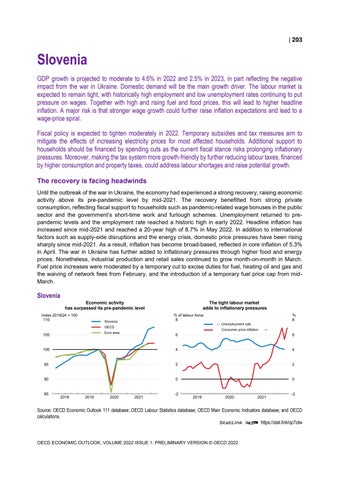
Slovenia GDP growth is projected to moderate to 4.6% in 2022 and 2.5% in 2023, in part reflecting the negative impact from the war in Ukraine. Domestic demand will be the main growth driver. The labour market is expected to remain tight, with historically high employment and low unemployment rates continuing to put pressure on wages. Together with high and rising fuel and food prices, this will lead to higher headline inflation. A major risk is that stronger wage growth could further raise inflation expectations and lead to a wage-price spiral. Fiscal policy is expected to tighten moderately in 2022. Temporary subsidies and tax measures aim to mitigate the effects of increasing electricity prices for most affected households. Additional support to households should be financed by spending cuts as the current fiscal stance risks prolonging inflationary pressures. Moreover, making the tax system more growth-friendly by further reducing labour taxes, financed by higher consumption and property taxes, could address labour shortages and raise potential growth. The recovery is facing headwinds Until the outbreak of the war in Ukraine, the economy had experienced a strong recovery, raising economic activity above its pre-pandemic level by mid-2021. The recovery benefitted from strong private consumption, reflecting fiscal support to households such as pandemic-related wage bonuses in the public sector and the government’s short-time work and furlough schemes. Unemployment returned to prepandemic levels and the employment rate reached a historic high in early 2022. Headline inflation has increased since mid-2021 and reached a 20-year high of 8.7% in May 2022. In addition to international factors such as supply-side disruptions and the energy crisis, domestic price pressures have been rising sharply since mid-2021. As a result, inflation has become broad-based, reflected in core inflation of 5.3% in April. The war in Ukraine has further added to inflationary pressures through higher food and energy prices. Nonetheless, industrial production and retail sales continued to grow month-on-month in March. Fuel price increases were moderated by a temporary cut to excise duties for fuel, heating oil and gas and the waiving of network fees from February, and the introduction of a temporary fuel price cap from midMarch.
Slovenia Economic activity has surpassed its pre-pandemic level Index 2019Q4 = 100 110
The tight labour market adds to inflationary pressures % of labour force 8
Slovenia
← Unemployment rate
OECD
Consumer price inflation
Euro area
105
% 8 →
6
6
100
4
4
95
2
2
90
0
0
85
2018
2019
2020
2021
0
-2
2019
2020
2021
-2
Source: OECD Economic Outlook 111 database; OECD Labour Statistics database; OECD Main Economic Indicators database; and OECD calculations. StatLink 2 https://stat.link/qc7otw
OECD ECONOMIC OUTLOOK, VOLUME 2022 ISSUE 1: PRELIMINARY VERSION © OECD 2022
204
Slovenia: Demand, output and prices 2018
2019
GDP at market prices Private consumption Government consumption Gross fixed capital formation
2021
2022
2023
Percentage changes, volume (2010 prices)
Current prices EUR billion
Slovenia
2020
45.9 23.9 8.4 8.8
3.3 4.8 2.0 5.5
-4.2 -6.6 4.2 -8.2
8.1 11.6 3.9 12.3
4.6 10.5 2.2 11.8
2.5 2.1 1.1 4.3
Final domestic demand Stockbuilding¹
41.1 0.9
4.4 -0.9
-4.7 0.1
10.0 0.8
9.0 0.0
2.4 0.0
Total domestic demand Exports of goods and services Imports of goods and services Net exports¹
42.0 38.9 35.0 3.9
3.3 4.5 4.7 0.3
-4.6 -8.7 -9.6 -0.1
10.8 13.2 17.4 -1.6
7.0 5.4 10.5 -3.7
2.4 3.4 3.3 0.2
_ _ _ _ _ _ _ _ _
2.2 1.7 1.9 4.4
1.2 -0.3 0.8 5.0
2.6 2.0 0.9 4.8
5.4 7.6 6.4 3.9
6.0 6.0 5.2 3.7
6.5 16.3 0.4 -7.8 86.6 109.7 65.6 79.8 6.0 7.4
11.0 -5.2 94.6 74.7 3.3
5.2 -3.7 93.0 73.5 -1.5
7.2 -3.6 92.8 73.3 -1.1
Memorandum items GDP deflator Harmonised index of consumer prices Harmonised index of core inflation² Unemployment rate (% of labour force) Household saving ratio, net (% of disposable income) General government financial balance (% of GDP) General government gross debt (% of GDP) General government debt, Maastricht definition³ (% of GDP) Current account balance (% of GDP)
1. Contributions to changes in real GDP, actual amount in the first column. 2. Harmonised index of consumer prices excluding food, energy, alcohol and tobacco. 3. The Maastricht definition of general government debt includes only loans, debt securities, and currency and deposits, with debt at face value rather than market value. Source: OECD Economic Outlook 111 database.
StatLink 2 https://stat.link/pxnlao
The war in Ukraine is a key source of uncertainty. Direct trade with Russia and Ukraine is low, although nearly all gas and 13% of oil and petroleum imports, or about 18% of total energy use, come from Russia. Higher energy prices and disruptions to supply chains are already weighing on consumer and business confidence. To ensure gas supplies in event of a Russian gas embargo, the government is in contact with other foreign suppliers and is taking steps to secure LNG capacity in other countries. The war in Ukraine has also led to an inflow of about 18 000 Ukrainian refugees in Slovenia by early May 2022.
Fiscal policy has been supportive The fiscal stance remained expansionary in early 2022. This reflected larger pension benefits due to higher pension indexation and replacement rates. Additional temporary public transfers included subsidies to households and businesses to mitigate the effects of increasing energy prices. These measures are expected to contribute to an expected budget deficit of 3.7% of GDP in 2022, implying a fiscal consolidation of about ½ per cent of GDP. Additional money from the Recovery and Resilience Facility funds will finance investment in the green and digitalisation transformations, boosting the inflow of total EU funds to an average of 2.2% per year over 2021-26. The fiscal stance has added to demand pressures at a time when monetary conditions are very accommodative in Slovenia.
OECD ECONOMIC OUTLOOK, VOLUME 2022 ISSUE 1: PRELIMINARY VERSION © OECD 2022
205
Growth will be driven by domestic demand GDP growth is projected to moderate, in part reflecting the negative impact from the war in Ukraine. The conflict will add to the already high inflation through higher energy and food prices, putting pressure on private consumption and investment. Nonetheless, economic activity will continue to expand, with the output gap projected to close in 2022. Economic growth will mostly be driven by private demand. Private consumption will benefit from real income increases due to a tight labour market. Investment will continue to expand, supported by inflows of EU funds. The labour market is expected to remain tight, with historically high employment and low unemployment rates continuing to put pressure on wages. Together with high and rising fuel and food prices, this will lead to high headline and core inflation in both 2022 and 2023. One major downside risk is stronger-than-expected wage growth, which together with high food and energy prices could fuel rising inflation expectations. Another important risk is an embargo on Russian gas supply. On the upside, a faster mobilisation of underutilised labour resources, as reflected in the low labour force participation of people older than 60, and increased immigration could help to reduce wage pressures.
Fiscal policy needs to manage demand pressures A faster fiscal consolidation is needed to reduce demand pressures. Additional support for the households most affected by the energy crisis should be financed by cuts to other government spending. Such efforts should be implemented alongside structural reforms to raise potential growth and prepare public finances for the fiscal challenges associated with population ageing. This includes a growth-friendly tax reform with lower labour taxes, financed by higher consumption and property taxation, as well as measures to promote later retirement and longer working lives.
OECD ECONOMIC OUTLOOK, VOLUME 2022 ISSUE 1: PRELIMINARY VERSION © OECD 2022